Est. 1996 PROVIDING EXQUISITE HANGERS TO THE WORLD’S BEST BRANDS European Manfacturing | FSC Certified ISO9001 Management Systems | EUDR Compliant info@hangersoflondon.com www.hangersoflondon.com
Discover the Advantages of Our European Manufacturing: Efficient, Ethical, and Compliant Wooden Hangers We are excited to introduce you to the benefits of partnering with our manufacturing network for wooden hangers, offering efficient, ethical, and compliant solutions. Choosing European manufacturing for your wooden hangers means more than just supporting local businesses. It also significantly reduces the carbon footprint of your products compared to far east alternatives. The geographical proximity translates into lower emissions from transportation, aligning your brand with environmentally conscious practices and helping you meet sustainability goals. High Capacity with 3-4 Week Lead Times Speed to market is crucial in today’s fast-paced retail environment. With a production capacity of 10,000 wooden hangers daily, we offer the scalability and efficiency to meet high-volume demands. This significant output ensures that we can provide competitive pricing that rivals far east manufacturers, giving you both cost savings and quality assurance. Our European facilities boast lead times of just 3-4 weeks for wooden hangers, which is a third of the time compared to far east manufacturers. This rapid turnaround allows you to respond swiftly to market demands, manage inventory more effectively, and reduce the risk of stockouts.
FSC Certified Our commitment to ethical operations is underscored by our FSC (Forest Stewardship Council) certification. This well-recognised accreditation guarantees that our wooden hangers come from responsibly managed forests that provide environmental, social, and economic benefits. Partnering with us means supporting sustainable practices and reinforcing your brand’s dedication to ethical sourcing. EUDR Compliant Starting December 2025, compliance with the European Union Due Diligence Regulations (EUDR) will be mandatory. Our proactive approach means we are already EUDR compliant, setting us apart in an industry where many retailers are not yet aware of this upcoming requirement. By choosing us, you can be confident that your wooden hanger supply chain meets future regulatory standards, avoiding potential disruptions and penalties.
We look forward to the opportunity to discuss how our manufacturing solutions can support your business needs. Please feel free to reach out with any questions or to schedule a consultation.
NEW YEAR NEW COLOURS
www.perspex.co.uk
www.perspex.co.uk/colour-selector-brochure
Download our Colour Selector brochure and see our extensive range of stocked colours and specialist finishes at your fingertips - maybe even find a new colour for your New Year projects! Perspex Distribution are the UK's leading supplier of coloured thermoplastics for fabricators and designers looking to stand out. Perspex® Cast Acrylic Hundreds of colour variants available from stock.
Alupanel Aluminium Composite The only UK manufactured ACM in a range of colours and speciality metallic finishes.
Palight Plus PVC Foam Premium PVC Foam colours for easy fabrication and print.
Plaskolite Fabback Acrylic Mirror The industry’s most durable backing in eye-catching colours.
Contact us for samples and pricing www.perspex.co.uk/colour-selector-brochure
Perspex Distribution Limited Registered in England No. 04625370 All Rights Reserved Perspex® is a registered trademark of Perspex International
CONTENTS
Follow RF:
24k+
35k+
14k+
GATEZERO 19
GERARD DAREL 22
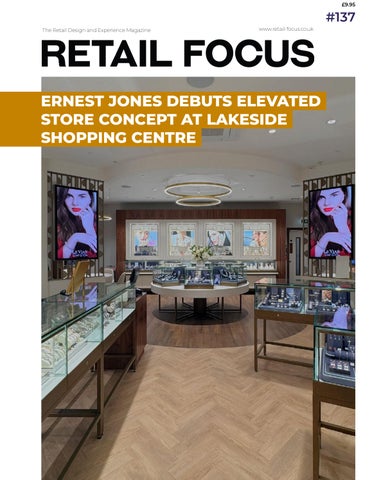
ERNEST JONES 20
NEWS..............................................8-17
FEATURE................................ 30-34
PROJECT FOCUS............... 19-20 Gatezero’s New Concept Store
PROJECT FOCUS................ 22-23 Gerard Darel Opens in London
PROJECT FOCUS................ 25-26 Ernest Jones Debuts Store Concept at Lakeside
PROJECT FOCUS................28-29 External Reference Designs The New Deportienda For Rc Deportivo De La Coruña
Lighting With Purpose
EXPERT VIEW.....................36-38 Six Things Luxury Pop-Up Store are Telling Retail Managers
FEATURE................................40-42 How Artificial Intelligence is Transforming Retail
EXPERT VIEW.................... 46-47
Why are you still designing brand strategy for survival instead of sustainable profit?
Q & A................................................. 58
With Antony Behiels, co-organiser of the Creative Retail Awards
5
HELLO... Hello and a very happy ‘Silly Season’ to you all! After what seemed like the longest summer we have ever had – complete with record temperatures and hosepipe bans galore – we are finally moving into the ever-colourful autumn months. Whether it is the leaves starting to fall from the trees, swapping T-shirts for sweatshirts to beat the chilly air outside or the ‘Great British Bake-Off’ returning to our screens, whatever signals the start of autumn for you, this represents an incredibly busy, yet exciting, time in the retail market.
Innovation is also clear to see at Gerard Darel, which recently opened its new flagship store on London’s Regent Street, inspired by a Parisian apartment (Page 22). Ernest Jones also debuted an elevated store concept at Lakeside Shopping Centre, with the aim of refreshing how customers navigate and experience its jewellery
October, November and December mark a hugely important period on the retail calendar. Of course, Christmas will always be the stand-out event, but when you also throw Halloween, Bonfire Night and Black Friday into the mix, the promotional and sales opportunities come thick and fast for retailers – and it is crucial to stay ahead of the game to make the most of these occasions. This issue of Retail Focus features plenty of examples of those who are innovating to stand out from the crowd, as well as a whole host of hints and tips on how retailers can kick it up a gear and ensure they do not fall behind. Take Gebr and its Gatezero airport concept store as just one example; the travel retailer has moved beyond traditional duty free to create a unique destination for travellers at Frankfurt Airport. See Page 19 for more details.
(Page 25). Of course, we cannot speak about innovation without referencing AI, which played a key role in External Reference’s work on the new Deportienda of RC Deportivo de La Coruña, located at the Abanca-Riazor Stadium in Spain (Page 28). For more insight into the role AI has to play in retail, see our focused feature on Page 40. We have other words of wisdom from industry experts on everything from using lighting to influence shopper behaviour (Page 30), to how to succeed with luxury popup stores (Page 36). Enjoy this issue. Season’s Greetings (or is it still too early for all that?)
CONTENT DIRECTOR Lee Cullumbine 07949 781817
Get more from Retail Focus online! For subscription enquiries please email: lee@retail-focus.co.uk Retail Focus is published by LTC Digital Ltd No part of Retail Focus may be reproduced, stored in a retrieval system or transmitted in any form without permission. Please address all enquiries to the editor at the above address. The opinions expressed in Retail Focus are the views of the writer and do not necessarily reflect the views and opinions of the publisher. Every effort has been made to ensure accuracy of the information contained in these pages. We will assume permission to publish any unsolicited material unless otherwise stated. LTC digital Ltd.
www.retail-focus.co.uk 24k+
37k+
4k+
3k+
14k+
DIARY
THE CREATIVE RETAIL AWARDS
MAPIC
Clapham Grand, London / 15th October 2026
Cannes, France | 3 - 4 November 2026
The Creative Retail Awards are much more than a mere accolade; they represent a pinnacle of achievement in the retail industry. The Creative Retail Awards feature 20 expertly curated categories, offering a broad platform for retailers, brands, agencies, and suppliers to showcase their achievements. This diverse range of categories culminates in an unparalleled awards ceremony, celebrating the remarkable talents and accomplishments within the retail sector. Participation in these categories is not only a recognition of success but also a pivotal moment that can shape the future trajectory of those in the retail industry.
MAPIC is the International retail real estate event to build the ultimate lifestyle and shopping destinations. It is an opportunity to learn network with key players at the centre of the retail property industry’s transformation, and be part of creating the exciting new business models that are shaping the places to live, play and shop of the future.
www.creativeretailawards.com
CHRISTMASWORLD Frankfurt AM Main | 29 January 2 February 2027 As the leading international trade fair for seasonal decorations and festive decorations, Christmasworld opens up effective design possibilities to surprise customers. For new synergies that offer added value.
www.christmasworld. messefrankfurt.com
8
The 30th edition of MAPIC is introducing an optimised and efficient two-day format (4-5 November).
www.mapic.com
DIARY SURFACE DESIGN SHOW BDC London | 2 - 4 February 2027 Surface Design Show is an event dedicated to surface material innovation. It is the event of choice for architects and designers to see, source and specify the latest and most inspiring internal and external surface materials from over 180 exhibitors. We look forward to welcoming you back to the Business Design Centre, next year for Surface Design Show 2025, 3-5 February 2026!
www.surfacedesignshow.com
INTEGRATED SYSTEMS EUROPE
VM & DISPLAY AWARDS
FIRA Gran Via, Gran Vila | 2 - 5 February 2027
London | 4 March 2027
Integrated Systems Europe is the world’s leading
The only event dedicated to celebrating excellence
audiovisual
exhibition,
and innovation in the retail visual merchandising and
showcasing technology innovators and solutions
display sector, the VM & Display Awards have been
providers from around the world, and featuring
successfully running for 30 years, and as a standalone
inspiring conferences, events and experiences.
event in its current format for 19 years. Held annually
The annual four-day event, which takes place every
together the UK’s most influential creatives, retailers
February, is organised and run by Integrated Systems
and suppliers in celebration of their considerable
Events.
achievements for projects installed.
www.iseurope.org
www.vmanddisplayawards.com
and
systems
integration
in an iconic, Central London location, the Awards bring
9
NEWS
SEPHORA UK AND HOLLISTER PICK BRENT CROSS FOR LATEST STORES Hammerson announces that global beauty retailer Sephora UK and lifestyle casualwear brand Hollister will open new stores at Brent Cross, building on a series of openings during the destination’s 50th anniversary year. These latest brand investments follow the exchange of 18 lease agreements in the first half of 2026, supporting a strategy to attract a broader customer base. The new Sephora UK store will occupy approximately 4,500 sq ft of space and will open in the winter. It will provide Sephora UK’s world-renowned beauty experience to customers in North London for the first time, including sought-after brands and “Only At Sephora” favourites, alongside expert advisors, personalised services and immersive experiences. The store will be the sixth Sephora in Hammerson’s portfolio and further highlights the role of strong brand partnerships. Hollister is also joining Brent Cross’s line-up with a new 6,500 sq ft store, bringing its globally recognised youth fashion brand offering casual, California-inspired apparel and accessories to the destination. Its offer is targeted at a teen and young adult customer base through its on-trend, accessible fashion offer.
VIRGIN ATLANTIC HOLIDAYS LANDS AT BATTERSEA POWER STATION WITH NEW LONDON FLAGSHIP STORE Virgin Atlantic Holidays is expanding its retail network into London with the opening of a new flagship store at Battersea Power Station, marking a major milestone in the brand’s retail expansion and bringing its premium holiday expertise to one of the capital’s most iconic destinations. Opening later this year in the restored Grade II* listed landmark, the store has been designed to inspire customers at every stage of their holiday journey. From luxury escapes, multi-centre adventures, family holidays or once-in-a-lifetime experiences, customers will enjoy personalised, expert advice from dedicated travel specialists, creating bespoke long-haul holidays individually tailored to their interests. The opening represents a significant investment in Virgin Atlantic Holidays’ retail strategy and forms part of the brand’s ambition to become the premium long-haul holiday provider of choice. With its landmark setting, riverside location and strong retail and leisure mix attracting thousands of visitors each week, Battersea Power Station provides the perfect home for the flagship store, allowing Virgin Atlantic Holidays to connect with more customers seeking expert guidance and inspiring travel experiences.
TRAFFORD CENTRE STRENGTHENS PREMIUM RETAIL OFFER WITH ARRIVAL OF INTERNATIONAL MENSWEAR BRAND SUITSUPPLY Trafford Centre has announced that international menswear retailer Suitsupply will open a new store at the destination in spring/summer 2027, further strengthening its premium fashion offering and reinforcing continued retailer confidence in one of the UK’s leading retail and leisure destinations. Founded in Amsterdam in 2000, Suitsupply has grown into one of the world’s leading premium menswear brands, operating more than 150 stores globally. Renowned for its contemporary tailoring and madeto-measure services the retailer’s arrival reflects growing demand for premium fashion brands within retail destinations. The new store will showcase Suitsupply’s full range of tailoring and elevated casualwear, from suits, jackets, and outerwear to shoes and accessories, as well as the brand’s Custom-Made Program and on-demand alterations by in-house tailors.
10
FRENCH CONNECTION JOINS PREMIUM BRAND LINE-UP AT FRASERS PLUS DESIGNER OUTLET LEEDS
NEWS
British fashion brand French Connection has officially opened at Frasers Plus Designer Outlet Leeds, becoming the latest nationally recognised retailer to join the destination’s growing premium fashion line-up. The new store also introduces French Connection’s latest retail concept to the outlet, creating a contemporary shopping environment featuring a brand-new shop fit, statement visual merchandising, illuminated branding and modern design throughout. Home to more than 85 brands, Frasers Plus Designer Outlet Leeds continues to strengthen its retailer mix with the addition of nationally recognised names. Combined with cafés, restaurants, free parking and year-round savings of up to 70% off RRP, the destination continues to enhance its appeal for both shoppers and retailers.
ACTIVATE LAUNCHES INTO HARLEQUIN WITH A REGIONAL DEBUT Hertfordshire’s leading retail and leisure destination, Harlequin Watford, which is owned and managed by SGS UK Retail, has announced that the immersive gaming concept, Activate, has now opened within the centre, bolstering Harlequin’s diverse tenant mix of retail, F&B, and leisure occupiers. Activate, which has taken a 15,592 sq ft unit, joins Harlequin’s evolving leisure offering, alongside Cineworld, Boom Battle Bar and Flip Out, affirming the centre’s position as both a thriving dual-purpose retail destination and a focal point for leisure and entertainment. Following Activate’s success within its London sites, and its global success across Canada, the US, and Dubai, SGS identified its popularity, along with the needs and wants of its visitors to open the brand’s 3rd destination outside of the capital. The regional debut cements Harlequin’s reputation as a key regional destination for visitors from across north London, Hertfordshire and Buckinghamshire.
CENTRE MANAGER APPOINTED AS GROWING FLEMINGATE CENTRE WELCOMES NEW OCCUPIERS An experienced new Centre Manager has been appointed at the Flemingate centre in Beverley, East Yorkshire, as more occupiers come on board and visitor numbers grow. Amy has now been recruited by Flemingate’s owner and operator, Wykeland Group, with a remit to build on the centre’s success as it continues to buck high street retail trends and contributes to Beverley being recognised as one of the North of England’s most attractive market towns. Amy said: “I’m excited to work closely with our tenants and to play an active role in the events and activities that make Flemingate such an important and popular destination. “My focus is on building relationships, streamlining processes and continually improving the experience for both our tenants and visitors to the centre.
11
NEWS
WORTH THE WEIGHT: FACEGYM CONTINUES UK EXPANSION WITH SIGNING AT REDICAL’S VICTORIA LEEDS Victoria Leeds, owned and operated by Redical, has announced that facial fitness brand FACEGYM has signed for its second standalone studio in the UK outside of London, representing another step in the destination’s commitment to providing a truly diversified and unique tenant mix. The 1,772 sq ft studio, located in Victoria Gate, has been designed to deliver FACEGYM’s signature high-energy, immersive massage concept to one of the UK’s leading retail hubs. The brand will offer clients unique, non-invasive facial workouts, combining advanced massage techniques, cutting-edge technology and performance-led skincare to lift, sculpt and strengthen the skin. With expert trainers, personalised treatments and the brand’s award-winning skincare range, the studio brings a fresh approach to self-care in the heart of Leeds. The milestone signing speaks to Victoria Leeds’ status as a leading lifestyle hub with a committed, engaged, and affluent consumer base. The new addition reflects the growing demand for science-backed beauty and wellness experiences across the UK, and demonstrates Victoria Leeds’ ability to deliver beyond a traditional retail and F&B offer.
QUEENSGATE ANNOUNCES MORE THAN £3M OF TENANT INVESTMENT IN OVER 100,000 SQ FT OF STORE REBURBISHMENTS Queensgate Peterborough has announced more than £3 million of tenant investment spanning more than 100,000 sq ft, with leading high street brands, Boots, Primark and Vision Express, all reaffirming their commitment to the destination through significant store refurbishments. Boots has unveiled its newly refurbished 64,000 sq ft store, featuring the retailer’s latest interior concept and an enhanced beauty proposition, centred around its most in-demand premium brands. Meanwhile, Primark has completed an impressive full refurbishment of its 59,000 sq ft anchor store. The investment introduces a modernised store environment, an improved layout, and 18 new self-checkouts across both trading floors, creating a more efficient customer journey. Vision Express has also reopened its updated store in Central Mall, introducing a contemporary new design alongside enhanced clinical technology, including a new dry eye machine. Queensgate’s ability to attract leading brands and deliver what its visitors want is a clear indicator of the active asset management strategy.
Westfield Rise and Disney UK expand Disney and Pixar’s “Toy Story 5” inspired activity across Westfield London and Stratford City Westfield Rise, the in-house media agency of Unibail-Rodamco-Westfield (URW), has launched the second phase of its integrated “Toy Story 5”-inspired experiential activity, extending across both Westfield London and Westfield Stratford City during the peak summer holiday period. The immersive experience celebrates the cinema release of Disney and Pixar’s “Toy Story 5” which continues to play in cinemas, having crossed the $1B global box office mark. The expanded programme builds on an initial “Toy Story” activation launched at Westfield London in June, which transformed the destination with a series of Gen Z ‘fan’ focused experiences. Visitors took part in interactive challenges including a claw machine photo opportunity, a Disney Lorcana card themed spin to win game with prizes and access to archived “Toy Story” content. Through the combination of immersive experiences and Westfield Rise’s onsite media network and destination marketing channels, the campaign demonstrates how brands can amplify storytelling, extend reach and drive deeper audience engagement across the customer journey.
12
Wands at the ready, magic is coming home! Warner Bros. Discovery Global Experiences is opening the UK’s largest official Harry Potter Shop on 4 November 2026 at The Ribbon, 134–140 Oxford Street, creating the ultimate Harry Potter shopping destination in the heart of London Spanning a total of more than 21,000 square feet, with two levels of retail space, the Oxford Street flagship is inspired by Diagon Alley, bringing one of the wizarding world’s most iconic locations to life through immersive environments, enchanting discoveries and exclusive experiences around every corner. Visitors can explore beautifully themed spaces, discover one-of-a-kind products and uncover magical moments created especially for witches, wizards and Muggles alike. Warner Bros. Discovery has also unveiled the first official concept artwork for the shop, offering fans an exciting first glimpse inside the magical new destination ahead of its opening this November.
LINDT DELIGHTS CENTRE:MK WITH THE OPENING OF ITS NEW CONCEPT STORE One of the UK’s top ten prime retail destinations, has announced the opening of Lindt, the premium Swiss chocolatier, adding to the centre’s already extensive bestin-class tenant mix and signalling growing investment from new brands. Lindt has launched in a 1,670 sq ft boutique on Silbury Arcade, and joins a critical massof premium retail brands, such as Mint Velvet, The White Company, Space NK and Reiss, reinforcing centre:mk’s position as the regional destination for leading brands and elevated retail concepts. Lindt at centre:mk features the brand’s latest design concept, which offers guests an immersive chocolate experience, such as Lindt’s iconic Pick & Mix selection, exclusive gifts, and personalisation. The boutique also includes unique features and trending flavours, from Tokyo Style Chocolate Matcha and Strawberry, and LINDOR Cherry Blossom.
Redevco welcomes Waitrose to Chelmer Village Redevco’s Chelmer Village Retail Park in Chelmsford has been selected for Waitrose’s newest store, marking a significant milestone for both Waitrose and the scheme’s owner, Redevco and taking the park to fully let. The new store is Waitrose’s latest, comprising approximately 10,055 sq ft, including a 7,000 sq ft sales area, alongside two dedicated trolley bays within the car park. Leasing momentum has gathered pace across Redevco’s portfolio in recent months. The Food Warehouse by Iceland has recently replaced Carpetright at Bolton Gate Retail Park. In Staines, The Range took over Homebase’s lease at the beginning of 2025 and subsequently committed to a new lease in December 2025, underlining its continued confidence in the location and trading performance.
13
NEWS
The UK’s largest official Harry Potter Shop to open on Oxford Street on 4th November 2026
NEWS
JACK&JONES TO LAUNCH AT BLUEWATER THIS AUTUMN Bluewater has announced that Danish brand,Jack&Jones, is set to open a brand-new store this October. The 6,370 sq ft store will be located on the Lower Thames Walk next to Stradivarius and will feature the brand’s selection of menswear and childrenswear. The new location will also be only the second in the UK to feature the brand’s ‘One Concept’ design. First introduced in late 2024 with the launch of the brand’s Jack&Jones and JJXX store on Oxford Street, the ‘One Concept’ design offers guests a sleek, modern, and highly curated store environment that simplifies the shopping journey. The store will showcase the brand’s selection of trend-led product ranges, everyday essentials and core denim collections for men, alongside the largest kids’ collection across the brand’s UK stores.
GOLDSMITHS REOPENS ITS NEWLY REFURBISHED SHOWROOM IN WATFORD This week, Goldsmiths, one of the UK’s leading luxury watch and jewellery retailers and part of the Watches of Switzerland Group, has unveiled its refurbished showroom in Watford. Located on the Upper Mall of the Harlequin shopping centre in the heart of Watford, the showroom boasts a fresh interior and a major expansion into the adjacent unit of the current Goldsmiths showroom, increasing the floorspace from 1528 sq. ft to 3875 sq. ft. The expanded showroom features dedicated branded areas for worldleading watchmakers Rolex, Tudor, TAG Heuer, Breitling, Longines and Tissot. Each area is thoughtfully designed to reflect the unique identity of each brand, allowing clients to immerse themselves in the luxury and craftsmanship that the timepieces represent. Complementing
the
exceptional
watch
offering,
Goldsmiths
introduces a dedicated jewellery area for renowned brands Roberto Coin and FOPE, showcasing a stunning selection of jewellery alongside Goldsmiths’ own expertly crafted collections.
SUPERDRY & CO TO BRING TIMELESS STYLE TO LINCOLN WITH WATERSIDE OPENING Superdry & Co is to open at the Waterside centre in Lincoln, as part of an ambitious programme of new locations in 2026. The iconic fashion brand has committed to an 11,200 sq ft unit across two floors at the retail and leisure destination. The Superdry & Co fit-out has now begun, with the store due to open on Friday, July 31. The ground floor will be dedicated to womenswear, with menswear occupying the upper level, creating a substantial new presence for the retailer in the heart of Lincoln. The arrival of Superdry & Co at Waterside will add to the 130,000 sq ft centre’s retail line-up, which features leading brands such as H&M, Next, Rituals, The Body Shop, New Look, Accessorize and Office. The letting is a further boost for Waterside, which has been rejuvenated under the ownership of commercial property and investment business Wykeland Group, first in a joint venture with Lincolnshire Co-op and, since earlier this year, as the sole owner.
14
NEWS
A NEW ERA FOR LAKESIDE AS TRANSFORMATION OF BROMPTON ARCADE UNVEILED Lakeside, the UK’s sixth-ranked out-of-town super-regional destination owned and operated by SGS UK Retail, has announced the unveiling of Brompton Arcade, formerly Brompton Walk, and its strategic repositioning as a vibrant hub for independent businesses, local entrepreneurs and experience-led operations. Brompton Arcade’s new identity marks the latest move in Lakeside’s evolution and signifies the destination’s active step change under SGS’s leadership. Located on Level 2 and serving as a gateway to the lake and its growing programme of sporting, leisure and outdoor activations, Brompton Arcade’s vision is to curate and support ambitious, independent and experience-led brands, providing them with greater visibility, operational support and access to Lakeside’s annual footfall of 17 million visitors. Local and independent operators will have the opportunity to trade alongside leading brands in a dynamic, evolving environment, including anchor brands FLANNELS, Reiss and Beaverbrooks. Placemaking enhancements include the introduction of new seating, extensive planting and a programme of creative activations, including changing community art installations.
ARNE BECOMES LATEST DESIGNER BRAND TO JOIN CATHEDRAL STREET LINE-UP Manchester Arndale is set to welcome modern luxury fashion retailer Arne to New Cathedral Street. The new city centre store will mark one of the brand’s first physical locations following its launch in Liverpool, further strengthening New Cathedral Street’s position as a key retail destination for digitally native brands expanding into bricks-and-mortar. Founded in 2018, Arne built its reputation through an e-commerce platform and a strong social media following before expanding into physical retail. The brand specialises in elevated everyday essentials, including contemporary menswear, footwear and accessories. Arne opened its first permanent bricksand-mortar flagship in Liverpool in September 2025, following a series of successful pop-ups, marking a significant milestone in its evolution from e-commerce to omni-channel retailer. The New Cathedral Street store will occupy 2,720 sq ft on a 10-year lease and is scheduled to open in June.
BERGHAUS PICKS MANCHESTER ARNDALE FOR FIRST NORTH WEST STANDALONE STORE Berghaus, the iconic British outdoor clothing and equipment brand established in the North of England 60 years ago, will open the doors to its new Manchester Arndale store – its first ever standalone retail space in the North West – later this year. Since its founding in 1966 by mountaineers Peter Lockey and Gordon Davison, Berghaus has been at the cutting edge of the outerwear technologies that get elite-level athletes and explorers to the most extraordinary places in the world, through the most challenging weather. Fuelled by its belief that the outdoors belongs to everyone, the brand has also earned a diehard following with young consumers fuelled by the rise of gorpcore and athleisure.
15
NEWS
PRIMARK REACHES NEW GROWTH MILESTONE AS IT OPENS ITS 500TH STORE La Cartiera Shopping Centre, Naples, Italy becomes the international retailer’s 500th store Primark today reached a major milestone with the opening of its 500th store in Naples, Italy, underlining the enduring strength of its store-led model and continued international growth. From a single store in Dublin, Ireland, in 1969, Primark has grown to serve millions of customers across 19 countries in Europe, the US and Middle East. Together, its 500 stores represent around 20 million square feet of retail space, bringing Primark’s distinctive combination of great fashion, quality and unbeatable value to customers around the world. Today, Primark employs more than 80,000 colleagues representing 190 nationalities. Its distinctive store-led operating model remains central to its customer proposition and a key competitive advantage as the business continues to grow internationally. From Manhattan to Milan, Manchester to Madrid, Primark has invested in creating distinctive retail destinations on high streets, shopping centres and retail parks around the world. Its stores give it scale, visibility and a direct connection with millions of customers, bringing together Primark’s value leadership with quality product offering within Primark’s unique store experience.
AURÉLIEN BRINGS ITS SIGNATURE VISION OF QUIET LUXURY TO KNIGHTSBRIDGE, LONDON Aurélien, the luxury lifestyle brand renowned for its refined approach to timeless elegance and exceptional craftsmanship, is pleased to announce the opening of its new flagship store in London, located in the heart of Knightsbridge, moments from Harrods. The new boutique marks a significant milestone in Aurélien’s continued international expansion, complementing the brand’s existing retail locations and bringing its distinctive world of understated luxury to one of the world’s most prestigious shopping destinations. Designed to reflect Aurélien’s commitment to quality, comfort and sophistication, the 3,200 sq ft space offers customers an immersive experience across the brand’s collections, from iconic outerwear and knitwear to footwear and accessories. Natural materials, warm textures and considered detailing create an environment that embodies the essence of the Aurélien lifestyle.
ALL SYSTEMS GO: BERSHKA, HOLLISTER, OLIVER BONAS, AND URBAN OUTFITTERS LAUNCH AT LAKESIDE Lakeside, the UK’s sixth ranked out-of-town super-regional destination owned and operated by SGS UK Retail, has welcomed a quartet of leading retailers Inditex-owned Bershka, Hollister, Oliver Bonas, and Urban Outfitters – further strengthening its position as one of the UK’s leading lifestyle locations. The arrivals enhance the depth and diversity of Lakeside’s retail offer, responding to sustained visitor demand for an expanded fashion proposition. The openings build on over £100 million of investment by retail occupiers at Lakeside over the past three years, underlining continued retailer confidence in Lakeside’s performance and long-term growth. The momentum continues later this year with the opening of Lefties, making Lakeside home to five of Inditex’s eight brands, alongside Zara, Pull&Bear, Bershka and Stradivarius. Collectively, Inditex will occupy more than 125,000 sq ft at Lakeside by the end of the year, reinforcing the destination’s status as a flagship UK location for globally recognised fashion retailers.
16
THE O2 BASKS IN ETERNAL SUNSHINE WITH RECORD-BREAKING AUGUST
NEWS
Demand for shared experiences drives double-digit growth across retail and hospitality at London’s best-performing outlet London’s best-performing outlet, and the adjacent Entertainment District, which is home to The O2’s F&B offer, delivered their strongest-ever sales performances in August since opening in 2018. Retail sales in the month grew by 11%, significantly ahead of the BRC’s UK average of just 0.7%, while F&B spend increased by 16% versus August 2025. Footfall also grew year-on-year, with a 5% increase compared to 2025. For Outlet Shopping at The O2, standout categories included fashion and accessories, which celebrated uplifts in August sales of 26% and 31%, respectively, versus 2025. This has been bolstered by the likes of Kate Spade, Reiss, Lovisa, and Carvela, highlighting the continued strength, appeal, and building momentum behind the destination’s retail offer.
A SWEET REGIONAL DEBUT AS QUEENSGATE SIGNS VANILLA TO BOLSTER FASHION MIX Queensgate Peterborough has announced that trend-led fashion brand Vanilla has signed for its regional debut at Queensgate, further evidencing the impact of its recent retail transformation. The 3,622 sq ft store will house both Blue Vanilla, its wide-appeal womenswear proposition, and Pink Vanilla, its younger, trend-led offer targeting 12- to 24-yearolds. It will deliver a diverse fashion offer designed to appeal to Queensgate’s broad customer base. Pink Vanilla will offer an extensive range of trend-led clothing and accessories aimed at Gen Z shoppers, while Blue Vanilla will provide more elevated day-to-night pieces designed to appeal to a wider demographic and suit a range of occasions. The signing of Vanilla follows a trio of refit investments from leading high street brands Primark, Boots, and Vision Express, affirming its position as a top 1% UK retail destination.
OLE & STEEN OPENS NEW ST.PAUL’S BAKERY THIS NOVEMBER AS IT MARKS 10 YEARS IN LONDON Danish bakery and coffee house Ole & Steen is set to expand its London estate with a new bakery in St Paul’s at the beginning of November, as the established brand celebrates 35 years of baking and more than a decade in the UK. The opening follows a record year for the business, which reported a turnover of £40.2 million in 2025, up £3.5 million year on year, while like-forlike sales rose 10.3% and customer numbers grew 7.1%. Located at 141 Cheapside, the new bakery will offer a capacity of 32 covers inside and 8 outside, becoming a new hub for City workers, residents and visitors alike to enjoy Ole & Steen’s all-day menu. The store will launch with two self-service kiosks and digital menu boards, combining Ole & Steen’s familiar bakery experience with a more streamlined format designed for the pace of the City. Founded in Denmark in September 1991, Ole & Steen has spent 35 years developing its coffee house concept around Danish baking traditions, quality ingredients and craft. The St. Paul’s opening marks another milestone in the brand’s continued UK expansion, following the launch of its inaugural bakery in St. James in 2016.
17
PROJECT
GATEZERO’S NEW CONCEPT STORE LANDS AT FRANKFURT AIRPORT Global retail experience design agency Checkland Kindleysides has created a new elevated concept store for GATEZERO, the experimental style platform operated by leading travel retailer Gebr. Heinemann.
GATEZERO is no ordinary airport concept store. Bringing
travellers out of the terminal flow and into the GATEZERO
together high-end fashion, sneakers, accessories, beauty,
world. Inside, polished surfaces, technical geometries
pre-loved pieces and limited-edition drops, the brand
and gallery-like product presentation create a refined but
sits at the intersection of travel retail, contemporary
energetic atmosphere, allowing the curated product mix to
fashion culture and new luxury. For Gebr. Heinemann
lead the experience.
and Checkland Kindleysides, the ambition was to move the experience beyond traditional duty free, creating a destination with the cultural energy and curatorial confidence of a must see concept store.
Brands including Acne Studios, Off-White, Comme des Garçons and Prada sit alongside pre-loved pieces and exclusive drops, turning the store into a destination for rarity, relevance and unexpected discovery en route. The
Located at Frankfurt Airport and designed to coincide
new GATEZERO concept reframes the role of airport retail.
with the launch of its state-of-the-art Terminal 3 - the new
Not as a place to simply pass through, but as a culturally
concept marks a sharper, more premium expression of the
charged destination for travellers who expect more before
GATEZERO brand. It is designed for fashion-forward global
they fly.
travellers who define luxury less by status and more by cultural credibility, discovery and access to what’s next. Envisioned as a “portal to a world between worlds”, the design approach fuses the design codes of air travel with the visual language of street style. Technical aviation, playful luxury and contemporary fashion culture come together through a sculptural spatial language that feels precise, progressive and tuned to a new luxury consumer. At the entrance, a dark-framed gateway and oversized circular portal create an immediate sense of intrigue, pulling
19
PROJECT
Key Design Details/Destinations: Aviation-inspired storefront: The storefront is designed as a gateway into the GATEZERO world. A dark-framed entrance and oversized -inspired window installation creates bold first impression while capturing the spirit of modern travel and cultural exploration. Frankfurt-coded
materiality:
Smoked
tinted
glass
references Frankfurt’s modern cityscape and high-rise architecture, creating a subtle connection between the airport environment and the city beyond. This architectural perimeter gives the store a sharper local identity while maintaining a premium international feel. Fuselage interior palette: An off-white and cream interior palette, inspired by fuselage-painted metals, gives the store a clean, aerodynamic quality. Polished surfaces and engineered details bring precision, lightness and technical refinement into the space. Technical geometry: The spatial language is built around technical geometries and sculptural forms, translating the functional world of aviation into a more elevated retail environment. Fixtures, portals and display systems feel precise, progressive and purposefully engineered. Playful luxury VM: Familiar airport cues are abstracted and reimagined as premium display moments. Refined security trays become sculptural visual merchandising tools, blending playful luxury with aviation design codes and creating unexpected moments of product discovery.
Adaptable
digital
storytelling:
Digital
screens
are
integrated on engineered, adaptable arms inspired by aviation equipment, departure boards and mobile stair systems. This brings movement, flexibility and campaign energy
into
the
store
without
compromising
the
architectural clarity of the space. First-class
footwear
lounge:
The
footwear
lounge
introduces the comfort and exclusivity of international air travel, it combines retro-future seating, modern pop-art colour accents and a built-in speaker system with spatial audio. The result is a first-class environment for fashion discovery and high-heat product moments.
20
PROJECT
GERARD DAREL OPENS ITS NEW REGENT STREET FLAGSHIP IN LONDON GERARD DAREL marks a defining moment in its international expansion with the opening of its new corner flagship at 221 Regent Street, London, alongside the unveiling of its Autumn Winter 2026 campaign starring Dree Hemingway for a second consecutive season.
A PARISIAN FLAGSHIP ON REGENT STREET Conceived as a Parisian’s London apartment, the new GERARD DAREL flagship blends French sensibility with cosmopolitan influence. Spanning 180 square metres across two floors, the space welcomes customers into
significant step in our UK development, strengthening our connection with British and international customers who value craftsmanship, timeless style and modern femininity,” said David Maruani, Chairman of GERARD DAREL.
DREE HEMINGWAY RETURNS FOR AUTUMN WINTER 2026
a curated environment of art, vintage furnishings and artisanal objects, showcasing the Maison’s collections
Dree Hemingway returns for a second season as the face of
in an atmosphere of warmth, culture and understated
GERARD DAREL, deepening a partnership built on shared
sophistication.
values of natural confidence and effortless style.
The interior combines soft architectural lines with terrazzo,
Raised in Sun Valley, Idaho, Dree Hemingway grew up
travertine, wrought iron, warm oak and elm wood, expressing
surrounded by nature, silence and freedom. Heir to a
GERARD DAREL’s dedication to authenticity, craftsmanship
celebrated name and shaped by deep artistic sensibility,
and timeless design.
she later refined her craft at London’s Royal Academy of
The Regent Street flagship complements the brand’s
Dramatic Art. Today, her life between Paris and Los Angeles
established Marylebone High Street and King’s Road
reflects a balance of structure and spontaneity, femininity
boutiques, offering the full collection of ready-to-wear,
and masculinity, a duality that feels instinctively at home
accessories and iconic pieces including the 24H Bag, Anna
within the world of GERARD DAREL.
Jeans and the signature trench.
A wardrobe worn with ease. Tailored men’s jackets draped
“Regent Street, with its unique blend of heritage and
effortlessly over the shoulder. Rich textures, precise
cosmopolitan energy, is the ideal setting to express GERARD
tailoring, signature coats and luxurious knitwear define the
DAREL’s effortless Parisian spirit. Our new corner flagship
season. Every silhouette is grounded in detail, attitude and
serves as a powerful window to the world and marks a
timeless ease.
22
PROJECT
GLOBAL EXPANSION & STRATEGIC GROWTH Building on strong international momentum, GERARD DAREL continues to expand across key global markets. The Maison has reached £137 million in turnover, delivering consistent 10% year-on-year growth, with a positive outlook through 2026. Today, GERARD DAREL
operates 250 owned boutiques
and shop-in-shop locations, alongside 230 wholesale and franchise partners, reinforcing its international footprint. The Regent Street corner flagship is a strategic milestone within this expansion, reinforcing the brand’s UK and international presence following recent flagship openings on Dree brings the same natural confidence to the campaign as
Madison Avenue in New York, as well as in Dubai and China.
she does to the screen. From ‘Starlet’ to collaborations with Noah Baumbach and Alex Ross Perry, and most recently American Love Story. Her performances are defined by restraint, sincerity and emotional depth, qualities long shared by GERARD DAREL. Captured through intimate moments in Paris strolling through its streets, along the banks of the Seine, the Autumn Winter 2026 campaign embodies the Maison’s timeless French elegance and effortless femininity. Together, the opening of the Regent Street flagship and Dree Hemingway’s return mark an exciting new chapter for GERARD DAREL.
Our vision is to bring Parisian elegance to every corner of the world while staying true to the authentic spirit of the brand David Maruani
23
We make successful stores. Where ideas become unforgettable spaces. A first-class understanding of the market and a comprehensive focus on the needs of our customers make us your trusted partner for sophisticated Retail Environments.
umdasch Store Makers United Kingdom Ltd. The Lambourn | Wyndyke Furlong | Abingdon | OX14 1UJ | United Kingdom premium@umdasch.com
www.umdasch.com
Ernest Jones has unveiled a new store concept at Lakeside Shopping Centre in Thurrock, UK, designed by Briggs Hillier to rethink how customers navigate and experience its jewellery offer.
The new format is organised around different customer missions, from browsing and discovery through to considered purchases and one-to-one consultation. The aim is to create clearer product zones, make categories easier to navigate and give greater prominence to the Ernest Jones Diamonds Collection, particularly around occasions such as engagements and weddings. The concept has also been developed with smaller-footprint stores in mind, combining product presentation with improved functionality for colleagues. “Working closely with the Ernest Jones team, we applied our experience in retail strategy, customer experience and premium store design to develop a new concept that respects the heritage and recognition of the brand, while creating a more contemporary, engaging and elevated environment for today’s customer,” said a spokesperson at Briggs Hillier. Briggs Hillier developed the layout around customer flow, using association diagrams to map relationships between departments, sightlines and key touchpoints. Watches sit to the left as customers approach the Diamonds Collection, with jewellery to the right, creating distinct areas within a clear overall journey.
25
PROJECT
ERNEST JONES DEBUTS ELEVATED STORE CONCEPT AT LAKESIDE SHOPPING CENTRE
PROJECT
Working closely with the Ernest Jones team, we applied our experience in retail strategy, customer experience and premium store design to develop a new concept that respects the heritage and recognition of the brand, while creating a more contemporary, engaging and elevated environment for today’s customer
At the rear of the store, the Diamonds Collection becomes
and dedicated display areas, helping customers navigate
a focal point. A circular feature unit creates a 360° browsing
the breadth of the offer.
experience, with a lowered ceiling, contrasting floor finish and statement circular light helping to distinguish the
Angled screens with integrated digital elements direct
space from the rest of the store.
customers
towards
the
providing
privacy
around
The design introduces a complementary material palette
Diamonds
Collection
consultation
while
spaces
and
concealing payment and transaction points.
to the Ernest Jones environment. Oak timber flooring, herringbone timber, seagrass wallcovering and textured
Furniture has been designed to balance presentation with
solid surfaces are combined with brass and antique
practicality, with storage and display density concentrated
bronze accents.
around the perimeter to support colleagues and maintain a cleaner store environment.
The design also places greater emphasis on consultation. Dedicated modules provide colleagues with spaces for
The Lakeside launch marks a new direction for the Ernest
one-to-one advice and service, incorporating bookcases,
Jones
decorative elements and opportunities for communication.
navigation, stronger product showcase and dedicated
store
environment,
bringing
together
clearer
spaces for expert consultation. At its centre is a more Product storytelling continues throughout the store, with
prominent
lifestyle imagery showing products in relevant contexts.
customers a distinct destination within the wider jewellery
Hero brands are showcased through in-cabinet signage
journey.
26
Diamonds
proposition,
designed
to
give
WWW.NORTHBANKS.CO.UK
PROJECT
EXTERNAL REFERENCE DESIGNS THE NEW DEPORTIENDA FOR RC DEPORTIVO DE LA CORUÑA WITH 3D PRINTING & AI
External Reference presents the new Deportienda of RC
design combines distinct zones for different product
Deportivo de La Coruña, located at the Abanca-Riazor
categories with an open, fluid circulation, designed to
Stadium. The project involves the renovation of the club’s
absorb both everyday activity and the high footfall of
official store, a 250 m² space, with the aim of turning it
match days. The modular furniture, developed with HMY,
into more than a point of sale: a place that represents the
allows the space to adapt to different configurations and
fans, the city and the “blanquiazul” identity.
activation moments throughout the season, reinforcing its
The design starts from the Onda Branca, the name by which Deportivo’s fanbase is collectively known. External Reference draws a parallel between that energy and the Atlantic waves that define A Coruña’s landscape, translating it into the space’s main scenography. A large wave runs through the store from end to end, linking the club’s imagery with its maritime setting and immersing visitors in an experience of belonging that goes beyond the purchase.
condition as a living place. The most singular piece of the project is the wave itself. Manufactured through large format robotic 3D printing by LaMáquina, it is made up of 155 modules in recyclable PETG dyed in the club’s blue and white colors. The scale of the intervention and its sculptural character give it a unique presence in the interior, establishing a link between constructive innovation, local identity and sports culture. The manufacturing process was developed from
The project is conceived as a space that any Deportivo
External Reference’s design, which defined the overall
fan can recognize, capable of expressing both the club’s
geometry, the panelization of the pieces and the assembly
identity and its connection to A Coruña and the sea. In
details. Production reached 620 m² of printed surface, with
this approach, the Onda Branca is presented as a central
a total manufacturing time of 2,885 hours and 6,590 kg of
metaphor that shapes the space’s narrative, connecting
recycled polymer used in the process.
the intensity of the fans with the energy of the ocean.
The material palette combines a modern, industrial
The route through the 250 m² is organized around the
aesthetic
wave, which acts as the visual and spatial thread. The
surfaces are treated with PureTech, a next-generation
28
with
sustainability
criteria.
The
interior
management. It operates anonymously, in compliance
pollutants, CO₂, nitrogen oxides (NOx) and volatile organic
with European data protection regulations, and works as
compounds, actively contributing to improved indoor air
a continuous improvement tool at the service of the club
quality. The use of recyclable PETG in the wave reinforces
and the fan experience.
this sustainable approach and integrates this criterion into
The new Deportienda opens in 2026, as part of RC
the design’s own narrative. The project integrates an artificial intelligence system developed by Noumena that turns the Deportienda into a space of continuous analysis. Through computer vision, the system analyzes visitor behavior, movement flows, areas of greater interest and usage patterns, to generate spatial
Deportivo de La Coruña’s 120th anniversary celebrations. The project brings together constructive innovation, sustainable materials, artificial intelligence and city identity in a space that aspires to be more than a store: a place of belonging for the fans and a contemporary reflection of what Deportivo is.
data that continuously optimizes layout and commercial
About External Reference External Reference is a multidisciplinary studio led by architect Dr. Carmelo Zappulla, dedicated to turning spaces into emotional experiences through architecture and design. Since its founding in 2007, the firm has carried out international projects across a wide range of fields, including urban interventions, architecture, retail, hospitality, exhibition design and product design. The studio approaches every project with a focus on innovation and technological research, drawn from a wide range of external inspirations, including contemporary art, science and philosophy. Among its notable projects are the new Nova Bocana seafront in Barcelona; the exhibition route of the Spanish Pavilion at Expo Dubai 2020; the WOW phygital marketplace in Madrid; the Presentedby stores and corners; the Pinko store at Rome Fiumicino Airport; gastronomic spaces such as the Alkimia, Casa Moritz, The Penthouse by WOW and CAAA by Pietro Catalano restaurants; Plaza Mahou at the Santiago Bernabéu Stadium; physical concept spaces for innovative brands such as VICIO and La Manso; and sustainable design and research projects such as the Pure Plants, a family of 3D printed air purifying sculptures, awarded the international Ro Plastic Prize. externalreference.com
29
PROJECT
coating capable of capturing and transforming airborne
FEATURE
LIGHTING WITH PURPOSE: INFLUENCING SHOPPER BEHAVIOUR
Lumily LED said lighting has moved from the electrical spec sheet into the design conversation.
By Rob Fletcher From directing shoppers’ attention and shaping perceptions to encouraging customers to linger, lighting plays a powerful role in the retail environment. With this in mind, how can retailers use it more strategically to influence the shopper journey and ultimately drive sales? Walk into almost any retail environment and lighting is likely to be one of the last things shoppers consciously notice. Yet from the brightness and colour temperature of a space to the way individual products are illuminated, light can have a significant influence on how customers perceive a store, where they look and how they move through it. Far from simply providing visibility, effective lighting can help shape the entire shopping experience. For retailers, this makes lighting a key tool for influencing behaviour. Carefully positioned light can draw attention to products, highlight promotions, create a sense of quality or
Design Conversation Offering advice on the subject is Shaun Robertson, head of product quality at Lumily LED, a specialist within the LED lighting space. Robertson said that lighting has moved from the electrical spec sheet into the design conversation for businesses across many industries, including retail. He sets out how retailers are layering their lighting, with a general layer for the space, then targeted lighting on shelves and displays to pull the eye to specific products, rather than just lighting the whole store evenly.
exclusivity, and even encourage shoppers to spend more
“A lot of shelving and display have been supplied by strip
time in certain areas. Meanwhile, poorly considered lighting
lately for retailers refitting product bays and cabinets, often
can have the opposite effect, making products appear less
CCT strip, so they can shift the colour temperature with
appealing or creating an environment that customers are
the season, cooler and brighter in summer, warmer for
keen to leave.
Christmas, without changing the hardware,” he said. “Optix
As retailers continue to look for ways to differentiate their
of display work.
physical stores and create more engaging experiences, lighting should be considered as part of the wider customer journey rather than simply an element of interior design. Understanding how shoppers respond to different lighting
S+ with Flow has been another popular choice for that kind “Control systems like DALI and Casambi’s wireless mesh let retailers zone and schedule lighting so feature areas stay bright while quieter zones scale back automatically.”
conditions can help retailers create spaces that not only look
Looking more closely at trends or innovations in this area,
better, but work harder.
Robertson said the environment will continue to play a major
30
FEATURE
Signify said retailers are moving away from a one-size-fits-all approach and towards application-specific lighting.
Signify highlighted the importance of connectivity with modern lighting strategies in retail.
role in lighting. On this, he said swapping an old fluorescent
services that help retailers improve customer experience
fitting for an LED panel can more than halve the energy use.
while reducing energy use and simplifying operations.
“For a retailer running hundreds of fittings 12 hours a day across a store estate, that is a serious saving,” he said. “LED fittings also last a lot longer, 50,000 hours or more, against 10,000 to 15,000 for fluorescent tubes, so there’s far less maintenance too.” Aside from the environment, Robertson said that the standout trend is tunable white and colour-changing lighting. He set out how retailers want to change the mood of a space at the touch of a button, making the environment crisper and cooler in the day and warmer for the evening, without re-lighting the store.
Whether it’s creating the right atmosphere in a fashion store, enhancing the appearance of fresh food, or using connected lighting to optimise store operations, our focus is on helping retailers create environments that perform better for shoppers, employees and the business.” Signify’s den Uijl went on to say that the most effective retail lighting is tailored to the specific application. He said while different retail environments have different objectives, the common principle is that lighting should enhance the merchandise rather than compete with it, while simultaneously leveraging occupancy sensors, HVAC connectivity, and other connected experiences to enhance
“That’s driving a lot of demand for CCT and RGBCCT strips that can be controlled wirelessly,” he said. “Our response has been to keep growing the CCT and RGBCCT side of our range alongside compatible controls, so retailers can get adaptable lighting without the install headache that used to come with it.”
intelligence and promote energy savings. “Today, retailers are increasingly moving away from a onesize-fits-all
approach
and
towards
application-specific
lighting,” he said. “We often talk about using the right ‘lighting recipe’—carefully engineered light spectra, colour temperatures and optics designed to complement products,
Connectivity is Key Also weighing in is Simon den Uijl, segment manager for retail at Signify. He said lighting is evolving from a utility into something that drives customer experience and into a strategic platform for retail performance.
materials, and store concepts. “Increasingly, retailers are combining these lighting recipes with connected controls. This enables them to adjust lighting scenes throughout the day, highlight seasonal campaigns or featured collections, and optimise energy use without compromising the customer experience. The result
“Today, lighting influences how shoppers perceive products,
is a lighting strategy that delivers on multiple fronts; creating
navigate a space, connect with a brand, and even how
immersive
efficiently a store operates,” he said. “It has become an
efficiency, and supporting measurable business outcomes.”
important tool for creating environments that encourage customers to spend more time in-store and engage more deeply with the shopping experience.
brand
experiences,
improving
operational
This connectivity, den Uijl said, is one of the most significant trends in retail, with lighting no longer an isolated system, but becoming part of a broader digital ecosystem that helps
“At Signify, we support this shift by ensuring our solutions go
retailers understand how their stores operate and identify
beyond just illumination. We combine high-quality lighting
opportunities to improve efficiency and customer experience,
with connected systems, intelligent controls and circular
becoming the backbone of a building’s operations.
LED fittings also last a lot longer, 50,000 hours or more, against 10,000 to 15,000 for fluorescent tubes 31
FEATURE
The retailers that will be most successful are those that recognise lighting as more than infrastructure
The Sign Group said effective lighting in retail is not about brightness, but more so the contrast of installations. Leading on from this, den Uijl said artificial intelligence
and nothing stands out,” he said. “If the whole wall is bright,
is “rapidly” becoming a key enabler of connected retail
the eye has nowhere to go. The schemes that work are
experiences, while he also highlighted a growing focus on
usually the ones with restraint in them, where one thing is
circularity and the importance of location-based services as
picked out and the rest is allowed to sit back.
factors to consider with lighting.
“The main technical point underneath is that brightness and
“The retailers that will be most successful are those that
power draw are not the same conversation, and wattage
recognise lighting as more than infrastructure,” he said. “It
on its own tells you nothing useful. Lumens per watt is the
is becoming a seamlessly connected platform that brings
comparison that matters, because it tells you what you are
together customer experience, operational intelligence
getting for what you are paying to run. Our current LED strip
and sustainability.”
runs at 186 lumens per watt; 10 years ago, you were getting
Contrast, not Brightness
roughly half that light for twice the power. That is the change
Up next is Grey Hoole, managing director of The Sign Group,
far less attention than it deserves because it is a boring
who said that while lighting has always influenced how
number rather than a product launch.”
people behave in a shop, what has changed is that retailers can now specify it deliberately rather than hope for it.
that made considered retail lighting affordable, and it gets
Looking ahead, Hoole said the biggest change will not be in technology, but more so in fit-out cycles, with these having
“For a long time, lighting in retail was split in two,” Hoole
gotten shorter but budgets have remained the same. He
said. “There was the lighting that let you see the product,
said retailers are refreshing spaces more often than they
and there was a sign above the door. They were bought
used to, and that changes what a good lighting or signage
separately, by different people, often from different suppliers.
scheme even is.
“What we see now, from where we sit as a trade manufacturer,
“Something built beautifully for one campaign and skipped
is those two jobs collapsing into one. The sign is not just
after eight weeks is a bad piece of design now, however good
telling you whose shop it is. It is setting the tone before
it looked,” he said. “So, the shift I would actually put money
anyone has picked anything up.”
on is towards schemes that can be reconfigured, reused, and
As for the technologies or design approaches that are most
moved rather than replaced.
effective at improving customer engagement and drawing
The practical version of that is separating the part of a
attention to products, Hoole said this is down to contrast,
scheme that changes from the part that does not.”
rather than brightness.
On this, he highlights Neon Flex from the Sign Group. This is
“There’s a persistent belief within our trade that brighter is
run in 6mm and 8mm across 10 colours, plus RGB and pixel-
better, and it leads to schemes where everything is lit hard
addressable. He said the reason it suits the way retail works
32
by TheSignGroup
TM
Verified credentials. Not just good intentions. For retail brand and design teams who need to show their own clients real sustainability credentials, not just good intentions. Neonplus® is manufactured by The Sign Group™, the UK's first signage manufacturer to launch a Carbon Footprint Calculator, working to CarbonQuota standards. Less waste. Lower emissions. Longer life, backed by a five-year warranty.*
E Y
EAR W
A
ECTED N
E
01132 524706
|
sales@thesigngroup.co.uk
|
www.neonplus.co.uk
Manufactured in the UK by The Sign Group™. *Five-year warranty applies to signage fitted and wired to a tray by The Sign Group™.
EL
Talk to us about your next retail project
S
O
NP
ANTY ON
LUS ®
IV
RR
F
Credentials you can put in front of the clients who now ask for them.
now is that the install stays put and the scheme does not.
FEATURE
“With RGB or pixel addressable runs, the colour and the effect change with the season, the campaign or the time of day, and nothing comes off the wall to make that happen,” Hoole added. “You are changing the content rather than remaking the sign.”
fittings are carefully considered to meet the requirements of the environment without over-lighting the store. This approach, he added, allows the company to specify the right amount of lighting for each space, while its product team researches and develops its range to improve efficiency. As a result, Shoosmith says Light Forms
Experience-Led Lighting
can offer clients access to the latest energy-efficient LED
Rounding off the discussion is Paul Shoosmith, director of Light Forms. He said that as retail lighting shifts more
technology and drivers, helping to deliver effective lighting solutions while keeping energy consumption in check.
towards experience-led, the company is working closely
On the subject of new developments, Shoosmith said
with retailers to create unique or bespoke designs within
that Bluetooth technology integrated within lighting
their stores.
still has plenty of potential. He said it not only provides
“This can range from bespoke colours like gold, bronze, or
sophisticated control over lighting, but can also turn
even bold RAL colours to made-to-measure feature fittings
luminaires into smart beacons that help retailers engage
that fit the space and design, through to digital (pixel) LED
with customers through their apps.
products that elevate the entire lighting design within a store,” he said. “Our recent collaboration with ‘Peaches & Cream’ demonstrates how the considered use of colour can enhance a brand’s identity, raise the profile of a retail space and bring the retailer’s vision to life. “Another great example is our collaboration with “Rough Trade” across its London, Liverpool and Berlin locations, where we created bespoke, made-to-measure colour-
“For example, lighting can be used to provide wayfinding, directing customers to specific areas of a store, while also enabling personalised offers based on their shopping habits,” he said. “With lighting already present throughout every retail environment, using it to deliver additional functionality beyond simply illuminating a space feels like a very natural next step, and one with huge potential for retailers.”
changing tubes of light. Designed specifically for each
The message is clear: lighting should no longer be treated
space, these striking installations create a distinctive
as an afterthought or a functional part of a retail fit-out.
feature
From creating contrast and highlighting products to
that
complements
the
surroundings
while
reinforcing the unique character of the brand.”
shaping brand identity, improving efficiency and even
By working closely with the retailer on both the design
providing connected services, the right lighting strategy
and layout of the space, Shoosmith said this enables
can influence both the shopper experience and the wider
Light Forms to ensure the lighting levels and quantities of
performance of a store.
Light Forms recently collaborated with Peaches & Cream on a lighting project.
34
shoplight.lighting
High Efficiency Low Carbon Our NEW high-efficiency LED modules can reduce energy consumption by up to 50%* Our High Efficiency range is made in the UK & EU, which significantly reduces carbon miles**
The High Efficiency range includes… Nort, Colt Bio, Colt Mini, Titan Micro D, Titan Mini D, Titan D, Titan G, Titan GS, Warrior Surface, Warrior Suspended For more information email marketing@shoplight.lighting or visit shoplight.lighting *compared to standard LED spotlights **compared to shipping from China
EXPERT VIEW
Six Things Luxury Pop-Up Store Are Telling Retail Managers By Ghalia Boustani | Ephemeral Retailing Specialist | Published Author | Founder, Decoding Retail, www.ghaliaboustani.com Every summer, the luxury industry migrates toward summer. Resort collections land in coastal boutiques, campaigns roll out against Mediterranean backdrops, and for a few weeks the category feels untouchable. June 2026 followed that pattern. But if you look past the aesthetics, something more instructive is happening. Across ten significant activations this month, from Louis Vuitton’s takeover of the Monaco Formula 1 Grand Prix to Bottega Veneta’s artist-led installation in a Milan flagship, the decisions brands are making reveal a set of strategic principles that deserve close attention from anyone responsible for retail experience, brand activation, or physical store strategy. This is a reading of the managerial choices underneath the surface. Here is what the evidence is pointing to.
1. The event has replaced the product as the primary retail unit None of the ten activations led with product. Louis Vuitton did not promote a new trunk. It became the title partner of a global sporting event and let the trunks appear as part of that story. Dior did not announce new swimwear. It placed a collection called Dioriviera into pop-ups across Capri, Mykonos, Ibiza, and Venice, and let those locations do the narrating. Ralph Lauren Fragrances did not simply launch Polo 67. It built a cricket-themed gamified experience in Mumbai and invited one of India’s most celebrated athletes to anchor it. The pattern is consistent. Product is present, but it arrives as evidence of a world already built, not as the opening argument. For retail managers, the implication is uncomfortable: if you are designing activations around product reveal, you are entering the conversation f rom the wrong end.
2. Cultural credibility has to be borrowed correctly. Every activation in June 2026 anchored itself to an adjacent culture that its target audience already cared about. Motorsport for Louis Vuitton. Mediterranean summer living for Dior and Armani. Cricket for Ralph Lauren in India. Art and craft for Bottega Veneta and Jacques Marie Mage. Horology culture for Swatch and Audemars Piguet. What makes this worth examining is the specificity of
in a generic coastal setting. It launched a summer
3. Scarcity is a structural decision
tour across Porto Cervo, Cannes, Forte dei Marmi, and
The Swatch and Audemars Piguet Royal Pop launch is the
Mykonos, anchored to the opening of its f irst Greek
clearest illustration of this in June 2026. The collaboration
boutique overlooking Psarou Beach. Each location was
introduced eight bioceramic pocket watches carrying
chosen because it carries meaning for the customer
Royal Oak design DNA at an accessible price point.
Armani is addressing. Ralph Lauren did not run a
What generated the queues across Singapore, New York,
generic sports-themed f ragrance campaign in India.
London, and Tokyo was not the product alone. It was a
It built a cricket activation at the specif ic cultural
precise set of structural decisions: in-store only at launch,
moment when sport intersects with aspiration for a
one watch per person per store, no online sales, a global
young Indian consumer.
synchronized drop.
The managerial lesson is this: cultural anchoring only
These are not marketing choices. They are operational and
works when the connection is genuine and specif ic.
commercial choices that produce a marketing outcome.
A brand inserting itself into a cultural context it does
The scarcity is real because the mechanics enforce it.
not understand, or doing so in a generic way, produces
This is a materially different approach f rom brands that
noise rather than resonance. Before selecting a cultural
announce exclusivity through language while making the
territory, ask whether your brand has earned the right
product broadly available.
to be there, and whether you have the specif icity to make it mean something.
The Nordstrom and Isabel Marant collaboration makes
37 39
EXPERT VIEW
the choices. Armani did not open a beach boutique
EXPERT VIEW
the same point at the opposite end of the scale spectrum.
the question is not how to celebrate a founding date
A limited sneaker collaboration was launched at an
or an iconic product. The question is what argument
intimate dinner for approximately thirty guests inside
that heritage makes about who you are right now, and
the Cherry Lane Theatre in New York. The event was not
whether the activation format delivers that argument
amplified into a mass campaign. The intimacy was the point. For retail and activation teams: if scarcity is part of the value proposition, it has to be built into the format and the distribution mechanics before the event goes live, not added to the brief at the end.
rather than simply displaying the asset.
6. Scale is less important than precision
4. Location is a strategic asset, not a logistical choice
June 2026 produced a city-scale takeover by one of the
Across the ten activations, location was doing active work.
proportionate to their ambition. The dinner worked
It was not a venue decision. It was a meaning decision.
because everything in it was chosen precisely: the venue,
world’s largest luxury houses and a dinner for thirty guests in a theatre. Both generated cultural weight
the guest list, the co-hosting arrangement between two Jacques Marie Mage opened its first New York space as
creative directors, the limited colourway release. Nothing
a gallery in SoHo, not as a conventional retail unit. The
was accidental or padded to fill a brief.
choice to stage eyewear, leather goods, and objects inside a gallery format placed the brand inside a cultural
This is worth stating plainly because the default tendency
tier it is building toward. La DoubleJ opened its first US
in large organisations is to equate investment with
flagship as a five-storey townhouse on the Upper East
impact. The evidence f rom this month’s activations does
Side, positioning a concept it calls The Lighthouse as a destination for fashion, home, and wellness in a single building. Bottega Veneta installed a woven light sculpture made from its own leather strips in the Via Sant’Andrea flagship, and then distributed companion moments to a local bookshop and a florist, allowing the activation to permeate the neighbourhood rather than occupy it as a single point.
not support that. Bottega Veneta’s triptych, a flagship installation, a bookshop, a florist, is not a large-budget activation. It is a precisely conceived one. The brand permeated a neighbourhood by showing up in three unexpected places rather than dominating one. The
managerial
implication
is
that
the
resource
conversation for pop-ups and experiential activations
Each of these location choices communicates something
should start with concept precision, not budget scale. A
about the brand before a visitor encounters a single
well-designed small activation will outperform a generic
product. Retail managers commissioning pop-ups or
large one consistently.
temporary activations should be asking: what does this location already say about us? And is that the thing we
All ten activations discussed here are not all operating at
want said?
the same tier, targeting the same audience, or working
5. Heritage is most useful when it is treated as an argument Gucci’s activation around the 60th anniversary of its Flora
f rom the same budget. What they share is a consistent underlying logic: build the world first, let the product live inside it, and make every structural decision, f rom location to guest list to distribution mechanics, carry meaning.
motif, shot in Monte Carlo, is a good example to examine.
The luxury sector has been running this playbook more
The Flora print is six decades old. The way Gucci deployed
deliberately than most of retail for several years. But the
it in June 2026, through a resort campaign anchored to one of summer’s most aspirational geographies and featuring a contemporary model cast, made it feel current rather than commemorative. The anniversary was not the story. The proof that a 60-year-old design can still set the temperature was the story. Louis Vuitton’s trunk-making heritage follows the same logic inside the Monaco activation. The trunks are not
principles are not exclusive to luxury. Any brand that sells something with emotional or aspirational dimension can apply them. The question is whether the organisation is set up to make those decisions with the precision required. That is the harder management problem underneath the surface of every activation discussed here. Getting the
displayed as artefacts f rom 1854. They appear as trophy
concept right is necessary. Getting the internal decision-
containers for the world’s most watched motor race,
making process right to enable concepts like these is the
making the case that the craft is as relevant to speed and
real work.
prestige today as it was to ocean liner travel a century ago. For brand managers with significant heritage assets:
38
Sources: Harper’s Bazaar India, ELLE, AOL / Yahoo Style, The Wire, 24Fashion.tv, WatchTime, Helvetus, June 2026.
FEATURE
HOW ARTIFICIAL INTELLIGENCE IS TRANSFORMING RETAIL – AND WHAT COMES NEXT
As AI becomes more deeply embedded, its influence on retail could become increasingly significant.
By Rob Fletcher AI is moving rapidly from experimentation into everyday retail, transforming everything from customer experience and operations to product discovery and sales. As adoption continues to accelerate, its influence on the market is only set to grow. Retailers should no longer look at artificial intelligence, or AI, as something for the future. What began with relatively
simple
applications
such
as
Connecting AI to real-world retail data
chatbots,
This summer, retail intelligence platform EDITED launched
recommendations and automated customer service
EDITED MCP, a new tool that allows retailers and developers
has developed rapidly, with AI now finding its way into
to connect its retail data directly to AI platforms including
almost every part of the retail operation.
Claude, as well as development environments such as VS
For retailers, the attraction is clear. AI can process huge
Code and Cursor.
volumes of data, identify patterns and make decisions
The new system uses Anthropic’s Model Context Protocol
at a speed that would be near-impossible manually. That
(MCP) to give AI tools access to EDITED’s database of more
is creating opportunities to understand customers more
than 90,000 brands and 5bn SKUs across apparel, beauty
closely, predict demand, optimise stock and supply chains,
and home.
streamline processes and deliver personalised shopping experiences.
According to EDITED, the move addresses one of the key
But the biggest changes may still be ahead. As AI becomes
themselves do not necessarily have access to current,
more sophisticated and more widely embedded into
detailed market data. By connecting AI tools to EDITED’s
retail technology, it has the potential to alter not only how
dataset, the company said this will allow retailers to use
retailers operate, but how consumers discover products,
them to analyse core areas including competitor pricing,
make purchasing decisions and interact with brands. The
product ranges and market performance using more
question is no longer simply where AI can be used, but how
specific and up-to-date information, rather than relying on
fundamentally it could reshape the retail market.
generic responses or manually searching for data.
40
limitations of general-purpose AI in retail: the models
“Our customers did not wait for us to build this,” said Doug Kofoid, CEO of EDITED. “They were already wiring their own
FEATURE
planning agents and copilots. Most AI projects fail for the same reason: the data underneath isn’t good enough to trust. We’ve spent 12 years solving that problem; now retail AI teams finally have something worth building on.” EDITED MCP forms part of the company’s broader AI+ roadmap, alongside AskEDITED, which it said gives retail teams faster, more trusted answers wherever they work.
AI is increasingly becoming part of the customer journey, from product discovery to purchase. the system has helped streamline reporting and identify products that could represent opportunities or risks. “It has enabled me to quickly identify high-performing items with low distribution as potential growth levers, as well as The next phase of retail AI is likely to see technology increasingly working alongside employees.
From analysing data to taking action Also bringing a new solution to market is Crisp, a vertical AI platform for retail, which earlier this year launched Crisp AI Agents. The platform is designed to analyse retail data and identify actions across areas including inventory,
low-performing items that are at risk,” Martel said. “With these insights, I have been able to provide my retailer with more precise data-driven assortment recommendations.”
Making sense of the physical store Moving from retail data and supply chains into the physical store, Everseen, a specialist in ‘Vision AI’ solutions for the retail industry, is combining computer vision with
promotions, merchandising and product availability.
generative and agentic AI through Everact.
In practice, Crisp AI Agents can monitor a promotion,
Everact is a platform that combines computer vision
identify low inventory at a distribution centre, recommend increasing order quantities and alert the relevant retail buyer. The idea is to move AI beyond analysing data and
with generative and agentic AI. The company’s existing technology is already used across over 140,000 checkouts, capturing millions of customer interactions and processing
towards taking action based on what it finds.
large volumes of video data each day.
The system uses Google’s Gemini models on Google Cloud
The next step is to make that data easier for retailers to use.
and draws on data from across the supply chain. Crisp said this allows its AI tools to work with retailers’ existing information and provide analysis across sales, inventory,
Rather than manually searching through video or reports to identify problems, Everact allows users to ask specific questions about what is happening in stores and retrieve
promotions and product availability.
the relevant video and point-of-sale data. Queries could
“At the core of a successful retail strategy is collaboration,”
when losses increased or highlighting where checkout staff
said Are Traasdahl, founder and CEO of Crisp. “Crisp’s
may need additional support.
AI Agents will change the way retailers and suppliers communicate and collaborate, by surfacing alerts and by leveraging AI Missions that make autonomous decisions
include identifying recent non-scan incidents, finding
Everseen said the significance is less about generating more data and more about making existing data actionable.
that give retail the optimisation boost it needs.”
It added that by combining video analysis with generative
Schwan’s Company is among the businesses using the
happened to understanding why it happened and deciding
technology. Ben Martel, category manager at Schwan’s, said
what to do next.
AI, retailers can potentially move from identifying what
Most AI projects fail for the same reason: the data underneath isn’t good enough to trust 41
FEATURE
Retail operations require immediate clarity, not just more data
search, reviews and showroom conversations. For local retailers, that
omnichannel
reality
has
become unmanageable. AiPRL OS gives them one intelligent system
to
customer,
understand access
the
the right
information and respond with speed, accuracy and consistency.”
What AI is relevant? While the growing number of AI tools available to retailers is largely
positive,
offering
those
in the industry more options and solutions to work with, it AI is giving retailers new ways to analyse vast amounts of market and customer data. “Retail operations require immediate clarity, not just more data,” said Joe White, CEO of Everseen. “Everact delivers this by adding a conversational layer to our platform. Now,
also creates a challenge: how to distinguish
which
technologies
are relevant and where they can deliver value. Earlier this year, the Retail AI Council introduced Ask.RetailAICouncil, an AI assistant designed to help retail
store managers and executives can speak directly to their
professionals research the technology landscape.
data to uncover the root cause of an issue and instantly
The tool is built around retail-specific knowledge rather than
identify the best operational response.”
relying solely on the broad information available through
AI moves into the customer journey
general-purpose AI models. It can be used for tasks including
AI is also being used to change how customers interact
software for specific use cases and preparing RFPs, while also
with retailers. AiPRL, a retail-first AI company, has
researching vendors and market trends, comparing retail helping teams assess how different AI approaches could apply
developed a new AI platform aimed at furniture, mattress
to their own businesses.
and design retailers. The system brings together customer
That points to another potential role for AI in retail: not simply
interactions across channels including voice, SMS, chat, email and social media, allowing retailers to respond to enquiries and provide product information without relying entirely on staff.
carrying out tasks, but helping businesses decide which tasks should be automated in the first place. As the technology develops and the number of competing AI solutions grows, having reliable, industry-specific information may become
The technology is designed to handle conversations with
almost as important as the AI itself.
customers throughout the buying journey, from answering
“Early feedback has reinforced our hypothesis: retailers want
questions about products and availability to helping shoppers find suitable options. For retailers, this could provide another way to use AI beyond internal analysis and operations, putting it directly into the customer experience. That shift is likely to become increasingly significant as AI becomes more capable of handling complex conversations and understanding individual customer needs. Rather than
specificity,” said Lauren Porten Lavey, ecommerce advisory board member for the Retail AI Council, and senior digital director of Eataly North America. “Retailers are not looking for generic AI overviews; they want to know what’s working for retailers like them, at their scale and in their functional area. This approach is shaping how we are prioritising content and capabilities going forward.”
simply providing automated answers, the next generation
AI is already changing how retailers operate, from the way they
of retail AI could increasingly influence how shoppers
analyse data and manage stores to how they interact with
discover products, compare options and ultimately decide
customers. The technology will continue to develop, but its real
what to buy. “Furniture, mattress and design retail is not simple
impact may come from how deeply it becomes embedded across the retail business.
ecommerce,” said JD Camden, the co-founder and CEO
For retailers, the challenge is no longer simply whether to use
of AiPRL. “Customers are asking questions across more
AI, but where it can deliver genuine value – and whether
channels than ever — phone, text, chat, social, email,
the data and systems behind it are ready to support it.
FEATURE
HOW LEGACY RETAIL BRANDS ARE DESIGNING THEMSELVES OUT OF RELEVANCE By George Gottl, CCO, Spatial Design at FutureBrand Logos that once carried character have been flattened into interchangeable sans serif marks. Cars that used to have unmistakable personalities have become sleek, standardised machines. Restaurant concepts that once reflected a neighbourhood are now rolled out as repeatable, efficient environments. The same thing is happening across retail. Many of the world’s best-known legacy retail brands are gradually stripping themselves of what made them distinctive. From Hollister ditching its beach vibe for more white-box, homogenised interiors, to Body Shop stripping down its unique, eco-activist apothecary charm, the high street is full of stores abandoning a once-unique POV. In pursuit of consistency, standardisation and cost control, they lack any visible, spatial and sensory cues that help make them memorable or enticing. The result is a new kind of risk: invisible retail brands. For retailers, invisibility is dangerous because physical retail is already fighting for attention. The high street is no longer
why would they make the journey? Consumers still value in-store experiences, craving personal interaction and expertise (EY Future Consumer Index, 2024). But they are often left disappointed by the retail experience. According to a global study by the IBM Institute for Business Value, only 9% of consumers report being satisfied with the in-store experience, despite a strong baseline preference for physical stores. The challenge, therefore, is not only how to make stores more efficient, easier to operate or cheaper to replicate. It is how to make them worth visiting at all.
Start with consumer psychology
a default destination for many people. Ipsos found that only
People do not remember efficiency. They remember
54% of Britons visit their local high street or shopping area
moments, cues and feelings. An entrance, sightlines,
at least once a week, citing “not having enough shops that
materials, lighting, service rituals, fitting rooms, checkout
interest them” among the top barriers to visiting. In that
and even the way a product is handed over are all part of
environment, safe design can become commercially risky.
the brand experience, and should be tailored to what a
If a store gives people nothing to notice, feel or remember,
customer is looking for.
44
FEATURE
Shoppers are always deciding whether a space feels inviting, relevant and worth their time. In our work with McDonald’s on its international décors, we always start with how a consumer uses a space. One store concept we designed included bleacher style seating. It was very counter-intuitive for a quick-turnaround food service, but it chimed with the way local customers were looking to use the space – more informally, less tied to the table-and-chair formula.
for example, it used salvaged blocks of Montjuïc stone,
Retailers need to be thinking in the same way, to start with
a local historic material no longer quarried today to tie it
the customer and what they’re looking for from a space
unmistakably to place.
in any given moment. Is it a ‘third space’ for connection;
Build a world people want to belong to
is it a quiet space for wellness; is it an exuberant space for inspiration?
Ultimately, today’s customer wants to belong, not simply
Design for attention as much as efficiency
buy. The most compelling brands do not treat the store as the final mile of distribution. They treat it as the physical
Efficiency matters, but today’s consumer increasingly shops
expression of a world customers want to enter.
with intent. Stores, therefore, need to give people a reason
That world is built through rituals and details: the welcome
to stop, look, linger or return.
at the door, the confidence of staff, the way products are
This is where standardisation can fall short. The same fixtures, same lighting logic and same neutral palette may make rollouts easier, but they also make a shop feel like everywhere else. In a market where footfall is steadily
displayed, the sound and pace of the space, the packaging, the follow-up after purchase. These interactions may seem small, but together they give a transaction emotional weight. They also create experiences that online retail
decreasing, recording a five-year low earlier this year (BRC
cannot easily replicate.
and Sensormatic, 2026), retailers need to create destinations
The great retail brands were built through clear points of
rather than simply outlets.
view, recognisable environments, service behaviours and
Gentle Monster is a brand that gets it consistently right. Its HAUS DOSAN in Seoul, for example, combines eyewear, Tamburins cosmetics and Nudake desserts into one experiential retail environment, deliberately removing typical store functions to create new emotions.
products that made people feel something. Standardisation can make a business easier to manage, but if it removes desire, it weakens the very reason people choose one brand over another. Those that remember that will not just protect relevance on the high street. They will give people a reason to come back.
Use local nuance as an advantage Another lesson from the likes of Gentle Monster is that rarity is a huge commodity in today’s retail landscape. If every store feels the same, the customer gets recognition, but not discovery. They know where they are, but they are not given any reason to care. Local
nuance
can
make
a
huge
difference
here.
Consistency of brand should not mean every store feels interchangeable. The strongest retail spaces create a brand world with enough flexibility to respond to neighbourhood, community and context. A store in Manchester should not need to feel identical to one in Brighton or Birmingham to feel unmistakably of the same brand. Done well, localisation makes the brand more relevant, not less coherent. Aesop is known for making every store unique in this way, while remaining instantly recognisable. In Barcelona,
45
EXPERT VIEW
Why are you still designing brand strategy for survival instead of sustainable profit? By Ghalia Boustani | Ephemeral Retailing Specialist | Published Author | Founder, Decoding Retail, www.ghaliaboustani.com The fashion and retail industry has reached a decisive inflection point, and most brand leaders are still playing the wrong game. Today’s customers are not confused. They are ruthlessly deliberate. Either they desire something, a piece that means something and reflects who they are, or they default to commodity and buy whatever fits at the lowest price. The comfortable middle is gone, and the brands that still live there are not safe. They are simply slow to disappear.
The uncomfortable truth is that most retailers are designing strategy for survival, not for sustainable profit. Survival thinking chases transactions and quick fixes: It discounts, it promotes, it reacts. Sustainable profit thinking, however, builds something more durable: value that lives in the customer’s mind long before she opens the app or walks into the store. When everything becomes expensive, from outlets to fast fashion to mass brands, customers don’t stop buying. They edit. They choose one or two pieces that mean something and let everything else go. The brands that win that edit are neither the cheapest nor the most premium. They are the ones that have consistently answered a single question: Does buying this make me feel like a better version of myself?
If your brand cannot answer that question clearly, you are not competing for desire. You are competing for leftovers. So where should brand leaders begin? I see three moves worth making now. The first is to discover what your brand actually means to your best customers, not what you assume it means. Sit down with your top 10 to 15 percent of customers and have real conversations, not automated surveys. Ask them why they chose you over the alternatives, what they would genuinely miss if you disappeared, and what they wish you did better. The gap between their answers and the
dilute how our customer sees herself when she chooses
urgent strategic problem.
us? If your teams cannot answer it, the brief is not ready.
The second is to rebalance where your marketing investment goes. Many retail brands spend 70 to 80 percent
Build this question into your creative reviews and your commercial planning. It is crucial that the communicated
of their marketing budgets chasing new customers while
meaning is not treated as a marketing afterthought. It is
their most profitable ones quietly drift away. Your loyal
a profit driver that most of your competitors are not yet
customers have already told you they find value in what
measuring.
you do. Invest in making that value more visible, more personal, and more consistent across every touchpoint. In
To conclude, sustainable profit follows value, and
a compressed economic environment, that investment is
value follows meaning. That is why meaning has to be
likely to deliver stronger returns than another acquisition campaign. The third is to make meaning a design criterion, standing right alongside margin and sell-through. Before any product brief, campaign, or store experience is approved, it should answer one forcing question: Does this build or
designed with intention from the start, not retrofitted into the quarterly deck after the numbers disappoint.
Brands that embrace this shift now will not just survive the current climate. They will own the next one.
47
EXPERT VIEW
assumptions behind your current strategy is your most
OPINION PIECE
Why Screens Alone Don’t Create a Successful In-Store Retail Media Network Author: Nikk Smith – Sales Director at Pixel Inspiration The Since the dawn of the digital age, retailers have made determined efforts to harness the potential of new screen technology to enhance their customer journeys, brand engagement and product sales, encouraged by studies like one from Grocery TV in June 2026 that found no fewer than 62% of shoppers have purchased an item directly after seeing it on an in-store screen. More recently, retailers have also been switched-on to the standalone revenue generating potential of in-store screens, often confident that deploying digital signage to stores is the same as creating an in-store retail media channel.
What’s often missed is an understanding of the differences between digital signage and in-store retail media. They both use screens as the canvas of communication, but the commercial, administrative and technological details that underpin them can be very different. Failing to consider these differences and deploying at breakneck speed can lead to missed expectations.
Perils and pitfalls of the gold rush Recent changes to privacy legislation in the digital advertising world have added significantly to the value of first-party retailer data. Brands understand this and appreciate the benefits of getting their message closer to the point of decision over a reliance on more heavily regulated thirdparty aggregators. This creates demand and budgets for online and in-store advertising inventory. Spend across onsite, app and in-store retail media networks is already in the Billions and projected to grow rapidly. Coupled with the sales uplifts on products achievable with well-placed campaigns, the numbers are genuinely persuasive. Retail media isn’t valuable just because a screen can be shown to move a sale, it’s valuable because that screen is inventory, and inventory has a market price. Globally, retail media is now a $145–175 billion category, and is growing year on year. In-store is still the smallest part of that and is forecast to reach just $1.06 billion by 2028, or 0.8% of total retail media spend, which is why many retailers see this as a future opportunity to explore. It’s fair to say that quite a few retailers have succumbed to a gold rush mentality, chasing the market by rapidly deploying new screen inventory into stores, but the ones building sustainable retail media businesses are the ones treating screen space as an asset to be priced, sold and measured on its own terms – a commercial platform, not just a technology rollout. It’s a distinction that’s easy to mis-understand. Move too fast and the results can be predictable, with inconsistent placement, poorly specified software, and commercial models no one can sell against. Screen
48
inventory ends up with little or no advertiser value, contracts get broken and, in at least one case, a supplier went out of business after over-promising on networks it couldn’t follow through to scale. That company was Stratacache UK, a retail media tech firm that closed its doors in May 2026. Its fate illustrates the perils lying in wait for retailers and providers who deploy commercially unviable solutions. Stratacache offered partner retailers the in-store technology in return for a revenue share of the advertising placed on the retail media network, but in several cases either failed to deploy any significant inventory or struggled to monetise what they did deploy.
OPINION PIECE
It’s essential to realise that a screen, on its own, is not a retail
volume, but transactional information gives much detail
media channel. Rushing to install the technology without
on spending habits, patterns and correlations, which is
a well-researched and viable commercial model behind
what helps define a retail audience to an advertiser. The
it is a costly mistake. Such blunders can be avoided by
most effective data source in the modern retail estate is the
understanding the core principles of what makes a good
loyalty cards distributed by many major brands. The data
network: audience reach, consistent formats and capable
tells retailers so much, not just about individual customers’
software coupled with the shrewd use of first-party data are
preferences but also about the times, days and stores where
key to driving serious commercial value.
certain products are particularly popular, as well wider
Where are retailers right now with in-store media?
purchasing patterns such as links between categories and the typical effects that different types of promotions have on behaviour.
It’s fascinating and highly informative to look across the
This information can be used to help advertisers decide
current retail landscape and see the brands that are leading
where best to place their online and in-store campaigns –
the field in the implementation of viable in-store media.
and this is the crux of well-executed and therefore viable
Tesco are leading the way in terms of creating a cohesive strategy; the partnership with dunnhumby, the global customer data science giant, playing a vital role in this market- leading approach. Together, they have created Tesco Media, which delivers a compelling case to brands
retail media: when brands and advertisers can be sure that their campaigns are going to be seen by the target audience that fits their needs, their confidence in the channel increases and, as a result, more media spend flows into the space.
keen to access the purses and wallets of Tesco customers.
Whilst getting content onto a screen is what digital signage
More than 20 million UK families now hold a Clubcard,
is all about, the platforms that power signage are not
which provides a wealth of first-party data that can be
necessarily the same as those that power a screen-based
leveraged by Tesco’s commercial team and systems to drive
retail media network. With retail media, advertisers need to
its in-store screen strategy and decisions on where displays
be able to deploy campaigns to the specific audiences that
should be placed across their estate.
a retailer’s 1st party data describes – this can only happen
By connecting its screen and online inventory to the same data platform that understands how their customers discover and purchase products across stores, web and app, Tesco is able to leverage its data to provide knowledge and insight into those purchasing habits and preferences to deliver media that provides maximum appeal to advertisers
when the underlying software platform allows targeting of content by audience, which the platform then correlates to a package of displays & time slots. In addition, a true retail media software solution needs to keep track of the occupancy percentage of each screen, ensuring bookings never exceed 100% of the available inventory (which is fixed
and brands.
based on the typical time a customer has the opportunity
First-party data is key to retail media value
on an infinite loop basis, allowing unlimited content to be
Customer data can be gathered in various ways, basic
target. These aspects may sound like a small difference, but
footfall trackers are the starting point to identify audience
from a software perspective, they’re huge.
to see content). Signage platforms don’t do this – they work targeted at a screen, which means that media buyers are unable to know whether there is unused space they can
49
OPINION PIECE
The blunders retailers must avoid Let’s look at the most common mistakes retailers make
Practical steps to build a quality network
when they rush to install an in-store screen network:
Let’s itemise the measures you can take to ensure your new
Inconsistent screen placement and lack of coverage. Without
in-store media network launches from a firm footing.
consistent in-store positions, across the widest geography
Keep it simple at first: Start with where your current
possible it is much more difficult to market the network
advertiser budgets actually are, and build consistent
- and will become more-so as others expand their reach.
inventory in those categories and positions. That should
Advertisers like to target the widest audience possible, but
act as an MVP and deliver the right results to validate the
don’t like to waste budget. This is what instore retail media
business model of a wider deployment.
should excel at, but it can only do so when an advertiser
Identify non-endemic positions: These are locations in
can get granular with their targeting but still reach a large audience. Capability of the infrastructure. Choosing the right software and hardware at the outset of your in-store screen implementation is absolutely essential. It determines the
the shopper journey where you can deliver advertising messages without disrupting the consumer experience. These may include pumps on a garage forecourt, or dwell zones around the post-checkout area. Non endemic campaigns give you net new revenue opportunities, but are
commercial viability of your network over the long-term.
only suitable for certain places in the customer journey.
Low-cost software platforms may be tempting, but do
Choose your software well: Ensure you invest in a solution
not provide the control needed to ensure the contractual
that can manage contractual selling of digital media space,
compliance that brands need. If you can’t manage and
and that is future-proofed to support programmatic selling
provide proof of delivery against the commercial terms
across the widest marketplace possible.
you’ve sold against, trust is lost and advertisers will look
Choose the right hardware: Invest in equipment that has
elsewhere the next time. Lack of future planning. Programmatic advertising is set to
a warranted, depreciable lifespan so that it gives you solid service and can be easily replaced or upgraded when the
claim an increasingly large share of the market. Only five
time comes.
per cent of current processes are driven by programmatic
The most compelling conclusion of any analysis of in-store
technology, but it is predicted that this will soon rise to
retail media is that you need so much more than a screen
as much as 30 per cent. If your software, networking and
to make it work.
processes don’t support programmatic selling, you risk missing out on a significant chunk of additional revenue in the medium and long term.
Commercial value comes from: •
Consistent, broad coverage
Make screens a long-term investment
•
Selection of fit for purpose hardware and software
Every retailer has heard the old adage “Buy cheap, buy
•
twice” – and it definitely applies to the purchase decisions related to delivery of in-store retail media networks. A highquality display can often remain viable for eight or more
– remembering that retail media needs much more capability than pure play digital signage The implementation of insights and audiences driven by first-party data •
Providing the proof that campaigns have delivered
years, and will typically come with fewer issues during its
It is tempting to rush to install screens to keep up with
operating life, while a less expensive option could struggle
the herd. But racing ahead without a sound, coherent
to make it to three. A five-year warranty from a proven
commercial model and technical implementation strategy
manufacturer can be depreciated with confidence.
can be an expensive mistake.
50
Over-sized Sliding Doors Automated by TORMAX Door Drives TORMAX UK supplied and commissioned advanced door automation for the striking new visitor reception and retail space at West Dean, Chichester. Working in partnership with Precision Glass Ltd, TORMAX automated two impressive 2.5m-high glazed sliding door entrances, ensuring seamless access for everyone between the new reception/shop and the renowned gardens beyond. Central to both access points are the TORMAX iMotion 2202 sliding door operators, specified for their ability to deliver safe, reliable performance while handling large, heavy glazed door leaves. Reflecting West Deans’ environmental ethos, the iMotion 2202 operators deliver energy-efficient operation alongside safe, reliable door movement. Their direct-drive design reduces wear, maintenance interventions and component replacement over the lifetime of the installation Further supporting a sustainable approach, the opening and closing speeds, and hold-open times of the doors can be
The new reception and retail facility provides a welcoming
precisely configured to reflect weather conditions and foot
gateway to the estate, combining contemporary architecture
traffic levels, minimising energy consumption and potential
with practical functionality to enhance visitor experience.
heat loss. Set within an historic estate near Chichester, West Dean is one of the South of England’s most celebrated horticultural
Working closely with the project architect, Precision Glass Ltd designed the entrance to balance aesthetics, usability and
their
long-term performance. The design focuses on achieving the
restored Victorian glasshouses, productive kitchen gardens
widest possible clear opening while ensuring safe operation
and beautifully maintained landscapes.
and seamless integration with the building’s architecture.
destinations,
attracting
visitors
year-round
with
The resulting slimline glazed entrances reflect Precision Glass Ltd’s expertise in delivering carefully coordinated solutions where glass quality and precision detailing are key, Supporting this ambitious design, the TORMAX door operators deliver dependable automation that complements the minimalist aesthetic while ensuring unrestricted access for all visitors. Designed and manufactured to exacting engineering standards, TORMAX operators are widely recognised for their exceptional durability and long service life. Their robust construction, reduced maintenance demands and proven longevity provide excellent whole-life value. For West Dean, the result is a future-proof entrance solution that will continue delivering safe, efficient and reliable operation for many years to come.
51
TRILUX Supports New ‘Brand House’ Concept at Stellantis &You Preston
TRILUX delivered a lighting solution for the refurbishment of Stellantis &You Preston, supporting the dealership’s transformation
into
a
modern
multi-brand
retail
environment. Designed by Scaramanga Design, the project introduced dedicated showroom spaces for Peugeot, Vauxhall, Fiat and Abarth alongside new
consistent environment. This layered approach avoids the darker zones and uneven appearance often associated with spotlight-only showroom schemes. Vehicles remain clearly visible from all areas of the showroom while the overall environment feels open,
customer and aftersales areas. Combining B.Veo spotlights
comfortable and visually balanced. TRILUX also supplied
with Lightpanel luminaires, the lighting concept balances
the emergency lighting throughout the showroom.
accent and ambient illumination to enhance vehicle presentation, improve visual consistency and create a clear, customer-focused showroom experience aligned with Stellantis corporate identity standards.
Designed Around Customer Experience
In its transition from traditional car retailer to ‘brand house’,
Stellantis’ retail design guide places strong emphasis on
Stellantis &You Preston underwent a major refurbishment.
customer experience, visual clarity and contemporary
The refurbishment created a contemporary multi-brand
showroom presentation.
dealership bringing together Peugeot, Vauxhall, Fiat and Abarth within a single integrated retail environment. Scaramanga Design was appointed as lead design consultant for the redesign, which included new showroom spaces, customer areas, service reception facilities and refurbished workshops.
This
scheme
coordination
delivers
exactly
that
through
careful
between
accent
and
ambient
lighting,
helping create a cleaner and more cohesive environment throughout the dealership while supporting both vehicle presentation and customer interaction.
Lighting played an important role in shaping the overall
Mike Strain, Director at Scaramanga Design, commented:
customer
Stellantis
“One of the key considerations was avoiding the uneven
corporate identity requirements, the scheme needed to
appearance that can happen in large showroom
experience.
Alongside
meeting
create a consistent visual approach across multiple vehicle brands while remaining flexible throughout the dealership. The project was delivered through close collaboration between TRILUX, Scaramanga Design and Quay Contracts.
Balancing Accent and Ambient Illumination The lighting concept moves beyond traditional spotlight-
environments
when
accent
lighting
is
overused.
Introducing a softer layer of ambient illumination helped create a more balanced visual experience across the different vehicle brands while maintaining the flexibility needed within the showroom. TRILUX worked closely with us throughout the project to ensure the lighting aligned with both the architectural
only showroom schemes by combining black B.Veo
vision and the practical requirements of the dealership.”
spotlights with Lightpanel luminaires to create a more
A Contemporary Multi-Brand Environment
balanced retail environment. Grado and Amatris luminaires also complement the scheme. B.Veo spotlights introduce focused accents to the vehicle displays, highlighting surfaces, contours and finishes throughout the space. Lightpanel luminaires provide a
From specification through to installation, the project progressed smoothly, resulting in a contemporary retail environment centred around clarity, consistency and customer comfort.
softer layer of ambient illumination, improving horizontal
For further information on retail lighting please visit:
uniformity and helping create a brighter, more visually
https://www.trilux.com/gb/applications/retail/retail-lighting/
52
TRILUX Lighting Shapes the Customer Experience at GRIDSERVE Markham Vale
More Than Somewhere to Wait
a two-head configuration with oval light distribution, enabling
As electric vehicle charging becomes an increasingly familiar part of longer journeys, the experience surrounding it matters too. At GRIDSERVE Markham Vale Electric Forecourt, charging time is an opportunity for drivers to step away from their vehicles, shop, have a coffee or simply take a break before continuing their journey.
compact visual language.
broader areas to be illuminated while retaining the same At Markham Vale, the combination allows focused and wider distributions to work together across the floor rather than relying on a single lighting effect. The extensive use of suspended track provides another
That thinking shaped the first-floor customer environment and the lighting brief behind it.
practical advantage. Luminaires can be positioned and directed
TRILUX worked with GRIDSERVE and Dave Dickinson & Associates Limited (DDA) to develop a lighting scheme capable of supporting the different activities taking place across the floor. Creating a warm, relaxed environment was central to the brief, particularly within the lounge and seating areas, while the adjoining retail and food and beverage spaces required lighting suited to more active customer environments.
flexibility should retail displays, furniture arrangements or other
The challenge was therefore not simply to illuminate one large space, but to use light to give each area its own character while ensuring the floor worked as a whole.
Built on Relationships
One Space, Different Experiences
proposed lighting solution, commercial approach and an
Rather than applying a uniform lighting treatment across the first floor, the scheme responds to how customers use each area.
Working closely with GRIDSERVE and DDA, TRILUX developed
A combination of 3000 K and 4000 K colour temperatures helps establish subtle changes in atmosphere across the space. Warmer light supports the more relaxed character of lounge and seating areas, while 4000 K configurations provide a brighter visual environment where appropriate.
requirements and relevant brand and franchise considerations.
The distinction helps reinforce the transition between different activities without relying on physical separation. Customers can move naturally between shopping, eating and taking a break, with lighting contributing to the change in mood and function. This approach also supports an important part of the GRIDSERVE brief: creating an environment specific to Markham Vale while retaining the familiar quality and character of its wider Electric Forecourt network.
Flexibility Through Yuvio Yuvio forms the principal lighting family across the customerfacing environment, with Yuvio Track and Yuvio Twin used in different configurations. Yuvio Track uses free-form lens technology to provide precise, controlled light distribution, with different beam characteristics available to suit the requirements of the space. Yuvio Twin adds
according to the layout below, while the system provides requirements change over time. Supporting luminaires from the wider TRILUX portfolio provide lighting within back-of-house, circulation and ancillary areas, while TRILUX also supplied emergency lighting as part of the scheme.
TRILUX secured the project through a combination of its established relationship with the project team. the scheme around the architectural layout, operational This collaborative approach helped translate the initial brief into a practical lighting solution spanning the varied functions of the first floor. For GRIDSERVE, the finished installation delivers the coverage and visual quality required while supporting the premium customer environment envisioned for Markham Vale.
A Different Kind of Stop Markham Vale reflects how the growth of electric mobility is changing the role of places encountered during a journey. Charging creates time away from the vehicle – and an opportunity to make that time more comfortable and useful. Here, lighting is part of that experience. Rather than treating the first floor as a single environment, the scheme responds to how people shop, eat, relax and move through the space. The result is a place designed not simply around charging vehicles, but around the people waiting for them.
For more information visit www.TRILUX.com
53
Retail’s Missing Link: Why OOH and Social Should Be Planned as One Connected System
Alex Marks, Strategy Director at Posterscope The dual screen relationship between social media and TV has long been understood, but our recent study ‘The Point of Social’ highlights that one of the most under used media channel partnerships is actually OOH and social, and this is particularly true in a retail environment. The way people use social media changes dramatically when they’re out and about in the world and nowhere is that shift more commercially valuable than in the retail space. At home, social media is largely passive. It’s habit driven, doomscrolling through boredom, but out of home, and especially in retail environments, social media behaviour becomes more active, more intentional, and crucially, closer to purchase. The study shows that social usage in these environments is not just more varied but fundamentally different in nature. People are more likely to explore products, and search for reviews about their purchase considerations. Exploring for products or services on social when OOH is 21% vs 13% when at home. But this rises significantly in retail environments, rising to 28% in shopping centres and 31% in-store. This shift matters because it reframes how we should think about social’s role in the retail journey. We’ve long optimised social for reach and engagement, but in retail environments it behaves much more like a conversion channel. Social activity out of home is 75% more likely to lead to a purchase compared to at-home usage. Yet at exactly the moment when social becomes more valuable, it paradoxically becomes less effective. The report identifies an 11% drop in attention to social ads during the daytime, the very period when most out-of-home social usage occurs. This is the tension at the heart of modern retail media planning: intent is high, but attention is fragmented. This is where OOH plays a critical role, not as a supporting channel, but as a structural one. OOH is uniquely designed to operate in high-distraction environments. It is unavoidable and captures attention in the physical world, often at key retail environments such as high streets, shopping centres, and transport hubs where decision-making is already happening. More importantly, it doesn’t just drive awareness; it primes behaviour.
to explore, validate, and ultimately convert. When planned together, rather than in silos, the effect is additive and measurable. There is already a plethora of evidence that campaigns combining OOH and social deliver stronger brand impact and significantly higher business outcomes, including uplifts in sales, profit and market share. Nowhere is this more relevant than in retail, where decisions are often fluid, social, and influenced by immediate context. Another important dimension is the social nature of “outof-home social”. The study highlights that 44% of social sessions out of home happen in company, compared to just 23% at home, and are nearly 5 times as likely to occur when we are with friends. This has two implications. First, it highlights the importance of the role of influence in groups, purchase decisions are more likely to be discussed, shared, and validated in real time. Second, it elevates the importance of creative. In retail environments, advertising isn’t just competing for individual attention, but for collective attention. Work needs to be not only noticeable, but talkable. Brands need culture to thrive and culture is built by groups of people. So, what does this mean for marketers? First, retail media planning needs to consider a shift from channels to moments. The question is no longer “how much social versus how much OOH,” but “where is the consumer, and what are they trying to do?” Retail environments are high-intent, high-context moments, both OOH and social need to be designed around that reality. Second, sequencing matters. OOH should be used deliberately to trigger intent at physical touchpoints, near stores, along commuter routes, within shopping destinations. Social should then be structured to capture that intent in real time, providing the information people are actively seeking, such as social proof, availability, reviews etc. Third, consistency is critical. The priming effect only works if people recognise the connection between what they see on the street and what they see in their feed. Distinctive assets need shared visual codes, and coherent messaging.
For retail brands, this has profound implications. It suggests that OOH is not just a top-of-funnel awareness driver, but a catalyst that makes bottom of funnel channels work harder.
Finally, measurement needs to evolve. If OOH and social are planned as a connected system, they need to be evaluated as one. Focusing on channel-level metrics risks undervaluing the combined effect which, as our study proves, is where the real gains lie.
What emerges is a more sequential view of the customer journey. OOH creates the trigger: it introduces the brand, frames the offer, and builds mental availability in the real world. Social then captures the response, allowing people
So, as retail becomes a media environment in its own right the relationship between OOH and social must become symbiotic. In retail today, the path to purchase doesn’t start on a screen. It starts on the street.
54
BARCELONA BECKONS… From start-ups to showstoppers, content creation to integration, and classrooms to concert halls. Expect nothing but EVERYTHING. To explore the latest solutions and join the conversation, visit us in Barcelona.
SAVE THE DATE 2 - 5 Feb 2027 Fira de Barcelona, Gran Via iseurope.org
A joint venture partnership of
UNIQLO enhance modern retail environment with I-Clad As commercial interior designers and fit-out specialists
all make full masonry construction difficult to accommodate.
continue to seek materials that combine aesthetics with
Interior brick slip systems offer an alternative approach,
practicality, brick slip systems continue being used to bring the character of traditional brickwork into modern retail and commercial spaces.
delivering the appearance and texture of real brickwork in a slim, lightweight format. Because the systems require significantly less depth than traditional brickwork, they help
A recent project at the new UNIQLO store in Cabots Circus,
maximise valuable internal floor space.
Bristol, demonstrates how brick slips can be used to
I-Clad has been developed specifically for interior applications
create striking interior features while overcoming many of the challenges associated with conventional masonry construction.
and is suitable for commercial environments, including retail stores, restaurants, offices, leisure facilities and public spaces. The system provides a durable, low-maintenance finish that is
For the retailer’s first South West store, approximately
designed to withstand the demands of busy customer-facing
175m² of Eurobrick’s I-Clad system was installed with Classic
environments while offering the design flexibility needed to
range Topaz brick slips and matching corners. Working with
create standout feature walls, stairwells and focal points.
contractor UC Build Ltd and installer ML Brickwork (Southern),
The UNIQLO Bristol project highlights the role that brick slip
the system was used primarily within the store’s central
systems can play in contemporary interior design, enabling
stairwell, as well as on feature wall areas in the two-storey retail
architects, designers and contractors to achieve the timeless
space.
appeal of brick without the compromises often associated
The result is an authentic brick finish that adds warmth, texture
with traditional masonry construction.
and visual interest to the contemporary store environment.
As designers of commercial spaces increasingly focus on
While exposed brickwork remains a popular design choice
creating memorable environments and enhancing customer
across retail, hospitality, leisure and workplace projects,
experience, solutions that combine authenticity, practicality
achieving the look using traditional construction methods is
and efficient installation are becoming ever more important.
not always practical. Space constraints, structural limitations,
For more information about the project and Eurobrick
installation programmes and refurbishment requirements can
systems and products, visit www.eurobrick.co.uk.
56
Eurobrick’s systems for new Sainsbury’s stores
Eurobrick’s brick slip and stone slip cladding systems have
definition. The versatility of the systems enables designers to
been specified on a series of recent Sainsbury’s superstore
achieve distinctive finishes.
and local store developments, continuing a longstanding relationship with the retailer across sites nationwide.
Eurobrick has a range of brick slips and its panel systems can be adapted to accommodate stone slips, making them
Projects at Talbot Green, Alsager, Lincoln and Reading
suitable for many design requirements.
demonstrate the versatility of Eurobrick’s P-Clad and
The projects were delivered in collaboration with contractors
X-Clad systems in delivering high-quality brick and natural stone façades to prominent front and return elevations. The systems provide an authentic brick or stone finish,
including O. Turner and A.E.P. (Modular Construction), alongside experienced installation teams. The use of Eurobrick systems across multiple Sainsbury’s stores underlines
while offering the practical and structural advantages of
their suitability for large-scale retail developments, where
rainscreen construction.
durability, consistency of finish and construction efficiency
Across the developments, a variety of brick or natural stone
are key considerations.
finishes were used, including varied coursing patterns and
You can view the full project details in the Sainsbury’s case
relief detailing to create visual interest and architectural
study on the Eurobrick website at www.eurobrick.co.uk.
57
This October, the Creative Retail Awards will once again bring together some of the industry’s leading figures, businesses and creative teams for a night celebrating the
Q AND A
work shaping the future of physical retail. More than 500 entries have been submitted for the 2026 programme, spanning five continents and covering everything from flagship stores and heritage spaces to popups, installations and immersive experiences. Taken together, they offer a revealing picture of where retail design is heading and how expectations around experience, sustainability and permanence are continuing to shift. Ahead of this year’s awards, Retail Focus speaks to Antony Behiels, co-organiser of the Creative Retail Awards, about the work that stood out, the growing influence of temporary retail, the realities of judging and what separates a memorable project from the rest. 1. More than 500 entries came in this year. What does that tell you about the health of the industry? It tells you the work is there, and that people are proud of it. Retail has had a rough few years and it would have been easy for the budgets to go and the ambition to go with them. That hasn’t happened. What we’re seeing is money being spent more carefully, on spaces that have to earn their keep. It made it the hardest year yet for our judges. 2. What stood out about the work itself? The range, mostly. We had a Grade II listed food hall in Piccadilly and a mural on a wall in Wandsworth in the same programme. Immersive tech on Oxford Street and a jeweller on a street corner in Lisbon. And the projects that stuck with the judges weren’t usually the biggest ones. They were the ones with a clear idea behind them that someone had actually seen through properly. The other thing I noticed is how much of the strong work now sits outside the traditional store. Windows, collaborations, installations. What we mean by retail design keeps getting wider. 3. More than a third of the shortlisted projects were temporary. Is permanence going out of fashion? Something’s shifting, definitely. Brands are spending flagship money now on spaces that’ll be gone in six weeks, and they’re doing it because those spaces travel. A pop-up that runs a month can reach more people through what gets shared than a store sitting on a high street for ten years. I wouldn’t say permanence is finished though. A good store has to work every day for years and that’s a harder discipline, if anything. But the balance has changed. 4. Sustainable Display is a category in its own right. Is the industry genuinely changing, or is this still largely presentational? It’s changing, but unevenly. What I’d say is the entries in that category got a lot more specific this year. People are talking about materials, reuse, what happens to the thing at the end. Not just saying a project was sustainable and hoping nobody digs. We’ve still got a long way to go, and all this temporary retail we’ve just been talking about makes it harder, not easier. But it’s a question that gets asked at the brief now rather than afterwards. That’s a real difference. 5. The shortlist includes projects in nine countries outside the UK. How did that happen? Slowly, and mostly by word of mouth. We never set out to be a UK awards programme. The work in this sector has always crossed borders, and the agencies and suppliers doing it here are often delivering in New York or Osaka or Seoul in the same year. This year it spans five continents. That matters to entrants because the recognition carries weight with international clients. And it matters to the judging, because you’re comparing against a much wider standard. 6. Independent stores compete in the same programme as global luxury houses. Is that a fair contest? They’ve got their own category, which is deliberate. You can’t
58
reasonably judge a jeweller in Leeds against a seven figure budget. But the independents do very well, and the judges notice. I think constraint produces clarity. Some of the entries I remember most this year came from small teams who couldn’t afford to get a single decision wrong. 7. Industry awards attract a degree of scepticism. How do you answer it? By pointing at how the judging actually works. Every entry gets assessed at an in-person judging day, by a panel from across the industry. They sit in a room, argue about the work, and decide. Organisers and sponsors have no influence over any category, and that’s not just a form of words. It’s the rule the whole thing rests on. Sponsorship buys you visibility, from the launch right through to the coverage after the night. However, that’s all it buys. If that weren’t true the awards would be worthless, and everyone in the room would work it out inside a year. 8. What separates a strong entry from a weak one? A weak entry tells you what got built. A strong one tells you why, and what happened next. The judges are experienced people. They can see a good looking space for themselves. What they can’t see from a photograph is the brief, or the constraint you were up against, or the thing you solved that nobody else would even notice. And that’s exactly the bit people leave out. So if you’ve got a number that shows it worked, put it in. If something was awkward, say so. The entries that get through are almost always the ones where somebody took the questions seriously. 9. Why The Clapham Grand? Because the venue ought to live up to the work. Most awards evenings happen in hotel ballrooms and there’s nothing wrong with that, but it’s not a room anybody remembers afterwards. The Grand opened in 1900 as a variety theatre, built by a group led by Dan Leno. Since then it’s been a cinema, a bingo hall and a nightclub, and it’s kept its balconies and its royal boxes and all that plasterwork through the lot of it. For a programme that celebrates what people do with physical space, a building with 125 years of reinvention in it felt about right. 10. The Spotlight Award is decided by public vote rather than by your judges. What does that add? It answers a different question. Our panel assesses the work on its merits, in a room, over a full day. The Spotlight Award measures what happened once the work was out in the world, and those two things don’t always agree. Look at the ten. adidas, Nike, Prada, LOEWE, Dr. Martens, and nine of them were temporary. That’s flagship money going into spaces built to last weeks. Whether all that ambition actually connected with anyone is a question only the public can answer, so we put it to them. Voting closes on Friday 4 September.
59
by TheSignGroup
TM
Depth and presence, not just light. Neonplus® illuminated lettering, feature lighting and architectural detail, specified by retail brands and designers who want the kind of presence flat signage can't deliver. From feature walls to window displays, Neonplus® brings genuine depth, colour and illumination to a space, built to your brief and built for peak trading. Bespoke to your brief. Specify Neonplus® now for this year's festive scheme.
U KCA & BS I Certifi ed | Trade On ly | 5-Year Warranty
01132 524706
|
sales@thesigngroup.co.uk
|
Manufactured in the UK by The Sign Group™.
www.neonplus.co.uk