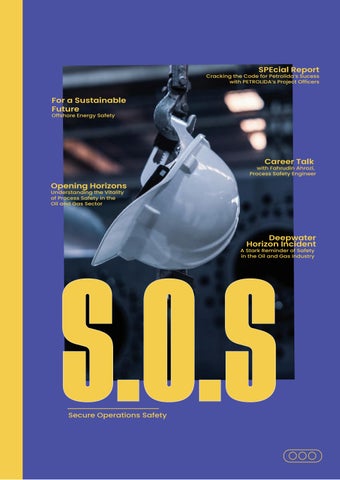
SPEcial Report
Cracking the Code for Petrolida’s Sucess with PETROLIDA’s Project Officers
For a Sustainable Future Offshore Energy Safety
Career Talk
with Fahrudin Ahrozi, Process Safety Engineer
Opening Horizons Understanding the Vitality of Process Safety in the Oil and Gas Sector
Deepwater Horizon Incident
A Stark Reminder of Safety in the Oil and Gas Industry
S.O.S Secure Operations Safety
Preface Nicomedus Sintong O. Siahaan President of SPE ITS SC 2022/2023
1 | Preface
Greetings! I am Nicodemus Sintong, the President of SPE ITS SC 2022/2023, and I proudly present the last masterpiece of our Journalism Team in this stewardship, PETROPOLIS Vol. 6! This time, our aim is to promote the importance of Health, Safety, and Environment (HSE) in the oil & gas industry. Health, Safety, and Environment (HSE) have become the most crucial parts of the industry, and as future industry professionals, we must practice them in every aspect of our lives. Implementing Safety Induction in every work program conducted and practicing Ergonomics at Work are essential steps before entering the professional industry. This magazine will expose readers to the application of Health, Safety, and Environment (HSE) in the professional oil & gas industry, along with other inspiring stories that will push readers beyond their limits. SPE ITS SC couldn't have presented this masterpiece without the help of all contributors; therefore, I would like to express my deepest gratitude to the Department of Public Relations SPE ITS SC 2022/2023, the Division of Journalism SPE ITS SC 2022/2023, and all contributors who willingly shared their ideas and insights and helped in the creation of PETROPOLIS Vol. 6. We hope that by presenting this work, we can contribute to the progression and advancement of Health, Safety, and Environment (HSE) practices among students who are aspire to become future professionals in the oil and gas industry. Thank you very much, enjoy the magazine, and let's fuel ourselves beyond! Regards, Nicodemus Sintong O. Siahaan President of SPE ITS SC 2022/2023
2 | Preface
SQUA MEET THE TEAMGO D ALS behind Petropolis
Tyara Novia Andhin Welcome to PETROPOLIS:SOS, the official magazine of the SPE ITS SC. Join us on an exciting journey as we delve into the world of safety in the oil and gas industry. Our magazine is dedicated to providing comprehensive insights from industry experts, sharing valuable tips, and promoting a culture of safety. Together, let's learn and contribute to building a safer industry. Happy reading and stay safe, SPE ITS SC members!
Nabila Luthfiani Hello readers! Welcome to the latest edition of PETROPOLIS, where we are delighted to present a comprehensive exploration of safety operations across various industries.It is our sincere wish that you find immense delight and satisfaction in delving into the insightful content we have passionately curated for your reading pleasure. So sit back, buckle up, and relish the fascinating insights that await you, as safety ‘oil’ways comes first!
Jacqueline Chelsea Hi, again readers! We would like to finish off our end of function with his latest edition of PETROPOLIS, discussing the matters behind Health, Safety, and Environment (HSE), especially in the oil and gas industry. Behind all the knowledge and innovation nowadays, one thing shall not change and is always in need of upgrades, health, and safety during practice. Time to bid farewell, my fellow riends! Keep the gears turning and the engines burning with the power of oil! Bye-bye and stay slick!"
Daffa Hibatullah Hi readers! Welcome to a thought-provoking edition of our magazine, dedicated to exploring the critical theme of Health, Safety, and Environment (HSE) in the oil and gas industry. This edition delves deep into the vital importance of prioritizing HSE in the operations and processes of this crucial industry. Together, let us recognize the transformative power of HSE in safeguarding lives, preserving the environment, and forging a path towards a safer and more sustainable future!
3 | Meet the Team
TABLE OF CONTENTS Preface
1
Meet the Team
3
Word Spill
5
Opening Horizons
7
Events
11
World’s Concern
15
What Does the Expert Say
17
For a Sustainable FUture
23
Career Talk
26
InSPEration
31
SPEcial Report
33
Winner’s Podium
35
PetroQuiz
39
4 | Table of Contents
Risk: The combination of the likelihood of an incident occurring and the severity of its consequences.
Risk Assessment:
Bowtie Analysis:
The process of identifying, analyzing, and evaluating risks to determine the most appropriate actions to reduce or eliminate them.
A visual risk assessment technique that uses a diagram to illustrate the relationship between hazards, potential causes, preventative barriers, and consequence controls.
Fault Tree Analysis (FTA):
Layers of Protection Analysis (LOPA):
A graphical representation of the various events and combinations of events that could lead to a specific undesired outcome, used to analyze system reliability.
A semi-quantitative risk assessment method used to analyze and evaluate the effectiveness of independent protection layers in reducing the risk of a hazardous event.
WORD HSE edition
5 | Word Spill
Process Hazard Analysis (PHA):
A systematic evaluation of the potential hazards and risks associated with a process to identify and prioritize safety measures.
Management of Change (MOC):
A structured process for reviewing and approving modifications to a process, facility, or organization to ensure that potential hazards and risks are identified and
Safety Integrity Level (SIL):
A measure of the reliability of safety instrumented systems, used to ensure the required level of risk reduction is achieved.
HAZOP (Hazard and Operability Study):
A structured review technique used to identify and analyze potential hazards and operability issues in a process.
Hazard: A potential source of harm or danger, such as a chemical, equipment, or process condition that could cause an incident.
D SPILL 6 | Word Spill
Understanding the Vitality of Process Safety in the Oil and Gas Sector
Opening Horizons Meet the Interviewee Introducing Mr. Yuniar Rusli, a distinguished graduate of ITS majoring in Chemical Engineering. With extensive experience in the Liquefied Natural Gas (LNG) industry, including several years as a Production Manager at an LNG plant, he brings invaluable expertise to the table. In this article, we are thrilled to have Mr. Yuniar Rusli joins us as we provide you with an introduction and the importance of safety in the oil and gas industry. Stay tuned for insightful information ahead.
7 | Opening Horizons
Mr. Yu
niar Ru
sli
Personal Safety vs. Process Safety: In the oil and gas industry, safety extends beyond personal protection. He emphasizes the distinction between personal safety, which is mandatory under the law, and process safety, which is essential for managing risks associated with large-scale handling of hydrocarbons. Personal safety, as mandated by occupational safety regulations, focuses on protecting individuals in the workplace. This includes wearing helmets, safety goggles, gloves, safety shoes, and high-visibility clothing when working in hazardous environments or handling potentially dangerous materials. Personal injury events are normally relatively simple and can be represented as a combination of incipient unsafe acts and unsafe conditions.Personal injury events are normally relatively simple and can be represented a s a combination of incipient unsafe acts and unsafe conditions. In contrast, process safety events – at least major events – often involve socio-technical system failures (management system deterioration) with complex causality involving equipment, control system, management system and human failures. Moreover, the oil and gas industry deals with substantial quantities of hydrocarbons, presenting unique risks. These include multiple injuries, the potential for fire and explosion, toxic releases, and catastrophic events. While personal safety measures are crucial, they are not enough to address the complex challenges faced by the industry. The explosion in the refinery that happened recently and affected both the industry and the surrounding community, serves as a stark reminder of the need to prioritize process safety.
vs
8 | Opening Horizons
Importance of Process Safety in the Oil and Gas Industry: Process safety is of paramount importance in the oil and gas industry. It involves safeguarding the entire operational process to prevent incidents and minimize risks. Yuniar highlights the significance of process safety management systems, multiple layers of protection, and the implementation of passive and active barriers. The complexity of the oil and gas industry can be represented by the Swiss Cheese Model that is associated with where multiple layers of protection and barriers need to be implemented to prevent incidents and risks in operational processes. By using the Swiss Cheese Model, the industry can understand the importance of having complementary and coordinated defense layers to minimize risks and ensure safety in this sector. Neglecting process safety can have severe consequences, including loss of life, financial losses, reputational damage, and environmental degradation.
9 | Opening Horizons
Consequences of Neglecting Process Safety: Failing to prioritize process safety can have devastating effects on human lives, businesses, and the environment. Major accidents, such as the Piper Alpha disaster, demonstrate the catastrophic consequences that can arise from overlooking process safety. The economic impact of such accidents, highlighted in studies, underscores the importance of proactive measures to protect lives and preserve the environment. Adhering to regulatory requirements and implementing robust process safety management systems can mitigate risks and safeguard both human lives and the ecosystem. Involvement of Stakeholders and Safety Culture: The involvement of stakeholders is crucial in ensuring effective process safety management. Executives need to understand and evaluate risks and barriers comprehensively. Risk ranking matrices and control measures can be implemented to reduce the frequency of incidents. Furthermore, everyone in the industry should have situational awareness and understand the hazards associated with their projects. A strong safety culture, driven by leadership commitment and employee involvement, significantly enhances process safety performance.
10 | Opening Horizons
Continuous Improvement and Training: Continuous learning, knowledge sharing, and technological advancements play a vital role in improving process safety in the oil and gas industry. Research and development efforts, coupled with industry-wide collaboration, foster innovative solutions and best practices. Integrating process safety principles into education and training programs ensures a competent workforce capable of identifying and mitigating process-related risks. Compliance audits also help maintain a high level of safety and ensure adherence to established standards.
the
DEEPWA INCIDEN A Stark Reminder of Safety in the Oil and Gas Industry
11 | Events
ATER HORIZON NT Welcome to our magazine section focusing on safety in the oil and gas industry. Today, we'll be delving into a devastating incident that shook the industry to its core—the Deepwater Horizon incident. We'll provide an overview of the incident, examine its causes, and explore the far-reaching consequences. This incident serves as a stark reminder of the paramount importance of safety in the oil and gas sector. Let's dive in.
12 | Events
How the Event Occurred
Overview of Deepwater Horizon
Deepwater Horizon, an offshore drilling rig operated by BP, was in the "temporary abandonment" phase of drilling the Macondo well. During this phase, cement is pumped into the well to seal and secure it before the commercial exploitation of the reserves. However, in this case, a fundamental safety step was overlooked. Normally, after cementing, a Cement Bond Log (CBL) test is conducted to test the integrity of the cement seal. This test measures the strength of the bond between the casing and the cement, ensuring a secure seal. Unfortunately, on Deepwater Horizon, the three-person Schlumberger team responsible for conducting the CBL test was sent home to cut costs.
The Deepwater Horizon was a drilling rig owned by Transocean and operated by Haliburton on behalf of BP for the Macondo Well in the Gulf of Mexico. Despite its immense size and sophisticated safety measures, the rig fell victim to a blowout, leading to a massive fire. Tragically, eleven crew members lost their lives, and others suffered injuries. The rig ultimately sank, allowing an estimated 4.9 million barrels of crude oil to be released into the Gulf over a staggering 87-day period. The Deepwater Horizon incident was a catastrophic event, resulting in one of the largest marine oil spills in history. 13 | Events
The omission of the CBL test proved to be a significant factor leading to the incident. Had the test been carried out, the fault in the concrete seal would have been identified, and remedial action could have been taken to prevent a blowout. Despite the incomplete CBL test, pressure tests were conducted. While the positive pressure test was successful, indicating that the well was holding pressure, the negative pressure test, used to determine if the cement barrier had isolated the formation fluids, indicated pressure anomalies. This signaled a potential problem, known as a well kick.
Aftermath and Impact
Another factor contributed to the incident was the failure of the blowout preventer (BOP), a crucial safety device located on the seabed. The main function of a BOP is to prevent flammable hydrocarbons traveling up the riser to the drilling rig, achieved by sealing the area around the drill pipe known as the annular space. The malfunctioning BOP, resulting from faulty equipment and insufficient maintenance, was unable to control the well pressure effectively. Miscommunication and misinterpretation of critical data further hindered efforts to prevent the blowout. Inadequate safety protocols and insufficient training of crew members compounded the problem.
As a result of the well kick, hydrocarbons and heavy mud began escaping from the wellbore, leading to the blowout. The gas rapidly dispersed across the rig, triggering multiple gas alarms. At approximately 21:49 pm, two explosions occurred, followed by a class 2 conflagration fire that engulfed the platform. Numerous attempts were made to seal the well and stem the hydrocarbon leak, but the challenges proved insurmountable. After burning for 36 hours, Deepwater Horizon eventually sank on April 22, 2010, leaving the uncapped well to leak oil into the Gulf of Mexico for 87 days. The consequences of the Deepwater Horizon incident were far-reaching. Beyond the loss of lives and injuries, the environmental impact was devastating. The massive oil spill wreaked havoc on marine life, coastal communities, and the tourism industry in the affected regions. BP faced extensive legal consequences, pleading guilty to criminal charges and paying over $65 billion in damages. The Deepwater Horizon incident stands as a stark reminder that safety must be the utmost priority in the oil and gas industry. By learning from this catastrophe, the industry can strive towards a future that ensures the well-being of workers and the preservation of the environment. It is through a collective commitment to safety that we can prevent such incidents and foster a responsible and sustainable oil and gas sector.
4 | Preface 14 | Events
Effective Oil Spill Contingency Plan Protects Sensitive Shoreline Areas and Communities From a global perspective, the specter of an oil spill invokes concern and calls for immediate action. The world watches with bated breath as the devastating consequences unfold, impacting not only the affected region but also the delicate balance of our interconnected ecosystems. The detrimental effects of an oil spill extend far beyond the immediate visible damage, as they pose a grave threat to marine life, fragile coastlines, and the livelihoods of countless communities. It is a stark reminder of the vulnerability of our environment and the need for comprehensive preventive measures, swift response strategies, and effective containment techniques. The world rallies together, urging nations to prioritize stringent regulations, technological advancements, and international cooperation to prevent future disasters. 15 | World’s Concern
The initial step of the OSCP involves the identification of operational activities that pose a significant risk of oil spills. By conducting a risk assessment for the WMO and Sukowati oil spills, a total of eight scenarios (three for the WMO Field and five for the Sukowati Field) are recognized as potential threats that could impact sensitive areas and communities. These identified scenarios are then simulated using oil spill trajectory modeling software, which takes into account factors such as sea currents and wind patterns to predict the trajectory of the oil spills throughout different seasons. This simulation provides an estimated timeline and location for the potential impact of the oil spills. The OSCP also incorporates a sensitivity map to determine the necessary resources required. Alongside risk analysis and oil spill simulation, the OSCP outlines specific methods and techniques for monitoring, evaluation, mechanical/chemical handling, and shoreline protection.
WORLD’S CONCERN olis p o r t e P
One of the world's most densely populated island, Java, contains numerous vulnerable regions, such as residential areas, fishing locations, mangroves, and leisure beaches. Adjacent to Java Island, Pertamina operates two significant offshore facilities, namely Pertamina Hulu Energi WMO Field and Pertamina EP Sukowati Field, which pose a risk of discharging over 100,000 barrels of crude oil into the sea during emergency situations. Drawing lessons from past oil spill incidents, it is vital for the company to establish a comprehensive oil spill contingency plan (OSCP) to effectively manage and mitigate potential risks.
6
The risk assessment has identified several significant events, including spills from a floating storage and offloading vessel, vessel collisions, subsea/export pipeline ruptures, and well blowouts. Based on simulations of oil spill trajectories in the field, it is projected that oil would reach the shoreline within a time frame ranging from 2 to 144 hours following a spill. Through exercises and terrain assessments, it has been determined that the affected area could be reached within a maximum of 60 minutes in the Sukowati Field scenario, or 2 to 3 hours in the WMO Field scenario. Each individual scenario is evaluated in terms of the time and location of impact, sensitivity, equipment mobilization duration, and environmental factors involved. This assessment helps determine the necessary actions to counter the effects of an oil spill. The successful implementation of the OSCP document and effective emergency response will play a crucial role in controlling oil spill pollution and providing a promising solution.
16 | World’s Concern
WHAT DOES
THE EXPERT SAYS?
HSE in the oil and gas industry?
Eko Ranti Wahyu Yulianto HSE Specialist at Oil and Gas Industry
17 | What Does the Expert Say 9 | World’s Concern
Beyond Compliance: Driving HSE Excellence in the Oil and Gas Sector How do you define HSE and what is the role of HSE in the oil and gas industry? HSE is a mandatory or a requirement in the oil and gas industry. Why is that, because this is a large project, you can imagine the price of one oil and gas well is around US$ 1.5 million. Indeed, this project is really high-cost and HSE has become a mandatory. If there is a problem from an HSE point of view or suppose there is an incident, the project must be stopped immediately, an investigation will be carried out, and you can imagine if we stop production in just one week the company can suffer quite a lot of losses. The costs needed to rent a rig in just one day require funds of around US$ 100,000 excluding fuel, apart from that we also have to rent a boat, and several other things. Therefore, why HSE is mandatory, firstly, because of necessity, don't let an incident occur in this project, because that will stop the project. Second, the company's reputation, if an incident occurs, the company's shares will be disrupted. To overcome this, the company usually has to sell assets to restore the disrupted assets.
Third, HSE has become the company's commitment, commitments are always published by the highest leadership regarding occupational safety and health, in this HSE workers are required to protect people's assets, the company and the environment. If we know, the probability of an accident occurring in the oil and gas industry is very small, but the consequences are huge. For example, once an accident occurs, there will be major consequences that must be paid by the company.
How does the company carry out accident investigations with HSE aspects? Before carrying out an investigation, the company classifies incidents based on their impact (risk matrix), whether this incident is low, medium, or high risk. After that, a team of investigators will be formed, from top management who will go directly to the field to discuss with local employees first to ask how the incident happened.
18 | What Does the Expert Say 10 | World’s Concern
In their solution, the investigator team usually uses fish-bone analysis, Hazard and Operability Study (HAZOP), or root cause analysis. After that, find the root cause of the incident and make recommendations, if the incident occurs at a medium-high risk level, this must be reported which will be presented directly to the government, and the report will be distributed to all oil and gas companies in the world as evaluation material. However, if the incident occurs due to a disaster, later the investigation team will be assisted by the authorities.
What are the difficulties that Mr. Eko faces as an HSE Engineer in onshore and offshore operations in the oil and gas industry? Back again to the behavior of each worker, because 90% of incidents in the field occur because of the behavior of these workers, and that behavior is shaped by a company. In this case, the safety and health of workers can be regarded as a high-cost aspect. Therefore, the more committed a company is to prioritize the safety and health of its workers, the higher the cost. So far it can be said that the HSE standard is very high, but it is a pity that the implementation is still relatively low. Until now, there are still quite a lot of workers who still do not implement or prioritize aspects of occupational health and safety. 19 | What Does the Expert Say
How do you ensure that the company complies with HSE regulations and standards that apply in the industry? Back to the beginning, we have to do a risk assessment first, this project is roughly at a low, medium, or high risk level. Then, we can take mitigation steps or preventative measures. From this, we also have to know where the project is located and who we are working with (contractor), in this case there is the Contractor Safety Management System (CSMS) method which explains how a company chooses a contractor from an engineering, financial and safety perspective . Apart from that, the company also prepares an HSE bridging document which contains key performance indicators (KPI) related to safety and health which are addressed to contractors. In addition, the company will also provide safety training to contractors in accordance with the standards set by the company, where this safety training consists of various levels, and an assessment test will be carried out every 3 months to test the understanding of workers in the field.
How do you involve your employees in promoting a strong safety culture in both onshore and offshore workplaces? As an HSE Engineer, I prefer to do this by making these workers friends, because when we make them friends they will definitely be more receptive to what we convey at that time, in this case, regarding the delivery of occupational safety and health in the field. When they can obey and implement this, I will give a reward in the form of whatever they like as a form of appreciation from me to them for being able to follow the company's commitment regarding HSE commitments.
How do you ensure that employees are equipped with the necessary knowledge and skills to deal with emergency situations in hazardous work environments such as oil and gas installations? To deal with this, the company has designed and made a training activity regarding the safety and health of its workers which is usually held once a week, apart from that every day a briefing is always held between workers so that they remind each other about what is permissible and what is not permissible. in the field while at work.
In addition, workers are always asked to convey if something happens related to their safety and health while in the field to the HSE Engineer as a daily report. This is done so that workers can be more aware if something related to the HSE aspect occurs and they are expected to know what action they should take at that moment.
What things do companies need to do before starting a project? The first thing to do is to do a risk assessment, a general risk assessment must be done, you can use the Hazard and Operability Study (HAZOP)/Hazard Identification, Risk Assessment, and Determining Control (HIRADC) method. After that the results of the risk assessment can be input into the FEED Project as a preventive step, then a tender process is carried out and an assessment of the working contractor is also carried out (assessed from administrative, engineering and HSE aspects). All minimum requirements must be met by the contractor, after being declared passed, the contractor and company must develop an HSE Management Plan (HSE Bridging Document) which is part of the project execution plan. 20 | What Does the Expert Say
21 | What Does the Expert Say
If an incident occurs, in this case an explosion, what steps will the company take? The first thing that must be done is a thorough investigation, later it will be reviewed the preventive measures that have been taken, whether they have been effective and updated or not. Preventive measures are carried out by: 1. 1. Administrative, examined Risk Assessment (HAZOP, etc.), Permit to Work (PTW), procedures, selection of competent personnel or not 2. 2. Engineering control, has a study on preventive measures been carried out, recommendations from the risk assessment that has been carried out (HAZOP, etc.), whether safety equipment has been installed according to function and design, as well as whether preventive maintenance has been carried out or not. 3. 3. Human Behavior, an assessment of work safety behavior is carried out and at what level do workers and leaders comply and carry out the safety management system properly and correctly. There are many investigative methods to find the root cause of an incident. If the root cause analysis and recommendations have been found, they must be shared and conveyed to related parties, orders and direct implementation monitoring are given by the company leadership.
22 | What Does the Expert Say
For a Sustainable Future University of Houston Professor's Trailblazing Research in Sustainable Offshore Energy Safety Harish Krishnamoorthy, an assistant professor of electrical and computer engineering at the University of Houston, has been recognized as a pioneering researcher in the field of offshore energy safety. Selected by the prestigious Gulf Research Program (GRP) of the National Academies of Sciences, Engineering, and Medicine, Krishnamoorthy's groundbreaking work aims to enhance safety measures and reduce systemic risks associated with offshore energy activities. Let's delve into his remarkable achievements and innovative research endeavors.
23 | For a Sustainable Future
Setting New Standards in Offshore Energy Safety: As the first-ever University of Houston professor to receive the esteemed GRP early-career research fellowship, Krishnamoorthy expresses his delight and anticipation for future breakthroughs. His expertise lies in power electronics, power converters, and offshore technologies, making him a distinguished figure in the industry. Krishnamoorthy's remarkable contributions were acknowledged at the 2022 Offshore Technology Conference, where he received the "OTC Emerging Leader" accolade for his dedication to workforce development and his emphasis on improving the safety and reliability of electrical power systems while reducing carbon emissions.
Revolutionizing Research Focus:
Krishnamoorthy's research interests encompass high-density power conversion for energy system grids, machine learning-based methods to enhance the quality and reliability of power electronics, and advanced electronics and control systems for mission-critical applications. As the associate director of the Power Electronics, Microgrids, and Subsea Electric Systems Center at UH, he encounters a diverse range of challenges and opportunities presented by the Gulf of Mexico region.
Addressing Safety Challenges in Offshore Energy:
With an estimated 1,500 offshore oil and gas rigs worldwide, including significant concentrations in the North Sea and the Gulf of Mexico, Krishnamoorthy recognizes the critical need for improving the electric distribution systems of these platforms. While large-scale offshore wind farms are yet to be established in the Gulf of Mexico, recent government initiatives have sparked interest in their integration. Oil and gas companies such as Shell, Chevron, and Exxon are actively exploring opportunities to reduce carbon emissions by incorporating offshore wind energy systems into subsea energy production activities. Furthermore, the potential utilization of hydrogen as an energy carrier in the future adds a new dimension to offshore energy production and transportation. 24 | For a Sustainable Future
Driving Safety and Reliability:
A Future of Collaboration and Growth:
Krishnamoorthy's research is driven by the imperative of ensuring safety and reliability in offshore operations. He cites the Deepwater Horizon disaster of 2010 as a stark reminder of the consequences of equipment failure, emphasizing the need for robust power converters, circuit breakers, and intelligent monitoring and control systems. His efforts focus on integrating subsea oil and gas systems with offshore renewable energy systems, fostering a safer and more resilient environment for workers in the field.
The GRP early-career award grants Krishnamoorthy the opportunity to pursue bold and innovative research. Alongside a generous $76,000 grant, he receives mentoring support and gains access to a network of like-minded professionals. Krishnamoorthy eagerly anticipates utilizing these resources to further his research, collaborate with his mentor, Ramanan Krishnamoorti, professor of petroleum engineering and vice president of energy and innovation at UH, and engage with a community of fellow researchers who share his vision.
References: https://jpt.spe.org/uh-professor-developing-new-technologies-to-improve-safety-resiliency-of-offshore-energy-systems https://www.uh.edu/news-events/stories/2023/january-2023/01132023-harishk-earlycareer-award.php https://www.slb.com/resource-library/interview/oss/rethinking-subsea-production-systems
25 | For a Sustainable Future
CAREER TALK
The Ultimate Guide for Process Safety Engineers
Mr. Fahrudin Ahrozi
With seventeen years of hands-on experience in Operations, Process Engineering, Process Safety The implementation of CCUS in Indonesia still requires Engineering, and Process Safety Management System Implementation, Mr. Fahrudin Ahrozi bringsthe a Upstream wealth of significant developments. Hence, we need expertise to the table. his Never primary focus toDon’t ensure the Production Researchers. heard ofisit? worry, safety of production processes. Now, let's we've and got reliability your back! With Mr. Andre Sahetapy, take a look at Mr. Fahrudin's ultimate guide to process explore a career that is essential to the development safety engineering! of CCUS in Indonesia. and implementation
26 | Career Talk
Can you briefly explain what a Process Safety Engineerdoes and what their main responsibilities are within an organization? As a Process Safety Engineer, our mission is clear: to make sure that safety is a top priority in any industrial process. We play an important role in ensuring safety and mitigating risks. Typically, our work involves dealing with different aspects of safety management, such as Process Safety Management elements, conducting Hazard and Operability Studies (HAZOP), and performing various risk assessments. We need to guarantee that the process of converting raw materials into finished products (process) is carried out safely.
27 | Career Talk
In fact, there are two main types of jobs for process safety engineers. One is working for a consulting company, where we provide safety consultations and technical support without direct involvement with stakeholders; technical expertise is paramount! On the other hand, when working for a client-based company, the responsibilities expand beyond technical aspects. We are required to interact and collaborate with various stakeholders, including operations and maintenance personnel. Process Safety Management (PSM) becomes a crucial focus in such roles, emphasizing the need for leadership and effective communication with the operations team. As a process safety engineer, they may be responsible for initiating Management of Change (MOC) processes and ensuring compliance with safety protocols within the operating company.
Fascinating! How do you begin your career as a process engineer and eventually become a process safety lead?
Are there any qualifications or certifications that are required to become a Process Safety Engineer?
I must say, it has been quite a journey! When I graduated, I didn't really have a clear idea of which field I wanted to pursue. I started my career as a process engineer at PT. Mitsubishi Chemical Indonesia, and then I moved to PT. PATRA SK. However, it was during my time as a safety engineer that a profound spark ignited within me. It became clear that this career path is my true passion. Simply put, I absolutely love my job and I have a strong passion for being a process safety engineer.
In Indonesia, there is no particular certification that is mandatory. If you have enough knowledge in the field of process engineering, you can try applying for it! Engineers mostly gain expertise through their experience. However, some companies provide training programs to improve skills and knowledge. When it comes to certifications, there are numerous options available, primarily from international certification bodies. For example, the CCPS Process Safety Professional Certification (CCPSC) issued by Aiche, the Certified Functional Safety Professional (CFSP), the Certified Fire Protection Specialist (CFPS), and many more.
Wow, that is a lot of scopes to learn! How does the role of a Process Safety Lead differ from other safety-related, like HSE for example?
Well, there's a lot of misconceptions among the public. Process Safety, as the name suggests, is mainly concerned with ensuring the safety of industrial processes. Its main focus is to prevent dangerous situations such as leaks, isolation problems, and various hazards. On the other hand, HSE (Health, Safety, and Environment) has a broader scope, encompassing the well-being of workers and their overall working conditions. Unfortunately, these two roles are often combined, which can result in less effective safety practices in industries, despite the fact that the dedicated role for Process Safety is essential to maintain smooth and secure operations.
28 | Career Talk
Can you provide an example of a project or initiative you have led as a Process Safety Lead that significantly improved process safety within your organization? The projects we handle can be divided into two types: Build Projects and Initiative Projects. In Build Projects, where we create something new, Process Safety takes care of studying or evaluating assets. This includes conducting HAZOP (Hazard and Operability Studies), Layers of Protection Analysis (LOPA), or helping evaluate fire protection systems. In contrast, Initiative Projects aim to enhance safety operations. For instance, at BP, we developed a healthiness dashboard to visually display the status of the company's site safety plan. This dashboard helps us visualize risk management by identifying hazards, barriers, and consequences. We can see which barriers are effective and which ones need improvement, enabling operators to be more aware. This visual representation is beneficial for understanding risks. Of course, continuous improvement is necessary for ongoing enhancement.
29 | Career Talk
What are some of the challenges faced by Process Safety Leads in ensuring the safety of processes? Not everything can go smoothly according to expectations. One common challenge is budget constraints. To meet comprehensive safety requirements, the budget required should be adjusted accordingly. However, sometimes clients ask for projects to stay within the given budget. As engineers with integrity, we must communicate the actual conditions and what is needed, provide recommendations, and explain the impact that may arise.
“When we become engineers, our task is not only to find mistakes but also to propose solutions to those problems.”
That’s true. As a Process Safety Lead, how do you evaluate the effectiveness of safety programs and initiatives, and what steps do you take to continuously improve them? We regularly conduct evaluations and seek improvements. When a problem occurs, such as a major leak, it's crucial to conduct a thorough investigation to prevent it from happening again. However, why do we often see repeated cases of such leaks? This could be due to insufficient and misguided investigations or correct investigations with unimplemented recommendations. Just like a doctor diagnosing a patient, we must ensure that the investigative process (diagnosis) and its implementation (taking medication) are accurate. If either of these steps is not carried out properly, the problem (illness) will never be fully resolved.
“We are doctors and detectives in disguise” In your opinion, what are the essential skills and qualities that make a successful Process Safety Lead? In my opinion, the most essential aspect of being a process safety engineer is having strong technical knowledge. It's essential to have a deep understanding of the technical aspects of the processes involved. However, being a good process safety engineer goes beyond theoretical knowledge. It also requires the ability to connect the dots and identify issues or problems effectively. Since we interact with others, communication skills and leadership are equally important. It's crucial to convey ideas without offending or upsetting others.
How do you stay updated with the latest advancements, best practices, and regulations in the field of process safety?
Noted! Any tips to motivated students out there who want to pursue Process Safety Engineering as their career choice?
Staying informed about the latest advancements is crucial, especially for Process Safety professionals working in consulting companies. It is important to have a strong technical foundation and stay up to date with the latest advancements. This can be enhanced by attending international conferences or reading the new journals, although currently, time allocation and human resources within the company may not be ideal for international conferences.
Be Passionate! Engage in activities that you enjoy. If you're interested in process engineering, give it a try! But if you don't find it enjoyable, it's best not to stay in that position for too long. Aim to shift careers within a maximum of five years. Additionally, it would be beneficial to have a role model and mentor. They can guide you, inspire you, and provide continuous learning opportunities for personal and professional growth. Good luck, guys! 30 | Career Talk
INSPERATION Finding Harmony in the Digital Age, a Reflection with Lionel Carlo.
with Lionel Carlo
As an Associate Business Analyst, he serves as the intermediary between business professionals and engineers, responsible for managing clients' software needs and requirements. While pursuing his degree in Information Technology (S.Kom), Carlo sought a career that involved less coding and technical aspects but remained connected to his field of study. To excel in his current role, he has taken it upon himself to continuously learn and acquire the necessary skills through certifications, such as process mining, Celonis value, and the fundamentals of digital marketing. During his time at university, Carlo embraced various endeavors, including participating in Petrolida’s marathon around Surabaya and engaging in competitions alongside friends he met through SPE ITS SC. He was also honored as an IISMA Awardee at the University of Pisa in Italy. Alongside his achievements for-non academics, he was also able to graduate with honors in 3 and a half years.
31 | InSPEration
"When you stop learning, you stop living."
Carlo emphasizes that digital interaction cannot replace the value of human connection, empathy, and the potential for human errors. The very essence of being human lies in the opportunity to make mistakes, learn from them, and continuously expand our knowledge and abilities, surpassing the boundaries of our programming. In the era of digitalization, Carlo believes it is crucial for people to seize every opportunity and utilize the tools at their disposal. Instead of isolating oneself in a bubble and avoiding the stream of globalization, he emphasizes the acquisition of basic digital skills and staying informed about current technologies such as AI, cloud computing, and process mining. By continuously improving themselves, individuals can become high-quality individuals who can compete with others. Carlo aspires to remain connected to his roots and preserve his identity, regardless of his future endeavors. He aims to stay in touch with friends and family, maintaining consciousness and awareness in a rapidly changing world. Alongside Carlo's message to fellow SPE members and all is to never cease exploring, continuously learn new things, and maintain a mindset that is always open to opportunities while remembering your identity and who you are.
32 | InSPEration
SPECIAL
Repo
Cracking the Code, Behind the Success of This Year’s Petrolida Hold on tight because the numbers speak for themselves! The number of registrants for Petrolida 2023 increased by an impressive 762 registrants
Petrolida, or Petroleum Integrated Days has made a powerful comeback for 2023, with strategic collaborators like Grab, Pertamina EP, and Purnomo Yusgiantoro. After hosting the event online for two and a half years, this year's Petrolida exceeded expectations. Aldi and Maher's meticulous benchmarking and early planning set the foundation for their success. They basically did their homework early and planned like there was no tomorrow.
33 | SPEcial Report
with a total of 762 registrants from 250 teams across three countries. Feedback from attendees confirmed that Petrolida 2023 was truly worth the time, effort, and money they have put in. Interestingly, the inclusion of a business case as a focal point attracted participants from diverse industries, showcasing Petrolida's broad appeal beyond oil and gas. To delve deeper into Petrolida's achievements, it is essential to recognize the individuals behind its triumph. From the rigorous recruitment process to the culmination of the event, Petrolida placed great importance on assembling a high-caliber committee. Training and sharing sessions were held to ensure that the vision was shared by the entire committee, not just Aldi and Maher.
ort
With Petrolida’s Projects Officers Renaldi S. Wardhana and Mahera Wijaksara One noteworthy collaboration was with the National Research and Innovation Agency (BRIN), unlocking classified research and facilities exclusively for eight teams competing in the thrilling oil rig challenges. These competitions rigorously tested the teams' ocean buoyancy and motion capabilities. Can you imagine the excitement? They are testing their innovations and creations like true pros!
The secret to Petrolida's success? These guys didn't settle for anything less than extraordinary. Their refusal to settle for mediocrity allowed them to curate an exceptional event. Looking towards the future, Petrolida aims to achieve a higher quality standard while maintaining quantity. They also have aspirations for international exposure and expansion into the Asia-Pacific region. When asked about their own plans, Maher wants to focus on his department and academic priorities, while Aldi sees himself conquering his final thesis and doing some wicked lab work. But hey, don't be shy! They're more than happy to spill the beans on all things Petrolida 2023 and maybe you can even do a little friendly benchmarking. Can’t wait for 2024’s Petrolida!
34 | SPEcial Report
WINNER’ Meet t
he Wi
nners
of IPFE
PODIUM
ST 202
Experience the annual Integrated Petroleum Festival (IPFEST), an exciting international competition event that brings together top talents. Organized by the Society of Petroleum Engineers ITB Student Chapter (SPE ITB SC), the Indonesian Association of Petroleum Engineers Student Section ITB (IATMI SM ITB), and the Petroleum Engineering Student Society PATRA ITB (HMTM "PATRA" ITB), IPFEST 2023 recently showcased a day filled with fierce competitions on February 24th. Participants from around the world battled it out in eight challenging contests. In an impressive display of skill and determination, eight delegates from SPE ITS SC made it to the final stage, with two of them proudly emerging as champions in two contests. 35 | Winner’s Podium
’S
M
23
Win•ner’s • • • • • • • • • • • • •
List
Sangkuriang - Chamipon Paper DERRICK 2022 Samhyang Jampang 2nd Highest Score DERRICK 2022 Masbro - 2nd Runner Up CSC APECX ugm 2022 Blacklist - 1st Runner Up Paper Poster APECX UGM 2022 Fuellion - 1st runner up CSC SPEEDFEST 2022 AVIRAMA - Champion POD IPFEST 2023 Fuel-Lion - Champion BCC IPFEST 2023 Safira - Champion AES SPE Java 2023 CHATOYANT - Champion ORDC OGFEST Malaysia 2023 EPHORICS - Champion ORDC BOREYES 2023 MORPHEUS - 1st Runner Up ORDC PETROLIDA 2023 Dansa Terakhir - Champion Smart Competition PETROLIDA 2023 Fire Hawks - Champion Paper & Poster Competition PROTECT UP 2023
36 | Winner’s Podium
Aviram a
Team
Nicodemus Sintong (Ocean Engineering 19), Julian Lo (Geophysical Engineering 19), Abdul Quddus (Chemical Engineering 20), M Zayem Ghifari (Geophysical Engineering 19), and Clara L. Oryza (Materials Engineering 19)
“We encourage all ITS students to challenge their limits and believe in achieving the impossible,” Sintong emphasizes.
37 | Winner’s Podium
Sintong as a team leader explained that Plan of Development Competition (POD Competition) is a competition focus on developing an oil/gas field across the stages of Development, Production, and Decommissioning in the Upstream Oil & Gas Life Cycle. The goal is to convert field data from the Exploration and Appraisal stage into economically valuable oil/gas production while considering environmental aspects. As the field operator, Avirama team aims to propose the most economical POD report to Indonesia's regulator, SKK Migas. Our 5-member team excelled in oil and gas competitions with individual expertise in various fields Quddus in Drilling and Production. Although we came from non-Petroleum Engineering majors, we recognized the need for mentoring sessions. Thanks to Ko Wilson, Pak Konsep, and Bu Dian for guiding us through the IPFEST ITB 2023 case! “Also, we prioritized our presentation performance, practicing extensively and even designing our own AVIRAMA pins for the Competition Day,” Sintong added. We're proud to win the competition with our economical Plan of Development for Cendana Gas Field in East Java. Despite coming from a non-Petroleum Engineering university, we formed a strong, multidisciplinary AVIRAMA Team. Gathering competent members was crucial for our success. We had fun during the competition and even got an exclusive interview with MetroTV! It felt like the stars aligned for us to win.
In a remarkable display of competence and confidence, the Fuel-Lion team exceeded expectations and won their first-ever business case competition. Consisting of the director and division heads from the competency development department, this remarkable accomplishment not only highlights the outstanding talent within the department but also serves as a profound inspiration for those who aspire to achieve success.
“There is no greater pride than becoming a delegate of SPE ITS SC”
This accomplishment was made possible through their strong dedication. "Choosing mentors and putting in hard work, we have given our best." expressed Zagota, the team leader. They sought to showcase the prowess and capabilities of SPE ITS SC delegates. The Fuel Lion team generously shared their secrets to success, giving us valuable advice on how to build and maintain confidence. Take notes! They suggest that not all team members need to attend the Technical Meeting for the competition since facing tough opponents can be overwhelming and causing panic. Another important tip they emphasize is the need to consistently work together as a team right from the start. By building a strong foundation and staying consistent, teams can handle early difficulties better. They strongly believe that setbacks, instead of discouraging, actually have the ability to make us stronger and more determined to succeed. With this mindset, they face challenges bravely, knowing that they have nothing to lose. Fuel Lion's story reminds us that with dedication, confidence, and a supportive team, we can achieve anything!
Fuel-Lio Samuel Zagota (Marine Engineering 20), Haya Aqilah (Engineering Physics 20), Fatahillah M Daffa (Marine Engineering 20)
n Team
38 | Winner’s Podium
1
3
5 6 7
8 9
Question Across
3. A sudden event, such as an accident or a natural catastrophe, that causes signif loss of life 4. The combination of the likelihood of an incident occurring and the severity of its
5. A potential source of harm or danger, such as a chemical, equipment, or proce could cause an incident
7. Hazard identification, risk assessment, and determining control9The condition of 9. The condition of being protected from or unlikely to cause danger, risk, or injury 39 | PETROQuiz
2
PETRO QUIZ
Join PetroQuiz now and test your knowledge in the petroleum industry!
4
Question Down
1. The action of reducing the severity, seriousness, or painfulness of something 2. A serious, unexpected, and often dangerous situation requiring immediate action 5. Hazard and Operability Study 6. Health, Safety, and Environment 8. Contractor Safety Management System
ficant damage or consequences
ess condition that
f being protected
Are you interested in joining PetroQuiz? Here are the steps: 1. Answer all the questions by either typing your answers or taking a screenshot of the PetroQuiz page and filling in the answers. Be creative with your approach, but make sure your answers are clear and understandable. 2. Direct message your answers or screenshots to @speitssc on Instagram. 3. The person who submits the most accurate and fastest answers will have a chance to win the prize 40 | PETROQuiz
Looking Deeper onto CCUS
RESILIENCE
inSPEration with Nahari Rasif
What Does the Expert Say with Isya Mahendra
VOL 6
Career Talk
with Mr. Andre Sahetapy
PETROPOLIS
For a Sustainable Future with Carbonize Team