



By Ashley Stimpson
to The Washington Post
MARISA MENDER-FRANK-
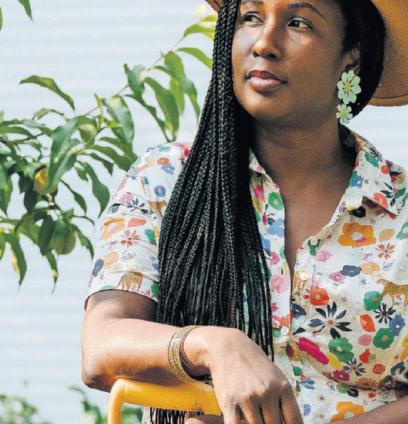
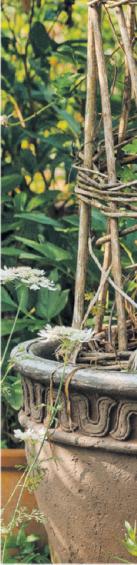
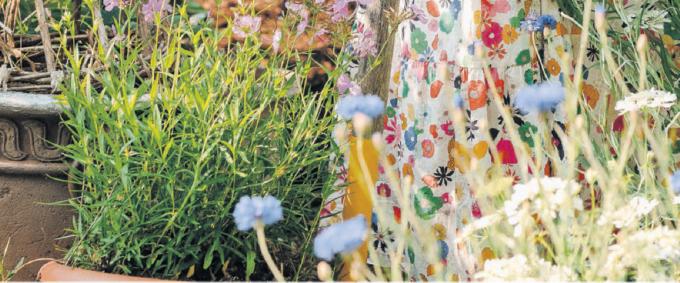
lin had always considered herself a gardener, but when the 37-year-old elementary school teacher grew the flowers for her 2020 wedding, she discovered a new love: farming. Unfortunately, her yard, like many in the Midtown neighborhood of downtown Memphis, was small and mostly shaded, not exactly ideal for the flower farm she now dreamed of.
Then, Mender-Franklin says, she began noticing many unused spaces — vacant lots, the lawn of the elementary school where she taught and many of the yards in her working-class neighborhood, which, together, added up to a lot of land. She had an idea.
“Flowers in need of a garden,”
Mender-Franklin posted on her local buy-nothing Facebook group in early 2021. In exchange for space to grow, she promised to provide lawn care and, of course, a steady supply of fresh-cut flowers.
Within a day, she had 40 offers. One was from a neighbor sick of mowing her double lot, another from a couple of ardent gardeners whose failing health kept them inside. “It just made so much sense for all of us,” Mender-Franklin says.
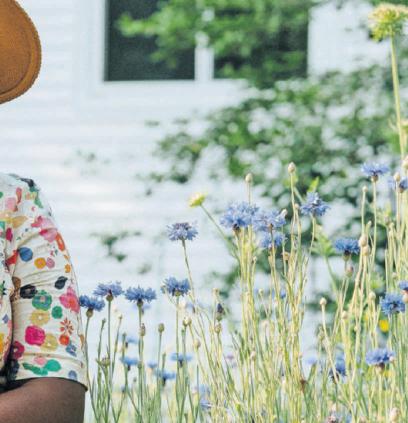
Now, five years later, Mender-Franklin is a full-time flower farmer, and her business, Midtown Bramble and Bloom, grows all the flowers it sells in bridal bouquets, prom corsages and get-well-soon deliveries across 10 borrowed lots and lawns. Mender-Franklin has seven employees and operates out of a neighborhood storefront where she also teaches workshops on pollinator gardens and flower arrangements.
Mender-Franklin is part of a cadre of farmers across the United States who practice urban micro flower farming, providing “payment” in the form of lawn care, seed mix and, of course, fresh-cut flowers in exchange for space to grow. The model poses a few logistical challenges for the farmer (if you think keeping up with weeds in one yard is tough, try 10), but it does more than cultivate a small business:
“I think people are happy to not have to maintain their own yards.”
Dee Hall, flower farmer
It also helps to sustain native wildlife and boost neighborhood pride, one yard at a time.
For most of her adult life, Rachel Nafis was an ER nurse with farming aspirations. Living in San Diego, she and her husband raised chickens and kept bees. In 2012, they tried their hand at growing vegetables and livestock on a 45-acre ranch outside the city. Wildfire and rodents quickly chased them back downtown, she says, but she “just couldn’t shake that strong calling and desire to farm.”
In 2018, Nafis added a row of dahlias to the vegetable garden in her backyard and was soon scheming a way to create a cut-flower farm without leaving the city. The 37-year-old summoned her courage to ask an elderly neighbor if she could use his lawn to grow flowers.
“He was in his 80s and not able to take care of it anymore,” she says. “The weeds were chest high.”
A quick yes gave Nafis the confidence to ask other neighbors, who readily volunteered their yards.
Over the past eight years, she has planted hollyhock, delphinium and echinacea across City Heights, a densely populated and diverse neighborhood that has long lacked green space. And in September 2021, Nafis quit her job and devoted herself fulltime to growing flowers.
“Nursing was meaningful work,” she says, “but I didn’t love it the way I love farming.”
Today Psalter Farm Flowers supplies three local flower shops and provides a 69-member community-supported agriculture program (CSA) with flowers grown in nine urban gardens totaling a quarter-acre.
In Norfolk, flower farmer Dee Hall, a former condo manager, has accumulated about half an acre of lots within
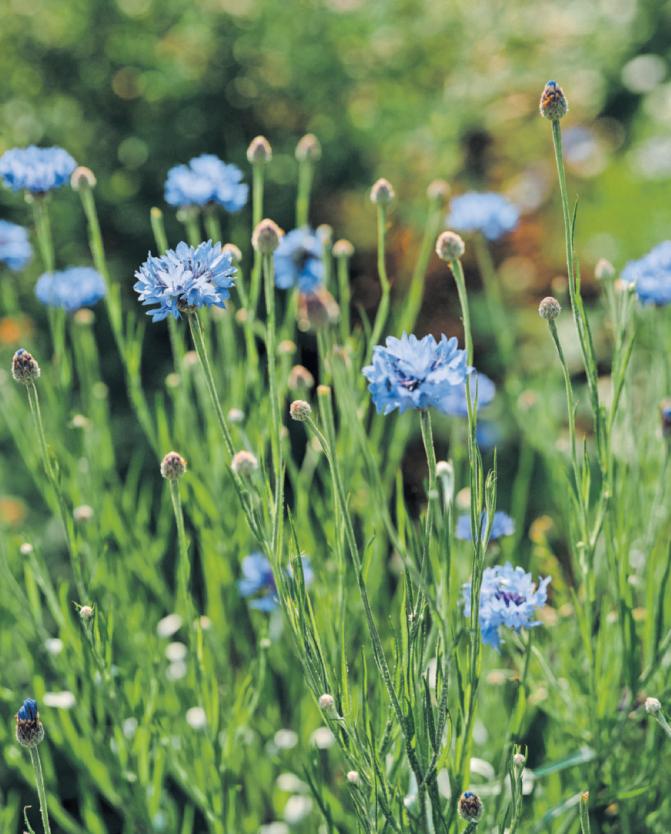
10 minutes of her home in the city’s Colonial Place neighborhood to grow blooms for Mermaid City Flowers, which she opened in 2020.
“I think people are happy to not have to maintain their own yards,” she says. The weekly bouquets of fresh-cut flowers are an added bonus.
For Hall, who grew up in St. Lucia gazing at the night-blooming cactus in her grandmother’s garden, growing a flower business close to home is about more than convenience.
“Land access has historically been a barrier for people of color in the United States,” she says. “I could have tried to move out to the country, but I wanted to be in a place that I felt comfortable.”
When Clarke Forrest and Marnie Baird moved into their San Diego home, they quickly got to work planting trees and a garden in the spacious backyard. The front of their single-story bungalow, though, remained
a barren conundrum.
“Front yards have always been this puzzle to me,” says Baird. “No one ever uses their front yard.”
When they heard about Nafis’s business model, they eagerly offered her access to their land. And now, after two growing seasons, Forrest and Baird love coming home to a lawn full of kaleidoscopic blooms and chatting with Nafis about what she’s growing outside their front window. But Nafis isn’t the only frequent visitor in their front yard.
“We’re seeing a lot more birds and bugs and little animals,” says Forrest. “We’ve created this little nature space in the middle of the city. It’s just an absolute delight.”
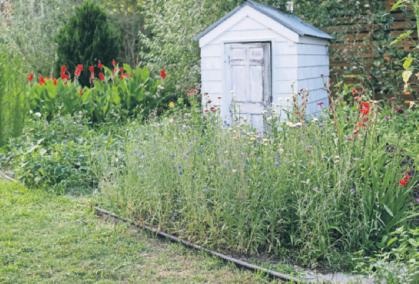
Before she turned her front yard into a cut-flower farm, Hall noticed the absence of wildlife in her urban neighborhood.
“I knew there were native birds I should be seeing here and I wasn’t,” she says.
By Patrick B lennerhassett
The Las Vegas Review-Journal
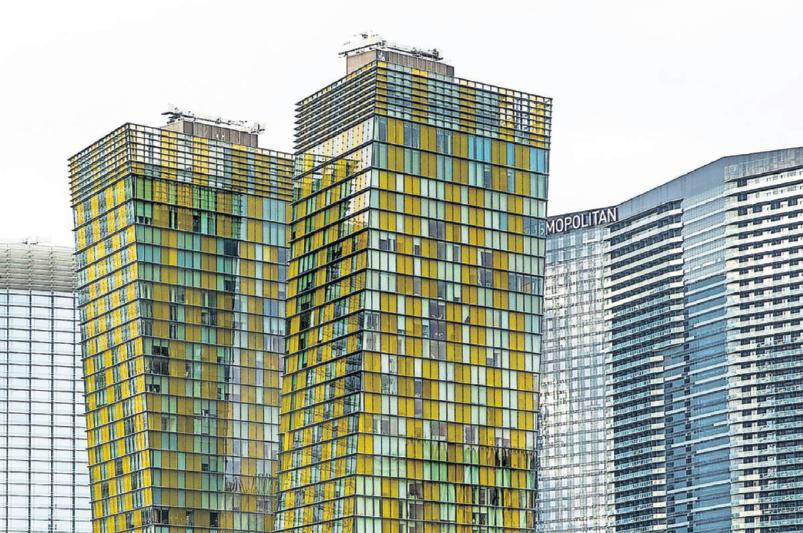
BUYING A CONDO in some parts of the U.S. has become harder due to recent changes in Fannie Mae’s condo policies, according to local real estate experts.
The government-sponsored mortgage enterprise recently increased the
required due diligence for condo loans, and that could make some purchases harder to close in the months ahead, Las Vegas-area mortgage adviser Matt Hennessy said.
Fannie Mae announced the changes in March — which apply to both new builds and resale — which are being phased in over the
next year. The changes were made to ensure condo projects across the country don’t get into financial trouble down the road and analysts say the government is worried some condo projects’ homeowners associatons don’t have enough saved for repairs or proper insurance.
Markets such as Florida
“Land access has historically been a barrier for people of color in the United States,” Hall says.
CONTINUES FROM PAGE F2
Now that her space is full of coneflowers, cosmos and yarrow, the avian life has rebounded. It’s a development she points out when she talks to her neighbors about regenerative agriculture and the many virtues of native plants, subjects she’s passionate about. “The flowers are a conversation starter,” she says.
Nafis has also noticed the way her flower beds have encouraged kinship in a neighborhood without a lot of community space. One of the yards she cultivates belongs to a lonely older man. Having people around and beautiful flowers to look at “mean a lot to him,” she says. “There’s a lot of mutual giving and receiving.”
Micro flower farming in the city is not without its difficulties.
“Having your farm split into 10 different places is such a logistic challenge,” says Mender-Franklin, who recalls pulling a wagon full of
compost through downtown Memphis from one garden to another during her first growing season. “People were looking at me like I was insane.”
Duplicating each irrigation and timer system is also costly.
“Then of course they all break at different times,” she says. And although farmers reimburse landowners for the water they use, they don’t get a say about who has access to the gardens and when.
“There are definitely challenges to being in someone else’s space,” says Mender-Franklin, who has had dogs tear up her beds and roofers drop materials on them. Passersby have ripped up whole plants for their own yards.
But the benefits far outweigh the risks, says Mender-Franklin, who moved to Midtown in 2020, just months before the pandemic shutdowns.
“I really didn’t feel connected to our neighborhood before [starting the business],” she says. “Now, I know so many people and I feel really proud to be from Midtown. We’re not fancy, but we look out for each other, we care for our neighbors, and we do cool things.”
and Texas have come under increased scrutiny due to a number of issues including increased natural disasters, insurance issues, construction defects and HOAs unable to fund large repairs on projects.
Condos are seen by some in the real estate industry as a potential solution to the
national housing crisis as they could ease supply and offer a new way for first time homebuyers to get into the market.
“The biggest change is that lenders now have to do a deeper review of condo projects, especially their reserves, insurance and repair risks,” Hennessy said.









Lee Reich | In the Garden
WALKING DOWN
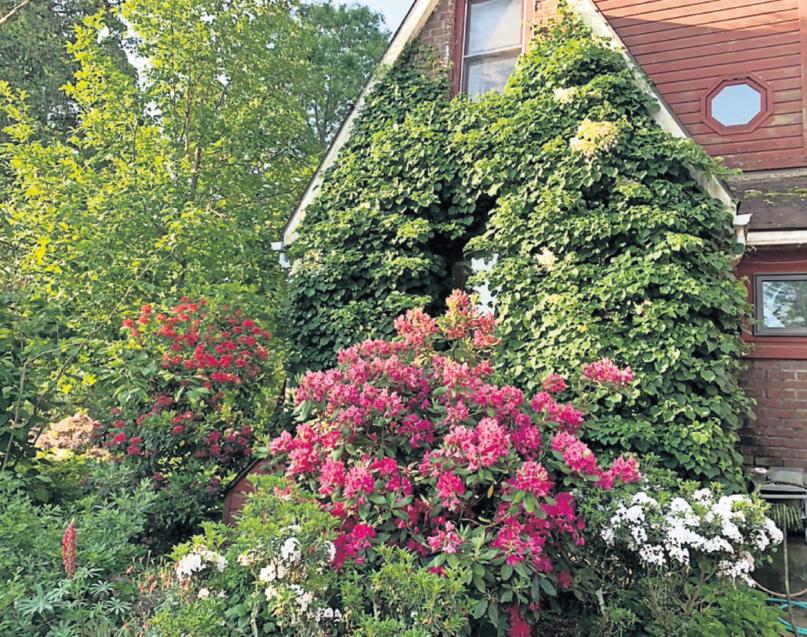
the path alongside my home first thing this morning, I looked to my right and was wowed. What I saw warranted bragging rights. Flowers in red, pink, white, and a touch of purple against a backdrop of varying shades of green leaves, some sparkling with reflected light, others matte, holding onto any reflections. Heart-shaped leaves, lance-shaped leaves, and compound leaves livened the backdrop. All of it set off against the solid backdrop of the red brick wall.
Although I chose and planted all that I admired, not too much credit for it was mine. This was no carefully planned design laid out on paper with squiggly shapes representing plants and their locations, each shape labeled with plant names and varieties, perhaps even a note to flower colors.
Twenty plus years ago, the site was a strip of sloping lawn on the east and north sides of my home. Imagining myself one day slipping while mowing with my foot sliding beneath the mower birthed a plan for building a rock wall at the base of the slope which would be backfilled with soil. No more slope and no more mowing.
And so was borne my “heath bed,” a bed of various plants in the heath family, Ericaceae. Grouping such plants together was not just a botanical plaything; it had function. Many members of the Heath Family thrive best with unique soil conditions. Such soils are well aerated, consistently moist, and are very acidic (low pH of 4-5). They also are rich in organic matter yet low in fertility.
A good amount of the soil at my disposal to backfill the slope rock wall was old potting soil, which is high in peat. Peat would supply most of the soil needs for these plants, for a while at least. A sprinkling of elemental sulfur, a naturally
mined mineral, and a topping of sawdust, wood chips, or leaves, renewed annually, would keep the ground acidic and enriched with organic matter over time. Two drip irrigation lines set in place would provide consistent moisture.
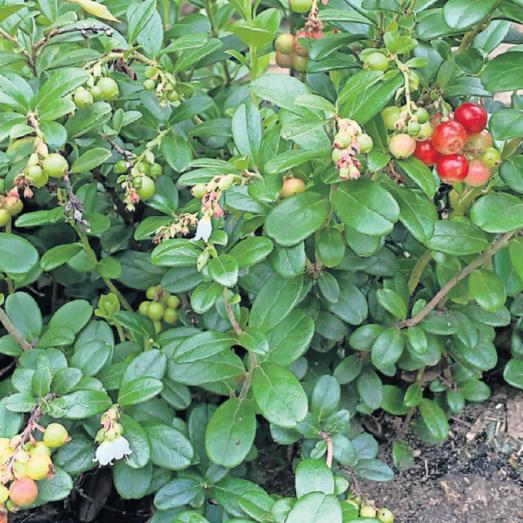
On to the plants ... As a fruit lover, the main reason, besides retaining my toes, for this bed was to provide a home for lowbush blueberries, lingonberries, and cranberries. All these plants are also very attractive. In spring, small, dainty white flowers hang in clusters from the stems. In fall, blueberry leaves ignite in a fiery red color. Lingonberry and cranberry are evergreen.
Two more related plants were added early on. One, P.J.M. rhododendron, is a dwarf variety that is very cold hardy. (A consideration back when winter lows here regularly dropped below -15° F.)
The other was heather (Calluna spp.), closely related to,
somewhat the less cold-hardy plant heath (Erica spp.), whose generic gives rise to the family name.
Over time, other plants, if they were people, you might say meandered into the bed, all tolerant of those specific soil conditions. Fifteen years ago, I was offered plants in partial payment for a lecture I presented at Broken Arrow Nursery, a nursery that specializes in rare and unusual plants, and especially mountain laurels. I felt like a kid in a candy store and drove home with five varieties of mountain laurel — the nursery’s founder, Richard Jaynes, breeds mountain laurels — and two dwarf rhododendrons with hoary leaves and white blossoms. Mountain laurels and rhododendrons are in the heath family.
A few years later, another rhododendron was added, this one has grown large, its rich, red-colored blossoms just now starting to fade.
Another heath plant that
The Greenfield Public Library has officially launched its new seed library. Home gardeners are invited to visit the seed library, located on the second floor of the library at the Information Services Desk, to choose up to five packets of seeds for their gardens. A wide variety of vegetable seeds (arugula to zucchini), as well as herb and flower seeds (amaranth to zinnia) will be available. Borrowing guidelines will be provided, and gardeners are encouraged to return seeds after the harvest season ends. This program is free and open to everyone.For more information, contact Nancy Little at nancy.little@greenfield-ma.gov or call 413-7721544.
made it here was picked up by scent. The waft of a very sweet scent on a woodland hike one June day had me, like a dog, go off the trail and into woods sniffing out the source. I found it, identified it, and soon had a small plant of swamp azalea (Rhododendron viscosum) nestled in here with its kin.
The floor of woodland near here is naturally blanketed with lowbush blueberry; also with huckleberry, another low-growing heath family plant, this one is the genus Gaylussacia. No need to be a botanist to differentiate huckleberry from blueberry. Eat the fruit, and if small seeds crackle in your mouth, you’re eating a huckleberry. Huckleberry brings alive its corner of the heath bed when its leaves turn a dark red in fall.
The bed has also become home a few plants not in the heath family. Early on, the bed was mostly low-growing plants.
REICH, PAGE F6
The Holyoke Senior Center Garden Club will hold its second annual plant sale on Saturday, June 6, from 9 a.m. to 1 p.m. at the Senior Center, 291 Pine St. Shoppers will find a selection of sun or shade loving perennials, plus herbs and annuals that do well in our local gardens. Members will be available to answer questions about the plants they enjoy. The sale will be held rain or shine! Proceeds from the sale are used for projects that beautify and support the Senior Center’s gardens.
Send items for Garden Notes to pmastriano@repub.com two weeks prior to publication.

Place an ad in the Classifieds. Time for a TAG SALE? Call (413) 788-1250 or email advertising@repub.com



































“In
plain terms, condo financing is not disappearing, but the approval process is likely to be more detailed and less flexible.”
Matt Hennessy, mortgage adviser
If a condo seller’s HOA does not fit the new guidelines, they may be limited to a cash sale only, which limits the buyer pool and will negatively impact their sales price, said Laura Harbison, broker and owner of Realty Executives of Southern Nevada Properties. If the condominium the buyer chooses does not fit the new guidelines, their purchase may be derailed in the third week of their escrow period after they have paid for a home inspection, appraisal and other items, she said.
“Sellers who want to get ahead of this may want to obtain the Condominium Certification (a form the lender sends to the condo association or management to get facts about the building and finances) in advance to know where they stand,” she said. “Those who confirm that their unit is eligible for financing will have an advantage and attract more potential buyers.”
The biggest impact could be on timelines and deal certainty, said Steve Ord, a real estate agent with KNJ Real Estate.
“More full reviews means more paperwork, more back and forth with HOAs, and longer escrows,” Ord said. “That can create friction, especially with first-time buyers or anyone trying to move quickly.”
Hennessy said there are also changes on how condominium insurance is checked.
“These changes may especially affect first-time buyers, because condos are often a lower barrier of entry to homeownership,” he said.
“If a condominium project does not meet the new conventional rules, a buyer may need to entertain alternative financing options like FHA, VA or non warrantable loan programs.”
Buyers may now see more upfront costs in requesting HOA budgets, reserve studies, insurance declarations and legal documents before a lender can say yes to the approval of their mortgage loan, added Hennessy.
CONTINUES FROM PAGE F4
What the bed needed was more plants to soften the visually abrupt transition from the vertical wall to the flat ground, especially at a corner.
A tall plant and a shorter one could soften that transition.
For the tall one I chose Japanese stewartia (Stewartia pseudocamellia), whose showy bark has increasingly become a patchwork of green, gray, brown, rust, terracotta, and cream with age. Camellia-like, white flowers are soon to unfold, and the growing season will close as the leaves turn a succession of yellow, red to dark reddish purple.
This [heath bed] was no carefully planned design laid out on paper with squiggly shapes representing plants and their locations, each shape labeled with plant names and varieties.
the ground, to establish itself.
Softening the look of the north wall itself is climbing hydrangea.
The lustrous, green leaves are attractive in themselves and also provide a dark background for white flowers about to unfold like stars in the nighttime sky.
“In plain terms, condo financing is not disappearing, but the approval process is likely to be more detailed and less flexible,” Hennessy said. “A condo that looked financeable last year may now need more documentation to qualify. Sellers, buyers, real estate agents, and HOA boards may all need to move faster and gather more paperwork early in the process. That extra time and scrutiny could slow down condo sales, especially in projects with low reserves or insurance problems.”
Christina Stockdale, a real estate agent with Real Broker, said moving forward, lenders will need to have an increased knowledge of the evolving requirements for condo buyers, specifically. “It’s also going to be important to structure your offer correctly, whether that means longer loan contingencies or closing timelines, can make all the difference between losing a deal and getting your deal closed.”
This article originally appeared in the Las Vegas Review-Journal.
A lower growing plant to bring the wall to ground transition down stepwise is Arnold’s Promise witch hazel, selected for fragrant yellow flowers in winter or, this past year, fall. Whoops. The witch hazel have grown much larger than expected, hardly a step down from the stewartia.
Arnold’s Promise’s days in the bed are now limited as I wait for the dwarf witchhazel, Quasimodo (very rare and also obtained from Broken Arrow Nursery), now in
Two more plants round out the planting. One is lupine, whose spikes of purplish flowers poke skyward here and there, wherever it happened to self-sow.
The other is sweet fern, planted for its scent that transports me to hikes in White Mountains summer when I was 10 years old.
All in all, I’ve very happy with the heath bed, a pretty site also providing seasonal scent, the plants and their placement more the result of random whims than deliberate design.
By Jessica Damiano Associated Press
WHEN YOU LOOK at your garden beds and borders, do you see any bare soil? If so, mulch is in order.
Mulch is defined as a protective layer applied over soil to retain moisture, suppress weeds and moderate soil temperature around plants, as well as in uncultivated areas.
But if used incorrectly, mulch can cause more harm than good.
The right kind of mulch Folks use everything from gravel, plastic sheeting and shredded tires to organic materials like compost, pine needles, shredded bark, hay, straw and wood chips. Some are better than others, to say the least.
Gravel and stones reduce weeds and retain some moisture, but affect plants differently than organic mulch. Stone absorbs heat, which can scorch plants and roots. Removing gravel later can be a Sisyphean task.
Still, in fire zones, gravel is recommended to cover soil, since organic mulches are flammable.
Shredded tires? Please don’t. Crumb rubber can contain volatile organic compounds, lead and other heavy metals. And even if you remove it someday, the chemicals it leaves behind will remain in the soil for a very long time — maybe permanently — unless you’re willing to strip out and replace layers of soil. It’s hard to imagine that tradeoff being worth it.
Any benefits of plastic sheeting should be weighed against eventual disposal problems. Sooner or later, it will end up in a landfill, where it’s likely to outlive you, and break down into microplastics that will contaminate the soil and groundwater.
Natural materials like shredded bark, wood chips, straw and pine needles are always the better choice because they improve the soil as they decompose.
Arborist wood chips, made by pruning crews after cutting down trees or removing
their limbs, make up my preferred mulch for a few good reasons. First, you can see what you’re getting. And as the chips decompose, they slowly turn into rich humus right on the soil surface, feeding plants as they break down. Since a large portion of wood chips comes from the inner wood of the tree, they also hold moisture longer and release it more evenly than other mulches do.
Wood chips are the National Park Service’s secret weapon for keeping the legendary Washington, D.C., cherry trees healthy.
Shredded bark mulch is my second choice. It handles most of the same jobs that wood chips do, though it doesn’t absorb and hold moisture quite as well. It’s also lighter, so a hard rain can wash it away, and my landscaper’s magical leaf blower orchestrates its unfortunate disappearing act every year.
Dyed mulches are best avoided altogether. The colorants used in the better-quality black, brown, or red mulches are usually considered nontoxic, but the bigger
issue is the material underneath. Most dyed mulch is made from recycled wood of unknown origin rather than actual shredded bark. Sometimes that wood comes from construction debris or other questionable sources, and it may contain harmful substances like arsenic.
And the cheaper dyed mulches are often cheap for a reason. Some are made with toxic pigments, so they’re not really the bargain they may appear to be.
If you’re determined to use dyed mulch anyway, at least keep it away from food crops.
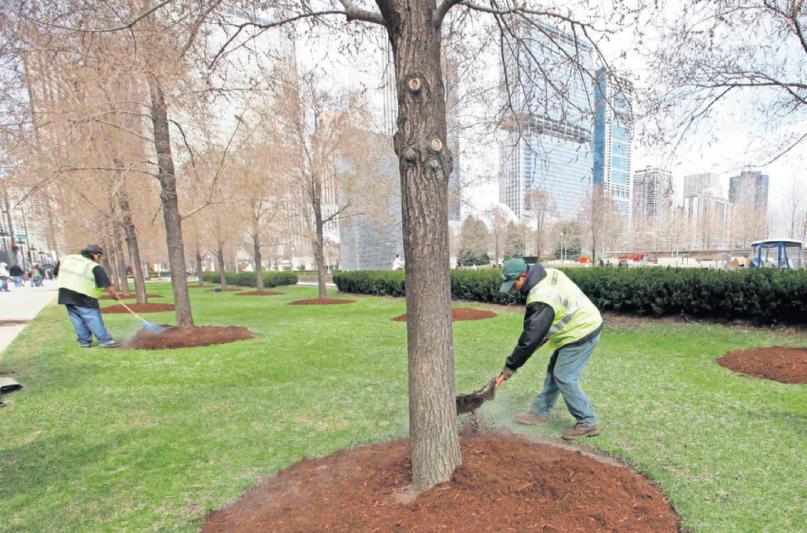
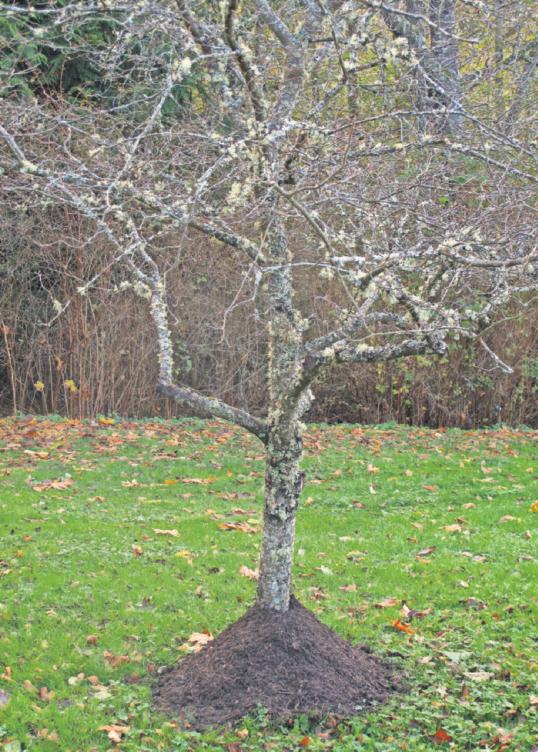
In most cases, 3 to 4 inches is the ideal depth for mulching around plants. Keep it a few inches away from trunks and stems to allow for air circulation. When mulch sits directly against bark or stems, moisture gets trapped, and rot eventually follows.
I know you’ve seen professional landscapers pile
mountains of mulch against tree trunks, but the practice — known as “volcano mulching” — is deadly to trees, slowly suffocating them as the buried portion of their trunks decay. When the trees die, sometimes years later, the homeowner is often perplexed, having forgotten the long-ago volcano.
A properly mulched tree leaves the flare at the base of the trunk exposed and fully visible.
The best time to mulch is after the danger of frost has passed but before weeds have emerged. Putting it down too early could trap cool temperatures in the soil and slow plant growth. Waiting too long risks soil erosion and weed proliferation, and facilitates moisture evaporation.
And there’s a cherry tomato on top: Mulch will make your garden look polished, too.
Jessica Damiano writes regular gardening columns for The Associated Press.
TENNIS, ANYONE?
How about table tennis? The tabletop version of the sport is believed to have begun in Victorian England as a parlor game played by the upper class. Early equipment was improvised; instead of a net, players are said to have lined up a row of books across a table and hit a golf ball, or possibly a champagne cork, over it. Cigar boxes or more books were used as paddles. The game caught on quickly. Companies started making and selling nets, paddles, and balls for indoor use.
An early set of four rattan rackets in a wooden box marked for “Spalding’s Game of Table Tennis” on the interior lid sold for $531 at Copake Auction Inc., against an estimate of $50 to $75, evidence of the game’s continuing appeal. The colorful scene on the label of elegantly dressed players in a furnished parlor reflects its origins in the homes of the upper class and helps date it to the 19th century.
Other companies called the game by other names. For J. Jacques & Son Ltd. in England, it was “Ping Pong.” To avoid trademark infringement, other manufacturers used names like “Gossima,” “Whiff Whaff,” and “Parlor Tennis,” but “table tennis” remained the generic name.
The International Table Tennis Federation was founded in the 1920s, leading to the first World Table Tennis Championships. The game’s popularity continued to grow as a leisure activity and a competitive sport. In 1972, Atari created Pong, an electronic version of table tennis, that paved the way for modern video games, which today include virtual reality table tennis. Table tennis became an Olympic sport in 1988, and, according to the International Olympic Committee, it has the most participants worldwide of any sport.
Terry & Kim Kovel | Antiques & Collecting
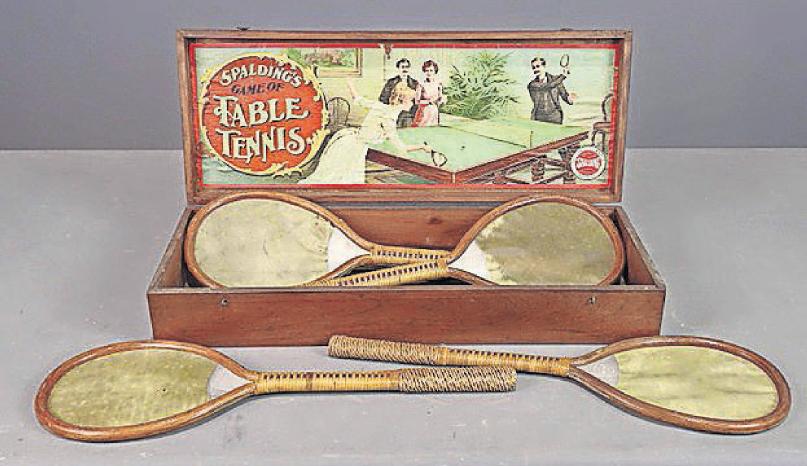
Sporting goods manufacturer Spalding has been making table tennis sets for more than a hundred years. In this case, it’s much more expensive to buy antique than brand new. ( COPAKE AUCTION INC.)
Q. I have a set of small animal carvings that I received as a gift a long time ago. I believe they are made of ivory. How can I tell? If they are, is it legal to keep them or sell them?
A. Many materials, including bone, horn, and plastic, can be mistaken for ivory. In fact, celluloid, one of the first plastics, was invented as a synthetic ivory. Ivory is smooth and cool to the touch and develops a yellowish or brownish patina over time. Take a close look at the grain on your carvings. Genuine ivory has a random grain. The grain on artificial ivory will have a repeating pattern. The World Wildlife Fund (worldwildlife.org) has an online guide with more advice on identifying ivory. There are no laws against owning legally acquired ivory. Laws concerning the sale of ivory are complicated and have changed over the years. If you can prove the ivory is more than 100 years old, it is legal to sell. If you are planning to sell your ivory, be sure to check the U.S. Fish & Wildlife Service for the current laws and requirements,
as well as your state laws. If your ivory is not legal to sell, you may be able to donate it.
Q. Can you help me find out about an old lamp that has been in my family for years? It has a half-dome shade made of squares of glass. The glass is swirled and translucent. The base is dark metal and shaped like a tree trunk.
A. The swirled translucent glass in your lamp’s shade is called slag glass. It was extremely popular in shades for electric lamps in the early 20th century, when light bulbs had a harsh, bright light that needed to be softened. Cast-metal bases were popular at about the same time. The tree trunk shape you described indicates it was made in the art nouveau period of the 1900s to 1910s, when designs had ornate lines and were inspired by nature. Many American companies made lamps like yours at the time. The “big three” among collectors are Handel, Pairpoint, and, of course, Tiffany. Check your lamp, both the shade and the base, for a maker’s mark. Lamps like yours by unknown makers can sell for
anywhere from about $50 to $500, depending on the quality of the design and the type of metal used for the base. Identifying the maker will increase the value. Lamps by the “big three” can be worth thousands of dollars.
TIP: A tennis ball can be used to rub out scuff marks on vintage linoleum tiles — the kind often used in houses before the 1960s.
Kovels answers readers’ questions sent to the column. Send a letter with one question describing the size, material (glass, pottery) and what you know about the item. Include only two pictures: the object and a close-up of any marks or damage. Be sure your name and return address are included. By sending a question, you give full permission for use in any Kovel product. Names, addresses or email addresses will not be published. We do not guarantee the return of photographs, but if a stamped envelope is included, we will try. Questions that are answered will appear in Kovels Publications. Write to Kovels, The Republican, King Features Syndicate, 300 W. 57th Street, 41st Floor, New York, NY 10019, or email us at collectorsgallery@ kovels.com.
Current prices are recorded from antiques shows, flea markets, sales and auctions throughout the United States. Prices vary in different locations because of local economic conditions. Doll, Mattel, Barbie, Diva, Barbie & the Rockers, curly Titian hair, blue and purple eye makeup, purple and yellow jumpsuit, blue metallic jacket, accessories, box, 1985, 12 inches, $25. Coverlet, overshot, four colors, red, blue, cream, tan, round center medallion surrounded by four eagles and shields, leafy scroll border, 82 x 66 inches, $70. Chinese Export, figure, bird, crane, textured wings, multicolor, perching on stump, c. 1900, 16 inches, $125.
Basket, Algonquin, Mi’kmaq, round, lid, loop finial, dark brown, woven, porcupine, splint, 3 1/2 x 5 inches, $130.
Tiffany silver, bonbon spoon, Wave Edge, pierced bowl, lobed sides, leafy border on handle, monogram, 6 inches, $160. Furniture, bin, wastepaper, rococo style, parcel gilt, painted, green, flower garland panels, scrolled trim, cabriole legs, 20th century, 25 inches, $225.
Pepsi-Cola, door push, Come In For That Big, Big Bottle, 5 Cents, On The Lips Of Millions!, dark blue ground, white lettering, red logo, enamel, 1940s, 10 x 3 inches, $355.
Cut glass, lamp, mushroom shape, dome shade, hanging prisms, flared base, metal mounts, electrified, 36 1/2 inches, $845.
Lamp base, electric, twolight, hammered copper, wrought iron mounts, shields, ring handles, four scrolled feet, Onondaga Metal Shops, c. 1905, 25 inches, $1,375.
Rug, runner, red field, center column of yellow, light blue and black diamonds, black side borders, wool, Morocco, mid-20th century, 9 feet 2 inches x 2 feet 10 inches, $2,435.
By A lex Veiga Associated Press
The average long-term U.S. mortgage rate rose again last week, reaching its highest level in nine months, another setback for prospective homebuyers.
The benchmark 30-year fixed rate mortgage rate rose to 6.53% from 6.51% last week, mortgage buyer Freddie Mac said Thursday. Despite the latest increase, the average rate remains below 6.89%, where it was a year ago.
When mortgage rates rise they can add hundreds of dollars a month in costs for borrowers, reducing their purchasing power.
Rates have been mostly trending higher since the war with Iran began, disrupting the passage of tankers ferrying crude oil from the Persian Gulf to customers worldwide. That’s sent oil prices sharply higher — a key driver of inflation. Mortgage rates are influenced by several factors, from the Federal
Claudia C. Colon and Edgardo Colon to Michelle M. Moriarty and Matthew F. Moriarty, 100 Kensington St., $375,000.
Kevin Lund, Erica Lund and Erica Lyman to Steve A. Zander, trustee, Amy H. Zander, trustee, and Zander Family Trust, trustee of, 32 Oak Lane, $450,000.
Mark A. Maruca, trustee, and Mark A. Maruca Revocable Indenture of Trust of, trustee of, to Loriann Gulluni, 79 Simpson Circle $292,500.
Douglas R. Rice and Laura K. Rice to Richard Allen Bishop III, and Michelle Lee Bishop, 148 Aubinwood Road, $620,000.
Sandra Mamani and Raul Mamani to Srinivasarao Nandiwada and Deepti S. Nandiwada, 252 West St., $269,900.
Amhad Development Corp., to Patricia E. Convery, 28 Greenleaves Drive, $350,000.
Evan J. Romer, personal representative, and Robert H. Romer, estate, to 104 Spring Street LLC, 104 Spring St., $710,000.
Reserve’s interest rate policy decisions to bond market investors’ expectations for the economy and inflation.
They generally follow the trajectory of the 10-year Treasury yield, which lenders use as a guide to pricing home loans.
Expectations of higher oil prices have pushed up long-term bond yields, causing mortgage rates to head higher.
Bond yields have been easing this week amid hopes that the United States and Iran may reach a deal to reopen the Strait of Hormuz and get oil flowing again. The yield on the U.S. 10-year Treasury note was at 4.46% in midday trading Thursday on the bond market, down from 4.57% a week ago. It was just 3.97% in late February, before the war broke out.
Meanwhile, borrowing costs on 15year fixed-rate mortgages, popular with homeowners refinancing their home loans, also rose this week. That average rate rose to 5.87% from 5.85% last week. A year ago, it was at 6.03%, Freddie Mac said. As recently as late February, the average rate on a 30-year mortgage had slipped just under 6% for the first
527 Main LLC, to Franklin Reed Brown and Kate Brown, 527 Main St., $439,000.
Amy Porter and Michael Gouin to Andrew Heath and Andrea Heath, 111 Aldrich St., $640,000.
David E. Gold to FH Vision Estate Inc., 18 Keyes St., $102,500.
David Slocum, George C. Slocum Jr., “aka” George E. Slocum Jr., and Christina Slocum-Wysk to Jennifer Guetti-Slocum and Roger L. Slocum, West Road, $75,000.
Brandon J. Grover and Gretchen L. Kelton to Kenneth Everett Jr., and Taylor Everett, 269 Bald Mountain Road, $160,000.
Peter J. Klimoski to Ashley Borkowski and John Field, 704 Brattleboro Road, $475,000.
David C. Southworth, trustee, and Mary B. Quimby Revocable Trust, trustee of, to Jennifer Peters and Brent Lacroix, 79 Main St., $395,000.
John C. Wood to John C. Wood and Lisa Wood McDonald, 318 Brook-
time since late 2022. It’s hasn’t fallen below that threshold since. It’s now at its highest level since Aug. 28, when it was 6.56%.
While average long-term mortgage rates remain lower than they were at this time last year, their recent increase has put a damper on sales so far this spring homebuying season.
Sales of previously occupied U.S. homes were essentially flat last month after declining from a year earlier in the first three months of the year, extending a nationwide housing slump that dates back to 2022 when mortgage rates began to climb from pandemic-era lows. Demand for newly built homes has also been lackluster. New home sales fell 6.2% in April to a seasonally adjusted annual rate of 622,000 units, the U.S. Census Bureau reported Thursday. Through the first four months of this year, new home sales are down 6.5% from where they were at this time last year, even as many homebuilders continue to lower prices and offer incentives to woo home shoppers.
New data on mortgage applications
field Road, $100.
John C. Wood to John C. Wood and Lisa Wood McDonald, Brookfield Road, $100.
Miaoli Wu to Noah Proulx, 52 Washington Road, $475,000.
Pastrich-Klemer RE Inc., to Katherine M. Klemer, 108 Main St., $457,500.
BHO Realty LLC, to Cory Russo, 67 Bromley Road, $345,000.
Patrick Q. Forshay to Frank Small and Isabell Small, 12 Riverfront Road, $329,000.
John D. Wilkie to Kathy Jaracz, 583-585 McKinstry Ave., $475,000.
Welltower Om Group LLC, to Chicopee 444 MP WRK 7 LLC, 444 Montgomery St., $17,700,000.
Joseph A Rizzo & Bernadette Rizzo Irrevocable Trust, trustee of, Scott A. Rizzo, trustee, and Keith P. O’Brien, trustee, to Claudia C. Colon and Edgardo Colon, 76 Kelley Road, Unit W8, $230,000.
points to ongoing weakness. Mortgage applications, which include loans to buy a home or refinance an existing mortgage, fell 8.5% from a week earlier as mortgage rates marched higher, according to the Mortgage Bankers Association. A pullback in demand for mortgage refinancing loans accounted for a big share of the overall decline.
One bright spot: Applications for loans to buy a home continued to run ahead of last year’s pace. Home shoppers who are undeterred by rising mortgage rates are benefiting from buyer-friendly trends in many markets, including more properties on the market than a year ago and data showing home listing prices have started falling in many metro areas, especially in the South and Midwest.
“Buyers have more homes to choose from and asking prices continue to soften, but their dollars don’t stretch as far as they did a few months back,” said Jake Krimmel, senior economist at Realtor.com. “A resolution to the (U.S.-Iran) conflict, therefore, would do a world of good for mortgage rates, consumers, and housing market momentum.”
Peter D. Drew, individually and as personal representative of the Estate of Beatrice R. Drew, to John M. Peters Jr., and Loretta L. Peters, 108 Nelson Road, $405,000.
Lorriane French to Lawrence F. Remby, Stage Road and Plainfield Road, $125,000.
Angela S. V. King and Douglas R. Kremm to Conor D. Mulroy, 71 Mathews Road, $999,900.
Happy Acres LLC, to Pawel Misniakiewicz and Malgorzata Misniakiewicz, Farmer Circle, Lot 13, $185,000.
NDS Properties LLC, to Bretta Construction LLC, Smith Avenue, Lot B, $97,500.
Hazel M. McCallum and Robert F. McCallum Jr., attorney-in-fact, to Anthony Aubrey and Maria Heffernan, 11 Laurel Drive, $545,000.
William P. Roeder and Diane M. Roeder to Bruno Soares De Oliveira, 18 Davis St., $420,000.
Bradley J. Robbins and Rachel A. Lepine to Joseph A. Allbright and
Kassandra O’Brien Allbright, 89 Garfield Ave., $765,919.
Brenda S. Campbell, Kimberley McDowell and Gina Tanksley to Jennifer R. Coletta, 53 Florence Road, $360,000.
Pineview Development LLC, and West Co Investments LLC, to Barbara K. Dadmun, 19 Nicols Way, $700,000.
Donna M. Helems-Phaneuf, trustee, and Phaneuf Family 2023 Irrevocable Trust to Anthony R. Witman, 16-26 Water Lane and 30 Water St., $840,000.
SGS Holdings LLC, to Lucien Lighthouse LLC, 1 Adams St., $500,000.
Elite Real Estate Investment Group Inc., to Axel Boy, 62 East Main St., $228,000.
Blast-Tech Inc., to Allyn Charlefour and Stephanie Charlefour, 182 Main Road, $495,000.
Breezy Acres LLC, to Philip Kraus, Kendall Street, $125,000.
Matlasz Realty Inc., to 95 Carver Street LLC, 95 Carver St., $100.
Mary Ann Meshako and Thomas J. Meshako to Roy F. Knight and Emily J. Skolfield, 714 Colrain Road, $608,000.
Felicia Leveille to Felicia Leveille, trustee, and Felicia Leveille Revocable Trust, 25 Meadowbrook Drive, $100.
John H. Allen to Jonathan H. Allen, trustee, and Allen Family Irrevocable Trust, 111 Middle St., and 65 Middle St., $100.
Jeremy D. Ober to Michael R. Lively and Angel P. Lively, 109 Bay Road, $484,000.
Branch View Farm LLC, to Franklin Land Trust Inc., 12 West Branch Road, $425,000.
Douglas Crabtree, representative, Wesley A. Crabtee, estate, and Wesly A. Crabtree, estate, to Christian Lucier and Katelyn Lucier, 74 Granville St., Lot 269, $314,000.
DVK Property Management, receiver, William Philpott and Massachusetts Comm Attorney General to Sariann Maldonado Pabon, 934 Main St., $300,000.
Marian Center Inc., to 1365 Northampton Realty LLC, 1365 Northampton St., $2,750,000.
Susan C. Lessard to Jose A. Vazquez-Garcia and Ramona Vazquez, 964 Main St., $165,000.
Thomas A. Palavra to Erin Silva and Connor Beaulieu, 127 Pond Brook Road, $375,000.
Greenfield Savings Bank and Ryan Martin, trustees of the Warren H. Morgan Family Trust, to Brittany Eisenbarth-Jenkins and Tyler Jenkins. 66 Cave Hill Road, $950,000.
Barbara C. Appel, trustee of the Barbara C. Appel 2025 Trust, to Raul Mamani, Sandra Mamani and Mark E. Pollock, 87 Shutesbury Road, $515,000.
Christopher Bushey to Jimmy M. Omran, 20 Kimberly Circle, $572,500.
Michael J. Grossane, Margaret B. Grossane and Margaret B. Mack to Elizabeth Blakeslee Zadworny Holmes, 27 Fairfield Terrace, $515,000.
Nicholas C. Fleming. trustee, David A. Fleming, trustee, and Jane Ellen Fleming and Edward J. Fleming III, Testamentary Trust, trustee of, to Sheila F. Soja, trustee, and Soja Realty Trust, trustee of, 8 Burns Meadow, Unit 102, $422,000.
Carlos L. Figueiredo and Carlos L. Defigueiredo to HP Rum LLC, 129139 Hubbard St., $850,000.
Robert W. Gibb to Linda A. Belben, 56 White St., $100,000.
Phyllis M. Margozzi to Marie S. Breheny. 8 Chester Street. $375,000.
Gargi Kundu to Joydip Kundu, 510 Fairway Village and 505 Fairway Village, $100.
Kathleen Kelly Godwin to Holly Buttrey, 74 Barrett St., and 72-74 Barrett St., $235,000.
Billmar Corp., to River Valley Market LLC, 330 King St., $1,350,000.
Georgia Nell Crump, trustee, Robert James Ratcliffe, trustee, and Georgia Nell Crump Revocable Trust to Robert J. Ratcliffe, trustee, Georgia N. Crump, trustee, and Robert James Ratcliffe Revocable Trust, 111 Prospect St., $100.
Cheryl J. Cross and Deborah S. Bruce to Catherine Weiss, 46 Columbus Ave., $1,150,000.
Elizabeth I. Read, trustee, and Elizabeth I. Read Living Trust to Samuel E. Read and Caroline M. Ciocca, 5 Pomeroy Terrace, $38,000.
Big Red Realty LLC, to Declan Cronin, 12-14 Grant Ave., $100.
Cynthia Larareo and John Larareo to Nina Gordon-Kirsch and Nancy Gordon, 60 Sheffield Lane, $637,000.
David Tetreault to Natalie D. Basile, 330 Haydenville Road, $388,500.
Leo M. Campbell and Alysia Campbell to Nikki Davenbrie and Marja Davenbrie, 284 South St., $557,000.
Martha J. Cohen, trustee, Christie Karis, trustee, and Cohen-Karis Revocable Trust to Rebecca Jacobson-Fowler and Derek Fowler, 103 Black Birch Trail, $527,000.
Thomas J. Mahar and Patricia A. Mahar to Michael Blefield and Laurie Blefeld, 20 Bridge Road, $970,000.
Brianna K. Inman and Tyler L. Inman to Thomas A. Aurigemma, 83 Captain Beers Plain Road, “aka” 83 Capt.
Beers Plain Road, $430,000.
Jennifer Finch, “aka” Jennifer Finch Piescik, Michael Scott Joseph and Melinda Finch Stone to Jennifer Finch, 33 Riverview Drive, $136,000.
Katherine H. St. Clair to Bettina Vlcek and Joseph Vlcek, 46 Maple St., $400,000.
Julian Jaworski to Erin Jaworski, Pine Meadow Road, $100,000.
David Christopher Simpson and Kimberly Simpson to Ryan Page and Wendaliz Page, 24 Russ St., $519,000.
51 Summit Avenue LLC, to James Hart and Laura Griffin, 1242 South Main St., $376,900.
Rosemary Leduc to Sovattra Naw, 1007 Foster St., $297,000.
Joan Roberts and Leonard H. Roberts to Anna J. Humbert and Dennis A. Humbert, trustees of the Anna J. Humbert Trust, Tunnel Road, $129,000.
Joyce L. McGibbon and David C. Myers to Joyce L. McGibbon, 13 Pine Grove Drive, $100.
Hadley Street SH LLC, to Newgen 1 LLC, 11 Hadley St., $842,900.
Hilda I. Pons Loud and Bryan C. Pons Loud to Lois Roufogalis, 176 Pine Grove Drive, $395,000.
Heather D. Connelly, trustee, and Revocable Indenture of Trust of Laurel L. Connelly to Heather D. Connelly, 112 Stonybrook Way, $100.
Stay In Motion LLC, to David Shpak, 356 Newton St., $405,000.
Ryan Spencer and David M. Dimauro to Aya Custom Homes Inc., Granby Road, $105,000.
Kellie L. Sanders, personal representative, Rachael Donato Stanton, personal representative, and Helen A. Lemiech, estate, to VLS Home Builders LLC, 110 Mountain View St., $220,500.
Hing Seng and Sovandarany J. Kry to Kristen Margaret Dearborn and Giovanni Richetelli, 20 Hillside Ave., $325,000.
Eric W. Perkins and Erica C. Wheeler-Perkins to Phyllis M. McTighe and Kenneth A. McTighe, 140 Pine Grove Drive, $365,000.
Thomas S. Avila and Hazel M. Ortiz to Thomas S. Avila, 11 Cold Spring Road, $45,000.
Deborah J. Sholly to Audra Cimineri,
Ryan Cimineri and Emily Cimineri, 4 Grant St., $100.
Brett Remillard to Andrey Katykhin, 57 White Loaf Road and 57 Whiteloaf Road, $98,000.
Suzanne L. McColgan, trustee, and Charles F. Perry Sr. & Sherrilyn R. Perry Convertible Trust to KBIP LLC, 38 College Highway, $135,000.
Brian K. Phillips, Linda M. Phillips O’Brien, Wendell Phillips and Wendell Phillips Jr., to Michael Daigle, 112 South Loomis St., $290,000.
Judith O. Zimmerman and William V. Zimmerman to Whitney Cass, Whitney R. Cass and Victoria P. Cass, 10 Revere Road, $455,000.
Alexander R. Dones-Schipper and Deliana Donnelly to Nery Bernal, 89 Juniper Drive, $250,000.
Brooke E. Lacey and James O. Lacey to Kenneth J. Filow, Glenn David Jennings and Matthew Filow-Jennings, 106 Magnolia Terrace, $420,000.
Carol J. Pulowski and Carol J. Labaj to Denisse Gutierrez Reyes and Kennix Martinez, 66 Thornton St., $295,000.
Dan Sweeney and Daniel W. Sweeney to Square Deal Properties LLC, ES Marine Street, $90,000.
Diane Savino to Tiana Piteo, 27 Williamsburg Drive, Unit 27, $45,250.
Eric L. Melendez Gerena and Evelyn Roman Medina to Alicia N. Rodriguez, 15 Florida St., $300,000.
IHI Wave LLC, to Melissa Merced, 64 Berkshire Ave., $280,000.
Innovareno LLC, to Tatiania Henry, 14 Adams St., $340,000.
JJJ17 LLC, to Demaris Cosme, 11 Ina St., $285,000.
Kathleen Truman, representative, William Glen McCarthy Jr., estate, and William G. McCarthy , estate, to Edouard W. Beauzile, 186 Bolton St., $290,111.
Katie A. Verrochi and Dwight Gregoire to Karen Angelia Allen, 88 Agnes St., $280,000.
Lisa Judkins, conservator, Gerald Nunes and Gerald E. Nunes to Nia E. Green, 179 Carver St., $225,000.
Mary T. Mackley to Alex Rafael Baez, 62 Firglade Ave., $465,000.
Maynard Hamre Investments LLC, to RGA Properties LLC, 140 Chestnut St., Unit 407, $65,000.
Natanel Crespo and Natanael Crespo to Jin Xin Huang, 140 Chestnut St., Unit 702, $94,000.
North Harlow 4 LLC, to Brendaliz Cepeda, 185 Kerry Drive, $295,000.
Selpan Holdings LLC, to Lisa M. Lord and Lawrence F. Lord, 890-892
St. James Ave., $523,000.
Shynna Jackson-Pilet to Katrina Gusmao, 118 Longhill St., Unit 3B, $145,000.
Spectra S1 LLC, to Pragya Verma, 21 Bloomfield St., $485,000.
Stacy L. Riley, representative, and Paula J. Phaneuf, estate, to Jonathan L. Soto-Landrau and Awildo J. Morales, 14 Drew Court, $190,000.
Thomas L. Aveyard and Sue E. Aveyard to 52 Bremen LLC, 52 Breman St., $255,000.
Trang Dam, Asia Nguyen, representative, Le T. Do, estate, and Le Do, estate, to Anh Thi Kim Do, 8 Wilmont St., $305,000.
Vladimir Kulenok, Irina G. Kulenok, Yuliya Saykina-Sevostianova and Vladimir Sevostianova to Angela B. Bradley, trustee, Kenneth J. Bradley, trustee, and Bradley Family Trust, trustee of, 68 Tallyho Drive, $620,000.
Jacob Francis Crevier and Dannielle Zoe Collette to Chase Laprade and Brittney Rose Collette. 83 Beaver Lake Road, $390,000.
Bluedog Capital Partners LLC, to Real Estate Investments Northeast LLC, 22 Church St., $70,000.
Diane J. Smith to Appleton Grove LLC, 125 Glendale Circle, $170,000.
Frank A. Small and Isabell Small to Shahara Bakth, 92 Norman St., $292,450.
Cycle Street Redevelopment LLC, to Cetnar One LLC, 0 Cycle St., $480,000.
Massfield LLC, to North Harlow 2 LLC, 465 East Main St., $1,975,000. Revampit Holdings LLC, to Max Coronel and Egma Santander, 42R Jefferson St., $380,000.
Roger P. Cox Jr., trustee, and Cox Living Trust, trustee of, to Katie A. Verrochi and Dwight A. Gregoire, 57 Joseph Ave., $300,000.
Stephen J. Murphy to Susan E. Moeller and Jeffrey C. Moeller, 544 Russellville Road, $181,475.
Frank Stellato and Rosa Stellato to John Graziano and Megan Graziano, 2 Edward St., $670,000.
Michael E. Petrick to Xiaochu Wang and Katalina Wang, 12 Old Carriage Road, $600,000.
Scott R. Beals and Valerie R. Beals to David Rivera and Angeles Rivera, 2205 Boston Road, Unit K-100, $330,000.













(BREAKINGOUTINACOLDSWEAT)

OtherHeartAttackSymptomstoWatchOutFor: Chestpain,discomfort,pressureorsqueezing,likethere’satonofweighton you•Shortnessofbreath•Nausea•Light-headednessorsuddendizziness •Unusualupperbodypain,ordiscomfortinoneorbotharms,back,shoulder, neck,jaworupperpartofthestomach•Unusualfatigue

Ifyouexperienceanyoneofthesesymptoms,don’tmake excusesforthem.MaketheCall.Don’tMissaBeat.
Tolearnmore,visitWomensHealth.gov/HeartAttack