


















By K evin B rasler
The Washington Post
REPLACING YOUR home’s heating or cooling equipment can cost thousands of dollars. When you need to upgrade your system, you’ll want to work with a company that offers the best possible advice and prices. How well a new system performs and what it costs largely depends on how well it is designed and installed.
Nonprofit Washington Consumers’ Checkbook’s surveys of local consumers turned up dozens of excellent HVAC services. But many others received poor overall ratings from surveyed customers. If you need to replace or add equipment, there’s lots to consider.
Energy efficiency matters
HVAC companies will present you with several options offering a range of energy efficiency capabilities.
Need a new central air conditioner? Consider a heat pump instead. These devices are basically air conditioners that can both heat and cool buildings. New models are extremely energy efficient and quiet and can reduce reliance on furnaces.
For all types of HVAC equipment, energy-efficient models cost more than basic ones. But lower power bills and rebates from utility companies can allow you to quickly recoup the extra cost.
Most HVAC contractors won’t provide detailed calculations on exactly how much highly energy-efficient equipment will lower your utility bills. But they can estimate what percentage you’ll save with different types and models of equipment. You can then roughly calculate your annual energy bills to determine how much you’d save with say, Furnace A versus Furnace B.
If you’re planning an addition or seeking to improve heating or cooling in one
Don’t spend thousands of dollars on efficient HVAC equipment without taking other steps to reduce energy waste. Identifying and sealing leaks and improving insulation will give you the biggest bang for your buck.
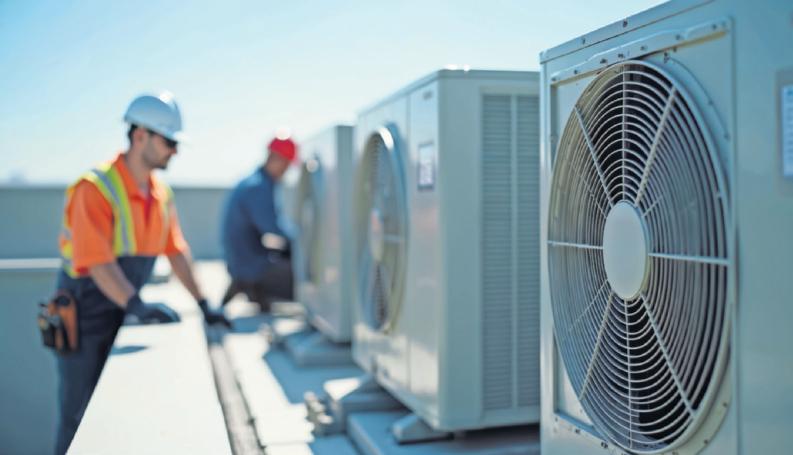
room, a basement, or an upper floor, consider a ductless mini-split heat pump, which allows you to control temperatures in a single space.
Don’t spend thousands of dollars on efficient HVAC equipment without taking other steps to reduce energy waste. Identifying and sealing leaks and improving insulation will give you the biggest bang for your buck. Many improvements cost little or nothing but will have substantial effects on your utility bills.
Don’t go too big — or too small
Make sure that the equipment you buy is the correct size for your home. Undersize units won’t efficiently heat or cool spaces; oversize units cost more and cycle on and off constantly, boosting utility bills, making more noise, requiring more frequent maintenance and dying sooner.
The size of heating and cooling units is called capacity. For furnaces and heat pumps, capacity is the amount of heat a unit can generate as measured in
British thermal units (BTUs). For air conditioners (and heat pumps operating in cooling modes), capacity is measured in BTUs but expressed as the amount of heat the units can remove. The capacity of heat pumps and air-conditioner units is usually described in “tons.”
One ton equals 12,000 BTUs — for example, a 36,000BTU air conditioner is a “three-ton unit.”
If you have expanded your home, finished a previously unconditioned space, or if your old equipment didn’t sufficiently heat or cool all parts of your home, companies should perform a load calculation to determine the right size of equipment. (If you are replacing old equipment that adequately heated and cooled your home, you can skip this step.)
Shop around
Getting competitive bids from several contractors will save you money.
For large installation jobs, it’s common for company-to-company price differences to exceed $1,500 for the same equipment
Ask each company which makes and models of equipment it will install and their capacity, energy efficiency and sound ratings. Most companies can offer equipment at several quality levels; ask about pros and cons.
For installation contracts, get performance guarantees specifying how warm or cool the equipment will keep your house, and how uniform the temperature will be inside when outside temperatures reach a specified level. Be sure your contract clearly states the company’s responsibilities on issues like providing an electrical supply and hooking up your equipment to the electrical panel; providing drainage for condensate; enclosing ductwork; and painting and patching holes.
and work. Even for smaller installation jobs, prices vary considerably.
Invite at least three reputable companies to your home to offer written proposals. Ask each to explain whether you need more than one separate heating or cooling system and more than one thermostat, and whether you’d benefit greatly from features such as variable-speed blowers. If you’re adding a new type of system, ask how ducts will be run, where and how a condenser unit and blower will be mounted, plus how to access equipment for maintenance and filter replacement. Their advice and your choices affect how noisy the system is, how quickly and uniformly your home is heated or cooled, how easy the system is to maintain, energy consumption, and how disruptive the installation process will be. You’ll also want to ask how much closet, attic, or outdoor space the system requires, and how the ducts and air-supply registers will affect the appearance of your home.
Whether you need repairs or a new unit, settle with a credit card. If you are dissatisfied with the work, you can dispute the charge with your credit card company.
Because many homeowners don’t have the cash on hand to pay for the equipment and installation, companies often offer financing through third parties, usually at high interest rates.
Before signing loan paperwork, review all repayment terms. If an HVAC company offers you a zero-interest loan, you’ll often have an interest-free period but pay a hefty deferred-interest fee when it ends.
Some HVAC outfits now push equipment leases; the policies we’ve reviewed might be the most lopsided contracts we’ve encountered in Checkbook’s 50-year history, so it’s best to avoid those.
Kevin Brasler is executive editor of Washington Consumers’ Checkbook and Checkbook.org.
Lee Reich | In the Garden
YOU’D THINK I would have known better or, at least, listened to my own preaching. An increasing warming spell a week ago induced many fellow gardeners around here to set tomato and pepper transplants out in their gardens. The average date of the last killing freeze around here is May 21 — but temperatures were getting warmer and warmer, and what with global warming . . . I have preached not going with your gut when it comes to times for spring planting but was swayed with the crowd and the warming weather, and planted out over 50 tomato plants and a dozen pepper plants a couple of weeks ago.
Then the weather turned cooler, with night-time lows predicted to sink into the low 30s.
Here on my farmden, cold air, which is denser than warm air, flows downhill like water to collect in low spots. My farmden always experiences temperatures a few degrees colder than locally predicted.
No problem. I made some wire supports over which I draped a row cover which is said to retain heat, offering about six degrees more of frost protection. I went to bed that night at peace with our planet.
Next morning I noted that minimum outdoor temperature on my Sensorpush receiver had registered a low of 27°; a minimum-maximum thermometer under the row cover registered 34°. I kept the cover on as the sun warmed the air, and later that day peeked underneath to see how everyone was doing. Most tomatoes and peppers were “toast,” wilting and watery looking!
The average date of spring’s last freeze — when the mercury takes its final plunge to freezing temperatures until autumn — is a seminal point
in the gardening calendar. That 32-degree temperature will threaten tender young seedlings and fruit tree blossoms. A key word in “average date of spring’s last freeze” is the word “average.” There’s a 50% chance of a freeze before or after that date. Unfortunately, each year we find out when that last frost has actually occurred only after it has passed.
Yet we can still plan our gardening activities around this date — by playing the averages. Hence, I sow tomato seeds indoors six weeks before the average date of the last killing frost, and then set out transplants a week after that same date.
To make plans using those averages, you’ve got to know the average date of the last killing frost in your garden.
One caution: Don’t trust your gut reaction (or someone else’s) to come up with this date or you’ll end up planting tomato seeds on a freak warm day in February! You might come up with that seminal date by looking in some gardening magazine for one of those maps showing the country overrun with squiggly lines on which the date is printed.
Frost dates don’t respect political geographical boundaries, but trace their squiggliness to differences in latitude and elevation, as well as proximity to large bodies of water. All other things being equal, that date is pushed four days further along for every seventy miles north you travel or four hundred feet you climb. For more precision of average freeze dates, go to https://www.ncei.noaa. gov/news/last-springfreeze. Or you could find it by zip code at https:// davesgarden.com/guides/ freeze-frost-dates/#b. The latter site lists various frost probabilities for various dates.
The Greenfield Public Library has officially launched its new seed library. Home gardeners are invited to visit the seed library, located on the second floor of the library at the information services desk, to choose up to five packets of seeds for their gardens. A wide variety of vegetable seeds (arugula to zucchini), as well as herb and flower seeds (amaranth to zinnia) will be available. Borrowing guidelines will be provided, and gardeners are
encouraged to return seeds after the harvest season ends. This program is free and open to everyone. For more information, contact Nancy Little at nancy.little@greenfield-ma. gov or call 413-772-1544.
The Hampden Garden Club’s Memorial Day plant sale will be held on Monday, May 25, at the Academy Hall, 616 Main St., from 8 a.m. to noon.








By L inda B ell Bankrate.com
HOMEBUYERS OFTEN FOcus on home prices and mortgage rates when thinking about affordability. But for millions of homeowners, another housing cost is creeping higher and quietly reshaping the math: homeowners association (HOA) fees.
Once considered a small maintenance expense, HOA dues are increasingly acting like a shadow mortgage. This mandatory, ongoing monthly payment can rise unexpectedly and, in extreme cases, even put a home at risk of foreclosure.
That possibility has Jo Meleca-Voigt, a 55-year-old, disabled and retired public educator, worried. In 2021, Meleca-Voigt and her wife, Christine, bought their townhouse in Rochester, New York. The home’s accessibility features and an HOA that handled exterior maintenance drew them in. The couple, who live on a fixed income, budgeted for the monthly $235 HOA fee.
But over five years, their dues jumped over 60% to $385 a month. On top of that, came two special assessments in 2023 totaling $3,000 to rebuild the
HOA’s reserve fund and repair the community’s aging roofs. Meleca-Voigt and her wife needed to dip into their savings to cover the surprise bills — not an easy move when every penny counts.
“This is absolutely a shadow mortgage,” Meleca-Voigt says. “It’s actually worse than a mortgage. If you get a mortgage with a fixed rate, you know what you pay and you can work around it.”
HOAs can offer real benefits by managing residential communities, helping maintain shared spaces and providing amenities, like pools or gyms. But there’s a tradeoff: According to Realtor. com, the median HOA fee has risen to $135 per month, up from $125 last year and $108 in 2019. This rise comes as the number of properties with HOAs is also climbing. Almost 85% of townhomes and condos have HOAs, while 33% of single-family homes do.
“It’s something that’s a little bit more accepted than it was maybe 10, 20 years ago, paying HOA dues every month,” says Joel Berner, senior economist at Realtor.com. “As it becomes more common, it’s kind of a race to the bottom where one neighborhood can say, well,

A HELOC is a way to tap into your home’s equity — the portion of your home you own outright. Like a credit card, a HELOC lets you borrow from a credit line gradually, as the need arises, up to a specified dollar limit. You can then pay the money back in installments. (STUART MILES / DREAMSTIME / TNS)
the neighborhood down the street is charging 200 bucks a month for HOA fees. So we can probably bump ours up a little bit, too.”
The housing bill that never goes away
With sticky inflation and the cost of labor and materials continuing to increase, HOA fees are rising as well, now eating up a significant portion of overall housing costs.
For example, in the Miami–Fort
Lauderdale–West Palm Beach area, the average HOA fee is $617 per month for a median home costing roughly $425,000, according to Realtor.com. That’s nearly 27% of a typical mortgage payment.
“These [rising costs] are effectively pricing them out of living in the home that they bought,” Berner says.
In addition to monthly dues, special assessments can be even more shocking.
There will be a wide variety of plants to purchase. Make sure to stop by and check out the raffle prize table and purchase raffle tickets for a chance to win.
AGAWAM
The Agawam Garden Club is planning its annual plant sale for Saturday, May 30. This year’s event will be held at the Historical Thomas Smith House, 251 North West St., Feeding Hills, and will run from 9 a.m. to noon. The sale will include many perennials and shrubs all from members gardens and all a bargain. Because the plants are all grown
locally in members gardens, they are well acclimated to the area. Proceeds from the sale go towards funding the club’s scholarship and providing educational programs for the year. Please check the club’s website for further information. agawamgardenclub. com.
The Springfield Garden Club will hold its annual plant sale on Saturday, May 30, from 9 a.m. to noon at the Monkey House in Forest Park. Free entry to the plant sale is available at the Trafton Road entrance to Forest Park, 200 Trafton Road.
A spring tradition and the Club’s major scholarship fundraiser, this is not the kind of plant sale that focuses on re-selling plants from wholesale growers. Except for a few donations from generous area garden centers, these plants are from members’ gardens or have been grown from seed specifically for the sale.
This is a major fundraiser for their scholarship program and a lot of fun for club members and customers alike. There will be many experienced gardeners and master gardeners among here who can offer useful suggestions on which plants to buy or answers to some of your gardening questions.
The Springfield Garden Club awards an annual scholarship of at least $2,000 to a graduating high
school senior, undergraduate or graduate college student majoring in a full-time plant science or environmental studies program, such as horticulture, floriculture, landscape design, conservation, forestry, botany, agronomy, plant pathology, environmental control, land management or other allied fields. Using proceeds from past plant sales, the club has given out over $80,000 in scholarships to students in the last 30 plus years and we look forward to adding to that this year.
For more information on Springfield Garden Club events, go online to www. springfieldgardenclubma. org or visit them on Facebook at https://www.facebook. com/SpringfieldMAGar denClub/
The Holyoke Senior Center Garden Club will hold its second annual plant sale on Saturday, June 6, from 9 a.m. to 1 p.m. at the Senior Center, 291 Pine St. Shoppers will find a selection of sun or shade loving perennials, plus herbs and annuals that do well in our local gardens. Members will be available to answer questions about the plants they enjoy. The sale will be held rain or shine! Proceeds from the sale are used for projects that beautify and support the Senior Center’s gardens.
Send items for Garden Notes to pmastriano@repub.com two weeks prior to publication.
































The periodic fees are used to cover major repairs or expenses not covered by the HOA’s budget or reserve fund. Special assessments can sometimes rival the size of a small mortgage, depending on the property’s type and location.
“In downtown San Diego, we have seen some high-rise buildings have special assessments in the tens of thousands of dollars,” says Kimberly Schmidt, team lead of Kimberly Schmidt and Associates with Compass in San Diego, California. “For example, all of the plumbing in the building needs to be redone, and every unit’s portion of that will be $80,000. That’s where it feels like a shadow mortgage. We’re not talking about $50 or $100.”
Even after you fully pay off your mortgage, HOA fees continue to cast a shadow on your finances. Unlike a mortgage, they can’t be refinanced, renegotiated or turned into equity.
“Not only are these homeowners struggling to keep up their [HOA] payments and keep the lights on in their home, but when they go to sell because they can’t afford it anymore, they’re meeting buyers who are more reluctant to make that purchase,” says Berner. “It’s just a lot of friction in the market.”
HOAs reduce your purchasing power
Rising HOA dues can impact your purchasing power differently depending on where you stand in the housing market. For current homeowners like Meleca-Voigt, rising dues increase the overall cost of living.
“When we sat down and figured out what it was going to cost us to live here, we understood that HOA fees could go up,” she says. “But we didn’t think they would go up more than 50%.”
Experts say buyers should count on those increases. “A homebuyer should always assume that the HOA fee will increase over their tenure as an owner,” Schmidt says. “If the HOA has not been adequately funding their reserve account, the result can be deferred maintenance in the community itself, dues increases or special assessments to the homeowners.”

For prospective buyers purchasing a home with an HOA, the impact starts even earlier. HOA dues reduce purchasing power before someone even gets the keys, since lenders factor HOA costs into debt-to-income calculations.
“HOA fees can potentially limit the buying pool for a community, forcing buyers to look elsewhere or to seek out a less-expensive home in the community,” Schmidt says. “Less expensive often translates into a home that is smaller, less upgraded and/or in a less desirable location.”
The mortgage equivalent of rising HOA fees
As of the third week of March, mortgage rates averaged 6.27%, according to Bankrate’s lender average. According to Bankrate’s “How much house can I afford” calculator, every $100 in monthly HOA dues erases around $16,000 in purchasing power, acting like a silent mortgage that limits the home you can buy.
HOA fees can impact your equity and housing value
If you miss mortgage payments, fees, interest and potentially legal costs pile on, raising your balance and shrinking your home equity, which is your home’s value minus what you owe. Unpaid HOA dues, with their own late fees, interest and attorney costs, can eat into your equity, too.
Normally, as you pay down your mortgage, your equity increases. But if your home’s value isn’t rising faster than the remaining balance and you need to sell, the HOA debt still has to be settled, cutting into your housing stake, explains Ashley Morgan, attorney, owner and founder of Ashley F. Morgan Law, a law firm based in Virginia.
“By increasing in a linear fashion these HOA fees every year, you’re diminishing the value of the asset, the home that you
bought and you’re so eager to maintain the value of,” Berner says. “We’re not in 2022 when home values are just shooting through the roof, and so these little pieces on the margin really make a difference.”
Still, HOA fees aren’t always negative. A well-managed association uses your dues to fund repairs and conduct maintenance or to rebuild reserves, all of which can make a property more attractive and marketable.
“The value of what the community looks like, that does add value to our home,” Meleca-Voigt admits. “That is something that people comment on when they come to our house, just what a great little community it is. There is value that the HOA brings for somebody who does have the financial ability to keep up with the increases. It’s very appealing.”
You can lose your home if you don’t pay
Living in an HOA community means agreeing to follow its rules and its covenants, which are legally binding and part of the property’s documents of record. Just like a mortgage, HOA dues are attached to your home. If you don’t pay, the debt doesn’t simply disappear.
“Any debtor can file a lien against the property,” says Brian Fox, chief revenue officer of Benutech, a real estate data solutions firm based in Southern California. If you get far enough behind on payments, state laws will determine when your HOA can file the lien. “They’re doing that to protect their owed money.”
A lien is a legal claim that secures a debt to real estate. In simple terms, it means you can’t sell or refinance your home without first paying off what you owe. The number of HOA liens is growing.
According to data from Benutech, HOA liens totaled 284,933 in 2025, up 8.6% from 262,446 in 2024, with Florida, Texas and California leading the way.
If the lien isn’t resolved, in some cases, the HOA can initiate foreclosure proceedings to recover unpaid dues, even if you’re current on your mortgage payments. Typically, if your home is sold in foreclosure, the mortgage gets paid first, then the HOA is paid afterwards.
But there are exceptions.
Published data highlight the influence of microclimate, pockets of air and soil that are colder or warmer, even more or less humid, than the general climate due to the influence of topography, walls, and pavement. Here, for instance, the local weather station is atop a nearby mountain. Higher elevations are usually colder than lower elevations (6° for every 1000 feet) — except on clear, still nights when dense cold air pours downhill to my garden.
A thermometer or two or three strategically placed at various locations can tell you actual temperatures in and around your garden. Even better are thermometers that register maximum and minimum temperatures. Even better still is a device such as Sensorpush that registers all this information (and more) and retains and transmits it to your cell phone and then, if desired, to your computer.
Local weather records are one source of information, as long as they extend over a long enough period of years.
The benefit of getting a better average by incorporating more years of records is, of course, offset by shifts in climate over the years. You could also keep such records yourself.
Most important, once you get that average last freeze date, is to keep reminding yourself that that date is nothing more than an average. One year the actual last frost date might arrive a week before the average date, the next year it might arrive a week after. Frosts that are late are the ones that find us gardeners scurrying around evenings putting overturned flowerpots and blankets over tomato and pepper plants.
Also keep in mind that a temperature that spells the death knell for one plant does not spell the death knell for all plants. Growing out in my garden that cold night were lettuce, arugula, cabbage, and Brussels sprouts.
Knowing their tolerance for cold temperatures, I didn’t give them a second thought; they just shook off the cold.
Frost occurs as a function of temperature and relative humidity, which is the amount of water vapor in the air relative to the air’s maximum water-holding capacity at a given temperature. Risk of frost grows higher at temperatures below 36°; a freeze occurs below 32°. A frost will kill tender plants, such as my tomatoes and peppers, although the plants, bucked up by decreasing temperatures and sunlight, are hardly fazed in autumn by a mere frost.
Fortunately, for me, I messed up on labelling my tomato varieties this spring, so had decided to re-sow them. The transplants I put out were from the first batch since they were bigger — but now dead. I’ll just replant with, this time, transplants from the second batch. I’ll wait a few more days before I replant, and still have a roll of heavy cloth, more snug than the row cover, ready, just in case.
Terry & Kim Kovel | Antiques & Collecting
AS THE WEATHER GROWS warmer, many of us like to set up furniture outside to enjoy the sunlight and spring breezes. Some of the best outdoor furniture, especially among antiques, is made of wicker. Wicker furniture has been made for thousands of years. Like many classic types of furniture, it experienced a renewed popularity in the 19th century. New tools and manufacturing processes revolutionized the furniture industry, and many people recognized the lightness, durability, and beauty of wicker. It could be easily bent or woven into the complex shapes and decorations that were fashionable at the time.
The most famous wicker furniture was made by the Heywood-Wakefield company, like an ornate settee that seats two, made about 1900, that sold for $562 at Thomaston Place Auction Galleries. Its curved shape, woven back and curled side panels show how the properties of the material were a match for the styles of the time.
Heywood-Wakefield was the result of the merger of two furniture companies, Wakefield Co. and Heywood Brothers, in 1897. Cyrus Wakefield was originally a grocer who realized that the rattan used to hold cargo shipments in place could be made into stylish, durable furniture. The Wakefield Rattan Co. was incorporated in 1873. Heywood Brothers, founded by Levi Heywood in 1861, bought rattan seats from Wakefield, but also made their own wicker furniture. The two companies merged after years of competition.
Heywood-Wakefield continued operating into the mid-20th century, when the company made streamlined furniture from blond wood. After it went out of business, the South Beach Furniture Company bought the rights to the name. They continued making blond wood furniture from the company’s original designs, but antiques enthusiasts still look for the early wicker pieces.
Q. Can you help me find out the origin and value of my china tea set? I have a tall pot, sugar bowl, and a cup. They have a raised dragon design with gold trim. There is a red mark on the bottom of the cup that looks like the outline of an animal’s head inside a circle. Any information will be appreciated.
A. Your tea set is decorated with a technique called moriage, where clay mixed to a thick liquid consistency, like

The Heywood-Wakefield company took advantage of the practical and decorative properties of wicker to make some of the most desirable antique wicker
toothpaste, is trailed on a ceramic piece to create a raised decoration. Other colors were added over these raised shapes. It became popular in Japanese ceramics, especially those made for export, about 1900.
Designs with dragons, like yours, are known as dragonware. Some have an additional picture at the bottom of the cup, called a lithophane, that is visible if you hold it up to a light. The mark on yours is for Emerson China, an importer that was active in the mid-20th century. Dragonware tea sets can be worth about $50 (for a teapot, sugar bowl, and creamer) to $150, depending on their size and condition. Individual cup and saucer sets can sell for about $10 to $20. For more information, you may want to contact the International Nippon Collectors Club (INCC, nippon collectorsclub.com), a club for collecting Japanese export porcelain from the late 19th to early 20th century.
Q. I am trying to find information on a back-painted chessboard that I purchased from a neighbor in 1975. It looks exactly like it did that day 50 years ago. It has green and black squares and a border of red and blue flowers. It is in a wooden frame with the words “A winner never quits” and “A quitter never wins” on the sides.
A. Decorated chessboards like yours are collected as folk art. The quote
Current prices are recorded from antiques shows, flea markets, sales and auctions throughout the United States. Prices vary in different locations because of local economic conditions.
Advertising, tin, Krispy Crackers, Sunshine Biscuits, rectangular, hinged lid, yellow, dark blue lettering, Loose-Wiles Biscuit Company, 7 x 9 x 8 inches, $35.
Flow blue, platter, scenic center, Chinoiserie, pagoda, flowering trees in foreground, mountains in background, wide flower border, England, 13 1/2 x 17 inches, $90.
Le Verre Francais, lamp, electric, glass shade and base, mottled, orange, red, amber, spread foot, metal hardware, signed, 14 inches, $160.
Basket, berry, West Coast, oval mouth, coiled, woven, vertical serrated stripes, swing handle, 5 1/4 x 5 inches, $290.
immediately helps date yours. It is attributed to author Napoleon Hill in his best-selling self-help book, “Think and Grow Rich,” which was published in 1937. That would place it a little bit later than most folk art game boards, which were at their height from about 1850 to 1920. Of course, these dates are approximate, and there is always the possibility that the frame or the quote was added later.
Back painting, or reverse painting, was popular in the United States in the 18th and 19th centuries. Reverse-painted game boards were especially popular in English and Scottish taverns. Today, reverse-painted game boards sell for about $75 to $200 at auctions. Because they usually sell as folk art, their age or maker are not necessarily as important as their look. Collectors generally want to see the original paint or finish, and signs of wear are often part of the appeal, but clear designs, legible words, and bright colors are always desirable.
TIP: If you keep wicker furniture inside, be sure to have a humidifier or lots of plants nearby. The wicker will crack if it is too dry.
Kovels answers readers’ questions sent to the column. Send a letter with one question describing the size, material (glass, pottery) and what you know about the item. Include only two pictures: the object and a close-up of any marks or damage. Be sure your name and return address are included. By sending a question, you give full permission for use in any Kovel product. Names, addresses or
Clock, folk art, moving eye, U.S. Navy sailor, arms crossed, red, white and blue shield, painted, World War I, 10 1/2 inches, $315. Brass, pitcher, lapis lazuli mosaic, center band, pre-Columbian style motifs, three loop feet, marked, Salvador Teran, Mexico, 7 1/2 x 8 inches, $510.
Tiffany glass, vase, squat, lobed shoulder, scalloped rim, gold iridescent, Favrile, signed, LCT, paper label, 6 1/2 inches, $610.
Textile, flag, United States, 38 stars, Grand Army of the Republic, block printed, black lettering, Memorial Day, Stannard Post No. 2, cotton muslin, dated, 1884, 8 5/8 x 14 inches, $935.
Furniture, chest, cherry, overhanging top, four graduated drawers, bail pulls, fluted pilasters, ball and claw feet, refinished, Connecticut, 1700s, 33 x 40 inches, $945.
Pottery-contemporary, pot, Navajo, shoulders, asymmetrical rim, three bead pendants, tapered base, horizontal ridges, signed, Jacquie Stevens, 9 1/2 x 16 inches, $1,920.
email addresses will not be published. We do not guarantee the return of photographs, but if a stamped envelope is included, we will try. Questions that are answered will appear in Kovels Publications. Write to Kovels, The Republican, King Features Syndicate, 300 W. 57th Street, 41st Floor, New York, NY 10019, or email us at collectorsgallery@kovels.com.
Joseph J. Ronca, Pamela K. Ronca and Pamela K. McCarthy to Matthew Hubbard, 18-20 Lincoln St., $511,000.
Kaylyn M. Reyome and Robert Reyome to Murathan Kayan, 138 Elmar Drive, $480,000.
Linda A. Longhi to Engin Akman and Tuba Akman, Regency Park Drive, $203,500.
Miguel A. Ortiz and Jacqueline Lugo-Ortiz to Jennifer L. Bixby, 190 Mill St., $510,000.
Suzanne M. Graziano to Kaylyn M. Reyome and Robert Reyome, 19 Logan Place, $565,000.
Lucas Tragos to Hilary Murnane, 10 Eaton Court, $425,000.
Catharine Atteridge and Andrew Gemmill to Kimberly A. Misra and Christopher P. Misra, 12 Kettle Pond Road, $870,000.
Lisa Garceau, Lisa Desroches and Anthony Garceau to Richard Buckley III, and Amanda Massotti, 268 North Liberty St., $380,000.
Valthea McGee Fry, trustee, David J. Fry, trustee, Valthea McGee Fry 2005 Revocable Trust and David J. Fry 2005 Revocable Trust to Proform Construction Inc., Cold Spring Road, $145,000.
Joel J. Harder to Allyson Clark, 105 Railroad St., $370,000.
Sara Richardson to Thomas V. Bachand and Lisa M. Bachand, 6 Sabin St., $103,000.
Jennifer L. Albury and Antonio Marquez-Diaz to Timothy Joseph Zych and Rebecca Lynn Brozek, 281 Mill Valley Road, $357,000.
Amy Jo Harchelroad and Jeremy Michael Harchelroad to Lorraine C. Lafontain e Badillo and Kevin X. Mendez, 30 Gore Road, $475,000.
Peter Hawes to Nathan Deslauriers, 2 North Blandford Road, $342,000.
Sean K. Addison and Amy Marie Coates to Loraine Rita Grignaffini-Gordon, Jesse M. Hayes and Nekeshia D. Hayes, West Oxbow Road, $82,000.
Anne Molinari, representative,
and Olimpia Daniele, estate, to Thuy N. Cao, 1720 Westover Road, $299,000.
Bennett Properties LLC, to Jennifer Mandeville-Shea and Thomas Shea, 48 Beeler Ave., $387,000.
Clare F. Lamontagne and Andrew P. Kraus to Mark Clifford Bolduc, 54 Yorktown Court, Unit 54, $261,000.
David D. Gagne, representative, and Lois Ann Gagne, estate, to Stephanie Laplante, 240 McCarthy Ave., $337,000.
Eduardo L. Figueiredo, Edward L. Figueiredo, Anna P. Figueiredo and Ana P. Figueiredo to Michael Adams, 26 Dayton St., $305,000.
Eleanor J. Godin to Matthew D. Abood, 72 Mitchell Drive, Unit T5, $125,000.
Jennifer L. Bixby to Matthew Burke, 61 Abbey Memorial Drive, $255,000.
Kenneth G. Sedlak, trustee, and 65 Mary Street Nominee Realty Trust, trustee of, to Brandon Hughes and Shelby Amanda Hughes, 65 Mary St., $331,500.
Mary Louise Mailloux, Mary Loise Mailloux and Barbara Waller to KMak LLC, 91 Haven Ave., $270,000.
Genevieve Construction Development Group Inc., to Abilinda Ortiz Cruz, 36 Daley St., $325,000.
Michael J. Axton to Mary K. Rainaud, 70 Greenwood Terrace, Unit 6026C, $200,000.
Wilmington Savings Fund Society, trustee, and HB13 Cascade Funding Mortgage Trust, trustee of, to Modern Homes LLC, 55 Fuller St., $210,000.
Carol L. Caldwell to Eric Driver, Stage Road, $60,000.
Northern Enterprises LLC, to Andrey N. Agapov and Galina Agapov, 355 Greenfield Road, $90,000.
Bedrock Financial LLC, trustee, and Morning Dew Realty Trust, trustee of, to Chritopher Cerbone and Carolina Cerbone, 8 Happy Acres Lane, $880,000.
Bedrock Financial LLC , trustee, and Morning Dew Realty Trust, trustee of, to Jolisa Anne Prakop and Andrew William Prakop, 6 Happy Acres Lane, $895,000.
Beth Anne Connor to Steven Connell Laberge and Nicole Connell, 18 Burt Ave., $310,000.
Bretta Construction LLC, to Cassidy Tate Cunningham and
Cassidy Cunningham, 350 Parker St., $775,000.
Geovanni Montesino, trustee, Madeline Saborit, trustee, and Realty Trust Montesino Property Management, trustee of, to Edwin W. Juma, 78 Wood Ave., $620,000. Katelyn Manley to Adam Sliwak and Karen Sliwak, 172 Maple St., $340,000.
LSS Holdings Three LLC, to Steven Shuback and Melanie Shuback, 109 Somers Road, $110,000.
Michelle Melanson, Michelle Magner and Dean Melanson to Marc Warbington and Megan Sylvia, Helen Circle, $340,000.
James C. Szumowski, personal representative, and Anthony J. Szumowski Jr., estate, to Jacob Lehan, 29 Parsons St., $200,000.
Anita J. Price to Elizabeth Price, 13 Pinebrook Circle, $320,000.
Brenda D. Bedford and Steven G. Bedford to Keith D. Gibbs, 557 Beech Hill Road, $310,000.
Mary C. Lunt, trustee of the Mary C. Lunt Revocable Trust, to Donald J. Cormier and Tammy Cormier, 204 Country-Side, Unit 204 Country-Side Condominium, $325,000.
Sherry L. Sweet to Sarah Emily Link, 58 Laurel Street, Unit 3A Pine Hill Park Condominium, $279,000.
Paula A. Farrell to Katherine Brandy Finn and Michael Taylor Finn, 18 Lillian St., $410,000.
Salim Abdoo to Miguel A. Romero and Iris C. Romero Valdez, 36 West St., $355,000.
Jason J. Penfield and Mark R. Penfield, “aka” Mark A. Penfield, to Franklin & Main LLC, 11 Country Club Road, “aka” 277 Silver Street, $150,000.
Elaine Henderson to Renee Kay and Greer X. 62 Peabody Lane. $510,000.
Mark Krause and Sarah Goodwin to Bercume Construction LLC, Colony Drive, $250,000.
David S. Whipple and James A. Whipple Jr., to Michael Handfield and Erin Handfield, 130 Stony Hill Road, $387,500.
Jennifer L. Specht, Jennifer L. Paydos and Joshua Paydos to Chad Skinner and Lindsay Bibeau, 325 Allen St., $378,000.
Martha A. Zigmont to Martha A. Zigmont, Stephen M. Zigmont, Michael T. Zigmont and Life Estate, 115 Elm St., $100.
Jeanne F. Charles to William Culleton Fontes and Elissa D. Viarengo, trustees of the EDV Living Trust, 7 & 9 Flagg Hill Road $10,000.
Amber Boucher to Peter Molle Jr., and Jenne Molle, 178 Brimfield Road, $400,000.
Edwin K. Chan and Wincy W. Chan to 25 Island Road LLC, 25 Island Road, $555,000.
Angelica Flores to A. Lindsay Byrne, trustee, Barbara J. Irving, trustee, and Blatjchkin Family Trust, trustee of, 32 Maple Crest Drive, Unit G, $231,000.
Constitution Properties LLC, to Brick City Investors LLC, 41 Dartmouth St., $275,000.
Danielle Schmidt, Katherine M. Amato, Brandon Reardon-Schmidt and Bryn Reardon-Schmidt to Ruthanne Lee Rutherford and Dylan Rutherford, 1 Park Slope, $315,000.
Joanne Custance-Smith and Alan J. Smith to Kristen M. Culver, 352 Pleasant St., $420,000.
Matthew Moriarty and Michelle Moriarty to Matthew Ernest Girard and Alisyn Cherie Girard, Madison Avenue, $600,000.
U S Bank Trust, trustee, and RCF 2 Acquisition Trust, trustee of, to Jose Reyes and Jeanette Reyes, 13 Hampshire St., $205,000.
Irene P. Scheer to Tatiana Lovygina and Aleksei Bocharov, 64 Brookwood Drive, $490,000.
Kenneth R. Holt and William T. McCarry to Jillian Winniman and Jacob Winniman, 184 Cambridge Circle, $515,000.
Patrick J. O’Shea, Leah L. O’Shea and Leah L. Miller to Alexander Miles Jenson and Julia Thorn, 58 Englewood Road, $815,000.
Thomas F. Bernatavitz and Thomas C. Bernatavitz to Anil Bhatnagar, 53 Meadowlark Drive, $370,000.
By A lex Veiga Associated Press
The average long-term U.S. mortgage rate climbed this week to its highest level in nearly nine months, driving up borrowing costs for homebuyers during what’s traditionally the housing market’s busiest time of the year.
The benchmark 30-year fixed rate mortgage rate rose to 6.51% from 6.36% last week, mortgage buyer Freddie Mac said Thursday. Despite the sharp increase, the average rate remains below 6.86%, where it was a year ago.
When mortgage rates rise they can add hundreds of dollars a month in costs for borrowers, reducing their purchasing power.
As recently as late February, the average rate on a 30-year mortgage had slipped just under 6% for the first time since late 2022. It’s hasn’t fallen below that threshold since. It’s now at its highest level since Aug. 28, when it was 6.56%.
Meanwhile, borrowing costs on 15-year fixed-rate mortgages, popular with homeowners refinancing their home loans, also rose this week. That average rate climbed to 5.85% from 5.71% last week. A year ago, it was at 6.01%, Freddie Mac said.
Mortgage rates are influenced by several factors, from the Federal Reserve’s interest rate policy decisions to bond market investors’ expectations for the economy and inflation. They generally follow the trajectory of the 10-year Treasury yield, which lenders use as a guide to pricing home loans.
Daniel Joseph Andreas and Katie Ann Charbonneau to Emma Kearney, 676 Chapin St., $307,100.
Darleen F. Randall to Jorjia Tsilibocos and Cameren Clauson, 125 Pondview Drive, $382,000.
Hemlock Ridge LLC, to Ian Premo, 319 Ventura St., $732,500.
Johnny East LLC, to Rylee Madison Pare and Stacey Lee Pare, 53 Waters Edge Drive, $295,000.
Lori Cummings, Grace Marques, Irene Kane and Manuel Rodrigues to Cora Lynette Davis and Carolyn Johnston, 259 Prospect St., $282,500.
Michael D. Klein and Maryellen Klein to Dean Ripley and Sheila Dion, 308 Miller St., Unit 6, $570,000.
Paul Gois, representative, and Helena Gois, estate, to Bangie Marrero and Carlos Clinton, 1172 East St., $695,000.
Steven D. Nicoll, estate, and Isabel Nicoll, representative, to John Rossetti and Stephanie Nascimento, 15 Hilltop Terrace, $158,500.
WMass Land Acquisitions LLC, to Kelly M. Omasta and Allyson Mignault, 47 Kendall St., $765,000.
James LaValley and James F. LaValley to James F. LaValley and Avrey I. LaValley, River Road, $100.
Bryanne M. Orisko, personal Representative of the Estate of Scott Alan Nisbet, “aka”, Scott A. Nisbet to Adam P. Brennan, Claire C. Brennan and Denis J. Brennan III, 805 Fairway Ave., Unit 805 Atrium Condominium, $230,000.
Duane A. Beauchesne to Heather Nicole Smith, 264 Federal St., Unit 11A Stoneywood Condominium, $272,950.
Peter Seterdahl and Mary B. Seterdahl to Kristin Campbell, 28 Harrison Ave., $1,645,000.
Tara M. Orzolek to Zachary Quinn Serritella and Kaleigh Clary, 4 School St., $675,000.
Barbara A. Ahearn and Lawrence B. Smith to Mireille Bejjani, 139 Water St., $450,000. Daniel Gomez Gonzalez to Lisa L. Sandri, Terrace Lane, $170,000.
Thomas L. Emery to Anne Elizabeth Caban, 46 Evergreen Road, $272,000.
Barbara A. Ahearn and Lawrence B. Smith to Mireille Bejjani, 139 Water St., $415,000.
Ram Real Estate Holdings LLC, to Batastella Properties LLC, 238 Bridge St., $300,000. Kyle Abney, Lynette Abney and Kayla Abney to Patricia Perlman, 43 Laurel Park, $319,000.
Northeast Enterprises Realty Partnership, Donna C. Bowles, partner, and Donna C. Bowles to Bowles Enterprises LLC, 36 Manhan St., $100.
American Legion Post 28 Inc., and American Legion Post 28 Home Inc., to Nu-Way Homes Inc., 63 Riverside Drive, $350,000.
William P. Gerry to Mandaryn E. Gerry, Kathryn B. Gerry and Andorra Madsen, 217 Prospect St., $100.
Kevin F. Bickford to Harold O. Robinson, 49 Lincoln Ave., $367,500.
Abdullah Usman, “aka” Adbullah Usman, to Irvin Ward and Marissa Ward, 216 Holtshire Road, $465,000.
Dennis Rogers, personal representative of the Estate of Douglas Alan Rogers, “aka” Douglas A. Rogers, to Taylor Baldwin and Tyler Baldwin, 490 South Main St., $349,000.
Trevor Darrell Richard, “aka” Trevor Richard, to Brandon Peterson, 44 Moss Brook Road, $248,300.
Cathleen M. Smith and Stanley R. Smith to Corey Costa and Victoria Morris, 26 East Myrtle St., $415,000.
Ahmed Aitmessaoud to Wilmery Frometa and Pedro J. Gomez Urena, 23 East Myrtle St., $471,000.
Edward W. Benoit, representative, and Rosemarie Ann Dubuque, estate, to Cornerstone Homebuying LLC, 31 Searle St., $162,000.
Dolores M. Conway to Matthew Gomberg and Alison Klaum, January Hills Road, $140,000.
Peter Giroux and Jennifer Martin to Eric D. Goldstein, 75 Pine St., $495,000.
Terry M. Rosenfeld and Ilene W. Rosenfeld to Kevin P. Warwick and Samantha J. Warwick, 110 Stonybrook Way, $559,000.
Gilbert J. Bach and Candace L. Bach to Gilbert J. Bach, Candace L. Bach and Julie A. Fox, 7 Bach Lane and 9 Bach Lane, $100.
Raymond H. Faginski III, and Amanda J. McIntosh to Jonathan King, 67 Boynton Ave., $510,000.
Tonya Skowyra and Allen Skowyra to Tonya Skowyra, Allen Skowyra and Christopher DeRosa, 11 Pittroff Ave., $100.
Melanie Navarro and Maria Centano to Melanie Navarro, 68 School St., $100.
Mary K. Rainaud to 413Group LLC, 10 Elm St., $205,000.
GGS Realty LLC, to Ludlow Road Realty LLC, New Ludlow Road, $75,000.
Alexander E. Horwatt, representative, and Joseph J. Horwatt Jr., estate, to Daniil Gerasimchuk and Liliya Gerasimchuk, 26 Grove
St., $300,000.
Kristen N. Livieratos and Kristen N. Kudlic to Michael Martin and Sandra Martin, 112 Sunnyside Road, $271,500.
Alyson Marie Clark, Alyson M. Jarvis and Erikson Q. Leger Clark to Brenda Bartels, 38 Northway Drive, $300,000.
Angie Roman and Richard Rios to Ashley A. Vazquez, 52 Vadnais St., $240,000.
Bangie Marrero and Carlos Clinton to Waynesha Martin, 25 Angelica Drive, $510,000.
Benjamin Devoie to Alberto Marconi and Jennifer Marconi, 447 Trafton Road, $385,000.
Brittany Washington to Ashleigh De Leon and Jordan Richardson-Polk, 322 Gilbert Ave., $441,000.
Cedar Investment Group LLC, to Gesnel Dortilus and Dubicia Dejean, 95 Dickinson St., $450,000.
Federal National Mortgage Association and Fannie Mae to Christine Lemboet and Rebhinio Lemboet, 32 Kent Road, $279,000.
Cig4 LLC, to Kwame Otuo-Acheampong, 118 Pilgrim Road, $315,000.
Cig4 LLC, to Patricia Fenelon and Judith Carrenard, 15 Malden St., $410,000.
Darwing Rodriguez to Varline Valentin, 211213 Chapin Terrace, $450,000.
David A. Barrera and Laura M. Barrera to Jonathan L. Meimerstorf, Jonathan Meimerstorf, Ashlee Marie Beard and Ashlee Beard, 23 Rachel St., $410,000.
David T. Cubi to De Jesus Properties LLC, 21-23 Santa Barbara St., $400,000.
Dnepro Properties LLC, to Richard F. Williams Jr., and Sarah A. Williams, 72 Larkspur St., $308,500.
Edgar Omar Nieves to Matthew Erridge, 7072 East Alvord St., $410,000.
Elizabeth A. Fitzpatrick, Jonathan W. Cooney and Karen L. Esempio to Anthony J. Asia, 2408 Roosevelt Ave., $280,500.
Epedicto A. Rodriguez to John Matos and Maria Matos, 114 Monrovia St., $270,000.
Ezequiel Feliz Charles to Neveita Gayle and Neveita Elizabeth Gayle, 123 Bay St., $305,000.
Gemini Town Homes LLC, to Ceasia Briggs, 82 Central St., Unit 304, $206,000.
Geraldine M. Warton to Misael Torres, 66 Fairfield St., $430,000.
Hammond Business Center LLC, to VCare Medical Group LLC, 2220 Main St., $100.
Joseph Santaniello to Alexis J. Rivera, 354 Greenaway Drive, $336,000.
Karen Esempio, representative, Jean Ann Fredette, estate, Jean A. Fredette, estate, and Karen C. Esempio to East Coast Contracting LLC, ES Timber Lane, $275,000.
Kevin V. Palaia, trustee, and Davis Family Trust, trustee of, to Kathleen Marie Wright, 72 Nassau Drive, Unit 72, $265,000.
Kmak LLC, to Hilary Garcia De Jesus and Jefrison Nunez Marte, 294 Tremont St., $297,000.
Lisa Ann Jaksina to Sareen Properties LLC,
16 N Hood St., $200,000.
Lorraine C. Lafontaine Badillo to Etny Adon, 56 Rosemary Drive, $310,000.
Matthew J. Papianou, Stewart J. Papianou and Russell J. Papianou to Adrianna Gwen Britton, Conor Liam Flynn and Lynne Britton, 15 Kingoke Lane, $309,500.
Matthew L. Crum, trustee, and Lumae Street Realty Trust, trustee of, to Stephen Crum, 69 Lumae St., $308,000.
Mayson J. Montes and Rosa Michelle Vargas Perez to Patrick H. Nunes Jr., 46 Balis St., $295,000.
Michael Dee and Elizabeth Dee to FM Properties LLC, 50-54 Orchard St., $520,000.
Miguel Barranco, Kianny M. Guerrero and Kianny M. Guerrero De Barranco to Hector Manuel Gonzalez, 191 Monrovia St., $315,000.
Molly Realty LLC, and Finn Realty to Ortins Capital Property Group LLC, 76 Pasadena St., $340,000.
Pah De3 LLC, to Michael Kuilan and Stephanie Marie Kuilan, 21-23 Continental, $500,000.
Pauline Calderon-Evans, Pauline Calderon Evans and Willie A. Evans to Edwin Kalaf Camacho Jr., and Tatyana Villegas, 121 Wait St., $320,000.
Quevia P. Amaral McCarthy to Dalia Ortiz Diaz and Juan Diego Velasquez-Ortiz, 24 Melha Ave., $320,000.
RBT Enterprise LLC, and H P Rum LLC, to SRS Belmont Holdings 2 LLC, 10 Marengo Park, $3,820,000.
RBT Enterprise LLC, and H P Rum LLC, to SRS Belmont Holdings 3 LLC, 143 Belmont Ave., $2,800,000.
Sariann Figueroa and Sariann Maldonado Pabon to Laeticia F. Israel and Donald B. Israel, 41 Florida St., $285,000.
Sheila Sullivan and Sheila Herbert to Sell 2 Us LLC, 85 Silas St., $100,000.
Shelby A. Hughes, Shelby A. Gray and Brandon Hughes to Luis F. Rubio, 57 Davenport St., $237,000.
Springfield City to Christopher J. Spears and Billie Jo Spears, North Side Tyler St., $734. Springhouse Properties LLC, to Richard Cuoco and Margaret Wall, 34 Flora St., $357,500.
Susan J. Cupero and Susan J. Grilli to Alyson Clark and Erikson Q. Leger Clark, 157 Wildwood Ave., $450,000.
Tavernier Investments LLC, to Roxanne Roman, 305 Dickinson St., $330,000.
Victor Woolridge, representative, Jo S. Woolridge, estate, Jo Stella Woolridge, estate, Jerry Woolridge, Timothy G. Woolridge Sr., and Mark Woolridge to JJJ17 LLC, 43 Cornell St., $140,000.
Waldemar Torres Diaz to Joanna Depena, 21 Merwin St., $540,000.
William P. Tallarita, Jeanette M. Tallarita and Meghan Tallarita to Marissa Faith Yeager and Alyson Karen Santerre, 246 Dwight St., $350,000.
Yvonne Wong, trustee, and Ching Wong Trust, trustee of, to Family & Developments LLC, 32-34 Longhill St., $36,000.
John Kingston and Glayzza Jane Kingston to Jessica Gene LaFlamme, 14 Bellevue Ave., $260,000.
Shawn C. Crevier and Angelique L. Crevier to Tori D. Crevier, Malboeuf Road, $100.
Shawn C. Crevier and Angelique L. Crevier to Jacob Crevier and Dannielle Crevier, Malboeuf Road, $100.
Jeffrey A. Begin and Jessica Begin to John Kingston and Glayzza Jane Kingston, 99 North St., $295,900.
Charles E. Lemaitre and Aline A. Lemaitre to Solstice Whelan and Theodore Bumpus, 201 West St., $285,000.
Ernest J. Warburton and Lisa Warburton to William Luukko, 29 Cottage St., $170,000.
Lael Birch, “fka” Rachel Stevens, and Samuel Birch, “fka” Samuel Hathaway, to Joseph Belisle, 41 Bear Mountain Road, $630,000.
Charles Ciarametaro and Lisa Ciarametaro to Naples Home Buyers Inc., 36 Maple Terrace, $140,000.
David James Partridge, trustee, Natalie Updegrove Partridge, trustee, and Partridge Family Trust, trustee of, to Ashlee Rios, 66 Penrose Drive, $567,000.
Jillian Madison-Wilson to Naples Home Buyers Inc., 294 Piper Road, $220,000.
Melissa Bertina Kendrick, Melissa Kendrick Brown, Scott Adam Kendrick, Scot Adam Kendrick, Adam Kendrick, Jennifer Kendrick, Jennifer Kendrick Chistolini, Wendy J. Hutchins and Herman D. Kendrick, estate, to Natasha Lobdell, 34 Worthy Ave., $300,000.
Edward Hagelstein III, and Stephanie Rochelle Desmond to David Coburn and Samantha Richards, 14 Sylvan Drive, $495,000.
Edward J. Pivirotto and Honey Pivirotto to Noah St. Pierre, 734 Holyoke Road, $310,000.
Kathleen E. Wilkerson, Ellen M. Beson and Ellen M. Benson to Paul Koh and Alex Koh, 181 Eastwood Drive, $327,000. Magerick LLC, to Chis-Home LLC, 1768 East Mountain Road, $225,000.
Marilyn A. McDaniel, estate, and Kristin Lee Cichaski, representative, to Jessi Peloquin and Joshua C. Peloquin, 4 Belmont St., $275,000.
Mark A. Dupuis to Glenn Pittsinger and Sambath Leang, 120 Woodcliff Drive, $750,000.
Nancy E. Demers to Christopher M. Fernandez and Megan R. Fernandez, 40 Pequot Point Road, $289,475.
Peter J. Miller and Diana M. Miller to Richard W. Hynes Jr., and Monica S. Hynes, 26 Hayre St., $369,000.
Daniel M. Fleuriel, Ellen M. Johnson and Lisa K. Moore, trustees of the Katherine E. Fleuriel Irrevocable Trust, to John P. Kennedy, 69 Chestnut Plain Road and Chestnut Plain Road, $475,000.
Karolina M. Kopczynski to Kristopher Barnes and Harriet Barnes, 592 Stony Hill Road, $525,000.
In several states, including Nevada, Tennessee and Washington, D.C, to name a few, HOAs have “super-priority” lien rights, which means they can jump ahead of your mortgage lender if you fall behind on dues. For a growing number of homeowners, HOA debt has led to the unfortunate loss of their home. Between 2022 and 2025, HOA-related foreclosures jumped 50% nationally, according to ATTOM Data Solutions, with Florida, Texas and California as the states with the most significant activity.
Before buying a home in an HOA community
• Treat HOA dues like part of the mortgage. When buying a home with an HOA, the listing price typically does not include the monthly HOA cost, so it can easily be overlooked when determining what your budget can handle. Because HOA fees are ongoing and can rise over time, it’s smart to stress-test your budget to make sure you can manage potential fee increases in the future.
• Review the HOA agreement: Before purchasing a home with an HOA, request the HOA contract. Take the time to carefully review all documents so you know all of the rules before moving in. Check the association’s budget and reserve funds, as
some HOAs are managed more effectively than others. It’s also helpful to read recent meeting minutes to see if there are discussions about deferred maintenance, potential lawsuits or upcoming special assessments.
• Be cautious of very low dues. While lower fees may seem attractive, they can sometimes signal that the HOA isn’t setting aside enough money for future repairs. If reserves are too low, the HOA may need to charge homeowners special assessments, or large, one-time fees, to cover unexpected costs.
When you buy a home in an HOA community, there’s no opting out of the fees or special assessments. But that doesn’t mean you’re powerless. If you decide to challenge fee hikes or special assessments in court, Morgan’s advice is to be smart about it.
“If you’re going to do that, escrow the money,” she says. “If someone says, ‘you’re this far behind,’ you can say, ‘I have the $20,000. It’s just, I don’t think I should have to pay for XYZ reasons.’ The judge is going to take you way more seriously.”
The key, Morgan stresses, is communication. Talk to the board. Try to negotiate a plan where you’re paying down what you owe while staying current, so you’re not stuck in a constant cycle of playing catch-up. In some cases, she says it might
make sense to prioritize paying your HOA over other debts, even your mortgage.
“Your mortgage [company] is probably going to offer you a modification,” she says. “Your mortgage [company] is probably going to have a forbearance program. Your HOA tends to depend on that money more. So they’re less likely to be reasonable. They’re less likely to reduce balances. Settlements are a lot less likely.”
Meleca-Voigt’s HOA gave her the option of paying the $3,000 special assessment bill in installments, easing some of the financial strain.
In 2023, her wife also joined the HOA board, giving them firsthand knowledge of how their community operates.
But even with those wins, Meleca-Voigt and Christine are planning their next move. For the past 18 months, they have been looking for a more affordable, HOA-free home that can accommodate Jo’s disability.
After being outbid for potential homes five times, Meleca-Voigt feels stuck, as the fear of rising HOA fees continues to cast a shadow over her finances.
“If the HOA keeps increasing, we have no choice. We have no option,” she says. “It’s scary. I’m 55. I hope I’ve got 30 good years left. If this is what it’s like five years in, what are we going to do?”
Distributed by Tribune Content Agency, LLC.





by Marilyn Andrews, 2012 Precedent golf cart, and more.
THURS. 8 AM - 4 PM &
8 AM - 6 PM View Numbered Catalog Online www.DouglasAuctioneers.com