BJCONLINE.ORG
WINTER 2025 VOLUME 80 NUMBER 3
BJC Magazine
HOLLY HOLLMAN shares the importance of protecting prisoners’ rights AMANDA TYLER discusses a new season of rest A lecture series asks: Is our government criminalizing mercy? BJC moves offices for the first time in 60 years
FAITH FREEDOM FOR ALL
New beginnings for this movement fueled by your generosity Your partnership empowers houses of worship, faith leaders, and local advocates to imagine and create a more just world, where religious liberty for all is a reality. Your contributions drive this movement forward by training the next generation of advocates, building trust across traditions, and strengthening the promise that faith in America must be free. We celebrate and extend our gratitude to the individuals, churches, organizations, and foundations that play such a crucial role on this team by giving generously to BJC over the past fiscal year. In Fiscal Year 2025 (November 1, 2024 - October 30, 2025), approximately 1,400 donors and 200 monthly donors provided essential financial support to make this work possible. We are thankful for your commitment to religious liberty. In the face of dehumanizing rhetoric and in response to attacks and raids in immigrant communities, we are expanding the vision of what it means to advance religious liberty, recognizing that practicing faith means protecting people. From our lecture series on the criminalization of mercy to Spanish-language resources for congregations, we are dedicated to embodying a faith that welcomes the stranger and defends the vulnerable. In anticipation of the new year, would you consider a year-end gift? An additional donation or first-time contribution now will support our bold vision for the coming year. Your support is an investment in this movement, propelling us towards a just society for all. You can donate by check, card, stock, bonds, IRA, or through your Donor-Advised Fund. Make a gift online by visiting our website at BJConline.org/give or by scanning the QR code on this page. If you give by check, please ensure it is postmarked by December 31, 2025, to be included in your 2025 contributions. Mail your check to our new address:
Baptist Joint Committee 500 New Jersey Ave., N.W. Suite 750 Washington, D.C., 20001 We are building a movement together in 2026 and beyond as we create power in communities. With new beginnings for our board, our mission statement, and our office space, we are continuing to equip young professionals for a lifetime of advocacy, honor the Sanctuary Movement, support a 25-year-old law that protects prisoners’ religious freedom rights, and more as new threats to religious freedom and democracy emerge. You can find details on all of those new horizons in the pages of this magazine. We are preparing for what’s ahead and working in the now, with rest, resilience, and renewed commitments for whatever may come our way.
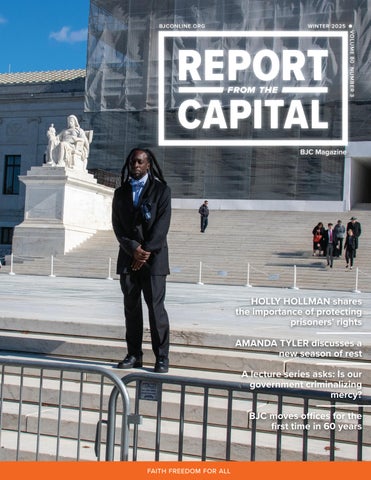
COVER PHOTO: Damon Landor stands on the steps of the U.S. Supreme Court on November 10, 2025, after the justices heard a case centered on an egregious violation of his religious freedom. Despite his Rastafarian beliefs, Landor’s dreadlocks were forcibly shaved by prison guards when he was incarcerated in 2020. Now, five years later, his case is at the highest court in the land. BJC joined an amicus brief with other groups defending Landor’s right to a specific remedy after the violation. “Many of the justices seemed skeptical about Landor’s claim for damages,” writes BJC’s Holly Hollman. “But a decision in favor of Landor would prevent prisons from avoiding responsibility for such clear violations. It would help deter brutal treatment that insults our values.” Read more on pages 4-5 of this magazine. Photo by Karlee Marshall.
2
REPORT FROM THE CAPITAL ● WINTER 2025 ● FAITH FREEDOM FOR ALL
REFLECTIONS A season of rest and freedom By Amanda Tyler, BJC Executive Director
W
e put the finishing touches of this magazine together just as the Advent season began. For Christians, this time is the beginning of the church year. We mark this time as a season of waiting and preparing our hearts, minds and souls for the gift of God’s presence with us, which we celebrate each year during the Christmas season — or “Christmastide” in liturgical language. This Advent season, I am also waiting and preparing for the next season in my life — a season of sabbatical. As a religious organization, BJC has long provided paid sabbatical leave to allow the executive director and other executive staff an opportunity for rest, rejuvenation, reading, recreation and relationship. I am grateful to the Executive Committee of the BJC Board for granting me sabbatical leave for 2026 as well as updating our policies to make this leave available for all employees of BJC after at least seven years working with the organization. As I begin my 10th year leading BJC in January 2026, I also will be beginning my sabbatical. Friends and colleagues who have taken sabbaticals in other contexts have reminded me that sabbath is not a vacation; it is a commandment. In his spiritual classic The Sabbath, Abraham Joshua Heschel writes, “To observe the seventh day does not mean merely to obey or to conform to the strictness of a divine command. To observe is to celebrate the creation of the world and to create the seventh day all over again, the majesty of holiness in time, ‘a day of rest, a day of freedom,’ … .” When the BJC Board met this October, they provided me with a blessing for my sabbatical, written by pastor and poet Meta Herrick Carlson. These specific words offer me challenge and comfort as I enter this season of rest and freedom: God promised provision on the seventh day, so that you could practice resistance to your zealous rhythms with rest, so that you could stop for a season and trust:
I am so small. And also, I matter so much. It is here in the absence of doing you will remember the terrible and wonderful news — that God is still here, making things new, even and often without your help. This is both a season of rest for me and one of continued new creation for BJC. We are carrying out our work with the guiding star of a renewed mission statement — one that matches the expansiveness of our vision found in our tagline: Faith Freedom For All. We affirm our Baptist roots and perspective, and we reframe our advocacy for and education about religious freedom in the broader context of a growing movement for a just society. Read more about the BJC Board’s work to update our mission statement on pages 15-17. Our work is done in and with communities across the country while our headquarters remain on Capitol Hill in Washington, D.C. Now — for the first time in six decades — we are at a new address. Before the move in November, current and former staff gathered for a service of grief and gratitude as we honored the space that had housed our organization since 1965. We remembered the significant moments in our office space and shared memories of our first time visiting the building. (See pages 18-21 for a special tribute to our longtime organizational home.) As we shared and listened, a consistent theme emerged: it was the people more than the place that has shaped our work for our mission. Our talented and committed BJC staff team are living into a new mission statement and a new headquarters. My heart is full of gratitude for the opportunity to lead this organization, rooted in a Baptist commitment to soul liberty, as we build a movement towards a just society that cultivates and expands religious freedom for all. Though I will be stepping back from day-to-day leadership of BJC until after Easter, I know that God never stops creating and doing new things in our broken and yet beloved world.
FAITH FREEDOM FOR ALL ● WINTER 2025 ● REPORT FROM THE CAPITAL
3
Damon Landor, attorney Zack Tripp, and others exit the U.S. Supreme Court after justices heard Landor’s case on Nov. 10.
Supreme Court hears arguments about damages for religious freedom violation By Cherilyn Crowe Guy, BJC Content Strategy Director Despite wide agreement among advocacy groups, the Supreme Court justices seemed uncertain about a prisoner’s right to a specific remedy after a religious freedom violation. During oral arguments in Landor v. Louisiana Department of Corrections on Nov. 10, the justices were focused on the question presented in the case: Whether an individual may sue a government official in their individual capacity for damages after a violation of the Religious Land Use and Institutionalized Persons Act. Passed in the year 2000, the law — commonly known as “RLUIPA” — protects the religious freedom rights of people in government custody, including prisoners. It has similar language to the 1993 Religious Freedom Restoration Act (RFRA). In 2020, the Court ruled that an individual may sue a government official in their individual capacity after a violation of RFRA, and now the Court must decide whether RLUIPA allows the same. In this case, prison officials forcibly shaved the head of Damon Landor, a practicing Rastafarian who was incarcerated at the time. Having his hair long is part of his religious practice, and the violation of his religious freedom right is undisputed. But, lower courts said he was not entitled to monetary damages against the individuals who violated his religious freedom. Much of the courtroom conversation was focused on the text of the statute and the context of congressional authority, including the ability of Congress to spend money and attach certain requirements to it under the Spending Clause of the Constitution. In this case, the federal funding to state prisons
BJC’s Holly Hollman speaks with Zack Tripp at the Supreme Court. Tripp argued the case on behalf of Damon Landor.
comes with the requirement to abide by RLUIPA, and there was discussion about what that requires in terms of notice. BJC chaired the Coalition for the Free Exercise of Religion in the 1990s, which specifically urged Congress to pass RFRA and RLUIPA, and we continue to defend the applicability of those laws in numerous cases. In this case, BJC joined a friend-of-the-court brief with a diverse group — including the Christian Legal Society, the ACLU, and the Alliance Defending Freedom — to argue that the legal language clearly authorizes damages against the officials in their individual capacities under RLUIPA. Read more in Holly Hollman’s column on the next page.
Want to hear more? Amanda Tyler and Holly Hollman discuss the case’s oral arguments in detail on this season of the Respecting Religion podcast (Episode 5 of Season 7). Listen on your favorite podcasting platform, and read more about the podcast on page 30. 4
REPORT FROM THE CAPITAL ● WINTER 2025 ● FAITH FREEDOM FOR ALL
HOLLMAN REPORT Religious freedom and dignity for prisoners at the Supreme Court By Holly Hollman, BJC Chief Legal Officer
R
eligious freedom is for everyone. That’s a promise — as well as a calling for us today — straight out of our country’s flawed but hopeful “history and tradition” that the current U.S. Supreme Court keeps emphasizing. If we want religious freedom for ourselves, we need to ensure it for our neighbors. Congress was doing just that in 2000 when it passed the Religious Land Use and Institutionalized Persons Act (known as “RLUIPA”), which provides statutory protection for religious exercise to those in government custody. In November, the Court heard arguments in Landor v. Louisiana Department of Corrections, a case brought to ensure RLUIPA works as intended. I’m hopeful the case might also remind us that religious liberty can and should be a uniting commitment that protects vulnerable populations, as well as those in the Christian majority. Specifically, the Court will determine if a prisoner’s right to obtain “appropriate relief against a government” includes potential money damages against the offending government officials. We at BJC and a broad coalition of religious freedom advocates argue it does. As the 5th U.S. Circuit Court of Appeals put it, the facts of the underlying case are “stark and egregious.” They demonstrate the importance of protecting prisoners and the necessity of oversight by courts. The violation was plain. Petitioner Damon Landor is a devout Rastafarian who — like the famously strong Samson in the Hebrew Bible — took an oath not to cut his hair. Landor let his dreadlocks grow for decades, and while serving time in a Louisiana prison, his religious observance had been respected. But when he was transferred to a different facility, prison officials held him down and forcibly shaved his dreadlocks. Adding further insult, they threw away his copy of a federal court decision upholding Rastafarian prisoners’ right to wear dreadlocks. Religious liberty cases often sharply divide the community of interest groups that focus on the First Amendment. The Landor case unites them. BJC joined an amicus brief led by the Christian Legal Society in support of Landor that drew a wide range of signers. The diversity
of organizations collaborating in this case reflects the principle that religious freedom protects the most vulnerable individuals and communities — a principle that hearkens back to RLUIPA’s beginning. RLUIPA is modeled on the Religious Freedom Restoration Act, an earlier statute that applies only to the federal government. The Supreme Court has held that “appropriate relief against a government” under RFRA includes compensatory damages against federal employees. The identical language in RLUIPA, which provides similar protections against state and local governments, should be interpreted the same way. Otherwise, Landor and many former prisoners could be left with no effective remedy. Courts can enjoin — order an end to — prison policies that unnecessarily burden religious liberty. But there was no chance to get an injunction against the prison’s sudden assault on Landor. As our amicus brief states: “His sole chance for effective relief is to seek damages from the offending officials in their individual capacities.” Even if prison guards and officials are liable for damages under RLUIPA, they still will be protected by the Supreme Court’s rule of “qualified immunity.” Government employees are liable for damages only if they violate “clearly established law,” and the Supreme Court interprets that requirement to provide extraordinary protection for defendants. Landor’s claim can surmount this hurdle: He handed the guards the court decision that clearly established his rights, and after consulting the warden, they immediately violated that decision. Many of the justices seemed skeptical about Landor’s claim for damages. Some worried about unintended consequences. But a decision in favor of Landor would prevent prisons from avoiding responsibility for such clear violations. It would help deter brutal treatment that insults our values. By interpreting RLUIPA’s remedy provision consistent with that of RFRA, the court will safeguard legal protections for the most vulnerable and remind us of the highest ideals of our history and tradition. This column first appeared in Baptist News Global.
FAITH FREEDOM FOR ALL ● WINTER 2025 ● REPORT FROM THE CAPITAL
5
Organizing across the map:
Building power through faith and action North Texas Coalition In North Texas, the coalition continues to expand its reach and impact. This fall, members hosted a webinar on the state-organized prayer in school bill (SB 11) and are creating ongoing spaces to hear directly from educators about SB 10, a 2025 law that requires all public schools in Texas to include the Ten Commandments in the classroom. More than 100 participants are now ready to reach out to their local school board members on the state-organized prayer in school bill, and the coalition has heard from more than 60 educators on SB 10. Read more about these two issues on page 8. The coalition is also working with partners to urge local city councils to reject harmful 287(g) agreements that entangle local law enforcement with federal immigration authorities. The Dallas City Council rejected a 287(g) agreement and unanimously voted against it after more than 70 community members testified. In addition, members are being trained and mobilized to serve as court observers in immigration hearings, ensuring transparency and accountability. In the past few months, three of our member churches hosted training sessions with 30 to 40 participants each. And finally, a recent virtual coalition meeting equipped participants with practical skills for writing letters to the editor.
A member of the North Texas Coalition serves at the ICE field office in Dallas.
Michigan — Grand Rapids Leader Nancy Janisch hosted her first community gathering in Grand Rapids. Unsure if anyone would come, she was encouraged when 17 people attended and every one of them signed up to join committees focused on education, legislative action, or community engagement. Nancy, an alum of our six-month spring organizing learning community, plans to form a leadership team to guide the work strategically moving forward.
6
REPORT FROM THE CAPITAL ● WINTER 2025 ● FAITH FREEDOM FOR ALL
Georgia Our very own Devin Withrow is collaborating with a vibrant team of faith leaders in Georgia who are quickly growing their statewide presence. With active groups now in Atlanta and the Central Savannah River Area region, they are building a leadership team and laying the foundation for policy advocacy and coalition partnerships. Their work emphasizes relationship-building and connecting faith communities to current justice campaigns, anchored by strong energy and vision.
Louisiana
A new group of clergy women in Louisiana launched their organizing efforts in November with a book event featuring BJC Executive Director Amanda Tyler. The gathering served as a springboard for action in a state where major policy battles are unfolding. BJC’s David Segal and Joy Pettigrew are meeting with the group to discuss how their advocacy can connect to statewide religious freedom and justice initiatives.
Religious Freedom Indiana Led by Vivian Combs, this newly formed group is focused on protecting voting rights amid efforts to gerrymander districts in the state. Seeking to partner with other civic groups, they are mobilizing Christians to contact their representatives and oppose legislation that consolidates power at the expense of equal representation. Vivian and her team are connecting with the broader voting-rights coalition to launch a targeted mini-campaign in the months ahead.
Get involved Our BJC organizing team is cultivating the role of faith communities in building a democratic society that practices dignity and pluralism. Want to join an existing group? Find one near you and sign up on our website at ChristiansAgainstChristianNationalism.org/localgroups. You can also get started in your community in other ways: • Have conversations about how Christian nationalism is impacting your community. On our local groups page, you’ll find a “three steps” guide for getting started, which includes a meeting agenda for hosting a community listening conversation. • Research policy issues that are most influenced by Christian nationalism in your community. Which organizations are working on those issues? Connect with them and explore how your faith community can engage with impact.
BJC Community Partnership Manager Joy Pettigrew meets with leaders of the local group in Minnesota.
• Build relationships through one-on-one meetings with community members and begin building a base of support. Begin learning the impact your community is feeling and what community members feel called to do about it.
FAITH FREEDOM FOR ALL ● WINTER 2025 ● REPORT FROM THE CAPITAL
7
Updates across the country
New Bill to Save Sacred Land
Legislation introduced Dec. 3 would protect the land known as Chí’chil Biłdagoteel — loosely translated in English as “Oak Flat.” Filed by Rep. Adelita Grijalva, D-Ariz., the “Save Oak Flat from Foreign Mining Act” continues the decade of work to save this area sacred to the San Carlos Apache and other tribes in the Southwest. The bill would repeal the 2014 National Defense Authorization Act rider that gave a portion of Arizona’s Tonto National Forest — which includes Oak Flat — to the mining company Resolution Copper. The company plans to mine a low-grade copper deposit under it, creating a crater almost 2 miles wide that would swallow Oak Flat. “This legislation is about repealing an indefensible land swap, respecting Tribal sovereignty and religious freedom, and protecting Arizona’s precious natural resources for future generations,” Rep. Grijalva said when she introduced the legislation. It is similar to legislation first introduced by her father, Rep. Raúl Grijalva, in 2015. “Sacred land without a steeple is no less deserving of protection than a big, steepled church in the heart of downtown,” said BJC Executive Director Amanda Tyler. “Too often the U.S. has failed when given opportunities to protect the religious freedom of our Indigenous neighbors. This is a chance to get it right and make the promise of the First Amendment a little truer for us all.” Ask your lawmakers to support this legislation, and learn more by visiting BJConline.org/SaveOakFlat.
Johnson Amendment Hearing
On Nov. 25, a federal court in Texas heard arguments in a case that could significantly weaken the Johnson Amendment, which protects houses of worship and other 501(c)(3) nonprofits from partisan campaigning. It was the latest in a proposed settlement of a lawsuit where the IRS suggested that churches could endorse candidates from the pulpit without violating that long-standing part of the tax code. At press time, the decision was still pending. Earlier in November, members of Congress issued a 8
letter to IRS Acting Commissioner Scott Bessent, reaffirming their support for the Johnson Amendment. BJC welcomed the action, warning that attempts to weaken the law risk politicizing houses of worship and undermining the integrity of the nonprofit sector. Learn more about this issue and access resources at BJConline.org/JohnsonAmendment.
Ten Commandments in Texas Schools
A federal judge temporarily blocked enforcement of a bill in Texas (SB 10) that mandates displays of the Ten Commandments in Texas classrooms. On Nov. 18, the judge ordered 14 school districts to remove displays of the Ten Commandments from classrooms by Dec. 1, concluding that the law exposes students to unconstitutional government-endorsed religious messaging. The ruling applies only to the districts named in the lawsuit, and it is yet another time a judge has ruled SB 10 unconstitutional and stopped its enforcement in certain school districts. On Dec. 2, a group of 18 families in Texas — who come from a mix of various faith traditions and nonreligious backgrounds — filed a class action lawsuit to stop SB 10 in all Texas public school districts. All of these cases are continuing.
State-Organized Prayer in Texas
BJC and coalition partners launched a statewide sign-on letter for Texas faith leaders in response to Texas’ state-organized prayer in school law. The letter notes how the law “threatens to drive a wedge into public school communities and create unnecessary administrative burdens,” and it reminds readers that existing laws already protect students’ right to pray and read religious texts at school without government interference. The sign-up form was distributed across Texas networks encouraging faith leaders to add their names. The coalition reconvened on Dec. 1, and partners are moving quickly to coordinate outreach, secure additional signers, and advance a unified response to the law.
Providing mercy in the face of repression Dr. Sergio González and community leaders discuss sanctuary and migrant justice today
H
By Cherilyn Crowe Guy, BJC Content Strategy Director
“How did prayer and protests — the physical manifestation of mercy — all become grounds for conflict with the state?” asked Dr. Sergio González. “When did mercy become a crime?” Those were key questions during the 2025 Walter B. and Kay W. Shurden Lectures on Religious Liberty and Separation of Church and State, held in conjunction with the University of St. Thomas in St. Paul, Minn., on Oct. 21-23. The annual lecture series was established in 2004 with a gift to BJC from Drs. Walter B. and Kay W. Shurden of Macon, Georgia. This year’s series included three separate events in the Twin Cities, all focused around the theme of “Criminalizing Mercy: Sanctuary and Government Repression of Migrant Justice.” Dr. González served as the keynote speaker for the series, engaging with community members as well as sharing stories that offered windows to think about the past in order to illuminate our present moment. A historian of U.S. immigration, labor and religion, Dr. González teaches at Marquette University and is a co-founder and former organizer for the Dane Sanctuary Coalition. He is the author of several books, and he is the co-creator of a podcast titled “Sanctuary: On the Border Between Church and State.” Setting the stage for our current climate, Dr. González began his keynote address by sharing the story of the Rev. David Black, who was praying outside the Immigration and Customs Enforcement detention facility near Chicago this
FAITH FREEDOM FOR ALL ● WINTER 2025 ● REPORT FROM THE CAPITAL
9
Dr. Sergio González facilitates a conversation with community leaders in Minneapolis on how faith communities can engage in sanctuary.
year when masked agents shot at him with pepper balls. Now he’s part of a lawsuit that alleges that ICE and the Department of Homeland Security targeted him and other clergy in violation of their religious rights. “In this moment, a call for Christian compassion, for Christian mercy, meets repression. A pastor offering spiritual care becomes a flashpoint in the fight over whether faith can protest immigration and detention policies that a growing number of Americans deem to be unfair, unjust and cruel,” Dr. González said. He noted that the confrontation is not an isolated incident — it echoes earlier chapters in the history of the United States when acts of conscience collided with the machinery of the state. He traced the origins of the Sanctuary Movement to the 1980s, when thousands of Salvadorans and Guatemalans were denied asylum in the United States, sending them back into the hands of the death squads they were fleeing. During that time, a group of churches in Arizona began offering supplies for the arriving refugees. But, charity alone was not enough — church leaders saw the law as an active instrument of harm on these individuals’ lives, so they began to organize a network of churches that would provide refuge to Central Americans fleeing persecution. “Asylum seekers became the moral center of the movement,” Dr. González said, explaining how they would speak in churches — with their faces covered by sunglasses or scarves to protect their identities — and shared their testimony of the violence they survived. “These were sacred acts of truth-telling, practices drawn from Latin American liberation theology, meant to awaken empathy and conscience in the U.S. public.” But, at the same time, a coordinated campaign worked against the movement, questioning the motives of those providing compassion. The movement basically went on trial in 1985, as the government compared the ministers providing sanctuary to drug traffickers, and the judge forbade any mention of faith or conscience within the courtroom. “Mercy, in other words, was inadmissible as evidence,” said 10
Professor Virgil Wiebe of the University of St. Thomas School of Law speaks on immigration law at the state and local level as well as Catholic social teachings.
Dr. González. The trial became a national spectacle, and eight defendants were convicted of transporting and harboring people illegally. “Compassion could be a crime, at least in the eyes of the federal government,” reflected Dr. González. But, it backfired, galvanizing even more congregations to join the work. “By the late 1980s, the Sanctuary Movement had spread to hundreds of churches and synagogues across the country. Cities like Seattle and Los Angeles declared themselves cities of refuge, while governors in New Mexico and Wisconsin proclaimed their states as sanctuary states,” Dr. González continued. The new Sanctuary Movement emerged in 2007, reviving the 1980s iteration but shifting its focus to protecting undocumented immigrants living in the U.S. from deportation. Now, we find ourselves in the midst of an immigration crackdown, animated both by political theater and moral language, according to Dr. González. “President Trump has promised what he calls the largest deportation force in American history, pledging to mobilize tens of thousands of new agents and National Guard troops to remove millions of undocumented residents. His administration has renewed its assault on sanctuary cities and churches alike, threatening prosecution and the loss of federal funding for communities that refuse to cooperate with ICE,” Dr. González said. “The ‘sensitive locations’ policy that once functionally shielded houses of worship from raids was rescinded on his first day back in office, and faith leaders across the country now report plain clothes agents surveilling churches and shelters once considered sacred ground.” But, there is one key difference: In today’s context, the language of faith is not confined to those providing mercy — it’s also being wielded by those looking to restrict it, as the Department of Homeland Security and ICE have also used religious language in their social media posts. “It’s an all non-too-subtle way of adding a religious veneer of moral legitimacy to their enforcement actions,” Dr. Gonzalez said. “This layering of sacred idiom over coercive state power makes dissent appear as not merely political opposition but, in
REPORT FROM THE CAPITAL ● WINTER 2025 ● FAITH FREEDOM FOR ALL
Pictured at the event are (left to right): BJC Chief of Staff Janna Louie, BJC Community Partnership Manager Joy Pettigrew, University of St. Thomas Law Professor Virgil Wiebe, Lecturer Dr. Sergio González, BJC Executive Director Amanda Tyler, and Danny Rodriguez, who is the president of the Immigration Law Society at the University of St. Thomas School of Law.
“The question that remains for us ... is not whether mercy will be criminalized, but whether we will have the courage to practice it anyway.” —Dr. Sergio González fact, spiritual misalignment, raising the stakes when faith communities act in solidarity with migrants.” “Trump’s campaign to build the largest deportation force in history, his attacks on sanctuary cities and churches, and the chorus of conservative pastors blessing these policies as divinely ordained all represent a calculated inversion of the moral order. They have traded mercy for vengeance, hospitality for hostility, compassion for control,” said Dr. González . While we cannot predict the form that faith-based solidarity will take in the future, Dr. González noted that mercy always finds a way to endure. “It survives in prayer circles and protest lines, in basement shelters and border chapels, in the quiet conviction that God’s law cannot be enforced by tear gas,” he said. “The question that remains for us, as it did for the Sanctuary workers of another generation, is not whether mercy will be criminalized, but whether we will have the courage to practice it anyway,” he concluded. Speaking to an engaged audience of college students, community partners, professors, members of the Minnesota group of Christians Against Christian Nationalism and more, Dr. González took questions for more than 45 minutes after his presentation, covering a range of topics. You can watch his presentation and the Q&A in a video on BJC’s YouTube channel, which is also available on our website at BJConline.org/ShurdenLectures. In addition to the keynote address, the three-day event included intentional conversations with community members and experts to discuss the best way to move forward in the midst of today’s challenges.
Noting that few issues cut more sharply into today’s immigration debates than the contested issue of “sanctuary,” a call to be courageous was the theme of a conversation on the first night. Gathered at University Baptist Church in Minneapolis, Dr. González led a discussion about how faith communities can engage in sanctuary in this moment. Members of congregations who have provided sanctuary discussed just what it takes to do so, taking risks in place of others who are more vulnerable to risk. Lawyers serving immigrants in the area also discussed the obstacles and opportunities for assistance with our neighbors in need. On the final day, a lunch event co-sponsored by the Immigration Law Society at the University of St. Thomas School of Law focused on the optimal role of state and local governments in immigration policy. Held at the law school, Professor Virgil Wiebe gave a presentation on immigration law at the state and local level. Speaking to law students and community members alike, he reviewed the current legal context, and he discussed the Catholic call to justice as a way to love our neighbors facing immigration enforcement. All three events invited those listening to organize with others around them, collaborating with groups who are focused on providing mercy when the government does not. “If we have the courage, what can we do?” asked one audience member during the Q&A session. “My first response is to listen to the people who have been doing the organizing on the ground for some time,” answered Dr. González, sharing that the first calls for sanctuary did not come from white, middle-class churches; they came from people who were affected by the policies creating a need for sanctuary. Places currently providing sanctuary often do so privately and without publicizing it — therefore, he pointed out, there isn’t a “prophetic platform” to speak out about it as a way of education and to draw others to the work. What sacred resistance looks like continues to change as our times change, and Dr. González said we must talk to the communities who have been providing protection for themselves when others have ignored them. “Sanctuary and solidarity practiced as a radical form of hospitality requires people to listen.”
FAITH FREEDOM FOR ALL ● WINTER 2025 ● REPORT FROM THE CAPITAL
11
There are neighbors everywhere:
Learning to see at the Texas-Mexico border
By Rev. Dr. David Rice, BJC Digital Strategist
T
he last thing I expected to encounter in Mexico was Little Caesars pizza. Yet there I was, standing in the lobby of a grocery store in Reynosa while our pastor-host placed an order for 25 pizzas. We then drove them over to an asylum camp where families and individuals wait in legal limbo at the United States border. Serving low-budget American pizza to people in Mexico from Central and South America was not what I expected when I agreed to travel to the border, but the world does not adhere to our expectations or the narratives we’ve been taught. I spent several days in McAllen, Texas, in September with a group of pastors through the J29 Coalition, hosted by Border Perspectives, an organization that educates people of faith around the issues impacting the U.S.-Mexico border. Much of the border conversation is dominated by politicians and commentators who have never walked across the river or looked someone in the eye as they share their story. Our purpose was to learn and to see the situation for ourselves. What we found was not an issue to manage, but people to learn from. I kept hearing the question asked of Jesus: Who is my neighbor? (Luke 10:29) We crossed into Reynosa to visit the camp where those pizzas were headed. Several years ago, thousands waited here as they fled untenable conditions in their home countries. Today, barely
12
a hundred remain. Their numbers did not fall because danger disappeared. They fell because, under an executive order issued in January, the United States is not processing new asylum claims. International law requires it. Scripture commands people of faith to care for the vulnerable. Yet the door is locked. People in the camp spoke of impossible situations that brought them there. They came openly and legally to request asylum. They arrived only to discover that the road ahead was blocked. Many spoke about God with a mix of faith and exhaustion. I wondered why so many Christians in the United States see migrants as a threat rather than neighbors in need. Hearing their testimonies made me ask myself how to respond. I was reminded of the prophets who warned God’s people not to ignore the stranger at the gate. And I remembered Jesus’ simple and straightforward command: Whatever you do for the least among you, you do for me. (Matthew 25:40) Back in Texas, we met with U.S. Customs and Border Protec-
“The border will always be with us. The question is, how will we respond: with fear or with love?”
REPORT FROM THE CAPITAL ● WINTER 2025 ● FAITH FREEDOM FOR ALL
tion agents in a public library. The officers were nothing like the caricatures in national debates. They were people who cared about their work and the lives they encountered. One officer spoke about her hope for a pathway to citizenship for those simply trying to survive by contributing to our economy and society, the same opportunity her grandfather had during the Reagan administration. The officers spoke of trying to keep criminals out while caring for people who cross the border without permission because they have nowhere else to go. They also told us about cartel networks that prey on desperate families. Then came a moment I will not forget. The agents showed us a slickly produced video portraying the border as a battlefield. The narrator referred to immigrants as the enemy. Images of cartel smugglers and asylum seekers blurred together until they became one faceless threat. The message was fear. It revealed our national confusion about how to distinguish those fleeing evil from those causing it. This confusion is not simply political. It is spiritual. Driving around McAllen, I noticed how much ordinary life flows across the border. Homemade tacos in Texas. A Burger King drive-through in Mexico. Families living in Mexico because it is more affordable, working in Texas because wages are higher. These are not two separate worlds. This is one community divided only by shifting water and a lack of imagination. Fear is easier to sell than empathy. But when you get close, the story becomes human. Most people want what everyone wants: Safety. Work. A future for their children. You see that cartel violence is real, but so is the courage of those who refuse to let fear have the final word. You begin to see neighbors everywhere. I wish every pastor who preaches in a congregation could spend time at the border. Sit with families waiting for hearings that may never come. Listen to officers trying to serve with integrity. Stand still long enough to hear God speak. The border will always be with us. The question is, how will we respond: with fear or with love? The choice is not even between laws and compassion — we can have compassionate laws if we’re willing to work toward that end. God invites us into the messy middle, where answers are hard and neighbors are real. May we learn to see people not as threats, but as neighbors, wherever we go.
Previous page: A van carrying a group of pastors drives through portions of the wall erected near the border between the United States and Mexico. TOP: A line of tents at an asylum camp in Reynosa, Mexico, house asylum seekers from South and Central America. BOTTOM: U.S. Customs and Border Protection agents meet with a group of pastors in Texas. FAITH FREEDOM FOR ALL ● WINTER 2025 ● REPORT FROM THE CAPITAL
13
Rabbi David Segal speaks to members of the BJC Board of Directors.
A rabbi among Baptists By David Segal, BJC Policy Counsel
“Why is a rabbi working for a Baptist organization?” What struck me most about this congressional staffer’s question is that I heard it only once during a day of a half-dozen meetings on Capitol Hill. I understand why it may be surprising to some that a Jewish attorney and advocate would fit in at a Christian advocacy organization, but this rabbi has found a home at BJC. Growing up as part of a religious minority in America, I was raised on stories of this country’s embrace of religious diversity. My father introduced me to George Washington’s 1790 letter to the Jews of Newport, Rhode Island. The synagogue had written to the new president with well-earned skepticism about whether America’s promise of full and equal citizenship regardless of religion included Jews — since no country had offered that before. President Washington responded that all “possess alike liberty of conscience and immunities of citizenship,” not out of mere “toleration … by the indulgence of one class of people,” but because
those rights are inherent in humanity. The president assured the Rhode Island Jewish community that the government gives “to persecution no assistance” and prayed that everyone “shall sit under his own vine and figtree, and there shall be none to make him afraid.” In other words, this would be a country that separates citizenship from religious identity. More than a century later, my grandparents benefited from this promise, leaving their less-than-hospitable Eastern European birthplaces to create a new life here, as Jews and equally as Americans. Baptists have been at the forefront of defending America’s promise of religious freedom since colonial times. More than a century before President Washington reassured Rhode Island’s Jews of their American welcome, Roger Williams was banished from Massachusetts for agitating against religious coercion. He founded Rhode Island as a haven for Baptists, Quakers, Jews, and other religious minorities and established the first Baptist church in this country. Inspired by Jesus’s parable of the
“For me, working with Baptists to cultivate and expand religious liberty fulfills my deepest commitments as a Jewish American.” 14
REPORT FROM THE CAPITAL ● WINTER 2025 ● FAITH FREEDOM FOR ALL
wheat and the weeds in Matthew 13, Williams (a Baptist only briefly — but more Baptist than I!) taught that the power to distinguish between truth and error — wheat and weeds — would belong to God alone at the harvest. This faith manifests as patience and pluralism, trusting in God to sort it out at the end of time while we figure out how to live together peaceably in the meantime. This teaching resonates with pluralistic threads in Jewish tradition. The Torah speaks commandingly to Jews in the context of our divine covenant, but we don’t expect others to live by our rules — aside from the basic moral laws given to Noah in Genesis 9. Rabbinic sages across the centuries taught that the righteous of all nations, not only among the Jewish people, have a share in the world to come. It’s no wonder that Jews have embraced and defended religious pluralism in America: it resonates with our theology and it has allowed us to thrive. For me, working with Baptists to cultivate and expand religious liberty fulfills my deepest commitments as a Jewish American. Why then is a rabbi engaged in legislative advocacy and litigation strategy at BJC? Because I feel called to do this work, and I’m blessed to do it within an organization with the vision and legacy of BJC.
BJC Board adopts updated mission statement, approves move By Cherilyn Crowe Guy, BJC Content Strategy Director A new mission statement, new officers, and the move to a new headquarters headlined the 2025 meeting of the BJC Board of Directors. Composed of representatives from various member bodies who support BJC, the BJC Board includes people from a variety of careers, Baptist denominations, and faith traditions. They gather for business each October, collaborating with each other on the continued work of defending faith freedom for all. During this year’s meeting, the board debated and approved an updated mission statement for BJC: “Rooted in a Baptist commitment to soul liberty, we are building a movement toward a just society that cultivates and expands religious freedom for all.” Learn more about the process and the statement itself on pages 16-17. The board also heard about circumstances that require a change for BJC’s headquarters in Washington, D.C. After being located for more than six decades in the Veterans of Foreign Wars building at 200 Maryland Avenue, BJC’s landlord announced extensive renovations that would displace the staff for more than a year. With the full backing of the board, it became clear that the only viable path forward was to conclude BJC’s lease and move. Read about BJC’s time at our former office on pages 18-21, and be sure to find us at our new address at 500 New Jersey Avenue N.W., Suite 750, Washington, D.C. 20001. At the end of the meeting, the board elected new officers, each to serve one-year terms. The Rev. Dr. Philip Thompson was elected chairman. Representing the North American Baptist Conference on the board, he serves as Professor of Systematic
Theology and Church History at Kairos University/Sioux Falls Seminary in Sioux Falls, South Dakota. The Rev. Dr. Elijah R. Zehyoue was elected secretary of the board. He is a board representative of the Alliance of Baptists, where he serves as co-director. The Rev. Dr. Christopher The was elected vice chair. Previously serving as board secretary, the Rev. Dr. The is a representative of the Religious Liberty Council on the board. He serves as the Director of Student Research and Initiative Management for The Association of Theological Schools in the United States and Canada (ATS). Sofi Hersher Andorsky was elected treasurer. Representing the Religious Liberty Council, she previously served as vice chair of the board and made history as the first Jewish person and the first non-Baptist leader to be elected to that position in 2023. Andorsky is Director of Organizing for the Democracy Communications Collaborative at Third Plateau. “In such a challenging time, it is a weighty honor to be chosen to serve in a leadership role on the BJC Board,” said the Rev. Dr. Thompson. “I look forward to working with the staff and board alike as we live our shared mission of defending religious liberty for all and cultivating a culture of faith freedom in local communities across the nation.” Hear more from him on the next page. “It has been a true blessing to serve as chair of the BJC Board during such a pivotal time for our nation and our faith communities,” said the Rev. Anyra Cano, immediate past chair of the BJC Board. “I am deeply grateful for the opportunity to have served alongside such a dedicated board and staff, and I look forward to seeing how this new leadership will build on BJC’s strong foundation.”
FAITH FREEDOM FOR ALL ● WINTER 2025 ● REPORT FROM THE CAPITAL
15
M New focus on a consistent mission By Rev. Dr. Philip Thompson BJC Board Chair
“Like its predecessors, the 2025 mission statement signals a steadfast commitment to embody and advocate for a conviction that goes all the way to Baptist beginnings in a new and challenging time and context.” 16
ission statements should not be revised very often. Frequent mission revision is a sign an organization lacks a clear sense of its identity and goals. That is manifestly not the case for BJC. We don’t revise our mission statement often, and we express consistent commitment to faith freedom for all when we do. Until the BJC Board gathered in October 2025, the last time the mission statement was revised was 2004. I am one of the very few people who served on the Board both then and now. At that time, I was one of the younger members, learning from those who had helped guide BJC through the difficult 1990s, when the largest member body and financial contributor, the Southern Baptist Convention, had withdrawn. As we headed into the new millennium, a renewed sense of stability and aspiration had emerged. It was by any measure a significant time. Emerging from great challenges, we looked to our upcoming 70th anniversary with a sense of renewed vigor. We appointed a committee to plan the celebration of seven decades of shared work. We adopted a (very slightly) larger budget. We took up the revision of our constitution and bylaws. We planned the launch of the First Freedoms Project. Alongside those events, 2004 was a good time to revisit the mission statement. One might expect that we would reflect the season of change in which we found ourselves. But that was not quite the case. Many board members expressed preference for a slightly revised version of the existing mission statement rather than the proposed new one. Not unlike the discussion of the 2025 revision, we toned down language of Baptist uniqueness in our work for religious liberty. We are not alone in our advocacy, after all. In the midst of institutional change, we opted for a sense of missional continuity, declaring: The mission of the Baptist Joint Committee is to defend and extend God-given religious liberty for all, furthering the Baptist heritage of championing the principle that religion must be freely exercised, neither advanced nor inhibited by government. What are we to make of this, and what light might it shed on the 2025 mission statement, which is the successor to this one? In
REPORT FROM THE CAPITAL ● WINTER 2025 ● FAITH FREEDOM FOR ALL
2004, we had just changed our name from Baptist Joint Committee on Public Affairs in order to emphasize our singular commitment to work for the sake of religious liberty for all. The sense of focus was already present in our existing mission statement. This was the core of our identity and work, the shared task that brought together a diverse collection of Baptist bodies. For all the change we had been through, organizationally and culturally, in defending and extending religious liberty for all, we believed that the embodiment of our historic Baptist witness remained constant. Now in 2025, we have again revisited our mission statement. Following another lengthy process of discussion, which included weighing various possibilities and receiving light from many sources, the BJC Board of Directors adopted our new mission statement at our October meeting: Rooted in a Baptist commitment to soul liberty, we are building a movement toward a just society that cultivates and expands religious freedom for all. It is under this mission statement that I begin my service as Chair of the Board. I believe it sets the right tone. There are more changes and less continuity in the wording here than in 2004. Yet the statement doesn’t reflect change in BJC’s sense of mission — it reflects change in the religious and political circumstances in which we seek to carry out our mission. In our discussion, Board members acknowledged that while we remain committed to defending and advocating for religious freedom at the highest levels, in the courts and in Congress, we are aware of the great need now for our new initiatives in mobilization and organizing at a more grassroots level. I believe that unless we strengthen commitment to faith freedom for all in faith and civic communities throughout the U.S., a commitment that may not have been as secure as we had thought and has certainly been eroded by aggressive Christian nationalism, our work to defend our first freedom may not be enough. All of this, the grassroots and the halls of power alike, are present in our new statement. Like its predecessors, the 2025 mission statement signals a steadfast commitment to embody and advocate for a conviction that goes all the way to Baptist beginnings in a new and challenging time and context.
I appreciate how the executive leadership of BJC consistently invites the board of directors into processes for organizational and programmatic decision-making. The same was true in the development of the new BJC mission statement. Amanda offered guiding questions and hopes for how the statement will function. Our board chair, the Rev. Anyra Cano, led the process as we envisioned through consensus. We listened well to each other, offered insightful perspectives and weighed the meaning in each proposed word or phrase. The commitment and energy of the group was inspiring. We reached an outcome that the full board unanimously affirmed. In our nation, too many political and religious leaders are struggling with selective memory in a way that is causing harm. From the earliest years of the United States, people have come from other nations fleeing religious persecution, and that freedom has always required vigilant defense. We are standing up against hostility and intolerance from those who have forgotten how religious liberty makes us stronger in faith and nation. I am thankful for the persistent work of BJC to uphold religious freedom for all, and the mission statement expresses that commitment.
Rev. Lisa Harris Lee BJC Board Member, Representing American Baptist Churches USA
As the new guy in the room, but with plenty of experience that reflects the joke, “wherever 2 or 3 Baptists are gathered, 5 or 6 opinions are there also,” I wasn’t sure what to expect. What I saw was an example of the best, beautiful, loving, democratic process that we Baptists like to claim we invented, or at least perfected. Many voices were heard, the first draft was referred to a smaller committee who listened even more, and then they stayed up late taking all of those voices into consideration. The next afternoon a revision was presented, discussed, and eventually unanimously and enthusiastically approved. I was reminded of something I tell my choir often: We don’t have to sing quieter, but we do have to listen better if we want to create something beautiful. The mission statement itself is historically rooted and movement oriented, and it’s a mission that reflects the work that I think God is calling BJC to. It’s a mission that the BJC staff and we supporters can be excited to work on, together.
Rev. Chris Crowley BJC Board Member, Representing the Religious Liberty Council
FAITH FREEDOM FOR ALL ● WINTER 2025 ● REPORT FROM THE CAPITAL
17
A tribute to our time at 200 Maryland Avenue As BJC moves a few blocks away, we remember the important moments shared in our sacred space for more than 60 years
T
1965
By Cherilyn Crowe Guy BJC Content Strategy Director
Through 12 presidential administrations, four chief justices of the Supreme Court, and five executive directors, you could always find BJC in one location: the third floor of 200 Maryland Avenue in Washington, D.C. Now we are moving to a new building and, for the first time in 60 years, we will advance the cause of religious liberty from a different headquarters. We trace our roots to 1936, but BJC didn’t have a physical office until 10 years later when Executive Director J.M. Dawson secured space at 715 8th Street, N.W., on the campus of Calvary Baptist Church near the Chinatown area of Washington. In 1948, we moved to a building known as the “Baptist Building” at 1628 16th Street, N.W., in the DuPont Circle area, which housed the D.C. Baptist Convention, the Baptist World Alliance, and BJC. After staying there for more than a decade, BJC moved into the Veterans of Foreign Wars building at 200 Maryland Avenue, N.E., on July 1, 1965.
18
BJC announces our move to the VFW building in Report from the Capital.
The announcement in Report from the Capital touted how the new location would increase the effectiveness of BJC’s work. “Close proximity to the Library of Congress, the Supreme Court, the Capitol, and the Senate and House office buildings will be especially valuable to the research and information programs, [Executive Director C. Emanuel Carlson] said.” And it was valuable indeed. Editions of Report from the Capital were created in the space — from the days of cropping photos with grease pencils to the computer software we use now. Amicus briefs were drafted and filed at the Supreme Court. Books were written inside those walls — first on typewriters and later on computers. Videos were filmed. Podcasts were recorded. Faxes were sent and received. Emails were composed. Staff members gathered for meetings,
REPORT FROM THE CAPITAL ● WINTER 2025 ● FAITH FREEDOM FOR ALL
for lunches, and for birthday celebrations, exchanging cards and singing deliberately off-key to showcase the “soul freedom” all Baptists can appreciate. Board meetings were held in the building — often on the first floor in what is known as “Ketchum Hall.” Press conferences were held at the address. Retirements were announced. New executive directors were elected. And everyone who came to the office walked up the same marble steps at the front of the building. Some of our biggest legislative victories were brokered from the address. BJC’s leadership of the vast coalition that worked to pass landmark legislation, including the Religious Freedom Restoration Act in 1993, can be seen through the letterhead created for those years of work — it has the return address of 200 Maryland Avenue. There were many key legislative victo-
1970
The staff of BJC in the conference room. Pictured left to right are W. Barry Garrett (Director of Information Services), C. Emanuel Carlson (Executive Director), John W. Baker (Associate Executive Director and Director of Research), and James M. Sapp (Director of Information Services and Editor of Report from the Capital).
ries that were orchestrated there: The Equal Access Act of 1984. The Religious Land Use and Institutionalized Persons Act of 2000. When the Johnson Amendment was under threat in 2017, we had several meetings in the same space, strategizing and monitoring activities. When BJC created the essay scholarship contest in the 2000s, we received hundreds of physical entries from across the country. The last two days of the deadline each year emulated the scene at the end of “Miracle on 34th Street” when the post office brings in letters to Santa Claus — mail crates would appear, full of envelopes addressed to us at 200 Maryland Avenue. Supporters of BJC will remember the redesign and renovation of the space in 2012 to transform the small, individual offices into BJC’s Center for Religious Liberty on Capitol Hill. It created an office area that was more modern, open, and — like our move to the building itself in 1965 — helped us expand and increase the effectiveness of our work. We now had new ways to work together as a team, host visitors, and — perhaps most importantly — create more educational
1973
BJC Executive Director James E. Wood Jr. speaks to youth from the First Baptist Church of Port Allegany, Penn., during their visit to BJC’s office.
1985
BJC Executive Director James Dunn speaks at a meeting in the “Ketchum Hall” area on the first floor of the VFW building. FAITH FREEDOM FOR ALL ● WINTER 2025 ● REPORT FROM THE CAPITAL
19
programs. Hundreds of students of all ages gathered in our conference suite over the years to be introduced to our work and engage in conversation. When you dig through BJC’s photo archive, you can find very few pictures taken in the office itself before the 2012 redesign. Many of our activities took place outside of our walls — our Capitol Hill location gave us the ability to get the job done as well as get to important gatherings in D.C. And while we’ve been in the building, we’ve grown in ways few could have imagined in 1965. There were four full-time staff members then, and we now have 14, spread out across the country. Our office gave us the foundation to do that — and more. Our work began before we were located at 200 Maryland Avenue, and it will continue as our headquarters moves to a new location in the Capitol Hill area. But we would be remiss not to stop and appreciate the
achievements that happened at the address, as well as how we’ve grown in so many different ways while we’ve been inside those walls. May the legacy continue in our new space.
Go online for more!
Scan the QR code to see other photos and to share your own memories of the office.
Spring 2012
BJC Executive Director Brent Walker participates in the demolition of BJC’s office space, preparing for the renovation.
2011
BJC Executive Director Brent Walker speaks at a BJC Board meeting in the “Ketchum Hall” area of the VFW building.
1993
Letterhead from the Coalition for the Free Exercise of Religion has the return address of 200 Maryland Avenue. BJC chaired this diverse group, which worked to pass the Religious Freedom Restoration Act (1993) and the Religious Land Use and Institutionalized Persons Act (2000). 20
REPORT FROM THE CAPITAL ● WINTER 2025 ● FAITH FREEDOM FOR ALL
Fall 2012
BJC opens the Center for Religious Liberty on Capitol Hill, and Justice Stephen Breyer attends the opening reception. Here, Brent Walker and Holly Hollman show Justice Breyer a photo of Justice Harry Blackmun when he came to BJC’s office in 1990.
2018
BJC Executive Director Amanda Tyler gives a tour of BJC’s offices to a group visiting as part of CBF’s Advocacy in Action.
November 2025
BJC staff members and interns gather one last time outside the VFW Building at 200 Maryland Ave., N.E.
2020
After the 2012 renovation, BJC hosts school groups on a regular basis. In this 2020 photo, BJC’s Charles Watson Jr. speaks to students from Kentucky.
BJC now has a new home on Capitol Hill, steps from Union Station and the U.S. Capitol. You can reach us at: BJC 500 New Jersey Ave., NW Suite 750 Washington, D.C. 20001
FAITH FREEDOM FOR ALL ● WINTER 2025 ● REPORT FROM THE CAPITAL
21
A statue of Richard Allen stands outside Mother Bethel AME Church in Philadelphia, which is the first AME Church in the nation. Allen’s work included nurturing spiritual needs as well as economic needs: He purchased the property in 1791, and it is the oldest continually owned land by African Americans in the United States. 22
REPORT FROM THE CAPITAL ● WINTER 2025 ● FAITH FREEDOM FOR ALL
Erasure, faith, and the story America will not tell this 4th of July
N
By Jaziah Masters, Research Fellow for the BJC Center for Faith, Justice and Reconciliation ext year, the United States will celebrate its 250th anniversary. Throughout the semiquincentennial commemoration, various festivities throughout the country will culminate in a celebration of Independence Day, and Philadelphia — the revolutionary era capital — will play a central role. Philly is the home of Independence Hall, the Liberty Bell, and the Museum of the American Revolution. For those of us called to the work of religious liberty, there is another Philadelphia site that isn’t so pronouncedly marked: the first African Methodist Episcopal (AME) Church. The AME Church is the first independent Protestant denomination founded by Black people. It traces its roots to Richard Allen, who freed himself from bondage and left the segregated Methodist Episcopal Church to start his own church where Black people could worship in dignity. Allen was not just a preacher — he also was active in Philadelphia’s abolitionist movement, and his church was a stop on the Underground Railroad. In 1799, Allen and 69 other Black Philadelphians sent a petition to Congress calling for the end of the international slave trade and gradual emancipation. Today, Mother Bethel AME Church in Philadelphia is the oldest piece of land continuously owned by Black Americans in the U.S. I visited Mother Bethel church this past summer. After the worship service, I enjoyed an insightful and thorough tour of the Richard Allen Museum located in the church’s lower level. The museum is a fully immersive learning experience with both Allen’s remains and original pulpit among its many artifacts that journey from the colonial era to modernity. While Richard Allen’s name and religious contributions are well known to us, he is a man who deeply understood the intersection of economic justice and religious liberty. Economic justice creates an opportunity for each person to establish a sufficient material foundation upon which to have a dignified, productive, and creative life. With this definition, it is easy to see Allen’s contributions to our society in terms of nurturing faith as well as providing others with the opportunity to make a stable living. With both, individuals can contribute their unique talents and abilities to their faith and broader community. Allen’s activism recognized the link between the dehumanization and commodification of Black people. He understood that Black people would not be seen as people until they were valued for more than their economic production. He understood that Black people could not exercise their God-given religious freedom so long as society denied full access to their personhood. Because of generational good stewardship and investment, all who make the pilgrimage to Mother Bethel AME Church can enjoy a walk through an intermingling of religious, economic,
Black, and American history all at once. In the book Freedom’s Prophet: Bishop Richard Allen, the AME Church, and the Black Founding Fathers, historian Richard S. Newman writes: Allen did not purchase property merely to claim economic superiority. Rather, he was trying to secure a solid, irrefutable black place in American society. Allen’s persistent buying of property made an iron-clad claim on the city in which he lived, the country in which he was born, the very soil on which he daily stood. As he subsequently wrote, America was a land that he and thousands upon thousands of Black laborers ‘have watered with our tears and our blood.’ For many, houses of worship are places of dignity where people pool and share resources for the betterment of their community. This economic dimension of churches is rooted in justice. It is a form of ministry aimed at meeting and improving people’s material needs. See a food pantry? That’s economic justice. See a jobs program for unhoused people? That’s economic justice. These programs are rooted in an awareness that some tentacles of circumstance are more than stumbling blocks to faith. By addressing both spiritual and material needs, these sacred sites can create an opportunity for each person to establish a sufficient material foundation upon which to have a dignified, productive, and creative life. As the nation prepares for its 250th anniversary, we must remember Richard Allen and the underlying narratives about the United States’ story located across Philadelphia and beyond. Mere steps away from Richard Allen’s church is First African Baptist Church, one of the first Black Baptist churches in America. Founded in 1809, two members of the church sold themselves into bondage in order to free another enslaved person to serve as pastor. These stories reveal the limits of our preconceived notions and prove that religious freedom, economic justice, and human freedom are inextricably connected. At a time when the teaching of accurate history is contentious and debated, we are called not just to learn but to teach these stories. Intersectional narratives are how we come to terms with the fullness of the American experience. Without appreciating the nuances of these stories, we fall into the trappings of erasure and convenient storytelling. During this upcoming year of remembrance, I look forward to raising stories that will shine a light and illuminate the nuance of our country’s history, helping us better envision our national future. Visit BJConline.org/Center for more about this work at the intersection of religious freedom and justice.
FAITH FREEDOM FOR ALL ● WINTER 2025 ● REPORT FROM THE CAPITAL
23
A decade of difference-makers Celebrating the first 10 years of the BJC Fellows Program This year, BJC celebrated the 10th anniversary of the BJC Fellows Program, gathering members of the 10 different classes together online to share their experiences and hear updates on things happening now in the religious liberty landscape. And it all began over a conversation over dinner a decade ago in Dallas. Back then, Ella Prichard shared a vision with J. Brent Walker, executive director of BJC at the time, to train young leaders to be advocates for religious liberty in their local communities.
“With so many attacks on religious liberty and separation of church and state — bedrock of Baptist beliefs — I take comfort in knowing there are 100 young advocates for First Amendment rights, thanks to this program.” —Ella Prichard Prichard suggested the venue: Colonial Williamsburg, Virginia. And she suggested the format: a multi-day workshop that brings together a cohort to learn Colonial and Virginia history, about the Establishment Clause of the First Amendment, good citizenship, and Baptist history. She even volunteered to fund the program for the first few years to get it started. “With the help of BJC staff members Charles Watson Jr. and Taryn Deaton, we met for a couple days with Ella and the team at Colonial Williamsburg, and we found out that they, too, liked the idea — and the rest is history,” Walker said. “We were off
and running the very next year in 2015.” The impact of the program reaches far and wide, and there are 100 different stories showcasing the difference it has made. Dr. Sabrina E. Dent, a member of that inaugural 2015 class, now leads the program in her role as the director of the BJC Center for Faith, Justice and Reconciliation. “Becoming a BJC Fellow was one of the best decisions of my life because it changed the trajectory of my life,” Dr. Dent said. “To lead and expand this program after the incredible leadership of the brilliant and amazing Charles Watson Jr. has been a gift.” This fall, the 10th anniversary gathering included sharing stories, lectures and workshops by BJC leadership, and ways to connect for future action. “We’re building a legacy and movement to equip youth and communities with the tools to advance faith freedom for all — to create a just and pluralistic democracy where we can all live and thrive,” Dr. Dent said. “I have been involved with a lot of nonprofits over the last 60 years, but I am particularly proud to have helped create the BJC Fellows Program at Colonial Williamsburg 10 years ago,” Prichard said. “With so many attacks on religious liberty and separation of church and state — bedrock of Baptist beliefs — I take comfort in knowing that there are 100 young advocates for First Amendment rights, thanks to this program.” Hear from a few members of previous classes about their experiences, and see page 31 to see how you — or someone you know — can apply to be part of the next chapter of BJC Fellows.
As a member of the inaugural Fellows class in 2015, it was a joy to participate in the 10th Anniversary Celebration. I loved seeing fellow alumni from across the country and hearing of their good work in their contexts. The event featured thought-provoking sessions that challenged us to deepen our commitment at the vital intersection of justice and faith freedom, protecting all beliefs while ensuring no one imposes theirs on others. I’m grateful to the BJC for fostering such a lasting community of changemakers. —Rev. Kyle Tubbs, Class of 2015
24
REPORT FROM THE CAPITAL ● WINTER 2025 ● FAITH FREEDOM FOR ALL
The BJC Fellows 10th Anniversary Celebration could not have arrived at a more urgent time. The alarming social and political developments of this year — moreover, the very real threat of their continuation — demand much from us. Safeguarding religious freedom, not only as something valuable in its own right but as a cornerstone of a liberal society, requires that we improve our knowledge, increase our vigilance, and, above all, intensify our action. The BJC Fellows anniversary demonstrated that BJC knows what is at stake and stands ready to help us meet the moment. My participation in the celebration allowed me to hear from an impressive slate of speakers. The Rev. J. Brent Walker, former executive director of BJC, shared the history of the program. His time of reflection not only revealed the early ideas and aspirations behind the program but also reminded me to see myself and my cohort as part of a larger story in BJC’s long commitment to religious liberty. Current BJC Executive Director Amanda Tyler spoke passionately about the Christians Against Christian Nationalism campaign efforts in Texas, an experience she used to reframe for us what it means to win. Joy Pettigrew, BJC’s community partnership manager, gifted us with effective ways to think and talk about advocacy where each of us lives. We face serious risks ahead — further erosion of cherished ideals and further marginalization of those targeted by intolerance. Having attended the celebration, I feel more encouraged and equipped than ever before to take action. —Jamil Grimes, Class of 2024
Being part of the BJC Fellows Program was one of the most meaningful experiences in my journey. As the first Muslim to join, I wasn’t sure what to expect — but from the very beginning, I felt welcomed and respected. The program gave me the space to share my own perspective while learning from others who care deeply about protecting faith freedom for everyone. Over the years, I’ve watched so many incredible advocates come through this program — many from different faith traditions, yet all grounded in the same belief that the separation of church and state protects us all. That shared principle is what makes BJC so special. The 10th Anniversary Celebration reminded me just how powerful that mission is. Seeing so many familiar faces, hearing the stories, and feeling that collective passion was inspiring. It reminded me that when people of different faiths come together with mutual respect and conviction, they’re living proof that religious liberty isn’t just an idea — it’s a practice that unites us. —Imran Suhail, Class of 2018
The BJC Fellows Program truly transformed my understanding of religious freedom issues in our country. I learned about the program years earlier through working with Charles Watson Jr. and Dr. Sabrina Dent on interfaith and justice work in D.C., but actually diving into the content and meeting other BJC Fellows emphasized that the deep learning was in understanding the details of how religious freedom has been shaped. Joining the reunion and 10-year celebration made that emphasis again. I was so grateful to hear how other BJC Fellows are working for faith freedom for all and how the program is continuing to provide graduate level learning to new people. It was helpful to hear from the initial class and organizers, sharing their vision for the program and how it has continued to be shaped in the past decade. I understand now that the dedication to provide robust and deep learning was built in and is what sets BJC Fellows apart from other similar programs. I’m grateful for the establishment and the ongoing commitment to the program, and I look forward to seeing how it continues to grow in the next 10 years. —Rev. Cassandra Lawrence, Class of 2022 FAITH FREEDOM FOR ALL ● WINTER 2025 ● REPORT FROM THE CAPITAL
25
The reunion was a meaningful time of reconnecting — both with the BJC and with BJC Fellows. It was particularly special to hear from BJC Hall of Fame Members (if that’s not a thing, then I’ll start the nominations!) Brent Walker and Charles Watson Jr., both of whom were important parts of my experience. But the event was not just a trip down memory lane. I was happy to form new relationships with fellows who came to the BJC before and after me. Plus, Amanda Tyler took us through a case study for how to be involved in supporting religious freedom for all in our communities today. I felt empowered and encouraged to stay involved — not by myself , but as part of a nationwide network and community. BJC offers advice, experiences and connections to equip us to stand up for religious liberty in this vitally important time. There are certainly many challenges that our country faces today, but BJC, its fellows, and all those who support religious liberty for all are addressing them head on — from our communities to Capitol Hill and the U.S. Supreme Court. I’m so grateful to be part of it! —John Weber, Class of 2016
Gathering once again with BJC Fellows from around the nation at our reunion reminded me of the reasons I applied to the program in the first place — a sense of shared purpose among people of goodwill, both Christian and non-Christian, religious and non-religious. As we spent time together in small groups discussing the local pressing matters of religious freedom in our own contexts, we were able to give each other insights, share resources, and find a sense of community. BJC’s work to make sure that all have the freedom to exercise their religion without interference and that the government does not favor one faith over another, or faith over no faith, continues to inspire the BJC Fellows to lead in their own communities, advocate in their home states and nationally, and provide a witness to how the separation of church and state is good for both. —Rev. Libby Grammer, Class of 2017
It was nice to see familiar faces, get an update on what BJC has been up to most recently, and reflect on all of the good work being done by both BJC staff and the more than 100 BJC Fellows! BJC continues to be such a valuable source of information and inspiration for advocacy efforts throughout the country. We received an update on the localized efforts that are working in sync with the powerful Christians Against Christian Nationalism movement and heard about the crucial work done in the past year tracking and combating efforts to bring devotional religious education into our nation’s public school systems. I’m personally very excited that the new season of the Respecting Religion podcast has just started, and I know it will be a valuable source of information on threats to religious liberty and the separation of church and state. —Bryan Kelley, Class of 2021 26
REPORT FROM THE CAPITAL ● WINTER 2025 ● FAITH FREEDOM FOR ALL
Celebrating 10 years of the BJC Fellows Program is both inspiring and humbling. ... The five-day seminar in Colonial Williamsburg was an immersive journey through the history, law, and theology of religious freedom. Through interpreters such as Gowan Pamphlet and George Wythe, I gained a deeper understanding of the struggles and triumphs of early religious communities, especially those of Baptists oppressed by the Anglican Church. Their courage and the steps taken by figures like Jefferson and Madison helped shape the principles of faith and liberty that remain foundational in our nation today. BJC’s “faith, freedom, for all” ethos reminded me that religious liberty is not abstract — it demands active partnership and advocacy. Living and working in Washington, D.C., I’ve seen how divisive rhetoric and extremist ideologies, like Christian nationalism, continue to threaten religious communities and democracy itself. BJC’s commitment to confronting these challenges, through initiatives like Christians Against Christian Nationalism, shows the importance of a principled, inclusive defense of faith for everyone. Being a BJC Fellow gave me not only historical insight but also practical tools to be a better advocate, ally, and partner across faiths. As we celebrate the program’s 10th anniversary, I am grateful to stand alongside a community dedicated to protecting religious freedom, promoting understanding, and ensuring that the rights of all people of faith are upheld for generations to come. —Dr. Mehmet Saracoglu, Class of 2023
Participating in the BJC Fellows Program was a pivotal moment in both my personal and professional development. Learning more about the roots of faith freedom in our country alongside traditional and non-traditional faith leaders was an incredibly unique experience (and over the years, I’ve referred many of my colleagues in the secular movement)! All of us who value the First Amendment in its entirety must be staunch allies, now more than ever, and the BJC Fellows Program prepared me to stand shoulder-to-shoulder with champions from all faith traditions to protect our communal rights to freedom of belief, practice, and worship. —Sarah Henry, Class of 2019
One record I grew to abhor as a child was the O’Jays’ hit ‘Family Reunion.’ My late Uncle Melvin played it faithfully at every family reunion we held on the fourth week of July. As a child, I longed to hear the contemporary hits of the day instead. Yet, there is something about that song that hits differently now. As I reflected on the events of the 10th Anniversary Celebration of the BJC Fellows Program, I couldn’t help but feel like I was at a family reunion. Though I was one of the newer members of the “family” as a 2025 BJC Fellow, I felt a deep kindred connection and shared spirit with everyone there. It was a joy to hear from and interact with the various members of this metaphorical family — people united by a commitment to justice, liberty, and religious freedom. This gathering reminded me that there is far more that unites us than divides us, and that we can truly see the humanity in one another when we take the time to “see” each other. It was a powerful meeting of minds and hearts, demonstrating what becomes possible when people come together for a common cause. The O’Jays had it right when they said, “It will be so nice when we come together for the family reunion.” —Rev. Christopher Coates, Class of 2025 FAITH FREEDOM FOR ALL ● WINTER 2025 ● REPORT FROM THE CAPITAL
27
Browse our new store:
Spark conversation with items showing your commitment to faith freedom for all After numerous requests over the years, our brand-new merch store is officially live! These pieces aren’t just shirts or totes. They spark conversations. They help you say that Christians are showing up differently. And that you are part of a movement, to serve our neighbors and protect religious freedom for everyone. So whether you want something bold or something subtle, you can find something for everyone in the merch shop that shares a message that matters to you. Here’s how you can jump in: • Browse the new store by visiting impactmerch.com/shop/bjc-cacn • Grab something you love • Wear it and spread the word Every purchase supports the work of BJC and our Christians Against Christian Nationalism movement as we advocate, organize, and invite others into a better future for faith freedom. We’re grateful for you — for your voice, your commitment, and your willingness to live out what you believe. Let’s keep going, together.
See the store!
28
REPORT FROM THE CAPITAL ● WINTER 2025 ● FAITH FREEDOM FOR ALL
By Jason DeRose for NPR’s All Things Considered, broadcast Oct. 22, 2025 Many Christians are worried that the rise of Christian nationalism — the idea that the U.S. government should be ruled by Christian beliefs — is doing harm to their religion. ... TYLER: That complete merger between Christianity and their political cause has the impact of making it seem like there is a national religion. DEROSE: But there isn’t. Tyler points to the First Amendment and the U.S. Constitution itself. TYLER: In fact, the only reference to religion is in Article 6 and a prohibition against religious tests for public office. So the Founders, if indeed they were setting up a Christian nation, they did it in the most ineffective way they possibly could by barring religious tests from the beginning. DEROSE: Tyler says many Christians in America are becoming increasingly uncomfortable with Christian nationalist rhetoric, and they’re doing more than labeling it. They’re taking action. ...
The case that could accelerate the mixing of religion and politics
BJC in the news
Progressive Christians counter Christian nationalism message
By BJC Executive Director Amanda Tyler, published by the Dallas Morning News on Nov. 25, 2025 Every faith tradition teaches that some things are too sacred to sell. The pulpit is one of them. ... Religious liberty has always needed independence from state control. The freedom to follow one’s conscience, to speak the truth as one sees it, and to gather in worship without coercion are all endangered when political power is exercised in the sanctuary. The Johnson Amendment protects congregations from that intrusion. Polling consistently shows broad opposition, among Democrats, Republicans and clergy alike, to partisan endorsements from the pulpit. They know that once the water is polluted, it’s hardly ever able to be cleansed again. Congregations fracture, mission work suffers and the moral authority of the church erodes. ...
Douglas Wilson Wants the U.S. to Be a Christian Republic. MAGA Is Listening. By Aaron Zitner for the Wall Street Journal, Sept. 26, 2025
... In Wilson’s vision of a biblically oriented America, abortion would be illegal. So would same-sex relations, LGBTQ Pride parades and other public displays of what he calls sexual immorality. ... Ultimately—many years in the future— non-Christians would be barred from public office. “You want all the office-holders to vow to uphold the Constitution. And if the Constitution is Christian, then yeah,” Wilson said. That would mark a significant departure from the Constitution’s instruction that “no religious test shall ever be required as a qualification to any office or public trust.” Some devoted Christians say Wilson is misusing their faith. Christian nationalism replaces Christ’s message “that we show our love for God by loving our neighbors” with a quest for political domination, said Amanda Tyler, executive director of the Baptist Joint Committee for Religious Liberty, which believes religious freedom is best preserved by separating religion from government. “This dystopian vision for American society, where people who do can,” Tyler said. ...
FAITH FREEDOM FOR ALL ● WINTER 2025 ● REPORT FROM THE CAPITAL
29
Don’t miss season 7 of the Respecting Religion podcast! From October through December, Amanda and Holly covered cases at the Supreme Court, threats to the Johnson Amendment, the Trump administration’s Religious Liberty Commission, and more. Watch episodes on YouTube or listen wherever you get your podcasts. Learn more at BJConline.org/RespectingReligion.
Honorary and memorial gifts
The following gifts were made to BJC to honor individuals who inspire acts of generosity and commitment to our shared mission. We also recognize gifts made in memory of those who have departed this life, celebrating their legacy and lasting impact on others. We are deeply grateful for these meaningful contributions, which support our work to defend faith freedom for all. In honor of Maddie Burke By Roger Burke
In honor of Rachel Morrow Bates By Leroy Bates
In memory of Paul Lansing By Kathleen Lansing
In honor of Dorothy Cherry Schleicher By Kristofer Schleicher
In honor of Raymond R. Rota By Charles S. Hammersmith
In memory of Orba Lee and Peggy Malone By David Malone and Mary Massar
In honor of Jonathan Davis By J. Brent Walker In honor of Rev. Rebecca Hewitt-Newson By Perry Newson In honor of Holly Hollman By Susan Borwick Walter and Kay Shurden In honor of Rev. Jim Hopkins By Sandra Mitchell
In honor of Pr. Dave Van Kley By Amanda Rasner In honor of J. Brent Walker By Isam and Katherine Ballenger In memory of Walter Brueggemann By Terri Elms Phelps In memory of James M. Dunn By Isam and Katherine Ballenger In memory of Joel Landau By C. Jason Landau
In memory of Rev. Howard Moody By Abigail Hastings In memory of Robert (Rob) Sandford By Bettina Sandford In memory of Patricia H. Vassar By Samuel Duenckel In memory of Richard E. Visser By Carol Visser
If you would like to give a gift in honor of or in memory of someone, simply send a note with your check or tell us when you give online at BJConline.org/give. 30 REPORT FROM THE CAPITAL ● WINTER 2025 ● FAITH FREEDOM FOR ALL
Callaway joins BJC staff as development director
Apply to be in the next class of BJC Fellows
REV. DR. KATIE CALLAWAY is BJC’s director of development, where she leads a comprehensive fundraising program to support the work of defending faith freedom for all and countering Christian nationalism. A seasoned fundraiser and ordained minister, Callaway believes development is both storytelling and justice work. She previously served as the senior director of grants management at The Y in Central Maryland, where she managed a $20 million philanthropic portfolio to advance equity-focused programs in youth development, health, and community engagement. Callaway’s career spans roles at large nonprofits and faithbased organizations, including AsylumWorks and New Profit, and in pastoral leadership with congregations in the Cooperative Baptist Fellowship and the Christian Church (Disciples of Christ) traditions. She also built coalitions to address systemic inequities, including founding an interfaith justice coalition in Savannah. Callaway lives in Baltimore with her husband and daughter. You can contact her at kcallaway@BJConline.org.
Mark your calendar for 2026 January 1: Amanda Tyler’s sabbatical begins
You — or someone you know — could be part of the next class of BJC Fellows. We are accepting applications until March 2, 2026, to be part of this immersive cohort experience. Open to young professionals ages 25-45, this annual program includes the BJC Fellows Seminar, a deep dive into religious liberty, history, and public engagement. The 2026 seminar will take place July 28-August 1 in both Colonial Williamsburg and Richmond, Virginia. During the seminar, BJC Fellows learn from BJC staff and leading experts, explore historic sites, and engage in candid conversations about the challenges and opportunities shaping today’s religious liberty landscape. BJC Fellows come from many faith traditions and community contexts — urban and rural, religious and nonreligious — united by a shared commitment to defending religious freedom. There is no cost to apply, and the BJC Fellows Program will cover travel, room, and meals for the seminar. You can read answers to common questions about the program and see how to apply by visiting our website at BJConline.org/Fellows. Curious to learn more before you apply? You are invited to join a no-obligation informational session on January 20 at 4 p.m. ET / 3 p.m. CT. Visit that same website page to sign up for the session.
January 20: Informational session about BJC Fellows Program March 1: Deadline to apply for a summer semester internship with BJC March 2: Deadline to apply for the 2026 class of BJC Fellows June 17- 19: During the CBF General Assembly in Jacksonville, Fla., BJC will host a luncheon to celebrate our 90th anniversary June 30: Deadline to apply for a fall semester internship with BJC
FAITH FREEDOM FOR ALL ● WINTER 2025 ● REPORT FROM THE CAPITAL
31
NOTE OUR NEW ADDRESS: 500 New Jersey Ave., NW Suite 750 Washington, DC 20001 202.544.4226 BJC@BJConline.org BJConline.org @BJContheHill Facebook.com/ReligiousLiberty
BJConline.org/blog
We are attorneys, Capitol Hill insiders, ministers, mobilizers and scholars. We file briefs in pivotal Supreme Court cases, advocate for and against legislation, testify in Congress and unite with others across faiths to ensure that all Americans have, and will always have, the right to follow their spiritual beliefs.
MORE FROM BJC We moved!
At left, the BJC staff stands outside the VFW building in 1965. Below, the BJC staff stands outside the same building in 2025. Our offices were housed there for 60 years before moving this November. Read a tribute to our time in the space and see where we are now on pages 18-21.
SUPPORTING BODIES OF BJC Alliance of Baptists American Baptist Churches USA Baptist General Association of Virginia Baptist General Convention of Texas Convención Bautista Hispana de Texas (Hispanic Baptist Convention of Texas) Converge Cooperative Baptist Fellowship Cooperative Baptist Fellowship of North Carolina FaithWorks (formerly Fellowship Southwest) National Baptist Convention of America National Baptist Convention USA Inc. National Missionary Baptist Convention North American Baptist Conference Progressive National Baptist Convention Inc. Religious Liberty Council
REPORT FROM THE CAPITAL Amanda Tyler executive director Cherilyn Crowe Guy editor Israel Igualate associate editor
Donate today
Visit BJConline.org/give to support this ongoing work before the end of 2025. Or, you can mail a check to BJC at 500 New Jersey Ave., NW Suite 750 Washington, DC 20001
Report From The Capital (ISSN-0346-0661) is published four times each year by BJC. For subscription information, please contact us at bjc@BJConline.org.