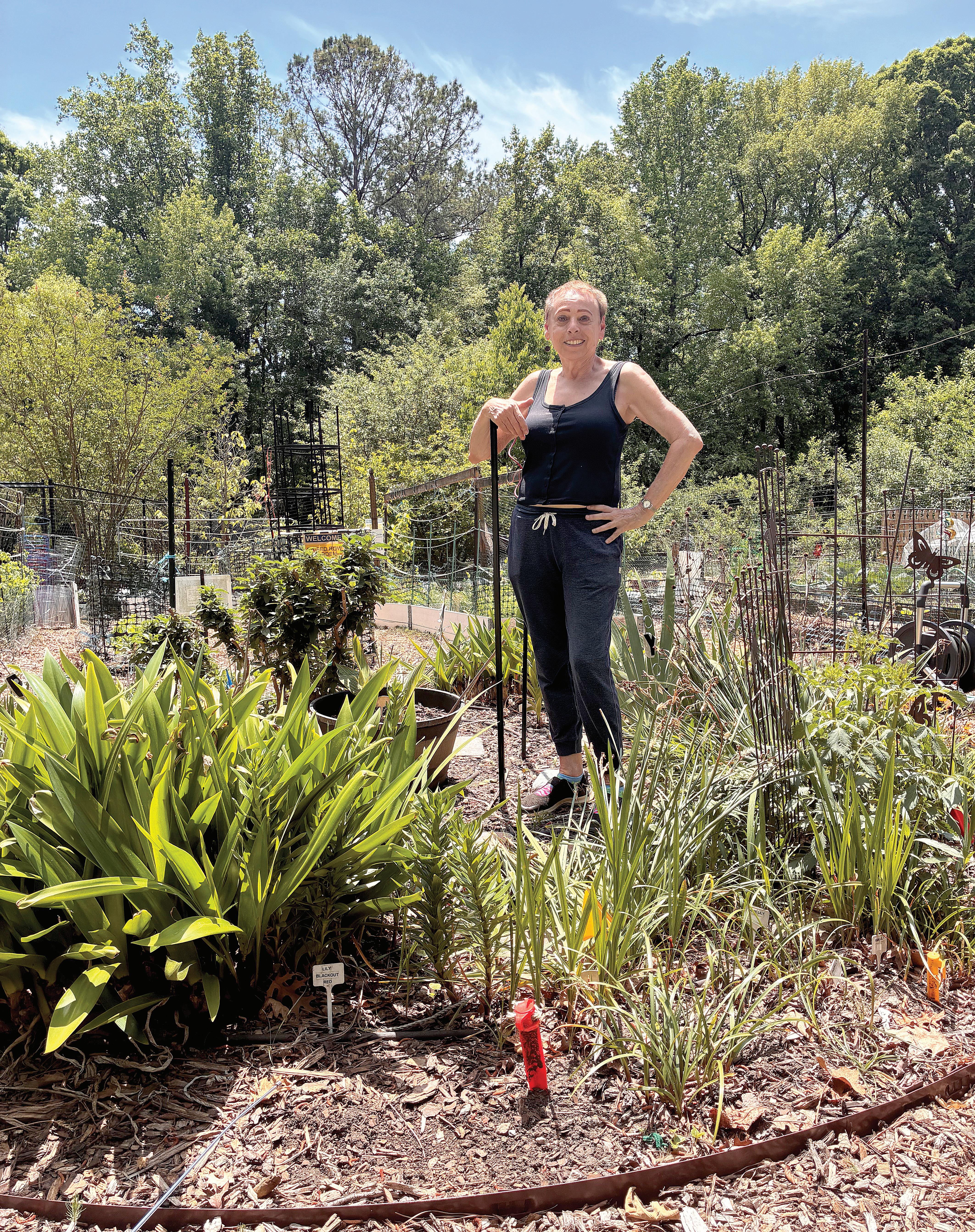
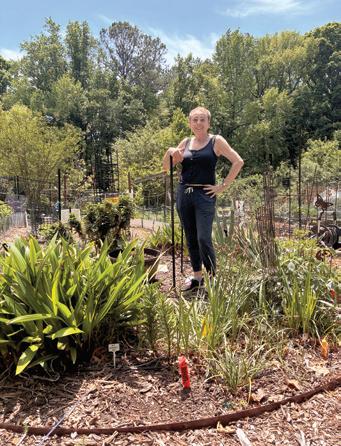
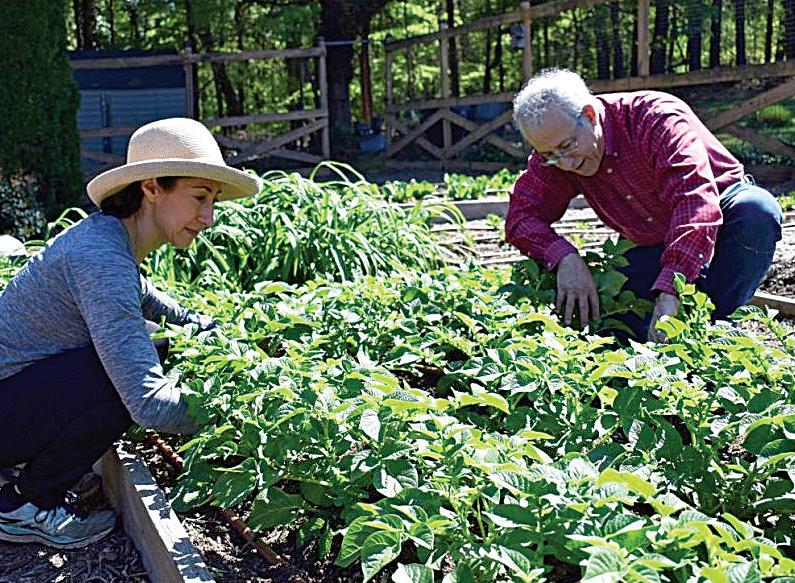
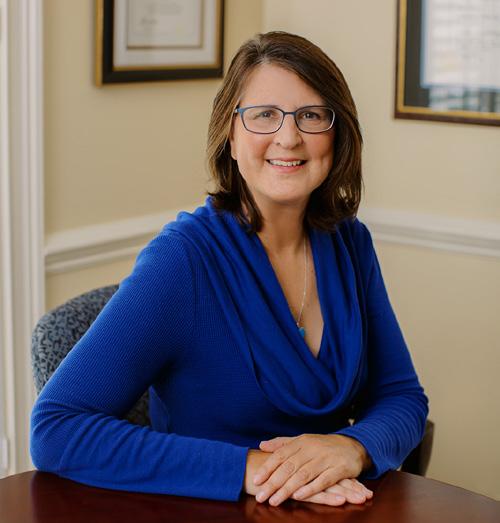
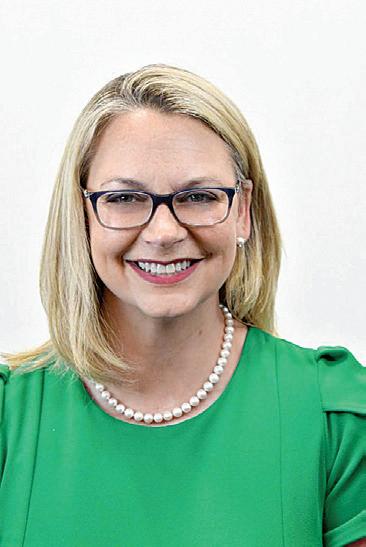
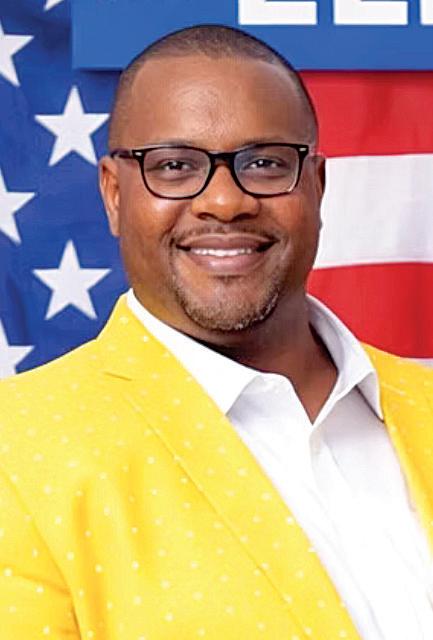
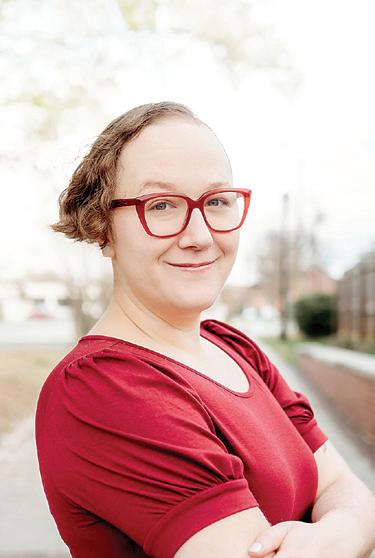
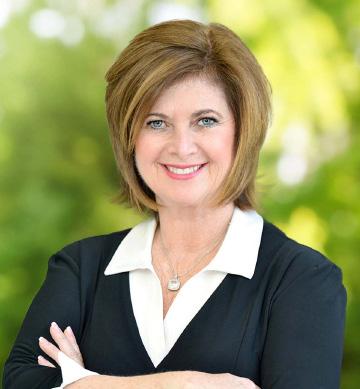
Janet Hanser works on experimental gardens at Brook Run Garden and Orchard.
(Photo by Cathy Cobbs)
I don’t know about you, but things seem busier than ever. A real estate friend assures me that things are “COVID busy,” referring to the days when interest rates were low and sales volume was high. A Gen X latchkey kid, I’m starting to relate to today’s overscheduled children shuttling from one after-school event to the next.
Complain as I may, I love it. As I’ve said many times, I think I created the perfect job for myself.
A critical part of channeling that passion into a sustainable, successful local media business is being present in the community. It means having our reporters at city council meetings and art openings, sponsoring local nonprofits, and managing a calendar packed with civic, cultural, and corporate events.
From the Atlanta Press Club Newsmaker event with Mayor Andre Dickens to a Greater Perimeter Chamber luncheon where I joined a panel on local media, to the Atlanta Opera and World Affairs Council of Atlanta breakfasts, being out in the community has built relationships and keeps my energy up.
The most rewarding recent event of all was the Inman Park Festival, where the Rough Draft team and I met a steady stream of readers and heard firsthand how you rely on our papers, website, and newsletters to keep you informed.
At a time when we know people are tuning out the news, it’s refreshing to know that our audience is growing. Whether it’s our newsletters, website, social media, or print products, we are reaching more readers than ever and, as somebody told me recently, we seem to be “punching above our weight.”
I think we are seeing growth because we produce products that don’t overwhelm people with doom and gloom, are unbiased, respect readers’ time, and provide exceptional results for our advertisers.
Tuning In. Or Out.
Besides all of the other existential threats to the media industry, news avoidance is something that’s been on my mind lately.
Even in a place like Atlanta, where there are myriad options for local and national news, a recent Pew study, “Americans’ Complicated Relationship With News,” found that about half of us
say we feel worn out by an overload of information.
That tension between overload and avoidance played out on April 25, when a gunman breached a security barricade at an event where the president and much of his cabinet were in attendance.
I heard about it from a dinner companion who relatively casually said, “There’s an active shooter at the White House Correspondents’ Dinner.” While I glanced at my phone, most people at the dinner table didn’t. There was no noticeable reaction in the bustling restaurant.
Dylan Byers, who covers the media for Puck, was evacuated from the event and ended up at a bar a few blocks away where the NHL Playoffs were on the TV. Nobody seemed aware of what had just happened at the nearby Washington Hilton — the same hotel where John Hinckley Jr. shot President Reagan in 1981.
When his group asked the bartender to switch to CNN, a manager intervened, citing a policy against showing political content.
In a post on X, Byers tried to imagine what that same bar would have looked like on March 30, 1981, with every television airing wall-to-wall coverage, passersby crowding in off the street.
“It’s unnerving,” he wrote, “how desensitized so many people have become — to shootings, obviously, but also to political violence and the abnormality of the moment.”
I don’t think it’s indifference. I think it’s exhaustion. The national news cycle has been relentless — the chaos in Washington, a stressful geopolitical landscape, and an economy that is booming for some, but suffocating for many. At some point, people stop reaching for their phones not because they don’t care, but because they need a break from caring too much.
Thank you for supporting local journalism. Please reach out to me with any feedback or suggestions at keith@ roughdraft.news.
Postscripts
■ The wildfires in South Georgia have been devastating. If you’re in a position to help, the Red Cross Georgia chapter is a good place to start.
Visit redcross.org/local/georgia.
■ Early voting for the May 19 primary is underway, with several runoffs certain to follow in June. Our voter guides are online. Please use them.
KEITH PEPPER
A Nostalgic Summer Vacation at Lake Oconee
Looking for things to do at Lake Oconee this summer or planning a weekend getaway near Atlanta? Just over an hour away, Lake Oconee is one of Georgia’s top summer destinations, offering everything from boating and fishing to berry picking and small-town charm.
Get Out On The Water
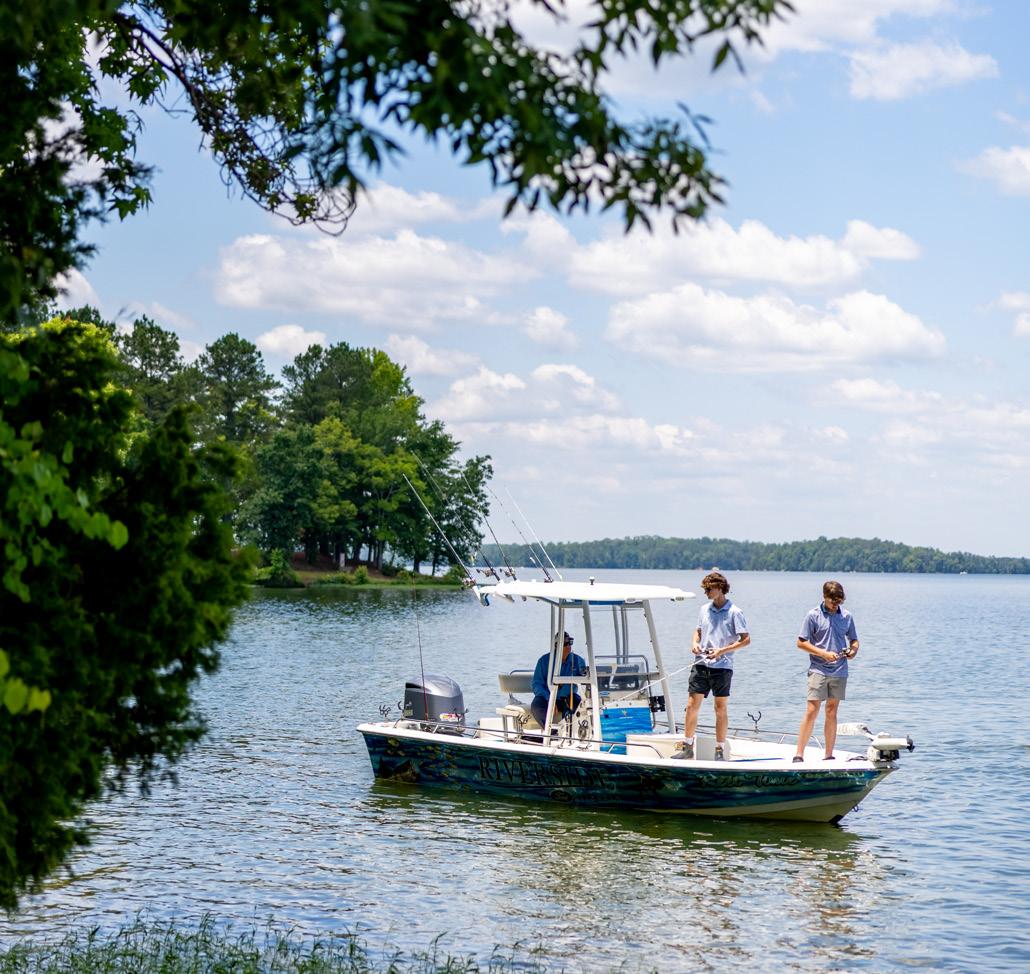
No classic summer is complete without a little time on the lake—and at Lake Oconee, there are countless ways to make a splash. Whether you’re cruising the shoreline on a pontoon boat, tubing behind a ski boat, or paddling out in a kayak, the water is where summer memories are made.
Jump Into Summer
For many, the thrill of a summer day isn’t complete without a leap into cool waters from a favorite rock. Jumping Rock at Lake Oconee is just that place—a timeless spot where kids (and adults) can channel their inner daredevil and jump from the iconic rock ledge into the refreshing lake below. It’s an exhilarating throwback to simpler days when fun was measured by how high you could leap and how much laughter echoed across the water.
Cast a Line
For those looking to enhance their fishing experience, Reel Time Guide Service, led by Captain Smith, offers expert-guided trips on Lake Oconee. With over 30 years of experience, Captain Smith specializes in targeting species like striped bass, hybrid bass, and crappie. He provides tailored trips that cater to all skill levels.
Georgia Department of Natural Resources requires a license to fish in all public lakes in Georgia so, make sure you have one before you get on the water.
Soak In Live Music By The Lake
All resort guests at The Ritz-Carlton Reynolds, Lake Oconee are invited to The Backyard this summer for their Summer Concert Series. The resort will be hosting a wide variety of live musical entertainment on select dates from early May through Labor Day Weekend. Firework displays will occur on holiday weekends.
Camp Under The Stars
If your idea of the perfect summer includes sandy toes, grilled hot dogs, and nights under the stars, Greene County’s campgrounds deliver all the throwback charm. Old Salem Park, Parks Ferry Campground and the KOA offer peaceful lakeside settings where you can swim at the beach, cast a fishing line off the dock, and spread out a checkered blanket for a picnic beneath the pines.
A Day of Classic Summer Flavors in Greensboro
Morning:
Start your day the way summer mornings should—with a slow, satisfying breakfast at Café 44. Order the chocolate chip pancakes and a hot cup of coffee, and ease into the day with classic comfort food and a welcoming, small-town atmosphere.
Lunch:
By midday, follow the unmistakable scent of hickory smoke to Holcomb’s Bar-B-Que, a local favorite since 1971. Grab a plate of tender pulled pork, tangy sauce, and all the classic sides—it’s the kind of no-frills, full-flavor meal that defines a Southern summer.
Don’t Skip Dessert:
Before the day gets away from you, stop by The Yesterday Café for a slice of their famous buttermilk pie—rich, custardy, and unforgettable.
Dinner:
End your day with a relaxed evening at Table at the Lake. Dine under twinkle lights in the courtyard, enjoy locally inspired dishes, and soak in the peaceful breeze—it’s the perfect way to wind down after a full summer day.
Go Berry Pickin’
Few summer memories are sweeter than picking sun-ripened berries straight from the bush—and at Hemi Blueberry Farm, that tradition is alive and thriving. Nestled just outside Greensboro, this charming, family-owned farm invites visitors to wander the rows, bucket in hand, and gather plump, juicy blueberries by the handful.
Snap The Past
Step back in time with a slow stroll through historic downtown Greensboro, where every sidewalk and vintage storefront tells a story. With a Polaroid camera in hand, you can capture the charm of this small Southern town the old-fashioned way—one instant photo at a time.
Slow Down And Soak It In
Sometimes the best summer moments are the quiet ones—rock on a porch swing, listening to the water lap against the dock, or feeling the warmth of the sun on your face with nowhere to be. At Lake Oconee, relaxation isn’t just encouraged—it’s part of the lifestyle.
Find your reason to linger longer this summer.
From garden plot to food pantry, community gardeners help neighbors in need
By Logan C. Ritchie
Community gardens run by passionate gardeners across metro Atlanta are contributing thousands of pounds of fresh produce per year to food pantries, soup kitchens, and free food stands. Whether the land lends a few acres or a handful of plots, an abundance of fruits and vegetables are being donated to neighbors in need.
Sandy Springs and Dunwoody
Atlanta Community Food Bank founder Bill Bolling spoke to a crowd of about 200 members of Temple Emanu-El, a Jewish synagogue in Sandy Springs, in 2004. Bolling’s talk sparked the creation of a community garden that 21 years later donates between 1,000 and 2,000 pounds of food per year to the Community Assistance Center (CAC) about two miles from the synagogue. It doesn’t get more local than that.
First, a piece of land was cleared that was formerly used as Temple Emanu-El overflow parking. Volunteers took it from there: they put up a fence, built raised beds, installed an irrigation system, and started operating Garden Isaiah.
“Temple Emanu-El decided that
we would be part of the solution,” said volunteer Robert Wittenstein, only the fourth person to run the garden.
Between six and 10 volunteers meet on Sundays to weed, plant, or harvest. Within a day, the produce is delivered to CAC. When he spoke to Rough Draft, Wittenstein had just dropped off 40 heads of lettuce “as good or better quality than one could find in the grocery store.” Detailed records are kept to track the amount and type of produce being delivered.
Children from Temple Emanu-El’s religious school visit to hear about who the garden serves and why. The kids help with watering, weeding, and whatever else needs to be done that day, Wittenstein said. The message he wants to convey: Sandy Springs and Dunwoody are considered to be affluent communities, and yet there are thousands of people in the community who are food obscure.
Wittenstein also helped to start the Dunwoody Community Garden and Orchard at Brook Run which contributes to Malachai’s Storehouse, the food pantry at St. Patrick’s Episcopal Church in Dunwoody. The two garden communities are very close, sharing seeds and visiting each other’s gardens. Dunwoody Community Garden starts plants from
seed in the greenhouse during the winter so they can be planted at Garden Isaiah in the spring.
What’s new this year at Garden Isaiah in Sandy Springs? Sweet potatoes are off the list. Wittenstein said the vegetables are labor-intensive to cure and store after they’ve been harvested. Historically, Garden Isaiah has grown bell peppers and jalapenos. This year, CAC has asked for hot peppers to serve to the pantry’s large Hispanic population.
With nearly 40 years under its belt, CAC distributed 1.1 million pounds of food in 2025 to approximately 4,200 families between its two Sandy Springs food pantries. To ensure the dignity and respect of CAC’s clients, both food pantries are set up like a grocery store so clients can choose what they like to eat.
“Last year, the visits to those two food pantries was up 18%, which tells you that the need is not going away. If anything, it continues to increase,” CAC CEO Francis Horton said, adding that CAC uses 28 congregational partners to provide food.
CAC is supported by local funding, not federal dollars, with the majority of support coming from individuals in Sandy Springs and Dunwoody.
“We’re not affected by cutbacks in Washington, or even at the state level.
So we’re blessed in that we continue to provide services to our clients in spite of what is happening around us,” Horton said.
CAC has seen an increased number of visits from who Horton describes as “middle income earners.” As prices in the grocery store rise and wages stay the same, folks are finding themselves “one crisis away from eviction proceedings.”
“It’s important for us to understand the needs are not only among those folks we characterize as low income, but are creeping up that scale to include more and more people,” Horton said.
Stone Mountain
Stone Mountain Community Garden has contributed more than 1,700 pounds of produce to Stone Mountain Ecumenical Cooperative food pantry since 2011.The space includes a pollinator garden, herb garden, children’s garden, 54 garden beds, bee hives, compost systems, and dedicated space for donations to the food pantry.
Although the choices at food pantries have improved from overly salty, overly sugary, and mass-produced products, there’s nothing like freshly picked fruits and vegetables from Columbus Brown’s garden.
As a master gardener and the co-site leader of Stone Mountain Community Garden, Brown said being a person of faith leads him to help people experiencing food insecurity.
“We like to walk the walk,” Brown said.
Brown said the plots have just finished harvesting late winter kale, collards, mustard greens, and turnips. They’re getting started with spring and summer produce like white potatoes, peas, climbing beans, tomatoes, eggplant, squash, and zucchini.
There’s no magic to getting rid of bugs in the garden, by the way. Brown said he and other volunteers on “bug patrol” go around knocking beetles off of leaves and into a glass cup of soapy water. Volunteers spend about 2,000 hours per year maintaining the garden.
“It’s a diverse collection of folks at the garden. There are a number of partners who help like Food Well Alliance, the Atlanta Botanical Garden, local beekeepers, and the women’s club,” Brown said.
Just west of Main Street, Stone Mountain Community Garden is open to visitors. A demonstration area gives gardeners ideas about what to plant and why.
Continued on page 8
Margaret Perry runs the Community Garden at Lutheran Church of the Resurrection in Marietta. She regularly donates seasonal vegetables to CAC. (Photo courtesy of CAC)
A shopper at the CAC mini market and food pantry. (Courtesy of CAC)
David is outstanding! We have been in several real estate transactions over our lifetimes and no agent has been as well-informed, calm, proactive and thoughtful as David...
David makes deals happen and is pragmatic, hardworking, responsive, and reliable. He not only knows the market, but also has a phenomenal marketing plan behind his transactions…
David was responsible, responsive, and was constantly in contact with us with any updates and news about our home search…
David Pruett
Continued from page 6
Tucker
NETWorks Cooperative Ministry has long been known for its food, housing, and utility assistance to neighbors in Northlake, Embry Hills, and Tucker. In late 2025, NETWorks launched Growings, an indoor hydroponic garden built by Neil Duggan, a member of Tucker First UMC.
Growings is a volunteer-operated garden inside a warehouse that produces more than 350 pounds of organic produce each month. By growing vegetables in nutrient-rich water instead of soil, the growing process is accelerated, consistent, and reliable.
“This method gives us ready access to high-quality, fresh produce with an extended shelf life, providing neighbors with the healthy items they want to put on their tables,” the website states.
NETWorks distributes more than 400,000 pounds of food annually.
NETWorks brings fresh food to the Tucker Farmers Market weekly from 4 to 7 p.m. at St. Andrews Presbyterian Church. From January to March, Growings shared 452 pounds of fresh produce including lettuce, arugula, cucumbers, herbs and more.
Food Well Alliance
Food Well Alliance, a collaborative network of gardens, farms, and orchards, is keen on the idea that every little bit counts. Whether it’s acres of planned crops or a few extra tomatoes, all metro Atlanta growers can participate in feeding their neighbors.
“Donate to the closest food pantry or shelter or group home and learn about the people right in your own neighborhood that are struggling with paying bills. It can be pretty eye opening,” Fred Conrad, Food Well Alliance senior manager of Community Gardens and Orchards, said. “It hits you on a more emotional level.”
Donating fresh food is no simple feat. It’s a lot of work to grow and harvest, and it takes extra time to deliver it to a food pantry, Conrad said.
“The food can make it from the garden to the plate in a single day,” he said. “The Atlanta Community Food Bank has gotten incredibly good at moving fresh, perishable food, but community gardens are so absolutely fresh and high in nutritional value.”
Although suburban gardens can produce more food with more land, need is not restricted to location or age. “There are seniors and children who, when they run out of money, they cannot go out and get a job. They need help,” Conrad said. He added: “Atlanta is one of the most generous communities as far as people donating local, fresh food to organizations.”
To donate from your own garden, visit https://www.foodwellalliance.org/
REAL ESTATE
Beltline reaches 79% of its affordable housing goal
By Collin Kelley
Atlanta Beltline, Inc. (ABI) said it has reached 79% of its goal to create or preserve 5,600 affordable housing units by 2030.
According to a press release, 4,425 units have been delivered within the Beltline Tax Allocation District (TAD). The Beltline and its partners delivered 299 affordable housing units in 2025, and are preparing to break ground on more in 2026.
Since 2018, the Beltline has more than doubled the number of completed affordable housing units along the corridor, with nearly three-fourths of these reserved for people earning 60% or less of the Area Median Income (AMI).
The Beltline moved several major projects forward this year, advancing sites from planning to implementation across the corridor. 356 University Avenue, 350 Chappell Road, 425 Chappell Road, Murphy Crossing, and 579 Garson Drive all saw progress, with community feedback helping guide each step, according to ABI.
Major developments advanced through collaboration in 2025 include Brownsville Point, Englewood Multifamily, the Residences at West End, Waterworks, and Oakland Exchange.
In January, ABI launched a new Affordable Housing Dashboard and
web-based mobile app to improve access to affordable housing information and strengthen transparency around progress toward its 2030 goal. The interactive platform allows residents, partners, and stakeholders to explore affordable housing developments along the Beltline through an interactive map and search tools that identify units within the Beltline Planning Area.
Launched in 2020, the Legacy Resident Retention Program (LRRP) helps longtime homeowners remain in neighborhoods adjacent to the Beltline by covering the cost of property tax increases through the 2030 tax year. In 2025, 276 homeowners in neighborhood stabilization areas on Atlanta’s Westside and Southside received tax relief through the program, according to ABI.
The Beltline also offers residents guidance on filing homestead exemptions, appealing property tax assessments, managing finances, and buying a home for the first time. Now marking a decade of connecting community members to these critical resources, the Beltline continues to expand access to financial education and housing stability tools.
Information on these workshops and additional resources can be found at beltline.org/live/resident-support.
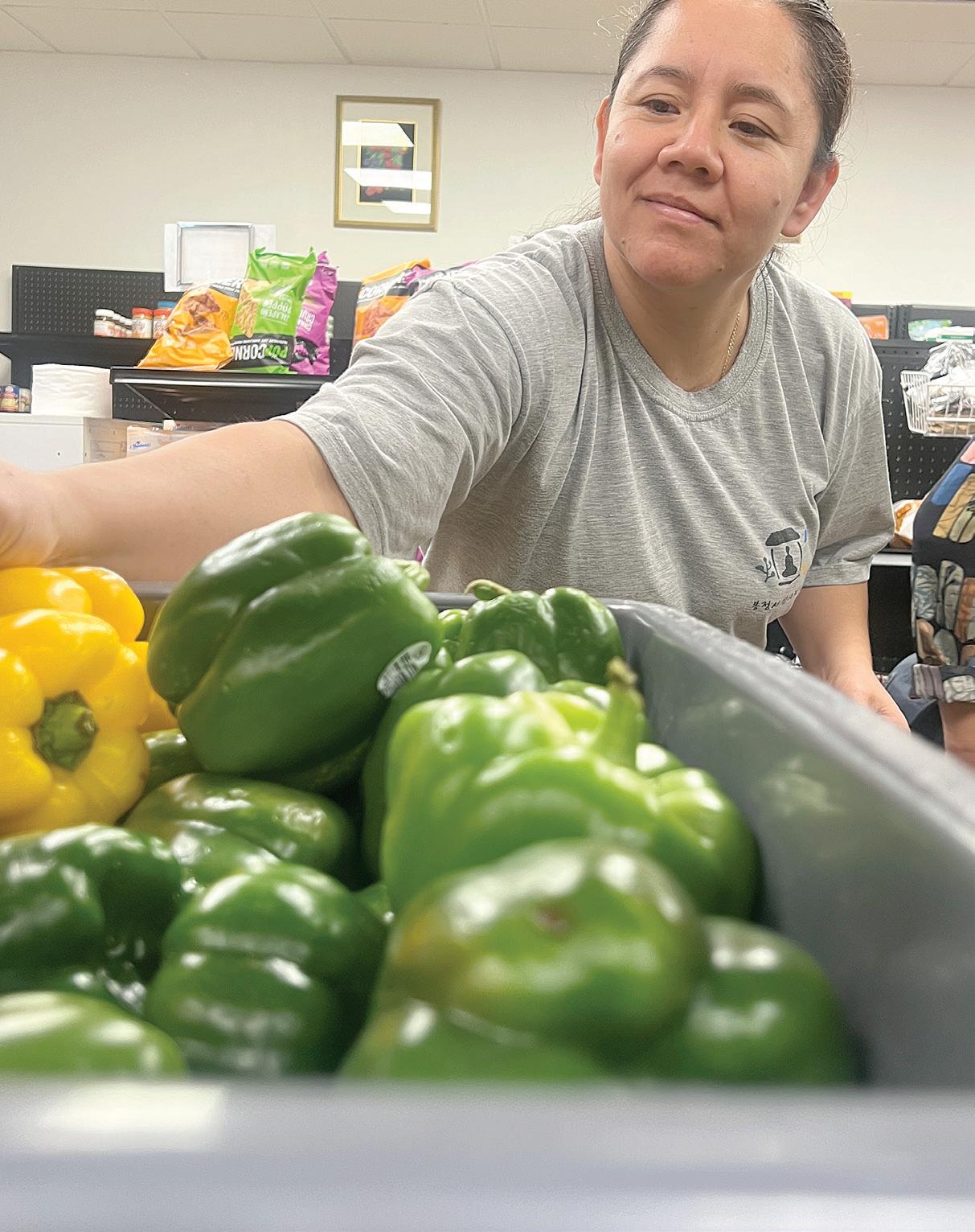
Volunteers work the charity garden boxes at the Brook Run Garden & Orchard. (Photo by Cathy Cobbs)
Volunteers work at Garden Isaiah. (Courtesy of CAC)
356 University Avenue is one of the affordable housing projects completed by Atlanta Beltline Inc. (Courtesy ABI)
A rendering of the Murphy Crossing development. (Courtesy ABI)
Unfinished office building renovation raises safety concerns
By Rachel Spooner and Collin Kelley
A crane looming over the unfinished renovation of an office building at Peachtree and 14th streets in Midtown has raised safety concerns from nearby residents.
Residents say the crane has been out of operation for four years, while renovations on the former Campanile building, now called The Midtowne, remain unfinished.
Renovation and expansion of The Midtowne, owned by Dewberry Capital, began in 2019, before stalling during the COVID-19 pandemic. The building was gutted, but the bare-bones structure remains exposed to the elements. Midtown residents and businesses have complained that the work site is an eyesore and is decreasing property values.
Gary Freedman, who lives in an apartment complex across the street from the building, is no longer concerned about the renovation or property value issues, but rather his safety.
“If anything were to ever happen to that crane, my building would be taken out,” he said.
It wouldn’t be the first time Freedman witnessed such an accident; when he lived in New York, a crane collapsed near his home on 57th Street in 2012. Now, he
faces the same threat. Freedman has seen the crane’s arm spinning and its tower swaying during storms.
On April 7, Freedman wrote to Mayor Andre Dickens’ office and city officials with his concerns. “Given the duration of inactivity, residents deserve clarity on the current condition of the structure and any ongoing safety oversight,” he wrote.
He has not received a response from
the city.
“I would not be concerned if they could just provide proof to residents in Midtown and the media that that crane is being inspected and that it has a solid foundation,” Freedman said.
In 2021, the city filed an abandoned project complaint against The Midtowne, which was resolved by Dewberry’s pledge to complete the building. In a December 2025 interview with the Atlanta JournalConstitution, Dewberry said interior work had resumed inside the structure and would continue.
Freedman works from home and can see the crane and a part of the building from his window. The only activity he sees at the site is, about once a week, construction workers will swing the crane in a different direction.
“They’re just sort of doing that to bypass city regulations or whatever, making it seem as if the crane’s in operation,” Freedman claimed. “Once a week, you will see two guys with orange vests and white hats just walk around the
property, kicking dirt. There’s nothing being done.”
In 2024, Urbanize Atlanta interviewed John Dewberry, the owner of Dewberry Capital who has become infamous for abandoned and prolonged construction projects across the Southeast. He stated during the interview that The Midtowne would be completed in two years, making 2026 the expected completion. The only quote the interviewer was allowed to print, as the majority of the 90-minute discussion was strictly off-the-record, was, “We’re working night and day to try to deliver a great product for Atlanta.”
Built in 1987, the Campanile building originally served as BellSouth’s headquarters and was purchased by Dewberry in 2010.
The lack of activity on the building has held up other construction in the city. The Juniper Complete Street Project, which began in May 2023 to widen the corridor to allow for easier travel, cannot be completed until lane closures on 14th to 13th street are reopened, which are in place due to The Midtowne work site.
“[The City of Atlanta] lets builders get away with murder–what actually could be murder, if that crane falls and kills people,” Freedman said. “The city has to come up with a solution.”
The Midtowne building site at 14th and Peachtree streets. (Photo courtesy Gary Freedman)
Residents say they don’t want 280-unit apartment complex
By Cathy Cobbs
Residents living near a proposed 280-unit apartment complex at Perimeter Summit continued to air their concerns about multi-family overdevelopment and the impact it will have on property values in the area.
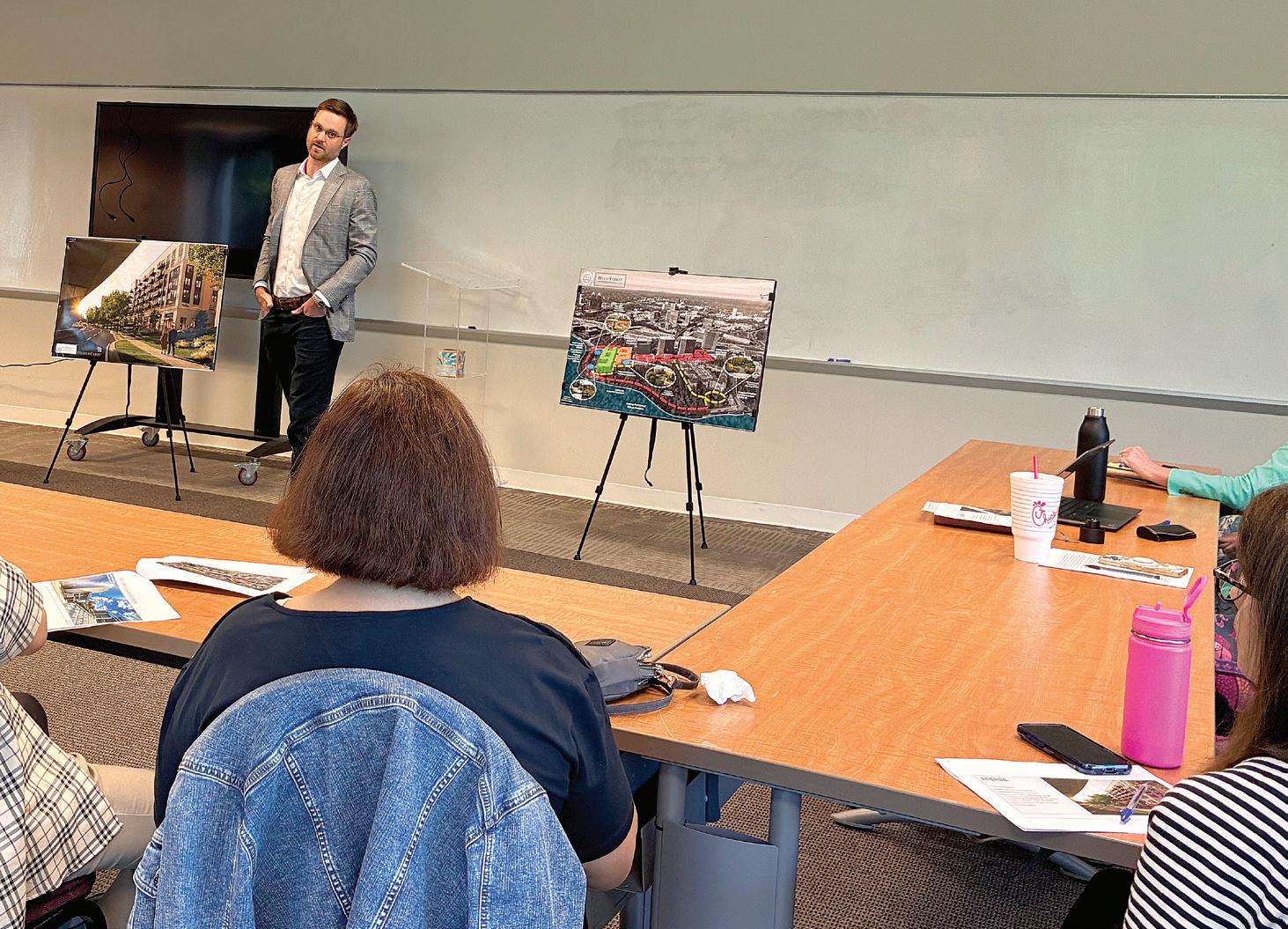
The meeting, held on April 20 at an office building in the Summit complex, drew about 30 people, most of whom said they oppose the development.
High Street Residential, the residential subsidiary of developer Trammell Crow Company, plans to build 280 apartments on a vacant 2.7-acre parcel that is zoned for a 12-story office building.
It is zoned Office-Industrial, and the developers are asking for conditional changes as well as two Special Land Use Permits to allow for the apartment’s construction and increased building heights.
Brookhaven’s planning commission at its April 1 meeting unanimously recommended the project, subject to several conditions, including a certain mix of residential, commercial, and retail, the inclusion of public art within the complex, and changes to the complex’s ingress and egress.
The commission had deferred a decision at its March 6 meeting after citizens aired their concerns regarding
further erode their home values.
the density of the development, and the perception that multi-family housing has a negative effect on surrounding properties’ home values.
Speakers at the April 20 meeting echoed many of the concerns discussed at the April 1 meeting, including the fact that several nearby mixed-use developments have seen the failure of retail businesses.
Recently, several restaurants, including Del Frisco’s Double Eagle Steakhouse and Iron Hill Brewery, have closed their locations at the State Farm corporate building complex.
Speakers say they are ‘construction weary’
Most of the speakers at the informal meeting, facilitated by Brookhaven City Council Member Michael Diaz, were Villa Sonoma condominium owners, who say they are weary of the construction in the area.
“We are just sick and tired of the construction process,” one person commented. “We are just literally over it.”
The speakers cited ongoing construction of a 350-unit, seven-story apartment near the proposed site, and the recent completion of the AMLi Brookhaven on Lake Hearn Drive, which has one- to three-bedroom units for rent, and contains another 20,000 square feet of retail.
They argued that the area is oversaturated with multi-family developments and the effect on an alreadyoverburdened Ashford Dunwoody Road will be devastating for the residents.
Several speakers, including Brian Murphy, said they are seeing their property values plummet, in part because the association had to hike its monthly homeowner fees in order to finance fixes to the complex’s failing stucco. They believe the “transient” nature of renters will
Trammell Crow goal: A vibrant community
Scott Kirchoff, a principal at Trammell Crow, said the development will turn the area into “a vibrant mixed-use environment.”
Compared to an office complex, the apartments would result in a 40% reduction in traffic overall, and 77% during peak hours, he said. Parking would be reduced from 1,000 spaces to 375, and trails would be built around the Perimeter Summit property to promote walkability. In addition, plans include building pocket parks and a 10,000 square-foot community green space gathering area. Kirchoff also pushed back against residents who have labeled the project as a “squeeze job” that will move ahead despite residents’ concerns. Diaz said the meeting was set up to refine the final plan based on citizen feedback.
“The intent is to provide the opportunity to connect, and hear about your concerns,” Diaz said.
Trammell Crow’s request was expected to be heard at the April 28 city council meeting. Kirchoff said construction may begin next year, with an expected two-year duration.
After the meeting, Diaz called the conversations “worthwhile and productive.”
“It gave residents, nearby stakeholders, and the applicant a chance to sit down together, speak directly, and talk through concerns in a more open setting than you usually get during a formal hearing,” Diaz said. “I was glad to see strong participation and a willingness from all sides to continue the dialogue. As this heads to Council, I’m still listening, reviewing the application, and considering the feedback that’s been shared.”
Scott Kirchoff, a principal at Trammell Crow, said the development will turn the area into ‘a vibrant mixed-use environment.’ (Photo by Cathy Cobbs)
found dead in cell, investigation underway
By Cathy Cobbs
Olaolukitan Adon Abel, a former Navy veteran accused of killing three people during a random shooting spree on April 13 across DeKalb County, has died in custody.
The DeKalb County Sheriff’s Office confirmed that Abel, housed at the DeKalb County Jail, died on April 21 while in custody.
“Olaolukitan Adon Abel was found unresponsive in his cell at approximately 6:48 p.m.,” the statement said. “Detention staff immediately notified medical personnel, and lifesaving measures were initiated. Despite those efforts, he was pronounced deceased at the jail at 7:17 p.m.”
“In accordance with agency policy, a standard internal review has been initiated to examine the circumstances surrounding this incident,” the DeKalb County Sheriff’s Department statement continued. “The official cause of death will be determined by the DeKalb County Medical Examiner’s Office. At this time, there is no indication of criminal activity or foul play.”
Random shootings in DeKalb Abel, 26, is accused of killing three people, including a Department of Homeland Security employee who was walking her dog in Panthersville, a woman outside a fast-food restaurant in Decatur,
and a homeless man at the Brookhaven Kroger on Peachtree Road.
Days after being shot multiple times, the Kroger victim, Tony E. Matthews, 48, of Atlanta, succumbed to his injuries.
Abel was apprehended in Troup County while driving a rental car, authorities said. Brookhaven Police Chief Brandon Gurley told the city council at its regular meeting that surveillance tools, like Flock Security cameras and license plate readers, led to Abel’s swift apprehension.
Abel had a violent criminal history
According to a statement by the United States Attorney General’s North Georgia office on April 17, troopers searching Abel’s car in Troup County found a box of 9mm ammunition and shell casings matching the same brand of ammunition found at the murder scene in Decatur.
The statement also provided details on Abel’s criminal history.
“Abel was previously convicted of a felony for Assault of a Police Officer with a Deadly Weapon on January 2, 2025, in the Superior Court of San Diego County, California, and he was sentenced to probation in June 2025 for four counts of misdemeanor sexual battery in the Recorder’s Court of Chatham County, Georgia,” the statement said.
Abel had been charged with three counts of malice murder, aggravated assault, possession of a firearm during the commission of a felony, and possession of a firearm by a convicted felon for the DeKalb County shootings.
He was facing further prosecution, along with another man, Damon Marquis Yarns, for illegally obtaining the 9mm pistol, which was found at the scene of the Decatur shooting.
The agency, the Bureau of Alcohol, Tobacco, Firearms, and Explosives, was leading the investigation, along with the DeKalb County Police Department, Brookhaven Police Department, Homeland Security Investigations, and Department of Homeland Security Office of Inspector General, the statement said.
Sgt. Carlai Moore talks to a tenant in the Cherokee Plaza shopping center on April 17 after two recent shooting incidents there.. (Photo by Cathy Cobbs)
BUCKHEAD Primary set for May 19, with governor’s race leading ballot
By Collin Kelley
Georgia voters are heading into a pivotal May 19 primary that will shape the state’s political direction, with a wide-open governor’s race at the top of the ballot and a host of competitive contests across metro Atlanta and the state.
The race to succeed term-limited Republican Gov. Brian Kemp is drawing crowded fields in both parties and is expected to dominate turnout. On the Republican side, candidates include Lt. Gov. Burt Jones, Secretary of State Brad Raffensperger, Attorney General Chris Carr, and businessman Rick Jackson, highlighting divisions between establishment conservatives and those aligned with President Donald Trump.
Democrats are also fielding a large slate, led by former Atlanta Mayor Keisha Lance Bottoms, former DeKalb County CEO Mike Thurmond, former state Sen. Jason Esteves, and former Republican Lt. Gov. Geoff Duncan, who switched parties over differences with Trump and his adherents in Georgia.
The size of both fields raises the likelihood of July runoffs if no candidate secures a majority.
The primary unfolds as Georgia remains a closely divided battleground, with both parties viewing the governor’s race as critical to shaping policy on issues including economic growth,
voting laws, and education.
Beyond the governor’s contest, the U.S. Senate primary is another major draw. Incumbent Democratic Sen. Jon Ossoff faces multiple Republican challengers competing to unseat him in November, ensuring heavy spending and voter engagement statewide.
Several down-ballot statewide races are also competitive, including lieutenant governor, secretary of state, and attorney general. These contests will determine leadership over elections administration, legal policy and legislative priorities, with candidates from both parties competing in contested primaries.
In metro Atlanta, voters in Fulton, DeKalb and Gwinnett counties will also weigh in on legislative and local races that could influence state politics. Competitive Georgia House and Senate primaries in these heavily populated counties are expected to play an outsized role in determining party control and ideological direction at the Gold Dome.
Early voting for the primary began April 27 and runs through May 15, with Election Day set for May 19. A likely runoff is scheduled for June 16.
Be sure to check your voting status at the GA My Gov Voter Page at mvp. sos.ga.gov/s/ and follow our primary coverage at RoughDraftAtlanta.news.
(File photo)
Piedmont Park Conservancy raises $700,000 at luncheon
By Rough Draft
The Piedmont Park Conservancy raised more than $700,000 at its 29th Annual Landmark Luncheon on April 23, setting a new fundraising record for the event held at The Promenade at Piedmont Park.
More than 500 civic leaders, supporters and community members attended, including Atlanta Mayor Andre Dickens, who serves as the city’s 61st mayor.
Proceeds will support maintenance, capital improvements, environmental stewardship and community programming at Piedmont Park, according to a release by the organization.
“No matter what part of the city you live in, everyone claims Piedmont Park as ‘their park’ and the ‘green heart’ of the city,” Dickens said. “A park this special does not maintain itself — it takes stewardship, investment, and dedicated partners.”
Presented by The Speedwell Foundation, this year’s luncheon centered on the theme “Putting the Plan in Motion: Progress, Impact and What
Comes Next,” highlighting the conservancy’s role as steward of the park in partnership with the city.
The event showcased progress tied to the park’s first comprehensive plan in 25 years. Recent improvements include renovation of the Pool and Aquatic Center, resurfacing of the Active Oval, restoration of Legacy Fountain, installation of a new garden at the 10th Street entrance and the unveiling of Myriad, a new public art installation.
The conservancy has also expanded to seven-day-a-week park coverage and increased public programming over the past year.
The luncheon featured the
conservancy’s Fund-A-Need initiative, supporting park care, expanded programming, volunteer opportunities, historic preservation, and advancement of the comprehensive plan.
“The support we received will
directly advance critical improvements, programming and stewardship that keep the park thriving for everyone,” said Doug Widener, president and CEO of the Piedmont Park Conservancy.
Small businesses don’t just power Georgia’s economy, they power our communities.
At Georgia Power, we know running a business isn’t easy. That’s why our Small Business Energy Savings program helps small businesses lower energy usage through LED lighting upgrades, HVAC maintenance and smart thermostats.
When your business saves, you gain the freedom to reinvest where it matters most: your people, your customers, and what comes next.
Apply today and start saving. Visit georgiapower.com/SBES to discover savings for your business.
Mayor Andre Dickens speaks at the 29th Annual andmark Luncheon on April 23. (Photo by DVPhotoVideo)
Independent investigation of Dunwoody Police officers fired for unauthorized searches concludes no discrimination
By Cathy Cobbs
An independent investigation regarding the termination of three Dunwoody Police officers in late 2025 concluded that neither racial nor sexual discrimination played a part in the force’s decision to fire them.
The investigators also stated the officers were not retaliated against because of their efforts to engage in “protected activity.”
The three officers – Ramatu Kamara, Jakori Edwards, and Jessica Preston – were terminated, or allowed to resign, after they were accused of several offenses, including conducting unauthorized database searches for a man who was allegedly dating one of
the officers.
All three claimed in official grievance letters that they received harsher punishments because they are Black and cited incidents in which their white counterparts received less punitive punishments.
According to Georgia law, any person “who knowingly requests, obtains, or attempts to obtain criminal history record information under false pretenses, or who knowingly communicates or attempts to communicate criminal history record information to any agency or person except in accordance with this article, or any member, officer, employee or agent of
the center, the council, or any participating agency who knowingly falsifies criminal history record information or any records relating thereto shall for each such offense, upon conviction thereof, be fined not more than $5,000.00, or imprisoned for not more than two years, or both.”
The investigation
A 24-page independent investigative report obtained by Rough Draft, which was conducted by the workplace law firm Fisher & Phillips LLP at the city’s request, concluded that allegations of racial and sex discrimination made by the former officers were unsubstantiated.
“Based on my interviews and review of documents provided during the investigation, the disciplinary decisions related to the grievants are supported by the evidence, and I was unable to find any evidence that race or sex factored into any of the decisions, or that any of them were retaliated against for engaging in protected activity, or otherwise,” Fisher & Phillips investigator Tracy Glaton concluded.
The firm was engaged in late 2025 following three internal affairs investigations conducted by Dunwoody Criminal Investigations Lt. Jason Dove, which resulted in the termination of the three officers, according to the report. The F&P report was sent to the city on January 29.
The engagement of an outside firm regarding the violations and subsequent allegations is in stark contrast to a 2020 investigation of former Lt. Fidel Espinoza after multiple allegations of sexual harassment by former officers. ThenPolice Chief Billy Grogan conducted the investigation himself, concluding that Espinoza sent sexually laden texts to his subordinates, but did not harass or coerce them.
The fallout from the Espinoza debacle resulted in several former officers filing lawsuits. A jury awarded a former Dunwoody officer $180,000 after a civil trial in 2024.
The 2025 investigation, according to an invoice obtained by Rough Draft, cost
$13,685.
2024 officer of the year accused of fabricating job offer
Edwards, hired in 2023 as a patrol officer and named both the department’s second quarter officer and Rising Star of the Year in 2024, was terminated on Nov. 21, 2025, after an investigation of allegations that he ran an unauthorized Georgia Crime Investigation Center/ National Crime Investigation Center (GCIC/NCIC) search on a Virginia man, Yazid Ajape, at the request of Kamara.
The report said that Ajape had initiated a complaint with the Dunwoody Police on Nov. 12, 2025.
“Ajape reported that he had been living with Kamara, and while living with her, he was informed that he had an outstanding warrant for his arrest in Virginia but was unable to obtain information from authorities in Virginia,” the report said.
“He reported that Kamara told him that she asked Edwards to look him up, and Edwards confirmed that Ajape had a warrant and a protective order.”
When questioned, however, Edwards denied he had run Ajape’s name on his computer even after Dove presented Edwards with the screenshot of the warrant hit on his assigned laptop, the report said.
Ajape, the report said, also provided a screenshot from his phone, which showed the Oct. 4, 2025 warrant hit on GCIC/ NCIC, providing photographic proof that the search was run on Edwards’ laptop.
Along with the GCIC/NCIC violation, the report also said that Edwards had lied about having a conditional job offer from the Georgia State Patrol in violation of the department’s truthfulness policy.
He appealed his termination with a grievance letter sent on Nov. 28, 2025.
Former Dunwoody Police officers Jakori Edwards, Jessica Preston and Ramatu Kamara (via Dunwoody Police)
Students and parents unite to combat substance abuse at Dunwoody High
By Cathy Cobbs
It started with the 2024 Fentanyl overdose death of Dunwoody High School (DHS) student Mia Dieguez. It sparked the actions of a student and a group of parents who are rolling out an unconventional campaign to ensure that Dieguez’s death was not in vain.
Dieguez, who died on May 6, 2024, was found unresponsive by a teacher around 11:50 a.m. that day after she ingested the fatal drug and then put her head on a desk during class.
An autopsy released by the DeKalb County Medical Examiner’s Office revealed that Dieguez had 4.6 nanograms per milliliter (ng/ml) of Fentanyl in her system, or twice the lethal amount of Fentanyl.
“Further information disclosed that a minor individual had confessed to giving the decedent OxyContin with a possibly high concentration of THC mixed with the pill, with school administrators in possession of the substance, conveying that they believed the substance contained Fentanyl,” the autopsy report said.
Mady Cohen, now a senior at DHS, said she felt the community was “looking to the high school” on how to prevent a similar tragedy.
school has formed to carry on Cohen’s work once she graduates.
“I want, as my legacy, for other people to help others without thinking first about what to get in return, and continue to spread the message of the importance of naloxone in the school and the importance of overdose prevention,” Cohen said.
Dunwoody Strong enters the picture
“I recognized an issue at the high school after the loss of a student,” Cohen said. “I saw the grief in the community and something needed to be done about it.”
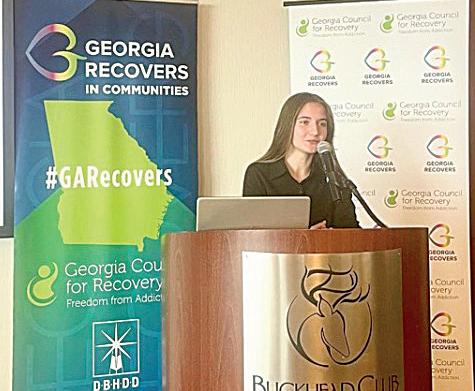
Cohen started Mady’s Narcan Project to provide Naloxone, commonly known as Narcan, to every classroom and common area on campus. The nasal spray is a prescription medication used to reverse the effects of an opioid overdose, according to the National Institute on Drug Abuse. She raised $12,000, not only enough to equip the school with the life-saving drug, but also to provide education to faculty on how to recognize the signs of a drug overdose. The grassroots effort spread to other schools, and a Narcan club at the
A group of parents felt the same sense of helplessness after Dieguez’s death in May 2024, followed by another nearly fatal drug overdose in August of the same year. In 2025, they formed Dunwoody Strong, a parent volunteer organization focused on empowering the community with “the knowledge and tools to prevent substance misuse, promote mental and emotional health, and foster a supportive environment.”
Parent Ly Douglass, one of the founders, said the nonprofit was formed during a time “when we truly felt helpless, watching our students struggle with mental health and then witnessing the overdose of Mia.”
Douglass, along with Eleanor Remigailo, Amy Halligan, Erin Zack, and other parents, formed the organization because “we had to come up with tools to support our students, our educators, and our parents to combat substance abuse and promote mental health.”
Dunwoody High School Principal Tom Bass
Mady Cohen
Read the full article online by scanning the QR code.
City council debates electric utility rate hike amid budget concerns
By Hayden Sumlin
With the fiscal year 2027 budget deadline just six weeks away, the Norcross City Council took up the question of whether to raise the city’s electric utility rate, with some pushback.
At the April 20 policy work session, representatives from the Electric Cities of Georgia and Norcross Power shared the results of a recent rate study. The city is a member of the Municipal Authority of Georgia, a statewide public power authority comprising 49 municipalities that produce and distribute power.
ECG, a nonprofit supporting members of MEAG Power, projects the city will have a nearly $900,000 deficit next year and suggests a phased, three-year rate increase to strengthen revenue.
“It’s showing, after current rates and current revenue, ’26 will barely break even at $180,000,” ECG Senior Analyst Cathy Johnson said. “Beginning in ’27, you start to see some large deficits … we call this the do-nothing slide, the baseline slide.” Council pushes back on projected deficit
The long-range financial projection shows Norcross Power’s direct revenue from customers remaining at $14.95 million from 2027 through 2031.
Council Member Matt Myers said ECG representatives also predicted a looming deficit for Norcross Power in
The Fountain of YOU.
2024, but it never materialized. He said the city has kept rates flat for some time to make the city more competitive.
“I’m a little confused about how you’re projecting it, like we’ve gotta do something and there’s an emergency,” Myers said. “I’ve heard this story before, and it didn’t pan out … and we still have a revenue surplus.”
Myers and Council Member Bruce Gaynor pointed out that the city is transferring more than $1.5 million from its electric fund to its operating fund, up from around $500,000 just two years ago. That’s $1 million the city is not spending on electric costs.
“When we say things like, ‘if we do nothing, we’re going to be in a shortfall,’ it can excite the community,” Myers said. “They don’t have the full context.”
Norcross Power has two main substations in the city with a total of seven circuits, according to the city’s website, with three more off-system stations in Cumming, Johns Creek, and Tucker. Its territory is mostly within the existing city limits, but the city can bid on providing large-scale electric service to large users outside its designated service area.
To increase revenue, the city can sell more electricity or charge higher rates.
Norcross Power rate comparison
Norcross Power President Jim Trupiano said the electric utility has seen 8% growth over the last 24 months, mainly driven by residential.
“We’re losing 2.7% on each residential customer … they’re being subsidized,” he said. “So as our residential customer base grows, that’s a little bit of an impact.”
Trupiano said there are some potential growth opportunities, like an AT&T 5G data center at Buford Highway and Lively Street, which will be online with a new transformer in the next 12 months.
“We’re in discussions with a property owner in Norcross that’s in talks with a Korean battery manufacturing company that could come here,” Trupiano said. “We have some growth in the future here, but it’s unknown at this point.”
The average home in Georgia consumes about 1,000 kilowatt-hours (kWh) per
month, but that usage can jump to more than 1,500 kWh in the summer months.
Norcross residents pay 5 cents less per kilowatt-hour than the more than 2.7 million Georgia Power customers in the state. That means Norcross Power is saving homeowners an average of $75 a month in the summer months.
Council hints at decision
The Electric Utility of Georgia recommends that the city design a phased three-year rate increase of 4% the first year, followed by 3.25% and 3%, on all classes.
While commercial customers will see a 5.5% average increase over the three years, residential customers will see a 2% average increase. With the proposed rate increases, ECG projects the city’s electric fund will avoid a shortfall from 2028-31.
“I met with the energy manager for Publix … he said we’re the lowest utility out of their 1,475 stores from a cost perspective,” Trupiano said. “And he was asking, how do we do that?”
For Norcross Power, Trupiano said the general fund’s 10% dividend, discounts for its residential customer base, and rising costs are putting pressure on the city’s electric fund.
“I understand this is the worst-case scenario, that’s the way I look at this,” Trupiano said. “I don’t think it’s that far from realistic for next year. I think we will be in a hole … If we wait, and we do reach the worst-case scenario, next year or the year later, the impacts to the customer and their budget are going to be worse than they are today.”
Council Member Josh Bare said he thinks the city should be charging market rate.
“We’re not,” Bare said. “The proposals that you’ve shown don’t even really get us to market rate, but are headed in the right direction. I think we need to move in that direction.”
Council Member Bruce Gaynor said he wants below-competitive rates.
“I think when the public owns the power system, then the public should be benefiting from that by paying lower-thancompetitive rates,” Gaynor said.
Norcross power representatives tell council members that the city’s electric utility may face a budgetary deficit next year.. (Photo by Hayden Sumlin)
Norcross aims to expand economic development with Hispanic business owners
By Hayden Sumlin
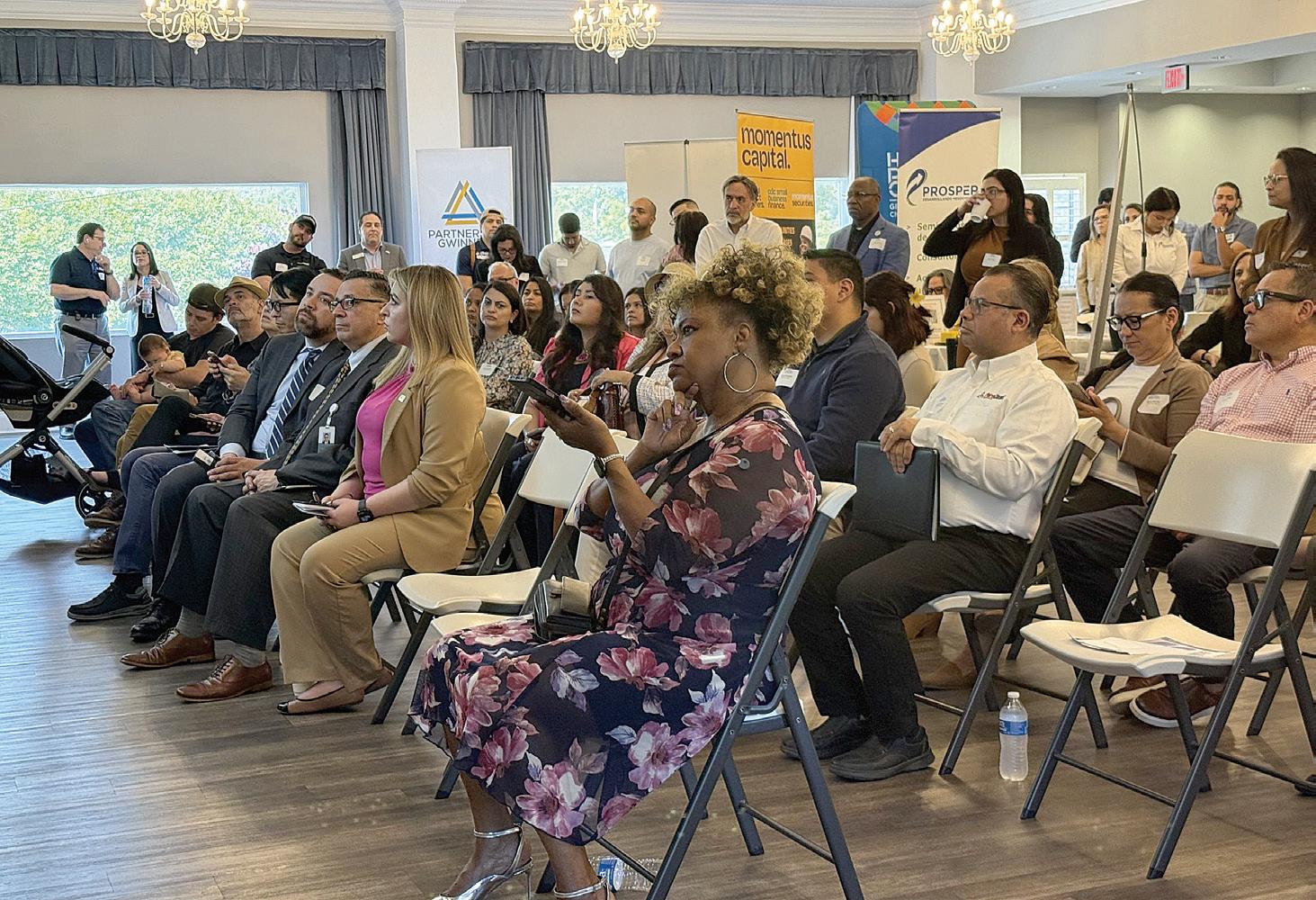
More than 100 people networked and discovered resources available around Norcross at the inaugural Hispanic Business Outreach Event on April 23 at the cultural arts and community center.
Norcross Economic Development
Director David Versel said the city intentionally designed an event to introduce Hispanic business owners to city and community resources. Future gatherings with the local business community and specific industries are planned, he said.
“We’ve done other outreach events at a smaller scale, including one with real estate brokers last month,” Versel told Rough Draft Atlanta. “But this is really the first big event we’re doing to engage with our broader business community. We thought starting with the Hispanic population was a good move because there’s a very large Hispanic population in Norcross, and we have a lot of businesses and entrepreneurs.”
Expanding economic development
Versel, who joined the city last May, said his department is trying to connect with and engage Hispanic business owners. Before he took the role, the position was vacant for nine months.
“The city takes pride in its diversity,” Versel said. “There are a lot of people who have been here a long time. There are also a lot of newcomers and a lot of immigrants, and we welcome everybody.”
The city of Norcross in southwest Gwinnett County is one of the most diverse cities in metro Atlanta, with no single ethnic majority. The city population of about 19,000 is around 40 percent Hispanic or Latino, 25 percent white, 20 percent Black, and 15 percent Asian.
While the event brought together the Hispanic community in and around Norcross, there was still diversity in the room. Attendees comprised a variety of income levels, age groups, and industries, coming from across the Spanish-speaking world.
Versel said the city is making an intentional effort to make Hispanic and Latino business owners feel heard at city hall and recognized as an important part of the community. In the last year, the community and economic development departments have hired Spanishspeaking employees, including Economic Development Manager Jennifer Mina Valencia.
“It’s hard enough sometimes with all the paperwork involved in getting permits, rezonings, business licenses … and it’s even harder when there’s a language barrier,” Versel said. “How do we serve our community better? What we identified right away is that we have a lot of Hispanic-owned businesses, and they need extra attention.”
Growth and access to capital
Two nonprofit economic development organizations, Access to Capital for Entrepreneurs and Prospera, can help entrepreneurs start, sustain, and grow their businesses.
Sandra Font said the ACE Women’s Business Center provides loans and business advisory services to entrepreneurs to get them “loan ready.”
If a business owner can’t get a bank loan, she said the nonprofit can help them get funding elsewhere.
About 100 people attended the Inaugural Hispanic Business Outreach Event on April 23. (Photo by Hayden Sumlin)
City appoints advisory committee for comprehensive plan update
By Hayden Sumlin
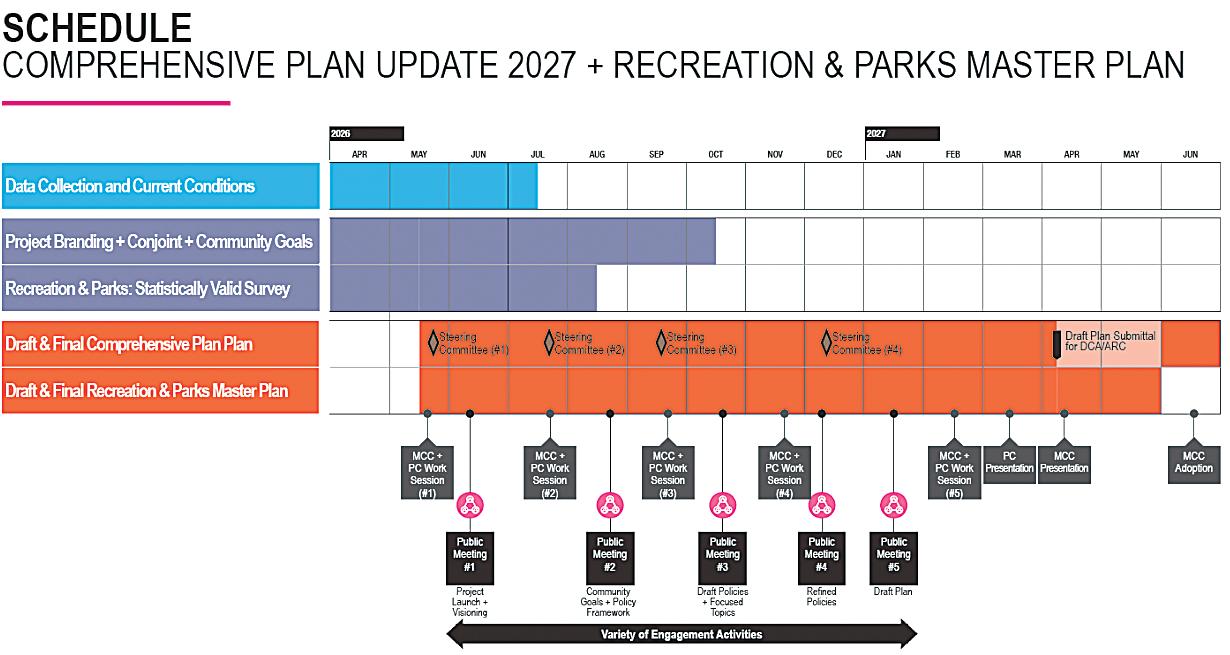
Sandy Springs held its first staterequired public hearing for the 2027 Comprehensive Plan, a long-range planning document that outlines where and how development should occur, at its April 21 meeting.
While elected officials won’t adopt a final plan for another 12 months, the kickoff signals the beginning of input opportunities for residents. During the public hearing no residents commented.
Sandy Springs planning process
In March, elected officials approved a $1.14 million contract with Rhodeside & Harwell, TSW Design, and KB Advisory to create the policy document and an update to the recreation and park plan.
The state of Georgia requires municipalities to update their comprehensive plans every five years to maintain access to state and federal grants. Like service delivery strategy negotiations, the legislature gives the city little wiggle room.
Updates to the Sandy Springs Recreation and Parks Master Plan include a system assessment, analysis of needs and gaps, and a future investment
strategy. Earlier this year, city officials discussed a future parks bond to fund new projects identified in the planning process.
Planning and Zoning Manager
Michele McIntosh-Ross said the community engagement process includes pop-up events, focus group meetings, and open houses. The Sandy Springs Planning Commission and City Council will also receive periodic updates at public meetings.
Later, elected officials unanimously appointed members to the Sandy Springs Comprehensive Plan Advisory Committee.
The committee, required by law to guide the planning process and gather input, has 14 residents appointed by the mayor. The committee includes Sandy Springs Council of Neighborhoods President Ronda Smith, Council
Member Melody Kelley, Temple Sinai Rabbi Natan Trief, and Board of Appeals Chair Sherri Allen, who also heads the Fulton County Registration and Elections Board.
Other members include Los Niños Primero Founder Maritza Morelli, Jennifer Barnes of Solidarity Sandy Springs, Development Authority Chair Chip Collins, and former Sandy
Springs Conservancy Executive Director Linda Bain. The remaining advisory committee members are Tyler Ewing, Raymond Grote, Planning Commission Chair Reed Haggard, Kimberly Oliver, Andrea Settles, and Charan Shikh.
Mayor explains selection
Mayor Rusty Paul said the advisory group is not intended to replace public participation and input in the process. In forming the committee, Paul said he looked at applicants with community reach and planning knowledge.
“This group will meet with the consultant four or five times over the course of the planning process, just to provide feedback,” Paul said. “A lot of people want to serve, way more than we can ever appoint. [This group] represents a broad spectrum of the community, and that’s what I tried to do in putting this together.”
After Kelley asked about her inclusion on the advisory committee, city staff said the state Community Affairs Department recommends a council member be included.
Paul said an elected official is usually included to “make sure that the council’s viewpoints are expressed.”
“You and I have talked about housing on a number of occasions,” Paul said.
“I thought this would give you an opportunity to get in and dig into that and have some input in the process.”
In other business:
■ Sandy Springs Public Works Director Marty Martin said residents can expect two-way traffic on Mount Vernon Highway and Johnson Ferry Road around May 15. Crews are working on burying utilities, adjusting traffic signals, and paving. Martin said full completion, including surface aesthetics and landscaping, will take longer.
■ The city council submitted its street paving list to the Georgia Department of Transportation for its annual grant program, covering $1.24 million of the $1.45 million needed to pave 4.63 miles of roadway.
■ Elected officials approved a costsharing agreement with GDOT for the second and final phase of PATH400, set to be completed by summer 2029. With the agreement, federal funds cover 20 percent of the project.
Sandy Springs reveals $129M plan funded by sales tax renewal
By Hayden Sumlin
In the city of Sandy Springs, a renewal of the countywide 0.75% sales tax for transportation this November tees up more than $129 million in infrastructure improvements within the city through the early 2030s.
The city held its first of three open houses on April 8 to unveil a list of proposed projects to prospective voters in the Nov. 3 general election. The next two public meetings are at High Point Elementary School on April 14, and at the North Fulton Government Service Center on April 16, from 5:30 to 7:30 p.m.
TSPLOST 2026 renewal
On ballots this November, Fulton County voters — outside the city of Atlanta — will be asked whether the 0.75% sales tax for transportation improvements should be collected for another five years.
Collections for the current 2021 TSPLOST run through March 31, 2027. A five-year renewal would keep the total sales tax rate in Sandy Springs at 7.75%.
Voters first approved the Transportation Special Purpose Local Option Sales Tax, or TSPLOST, in November 2016. During a presidential election year with high turnout, it
narrowly passed with 52.7% of the vote.
Voters then approved a five-year extension in 2021, renewing the tax with more than 60% of the vote during an off-year municipal election. Because this November’s elections are expected to have a high turnout, the referendum could be close.
Former Sandy Springs Council Member Andy Bauman attended the April 8 open house. He said he thinks Sandy Springs’ votes are necessary for the tax referendum to pass.
Without a majority of Fulton County voters backing the tax renewal referendum this fall, local governments will go without a bulk of their capital project funding.
Bauman said he’s eager to see projects move forward in District 6, which he used to represent, like sidewalk extensions from the Northside Drive roundabout to Powers Ferry and along Lake Forrest Drive. He mentioned the importance of public input to ensure the tax revenue is directed toward purposeful projects.
Sandy Springs project list
If approved, the countywide sales tax in Sandy Springs will fund bridges, congestion relief, intersection and roadway realignment, safety enhancements, sidewalks, and bike improvements.
Of the city’s $129.1 million budget,
$44.6 million, or about a third of its sales tax revenue, funds the second phase of the Hammond Drive widening project. Phase two, several years away from construction, will widen two segments along Hammond Drive from Boylston Drive to Roswell Road and from Glenridge Drive to Barfield Road.
Phase one stretches between Boylston Drive and Glenridge Road and involves shifting the roadway north, adding one lane in each direction with a median barrier, and putting in two roundabouts. The first phase could cost upward of $64 million, according to the city’s project webpage.
While phase one is not expected to begin construction until this winter, Public Works Director Marty Martin said the city has acquired all of the necessary parcels and is on track. By starting in the middle and then moving to the commercial nodes, Martin said the phasing was chosen to protect neighbors along the corridor.
Martin said the city’s communication team has been working with surrounding neighborhoods for more than five years to design the project. The design has paths on both sides of the roadway and cul-desacs at the end of neighborhood streets to prevent cut-through traffic.
tuckerga.gov/summer
MAY MEETINGS & EVENTS
Unless otherwise noted, all meetings are held at Tucker City Hall, 1975 Lakeside Pkwy, Ste 350B, Tucker, GA 30084
• MAY 1, 7 P.M. First Friday Concert Trina Meade & Co. Tucker Town Green
• MAY 4, 4:30 P.M. Downtown Development Authority
• MAY 5, 7 P.M. Zoning Board of Appeals
• MAY 6, 3 P.M. Opportunity Tucker Development Summit Northlake Mall
• MAY 7, 1 P.M.
Small Business Expo Stone Ridge Event Center
• MAY 11, 7 P.M. City Council Meeting
• MAY 16, 9 A.M. Perk Up with Parks
• MAY 16, 10 A.M. Water Safety Workshop Kelley Cofer Pool
• MAY 16 & 17, 12 P.M. Preview Weekend at Tucker City Pools
• MAY 21, 7 P.M. Movie on the Green Raiders of the Lost Ark Tucker Town Green
• MAY 21, 7 P.M. Planning Commission
• MAY 23-25 Memorial Day Weekend Pools Open for Holiday
• MAY 25 Memorial Day
All City Ofces Closed
• MAY 26, 7 P.M. Council Work Session
Check tuckerga.gov/pools for complete pool schedule, swim lessons and
DeKalb Board of Education candidates share vision
By Katie Burkholder
NOTE: Tracy Brisson, Alison Cundiff, Crew Heimer, Jamison Murphy, and Sonja Szubski are running to fill the District 4 seat left vacant by Allyson Gevertz, which represents schools in the Tucker and Lakeside clusters. Rough Draft reached out to each candidate with questions about what parents and children in District 4 most need. Quotes have been abbreviated for brevity.
Q: What are the biggest problems facing students and families in District 4? How do you plan on addressing these issues?
Tracy Brisson: The issues facing District 4 students stem from systemic problems affecting other students in our district: aging buildings, mismanagement of our capital spending program, an oversized central administration, and a lack of focus on academic performance and high standards for all.
The reality is that the SAP plan the district has proposed for District 4 schools lacks funding, let alone closing some of the highestperforming and replicable educational programs in the district. I hope the board votes on a SAP proposal with a narrower scope, focusing on district clusters with the longest unmet needs that the November ballot’s ESPLOST bill can fund. It will not go far.
Alison Cundiff: Many District 4 buildings have facility problems. Old buildings that have exceeded their 50-year lifespan have not been maintained and are riddled with mold, toxic building materials, and other issues. My solution is to create a public maintenance dashboard that tracks operations at each facility and commit to a robust program of renovation and maintenance. Additionally, the district’s top-down SAP implementation leaves no room for our families to provide meaningful input on these dramatic changes.
Crew Heimer: The first goal of the SAP, to close some schools, is excellent, albeit unfortunately five-years overdue.
It is impeded by the second, and flawed SAP goal, which is to reconfigure elementary education into supersized schools. The SAP proposes closing some of the best functioning schools – because the existing sites are too small for future super schools – while adding capacity at recipient schools in North DeKalb to accommodate the moved students. Why are we proposing to build school seats during a process designed to reduce seats?
Jamison Murphy: The biggest challenges facing students and families in District 4 are declining trust in leadership, inconsistent academic outcomes, and aging school facilities that no longer meet the needs of our community. I will address these issues by focusing on three priorities: First, restoring accountability at every level so decisions are made in the best interest of students— not convenience. Second, ensuring our schools are safe, modern, and conducive to learning by making responsible use of ESPLOST and other funding. Third, strengthening communication and engagement so families are part of the process—not reacting to it after the fact.
Sonja Szubski: I believe the intent of [the SAP] proposal is correct that something must be done to turn the tide of dwindling enrollment, distrust of the board and leadership while also serving our students in the best way. I encourage the board to vote to pause this process, focus on hiring a permanent superintendent and allow the next board to reevaluate the process. But there is much more to student success and the hurdles some must overcome. Some would say it is access to special programs, others would say it is access to choices, and others would say access to food and shelter. I say it is equitable access to it all, basic human rights, diverse programming across the board, and quality teachers and administrators.
Tracey Brisson
Crew Heimer
Sonja Szubski
Jamison Murphy
Alyson Cundiff
Atlanta is in the midst of a matcha craze
By Sarra Sedghi
Atlanta’s beverage scene has gotten greener because matcha is trending in a big way, from coffee shop and dessert menus to pop-ups offering direct-to-consumer tins.
Matcha is a high-grade powder made from shadegrown green tea leaves. Rather than just the extract of a leaf, matcha contains the entire leaf. In addition to giving the powder its signature verdant hue, growing tea leaves in the shade promotes chlorophyll and accentuates umami in the flavor profile.
While traditionally matcha is whisked and combined with hot water, you’ll now find it as the top portion of layered lattes and lemonades, or mixed in pastries, cocktails, and soft serve ice cream to provide that shock of green.
Although powdered tea has been produced for centuries, the earthy, green beverage only recently became a popular alternative to coffee and caffeinated teas. Unlike coffee and some black teas, matcha distributes caffeine more slowly and consistently. (Think of coffee’s caffeine boost as an instant-release medication and matcha as a continuous-
release medication.) Even with its distinct flavor, matcha is also less acidic than coffee, making it gentle on the stomach. Matcha in Atlanta coffee shops
Atlanta Coffee Shops website founder Eugene Buchko said he first noticed a matcha uptick in Atlanta after the COVID-19 pandemic. The matcha trend really took off in 2024, he said.
Buchko recalled encountering matcha drinks at Atlanta coffee shops in the late 2010s. Matcha mostly stuck to the sidelines. It wasn’t until recently that increased demand had local coffee and tea shops adding matcha to the lineup.
Before closing in 2025, Wave 3 Coffee and Chocolate altered its menu to add matcha after realizing customers gravitated toward tea-based drinks. Wave 3 pivoted to production and now supplies matcha to several local shops and bakeries, including Bearly Awake Coffee, Flour and Time Bakery, and The Postcard, which opened last year in the former Wave 3 space.
“We watched Atlanta’s matcha scene explode, but as it grew, we noticed a major gap in the quality available to cafes and home drinkers,” said Indira Pal, Wave 3 Matcha co-founder. “While we loved the coffee shop we built, our mission was to solve the sourcing frustrations we experienced. We pivoted to production to focus on bringing rare, small-batch harvests from Japan to a national audience.”
Buchko said he’s noticed that some Atlanta coffee shops are promoting ground tea more on menus, even to the point where shops are foregoing espresso drinks in favor of matcha drinks.
Beyond the coffee shop
But matcha’s impact on Atlanta isn’t limited to coffee shops and farmers markets. Matcha is also seeping into Atlanta’s cultural fabric.
Chanel Allen, founder of Atlanta-based direct-to-consumer brand Oohmami Matcha, pursues opportunities to sell matcha within the beauty and wellness industries. She hosts pop-ups at workout studios like Solidcore and salons like Purely Pampered Nail Spa.
Similarly, Shogun Matcha hosts sober parties with a DJ called “Matcha and Move.” The Artchive’s monthly Matcha Market pairs the beverage with local businesses looking to get their names out, including Table Haus ATL, Forged Rose Fragrances, and Growing Intentions.
“We build a strong community around it,” said Shogun Matcha founder Dan Tirmizi. “We’re really happy that Atlanta loves us. It’s our home base.”
The matcha cultivars
Not all matcha is created equal. The quality normally reflects the makeup of the beverage that contains matcha. The higher the matcha grade, the fewer additions a drink with matcha in it needs.
“Actually, with the highest grade, you don’t even want to drink it with milk,” Allen said. “You want to drink it straight with water.”
Just like with wine or coffee, green tea has numerous cultivars varying by region. Matcha grown in Uji, located south of Kyoto in Japan, has a distinct umami flavor, thanks to volcanic properties in the soil.
“Different regions are going to give you a different matcha,” Allen said. “All [cultivars] have different notes [and] flavor profiles that come through because of the soil.”
While Uji is the most-awarded region for matcha, that doesn’t make one particular region or cultivar the all-around best for ground tea. Matcha cultivars are no longer exclusive to just Japan. Both China and Korea have recently emerged as growing markets for matcha.
Pal decided to expand matcha sourcing for Wave 3 to cities like Kagoshima, Yame, and Nishio.
“Once we began tasting more deeply across Japan, it became clear that some of the most beautiful matcha isn’t tied to one place,” Pal said. “It’s about the farmer, the cultivar, and how it’s grown and processed.”
“Expanding our sourcing lets us stay true to what we care about most: finding matcha that feels exceptional and special,” she added.
What makes good matcha
There are a few guidelines indicating a higher-quality matcha. Good matcha will feature a strong, grassy aroma and rich green color. The earlier the harvest, the younger the leaves, which yields a better taste.
A drink laden with cream and artificial sweeteners was likely made with lowergrade matcha. As with other beverages, however, it’s completely subjective. And don’t worry about getting “ceremonial grade.” According to Tirmizi, the term is pretty much meaningless.
“Ceremonial grade is a marketing gimmick started by a Canadian guy. It’s not even a term the Japanese use,” he said. While you’ll see ceremonial grades listed on packaging, the term for these grades isn’t legally standardized. The label was created in order to sell matcha to Western countries. Your best bet is to always purchase matcha from a brand you trust.
Matcha at Fujissa in Duluth (Photo by Sarra Sedghi)
ARTS & ENTERTAINMENT
Atlanta natives hit big with ‘Over Your Dead Body’ and ‘Pizza Movie’
By Sammie Purcell
Atlanta natives Nick Kocher and Brian McElhaney, better known as the internet sketch comedy duo “BriTANick,” are having a huge month.
On April 3, their feature directorial debut, the stoner comedy “Pizza Movie,” hit Hulu and Disney+. This weekend, a film they penned called “Over Your Dead Body” hits theaters.
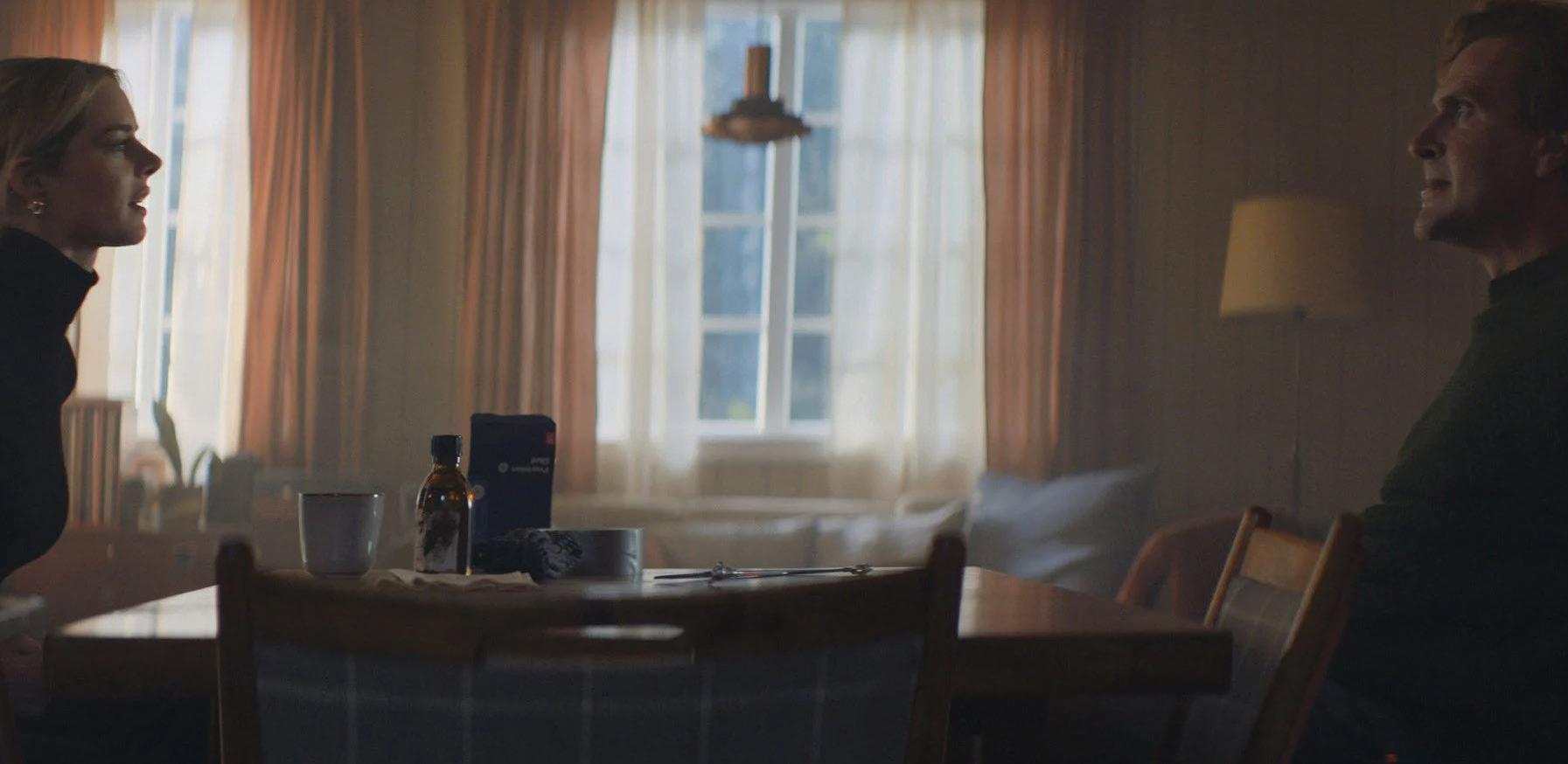
Directed by Lonely Island member Jorma Taccone, “Over Your Dead Body” is a remake of the 2021 Norwegian film “The Trip,” starring Samara Weaving and Jason Segel as a couple who goes on a serene cabin vacation while both secretly plotting to kill the other. The film played at the Atlanta Film Festival on April 23 and went into wide release on April 24.
Ahead of the film’s release, Rough Draft Atlanta spoke with Kocher and McElhaney about their sketch background, their collaborative process, and the making of both films. This interview has been edited for length and clarity.
Q: I just watched “The Trip,” the film that this is based on, yesterday. I’ve read interviews where you talk about loving that movie, but how did this materialize as a project for you two?
Nick Kocher: We were approached by XYZ [Films] about adapting it. We hadn’t heard of it until it was brought to us. I just watched the trailer at first, and I was immediately like, oh yeah – I’m very intrigued with this, curious where the story will go. Then when we watched the
whole movie, it was great. We loved the structure, and were kind of like – we don’t want to change much about the structure. Which was great, because it makes our job easier. It was just fun to do our cover song version of it.
Brian McElhaney: It was originally supposed to just be a punch-up pass, and then we were like, well, there are a lot more little details that we felt we could start throwing in. They were like, just play around with it, see what you got. Then we ended up changing enough that we made it our own, but like Nick said, kept the structure, which we felt was really nice. Writing can sometimes be a really long and difficult process, and this one was actually kind of a really fun one, because everything was there for us. We didn’t have to reinvent the wheel, which can always take so much time when you write.
Q: I was curious, because it hasn’t been a long time since that original movie came out. How do you decide what needs updating? For instance, changing a character from a soap opera director to a commercial director?
Kocher: We honestly didn’t really worry too much about it. We were just like, what would be fun to explore? I think in terms of the soap director to a commercial director – I mean, there are very few soap operas currently on the air, so we were like, this guy probably would be working more in the ad space. That was an arena where we wanted to push it further. I always love inside baseball Hollywood jokes, so we just put a lot more of those in there.
Q: Yeah, my boyfriend works in production and after that opening sequence with the commercial shoot, he was like – well, I’m triggered.
McElhaney: That’s what Jorma [Taccone] said on set as we were shooting it. He was like, ”I’ve done these commercials before, and it’s no fun. Let me tell you, you guys have made me remember what that’s like, unfortunately.”
Q: I know you guys also have “Pizza Movie” out now. I’m curious, from a writing mindset, how are you approaching the writing process for those things differently? When it’s an original concept like “Pizza Movie” versus something like this, does your mindset change?
McElhaney: There’s a pro and con for both. I mean, writing from scratch is great because it’s all yours, and it’s your idea and your characters, and the tone, the genre. The hard part is exactly that – you have to discover all of this for yourself. The process is just much longer, and it’s a little bit more arduous. You have so many infinite options to discover, and you don’t know what’s right and what’s wrong. I also think you’re a little more – I feel this way, at least – I’m a little more precious when it’s my idea from the beginning. That’s also kind of for better or worse. There’s a for betterness, because you really want to make it your own, and it’s your baby.
But the thing about doing “Over Your Dead Body” is, because it’s another idea, and then someone else is directing it, you can be a little more free with ideas and you can collaborate a little bit more. So you
kind of move quicker, but it’s not your thing entirely at the end. And sometimes that’s actually a better way to write, because then you’re not just obsessing over every little detail, like with “Pizza Movie.” It makes something very unique in the end, but also we can kind of overwrite sometimes, if we’re not careful.
Q: It’s interesting you bring up the tone. The original movie, it really made me think of the difference between – I don’t know if you guys have seen “Speak No Evil.”
Kocher: Yeah.
McElhaney: Sure, yeah.
Like the Danish and American versions of that movie, the original movie “The Trip” is a little bit darker, a little bit grimier, and the American version has a little bit of a lighter step, but still feels very punchy. But at the same, avoiding spoilers, there’s a point in this movie where some characters show up and something really nefarious feels like it’s about to happen. The comedy kind of dies out for a bit at that point, and it feels a little more serious. I’d love to hear you guys talk about melding those tones and finding that bridge.
Kocher: It’s an interesting thing from the screenwriting perspective, because I think the director is even more so in control of that. But we’ve always really enjoyed wildly changing tones. I think when you have a dramatic movie that makes people laugh, you laugh even harder in those moments. If you have a comedic movie that really makes you feel something, you feel it more, because you’re kind of more caught off guard. Obviously, some people don’t like crazy tonal shifts, and they’re difficult to do, and you can absolutely lose people if you’re not careful. But I think something that’s really important to us is surprise, and trying to surprise the audience and keep them on their toes. That change of tone can do that, if done correctly.
McElhaney: In all of our comedy, we like having something dramatic beneath it. We often talk about having a truth at the core of our sketches, or a movie having a relationship that’s real even though we’re going off into places that might be absurd, or might be a little more wild and violent. It’s finding times where, if you play into a tone for a while that’s more fun and carefree, reminding people
Samara Weaving and Jason Segel in “Over Your Dead Body.” (Courtesy of Atlanta Film Festival)
there’s something real behind it, or there’s something dark behind this. We like, like Nick said, tonally shifting to remind people, this isn’t just super fun and wild right now. This is really intense and really serious. And then, once that’s over, going back to the fun can hopefully, if done right, make both tones elevate themselves.
Q: Jorma is the director – how did he factor into the construction of the film? I know the original director, Tommy Wirkola, is also a producer. I’m curious about how all those different facets factored in.
Kocher: Yeah, it was great. Tommy Wirkola, who did the original, was just kind of a cheerleader, and was like, “Do your own thing. I don’t care. I’ve made my version of the movie, go do your own thing.”
Yorma was great to work with. He’s been a massive influence on us, from “The Lonely Island,” and we both came from sketch. We didn’t overlap at “SNL,” but we both worked there. We worked together great, and we had a really great shorthand. We had a draft of the script before he came on, and he had his notes, and we incorporated those. Those ranged from tiny bits of punch up to – there were a couple of scenes that we had changed that were completely different from the
original, but he was like, “I actually think this thing in the original works better. Let’s go back to a version of that.” Then there was other stuff where he was like, “Alright, the place where we’re going to shoot this in Finland, the scene location needs to change, like the geography. It was stuff like that, where we had no idea, because we weren’t seeing the location. You just kind of have to go, “Yeah – got it.” When we directed “Pizza Movie,” we understood a lot of those choices way more. We were like, oh right – there are significant limitations at this budget level.
McElhaney: He was on set in Finland, and we would get texts at like, 2 a.m. being like, “The boat house doesn’t make sense to get here in the third act! We have to find another way!” It was like, “Oh sh*t – what do we do?”
He and Jason [Segel], once Jason got on board, they were collaborating a lot and really going through it. He’d be like, “We were talking about this monologue guys, and we think it’s almost there, but it can change in this way. What do you think?” It was really nice, because they were on the same wavelength. We all were trying to make it make sense for all of us. He’s a super collaborator, as most people who have been through “SNL” are, because you have to be there.
Q: Now that you’ve directed “Pizza Movie,” how will that change how you write, having had that experience?
McElhaney: You definitely know one, what’s possible, and what’s not possible. I think before you direct a movie, you kind of just go, it’s whatever! Anything! Even as we were making “Pizza Movie,” we learned like, oh, this is how you can block a scene to make it take half as much time to shoot. Or when you originally write … you’re like – we’ll add a flashback to this location really quick. That’ll be a fun scene! Little things like that. You just don’t know, that is a whole company move.
Kocher: For that one little joke, that’s six hours of your time. So is that worth it? It’s also interesting, because anytime you’re writing for pay, they tell you don’t worry about the budget. Just write your version of the script. I actually don’t think that’s helpful, because you’re gonna have to change it at some point. I think it’s much better to really know the limitations going in, so you can write to that.
Q: How do you think that having a sketch background has influenced your writing?
Kocher: Well, I think it’s very apparent with “Pizza Movie,” our sketch background, because the movie is, in many ways, a series of sketches. I think for a stoner drug comedy, that is very much what you want. You’re watching that more to laugh and have fun. We gave it an emotional throughline, and we did work very hard on that and having that be there, but I don’t think it’s the priority with a
movie like that. With other movies that we’ve written … the sketch influence, you will not see as much, because they’re more grounded … but for “Pizza Movie,” what we loved about this movie is that it was a movie that we could write and we could really let us our leashes off, and just go crazy. McElhaney: Most like good films, you start with a character or a concept, and then you follow it. You just see it unfold. What is the causation of this to this to this, until the end of the story. With “Pizza Movie,” we had all these drug trip ideas before we knew the character. We had these sketches, and kind of built a movie around that. Which, like Nick said, I think works for this movie.
Q; The ending of “Over Your Dead Body” is very similar to the European film. But I found the added commentary about streaming very funny, in light of the fact that the original movie was on Netflix.
Kocher: That’s been brought up by a couple interviewers to us. We expected the movie to be on streaming. Everything’s on streaming! So, when we wrote that joke, we thought it would be self-deprecating. Not like [laughs], sh*tting on our other film.
McElhaney: Yeah, it’s almost like we’re making fun of “Pizza Movie,” a little bit. The movies are connected that way.
Isamu Noguchi’s modern design at the High Museum
By Sherri Daye Scott
As you enter the High Museum’s latest exhibition, “Isamu Noguchi: ‘I am not a designer,'” a small placard at the entrance poses a question to carry through the galleries: Was Noguchi indeed a designer, despite his proclamations to the contrary? The answer, the show makes clear, is no. The case the retrospective makes - through nearly 200 objects spanning architecture, industrial design, ceramics, furniture, lighting, stage sets and landscape design — is that Noguchi approached everything he created from the perspective of an artist. Purpose and usability mattered to him, but they were always in service of expression. And what the exhibit also makes clear is how much Noguchi’s art has shaped modern American life.
A career of collaborations
“Making Multiples,” the first section of “’I am not a designer,” explores Noguchi’s forays into industrial manufacturing and his experiments with reproducibility. It opens with the Radio Nurse - a bakelite baby monitor he designed for Zenith Radio Corporation in 1937, small, dark and rounded, a now familiar silhouette that was considered radical at the time. Turn left and the room declares itself: a centerpiece grouping of Noguchi-designed coffee and side tables, a chair or two. Then,
continuing around, your first introduction to the Akari paper lantern lamp.
Around the corner, a wall maps the extraordinary web of collaborators Noguchi moved through over his career. The breadth of it is the argument. He was not a man with a specialty. He was an artist who went wherever the muse moved him.
Galleries of movement
But it was the gallery devoted to Noguchi’s collaboration with Chicago dancer and choreographer Ruth Page - his one-time lover and artistic partner - that stopped me cold. It features the sculpture “Miss Expanding Universe” (1932), a gleaming aluminum suspension figure radiating her limbs outward, hanging alongside the blue jersey sack costume Noguchi designed for Page to wear in performance. I grew up in the Black Baptist church. My sister once led the praise dance troupe. I recognized that silhouette - and the figure above it - from the pulpits and stages of my youth.
Further into the exhibit, in an alcove devoted to Noguchi’s five-decade collaboration with choreographer Martha Graham, stands “Seraphic Dialogue” (1955), a brass rod-and-steel-wire structure evocative of an altar. “This set is only effective with light - moods to be varied by changing intensities between the
various elements,” Noguchi wrote in his notes on the set. Standing before it, you see how Noguchi viewed a dancer’s body in motion and his sculptures as the same conversation, held in different materials.
Play as art
I heard it the moment I stepped off the elevator into the exhibition: Children’s voices. Screaming, shrieking. I stopped. My heart stopped. A sign of the times, perhaps. Then it registered. Those were sounds of pure joy. A gallery attendant promised all would be revealed. It was.
In the second-to-last gallery is a large, red-painted, steel Noguchi play piece.
Signs encourage you to sit. Oversized screens surround the piece, projecting images and audio designed to mimic the experience of playing in a city park. The screams. The shrieks. The pure joy. That gallery turned out to be my favorite room in the exhibition.
Shaping memories
The final gallery of “I am not a designer” belongs to Atlanta.
In 1973, a High Museum volunteer named Frankie Coxe proposed building a children’s playground that was also a work of art. Noguchi was always the first choice. He visited Piedmont Park in the fall of 1975 and completed the designs for Playscapes by December. It opened in May 1976, Noguchi’s first playground built in the United States during his lifetime. The final gallery holds a large-scale architectural model of Playscapes at its center. A panoramic photograph of the playground’s climbable blocks, asymmetric swings, its swirling painted-steel slide spans the wall behind it. Sketches, footage, and a photograph by celebrated Atlanta photographer Lucinda Bunnen, taken at the playground’s 1976 opening, complete the installation.
“Isamu Noguchi: ‘I am not a designer’” runs through Aug. 2 at the High Museum of Art. Get tickets at high.org.
“Miss Expanding Universe” by Isamu Noguchi. (Photo by Sherri Daye Scott)
Midtown International School closes amid financial crisis
By Logan C. Ritchie
When Midtown International School (MIS) abruptly announced its immediate closure on April 3—six weeks before the end of the academic year— parents were left scrambling for answers and questioning the school’s financial management.
Parents soon discovered that newly recruited MIS board member Brett Curry had purchased the building to help financially save the school.
In a letter to families, board members
Anneke Bates, Chaitra Chambers and Curry said declining re-enrollment and rising demand for financial aid had made operations “unsustainable.” But during an April 2 virtual meeting with roughly 90 attendees, parents pressed for more transparency about the school’s finances and decision-making.
“I joined the board as a parent … because I care so much about this place,” Bates said, at times weeping. “We recognize we owe you an explanation of how we got here.”
Curry told parents the school
Answers for puzzles on page 27
planned to enter Chapter 7 bankruptcy and outlined mounting financial pressures, including a $45,000 monthly mortgage he described as “unsustainable.” MIS had operated at a deficit for at least eight of its 12 years, according to tax filings, including a $200,000 shortfall in 2024, when revenue was $3.63 million against $3.83 million in expenses.
In late 2025, the school sought mortgage relief and was granted temporary forbearance, subject to selling its building. The property on Sheridan Road was ultimately sold in December to Midtown 1575 LLC, a company formed by Curry. He said he recused himself from related board decisions. The new ownership waived nearly $100,000 in rent to keep the school open temporarily.
Despite those efforts, enrollment continued to fall. Curry said MIS lost more than 20 full-tuition students and saw a 30% drop in applicants for the 2026–27 school year. After reviewing updated projections on March 26, the board voted the next day to close.
“We realized … if we tried to push to next school year, we will be taking more money from parents and still have a high likelihood that we wouldn’t be able to have school in the fall,” Curry said.
Many parents, however, say the board failed to warn them about the severity of the situation. Some had recently paid deposits—one parent cited a $9,200 payment in March—and are now considering legal action.
“They took our money, ostensibly knowing that they’d be closing,” the parent said. “How is that not fraud?”
Others questioned why tuition already collected for the current year did not carry the school through May. Head of School Ashley Scott responded bluntly: “I inherited a lot of debt.”
Scott, who said he had no vote in the closure decision, added: “Tomorrow I don’t have a job. I have committed 13 years of my life to this school … It was not my decision to close.”
The school’s governance structure has also come under scrutiny. MIS operated with just three voting board members and no formal committees or treasurer, a lean structure compared to similar independent schools. Experts note nonprofit boards are expected to provide financial oversight, strategic guidance, and transparency.
As the school begins liquidating assets, it has halted payments to creditors, including tuition reimbursements. Bates said the school expects to provide an update to families in late May.
Meanwhile, many families have formed informal pods with former teachers to finish the academic year. While MIS says students have met instructional requirements for full credit, frustration remains high.
“I want accountability,” one parent said. “I want the board to explain how and why this happened—and why we were left in this position with six weeks left in the school year.”
Courtesy MIS
AROUND ATLANTA
MARTA launches first BRT line, new bus route network
By Collin Kelley
MARTA’s Rapid A-Line, the city’s first bus rapid transit (BRT) line connecting Downtown to the Atlanta Beltline Southside Trail launched on April 18.
The five-mile Rapid A-Line will connect Downtown Atlanta to Capitol
Gateway, Summerhill, Peoplestown, and the Southside Trail, with connections to MARTA trains at Five Points, Georgia State, and Garnett Stations.
Phase one of the BRT line has service hours from 5 a.m. to 1 a.m.Construction is still underway on some of the line, meaning not all stations and the dedicated bus lane are complete.
New indictments in ‘Cop City’ protest arson case
By Collin Kelley
Georgia Attorney General Chris Carr said his office has obtained new indictments against three people who allegedly damaged a construction company’s property as part of a protest against the controversial Atlanta Public Safety Training Center.
According to a press release from Carr’s office, the trio traveled to Brasfield & Gorrie’s offices in Cobb County on May 12, 2022, where they threw incendiary devices at the building. The devices damaged the building, with employees working inside, and set fire to the surrounding land. Brasfield & Gorrie was the general contractor for the training center, dubbed “Cop City’ by its opponents.
The new indictments come after a Fulton County Superior Court judge last December dismissed RICO (Racketeer
Influenced and Corrupt Organizations) charges brought by Carr’s office against 61 protesters.
The three newly charged are Katie Marie Kloth, 39, of Schofield, PA; Tyler John Norman, 42, of Blue Mountain, WI; and Hannah Kass, 33, of Philadelphia, PA. They have each been charged with criminal damage to property and arson.
The attorney general alleged that the 61 people were members of Defend the Atlanta Forest – “an anarchist, anti-police, and anti-business extremist organization.”
“When it comes to fighting Antifa and keeping people safe, we won’t back down,” Carr, who is a Republican candidate for Georgia governor, said in a statement.
“This isn’t Portland or Seattle. If you come to our state and engage in violence, threaten private businesses and damage property, you will be identified and prosecuted to the fullest extent of the law.”
In areas under construction, temporary bus stops located near stations will be used, including at Convocation Center, Summerhill, Ormond Street, Peoplestown, and Carver. Temporary stops near unfinished stations are fare-free.
MARTA cautioned motorists that the red “busonly” lanes are to be used by the Rapid A-Line dedicated buses, regional transit partner buses, and emergency vehicles.
According to a press release, there are multiple intersections where buses receive priority to pass through the intersection ahead of other vehicles. Drivers should observe all traffic signals and wait for the bus to clear before proceeding through the following intersections:
■ Martin Luther King Jr. Drive at Forsyth Street
■ Mitchell Street turning right onto Washington Street
■ Washington Street turning left onto Memorial Drive
■ Hank Aaron Drive at Haygood Avenue
Since its groundbreaking, the project has experienced challenges, including the discovery of old infrastructure during excavation, and a battery recall on the New Flyer batteryelectric buses purchased to operate on the line.
These unforeseen circumstances have delayed completion of BRT stations and necessitated a phased opening. Phase 2 of the Rapid A-Line launch is scheduled for fall when all BRT stations are complete.
The launch of the new BRT line coincided with MARTA’s new bus route plan, the first since the service began in 1972.
The NextGen Bus Network redesign overhauled nearly every bus route, aiming to create a simpler, more frequent, and more efficient network. The plan consolidated and streamlined routes, eliminating more than 30 lines while shifting service to high-demand corridors so buses arrive more often.
At the same time, MARTA introduced “Reach,” an on-demand, rideshare-style service in multiple zones to cover lower-density areas.
Interactive children’s experience opens at CCHR
By Rough Draft Staff
The National Center for Civil and Human Rights in Downtown Atlanta has opened anew interactive experience for children.
“Change Agent Adventure: Children’s Gallery” is designed for children ages 12 and under, designed as a “secret headquarters” where they’ll discover how kids throughout history have challenged injustice and made a difference.
The immersive experience will offer hands-on activities, storytelling, and creative play that explore the ideas of empathy, fairness, and courage in ageappropriate ways. From designing their own change-agent identity to learning from real young advocates, every
moment is designed to inspire action and imagination, according to center officials.
Visitors begin their journey in a “magic elevator,” where they discover how young people across generations have helped challenge unfairness and push for change.
Inside this interactive gallery, children explore activities that build civic and social skills, such as empathy, belonging, justice, and “upstandingness” – the courage to stand up for what’s right.
Children can also create a Change Agent Badge to take home and design a Change Agent Hat, inspired by ones worn by Martin Luther King Jr. and Eleanor Roosevelt.
For tickets and information, visit civilandhumanrights.org.
One of the new Rapid A-Line buses. (Courtesy MARTA)