Renmark Paringa Council Draft 2027-36 Long Term Financial Plan
The Long Term Financial Plan (LTFP) is a key component of Renmark Paringa Council’s Strategic Management Framework and outlines Council’s projected financial position over the period 2027–2036.
The Plan supports informed decision-making by identifying the financial capacity required to deliver services, maintain and renew infrastructure assets, and invest in strategic priorities over the long term. It has been prepared in accordance with the requirements of the Local Government Act 1999.
Financial outlook at a glance
Key features of the Plan include:
• a projected return to sustainable operating surpluses within the early years of the Plan;
• investment of more than $52 million in the renewal and replacement of existing assets;
• delivery of approximately $12 million in growthenabling infrastructure and new assets;
• continued investment in infrastructure that supports housing, industrial development and economic growth;
• maintaining financial sustainability indicators within prudent target ranges; and
• strengthening Council’s long-term financial resilience and borrowing capacity.
The LTFP has been developed in alignment with Council’s: Community Plan; Infrastructure and Asset Management Plan (IAMP); Annual Business Plan and Budget process; and broader strategic planning framework.
The Plan demonstrates Council’s ongoing commitment to balancing financial sustainability, service delivery, infrastructure renewal and future growth.
The LTFP recognises the significant financial pressures currently impacting local government, including:
• inflationary cost increases;
• asset renewal demands;
• wage growth;
Executive Summary DRAFT
• increasing service expectations; and
• constrained external funding sources.
Accordingly, the Plan includes ongoing financial sustainability measures designed to ensure Council can sustainably fund both operational service delivery and long-term asset renewal obligations.
Council remains committed to reviewing the LTFP annually to ensure assumptions, priorities and financial projections remain aligned with changing economic conditions, community expectations and strategic priorities.
Strategic Management Framework
Renmark Paringa Council’s Long Term Financial Plan forms part of Council’s broader integrated planning framework.
This framework ensures that Council’s strategic direction, financial planning, infrastructure investment and annual service delivery decisions remain aligned with the long-term aspirations of the
community. It supports informed decision-making and ensures Council’s resources are allocated in a manner that balances community priorities, service delivery needs and long-term financial sustainability
Community Plan
Where are we going? What do we want to achieve?
Other strategic and legislated plans
including the Growth Strategy and the Riverland Disability Access and Inclusion Plan
Long Term Financial Plan Infrastructure and Asset Management Plan
Annual Business Plan and Budget
What are the activities and outcomes to be achieved this year? How will we allocate the resources?
Quarterly Progress Reports
Provides un update on Council's progress against the Annual Business Plan and Budget
Annual Report
Showcases what Council achieved in the financial year
At the centre of this framework is Council’s Community Plan, which establishes the longterm vision for the Renmark Paringa district and identifies the outcomes Council is working toward in partnership with the community.
Developed through extensive community engagement, the Community Plan reflects what the community values most about living in the Renmark Paringa area, the challenges facing the district and the opportunities Council and the community wish to pursue together.
The Community Plan identifies four key aspirations: Liveable, Prosperous, Leadership and Environment.
The Long-Term Financial Plan, Infrastructure and Asset Management Plan and Annual Business Plan and Budget work together to ensure Council can sustainably resource the infrastructure, services and projects required to deliver these aspirations over time.
Community aspirations
Liveable
A safe and welcoming place to live and enjoy a healthy and active lifestyle.
Council’s Annual Business Plan and Budget process is directly informed by the Long-Term Financial Plan and Infrastructure and Asset Management Plan. Each year, Council reviews financial sustainability indicators, service levels, infrastructure priorities and emerging risks to ensure annual decisions remain aligned with long-term strategic objectives and Council’s financial capacity.
Ongoing monitoring and reporting through Council’s Annual Report, Quarterly Progress Reports and community satisfaction measures supports transparency, accountability and continuous improvement across Council’s operations and strategic planning activities.
DRAFT
Leadership
A Council that is a trusted partner that delivers what it promises in an efficient and effective way.
Prosperous Environment
A place that attracts, retains and supports talented people, underpinned by diverse regional industry, tourism and access to infrastructure and housing.
A place that is resilient to the effects of extreme weather, protects its river and flood plains, is green and limits its impact on the natural environment.
Renmark Paringa Council is committed to managing its financial resources in a manner that supports the needs of today’s community while creating opportunities for future generations.
Council currently manages an asset base of approximately $200 million, comprising predominantly infrastructure, land and buildings. The Long Term Financial Plan (LTFP) is delivered in alignment with Council’s Infrastructure and Asset Management Plan (IAMP), supporting a structured and sustainable approach to asset renewal, maintenance and lifecycle management. Together, these plans help ensure Council’s assets continue to meet community needs while balancing affordability, service delivery and long-term financial sustainability.
Over recent years, Council has undertaken significant work to improve the accuracy and reliability of asset data, financial forecasting and long-term planning assumptions. This has provided a stronger understanding of asset condition, remaining useful life and future renewal requirements, supporting more informed decision-making and ensuring Council is better positioned to plan proactively for the future.
CEO's Financial Sustainability Statement DRAFT
The 2027–2036 LTFP has been prepared in alignment with Council’s strategic priorities and supports the delivery of adopted plans, projects and service levels over the coming decade. The LTFP outlines how Council intends to fund its operations, maintain and renew its assets and deliver capital investment in a manner that is financially responsible, sustainable and aligned with community expectations.
Importantly, the LTFP also reflects Council’s broader commitment to positioning the district for future growth, investment and regional prosperity. Strategic initiatives such as the Renmark West CWMS expansion and the Jane Eliza Project represent important opportunities to support residential growth, economic development and increased liveability across the district. The LTFP considers the longterm financial implications of these initiatives and supports Council’s capacity to deliver the infrastructure and services required to respond sustainably to future demand.
The LTFP also recognises the importance of investing
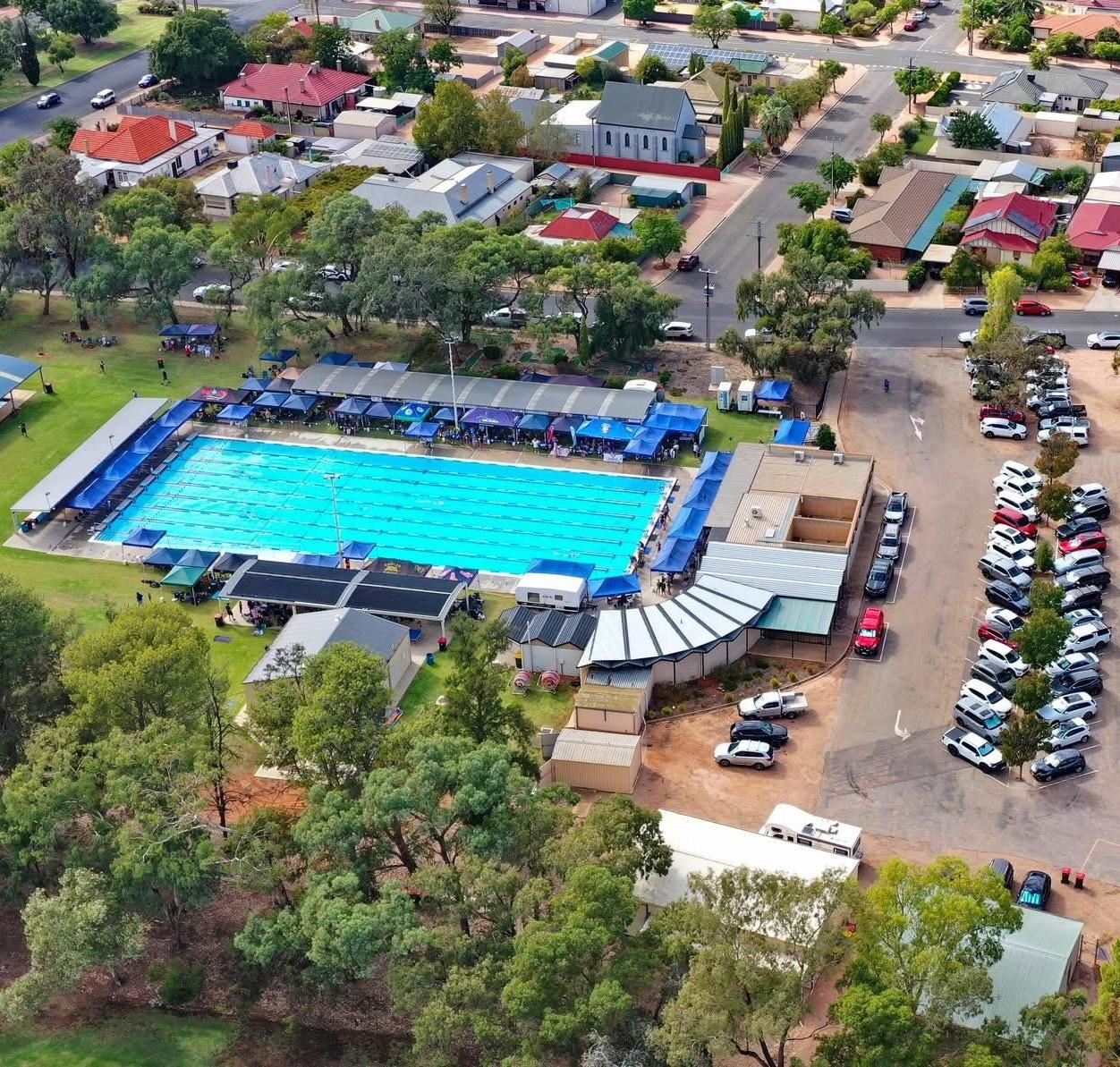
in community infrastructure that supports long-term wellbeing, participation and regional activation. This includes planning for transformational projects such as the Alan Coulter Recreation Centre. As a significant regional community asset, the long-term direction of the facility will require careful planning, robust business case development and consideration of future funding opportunities to ensure Council is strategically positioned to respond to evolving community needs and expectations over time.
While Council has experienced operating deficits in recent years, the LTFP outlines a clear and achievable pathway toward returning to sustainable operating surpluses within the next one to two financial years. Achieving sustainable operating results remains a key priority, ensuring borrowings can be directed primarily toward strategic growth and long-term capital investment rather than funding recurrent operations. This approach strengthens Council’s long-term financial resilience and capacity to respond to future challenges and opportunities.
Council monitors its financial sustainability through a suite of key financial indicators. Over the life of the LTFP, Council is forecast to progressively improve its operating surplus ratio while maintaining other key financial indicators within prudent and achievable ranges. Council’s net financial liabilities ratio is also projected to strengthen over time, supporting increased future borrowing capacity should it be required to deliver strategic infrastructure investment and growth-related projects.
It is acknowledged that the LTFP is based on a range of assumptions, including those relating to revenue growth, expenditure pressures, inflation, interest rates and external funding availability. Council recognises that economic conditions, government policy settings and community expectations may change over time. Accordingly, the LTFP will continue to be reviewed annually as part of Council’s broader strategic management framework to ensure it remains responsive, relevant and financially responsible.
Based on the information available and the strategies outlined within this LTFP, I am satisfied that it provides a sound, responsible and achievable framework for the sustainable management of Council’s finances and assets. Importantly, it positions Council to respond proactively to future opportunities, support sustainable growth and continue delivering the infrastructure, services and community outcomes that contribute to a strong, liveable and prosperous Renmark Paringa region.
Tony Siviour CEO, Renmark Paringa Council
FINANCIAL STRATEGY
The Long Term Financial Plan (LTFP) has been prepared using a set of key financial and economic assumptions that reflect the most reliable information available at the time of preparation. These assumptions underpin the projected operating statements, balance sheets, cash flows and sustainability indicators contained within the Plan. Where appropriate, assumptions are based on external economic forecasts and established Council policies.
Inflation
Consumer Price Index (CPI) assumptions used in the LTFP are based on the Deloitte Access Economics Business Outlook – March Quarter 2026. The forecast assumes inflation of 3.4% in Year 1, followed by a return to the Reserve Bank of Australia’s target range, with CPI moderating to approximately 2.5% to 2.3% for Years 2 to 10.
Unless otherwise stated, income and expenditure items within the LTFP are indexed in line with these CPI assumptions.
Interest rates
Interest costs in the LTFP are based on projected debt levels and forecast interest rates. Interest rate assumptions are derived from the Deloitte Access Economics Business Outlook – March Quarter 2026, applying the 10 -year bond rate plus 1%. This methodology closely reflects the margins and borrowing costs typically charged by the Local Government Finance Authority (LGFA).
Employee costs and wage increases
Key assumptions DRAFT
The 2026–27 financial year represents the final year of Council’s current Enterprise Bargaining Agreement (EBA). Accordingly:
• Year 1 salary and wage increases reflect the negotiated changes under the EBA, which are tied to the March quarter real CPI figures for Adelaide.
• Years 2 to 10 salary growth assumptions are based on CPI forecasts from the Deloitte Access Economics Business Outlook – March Quarter 2026.
Employee costs include wages, allowances, superannuation and on - costs and are indexed accordingly unless otherwise specified.
Rate revenue and other charges
Council’s rate revenue assumptions are addressed in more detail later in this document. Key assumptions include:
• General rate revenue growth is informed by Council’s rating strategy and CPI assumptions.
• Landscape levy rates are assumed to increase in line with CPI.
• Waste collection charges are based on anticipated pricing increases from Council’s waste collection service provider.
• Community Wastewater Management Scheme (CWMS) charges are aligned with the adopted 20 -year CWMS pricing model, discussed later in this LTFP.
CWMS pricing is developed in accordance with the National Water Initiative Pricing Principles and the Local Government Association CWMS pricing methodology.
Indexation assumptions
All figures within the LTFP are indexed unless stated otherwise. Unless explicitly noted, increases to income and expenditure items are assumed to occur in line with CPI.
Fuel market volatility
Fuel prices are assumed to remain elevated and volatile in the short term, reflecting ongoing global supply disruptions and recent sharp increases in diesel costs impacting the construction and transport sectors. As bitumen and many construction inputs are petroleum-based, higher fuel prices are expected to place upward pressure on reseal programs, infrastructure works and kerbside waste service delivery costs. These pressures may result in cost escalation across the capital program, requiring contingencies, reprioritisation or deferral of works where necessary.
Insurance costs
Insurance cost assumptions are based on advice received from Local Government Risk Services. A 5% increase is assumed in Year 1 of the LTFP to reflect current market conditions, with costs indexed to CPI in the outer years.
Depreciation
Depreciation expense for the Chaffey Community Centre and the McCormick Centre has been removed from the LTFP. This reflects Council’s intention to dispose of these assets, either through sale or by holding them for the purposes of future sale and therefore aligns depreciation treatment with the expected use and classification of these properties.
Assets are also projected to be revalued each year by way of desktop revaluation, this is tied to the CPI projections within the LTFP.
Growth
Capital and operational grants
Capital and operating grant funding has been included in the LTFP only where formally confirmed at the time of preparation, with no allowance made for future unapproved or speculative funding. Council will continue to actively pursue external grant opportunities over the life of the Plan; however, a conservative approach has been adopted to ensure financial sustainability in a constrained and competitive funding environment. This approach ensures that operational and capital programs remain deliverable based on known revenue sources, reducing reliance on uncertain funding streams.
Alan Coulter Recreation Centre
Alan Coulter Recreation Centre renewal or upgrade has not been included in the LTFP or associated Infrastructure and Asset Management Plan at this time. The first year of the Plan includes provision for the development of a detailed business case to assess the future role, service levels and investment required in the facility. Following completion of the business case, any resulting capital and operating impacts will be incorporated into future updates of the LTFP. In the interim, the Plan provides for minor maintenance and repair expenditure to ensure the facility remains safe and functional for community use.
DRAFT
Population growth estimates have been informed by historical Census data, complemented by a five year rolling average of new dwelling approvals. Based on these indicators, an average annual growth rate of approximately 0.7% has been adopted.
Council's Growth Strategy adopted in 2025 estimates a growth rate of 1.1%. However, historical growth rates have been used to ensure income predictions are not overstated within the LTFP. Growth rates will be reviewed annually to ensure they remain appropriate.
Major projects
DRAFT
The Long Term Financial Plan (LTFP) underpins Council’s commitment to sustainable growth by balancing the renewal of existing assets with targeted investment in new, growth‑enabling infrastructure.
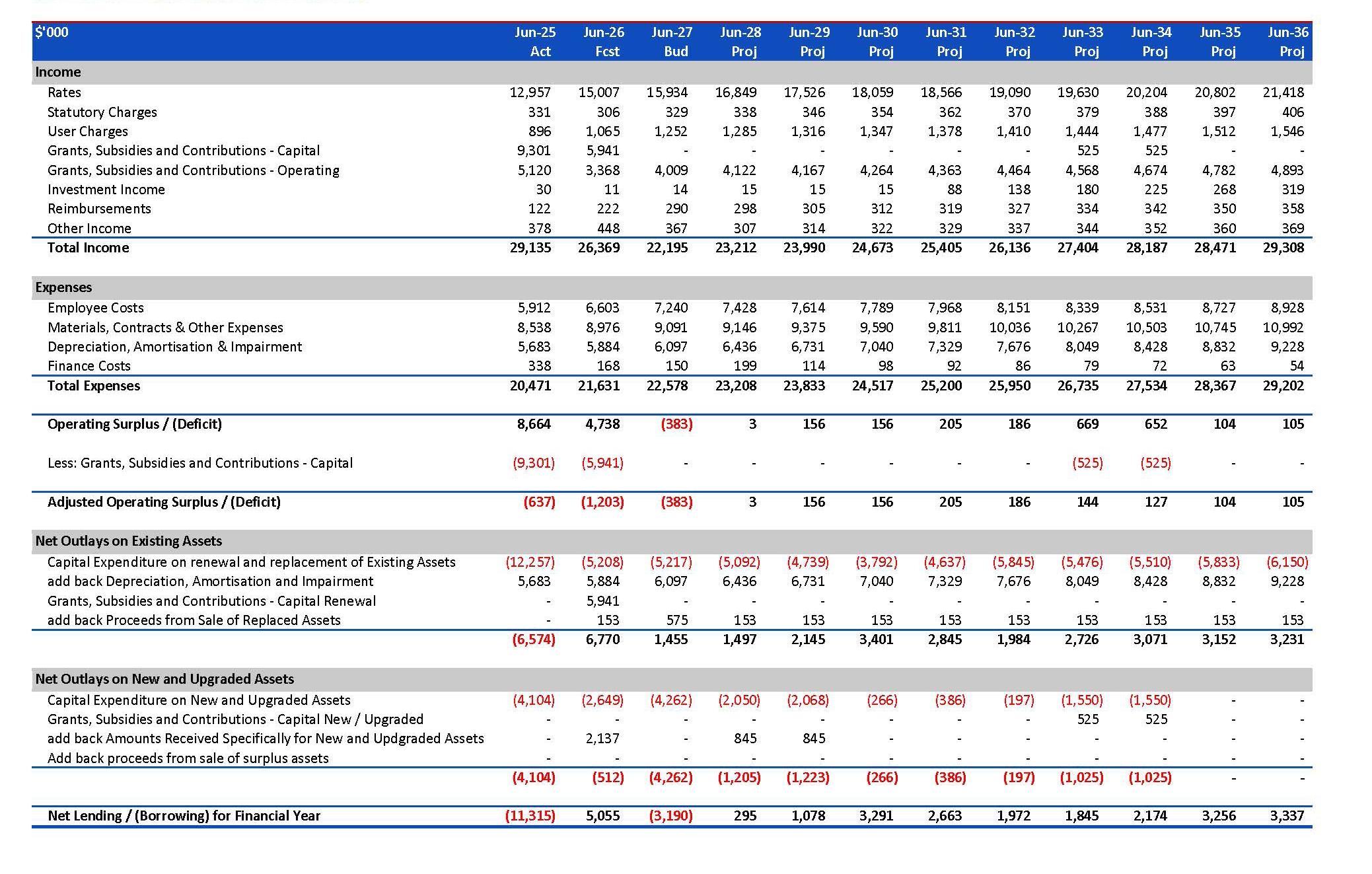
Over the next ten years, the LTFP provides for the renewal of more than $52 million in existing assets, ensuring Council’s core infrastructure continues to meet acceptable service levels. In addition, the Plan supports the creation of approximately $12 million in new assets to facilitate population, housing and economic growth across the Renmark Paringa Council area.
These investments directly support Council’s Growth Strategy, which identifies the timely provision of enabling infrastructure as a critical requirement to unlock new development opportunities, diversify housing supply, and grow local employment. They also align with the Community Plan, particularly the vision of Renmark Paringa as a great place to live, work and invest, supported by resilient infrastructure and a strong local economy.
Key growth projects
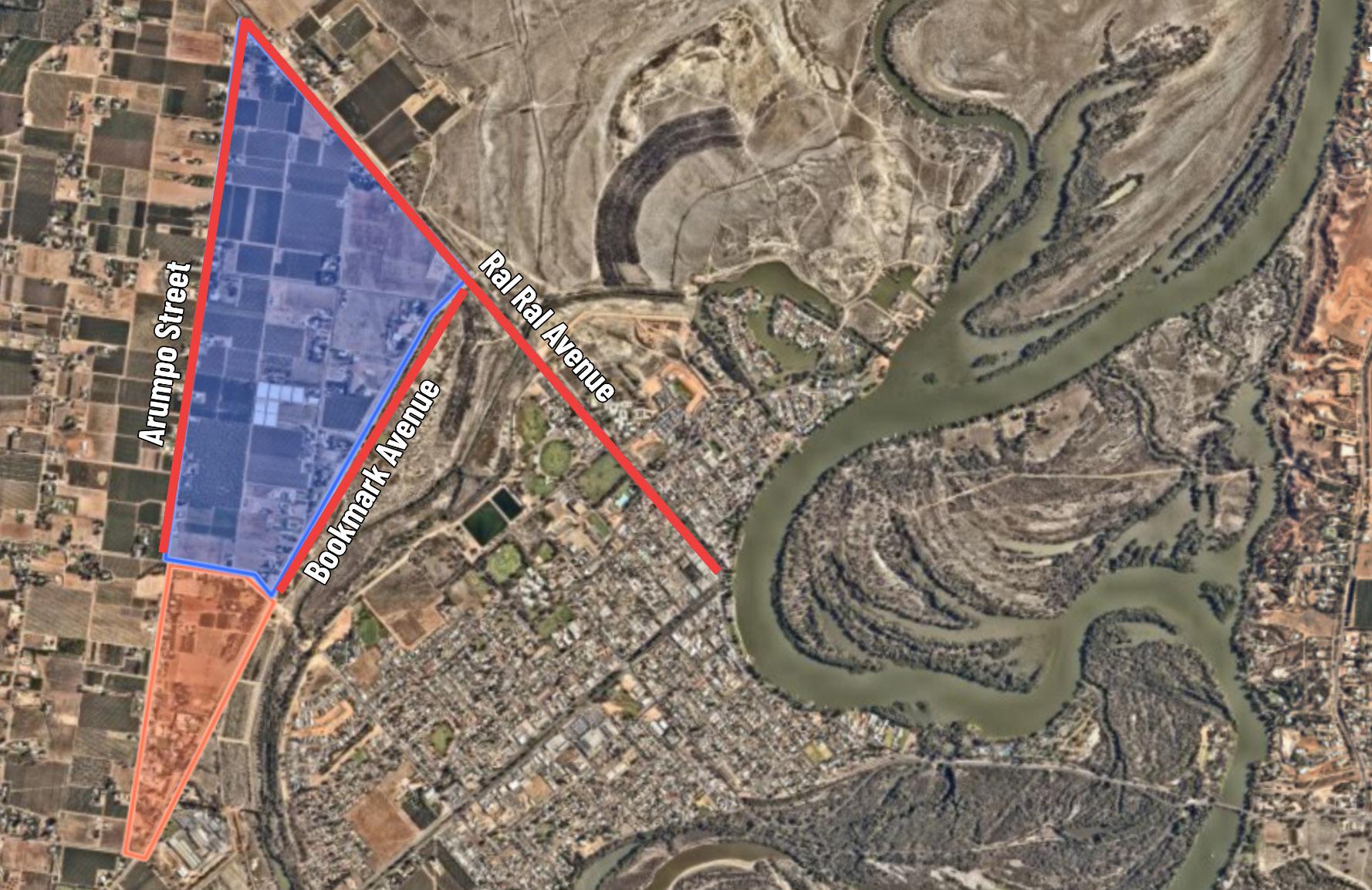
A flagship project within the LTFP is the Renmark West CWMS Expansion, which will enable CWMS connections to more than 500 new residential housing lots in Renmark West.
This investment is fundamental to delivering planned residential growth in accordance with the Growth Strategy and will support a mix of housing types, including semi rural allotments and alternative housing options. By increasing the diversity and availability of housing, this project helps meet the needs of a growing population and supports the Community Plan objective of providing inclusive and liveable communities for current and future residents.
DRAFT
Importantly, the extension of CWMS infrastructure in the Calperum area also has longer term land use benefits, opening up future opportunities for residential development where appropriate. This integrated approach ensures that infrastructure investment not only meets immediate industrial needs but also supports longer term growth, consistent with Council’s land use planning, Growth Strategy and Community Plan objectives.
Collectively, the major projects funded through the LTFP demonstrate Council’s proactive approach to growth management. By aligning long-term financial capacity with strategic land use planning and community aspirations, the LTFP ensures that infrastructure investment:
In the future years of the LTFP, significant provision is made for the staged delivery of CWMS and water supply infrastructure to the Calperum Industrial Estate. This investment is a key enabler of industrial development and industrial-supporting infrastructure, positioning Calperum as a focal point for economic growth, investment attraction and job creation. Improved servicing of the industrial estate will support Council’s strategic goal of encouraging people to both live and work locally, reducing reliance on commuting and strengthening the local economy.
• Enables sustainable population and housing growth.
• Supports economic development and local employment.
• Maintains and renews critical assets to appropriate service standards.
• Delivers outcomes consistent with Council’s vision for a resilient, liveable and prosperous Renmark Paringa community.
Key financial indicators
Following a comprehensive review by the SA Local Government Financial Management Group, and with support from the Australian Centre of Excellence for Local Government, all Australian jurisdictions have agreed in principle to adopt three key financial indicators:
• Operating Surplus Ratio
• Net Financial Liabilities Ratio
• Asset Sustainability Ratio
Renmark Paringa Council has adopted the following indicator targets in line with the LGA’s recommendations.
Operating Surplus Ratio
? What does this mean?
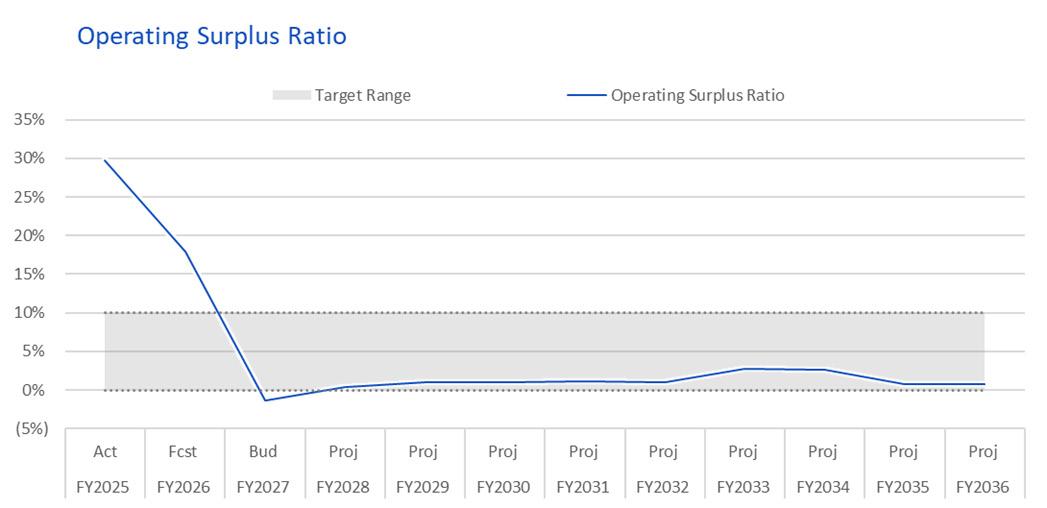
Council is projected to return to sustainable operating surpluses within the early years of the Plan, supporting long-term financial sustainability and ongoing service delivery.
This ratio provides a measure of Council’s ability to cover operating expenses and have revenues available for capital funding, repayment of debt or consider the provision of new services.
Operating Surplus Ratio is calculated by Operating Surplus (Deficit) divided by operating revenue from the statement of comprehensive income.
Council’s Target over the life of its Long Term Financial Plan is to achieve an average between 0-10%.
Council’s projected operating surplus ratio is outside the adopted target range in the initial year of the LTFP before returning to sustainable levels within the target range in the following years.
This reflects Council’s ongoing transition toward long-term financial sustainability and demonstrates the importance of maintaining financial sustainability measures, including rating revenue growth above CPI in the early years of the Plan.
What does this mean?
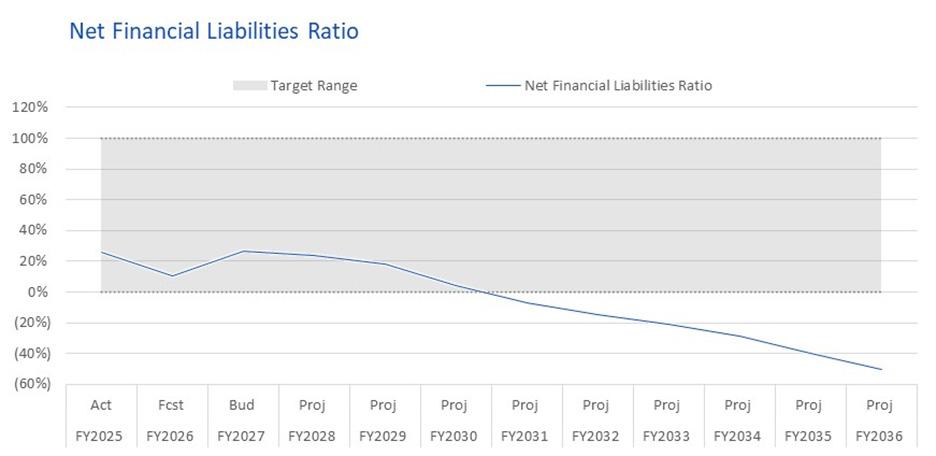
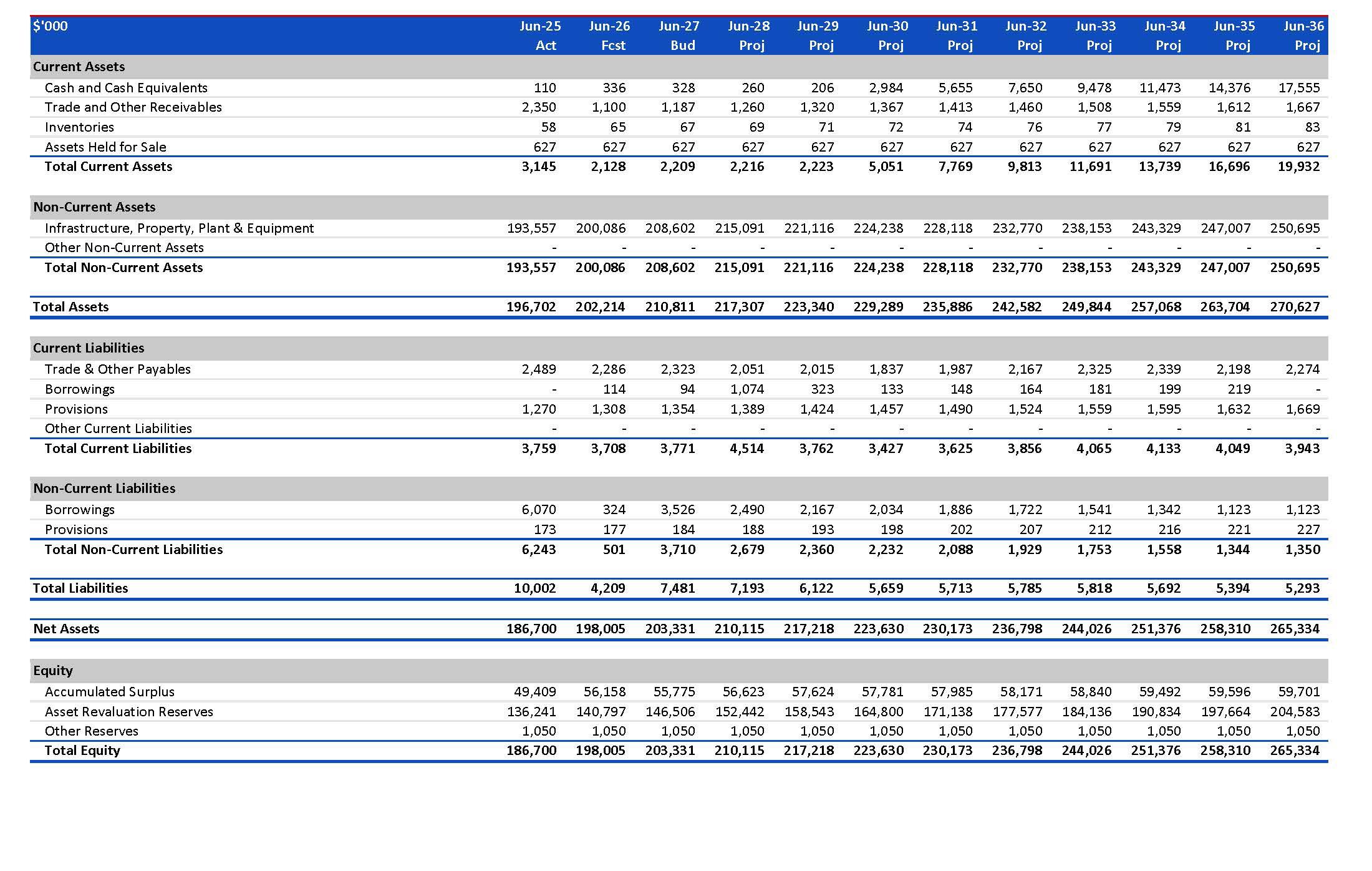
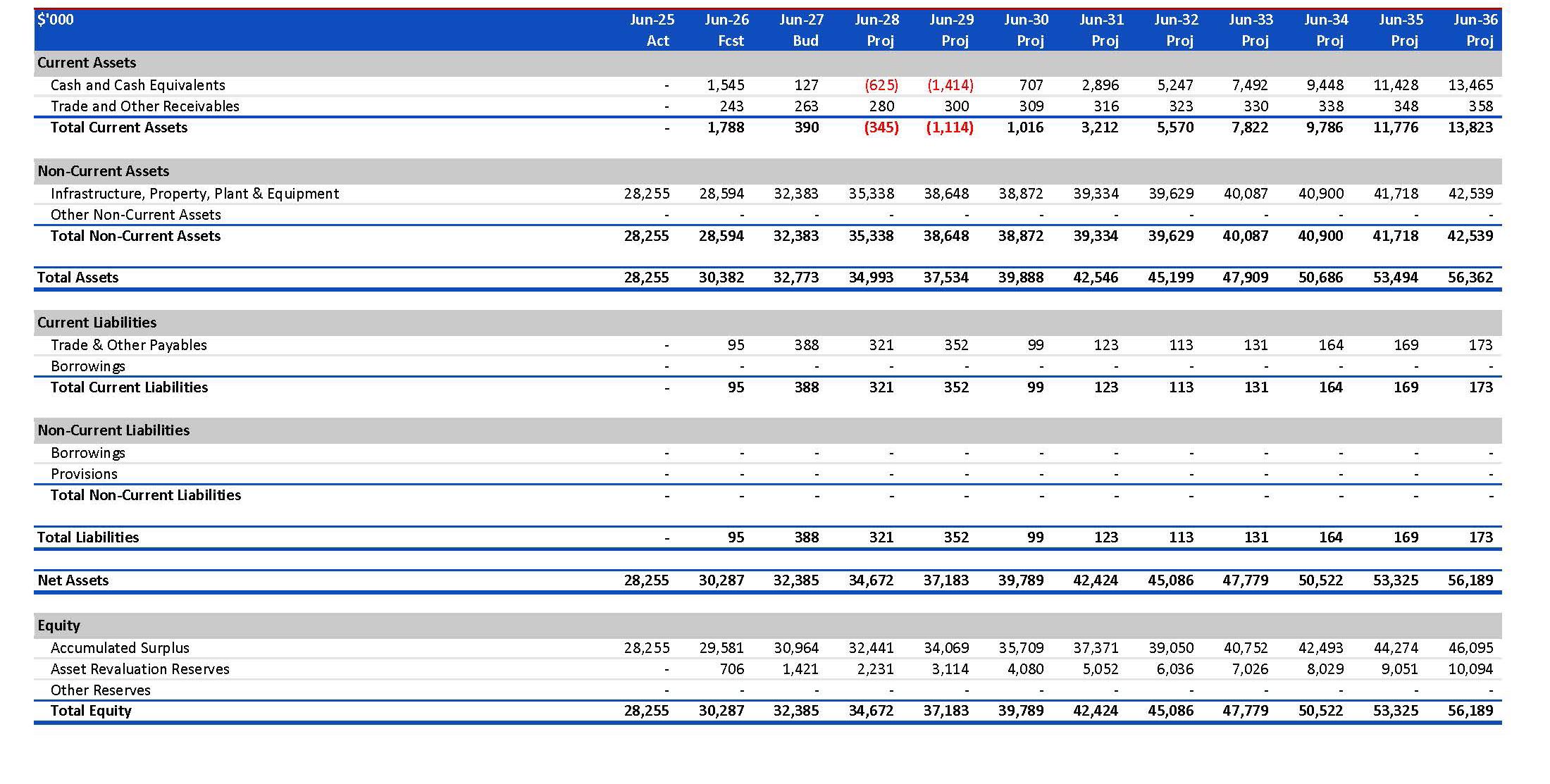
Council’s financial position improves over the life of the Plan, with projected cash and cash equivalents exceeding liabilities in the later years.
This ratio provides a measure of Council’s ability to meet its long-term financial obligations including debt repayments relative to its revenue. This ratio is calculated by Total liabilities (less cash and cash equivalents) divided by Total Operating revenue excluding Landscape levy. Council’s target is for Net Financial Liabilities to be greater than zero and less than 100% of total operating revenue.
Council’s projected position remains within the adopted target range throughout the early years of the Long Term Financial Plan before moving to a negative ratio in the outer years of the Plan.
? DRAFT
A negative result indicates that Council is projected to hold more cash and cash equivalents than total liabilities, representing a positive financial outcome and demonstrating improved financial capacity and resilience over the longer term.
This also indicates Council retains future borrowing capacity should debt funding be required to support strategic growth or major infrastructure investment.
What does this mean?
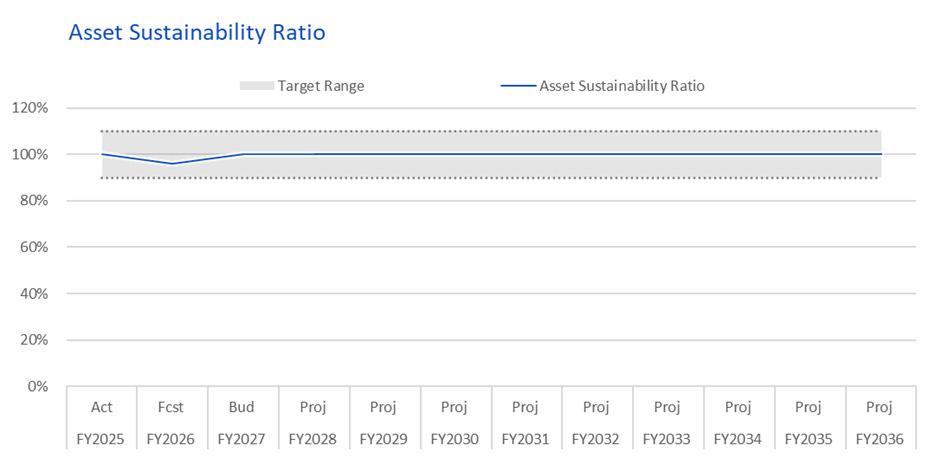
Council is planning to renew infrastructure broadly in line with the levels identified within its Infrastructure and Asset Management Plan.
This ratio provides a measure of Council’s ability to renew/replace its assets in line with the levels proposed in its adopted Infrastructure and Asset Management Plan.
This ratio is calculated by Expenditure on renewal/ replacement of assets less sales of replaced assets
divided by the optimal level of expenditure proposed in Council’s Infrastructure Asset Management Plan. Council has projected to spend an amount each year roughly equivalent to that determined by the respective infrastructure asset management plans. This evidences Council is budgeting appropriately to be able to renew its assets as required.
Risk sensitivity analysis
The following risks identify key internal and external factors that could materially affect Council’s ability to achieve the financial outcomes and strategic objectives outlined in the LTFP. These risks are monitored and managed through Council’s broader risk management, asset management, and financial governance frameworks.
Actual development growth exceeds assumptions used in the LTFP
Potential consequences
• Insufficient infrastructure capacity.
• Increased capital and operating expenditure not funded in the LTFP.
• Cash flow pressure.
Management strategies
• Regular review of population and development growth assumptions.
• Use of developer contributions and infrastructure agreements.
• Scenario and sensitivity analysis within the LTFP.
Climate‑related events increase costs and disrupt service delivery beyond LTFP assumptions
Potential consequences
• Higher asset renewal and maintenance costs.
• Unplanned capital works and emergency expenditure.
• Insurance affordability issues.
• Reduced asset life and service reliability.
DRAFT
Management strategies
• Climate risk assessment integrated into asset management plans.
• Incorporation of climate -resilient design standards.
• Advocacy for climate adaptation grant funding.
State Government funding is reduced below LTFP assumptions
Potential consequences
• Operating deficits or reduced service levels.
• Delay or cancellation of capital projects.
• Pressure to increase rates, fees, or debt.
Management strategies
• Conservative grant forecasting assumptions.
• Diversification of revenue sources.
• Continued strong advocacy for fairer distribution of Financial Assistance Grants as detailed in Council’s Advocacy Plan.
Critical infrastructure fails earlier than forecast in asset life assumptions
Potential consequences Management strategies
• High unplanned capital expenditure.
• Service disruption.
• Reduced capacity to fund strategic priorities.
• Increased reliance on debt.
• Robust asset condition data and inspections.
• Alignment of asset management plans with the LTFP.
• Conservative interest rate and inflation assumptions.
• Fixed-rate debt where appropriate.
• Regular LTFP sensitivity analysis.
• Contingency allowances in capital project budgets.
Supply chain disruptions impact project delivery, cost, and timing
Potential consequences Management strategies
• Capital project delays.
• Cost overruns beyond LTFP allowances.
• Re -prioritisation of capital works program.
DRAFT
• Early procurement planning.
• Monitoring of market conditions during budget reviews.
Timing of major projects and funding opportunities (eg. Calperum Industrial Estate Expansion / Alan Coulter Recreation Centre Renewal)
Potential consequences
• Missed funding opportunities.
• Requirement to fund projects earlier or later than planned.
• Cash flow constraints or project deferrals.
• Community and stakeholder dissatisfaction.
• Maintain “grant-ready” project documentation.
• Regular review of funding opportunities.
• Clear Council decision points for project commencement.
Opportunities
While the Long Term Financial Plan identifies a range of risks and financial pressures that may impact Council over the coming decade, it also highlights a number of opportunities that have the potential to strengthen Council’s long term financial sustainability, support economic growth and improve service delivery outcomes.
These opportunities reflect Council’s proactive approach to strategic planning, continuous improvement and responsible financial management. They include opportunities to leverage external funding, improve operational efficiency, rationalise under-utilised assets and support growth through strategic infrastructure investment.
Council will continue to monitor and assess these opportunities throughout the life of the Plan to ensure it remains well positioned to respond to changing economic conditions, emerging funding programs and future growth opportunities across the Renmark Paringa district.
Strategic external works and contracting opportunities
Potential benefits Management strategies
• Additional revenue above LTFP assumptions.
• Improved utilisation of council workforce and plant.
• Regular review of service demand and pricing arrangements.
• Workforce and plant capacity planning.
• Proactive engagement with DIT regarding future works programs.
Strategic asset optimisation and rationalisation
Potential benefits Management strategies
• Opportunity to redirect capital toward priority strategic infrastructure.
• Reduced ongoing operating and maintenance costs.
DRAFT
• Changes to ongoing strategic review of Council's asset portfolio.
• Alignment with service delivery needs and community priorities.
Securing funding beyond LTFP assumptions from State and Federal Government programs
Potential benefits Managementstrategies
• Acceleration of capital projects without additional rate pressure.
• Reduced reliance on debt.
• Improved long-term financial sustainability.
• Maintain grant-ready business cases and designs.
• Active monitoring of funding announcements.
• Flexible capital works programming.
• Strong advocacy and relationship management.
Service transformation and continuous improvement
Potential benefits
• Improved customer experience and service accessibility.
• Increased operational efficiency and productivity.
• Better alignment of services with community expectations.
• Reduced long-term operational costs.
Managementstrategies
• Ongoing service reviews and process improvement initiatives.
• Increased use of digital systems and technology.
• Review of service delivery models and organisational capacity.
Population growth and development expansion
Potential benefits
• Increased rate revenue growth.
• Improved utilisation of existing infrastructure.
• Increased operational efficiency and productivity.
• Greater economic activity and local employment opportunities.
• Enhanced financial sustainability through broader revenue base.
Managementstrategies
• Continued investment in growth-enabling infrastructure.
• Alignment with Council’s Growth Strategy and land use planning.
• Advocacy and partnership with developers and government agencies.
Funding the LTFP - Operational income
Council’s Long Term Financial Plan (LTFP) sets out a clear and financially sustainable pathway for the organisation, with a strong focus on improving operating performance, maintaining service levels, and strategically investing in infrastructure.
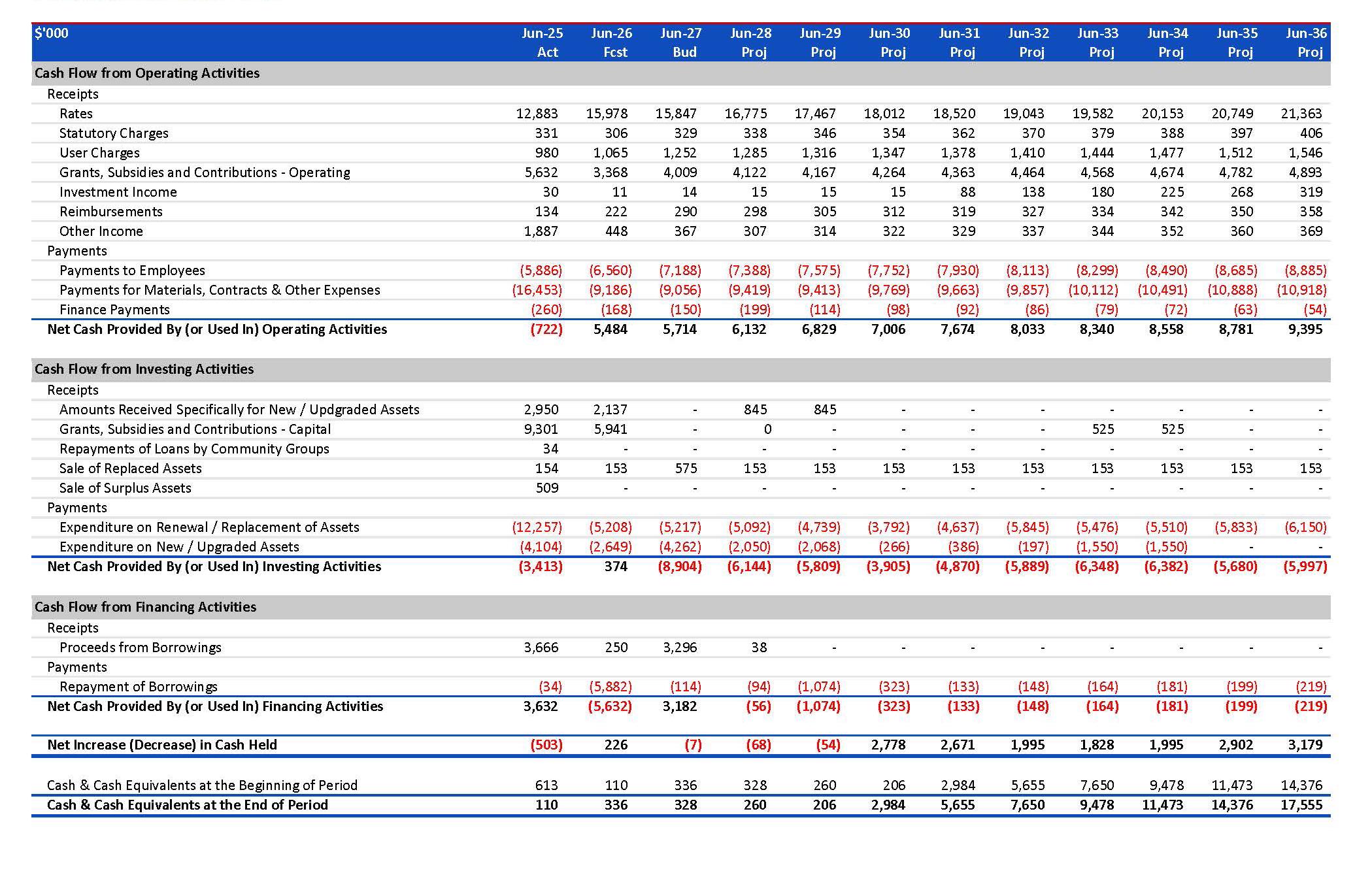
Over the ten year planning horizon, Council transitions from an operating deficit to sustained operating surpluses, underpinned by revenue growth and disciplined expenditure management. Cash reserves are forecast to strengthen, while the asset base continues to expand through timely and appropriate asset renewal.
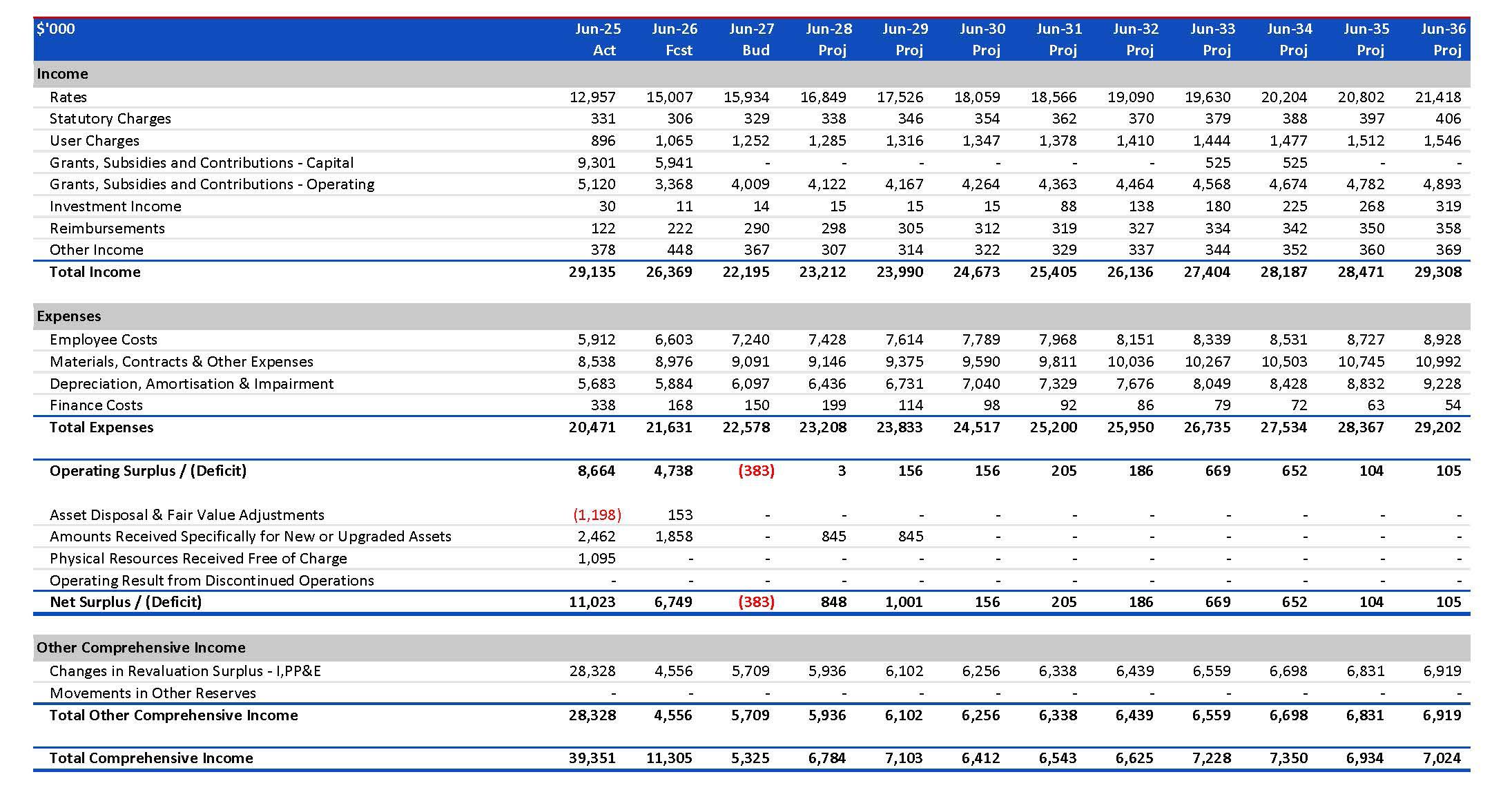
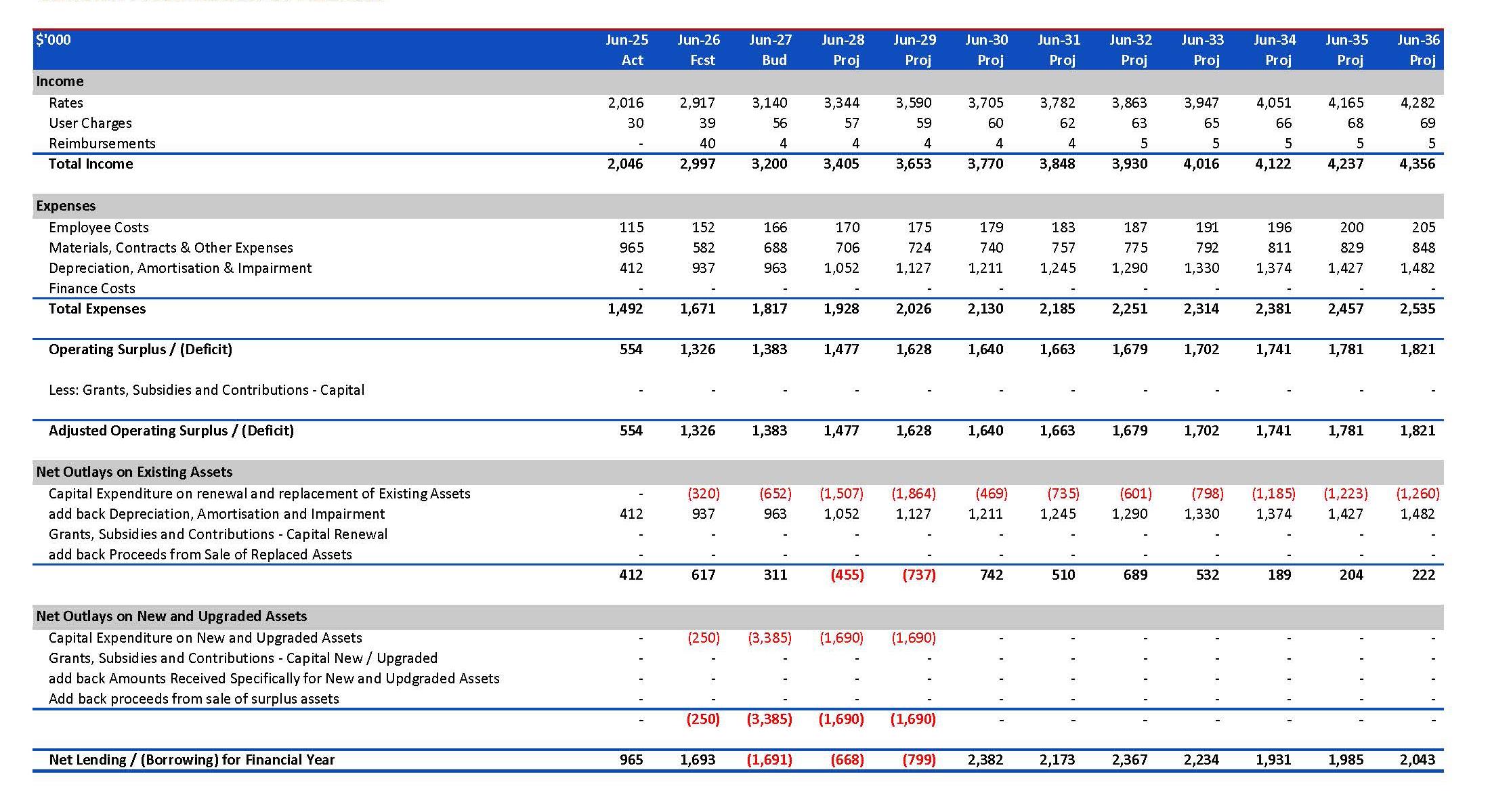
Operating income is projected to grow from approximately $22.195 million in 2026/27 to $29.308 million by the end of the forecast period.
This growth is driven by steady increases in rates, user charges, and operating grants. The income mix remains heavily reliant on rating income with
rates making up approximately 70% of operating income. Over the ten year plan, operating income is projected to grow by 3.1% per year.
Council rates will grow by a factor higher than CPI in the first two years of the LTFP to ensure a return to sustainable operating surpluses. In years three - ten, rating increases are expected to be tied to CPI. Average rating increases over the life of the LTFP are 3.6%.
Service delivery - Operational expenditure
Operating expenses are projected to grow from $22.578 million to $29.202 million, reflecting inflation, service demand, and asset maintenance needs. This is broken down into the following components: employee costs, materials and contracts, finance costs and depreciation.
The increase equates to 2.9% per year throughout the ten year plan. Council maintains a disciplined approach to expenditure, ensuring that growth in expenses is aligned with revenue and service expectations.
Depreciation reflects the consumption of Council’s asset base and increases from approximately $6.1 million to more than $9.2 million over the life of the Plan. This increase is driven by asset revaluations, ongoing capital investment and the expansion of Council’s infrastructure base.
Depreciation is a critical indicator of asset sustainability as it reflects the long-term cost of consuming infrastructure assets over time and informs Council’s renewal funding requirements.
Depreciation accounts for approximately 30% of Council’s operating expenditure over the ten-year period and is projected to increase by an average of approximately 4.6% annually.
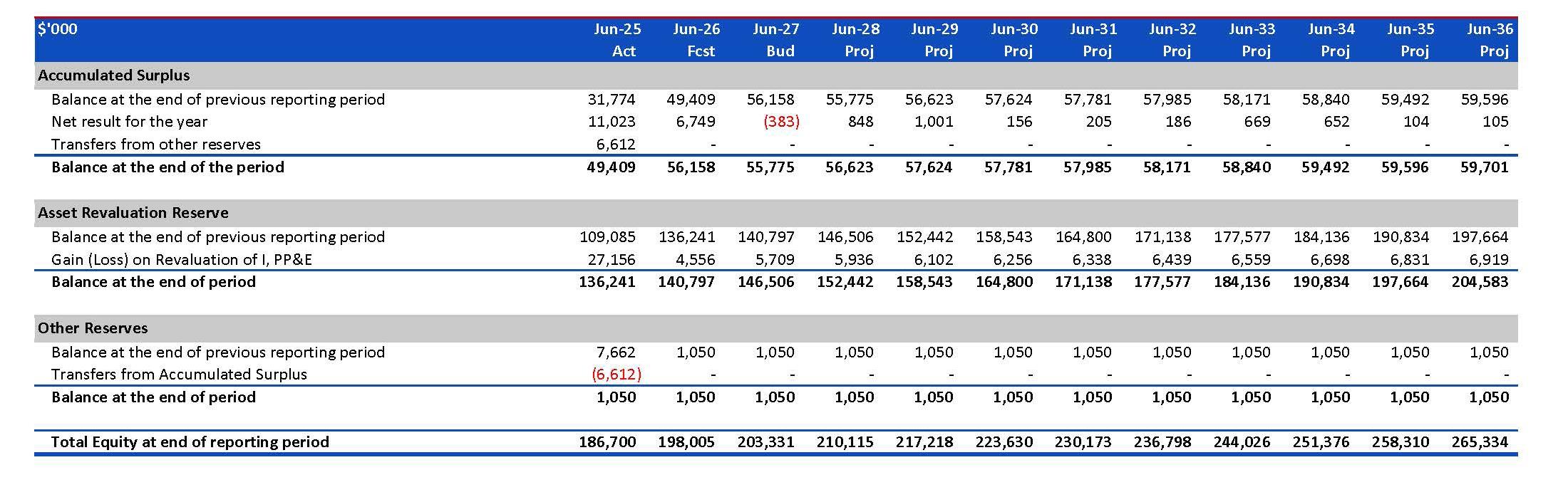
FINANCIAL STATEMENTS DRAFT
Statements - Consolidated | Statement of Financial Position