
Welcome Welcome
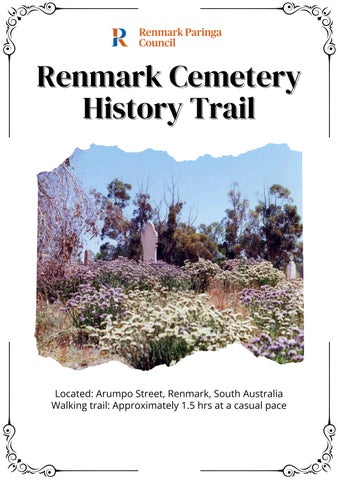
Welcome to the Renmark Cemetery History Trail
This history trail offers a glimpse into the lives and stories of Renmark’s earliest settlers, through the marked graves scattered throughout the original cemetery grounds.
Established on land set aside by the pioneering Chaffey Brothers, this site stands as Renmark’s first burial ground and has gradually expanded over the years. The oldest section lies along the Arumpo Street boundary, where many graves remain unmarked. Unlike cemeteries in Adelaide, there are currently no plans to reuse these older plots, preserving their historical significance.
As you follow the trail, you’ll encounter graves reflecting the diverse origins of the people who helped shape Renmark.
Among the most poignant are the numerous children’s graves, a reminder of the harsh conditions faced by families in the early years. With no resident doctor and the nearest hospital far away in Kapunda, illness and injury often proved fatal.
Sunstroke, then known as Thematic Fever, along with drowning in the river or open irrigation channels, were tragically common causes of death. We invite you to explore this site with respect and curiosity, as each resting place contributes to the rich tapestry of Renmark’s past.
1.The Malcolm Family 1.The Malcolm Family
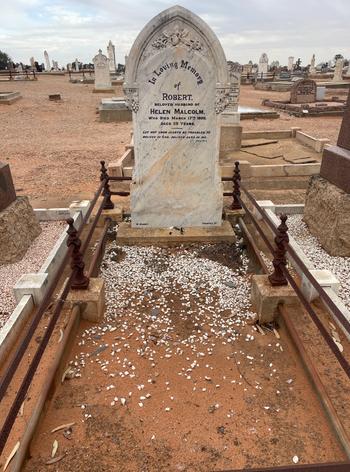
The Malcolm family graves are situated in a line with two 19th Century graves behind these.
Helen Malcolm 1841 - 1922 (nee Scott) aged 10 arrived with her parents from Scotland in 1851 to the Port of Melbourne from where they travelled to SA. She married Robert Malcolm in 1865 and they farmed in the Smithfield, Balaklava and Morgan districts before coming to Renmark in 1888.
Robert Malcolm 1841 - 1899 also born in Scotland, arrived in SA in 1863 and chose to call his Renmark property ‘Stirling’ after his birthplace. He was allotted the first block in Renmark of 20 acres in 23rd Street, which together with his sons, he cleared, ploughed and sowed to wheat in 1888. After the hay was cut some of the land was planted with vines and apricots. It was the first block to receive irrigation water. For some time the Malcolm family were the only owners of a horse team and they did considerable contracting work (carting stone, channel scooping) for the Chaffey Brothers.
Robert Malcolm also managed the 80 acre estate of the Hon. G.N. de Yarburg Bateston (son and heir of Lord Deramore).
Behind the parent’s graves are those of Robert (1873 - 1892) who died of Typhoid and his sister Margaret (1875 - 1895). ‘The Renmark Pioneer’ recorded Margaret’s death as due to ‘Murray Fever’, which could be today’s Murray Valley Encephalitis Virus carried by mosquitoes. Other family graves alongside are those of Robert and Helen’s children Isabel (Stevens) and Alexander.
2. Annie Lawson 2. Annie Lawson
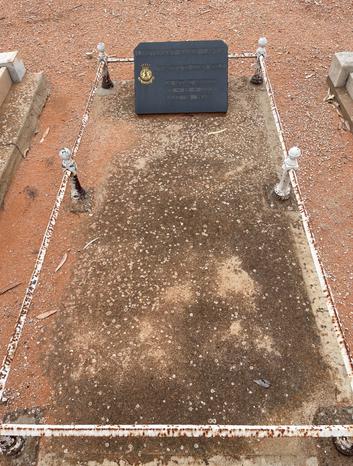
Lieutenant Annie Lawson was a young Salvation Army Officer from Melbourne and only 19 years of age when she died of Tuberculosis in 1891.
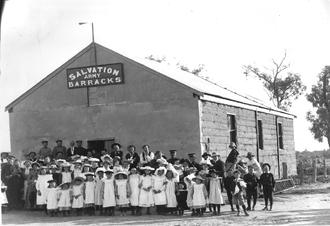
The Salvation Army was one of the earliest churches in Renmark with a wattle and daub Barracks built in 1890 on the corner of Para and 16th Streets.
Annie Lawson’s grave had been originally marked by a wooden cross long since deteriorated and iron railings, which had fallen into disrepair.
The late May and Bill Kohler, Renmark Salvation Army members, were the driving force behind the repair of the gravesite and the new headstone. This was made possible with a generous donation made by Phil Rosenthal of Rosenthal Motors, Renmark.
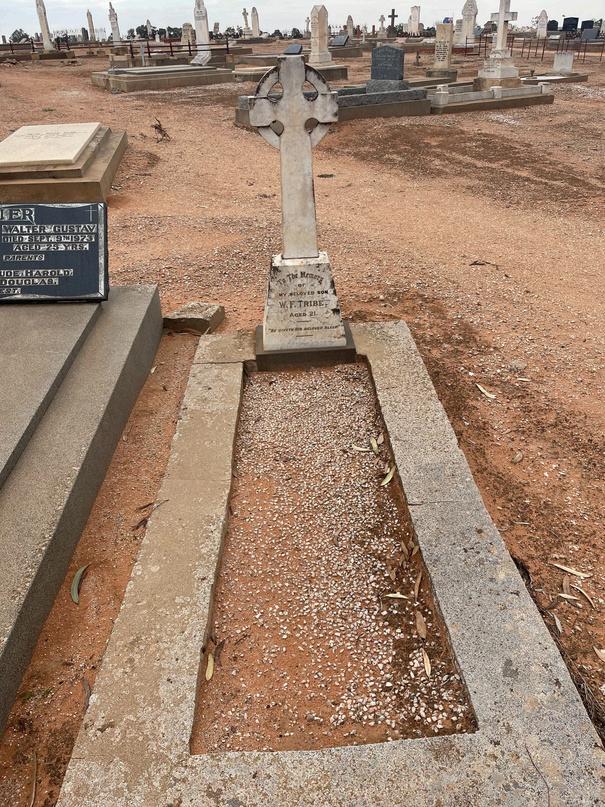
3. William Foulkes Tribe 3. William Foulkes Tribe
The simple cross of William Foulkes Tribe is undated but his Will records that he died 18th April 1892 and his estate of 70 pounds was left to his father. His father then Archdeacon Walter Tribe of Lahore, India and twin brother John Campbell Tribe, a tea planter of Matale, Ceylon were among the earliest purchasers of land in Renmark though never visited Australia.
William F. Tribe’s father Walter (1832 - 1909) came from West Sussex, was educated at Oxford University and after marriage was presented with a living at Stockbridge Hampshire by Lady Barker-Mills. William’s mother was Sophie Lander daughter of Charles Lander, Consul-General in the Dardanelles in 1841 and during the Crimean War, and later Vice-Consul in the Netherlands and Prussia. Almost all of Rev. Walter Tribe’s working life was spent in service in India and later Algiers before retiring as Vicar of Awliscombe Devon in 1905. William had two brothers and two sisters. One was Mary de Caurroy who became the Duchess of Bedford and in 1919 was known as the ‘flying duchess’.
She set four records after completing 18,800 miles on the London-Capetown-London flight taking 20 days to do the trip using Shell fuel.
William F. Tribe died of Typhoid in 1892 when, during a period of drought with dead animals and stagnant water in channels, together with weeks of temperatures over 100º F. pestilence struck Renmark and Mildura settlements with considerable loss of life.
4. Harry Samuel Taylor 4. Harry Samuel Taylor
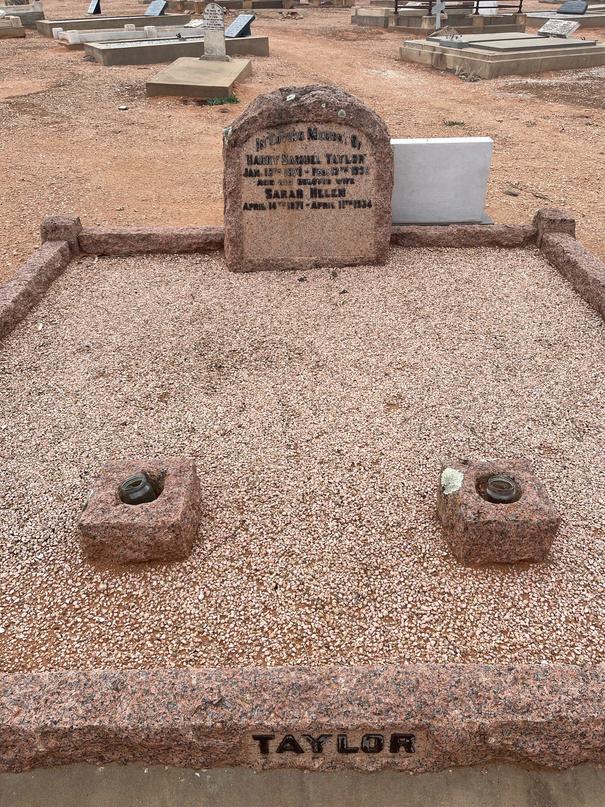
Harry S. Taylor was born in North Adelaide in 1873 to William Henry Taylor and Mary Jane Smith. His maternal grandfather Samuel Smith who founded the Yalumba vineyards instilled Christian convictions and high ideals in Harry. His final years of schooling were as a boarder at Prince Alfred College and from his earliest years he took great interest in the political and social issues of his day. He was a self-declared Christian socialist and took part in the unsuccessful communistic Cosme and New Australia settlements in Paraguay returning to Australia in 1896 on the death of his father.
In 1898, he married Sarah Helen (Nellie) Smith one of 10 children of Thomas and Caroline Smith of Warrakoo Station, Cal Lal NSW. The couple first lived on a 10,000 acre block ‘Four Corners’ part of Warrakoo, engaged in dairying and then moving to Mildura continuing dairying on a fruit block.
In 1905, Harry took over ‘The Renmark Pioneer’ newspaper; he had been a horticulture writer for the ‘Mildura Cultivator’. He was to prove a successful proprietor, editor and journalist. In the 1920’s the paper now called ‘The Murray Pioneer’ was a valuable reference for both farmer and fruit grower on a national level. He was irrigation’s greatest promoter and he fostered the spirit of co-operation, believing it to be the basis for economic wellbeing and living proof of what was the irrigation settlers of the Riverland.
5. Peter Jacob Johannes Lembke 5. Peter Jacob Johannes Lembke
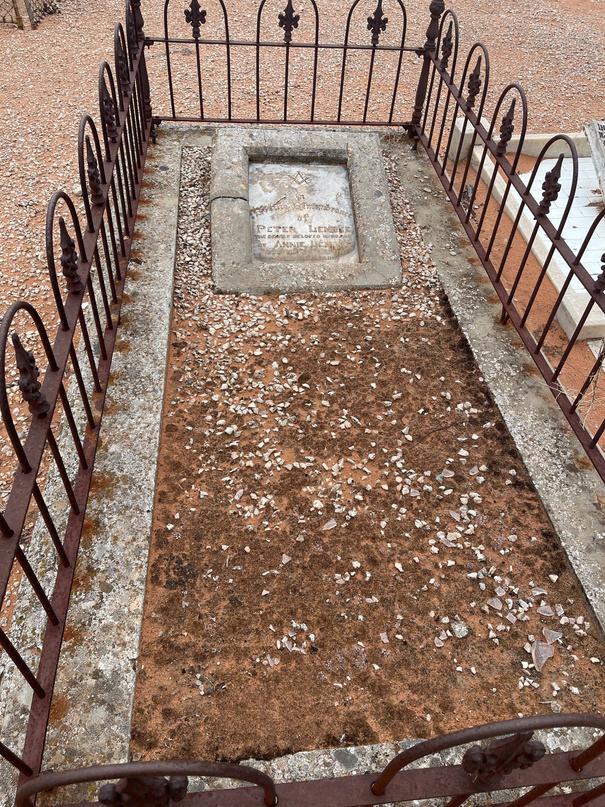
Peter Lembke was born in Schleswig-Holstein and attended the Heidelberg University and emigrated to SA to avoid military service in 1883. He was an architect and builder and built the Quorn railway station and school. On 16.5.1885 he married Anna Reiners in Quorn. Peter Lembke had a stroke at an early age and to improve his health he moved his family of three children to Renmark in 1894. He purchased a block of land on Kulkyne Street which he planted to vines and fruit trees. He had built a temporary house and dug a cellar for the main home when he suffered a fatal stroke after living less than six months in the settlement.
Anna attempted to carry on with the fruit block supporting her family by operating a camp kitchen supplying meals to the single men working on nearby properties. Anna’s father had been ADC to the British King Georges at the Hanoverian Court. Her brother Johann Clemens Reiners and wife emigrated in 1895 to Renmark from Liverpool, England. (Mr. Reiners became the earliest and best known photographer in the river districts)
Seepage killed the Lembke fruit trees and Anna and children moved to Hahndorf in 1900 where her son won a scholarship to the Academy. Later the family moved to Adelaide where she eked out a living making gowns for Adelaide society matrons and their daughters about to travel to London to be presented at Court. Peter Lembke’s grave is the earliest to display the Freemason symbol. He became a member in 1882 in Germany and was a member of the Port Augusta lodge before moving to Renmark.
6. James Wilkinson 6. James Wilkinson
Elizabeth Wilkinson Elizabeth Wilkinson
7. Henry Rixson Little 7. Henry Rixson Little
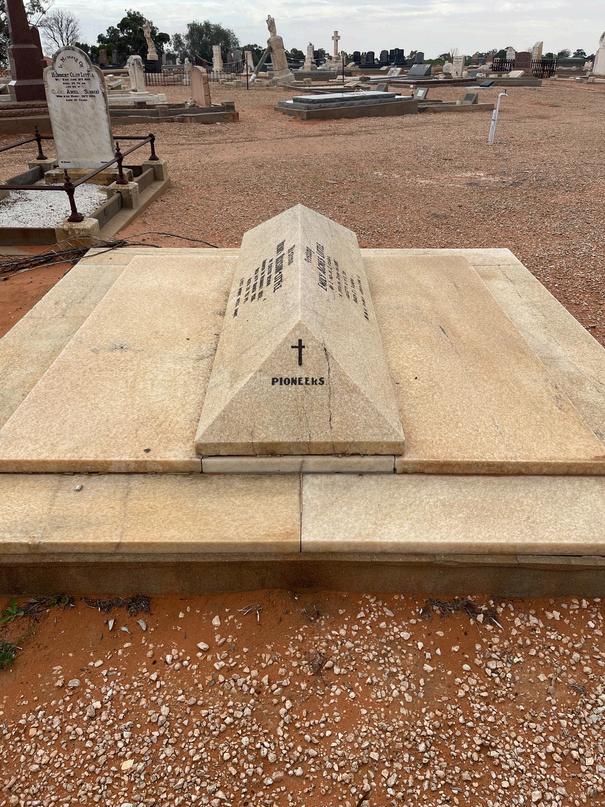
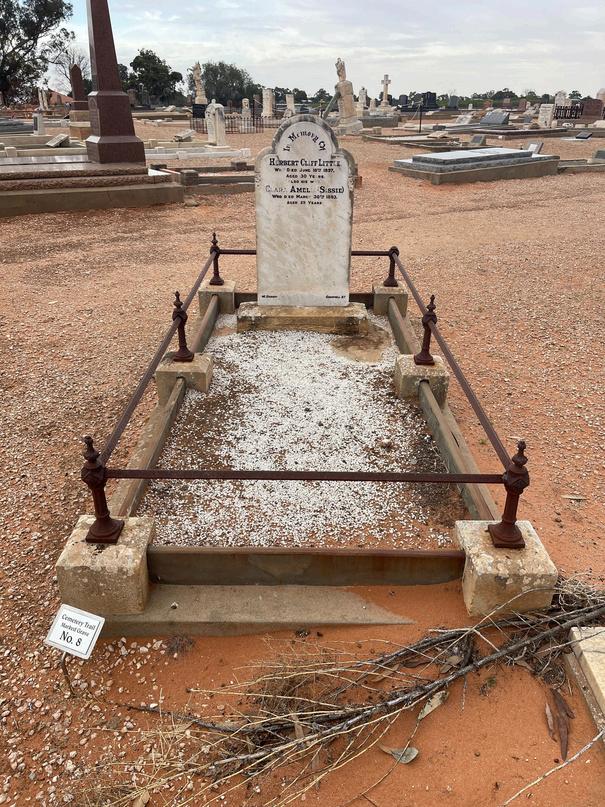
Harry Little with brothers Herbert Cliff (and wife Clara) and Alfred emigrated from Devon and arrived in Renmark in 1892. The three brothers took up 10 acres on Arumpo Street which they immediately cleared and planted with citrus, apricots and gordo vines. They were among the few settlers who possessed a horse and were kept busy working the blocks of absentee landowners. All three were tradesmen and able to work for others and earn a living while establishing their property. Harry was a carpenter and erected some of the earliest timber homes and could turn his hand to furniture making. In 1897, Harry travelled to Adelaide to marry his fiancé Emily Agnes Johnson who had just arrived from England, having decided after five years, to wait no longer for Harry to establish himself. The return journey in a buggy and pair took an adventurous week. That same year brother Cliff died and Alfred, who had married Olive Hunt in 1896, returned to England. Harry and Emily took over the block and over time extended their holdings.
8. Herbert Cliff Little 8. Herbert Cliff Little
Cliff Little arrived from Devon England in 1892 with his wife Clara Amelia and brothers Harry and Alfred. In 1893, Cliff and Clara were part of a large group of young settlers who travelled to an area outside of Renmark on the Ral Ral Creek known as ‘Wide Waters’, which was popular for picnicking. As was the custom, the young men would go shooting while the women chatted and prepared food. Clara Little aged 27 died tragically when a gun accidentally discharged.
Cliff died in 1897 aged 30 after being nursed for several months by his sister-in-law Emily.
9. Brian Marmaduke
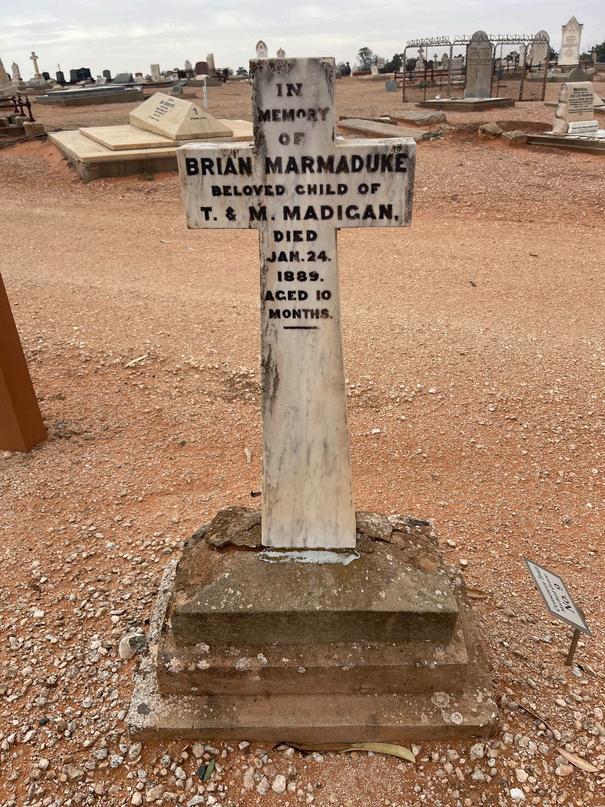
Madigan 9. Brian Marmaduke Madigan
Brian Madigan has the distinction of being the first burial and having the oldest headstone in the cemetery. He was born 17.3.1888 in Renmark and was the second of five children born to Thomas Madigan and Mary Dixie Finey. Thomas Madigan was a contractor for the Chaffey Brothers and a director of the Renmark Irrigation Company of 1892. He was of Irish descent and one of 14 children from Mintaro and his wife Mary came from Hahndorf where her English father was an auctioneer. The Madigan homestead on 21st Street was originally of pine logs and stone and today is opposite Olivewood’s car park. The property consisted of 20 acres and recently a public reserve in Wattle Street has been named after this family, on part of the original property. In 1897, Thomas Madigan was exploring mining opportunities in WA when he died of Appendicitis, which left his wife and four children in straitened circumstances. The family moved to Hahndorf where Mrs. Madigan resumed teaching.
She returned during WW1 to do relief teaching at Renmark West School.
Brian Madigan died on 24th January 1889 aged 10 months and in October of that year, Cecil Thomas his brother was born. Cecil Madigan (1889 - 1947) is one of Renmark’s most famous sons; Rhodes Scholar, Antarctic Explorer (with Mawson), Oxford Scholar, Simpson Desert Explorer, served in WW1 and WW2 and contributed to the Legacy Club, Boy Scout movement and National Fitness Council.
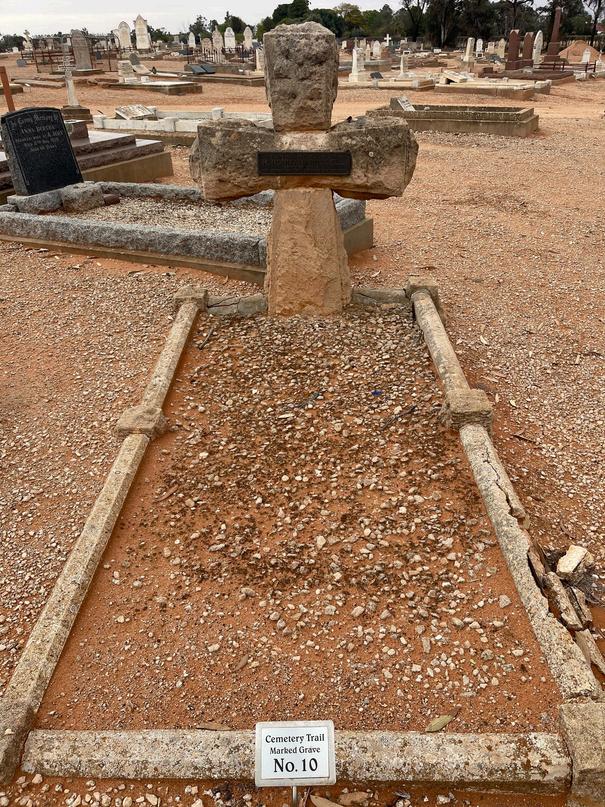
10. Henry Norman Rossell 10. Henry Norman Rossell
Norman Rossell aged 22 accompanied his father Henry Augustus (1844 - 1902) and mother Charlotte Rossell (1845 - 1921) to Renmark in 1892. The family was amongst the oldest in Yorkshire and engaged in steel manufacture. They took up 20 acres in Ettiwanda Street and at the time of his death in 1927 Norman owned 160 acres under irrigation in addition to pasture above the 60 foot channel and a farm at Paringa. He bred horses of the Suffolk Punch breed and his Ettiwanda Dairy supplied the district with milk. In 1913, he married Mary Rathbone (1889 - 1965) who had been born in Burnie Tasmania. Her father had links with this district having been bookkeeper to the Cudmore family when they held Paringa Station, and later the Rathbones had an ostrich farm at Port Augusta. Both Norman and his father were expert chess players and Norman was also a fine pianist. The ‘Southfield’ plantation was surrounded by trees and palms and noted for its fine gardens and the hospitality of its owners.
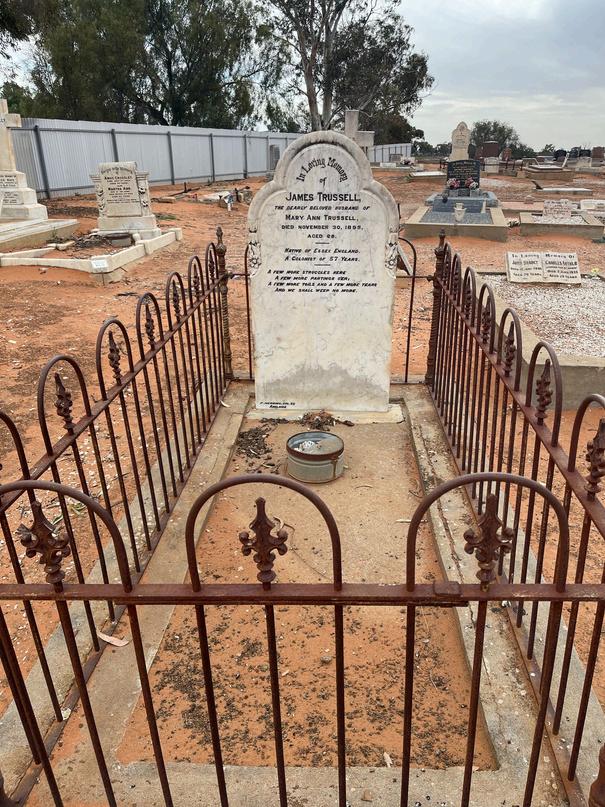
11. James Trussell 11. James Trussell
James Trussell accompanied Col. William Light as a 10 year old cabin boy on the brig ‘Rapid’ in 1836. He was in the employ of Adelaide’s Surveyor General when the Colonel died in October 1839 at Thebarton. After Light’s death he was employed by the Chambers brothers who held considerable property in SA and in 1850 Trussell was managing Cobdogla Station on the Murray River. This position he held for 45 years until his death in 1895 when visiting one of Cobdogla’s outstations at Berry Berry (present day Berri). As a horseman he had no equal and among bushmen of the last half of the 19th Century his tracking, riding and endurance abilities earned him enormous respect.
Cattle duffing and horse stealing were rife in earlier times and at times there were minor altercations with the local Aborigines. In all his dealings he was firm but fair and earned the name ‘The General’ from the native population.
Cobdogla horses were famous for their stamina; ‘Circle C’ horses were in demand as cab horses in Adelaide and they accompanied John McDouall Stuart’s explorations across Australia. Stuart and Trussell were firm friends and Stuart suffering in health after one of his expeditions, spent time recovering at Cobdogla. He gave his gun and binoculars to Trussell and today they are held by the SA Museum.
He married twice and his second wife Mary Ann financed the establishment of Renmark’s Community Hotel in 1897.
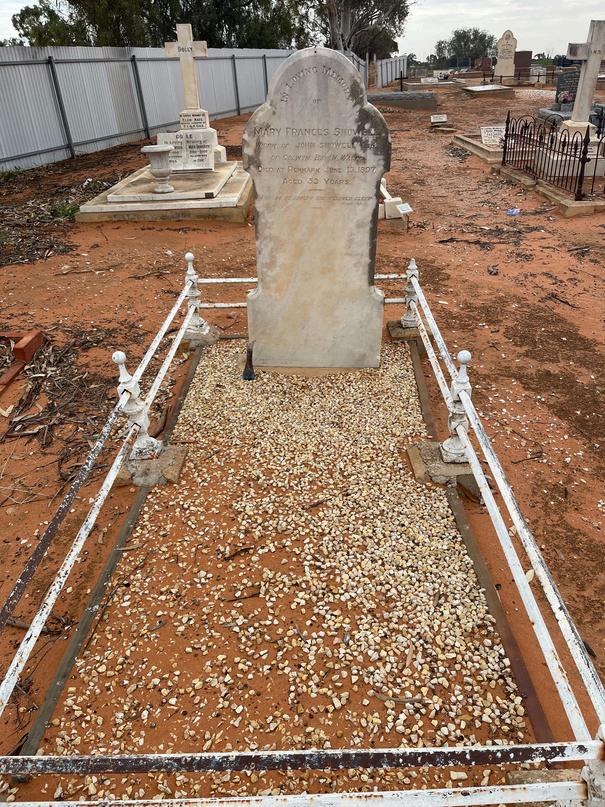
12. Mary Frances Showell 12. Mary Frances Showell
Mary Frances Showell (nee Hague) was the daughter of an oil merchant of Manchester, England. In the 1860’s she married John Showell, a Civil Engineer and there were three children; Harry, Samuel and Mary Gertrude. The family lived in Yorkshire and after John Showell’s death in 1888, Mary Frances and her two youngest children went to live in North Wales with her son Harry who was a qualified Architect/Civil Engineer. Harry became interested in irrigation after reading the Chaffey Brothers’ promotional publication known as ‘The Red Book’ and in 1892 he departed England for Renmark. Harry Showell lived in a tent for two years on his 10 acre block and by 1911 he owned 280 acres all planted to sultanas, which earned him the title of ‘Sultana King’. In May 1896, Mary Frances and her two youngest children arrived from Wales. However, in October of that year she suffered a paralytic stroke. After a lingering illness she died on 13th June 1897 aged 53 years.
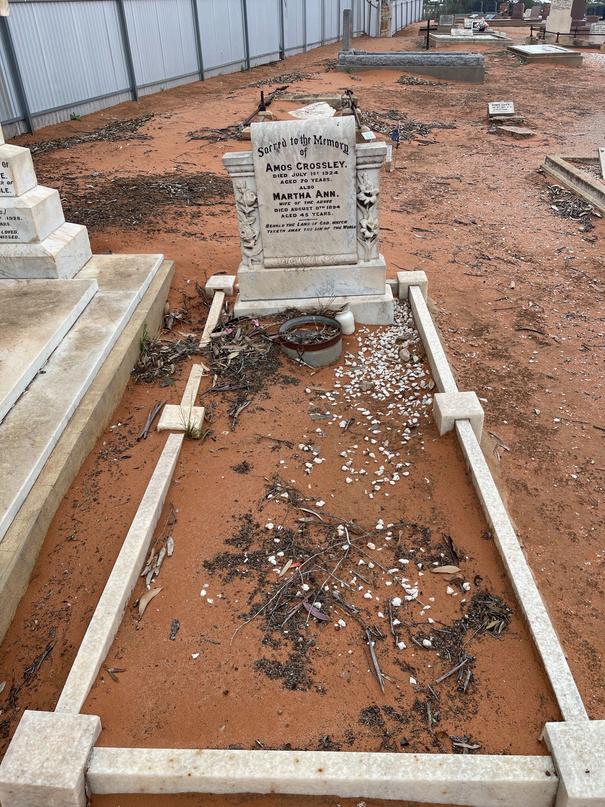
13. Martha Crossley 13. Martha Crossley
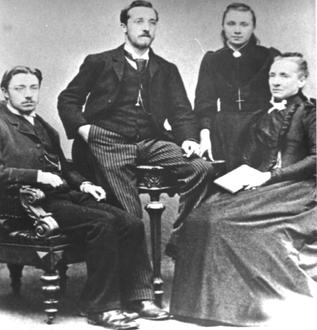
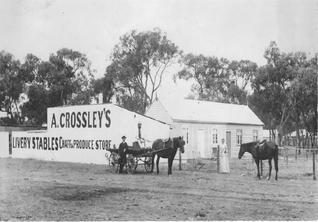
Martha Crossley with her husband Amos emigrated from Yorkshire England to SA in 1883. Amos Crossley was involved with Wesleyan Mission work in the Burra area before coming to Renmark in 1889. Congregational Church records list Amos Crossley as one of their foundation members. Amos operated a livery stable in Murtho Street and also a chaff store selling bran, corn and pollard. After Martha’s death in 1894 Amos remarried in the following year. During 1895 - 96 ‘gold fever’ took hold of many of Renmark’s settlers, and in April of 1896 Amos left his new wife and child to look after his business while he went to try his luck on the Murchison goldfields in WA.
By December of 1896, Amos Crossley had returned to Renmark and expanded his business. He took a keen interest in civic affairs particularly in the matter of piped water to households. In 1897, as Chairman of the Town Supply Waterworks he had the honour of turning on the pump to fill the newly erected water tower near the town wharf.
In 1898, Amos Crossley sold his business to mail coach driver Fred Plush and with his family moved to Adelaide where he took up shop keeping. When he died on 1st July 1924 aged 71, his remains were brought to Renmark and interred with his first wife.
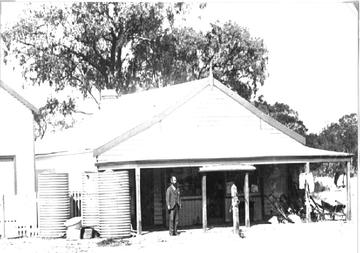
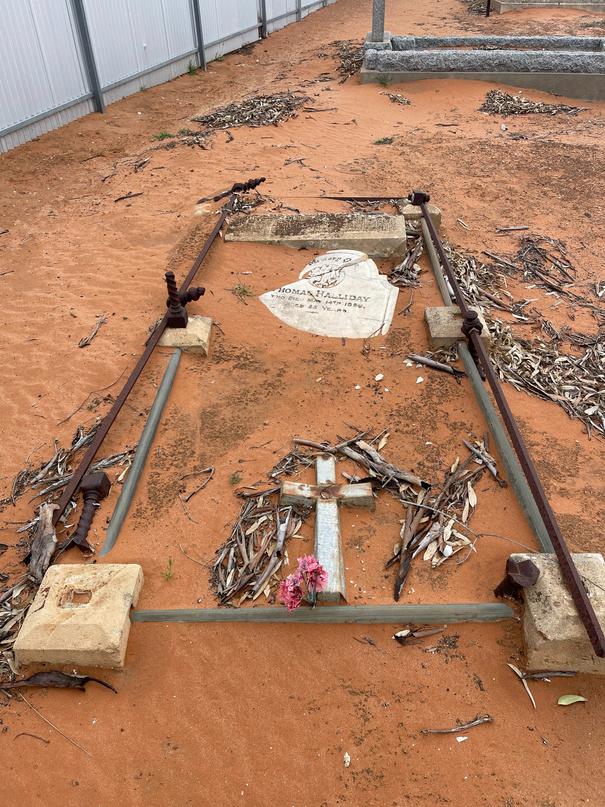
14. Thomas Halliday 14. Thomas Halliday
Thomas Halliday was Renmark’s first shopkeeper; his Ral Ral Store (site of the ‘Murray Pioneer’) was stocked with everything the new settler needed – groceries, hardware, paints, oils, glass, crockery, linoleums, floor cloths, boots and shoes.
On a particularly dark and windy Saturday night in 1898 Thomas Halliday was returning home from the centre of town about 8pm when it was supposed his hat blew off. It was when trying to find it, that he fell over a steep bank at the end of Renmark Avenue into the river.
His calls for help were heard by more than one person but mistaken for a fisherman camped across the river. On Sunday his partially submerged body was discovered caught on a snag close by the place where he fell. It being impossible to decide whether he was not first exhausted by exposure before being drowned, the Coroner’s jury returned a simple verdict of ‘accidentally drowned’.
Thomas Halliday’s widow Eliza Jane carried on the business with a manager until 1907 when she sold out to shopkeeper Frank Ockenden.
15. Ali Bey Abdulaley 15. Ali Bey Abdulaley
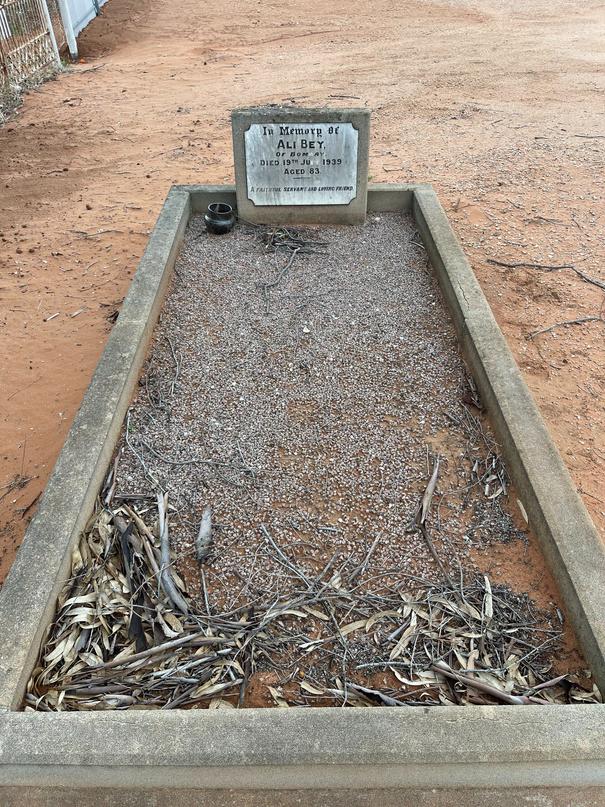
Ali Bey Abdulaley lived in Renmark with his employer Ambrose Durack, fruit grower of Eighth Street. The history of the Durack family is the stuff of epic pastoral legends. This family carved a cattle empire out of the frontier lands of the northern Australia, taking up land around Coopers Creek and later vast areas of the Kimberley region of WA. Durack descendant Dame Mary Durack OBE who wrote of her family in ‘Kings in Grass Castles’ and ‘Sons in the Saddle’, made many mentions of Ali Bey in her books. The Durack family called him ‘Ali Boy’ and he was in charge of the kitchen; a good cook, always friendly and amiable and devoted to Ambrose Durack grandson of Michael Durack the patriarch of the clan.
As a young man he fought in the Indian border wars under Lord Frederick Roberts of Kandahar. It is thought Ali Bey came to Australia in connection with the lucrative horse trade between those two countries.
From January 1909 he figured continually in the records of Argyle Station as stockman, homestead and mustering camp cook and jackof-all-trades.
In 1923, when Ambrose Durack left Argyle Station for Renmark his wife, daughter and faithful servant accompanied him.
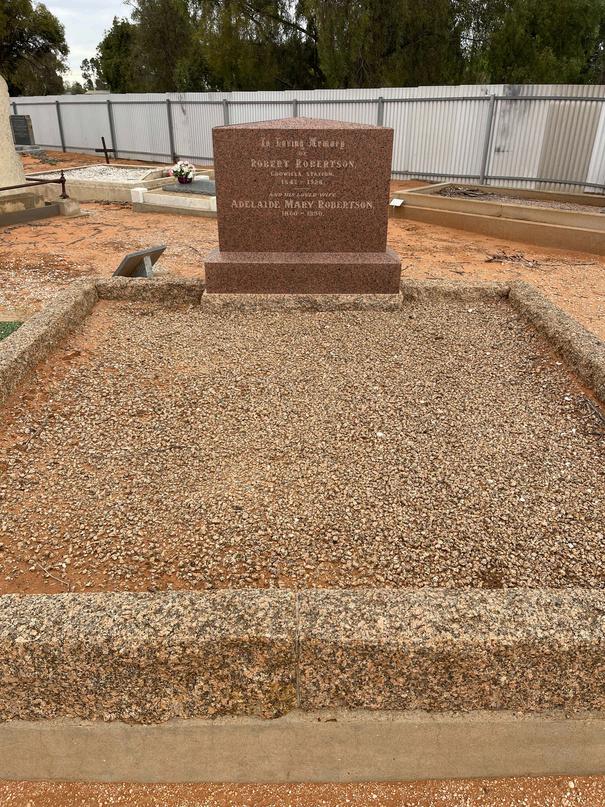
16. Robert Robertson 16. Robert Robertson
Robert Robertson was only three months old when his father Robert Robertson died in 1847. Robert and Margaret Robertson had emigrated to SA in 1839 from Scotland. They built the Old Bushman Inn at Gawler and Robert held the license from 1840 - 1845. At the time of his early death Robert Robertson Snr. was farming near Rosedale. In 1852, widow Margaret Robertson married Richard Holland and Robert junior and his two brothers had a stepfather who was famous for quality cattle and horses. Their home was ‘Turretfield’ an 1854 stone mansion near Rosedale and when the three boys were of age their stepfather set them up on stations, Chowilla, Bookmark and Bookpurnong. Robert Robertson had received a good education in Adelaide and possessed considerable artistic ability, and though he never learnt any trade, he excelled in all woodwork and joinery which is evident at the Chowilla and Bookmark homesteads. Like his brother John he also made several violins and made all the fittings of the family’s launch ‘Lotus’. He was a fine marksman with his Purdey gun and his racehorses won all along the river racecourses as well as the metropolitan courses.
Family tradition says that 28 year old Robert first set eyes on Adelaide Harvey, the Blanchetown publican’s daughter, when she was 16 years of age. He arranged for her to have two years education in Adelaide and married her in Christ Church North Adelaide when she had turned 18 in 1878. Their first home was Bookmark Station (on the Lyrup flats) where in the late 1870’s sheep had replaced cattle. Adelaide Robertson with her medicine box ‘doctored’ everyone for miles around. In 1896, Robert and his brother John exchanged properties and Robert, Adelaide and their six children moved by riverboat to Chowilla homestead. Here they extended courtesy and consideration to all travellers; their lovely homestead and garden together with the musical and riding accomplishments of their children made Chowilla a centre of culture and refinement.
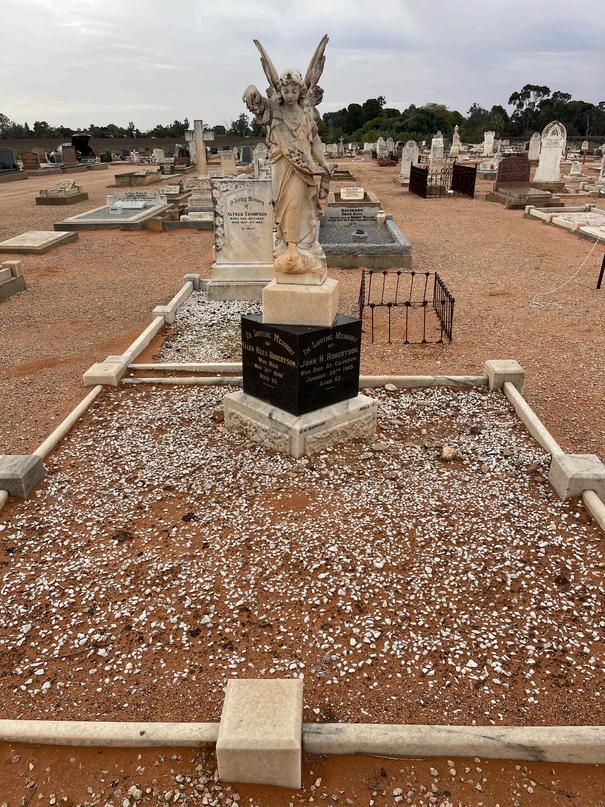
17. John Holland Robertson 17. John Holland Robertson
John Robertson was the eldest of the three Robertson brothers and as a mark of respect adopted his stepfather’s name. He was educated in Adelaide and learned the business of being a pastoralist on his stepfather Richard Holland’s property ‘Turretfield’ near Rosedale. Forty five years of his life were spent on the river; 15 years at Bookpurnong, 18 years at Chowilla and 12 at Calperum formerly Bookmark Station. John Robertson was senior magistrate in the Renmark district and a valued patron of local sports and racing clubs. He was also recognised as a crack rifle and pigeon shot. His hobby was making violins which were a labour of love at which he excelled. In 1895, he took a first award at the Australian Industrial Exhibition in Ballarat for two violins; one a 16th Century Maggini and the other a Stradivarius both of which had their excellent workmanship and tone commended by experts. The timber for his instruments was imported – ebony from Siam (Thailand) and birdseye maple, soft pine and bent holly.
He made over 100 violins and cellos in his lifetime, however a fire in 1915 destroyed his workshop and many instruments. In 1878, John Robertson married Ellen Rees George at St Luke’s Church Adelaide and after a honeymoon in New Zealand the couple moved into the new homestead at Chowilla. Here they had four daughters and when John and brother Robert dissolved their partnership in 1896, the family moved by riverboat to Bookmark, which John changed to its original Aboriginal name ‘Calperum’. John Robertson died at Calperum in 1909 aged 67 and the property was then managed by his daughters Lass Warren and Ellie Harris until the 1940’s.
18. Saies Family Group 18. Saies Family Group
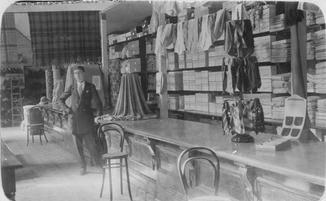
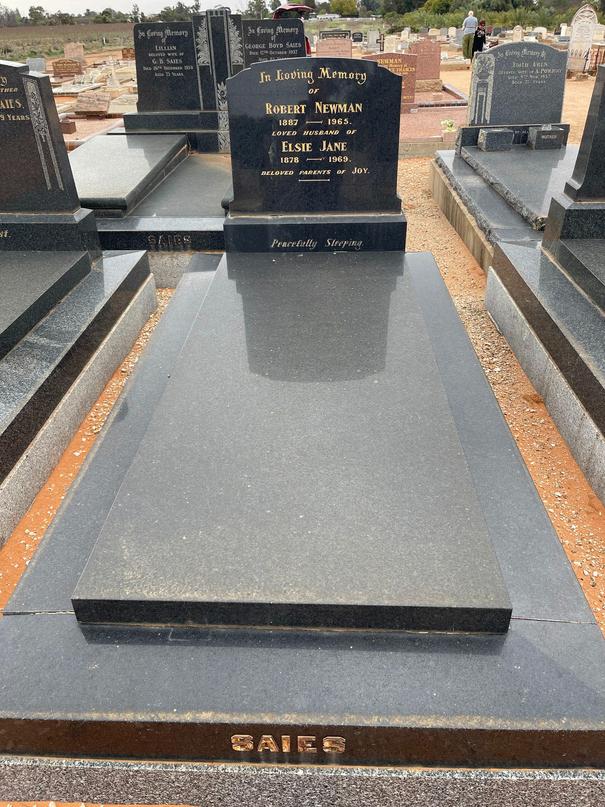
The name Saies in Renmark recalls an era of shop keeping when respectful employees displayed wares on polished timber counters to seated customers and payment for purchases was conveyed by canister on a ‘flying fox’ arrangement of wires overhead. George Boyd Saies, wife Lillian and four sons arrived in Renmark during 1894 to take up a fruit property in Tarcoola Street. In 1900, Mr. and Mrs. Saies commenced business on Renmark Avenue and Mr. Saies would walk once a week to conduct business in Lyrup. Over years the business expanded taking up new sites and offering a wide range of merchandise; millinery, haberdashery, ironmongery, manchester and all manner of household items. Their four sons Geoffrey, Robert, Frederick and Richard worked in the family business. A fifth son John born in Renmark in 1897 lost his life in WW1.
In 1927, a fire destroyed the ironmongery department and in 1928 a larger store was erected on the corner of Renmark and Ral Ral Avenues. The family business ceased trading after 53 years in 1953 when purchased by Hambours Limited.
Today this store is occupied by Target.
George Boyd Saies was born in Harvfordwest, England and educated in Switzerland before working for some of the biggest retail firms in London. As a youth he walked all over Europe; on one occasion walking from the source of the River Rhine to its mouth. He possessed one of the finest libraries in the river districts.
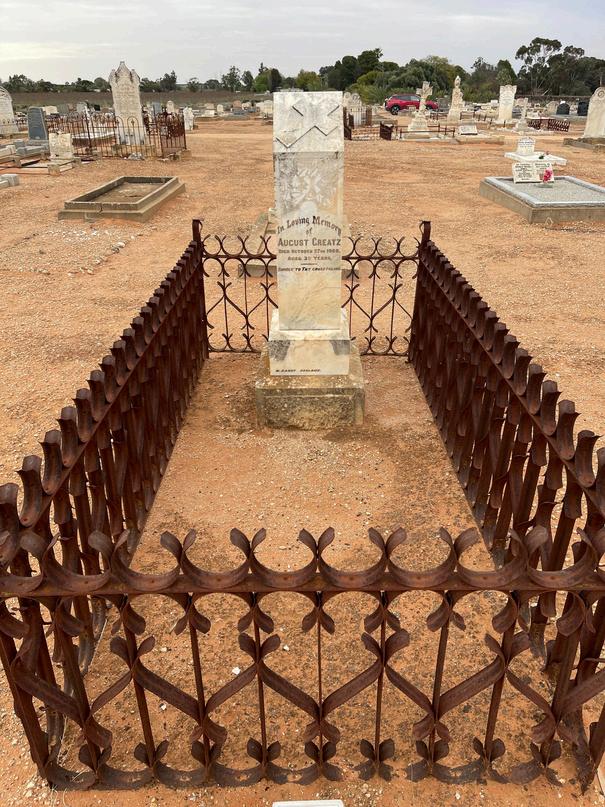
19. Carl August Wilhelm Greatz 19. Carl August Wilhelm Greatz
August Greatz was born at Tarnma (19km from Eudunda) in 1870, which prior to 1917 had been known as Friedrichswalde. His parents Wilhelm Traugott and Anna Maria Greatz were born in separate villages near Frankfurt Germany.
August was a resident partner of a syndicate comprising his brother William and Frank Egge both resident in Mildura, who had purchased in the early 1900’s the defunct Murtho Village Estate. At the time of his death, August was living at Murtho with his mother and two youngest siblings and was engaged to be married.
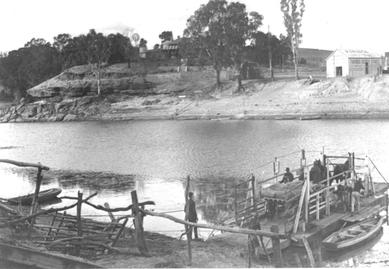
In 1909, August and some associates had purchased 80 horses at the Kapunda horse sales and arrived at Paringa in the late afternoon to cross the animals using the punt. There was a high river with a fierce current; two crossings were made safely carrying 35 horses. On the third crossing with 14 horses the punt dipped when in the middle of the river and the frightened horses rushed to one side. Some broke through the rail guards, a few stayed on the punt and one drowned.
The men had jumped overboard and the punt floated downstream until it sank opposite the Paringa Sandbar. A search was made for August; no one knew he could not swim, and unfortunately his body was not found for several days having been carried by the current two miles downstream.
20. Mary Jane Barber 20. Mary Jane Barber
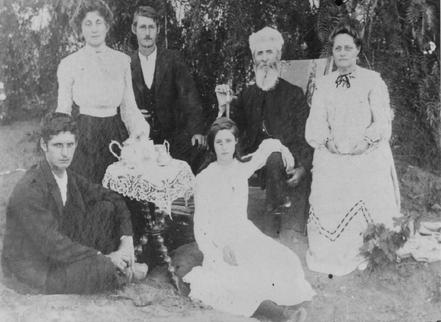
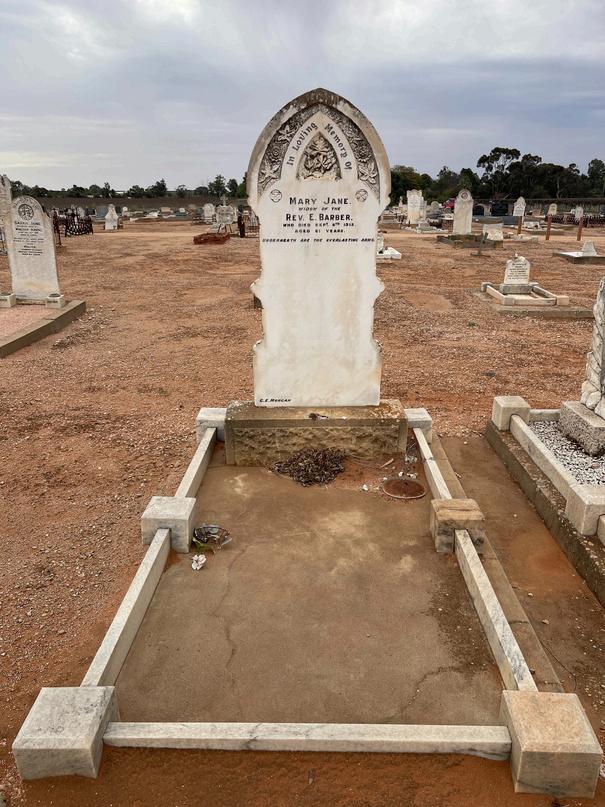
Mary Jane Barber was born in Redruth Cornwall in 1852 to Reverend Robert Bond and his wife Jane nee Arch. In 1879 at York she married the widower Reverend Edward Barber who was born in 1835 at Camelford Cornwall. Their first posting was Tauranga in New Zealand where sons Edward Ernest and Alfred Arch were born. In 1884, the family moved to Port Augusta, then Yankalilla, where Gertrude Mary was born, and Melrose circuits before arriving in 1897 to take charge of the Renmark Wesleyan Methodist Church. Prior to the Rev. Barber’s arrival the Methodists were under the care of Rev. W. Corley Butler who visited settlements on the steamer ‘Glad Tidings’. In the early 1900’s there was no resident doctor in Renmark and those with serious illness had to make a steamer, train, coach trip to Kapunda Hospital. In 1905, Rev Barber died in the Kapunda Hospital aged 70 surrounded by his family and many Methodists of that town. He is buried in the Kapunda General Cemetery.
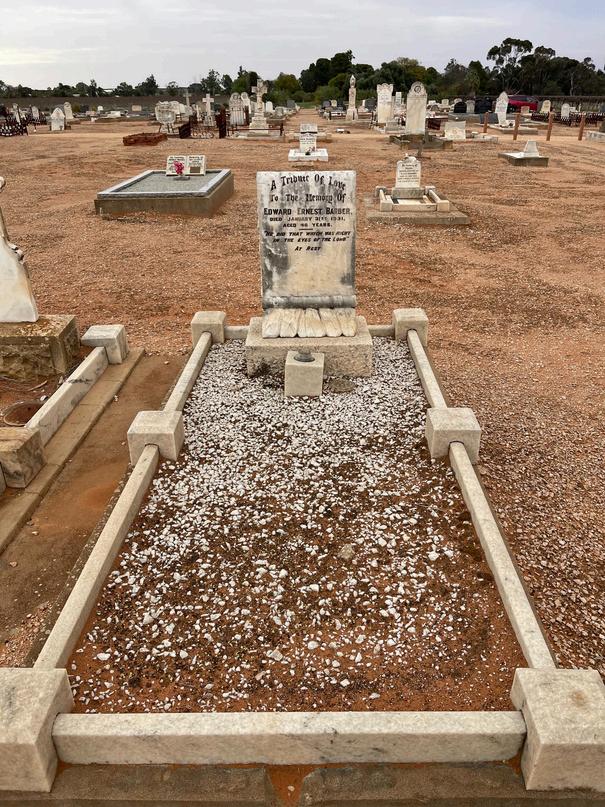
21. Edward Ernest Barber 21. Edward Ernest Barber
Ernest Barber affectionately known as ‘Fritzy’ is best known for the formation of the Renmark Boy Scouts in 1909 and the enthusiasm he brought to this group culminating in the presentation of the ‘Trenchard Miller’ Shield in 1925 – the most prestigious of all scouting awards in Australia. This was a monumental achievement of vigorous physical training, bridge building, bush ambulance, and all with kit and equipment made to specifications by the scouts themselves.
Ernest Barber in his role as scoutmaster was responsible for teaching hundreds of boys to swim in the dam on his fruit property on Tarcoola Street and in the river. In turn many lives were saved by his scouts. He lobbied long and hard for years to secure a permanent swimming pool in the town. The Barber Memorial Pool was opened in 1933 two years after his death. Ernest Barber had been born in Tauranga New Zealand in 1883 and after his family’s arrival in Renmark in 1897 he worked on local fruit properties before purchasing the Legge-Willis property on Tarcoola Street. In 1917, he married Gertrude Bannon.
In 1931, Edward Ernest Barber died aged only 48. Five hundred citizens and scouts were present at his funeral where his pall bearers were scouts of the Kings Banner Troop. His last spoken words were to request that he be laid next to his mother Mary Jane Barber.
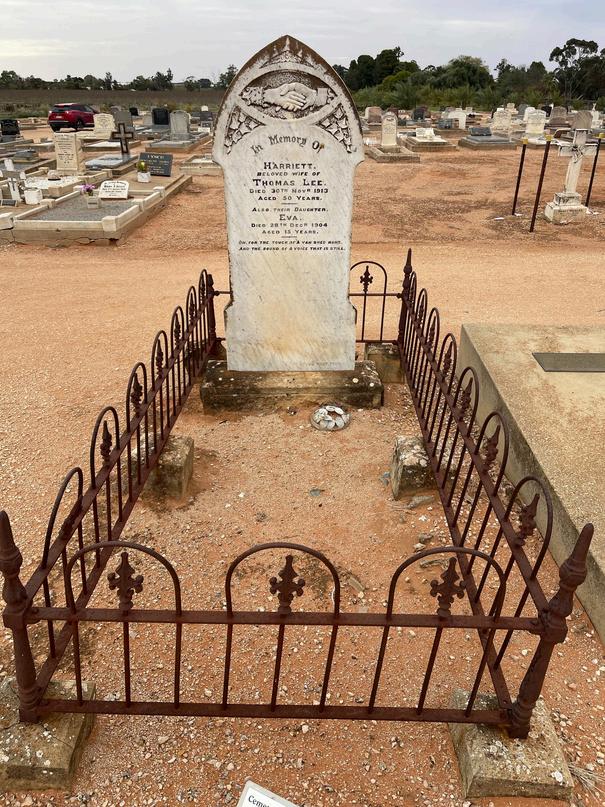
22. Harriett Lee 22. Harriett Lee
Harriett Lee when aged 16 had been a housemaid to the Earl and Countess de la Warr and recalled the countess as being both natural and kind and who never passed any of the servants without a kindly word. On one occasion the Prince and Princess of Wales (later to be crowned King Edward VII and Queen Alexandra) with their family of five came to stay for one week. Mrs. Lee remembered that in the evenings when dinner was being served and the royal party’s maids were also at supper, she would play with the children who delighted in dressing her up in a long train and pretending she was a grand lady. One of these children was the 14 year old future King George V and grandfather of Queen Elizabeth II. Harriett came out to Australia in 1883 on the ‘Dundee’ in the company of other Renmark settlers (Elsley and Dopson) and former premier Thomas Price. She married Norwegian sailor Thomas Lee who was employed in the irrigation settlements of Mildura, Renmark and Berri.
Harriett had been an invalid for nine years before passing away in her 51st year and Thomas moved to Adelaide, where on the 3rd January 1923 he was struck with illness while walking down King William Street and died the same day, aged 65.
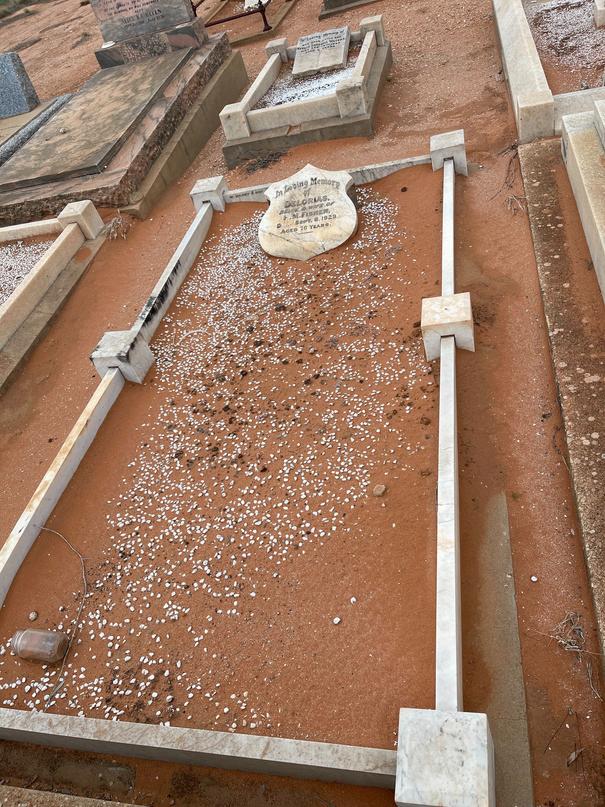
23. Delorias Massey-Fisher 23. Delorias Massey-Fisher
Delorias Massey-Fisher’s marriage certificate records her maiden name as Delorias Jennie Valburga Carbonnia Voyce de Viesca, daughter of the Marquis de Viesca when on 6th October 1890 she married Herbert Massey-Fisher in London. It was the opinion of her London doctor that Mrs. MasseyFisher had only a few years to live but her new husband had great faith in the Australian climate, having been a trader on a schooner in the South Seas.
The newly married couple arrived in Renmark at Christmas of 1890. They purchased a block in Arumpo Street on which they built a weatherboard home on stumps one metre high similar to homes in the tropics. The Spanish countess who had a coronet printed on her visiting cards, kept as pets five sulphur crested cockatoos in a brush shelter all chained to individual perches. She was never idle; making butter for shops in Renmark and assisting her husband with the seasonal work on their fruit block.
Mrs. Massey-Fisher died unexpectedly in 1929 – her headstone is a simple shield design. In 1930, her husband aged 72 returned to England after having sold his fruit properties.

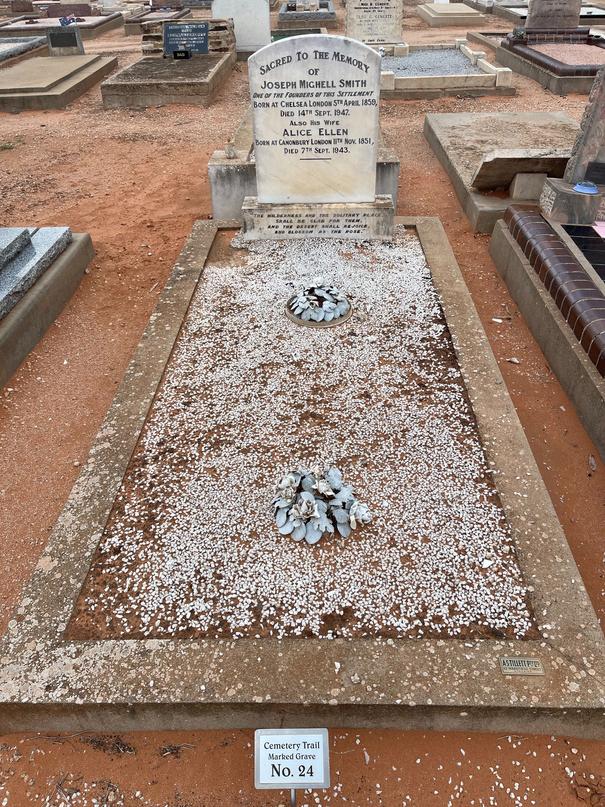
24. Joseph Mighell Smith 24. Joseph Mighell Smith
‘Cocky’ Smith was a settler of indefatigable energy whose whole life was directed towards the improvement of his community. He was born on Kings Road, Chelsea London and was a sailor on clipper ships before arriving in Renmark in 1889. His first venture was a milk round and three acres of land. Later he took up a fruit block and was the first to plant gordos. In 1891, he married Alice Ellen Memess 1851 - 1943, also a Londoner who had arrived with the Charles Chaffey family as governess in 1888. They had one child Emily (Barrington) and the Smith home ‘White Cedars’ in Pyap Street was completed in 1914 after many years of living in a tent on the property. ‘Cocky’ Smith was part of the delegation who went to Adelaide in 1893 after the Chaffey collapse to petition the Government for a loan to keep the settlement afloat. A Royal Commission was instigated and a loan approved. In 1927, he was one of two men credited with the bringing of a railway to Renmark, after several years lobbying the Government as Chairman of the Renmark Railway Committee.
He was the third Chairman of the Renmark Irrigation Trust and held that position for 11 years. A tablet at the entrance of the Trust building commemorates his contribution to that organisation. He was a long serving lay reader and deacon of St Augustine’s Anglican Church.
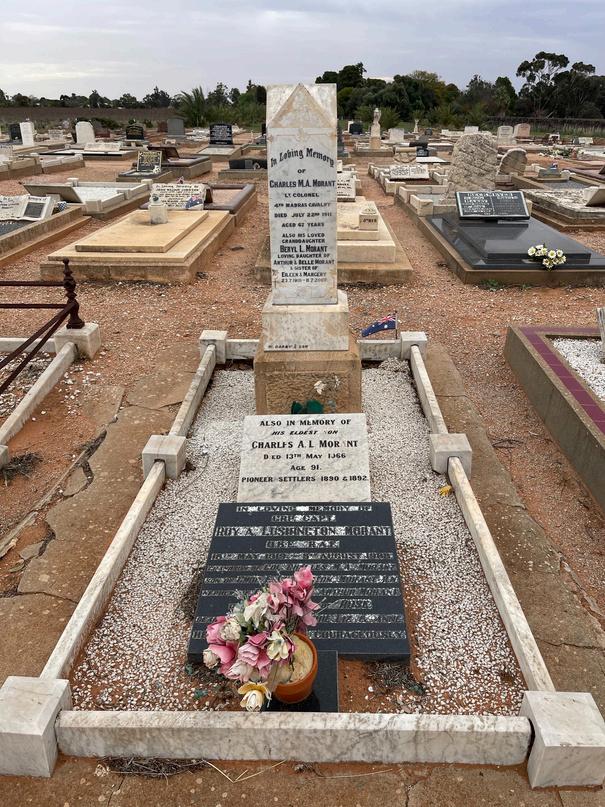
25. Colonel Charles M.A.
25. Colonel Charles M.A.
Morant
Morant
Lt. Colonel Charles May Allen
Morant was born in India to Rev. James Morant and Barbara Wilson Lushington. He married in 1872 Catherine Lushington and in 1891 arrived in Renmark after retiring from an army career spent in India. The only members of his family to join him in this new venture were sons Charles aged 17 in 1892 and Arthur aged 18 in 1894. In 1904, the Morant property named ‘Walteela’ occupied 100 acres and was second in size only to ‘Olivewood’. The pine log homestead had been built for a former owner and the Morants planted orchards of apricots, peaches, citrus and vineyards of gordos and sultanas. Both sons married in 1908 and the property was divided with the homestead and 30 acres going to Arthur and wife Isabella (Steele) and 70 acres to Charles and wife Madeline (Robertson) who built a new home in 26th Street taking the name ‘Walteela’. Arthur re-named the old homestead ‘Bangalore’ after his Indian birthplace. In the early 20th Century Col. Morant with his two sons, two permanent hands and four working horses were all the labour needed to work this large property.
During apricot harvest another 60 hands were required and for the raisin crop 30 hands. The plant consisted of seven sulphur boxes and during harvest 7,000 trays were in use. Iron tramlines greatly assisted in the laying out stage on the drying green.
On 11th July 2007, Miss Beryl Lushington Morant, eldest daughter of Arthur and Isabella passed away 12 days short of her 97th birthday, ending an unbroken chain of 116 years of Morant family occupation of ‘Bangalore’.
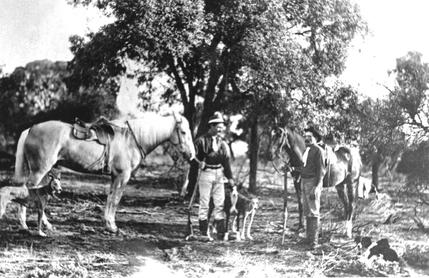
26.William George Cuttle 26.William George Cuttle
William Cuttle was one of five men brought to Australia from the USA by the Chaffey Brothers to teach the settlers of Mildura and Renmark about horticulture. He was born in Montreal, Canada and specialised in citrus growing. In those early days of both settlements very few in Australia knew anything about fruit growing under irrigation. His job was to advise and instruct the growers about the best methods of preparing and planting the land and the application of water. For many years he served as an inspector for the Australian Dried Fruits Association. ‘Billy’ Cuttle was a fine horseman and one of the first to volunteer for the Boer War in 1899 with other Renmark men. After returning from the war he started a carrying business firstly with Mortimer Eve and later Walter Ogilvy, both veterans of the Boer campaign. He was a fine judge of horses and regularly raced his own horses. In 1904, he married Nellie Manson daughter of Mrs. Jane Meissner first licensee of the Renmark Community Hotel. William Cuttle was a very well read man, possessing a fine library and was greatly respected for the help he gave to the returned soldiers of WW1 in setting up their fruit blocks.

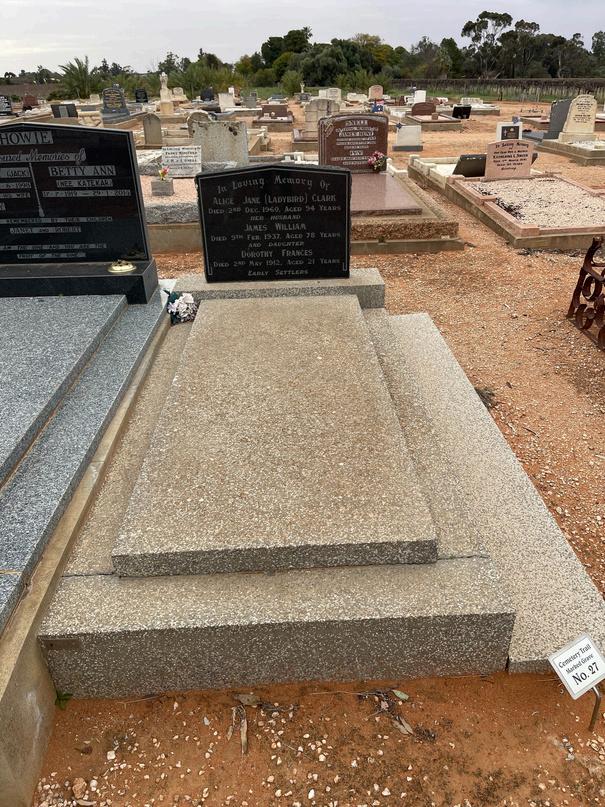
27. Alice Jane Clark 27. Alice Jane Clark
Alice Clark was the daughter of whaler John Kerrison from Norfolk England, who lived in the Victor Harbor area before Adelaide was settled. John Kerrison was one of 22 children, who married four times and had 11 children.
In her own words Alice Jane Kerrison was ‘looking for romance and adventure’ when she arrived in Renmark in 1888. She found immediate employment in the household of Charles Chaffey who was then living in the Paringa homestead while his own home ‘Olivewood’ was being built.
In 1889, Alice Jane married James William Clark, a London tailor and widower who had arrived in Renmark that year with his two young children. Mr Clark was one of Renmark’s earliest shopkeepers and in 1902 gave up his business to take on full-time fruit growing. His property on Tarcoola Street consisted of 54 acres of currants, oranges and sultanas. James William Clark c1859 - 1937 was the first grower to plant sultanas having obtained rooted vine cuttings from the Adelaide Botanical Gardens, which came originally from Kew Gardens, England.
Alice Jane Clark’s nickname ‘Ladybird’ was given to her by her daughter and she displayed a life-long ‘zest for living’. She surprised the district when at aged 80 in 1947, she planted 1000 orange trees. She took an active role in the management of her block assisted by manager ‘Snow’ Pendle until her death in 1960 aged 93.
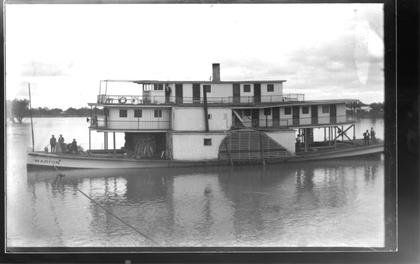
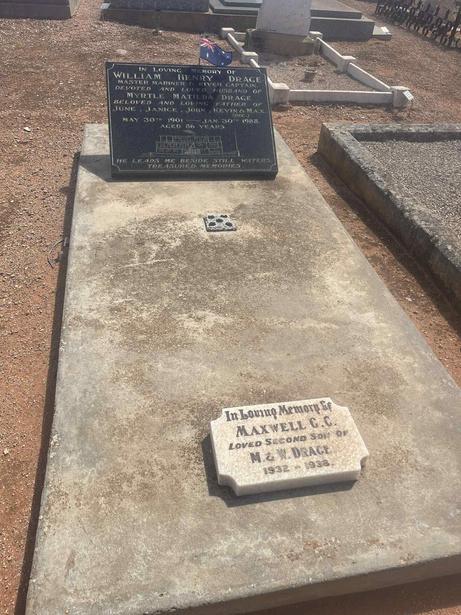
28. Captain William Drage 28. Captain William Drage
William Drage has a headstone depicting the Paddle Steamer Marion. In 1963, he was honoured to be called out of retirement to bring this old steamer from Berri to Mannum where she was officially re-commissioned in 1994.
William Drage was the fifth of nine children born to Sydney and Jane Drage who arrived in Renmark in 1893. He attended Renmark Primary School and started work as a messenger boy at the Renmark Post Office aged 13 and was then taken on as a telegraphist and postal assistant.
The river was his first love and he joined the crew of the P.S. Royal before joining the Navy aged 17. After his discharge in 1921 he returned to work on river steamers and obtained his skipper’s ticket in 1926. He steamed the Murray and Darling rivers carrying cargo and passengers and experienced first hand the decline of river trade in the 1930’s when it was overtaken by rail and more efficient road transport. In 1925, he married Myrtle Holcombe, a blacksmith’s daughter from Mildura and they made Renmark their home raising five children. In 1941, he left the river to work in the post office at Berri and in 1942 he joined the RAAF. After his discharge in 1945 he rejoined the postal service at Renmark until his retirement in 1966.
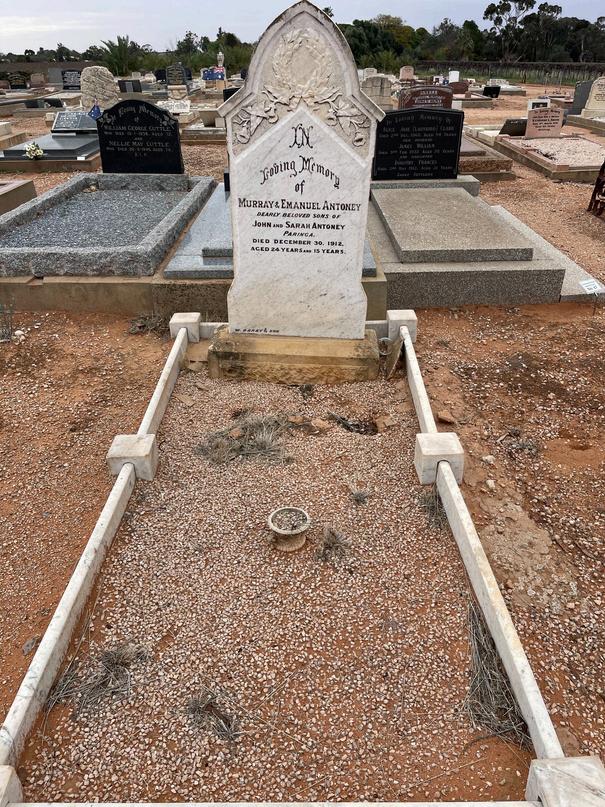
29. Murray Antoney 29. Murray Antoney
Emanuel Antoney Emanuel Antoney
Murray and Emanuel were the sons of John and Catherine Antoney (nee Merritt) who farmed in the Pike River district of Paringa. On 30th December, the two brothers went to collect some cattle near the river, intending to stay overnight and were expected back the next morning to collect a horse they had entered in the Loxton Carnival Races on New Year’s Day. When they failed to appear on 31st December it was felt they had gone straight to Loxton.
On 2nd January, a search party found Murray floating in the Rumpagunyah Creek in ten feet of water with his spurs held to a log. This creek was then forty yards across with a swift current and deep from bank to bank. The body of Emanuel was found on the morning of the 3rd January his body floating in the Pike River held to a snag by his clothing.
Emanuel aged 15, could not swim and it was supposed that Murray aged 24 came to his brother’s aid. Murray was described as a young man of great fearlessness and a splendid rider well known on local race tracks.
The funeral procession was an impressive one of no less than 85 horsemen headed by veteran mail coach driver Fred Plush.
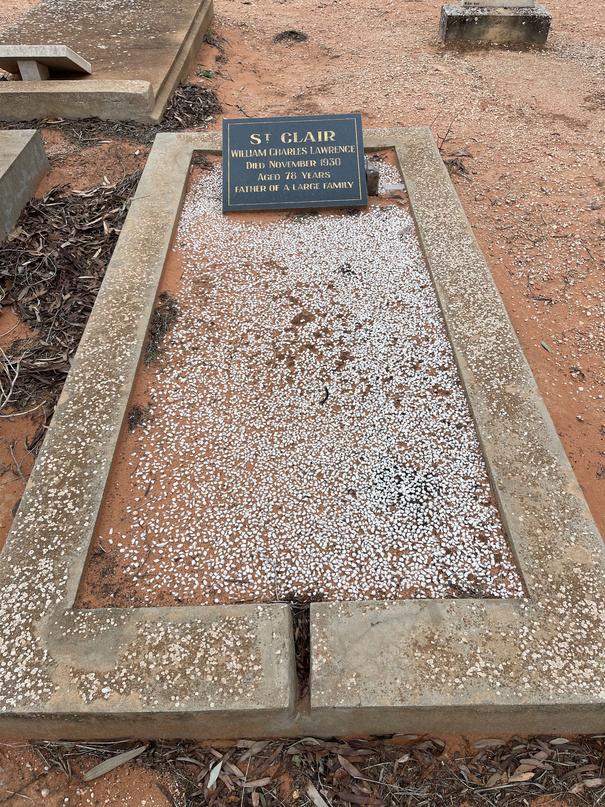
30. Charles St Clair 30. Charles St Clair
Charles St. Clair was born in Glasgow Scotland and joined the navy at a young age sailing to India, Africa and Australia. Leaving the navy he joined the merchant service and made long voyages to China and the Dutch Indies. During those years he experienced skirmishes with Malay Pirates and had been shipwrecked. He arrived in Port Adelaide in the late 1870’s and found employment driving mail coaches and then taking on shearing and droving work. In 1878, he married his first wife Maria Barty to whom he had seven children before Maria’s death in 1904. He arrived in Renmark in 1890, working on the erection of the Irrigation Trust building and on paddle steamers as an engineer. However, it was his combined lifestyle of fishing and gardening that kept his family for three decades. He supplied fish, lobsters, fresh fruit, vegetables and flowers to the Renmark Hotel.
‘Charlie’ made Renmark history when in 1921, then in his 70th year, he married Lilac Kirkbright recently turned 15 and daughter of his housekeeper.
A special licence had to be obtained as the ceremony took place on the groom’s fishing boat and their honeymoon was spent fishing for Murray Cod. The couple had five children before Charlie’s death in 1930. Lilac then married Claude Adams to whom she had two children and died aged 29 in 1936.
Headstone Project Headstone Project
The Headstone Project SA is a volunteer-led initiative committed to ensuring that no World War One veteran lies in an unmarked grave. Many returned servicemen came home, lived quietly in their communities, and passed away without formal recognition of their service.
The Headstone Project works to find these unmarked resting places and install official military headstones, a lasting tribute to those who served. Through detailed research and community collaboration, the project aims to preserve the memory of these veterans and acknowledge their contribution to Australia's history.
Each headstone tells a story that might otherwise have been lost to time.
In 2024, the Renmark Cemetery became part of this important project, with 16 World War One veterans finally receiving the recognition they deserve.
These headstones now stand as permanent markers of service, sacrifice, and remembrance within our local landscape.
To learn more about the project, access research records, or support their work, visit: www.theheadstoneprojectsa.org
Renmark Cemetery History Trail Renmark Cemetery History Trail
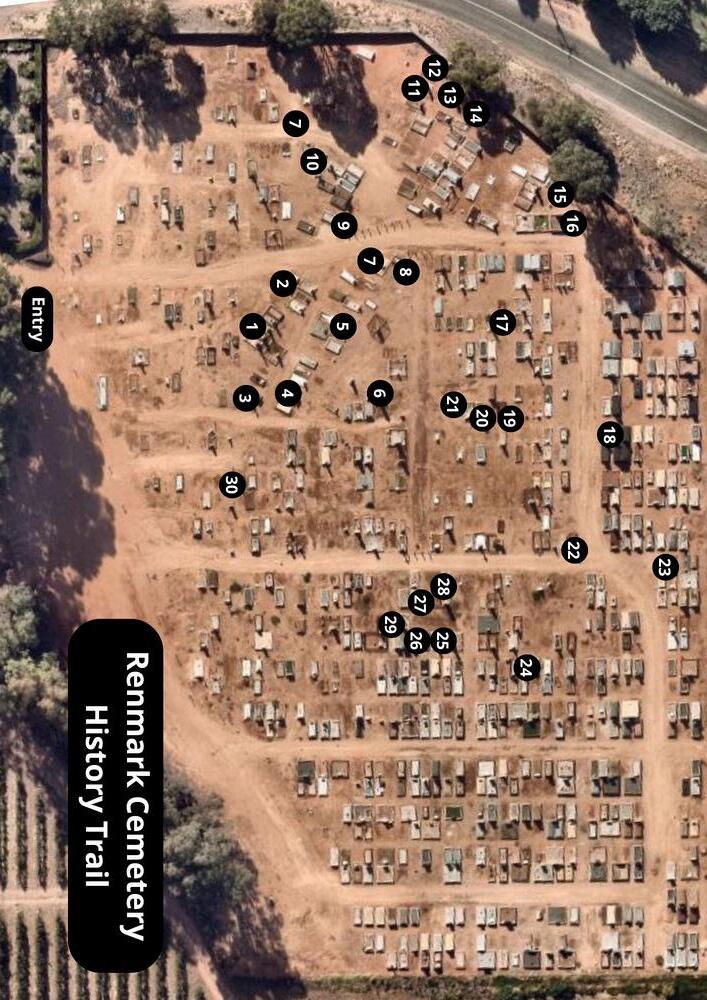

Renmark Paringa Council prepared the Renmark Cemetery Trail booklet to help acknowledge the rich history within the cemetery, which is under the care and control of council. This booklet is version 3 of the Renmark Cemetery History Trail.