SVNIT
APRIL 2019
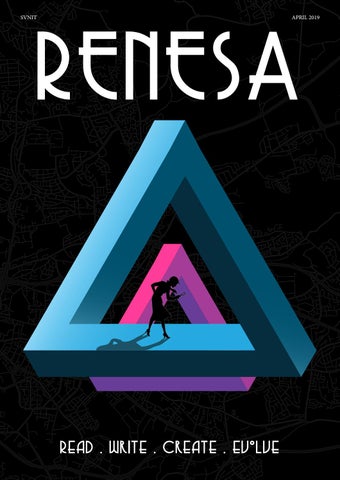
RENESA
Read . write . create . evolve
Editorial “Coming together is a beginning. Keeping together is progress. Working together is success.” Few years ago, if we were ever to be asked of what we took away from this quote, there would not be much to speak of. But after spending three years in Renesa, this quote resembles a diamond hidden deep in coal mines. Often, we’ve been asked, as to why the thought of Renesa dominates our minds. Little do they know about this prodigious family and their quirkiness. The seniors who deemed us capable enough to carry their legacy, the affable batch mates who work together late at night and straight into early dawns, and the juniors who have always surprised us with their interesting ideas and concepts. We have been through it all. We associate various emotions with this team, but the one that dominates is our sense of immense respect for our seniors. It has never been easy to lead a chaotic team with such grace and elegance yet provide them with enough freedom to experiment with their ideas. Now that we stand where you did, we see how persevering one must be. A standard Renesa issue has all its articles connected by a single underlying theme. This time, we have decided to go with the theme ‘Patterns and Predictions’. It is said that human beings spend an eternity looking for patterns in almost everything they see. From the food they eat to the tests they write, humans tend to find non-existential patterns. And what do they do with these patterns? Like any other aptitude test, they try to derive predictions from them. Like any other Renesa issue, we have tried to cover a range of topics varying from sports to current affair; and how can we leave out technology? We pride ourselves on being a part of one of the best technical institutes in the nation. Hence, it seems illogical not to make it a major part of any Renesa issue. We have been blessed with an awesome team that never stops growing. With this said, we present the latest issue of Renesa. This is our token of love and respect, for all the good times we have been through. We hope that we’ve made the readers and the faculty feel satisfied with our work. Amrita Mohanty Chief Editor Tharun Balaji Chief Editor
Contents BUTTERFLY EFFECT
2
THE BIZZARE WORLD OF FINANCE
4
GAME THEORY
5
HOUSING MARKET CRASH 2008
7
MURDER MYSTERY
9
PLANES, TRAINS & OSCILLOSCOPES
11
ELECTRIC CHINGAM
12
SIX DEGREES OF SEPARATION
13
ARTIFICIAL EMBRYOS
15
SOLAR_64
18
REVIEW
19
Cover & Editorial Illustrator : Sahil Pathan
BROTHERS IN BLOOD Phantom Thief
A group of five friends, leading perfectly normal lives, who would have thought it would all go south, all of our lives destroyed forever. Before I give into my owes, I’m Sam. The other person you need to be introduced to is Ken, the one responsible for everything. My friends and I attended the same high school, and would meet up at canteen during breaks. It was during one of these meetings, that I doomed us to a fate so foul, there was no escape from it. Ken and I were the quiet ones, while the rest of the group spoke. We loved listening to their misadventures, tales of boyish heroism that amused us endlessly. One day, I heard Ken clicking away. On a closer observation, there was a peculiar pattern that caught my attention. Click clack clickclack clackclackclick clack clackclack click clack clack. The same sequence, with a pause of 10 seconds between each cycle. It was easy to memorize, and in that godforsaken moment of mischief and immature decisions, I decided to mimic him. It took Ken some time to register what was happening, but the moment he did, he looked up at me, the shock was evident. I beamed at him, happy that my little prank had gone through, and that was the last time I had ever been happy. As we parted ways, Ken came over to me. “Hey, if it is fine with you, could I possibly come over to your home, tonight? I just wanted to talk of how we could do this with others.” Well, my friend wants to prank others too now, this was going to be a fun adventure, just for us. I agreed upon meeting up and the rest of the day went by quickly, lined by 1
Renesa
my slight excitement for the meeting. I remember waiting for Ken, while watching the documentary of 'Brothers in blood', an excellent one, if I say so. It wasn’t long before I fell asleep. I woke up several hours later, to a room so dark, the vampires could make it their lair. The sheer eeriness of the atmosphere was hard to miss. I turned around in an attempt to see what was going on in the room. “Hey” Ken was here, but something was terribly wrong with it all. “What’s it with the darkness, Ken?” A very logical question, if you ask me. “I was making our task easier.” With this said, he pulled out a knife, dripping blood all over the floor. With every drop of blood that hit the floor, I could feel mine drain. “What have you done?” It was a question, yet it sounded more like a plea for benevolence that had no place in the room. “Don’t worry Sam, others are taken care of, you know how hard it is to come across someone like us, who shares the same inhibition and zeal to follow our passion.” “What are you talking about?” “Our friends and family Sam. You understood my message in the canteen right, the Morse code, so I just went ahead with it. The clicks were dashes, and clacks the dots.” Whatever little blood was left in my body drained faster than ever.Without wasting any time, I bolted out of the door, with Ken following me closely. I lost everything dear to me that night, and have been on the run ever since. I’ve moved away from it all, but ever so often, I hear that clickity-clack, making its way to me. Cooing me to sleep, for it has unfinished business to attend to.
BUTTERFLY Saptarishi Pandey B.Tech II | Mech
EFFECT Nisarg Desai B.Tech II | Mech
Henry Tandey was a decorated British soldier, fighting in the fifth Battle of Ypres when a wounded German enemy came in his line of sight. Seeing him unarmed, Tandey chose mercy over justice and let him go unharmed. This German soldier was a young Hitler, who later went on to kill 6 million Jews and caused World War II. Let’s go to 1961, when the scientific community was taken aback when the findings of Edward Lorenz broke all grounds of predictions. Until then, scientists believed that seemingly minuscule changes in the start would only produce tiny, if noticeable, changes in the results. Lorenz was a meteorologist and mathematician, trying to create a model depicting air flow in the atmosphere. While running simulations for weather forecasting, he noticed his output deviate from the expected path when he punched in a rounded off 0.506127 to a value of 0.506 on his computer. While the simulations were similar in the beginning, they soon diverged to a point where they were hardly relatable and looked like different models altogether. He realised that a tiny change in the initial conditions, like rounding off, made huge differences in the result, perhaps something as insignificant as a flap of the wings of a butterfly could trigger a chain reaction leading to a storm somewhere else. This went hand-in-hand with what mathematician Henri Poincare had hypothesised, that small changes in initial conditions have drastic changes in final results. Lorenz later went on to pioneer Chaos Theory, a branch of mathematics which dealt with systems like these, having highly sensitive initial conditions.
This ‘sensitive dependence on initial conditions’, often called the Butterfly Effect, is the cornerstone of modern-day Chaos Theory. It has practical applications in formulating predictive models which account for all variables, in fields like psychology, robotics, weather forecasting, sociology, career counselling- to name just a few. Chaotic systems are often dynamic and complex, containing multiple variables, which even if changed slightly, may cause massive implications down the road, but are in no way random or unpredictable. They are governed by solid rules. Often, a system which appears chaotic can become deterministic. The best example of this is nature itself. Nature is a system governed by a googolplex of variables, yet, there are fractals and patterns seen everywhere, from the petals of a flower being spirally arranged, snowflake structures, to the shape of ammonite and galaxies. Chaos Theory, unlike classical science, highlights the fallacies of the typical way in which we predict things, and emphasizes that the small choices we make could lead us to something radically different than other choices. If you hadn’t read this article, maybe your life would have gone down a completely different path. More importantly, had Tandey instead shot the young and wounded Hitler, could the Second World War have been avoided? Renesa
2
Winner Winner Chicken Dinner Tharun Balaji B.Tech III | Trical
The movie ‘21’ was one of the first movies that I saw which was based on the concept of predictions. It basically explored the idea of how the casino game ‘Blackjack’ is predictable, and how a group of players can beat the house. This led me down a rabbit hole as I ended up watching a lot of movies involving sports and betting. So today, I’ll try to break down the so-called predictions and patterns in betting by taking the example of football. Let’s start with the most basic term in betting, odds. Odds tell you the chances of a team winning according to your bookmaker or bookie. So if a team is assigned an odds of 3/5, it basically means the bookie believes your team has a 5/(3+5) x 100=62.5% chance of winning, and for every Rs 5 you bet, you can win Rs 3, assuming that your bet is correct. Stronger teams like Barcelona and Real Madrid are usually assigned lower odds i.e. they are more likely to win, and various other factors like venue, form and injuries play a part in assigning odds to a given team for a given match.
brain trip Anya Trivedi B.Tech III| Comps
3
Have you ever wondered what a sensory condition, foot obsessions, and tripping on psychedelics have in common? Well, they all involve glitches in the brain’s ability to recognise patterns.
Scientists often call the human brain the most elaborate patternrecognition machine that has ever existed. It contains some hundred billion neurons, each of which wires itself up to thousands of neighbours (the neurons seem to obey the famed ‘six degrees of separation’ rule: no two neurons are separated by more than six steps), creating a ridiculously well-connected parallel processor for analysing data. All humans subscribe to a standard wiring plan, where certain patches of neurons can recognise specific input patterns, such as colours, sounds or Monopoly defeats.
Renesa
Predictions are easy to make in football. In majority of the games, there’s a clear favourite. And weaker teams playing at their own stadium are usually given favourable odds for a draw as they have the psychological advantage of playing in front of their own fans. Form can be another factor in predicting the outcome of a game. And if you have no idea about the sport or the teams involved, you can always have an octopus or a cat make predictions for you. These predictions, along with the odds assigned by the bookmakers, are useful in ‘Full Time Result’ betting, in which you can bet on whether a team will win, draw, or lose their next game. But establishing patterns is very difficult in football, or any other sport for that matter, as long as the event is not fixed. At the end of the day, we need to remember that any sporting event can spring a few surprises every now and then. Let’s not forget the Leicester City team of 2016, which overcame the odds of 5000-1 to win the Premier League. Predictions may be based on which team has the better players or which team is on a hot streak, but David did beat Goliath, didn’t he? So the next time you’re having a friendly wager with your roommate, remember there’s always a slight chance that Barcelona might lose. Or in Manchester United’s case, a decent one. But what happens when that plan has a glitch? For most people, one sensory input ‘pattern’ produces one sensory output, or ‘pattern recognition’. Chai simply tastes like chai; a violin simply sounds like a violin. For people with synaesthesia, an extraordinary sensory condition in which people’s senses blend together in trippy ways, one sensory input leads to multiple sensory outputs- the expected chai taste, with, say, a phantom tone- with these extra sensations being both involuntary and consistent: each time the habitué drinks chai, the exact same tone floods her ears. The most common type of synaesthesia provides a symphony of colour, especially when people read certain letters or hear certain sounds. While most of us only see impending doom when faced with mathematical equations, renowned theoretical physicist Richard Feynman saw beige j’s, indigo n’s, and chocolate x’s in them, and composer Franz Liszt often berated his orchestra, who could only stare back in bewilderment, for playing his music the wrong colour.
While their stories may seem to have a tragic underlying theme of substance abuse, both Feynman and Liszt credit their shared psychedelic experiences of synaesthesia to brain geography. The clusters of neurons which analyse patterns of colour, text and sound lie in close proximity, so signals can easily leak across borders. This phenomenon is also commonly experienced while experimenting with hallucinatory drugs, like LSD. Interestingly, the regions in the brain associated with different
parts of the body are not ordered according to their physical structure, meaning that the region which controls the feet does not lie below the legs, but lies near the clusters controlling the nether regions. This proximity may cause the neuron circuits that process one sense to accidentally activate the circuits that process another, causing them both to ‘fire' simultaneously. This explains why some people find feet stimulating to places which are, well, not feet.
The Bizarre World of Finance Protection is a necessity for any human being. Guaranteeing your survival depends on the assurance that everything will be alright. Your money, your belongings, your secrets, everything needs this invisible barrier not meant for the wrong people. But what happens if it becomes too much? The world of finance plays this game with you where they smile and give you a hug, while simultaneously holding a knife to your back, constantly searching for a chink in this armour that we call ‘being content’. Imagine this: six people in a room, with each and every one given the same amount of money. The objective of the game is to pass around these scraps of paper from one owner to the next, in a series of analytical moves. At the end of the game, regardless of what each player has, we can all agree that the value of that particular currency does not change. Now, what happens if instead of six people playing the game, it’s every banker across the American and European continents? Banks have always been a medium of exchanging money between the people who desperately need it and the people who don’t. What actually happens is completely a different story. We could think of them like as Robin Hood, except they are not. Statistics show that only 3% of the bank’s assets are lent over to the general public. 97% of the time, it’s just banks dealing with other banks and on the table, is something we call a secondary assetprotection. This raises the question- if all banks do is trade among each other, why do they earn so much? There are two ways this happens. In his book, ‘The Great Crash, 1929’, John Kenneth Galbraith
Sanskar Panda B.Tech II | Comps
introduces the world ‘bezzle’. Say you pass by an opportunity to make money off an asset. The next day at work you spread this to your colleague, making them willing to pay you money to help them make some too. This keeps going on until a lot of people just assume that they have all made a profit. Suppose later you find out the asset wasn't worth as much as you thought it was. So, over time, people have created this imaginary pool of wealth, rendering everyone a little bit richer in this fancy world. This is what a bezzle is. Here everybody thinks they’re winning until the dagger twists, finding that small chink. This is one way a profit from their consumers. Tailgating is another way. The fundamental idea of tailgating is to make a small sum of profit on a regular basis over a large period of time. In the streets of France, any vehicle going under a certain speed gets tailgated by other vehicles. Tailgating vehicles gets you from point a to point b faster than someone driving rationally. Useful right! Except, about 1 in a 1000 times there's someone who dies on the street. This practice, similar to that of tailgating vehicles, however legal, is deemed very unethical. The small things in life matter. Take the great depression of the 1920’s or the debt crisis of 2008. An illusion that more than one party was profiting from the same asset lead to a misunderstanding later realizing there never had been any money to begin with, leaving a nation in chaos. The services of banks and the magic of finance are necessary in the modern world. What’s scary is that, the recurrence of such trends leads to an even graver situation. After all, we aren’t the best at learning from history. In the end, it often comes down this one question. Is everything necessary always good?
Renesa
4
repeated. For example, in the above scenario, allowing a discussion between the guilty parties before either of them are required to confess may result in a more cooperative result.
GAME THEORY The art of predicting what to do next Aashka Trivedi B.Tech III | Comps
Yukta Malik B.Tech II | Chemie
Close your eyes and think about a professor you absolutely loathe. Think of all the times he wronged you, all the marks he took from you and all the dreadful morning lectures he inflicted upon you. Now assume that you and a fellow professor-hating acquaintance find out where he lives. Being the mature, rational adults that you are, you both would probably do the most mature, rational thing you could do with this information- egg his house. But what happens when he finds out, and wants at least one of you to confess to the crime? Moreover, he offers a bargain: if neither of you confess, you will both be suspended for 3 weeks. If only one of you confess, then the person who talks goes free with an unblemished record, while the other is suspended for 10 weeks. And if both of you confess, you are both suspended for 5 weeks. Now at this point, I’m sure you have nothing but your spotless record going for you. So then, what would you choose? Would you choose in favour of mutual interest? Or would you let some psychopath poach a potential friendship? This is a scrambled variation of a popular problem known as the Prisoner's Dilemma, which is one of many examples that can be analysed by a little tool that economists like to call “Game Theory”. Game theory is basically the study of how self-interested participants would behave in a strategic environment, and how these interactions should be structured in order to lead to a good outcome. It also analyses how the result of such a situation would change if participants were allowed to interact, or if the situation (aptly called “game”) is 5
Renesa
Think of the game PUBG- while you’re putting maximum effort to get yourself or your squad a chicken dinner, you might not realize it, but all the tactics you use employ game theory. The drop, how you place yourself, the direction of your movement and the ammunition you use, all depend on what actions your opponents have decided to follow. Thus, your moves depend on the moves of other players, i.e. other self-interested participants. Such strategies of play are an important aspect of game theory. Another prominent concept is the Nash Equilibrium. Simply put, this is a set of moves that will leave no one wishing that they had done something else. Fundamentally, this is what defines game theory- not trying to win, not trying to ensure that your opponent loses, but trying to find the best action pattern for yourself, irrelevant of how your environment reacts. You may wonder, are these abstractions limited to the realm of games? Not in the slightest. For example, instead of a PUBG map, imagine being dropped in a stock sale. It might seem like a rather appalling idea to those addicted to the game, but trust me, it involves the same concepts you were trying to use before. Predicting the moves of your opponents, anticipating the stocks they would choose to invest in, and then making your own strategies based on them to maximize your profits (basically finding out the Nash Equilibrium), is what traders have been doing for years. “What all effective traders have in common”, as Keynes, one of the most influential economist of the 20th century wrote, “is the ability to guess better than the crowd, how the crowd will behave.” And not just economics, game theory is being used in a myriad of fields. Analysing football games, Spanish economist Ignacio Palacious Huerta spent years building a database of thousands of penalty shootouts. Obviously, no one can perfectly predict how the world’s best shooters and keepers would respond to a given penalty, but Huerta had both a sound understanding of game theory as well as enough data to anticipate a response with more accuracy than anyone else. In recent years, a grow
ing number of football teams have been hiring economic analysts and game theorists to help predict the best course of action in different game scenarios, largely based on Huerta’s work. As ESPN’s Simon Kuper puts it, “finals are often decided on shootouts. And shootouts are increasingly being decided by science.”
telligence, competitive or cooperative economics, political negotiations, or a redundant mobile gamegame theory can be used in almost every scenario of our daily lives. It has helped us learn the art of making prudent decisions, has made us take risks, and also understand the pattern of change. So, the next time you feel like ratting out your peers, maybe analyse the math behind it.
Whether it’s sports, the stock market, artificial inalready taken place. Encountered frequently in nature, this type of distribution is called a Power Law. It is very likely, for example, for a big earthquake to be followed by another large one.
THE MATH BEHIND MURDER
Rhishabh Goswami B.Tech III | Chemie
Psychologists agree upon certain behavioral traits common to most serial killers: impulsivity, lack of remorse and predatory behavior. Serial killers are also very likely to have been victims of abuse – both emotional and physical – and are often found to be inclined towards some not-very-orthodox fetishes. Psychological evaluations aside, it might now be possible to predict a serial killer’s pattern of behavior using mathematical analysis. Researchers from UCLA have modeled the murder rate of Andrei Chikatilo, a serial killer who did away with 53 lives back in the 1980s. Turns out, the distribution of murders that he committed is very similar to a mathematical pattern followed by earthquakes, epileptic fits and a bunch of other natural phenomena.
In the case of the serial killer, the outcome may be explained on the basis of neuronal firing in the brain. Every neuron is connected to thousands of others, so a single triggered neuron can fire a bunch of neurons close by. This is how signals travel in our brain. However, once triggered, a neuron needs time to cool off and cannot fire again immediately. Thus, the cascades of neuronal activity are usually small and short-lived. And yet, sometimes, when conditions are ripe, neuronal excitation can cross a certain threshold, causing triggers to sweep across the entire brain. These threshold-crossing cascades occur after time intervals determined by the Power Law. And it is exactly these neuronal firings that would flood a serial killer with the urge to kill. So the researchers from UCLA simulated a pattern of neuronal firing, noting how often it surpassed a given threshold. The model was simulated for a period of 12 years – that’s the number of years Chikatilo was active for. Turns out, the model fit almost exactly with the distribution of the murders he’d committed. This same phenomenon of neuronal firing can be used to predict the behavior of drug addicts as well. Now these findings are all very exciting but then, they beg the question: are serial killers merely puppets of a natural biological process? So how blameworthy are they exactly?
An almost-straight line, with a negative slope, is obtained when the intervals between his murders is plotted against the number of times he had to wait that many days, on a logarithmic scale. In other words, it shows that the probability of another murder is much higher soon after a murder has Renesa
6
HOUSING MARKET CRASH 2008 Mrityunjay Mohan Borah B.Tech III | Mechanical
I was only halfway through the movie “Big Short” when Margot Robbie appeared in a bubble bath. She made me realize that I was completely oblivious to the terms they were using to describe the housing market crisis of 2008. She also told me, in a not-so-subtle way, to get out and do some actual research on the topic. Personally, I feel Margot Robbie could’ve been kinder. But Margot Robbie’s dialogue delivery and kindness are not what we’ll be discussing here today. We will be talking about the housing market crisis of 2008 which affected nearly everyone on this planet. First, let me outline the main characters in this game and their respective roles. The foremost individuals were the investors who had tonnes of money and were on the lookout for a good investment to increase their capital. Before 2002, they invested in pieces of paper which were known as treasury bonds. These bonds were extremely safe investments. However, in 2002 the return rate of the treasury bonds reduced to 1%. This was an extremely low return on an investment. Hence, they turned their investments towards the housing market since the prices of the houses were escalating at that time. The process of buying and selling of houses is very simple. Say, there is a family that wants to buy a house using down payments. There is a lender who passes or declines this family’s loan request based on their income papers, available assets etc. After proper verification, if the home owners qualify for a loan, they buy the house and submit a mortgage to the lender. Worrying about what mortgage is? Another piece of paper which says that if the family defaults on its payment, the lender can take over the property and sell the house to another buyer. 7
These mortgages were then bought by the banks Renesa
who hired credit rating agencies for classification and rating of these documents. These agencies bundled a large number of such mortgages together and categorized them as either safe or risky investments. Investors bought the safest investments from the investment bankers. At each transaction, the owner of the mortgage made a nice profit. Even if the home owners don’t pay up, they still had the house which they could sell. But the investors got greedy. They wanted to invest more money in the housing market. Thus, the banks borrowed a huge sum of money to buy more mortgages. The investors started putting pressure on the banks and the banks in succession compelled the lenders to procure more mortgages. Accordingly, lenders started sanctioning loans to families without proper document verification. Then they sold these papers to the banks and the cycle repeated. The mortgages were like the class topper’s notes which are generally passed from one student to another before exams. So, the institutions thought that as soon as they sold these bonds to the next body in line, they were free from the responsibility. After some time, the obvious situation took place. The families with unstable income stopped paying their lenders. As a result, more and more houses were put up for sale. Since the supply was more than the demand, the price of houses crashed. Now, what about the families with stable income? Well, they joined the crowd when they realized that they were paying much more for the house than it was worth. But by this time every institution in line were holding thousands of these mortgages. Oh, and remember the loans the banks took to acquire more mortgages? They were acquired from the Federal Reserve of USA which were offering treasury bonds for just 1% interest. In 2008, the time bomb finally blew off. Suburban areas which were once densely populated became deserted. The Federal Reserve estimated that there was a total of 2.25 million foreclosures in 2010 alone. The unemployment rate went up to 10% from a former 5%. Thousands of people lost their homes, the economic growth of the country clogged, the housing market crashed, many institutions declared bankruptcy and there was complete mayhem. But despite knowing all these details don’t you think Margot Robbie could’ve said her dialogue in a more benevolent way?
Beethoven’s deaf music Shivansh Shandilya B.Tech I | Civil
It’s something of a task to compose good music because it involves coming up with tunes and expanding upon those tunes using scales and notes and chord progressions and time signatures. But all the music in the world - from complicated (or sometimes simple) modern day contemporary and EDM to yesteryear classics – is based on math. Case in point - the famous composer and pianist Ludwig van Beethoven’s works. Beethoven started losing his hearing in his late 20s. Despite that he created some beautiful compositions after his hearing took a toll.
He’d sit in front of his piano and feel the vibrations of the notes. Consequently, his composition style also changed - due to his inability to hear the high notes, he used more of the low notes. He relied heavily on his imagination and 3 decades of listening and creating music for composing his pieces but also unknowingly employed mathematics (for he never took any higher mathematics classes). According to music theory, there are 12 notes (A,A#,B,C,C#,D,D#,E,F,F#,G,G#) and a major chord is made of the 1st, 3rd and the 5th notes of the given scale. These chords are known as triads. In the first half of Beethoven’s Moonlight Sonata, for example, three notes in D major – D, F sharp and A are used together, creating, what is known as ‘consonance’, which is the kind of thing that sounds ‘right’, `musically. This is why a lot of music theory stresses upon the usage of chords based on scales because they sound good together. In a nutshell, all the music we hear is math. This gives us another reason to appreciate it all the more.
The Baby, Maybe Sumant S. Dangi B.Tech I | Chemie
Let’s go back to the time when you were just a little baby. In those days, everything fascinated you, the voices around you, mum’s long hair, dad’s bushy moustache, your colorful blocks set, and also Fluffy the teddy bear. Babies are born ready to learn and grow, with all the brain cells they need for their whole life. However, it is the connections between these brain cells that make the brain develop and capable of performing more complex activities. During the initial years of a child’s life, nearly 1 million new neural connections are made in the brain every second! Curiosity and the undeniable exuberance of youth fuel the child’s growing understanding of the world around them. Through everyday experiences and interactions with parents, caretakers, family members, and other children, the child develops physically, mentally, socially, and emotionally. One aspect of learning that cannot be ignored is patterns. As babies grow older, they start to identify and recognize patterns in the sounds they hear, shapes and colors they see, odors they smell, and
objects they touch. The neurons in their brains interconnect in increasingly complex ways which allow them to move, think and speak in a more complex manner. Why do you think kids are told nursery rhymes? Yes, one reason is that they enjoy listening to them. However, the auditory patterns in the songs help the children identify similar sounding words, not only increasing their vocabulary, but also providing them with catchy tunes that they love. Old McDonald had a farm! Eee-yaaah-eee-aiooh! Kids realize that the numbers they have been introduced to are used and repeated in real life and begin to use them to count objects and eventually, do math. Parents should provide children with a diverse range of fun and stimulating activities, which doesn’t always mean breaking the bank. For a child, a simple spoon and pot can be as intriguing as a 3000 rupee drum set. What’s important is that they are provided ample opportunities to grow, and improve their motor, emotional, and social skills along the way.
Renesa
8
MURDER MYSTERY Famed cryptologist Dr. Brown has been murdered in his apartment. Observe this image for clues and connect the clues to find the killer
Illustration : Sahil Pathan
PLANES, TRAINS & OSCILLOSCOPES Amey Kulkarni BTech III | ECE
By now, most of you, if not all of you, have been acquainted with the electronic instrument known as the CRO, or the cathode-ray oscilloscope. It’s otherwise known as the one instrument in the EC lab that if one were to figure out how to use, they’d deserve a medal. What an oscilloscope does is pretty simple, it gets a voltage signal from a source that’s connected to it as input- then displays that signal to the user. It’s used for testing a variety of electronic equipment. Sounds fun, doesn’t it? Enter sound itself. A signal. One that can be transmitted through wires such as the ones on your pair of earphones, in the form of data as an electronic signal. That’s something the oscilloscope can pick
up. This allows the user to witness the sounds coming out of a device such as your own phone, come to life in the form of a signal. Most likely you won’t see that the signal has much of a pattern, or any shape in particular. Enter Jerobeam Fenderson, an Austrian YouTuber with a channel full of music that plays on a CRO, but looks, and sounds, unlike anything you’ve seen or heard before. Using a specialized software to generate specific shapes out of audio signals, what he achieves is an audiovisual experience that blends the new age sound of electronic music and the familiarity of the CRO display, which shows its age due to the analog nature of the display as opposed to digital. The result is green, rhythmic patterns of asteroids, spaceships, bicycles, mushrooms- basically anything Jerobeam wants it to be. It’s an incredibly unique way to tell a story. It’s also a unique endeavour in approaching just how we interpret sound.
D LS S T EC H N O LOGY Haider Sultan B.Tech II | ECE
Unless you have been living under a rock for the past few months, you will be aware of NVIDIA’s latest Turing-generation of GPUs. The RTX lineup of cards come with a ton of new features but the most significant changes were the introduction of Ray Tracing and DLSS techniques. We will be discussing more about DLSS. DLSS stand for deep-learning super sampling and it’s used for anti-aliasing. Anti-aliasing is the process of making the jagged edge of a pixel look smooth which makes the end result look clean and splendid. Typical methods like MSAA, FXAA or TAA were used in NVIDIAs previous cards for anti-aliasing but DLSS outperforms all those methods. NVIDIA claims that DLSS can achieve near 64x super sampling with less performance impact than traditional anti-aliasing. It is achieved by pre training data sets for each sup11
Renesa
ported games and then pushing those results out via driver updates, i.e. they use AI to render the final image as seen by the user, which will create a better and much cleaner end result with less of an overhead. The tensor-core powered AI is used for DLSS. Although it is still unclear as to what DLSS exactly does as NVIDIA has been very discreet about it and also there isn’t actually any game available as of now to completely understand it. NVIDIA demo shows how DLSS improved the frame rates and performance in Final Fantasy XV, and more tests by individual consumers show that the RTX2080 with DLSS on outperforms the 2080Ti with DLSS off. DLSS surely looks promising and eventually we will see more game come out which supports this, till then let’s just enjoy playing minecraft with jaggys.
Tanisha Tambi B Tech II | Comps
Ever fancied eating a particularly fashionable pair of pants? Crazy thought, right, but what’s crazier is how your fleece is still ending up in your fish. As recently discovered, one of the biggest source of ocean pollution is the microfibers being washed out into waterways by laundry machines. But we’ve been wearing synthetic clothing for over a century and being baffled by the presence of plastic in the ocean for nearly a decade, so why is it that you’re only hearing about it now? Simply because, these tiny troublemakers were too tiny to be detected by the sampling methods used, be it fishing nets or sorting physically without enough magnification. But fret not, as the smartest species on the planet, we did find a way to slow down the inevitable doom and destruction. Enter cora balls. Cora balls come from the non-profit Rozalia Project and as the name suggests, cora balls draw inspiration from the corals which does exactly what was required, catch wandering little things from flowing water. What a cora ball does is catch those flowing pieces of microfibers before they exit the laundry machine, so the water flows out but the harmful waste doesn’t make it to the waterways. As all good things go, it’s not perfect. They can’t be used with delicate items and leaves around 65% microfibers untouched, still its creators say that even if 10% of the US households use a cora ball, plastic worth 30 million water bottles can be prevented from entering the waterways. Easily reusable, cheap to buy and made from 100% recycled plastic, these act like little protectors of air and water. So next time the chair overflows and you find yourself on the familiar quest for clean clothes, throw in one of these and see the magic unload.
electric chingam
Sumant S. Dangi B.Tech I | Chemie
When Veruca Salt put a piece of Wonka’s everlasting chewing gum in her mouth in Charlie and the Chocolate Factory and enjoyed a 3-course meal in a few minutes of chewing, we watched in awe. When she swelled into a giant purple blueberry, we also watched in awe. Sure, such things look good on silver screens, but one doesn’t really expect such marvels to come to life. Hold your horses people! The idea of an infinitely lasting gum flavor is finally close to becoming a reality. Japanese scientists at Meiji University have developed a type of chewing gum that shocks your tongue when you chew it. Don’t worry, this isn’t a Ben Franklin-gettingstruck-by-lightning kind of shock! This occurs due to the “piezoelectric effect”, a phenomenon that produces charge in some materials when they are pressed or squeezed. This current stimulates the tongue and produces a sensation of taste. You’re getting a flavor hit without any actual chemical flavoring! The thought is mind-boggling. The gum consists of a piezoelectric element and small electrodes enclosed in a saliva-proof covering. Currently, the chewing gum is in the development phase, and it only produces a bitter and salty taste. However, soon we may have access to countless flavors that last as long as you’re chewing. The unlimited electric gum may have numerous applications in the field of virtual reality (VR). Until now, VR mostly involved manipulating sight and hearing, but now, developers may even be able to manipulate taste. Renesa
12
SIX DEGREES OF SEPARATION Mir Bhatia B.Tech III | Comps
Human beings are social animals. We love to form networks and groups of various sizes, but on average, a normal person (not you, for sure) has around 40 friends, according to a study conducted. From personal experience, and I’m sure you can relate, the number of acquaintances is definitely more - you know a lot of people, but not everyone you know is your friend, yes? Let’s play a game now, shall we? Let’s say you’re a social disaster, and that you suck at making friends. Given that a normal person has 40 friends, say you’ve got only 20. That seems doable, yes? I mean it should be, you’re not Adolf Hitler. Add around 30 acquaintances (people you know by name and could technically have a conversation with, if need be), and you have a real life social network of 50 other individuals. Now, don’t get offended. I know that you’re super popular and that you think you’ve got 2000 friends, because Facebook, but for the purpose of this exercise let’s stick to the 50. Even if you know just 50 people, when you do the math, and it’s doable math, you end up with an astronomical figure of 15 billion (yes, that’s a billion with a b). 50 to the power 6 is 15.6 billion, double the current population of this world, and that in essence is what 6 Degrees of Separation is all about. It says that if you connect people who know each other, and then they connect to people they know, and so on and so forth, in 6 connections you could
HOW DEFEATED GERMANY Kapil Dedhia B.Tech I | Mech
13 Renesa
reach any individual alive, from Michelle Obama to Kim Jong-un and everyone else in between. It’s a theory, first introduced to the world at large by Hungarian author Frigyes Karinthy in 1929. He wrote that because of advancements in technology, the world was growing ‘smaller’ and in a story hypothesised a game where he believed that any one of the 1.5 billion people alive could be connected to him through a network of 5 personal acquaintances alone. Research since then has been continuous, and modern tech has helped. In 2007, an experiment involving a data set of 30 billion messages and 240 users showed that the average path between Microsoft Messenger users was 6, further supporting the theory. If anything at all comes out of this ‘social experiment’ of sorts, it’s that we’re all very close - much closer than any of us expect to be to one another, really. In a world that seems more disconnected with every passing day, where it’s becoming harder to relate to other people living in your building, forget the wider world, it can almost be comforting to know that you’re only 5 connections away from the rest of us, from the rest of humanity, and also 5 away from the next Osama Bin Laden. Fascinating, huh?
What would you do if there was a tiny red dot on the free parking space of the Monopoly board you’d purchased? You wouldn't be perturbed, I assume. Tell you what, the Nazi soldiers weren't either, even when hundreds of these Monopoly sets were sent to the Allied prisoners during World War II. Why they should have been bothered is what we talk about here. The Geneva conventions allowed prisoners to receive parcels from humanitarian organisations. MI9, the secret department of the British Government responsible for helping prisoners of war, saw
this as an opportunity to smuggle maps, compasses, currency and other items to help prisoners escape. How they chose Monopoly is a bit of both luck and cunning. They wanted to print maps on materials hardier than paper. Silk and rayon were the best alternatives. Waddingtons, which also happened to be the licensee for Monopoly in Britain, had mastered the art of printing on silk. They agreed to prepare special edition sets with carved depressions where escape kits could be hidden. Special codes were used to indicate the ministry about which map was concealed inside a particular game. Apart from Monopoly, playing cards, pens, and gramophone records were also used to smuggle escape kits. The cards, when immersed in water, would break into three parts. The four aces would give a mini-map of Europe. The other 48 pieces
would combine to form a large-scale map of the area that a concentration camp was located in. The joker would have the key to the codes being used in the maps. Gramophone records, on the other hand, would have miniature compasses enclosed within them. To not compromise charitable organisations like the Red Cross, MI9 set up fictitious organisations based on fake addresses. Games and entertainments were permitted as the guards believed that diversions would cause prisoners to be less troublesome. By the end of the war, around 1.4 million maps were produced and it is believed that around 15,000 prisoners escaped using these kits. Just to highlight the enormity of the task, in the words of army intelligence officer Lieutenant Colonel James Yule,“ Without Monopoly, there would be no England.”
D A S S AU LT A S S AU LT Adi Saggar B.Tech II | ECE
India’s single largest defence deal, a contract worth $ 7.7 billion is now entangled in a political fiasco. The Rafale Deal has become a contention point for the upcoming general elections, with even the Supreme court getting involved. However, what is more surprising is the general lack of knowledge about the aircraft itself. While anybody could give you a synopsis of the political mess, most people know little to nothing about this technological marvel. The Dassault Rafale, was chosen to fit in the role of a Medium Multi Role Combat Aircraft (MMRCA), covering the large gap between the virtually unserviceable Sukhoi 30 and the yet to be deployed Tejas LCA. The original bid was to supply the Air Force with 126 aircraft; however this number has now boiled
down to a paltry 36 aircraft. The Rafale was not the only aircraft in consideration. The Boeing Super Hornet, Eurofighter Typhoon, Lockheed Martin’s F-16, Mig- 35, and the Saab Gripen were all contenders for the MMRCA contract. The Typhoon and Rafale were the only 2 fighters to be considered in the IAF’s shortlist after undergoing rigorous testing. The French aircraft is a twin engine, delta winged, multi role fighter, designed to perform a wide range of roles including air supremacy, recon, ground support, and even nuclear strike. Variants of the aircraft are also capable of being launched from carriers, and have anti ship capabilities. Renesa
14
Ironically enough, the aircraft’s vastly reduced price is what set it apart from its competition. The Rafale’s life cycle cost per unit was a whopping $ 40 million less than the Typhoon’s. This is due to its efficient fuel consumption and simpler maintenance requirements. With contracts as large as these, there is often more than one single simplistic reason behind a purchase. The Rafale’s track record of performance in Libya and Afghanistan, including India’s experience with the Dassault Mirage 2000 during the Kargil War had a huge
ARTIFICIAL EMBRYOS
Kapil Dedhia B.Tech l | Mech
The study of stem cells has been one of the most promising studies in the field of medicine for around a decade. These cells can end diseases like Alzheimer’s and Parkinson’s, which are considered incurable as of today. Embryonic stem cells can be activated to become any type of cell in our body. They can replace any damaged or diseased tissue or could grow an entire organ in our body. Not to mention this could just be the medicine that oncologists have been craving for years. The potential of embryonic stem cells to enhance human life has never been in question. But ethical issues have always plagued this field. The stem cells have to be extracted from the inner cell mass of a blastocyst which forms around 4-5 days after fertilization. The first neuron develops after around fourteen days, which is first sign of life in an embryo. Dealing with embryos beyond this point is not allowed legally. But in a groundbreaking development in this field scientists have been able to develop embryos using only stem cells, that too bypassing the crucial stage of fertilisation. A team of scientists developed a 15
Renesa
influence. The compatibility of the Rafale with Indian, Israeli, and Russian technology increases the system’s versatility. Historically, the support of the French in the aftermath of the Pokhran tests also nudged India to consider the French aircraft. While the aircraft is a true modern marvel, the acquisition process has been a complete disaster. In a country seemingly full of patriots, one can only wonder why our national security has turned into a joke.
mouse embryo using only stem cells and observed its growth for around 13 days, which by the way is way longer than ever before. They believe that it is not too far-fetched to think that we could be studying human embryos and their development on an unprecedented level. Early embryonic stage is that time of pregnancy when most birth defects occur. We could now understand the causes of these defects and produce ailments for them. We can also understand why the process of foetus formation fails sometimes. These cells have the ability to replicate at a very high rate, so a limited number of initial cells can grow into a number that could suffice study as well as treatment. More than anything else artificially forming embryos could help researchers bypass all ethical discussions. It could open an avenue where several life threatening diseases could be cured with minimum of fuss. But before that there are questions that need addressing. To put it bluntly this research involves growing humans in laboratory, and it is fair that questions be asked. But in the end nothing should hinder a research that could potentially save millions of lives.
An artificial mouse embryo after 48 hours (right) and 96 hours (left) Image: University of Cambridge
I TER The search for a sun Mir Bhatia B.Tech III | Comps
Imagine the awesome power of a star; fiery hydrogen atoms fusing together to form helium, releasing monumental amounts of energy, driving our very existence. Now imagine that power, right here on Earth, in our own metaphorical back yard. Seems impossible? Not for much longer! The International Thermonuclear Experimental Reactor, or ITER, as it’s thankfully better known, is our species’ latest attempt at a fusion reactor. Currently under construction in the French Riviera, it possibly is the most complicated machine we’ve ever tried to build as a species, and if not, it’s in the top 3 for sure. A monumental feat of engineering, this project, a proof-of-concept fusion experiment is truly an international effort, funded by the EU, India, China, Russia, South Korea, and the USA. Before I get into what this project intends to achieve, let me first describe what the main device used actually is - a tokamak. A tokamak can simply be described as a toroidal vacuum chamber in which superheated plasma is levitated using uber powerful magnets. For fusion
to occur, plasma needs to be heated to at least 6 times the temperature of the core of the sun - over a 100 million . If this plasma touches anything, that particular any will cease to thing, and hence this structure is the most important piece of the puzzle. Coming back to the actual experiments, ITER involves operating the largest tokamak built to date, and is expected to conduct deuterium/tritium experiments in 2035. Its main vacuum vessel weighs over 5000 tons and it stands 20m wide and over 11m tall - truly an absolute unit. Even at this scale, scientists still don’t expect a net positive energy production, since heating up and levitating the plasma takes up a lot of energy itself. However, this experiment will allow us to see exactly how the plasma behaves, and whether or not scaling it up is feasible. You see, when scaled up, the energy needed to start the fusion reactor climbs slower than the energy given off. If we can get this darned thing to work, making it large enough will theoretically finally let us cross that point of intersection, and give us a sustainable fusion energy source. For now, work at the site continues, over-budget and slower than expected, but none of that will matter if we can succeed with this tech, achieving something we’ve been trying to do for the last 70 or so years - a non-toxic, relatively safe means of energy production that requires raw materials abundantly available on the planet. ITER is the final test of our concepts before we’re at that reality.
Renesa
16
college activities Pictures by Convex
17
Renesa
SOLAR_64 OUR OWN MARS ROVER Yukta Malik B.Tech II | Chemie
Drishti, the technical club of our college has recently been working on a project for the upcoming Indian Rover Challenge, which is a nationwide competition to engage students in the next phase of space exploration. They have successfully designed ‘Solar_64’, short for ‘System Of Linear Actuators and ROS’, with 64 signifying the number of links in each wheel. The rover is mainly a framework consisting of a chassis, manipulator, a 3-D printed end effector and wheels.
System). There are various sensors mounted on the rover used to measure various parameters like temperature, soil moisture, pressure, humidity etc. The data from these sensors will be recorded on a GUI (Graphical User Interface) and saved for further use. As the rovers compete in Mars stimulated conditions, Solar_64 has been designed to perform tasks such as object detection using image-processing, flipping switches and moving objects from one place to another by a three claw mechanism. The rover uses GPS coordinates to navigate through the field autonomously and video streaming is done using three cameras. Team Drishti stood 4th in IRC 2018, and with such innovation and skill, we look forward to be the best among all, in the next IRC to be held in January 2019.
The IRC tests rover capabilities based on the autonomy, equipment servicing, astronaut assistance, and collection and storing of samples from the field. To fulfil the goals, the rover is equipped with a 4-wheel differential drive for proper turning and skidding of wheels. The manipulator and driving of the rover is controlled by ROS (Robot Operating Renesa
18
F L AT L A N D Aditya Saggar B.Tech lI | Tronics
Edwin Abbot’s Flatland follows the journey of one of the most unlikely protagonists in literature. Our narrator is a square who inhabits the two dimensional world of Flatland. All the residents of Flatland are geometrical shapes who live in a highly structured society. Inhabitants are subjugated under a pseudo caste system, based on the number of sides of each shape, where more sides are better. Shapes are further divided by the regularity of their angles. The women are all straight lines, while the men are various polygons. Society is controlled by Circles who function as the priests, and make up the highest class. The narrator vividly describes his world, and details the subjugation in the first half, making even this impossible world seem plausible.
The author’s background in theology and mathematics becomes evident as he reveals human tendencies through shapes. The uniqueness of the book lies in its geometrical setting, and its manipulation. Abbot connects the constraints of dimensions with human ignorance.The human tendency to violently oppose something one can not explain, is illustrated through the square’s interaction with Other Dimensional beings. The development of the class system through natural geometric law, the superiority of Many Sided Polygons, the lowly status of Women and many more issues in Flatland mirror societal issues today. As the book continues, an overarching theme of neutrality surfaces. Paradoxically enough, Abbot’s own prejudices come to light in this book on a wide range of issues from women to philosophy. While the interlinking of philosophy with geometry is unique, often times it feels didactic. In spite of the wild plot and absurd world creation, perhaps the most surprising aspect is that Flatland was published nearly 130 years ago. Edwin Abbot’s mockery of societal divisions stands the test of time, forcing us, even now to reflect on the nature of human oppression through the lens of geometry.
FLATSOUND Foram Fanasia MSc l | Physics
Flatsound is the stage name of a South Californian artist, Mitch Welling who stepped into the music industry with his first record album in the year 2007. Flatsound first came into sight with the song “You Said Okay”. He admitted in his biography that he suffered from agoraphobia, due to which he did not leave his house for almost ten years. This can be seen and felt in his songs which bring out pain and overwhelming emotions through the lo-fi music, which is very melancholic.
19
His songs have a touch of ambient music and aesthetic vibes that require patience and silence to actually ‘get’ them. These songs are dispiriting to be honest. The other genres he generally uses are spoken word, emo and acoustic, where his emotions are all woven with his poetic lyrics, whisperRenesa
ing sound and idiosyncratic instrumentation, just perfect for the insomniac nights and the forlorn twilight. “You are the coffin”, “I exist I exist I exist” and “Sleep” can serve as a gateway to land of Flatsound music. Most of the songs are verses with hints of instrumental music, which are passionate. He gives his songs and albums peculiar and quirky titles which make them interesting, like, “You Said Remembering Would Feel Too Much Like Moving Back Home”. His songs portray a tired, worn out mind, but will give you chills once you are into his songs. The albums portray the vulnerability of the artist, and his poignant self. His music is all about honesty where you will feel welcomed into his personal space through the songs.
ATOMIC
The Atomic Cafe is a 1982 documentary about nuclear warfare. Do not judge already because this one’s got everything that you’d not expect of it. A darkly humorous film, it offers insight into midtwentieth century America. It is basically a collage of several military training clips and archival footage, focussing mainly on how the Americans adapted to live in nuclear age. The film essentially takes a dig at the U.S Government and its policies during the cold war, and it does so with some class. The directors do not try to shove the idea of the film upon the viewer: highlighted by the fact that it is a non-narrative documentary. The film contains several clips that depict how the common people feared the bomb, but were equally clueless about it.
CAFE
Kapil Dedhia B.Tech I | Mech
For a documentary discussing nuclear warfare, this one manages to provoke quite a bit of laughter. The film keeps the viewers entertained at all times, but at no point does it deviate from its course. Although the transitions of clips seem a bit rough, the background soundtrack manages to make up for it. The film is brilliantly crafted and there is hardly anything that seems out of place. As specific as the genre might seem the film is meant for mass audience. A vague idea of the destruction an atom bomb can cause is enough to enjoy this ‘mockumentary’. So, for once, ditch your favourite genre and watch this masterpiece.
CONTRIBUTORS
SECRETARY Mrityunjay Mohan Borah Mir Bhatia SENIOR EDITORS Aashka Trivedi Anya Trivedi Kevin James Amey Kulkarni
CHIEF DESIGNER Shraddha Prasanth
E – RENESA HEAD Tanu Tomar
EDITOR AT LARGE Rhishabh Goswami
DESIGNERS Sahil Pathan Shreyash Vora J. Saketh Fahad A. K. Aarthi Vaidyanathan
JUNIOR EDITORS Haider Sultan Sanskar Panda Saptarishi Pandey Tanisha Tambi Yukta Malik Nisarg Desai
CORRESPONDENTS Aditya Saggar Foram Fanasia Kapil Dedhia Shivansh Sumant Dangi
Answer to Murder Mystery: Moriarty
CHIEF EDITORS Amrita Mohanty Tharun Balaji
Renesa 20