Sent to you by NREA
Magazine
November 2026
BURN BURN SAFELY SAFELY Protect Poles, Power and People
Energy-Saving Suggestions for Renters
Honoring Veterans Their Service Lives On
Simple Holiday Safety Tips
PROTECTING THE PRESENT TO POWER THE FUTURE There’s strength in choosing the rural way of life— rising early, working hard, and building something that lasts. At Tri-State G&T, we share that commitment and are working with our members to protect your way of life and power what’s next. Our business model drives how we plan our diverse energy mix—solar, wind, natural gas, hydro, and batteries—so we can weather any storm and meet the growing energy needs of the West. Now that’s reliability.
WHATEVER THE FUTURE HOLDS, WE’LL POWER IT.®
Scan to learn more or visit www.tristate.coop/powering-future
Tri-State is a not-for-profit power supplier to cooperatives and public power districts in Colorado, Nebraska, New Mexico and Wyoming.
Telling the Story of Rural Nebraska Volume 80 Number 11 November 2026
Contents 6
Honoring Veterans Freelance writer Tim Trudell shares the story of a Tecumseh restaurant that preserves Johnson County’s military history through nearly 1,000 photographs honoring local veterans and the stories of sacrifice, service and patriotism behind them.
Staff General Manager Rick Nelson Editor Wayne Price
14 Burn Safely: Protect
Poles, Power and People
Editorial Assistant Tina Schweitzer
Controlled burns can help Nebraska farmers manage fields, but fires near utility poles and electrical equipment can cause hidden damage, outages and dangerous conditions. Farmers can help protect themselves and the electric system by maintaining safe distances, monitoring weather and fires, and reporting damaged utility equipment to their local electric utility.
President Vance McCoy Midwest Electric Cooperative Corporation Vice President/Secretary Dan Scheer Howard Greeley Rural Public Power District Treasurer Stewart Huneke Norris Public Power District Published monthly by the Nebraska Rural Electric Association, 1244 K Street, Box 82048, Lincoln, Nebraska 68501, (402) 475-4988. Advertising in the Nebraska Magazine does not imply endorsement for products by the Nebraska Rural Electric Association. Correspondence should be sent to Wayne Price, Editor, Nebraska Magazine, Box 82048, Lincoln, NE 68501. The Nebraska Magazine is printed by the Aradius Group, 4700 F Street, Omaha, NE 68117. Form 3579 should be sent to Nebraska Magazine, Box 82048, Lincoln, NE 68501. Periodicals postage paid at Lincoln, Neb. POSTMASTER: send address changes to Nebraska Magazine, 1244 K Street, Box 82048, Lincoln, NE 68501. Publication numbers are USPS 071-630 and ISSN 30697549. Subscriber Services: Cost of subscription for consumers of participating member-systems is $2.14 per year (17.8 cents per month), plus periodicals postage paid from equity accruing to the consumer. For nonmembers, a subscription is $10 per year or $20 for three years, plus local and state tax. Single copy, $2.50.
November 2026
Departments Editor’s Page
Hometown Eats
Safety Briefs/Murphy
Marketplace
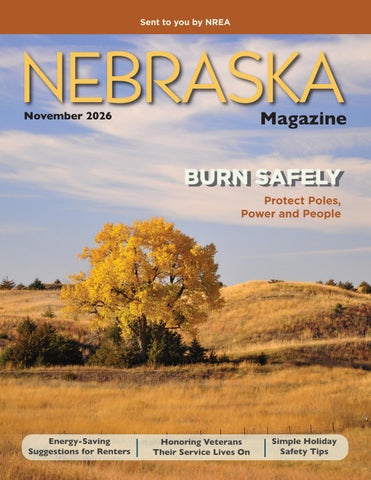
Energy Sense ON THE COVER An eastern cottonwood stands in brilliant autumn color amid the rolling grasslands of Nebraska’s Sandhills in Wheeler County. Photograph by Alan Bartels
3
Editor’s Page Lessons from Nebraska Weather
Wayne Price
Visit our website at nebraskamagazine.org
4
Nebraska weather can change in an instant. A winter blizzard can cover power lines in snow and ice. A spring thunderstorm can bring damaging winds, while a tornado or flood can disrupt communities and threaten essential services. When severe weather strikes, Nebraska’s public power utilities are prepared to respond with skill, teamwork and a commitment to the customers they serve. Preparation begins long before a storm arrives. Utility crews train for emergencies, maintain equipment and develop response plans designed to protect employees and the public. When damage occurs, these preparations help crews assess conditions, identify hazards and begin restoring service as safely and efficiently as possible. Trevor Wehrer, operations manager at Norris Public Power District, understands the responsibility that comes with serving customers during difficult times. “We know that when severe weather hits, our customers are counting on us. Our job is to be prepared, respond safely and work as efficiently as we can to restore power. It takes a lot of people working together, but that’s what public power is about, especially when our customers and communities need us most.” That commitment extends beyond individual utility boundaries. Severe weather can damage distribution lines, substations and other infrastructure across a wide area. When local resources are stretched, public power utilities rely on mutual aid, sending crews and equipment to communities that need additional help. “Severe weather in Nebraska can be harsh and cause more damage than one utility can handle on its own,” Wehrer said. “One of the things that stands out during a major storm is how quickly utilities come together to help one another. Mutual aid crews allow us to bring more people and resources to an area when they’re needed most. After you’ve experienced a major storm, you realize just how much goes into restoring power. There’s the damage you can see, but there’s also a lot of planning, coordination, and work behind the scenes to keep everyone safe. It takes everyone working together as a team to get electricity safely restored to our customers.” For customers, the return of electricity often represents relief, comfort and a return to normal routines. For utility crews, restoration involves careful coordination, difficult working conditions and a constant focus on safety. Nebraska’s storms will continue to test its communities. But each response reinforces an important lesson: resilience is built through preparation, cooperation and people who are willing to help one another. That is the strength of public power, and it is a commitment that matters most when Nebraska needs it most.
Nebraska Magazine
Guest Editorial Keep Rural Nebraska Strong Through Affordable, Reliable Energy
Brandon Lehman
Brandon Lehman is the General Manager of Perennial Public Power District, headquartered in York, Neb.
Affordability remains one of the most important issues facing rural Nebraska families, farmers, ranchers, and businesses. Whether it is the cost of groceries, fuel, housing, or electricity, every dollar matters in communities where budgets are carefully managed, and economic competitiveness depends on controlling operating costs. During his recent visit to Grand Island, President Trump emphasized affordability as a central theme of his remarks, announcing actions intended to lower transportation and fuel costs while highlighting the importance of policies that reduce financial burdens on working Americans. In announcing expanded access to tax-free red-dyed diesel, the president described the measure as "another unprecedented step to bring down costs" and argued that reducing energy and transportation expenses can have a ripple effect throughout the economy. For Nebraska's rural electric systems, affordability is more than a political talking point. It is a mission. Nebraska's unique public power structure has generated some of the most reliable electric service in the nation while keeping rates competitive for residential consumers, agricultural producers, and commercial businesses. Publicly owned power utilities operate with a focus on serving customers rather than shareholders, allowing revenues to be reinvested into infrastructure, reliability improvements, and keeping rates affordable. Affordable electricity is especially important in rural areas. Agriculture depends heavily on energy for grain drying, irrigation, livestock facilities, refrigeration, and transportation support. Small businesses rely on dependable electric service to remain competitive, while families depend on affordable power to heat and cool their homes through Nebraska's cold winters and hot summers. Earlier this year Governor Pillen along with 22 other governors signed the Rate Payer Protection Pledge. The pledge's central principle is that data center developers and large technology companies should pay the full costs of new generation, transmission, and grid infrastructure needed to serve their facilities, rather than shifting those costs to existing utility customers. Our Legislature also voted two new bills into law this spring that help protect affordability. Legislative Bill 1261 protects Nebraska ratepayers by allowing large power users such as data centers to develop or procure their own generation resources, reducing the risk that the cost of new power plants and infrastructure will be shifted to existing utility customers. In addition, Legislative Bill 1010 protects ratepayers by requiring large new electric loads to bear the costs they impose on the system, helping preserve Nebraska's affordable public power rates for existing residential,
Continued on Page 17
November 2026
5
by Tim Trudell
Their Service Lives On in Tecumseh Above: Mildred Bates served in the Women’s Army Corps 1945-50. Top: Mary and Justin Brown own The Grain Bin, and have carried on the tradition of displaying the photos of Johnson County veterans. Top right: Clarence Hupka, who was one of 317 survivors of a torpedo attack on the U.S.S. Indianapolis, following its top-secret mission during World War II.
Tecumseh
6
“Four score and seven years ago our fathers brought forth on this continent, a new nation, conceived in liberty, and dedicated to the proposition that all men are created equal.” As President Abraham Lincoln’s Gettysburg address, considered by many historians as one of the mostsignificant speeches ever delivered by an American leader, a young man from Johnson County stood about 10 feet from the 16th president, as he delivered those oft-quoted words. Fredrik Peterson was about 23 years old as he stood guard over Lincoln. It was just another assignment for the Swedish immigrant, who found his way to the United States at the age of 12. Enlisting in the Union army twice, Peterson saw action at the Battle of Bull Run, as well as Gettysburg. Peterson didn’t brag about his time in the military or serving as a guard for Lincoln, said Lois Linke, his
great-granddaughter. She authored a book, “Just an Ordinary Man of Long Ago,” to share his story with her family. “He was patriotic. He was determined,” Linke said. “He went through a lot of hardships, and lived to be 90 years old.” Peterson is one of more than 950 Johnson County veterans featured in 8x10-inch photos on the walls of The Grain Bin restaurant in Tecumseh. The photographs range from five veterans of the Civil War through the Middle Eastern conflicts. The photo exhibit started in 2009 when Beverly Ramsey, while working in human relations at the local Smart Chicken Plant, was part of a sevenmember committee looking for a unique way to honor area veterans during Tecumseh Days. The idea was an immediate success. The first year, more than 300 photos were submitted, Ramsey said. The first couple of years, the
Nebraska Magazine
photos were displayed on poster board at the Johnson County courthouse in Tecumseh. Over the ensuing years, the collection grew to more than 750 photos. As Ramsey and her husband, Wilbur, planned to open a soda fountain, they decided to display the photos at the store. Photographs were displayed in black frames along a long wall that ran the length of the downtown restaurant, as well as smaller sections. The photos added to the soda fountain’s popularity. “We had a lot of people come back and look at their relatives,” Bev Ramsey said. “We had school children come down, and they maybe weren’t so interested, until they got down there, and they maybe saw Grandpa’s picture.” In 2023, the Ramseys sold the restaurant to Mary and Justin Brown, who changed its name to The Grain Bin, and stamped their own style on the eatery.
November 2026
But one thing remained, the photographs. It was a no-brainer for the Browns to keep the photos as part of The Grain Bin, said Mary Brown. “What’s going to happen to them?” she said. “The museum cannot take them on, and we have people come in and look at them every day, and we have people bringing us photos they’re wanting to display. They’ll come in and say, ‘Oh, I thought soand-so was in here. My dad, my grandpa, my uncle.’ So it’s just a nice tribute to the veterans.” An historically-significant photo is one of Clarence E. Hupka, who was among 316 sailors to survive the sinking of the U.S.S. Indianapolis during World War II. In July 1945, the cruiser completed a top-secret mission, delivering components for “Little Boy,” one of two hydrogen bombs the United States dropped on Japan to expedite the end of the war.
Continued on Page 8
Lois Linke poses with a photo of her great-grandfather Fredrik Peterson, who served as one of the guards for President Abraham Lincoln when he visited the Gettysburg battlefield during the Civil War.
7
More than 950 photographs of Johnson County veterans are displayed at The Grain Bin restaurant in Tecumseh, a tradition that is more than 15 years old.
From Page 7 En route to the Philippines, the U.S.S. Indianapolis was hit by a torpedo from a Japanese submarine. With about 1,200 sailors aboard, the ship sank in less than 15 minutes, killing 300 crewmembers. The remaining sailors floated in the sea, facing exposure, dehydration, saltwater poisoning and shark attacks. The Navy learned about the U.S.S. Indianapolis four days after its sinking, when survivors were spotted by the crew of a PV-1 Ventura bomber on patrol. The ship’s sinking resulted in the greatest number of deaths a US Navy vessel has ever experienced. While she’s honored to display them, maintaining almost 1,000 photos is time-consuming, Brown said. Twice annually, photos need to be reorganized in alphabetical order, she said. Tagging the photos helps keep them in alphabetical order, Brown said. Located on the oldest block in Tecumseh, The Grain Bin’s building was constructed in 1890. At 136 years old, brick walls are crumbly, so dusting the photo frames and shelves can be challenging, Brown said. “On the day we’re closed, my blessed mother comes in, climbs a ladder and helps us scooch and dust. That sort of thing,” Brown said. The restaurant is running out of room to display veterans’ photos, she said. 8
Acknowledging the importance of the photos to the community, the Browns refuse to turn people away, but they are exploring options. Will the restaurant rotate photos, keeping some in storage? “I had a thought about somehow archiving them, but I’m not ready for that responsibility,” Brown said. “It would take some undertaking to archiving them, so that, God forbid, we don’t have this business, or there was a fire, or something happened, that we can preserve them. I think the family members have photos, but I just would hate for that kind of a loss.” The Johnson County Historical Museum doesn’t have room for the photos, Brown said. The museum has a room set aside to recognize the county’s veterans through a series of displays, along with artifacts, such as Fredrick Peterson’s musket from the Civil War and a Nazi flag confiscated during World War II, said Sarah Williamson, president of the Johnson County Historical Museum. Knowing people visit The Grain Bin not only for its home-style sandwiches and soups, but also to check out the veterans photos motivates Brown to continue sharing the veterans’ stories. “I think everyone is important to what we’re doing here,” she said. “Trying to think of a way that we can keep building on this is something that I am glad to do.”
Nebraska Magazine
PHYSICAL GOLD, REAL VALUE, PEACE OF MIND. A LEGACY FOR YOUR FAMILY
For generations, Americans have turned to physical gold during times of economic uncertainty. 5 $ 5 Gold has historically maintained its value when paper money declines.
A smart way to help balance your portfolio and reduce risk.
5 5 Real, tangible assets outside the banking system.
SPECIAL ARRANGEMENTS ON ORDERS OVER $50,000
Americans have relied on gold for security for centuries.
Gold can be passed down to help secure your family’s future.
CHECKS
MENTION VAULT CODE: AMS-NM23
!"#$%&'()*+ *,-#.*
/
0 0 1
! #) 2,*+ +*$#-*,%
*.2,* ',+*,#)
3 4
U.S. MINT GOVERNMENT-BACKED
10
Nebraska Magazine
ASSOCIATES DEGREE IN
UTILITY LINE SAFE. EFFICIENT. EXPERIENCED.
The program is nationally recognized for comprehensive utility line and job training safety. Classes are taught by expert faculty committed to student success.
HANDS-ON LEARNING.
Study and perform wiring, pole climbing, metering, operating bucket trucks and digger derricks, and line construction. Graduates have high job placement rates and the skills and confidence to excel on the job.
SCHEDULE YOUR VISIT AND SEE WHY STUDENTS AND EMPLOYERS PREFER NORTHEAST.
Northeast does not discriminate based upon any status protected by law or college policy. Please go to northeast.edu/nondiscrimination for details.
CLASS A CDL CERTIFIED November 2026
|
CLASSES MONDAY - THURSDAY
northeast.edu/visit
| EXTENSIVE OUTDOOR/INDOOR LABS 11
The Next Generation of Renewable Energy
Solar Energy
Wind Energy
Geothermal Energy
Battery Energy Storage
by Steph Joven 12
Nebraska Magazine
Electricity demand continues to grow, and the energy industry is exploring new ways to generate, store and deliver energy more efficiently. Researchers are developing technologies that could expand renewable energy options and improve how the electric grid operates, including advances in battery storage, geothermal, solar and wind energy. Here’s a look at some of the innovations helping shape our energy future. Battery Energy Storage Large-scale batteries can store electricity and discharge it when needed, helping balance supply and demand on the electric grid. Lithium-ion batteries are currently the most widely used option, but researchers are exploring new battery chemistries that could improve performance, reduce costs and rely on more abundant materials. One example is sodium-ion batteries. Because sodium is widely available, these batteries could offer an alternative to lithium-ion technology for certain applications, including large-scale energy storage. While they currently store less energy than comparable lithium-ion batteries, researchers are working to improve their performance. Another area of research is solid-state batteries, which use solid materials instead of liquid electrolytes to move energy within the battery. Researchers are investigating whether this design could improve safety and increase the amount of energy that can be stored in a given space. Geothermal Energy Geothermal energy uses heat from beneath the earth’s surface to generate electricity. Traditionally, geothermal power plants have been limited to areas with naturally occurring underground reservoirs of hot water or steam. Researchers are now developing enhanced geothermal systems (EGS), which could make geothermal energy possible in more locations. Demonstration projects across the U.S. are testing these technologies in different geological environments and helping researchers better understand their potential. Unlike solar and wind resources, geothermal energy can operate around the clock because it relies on heat stored beneath the earth’s surface. If EGS technology proves successful, it could provide another source of consistent renewable electricity. November 2026
Solar Energy Solar photovoltaic (PV) systems convert sunlight into electricity, but researchers continue to look for ways to make solar panels more efficient. One area of research focuses on perovskites, materials that may improve how efficiently solar cells convert sunlight into electricity. Tandem solar cells combine perovskites with traditional silicon cells to capture more of the sun’s energy. Researchers are also exploring new panel designs, including vertically mounted systems that could produce electricity at different times of day while potentially reducing the amount of land needed for solar development. Wind Energy Wind turbines generate electricity by using moving air to turn blades connected to a generator. Turbines have grown larger and more efficient over time, allowing them to produce more electricity from available wind resources. Innovation is also expanding where wind energy can be deployed. Floating offshore wind turbines can operate in deeper waters where traditional fixed-bottom structures may not be practical. Airborne wind energy systems use tethered devices to access stronger winds at higher elevations. Many of these technologies are still being researched and tested, but they demonstrate the range of innovation shaping our energy future. As Nebraska’s public power districts and electric cooperatives work to provide safe, reliable and affordable electricity, we’ll continue monitoring emerging technologies and considering how they may support the long-term energy needs of the communities we serve. Opposite: Solar photovoltaic (PV) systems convert sunlight into electricity, but researchers continue to look for ways to make solar panels more efficient. Floating offshore wind turbines can operate in deeper waters where traditional fixed-bottom structures may not be practical. Large-scale batteries can store electricity and discharge it when needed, helping balance supply and demand on the electric grid. Photographs provided by NRECA
13
Burn Safely Protect Poles, Power and People
by Abby Berry
14
Nebraska farmers play an essential role in keeping communities across our state thriving, and we appreciate their hard work and dedication throughout the year. As the harvest season comes to a close and fields are prepared for the year ahead, we are reminding farmers to exercise safety when conducting controlled burns near utility poles and other electrical equipment. Over the next few months, many farmers will conduct controlled burns to clear crop stubble and weeds and prepare fields for spring planting. While controlled burns are an effective way to manage agricultural land, they can also pose serious risks to nearby utility poles, power lines and other electrical equipment. Nebraska’s public power districts and electric cooperatives urge farm workers to use extreme caution when planning and conducting burns near electrical infrastructure. Every year, utility poles are damaged during controlled burns in fields, along roadsides and in ditches. The danger is compounded by the delayed visibility of pole damage after the fire has passed. Most wooden utility poles are treated with chemical preservatives, including creosote, to protect them from decay. When exposed to fire, the pole can sustain hidden damage. Embers can become lodged in cracks or other openings and continue
Nebraska Magazine
Left: As the harvest season ends and many farmers prepare their fields for the next season, remember to exercise caution when conducting controlled burns near utility poles. Opposite: Controlled burns are an important part of managing many agricultural operations, but they should be conducted safely. Photographs by Jeremy Smith, USDA burning inside the wood long after the flames have disappeared. In some cases, a utility pole can burn from the inside out and collapse hours or even days after a controlled burn has ended. A damaged utility pole can create a dangerous situation for farm workers, local electric utility crews and the public. Repairing or replacing a utility pole can be expensive and time-consuming. More importantly, a weakened pole can fall unexpectedly, potentially bringing power lines down with it. Depending on the location and extent of the damage, a single compromised pole can result in power outages affecting homes, farms and entire communities. Farmers planning controlled burns should keep the following safety measures in mind: • Maintain a safe distance from utility equipment. Avoid burning directly beneath or near utility poles, guy wires, transformers and other electrical equipment. • Monitor the weather. Avoid burning during dry, windy conditions when flames and embers can spread quickly. • Create firebreaks. Clear vegetation and other combustible materials around the area to keep the fire contained.
November 2026
• Have water and firefighting equipment nearby. Be prepared to respond if the fire moves beyond the intended burn area. • Monitor the fire until it is completely extinguished. Never assume a fire is out simply because flames are no longer visible. • Inspect nearby utility poles after the burn. If a pole is actively burning, call the fire department. If a pole appears scorched, damaged or otherwise compromised, contact your public power district or electric cooperative. Never attempt to repair electrical equipment yourself. Controlled burns are an important part of managing many agricultural operations, but they should be conducted safely. If you have questions about how a planned burn could affect nearby electrical equipment, contact your local electric utility before you begin. Nebraska’s public power districts and electric cooperatives appreciate everyone doing their part to protect themselves, their neighbors and the electrical infrastructure that helps power Nebraska communities every day.
15
Simple Holiday Safety Tips
The holiday season brings family, food and festive decorations, but it can also bring added demands on your home's electrical system. Before you plug in holiday lights, decorations and other seasonal equipment, take a few minutes to make sure your electrical system is ready. Start with your holiday lights and decorations. Inspect cords for cuts, frayed wires, loose connections or other damage. Throw away damaged strings rather than trying to repair them. Use lights and extension cords that are rated for their intended location, especially when decorating outdoors. Outdoor decorations should be plugged into outlets protected by ground-fault circuit interrupters, or GFCIs. Be careful not to overload outlets. Plugging multiple power strips or extension cords into one another can create a serious fire hazard. Follow the manufacturer's instructions for how many light strings can safely be connected. Keep electrical cords away from heat sources, water and areas where they could become a tripping hazard.
16
If you are using a portable generator during a power outage, operate it outdoors in a wellventilated area at least 20 feet from your home and away from doors, windows and vents. Never operate a generator inside a garage, basement or other enclosed space. Carbon monoxide is an invisible, odorless gas that can be deadly. The holidays are also a good time to check smoke alarms and carbon monoxide detectors. Test each device and replace batteries as needed. Make sure everyone in your household knows what to do if an alarm sounds. A little preparation can help keep holiday celebrations safe and enjoyable. Before decorating, take a walk around your home and look for potential electrical hazards. If you have questions about an electrical problem or are unsure whether something is safe to use, contact a qualified electrician or your local electric utility. Safe electrical practices are a simple way to help ensure your holiday memories are about family and celebration, not an electrical emergency.
Nebraska Magazine
Photograph by Max Bender
Safety Briefs
From Page 5 commercial, and industrial customers. However, inflation erodes affordability when each dollar buys less than it did before. Investments in the electric grid still need to be made to maintain and serve our existing customers with reliable power. So, even with these protections in place, rate increases are unavoidable. Whether discussing fuel prices, electric rates, or broader economic concerns, one principle remains clear: affordable and reliable energy is essential to the success of rural Nebraska. By keeping that focus at the center of public policy and utility operations, we can help ensure that Nebraska families, farms, and businesses remain strong.
November 2026
17
Energy Sense by Miranda Boutelle
Energy-Saving Suggestions for Renters
Renting a house or apartment can put you in a U.S. Department of Energy recommends setting it to 120 challenging spot when it comes to energy efficiency. degrees. This keeps the water hot enough to be safely Renting means that you can’t make all of the decisions stored in the tank and prevents scalding. I recommend about energy efficient upgrades in your home. At the same calling the owner or property management company to time, renters are usually responsible for paying the electric request an adjustment. bill. That means if the home has inefficient equipment, One of the benefits of renting is that you aren’t on the you’re going to use—and pay for—more energy. hook when equipment breaks down. If the water heater is Typically, it is the owner’s responsibility to make energy older than 10 years or showing signs of possible failure, efficiency upgrades, such as such as leaking, unusual noises adding insulation or new or discolored water, let the heating and cooling owner know. Upgrading to a equipment. Don’t assume heat pump water heater could they won’t make upgrades. If be a great fit for your home, the home needs upgrades, just saving energy and preventing ask. I’ve had landlords let me possible damage caused by a pay for an upgrade and failed water heater. provided a credit on my rent Another way to save is by to offset the cost. finding available rebates and In a situation where you incentives for your home. don’t have control over all the Because renters typically pay decisions, choose to focus on the electric bill, a landlord what you can control. doesn’t see the financial benefit The thermostat is a great of monthly energy savings. You place to save energy. Nudging can make it easier for them by the thermostat a few degrees finding opportunities for Thick curtains can help make the room feel warmer closer to the outside energy-efficient upgrades in in the winter. Photograph by Mark Gilliland, Pioneer temperature can help you save your home. Your rental might Utility Resources money. Adjust the settings be eligible for insulation, water when you aren’t home or at night when you’re sleeping. heater or HVAC upgrades. You might also be eligible for Adding thick curtains can help keep heat out in the discounts on products that you can buy yourself, such as summer and make the room feel warmer in the winter. A air purifiers, dehumidifiers or other small home rug can make a cold floor feel warmer in the winter. These appliances. additions can make changing the thermostat a few degrees If your home has electric heat, adding either a ducted or more comfortable. ductless heat pump—also called a mini-split—provides Make sure your property owner follows through with more efficient heating as well as air conditioning. That’s a annual maintenance and HVAC filter changes. Ignoring popular rebate offering across the country. these can lead to unnecessary energy waste. Energy efficient upgrades could benefit the homeowner Lighting is another element you can typically control. If by increasing the property value or keeping a good renter your home has incandescent or compact fluorescent bulbs, from looking for another place to live. It doesn’t hurt to switch to efficient LEDs. If you don’t have the ability to ask for upgraded equipment and provide information on change the lighting that’s installed in your home, consider eligible rebates or incentives. Partnering with your using plug-in LED lighting or lamps instead. landlord on projects is a great opportunity to benefit both Check whether your water heater is wasting energy. The of you.
18
Nebraska Magazine
The back of the man’s shirt read, “Follow me to the tractor pull.” So I did. And many do. After all, tractor pull enthusiasts mean business. And tractor pulls are big business with a healthy number of spectators at each, as numerous as pennies per drop in a gallon of diesel. Take a walk behind the scenes sometime at your friendly, neighborhood tractor pull to see what this big business is all about. Waiting for their turn to rumble and surge and charge down a track are pulling tractors, diesel pickup trucks, and even garden tractors. Alongside the pulling machinery are trailers for hauling them, plus deluxe campers for human habitation; these seem to run as long as the plume of black cloud emitting from a pulling tractor’s exhaust pipe. Spare engines lie in wait, just one promise away, cooling their jets and biding their time on the off chance that their predecessor blows up on the track, giving up the ghost so that these auxiliary accessories can gallop to November 2026
the rescue. This spare engine may cost more than the car many spectators drove there in, but necessary to keep the competition going. Mixed in with all of the machinery and spectators is command central loaded with speaker systems, sign-up sheets, records of cash prizes and advertisements, plus lines of food vendors hawking bustin’ big burgers, burritos and buckets of beer, slushies of all flavors, ice cream sundaes, and French-fried Something on a Stick. Follow me to the food line. But tractor pulls didn’t begin this way. They were originally small-time business. When tractor pulls first began, a track was laid out at a level spot under a shady cottonwood, at a county fair or town celebration, or an event unto itself. Then came the second most important preparation: round, galvanized stock tanks were filled with equal parts ice, bottles of Falstaff, Pabst Blue Ribbon, Hines Root Beer and Orange Crush. Bleachers might be slid in place to host a myriad of spectators. Farmers came in from the field, kicked the clumps of dirt off their work shoes, and putt-putted their farm tractors to town. The wives rode along too just in case a powder puff derby was planned. Pickups were backed up to the edge of the track, their behinds loaded with lawn chairs, coolers stoked with sandwiches and chocolate cake, and beach balls for the youngsters’ entertainment. Infant seats were draped with lightweight blankets designed as shade canopies for any stray baby, due for a nap. Metal folding chairs were lined up on either side of the track at marked locations, loaded with men of a particular persuasion: those looking for a front row seat. A sled was attached to the pulling tractor and as the tractor drug it down the track, these men stepped on at designated intervals, providing the necessary weight, and proving just how much it would take to make the tractor stall out, wiping out that driver’s bragging rights. In those days, like today, each of the men in those folding chairs could have had the words embroidered on the back of their chambray work shirts and plaid cowboy duds, an enticing “Follow me to the tractor pull.” This is LaRayne Topp, just roaming the countryside.
19
HOMETOWN
EATS
BUBBA’S ANYTIME StRANG, NEB.
In a town of just 32 people, you might not expect to find a restaurant known for its big portions, homemade food, unusual specials and a promise to keep feeding customers as long as they keep coming through the door. But that is exactly what you will find at Bubba’s Anytime in Strang, Nebraska. Chris and Julie Dunker built the restaurant in 2002 on what had previously been an empty lot with a few trees. They opened in May of that year and have operated the business ever since. The name came from Chris’ nickname, “Bubba.” “It just stuck,” Chris said. “Some of my nieces and nephews don’t even know my name.” Julie had another reason for choosing the word “Anytime.” Coming from an athletic family, she remembered playing softball and looking for someplace to eat after games. Too often, restaurants were closed by 9 p.m. “When we started this, I wanted people to be able to eat anytime,” she said. For the Dunkers, that philosophy has remained part of the restaurant’s identity. Their motto says it best: “When the front door is open, the grill is a smokin’.” Today, Bubba’s is open seven days a week, serving lunch from 11 a.m. to 1:30 p.m. and dinner from 5 p.m. until closing. But there is no set closing time. “People call and ask, ‘How late are you open?’” Chris said. “We say, ‘Until there’s nobody here.’” Julie does most of the cooking, assisted by a small staff and occasional help from family members. Before COVID-19, the restaurant had as many as 18 part-time employees. Today, five employees help keep things running. One of Bubba’s most popular traditions is Wacky Wings Wednesday. Wings and fries are
20
.
served in buckets and dumped directly onto plastic-covered tables. Customers get a roll of paper towels and dig in. Homemade food is another big part of Bubba’s appeal. Burgers are made by hand with beef from a local vendor. Sunday’s buffet features real mashed potatoes and broasted chicken. A homemade salad bar is offered Friday through Sunday in a refurbished Coke cooler. And then there are the kolaches. Julie’s mother, Opal, who is 96, still comes in twice a week to bake them. “People love her kolaches,” Julie said. The restaurant’s walls are covered with Coca-Cola memorabilia, a theme that grew from a family suggestion and a few items purchased at a garage sale. “We try to do things differently,” Julie said. “That draws a lot of people.” In a small Nebraska town, that different approach has kept Bubba’s Anytime busy for more than two decades.
Nebraska Magazine
Reader Submitted Recipes Turkey or Chicken Dressing Bake
Mini Pecan Cheesecakes 1 package plain round shortbread cookies 1 tablespoon flour 3/4 cup sugar 2 packages (8 ounces each) cream cheese, softened 2 large eggs 1 teaspoon vanilla 1/4 cup sour cream 1 stick butter, melted 3/4 cup brown sugar 3/4 cup crushed pecans
Heat oven to 325 F. In muffin pan, fill each hole with paper cupcake liners. Place one cookie in bottom of each cup. Whisk flour and sugar. Mix in cream cheese. Using hand mixer, blend in eggs one at a time then add vanilla and sour cream. Mix until smooth then spoon on top of cookies. Mix butter, brown sugar and crushed pecans. Spoon on top of cheesecake mixture. Bake 25 minutes. Let cool before serving.
10 slices bread (tear into bite sized pieces) 1/2 cup margarine 1/2 cup onion, chopped 1/2 teaspoon poultry seasoning Pinch of salt 1/2 cup celery, chopped
2 eggs well beaten 2 cups turkey or chicken broth 2 1/2 cups cooked turkey or chicken, diced 1 can cream of mushroom or cream of chicken soup 1/2 cup milk
Sauté onion and celery in margarine until tender. Pour over the bread cubes. Mix turkey or chicken with poultry seasoning, salt and broth. Mix with bread crumb mixture. Pour in a greased 9” X 13” pan. Mix soup and milk with whisk and pour over meat mixture. Cover with foil and bake at 350 degrees for 45 minutes, take off foil and bake 10 minutes longer until middle is set. This Thanksgiving favorite is one we enjoy the weekend after Thanksgiving using leftover turkey. The dish is hearty enough as your main course.
Darlus McWilliams, Norfolk, Nebraska Sugar Cream Pie 1 deep dish pie crust, at room temperature 4 Tablespoons cornstarch 3/4 cup white sugar 4 Tablespoons butter, melted 2 cups heavy cream 1/4 cup milk (I use whole, but 2% works fine)
1 Tablespoon vanilla FOR TOPPING: 4 Tablespoons butter, melted 1/4-1/2 cup cinnamon sugar (1/4 or 1/2 cup sugar with 2-3 teaspoons ground cinnamon mixed in. Start with 1/4 cup but add up to 1/2 cup if you prefer it spicy)
Preheat oven to 325 degrees. Place the pie crust onto a baking sheet. Or, if using a refrigerated crust, lightly grease a 9" pie pan, put the crust in, and set the pan on a baking sheet. Bake for approximately 12 minutes or until partially baked. Set aside. In a small bowl, mix together the cornstarch and sugar until blended. In a medium saucepan, bring the cornstarch-sugar mixture, melted butter and heavy cream together over medium heat, stirring constantly. The mixture is done when it's thick and creamy. Stir in the vanilla. Pour the mixture into the prepared pie crust and smooth out the top. Drizzle on the melted butter and evenly sprinkle on the cinnamon sugar. Bake for 25 minutes, then turn on the broiler and broil for about 1 minute, watching carefully. Remove from oven and allow to come to room temperature before refrigerating for at least one hour to set. Store in fridge.
Brenda Smith Bayard, Nebraska Wanted: Favorite Winter Soup Recipes The Reward: $25 for every one we publish! Send us your favorite Winter soup recipes. Be sure to include a mailing address for payment purposes and a phone number in case we need to contact you. Recipes will not be returned and not all recipes will be used. Mail: Nebraska Rural Electric Association, Nebraska Magazine Recipes, P.O. Box 82048, Lincoln, NE 68501 E-mail: Tina Schweitzer at tschweitzer@nrea.org.
November 2026
21
Marketplace Round HayBoard Banners Hay Bale Signs & Covers Graduation, Holiday, Special Events, County Fairs, Ag Products, Sponsorship, and more.
HayBaleBanners.com (308) 737-3300 Enders, Nebraska
FOR RENT • Storage Units • Mobile Home Lots - No Minimum Age • Storage Lots (303) 345-1603 Leave a message please
DENTAL Insurance Big dental bills? Get protection.
®
Get dental insurance from Physicians Mutual Insurance Company, Inc. Get your FREE Information Kit It’s easy! Call or scan today
1-855-640-9264 or go to Dental50Plus.com/Electric
Church/Gov’t Unite Our Constitution
SCAN NOW! Product/features not available in all states. Contact us for complete details about this insurance solicitation. To find a network provider, go to physiciansmutual.com/find-dentist. This specific offer not available in CO, KS, NY, OR – call 1-800-969-4781 or respond for a similar offer in your state. Certificate C254/B465, (ID: C254ID; PA: C254PA); Insurance Policy P154/B469 (GA: P154GA; OK: P154OK; TN: P154TN). 6370
Enforce Sunday Law
There are many effective ways to reduce stuttering.
FREE INFORMATION Be Informed, Not Deceived! Leave Mailing Address.
Doing nothing is not one of them.
TBSM P.O. Box 374, Ellijay, GA 30540 tbsmads@yahoo.com 1-888-211-1715
22
“MONEY LIKES SPEED, SIMPLICITY AND AUTOMATION!” Profit/Thrive With PROVEN “Social Distance Marketing” Resources! Consistent Actions ... Predictable Results!
Text moreinfo to (833) 643-2360 www.41242.biz
35 Words for $35 THE
800-992-9392 www.StutteringHelp.org
STUTTERING FOUNDATION
®
A Nonprofit Organization Since 1947—Helping Those Who Stutter
Advertise in Nebraska Magazine Classifieds Call 402/475-4988
Nebraska Magazine
Together with your local public power utility.
POWERED LOCALLY. Public power gives customers a voice. Decisions
are made locally, led by elected of昀cials who live in the communities and within their respective service territories. Customers can in昀uence decisions by attending public board meetings.
Visit publicpowered.com to learn more about the bene昀ts of public power in Nebraska.
Nebraska Voices for Cooperative Power gives you the power to speak about energy policies that impact your community and your electric utility.
Become an advocate today. JOIN ONLINE
VOICESFORCOOPERATIVEPOWER.COM/NEREGISTER
NREA