Sent to you by NREA
Magazine
October 2026
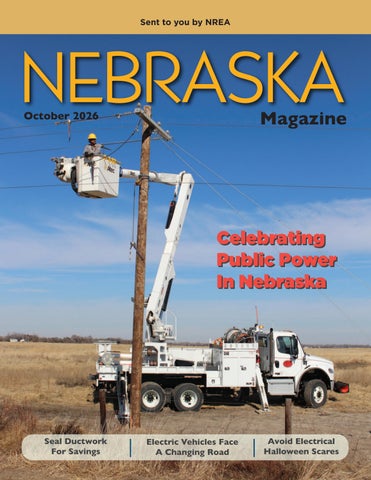
Celebrating Public Power In Nebraska
Seal Ductwork For Savings
Electric Vehicles Face A Changing Road
Avoid Electrical Halloween Scares
For generations, Americans have turned to physical gold during times of economic uncertainty. 5 $ 5 Gold has historically maintained its value when paper money declines.
A smart way to help balance your portfolio and reduce risk.
5 5 Real, tangible assets outside the banking system.
SPECIAL ARRANGEMENTS ON ORDERS OVER $50,000
Americans have relied on gold for security for centuries.
Gold can be passed down to help secure your family’s future.
CHECKS
MENTION VAULT CODE: AMS-NM91
!"#$%&'()*+ *,-#.*
/
0 0 1
! #) 2,*+ +*$#-*,%
*.2,* ',+*,#)
3 4
U.S. MINT GOVERNMENT-BACKED
Telling the Story of Rural Nebraska Volume 80 Number 10 October 2026
Contents 6
Celebrating Public Power in Nebraska Public Power Month is an opportunity to appreciate electricity’s essential role in our daily lives and celebrate Nebraska’s unique tradition of providing affordable, reliable and community-focused electric service.
Staff General Manager Rick Nelson Editor Wayne Price
14 Electric Vehicles Face A Changing Road
Editorial Assistant Tina Schweitzer
The U.S. electric vehicle market is adjusting to the end of federal incentives and changing consumer demand, while lower prices, growing fleet use and continued global adoption point to a changing but still significant role for EVs in America’s energy future.
President Vance McCoy Midwest Electric Cooperative Corporation Vice President/Secretary Dan Scheer Howard Greeley Rural Public Power District Treasurer Stewart Huneke Norris Public Power District Published monthly by the Nebraska Rural Electric Association, 1244 K Street, Box 82048, Lincoln, Nebraska 68501, (402) 475-4988. Advertising in the Nebraska Magazine does not imply endorsement for products by the Nebraska Rural Electric Association. Correspondence should be sent to Wayne Price, Editor, Nebraska Magazine, Box 82048, Lincoln, NE 68501. The Nebraska Magazine is printed by the Aradius Group, 4700 F Street, Omaha, NE 68117. Form 3579 should be sent to Nebraska Magazine, Box 82048, Lincoln, NE 68501. Periodicals postage paid at Lincoln, Neb. POSTMASTER: send address changes to Nebraska Magazine, 1244 K Street, Box 82048, Lincoln, NE 68501. Publication numbers are USPS 071-630 and ISSN 30697549. Subscriber Services: Cost of subscription for consumers of participating member-systems is $2.14 per year (17.8 cents per month), plus periodicals postage paid from equity accruing to the consumer. For nonmembers, a subscription is $10 per year or $20 for three years, plus local and state tax. Single copy, $2.50.
October 2026
Departments Editor’s Page
Hometown Eats
Safety Briefs/Murphy
Marketplace
Energy Sense ON THE COVER A Polk County Rural Public Power District lineworker builds an electric power line. Photograph by Wayne Price
3
Editor’s Page Banish the Energy Vampires in Your Yard
Wayne Price
Visit our website at nebraskamagazine.org
4
There’s something lurking outside your home after dark. It’s old. It’s hungry. And every night, it quietly feeds on your electricity bill. No, it’s not a vampire.Well, not exactly. If you still have mercury-vapor lights illuminating your yard, driveway or outbuildings, you may have an energy-guzzling monster hiding in plain sight. A typical 175-watt mercury-vapor lamp actually consumes about 205 watts when you include the energy used by its ballast. Run it 12 hours a night, and it can consume nearly 900 kilowatt-hours of electricity each year. That can add more than $100 to your annual electric bill. And here’s the really scary part: The light gets weaker with age, but the energy appetite doesn't. After just one year, a mercury-vapor lamp can lose nearly 20% of its light output. Meanwhile, an LED fixture can provide comparable illumination using only a fraction of the energy, while maintaining its brightness much better over time. LEDs also offer long service lives, meaning fewer trips up a ladder to change bulbs. Your knees will thank you. Mercury-vapor lights can also create a false sense of security. Their bright, constant glare can produce harsh shadows and interfere with security cameras. A motion-sensing LED floodlight can be a better choice. The sudden burst of light can discourage unwanted visitors while providing clearer illumination exactly when it is needed. Then there are the bugs. Mercury-vapor lights produce ultraviolet light that attracts insects like a moth to, well, a porch light. Once the insects arrive, spiders, bats and other hungry critters may follow. Before long, your light fixture has become the hottest restaurant in the neighborhood. LEDs can attract fewer insects, especially fixtures designed to produce little or no UV light. Finally, mercury-vapor lights send light in nearly every direction, including straight into the night sky. LEDs are more directional, making it easier to illuminate your property without illuminating the entire county. So this Halloween, don't just beware of ghosts, goblins and things that go bump in the night. Take a look at what's lighting up your property. Replacing an old mercury-vapor fixture with an efficient LED could save energy, improve security and help restore those beautiful Nebraska stars. Check with your local rural electric utility to see what options you might have. Some public power districts have been converting mercury-vapor lights to LED for a few years. Others are waiting until they fail and then swap them out with LED lights. A new LED could qualify for an incentive as well. And, yes, werewolves hate LEDs.
Nebraska Magazine
Guest Editorial Local Control with Public Power
Doyle Hazen
Doyle Hazen is the General Manager of North Central Public Power District, headquartered in Creighton, Neb.
October 2026
Public power in Nebraska is something many people take for granted. Nebraska is the only entirely public power state. With a few exceptions, Nebraska electricity is provided by public power districts throughout the state. Public power districts, municipal utilities, and electric cooperatives were built to serve communities, not shareholders. That model for electric service still survives. Public power means there is local control over decisions for making rates, reliability, infrastructure, and services connected to your community. Board members are residents who live in your community and are publicly elected, giving you a voice in the future of your electrical service. Whether your needs are agricultural, commercial, or domestic, locally governed public power supports your needs. It focuses on reliability and affordability. Because public power is not for profit and is a political subdivision of the state, its margins are reinvested into the system. Those margins are also available to support energy-efficiency programs, maintain competitive rates, and provide customerfriendly service. Public power is not static; it is not solely for maintenance. Public power is continually planning and growing for the betterment of the people it serves. Proper planning ensures that customers can take advantage of the opportunities in their personal and business lives. Technology, changing resources, and ever-higher expectations require public power to be adaptive and responsive to customer needs. The history of public power reflects the determination of its customers who, in its early days, worked to realize the asset was economical and practical. Early private companies did not want to serve rural communities due to low return on investment and too many miles per customer. Public power today is an economic powerhouse in Nebraska and its rural and urban communities. The spirit that those early developers had reminds us that public power is rooted in the belief that it is accountable to the public, responsive to local needs, and managed for the long-term good of the community. Please remember that local control is essential in the governance of public power. Participation in public power ensures that local control will remain its greatest strength. Public power is not just a service, but a community partnership. Public power works because its governance belongs to the people that it serves.
5
6
Nebraska Magazine
Celebrating Public Power
in nebraska Could you imagine going an entire day without the you have problems. And you know their track record of use of electricity? Have you ever tried it? In the span of keeping the power on and restoring it immediately in about 100 years we have seen electricity evolve from a the case of weather-related outages, such as blizzards and big city luxury to a nationwide necessity. It keeps us safe tornadoes. and comfortable, and it connects us to our friends and Nebraskans have several reasons to celebrate Public family. Power. Our state is the only one in the nation that is We take electricity for granted in Nebraska and the totally served by public power. Other states have entire United States for that matter. investor-owned utilities that are in the The folks who can remember what it business to make money. Electric Every state in the U.S. has a was like before their family had utilities in Nebraska are in business to public power utility, but electricity are becoming fewer every provide affordable, reliable and safe Nebraska is the only state year. It is easy to forget how electricity. where 100 percent are served by a communitydependent we have become on Nebraska has it’s heritage to owned utility. electricity in our everyday lives. We celebrate when it comes to public flip the switch and automatically power. In 1936 Nebraska Senator expect our homes and offices to be filled with light. George Norris worked to get the Rural Electrification It doesn’t hurt to be reminded occasionally about the Act passed. He believed that public power represented a importance of electricity, as well as the contributions it way to ensure that every citizen was provided with makes to our towns, our state and the nation. reliable service at a reasonable price. We encourage our readers to take part in celebrating Nebraska’s rural electric utilities are dedicated to Public Power Month. energy efficiency, too. Public Power Month is a good Public Power Month honors the nation’s more than time to look at your local electric utility’s low- or no-cost 2,000 not-for-profit, community-owned electric utilities, programs designed to help reduce energy consumption like those that serve your homes, ranches and businesses. and save you money. The programs help consumers gain Public power serves the interests of the community. control over their energy use. The not-for-profit rates hold down household and In Nebraska we create electricity from a number of business costs, and Nebraska has some of the lowest sources, including coal, nuclear, hydro-power and wind. electric rates in the country. Lower electricity rates The energy efficiency programs offered by local electric attract and keep businesses that provide jobs for our utilities help reduce the need for additional power plants citizens. They are also good for our household budgets. to be built in the future. When it comes to service, you know your electric Take a minute to tell your electric utility “thank you” provider is just down the street or a phone call away if for working to keep rates low and the power on.
October 2026
7
WHY
PUBLIC POWER
?
What makes Nebraska different? Look at your electric meter. Nebraska is the only state in the nation where every community is served by public power. That distinction is more than a fun fact. It is part of Nebraska's history and a reflection of the state's commitment to local communities. Public power puts service at the center of the mission. Nebraska's public power utilities and cooperatives are built to provide reliable, affordable electricity while keeping the needs of their communities in focus. That local connection matters. Electricity powers nearly every part of daily life. It keeps homes comfortable, farms productive, businesses operating and communities connected. Behind that service are dedicated employees who live in the communities they serve. Lineworkers maintain the system and respond when storms cause outages. Engineers plan for changing energy needs. Customer service representatives help answer questions and solve problems. Public power is also about looking ahead. Nebraska's electric utilities continually invest in poles, wires, substations, generation and other infrastructure needed to maintain a reliable electric system. They also work with communities and customers to prepare for the energy needs of tomorrow. From rural farms and ranches to growing cities and small-town Main Streets, public power connects Nebraska. It is a system built by Nebraskans, for Nebraskans. So the next time you flip a light switch, take a moment to consider what is behind that simple action. There is an entire network of people, equipment and local communities working together to keep the power flowing. Why public power? Because Nebraska doesn't just use public power. Nebraska is public power. 8
Nebraska Magazine
October 2026
9
by Anne Prince
Create Your Own Comfort Zone Mini-split systems offer homeowners customizable room-by-room heating and cooling while potentially reducing energy use through efficient, ductless operation. Although installation costs, cold-weather performance and the appearance of indoor units are important considerations, mini-splits can be an effective solution for additions, basements, attics and other spaces where extending ductwork is difficult.
10
How would you like a personalized comfort zone within your home? One where the temperature is customized to your liking and may be different than the temperature in the shared living areas or other rooms in the house. This flexibility and customization are precisely why mini-split systems, also known as ductless air-source heat pumps, and their energy efficiency aspects are so popular. Let’s unpack some mini-split basics and explore whether this type of system is a good choice for your home heating and cooling needs. A mini-split system is a type of HVAC equipment used for heating and cooling, allowing you to control the temperature in individual rooms or spaces. Similar to central heating and cooling, mini-split systems have two main components––an outdoor compressor and an
Nebraska Magazine
area, such as a finished attic or basement. In these instances, it may not be feasible to install or extend the ductwork required in traditional central cooling and heating systems. In contrast, mini-splits are relatively easy to install requiring a small hole for the conduit connecting the indoor and outdoor units. Most systems can handle up to four indoor rooms or zones connected to one outdoor unit. Each of the zones can be customized because each includes a thermostat that enables you to heat or cool the space as needed, saving energy and money over time. Cool solutions Mini-split systems bring additional benefits. They are quiet, improve indoor air quality and are typically easy to install. Many come with remotes to make temperature control even easier, and because of their smaller size, mini-split systems have many placement options for indoor and outdoor units. One of the greatest benefits of mini-splits is that they typically have a higher SEER (seasonal energy efficiency ratio) rating than traditional central heating and cooling systems. The higher the unit's SEER rating, the more energy efficient it is.
indoor air-handling unit(s). A narrow conduit links the indoor unit(s) to the outdoor compressor. While central heating and cooling systems feature an indoor unit connected by long lengths of ductwork, mini-splits are typically ductless. This means energy is not lost traveling through long stretches of ductwork. Installing the air-handling unit in a desired room or area enables you to control the temperature more precisely, reducing energy consumption. That’s because you’re adjusting the temperature to a single room or space rather than the whole home.
Additional considerations However, according to the Department of Energy, “mini-splits cost about $1,500 to $2,000 per ton of cooling capacity. That’s about 30% more than central systems (not including ductwork) and may cost twice as much as window units of similar capacity.” While the technology is improving and evolving, those in particularly colder climates may need a fuel backup to run a mini-split system. Aesthetics are another factor to consider, as some homeowners don’t like the appearance of the indoor units, which are more visible than central air conditioning vents. If you’re considering an upgrade or additional heating and cooling equipment, talk to a qualified technician to learn if a ductless mini-split system could work for your home.
Is a mini-split system right for you? Mini-split systems are a popular option in home additions, or to supplement heating and cooling in a space that may be furthest away from the main living
Anne Prince writes on consumer and cooperative affairs for the National Rural Electric Cooperative Association, the national trade association representing nearly 900 local public power districts and electric cooperatives.
October 2026
11
The
Password Myth
Why Longer is Stronger
Most people manage important parts of their lives online. They pay electric bills, participate in efficiency programs, monitor energy use through member portals and receive outage alerts through rural electric utility apps and websites. Protecting those accounts starts with a strong password. With October recognized as National Cybersecurity Awareness Month, it's a good reminder that one of the easiest ways to protect yourself is by updating how you think about passwords. Unfortunately, many of us learned the same password rules, which are now outdated. Mix in a capital letter. Add a number. Throw in a symbol like a dollar sign. We were told that a password full of strange characters was a strong password. It turns out that advice was only half right, and the half that got left out matters more than you might think. Here’s the surprising truth: The length of your password protects you more than how complicated it is. A short password packed with symbols, like "P@ss1!", can be cracked by a computer in seconds. A longer password made of several unrelated words is far harder to break. The reason comes down to math. Computers crack passwords by guessing, and modern ones try billions of combinations every second. Every extra character multiplies the guesses a hacker must make, far more than swapping an "a" for an "@" ever could. 12
Think of it like a bike lock. A short combination is quick to spin through, but a longer one simply has too many settings to try. The nation’s top security experts agree. The National Institute of Standards and Technology, which sets the standards many companies follow, now recommends longer passwords and has dropped the old rules that forced a mix of symbols and numbers. Why the change? Because those rules often backfire. When told to add symbols, people do predictable things, like ending with a "1" or an "!". Hackers know these tricks and check for them first. The rules made passwords harder for humans to remember but easier for criminals to guess. So, what should you do instead? Whether you are logging into your electric utility’s member portal, online banking account, healthcare provider or favorite shopping site, the same advice applies. Think in phrases, not single words. A passphrase is just several words strung together, like "Sailboat lemon thunder pillow." The trick is to pick words that have nothing to do with each other. The stranger the mix, the better. Avoid song lyrics, common sayings or anything tied to you, since those are easier to guess. Aim for at least 15 characters when you can. What about sites that still demand a number or a symbol? You don’t have to give up your passphrase. Just work the extra character into a spot you will remember, like "Sailboat7 lemon thunder pillow." Try not to simply Nebraska Magazine
tack a "1" or "!" onto the very end, since that’s the first thing criminals check. A few more simple habits will keep you safe. Avoid personal details like your birthday, address or pet's name, since those are easy for others to find. Use a different password for every account, including your electric utility’s member portal. Companies get hacked, and criminals try the stolen passwords on other sites, so one password should never unlock your whole life. If remembering them all feels like too much, a password manager can store them for you. And turn on multifactor authentication whenever it is offered, which is the step where a website texts a code to your phone or an app, adding a second lock to your door. You may also start seeing "passkeys." This newer option lets you sign in with your face, fingerprint, or a PIN instead of a password at all. Because there is no password to steal or guess, passkeys are very secure and worth using whenever a site offers one. As more services move online, good password habits are becoming an important part of everyday cybersecurity. You don’t need to be a technology expert to protect yourself. A longer password or passphrase is one of the simplest and most effective steps you can take. Pick a phrase you can remember, keep it unique for every account and you will be much harder for criminals to target. Protecting online accounts helps safeguard access to services such as bill payment, outage notifications, energy management tools and other digital services offered by your rural electric utility. October 2026
STAY Strengthen Your SHARP Cybersecurity Habits
As the leaves change and fall routines return, it’s a good time to check more than your furnace and winter gear. It’s also the perfect season to refresh your cybersecurity habits. At your rural electric utility, cybersecurity is an important part of providing safe, reliable electric service. Nebraska’s public power districts and electric cooperatives work to protect the systems and information that help us serve you, including online accounts, payment systems and outage communications. Unfortunately, scammers are getting better at what they do. Artificial intelligence can help criminals create convincing emails, texts, websites and even voice messages. That means a scam may look and sound legitimate—even when it isn’t. Utility scams often involve urgent claims that your bill is overdue or your electricity is about to be disconnected. If you receive an unexpected message, don’t click its links or use its phone number. Instead, contact your electric utility through a trusted method to verify the request. You can also strengthen your online security before a scam happens. Use long, unique passwords or passphrases, and never reuse them across accounts. When available, enable multifactor authentication (MFA) for an added layer of protection. Most importantly, slow down. A legitimate utility will give you an opportunity to verify an unexpected payment request. When something feels urgent, take a moment, check the facts and contact your public power district or electric cooperative directly. A few extra seconds of caution can help keep your information—and your money—safe.
13
Electric Vehicles Face A Changing Road
by Jennah Denney 14
Electric vehicles have undergone a notable shift over the past year. New policies, changing consumer demand and decisions by automakers are shaping the current EV market––and what may come next. One major turning point came with the expiration of the $7,500 federal EV tax credit in September 2025. The effect on new EV sales was immediate. Transaction prices effectively rose across the board, and lease deals that previously made EVs more accessible largely disappeared. Sales figures show two clear trends. In late 2025, many people rushed to purchase EVs before the tax credit ended. This resulted in a 44% spike in sales. Afterwards, EV sales quickly declined. In early 2026, Americans purchased 212,600 EVs, which was a 28% drop compared to early 2025. The EV market share also fell to 5.8%, down from a high of 7.5%. But that decline might be slowing. With more leased vehicles being returned and resold, the used EV market is growing with a reported sales increase of 12% in early 2026. New EV price tags have also dropped more than 12% since demand slowed.
Nebraska Magazine
Left: Pricing for some new EV models like the Chevy Bolt is expected to start under $30,000. Photograph provided by Chevrolet Center: Amazon is rolling out thousands of electric delivery vehicles manufactured by Rivian, which are now a common sight in many communities. Photograph provided by Rivian Right: The 2026 Chevy Equinox EV can travel up to 319 miles on a single charge. Photograph provided by Chevrolet Another trend we’re seeing is automakers are adjusting their focus. Ford is shifting part of its EV battery production to manufacture batteries for other uses, like data centers and electric utility equipment. In May 2026, the “Ford Energy” group was created to focus on these efforts. General Motors is also making changes, with a sharper focus on self-driving vehicle technologies. While these shifts are a result of slower EV sales, both companies continue to manufacture EVs. Even with slower sales, new, lower-cost EV models are becoming available. The 2026 Chevy Equinox EV starts at under $35,000 and can travel up to 319 miles on a single charge. Pricing for some newer models, like the Nissan LEAF and the Chevy Bolt, is expected to start under $30,000. These lower prices might help more drivers consider EV options. Outside the U.S., EV sales continue to grow. Around the world, one out of every four new vehicles sold in 2025 was an electric model, and experts expect that number to keep rising.
October 2026
One area where EV growth remains strong is commercial and delivery fleets. Companies like Amazon, UPS and FedEx are adding electric vans and trucks to their daily operations. Amazon is rolling out thousands of electric delivery vehicles manufactured by Rivian, which are now a common sight in many communities. Fleet vehicles are a good fit for electrification because they follow set routes, return to a central location each day and can charge overnight. This makes costs more predictable and easier to manage. Companies are expected to continue investing in EV fleets to reduce fuel costs and meet long-term goals. Even with slowed sales, EVs represent a meaningful and growing source of electricity demand. The U.S. Department of Energy projects that in rural areas, home-based Level 1 and Level 2 charging could meet approximately 82% of EV electricity demand by 2030. While the pace of EV adoption in the U.S. remains uncertain, electric co-ops are well positioned to adapt. By planning ahead and staying flexible, co-ops will continue to provide reliable, affordable power while supporting members as their energy needs evolve.
15
Safety Briefs
Avoid Electrical Halloween Scares
More and more people decorate their yards for Halloween with elaborate lighting displays with as much enthusiasm and as many materials as they do for the Christmas holidays. Strings of decorative lights, fog machines, strobe and black lights, animatronics, and electrically powered decorations all add to the ambience of Halloween, but improperly used, can create added dangers of fire, shock, and other potentially disastrous accidents. SafeElectricity.com urges everyone to use caution and look for potential hazards while decorating and operating these displays. Follow these tips: • Carefully inspect each electrical decoration. Cracking, fraying, or bare wires may cause a serious shock or start a fire. Replace any damaged products. • Before using any light strings, animated displays, or other electrical products outdoors, make sure the product is approved by a nationally recognized certification organization such as Underwriters Laboratory (UL) and marked for outdoor use. • Follow the use and care instructions that accompany your electrical decorations.
16
• Do not overload extension cords or allow them to run through water on the ground. Typically, one extension cord should only have three strands of lights connected to it at most, but you should also check that the extension cord is rated for its intended use. • Plug outdoor electric lights and decorations into outlets protected by ground fault circuit interrupters (GFCIs). If your outdoor outlets don’t have them, either contact a qualified electrician to install them or use portable GFCIs instead. • When decorating outside, always be sure to look up and double check that you and any equipment, such as a ladder or a light strand, are a minimum 10 feet away from overhead power lines. When securing light strands, never staple or nail them into place. This could damage the product. • Keep electrical cords out of walkway areas to avoid causing a tripping hazard. • Lastly, turn off all electrical light strings and decorations before leaving home or going to sleep. A timer can help you do this. Avoid real scares this Halloween, and decorate safely.
Nebraska Magazine
Five Ways to Save Energy as October Gets Colder As temperatures begin to drop, heating season is just around the corner. A few simple steps now can improve comfort, reduce energy waste and help keep heating costs in check. 1. Adjust the thermostat. Set your thermostat as low as is comfortable when you are home, and lower it when you are asleep or away. The U.S. Department of Energy says setting the thermostat back 7–10 degrees for at least eight hours a day can save as much as 10% annually on heating and cooling costs. Smart thermostat technology is most beneficial for households that have extended periods during the day when no one is home or those that have irregular occupancy through the week, month or year. If you have a home Wi-Fi connection and a central air-conditioning or heat pump system, you may qualify for an EnergyWise incentive of up to $100 for installing a qualifying smart thermostat. 2. Check your heating system’s air filter. A dirty filter restricts airflow and can make a heating system work harder. Check the filter monthly during periods of heavy use and clean or replace it when needed, or at least every three months. 3. Seal drafts around windows and doors. Caulk and weatherstripping can help reduce unwanted air leakage around windows, doors and other openings. Keeping warm air inside and cold air outside can make your home more comfortable while reducing heating energy waste. 4. Use the sun to your advantage. Open curtains or shades on sunny October days to let sunlight provide natural warmth, then close them after sunset to help retain heat. This simple habit can complement your heating system without using additional energy. 5. Schedule a heating-system checkup. Fall is a good time to have heating equipment inspected and serviced before colder weather arrives. Regular maintenance can help keep HVAC equipment operating efficiently and identify potential problems before they become more expensive repairs. These small steps can help your home transition into colder weather more efficiently—and may help keep energy use under control throughout the heating season. October 2026
17
Energy Sense by Miranda Boutelle
Tips to Seal Ductwork for Savings
If you live in a home with a forced air furnace, the biggest energy waster may be out of sight. Improve your home’s efficiency and comfort by repairing and sealing ductwork. Around 20% to 30% of the air you pay to heat or cool is lost through leaks, holes or poorly installed ductwork in the average home, according to the U.S. Environmental Protection Agency. This results in wasted energy and uncomfortable homes, regardless of the thermostat setting. Properly sealing ducts can reduce wasted energy by delivering conditioned air where you want it inside the home. If you have a room that is cold in winter and hot in summer, the culprit might be a leaky or disconnected duct. Duct sealing also helps with indoor air quality. Leaking return ducts can pull air from the spaces they run through, such as attics and crawl spaces. You don’t want to breathe in dirt, dust and insulation. If you have gas appliances, such as a gas water heater, dryer or furnace, leaking return ducts can inadvertently cause backdraft, introducing combustion gases back into the home instead of outdoors where they belong. You can seal ducts yourself or hire a professional. For a do-it-yourself approach, start with a visual inspection to determine your duct type. Most homes have flexible or metal ducts. Metal ductwork comes in various shapes and sizes, including round and rectangular, and with various options for turns and connections. Ducts should be insulated when they run through unconditioned spaces, such as crawl spaces, attics and garages. If your metal ducts are insulated, you must remove the insulation to properly seal them, then reinsulate. Flexible ducts typically have an inner and outer layer with insulation in between. The inner layer is made of bendable plastic reinforced with wire, like a stretched-out Slinky covered in plastic. The outer layer holds the insulation in place. The inner liner in flexible ducts can become brittle over time, cracking easily and causing leaks. If your inner liner is in bad shape, replace the flexible duct. Check for any obvious disconnections, gaps, extra bends or sagging ducts. Improve airflow by using short, straight, 18
Prep is important. After inspecting your ductwork, gather products designed for the job based on the type of ducts in your home. If you don’t feel comfortable doing the work yourself, hire a professional. Photograph by Miranda Boutelle taut runs. Avoid sags and excess turns. Metal ductwork should be fastened together at each joint using sheet metal screws. Make sure your ducts are properly supported to keep the joints from separating over time. For flexible ducts, use Panduit straps. These are heavyduty nylon zip ties that offer long-term durability and a tensioning tool specifically designed to tighten them. When it comes to sealing ducts, use products designed for the job. Seal every joint and seam using duct-sealing mastic—a thick paste that can be applied with a paintbrush or gloved hand. When it dries, mastic creates a flexible, airtight seal, eliminating duct leakage. Use mesh tape to bridge larger gaps before applying mastic. Remove register covers inside the home to seal the joints and seams there. You also want a good seal where the duct meets drywall or flooring. In easier-to-reach areas, you can opt to use UL-listed foil-backed tape designed for ductwork. Nebraska Magazine
Do not use duct tape. Fluctuations in temperature cause the adhesive to fail. Duct sealing is messy, so make sure to protect yourself and your home. Use drop cloths to protect flooring. Metal tape and the edges of metal ducts are sharp, so put on coated work or garden gloves underneath nitrile or latex disposable gloves. To protect your arms, wear a long-sleeve shirt tucked into your gloves or a long sock with the toes cut out. After air sealing, have an HVAC professional test the airflow during your next annual maintenance visit. If you don’t feel comfortable getting your hands dirty, hire a professional. Most companies that install ductwork or heating and cooling systems can also seal ducts. Sealing your ductwork gives you peace of mind that your home is not wasting energy or introducing unhealthy air into your living space.
October 2026
19
HOMETOWN
EATS In a town of just 151 people, a restaurant can be more than a place to grab a meal. At The Rusty Spur in Stamford, it is also a gathering place, a workplace and a familiar stop for both local regulars and visitors passing through the area. Lacey Bantam, the restaurant’s owner, knows that small-town connection well. She has worked in bars and restaurants off and on since she was 17, including managing a bar in the next town over. She says she enjoys the work, especially the opportunity to talk with customers and get to know them. Bantam became the owner of The Rusty Spur in November 2025, but her history with the business goes back further. She previously worked as a manager for former owner Brian Bieghler. The restaurant has been known as The Rusty Spur since 2014. After taking ownership, Bantam made changes to give the business more room. She remodeled the bar, purchased the American Legion Hall next door and opened a passage between the two buildings. The expansion was important because, as Bantam put it, the restaurant was previously “pretty small.” Today, The Rusty Spur has 16 employees, including five full-time workers and 11 parttime employees. Some of the part-time staff are teachers at Southern Valley schools. Bantam divides her own time between the kitchen and dining room, spending about half of each week cooking and the other half working as a waitress. The menu offers plenty of familiar favorites, including steaks, chicken fried steak, hamburgers, homemade French fries, gizzards and cheese curds. Bantam takes particular pride in the hamburgers. The ground beef is not frozen, and the patties are made at the
20
The Rusty Spur Stamford, NEB.
.
restaurant. Daily homemade specials are another draw. Thursday features chicken fried steak, while Mexican dishes are served on Tuesdays. The daily lunch special includes a main dish, a side and a homemade dessert. Although Stamford is small, The Rusty Spur’s customer base extends well beyond town. Bantam said local residents make up the regular crowd, while summer brings visitors from around the Harlan County Reservoir and travelers from communities such as Kearney. For Bantam, the formula is straightforward: good food, good people and a welcoming place to gather. “We have great food and great staff,” she said. In a community where the bank, gas station and restaurant are among the few businesses in town, The Rusty Spur has earned its place as part of Stamford’s everyday landscape—and a destination worth finding for those who live beyond its city limits.
Nebraska Magazine
Reader Submitted Recipes Popcorn Salad 1/2 cup crispy bacon 1/2 cup diced celery 1 can water chestnuts, chopped 1/2 cup chopped onion
Pasta Salad in a Jar Dressing: 2 tablespoons olive oil 2 tablespoons red wine vinegar 1/8 teaspoon dried basil 1/8 teaspoon oregano 1/8 teaspoon parsley salt, to taste freshly ground pepper, to taste 1/4 cup canned chickpeas, rinsed 1/2 cup halved grape tomatoes 1/2 cup diced cucumber 2 tablespoons sliced Kalamata olives 1 cup cooked pasta of choice, cooled 1 cup chopped spinach
To make dressing: In canning jar, combine olive oil, vinegar, basil, oregano, parsley and salt and pepper, to taste. Stir in chickpeas. Layer tomatoes, cucumbers, olives, cooked pasta and spinach over dressing. Refrigerate until ready to serve. To serve, flip jar over and lightly shake to combine dressing with other ingredients.
3/4 1 1/2 6
cup cheddar cheese cup mayonnaise cup sugar cups popped popcorn
Mix together all ingredients, except the popcorn, the day before you plan to serve. Mix in the popcorn 4 hours before serving. I use the store-bought popcorn, so it doesn’t have any unpopped kernels. Everyone who’s tried it thinks it’s cauliflower instead of popcorn. It’s been a real hit with our family.
Wilma Schock, Norfolk, Nebraska Chicken & Vegetable Bean Soup 1 can great northern beans drained and rinsed 1/2 cup chopped onion 1 cup chopped carrots 2 cloves garlic - minced 2 tablespoons snipped fresh parsley (can also use parsley flakes)
1 teaspoon dried rosemary, crushed 1/4 teaspoon pepper 4 cups chicken broth 2 1/2 cups shredded or chopped cooked chicken 1 can (14 1/2 oz) diced tomatoes - undrained
In a 4 or 5 quart slow cooker, combine beans, onion, carrots, garlic, parsley, rosemary, pepper and chicken broth. Cover and cook on low-heat setting for 8-10 hours OR on high-heat setting for 4-5 hours. If using low-heat setting, turn to high-heat setting and stir in chicken and tomatoes. Cover and cook for 30 minutes longer on high heat setting or until heated through.
Michelle Koch, York, Nebraska Barbecued Beef Patties 1 1/2 1 1/2 1 2
lb. ground beef cups milk cup quick oats tablespoons grated onions
1 1/2 teaspoons salt 1/2 teaspoon chili powder 1/8 teaspoon pepper
Barbecue Sauce - Mix and simmer for 30 minutes: 3 medium onions finely chopped, 3/4 cup ketchup, 3/4 cup water, 2 tablespoons vinegar, 2 tablespoons Worcestershire sauce, 1 teaspoon chili powder and 1/2 teaspoon paprika. Heat oven to 350 degrees. Mix all ingredients except barbecue sauce, then shape into 16 patties. Place in 13” X 9” X 2” pan. Cover with barbecue sauce and bake for one hour. Yields 6 to 8 servings.
Delores Hansen, Stanton, Nebraska
October 2026
21
Marketplace Linwood Haunted Barn Open Friday & Saturday in October 8 PM to Midnight 4551 Road U Linwood, Neb. On Facebook at
The Linwood Haunted Barn
DENTAL Insurance Big dental bills? Get protection.
FOR RENT • Storage Units • Mobile Home Lots - No Minimum Age • Storage Lots (303) 345-1603 Leave a message please
®
Get dental insurance from Physicians Mutual Insurance Company, Inc. Get your FREE Information Kit It’s easy! Call or scan today
1-855-640-9264 or go to Dental50Plus.com/Electric
Church/Gov’t Unite Our Constitution
SCAN NOW! Product/features not available in all states. Contact us for complete details about this insurance solicitation. To find a network provider, go to physiciansmutual.com/find-dentist. This specific offer not available in CO, KS, NY, OR – call 1-800-969-4781 or respond for a similar offer in your state. Certificate C254/B465, (ID: C254ID; PA: C254PA); Insurance Policy P154/B469 (GA: P154GA; OK: P154OK; TN: P154TN). 6370
Round HayBoard Banners
Enforce Sunday Law FREE INFORMATION Be Informed, Not Deceived! Leave Mailing Address. TBSM P.O. Box 374, Ellijay, GA 30540 tbsmads@yahoo.com 1-888-211-1715
22
Hay Bale Signs & Covers Graduation, Holiday, Special Events, County Fairs, Ag Products, Sponsorship, and more.
HayBaleBanners.com (308) 737-3300 Enders, Nebraska
“MONEY LIKES SPEED, SIMPLICITY AND AUTOMATION!” Profit/Thrive With PROVEN “Social Distance Marketing” Resources! Consistent Actions ... Predictable Results!
Text moreinfo to (833) 643-2360 www.41242.biz
35 Words for $35 Advertise in Nebraska Magazine Classifieds Call 402/475-4988
Nebraska Magazine
PROTECTING THE PRESENT TO POWER THE FUTURE There’s strength in choosing the rural way of life— rising early, working hard, and building something that lasts. At Tri-State G&T, we share that commitment and are working with our members to protect your way of life and power what’s next. Our business model drives how we plan our diverse energy mix—solar, wind, natural gas, hydro, and batteries—so we can weather any storm and meet the growing energy needs of the West. Now that’s reliability.
WHATEVER THE FUTURE HOLDS, WE’LL POWER IT.®
Scan to learn more or visit www.tristate.coop/powering-future
Tri-State is a not-for-profit power supplier to cooperatives and public power districts in Colorado, Nebraska, New Mexico and Wyoming.
Nebraska Voices for Cooperative Power gives you the power to speak about energy policies that impact your community and your electric utility.
Become an advocate today. JOIN ONLINE
VOICESFORCOOPERATIVEPOWER.COM/NEREGISTER
NREA