Gill Athletics® high-moment G-series discus offers throwers precision-crafted, guaranteed legal weight out of the box, World Athletics Certified discuses. Expect the best for every throw.














CONNIE PRICE-SMITH
USTFCCCA President
Connie is the Head Coach of Men’s and Women’s Track and Field and Cross Country at the University of Mississippi. She can be reached at cmprices@olemiss.edu
VIN LANANNA
Track & Field
Vin is the Director of Track and Field and Cross Country and Associate Athletics Director for Administration at the University of Virginia. He can be reached at coachvin@virginia.edu
TINA DAVIS FERNANDEZ
Track & Field
Tina Davis Fernandez is the Head Cross Country and Track & Field Coach for CAL State LA. Tina can be reached at Tina.DavisFernandes@ calstatela.edu
CHAD GUNNELSON
Track & Field
Chad Gunnelson is the Director of Track and Field and Cross Country at Augustana College. Chad can be reached at chadgunnelson@augustana.edu



CALEB SNYDER
Track & Field
Caleb Snyder is the Head Men’ and Women’s Track & Field Coach at Indiana Wesleyan University. Caleb can be reached at caleb.snyder@indwes.edu

CHIP GAYDEN
Track & Field
Chip Gayden is the Head Men’s and Women’s Track & Field Coach at Meridian Community College. He can be reached at hgayden@meridiancc.edu

STEFANIE SLEKIS
Cross Country
Stefanie Slekis is the Head Coach of Track and Field and Cross Country at Nicholls State University. Stefanie can be reached at stefanie.slekis@nicholls.edu
PUBLISHER
Sam Seemes
MEMBERSHIP SERVICES
Nick Lieggi, Kristina Taylor, Dave Svoboda
COMMUNICATIONS
Garrett Bampos, Tom Lewis, Tyler Mayforth, Howard Willman
PHOTOGRAPHER
Kirby Lee
EDITORIAL BOARD
Tommy Badon, Scott Christensen, Todd Lane, Derek Yush
ART DIRECTOR
Tiffani Reding Amedeo
PUBLISHED BY
ERIC PHILLIPS
Cross Country
Eric Phillips is the men’s distance assistant coach for track and field and cross country at Saginaw Valley State University. He can be reached at edphilli@svsu.edu.
RYAN CHAPMAN
Cross Country
Ryan Chapman is the Head Coach of Men’s and Women’s Cross Country at Wartburg College. Ryan can be reached at ryan.chapman@wartburg.edu
Renaissance Publishing LLC
110 Veterans Memorial Blvd., Suite 123, Metairie, LA 70005 (504) 828-1380 myneworleans.com
GRIER GATLIN
Cross Country
Grier Gatlin is the Head Coach of Track and Field and Cross Country at Southern Oregon University. Grier can be reached at gatling@sou.edu
DEE BROWN
Cross Country
Dee Brown is the Director of Track and Field and Cross Country at Iowa Central CC. Dee can be reached at brown_dee@iowacentral.edu
USTFCCCA
National Office 1100 Poydras Street, Suite 1750 New Orleans, LA 70163 Phone: 504-599-8900 Website: ustfccca.org
If you would like to submit content for, or advertise your business in Techniques, please contact 504-599-8906 or techniques@ustfccca.org.
Techniques (ISSN 1939-3849) is published quarterly in February, May, August and November by the U.S. Track & Field and Cross Country Coaches Association. Copyright 2025. All rights reserved. No part of this publication may be reproduced in any manner, in whole or in part, without the permission of the publisher. techniques is not responsible for unsolicited manuscripts, photos and artwork even if accompanied by a self-addressed stamped envelope. The opinions expressed in techniques are those of the authors and do not necessarily reflect the view of the magazines’ managers or owners. Periodical Postage Paid at New Orleans La and Additional Entry Offices. POSTMASTER: Send address changes to: USTFCCCA, PO Box 55969, Metairie, LA 70055-5969.


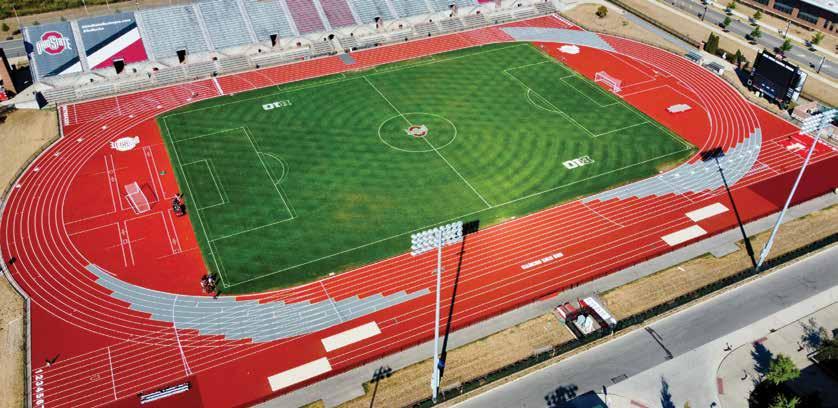
Beynon controls all aspects of the manufacturing value chain. From start to finish, your project doesn’t leave our hands.
Manufactured and installed with the highest attention to detail, Beynon systems showcase proven durability.
For indoor or outdoor venues, Beynon is the trusted surface of leading NCAA Div I programs, thousands of high schools and distinguished municipal facilities.
Part of Tarkett Sports, a division of the Tarkett Group, a worldwide leader of innovative flooring and sports surface solutions, Beynon has unprecedented financial support and stability. You can rest easy.
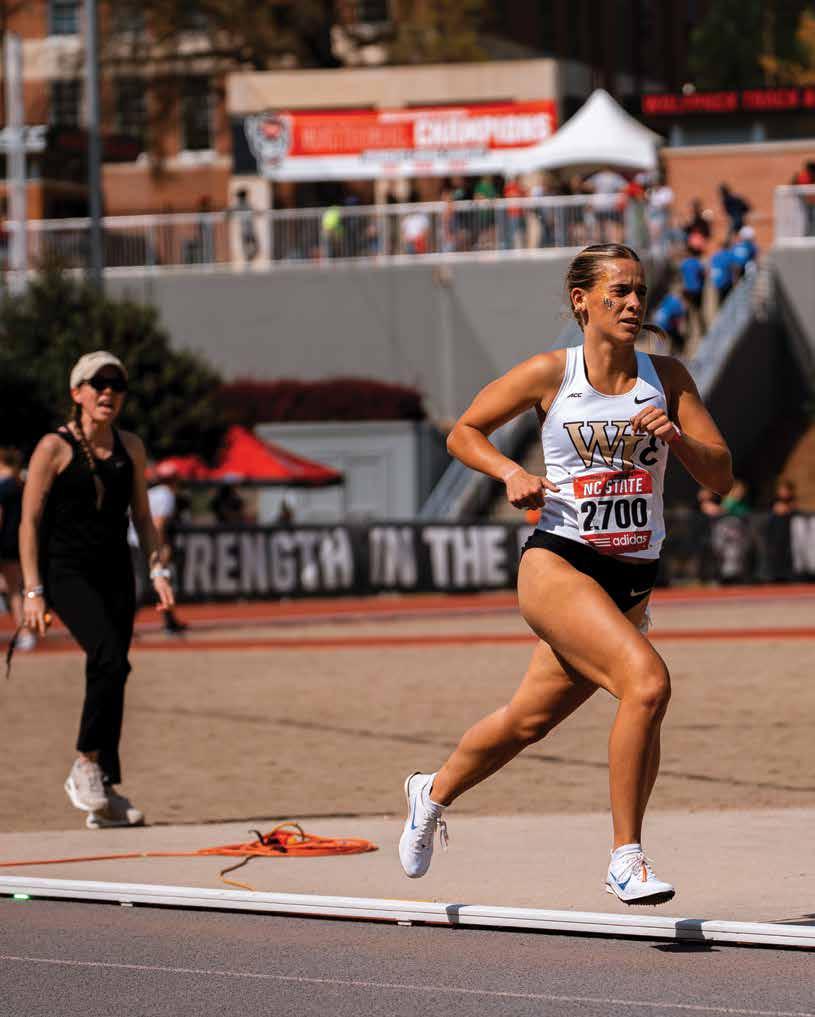
Anumber of top coaches in the country continue their discussion of training the 800- meter runner in part two of a coaches’ forum coordinated by retired former University of Mary coach Mike Thorson
There was certainly a lot of common ground in the first installment of the 800meter coaches’ roundtable. There were also a lot of differences in the way the coaches approached the mentoring of two-lappers. However, a common theme was that the coaches were all highly successful with the training they employed with their 800-meter runners.
The same panel of coaches continue their discussion in part two of the 800-meter training coaches’ question and answer forum. Our objective in part two is the same as the initial roundtable: to provide information and ideas, education and stimulate coaches to grow and improve their training programs.
It is always our hope coaches will be lifelong learners. An excellent quote by the famous activist Mahatma Gandhi sums up our goal very well: “Live as if you were going die tomorrow, learn as if you were to live forever,” said the late Indian lawyer who led India’s successful independence from British rule.
Our panel of coaches for part two remains the same as part one. They include Nate Wolf from Dordt (IA), Brandon Bonsey from
Georgetown, Houston Franks from LSU, Dennis Newell from North Dakota State University, Jeremy Wilk from the University of Miami, Pat McCurry from Boise State, Cade Burks from Sacramento State, Jeff Pigg from North Florida, Dee Brown from Iowa Central, and Ryun Godfrey from Oklahoma State.
A SHORT BIOGRAPHY FOR EACH COACH FOLLOWS.
Ryun Godfrey (Oklahoma State) Godfrey is in his second year at Oklahoma State as a cross country and distance assistant coach, following a stint at Nebraska as the head cross country coach. A 28-time conference coach of the year, Godfrey has also coached at Arizona State, Kansas State, and his alma mater, North Dakota State University in Fargo, ND. It was at NDSU, where Godfrey graduated in 1996, that he had amazing success, winning 30 conference championships and an NCAA Division II women’s national championship in indoor track and field. The long-time coach was a six-time regional coach of the year, as well as a Division II national coach of the year. That success has followed Godfrey to Oklahoma State, where the Cowboys won the men’s national championship in cross country this past fall.
Pat McCurry (Boise State) McCurry is in his second year as the Broncos track and field and cross country coach after serving as an assistant coach 2016-18. McCurry,
known for having strong 800 and steeplechase runners, had an extraordinarily successful career at the College of Idaho, mentoring 14 NAIA national champions. He also had a successful tenure at Division 1 San Francisco (2018-21). McCurry, who has coached 21 Olympic Trials qualifiers, was an assistant coach at his alma mater, Eastern Oregon, prior to Idaho. McCurry continues to coach world class, elite athletes, including Olympians Lizzie Bird of Great Britian, seventh in the steeplechase at Paris, and Marisa Howard of the USA, who was ninth in the steeple at the Paris Olympic games.
Cade Burks (Sacramento State) Burks is entering his third year of coaching the distance, cross country and mid-distance athletes at Sacramento State, arriving at the university in 2023. With Burks at the helm, the distance program has improved immensely, with multiple school records, over 20 top-10 school performances, and multiple NCAA first round appearances and Big Sky finalists. Prior to his tenure at Sacramento, Burks ran at Northern Arizona University from 2016 to 2021 where he was a part of four national championship cross country teams and was a four-minute miler on the track.
Jeremy Wilk (University of Miami) Coach Wilk is in his third year at the University of Miami in Florida and it has been a remarkably successful one, having coached school record holders and numerous top perform-
ers in the ACC conference. Wilk serves as the distance coach and cross country mentor for the Hurricanes. Prior to Miami, the two-time All American from Grand Valley (MI), who had the school record in the 800 meters at 1:45.40, was at Northwood in Michigan. He was at the Michigan institution from 20162023, taking over head coaching duties in 2021. His athletes broke school records 33 times while he was at Northwood and he coached Jordan Chester, a 2020 Olympic Trials qualifier. Wilk was at Ashland in Ohio as an assistant and director of operations prior to Northwood.
Brandon Bonsey (Georgetown) Coach Bonsey is in his seventh year as the highly successful head coach of the Hoyas men’s cross country program and middle distance/ distance athletes in the Georgetown track and field program. Bonsey has coached 49 All-Americans in 10 different events after returning to his alma mater for the 2012-13 campaign. Prior to returning to Georgetown, he had been at Syracuse. Coach Bonsey competed for the Hoyas 2004-09, graduating in 2009. He coached for the Hoyas as an assistant before heading to Syracuse.
Jeff Pigg (North Florida) A veteran coach who has a lengthy record of success everywhere he has been, Pigg came to North Florida from Georgia in 2012 to serve as the director of track and field and cross country. He has guided his North Florida teams to their best showings in their Division I era, winning a number of ASUN conference titles in cross country. Prior to the Georgia stint, Pigg was the head cross country coach at Florida, his alma mater from which he was a1988 graduate. The many-time coach of the year also spent 10 years at the University of Missouri.
Dee Brown (Iowa Central) Coach Brown has had an unbelievable career since starting the cross country and track and field programs at junior college powerhouse Iowa Central. Since starting the program in 2004, he has led the Tritons to 40 national championships. He has been named JUCO national coach of the year 14 times. The men’s and women’s director of track and field and cross country, Brown has guided his women to eight national cross country championships and the men five. His teams have also won 14 national half marathon team titles. Brown was at Luther College in Decorah, Iowa, prior to coming to Iowa Central.
Nate Wolf (Dordt IA) (With assistance from Craig Heynen, the Dordt head track and field coach. See Coach Wolf’s note at
end of bio) Coach Wolf is the head men’s and women’s cross country coach and assistant in charge of the distance runners at Dordt, an NAIA school in Iowa. He has had amazing success in cross country. Since he arrived in 2015, his women’s teams have won eight GPAC conference titles, earning him coach of the year all eight of those years, and the men have won seven conference titles, earning him coach of the year seven times on the men’s side. He has also won two regional coach of the year awards with his women and five with the men. A graduate of Northwest College in Iowa, his first coaching position was at his alma mate from 2005-12. He spent 2012-15 at Southwest Minnesota in Marshall, MN. A note from Coach Wolf: As a point of reference, in our program the 800 runners are split into those that do cross country and those who do not. I coach the cross country group, as I combine their cross country training into the track season plan. Coach Heynen coaches the non-cross country 800-meter runners. Our philosophies are pretty similar, but due to the type of athletes, their physical and psychological makeup, we emphasize different aspects of the training to get them to similar places. Our answers to the questions may read like two people contributed to the writing, because we both did. In our program, the 800 meters is a link between the distance groups and sprint groups.
Houston Franks (LSU) The LSU Tigers program has flourished under Coach Franks, who is in seventh year at the Baton Rouge school. The program has been remarkably successful from both a team and individual standpoint. Some of Franks’ most notable individuals include Marco Arop from Canada, the world champion in the 800 meters in 2023 and a silver medalist in the 800 at the Paris Olympics; Michaela Rose, a former NCAA 800-meter national champion who recently signed with Adidas; and Lorena Rangel Batres, the 2024 Mexican national champion in the 800. Franks, who came to LSU from Mississippi State, coached at Southwest Missouri State (1999-2004) for five years where his women won three conference championships and he was the Missouri Valley Conference coach of the year three times. Franks, a 1998 graduate of Mississippi State, is very involved in coaching education, presently serving as the lead instructor for the USTFCCCA Academy endurance, middle distance, and distance master’s level courses.
Dennis Newell (North Dakota State
University) Astounding success has been a trademark for Coach Newell, who is in his fifth year as the Bison cross country coach and assistant track and field coach. Newell has contributed to nine Summit League Team titles for the Bison indoor and outdoor track and field program since his arrival in the fall of 2021, with the Summit League women’s cross country coach honors being one of his top accolades. Prior to NDSU, Newell spent 15 years at the University of Mary, developing the Marauders into a regional and national power in cross country and track & field. The Marauders won 24 NSIC team championships in cross country and track & field during his tenure, including 19 titles in women’s track & field since 2007. The Mary women earned NCAA Division II runner-up team finishes in cross country in both 2017 and 2018 and earned an NCAA Division II podium finish (4th place) in indoor track & field in 2018. Newell has mentored 172 NCAA D 2 All-Americans and 12 individual national champions, including Ida Narbuvoll in 2021, who won national titles in both the 5000 and 10,000 meters, setting the Division II outdoor 5,000-meter record. Narbuvoll also won the 2021 Norwegian national title in the 10,000 meters. Newell boasts 21 coach of the year honors in his career, highlighted by being named the 2013 NCAA Division II Indoor Women’s Assistant Coach of the Year.
Each of the 10 coaches were asked to answer the same 12 questions, with six questions being addressed in the first installment, and the remaining questions in this, part two of the roundtable. Some answers were edited for brevity, and the coaches were free to select which questions they chose to answer.
QUESTION 1: CAN YOU GIVE US AN IDEA OF HOW YOUR TRAINING PROGRESSES AS YOU WORK THROUGH THE YEAR IN DIFFERENT PHASES? GIVE US AN IDEA OF MILEAGE GOALS/PARAMETERS AT DIFFERENT TIMES OF THE YEAR. AND IS MILEAGE A MAJOR CONSIDERATION WHEN DESIGNING THE TRAINING FOR AN 800 METER RUNNER?
Godfrey: Most of the women I coach run between 40 – 50 miles per week. In the fall, we are closer to the 50 miles a week range and during the competitive season we are much closer to the 40 miles a week range. Weeks of competition are in the 30 – 35



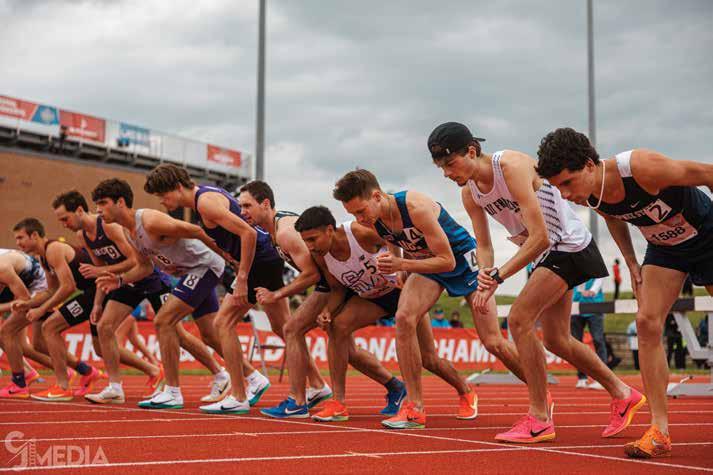
miles a week range. The men’s volume is just slightly higher, but in terms of overall minutes of running it is very similar. Some of the athletes I have coached have been at 60 miles+ per week during the fall. Athletes who come from a strong 400-meter background and are new to the program start with much lower volumes. We have been as low as 15 miles per week and progressed to the 25 – 30 miles per week for some athletes. I believe it’s important to consider their backgrounds and their strengths. Mileage is important because volume of training is always a consideration when designing a program. However, if we need to have athletes cross train, I’m not concerned that they will run less than someone else on the team.
McCurry: I don’t do cumulative volume. I’m a volume coach, but I’m only focused on the volume of the key sessions (long run, structured intensity sessions across various energy systems, etc.). We build volume there and do what each individual athlete needs to do in order to recover in between. So, we never talk about weekly mileage, only about the volume of specific training sessions. Volume
is critical for all athletes, but I think we need to be more efficient and individualized about the application of volume. Regarding phases, we build volume gradually to what I think each athlete should be at each year, and then we hold steady until we come down some for the championship phase.
Burks: For our athletes, the training develops throughout the year from the most general, to more specific. Our cross country/ middle-distance athletes maintain a focus on aerobic work to prepare for the needs of cross country, with frequent sub-threshold, threshold, and vo2max workouts. Anaerobic work is limited but generally used to develop efficiency (such as grass 200’s or 300’s on short recovery). The frequency and intensity of anerobic intervals progresses through the winter and into the indoor season. As the track season progresses, we are continually maintaining the aerobic system with weekly threshold or sub-threshold sessions. Through the track season the pace and intensity of our interval sessions increase. Workouts where a “shift” is done in the pace mid-rep is typically used to
practice changing pace while running but also can help buffer the transitions to faster workouts. Through the track season, while racing 800-1500 regularly, these athletes are often maintaining 50-80mpw (miles per week). Our non-cross country athletes spend the summer running 20-40 miles per week accompanied by hills, shorter aerobic repeats, and introductory anaerobic work. Through the fall their workload progresses, with a focus on increasing the volume of workout sessions. Their mileage stays consistent through the fall. Wicket sprints, treadmill hill sprints, and flying sprints are used weekly. As the fall progresses, we introduce longer sprint reps — for example 1-2 reps of 100-200 meters. Progressing from the winter to spring, the quality of main anaerobic sessions will increase, while continuing to maintain aerobic sessions (such as 400-800 repeats at Threshold). Through the track season, we race regularly — these races are used instead of a difficult anaerobic workout.
Wilk: I view the summer/fall as the time to build up that aerobic foundation as big as







•
•
•
•



we can, while keeping them healthy, and not making them feel slow. We touch on the speed aspect throughout the whole year (hill sprints are great for this.) After cross country (or over the second half if they aren’t likely cross country contributors), we transition more towards track work, but we typically aren’t in spikes ripping race specific work. I keep VO2 max (and sometimes lactate threshold training for the more aerobicallycentric 800-meter runners) through most of the season, I just lower the frequency with which we hit them and the volume. As we get more into the second half of each season (indoor and outdoor), I increase the race specific intensity/championship racing simulation work, with the first half of the season more or less being trained through, and volume not significantly dropped.
Bonsey: I had two guys run 1:45 last year. One ran 35 miles a week and the other 60-70 depending on the week. The mileage is super individualized. Everyone is different and different things work for different people. For most of them the mileage and the threshold volume stays pretty consistent throughout the entire year. Through the first semester, the speed and the intensity of the Friday workout increases as we go. I have always thought the fall and early winter are a good time to do some quality 800 workouts. Once indoors starts, the main training stimulus is the meets. I try to have them run the 4x400 at every meet that makes sense. An individual race, plus a hard 400 is an incredible workout. If they are racing consistently, we can keep the workouts under control, which keeps them healthy.
Pigg: Mileage is not a big consideration for our best 800 runners. They do it over summer and fall, but mostly it is recovery days. Fartlek is done throughout the season. An example would be 4-3-2-1 x 3 with 2:00 rest. It is quite a bit of mileage, but focus is fartlek not volume. We do not do long runs, but rather weekly fartlek.
Brown: I would say our male mid-distance athletes will run up to 50-55 miles per week (women 40-45) during the fall cross country season. Once we transition over to track and field by January, we are closer to 40 miles per week for our men and 30-35 for women depending on which event(s) are their focus. We pay closer attention to mileage in the fall than the spring, just to make sure we are not going to overdo it or injure the athlete.
Wolf: Mileage is not something we put much of a focus on for our 800-meter runners. We will track it for a few reasons. One is to monitor their recovery and to aid the runner, as we might want to create a bit more “pop” in the legs for a bigger race in the middle of the season, without adjusting the major workout for the week. The second is for those who have come from cross country. They often feel better with a bit more mileage and we want to provide some guidance and control on those recovery days.
Franks: Everything is a progression for sure. I think I may have talked about a lot of those progressions in some of the other questions. But we work general to specific in everything we do. Mileage is important for sure, but different for each athlete. But I am a quality first, quantity second person. Meaning, I would rather have an athlete run five good miles than seven bad miles. We have specific paces and percentages that we want our quality miles and recovery miles run at. Most of our athletes increase mileage each year. But how much depends on the athlete and what their background is. For example, Michaela Rose runs 45-50 miles per week most weeks (recovery weeks probably low 40’s). Her freshman year she was probably around 30, then sophomore year 35-40, junior year mid 40 pretty consistently, and last year mid 40’s and hit 50 regularly. (Editor’s note: Rose was a national champion in the 800 for LSU and Coach Franks) But mileage is more of a concern during times of the year when endurance building is the focus. I do monitor it year round, but towards the end of the year, what the race prep workouts look like matter much more. I want every athlete to run/do as much quality work as they can and be able to recover and stay healthy. Recovering and staying healthy is the key.
Newell: We progress from broad and general to narrow and specific throughout a training cycle, in most aspects of what we do. Emphasis will change on specific elements and variables within the overall training design, but everything we value for the 800meter student-athlete remains present in our training cycle. Some examples of how workouts may progress throughout the season: 1. Progressive Runs by Feel => Tempo Runs => Tempo Intervals. 2. Critical Velocity 10k Intervals = > VO2 5k Intervals => VO2 3k Intervals 3. 1500m RP Reps => 800m RP Reps
=> 800m Lactic Tolerance Reps => Races 4. Strides => Accels => Max Velocity/ Speed Endurance 5. Body Building Strength => Static Strength/ Absolute Power => Ballistic Movements
QUESTION 2: HOW BIG A ROLE DOES STRENGTH TRAINING PLAY IN YOUR TRAINING FORMAT? EXPLAIN WHAT YOU ARE DOING IN AND OUT OF THE WEIGHT ROOM AND HOW IT EVOLVES AS THE SEASON PROGRESSES.
Godfrey: We are strength training 3x per week in the summer and 2x per week throughout the school year. Typically, Mondays and Wednesdays during the school year. Our Saturdays in the fall are sessions on hills and therefore I do not incorporate a third lifting session. There is a greater emphasis on building strength in the summer and fall. Our lifting in the spring is more focused on maintenance.
McCurry: Huge role. We emphasize the weight room heavily and do pre and post run strength and mobility work EVERY day. We also individualize weight room work for middle distance athletes, feeding the more sprint/anaerobic based athletes more explosive heavier loads and the aerobic types a bit more basic work...but they ALL lift, 2-3x per week nearly year around.
Burks: We lift twice weekly throughout the school year. Strength training is incredibly important in addressing imbalances, weaknesses, and general force production. Our throws coach, Coach (Kyle) Peterson, is also the strength and conditioning coach for the track/cross country team, so we work closely to monitor what needs to be addressed in the weight room. I have seen a reduction in injuries within the program when we work together and identify consistent injury themes within the program. Our time in the weight room consists of general Olympic lifting — squats, power cleans, bench, as well as mobility work, stretching, and band work. Strength work is also supplemented by our athletic trainer, who regularly provides strengthening routines for each of our athletes.
Wilk: I think the weight room is important for all runners, but especially mid-distance type runners. At Northwood (NCAA D2, my previous school before Miami), I wrote the weight room training, but here at UM we
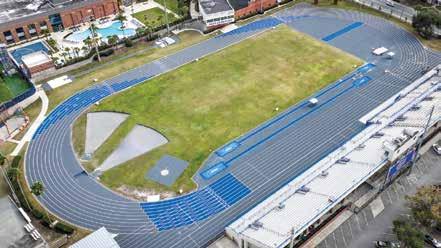
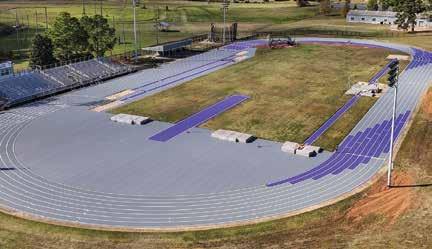
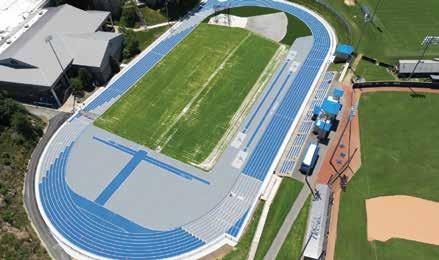
With decades of experience working with top-ranked programs across the country, TenCate brings the latest in surfacing, design and construction technology to the track market.
James G. Pressly Stadium
University of Florida, Gainesville, Florida
Host of the Tom Jones Memorial Invitational
Walter P. Ledet Track Complex
Northwestern State University, Natchitoches, Louisiana
Southland Conference Outdoor Track & Field Championships
Karl Straus Track
University of North Carolina, Asheville, Asheville, North Carolina
Host of the 2026 NAIA Men’s and Women’s Outdoor Track & Field National Championships
tencategrass.us
Building healthier, more beautiful communities.

have a dedicated strength and conditioning coach. I love how specific she makes many of our exercises, and how each cycle builds upon the previous. My plan did this, but Caitlin’s (Caitlyn Smith is the Miami strength and conditioning coach Wilk is referring to) is next level. I look at the weight room as a way to get stronger, develop more force application, and help with general strength/injury prevention. We work from developing the movements properly, to lifting heavier, and then focusing more on speed and efficiency as we get later into the season.
Bonsey: They are in the weight room twice a week. We have a strength coach that writes up their plan. I think lifting is very important, but our strength coach would have to
speak on the specifics of his plan.
Pigg: We lift year around. I trust our strength coaches to meet needs of health and fitness and some specific work. It makes us better and keeps us healthy. We only lift after hard days, so that varies with the day of week in our training plans.
Wolf: Out of racing season, our athletes are regularly in the weight room. As we get into racing season, they continue to lift regularly, but we may pare down from three to two times per week. We also work to provide strength work in small components of the warm-up or cool down with band work, mobility work, and core strength work.
Brown: TBD — we have changed this vari-
able many times in many different ways. We are currently NOT using the weight room/ strength training much at all and relying more on core and mobility exercises.
Franks: We lift year around two days a week. We do Olympic lifts as part of that when they are at school, and we can monitor it. During the summer when they are on their own, we don’t do the Olympic lifts. Typically, we do a pushing exercise, a pulling exercise, some sort of squat exercise, and an Olympic lift. Each one of those lifts often has a super set bodyweight exercise with it. On top of the two lifting days, we will have two other days a week that we will do a short core routine and/or a yoga routine that is strength based.
Newell: We use strength training and plyometrics to develop power, speed, strength, endurance, running economy, form and stability, fatigue resistance, balance and coordination, improve body composition, improve recovery, and prevent injury. We typically lift two days a week after we do some type of speed development on Mondays and Thursdays. We usually do a warm-up which includes 2-3 plyometric movements, followed by a strength session that complements our run training at that part of the season. Off-Season/ Foundational Strength => In-Season/ Power => Championship Season/ Maintenance.
QUESTION 3: IS CROSS TRAINING A BIG PART OF YOUR TRAINING DESIGN, SPECIFICALLY TREADMILL AND UNDERWATER TREADMILL WORK?
Godfrey: I’ve coached some athletes who cross train 2 – 3 times per month and others who cross train 2 – 3 times per week. I allow this to be very individual. Most often, the athletes use the pool or bike to cross train. We have access to an underwater treadmill, but it is seldom used.
McCurry: I love cross training and think it is still highly underutilized, particularly with middle distance athletes. So many athletes out there could stay healthier and stack the necessary months and years to see their potential if they incorporated more cross training. I’ve had elite level athletes run at their career best on four runs per week.
Wilk: For some, yes, it is an integral part between recovery days and doubles. I utilize
it mostly as a way to take some of the pounding off and keep them training if they’re feeling a little banged up. We are fortunate enough to have two Alter-G treadmills and a water treadmill with adjustable depth.
Bonsey: We don’t really have people cross train or Alter-G unless they are hurt.
Pigg: Cross training is not too big for us. It depends on their background. If they are good swimmers, then we opt for the pool. If they are not too water friendly, we do 20 bike, 20 stair master/ 20 rowing or something else in the gym. Variety is key.
Brown: No. Due to facilities and equipment, it isn’t an option. We only use treadmills or ellipticals when needed because of injury or bad weather.
Wolf: We do not utilize this much.
Franks: We do cross train some, especially on secondary workouts on a given day. So, an athlete might have a recovery run in the morning and a bike or elliptical session in the afternoon. We are very fortunate to have two Boost treadmills that we use a lot and then we use elliptical and bike quite often. Some use swimming, but I feel you need to be an efficient swimmer to be able to swim enough volume to get a great workout from it. We don’t have an underwater treadmill at LSU, but we did at Mississippi State when I coached there. I very much prefer the Boost/ Alter G treadmill, but the underwater treadmill is useful too. I just don’t love the slow pace of the underwater treadmill (not saying you don’t work hard to run that slow pace, but the actual pace is typically really slow, and not optimal for muscle fiber recruitment).
Newell: We utilize cross training with our 800-meter student-athletes. We use stationary bike, elliptical machine, arc trainer, pool, underwater treadmills, and BOOST treadmills as cross training options. Each modality offers a different option based on the student-athlete and training that we are achieving on that day. We use cross training for every reason we would use running. We use cross training as a preventative measure in what we do to stay healthy, consistent, and sustainable above anything else. Every year that I coach, I use cross training increasingly. An invaluable training entity.
QUESTION 4: DO YOU TRY TO INTEGRATE YOUR 800-METER GROUP INTO THE CROSS COUNTRY AND LONG DISTANCE GROUP? OR
DO YOU CREATE AN 800-METER CULTURE OF THEIR OWN?
Godfrey: We try to incorporate the 800meter group into the cross country group as much as we can.
McCurry: We have athletes who race cross country for us who are very effective in the 800-meters. We do have a separate group though that does not race cross country. They all meet for practice at the same time, but we have different workouts for the true 800- meter focused athletes.
Burks: Integration of a middle-distance athlete into cross country or long distance depends on the strengths of the athlete themselves. Currently, we have a middledistance culture within itself. This group of athletes are aware that their main focus through the year is the 800-meters – however, their training may overlap with cross country and long distance at various times throughout the season. In practice, we do not have separate practice times, and their easy or aerobic runs are done with the rest of the team. I have middle-distance athletes who came into college with cross country and longer distance experience, and some with a sprint/800 background who progressed aerobically enough to compete in cross country. Some have stayed 400-800 focused and do not run cross country. Some training overlaps, some does not – but each of those athletes are aware of their main focus at each time of the year.
Wilk: I don’t work with many 400/800m types, so I generally try to integrate the 800meter runners I work with into cross country. They have different strengths and weaknesses, but being around cross country generally helps the good ones push themselves further and develop the aerobic side more than they would if they were on an island. As we get into track season, they will have a little more of a group identity, but I save that for the winter/spring and not the fall.
Bonsey: I coach all of them, so the cross country guys and the 800 guys are always at practice together. I think that is very important. I think both groups can learn a lot from each other. Our best cross country runner last year also ran 1:45 so there can be overlap between the two groups as well. I think the 800 guys learn a lot about the work ethic of the distance runners and the distance runners can improve their speed by training with the 800 guys. It’s good to have both groups together.
Pigg: We look to build a specific 800 culture and have a specific identity. We blend with cross country and the sprint group as well. Once per week we do shorter sprint work with assistance from our sprint coach.
Brown: Yes! It is essential to the bond of the entire athlete group. However, during the track and field season, we split into two distinct groups with occasional overlap in workouts. We still do our warmups and training sessions at the same time and location.
Wolf: We do both. Fifty percent of our 800meter runners are “long sprinters,” and fifty percent are cross country runners. This is based on their physical strengths and passions as they pertain to our sport. Having the 4x800 meter relay in the NAIA allows us to integrate these two groups into a cohesive unit, as they are excited to do the relay together and desire to have the fastest four on the team, regardless of training group.
Franks: Yes and No. On the women’s side, 800-meter runners can stretch out to 5k and 6k effectively. For those that can, they run cross country. On the men’s side, stretching out to 8k and 10k is rarer, although it does happen. Whether they race cross or don’t race cross, they do a lot of the same training (although volumes are often reduced for the sessions or at least the length of the reps). But they also on some days do some different things than the cross folks. I do not make them a culture of their own, although on some days they are a separate group, especially if they are not racing.
Newell: Not all of our 800-meter studentathletes train and/ or compete in the cross country season. We typically have our 800meter student-athletes training on a similar path to our cross country runners in the fall, with some slight training adjustments a few days a week throughout the fall to ensure we are training the appropriate 800-meter competition necessities. These 800-meter student-athletes do less overall volume as well, as many of the 800-meter runners we train do not run more than 50-60 miles/ week. Again, aerobic development is the emphasis, especially in the fall, with anaerobic and ATP-CP work complementing the work week. I don’t like to get too far away from any work I feel is important for the 800meter student-athlete.
QUESTION 5: HOW OFTEN DO YOU RACE AN 800-METER RUNNER, AND DO YOU
CONSIDER COMPETITION A PART OF YOUR OVERALL TRAINING PROGRAM?
Godfrey: At the beginning of the competitive season, we typically race every two weeks. However, as the season progresses, we will race back-to-back weekends. I do believe competition can be a part of the overall training program.
McCurry: Not often in training phases, ideally, though the NCAA system can be challenging that way. We try to identify periods of time when we completely step away from racing and just train. Often, we do this in March. I do like racing frequently, however, once we are into the championship phase. I will often send my 800-meter athletes to a meet even the week before a conference championship, while I never do that with steeplechasers/5000m athletes.
Burks: Competition is an incredibly important piece of my training program. I have my 800-meter athletes race regularly throughout the season. At the beginning of the year, I will map out the season with each of my athletes, and we will work together to plan where we will run which event – this includes 400’s, 800’s, and 1500’s for most middle-distance athletes. We will use each of these events to develop confidence with our speed, strength, and tactics throughout the year. Many races early in the season are used as steppingstones in our training, as we develop towards championship events.
Wilk: Yes, competition is a huge component of the overall training program. It’s the most race-specific training you can get and helps them develop their racing acumen. Generally, I don’t race them more than two weeks in a row, unless we are chasing a mark at the end of a season and that’s what we have to do. I generally continue to train through the early indoor meets, since I feel like if we back off too many times, we will feel stale and not be as strong at the end of outdoor.
Bonsey: Racing is 100% part of the training stimulus. We build the races into the training plan. I view the races as a day when we don’t have to do specific 800 work. I like them to race about every other week once the season starts. Sometimes they have to race more than that in order to chase qualifying times but that would be ideal for me.
Pigg: We don’t race too often, usually missing a meet or two of the regular season. We can then train specifically and avoid travel. Then race time becomes somewhat special. We do a variety of races, such as 1500 meters twice a year, 4 x 400 often, and the open 400 when I know they are ready.
Brown: Yes, racing is part of the overall training program. We schedule competitions nearly every weekend. However, if the 800-meters is their primary event, they are definitely NOT racing it each weekend and rarely on back- to- back weekends. I feel athletes need to take a mental break and have a plan of when we expect them to race fast and know which competitions we are targeting for that. The other weekends could be a weekend off if needed for either recovery or academic purposes. During those extra weekends we will race shorter events or a longer event or do multiple events with less recovery (more as a workout) and sometimes attempt to simulate prelims and finals at a national meet.
Wolf: Younger athletes race as often as we can, typically once a week with two to three races per meet. Older athletes may race less frequently and run two races per meet, outside of a championship meet. Our competitions are seen as part of the training load for the week. Long sprinters that run 800’s tend to also run 400’s and 600’s indoors, so they don’t usually run 800’s every meet.
Franks: I absolutely consider racing as part of the training program. Racing HAS to be considered. As a general rule of thumb, we don’t race more than two weeks in a row during the track season, and often we only race every other week. How often and how many 800’s we run in a season depends on the athlete and the situation. If we race two weeks in a row, usually it may be a 400 and a 4x4 the first week and 800 the next. Or maybe a 1500 and 4x4 the first week, or a 600-meters indoors. I like to mix distances and race different distances fairly often for training purposes.
Newell: Historically, we will race the 800meter student-athlete two weeks on, and one week off. The way our schedule works, we can race two high quality races in a row, with the third week off from racing to focus on recovery. We do consider any competi-
tion a workout because racing is the most specific work we can do in our training cycle. Depending on the 800-meter studentathlete we are working with, we may race an open 400-meters and 4 x 400m relay leg the first weekend, and the open 800-meters and 4 x 400m relay leg the next weekend. Others we may race the open 800-meters and a 4 x 400m relay leg the first weekend, and the open 1500 meters the next weekend. Some freshmen we may race back-to-back 800-meters and 4 x 400m relay legs to get them more experience in the 800-meters. The artistry is determining what each student-athletes needs from the races and how they play into the training cycle for their individual growth.
QUESTION 6: DO YOU COACH THE EVENT, OR THE INDIVIDUAL? THERE ARE MANY WAYS TO GET ANY OUTCOME. SO HOW DO YOU DETERMINE HOW YOU WILL COACH AN 800-METER RUNNER (200-400, 400-800, 800-1500, 1500-3000 TRAINING EMPHASIS). DO YOU CUSTOMIZE AND INDIVIDUALIZE YOUR 800-METER TRAINING TO THE STRENGTHS OF YOUR ATHLETES? OR TRY TO TRAIN THE DEFICIENCIES AND WEAKNESSES? EXPLAIN.
Godfrey: Generally, I believe the aerobic system is not given the attention it deserves. Our goal is to maximize this system as best we can, but it takes time to do so, and I believe we need to consider this from an individual standpoint. Some athletes are more prepared as freshmen to handle aerobic/lactate threshold efforts than others. In a given week, the ”sprinters” in our group may do more cross training than the “1500 meter types.” Also, the “1500 meter types” typically will do more V02 sessions than our “sprinters.”
McCurry: Definitely coach the athlete over the event. This is a foundational principle for me. We had four women in the Mountain West 800-meter final last spring, and all four trained differently. I focus more on maximizing an athlete’s natural strengths in pursuit of their potential, though we do need to allocate time to minimizing weaknesses too.
Burks: I coach the individual. The determination of how I will coach an athlete begins with the recruiting process – determining their sports background, training, racing history, and goals. Generally, I try to determine

how much easy/aerobic training they have done versus how much sprint/speed training they are used to. In that determination, some athletes will be pushed to train more in the aerobic system, while some other athletes are less adaptable to the new stimuli. Initially when I began coaching 800-meter athletes, I focused heavily on training deficiencies and weaknesses, but over time I have shifted to a more balanced approach. While we still develop areas of weakness, we now spend as much time developing the athlete’s natural strength.
Wilk: I try to coach the individual, but it’s important to keep in mind the demands of the event. I have not always done the best job of this, but have grown in this area, especially while getting to work with Coach (Amy) Deem at Miami. (Editor’s note: Deem is the longtime director of track and field and cross country at the University of Miami.) First, I look at the athlete’s strengths and cater to those, as those are where they get their confidence from, so it’s important to not stray too far from those. (This is something I didn’t do the best job of when I was younger.) If they aren’t confident, they won’t be able to run to the best of their abilities. However, if there are areas that are holding them back, and that they can handle it in training, then it can be helpful to improve those. Building true confidence is the most important aspect of the 800-meters in my mind. Even if they’re fit and capable, they won’t run well if they aren’t confident.
Bonsey: I coach the individual. Our 800 runners are very diverse. Like I said before, they run anywhere from 30-70 miles a week. I really try to individualize things as much as possible. I learned a lot by coaching Tinoda Matsatsa and Gabriele Angiono when they were freshmen. Both were super low mileage in high school, so as freshmen I kept them right around 30 miles a week. They ended up running 1:45 and 1:46. That really opened my eyes to different ways to train and what you can accomplish with a talented athlete. They still trained hard but just a little differently than some of the other guys. I have always found that I learn just as much from the athletes as they learn from me. I am constantly trying to learn more about each guy I coach so I can cater things to them individually. Ultimately, believing in what they are doing is more important than the specifics of any workout. I make sure they are comfortable speaking their mind to me and I make
adjustments at times based off what they tell me. I think they like feeling like they have some ownership over their training and that can be very powerful. Some guys like to show up, do what they’re told and go home. Others like to talk with you about training and have ideas. I try to find ways to have each guy feel really confident about what they are doing on a daily basis.
Pigg: Individuals. Some need a wide spectrum of work, and others it is a more focused scope. Everyone I coach has different strengths and needs. We want to stay good at the strengths and focus some on seeing increases in their weaknesses. More importantly, however, is that they are getting better in everything they do throughout their careers.
Brown: We coach the individual. Everyone’s needs are very different regardless of their event. We plan the season, cycle, and week to the event. Typically, on a Sunday night I will review what each athlete was expected to do versus what they did in addition to their health. After that, I will make adjustments to their upcoming week to try to account for all of those variables. They know that after they receive the training plan on Monday, they can come speak with me about any concerns or things I may need to know, and we can tweak the plan accordingly. In terms of how we train them, I would say it is more of, ‘what do they need.’ Again, each athlete is different so in a given week or workout, many athletes could be doing many different variations of the original plan to accommodate those strengths, weaknesses or needs.
Wolf: We coach the individual within the greater principles of the training group. So, yes, individual tweaks are made for athletes who may need them. However, the components needed to race the 800-meters are similar regardless. We tend to work a balanced program that helps an athlete develop both strengths and weaknesses. Our belief is that they will always default to their strengths within the race but will also always be limited by their weakness. Both parts need to be developed to allow an athlete to fully excel in the event.
Franks: I am a HUGE believer in coaching the individual. If I have 30 athletes that I am coaching (number changes every year) then every Sunday when I do schedules for
the week, I do 30 individual schedules. In saying that, the event they are training for has certain physiological demands that the athlete is going to have to meet. But how they go about meeting those and training for those has to be catered to the individual athletes’ strengths and weaknesses. Physiology (their lactate threshold, aerobic threshold, buffering capacity, vVO2 all age, experience, genetics, biomechanics, mental state, health, etc.) all play a role.
Newell: We develop the student-athlete’s strengths and weaknesses with our training. Everything is about finding a baseline and then making progress in all areas with that student-athlete from that point.
SUMMARY
We are very grateful to the coaches who put a considerable amount of time and effort into this project. These coaches understand that coaching education is vitally important and question and answer forums such as this certainly serve that purpose. We hope that this article has provided coaches with some excellent information, knowledge, and hopefully sparked or renewed an interest in continuing and improving their coaching craft. Benjamin Franklin, one of founding fathers, sums this up much better than I could with this quote: “An investment in education pays the best interest,” echoing my key thoughts concerning education and the coaching world.
++A special thanks to Dennis Newell from North Dakota State University, as without his help, the 800-meter roundtable would not have been possible. Newell and Mike Thorson, the coordinator of this forum, were long-time coaches at the University of Mary, with Thorson serving as director of track and field/cross country for 24 years, and Newell holding down cross country coach, associate head coach, and director of the program titles during his 15 years at the Bismarck, ND Division 2 school.
++A very special thanks to Ann Thorson and Ameila Sherman for their editing and technical assistance
MIKE
THORSON, FORMER DIRECTOR OF TRACK AND FIELD/CROSS COUNTRY AT THE UNIVERSITY OF MARY

In 1934, Karl Popper published a book that would permanently alter the course of scientific thinking. The central argument of The Logic of Scientific Discovery was disarmingly simple: a theory is not scientific because it can be proven true. It is scientific only if it can, in principle, be proven false. Popper called this standard falsifiability, and he drew a sharp demarcation between genuine science and what he termed pseudoscience — belief systems so elastic that no observation could ever threaten them. A claim that explains everything, Popper argued, explains nothing. The willingness to be wrong is not a weakness of science. It is the engine of science.
Track and field coaches should feel this argument personally. Because if Popper had spent 50 years at the fence line of a high jump competition, watching coaches explain, diagnose and instruct, he might have reached for a different word than pseudoscience. He might have called it something more familiar: a bucket of beliefs. A claim that explains everything explains nothing. The willingness to be wrong is not a weakness of science — it is the engine of science.
Every coach carries one. It is built over years from personal athletic experience, mentorship, clinics, video and the invisible sediment of competitive folklore. Some of its contents are genuinely correct — tested and structurally sound. Much of it is not. The most dangerous feature of the bucket is not the bad information it contains. It is that the bucket has no drain. Beliefs enter. They rarely leave.
The reason is exactly what Popper diagnosed: coaching beliefs, as typically held and communicated, are rarely falsifiable. Consider the standard vocabulary of technical instruction in the high jump. An athlete is told that the mechanics are like “stepping down from a bar stool.” To pre-rotate their shoulders to facilitate getting back-to-bar. To “drive the free leg knee toward the opposite shoulder.” Each statement might be directionally accurate, partially accurate, or entirely wrong. But none will be tested. There is no agreed-upon measurement, no threshold for confirmation or refutation, no protocol by which the belief can be placed at genuine risk.
When the athlete improves, the instruction is credited. When they don’t, something else is blamed — timing, fatigue, nerves.
The belief itself is never in jeopardy. It sits safely in the bucket, insulated from falsification, explaining whatever happens. This is not coaching from fact. It is coaching from faith. The distinction matters enormously, because the athlete’s career is the experiment, and it only runs once.
The high jump is one of the most kinematically complex athletic events in existence.
The Fosbury Flop requires a precise curved approach, a multi-plane penultimate step, a takeoff that maximizes the trajectory of the center of mass (COM), and a mid-air reconfiguration to clear a bar the COM itself may never reach. The event is, at its mechanical core, a three-dimensional problem of momentum management across the full stride cycle.
And the overwhelming majority of coaches watching it are two-dimensional thinkers and seers.
This is not an insult. It is an accurate description of the human visual system applied to a moving athlete. The eye is sensitive to sagittal-plane motion — forward and backward displacement. It is considerably less capable of integrating frontal- and transverse-plane dynamics simultaneously.
We see limb segments, imprecise angles, speed in two dimensions. What we functionally cannot see is the actual trajectory of the COM through three-dimensional space. Tellez, Pfaff, Schexnayder, and a few others, have the innate ability not only to recall what they just saw, but to mentally rotate that image, and to extrapolate what was taking place in areas they did not directly see. That is the essence of 3D thinking and seeing.
For everyone else, the COM trajectory remains the governing mechanical signal of the entire event — and the one they cannot access. The curve of the approach is not incidental; it redirects horizontal momentum into vertical displacement while pre-loading the system for the rotational demands of bar clearance. Every phase connects to every other phase through the single integrating signal of how the COM moves through space. The coach at the fence line sees the jump in a fundamentally different coordinate system than the one in which it actually occurs. They are watching a 3D event through a 2D window. And then they coach what they saw — not what happened.
The coach at the fence line sees the jump in a fundamentally different coordinate system than the one in which it actually occurs. They are watching a 3D event through a 2D window.
There is a game called Liar’s Poker. Players hold a dollar bill — serial number concealed in their fist — and make successive bids about the collective distribution of digits across all the bills in the game. The bids may be bluffs or genuine calculations. From the outside, they are indistinguishable. Each player bids confidently from severely incomplete information. The danger is not that players lie intentionally. The danger is that the structure of the game makes confident statements about hidden information not just possible but required.
The fence line at a track meet is Liar’s Poker.
A coach watches a high jumper miss. In the three seconds between the dislodged bar and the athlete’s return walk, a diagnosis has formed and an instruction is already being constructed. “You were too far off the
bar.” “You dropped your hips.” “Your takeoff was too flat.” The statement is delivered with the authority of observation. It feels like fact. It is experienced as fact, by both coach and athlete. But it is, in the overwhelming majority of cases, a projection from incomplete information — a confident bid from a concealed hand.
The problem is not malice or incompetence. It is epistemological. The coach’s visual system captured approximately what was happening in one plane, during one phase, with no access to the mechanical signal that actually explains the outcome. The diagnosis is offered without the data that would make it testable. Technical points can mean many things, can be executed many ways, and produce different mechanical outcomes depending on where in the performance cycle they occur. They cannot be falsified because they were never operationally defined.
The information required to make falsifiable claims about three-dimensional movement is not available to the naked eye at the fence line. The gap between what coaches see and what is mechanically occurring is
not a gap of effort. It is a gap of instrumentation. This can be observed when a coach has been viewing performances at practices and meets from a right angle perspective. The athlete qualifies for the year’s internationalmajor championships and where are coaches seated? Directly behind their athletes, at a viewing perspective they haven’t worked from all year… and they are still bidding with confidence on a hand they cannot read.
The antidote is falsifiability as a cognitive habit — a standard the coach applies to their own claims before issuing them. This begins with distinguishing three categories of coaching statements. The first is observation: what the coach actually perceived, honestly bounded by its limitations. “From where I was standing, your free-leg drive appeared to slow before takeoff” is an observation. The second is inference: a mechanical claim derived from observation but extending beyond it. “If that’s what happened, your hip height at takeoff was likely suboptimal” is an inference that makes a checkable prediction. The third is instruction: a proposed correction with an implied forecast. “Focus on maintaining free-leg speed through the takeoff, and we should see your clearance improve at this bar setting” is instruction attached to a falsifiable outcome.
Most fence-line coaching collapses all three into a single declarative statement delivered as settled fact. This is the Liar’s Poker move: the confident bid from incomplete information, stated authoritatively when it is actually inference compounded by instruction. The Popperian coach holds the categories apart. They know what they saw, what they inferred, and what they are predicting. And they know the conditions under which they will have been wrong.
In the high jump, this discipline is especially tractable because the bar is either up or down. That binary outcome is a gift—a built-in feedback mechanism. The problem is not its absence. The problem is that most coaching interventions are not stated with enough precision to be evaluated against it. When the bar stays up, the instruction is confirmed. When it comes down, execution is blamed. The belief is preserved. The bucket stays full.
The bar is either up or down. That binary outcome is a gift. The problem is that most coaching interventions are not stated pre-
cisely enough to be evaluated against it.
The bridge between the 2D world the coach perceives and the 3D world in which the athlete moves is not simply technology, though technology matters. It is conceptual. Coaches must first understand what they are not seeing — must develop a disciplined awareness of the blind spots in their visual access — before they can honestly calibrate what their instructions are based on.
In the high jump, the most consequential invisible is the COM path during the last two strides and through the takeoff. This window determines bar clearance height more directly than any joint angle or limb position a coach can observe. The curve of the approach concentrates centripetal force that, redirected at takeoff, contributes to the rotational mechanics of the Flop. The penultimate step sets the ceiling on how much vertical velocity the takeoff can generate.
What coaches can see are the observable correlates of these three-dimensional events — proxies. A penultimate step that fails to maintain the COM path without shifting laterally in the direction of its grounding is a proxy for the performance compromises that follow. A torso prematurely upright out of either backward or inward leans is a proxy for a COM that will not track across-over the plant foot for maximum velocity conversion to vertical and will compromise back to bar and about the bar rotations. These proxies have genuine value. But they are not the thing itself, and coaching them as if they were the thing itself is the error that produces the Liar’s Poker dynamic.
The coach who understands this distinction coaches differently. When they see the athlete lean back at takeoff, they don’t simply instruct “stay tall.” They ask what mechanical condition would produce that lean—what is happening at the COM level that the lean is a surface expression of—and they construct an instruction aimed at the underlying cause rather than the visible symptom. That instruction will carry a prediction. It will be falsifiable. It will either improve the outcome or it won’t, and if it doesn’t, the coach updates the bucket rather than protecting it.
THE SCIENTIFIC COACH Popper’s demarcation principle was never just about physics labs. It was about the difference between a mind that holds its beliefs
up to the light—genuinely willing to discover it was wrong—and a mind that arranges its beliefs so that discovery is impossible. The first kind of mind advances. The second accumulates. The first builds a science. The second builds a bucket.
The high jump is among the most intellectually demanding events to coach well. It requires understanding of three-dimensional kinematics, momentum strategy, stride-cycle mechanics, and the relationship between approach geometry and bar clearance. It also unfolds in an environment—the competition venue, the fence line, the compressed window between attempts — that is maximally hostile to deliberate, evidencebased reasoning. The structural pressures of the game push coaches toward confident, rapid, declarative instruction. The bucket is always within reach.
The discipline of falsifiability does not require a biomechanics lab to begin practicing. It requires only a cognitive habit: before any instruction is issued, ask what would have to happen for this claim to be wrong. If there is no answer — if the claim is constructed so that any outcome confirms it — then it is not coaching from fact. It is coaching from belief. And the athlete, who does not have the luxury of running the experiment twice, deserves better than a confident bid in Liar’s Poker.
The fence line will never be a laboratory. But it can be governed by a scientific attitude — one that distinguishes observation from inference, inference from instruction, and instruction from fact. That distinction is not a technicality. For the athlete on the runway, it is the difference between a coach who is learning alongside them and a coach who is simply very confident about things they cannot actually see.
DAVE KERIN IS A FORMER COACH AT MIDDLEBURY COLLEGE, FOUNDER OF KERIN PERFORMANCE INSIGHTS (KPI) AND DEVELOPER OF THE TIMS™ (TEN INDICES MASTER SYSTEM), A COM-CENTRIC MOVEMENT ANALYSIS FRAMEWORK, AND PERIA™ (PERFORMANCE EVIDENCE RESOLUTION AND INTELLIGENCE ARCHITECTURE). HE HOLDS A PROVISIONAL PATENT COVERING THE TIMS/PERIA ARCHITECTURE.
AN EXCERPT FROM THE USTFCCCA TRACK
STATIC FLEXIBILITY EXERCISES
• Static Flexibility Exercises. Static Flexibility Exercises are stretching exercises that challenge the range of motion of a joint in a format that involves little or no motion.
• Purpose. These routines are designed to develop active and passive flexibility. They are typically used to produce a general loosening effect immediately prior to more intense work. When used extensively, they are capable of producing more permanent flexibility increases.
• Protocol. Typical Static Flexibility units employ a variety of exercises that address all regions of the body. Sets are comprised of 10-15 seconds of work for a general loosening effect. Session volumes involve 5-12 minutes of work. More permanent changes require sets of 2 minutes or more. Care should be taken in scheduling this extended form of work however, since it produces dramatic short-term decreases in the athlete’s force production capabilities.
• Categories of Static Flexibility Exercises o Static Stretching Routines. Static Stretching Routines are traditional stretching exercises. These exercises place a joint in a position that challenges range of motion, usually using gravity or other muscle groups to increase the tension levels applied to the targeted muscles and connective tissues. These are typically used for several seconds to produce a gentle loosening effect.
o Facilitated Stretching Routines.
Facilitated Stretching Routines employ more sophisticated methods such as PNF techniques, elastic band stretching, or yoga. Tension levels should be mild, as overly aggressive stretching results in diminished force outputs in performance. These are normally used for several seconds to produce a gentle loosening effect.
• Administration. Static flexibility exercises are typically (but not exclusively) included in the warmup portion of the training session. They may also be employed in the cooldown portion of the session, and at other times depending upon the goals of the session. Static flexibility exercises should be done mildly and comfortably, with tension levels generated in the muscle and connective tissue kept to moderate level. It is a common error for athletes to stretch too aggressively, preventing the relaxation needed for proper release of muscle tissue. Breathing control is necessary as well, as because deep, slow inhalation and exhalation contribute to the release of muscle tissue. Aggressive, high tension stretching and prolonged stretching produce dramatic short-term decreases in force
production, so relaxed, mild stretching is preferred. Extended stretching times can be used for more permanent flexibility gains, but the resulting force production decreases dictate that this type of work, if needed, is best scheduled during transition phases of training.
• Dynamic Flexibility Exercises. Dynamic Flexibility Exercises are exercises that move joints through large ranges of motion, testing flexibility limits in a dynamic sense. Normally one side of a joint is stabilized, while the other is forced through high amplitude, ballistic motion.
• Purpose. These exercises are designed to develop passive and kinetic flexibility. Specifically, they seem to train the threshold response of the Golgi tendon organs, enhancing the efficiency, economy, and elasticity of movement.
• Protocol. Typical dynamic flexibility units employ 8-15 repetitions of 3-12 exercises, addressing all regions of the body. Typical sessions employ 5-12 minutes of work.
• Administration. Dynamic flexibility
exercises should be done aggressively, at high speeds with a significant ballistic component. Stabilization of the non-moving side of the joint is essential. Also essential is complete release and relaxation at the ends of the joint’s range of motion. Guarding or tensing as the moving body part changes direction is a common error.
• Sprint Development Drills. Sprint Development Drills are various modifications of walking, running, and skipping mechanics, designed to serve as dynamic flexibility exercises and specific technical teaching progressions. They differ from the previously mentioned dynamic flexibility routines as they are performed in an upright position and involve displacement.
• Purpose. Sprint Development Drills develop coordination, flexibility, and mobility. They also provide an opportunity to teach certain technical aspects of sprinting, particularly postures and force application strategies. It should be noted that while these exercises provide opportunity to address many aspects of running mechanics, this
represents the limit of their effectiveness as sprint teaching tools. The intensities found in these exercises are not sufficient to elicit the reflexes found in high velocity sprinting, so skill transfer to actual sprinting is minimal or nonexistent.
• Protocol. Typical sprint development drill units employ 1-3 repetitions of 4-8 exercises, performed over distances of 10-50 meters. Total volumes range from 150 to 500 meters.
• Administration. Sprint development drills can be used for several purposes. Many drills of this type feature high speeds of movement. In these situations, ranges of motion must not be decreased and posture adjusted in compensation. Good sprint drill programs provide a mix of slower, high range of motion activities, and faster movements. It is also good practice to provide a mix of forward, lateral, and backwards movements, to ensure all body regions are addressed, enhance coordination, and improve force application capabilities. Finishing sets of these exercises with short (10-30 meter) accelerations is common.
• Hurdle Mobility Exercises. Hurdle Mobility Exercises are mobility development exercises that use hurdles as tools to provide the exercise environment. Hurdle mobility exercises challenge the athlete’s ranges of motion, and the hurdles supply technical and coordinative demand.
• Purpose. These exercises are designed to improve mobility, flexibility, and coordination. They strengthen the lower back, lower abdominal, and pelvic regions and seem to help sharpen agonist/antagonist muscle group firing patterns.
• Protocol. Typical hurdle mobility units employ 1-3 sets of 2-8 exercises, performed over 6-12 hurdles. Total unit volumes typically involve negotiating 40-100 hurdles. Sessions may be performed at slow speeds, or done at fast speeds employing more ballistic movement.
• Administration. Maintaining the proper spatial relationships between body parts during hurdle mobility work is essential. Every forward movement over a hurdle should be initiated by turning the toes outward, to preserve proper balance in the hip’s rotator muscle groups. Pelvic alignment should be consistently neutral when moving over hurdles, and the knee should remain above the ankle during clearance. Even in faster, more ballistic forms of hurdle mobility work, ranges of motion achieved should be prioritized over speed of movement.
TRAINING EXERCISES
• Weight Training Exercises. Weight Training Exercises are exercises that involve resistance, usually using traditional weight training equipment. They are typically thought of as strength development exercises but also address many other physical performance components.
• Categories of Weight Training Exercises o Olympic Lifts
▪ Exercises. Olympic Lifts include the competitive weightlifting exercises, specifically the clean and jerk, and the snatch. Also included in this group are exercises that are derivatives of, partial movements of, or exercises used in teaching progressions for these lifts. Olympic lifts are a major muscle group oriented activity.
▪ Purpose. Olympic lifts develop absolute strength, power, reactive strength, and coordination. They are extremely complex lifts, placing demands on the athlete’s stabilization, absolute strength, power, reactive strength capabilities at various points in
the exercise. Unique sequences of hip, knee, and ankle extension are used, as are unique relationships between upper body and lower body movements. As a result, when done correctly, we see movement patterns very similar to those we see in athletics. This makes them very specific to performance and we see significant skill transfer into athletic skills. This complexity could be the reason that they seem to serve as a harmonizing agent, making gains made in other areas more functional to performance.
▪ Protocol. Normal protocols employ 4-8 sets of 1 to 5 repetitions, with recoveries long enough to guarantee the quality of work. Intensities should be relatively high, but appropriate to the time of year. Loading schemes can be based upon load (weight lifted) or velocity (bar speed).
▪ Administration. A detailed discussion of lifting techniques is beyond the scope of this course, but the student should seek additional resources and develop effective teaching progressions for these exercises. Failure to perform these exercises correctly increases injury risk. Poor technique also produces joint firing patterns that differ from those we see in performance, hindering skill transfer rates into the sport. Weight should never be so extreme as to compromise proper technique, and technical evaluation is a good measure of the appropriateness of the training load. Because of the high technical demand and power outputs of this type of work, they are typically done before all other types of weight training in a session.
o Static Lifts
▪ Exercises. Static Lifts are traditional weight lifting exercises that involve gross movements and major muscle groups. Relatively high resistances are employed, necessitating low speeds of movement. Usually, full ranges of motion are employed. Most squatting and pressing movements fit into this category. Also falling into this category are slow eccentric movements or loaded isometric exercises. Necessarily, they normally involve lower repetitions and high numbers of sets. Intensities should be relatively high, but appropriate to the time of year.
▪ Purpose. Static lifts are a primary tool for absolute strength development, and enhance postural qualities and anchoring ability when technique and loading are appropriate.
▪ Protocol. Normal protocols employ 4-8 sets of 1-8 repetitions per body region, with recoveries long enough to guar-
antee the quality of work.
▪ Administration. A detailed discussion of lifting techniques is beyond the scope of this course, but the student should seek additional resources and develop effective teaching progressions for these exercises. Failure to perform these exercises correctly, in addition to producing injury risk, results in compromised joint firing sequences. This limits skill transfer and presents the risk of developing imbalances. Weight should never be so extreme as to compromise proper technique, and adequate general strength levels must be achieved before static lifting can be undertaken in earnest. Technical evaluation is a good measure of the appropriateness of the training load. While there may be exceptions at times, full ranges of motion should be employed in the static lifting program to ensure strengthening kinetic chains and body parts in the correct ratios.
o Ballistic Lifts
▪ Exercises. Ballistic Lifts are fast, repetitive, weighted movements that that involve gross movements and major muscle groups. These exercises display a high degree of involvement of reactive and elastic qualities. At times smaller ranges of motion are employed to avert fatigue and maintain high power output.
▪ Purpose. These lifts enhance power, elastic strength, and absolute strength, and greatly resemble many demands of competition.
▪ Protocol. Normal protocols employ 4-8 sets of 5-12 repetitions per body region, with recoveries long enough to guarantee the quality of work. Intensities should be relatively high, but appropriate to the time of year. Loads usually range from 10% to 30% of the athlete’s bodyweight in jump work, and 30% to 50% of the athlete’s bodyweight in upper body work.
▪ Administration. The impact and spinal loads associated with ballistic lifts offer some injury risk. Athletes should achieve adequate levels of general strength, power, and absolute strength before ballistics are done. Weight should never be so extreme as to compromise proper technique and technical evaluation is a good measure of the appropriateness of the training load. The technical aspects of foot contacts should resemble those discussed in multijump training administration.
o Bodybuilding Lifts
▪ Exercises. Bodybuilding Lifts are weightlifting exercises performed in higher repetition/lower resistance/short recovery for-
mats. The exercises typically employ smaller muscle groups. They may be very simple or highly technical and complex in nature.
▪ Purpose. Bodybuilding lifts are used to develop endocrine and energy system fitness, improving the effectiveness of other strength training agents and rates of recovery.
▪ Protocol. Normal protocols employ 20-24 total sets of 10 repetitions in a session, with recoveries ranging from one minute to 90 seconds.
▪ Administration. As in all lifts, proper technical execution is critical to achieving proper results. While there may be exceptions at times, full ranges of motion are preferred, and proper release at the ends of the ranges of movement assist in providing the restorative properties of this type of work. Speeds of movement should not be so high that these are compromised. Because of the metabolic demands and restorative properties of bodybuilding lifts, strict adherence to training parameters, particularly recovery times and exercise order, should be established.
• General Strength Exercises. General Strength Exercises are strength development exercises that involve no external loading. Bodyweight serves as the only loading agent. General strength exercises improve general strength levels, coordination, body control, and active flexibility.
• Purpose. General strength exercises can be used to improve muscular strength and strength endurance. These activities are often the best way to address muscles and muscle groups not directly involved in the gross movements most used in training. Because of the lack of external loading, general strength work is a good way to prevent and alleviate muscle and strength imbalance situations. General strength can then enhance gross motor performance by preventing imbalance related dysfunction and by activating smaller muscle groups that are responsible for proper action of gross movements. Like bodybuilding lifts, general strength work can be used as a tool to achieve endocrine and energy system fitness, while lessening the chances of repeti-
tive movement syndromes. They serve as a primary strength training modality for young athletes, and a primary recovery modality for older athletes.
• Protocol. These exercises are usually performed in circuit fashion. Normal protocols employ a variety of exercises comprising a training unit of 10-12 minutes in duration, with a session employing 1-3 such units.
• Categories of General Strength Exercises
o Calisthenics. Calisthenics are simple, gross body movements that involve large amount of muscle tissue. Often, they involve body positions that create resistance or challenge ranges of motion. They are typically performed in circuit fashion, using work/rest ratios designed to develop energy system and endocrine fitness.
o Specialized Calisthenics. Specialized calisthenics are calisthenic exercise routines geared toward addressing a particular quality or body part. Many of these routines are geared toward abdominal/spinal development or lower leg strength and mobility, because of the importance of these body
regions to performance.
o Stabilization Routines. Stabilization Routines develop the ability to stabilize joints and gross muscle groups during activity. These muscle groups must possess enough strength endurance to function throughout the course of the event. Often these exercises require joints or body parts to remain stationary under circumstances of loading or instability. At other times they may require very slow, uniform movements of body parts. Improvement of proprioception and balance results from this type of work.
o Connective Tissue/Fascia Routines. Connective Tissue/Fascia Routines are exercises that create great tension in the connective tissue, under conditions of very slow movement. These also address muscle tissue as well, and help to improve flexibility and muscular strength and endurance.
• Administration. In performing general strength exercises, goals differ depending upon the purpose of the session. For example, when movements are gross, high speeds of movement and power output are typically needed to achieve the glycolytic stimulation desired. Strict adherence to work and rest time parameters are essential to achieve fitness and restoration goals. However, when a complex movement is required in an exercise, correct technical execution is required to ensure proper loading of the kinetic chain and strengthening of body parts in the correct ratios. Body control should always be demonstrated in general strength work.
• Medicine Ball Exercises. Medicine Ball Routines include various exercises using the medicine ball as loading. Examples include various catch/throw combinations, abdominal and spinal exercises with the medicine ball, and callisthenic type exercises using the ball as a light load.
• Purpose. Medicine ball work produces many of the same benefits of general strength work due to the relatively light loading and similar nature of the activities. These benefits include improvements in coordination, body control, muscular strength, and strength endurance. These exercises can be chosen to activate and educate small muscle groups and enhance the efficiency of large muscle groups. They can also be used as a tool to achieve endocrine and energy system fitness when done in circuit fashion. They can serve as a primary strength training modality for young athletes, and a primary recovery modality for older athletes. They
also seem to alleviate some of the imbalance situations created by other parts of the training program. Additionally, medicine ball work can be used to enhance postural strength and the body’s ability to withstand impact by catching the thrown ball.
• Protocol. These exercises are usually performed in circuit fashion. Normal protocols employ a variety of exercises comprising a training unit of 8-15 minutes in duration, with a session employing 1-3 such units.
• Administration. Most of the principles governing the administration of general strength exercises can be applied to medicine ball exercises as well. In addition, special attention should be given to toss-catch work. The purpose of this work is developing postural integrity under the stress of impact, so special attention should be given to stability during the catch. The target presented should be reasonably outside the frame of the body, to increase the postural demand.
• Multithrow Exercises. Multithrows are high intensity throws, performed from various positions, using a shot or heavy medicine ball as a load. At times jumps may be used in combination with the throws to intensify the loading phase of the exercise.
• Purpose. Multithrows develop power and coordination. Like Olympic lifts, multithrows require muscle stabilization and locomotive activity that is very similar to what we see in athletics, and thus are very specific to performance. They are typically used when a low risk, high power activity is required.
• Protocol. Normal protocols employ involve various 3-6 different exercises, 3-5 repetitions, totaling 15-40 per session.
• Administration. Multithrows resemble Olympic lifts in technical demand. Joint firing sequences must be correct in order to insure transfer into the events themselves. Generally speaking, proximal to distal firing should be stressed, and lower body activity should significantly precede upper body activity. Performing certain exercises from atop a toeboard or some other elevated surface enables the ankle to move through a greater range of motion and fire at a more appropriate time.
• Special Strength Exercises. Special strength exercises are exercises that mimic the strength demands and movement patterns of the event.
• Categories of Special Strength
Exercises. Special strength exercises can take two forms.
o Loaded Rehearsal. These exercises technically mimic the competitive movement to a great degree and are performed under loads. Care should be taken, as the high levels of specificity used in this work (and at times the attractiveness of gimmicks) often serves as a distraction in developing a sound, diverse strength development program.
o Advanced Strength and Power Routines. In the combined events, with high level competitors, it is common practice in training program design to include high level exercises for strength and power. While they do not resemble the event enough to be classified as rehearsal, the movement patterns and demands are very specific. In combined event training programs these exercises usually involve high level, single leg strength and power exercises, throw specific exercises, and high level exercises directed at postural musculature, usually involving rotational and multiplanar work with a functional training theme.
• Multijump Exercises. Multijumps are jumping activities that develop reactive strength and the elastic response. They also develop technical efficiency when the characteristics of force application to the ground are considered. They are highly specific to the combined events, so they serve as an important special strength and technical development tool as well.
• Categories of Multijump Exercises o Short Bounds
▪ Exercises. Short Bounds are simple jumps of low to medium intensity, with displacement, and specific technical demand. They are commonly subcategorized as horizontal or vertical based upon the general trajectory of takeoff.
▪ Purpose. These are typically used to improve reactive strength and to enhance the quality of force application to the ground in a manner specific to running and jumping.
▪ Protocols. Normal protocols employ 3-5 repetitions of 3-6 different exercises. Each exercise uses 1-5 takeoffs, with a total of 30-60 contacts per session.
o In Place Jumps
▪ Exercises. In place jumps are jumps of low to medium intensity without displacement.
▪ Purpose. These exercises are used to improve reactive strength, coordination,

and work capacity for multijump training.
▪ Protocols. Normal protocols employ 8-20 takeoffs per set, and a total of 150- 300 takeoffs per session. These are often done in circuit fashion and quantified in time.
o Extended Bounds
▪ Exercises. Extended bounds include jumps performed over significant distances, exhibiting displacement and specific technical demand. These are exercises show medium to high intensities, and many exercises that fall within this category are technically complex.
▪ Purpose. These exercises are employed to subject athletes who have experienced proper prior preparation to improve reactive strength, address technical jumping mechanics, and to improve the ability to sustain power production.
▪ Protocols. Normal protocols employ 2-3 repetitions of 3-6 exercises, performed over distances of 20-40 meters, not exceeding 400 meters of total volume.
o Depth Jumps
▪ Exercises. Depth jumps are rebounding efforts performed after a fall from some elevated surface. The elevated surface enables gravity to act upon the falling athlete for a certain defined period of time, thus determining the impact associate with the landing and the subsequent takeoff. High surfaces produce high intensities. While low surfaces can be used, depth jump sessions are usually used to challenge intensity.
▪ Purpose. These exercises are employed to subject athletes who have experienced proper prior preparation to higher training intensities, increasing reactive strength in a specific manner.
▪ Protocols. Normal protocols employ 3-5 repetitions of 3-5 different exercises, totaling 15-40 contacts per session.
• Administering Multijumps
o Training Quality. High quality and intensity of training are necessary to achieve the desired training effect. The quality of training should not be compromised in order to hasten work or accomplish volumes.
o Prestretch Characteristics. The rate of prestretch applied to the muscle is more important to the quality of the elastic response than the magnitude of prestretch. The prestretch should be optimized, not maximized.
o Strength Prerequisites. Certain strength levels should be established before advanced multijump training is undertaken.
o Technical Correctness. All multijumps should be done correctly to avoid injury, and certain technical proficiency levels should exist before undertaking advanced multijumps. Technical evaluation is a good measure of the appropriateness of the training load.
o Postural Correctness. Good posture and technique should exist during all multijump activities. Of special importance is the maintenance of a neutral pelvic alignment in single leg hopping and bounding work. Postural and technical evaluation are good measures of the appropriateness of the training load.
o Technical Specifics
▪ Foot Contacts. Foot contacts vary in different types of multijump training. In horizontal work, contacts should be full footed, with a rolling contact of the foot against the surface to the toe. Cuing heel to toe is good and common coaching practice. In more vertically oriented work or less intense in place jumping, a rolling action from the middle of the foot to the toes is commonly taught. Stabbing, toefirst contacts are dangerous and should be avoided.
▪ Recovery Heights. Recovery heights in single leg hopping or bounding work are determined by the degree of transfer of angular momentum to the lower leg as the thigh moves forward. Cuing cycling of the leg is hazardous and destroys the elastic nature of the exercise. This practice introduces poor posture due to the body’s flexion reflex and prevents the quadriceps from adequately protecting the knee at impact. High recovery heights result from high velocities, and since these velocities do not exist in multijump training, they are inappropriate and low recovery heights should be stressed.
▪ Trajectories. Trajectories should be addressed. Generally speaking, to achieve the best results, the vertical components of the exercises must be overemphasized. In horizontal work, cuing outward trajectories in the initial takeoff, but vertical trajectories thereafter is a common coaching practice. Instability in bounding or hopping exercises usually calls for an increase in trajectory and vertical component.
▪ Swing Leg Radius. The swing leg movement that accompanies each takeoff (in single leg exercises) should occur with the leg in an extended position. This assists in the preservation of good pelvic alignment, and best places the quadriceps muscle group in position to protect the knee.
▪ Arms. Arm actions, whether single or double arm style, should display large ranges of motion at the shoulder and extended positions.
▪ Swing Leg Symmetry. The swing leg movement that accompanies each takeoff (in single leg exercises) should be symmetrical with respect to the body’s long axis. Excessive instability during horizontal hopping and bounding exercises is often related to an asymmetrical, backside dominated swing.
• Acceleration Development
o Acceleration Development Work. Acceleration Development Work is run training designed to improve acceleration capabilities. When examining human performance, most athletic populations require an acceleration of approximately 40 meters to reach maximal velocity. Acceleration development work isolates the acceleration component of the sprint, so most sprint distances used in acceleration development training are 40 meters or less in length. This standard may be adjusted for developmental or elite populations.
o Categories of Acceleration Development Work
▪ Acceleration Development Sprints
• Exercises. Acceleration development sprints are sprints of short distances, generally up to 40 meters in length. The short distances are used in order to isolate the acceleration abilities and mechanics.
• Protocol. Normal protocols employ total volumes of 200 to 400 meters per session. Intensities are maximal, and recoveries are long enough to ensure quality of work remains high (usually 1-3 minutes). Sets and ladder up constructs are common.
▪ Resisted Runs
• Exercises. Resisted runs are sprints performed with some type of light to moderate resistance. These may include harness runs, hill sprints, sled pulls, or other forms of resistance. Loading inherently places the body into positions and mechanics that accentuate the mechanical features of acceleration, so resisted runs are often employed to improve acceleration qualities. They also provide needed contrast to nonresisted acceleration development sprint work.
• Protocol. Normal protocols employ runs of 20-60 meters in length, totaling 250-450 meters per session. Intensities are maximal,
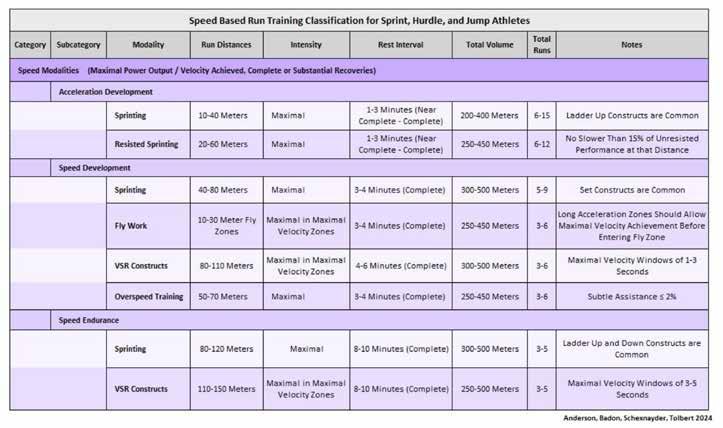
and recoveries long enough to ensure quality of work remains high (usually 1-3 minutes). Resistance values should not be extreme, timed performances in these sprints should not fall below 15% of the time capable in a nonresisted effort.
▪ Drill Based Approaches. There are numerous drills and technical exercises that employ the movements of acceleration. Wall drills, heavy sled work, and many others are commonly used in sprint and jump programs. These can be used to teach acceleration skills and reinforce acceleration concepts. It’s important to note that while these types of exercises can develop and reinforce acceleration concepts, the rate of skill transfer to actual, competition level acceleration is very low. For this reason, the coach should not overinvest here, and the bulk of the acceleration development program should be composed of high quality acceleration development sprints and resisted runs.
o Administration. Acceleration development work must be performed at high intensities. While formal monitoring of the recoveries is not usually necessary, adequate rest must be provided to ensure the quality of each effort. A designated, previously taught starting technique should be used in each session. Injury prevention concerns also dictate addressing patient deceleration
and stopping at the end of each effort.
• Absolute Speed Development
o Absolute Speed Development Work. Absolute speed development work is run training designed to improve absolute speed qualities and maximal velocity performance. Observations of human performance show that upon achieving maximal velocity, humans capable of maintaining maximal velocity for more than a few seconds, after which deterioration in velocity takes place. Absolute speed development work should involve placing the athlete into situations of maximal velocity for periods of time not exceeding three seconds, experiencing maximal velocity performance without experiencing the subsequent degradations in velocity.
o Categories of Absolute Speed Development Work
▪ Speed Development Sprints
• Exercises. Speed development sprints are sprints of 40-80 meters. This distance range is employed because, when individualized correctly, it places athletes into maximal velocity situations of 1-3 seconds after acceleration is completed, a period of time consistent with the time frames mentioned above.
• Protocol. Normal protocols employ multiple runs totaling 300 to 500 meters per session. Intensities are near maximal, and
recoveries long enough to ensure quality of work remains high (usually 3-4 minutes). Sets and ladder up constructs are common.
▪ Fly Work
• Exercises. Fly work for speed development purposes is very similar to the sprints previously discussed. The difference is the presence of a more relaxed acceleration phase before entering a fly zone (a 1-3 second zone of maximal velocity performance). For this type of work to be effective, the athlete must achieve maximal velocity prior to entering the fly zone. When done properly, fly work of this nature uses very long (often 50m or more) acceleration zones prior to entering the fly zone.
• Protocol. Normal protocols employ 3-6 runs totaling 250 to 450 meters per session. Intensities are maximal, and recoveries long enough to ensure quality of work remains high (usually 3-4 minutes).
▪ Variable Speed Runs
• Exercises. Variable speed runs are complex runs involving alternating periods of relaxed running with periods of maximal velocity performance. Examples would include ins and outs and sprint/float/sprint type runs.
• Protocol. Each run is constructed to provide 2-3 maximal velocity situations during the course of one running effort, and are typ-
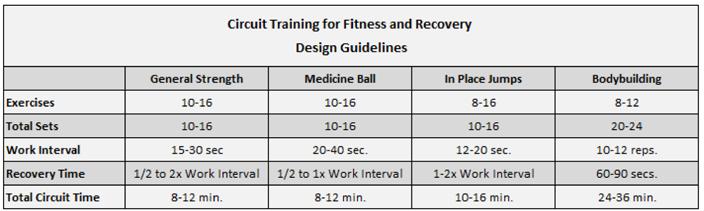
ically 80-110 meters in length. Recoveries are long enough to ensure the quality of work remains high (usually 4-6 minutes). Normal protocols employ 3-6 runs totaling 300 to 500 meters per session.
▪ Overspeed Training
• Exercises. Overspeed training involves sprint work using some type of assisting device. Theory suggests that this enables an athlete to achieve velocities that surpass one’s current absolute speed qualities. Examples include towed sprints, downhill running, or wind assisted sprinting.
• Protocol. Normal protocols employ 3-6 runs of 50-70 meters in length, totaling 250450 meters per session.
▪ Drill Based Approaches. There are numerous drills and technical exercises that employ the movements of maximal velocity sprinting. Sprint drills, stadium steps, wickets and many others are commonly used in sprint and jump programs. These can be used to teach maximal velocity skills and reinforce maximal velocity concepts. It’s important to note that while these types of exercises can develop and reinforce maximal velocity concepts, the rate of skill transfer to actual, competition level sprinting is very low. For this reason, the coach should not overinvest here, and the bulk of the speed program should be composed of high quality work performed at maximal velocities and intensities.
o Administration. Absolute speed development work must be performed at high intensities. Achieving the proper timeframes of maximal velocity performance might require slight alterations in the training course for certain individuals. When choosing rest intervals, err on the side of excess to ensure work quality, and be prepared to alter volumes should power levels
drop. A designated, previously taught starting technique should be used in each session. Injury prevention concerns also dictate addressing patient deceleration and stopping at the end of each effort. Wind direction should always be a concern.
• Speed Endurance
o Speed Endurance Work. Speed endurance work is run training designed to improve speed endurance qualities, specific coordination or sprinting movements, freedom of movement at high speeds, and glycolytic capacity and power. Speed endurance work must place the athlete into maximal velocity situations for time frames that permit the athlete to combat the degradation of absolute speed qualities that occurs at this point. Appropriately scheduled speed endurance work is helpful, particularly with more advanced jumpers, because the coordination improvements that result eliminate much of the deceleration and hesitation associated with preparation and takeoff in the jumping events
o Types of Speed Endurance Work
▪ Speed Endurance Sprints
• Exercises. Sprints used to develop speed endurance are typically of 80 – 120 meters in length. This distance chosen should allow the athlete to accelerate, achieve maximal velocity, and attempt to maintain maximal velocity for 3-5 seconds. This challenges the athlete’s ability to resist deceleration and maintain coordination of the sprint movements.
• Protocol. Normal protocols employ 3-5 runs totaling 300 to 500 meters per session. Intensities are maximal, and recoveries are long enough to ensure quality of work remains high (usually 8-10 minutes) Sets and ladder up and down constructs are common.
▪ Variable Speed Runs
• Exercises. Variable speed runs are complex runs involving alternating periods of relaxed running with periods of maximal velocity performance. Examples would include ins and outs and sprint/float/sprint type runs.
• Protocol. These runs are usually constructed to provide 2 maximal velocity situations during the course of one running effort. Typically 2-5 runs of 110 to 150 meters in length are used. Segments of maximal velocity sprints are of 3-5 seconds, athlete’s ability to resist deceleration and maintain coordination of the sprint movements. Recoveries are long enough to ensure the quality of work remains high (usually 6-10 minutes). Normal protocols employ 2-5 runs totaling 250 to 500 meters per session.
ENDURANCE DEVELOPMENT COMPONENTS
• Circuit Training
o Circuits. A circuit is a collection of exercises combined into a session, performed with specified work and rest intervals, in order to accomplish some specific purpose.
o Benefits of Circuit Training. Circuit training can be used to accomplish a variety of goals. Common circuit goals and purposes include developing glycolytic fitness, developing endocrine fitness, accelerating recovery, and improving strength, mobility, and /or coordination. The variety of exercises used in a good circuit reduce the risk of repetitive movement syndromes dramatically, so these goals can be accomplished with minimal injury risk.
o Circuit Types. Circuits are typically classified by the predominate type of work used in the circuit. Most circuits used in training can be classified as General Strength circuits, Medicine Ball Circuits, In Place
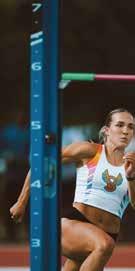








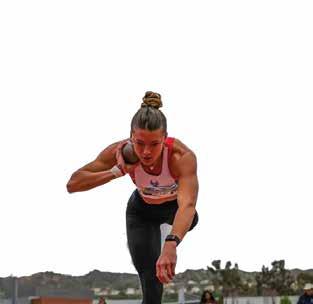























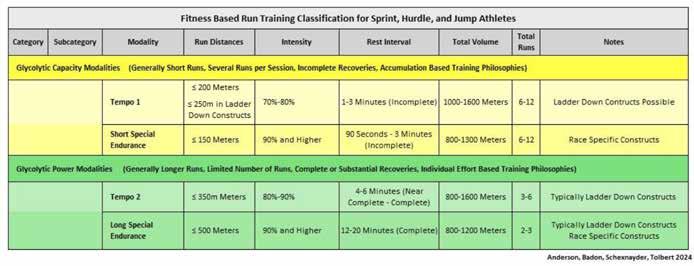
Jump Circuits, or Bodybuilding Circuits. Different types of work can be combined into a single circuit provided the mix does not interfere with administration of the circuit.
o Circuit Design. A good circuit employs a variety of exercises addressing multiple body parts. The circuit should be designed so that the athlete’s power output levels remain high, even though the circuit might be challenging and taxing.
o Administration. While circuit training is often designed to challenge the athlete, the principles of power level maintenance apply here as well. Many circuit workouts would be better served by breaking them into multiple manageable units. A convenient method of quantifying this type of work and budgeting energy distribution is by considering the total training time of each session. Much consideration must be given to the practical aspects of circuit training, such as the convenience and availability of partners when needed, the availability of equipment, and exercise sequence.
• Glycolytic Capacity Work. Glycolytic capacity work trains the glycolytic energy pathways and buffering capabilities to improve the athlete’s ability to perform significant volumes of glycolytic work. In glycolytic capacity training, this is done by achieving an accumulation of glycolytic stress and acidity throughout the workout. Many shorter runs are used, employing the principle of intermittent work to accomplish these volumes. These runs might not be challenging individually, but the session produces significant glycolytic stress and fatigue because of the short rest intervals employed. Incomplete recoveries between run efforts
are a characteristic of this type of training. accumulation of fatigue and acidity throughout the workout.
o Tempo 1. Tempo 1 training employs runs of 70% - 80% intensity and is done with rest intervals of 1-3 minutes. Runs employed are of 200 meters or less, however runs as long as 250 meters might be used to begin ladder down constructs. The number of runs used ranges from 6-12, and total volumes range from 1000 to 1600 meters. Tempo 1 training is not overly specific to the jumping events, but is commonly used in the general preparation period in preparation for more intense forms of training. This type of work is helpful in jump programs to prepare athletes for subsequent glycolytic power work.
o Short Special Endurance. Short special endurance employs runs done at an intensity of 90% or more, with rest intervals ranging from 90 seconds to 3 minutes. Runs employed are of 150 meters or less. The number of runs used ranges from 6-12, and total volumes usually range from 800 to 1300 meters. The runs can be arranged into sets. Short special endurance work is not specific to jumps training and need not be included, but might be applicable with jumpers who compete in other (particularly sprint) events.
• Glycolytic Power Work. Glycolytic power work trains the glycolytic energy pathways and buffering capabilities to improve the athlete’s ability to perform extended, longer glycolytic efforts. In glycolytic power training, this is done by achieving an accumulation of glycolytic stress and acidity with each running effort. Longer runs are used, that are challenging individually. Maintenance of quality throughout the workout requires significant (possibly complete)
rest between runs, and a limited number of running efforts.
o Tempo 2. Tempo 2 training employs runs of 80% - 90% intensity and is done with rest intervals of 4-6 minutes. Runs employed are of 350 meters or less. The required paces, along with the need to maintain velocity and power output throughout the workout dictates that tempo 2 workouts nearly always show a ladder down structure. The number of runs used ranges from 3-6, and total volumes usually range from 800 to 1600 meters. The runs can be arranged into sets. This type of work is helpful in jump programs to prepare athletes for subsequent speed endurance work.
o Long Special Endurance. Long special endurance work employs runs done at an intensity of 90% or more, with rest intervals ranging from 12-20 minutes. 2-3 runs of 500 meters or less are used, and ladder down structures are typical. Total volumes range from 800 to 1200 meters. Long special endurance work is not specific to jumps training and need not be included, but might be applicable with jumpers who compete in other (particularly long sprint) events.
• Administration. Strict adherence to intensity and recovery parameters is critical to achieving desired results in this type of work. Intensity throughout the efforts is needed to maximize adaptations in buffering capability. Accurate record keeping insure the progressiveness and systematic nature of training.
TECHNICAL TRAINING COMPONENTS
Technical Training consists of activities designed to provide opportunity to teach the specific movements and skills involved in

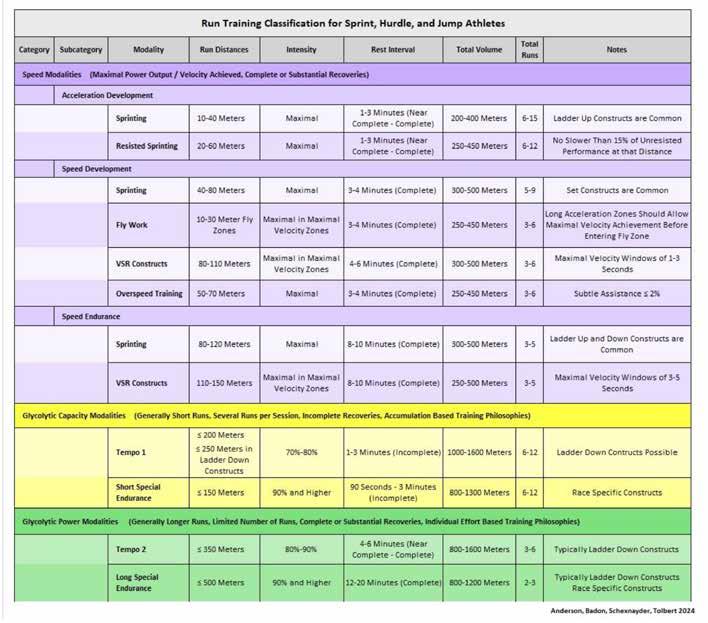
the event. These activities normally fall into the two categories that follow.
• Drills and Technical Exercises. Drills and technical exercises are activities which provide the opportunity to teach fundamental skills common to multiple events, or partial skills that must be assembled into a technical model. These exercises may be very event specific, or might address very rudimentary mechanics that may be addressed with medicine ball throwing routines, hurdle drills, and rudimentary jumping activities.
• Technical Rehearsal. Technical rehearsal refers to actual execution of the complete skill or large portions of the skill, in an environment that resembles the competition environment.
Testing and competitions must be considered as components of training. While not generally thought of as a part of the training process, the demands associated with these components require special attention.
• Testing. Testing is another important part of the training plan. The testing is periodic, planned, physical testing of physical performance component levels. Testing has definite impact on the total volume and intensity of the training program, and these effects must be considered in training design. Testing should be considered as a part of the program, not an addendum to it. Testing will be examined in more detail in a later section.
• Competitions. Competitions should be
considered as a part of the training plan. Competitions have a definite impact on the on the total volume and intensity of the training program, and these effects must be considered in training design. Competitions should be considered as a part of the program, not an addendum to it.

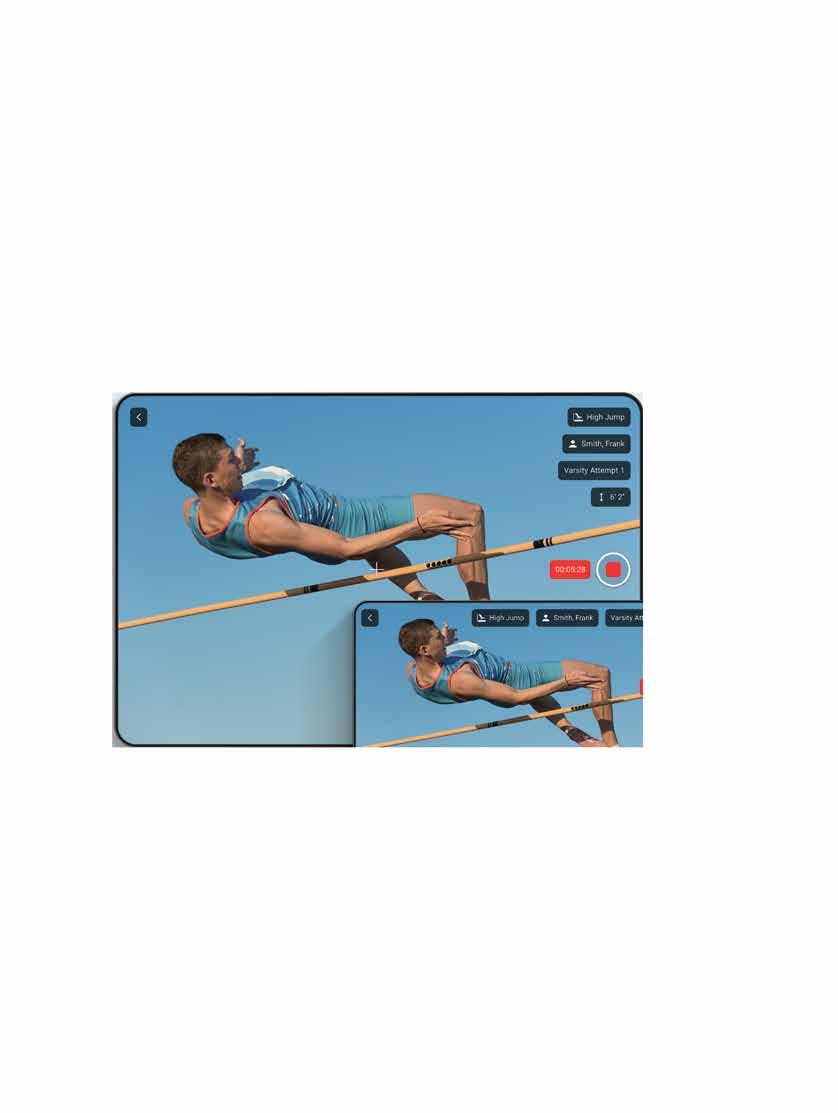























NCAA DIVISION I

Caryl Smith
Gilbert
Georgia Women’s COY

Doug Case Arkansas Men’s COY
NCAA DIVISION II

Kyle Rutledge Pittsburg State Women’s COY

Kyle Rutledge Pittsburg State Men’s COY
NCAA DIVISION III

Jeff Stiles Washington (Mo.)
Women’s COY

Josh Buchholtz UW-La Crosse Men’s COY

Diljeet Taylor BYU Women’s Assistant COY

Ken Harnden Auburn
Men’s Assistant COY

Jane Hedengren BYU Women’s Track AOY

Ja’Kobe Tharp Auburn Men’s Track AOY

Hana Moll Washington Women’s Field AOY

Brian Sebera Minnesota State Women’s Assistant COY

Pol Domenech Wingate Men’s Assistant COY

Ava O’Connor Adams State Women’s Track AOY

William Opare Angelo State Men’s Track AOY

Miranda Lauvstad
Minnesota State Women’s Field AOY

Peyton Bair Oregon Men’s Field AOY

Ben Haas Hillsdale
Men’s Field AOY

Ernest Mosheleketi Centre
Women’s Assistant COY

Norman Tate Rowan
Men’s Assistant COY

Sydney Radigan Calvin Women’s Track AOY

Collin Conzemius UW-La Crosse
Men’s Track AOY

Serena McNeilly Centre Women’s Field AOY

Gage Stankiewicz
Men’s Field AOY








Women’s COY

Iowa Western CC Women’s COY
Marian (Ind.) Men’s COY

David Schenek Barton (Kan.)
CC Men’s COY
Presley Martin Marian (Ind.) Women’s Assistant COY
Presley Martin Marian (Ind.)
Men’s Assistant COY
Women’s Track AOY
Men’s Track AOY
Kori Nagel Dickinson State (N.D.)
Women’s Field AOY

Marc Bierbaum
Iowa Western CC Women’s Assistant COY

Emmanuel Dixon Barton (Kan.)
CC Men’s Assistant COY


Jayval Wright Hinds (Miss.)
CC Men’s Track AOY

Xylavene Beale Hutchinson (Kan.)
CC Women’s Field AOY

2025 NATIONAL HIGH SCHOOL CROSS COUNTRY COACHES OF THE YEAR

Tom Kennedy Bridgeland (Texas)
Girl’s COY

Columbus North (Ind.)
Preparatory
Boy’s COY