PLUS
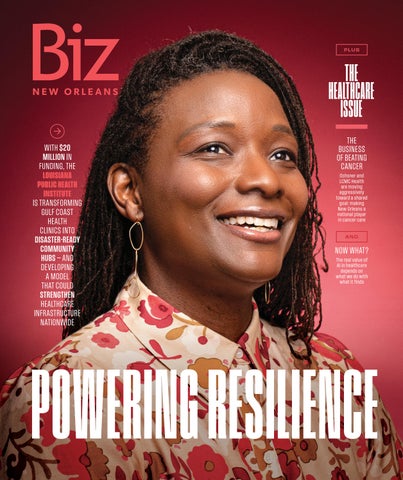
THE HEALTHCARE ISSUE → WITH $20 MILLION IN FUNDING, THE LOUISIANA PUBLIC HEALTH INSTITUTE IS TRANSFORMING GULF COAST HEALTH CLINICS INTO DISASTER-READY COMMUNITY HUBS — AND DEVELOPING A MODEL THAT COULD STRENGTHEN HEALTHCARE INFRASTRUCTURE NATIONWIDE
THE BUSINESS OF BEATING CANCER Ochsner and LCMC Health are moving aggressively toward a shared goal: making New Orleans a national player in cancer care AND
NOW WHAT? The real value of AI in healthcare depends on what we do with what it finds
POWERING RESILIENCE
NOVEMBER EVERY ISSUE
PERSPECTIVES
FROM THE LENS
54 GREAT WORKSPACES From layout and lighting to colors and furnishings, every detail of Hope House’s new Northshore facility was designed to help children feel safe.
08 EDITOR’S NOTE
10 PUBLISHER’S NOTE
26
MANUFACTURING
Greater New Orleans is home to a surprising range of health care products and technologies — and a growing effort to turn medical research into companies, jobs and investment.
62 NEIGHBORHOOD GEM At Miss Gloria’s Garden, lessons in planting and harvesting come with an education in pricing, marketing, money management and self-reliance. 72 64EW ORLEANS 500 Erin Kolb, MSW, LCSW, NFA, CEO of Poydras Home
22 BANKING + FINANCE Five questions executives should ask before expanding
14 SPORTS If Pelicans can win half of their games this season will be a success
16 PUBLIC POLICY With a new sheriff emphasizing collaboration, New Orleans has an opportunity to turn decades of jail dysfunction into lasting reform.
18 ENTREPRENEUR Smart accounting can make the difference between a business that survives and one that thrives.
VOLUME 13 ISSUE 02
24 MARITIME + PORTS Louisiana already has the assets to lead America’s maritime economy.
30 ECONOMIC DEVELOPMENT The Urban League is advancing entrepreneurshipled economic developoment across the state
32 GUEST Healthcare AI can identify risk with remarkable accuracy, but its real value depends on whether organizations have the people, processes and resources to act on what it finds.
34 58
WHY DIDN’T I THINK OF THAT?
For nearly 25 years, Blue Cypress Books owner Elizabeth Ahlquist has shown how an independent bookstore can thrive by becoming an essential part of its neighborhood, but her biggest challenge right now may surprise you.
40
Powering The Business Resilience With $20 million in of Beating funding, the Louisiana Cancer Public Health Institute Ochsner and LCMC Health are moving aggressively toward a shared goal: making New Orleans a national player in cancer care.
is transforming Gulf Coast health clinics into disaster-ready community hubs — and developing a model that could strengthen healthcare infrastructure nationwide.
EDITOR’S NOTE
Biz Talks
Healthy Growth
W
elcome to our first-ever health focused issue! Healthcare is Greater New Orleans’ largest employment cluster, supporting more than 86,000 jobs across our 10-parish region, with an average annual salary topping $87,000. But the industry’s economic impact extends well beyond patient care. Our region is also a center for medical research and innovation. In 2025 alone, Tulane University, LSU Health New Orleans and Xavier University collectively received approximately $135 million in funding from the National Institutes of Health. And that innovation economy is only getting stronger. This month, we explore how our region’s two healthcare giants, Ochsner Health and LCMC Health, are each making major investments to position New Orleans as a destination for cancer care — and what those efforts could mean for patients, jobs and our economy. There’s encouraging news on the cancer front, too. Although Louisiana continues to struggle with cancer rates above the national average, Orleans Parish has one of the lowest cancer incidence rates in the state, ranking next to last among Louisiana’s 64 parishes. Its rate is also below the national average and continues to decline. As we (thankfully!) approach the end of hurricane season, we also caught up with Shelina Davis, president and CEO of the Louisiana Public Health
Institute, about an ambitious effort to make healthcare more resilient across the Gulf Coast. Backed by a $20 million grant — one of just two awarded nationwide through the National Academies of Sciences, Engineering, and Medicine’s Gulf Futures Challenge — the five-year Gulf Hub initiative aims to ensure community health centers can continue providing critical care before, during and after disasters. Investments in everything from solar power to portable health records will help make that possible. It’s yet another example of how our region is turning its challenges into opportunities for innovation. Speaking of innovation, don’t miss this month’s manufacturing feature, in which Biz New Orleans Associate News Editor Kelly Hite takes a deep dive into the surprising variety of healthcare products and technologies being developed and manufactured right here. From cutting-edge medical devices to custom prosthetics, there’s a lot more happening in this sector than you might imagine. Thanks for reading,
KIMBERLEY SINGLETARY Editor Kimberley@BizNewOrleans.com
THE ALLIANCE OF AREA BUSINESS PUBLISHERS AWARDS 2026 Silver Best Overall Design Silver Best Feature Layout 2025 Silver Best Overall Design Silver Best Feature Layout 2024 Silver Best Daily Newsletter Silver Best Feature Layout Silver Best Beat Reporting, Real Estate 2023 Gold Best Feature Layout Gold Best Beat Reporting, Real Estate Silver Best Feature Series Silver Best Personality Profile Silver Best Cover Silver Best use of Photography/Illustrations Bronze Best Overall Design 2022 Gold Best Feature Gold Best Recurring Feature Silver Best Feature Layout 2021 Gold Magazine Design Gold Best Explanatory Journalism Gold Feature Design Silver Best Feature Bronze Best Use of Multimedia 2020 Silver Best Recurring Feature 2019 Gold Best Recurring Feature Gold Best Explanatory Journalism 2018 Gold Most Improved Publication Silver Best Recurring Feature 2017 Silver Best Recurring Feature Bronze Best Daily Email 2016 Bronze Best Feature Layout
06
B IZ NE W ORL E AN S
N OV 2 6
Each week, “Biz Talks” reaches beyond the pages of Biz New Orleans’ magazine to bring you in-depth conversations with leaders in our community. Episode 305 What If New Orleans Businesses Could Help Power the City?
What if local businesses could help keep New Orleans powered during outages — while lowering energy bills for everyone? That’s the idea behind the newly approved $28 million Neighborhood Power Plan. But how exactly would it work, and what could it mean for local businesses and residents? Garreth Johnson of Together New Orleans joins us to explain the ambitious initiative, which aims to create the largest per-capita virtual power plant in the country, strengthen the city’s electric grid and make power more reliable and affordable. Episode 304 Why Does Selling a Home Cost So Much? Does It Have To?
Hint: Part of the answer, Grant Clayton says, has to do with a certain mega home-search company. But he argues there’s a better way — and he’s proving it. The Northshore resident launched 1 Percent Lists with his wife in 2015, and today the company is approaching 80 franchises nationwide. On this week’s Biz Talks, Clayton explains why he believes a 1% commission is more than fair, what consumers don’t understand about how real estate agents get clients and get paid, and what simple change he’d like to see to increase transparency.
AVAILABLE ON: Spotify, Apple, Audible, Amazon Music, Anchor, Overcast, Pocket Casts
Publisher Todd Matherne EDITORIAL Editor Kimberley Singletary Art Director Sarah E.G. Majeste
Digital Media Editor Kelly Massicot Associate News Editor Kelly Hite Research Alex Jorns
Contributors Natalie Barranco, Samantha Hindman, Ashley McLellan, Misty Milioto, Judy Reese Morse, Rebecca Mowbray, Chris Price, Bethany Stich, Keith Twitchell, Ralph Whalen ADVERTISING
Senior Account Executive Meghan Schmitt 504-830-7246 Meghan@BizNewOrleans.com Senior Account Executive Lauren McCanse 504-830-7249 Lauren@BizNewOrleans.com
RENAISSANCE PUBLISHING
PRODUCTION Digital Director Rosa Balaguer Arostegui Senior Production Designer Ashley Bravata MARKETING Marketing Manager Haley Nash Sponsored Content Coordinator Jeremy Marshall ADMINISTRATION Office Manager Emily Ruiz VP of Sales and Marketing Kate Henry Chief Executive Officer Todd Matherne For subscriptions, call 504-830-7231
110 VETERANS BLVD., SUITE 123 • METAIRIE, LA 70005 • 504- 828-1380 Biz New Orleans is published monthly by Renaissance Publishing, LLC, 110 Veterans Memorial Blvd., Suite 123, Metairie, LA 70005; 504- 828-1380. Subscription rate: one year $48, no foreign subscriptions. Postage paid at Metairie, LA, and additional mailing entry offices. POSTMASTER: Send address changes to Biz New Orleans, 110 Veterans Memorial Blvd., Suite 123, Metairie, LA 70005. Copyright 2025 Biz New Orleans, all rights reserved. No part of this publication may be reproduced without the consent of the publisher. The trademark Biz New Orleans is registered. Biz New Orleans is not responsible for unsolicited manuscripts, photos, and artwork, even if accompanied by a self-addressed stamped envelope. The opinions expressed in Biz New Orleans are those of the authors and do not necessarily reflect the views of the magazine or owner. Official digital reprint and framed content is only available from Renaissance Publishing, LLC by calling 504- 828-1380 or visiting bizneworleans.com/frames.
B I Z N E WORLE AN S.C O M
07
PUBLISHER’S NOTE SALES TEAM
Grateful Gatherings
N
ovember offers plenty of opportunities to celebrate the people and organizations helping move our region forward. I hope to see many of you at the World Trade Center New Orleans Gateway Luncheon on November 13 at the Higgins Hotel. This annual gathering is always an important opportunity to recognize the people and partnerships strengthening our international business community. On November 18, JEDCO and the Jefferson Chamber will host the next Prosper Jefferson, highlighting the growth and economic opportunities throughout Jefferson Parish. As I continue my year with Leadership Jefferson, I’ve gained an even greater appreciation for the businesses, organizations and individuals investing in the parish and our region as a whole. November 20 promises to be an especially busy day. I look forward to attending the Port of New Orleans’ annual State of the Port Brunch, hosted in partnership with the International Freight Forwarders & Customs Brokers Association of New Orleans at the InterContinental Hotel. Our port and international trade community remain vital economic engines for Louisiana, connecting our region to markets around the world. That same day, the New Orleans Opera will present Il Trovatore, and we’re proud that Renaissance Publishing is producing the official program. We’re equally excited to continue that partnership with Opera Fest in March 2027. Supporting the
organizations that enrich New Orleans’ cultural landscape has always been an important part of what we do. On a more personal note, November holds special meaning for Andrea and me. On November 24, we’ll celebrate our 37th wedding anniversary. Thirty-seven years, three daughters, seven grandchildren and countless memories later, I remain incredibly grateful for the life and family we’ve built together. Andrea continues to be the heart of our family, and I’m blessed to share this journey with her. Just two days later, we’ll gather with our growing family for Thanksgiving. It’s a welcome reminder that amid busy schedules, deadlines and the demands of everyday life, our greatest blessings are often the people sitting right around the table. As we approach the close of another year, I’m also thankful for our incredible Renaissance Publishing team, our readers, advertisers, partners and the Greater New Orleans community we’re so fortunate to serve. Happy Thanksgiving — and I hope to see you around town this November!
KATE HENRY
VP of Sales and Marketing 504- 830-7216 kate@bizneworleans.com
MEGHAN SCHMITT
Senior Account Executive 504- 830-7246 meghan@bizneworleans.com
TODD MATHERNE CEO and Publisher Renaissance Publishing
LAUREN MCCANSE
GIVE THE GIFT OF STORIES THIS HOLIDAY SEASON! GIFT 50% OFF A NEW SUBSCRIPTION. *Must order online, new subscribers only expires December 31, 2026.
08
B IZ NE W ORL E AN S
N OV 2 6
Senior Account Executive 504-830-7249 Lauren@BizNewOrleans.com
B I Z N E WORLE AN S.C O M
09
IN THE BIZ
18
ENTREPRENEUR
14
16
If Pelicans can win half of their games this season will be a success
With a new sheriff emphasizing collaboration, New Orleans has an opportunity to turn decades of jail dysfunction into lasting reform.
SPORTS
PUBLIC POLICY
Smart accounting can make the difference between a business that survives and one that thrives.
IN THE BIZ SPORTS
CHRIS PRICE is an award-winning journalist and public relations principal. When he’s not writing, he’s avid about music, the outdoors, and Saints, Ole Miss and Chelsea football.
Leveling Up
If Pelicans can win half of their games this season will be a success BY CHRIS PRICE
T 14
B IZ NE W ORL E AN S
N OV 2 6
his young players to cohesively mesh with established players. The biggest question is how the Pelicans will be able to compete with teams across the NBA and climb their way into the Western Conference postseason picture. The starting lineup will likely feature forwards Zion Williamson and Herb Jones, guards Dejounte Murray and G Saddiq Bey, and guard/forward Trey Murphy III. They’ll be supplemented by guards Benedict Mathurin, Jeremiah Fears, Jordan Poole, forward/center Derik Queen and center Yves Missi. To win, the Pelicans will need to play solid defense, maximize scoring chances off turnovers and draw fouls that give them opportunities for free throws. Injuries, especially to Williamson, have plagued the Pels for years, but there is hope this year may be different. Williamson, Murphy and Bey each played in at least 62 games last season. They are a core three that have the potential to drive this team to the playoffs, but if the wheels fall off — especially early in the season — Peli-
I L LU S T R AT I O N BY PADDY MILLS
he New Orleans Saints’ season hasn’t lived up to expectations thus far, and as the 2026-27 NBA season tips off, greater attention is moving across the street from the Caesar’s Supe rdome to the Smoothie King Center. But there’s no guarantee that local sports fans will find relief with the New Orleans Pelicans. After winning just 26 games last season and finishing 11th in the Western Conference, the Pels had a relatively quiet offseason. They brought in former Orlando coach Jamahl Mosley, who took the Magic to the playoffs the last three years, to lead the team and hope his track record of strong defense and player development takes hold in the Crescent City. They will definitely need to be better at stopping the opposition as they’ve ranked in the bottom 10 in team defense the last two seasons. Mosley has talent on his squad that he can work with. One of his main tasks will be getting
cans executive VP for basketball operations Joe Dumars may look to offload some current players and try to rebuild the roster. Experts and bettors aren’t big on the Pelicans’ chances this season. FanDuel set the Pels over/under win total at 29.5 wins. BetMGM has the Pelicans’ 2026-27 title odds at +75000, meaning a $100 bet on New Orleans winning the title would result in a $75,000 payout. Yeah, that would be a nice payday, but it’s seemingly highly unlikely. The Pels would need to win 15 more games than they did last season just to win half of their games and 16 more to have a winning season. Even if they make the playoffs, which they’ve done nine times, New Orleans has only won two playoff series since moving to the Big Easy in 2002. USA Today analyst Lorenzo Reyes doesn’t see a championship happening this season. He gave the Pels a D grade for their offseason moves and predicts the team will finish with a 34-48 record. While the Pels are seen as an athletic team, they lack height and an established 3-point shooting threat. They led the league in shots taken in the lane last season (58%) but only hit 55.4% of their shots in the paint, the league’s second-worst mark. Potential injuries, as always, remain a threat. While Murray only played in 14 games last season, after tearing his right Achilles tendon, he could be a stabilizing presence. There are expectations that young players Fears and Queen will continue to improve as they adjust to the NBA game. The team will also hope that Jones plays more like he did two seasons ago when he was named First Team All-Defense. The truth, however, is this team will go as far as Williamson can take them. Expectations may be low for New Orleans, but if the Pelicans can compete for a Western Conference postseason play-in berth, it should be considered a successful season. If things go sideways, especially early, look for Dumars to be open to possibly trading Jones, Murphy, Bey, Murray and even Williamson as he tries to build a winning team. T
IN THE BIZ PUBLIC POLICY
REBECCA MOWBRAY is the president and CEO of the Bureau of Governmental Research (BGR) a private, nonprofit, independent research organization dedicated to informed public policy making and the effective use of public resources for the improvement of government in the New Orleans metropolitan area. She may be reached via email at rmowbray@bgr.org.
Keys to Progress
New Orleans has an opportunity to turn decades of jail dysfunction into lasting reform. BY REBECCA MOWBRAY
A 16
B IZ NE W ORL E AN S
N OV 2 6
clear understanding of its long-term needs or a reliable way to measure results. But the stakes extend far beyond dollars. Jail operations are also a matter of human rights, public safety and workplace conditions. The people incarcerated there, the employees responsible for their care and security, and the public that funds the system all have a stake in its success. The willingness of elected officials to share information and work together, rather than guard information and assign blame, represents an important shift. Now that cooperation needs to become a lasting commitment. Another critical piece is independent oversight. Sheriff Woodfork has expressed hope that the jail will reach substantial compliance with the federal consent decree within her first year. That would be a significant milestone. But it would also set the stage for the eventual departure of federal monitors, whose public reports have provided one of the clearest windows into conditions inside the facility. BGR has recommended establishing an independent local oversight body with broad access to the jail and a mandate to issue regular public reports. Cities including St. Louis and Denver already have such mechanisms. Having served in leadership roles during NOPD’s consent decree, Sheriff Woodfork understands the importance of outside scrutiny in sustaining institutional reform. As New Orleans enters another challenging budget season and prepares to open a new jail facility, three questions deserve particular attention: Is there a shared strategic plan, and who has committed to it? Does the city’s funding align with a clear staffing and compensation strategy? And who will provide independent oversight once the federal court steps back? The answers will help determine whether today’s promising developments become tomorrow’s lasting reforms. For the first time in a long while, the people holding the keys to the jail appear ready to work together. The challenge now is to make that cooperation permanent. T
I L LU S T R AT I O N BY PADDY MILLS
t a BGR Breakfast Briefing in September, Orleans Parish Sheriff Michelle Woodfork recalled how BGR’s 2022 report, Keys to the Jail, became a go-to resource as she prepared to run for office. Calling it a “guide to success,” she said she still returns to it today. What struck me most was how relevant the report remains four years later. The Orleans Parish jail remains under a federal consent decree, as it has in one form or another for more than 50 years. It houses roughly 1,450 people, about 200 more than the cap set by the City Council. Staffing remains thin, and training has lagged. A new medical and mental health facility is set to open soon, bringing additional staffing and funding needs. All of this comes as New Orleans continues to grapple with the fallout from last year’s fiscal crisis. The jail is already the city’s third-largest expense, behind police and fire. In Keys to the Jail, BGR traced many of these longstanding challenges to a fragmented system of responsibility and accountability. The city pays for most jail operations, but the sheriff runs the facility. Meanwhile, judges, prosecutors, defense attorneys, police and state officials all influence who enters the jail and how long they remain. For decades, that arrangement has fostered
finger-pointing rather than coordinated solutions, with sheriffs citing inadequate funding and city officials pointing to mismanagement. Fifty years of evidence suggest both sides have had a point. What I heard at the September briefing, however, gave me reason for optimism. Sheriff Woodfork repeatedly emphasized partnership. She has met with the district attorney, courts, clerk, NOPD and state corrections officials to keep cases moving and expedite the transfer of nearly 200 sentenced prisoners who belong in state custody. She has asked the business council to help develop a compensation study and staffing plan, giving her concrete numbers to present to the city during budget negotiations. After discovering that the sheriff ’s office lacked a procurement department, she began hiring a procurement manager and committed to making contracts publicly available. She has also launched an online jail population dashboard. These are meaningful steps toward greater transparency, efficiency and accountability. Several align closely with BGR’s 2022 recommendations, including independent compensation studies, annual staffing plans, fair and transparent contracting, and a more open budget process. That’s encouraging progress. But the real test will be whether these improvements endure beyond any one sheriff, mayor or City Council. That is why BGR’s central recommendation remains as important as ever: The city, the sheriff ’s office and their criminal justice partners must develop a shared, multi-year strategic plan for the jail. That plan should establish clear goals for the jail population, staffing, facilities and funding, with annual reviews tied directly to the city’s budget process. Formalizing the partnership through a binding agreement, and eventually state law, would help ensure that collaboration becomes an institutional expectation rather than a matter of individual leadership. For taxpayers, the stakes are substantial. Without coordinated planning, the city risks continuing to fund a costly system without a
B I Z N E WORLE AN S.C O M
17
IN THE BIZ ENTREPRENEUR
KEITH TWITCHELL spent 16 years running his own business before serving as president of the Committee for a Better New Orleans from 2004 through 2020. He has observed, supported and participated in entrepreneurial ventures at the street, neighborhood, nonprofit, micro- and macro-business levels.
Know Your Numbers
Smart accounting can make the difference between a business that survives and one that thrives. BY KEITH TWITCHELL
F 18
B IZ NE W ORL E AN S
N OV 2 6
KNOW WHAT IT REALLY COSTS TO DO BUSINESS
One of the most common ways business owners undermine profitability is by failing to account for the true cost of their products and services. Fontes said tracking expenses accurately is essential not only for tax purposes, but also for pricing, budgeting and evaluating whether a business is actually making money. “For example, account for all the costs of your goods,” he explained. “Shipping, the mileage for the car ride you took to pick something up, your time involved.” Even seemingly minor expenses can add up and overlooking them can leave business owners with an inaccurate picture of their profit margins. At the same time, Fontes cautioned against taking an overly aggressive approach to deductions. “Meals and entertainment can be legitimate expenses,” he said, “but don’t overdo it. Fifteen percent of your total business expenses can’t be meals.” He also recommends using credit cards for as many business purchases as possible — provided balances are paid in full each month — as they create an easily accessible record of expenses, simplify tracking and may generate rewards that provide additional value. THINK BEYOND TAX SEASON
While minimizing taxes is a priority for most business owners, Fontes said focusing exclusively on reducing taxable income can sometimes work against a company’s larger goals. “You have to think of the implications of showing
too much income and too little income,” he said. Higher reported profits can mean a larger tax bill, but consistently low earnings can make it harder to qualify for financing, attract investors or demonstrate the financial strength needed to expand. “Don’t get in trouble,” Fontes cautioned, “but don’t stunt your own growth.” That strategic thinking should begin before a business even opens its doors. Choosing the right legal and tax structure, for example, can affect everything from liability and taxation to how profits are distributed and how easily the company can grow. THE TRUE COST OF HIRING
Few decisions signal business growth more clearly than bringing on employees. But Fontes cautioned that expanding a workforce requires careful financial planning. Before making that first hire, he recommends asking two straightforward questions: “Do you need them, and can you afford them?” Recruiting, benefits, insurance, equipment and workspace expenses all contribute to the price of expanding a team. Business owners must also account for the time required to train and manage employees. Fontes noted that costs associated with creating a productive work environment — including painting, décor and safety improvements — are frequently overlooked as tax deductions. Employee benefits, from 401(k) contributions to everyday workplace amenities, should also be documented. NUMBERS THAT DRIVE GROWTH
Fontes believes the greatest mistake entrepreneurs can make is treating accounting as a once-a-year obligation rather than an ongoing management tool. Accurate, up-to-date financial information can help business owners identify unnecessary spending, evaluate profitability, prepare for expansion and recognize potential problems before they become serious. T
I L LU S T R AT I O N BY PADDY MILLS
or many entrepreneurs, accounting ranks somewhere near the bottom of the list of reasons they went into business. But while bookkeeping may lack the excitement of landing a major client or launching a new product, understanding the numbers behind a business can be just as important to its success. According to Thomas Fontes, founder and principal of Accounting Services Unlimited, a 55-employee firm based in Metairie, good accounting is about far more than balancing the books or preparing tax returns. It’s about making smarter decisions, protecting profits and positioning a company for growth. His first piece of advice? Leave the bookkeeping to someone else, but never stop paying attention to it. “You’re in business, so do your business,” he said. “Do what you love and have a second set of eyes on your books.” For startups and small businesses that lack in-house financial expertise, choosing the right accounting professional is especially important. “The two biggest mistakes I see are trusting the wrong person and not listening to the right person,” said Fontes, who also cautioned
against relying too heavily on artificial intelligence for accounting advice. “Each business is unique, from the smallest details to the longterm financial goals.” Hiring an accountant, however, doesn’t mean handing over the books and walking away. “You have to communicate regularly with them, at least once or twice a month,” Fontes advised. “Give them access — they have to be able to get into almost every aspect of your business. And read all the reports you get from your accountant.”
20
B IZ NE W ORL E AN S
N OV2 6
PERSPECTIVES
26
MANUFACTURING
22
24
Five questions executives should ask before expanding
Louisiana already has the assets to lead America’s maritime economy. Now comes the next challenge.
BANKING + FINANCE
MARITIME + PORTS
30
ECONOMIC DEVELOPMENT
Strategic partnerships are helping local businesses prepare to compete for new opportunities.
32
GUEST
The real value of AI in healthcare depends on what we do with what it finds.
Greater New Orleans is home to a surprising range of health care products and technologies — and a growing effort to turn medical research into companies, jobs and investment.
PERSPECTIVES BANKING + FINANCE
NATALIE BARRANCO is CEO of PRIME Business Advisory Solutions (primebas.com). Celebrating 10 years this year, the New Orleans-based company provides financial and operational advisory, risk management and business transition services. Barranco may be reached via email at natalie@primebas.com.
When Growth Creates Problems
Five questions executives should ask before expanding BY NATALIE BARRANCO
1
Revenue alone does not tell you whether growth is good growth. As businesses grow, it becomes increasingly important to understand profitability by customer, project, service line or location. A company can grow revenue significantly while making less money because labor increased, overtime expanded, pricing changed or certain types of work were not as profitable as expected. For project-based businesses, this means having reliable job costing and understanding estimated cost to complete — not discovering after a project closes that the margin disappeared months earlier. The question is not simply, “Are we growing?” It is, “Are we making money on the growth?”
2
G 22
B IZ NE W ORL E AN S
N OV 2 6
CAN CASH SUPPORT THE TIMING?
Profit and cash are not the same thing, and growth often makes that painfully clear. A business may hire employees, purchase materials and pay vendors months before collecting from customers. On paper, the work may be profitable. In the bank account, the company experiences significant pressure. I have witnessed businesses with strong sales growth become concerned about making payroll. The underlying work was profitable, but the timing of cash coming in did not match the timing of cash going out. A useful cash-flow forecast should identify those gaps early enough for management to do something about them.
3
WHICH COSTS BECOME PERMANENT?
Growth often requires investment, but not every investment carries the same risk. A new employee, lease or debt payment creates an ongoing obligation. Other costs can increase or decrease with demand. Leaders should understand that distinction before committing to a growth plan. This is where scenario planning becomes valuable. What happens if the expected revenue takes six months longer to materialize? Can the
business still comfortably support the additional overhead? Sometimes the best decision is not “yes” or “no,” but “not all at once.”
4
CAN OPERATIONS ACTUALLY DELIVER THE GROWTH?
5
WHAT HAPPENS IF THE FORECAST IS WRONG?
A common mistake is treating growth as purely a sales issue. A full pipeline means nothing if the organization cannot execute the work efficiently. Capacity constraints eventually show up financially through overtime, rework, missed deadlines, delayed billing and declining margins. Executives should know where the operational bottlenecks are before adding more volume. They should have a few meaningful indicators that provide an early warning when operations begin falling behind. By the time the problem appears on a monthly income statement, management may already be several weeks too late. Every budget and forecast is based on assumptions. Revenue will grow. Pricing will hold. Employees will be available. Projects will finish on time. Some of those assumptions will inevitably be wrong. Instead of relying on one forecast, leadership should understand the base, upside and downside cases—and, more importantly, decide what actions each scenario would trigger. If revenue falls below a certain level, what spending stops? If margins decline, what gets investigated? If demand exceeds expectations, when do we make the next hire? The purpose of financial reporting is not simply to tell executives what happened last month. It should help them decide what to do next. Growth always involves some uncertainty. The goal is not perfect information. It is having enough visibility to recognize when reality is moving away from the plan—and enough time to respond. T
I L LU S T R AT I O N BY S.E. GEORGE
rowth is usually viewed as a sign that a business is doing well. Revenue is increasing, the pipeline is strong, and leadership starts thinking about additional employees, equipment, locations or markets. But growth can create problems just as quickly as it creates opportunities, especially when the financial and operational infrastructure of the business has not kept pace. I have seen companies achieve record revenue while struggling with cash, add sales while margins decline, and report profitable jobs long after operations knew those jobs had gone sideways. Before making the next investment, I believe executives should be able to answer five questions.
WHAT ACTUALLY DRIVES THE MARGIN?
B I Z N E WORLE AN S.C O M
23
PERSPECTIVES MARITIME + PORTS
DR. BETHANY STICH is director of the LSU New Orleans Transportation Institute (LTI) and a full professor in the Division of Planning and Public Affairs at LSU New Orleans. She may be reached at bstich@lsuneworleans.edu.
Building the Maritime Workforce
Louisiana already has the assets to lead America’s maritime economy. Developing the talent, technology and innovation pipeline to capitalize on them is the next challenge. BY BETHANY STICH
L 24
B IZ NE W ORL E AN S
N OV 2 6
Another emerging workforce initiative involves GNO, Inc.’s Innovation Internship Program (GIIP), which can provide students with opportunities to pursue internships focused on maritime, trade and logistics. Experiences like these help employers develop a pipeline of talent while giving students exposure to career opportunities they may never have considered. Ultimately, Louisiana should aspire to something bigger than simply supplying workers for the maritime industry. We should work to transform transportation from an industry that supports innovation in other sectors into one that increasingly drives innovation and commercialization itself. Getting there will require multiple pathways. Those include developing K-12 maritime and intermodal curricula and potentially a Louisiana K-12 school that takes advantage of the extraordinary maritime living laboratory our state provides. They also include stronger maritime career pathways created through industry-university partnerships, continuing education and training for the existing workforce, and greater opportunities for entrepreneurship and innovation in the maritime and freight sectors. For employers, this is fundamentally a competitiveness issue. Technology is changing how cargo moves, how vessels operate, how infrastructure is managed and how supply chains respond to disruption. Companies will increasingly compete not only on their physical assets, but on their ability to find workers with the technical, analytical and leadership skills needed to operate in that environment. Louisiana already possesses many of the ingredients needed to lead: an extraordinary concentration of maritime activity, globally significant ports and waterways, established industries, research institutions and generations of maritime expertise. The challenge now is to connect those assets more deliberately. By aligning education, workforce development, research and private-sector innovation, Louisiana can strengthen its blue economy, create new opportunities for its residents and businesses, and play a leading role in rebuilding America’s maritime dominance. T
I L LU S T R AT I O N BY S.E. GEORGE
ouisiana ranks first in the nation in economic impact from America’s maritime industry. Approximately 54,000 jobs are directly tied to the industry, while roughly one in five jobs in the state is connected in some way to the maritime economy. The state also ranks third nationally in shipbuilding, an industry that supports approximately 29,000 jobs and generates more than $2.23 billion in annual economic impact. Louisiana leads the nation in waterborne traffic and is home to more than 2,850 miles of navigable waterways. More than 500 million tons of cargo move through the state’s extensive river and Gulf networks each year. Those numbers demonstrate Louisiana’s strength, but maintaining that competitive advantage will require more than geography and infrastructure. It will require a workforce prepared for rapid technological change and a strong pipeline connecting education, research, industry and entrepreneurship.
That is where the LSU New Orleans Transportation Institute (LTI) is focusing its efforts. Our goal is twofold: help today’s maritime workforce adapt to technological advancements while preparing the next generation not only to work in the industry, but to solve its challenges through research, development, innovation and commercialization. One piece of that effort is transportation planning and policy. Resilient supply chains increasingly depend on sophisticated data and tools that allow industry and policymakers to assess maritime system performance, identify vulnerabilities and make better infrastructure and investment decisions. Developing that expertise is essential to maintaining the Gulf Coast’s economic competitiveness. LTI’s 33-credit-hour Master of Science in Transportation (MST) program has a hybrid format that combines the flexibility of online education with concentrated on-campus meetings that allow students to build professional networks with classmates, instructors and industry partners. Just as important, students are studying transportation in one of the country’s most dynamic transportation laboratories — with direct exposure to ports, waterways, rail, trucking, logistics, shipbuilding and other pieces of an interconnected freight network. Workforce development, however, cannot stop at the classroom door. As part of a Carnegie-classified Research 2: High-Spending and Doctoral-Production institution, LTI is positioned to conduct research that directly supports maritime businesses and their workforce needs. Partnerships like this demonstrate what is possible when we eliminate the traditional divide between universities and industry. We now have an opportunity to take that collaboration even further. LTI is working with the LSU New Orleans Research and Technology Park and public- and private-sector partners to develop a Gulf Coast Maritime Innovation Incubator. The goal is to bring education, research and technology together to encourage maritime entrepreneurship and support Louisiana’s targeted trade and logistics economic-development efforts.
B I Z N E WORLE AN S.C O M
25
PERSPECTIVES MANUFACTURING
KELLY HITE is the associate news editor for Biz New Orleans, responsible for delivering daily business news on BizNewOrleans.com, focusing on developments that impact the greater New Orleans area and southeast Louisiana. She may be reached via email at KellyH@BizNewOrleans.com.
MADE FOR MEDICINE Greater New Orleans is home to a surprising range of health care products and technologies — and a growing effort to turn medical research into companies, jobs and investment. BY KELLY HITE
W
hat does a device designed to help control hand tremors have in common with custom-made artificial eyes, a curved orthopedic implant named after an ancient Ethiopian sword and an “obesity-on-a-chip” model built from human cells? They’re all being made or developed in Greater New Orleans. Together, they represent lesser-known side of the region’s health care economy: turning research, clinical expertise and new ideas into products that can be manufactured, patented and sold. Kris Khalil, executive director of the New Orleans BioInnovation Center (NOBIC), said the opportunity starts with the region’s concentration of medical and research institutions. “Within a short distance of our building on Canal Street you have two medical schools (soon to be three), a college of pharmacy, two
26
B IZ NE W ORL E AN S
N OV 2 6
B I Z N E WORLE AN S.C O M
27
major hospitals and a cancer research center. The science was always here,” Khalil said. “What was missing was a place to turn that science into a company.” NOBIC helps bridge that gap, providing laboratory space and helping startups secure funding, connect with investors and bring discoveries to market. Lucio Miele, director of the LSU LCMC Health Cancer Center, said connecting researchers, health systems and entrepreneurs could help build a larger biotechnology sector. “Our goal is to improve cancer care while helping build an innovation economy that creates jobs and keeps talent here in Louisiana,” said Miele, who added that pursuing National Cancer Institute designation could attract additional talent, investment and industry partnerships. Several companies that started at NOBIC have already outgrown the incubator and expanded elsewhere in Louisiana, Khalil said. “We need that to be the norm, not the exception.” FROM IMPLANTS TO ARTIFICIAL EYES
Some of the region’s medical-product businesses occupy specialized niches — where expertise and innovation matter more than company size. Shotel Medical, founded in 2017, developed a curved implant used in ankle fusion surgery. Its Shotel Ankle Arthrodesis Nail System takes its name from an Ethiopian sword with a curved, sickle-shaped blade. Metairie-based Readi-Steadi makes an anti-tremor orthotic system invented by occupational therapist and certified hand therapist Krista Madere. Each device is fabricated according to a patient’s measurements, anatomy and tremor patterns. Also in Metairie, L&B Laboratories has manufactured custom artificial eyes and scleral shells since 1957. LA Rehab Products in Kenner produces custom prosthetic limbs and orthotic devices using an in-house lab and 3D scanning. Together, the companies illustrate the range of local medical manufacturing, from decades-old specialty businesses to newer patented technologies. FROM THE LAB TO THE MARKETPLACE
The commercialization pipeline is especially visible in biotechnology. Obatala Sciences, founded in New Orleans in 2017, manufactures human-derived cells, biomaterials and tissue models, including
28
B IZ NE W ORL E AN S
N OV 2 6
The science was always here. What was missing was a place to turn that science into a company. Kris Khalil, executive director of the New Orleans BioInnovation Center
“fat-on-a-chip” and “obesity-on-a-chip” models used to study obesity, diabetes and cancer. The 14-employee company operates laboratory space at NOBIC and conducts manufacturing at the Advanced Materials Research Institute at LSU New Orleans. “One thing that may surprise readers is that we are building sophisticated human tissue models right here in New Orleans, and that we are a fully commercial, revenue-generating company,” said co-founder, president and CEO Trivia Frazier. Other companies are pursuing different markets. Bioceptive developed the Cervical Suction Retractor, used during gynecological procedures. Theodent developed toothpastes and a professional dental varnish using patented, cacao-derived technology instead of fluoride. Chosen Diagnostics, an LSU Health New Orleans spinoff, is developing NECDetect, a test for necrotizing enterocolitis, a serious intestinal disease affecting premature babies. Founder Sunyoung Kim, an LSU Health New Orleans professor said the technology was developed by four mothers, all named inventors on its patent. “The company was created because we did not want the research to end with a scientific publication,” Kim said. “We hope that this is what Chosen Diagnostics represents: a discovery made in Louisiana, developed in Louisiana, and ultimately intended to improve care of vulnerable babies everywhere.”
The 12-employee company is now preparing NECDetect for large-scale production and FDA review. BUILDING THE NEXT GENERATION
Several earlier-stage companies have attracted significant federal funding to move their technologies toward commercialization. Tulane University spinoff LumaWave is developing technology using light and sound to measure fetal tissue oxygen levels during pregnancy and labor, potentially providing earlier indications of fetal distress. The work received a $1.5 million federal award in July. Beken Bio co-founder and CEO Christopher Millan, a New Orleans native, moved the company from San Diego and opened a laboratory at NOBIC in 2026. Beken is advancing an ovarian cancer blood test into clinical validation with a $1.25 million National Science Foundation award. “Phase II funding allows us to put that technology to the test in real patients across Louisiana,” Millan said. Informuta, founded in New Orleans in 2023, is developing technology to predict antibiotic resistance. CEO and co-founder Kalen Hall said a $1.25 million NSF award will help the company move “from promising science to clinical infrastructure,” with the next stage being built locally. BioncoDx is developing a patented urinebased molecular test to detect lung cancer. Co-founder Patrick Ma, a physician and researcher at the LSU LCMC Health Cancer Center, said the company has licensed technology developed at the National Cancer Institute and is working toward clinical trials. “A simple, convenient, non-invasive, affordable cancer detection test is a huge unmet need,” Ma said. Other locally developed products include at-home diagnostic tests from Exactics, a SafePush device designed to prevent IV medications from being administered too quickly and a RhinoBVM resuscitation mask. Collectively, these businesses offer a glimpse of a larger Greater New Orleans life-sciences sector. The region already has universities, medical schools, hospitals and clinical expertise. The opportunity lies in building the capital, laboratory space, regulatory support and manufacturing capacity needed to turn discoveries into businesses that stay and grow here. As Khalil put it, the science was already here. The opportunity now is to build the businesses around it. T
SPONSORED
NONPROFIT EXECUTIVE SPOTLIGHT
FUN FACT When I’m not at work, you’ll find me on a Caribbean beach or at a Saints game.
DAWN BRADLEYFLETCHER The CEO of the New Orleans Women & Children’s Shelter discusses the organization’s family-first approach, the economic impact of homelessness and the importance of community support.
The New Orleans Women & Children’s Shelter serves the whole family. What led the Shelter to that approach? NOWCS is the only shelter in New Orleans for intact families, including fathers and teenage sons. Our founders, Dan and Jackie Silverman, opened the Shelter in 2007 to meet the immediate need for food, shelter and security for women and children. At that time, many shelters turned away fathers, and boys had to leave at age 12. In our case, we learned that a mother will not stay in shelter while her son sleeps on the street. Likewise, we watched mothers save food from their own plates and pass it to their partners through the shelter gate. It was heartbreaking, and the separated families couldn’t thrive. So, we changed our model. Today, we provide wraparound services for the entire family, and it works. Since our founding, we have served more than 5,000 parents and children, and less than 2% have returned to homelessness.
NEW ORLEANS WOMEN & CHILDREN’S SHELTER 2625 Iberville Street New Orleans 504-522-9340 nowcs.org
When most people hear the word “shelter,” they picture a large room full of cots. What would surprise them about NOWCS? When families cross the threshold into NOWCS, their homeless journey ends. In 2025, we moved into a beautiful new Mid-City
facility with an en-suite bathroom for every family, a soft-surface playground, a commercial kitchen and dedicated spaces for services. Case managers work with families on employment, education and permanent housing, while children have their own programming. Additionally, there is no end date to our services. Our support continues long after a family finds housing. Who is experiencing homelessness in New Orleans today, and why does it matter to employers and business professionals? There is no face of homelessness. Our participants go to work and school every day. They could be your colleague or your employee, and you might never know. Half of southeast Louisiana households cannot afford the basics, and rents are outpacing wages. Many working families are one car repair or rent increase away from losing their home. Employers can feel that in absences, turnover and burnout.
Why is family homelessness an economic issue? A family in crisis leans on emergency services and public systems that all of us fund. Stability is the better investment. If New Orleans wants to grow its workforce and improve quality of life, we must support families facing homelessness and housing insecurity. Housing stability means families can work here, stay here and raise their children here today and for generations to come. The Shelter turns 20 next year. What role do you want the business community to play in the next chapter? In 2025, the Bezos Day 1 Families Fund awarded us $1.25 million, the largest gift in our history. We are building on that momentum and placing national and local leaders at the table to shape the next two decades. Come and tour the Shelter, invest in our workforce development and financial literacy programs or simply follow us on social media. We are setting the standard for what is possible in New Orleans.
PERSPECTIVE ECONOMIC DEVELOPMENT
The Power of Partnership
As billions in industrial investment flow into Louisiana, the Urban League is advancing entrepreneurship-led economic development across the state. BY JUDY REESE MORSE
30
B IZ NE W ORL E AN S
N OV 2 6
organizations work together to ensure local entrepreneurs have the resources and connections needed to compete. For nearly 90 years, the Urban League of Louisiana has built partnerships designed to expand economic opportunity and mobility. As the state’s industrial footprint grows, that mission is taking on new urgency: helping local businesses position themselves to benefit from investments that could reshape Louisiana’s economy for decades to come. SMALL BUSINESSES, BIG OPPORTUNITIES
Small businesses account for 99.9% of all U.S. businesses and play a vital role in job creation, wealth generation and local economic stability. Their impact extends beyond their own operations. When locally owned businesses succeed, more dollars circulate within their communities, supporting additional jobs, spending and economic activity — a phenomenon economists call the “local multiplier effect.” Major industrial developments create opportunities well beyond the companies making the initial investments. Construction contractors, suppliers, transportation providers, professional services firms and other businesses can all benefit from the demand generated by these projects. But securing those opportunities requires more than proximity. Small businesses must have the capacity, capital, technical expertise and industry connections to compete for contracts and sustain growth. The Urban League’s entrepreneurship-led economic development strategy focuses on closing those gaps. By bringing together publicand private-sector partners, the organization helps entrepreneurs access training, technical assistance, financing resources and business networks that can turn economic investment into local business growth. PARTNERSHIPS THAT PRODUCE RESULTS
The Urban League has a long history of collaborating with organizations to help local busi-
nesses participate in major economic development initiatives. In 2015, the organization partnered with Jacobs/CSRS, the Recovery School District, Orleans Parish School Board and New Orleans Business Alliance to provide technical assistance to contractors pursuing opportunities through the School Facilities Master Plan, the largest public school rebuilding initiative in U.S. history. From 2020 through 2026, the Urban League worked with the Louisiana Department of Transportation and Development through its Disadvantaged Business Enterprise Supportive Services Program. The partnership provided training, counseling and capacity-building assistance to contractors seeking highway construction and infrastructure work. More recently, the Urban League partnered with Sankofa Community Development Corporation to strengthen entrepreneurship in New Orleans’ Lower 9th Ward. Supported by funding Sankofa received through The Hartford Small Business Accelerator Grant Program and Main Street America, the collaboration supports Start Up! Louisiana, the Urban League’s signature eight-week business accelerator. The program equips aspiring and early-stage entrepreneurs with practical knowledge, business development resources and support to launch and sustain successful ventures. Together, these initiatives demonstrate how partnerships can help smaller businesses overcome barriers to entry and pursue opportunities that might otherwise remain out of reach. Preparing Businesses for What’s Next The stakes are growing as Louisiana attracts a new wave of large-scale industrial projects. Hyundai’s planned $5.8 billion low-carbon steel facility and CF Industries’ $4 billion blue ammonia project in Ascension Parish represent significant opportunities for surrounding communities. Beyond their direct employment and tax benefits, developments of this scale can
I L LU S T R AT I O N BY S.E. GEORGE
L
ouisiana is attracting billions of dollars in industrial investment, from Meta and SpaceX to Hyundai and CF Industries. These major projects promise new jobs, expanded infrastructure and increased economic activity across the state. But how much of that investment will ultimately benefit Louisiana’s small businesses? The answer depends, in part, on how effectively economic developers, government agencies, financial institutions and community
JUDY REESE MORSE is the president and CEO of Urban League of Louisiana. She may be reached via email at jmorse@urbanleaguela.org.
generate substantial demand for local contractors, suppliers and service providers. Recognizing that potential, the Urban League’s award-winning Entrepreneurship and Innovation team, led by Vice President Klassi Duncan, partnered with the Nasdaq Foundation, Louisiana Economic Development and the U.S. Small Business Administration’s Louisiana District Office to launch Scale Up! Louisiana in the River Parishes. The 10-week entrepreneurial intensive is designed for growth-stage businesses ready to expand their operations. Participants gain access to education, tools and resources aimed at improving profitability, competitiveness and scalability. The goal is to help established entrepreneurs build the capacity needed to pursue larger contracts, serve new customers and participate more fully in the economic activity generated by major investments. As industrial development expands into rural Louisiana, that preparation becomes increasingly important. Without access to capital, technical assistance and professional networks, many small businesses may struggle to take advantage of opportunities emerging in their own communities. Strategic partnerships can help bridge that divide, connecting entrepreneurs with the expertise and resources needed to grow alongside the industries investing in Louisiana. TURNING INVESTMENT INTO LASTING GROWTH
As the Urban League approaches its 90th anniversary, its commitment to expanding economic opportunity remains central to its work. Through programs such as Start Up! Louisiana and Scale Up! Louisiana, the organization continues to cultivate partnerships that strengthen local businesses and help communities participate in the state’s changing economy. Louisiana’s major industrial investments represent an extraordinary opportunity. But the true measure of their success will extend beyond construction spending, job announcements and ribbon-cuttings. It will also be reflected in the number of Louisiana businesses that grow, the entrepreneurs who secure new contracts and the communities that build lasting wealth as a result. The investments may bring opportunity to Louisiana, but partnerships will help determine how widely that opportunity is shared. T
B I Z N E WORLE AN S.C O M
31
PERSPECTIVE GUEST
RALPH WHALEN is the founder and CEO of BENZAIT, a healthcare IT consulting firm based in New Orleans specializing in data intelligence, AI governance and digital transformation. He may be reached via email at ralph.whalen@benzait.com.
Prediction Is Not Care
Healthcare AI can identify risk with remarkable accuracy, but its real value depends on whether organizations have the people, processes and resources to act on what it finds. BY RALPH WHALEN
I
magine a patient leaving the hospital after treatment and an AI system predicts that the patient is likely to return within a month. The model might be right. Now what? If the warning sits in a dashboard while the patient struggles to understand discharge instructions or fill a prescription, nothing about the care has changed. We have identified risk. We have not helped the person facing it. In my previous Biz New Orleans column in the February issue, I argued that refusing to use effective AI can carry ethical costs. I stand by that. But adoption is only the beginning of our responsibility. We also must ask whether the technology’s promised value actually reaches patients. A post-discharge risk alert makes the distinction clear. It could prompt a nurse to call, uncover a medication problem or help schedule a timely follow-up visit. Those are meaningful interventions. The risk score itself is not. A hospital can purchase a remarkably accurate model and still leave patients no better off
32
B IZ NE W ORL E AN S
N OV 2 6
if nobody has the time, resources or process to act on it. That is why responsible AI starts before the purchase. In a paper I coauthored in npj Digital Medicine, we proposed four questions for evaluating vendor AI: Does it serve a real organizational goal? Who owns the outcome? What measurable benefit should it produce? What risks might it introduce? These questions are practical. They force leaders to define what success looks like before anyone is dazzled by a demonstration. For a readmission tool, the answer cannot simply be “more alerts.” Who will receive the warning? How quickly should someone respond? What help can that person actually offer? If appointments, transportation support or staff time are unavailable, the tool may reveal a need without providing a way to meet it. Calling that human oversight does not make the system responsible. When an alert reaches a team with no capacity to follow up, patients with transportation and an established doctor may find their own way back into care. Others may not. Tech-
nology can make these gaps visible, but it can also widen them if the response reaches only the patients easiest to contact. That is an operational choice, not a mathematical inevitability. Once the tool is launched, leaders face another test: adoption. Clinicians and care coordinators need to understand what a score means, where it can be wrong and how it fits into the work they already do. They need an easy way to report false alarms or missed patients. If staff avoid the tool because it creates noise, the answer is to investigate the workflow and fix the problem — not simply remind everyone to log in. Then, keep measuring. How many flagged patients were contacted? How many received useful follow-up? Did the tool improve care or merely generate more work? Are some groups of patients missed more often than others? Has its performance changed as patient populations, staffing or the model itself changed? An AI program cannot be declared successful on launch day and left alone. There is also a danger in treating a low-risk score as permission to ignore a patient’s concern. A patient who needs help may not fit the pattern the model learned. Clinical judgment and a conversation with the patient must remain part of the response. The purpose of a warning is to focus attention, not narrow it. The New Orleans Health Department lists access to care as a local priority. The same standard should guide any AI investment here: Can we show that more people received the attention, explanation and follow-up they needed? A saved hour or a better prediction matters because of what it makes possible for a patient. Healthcare AI will be judged by more than what it can predict. Before we buy it, we should know who will act. After we deploy it, we should keep proving that the action made a difference. Prediction is not care. What we do next is. T
THE BUSINESS OF OCHSNER AND LCMC HEALTH ARE MOVING AGGRESSIVELY TOWARD A
BY SA M A NT H A H I N D M A N
BEATING CANCER SHARED GOAL: MAKING NEW ORLEANS A NATIONAL PLAYER IN CANCER CARE.
I L L U S T R AT I O N S B Y V E R O N I K A K I R I Y E N K O
DR.
Amelia Jernigan had run out of answers for one of her patients. The young mother had a cancer so rare that a physician might encounter only a handful of cases in an entire career. Standard treatments had been exhausted, and her options were running out. Then Jernigan, a gynecologic oncologist and director of LCMC Health’s cancer service line, enrolled her in a first-in-human clinical trial at University Medical Center New Orleans (UMC) — an option that, until recently, wasn’t available anywhere in the LCMC system. A year and a half later, the patient’s tumor is still shrinking. “I had no doubt she would be dead if we didn’t have that option for her,” Jernigan said. “She’s just doing great … watching her kids grow up. Before, this would have meant leaving the state. It’s just not financially, economically, emotionally viable for a lot of people.” Keeping patients like her close to home — while attracting others from across the Gulf South — is driving a wave of investment by New Orleans’ two largest health systems. Ochsner Health has partnered with Houston’s MD Anderson Cancer Center to bring nationally vetted treatment protocols to Louisiana, while expanding specialized services that are drawing patients from neighboring states. LCMC Health has expanded its cancer center at UMC, developed an early-phase clinical trials program and launched an ambitious initiative to identify inherited cancer risks before symptoms appear.
The investments represent more than a transformation in patient care. They are part of a broader effort to establish New Orleans as a regional destination for advanced cancer treatment, attract top medical talent, expand research funding and strengthen one of the region’s largest economic engines. The need is substantial. According to the American Cancer Society, Louisiana is expected to record approximately 29,870 new cancer diagnoses and 9,360 cancer deaths this year — roughly 26 deaths a day. Cancer death rates in Louisiana are approximately 17% higher than the national rate for men and 10% higher for women, while nearly half of Louisianans with cancer are diagnosed at a late stage. The state also lacks a National Cancer Institute (NCI)-designated cancer center, a distinction that can help attract research funding, clinical trials and specialized physicians. Neither Mississippi nor Arkansas has one, either. For LCMC Health CEO Greg Feirn, addressing those gaps presents both a healthcare imperative and an economic opportunity. “Not only do we want our community members to stay here for their care, we also want to create care that draws people in from outside,” he said. Both health systems are pursuing that goal by expanding what cancer care can mean — from identifying risks years before a diagnosis to providing advanced treatments and supporting survivors decades after treatment ends.
FINDING CANCER BEFORE IT STARTS
One of LCMC Health’s most ambitious investments aims to identify cancer risks long before patients develop the disease. Through a partnership with genomics company Helix, the health system recently announced plans to provide free genetic screening to 100,000 Louisianans over five years.
The program, called “Uniquely You,” is designed to make screening accessible. Participants can opt in during a routine medical appointment, when a nurse draws an additional tube of blood, or request a cheek-swab kit by mail. Samples are sent to Helix’s clinical sequencing laboratory in San Diego, with most results returned within a week. The screening targets conditions the Centers for Disease Control and Prevention classifies as Tier 1 — inherited risks for which established medical guidelines can help prevent or reduce serious health consequences. These include BRCA1 and BRCA2 mutations associated with breast and ovarian cancer, Lynch syndrome, which increases the risk of colorectal and uterine cancers, and familial hypercholesterolemia, an inherited form of high cholesterol. Participants who test positive are connected with LCMC’s genetic counselors to discuss preventive care and additional screening. For many, the results could reveal risks they never knew existed. A 2020 study involving nearly 27,000 participants in a Helix program in Nevada, published in Nature Medicine, found that approximately one in 75 carried one of these inherited risks. About 90% had not previously been identified through routine care. “It wasn’t because of family history,” said Dr. James Lu, Helix’s CEO and co-founder. “They found out because they got screened here.” If Louisiana’s program produces similar results, more than 1,300 participants could learn they carry an inherited health risk over the next five years. The initiative also has implications for biomedical research. Participation is free and voluntary, although participants consent to the potential sharing of de-identified data with nonprofit or commercial research partners. LCMC is also using artificial intelligence to identify possible cancers hidden in medical images originally taken for other purposes. Through a partnership with AI company Eon and funding from a newly approved rural transformation grant, the system plans to bring software to eight rural hospitals that analyzes existing scans for suspicious lung nodules. “Let’s say a person had heart disease risk, so they had a CT,” Feirn said. “The CT wasn’t looking for cancer, but … there might be a nodule somewhere in that image.”
Ochsner is tackling early detection through its own high-risk program, which identifies patients with genetic or family risk factors and coordinates recommended screenings. “We’re owning it for them to keep them safer in the long run,” said Dr. Zoe Larned, director of Ochsner MD Anderson Cancer Center. Ochsner oncologist Dr. Marc Matrana also led a study published in Nature Communications examining more than 111,000 real-world uses of a blood test designed to detect multiple cancers. Together, the initiatives reflect a significant shift in healthcare strategy: investing not only in treating advanced disease, but also in identifying patients earlier, when intervention may be more effective and less costly.
BUILDING A DESTINATION FOR ADVANCED CARE
When Larned joined Ochsner in 2004, chemotherapy was often “like throwing an atomic bomb on a cancer,” she recalled. Today, targeted drugs and immunotherapies are transforming treatment, sometimes producing “cures in cancers that weren’t curative” or allowing patients to manage their disease “more like a chronic disease.” But access to the latest treatments has historically required many Gulf South patients to travel to major medical centers, particularly Houston. Ochsner’s 2023 partnership with MD Anderson Cancer Center was designed to change that. Ochsner is one of seven MD Anderson partners nationally and the only one in Louisiana. Its treatment plans follow pathways reviewed by MD Anderson, and specialists in Houston review Ochsner’s radiation treatment plans weekly. As Larned explained, “Patients get their radiation planning done twice.” The partnership gives Louisiana patients access to a nationally recognized approach to cancer care without necessarily leaving the state. It is also creating opportunities to attract patients from elsewhere in the region. Larned said new patients at MD Anderson can face waits of “six months or longer” for an initial appointment. Some patients from Alabama, Florida and Mississippi are instead offered care at Ochsner. The system is also expanding its ability to deliver highly specialized treatments. In February, Ochsner became the first institution in Louisiana to administer an adult tumor-infiltrating lymphocyte (TIL) therapy, a cell-based treatment for advanced melanoma. Its first patient was identified in Baton Rouge. “They deserve to have their care close to home,” Larned said. “They should be able to sleep in their bed at home.” Across town, LCMC is pursuing a similar goal through investments in facilities, specialists and clinical research. UMC, the safety-net hospital that replaced Charity Hospital, unveiled an expanded cancer center this summer featuring 28 examination rooms and 25 infusion chairs, supported in part by a $2 million federal grant. By August, the center had recorded nearly 2,000 new-patient visits in 2026, almost double the number during the same period the previous year. The expanded facility allows patients to see multiple specialists during a single visit, reducing the logistical and financial burdens of coordinating complex cancer treatment. “I’m going to meet the surgeon and the radiation oncologist and the medical oncologist and maybe the Phase 1 trials team,” Jernigan said, describing the patient experience. That clinical trials team represents one of LCMC’s most significant advances. Approximately 10.8% of UMC’s cancer patients participate in clinical trials, compared with roughly 6% nationally.
Until recently, UMC and the broader LCMC system had no Phase 1 clinical trials program, limiting access to some of the earliest testing of promising new therapies. The new program is changing that, as demonstrated by Jernigan’s patient. Beyond expanding treatment options, clinical trials can attract researchers, physicians, funding and partnerships with pharmaceutical and biotechnology companies.They also help ensure Louisiana patients are represented in the research shaping future treatments. “It’s actually a big problem for Louisianans if we aren’t part of the science today,” Jernigan said, “because tomorrow’s treatments then don’t represent us.” LCMC is also adding procedures that previously required some patients to travel outside the state. In July, Tulane cardiothoracic surgeon Dr. Wassim Abi Jaoude performed the first single-port robotic lung surgery in Louisiana, Arkansas or Mississippi at East Jefferson General Hospital. Most patients undergoing the procedure return home within a day. Although Ochsner and LCMC are competing for patients, specialists and recognition, Feirn sees their parallel investments as a benefit to the region. “What’s great for the city of New Orleans,” he said, “is they’re going to benefit from both.”
CARE BEYOND A CURE
As cancer treatments improve and more patients survive, health systems are confronting another challenge: caring for people whose medical needs may continue for decades.
For patients with inherited cancer risks, that care may begin before a diagnosis. According to the National Cancer Institute, women with a BRCA1 mutation can face a lifetime ovarian cancer risk as high as 58%. Because there is no reliable screening test for ovarian cancer, some women choose preventive surgery to reduce their risk. Jernigan noted that approximately one-quarter of women diagnosed with ovarian cancer carry an inherited mutation. Knowing about that risk in advance can dramatically change the course of a patient’s life. Rather than arriving at her office with advanced disease, Jernigan said, women can consider risk-reducing surgery “and get to live a very long life.” The advocacy organization FORCE calls people living with a predisposition to cancer “previvors” — a term coined in 2000 to recognize individuals facing cancer risks before developing the disease. But prevention and treatment can bring their own long-term health challenges. Removing ovaries before natural menopause causes immediate surgical menopause, which can increase risks involving cardiovascular, bone and cognitive health. Dr. Elizabeth Lapeyre, an Ochsner OB-GYN who leads the system’s integrative oncology program and Menopause and Women’s Wellness Center, is working to address those consequences. Ochsner’s gynecologic oncologists refer patients to her before surgery so they can begin planning for potential complications.
“Women used to be told, ‘Well, you survived your cancer… sorry that you’ve now been put into menopause,’” Lapeyre said. “That’s no longer acceptable.” The effects can extend beyond physical health to employment and financial stability. Some patients, Lapeyre said, “can’t stay in the workforce like they want to.” Her program supports survivors “20, even 30 years down the road,” offering services that include acupuncture, yoga, tai chi, nutrition counseling and therapy. Acupuncture is available at Ochsner cancer centers in New Orleans, St. Tammany and Baton Rouge. The system has also advocated for expanded insurance coverage of integrative cancer treatments. “We’ve worked at the state level to lobby for better coverage, and I think we’ve gotten better coverage,” Lapeyre said. Louisiana’s Act 227, which took effect Jan. 1, requires health insurers to cover certain guideline-recommended integrative cancer treatments, including acupuncture. LCMC is similarly expanding its approach to long-term care. At UMC, a dedicated clinic addresses hormone therapy and bone, cardiovascular and sexual health for women undergoing cancer prevention or treatment. The hospital also operates a cancer risk clinic twice a week. The growing emphasis on survivorship reflects a broader shift in how health systems define success: not simply extending patients’ lives, but helping them remain healthy, productive and engaged in their communities.
THE ECONOMIC IMPACT OF A GROWING HEALTHCARE HUB
The expansion of cancer care is taking place within one of Greater New Orleans’ most important industries. Healthcare is already the region’s largest employment sector, accounting for 86,477 jobs in 2025, according to GNO, Inc. Employment in the sector has grown 15% over the past decade, with average annual earnings exceeding $85,000.
For regional economic development leaders, continued investment in advanced medicine offers opportunities to build on that foundation. Specialized cancer centers require highly trained physicians, nurses, researchers, technicians and support staff. Clinical trials can attract outside funding and partnerships, while patients traveling from other markets generate demand for services beyond hospital walls. Feirn believes the investments can also strengthen the region’s appeal to companies considering where to locate or expand. “It keeps people here, it attracts people to the area, and ultimately big business corporations — they want a headquarters around innovation,” he said. The ability to recruit leading medical talent is another part of that equation. Jernigan described “a big influx of people coming from very prestigious places like Memorial Sloan Kettering and Mayo Clinic,” which she said “will help us retain the very best talent in Louisiana rather than seeing them leave.” One of the region’s most consequential ambitions is securing National Cancer Institute designation. None of the nation’s 73 NCI-designated cancer centers is located in Louisiana, Mississippi or Arkansas. The designation recognizes institutions meeting rigorous standards for cancer research and can strengthen their ability to compete for grants, recruit specialists and develop new treatments. The LSU LCMC Health Cancer Center is pursuing that status, backed by an initial $50 million commitment from LCMC. The center already attracts more than $20 million annually in research funding, more than twice the NCI’s minimum funding threshold. “We probably have a couple more years to go,” Feirn said. “The NCI designation is sort of that stamp of approval.” The potential economic benefits are significant. Arkansas, which is pursuing the same designation, estimates it could generate 1,500 jobs and $72 million in annual economic impact. Louisiana is already benefiting from federal biomedical research investment. In fiscal 2025, the state received $200.3 million from the National Institutes of Health, supporting an estimated 2,861 jobs and $554 million in economic activity, according to the advocacy organization United for Medical Research. The expansion of genomic screening could create additional opportunities. Lu said information generated through LCMC’s partnership with Helix could support future clinical trials and contribute to the growth of the local biomedical research industry. Feirn believes the potential is even greater, predicting Helix could eventually hold “the single largest de-identified database of genomic data.” He compares the opportunity to other emerging industries that are changing perceptions of Louisiana’s economic potential. “Who would have fathomed SpaceX being in Louisiana?” he said, referring to the company’s planned Starship launch site in the state. “Well, I think there’s the equivalent happening in healthcare here.” Whether New Orleans ultimately secures NCI designation or becomes a nationally recognized cancer care destination remains to be seen. But the investments already underway suggest a shift in the region’s role — from a place where patients often had to leave for specialized care to one increasingly capable of attracting patients, researchers and medical innovation from elsewhere. For Larned, who has spent 22 years at Ochsner, the transformation is evident in the patients she treats. Where cancer care once centered primarily on treating a diagnosis, she now sees opportunities to guide patients from their earliest signs of risk through decades of survivorship. “I look at it as a care continuum over a lifetime now,” she said. “It’s pretty phenomenal, thinking of the way that things are going.” ⃞
POWERING With $20 million in funding, the Louisiana Public Health Institute is transforming Gulf Coast health clinics into disaster-ready community hubs — and developing a model that could strengthen healthcare infrastructure nationwide.
by MISTY MILIOTO portraits by THERESA CASSAGNE
RESILIENCE
A A $20 million investment in Gulf Coast healthcare infrastructure could help keep neighborhood clinics operating when disaster strikes — while laying the groundwork for a new model of climate resilience that could expand nationwide. The Louisiana Public Health Institute (LPHI) received the funding through the National Academies of Sciences, Engineering, and Medicine’s Gulf Futures Challenge, a $50 million initiative supporting science-driven solutions to the region’s most pressing challenges. Announced April 23, the award was one of two $20 million grants, with the Gulf Offshore Research Institute receiving the other. LPHI’s five-year initiative, Gulf Hub, aims to transform community health centers into Learning Resilience Hubs — energy-independent, climate-adaptive facilities designed to remain operational before, during and after disasters. The project is expected to serve more than 500,000 residents across Louisiana, Mississippi, Alabama and Florida. Of the $20 million, $8 million will go directly to eight community health centers, with the remaining funding supporting infrastructure development, research, technical assistance and a regional network of partners. Founded in 1997, LPHI connects government public health agencies, healthcare providers and the communities they serve through research, policy advocacy and public health programming. President and 42
B IZ NE W ORL E AN S
N OV 2 6
CEO Shelina Davis describes the organization as an “ecosystem connector.” Community health centers are central to Gulf Hub because, Davis says, they are “trusted local anchors.” Located in the neighborhoods they serve, these centers provide services ranging from chronic disease management and addiction treatment to assistance with food and housing needs, regardless of patients’ ability to pay. The centers collectively serve more than 4 million Gulf Coast residents, but hurricanes, flooding, extreme heat and an aging electrical grid increasingly threaten their ability to provide uninterrupted care. Gulf Hub aims to change that through investments in solar power and battery storage, improved emergency communications, portable health records and community-driven research. Beyond keeping clinics open, the initiative could also offer a blueprint for
financing resilient healthcare infrastructure, measuring its economic benefits and attracting future investment. In a recent conversation with Biz, Davis discussed how Gulf Hub will work, what the $20 million investment means for Louisiana and how the initiative could reshape disaster preparedness across the Gulf Coast and beyond. Where are the greatest vulnerabilities in our healthcare infrastructure when disasters strike? In a disaster, a community’s infrastructure can collapse quickly, just as the need for healthcare peaks. We know that much of the loss of life and well-being occurs in the aftermath, when power, water and essential services are unavailable. Hospitals may have the
capacity to house staff during emergencies. Community health centers often don’t. When the electrical grid is damaged, many centers rely on backup generators that require fuel, or they simply close. Through Gulf Hub, we’re working to ensure these centers can remain operational before, during and after disasters through solar-plusstorage systems. We’re also helping them develop the emergency preparedness infrastructure they need on-site. Out of 164 proposals submitted to the National Academies’ Gulf Futures Challenge, LPHI was one of only two organizations awarded $20 million. What made Gulf Hub stand out? I go back to the longstanding relationships we’ve built with these institutions. While LPHI is the named organization, this is
really a collective of organizations, many of whom we’ve worked with for decades. Our partners include the primary care associations in Alabama, Louisiana, Mississippi and Florida; Collective Energy, which is helping with solar-plus-storage capacity; the Mississippi Public Health Institute; Crescent Care; Louisiana State University’s School of Public Health; Southern University at New Orleans’ Millie M. Charles School of Social Work; the University of Miami’s Miller School of Medicine; and 504HealthNet. Second, the award came from the National Academies of Sciences, Engineering, and Medicine, and our initiative bridges all three disciplines while amplifying them through innovation. Finally, we’re positioning health as a foundation for resilience. When we talk about climate resilience, particularly in
conversations about energy, health isn’t always at the table. We already have amazing partners in community health who have trusted relationships with the people they serve. These centers can become resilience hubs alongside faith-based and other social service organizations. What will this $20 million investment make possible that wasn’t possible before? It will allow us to make significant transformations. Some people ask, “Why haven’t you done this before?” And I say it’s because we haven’t had the resources. First, we’re going to provide largescale solar-plus-storage infrastructure to community health centers that would never otherwise be able to afford it because they serve the people most in need. B I Z N E WORLE AN S.C O M
43
Second, we’re developing a portable health record. Right now, unless you’re in a closed hospital system, most people can’t get all their health records in one place. If I have to evacuate from New Orleans to Birmingham, for example, I could bring my health record with me, including my prescriptions. We’ve seen how people can lose access to their medications when they evacuate to Texas, Alabama or Tennessee. We’re still in the development phase, so exactly what that record will look like remains to be determined. We’re also connecting community priorities to long-term climate-adaptive medicine research. Because we’re funded through the National Academies, we’re pairing infrastructure improvements with a major research agenda that includes academic researchers and patients served by these health centers. Gulf Hub will serve four states. How much of the funding will directly benefit Louisiana, and where will the money go? We’ll award up to $1 million each to eight clinics, two in each state. That’s $8 million of the total budget allocated for direct clinical investment. The remaining resources are committed to the collective partnership network, including funding for each state’s primary care association. Crescent Care is a federally qualified
University of Miami — will also receive funding to provide training and technical assistance. So, this isn’t just an investment of money. It’s an investment in the expertise needed to help these centers become climate-adaptive facilities. How will you select the eight clinics that receive the initial investments? The community health centers must operate multiple clinics, rather than just one location, and must be within 100 miles of the Gulf Coast in Louisiana, Mississippi, Alabama or Florida. They must also complete a readiness assessment, adapted from organizations such as Collective Energy, to determine their interest, readiness and the feasibility of transforming their facilities. We work directly with the primary care associations in each state to engage eligible centers. We’re currently in the assessment and selection phase and expect to announce the eight selected sites in early 2027. What exactly is a Learning Resilience Hub, and what changes when a clinic becomes one? We added the learning element to the resilience hub model developed by the Urban Sustainability Directors Network. That model has five foundational elements. The first is power. The second is
“We’re positioning health as a foundation for resilience. When we talk about climate resilience, particularly in conversations about energy, health isn’t always at the table.” health center based in New Orleans and one of the first in the Gulf South to use solarplus-storage. It will serve as a peer expert, helping community health centers across the four states become resilience hubs. Collective Energy will manage the solarplus-storage projects, including vendors and construction. It already does this work for community health centers across the country. Our academic partners — Southern University at New Orleans, LSU and the
communications, including connections to city and state emergency management systems. The third is buildings and landscapes — for example, using porous concrete so parking lots don’t flood. The fourth is services and programming. The fifth is operations, which means having staff who can stay connected to resilience partners. Our learning element adds enhanced data systems, community engagement infrastructure and patient-centered research focused on disasters, emergency
preparedness, recovery and response planning, and emergency medicine. What roles will New Orleans-based organizations such as Crescent Care and 504HealthNet play? Crescent Care is a leader in climate-adaptive, resilient healthcare. Within Gulf Hub, it will serve as a subject-matter expert, program advisor and peer trainer for the selected clinics. 504HealthNet and the Mississippi Public Health Institute will support community engagement and help design and implement Gulf Hub’s patient-centered research. Gulf Hub combines energy infrastructure, communications, flood mitigation, data and research. Why is such a comprehensive approach necessary? Those of us who have lived in South Louisiana all our lives know that disasters come in many forms. Some are more predictable, like hurricanes. Others aren’t, like tornadoes or pandemics. The best practice in emergency management is an all-hazards approach, and community health centers already develop their emergency operations plans that way. Gulf Hub builds on that approach to create Learning Resilience Hubs capable of withstanding many different types of disruptions. The research component is equally important. Historically, many of the communities these centers were created to serve — lower-income, rural and marginalized populations — have been excluded from shaping the care and research that directly affect their health. That exclusion has contributed to disparities in healthcare access and quality, as well as mistrust in the healthcare system. We want community members to be research partners and help build a more equitable system. Beyond improved healthcare access, what economic benefits could this investment generate, and how will you measure its return? Evaluation and monitoring are critical components of Gulf Hub. We have an internal evaluation team, and our funder
B I Z N E WORLE AN S.C O M
45
is asking us to work with an external evaluator. We’ll track health outcomes identified in partnership with the selected clinics. We’ll also examine economic impact, including return on investment — not just for clinic operations, but potentially for the surrounding communities. And we’ll evaluate what it would take to scale the model and how much that expansion would cost. In the short term, success means eight community health centers transformed into Learning Resilience Hubs that can remain open and operational before, during and after disruptions. We believe that will improve healthcare access and data sharing, with measurable benefits for patient health outcomes and community resilience. Long term, we’d like to see additional regions across the country adopt the Gulf Hub model. A recent Tulane study raised concerns about the long-term future of New Orleans and coastal Louisiana. How does Gulf Hub address the region’s broader climate challenges? We take an all-hazards approach because we know we’re living in a changing climate, with more frequent storms, rapidly intensifying storms and a variety of other disasters. The impact may be particularly acute along the Gulf Coast, but these challenges are being experienced everywhere, including through wildfires. We see Gulf Hub, and the South more broadly, as an opportunity to lead innovation for a climate-adaptive future. We also believe Gulf Hub can be part of the solution by expanding healthcare access and community resources, centering community voices and building evidence through the Gulf Hub Data Network and research. There are so many leaders here already doing this work who may not describe it as climate-adaptive innovation. We hope their efforts receive more attention. Having the National Academies as a trusted national voice can help open doors for conversations at both the state and federal levels. The grant covers five years. How do you plan to make these improvements financially sustainable, and could the model attract private investment?
46
B IZ NE W ORL E AN S
N OV 2 6
Our goal is for all eight community health centers to become self-sustaining Learning Resilience Hubs by the end of the grant period. From there, we want to expand the model to more clinics along the Gulf Coast and eventually to other regions. We’ve built sustainability into the project from the beginning, and we’re exploring financial tools we haven’t historically used. We’re talking with people in
impact investing about what would make this model attractive to investors. We’re asking how we can work with community development financial institutions and leverage tax credits. As a public health institute, we haven’t traditionally worked in these areas. But public health touches everything. We’re figuring out how to embed this work in financial systems that can support it for the long term.
You began your career at LPHI as a Tulane public health intern and now lead an organization overseeing a $20 million regional initiative. What does this moment mean to you personally? I can’t give enough credit to our partners. I have the privilege of leading LPHI, and we were the named applicant, but this initiative wouldn’t exist without them. For me personally, it reinforces the
importance of relationships and trust. I started as an intern at LPHI after Hurricane Katrina and worked here for seven years. Some of the same CEOs are still in their positions today. After the BP oil spill, we worked across the Gulf Coast to the Florida Panhandle. Some of those same leaders are still involved, whether at the same organizations or in new roles. Communities remind us that earning their trust means bringing them to the
table, listening and hearing their voices. In a world where we see so much negative news, I think this initiative shows what can happen when organizations maintain longstanding relationships, work together and dream big about what their communities need. Ultimately, it’s about creating a healthier future for all of us, not just a few of us. ⬛
52
B IZ NE W ORL E AN S
N OV2 6
FROM THE LENS
58
WHY DIDN’T I THINK OF THAT 54
62
64
From layout and lighting to colors and furnishings, every detail of Hope House’s new Northshore facility was designed to help children feel safe.
Blue Cypress Books owner Elizabeth Ahlquist has shown how an independent bookstore can thrive by becoming an essential part of its neighborhood.
Erin Kolb, MSW, LCSW, NFA CEO of Poydras Home
GREAT WORKSPACES
NEIGHBORHOOD GEM
NEW ORLEANS 500
At Miss Gloria’s Garden, lessons in planting and harvesting come with an education in pricing, marketing, money management and self-reliance.
FROM THE LENS GREAT WORKSPACES
CHILDREN’S ADVOCACY CENTER HOPE HOUSE - “BROOKE’S PLACE” AT THE OSCAR J. TOMAS CHARITABLE TRUST CAMPUS 217 W. 28th Ave. // Covington // 985-882-3885 // cachopehouse.org @hopehouse_cac // @CACHopeHouse
BUILDING TRUST From layout and lighting to colors and furnishings, every detail of Hope House’s new Northshore facility was designed to help children feel safe. BY MISTY MILIOTO
PH OTOS BY SARA ESSEX BRADLEY
W
hen Children’s Advocacy Center–Hope House cut the ribbon on Brooke’s Place at the Oscar J. Tolmas Charitable Trust Campus this past August, the celebration marked the culmination of a project that began with a
chance discovery. Michael Savoie Hunley, principal at MSH Architects, was driving past Hope House’s Covington headquarters when he spotted a CivicSource sign on the vacant property next door. Curious, he looked up the property and immediately called Hope House Executive Director Thomas Mitchell. “I told him that the property was fully adjudicated and about to go up for auction,” Hunley said. Mitchell entered the auction and won, securing the lot adjacent to Hope House’s existing headquarters and setting in motion an expansion that would significantly increase the nonprofit’s forensic interview and clinical space. “Brooke’s Place represents an important next chapter in Hope House’s mission to protect children, support families and help children heal from abuse,” said Mitchell. “The new facility expands our ability to provide specialized services in a setting intentionally designed
54
B IZ NE W ORL E AN S
N OV 2 6
around the needs of children and families who have experienced trauma.” It’s a need Mitchell said has become even more urgent. In August, Hope House conducted 70 forensic interviews—more than any other month in the organization’s history—and the nonprofit is on pace to complete more than 600 this year. That increase in demand pushed the organization to think ahead. “We wanted to be proactive rather than wait until our existing space limited our ability to serve children,” explained Mitchell. “Our team met with CAC and began conceptualizing in fall of 2023; designing, rendering and producing marketing materials for CAC Hope
House to use in fundraising,” said Karrah Glynn, lead project architect at MSH Architects, who worked alongside Hunley on the project. In early 2025, the development of construction documents kicked off. Construction began in November 2025 and wrapped in June — about seven months of design and documentation followed by roughly 10 months of bidding and building. A discovery early in the process shaped the building’s layout. The property had been subdivided, and its rear portion belonged to the city of Covington. The architects suggested Hope House enter a cooperative endeavor agreement with the city to use that section for law enforcement parking, accessible from the alley behind the property.
QUICK LOOK Number of years in operation Brooke’s Place completed 2026; CAC Hope House opened in 1994 Square footage 2,200 Number of Employees 12
Persons in Charge Hope House Executive Director Thomas Mitchell Architect MSH Architects
Interior Décor Elizabeth Menville Design
“This decision helped drive the building layout and really enhanced the functionality, because it allows the families to enter through the front, and access the interview and counseling rooms without direct interaction with law enforcement, which can be intimidating for vulnerable children,” noted Hunley. Inside, the building purposely has a residential rather than clinical design ambiance. Glynn pointed to a vaulted ceiling and fireplace in the waiting room, a wraparound porch with a swing and details like shake siding, corbels and shutters. “CAC Hope House’s teddy bears have a home on the built-in bookshelves,” she added. That teddy bear wall, where children can pick out a bear to keep, carries over from Hope House’s original building, Mitchell explained, along with books and activity stations meant to put young visitors at ease. Interior designer Elizabeth Menville — who has worked with Hope House since 2021 — began developing the interiors concept in
early 2025. She said she drew inspiration from an unlikely source — Taliesin West, architect Frank Lloyd Wright’s former winter home and school in Arizona. “The natural light and simple furniture combined with natural elements was a gorgeous environment,” said Menville. “I remember how serene and at peace I felt there, and I wanted to translate that to this space.” Color choices were deliberate. Menville kept primary spaces off-white and reserved brighter tones for artwork, steering away from what she calls “activator” colors. “Overly saturated colors such as red and bright yellow ... can trigger emotional dysregulation and overstimulate children with sensory sensitivities, ADHD and autism,” she explained. “Warmer earth tones and softer colors like white, blues and light greens provide a calming and peaceful effect.” The interview room, used daily for sensitive forensic work, was furnished with soft textures and deep, comfortable seating but kept deliberately sparse — without floor lamps, heavy objects or toys — to limit distractions for children. Louisiana touches are woven throughout Brook’s Place — from local artwork depicting regional wildlife and trees to handmade ceramic bowls pressed with local leaves and
56
B IZ NE W ORL E AN S
N OV 2 6
herbs, crafted by children in Mandeville and Covington. Menville also locally sourced accessories from Patina Interiors & Consignment. Coordinating with the architecture team was essential to the finished project. “In order to give the space a residential feeling, we chose intentional finishes, colors and materials to communicate that,” Menville added. “Custom lighting with round shapes, fabric sconces, relaxed furniture, performance linen fabrics and kid-friendly accessories balance the seriousness of the building’s purpose to create a calming and peaceful environment.” The project was funded through community donations, foundations and businesses, with significant support from the Oscar J. Tolmas Charitable Trust, for which the campus is named, and a $100,000 matching gift from the In Jesus’ Name Foundation, made in honor of the Tujague family. Now that Brooke’s Place is open, Mitchell said he hopes it’s only the beginning. “Our goal isn’t simply to have a larger facility,” he said. “Our goal is to use this additional capacity to deepen the impact of Hope House, and to make sure that when a child experiences abuse, they have access to the specialized services, compassionate professionals and safe environment they need to begin healing.” T
FROM THE LENS WHY DIDN’T I THINK OF THAT?
A FORCE OF NATURE
At Miss Gloria’s Garden, lessons in planting and harvesting come with an education in pricing, marketing, money management and self-reliance. BY ASHLEY MCLELLAN PH OTOS BY EDMUND D. FOUNTAIN
MISS GLORIA’S GARDEN 1320 Forstall St. missgloriasgarden.com // @msgloriasgarden
A
vibrant corner of the Lower Ninth Ward is home to Miss Gloria’s Garden (also known as Ms. Glo’s Garden), a community space where growing vegetables is only part of the mission. Here, children learn lessons in entrepreneurship, financial literacy, marketing and self-reliance alongside gardening, sewing and crafting skills. Led by Gloria Ward — “Miss Gloria” to almost everyone — the garden and its nonprofit, Developing Young Entrepreneurs, give young people opportunities to create products, sell what they grow and make, and learn the fundamentals of running a small business. The space also serves as a gathering place for volunteers, community organizations and residents of all ages. Ward is a whirlwind of a leader, seemingly always in motion and looking for another way to turn creativity and hands-on work into practical life skills. A native of Chicago, Ward moved to New Orleans in 2002, bringing with her an unusually diverse entrepreneurial background. “I had a really successful welding business,” she said. “I did wrought iron, fencing and stairs and more. I also worked on movies and plays as a costume designer, and I made all my children’s clothes. I did prom dresses and weddings.” Her design work extended to Chicago institutions and entertainers, and her clothing was sold in a Chicago boutique. After arriving in New Orleans, Ward put those creative and business skills to work in a new arena: gardening. It started when she noticed a garden across from the Treme Center and offered to help. “I went there every day, so I just took over the garden, she said.” FINDING A PERMANENT HOME
Miss Gloria’s Garden has since had multiple incarnations and locations. Challenges with landlords, rent and the potential demolition of garden infrastructure repeatedly forced Ward to move. Eventually, a Lower Ninth Ward property owner who had seen what Ward was creating offered a solution: He donated the use of property that had belonged to his grandmother, giving the garden a permanent home.
58
B IZ NE W ORL E AN S
N OV 2 6
“I moved all my stuff to the Lower Nine, and I’m there and I really love it,” Ward said. “The people over there are so nice. They’re driving by in their cars telling me, ‘Thank you so much for putting this in the neighborhood.’” For Ward, beautifying a vacant property is itself part of the mission. “I like to make things beautiful where people enjoy coming,” she said. Today, Ward masterminds the garden’s design and planting while coordinating volunteers from businesses, nonprofits, universities and community groups. Tulane University medical students are among the regular volunteers, and the garden also hosts open volunteer days where participants build planters, paint bricks, install plants and tackle other projects. For Ward, managing volunteers comes with the same expectations she brings to teaching
young entrepreneurs: Show up, take responsibility for your work and do the job well. “If you say you’re going to do something, look it up and do it right,” she said. “When you volunteer, you are giving somebody your time. So, give your time right.” A GARDEN BECOMES A BUSINESS CLASSROOM
That philosophy carries directly into the garden’s youth programs. A recent summer program combined gardening and cooking lessons with nutrition education, field trips and teamwork exercises. A weekly Saturday gardening program for children ages 6 to 12 goes further, introducing participants to the fundamentals of entrepreneurship. Children plant and maintain their own plots, harvest what they grow and then sell their produce at a farmers’ market. Along the way,
Ward teaches them how to create a cash-flow sheet, calculate expenses, set prices and think about marketing. “I like kids to grow their own vegetables, and we all grow the same thing,” she said. “At the farmers market, when we harvest, you weigh your stuff by the pound, and then that determines how much money you make.” The results provide a tangible lesson in the relationship between effort, productivity and revenue. “How much of the product you grow [depends on] how well you take care of your plot,” Ward said. “I have them do a cash-flow sheet — what they have to put down for their bills, what they have to pay and what they’re going to do with their money.” Through Developing Young Entrepreneurs, Ward applies the same approach to arts and crafts. Children learn to make products, price them, market them and decide how to use or invest their profits. An annual art market essentially becomes a hands-on introduction to launching a microbusiness. Participants create at least 20 items, decorate their own sales tents and develop a marketing strategy. Ward challenges them to understand the economics behind what they are selling. “They’ll tell me, ‘I want $100 for that,’” she said. “I ask, ‘How much time did you put in that? Why should somebody give you $100? How much was your paint?’ I make them think about what they’re doing. You can’t just say, ‘I’m going to sell this for this.’ It doesn’t work like that.”
B I Z N E WORLE AN S.C O M
59
It’s a lesson many established entrepreneurs know well: A good idea or attractive product is only the beginning. Successful businesses also require an understanding of costs, pricing, customers and profitability. For Ward, however, the mission extends beyond creating future business owners. Entrepreneurship is a vehicle for building confidence, independence and a sense of personal value. “That’s what I like to teach them — to love themselves and be happy with who you are,” she said. “Learn to love it and make it the best you can be.” BUILDING COMMUNITY PARTNERSHIPS
As the Lower Ninth Ward location develops, Ward intends to expand both programming and partnerships. Miss Gloria’s Garden hosts community events including music and yoga, and the United Way of Southeast Louisiana is helping
60
B IZ NE W ORL E AN S
N OV 2 6
build a stage that Ward hopes will allow live jazz performances to return to the garden. She also hopes to acquire use of an adjacent property to launch a wellness program for seniors, where participants could garden, paint, draw, play games and socialize with the help of student volunteers. The broader vision is to create a multigenerational community asset — one that combines education, entrepreneurship, wellness and recreation. Making that vision sustainable, however, remains a challenge. Ward said she personally funds much of the garden’s operations and is looking for ways to generate revenue from activities at the site. Immediate needs include approximately $2,400 for water and electrical service, along with starter plants and other gardening supplies. “Mostly everything, I pay for it myself,” she said. “I’m trying to come up with some things
I can do in the garden where I can make some money so it can take away the struggle. It takes a lot to do a garden.” That need presents an opportunity for businesses and other community partners looking for tangible ways to invest in the Lower Ninth Ward. Financial support, materials, professional expertise and employee volunteer time can all translate directly into expanded programming. And Ward’s ambitions extend well beyond her current property. “There’s so many vacant lots in the Ninth Ward,” she said. “I’d love to have vegetables on each lot and let people come and pick food for free. I think that would be great.” It is a vision that reflects the same approach Ward teaches the children who come through her garden: Start with what you have, create something of value and find a way to make it grow. T
FROM THE LENS NEIGHBORHOOD GEM
BLUE CYPRESS BOOKS 8123 Oak Street 504-352-0096 // BlueCypressBooks.com @BlueCypressBooks // @blue_cypress_books
Local Chapters
For nearly 25 years, Blue Cypress Books owner Elizabeth Ahlquist has shown how an independent bookstore can thrive by becoming an essential part of its neighborhood, but her biggest challenge right now may surprise you. BY KEITH TWITCHELL
A
bout the only thing Elizabeth Ahlquist loves more than books is her community — two passions that the owner of Blue Cypress Books on Oak Street has brought together as satisfyingly as the final chapters of a great novel. Ahlquist began buying, selling and trading used books in 2001 as a sideline to her primary profession as a paralegal. But after Hurricane Katrina, she and her husband suddenly found themselves out of work with a 3-month-old child. Living in a part of the city that largely escaped the flooding following the levee failures, Ahlquist saw an opportunity: Entertainment options were scarce, and many residents had lost their book collections in the flood. Her sideline quickly became her full-time job. For almost 20 years, the only new books found at Blue Cypress were those by local authors. Then another tumultuous period forced a change. “Secondhand books are a whole different thing,” said Ahlquist, explaining that her business model revolved around continuous,
62
B IZ NE W ORL E AN S
N OV 2 6
in-person interactions with the community. That model became much more difficult during the COVID-19 pandemic. Book publishers, however, were still sending out new releases. “So, we moved to contactless sales, and we were able to keep going,” she said. Today, the store’s inventory is about 60% used books and 40% new. A resident of the Oak Street neighborhood, Ahlquist relishes being part of its fabric. “This is my neighborhood,” she said. “I’m next to a business that’s been here for over 100 years. That’s what I want — that’s what I see here.” And books aren’t the only thing connecting Blue Cypress to the community. The store hosts multiple book clubs, including “The Guild” for lovers of fantasy, “Happily Ever After” for romance aficionados and the Krewe of Ark, a club for adults looking to revisit children’s classics as grownups. Blue Cypress also hosts monthly children’s book readings accompanied by arts and crafts, and many of its used children’s books are priced at $2 to make them as accessible as possible. Also popular are the store’s “Writer’s Desk” author events, which Ahlquist described as “more meet-and-greet and conversations than traditional signings.” While much has been made of the competition independent booksellers face from online and big-box retailers, Ahlquist said that isn’t her biggest challenge.
“The tariffs have been very unhelpful,” she said. “Books are largely manufactured in China. Many of our sideline items come from Europe, and we don’t get to set the price for new books.” One tactic she employs to keep customers coming back is Blue Cypress’ “frequent reader card,” an idea Ahlquist introduced when she first opened. She also noted that secondhand books offer customers a more affordable option — and that what comes through the door often reflects the interests and personalities of the surrounding community. That connection helps build long-term customer relationships, reinforced by an emphasis on service. Several members of her eight-person staff also live nearby, and Ahlquist works to make sure her employees are having fun and enjoying what they do. “Being locally focused means we are able to provide more for the community while still being very selective in what we stock,” said Ahlquist, who estimates that 90% of her customers are local. “We speak to the community.” Running the store is demanding and the hours are long, but nearly 25 years after she first began buying and selling used books, Ahlquist still clearly treasures both the work and the connections it has brought her. “I’m just really happy to be here, happy to be in this community,” she said. “We want everyone to be comfortable in here. Everyone should be able to find something to read in here.” T
FROM THE LENS NEW ORLEANS 500
NEW ORLEANS “HAPPY PLACE”
THE PERFECT MEAL
Port Orleans Brewery
Boston salad and filet mignon at Clancy’s
Erin Kolb, MSW, LCSW, NFA CEO of Poydras Home PH OTO BY JEFFERY JOHNSTON
64
B IZ NE W ORL E AN S
NAUG OV 2UST2 6 6
FIRST JOB
Working at a nursing home in Alexandria during the summer while I was in high school
SKILL YOU’D LIKE TO LEARN
I am taking Mahjong lessons right now!
FAVORITE CONCERT
Elton John
Kolb began her 21year career at Poydras Home, a continuing care retirement community, as social worker/director of admissions, growing into CEO. She led Poydras Home through the pandemic and Hurricane Ida, as well as through the organization’s 200th anniversary and its acquisition of caregiver company Home Care Solutions. In 2023, she introduced the Green House Project model of care with a $22 million dollar expansion and culture change.
ADDITIONAL Q+A ONLINE AT BIZNEWORLEANS.COM