SPRING 26 | V o l 1 2 7
revue vpela
Victorian | Planning | Environmental | Law | Association
2 | VPELA Revue Spring 26
Contents From the Editors
3
From the President
4
Shadow Minister
5
People Vale
6
Paul Jerome Award Recipient
7
Young Professional Award Recipient 2025
8
Conference Healthy Streets
12
Creating places where communities flourish
13
From the futures we imagine to the planning systems we deliver
16
Where do I even start? Understanding and navigating the ICP system in the context of recent change
17
The future feels different when we imagine it together
23
Reflections and takeaways from the Conference
24
1st December 6.00pm
Look what they’ve done to my jurisdiction, Ma
26
Where is the Planning Report?
28
ZINC Federation Square
VicGrid's Social Value Guidelines become mandatory for renewable energy projects from mid-2027
30
Heritage planning gets a new rulebook
32
Reflections on Melbourne’s bicycle infrastructure
34
Experiences of living in Stonnington
36
In case you missed it
38
The Business
STOP PRESS
VPELA CHRISTMAS PARTY
Proudly sponsored by
VPELA would like to congratulate sitting Committee members Ellen Tarasenko, Polis Legal and Mia Zar, Tract Consultants who were successfully returned. A warm welcome to newly elected members Angela Ash, Bold Urban Planning, Julia Bell, Urbis and Jordan Wright, Victorian Bar who have joined the Board. A full profile of our new members will be included in the Autumn 2027 Revue.
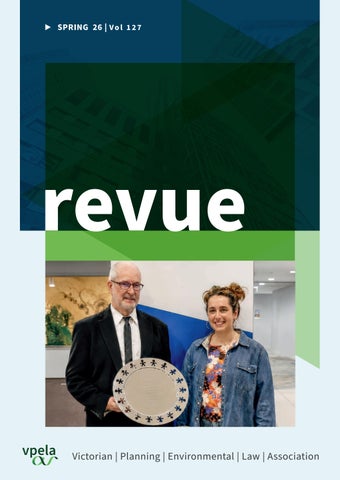
Cover: Felicity Karakiklas, Contour Consultants presented
Leon Wilson, City of Melbourne with the Paul Jerome Award at the State Planning Conference in August.
vpela
BOOK NOW!
Newsletter editors: Amanda Ring M: 0419 332 473 E: aring@upco.com.au T: 8648 3500
Copy deadline date for the Autumn Revue issue is Friday 19 February 2027. A one page article is 700 words approx. including an image.
Holly McFall M: 0459 321 020 E: hmcfall@upco.com.au T: 8648 3500
VPELA PO Box 1291 Camberwell 3124 www.vpela.org.au E: admin@vpela.org.au T: 9813 2801
VPELA acknowledges the Traditional Custodians of Country throughout Australia, their Elders and ancestors, recognising their rich heritage and enduring connection to Country and the ongoing sovereignty of all Aboriginal and Torres Strait Islander Nations.
VPELA Revue Spring 26 | 3
From the Editors A chance to rekindle Victoria’s confidence
Amanda Ring UPco As Victoria approaches the November 2026 election, a sense of malaise has settled across much of the state. Households are grappling with cost-of-living pressures, businesses are navigating economic uncertainty, and confidence in the state’s direction appears subdued. Nowhere is this more evident than in housing. For years, Victoria’s planning system, development industry and successive governments have sought to address the growing imbalance between housing supply and demand. Yet despite ambitious targets and recent policy and process reforms, many in the property and construction sectors argue that housing delivery has slowed at precisely the time new homes are needed most. Rising construction costs, labour shortages, financing challenges and regulatory complexity combine to create a difficult environment for developers and builders alike. The result is a perception that Victoria has lost the dynamism that once distinguished it from other states. Investment decisions are taking longer. Business confidence remains fragile. Consumers are cautious. While Melbourne remains one of the world’s great cities, there is a strong feeling among many Victorians that the state is treading water, maybe even going backwards, rather than forging ahead. Elections are often a verdict on the past but they can also provide a mandate for renewal. Should a new government emerge in November, one of its greatest opportunities may be to restore confidence. Markets respond not only to policy settings but also to certainty, leadership and optimism. A clear vision for housing delivery, sustainable infrastructure investment, ongoing planning reform and economic growth could provide the spark that many believe Victoria needs. Confidence is a powerful economic force. When households feel secure, they spend. When businesses believe conditions will improve, they invest. When developers have confidence in the future, projects that have sat dormant can commence. Momentum begins to build. Regardless of political persuasion, Victorians share a common interest in a prosperous, growing and confident state. The pending election presents an opportunity to reset expectations, lift sentiment and rekindle the belief that Victoria’s best years lie ahead. The challenge for whoever forms government next will be to convert that optimism into tangible outcomes, restoring momentum and ensuring Victoria once again becomes a place where investment, innovation and housing delivery can thrive. On the eve of the election, this Spring edition of Revue has something for everyone. We recount another successful Annual
Holly McFall UPco
Conference and its many contributors. These contributors and others discuss a wide range of topics including renewable energy, infrastructure contribution plans, healthy streets - for people and cyclists, the challenge facing Chapel Street, AI and the impact of planning reform on the professionals working in the planning and environment professions. Also, as we go to press, we have sadly learned of the passing of two notable industry professionals. They join Jim Coomes and Ron Gould whose contributions are recognised deeper into this edition of Revue. Des Eccles was a distinguished planner, educator and former VCAT Member whose contribution to planning in Victoria spanned more than three decades. He leaves a lasting legacy through his work, teaching, publications and service to the profession. There would hardly be a planner educated and or practising in Victoria who would not, at some stage, have read his Statutory Planning in Victoria (which he co-authored with Tannetje Bryant). He will be greatly missed and warmly remembered, especially by his many students and those who appeared before him at VCAT. The landscape architecture profession has lost one of its most respected practitioners with the passing of Steve Calhoun. Born in the American Midwest, he was Harvard educated and a founding partner of Tract Consultants. Steve’s vision, creativity and commitment to excellence, contributed significantly to the design of places that enriched communities and enhanced the public realm. Many will have driven the long, gently curving and poplar lined driveway at Tarrawarra Estate in the Yarra Valley – just one of many memorable landscapes he designed over a long career. Steve will be remembered for his professional leadership, generosity to colleagues and lasting contribution to the profession – and his immaculate vintage white Porsche. VALE Des and Steve. Finally, as we head towards the end of the year and festive activities, Holly and I hope to see members at VPELA’s December Christmas Party where we will be able to thank many of you for your contributions to Revue in 2026. The generosity of contributors never ceases to amaze and we are always appreciative. In the interim, we extend our best wishes for the festive season, and we look forward to a more prosperous New Year for Victoria and the professions represented by the membership in 2027. Amanda Ring and Holly McFall are part of the team at UPco.
4 | VPELA Revue Spring 26
From the President
Planning for the future we imagine Jodi Kennedy Bass Coast Shire Reflections on the VPELA Annual Conference, Victoria’s planning reforms and the opportunities ahead for the sector. The VPELA Annual Conference, held in Lorne on 27–28 August, brought our sector together at a pivotal moment. I congratulate the dedicated organising committee, led by Conference Convenor Anna Borthwick for a wonderful event. Having helped organise many conferences over the years, I understand the time, energy and inevitable nervousness involved in creating a program that offers something for everyone while also challenging and inspiring the profession. Across the two days, optimism was balanced by a clear recognition of the challenges ahead. Thank you to everyone who completed the post event survey. The overwhelmingly positive feedback affirmed the conference’s value, while offering practical guidance on how we can continue to make it engaging, relevant and enjoyable for members. For those unable to attend, this edition includes a comprehensive summary of the program.
Reform at pace This year’s theme, The Futures We Imagine, resonated strongly. As Victoria undertakes the most significant planning reforms the state has seen, a central question remains, will the future envisaged by the reforms be realised? I hope the changes produce more streamlined and considered planning outcomes, better places for our communities to enjoy, and the housing Victorians urgently need. However, speed brings risk. A rapid program of reform may meet a list of commitments without necessarily delivering the outcomes it was designed to achieve. That urgency has been particularly evident towards the end of this term of government, with the latest tranche comprising 10 VC amendments in the first eight days of September. This period of reform also gives us an opportunity to reconsider how planning is done, to retain what works, improve what does not, and build a framework capable of responding to profound local, national and global shifts. Artificial intelligence is ushering in another technological revolution, and planning—like every sector—must be ready to adapt. Our legal and planning frameworks should be robust enough to provide certainty, yet flexible enough to support innovation and evolution. In addition the role of planners will evolve, as the reforms bring about significant changes in the work of planners in local government, the private sector and of course the role of VCAT and Planning Panels in the process. The scale and significance of the reform package cannot be overstated. The sector has long advocated for meaningful change and is now experiencing it at considerable pace. With so many changes progressing simultaneously, however, the potential for unintended consequences is substantial. Their
full impact will become clear over time. I sincerely hope the package ultimately delivers the better future it was intended to create. VPELA has a very busy calendar ahead which reflects the changes we are all facing, and we have turned our attention to the impact of changing work practices will have on the needs of business and how do we plan for these changes. From Data centres, to AI and the changing ways of working I am sure there is an event of interest to any of our members. And with the politicians gearing up for the State Election in late November it has never been more important to understand the election commitments, promises and policy platforms of all parties. The election promises have already commenced and there will be plenty more to come. Housing and renewable energy policies will be a key focus of this election and will no doubt impact our sector going forward in this State – if we are to achieve the future we imagined. Whatever the outcome, VPELA looks forward to working with the government and Planning Minister of the day Finally, as this is the last Revue before the State election, I would like to acknowledge Minister Kilkenny’s strong support for VPELA. The Minister and her staff have been accessible, engaged and consistently supportive. She regularly attended our Gala Dinners and embraced each event’s dress theme with enthusiasm; a personal highlight remains seeing the Minister and Mark Sheppard in punk outfits at the 2024 dinner. More importantly, Minister Kilkenny sought VPELA’s input throughout the reform program and, at numerous events, welcomed candid questions from the audience. That openness demonstrated a genuine commitment to engaging with the sector. Jodi Kennedy is President of VPELA and General Manager Community & Culture with Bass Coast Shire.
VPELA Revue Spring 26 | 5
Shadow Minister Certainty is the missing piece in Victoria’s housing system
David Southwick Shadow Minister for Planning Victoria does not have a shortage of housing targets. It has a shortage of homes being built. Home building is at a decade low, and builders are openly saying “anywhere but Victoria”. Taxes, fees and levies now make up 43 per cent of the cost of a new home in Melbourne, or $373,000 on average. That is 73 per cent higher than in 2019. The share of under-30s who own their home has fallen from 50 per cent in 1971 to just under 36 per cent in 2021. In February, the Liberals and Nationals released More Homes, More Choice, our plan to restore the dream of home ownership and give everyone in the system certainty. It starts with the target itself. Labor’s plan rests on 800,000 new homes over 10 years, split 70/30 between established suburbs and growth areas. That split has pushed new housing away from the places where family homes and affordable land are easiest to deliver, and it has not delivered the homes. We will scrap the 70/30 target and let supply follow demand. Our growth areas should be the easiest place in Victoria to build a family home. Instead, precincts are taking up to a decade to progress, and some commencement dates stretch into the late 2030s. Casey Fields South and Devon Meadows began scoping in 2021 and are still held up by drainage and infrastructure funding issues. We will clear the backlog of 27 Precinct Structure Plans. Every PSP will have a clear end date from commencement. We will introduce industry-led PSPs and put statutory timeframes on referral agency outcomes, so one agency cannot hold up an entire precinct. Growth Areas Infrastructure Contribution revenue will be spent in the communities where it is collected.
The same problem is playing out in the city. Demand for innercity living is there, but only 1,400 apartments were completed in the inner city in 2024, less than half the long-term average of 3,600 a year. We will expand the Capital City Zone into targeted areas around the CBD, including North Melbourne, Fishermans Bend, Southbank, Parkville and parts of the City of Yarra. The expanded zone will keep the CCZ’s certainty, streamlined approvals and mixed-use flexibility. Beyond Melbourne, outstanding and unprogrammed PSPs across regional Victoria could deliver up to 50,000 new homes. We will fast-track them, and help revitalise the CBDs of Geelong, Ballarat and Bendigo. But planning reform alone will not close the affordability gap while tax makes up so much of the price of a home. That is why we will lift the stamp duty exemption for first home buyers to $1 million and progressively restore the land tax-free threshold to $300,000. Planners, lawyers and builders do not need another target. They need a system that will enable More Homes and More Choice. Under Labor, you get what you’re told. Under the Liberals and Nationals, you can choose what you want. That is how we will restore the dream of home ownership for the next generation of Victorians. David Southwick MP, is the Deputy Leader of the Opposition and Shadow Minister for Planning.
Your ESD Consultants Sustainability Management Plans | Sustainable Design Assessments Waste Management Plans | Energy | WSUD | Daylight Modelling
We're here to help you ecoresults.au
6 | VPELA Revue Spring 26
Vale Jim Coomes
Thank to you Henry Turnbull RFD for preparing the following tribute to Jim Coomes, VPELA Fellow, who passed away recently at the age of 84.
Jim was a stalwart of the early VPELA having joined the Board in 1989 (the first year of the Association) and serving as Executive Director for 12 years. Jim’s early career was as State Development Manager for the AMP Society and then Managing Director of a group of property development companies. Jim established Coomes Planning in 1983 providing planning services to property owners, investors and developers, government bodies and statutory authorities. His work involved the evaluation, planning and development of a broad range of projects in Victoria, NSW and Queensland, including residential and industrial estates, resorts, office developments and shopping centres. He regularly appeared at VCAT and Panels Victoria as an advocate or as an expert witness. Soon after Jim’s appointment to the VPELA Board, he and Peter Barber invited land surveyor, Denis Mahon, to join the Board. Together the trio formed VPELA’s infamous “Kitchen Cabinet” which set as its task to turn the small fledgling group into a major professional organisation. Denis and Jim saw their role as providing Peter Barber with a support structure so that VPELA could grow. Jim’s blueprint is all over the VPELA we have today, with many of VPELA’s activities initiated or influenced by him. Jim was responsible for recommending the establishment of the Young Professional Group. In 1991, Jim recommended VPELA hold an Annual Dinner and was responsible for organising and running the first three. The first dinner was attended by 120 people. The Annual Dinner was an immediate success and set the high standard for all future dinners. In 1995, he recommended the creation of Fellows and Life Members and the first Fellows awards were issued later that year. In 1996, he also recommended that an Annual Fellows Dinner be held. During his time as Executive Director, Jim strove to establish high standards of corporate governance, a strong business approach to VPELA’s management and financial accountability; and worked hard to encourage the participation of women on VPELA’s Board and in the Special Interest Groups. Jim was a loving family man and a loyal and hard-working colleague. He never fully retired with his planning services in demand right up to his passing. Vale – Jim Coomes
Ron Gould
Thank to you Amanda Johns, Planning & Property Partners (Ron’s step-daughter) and Chris Canavan KC for preparing the following tribute to Ron Gould. The Planning Profession has lost one of its stalwarts. Ron Gould attended Scotch College. He obtained his Civil Engineering Degree from RMIT. He commenced his career as an engineer at Stawell Council. He then served with distinction as City Engineer at Fitzroy and Prahran Councils. At Prahran, he supervised many infrastructure projects including a series of major road projects. The reconstruction of Alexandra Avenue which involved a major rock excavation at Como Park was a particularly challenging project. He became a director at Hardcastle and Richards consulting engineers and also served as the Chairman of the Institute of Engineers. Ron joined the Planning Appeals Board in 1975 and retired from its successor, VCAT (very reluctantly) on 1 March 2003 when he reached the statutory retirement age. He served as a full-time member. It was a delight to conduct hearings before Ron. His engineering expertise was very valuable in assessing applications. He was unfailingly courteous, with a warm dry sense of humour. He detested waffle and always cut to the main issues. He decided cases fairly, quickly, efficiently and with common sense. He loved working with his legal colleagues and with the lawyers who appeared before him, loving to adopt a Latin maxim where he could. Over almost 30 years Ron made an enormous and positive contribution to the efficient and just operation of the planning system in this State. Vale – Ron Gould
VPELA Revue Spring 26 | 7
VPELA Awards
Paul Jerome Award Recipient 2026 Leon Wilson, City of Melbourne With more than 30 years of experience, Leon Wilson has made an outstanding contribution to Victoria’s planning and land administration system through his technical expertise, innovation, leadership and commitment to the public good. For over 20 years at the City of Melbourne, Leon has been a trusted authority on complex land tenure, subdivisions, road discontinuances and boundary realignments. His ability to navigate legal, planning and political complexities while anticipating future needs has delivered lasting benefits to councils, industry professionals and the broader community.
Innovation and Achievement Leon has pioneered significant improvements to Victoria’s land administration system, including:
• Leading the City of Melbourne to become the first council to issue a statement of compliance through SPEAR.
• Converting historical landholdings and General Law Roads to Torrens titles, simplifying administration and securing land ownership for future generations.
• Working with Land Use Victoria and Surveyor-General Victoria to develop processes now used as models by other councils.
• Leading a groundbreaking project to bring Old Law
Roads under the Transfer of Land Act, improving land identification, ownership records and street addressing.
• Coordinating the correction of cadastral inaccuracies
across Melbourne’s CBD and North Melbourne, supporting the accuracy of the City’s digital twin.
Leadership and Professional Contribution Leon’s influence extends well beyond his role at the City of Melbourne. He has served as President and Secretary of the Institution of Surveyors Victoria, been an examiner for the Surveyors Registration Board of Victoria for over 30 years, and is a founding member of the Subdivision Officers Group. Widely regarded as a generous mentor and trusted adviser, Leon has helped improve professional practices and outcomes across Victoria. His achievements have been recognised through the J.G. Gillespie Gold Medal, the Bill Carlyle Award and multiple Municipal Excellence Awards achieved by the City of Melbourne under his leadership.
A Respected Colleague Leon’s nomination attracted an extraordinary 26 testimonials, reflecting the respect and admiration he has earned throughout his career. Rob Adams AM described Leon as: “One of the most impressive professionals I have had the pleasure of working with.”
Leon pictured with Daniel Soussan, Tract Consultants and City of Melbourne colleagues Matthew Metaxas, Julian Edwards and Nathaniel Man. He praised Leon’s professionalism, calm leadership and ability to guide teams through complex challenges, including his successful leadership of the City’s Capital Works Program during a period of significant transition.
Congratulations Leon embodies the spirit of the Paul Jerome Award through his innovation, professional excellence, generosity and unwavering commitment to the community. His remarkable contribution has helped shape Victoria’s planning and land administration system and inspired countless colleagues along the way. VPELA warmly congratulates Leon Wilson on receiving the 2026 Paul Jerome Award.
Recipient Response – Leon Wilson I am truly honoured and humbled to receive the Paul Jerome Award. To be recognised by my peers and colleagues, many of whom are here tonight, is incredibly meaningful. Throughout my career, I have enjoyed working behind the scenes to find practical solutions, simplify complex processes and achieve the best possible outcomes for our professions and the communities we serve. Sharing knowledge, particularly in land tenure, and helping others navigate the complexities of our work has always been important to me. This award also recognises the many people who have supported and inspired me throughout my career, including previous Paul Jerome Award recipients and colleagues here tonight. My sincere thanks to VPELA, the award panel and everyone who has been part of my journey. I accept this award with gratitude and a continued commitment to supporting our professions and the next generation.
8 | VPELA Revue Spring 26
VPELA Awards
Young Professional Award Recipient 2025 Streets for the people James Aloi onemilegrid
Learnings from my travels to Europe and my recommendation to the industry. “You can’t justify a bridge by the number of people swimming across a river”. Consider this quote from internationally renowned Canadian city planner, urbanist and thought leader, Brent Toderian. Right now, we live in a data driven world. If you’re proposing ‘a’, then you will need ‘b’. If you provide ‘x’ then you will get ‘y’. In our work, we’re always asked, ‘what does the data suggest?’. Well, what if data to do something great didn’t exist? What if people wanted or needed something they didn’t know was even possible? How are we to justify a bridge when no one is swimming across the river? In 2025, I was very humbled and grateful to receive the VPELA Young Professional Award, allowing me the rewarding opportunity to travel overseas, conduct independent research and share knowledge from the other side of the globe on integrating our places and spaces for sustainable and active transport, and people-oriented havens. As some of you may have seen, I documented my research and learnings in ‘Tik Tok’ style videos which I posted on LinkedIn, allowing me to have a platform to collate my learnings and educate my colleagues and peers about my travels. Whilst this turned out to be a time-consuming endeavour, it was important for me to share my experiences and help people understand a different way of living. My research was inspired by ‘Plan for Victoria’, an ambitious long-term plan addressing and prioritising sustainability, equitable access and thriving public spaces. Since then the Department of Transport & Planning released Victoria’s Active Transport Plan. It states that the Plan will play a crucial role in creating safe and welcoming spaces, reducing the environmental impacts of private transport and promoting physical activity and mental wellbeing for all Victorians.
in North London by diverting traffic. With the number of people taking up every single square metre of open space, you would have a very hard time imagining how unsafe an environment it would be if everyone was confined to footpaths, AND you had two-way traffic on the roads. This ‘temporary’ measure is very powerful. No amount Strand Aldwych, London: of data driven analysis, pedestrianised in 2022 modelling and expert evidence estimating would have helped the decision. It just needed to be tried. Let’s see and find out. Yes, you may get some push back, but travel behaviour will change, everyone will get used to it, and eventually it will be a very simple permanent solution. It’s why I cannot fathom what Melbourne has done with the Metro Tunnel construction sites. We had blocked traffic to areas like Flinders Street, Franklin Street and Grattan Street for a literal decade. The world didn’t end. Traffic found another way, and we all got used to it. I cannot for the life of me understand how there was no forethought to convert these spaces into permanent, non-trafficable, public spaces. It was right there for us.
If it wasn’t important before, my grant-funded travels to experience London, Paris, Belgium, the Netherlands and Copenhagen are now more important than ever. And with all the research I’ve read and discussions with experts I’ve undertaken, I am gravely concerned that we are very, very far behind. Transport for London is aggressively transforming London into a cycling haven. It is palpable how strong the messaging is. Plans were recently approved by the Mayor to remove traffic from an 800m stretch of Oxford Street in central London, opening an inordinate amount of public space for shoppers, tourists and families. Cycling lanes are being built everywhere, and fast. Unnecessary streets are being closed off to traffic for good. One project I loved was the temporary closure of Camden High Street, testing the pedestrianisation of another very busy street
A Parisian shared zone, where vehicles must go at walking pace ‘Roulez au Pas’
Paris and their politicians are equally as unapologetic as London in their pursuit for sustainability, slowly transforming the City of Love into the greenest city in the world or ‘ville-jardin’. Five hundred new city streets will become ‘rue vegetale’, green streets, along with their continued roll out of ‘rue aux ecole’, schools streets. In the city’s tight network of streets, each one you walk down has some form of garden,
VPELA Revue Spring 26 | 9
planting or trees, in addition to prioritising the bicycle as the city’s primary form of transport. Cars are truly an afterthought, and they cede their priority to all others. Here’s a fun Melbourne fact. The Hoddle grid has 144 individual street segments within 1.8 square kilometres. With 9 streets in each direction you’d think there’d be 81 intersections, but there are approximately 90 signalised intersections within this same area. This is a heinous misuse of public space, and I seriously don’t think there needs to be this many streets, and this many intersections, within such a highdensity location. Take Belgium as an example. Despite its network of narrow, winding streets, cities like Brussels, Ghent and Bruges don’t allow traffic to flow in every direction simply because it can. Instead, they use carefully designed traffic circulation plans to prioritise people over throughtraffic. During the day, streets become places
A typical Belgian street in central Brussels
for the community, not shortcuts for vehicles, and key destinations are either permanently pedestrianised or closed off throughout the day. The result is a city that replaces chaos with order, invites people into its streets and businesses, and creates vibrant places where people want to spend time, not roads that simply move cars as quickly as possible. Indeed, the City of Melbourne will be implementing a trial of pedestrianising Flinders Lane, removing traffic during key times, raising the level of the road carriageway and changing the pavement to bluestone. I applaud Mayor Nick Reese and the City of Melbourne for approving this trial. Rather than just slapping some shared zone signs in the streets and hoping things will change, they’re actually changing the feel and structure of the space. I spoke with renowned cycling infrastructure advocate and design consultant, Sjors van Duren, from Groningen in the Netherlands, who told me that one of the most
Enabling our communities to thrive
Meg Lee – Partner M +61 404 070 549 meg.lee@hallandwilcox.com.au Rory O’Connor – Partner M +61 400 436 175 rory.oconnor@hallandwilcox.com.au
Our planning and environment team has market-leading expertise across a broad range of industry areas, including property development, transport, construction, energy, waste and recycling and social infrastructure. We act for State government, local Councils, statutory authorities and the private sector. Our full service firm enables you, your projects and your communities to thrive.
2021 - 2026
2021 - 2026
2020 - 2026
2020 - 2026
A typical Dutch local street in Haarlem’
Natalie Bannister – Partner M +61 409 418 259 natalie.bannister@hallandwilcox.com.au Lucy Eastoe – Special Counsel M +61 401 836 105 lucy.eastoe@hallandwilcox.com.au
2020 - 2027
2020 - 2027
10 | VPELA Revue Spring 26
important things he aims to drive home is the Dutch concept of ‘vanzelfsprekend’. Your streets must match the function. The City of Melbourne has very much learnt from their mistakes and are ensuring that their little streets will indeed look and feel like spaces for people, and not for cars. This is what we should be seeing more of throughout Victoria. Yarra City Council is pioneering these changes by closing off streets with pocket parks and greening its streets. Though recently, one of its ambitious projects got canned, pretty much because of politics. To be fair, it looked like a significant change, so I’m not surprised there was such an uproar. It also doesn’t help when the first sentence of The Age article about same states “a controversial plan to block most car and truck traffic”. Perhaps Yarra should have started smaller and done a temporary trial to test the waters. Now, this portion of Wellington Street will remain tight, with traffic on top of bikes, and a stretch of road with 5 uncontrolled cross-intersections literally every 80 metres. Not a relaxing environment. Maybe chuck that in your article, The Age! I was fortunate enough to see the epitome of a relaxing environment in Copenhagen. Well-designed people spaces, courteous and understanding bike riders on a protected and prioritised network, and an overwhelmingly pleasant city that really champions and prioritises liveability. It IS the most liveable city for a reason. It combines the best of urban planning and transport integration into public spaces, and over time Copenhagen has created a way of living that feels so easy and organic. I truly believe Melbourne and other Australian cities can reach this level. We already are considered a liveable city, can you imagine if we could harness the power of what Europe has already implemented? Action 5 of Plan for Victoria will “match car and bike parking requirements and bike facilities with demand”. It is expected that greater importance and priority will be placed on bike parking and bike facilities. We should be planning for a substantial uptick in bike riding, which is likely to happen quickly. Therefore, we need to be able to react accordingly. Our current network simply won’t cope with a surge in bike ridership. As more people choose to, and quite frankly, need to ride, we must create space for them now, because permanent infrastructure won’t arrive fast enough. That means embracing quick, flexible and low-cost trials, alongside temporary measures, to be able to rapidly reallocate space and have our community riding safely. Ample literature points to status quo bias. Australians are inherently creatures of habit. ‘Not in my backyard’. So unfortunately we, as practitioners, consultants, leaders and agents of change, must take it upon ourselves to show people the way. Based on my research, my recommendation to the industry is to readily adopt temporary closure trails, pop up bike lanes and traffic circulation plans to enable active transport integration into our public spaces. The turn of the new year brought about the release of the Macaulay Structure Plan and the Suburban Rail Loop Advisory Committee reports. It’s clear and easy to see that my line of recommendations is being implemented as the norm in these future urban areas. Indeed, the second sentence of the Macaulay Precinct Zone states to provide “a network of people focused streets and green spaces”. Macaulay will be full of new open spaces to prevent unnecessary traffic circulation. Laneways and arcades will be built for activated public spaces. The identification of ‘vehicle-capable’ streets is amazingly
Map 8 to Committee Recommended Version of Schedule 1 to Clause 43.06 Built Form Overlay progressive terminology, and I fully expect this classification to become more commonplace. A 10-metre-wide active transport corridor with open space connections. Narrow arcades for people and bikes. This is the gold standard. This is world-class best practice. This is our future. And what’s more, flexibility has been recommended to ensure that we’re carefully designing our spaces rather than being prescribed to a specific layout. This is where creativity thrives and the best spaces are incepted. What makes me really smile, however, are the street typologies identified in the SRL Draft Structure Plan. ‘Green Streets’ and ‘Activity Streets’. Sound familiar? Whilst these street typologies are great to see, I agree with the transport and urban design experts that their designation in itself isn’t going to be enough to tangibly achieve mode shift. The timeliness of infrastructure delivery will always be questionable, and no doubt be handballed between a number of frugal developers. Slapping sharrows on a road won’t make it safer or more appetising for cyclists. So, what is the quickest way to trial street typologies on existing streets? How can we tangibly impact mode shift before creating permanent infrastructure? Answer? Temporary measures and trial projects. At times like these where we face such things as a fuel crisis, we need to pivot and act accordingly. We can’t drag our feet and accept the status quo. Just because a space isn’t busy or utilised by people, doesn’t mean it can’t become an area for rest, eating or play. Just because a road isn’t utilised by bike riders, doesn’t mean people wouldn’t use bike infrastructure if it was provided. Just because people don’t occupy narrow footpaths, doesn’t mean they wouldn’t occupy the road if there were no cars. We can’t justify our bridges by the number of people crossing their rivers. James Aloi is a Senior Engineer at onemilegrid and is Co-Convenor of the YPG Committee.
VPELA Revue Spring 26 | 11
Meet the People behind the NEXT CHAPTER of Planning & Property Partners Welcome to our new starters and appointees. From senior industry expertise to the next generation of planning and property professionals, 2026 has been an exciting year of growth for Planning & Property Partners.
A warm welcome to Tamara Brezzi and our 2026 appointments With over 30 years of planning law and property development sector expertise, Tamara brings strategic insight, leadership skills and an exceptional reputation as we continue to grow and deliver outstanding outcomes for clients.
AMAR SINGH
JOSHUA KHAW
Associate Director
Associate
MATILDA BURSTON
MICHAEL BAYLEY
RED FENNESSY
SARA LEON
RUBY EVANS
Associate
Lawyer
Senior Town Planner
Law Graduate
Law Graduate
We’ve moved
Level 17, 55 Collins Street, Melbourne (Collins Place)
NEW SPACE. NEW ENERGY. NEW OPPORTUNITIES.
pppartners.com.au
12 | VPELA Revue Spring 26
Conference Healthy Streets
Lucy Saunders Healthy Streets UK
This article was provided by Lucy Saunders and summarises her presentation at the State Planning Conference in August. The origins of the planning system that we use today are rooted in protecting public health: from ensuring dwellings have suitable ventilation and daylight to managing clean water supplies and waste disposal. So, it makes perfect sense that the Planning Amendment (Better Decisions Made Faster) Act 2026 includes a new objective to facilitate safe and accessible places that promote health and wellbeing. This can draw the focus of planners on to the need to ensure everyone has access to healthcare facilities and opportunities for education, employment and recreation. However, the planning system can have a huge impact on the health and well-being of Victorians by also paying much closer attention to their role in local transport and streets. Street environments have a central role in shaping how well and how long people live. There are many health issues that have been linked to the decisions we have made about street environments including road traffic injuries, cardiovascular impacts of air and noise pollution, social isolation, loss of childhood independence impacting on child development and a range of cancers. One of the biggest impacts of streets on our health is the extent to which they enable us to build gentle daily activity into our daily routine in the form of walking, biking and accessing pubic transport for our means of travelling. Without what is termed ‘active travel’ it is very difficult for the majority of people to achieve the World Health Organisation recommended levels of daily physical activity. The good news is that there is one thing that planners can do which will address all of the many ways in which streets impact negatively on our health and this one simple solution also delivers environmentally, economically and socially sustainable places that people want to live, work and do business in. This is the Healthy Streets Approach, an evidencebased framework of 10 Indicators that has been translated into a range of free practical tools that can be used to improve decision-making in government and private practice. This framework was first adopted in London, UK back in 2014 and you can see the planning document for London ‘The London Plan’ for best practice in how planning negotiations can be strengthened with this simple, transparent set of principles and thresholds. Since 2019 Healthy Streets has been spreading globally including adoption by government in Austria, Hungary, Norway and New Zealand. In Australia hundreds of practitioners have completed the Healthy Streets training course online or inperson and this framework is being used in conjunction with Movement and Place in NSW, WA and places in Victoria. In practice this means ensuring the 10 Healthy Streets Indicators are prioritised in the decision making for how all streets are
designed, managed and used. At a street by street level it can seem obvious from looking at the Indicators that this means designing active frontages on buildings, ensuring there is safe space for walking and biking, putting a suitable crossing facility on every intersection, side street and mid-block and, of course, providing adequate shade and regular places to stop. Planners are critical to delivering these health-boosting places in other ways too. They can ensure the basic foundations are in place to create the conditions that enable people to travel locally for most of their transport needs and that street environments are convivial and social spaces. Strategic decisions about land use mix and density, street network connectivity and public transport connections are just a few examples. The new health-focused objective of the Act has the potential to provide both State and local government with increased scope and power to consider health and wellbeing when developing their local planning schemes and making planning decisions. The size of the impact of this objective in the Act will come down to the daily decisions both big and small made by the wide range of professionals who shape our streets including planners, lawyers, designers and engineers. The Healthy Streets Approach offers tools and training for those seeking an easy path towards a healthier future for Victoria. Lucy Saunders is the founder of Healthy Streets UK.
VPELA Revue Spring 26 | 13
Conference
Creating places where communities flourish Dean Landy ClarkeHopkinsClarke Architects
What Africa, Fiji and the growth areas of Australia are teaching us about creating liveable places where communities can thrive. How can designers, planners and developers create more liveable places, where people feel connection, belonging and a desire to participate? It’s a question that has shaped my work as an architect and urban designer across Australia, Africa and, more recently, the Pacific. In Australia, my work at ClarkeHopkinsClarke Architects spans urban renewal, new town centres, regional revitalisation and growth areas. In East Africa I’ve been exposed to very different models of community through co-founding not-for-profit One Heart Musana to create sustainable communities for vulnerable children, and working with Rendeavour, Africa’s largest new city developer, leading the design of six new cities. Emerging work in Fiji is providing yet another perspective.
emerge. Our challenge is to design places that cultivate connection, belonging and participation. At ClarkeHopkinsClarke, our Liveable Places Framework looks beyond the physical ‘hardware’ of buildings, infrastructure and public realm which can be seen as the attributes of a 15-minute city. It helps us bring focus to the less tangible ‘software’ elements that animate places over time: community, relationships, enterprise, leadership, events, sport, faith, culture and identity.
Together, these experiences have challenged my ideas about designing places where people and communities can flourish.
What defines a strong community? Where is community stronger: a new growth suburb in Australia or a village in Africa? Many Australians might instinctively choose the former, given our housing, infrastructure, services, planning systems and material wealth. But 20 years of working in Africa, and living in Kenya for the past couple of years with my family, I’ve seen how many people tend to know their neighbours, care for children collectively, share meals, and maintain close connection with extended families. Social networks can be extraordinarily strong. By contrast, Australians are experiencing higher levels of loneliness, isolation and social disconnection even in wellserviced neighbourhoods. Of course, African cities also face enormous challenges from rapid urbanisation to inequality and environmental degradation. But there are lessons to be drawn from social structures fostering connection and belonging. Those lessons matter as our own cities expand. Australia needs to accommodate substantial population growth, often in communities in new growth areas where delayed amenity, car dependency, lack of employment opportunities and limited social infrastructure are familiar challenges. As designers and planners, we need to bring a broader lens to growth and consider social outcomes alongside economic, environmental and design outcomes.
Proximity isn’t connection We often talk about ‘creating new communities’ but, in reality, we can only design the places in which communities might
Tatu Central Street
Designing for social outcomes in Africa At Tatu City, a new 2000ha city being developed outside Nairobi, we’ve been working with Rendeavour, its in-house design team, and international consultants, on a masterplan and place strategy for Africa’s most liveable, walkable and sustainable new city. The plan builds on development already underway, and looks to connect homes, schools, workplaces, shopping districts, health precincts, as well as a wildlife sanctuary and civic parks through a network of greenways, walking and cycling routes and nature trails. The masterplan connects a series of compact mixed-use neighbourhoods back to a thriving new central city heart. This is not about importing an international urban model. It starts with what is already meaningful locally. Walking, for example, is integral to African city life. The masterplan builds on that by introducing extensive walking and cycling infrastructure and creating a safe environment where people are prioritised over cars. Resident engagement and local leadership are key to building a sense of local ownership. Early programs supporting events, sports, public art, skills training, local jobs, coffee heritage and reforestation bring people together continually. It’s a good example of how design can help community to thrive when it responds to existing culture and behaviour, rather than trying to import or manufacture them.
14 | VPELA Revue Spring 26
Culture as infrastructure Our recent work in Vanua Levu, Fiji, has reinforced that idea. Here, amidst extraordinary natural environments and strong traditional communities, some of the most important social infrastructure isn’t physical infrastructure at all. It is family, village, church, rugby, food, land, local leadership and resilience. For us, the question became: how can development strengthen the cultural and social structures that already exist rather than unintentionally designing them out? That’s meant developing place principles that elevate cultural sovereignty, and exploring opportunities for economic empowerment, housing and shared prosperity alongside regenerative development and reforestation. It’s also meant slowing down and unlearning, spending time with the village chief – in conversation and in silence, and fishing with locals. Listening and observing helps to understand the ways in which their community already flourishes, and how new infrastructure might help them plant the seeds for growth. There are clear parallels for Australia, particularly around designing with respect for Country and helping growth communities steward the places they value.
Bringing it home
Australiawn culture places relatively strong emphasis on the individual, personal agency and choice. In many African contexts, family, tribe and community play a stronger role in supporting the individual. In Fiji, identity can be deeply entwined with family, village, culture and land. None is inherently better than the other, but context matters. For Australian growth areas in particular, we need to continue advocating strongly for the social conditions that enable neighbourhoods to flourish.
Creating the conditions Planners and designers can work with local communities to apply some practical principles, adapting each to its context and culture: 1. Create compact, mixed-use neighbourhoods Bring people, homes, services, employment and activity closer together. A neighbourhood needs more than housing if everyday life is to happen locally. 2. Design for everyday encounter Create places where people naturally cross paths: streets, entries, stairs, courtyards, verandahs, shared gardens and parks. Small, repeated encounters can provide the foundations for stronger relationships. 3. Enable local enterprise
What can Australia, Africa and Fiji teach one another? Across all three, community creates meaning. But their cultural starting points differ.
Make room for small businesses, markets, cafés, services, creative enterprises and home-based businesses. Build local economies alongside local communities.
Caught in an Environmental or Planning Dispute? Foley’s List has over 30 planning and environment barristers, supported by a team of clerks with expert industry knowledge to help you find the right barrister for your matter.
Serena Armstrong
Michael Beaconsfield
Eliza Bergin
Natalie Blok
Susan Brennan SC
Travis Brown
Darren Bruno
Samuel Burt
Olivia Callahan
Paul Chiappi SC
Marissa Chorn
Nic Edmondson
Robert Forrester
Juliet Forsyth SC
Alex Gelber
William Gillies
Louise Hicks
Tara Hooper
Georgina Long
Kate Lyle
Rachel Matulis
Sean McArdle
Ian Munt
David O’Brien
Peter O’Farrell KC
Suganya Pathan
Adele Patterson
Emma Peppler
Carly Robertson
Dr Cait Storr
Jennifer Trewhella
Trevor Wallwork
Sarah Varney
From early strategic advice through to representation in VCAT, Planning Panels Victoria and the courts, our barristers advise and appear across the full spectrum of planning and environment matters.
call 03 9225 7777 or email foleys@foleys.com.au
VPELA Revue Spring 26 | 15
4. Give people reasons to linger Don’t only design destinations; create reasons to stay. Playgrounds, sport, cafés, libraries, markets, community spaces, shade, seating and gathering places can turn movement through a place into participation in it. 5. Make walking social Design streets so that walking is more than movement from A to B. The journey itself can create opportunities to see, greet and interact with other people. 6. Design across generations Give children, teenagers, families, singles and older people meaningful reasons to inhabit the same neighbourhood. Diverse communities need places where generations can overlap rather than remain separated. 7. Connect private life with public life Create softer thresholds between home and community through porches, balconies, front gardens, and semi-public spaces. These transitional places can help turn neighbours into familiar faces.
governments. It also depends on how willing each of us is as individuals to participate in the places where we live. Our professional challenge is to give as much thought to human frameworks as we give to built-environment frameworks. While we can’t create community, we can help create the conditions in which it can flourish. Dean Landy is Cities + Precincts Partner at ClarkeHopkinsClarke Architects and author of Creating Vibrant Communities, co-founder of One Heart Musana, and former Group Head of Urban Planning and Design at Rendeavour, Africa’s largest new city developer.
MUSANA Run for Change A Trip of Impact and Adventure 23 July – 4 August 2027
8. Build identity, agency and stewardship Support local stories, culture, art and landscape alongside schools, faith communities, sport, youth organisations, events, markets and resident leadership. Give people opportunities not simply to occupy a place, but to shape and care for it.
We are the community Creating connected neighbourhoods isn’t solely the responsibility of designers, planners, developers or
Experience the power of communities building their own future. Return home changed.
16 | VPELA Revue Spring 26
Conference
From the futures we imagine to the planning system we deliver More than 50 years ago, Pressman and Wildavsky published their seminal study of public policy implementation, Implementation: How Great Expectations in Washington Are Dashed in Oakland. First published in 1973, the book examined a United States federal employment and development program in Oakland, California, which struggled to translate ambition into results, notwithstanding it being well-funded and politically supported. Pressman and Wildavsky’s central insight was that public policy is not made real by legislative ambition alone. It succeeds or fails through implementation. That insight remains relevant to areas of public policy analysis today, including contemporary planning reform. It is particularly salient in the context of the theme of this year’s VPELA State Planning Conference: “The Futures We Imagine: The places we inhabit today were once ideas on paper, visions of how cities, towns, infrastructure and landscapes might grow and evolve. Some of those futures became reality. Others did not. As Victoria faces new challenges, housing supply, climate adaptation, regional growth, infrastructure investment and changing community expectations, the role of industry in imagining and shaping the future has never been more important.” By the time of the publication of this article in VPELA’s Spring issue, the Victorian state election will be in full swing. Whilst the two major Victorian parties both seem to agree upon the goal of greater housing affordability, their differences on the means to achieve that goal are stark. What does this mean for the futures we imagine? Politics aside, the one constant is that the task of implementation will largely fall to industry. That is to say, many of the attendees at this year’s VPELA State Planning Conference. These are the planners, council officers, lawyers, developers, consultants, traffic engineers, and the various other hard-working dedicated professionals that make up VPELA’s membership, whose task it will be to use their considerable skills and translate policy goals into practical outcomes.
Heritage expertise for planning outcomes Talk to our experts
Maria Marshall Maddocks
Terry Montebello Maddocks
Briana Eastaugh Maddocks
Joseph Monaghan Maddocks
To this end, one of the topics discussed at the VPELA State Planning Conference was how industry professionals can apply AI so as to redesign safer, smarter cities. As the conference discussion made clear, AI is no longer an abstract future concept for the sector. Used well, AI has the potential to support better implementation. But AI must be understood for what it is: a tool. It can assist the professionals who give effect to planning policy, but it cannot replace the judgment, ethics and collaboration that sit at the heart of good planning. VPELA’s own mission – “to work together for the better management of our cities, towns and the environment” – is a useful reminder that the future will not be delivered by technology alone. And so, our challenge is not only to imagine better futures for Victoria, but to implement them better. That will require collaboration across the sector and careful use of the tools now available to us, including AI. We are committed to this approach at Maddocks and stand ready to support the sector. Maria Marshall, Terry Montebello, Briana Eastaugh and Joseph Monaghan are Partners at Maddocks.
• Pre-purchase Advice • Due Diligence Assessments • Strategic Advice • Placemaking and Interpretation • Masterplanning Inputs • Traditional Owner Engagement • Cultural Heritage Management Plans • Dry Stone Wall Management Plans • Significance Assessments • Conservation Management Plans • Heritage Impact Statements • Archival Recording • Expert Witness Services
An
company
VPELA Revue Spring 26 | 17
Conference
Where do I even start? Understanding and navigating the ICP system in the context of recent change
Carly Robertson Victorian Bar
An Infrastructure Contributions Plan (ICP) facilitates the collection of land and monetary contributions for essential infrastructure for new and growing communities. This infrastructure may include roads, other transport, local parks, recreation facilities, community centres and kindergartens. The ICP system has been used in greenfield areas in Victoria for almost a decade. Recent changes to the system facilitate its use within State-led Infill Precincts (or SLIPs) and Suburban Rail Loop structure plan areas (SRL precincts). The ICP system’s recent expansion represents a shift in the way in which ICPs can be developed and operate. Consequently, recent changes to the system present entirely new questions and challenges. These questions and challenges were explored by an experienced panel of experts: Paul Shipp (Managing Director, Urban Enterprise), Jim Ingemann (Manager of Infrastructure Coordination and Planning, DTP), Briana Eastaugh (Partner, Maddocks) and Ellen Tarasenko (Principal, Polis Legal) at the recent VPELA Conference – The Futures We Imagine. The panel provided essential information, insight and important guidance into a challenging ICP system that has very recently been the subject of transformational change.
ICP 101 The panel kicked-off with an ICP 101 session from Paul Shipp who brought delegates up to speed with a detailed analysis of infrastructure contributions prior to the recent changes, including: • development contributions principles – namely need, nexus, equity and accountability; • the existing mechanisms by which infrastructure contributions can be made and the principal differences between DCPs and greenfield ICPs; and • the types of infrastructure that may relevantly be funded. Paul then explored the evolution of the DCP system and introduction of the ICP system which pursued a greater focus on flexibility and practicality through better consistency of ‘allowable’ items, the introduction of benchmark costs and a revised approach to public land valuation and equalization. Paul concluded his ICP 101 introduction by identifying ongoing challenges that have been experienced in the ICP system to date, including: ongoing debate as to what properly constitutes ‘basic’ and ‘essential’ infrastructure; difficulties in standardizing infrastructure for different development settings; funding shortfalls; what constitutes ‘fair’ apportionment; and the pressures resulting from increases in the cost of infrastructure and increases in the standard of infrastructure.
Jim Ingemann, Carly Robertson, Sonia Narduzzo, Paul Shipp, Ellen Tarasenko and Briana Eastaugh. Reform to the ICP system Jim then explored the recent reform to the ICP system which represents a shift toward what is regarded by DTP as a more flexible infrastructure funding model. Jim described the benefits of the new infrastructure contributions model, as well as DTP’s approach to implementation. Jim explained ICPs within the new precinct settings are intended to have increased flexibility with infrastructure projects identified annually to meet priority community needs – in contrast to DCPs and greenfield ICPs, where all projects are identified and comprehensively scoped and costed at the time of the development of the relevant precinct plan. In relation to priority categories of works, priority categories can be selected by the planning authority (and may include administrative costs) but must only fund allowable items from the Ministerial Direction. Prioritization for projects will be determined via the levies collected, the objectives and policies in the Planning Scheme or ICP, key projects in the SRL precincts, population and infrastructure needs and alternative funding sources and annual budgets (for the local component).
ICP levies In the new settings, leviable development will contribute: • $11,350 for each additional dwelling; • $114 for each additional square metre of leasable commercial floor space over 100 square metres; and • $57 for each additional square metre of leasable industrial floor space over 200 square metres.
18 | VPELA Revue Spring 26
An increased levy for SRL precincts is to apply from 2032. Contributions are to commence on 1 January 2027 for the 6 SRL precincts and 10 pilot activity centres. Contributions for the remaining 49 activity centres in the expanded SLIP program will commence on 1 July 2027. Briana highlighted that the new ICP levies only apply to planning or building permit applications, or amendment applications, made on or after the date on which the imposition of the levy commences under the ICP. It is also important to note that there have been changes in relation to ICP reporting requirements for Councils.
Interaction with existing DCPs Briana highlighted that where an ICP is applied to the same land as an existing DCP, the existing DCPs will remain legally operative and DCP project delivery commitments will remain. Accordingly, Councils will need to manage overlapping systems for the foreseeable future. When considering the management of overlapping development contributions regimes, the SLIP and SRL precinct ICPs must not fund the provision of infrastructure that services the same need as an item funded by the DCP. The ICP Ministerial Direction sets out (at Annexure 2 Cl 15 and Annexure 3, Cl 16): Where an infrastructure contributions plan is applied to the same land as an existing development contributions plan, the total amount of levies payable under the applicable development contributions plan in relation to an application for a planning permit or a building permit is to be deducted from the total amount of the local component of the levy payable under the infrastructure contributions plan in relation to the same development. Should the total levies payable under an existing development contributions plan exceed the total amount of the local component of the levies payable under an infrastructure contributions plan, then the total amount of the local component of the levies payable under the infrastructure contributions plan is reduced to nil for that permit application.
Accordingly, where an existing DCP intersects with a SLIP or SRL precinct ICP, where the DCP levy exceeds the ICP local levy, the Council will only collect the DCP levy. If the local portion of the ICP levy exceeds the levy in the existing DCP, Council will still collect the local component of the ICP levy but it will be reduced by the DCP levy amount so that an applicant will not be charged more than the total local component of the ICP levy. The state portion of the ICP levy will be collected and paid to State government. Briana noted that Councils will be tasked with navigating the boundaries of the overlapping systems, accounting for revenues separately, while balancing infrastructure priorities to deliver both ICP and DCP infrastructure. Ellen addressed potential implementation issues with SLIP and SRL precinct ICPs, including the fact that as works-inkind projects, Section 173 agreements, land contributions and supplementary levies are all either prohibited or unlikely to be pursued in a SLIP or SRL precinct, the implementation question really arises in relation to how and when levies are spent. As infrastructure to be delivered may be specified ‘from time to time’ and there are fewer annual reporting requirements regarding funds received, Ellen noted that there is a question as to whether infrastructure will appropriately keep pace with development. Ellen noted that pros of the new system (from a developer perspective) include that payment of a SLIP or SRL precinct ICP levy is simpler than in a greenfields setting and is similar to the payment of GAIC – pay the levy and funds are ultimately spent on infrastructure projects. Cons include the impost on development feasibility and concern regarding clarity about infrastructure that would be required to be delivered as part of ‘developer works’ – as opposed to infrastructure that would be provided by an ICP development agency. It will certainly be interesting to see how the new ICPs in SLIP and SRL precincts are developed following the introduction of new ICP guidelines later this year. Carly Robertson is a Barrister at the Victorian Bar.
WELCOMING NEW LEADERS Celebrating new milestones
We’ve welcomed Anna Thang and Holly McFall to the UPco partnership as Associate Directors, and we’re celebrating the promotions of Victoria Hadfield and Brigette McKay, who have stepped into Associate and Senior Planner roles. From new partners to emerging talent, we love watching our people thrive. upco.com.au
VPELA Revue Spring 26 | 19
THE FUTURES WE IMAGINE At this year’s conference we explored ‘The Futures We Imagine’, commencing with a smoking ceremony conducted by Ebony Hickey a proud Gadubanud woman from the Eastern Maar Aboriginal Corporation, who told us of the importance of storytelling and dreaming, and honouring stories of the past. Over the course of two days we heard about stories of the future. Lucy Saunders spoke about her dream of creating healthy streets and how we can all help to achieve this goal. Rita Arrigo presented on AI where there were mixed opinions about the dreams of AI potential and the nightmares of AI. Dean Landy shared stories of his work in Africa and Fiji, and we heard stories from different perspectives of what it takes to enable and create places and spaces, and importantly communities. We also welcomed back VCAT to the conference where Judge Suzanne Kirton, Country Court and Deputy President Carol Daicic informed us of changes at VCAT and the Country Court, and their dream of what future processes might look like. Cameron Hamilton shared stories of the Hamilton Group‘s growth and his dream for Geelong’s future Our in-focus sessions took us out and about across the landscape, but also out and about across stories and ideas. Jelena Dokic concluded the conference presenting her story and her dream that we can all show kindness and compassion. Thank you to all the speakers, participants and delegates for your participation and attendance. We would like to recognise and thank the Organising Committee for the enormous amount of time that goes into organising the program. Conference Convenor Anna Borthwick and Committee members Carlo Morello, Carly Robertson, Damian Iles, Emily Mignot, Isobell Vescovi, Jane Witham, Melinda Ryan, Sonia Narduzzo, William Bromhead, Amaya de Silva and Brigette McKay. The conference concluded with our “Back to the Future” themed Gala Dinner and here are some of the best dressed that caught our eye on the night!
1
2
4
9
5
3
6
10
7
8 1. All the Martys 2. Tract rocking it 3. All the Docs 4. Jodi Kennedy and Meg Lee 5. Oona Nicolson 6. Andrew Turner 7. James Mackness 8. Penny Dodsworth with Melissa Renard & Christophe Delaire 9. Hayley Down & Tasma Eddy 10. Adrian Peggie & Alex Iljin
20 | VPELA Revue Spring 26
Conference
VPELA Revue Spring 26 | 21
22 | VPELA Revue Spring 26
Nexus
VPELA Revue Spring 26 | 23
Conference
The future feels different when we imagine it together Steven Huang Clutch Planning Marty McFly and Doc Brown had a DeLorean to take them into the future. The rest of us have to work out how to get there together. Attending VPELA’s State Planning Conference, The Futures We Imagine, as a scholarship recipient, I arrived excited, but also a little overwhelmed. Early in your career, you are still finding your feet, while the industry around you is changing quickly. Between housing supply, climate adaptation and new technology, there is a lot to take in. It is easy to feel uncertain about where it is all heading. Hearing from people working through those challenges left me more optimistic about the future, and where I might fit. That feeling began with Ebony Hickey’s Welcome to Country and smoking ceremony. Listening to her stories, including those connected to Teddy’s Lookout, I felt grounded in a way I am still finding words for. There was something moving about beginning a conference on the future by connecting with the place we were standing and the stories it already held. Before thinking about what comes next, we were invited to listen. I felt that connection with people at the mentoring meet and greet too. Everyone I spoke to was generous with their time, and it was easy to get caught up in their excitement about their projects. I found myself talking about everything from modular construction to reusing construction waste. Hearing people share what they were working on made me feel more optimistic about how we could tackle the challenges ahead. Rita Arrigo’s presentation helped me understand where AI might be heading. She described three horizons: using AI to complete everyday tasks more efficiently; agentic AI, where systems can plan and carry out a sequence of tasks towards a goal; and physical intelligence, where AI interacts with the world through machines such as robots.
The dancing robot made that third horizon memorable. It is easy to get caught up in what AI means for productivity and jobs. I had spent less time thinking about what happens when these capabilities come together. I still wonder how soon we will see them in everyday practice, but the pace of change left me curious about what might come next. Dean Landy’s work in Africa and Cameron Hamilton’s account of change in Geelong offered another perspective. What struck me was how long they had stayed with these projects, even when change was difficult. Building communities or finding new uses for former industrial places takes time, and people willing to keep going. Jelena Dokic’s story stayed with me. Hearing about the abuse she endured, then seeing her speak with such confidence and openness, was deeply moving. She has fought to reclaim her voice and now uses it as a commentator, author and advocate to help others. Her honesty brought me back to the power of sharing stories, something I had felt during the welcome ceremony. I left Lorne with more energy than I arrived with. The challenges ahead felt less overwhelming after meeting people I could learn from, talk to and work alongside. We can keep those conversations going beyond the conference. Thank you for taking the time to read my reflections. I’d like to leave you with an invitation: catch up with a colleague, invite someone for coffee, or ask about a project they are excited about. Sometimes a conversation is enough to help us feel more optimistic about the future. Steven Huang is the founder of Clutch Planning, a town planning consultancy, and a current member of VPELA’s YPG Committee.
24 | VPELA Revue Spring 26
Conference Reflections and takeaways from the Conference
Rom Barca Contour Consultants
Hans, Rom and Penny were lucky recipients of scholarships to this year’s conference. They have provided their key reflections and takeaways from the conference.
Penny Dodsworth I’d be selling the trip short if I didn’t start with the travel. From Big Hill to Big Hill Creek (approx. 220km apart), I had the immense pleasure of passing vast canola fields, valleys and mountainscapes; the kind of scenes you’d believe were only available through digital editing. Then, dual carriageways and potholes that have you questioning the longevity of your tyres, and the road and soil conditions. I passed dry and flat land, mountainy forests of varying density and ecology, wind energy facilities that continue to awe me with the overwhelming size of the turbines. I passed through small towns, starting out more familiarly, where I could see the developmental changes from past years of travelling in this direction – upgraded recreation fields and facilities, new houses, upgraded roads, more signs, improvements and degradations to land through time – to the less familiar as I neared Geelong. The backroads led to the highway which finally broke to views of the ocean and its coastal towns. I passed the glazed mountainsides, where not a metre of view has been wasted, and a particularly striking development that sparks the internal debate; ‘how did that get approved?’ Then, ‘am I being unreasonable and biased on little-to-no information?’ (Yes). Finally, I passed the iconic tourist photo ops and the mythic-like glade that lives in one of the ocean view reprieves to arrive in picturesque Lorne. After an ode to the journey, it was fitting to hear from the first speaker, Lucy Saunders. Lucy reinforced the importance of our everyday public spaces – our transitory, in-between, third spaces – and the pivotal role their design has on our lives and health. Something I read the other day described this well;
Victoria’s Property, Planning & Land Development Advisory Law Firm
Hans Gao Eukai
Penny Dodsworth URPS
it discussed the need for reward to do extra work, either to complete a journey or meander from it, and that ‘street life isn’t street life; it’s ordinary life observed by people with time to kill’. I am reminded that well-designed streets are not just important, they are a minimum necessity going into the future. Speaker, Dean Landy, discussed big international developments that rely on community uptake. One of the key lessons I drew was in creating repeated interactions. He impressed that ‘we can’t create community, but we can create the conditions that enable it.’ Other important lessons from the two days included; AI and its inability to replace professional human judgment; the ‘space between buildings’ as often missed opportunities for value generation; that demolition and construction materials make up a lot of Australia’s waste; and Appropriate Dispute Resolution (ADR) for varied levels of empowerment and intervention based on individual dispute assessments. Certainly, one of the most impactful speakers was Jelena Dokic. She spoke openly about surviving circumstances that many people spend a lifetime trying to find words for. Her message was strong; that silence is violence, vulnerability is a superpower, and to go from ‘victim to survivor, but most importantly, thriver’. The VPELA Conference was not only an opportunity to learn from people excelling in their fields, but also the ability to take those lessons and immediately discuss them with other people in our fields; to share in these lessons so that we can examine and discover ways to implement ideas. It provided me with approximately 20 opportunities for repeated interactions, and in that time, I met many people who invigorated me in my work. I have nothing but gratitude for all the people I had the opportunity to meet and those who made it happen
COMPULSORY ACQUISITIONS
03 9670 8951 MAIL@BESTHOOPER.COM.AU BESTHOOPER.COM.AU
VPELA Revue Spring 26 | 25
Hans Gao
For me, one of the main themes throughout the conference was that through this period of significant change, how we plan our cities and regions needs to remain focused on the community as the end user of the places we help create. I particularly enjoyed how Lucy Saunders’ and Dean Landy’s keynotes explored this theme. Lucy’s Healthy Streets approach challenged us to think beyond streets as movement corridors and instead consider how they can be designed to directly support our health and wellbeing. A Healthy Streets approach will ensure that both existing and new streets can be destinations in and of themselves where people want to spend time. Her advice was that creating liveable streets is not necessarily difficult, but requires consistent incremental improvements over time – with small changes often creating significant benefits. Dean’s keynote reinforced this people-centred perspective by sharing his experiences in creating places that allow communities to thrive. He argued that a city or precinct should be carefully planned, with the vision for a place established from the very first major development. As developing a strong community takes decades, it is important to set up the conditions for it to grow from the get-go. I particularly agreed with his philosophy that while planners and designers cannot simply “create” community, we can do the next best thing – creating liveable places that have what communities need to develop organically. The core message from Lucy and Dean’s keynotes on the importance of community was reinforced in the broader conference program. This included the “transforming precincts” panel which explored how precincts can evolve to cater to ever-changing communities, the Point Grey Redevelopment tour, where the final vision was shaped by community engagement, and James Aloi’s “Streets for the People” session, which showed us how streets can support liveable communities. In summary, while we may not be able to predict exactly what the future will look like, what we can do is to design places that are adaptable and inclusive such that they can support strong communities no matter which future eventuates.
Rom Barca
It was a privilege to hear from the remarkable Jelena Dokic. You can call her remarkable for her tennis career, but, I find her remarkable for her resilience. Jelena spoke about being a refugee twice over and the abuse she endured from her father, which cut her tennis career short. What came next was her work as a commentator and author. Those years were dark for Jelena and should not be glossed over, but it was the learnings she drew from them that stay with me, and there are key takeaways for all of us in our industry: 1. There will be challenges, mistakes and setbacks, but you can get up and keep going. In an industry run on statutory timeframes and constant reform, things slip. A public notice goes out with the wrong details. A tribunal timeframe passes. An assessment misses a permit trigger. The setbacks run both ways too. Getting back up is what defines us, so own the mistake, rise to the challenge and move forward. 2. Perfection does not exist. We are told we have to be perfect, but as Jelena said, not even Roger Federer or Rafael Nadal are. She said it is vulnerability that leads to amazing things, and stepping outside your
comfort zone is how you learn. So be vulnerable and uncomfortable: present at that panel hearing, or work on that application in a sector you are not familiar with. You do not need to be perfect at it. 3. Collaboration is key. Jelena said every coach has a different style, and the same is true across our industry, where different interests drive different approaches. When a policy is open to interpretation, the public sector will argue the reading that aligns with it, while the private sector argues the one that best supports the proposal. Neither position is wrong, because interpretation is subjective. Jelena said that conflict needs hard conversations, which is why forums like community consultation, council meetings and VCAT matter. 4. Approach with kindness. Jelena advised that rapport should always be built in a kind way. We might sit on opposite sides of a project or a legal matter, but that does not mean we judge each other for the roles we take. When Jelena wrote about her father in her book, she did not want to resent or blame, because she believes you cannot spread a story built on blame. She offered that as a lesson for anyone, and it is worth carrying into our work. The best written submissions are not the ones that discredit the other party, but the ones that tell a story and offer a solution. 5. Find your voice through the support of others. Jelena said that even through her success, her mental health told her she was not enough, and that for her, the first step was finding courage. One support person can help move mountains. Jelena met Todd Woodbridge for coffee the day after she retired, when her confidence was low. He listened, and when she opened up to him about the abuse she had suffered his face did not change. There was no judgement. He said he was proud, and that he believed in her. Those interactions create culture, so have the open conversations that lead to change, whether you are advocating for your skill set or putting forward cultural improvements. Self belief and self worth should not be up for discussion, and belief equals winning even when you lose. As Jelena said, be someone’s Todd. I have definitely found a few across the industry, and I hope everyone finds theirs. As Jelena said, you can write your story, so never give up on yourself. Even when times are tough, someone in this inclusive industry will support you, because we are all working together to shape a better future we imagine. Hans Gao is a Senior Consultant at Eukai and a current YPG committee member. Penny Dodsworth is a consultant planner at URPS. Rom Barca is a senior planner at Contour Consultants.
26 | VPELA Revue Spring 26
The Business
Look what they’ve done to my jurisdiction, Ma Emily Porter SC Victorian Bar
Following the Doug Wade litigation1 in the mid-1980s, which attracted much adverse criticism for the high costs and lengthy delays involved in the Supreme Court proceedings and appeal, the Victorian Government introduced a package of measures aimed at remedying a number of the problems it revealed. This included establishing the Planning Division of the Administrative Appeals Tribunal as a “one-stop shop” for planning matters.2 That legislative response was designed to ensure that the planning tribunal provided accessible, timely and inexpensive recourse in relation to planning matters.3
Once the Planning Amendment (Better Decisions Made Faster) Act 2026 (BDMF Act) comes into force on or before 29 October 2027, the planning jurisdiction of VCAT will be further eroded. Permit applications will fall into one of three types, only one of which will be amenable to third party review and only in circumstances where the third party received “direct notice” of the application. The right of affected persons to seek leave to apply for review of a decision in certain circumstances under s 82B will be removed. Notably, the BDMF Act removes “fairness” as an objective of planning under s 4(1) of the Act.
That same legislation – the Planning and Environment Act 1987 (Act) – and that same “one-stop shop” – now the Victorian Civil and Administrative Tribunal (VCAT) – are still standing 40 years later. But recent reforms to this jurisdiction are seismic and the foundations are at risk.
The strategic planning jurisdiction has not been spared. Changes to the Act and the VPPs, together with the Minister’s use of s 20(4) of the Act to amend planning schemes, have led to in the order of a 72% decrease in planning scheme amendments considered by Planning Panels Victoria (PPV) since the 2016/17 financial year. In the 2025/26 financial year, only 15% of PPV’s workload comprised traditional planning scheme amendments.5
A perfect storm of factors has already led to a 34% reduction in major cases and a 10.5% reduction in standard cases initiated in VCAT’s Planning and Environment List since the 2023/24 financial year.4 While the economy is a significant cause of that reduction, so too are changes to the Victorian Planning Provisions (VPPs). Clauses 37.08-8 (Activity Centre Zone), 37.10-10 (Precinct Zone), 32.10-10 (Housing Choice and Transport Zone) and 43.06-10 (Built Form Overlay) exempt applications from third party notice and review rights in certain circumstances, among many other controls. Following Amendment VC267, residential planning has substantially moved away from a performancebased to a code-assessed framework, removing third party rights where an application is code-compliant. More significantly, the Department of Transport and Planning’s Development Facilitation Program under clauses 53.22 (significant economic development), 53.23 (significant residential development with affordable housing) and 53.25 (Great Design Fast Track) enable planning permit applications to be made to the Minister for Planning in certain circumstances. Under those provisions, the Minister for Planning can: • waive or vary mandatory planning scheme requirements relating to building height, setbacks and garden area; • waive or vary a condition opposite a use in Section 2 in a zone or a schedule to a zone for an application made under Clause 53.23; or • waive any application requirement if it is determined irrelevant to the assessment of the application. While those provisions do not exempt applications from any applicable notice provisions, they do exempt third party rights of review.
Once the BDMF Act comes into force, PPV will have a role only in respect of “high impact” planning scheme amendments (yet to be determined by revised Regulations) and will not be obliged to hold a public hearing or accord natural justice to any submitter. Separately, EES inquiries and Advisory Committee hearings are decreasing in duration and increasingly confined to specific matters under terms of reference. The combined effect of all these changes is that the planning jurisdiction as we know it will be a shadow of its former self in a little over a year’s time. Is this a personal lament? Of course it is. It has been the greatest privilege of my career to appear in hearings surrounded by intelligent people from an incredible array of technical specialties, arguing about how best to shape the future of our city and State. Is this a lament for my colleagues? Yes. The Planning Bar has always been populated by some of the finest minds, honing our advocacy skills through leading and testing expert evidence and making submissions before experienced and robust decision-makers, against often fierce opposition. Similarly, our instructors are intelligent, knowledgeable and diligent. It will be a great shame to work with and against each other less often in the future. But you can put away the world’s smallest violin: the lawyers will be ok. Lawyers have transferrable skills. When a jurisdiction shrinks or is eradicated by legislative fiat, we pivot. Indeed, we now have the opportunity to accept work in areas long crowded out by our extremely busy planning practices. I also predict a steady increase of judicial review applications
VPELA Revue Spring 26 | 27
being lodged in the already stretched Supreme Court of Victoria by those who have the incentive and the financial means to test the limits of administrative decision-making. The real lament is for the achievement of good planning outcomes. Lest I be misunderstood, there is no doubt adjustments were required to facilitate use and development of land for important strategic purposes, most critically housing supply. For the past decade, the “background hum”6 of the housing crisis has been getting louder while worthy projects have been caught up in lengthy planning processes. But there is also no doubt that the public hearing process, and Victoria’s until now generous rights of review, have led to better planning outcomes. There is nothing like the crucible of a public hearing to bring issues to the fore. Rather than getting in the way of approvals, lawyers, relying upon expert advice, have assisted to improve proposals significantly before they reach hearing. Lawyers, expert witnesses, Council officers and members of the public have exposed proposals’ flaws during the hearing. Tribunal and Panel members have rightly demanded robust evidence to demonstrate that permits or planning scheme amendments are supported by policy and will result in acceptable planning outcomes and net community benefit. Hearing processes, whether at the strategic or the statutory ends of the planning process, have enabled stakeholders and members of the public to participate in the shaping of their city or region, and to understand how decisions came to be made (whether or not they agreed with the outcome). Tribunal decisions and Panel reports have provided detailed reasons and analysis, and built a body of precedent over time to assist with orderly planning. It should also go without saying that independent Tribunals and Panels provide important checks and balances on the potential for corruption. Increasingly, planning decisions are being made behind closed doors and on the basis of information that is often not publicly available and is subject to limited interrogation. The identification of issues risks undue constraint. The robustness of the supporting material depends on the technical abilities
of its authors and reviewers. The relevant decision may or may not be accompanied by publicly accessible written reasons. The conditions attaching to an approval or planning control may or may not have had the benefit of legal or technical review. Without recourse to an independent expert Tribunal or Panel – the “one-stop shop” that is at the heart of the Act – it will be left to the Supreme Court to scrutinise planning decisions, not on their merits but on their lawfulness. Through no fault of the Court, that scrutiny will be neither accessible, timely nor inexpensive. We will have come full circle back to the days of Doug Wade-style litigation. So before anyone celebrates the imminent removal of the “L” in “VPELA” they would do well to remember that planning will continue to operate, as it has always done, within a legal framework, and decisions will continue to be challenged by those who have the means to do so. But without the substantive review afforded by independent and expert Tribunals and Panels, it will be good planning that suffers, to the detriment of the public. Look what they’ve done to my song, Ma Look what they’ve done to my song Well it’s the only thing I could do all right And they turned it upside down, Ma Look what they’ve done to my song Melanie Safka, 1970 Emily Porter SC is a Barrister at the Victorian Bar. 1 Thorne v Doug Wade Consultants Pty Ltd [1985] VR 433. 2 Cook v Melbourne CC [1998] VCAT 783. 3 Ramholdt v Planning Panels Victoria [2004] VCAT 2432. 4 Percentages taken from presentation to VPELA members by Deputy President Bisucci and Senior Member Nash, 6 August 2026. 5 Percentages derived or taken from presentation to VPELA members by Chief Panel Member Carlisle, 6 August 2026. 6 NJJJKT Pty Ltd v Whitehorse CC [2008] VCAT 1410.
28 | VPELA Revue Spring 26
The Business
Where is the Planning Report? Kathy Mitchell AM
Those who know me, know I am a luddite, slow to take on new technology and last to the post. Recently I was walking past a site in my local area when I saw a notice for an amendment to an approved planning permit. I was intrigued about the change, so I looked it up online. I noticed it had a traffic report, architectural drawings, and an acoustic report. As I did when at Planning Panels Victoria (PPV), whenever I received material relating to any matter, I first read the planning report, either as a submission to accompany the matter, or as evidence and/or part of the hearing submissions for context. I found I always needed to understand the planning issues before delving into the other matters. In this application, I couldn’t find a planning report. The AI assistant was twinkling in the corner of my screen, so I gave up and asked it to find me the planning report. It responded very efficiently that there was no accompanying planning report. So, tongue in cheek, I asked AI why not and what might the applicant be trying to hide? AI responded:
“The absence of a standalone planning report in this submission is notable, as such report is standard practice and provides a clear narrative rationale for the proposal, addressing planning controls, context, compliance, and community impacts. Based on the available documents, there is no direct evidence of what the applicant may be trying to hide, however, several implications can be considered: 1. Reduced transparency: without a written report, it is harder for stakeholders to understand the planning rationale, assess compliance with planning policies, or identify how issues like amenity, overshadowing, or traffic are addressed. 2. Limited Contextual Justification: the architectural drawings and façade strategy sheets focus on design and materials but do not provide a holistic explanation of how the proposal responds to broader planning objectives or community concerns.
VPELA Revue Spring 26 | 29
3. Potential to Avoid Scrutiny: Omitting a planning report may make it more difficult for reviewers to identify inconsistencies, omissions, or non-compliance with planning requirements, as the information is fragmented across technical drawings rather than clearly summarised. 4. Reliance on Technical Detail: the submission relies on technical notes within the drawings, which may not be accessible or easily interpreted by non-specialists, potentially limiting public engagement or objection. While these points suggest possible reasons for omitting a planning report, there is no explicit indication in the documents of intentional concealment. The omission could also be an oversight or a result of document collation for this particular submission. For full transparency and best practice, a standalone planning report should be requested from the applicant or project team”1. This response intrigued me. I am new to AI and this is probably the first time I have really used it apart from asking the odd question in my browser (usually about holiday options and health). Some might think I asked a loaded question, so therefore AI responded accordingly, and I accept that. But there are many people potentially impacted by this proposal and many might have been trying to find the planning report in the same way as me to better understand the proposal. The four points in response to my question might also indicate potential impacts of development on communities at large who find themselves unable to be involved in the planning system as it is now.
underestimate that most matters before me resulted in a better outcome because of professional and local input, an invaluable resource. So back to my local development issue (which is not a strategic review), there are several additional points: • I am not opposed to the proposal, even in the absence of a planning report. I am just curious. • For the benefit of all with an interest in the site, a planning report would have been useful and informative. • The way in which AI was readily available to assist me navigate the on-line site and respond to my issue was helpful. • The interpretation by AI about the implications of no planning report was insightful. I believe that planning should continue to be rigorous in Victoria and there should continue to be access to information about a proposal, no matter if it is a strategic review or a permit application/amendment, whatever pathways are pursued for approvals. Even if a local community is precluded from the ultimate decision-making process, full details of a proposal should be readily available for review. Let’s not lose sight of the importance of planning to a local community. Kathy Mitchell AM is a past President of VPELA. 1 word for word, bolding and capitals and as set out in AI response.
I have always held the strong belief that it is critically important to get the strategic planning right and in place – and to involve potentially impacted people in that process. Once the parameters are in place, then the statutory and permit process should follow, with more limited public involvement. To a certain extent, this is the system that Victoria now has. However, increasingly, there is less genuine public involvement at the strategic level, less scrutiny on key issues and processes and less local Government input. There are those who can successfully benefit from this process, but I ask, will it lead to better and more durable planning outcomes? I am sure that some who benefit from current processes, might also find themselves hampered by it when wearing another hat. In my former role at Planning Panels Victoria (PPV), I found that many valid issues were raised about proposals by those who knew and lived in an area in question. Sometimes it was the little things that value added to an acceptable end result. Sometimes it was about the opportunity to have a say and be involved in the process. Of course, there were often ‘serial submitters’ where I had my five-minute rule – let them speak for a few minutes and then ensure they got to the point and focussed on the issue at hand. In many cases, it was the ‘little things’ that both advocates and witnesses, as well as community submitters raised that made a difference. In addition to the legal input and experts, local knowledge – from local Government and local residents – can be invaluable. Then there is the advocacy and expert witness role. As previously noted, planning submissions and planning reports were most important to understand the context and issues relating to a proposal. I firmly believe and cannot
The Kathy Mitchell Award 2027 AWARD NOMINATIONS OPEN VPELA is pleased to invite applications for this award which recognises excellence in a young or new professional working in the Victorian Public Sector. It is awarded to a young person, or mid/ late career person following a career change, who goes above and beyond and demonstrates exceptional initiative and endeavour. The aim of the award is to reward outstanding contributions, foster a culture of excellence in the public sector, and contribute to public sector staff retention. The winner will be awarded unlimited attendance at VPELA seminars and events for a whole year, and the opportunity to prepare an article in the Revue. The Award will be presented at our Summer Soiree in 2027. You can download the criteria and application forms here
Applications close on Friday 27 November.
30 | VPELA Revue Spring 26
The Business
VicGrid’s Social Value Guidelines become mandatory for renewable energy projects from mid-2027 VicGrid and the Department of Energy, Environment and Climate Action (DEECA) have released updated Community Engagement and Social Value Guidelines for Renewable Energy and Transmission Projects (Guidelines)1, setting out the Victorian Government’s minimum expectations for how renewable energy, storage and transmission developers engage with communities, Traditional Owners, landholders and neighbours, and how they should create social value and economic benefits through their projects. While first published in 2021, the Guidelines have been significantly updated following community and industry feedback. Critically, from mid-2027, when the Victorian Access Regime commences under the National Electricity (Victoria) Act 2005 (Vic) (NEVA), project developers seeking to connect to the state’s declared transmission system will be required to demonstrate compliance with the Guidelines as a condition of obtaining access to the grid. The Guidelines apply broadly to all projects seeking access to Victoria’s declared transmission system under the Victorian Access Regime2, — not just those within declared Renewable Energy Zones (REZs). The type of approval required depends on the project: those within a declared REZ meeting the zone’s designated technology type must obtain a renewable energy zone authority, while all other projects must obtain a grid impact authority. In both cases, applicants must prepare and submit a Consultation and Engagement Plan as part of the access application, demonstrating how the project meets the Guidelines’ minimum expectations. Applications will be assessed by VicGrid against a range of criteria, including social performance. Until the Victorian Access Regime takes effect, existing open access arrangements under the National Electricity Rules continue to apply, though VicGrid has indicated it will expect developers to follow the Guidelines in the interim. At a minimum, developers must engage with communities surrounding the project (including local government), host landholders, ‘neighbouring and nearby’3 landholders, and Traditional Owners through preparation of a Consultation and Engagement Plan submitted as part of their access application. This must be done prior to submission of planning permit applications or referrals under the Environment Effects Act 1978 (EES Act) or the Environment Protection and Biodiversity Conservation Act 1999 (Cth) (EPBC Act). The Guidelines acknowledge that the geographical area of the relevant community will vary for every project depending on the project size, scale, location and impacts. The Guidelines also require developers to negotiate transparently with host landowners and address prescribed matters, including: preventing contractual clauses from unreasonably restricting landholders from discussing project
Meg Lee Hall & Wilcox
details; providing adequate support (including covering reasonable costs of independent legal, financial, tax and insurance advice); ensuring preliminary agreements do not impose unintended long-term obligations; and specifying developer responsibilities for decommissioning and endof-life arrangements, including financial safeguards in the event of insolvency. The Guidelines introduce a significant new expectation that developers must ensure host and neighbouring landholders do not face an increased liability position as a result of renewable energy or transmission projects. Developers are required to limit their right of recovery against landholders, provide this commitment in writing before construction commences, and take all reasonable steps to ensure their insurers honour the commitment — including by negotiating a waiver of subrogation in favour of eligible landholders4. A ‘neighbouring landholder’ is defined as one whose property is within 3.5 km of the project boundary in a rural zone or shares a title boundary with the host property (or is separated only by a road) in a residential, industrial, commercial or special purpose zone. This doesn’t take account of topography or other features that might separate a neighbour from a project. The Guidelines require developers to prioritise genuine partnership with Traditional Owner Corporations, support self-determined engagement and agreement-making, and undertake cultural safety and competency training. Developers are also expected to design social value and economic benefit initiatives that reflect local community needs and to collaborate with other developers, industry and government to achieve collective impact and are delivered to align with key phases of the project. The integration of the Guidelines into the statutory access regime under the NEVA represents a material shift in the regulatory landscape for renewable energy and transmission projects in Victoria. Developers should review their template landholder agreements, engagement strategies and insurance arrangements now to ensure alignment ahead of the commencement of the Guidelines in mid-2027. Meg Lee is a Partner at Hall & Wilcox. 1 https://www.vicgrid.com.au/community/community-engagement-andsocial-value-guidelines 2 The declared transmission system encompasses the high-voltage network subject to the Victorian Access Regime. 3 These are defined as those directly adjoining the land hosting project infrastructure and those within ‘close proximity’, having regard to the project's size, scale, location and impacts. 4 A release need not extend to damage caused by gross negligence or wilful misconduct, nor to public or large proprietary companies, companies registered outside Australia, or their subsidiaries.
VPELA Revue Spring 26 | 31
“Be the advocate for the communities that don’t yet exist.” – Dean Landy, VPELA 2026 Conference
Proud supporter of:
Formerly
32 | VPELA Revue Spring 26
The Business
Heritage planning gets a new rulebook Dr James Lesh Heritage Workshop DTP’s 2026 Victorian Local Heritage Guidelines and regional toolkit – and what they mean for practice Amid a reform program dominated by housing codes, activity centres and the Better Decisions Made Faster changes, local heritage has quietly had its own reform moment. In May, the Department of Transport and Planning (DTP) released the Victorian Local Heritage Guidelines, replacing Planning Practice Note 1 (PPN01) after two decades. It has since added a Legacy Heritage Study Toolkit, published through its Regional Planning Hub. Together, they amount to a substantial refresh of local heritage guidance. The timing is not accidental. Heritage has been an undercurrent of the reform debate – readers may recall the Select Committee’s finding last year that advice recommending heritage protection in activity centres had gone unconsidered. Meanwhile, many councils rely on heritage studies 20 or 30 years old, prepared under earlier criteria and to lesser standards of evidence. Ageing citations and grading maps of uncertain status have become a recurring source of friction for planning applications and at Panels Victoria and VCAT. The new guidance addresses both problems.
What continues The foundations hold. The eight HERCON criteria (A to H) still underpin significance assessment; local places are still protected through the Schedule to Clause 43.01; and Statements of Significance retain their ‘What, How and Why is it significant?’ structure. Practitioners need not relearn the discipline.
What changes Four shifts stand out. First, a two-step test. Part A separates a ‘basic test’ (does the place meet the criterion?) from a ‘threshold test’ (does it reach the local significance threshold?), mirroring the Heritage Council of Victoria’s approach to the Victorian Heritage Register and demanding more disciplined reasoning from the outset. Second, the incorporated Statement of Significance – specifically its mandated property table – becomes the single source for Significant, Contributory and Non-contributory gradings. Municipal grading maps and lists of ambiguous status are retired. Third, Group, Thematic and Serial (GTS) listings are formally defined, allowing dispersed places sharing common values to be managed under one HO number. Fourth, and most consequential, a Heritage Overlay can no longer be applied in isolation. Councils are directed to Ministerial Direction No.11 and asked to identify relevant settlement, housing, activity centre and employment policies; evaluate how the overlay affects them; and determine whether it delivers a net community benefit. Where conflicts emerge, the Guidelines contemplate adjustments to structure plans and local policy – not the abandonment of heritage objectives. In our experience, Panel members were already asking these questions; councils are now obliged to answer them upfront.
Heritage Overlays in activity centres now require a strategic assessment under Ministerial Direction No. 11. (photo: Chaz McGregor for UnSplash)
VPELA Revue Spring 26 | 33
The regional toolkit
What remains unresolved
The Toolkit is aimed squarely at rural and regional councils, where one officer may carry both statutory and strategic responsibilities and heritage expertise is thin. It offers model consultant briefs and project plans, auditing tools with ‘before and after’ citation examples for identifying gaps in legacy studies, and example Explanatory Reports and Clause 43.01 schedule entries. It is unglamorous, practical material – and precisely what has been missing. A gap analysis commissioned today will be built to the new standard, not the old.
The Guidelines say Heritage Overlays should complement the strategic framework, but the tension between conservation and housing targets has not been dissolved; it has been relocated to the local level, to be worked through amendment by amendment. Next should be updates to the heritage provisions of the VPPs, to create clearer pathways for conserving and enhancing heritage significance, while enabling sensitive housing density. For a sector accustomed to being an afterthought in reform, the Guidelines mark a coming of age for us. The harder work – reconciling heritage with growth, place by place – has only begun.
Insights for practice For strategic planners: heritage amendments are now strategic amendments. Expect Panels to probe net community benefit analysis alongside the citations, particularly for overlays proposed in activity centres or along transport corridors.
Dr James Lesh is Founding Director of Heritage Workshop, a specialist heritage advisory practice working with councils and proponents across Victoria.
For statutory planners and applicants: the property table brings welcome certainty to gradings and should reduce the hearing time consumed by arguments over what a building is ‘actually’ graded. Older overlays supported only by grading maps may warrant review. For lawyers and advocates: the two-step test provides a clear structure for testing heritage evidence. A citation asserting significance without demonstrating it is now vulnerable. Equally, those resisting an overlay have a policy-based avenue that PPN01 never offered. For expert witnesses: the evidentiary bar has risen. Desktop reviews and generic citations were already losing favour with Panels; they are now inconsistent with state guidance.
Follow us on https://au.linkedin.com/company/vpela
Planning and environment lawyers helping clients navigate complexity with confidence.
Kate Morris Principal 03 9611 0142
kmorris@ha.legal
Strategic Planning
Greg Tobin Principal 03 5225 5252
Kim Piskuric Principal Lawyer 03 9611 0133
gtobin@ha.legal
kpiskuric@ha.legal
VCAT
harwoodandrews.com.au
John Hannagan Special Counsel 03 5225 5202
jhannagan@ha.legal
Planning Panels Advisory Committees
Aaron Shrimpton Special Counsel 03 5225 5248
ashrimpton@ha.legal
Major Projects
Amara Coleman Senior Associate 03 9611 0156
acoleman@ha.legal
34 | VPELA Revue Spring 26
The Business
Reflections on Melbourne’s bicycle infrastructure Emma Kennedy UPco Copenhagen is often considered one of the world’s best cities for bike riding. Approximately 400 kilometres of separated bike paths form a connected network across the city, helping make bike riding a part of everyday life. Around 55-60% of people commute to work or education by bike and collectively ride an estimated 2.7 million kilometres each day. In a metropolitan area of only 1.4 million people, these figures reflect how culture and bicycle infrastructure can influence movement, access and choice.
connected. That distinction led me to a broader question: what makes a city bicycle-friendly?
Copenhagen was not always the bicycle-friendly city we recognise today. Although bike riding was a popular mode of transport throughout much of the 1900s, private car use became more dominant in the 1950s and 1960s. The shift back towards bike riding was driven by active public participation, car-free day initiatives, higher taxation on cars and sustained investment in bicycle infrastructure. Together, these choices helped form the city we know today, while continuing to influence how it evolves.
Safety
When I moved to Melbourne a couple of years ago, after spending most of my life in Copenhagen, I began discovering a new city by bike. Melbourne initially reminded me of Copenhagen with its relatively flat terrain and mostly mild weather it appeared, on paper, to provide an ideal setting for bike riding. Yet my experience revealed that these conditions alone do not necessarily create a bicycle-friendly city. Bike riding in Melbourne made me increasingly aware of the difference between a city that is physically suitable for bike riding and one designed to make bike riding feel easy, safe and
Melbourne
L>R: St Georges Road with and without bike lanes. St Kilda Road.
Drawing on my bike rides in Melbourne and Copenhagen, I have identified three qualities that contribute to making a city bicycle-friendly: safety, access and opportunity. Safety gives people the confidence to ride, access allows them to complete their journeys and opportunity makes bike riding a practical part of everyday life. The following sections of this article consider these qualities in the context of Melbourne. While bike riding in cities is not inherently dangerous, sharing roads with motor vehicles, poor road design and driver behaviour can increase the risks faced by bike riders. These conditions may discourage people who are interested in riding but feel unsafe or uncomfortable on the road, particularly because perceptions of safety vary according to a person’s age, experience and confidence. In my experience, welldesigned infrastructure makes bike riding feel safer and more accessible. I feel safest on separated on-road or off-road bike lanes and at intersections where bicycle signals allow me to move ahead of vehicles. Although some parts of Melbourne incorporate these examples of bicycle infrastructure, the network feels fragmented. Depending on where you are travelling to and from, suitable and safe infrastructure can feel few and far between. The feeling of safety can therefore depend not only on the quality of individual bike lanes or intersections, but also whether they form part of a continuous and accessible route.
Copenhagen
Copenhagen roads with bike lanes.
VPELA Revue Spring 26 | 35
Access If safety determines whether people feel comfortable riding, access determines whether they can complete a journey using safe, connected infrastructure. Melbourne’s Strategic Cycling Corridors and Victoria’s Principal Bicycle Network provide an important framework for connecting bike riders across the city. However, these networks are only effective when people can reach them safely and use them to travel continuously from their starting point to their destination. For example, bicycle paths may come to a sudden end, requiring the bike rider to merge into busy traffic, creating tension between different modes of transport. Alternatives to merging with traffic often involve taking a detour or walking the bike along the footpath, both of which make the trip less convenient and accessible. Even where high-quality infrastructure exists, the network is not truly accessible if bike riders cannot safely reach it or complete the final part of their journey. A connected bicycle network therefore does more than provide access, it creates greater opportunities for people to make bike riding a practical part of their everyday journeys.
Opportunity A bicycle-friendly city gives people more opportunity in how they move around. Bike riding does not need to replace other modes of transport; instead, it can complement them by connecting people to everyday destinations and public transport. Providing this choice requires safe, connected
routes, secure bicycle storage and the ability to take bikes on public transport where appropriate. Copenhagen allows people to bring bicycles on most forms of public transport. Similarly, the new Metro Tunnel trains in Melbourne include dedicated train carriages for bicycle storage. In a similar spirit, Canberra’s trams also include dedicated spaces for bicycles, making it easier for people to complete their journeys by combining bike riding with public transport. By creating more opportunities to combine bike riding with other modes of transport, Melbourne can make cycling a convenient choice for more people and move closer to becoming a bicycle-friendly city.
The future for Melbourne’s bicycle infrastructure Currently, only 1.7% of trips across Greater Melbourne are completed by bicycle. This figure suggests that Melbourne has not yet reached its potential as a bicycle-friendly city, just as Copenhagen had not in the 1960s. As this article explains, safe infrastructure gives people confidence to ride; continuous networks allow them to complete their journeys; and integration with public transport makes riding a practical choice. When these elements work together, bike riding can become a more comfortable, flexible and convenient option for more Melburnians. Emma Kennedy is a planner at UPco – Urban Planning Collective.
36 | VPELA Revue Spring 26
The Business
Experiences of living in Stonnington Matthew Townsend Victorian Bar
Address to the Chapel Street Community Discussion, Prahran Town Hall, September 2026 I’ve been living within 300m of Chapel Street for more than 25 years. Over that time: a. I’ve seen trails of blood spatter down the street from stab wounds; b. I’ve been awoken by gunshots half-way through the night; and c. not long ago, my 85-year-old mother was punched in the face outside Windsor station by someone with a mental illness. But when I went searching through the pages of The Argus, The Age and the Prahran Telegraph, I could see that the history of stabbings, robberies and misadventure in Chapel Street dates back to the 1890s. It’s also true that many of the public housing developments were here well before most of us, dating back to a slum reclamation project by Sir Horace Petty in the 1950s. So, it is safe to say that many of us moved to this area, knowing that a demographic diversity was already present, if we were not actually drawn to the colour and movement that distinguishes Chapel Street from the more prosaic precincts of Armadale and Malvern. Indeed, Chapel Street is: d. home to some of the best restaurants and nightclubs in Melbourne;
g. within walking distance of both: i. the Albert Park lake and ii. the St Kilda foreshore. Lifestyle and culture publication “Time Out” recently rated Windsor in the top-ten coolest suburbs in the world. So, while things may not be perfect in Chapel Street, it is important for us to be clear-eyed about what we can and we cannot do: h. we cannot reverse the arrival of the digital economy and people’s preference to order their clothes and shoes online; i. security staff cannot eject people from Chapel Street, the way security staff can throw people out of the Chadstone Shopping Centre; and j. the City of Stonnington can neither provide accommodation for homeless people or mental health services at a scale that will eliminate rough sleeping, or drug affected people on the street, for as long as responsibility for housing and mental health services rests with the state government. Council’s role in dealing with the mentally ill and/or drug affected people is limited to: k. service referral; l. sending abandoned belongings to the tip; and m. limiting the opportunities for public drinking. What we can do, is implement the policies in the Planning Scheme that:
f. well served by public transport; and
n. prioritise Chapel Street as a destination rather than as a thoroughfare; and
www.biosis.com.au
Leaders in Ecology, Heritage and Environmental Approvals
e. characterised by fine-grained Victorian architecture;
VPELA Revue Spring 26 | 37
o. support the widening of footpaths to increase their capacity for safe pedestrian movement. From a community safety perspective, in my opinion, this is both our greatest challenge and best opportunity for change. In the ten years to 2026, there were: p. two fatalities; q. 85 serious injuries; and r. 188 other injuries— along Chapel Street, in Stonnington; involving cyclists and pedestrians. At the moment, it is commonplace to see people walking on the street because there is no room on the footpath. And incredibly, the traffic light sequencing along Chapel still prioritises cars over pedestrians at all hours of the day—even when there are no cars or trams approaching. To my mind, this is inexcusable. So, I have two requests of Councillors and Council staff today. First, prioritise the introduction of the shared space in the road reserve immediately outside the Jam Factory. This is already part of the Activity Centre provisions in the Stonnington Planning Scheme. If you want to visualise what a shared space looks like go down to see the terrific work done in Greville Street.
It is not necessary, and I emphasise this, to talk of banning cars from Chapel Street. That is not a serious proposal. And my second request is for Council staff to continue to build out the footpaths along Chapel Street at every possible opportunity, in particular, at street corners and other places where pedestrians congregate—even if it means slower travel times for cars. This will have the twin benefit of discouraging people from walking on the street and will reduce opportunities for conflicts between cars on the one hand, and pedestrians, cyclists and trams on the other. Talk of removing parallel parking spots from Chapel Street is an argument we do not need to have. By improving pedestrian amenities over time—in the manner set out in the Planning Scheme, we will achieve the same outcome, but without the hysteria associated with removing people’s ability to park outside their place of work. This is something Council can do today to make Chapel Street a better place to improve community safety and wellbeing on Chapel Street. Matthew Townsend is a member of VPELA and a resident of the Chapel Street precinct. townsend@vicbar.com.au
Name
Company
Name
Company
Cameron Algie Emma Baker Chelsea Borys James Busch Christina Collia Myfanwy Cummerford Durwin Dharmaraj Lorraine Dowsey Ross Edwards Ruby Evans Anna Fajgman Dhruv Ashokbhai Golakiya Justin Harding Tristan Indrayanto Nicholas James
Kellehers Australia Urbis AECOM HWL Ebsworth Manningham City Council Duffy & Simon Lawyers SLR Consulting Department of Transport & Planning Onterris Planning and Property Partners Pulse Planning and Advisory Student Mitchell Shire Council Student Tract Consultants
Henry Johnstone Anne Laing Shihe Liu Suzanne Love Prudence McKindlay Rhiannon McTaggart Tali Mishali Johann Ollquist Carole Quintanilla Anuja Raju Hamish Redgrove Nicolas Rocca Shaanon Rodrigues Bonham Rubi-Quinn Heshan Somaratne
Ratio Consultants
International Study Tour Japan
October 2027 (8-9 Days) Planning for Sustainable Growth: Housing, Climate Resilience and Urban Transformation in Japan Proposed Locations: Tokyo | Fujisawa | Kashiwa-no-ha | Osaka |Toyama 15-20 delegates | Indicative Cost $8,000 - $12,000 pp EOI to be involved on the Organising Committee
email: admin@vpela.org.au
Student Sustainable Project Management Tract Consultants Mills Oakley Student Victorian Bar Russell Kennedy MGS Architects Urbis Dennis Family Home Corporation Student onemilegrid
38 | VPELA Revue Spring 26
The Business In case you missed it
Hew Gerrard Glossop Town Planning VCAT continues to issue decisions of interest and importance to the broader VPLEA community. Whilst ‘Red Dot’ decisions grab the spotlight, below are three other decisions for ICYMI readers to consider.
Street trees and Clause 55 Planning applications for new residential developments often require a new vehicle crossover to be provided which can necessitate the removal of a street tree. Unless a permit is specifically required, street tree removal is typically addressed through conditions as a separate matter for councils under their local laws. Clause 55.02-6 (Standard B2-6 Access), however, blurs this distinction outlining: The location of a vehicle crossover or accessway does not encroach the tree protection zone of an existing tree, that is proposed to be retained in a road by more than 10 per cent. In Heaton v Kingston CC [2026] VCAT 434 the Tribunal considered a dual occupancy development that had been refused essentially on the grounds that a crossover proposed necessitated the need for a street tree to be removed which was not supported. As outlined by the Tribunal: 32. Council’s concerns with the Permit Application primarily arose under Clauses 55.02-6 and 55.02-7 of the Kingston Planning Scheme (Scheme). Specifically, in relation to the proposed second crossover and its consequences for the mature street tree within the Keith Street road reserve adjacent to the Subject Land. 33. Having considered the relevant new provisions further, Council accepts that the question of compliance with Standard B2-6 is to be assessed with reference to the proposal, as reflected in the Permit Application, to remove the Street Tree to enable the development to occur, notwithstanding that it will be necessary to obtain separate approval for its removal under Council’s Community Local Law 2025 (Local Law). 34. In those circumstances, Council accepts (contrary to its previously advanced position) that the Street Tree is not an ‘existing tree, that is proposed to be retained in a road’ within the meaning and for the purposes of Standard B2-6 in Clause 55.02-6. It follows that the proposed accessway’s encroachment into the tree protection zone of that tree does not, of itself, comprise non-compliance with Standard B2-6. Council does not otherwise contend that the proposal fails to satisfy the remaining requirements of that standard.
35. Council has also reconsidered its position under Standard B2-7. Council’s concern under Clause 55.02-7 was advanced on the same basis – namely, that the proposal would produce an unacceptable canopy tree outcome because of the implications for the Street Tree. Having reconsidered the Permit Application on the footing described above, Council no longer maintains that position and does not otherwise contend that the proposal fails to meet Standard B2-7. 36. Accordingly, Council now accepts that the proposal meets Standards B2-6 and B2-7 in Clause 55.02 of the Kingston Planning Scheme. This decision highlights a tension between a standard seeking to minimise street tree impacts and a deemed to comply pathway. If an encroachment of more than 10 per cent would occur, will a permit applicant seek a variation to the standard thus opening up appeal rights and further scrutiny against the decision guidelines? Or, will they nominate the street tree to be removed to obtain a ‘tick’ and seek to address the removal of the street tree later?
The whole tree or the part of the tree? Provisions governing vegetation removal can reference an exemption from a permit for vegetation within a certain distance of an existing building. But do such exemptions refer just to that part of the vegetation within the specified distance? In Nontapan and Smith Pty Ltd v Surf Coast SC [2026] VCAT 104 the Tribunal considered such an exemption in relation to an SLO. The relevant part of the SLO read A permit is required to remove, destroy or lop… This does not apply:… If the vegetation is within 2 metres of the outer edge of the roof of a building or overhangs this area. The applicant sought a declaration that no permit was required to remove the whole of the tree as part of its canopy was within 2 metres of a building. The Council, on the other hand, argued that the exemption only allowed that part of the tree within 2 metres of the building to be removed. The Tribunal agreed with the applicant stating: 39. The relevant exemption does not seek to qualify or limit the extent of the activities that can occur without a permit. Without such qualification or limitation, the meaning of the relevant exemption is that all three activities that is, the removal, the destruction or the lopping can occur without a permit under SLO6. 40. Had the drafters of the exemption intended to limit, qualify or restrict the operation of the exemption
VPELA Revue Spring 26 | 39
from the need for a permit for the three activities, the drafters of the scheme would have made that clear. They have not done so. 41. Thus, when considering the text of the relevant exemption, I find that a permit is not required for the removal, destruction or lopping of the subject tree because it overhangs the area that is within two metres of the outer edge of the roof of a building. As the Tribunal also noted: 48. At the hearing, I put to council a situation where the trunk of a tree was partly within and partly beyond two metres of the outer edge of the roof of a building. Using council’s interpretation then only that part of the trunk within the two metres could be removed without a permit, whilst the remainder of the trunk (and any branches) would require a permit. That would be an absurd outcome.
Car parking: Net floor area and car parking demand assessments Schultz v Golden Plains SC [2026] VCAT 705 concerned a motor repairs business and raised two issues of interest being a) how net floor area is calculated and b) whether a car parking demand assessment is mandatory when a reduction is sought.
car parking or bike facilities sited within a building as part of the net floor area of the building. There may be instances where not doing this would lead to double counting. However, the Tribunal found that the service bays in Schultz were not appropriately characterised as land used to ‘park motor vehicles’ and therefore did contribute to net floor area. What this aspect of the decision highlights is that the calculation of net floor area (or leasable floor area) is something which warrants careful scrutiny when assessing car parking requirements. The second issue of interest explored in Schultz was whether the Tribunal could approve a reduction in the required car parking rate without a car parking demand assessment. The Tribunal stated: 138. The objectors argued that the applicant’s failure to provide a car parking demand assessment was a barrier to the approval of this application as such an assessment is required under clause 52.06-7 of the Scheme. 139. I have some significant doubt about whether this is a mandatory requirement such that a permit cannot issue if the required document is not provided.
The Tribunal was initially asked to determine the car parking requirement calculation which required a calculation of what the net floor area was (being pre-VC277) and specifically whether car service bays were ‘in’ or ‘out’.
140. It is not necessary for me to resolve this question, as I am entitled to disregard failures to comply with a requirement where it is in the interests of justice to do so.
The Tribunal referred to the decision of Ashmark Investments Pty Ltd v Greater Geelong CC [2025] VCAT 353 where in that matter the Tribunal stated:
The Tribunal referred in footnotes to two earlier cases being Righele v Darebin CC [2025] VCAT 399 and Planning and Design Pty Ltd v Whittlesea CC [2017] VCAT 1846.
44. At the hearing the council’s representative questioned Mr Woollard as to how he calculated the net floor area used to determine the parking requirement. In particular, the council questioned whether some ground floor areas, including the bin storage, bicycle parking area and entranceway should have been included in the calculation of net floor area. This is in context that clause 73.01 defines net floor area…
In the former, the Tribunal relied on its ability to disregard a failure to comply with a requirement to allow a car parking reduction in the absence of a car parking demand assessment, whilst in the latter the Tribunal stated because a Car Parking Demand Assessment did not accompany the application for a permit to waive the visitor car parking space, I am unable to grant a permit to waive the visitor space to zero.
45. Mr Woollard’s response was that he had calculated the car parking from the area of floor area identified as office, shop and café as set out in plans provided by the project architects. This excluded the main entry lobby identified as ‘accessway’ on the plans, the area of bin storage and bicycle parking… 46. As a technical reading of the definition of ‘net floor area’ in clause 73.01 it could be construed that that the bicycle parking and bin storage are not exempt from the net floor area calculation. However, the question is then what use is to be allocated to these floor areas for the purposes of car parking calculation. Neither area is used specifically for office, shop or café. The areas form part of the common facilities and services. It also is counterintuitive to include the parking for bicycles as floor area that generates a need for car parking. In the Schultz matter the Tribunal found: 107. I agree with the observations in Ashmark that there may be instances where it would not be appropriate to include service areas and potentially dedicated
This second position was also taken by the Tribunal more recently in Pepe Corporation Pty Ltd v Melbourne CC [2025] VCAT 511 where the Tribunal stated: 66. The Applicant is correct that a Car Parking Demand Assessment is required. Whilst the content of that Assessment can be discretionary, the need to provide one is not discretionary. For this reason and the fact that none of the previous traffic engineering consideration for the original permit application is relevant to the amendment application’s proposed student and staff numbers, I am not persuaded this planning permission can be granted approval at this time. Given the apparent differences in approach, it would appear best to provide a car parking demand assessment no matter how small the reduction or straightforward the waiver might seem! Hew Gerrard is a Senior Associate at Glossop Town Planning.
BARBER LECTURE
vpela
V P E L A – A M U LT I - D I S C I P L I N A R Y P R O F E S S I O N A L A S S O C I AT I O N Established in 1989, the Association holds regular seminars, social events and a conference annually. It also reviews legislation, provides high level advice to Government and makes submissions to all aspects of land use planning. If you have any questions or are interested in joining the Association, contact Anna Aughterson, Executive Officer – admin@vpela.org.au