0PHH@M
&002" +J
THE TAPIS
1 % " 4 / 4 & ! , 4 0 $ 2 & ) ! , # 2 0 1 / ) & 3 &
&+
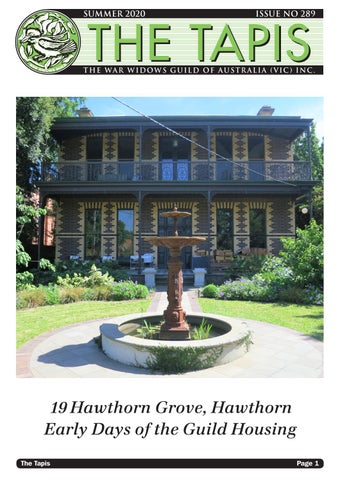
19 Hawthorn Grove, Hawthorn Early Days of the Guild Housing The Tapis
Page 1
From The State President Wendy Charlton
Dear Members,
Also of note at the Vasey AGM was the resignation of
As we look forward to Christmas and time with family
Vasey RSL Care director John
and friends, it’s good to reflect on a difficult year
Cullen OAM. Many of our
for all of us and to look forward to a year, hopefully
members will know John for
COVID free in 2021. In Victoria, the recent easing of
his many years of work for
restrictions will allow families to celebrate Christmas
war widows. Notably, John’s
together. Of course we will need to remain vigilant as we move forward with our lives and the government moves to restart the economy. As one, we are all in this together.
Mr John Cullen
service to the Guild was as a director on the Board of
Vasey Housing Ltd, which was established by the Guild in 1971 for its expanding Housing Program.
In the last edition of The Tapis, we announced that
John worked in Vasey Housing for over twenty
our 2020 November AGM was postponed due to
years. At the Vasey AGM, John was acknowledged
COVID restrictions. The AGM will now be held early
as a founding member of the Board of Vasey RSL
2021 [date to be advised].
Care, from its inception, on the 6th of July 2004
75 Years of Service to War Widows. I hereby acknowledge that after 75 years of dedicated service to war widows the War Widows’ Guild of Australia [Vic] Inc. will be moving a motion to wind up at its next AGM. Please note, at the AGM we will update members as to the legal requirements and process to formally wind up the War Widows’ Guild
to November 2020. He was nominated by the War Widows Guild and was duly appointed as a director of the company. In 2006 John was awarded the Medal of the Order of Australia for his years of service to veterans and their families. At the time he commented that the award was “unexpected and humbling”.
of Australia [Vic] Inc. For more information I ask that
Although the Victorian Guild is no longer a member
you read the article included in this magazine. We
of the national body we still keep in touch. As we
look forward to your attendance at the AGM.
indicated a few years ago the National Body and
19 November 2020: In anticipation of the of the wind up of the War Widows’ Guild of Australia [Vic] Inc. a Special Resolution was put forward at the Vasey RSL Care Ltd AGM, to amend their
States have now changed their name from War Widows Guild to Australian War Widows. It well may be that Victoria will be both the first and last to be known as The War Widows’ Guild.
Constitution. In effect, the War Widows’ Guild is now
Remembrance Day 11 November 2020 was
no longer a stakeholder and no longer has company
commemorated in virtual format this year by most of
members in Vasey RSL Care Ltd. With this in mind
us tuning in to either the local or national broadcast.
we have dedicated this edition of Tapis to the Guild/
The significance of the day was not forgotten by the
Vasey housing history, we hope you enjoy reading
many who held personal ceremonies at home.
the articles.
Page 2
The Tapis
I acknowledge the Guild Committee for their loyalty and support throughout a very busy 2020. It was a challenging year in so many ways as we worked from home and held meetings via zoom, teleconference etc. There were many extra meetings as we determined the War Widows Guild’s final chapter and acknowledged its proud and historical significance. My sincere thanks to Kath, Margaret, Gail, Heather, Dot and Jill for all that was achieved this year. Enjoy the summer break. As the year comes to an end, we pause to look back and reflect on 2020. It was a year like no other, but we adapted to changing circumstances and lived and along the way we found reasons to smile. As we look forward to the festive season of Christmas, we send good wishes to all and the hope for a very happy new year. Wendy Charlton
Rob Webster VIC RSL & Wendy Charlton
State President
The Guild welcomes the appointment of the new Deputy Commissioner of DVA in Victoria. Michael
Guild Motto
Harper will start with the Department of Veteran
We all belong to each other
Affairs in December.
We all need each other
It was with sadness that we received the news that
It is in serving each other and
Dina Carr had passed away. To Tony Carr and family,
in sacrificing for our common good
we acknowledge your mother as a WWG member, an
that we are finding our true life.
ex-director, a tireless worker and a good friend to all of us. Vale Dina, you will be missed.
Editor’s Note: During COVID-19 the Guild office is offsite
Apology Spring Tapis oversight: President’s Report
however you can still contact the Guild on (03)9810 5500,
page 3 should have read as Major General George
0499 490 222 or jill.wilmott@vaseyrslcare.org.au
Alan Vasey.
Disclaimer All materials published are subject to War Widows’ Guild of Australia (Vic) Inc terms and conditions. War Widows’ Guild of Australia (Vic) Inc accepts no liability for any errors or omissions and does not endorse any companies, products or services that appear in this publication Print Post Approved 100008013 PO Box 203 Hawthorn 3122, Ph - 9810 5500 Email - jill.wilmott@vaseyrslcare.org.au Patron - The Honourable Linda Dessau AC, Governor of Victoria
The Tapis
State President - Mrs W Charlton Management Committee - Mesdames K Banks OAM, G Best, M Miles, H Minty & D Humphrey Lesque. Editor - Jill Wilmott (jill.wilmott@vaseyrslcare.org .au) Sub-Editor - Linda Vine (linda.vine@vaseyrslcare.org.au)
Page 3
Handing over the Baton Since the formation of the War Widows’ Guild of Australia 75 years ago in 1945 the Victorian Guild has advocated for widows, veterans and their families. The major goals were to provide widows with skills to become self-sufficient, improve government compensation and provide access to affordable housing. The Guild fundraised and sought government grants to initially build units and later when the need presented aged care facilities. In 1959 when the Guilds accommodation division outgrew the management logistics of a membership based organisation a decision was made to separate the Guild into two companies. The two entities would be The War Widows’ Guild of Australia (Vic) Ltd and Vasey Housing Auxiliary. The Guild could now concentrate its time and resources into the welfare of its members and indeed all war widows and the ex-service community. Vasey Housing would go on to further the Guild founder, Jessie Mary Vasey’s vision of building Nursing Homes (Aged Care) so that there would be affordable ex-service specific facilities for the ageing veteran community. This decision was not without controversy as many of the founding members felt they would lose control of the valuable assets they, with the help of many, had worked so hard to attain. Some believed that they would no longer be guaranteed accommodation when it was needed. A small group of founding members campaigned to block the separation however times were changing and stronger specific skilled management was required to take the housing company forward. The separation would also mean that under the new company Vasey would be able to access government grants available for nursing homes. To ensure that the Guild still had a voice within the new organisation the Vasey constitution ensured that both the board and members of the Vasey Company had Guild representation. In the Page 4
beginning the President of the Guild and the Chair of Vasey were the same person. Even though there had been doubts the arrangement worked well for all involved and a strong relationship between both companies continued for many years. In the 2003-2004 period the Board of Vasey Housing Ltd as it was then known explored how the small company (compared to other aged care organisations) could best service the exservice community and obtain the much sort after government grants that could guarantee the company could provide a high standard of service. Many of the accommodation units (independent living units) which had been built in the early 60’s were no longer suitable for their ageing clients. Many of the units were not fit for purpose, many were two stories or more with no lifts and shared laundries and to renovate them was impracticable. Conversations began with the Victorian RSL who also had accommodation which was also proving problematic for similar reasons. The two organisations agreed to merge their housing and in 2004 they jointly became Vasey RSL Care Ltd. One major benefit of consolidating the two companies was that it enabled them to disperse with accommodation that was no longer serviceable and build new facilities. The new company ensured that the Guild and RSL still continued to have a voice by maintaining their ability to nominate/endorse members of the Vasey Board and to also nominate members of the company, both in equal proportion. Therefore both the Guild and the RSL retained interests in the business of Vasey RSL Care Ltd a Patriotic Fund of whose total assets at the time of formation were originally properties under control of the Patriotic Funds of the Guild and RSL Victoria’s individual associations.
The Tapis
When both the Guild and the RSL were formed a majority of their funding was accumulated by either public donation, including generous member donations or by way of grants. For this reason both organisations and also Vasey RSL Care Ltd are what is known as Patriotic Funds. They must disperse their funds for the reasons they were established, primarily to assist veterans, war widows and the greater veteran community. Upon wind up (closure) any remaining funds must be transferred to a Patriotic Fund with similar ideals. This ensures that all public monies raised continue to be used as they were originally intended. In 2012 the Guild committee had a vision for the future to set up a trust fund which would provide for all in the ex-service community. Rather than have assets tied to one company or one type of asset, their vision was to set up a trust that could disperse funds when and where needed. If someone needed assistance, be it metropolitan or country, the fund would be able to assist because it would be driven by the individuals need. Clients would have the option to stay in their area rather than move to where services were available. The Guild was advised by several parties not to disclose their vision so that it would not adversely affect the business of Vasey and more importantly not cause undue stress and worry to Vasey clients. Discussions with Consumer Affairs regarding the possibility of setting up such a trust stalled time and time again. Until finalisation of the trust could be guaranteed the Guild kept its promise to not disclose its plans. Unfortunately negotiations with stakeholders, opposition from interested parties and yes COVID have all been against the committee and they are unable to fulfil their vision. In October 2020 the Guild committee decided the time had come to transfer its interest in Vasey RSL Care Ltd to the Victorian RSL. At the Vasey RSL Care AGM held on Thursday 19th November 2020, a motion was passed to transfer all Guild interests in Vasey RSL Care Ltd, to the The Tapis
Victorian RSL. This will mean that even though the Guild will no longer have an interest in the company, its joint partner of many years will retain representation and rights. Vasey RSL Care today is a different organisation from its origins. All of the Guild properties that were transferred to Vasey back in 1959 and then from Vasey Auxiliary to Vasey Housing in 1971 have been sold. New facilities have been built and upgrades have been made to the ones transferred from the RSL that have been retained. A committee decision has been made that at the next AGM of the Guild a motion will be put forward to wind up the Victorian Guild. Due to COVID the Guild has applied for a 3 month extension through Consumer Affairs Victoria (they regulate Patriotic Funds). The committee is hopeful that an AGM can be held in late February 2021. Pending the circumstances early next year the committee will mail members advising of the date of the AGM and Notice of Meeting. It is not with sadness that we advise members of the intention to wind up but in celebration of all that has been achieved. It is a time for the acknowledgement of all those who have fought for better conditions and outcomes. For 75 Years the War Widows’ Guild has advocated for war widows, veterans and their families. There is great pride in being able to say that the organisation you are part of has not only achieved all that it set out to do but so much more. Over 75 years there have been many challenges and changes. The Guild Committee has shown both strength and wisdom in recent decisions. The wisdom is in knowing that there are other organisations in existence that can provide and advocate for your members. The strength is in admitting that someday there is a time for all of us to hang up our hat and say “It’s your turn now and you better do it right because we will be watching”.
Page 5
The Times they are a Changin’ Come gather ‘round, people wherever you roam And admit that the waters around you have grown And accept it that soon you’ll be drenched to the bone If your time to you is worth savin’ and you better start swimmin’ Or you’ll sink like a stone For the times they are a-changin’ Come writers and critics who prophesize with your pen And keep your eyes wide the chance won’t come again And don’t speak too soon for the wheel’s still in spin And there’s no tellin’ who that it’s namin’ For the loser now will be later to win For the times they are a-changin’ Come senators, congressmen please heed the call Don’t stand in the doorway, don’t block up the hall For he that gets hurt will be he who has stalled The battle outside ragin’ will soon shake your windows And rattle your walls For the times they are a-changin’ Come mothers and fathers throughout the land And don’t criticize what you can’t understand Your sons and your daughters are beyond your command Your old road is rapidly agin’ please get out of the new one If you can’t lend your hand For the times they are a-changin’ The line it is drawn the curse it is cast The slow one now will later be fast As the present now will later be past The order is rapidly fadin’ and the first one now Will later be last For the times they are a-changin’
Bob Dylan Page 6
The Tapis
The Tapis
Page 7
25 Hawthorn Grove, Hawthorn Page 8
The Tapis
The Tapis
Page 9
Church Street Brighton Property Page 10
The Tapis
History of the War Widows’ Guild of Victoria Welfare & Housing Schemes Reprint from Guild History Files From the time of the founding of the War Widows’ Guild in 1945, the main function was to provide welfare assistance for War Widows. This was predominantly in the form of handcraft classes which provided both a source of social intercourse and a means of augmenting a War Widows pension by the sale of handcrafts. The earliest balance sheets are not now available but from 1951 onwards, formal accounts were presented by firms of Chartered Accountants. These are all available in the Guild office, E. V. Nixon and Partners began a long association with the War Widows’ Guild in 1953 and remain as auditors and accountants to both the War Widows’ Guild and Vasey Housing Limited. From 1952 onwards, a new phase of activity was entered into – that of providing housing for elderly war widows. The introduction of the Commonwealth Government Aged Persons Homes Act made the building of flats for elderly persons an economic possibility for charitable organisations, providing as it did, a capital subsidy in respect of every person accommodated. In addition to the housing of widows in apartments, the Guild ventured into several minor Real Estate propositions, none of which proved viable. Land and/ or cottages were acquired at Torquay, Beaumaris and Wantirna with a view to providing cheap holiday accommodation for war widows or storage space for Guild materials. In 1953, the auditors reported that none of these ventures were economical and advised that the Guild should discontinue them. The handcrafts activities were continued because of their sale and welfare value to members in spite of the fact that they were not self-supporting. The accountants were also critical of several inadequacies and errors in the keeping of the books of account. It should be stated that as far back as 1953, Salaries and Allowances for staff members amounted to approximately £2,700 ($5,400) so that the popular concept that all work was being done voluntary is refuted. A succession of clerical workers was employed over the years – many of them part time and untrained.
19 Hawthorn Grove, Hawthorn The Tapis
Page 11
In 1952, a donation of £5,000 by the H. V. McKay Trust encouraged the Guild to purchase a property, 19 Hawthorn Grove, Hawthorn for conversion into apartments. The purchase price was £7,000 and a mortgage had to be entered into in connection with this purchase. Again the accountants cautioned the Guild and expressed concern for its future activities. In the year 1952-53, the income for the War Widows’ Guild was £5,488 of which £2,829 was spent on Salaries and Allowances. In the year 1953-54, the loss of Property Trading Account was £39. Donations were down to £3,102. Administration expenses continued to increase to £2,684 including Salaries and Allowances of £2,276. During the year 1954-55, the first grant, £5,784, by the Commonwealth Government towards the building of new flats at Hawthorn Grove was received. In this same year the profit on the sale of goods was down to £129 and administration expenses were £3,775, including Salaries and Allowances of £2,976.
23 Hawthorn Grove, Hawthorn The financial year 1955-56 produced a deficit in the Trading account of £512 and a nett loss of the properties of £27. Administration expenses cost £5,095, part of which was the fee of a professional fundraiser who conducted a raffle in aid of the War Widows’ Guild. During this year (1955-56) the property, 74 Caroline Street, South Yarra, was purchased with the assistance of a mortgage. The total purchase price was £19,950. This property was purchased with a view to securing space for the Guild Headquarters and for providing rooms for handcraft activities. The top storey was converted into five very small apartments for war widows. As the building has some historical significance, Mrs. Vasey decided to use a great part of the premises as a display home for Victoriana. Large sums of money were spent at auction in the acquisition of furniture, furnishings, bric a brac with which to equip the home. Considerable renovation had to be completed and redecoration was done on a grand scale. Mrs Vasey’s plan was to open the building for conducted tours which would provide revenue for the Guild. Page 12
The Tapis
The whole project failed over the years because of lack of public support. The door takings were minimal compared with the large amount of money tied up in the building and antiques. £30,000 ($60,000) had been spent on the purchase of the property and contents and the redecoration of the building. The 1955-56 accounts reported a profit of £10,138 from the raffle. In 1956-57 donations were reduced to £2,564, costs of administration accounted for £3,569. The nett loss on the Trading account was £326.
Caroline House - 72 Caroline Street, South Yarra Year 1957-58 accounts – donations were down to £1,360 and the losses in the Trading account continued. A property was brought at Moreland for conversion to apartments. In this year the houses at Moreland and Hawthorn Grove and flatetts at 74 Caroline Street, produced a nett profit of £3,476. In that same year administration expenses accounted for £3,897 of which £558 is shown as expenses in connection with an overseas conference. Other costs in connection with this conference are unable to be traced.
Mrs Munday and Allen Coburg Units The Tapis
Page 13
The financial year 1958-59 saw the rapid extension into the field of elderly persons’ housing. The amount of £57,029 plus the Commonwealth Grants of £23,500 reflects the conversion and anticipated conversion to flats of properties at Hawthorn Grove, Hawthorn, Princess Street, Kew and Seymour Road, Elsternwick. At this time, welfare work and handcraft activities began to diminish rapidly. Salaries and Allowances in this year cost £3,089. Seymour Road, Elsternwick
120 Princess Street, Kew At this stage the solicitors of the Guild and the auditors, E. V. Nixon and Partners, recommended that the housing activities should be treated separately from all other Guild functions. It was obvious that the funds provided by both the Commonwealth Government and incoming tenants were being utilised for maintaining other Guild projects, particularly the Caroline House venture. The auditors complained that it was almost impossible to value the items of furniture and effects which were in Caroline House since some were said to be on loan from members and invoices relating to the purchase of others were not able to be produced. It was recommended that the housing should be handled by a company limited by guarantee, thus obviating the difficulties occasioned by changing office bearers, committees and trustees. It was recommended that all Real Estate should be transferred to the Housing company and that the housing activities be diverse from other Guild welfare work. The Vasey Housing Auxiliary (War Widows’ Guild) Limited was formed and at the first meeting of the Board of Directors on 6/7/1959 the following minute was passed. Page 14
The Tapis
Property Transfer It was resolved that the Solicitors of the Auxiliary be instructed to take steps necessary to transfer all Real Estate held by the Trustees for the Guild to the Vasey Housing Auxiliary. MOVED:
Mrs. Vasey
SECONDED: Mr. Roe CARRIED
By Direction of the Chairman That this transfer to take place subject to existing licences granted by the Guild in relation to the occupancy of flats and subject to the Guild’ being entitled to continue to occupy such part or parts of the Real property referred to which it is now occupying, or which it may require at any future date, for the purpose of conducting its offices and social activities. MOVED:
Mrs. Gahan
SECONDED: Mrs. Sparks CARRIED The Memorandum and Articles of the housing company made provision for the continuation of the housing of war widows. A few months later an extract of the minutes of a meeting of the Directors of Vasey Housing Auxiliary resolved “that the Committee of Management be authorised to publicly advertise that widows of ex-servicemen or close relatives of deceased servicemen be eligible for admittance to the Vasey Housing Scheme provided that they are eligible under the Aged Persons Homes Act.” It was obvious that the building programme had built more flats than could be utilised by war widows over the age of 60 and it was noted that the original memorandum of the Guild had included the families of war widows and possibly disabled servicemen and women as beneficiaries of the Guild. At no time since 1959 have war widows been denied priority to any Vasey Housing Auxiliary flats. At present the ratio of war widows to non Repatriation-accepted war widows and other relatives is approximately 40:60. This is purely the result of supply and demand. As years go by, this ratio will increase with the increase in age of Second World War widows, many of whom are now only approximately 50 years of age. A similar situation appears in the Vasey Housing Auxiliary Nursing Home opened in March 1971. The transfer of all Real Estate to the Vasey Housing Auxiliary in 1959 did not deprive war widows of the flats which they had been helped to occupy under the terms of the Aged Persons Homes Act. The assets of land and buildings remain intact and by Government regulation must remain so. They cannot be sold or mortgaged. They exist solely to house elderly persons and by another Government regulation, cannot be used to raise funds for any other purpose save that of building additional flats, hostel or Nursing Home accommodation. This regulation is now strictly policed and it is no secret that its introduction was made necessary by the use of such funds for other than housing projects in the early years of the War Widows’ Guild and also other similar organisations. The Tapis
Page 15
The value of the Real Estate transferred to Vasey Housing Auxiliary in March 1960, was £184,486 ($368,972). The balance of War Widows’ Guild funds was then £8,995 of which £7,530 was represented by the furnishings and antiques in Caroline House. Both Vasey Housing Auxiliary and War Widows’ Guild were administered by the same staff and prior to 1966 there were frequent adjustments between the two sets of accounts as regards administration charges to be applied to each organisation. In the year 1961-62, the deficit in the Guild Trading account was £2,748. Salaries and Allowances had cost £4,289. In this year the Historic Home, 74 Caroline Street, received only £175 in visitors fees. During the year 1962-63, the Guild decided to purchase a property 48-52 Caroline Street, South Yarra. The property required considerable alteration (£16,535) to convert the down stairs section to offices for the War Widows’ Guild and Vasey Housing Auxiliary and the upstairs to an apartment for Mrs. Vasey. The total expenditure on 48 Caroline Street was £30,535 ($61,170), none of which would attract a Government subsidy. With almost no funds available, the Guild approached the Vasey Housing Auxiliary and asked that the value of the properties in Hawthorn Grove should be handed over to the War Widows’ Guild by way of a transfer so that the War Widows’ Guild could acquire 48-52 Caroline Street in its own right. A photostat of these negotiations follows.
52 Caroline Street, South Yarra
48 Caroline Street, South Yarra Page 16
The Tapis
The balance sheet for the Guild for the year ended March 1963 shows that this was done by transferring the amount of the cost of the 48-52 Caroline Street property to the accumulation account of the War Widows’ Guild. In the year 1963-64, the War Widows’ Guild charged Vasey Housing Auxiliary with £2,040 for rent and administration costs. In this year incoming tenants and the Commonwealth Government paid £27, 905 into the 52 Caroline Street property account. There is no doubt that the Guild envisaged applying the nett surplus from the 16 flats at 52 Caroline Street towards Guild funds. This is in conflict with Department of Social Services Regulations as mentioned previously. Following Mrs. Vasey’s death in September, 1966, the Boards of the War Widows’ Guild and Vasey Housing Auxiliary, with the help of Mr. R. Abbott, Auditor and a member of E. V. Nixon and Partners, began a long job of separating the finances of War Widows’ Guild and Vasey Housing Auxiliary and the balance sheets for 31/3/68 reveal the transfer back to Vasey Housing Auxiliary £177, 873 representing 48-52 Caroline Street and a deposit of £6,900 paid on the property acquired for a Nursing Home in Brighton. After a thorough investigation as was possible, the Board of the Vasey Housing Auxiliary decided to make $20,000 available to the War Widows’ Guild to enable it to pursue welfare work for war widows. This figure was determined to be a fair recognition of the fact that the Vasey Housing Auxiliary owed its origin to the War Widows’ Guild. It took into account the extremely limited fund raising and failing income of the War Widows’ Guild in the years after 1957, the fairly heavy expenditure on Salaries and Allowances and other overhead costs prior to 1969 together with the extremely costly historical house project mentioned above. It was recognised that almost the entire revenue of the War Widows’ Guild in the years 1957 onwards, was in the form of Government subsidy for housing elderly people and ingoing donations being the tenants themselves – War widows (40%) and other beneficiaries (60%). It was recognised that it was an impossible task to unravel all the intricate transactions between the War Widows’ Guild and Vasey Housing Auxiliary in the period 1952 to 1966 (the year of Mrs. Vasey’s death). At a meeting of the Board of Directors of War Widows’ Guild on 21st February, 1968, this decision of the Vasey Housing Auxiliary was accepted with appreciation and it was resolved that the Guild now start a new phase of operation as an organisation devoted to the welfare of war widows only. At that time the Board had no immediate plans for the $20,000 and it was offered as a contribution towards the Vasey Housing Auxiliary Nursing Home. This was accepted. In 1969, the revenue account of the War Widows’ Guild showed a deficit of $2,861 and in 1970 the deficit was $227. The Board of the Vasey Housing Auxiliary then offered to return the $20,000 to the War Widows’ Guild to enable it to continue to operate. This offer was accepted. In 1967 permission was obtained from the Commonwealth Department of Social Services to sell 74 Caroline Street (Caroline House) providing the Vasey Housing Auxiliary provided alternative accommodation for the five occupants of the flatets. The sale of the property was made conditional on the repayment of the Commonwealth subsidy originally granted in connection with the five flatets and upon an undertaking of the Vasey Housing Auxiliary that the money obtained from the sale would be applied to the construction of a Nursing Home. The sale was effected and all the antiques and furniture sold at auction. This realised a lower figure that the amount represented on the books – a fact which the auditors had suspected all along. The Tapis
Page 17
In retrospect, it can be said that the properties 74 and 48 Caroline Street, South Yarra proved to be extravagant and ill-run ventures. A total of $121,170 was spent on these two properties: 74 Caroline Street – $60,000 historical home and 5 flatets. 48 Caroline Street – $61,170 offices and apartment for Mrs. Vasey. The balance sheets of the War Widows’ Guild from 1953 to 1962 show that these sums were not raised by extra fund raising activities but were in fact obtained by appropriating monies given for housing purposes. For all these reasons the Board of the Vasey Housing Auxiliary had no hesitation in re-assigning the titles of 48-52 Caroline Street, South Yarra to the Vasey Housing Auxiliary. In fact, at the time of effecting the transfer the Board was very concerned to realise that the title had not been made out in the name of the War Widows’ Guild, nor in the name of War Widows’ Guild Trustees, but in the joint names of Mrs. Vasey, Mrs. K. Gahan and Mrs. M. Sparks. At the time of the transfer, Mrs. Vasey had died and it was realised that 1/3rd of the value of the property could have been included with her estate. It was exactly the type of problem which the auditors had foreshadowed years before when they had urged the formation of a limited company to undertake the responsibility for all the housing properties.
48 Caroline Street, South Yarra
Page 18
52 Caroline Street, South Yarra
The Tapis
Recollections of Mrs Vasey Reprint from Guild History Files During October many Clubs and Branches throughout Australia celebrated Founder’s day; commemorating the birthday of the late Mrs. Jessie Mary Vasey. This was a nostalgic day for all those involved in the establishment of the Guild in every State; a time for remembering those early days when members were united in their struggle for benefits and compensation which would more properly recognise their husbands’ sacrifice and their loss. My own special memories of the Guild also centre around October (October 1963 to be precise). In September 1963 I started work as Company Secretary of the Guild’s housing organisation; at that time Mrs. Vasey had been endeavouring to do this work herself, having been without a Company Secretary for about a year and so there was a great deal of catching up to do. No sooner had I thrown myself into this task than Mrs. Vasey told me that the Guild’s National Conference was to be held in Melbourne in October – only six weeks away – and, she added that the Minutes from the previous Conference were still only in very rough draft form. She asked – or rather – told me that I would have to take on the job of National Secretary as she had been unable to find a member who was willing, or able, to do the work. Well, I eventually managed to put together the Minutes – all twenty-six pages of them if my memory serves me correctly, and they were actually passed at the Meeting, but what a scramble that was! No Hotel bookings had been made and nothing was said about arranging transport from the airport, or putting flowers or fruit in their rooms to welcome them, so I’m afraid most delegates missed out on the little courtesies that year. Fortunately many of them had already established firm friendships with other office-bearers or members and no doubt they were well looked after, but when I look back I can’t believe that we actually came through that Conference without a real disaster! In those days a great number of the members were young and sprightly and many came into the office on a regular basis, so all the catering was done by them and other Committee members. The small office staff did not escape of course; and helped with anything and everything in between doing their routine work. When I first arrived at 48 Caroline Street, it seemed to me that the office was always overflowing with people – Winnie Holland – the Wrapper Queen and Mrs. Sewell – known as Sewelly – ruled the roost in the kitchen where they recorded membership dues and addressed the wrappers for the Guild magazine, and I was quite terrified of this powerful duo. Fortunately Caroline Sturm who started work only weeks before me, was a great ally. She had a great sense of fun and humour, as did Mrs. Mills who also spent several days a week in the office, and we had many a laugh over shared difficulties. Caroline was an excellent cook and was recruited to make profiteroles and other appetisers to serve to delegates. We came in early to prepare these and had great fun filling them with a Pate and Brandy mixture, closely watched by Winnie Holland who popped in and out like a jack in the box, obviously concerned that some of the hilarity might be caused by too much tasting!
The Tapis
Page 19
48 Caroline Street, South Yarra Over the years there were many more memorable times – a visit to Geelong, Ballarat and Colac with Mrs. Vasey was particularly unforgettable. At that time her health had already deteriorated and mornings were the most difficult time. We stayed at old hotels in each of these cities and there was no such thing as room service, so at 11am I was despatched to the kitchen to find some breakfast for her and nearly caused the entire staff of two to walk off the job! The City of Colac laid on a Civic Reception for Mrs. Vasey and I spent some time dressing for this special event before going in to see if she was ready to leave. To my horror I found her propped up in bed, very weary and far from well, but eventually we set off for the reception; Mrs. Vasey dressed in an old brown hopsack suit and looking far from her best. We were met by the Mayor – in full civic regalia – and escorted to the massive dining area where an obviously restive audience had been waiting for some time for their guest of honour. After a brief preamble Mrs. Vasey rose to address them. Totally transformed, her face illuminated with such a glow that her clothes held no importance, she started speaking and within minutes the whole audience was spellbound. She always spoke from the heart, with no set speech but only a few headlines to keep her on track, and when she had finished everyone was on their feet to give her a standing ovation. At that moment I fully realised why this brilliant woman had charmed so many members of the Government including Sir Henry Bolte and Sir Robert Menzies. Page 20
The Tapis
The years I worked with Mrs. Vasey were not without their difficulties, of course. The housing programme was still in its infancy and we were already reaping the bitter harvest which can come with being leaders in the field. When Mrs. Vasey started her ‘aged persons’ homes’ project, she desperately wanted to provide good, cheap housing for her war widows. As the properties were newly established they had not been rated by the local Councils and Mrs. Vasey firmly believed that as a charitable body Vasey Housing would enjoy the same exemption as the Church 2 Manningtree Road, Hawthorn Homes. The rents were therefore extremely low, but by 1960 all the Councils had decided to charge full rates and this made it imperative to substantially increase rents. A number of residents became increasingly hostile when this happened – unfairly so, I thought – but one has to remember that at that time they were trying to cope with the rather meagre services and unestablished gardens which had resulted from building on a shoestring. Many refused to pay higher rents and I was under strict instructions to keep maintenance to the minimum and only organise essential repairs. I got my fingers badly burned one day when a ‘dear old lady’ from Manningtree Road telephoned for maintenance service. She inferred that she was on her deathbed and I, in my ignorance, got the work done and was carpeted by Mrs. Vasey for my trouble. Two days later we were in the grounds of that block of flats when a tall, slender vision clad in a magnificent black cape whisked around the corner to be confronted by Mrs. Vasey. “Off to the races, Mrs. X” asked Mrs. Vasey sweetly? That, she hissed at me afterwards, was your dying swan! The Tapis
14-18 Manningtree Road, Hawthorn Page 21
Although the majority of our residents were delightful and only too anxious to be helpful, problem tenants always took up an enormous amount of our time in those days, and nothing really altered over the thirty years that I was with Vasey Housing. Mrs. Vasey was an absolute master not only of oratory but also letter writing. She had a delightfully direct style which I tried my hardest to emulate. However, my skills were certainly tested by some of the jobs she gave me. On one occasion I had to write to a resident who had an ongoing feud with the woman who lived beneath her. The latter was fond of gardening and spent most of her days kneeling in the garden below weeding and planting. Mrs. Upstairs would get her wringing wet washing and hang some of it on the trees above so that a continuous stream of water trickled down on the hapless gardener. It was my task to write and admonish her about this, in a diplomatic way, and to persuade her to mend her ways. On another occasion the Police rang me in the middle of the night. One of our residents had been firing a pistol from her window and had so frightened her neighbour that she had been taken off to hospital with a heart attack. That took a great deal of sorting out but we eventually found that the ‘pistol’ had really been a shot gun and the woman concerned, who was fanatically clean, had been firing at the pigeons which persisted in roosting on her window sill. I had a great deal of trouble with this tenant who was regarded as a real old battle-axe by other residents and refused to co-operate in any way until the roof began to leak and discoloured her immaculate ceiling. She was quite distraught and although funds were limited I was able to do something for her (without incurring further wrath or expense) through our Insurance Company. From then on I became No. 1 pin-up girl with this particular woman. I came to realise that her obsessive cleanliness had alienated both her old friends and her neighbours and she was really a very kind person who hid her loneliness behind an aggressive and forbidding manner. Many years later, when she was in her nineties she gave me beautiful supper cloth, hand-embroidered with roses, which she had made for me. The work is so fine that I hardly dare to use the cloth but I never do so without remembering this very lonely woman and recalling the furore those pigeons caused.
2 Manningtree Road, Hawthorn Page 22
The Tapis
There have been so many similar incidents over the years that it would be hard to say which are the most memorable. However, I think the times I most like to recall are the days when we would have some special celebration at the office, a birthday usually, and bring in our favourite dishes for lunch. On these occasions Mrs. Vasey would often join us for coffee afterwards and talk of the happy years she spent in India when General Vasey served in the Army there. She would tell us about the journeys she made looking for antiques and artefacts, and the colourful servants and bearers who travelled with her, and, in particular about the culture of the country she came to love. When she spoke we would all sit there entranced, Edna Mills, her beautiful brown eyes alive with interest, Sally Burningham and Caroline Sturm; all of us would be transported to a far off country as we listened to her stories. Indeed, in subsequent years these have been the memories we have always shared and enjoyed whenever we’ve had a reunion. When Mrs. Vasey first asked me to work for the Guild and Vasey Housing, I had some misgivings. I had always worked in commerce until that time and felt the work might be rather dull by contrast. How wrong I was! I not only had the privilege of working with one of Australia’s most talented women, but I also met many other outstanding people, not least those among our Guild members and stacked up enough nostalgia to last a lifetime whilst enjoying thirty challenging and rewarding years working with and for the Vasey community and the War Widows’ Guild. Friends of Vasey
The Tapis
Page 23
Page 24
The Tapis
The Tapis
Page 25
How Rumbalara, Wattle and Waratah Lodges came into being with Lois Hurse as Managing Director and Chairman of the Board of Vasey Housing Major General George Vasey was devoted to the welfare of his men and encouraged his wife, Jessie, to have concern for their widows. Following his death in March 1945, Mrs. Vasey founded the War Widows Guild to improve the social and economic state of war widows. When the Aged Persons Homes Act was introduced she took advantage of these capital grants to ease their housing burdens. By 1964 there were 300 war widows living in self-contained flats in ten locations of Melbourne. She also purchased a mansion in Caroline Street South Yarra and furnished it with Guild money. A series of raffles had produced significant funds over the years, but Caroline House was planned to produce a regular income from the public coming to view the historic home furnished with antiques. The income was minimal. The top storey of the house was converted into five small flatettes by claiming the subsidies from the Government’s Aged Persons Home Scheme. By 1964 Mrs. Vasey admitted that she needed help with the administration and realised that she needed to appoint a successor. She could find nobody from the ranks of the Guild. Almost by accident I went to the Guild office to pay my first subscription having been accepted as an eligible war widow. I was introduced to Mrs. Vasey. Over a period of weeks I was invited to lunch with her. On my fourth visit she challenged me to ‘take over’. I was dumbfounded and explained that I had commitments to the Australian Island Mission for some years. Mrs. Vasey was persistent – by letters and phone calls – and finally I agreed when family responsibilities necessitated my return to Melbourne. I started in February 1966 and found the entire administration of the Guild and Housing wing was maintained by four persons – Mrs. Vasey, a secretary, receptionist and bookkeeper. Behind the scenes was a small group of six elderly war widows of intense loyalty to Mrs. Vasey. They met infrequently but I was introduced to them as the new President when Mrs. Vasey retired. For six months I worked alongside Mrs. Vasey and learned as much as I could from minutes and newspaper clippings. These latter endorsed what I was hearing about “disgruntled” residents who were complaining about the lack of attention to maintenance on their flats and the costs they were facing. Melbourne newspaper “Truth” had become a harsh critic. Early in September Mrs. Vasey went to Queensland to visit the Guild there and planned to take a short holiday on the way back. Three weeks later I received a phone call to say that Mrs. Vasey had died at a motel in Grafton. Her son Robert flew from Hobart and a funeral service was held in Toorak on 27 September 1966. It was attended by a large number from all over Australia – all of whom were shocked by the suddenness of her death. She had become a national figure. Nobody was more shocked than me. The Board immediately announced publicly that I was the new President and head of the Housing Auxiliary. This was endorsed at a general meeting of the Guild held within a couple of weeks. My immediate reaction was to seek the advice and assistance of professionals to guide the housing section. I appointed a Board comprising the Guild bank manager, a master builder, an insurance expert, accountant and doctor who was Medical Superintendent of the Heidelberg Repatriation Hospital.
Page 26
The Tapis
There were two urgent matters. The first concerned the as yet unfinished block of flats in Lisson Grove, Hawthorn. Mrs. Vasey had spoken of making provision there for some limited help for the residents in their daily living, but nothing had been decided. The Board agreed to alter the last section already under construction to include a larger dining room, commercial kitchen and a flat for a supervisor. The new Personal Care Home was officially opened in April 1967 and a plaque unveiled by her son “In memory of General George Vasey and Mrs. Jessie Vasey�.
Lisson Grove, Hawthorn
The Tapis
Page 27
The second major concern was to rectify the financial problems associated with residents’ complaints. Our legal advice was that the residents’ contracts could only be determined by action in the Supreme Court. This necessitated a large volume of work going through accounts and invoices by hand. Computers were not known at this stage! All this took several months and ended with three days in court. The judgement vindicated the Board’s actions in responsibly maintaining the flats but recommending a change in the wording of the contracts. The each-way result enabled the administration to proceed with the knowledge that the residents would in future have to meet their obligations. The Board endorsed my plan to cease building residential units in favour of building nursing homes and hostels. The Government had extended its provision for aged care to announce help with the capital costs. In order to apply for a grant it was necessary to find a property on which to build, and the purchase of a property required significant funds. It was decided to capitalise on the Caroline House museum project which was unproductive. Two days of professionally run auctions resulted in $17,000 for the antiques and $41,000 for the house. A search produced a house on a large block of land in Brighton and the proceeds of Caroline House matched its price. As Mrs. Vasey had done, I devoted my time to the nursing home project. The Board decided to demolish the existing house in favour of building a purpose-built modern nursing home. Over several months I visited many nursing homes in search of recommendations from staff working in the field. They were able to supply details of what worked and what did not in the interests of both patients and staff. All expressed the hope that we could supply full air-conditioning – no existing nursing homes at that stage had its benefits. With all these planning suggestions the Board asked Mr. Cecil Baldwin, the architect of Lisson Grove, to draw up plans for Rumbalara – an aboriginal word for the realisation of a dream. The plans did include a full air conditioning plant situated on the upper level of a strictly functional style building, with large floor to ceiling windows that could be opened if necessary. Page 28
Rumbalara The Tapis
I attended every site meeting with the architect and by being on the spot could help decide issues as they came up. When the building was completed, the Board asked me to choose the furniture and fittings including the kitchen facilities. I spent weekends visiting small art shows from which I chose original paintings from local artists. These were not expensive but they gave a homely appearance to hospital corridors and rooms. We appointed the first Director of Nursing who had first to select the necessary medical equipment. She then appointed the nursing and domestic staff. The Board had negotiated with Legacy to allow six beds to be allocated for their widows as required in return for a donation of $25,000.
Wattle Lodge and Waratah Lodge In 1972 the Government introduced the Aged Persons Hostel Act. This allowed organisations which had already built flats to apply for grants for a number of hostel beds proportionate to the flats already built. As Vasey Housing had 320 flats there was no problem in obtaining funds. An amount of $7,800 was set as the maximum per bed, and no further contribution was required, either for the building or required by an incoming tenant. A block of land on the western boundary of the Cochrane Street flats had been bought earlier. Plans were drawn up for a hostel of 28 beds and this had been approved. So anxious was the Department of Social Services to spend money before the end of the financial year that early in June I was rung and asked how quickly we could get 30,000 bricks on the site before the 30th. The builder had already been chosen by tender and he was very quick to meet the request. The building proceeded quickly and was ready for occupation at the end of 1976. During this operation the Board decided to convert the recreation room attached to the Cochrane Street flats into a Day Hospital. This was approved by the Hospitals and Charities Commission and fitted out at our expense. Professional physiotherapy and occupational therapy were thus available to the residents of Wattle Lodge and the flats. Salaries of these persons were paid by Rumbalara. A second stage of Wattle Lodge was made possible by the purchase of a bakery fronting Bay Street Brighton. This gave access to the rear of Wattle Lodge and gave space for a twoÂstorey addition. Access to the top floor was by a hydraulic lift and the facilities of Wattle Lodge dining and recreation rooms were adequate to accommodate an additional 28 persons. This was completed in 1978. Waratah Lodge
The Tapis
Page 29
A second hostel was planned for land purchased in Abbott Street Sandringham in 1974. Building a hostel for 28 beds commenced in 1978 and was completed without incident at the end of that year. A 100-year-old olive tree in front of the building was the joy of the neighbourhood and there was much relief when the building operations kept it intact. Again it was my privilege to choose the furniture and fittings for the lounge and dining rooms, kitchen, laundry and handcraft rooms. Incoming residents could choose to accept the beds as provided or bring their own choice of bedroom furniture. I retired in 1981 and was able to look back on fifteen years of being intensely involved in planning and completion of Rumbalara, Wattle Lodge and Waratah Lodge. By 1981 all three were running efficiently and happily and were regarded among the finest in the aged care field. Now in 2011, I appreciate that 35-year-old buildings and equipment are due to be retired and have a rebirth in Vasey East Brighton. I wish the new enterprise every success.
Lois Walker OBE (Hurse) Page 30
The Tapis
The Tapis
Page 31
Let’s light a candle for Christmas, A symbol of joy and good cheer, And then keep it bright in the window, And in our lives throughout the year. Let’s light a candle with all of our warmth, Our friendship and love and good will, So that even when Christmas is over, Its meaning will be shining still. May the joy and love that are Christmas, Be brighter than ever for you, And then may its beauty, Remain in your heart, To light your way all the years through. Constance Parker Graham