Commercial Services (pg 20): ASSET/PROPERTY MANAGEMENT FIRMS
CONSTRUCTION COMPANIES/GENERAL CONTRACTORS ECONOMIC DEVELOPMENT CORPORATIONS
©2025 Real Estate Publishing Corporation December • VOL.25 NO.6
ENVIRONMENTAL/ENGINEERING FIRMS MULTIFAMILY FINANCE FIRMS REAL ESTATE LAW FIRMS
Life Between the Buildings: How Bell Works Chicagoland reframed suburban office development By Brandi Smith
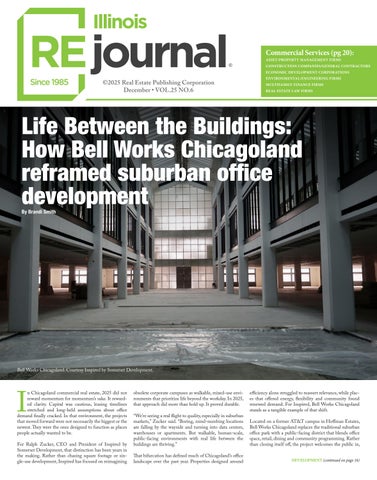
Bell Works Chicagoland. Courtesy Inspired by Somerset Development.
I
n Chicagoland commercial real estate, 2025 did not reward momentum for momentum’s sake. It rewarded clarity. Capital was cautious, leasing timelines stretched and long-held assumptions about office demand finally cracked. In that environment, the projects that moved forward were not necessarily the biggest or the newest. They were the ones designed to function as places people actually wanted to be. For Ralph Zucker, CEO and President of Inspired by Somerset Development, that distinction has been years in the making. Rather than chasing square footage or single-use development, Inspired has focused on reimagining
obsolete corporate campuses as walkable, mixed-use environments that prioritize life beyond the workday. In 2025, that approach did more than hold up. It proved durable. “We’re seeing a real flight to quality, especially in suburban markets,” Zucker said. “Boring, mind-numbing locations are falling by the wayside and turning into data centers, warehouses or apartments. But walkable, human-scale, public-facing environments with real life between the buildings are thriving.” That bifurcation has defined much of Chicagoland’s office landscape over the past year. Properties designed around
efficiency alone struggled to reassert relevance, while places that offered energy, flexibility and community found renewed demand. For Inspired, Bell Works Chicagoland stands as a tangible example of that shift. Located on a former AT&T campus in Hoffman Estates, Bell Works Chicagoland replaces the traditional suburban office park with a public-facing district that blends office space, retail, dining and community programming. Rather than closing itself off, the project welcomes the public in, DEVELOPMENT (continued on page 16)
D E C E M B E R 2 0 2 5 I L L I N O I S R E A L E S TAT E J O U R NA L
3
DECEMBER 2025 C O N T E N T S ILLINOIS REAL ESTATE JOURNAL
F E AT U R E S
PUBLISHER Mark Menzies menzies@rejournals.com
18
EDITOR Dan Rafter drafter@rejournals.com VICE PRESIDENT OF SALES & MW CONFERENCE SERIES MANAGER Ernie Abood eabood@rejournals.com VICE PRESIDENT OF SALES Frank E. Biondo frank.biondo@rejournals.com CLASSIFIED DIRECTOR Susan Mickey smickey@rejournals.com MARKETING & EVENTS COORDINATOR Allison Kim Allison.kim@rejournals.com
1010 Lake St. #210 Oak Park, IL 60301 312.933.8559 Website: www.rejournals.com EDITORIAL ADVISORY BOARD
ALISSA ADLER Colliers
BETWEEN THE BUILDINGS: 1 LIFE HOW BELL WORKS CHICAGOLAND REFRAMED SUBURBAN OFFICE
Oswego, Illinois: Growth and Opportunity in 2025
DEVELOPMENT In Chicagoland commercial real estate, 2025 did not reward momentum for momentum’s sake. It rewarded clarity. Capital was cautious, leasing timelines stretched and long-held assumptions about office demand finally cracked.
4 8
10 CONTENT PARTNER TALK: COMMERCIAL LANDSCAPING 12 TURF & SNOW REMOVAL STRATEGIES How Winter Damages Commercial Landscapes And What Property Managers Should Do About it
PROFILE: HUNTLEY BECOMING A DRAW FOR NEW BUSINESSES LOOKING 18 VILLAGE FOR QUALITY OF LIFE, AFFORDABILITY
RETHINKING RISK: WHAT CHICAGO’S LENDERS LEARNED FROM 2025
The Village of Huntley, Illinois, offers a high quality of life and is still affordable. It also boasts a local government that is friendly to and encourages new development.
2025 was a year when the deals that moved were often the ones driven by creativity, speed and borrowers willing to reimagine what an aging industrial asset could be.
PRESSURE, PARTNERSHIP, PROGRESS: PROPERTY MANAGERS TURNED DISRUPTION INTO INNOVATION IN 2025
20 COMMERCIAL SERVICES
2025 was a year when protecting NOI required creativity and collaboration. Rising interest rates, maturing loans and broader uncertainty pushed many owners to sell assets or aggressively cut costs.
GEORGE KOHL Savills Jeff Krusinski Krusinski Construction Co. RONALD C. LUNT Hamilton Partners JOHN M. MOYSEY Avison Young NANCY A. PACHER CBRE JONATHAN STEIN Inland Real Estate Group GREGORY T. WARSEK Associated Bank
The Illinois Real Estate Journal is published bi-monthly by Real Estate Publishing Corp.© 2025 Real Estate Publishing Corporation. No part of this publication may be reproduced without the written permission of the publisher.Phone: 312.933-8559
CHRIS WOOD Cushman & Wakefield
www.rejournals.com
I L L I N O I S R E A L E S TAT E J O U R NA L D E C E M B E R 2 0 2 5
4
Rethinking Risk: What Chicago’s lenders learned from 2025 By Brandi Smith
Photo by Markus Winkler on Unsplash
T
he building in Addison wasn’t supposed to become a car club. It started as an unremarkable 20,000-squarefoot distribution shop before its owner decided to rethink the space, overhaul the interior and turn it into a destination for collectors. The construction was financed by Union National Bank The vision took shape and the building reopened as something completely different from what the market typically offers. It became an emblem of 2025, a year when the deals that moved were often the ones driven by creativity, speed and borrowers willing to reimagine what an aging industrial asset could be. Deals like that didn’t happen by accident. According to Anthony Catanese, Manager of Business Development at Union National Bank, transactions like the Addison project stood out because they were exceptions in a year defined by stalled trading velocity. His team closed several industrial deals, including an owner-user expansion in Elk Grove and an owner-user transitioning to investor sale in Bensenville. But each one required precision and timing because the market itself didn’t provide much momentum.
“The stalled velocity in the trade of functional, older industrial assets surprised me. Owner-user demand stayed relatively strong and steady.” Catanese focuses on small to midsize industrial buildings, a category that usually moves even when the broader market hesitates. Yet he watched deals slow as sellers clung to valuations shaped during the low-rate era, making price alignment difficult and dragging out timelines. The disconnect created an unexpected drag on activity even in sectors where fundamentals remained solid.
“The stalled velocity in the trade of functional, older industrial assets surprised me,” Catanese said. “Owner-user demand stayed relatively strong and steady.” That theme of unexpected pauses and reversals echoed across the Chicago finance community. “The one financing trend that surprised me in 2025 was how momentum for CRE lending created during the first quarter stalled after tariffs
were introduced,” Rob Burda, senior regional manager at Associated Bank, said. Even as the broader market cooled, Catanese’s team found ways to adapt. He emphasized a shift toward prioritizing operational cash flow and business fundamentals over traditional loan-to-value thresholds. That meant diving deeper into the quality of a borrower’s business, its debt service capacity and the durability of its revenue streams rather than relying primarily on
24th Annual Chicago
January 15, 2026 8:30am Registration, Networking, Exhibits & Breakfast 8:00am - 12:30pm Program Hyatt Regency O’Hare Chicago
Register Today
Scan for more information and to register
www.rejournals.com/upcomingevent/
WE HAVE A TABLETOP EXHIBIT for YOU!! EXHIBIT at Chicagoland’s largest CRE event of the year!
• Exhibit & network with 750+ top industry professionals • Keep your company & brand front and center
EXHIBIT TODAY! Speaking and Sponsorship opportunities available Mark Menzies menzies@rejournals.com 312-933-8559
Ernie Abood eabood@rejournals.com 773-919-8799
Frank Biondo frank.biondo@rejournals.com 248-670-2691
I L L I N O I S R E A L E S TAT E J O U R NA L D E C E M B E R 2 0 2 5
6
Image by snowing on Freepik
appraised real estate values. It also meant adjusting amortization schedules and terms to give borrowers more monthly breathing room when repricing challenges arose.
anese said. “Interest rates and rents matter, but labor is the long-term headwind.” Others are watching macro pressures instead. Burda said stability itself will be the most important variable in 2026 after seeing how tariff negotiations and policy shifts created uncertainty for lenders and borrowers throughout 2025.
“We really shifted to prioritizing operational cash flow over pure LTV,” Catanese said. “We’re looking closely at the borrower’s business, their EBITDA and their debt service because that ultimately dictates our appetite more than the appraised value.”
Even with limited inventory, Catanese has seen well-located industrial properties move quickly when they do come to market. He noted that the buyers who succeed are often the ones who bring their financing teams into the process early, allowing them to write, adjust and close with urgency. In a few cases, his team pushed deals across the finish line in under 30 days when clients were prepared to act.
Not every lender felt compelled to recalibrate. Associated Bank, according to Burda, didn’t find a need to adjust its lending strategy throughout the year. “We continued to actively seek CRE lending opportunities with our customers and prospects,” Burda said.
Rob Burda
Anthony Catanese
Where lenders aligned less consistently was in how each interpreted the market’s biggest mismatch. Catanese pointed to a disconnect between what buyers hoped to achieve and what current pricing realities allowed, noting that the shift in debt costs fundamentally changed how deals penciled.
Burda described a different disconnect, framing the tension not in lending metrics but in capital availability, and said the mismatch is how equity sources are scrutinizing new CRE investment opportunities and limiting new investments.
ating impact of automation. For industrial assets, he sees long-term performance tied to whether facilities are equipped to support robotics, vertical storage, charging stations and modern material handling systems. Those considerations matter even in smaller buildings, where clear heights, floor stability and electrical capacity can determine whether a tenant’s operation can scale.
“Borrowers who acquired properties from 2018 to 2022 still expect valuations and leverage based on the high watermarks of that era,” Catanese said. “With today’s higher cost of debt and more conservative underwriting, the math just doesn’t work the same way.”
“The mismatch is not between borrower expectations and lender appetite; it is between borrower expectations and equity source appetite,” he said. Looking into 2026, Catanese believes investors and owners will need to focus more on the cost and availability of skilled labor and the acceler-
“The biggest variable to watch is the cost and availability of skilled labor and how that intersects with the rising cost of automation,” Cat-
“With limited inventory, good properties move fast,” Catanese said. “We tell people to get their financing team involved early even before a property is under contract.” The Addison car club stands as a fitting symbol for a year that demanded both realism and imagination. Transactions were harder, pricing was tougher and underwriting required more discipline, but the deals that worked often reflected a willingness to move decisively and think differently. As 2026 approaches, lenders expect more of the same and the market is likely to reward borrowers, investors and partners who prepare early and act with confidence. Just as that repurposed building proved, opportunity favored those willing to move and adapt.
New Construction Facility Renovations Tenant Improvements Additions / Expansions
Thanks to Our Clients for Making 2025 a Success!
Please contact us for any upcoming project needs!
847.374.9200 · www.meridiandb.com
I L L I N O I S R E A L E S TAT E J O U R NA L D E C E M B E R 2 0 2 5
8
Pressure, Partnership, Progress: Property managers turned disruption into innovation in 2025 By Brandi Smith
Image by Pexels from Pixabay
T
he story of property management in 2025 can be told through an 800,000-square-foot tower where a fitness center was losing $18,000 a month. Ownership wanted higher occupancy, lower expenses and better NOI in a year that demanded new thinking across the industry. For Carrie Szarzynski, Executive Managing Director and Head of Management Services for Hiffman National, the turnaround that followed captured the tone of the year. “We were able to go in and identify very low hanging fruit,” Szarzynski said. “In this case, there was a fitness center with an operator that could not be billed back through the common area because it required a membership. We brought in a new partner who built relationships with the community and tenants, taking an $18,000 monthly subsidy into a profitable business within about 18 months.” That win set the tone for a year when protecting NOI required creativity and collaboration. Rising interest rates, maturing loans and broader uncertainty pushed many owners to sell assets or aggressively cut costs. Some firms even brought management in-house for financial or strategic reasons, a shift Szarzynski noted had become rare before 2025.
“We saw things happening that we hadn’t seen happen before, all at the same time,” Szarzynski said. “It wasn’t one market or one product type being impacted. It was across the country, across all product types, all culminating at one point.”
Amid those pressures, Szarzynski began thinking differently about leadership. A client who had taken management in-house later sought help because the transition wasn’t as simple as expected. Instead of viewing the change as a closed door, she reframed the relationship.
Her team’s experience at Hiffman National usually benefits from diversification across asset types and geographies, but those stabilizers didn’t exist this year. Owners everywhere were scrutinizing expenses and re-evaluating operations. Expectations for service didn’t necessarily rise, she said, because they were already high coming into 2025. “From 2020 to 2024 we really saw increased service, especially in industrial,” Szarzynski said. “We saw ESG requirements, a reduction in asset managers after COVID, and we had to show up differently providing a higher level of support to both clients and tenants. That hasn’t gone down, but it hasn’t gone up, either.” What did shift was the tone of the partnership. With more assets under financial stress, owners leaned more heavily on management teams for problem-solving and strategic support. One example stands out. “We had a client with a 74,000-square-foot tenant moving out of a 400,000-square-foot
Carrie Szarzynski
building,” Szarzynski shared. “They asked us to cut expenses to help increase their bottom line. We went through the budget looking for anything that could be reduced without impacting service or the class of the building and gave over $150,000 of potential cuts. Now they’re looking at putting those dollars back in as we head into 2026 because the building is in a healthier position.”
“One client told me they were having a hard time figuring out how to create consistency,” Szarzynski said. “We had just signed an agreement with another group that manages in-house, and we have a consulting agreement with them to provide support and training to their in-house property managers. This forced me to think creatively about how I show up as a leader to help the business grow. Even if they aren’t a management client it doesn’t mean we can’t support them and make their lives easier.” At the same time, she began seeing bright spots. New buyers entered the office market throughout the year, and by Q4, fresh capital started flowing into industrial from smaller firms launched by industry veterans. These emerging players tend to want early, hands-on partnerships with management teams — something Szarzynski views as a promising sign heading into next year. “We’re seeing a lot of new buyers in office,” she said. “Toward the end of ’25 we also saw
D E C E M B E R 2 0 2 5 I L L I N O I S R E A L E S TAT E J O U R NA L
9
new players come out with money to spend on industrial. These are people who were at larger firms and are now starting their own firms. We love those clients because we can partner with them from the moment they start, help them find success and continue to grow with them.”
“We saw things happening that we hadn’t seen
Taken together, the challenges and emerging opportunities reinforced a conclusion she’s reached repeatedly this year: the industry is not returning to pre-COVID norms. Work patterns, investment strategies and operational expectations have fundamentally shifted.
market or one product type being impacted. It
“I’ve said multiple times it’s never going to go back,” Szarzynski said. “Covid changed everything. It changed the way people work and the way people invest. It doesn’t mean we can’t have a healthy real estate industry, but we have to stop approaching things based on how it was done and start focusing on how it is today.” Looking ahead, she believes 2026 will be shaped by whether owners begin making moves because timing feels right rather than because debt forces their hand. The election-year burst of activity in January, followed by another market pause, left many hesitant to transact in 2025. A shift in motivation could signal a healthier cycle ahead. “It’ll be really interesting to see if people start doing things because it’s the right time and not
happen before, all at the same time. It wasn’t one
was across the country, across all product types, all culminating at one point.” because they have to,” she said. “That’s when we see a healthier market.”
in with high-level support when they need it,” Szarzynski said.
Her priorities for 2026 reflect what the past year required: clarity, fundamentals and a deeper commitment to client partnership.
She also wants to ground her team in the basics that fueled Hiffman National’s momentum over the last eight years.
“We want to help our clients be successful and in order to do that we need to handle the day to day fully so they can focus on bigger things. We will also be there ready to jump
“What really drove our growth has been being the best-in-class provider,” Szarzynski said. “We also need strong relationships and strong training and development at every level, from
property assistant to director, everyone needs to know how to add value making their client’s lives easier.” After a year defined by simultaneous disruptions and emerging opportunities, Szarzynski sees 2025 less as a setback and more as a reset. Those who leaned into creativity and partnership, she said, made it through the year and built the foundation they’ll need to compete in 2026.
CONTENT PARTNER
I L L I N O I S R E A L E S TAT E J O U R NA L D E C E M B E R 2 0 2 5
10
Oswego, Illinois: Growth and Opportunity in 2025 Located 40 miles west of downtown Chicago, the Village of Oswego continues to experience substantial economic growth. The current population of Oswego is 38,778 but that number is expected to increase considerably by the next decennial census. Despite having over 1,500 new residential units constructed since 2022 along with more than 3,000 residential units approved for future construction, Oswego continues to receive permit plans for additional units. With all this growth, Oswego still enjoys an impressive mix of residential units suitable for all types of new residents. Over the last few years, the Village has added 523 new single-family units, 142 multi-family units, and 210 senior housing units all of which are a unique blend of for rent and for sale options. These numbers are expected to continue over the next several years. With an average home sale price of more than $400,000 and a median household income of over $120,000, the demand for more commercial development remains ever increasing. The retail and hospitality sectors have continued to lead the way for commercial growth in Oswego. The sheer amount of new construction and economic activity makes it an incredibly exciting time to set down roots in Oswego! “The Village of Oswego’s leadership is committed to helping businesses locate and thrive in our community,” said Village President Ryan Kauffman. “We’re excited to provide a variety of development options to help elevate and diversify our current offerings”. NEW BUSINESSES From Oswego’s largest and most heavily traveled commercial corridors to its historic downtown business district, 2025 has been a banner year for new business investment. After welcoming Barnes & Noble and Vasa Fitness in 2024, Oswego saw two additional large format stores open in 2025. Japanese-inspired household goods store Daiso took over 9,700 SF while footwear retailer Skechers reoccupied 13,000 SF, both in the Oswego Commons shopping center. Other noteworthy businesses that opened in Oswego this year include Candy Cloud, Crumbl Cookies, Freddie’s Off the Chain Mexican Cuisine, Nori Sushi, School of Rock, Smart Beginnings Academy and Taco Dale Cantina.
NEW CONSTRUCTION In a market where new commercial development opportunities have been stymied by high material costs and interest rates, Oswego has been fortunate to not only backfill existing vacancies but also experience new commercial construction over this past year. In early 2025, Core Acquisitions completed construction on its Starbucks and Valvoline projects on Orchard Road. Then further north on Orchard this past summer, Gas N Wash completed construction on its 5.5-acre development which features a fueling station, car wash, convenience store, and two QSR tenants in Woodie’s Wings and Scooter’s Coffee. The Woodie’s Wings quick service concept was brought forth by the Big Onion Hospitality group which was the first of multiple locations they will be opening across the Chicagoland area. Along U.S. Route 34, Benderson Development is under construction on a grocery anchored retail project. The name of the grocery tenant is still to be announced, but once the project is completed, it will feature a 12,500 SF grocer and 10,000 SF of additional retail space. They expect to complete the project in 2026. Looking ahead to 2026, several more commercial projects are in the works and set to be up and running. Dunkin’ is nearing completion on its newly constructed 800 SF drive-through coffee shop and is expected to open after the beginning of the new year. Meanwhile in the downtown business district, a local developer is under construction on a new concept called “Harrison Street Square”. The scope of the project features a mixed-use concept comprised of small pop-shop structures and the conversion of a former 10,000 SF industrial building to additional retail space. NEW OPPORTUNITIES Despite all the investment Oswego continues to receive, there are a limited number of opportunities still available. Depending on the project, financial incentives may be available. Multiple village-owned land sites downtown may also be included as part of a larger incentive package. Visit oswegoil.org/business or contact Economic Development Director Kevin Leighty at kleighty@oswegoil.org or (630) 551-2334 for more information and to get started.
Development Partners Wanted Prime investment opportunities available including a limited number of Village-owned sites
Why choose Oswego? • One of Chicagoland’s fastest-growing communities • Over 1,300 new residential units added to market since 2022 • More than 3,000 new residential units approved for future construction • $114K median household income • Join several new high end retailers and restaurants in this evolving commercial area
Financial incentives may include: Tax revenue sharing
Grant funding
Low-interest loans
Permit fee waivers
Contact Kevin Leighty, Economic Development Director kleighty@oswegoil.org, (630) 551-2334 or visit oswegoil.org/commercial
I L L I N O I S R E A L E S TAT E J O U R NA L D E C E M B E R 2 0 2 5
12
Turf Talk: Commercial Landscaping & Snow Removal Strategies
How Winter Damages Commercial Landscapes And What Property Managers Should Do About it By Tom Marsan
Tom Marsan is a certified snow professional who has been in the landscaping and snow removal industry for about two decades. He is an active member of ILCA and SIMA and is currently the general manager at Beverly Companies in Chicagoland. Midwest winters are uniquely demanding on commercial properties. Between freeze–thaw
cycles, heavy snow, corrosive deicing salts, and long stretches of cold, landscapes take a beating from November through March. Both seasoned property managers and those newer to the industry face the same challenges. Winter quietly causes thousands of dollars’ worth of plant loss, cracked pavement, slope damage, and irrigation failures if not proactively managed.
Understanding how this damage occurs and what can be done both mid-season and longterm allows real estate professionals to protect their sites, reduce liability exposure, and avoid costly spring repairs.
In the Midwest, temperatures routinely bounce between freezing and thawing, often within a single day. Water seeps into cracks in sidewalks, curbs, asphalt, and pavers, then freezes and expands.
The Freeze–Thaw Factor: Winter’s Most Persistent Threat
This cycle widens existing cracks, creates potholes, lifts pavers, and even shifts retaining walls. The same process affects plants. Frozen
D E C E M B E R 2 0 2 5 I L L I N O I S R E A L E S TAT E J O U R NA L soil expands upward, pushing shallow-rooted perennials and groundcovers out of the ground. By the time spring arrives, many plants have already died from root exposure or desiccation.
“Snow and ice accumulation can be equally
The Weight of Snow and Ice on Commercial Sites
destructive. Heavy, wet snow bends and breaks
Snow and ice accumulation can be equally destructive. Heavy, wet snow bends and breaks shrubs, distorts hedges, and can snap tree limbs with structural weaknesses. When snow piles cover turf for extended periods, the weight compacts and suffocates the grass, often leading to snow mold or widespread turf die-off.
shrubs, distorts hedges, and can snap tree limbs with structural weaknesses. When snow
Ice storms add their own layer of complexity. Coatings of ice can cause sudden limb failure, while meltwater refreezing across walkways creates high-liability black-ice conditions. Even foot traffic on frozen turf can crush crowns and reduce spring recovery.
piles cover turf for extended periods, the weight compacts and suffocates the grass, often leading
Salt: A Safety Necessity With Landscape Consequences Deicing salts are unavoidable for commercial properties, but they remain one of the most damaging components of winter maintenance. Sodium chloride dissolves into ions that disrupt plant root function, burn evergreen foliage, and cause turf near walkways and curbs to brown out every spring.
to snow mold or widespread turf die-off.” Salt spray thrown by plows hits shrubs and evergreen needles, leading to one-sided dieback. Salt also accelerates scaling and deterioration of
“We implement strategic plans driven by client collaboration.” For over 45 years, DarwinPW Realty/ CORFAC International has been a leader in industrial and commercial real estate. The company specializes in brokerage, property management, investment and development services primarily in the Midwest. DarwinPW Realty’s highly qualified professionals are problem solvers and utilize a breadth of tools and knowledge to serve our clients best.
630.782.9520 | darwinpw.com
13
concrete and corrodes metal fixtures, shortening the lifespan of walkways, bollards, pavers, and
Rick Daly President
railings. For many properties, spring’s most visible damage comes from months of over-salting.
I L L I N O I S R E A L E S TAT E J O U R NA L D E C E M B E R 2 0 2 5
14
Mid-Season Actions to Reduce Ongoing Damage Even in the middle of winter, property managers can take meaningful steps to limit damage as it occurs. Smart Snow Placement: Where snow is piled matters. Snow should not be pushed into landscape beds or stacked against shrubs, as weight and salt-laden meltwater cause long-term decline. Instead, designate snow storage zones on pavement or low-value turf areas with good drainage. Mark curbs, bed edges, and irrigation components with tall stakes so plow drivers avoid damaging them.
“For commercial property owners, investors, and managers, a well-maintained winter landscape isn’t just a matter of curb appeal. It’s a matter of safety, liability reduction, and long-term asset preservation. ”
Responsible Salt Application: Remove as much snow as possible mechanically before applying deicers. This reduces salt use and minimizes damage. Ensure crews are applying the correct amount. Overapplication is common and unnecessary. Alternative products such as calcium chloride or acetate-based deicers can be reserved for high-sensitivity areas closer to plant material or newer concrete. During warm spells, flushing salt-affected areas with water can reduce long-term soil buildup. Protecting Plant Materials:
After storms, gently remove heavy snow from shrubs. Don’t remove ice though, wait for natural melt. Evergreens prone to windburn or desiccation can benefit from temporary burlap windbreaks. Address freeze–thaw soil gaps around trees by pressing soil back into place, and add mulch to exposed root zones to stabilize temperatures.
Clearing snow and ice from storm drains during thaws prevents pooling and refreezing. Maintaining exterior lighting reduces slip hazards and keeps tenants and visitors safely on designated walkways.
Mid-Winter Infrastructure Checks:
The most effective approach to winter damage is long-term planning and smart site design.
Irrigation systems should remain fully winterized. Any signs of seepage or ice formation may indicate a valve issue or unnoticed crack.
Long-Term Design Strategies for Winter-Resilient Properties
Select Salt-Tolerant, Hardy Plantings:
Salt-tolerant plants near pavement edges significantly reduce winter loss. Certain grasses, junipers, pines, honeylocust, and hardy native species withstand exposure far better than delicate shrubs or salt-sensitive evergreens. Designing with buffer zones such as turf strips or gravel barriers near walkways keeps salt away from ornamental beds. Invest in Better Hardscape Design: Commercial properties benefit from highstrength, air-entrained concrete, durable pavers, and regular sealing that protects surfaces from
D E C E M B E R 2 0 2 5 I L L I N O I S R E A L E S TAT E J O U R NA L
15
chemical intrusion. Proper grading ensures meltwater flows away from entrances and does not refreeze. In high-traffic or high-liability environments, heated sidewalks or snow-melt systems eliminate the need for salt on primary entrances altogether. Plan Snow Storage Into the Site Layout: Snow storage areas should be intentionally incorporated into the property. Reinforced turf, gravel pads, or low-impact corners help prevent crushed shrubs and dead turf each spring. These areas should be well-drained so that melting piles don’t flood adjacent beds or refreeze into hazardous sheets across pavement. Make Preventative Maintenance a Routine: Completing crack sealing, drainage checks, irrigation blowouts, mulching, and pruning each fall prevents small issues from compounding through winter. Working with qualified snow contractors and writing landscape protection expectations into snow agreements creates accountability and reduces avoidable damage. Keeping annual records of winter-damaged areas helps property managers identify recurring problem zones and correct them with structural solutions. A Smarter, More Proactive Approach to Winter
Midwest winters will always be harsh, but they don’t need to be destructive. When property managers understand the mechanics of winter damage they can make informed decisions that protect their assets. A blend of in-season action and long-term planning ensures landscapes
emerge from winter stronger, healthier, and more predictable to manage. For commercial property owners, investors, and managers, a well-maintained winter landscape isn’t just a matter of curb appeal. It’s a matter
of safety, liability reduction, and long-term asset preservation. With preparation and strategic maintenance, even the toughest Midwest winter can be navigated with confidence.
I L L I N O I S R E A L E S TAT E J O U R NA L D E C E M B E R 2 0 2 5
16
Alsip - Courtesy Brandon Stengel, Farm Kid Studios “Where there’s nothing but parking lots or dead space, it’s very hard to make anything work,” Zucker said.
DEVELOPMENT (continued from page 1)
creating activity throughout the day and into the evening.
That philosophy is not limited to largescale adaptive reuse projects. Across Chicagoland, developers integrating residential, retail and community-oriented design are seeing similar results. In high-end multifamily, retail is increasingly treated as an extension of the amenity experience rather than a separate revenue stream.
“At Bell Works, we’ve created an ecosystem where you can work, walk, shop, grab a drink, play a little indoor golf and actually feel part of a community,” Zucker said. “It’s not a closed-off office building with a cafeteria sandwich on Tuesdays. It’s a place with energy and a welcome mat for the public.” That ecosystem has translated into leasing momentum at a time when many suburban office properties have stalled. Inspired has leased nearly 500,000 square feet across Bell Works Chicagoland over the past three years with much of that activity occurring in 2024 and 2025. “Our east side is 97 percent full,” Zucker said, noting that development continues on the west side. “The momentum continues because the model works.” Flexibility has played a central role in that performance. Bell Works Chicagoland offers a range of options from coworking desks rented by the hour to furnished, move-in-ready suites and build-to-suit offices for tenants approaching 100,000 square feet. That adaptability has resonated with companies navigating uncertain growth trajectories.
Mike Yungerman
Ralph Zucker
“You don’t need to sign a 10-year lease and bring in architects and lawyers,” Zucker said. “You can rent a desk for an hour, take a furnished suite for a year or grow into a 100,000-square-foot space. We’ve built flexibility into every level of the ecosystem.”
“The building wasn’t archaic. The zoning was,” Zucker said. “Once we reimagined it as a mixed-use environment and focused on life between the buildings, it became 98 percent leased.”
The Bell Works concept did not originate in Chicagoland. Inspired first tested the model at the former Bell Labs facility in Holmdel, New Jersey, a two-millionsquare-foot building many believed should be demolished.
That emphasis on life beyond the building itself has become central to how Zucker views both urban and suburban development. In his view, strong neighborhoods can carry even challenged structures while isolated buildings struggle regardless of design.
“Retailers value the built-in customer base of our residents and the appeal of operating in design-forward buildings located in active, walkable settings,” said David Hovey Jr., President of Optima Inc., design-driven real estate development firm. “The result is a mutually reinforcing dynamic where retail enhances our communities and residents provide steady patronage that supports long-term commercial success.” For Inspired, that integration continues to evolve at Bell Works Chicagoland, where residential development is now coming online alongside office and retail uses. Nearly 164 townhomes are under construction on the former campus with additional residential units entitled for future phases. Zucker sees housing as a stabilizing force that deepens activity and reinforces longterm value. “Suburban Chicago is one of the strongest value plays in the country because there’s
D E C E M B E R 2 0 2 5 I L L I N O I S R E A L E S TAT E J O U R NA L
17
been so little new development,” Zucker said. “There’s real hunger for new product, great school systems and great places to live. It’s hard to get anything approved, but once you do, you’re off to the races.”
along Interstate 65 between Chicago and Indianapolis. “Infill space among industrial users continues to be strong as these users have their cost of transportation and labor as key decision points,” Yungerman said. “We continue to explore infill opportunities as one of our industrial strategies.”
Looking ahead, Zucker believes 2026 will mark a turning point for office leasing, particularly for projects that already demonstrate momentum. After years of uncertainty, larger tenants are reentering the market and conversations that stalled in 2024 are resurfacing with renewed urgency. “We used to say ‘stay alive for ’25.’ Now we say ‘stay in the mix ‘til ’26,’” Zucker said. “The whales have surfaced again. We’re seeing tenants in the market for 100,000 to 200,000 square feet, enough serious activity to fill our entire west side.” That cautious optimism is emerging across other sectors of Chicagoland development, even among firms that largely pressed pause on new starts in 2025. “Due to slower leasing activity, we didn’t have any industrial development starts in 2025,” said Mike Yungerman, Executive Vice President and General Manager of The Opus Group. “Leasing has escalated over the past six months, and we’re antic-
That return to fundamentals has made projects with visible momentum stand out even more. At Bell Works Chicagoland, the concept no longer has to be sold or explained. The environment does the work on its own. Merrillville Industrial - Courtesy Brandon Stengel, Farm Kid Studios ipating new construction throughout the market to pick up in 2026.” Yungerman said the firm’s focus during the slowdown remained on fundamentals, particularly in industrial markets where demand drivers never fully disappeared. “Whenever a market slowdown happens, we focus on disciplined underwriting, flexibility in our development plans and staying close to core relationships,” Yungerman said. “Infill space among indus-
trial users continues to be strong because transportation and labor costs are key decision points.” As activity begins to return, Opus is positioning for that next phase with infill projects such as Alsip Park 294, a two-building, 360,026-square-foot Class A spec industrial development near the Interstate 294 corridor and Midway Airport, as well as Merrillville Industrial, a 289,000-square-foot Class A facility
“When we started leasing after COVID, people had to believe in the vision,” Zucker said. “Now they walk in, see the market buzzing, people lining up for coffee, someone playing indoor golf, people walking their dogs, and they get it instantly. The vision is no longer theoretical. It’s alive.” In a year defined by restraint and recalibration, Bell Works Chicagoland illustrates what 2025 ultimately demanded from developers across the region: not just new buildings, but new ways of thinking about how people live, work and gather.
...a strong foundation. A strong bank is... hbtbank.com 042025-C
Building a successful business requires reliable financial support. Heartland Bank has the resources you need to lay the groundwork for success. Scan the QR code below for information regarding commercial lending.
I L L I N O I S R E A L E S TAT E J O U R NA L D E C E M B E R 2 0 2 5
18
Village profile: Huntley becoming a draw for new businesses looking for quality of life, affordability By Dan Rafter
Kuriyama chose Huntley for a significant new presence, leasing approximately 329,000 square feet as the anchor tenant in the Huntley Commercial Center. (Photo courtesy of the Village of Huntley.)
L
ess than an hour’s drive from Chicago, the Village of Huntley, Illinois, is attracting new businesses at a steady pace. Why? Huntley offers a high quality of life and is still affordable. It also boasts a local government that is friendly to and encourages new development. We recently spoke with Melissa Stocker, development manager with the Village of Huntley, about why this community of nearly 30,000 has become such a strong draw for new businesses. Here is some of what she had to say. Why should companies consider Huntley when they are deciding on new headquarters or satellite office locations? Melissa Stocker: Huntley’s location is one of its strongest assets. With a full-access interchange at Interstate-90 and Illinois Route 47, companies gain immediate access to the Chicago region, O’Hare International Airport, Rockford and major national freight routes. This allows firms to maintain a strong regional presence while avoiding the congestion, higher
overhead and higher operating costs associated with Chicago suburbs. Huntley remains one of the northwest suburbs’ growth communities, with steady population increases and ongoing residential, commercial, and industrial development. The village’s expanding residential base, strong amenities, and family-friendly environment give employers a meaningful advantage when it comes to attracting and retaining talent. Paired with competitive real estate costs and reliable municipal infrastructure, Huntley offers a compelling option for organizations looking for a headquarters or satellite office with room to grow. What are the main benefits of doing business in Huntley? Stocker: Companies operating in Huntley often point to the village’s straightforward, predictable development process. Huntley has a reputation for streamlined permitting and consistent communication, which helps reduce project uncertainty and shorten timelines. Huntley also has the infrastructure capacity to accommodate a wide range of business needs,
whether office, industrial, or mixed-use. There is developable land for companies that want to build new, along with redevelopment opportunities for those seeking to adapt existing space.
• Staff regularly collaborate with developers and commercial brokers to showcase development-ready sites, particularly along the I-90 corridor.
These advantages—combined with a strong local workforce and a high quality of life for employees—reinforce Huntley’s position as an attractive place to establish and grow a business.
• Huntley continues to support redevelopment and mixed-use projects that strengthen commercial areas and diversify the local economy.
What steps is the village taking to encourage businesses to move to the area? Stocker: The Village of Huntley actively positions itself as a partner and has taken a deliberate approach to economic development. • The village recently adopted an updated comprehensive plan and continues to follow an economic development strategy centered on business attraction, industry engagement, and long-range planning. • Significant infrastructure improvements are underway — including roadway upgrades and enhanced water treatment capacity — to support anticipated commercial and industrial growth.
Together, these steps demonstrate Huntley’s commitment to fostering a predictable, supportive environment for business relocation and expansion. Is the village seeing an increase in interest from companies? Why is this happening? Stocker: Yes. Huntley has seen rising interest across manufacturing, industrial, logistics, office, and mixed-use sectors. Several factors are driving that activity. Many companies are rethinking their suburban footprints and seeking locations with lower operating costs and improved workforce access. The I-90 corridor, in particular, has become a highly attractive development area thanks to its connectivity and availability of modern sites.
D E C E M B E R 2 0 2 5 I L L I N O I S R E A L E S TAT E J O U R NA L Further strengthening Huntley’s appeal is its reputation for efficient permitting and responsive municipal processes— qualities that carry significant weight during competitive site-selection processes. Continued residential growth has also strengthened the labor pool, making the community more appealing to employers focused on staffing stability.
19
The international flavor manufacturer Silesia Group selected Huntley for a major expansion project. (Photo courtesy of the Village of Huntley.)
• Rush Truck Centers: A longstanding presence in Huntley, Rush is constructing a large new facility to expand its operations, reflecting continued confidence in the local market. • Northwestern Medicine: Northwestern Medicine is underway on a noteworthy $95 million expansion of its Huntley Campus. The project will broaden medical services, improve access to care, and strengthen Huntley’s role as a regional healthcare hub. It is one of the most significant capital investments currently occurring in the northwest suburbs.
Taken together, these dynamics have elevated Huntley’s standing as a destination for business investment. Can you share any recent economic success stories with our readers?
Do you expect the pace of investment activity to remain strong in Huntley?
Stocker: Yes, several recent developments highlight Huntley’s growing economic momentum.
Stocker: These investments reflect a clear trend: companies across the region are choosing Huntley for their next stage of growth. The village’s strategic location, development-ready environment, and forward momentum demonstrate that Huntley is built for business and ready for growth.
Huntley has seen several notable economic development successes, many involving companies that already had a presence in the suburbs but selected Huntley for their next phase of growth. Recent examples include: • Silesia Group: The international flavor manufacturer, with operations in our local region, selected Huntley for a major expansion project. The company is investing $40 million in a new production and innovation facility, which will bring more than 40 full-time jobs to the village.
ing approximately 329,000 square feet as the anchor tenant in the Huntley Commercial Center. This decision underscores the village’s appeal for companies seeking modern facilities with strong interstate access.
• Kuriyama of America: Kuriyama chose Huntley for a significant new presence, leas-
• Sanfilippo & Son: With longstanding operations in the northwest suburbs, Sanfilippo chose
Huntley for a substantial new distribution facility, securing 444,600 square feet to consolidate and expand its logistics functions. The move underscores Huntley’s competitive positioning along the I-90 corridor and its ability to attract major corporate investments.
Huntley has been very deliberate about positioning itself for long-term growth, and companies are responding. Businesses of all sizes value the access, the available space, and the sense of momentum throughout the community, but they also appreciate that Huntley is a place where they can envision their future. That combination—opportunity and community— is what continues to draw businesses here.
Removing barriers and providing concrete savings while creating more space. Principle developed a new and improved warehouse space for POLI FILM America, Inc. at its Hampshire, IL location. In a cost-effective way to gain space, the Principle team repositioned 12 existing precast concrete panels spanning 133', along with installing 40 new precast panels, to create an unencumbered, 38,956 square foot addition to the manufacturing facility. The long clear spans created by repositioning precast panels will now accommodate POLI FILM’s custom designed manufacturing equipment.
38,956 SF Manufacturing Expansion Hampshire, IL
9450 West Bryn Mawr Avenue, Suite #120 • Rosemont, IL 60018 (847) 615-1515 fax (847) 615-1598
PCC2025 IREJ Dec Ad (f).indd 1
12/12/25 4:51 PM
20
COMMERCIAL SERVICES
ASSET/PROPERTY MANAGEMENT FIRMS MID-AMERICA One Parkview Plaza, 9th Floor Oakbrook Terrace, Illinois 60181 Key Contacts: Jean Zoerner-Illinois, JMZoerner@midamericagrp.com; Brad Lefkowitz-Michigan, blefkowitz@midamericagrp.com; Brandon O’ Connell-Minnesota, boconnell@midamericagrp.com; Jim Vaillancourt-Wisconsin, jvaillancourt@midamericagrp.com; Services Provided: Mid-America provides strategic consulting services that maximize net operating income, net cash flow, and accelerate property appreciation. We provide property and construction management, leasing, due diligence, and market analysis. Additionally, we offer MA Building Services, a self-performing porter and maintenance company offering our clients cost savings and improved accountability for related services. Company Profile: Mid-America Real Estate is #1 in retail real estate services in the Midwest, with full service offices in Illinois, Michigan, Minnesota, and Wisconsin. Our exclusive focus on retail property, combined with cutting-edge technology and unsurpassed service, distinguishes Mid-America within the industry and provides clients with a competitive edge. For more information, visit www.midamericagrp.com.
OUTLOOK MANAGEMENT GROUP, LLC AMO S74 W16853 Janesville Road Muskego, WI 53150 P: 414.369.3511 | F: 414.435.0251 Website: outlookmgmt.com Key Contact: Ray Balfanz, President/Partner, ray@outlookmgmt.com Services Provided: Full service property and asset management services, financial analysis and reporting; budget preparation and expense reconciliations; lease administration; construction management; preventative maintenance and consulting services. Company Profile: Outlook Management Group, LLC AMO provides comprehensive property and asset management services for all asset classes in multiple states and markets. Notable Properties Managed: Washington Corners, Naperville, IL; Ironwood Office Park, Glendale, WI; Wood River Condominiums, West Bend, WI; Seven 10 West Luxury Apartments, Chicago, IL; MDJD Aesthetic MOB, Rockford, IL, Ascension Health MOB Milwaukee, WI; Henry Ford Health Systems Pharmacy Services Bldg. in Rochester Hills, MI; Henry Ford Medical Center in West Bloomfield, MI.
CONSTRUCTION COMPANIES/GENERAL CONTRACTORS
PRINCIPLE CONSTRUCTION CORP. 9450 West Bryn Mawr Ave., Suite 120 Rosemont, IL 60018 P: 847.615.1515 | F: 847.615.1598 Website: pccdb.com Key Contacts: Mark L Augustyn, COO, maugustyn@pccdb.com, James A. Brucato, President, jbrucato@pccdb.com Services Provided: Since 1999, Principle Construction Corp. has been a leading design-build general contractor serving the industrial markets of Chicago Metro, Southern Wisconsin, and Northwest Indiana. We specialize in designing and constructing exacting solutions for our clients, including: • Built-to-Suit Facilities • Speculative Facilities • Warehouse and Distribution Centers • Logistics and Cross-Dock Facilities • Industrial Outdoor Storage • Industrial and Manufacturing Plant • Tenant Improvements • Expansions and Additions • Food Processing Facilities • Specialty Projects Recently Completed Projects include: • 8,205 SF animal shelter for Heartland Animal Shelter, at 586 Palwaukee Dr., in Wheeling, IL. • 12,560 SF showroom and outdoor pool park for Doheny Enterprises, at 5307 Green Bay Rd., in Kenosha, WI • Phase 1 renovation project for SMW Autoblok, at 285 Egidi Dr., Wheeling, IL VICTOR CONSTRUCTION 2000 Center Dr., Suite East C219 Hoffman Estates, IL 60192 P: 847.392.6900 Website: victorconstruction.com Key Contact: Zak Schuttler, President, ZakS@victorconstruction.com Services Provided: Victor Construction Co., Inc. manages projects from ground-up site developments to interior buildouts, specializing in retail, industrial, and commercial markets. Company Profile: Established in 1954, Victor Construction Co., Inc. is a third generation general contractor that specializes in commercial, industrial, and retail construction. Victor Construction is known as one of the most efficient and dependable general contractors in the Chicago metropolitan area and has earned the reputation due to meticulous project management, cost-effectiveness, budget awareness, and prime first-rate workmanship. Commitment to the clients’ goals is what keeps satisfied customers returning to Victor Construction for all of their construction needs—We Build for Your Success! Notable/Recent Projects: Owens + Minor Distribution – 600K SqFt distribution facility that involved a full LED lighting upgrade, new HVLS fans, 200K SqFt section that required new cooling for medical distribution, an office renovation of 20K SqFt, and a new exterior employee pavilion.
ECONOMIC DEVELOPMENT CORPORATIONS MERIDIAN DESIGN BUILD 9550 W. Higgins Road, Suite 400 Rosemont, IL 60018 P: 847.374.9200 • F: 847.374.9222 Website: meridiandb.com Key Contact: Paul Chuma, President; Howard Green, Executive Vice President Services Provided: Meridian Design Build provides construction and design/build construction services on a national basis with a primary focus on industrial, office, medical office, retail and food and beverage work. Company Description: With a team of in-house professional project managers, Meridian has extensive experience coordinating the design and construction of new buildings, tenant improvements, and additions/renovations from 15,000 square feet to 1,000,000+ square feet. Meridian Design Build has been a Member of the U.S. Green Building Council since 2007. Notable/Recent Projects: Venture Park 47, Huntley, IL - 729,800 sf speculative industrial facility for Venture One Real Estate. Lion Electric, Joliet, IL - 928,500 sf electric bus / medium duty truck assembly plant for Clarius Partners. Greenwood Truck Terminal, Greenwood, IN - 125 door truck terminal on 43 acres for Scannell Properties.
VILLAGE OF HOMER GLEN ECONOMIC DEVELOPMENT 14240 W. 151st Street Homer Glen, IL 60491 P: 708.301.0632 Website: HomerGlenIL.org Key Contact: Janie Patch, Economic Development Director, jpatch@homerglenil.org Services: Resource center for brokers, developers, site selectors and businesses providing space and property inventory, trade area demographics, site selection assistance, custom tours, coordination through entitlement process, business opening process guidance and retention services. Demographic Info: Strategic Will County location 25 miles southwest of Chicago with two I-355 interchanges between I-55 and I-80. Average household income of $154,800. Trade area population of 83,000. Prime commercial corridors include Bell Road, 143rd Street and 159th Street (State Route 7). 159th Street is improved with 4 lanes and access to Lake Michigan water and sanitary sewer. Recent CRE Activity: The Villas of Old Oak (46 ranch duplexes) completing full build out. New food specialty and restaurant openings include South Viet, OneZo Boba Tea, Sultan Sweets and Cervantino’s. Restaurant with drive-thru position available at Homer Glen Bell Plaza with Pet Supplies Plus, Dollar Tree and Taco Bell, SWC 143rd/Bell.
COMMERCIAL SERVICES ECONOMIC DEVELOPMENT CORPORATION OF MICHIGAN CITY Two Cadence Park Plaza Michigan City, IN 46360 P: 219.873.1211 Website: www.edcmc.com Key Contacts: Clarence Hulse, Executive Director, chulse@edcmc.com Karaline Cartagena Edwards, Economic Development Manager, kcedwards@edcmc.com Services/Demographic Info: Up-to-date inventory of commercial buildings, site selection and orientation tours Incentives: Tax-Increment Financing, Façade Improvement Grants, Property Tax Abatements, Enterprise Zones, Job Training Programs Recent CRE Activity: Double Track Northwest Indiana: $1.6 Billion development reducing train travel to Chicago to 60 minutes; The Franklin at 11th St. Station: $100 Million Development with Residential & Retail Space; “You are Beautiful”/ SoLa: $311 Million Mixed-Use Multi-Family Development with 235 boutique hotel rooms & 174 Luxury Condos; Burn ‘Em Brewing: $3 Million Expansion project with 30 new jobs.
ENVIRONMENTAL/ENGINEERING FIRMS DEIGAN & ASSOCIATES, PLLC 28835 N. Herky Drive Lake Bluff, IL 60044 P: 847.682.7381 Website: http://www.deiganassociates.com Key Contact: Michele Brady, Director Business Development & Real Estate Services, mbrady@deiganassociates.com Services Provided: The Deigan Group provides client responsive, results oriented environmental consulting and remediation services, with a focus in land-based work, including Brownfield Redevelopment, Power Plant Decommissioning/Redevelopment, Strategic Environmental Planning, Property Assessments and Site Remediation, Compliance/Permitting, Employee Exposure Testing/Safety Monitoring Asbestos Surveys/Mold/Indoor Air Quality, Waste Minimization/ Recycling/ Sustainability Plans, Successful Grant Writing. Company Profile: A full-service environmental consulting organization specializing in defining environmental business risk and removing environmental uncertainties for property development sites. Our wide range of experience within the environmental industry helps us provide realistic cost-saving strategies for our clients with the goal of reducing their overall environmental liability and obstacles to redevelopment.
MULTIFAMILY FINANCE FIRMS MARQUETTE BANK 1628 W. Irving Park Road, Unit 1D Chicago, IL 60613 P: 708.873.8639 Website: emarquettebank.com Key Contact: Patrick Tuohy, Senior Vice President, ptuohy@emarquettebank.com Services Provided: Multifamily/apartment building lending for all Chicagoland. Fast, local decision making. Dedicated local servicing staff. Simple, no-hassle paperwork. Quick close. Flexible terms. All clients enjoy ZRent – an automated, hassle-free, nocost way to collect monthly payments from tenants. Company Profile: Marquette Bank has 20 branches, loan office and $2 billion in assets. Independently owned/operated since 1945. Offering clients full-service, banking, financing, insurance, trust and wealth management services.
21
REAL ESTATE LAW FIRMS REINHART BOERNER VAN DEUREN S.C. 1000 N Water Street, Suite 1700 Milwaukee, WI 53202 P: 414.298.1000 Website: reinhartlaw.com Key Contact: Joseph Shumow, Shareholder, jshumow@reinhartlaw.com Services Provided: Reinhart is a full-service, business-oriented law firm that delivers innovative, value-added solutions for today’s most important real estate needs, including land use and zoning; tax-incremental financing; tax credits; leasing; construction; and condemnation and eminent domain issues. Company Profile: With the largest real estate practice in Wisconsin and offices throughout the Midwest and across the country, Reinhart’s attorneys offer clients customized real estate insight rooted in broad knowledge and deep experience to help you capitalize on opportunities no matter where you do business. SARNOFF PROPERTY TAX 100 N. LaSalle St., 10th Floor Chicago, IL 60602 P: 312.782.8310 Website: sarnoffpropertytax.com Key Contact: James Sarnoff, jsarnoff@sarnoffpropertytax.com P: 312.448.5337 Services Provided: Since 1986, Sarnoff Property Tax has been a leading and recognized law firm concentrating solely in the field of property taxation. We help client’s secure favorable taxes in Illinois through property tax appeals, incentives and consulting. Company Profile: Sarnoff Property Tax’s clients include Owners, Developers, Managers, REIT’s, Fortune 500 Companies, Private Equity Firms, etc., in connection with commercial property, high-rise and low-rise apartment buildings, condominium associations and single-family home portfolios.
WORSEK & VIHON, LLP 180 North LaSalle Street, Suite 3010 Chicago, IL 60601 P: 312.917.2307 P: 312.917.2312 | F: 312.596.6412 Website: wvproptax.com Key Contacts: Francis W. O’Malley, Managing Partner fomalley@wvproptax.com; Jessica L. MacLean, Partner jmaclean@wvproptax.com Services Provided: Worsek & Vihon, LLP represents tax payers in Illinois by limiting their property tax liabilities through ad valorem appeals. We have over 40 years of experience and can handle basic to the most complex assessment issues while offering the dependable, personalized attention our clients deserve. We have experience representing owners of all property types. In addition to filing thousands of appeals with the Cook County Assessor, we have been involved in numerous proceedings before various Boards of Review, the Illinois Property Tax Appeal Board, and the Circuit Court of Illinois, and have appeared before the Illinois Appellate and Supreme Courts. Company Profile: Worsek & Vihon LLP, is a team of experienced attorneys singularly focused on real estate tax law. The firm is dedicated to minimizing property tax liabilities through strategic tax portfolio management, well-researched, creative appeal preparation and aggressive advocacy.
FOR ADVERTISING OPPORTUNITIES IN THIS SECTION, PLEASE CONTACT SUSAN MICKEY AT SMICKEY@REJOURNALS.COM OR 773.575.9030