Commercial Services (pg 24): ASSET/PROPERTY MANAGEMENT FIRMS
CONSTRUCTION COMPANIES/GENERAL CONTRACTORS ENVIRONMENTAL/ENGINEERING/GREEN FIRMS
©2026 Real Estate Publishing Corporation August • VOL.26 NO.4
REAL ESTATE LAW FIRMS MULTIFAMILY FINANCE FIRMS
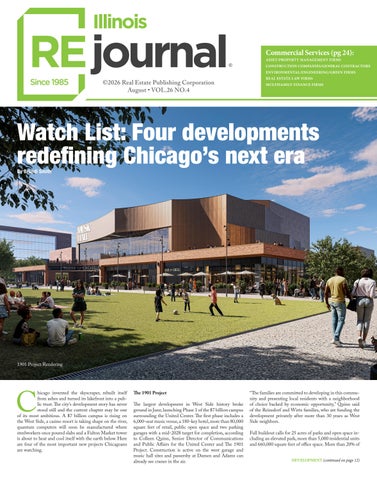
Watch List: Four developments redefining Chicago’s next era By Brandi Smith
1901 Project Rendering
C
hicago invented the skyscraper, rebuilt itself from ashes and turned its lakefront into a public trust. The city’s development story has never stood still and the current chapter may be one of its most ambitious. A $7 billion campus is rising on the West Side, a casino resort is taking shape on the river, quantum computers will soon be manufactured where steelworkers once poured slabs and a Fulton Market tower is about to heat and cool itself with the earth below. Here are four of the most important new projects Chicagoans are watching.
The 1901 Project The largest development in West Side history broke ground in June, launching Phase 1 of the $7 billion campus surrounding the United Center. The first phase includes a 6,000-seat music venue, a 180-key hotel, more than 80,000 square feet of retail, public open space and two parking garages with a mid-2028 target for completion, according to Colleen Quinn, Senior Director of Communications and Public Affairs for the United Center and The 1901 Project. Construction is active on the west garage and music hall sites and passersby at Damen and Adams can already see cranes in the air.
“The families are committed to developing in this community and presenting local residents with a neighborhood of choice backed by economic opportunity,” Quinn said of the Reinsdorf and Wirtz families, who are funding the development privately after more than 30 years as West Side neighbors. Full buildout calls for 25 acres of parks and open space including an elevated park, more than 5,000 residential units and 660,000 square feet of office space. More than 20% of DEVELOPMENT (continued on page 12)
AU G U S T 2 0 2 6 I L L I N O I S R E A L E S TAT E J O U R NA L
3
AU G U S T 2026 C O N T E N T S ILLINOIS REAL ESTATE JOURNAL
F E AT U R E S
SENIOR VICE PRESIDENT/ PUBLISHER Jay Kodytek jay.kodytek@rejournals.com
10
EDITOR Dan Rafter drafter@rejournals.com VICE PRESIDENT OF SALES & MW CONFERENCE SERIES MANAGER Ernie Abood eabood@rejournals.com VICE PRESIDENT OF SALES Frank E. Biondo frank.biondo@rejournals.com BUSINESS DEVELOPMENT DIRECTOR Matt Loarie matt.loarie@rejournals.com CLASSIFIED DIRECTOR Susan Mickey smickey@rejournals.com
LIST: FOUR DEVELOPMENTS 1 WATCH REDEFINING CHICAGO’S NEXT ERA
Chicago invented the skyscraper, rebuilt itself from ashes and turned its lakefront into a public trust. The city’s development story has never stood still and the current chapter may be one of its most ambitious.
4
ESSENTIAL INFRASTRUCTURE: CHICAGO’S AFFORDABLE HOUSING PIPELINE PUSHES FORWARD AGAINST COSTS, RULES AND RED TAPE Chicago’s newest apartment towers keep arriving with rooftop pools and concierge desks, while renters searching for something they can afford join waitlists that rarely move.
8
SPOKEN FOR: RENTERS AND INVESTORS COMPETE FOR A CHICAGO-AREA MULTIFAMILY MARKET THAT CAN’T BUILD FAST ENOUGH When Essex Realty Group listed a 14-unit building in Downers Grove and a 20-unit building in Villa Park this year, each drew more than 25 tours and at least nine offers. The 84-unit Heritage Manor under contract in Orland Park is generating the same intensity, according to Jimmy Donahue, Director at Essex Realty Group.
AFFORDABLE HOUSING MORE 10 MAKING AFFORDABLE TO BUILD Communities across the country are working to address a growing shortage of affordable housing, yet bringing these developments to life continues to present challenges.
NICE SURPRISE: SOME GOOD NEWS 14 AFOR THE CHICAGO AREA’S OFFICE MARKET
After several years of rising vacancy rates and companies seeking smaller footprints, metropolitan Chicago’s office market finally delivered some good news for the sector during the second quarter of this year.
GOOD FOR TEXAS IS GOOD FOR 16 WHAT’S THE MIDWEST
Everything is bigger in Texas. Houston-based SparrowHawk is proving what’s bigger in Texas can spill over into other parts of the country, including the Midwest.
TALK: COMMERCIAL LANDSCAPING 18 TURF & SNOW REMOVAL STRATEGIES to look for in a snow removal plan
What
AI IS CHANGING THE DAY-TO20 HOW DAY WORK OF INDUSTRIAL REAL ESTATE ACQUISITIONS
Clear Height Properties adopted Claude as a firm-wide AI tool at the beginning of this year.
FUTURE OF OFFICE? CREATIVITY 22 THE MATTERS MORE THAN EVER
Developers are willing to rethink how they can transform outdated office buildings into multifamily projects, industrial space and other uses.
24 COMMERCIAL SERVICES
The Illinois Real Estate Journal is published bi-monthly by Real Estate Publishing Corp.© 2026 Real Estate Publishing Corporation. No part of this publication may be reproduced without the written permission of the publisher.Phone: 312.933-8559
MARKETING & EVENTS COORDINATOR Allison Kim Allison.kim@rejournals.com
www.rejournals.com
EDITORIAL ADVISORY BOARD
ALISSA ADLER Colliers GEORGE KOHL Savills Jeff Krusinski Krusinski Construction Co. RONALD C. LUNT Hamilton Partners JOHN M. MOYSEY Avison Young NANCY A. PACHER CBRE JONATHAN STEIN Inland Real Estate Group GREGORY T. WARSEK Associated Bank CHRIS WOOD Cushman & Wakefield
www.rejournals.com
I L L I N O I S R E A L E S TAT E J O U R NA L AU G U S T 2 0 2 6
4
Essential Infrastructure: Chicago’s affordable housing pipeline pushes forward against costs, rules and red tape By Brandi Smith
cally requiring flexible soft debt or other subordinate public funding. Competition is fiercest for the limited 9% credit allocation, Hamer noted, while 4% deals financed with tax-exempt bonds offer a more predictable path.
43 Green Bronzeville. Credit Tom Harris, courtesy Habitat
David Block, Director of Development at Evergreen Real Estate Group, said most affordable developments are heavily reliant on those public tools and assembling them is a discipline of its own. “Each program has a significant number of rules and restrictions and much of the challenge of developing affordable housing is using several of these tools together while avoiding conflicts in their various rules and restrictions” Block said. Where a project sits changes which tools are available. Chicago brings significant resources, Block said, including TIF funds, a new city affordable housing bond program and federal dollars, while most suburban communities lack that firepower and lean on state and federal programs. The suburbs also carry a political cost the city largely avoids. “While there is sometimes resistance to developments in the City, generally urban neighbors are more accustomed to living next to denser buildings and in proximity to people of varying socioeconomic levels,” Block said. Evergreen has built a reputation for creative workarounds, including adaptive reuse, which carries a financing wrinkle of its own.
LeClaire Courts Phase 1 Residential North Building. Rendering Credit Habitat
“Adaptive reuse projects are not necessarily less expensive than new construction developments, but they can potentially unlock additional resources like state and federal tax credits available for preserving historically significant buildings,” Block said. Those credits can reduce the demand on other housing resources and make a project more competitive for federal, state or local programs, Block said.
C
hicago’s newest apartment towers keep arriving with rooftop pools and concierge desks, while renters searching for something they can afford join waitlists that rarely move. But Charlton P. Hamer, Senior Vice President of the Habitat Affordable Group at The Habitat Company, argues the gap between those two worlds is narrower than it looks.
“At Habitat, we often say we do not build affordable housing; we build housing,” Hamer said. Drywall, steel and mechanical systems cost the same whether finished units rent at market rates or below them, Hamer said, and an affordable development often costs more because of the compliance requirements attached to public funding. Affordability gets engineered on the financing side through Low-Income Housing
Tax Credit equity, reduced tax liability, rental subsidies, tax increment financing and other public tools that let owners restrict rents while still covering construction and operations. That machinery has strained as construction costs, interest rates, insurance and operating expenses have climbed while restricted rents stayed put, Hamer said. The hardest gap to fill today comes after LIHTC equity, conventional debt and sponsor capital are committed, typi-
Habitat sees the depth of demand firsthand through waitlists, occupancy and lease-up speed, Hamer said, with the rapid lease-up of OC Living’s first phase in North Lawndale and both phases of 43 Green in Bronzeville proving out neighborhoods the market has historically underestimated. The strongest unmet need sits at the lower end of the income spectrum and among families requiring larger units, Hamer said, though workforce households earning 60% to 120% of median income and a growing senior population are pushing demand as well.
I L L I N O I S R E A L E S TAT E J O U R NA L AU G U S T 2 0 2 6
6
David Block
Marine Drive Apartments Redevelopment, Buffalo NY. Rendering Credit Habitat.
Charlton Hamer als. The direction is encouraging, he said, but the verdict is still out. “We should ultimately evaluate these initiatives by how quickly awarded developments reach closing, begin construction and deliver units, not simply by the number of awards or procedural recommendations announced,” Hamer said.
Leyden Senior Apartments & Carl Fiorito Senior Center. Courtesy Evergreen Real Estate Group. Both firms are answering with pipeline. At LeClaire Courts on the Southwest Side, Habitat and Cabrera Capital Partners closed financing July 31 on the first residential phase of a redevelopment that could eventually total 700 homes. The initial phase includes 183 mixed-income apartments, roughly 90% of them affordable, plus an early-childhood center and retail, with construction set to begin this month. At Ogden Commons in North Lawndale, a second phase adds 75 apartments, 76% of them affordable, including 30 Chicago Housing Authority residences. In Riverdale, Habitat is rehabilitating 258 existing affordable homes at Riverside Village. “Preservation is just as important as new construction because losing an existing affordable unit only increases the pressure on the rest of the system,” Hamer said. Evergreen is completing the 80-unit Leyden Senior Apartments and Carl Fiorito Senior Center in unincorporated Franklin Park, aims to start construction on Phase 2 of Encuentro Square in Logan Square in early 2027 and is
“Affordable housing should be viewed as essential infrastructure. It supports workforce stability, public health, education and economic mobility.” targeting a late-2027 closing on a redevelopment of the Clybourn and Larrabee portion of the former Cabrini Green site. Public policy will determine how much of that pipeline gets company. Hamer pointed to the
city’s latest Qualified Allocation Plan awards, which put roughly $300 million behind 15 affordable developments, among them Ogden Commons’ planned third phase, and to the Cut the Tape initiative meant to accelerate approv-
Habitat has found a preview of what alignment can deliver in Western New York, where construction is underway on the 250-unit first phase of Buffalo’s Marine Drive Apartments redevelopment, expected to reach roughly 700 units. “While the market is not without challenges, it provides a more favorable environment than many others for producing affordable housing while achieving sustainable development margins, enabling us to remain financially strong, reinvest in future projects and create a meaningful impact in more communities over time,” Hamer said. Chicago has the need, the developers and the institutional partners, Hamer said. What it requires is a funding and approval system predictable enough to let them deliver. “Affordable housing should be viewed as essential infrastructure,” Hamer said. “It supports workforce stability, public health, education and economic mobility.”
Chicagoland 23rd Annual
INDUSTRIAL SUMMIT
October 15, 2026
8:00 AM - Registration, Networking & Exhibits 8:30 AM - 12:00 PM Program Carlisle Banquets (435 Butterfield Rd, Lombard, IL 60148)
Register Today
Scan for more information and to register www.rejournals.com/upcomingevent/
Speakers to be Announced... Sponsors:
Speaking and Sponsorship opportunities available Jay Kodytek jay.kodytek@rejournals.com 612-940-3713
Ernie Abood eabood@rejournals.com 773-919-8799
Frank Biondo frank.biondo@rejournals.com 248-670-2691
Matthew Loarie matt.loarie@rejournals.com 701-388-4926
I L L I N O I S R E A L E S TAT E J O U R NA L AU G U S T 2 0 2 6
8
Spoken For: Renters and investors compete for a Chicago-area multifamily market that can’t build fast enough By Brandi Smith
Heritage Manor in Orland Park
W
hen Essex Realty Group listed a 14-unit building in Downers Grove and a 20unit building in Villa Park this year, each drew more than 25 tours and at least nine offers. The 84-unit Heritage Manor under contract in Orland Park is generating the same intensity, according to Jimmy Donahue, Director at Essex Realty Group. “It’s a strong sign that smaller and mid-size suburban assets are drawing just as much conviction from buyers as the bigger deals, which speaks well for where pricing and investor confidence are headed,” Donahue said. Investors are chasing the same math that renters confront every day. Demand for Chicago-area apartments keeps climbing while new supply trails far behind and brokers across the market describe a supply-demand imbalance with no near-term fix. “Given the lack of new product coming to market and a tightening supply, demand has never been higher,” said Aaron Sklar, Partner at Kiser Group and Co-Leader of the firm’s Birk/Sklar team. “And that’s across the board.”
Jon Morgan, Co-Founder and Managing Principal of Interra Realty, traces much of that demand to would-be buyers stuck renting. Mortgage rates and home prices have kept a meaningful share of first-time buyers on the sidelines, he said, driving renewals and lease-up activity in Interra’s core Chicago neighborhoods even as job growth cools. Citywide vacancy still sits below 5%, a figure Morgan calls resilient given the broader economic noise. The suburbs tell a similar story. Suburban occupancy running near 97% might suggest renters are abandoning the city in droves. Donahue sees a supply problem instead. “It’s less a story of renters fleeing the city and more one of the suburbs simply not having enough new units to meet demand that was already there,” Donahue said. Suburban Chicago has delivered new supply equal to roughly 1% of existing inventory in each of the past couple of years, he said, well short of what population and household formation trends would support. James Love, Vice President of Marketing and Brand at Draper and Kramer, sees the same balance across his firm’s portfolio: healthy
demand in both the city and the suburbs with no significant migration in either direction. The more notable trend, according to Love, is retention with renters renewing their leases and staying in place longer, particularly in urban communities. Where renters are competing hardest depends on which side of the city line you stand. Andrew Friedman, Partner at Kiser Group, describes rental demand in Old Town and Lincoln Park as off-the-charts strong and said major price increases there have pushed renters north to Edgewater and Uptown and west to Logan Square and Wicker Park, fueling rent growth in those neighborhoods in turn. Morgan’s list overlaps. Logan Square, Avondale and Pilsen lead Interra’s listings on rent growth and absorption, he said, while the North Side lakefront is regaining strength and Bronzeville and Hyde Park continue to improve behind university and hospital employment anchors. “What ties these together is proximity to transit and a walkable commercial corridor,” Morgan said. “That combination is driving the leasing velocity we’re tracking in our listings.”
In the suburbs, Donahue points to DuPage County, which captured roughly a third of suburban multifamily sales activity in the first quarter of 2026, along with northwest Cook County, where demand has absorbed new deliveries, and Orland Park and Tinley Park, where downtown reinvestment is pulling in renters seeking value without giving up walkability. “On the ground, it shows up the same way across all of these: units leasing within days, minimal concessions and renters who know they need to move fast on anything well-priced,” Donahue said. New deliveries remain concentrated in luxury product, but the biggest beneficiaries may be the buildings that luxury never touches. With new construction almost entirely Class A and clustered downtown, Morgan said, the vintage two- and three-flats and courtyard buildings that make up most of the city’s rental stock face no new competitive supply. He reports 4% to 7% rent growth on turnover units in well-located Class B and C assets, outpacing many new luxury towers still working through concessions. “In today’s market, renters are ultimately prioritizing value and location,” Love said. “Once a community meets their needs, competitive
AU G U S T 2 0 2 6 I L L I N O I S R E A L E S TAT E J O U R NA L
NoahBirk
Jimmy Donahue
pricing often has a greater influence on leasing decisions than an extensive list of amenities.” Donahue sees both ends performing in the suburbs with Class A commanding a premium against limited competition while owners of older product win rent growth through targeted capital improvements rather than full repositioning. “Well-managed buildings that are in physically ‘good’ condition will be occupied,” said Noah Birk, Partner at Kiser Group and Co-Leader of the Birk/Sklar team. “Vacancy will remain low, and rents should continue to trend up. It all goes back to supply and demand, and that equation heavily favors home providers in Chicago.”
Andy Friedman
If the fundamentals are so favorable, why isn’t more supply getting built? Birk said many Kiser clients simply refuse to jump through the hoops a major Chicago project requires. Morgan points to hard costs, insurance and higher-for-longer interest rates that demand rents achievable only in a handful of premium submarkets and notes that when construction does pencil, developers are building less dense product, typically five stories or under. Friedman sees the same pattern with robust appetite for development sites that avoid a zoning change and its accompanying 20% affordable requirement, plus multiple office-to-residential conversions underway on the North Side. In the suburbs, Donahue points to entitlement timelines that can stretch a year or more, keeping any real supply relief a couple of years out.
9
James Love
Jon Morgan
Capital has noticed the imbalance. The more significant trend, Birk said, is the continued influx of investor money into Chicago from across the country. “Chicago continues to offer higher yields than most major markets worldwide and the limited supply of multifamily housing creates a strong foundation for long-term appreciation,” Birk said. Much of that money is arriving without an institutional badge. Morgan sees private local buyers, many using 1031 exchange or family-office capital, stepping in where institutional players have pulled back, chasing workforce and value-add product in the city and suburbs alike.
AaronSklar “We’re a renter-majority city with limited new supply outside of luxury towers and that combination continues to support steady, sustainable rent growth rather than the boom-bust swings you see in some Sun Belt markets,” Morgan said. Friedman is watching one submarket to see how long the scarcity story holds. Fulton Market carries roughly 10,000 entitled units, he said, yet few buildings are capitalized and under construction. “As rents continue to climb those deals will pencil out better, but if they all get capitalized will the submarket become oversupplied and ruin its own party so to speak,” Friedman said.
I L L I N O I S R E A L E S TAT E J O U R NA L AU G U S T 2 0 2 6
10
Making affordable housing more affordable to build in Chicago and beyond By Kinjal Patel, President, McHugh Construction
McHugh Construction and Powers & Sons Construction have begun construction on Southbridge 1C, a 13-story, 80-unit mixed-income building on the southern edge of Chicago’s South Loop. (Credit: Gensler)
C
ommunities across the country are working to address a growing shortage of affordable housing, yet bringing these developments to life continues to present challenges. Rising construction costs, labor shortages, higher interest rates and more complex financing structures make projects more challenging to deliver than in years past. While owners and developers can’t control many of the market forces affecting affordable housing, they can influence how projects are planned and delivered. In our experience, the most successful developments become affordable because project teams make smarter decisions before construction ever begins. Over the past four years, McHugh Construction has served as general contractor on projects delivering nearly 500 affordable and mixed-income residential units across Chicago. These developments include Southbridge 1C, an 80-unit mixed-income community being developed by The Community Builders as part of the redevelopment of the former Harold Ickes Homes; Habitat’s OC Living community in North Lawndale; 508 Pershing in Bronzeville; and Habitat’s 43 Green equitable transit-oriented development, also in Bronzeville. While each project has presented unique opportunities and challenges, they’ve reinforced a common lesson: the greatest opportunities to control
cost, reduce risk and maximize value occur during preconstruction. Early Collaboration Pays Throughout Construction
Dividends
One of the biggest misconceptions about affordable housing is that cost savings come from bidding and value engineering in the later stages of the design process. In reality, the greatest savings often come from bringing the construction team to the table much earlier. When a construction manager or general contractor is engaged during design, the team has the opportunity to evaluate constructability, recommend more efficient structural or building systems, improve sequencing and identify logistical challenges while changes remain relatively inexpensive. Those discussions become much more difficult, and often much more costly, once construction documents are complete and permitting is underway. Early collaboration also allows owners, architects and contractors to establish clear project priorities. Whether the objective is preserving resident amenities or maintaining an aggressive funding schedule, aligning those priorities early helps every subsequent design decision support the same outcome.
We saw the benefits of this approach during construction of 508 Pershing, a 53-unit mixed-income development in Chicago’s Bronzeville neighborhood developed by The Community Builders. As supply chain disruptions affected the project, our team worked closely with the owner and design partners to identify cost savings in façade materials, structural framing, finishes and mechanical, electrical and plumbing systems. Those collaborative decisions helped offset rising costs while maintaining the building’s quality and keeping the project on budget. When the goal is to maximize value, project teams who evaluate alternatives early often improve efficiency without compromising the quality or long-term performance of the building. Strong Partnerships Lead to Better Outcomes Affordable housing developments are among the most collaborative projects in commercial real estate. Success depends on owners, architects, contractors, lenders, public agencies and trade partners working toward the same objective while navigating tight budgets, multiple funding sources and demanding schedules. Long-term relationships make that process more effective.
McHugh’s ongoing partnerships with The Community Builders demonstrates how trust and familiarity can benefit a project. After completing 508 Pershing in 2023, we were selected to build Southbridge 1C, the next phase of TCB’s work on Chicago’s Near South Side. Because the teams had worked together previously, we were able to build on established communication, streamline decision-making and focus our attention on solving project-specific challenges rather than developing new working relationships. The same has been true with Habitat, where our collaboration has included completing 179 units at 43 Green in Bronzeville and 167 units at its OC Living community in North Lawndale. While every project is different, strong partnerships consistently create efficiencies that are difficult to quantify but invaluable over the life of a project. Procurement Requires More Strategy Than Ever The construction industry’s supply chain has improved considerably since the pandemic, but procurement remains one of the most important tools for managing cost and schedule. Lead times for structural steel, electrical equipment and major mechanical systems continue to require careful planning, particularly as data
AU G U S T 2 0 2 6 I L L I N O I S R E A L E S TAT E J O U R NA L center construction increases demand. Affordable housing projects often operate within strict financing timelines, making schedule certainty just as important as budget certainty.
11
The Junction at OC Living introduces 75 new mixed-income apartments within a four-story residential building to Chicago’s North Lawndale neighborhood as part of Habitat’s larger Ogden Commons development. (Credit Habitat)
A thoughtful procurement strategy allows project teams to secure production schedules, pre-purchase critical materials when appropriate and provide owners with greater confidence throughout the development process.
Delivering More Housing by Building More Efficiently Affordable housing developments do more than provide apartments. They create opportunities for families, strengthen neighborhoods and support long-term community investment. That makes every construction dollar especially important.
Procurement strategies can also extend beyond material purchased, such as maintaining healthy relationships with subcontractors. Affordable housing projects frequently undergo multiple pricing exercises as financing packages evolve, but repeatedly requesting bids can discourage participation and ultimately reduce competition. Carefully planned procurement milestones help meet project budgets while respecting subcontractors’ time and encouraging more competitive pricing. Standardization offers another opportunity to improve efficiency. Repeating unit layouts, finish packages and building assemblies can increase labor productivity, reduce material waste and simplify long-term maintenance without sacrificing design quality. The objective is to identify where consistency creates value so resources can be invested where they have the greatest impact.
before work starts helps reduce rework while ensuring the finished building meets the expectations of owners and residents alike.
No contractor can eliminate inflation, labor shortages or financing challenges. But project teams can choose to collaborate earlier, procure more strategically and invest the time necessary to plan projects thoroughly before construction begins.
Successful Projects Are Won During Preconstruction Once a project enters construction, the opportunity to make significant changes becomes increasingly limited. That’s why preconstruction planning remains one of the most effective ways to control cost and improve project outcomes. Coordinating design milestones, permitting, procurement, estimating and construction sequencing into a single plan allows teams
to identify conflicts before they become delays. Digital tools like Building Information Modeling (BIM) and clash detection further improve coordination by resolving issues virtually instead of in the field, reducing rework and improving productivity. Planning should also extend to field operations. Material staging, crane locations, workforce access and delivery logistics all influence efficiency once construction begins. Establishing quality standards, mock-ups and inspection procedures
Our experience building nearly 50,000 residential units in our company’s history, as well as 500 affordable and mixed-income residential units in just the past four years, has led to practical strategies that help limited housing dollars go further. As demand for affordable housing continues to outpace supply, the industry’s goal shouldn’t be to build cheaper housing. It should be to build housing more intelligently. When owners, designers, contractors and trade partners work together from the outset, more projects become financially viable, more communities benefit and more families gain access to quality housing.
EXPERIENCE A BETTER WAY TO BUILD ARCO/Murray delivers industrial commercial construction projects with integrated design-build expertise, cost and schedule certainty, and a single point of contact from start to finish. With an in-house design team and BlueFox furniture solutions, plus racking and automation capabilities, we help clients develop efficient, fully operational spaces, from early space planning and layout through construction and installation.
DISTRIBUTION
Tom Leary Vice President tleary@arcomurray.com
COLD STORAGE
FOOD & BEVERAGE
MANUFACTURING
#1
U.S. Distribution & Warehouse Contractor (ENR)
#6
Top 100 Design-Build Firms (ENR)
I L L I N O I S R E A L E S TAT E J O U R NA L AU G U S T 2 0 2 6
12
410 N Elizabeth - Exterior Rendering
Bally’s Casino Floor Rendering 1901 Project Rendering
1901 Project Rendering
IQMP Rendering. Courtesy Clayco
DEVELOPMENT (continued from page 1)
the housing will be affordable, Quinn said, with additional workforce and student housing planned. She estimates Phase 1 will generate roughly 2,000 construction jobs, growing to 32,000 at full maturity, alongside 7,000 permanent positions. “Our history lives on the West Side of Chicago,” Quinn said. “We plan to be here for another 100+ years investing in the community, delivering economic opportunities for local residents and creating a neighborhood where the unifying power of sport, music and culture connects the city.” Bally’s Chicago Bally’s topped off its permanent casino at 560 W. Grand Ave. this spring, shifting the project from vertical construction to interior build-out ahead of a 2027 opening. The integrated resort will bring a 500-room
“Our goal is to create a destination where guests come to stay, dine, be entertained and experience Chicago.” hotel, a 3,000-seat theater, a comedy club, dining concepts curated with Chicago-based Levy and an expanded riverwalk to a stretch of the Chicago River that has long sat disconnected from its surroundings, according to Christopher Jewett, Senior Vice President of Development for Bally’s Corp.
“Our goal is to create a destination where guests come to stay, dine, be entertained and experience Chicago, not to just simply visit a casino,” Jewett said. The economic case reaches beyond the gaming floor. Jewett expects approximately 3,000 permanent jobs upon opening and
more than 1,500 union tradespeople have already worked on construction. He projects sustained spillover for hotels, restaurants, retailers and entertainment venues across River West and downtown along with dedicated tax revenue for the city.
AU G U S T 2 0 2 6 I L L I N O I S R E A L E S TAT E J O U R NA L “It’s designed to complement, not compete with, the surrounding neighborhoods by creating another reason for residents and visitors to spend more time exploring Chicago,” Jewett said.
13 deliver 383 units, 77 of them affordable, as the first phase of a two-tower development that will eventually total more than 724 units.
1901 Project Ground Breaking
The geothermal system developed and operated by Infinite Energy Partners is designed to cut energy usage by up to 60% while handling all heating, cooling and domestic hot water electrically. The developers project 30% lower emissions and 25% energy-related cost savings, aided by a triple-glazed window wall system.
Illinois Quantum and Microelectronics Park The most improbable entry on the watch list sits at the former U.S. Steel South Works site, where the Illinois Quantum and Microelectronics Park occupies 128 acres of the larger 440-acre Quantum Shore Chicago redevelopment. The land that produced steel for skylines across America sat vacant for three decades after the mill closed in 1992. Now it is being transformed into a campus for quantum technology and advanced microelectronics anchored by PsiQuantum’s roughly 580,000-square-foot facility, which broke ground Sept. 30, 2025, and is expected to begin operating in May 2027. “The site’s transformation into a global destination for quantum technology and advanced research reflects the enduring strength of Chicago’s industrial legacy and the neighborhood’s role in shaping industries of the future,” an IQMP spokesperson said.
The tenant roster reads like a who’s who of the industry: IBM, Infleqtion, Diraq, Pasqal, Zero Point Cryogenics and Quantum Machines have all committed along with DARPA’s Quantum Proving Ground program. Tenants have pledged more than 1,000 jobs at the park, according to IQMP officials, and a 2024 Boston Consulting Group analysis projects as many as 191,000 quantum technology jobs across the Illinois-Wisconsin-Indiana region by 2035. Partnerships with Chicago Public Schools, City Colleges of Chicago and
Chicago State University aim to build the local talent pipeline. 410 N. Elizabeth Innovation on the watch list also comes at the scale of a single building. Construction is underway in Fulton Market on Chicago’s first geothermal, all-electric multifamily high-rise, a 33-story tower from Tree Street Group, Magellan Development Group and Mark Goodman & Associates. The building at 410 N. Elizabeth St. will
“Reaching this milestone is a result of the dedication and vision of our project partners, the faith of our investors in our construction-informed design model, and thoughtful collaboration with city officials and the community to create what we expect will become a model for sustainability and a beautiful addition to the neighborhood,” said Rodrigo d’Escoto, Principal at Tree Street Group. The project adds public amenities beyond its walls including ground-floor retail, a publicly accessible park and a 30-footwide pedestrian street that will eventually connect Elizabeth Street to Ogden Avenue and the planned Fulton Market Metra station.
Principle builds the foundations for your future. As a leader in commercial and industrial construction, Principle Construction Corp. specializes in a wide range of projects, from custom build-to-suit facilities to complex food processing plants and efficient cross-dock logistics centers. Our expertise also extends to developing business parks, constructing retail spaces, and executing strategic expansions and tenant improvements.
Building Chicago since 1999
9450 West Bryn Mawr Avenue Suite #120 • Rosemont, IL 60018 (847) 615-1515
PCC2026 CIP 10x7 July Ad (f).indd 1
7/15/26 12:24 PM
I L L I N O I S R E A L E S TAT E J O U R NA L AU G U S T 2 0 2 6
14
A nice surprise: Some good news for the Chicago area’s office market By Dan Rafter
Photo by Daniel Torobekov, Pexels.
A
fter several years of rising vacancy rates and companies seeking smaller footprints, metropolitan Chicago’s office market finally delivered some good news for the sector during the second quarter of this year, according to the latest research from NAI Hiffman. Both the Chicago downtown and suburban office markets posted strong positive absorption during the quarter, a hopeful sign that tenant demand is beginning to stabilize even as employers continue adjusting to hybrid work schedules and a slower economy. The second-quarter Metropolitan Chicago Office Market Report from NAI Hiffman found that the downtown Chicago office market recorded more than 1.08 million square feet of positive net absorption, one of the strongest quarterly performances the city’s central business district has seen since the start of the COVID-19 pandemic. And in the suburban Chicago office market? NAI Hiffman reported that suburban areas added another 605,806 square feet of positive absorption, giving the metropolitan area nearly 1.7 million square feet of occupancy gains during the quarter.
The suburban market especially continued building on the momentum it generated in 2025. The office vacancy rate in the Chicago suburbs fell to 26.1%, down from 26.6% a year ago, as companies leased more space and expanded in higher-quality buildings. Class-A properties accounted for nearly three-quarters of the quarter’s positive absorption, though Class-B buildings continued attracting tenants looking for more affordable options.
panies might require more in-office work as a requirement for employment.
Leasing activity also remained steady in the suburbs, topping 1.05 million square feet during the quarter. While Class-B buildings remained popular among cost-conscious tenants, Class-A properties still captured 55% of all leasing activity, a sign that companies willing to make long-term commitments continue to seek space in newer, upgraded office buildings.
Downtown Chicago, though, may have delivered the quarter’s most unexpected bit of positive news. The city’s central business district posted more than 1 million square feet of positive absorption, only the third quarter of positive occupancy growth since early 2021, according to NAI Hiffman. Vacancy fell to 24.9% after reaching a record high during the first quarter, another indication that the market may finally be finding its footing.
NAI Hiffman said that mid-sized suburban office buildings, especially those ranging from 20,000 to 100,000 square feet, continue to outperform the rest of the sector. Consistent leasing activity and below-average vacancy rates have helped these properties stay resilient while many larger office buildings continue facing challenges. NAI Hiffman also said that a softer labor market could encourage more employers to bring workers back to the office, slowing the pace of future space reductions. Many com-
Several large leases in the Chicago-area market closed during the second quarter. AbbVie renewed nearly 198,000 square feet across two office buildings on South Lakeside Drive in Waukegan, while office products supplier Quill signed a new 61,518-square-foot lease at 300 Tri State International in Lincolnshire.
The improvement came even though leasing activity slowed from a year earlier. Downtown tenants signed 1.31 million square feet of office leases during the second quarter, a 41% decline from the same period in 2025, NAI Hiffman reported. Much of that activity took place in Class-A buildings, which accounted for nearly three-
fourths of all leasing volume. At the same time, the amount of sublease space continued to drop, falling to its lowest level since the pandemic began as fewer companies put excess office space back on the market. Among the quarter’s largest transactions in the Chicago central business district in the quarter, law firm Vedder renewed its 163,000-squarefoot lease at 222 N. LaSalle St., while Loeb & Loeb signed the largest new downtown lease, taking 53,134 square feet at 151 N. Franklin St. Office investment sales activity remained slower. NAI Hiffman said that 11 suburban office properties traded during the second quarter for a combined $72.08 million as investors continued focusing on value-add opportunities and redevelopment candidates instead of large portfolio acquisitions. The largest transaction was the $16.1 million sale of the 207,714-square-foot office building at 55 Shuman Blvd. in Naperville, while another significant deal involved the purchase of a 140,122-square-foot office property in Addison that is slated for demolition and redevelopment.
TRUST BUILT ON PERFORMANCE
Partner with a general contractor trusted by leading companies to deliver complex projects with precision, safety, and speed.
Industrial
Food & Beverage
Warehouse
Logistics
Cold Storage
Manufacturing
Since 1978, Keeley Construction has consistently delivered results on industrial and commercial projects where accountability, performance, and execution matter most.
WWW.KEELEY.COM
245 E SIDNEY CT VILLA PARK, IL 60181 | (630) 833-8600
I L L I N O I S R E A L E S TAT E J O U R NA L AU G U S T 2 0 2 6
16
What’s Good For Texas is Good For the Midwest By SparrowHawk
E
verything is bigger in Texas. Houston-based SparrowHawk is proving what’s bigger in Texas can spill over into other parts of the country, including the Midwest. At the end of 2025, SparrowHawk secured $300 million in growth capital to support acquisitions, portfolio expansion, and platform growth through a strategic partnership with Almanac Realty Investors. And while expanding its industrial footprint in St. Louis and Kansas City and building a robust pipeline of investment opportunities throughout the Midwest, SparrowHawk has grown its senior leadership team. The firm added Scott Brast as Senior Vice President of Investments and Capital Markets, and Peter Wismer as Senior Vice President of Finance and Financial Reporting to help achieve portfolio and pipeline growth. “These additions represent another important milestone in SparrowHawk’s evolution,” said Alfredo Gutierrez, Founder, President and CEO of SparrowHawk. “With the support of Almanac and the addition of executives of Scott’s and Peter’s caliber, SparrowHawk is entering one of the most exciting chapters in our company’s history. We are building a premier industrial investment platform positioned to capitalize on opportunities across America’s logistics corridors and create long-term value for our investors, tenants, and partners.” Over the past 15 years, SparrowHawk has established itself as one of the Midwest’s most active industrial investors and operators, completing more than $1 billion of real estate transactions and developing a reputation for identifying opportunities ahead of market trends. Through disciplined investment execution, deep market relationships, and a vertically integrated operating platform, SparrowHawk has consistently delivered value through multiple market cycles. The Almanac partnership represents a significant validation of the firm’s track record and positions SparrowHawk to accelerate its growth as a premier industrial real estate investment platform. According to Gutierrez, industrial real estate remains one of the most compelling sectors in commercial real estate, driven by e-commerce, reshoring, supply chain modernization, and population growth. “Industrial real estate is ultimately about moving the goods that keep America running,” said Gutierrez. “At SparrowHawk, we are building a platform designed not only to own buildings, but to create enduring value through relationships, operational excellence,
The SparrowHawk senior management team, pictured from left to right, includes Scott Brast, Chris Stephens, Peter Wismer, Alfredo Gutierrez, Jorge Cabrera, and Lisa Beckman. (Photo courtesy of SparrowHawk.) disciplined execution, and a relentless focus on serving our investors and tenants.”
grow the platform to approximately $10 billion in assets under management.
Scott Brast Joins SparrowHawk
Brast and Gutierrez worked together on numerous successful joint venture investments dating back to SparrowHawk’s founding. Their collaborative efforts contributed to the growth of both organizations and established a track record of disciplined investing, value creation, and successful execution across multiple market cycles.
Brast brings more than 35 years of commercial real estate investment and capital markets experience to SparrowHawk. In his role, he will lead investment sourcing, capital markets initiatives, strategic partnerships, and acquisition execution across the firm’s growing portfolio. His appointment reflects a professional relationship spanning decades and a shared history of successful investing. “Scott and I have worked together for many years and have successfully partnered on numerous real estate investments,” said Gutierrez. “Throughout my career, I have learned that real estate is ultimately a relationship business. Scott is one of the most respected professionals in the industry, and our long-standing working relationship, built on trust, integrity, and successful execution, made this a natural fit.” Previously, Brast spent more than three decades with American National, most recently serving as Chief Mortgage Loan and Real Estate Investment Officer. He oversaw debt and equity investment platforms, sourced and managed strategic partnerships with national and regional real estate operators and helped
“Some of the most successful investments in my career were completed alongside Scott and the American National team,” Gutierrez said. “Over multiple decades, market cycles, and numerous joint ventures, Scott has consistently demonstrated exceptional judgment, integrity, and an investor-first mindset.” At American National, Brast led annual lending production exceeding $1.5 billion, implemented innovative debt and equity investment structures, and built enduring relationships across the institutional real estate industry. Peter Wismer Joins SparrowHawk Wismer joins SparrowHawk with a decade of accounting, finance, and advisory experience. As Senior Vice President of Finance and Financial Reporting, he will oversee the firm’s financial reporting, accounting operations, forecasting, compliance, investor reporting, and financial strategy initiatives.
Prior to joining SparrowHawk, Wismer spent his career with Deloitte, where he served clients throughout the financial services sector. His experience includes advising executive leadership teams, boards of directors, publicly traded companies, private equity funds, and complex investment structures with assets and revenues measured in the billions of dollars. “Peter represents the next generation of leadership at SparrowHawk,” said Gutierrez. “He combines technical excellence, strategic thinking, and a commitment to continuous improvement. His experience serving sophisticated financial institutions and investment platforms will be invaluable as SparrowHawk continues to grow and institutionalize its operations.” Wismer has been recognized as a thought leader on emerging accounting and reporting topics and has spoken at conferences in six countries on technical accounting matters, including the impact of generative artificial intelligence on financial reporting and governance. For Gutierrez and SparrowHawk, Texas-sized opportunities are better for everyone and create opportunities for growth in key Midwest markets.
Building world-class sports and entertainment districts that bring people together—and stand the test of time.
M ARQ UEED E V ELO PMEN T.C OM
I L L I N O I S R E A L E S TAT E J O U R NA L AU G U S T 2 0 2 6
18
Turf Talk: Commercial Landscaping & Snow Removal Strategies
What to look for in a snow removal plan By Tom Marsan, Beverly Companies
iStock photo credit, xphotoz. Tom Marsan is a certified snow professional who has been in the landscaping and snow removal industry for about two decades. He is an active member of ILCA and SIMA and is currently the general manager at Beverly Companies in Chicagoland. A snow plan that says “plow at two inches” is not really a plan. It is a sentence. A very optimistic sentence. A complete snow removal plan should explain what the property needs to look like during a storm. It should identify who makes decisions. It should also account for the strange little details that become very large problems at 2:17 a.m. Here is what facility managers should look for before winter arrives. Start with the result, not the equipment Snow contractors like to talk about equipment. Trucks are impressive and they need to be in the right spot at the right time. But the number of trucks does not tell you what condition your property will be in when employees arrive. A good plan separates the scope of work from the level of service. The scope describes the work being performed. The level of service describes the outcome. For example:
• Main entrances substantially clear before the first shift • Accessible parking and routes continuously maintained • Loading docks open before scheduled deliveries • Primary traffic lanes passable throughout an extended storm The current ANSI-recognized planning standard from the Snow & Ice Management Association recommends documenting the desired outcome, service initiation points, critical timeframes and property priorities. It also warns against promising anything more absolute than “substantially clear of hazards.” Snow is weather. It has not signed your contract. Ask what happens when the forecast is wrong Many plans are built around one number. “Two to 30 inches.” That’s about as precise as it gets during a Chicago winter. And it changes hourly. Your snow plan should do the same. It should explain what changes during: • A light nuisance event • A normal plowable storm • A prolonged storm • Freezing rain • Back-to-back events • A high-end snowfall scenario
At what point is more equipment added? When does snow hauling begin? How often are priority areas reopened during a storm that lasts 18 hours? Follow the water During a preseason property walk, everyone notices the curbs. Fewer people notice the downspout aimed directly at the employee entrance. Snow problems often begin as water problems. A roof drip line can freeze beside an entrance. A clogged drain can leave water sitting on the pavement. A poorly placed snow pile can melt across a walkway and refreeze overnight. A good snow plan identifies those trouble spots before winter does. Snow piles deserve special attention. The pile may look perfectly harmless while frozen. Then the sun comes out and water travels downhill. The temperature drops and now the property now has a small skating rink. A useful site map should show not only where snow can be placed but where the meltwater will go afterward. Plowed snow is still snow. It has simply been given a new address. Treat accessibility as one continuous route Clearing an accessible parking stall is not enough if the access aisle is buried. Clearing the aisle is not enough if the curb ramp is blocked.
Clearing the curb ramp is not enough if the sidewalk ends at a mountain of plowed snow. A strong plan treats it all as one connected system. The site map should clearly mark the entire route. It should also prevent crews from using accessible stalls or access aisles as convenient snow-storage areas. Decide who is allowed to make decisions This may be the most overlooked part of the plan. Who can authorize an additional salt application? Can the contractor respond to refreezing without waiting for approval? Can a night security officer request service? What happens if the property manager does not answer? A good plan names the people or positions with authority for initiating and stopping services. It should also include an escalation process and current contact information. SIMA’s standard identifies service controls and communication authority as core planning requirements. Without this, the contractor may see a hazard and wait for permission. And ice is famously patient. Make sure the equipment fits the property The plan should account for the physical limits of the property. Some equipment may be too
AU G U S T 2 0 2 6 I L L I N O I S R E A L E S TAT E J O U R NA L tall for a parking garage. Other machines may be too heavy for a deck or too wide for a narrow service lane. Gates and security access can also slow down a crew. A good plan identifies those restrictions before equipment is assigned to the site.
The snow may stop at noon. The snow plan should not. The work should continue after the snow stops. Crews may need to clear drifting or cut back piles that block visibility. Drains should be reopened before melting begins. The plan should also explain when snow will be relocated or hauled away so storage space does not run out.
It’s also important to ask where the equipment is coming from. Is it staged on the property? Is it assigned to a nearby route? What is the backup plan if the primary machine breaks down? Look for a material strategy, not “salt as needed” Salt should not be treated like parsley at a restaurant. More is not automatically better. A serious plan should address the materials being used and pavement conditions so the application rates are appropriate. It should also identify surfaces or environmental areas where certain products are restricted. Pavement temperature matters because it can differ from air temperature and directly affects winter treatment decisions. Ask whether the contractor records the type and amount of material applied. “We put down plenty” is not especially useful data. The SIMA-10-2025 Standard Practice for Procuring and Planning Snow and Ice Management Services addresses both sides of this
19
Tom Marsan issue. It calls for plans to identify approved materials as well as prohibited products. It also calls for service records that document the type and amount applied. The Standard also references the Snow & Ice Management Site Risk Evaluation Example. The tool was prepared by a joint task force of experts from Canada and the United States. It helps property teams find the conditions that cause repeat icing or unnecessary material use before winter begins. Define when the storm is actually over
What was the condition? What action was taken? What was the condition afterward? That information helps with billing and complaints. It also reveals patterns. Perhaps one entrance repeatedly refreezes. Perhaps a snow-storage location blocks sightlines every January.
The plan should also establish who monitors the property between events. A contractor cannot address overnight refreezing if nobody is assigned to look for it.
That is useful information. Much more useful than a folder containing 400 nearly identical photographs of trucks in the dark. The plan should make winter less exciting
Define post-storm requirements and ongoing surveillance for ice that forms after initial service has been completed.
The best snow removal plan will not predict every storm.
Require documentation that tells a story GPS dots are helpful. They prove that a truck visited. They do not prove what the truck found or what the operator did. A complete service report should include aspects like start and finish times, site conditions, weather, air and ground temperatures, equipment used, services performed and the type and amount of deicer applied. Photos and GPS records can support that information. Documentation should answer three simple questions:
It will do something better. It will make the important decisions before the storm arrives. It will define priorities. It will uncover site problems. It will tell everyone what happens next. That may sound boring. At 2:17 a.m. during freezing rain, boring is a luxury. Tom Marsan is a certified snow professional who has been in the landscaping and snow removal industry for about two decades. He is an active member of Landscape Illinois, IREM, and SIMA and is currently the General Manager at Beverly Companies in Chicagoland.
I L L I N O I S R E A L E S TAT E J O U R NA L AU G U S T 2 0 2 6
20
How AI is changing the day-to-day work of industrial real estate acquisitions By Cole Chernow, Senior Analyst, Acquisitions | Clear Height Properties
T
here is a version of commercial real estate acquisitions work that most people outside the industry never see: the hours spent pulling deal details, formatting data, and building presentation materials before any real analysis can happen. On a team tracking 50 to 70 deals a week across Midwest markets including Chicago, Indianapolis, Columbus, Cincinnati, and Minneapolis, that administrative layer adds up fast. Clear Height Properties, the Oak Brook-based industrial real estate firm, adopted Claude as a firm-wide AI tool at the beginning of this year. The decision was straightforward: the acquisitions team was spending too much time on work that did not require judgment, taking time away from work that did. Where the time was going Before AI tools entered the workflow, every deal required manual data entry. Pull the details, format them, get them into the system. At a volume of 50 to 70 deals a week, that process alone consumed an estimated 10 to 20 hours of analyst time every week. Not underwriting. Not market analysis. Just moving data from one place to another.
iStock photo, credit S and V Design.
Claude handles that intake now. Feed it the raw deal information, it organizes and formats it, and the team moves straight to analysis.
“AI can’t replace being able to find the people who are bringing you deals. It’s a relationship business, that’s not going to change.”
Investment memoranda followed a similar path. A standard memo for a deal in diligence, covering the market, financials, rent roll, tenants, and business plan, typically ran 12 to 15 slides and took an analyst five or six hours to build from scratch. Now the data goes into Claude, and a first draft comes back that is 80 percent complete. The analyst reviews, refines, and finishes it.
In Midwest industrial markets specifically, the relationship layer is the business. Finding off-market deals, sourcing debt, raising equity, and getting to the closing table all run through a network of people who have decided to work with you. That holds in Chicago as much as it does in Indianapolis, Columbus, or Cincinnati. Two tracks at the same time
“The time we used to spend on formatting and assembly is going somewhere better now.” The 80% rule and why the review still matters The pattern holds across tasks: Claude handles the production, the analyst handles the review. In industrial real estate acquisitions, that distinction matters. A 50-basis-point difference in a cap rate can shift a purchase price by millions of dollars on a single asset. The efficiency gain from AI does not reduce that accountability, it concentrates it. Someone still has to check the numbers, and that person needs to know what they are looking for. What has changed is where analyst time goes. Less of it on data entry and document assembly. More of it on market analysis, underwriting decisions, and the judgment calls that determine whether a deal is worth pursuing in the first place.
Cole Chernow.
(Photo courtesy of Clear Height Properties.)
The part AI cannot touch The shift in production work has also sharpened a more important question: what does not get automated? Brokers bring deals to firms they trust to close. Owners return calls to people they know. Lenders commit to operators they have seen perform. Equity partners back teams whose judgment they respect. Every one of those relationships is built over time, through consistent follow-through and direct human interaction. None of it transfers to a language model, and none of it moves faster just because the intake process did.
For Clear Height’s acquisitions team, that means running two priorities in parallel. The first is getting very good at AI tools, the efficiency gap between people who use these tools well and those who do not is only going to grow. The second is building and maintaining the broker, lender, and equity relationships that put deals together, because that is the part of the job that compounds over time in ways no software will replicate. AI tools for commercial real estate acquisitions are not a replacement for expertise. They are a multiplier on it. The firms and professionals who are figuring that out now are building a real efficiency advantage. In a business where speed and accuracy both matter, the ability to process more deals and keep analyst attention focused on higher-order work is a meaningful edge.
For Clear Height, the first half of this year has made the case clearly enough. The administrative layer is thinner. The analytical work is deeper. And the time that used to go into formatting and assembly is going somewhere better. ABOUT CLEAR HEIGHT PROPERTIES
Piloted by an experienced leadership team, Clear Height Properties has built a strong platform for acquiring and operating industrial real estate in the most desirable locations throughout the central United States. From its headquarters in Oak Brook, Illinois, the firm has bought and sold 213 assets totaling nearly $1 billion over the past fifteen years, establishing a record of strong risk-adjusted returns. Driven by its core values and mission of “building wealth and creating legacies,” Clear Height is uniquely positioned to invest in, manage and add value to every asset and relationship. Learn more at clearheight.com. Cole Chernow is a Senior Analyst on the Acquisitions team at Clear Height Properties, an industrial real estate investment firm headquartered in Oak Brook, Illinois. He focuses on deal sourcing, underwriting, and acquisitions across the firm’s Midwest and Sun Belt markets, including Chicago, Indianapolis, Columbus, Cincinnati, Minneapolis, and Dallas/Fort Worth.
Chicagoland 21st Annual
PROPERTY MANAGEMENT September 29, 2026
8:00 AM - Registration, Networking & Exhibits 8:30 am - 11:30 AM Program Carlisle Banquets (435 Butterfield Rd, Lombard, IL 60148)
Register Today
Scan for more information and to register www.rejournals.com/upcomingevent/
Speakers: Lloyd Berry - Colliers International Kirsten Bowersox - Xroads Real Estate Advisors Rebecca Cusack, RPA - CBRE | Property Management Roger Daniel - Daniel Management Group
Meg Hanley - Sterling Bay David Hopwood - JLL Lisa Metz - Stream Realty Partners More Speakers to be Announced...
Sponsors:
Speaking and Sponsorship opportunities available Jay Kodytek jay.kodytek@rejournals.com 612-940-3713
Ernie Abood eabood@rejournals.com 773-919-8799
Frank Biondo frank.biondo@rejournals.com 248-670-2691
Matthew Loarie matt.loarie@rejournals.com 701-388-4926
I L L I N O I S R E A L E S TAT E J O U R NA L AU G U S T 2 0 2 6
22
The future of office? Creativity matters more than ever By Dan Rafter
O
ffice values remain depressed across much of the country, but this is creating an opportunity for developers willing to rethink how they can transform outdated office buildings into multifamily projects, industrial space and other uses.
Photo courtesy of Pixabay.
That’s one of the key findings from CommercialCafe’s recently released July U.S. national office report. According to CommercialCafe, using research from Yardi Matrix, declining office property values are making office-to-multifamily conversions financially feasible in cases that would have been considered too risky just a few years ago. As more office buildings trade at steep discounts, developers are finding opportunities to offset the often-high costs of converting outdated office space into housing. CommercialCafe reported that nearly half of all office property transactions with two or more recorded sales prices have sold at a discount since 2024. Those lower acquisition costs are helping more adaptive-reuse projects move from the drawing board to construction. The result is a record year for office conversions. CommercialCafe said that 11.8 million square feet of office-to-multifamily projects were either completed or under construction during 2025, more than in any previous year. Peter Kolaczynski, director of Yardi Research, told CommercialCafe that although office conversions remain expensive and technically challenging, discounted building prices are making more projects financially viable. “Recognizing that office conversions can still be an expensive undertaking and difficult to pull off, the fact that a segment of buildings are trading at such a discount creates the opportunity for more conversions to pencil out,” Kolaczynski said in the report. “At the very least, this allows for creative solutions to be introduced on what to do with this oversupply.” Chicago stands out as one of the strongest examples of that trend. CommercialCafe reported that nearly 60% of office building sales completed in Chicago since 2024 have been discounted. At the same time, approximately 95 million square feet of office space in the metro is considered suitable for conversion to other uses. That combination of lower purchase prices and a large inventory of potentially convertible buildings has fueled adaptive-reuse activity in the Chicago market. CommercialCafe said those conversions have also helped keep the city’s office vacancy rate at 17.8%, almost identical to the national average of 17.7% recorded in June. Not every market is seeing the same results. CommercialCafe pointed to Seattle as an ex-
“The fact that a segment of buildings are trading at such a discount creates the opportunity for more conversions to pencil out.” ample of a metro where conversion activity has lagged despite having many of the same ingredients. Seattle posted one of the nation’s highest office vacancy rates at 24.7% in June and has roughly 47.5 million square feet of office space considered suitable for conversion. Even so, the market has experienced relatively little adaptive reuse compared to Chicago. Across the Midwest, office markets continue to offer some of the country’s most affordable leasing opportunities. According to CommercialCafe, Detroit posted the region’s lowest average office asking rent in June at $21.47 per square foot. The Minneapolis-St. Paul market followed with an average asking rent of $27.63 per square foot.
The Twin Cities also maintained a vacancy rate of 17.8% in June, matching Chicago and remaining close to the national average, CommercialCafe reported. Chicago remained the Midwest’s most expensive office leasing market, although only by a modest margin. CommercialCafe reported that average asking rents reached $28.39 per square foot during June while vacancy also stood at 17.8%. Nationally, developers continue to add new office space, although construction remains limited compared to the size of the existing inventory. CommercialCafe reported that 29.6 million square feet of office space was under construction across the markets it tracks as of June, rep-
resenting roughly 0.4% of existing office inventory. Developers have also delivered 11.1 million square feet of new office space so far this year. Three markets each had more than 2 million square feet under construction in June: Manhattan, Boston and Dallas, according to CommercialCafe. Dallas continues to draw attention because of its employment growth and expanding financial sector. CommercialCafe reported that the metro had approximately 2.9 million square feet of office space under construction in June, equal to about 1% of its inventory, even though its construction pipeline has declined 11% from a year earlier. The report noted that Dallas recorded 0.6% office employment growth in May, supported by continued expansion in professional and business services as well as financial services. That employment growth, combined with businesses relocating to or expanding in the metro, is expected to support future office development. CommercialCafe highlighted Goldman Sachs’ planned 800,000-square-foot campus at 2323 N. Field St. as one example. The project has already broken ground and is expected to open in 2028, underscoring that while office conversions are reshaping older buildings, demand for new office development remains alive in select high-growth markets.
24
COMMERCIAL SERVICES
ASSET/PROPERTY MANAGEMENT FIRMS
MID-AMERICA One Parkview Plaza, 9th Floor Oakbrook Terrace, Illinois 60181 Primary Contacts Jean Zoerner-Illinois, JMZoerner@midamericagrp.com; Brad Lefkowitz-Michigan, blefkowitz@midamericagrp.com; Brandon O’ Connell-Minnesota, boconnell@midamericagrp.com; Jim Vaillancourt-Wisconsin, jvaillancourt@midamericagrp.com Core Services Mid-America provides strategic consulting services that maximize net operating income, net cash flow, and accelerate property appreciation. We provide property and construction management, leasing, due diligence, and market analysis. Additionally, we offer MA Building Services, a self-performing porter and maintenance company offering our clients cost savings and improved accountability for related services. About Mid-America Mid-America Real Estate is #1 in retail real estate services in the Midwest, with fullservice offices in Illinois, Michigan, Minnesota, and Wisconsin. Our exclusive focus on retail property, combined with cutting-edge technology and unsurpassed service, distinguishes Mid-America within the industry and provides clients with a competitive edge. The total consideration value of leasing and investment sales transactions facilitated in 2025 was $2.6 billion. Mid-America leases and manages more than 50 million square feet of retail space, provides comprehensive self-performing facility services, and represents over 270 retailers and other tenants. For more information, visit www.midamericagrp.com.
PRINCIPLE CONSTRUCTION CORP. 9450 West Bryn Mawr Ave., Suite 120 Rosemont, IL 60018 P: 847.615.1515 | F: 847.615.1598 pccdb.com Primary Contacts Mark L Augustyn, COO, maugustyn@pccdb.com, James A. Brucato, President, jbrucato@pccdb.com Core Services Since 1999, Principle Construction Corp. has been a leading design-build general contractor serving the industrial markets of Chicago Metro, Southern Wisconsin, and Northwest Indiana. We specialize in designing and constructing exacting solutions for our clients, including: • Built-to-Suit Facilities • Speculative Facilities • Warehouse and Distribution Centers • Logistics and Cross-Dock Facilities • Industrial Outdoor Storage •Industrial and Manufacturing Plant • Tenant Improvements • Expansions and Additions• Food Processing Facilities • Specialty Projects Selected Projects • 8,205 SF animal shelter for Heartland Animal Shelter, at 586 Palwaukee Dr., in Wheeling, IL. • 12,560 SF showroom and outdoor pool park for Doheny Enterprises, at 5307 Green Bay Rd., in Kenosha, WI • Phase 1 renovation project for SMW Autoblok, at 285 Egidi Dr., Wheeling, IL
CONSTRUCTION COMPANIES/GENERAL CONTRACTORS
ENVIRONMENTAL/ENGINEERING/GREEN FIRMS
MERIDIAN DESIGN BUILD 9550 W. Higgins Road, Suite 400 Rosemont, IL 60018 P: 847.374.9200 info@meridiandb.com meridiandb.com
DEIGAN & ASSOCIATES, PLLC 28835 N. Herky Drive Lake Bluff, IL 60044 P: 847.682.7381 www.deiganassociates.com
Primary Contacts Paul Chuma, President Howard Green, Executive Vice President
Primary Contact Michele Brady, Director Business Development & Real Estate Services mbrady@deiganassociates.com
Core Services Meridian Design Build provides construction and design/ build construction services on a national basis with a primary focus on industrial, office, medical office, retail and food and beverage work.
Core Services The Deigan Group provides client responsive, results oriented environmental consulting and remediation services, with a focus in land-based work, including Brownfield Redevelopment, Power Plant Decommissioning/Redevelopment, Strategic Environmental Planning, Property Assessments and Site Remediation, Compliance/ Permitting, Employee Exposure Testing/Safety Monitoring Asbestos Surveys/Mold/ Indoor Air Quality, Waste Minimization/ Recycling/ Sustainability Plans, Successful Grant Writing.
Company Overview With a team of in-house professional project managers, Meridian has extensive experience coordinating the design and construction of new buildings, tenant improvements, and additions/renovations from 15,000 square feet to 1,000,000+ square feet. Meridian Design Build has been a Member of the U.S. Green Building Council since 2007. Selected Projects University Park Logistics Center, University Park, IL - 970,123 sf speculative multitenant industrial distribution/warehouse facility for Clarius Partners and Hillwood Investment Properties. Silesia Flavors, Huntley, IL - 134,075 sf food production, laboratory, research and development, and office facility for Venture One Real Estate and a global leader in confectionery and beverage flavors. FedEx Ground, Gary, IN 324,901 sf package sorting and distribution center on a 78-acre redevelopment site for Scannell Properties and Transport Properties.
Firm Overview A full-service environmental consulting organization specializing in defining environmental business risk and removing environmental uncertainties for property development sites. Our wide range of experience within the environmental industry helps us provide realistic cost-saving strategies for our clients with the goal of reducing their overall environmental liability and obstacles to redevelopment.
COMMERCIAL SERVICES REAL ESTATE LAW FIRMS
MULTIFAMILY FINANCE FIRMS
SARNOFF PROPERTY TAX 100 N. LaSalle St., 10th Floor Chicago, IL 60602 P: 312.782.8310 Sarnoffpropertytax.com
MARQUETTE BANK 1628 W. Irving Park Road, Unit 1D Chicago, IL 60613 P: 708.873.8639 emarquettebank.com
Primary Contact James Sarnoff, jsarnoff@sarnoffpropertytax.com, P: 312.448.5337
Primary Contacts Bill Hinsberger, Executive Vice President, bhinsberger@emarquettebank.com; Patrick Tuohy, Senior Vice President, ptuohy@emarquettebank.com
Core Services Since 1986, Sarnoff Property Tax has been a leading and recognized law firm concentrating solely in the field of property taxation. We help clients secure favorable taxes in Illinois through property tax appeals, incentives, and consulting. Firm Overview Sarnoff Property Tax’s clients include Owners, Developers, Managers, REITs, Fortune 500 Companies, Private Equity Firms, etc., in connection with commercial property, high-rise and low -rise apartment buildings, condominium associations and singlefamily home portfolios.
25
Core Services Multifamily/apartment building lending for all Chicagoland. Fast, local decision making. Dedicated local servicing staff. Simple, no-hassle paperwork. Quick close. Flexible terms. All clients enjoy ZRent – an automated, hassle-free, no-cost way to collect monthly payments from tenants. Company Overview Marquette Bank has 20 branches, 2 loan offices and $2 billion in assets. Independently owned/operated since 1945. Offering clients full-service, banking, financing, insurance, trust and wealth management services.
WORSEK & VIHON, LLP 180 North LaSalle Street, Suite 3010 Chicago, IL 60601 P: 312.917.2307 P: 312.917.2312 F: 312.596.6412 wvproptax.com Primary Contacts Francis W. O’Malley, Managing Partner, fomalley@wvproptax.com; Jessica L. MacLean, Partner, jmaclean@wvproptax.com Core Services Worsek & Vihon, LLP represents taxpayers in Illinois by limiting their property tax liabilities through ad valorem appeals resulting in lower tax bills. We have over 40 years of experience and can handle basic to the most complex assessment issues while offering the dependable, personalized attention our clients deserve. We have experience representing owners of all property types. In addition to filing thousands of appeals with the Cook County Assessor, we have been involved in numerous proceedings before various Boards of Review, the Illinois Property Tax Appeal Board, and the Circuit Court of Illinois, and have appeared before the Illinois Appellate and Supreme Courts. Firm Overview Worsek & Vihon LLP, is a team of highly experienced attorneys singularly focused on Illinois real estate tax law. The firm is dedicated to minimizing property tax liabilities through strategic tax portfolio management, well researched, creative appeal preparation and aggressive advocacy.
FOR ADVERTISING OPPORTUNITIES IN THIS SECTION, PLEASE CONTACT SUSAN MICKEY AT SMICKEY@REJOURNALS.COM OR 773.575.9030
SAVE
THE
DATE
25th Annual Chicago
COMMERCIAL REAL ESTATE Summit January 14, 2027 The Westin O’Hare (6100 N River Rd, Rosemont, IL 60018) 7:30 AM - Registration, Networking & Exhibits 8:00 AM - 12:30 PM Program
Register Today
Scan for more information and to register
www.rejournals.com/upcomingevent/ Speaking and Sponsorship opportunities available Jay Kodytek jay.kodytek@rejournals.com 612-940-3713
Ernie Abood eabood@rejournals.com 773-919-8799
Frank Biondo frank.biondo@rejournals.com 248-670-2691
Matthew Loarie matt.loarie@rejournals.com 701-388-4926