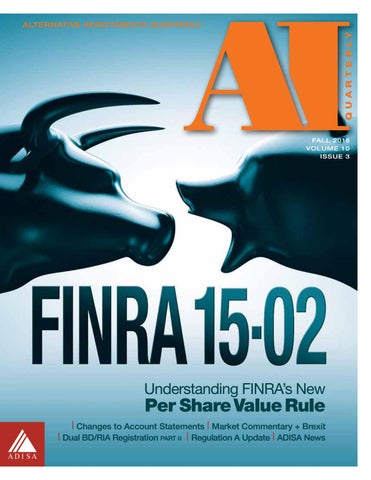
Q U A R T E R LY
Alternative Investments QUARTERLY
FALL 2016 volUME 10 issue 3
Understanding FINRA’s New
Per Share Value Rule
I Changes to Account Statements I Market Commentary + Brexit I Dual BD/RIA Registration PART II I Regulation A Update I ADISA News
Q U A R T E R LY
FALL 2016 volUME 10 issue 3
Alternative Investments QUARTERLY
1 President’s Letter ADISA Leadership Continuing to Advocate For You
2 ADISA Editorial Board Chair I Brandon Raatikka I FactRight, LLC
CONTACT INFORMATION ADISA I 10401 N Meridian St., Suite 202 I Indianapolis, IN 46290 Direct: 317.663.4180 I Toll Free: 866.353.8422 Fax: 317.815.0871 I E-mail: adisa@adisa.org John Harrison I Executive Director I 317.663.4172 Tanisha Bibbs I Director of Event Planning I 317.663.4174 Jennifer Fitzgerald I Director of Marketing I 317.663.4175
Taking ADISA to Even Greater Heights. By Mike Bendix, DFPG Investments
Executive Director’s Letter Industry Efforts on the DOL Fiduciary Rule
Linda Dewlaney I Preferred Partnership Services Peter Magnuson I Securities America
President’s Letter
4 Understanding FINRA’s New Per Share Estimated Value Rule
8 Understanding Changes to Account Statements
12
It seems like only yesterday that ADISA was publishing its first AIQ of the year. Yet here we are, already in the fourth quarter, with all three major ADISA events behind us. 2016 has been extremely successful for the association. Membership numbers continue to grow, ADISA’s catalogue of alternative product sponsors has become deeper and more varied, and attendance at our three conferences once again set records. The combination of educational content and networking opportunities continue to bring value to attendees in every membership category. As we look to 2017 and beyond, a number of industry changes that are about to take place make
Market Commentary July 2016
membership in ADISA more important than ever. In concert with our industry partners, ADISA has become
16
regulators and legislators alike. Fortunately, we are in very good hands as John Grady, who has led the
an important voice in Washington as representatives of our board have earned a seat at the table with
Tony Grego I Associate Executive Director I 317.663.4173 Erin Balcerzak I Administrative Assistant I 317.663.4183 Design I DesignMark I Susie Cooper
adisa.org Copyright © 2016 By ADISA (Alternative & Direct Investment Securities Association), formerly REISA, formerly the Tenant-In-Common Association. All rights reserved. Readers may copy sections of this publication
Dual Registration: Duties, Risks and Rewards for Broker Dealers and Investment Advisers
association’s L & R efforts for several years, is set to take the reins as present in January. I encourage each of you to consider how you can help take ADISA to even greater heights. Our committee structure allows members of all levels to participate in a meaningful way. It is a great way to
22 Regulation A Market Update: Tier 2 Offerings
not only network with your peers but also to help shape the direction of our industry. Please, raise your hand and get involved. Continued success! ▲
for personal use. However, it is a violation of U.S. copyright laws to copy substantial portions of the publication for any reason without permission. The Copyright Act of 1976 provides for damages for illegal copying. If you wish to copy and distribute sections of this publication, contact Jennifer Fitzgerald at jfitzgerald@adisa.org.
26 ADISA News
FALL 2016 AI QUARTERLY
1
Executive Director’s Letter
Industry Efforts on the DOL Fiduciary Rule By John Harrison, Executive Director, ADISA
making <$100k/yr grew by over 20%—a possible indication of the increasing value of investment advice as times get hard (Oliver Wyman, 2015) • Studies in the UK, during the RDR change—similar to the fiduciary rule— showed that only 19% of individuals currently saving would be willing to pay out-of-pocket for financial advice (Cass Business School, 2013)
Specific points on alternatives • 78% of Millennials and 70% of Gen Xers endorse using alternatives compared with only 58% of boomers (Natixis, 2014)
Our industry’s efforts on the DOL Fiduciary rule were coordinated and extensive. We managed to get the asset class aspect off the table, and some have asked what research was actually presented by ADISA to help in this. Here follows the research underlying the points our Legislative & Regulatory Chair, John Grady (DLA Piper), and I argued before our government. Why is this important now? It’s important because as we go forward with the actual implementation of this Fiduciary Rule—especially with a new administration—there will be plenty of back and forth as some sensibility is sought between the regulators and those regulated. Knowing what we’re looking for, what evidence-based metrics there may be, will help in judging risks and rewards. The crux of our argument was this: the DOL’s aim is to help investors; and there is an assumption on the part of the DOL that commissionbased compensation is worse than fee-based advice for retirement accounts for the investor. We maintain that the major unintended consequence of preferring only fee-based compensation for advice will be that many investors cannot or will not pay for fee-based advice, and that this lack of advice will harm investors in the long run. An additional downside—from the alternative investment point of view—is that this restriction of advice also leads to restricting the choices investors have, particularly with alternatives. First, we provided a summary of research that financial advice helps, then we showed that alternatives are important, and we ended with the argument that the Fiduciary Rule is likely to dampen both.
• Advised individuals, segmented by age and income, have a minimum of 25% more assets than non-advised individuals (Oliver Wyman, 2015) (based on data from Equifax). • For individuals aged 65 and older with less than $100,000 in annual income, advised individuals have on average 113% more assets than non-advised investors (Oliver Wyman, 2015). • Advised investors have more diversified portfolios—own twice as many asset classes, have more balanced portfolio asset allocations and use more packaged products for equity exposure compared with non-advised investors (Oliver Wyman, 2015).
2
AI QUARTERLY
FALL 2016
• The undisputed value of non-traded and non-correlated assets came to the forefront with the stability of endowments during the Recession, where the diversified endowment model proved vastly superior to the S & P 500 (Reuthers, 2009) • In the 10-year period from 1999-2009, the generic 60% equity/40% bond ratio after fees returned absolutely 0% while the heavily managed Yale, Harvard, and Stanford portfolios with alternatives performed from 135% to 198% in total, while the S & P 500 lost 35% (Wildermuth, 2012). • Investors pay a price for liquidity, in 2013’s example, about 1.4% (Whitman, 2014)
Summary points 1. Unintended consequences here are hugely important (in fact, today’s whole defined contribution retirement industry is itself an unintended consequence of obscure tax legislation). 2. Vital, necessary non-correlated products depend on personal financial advisors, and limiting financial advice can only result in decreased diversification.
General points that financial advisors helps • Small businesses that work with a financial advisor are 50% more likely to set up a retirement plan—and micro business with 1-9 employees are almost twice as likely. (Oliver Wyman, 2015).
• Investors are much more likely to use alternatives if using an advisor: only 3% of investors were confident or very confident in using alternatives. 67.9% of advisors were confident or very confident in using alternatives (FPA- REISA study, 2011).
• Households that use a financial advisor are twice as likely as non-advised households to have $100,000 or more in retirement savings, and three times as likely to have a retirement nest egg greater than $250,000 (LIMRA, 2015). • People who engage a financial advisor are more likely to contribute at least 10% to their employer provided plan, which is the commonly recommended saving rate. This is much higher than the average default contribution rate of 3.4% that unadvised individuals make with automatic enrollment (LIMRA, 2015). • Advised individuals are more likely to be diversified among a range of products across all ages and income levels. This is especially true for younger and smaller level advisors (Oliver Wyman, 2015). • Using vast Equifax data, during the Recession and its aftermath, the ratio of advised to non-advised IRA assets in accounts for those
3. Moving future investors toward lower cost commoditized digital advice surely increases herd behavior and amplifies catastrophic market risks. 4. Investors are interested in best results; they are not particularly sensitive to fees/commissions, etc. (according to behavioral finance research; Malmendier, ADISA Conference, 2014).
As the intricate dance proceeds with the DOL’s Fiduciary Rule implementation timeline, it’s important for us to remember the objective of providing the best
References Clare, A., Thomas, S., Walgama, O., and Makris, C., The impact of the RDR on the UK’s market for financial advice, Cass Business School, City Unversity of London, 2013. Financial Planning Association, Real Estate Investment Securities Association, white paper “Alternative Investment Report”, 2011. LIMRA, Matters of Fact: Consumers, Advisors, and Retirement Decisions (and Results), May 2015, http://www.limra.com/uploadedFiles/limra.com/ LIMRA_Root/Posts/PR/_Media/PDFs/Facts-aboutretirement-decisions.pdf Natixis Global Asset Management Survey, http:// durableprotfolios.com 2014. Oliver Wyman, The role of financial advisors in the US retirement market, July 2015, http://www.dol.gov/ ebsa/pdf/1210-AB32-2-00515.pdf Reuthers, “University Endowments Beat S & P 500 last Year”, Dec. 10, 2009. (cited in Wildemuth, D., Wise Money, McGraw Hill, 2012). U.S. Chamber of Commerce, Locked Out of Retirement: The Threat to Small Business Retirement Savings, July 2015, http://www. centerforcapitalmarkets.com/wp-content/ uploads/2013/08/US-Chamber-Locked-Out-ofRetirement-White-Paper.pdf
products to the investor as the best prices; this is how the industry prospers. We
Whitman, K. “The Hidden Cost of Liquidity How Alternatives Can Reward Long-Term Investors” Alternative Investment Quarterly, January 2014).
must show the regulators we intend to do this, and provide evidence as to the
Wildermuth, D. Wise Money: How the Smart Money Invests. McGraw Hill, 2012. Pp. 64-65.
wisest steps forward. We’re in this together, and we all will answer to the voter/ investor, who is the final decider of the evidence. ▲
FALL 2016 AI QUARTERLY
3
Understanding FINRA’s New Per Share Estimated Value Rule By Inland Real Estate Investment Corporation
The Securities and Exchange Commission approved amendments to FINRA Rule 2310 and NASD Rule 2340 which require broker-dealers to provide per share estimated values of publicly issued, nonlisted real estate investment trust (REIT) securities on investor account statements with specific disclosure obligations, prominently and in close proximity to distributions and per share estimated values. The amendments became effective on April 11, 2016 and are discussed in more detail in FINRA’s Regulatory Notice 15-02.
Per Share Estimated Value Rule — What is it? The Per Share Estimated Value Rule requires two main changes to the current rule. First, broker-dealers will need to show per share estimated values of publicly issued, nonlisted REIT securities on investor account statements. Second, they will have specific disclosure obligations that must be featured prominently and in close proximity to distributions and per share estimated values.
4
AI QUARTERLY
FALL 2016
FALL 2016 AI QUARTERLY
5
Per Share Estimated Value Regulatory Process Timeline The Per Share Estimated Value Rule, in its final form, was created based on a thorough industry collaboration and review process.
2007
2009
2015
• May: National Association of Securities Dealers (NASD) Rule 2340 (Customer Account Statements). • July: the NASD consolidated its operations and became the the Financial Industry Regulatory Authority (“FINRA”).
• August: FINRA releases rule 2310 (Member requirements for Direct Participation Programs).
• FINRA releases Regulatory Notice (“RN”) 15-02 that discusses the rule amendments to NASD rule 2340 and FINRA rule 2310.
2014 • October: FINRA releases amendments to revise NASD Rule 2340 and modify FINRA Rule 2310, which are approved by the SEC.
2016 • April 11: Effective date of amendments.
New Valuation Methodologies. New Disclosures.
Providing Full Transparency — An Example Using NIM.
The Per Share Estimated Value Rule provides two new methodologies for calculating the per share
As of April 2016, an initial $100,000 investment in a nonlisted REIT with standard industry fees and
estimated values and specific disclosures:
issuer costs 1 shows an investment value of $88,000, net of all fees and issuer costs, on a customer account statement. This is similar to how a mutual fund discloses fees and costs associated with
Net Investment Methodology (NIM) Definition: Maximum offering price (per share) minus commissions, dealer manager fee and issuer costs. Timing: It may be used until 150 days following the second anniversary of breaking escrow in the public offering; thereafter, new value must be estimated using the Appraised Value Methodology (see below). Disclosure Obligation (Specific to NIM): IMPORTANT: Part of your distribution includes a return of capital. Any distribution that represents a return of capital reduces the estimated per share value shown on your account statement.
an investment.
Per Share Estimated Value Statement Example $100,000.00 Investment Offering Price Per Share
Investors will see the following disclosure on all account statements, regardless of the valuation methodology: Nonlisted REIT securities are not listed on a securities exchange, are generally illiquid, and even if a stockholder is able to sell the securities, the price received may be less than the per share estimated value provided in the account statement.
$10
Commission to Financial Advisor/Rep
(.70) 7.00%
Dealer Manager Fee
(.30) 3.00%
Issuer Costs
(.20) 2.00%
Net Investment Value per Share
Net Investment Methodology (NIM)
Industry StandardFees & Issuer Costs
Total Net Investment Value
$8.80 per share $88,000
Definition: Based on appraisals of the assets and liabilities of the entity, as disclosed in the entity’s most recent SEC filing, by, or with the material assistance of, a thirdparty valuation expert that conform to standard industry valuation practices.
This example is for illustrative purposes only. It is intended to show the calculation of the estimated value of a
Timing: Performed at least annually; may be used any time during the offering period.
A Note on Per Share Estimated Value.
$100,000 investment using NIM (i.e., offering price less fees and issuer costs).
The per share estimated values are calculated on a “periodic” basis using a method that conforms to standard industry practice. Unlike a security that trades on a public exchange and is valued daily, the new FINRA valuation rules provide nonlisted REIT investors an estimation of the portfolio’s value based on a periodic valuation cycle, and should not be confused with a daily net asset value (NAV) product. Market
Investor Benefits.
conditions can change from the time of valuation that cause the estimate to be more or less between
• Transparency: Provides investors with full transparency of actual costs/fees, which helps the stockholder
valuation cycles. Any future estimated value should not be used as an indication of the proceeds an
better understand the investment and which sponsors are successful at creating value.
investor would receive in the event of a liquidation or upon the sale of an invester’s shares. ▲
• Standard Methodology: Moves the industry to a standard methodology to determine per share estimated values so it is easier and more “apples to apples” to compare different nonlisted REIT investment products. • Independent Valuations: Requires annual independent (third-party) valuations, which makes sponsors
1 – To determine industry standard fees and issuer costs, the fees and issuer costs of 45 nonlisted REITs were averaged and produced total fees and issuer costs of 12%. Issuer costs include those costs stated in each REIT’s prospectus. Such costs include other organizational and offering expenses such as reimbursement of, among other items, legal, accounting, printing and other accountable offering expenses; development of sales literature and presentations, participating in due diligence and coordinating generally the marketing process for the offering.
more accountable for the results they generate to meet investor expectations.
6
AI QUARTERLY
FALL 2016
FALL 2016 AI QUARTERLY
7
Understanding Changes to Account Statements By Griffin Captial Corporation
What changes will I see on my account statement? The following is an example of the typical changes that will appear on investors’ statements pursuant to the FINRA’s Regulatory Notice 15-02.
The Customer Account Statement Rule will provide more clarity on the fees associated with purchasing a REIT/DPP, increase the frequency of valuations, and provide disclosures on the statement in order for you to better understand the investment. These changes are meant to have your best interest in mind. Following is a break down of what you will see on your new statement.
This change will not affect the value of your investment, it will only change the reported value on your statement. • On your new statement, you will notice that the price per share listed is different than what you paid or what was previously disclosed. This is because the price per share displayed on your previous statements did not take into account the up front sales commissions, brokerdealer fees, and organizational and offering expenses associated with purchasing a REIT/DPP. Your new statement will show the price per share net of these offering expenses. These are not new fees and have always been in place, they just were not reflected on the statement, only throughout the prospectus. • Even though you may see a drop in your account balance due to the change in the price per share, this does not change the performance of the investment, your distributions, or what you would receive in either a liquidity event or if you were to sell this investment on the
The Customer Account Statement Rule will provide more clarity on the fees associated with purchasing a REIT/DPP, increase the frequency of valuations, and provide disclosures on the statement in order for you to better understand the investment.
secondary market.
Disclosures you will see on your new statement. • The disclosure that will appear on ALL statements (both NIM and AVM) will state “DPP and non-listed REIT securities are not listed on a national securities exchange, are generally illiquid, and even if you are able to sell the securities, the price received may be less than the per share estimated value provided on the account statement.” • Prior to using the new AVM methodology, the following disclosure must be included on the statement: “IMPORTANT— Part of your distribution includes a return of capital. Any distribution that represents a return of capital reduces the estimated per share value shown on your account statement.”
8
AI QUARTERLY
FALL 2016
FALL 2016 AI QUARTERLY
9
How Will this Rule Alter the Value Reported on Your Account Statements?
What is the Account Statement Rule (FINRA RN 15-02)1? The Securities and Exchange Commission approved amendments to
Previous Regulation
NASD2 Rule 2340 and FINRA Rule 2310 to alter the requirements related
New Regulation
to the way that the per share estimated valuation for Unlisted Direct It has been a widely
From the admission of the first investor into a nonlisted
accepted practice to
REIT and continually thereafter, broker-dealers will
(“REITs”) are detailed on customer account statements. The goal is
report the then-current
provide a per share estimated value of the security on
to promote greater transparency of the underwriting and sales costs
Public Offering Price
customer account statements which has been developed
(“POP”) of the security
in a manner reasonably designed to provide a reliable
as the price per share
value. FINRA has defined two valuation methods that are
on customer account
presumptively reliable:
statements. This
Net Investment Methodology (“NIM”) - Brokerdealers
Participation Programs (“DPPs”) and Real Estate Investment Trusts
associated with purchasing a non-traded DPP or REIT and to increase the frequency and accuracy of valuations. These amendments will go into effect April 11, 2016.
Initial Estimated Valuation
practice was compliant with regulations until
➤
18 months after the
may report a value that is equal to the gross offering price minus selling commissions, dealer manager fees and estimated organizational and offering expenses.
closing of all offerings,
-OR-
including follow-on
Appraised Value Methodology (“AVM”) - Brokerdealers
offerings.
may report a value disclosed by the REIT or DPP that is based on an appraisal of the assets and liabilities of the program by or with the material assistance of a third-party valuation expert.
Timing & Frequency of Valuations
The estimated
NIM - Valuations using this methodology may be
valuations included
reported on investor account statements until 150 days
on customer account statements could be based on data up to 18 months old.
➤
after the second anniversary of the initial escrow break. AVM - Values based on this methodology may be used at any time during or after the offering period. Revised valuations must be performed at least annually.
1—FINRA Regulatory Notice 15-02. Financial Industry Regulatory Authority, formerly known as the National Association of Securities Dealers, is a non-profit organization authorized by Congress to protect investors by making sure the securities industry operates fairly. 2—National Association of Securities Dealers.
10
AI QUARTERLY
FALL 2016
FALL 2016 AI QUARTERLY
11
Market Commentary July 2016 By Ladenburg Thalmann Asset Management
KEEP CALM 12
AI QUARTERLY
FALL 2016
Investors around the globe are grappling with the reality and ramifications of the historic vote for the U.K. to leave the European Union, known as “Brexit�. The economic implications of a Brexit are wide spread and the impact on investments is significantly different abroad as opposed to at home. The process of the U.K. leaving the EU will be laborious and take several years to complete. What is clear is that economic growth could slow dramatically, with revised economic forecasts showing a fall of roughly 1% in GDP this year. There are short to intermediateterm ramifications, as it is yet to be seen what results will bear from negotiations between the U.K. and EU in regards to trade treaties, borders, labor mobility, financial systems, and many more.
Amidst all of the global turmoil, we believe this will be a shock for markets, as opposed to a financial crisis. The United States is a closed economy with 70% of our growth tied to the U.S. consumer. We believe the U.S. consumer is the healthiest they have been since the start of this economic recovery and should drive equity markets higher. Unemployment today is at its lowest level since the beginning of 2008 and wages have slowly improved to 2.5% growth from its low of 1.6% at the end of 2012. This global uncertainty has now pushed expectations for the Federal Reserve to raise interest rates out to next year, which should benefit U.S. equities.
Domestic Equities Despite elevated, the S&P 500 finished the quarter up 2.46% and is now up 3.84% YTD. Unlike the first quarter, domestic equity diversification was a positive contributor to performance with mid and small cap stocks finishing the quarter up 3.18% and 3.79%, respectively. With the rest of the world riddled with uncertainty and concerns over growth, the U.S. has quietly continued to build strong positive economic momentum. After a sluggish start to the year, U.S. consumers have started to increase their spending, with retail sales in April and May beating expectations. This should quiet fears of soft corporate earnings, which have been hampered over the past year by low oil prices and a stronger dollar that has made our goods more expensive to foreign buyers. Earnings should have a better second half of the year, due to an increase in consumer spending, along with the recent rise in oil prices and a more stable U.S. dollar. A strengthening U.S. economy and stronger corporate earnings should help push stocks higher despite the added volatility from the Brexit and the U.S. elections.
International Equities The Brexit outcome was a shock to many as 52% voted to leave and 48% voted to remain. Investors sold off risky international assets in fear that the U.K.’s decision to leave the EU would have consequential effects on the global economy. This in turn resulted in a rather significant drop in international equity indices, with the MSCI EAFE index returning -9.68%
FALL 2016 AI QUARTERLY
13
around the globe helped to suppress yields further as over 25% of sovereign bonds generate negative yields. Last but not least, as yield-starved U.S. baby boomers enter retirement, they are searching for yield, driving prices up significantly. As a result, the yield curve continues to flatten, with longer duration fixed income securities outperforming those with shorter duration. The market turbulence and global uncertainty should keep the Fed restrained from hiking interest rates. Currently, the market isn’t anticipating any rate hikes. As economic growth remains low, it is unlikely that the Fed will want to add fuel to the fire by raising rates unexpectedly. We think the “lower for longer” theme remains, which should benefit fixed-income allocations.
Alternatives During this period of economic uncertainty, alternatives can play a key role in protecting against the downside. As an illustration of the ability of alternative strategies to protect a portfolio during periods of market turmoil, when the S&P 500 was down -4.47% in the month
Despite all the headlines and negative news, U.S.
of June, the Deutsche Bank Hedge Fund index was down only -0.65%.
equity markets have been able to weather the
While new single-family home sales fell -6% in May, the trend remains positive in the domestic
Real Estate real estate market. As consumers continue to strengthen, unemployment remains low and wage growth picks up, the prospect of buying a home is within reach for more people. The
storm and navigate these volatile times.
homeownership rate is still historically low, leaving plenty of potential buyers on the table. Though the Brexit shocked markets globally, the ripple effect may turn out to be a positive for the U.S. real estate market; Rate hike expectations have been pushed further into the future, leaving the cost of borrowing at attractive levels. Moving into the second half of 2016, real estate should continue to be a bright spot in the U.S. economy.
The outlook for markets abroad is unclear but rather than trying to time pullbacks or bet on short lived rallies, we believe it is most beneficial to remain disciplined.
YTD through June 27th. Subsequently, international stocks were able to recover some of their losses in the remaining days of the quarter finishing down -4.42% YTD. Foreign currencies also Although this market outlook has been
plummeted as a result of the Brexit news. The British Pound fell 12% to $1.32 on June 27th, its lowest level since 1985. The outlook for markets abroad is unclear but rather than trying to
Conclusion
time pullbacks or bet on short lived rallies, we believe it is most beneficial to remain disciplined.
The S&P 500 started 2016 with a major market correction of over 10%,
So far this year, emerging market equities have recovered some of their losses from 2015 but not enough to break even. Emerging market stocks finished the quarter up 6.41%
followed by the volatility inducing historic vote of the U.K. to leave the
prepared from public and private sources and data that LTAM believes to be reliable, LTAM makes no representation as to its accuracy or completeness. Any securities, indices, and other financial benchmarks shown are provided for illustrative purposes only, and
EU, yet equity markets have continued to climb higher. This global
reflect reinvestment of income, dividends,
performance for emerging markets this year can be primarily attributed to firming commodity
uncertainty has also put the Fed on hold from raising interest rates
deduction of advisory fees. Indexes are
prices and attractive valuations. Although strengethening commodity prices can contribute to
and we would expect rates to be range bound for the rest of the year.
directly in an index. Investors should bear in
outperformance in emerging markets, it can just as easily dampen performance in this region
Despite all the headlines and negative news, U.S. equity markets have
future results and there can be no assurance
been able to weather the storm and navigate these volatile times. This
results. Investment products are subject to
YTD but like other global equities, were not sheltered from the Brexit event. The positive
as we saw with oil prices and emerging market results in 2015. This close tie to commodities, coupled with heightened political risk make emerging markets a riskier asset class.
Fixed Income Fixed Income enjoyed another rally during the second quarter as demand for the 10 year U.S. Treasury yield increased causing the yield to decrease from 1.77% all the way down to 1.47%.
is a great reminder to investors that markets are historically volatile and drawdowns are normal, but the U.S. economy is strong enough to handle these shocks due to a strengthening consumer, low interest rates and an
and other earnings. They do not reflect the unmanaged and investors cannot invest mind that past performance is no guarantee of that the Program will achieve comparable investment risk, including possible loss of the principal amount invested and should review the prospectus before investing. The information and views expressed are given as at the date of the writing and are subject to change. This information is not to be used or considered as an offer or the solicitation
The Barclays US Govt/Credit Index surged another 1.59% after finishing the first quarter up
improving labor market. With the impacts of the Brexit still unclear and
2.5%. The outperformance in fixed income was attributable to a few factors. First, yields
an uncertain U.S. election on the horizon, we expect volatility is here to
mentioned herein. Ladenburg Thalmann Asset
plummeted as uncertainty over global economic softness prevailed, which was heightened
stay, but there are enough positive improvements within our economy for
advisor and subsidiary of Ladenburg
markets to climb higher. ▲
traded on the NYSE_MKT: LTS.
by the Brexit. German 10-year government bond yields dipped below zero for the first time a few days before the Brexit poll result was released, which marked a milestone for investors’
of an offer to sell or buy any securities Management Inc. is a registered investment Thalmann Financial Services Inc. which is
flight to safer assets. In addition, supportive central bank policies from major economies
14
AI QUARTERLY
FALL 2016
FALL 2016 AI QUARTERLY
15
The Search for income and less volatility The word “diversification” is used frequently in our industry and, to the everyday investor, I suspect that they interpret that term
Dual Registration: Duties, Risks and Rewards for Broker features that the everyday investor is more Dealers accustomed to in and Investment Advisers regards to reporting and tracking. Technically, they are classified as a closed-end fund, but have
But is that all there is? Stocks can create sleepless nights and
Interval funds offer several advantages to both the investor By Brittany Burns, WealthForge as well as the financial professional. They can invest in both
anxiety, fixed income yields are at historical lows and high-yield
private and public securities within a structure that offers liquidity,
seems to be the solution for many yield chasing investors, but at
daily valuation and transparency via audited financials. Liquid
what cost? And cash? We might as well store that in our mattress
interval funds can often have multiple underlying sub-managers
these days since it earns us nothing in the way of interest.
in addition to the fund manager that is charged with making the
to mean they should diversify among stocks, bonds and cash.
The life stage of an investor is an important factor to consider when making portfolio recommendations. Investors in the
The Appeal
able to stick with the traditional allocation of stocks, bonds
In a post 15-02 world, and in order to help level the playing field
and cash via their employer sponsored savings plan and be
for every day investors, interval funds are an attractive option
okay, thanks to the benefit of time. However, if an investor is
because their structure already addresses pricing issues now
exposed to other asset classes, e.g. alternative investments,
imposed on other alternative asset class structures. Other
their portfolio will most likely be more diversified, and in-turn,
benefits include:
time. The variance in volatility will be dependent on whether or not the alternatives are publicly traded, i.e. daily liquid mutual funds, or non-traded direct participation programs (DPP). Liquid alternative investments burst onto the investment
• Clients and advisors alike are able to track the Fund’s
• Liquidity is offered on a predetermined basis (generally
non-traded sector has recently faced some major challenges
redemption is typically 5% of the total shares outstanding
due to the regulatory environment. The recent roll-out of the final
each quarter, or 20% per year.
changes to the maximum allocation percentages permitted in
“where do we go from here?” All the while, investors are asking
and are exempt from state suitability guidelines, which
their financial professional, is there anything else we can allocate
can make compliance oversight
to besides stocks and bonds to help me generate income and
less rigorous and time consuming.
offers greater transparency, daily valuation and an opportunity
• They may be sold in fee-based accounts. Many interval funds offer multiple share classes
investments via a pooled fund approach rather than proposing
Enter Interval Funds
a single concentrated
Simply put, interval funds are mutual funds as defined in the
alternative investment.
16
AI QUARTERLY
FALL 2016
Brokers and Advisers have varying disclosure requirements, each based in the perceived role of the individual position.
adviser’s fiscal year.3 In addition, Advisers are required to disclose all material information regarding compensation, conflicts of interest between the Adviser and its clients, and any benefits the Adviser may receive from third parties as a result of its recommendation to clients.4 These disclosure requirements reflect the fiduciary duty implicit in the definition of an investment adviser. On the other hand, Brokers are required to disclose conflicts of interest to their customers conflict at the beginning of the relationship with a client. Instead, Brokers have to make the
introduce investors to alternative
at stated “intervals” throughout the year, usually quarterly.
amend the brochure and provide each client with an update within 120 days of the end of the
model quite easily.
extended period of time.
for investment with certain liquidity opportunities that are made
material changes to the brochure since the adviser’s last annual update, the Adviser must
and are able to accommodate the advisor’s business
• Advisors may find interval funds offer a simpler way to
and Securities Exchange Act of 1934, that offer daily purchases
(brochure) that describes “the adviser’s business practices, conflicts of interest and background
under SEC Rule 240.10b-10(a)(2).5 Unlike Advisers, Brokers are not required to disclose the
for liquidity rather than having to “lock-up” their money for an
1940 Investment Company Act, and Securities Act of 1933,
rule,” which requires registered investment Advisers to provide clients with a Form ADV Part 2A
to clients in advance, and in any case no later than entering into a contract. If there are any
as illiquid alternative investments
industry innovators have created a product structure that
the individual position. The most important disclosure requirement for Advisers is the “brochure
must have sufficient liquid assets.
dealers and financial advisors to scratch their heads and wonder
meet investor demand for more sophisticated product choices,
Brokers and Advisers have varying disclosure requirements, each based in the perceived role of
of the investment adviser and its advisory personnel.”2 The adviser must provide the brochure
• Interval funds are not subject to the stringent regulations
In order to navigate the current regulatory environment and
Disclosure Requirements
• In order to meet the Fund’s required redemptions, they
alternative investments, have caused industry leaders, broker-
reduce volatility?
On April 6, 2016, the Department of Labor (“DOL”) announced its final “conflict of interest” rule which expanded the definition of fiduciary to include “any person who provide[s] investment advice or recommendations for a fee or other compensation with respect to assets of a plan or IRA.”1
Funds are given a CUSIP that can be monitored.
quarterly). The amount available for
15-02 statement rule, and NASAA’s Model Act that proposes
(Part I was published in the Spring 2016 issue of AIQ)
value daily for greater transparency.
scene in the public arena beginning in 2009, however, the public
version of the Department of Labor’s Fiduciary Rule, FINRA’s
Part II of II
allocation decisions at the fund level.
accumulation stage tend to be younger and therefore may be
may experience less volatility, and generate more income, over
White Paper
disclosure at or before completion of a transaction, but best practices reflect early disclosure.6 In addition, the Exchange Act Rules 15c1-5 and 15c1-6 require disclosure if a Broker has any control, affiliation, or interest in a security it is offering or in the issuer of the security.7 FINRA also has defined rules that require disclosure by Brokers under specific circumstances. FINRA Rule 2262 requires disclosure if a firm controls, is controlled by, or is under common control with an issuer of securities.8 Rule 2269 requires written disclosure to customers
• Investors gain access to institutional money managers
for trades in any security in which the firm is participating in the distribution or is otherwise
that otherwise would be inaccessible
financially interested.9 Another disclosure requirement is found in Rule 5121, which prohibits
to them due to minimum investment requirement and/or
participation in a public offering where the Broker has a conflict of interest unless the Broker makes a prominent disclosure in the prospectus.10
FALL 2016 AI QUARTERLY
17
Like many securities laws, disclosure requirements are intended to protect investors by providing them with as much information about the motivation behind their Adviser or Broker’s actions.
While Advisers and Brokers are both required to disclose conflicts of interest, the extent of
trusted relationships between clients and their Advisers. These three fee structures—hourly
these disclosures vary. Disclosure compliance is one of the easier thresholds to pass when
fees; carries; and AUM fees—allow for Advisers to provide recommendations that best suit
an Adviser dually registers as a Broker, since Advisers are already required to make more
their clients versus recommendations that provide them with initial monetary gains.
exhaustive disclosures. A Broker who decides dually registers as an Adviser will now be
Comparatively, Brokers are usually compensated through transaction based compensation.
required to file a Form ADV and look more closely at whether the securities that the Broker is
Transaction based compensation are commissions paid based on the amount of securities
selling creates a conflict of interest, and if that conflict is prohibited when the Broker is acting
sold or profit netted from the sale of a security.14 The commission received by Brokers differs
as an Adviser. As discussed previously, for Brokers selling interests in their own OBA, an
from the carry paid to Advisers because of the differing duties owed by Brokers and Advisers.
obvious conflict is created if that Broker is also registered as an Adviser and recommending
While Advisers are always under a fiduciary duty to act in the best interest of their clients,
clients to invest in his OBA. As a Broker, disclosure of a conflict of interest is sufficient and a
Brokers are only required to ensure suitability and fair dealing. Thus, a Broker is more likely to
client may waive objection to the conflict by proceeding with the transaction. In comparison,
recommend suitable securities that offer the highest commission to the Broker.
an Adviser has a duty to avoid conflicts of interest and disclosure of a conflict does not waive
An individual who is dually registered has to consider the implications of the type of
If an Adviser recommends the purchase of a security in his
compensation they receive. Both Advisers and Brokers have a duty to charge their clients
OBA that is not in the best interest of his client, regardless of whether the client knew of the
fair and reasonable fees.15 In a study released by FINRA in 2013, the SRO stated that taking
conflict before entering into a contract with the Adviser, the Adviser is still liable.
front end compensation as well as long term AUM fees would create “a clear conflict [of
the Adviser’s fiduciary duties.
11
Like many securities laws, disclosure requirements are intended to protect investors by
interest].”16 Thus, for dually registered individuals a choice must be made from the outset—
providing them with as much information about the motivation behind their Adviser or Broker’s
either accept transaction based compensation in the form of commissions for the transaction
actions. Disclosure can expose these conflicts of interest, allowing investors to determine
effected or charge fee-based compensation in the form of AUM fees or hourly/flat fees. Dual
whether they would like to proceed with a recommended investment or seek advice from
registration does not equate to dual compensation, and Advisers/Brokers must be cognizant
an unencumbered Adviser or Broker. In addition to disclosure, compensation structures of
that their compensation structure does not result in “double dipping,” or the Adviser/Broker
an Adviser and Broker can suggest the motivation behind the registered person’s actions.
receiving both front end (commission) and back end (carries/AUM) fees.
Compensation Structures for Advisers and Brokers
Benefits and Risks of Dual Registration
Advisers are typically paid in one of three ways: (1) an hourly fee; (2) fees based on gains
Benefits of Dual Registration
in the investments they manage; or (3) an assets under management fee (“AUM fee”).12 An hourly fee is commonly used when providing clients with “one-off” advice or financial planning sessions and it limits the fiduciary duty to that one occasion. An Adviser is still required to act in the best interest of their client under an hourly fee. However, upon completion of the consultation, the Adviser does not have a duty to continue to act in the best interest of the client, such as suggesting to sell a security or updating the client if a change in the market down the road results in a change in the advice that was given. In addition, hourly fees are gaining popularity as a way for Advisers to earn compensation when managing accounts with a smaller number of assets. The second Adviser compensation structure is fees based on gains in investments the Adviser manages, also known as a “carry.” A carry compensates Advisers based on the success of his or her recommendations. Carries bolster the adviser’s compliance with his or her fiduciary duty because the adviser has incentive in actually recommending the best investments for his client. Carries differ from commissions in that a carry is paid based on gains in an investment, i.e. a carry is not paid until the investment earns money. Commissions, on the other hand, are paid upon transaction, regardless of whether the security grows in value or depreciates in the future. Finally, a third way in which Advisers are compensated is through an AUM fee. An AUM fee is a fee based on the amount of assets an adviser manages for a client. AUM fees are the most popular Adviser payment structure13 and usually are calculated as 1% of the assets an Adviser is tasked with managing and giving advice about. The AUM fee also coincides with the fiduciary duty required by Advisers because it establishes and reflects more long term,
18
AI QUARTERLY
FALL 2016
Dual registration can provide many benefits to both Brokers and Advisers, the most obvious of which is expanding their business and opening up new avenues of investment to their clients. In addition, clients have access to a one-stop shop for both advice and investment opportunities. Advisers also benefit from the protection of the broker dealer that they register with, who is charged with supervising the adviser and thus bears more liability from clients and regulatory agencies. Advisers also benefit from dual registration because they can focus more on selling and management of deals while allowing the Broker to focus on the administration and compliance requirements. Risks of Dual Registration While an estimated 24,000 Advisers are dually registered as Brokers, some don’t understand the risks and responsibilities of dually registering.17 As discussed, dual registration requires an awareness that you are acting under the correct standard of care pursuant to the role you
Dual registration can provide many benefits to both Brokers and Advisers, the most obvious of which is expanding their business and opening up new avenues of investment to their clients.
are playing with a particular client at that time. Alternating between an advisory role and a broker role with the same investor can cause confusion on the part of the investor and open the Adviser/Broker to scrutiny from regulatory agencies. If a dually registered individual is providing both Adviser and Broker services to the same client, the prudent course is to act as a fiduciary in both roles. Another risk of dual registration is the risk of an individual not concurrently complying with the extensive regulatory regimes that Advisers and Brokers are subject. In recent years, compliance officers have been tasked with carefully supervising dually registered Advisers to ensure compliance with FINRA Rule 3280.18 Advisers who wish to participate in a private
FALL 2016 AI QUARTERLY
19
Conclusion In conclusion, dual registration can provide additional revenue streams and offerings to current customers of Advisers and Brokers. However, as reflected by the DOL’s final rule, regulatory entities are taking a closer look at the duties owed by Advisers and Brokers.24 A dually registered Adviser/ Broker should ensure that it complies with the correct fiduciary standard that is required under the services he or she is providing. Once the standard of care is determined, the Adviser/Broker should ensure that all disclosures and compensation structures comply with the standard the relationship falls under. The penalties for non-compliance with laws regulating Advisers and Brokers can range from disgorgement of ill-gotten gains to a life-time ban from the securities industry, therefore understanding the rules and regulations surrounding dual registration is imperative. ▲
securities transaction, even one they had been involved with before dual registration, are
An Adviser/ Broker who participates in a private securities transaction without giving prior notice to, and receiving permission from, their member broker-dealer is said to be “selling away” from their firm.
required to disclose to their member firm their participation in the transaction and receive
1—29 CFR 2510.3-21 (April 6, 2016).
14—2011 SEC Study at 10-11, supra note 15.
permission to participate in the transaction.19 Failure to disclose their participation opens up
2—General Information on the Regulation of Investment Advisers, Securities and Exchange Commission
15—FINRA Rule 2121; See Shareholder Service Corp., SEC Staff No-Action Letter (Feb. 3, 1989).
(2011), available at https://www.sec.gov/divisions/investment/iaregulation/memoia.htm; see
both the member firm and the dually registered Adviser to liability.
16—Report on Conflicts of Interest, FINRA, at 29 (October 2013), https://www.finra.org/sites/default/
Investment Advisers Act Rule 204-3; 17 C.F.R. 275.204-3.
files/Industry/p359971.pdf; See Timothy Edward Daly, FINRA Letter of Acceptance Waiver and
3—17 C.F.R 275.204-3(b)(2).
Consent (April 27, 2012) (holding that taking front end commissions on transactions in a retail account
4—General Information on the Regulation of Investment Advisers, Securities and Exchange
and AUM fees on the same securities in a fee-based account was in violation of FINRA Rule 2010).
Commission (2011), available at https://www.sec.gov/divisions/investment/iaregulation/memoia.htm.
17—Matthew Rieker, Dually Registered Investment Advisers Blur the Broker-Fiduciary Line
away” from their firm. Upon notice that an Adviser/Broker is selling away, a member broker-
5—See 17 C.F.R. §240.10b-10(a)(2) (“provide written notification disclosing…if the broker or dealer
(March 26, 2015) (citing data research firm Cerulli), available at http://www.wsj.com/articles/
dealer may file a Form U5 termination notice and report to FINRA that the termination is
6—17 C.F.R. §230.10b-10(a).
for cause.20 An Adviser/Broker who is found guilty of selling away by FINRA faces serious
7—Exchange Act § 15c1-5 (“The term manipulative, deceptive, or other fraudulent device or
consequences, including disgorgement of any fees earned from the selling away, monetary
with, the issuer of any security…unless such broker…before entering into any contract with or for
An Adviser/Broker who participates in a private securities transaction without giving prior notice to, and receiving permission from, their member broker-dealer is said to be “selling
sanctions up to $73,000.00, and suspension or a complete bar from participating in another
contrivance… include[s] any act of any broker…controlled by, controlling, or under common control such customer for the purchase or sale of such security, discloses to such customer the existence
dually-registered-investment-advisers-blur-the-broker-fiduciary-line-1427384699. 18—FINRA Rule 3280; See also Les Abromovitz, Watch Out for Outside Business Activities and Private Securities Transactions, ScottTrade Advisor Services (January 11, 2011) (last accessed on March 31, 2016), available at http://advisoradvocate.scottrade.com/2011/01/11/ watch-out-for-outside-business-activities-and-private-securities-transactions/.
of such control”); Exchange Act § 15c1-6 (“The term manipulative, deceptive, or other fraudulent
19—FINRA Rule 3280(b).
device or contrivance… include[s] any act of any broker who is acting for a customer or for both
20—FINRA Rule 2010. Selling away is a violation of FINRA Rule 2010. Broker-Dealers have written
such customer and some other person…any security in the primary or secondary distribution of which
supervisory procedures that define the managing broker-dealer’s required response to a registered
such broker…is participating or is otherwise financially interested unless such broker…at or before
representative “selling away.” This allows the member broker-dealer discretion over how to punish a
the completion of each such transaction gives or sends to such customer written notification of the
registered person, however, it also creates liability for the member broker-dealer if they decide not to
existence of such participation or interest”).
reprimand a violating registered representative. Thus, many member broker-dealers require an immediate
8—FINRA Rule 2262; see also https://www.finra.org/sites/default/files/Industry/p359971.pdf
filing of a U-5 terminating for cause upon notice that an affiliated registered person is selling away.
the activities of each associated person.”22 If a Broker is found liable of selling away, FINRA
9—FINRA Rule 2269.
21—FINRA, Sanction Guidelines (March 2015), available at www.finra.org/sites/default/files/Sanctions_
will usually turn their eye to the firm to ensure that the firm has established procedures to
10—FINRA Rule 5121.
properly supervise associated persons.23 Failure to properly supervise a Broker may result
11—“Hedge Clauses” are sometimes used by Advisers to limit an Adviser’s liability, through indemnification, waiver, or limitations on liability. These clauses have risen concerns from the SEC,
23—Id. When investigating whether a firm established and maintained procedures, FINRA looks to see
in regulatory fines and penalties. In addition, if the firm knew or should have known of the
who held that while the clauses are not “per se” fraudulent, they may be fraudulent depending on the
that a member firm has provided, at a minimum, the following: (i) written supervisory procedures; (ii)
circumstances. See Heitman Capital Management, LLC, SEC No-Action Letter (February 12, 2007).
principals with authority to supervise; (iii) registration and designation of branch offices; (iv) designation
Regardless, an Adviser’s disclosure of a conflict of interest does not waive liability without an additional
of a principal at each branch office; (v) assignment of registered persons to an appropriate supervising
hedge clause, and even then liability may still be imposed.
principal; (vi) use of reasonable efforts to determine supervisory personnel are qualified; (vii) annual
private securities transaction.21 In addition, a member firm can face regulatory penalties and can be held vicariously liable for any damages incurred by an investor that is the victim of a Broker who sold away. A firm can face regulatory penalties for failing to “establish and maintain a system to supervise
Broker’s selling away, the firm can be vicariously liable for damages incurred by an investor in the sold away security.
12—2011 SEC Study at 7, supra note 15; see also Joanne Cleaver, A Guide to Financial Advisor Fee Structures, U.S. News (February 18, 2014). 13— Liz Skinner, Advisers shift away from AUM fees to better serve clients, Investment News (May 14,
Guidelines.pdf. 22—FINRA Rule 3110.
training of registered representatives. 24—2011 SEC Study at vi, supra note 15 (arguing for a uniform fiduciary standard for brokers and dealers that is no less stringent then the fiduciary standard imposed on investment advisers).
2015) (stating that a 2014 study found that 95% of investment advisers set fees based on AUM).
© 2016 WealthForge. All rights reserved.
20
AI QUARTERLY
FALL 2016
FALL 2016 AI QUARTERLY
21
Regulation A Market Update: Tier 2 Offerings By Brandon Raatikka, FactRight, LLC
We are starting to see a flood of Regulation A offerings entering the market, facilitated by SEC rules adopted in 2015 pursuant to the JOBS Act. Since November 2015 and through September 30, 2016, the SEC has qualified Tier 2 offerings for 46 issuers, excluding those that were later withdrawn or were filed for merger purposes. (Note that there were only 26 Reg. A offerings between 2012 and 2014.) Qualification activity has climbed over time, and September 2016 saw more Tier 2 qualifications than any other
e
r ings
month under the revamped Reg. A+ regime (see Chart 1). Additionally, as of September 30, there were 24
f f TIER 2 O 22
AI QUARTERLY
FALL 2016
Tier 2 offerings filed and awaiting qualification. This update covers Tier 2 offerings only—the SEC has qualified another 29 Tier 1 offerings since late 2015, with several more filed.
Chart 1 Tier 2 Qualifications 14 12 10 8 6 4 2 0
Nov
2015
Jan
Feb
Mar
Apr
May
Jun
Jul
Aug
Sep
2016
FALL 2016 AI QUARTERLY
23
Multiple 9%
Chart 2
Common 70%
The average maximum primary offering amount for Tier 2 raises was approximately $27.1 million, and the median offering was $22.5 million. It is fascinating to consider that although issuers are allowed to raise $20 million annually under Tier 1 of Regulation A and avoid certain financial reporting obligations, many issuers seeking
Debt 4%
relatively low capital raises eligible for Tier 1 offerings are still opting to undertake Tier 2 offerings (with their increased public disclosure requirements and exemption from state blue sky laws). As shown in Chart 3, half of all qualified
Tier 2 Securites Type Breakdown
Tier 2 offerings have been for primary maximum offerings of $20 million or less. Still, a significant number of issuers (37%) are seeking to raise the maximum allowable under Tier 2 of Regulation A ($50 million). Through September 30, Tier 2 issuers had not settled on consensus for distribution strategies of Reg. A
Preferred 17%
securities. The majority of issuers do not utilize a lead placement agent or dealer manager (see Chart 4). To date, Moloney Securities, W.R. Hambrecht, and SI Securities are the only lead placement agents servicing multiple Reg. A offerings. Meanwhile, 50% (23 of 46) use an online platform or website to solicit investment. StartEngine and SeedInvest, which also facilitate fundraising through Regulation CF and 506(c), are the most active online platforms in the Reg. A space. For offerings with lead placement agents, estimated offering commissions and expenses average 6.59%. For all Tier 2 offerings, average upfront fees and expenses drop to 5.63%. Of qualified issuers, approximately 39% have disclosed an intention to seek quotation or facilitation of trading of
Issuers with qualified Tier 2 offering circulars are predominately offering common equity (as shown in Chart 2). Issuers that are offering multiple kinds of securities include those issuing preferred shares or warrants in
its securities on a secondary system or exchange. Nearly all of these (16 of 18) envision eventual quotation on the OTC Financial Markets (OTCQB, OTCQX, and OTC Pink Sheets).
addition to common shares. Of the 46 issuers with qualified offerings as of September 30, 2016, existing
As the market matures, it will be interesting to observe how fee structures normalize—for Reg. A securities that
shareholders of only seven issuers (or 15%) were selling securities through the qualified offering circular
are distributed through the retail channel, anyway—and how secondary markets will materialize to spur popularity
concurrently with the primary offering. Secondary offering amounts ranged from $25,000 to $9 million. This
for these offerings. For now, we can be grateful that these new issuances are making it to market en masse. ▲
overview focuses on primary offerings.
> $20 million and < $50 million 13%
Chart 3 Tier 2 Maximum Offering Amount
AI QUARTERLY
FALL 2016
Use a placement agent 28%
Chart 4 Tier 2 Lead Placement Agent Usage
$50 million 37%
24
$20 million or less 50%
Don’t use a placement agent 72%
FALL 2016 AI QUARTERLY
25
ADISA
News
Events
ADISA’s 2016 Annual Conference & Trade Show + Top Ten Take-Aways Advocacy ADISA’s 2016 Due Diligence Forum 1
4
2
5
3
6
ADISA 2016 Annual Conference & Trade Show Wrap-Up With a record crowd, great location, and an incredible agenda,
• The Women’s Leadership Forum Luncheon, where women in
ADISA’s 2016 Annual Conference & Trade Show may just be the
the industry came together for an informative program and lunch
best yet.
featuring Linda Gray, award-winning actress, accomplished
The program was a little different, with three Semi-General Sessions added: a CEO Showdown Part I: Broker-Dealer Exec Asks Sponsors the Tough Questions, followed by a CEO Showdown Part II: A Sponsor’s Turn to Challenge Broker-Dealer Leadership, plus The Great Due Diligence Third Party Debate, where leading due diligence analysts squared off.
director and former United Nations Goodwill Ambassador. • Bob Rice presented on our industry’s direction and trends. • And our closing keynote speaker was Joe Torre, baseball legend, who engaged in a conversation with the audience on how to manage a great team. ▲
Other program highlights included: • Educational sessions covering legislative and regulatory issues, as well as REITs, BDCs, Interval Funds, oil & gas, Regulation A+ and other popular industry topics.
Go where the industry professionals go, and mark your calendar now for 2017: ADISA 2017 Spring Conference
• The DOL Fiduciary rule and its pending implementation, from the
April 3-5
Rule overall, on how the BICE can work, and a couple of practical
Hyatt Regency New Orleans
sessions on implementation, and one on how it’s going to affect
ADISA 2017 Due Diligence Forum
the industry overall.
Mid-July in Chicago (exact dates and location TBD)
• The latest on 1031 offerings and what might politically be up
ADISA 2017 Annual Conference & Trade Show
for grabs.
October 23-25
• Music and political satire by The Capitol Steps, the Washington-
ARIA Resort & Casino Las Vegas
(1) ADISA DSA Award winner Keith Lampi, Inland Private Capital Corporation, (2) ADISA President’s Award winner, DLA Piper (ADISA President-Elect John Grady accepting on behalf), (3) ADISA ACE Award winner Catherine Bowman, The Bowman Law Firm (4) Keynote Speaker Joe Torre, (5) Featured Speaker Linda Gray, (6) The presidential debate draws a crowd.
based troupe of Congressional staffers turned songwriters.
26
AI QUARTERLY
FALL 2016
FALL 2016 AI QUARTERLY
27
ADISA Places “The Guide to Alternative Investments” in the Hands of Congress As part of its ongoing outreach efforts to educate Congressional members on
Top 10 Takeaways from ADISA’s 2016 Annual Conference & Trade Show
alternative and direct investments, ADISA recently sent a mailing to key representatives
By John H. Grady, DLA Piper, ADISA President-Elect
and senators, with its new pamphlet, “The Guide to Alternative Investments.” The mailing stressed the importance of non-traded alternative investments, as
10. ADISA and its members know that there are many challenges facing the industry. What is key is the industry’s response to them.
more and more Americans rely on them as part of their diversity strategy for general
9. The Department of Labor’s changes to the definition of “fiduciary” and
investment and retirement planning. “The Guide to Alternative Investments” provides
its adoption of the “best interests contract” exemption pose substantial
an overview of non-traded alternatives, and includes non-traded real estate investment
challenges for broker-dealers and product and program sponsors alike.
trusts (REITs), non-listed business development companies (BDCs), and other
8. FINRA’s changes to its customer statement rules has generated new
alternative funds, which in total raised more than $15 billion of equity in 2015. The nontraded REIT industry alone had approximately $120 billion in total assets. “We, of course, will follow up this action with more outreach to Congressional leaders involved in issues affecting our space,” said ADISA’s Executive Director/CEO, John Harrison. “We are preparing more material for the upcoming Congress and stand
product structures and approaches designed to work well within these new requirements. 7. Product sponsors are once again adapting to the new competitive landscape, focusing on or introducing products such daily net asset value REITs, multiple classes of shares and “master-feeder” funds. 6. The industry continues to look at SEC registered funds, particularly
Due Diligence Forum Recap ADISA’s 2016 Due Diligence Forum
interval funds, as it seeks to offer alternative investments with greater
in Boston in July was a tremendous
investor liquidity
success. Nearly 200 attendees took
5. ADISA has actively represented the alternative investment industry
advantage of the exceptional education
the Senate Finance Committee, the House Financial Services Committee,
before Congress and the regulators, and industry members can and
program, which included sessions
and the House Ways & Means Committee. These committees handle
should get involved in the process in their own regard.
on the pros and cons of non-traded
legislative matters that most directly pertain to the investment
4. ADISA continues to expand its membership base across new product,
vs. traded REITs; interval funds; oil &
ready for continued outreach,” said Harrison, who is also a registered lobbyist. Recipients of the mailing included members of the Senate Banking Committee,
industry and ADISA members. In addition to the senators and representatives, senior staff members of each committee also received the mailing. All recipients were invited to contact ADISA with any questions they may have to learn more about the value of this investment area, and hopefully this will encourage more open dialogue between our industry professionals and Congress. ▲
program and offering types, including private offerings, crowdfunding platforms, conservation easements and other income focused strategies. 3. Investors continue to be drawn to the alternative investment space in their search for income producing, non-correlating and diversifying investments. 2. Product elements such as cost and transparency, along with appropriate marketing efforts, continue to drive client acceptance and satisfaction with alternatives investments. 1. According to Bob Rice, the industry is well positioned to provide
gas program performance; navigating through the due diligence weeds; an overview on the state of the sector; and a lively panel on the history and future of 1031s; plus a regulatory download, discussing the DOL fiduciary initiative and other issues. Attendees also heard
the income focused investment products and programs that today’s
from keynote speaker Bob Rice, best-
investors need. ▲
selling author and investment manager, who returned to speak at ADISA’s Annual Conference in September. ▲
28
AI QUARTERLY
FALL 2016
FALL 2016 AI QUARTERLY
29
10401 North Meridian Street Suite 202 Indianapolis, IN 46290
SAVE THE DATE
ADISA SPRING CONFERENCE APRIL 3-5, 2017 HYatt regency new orleans