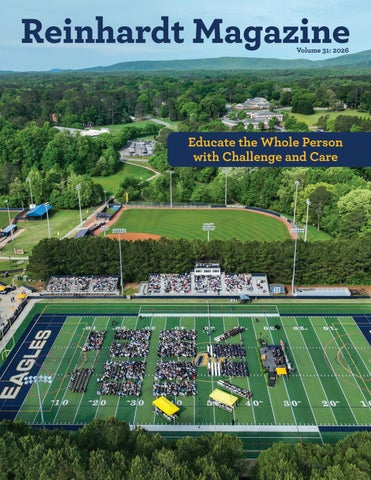
Reinhardt Magazine Volume 31: 2026
Educate the Whole Person with Challenge and Care
2026 Board of Trustees Officers
Phillip M. Landrum, III, Chair Warren R. Calvert, Vice-Chair Rev. Dr. James B. Mooneyhan (RU-1966), Secretary Raymon H. Cox, Treasurer
Members
Sharon J. Bartels John H. Bennett, Jr. (RU-1965) Dr. Elizabeth Bowser (RU-1968) Tom W. Carter (RU-1961) Lewis A. Cline (RU-1991) Dr. Richard L. Dixon Dr. Jeffrey R. Dobson (RU-1965) Dr. L. Austin Flint Dr. Russell A. Flint Alicia M. Ivey (RU-2004) Ben L. Looper Steve McClure Hon. M. Ellen McElyea Pete Nettles Patience E. Peterson Hon. John A. Pipkin, III (RU-2001) Glenn A. Rivers, III Dr. Randell E. Trammell (RU-2003 & 2009) Huie L. Turner, Jr. (RU-1983) R. Lamar Wakefield Fred J. Weir, III Dr. C. Ken White (RU-1961 & 2021) Kevin Williams JoEllen B. Wilson (RU-1961)
Emeriti Members
Robert E. Byrd Hon. Joe Frank Harris James K. Hasson, Jr. William G. Hasty, Jr. (RU-1967) Lynn H. Johnston Deborah A. Marlowe Hugh Peterson, Jr. Hon. Marion T. Pope, Jr. Hon. A.R. Roberts, III Dr. Nancy G. Simms (RU-2025)
Ex-officio Members
Bishop Robin Dease Rev. Dr. Adam Roberts Dr. Mark A. Roberts Rev. Dr. Carolyn Stephens Christopher H. Pierce (RU-2001)
2
2026 University Leadership Team Mark A. Roberts, Ph.D., President Ken Wheeler, Ph.D., Vice President, Academic Affairs Joseph Wiegand, J.D., Ed.D., Vice President, Finance and Administration and Chief Financial Officer Kristi Ledford, Vice President, Advancement and Communications Mike Floyd, M.A.R., Vice President, Enrollment Management and Marketing Walter May, Ph.D., Dean of Students Jonathan Burton, M.Ed., Executive Director of Athletics
Editor in Chief, Writer, and Photographer Suzy Alstrin, Director of Media Relations and Public Relations
Writers & Copy Editors Gabriel Gutierrez (RU-2027), Reinhardt Communications Work-Study Student Elizabeth Harris, Executive Assistant to the Vice President of Advancement and Communications Madeline Nagy, Assistant Director of Prospect Research and Records Management
On the Cover:
An aerial view of campus during Commencement 2026, by Preston Christ, Reinhardt Digital Marketing Coordinator.
Get Connected:
Visit www.Reinhardt.edu/news to register for the Reinhardt Eagle e-newsletter and read the latest news.
Reinhardt.edu ReinhardtUniversity Reinhardt_Univ Reinhardt_Univ Reinhardt University ReinhardtUniversity1883
Copyright 2026 Reinhardt University | 7300 Reinhardt Circle, Waleska, Georgia 30183 770-720-9208 | advancement@reinhardt.edu
A Message from the President
THE WHOLE PERSON WITH
It is with great pleasure that we present to the Reinhardt family a magazine that collects stories and images of the people who make our learning community so unique and strong. Indeed, the value of human relationships is the thread that keeps this collection cohering. Inside, you will get to know how the Reinhardt community maintains its resilience and its legacy. It is through, what may be the most significant way people choose to spend their time, a relationship that makes learning its centerpiece.
In an age of rapid technological advancement, in a time when human problem solving, judgement, and creativity seem in question, in a moment when the value of a college education is gravely doubted, Reinhardt University remains steadfast and true to its calling to “educate the whole person with challenge and care.” My deepest hope is that you join us in widening the endeavor through your gifts of time, talent, and treasure. Onward in the Real Work! Mark A. Roberts, Ph.D.
3
To Educate the Whole Person with Challenge and Care. To Be a University Where Diverse Talents Grow Together. Learning. Serving. Leading. Do the Real Work for the Good Life (Verum Opus ad Vitam Bonam).
4
Table of Contents
In This Issue: Planting the Seeds.................................................................... Pages 6–13 • • •
Built to Care: John A. Cauble, M.D. and Rachel (Gondek) Price, DNAP (RU-2019) .....................................................................8 Blending Curiosity and Opportunity: Keith Hudson (RU-2026) ..........................10 Cultivating the Future: Dean of Students Walter May, Ph.D., and Kaleigh Kendrick, D.Sc. (RU-2008) ...............................................................................12
Developing New Growth ......................................................Pages 14– 23 • • • •
A Mindset for More: Matthew Bowman (RU-2026) ..................................................16 Success Through Trust: Dean of Student Success Melissa Hickman and Jacorris Lamar (RU-2017 & 2021) ..................................................................................18 Impact Beyond the Game: Director of Sports Medicine Kellen Shervington and Maja Brodzinska (RU-2029) ............................................. 20 Leadership Takes Root: Former Vice President for Enrollment Management and Athletics Bill Popp and Athletic Director Jonathan Burton .......................... 22
Branching Out........................................................................ Pages 24–31 • • •
New Oaks Rising: Chase (RU-2019) and Sarah (RU-2017) Brackett ................... 26 Sculpting with Music: Zoe Reddick (RU-2020) ....................................................... 28 Finding Joy in Digging Deeper: Debbie Blount (RU-2023 & 2024) ..................... 30
Everlasting Blooms .............................................................. Pages 32–41 • • • •
Ode To a True Friend of Reinhardt College: Elizabeth Bailey (RU-1928) ...........33 Faith, Family, and the Future: John Bennett Jr. (RU-1965) .................................... 34 Encouraging the Next Generation: Instructor of Business Russ Fletcher ........ 36 ‘We are Doubly Privileged,’ Says Man Remembering Old Reinhardt Days ....... 38
In Remembrance ............................................................................Page 40 Reinhardt Alma Mater .................................................................. Page 43
5
6
The Old Man and the Tree Little tree, in planting you today, To all the world I have my say. Beyond today’s reality Is a little bit of immortality. Day by day I’ll watch you grow Until it’s time for me to go. Though I may never rest beneath your shade And those who walk within this glade May never know my name, My reward is more than fame. By former Reinhardt President James Rowland Burgess (1907–1987) Published in Flashing Eyes, Trilliums, & Trees, Reinhardt College, March 1982.
7
Pictured from left: Sara Jo Cauble, David Cauble, Sally Forest, Susan Cauble, and John A. Cauble, M.D.
y l i m a F e l b u a C n Joh
The
BUILT TO
W
hen John A. Cauble, M.D., approached Reinhardt to launch a nursing school, he accentuated a primary desire: quality over quantity. From the first day students stepped into class in 2018, the Dr. John A. Cauble School of Nursing and Health Sciences upheld his request.
Rachel Price
“I wanted the school to produce top quality graduates as opposed to the number of nurses. That would attract future nurses to come to Reinhardt for their training,” explained Dr. Cauble. “I emphasized we want to concentrate on achievement, and it absolutely pleases me that they’re working on that basis.” His wife, Sara Jo, described a visit they received in 2025 from Dean Kimberlin Zelinsky, DNP. “Dr. Cauble graduated from Emory University School of Medicine. Dr. Zelinsky let him know Reinhardt nurses achieved a higher pass rate than the nurses from Emory on their licensure exam. That truly impressed him.” The inaugural class of 2019 set the bar high for future cohorts, with all 22 graduates achieving a 100 percent pass rate on the NCLEX on their first try. Rachel
8
Planting the Seeds
(Gondek) Price, DNAP (RU-2019), was among them. She currently practices as a Certified Registered Nurse Anesthetist (CRNA) at a Level I trauma center in Alabama. As the first nursing alumnus to earn a doctorate, Price hasn’t forgotten where she started. “Being among the first students meant we were not only learners, but also contributors to the culture and standards of a program that was being built from the ground up. It required adaptability, leadership, and perseverance. It taught me how to navigate uncertainty, advocate for myself and others, and take pride in being part of something greater than myself. Those lessons continue to guide me in my daily practice and professional relationships.”
“Another defining aspect of my experience was the opportunity to meet Dr. and Mrs. Cauble during the formative stages of the nursing program. Their vision, generosity, and genuine investment in nursing education left a lasting impression,” Price reflected. I was deeply honored to receive the inaugural Northside Cherokee Scholarship, an experience that reinforced the sense of community, support, and shared mission that defined the Cauble School of Nursing from its inception. Being entrusted with that honor as part of the program’s foundation remains one of the most meaningful recognitions of my academic journey.”
patients. I wanted to do something to support Reinhardt, so we combined that with supporting nurses.” Dr. Cauble’s daughter Sally Forest follows her father’s example. “Sally is always giving,” explained Sara Jo. “When she learned about the School and her dad’s involvement in supporting it, she wanted to help as well.” Reinhardt’s Health Assessment Laboratory, named for Forest, honors her dedication which includes supporting student scholarships. Sara Jo noted that the gratitude shown by those recipients also holds meaning. “We received nice notes written by the students. It meant a lot that they cared enough to say, ‘Thank you for helping me with my schooling.’ ” Price says vital support also comes from the faculty. “Professors know us not just as students, but as individuals — with unique strengths, challenges, and goals. Their mentorship extends far beyond the classroom, shaping my confidence, work ethic, and professional identity. The faculty consistently held us to high academic and clinical standards, reinforcing the expectation that excellence was not optional, but essential. Professor Kimberly Parker encouraged me to seek out an environment that would challenge me clinically, promote lifelong learning, and expose me to high-acuity patient care. This guidance ultimately shaped the course of my career. The program’s emphasis on critical thinking, clinical judgment, and professionalism laid a strong academic and practical foundation that prepared me to pursue further training at one of the nation’s top-ranked nurse anesthesia programs, obtain my doctorate, and become a CRNA.”
Dr. Cauble realizes the meaning and value of the care and compassion of nursing professionals like Price. Their efforts sparked his desire to give back to the Canton-area community where he practiced medicine for 40 years.
Sara Jo says they couldn’t be more pleased, “The dean and the instructors have a real commitment to making sure these nurses get the quality education they need to go on to work as a nurse.” “Absolutely,” agreed Dr. Cauble and added a challenge to the students, “Concentrate on being the best you can be and commit yourself to being a top-notch quality nurse.”
“Being a doctor, I have always had a lot of respect for the nurses because of their skill and how they helped me provide my service,” he stated. “My last nurse was more than a nurse; she was my partner. I depended on her to help me treat patients, and as a result, we were a team, and I was a more effective physician. She was smart, committed to quality care, and she cared about our
At age 98, hearing these words makes Dr. Cauble proud. He says he has no plans to stop supporting the Cauble School of Nursing and encourages others to do the same.
Price strives to uphold their request. “The values instilled by the Cauble School of Nursing — excellence, integrity, compassion, and accountability — remain central to the care I provide and the clinician I strive to be.”
9
BLENDING
O
n a quiet roadside in the North Georgia mountains, a simple PVC pipe sticks out from a hillside. Clear water flows steadily — water that locals often collect in jugs and haul home for drinking, cooking, and daily life. For many, it’s a trusted source. For Keith Hudson (RU-2026), Beasley Gap in Waleska is a research site. Hudson, a senior biology major with a chemistry minor, kneels beside the pipe with gloves, sampling bottles, and testing equipment. Alongside Reinhardt Assistant Professor of Biology and Environmental Science Megan Hopson, Ph.D., they study the water quality of natural aquifers and springs throughout the region.
10
h t i e K udson H
The work is more than academic. Some people in these mountain communities rely entirely on water from these natural sources. “One person told us they collect 20 to 30 gallons a week,” Hudson explained. “We’re making sure the water is actually safe. If we find a consistent issue, we’ll let them know and explain what they can do.”
Planting the Seeds
Their research checks for microorganisms, heavy metals, and pH levels that could affect human health. This new study collects seasonal data that could one day help communities better understand the safety of their water. Experiences like this exemplify studying biology at Reinhardt. Students quickly learn that science isn’t confined to lectures or textbooks; it’s muddy boots in a stream bed, hours beneath a microscope, and collecting data that refuses to make sense — until it finally does. From their first year, students are encouraged to step into real scientific work. Some wade through streams with biologists from the Georgia Department of Natural Resources to survey rare species like the Cherokee darter and the fine-lined pocketbook mussel. Others maintain Eastern bluebird boxes, monitor wildlife habitats, or document biodiversity in the area through the University’s annual BioBlitz. What often begins as a single day of exploration can spark years of research. It can also ignite self-discovery. “I participated in the BioBlitz my freshman year, and going out in nature was the most amazing thing ever,” Hudson explained. At one point, he even befriended a snake that stayed coiled around his arm for hours. Hudson’s opportunities broadened his horizon in ways a lecture never could. “I enjoy working in a lab, but this experience opened a new door for me. It made me realize I want to do environmental work.” Another invitation reinforced Hudson’s passion. During his sophomore year, his professors encouraged students to apply for Research Experiences for Undergraduates (REU) programs funded by the National Science Foundation. “At first I treated the application like extra credit,” Hudson admits with a laugh. Then he read the details. “They pay you, cover airfare, room and board, and you’re doing research with top scientists.” Hudson’s impressive acceptance led to spending a summer conducting research at the University of California Riverside. For three months, he studied microorganisms living inside plants and explored how scientists engineer them to perform specific biological tasks. “That’s when I knew I was really interested in biotechnology — specifically microbial engineering,” he said. “That’s where my heart lies now.”
With a new trajectory, Hudson began envisioning a career designing microorganisms that could solve environmental problems — using nature’s own biological tools to improve the world around us. “The great thing about microbiology,” he explained, “is that we use systems already in nature.” An example he finds fascinating is using genes from jellyfish as biological indicators. “If the organism successfully carries the gene we inserted, it glows in the dark,” he explains. “It’s incredible.” Hudson and Dr. Hopson’s research partnership demonstrates just one of the many instances of faculty taking students’ interests to a higher level. Faculty regularly let students know about opportunities for research, public presentations, internships, and contactbuilding. Yet, ultimately, the responsibility to further oneself lies with the student. “It’s 100 percent on me to decide to take on something new,” Hudson explained. “If I want to do more, I can.” He did just that.
Hudson balanced the difficult task of research with a full class load, as well as playing trumpet in the University Wind Ensemble, and performing the viola, yet he never felt alone. “The professors are always willing to give advice and support,” Hudson touted. “That is priceless.” He hopes future Reinhardt students continue the aquifer study he began with Dr. Hopson. While their project could take years before enough quantitative data exists for publication, that doesn’t make the effort less meaningful. It all started with curiosity, opportunity, and inspiration to pursue answers. Surrounded by mentors whose care encourages success and well-being, students like Keith Hudson become scientists ready to shape the future.
11
Kaleigh Walter Kendrick May THE “To be wise is to plant an acorn today, knowing you won’t sit under its shade,” Kaleigh Kendrick, D.Sc. (RU-2008) stated, as she looked across a lunch table at Dean of Students Walter May, Ph.D., “You had us planting a lot of acorns and guided us to teach other students that you need to have acorns to eventually have oak trees.” Dr. May grinned and responded, “Part of working with students like you is figuring out what you’re passionate about, how to utilize that passion for the interest of all students, wind you up, and get you going.”
Uncertainty Grows into Opportunity
12
As the friendly discussion continued, the dean’s life-changing impact became clear. “The reality is, I wouldn’t have remained a student if it hadn’t been for Dr. May,” Kendrick explained. After her first year ended, she approached him with financial concerns that would prevent returning for her sophomore year.
His response changed her life. “Dr. May would come to me and offer opportunities that he needed a student leader to fill, and many came with a stipend or scholarship. He helped me so I could finish my education.” Not only did Kendrick succeed as the first in her family to graduate from college, her experiences shaped her character. She lost her bid for Student Government Association (SGA) president but wasn’t deterred. She became an SGA senator, ran the Reinhardt Outdoors program, served as editorin-chief of the student newspaper and as a resident assistant, and attended every leadership program Dr. May organized. When a task failed and frustration became overwhelming, May reminded her that by giving up, her goals wouldn’t be realized. Current commuter students have Kendrick to thank for initiating the paved parking lot across from the Burgess Administration Building. Before moving to
Planting the Seeds
campus, she commuted. The first time she met Dr. May, she asked how to convert the gravel lot into asphalt with lines and signage. He taught her how to plant the seeds for change and build consensus. A few years after graduating, she witnessed the fruits of her labor in an upgraded parking lot.
Building Leadership “If you build a foundation and get advocacy going, the next person can take it to the next level, and so on,” Dr. May explained. “Each student adds pieces to the puzzle until it becomes complete.” Kendrick added, “I remember being puzzled when he had me run the Greek Life Exploratory Committee, but looking back, that was really clever. Someone who is against an idea can point out the issues, and that helps develop a stronger solution.” When disagreements arose within the SGA, she reflected, “Dr. May advised me that conflict happens, and it’s uncomfortable, but if you don’t help resolve that conflict, it’s going to build. So, I picked up a shovel and dug deep.” Kendrick set aside her shyness and bolstered her peers. She learned to advocate for her objectives, spoke up for others who weren’t being served, and embraced those with an opposing opinion. In 2007, when a gunman killed 32 professors and students at Virginia Tech, Kendrick organized an interfaith vigil, not for herself, but because she felt the need among her colleagues. “Dr. May was instrumental in helping me navigate relationships and influencing people without having authority. If you help others with their issues, they will help you with yours. I learned to inspire people to support what I cared about, and to celebrate each success throughout the process.” The harmony Kendrick built earned her the Marguerite Thigpen Cline Leadership in Action Award from the SGA. “I recognized Kayleigh as a leader, and Reinhardt’s been very good at providing resources to help students who can become an integral part of the campus community. They leave being well-rounded and with a list of all the different things they’ve managed,” explained Dr. May. “I want students with differing opinions to participate in exploratory committees. In the case of building Greek life, I put Kaleigh in charge, knowing the leader was the person who needed to be convinced.” Dr. May also guides students to benefit from their mistakes, “I try to be omnipresent, prodding, and empowering, but also let them stumble and fall a little bit. If I see a train wreck coming, but if it won’t be a bad one, I let it happen. Once they’ve picked themselves up, I ask them what they learned.”
The Difference One Person Makes Unexpectedly, in Kendrick’s senior year, everything changed. “I went from caring deeply about absolutely everything to not caring about anything,” she reflected. “Dr. May sat down with me and asked what was going on. He suspected that it might be medical. We found out that I had a serious thyroid disorder. I never would have even thought to look at it. He could have written me off because suddenly I wasn’t delivering. Instead, he noticed before anyone else and offered to help figure it out. We got medical support in place, I trained and handed off to younger students, and I was able to finish out strong. At no point did he make me feel like a failure — he made it feel like a win.” Kendrick now embraces her neurodivergence, disabilities, and chronic illnesses diagnosis. As a Senior Content Developer at Microsoft, she volunteers as co-leader for the disability community and planned the company’s first global celebration of neurodiversity. She emphasizes the importance of recognizing changes within oneself, admitting you need help, and selfadvocating for support: “I learned that from Dr. May during one of the hardest periods of my life.” After Reinhardt, Kendrick earned a Master of Science in Applied Computer Science and a Doctor of Science in Information Technology at other institutions. Yet she says the lessons learned at Reinhardt are what she practices in her profession, “You let people be heard, are impartial, and try to find out what’s possible, instead of focusing on what can’t be done. You look for opportunities outside the requirements, find ways to help the people around you, and build on who you are.” Throughout Kendrick’s career, Dr. May remains an influence. She reaches out routinely and meets to share a meal. “His mentoring evolved beyond being a student and turned into a lifelong mentorship. When I graduated from high school, I hated school. At Reinhardt, I learned to love learning more than I feared failure. It isn’t where you start that determines where you go — it is the people you surround yourself with on the journey.”
Planting More Acorns Kendrick is just one of countless Reinhardt students touched by Dr. May over the past 25 years. She summarized, “He cares about how a student’s time on campus can shape who they are after campus.” When word of a student excelling or struggling reaches Dr. May, he continues to find connection points to encourage them to become vested in a community and to thrive. His presence throughout hallways – and lives – plants seeds and nurtures growth. 13
I Believe in You When you find yourself working to no end And you feel you never will have any rest, Just believe in yourself and, whatever you do, I believe in you. Never let your dreams go even when you think they will never come true. I believe in you. Because I know you’re going to make your dreams come true.
By Emily Saxon (RU-1994) Published in Kaleidescope, Reinhardt College, 1992-1993.
14
15
n a m w o B w e h t t Ma 16
Developing New Growth
FOR
W
hen Matthew Bowman (RU-2026) arrived at Reinhardt University, he brought with him the polish of a high school valedictorian and ambitions for medical school. He didn’t expect that his most meaningful growth would come, not only from academic rigor, but from a program designed to challenge how he thinks and to uphold who he is becoming. Through Reinhardt’s Diverse Talents and Scholars Program, Bowman found a rare balance: an environment that pushes students intellectually while surrounding them with genuine care and confidence. At its center is a philosophy that students thrive when they are stretched and supported. Peers enter into deep discussions and self-reflection at weekly meetings where they question assumptions, refine their goals, and encourage curiosity and thoughtful engagement with the world around them. Students also learn to foster faculty connections to gain mentorship and opportunity. For Bowman, these conversations reshaped how he approaches both his education and his future. He explained, “The discussions are beneficial — changing my outlook on how I see things, finding ways to improve, and giving me ideas of what I am looking for in life.” As a biology major, Bowman worked alongside professors on research ranging from DNA sequencing to the analysis of food dyes, and presented his research on a state level. These experiences demanded discipline while reinforcing a sense of belonging in the academic community. In turn, Bowman helped strengthen the University community through vitality and engagement. He served as an associate with the Fellowship of Christian Athletes, led students across Cherokee County to become closer to God, played on the Eagles baseball team, served
as a chemistry tutor and on the Student Government Association Senate, and was active in the TriBeta Biological Honor Society. In 2026 he received top awards for exemplary leadership as a campus housing resident assistant and with Campus Ministry, the Engaged Learner Award, his school’s Student Achievement Award, and the Traditional Student of the Year Award. The Diverse Talents and Scholars Program extends membership to students who receive top scholarships, such as the Mary Jane Reinhardt Sharp Scholarship and the Diverse Talents Award. Bowman received the Presidential Scholarship, the most prestigious institutional academic award, recognizing high academic achievement and engagement in service to others. He emerged as an engaged, thoughtful leader, defined by more than an impressive grade point average.
“There is an absolute connection between my personal, professional, and academic development at Reinhardt,” Bowman stated. “The professors, administration, and staff all recognize the importance of the whole person and helped me not only obtain my degree but also leave the University as a better person.” At Reinhardt, academic excellence is just the beginning — students like Matthew Bowman remind us that when we open doors, they walk through them seeking the courage to grow, the humility to listen, and the heart to create lasting change.
17
THROUGH
18
Jacorri&s Lamar Melissa Hickman
“I
knew he was special from the day I met him. He could be challenging in the classroom and on the football field, but underneath his tough exterior, there was a young man more intelligent than he even knew or some might have realized. Watching him mature over the years into a devoted father and business owner has been one of the most rewarding experiences in my career. He has taught me more than he will ever know about life and loyalty.” When Jacorris Lamar (RU-2017, 2021) first arrived at Reinhardt, he couldn’t imagine inspiring those sincere words from Melissa Hickman, D.B.A., Reinhardt’s Dean of Student Success. Through her mentorship, he overcame challenges and surpassed both of their expectations — transforming from wanting to drop out of college to earning both a bachelor’s degree in business administration and a master’s degree in sport leadership.
Developing New Growth
A first-generation student, Lamar attended the University to play football. He found himself on the sidelines freshman year, needing to adapt to the collegiate program and academics. “Being unable to play didn’t sit well with me. I also had a hard time being understood and I struggled to fit in with those around me. Even the campus was a shock, because I’m used to hearing city traffic, and there was no noise.” He set his mind on going home. After learning he had packed to leave, Dr. Hickman intervened, convincing him to meet with her. She told him, “I’m going to make sure you graduate. Just trust me.” Over time, she earned that trust — something an innercity teenager never thought possible with someone so different from him. “It’s a genuine connection and not just for show,” Dr. Hickman explained. “These relationships develop by getting students’ trust and by showing them respect. It’s listening to their stories, reassuring them, and constantly communicating. And of course, I tell them I love them all the time.” “Dr. Hickman became a mother figure for me,” Lamar reflected. “She always was straightforward, in the sense of, ‘I’ll help you, but I won’t do all the work for you.’ She gave me a foundation to find myself and made it possible for me to see the light. She never jumped ship on me, even when situations got hard.” He laughed and added, “She also made me homemade lasagna whenever I asked.” With Dr. Hickman’s guidance, Lamar built relationships with professors and students and improved his communication skills. In turn, he succeeded in the classroom. “She allowed others to understand me and my thought process. I became good friends with people from different backgrounds because she shined a light on me,” he explained. “She also held me accountable. Accountability comes with responsibility, and she made sure I had daily goals. In the business world, you must be able to hold your word, and that is the standard she held me to.”
Every semester since graduation, Lamar returns to share his personal story with current students, including the Eagles football team. He emphasizes what Dr. Hickman did for him, and her encouragement, “Trust her because she’s got your best interest. She will tell you what you need to hear, not what you want to hear, and that’s where she will pay off in the end.” Lamar’s dream is becoming a reality, as he is opening a childcare facility to give back to his Atlanta community, called Seeds Early Learning Academy. He made Dr. Hickman, his family, and himself proud. “Nobody in my family had ever seen up close, a person graduate high school — and go to college and get two degrees — and also be trouble free.” He and his family often get together with the Hickman family and celebrate special occasions such as the birth of Lamar’s child. They share his sentiment, “There should be more Dr. Hickmans in the world — that would make the world a lot better.”
“The discipline of academics and college athletics was only part of my battle,” Lamar added. “I also went through things that were unimaginable, such as the loss of friends and family members. She always made me feel supported, and I’m very grateful.” 19
& a j a Ma dzinsk o r B n e l l Ke vington r e Sh
BEYOND THE By Gabriel Gutierrez (RU-2027)
A
t Reinhardt, education begins with trust. For injured student-athletes, Director of Sports Medicine Kellen Shervington builds trust every day, creating relationships that heal the mind, body, and spirit. His impact demonstrates the University’s mission through recoveries rooted as much in compassion and connection as they are in clinical care. This holistic mindset became critical for freshman volleyball player Maja Brodzinska (RU-2029), a Polish native. She arrived while recovering from knee surgery, unable to compete during her first season. Physically, she was progressing well, but emotionally, the transition brought new challenges: adjusting to a new country, a new campus, and the reality of watching from the sidelines.
20
Developing New Growth
Shervington focused on helping her feel supported and connected as a person navigating a major life transition. “It was about getting her comfortable being away from home and knowing she had someone in her corner to support and encourage her through the rehabilitation journey,” he stated. “I want students to see me, not just as someone who helps with injuries, but as someone who will advocate for them, celebrate their milestones, and be a nonjudgmental ear.” Because international students are far from home support systems, Shervington intentionally creates caring connections, explaining, “I ask about their families, whether they’ve talked to them, and if they’re watching the games. I even started learning Spanish on Duolingo to connect better with our Spanish-speaking athletes.” “My coach told me about Kellen before I came, and a friend said he was going to be an important support here,” Brodzinska said. “When I met him, I knew that was true. Sometimes I would come just to talk, even when I wasn’t doing rehab, and he helped clear my mind.”
“Educating the whole person means teaching students about how their physical body moves and works along with the importance of good mental and emotional health,” Shervington explained. “We’re also checking on their sleeping habits, eating habits, anxiety, self-doubt, and overall well-being. When those pieces work together, athletes achieve success. That’s why building a strong relationship is so important.”
For Brodzinska, Shervington made a lasting difference during a difficult season: “Sometimes I had really hard days watching practice when I couldn’t play,” she said. “A few times our conversation was deep, but we often laughed, and joking with him made me feel better. He taught me not to rush things, but to take it step by step. Having those regular conversations improved my mental state, and he never failed to make my knee feel better.” For Shervington, fulfillment extends beyond championships or successful recoveries, and into witnessing transformations. “One of the most rewarding parts is helping them return from an injury and seeing the joy when they make a big play,” he said. “Just as meaningful is seeing their growth from the day they arrive as freshmen to the day they walk across the stage as graduates.” One unexpected impact occurred when former athletes asked Shervington to preside over a memorial service. “I was shocked at first,” he recalled. “But I was honored they trusted me with such a personal and sacred moment. It showed my role in their lives went beyond athletics.” Ultimately, Shervington hopes students will depart with more than just memories of competition: “I hope they take the lessons from their successes and mistakes, the memories, and the genuine relationships they built here.” Through mentorship, compassion, and daily dedication, he embodies both challenge and care — helping students thrive and grow into confident, resilient individuals prepared for life beyond the game.
Equally essential, Shervington encourages injured athletes to remain engaged with their team and to contribute in new ways. He explained, “They can give feedback from the sideline, encourage teammates, and even do rehab sessions during practice so they still feel connected.”
21
TAKES
A
t the heart of Reinhardt’s athletic culture stands a philosophy shaped by time, trust, and a shared conviction that athletics should build people first. It’s about optimistic leaders who shape character and unlock potential for both athletes and each other. From 2004 to 2022, Bill Popp poured himself into the program — as head baseball coach, athletic director, and later vice president for enrollment management and athletics. Today, as commissioner of the Gulf South Conference, and previously of the Appalachian AthleticConference (AAC), he oversees institutions instead of a single campus. Upon asking him what he misses, he answers that it’s the students.
n a h t a Jonurton B
p p o P Bill
“The daily interactions of being on campus, from celebrating with students on the field to watching them cross the graduation stage are what I miss most,” Popp stated. “Those are huge moments where you get to hug somebody or shake a hand. Every day I would see them, understand their issues, their problems, and try to help them grow — not only as a player, but also as a human being.” Former players offer hugs during grocery store encounters. He elated, “That’s what you live for.”
Leadership by Presence Popp’s leadership style with students, parents, coaches, and staff didn’t focus on pressure. He led with presence. His actions shaped Jonathan Burton, Reinhardt’s current executive director of athletics. The two men met years ago as coaches on opposing baseball fields. As the athletic director in 2018, Popp hired Burton as the Eagles’ head coach. They shared the same ideals for program growth and mentorship. “Popp was at every baseball game,” Burton explained. “He was always in front of the dugout. You don’t even tell if we’d won or lost – he was there offering support and encouragement.”
22
“I called it walk-around leadership,” Popp reflected. “I didn’t ask everyone to meet in their office. I’d go to their practices and their spaces to make them comfortable.” When an issue arose,
Developing New Growth
he gave time to let emotions subside. “Then I would involve everybody in a meeting, so they felt like there was transparency.” Burton transitioned from coaching to directing athletics in 2025 and says he couldn’t have asked for a better mentor. “Bill doesn’t tell you what you want to hear, but he’ll tell you in a way that encourages you to be better. That’s what he does best. He listens. He cares. He goes to battle for you. When you’re having a bad day, he makes you feel good.”
The Value of Trust One story captures their dynamic. Early in Burton’s tenure as head baseball coach, he pushed for funding to install a new windscreen on the field. Popp said no; budget realities were tight. Then one day, Popp saw the new windscreen going up anyway. “I was frustrated,” Popp admitted with a laugh. “I thought, ‘This is going to be an interesting conversation.’” Seeing his anger, Burton recalled, “At first, I thought I may get fired, but even when he was upset, he listened.” “Jonathan kept insisting to trust him, so I said, ‘Okay, I’m going to trust you,’” Popp recalled. What Popp didn’t yet know was that Burton had raised the money and secured the president’s approval. The new windscreen wasn’t just an upgrade — it was a surprise tribute. Burton had embedded Popp’s jersey into the design, retiring his number and honoring him for founding the baseball program. The moment became a memorable masterclass in leadership. “It turned into a good understanding of how relationships can change quickly if you’re not careful with how you handle things,” Popp reflected. “And, this outcome was personally really good for me.”
Keeping the Glass Half Full
Today, Burton channels Popp’s example into tangible change. “I’m now coaching coaches that if someone makes an unwise decision, to be servant leaders and help students learn the right way. The relationship aspect is very important to me — knowing that you can have an everlasting impact on how life turns out for our students. It’s in how you talk to them, respect them, and are there for them.” Burton also encourages athletes to embrace their own growth, “to be respectful of one another, to be challenged in the classroom, challenged to be a leader outside of their team, and to find ways to go out and grow in the community. Genuinely caring about them means you want them to achieve the highest of highs, knowing they’re going to go through a lot of failure.”
Investing in People Recent upgrades have transformed the Reinhardt athletic facilities, thanks to Burton’s vision and fundraising efforts. The changes are more than cosmetic; they signal belief. “We’re trying to create energy and excitement,” Burton says. “These kids are investing in us. We want them to see that we’re investing in them.” That investment echoes Popp’s long tenure. Under his leadership, Reinhardt doubled its number of programs, expanding opportunities for countless students. He worked under three presidents: Dr. Thomas Isherwood, Dr. Kina Mallard, and Dr. Mark Roberts — each of whom, he says, offered support, respect, and freedom to grow. “From day one, it was a ‘go get it, and we’ll support you’ feeling,” Popp recalls. “That gave me confidence.” Trust from the top-down empowered him to build relationships across campus. He brings that mindset now to his role with the AAC, where he works with 16 presidents and athletic directors, and a multitude of coaches. “At the end of the day,” he says, “it’s about relationships.”
Their anecdote reflects a broader leadership philosophy. They prioritize a steady presence and a “glass is half full” outlook that assumes every problem has a solution. Building rapport, Popp explained, makes difficult conversations possible.
In 2025, Popp received another surprise from Burton: induction into the Reinhardt Athletics Hall of Fame. “Anything I can do to bring attention to what he did for Reinhardt, I’m going to try to do it any way that I can,” Burton explained.
“Bill gave you a leeway to do what you needed to be successful, and he didn’t to rush to judgment,” stated Burton. “There are always two sides, so I take a deep breath, gather the information, and try to make the best decision. That’s one thing he taught me that I use the most.”
On a campus where scoreboards and awards shine, the most enduring legacy is built in offices and dugouts, in tough conversations handled with grace, and in trust extended before it’s fully understood. It’s built by leaders who see potential and who teach those 23 around them to do the same.
24
Use It Judge me not for my knowledge, But for my ability to learn. Not for my love, But for my ability to care. For if I have much knowledge And a closed mind, I benefit no one. And if I have much love But cannot share I am no one. By Lorhetta (Newham) Rainey (RU-1985) Published in Kaleidoscope, Reinhardt College, Spring, 1985.
25
T
he place. The people. The opportunities. All led to the growth of Chase (RU-2019) and Sarah (RU-2017) Brackett, who transitioned from acting as romantic interests in Reinhardt productions to co-founding a professional theatre company, New Oak Theatre, in Savannah, Georgia.
h a r a S & Chase tt Bracke 26
Selecting the name was carefully thought out. “The Live Oak is Georgia’s state tree,” explained Sarah. “The oak has many rings of history within it. They are rooted and have so much life. There are so many historic oaks in Savannah, and we wanted to bring forth new growth.” In their stage productions, the Bracketts creatively modernize and bring new life to classic plays and musicals to make them more relatable, including the 1900s classics The Glass Menagerie and I Do I Do. The latter became their debut performance, and a fitting tribute to their relationship. The roots of the Bracketts’ flourishing career — and their life together — began in the Reinhardt theatre program. While considering what college to attend, Sarah received a tour from Theatre Department Coordinator David Nisbet. “I instantly knew that’s exactly where I should be. He represented the
Branching Out
program so well. He was everything I was looking for in a leader and a teacher, and he put me at ease. He’s kind and warm, and once I was in the program, I received so much hands-on experience.” “Having the ability to jump into the theatre world as freshmen was invaluable,” Chase added. “We didn’t just theoretically talk about theatre; we became immersed in it. Reinhardt’s program provided the ability to not only act, but be active actors, singers, dancers, and even do combat and directing. We had stage makeup tutorials and classes where I learned every aspect of theatre, and I had so much flexibility to choose what I really wanted to specialize in and enjoy.” “I probably wasn’t great my first year, but I got to troubleshoot different aspects of acting, shows, dance, and singing,” Sarah reflected. “I had an amazing voice teacher, Dr. Anne Schantz, and an awesome choral director, Dr. Martha Shaw, so I became immersed in a group of people who were so wise. I had been working hard my whole adolescence without much support or encouragement. Dave Nisbet immediately gave me that.” Sarah laughed as she recalled, “When I first started, I thought my professor, Stewart Hawley, hated me because I was so bad. I cried a few times. Then I realized the way he was loving his students and loving me was by never settling for less than excellent. He truly cared to make me excel at my art. I knew whenever I got his feedback, it was honest. So, after every failure, I kept pushing and pushing. Fast forward to my senior year, I was Ophelia in Hamlet, and he said, ‘I can’t wait to work with you professionally.’ In that moment, I was again moved to tears. I credit him and many others, but definitely him, for making me the actor I am today.” “There was so much heart,” Chase agreed. “Whether it was a theatre class or academics, the faculty personalized every student. That was invaluable. I continued to work with Stewart Hawley after college, helping to co-direct and choreograph one of his shows. Professor Brian Osborne also connected us with the professional world. He constantly talked to others in the field. He would bring that insight to our classes and hold practice auditions as if it was for Broadway. That’s tough because you only get 30 seconds to show who you are. It was extremely challenging as a freshman to be held accountable to the professional level from the get-go, so once I left Reinhardt, I was extremely prepared for the professional world.”
“With larger collegiate theatre programs, students don’t get in productions until at least their third year. At Reinhardt, students are a part of each production in some way or another,” Chase explained. “By the time we got to junior and senior years, we could focus more on starting to do real-world auditions, do shows over the summer, attend professional workshops in New York, and hone our craft.” Reinhardt’s School of the Arts programs expand beyond specific majors, an aspect that appealed to Chase.
“I loved being able to do cross-programs, like being in the choir. We had football players from other fields in our combat classes and English majors in our musicals. It was special that we were at a college that encouraged us to explore our interests.” Those interests also included Chase and Sarah taking a shine to each other. After being cast in consecutive performance roles as a couple, that romance transitioned beyond acting. Chase started walking Sarah to her car, hanging out in her dressing room, and carrying her belongings. Sarah was honored with the 2017 Student of the Year Award and held the shovel for the groundbreaking of the University Theatre alongside Nisbet. Chase starred in the first production in the new location, each faithfully supporting one another’s triumphs. Taking advantage of employment and experience opportunities encouraged by Reinhardt faculty, Sarah and Chase participated in auditions. Sarah landed a professional national performance tour, and Chase got booked for a stunt show. They married in 2020 and worked with theaters in New York and Florida often traveling in different directions. Now, as proud parents of a one-year-old daughter, they returned to Georgia to anchor down. Throughout their journey from constant auditions to directing and producing in their own theatre, they always remember the college, the people, and experiences that led to their happiness and success.
27
e o Z
28
k c i d d Re
Branching Out
F
By Elizabeth Harris
rom a young age, Zoe Reddick (RU-2020) lived beyond the traditional sibling role as a familial caretaker to her younger brother, and she saw how the disability community had supported her brother and her family over the years. How could she give back to the special needs community? How could her lifelong love of music play into that desire to serve? At just 13, these questions would be answered with a question by her brother’s occupational therapist, “Did you know music therapy is a thing?” Reddick recalls, “I went home and researched it. From then on, I knew it is what I’m supposed to do. And, it became the best decision I ever made in my life.” Today, she loves that her dream job allows her to serve those who gave her family so much. Now, with her undergraduate degree in Vocal Performance from Reinhardt University and her master’s degree in music therapy from Georgia College & State University, Reddick is proudly in her third year as a music therapist for Fulton County District Schools in Georgia. “Music therapists use music as a tool to get people to achieve non-musical goals,” Reddick explains. She works with kids in special education classrooms by using music to teach everything from academic skills to social skills like dealing with crowded rooms or expressing when they’re uncomfortable. Each child taught by Reddick comes with their own challenges and unique needs, and she educates each one, day by day, with the same mantra instilled in her by Emerita Professor of Music Martha Shaw, D.M.A. “She would say all the time, ‘I don’t care what kind of musician you grow up to be; I care about the person.’ and I take that with me,” she elaborates. Early into her journey to become a music therapist, Reddick faced her own challenge. She was studying for her Vocal Performance degree at Reinhardt and worrying: “This is going to sound silly, but I was a performance major, and I always had really bad stage fright. So why would I go to college for performance? Who knows? But I
was there.” She credits words of encouragement and the personal support from her professors, Dr. Shaw, Dr. Anne Schantz, and Dr. Cory Schantz, with helping her overcome her performance anxiety and reaching into her own person to share her gifts. When discussing where she is today, Reddick states, “I perform every day for my students. There always will be that performance aspect as music therapists, and I think Reinhardt truly helped me be able to get past that performance anxiety.” She is now able to be that support for her own students. Reddick remains passionate about her dream job. Her students are able to learn and have fun in school like their general education counterparts because of music therapy.
“My students deserve to be able to engage in music as well. They’re deserving of a music education. Thank you, special education laws! They deserve to come in. They deserve to have fun. They deserve to learn something along the way. And, I hope, truly, that’s what I’m providing for them,” says Reddick with zeal. Reddick continues Reinhardt University’s mission of educating the whole person with challenge and care with her own students and states that the mission “is something I’ve taken with me from Reinhardt because I don’t care if my kids grow up to be musicians at all. I want them to be able to function in society. I want them to be able to be good and caring people.”
29
FINDING JOY IN
D ebbie Blount
By Debbie Blount (RU-2023 & 2024)
I
vividly remember my first class on campus in the Fall of 2020. I was extremely nervous, as I am sure most freshmen are, but as a nontraditional student who was not even sure she could do college-level work, I was exceptionally nervous since it had been nearly 45 years since I last sat in a classroom. I was looking forward to the Old Testament class and arrived very early. Due to Covid, we were all in masks and my reading glasses were fogging up, so I was also afraid I could not see the board. The professor arrived wearing a dapper hat and immediately told us his expectations for the semester. It was very apparent this professor was a no-nonsense man who knew his material and expected his students to work hard. I became even a little more nervous about my own abilities, but I was excited. Rev. Aquiles Martinez, Ph.D. set the tone for my college career. His class was nearly over when he started a sentence with, “When I was your age...” He then asked if anyone had any questions. I sheepishly raised my hand and said, “With all due respect Dr. Martinez, I don’t think you have been my age yet, but I do have a question.” It was that moment when I realized that I was older than most professors, but I looked forward to soaking up their knowledge like a sponge.
Branching Out
The next memorable lesson from Dr. Martinez’s class involved the word “context” and the need to understand underlying people, places, and events of the time to fully understand the subject. I found myself digging deeper and enjoying the learning process. This established a practice which followed me to every class I took and greatly enriched my college experience. Dr. Martinez taught me how to experience the true joy of learning. At times, I struggled in his class because it was hard. I decided that a hard class was a great class. This experience determined my study habits and personal expectations for my college career. I learned how to learn! As a commuter student and a student athlete who was also balancing home life, another big challenge was deciding on a class schedule and understanding what I needed for my degree. Early on, I signed up for a business course for which I was ill-prepared — computers and old people are sometimes not a good combination. Luckily, I had an amazing advisor, Margaret Morlier, Ph.D. She held my hand through the process, never got frustrated when I had to make changes, and responded quickly to my questions which greatly impressed me. When I realized that a change in major was in order, she guided me toward the perfect fit. I also had the privilege of taking a couple of Dr. Morlier’s courses, one of which was The Bible as Literature. It sounded intriguing since I had never really read the Bible other than in bits and pieces and never really viewed it in the context of literature. She masterfully guided our class with open-mindedness through what is often a closeminded subject. Her assignments taught us to appreciate and honor the Bible’s history and its many iterations and interpretations. I came away from the class inspired to dig deeper into many aspects of the book. Motivating that kind of interest is the mark of a master-educator. On the humorous side, I learned why I was getting points deducted on papers I submitted in my criminal justice classes. Only a teacher who grew up putting two spaces after a period could understand my frustration despite submitting exceptional, hard thought-out content. I had no idea the times had changed, and APA formatting required only one space after a period. Professor of History Theresa Ast, Ph.D., taught me how to elevate my grades by deleting one simple space! Her sense of humor was much appreciated when I made the mistake for the last time. She put a smiley face in the extra space.
On the serious side, I was privileged to take Dr. Ast’s Holocaust History course — the most impactful of my college career. It changed my worldview and changed the way I look at the human race. Through a multi-disciplinary approach with literature, films, and lectures, I learned about how it happened, the perpetrators, the victims, the liberators, and how we must never let it happen again. I had friends whose parents or grandparents were Holocaust survivors — I saw “number tattoos” on their arms. After Dr. Ast’s class, I thought about the meaning of those tattoos, and my reaction was one of either chills or tears. I never realized one class could change my life, but it did. Today, when people ask if I had a favorite college class, my answer is always Holocaust History because of the impact it made. I still find myself looking for more information through films and books. I took a couple of other courses from Dr. Ast, including the History of Science and Technology, which opened my eyes to the concept that science and technology are not new but date back to the origins of mankind. I truly looked forward to writing papers for her classes and looked forward even more to her commentary on my papers. I always learned something from her comments. These three professors may never know how much their teaching meant to me and how I appreciated every moment I spent in their classes. I was envious of and fascinated by the depth of their knowledge of everything they taught, but as the cliche goes, “Students don’t care how much you know until they know how much you care.” It was obvious that Drs. Martinez, Morlier, and Ast cared tremendously about the students they taught. Their impact on my Reinhardt experience remains immeasurable, and I now realize how lucky I was to experience their classes. At age 65 and 66, I earned a bachelor’s and a master’s degree, accompanied by excitement to soar, contribute, and continue to learn.
31
E 32
h t e b a z i El Bailey
Ode To a True Friend of Reinhardt College Ever a true friend, really true blue Loyal to co-workers, the old and the new Industrious! My how that lady can work Zany at times, but her duty won’t shirk Ambitious for Reinhardt to always be better Better in all ways down to the letter Early to rise, she works through the day Truthful, trustworthy, she deserves more than her pay Happiness she gives to those coming her way. Beauty of spirit – observed by so many Advice when asked for, worth more than a penny Intelligent? Yes! Often put to the test Love for the girls who give her no rest Endeavoring always to do her best You! You are that true friend. We should give thanks for you daily For what you’ve meant to Reinhardt, Elizabeth Bailey. By Martha Stallings Burgess. Published in Flashing Eyes, Trilliums, & Trees, Reinhardt College, March 1982. Dean Emerita Elizabeth Moss Bailey (RU-1928) (1910–2008) began her Reinhardt journey as a child in the Academy’s primary school. One of her fondest memories was offering suggestions to her history teacher, Miss Dora Lee Wilkerson, as she wrote the school’s Alma Mater in 1922. She later delivered a speech at the Dobbs Building dedication in 1926 and graduated as valedictorian of the junior college class of 1928. Inspired to educate others, Bailey returned to teach English, founded the work-study program, and served as registrar, dean of women, and academic dean. In 1965, students dedicated the yearbook to her, honoring her as “A wise counselor and teacher, inspiring through trust, faith, compassion, and nobility of spirit.” In 1973, she received the Alumni Loyalty Award for more than 50 years of devoted service, including leadership roles in the Alumni Association and on the Board of Governors. Established in 2003, the annual Elizabeth Moss Bailey Faculty Mentor Award continues her legacy by recognizing outstanding faculty mentorship of students, reflecting her devotion to service, education, and inspiration.
34
. r J , t t e n n e B n h Jo
Everlasting Blooms
AND THE
J
ohn Bennett, Jr. (RU-1965) always knew he would attend Reinhardt. Growing up eight miles away in the rural Salacoa Valley, he assumed he would attend the school which had shaped his family. His parents, aunts, uncles, and older sister all studied there when it included a high school. By the time Bennett enrolled, Reinhardt already felt like home. What he did not yet know was how much the institution would challenge him — and how deeply he would one day feel called to serve it. “Reinhardt changes lives,” Bennett stated. He has seen it firsthand — students unsure whether college was possible being given a chance to try, work on campus, and build a future they never imagined. The transformation reminds him of his own growth from a rural teenager into a leader responsible for stewardship. “I grew up knowing how to work,” Bennett reflected. “But Reinhardt helped me mature and transition.” As a day student navigating academic expectations, leaders like Dean of Men Clyde Collins and Dean of Women Elizabeth Moss Bailey provided both accountability and encouragement. He laughs about Coach Collins chiding him for skipping chapel — only to discover friends had mischievously placed his name in the attendance hat multiple times. The correction was gentle with a lasting lesson: character matters. Even after 60 years, Bennett still fondly recalls how Bailey’s quiet voice drew respect. “When she said something, you listened. I never heard her raise her voice, but the way she handled herself made the biggest impact of any teacher here.” That balance of challenge and care became foundational. After completing his junior college studies, Bennett earned a business management degree from the University of Georgia and returned, as he always planned, to the valley he loved. He built a 47-year career in the poultry industry while remaining rooted in community service. For over four decades, he also continued his father’s legacy of rural electrification, expanding affordable access.
That same spirit of service guides his role on Reinhardt’s Board of Trustees. “I really feel like I’m doing something to help people and make a difference in their lives,” he stated. The Bennett family’s commitment to Reinhardt is both personal and generational. His father, John H. Bennett, Sr. (RU-1925), was instrumental in funding the John H. Sr. and Ethel C. Bennett History Museum. It includes the Sellars Tool Gallery, the Estelle Bennett Hughes Theater, and a replica of the front porch of the Bennett’s country store. Sparked by conversations with then-President Dr. Floyd Falany, the gift reflected a shared belief in the importance of preserving local history.
Opened in 1999 as part of the Funk Heritage Center, the museum weaves together Appalachian history and Reinhardt’s own story — much like the Bennetts themselves. Four generations of the family have now attended the University, plus cousins, nieces, and nephews. As a trustee, Bennett remains especially passionate about campus facilities and ensuring students have the technological tools to thrive. Beyond buildings and budgets, his deeper concern is mission. “If you’re going to give your time,” he says, “it ought to be to something that helps somebody else.” For Bennett, Reinhardt represents faith, family, and the belief that opportunity changes lives. The institution once challenged him to grow. Today, he helps ensure it can do the same for generations to come.
35
r e h c t e l Russ F 36
Everlasting Blooms
ENCOURAGING THE
F
By Gabriel Gutierrez (RU-2027)
or more than a century, The Coca-Cola Company has supported Reinhardt University — beyond financial contributions, through long-term commitment, leadership engagement, and a shared investment in people. According to Russ Fletcher, Reinhardt instructor of business and a former Coca-Cola leader of more than two decades, this support represents something much deeper than sponsorship. “The most successful relationships are built on shared values and dedication,” Fletcher explained. “They’re grounded in an investment in people, leadership, and community impact that continues to grow.” Fletcher first became aware of Reinhardt in the early 2000s through Chris Dupree, a Coca-Cola Sales Director who served for many years on Reinhardt’s Board of Trustees. That connection was part of a much larger tradition. Since 1923, the company has maintained consistent representation on Reinhardt’s Board, beginning with Coca-Cola President Samuel Candler Dobbs. It continued through the decades with Coca-Cola Director of Customer Leadership Glenn Rivers currently serving as a trustee. “What impresses me is the commitment,” Fletcher explained. “There’s a sense of shared responsibility for shaping students’ futures and strengthening our community.” Trust, he adds, is foundational. Companies want their investments to be stewarded wisely, and universities want to count on consistent support. That mutual confidence allowed the Coca-Cola relationship to endure and evolve across generations. Executives currently mentor students, speak in classrooms, and open professional doors. Students gain access to resources, knowledge, experience, networks, and examples of leadership. As an instructor, Fletcher draws from his corporate experience, actively guiding students toward internships and professional opportunities that explore and build upon their interests. Through mentorship, classroom discussions grounded in real-world experience, and his leadership of Reinhardt’s business club, he works to create pathways for students to gain firsthand industry exposure.
In 2025, Fletcher organized a visit to CocaCola’s corporate headquarters that left a lasting impact. He described it as “amazing” to watch Reinhardt business students engage directly with company leaders and maintain those executive connections. Equally impressive was their exposure to real-world business strategy, innovation, marketing excellence, and leadership perspectives. “Professor Fletcher has had a huge impact on my college experience,” stated Grier Diedrick (RU– 2027). I’ve taken four marketing classes with him, and he truly cares about his students’ learning — not just earning a grade. His classes are very hands-on, with realworld applications that help us understand what we’re doing. He’s also been incredibly supportive outside the classroom, even helping me secure an internship with the Cherokee County Chamber of Commerce. What stands out most is how much he invests in his students personally — he takes the time to get to know us and shows up to support us, including at our athletic games.” “The best leaders are motivated by making a positive impact and helping others grow,” Fletcher explained. He related that because many business leaders were once shaped by teachers and mentors who invested in them, they want to invest in the next generation. “Not just preparing them for careers but for meaningful lives. Companies want to make a difference in the communities where they operate.” When students engage with industry leaders, they develop strategic thinking, communication skills, empowerment, inclusivity, ethical decision-making, curiosity, and a growth mindset. These experiences place them on a pathway of lifelong learning while strengthening their confidence and sense of purpose. Through board leadership, mentorship, internships, classroom engagement, and longstanding financial support, Reinhardt’s corporate partnerships represent a collaboration and commitment to investing in the future leaders who will strengthen our communities for generations to come.
37
WE ARE
SAYS MAN REMEMBERING OLD REINHARDT DAYS By Ralph Sawyer (RU-1936) (1916-1962)
A
s originally printed in the Pow Wow alumni magazine, February 1947.
“My boy, we are doubly privileged having attended a school such as this.” The pleasant-faced gentleman spoke sincerely and somewhat reverently as he indicated the little college across the street. “We are indeed.” I replied with equal sincerity but without understanding exactly what he meant by doubly privileged.
38
I had met the gentleman on “Bearden’s Corner” and would have recognized him as a former student of Reinhardt College even without an introduction, so discernible is the familiar manner with which the old students walk over the campus and about Waleska. They greet old friends along the street and visit favorite spots on the campus; as often as not they point out to their companions the scene of some event they remember from their college days.
Everlasting Blooms
“Yes,” the gentleman continued, gazing up the hill at Witham Hall, “Reinhardt has given all of us something which is hard to describe but without which we would be definitely less in our characters.” To this I agreed also and said that I had often wondered just what it is about Reinhardt that tends to bring out the best of the latent qualities in its students. It is a fact well known to all of us who are acquainted with very many alumni of Reinhardt that, although it failed to develop all of us into saints and mental giants, Reinhardt does at least develop a certain distinctive and individualistic trait of character evident in her graduates wherever they may be.
“I think it must be the nearness to nature and the feeling of the vastness of the God who fashioned these mountains and colored the land and the trees which inspires a student here to individual thought and accomplishment.” Saying this my friend reflected momentarily before continuing, “but, too, there has always been some truly great teachers among the faculty here – why, Miss Fredonia Blanton alone influenced more young lives to the good than... than, well more than we will ever have any way of knowing.”
“One of my regrets about my days at Reinhardt was the fact that I never knew that great woman better.” I said thinking of the many times I had heard her praised by Reinhardt people of other years. “But I had some teachers here who will never know just how much their influence meant to me.” “That is one of the ways in which we are privileged by having attended Reinhardt,” the older man declared in reply. “I was here some thirty years before you were, and I am glad to know that Reinhardt still exerts that kind of influence on her students. Thirty years from now you will come to appreciate that influence even more.” “You said we were doubly privileged in having attended Reinhardt. What do you consider the other distinct privilege the Reinhardt graduate carries away with him when he leaves Waleska?” I asked this still wondering what he had meant by his earlier statement. “The feeling that we are always a very real part of Reinhardt College,” he answered without hesitation. “In the past few years, I have come to realize that his little school opened its doors to a little country boy and without making him feel that he was accepting charity, gave him the chance he would never have had to make something of his life. Now it is my privilege to see that Reinhardt continues to open its doors in the same way to other boys and girls who come seeking an education.”
39
We pause to remember members of the University family who passed away between March 2025 and March 2026. Their lives and contributions remain an enduring part of Reinhardt’s story. Their memory is honored with gratitude and respect. Martha (Croft) Anderson (RU-1968) Larry Andrews (RU-2001) Charles Banks, Sr. (RU-1960) Nadine Basta Wilmer Douglas Bentley (RU-1962) Martha (Burgess) Blanton (RU-1957) Rachel Inez Baxter (RU-1947) Milton “Buddy” Blankinship Linda Diane (Hallman) Britt (RU-1973) Barbara (Bishop) Byers, Ph.D. (RU-1953) Gail (Lambert) Cadenhead (RU-1970) Mickey Call (RU-1968) Sarah (Teasley) Close (RU-1964) Kenneth Andrew Cloud (RU-1996) Phyllis Sybil (Johnson) Colbert (RU-1954) Marjorie Cole (RU-1947) Carolyn Conner (RU-1984) Ina Lou (Bannister) Conley (RU-1961) H. Talmage Dobbs, III (RU-1996) Jepp Roger Earley (RU-1953) Maye Eaton (RU-1958) Dr. Floyd Falany Reverend Hugh Burch Fannin (RU-1949) John Fincher Marilyn Foster (RU-1954) Matthew Haber (RU-2026) Julian Wesley Hall, Jr. (RU-1963) Peggy (McIntosh) Hancock (RU-1961)
Joan (Picklesimer) Hardy (RU-1961) Mary (Haren) Alexander Harris (RU-1950) Bill Henry Jerry Ingram (RU-1969) David Joseph Johnson (RU-1963) Martha Jo (Boston) Carmichael Lingefelt (RU-1938) Edmond Mathis (RU-1945) Javarsia Meadows (RU-2024) Mark Edmund Needham (RU-1981) Carl Nix (RU-1978) Jon Oscher Betty (DeBord) Payne (RU-1986) Joeita Pearson (RU-1946) Carol Lynn Perry (RU-1983) Donald Edwin Price, Jr. (RU-1995) Marion Reece (RU-1959) William Roberts (RU-1993) Dr. S. Beth Russell Dr. J. Harold Smith (RU-1960) Kurt H. Sutton (RU-1965) William Teasley Dr. Duanne J. Thompson Stanley “Coon” Townsend Edwin Varner (RU-1954) Vernon Leslie Vogel, Jr. (RU-1963) Amy Waits (RU-2001) James White (RU-2018)
41
42
Reinhardt Alma Mater
Reinhardt Alma Mater Far up in the mountains azure Blessed with ideals true, With influence most inspiring, Reinhardt, we love you. (Chorus)
We will praise thee, ever praise thee, Be always sincere; We’ll uphold thy purpose high, Alma Mater, dear. In thy splendor stand forever, Spread thy fame afar; Give to all a helping hand, Be our guiding star.
(Chorus)
We will praise thee, ever praise thee, Be always sincere; We’ll uphold thy purpose high, Alma Mater, dear. In our memory cherished ever, We will loyal be. May each year bring forth more honor Is our hope for thee. (Chorus)
We will praise thee, ever praise thee, Be always sincere; We’ll uphold thy purpose high, Alma Mater, dear.
Words by Reinhardt History Instructor Dora Lee Wilkerson, 1922. Arranged by H.S. Thompson.
43
7300 Reinhardt Circle Waleska, GA 30183-2981