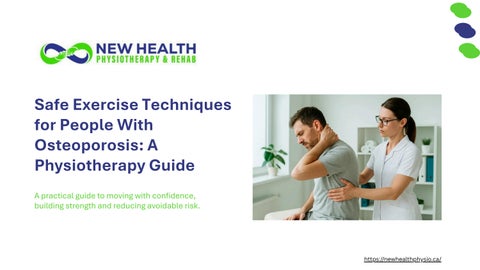
Safe Exercise Techniques for People With Osteoporosis: A Physiotherapy Guide A practical guide to moving with confidence, building strength and reducing avoidable risk.
https://newhealthphysio.ca/
Why safe movement matters Osteoporosis weakens bone strength. The right exercise plan supports function while respecting fracture risk.
01 Build strength
02 Improve balance
03 Move with confidence
Progressive resistance exercise helps maintain muscle function and supports bone health.
Balance and functional training can reduce falls — a major cause of fractures.
Posture, controlled technique and suitable exercise choices help make activity safer.
Physiotherapy Treatment for Osteoporosis should be tailored to fracture history, fitness, symptoms and individual goals.
https://newhealthphysio.ca/
Before you start: make safety personal A physiotherapist can adapt the programme to your medical history and current ability.
01 Review your risk
02 Set a safe starting point
Discuss previous fractures, spinal or hip pain, balance, falls, medications and other health conditions.
Check posture, walking, sit-to-stand ability, strength, balance and any movement limitations.
03 Choose the right support
04 Know when to stop
Use a stable chair, counter or rail for standing exercises. Wear supportive, non-slip footwear.
Stop and seek clinical advice for new sharp pain, sudden back pain, dizziness, chest pain or unusual breathlessness.
After a recent fracture, new or worsening pain, or high fracture risk: get individual clinical guidance before progressing.
https://newhealthphysio.ca/
03
03 / TECHNIQUE
Four spine-safe movement principles Use these cues during exercise and everyday activities.
01 Keep a long, neutral spine
02 Bend through hips and knees
Stand tall; keep shoulders relaxed and gaze forward. Avoid slumping or rounding the back under load.
For reaching or lifting, hinge at the hips and bend the knees rather than folding through the spine.
03 Move slowly and smoothly
04 Breathe; do not strain
Avoid fast, forceful or end-range twisting and repeated loaded forward bends.
Exhale through effort. Avoid holding your breath, jerking or pushing through pain.
https://newhealthphysio.ca/
04
04 / AEROBIC ACTIVITY
Choose weight-bearing movement that fits Start with comfortable, low-impact options; progress only when your clinician says it is appropriate.
Begin gradually
Use safe surroundings
Try short bouts at a comfortable pace. Build duration before intensity.
Choose even surfaces, good lighting and supportive shoes. Use a rail if needed.
• Elliptical trainer
Check your response
High impact is not for everyone
• Stair-step machine (if safe)
You should be able to speak in short sentences. Adjust if symptoms appear.
Running, jumping and vigorous impact need individual fracture-risk assessment.
GOOD STARTING OPTIONS
• Brisk or steady walking • Low-impact aerobics
https://newhealthphysio.ca/
05
05 / STRENGTH
Build strength with controlled resistance Progressive resistance training can target major muscle groups, including the legs, back and abdomen.
A
Sit-to-stand
Use a firm chair. Lean slightly from the hips with a long spine, stand up smoothly, then sit with control.
B
Wall push-up
Hands on wall at chest height. Keep the body aligned; bend elbows gently, then press away.
C
Resistance-band row
Anchor safely. Pull elbows back while keeping shoulders relaxed and chest open; return slowly.
Technique first: Begin with light resistance and a manageable range. For the Best Physiotherapy for Frozen Shoulder, increase repetitions or resistance gradually under professional guidance to support safe movement and improve shoulder mobility.
https://newhealthphysio.ca/
06
06 / BALANCE & FUNCTION
Train balance to help prevent falls Practise near a sturdy support. Keep the challenge appropriate to your current balance.
01 Supported heel raises
02 Side-to-side weight shifts
03 Heel-to-toe walking
Hold a counter. Rise onto the balls of your feet, pause, then lower slowly.
Stand tall and shift weight gently from one foot to the other without leaning or twisting.
Walk beside a counter, placing one foot in front of the other. Use support as needed.
Practice regularly — Canadian guidance recommends balance and functional training at least twice per week. Make it easier: widen your stance, slow down or use both hands for support. Make it harder only with supervision.
https://newhealthphysio.ca/
07
07 / MOVEMENT CHOICES
Movements to modify — and safer alternatives The goal is not to avoid all activity. It is to adapt higher-risk movements to your fracture risk. MODIFY / AVOID
TRY INSTEAD
Repeated deep forward bends
Hip hinge with knees bent
Especially when holding weight or rounding the back.
Keep the spine long; move through hips and knees.
Fast or forceful trunk twists
Turn with your feet
Especially repeated, loaded or end-range twisting.
Step around rather than twisting through the waist.
Combined bend + twist
Keep loads close
Avoid lifting and turning at the same time.
Split loads, ask for help or use equipment.
Specific restrictions depend on fracture history and risk. Ask your physiotherapist how to adapt yoga, Pilates, lifting and daily tasks.
https://newhealthphysio.ca/
08
08 / PUTTING IT TOGETHER
A safe routine is consistent — and individual Use this as a discussion starter, not a one-size-fits-all prescription.
2+ days / week
2+ days / week
Across the week
Balance and functional practice, such as supported heel raises and sit-to-stands.
Progressive resistance for major muscle groups, including back extensors and abdominals.
Add suitable weight-bearing activity, such as walking, based on ability and clinical advice.
Physiotherapy Treatment for Osteoporosis works best when exercise choice, technique and progression match the person.
Track how you feel. Progress one factor at a time — repetitions, resistance, duration or balance challenge. Review the plan if pain, falls or health status change.
https://newhealthphysio.ca/
09
NEXT STEP
Move safely. Build strength. Stay active. Get guidance that reflects your goals, movement ability and fracture risk.
New Health Physiotherapy & Rehab Book a physiotherapy consultation 226-337-9696
|
newhealthphysio@gmail.com
561 York Rd Unit 11, Guelph, ON, N1E 3J3, Canada
Your movement plan should be safe, practical and designed around you.