
8 minute read
Energy saving

The increased energy price cap and cost of living crisis means that people are looking for ways to make their heating more efficient. Here are some quick wins you can suggest that will help make a difference.
The energy price cap rise last month sent fuel bills up sharply for around 22 million customers in the UK – and they’re expected to go up again later this year. This, as well as living costs that are rocketing at their fastest rate for 30 years, is prompting people to look for ways to reduce their outgoings.
We know that many heating engineers are getting calls from their customers seeking advice on how to save money on their heating bills. So what options are available? Here are 10 top tips that you can share with your customers.
1. Fit thermostatic radiator valves
Millions of homes still lack even basic controls such as thermostatic radiator valves (TRVs). TRVs monitor the temperature of the air around the radiator and automatically adjust the amount of hot water that enters the radiator, depending on whether or not each individual room is at the correct temperature, making sure the room doesn’t overheat. A standard TRV can cost as little as £20.
Martyn Bridges, director of Technical Services at Worcester Bosch, says: “For a relatively inexpensive cost, installing TRVs will help your customers control each room temperature individually. It is one of the best ways of saving energy, evidenced by the fact that TRVs can save on average 18 per cent over an uncontrolled radiator. The consumer payback is likely to be less than two years.”
2. Upgrade the thermostat
Studies show that advanced room thermostats can help reduce fuel consumption for many households. A 2021 BEAMA study found that replacing a standard room thermostat with a directly modulating one could reduce the gas used during the heating season by up to 12 per cent.
Martin Wilson, sales director at Resideo, says: “The study was conducted in partnership with Salford University, HVAC authority, OpenTherm Association, and several manufacturers, including Resideo. It also found that installing a room thermostat with proportional on/off load compensation, as a direct replacement for a standard option, can reduce the gas used for heating by around 10 per cent over the peak period.”
3. Add weather or load compensation
Weather-compensated heating controls monitor the temperature of the air outside as well as inside, adjusting the boiler so that it provides heat only when necessary. This is particularly useful in homes that have large windows or poor insulation, in which the internal temperature can be more affected by changes outside.
Darren McMahon, marketing director at Viessmann, says: “Most radiators are able to heat a room from around 40˚C upwards, depending on the outside temperature. All Viessmann boilers contain weather compensation software as standard and require an outside weather compensation sensor, costing in most cases less than £30.
“Used with the free ViCare app, the cost of introducing these controls would be paid back in a matter of months and go on to comfortably deliver 15 per cent savings.”
4. Zone the home
Creating heating zones inside the home makes sure that rooms are only heated when they are in required, instead of the entire property being heated whenever there is a demand for heat. Installing a thermostat that has zoning capabilities, along with connected TRVs, means users can specify which rooms they want heated at any given time. They or their heating engineer will need to take the time to create the correct zoning programme through a smartphone app or on the thermostat.
5. Reduce the boiler flow temperature
Some energy suppliers are recommending their customers should reduce their boiler temperature to lower their fuel bills. But if this isn’t done correctly, it can cause radiators not to heat up correctly.
David Stanley, UK technical service manager at Intergas Heating Solutions, says: “Set the flow temperature according to the system design. With a standard combination boiler, start with a flow target temperature setting on the boiler of around 60˚C for the heating and 55˚C for the hot water. Many homes have oversized radiators that allow you to run lower flow temperatures, but radiators must be balanced and the system cleaned and treated to BS 7593:2019.
“When the system has a hot water cylinder, it’s more problematic to run lower flow temperatures: the cylinder won’t be able to satisfy the higher temperatures and, crucially, regular disinfection of the hot water tank could be affected.
“It’s best not to set the flow temperature on the boiler below 60˚C to allow for pasteurisation of the hot water storage. The hot water cylinder thermostat should also be adjusted to 60˚C.”
6. Treat the system water
Dirt and air can have a significant impact on the efficiency of the heating system. Checking the quality of the water, and then introducing chemicals to treat any sludge or magnetite found, can help make the system more efficient and reduce fuel bills.
Dave Goodyer, area sales
A gas engineer’s view
Simon Ashman, heating engineer at Red Panda Heating Solutions, says: “For a low to middle-income family, chances are they won’t have thousands of pounds spare to revolutionise their heating and hot water. What they need is simple, low-cost advice.
“If a customer has a modest budget of £500, my priority would be to investigate how the insulation/draught proofing could be improved, point them towards government grants, then quote for the installation of thermostatic radiator valves and a sophisticated programmable temperature control, preferably offering load compensation, along with a service of the boiler and a sample of the system water quality.
“Simple advice on how to maximise efficiency from the existing boiler remains essential, along with an appreciation of the more obvious correlation between lowering room set temperatures and reduced energy consumption. For a comparatively modest investment, compared to changing the heat source, running costs will significantly reduce, with a reassuringly quick payback period.”
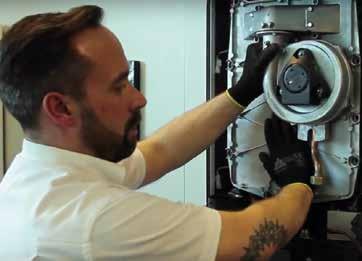
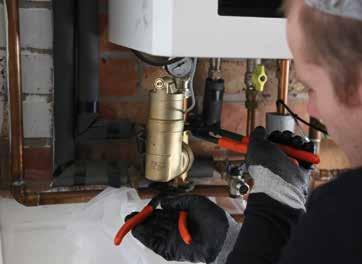
Reduce the flow temperature according to the system design Treat the system water
How can you help cut your
customers’ heating bills? (continued)
Zone the home
Balance the system manager at Spirotech, says: “A key sign of a contaminated heating system is radiators that don’t heat up fully, resulting in the homeowner needing to run the heating at a higher temperature or for longer. Radiator cold spots can be caused by both air and dirt, with cold spots at the bottom indicating a build-up of dirt, and cold spots at the top indicating trapped air.
“Regular bleeding will only go so far in helping to improve the efficiency of the system. Ultimately, trapped air and dirt force the boiler to work harder to deliver the level of warmth that the customer is looking for.”
7. Balance the system
Balancing the heating system ensures there is an equal flow of hot water throughout the system, preventing radiators that are too hot in one room and lukewarm in others, causing householders to turn up their heating and incur higher bills overall. This is especially true if the heating system runs on a lower flow temperature.
Remi Volpe, managing director at Drayton, says: “When running a system on a lower flow temperature, it is crucial to ensure that the system is correctly balanced and that radiators are correctly sized for the rooms.
“One of the easiest ways to balance a system is using radiator valves. Many TRVs enable engineers to set the heat output of the radiator, which should be determined for each room based on heat loss calculations. If not done correctly, homeowners are likely to find that the radiators farthest from the boiler do not heat up to the desired temperature.”
8. Insulate
Homes can lose 25 per cent of their heat through an uninsulated roof, and every loft should be insulated with 270mm of mineral wool insulation.
Fitting 270mm of loft insulation into the uninsulated roof of a semi-detached property could cost around £300, saving £165 per year. Insulating the roof of a detached home might cost £395 but could save £380 a year on energy bills, according to the Energy Saving Trust (EST).*
Don’t forget to lag tanks, pipes and radiators to reduce heat loss. An 80mm hot water cylinder jacket can cost as little as £15, is easy to fit, and could save around £95 every year compared with an uninsulated cylinder. Wrapping hot water pipes with a foam tube (costs around £1.50 per metre) will also help reduce the amount of heat lost.
9. Draught-proof
Gaps in walls and floors, or around doors and windows, can cause draughts that let cold air in and will make people feel colder. Draught-free homes tend to feel more comfortable at lower temperatures, which can encourage people to turn down their thermostats. Consider fitting draught-proofing strips around windows, and draught excluders along the bottom of external doors, to prevent heat from escaping.
Fill small gaps around pipework, block cracks in floorboards and skirting, and fit a draught excluder into the chimney of an open fireplace to prevent heat loss.
10. Upgrade the boiler
Generating heat and hot water accounts for more than half of a property’s energy usage, so an efficient boiler can really help reduce bills. It might not be the lowest-cost option, but if your customer’s boiler has become inefficient over time, is not a condensing boiler, or is starting to need replacement parts, it could be worth considering a complete upgrade – especially if they are planning to stay in their property for a long time.
The EST says replacing an old, F-rated gas boiler with an A-rated condensing model and TRVs could save £170 a year in a semi-detached house. ■
* www.energysavingtrust.org.uk/ energy-at-home/reducing-home-heat-loss
