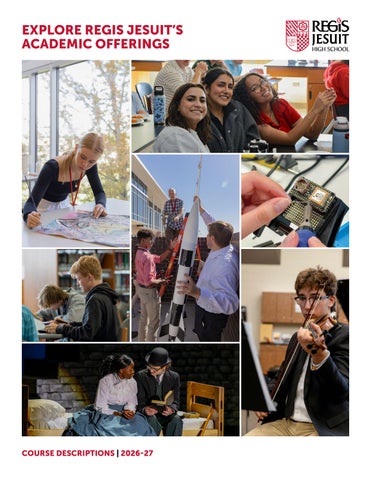
EXPLORE REGIS JESUIT’S ACADEMIC OFFERINGS
COURSE DESCRIPTIONS | 2026-27
Course Descriptions | 2026-27 Academic excellence is a cornerstone of the Regis Jesuit experience. Our comprehensive curriculum challenges students to think critically, explore their interests and pursue their academic potential. From foundational coursework to advanced opportunities, including Advanced Placement (AP) and dual enrollment courses, students are encouraged to challenge themselves and grow as learners. Explore our course catalog for a complete listing of courses and descriptions, reflecting the breadth, depth and rigor of a Regis Jesuit education.
CONTENTS Classical & Modern Languages............................................................................... 3 English.................................................................................................................................................................. 9 Fine Arts & Media Technology.............................................................................. 12 Health & Physical Education....................................................................................18 Mathematics......................................................................................................................................... 21 Performing Arts...............................................................................................................................25 Science........................................................................................................................................................... 29 Social Studies......................................................................................................................................33 Theology......................................................................................................................................................36
Classical & Modern Languages ANCIENT GREEK Ancient Greek 1
GRADE LEVEL: 11 & 12
Ancient Greek is a year-long, beginning language course which teaches the language mainly through reading in the target language. Students will read Greek for comprehension, translate from Greek into English and vice-versa, memorize and use vocabulary, study the origin of English words derived from Greek, and learn about ancient Greek culture and history. Prerequisite: 2 years of Latin, French, Spanish or Mandarin. (1 credit)
FRENCH French 1
GRADE LEVEL: 9–12
An introduction to the French language and culture, stressing proficiency in the five goals of foreign language learning (communication, cultures, connections, comparisons and communities). Students learn basic grammar concepts and begin to build a large bank of functional, high-frequency vocabulary. Proficiency in the five Cs is achieved through a variety of activities, based on the four standards of language learning: listening, reading, writing, and speaking. Students are introduced to the basic geography, culture, and history of Francophone countries. This is a beginning, year-long course for those who have not previously studied French or who have a minimal background and have been placed in this level. (1 credit, NCAA Approved)
Honors French 2
GRADE LEVEL: 9–12
A continuation of the study of the French language, stressing basic proficiency in the five language goals (communication, cultures, connections, comparisons and communities). In this year-long course, students expand their knowledge of the basic grammar concepts and increase their bank of functional, high-frequency vocabulary. Proficiency in the five Cs is achieved through a variety of activities; based on the four standards of language learning: listening, reading, writing, and speaking. Students are further introduced to the culture, literature, and history of Francophone countries. Prerequisite: French 1. (1 credit, NCAA Approved)
French 3
GRADE LEVEL: 10–12
This year-long course provides a review of previously-learned grammar concepts and an introduction to more complex grammar structures, such as the plus-que-parfait and the subjonctif. While students continue to develop proficiency in the five goals of language learning (communications, cultures, communities, comparisons and connections), emphasis is placed on the strengthening of all four standards: reading, writing, listening, and speaking. Students will continue to learn to appreciate cultural aspects of various Francophone countries. Prerequisite: Honors French 2. (1 credit, NCAA Approved)
Honors French 3
GRADE LEVEL: 10–12
This year-long course provides a solid foundation for the AP French Language & Culture course. Intermediate grammar concepts are reviewed, complex grammar structures are introduced, and students strengthen their knowledge of thematic vocabulary and related idiomatic expressions. Students will improve reading and writing skills through original French literature excerpts. Students develop more advanced proficiency in all five goals of foreign language learning (communications, cultures, communities, comparisons and connections), through listening, speaking, reading, and writing, with a continued appreciation of the treasures of Francophone civilizations. This course is intended for students performing at an advanced level (grade of “B” or better) entering from the Honors French 2 course. Prerequisite: Honors French 2. (1 credit, NCAA Approved)
CONTENTS
3
AP French Language
GRADE LEVEL: 11 & 12
The fourth-year French Language course enables students to develop advanced proficiency in the language skills of listening, speaking, writing, and reading. This year-long course emphasizes the use of the French language to improve oral and written comprehension in a variety of contexts and engages the students to explore the different cultures of Francophone countries. Students will learn to use the three modes of Communication: Interpersonal, Interpretive and Presentational. They will be required to read articles and excerpts from French magazines, newspapers and literary texts and to listen to original audio sources. The College Board’s Curriculum Framework, will be the focus of the teaching and learning throughout the entire year: global challenges, science and technology, contemporary life, beauty and aesthetics, families and communities, and personal and public identities. Prerequisite: Honors French 3. (1 credit, NCAA Approved)
French Civilization & Culture
GRADE LEVEL: 11 & 12
French Civilization and Culture is a fourth year, year-long course that offers an in-depth study of French and Francophone cultures and influences in the world, past and present. History, geography, contemporary cultures will be appreciated within various contexts such as politics, education, immigration, religion, etc. through French films. Knowledge of Level 3 French, vocabulary and grammar, as well as intermediate reading skills are required. Needed skills will be developed in the process of this course, such as contextual grammar, structure and vocabulary. Prerequisite: French 3, Honors French 3, or AP French. (1 credit, NCAA Approved)
LATIN Latin 1
GRADE LEVEL: 9–12
Latin 1 is a year-long, beginning course which teaches Classical Latin through reading. Students engage in the following activities: reading Latin aloud and silently, translating Latin sentences into English and vice-versa, memorizing and using vocabulary, developing listening skills, studying the origin of English words derived from Latin, and learning about Roman daily life and the history of the Roman Empire. (1 credit, NCAA Approved)
Honors Latin 2
GRADE LEVEL: 9–12
Honors Latin 2 follows Latin 1 as a year-long thorough study of the Latin language. By the end of the year, the student will have been introduced to most major syntactic forms, will have further explored the culture of the ancient Romans, and will continue to practice translating and reading comprehension. Prerequisite: Latin 1. (1 credit, NCAA Approved)
Honors Latin 3
GRADE LEVEL: 9–12
This year-long course reviews and completes the grammar and skills learned in Latin 1 and Honors Latin 2 and explores different genres of Roman Literature. The historical context of these writings will be of significant importance. Students will improve their proficiency in sight-reading and translating without the aid of reference materials. The course will provide solid preparation for AP Latin 4 for those students who make that their goal for the following year. Prerequisite: Honors Latin 2. This course is eligible for dual-enrollment credit through the SLU 1818 Advanced College Credit program. (1 credit, NCAA Approved)
AP Latin
GRADE LEVEL: 11 & 12
This year-long course is designed to prepare the student to translate and understand major sections on Vergil’s Aeneid and Caesar’s De Bello Gallico. By supplementing the translation and reading with additional readings in the epic and prose genres, as well as historical background of the authors, the student will gain understanding of both the time period and importance of the works in their historical contexts. In this course, students will use their knowledge of Latin grammar and vocabulary in order to read Roman literature not only with comprehension but also with an appreciation for their literary value. The spring AP exam is strongly encouraged. Prerequisite: Honors Latin 3. This course is eligible for dual-enrollment credit through the SLU 1818 Advanced College Credit program. (1 credit, NCAA Approved)
CONTENTS
4
Advanced Classical Languages & Literature
GRADE LEVEL: 11 & 12
This year-long course is designed as a further exploration of Roman authors in poetry and prose based on student interest. The course may also include an introduction to, or further study of, Ancient Greek based on student preparation and interest. Prerequisite: AP Latin. (1 credit, NCAA Approved)
MANDARIN Mandarin 1
GRADE LEVEL: 9–12
This year-long course will not only offer language lessons in Mandarin Chinese--a powerful economic language of the future--but also a cultural education. The native language instructor, with extensive experience in teaching Mandarin Chinese, will prepare students for more in-depth study of this or other world languages and contribute to the student’s greater knowledge of his or her own language, understanding of cross-cultural communication, and interest in issues here and abroad. (1 credit, NCAA Approved)
Mandarin 2
GRADE LEVEL: 9–12
This year-long course is a continuation of Mandarin 1. It is open to students who have completed Mandarin 1 or an equivalent level. Mandarin 2 students will increase their skills to write essays, read short articles, engage in more complex conversations and be able to understand detailed presentations. The native language instructor, with extensive experience in teaching Mandarin Chinese, will prepare students for continued in-depth study of this world language culture. Open to sophomores, juniors and seniors who are in compliance with Classical Modern Language requirements for graduation, or freshman who have taken the placement test. Prerequisite: Mandarin 1. This course is eligible for dual-enrollment credit through the SLU 1818 Advanced College Credit program. (1 credit, NCAA Approved)
Mandarin 3
GRADE LEVEL: 9–12
This year-long course is a continuation of Mandarin 2. It is open to students who have completed Mandarin 2 or an equivalent level. Mandarin 3 students will increase their skills to write essays, read articles, engage in more complex conversations, and understand detailed presentations. Prerequisite: Mandarin 2. This course is eligible for dual-enrollment credit through the SLU 1818 Advanced College Credit program. (1 credit, NCAA Approved)
Mandarin 4
GRADE LEVEL: 9–12
This course provides a fourth-level Mandarin Chinese class on a non-AP track, which is designed to further develop proficiency skills (interpretive, interpersonal, presentational) through a theme-based learning content. Students review basic and complex grammar concepts in speaking, reading, and writing. This course also focuses on improving reading comprehension and writing skills. New reading and writing techniques are taught through a variety of learning materials and practices (e.g., classic and modern literature, four main types of writing; narrative, expository, persuasive, and descriptive). Prerequisite: Mandarin 3. This course is eligible for dual-enrollment credit through the SLU 1818 Advanced College Credit program. (1 credit, NCAA Approved)
AP Chinese Language & Culture
GRADE LEVEL: 10–12
The AP Chinese program at RJHS offers high school students an opportunity to learn college-level Chinese language and culture. In this year-long course, students will intensively practice Chinese in three modes: interpersonal, interpretive, and presentational. In addition, they will develop Chinese language skills in the five goal areas: communication, cultures, connections, comparisons, and communities. Students will strive to speak Chinese with a higher level of fluency. They will read articles and write essays in Chinese, while becoming familiar with the Chinese culture. This course will prepare students to take the CollegeBoard AP Chinese Language & Culture exam in May. Prerequisite: Mandarin 3. This course is eligible for dual-enrollment credit through the SLU 1818 Advanced College Credit program. (1 credit, NCAA Approved)
CONTENTS
5
Advanced Chinese Conversation & Reading (DE)
GRADE LEVEL: 10–12
This course is designed to meet the individual needs of a student! The work is chosen by the student and the teacher with approval of the school and/or the World Language Department. This one-year long course is to enhance students’ language production in speaking and writing throughout the project-based instruction. Students will also continue to improve their reading comprehension skills through a variety of literary selections from China. This course will be conducted in a Mandarin Chinese immersion setting (the target language is used for 90% or more of class time). Students are also expected to communicate with the teacher and others in the target language during the class. Prerequisite: Mandarin 4 or AP Chinese (1.0 credit)
SPANISH Spanish 1
GRADE LEVEL: 9–12
An introduction to Spanish language and culture, stressing the five goals of language learning: communication, culture, connections, communities and comparisons known as the Five Cs. Students use the skills of listening, speaking, reading and writing to learn basic grammar concepts and begin to acquire a large bank of high-frequency vocabulary. Students immediately start speaking Spanish using simple phrases and sentences. The communicative skills are practiced through a variety of activities: skits, presentations, music, conversation, and audio exercises. Spanish culture is discovered through texts, videos and projects. This is a year-long, beginning course for those who have not studied Spanish previously or who have a very minimal background and have been placed at this level. (1 credit, NCAA Approved)
Spanish 2
GRADE LEVEL: 9–12
This year-long course is a continuation of the study of the fundamentals of the Spanish language, stressing the five goals of language learning: communication, culture, connections, communities and comparisons known as the Five Cs. Proficiency is achieved using a variety of activities including listening, speaking, reading and writing. Students expand their knowledge of basic grammar concepts and high-frequency vocabulary. The communicative skills are practiced through a variety of activities: skits, presentations, music, conversation, and audio exercises. Spanish and Latin American culture is discovered through texts, videos and projects. Prerequisite: Spanish 1. (1 credit, NCAA Approved)
Honors Spanish 2
GRADE LEVEL: 9–12
This year-long course is a continuation of the study of the fundamentals of the Spanish language, stressing the five goals of language learning: communication, culture, connections, communities and comparisons known as the Five Cs. Proficiency is achieved using a variety of activities including listening, speaking, reading and writing. Students expand their knowledge of basic grammar concepts and high-frequency vocabulary. The communicative skills are practiced through a variety of activities: skits, presentations, music, conversation, and audio exercises. Spanish and Latin American culture is discovered through texts, videos and projects. This course is intended for students performing at an advanced level entering from Spanish 1. The fast-paced, rigorous nature of this course requires daily practice and review both in class and independently. Prerequisite: Spanish 1. (1 credit, NCAA Approved)
Spanish 3
GRADE LEVEL: 10–12
This year-long course provides a review of the previously-learned grammar concepts and an introduction to more complex grammatical structures. This course is also a continuation of the study of the five goals of language learning: communication, culture, connections, communities and comparisons known as the Five Cs. While students continue to develop proficiency in the communicative skills of listening and speaking, the particular focus of this course is on the strengthening of reading and writing skills through the study of literary and cultural texts and the crafting of compositions. Basic grammar is reviewed, and more complex grammar is introduced. Prerequisite: Spanish 2, Honors Spanish 2. (1 credit, NCAA Approved)
CONTENTS
6
Honors Spanish 3
GRADE LEVEL: 9–12
This year-long course provides a review of the previously learned grammar concepts and an introduction to more complex grammatical structures. While students continue to develop proficiency in the communicative skills of listening and speaking, the particular focus of this course is on the strengthening of reading and writing skills through the study of literary and cultural texts and the crafting of compositions. This course provides a solid foundation for the AP Spanish Language course. Proficiency is achieved using listening, speaking, reading and writing. Activities include skits, presentations, music, conversation, and audio exercises. Spanish and Latin American culture is discovered through texts, videos and projects. The fast-paced, rigorous nature of this course requires daily practice and review both in class and independently. Prerequisite: Honors Spanish 2, Spanish 2. (1 credit, NCAA Approved)
Spanish for Heritage Speakers
GRADE LEVEL: 9 & 10
Designed for 9th and 10th grade heritage learners of Spanish who already have some oral language proficiency, this year-long course can accommodate students from a wide range of linguistic backgrounds. Students will build upon their current language skills to develop language and cultural literacy. This course will guide students to understand the grammatical foundation of Spanish, and to develop a deeper appreciation for their own cultural heritage. During this course, students will gain confidence using Spanish to express their own thoughts on social and academic themes, interact with other speakers of the language, understand oral and written messages, and make oral and written presentations. Following completion of this course, student will transition into the AP Spanish Language course or Spanish 3 Honors depending on the level of written literacy demonstrated at the end of our Heritage Speakers sequence and the grade level of the student. (1 credit, NCAA Approved)
Spanish Civilization & Culture
GRADE LEVEL: 11 & 12
In this year-long course, students will analyze and discuss the civilization, history, current events, literature, art and film of both historical significance and modern-day relevance of the Spanish-speaking world. Through discussion, conversation, listening, reading, and writing in the target language, students will develop their Spanish proficiency and gain an appreciation for the diverse traditions, customs, and people of Spanish-speaking countries. This course is taught primarily in Spanish, and emphasis will be placed on learning through using the target language in an immersion setting. Prerequisite: Spanish 3, Honors Spanish 3. This course is eligible for dual-enrollment credit through the SLU 1818 Advanced College Credit program. (1 credit, NCAA Approved)
Spanish Conversation & Reading
GRADE LEVEL: 11 & 12
Designed for students who want to become more confident and comfortable speaking Spanish, this year-long course puts conversation at the center of the learning experience. Students will build on the skills they developed in previous Spanish courses and put their Spanish into practice through engaging discussions, creative interactions, and real-world communication in a supportive environment that encourages students to take risks and grow in confidence. Through readings, conversations, and other authentic materials, students will also explore how culture shapes our perspectives, values, expectations, and ways of interacting with others. The course will be conducted primarily in Spanish where students will strengthen vocabulary and grammar as tools for communication with an emphasis on using the language to connect, exchange ideas, and broaden students’ understanding of the world. Prerequisite: Spanish 3 or Honors Spanish 3. (1 credit, NCAA Approved)
AP Spanish Language & Culture
GRADE LEVEL: 10–12
This year-long course, taught in Spanish, centers on preparing students to take the AP Spanish Language and Culture exam. Students will review grammar outside of class (from a text written in Spanish). In class, students will discuss literature (read outside of class) write 45-minute compositions, give oral presentations, be exposed to samples of a variety of media in the target language, record dialogues, and practice listening and reading skills. It is important that the student taking AP Spanish Language and Culture is detail-oriented, willing to learn an extensive amount of vocabulary and grammar concepts outside of class, and willing to speak entirely in Spanish. Prerequisite: Either Spanish for Heritage Speakers, Honors Spanish 3, or Dept. Chair approval (1 credit, NCAA Approved)
CONTENTS
7
AP Spanish Literature & Culture
GRADE LEVEL: 11 & 12
This course is equivalent to a third-year university survey course, which covers the six AP Spanish Literature themes and the entire reading list (as prescribed by the College Board) outlined within the AP Spanish Literature and Culture Curriculum Framework. The course is conducted entirely in Spanish and covers Spanish and Latin American authors, and their works, from the medieval period to the present day. The full-year course and its activities are intended to teach and enhance a student’s ability to acquire, identify, understand, discuss, interpret and analyze the form and content of literary works of prose, poetry and drama along with the literary terms and conceptual aspects of art and history of the time. All students are highly encouraged to take the Advanced Placement Exam in Spanish Literature and Culture in May. Prerequisite: AP Spanish Language & Culture. (1 credit, NCAA Approved)
Advanced Spanish for Heritage Speakers
GRADE LEVEL: 12
This year-long course for 12th-grade heritage Spanish learners enhances language skills and cultural literacy while deepening understanding of Spanish grammar and cultural heritage. Students will gain confidence in expressing themselves on social and academic topics and improve their communication skills. The course also emphasizes reconciliation and justice, encouraging students to pursue personal growth and societal transformation through compassion, equity, and integrity. By fostering critical reflection and active engagement, students will develop the skills to address injustice and promote reconciliation, empowering them to become agents of change. Prerequisite: AP Spanish Literature or permission of department chair.
CONTENTS
8
English ENGLISH COURSE PROGRESSION Foundations of Language & Composition
GRADE LEVEL: 9
Our 9th-grade English course is designed to help students flourish at Regis Jesuit and build a firm foundation in writing, reading, and critical thinking skills. This course exceeds college entrance requirements and offers a rigorous, collegepreparatory, and skill-based experience that includes a comprehensive, goal-setting approach with individualized reading and writing support. The course focuses on creative and expository writing, grammar and mechanics, and analysis of fiction, non-fiction, poetry, and drama. Teachers tailor writing instruction to help students develop and hone their academic voice, while mastering writing conventions and engaging in a diverse set of texts that foreground powerful themes about identity, self-knowledge, and belonging. This class will prepare students for Language & Composition 2 or Honors Language & Composition 2. (1.0 credits)
Language & Composition 2
GRADE LEVEL: 10
The purpose of the Language & Composition 2 course is to develop and expand upon the groundwork of Foundations of Language & Composition course, with a focus on critical reading and writing. In this year-long course students will develop and foster an understanding of the universality of literature and further establish a personal connection to the works studied. In addition to literary analysis, students will develop strong rhetorical skills that will create competence and confidence in the expression of their ideas. (1 credit, NCAA Approved)
Honors Language & Composition 2
GRADE LEVEL: 10
The purpose of the Language & Composition 2 course is to develop and expand upon the groundwork of Foundations of Language & Composition, with a focus on critical reading and writing. In this year-long course students will develop and foster an understanding of the universality of literature and further establish a personal connection to the works studied. In addition to literary analysis, students will develop strong rhetorical skills that will create competence and confidence in the expression of their ideas. Students enrolled in the Honors section of the course will have demonstrated a stronger skill level in these areas, and the pace and workload of the class will reflect a more advanced approach to the topics of study. (1 credit, NCAA Approved)
American Literature & Composition
GRADE LEVEL: 11
The rich American tradition of non-fiction and fiction provides the foundation for this American Literature course. It seeks to recognize literature as a record of American experiences and understand its place in the inception and growth of America. Focus will include the major literary movements throughout American literature ranging from the literature of early America to contemporary literature. The course will explore diverse voices, issues of race, social justice and questions of identity in revealing how America has evolved as a nation. Throughout the year we will explore the various expository modes of writing, including literary analysis, rhetorical analysis, and argument in non-fiction and fiction. (1 credit, NCAA Approved)
AP English Language & Composition
GRADE LEVEL: 11
The rich American tradition of non-fiction and fiction will provide the foundation for this college-level course. This yearlong course addresses the same topics as the American Literature and Composition course but also involves extensive reading, discussion, critical analysis, analytical writing, and preparation for the College Boards Advanced Placement English Language and Composition Examination. Authors to be studied include Thomas Paine, Thomas Jefferson, Ben Franklin, Ralph Waldo Emerson, Henry David Thoreau, Abraham Lincoln, Frederick Douglass, Willa Cather, Edith Wharton, Kate Chopin, John Steinbeck, Tennessee Williams, Truman Capote, Maya Angelou, Sojourner Truth, Martin Luther King, and many others. (1 credit, NCAA Approved)
CONTENTS
9
SENIOR ENGLISH OFFERINGS AP English Literature
GRADE LEVEL: 12
This year-long college-level course involves extensive reading, discussion, critical analysis, analytical writing, and preparation for the College Board’s Advanced Placement English Literature and Composition Examination. Students will study a wide variety of authors and works primarily from British and American literature and will help students develop their writing for a variety of purposes. This course is eligible for dual-enrollment credit through the SLU 1818 Advanced College Credit program. (1 credit, NCAA Approved)
ENGLISH ELECTIVES Women in Literature
GRADE LEVEL: 12
In this semester-long course students will utilize and develop their skills for reading critically, analyzing literature, and writing for a variety of purposes in the context of their study of women in literature. Topics will emphasize how women are represented in and have contributed to literary tradition using a wide selection of representative texts written by women. Students will examine the relationship of women’s writing to their entire experience in literature with reference to various genres, including biography, poetry, fiction and non-fiction. This course is offered only to seniors as one semester of their full-year requirement in English. (0.5 credit, NCAA Approved)
Literature into Film
GRADE LEVEL: 12
Through careful reading of selected literary works, writing about these works and viewing the films based on these works, students study, in this semester course, the relationship between the written and filmed interpretations. Exploring the differences challenges students to understand the moral and social implications of each version. (0.5 credit, NCAA Approved)
Detective Fiction Genre & Archetypes
GRADE LEVEL: 12
This semester course will expose students to the history of detective fiction in the Western prose tradition. This course aims to develop critical reading and writing skills with an emphasis on elements of fiction such as setting, character, plot and point of view. Students will analyze a variety of works by American and world authors. (0.5 credit, NCAA Approved)
Perspectives of War
GRADE LEVEL: 12
Students will examine, discuss and respond to works of literature that interpret the experience of war and its consequences. In this semester course, students will look at conflicts from the early 1900’s to the 2000’s and study how the literature from those wars depict the best and worst human behavior under the most extreme conditions. This course will allow students to read a variety of genres such as: poetry, fiction, non-fiction and a graphic novel. The readings include works from the soldier’s perspective as well as from the civilian’s perspective. (0.5 credit, NCAA Approved)
Black Literature
GRADE LEVEL: 12
This is a semester course in which we will survey a very large temporal area, from the late-18th century to the present, a scope that will give you a broad sweep of the African American literary landscape, and in a variety of genres. We will read these texts not only within race-specific contexts, but also-and perhaps more importantly-as American literature. The objectives of this course are to give students an introduction to the vast array of prose, poetry, and drama that make up much of African American literature; to provide the opportunity to explore the diverse nature of this literature; to help students develop a deeper understanding of the ever-evolving issues involved in defining the American literary canon; and to encourage the reading of literature with a fine critical understanding and aesthetic appreciation. (0.5 credit, NCAA Approved)
CONTENTS
10
Creative Writing: Poetry & Fiction
GRADE LEVEL: 12
This semester course will offer students opportunities to explore their creative voices through the study and writing of poetry and fiction. Students will study the forms and elements of creative writing, learn interpretive and evaluative skills, and think and write critically as they develop their own creative voice. Aspects of the class will include in-depth analysis and practice of short stories, poetry, memoir, personal narrative, satire, and a variety of other creative writing styles and genres. This course is offered to seniors as one semester of their full-requirement in English. (0.5 credit)
Fantasy Fiction
GRADE LEVEL: 11 & 12
This semester-long senior elective will focus on the genre of fantasy literature. Through a close analysis of fantasy theory, origins, history, and a survey of major authors, students will explore the central tenets of the genre and what makes it so popular. Through class conversations, myriad readings, traditional essays, and class conversations, students will assess the power of fantasy literature to explore other worlds that tell us more about our own. (0.5 credits)
Reading and Writing for Advocacy and Social Change
GRADE LEVEL: 12
This coed immersion course for English credit both builds toward and follows up on the experience of attending the Ignatian Family Teach-In for Justice in Washington DC. Units will focus on the same themes highlighted at the IFTJ: migration, ecology, and advocacy. In addition to encountering and analyzing these issues through fiction and non-fiction texts and film, student will have the opportunity to participate in field trips working with local non-profit organizations that engage in migrants’ rights and environmental justice in the Denver area. This course requires travel to the Ignatian Family Teach-In for Justice in Washington, D.C. as well as other associated Immersion experiences. (0.5 credit).
CONTENTS
11
Fine Arts & Media Technology FINE ARTS Fine Art 1
GRADE LEVEL: 9–12
Students are introduced to the basic elements and principles of art through hands-on experience. Areas of study include portraiture, figure drawing, contour, design, composition, and art appreciation. Art mediums include pencil, color pencil, pen and ink, etc. (0.5 credit)
Fine Art 2
GRADE LEVEL: 10–12
This semester course continues the topics of study from Fine Art 1, while exploring more in-depth study of artistic styles and techniques. Studio work covers colored pencil, watercolor, acrylic or oil painting and art appreciation. Prerequisite: Fine Art 1. (0.5 credit)
Sculpture 1
GRADE LEVEL: 9–12
In this class, students will consider the art of form within the practice of sculpture. We will use a combination of materials like paper, cardboard, wax, clay, plaster, 3D printing, and even casting techniques to realize different ideas in three-dimensional form. We will focus on improving hand skills in a three-dimensional space as well as participate in active group critiques and personal reflection of the work being done. Students can expect to get their hands dirty while they explore the physical world around them. This is an exciting introductory class to the world of sculpture and contemporary art. (0.5 credit)
Sculpture 2
GRADE LEVEL: 9–12
Students will expand their three-dimensional building skills utilizing STEAM tools and techniques. In this class students will work with the tools in the Innovation Center alongside traditional techniques like casting and welding to create individual projects designed to expand students’ knowledge and skills as three-dimensional artists. Prerequisites: Sculpture 1, Ceramics 1, or Maker Lab. (0.5 credits)
Oil Painting & Pastels 1
GRADE LEVEL: 9–12
This semester-long course deals with various mediums of drawing with pencil, pastel and oil paint. The primary objective of this class is to teach students, even those who have never painted before, to learn by “wholes”--the painting as a whole, an interplay of lines, shapes, colors, color mixing, textures, light and dark. Students will learn to manipulate the painter’s materials and develop a basic vocabulary with regard to qualities of paintings. Further, the course will explore the historical influences of drawing and painting and also allow students to analyze and critique professional works. Prerequisite: Fine Art 2. (0.5 credit)
Oil Painting & Pastels 2
GRADE LEVEL: 10–12
This semester-long course continues to deal with various mediums of drawing with pencil, pastel and oil paint. The primary objective of this class is for students to further enhance their understanding of “wholes”--the painting as a whole, an interplay of lines, shapes, colors, color mixing, textures, light and dark. Students will continue to manipulate the painter’s materials and develop their vocabulary with regard to qualities of paintings. Further, the course will continue to explore the historical influences of drawing and painting and also allow students to analyze and critique professional works. Prerequisite: Oil Painting & Pastels 1. (0.5 credit)
CONTENTS
12
AP Studio Art - Drawing
GRADE LEVEL: 11 & 12
This year-long course provides students with the opportunity to create a college-level portfolio for submission to the College Board for review and college credit. Students will develop a portfolio of work in drawing. Student work will illustrate competence in the three areas required by the College Board: quality, concentration, and breadth. In the quality section of the portfolio, students will demonstrate mastery of concept, composition, and execution. In the concentration section, students will comprise a body of related pieces that demonstrate growth and discovery in the exploration of a personal visual idea. In the breadth section, the students will demonstrate technical, conceptual, perceptual, and expressive range. The student work in the breadth section will show understanding of formal drawing issues, including mark making, use of light and shadow, line quality and representation/abstraction and composition. Prerequisite: Fine Art 2. (1 credit)
AP Studio Art - 2D Design
GRADE LEVEL: 11 & 12
In this year-long course students will create a college-level portfolio for submission to the College Board for review and college credit. Students will develop a portfolio of work in design, illustrating competence in the three areas required by the College Board: quality, concentration, and breadth. In the quality section of the portfolio, students will demonstrate mastery of concept, composition, and execution. In the concentration section, students will comprise a body of related pieces that demonstrate growth and discovery in the exploration of a personal visual idea. In the breadth section, students will demonstrate technical, conceptual, perceptual, and expressive range, showing understanding of the elements and principles of design including unity/variety, balance, emphasis, contrast, rhythm, repetition, proportion/scale, form, shape, space, texture, and figure/ground relationships where applicable. Prerequisite: Fine Art 2. (1 credit)
Independent Art
GRADE LEVEL: 11 & 12
This semester course involves directed, independent study in art. Students work in the area of their choice as approved by the instructor. Students are only allowed to register for this course if they have exhausted the other offerings in the Fine Art and Media Technologies Department, including both Fine Art 1 and Fine Art 2, and with the approval of the instructor and the Assistant Division Head. Prerequisite: AP Studio Art and Fine Art 2. (0.5 credit)
COMPUTER SCIENCE & DIGITAL MEDIA Digital Explorations
GRADE LEVEL: 9–12
Explore software with the intention of learning your favorite technological direction. Through a series of creative projects, you will get a taste for a variety of digital software programs from computer aided 3D design to video production, computer programming with HTML website building to architecture, this class is designed to help you explore today’s digital landscape and prepare you to pursue that direction here at RJ through higher-level classes. This course qualifies for membership in DECA. (0.5 credit)
Graphic Design 1
GRADE LEVEL: 9–12
This semester-long course is designed to provide students with a fundamental understanding of visual communication utilizing graphics, text and photo imagery. The most recent version of Adobe Photoshop will be used and students will be introduced to a broad range of image effects and photo manipulation. No prerequisites are required. This course qualifies for membership in DECA. (0.5 credit)
Graphic Design 2
GRADE LEVEL: 10–12
This semester-long course is designed to further the student’s understanding of graphic design as visual communication while learning the most recent version of Adobe Illustrator. Students will create vector-based graphics and design logos, posters as well as other creative illustration projects. Students will build upon their skills from Graphic Design I and be able to use both Adobe Photoshop and Adobe Illustrator in their work process. Open to Grades 10-12. Prerequisite: Graphic Design 1. This course qualifies for membership in DECA. (0.5 credit)
CONTENTS
13
Animation
GRADE LEVEL: 9–12
This semester course introduces students to the art of animation through a comprehensive exploration of both traditional and modern techniques. Students will learn Disney’s Twelve Basic Principles of Animation and apply them across various mediums, including 2D computer animation with Adobe Animate (covering tweening and frame-by-frame animation), 3D animation using Blender, and claymation. The course emphasizes creativity and technical skills, culminating in a final project where students design and produce an original animated short. Drawing experience is not necessary. (0.5 credit)
Architecture
GRADE LEVEL: 10–12
This semester course introduces students to architecture and computer-aided design. Using Chief Architect, students will develop custom homes, multi-family housing and commercial buildings. Students will explore aspects of architecture from historical, artistic and functional contexts with an emphasis on spatial design, ordering principles and fundamental architectural elements. In addition, this course will familiarize students with marketing and real estate principles as students analyze projects in real-world contexts. No prerequisites are required. (0.5 credit)
Computer Programming 1
GRADE LEVEL: 9–12
This semester course introduces students to computer programming with a focus on video game development. Students will learn the fundamentals of programming using the Python language, with an emphasis on the Pygame library for 2D game development, and will explore the use of artificial intelligence (AI) in coding. Additionally, students will gain hands-on experience with the Godot game engine for both 2D and 3D game creation. Core programming concepts covered include pseudocode, flowcharts, algorithms, variables, data types, control structures, looping, functions, object-oriented programming, and libraries. The course concludes with students developing their own video game projects. No experience necessary. This course qualifies for membership in DECA. (0.5 credit)
Computer Programming 2
GRADE LEVEL: 10–12
This semester course is an extension of Computer Programming 1. Students study Object Oriented Programming techniques in the context of the Java programming language. The semester concludes with large-scale projects designed by the students. This course is combined with Computer Programming 1 and is delivered in a hybrid online course format. Prerequisite: Computer Programming 1 or instructor approval. This course qualifies for membership in DECA. (0.5 credit)
AP Computer Science Principles
GRADE LEVEL: 10–12
AP Computer Science Principles introduces students to the central ideas of computer science, instilling the ideas and practices of computational thinking and inviting students to understand how computing changes the world. This rigorous course promotes deep learning of computational content, develops computational thinking skills, and engages students in the creative aspects of the field. Rather than teaching a particular programming language or tool, the course focuses on using technology and programming as a means to solve computational problems and create exciting and personallyrelevant artifacts. This course qualifies for membership in DECA. (1 credit, NCAA Approved)
AP Computer Science Programming A
GRADE LEVEL: 10–12
In this year-long course, students will learn to design and implement computer programs that solve problems relevant to today’s society, including art, media, and engineering. AP Computer Science Programming teaches object-oriented programming using the Java language and is meant to be the equivalent of a first semester, college-level course in computer science. It will emphasize problem solving and algorithm development, and use hands-on experiences and examples so that students can apply programming tools and solve complex problems. This course will prepare students for the end-of-course AP Computer Science A Exam. Prerequisite: Computer Programming 2 or AP Computer Science Principles. This course qualifies for membership in DECA. (1 credit)
CONTENTS
14
AP CK Cyber 1: Networking Fundamentals
GRADE LEVEL: 10–12
Explore the principles of computer networks and cybersecurity, learning how data flows through systems and how to protect digital assets. Build a foundation in network configuration and identify security vulnerabilities. Prerequisite: AP Computer Science Principles or AP Computer Science A (0.5 credits)
AP CK Cyber 2: Cybersecurity Fundamentals
GRADE LEVEL: 11 & 12
Explore the principles of computer networks and cybersecurity, learning how data flows through systems and how to protect digital assets. Build a foundation in network configuration and identify security vulnerabilities. Prerequisite: AP CK Cyber 1 (0.5 credits)
CINEMATIC ARTS Video & Film Production 1: Cinematic Arts
GRADE LEVEL: 10–12
Students will produce effective communication and storytelling in the cinematic arts through the study and practice of scripting, camera operation, audio production, lighting, and editing using Adobe Premiere. Emphasis is placed on developing a personal voice, and creating work that explores film and video as a unique art form. (0.5 credit)
Video & Film Production 2: Cinematic Arts
GRADE LEVEL: 11 & 12
This semester course will allow students to expand their knowledge of Adobe Premiere, Sound Track, Live Type, and Motion. Students will deepen their understanding of advanced filmmaking and apply techniques gleaned from their study of diverse directors. Through pre and post production, students will be in charge of the creative process. Prerequisite: Video & Film Production 1. (0.5 credit)
JOURNALISM & MEDIA PRODUCTION Journalism
GRADE LEVEL: 9–11
This semester course introduces students to the world of print and online media, video, and broadcast. The history of journalism, law, ethics, news literacy and Internet and social media responsibility, including 21st-century media convergence and civic duty to identify and analyze what is fair, balanced and true, will complement the major units of study: reporting, writing, editing, photography, videography, multimedia production and publishing, and design. Students will have the opportunity to use state-of-the-art software for graphic design, photography, magazine publishing and video production tools. During this semester course students will work as reporters on staff to support the student-run news magazine, the broadcasting program, and RJ Radio podcasting. (0.5 credit, NCAA Approved)
Advanced Journalism
GRADE LEVEL: 10–12
This semester course introduces students to the world of print and online media, video, and broadcast. The history of journalism, law, ethics, news literacy and Internet and social media responsibility, including 21st-century media convergence and civic duty to identify and analyze what is fair, balanced and true, will complement the major units of study: reporting, writing, editing, photography, videography, multimedia production and publishing, and design. Students will have the opportunity to use state-of-the-art software for graphic design, photography, magazine publishing and video production tools. During this semester course students will work as reporters on staff to support the student-run news magazine, the broadcasting program, and RJ Radio podcasting. Open to seniors or those who have completed Journalism. (0.5 credit, NCAA Approved)
CONTENTS
15
Advanced Journalism 2
GRADE LEVEL: 10–12
In this semester-long course students will be the lead editors and producers on the RJ Media team. They will run the real-world, student-run newsroom that produces content for the student news magazine, online student site, RJ Radio, and broadcast network. Students will coordinate efforts to organize, edit, design and produce news, feature, and opinion packages. Students will also become responsible and proficient in their use of social media and their civic duty to identify and analyze fair, balanced and true information. Students will specialize and achieve mastery in specific areas as managers or editors in their field of choice. Media literacy, law, ethics, and professional and ethical presentation and communication, will be cornerstones of study. Prerequisite: Advanced Journalism. (0.5 credit)
Broadcast Journalism
GRADE LEVEL: 9–12
This semester-long course introduces students to video storytelling, digital reporting and broadcast television. As members of RJTV, students will synthesize the various aspects of television production and formally present a mastery of the medium. News literacy, news values and the social role of media will be examined and used as the students make content decisions. RJTV gives students the real-time experience of a deadline-driven television newsroom. Students rotate through newsroom jobs such as director, switch operator, editor, writer, producer, anchor, reporter and videographer. Students learn to write news and feature scripts, shoot and edit video to tell a story, organize and produce a newscast, work together as a broadcast news team to air live and taped broadcasts to the community. Students may take this course more than once for credit with instructor approval. (0.5 credit)
RJ Sports Network
GRADE LEVEL: 9–12
The goal of RJ Sports Network is to highlight our student-athletes through multimedia production, including live event broadcasts, feature and graphic packages, highlights, and studio shows. Students in this semester course will also work on print and radio stories. Students will work as an ESPN-style sports media team to create, package, publish and promote content to the wider community. They will gain practical experience in collaboration, decision-making, communication and production using state-of-the-art production technology and an understanding of audience, culture, and storytelling. (0.5 credit)
Social Documentary: Research, Outreach, & Filmmaking
GRADE LEVEL: 12
In this semester-long course students will experience the role of a social documentarian and research, analyze, and contextualize a social justice issue in the community. Students will partner with local organizations to research, conduct pre-interviews, build rapport, and listen to the voices of the poor and marginalized. As journalists, they will document an issue of social justice in the community with radio and video storytelling. They will plan, shoot, and edit a short documentary to premiere to the RJ community and to the outside community in order to raise awareness for the social justice issue. Students will develop skills on new software and application including but not limited to Adobe After Effects, Motion Array Graphics, Adobe InDesign, Adobe Lightroom, Adobe Animator, Adobe Audition Sound Engineering and Editing, Twitter, Instagram, and Facebook. (0.5 credit)
Yearbook
GRADE LEVEL: 10–12
The yearbook class involves the production of the annual Raider yearbook. Students will write and edit articles, create layouts, take photographs and submit yearbook pages using the latest publication software and technology. Students may take this year-long course more than once for credit with instructor approval only. (1 credit)
CONTENTS
16
MAKER LAB & INNOVATION Maker Lab 1
GRADE LEVEL: 9–12
In this semester-long course, students will learn the power of creation using many tools and materials available in the Innovation Center. Students will free their creative mind and design and build a final project of their choosing. The skills students will learn in this course include: computer-aided design, 3-D printing, laser-cutting/engraving, basic electronics and circuit design, microcontroller programming, use of hand and power tools, system design, integration, and testing. Prerequisites: basic computer skills.
Maker Lab 2: Innoventions Project Lab
GRADE LEVEL: 10–12
In this semester-long course, each student will take the skills they’ve learned in Maker Lab, Sculpture, and/or Graphic Design and apply them to a large project that they will develop throughout the semester. Focusing on creativity, artistic design, and making a positive impact on others, students will work on a project that serves their community and cares for the environment. With an emphasis on storytelling and imaginative problem-solving, students will bring their design to life. Innoventions Project Lab offers a fun, supportive space for students to combine their creativity and technical skills to make a tangible difference. Prerequisites: Maker Lab 1 AND Sculpture 1 or Graphic Design 1. Or instructor permission. (0.5 credit)
CONTENTS
17
Health & Physical Education HEALTH & WELLNESS Health
GRADE LEVEL: 9
Freshman Health seeks to inform the students about the impact their daily choices have on their bodies and on the community around them. We will study the issues of honesty, violence, personal health and hygiene, basic sexuality, and living in community in order to help our students continue to develop their character and personal integrity. The semester-long class will draw upon the sciences (biological and psychological) as well as the reflective experience of our faculty as we seek to help our students carefully consider what type of person they are and what type of person Regis Jesuit challenges them to be over the course of their four years here and in their life beyond Regis Jesuit. This course is a graduation requirement taken during 9th grade (0.5 credit).
Personal Fitness
GRADE LEVEL: 9–12
This semester-long course is designed for the student who wants to learn how to improve and increase her personal muscular strength/endurance, flexibility and cardiorespiratory endurance fitness level. Students enrolled in this course will develop, implement and monitor their own fitness plans. The class activities involve aerobic activities (i.e. weight training, running, ab circuits, jump roping) and agility drills. (0.5 credit)
Mind/Body
GRADE LEVEL: 9–12
This semester-long course is designed to introduce students to mind/body exercises. There will be an introduction to various styles and philosophies. This course will consist of guided practice for core stabilization, toning techniques, starting at the basic levels, and progressing to more advanced sequences as students progress. (0.5 credit)
Mind/Body 2
GRADE LEVEL: 10–12
This semester-long course is a continuation of study from Mind/Body. Students will deepen their understanding of philosophy, meditation, and various styles of physical movement. Students will develop and document a personal practice log, and be introduced to intermediate inversions and arm balances. Prerequisite: Mind/Body. (0.5 credit)
TEAM & RECREATIONAL SPORTS Team Sports
GRADE LEVEL: 9 & 10
This semester-long course is designed for the student who wants to improve his/her knowledge and skills of team sports. The student will gain basic knowledge about the rules and basic skills of popular team sports including but not limited to softball, volleyball, and flag football. Fitness testing will occur throughout the course of the semester. (0.5 credit)
Aquatic Sports
GRADE LEVEL: 9–12
This semester course is designed for the student who enjoys the aquatic environment. Sports covered include but are not limited to water polo, water basketball, water volleyball, water softball, diving, and synchronized swimming. The basic swimming strokes: freestyle, breast, butterfly and back are covered during the fitness part of the class. All students will be required to participate in a pre and post swim test. (0.5 credit)
CONTENTS
18
Lifetime Sports
GRADE LEVEL: 11 & 12
This semester-long course is designed for the student who wants to improve their knowledge and skills in activities recognized as lifelong sports including golf, bowling, archery, billiards and cycling. The student will be required to develop, implement and monitor a personal fitness plan. Activities will require additional course fees and travel off campus. (0.5 credit)
STRENGTH & ATHLETIC PERFORMANCE Weightlifting 1
GRADE LEVEL: 9–12
This semester-long course is designed for the student who wants to improve their overall fitness level, as well as increase their muscular strength and flexibility. The class activities will include weightlifting, stretching, plyometrics and agility drills. The student will be required to develop and monitor their own individual weightlifting program. The student will also gain an understanding of basic exercise physiology principles and basic anatomy as it applies to the skeletomuscular system. (0.5 credit)
Weightlifting 2
GRADE LEVEL: 10–12
This semester-long course is designed for the student who wants to continue their overall fitness level, as well as increase their muscular strength and flexibility. The class activities will include weightlifting, stretching, plyometrics and agility drills. The student will use previous knowledge gained in Weightlifting to continue to develop and monitor his/her individual weightlifting program. This course may be retaken for credit multiple times, but not in the same academic year. Prerequisite: Weightlifting. (0.5 credit)
RJ Sports Performance Training
GRADE LEVEL: 10–12
This zero-hour or 2RW class is designed for current Regis Jesuit students, particularly those who are participating in our school’s athletic programs, to train before the school day, receive a Health & Physical Education credit, and open their schedule to take other academic courses during the school day. The training in this course is geared towards athletes who already possess knowledge of weightlifting. Students in this class should expect to be trained to enhance muscular strength and power to increase athletic performance. The zero-hour class is scheduled in the spring semester from 7:00-8:00 a.m. every Monday-Thursday, with attendance required just like every other RJ course. Students may take this course multiple times for credit, but only once in an academic year. Prerequisite: Weightlifting 1 or recommendation of RJ coach. (0.5 credits)
DANCE Dance 1
GRADE LEVEL: 9–12
Dance 1 is a semester-long course allows students the opportunity to learn the basic fundamentals of dance. Several different styles of dance are studied. This is a beginner class for students with little or no dance background who are interested in learning the history and interpretation of dance. The student learns the physical steps to basic dance routines. Please note dance courses offered are NOT like studio courses since options are open to all students of varying levels of experience. (0.5 credit)
CONTENTS
19
Dance 2
GRADE LEVEL: 9–12
Dance 2 is a semester-long course designed as a continuation of Dance 1. This class furthers study and development of coordination, agility, flexibility, rhythm, body awareness, dance technique, and self-confidence while performing. This semester-long class also encompasses elements of choreography, such as floor patterns, direction change, weight change, level change, and use of space. Students will be expected to create mini routines through their gained knowledge of choreography. Please note RJ dance courses offered are NOT like studio courses since they are open to all students of varying levels of experience. Prerequisite: Dance 1. (0.5 credit)
Beginning Ballroom Dance
GRADE LEVEL: 11 & 12
Beginning Ballroom Dance is a coed semester-long course that explores the world of ballroom dance. Students will learn basic ballroom dances from varying cultures in a respectful environment. This course focuses on partnering techniques, body alignment, rhythm, discipline, and basic knowledge of ballroom dance. (0.5 credit)
CONTENTS
20
Mathematics MATHEMATICS COURSE PROGRESSION Algebra 1
GRADE LEVEL: 9
This year-long course introduces concepts such as linear and quadratic equations, graphing, polynomials, factoring, exponents, exponential functions, and problem solving. Students normally take this standard math course in high school sequence. (1 Credit, NCAA Approved)
Honors Algebra 1
GRADE LEVEL: 9
This year-long course extends student knowledge of linear and quadratic equations, graphing, polynomials, factoring, problem solving, exponents, exponential functions, and all other topics covered in Algebra 1. The class is intended for those students who have prior algebraic knowledge and a qualifying score on the algebra proficiency exam but need a more solid foundation and a deeper knowledge to continue in the Honors Math sequence. (1 credit, NCAA Approved)
Geometry
GRADE LEVEL: 10
This course introduces students to geometric vocabulary, postulates, and theorems. Geometry contains analysis of different types of polygons and polyhedra and their properties and measurements. In addition to the study of proofs as applied to plane figures, symbolic logic is introduced. The curriculum includes a review of algebra, applications of algebra to analytic geometry, and right triangle trigonometry. Prerequisite: Algebra 1 or Honors Algebra 1. (1 credit, NCAA Approved)
Honors Geometry
GRADE LEVEL: 9 & 10
This year-long course introduces students to geometric vocabulary, postulates, and theorems. Honors Geometry contains extensive analysis of the study of proofs as applied to plane figures. Symbolic logic is introduced. The curriculum includes a review of algebra, applications of algebra to analytic geometry, transformations of plane figures, and right triangle trigonometry. Prerequisite: Honors Algebra 1 or permission from Algebra 1 instructor. (1 credit, NCAA Approved)
Summer Honors Geometry
GRADE LEVEL: 9 & 10
This summer course introduces students to geometric vocabulary, postulates, and theorems. Honors Geometry contains extensive analysis of the study of proofs as applied to plane figures. Symbolic logic is introduced. The curriculum includes a review of algebra, applications of algebra to analytic geometry, transformations of plane figures, and right triangle trigonometry. Prerequisite: Algebra 1 or Honors Algebra 1. (1 credit, NCAA Approved)
Algebra 2
GRADE LEVEL: 10–11
This course advances the student’s algebraic skills with focuses on polynomial, rational, logarithmic and exponential functions and their graphs. The course also incorporates new topics such as complex numbers, matrices, and determinants. Prerequisite: Geometry. (1 Credit, NCAA Approved)
Honors Algebra 2 / Trigonometry
GRADE LEVEL: 9–11
This course advances the student’s algebraic skills by focusing on polynomial, rational, logarithmic, exponential, and trigonometric functions. The topics prepare the student for Precalculus or AP Precalculus. Prerequisite: Honors Geometry or approval from Geometry instructor. (1 credit, NCAA Approved)
CONTENTS
21
Precalculus
GRADE LEVEL: 10–12
This is a year long course, in which students examine the behavior and characteristics of functions and relations and their graphs. Students work with mathematical models and other real world applications. The course also includes a thorough examination of Trigonometry and related algebraic and geometric content. Right triangle, non-right triangle, unit circle, graphical applications of Trigonometry are studied. This course is a prerequisite for future study of Calculus. Prerequisite: Algebra 2. (1.0 credit, NCAA Approved)
AP Precalculus
GRADE LEVEL: 9–12
AP Precalculus focuses on prerequisite skills and objectives of Calculus. The year-long course includes the study of polynomial, rational, exponential, logistic, absolute value, piecewise and trigonometric functions and their inverses. Additional topics include parametric relationships, conics and an introduction to limits. The course emphasizes graphical, analytical, verbal and numerical representations in modeling the mathematical relationships. Content mastery relies heavily on successful completion of all Algebra 2 topics. All students in AP Precalculus are encouraged to take the AP exam in May. Students scoring at a proficiency level on the AP exam may receive college credit depending on the requirements set forth by the particular college. Prerequisite: Honors Algebra 2 / Trigonometry. (1 credit, NCAA Approved)
Summer Honors Precalculus
GRADE LEVEL: 10–12
Honors Precalculus focuses on prerequisite skills and objectives of Calculus. The summer course includes the study of polynomial, rational, exponential, logistic, absolute value, piecewise and trigonometric functions and their inverses. Additional topics include parametric relationships, conics and an introduction to limits. The course emphasizes graphical, analytical, verbal and numerical representations in modeling the mathematical relationships. Content mastery relies heavily on successful completion of all Algebra 2 topics. Prerequisite: Honors Algebra 2 / Trigonometry. (1 credit, NCAA Approved)
CALCULUS & ADVANCED MATHEMATICS AP Calculus AB
GRADE LEVEL: 10–12
AP Calculus AB is a rigorous, college-level calculus course, equivalent to the first semester of calculus in most fouryear universities. Beginning topics in differential and integral calculus are studied. In this year-long course, students will develop a conceptual understanding of calculus through graphical, analytical, verbal and numerical representations. Further, students will apply a variety of strategies and techniques in solving problems related to exponential growth, related rates, optimization and accumulation of rates. All students in AP Calculus AB are encouraged to take the AP exam in May. Students scoring at a proficiency level on the AP exam may receive college credit depending on the requirements set forth by the particular college. Prerequisite: Honors Precalculus or AP Precalculus. (1 credit, NCAA Approved)
AP Calculus BC
GRADE LEVEL: 11 & 12
AP Calculus BC is a rigorous year-long college-level Calculus course, equivalent to the first two semesters of Calculus in most four-year universities. AP Calculus BC is an extension of AP Calculus AB into parametrics, vectors, and polar equations. AP Calculus BC also introduces the topics of sequences and series. Students will develop a conceptual understanding of Calculus through graphical, analytical, verbal and numerical representations. Further, students will learn to apply a variety of strategies and techniques in solving problems related to exponential growth, related rates, optimization, accumulation of rates, sequences and series. All students in AP Calculus BC are encouraged to take the AP exam in May. Students scoring at a proficiency level on the AP exam may receive college credit depending on the requirements set forth by the particular college. Prerequisite: Honors Precalculus or AP Calculus AB (1 credit, NCAA Approved)
CONTENTS
22
Applied Calculus
GRADE LEVEL: 11 & 12
This year-long course is an introduction to differential and integral Calculus, with an emphasis on the applications of Calculus. It is the equivalent to a first-year Calculus course for non-science and engineering majors at most colleges. Topics include analytic geometry, limits, continuity, differentiation and integration of polynomials, rational, logarithmic, exponential, and trigonomic functions in a single variable, application to maximum and minimum problems, and volume of a solid revolution. Prerequisite: Precalculus or Honors Precalculus. (1 credit, NCAA Approved)
Calculus 3
GRADE LEVEL: 11 & 12
Calculus 3 is a full-year course in the calculus of functions of more than one variable. Students enrolling in Calculus 3 must have successfully completed a year in AP Calculus BC. The course is a study of Multivariable and Vector Calculus and a quick introduction to Differential Equations. Prerequisite: AP Calculus BC. (1 credit, NCAA Approved)
Advanced Math Topics
GRADE LEVEL: 12
Advanced Math Topics is a self-directed course for students who have completed Calculus 3. Students, in conjunction with the department chair and Calculus 3 instructor, will choose a course available from an accredited college or university that can be completed online during the Regis Jesuit school day. The course should be a post-calculus course that involves high level mathematics and connects to the student’s math and/or career goals. The course will be moderated by the Calculus 3/Advanced Math Topics teacher and students must create a schedule and facilitate a direct report from the school they are taking to the teacher of the Calculus 3/Advanced Math Topics. This course will be approved by the department chair and the AP for Academics, based on the content of the course and budgetary considerations. Prerequisites: Calculus 3 (1.0 credit)
STATISTICS Probability & Statistics
GRADE LEVEL: 10–12
This is a semester course offering a general overview of probability and statistics. Students will learn the purpose of statistics, analyze different types of data, calculate margin of error, learn different types of bias, develop an experiment and observational study, work with discrete and continuous probability distributions, and develop confidence intervals. Prerequisite: Algebra 2. This course qualifies for membership in DECA. (0.5 credit, NCAA Approved)
AP Statistics
GRADE LEVEL: 11 & 12
The purpose of this year-long course in AP Statistics is to introduce students to the major concepts and tools for collecting, analyzing, and drawing conclusions from data. The course, while preparing students to take the AP Statistics exam, will expose students to four broad conceptual themes, which are exploring data, sampling and experimentation, anticipating patterns, and statistical inference. AP Statistics students are active and engaged learners. They will analyze data with calculators and computers, conduct classroom experiments, carry out individual and group projects, and perform simulations involving concepts of probability. Prerequisite: Honors Algebra 2 / Trigonometry, Algebra 2. This course qualifies for membership in DECA. (1 credit, NCAA Approved)
CONTENTS
23
FINANCE & BUSINESS Personal Finance
GRADE LEVEL: 9–12
This semester-long course will inform students how individual choices directly influence occupational goals and future earnings potential. It offers an introduction to basic personal and business financial concepts such as net worth, cash flow, budgets, time value of money, taxes, retirement planning, credit reports, credit cards, mortgages and insurance. Students will develop spreadsheets relevant to the material. Students are expected to use problem-solving skills to make sound financial decisions and interpretations from basic formulations and calculations. This course qualifies for membership in DECA. (0.5 credit)
Entrepreneurship
GRADE LEVEL: 9–12
Entrepreneurship is an introductory course designed to familiarize students with the world of small business. The students will be guided through the process of creating a real business plan to start and operate a business. Students will learn all aspects of a business, including: planning, forecasting, financing, beginning accounting, marketing, and sales. This course does not satisfy the Math graduation requirement. This course qualifies for membership in DECA. (0.5 credits)
AP Business with Personal Finance
GRADE LEVEL: 11 & 12
AP Business with Personal Finance is a yearlong high school business and personal finance course that aligns closely with a college-level introduction to business course. Students explore the business disciplines of entrepreneurship, marketing, finance, accounting, and management through real-world business applications, case studies, and project-based learning. In addition, students learn and apply all the National Standards for Personal Financial Education created by the Council for Economic Education and the Jump$tart Coalition for Personal Financial Literacy. NOTE: This course is an elective and does NOT fulfill Regis Jesuit’s Math requirement for graduation. Open to grades 11-12. (1.0 credit)
CONTENTS
24
Performing Arts MUSIC Beginning Band
GRADE LEVEL: 9–12
This semester-long course is intended for students who want to learn how to play a brass, woodwind, or percussion instrument or who have some previous playing experience and want to gain more experience playing in a group setting. Students will study performance techniques and qualities of sound production on their instrument as well as reading basic music notation. This course is open to all students. (0.5 credits)
Advanced Band
GRADE LEVEL: 9–12
Intermediate to advanced wind, brass, and percussion players form this co-ed ensemble for a full year. The purpose of this group is to explore and interpret original concert band literature, transcriptions of Classical pieces, and Jazz repertoire. Students will be challenged to advance their own individual skills as well as learn the necessary ensemble skills. Public and in-school performances are a part of this course. Prerequisite: fluency in reading music and at least 1-2 years on an instrument OR the Beginning Band course. No audition is required. Piano players are welcome to play percussion. (1 credit). This course may be repeated for credit in multiple academic years.
Beginning Orchestra
GRADE LEVEL: 9–12
This semester-long course is intended for students who want to learn how to play a string instrument; violin, viola, cello, or bass or who have some previous playing experience and want to gain more experience playing in a group setting. Students will study performance techniques and qualities of sound production on their instrument as well as reading basic music notation. This course is open to all students. (0.5 credits)
Advanced Orchestra
GRADE LEVEL: 9–12
This year-long co-ed course is open to intermediate and advanced violin, viola, cello, bass, and piano students. Students will be challenged to advance their own individual skills as well as learn necessary ensemble skills. Public and in-school performances are a part of this course. Prerequisite: Fluency in reading music and at least 1-2 years on an instrument OR the Beginning Orchestra course. No audition is required. Piano players with experience are also welcome to perform as part of the ensemble. Open to Grades 9-12. (1 credit). This course may be repeated for credit in multiple academic years.
Beginning Chorus
GRADE LEVEL: 9–12
This one-semester ensemble is open to all singers hoping to begin or expand upon their vocal talent. The members will be singing standard unison to three-part vocal repertoire. Both secular and sacred music will be studied and sung in the appropriate styles. Proper singing technique and ensemble skills are emphasized. Open to Grades 9-12. (0.5 credit)
Regis Jesuit Chorale
GRADE LEVEL: 9–12
Students interested in choral performance and vocal improvement may want to be a part of this intermediate, twosemester choir. Secular and sacred music, foreign languages, and diverse musical cultures are studied and sung in the appropriate styles. In-school, statewide, and national performances are a celebrated part of this course. Prerequisite: Beginning Chorus or audition. (1 credit)
CONTENTS
25
Vox Lucis
GRADE LEVEL: 9–12
This full-year course gives its members the opportunity to improve their vocal talents, and gain a practical knowledge of music theory and history. Vox Lucis will provide multiple performance experiences, including fall and spring concerts, as well as performances outside the school community. A student may take this year-long course more than once for credit. An audition is required. (1 credit).
The Canta Belles
GRADE LEVEL: 11 & 12
This choir meets for two semesters and represents the most advanced female vocal ensemble at Regis Jesuit Girls Division. In order to enter this prestigious ensemble, students must exhibit skills in music theory, sight singing, and 4-part (SSAA) vocal arrangements. Advanced secular and sacred music, foreign languages, Broadway hits, Jazz, and diverse musical cultures will be studied and sung in the appropriate styles. Public and in-school performances are a required part of this course. Prerequisite: Regis Jesuit Chorale or audition. (1 credit)
Beginning Guitar
GRADE LEVEL: 9–12
This is a one-semester course for beginning guitar players. Performance of various styles of guitar literature and transcriptions, combined with basic music theory, will increase the student’s knowledge of music and appreciation of the effort and reward involved in playing an instrument. No prior guitar experience necessary. (0.5 credit)
Advanced Guitar
GRADE LEVEL: 9–12
This semester-long course is open to intermediate and advanced guitarists. Advanced Guitar emphasizes an increased understanding of the fretboard through advanced scales and solo techniques. Students will gain more performance experience and explore a variety of musical styles. Prerequisite: Beginning Guitar or experience/audition. (0.5 credit)
Beginning Piano
GRADE LEVEL: 9–12
This semester-long course is open to all students with no experience necessary. Students will learn the fundamentals of piano performance through exercises and performance pieces, drawing from both traditional and modern repertoire. Students will learn how to read music in two clefs in standard notation as well as how to interpret chord symbols. Lastly, there will be opportunities for personal creative expression through composition and improvisation in a jazz setting. No prior piano experience required. (0.5 credit)
Advanced Piano
GRADE LEVEL: 10–12
This semester-long course is open to intermediate and advanced pianists. This course focuses on the performance of piano repertoire, drawing from classical, modern, rock, jazz and pop repertoire. This course emphasizes an increased understanding of technique, interpretation, keyboard theory, style and advanced repertoire. This course is open to grades 10-12, based on a preliminary meeting/audition. Prerequisite: Beginning Piano or experience/audition. (0.5 credit)
Songwriting
GRADE LEVEL: 9–12
This semester-long course is designed for students with any level of musical training and performance who have an interest in learning more about songwriting, the music industry, and music appreciation. Exploration of the different theories, cultures, and genres of musical composition will create a stronger knowledge of the evolution of music and its personal expression. (0.5 credit)
Digital Music Production
GRADE LEVEL: 11 & 12
Students gain the opportunity to work with music through the unique lens of technology. Working with a variety of software, students will learn the fundamentals of sound recording, synthesizing, mixing, and producing. Explorations into music theory will support musical composition, demonstrating how harmonies, melodies, and rhythms work together to create pieces of music.
CONTENTS
26
AP Music Theory
GRADE LEVEL: 11 & 12
AP Music Theory corresponds to a two-semester introductory college music theory course that covers musicianship, theory, dictation, listening skills, sight singing, and harmony. Students will develop the ability to recognize, understand, and describe basic materials and processes of tonal music that are heard in a score. Performance is also part of the curriculum through sight- singing methods. Open to Grades 11-12. Prerequisite: Vox Lucis, Chorale, String Orchestra, Advanced Jazz Ensemble, or Concert Band. (1 credit)
THEATRE Theatre 1: Introduction to Theatre
GRADE LEVEL: 9–12
Students will study the history of the theatre as well as the practical and artistic aspects of the theatre by practicing the techniques of stage movement, pantomime, vocal expression, physical language, action and improvisation, and performing monologues and scenes from different plays. This semester course fulfills the Communications graduation requirement. (0.5 credit)
Theatre 2: Acting for the Stage
GRADE LEVEL: 9–12
This co-enrolled course includes advanced techniques of voice production, improvisation, scene study, and in-depth character work. A formal study of the Method, and other techniques will be applied to Elizabethan and classic American Dramas. Classes will include video resource, exercise, recital, and rehearsal for formal presentations. Directing styles and criticism skills will also be explored. Attendance at one professional theater production, along with a report, will be required. Students must be comfortable with being in front of an audience effectively. Students will produce a one-act or full play for study of these techniques. Prerequisite: Theatre 1. Open to Grades 9-12. (0.5 credit)
Technical Theatre
GRADE LEVEL: 9–12
A semester, hands-on course to develop student leadership in the technical aspects of stagecraft. Students will learn theatre safety techniques while constructing, painting, and lighting the school Drama Productions. A major goal of this course is for students to demonstrate the ability to create and design future productions from script analysis and functionality of the arena theatre scenario. Students with previous experience in art or construction are encouraged to register; however, it is not required. Open to Grades 9-12. (0.5 credit)
COMMUNICATION & SPEECH Interpersonal Communication
GRADE LEVEL: 9–12
In this semester course, students focus on the original language arts - speaking and listening - so that they better understand the dynamics of interpersonal communication in their lives. Students learn the proper techniques of public speaking and develop a foundation for becoming more comfortable speaking in front of an audience. This course fulfills the Communications graduation requirement. (0.5 credit, NCAA Approved)
Introductory Speech & Debate
GRADE LEVEL: 9–12
This semester-long course is designed for those with a beginner’s interest in improving their public speaking and debate skills. Students will learn about appropriate the ways that vocal expression, physical language, and stature apply to various speech forms. This course fulfills the Performing Arts graduation requirement. (0.5 credit)
CONTENTS
27
Advanced Speech & Debate
GRADE LEVEL: 9–12
This semester-long course offers serious rhetorical training to students interested in developing their own persuasive voice. The syllabus builds upon the basic speaking skills covered in Introductory Speech & Debate. Classwork will be structured around the traditional categories of competitive speech and debate, offering students the opportunity to specialize in either performative or argumentative skills. Prerequisite: Intro. Speech & Debate or any other Performing Arts course. Incoming 9th-grade students may speak to the instructor for permission to join the course. (0.5 credits)
CONTENTS
28
Science BIOLOGY & LIFE SCIENCES Biology
GRADE LEVEL: 9
This full-year course covers the integration of physical laws of the universe with living systems. The specific topics covered are the scientific method, chemistry/biochemistry, cell structure and function, genetics, evolution, and ecology. (1 credit, NCAA Approved)
Honors Biology
GRADE LEVEL: 9
This full-year course includes all objectives listed in Biology with added depth, and includes an emphasis on scientific writing, formal laboratory report writing, and problem solving skills. This course is intensive and designed to prepare motivated students for the challenging Advanced Placement Biology course. This course covers the integration of the physical laws of the universe with living systems. The specific topics covered are the scientific method, biochemistry, cell structure and function, genetics, evolution, and an overview of ecology. (1 credit, NCAA Approved)
AP Biology
GRADE LEVEL: 11 & 12
This full-year course is equivalent to that of an introductory, college-level Molecular and Cellular Biology course. Topics include: ecology, biochemistry, cellular structure and function, molecular genetics, evolution, mammalian anatomy and physiology, botany and ecology. Registration and completion of the spring AP Exam is strongly recommended. Due to time constraints this course includes summer work to be completed prior to the beginning of the school year. This is a fast-paced course, requiring a great deal of independent study. A strong background in Biology and Chemistry and a commitment to one to two hours of daily study are essential to success. Lab work is a critical component of this course and may require time outside of class to complete. Open to Grades 11-12, or to 10th-grade with instructor approval/ recommendation. Prerequisite: Chemistry or Honors Chemistry. Successful completion of Honors Biology and Honors Chemistry strongly recommended. (1 credit, NCAA Approved)
Anatomy & Physiology
GRADE LEVEL: 11 & 12
This semester-long course is designed to provide in-depth study of the structure and function of the human body from the molecular level through the systemic level. Various projects, interactive programs/labs, and cadaver or dissection study will enhance the experience of this class. (0.5 credit, NCAA Approved)
Molecular Biology & Genetic Engineering Techniques Lab
GRADE LEVEL: 11 & 12
The goal of the Molecular Biology & Genetic Engineering Techniques course is to allow students a unique lead in the fields of science or medicine prior to attending college. In this lab-based course, students will reproduce several seminal experiments as they learn basic and intermediate techniques of genetic engineering, molecular cloning, and eukaryotic cell culture. Students will learn to use scientific instruments, equipment, and data analysis while advancing their knowledge of molecular techniques at a level normally only available within a university. This advanced class is designed specifically for students who are interested in a career in science or medicine. Prerequisites: Honors Biology & Honors Chemistry. (0.5 credits)
CONTENTS
29
CHEMISTRY Chemistry
GRADE LEVEL: 10–11
This year-long course is a conceptual introduction to chemistry. Topics include the study of matter, energy, gas laws, atomic and periodic structure, chemical names and formulas, chemical bonding, chemical reactions, mole relationships, stoichiometry, thermodynamics, and solutions. May include individual research projects on chemistry topics of interest to the students. (1 credit, NCAA Approved)
Honors Chemistry
GRADE LEVEL: 10
This year-long course emphasizes in-depth conceptual understanding and scientific problem solving in the field of chemistry. Topics include; the study of matter and energy, atomic and periodic structure, chemical names and formulas, chemical bonding, chemical reactions, mole relationships, stoichiometry, solutions, gas laws, thermodynamics, and acids and bases. Additional topics could include kinetics, equilibrium, nuclear, organic chemistry, and electrochemistry. This course prepares students for AP Chemistry. Success in Honors-level Math courses is strongly recommended. (1 credit, NCAA Approved)
AP Chemistry
GRADE LEVEL: 11 & 12
This year-long course is designed to be the equivalent of a general chemistry course taken during the first year of college. The course is structured around six big ideas; Structure of Matter, Properties of Matter, Chemical Reactions, Rates of Reactions, Thermodynamics, and Equilibrium. An emphasis will be placed on science practices that combine content with inquiry and reasoning skills, including a significant lab experience. A Chemical Foundations Unit is expected to be completed through the summer and will be due at the beginning of the second week of school. Registration and completion of the spring AP exam is expected. Open to Grades 11-12. Prerequisite: Honors Chemistry and Honors Algebra 2/Trigonometry. (1 credit, NCAA Approved)
PHYSICS & ASTRONOMY Physics
GRADE LEVEL: 11 & 12
This is a full-year, lab-based course of introductory physics. Students will explore the laws which govern matter and energy in our universe. Areas of emphasis include mechanics, matter, sound, electricity, magnetism and optics. This course emphasizes the mathematical applications associated with each topic. (1 credit, NCAA Approved)
Honors Physics
GRADE LEVEL: 11 & 12
This is a full-year, lab-based course of introductory algebra-based physics. Students will explore, in detail, the laws which govern matter and energy in our universe. Areas of emphasis include mechanics, matter, sound, electricity, magnetism and optics. This course emphasizes the mathematical applications associated with each topic and an in depth understanding of the link between mathematical equations and physical phenomenon. (1.0 credits, NCAA-approved)
AP Physics 1
GRADE LEVEL: 11 & 12
AP Physics 1 is a year-long, algebra-based, introductory college-level physics course. Students cultivate their understanding of Physics through inquiry-based investigations as they explore these topics: kinematics; dynamics; circular motion and gravitation; energy; momentum; simple harmonic motion; torque and rotational motion; electric charge and electric force; DC circuits; and mechanical waves and sound. Open to Grades 11-12. (1 credit, NCAA Approved)
CONTENTS
30
AP Physics C
GRADE LEVEL: 11 & 12
AP Physics C is a year-long calculus-based college-level physics course. Students cultivate their understanding of Physics through inquiry-based investigations as they explore topics in mechanics, electricity, and magnetism. The focus of the first semester is on the following mechanics topics: kinematics; Newton’s laws of motion; work, energy and power; systems of particles and linear momentum; circular motion and rotation; and oscillations and gravitation. The focus of the second semester is on the following electricity and magnetism topics: electrostatics, conductors, capacitors and dielectrics, electric circuits; magnetic fields; and electromagnetism. Prerequisite: Honors/AP Precalculus and AP Physics 1 or Honors Physics. (1 credit, NCAA Approved)
ENVIRONMENTAL & SUSTAINABILITY STUDIES Sustainability: Environment, Economy & Equity
GRADE LEVEL: 11 & 12
This semester course engages students with in-depth hands-on projects around the themes of Sustainability. Each of the three units; water, energy and food, will consider the cornerstones of Sustainability, Environment, Economy & Equity. While addressing local environmental concerns students will interact and build partnerships with members of the community in order to gain an understanding of various stakeholders. Students will work to understand all sides of an issue and design practical solutions. (0.5 credits)
AP Environmental Science
GRADE LEVEL: 11 & 12
The goal of this year-long AP Environmental Science course is to provide students with the scientific principles, concepts, and methodologies required to understand the interrelationships of the natural world, to identify and analyze environmental problems both natural and human-made, to evaluate the relative risks associated with these problems, and to examine alternative solutions for resolving or preventing them. Environmental Science is interdisciplinary; it embraces a wide variety of topics from different areas of study. (1 credit, NCAA Approved)
ENGINEERING & APPLIED SCIENCES Robotics 1
GRADE LEVEL: 9–12
Robotics 1 will offer students a chance to program and build advanced robots to accomplish a variety of tasks. The focus of this semester-long course will be the engineering design process and programming. Students will create robots that are operated both remotely and autonomously that are designed to accomplish a variety of tasks. Students will learn to program using the Arduino platform along with the Tetrix PRIZM controller. By the end of the course students will have a strong understanding of the engineering design process and basic programming skills. (0.5 credit, NCAA Approved)
Engineering Principles & Design
GRADE LEVEL: 11 & 12
This semester-long course develops the student’s engineering design skills by engaging in independent and team-based research projects and various hands-on challenges. Students will hone problem-solving and critical-thinking skills that will help them prepare for engineering at the university level and/or interdisciplinary collaborative problem solving. Open to Grades 11-12. Prerequisite: Chemistry or Honors Chemistry. (0.5 credit, NCAA Approved)
CONTENTS
31
Introduction to Rocket Science
GRADE LEVEL: 9–12
In this semester-long class, students will learn about the disciplines involved with rocket science, space, orbits, current rocket types, the future of rockets, and the Aerospace industry in general. Students will learn to speak the language of rocket science, and be guided toward the right steps to take now to prepare themselves for a career in Aerospace. Students will get hands-on experience building and launching their own high-power sport rocket, with 125 times the power of a typical entry-level Estes A class model rocket. Students will have the opportunity to become certified to Level 1 in High Power Rocketry by the National Association of Rocketry. Prerequisites: None, but students should have good math skills including Algebra, or be taking Algebra concurrently with this class. (0.5 credits)
Advanced Rocket Science
GRADE LEVEL: 10–12
The objective of this class is to get engineering-bound students a head start in their college education and possibly a career in the Aerospace industry. It will build off the subjects taught in the Introduction to Rocket Science class, and use real world examples of problem solving performed by Aerospace engineers while applying math and science principles taught in the prerequisite courses. Students will also get hands-on experience building and launching their own electronically-controlled high-power sport rocket, with 250 times the power of a typical entry-level Estes A class model rocket. Students will learn to design and 3D print some of the parts in their rocket. Students may have the opportunity to become certified to Level 2 in High Power Rocketry by the National Association of Rocketry. Prerequisites: Algebra, Geometry, Trigonometry, Physics, Introduction to Rocket Science (or approval from instructor). Preferred but nonmandatory Prerequisites: Basic proficiency using Microsoft Excel spreadsheet software. (0.5 credits)
Scientific Principles of Athletic Training
GRADE LEVEL: 10–12
This semester course is designed to introduce students to the prevention, evaluation, treatment and rehabilitation of athletic injuries. Components of this course include medical terminology, skeletal and soft-tissue anatomy, mechanism of injury, specific orthopedic testing, components of fitness, hydration and nutrition, psychology of injury, and emergency procedures. Students in the class will participate in hands-on lab activities, anatomy study, and practical experiences of the field and in the Athletic Training Room, under the supervision of a Certified Athletic Trainer. (0.5 credit)
Forensic Science
GRADE LEVEL: 11 & 12
Forensic Science is a lab-based semester course that focuses on collecting and interpreting data including evidence that has been collected at a crime scene and on analyzing “popular” forensics from a scientific point of view. Students will build on their knowledge from Biology and Chemistry to enhance their lab skills, and critical thinking and problem-solving skills. Students will be exposed to the history of forensics as well as the rules and laws relating to forensics evidence. Additionally, moral and ethical issues related to Forensic Science will be discussed. (0.5 credit, NCAA Approved)
CONTENTS
32
Social Studies HISTORY & CIVILIZATION World History
GRADE LEVEL: 10
This year-long course is required for sophomore year (other option: AP World History). The course is designed to continue helping students to improve their writing and analytical skills while also pursuing a thematic understanding of human societies and institutions that developed in different areas of the world during the Classical, Post Classical, and Early Modern periods of history. (1.0 credit, NCAA Approved)
AP World History: Modern
GRADE LEVEL: 10
This year-long, 10th-grade class uses a chronological perspective to develop greater understanding of global processes and human interaction. Students will gain important research and analytical skills, and an ability to draw upon significant areas of factual knowledge about major civilizations, to construct reasoned arguments about continuity and change in the frameworks of society, as well as major themes and turning points in periods of human history. Students will be prepared for and encouraged to take the AP World History examination, given annually in May. The course requires higher-level reading comprehension and writing skills and more independent and self-motivated study. (1 credit, NCAA Approved)
US History
GRADE LEVEL: 11
This year-long, junior-level course examines the social, economic, political and some of the artistic developments and/or events of United States history. Intellectual and philosophical movements are reviewed. The connection of U.S. History to histories of other nations is presented. (1 credit, NCAA Approved)
AP US History
GRADE LEVEL: 11
This year-long, junior-level course is designed to prepare students for the AP US History exam. The student’s understanding of America’s development is enhanced by an integrated presentation of history, geopolitics, literature, art, music and philosophy common to the period under study. Elements of study include lecture, research, simulation, group activities and debate. Advanced educational skills of analysis and evaluation of materials are emphasized. This course is eligible for dual-enrollment credit through the SLU 1818 Advanced College Credit program. (1 credit, NCAA Approved)
AP European History
GRADE LEVEL: 12
This course is a full-year college-level course offered to seniors. It will be a seminar course requiring extensive reading and writing. It should fulfill a first-year college requirement. The course will examine these three major areas of the formation of Western Civilization: (1) the Renaissance and Reformation, (2) the rise of the European State and (3) 20th Century European and Western Diplomacy. Prerequisite: US History or AP US History. (1 credit, NCAA Approved)
Black History in the US: 1865 to Present
GRADE LEVEL: 12
This semester-long course discusses the social, political, cultural, and economic history of African American people in the United States since the Civil War. Students will explore the dimensions of the African-American experience, and in so doing, highlight the multifaceted ways Black people made their own history while simultaneously shaping and contributing to the history of the United States. Prerequisite: US History or AP US History. (0.5 credits)
CONTENTS
33
Ancient History: Foundations of Civilization
GRADE LEVEL: 11 & 12
This semester-long course examines the rise and fall of ancient civilizations, including the Paleolithic and Neolithic eras, Ancient Persia, Egypt, Greece, Rome, Shang, Zhou, Qin, Han, Mauryan, and Gupta Dynasties. Students will engage with primary sources, scholarly articles, and archaeological evidence to explore how these civilizations laid the foundations of modern society. Emphasis will be placed on comparative analysis and the influence of ancient governance, religion, and cultural exchanges on contemporary systems. (0.5 credits)
AP Art History
GRADE LEVEL: 11 & 12
This year-long course is designed to allow students to examine major forms of artistic expression relevant to a variety of cultures evident in periods from present time into the past. Students acquire an ability to examine works of art critically, with intelligence and sensitivity, and to articulate their thoughts and experiences. The main topic is European Art, with focuses on African, Hindu, South and East Asian, and Islamic Art. Open to Grades 11-12. (1 credit)
GOVERNMENT & POLITICS United States Government
GRADE LEVEL: 9
United States Government is a one-semester course designed to provide 9th-grade students with a comprehensive understanding of the structure, functions, and principles of the United States government. The course will equip students with the knowledge and skills necessary to actively participate in the democratic process and become informed citizens, while also introducing students to the historical traditions of democratic government. (0.5 credits, NCAA approved)
AP US Government
GRADE LEVEL: 12
This is a one-semester advanced course open to juniors and seniors. Students will analyze the contemporary nature and function of the American national political system. Students will understand the framework of American political values and traditions, the essential components of the institutions and processes through which the political system operates, and how public policy is adopted and implemented. (0.5 credit, NCAA Approved)
AP Comparative Government & Politics
GRADE LEVEL: 11 & 12
This semester-long AP course in Comparative Government and Politics introduces students to fundamental concepts used by political scientists to study the processes and outcomes of politics in a variety of country settings. The course aims to illustrate the rich diversity of political life, to show available institutional alternatives, to explain differences in processes and policy outcomes, and to communicate to students the importance of global political and economic change. Comparison assists both in identifying problems and in analyzing policy making. (0.5 credit, NCAA Approved)
ECONOMICS AP Macroeconomics
GRADE LEVEL: 11 & 12
This semester-long AP course will prepare students for college work equivalent to a first year of college. Macroeconomics focuses on fundamental economic concepts such as inflation, unemployment, GDP, recession and economic growth. Other concepts include the way the tools of supply and demand can be used to address how the government and the entire nation analyze, diagnose and provide solutions to economic problems that plague the American Economy. Classes will apply economic theory to the current events and issues that are in the news on a daily basis. In the Spring, the students will have the opportunity to take the advanced placement Macro Economic Exam. There are activities and skill-building tasks that the students will accomplish on a daily basis. This is a course that will serve students who are interested in business, government or economic problem solving. This course qualifies for membership in DECA. (0.5 credit, NCAA Approved)
CONTENTS
34
AP Microeconomics
GRADE LEVEL: 11 & 12
This semester-long AP course will prepare students for college work equivalent to a first year of college. Microeconomics focuses on fundamental economic concepts such as the functions of individual decision making, both as consumers and producers within our larger economic system. Using the concepts of supply and demand we will focus on how businesses make decisions to maximize profit, setting price on products, hiring workers and managing their businesses in the long run. Other concepts include decisions made at the individual level, i.e., by individual consumers or firms after evaluating resources, costs, and tradeoffs. Classes will apply economic theory to the current business models and issues that business owners face on a daily basis within our economy. In the Spring, the students will have the opportunity to take the advanced placement Micro-Economic Exam. There are activities and skill building tasks that the students will accomplish on a daily basis. This is a course that will serve students who are interested in business, running/starting a business, or entrepreneurship. This course qualifies for membership in DECA. (0.5 credits)
BEHAVIORAL & SOCIAL SCIENCES Psychology
GRADE LEVEL: 11 & 12
Through exposure to psychological theories, exploration of the human psyche, and stages of psychological development, students will develop a deeper appreciation of the human person and arrive at greater understanding of themselves and others. The areas to be explored are: personality, development, cognitive processes, dysfunction and resolution of psychological conflict. (0.5 credit, NCAA Approved)
Sociology
GRADE LEVEL: 11 & 12
Sociology is a semester-long course that will provide students with an appreciation for the causes and consequences of human behavior. A variety of classroom activities will encourage students to analyze their social environments. Emphasis will be placed on the five key concepts of modern society by focusing on such significant issues as deviance, stratification, minorities, poverty, crime and gender. (0.5 credit, NCAA Approved)
LEADERSHIP Servant Leadership (Semester)
GRADE LEVEL: 10–12
Students in Servant Leadership will learn what the call to be a Contemplative in Action means by living and experiencing it firsthand in their service to the Regis Jesuit community. The semester class is designed to teach leadership skills and leadership structure, which ultimately enhances school pride, spirit and culture as well as the student’s individual knowledge of leadership in a community. The class will focus on core standards including, but not limited to public speaking, written communication, service learning, presentation skills, community service, procedures and elections, personal and social development, goal setting, group dynamics, business marketing, finance accounting, advertising, and research while positively impacting the entire student body. This course is open to Grades 10-12 for students in both formal and informal leadership roles at the school. Student Council members are strongly encouraged to take this course. This course qualifies for membership in DECA. (0.5 credit)
CONTENTS
35
Theology THEOLOGY COURSE PROGRESSION Theology 1
GRADE LEVEL: 9
Theology 1 studies the doctrines and practices of the Roman Catholic Faith. Using basics of Trinitarian Theology, students discover and describe the image in likeness in which all humans are created in terms of humility and community. Students will discuss the person and dual-natures of Jesus Christ and the Christian concept of Jesus within the context of Salvation History and Salvation. The first semester ends with the study of the Communion of Saints and Ignatian Spirituality as they serve to assist us in developing a relationship with God and the Church. The second semester begins with the study of Ecclesiology and the nature and purpose of the Church. Included is a description of the Sacraments of the Church and how they serve us in pursuing a relationship with God. The course ends with a unit on Moral Theology, focusing on the development of the conscience and Catholic teachings on how the pursuit of Virtue is a pursuit of a relationship with God and our Authentic Self. (1 credit)
Theology 2
GRADE LEVEL: 10
Theology 2 is a year-long course that studies and analyzes the sacred stories of the Old and New Testaments. With the Old Testament, we ask the questions which deal with life, its origin, its meaning, and its ultimate destination in Jesus. We examine how God established an order in creation, how sin disrupts this order, and how God set in motion a plan for salvation which culminates in the person of Jesus Christ. With the New Testament, we continue to ask the questions which deal with life, its meaning, and its destination with God. We find answers through God’s complete self-revelation in Jesus Christ. We examine how Jesus ushers in the reign of God, thus fulfilling the saving action of God begun in the Old Testament. In analyzing the writings of the New Testament, we look at the life, death, and resurrection of Jesus, the establishment the Church and the continuing work of God in the world. Thus, we encounter the living Christ in ourselves and in our surrounding community. (1 credit)
Theology 3
GRADE LEVEL: 11
Students will summarize a Catholic perspective on the human person and moral life. Students will understand that Catholic anthropology is rooted in the imago Dei-the biblical conviction that human beings are made in the image of God and endowed with the gifts of rationality and free will. Students will understand our intrinsic goodness and dignity as human beings, and how sin impacts our ability to be authentic selves and reflect His image in the world. Students will understand that in his words and deeds, his ministry and miracles, in His passion, death, and resurrection-Jesus reveals that “God is love” itself. Students will explain why Jesus came: to reveal to and restore in us our true identity. Students will explain how their moral life and their own spirituality might flow from accepting a Catholic anthropology, inviting Jesus into their own lives, opening themselves up to the grace of His Holy Spirit, and engaging with the world sacramentally. (1 credit)
SENIOR THEOLOGY OFFERINGS Christian Life
GRADE LEVEL: 12
This semester-long course for Seniors focuses on Wholehearted Holiness. This term is a mingling of ideas from Catholic theology, as well as the secular fields of psychology and sociology. At the heart of this course is an invitation to live a life directed by God and towards God and a life that is rooted in love and nurtured through healthy and authentic relationships with self, others, and God. Building on the work of Junior year, students will explore the concepts of vulnerability and authenticity, and discover practical ways to live with intention. The first unit focuses on believing we are loved by God and developing a response to that love. The second unit challenges students to be honest about the obstacles to holiness and work towards reconciliation. The final unit is a practical approach to applying the skills of Wholehearted Holiness to one’s daily life. Students will engage in meditation and prayer regularly in class. (0.5 credit)
CONTENTS
36
Theology Seminar
GRADE LEVEL: 12
This semester-long course for Seniors began in 2007 with the intention of allowing students to explore deeply the great questions of our existence and the meaning of life. Like God Concepts, Theology Senior Seminar examines the world’s great religions (Buddhism, Hinduism, Judaism, and Taoism primarily), but focuses more intently on how they intersect with Catholic Theology. How can, for instance, being more conversant with Eastern religious thought actually expand our understanding of the hidden depths of the Christian message? Additionally, the course has always featured the Great Books in pursuit of exploring the Christian message. Currently, Les Miserables (an abridged version) is used to highlight how Christian faith intersects with human redemption and societal outreach to those on the margins. The course has long assisted those with sincere and honest questions about faith, including those who struggle with it, to pursue the tough questions, attempting as much as possible to allow student input to drive the conversations forward in a seminar style. This course is eligible for dual-enrollment credit through the SLU 1818 Advanced College Credit program. (0.5 credit)
Social Justice
GRADE LEVEL: 12
This semester-long course for Seniors is designed to help students engage the realities of structural injustice(s), while introducing them to a variety of responses to such “Social Sins” within the Catholic Christian Tradition. Students will study selections from Scripture, Catholic Social Teaching, and Jesuit Spirituality, as well as lessons drawn from the lives of Catholic Christian teachers, Saints, and martyrs. Specific topics addressed include racism, classism, sexism, militarism, and environmental degradation in global context, through the works of African-American, Feminist, Womanist, Mujerista, and Latino/a Theologians. Students will gain a better understanding of Catholic Christian perspectives on Social Justice that can then be applied to their own lives. This course is eligible for dual-enrollment credit through the SLU 1818 Advanced College Credit program. (0.5 credit)
Ignatian Spirituality
GRADE LEVEL: 12
This semester-long course for Seniors focuses on the founder of the Society of Jesus, and one of the most influential figures within the Catholic Church: Saint Ignatius of Loyola. The class will examine the biographical events and pivotal moments in the life of Saint Ignatius, and how these life events became the catalyst for the development of the Spiritual Exercises, as well as help students come to a deeper understanding and daily application of the Examen, imaginative prayer, and Ignatian Discernment. Through studying the ideas that have animated Jesuit spirituality over the centuries, students will be asked to reflect on how this way of proceeding through life affects their own interior life, and how the spirituality of St. Ignatius can aid us on our universal call to holiness. While there will be occasional lectures, this class will be more seminar style, and will challenge students toward personal engagement in class discussion, reading, and spiritual activities. (0.5 credit)
Religions of the World
GRADE LEVEL: 12
This semester-long course for Seniors offers an introduction to the philosophies, theologies, and approaches to belief of the four major non-Christian religions: Judaism, Islam, Hinduism, and Buddhism. Through the lens of each individual religion, we will discuss their history, theology, and relationship with the Catholic Church. In going through each individual faith, this class will discuss their contributions to society, as well as draw elements from the three previous years of theology into sharper focus, by examining the broad, human categories of religious ideology and behavior found in Christianity and the major world religions. This course is eligible for dual-enrollment credit through the SLU 1818 Advanced College Credit program. (0.5 Credit)
A Theology of Encounter
GRADE LEVEL: 12
This semester-long coed course for Seniors will facilitate the development of an embodied presence to oneself through witness to the stories and experiences of our neighbors, especially our most vulnerable neighbors. Through this course, students will develop a critical and engaged understanding of the incarnation, life, death, and resurrection of Jesus Christ. Each course will offer a roughly 5-day overnight immersion experience for students to apply what they have learned in the classroom to real life experiences. Through their immersion experience, as well as the course curriculum, students will learn about issues of social concern and social justice firsthand, and then be able to analyze the root causes of injustice, or economic disparity through the lens of Catholic Social Teaching. (0.5 credit)
CONTENTS
37
The Examined Life
GRADE LEVEL: 12
This semester-long course for Seniors offers an opportunity to explore the variety of meanings attached to Philosophy as & ‘the love of Wisdom.’ Students will grapple with foundational concepts and presuppositions central to Theology, as well as to the Humanities and Natural Sciences, in general. We will work historically from Pre-Socratic thinkers through the Ancient Greeks, Hellenists, Scholastics, Continental thinkers and others. In doing so, we will closely examine the relationship between philosophical movements expressed therein (Rationalism, Empiricism, Existentialism, etc.), helping students become adept at distinguishing which ones are most relevant to the original aims of Theology, especially as understood by the Church Fathers and in many ways revived by St. Ignatius. This course is eligible for dual-enrollment credit through the SLU 1818 Advanced College Credit program. (0.5 credits)
CONTENTS
38