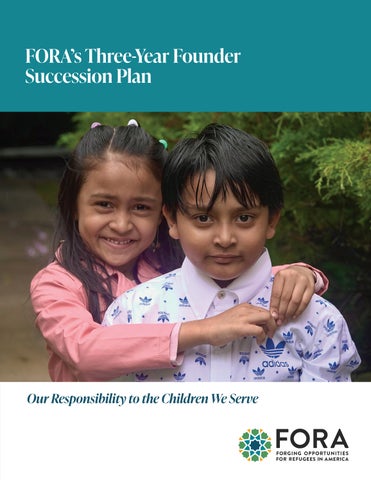
FORA’s Three-Year Founder Succession Plan
Our Responsibility to the Children We Serve
Shamshida, soon to be graduate of Hudson Valley Community College
An Education Stolen at Gunpoint When Kathleen and Michael O’Connor married in 2001, they did not set out to build institutions. They set out to live in solidarity with others and to respond personally to injustice where it was most acute and where nobody else was challenging it. Within months, they found themselves overseas, in the middle of Madagascar’s Civil War in 2002, assisting displaced people with resettlement. That work continued for the next eight years across conflict zones and fragile states. In those places, they witnessed education denied as a tool of control by rogue regimes and misogynistic theocracies. Schools were shuttered. Girls were barred. Teachers were threatened, silenced, or killed. Childhood itself was treated as disposable. The O’Connors learned how long it takes to rebuild educational foundations that had been undermined over generations. Welcoming people to safety in new homelands was necessary, but more than a mere welcome was needed. Educational foundations once destroyed at gunpoint could only be rebuilt through sustained presence over many years. When Kathleen and Michael returned to Chicago with three children under the age of two, they spent all their free time working with refugees and asylees newly arrived in the United States. They saw a pattern repeating again and again. Pre-literate refugee
children were placed in grade levels by age rather than readiness, asked to absorb instruction delivered at levels they could not access, “socially promoted” without mastery, and praised for compliance while foundational skills went unbuilt. They refused to allow educational failure to continue, expressed through long-term, one-on-one instruction grounded in strong pedagogical practice and sustained over time. They would not permit the Myanmar military junta to win by completing, through neglect and indifference in the United States, what it had begun through force thousands of miles away. The O’Connors knew this was a long-term commitment and they committed, wholeheartedly.
On January 3, 2019, Kathleen and Michael opened FORA in a small storefront with twelve Rohingya refugee children. From the beginning, FORA grounded its commitment in High Impact Tutoring: sustained, one-on-one instruction focused on constructing foundational skills from the ground up, particularly in reading and math. The work was methodical. Skills were built sequentially. Confidence followed competence. Children flourished. The eldest of FORA’s original twelve students, Shamshida, was a teenage Rohingya girl who had never attended school before arriving in the United States. Not for a day. Not at any age. She could not skip count by twos in her native language. She had been denied education entirely. When she began tutoring, she had no foundational numeracy or literacy on which to build. She was tenacious and brilliant. Over seven years, she thrived, even making the president’s list at her college. In May 2026, she will graduate with an associate’s degree in business. For this young woman, the Myanmar junta has lost. The persistence, presence, and learning that was taken by force was reclaimed and can not now be erased. She was the first, but nowhere near the last.
Michael and Kathleen O’Connor, 2019 3
When a Promise Becomes a Movement FORA currently serves 127 refugee children, providing more than 50,000 hours of one-on-one tutoring each year. We serve scores of refugee parents through our one-of-a-kind family-school partnership program. Success breeds new challenges, and we now have more than 200 additional children on the waiting list. And we are moving in the right direction. Over seven years, thousands of volunteers and supporters have rallied around FORA’s children, and we now own outright a 12,000 sq. ft. former Chicago public library in the heart of Chicago’s West Ridge refugee community. The best is yet to come. But, at this scale, the obligation changes. What began as a commitment carried by two people has become a responsibility borne by many. Continuity can no longer depend on the stamina or sacrifice of a few. If continuity fails, the damage would not be abstract. Children who have already survived traumatic rupture would experience it again. Learning arcs would fracture. Trust built through consistency would erode. Progress measured over years would be undone in months.
Ubaidah and tutor Jacqueline, 2023
Success creates obligation, and promises made to survivors of educational denial must be structured to endure beyond the people who first make them. On January 3, 2029, ten years to the day after FORA opened its doors, Kathleen and Michael O’Connor plan to step away from top management roles. This decision is driven by responsibility, not retreat. Work of this intensity, carried at this scale, must not depend indefinitely on the endurance of any two people. Because none of us can work or live forever, no sustained obligation to children can rest on any one person or pair alone. Succession must be planned at the height of strength, not forced by illness or crisis. FORA is now at the height of strength. This is the moment to plan. Responsible planning requires two things: continuity of people and continuity of practice.
FORA Tutoring Session, 2025
4
A Call to Commitment: The FORA 100 Each week, approximately 250 volunteers tutor at FORA. Most are college students. Their generosity is real. Their contribution is significant. But their availability rises and falls with academic calendars, finals, summer vacations, and graduations. Children who have survived displacement measure commitment by continued return. They learn quickly who comes back and who disappears.
When adults arrive consistently, in the same rooms, with the same children, learning accelerates because presence becomes reliable. Continuity therefore requires adults whose lives are not structured around academic cycles.
The FORA 100 is a defined community of adults who commit to tutoring refugee children at FORA for at least 150 hours each year, year after year. This is a minimum commitment, not an aspiration. These adults are not occasional helpers or symbolic supporters. They are the adults who show up regularly, on predictable schedules, with the same children, over sustained periods of time. FORA does not yet have one hundred such adults. At present, twenty-two already meet this FORA 100 commitment. That leaves seventy-eight more that need to be recruited. If we can recruit and keep 100 adults, and each meets the minimum 150-hour annual commitment, they will provide 11,700 tutoring hours per year, approximately 23.4 percent of FORA’s current tutoring volume. Nearly one quarter of FORA’s work would be anchored by a stable adult core whose presence children can count on. This is what we need to replace Kathleen and Michael.
Fereshteh and tutor Doug, 2021
5
Pragmatic Planning: The Horizon Fund When Kathleen and Michael step away from daily management in 2029, the labor they currently provide as unpaid volunteers will need to be replaced by paid professionals. At the same time, FORA presently receives more than 25 percent of its funding from the federal government, a revenue stream that is likely to disappear entirely within the next three years. Compounding this challenge, a significant share of FORA’s fundraising has historically depended on personal relationships developed by the founders themselves. Moving forward, those relationships cannot be dependent upon any individual personality or charisma. Taken together, these realities create a substantial funding gap that must be addressed before the moment of transition, not after it. That gap must be closed on the first day new leadership takes responsibility. Future leaders will already be assuming demanding roles. They should not also be forced to stabilize finances while stepping into those roles. FORA is addressing this challenge now because the work itself demands continuity. We do not measure success by annual participation or short-term gains. We measure it by whether children who enter FORA in kindergarten graduate from high school prepared for college. That outcome requires uninterrupted instructional quality, stable leadership, and institutional memory sustained across many years. Any disruption during leadership transition would fall not on an abstract organization, but on students who are midway through a long academic journey. In response, a group of long-standing FORA supporters created the Horizon Fund. The Horizon Fund is a restricted fund designed to distribute up to $500,000 per year beginning in 2029. Its purpose is narrow and operational. The Horizon Fund is not an endowment. It is not a substitute for annual operations. It is a runway. For a defined period of years, it will replace the founder-provided labor currently embedded in the organization, preserve leadership and instructional quality through transition, and ensure that fundraising capacity is institutional rather than founder-driven at such a tumultuous time in the history of our country.
6
FORA currently holds approximately $1,200,000 in cash within the Horizon Fund, with approximately an additional $1,800,000 pledged. This progress is meaningful, but it does not yet fully solve the problem the Horizon Fund was created to address. Partial capitalization creates a false sense of security. It suggests preparedness without yet fully providing it. We are only halfway there. A continuity fund either carries the organization through leadership transition, or it does not. There is no workable middle ground. If the Horizon Fund is underfunded at the moment leadership changes, the result will not be a gradual adjustment. It will be immediate strain, reduced capacity, and forced tradeoffs at precisely the moment when stability is most required. It would also send a signal to the best candidates that we are less than prepared. So, prepared we will be. Because we are fiercely focused on attracting the best of candidates. To note, the focus on the Horizon Fund does not reduce the need to raise FORA’s full annual operating budget of approximately $1.5 million, which pays for daily programming for students and parents right now. At the same time, and separately, FORA must continue building the Horizon Fund, beginning with at least $500,000 in new Horizon Fund commitments in 2026 alone and continuing in subsequent years, so that the organization can replace founder labor and remain stable when leadership transitions in 2029. These are not interchangeable tasks. Running the program each year does not prepare FORA for leadership transition, and preparing for leadership transition does not pay for this year’s work. Both must be done at the same time. Completing the Horizon Fund is not an enhancement. It is the condition that allows FORA to keep its promise to see children who begin in kindergarten through high school graduation with the preparation required for college. Our ask is no mystery. We need people who have been giving to our operational fund to continue giving as much as in the past while also giving generously to the Horizon Fund over the next three years.
The Passing of the Torch: What We Ask of You
One of FORA’s families since 2023
FORA was never meant to belong to two people. It belongs to children who survived what should not have been survivable, to parents who entrust us with what genocide sought to erase, and to the community that has grown around them. As the work matures, responsibility must broaden. The work now requires deep participation, not admiration. Some are called to join the FORA 100. Others are called to strengthen operational capacity and secure continuity through the Horizon Fund. This is not symbolic. It is obligation. Our obligation. What we fear is not the loss of an organization, but the moment when a child who has already lost everything looks up and sees no one there. This shall not stand.
This is not a threat. It is a call to action. Such day will come whether or not we are ready. Preparation cannot begin then. It must begin now. So, we begin now, as if the children are counting on us, because they are.
The children will still arrive on January 4, 2029. They will sit down. They will open their books. They will look up to see who has come back. Perhaps Kathleen and Michael will be in rocking chairs reading books to kindergartners in a corner, but new leaders must take over. 7
Together, we are... Forging Opportunities for Refugees in America.
Our thanks to Chuck Berman, Leianna Boenke, and Giulianna Larson for their photography.
6435 N. California Avenue, Chicago, IL 60645 | (312) 685-2655 | info@refugeefora.org
www.refugeefora.org