2026 STUDENT ACHIEVEMENT REPORT
The Mathematics of Hope How Refugee Children Recover Years – and Sometimes Generations – of Lost Educational Opportunity
Some refugee families arrive in the United States after having been denied an education for years, or even generations. FORA was created to serve those students whose educational backgrounds require intensive literacy intervention and a high level of parental engagement.
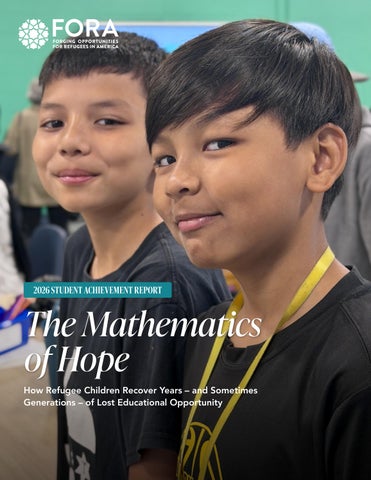
Amir and Samir, fraternal twins, came to Chicago from Myanmar in the spring of 2018. They began attending pre-K the following August, and joined FORA a year after its founding in 2020. While Samir didn’t hesitate to join in on tutoring, Amir felt differently. According to him, “There were a bunch of kids I didn’t know, I was so nervous.” Luckily it didn’t take long for both boys to find their place with FORA’s other students.
Amir and Samir, 11 Myanmar
Now in 6th grade, neither can get enough of math. Their confidence is great, suggesting that the math at school is too easy, with Amir asking “If I could skip (6th grade)?” They also admit their success in math would not be without the consistency and reinforcement of FORA’s tutoring. This past summer Amir attended a Northwestern summer camp for competitive math, where he began learning trigonometry. Samir also favors math, and has big dreams of using it to help him become an entrepreneur when he grows up, saying “I want to open a food business.
A Simple Truth About Learning LONG BEFORE CHILDREN ENTER KINDERGARTEN, THEY DEVELOP THE LANGUAGE, LITERACY, AND NUMERACY THAT BECOME THE FOUNDATION FOR FUTURE LEARNING.
For many refugee children, those opportunities were interrupted by war, ethnic cleansing, genocide, persecution, prolonged displacement, or years spent in refugee camps. Some never attended preschool. Others had only sporadic access to school. Some experienced years with no formal education at all. Most come from families in which parents were themselves denied an education and never learned to read or write. Research has consistently shown that children who begin school without these foundational skills often remain behind unless those gaps are intentionally addressed.1 2 Educational researchers describe many of these children as Students with Limited or Interrupted Formal Education (SLIFE) and conclude that they require accelerated support beyond traditional English-language instruction.3 4 Most people assume that schools will help these children to catch up. Unfortunately, school systems are not designed to provide the support that SLIFE students need to close the gap. The mathematics are simple. Imagine two children entering school on the same day. One begins at grade level. The other begins two years behind. If each learns one year’s worth of material, the gap between them does not change, and the negative impact is immense and ever-continuing.
“Equal” learning cannot erase unequal opportunity. The question is not whether refugee children can learn. It is whether they are given enough time and support to learn fast enough. Children who begin behind cannot catch up by learning at the same rate as everyone else. They must work harder and learn faster, but they also need a specialized plan. That is the challenge. From the day FORA opened its doors, our mission has never been simply to help refugee children make progress. Our mission has been to help them learn fast enough to recover years, and sometimes generations, of lost educational opportunity. Nationally-normed STAR Achievement Tests allow us to answer one question: Are refugee children learning fast enough to close those educational gaps? Our students’ test results answer that question with unusual clarity. They show that, given sufficient time, individualized instruction, and high expectations, refugee children can close the gaps that displacement left in their education. Those results are the mathematics of hope. 1 Snow, C. E., Burns, M. S., & Griffin, P. (Eds.). (1998). Preventing Reading Difficulties in Young Children. Washington, DC: National Academy Press. 2 National Early Literacy Panel. (2008). Developing Early Literacy: Report of the National Early Literacy Panel. National Institute for Literacy
3 WIDA Consortium. (2015). Focus on SLIFE: Students with Limited or Interrupted Formal Education. Wisconsin Center for Education Research,
University of Wisconsin–Madison.
4 New York State Education Department. (2018). Supporting Students with Interrupted/Inconsistent Formal Education in New York State. Albany, NY.
Three Years That Change a Life ONE GOOD YEAR IS ENCOURAGING. THREE YEARS TELL THE REAL STORY.
The 92 FORA students who took the STAR standardized tests both last spring and this spring have participated in FORA for a median of three years. During that time, the median FORA student gained 23 percentile ranks in mathematics and 20 percentile ranks in reading. To appreciate how extraordinary those gains are, it helps to understand what percentile ranks measure. National percentile ranks compare each student with peers across the United States. Because children across the country continue learning every year, percentile ranks normally remain relatively stable over time. A substantial increase therefore means a child is learning faster than peers nationwide. A gain of 25 percentile ranks represents far more than academic improvement. It represents exceptional learning that closes educational gaps. The mean gains were even higher: 28.13 percentile ranks in mathematics and 25.80 percentile ranks in reading. The average gain outpacing the median tells us we’re not just seeing consistent growth – we’re seeing some real breakout success stories on top of it.
Many of our scholars are now among the nation’s highest-performing students. This summer, 16 FORA students qualified for Northwestern University’s Center for Talent Development after scoring at or above the 90th percentile in mathematics or reading. Children who once entered school with profound educational disadvantages are now performing at levels that qualify them for one of the nation’s premier academic talent programs.
Growth in Percentile Ranks from Entry to Spring 2026 For all 92 FORA students tested by FORA on Star standardized tests from entry in spring of ‘25 to ‘26.
Growth of National Percentile Ranks
More than 61% of FORA students gained 20 or more percentile ranks in mathematics, while 50% gained 20 or more percentile ranks in reading. Nearly one- quarter gained 50 or more percentile ranks in mathematics. These are not isolated success stories or the achievements of a small group of exceptional students. They demonstrate that accelerated learning is occurring throughout the program and that children who were formerly expected merely to catch up are rapidly reclaiming years of lost educational opportunity.
30
28.13
20
10
0
23
Median Percentile Ranks Gained
Mean Percentile Ranks Gained
MATH
25.80
20
Median Percentile Ranks Gained
Mean Percentile Ranks Gained
READING
Expected growth in percentile ranks is zero. The higher mean indicates that the growth for all FORA students skews high.
Velocity Sustained THREE YEARS SHOW WHAT SUSTAINED PARTICIPATION IN FORA CAN ACCOMPLISH. THE MOST RECENT ONE-YEAR RESULTS SHOW THAT THE VELOCITY CONTINUES.
As stated above, percentile ranks tend to remain stable over time, these gains demonstrate learning at a faster rate than peers across the United States. From the spring of 2025 to the spring of 2026, the median FORA student gained 7 percentile ranks in mathematics and 6 percentile ranks in reading. Because percentile ranks tend to remain stable over time, these gains demonstrate learning at a faster rate than peers across the United States. As in the three-year results, these higher averages show that while the typical student continued to make substantial gains, many students progressed even faster. The averages again exceeded the medians, reaching 12.54 percentile ranks in mathematics and 9.90 percentile ranks in reading. Shockingly, nearly 43% of students gained 10 or more percentile ranks in mathematics during the past year, while 38% gained 10 or more percentile ranks in reading. The averages again exceeded the medians, reaching 12.54 percentile ranks in mathematics and 9.90 percentile ranks in reading. As in the three-year results, these higher averages show that while the typical student continued to make substantial gains, many students progressed even faster.
This Year’s Growth in Percentile Ranks
Growth of National Percentile Ranks
For all 92 FORA students tested by FORA on Star standardized tests in spring of ‘25 and ‘26. 15
12.54
Mean Percentile Ranks Gained
10
5
0
7
Median Percentile Ranks Gained
MATH
9.90
6
Median Percentile Ranks Gained
Mean Percentile Ranks Gained
READING
Expected growth in percentile ranks is zero. The higher mean indicates that the growth for all FORA students skews high.
Accelerated learning is not a one-time event or the result of a particularly successful year. It is sustained over time. Given sufficient time, individualized instruction, and high expectations, refugee children continue to gain ground on their peers year after year. They are not simply making progress. They are steadily reclaiming educational opportunities that many had once been denied. FORA students have shattered the standard baseline of maintaining a consistent national percentile rank. Their growth in mathematics was 0.759 standard deviations above the growth expected in a comparable population, and their reading growth was 0.571 standard deviations above. Statistical analysis for both math and reading gains demonstrates a 99.9% probability that these differences are associated with participation in FORA’s programming, and not due to random chance.
Why FORA Works These results are not accidental. They are the product of a simple educational model refined through years of working with refugee children who begin school far behind their peers.
FIRST, children need time. Every child attends
FORA five days a week for two hours each day, receiving approximately 480 hours of individualized instruction each year. Children who have lost years of educational opportunity rarely recover those years through occasional drop-in tutoring or shortterm programs. Catching up requires sustained, intensive instruction.
SECOND,
children need instruction that meets them exactly where they are. Every child begins in a different place. Some arrive unable to recognize letters. Others are ready for algebra but are still learning English. FORA continually adapts instruction so that every lesson is challenging enough to promote growth without becoming discouraging. Rather than expecting children to fit a standardized curriculum, instruction using high-quality materials is adapted to meet every child where they are and move them forward.
THIRD,
children need relationships. FORA’s low student-to-tutor ratio allows every child to be seen and understood by caring adults who provide encouragement, accountability, and confidence. Children learn more when they know someone believes in them, expects them to succeed, and refuses to let them fail.
FINALLY,
children need families. Parents are not spectators in their children’s education; they are partners. FORA works closely with families and schools because lasting educational success depends on everyone moving in the same direction. There is no mystery. These results are built on time, individualized instruction, caring relationships, and engaged families. Combined with extraordinarily hard-working children and parents who believe education can transform a family’s future, these components are changing educational trajectories every day.
A Future Reclaimed THE RESULTS IN THIS REPORT MEASURE FORA’S STUDENTS’ GAINS IN READING AND MATHEMATICS. BUT THEY ALSO MEASURE SOMETHING FAR MORE IMPORTANT.
For FORA parents, education was never something to be taken for granted. Many were denied the opportunity to attend school because of war, ethnic cleansing, genocide, persecution, or prolonged displacement. Few ever learned to read or write. Yet they came to the United States hoping their children might have opportunities they themselves had never known. That hope is one of the greatest gifts they bring with them. Today, that hope is becoming reality. Children who once seemed destined to remain years behind are succeeding in school, qualifying for gifted academic programs, and discovering that becoming an engineer, physician, teacher, scientist, entrepreneur – or whatever they choose – is within reach. That is what these test scores really represent. Not simply higher percentile ranks, but restored opportunity. Families are breaking cycles of educational deprivation that have lasted for years, and sometimes generations. Every percentile rank gained represents another child discovering confidence, another door opening, another teacher recognizing previously unseen potential, and another parent realizing, “My child’s future does not have to look like my past.” The achievement of FORA’s students represents more than 1,000 hours of instruction, years of sustained effort, and learning measured against national norms. But they tell only part of the story. We invite you to visit FORA. Meet our students. Sit beside a child as they read. Watch a tutor celebrate a breakthrough. Talk with families whose hopes are now becoming reality. See for yourself how refugee children are reclaiming years of lost educational opportunity. We believe you’ll leave with the same conclusions the data have led us to: given sufficient time, individualized instruction, high expectations, and caring relationships, refugee children can learn fast enough to change the trajectory of their education – and the trajectory of their lives.
That is the mathematics of hope. Thank you for making this possible.
TOGETHER, WE ARE... FORGING OPPORTUNITIES FOR REFUGEES IN AMERICA.
6435 N. California Avenue, Chicago, IL 60645 | (312) 685-2655 | info@refugeefora.org
www.refugeefora.org