THE
JAN/FEB 2026
VOLUME 76 | ISSUE 1 www.reformedfellowship.net
ANNIVERSARY
DEDICATED TO THE EXPOSITION AND DEFENSE OF THE REFORMED FAITH | 75 YEARS: 1951–2026
RFI–1951–2026 THE LORD GAVE THE WORD; GREAT WAS THE COMPANY OF THOSE WHO PROCLAIMED IT. PSALM 68:11
The Promises of God Crying Blood Fulfilled in Christ History that Convicts, Grace that Restores Anniversaries, Unions, and Desiderata Divine Providence Old Paths The Top Ten Reasons Why It’s Hard to Be a Christian in Prison Walking With Job Through Miscarriage 10 Years of Service: 2016–2026 The Eye of the Needle: The You Can Be Freed from Irreverence Paradox of Money You Can Be Freed from Blasphemy Exceedingly, Abundantly More...
Contents | January/February | Volume 76 | Issue 1 3 | The Promises of God Fulfilled in Christ
18 | Exceedingly, Abundantly More...
27 | Divine Providence Article 2 of 6
God’s people can enter the new year looking unto the birth of the God-man, Jesus the Christ as their propitiation!
Summit was started by Bethel URC (Calgary, AB) in 2016. The goal is to glorify God by serving the youth and young adults of our Reformed churches in Western Canada. Summit achieves that goal by organizing and hosting annual conferences so that our young people can grow in the grace and knowledge of the Lord Jesus Christ. The results? We leave the results to God (which includes an occasional “Summit marriage”), but what we have witnessed is that God has blessed Summit exceedingly, abundantly more than we could have ever imagined.
Psalm 104: God Upholding and Governing Nature
Mr. Cornelius VanKempen
4 | Anniversaries, Unions, and Desiderata Dr. Michael R. Kearney
Opportunities for the United Reformed Churches in North America at its 30th Anniversary.
8 | Old Paths
Rev. Greg Lubbers In our current Western culture, various worldviews beckon to us to “walk this way.” This has and continues to lead many to abandon the Christian faith. In the midst of all this confusion, true rest is still to be found in the “old paths.”
10 | Walking With Job Through Miscarriage Rev. Ryan Swale
Reflecting personally and pastorally on his family’s experience of miscarriage while preaching through the Book of Job, Ryan Swale offers ten encouragements from Job about early infant loss.
Rev. Keith Davis
The second of a six-part series exploring the doctrine of divine providence from a very unique point of view.
30 | The Top Ten Reasons Why It’s Hard to Be a Christian in Prison Robert Heitbrink
20 | Crying Blood
Rev. Peter Holtvlüwer How far did Cain’s rejection of God go? What message does God’s punishment of Cain send still today? How should Christians think of and interact with the seed of the serpent?
23 | History that Convicts, Grace that Restores:
14 | The Eye of the Needle: The Paradox of Money
Ezekiel’s Theological Retelling of Israel’s History of Idolatry and Hope of Restoration
Is it OK to be rich? How much is too much? What do we do with the statement of Christ that it is easier for a camel to go through the eye of a needle than for a rich person to get into heaven?
Ezekiel 20 is “history with attitude,” aimed to shake Israel out of her spiritual stupor and aid her turn to the Lord in repentance and faith.
Bryce Bartruff, Ph.D
Mr. Daniel Olaska
Dr. R. Andrew Compton
While Robert was awaiting trial in 2013— facing a potential sentence of 20 to 60 years—the Lord, through the work of the Holy Spirit, convicted him of his sins and led him to seek forgiveness.
32 | 10 Years of Service: 2016–2026 A Note from the RFI Board
A note of appreciation on the occasion of our magazine editor’s retirement.
33 | You Can Be Freed from Irreverence Rev. William Boekestein Lord’s Day 35 – Q&A 96-98.
35 | You Can Be Freed from Blasphemy Rev. William Boekestein Lord’s Day 36 – Q&A 99-100.
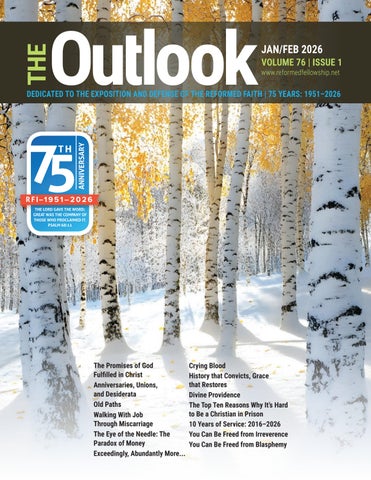
About the cover image: Knowing Jesus and His righteousness, we may enter the new year with all its unknown trials confidently following Him fully – Mr. Cornelius VanKempen
The Promises of God Fulfilled in Christ
T
he old year is history and the new year is beginning! What are the longings of your heart for this new year? Is the world’s approach of wealth and prosperity, health and a restful life in this new year, your desire? While those things may have their place, it should not give us peace. Every breath we take is a gift of God. He is the sustainer of each one of us. Look back on all the things that happened this year, with all the fears that we had. Fear is a debilitating thing. We look at the evil in the world, and why would we not fear? But Christ said, “Fear not, little flock; for it is your Father’s good pleasure to give you the kingdom” (Luke 12:32). The faithful and true God is still in control using all the seemingly evil things to work for His glory and the good of His church. This world was created to glorify God in His triune being to establish the kingdom of God from the masses. The gospel goes out by God’s called servants to bring the good news of the Christchild, born to be the propitiation for lost sinners. “For we preach not ourselves, but Christ Jesus the Lord; and ourselves your servants for Jesus’ sake. For God, who commanded the light to shine out of darkness, hath shined in our hearts, to give the light of the knowledge of the glory of God in
Mr. Cornelius VanKempen known as Case, has been married to Susan for sixty blessed years. They attend and are members of Heritage Reformed Congregation in Grand Rapids, MI.
For all the promises of God in him are yea, and in him Amen, unto the glory of God by us. –2 Corinthians 1:20 the face of Jesus Christ. But we have this treasure in earthen vessels, that the excellency of the power may be of God, and not of us” (2 Cor. 4:5–7). All these things have been given by the power of the Holy Spirit, revealing the cross of Calvary as the open gospel door of hope in the new year. “For which cause we faint not; but though our outward man perish, yet the inward man is renewed day by day. For our light affliction, which is but for a moment, worketh for us a far more exceeding and eternal weight of glory; while we look not at the things which are seen, but at the things which are not seen: for the things which are seen are temporal; but the things which are not seen are eternal” (2 Cor. 4:16–18). Yes, the world is perishing, but God’s church is in safe keeping as Christ their Savior guides them through this wilderness to their eternal home. “Many are the afflictions of the righteous: but the Lord delivereth him out of them all” (Ps. 34:19). The new year’s outlook may be dismal, but by the grace of God all things will work out for the good of His people! The cross of Jesus is the dividing line as to how we begin this new year! Without the cross there is only fear, but in Him there is divine security. How are you approaching 2026? “Wherefore seeing we also are compassed about with so great a cloud of witnesses, let us lay aside every weight, and the sin which doth so easily beset us, and let us run with patience the race that is set before us,
looking unto Jesus the author and finisher of our faith; who for the joy that was set before him endured the cross, despising the shame, and is set down at the right hand of the throne of God” (Heb. 12:1–2). Knowing Jesus and His righteousness, we may enter the new year with all its unknown trials confidently following Him fully. God is our refuge and our strength, a helper ever near us; We will not fear tho’ earth be moved, for God is nigh to cheer us. Although the mountains quake and earth’s foundations shake, Tho’ angry billows roar And break against the shore, our mighty God will hear us. God’s city is forever blest with living waters welling; Since God is there she stands unmoved ‘mid tumults round her swelling; God speaks and all is peace, From war the nations cease; The Lord of Hosts is nigh, Our fathers’ God Most High is our eternal dwelling. Behold what God has done on earth; His wrath brings desolation. His grace, commanding wars to cease, brings peace to ev’ry nation; Be still, for He is Lord, by all the earth adored; The Lord of Hosts is nigh, Our fathers’ God Most High is our strong habitation. Psalter 128 (Psalm 46)
Jan/Feb 2026 | 3
Anniversaries, Unions, and Desiderata
USA
WEST SAYVILLE
RFI
URCNA
Dr. Michael R. Kearney
30 75 150250 W
e are entering a year of milestones: the 30th anniversary of the United Reformed Churches in North America (URCNA)1, the 75th anniversary of Reformed Fellowship, and the 150th anniversary of the congregation I grew up in, West Sayville Reformed Bible Church—not to mention the 250th anniversary of the United States of America. The church in West Sayville has some connection to each of the other anniversaries as well. Founded as a mission work of the Christian Reformed Church (CRC) in 1876, that congregation has affiliated with the URCNA since 1998. Located on the south shore of Long Island, about fifty miles east of New York City, the congregation followed the history of
The Outlook | 4
waves of European immigration to America in the late 1800s and early 1900s and the rapid demographic transformation of the East Coast in the last several decades. The church has shifted from serving the families of a small community of Dutch fishermen to being a waystation for all kinds of people in various walks of life who are seeking answers to life’s questions from God’s Word in the fellowship of believers.2
An Old Church in a Young Federation
The West Sayville congregation was not technically a charter member of the URCNA, although its leaders and concerned members participated in many of the conversations that led
to the creation of our federation of churches. Nonetheless, I believe the West Sayville church is the oldest congregation in the URCNA—that is, the oldest local body to join the federation intact, without a church split, while maintaining its legal and ecclesiastical identity. Many other congregations, from brand-new plants to churches with more than a century of history, have thrown in their lot with this fledgling group of churches that now turns thirty this year. The conversations that led to the formation of the URCNA, in turn, are closely tied to the history of Reformed Fellowship. Now and then the discussion comes up in a board meeting or conversation with
0
a Reformed Fellowship supporter: is Reformed Fellowship a URCNA entity? Many of our members attend URCNA churches; several of our board members are URCNA ministers. Multiple United Reformed congregations in West Michigan have offered us the use of their facilities for events and storage. We publish works by numerous United Reformed authors, we distribute the Life in Christ catechism series used across the URCNA, and we print the official URCNA membership directory each year. Reformed Fellowship seems to be as official of an unofficial publishing house of the URCNA as you could get. And yet we are also not. In principle, Reformed Fellowship and The Outlook have always been open to all individuals and churches who adhere to the Reformed faith as expressed in the Three Forms of Unity or the Westminster Standards. We actively try to recruit board members from multiple Reformed denominations and to be present at a variety of Reformed and Presbyterian events. If you ask anyone involved in the leadership of Reformed Fellowship, I think you will get a consistent answer: Reformed Fellowship is not meant to be exclusively or even predominantly centered on the URCNA. As URCNA officebearers and members think about the opportunities that lie ahead of our federation in the next thirty years (and that is what I am envisioning in this series of articles, a kind of prospectus of some of the unique opportunities that confront us), the relationship between the URCNA and Reformed Fellowship deserves a little more historical explanation. One exchange that occurred on the pages of this very magazine in 1977 and 1978, in particular, helps us understand the directions and relationship of the two institutions today.
Let me set the context. Rev. John Vander Ploeg had taken up editorship of The Outlook after editing The Banner, the official periodical of the CRC, from 1956 to 1970. He was a well-respected minister with an established audience, and he used the platform of Reformed Fellowship’s magazine to launch a wide-ranging critique of departures from Reformed orthodoxy in the CRC.
enthusiastic in the profession of it.” While the CRC was the primary harborer of the “foe within the gate” in Vander Ploeg’s estimation, his vision of a new denomination extended to all Reformed churches that desired to make sola Scriptura the central principle of their unity.
An Agenda-Setting Editorial
Vander Ploeg voiced the sentiment of many conservative Christian Reformed members who objected to liberalizing developments in their denomination, but his proposal was a call for educated collective action, not just grandstanding. First, church leaders as well as laypeople needed to read, investigate, and examine the issues confronting their denomination. Second, The Outlook needed to offer a forum where “contributions from our readers as to how to bring into being a truly United Reformed Church are welcome.” Third, members of the CRC and other people of Reformed convictions ought to consider organizing local chapters of Reformed Fellowship. The goal was to help a concerned group of members find a sense of direction.
Vander Ploeg’s July 1977 editorial was titled “Desideratum—A United Reformed Church.”4 This was not only the first time a term as arcane as “desideratum” appeared in The Outlook; it was also, to my knowledge, the first published use of the phrase “United Reformed Church” to describe a vision of a confessionally Reformed union of congregations in North America. That vision, again, was both reactive and proactive: if a union of congregations would “purge themselves of the foe within the gate and of those bold innovations that now threaten to undermine the Reformed faith,” Vander Ploeg contended, the result would be a new “denomination that would not shillyshally in its witness to the Reformed faith but a church that would rather be unambiguous, consistent, and
Vander Ploeg wanted responses, and he got them. An anonymous reader from Florida wrote to agree with Vander Ploeg’s basic proposal but to offer a different name: the Orthodox Christian Reformed Church. “Why should we lose our precious name?” he demanded. “After all, we are not leaving the church—the church is leaving us.” Interestingly, the same reader also predicted, “No doubt THE OUTLOOK will be the new church paper.”5 Another reader pointed out that, since 1972, there already was a (liberal) denomination named the United Reformed Church in the United Kingdom. A Protestant Reformed contributor to The Standard Bearer commended Vander Ploeg for raising the alarm but claimed that any new denomination would need to revisit the CRC’s 1924 decision about common
Vander Ploeg changed the magazine’s title from Torch and Trumpet to its present name.3 He saw the mission of the magazine as just that: providing an outlook, a direction—a proactive voice rather than just a reactive one. Vander Ploeg’s editorship was marked by an activist spirit and a sense of urgency, eliciting many notes of support as well as critique from readers. In an age without the internet and social media, members of the Reformed community spread across the United States and Canada engaged in fellowship and debate largely on the pages of this magazine.
Jan/Feb 2026 | 5
grace.6 A writer for the Canadian Reformed paper Clarion supported the editorial but stated that secession must be pursued in and through seeking unity with other likeminded denominations.7
Others were not as enthusiastic. Rev. Jelle Tuininga offered a stern response: while he shared Vander Ploeg’s desire to return the CRC to its confessional heritage, he believed that planning a secession, as opposed to being forced into a secession, was arguably schismatic. Moreover, he found the vision of a confessional group of Reformed churches “unduly idealistic and unduly illusory.”8 Tuininga’s response got its own counter from Donald Blaauw in Holland, Michigan. Blaauw stood behind Vander Ploeg all the way: “We ought to thank our God again and again for the spiritual idealism and the courageous foresight (illusions?) of our forebears, and we ought to be praying that the same kind of God-given courage may be our portion today and in the days ahead.”9 As it turned out, seventeen years later, the same Rev. Tuininga would serve as vice-chairman for the 1995 Lynwood meeting that launched the formation of the URCNA. Vander Ploeg followed up his initial proposal with a few more editorials, although his editorship was cut short soon after due to poor health. In “That United Reformed Church—An Ongoing Challenge,” Vander Ploeg spoke of the need for not just a torch of destruction but a hammer for building: “Hope thrives only when, like Peter, James, and John, we see no man save Jesus only as the One Who builds His church. And if it be his will, already on this side of glory, to effect and bring forth a union of those united in the Reformed faith, He surely can and will bring it to pass.”10
The Outlook | 6
Unity as a Founding Principle I recount all this history in order to make two observations, ending with opportunities for Reformed Fellowship and for the United Reformed Churches in North America today. First, this was 1978. Vander Ploeg did not live to see the formation of the URCNA in 1996, but the discussion in the pages of The Outlook set the fundamental coordinates for the emergence of that federation twenty years later. The two proposed names of “United Reformed Church” and “Orthodox Christian Reformed Church” spelled out two different visions of what a restoration of Reformed doctrine and piety should look like. One was a new group of churches with biblical ecumenicity as a central goal; the other was a restored CRC, realigned with its positions at some previous point in history.11 Interestingly, another group of former Christian Reformed churches in Canada did form a small denomination named the Orthodox Christian Reformed Church in 1988; they merged with the URCNA in 2008. Second, this history gets to the roots of that longstanding, ambiguous relationship between the URCNA and Reformed Fellowship. The Florida reader could write that The Outlook would “no doubt” be the official magazine of a future United Reformed Church. Why was he so sure? Perhaps the sentiment was that the URCNA would obviously comprise ministers, officers, and members who valued theological literacy, Reformed sensibilities, and a clear biblical worldview on the issues confronting the church and society—just the kind of people who would read The Outlook. Perhaps he thought The Outlook offered the best counterpoint to The Banner, which embodied much of what was seen as problematic in the CRC. In
any case, it seemed clear that the fledgling idea of a United Reformed Church needed Reformed Fellowship in order to grow its wings and fly. But for a host of other reasons, neither Reformed Fellowship nor the URCNA have ever wanted to formalize that relationship. Their collaborative efforts so far have remained healthy, voluntary, and organic. So what is the point of all this? For Reformed Fellowship, the vibrant discussion on the pages of The Outlook decades ago is a vision we should still strive for today. While technology has changed dramatically, the need to offer a forum for reasoned, balanced, and tenaciously committed discussions of Reformed faith and life has not ceased. People, families, churches, and whole denominations need our support as they wrestle with newfound challenges to our creeds and confessions. It is heartening to see how widely our publications are sold, far beyond the bounds of the URCNA and even beyond North America. For the United Reformed Churches in North America, we must continue to take our name seriously. We are not the Orthodox Christian Reformed Church; our federation did not come into being merely to rewind the clock on denominational decay. We have a positive and distinctive task of promoting gospel unity far beyond our origins. From the beginning of the URCNA, its founders made decisions that sought unity in a common confession rather than ethnic or historic ties alone, and that biblically ecumenical spirit continues to represent a unique and profound opportunity for the URCNA today. And for West Sayville Reformed Bible Church, and for every other local congregation of the church of Jesus Christ, the sacred tasks of
worship, discipleship, and evangelism go on—whether for another year or for 150 years.
6. John Vander Ploeg, “That ‘United Reformed Church’—An Ongoing Challenge,” The Outlook 28, no. 4 (April 1978), 2–5.
1. This could also be the 31st anniversary if the organizational meeting of independent Reformed churches in Lynwood, Illinois, held on November 15–16, 1995, is taken as the founding of the URCNA.
8. “Letter to the Editor,” The Outlook 28, no. 7 (July 1978).
2. See https://wsrbc.org/our-history. 3. See W. Robert Godfrey’s article “Fifty Years of Faithfulness: The Witness of The Outlook,” The Outlook 51, no. 4 (April 2001), 7–12. 4. John Vander Ploeg, “Desideratum—A United Reformed Church,” The Outlook 27, no. 7 (July 1977), 2–4. This article was reprinted in The Outlook 66, no. 3 (May/June 2016), 27–30. 5. “Letter to the Editor,” The Outlook 28, no. 1 (March 1978).
NAPARC 2025
7. Vander Ploeg, “That ‘United Reformed Church,’” 2–5.
9. “Letter to the Editor,” The Outlook 28, no. 9 (September 1978). 10. Vander Ploeg, “That ‘United Reformed Church,’” 2–5. 11. I realize I am glossing over some details here. At the first synod of the new federation, four names were under consideration: Evangelical Reformed Churches in North America, Orthodox Reformed Churches of North America, Reformed Christian Churches of North America, and United Reformed Churches of North America (Acts of Synod 1996, Art. 9). Individual congregations that had left the CRC had already chosen a variety of naming schemes,
from “Independent Reformed Church” to “Christian Reformation Church” to “Reformed Bible Church” (hence the present name of West Sayville Reformed Bible Church). Other overlapping names and groups played a role in this story as well: the Consistorial Conference, the Interclassical Conference, the Alliance of Reformed Churches, and others. Nevertheless, I do believe that the particular names discussed in The Outlook marked the earliest substantive discussion of the direction that the new group of churches would take.
Dr. Michael R. Kearney is an assistant professor of communication at Dordt University in Sioux Center, IA, and a board member of Reformed Fellowship.
Fifty Years of Promoting Organic Union
The 50th annual meeting of the North American Presbyterian and Reformed Council (NAPARC) convened November 11–13, 2025, at Hope Community Reformed Presbyterian Church in Beaver Falls, Pennsylvania, and the neighboring campus of Geneva College. Discussion centered on past efforts and present prospects for organic union, a primary purpose of this council of thirteen confessionally Reformed denominations in the U.S. and Canada. The assembly was encouraged to be “eager to maintain the unity of the Spirit in the bond of peace” (Eph. 4:3), promoting bottom-up forms of collaboration between member churches. As part of its deliberations, the council recommended that its member churches observe a day of humiliation, prayer, and fasting regarding sexual sin by church officers, with Wednesday, April 22, 2026 as a suggested date. The Heritage Reformed Congregations received permission to organize a consultation (a separate meeting of member
John Bernard, Geneva College Staff Photographer.
churches) on biblical counseling, with the date to be determined. Numerous bilateral meetings between delegates of member churches provided fruitful time to discuss practical expressions of interdenominational unity. On Wednesday evening, delegates enjoyed a 50th anniversary dinner in the Metheny Fieldhouse of Geneva College and a keynote address by Dr. Chad Van Dixhoorn of Reformed Theological Seminary in Charlotte, North Carolina, with more than one hundred guests present. Full minutes of the council can be found at naparc.org. The next meeting will be November 10–12, 2026, at First United Reformed Church in Oak Lawn, Illinois.
Jan/Feb 2026 | 7
Old Paths Rev. Greg Lubbers
Statistics can be confusing to interpret but they can also be sobering to consider. This is especially true with statistics in relation to the Christian church and covenant young people. While there are many variables to be considered, numerous studies show that an alarming number of covenant young people are departing from the visible church. A recent Barna study reported, “Nearly twothirds of U.S. 18–29 year olds who grew up in church ... have withdrawn from church involvement as an adult after having been active as a child or teen.” This sad phenomenon, historically known as apostasy (i.e., “a falling away”), has brought about such terms as “deconstruction” and “dechurching.” This trend is especially troubling for those who love the Christian church and its young covenant members. Out of a desire for God’s glory as well as these individual’s spiritual well-being, the mature members of the church desire the next generation to “prosper in all things and be in health, just as [their] soul prospers” (3 John 3). In order for God’s covenant people to prosper spiritually, they must take the “old paths” of biblical orthodoxy.
The Need for the Old Paths The late teenage and early adult years are critical for setting a person’s course in life. As they reach these milestones of maturity and independency, their beliefs and practices become their own rather than simply those of their parents. While not an absolute rule, generally the pattern of life set in a person’s twenties gives a reliable indicator of the pattern of their entire life. Our culture bombards our young people with voices speaking to which way they ought to take in life. Such voices include the opinions of peers, the instruction of professors, the musings of authors, and especially the clamoring of podcasts and social media influencers. Along with cultural trends and the opinions of one’s own self, all of these voices form an unrelenting call to “come this way” in life. Many of us have had the experience of being in a busy airport. Thousands of travelers make their way to hundreds of gates to catch flights leading to a host of destinations.
The Outlook | 8
Thus says the LORD: “Stand in the ways and see, And ask for the old paths, where the good way is, And walk in it; Then you will find rest for your souls . . .” –Jeremiah 6:16
Human life is similar, in a way. There are billions of people following millions of paths through life with contrasting convictions on the meaning and purpose of life. Some find themselves boarding the plane of Secularism1 while others stand at the gate of Humanism2; others prefer Narcissism3 while their fellow travelers wait in futility for Nihilism.4 While there are various worldviews with their respective beliefs about God, salvation, and the meaning of life, all roads through life ultimately lead to the same destination: eternity. Human life does not end with a “Game Over” or an exit into nothingness. Rather, upon physical death, “the dust [body] will return to the earth as it was, And the spirit [soul] will return to God who gave it” (Eccl. 12:7). However, in relation to the common destination of all humanity into eternity, there is also a remarkable and irreversible difference: either heaven or hell. This is the clear revelation of Jesus in Matthew 7:13–14: “Enter by
the narrow gate; for wide is the gate and broad is the way that leads to destruction, and there are many who go in by it. Because narrow is the gate and difficult is the way which leads to life, and there are few who find it.” In light of such a truth, there is a need for all of us to “stand in the ways and see, And ask for the old paths, where the good way is . . .” (Jer. 6:16).
The Identity of the Old Paths Since it is important to find and walk in the old paths, it is also important to identify the old paths. In the context of Jeremiah, the Lord, through His prophet, is calling His covenant people away from innovative idolatry adopted from the surrounding nations and back to covenant loyalty focused upon the divine revelation. In his autobiography, Surprised by Joy, C. S. Lewis warns against what he calls “chronological snobbery.” This is the mindset of “the uncritical acceptance or the intellectual climate common to our own age and the assumption that whatever has gone out of date is on that account discredited.” Essentially, “chronological snobbery” is the mindset that believes the simple, Christian faith of the fathers must be dismantled by progressive, postmodern insight of the children. But it is upon the old paths that a person finds the good way. The old paths are the gracious provision and revelation of the covenant of grace. It was and is this gracious, covenantal redemption that was revealed to Adam, Noah, Abraham, Moses, and David. It was and is this gracious, covenantal redemption that revealed the way for reconciliation between the Lord God and His chosen people. The old paths form the good way of covenantal redemption that is centered upon the Person and work of the Mediator of the covenant, Jesus Christ. It includes the revelation of and conviction in the miraculous incarnation, the
substitutionary atonement, and victorious resurrection of Jesus Christ. Furthermore, the good way is the belief in the forgiveness of sins and life everlasting based upon God’s grace and mercy in and through Jesus Christ. These old paths are what our covenant forefathers and mothers studied and believed with their open Bibles, bent knees, believing hearts, and active faith. Many of them suffereed persecution because of these good ways, and they pursued immigration because of it. These paths have guided innumerable saints through this life into glory, saints who now form an encouraging cloud of witnesses for those of us who follow behind (Heb. 12:1, 2a). For those tempted to deconstruct their faith and “dechurch,” what is needed is not a new path but rather a return to the old paths. It is upon the old paths of the apostolic faith that one finds the good way.
The Blessing of the Old Paths The Bible often attaches promises to commandments. It does so to encourage obedience. The promise given to those who walk in the good way of the old paths is that of rest. Long ago, Augustine reflected that “our souls are restless until they rest in God.” Sadly, our modern culture is overflowing with persons who are restless and searching for a “safe place” for their spirit. While the higher institutions of our contemporary age beckon with the promises of “safe places,” these often turn out to be dead end roads of selfish, subjective preoccupation that only increases the restlessness of those who seek refuge. True soul rest is found in the old paths of the good way of a saving relationship with Jesus Christ. Jesus authoritatively and truthfully proclaims to weary travelers, “I am the way, the truth, and the life.” As the
way, the truth, and the life, He invites and promises, “Come to Me, all you who labor and are heavy laden, and I will give you rest. Take My yoke upon you and learn from Me, for I am gentle and lowly in heart, and you will find rest for your souls” (Matt. 11:28–29). There is a vast difference between simply knowing about the old paths of the good way and actually walking on them. We all need to walk in the old paths of the good way by a personal, living faith in the Lord: Father, Son, and Holy Spirit. This is not simply a philosophical curiosity in or a historical affirmation of the faith of our fathers. It is a living faith in the Triune God. The new path of deconstruction and “dechurching” leads further and further away from peace. Nevertheless, the Father stands at the head of the old paths of the good way eager to receive prodigal sons and daughters who come to their spiritual senses and return home on the path of repentance and faith. The call is the same for us today as it was for Israel in Jeremiah’s day, “Thus says the Lord: ‘Stand in the ways and see, and ask for the old paths, where the good way is, and walk in it; then you will find rest for your souls.’” 1 “Secularism” could be defined as “the principle of seeking to conduct human affairs based on naturalistic considerations, uninvolved with religion.” 2 “Humanism” could be defined as “an outlook or system of thought attaching prime importance to human rather than divine or supernatural matters. 3 “Narcissism” could be defined as “excessive interest in or admiration of oneself and one’s physical appearance.” 4 “Nihilism” could be defined as “the rejection of all religious and moral principles, in the belief that life is meaningless”
Rev. Greg Lubbers is currently serving as Minister of the Word and Sacraments at Covenant Reformed Church (URCNA) in Pella, IA.
Jan/Feb 2026 | 9
(ISSN 8750-5754) (USPS 633-980) “Exhorting you to contend earnestly for the faith which was once for all delivered to the saints.” —Jude 3 Journal of Reformed Fellowship, Inc. Send all copy to: Interim Editor 1988 140th Avenue, Dorr, MI 49323 Email: editor@reformedfellowship.net Website: www.reformedfellowship.net Board of Trustees Al Rumph, President; Rev. Casey Freswick, Vice President; Rev. Doug Barnes, Secretary; Marv Mingerink, Treasurer; Dr. Andrew Compton, Vice-all; Glenn Hop, Dr. Michael Kearney, Tom Kooienga, Dr. Daniel Ragusa, and Dr. Ryan Swale, Directors Editor: Dan Van Dyke Contributing Editor: Dr. Cornelis P. Venema Art, Design & Production: Jeff Steenholdt General Manager: Hope Staal Distribution Manager: Emily Postma Bookkeeper: Mindy Toonstra Outreach Specialist: Ashley Hoekman This periodical is owned and published by Reformed Fellowship, Inc., a religious and strictly non-profit organization composed of a group of Christian believers who hold to the biblical Reformed faith. Its purpose is to advocate and propagate this faith, to nurture those who seek to live in obedience to it, to give sharpened expression to it, to stimulate the doctrinal sensitivities of those who profess it, to promote the spiritual welfare and purity of the Reformed churches and to encourage Christian action. The publishers of this journal express their adherence to the Calvinistic creeds as formulated in the Belgic Confession, the Heidelberg Catechism, the Canons of Dort, and the Westminster Confession and Catechisms.
The Outlook | 10
Reformed Fellowship holds the copyright to all material published in this magazine. All contributions represent the personal views of the writers and do not necessarily reflect the opinions of the members of Reformed Fellowship, Inc. Subscription Policy The Outlook (USPS 633-980) is published six times per year (bi-monthly) by Reformed Fellowship, Inc. Annual subscriptions are $35.00 per year in the United States; outside the US, $40 per year (foreign subscribers please remit payment in US Funds; Canada add GST). Digital download subscriptions are $20 annually, and are included FREE with a print subscription. Unless a definite request for discontinuance is received, it is assumed that the subscriber wishes the subscription to continue without the formality of a renewal order and he will be billed for renewal. Anyone desiring a change of address should notify the business office as early as possible in order to avoid the inconvenience of delayed delivery. Zip code should be included. Periodical postage paid at Grandville, MI and at additional mailing offices. POSTMASTER: Send address changes to The Outlook, 1988 140th Avenue, Dorr MI 49323 Advertising Policy 1. The Outlook cannot accept announcements or advertising copy inconsistent with the stated purpose of RFI. All advertisements and announcements must be approved by the RFI board prior to publication. We reserve the right to reject, edit, or request resubmission of announcement text or advertising copy. Books, pamphlets, or CDs to be advertised are to be screened as to author and content prior to publication of the advertisement, and such material should not conflict with the stated purpose of RFI. We reserve the right to limit the size of all
announcements and advertisements, and to limit the number of issues in which they appear. 2. All advertisements or announcements are to be submitted via email to office@reformedfellowship.net or to the business office at 1988 140th Avenue, Dorr MI 49323, and must be received at least two months before the publication date. 3. Fees for B&W/grayscale ads: $190 for full-page, $115 for half-page, $65 for quarter-page. 4. Fees for full-color ads: $235 for full-page, $140 for half-page, $80 for quarter-page. 5. Fees for preparing artwork for ads (in addition to advertising costs above) are $140 for full-page, $115 for half-page, $90 for quarter-page. These fees are waived if advertising art is print-ready. Please submit manuscript in an email or as an MS-Word.doc attachment. If you have pictures or images, please include as JPG files. 6. Preferred final file format for print-ready ads: High Quality Print PDF. 7. Ad sizes specifications: 8.75 x 11.25, trim 8.5 x 11" Full page non-bleed: 7.25 x 9.75" Half page horizontal bleed: 8.625 x 5.25" Half page horizontal non-bleed: 7.25 x 4.5" Quarter page (non-bleed) 3.5 x 4.5" 8. This Advertising Policy supersedes all prior policies, resolutions, or other statements. Editorial Office Interim Editor 1988 140th Avenue, Dorr, MI 49323 Email: editor@reformedfellowship.net Circulation Office 1988 140th Avenue, Dorr MI 49323 (616) 532-8510 Business Mailing Address 1988 140th Avenue, Dorr MI 49323 Email: office@reformedfellowship.net
The woman pictured above once shouted and threw rocks at the man beside her. She despised evangelists and chased him away whenever he came near. One day, the pastor arrived with a Talking Bible and played Scripture in the Gamo language. Her husband’s heart was stirred as he listened. The pastor noticed his interest and offered to lend him the device, promising to return and see what God might do. “The Talking Bible opened his heart before I ever spoke a word,” the pastor said. Weeks later, when the pastor returned, the man was still listening—and all along his wife had been secretly listening too. She shared they had endured years of sickness and hardship. But after hearing God’s Word and placing their trust in Christ, everything changed. Today, she sits beside the pastor, smiling with gratitude for the Talking Bible that brought hope to her home. Did you know you can lower your taxes while helping more people hear God’s Word? Through our partnership with Barnabas Foundation, you can create a lasting legacy—bringing the hope of the Gospel to those who need it most.
We can help you: lower your taxes • include Talking Bibles in your will • donate stock, real estate, crops, and more. To learn more or request a free brochure, call 760-745-8105 or email info@talkingbibles.org.
Paul D. Hoekstra, President
Reformed Fellowship, Inc. 1988 140th Avenue Dorr, MI 49323 (616) 532-8510
NEW! FROM REFORMED FELLOWSHIP
.......................................
I WANT YOUR HEART MONEY TALKS: WHAT IS YOURS SAYING? 31 DAILY DEVOTIONS From the author of “A Cheerful Giver” comes this 31-day devotional, a wonderful aid to the Christian in examining the heart relationship we have with our material possessions. Clear, concise, Biblical, and thoroughly practical, this is a worthy addition to every Christian’s bookshelf.
Retail $17.00
This resource helps us understand our relationship with God and “our” money. How does God want us to use the resources He has entrusted to us - if not for eternal purposes? I heartily recommend this biblically-based and practical guide to a Godhonoring stewardship of our earthly possessions.
$10.00
Dawn G. Doorn, Vice President for Advancement, Westminster Seminary California
Pre-order price!
Three convenient ways to order: Online: www.reformedfellowship.net Email: office@reformedfellowship.net Call: 616.532.8510