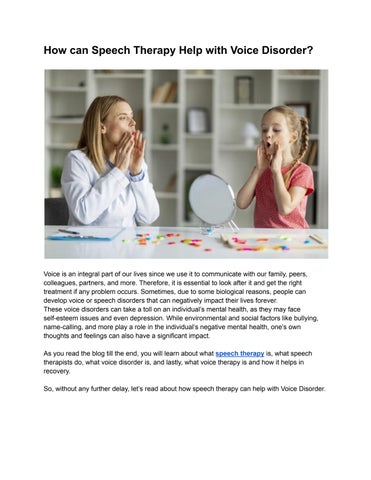
How can Speech Therapy Help with Voice Disorder?
Voice is an integral part of our lives since we use it to communicate with our family, peers, colleagues, partners, and more. Therefore, it is essential to look after it and get the right treatment if any problem occurs. Sometimes, due to some biological reasons, people can develop voice or speech disorders that can negatively impact their lives forever. These voice disorders can take a toll on an individual’s mental health, as they may face self-esteem issues and even depression. While environmental and social factors like bullying, name-calling, and more play a role in the individual’s negative mental health, one’s own thoughts and feelings can also have a significant impact. As you read the blog till the end, you will learn about what speech therapy is, what speech therapists do, what voice disorder is, and lastly, what voice therapy is and how it helps in recovery. So, without any further delay, let’s read about how speech therapy can help with Voice Disorder.
What is Speech Therapy? Voice therapists or Speech-language pathologists are trained professionals who use speech therapy techniques. Speech therapy consists of an in-depth evaluation and assessment of the condition, which further helps in improving communication problems among individuals. Speech therapy techniques include language intervention activities, articulation therapy, and more. A speech therapist performs an assessment and then frames a treatment plan for the individual as per their communication results. Speech therapy is useful for all age groups. Sometimes, children suffer from speech impairments from the start, and sometimes adults may face them due to injury, surgery, or other illnesses.
Speech Therapy: For Children & Adults CHILDREN Speech therapy for Children can take place in the classroom, in small groups, or in one-on-one sessions. The treatment plan depends on the assessment taken by the Speech-language pathologist (SLP), and then the activities and needs are planned. Apart from the type of Speech disorder the child has, the age and needs of the child are also considered when planning out the treatment. In speech therapy for children, the SLP may: ● ● ●
Use talking, playing, objects, pictures, books, and more to interact with the child. Speech therapists may use sounds and syllables so that the child can learn how to make certain sounds. Provide assignments and homework for the child that their parents or caregivers can help with at home.
ADULTS Just like for children, the SLP first performs an assessment to understand the condition of the speech disorder and then plans the best treatment. The exercises dedicated to adults not only help in speech and language but also in cognitive communication. Individuals who have Parkinson’s disease or oral cancer can, at times, develop swallowing difficulties. Speech therapy can help such adults retain their swallowing function. The exercises for adults may include: ●
Activities, including memory, organization, problem-solving, and others, help in improving cognitive communication.
● ●
Conversation skills building to help with social communication. Some exercises that improve oral muscles.
What are Voice Disorders? Individuals who are diagnosed with voice disorders sometimes differ in pitch, loudness, and voice quality as compared to individuals of the same age and gender. There are several types of Voice Disorders, which are: ● ● ● ● ● ● ●
Hoarseness: Conditions like viral infections and Parkinson’s disease can cause an individual’s voice to sound weak or raspy. Laryngitis: Allergies or upper respiratory infections can sometimes swell up an individual’s voice box. This condition is usually temporary and causes irritation. Muscle Tension Dysphonia: Occurs when an individual’s vocal muscles and cords get tight due to putting too much stress on them. Spasmodic Dysphonia: As the name suggests, this condition causes spasms in the individual’s voice box muscles. Vocal Cord Dysfunction (VCD): Having VCD can lead to breathing problems, as this condition prevents the vocal cords from opening entirely. Vocal Cord Lesions: Non-cancerous growths like polyps, cysts, and nodules end up affecting the individual’s voice. Vocal Cord Paralysis: The individual in this condition is unable to control their voice box muscles.
Symptoms of Voice Disorder? Every individual may face different symptoms depending on their disorder and causes. People with Voice Disorder may sound: ● ● ● ● ● ● ● ● ●
Wet or Gurgly Strained, Raspy, Hoarse or Rough Breathy or Strangled Too low or too high Too soft or too loud Shaky or uneven, with gaps or breaks in sound. Weak Voice Shrill Voice Loss of Voice
Remember, it is not possible to diagnose an individual with a Voice Disorder by just hearing their voice. Therefore, it is important to get a proper assessment done by a professional so that the right treatment can be given to the client.
How can a Speech Therapist Help? Noticing the symptoms in the beginning and getting early intervention is very essential. A speech therapist can help a client with the following: ● ● ● ●
Establishing vocal hygiene practices. Understanding shortcomings related to functional and structural issues. Improving self-awareness about the condition. Providing proper training in terms of communication strategies and skills.
Speech therapists not only help the client overcome their speech difficulties but also address the factors that cause voice problems. These factors include: ● ● ● ● ●
Excessive throat clearing Not staying hydrated enough Shouting every now and then Excessive coughing Talking loudly
There are some approaches that a Speech Therapist may decide to apply in their intervention plan. These approaches majorly depend on the condition of the client and their symptoms. The most common approaches to speech therapy include: ●
●
●
Direct Approach: In this approach, a Speech Therapist will focus on working on the voice-producing mechanisms. For example, musculoskeletal function and respiration further help in modifying vocal behaviors. Indirect Approach: This approach focuses on making the client aware of their symptoms and how the disorder works. Moreover, strategies to manage the symptoms are identified using counseling and education. Therapeutic Plan: After assessing the condition of the client, a unique intervention plan is designed, where the speech therapist uses both direct and indirect approaches.
In the case of children, the role that etiology, anatomy, and developmental level play are also considered. After proper assessment, the treatment plan is devised, and the approach to managing the voice disorder is decided. Remember, the symptoms and treatment plans for voice disorders can vary from person to person. Therefore, it is best to consult your speech therapist and ask what is best for you.
Conclusion Communication is an important part of our lives, which helps us express our thoughts, emotions, and feelings. Hence, it is important to take care of it and consult a professional when necessary. So, without any delay, get in touch with Reflect Within today and book an appointment with a Speech Therapist now.