ISSUE 05
REEDS BESPOKE January 2026
REEDS BESPOKE
REEDS BESPOKE
THE TIME IS NOW The continent's call has never been clearer. In a world that seems to be shifting with increasing velocity; environmentally, culturally, and politically, there has never been a more meaningful time to travel to Africa. The continent’s landscapes, wildlife, and people exist in a delicate balance of resilience and change, offering an extraordinary opportunity for travellers to witness something utterly authentic, profoundly moving, and in many ways, vanishing. To travel to Africa now is to immerse oneself in a moment of truth. Nature here is raw and unedited, deeply ancient yet undeniably dynamic. Seasons shift, species migrate, and ecosystems respond daily to the pressures of modernity. The privilege of experiencing these spaces as they are today, before climate, population, or development reshape them cannot be overstated. What you experience today will not be there forever, and the unique moments you yearn for will soon be fleeting memories. From Gabon’s untamed Loango coastline to the great herds of the Okavango Delta, conservationists, communities, and governments are fighting to protect what remains unspoiled. Their efforts deserve not only recognition, but support. When you choose to travel here, you become part of a global conversation about preservation and purpose. Your journey has weight, and is what keeps tourism on the minds of government or private investors controlling most if not all, of the natural areas. Tourism, when done responsibly, can breathe life into local economies and empower custodians of culture and land. In many parts of Africa, a single traveller supports rangers, educators, craftspeople,
and small-scale farmers. It keeps traditional knowledge alive, fuels community development, and safeguards habitats for future generations. To go now is not just to witness; it is to contribute meaningfully to something far greater than ourselves.
The Reeds Bespoke Team
REEDS BESPOKE
01
REEDS BESPOKE
TABLE OF CONTENTS Featured Lodge 02
Silvan Safari Lodge
LOANGO 08
Loango National Park, Gabon
IN THE WILD 12
Face to Face with the Great Apes
Safari Essentials Game Drive Etiquette
18
Field Talk 21
Wisdon from Ed Truter
SAFARI
SILVAN
REEDS BESPOKE
“Where Design Breaths, And Hospitality Dances”
There is a moment, just as you cross the threshold into Silvan Safari Lodge, when you realise you’ve arrived somewhere entirely different. From the moment you step inside, you're embraced by deep teals and sapphire blues that ripple through open lounges, while ochres and rusts glow softly on the walls and fabrics. Striking contemporary artworks and bold sculptures infuse the space with a sense of imagination, rooted in Africa, yet wholly its own. Every corner feels considered, expressive, and alive. There’s no sense of trying too hard but just the quiet confidence of a place that knows exactly what it is.
02
03
REEDS BESPOKE That creative energy carries seamlessly into the six suites, where floor-to-ceiling windows pull the landscape indoors. Light pours through ancient leadwoods, and the calls of hornbills drift on the morning air. Inside, the aesthetic is layered and luxurious: wild wood meets polished concrete, bold art softens against pale linens, and handwoven textures beg to be touched. It’s visually striking, but never overwhelming. The attention to detail here is undeniable. A mini bar becomes a small act of joy, stocked with handblown glasses for the perfect G&T, and house-made rusks to pair with a freshly brewed morning coffee. Nothing feels generic or off-the-shelf. Instead, each choice and each amenity feels intentional, almost personal, as if someone had quietly considered exactly what you might need before you even arrived. Silvan is often labeled a “design-led lodge”—and yes, the aesthetics are breathtaking, worthy of any design magazine spread. But that description misses the point. The lodge’s true beauty lies in the harmony between daring creativity and deeply intuitive care. Here,
design isn’t just about visual appeal; it’s about emotional resonance. Colour tells a story. Hospitality becomes art. And then, of course, there’s the people. It’s hard to define the kind of ease the staff at Silvan create because real ease is invisible. It’s not performance or routine. It’s the guide who shares stories by the fire with quiet charisma, the subtle check-in just before you’ve reached for your morning cup, the way your G&T appears, just right, without you ever asking twice. The service doesn’t announce itself; it wraps around you like a familiar shawl, ever present, comforting, and perfectly timed. Even the food reflects this philosophy: refined, yet deeply soulful. Meals unfold like slow-burning narratives, rooted in South African tradition but lifted by contemporary flair. One evening might bring fragrant bobotie spring rolls beneath the stars; another, a delicately plated tomato tartare that feels almost too exquisite to touch. Whether it’s breakfast beneath ancient trees or a lantern-lit dinner humming
REEDS BESPOKE
04
05
REEDS BESPOKE
with intimacy, every meal feels of the moment. Game drives at Silvan follow the same rhythm. The Sabi Sands delivers on wildlife, of course that is something well known but it’s the guides and trackers who shape the experience. There’s reverence here. You feel it in the gentle way a leopard is observed, the way silence is honored as elephants pass by, or the way stories are shared not told. There’s no rush, no quick hustle onto the next best thing, but patience and appreciation.
“Silvan doesn’t just welcome you, it envelops you. Its magic lies in the harmony between bold, expressive design and a team whose quiet grace makes every moment feel instinctively, impossibly perfect.” Its magic lies in the rare blend of expressive design and effortless grace, where every moment feels like it’s been quietly curated just for you. It’s a place where luxury and soul are not at odds, but in perfect step. In the end, a stay at Silvan isn’t simply a safari in general terms. It is a reawakening. A reminder that beauty and comfort can coexist with meaning, that nature and design can elevate one another, and that true hospitality isn’t found in grand gestures, but in the quiet magic of being deeply seen, and softly held. Long after the dust has settled on your boots, and the teal cushions have faded into memory, Silvan’s story and experience will remain with you. (Silvan Safari now bears the prestigious stamp of approval from Relais & Châteaux, a mark reserved for properties that embody the highest standards of hospitality. To be welcomed into the Relais & Châteaux family is to be acknowledged on the global stage, and Silvan wears this honour with quiet pride).
silvan_safari relaischateaux
REEDS BESPOKE
REEDS BESPOKE
06
REEDS BESPOKE
07
08
REEDS BESPOKE
LOANGO NATIONAL PARK Africa’s Last Eden. Where hippos surf, and gorillas roam. Tucked away on the wild Atlantic coast of Gabon, Loango National Park stands as one of Africa’s final frontiers where equatorial rainforest, sprawling savannah, and deserted beaches converge into a pristine, uninterrupted wilderness. In a continent renowned for its safari legends, Loango quietly claims a rarer title: Africa as it was before the maps were drawn. With more than 11% of land in Gabon protected by national parks, it is often described as a “last Eden.” Yet tourism here remains in its infancy. Infrastructure is minimal, and few travel brochures list it alongside Kenya or Botswana. Unlike the more traversed safari circuits of East and Southern Africa, Loango’s appeal lies in its rawness. Here, nature has not been bent to the will of man; rather, it unfolds as it has for millennia. Gabon offers an experience unmarred by crowds, fences, or predictability, a unique destination where nature still holds sway. At the heart of Gabon’s conservation efforts is African Parks, a non-profit organization that assumed management of Loango in partnership with the Government of Gabon. Their mission: to restore and protect this extraordinary ecosystem while creating long-term benefits for the local communities. Alongside these efforts, the Max Planck Institute for Evolutionary Anthropology has conducted pioneering research in Loango for over a decade. Their work with the region’s chimpanzees and lowland gorillas has revealed extraordinary
insights into primate behaviour and intelligence. The institute’s long-term studies not only deepen scientific understanding but also inform conservation strategies and habitat protection. Contributing to the aquatic side of this conservation narrative is African Waters, an organization deeply involved in protecting freshwater ecosystems and promoting responsible fishing. Their presence in Gabon supports sustainable catch-and-release fishing practices and protects riverine habitats vital to species like tarpon, threadfin, and Nile perch. Together, these organizations form a formidable alliance, ensuring that Loango’s rich biodiversity thrives. Loango is one of the only places on Earth where forest elephants, lowland gorillas, buffalo, and red river hogs share a habitat that stretches uninterrupted to the ocean, with no vehicle or visitor in sight for miles. Its remote beaches are known for otherworldly encounters where animal tracks are so diverse that the scenes of tracks feel
REEDS BESPOKE
10
REEDS BESPOKE
more myth than reality. The spoor is proof of elephants and hippos enjoying the Atlantic waters, buffalo grazing on rônier palms and endangered leatherback turtles sourcing their nesting grounds. These moments, equal parts surreal and sublime, are what make Loango a destination unlike any other.
It’s here, deep within Gabon’s wild heart, that the true magic of Loango reveals itself - raw, untamed, and utterly serene. The park’s biodiversity is staggering. Over 400 bird species fill the skies with flashes of color and song, while the waters of the surrounding lagoons and estuaries are home to manatees, tarpon, and prized game fish. An abundance of aquatic wildlife that it sounds like the water is boiling .
Gliding silently down Loango’s labyrinth of rich, winding waterways, you're enveloped not by the distant hum of traffic, but by the living symphony of the rainforest. Choruses of frogs, the haunting evening return calls of hornbills, and the distant chatter of monkeys hidden in the canopy. These lagoons, edged by tangled mangroves and ancient forest, carve paths into untouched wilderness where few have ever ventured. Loango is not simply a safari destination, it is a frontier of ecological wonder, a glimpse into Africa as it might once have been. For those willing to go further and embrace the unknown, it promises an experience as profound as it is unforgettable.
africanparksnetwork loangocamps
african_waters
REEDS BESPOKE
12
REEDS BESPOKE
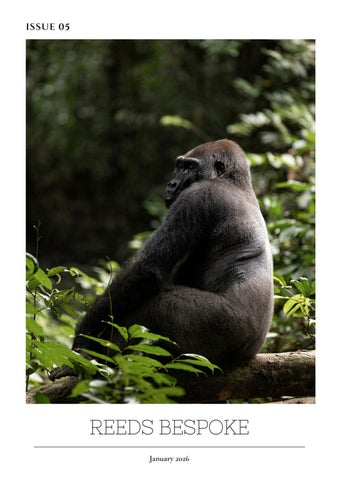
IN THE WILD Face to Face with the Great Apes For as long as I can remember, I’ve carried a childhood dream that bordered on fantasy which was to stand face to face with one of the last great apes. Movies, books, old wildlife specials all painted gorillas as both majestic and elusive. For a time, I wasn’t even sure they truly existed outside of imagination. But as I grew, and my love for Africa’s wilderness deepened, I learned the truth: they’re real. Not just in zoos or behind glass, but out there in the last wild places on Earth, just waiting for me to take the leap.
into a small wooden outpost which is the heart of the program. The walls were filled with hand-marked maps, photos of individual gorillas, field notes were scrawled across whiteboards offering minor insight into the family we were about to experience, We learned that there is only one habituated group of western lowland gorillas in this part of Gabon. Encounters are limited to four guests, strictly monitored, and never guaranteed. This wasn’t a tourist hub with gorilla souvenirs, this was observation, and on the gorillas’ terms.
For over a decade, Gabon has sat at the top of our bucket list. Jessica and I both grew up fishing, and while we’ve been fortunate to explore some of the most untouched places on the planet due to our matching hobbies, this was something different. This was a calling, and one we decided to answer this year. With the incredible help of African Waters, we planned a two-week expedition through Loango National Park with a few Reeds Bespoke clients who were crazy enough to join us. We traveled by 4x4, boat, and foot to achieve a rare and humbling goal which was to spend a day with a family of gorillas. Not at a zoo, but deep in the jungle at the Max Planck Institute’s Great Ape research center in the heart of Gabon.
After a quick boat ride, we had reached our inlet into the jungle. We were provided with face masks and our researcher had instructed us to put the masks on when they find the family. In-between the time of receiving the masks, and climbing over two fallen trees, they had located the family.
After several days traversing Loango’s raw, staggering beauty, the morning of the gorilla trek had finally arrived. The air felt thick with electricity, and either we were high from insect repellent or high on life. At dawn, we stepped onto a boat at the quaint Ndola Camp and cut through the southern edge of the Iguéla Lagoon. For two hours, we glided through a dreamscape of mist and mangroves to a place so quiet it you could hear your heart beat. This was no game drive, this was something closer to a pilgrimage. At a weathered dock, a research team met us: one primatologist and two local trackers. We were ushered
Whispers rippled down the line: “They’re here.” And just like that, it was time. The terrain swallowed us quickly with dense vines, towering trees, and the faint smell of earth and rain enveloped us, We walked in silence, following a narrow elephant trail, eyes scanning, ears straining. The forest around us stirred, and we stopped abruptly. Branches cracked softly, and the leaves shivered. A low, deep groan emanated from the bushes 15 meters ahead of us. Not threatening, but loud enough to make its presence known. We squinted into the shadows, unsure whether what we saw movement or if the light was playing tricks with us. Without warning, the silverback emerged from the trees and stopped. His arms folded across his chest like a king watching trespassers. He didn’t charge. He didn’t panic. He simply
REEDS BESPOKE
14
REEDS BESPOKE
claimed his space. Wordless and breathless, we all stepped off the path and let him cross. It was the most powerful silence we have ever felt. A rush of sounds escaped the bush, and the researched notified us that the other family members had been startled by a duiker moments before our arrival. This made it challenging to locate them but slowly, they began to reassemble which was drawn by the silverback’s calm gravity. A sighting of a life time came to fruition within 15 minutes of us finding the family. Our researched alerted us to a female who had given birthday just days before our arrival. Gently easing her way through the pathway, the female appeared cradling the newborn. Its tiny hands curled against the mothers chest, seeking security from the two young, juveniles who chased each other through
the undergrowth and wrestling like two teenagers in your grandparents living room. Within a minute, a quiet decended through the bush, and there came the silverback moving right towards us. At barely a whisper, the researcher told us to “stay still, eyes down and do not move”. Motionless and within an arms reach away from my side, he forced behind us and paused, contemplating his next move. I could feel his prescence like a current, our finer hairs standing up when there is too much static in the air. No agression, no fear, just an unmistakable message to us: I am real, and you are in my home. Time moves quickly when your senses and emotions are supercharged. Without realizing, our one hour visiting time had come to an end. With sweat-soaked masks and hearts that had just experienced something beyond words, we respectfully retreated back to the boat. Returning the way we came, but leaving feeling different, and grateful for the wild allowing us into their world for a brief moment. If we’re lucky, these remote encounters will continue, because this isn’t just a story about gorillas, it is a story about what still exists, and how important it is to protect it.
africanparksnetwork
REEDS BESPOKE
REEDS BESPOKE
REEDS BESPOKE
18
REEDS BESPOKE
SAFARI ESSENTIALS - GAME DRIVE ETIQUETTE The Wild Rules: Game Drive Etiquette with Style and a Smile There’s nothing quite like the thrill of a South African game drive. The crunch of tyres over the ground, the hush that falls as binoculars lift, and the breathless pause when a lioness appears, silent and steady, through the golden grass. But amid the drama of the wild, there’s one thing no lodge can entirely prepare you for: your fellow safari-goers. Yes, game drive etiquette is its own kind of wilderness wisdom which is part common sense, part quiet courtesy, and part knowing when to simply sit back and soak it all in. Whether you’re stepping into your first safari or you’re a seasoned traveller with a sun-worn field guide and a favourite spot on the vehicle, these helpful pointers will ensure your adventure is unforgettable (for all the right reasons). 1. The Golden Rule: Silence is Powerful Nature doesn’t shout, and neither should we. Keep your voice low, almost secretive, like you’re sharing something sacred. Sudden outbursts and loud chatter can send wildlife retreating before you even spot them. The bush has its own rhythm. Let the songs of the birds, the distant warning calls, and rustling leaves tell the story. 2. Capture the Moment: Respectfully Photography is a huge part of any safari, and those golden-hour lion shots and quiet elephant silhouettes are souvenirs for a lifetime. But while snapping away, be mindful of your fellow travellers. Avoid blocking someone’s view, leaning across others, or standing up midsighting. If you’re capturing guests in your shot, a quick “Do you mind?” goes a long way. Not everyone wants to be part of your highlight reel, and that’s okay.
Remember: a little courtesy behind the lens ensures everyone walks away with the memories they came for. 3. Dress the Part: Blend In Safari style can be effortlessly chic but practicality wins the day. Earth tones like khaki, olive, and sand help you blend in and stay cool. Avoid anything loud (literally). That neon cap or jangly bracelet? Best left behind. Think subtle sophistication, not safari runway. When you dress to disappear into the landscape, the wildlife is more likely to let you witness its secrets up close.
19
REEDS BESPOKE
5. Your Guide & Tracker is Your Compass Think of your guide and tracker as your pilots, naturalists, and storytellers rolled into one. Their instructions aren’t mere suggestions, they are the fine line between a memorable sighting and a missed opportunity (or worse). Trust their timing and positioning of the vehicle. Most of your guides want to see the animals more than you do, and pay attention as they’ve likely read the bush long before you noticed the ears flicking in the grass. 6. Share the View, Share the Magic We wall want the “money shot” when we are on a drive, but everyone deserves a fair look. If you are sharing a vehicle with fellow photography enthusiasts, stay aware of those around you, and do not lean across others to get the perfect photo. You might miss the leopard behind you while focusing on the zebra in front. 7. Respect the Wild (and Snack Smartly) Game drives aren’t snack buffets, but a quiet sip of water or discreet bite from the freshly baked cookie you popped in your pocket at sunrise coffee is fine. The point is to be mindful of the sounds you may create while snacking on your granola bar. No noisy wrappers, no strong smells, and absolutely no littering. The bush is not your bin. Leave only tyre tracks, take only memories (and maybe a few crumbs). 8. Curiosity Welcome: Ask Away Your guide and tracker are walking encyclopedias of the bush, and most genuinely love sharing their knowledge. Why is that elephant flapping its ears? How can you tell if a lion is hunting? What bird just made that sound? Every question you ask deepens your connection to your surroundings, and often reveals details you’d otherwise miss. Engage, be curious, and treat your guide like the incredible resource they are. You’ll walk away with far more than just photos. Don’t hold back, your curiosity is one of the best things you can pack on safari.
Final Word: Be Gracious in the Great Outdoors Game drive etiquette isn’t about stiff rules but about respect. For the land, the animals, your guide, and your fellow travellers. When practiced with grace, it doesn’t just improve your own safari but elevates the entire experience. Because out here, the wild is watching, and rewarding those who honour and respect it. The bush has endless stories to tell, you just need to be gracious enough to hear them.
REEDS BESPOKE
21
REEDS BESPOKE
WISDOM FROM ED TRUTER Some understanding only comes from time spent paying attention.
Ed Truter is South African, born and bred, and has spent most of his adult life working in wild places across Africa. Conservation, field operations, guiding — usually in fairly remote areas — have been the constant. Much of his work has sat at that uneasy intersection between people, wildlife, and long-term conservation, where ideals are tested quickly and theory rarely survives first contact with reality. When asked to point to a single moment that changed his perspective, Ed pauses. He laughs slightly, not because the question is funny, but because it’s almost impossible. “It’s actually quite a difficult question,” he says. “More difficult than a typical interview or podcast, because it’s so hard to isolate experiences.” When you’ve spent years moving through these landscapes, moments don’t arrive neatly packaged. They accumulate. They overlap. They blur. But what stays with him, he explains, are the quieter realisations. “You suddenly understand how small you are,” he says. “You’re in a system that’s been functioning perfectly without people for thousands of years, and you’re just passing through it.” That perspective, once gained, doesn’t disappear. It informs how he works, how he moves, how he thinks about risk, about decision-making, about responsibility. Conservation, he’s quick to point out, is rarely the romantic endeavour people imagine from the outside.
“It’s never straightforward,” he says. “And one of the hardest lessons is realising that caring isn’t enough.” There are politics to navigate, funding constraints, community dynamics, and competing priorities. Decisions have consequences, and often there is no clean outcome. Those moments — when ideals meet reality- are some of the most difficult. “But they shape how you work,” he continues. “You become more pragmatic. You listen more. You stop thinking in absolutes.” And perhaps most importantly, you learn that conservation is as much about people as it is about wildlife — whether that’s comfortable or not. Rivers, for Ed, have always been a touchstone. He speaks about them not romantically, but honestly. “They don’t lie,” he says. “If a river is healthy, you don’t usually have to look very far to see that everything around it is working too.”
22
REEDS BESPOKE Certain species become important not because of the fishing alone, but because of what they represent: intact habitat, resilience, balance. For Ed, fishing has never really been about the catch. “It’s about understanding where you are,” he says. “Understanding how that system works.” That same attention to systems extends beyond water. When asked about places in Africa that the world still doesn’t fully appreciate, he doesn’t hesitate. “There are huge areas that never make it into the spotlight,” he says. “But they’re absolutely critical.” Often they’re working landscapes, places where people and wildlife still coexist, sometimes uneasily, sometimes in balance. They don’t always photograph well. They don’t always look dramatic. “But once you spend time there,” Ed says, “you realise how important they are, and how vulnerable.” Storytelling, in that context, becomes essential. “Data is important,” he says. “Obviously. But it doesn’t move people on its own.” People need emotional connection. They need to care. And storytelling, when done honestly, allows people to connect with places they may never see for themselves. “The danger,” he adds, “is turning it into a spectacle. If you avoid that, storytelling can actually lead to real support for conservation.” Then there are the moments that humanise the work — the stories that live somewhere between humour and discomfort. Food, unsurprisingly, brings those out quickly. “There have been some incredible meals,” Ed says. “Simple food. Local food. Shared with people who are proud of what they’re offering.” But not all food memories are quite so comforting. “In Burkina Faso,” he says, laughing now, “we were eating frogs. Big frogs. Their legs were like drumsticks — honestly, like partridges.” They were cooked whole, eaten communally, entirely normal in context — and deeply confronting if you weren’t expecting it.
“And then there were the giant land snails,” he adds. “They cut them up, put them on skewers. You eat what’s put in front of you. Sometimes curiosity gets the better of you.” Some of those meals are unforgettable for the right reasons. Others… less so. But all of them become part of the story you carry. It’s the same with people. Over decades of travel, Ed has crossed paths with countless characters, but some of the most influential wouldn’t describe themselves as conservationists at all. “They’ve just lived there their whole lives,” he says. “They’ve watched things change. They understand their environment in a way that no report ever will.” Those conversations stay with him — grounded, practical, earned through observation rather than theory. Africa’s wilderness, he says, reflects that same complexity. “It’s mixed,” he explains. “Some areas are doing incredibly well, especially where communities are genuinely involved and benefiting.” Other places are under increasing pressure — development, population growth, short-term decisionmaking. “The next ten years are going to be critical,” he says. “There are reasons to be optimistic. But only if decisions are made carefully and realistically.” When asked where he would go if he had just one expedition left, Ed doesn’t romanticise it. “Somewhere remote,” he says. “Definitely.” Not to tick boxes. Not to chase anything specific. Just immersion — time, understanding, minimal impact. “Nature is still boss,” he says. “Always.” For those hoping to follow a similar path, his advice is simple, and hard-won. “Be patient. Be humble. Listen more than you speak.” This work, he says, isn’t about ego. It’s about responsibility. And if you’re willing to learn — especially from the people who live closest to the land — you stand a far better chance of doing something that actually matters.
edwardtruter
REEDS BESPOKE
“The deeper stories rarely announce themselves.”