California Mahjong House opens in Tiburon By Sidney Bank Beginning Aug. 26, Tiburon became home to the first American mahjong retail store in California, California Mahjong House. Founded by Daria Lovette and Maureen (Moe) Riley, the space brings the community together one mahjong tile at a time. “American mahjong is a game that's played with tiles. It’s similar to a card game in that you draw and discard, with the objective being to get 14 tiles in a row that match a pattern,” Lovette said. Lovette and Riley started playing American mahjong less than a year ago and quickly fell in love with the game. They love its ability to let people unplug and create a rejuvenating environment. “There’s nothing digital about [mahjong], which we love, and it’s a way to completely disconnect. The game is hard and can be complex, so you can’t really be distracted, which is lovely,” Lovette said. According to a September Bark survey, 56% of Redwood students have reported knowing somebody who plays mahjong. Sophomore Hyla Weingarten has been playing mahjong for more than two years after learning the game from her mother and a few of her mother’s friends. “It's so exciting that you’re competing with your friends, so that you can bring them all together and even bet on the games. It’s just the best thing,” Weingarten said. Lovette and Riley opened the store without any prior experience in retail business, and felt the timing was perfect to begin creating this hub. “It was just the right time to start a new
MAHJONG TILES SCATTERED across a peacock-patterned mat.
bark.
redwood
Illustration by Rosstin Pouradib
Volume LXIX, No. 2 • October 2, 2026 • Larkspur, CA
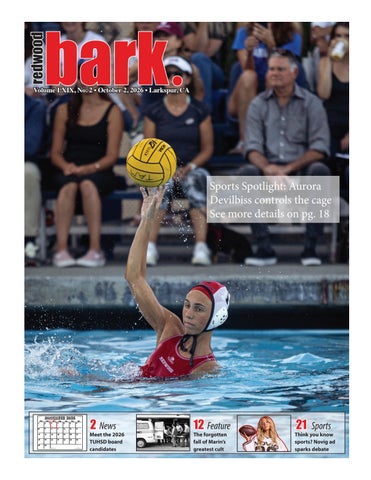
Sports Spotlight: Aurora Devilbiss controls the cage See more details on pg. 18
A TABLE DISPLAY of mahjong tiles, beaded coin purses and gift accessories at the entrance of California Mahjong House. chapter of our lives. As your kids go, your friendships take new forms, so it’s a great way to stay connected to a community of people,” Lovette said. The response from the community following their grand opening has been overwhelmingly positive, with strong customer turnout and traffic. “I think [the California Mahjong House] is the best addition, and I’m so glad they decided to do that, as it could expose the game to an even bigger audience and bring more people together,” Weingarten said. Individuals often begin with a starter set but grow their collection as they become more passionate about the game, eventually seeking tiles that reflect their personal style. “The best thing is when someone comes in looking for guidance and [we’re] able to show them or give them a [mahjong] set that they're so happy about, and they are just beaming because of their excitement,” Lovette said. “That just brings us a level of joy that no other job ever has before.” For Weingarten, getting her own mahjong set was a milestone event in her love for the game. “Getting my first mahjong [set] was really sensational. My mom has her own set and mat in our [mahjong] room. My mom and a few of her friends joined me when I got my first mahjong set, and
everyone was so excited,” Weingarten said. Mahjong is not only a competitive and fun game, but one that brings everyone closer together. “Mahjong is a lifestyle. It’s so fun, and it’s a great way to bring my family together after dinner, since sometimes we have different practice times, and we’re not always eating dinner together. It’s a great time to recollect and talk about our days,” Weingarten said. Beyond the built-in community of open play, coming to the shop is much different from playing at home, as Lovette and Riley handle all the hosting and an elevated setup with curated tile sets for guests. “If [guests] come to one of our open plays, they know they’re going to get paired up with either one, two, three or four other people at their skill level, so they can just play the game,” Lovette said. The California Mahjong House has not only brought the community closer together, but encouraged many new people to play the game. “Definitely try [mahjong]. It is not a boring game but actually very exciting, and I’ve never felt more joy in my life than my first mahjong,” Weingarten said. sbank@redwoodbark.org
2 News
Meet the 2026 TUHSD board candidates
12 Feature The forgotten fall of Marin’s greatest cult
21 Sports
Think you know sports? Novig ad sparks debate
Fall 2026 Roster/Positions
Editors-in-Chief: Reed Grossman Beatrice Nass Logan Scully
Section Editors: Art Consultants: Ethan Finkelstein Ada Healy Rosstin Pouradib Julia Rivo Edie Youngs Business Managers: Charlie Anderson Tate Ralston Ronak Shah Copy Editors: Alex Atherton (Head Copy) Amrit Aujla (Head Copy) Georgia Thomas (Head Copy) Eleanor Bentley Claire Carbone Liv Fargo Skye Hammond Olivia Herbst Adriella Marcus Alexa Martin Anika Murray Isha Patel Maddie Petersmeyer Sophie Sahai Adam Scheer Maya Tucker Sofia Yanni Data Analyst/Survey Managers: Zack Ferry Milan Hendrickson Logan Schneidewind Feature Editors: Bella Garbo Anna Horn Maggie Schwartz
Redwood High School 395 Doherty Drive, Larkspur, CA 94939 www.redwoodbark.org Games Editors: Olivia Hamm Olivia Shapiro Maddy Wagner Lifestyles Editors: Siena Forster Lyla Hielscher Elizabeth Hopkins Multimedia Editors: Leyton Defesche Claire Johnson Lucy Levine News Editors: Calista Grigg Cian Kelly Nico Less Opinion Editors: Josephine Perlov Henry Rivo Nico Ruel Outside Opportunities Managers: Isla Geithman Sienna Watt
Noah Gersch Margaux Hirschbein Thea Jones Lily Kilgore Sophia Kletz Elaina Leighton Carmela Mangilit Valentina Mitchell Paige Mori-Prange Rose Mueller Nico Post Drew Schultz Solomon Strasburg Guo-Ting Tseng Charlotte Welter Review Editors: Gabby Baumgarten Ella Shawn Tessa Soccorsy Spanish Editors: Sidney Bank Esperanza Cubillos Sports Editors: Grady Graziadei Joel Kurtzman Hayden Martay
Photography Editors: Lauren Ellington Owen Scheeline Oren Weingarten Asha Zlatoper
Social Media Managers: Isabella Marsh Zoe Peters Berkeley Smith
Podcast Editors: Jimmy Centeno Olen Johnson Taylor Kaster
Video Editors: Josh Friedman Brooke Hansen Victor Levsky
Reporters: Ava Babb Hudson Brod Carlie Catanese Piper Cifarelli Sophia Davis Vibha Devulapalli Wes Fitzpatrick Dorothy Florence
Web Designers: Zander Hakimi Colette Reidy Bodhi Wadia
bark.
Redwood High School ● 395 Doherty Dr., Larkspur, CA 94939 ● Volume LXIX, No. 2 ● October 2, 2026 ● www.redwoodbark.org
Tiburon allots $75,000 to prepare for El Niño By Taylor Kaster The Tiburon Town Council recently approved a $75,000 budget amendment intended to help prepare Tiburon for the upcoming El Niño that is predicted to hit in October. According to the National Oceanic and Atmospheric Administration, “El Niño and La Niña are climate patterns in the Pacific Ocean that can affect weather worldwide.” For a town like Tiburon, this could mean intense rainfall, wind and a high probability of flooding. Patrick Kerslake, Tiburon Public Works Department operations and technology manager, presented the budget amendment to the Tiburon Town Council. “[I] wanted to supplement our existing inventory of
Photo courtesy of Partick Kerslake
REPAIRING A ROAD damaged by a storm, employees for the Tiburon Public Works Department use a jackhammer.
equipment and things that we use to be as ready as we can,” Kerslake said. Meteorologists are predicting a “Super El Niño,” the first one since the 2015-16 winter season. “There’s been a lot of modeling and a lot of forecasts that have indicated a pretty strong El Niño year for us here in town,” Kerslake said. This puts Tiburon at high risk for damage, especially due to its topography. “We are a coastal town with a lot of naturally low-lying areas and we’ve already seen some of the impacts with the king tides,” Kerslake said. This funding will enable the public works department to purchase more emergency preparedness and critical storm response equipment to help combat these weather risks. “We are looking to buy a large towable diesel pump to pump flooded areas and additional message boards,” Kerslake said. These supplies will be distributed around Tiburon, depending on which areas are hit hardest. “Our primary objective is to protect our public infrastructure and make sure that the critical networks like the storm drain system, roadways, traffic signals and those types of things are in operation,” Kerslake said. Tiburon Vice Mayor Isaac Nikfar was one of the three council members who voted to approve the funding. Learning from previous storms, like the king tides that occurred last winter, Nikfar said that Tiburon has started to make infrastructure upgrades to allow for water to better flow into the bay. “We’ve done a lot of the work to make sure that the drainage and flooding are mitigated,” Nikfar said. Ensuring drainage is functioning properly will be an essential step for residents to lower their chance of flooding. “People in Tiburon have done a great job of making sure that they have proper drainage so that water is able to get through their property quickly,” Nikfar said. The public works department has made the project
a priority and has put significant effort into research, evaluation and the use of available resources to protect the community. “Everyone’s kind of been on ready standby to make sure that we are learning from past years where things have not gone according to plan, to make sure that we’re doing everything we can and making our best effort to ensure that we don’t see flooding or repeat mistakes,” Nikfar said.
Photo courtesy of Partick Kerslake
WORKING HARD, TIBURON Public Works Department employees fix a clogged drain caused by previous storm flooding. tkaster@redwoodbark.org
Newsom signs social media and AI protections for youth just moved.” Freshman Alexis Colonia said he feels conflicted On Sept. 10, in front of the Bay Area Discovery about these new regulations. Museum in Sausalito, California, Gov. Gavin Newsom “I know that I could do way more things without signed into law a 13-bill package aimed at protecting being on my phone,” Colonia said. California youth from the potential harms of social media He said that he appreciates that these regulations will and artificial intelligence (AI). give kids more time to go outside, hang The laws will take effect on difout with friends and play sports. On the ferent dates beginning in 2027. other hand, he said that he also enA driving force behind the joys being on his phone and watching passing of these bills is the national videos. organization Mothers Against Media While students like Colonia see the Addiction (MAMA). Lauren Goodregulations as a way to spend less time man, the leader of the Marin chapter on their phones, freshman Daniel Diaz of MAMA and a parent of a student questioned whether the government in the Tamalpais Union High School should be involved in the decision to District, said that these regulations regulate social media at all. Lauren Goodman are overdue, specifically pointing to “Other people enjoy [social media], regulations around AI chatbots. so you might as well let other people SB 1119, known as “Adam’s just enjoy what they like,” Diaz said. Law,” will create more protecGoodman said that opposition to tions around the use of AI chatbots for minors, which government regulation is “a totally legitimate argument,” Goodman said is significant and has received bipartisan especially in the United States. She said, however, that support. social media companies have used that idea of individual Goodman also advocated for restrictions on social choice to defend their products. media, saying that her own experience with these plat“The consumer likes to think that they are in control, forms has shown her firsthand how addictive they can be. and that they’re the ones that decide,” Goodman said. One of the bills she supported, AB 1709, restricts “That’s a point of view that social media companies have social media companies from using addictive features used for years to protect themselves and say, how could such as autoplay, personalized feeds and endless scrolls we possibly decide for you? You are the one in control. for users under 16. You have all the power.” At the same time, Goodman acknowledged social Goodman acknowledged that these laws are not media’s benefits. foolproof. But she said that focusing on these potential “Social media is fun,” Goodman said. “It was a plea- loopholes overlooks the broader picture of creating legal sure to use when it wasn’t so harmful… it allowed me to boundaries around social media. stay in touch with my friends from New York after I had She compared enforcing these laws to enforcing By Ronak Shah
The consumer likes to think that they are in control
Photo courtesy of Mothers Against Media Addiction
GOV. NEWSOM GIVES a speech during the signing ceremony at the Bay Area Discovery Museum. “It’s a good day for our children. It’s a good day for the state of California,” Newsom said. already existing laws. “Stealing is illegal. Does that mean that people don’t steal? No… But it creates some friction. And it lets people know that it must be illegal for some reason,” Goodman said. With the passage of these laws, California now has some of the nation’s most comprehensive safeguards for children using both AI chatbots and social media.
rshah@redwoodbark.org
October 2, 2026 bark Page 2 • News Meet the 2026 TUHSD school board candidates
Leslie Harlander By Nico Less
As the former Tamalpais Union High School District (TUHSD) Board of Trustees President, TUHSD board candidate Leslie Harlander hopes to bring both experience and patience to the role. She previously served two terms, from 2016 to 2024, and decided to run again due to recent concerns about how the board and community interact. Harlander emphasized how working with scientists and engineers as a civil engineer, and as a nurse, helped her find common ground among groups that have differing views. “I've worked alongside a huge range of personalities, and have always been able to find a commonality so that we can get the work done,” Harlander said. This is valuable, as Harlander believes that the most important issue currently facing the board is an upset community. She believes that without first addressing community engagement with the board, progress on other issues such as budget cuts and an artificial intelligence (AI) policy will be inhibited. Her previous terms on the board have given her “institutional knowledge” regarding how the board functions, which she references when reconnecting the board and community. She said that due to law, board members cannot engage in back-and-forth conversations with community members during meetings. To combat this, Harlander said that there should be other ways to communicate with the board outside of meetings. An example of this is how the board has previously handled budget cuts during her term, which Harlander says involved meetings with the community to explain how and why cuts were going to be made. “Once you get an inkling that you’re going to have to make cuts, you better start talking to the community right away,” Harlander said. She acknowledged that there isn’t always time to do
Joy Koo
By Maya Tucker
As the election for the Tamalpais Union High School District’s (TUHSD) school board approaches, first-time candidate Joy Koo hopes to bring greater community input and alternative perspectives to the board’s decisionmaking. Koo attended Columbia University and graduated with a degree in engineering. She then earned a master of business administration (MBA) from SDA Bocconi University in Milan, Italy. More recently, Koo has served as a member of the Tamalpais High School Site Council for two years and has been on the Parent Teacher Association
HOPING TO BRING a more community-oriented perspective, Koo will be running for the first time.
AFTER NOT RUNNING for re-election in 2024, Harlender is coming back to run for the upcoming election. this process, but that it must be prioritized. She also emphasized the importance of community perspectives when it comes to AI policy in schools. She said that her work experience has shown her how important sitting with problems is, instead of using AI to take shortcuts. “AI is here, so we need to have some sort of education with our students. In a way, it’s almost a partnership because everybody’s learning at the same time,” Harlander said. She said that while the board does not handle implementation of an AI policy, it is not up to the teachers to figure out themselves. “Anything big that comes down the pike in society, it hits the schools and then it’s, ‘let the teachers figure it out,’” Harlander said. “And this one’s not an easy thing to figure out.” Instead, she said she could see a collaborative approach being useful, where students and teachers work together on an “ideal policy” to present to the superintendent or
even the school board. She noted that one current board decision affected by community engagement has been Phone-Free Schools, which she has seen a positive response to in recent board meetings, but believes will need to continue to adapt. She said that sometimes policymakers get so happy about all the things that are working well that they stop paying attention to some of the things that aren’t working. “Whenever you start something new, it’s not going to be completely free of little stumbles here and there. So it’s a matter of making sure we don’t lose those,” Harlander said. Despite some current concerns about the board, her outlook is largely positive. “I think that we have really good teachers and a lot to celebrate, even though we have some tough decisions ahead,” Harlander said.
executive board for Edna Maguire and Mill Valley Middle School. Koo became increasingly involved in TUHSD after attending board meetings and hearing students speak about issues affecting their schools. During the 2025-26 school year, she said she became frustrated when board decisions surprised the community, ultimately encouraging her to run for school board. “I learned a lot from hearing people,” Koo said. “I was frustrated with the situation where it felt like there were decisions being made, but they were surprising to the community.” After attending multiple board meetings, Koo said she values the voices of students, teachers and the community. As a mother of three, she understands parent perspective. “If we have to make some of these decisions, then we want to be interacting with our community in a way that we could really understand what aspects of X, Y and Z are most valuable to people, and try and address as many of those as we can,” Koo said. Koo’s emphasis on community voice also shapes her views on the district’s new phone-free initiative. While she acknowledges that the policies have been a difficult adjustment for students and staff, she supports them because it has fostered more social interaction among students. “I love that at lunchtime, people are talking to each other more and that the human connection is growing,” Koo said. Koo said her approach to problem-solving is rooted
in what she describes as a growth mindset rather than a fixed mindset. Before settling in Marin, Koo lived abroad, earning her MBA in Italy and living with her family in Hong Kong and Singapore. She said those experiences shaped the way she approaches challenges and looks for alternative solutions. “It feels like a fixed mindset. Like, there’s only A or B. And with the experience I have had in my life, I felt like there was never a no. Maybe I can’t do it that way, but I could do it this way, right?” Koo said. Along with communication, Koo said her professional background has given her experience managing large projects and working with budgets. She spent 20 years managing complex client relationships, leading teams through change and addressing problems under pressure. She said she would bring that problem-solving approach to emerging issues in the district, including the use of artificial intelligence in schools. Koo believes a task force with a combination of experienced adults and students would help address problems. “I think we need another sort of task force. Again, I think we have some really brilliant minds in our community, whether they’re directly tied to the school in terms of being a parent or they happen to live in our community and have a lot of knowledge about what’s happening. I think it’d also be great to get students on the same committee,” Koo said.
nless@redwoodbark.org
mtucker@redwoodbark.org
Page 3 • News
www.redwoodbark.org
Cynthia Roenisch By Victor Levsky
For more than two decades, Cynthia Roenisch has served as a school trustee. Now, the Tamalpais Union High School District (TUHSD) board president is seeking a third term on the board. “I’ve served as a trustee for 21 years, 13 in Kentfield, eight here,” Roenisch said. In addition to her time spent on the school board, Roenisch has taught for 17 years and now teaches three AP English classes to high school juniors and seniors at Alameda High School. Roenisch said another run was not a given, but she wants to continue supporting Superintendent Courtney Goode, who was hired last year. “I’m running to continue to support [Courtney Goode] and his vision that he has for the district, particularly refocusing on academics,” Roenisch said. When asked what makes her a unique candidate, she pointed to her tenure. “That I’m crazy enough to do it for what would be 25 years if I do it,” Roenisch said. “I certainly have the most experience.” Roenisch has served as the TUHSD board president since 2022. Her two children graduated from Redwood in 2015 and 2017. Roenisch said her current classroom experience also sets her apart from the other candidates. “I am currently teaching. I know [Valerie Wynn] is a former teacher, but I’m currently teaching,” Roenisch said. On the district’s phone-free policy, Roenisch expressed firm support, apologizing for not taking earlier action on the initiative. Roenisch also acknowledged that many students dislike the policy. “It’s kind of like eating your vegetables and your protein, and not your junk food,” Roenisch said. “Does it taste as good? No. But is it going to have a better effect later? Yes.” Roenisch added that she would not change the district’s current AI policy, which she said focuses on cheating. Roenisch worries that students who rely on AI will miss the chance to build on their critical thinking skills. “I tell my own students every day … you’re nowhere near where you need to be to use AI as an efficiency tool,” Roenisch said. Roenisch said AI rules should start with teachers and administrators, not trustees. “I’m not teaching in the classrooms and I don’t have these students,” Roenisch said.
Kevin Saavedra
bark
By Alex Atherton and Dorothy Florence
Photo courtesy of the Tamalpais Union High School District
FILING FOR CANDIDACY July 24, Roenisch will be running for her third trustee term. “That’s not really our role.” When asked about the most pressing issues she intends to tackle, Roenisch pointed to the district’s finances. Roenisch has also previously focused on improving student scores in the [California Assessment of Student Performance and Progress (CAASPP)] for the past three years. Roenisch expressed concern about Redwood’s performance compared with students at Alameda High School, where she teaches. “If our language learners, [and] firstgeneration students are outperforming Redwood, there’s a problem,” Roenisch said. Roenisch said scores rebounded last year as more students took the test seriously. For Roenisch, serving on the board means helping students make the most of the education available to them. “We are fortunate to live here where you get education for free right until college,” Roenisch said. “Let’s not waste it.”
vlevsky@redwoodbark.org
Maria Sandoval
Sandoval sees these skills as valuable in building trust between community A crowded race for Tamalpais Union members and the board. While it is hard to High School District (TUHSD) board please everyone, Sandoval said her “north member is currently playing out, as seven star” will always be student success, which candidates run for three starts with crafting available seats. Longtime solutions together. Spanish educator Maria “I think that right Dolores Sandoval hopes now, there is a lack of to fill one of these spots trust. Unfortunately, in order to bring a unique the community doesn’t perspective centered on feel like they’re being her education-focused heard,” Sandoval said. background. “So I think that the Her values are formed Maria Sandoval, most important thing by her experiences in right now for these board candidate education, from teaching new members that are kindergarten all the going to be part of the way to College of Marin Spanish classes. committee is regaining trust.” She has close to 20 years of experience One current issue involving community in education and says that she brings an members is budget cuts in all TUHSD educator’s lens to everything she does. schools, which Sandoval has felt the effects Sandoval said education has also of firsthand as a Spanish teacher. She says helped her develop important listening Spanish is often one of the first classes to skills and a strong sense of empathy. As a go, despite its value in expanding students’ teacher, she has to listen to many different vision of the world. interest groups and perspectives. Sandoval emphasizes that teamwork is By Nico Less
Right now, there is a lack of trust... the community doesn’t feel heard.
With three seats open and seven candidates on the ballot, current trustee Kevin Saavedra is seeking reelection to the Tamalpais Union High School District (TUHSD) Board of Trustees on Nov. 3. Saavedra, who has served on the board since 2018 and currently serves as board clerk, is seeking another four-year term. For Saavedra, his role on the board largely centers around one area: finance. A graduate of University of California, Los Angeles who works in finance and investment banking within commercial real estate, Saavedra first became involved with district schools through his interest in music education. A longtime musician himself, Saavedra began supporting local music programs while his two children attended district schools. “I’m a big supporter of public education,” Saavedra said. “I got involved specifically to engage and support our music programs.” That involvement eventually expanded beyond music. Saavedra joined the district’s fiscal advisory committee as TUHSD faced financial instability and served as treasurer for the district’s 2018 parcel tax campaign before being elected to the board that year. Saavedra said his financial background has shaped how he approached his responsibilities as a trustee. “I would view my role as being the finance person on the board, really understanding the drivers of our revenue [and] the risks to the forward projection,” Saavedra said. That experience remains central to Saavedra’s reelection campaign. With district enrollment declining, Saavedra said the board will need to decrease spending and course offerings to accomodate for the decline. Managing that transition, he said, is the issue that “keeps [him] up at night.” Beyond finances, Saavedra said removing phones throughout the entire school day benefits students’ mental health and socialization. “My perspective has always been that we’ve got to get the phones out of your hands during the school day, without question,” Saavedra said. “I am absolutely confident that we have done the right thing.” Saavedra described the district’s approach to artificial intelligence (AI) cautiously. He views AI as a potentially
priority in solving budget cuts. “We’re a team, and we can figure it out together, and as I said, it goes back to listening. What does the community think? What do the parents think?” Sandoval said. She supports current board policy on multiple issues, including phonefree schools and developing an artificial intelligence (AI) policy. “Because of my own experience as an educator I feel like students learn better when they don’t have a cell phone in their hand. It’s a big distraction. They’re more present, they’re more engaged,” Sandoval said. Sandoval also supports an AI policy that incorporates input from all sectors of the community, saying she wants participation from teachers, students and parents in creating guidelines. However, Sandoval also noted the significance of updating AI policies. Issues like AI, the school budget and personal technology are constantly evolving. To combat this, Sandoval emphasizes that curiosity is one of her driving values.
Photo courtesy of the Tamalpais Union High School District
HOPING FOR REELECTION, Saavedra aims to continue what he views as consistent progress under Superintendent Goode. valuable tool for research and efficiency but said policies will need to evolve alongside the technology to prevent students from misusing it. “It’s definitely a work in progress,” Saavedra said. “I’m sure that policy will change numerous times over the next couple years, and we just got to stay on top of it.” Saavedra also addressed concerns surrounding communications between the board and students. He encouraged students to contact trustees by email, phone or Zoom if they want a conversation. “You want my opinion? Reach out to me,” Saavedra said. “I’m very accessible, and I’m super happy to share my perspective.” As he seeks another term, Saavedra said his goal is to focus on continuing what he sees as recent progress under Superintendent Courtney Goode. Saavedra points to a boost in attendance, standardized testing and Advanced Placement participation as evidence of improvement. “The district is, particularly over this last year, on a good trajectory,” Saavedra said. “The cement is still a little wet here. We need to make sure that we’re really solidifying those gains, locking them in.”
bark@redwoodbark.org
Photo courtesy of Maria Sandoval
FOR THE 2026 board election, Sandoval will be focusing on education. “When you’re curious, and you like to ask questions and you’re willing to listen, I think that learning is not that hard,” Sandoval said. To Sandoval, success as a board member would mean creating a community that feels more united and is taken into consideration for the big decisions that the board makes. nless@redwoodbark.org
bark Page 4 • News Brian Sutherland By Cian Kelly Civil dialogue and communication have been a recent struggle for the Tamalpais Union High School District (TUHSD) board of trustees, according to board candidate Brian Sutherland, and it’s one of the most important issues to him as a candidate in the upcoming board election. Backed by organizations including the Marin Democratic Party and Tamalpais Federation of Teachers, as well as prominent district figures like departing TUHSD board trustee Emily Uhlhorn, who will not be running for reelection in November, the first-time board candidate has amassed significant backing for his campaign. If elected, Sutherland will be serving on a board of trustees for the first time. He is an appellate lawyer who has previously focused his 20-year-long career on public-interest and government accountability. He served the New York attorney general’s office and later worked on pro bono public-interest cases in California for approximately 12 years. Sutherland’s campaign is currently focusing on five main goals: equity, academics, finances, phones and artificial intelligence (AI). Sutherland said he wants to allocate more resources to help bridge the gap between students through equity-based initiatives like The Hub, an academic support program at Tamalpais High School, which focuses on academically supporting Black students who have historically underperformed their peers. Despite not having any current plans to address educational circumstances in the district, Sutherland said he wants to focus on studying issues and setting up office hours for him to hear from staff and address future concerns. Regarding phones in schools, Sutherland said that NuKases are an important “symbol” in the district’s phonefree schools policy. Although he recognized that there are students who circumvent the policy, Sutherland said that there are still students who are positively affected by the implementation and that NuKases create a more tangible attempt at regulating device usage than previous policies. Concerning AI, Sutherland said unregulated use of AI should not be permitted in the classroom and likewise said that complete restrictions on AI are also not the right approach.
October 2, 2026
Instead, Sutherland wants a more concise approach to AI in schools. Sutherland wants to reinstate the formerly disbanded AI Task Force, hoping to use the task force to create new guidelines that permit AI in a way that doesn’t inhibit students’ cognitive capabilities in learning. “Just regulating whether the student is using AI is very difficult. If we can move to a different approach, I’d like to do that, and that’s what I hope to ask an AI task force to work on,” Sutherland said. Sutherland has been very active in voicing his perspective on AI, posting an editorial article to his Substack publication “Active Voice” regarding TUHSD’s current policy on AI in classrooms. Using his perspective as an appellate lawyer, Sutherland wrote about what he wants to change if elected, including clearer regulations that are less centered on academic honesty.
Sutherland also wrote an editorial article surrounding the Bark’s story on the Epstein Files, in which he criticized administrative action in the situation. “I find no board policy or administrative regulation specifically addressing complaints or a threatened defamation lawsuit against the school district based on articles or posts that an official student-run publication has already published. This potential gap in the Tam District’s policy and regulation framework may have led to an adhoc emergency response when the reported threat from Bonnouvrier arrived,” Sutherland wrote.
ANNOUNCING HIS CANDIDACY for the 2026 TUHSD school board election Aug. 16 in a post to his Substack publication Active Voice, long-time appellate lawyer Brian Sutherland will be running for a board position for the first time. ckelly@redwoodbark.org
Valerie Wynn By Olivia Shapiro Having spent years in the classroom, Tamalpais Union High School District (TUHSD) board candidate Valerie Wynn says she knows where district policies matter most: with the teachers and students inside the classroom. Now retired from teaching, Wynn hopes to bring her experience to the school board. Entering the race in late July, she has garnered endorsements from several community organizations, including Friends of Tam District, Tamalpais Federation of Teachers and Marin Women’s Political Action Committee, over the course of her two-month campaign. About 15 years ago, Wynn discovered her passion for education through volunteer tutoring. She later taught general history and social studies at Archie Williams High School for six years and raised her two children in the district. Wynn strives to reflect her background in education throughout her campaign and in her proposed policies. According to Wynn, it is the school board’s job to uplift all students by committing to its goal of closing the opportunity gap. If elected, Wynn plans to retain the district’s most equitable programs, prioritizing classes that are designed to assist marginalized groups of students. Wynn included college preparatory classes, such as Advancement Valerie Wynn, Via Individual TUHSD board candidate Determination, and special education classes in this definition. “This is where I think my experience is helpful,” Wynn said. “I know a lot of these classes. I’ve talked to students
about what classes really work for them and what classes don’t. What classes really help you learn or help you feel like you belong? You need to be able to ask those questions.” Prior to becoming a teacher, Wynn worked as a government lawyer representing school boards and San Francisco public agencies. She credited her legal experience with helping her understand the responsibilities of public office, including building relationships between governments and the communities they serve. Citing concerns she has heard from local families about the district’s communication style, Wynn aims to improve district-community ties. “The board needs to heal any fractures between the school district and the public,” Wynn said. If given a seat on the board, Wynn hopes to provide
The board needs to heal any fractures between the school district and the public
residents with a greater voice in district decisions by creating community-led committees, such as a financial committee that would manage district spending. “We need to be transparent,” Wynn said. “We need to listen to teachers, students and families. All of them.” Regarding the district’s no-phone policy, Wynn draws on her teaching experience, describing the classroom as the place “where the sausage gets made.” She said classrooms without phones give teachers more time to teach and students more time to learn by reducing the time spent policing devices. “We can’t underestimate the human part of what phones take away,” Wynn said. “I wonder if there’s more room for connection with each other, which in my mind is probably the biggest reason to support the phone policy.” However, Wynn also acknowledged parents’ concerns about students being without their phones in the event of an emergency, especially when off campus. Beyond concerns surrounding phone access, Wynn also emphasized strengthening collaboration between administrators and the community in addressing the district’s artificial intelligence (AI) policy. She proposed a “superintendent or citizens task force” that would invite teachers, students, parents, administrators and board members to discuss and learn how to handle AI use in schools. For Wynn, that conversation is ultimately about preparing students for an AI-driven world. “Kids need to learn AI literacy,” Wynn said. “I think high school is a good place to teach them that. It’s so important when they leave school that they understand what AI is, how it works and [that they] don’t get fooled by it.”
Photo courtesy of Valerie Wynn
RETIRED TUHSD TEACHER and first-time board candidate Valerie Wynn campaigns for a seat on the board of trustees.
oshapiro@redwoodbark.org
opinion
Page 5
The tipping point: Why gratuity culture needs to change By Carmela Mangilit
This February, I went to Singapore with my family and, while we were there, we ate at a variety of restaurants. As we would finish up and pay there was one difference I noticed from American dining: there was no option to tip our server. Instead, there was an automatic 10% service charge. This was incredibly noteworthy because every dine-in or take-out order requests a 10% or 20% tip, no matter how good the service was. This raises the question: why has tipping turned into a requirement rather than a common courtesy from customers? Shouldn’t employers be paying workers enough that they don’t have to rely on tipping culture? Since 2009, according to the United States Department of Labor, the federal minimum wage has been $7.25 per hour. The US Department of Labor states, from a data table on minimum wage, that as of July 2026, 18 states pay their service workers the exact federal minimum wage. But according to a webpage on employee minimum wage on the US Department of Labor website, “The employer of a tipped employee is only required to pay $2.13 per hour in direct wages if that amount combined with the tips received at least equals the federal minimum wage.” This implies that as long as an employee is receiving $7.25 with minimum wage and
Satire: Thank you Chromebooks tips combined, then the employer is allowed still trying their best to recover, 31% of to pay them below the federal wage. This Americans said that how much a worker data shows how much service workers in was earning before the tips is something America have to rely on customer tips just they consider when thinking about whether to make enough for a living. This creates to tip or not. a social obligation for customers, because Overall, egregious tipping culture in if they don’t tip, they are scared to be the US is something that should come to perceived as an ungrateful or a bad person an end as placing the burden and that the of worry on how much a service service employee is earning provider on a customer is unfair. The might not US government should get paid a require employers to pay sufficient their tipped employees amount. enough to make a On the living to encourage other hand, good customer tipping culture service and not rely in the US has on customers to pay allowed the their employee restaurant and wages. Looking service industry to other countries to keep their prices such as Singapore, on food or services Finland, Iceland and many more affordable for more, the US could seek customers, as they aren’t to adopt automatic 10% spending as much money service charges that go ly a e H a d n by A Illustratio on direct wages for employees. directly to the workers so Tips also helped many small that customers don’t have to feel the social businesses and service workers bounce obligation to tip. Tips in the US should be a back after the financial and unemployment thank you to service employees rather than crisis during the COVID-19 pandemic. a paycheck. According to a Pew Research survey from 2023, around the time the pandemic was just about done and businesses were cmangilit@redwoodbark.org
Why are we settling for greyscale? By Asha Zlatoper It’s not hard to notice the change. Parking lots full of gray cars, neighborhood house renovations choose neutral color palettes and classrooms are coated in hospital white. It’s trendy now; throwing on a basic black top is “chic” and dressing in bland tan colors is “in for the upcoming season.” When did this shift happen? Why did we lose our spunk and throw out every color in our closet? What used to be fun and flashy has now turned sterile and sad. Color has vanished from our world and it’s taking a toll on creativity, communication and making our physical world more dull. The lack of color in our world has severely hurt our imaginative thinking. According to the National Library of Medicine, a 2009 study tested roughly 6 0 0 people in six different experiments a n d noticed t h a t Illustratio n by Ross tin Pourad p e o p l e ib who started with a blue canvas produced almost double the amount of creative art pieces compared to those who started with a red canvas. What this study shows us is that color can directly affect our thinking and imagination when it comes to expanding our creativity. With color fading in every place we look, the effect of this loss is firsthand deteriorating
our own unique ideas when it comes to creating. If certain colors can change the way we create and think about art, it is crucial to notice how much the bland color palette of the world is affecting our own personal imaginations. The loss of vibrance and color is also destroying our self expression through what we choose to wear and “trending” items. For instance, a Hugo 2026 analysis of clothing colors found that across 4,464 random Instagram posts, 58.3% of the clothes worn in each video were either black, white, gray or beige. The color black alone made up 28.8%. This overwhelming percentage proves just how much our own preferences and styles have disappeared with the loss of color. Recently, more individuals have fallen into the on-brand clothes category instead of finding the colors they love or t h e styles they like to wear. We’ve all fallen victim to seeing what new items are “in” instead of creating our unique aesthetic of clothing we truly love. The Fashion Institute of Technology described the most popular colors in the ’80s as consisting of neon pink, electric blue and bright yellow. A time when people found their own expression in bold and saturated colors is now coming to
an end. The loss of color has also made our physical surroundings much more dull. For example, according to an iSeeCars analysis, since 1996, gray cars have jumped from 3% to 22%, red cars have dropped from 20% to 7% and silver vehicles in general now make up 80% of the car market. Our world is slowly slipping into grayscales right before our eyes. Although cars are just a piece of the puzzle, they stand as a representation for the loss of color in ordinary things. Without boldness, vibrance or saturation, we also fall to the boring and neutral lifestyle we’ve slowly created as a society. Some people may argue that minimalism and neutral palettes aren’t stopping creativity, and instead, they’re just changing social trends. However, minimalism and neutrality aren’t the problem. It’s when it becomes so widespread that our entire world starts to dull as well. However, not all bland color palettes are bad. It’s necessary to have some contrast in life, it’s also important to notice how much our world has changed. We are surrounded by tall gray buildings like the ones often mainly seen in dystopian movies. There has been a noticeable loss in the creativity and art that used to sparkle in the 1980s and the 1990s. With modern and minimalist trends taking over, it’s important to consider how color impacts the world. When looking out a window, we should see a world filled with vibrance and contrast. The world is not meant to be the same. With color comes creativeness, uniqueness and boldness! azlatoper@redwoodbark.org
Illustration by Julia Rivo
By Josephine Perlov Dear school Chromebooks, Thank you. Every morning, every school day and every week, you are there for us — whether we want you or not. Your sleek design and easily plug-innable charging ports, years-long battery life and lightning loading capabilities are truly marvelous. Every mysteriously sticky key (seriously, what is that fluid: glue or just boogers?) adds so much to your charm. I can still remember those first few times logging in, getting to type all 34 characters of my username and then still getting rejected because I forgot the first letter of my name. When I finally did get in, nothing was as magical as the 20,000,000,000,000,000 GB processing speed and unlimited access to all of the accounts I need for my schoolwork. The clear instasync technology at play here is beyond even my comprehension. There is no use even trying to understand how any device could be so fast and efficient. When the amazing Wi-Fi does decide to take a well-deserved vacation and the computers decide not to load, it’s only so that students have time to reflect on all of their regrets. Not to mention the magic of Random Computer Death, or RCD. RCD is a clear favorite among students and fosters a sense of resilience and non-crashout-ibility impossible to obtain elsewhere. It seems like the Chromebooks are so in tune with student needs that they can see that the best times for RCD are as follows: during a final exam, a class assignment worth 99% of your grade (for some reason) and right before submitting a project that took three months. Though some may face minor rage, the majority of students can see the value in having to restart a Chromebook and retype a 10,000-word essay 20 minutes before the deadline. All of this to say, thank you.
jperlov@redwoodbark.org Read more articles at redwoodbark.org here:
Oct 2, 2026 bark Page 6 • Opinion Technology Will this November be the end of the has ruined Trump agenda? childhood By Henry Rivo
By Paige Mori-Prange Childhood used to be a time when imagination was everything. We played make-believe, turned ordinary things into games and spent hours outside with our friends. Our biggest concern was that if we went inside to get a glass of water, our parents might not let us go back out. Growing up, I never needed a Wi-Fi password to enjoy my free time. I created my own entertainment. However, as technology has become a larger part of the world, I often wonder how it’s affecting core childhood experiences, which are necessary for children to discover who they are and build basic life skills. A 2023 study published in the Journal of the Medical American Association Pediatrics, found that young children ages 2-4 who spent over an hour on screens a day had lower communication and daily living skills. On the other hand, children who spent more time outside tended to be able to communicate better and had better daily life skills. Technology itself is not the issue. At the same time, the introduction of screens into young children’s everyday lives needs to come with more boundaries. Screens can entertain anybody for hours, but they can’t replace the feeling of running around outside with friends, or discovering something brand new. We need to be more diligent with the influence screens have on our youngest generations’ everyday lives. In Common Sense Media’s 2025 Census, children ages 5-8 averaged three and a half hours of screen media per day. It also found that 40% of 2-year-olds had their own tablet, and that by age eight, one in four children had their own cellphone. These reports capture how screens are becoming a normal part of childhood at younger ages. Technology will always be part of our lives, and we don’t need to remove it completely. However, if we want children to grow into independent, creative and curious people, they need to learn the world through their own eyes, not through their iPads. Screens are beneficial in many ways, to youth and anyone. The introduction of technology and the internet has made learning new things much easier in some ways, as with the use of Google search to find out what a flower looks like rather than going outside to see for yourself. But even the most effective learning apps cannot replace the critical developmental benefits of real-world, screen-free experiences. Making a change on this issue requires action, and action requires a plan. Parents can start by setting aside unstructured and screen-free time each day for their children. But parents aren’t the only ones who can make a difference. To teenagers with younger siblings, cousins, neighbors or even the kids they babysit, play a game with them instead of handing them a screen. Childhood only happens once. It should be messy, unpredictable and full of imagination. Kids should be able to knock on their neighbor’s door and spend hours playing, with no plan of coming home. They need the same opportunity to experience the magic of simply being a kid. pmoriprange@redwoodbark.org
The upcoming midterm elections are more impactful than you may think. While it’s not a presidential election, it is crucial to grasp the larger picture of the impact this election will have on our government over the next few years. With the Republican Party holding control over the White House and Congress, checks and balances are extremely limited. This November will determine whether the Trump administration will continue unchecked or if Congress will do its job addressing inflation, war in Iran and corruption. In order to bring necessary change, voters must put their best foot forward and cast their ballots for representatives who will challenge the current administration. Following his 2024 re-election, President Trump has pursued actions that contrast with many of his campaign positions: starting a war with Iran, not controlling inflation and restricting voting maps and mail-in voting. And voters are responding negatively. According to a poll conducted by The New York Times and Siena University, only 28% of voters approved of how Trump has managed affordability. According to the poll, even his most loyal supporters — white voters without college degrees — disapprove of his handling of the cost of living. Midterm elections will determine how the next two years of Trump’s presidency will play out. They give Democrats the opportunity to hold a majority in the House and Senate, setting legislative agendas, passing laws, launching investigations and possibly beginning impeachment
proceedings. All of this is why it is so important to vote for non Trump-backed representatives. According to the Pew Research Center, among registered voters, 43% say they would back a Democratic candidate for Congress, while 37% would back a Republican. Additionally, 29% of voters from both parties said the economy was the largest deciding factor in their vote. And it’s not just the economy. The same poll also found that the majority of voters see Republicans as more extreme, elitist and corrupt than Democrats. In a speech at a House Republican policy retreat, Trump said, “[We’ve] got to win the midterms, because if we don’t win the midterms … they’ll find a reason to impeach me.” Historically midterm elections receive the highest turnout from the opposition party, but according to Fox News, Republicans are hoping to energize their voters and get them to the polls. Ending the Dallas Midterm Convention, the Dallas Morning News quoted Trump saying, “You know what happens if you don’t vote? You go to hell.” Statements like these show the extremity of the current midterm elections, and why now more than ever, a democratic voice matters. Despite criticism of Trump’s actions, The White House states that Trump’s
accomplishments include creating 1.2 million jobs, hitting record stock market numbers and authorizing $28 billion in aid for farmers. Trump’s accomplishments, however, do not erase concerns about the economy, as inflation associated with the Iran war continues. Gallup polls show that his approval rating is at a recordsetting low of 34%. To fix the issues voters find themselves upset by, electing an official who will advocate for positive change is crucial. While republicans hold a majority in Congress, recent polling shows declining approval. This i s a n
Illustration by Ethan Finklestein
opportunity for democrats to communicate the need for change given the failed campaign promises and rising prices under Republican leadership. Voting to support Democrats will deliver the necessary change our country needs. So, in these next few weeks before midterms, ask yourself what is most important: to continue down this path of uncertainty, or to bring change for a fresh system.
hrivo@redwoodbark.org
Has being busy become a status symbol? By Edie Youngs
At Redwood, it is easy to fall into a very busy schedule, but how can you practice embracing boredom? Starting daily habits such as taking a quiet walk, having a device-free meal and allowing your mind a moment of freedom to wander can help you embrace boredom and help you come up with new ideas, solve
When did being busy become something to be proud of? Between school, sports, jobs and trying to maintain a social life, there is rarely any time to relax and reset. Having a packed schedule can make people feel good about themselves, like they are accomplishing things, but it can be mentally and physically draining. Being busy all the time does not correlate to being productive. Sometimes it just means that you aren’t giving yourself time to rest, think or actually enjoy your life. “I have practice, then homework, then a meeting …” can sound like you are more accomplished than someone who says, “I don’t have anything tonight.” Illustration by Edie Youngs According to Dr. Erin problems C. Westgate, an academic and social and just have more psychologist, in an article published time to think. by the National Library of Medicine, When students have a free afternoon “Boredom is often considered a trivial and or weekend, they can start to feel guilty, inconsequential emotion, but recent studies as if relaxing means they are wasting their have shown that it can have a significant time. Instead, students should see free time impact on our wellbeing, productivity, and as something to be proud of. They are even our health.” allowing their brains to slow down, think Boredom is seemingly synonymous about things outside of school and reset to with negativity. What most people don’t avoid mental burnout. realize is that boredom can actually have According to a September Bark survey, benefits. 48% of students preferred a busy weekend According to Psychology Today, when over a relaxed weekend. This shows you are bored, your brain goes into a how students feel obligated to be doing resting state and uses a system called the something at all times to feel productive default mode network, which helps you with their time. process information and solve problems. The constant pressure to always have Most students’ immediate reaction to plans going on in your day can leave no boredom is to go on their phones or find time to rest. It becomes something we try something else to do. Instead of sitting in to squeeze in instead of something that silence, we instinctively fill every empty deserves a place on our packed schedules. moment with TikTok, texting, homework In a 2014 study led by psychologists or another activity. at the University of Virginia, 67% of
the men and 25% of the women in one experiment gave themselves at least one electric shock during a 15-minute period alone with their thoughts. This helps support the idea that being bored isn’t always comfortable, which might be why so many students are quick to fill every empty moment. Being uncomfortable isn’t always a detriment. Getting out of your comfort zone is actually really good for your health. While having a busy schedule can be fulfilling for a short period of time, constantly having somewhere to be can make it harder to find time to reset and rest. Having time to clear your mind and be bored is equally important. According to a September Bark survey, 37% of students said they have less than an hour of free time a day. When so much of our time is taken up by homework, sports, clubs and jobs, free time shouldn’t be something that we feel guilty about. The next time you have a free afternoon with nothing planned, don’t rush to fill it. Let yourself enjoy having nowhere to be. Instead of seeing free time as wasted time, start seeing it as something valuable. If we stop measuring our success by how full our schedules are, we might actually find space to breathe and reset. Being busy can be a good thing when it comes from activities we genuinely enjoy. The problem is when being busy becomes the goal itself. A full calendar does not necessarily mean a full life. Sometimes, the most productive thing you can do is nothing at all. eyoungs@redwoodbark.org
Page 7 • Opinion
www.redwoodbark.org
bark
Point-Counterpoint: Early bird or night owl, which one is better for studying? By Bella Garbo
nb yR
os
sti
nP ou
rad
ib
Night owl catches the mouse: While school is a place to try new things, have new experiences and make new friends, its primary purpose is to expand students’ knowledge and prepare them for their future endeavors. With that responsibility comes hours upon hours of studying, completing homework and absorbing information. According to a September Bark survey, 14% of students p r e f e r getting their
str ati o
Early bird gets worm: For many high school students, homework happens at night. After school comes sports, clubs, jobs, dinner, family responsibilities and everything else that fills up the day. By the time everything is over, it can feel natural to sit down and start studying at 9 or 10 p.m. According to a September Bark survey, 78% of Redwood students prefer doing their homework at night. That makes sense. Nighttime may be when students finally have free time. But just because studying at night is common does n o t mean it is necessarily the most effective time to do schoolwork. Students should try doing their homework and studying in the morning because mental fatigue and distractions can make it harder to concentrate later in the day. While morning studying may not work for everyone, students should give it a chance and see whether starting the day with schoolwork is beneficial for them. One reason morning studying is worth trying is the mental fatigue that comes at night. After spending an entire day sitting in classes, completing assignments and participating in activities, students may be more mentally tired by nighttime than they were when they woke up. A 2025 study published in Cognition and Emotion examined 110 10th-graders and found that students who reported greater mental fatigue had lower concentration performance and higher error rates. The study does not prove that students will automatically perform better in the morning, but it does show why the timing of schoolwork matters. There is also evidence that students can perform differently depending on the time of day. Research on adolescents has found a relationship between students’ preferred time of day and their performance on cognitive tasks. A study published in the Journal of Youth and Adolescence found that adolescents performed better when they completed tasks at a time that matched their individual circadian preference according to a study done byt he National Library of Medicine. That does not mean that studying in the morning is automatically the best time for every student. Someone who naturally functions better late in the day may still prefer studying at night. But it does suggest that when students study can affect how well they perform. Instead of assuming nighttime is best simply because that is when homework is usually done, students should experiment with different times. There is also another problem with nighttime studying: distractions. A 2015 study found that receiving a cell phone notification alone could disrupt performance on an attention-demanding task, even when participants did not interact with their phones (National Library of Medicine). For a student trying to study at night, one notification can easily become a text conversation, a social media
check or another distraction. Morning studying does not eliminate phones, but it can provide a chance to get work done before the notifications and activities of the day begin. There are good reasons students prefer nighttime. Some people genuinely feel more productive at night. Others have practices, jobs, clubs or family responsibilities that make morning studying difficult, and students should not sacrifice necessary sleep just to wake up earlier and do homework. That is why the argument i s not that every student
Illu
By Rosstin Pouradib
needs to become a morning person. The argument is simply that students should try it. For one week, try doing some of your homework and studying in the morning. Put the phone away, work for the same amount of time you normally would at night and pay attention to how focused you feel. Then compare that experience with your usual nighttime routine. Maybe you will discover mornings are not for you. But you might find that studying for a test feels easier, homework takes less time or you simply concentrate better when the school day begins. With 78% of Redwood students preferring nighttime homework, studying at night is clearly popular. However, students should not assume that the most common routine is automatically the most effective one. Give morning studying a chance. You have nothing to lose by trying for a week or even a day, and you might find a new way that works for you.
rpouradib@redwoodbark.org
work done in the mornings, while 78% of students prefer the evenings. But which method of studying ends up benefiting students in the long run more? Some might say studying in the morning can help refresh your memory and give you more time to get things done. However, evening studying has far more benefits, including fewer distractions, improving motor learning skills and giving students time to recall information. A study conducted by the National Library of Medicine in 2008 tested 56 college students and found that students seem to perform better on fluency and processing-speed wwin the evening rather than the morning. The study showed that students’ focus is higher in the evenings than in the mornings, which can produce better performance on tests. Oxford Learning also suggests that distractions in the evenings seem to be minimized compared to the mornings. Energy levels can be heightened towards the evening, which helps students have a stronger attention span. Students’ brains are more equipped to integrate new information with other knowledge they already have. This makes it easier for students to correlate information, and it can create more meaningful connections. At night, it’s quieter, more peaceful and less busy. Whereas in the morning, the
whole day is in front of you with many other things flying in and out of your brain. Some students work best by cramming for a test the morning of because they believe it can help them keep the information fresh in their minds. But what if I told you that studying the night before can keep the information just as fresh and even improve motor learning? ScienceDirect defines motor learning as the internal and cognitive processes that relate to practice that can lead to permanent changes in performance. A study done by the Public Library of Science One taught a group of teens information at two different times: one was in the morning, and one was at night. The next day, the students were tested on the information. The study showed that the students tested at night produced greater improvement in motor learning. Motor learning is important because the point of learning in general is to understand and digest information that can be used for other areas of life. Although studying in the morning can help students absorb information temporarily, learning and studying at night can help students permanently. Baylor University explains that the reason why sleep is so crucial to excellent exam results is because students need time to recall information. Giving your brain time to process new material and put pieces together can be extremely beneficial in improving motor learning skills and can help students remember information long term. Though the evening study sessions have immense benefits for students, it’s not always about what the best overall time to study is. Sleep Foundation explained that depending on the chronotype of a person, the time found easiest to focus and learn isn’t always the same as others. A chronotype is a person’s natural tendency to feel awake or sleepy at certain times of day. This can dictate what time of day is best for a person to get work done, and it’s not always evenings. However, for high school students specifically, evenings seem to be the most frequent time to study. The National Library of Medicine’s 2021 study showed that out of the 3,920 students they surveyed, only 7.8% were morning studiers. Considering that over 90% of the students surveyed found success in studying at night, it seems to be the best time to work. It’s crucial to find a time that has the highest success rate in consuming information. While schoolwork may not be around forever, knowing what time of day you will feel motivated and ready to get work done will be important for life, and that time should be at night.
bgarbo@redwoodbark.org
bark Page 8 • Editorial
October 2, 2026 Editors-In-Chief Reed Grossman Beatrice Nass Logan Scully Head Copy Editors Alex Atherton Amrit Aujla Georgia Thomas
Illustration by Ethan Finkelstein
Regrow Redwood’s school spirit
editorial The importance that school pride carries for students
POLICY: All editorials are unsigned and have been approved by the majority of the Bark staff.
In recent years, Redwood has suffered from a continuous downward trend in school spirit that has become hard to ignore. In 2023, 897 students attended the Back to School Dance (BTSD) with sales totaling $22,435. In comparison, this year, only 452 students attended and sales totaled $11, 290. The cost to put on BTSD is, on average, $10,000. This means, after expenses, Leadership saw a decline in total revenue from $12,345 to $1,290 during this three year period. This data sends the message that students no longer care about the BTSD. This lack of spirit isn’t just seen in the BTSD, but nearly every sports game, dance and rally. It needs to change; school spirit is essential to increase students’ sense of pride and belonging. In order to rebuild school spirit, upperclassmen need to change their mindsets, break the stigma around school events and set an example for underclassmen by attending them. On Sept. 4, Associated Student Body (ASB) President Saif Faghihy sent out a Google Form asking whether students planned to attend the homecoming dance. From the Google Form, 62.4% of respondents said that they were planning to attend homecoming this year. However, 63.8% of the respondents were underclassmen. This shows that the majority of the students who care about Homecoming, and are most likely planning to attend, are freshman and sophomores. Melissa Boles, one of the Leadership advisers, said that the overwhelming majority of feedback from the Google Form was that attendance would increase if everyone went to Homecoming and if tickets were cheaper. Many students get dressed up for homecoming and post their photos on social media. However, very few students actually attend the dance, instead choosing to go to events they have pre-planned with their friends. Alternatively, those who attend the dance tend to go for the first hour, and then leave for post-dance parties. In order to accommodate these post-dance events, homecoming this year was moved from 7:30-10 p.m. to 6-8 p.m. Low homecoming attendance means even less budget for school events, creating a cycle: if students don’t buy tickets, there is less funding for future events, making them less appealing to go to. This is evident in this year’s dance planning. Homecoming is going to be highly scaled back, not featuring the previously-present elaborate stage and food options. However, 21.4% of respondents said that their decision to attend the dance would be based on the activities or entertainment provided. In order
to fund the elaborate food and entertainment options wanted, students must make an effort to buy tickets and attend events. Many students, particularly underclassmen, can feel embarrassed participating in school events such as dances and rallies because it can seem “uncool.” Despite it being mandatory, participation in rallies and attendance has seen a massive decline. In an effort to prevent students from leaving early, school staff members guard the gym’s exits, and the various school entrances to catch students who try to ditch the rally. It should not be the job of staff to monitor students. As a student body we should be willing to attend rallies. Student participation is also impacted by our community. A significant factor that contributes to school spirit is sports games. Very few students attend sporting events, including the homecoming football game, an event that is highly attended at most schools. One of students’ biggest suggestions over the years to resolve this has been installing lights on the football field for night games. In a September Bark survey, 42% of students said that having lights to enable night games would increase attendance at sports games and raise school spirit. However, there are valid concerns about lights causing nighttime disturbances in surrounding neighborhoods. If students can show consideration for the surrounding community while attending sporting events, these concerns could be resolved and there may be more inclination to install lights for night games. There tends to be a stigma around putting yourself out there when dressing up for spirit days or participating in rally games. However, what makes these events fun is participating in them with your friends and showing school spirit. If upperclassmen started to attend events, from homecoming to classic sports games, and show up with spirit, precedent and tradition can be set for following years. As a student body we should make a stronger effort to bolster participation not only for ourselves, but also for future Giants.
Have an opinion regarding anything that appears in the Bark or in general? We encourage our readers to submit letters to the editor. Letters to the Bark should be 500 words or fewer, typed if possible and signed. They must be emailed to bark@redwoodbark.org.
A BARK to homecominghallA BARK to boys water polo. oweenthanksgivingchristmashan- The only team to be top 20 in the ukkah season. Is it too soon to nation while topping only 20 people say it’s timeee? in the student section. A BITE to Apple making the iPhone fold in half. Redwood already figured out how to make ours disappear.
BARKS and BITES are the collective opinions of the BARK staff concerning relevant issues. BARKS represent praise, while BITES represent critiques.
A BARK to senior overalls. Proof that Redwood does have a uniform it just takes four years to get. A BITE to the AP exam registration opening. Nothing says fall like paying to suffer in May.
A BITE to Homecoming attendance. Anybody HOME? Who’s COMING? A BARK to Tom and Zendaya being spotted in Marin. Looks like Tom is officially out of the hat! A BITE to every classroom being a completely different temperature. We shouldn’t need to dress for July and December.
Reporters Ava Babb Hudson Brod Carlie Catanese Piper Cifarelli Sophia Davis Vibha Devulapalli Wes Fitzpatrick Dorothy Florence Noah Gersch Margaux Hirschbein Thea Jones Lily Kilgore Sophia Kletz Elaina Leighton Carmela Mangilit Valentina Mitchell Paige Mori-Prange Rose Mueller Nico Post Drew Schultz Solomon Strasburg Guo-Ting Tseng Charlotte Welter
Copy Editors Eleanor Bentley Claire Carbone Liv Fargo Skye Hammond Olivia Herbst Adriella Marcus Alexa Martin Anika Murray Isha Patel Madisen Petersmeyer Sophie Sahai Adam Scheer Maya Tucker Sofia Yanni Opinion Editors Josephine Perlov Henry Rivo Nico Ruel Feature Editors Bella Garbo Anna Horn Maggie Schwartz Lifestyles Editors Siena Forster Lyla Hielscher Elizabeth Hopkins Games Editors Olivia Hamm Olivia Shapiro Maddy Wagner Sports Editors Grady Graziadei Joel Kurtzman Hayden Martay News Editors Calista Grigg Cian Kelly Nico Less Review Editors Gabby Baumgarten Ella Shawn Tessa Soccorsy Video Editors Josh Friedman Brooke Hansen Victor Levsky Spanish Editors Sidney Bank Espy Cubillos Podcast Editors Jimmy Centeno Olen Johnson Taylor Kaster Art Consultants Ethan Finkelstein Ada Healy Rosstin Pouradib Julia Rivo Edie Youngs Outside Opportunities Isla Geithman Sienna Watt Business Managers Charlie Anderson Tate Ralston Ronak Shah Social Media Managers Isabella Marsh Zoe Peters Berkeley Smith Data Analysts Zack Ferry Milan Hendrickson Logan Schneidewind Web Designers Zander Hakimi Colette Reidy Bodhi Wadia Multimedia Designers Leyton Defesche Claire Johnson Lucy Levine Photography Editors Lauren Ellington Owen Scheeline Oren Weingarten Asha Zlatoper Adviser Lindsey Kornfeld
Page 9
games@redwoodbark.org
español
Page 10
Más allá del vocabulario: Como utilizaron los estudiantes de Redwood su español Por Cali Grigg En todo Estados Unidos, el 70% de los graduados de secundaria en 2009 cursaron español como asignatura con créditos, según el Centro Nacional De Estadísticas Educativas. De ese 70%, solo el 20% continúa estudiando el idioma a un nivel superior. Sammy Haan, estudiante de tercer curso en la Universidad de California, Berkeley (UC Berkeley), ha seguido estudiando español en la universidad. Está cursando una doble titulación en Economía y Español. Haan comenzó con el curso de español 5-6 en su primer año en Redwood y avanzó hasta llegar al curso de Lengua y Cultura Española de Nivel Avanzado (AP). A lo largo de su trayectoria en el aprendizaje del idioma, Haan ha descubierto que estudiar español puede dar lugar a relaciones significativas. “Se establecen muchísimas conexiones, y no solo con las personas”, afirma Haan. “Cuando lees cosas en la calle y estableces esas conexiones intelectuales en tu mente, puedes comprender y tener una visión más amplia del mundo”. Al ingresar en la UC Berkeley, Haan sabía que quería seguir aprendiendo español. Tras descubrir que la especialidad
en español solo requería tres asignaturas más que la mención, decidió cursar una doble especialidad. Tras su primer curso, Haan aprovechó las oportunidades de estudios en el extranjero que ofrece la Universidad de California en Berkeley. “Empecé [a estudiar español] en mi primer año, en otoño de 2024, y el verano siguiente participé en un programa de estudios en el extranjero organizado por Berkeley llamado ‘Entre Dos Mundos.’ Fueron seis semanas en un estado llamado Puebla, en México”, explicó Haan. La pasión de Haan por el español se remonta a la escuela secundaria. Inspirada por uno de sus profesores, se dio cuenta de que el español era algo en lo que se podía destacar. “Fui a Del Mar y tuve un profesor, el señor Harrington, que en séptimo curso me preguntó si alguna vez hablaba español en casa porque le parecía que tenía buen acento,” explicó Haan. “Eso fue lo que despertó mi pasión por el idioma. Durante toda la secundaria disfruté aprendiendo”. En Redwood se pueden encontrar alumnos con intereses similares a los de Haan, que sienten un interés especial por el idioma. Durante el verano, Brooklyn Koury, alumna de Español del curso 7-8 Honores, pasó dos semanas viviendo con
Foto por Lauren Ellington
SENTADOS EN CLASE de español, los alumnos escuchan a su profesora mientras se esfuerzan por comprender el idioma para realizar su tarea en línea.
Foto cortezía de Brooklyn Koury
UNA CASA EN Perú se encuentra cerca de la vivienda de la familia de acogida de Brooklyn Koury. Sus vivos colores resplandecen bajo el sol. una familia de acogida en Perú. “Mi familia de acogida no hablaba nada de inglés. La única forma en que podía comunicarme con ellos era a través del español,” explicó Koury. Su viaje es un ejemplo de cómo el español aprendido en Redwood se puede aplicar en el mundo real. Para graduarse, los alumnos deben completar dos años de un curso de lengua extranjera, y muchos superan ese requisito. Los alumnos que eligen estudiar español aprenden tanto el idioma como la cultura de los países de habla hispana, lo que los expone a nuevas perspectivas. Koury también ha ayudado a su familia a comunicarse durante sus viajes al extranjero y espera seguir utilizando sus conocimientos de español una vez que se gradúe. “Tengo pensado utilizar el español en el futuro en mis viajes internacionales. También sé que en el mundo laboral, necesitaré saber hablar español y comunicarme con personas que no hablan inglés,” afirmó Koury. Knox Donnelly, alumno del curso de Español AP Lenguaje y Cultura, lleva estudiando español desde séptimo curso y se siente más cómodo hablándolo.
¡Celebrando el mes de la herencia hispana! Por Elaina Leighton El mes de la Herencia Hispana comenzó el 15 de sept. y terminará el 15 de oct., teniendo grandes celebraciones para las comunidades Hispanas y Latinas de todo el país. Lo que comenzó como la Semana de la Herencia Hispana en 1968 se convirtió en una festividad de un mes de duración tan solo veinte años después. En esta infografía, descubre por qué celebramos esta conmemoración, por qué comienza a mediados de sept. en vez del primero de Septiembre y cómo puedes celebrar a la comunidad Hispana en el Área de la Bahía. Otras formas de conmemoración este mes incluyen disfrutar comidas tradicionales como, tacos, pupusas y arepas. Actividades como el baile — de la salsa o flamenco — muestran una interpretación artística. eleighton@redwoodbark.org
“No diría que lo hablo con fluidez, pero soy capaz de comunicarme con la gente,” afirma Donnelly. Esa habilidad le ha resultado útil en su vida cotidiana, empezando por su trabajo. comunicarme con ellos en la cocina, y eso me ayuda a practicar mi español al mismo tiempo,” explica Donnelly.
Escanea el código QR para seguir leyendo.
cgrigg@redwoodbark.org
feature
Page 11
Illustrations by Rosstin Pouradib
from criminal insanity to prosecuting a suspect that had already been cleared by the authorities three years prior in the original trial. Whether your algorithm is mostly fashion, sports or This is a common trend throughout various high profile even day in my life (DIML) videos, chances are you have cases, because stumbled across the Lindsay Clancy court case. What social media began as a small-town murder, skyrocketed into a slew of gives creators the opinions, conspiracy theories and criminal analysis. This ability to publish has been developed by both experts and ordinary people e s s e n t i a l l y through the form of short-form social media videos. CT a n o n y m o u s l y. Insider reported that over 164,000 TikTok videos related to This provides the case have been posted, turning the devastating crimes them creative into a cultural obsession for social media users. freedom, and, The case follows Lindsay Clancy, a Massachusetts therefore, the mother, who was charged with three counts of first-degree ability to spread murder in the deaths of her three children. On Sept. 15, misinformation 2023, a grand jury formally charged her on these counts, and false claims after she pleaded not guilty. A new trial began on July 20, that can be where the defense argued that Clancy was experiencing damaging. postpartum psychosis and was not criminally responsible This becomes for the murders. especially Psychiatrist and forensic psychiatrist Zachary Torry p r o b l e m a t i c explains postpartum psychosis. when the creators “A rare condition that occurs in the weeks after a and audiences woman gives birth due to abrupt and significant changes may not be in her hormones immediately after childbirth,” Torry educated on the said “[Postpartum physcosis is] what we call psychotic details of the symptoms, which are symptoms in which somebody has crime. a break from reality.” This includes hallucinations, which T h e are false auditory or visual perception, and delusions, “#clancy” case which are false fixed beliefs. gives attention But the case was not cut finished there, triggering a to a larger, resurgence of its popularity on social media. On Sept. 4, more damaging trend: social media is now taking hold the trial was deemed a mistrial, meaning a verdict has of criminal cases, potentially swaying verdicts. In fact, yet to be determined. With the recent updates in the case, according to Pew Research, 53% of adults say they the trial has been very popular on social media due to the regularly get their news from social media, rather than complexity of the hearing and the extraordinary nature of news platforms directly. When the only information being the crime. consumed is from an opinionated, underqualified TikTok As someone who works with cases of a similar creator, it can affect the way a case is viewed through the nature, Torry has witnessed how the public public eye. reacts to violent criminal offenses, especially “Social media can distort people’s against children. It triggers people to be perception of what’s actually happening and more judgmental or blameful towards the the timeline of events in which it occurred, as perpetrator, given the victims harmed are well as details that aren’t included on social young children. media,” Torry said. “When a mother harms or kills their Junior Steele Early says her interest children, people tend to take sides. We want in the Clancy case sparked after seeing to blame somebody,” Torry said. a video from the criminal trial when This tendency to blame gets amplified scrolling through her TikTok feed. with the presence of social media, because Early expresses how she initially now the opinions of ordinary believed Linday Clancy was at fault people can be blasted, until seeing videos on TikTok pointing commented on and shared fingers at Patrick Clancy. with even more ease than “I thought [Lindsay Clancy] was ever before on social responsible for the murders at first media. because she had postpartum psychosis, Despite the case and I had only heard mainly the being televised, much dad’s side,” Early said. “But now I'm of the public received starting to think [Patrick Clancy] is Illustration by Ada Healy their news from social responsible, because I keep seeing media. Based on a videos saying his facts aren’t lining few content creators on social up and that her injuries don’t align media, the debate switched from the legal question of with her actions, making me think criminal responsibility to one of who did it. it was him.” Patrick Clancy, the children’s father and Lindsay’s The popularity of TikTok and other social media ex-husband, testimony caused an uproar on social media. platforms can be credited to the ease of access to tailored Conspiracists believed Patrick was the one who actually content. committed the murders, despite Lindsay admitting to TikTok uses algorithms to recommend users videos killing her children prior. Because the case was retried based on their watch time and completion rate of passed three years after the original verdict, the original case facts posts. This influences the information TikTok users were not fully portrayed in the media. This gave viewers receive, adding yet another level of bias. only a piece of the evidence, which allowed people to “TikTok is the place where I get a lot of information, draw conclusions about who was at fault. just because it's the most accessible and I use it the most,” This is an illustration of the media not only creating Early said. “A lot of the news events I'm familiar with come a false narrative but actually changing the legal question from social media as my main source of information.” By Carlie Catanese
Early wasn’t the only one with this experience. Freshman Chloe Chin also consumed an algorithm of conspiracies regarding the case. “I saw a video about [Lindsay Clancy] on TikTok explaining how she had psychosis and then killed her three kids, and that’s how I got the conclusion that it was her who did it,” Chin said. “Then I also heard a bunch of conspiracies surrounding the dad and that he may have done it as well, which made me rethink my original conclusion.” Early and Chin’s experiences as viewers mirror a common experience: seeing snippets of opinions and facts on social media and immediately making personal assumptions Infographic by Leyton Defesche and conclusions regarding the case. The information is often biased, as Torry describes. Creators tailor content to what they believe and what they want their audiences to hear, even if it is at the cost of leaving out important information. “Social media creators are not presenting the full breadth of evidence, and they're just presenting evidence that they find to be important, which might be out of place,” Torry said. “That’s gonna influence how a viewer understands the details and facts of the trial.” The information isn't always coming from somebody who’s been educated and trained on the subject, and it might involve what the social media creator finds to be important, or highlight things that are irrelevant as opposed to accurate information. Despite the risk of misinformation and potential distorted effect on the public's perception of cases, there is an argument for the benefit behind the attention amplified by social media. Even with this, it can overcompensate, making circumstances seem more common than they are. “Social media has improved the public’s awareness of mental illness, but I think it's overemphasized the overlap between mental illness and criminal cases,” Torry said. “High-profile cases that involve mental illness and criminal behavior are relatively rare. When social media highlights the link between criminal behavior and mental illness, it gives a false impression that it is more common than it actually is.” As the Lindsay Clancy trial continues to surface online, the separation between what facts shared through social media are true and false still remains. While social media platforms, especially TikTok, provide an easy and accessible hub for information, they can also expose viewers to misinformation and bias. For viewers, it’s important to keep in mind potential downsides that come with getting information from social media. ccatanese@redwoodbark.org
By Alex Atherton and Liv Fargo When you think of Marin County, you probably picture the bespoke Jeep Wranglers parked in every driveway, or the mob of yachts hopelessly outnumbering fish in Belvedere Cove—not a cult forcing its members to separate from their kids, shave their heads and get vasectomies. But both images are equally entrenched in the county’s identity. In the late 1960s, Synanon, the aforementioned drug rehabilitation group turned cult, made a home for itself in Marshall—a town just north of Point Reyes—at a property that became known as “The Ranch.” According to a presentation by Carol Acquaviva, Archivist at the Marin History Museum, the HaightAshbury neighborhood in summer 1967 was a haven for people looking to form their own society away from the war-torn, Lyndon B. Johnson-era America that had created a sense of disillusionment among American youth. “You saw people challenging the board, protesting the Vietnam War, questioning conventional ideas about race, about gender,” Acquaviva said. “Many people viewed America through countercultural skepticism or intensity; this growing divide over hotbed issues and changing social values created tension that extended far beyond San Francisco. For some people, the answer was not to protest the establishment, but to try to create communities with new meaning where their ideals shaped everyday life.” While it succeeded initially, this hippie utopia was on a clock. After the Summer of Love, a counterculture movement where hundreds of thousands of young people flocked to San Francisco, city resources were overextended as dozens of people crammed into singlebed studio apartments. According to Acquaviva, as the Haight-Ashbury became overcrowded, many residents looked to find somewhere with more space and less chaos. “As the neighborhood changed, some hippies began looking north towards places like Marin, searching for a quieter and more sustainable life. Communes that flourished in Marin were not simply an extension of the San Francisco scene; they were a response to its limitations,” Acquaviva said. As hippies flooded into the county, which one newspaper headline referred to as “a deadbeat paradise,” they faced intense scrutiny from the conservative county government. Because of this, most of Marin’s communal living communities were short-lived. But Synanon, which had established The Ranch in West Marin in 1964, survived in the county for nearly
three decades. The group’s unique longevity was likely due to its wealth and initial public acclaim. In its early years, the group was described almost entirely in glowing terms. In a 1968 address to President Lyndon B. Johnson, Connecticut Senator Thomas J. Dodd described the group as “a miracle on the beach at Santa Monica,” the group’s headquarters at the time, one that he felt could “benefit thousands of drug addicts.” The addicts agreed. Gary Williams, a former heroin addict who lived in Synanon’s Marshall ranch, credits the group with his recovery. “It was one of the only organizations that a drug addict, a heroin addict, could Elena Broslovsky, go to besides prison,” Former member Williams said. When Synanon was founded in 1958, residential drug rehabilitation programs were entirely unheard of. Synanon pioneered the treatment model, providing an isolated space where recovering addicts could live with others trying to better their lives, and it worked. “The biggest thing [Synanon] did was offer a place to come to where you could just get away from whatever ailed you and gave you a chance to spend some time with some positive people, while not doing what you were doing to get you there,” Williams said. Another effective, but now controversial, tactic Synanon used to assist recovering addicts was what Chuck Dederich, the group’s founder, called “The Game,” a group discussion meant to curb ego and resolve conflict. Participants—who generally played in groups of around a dozen—arranged themselves in a circle and shared brutally honest truths about themselves, hoping to better everybody involved by bringing suppressed emotions to the surface. These truths could be shared through calm, measured discussion, or—equally as often—aggressive shouting matches. Williams believes the game was instrumental. “[The game] was really the engine of Synanon and what kept the place clean,” Williams said. “If you picture yourself sitting down amongst people five or six times a week and just laying into each other and loving each other and saying words to each other on intimate levels for years and years, then you have a good idea of what the glue was that held people together in Synanon.”
Dederich, who devised the game based on his experience as a former Alcoholics Anonymous member, believed similar forms of group communication had existed for thousands of years. “The Synanon game has roots as old as man. I’m convinced that Jesus and his disciples played an early form of the game. There were thirteen of them, which would be just about the right number. I’m further convinced that the phrase in the bible, ‘confess ye one to another,’ is additional evidence of an ancient group situation,” Dederich once said in an interview. Although some participants like Williams appeared to benefit from the game, its effectiveness is now questioned. The game, or “attack therapy,” as it is often called, is now widely discredited by psychologists, and its criticism has only been amplified after the controversial troubled teen industry, for which Synanon served as a blueprint, began to adopt game-like practices. As the group grew throughout the 1960s, so did the diversity of its members. In 1966, individuals who had no history of substance use, known within the group as “Squares,” were allowed to join Synanon to seek an alternative lifestyle. Since they didn’t need treatment, they had to prove they offered value to the group in a process called “demonstrating to move in.” Many Squares were drawn to the food, jobs and community the commune provided. Its environment was constantly changing and free from outside social expectations, which was exciting for many young people living in Marin at the time. Former member and Square Elena Broslovsky recalls Synanon as a highly dynamic environment. “When I moved in, there was no average day. That was one of the best things about it. It was constant change, constant location. There used to be posters up saying the only constant is change. It was a very exciting place to live,” Broslovsky said. Broslovsky was enamored with Synanon’s lifestyle and still remembers it fondly, remarking at one point that if she could’ve stayed, she would have. “I learned how to be open to people. I learned how to be a loving, trusting person. I learned how to depend on my own instincts. I learned a lot of skills from every job that I had that I never would have learned otherwise, traveled places I wouldn’t have gone and made so many friends that are still enriching my life,” Broslovsky said. Janet Best-Dart, a square and author of “Tender
I learned how to be open to people. I learned how to be a loving, trusting person. I learned how to depend on my own instincts.
Photo courtesy of Cordelia Becker
Loving Care: Escaping one of the most dangerous cults in America,” joined Synanon seeking an escape. “By the time I joined, which was 1969, it had already started going towards the lifestyle business,” Best-Dart said. “I think that Dederich was starting to like the money that the squares were bringing in. But be that as it may, it didn't matter to me. It was a different way to live. It was 1969; we were in the throes of Vietnam, and I was going to UC Berkeley, and there were all these things starting. Black is beautiful, free speech, [the] women's movement, and it was all chaotic. And this looked like an alternative lifestyle, so it was just an exciting place to live.” By the time Best-Dart joined in 1969, The Ranch had become its own isolated society, one complete with all the amenities of a more standard town. The group ran its own fire department, whose ambulance was credited with saving the life of former Nick’s Cove owner Al Gibson from a heart attack in a 1977 news article. A boat was on standby to assist the coast guard in rescue operations. These services meant Synanon was seen as a positive force for a large part of its history by both the Marin public and its members. “We thought we were figuring out a new way to live instead of this crazy society that was, you know, fucked up beyond all recognition, and helping people to boot. We thought we were building a better world, and we did for a while,” Best-Dart said. Although it took years to dissipate among members and the public, this positive perception wouldn’t remain. By the time Synanon celebrated its 20th anniversary, most rose-tinted lenses had been smashed by the group’s increasingly authoritarian practices. Best-Dart recalls slowly noticing changes in the group’s leadership leading up to its decline. “Some of the people that were in [Dederich]’s circle, I knew them when I was first there, and [I] watched them change, and they became like enforcers. Whatever [Dederich] said, nobody stood up to him anymore, including [his wife],” Best-Dart said. Dederich’s close circle’s blind loyalty allowed it to gain significant authority, eventually culminating in its transformation into a paramilitary force known as the “Imperial Marines.” The Marines violently enforced Dederich’s increasingly radical agenda, purchasing 152 firearms and over 660,000 rounds of ammunition to ensure members’ compliance. At the time, this was the largest private purchase of firearms in the history of California. With the backing of his newly armed enforcers, Dederich’s declarations became increasingly bold. “[Dederich] decided we weren't having babies anymore. That's when I went, ‘something is wrong,’ but not wrong enough to knock me out of my true believer status. And then the natural outcome of deciding not to have babies is that women who were pregnant were pressured into getting abortions, and then the men were told if they’d been there for three years, they had to get vasectomies, and I was rebelling inwardly about that, but I was still a true believer at that point. Those were the times when, you know, your mind kind of cracks and goes, ‘This isn't right, but it'll go back. It'll go back to what it was. It'll go back to this wonderful place I moved into,’” Best-Dart said. Despite Best-Dart’s hopes, Synanon wouldn’t reverse course. The final motivation for her eventual departure came when Synanon separated her and many other women who’d given birth from their children in the group. “I lived in the same building as [Synanon’s school]. We saw our kids every day, and then they started saying, ‘Oh, you don't need to see him so often.’ And, within two months. They moved the kids back up to [Marshall] and left me in Santa Monica, and somehow that was okay,” Best-Dart said. In Marshall, the children would come to be the subjects of a scientific study that remains largely absent from the public eye. In the study, titled “Aggression and Dominance Relations in Young Children,” researchers and former Synanon members Elizabeth Missakian and Karen Hamer examined children’s hierarchical behaviors in group settings by monitoring and recording the actions of Synanon’s newly independent children—a nearpristine test group due to its lack of adult influence. To fund the study, the two researchers received a grant from the National Institutes of Health. The grant was accepted, and the two received a total of $134,849— $839,623 in today’s currency—to carry out their research. Best-Dart and other parents whose children were
involved question the ethics of the study’s methodology. Parental consent was never given, and most parents remained entirely unaware of the study until long after it had been completed. Caregivers were only allowed to enter the room where children were observed if one child hurt another, and parental visitation time was incredibly limited; in a September Substack post, Best-Dart recalled that she was only allowed to visit her child for “two hours every two or three weeks.” Synanon’s increasingly authoritarian actions, especially those regarding children, would ultimately be responsible for the group’s fall. As members watched the group go downhill, many of them left—and some of them sued for damages to their children and themselves. “Some [squares] sold their houses, and donated all the proceeds to Synanon so their kids could be in the school. Then they went, ‘my kid's not getting educated,’ and they sued [Dederich],” Best-Dart said. These lawsuits led to an increasingly paranoid mentality, one that Synanon’s leadership eventually violently acted on. On Dederich’s orders, on Oct. 10, 1978, two members of the Imperial Marines planted a four-foot derattled rattlesnake in the mailbox of Paul Morantz, an attorney who had successfully won a $300,000 settlement for the husband of one allegedly brainwashed Synanon member. Morantz nearly died after being bitten, but he later successfully prosecuted Dederich and his Marines, sending each defendant to prison after all pleaded no contest. The attack led the ongoing media firestorm around Synanon to reach its peak. In December 1977, Time Magazine, which had previously praised Synanon’s achievements in addiction treatment, published an unflinching expose in which the group was described as a “kooky cult”. When the Jonestown Massacre, in which hundreds of members of The People’s Temple cult killed themselves along with a visiting congressman, came just over a month after the rattlesnake attack, an intensely cult-skeptical U.S. government turned its gaze to The Ranch. The walls were closing in on Synanon, and it was floundering in its attempts to fight back. After Time Magazine published its critique of Synanon, Dederich attempted to sue the publication for $76,000,000 on grounds of libel. He lost after spending two years’ worth of legal fees. During the criminal investigation of the rattlesnake attack, it was discovered that Synanon had been destroying evidence subpoenaed by victims following Dederich’s failed lawsuit against Time, leading nine Synanon members and lawyers to be convicted of obstruction. The nail in Synanon’s coffin was finally hammered when it lost its religious tax-exempt status in 1982, forcing it to pay taxes on i t s five major properties and $30-50 million of various holdings.
Photo courtesy of Janet Best-Dart
Photo courtesy of Cordelia Becker
STANDING WITH FRIENDS, Williams, left, and BestDart, fourth from left, pass time with other Synanon members at The Ranch. In 1991, bleeding money from what seemed like a thousand cuts, the group disbanded, leaving behind an exceedingly controversial legacy. Synanon’s methods would go on to be the blueprint for the troubled teen industry, and former members are split on the group’s ultimate impact. “In order to make an omelet, you have to break some eggs. So there were definitely some eggs broken, and not everything that went down was the right way to go about doing things, but by and large, I think Synanon was a positive program in Marin County,” said Williams. bark@redwoodbark.org
bark Page 14 • Feature
October 2, 2026 Illustration by Rosstin Pouradib
Colleges rethink the supplemental essay Wall Street Journal. While this benefits the school, it can lower its acceptance rate if admissions offers do not increase proportionally. For most high school seniors, college applications Senior Quinn Maturo argues that she would prefer to come with a multitude of supplemental essays, asking spend the extra time writing a supplemental essay if that additional, school-specific questions. However, in the meant her chances of acceptance could be higher. past year, many colleges, including Tulane University, “I'm applying to [the University of] Georgia, and the University of Miami and the University of North they've removed their supplements this year. I feel like it Carolina at Chapel Hill, have made the decision to remove will increase the number of applicants by 20,000 because supplemental essays from their applications. While it may people are just randomly [applying] even when they don't just seem like one less essay to write, this decision could want to go,” Maturo said. “It's my dream school and that actually harm students' chances of acceptance. kind of makes it miserable for me.” The University of Virginia (UVA) was one of the first Maturo’s concern shows the broader consequence schools to drop its supplemental essays and has since associated with eliminating supplemental essays. A school created a domino effect. According to Top Tier Admissions, that once required two additional essays could have been UVA received 17,606 more applications, representing a seen as daunting to students, discouraging them from 27.4% increase after dropping its required supplemental applying if they were only mildly interested. However, essay for the class of once that barrier disappears, 2030. Since then, many submitting an application only schools have followed requires the little effort of adding suit for the class of 2031. it to the Common Application Private college and entering information that counselor Linda Perrella has likely already been used explains why the for other colleges. While this removal of supplemental can broaden access, it can also essays is intended to bring in a plethora of applicants benefit students. who may not have applied “Part of it has to do when the requirement was an with equity. It can be additional essay. difficult for students who Ian Scott, a counselor who live in circumstances works with many students, where they don't have Linda Perrella, agrees that removing additional the resources to get essays allows students who may support, in terms of Private College Counselor not be completely interested in understanding what to a school to just apply because it say in their essays,” doesn’t take much time. Perrella said. “My worry is that with the “I think that colleges are always trying to make the removal of [supplemental essays], students will feel like application process fair. So I would say equity would be they have more time and can apply to more schools. The a key factor.” downsides to that is there is no differentiation in terms of Many colleges have made it a priority to strive where that student is choosing to apply,” Scott said. “For for an application process that is fair to people of all colleges, now instead of having 100,000 applicants to filter socioeconomic statuses. In a September 2025 Bark survey, through, they have 150,000 applicants or something like 36% of students surveyed reported that they were currently that, which just makes the application a lot more generic.” working with a private counselor outside of school, and This resulting increase in applicants can also make 24% said they were planning on hiring one. According to admission more competitive if the university does not Premier College Guidance, the cost of a private college increase the number of students it admits at the same rate. counselor in California usually ranges from $5,000 to As mentioned earlier, during the 2025-26 application cycle, $15,000. Removing supplementals can be seen as another UVA removed its supplemental essay with the exception step in an equal application process because many families of nursing school applicants. Following this change, the hire private counselors to help their kids with essay writing. total application pool jumped from 64,457 applicants in Unfortunately, this is an unrealistic financial decision for the previous year to 82,089. The overall acceptance rate most, so removing additional essays can create a more dropped from 16.3% to 12.5%, showing the negative level playing field. impact students can face. The removal of supplemental essays also acts as a way “More applications with the same number of to attract and encourage a greater number of applicants. acceptances means that their acceptance rate goes down, “Frankly, as college application numbers drop overall, which looks good for colleges. So part of it is that business colleges are trying to make it as easy as possible for decision,” Scott said. students to apply,” Perrella said. Still, others argue that supplemental essays are not According to NPR, colleges and universities experienced necessary for colleges to understand an applicant. Becky a 15% decrease in enrollment from 2010 to 2021. Removing Bjursten, the college and career specialist, explains why additional essays may help attract more applicants. Just supplemental essays may not be necessary. last year, Texas Christian University received a 15% jump “It makes it less stressful because it's one less writing in applications after removing its supplemental essays, portion of the application, and they already have a writing according to the sample and a story about the student that has been shared By Amrit Aujla and Georgia Thomas
Every time colleges try to make it less stressful, it only makes it more stressful.
Infographic by Claire Johnson
through the main Common App essay,” Bjursten said. “They [also] get a good narrative from the activities, supplements, coursework and all the other elements of the application.” Perrella offered a different perspective, citing that in some ways, the removal of the supplemental essay can actually make the application process more challenging. “I think that every time colleges try to make it less stressful, it only makes it more stressful,” Perrella said. “I think students feel like it puts more pressure on their personal statement.” The rising use of Artificial Intelligence (AI) has also contributed to this pressure. According to College Help Squad, it is becoming increasingly difficult for colleges to detect if student writing has been assisted by AI or even generated by AI completely. As AI becomes more accessible and common, supplemental essays may provide admissions officers with less reliable insight into a student’s authentic writing abilities and personality. “I've heard that with the proliferation of AI, a lot of admissions counselors are getting essays and supplemental essays that were clearly written or very much influenced by AI, so [the essays] weren’t really helping in the admissions discussions,” Scott said. Essays are intended to help admissions officers learn more about each of their applicants' personalities, interests and desire to attend their school, but the presence of AI can make it difficult to determine whether an essay is really a student's voice or not. Removing supplemental essays altogether can get rid of the risk of dishonest AI use in applications. However, every benefit also has its disadvantages, and removing essays because of AI may place more pressure on the remaining parts of the application. With fewer opportunities to display their personalities, students will have to rely more heavily on their grades, activities, honors and letters of recommendation. In the midst of the current application cycle, students around the world are facing a changing admissions process. Fewer supplemental essays may mean less stress and less time spent on applications, but ultimately, their removal places greater pressure on the rest of the application and limits students’ opportunity to stand out. bark@redwoodbark.org
Illu
stra tion
by Edi e
You n
gs
review
Page 15
From best overall to biggest surprise: Ranking the “Dancing with the Stars” premiere By Leyton Defesche
“Dancing with the Stars” (DWTS) returned for Season 35 with a special two-night premiere, introducing a new group of celebrities to the ballroom. While some contestants immediately looked comfortable under the lights, others stood out for their personality, unexpected skill or room to grow. After the first dances, five partnerships especially caught my attention.
Photo courtesy of IMDb
Best Overall: Harry Shum Jr. and Jenna Johnson Harry Shum Jr. and Jenna Johnson set the bar high with their cha-cha to “Let’s Groove” by Earth, Wind & Fire. Shum looked confident from the beginning, with sharp movements and an ease that separated him from many of the other contestants. Although Shum has a professional dance background, he shared that he had lost some of his passion for dancing over the years. However, he said that joining DWTS and working with Johnson has helped bring that love back. His chemistry with Johnson made the routine feel very much like a true partnership, especially for being just a weekone dance. With a score of 21/30, the highest score of the night, the pair proved that they are definitely a pair to watch.
skating background was clear in her confidence and ability to perform for an audience. Their 18/30 left room for improvement, especially when it comes to dancing with a partner (something Glenn is unfamiliar with), but Glenn’s natural performance ability makes this partnership naturally flow. Biggest Surprise: Maura Higgins and Mark Ballas Maura Higgins and Mark Ballas delivered one of the premiere’s biggest surprises with their foxtrot to “Black Velvet,” by Alannah Myles. Higgins appeared controlled and comfortable despite it being her first ballroom performance, while Ballas’ choreography perfectly matched her bold and confident personality. Their 21/30 tied for the highest score of the entire premiere and immediately established Higgins as someone who could go further than viewers may have expected.
Most Potential: Ezra French and Daniella Karagach Ezra French and Daniella Karagach’s tango to “Since U Been Gone,” by Kelly Clarkson, showed how much potential French has moving forward. He brought energy and intensity to the routine Most Entertaining: Guillermo Rodriguez while keeping up with Karagach’s challenging and Witney Carson choreography. Even after struggling to adjust to Guillermo Rodriguez and Witney Carson dancing with his prosthetic leg and taking several proved that the best entertainment does not falls during rehearsals, French persevered always come with the best score. Their chaand delivered a strong performance when it Photo courtesy of ABC News cha to “Mr. Big Stuff,” by Jean Knight, mattered. Their 20/30 score put them close to the earned only 10/30, but Rodriguez fully top, but what was more impressive was how comfortable committed to the performance and brought personality French looked already. With more weeks to improve his to every moment. Their technique needs work, but their technique, this partnership could become even stronger routine was fun, memorable and exactly the type of and he could become a real competitor. performance that makes “Dancing with the Stars” so entertaining. Underrated: Amber Glenn and Pasha Pashkov Amber Glenn and Pasha Pashkov may not have received the most attention, but their cha-cha to “Smooth” by Santana showed plenty of promise. Glenn’s figure- ldefesche@redwoodbark.org
Best BAY-gels By Berkeley Smith Whether you prefer your bagel soft and chewy, or golden brown with a hint of crunch, there is no denying that a great bagel can truly make a morning. Marin has a variety of bagel shops, each with plenty to offer, but read below to see which ones are actually worth the trip.
sure has mastered the art of bagel-making. Their plain bagel with plain cream cheese hit all the marks: it was perfectly toasted with a fluffy interior and a substantial amount of rich cream cheese. New York Bagels was truly a life-changer.
Noah’s Bagels: 8.7/10 Noah’s Bagels in Greenbrae, located in the Bon Air shopping center, has a variety of coffee and bagel options. From their seasonal pumpkin bagel flavors to the classic cheddar and jalapeño, they have everything you need! Their plain bagel with classic schmear has the perfect crisp on the outside, yet a pillowy inside featuring whipped cream cheese.
CREAM CHEESE OOZES from Boichik Bagels plain bagel. Barton’s Bagels: 6.4/10 Barton’s Bagels prides itself on quality customer service, but their bagels lack a few key qualities. This storefront in San Anselmo provides an enjoyable customer experience with short wait times and quick service, but they fail to put enough cream cheese in their sandwiches and don’t toast their bagels long enough. Their dough, overall, has a great consistency, and their cream cheese tastes perfectly fine, but they miss the mark in their assembly process.
NEW YORK BAGELS’ perfected sandwich, with a soft layer of cream cheese and a crunchy exterior.
NOAHS BAGELS’ LOCATION in Greenbrae hosts unique flavors like pumpkin bagels. New York Bagels: 9.3/10 If you’re craving a true New York-style bagel, look no further! Located in Strawberry Village, this location
Boichik Bagels: 7.5/10 If you love cream cheese, boy (chik) would you love this place! Located in downtown Larkspur, Boichik produces quality bagels with a truckload of cream cheese in between the bagel halves. While their dough is seemingly perfect, their cream cheese often overpowers the fluffy exterior, and it can even get a bit messy! Overall, this store makes a solid bagel, but they go quite heavy-handed on their toppings.
BARTONS PLAIN BAGEL lacks a sufficient amount of cream cheese bsmith@redwoodbark.org
bark Page 16 • Review
October 2, 2026
Bark Beats: Summer 2026 wrapped By Dorothy Florence you seem pretty sad for a girl so in love by Olivia Rodrigo 9.5/10 Olivia Rodrigo has never struggled to write a hit, but “you seem pretty sad for a girl so in love” proves she can construct something far more difficult: a cohesive concept album. The album is essentially split in half: the first half is the girl “so in love,” while the second is the girl who “seems pretty sad.” As the songs progress, the relationship that once seemed like the answer to her sadness starts to look more like the reason for it. In songs like “the cure” and “what’s wrong with me,” Rodrigo plays with the idea of something being fundamentally wrong with her. What initially appears to be the cure for that sadness slowly reveals itself as part of the illness itself: the relationship. “purple,” conveniently placed in the middle of the album, captures this concept best. Pink represents one side of the album and blue represents the other, so when the two finally meet in “purple,” right at the album’s midpoint, everything starts to blend together. The song combines the infatuation of the first half with the growing uneasiness of the second. It’s one of those details that makes an album feel particularly rewarding to listen to in order, rather than on shuffle. Sonically, the sound itself pulls heavily from 1980s and 1990s bands such as “the cure, Joy Division and Pet Shop Boys,” which is a huge shift from Rodrigo’s previous albums, “SOUR” and “GUTS.” For the first time, I think Rodrigo is proving herself as more than an artist who knows how to make a radio hit. She feels like a genuine singersongwriter with a complete vision for an album. While the album’s single “drop dead” feels oversaturated following its pre-album release and “begged” is less memorable, standouts “cigarette smoke,” “purple” and “maggots for brains” make this Rodrigo’s strongest, most mature and most deliberate body of work yet. WILD by KATSEYE 5/10 KATSEYE has always been somewhat polarizing, but “WILD” makes one thing difficult to deny: these girls know how to
“The Feeling” is easily the album’s standout. What I love about “the feeling” is how painfully relatable it is. It’s basically that horrible in-between of missing someone, waiting for them and not knowing whether they even feel the same way. The layered vocals during the bridge are probably my favorite moment on the entire project. However, the album’s experimentation does not always land. “pure colour,” despite its psychedelic production, drags through a repetitive progression and extended countdown. Still, “Oh yeah?” sounds unmistakably like Steve Lacy. I still think his junior album “Gemini Rights” is substantially better, but songs like “The feeling” are enough to keep me coming back.
make you pay attention. This is definitely a more mature era for KATSEYE, but the actual music still feels like it was made to be commercially successful. That’s what frustrates me about “WILD”: the girls themselves are more interesting than most of the music they’re being given by their label. “Bel Air,” originally demoed by Charli XCX, is the project’s standout, with addictive production making it an easy repeat listen.“PINKY UP” is just fun, and “Hootie Frutti” is blatantly ridiculous, but somehow that’s exactly why it works. The lyrics barely make sense, yet I can completely imagine hearing it on a night out and immediately turning up to the lyric, “Hootie frutti like the 20 dollar smoothies in L.A.” Meanwhile, “Animal” borders on generic and “That Way” is largely forgettable. Ultimately, “WILD” feels more like a collection of singles than a cohesive project. These girls have spent years proving that they can perform. At this point, get them in the studio, put pens in their hands and let us see what they can actually make. Music, Fashion, Film by Charli XCX 7.5/10 I honestly expected “BRAT” 2.0 from Charli XCX. After how massive that album became, it would have been easy to keep chasing the experimental electronic sound that worked so well for her. Instead, “Music, Fashion, Film” goes
somewhere completely different, which is stated in the album’s lead single “Rock Music,” when she sang, “I think the dance floor is dead so now we’re making rock music.” Charli leans into nostalgic 2000s pop-rock, making the album feel more personal, almost like a look inside her journal. That vulnerability is clearest on “Camera,” where Charli questions what comes next as she approaches 34 and expands beyond music. There’s this lingering anxiety throughout the album about what she is supposed to do after “BRAT.” If that was the biggest moment of her career, does she try to recreate it, or just move on and make whatever she wants next? “Wink Wink” and “Spring Summer 26” maintain the album’s playful nostalgia, but what I like most is that Charli doesn’t seem interested in recreating “BRAT,” even when she’s clearly still figuring out what comes after it. She makes it clear that this is not “BRAT” 2.0; it feels more like her goodbye to needing it to be. Oh yeah? by Steve Lacy 6/10 The best parts of “Oh yeah?” are also some of its simplest. Steve Lacy doesn’t need much to make a song about missing someone completely addictive. The title track reflects on friendships, breakups and the uncomfortable feeling of life moving forward before dissolving into an infectious, but honestly, repetitive chorus.
Chuck Timely & The Hourglass by Role Model 7/10 Nothing Role Model is doing here completely reinvents country music, but I also don’t think that’s the point. He’s taking that sound and bringing it to an audience that probably wouldn’t normally call themselves country fans. “High Hopes 3000” pairs an infectious country progression with the indie-pop charm central to Role Model’s identity. The sound is not groundbreaking, but coming from an artist whose audience may not typically reach for country, it feels surprisingly fresh. Following “Kansas Anymore,” Role Model seems increasingly comfortable with the world he has created around himself. His humor and constructed aesthetic translate naturally into “Service Receipt,” while “The Wedding” is probably where his storytelling comes through best. You can picture him sitting at this wedding, unexpectedly getting emotional and questioning why marriage scares him so much. I don’t think this album is doing anything revolutionary, but Role Model has clearly found his sound, and honestly, it works for him.
dflorence@redwoodbark.org
Worth the drive-thru wait? Chick-fil-A introduces new fall menu By Wes Fitzpatrick What happens when you combine possibly the greatest breakfast order with arguably the best fast-food spot in the world? You get a meal so memorable you will be wanting to get more all week. Chick-fil-A’s chicken and waffles sandwich uses a classic, crispy fried chicken filet in between two housemade maple-flavored waffles, served with a side of maple syrup. The maple flavor from the syrup and the waffles, combined with a whipped honey butter spread, provides the ultimate sweetness that pairs well with the applewood-smoked bacon. For me, the first thing that hit me was the surprising crunch of the chicken hidden between the waffles. What followed was even more shocking: the fusion of smokiness from the bacon, sweetness from the maple syrup, waffles and honey butter and a touch of that classic Chick-fil-A
THE MAPLE WAFFLE sandwich is filled with sweet, crunchy bacon. chicken that everyone knows and loves. Overall, the chicken and waffles sandwich is not only one of the best limited-time meals, but one of the best fast food items I have been lucky enough to try.
Therefore, I rate this a 4.9 out of 5. The marshmallow syrup does a great job The sandwich is not the only at providing a nostalgic toasted feeling, but thing Chick-fil-A is serving undoubtedly the best part was the this fall, as it is also texture. rolling out a new The creamy ice cream, s’mores flavored mixed in shortbread and milkshake graham cracker pieces and frosted gave the milkshake a coffee. unique silky texture While I with pieces of soft wasn’t able cookie. Although to have it was good, it was the frosted not able to surpass coffee, I the expectations I was able had after trying the to try the sandwich. Therefore, s ’ m o r e s I rate it a 4.1 out of 5. milkshake, which did not disappoint. The milkshake is made with vanilla soft serve, Photo courtesy of Chick-fil-A toasted marshmallow syrup, chocolate shortbread and graham cracker crumbles. wfitzpatrick@redwoodbark.org
Page 17 • Review
www.redwoodbark.org
bark
Netflix’s “Monster” reimagines the Lizzie Borden murders By Valentina Mitchell An axe swings down as blood splatters across the room. Within minutes of Netflix's “Monster: The Lizzie Borden Story,” viewers are thrown into the violent murder that made Lizzie Borden's name known all over America. Released on Sept. 17, the eight-episode series stars
Photo courtesy of IMDb
Ella Beatty as Lizzie Borden, who was accused of murdering her father and stepmother in 1892. Borden was later determined to be innocent and cleared of murdering her parents, leaving the murders unsolved. Rather than recreating the case, “Monster” brought to life what could
have happened behind the closed doors of the Borden home and what might have motivated Lizzie to murder her father and stepmother. While the vivid imagery of blood and gore immediately stands out, the smaller details are what make the show so unsettling. The camera heavily focuses on facial expressions, clothing and random objects around the Borden home. During the murders and later in the show, Lizzie’s blood bath especially shows that violence has become almost normal to Lizzie. That attention to detail makes the violence feel even more horrific. The same camera that captures the gruesome scenes also follows Lizzie into her bright garden surrounded by flowers and cherry trees. The garden almost acts as an escape from the dark environment inside the Borden home, showing a more peaceful version of Lizzie. The beautiful scenery feels somewhat out of place next to what viewers have just witnessed, making the other violent moments even more disturbing. Lizzie herself also follows the juxtaposition of beauty and violence. At times she can seem so innocent and peaceful before revealing a completely different side of herself in the next scene. The show's dramatic style also makes the series feel more modern. They integrate many modern-day songs including the Runaways’ “Cherry Bomb,” which are paired alongside Victorian dresses and old-time elaborate rooms and sets. This unexpected combination gives what was a murder case from more than a century ago a surprisingly modern feeling. This mystery differs from earlier popular seasons of “Monster,” which were focused on Jeffrey Dahmer, the Menendez brothers and Ed Gein, because Borden has not been proven guilty. There is no definite answer to what actually happened. The show uses those unanswered questions to create its own interpretation of what could have happened in the Borden home. It is also the first season centered around a woman, so it shows the restrictions and expectations women faced during those times.
For viewers who cannot handle gore, “Monster: The Lizzie Borden” Story may be difficult to stomach. But its detailed cinematography, disturbing performances and ability to make something horrifying look beautiful make the series difficult to turn off. More than a century after the Borden murders, “Monster” somehow makes the story feel alive again.
Photo courtesy of IMDb Photo courtesy of IMDb
vmitchell@redwoodbark.org
Ranking Marin’s best froyo spots By Maddy Wagner There’s still time to grab some fresh frozen yogurt before the season ends. If you haven’t already been able to stop by a local frozen yogurt shop yet, here is a guide so you don’t have to waste any time finding the best frozen yogurt in Marin. Mag’s Local Yogurt 4.5/5 Mag’s Local Yogurt is an all-time favorite for many people! Located in downtown Larkspur, the shop thrives most during the warmer months. As you walk in, employees greet you and are ready to help any way they can. Colorful froyo cups are offered as well as a wide selection of yummy fruit like strawberries and cherries, as well as candy like caramel cups, brownie bites and cookie dough. If you are having trouble deciding, customers can always taste-test flavors before adding them to their cup. The flavors change out frequently and can vary. However, they always have the classics: chocolate, vanilla and their signature Mag’s euro tart. They also have vegan frozen yogurt with a sorbet so everyone is included! After paying, customers can choose between outdoor and indoor seating depending on the weather. The atmosphere of the shop is very casual and not too busy which is convenient because there is never a wait! Easy Breezy 3/5 Easy Breezy is another fan favorite, located in the Corte Madera Town Center shopping mall. Finding the shop can be a little complicated because it is tucked away, farther from the main entrances. The shop can become pretty busy after school and during the evening when walking in. In the front, customers are able to fill the cups with frozen yogurt and all the toppings. Easy Breezy offers the classic flavors like tart, which is nonfat and glutenfree, as well as flavors that are vegan, med fat, gluten-free or plant-based. If customers want to taste-test one of the flavors, they have to ask the employees to sample, which can become annoying when trying multiple flavors.
While there are fewer options, they do have vegan flavors and a great amount of toppings to choose from. Seating wise, they offer minimal indoor seating, but plenty of outdoor seating depending on what the customer.
Swirl 4/5 Swirl has two locations, one in Mill Valley and one in San Anselmo.Walking in, customers find a very colorful and fun environment in the shop. It's a perfect place to stop if you're on the way to Stinson Beach. Swirl offers many flavors along with its unlimited topping bar with mini mochi squares, popping boba and gummy frogs, as well as ice cream and ice cream cakes. There are taste testers and vegan options, and the flavors change weekly. Whether it's after school, after long hot practices or even a little froyo date, these shops offer a sweet treat to end the day!
Photo by Ella Shawn
EASYS BREEZY’S LOGO cup of frozen yogurt and toppings is filled to the brim. Loving Cup 3/5 Loving Cup is a popular frozen yogurt shop in the Bon Air shopping center in Greenbrae. They are not only a frozen yogurt shop but also a pizza parlor. Loving Cup stands out among the other frozen yogurt shops by mixing toppings into its frozen yogurt bases. Customers can choose from recommended mixes or build their own as well. My favorite is the Thin Mint mix! This is a good way to mix up your normal frozen yogurt places with something similar but also different at the same time. The employees work quickly and take no time making the dessert. The shop can become crowded because Gott’s is nearby, and many people love to go grab food there and stop by the Loving Cup afterward. Overall, Loving Cup has many options with mixes and even serves pizza in a family-friendly atmosphere. Illustration by Rosstin Pouradib
mwagner@redwoodbark.org
sports
Page 18
Sports Spotlight: Aurora Devilbiss controls the cage By Claire Johnson
Senior Aurora DeVilbiss’ journey as a varsity girls water polo goalie has taken her from a freshman starter to a senior captain and future Division I athlete, but the path has been anything but smooth. Confidence in one of the most mentally taxing positions in the pool was not guaranteed, but rather something DeVilbiss has had to build over the last four years. “Starting as a freshman on varsity was really overwhelming. As a goalie, I’m supposed to be commanding these seniors and I was always thinking to myself ‘Oh my god, they know so much more than me, who am I to tell them what to do?’” DeVilbiss said. Her calm nature was one of the biggest challenges she had when stepping up both as a teammate and to the next level of play. “I was getting told by all these coaches to talk more and I was confused because no one had ever told me I needed to do that. It was really hard for me to learn to get over my fear of mistakes and realize that my team needed me to become more of a leader,” DeVilbiss said. Since then, DeVilbiss has grown more confident in her role and found her rhythm, knowing that her teammates have her back. “They know that what I say is best for the team. I’ve learned that my team will trust me, and that gave me more confidence,” DeVilbiss said. Junior Samantha Riley has firsthand experience with DeVilbiss’ leadership style, having been both her teammate during the high school season and her opponent during Olympic Development Program events outside of school. “Aurora has influenced me as a player so much, she’s most impacted my attitude, my ability to stay calm and collected during stressful games and also my style of defense is super tailored to her style of play,” Riley said. Riley has also had the privilege of watching DeVilbiss’ confidence grow from an outside perspective for the past three years. “I think she has the best attitude and self-talk on the team. Being a goalie is extremely important and a very isolating position, so her ability to learn and move on from the last play without getting in her head is just spectacular,” Riley said.
Her composure under pressure did not go unnoticed. This past summer, a Harvard coach watched DeVilbiss play in a tournament, and what followed was a recruiting process unlike anything she’d planned for. “I actually really wasn’t considering Harvard. I was mostly talking to Stanford and Davis, and I was just planning on those,” DeVilbiss said. “But then at the beginning of the past summer, the Harvard coach saw me playing a game. Once he saw me, he really started pursuing me, and I started learning more about Harvard and realized, ‘wait, this is what I’ve been looking for,’” DeVilbiss said. What made the fit feel right wasn’t just the water polo program, but the culture. “It has the balance of school and water polo, and one of the big things they emphasize is family culture. That’s one of the reasons I love water polo, because of family, so it fits perfectly,” DeVilbiss said. From there, things moved fast. “I had a conversation with him on the deck, and then a week later I’m flying out to Boston to tour Harvard. I’d never been there before, and I needed to see it,” DeVilbiss said. “He gave us a four-hour tour, and I could tell he was really interested. I flew back on a red-eye, and then that morning he called me and gave me the offer, [only] three weeks after I first talked to him.” The quick turnaround left DeVilbiss with an important decision to make. “It was a rush, and I was scared I was rushing into it, “DeVilbiss said. “But he let me have a lot of time to think, and the more I thought about it, it was just perfect.” Part of what made the process so stressful was the world she was navigating within. “It’s very hard because water polo is already a very small community, and as a goalie, it’s an even smaller position,” DeVilbiss said. “I always knew the other top goalies in my year and kept track of them like ‘this team needs a goalie, and she went here.’ So it’s a lot of planning.” With so few spots available at the schools she wanted to play for, the process came down to persistence more than volume. “It’s mainly just sending a lot of emails and highlight reels, which I’ve made a lot of,” DeVilbiss said.
Photo by Oren Weingarten
IN FULL EXTENTION, Devilbiss powerfully reaches to save a shot. Now, with her college decision behind her, DeVilbiss is focused on what she leaves behind after her senior year. “One of the things I really care about is leaving an impact on the team. I’ve grown up in it for four years, and I really love this team. I really want to make sure when I leave, it continues to stay on a good path,” DeVilbiss said. “Setting examples with attendance, hard work and support. I always want to emphasize those things, so when I leave, I know the teammates I love will be able to keep the great culture we have.” That culture is something Riley says the team won’t be able to replace easily. “We’re definitely going to miss her strong and reliable presence in the cage, she really holds us down as a team and keeps us in tough games,” Riley said. “But also losing her great attitude and positive impact on everyone is definitely going to be another challenge that we will need to overcome.” Riley described DeVilbiss’ leadership as something felt more than heard. “Aurora is really amazing at leading by example, with her actions and not her words. Her amazing and uplifting attitude is super infectious and obviously her talent is so inspiring as a teammate,” Riley said. That impact reaches beyond the players in the pool with her. According to Riley, DeVilbiss makes a point of investing in teammates who don’t get as much attention. “She really supports and encourages our younger players to be super involved and confident, which is so important for not only this season, but preparing them for upcoming seasons,” Riley said. Riley emphasizes that her impact is felt just as much outside of the pool as it is during games. “She truly cares about and maintains a relationship with each and every one of her teammates which is so valuable to our team chemistry,” Riley said. Riley believes, above all, DeVilbiss will be remembered for her consistency. “Strong, positive and disciplined,” Riley said, describing DeVilbiss in three words. “I can tell she always gives her 100%, and is always looking to improve.” Three words are a small container for years of work. The freshman who once doubted whether she belonged in such a commanding position has become the steady presence that the program is built around. Whatever cage DeVilbiss is in next, at Harvard or beyond, that discipline isn’t something that she leaves behind after graduating. It’s what she takes with her.
Photo by Oren Weingarten
LEAPING OUT OF the water, DeVilbiss tracks an incoming shot in a Sept. 23 contest versus Tamalpais.
cjohnson@redwoodbark.org
Page 19 • Sports
www.redwoodbark.org
California’s dwindling home field advantage
bark
By Grady Graziadei and Joel Kurtzman A high school football game could mean a lot of things to a student. In some communities, it is a Friday night fall tradition, with games bringing students, families and entire towns together. In others, it can be viewed as an afterthought, one more event competing for students’ time alongside school, sports and extracurricular activities. The same divide shows up in college athletics. Some campuses transform on game day, with color-coordinated fans in sports attire flooding the streets, while others struggle to fill their stands to half capacity for regular season games. California has no shortage of sports fans or culture, but getting people to attend sporting events has become increasingly challenging. While student sections often remain lackluster for regular games, Redwood’s fanbase has a history of going big or going home. Currently, Saturday afternoon football games often remain empty. But we have history of packing out stadiums. The Marin County Athletic League (MCAL) baseball championship at Albert Park drew an estimated 2,000 fans. The Redwood versus Marin Catholic rivalry games at Phil Roark Gym brought in roughly 1,500 fans, while Redwood’s North Coast Section football championship against American Canyon at Napa’s Memorial Stadium attracted over 3,000 fans. These crowd sizes suggest that the problem may not be a lack of interest in sports itself, but instead a lack of organization and student motivation to attend games. Jonathan Hirsch, freshman football coach and teacher, has seen Redwood’s student section disappoint him over his 21-year teaching career at the school. He believes poor attendance may stem from students’ busy schedules. “There has never been great attendance at Saturday afternoon football games because Redwood students, as much as any students anywhere, have a lot going on. I can totally see why they’re like, ‘Do I want to go to the beach, or go to the city or do anything else?’ So I get it,” Hirsch said. According to a September Bark survey, 51% of Redwood students go to two or fewer sporting events per year, while only 18% attend six or more games per year. Spread across 23 teams and three seasons, low attendance often leaves the student section lacking energy, especially when facing other MCAL rivals, who often sell out their student section, dwarfing the Giants. Senior Cameron Flahive has been in the Redwood football program for four years and has noticed the trend in low attendance at games. “At this point in my career, I know no one’s going to come to the Redwood [football] games at home. I thought I would see more people at our game against Tamalpais, but there were a very limited number of students,” Flahive said. Hirsch also spoke about the many extracurriculars Redwood students participate in, and how that may affect
Photo courtesy of Wikimedia Commons
FANS PACK OUT University of California Berkeley’s Memorial Stadium ahead of a rivalry matchup.
Infographic by Leyton Defesche
student section turnout. “Redwood students have so many interests and so many passions and so many ways to explore those. We are not a small town that rallies around Friday night lights, right? We have people playing club volleyball, playing club water polo, playing travel baseball, volunteering and doing a million other wonderfully productive things,” Hirsch said. The growing issue of sports attendance extends well beyond the high school level. In Division I athletics, the most alarming data lies in the University of California, Los Angeles’ (UCLA) 2026 football attendance. During the first two weeks of the season, fans filled only a third of the Rose Bowl Stadium, one of sports’ marquee stadiums. In response, UCLA withdrew season ticket offerings to students and instead voided all ticket prices for football and basketball games, giving students free admission to home games to regain fanfare at athletic events. Historically however, this has not been the case. Former marketing team member at the University of California athletics department Mark Ryan described the college sports environment in the early 2000s as lively and community-driven. “The landscape of college sports has shifted tremendously in the last 15 to 25 years. I think the number one driver, specific to college sports in California, has everything to do with the proliferation of media, and the ability to essentially watch every game,” Ryan said. “You can now get the real-time feed [of a game]. You can watch the game not only on your phone, but you can follow the play-by-play to see what’s going on.” California universities have recently struggled to convince students to attend games, especially as digital sports entertainment in California has grown exponentially. According to Ryan, persuading students to attend games has become increasingly challenging.
“The downside is, if you are in the athletic department or the university, it’s competitive. It’s tough to convince people to give up not just three and a half hours to sit through a college football game or two to two and a half hours for a college basketball game,” Ryan said. “People just have a lot of other things to do than commit their entire day or six Saturdays in the fall to a college football game.” To revive attendance at sporting events at Redwood, students offered insight into what could motivate them to show up to games. According to a September Bark survey, 42% of Redwood students listed adding lights to the football field as the best way to boost school spirit. Across Marin County, several other high schools have added lights to their facilities and have noticed substantial increases in attendance. Both San Rafael and Marin Catholic Wildcats sold out many of their home games. On the other hand, Redwood played its rivalry game against the Tamalpais Hawks on Sept. 10, a Thursday afternoon and drew a small crowd with noticeable gaps in the bleachers. When asked about potential fixes to attendance issues, Flahive had one key addition in mind. “Lights. That’s it. There’s literally nothing else. Friday Night Lights is supposed to be a big part of high school where you watch your team play, and it sucks that we can’t have that,” Flahive said. While overall attendance at California sporting events has regressed, the spirit of college and high school athletics remains, leaving school departments to adjust fan experiences and encourage attendance statewide. As the fall sports season takes shape, students continue to miss important sporting events throughout the school year. Whether the growth of student sections relies on leadership, lights or joint initiative, a change in school spirit is vital to fill the bleachers that remain empty. bark@redwoodbark.org
America’s pastime could miss its next chapter By Joel Kurtzman For high school students who grew up watching Major League Baseball (MLB), the end of the 2026 season could mark more than the start of the offseason. It could be the last time many students are able to watch or attend a Major League game before graduating high school. With MLB’s Collective Bargaining Agreement (CBA) set to expire on Dec. 1, the negotiations that follow could determine whether the 2027 season begins on time or happens at all.
The CBA is the contract between MLB and the Major League Baseball Players Association that manages the league’s financial and operational rules. Negotiations have started across the league, regarding rule changes to balance out the field of play ahead of the CBA deadline. However, the dialogue between the two sides has escalated in recent months, with no sign of an agreement.
jkurtzman@redwoodbark.org
Scan the QR code to read more.
Illustration by Ethan Finklestein
bark Page 20 • Sports Beneath the helmet: The untold story of CTE By Jimmy Centeno and Bodhi Wadia Many young football players may be unaware of the extreme consequences that can result from exposing their brains to repetitive head impacts (RHIs). Chronic traumatic encephalopathy (CTE) is a progressive neurodegenerative brain disease that can lead to symptoms such as delusional acts of violence or loss of memory. CTE is caused by repeated concussions and RHIs and is only diagnosable post-mortem. Dr. Gary Abrams is an award-winning neurologist at the University of California, San Francisco, who gave background information on certain effects of CTE. “There are a number of different cognitive behavioral changes that occur. There can be changes in personality, aggression; there's been
well as in pro football. I don't want to make parents think there's absolutely no [risk] at all in playing high school football. That's not true," Abrams said. To many high schoolers, CTE can seem like a distant possibility rather than an immediate concern, especially with the ample protective gear the players must wear. Junior Miles Bricker, a running back for the Giants, fits this archetype. “I feel like the sport has changed so much. I don’t think [CTE] is going to be as common as people think,” Bricker said. Contrary to this, an article published by the National Institutes of Health titled “How football raises the risk for chronic traumatic encephalopathy,” states that, among the players studied, each additional year spent playing f o o t b a l l increases the risk of
October 2, 2026
SPORTS BRIEFS By Nico Ruel
Photo by Joel Kurtzman
Boys varsity football, Sept. 12
On Sept. 12, boys varsity football defeated Tamalpais 42-21 to win the Mt. Tam rivalry game and reclaim the Mt. Tam Trophy for the first time since 2022. The Giants jumped out to an early lead after an interception on Tamalpais’ opening drive and a pair of touchdown receptions by seniors Olen Johnson and Wes Fitzpatrick. The Red-Tailed Hawks cut the deficit to 21-14 before the Giants pulled away in the second half, securing the 21-point victory. Senior quarterback Cash Ward led the Giants offensively, throwing for five of the six touchdown passes for a total of 266 yards.
Illustration by Edie Youngs
suicidality, a number of behavioral changes, depression that could occur. And then that can be followed by cognitive changes such as troubles with memory, troubles with executive function,” Abrams said. Abrams also said he would potentially try to steer his should not be available until the high school years at the earliest. This presents the idea that high school athletes playing a contact sport should not entirely disregard the possibility of risking their brain health. Former NFL tight end Aaron Hernandez, who was convicted of murdering semiprofessional football player Odin Lloyd in 2013 and died by suicide in 2017, was posthumously diagnosed with CTE. According to the Boston University CTE Center, researchers had identified CTE in 345 of 376 former NFL players' brains, which were donated to a study performed in 2023. Despite the risks associated with CTE, football still holds a prominent place in American culture. The Super Bowl, drawing over 100 million viewers annually according to the NFL, reflects the sport’s role as both entertainment and, for many, a marker of national identity. The physical contact and intensity of the game are part of what attracts spectators. CTE is a dosage-based disease, meaning more playing and more contact leads to exposing oneself to larger amounts of RHIs, and therefore higher levels of risk. “[It has] been reported at the lower levels of football as
Infographic by Bodhi Wadia
developing CTE by 14% to 15%. In addition, Bricker said that there is a negative stigma associated with wearing anti-concussive protective gear like Guardian Caps during games, further advancing the obliviousness to these potential injuries. Steve Fainaru, a Pulitzer Prize-winning journalist, senior writer for ESPN and Redwood alum, co-wrote “League of Denial,” a book focused on CTE in the NFL. Fainaru gave insight into the relationship between the amount of football played and the likelihood of becoming affected by the disease. “The reality is it's a dose-related phenomenon, so the more hits over time that you get, the more likely you are to get it. If you stop after high school, you're less likely to get it than if you played in college, and less likely than if you played in the NFL,” Fainaru said. This increase in chance is simply based on additional years experiencing RHIs. However, as players advance to higher levels of play, the skill level increases exponentially. This transfers directly to how impactful the RHIs can be, due to the intensity of the contact. Doug Brien is a former NFL kicker who played for seven different teams across a span of 12 seasons. He described his up-close experience with the reality of the contact in the NFL. “The hitting is like a car crash,” Brien said. An article written by Sally Jenkins for The Washington Post states that NFL tackles are comparable to getting hit by the weight of a baby whale and that helmet-to-helmet collisions can be comparable to the force of dropping a 16-pound bowling ball on your head from a height of 12 feet. “Patting a linebacker on the back doesn’t feel normal. They’re so muscular and have so much scar tissue from hitting so much for so long.” Brien said. Equipment marketing is another factor in the conversation about CTE. Brands that sell helmets often reference brain trauma in their advertising. Some players and coaches have come to associate better equipment with better protection against brain injuries specifically, though total protection is never guaranteed. “The real damage is what goes on inside your head,” Fainaru said. “There is no piece of equipment that is preventing your brain from smashing up against your skull. The helmet may protect the physical features of your head, but not what lies beneath it.” Even though playing football in high school does not present players with hits comparable to the violence of the NFL, it does present players with scaled-down RHIs that can still cause lifelong damage. When deciding whether to participate in high-school-level tackle football, the risk of CTE may be an important factor. “I don’t know if I see football ever getting banned, people love it too much,” said Brien. “There’s always someone who’s willing to sign up and take the risk.” bark@redwoodbark.org
Photo by Joel Kurtzman
Girls flag football, Sept. 16
On Sept. 16, varsity girls flag football dominated in the first-ever Golden Flag Rivalry game against the Marin Catholic Wildcats, winning 32-6. The Giants quickly built a lead in the first half, scoring three times through the air, and carried that momentum to the second half adding two more touchdowns. Defensively, the Giants limited the Wildcats to only one touchdown all game, which was scored late in the second half. Sophomore quarterback Annaliese Pyle was named player of the game following an impressive performance where she threw for five touchdown passes and a total of 193 yards.
Photo by Nico Ruel
Boys varsity water polo, Sept. 23
On Sept. 23, boys varsity water polo secured a 13-4 victory over longtime rivals Tamalpais to kick off its Marin County Athletic League (MCAL) season. The Giants scored two goals in the first quarter and three more in the second, taking a 5-0 lead into halftime. In the second half, the Giants continued their momentum, scoring six unanswered goals. Junior goalkeeper Yummy Mills allowed only one goal before being substituted out in the fourth quarter, while seniors Maddox McClellan and Issac Nikfar, along with junior Storm Jackson, led the team offensively, scoring nine of the Giants’ 13 goals.
nruel@redwoodbark.org
www.redwoodbark.org
Page 21 • Sports
bark
Novig ad sparks a larger conversation
Infographic by Hayden Martay
By Grady Graziadei and Hayden Martay “Think you know sports? Prove it,” actress Sydney Sweeney says at the beginning of a Sept. 9 advertisement for Novig, a sports prediction market. Within days of its release, the 40-second advertisement featuring a nearly nude Sweeney posing with sports equipment generated tens of millions of views, surpassing 47 million on Instagram and 12 million on X by Sept. 15, according to Front Office Sports. The conversation surrounding Novig’s campaign extended far beyond its view count. Female athletes across social media responded by posting videos of women displaying their athletic ability, criticizing the campaign’s emphasis on Sweeney’s appearance. Their response raised a broader question about women’s representation in sports marketing and on social media: Are women receiving recognition for their athleticism, or does appearance continue to take center stage? For female athletes pursuing collegiate sports, social media can showcase athletic ability to prospective coaches. During the college recruiting process, senior Teagan McCormick relied on platforms like Instagram and
Infographic by Hayden Martay
YouTube to show coaches what she could bring to a team. athletes, but that has begun to shift. Speedo is one of those “It is very important that your highlight clips market brands making this shift, especially through collegiate and you in the best light possible, and also show specific high school club swim teams. attributes that make you different from other people,” “With younger athletes, we like to focus more on McCormick said. community. We feature them in groups and show them While female athletes have criticized the campaign for before, during and after swimming or within their emphasizing Sweeney’s appearance, McCormick sees the practices. Those athletes can sometimes be more relatable advertisement as reflecting a larger, longstanding issue in than the Olympic-level athletes,” Greathouse said. women’s sports. Greathouse expressed concern over the Novig ad “[Sweeney] is feeding into this whole idea that women featuring Sydney Sweeney and how it undermines the in sports is about our bodies,” McCormick said. “It should work female athletes have done to market themselves as be about your talent or what you bring to your sport.” professional athletes. Physical education teacher Christina Amoroso has also “I understand that female athletes feel very noticed pressure on female athletes to balance their athletic disappointed after how much work they’ve put in to work ability while still meeting expectations of femininity. against that type of image,” Greathouse said. “If it were a “Just because you’re athletic doesn’t mean someone female athlete instead of an actor, I think there still would should classify you as too masculine, too competitive or have been backlash, but I think it was heightened because anything else,” Amoroso said. there was no credibility behind who was in it from an Rather than fitting a single image of what a female athlete or sports perspective.” athlete should look like, Amoroso said athletes should be Greathouse also noted her perspective on the Novig able to define their own identity. ad, and how she works to prevent campaigns that “There’s no cookie cutter. You pick what you want,” oversexualize the athlete or model. Amoroso said. “It’s normal to be unique rather than fit all “There should always be an open conversation the same ideas of what you’re supposed to be.” between the athlete and the brand. Everything should be The debate over representation also extends to the aligned before anything goes forward.” brands that curate athletes’ public images. Michelle Greathouse believes there may be positive takeaways, Greathouse, Speedo’s North American director of brand such as the conversations it sparked. marketing, has more than 15 years of experience in “I think it opened up conversations for women in performance apparel marketing. She prioritizes building sports… It probably brought to the surface a really good Speedo’s campaigns around athletes as people rather than conversation for female athletes to have with their brand reducing them to their appearance, while making both partners. It allows them to create their own guardrails the athlete’s story and the brand’s vision priorities when and boundaries for how they want to be represented,” designing an advertising campaign. Greathouse said. “We always like to approach athletes, especially From McCormick’s recruiting female athletes, by telling the whole story — meaning, highlights to the athletes responding who are they beyond just the pool? Athletes are so to Novig on social media, female often identified for what they do as an athlete, athletes are finding ways to but there’s so much more influence their public images. to them beyond that,” While the controversy began Greathouse said. with an advertisement featuring Greathouse Sweeney, it has also brought emphasized attention to the role athletes the importance of play in shaping the allowing them to shape campaigns that represent how they are represented them. in campaigns. “We always let the athlete drive who they are. Authenticity is our number one priority. We never want to tell an athlete who to be or what to say,” Greathouse said. In swimwear marketing, Greathouse said that awareness affects how athletes are photographed during campaigns. “We’re always really careful about how we shoot athletes and making sure they’re comfortable during the shoots,” Greathouse said. Before the era of name, image and likeness and a strong youth social media presence, athletic wear brands typically bark@redwoodbark.org marketed to professionals rather than studentPhoto courtesy of Novig
lifestyles
Page 22
The power of a picture: Maddy DeBisschop receives international recognition By Eleanor Bentley
Many students take classes in photography or other forms of visual arts, but few have taken this passion quite as far as senior Maddy DeBisschop. DeBisschop is both president of the Yearbook Club and treasurer of Giants’ Studio, a club that spotlights art created by students within the community. On Aug. 27, DeBisschop received third place in the 2026 International Photography Awards (IPA), a worldwide annual competition for professional, amateur and student photographers. The committee accepts thousands of entries each year, spanning over 130 countries and 89 sub-categories. Under the category of “NonProfessional Event, Social Cause,” she entered a collection of photos titled “Pride in Motion,” taken at the June San Francisco Pride Parade. The collection depicts a
Photo courtesy of Maddy DeBisschop
CROUCHING WITH HER camera, DeBisschop achieves the perfect angle for her shot.
series of lively individuals at one of the largest pride events in the country, coming together in a joyful celebration of love and authenticity. Initially, DeBisschop took the photos to capture a special moment in her community. When she discovered the chance to enter in the competition, she decided to give it a shot. “I found out about the competition the day before the entry was due,” DeBisschop said. “So I actually just [went to the Pride Parade] for fun, to take pictures, and then that’s when I chose to enter.” Photography is one of several hobbies that DeBisschop enjoys in her daily life. While her achievements are certainly impressive, her favorite part is the reactions she receives from the subjects of her photos. “I love taking photos because it makes people really happy,” DeBisschop said. “When they see a photo, they get excited, especially if it’s [a picture] of them. Photography captures these small details in a moment that you might not notice in your daily life, and I think that’s really special.” Her interest in photography has been apparent since childhood, inspired by her father’s passion for photography. “When I was little, I would always go with [my dad] when he would go out and take pictures, and I would just follow him around with my camera,” DeBisschop said. Since then, photography has played a key part in DeBisschop’s life, influencing her involvement with clubs at Redwood such as her role as treasurer of Giants’ Studio. DeBisschop has attended multiple craft fairs and other art conventions with the club, where she has shared her work with other members of her community alongside her fellow artists and club members. Senior and co-president of Giants’ Studio, Avery Gunst, describes DeBisschop
Photo courtesy of Maddy DeBisschop
DEBISSCHOP RECEIVED THIRD place at the 2026 International Photography Awards for her collection titled “Pride in Motion.” as not only hardworking and dedicated to her passion, but also a kind and empathetic individual who supports others’ work as well as her own. “Maddy is the reason our sales and meetings run as smoothly as they do,” Gunst said. “She’s so good at coordinating and planning everything, and she has such great attention to detail.” In addition to her impact within Redwood’s artistic community, DeBisschop has also made significant contributions to the yearbook, The Log, for the last four years. This year, she has stepped into a leadership role as an Editorin-Chief of The Log. DeBisschop views photography as a lifelong passion that she plans to continue pursuing beyond her time at Redwood.
“I hope to be able to do [photography] in the future, maybe as a minor or double major in college,” DeBisschop said. “Either way, I just want to keep doing it. My dream job would be to photograph for National Geographic.” DeBisschop represents a community of artists within Redwood whose devotion to their craft creates a truly special environment for students wishing to freely express their creativity.
ebentley@redwoodbark.org
Looking to give back? Ayansh Singh connects students with new volunteer work By Sofia Yanni Finding the perfect place to volunteer usually means drowning in outdated website directories and endless email chains. Senior Ayansh Singh decided to fix that. Nexolink is an app used to find volunteer opportunities based on a user’s location and interests. The app matches users to a variety of different nonprofit organizations and volunteering events. Singh has always had an interest in technology and programming, and he realized he could use this interest to create something that would benefit his community. “I’ve always liked the idea of making something that people can actually use. Programming was interesting to me on its own, but over time, it became a lot more meaningful when I realized I could just take an idea, build it, put it on someone’s phone and just see how they react to it,” Singh said. What began as a series of casual experiments quickly transformed into something much bigger. Singh realized his passion projects had the power to spark real change. “Before I got into building apps, a lot of
these early projects were just experiments,” Singh said. “I would make some things and show them to friends and family, see what was confusing and then change it. That iterative build of constantly improving and building things is what got me into making apps,” Singh said. Ben Burgstone, senior and friend of Singh, described the benefits of the app for local students and community members. “Redwood is definitely a school with lots of people capable of volunteering at a high level,” Burgstone said. Burgstone points out how many factors go into trying to volunteer somewhere, and how due to logistics, many people don’t volunteer. Singh’s app has made it much easier for students to find volunteering opportunities, as well as keep track of their progress. “Nexolink also gives you a space to track your hours. It gives people in Redwood and in the larger community a place to find volunteer places that they wouldn’t otherwise do or find,” Burgstone said. Mr. Sullivan-Friedman (SF), a computer science and engineering teacher, has worked with Singh for four years and
has been able to observe the development of Nexolink firsthand. Mr. SF has taught many students, but few have pursued longterm independent projects. “Nexolink has been [Singh’s] main priority over the last several years. It’s not uncommon for my students to work on projects outside of school, but it’s very uncommon for students to have projects outside of school that they stick with and that they bring to commission and publish. I only have two students who have really published something outside of school and Ayansh is one of them. It’s such a cool project,” SF said. SF noted how Singh is very dedicated to his work, continuing to edit and improve his project diligently. “I knew Ayansh before he joined computer programming, because he was on the robotics team. He’s always been a very diligent and academically motivated student,” SF said. Singh makes no money from the app, as he wants to make it accessible for everyone. His goal is to create more apps in the future that will help address other issues. “It’s completely nonprofit. That was
the main goal of building this app. I didn’t really want [to pay or make people] pay for this application because I guess it didn’t really feel right,” Singh said.
Photo courtesy of Ayansh Singh
AYANSH SINGH, CREATOR of the app Nexolink.
syanni@redwoodbark.org
Page 23 • Lifestyles
www.redwoodbark.org
Aviation Youth Club takes flight By Sophia Kletz
Students interested in learning more about aviation can find guidance, skills and possible career paths at the Aviation Youth Club (AYC). The club, founded this year by co-presidents junior Cade Jaffee and senior Justin Shern, offers insight on aviation and provides opportunities for students to learn about piloting. To introduce students into the world of aviation, Jaffee and Shern plan to offer members a handful of activities. “We will go plane watching at SFO [San Francisco International Airport], have guest speakers and help members reach their goals by spending as little money as possible,” said Jaffee. The concept for the AYC was sparked by Jaffee and Shern’s personal interests in aviation and their desire to share their passion with other students. “Since I was young, I just loved to travel, and I’ve loved to go flying and be up in the skies, and I wanted to share that with others,” said Jaffee. Both Jaffee and Shern shared that aviation was the career path they wanted to pursue in the future, a goal which only further motivated them to create this club. The AYC welcomes all students, regardless of background knowledge or experience.“No prior knowledge needed,
bark
just a passion for [aviation],” Jaffee said. Jaffee and Shern hope to encourage students with any curiosity for aviation to join and learn more about it. Beyond educating and introducing students to aviation, the club hopes to create a community where students can explore their interests and learn more about opportunities in the aviation field in a way that is accessible and affordable. “My main goal would be to get more people aware of what aviation can be and that there’s opportunities for kids our age that aren’t just for rich people who have million dollar jets,” Shern said. Both Shern and Jaffee emphasized their goal of making aviation education as lowcost as possible. They are trying to provide alternatives to expensive educational experiences such as flying lessons, which can cost upwards of $200 an hour. As the club kicks off its first year, Jaffee and Shern are eager to get new recruits and begin club meetings. “I’m most excited to have a group of passionate kids, the more the better,” said Shern. The club will be hosted in room 233, Photo courtesy of Cade Jaffee with supervisor Mr. Nash, every week on TAKING A FLIGHT lesson, Cade Jaffee gains hands-on experience flying over the Wednesday. To sign up, students can reach Bay Area. out to Jaffee and Shern personally, or just skletz@redwoodbark.org drop by a meeting.
Sculpting Fenty Beauty: The creative job of Kristi DeBisschop
By Espy Cubillos Redwood parent Kristi DeBisschop helped build the creative side of one of the beauty industry’s largest brands, inspiring her senior daughter Maddy DeBisschop to pursue creativity in her own life. Kristi is the Vice President of Global Creative at Fenty Beauty, where she leads a team of various creative groups. Makeup has always been a constant in Maddy’s life. As a child, she grew up with piles of beauty products littered around the house. “During COVID, [my mom’s work] sent her a massive box of products; it was huge, I could fit in the box…she always brought home makeup [for] me to play with and dress up with, and we would do that together,” Maddy said. After high school, Kristi studied Graphic Communications at Cal Poly San Luis Obispo. Following her graduation in 2000, she worked for Gap brands, designing window graphics, Instagram posts, billboards and magazine advertisements. Then, from 2007 to 2008, Kristi worked at Method Beauty and, later in 2010,
to design the graphics for the brand, using vibrant colors and aesthetics to draw customers in. “One of the biggest misconceptions [young people] may have about working in the beauty industry is that it is just fun and easy. It is a ton of fun, but it is a lot of work,” said Kristi. Many of Fenty’s campaigns are planned months in advance, going through rounds of diligent edits until the team is satisfied with the final product. Fenty Beauty’s reach also means that Kristi’s work extends far beyond the United States. As the brand moves into different regions, her team has to consider how a campaign will be received differently in each country due to varying cultural expectations and advertising regulations. For Maddy, one of the most memorable parts of growing up around Kristi’s career has been seeing how hard her mom works while putting family first. Maddy watched Kristi continue working after coming home while still being present with her family and making time for friends, family, skiing and travelling on the weekend, and this balance
has shaped what Maddy desires in her own future. Maddy has spent her childhood watching her mom do exactly that, and as she starts to imagine her own future, she is taking the example of a woman who showed her what it means to work hard, be curious and make something of her own.
Illustration by Ada Healy
Photo courtesy of Kristi DeBisschop
CEO OF FENTY Beauty Kristi DeBisschop poses with her daughter Maddy DeBisschop.
Kristi began working for beauty brand Bare Essentials. Although the work itself was highly fulfilling, Kristi noted that her mentors at Bare Essentials had a particular impact on her career trajectory and passion for the beauty industry. “I was running their creative studio at the time, and I loved touring the beauty space, working with the colors, the artistry, the products, the makeup artists and the creative director to bring these creative visions to life,” Kristi said. “It was so exciting and fun getting to play with the product, test the product, see other individuals try the product on and everybody was smiling and felt so good about themselves” Bringing creative ideas to life and helping everybody feel beautiful in their skin quickly became a part of Kristi’s “why,” and she stuck with Bare Essentials until 2016, when they relocated to New York and Kristi made the hard decision to stay in the Bay Area. Despite the potential of being unemployed after the year ended, circumstances worked out for the best. Although the transition was hard at first, Kristi found a new opportunity that was better than she could have expected. “I got a phone call when I was finishing up at Bare [Essentials], from a woman who I used to work with, and she said, ‘hey, we’re looking for somebody to build and lead our creative team… and we’re doing some things, I can’t talk too much about it, but we’d love to talk to you…I went over and talked to them, and they were working with Rihanna to build the brand, which had not even launched yet,” Kristi said. Just nine months after she started on the creative team at Fenty Beauty, they launched the brand. “[This was when] I met Rihanna for the first time. She has an incredible vision [for]an inclusive cosmetics brand, [and] an incredible range of foundations [so that] everyone was able to find something that works for them. And there were not a lot of those out on the market, [so it was] really special to be a part of bringing her vision to life,” Kristi said. Kristi works with a team of creative directors, video directors, copywriters and visual merchandisers who work together
ecubillos@redwoodbark.org
California Mahjong House opens in Tiburon By Sidney Bank Beginning Aug. 26, Tiburon became home to the first American mahjong retail store in California, California Mahjong House. Founded by Daria Lovette and Maureen (Moe) Riley, the space brings the community together one mahjong tile at a time. “American mahjong is a game that's played with tiles. It’s similar to a card game in that you draw and discard, with the objective being to get 14 tiles in a row that match a pattern,” Lovette said. Lovette and Riley started playing American mahjong less than a year ago and quickly fell in love with the game. They love its ability to let people unplug and create a rejuvenating environment. “There’s nothing digital about [mahjong], which we love, and it’s a way to completely disconnect. The game is hard and can be complex, so you can’t really be distracted, which is lovely,” Lovette said. According to a September Bark survey, 56% of Redwood students have reported knowing somebody who plays mahjong. Sophomore Hyla Weingarten has been playing mahjong for more than two years after learning the game from her mother and a few of her mother’s friends. “It's so exciting that you’re competing with your friends, so that you can bring them all together and even bet on the games. It’s just the best thing,” Weingarten said. Lovette and Riley opened the store without any prior experience in retail business, and felt the timing was perfect to begin creating this hub. “It was just the right time to start a new
MAHJONG TILES SCATTERED across a peacock-patterned mat.
bark.
redwood
Illustration by Rosstin Pouradib
Volume LXIX, No. 2 • October 2, 2026 • Larkspur, CA
Sports Spotlight: Aurora Devilbiss controls the cage See more details on pg. 18
A TABLE DISPLAY of mahjong tiles, beaded coin purses and gift accessories at the entrance of California Mahjong House. chapter of our lives. As your kids go, your friendships take new forms, so it’s a great way to stay connected to a community of people,” Lovette said. The response from the community following their grand opening has been overwhelmingly positive, with strong customer turnout and traffic. “I think [the California Mahjong House] is the best addition, and I’m so glad they decided to do that, as it could expose the game to an even bigger audience and bring more people together,” Weingarten said. Individuals often begin with a starter set but grow their collection as they become more passionate about the game, eventually seeking tiles that reflect their personal style. “The best thing is when someone comes in looking for guidance and [we’re] able to show them or give them a [mahjong] set that they're so happy about, and they are just beaming because of their excitement,” Lovette said. “That just brings us a level of joy that no other job ever has before.” For Weingarten, getting her own mahjong set was a milestone event in her love for the game. “Getting my first mahjong [set] was really sensational. My mom has her own set and mat in our [mahjong] room. My mom and a few of her friends joined me when I got my first mahjong set, and
everyone was so excited,” Weingarten said. Mahjong is not only a competitive and fun game, but one that brings everyone closer together. “Mahjong is a lifestyle. It’s so fun, and it’s a great way to bring my family together after dinner, since sometimes we have different practice times, and we’re not always eating dinner together. It’s a great time to recollect and talk about our days,” Weingarten said. Beyond the built-in community of open play, coming to the shop is much different from playing at home, as Lovette and Riley handle all the hosting and an elevated setup with curated tile sets for guests. “If [guests] come to one of our open plays, they know they’re going to get paired up with either one, two, three or four other people at their skill level, so they can just play the game,” Lovette said. The California Mahjong House has not only brought the community closer together, but encouraged many new people to play the game. “Definitely try [mahjong]. It is not a boring game but actually very exciting, and I’ve never felt more joy in my life than my first mahjong,” Weingarten said. sbank@redwoodbark.org
2 News
Meet the 2026 TUHSD board candidates
12 Feature The forgotten fall of Marin’s greatest cult
21 Sports
Think you know sports? Novig ad sparks debate