Why Beauty M&A in Southeast Asia Is Moving Beyond Brands The next beauty advantage may sit behind the brand The Southeast Asia beauty market is growing into a large and increasingly competitive opportunity, but the biggest strategic question is changing. Redseer Strategy Consulting’s September 2026 report, Capability Is the New Brand: How Beauty’s Moat Moved Down the Value Chain, argues that the scarce asset in beauty is increasingly not demand or brand visibility alone. It is the capability to formulate, manufacture, certify and distribute products at regional speed. That shift has important implications for Southeast Asia beauty M&A. Instead of using acquisitions mainly to add another consumer-facing brand, companies may increasingly look at the infrastructure and capabilities that allow multiple brands to move faster. This includes formulation, manufacturing capacity, omnichannel distribution and regulatory readiness.
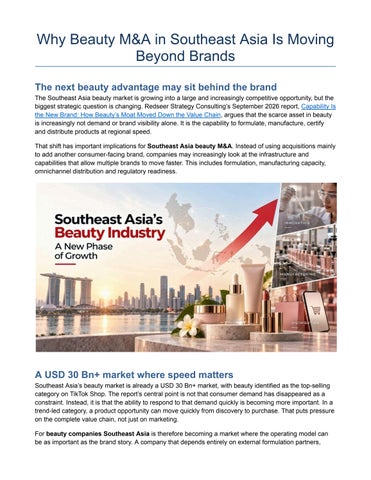
A USD 30 Bn+ market where speed matters Southeast Asia’s beauty market is already a USD 30 Bn+ market, with beauty identified as the top-selling category on TikTok Shop. The report’s central point is not that consumer demand has disappeared as a constraint. Instead, it is that the ability to respond to that demand quickly is becoming more important. In a trend-led category, a product opportunity can move quickly from discovery to purchase. That puts pressure on the complete value chain, not just on marketing. For beauty companies Southeast Asia is therefore becoming a market where the operating model can be as important as the brand story. A company that depends entirely on external formulation partners,
contract manufacturers and distributors may have flexibility, but it can also face limitations when speed, quality control or regional execution becomes critical.
From renting the value chain to controlling the bottleneck Beauty companies could rent formulation from an ODM, production from a contract manufacturer and market access from distributors, while concentrating investment on the brand. This model can still work in many situations. But Redseer’s analysis suggests that the economics are changing when the external capability becomes the factor that determines speed to shelf. This is the core reason behind the question: why beauty companies are acquiring capabilities? The answer is not simply to own more assets. The strategic logic is to control a bottleneck that can affect several products, categories or brands at once. A portfolio of brands can provide revenue and consumer access. A capability asset can potentially influence how quickly many products are developed, produced, certified and distributed. That difference is central to the new beauty M&A strategy outlined by the report.
What recent deals tell us about Southeast Asia beauty M&A One of the most useful parts of the Redseer report is its transaction-led approach. It examines recent Southeast Asian transactions involving Sociolla, Skintific and Cosmax, and compares them with global precedents involving Amorepacific, L’Oréal, Unilever and Beiersdorf. Rather than treating these names simply as a list of deals, the report asks a more useful question: what capability sits behind the transaction? This changes how beauty acquisitions can be viewed. An acquisition can provide a company with a manufacturing platform, formulation capability, distribution reach or another asset that is difficult to build quickly from scratch. The value may therefore extend beyond the immediate brand or business being acquired. The report also highlights a particularly important signal: when a manufacturer moves toward launching its own brand, the relationship between capability and brand becomes even more interesting. Manufacturing is no longer only a back-end service. It can become a strategic route toward product development, market learning and brand creation.
Why beauty manufacturing is becoming a strategic asset The discussion around beauty manufacturing Southeast Asia is increasingly about more than production cost. In a fast-moving category, manufacturing capability can affect development timelines, quality control, minimum order flexibility, product iteration and the ability to respond to local demand. The Redseer report also points to the localisation of the K-beauty supply base into the region. This matters because Southeast Asian brands and consumers can increasingly interact with a supply ecosystem that is closer to the markets where products are sold. For beauty manufacturing SEA, that creates a strategic question: should companies continue to rent capacity when speed is critical, or should they own, partner with or acquire the capability they depend on? The answer will not be the same for every company. The report’s framework is more useful as a way to identify the bottleneck than as a universal instruction to own manufacturing.
Speed to shelf is becoming a competitive variable Beauty trends can move quickly, and the report argues that product cycles have compressed enough to change the value of supply-chain speed. If a trend can move from consumer feed to shelf in weeks, then every delay in formulation, production, certification or distribution has a commercial cost. This is why Southeast Asia beauty M&A trends should be read alongside operating-model changes. M&A is not happening in isolation. It is connected to a broader need for faster product development, stronger execution and more control over the parts of the value chain that can slow growth.
Distribution and compliance are becoming control points Manufacturing is only one side of the equation. The report identifies distribution and compliance as two binding constraints. Southeast Asia is not one uniform market. Companies expanding across the region need to navigate different markets, channels and regulatory environments. The report specifically highlights the challenge of covering six markets with six regulatory systems through organic expansion alone. That makes beauty distribution SEA strategically important. Distribution capability can provide access to multiple brands and markets, while strong local infrastructure can reduce the friction involved in regional expansion. In an environment where speed and local execution matter, distribution is not simply a final logistics step. It can be part of the competitive moat. Compliance adds another layer. Redseer’s report examines what Indonesia’s halal requirement means for certified local capacity. The broader lesson is that regulatory readiness can become part of market access. For companies planning regional growth, certified capacity may therefore be a strategic capability rather than a back-office cost.
What these Southeast Asia beauty M&A trends mean for different players For strategic acquirers, the report suggests looking beyond the next attractive brand. The more important question may be which capability is currently limiting growth. If distribution is the bottleneck, acquiring another brand may not solve the problem. If certified manufacturing is the constraint, additional brand equity may not improve speed to market. For ODMs, manufacturers and distributors, the shift can change how their businesses are valued. Infrastructure that serves multiple brands can become more strategically important when buyers are looking for platform-like capabilities. This is one reason beauty manufacturing M&A Southeast Asia deserves attention from capability owners as well as traditional beauty companies. For investors and private equity firms, the report raises a different question: how durable are the cash flows generated by a capability that serves multiple brands? A multi-brand infrastructure asset can have a different strategic profile from a single-brand business because its relevance may extend across several customers or categories. For founders and regional leadership teams, the issue is more practical. Not every company needs to own every part of the value chain. The challenge is knowing where renting still provides enough flexibility and where ownership, partnership or acquisition can create a meaningful advantage.
Related Redseer insights on beauty and Southeast Asia This report also fits into a wider body of Redseer research on the region. For additional context on local beauty demand and market development, explore Indonesia’s Beauty Industry Insights. The article looks at the rise of new-age beauty brands and changing opportunities in Indonesia. For a broader view of online beauty and local market dynamics, see Indonesia Online Beauty and Personal Care – Local Charms. For a more global and strategic perspective on pure-play beauty businesses, see Beauty Unveiled: Decoding the Success of Pure-Play Beauty Companies. Readers interested in how regional supply-chain strength affects competition can also read Southeast Asia’s Guide to Competing and Collaborating with Chinese Giants, which discusses supply-chain reliability, omnichannel distribution and local execution in Southeast Asia.
The bigger question: what should beauty companies own next? The most useful takeaway from the report is that the future of beauty industry Southeast Asia may be shaped by capabilities that consumers rarely see. A brand can create attention, but formulation, manufacturing, certification and distribution determine how reliably that attention can be converted into products on shelves and screens. That is what makes Southeast Asia beauty acquisitions worth watching. The next wave of transactions may not always be about adding another recognisable name to a portfolio. It may be about gaining control of the infrastructure that allows a portfolio to move faster. For the full transaction analysis, capability lens and Redseer Strategy Consulting perspective, read the complete report on Southeast Asia beauty M&A. The report goes deeper into what recent transactions bought, why speed to shelf is becoming more valuable, how manufacturing and distribution are changing, and what the shift means for acquirers, capability owners and investors.