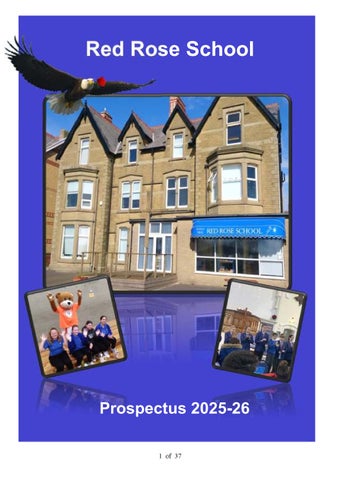
Red Rose School Strive together to achieve success
Prospectus 2025-26 1 of 37
Contents Head teacher’s welcome…………………. Page 3 Directors & introduction………………… Page 4 About the School……………………………. Page 6 Curriculum……………………………………… Page 14 The school day……………………………….
Page 18
Awards & Qualifications…………………. Page 19 Health and Safety…………………………… Page 21 Safeguarding………………………………….
Page 23
Behaviour………………………………………. Page 24 Anti-Bullying…………………………………… Page 27 Home and School……………………………. Page 29 Admissions……………………………………… Page 30 Uniform…………………………………………. Page 31 Staff……………………………………………….
Page 33
Location /contact…………………………… Page 35 Terms & Conditions……………………….
2 of 37
Page 36
Welcome to Red Rose School Over 28 Years of Training Eagles Dear Parents, I am pleased to welcome you on behalf of the pupils and staff of the Red Rose School. Many of our pupils come to us having failed to thrive within the mainstream setting. Generally, their self-esteem will be at a very low ebb and some may also have been bullied because of their learning difficulties. But you can be assured that we will do everything we can to make the transition into the Red Rose family a happy experience. This prospectus has been designed to help you find out about the School, its Staff and Pupils. I hope you find it informative and that it gives you an insight into our School. We are dedicated to providing a positive and happy learning environment where every child feels valued and safe, and as a result, enabling his or her true potential. Do feel free to ask questions, make comments and above all, come and see me and talk to the staff. We hope that your child will enjoy and benefit from his/her experiences here and that you will join us as part of the Red Rose Family. Yours sincerely, Gill Makinson Head Teacher MA.ASC; PG.Dip.SpLD; Cert.Ed; AMBDA; APC (PATOSS)
3 of 37
Expertise in Specific Learning Difficulties (SpLD) including ASD and related Teacher Training Dr. Sionah Lannen and Mr. Colin Lannen are the Cofounders, Directors and Proprietors of Red Rose School
Current Expertise: Co-authors and Co-Directors of 2 major European Union Projects. The first was completed July 2013 with the results presented to the European Parliament in October 2013. The second £350,000 3year project to develop and implement teacher training e-training throughout Europe in Specific Learning Difficulties (SpLD) finished in August 2017. The Project was rated OUTSTANDING by the EU, scoring 91 out 100
www.euspld.com Sionah and Colin remain the School’s SpLD Educational Consultants whilst Sionah continues to work as a Chartered Educational Psychologist both in the UK and internationally. www.drsionahlannen.co.uk From January 1997 until July 2016, Colin acted as the School Principal and Sionah was the School Head Teacher and Chartered Educational Psychologist.
Dr. Gavin Reid is a close friend and Co-founder of the Red Rose School. Father of a young man with ASD. He is a renowned international independent educational psychologist with active consultancies in seven countries including the UK, Canada, Middle East and Switzerland. Gavin is chair of the British Dyslexia Association Accreditation Board and an ambassador for the Helen Arkell Dyslexia Centre in the UK.
4 of 37
He has written over 30 books in dyslexia, literacy, learning styles and motivation. These are used as core texts in courses worldwide and some have been translated into Arabic, Polish, French, Italian and Croatian.
Mrs Gill Makinson, Head Teacher Gill, our Head Teacher, does not like to ‘blow her own trumpet’ so it is up to me, Sionah, to explain why I chose Gill to take over from me. I have known Gill for well over 20 years both as a close friend and as a fellow professional. In choosing my replacement I knew exactly the personal qualities and expertise required of the person – Gill meets all these and much, much more! Without doubt her expertise in SpLD and SEN is unquestionable. However, although such expertise was obviously required, I needed a person who had the same love and passion for children with learning difficulties. A person who would ensure that our school ethos would carry on almost seamlessly!
…and I have been proved right! In her first Ofsted inspection as Head Teacher in Feb 2018 she gained Outstanding… Ofsted 2018: ‘Parents single out the headteacher for particular praise, acknowledging the impact she has on ensuring that the school continues to improve.’
Sionah Lannen
5 of 37
About the School Red Rose School is an independent day special school (DfES Registration: 888/6032). It is an accredited member of the Independent Schools Association (ISA). At Red Rose School, we provide for the educational, emotional and social needs of up to 52 boys and girls, aged between 8* and 17 years. These are pupils who experience SpLD and associated conditions or have experiences and needs that cause them to become delicate and vulnerable in a mainstream setting. * the lower age is dependent on an existing appropriate peer group.
What we do well Over the last 25 years, we have provided for the educational, emotional and social needs of children with borderline-to-average intellectual potential, who experience Specific Learning Difficulties (SpLD) and/or experiences that cause them to become delicate and vulnerable in a mainstream setting. Pupils are placed by several Local Authorities (LAs) and privately by parents. They all fall within the SpLD continuum from mild to severe. There are often multiple diagnoses from various medical, social and educational professionals. In many cases, the complexities and extended timeframes (some over many years) have made the diagnoses very difficult, resulting in cross-over/s (comorbidity) and linkages between the various diagnoses.
OUR VALUES STATEMENT Personal development, including the spiritual and moral development of our pupils, is key to building positive self-esteem. With this, pupils will feel enabled to learn and become valuable members of the school and wider community. The attributes that we instil in our pupils, include our core British and ‘radicalize-never’ values, and both the celebration and tolerance of differences and equality. These aim to help our young people become ‘rounded’ citizens, who are able to take an active role in the community, willing to become ‘givers’ in society rather than ‘takers’.
6 of 37
The diagram opposite is the ‘reality’ of pupils placed in the school. All have failed (some over many years) in the mainstream educational environment and this situation has made them delicate and vulnerable or anxious. The majority of pupils arrive with a very low selfesteem/self-concept.
‘DELICATE’ CHILD No matter what the diagnoses, the key is what should be done to meet the child’s needs so that he/she can reach his or her true potential. It is important to recognise the additional needs of delicate and vulnerable children. We place a high priority on providing a learning environment that caters for the diversity of emotional and learning needs in order to help children achieve their potential.
“The headteacher and staff all show a commitment to providing a second chance for pupils who have often been failed by their previous experiences in education. They radiate a passion to provide the very best for the pupils of Red Rose School.”
7 of 37
Our Definition of Specific Learning Difficulties (SpLD) Children having a Specific Learning Difficulty or Difficulties all show different intellectual and emotional profiles, strengths and weaknesses, learning styles and life experiences. SpLD can be identified as distinctive patterns of difficulties, relating to the processing of information, ranging from very mild to severe. This results in restriction to literacy, language and number skills, in addition to discrepancies in motor function and social and organisational skills. Whilst there are variations and developments in definitions, the key is not the precise definition, but what professionals do to meet the child’s needs. This is especially true when co-morbidity of learning difficulties is seen to be ‘the rule rather than the exception’.
The school has specialised in supporting the needs of children and young people with SpLD for over 25 years. By the time pupils leave the school they have regained resilience and progressed in their abilities. They are well prepared to move on to the next stages of their education. Throughout their school journey, a pupil’s sense of self is developed. Older pupils engage in activities and work-related experiences that foster careers awareness. The school works in partnership with local authorities, parents and carers to ensure that pupils are aware of the options available to them when they leave the school.
Important Caution An IQ showing MODERATE LEARNING DIFFICULTIES When a full-scale IQ is calculated for students who may have a ‘spiky profile’ of strengths and weaknesses (as in SpLD), it can over-ride subtest strengths by giving a single overall low score that may be associated with the term ‘Moderate Learning Difficulties’. Where this occurs, it is more relevant to look at individual subtest scores of the IQ test and observe the student in an educational setting. In cases where students have been admitted to Red Rose School with a full-scale IQ indicating Moderate Learning Difficulties, such students have successfully integrated and transitioned to college and, in some cases, University.
8 of 37
Our Ethos...Training Eagles! Just as the eagle shields and cares for its young, the school shields and cares for the pupils in its charge. All our pupils have felt previous ‘failure’ caused by their learning difficulties, so it is important that they feel safe and unthreatened in their new school environment. It is just as important for our pupils to learn to trust again – this can only be done by staff establishing a loving and caring relationship with each child in their charge. ‘Training eagles’ helps to describe the process we aim to achieve with our pupils: When the eaglet reaches maturity the mother eagle ‘stirs up the nest and hovers over her young’: She takes the nest out from under her eaglet. It tumbles down, but before hitting the ground, she catches it and carries it back to safety. This process is repeated until nature takes over and the eaglet spreads its wings and flies for the first time. Soon the young eagle can soar high above the storms. This analogy reflects our ethos: Once our pupils feel safe and ‘strong’, we will start to challenge them until the time comes when they can ‘fly’ on their own. – Then our job is finished, our pupils have the resilience to re-enter mainstream school or go on to Further Education and the workplace!
Our job done…the child finds their wings and flies ... The school’s ethos of care, support and personal growth is championed by the headteacher, who demonstrates great passion in striving to provide an outstanding experience for every single pupil. She leads by example. Staff are inspired to do everything they can to help pupils grow and develop. The school’s ethos of care, support and personal growth is championed by the headteacher, who demonstrates great passion in striving to provide the best experience for every single pupil. Staff are inspired to do everything they can to help pupils grow and develop. 9 of 37
OUR PACKAGE The expectations of how our pupils should behave are unwaveringly high. The school is calm and orderly. Our pupils cooperate very well together during lessons and during breaktimes.
Take a dedicated Head Teacher, highly experienced and with specialist expertise in Specific Learning Difficulties, Autism Spectrum Conditions and ‘delicate’ children. Add the ongoing expertise of the previous Head Teacher, Dr. Sionah Lannen, chartered Educational Psychologist, with her extensive experience in Learning Difficulties. Include the skills and management of the Founding Director and Principal, whose skills led to a recent ‘Outstanding’ large-scale project for SpLD e-Training for EU Teachers and Specialists (EU 2018). Mix in a careful blend of experienced teaching staff and dedicated assistants, season with current research, resources and an ethos of Christian love and care. Pour into a multi-sensory container and the ingredients are in place to ‘crack the code’ of each child’s difficulties. Allow to blend and cook for a year or two, so that ‘self-esteem’ grows… Then it happens! Difficulties are overcome, coping strategies and skills are developed, and the child learns the values of respect and kindness to others. Parents regain their son or daughter, with the self-worth, confidence and motivation to look ahead to their future learning and prospects beyond school. Our job done, the child spreads their wings and flies in the anticipation of many good tomorrows. That is our package and what we are dedicated to each day!
Teachers use their expertise to attune to the specific needs of every pupil in their class. They monitor the response of each pupil to the work they are set, and know when to celebrate success or encourage a pupil to extend their work even further. As PERSONAL DEVELOPMENT a result, teachers are adept at getting the best out of pupils.
10 of 37
PERSONAL DEVELOPMENT IS A FUNDAMENTAL VALUE
The school works to promote pupils’ personal development and welfare. The needs of every child are understood. Care systems can be as simple as a reassuring smile, to a programme of well-targeted therapies.
Personal development in our school supports pupils in their spiritual, moral, physical, emotional, cultural and intellectual development. It is adapted to their needs, and regardless of their social and/or economic backgrounds. It promotes their wellbeing and enables them to develop their potential as healthy, enterprising and responsible citizens in our society. It provides our pupils with a sense of identity in a diverse world and informs their academic and Personal Learning and Thinking Skills (PLTS).
Pupils flourish and this is fundamental to rebuilding their selfbelief and confidence.
Within the curriculum the personal, learning and thinking skills of our pupils are integral to their personal development and the roles they take on in life – family member, friend, neighbour, partner, parent, employee, employer, citizen and member of communities. Our students understand 'values', including: ✓ the importance of having a vision for their life and the need for action to make it a reality. ✓ love of others is more important than love of self. ✓ that life is to be enjoyed but having a 'giving' heart is better than a 'taking' heart. ✓ the importance of being a good citizen, aware of ‘British Values’ in terms of racial harmony, cultural diversity, religious freedom and each person’s right to a full and happy life within this democracy. ✓ ‘radicalise-never’
11 of 37
BEING SAFE We place a high priority on providing a structured and caring learning environment that caters for the diversity of our pupils’ emotional and learning needs. Many of our students have felt previous 'failure' or may have experienced isolation or bullying. It is essential that they feel safe and unthreatened in our school.
Staff are tuned-in and sensitive to any indication that something might not be right with a pupil. Pupils learn to trust staff enough to share their worries and concerns. These factors are critical in contributing to a strong culture of ensuring that pupils are safe and happy.
12 of 37
GOALS The personalised curriculum ensures that all make good progress in reaching their potential. Teachers have excellent relationships and communicate very effectively with their students Pupils feel proud of their achievements and enjoy their learning.
The goals of Red Rose School are to help children realise their full potential within a pastoral environment through: ✓ A small school environment. ✓ Small Class sizes (up to 9 pupils) with at least 2 adults in each class. ✓ Individual pupil programmes. ✓ Continuous building of self-esteem and independent learning. ✓ Developing the necessary skills through the application of proven educational strategies.
The school is calm and orderly Sometimes for the first time in their education, Red Rose pupils begin to experience success in their learning. This motivates them to improve and to achieve Teachers are dedicated in providing highly positive learning and support for their pupils.
13 of 37
CURRICULUM Each pupil who comes into the school has been unable to thrive in mainstream school and consequently unable to access the broad and balanced education on offer. Many pupils have had emotionally damaging experiences resulting in low self-esteem and associated anxiety or similar difficulties. In many cases, pupils arrive with a level of withdrawal and an inability to feel at ease in learning.
From the time when a pupil comes on roll, in both English and Mathematics, it is common to see pupils making strides of progress in only one year. Pupils also begin to thrive in their learning of other subject areas, including science, computer science and humanities. Creative studies including Art is often an area in which pupils with SpLD excel.
Emotional factors are often at the heart of pupils’ previous experience. It is essential to build good self-esteem and self-concept so the child can deal with their learning difficulties. By reversing the child's perception of failure and subsequent anxiety, it is our experience that emotional success leads to a child feeling safe and ready to learn.
Our curriculum takes a ‘Head, Heart and Hands’ approach to meet the needs of our pupils. Class sizes are kept small, so that learning programmes can be customised to the needs of each pupil. Personal well-being is fundamental, so our class model is that of a teacher and at least one teaching Assistant as the constant, familiar adults for a group of learners. Most classes may include two or more curriculum year groups. This multi-grade teaching positively provides for meaningful educational access, in which social diversity and Citizenship can be encouraged and fostered. Both academic skills and practical talents are nurtured to allow the development of confident, sensitive, and independent young people and citizens. For those pupils with the potential to reintegrate into mainstream education, it is our aim to build their resilience for a transition at a suitable stage. This may be re-entry to a mainstream school or entering further education and the work environment with confidence and a positive 'can-do' attitude.
14 of 37
CLASS ORGANISATION and SUBJECTS TAUGHT Pupils are mostly placed in a class according to their national curriculum ‘Key stage’. However, the Head Teacher may decide, in discussion with a pupil’s parents, that other factors are important for ‘best’ placement. These may include maturity, self-concept and /or the level of their needs. The morning timetable (60% of the curriculum) Mornings are generally spent within the class. The teacher focuses on core areas of Literacy and
Numeracy, differentiated to pupils’ needs. Amongst all our students there are basic needs to build self-esteem, confidence and resilience therefore, Personal and social development is embedded within class sessions. The afternoon timetable (40% of the curriculum) Afternoons mostly include specific subjects embedded in ‘topics’ for younger classes and timetabled separately for older students: Subjects include:
Science, ICT, History, Geography, Art, Music, Drama, Food technology, *Construction, Physical Education (PE), Religious Education (RE) and *Personal, Social, Health and Economic education (PSHE includes Citizenship, Careers, Relationships and Sex education, online safety education). *We partner with an external provider to deliver City and Guilds qualification in Construction skills. At Key Stage 4, a student’s timetable is organised to include his or her vocational options (BTEC or Arts Award) that are studied in addition to 5 core subjects: Functional Skills Maths and English, Entry Level or GCSE Science, BTEC Personal Growth and Well-Being (PGW), and BTEC ICT is studied formally and informally. Computer skills are seen as an important ‘life-skill’ for all our students. The level of formal study considers each pupil’s needs, to avoid overload and promote their success in basic skills.
15 of 37
Differences for different age groups We currently provide for the education of pupils age 8-16 (Key Stages (KS): 2-4). We also have provision for students to stay on in school for a further year: year12. During 2017, we developed our 16+ provision primarily for pupils who came on roll later in their school life or whose individual learning needs would benefit from time to develop their skills before the transition to a college or other provider. Our Year 12 or ‘Transition group’ is now an established group working to attain their potential in core subjects in addition to careers, life skills and social communication development. Resources and approaches are adapted according to age, learning needs, strengths and maturity. The curriculum embeds Personal and Social Development and seeks to unlock what works for a student. This may be different from what works for another student.
The Red Rose 16+ provision incorporates Work and Independence Skills, alongside personalised visits to providers of Further Education, careers-based trips and exposure to the world of work. Classes use Circle Time or a similar approach for group discussion and conflict resolution. Where required, additional one-to-one support is provided for a child’s specific needs. Pastoral counselling and therapeutic Music and Drama are also available. Personal as well as academic skills are nurtured to encourage the development of resilient, selfaware and independent young people.
Religious Education & Collective Worship The Red Rose School is a school with a religious character, defined as being a Christian School. [Designation of Schools Having a Religious Character (Independent Schools) (England) (No.3) Order 2003, 23rd December 2003.]
Full assemblies are held at intervals and include an act of collective worship. These are broadly, though not exclusively, Christian in nature and can involve local clergy, Youth work teams and community groups. The Christian aspect is non-denominational.
16 of 37
Parents who wish to exercise their right to withdraw their child from religious activities are asked to speak with the Head Teacher.
All our pupils gain recognised academic qualifications and move onto college, apprenticeships or other post-16 courses matched to their interests and abilities By the time pupils leave the school they are well prepared to move on to the next stages of their education. Pupils receive careers-based advice throughout their school journey and older pupils gain meaningful work experience. The school works in partnership with parents and carers to ensure that pupils and their families are aware of the options and available when they leave the school. Relationships Sex Education Relationships education (RHE) and Sex education (RSHE) is taught with due regard to maturity level, moral considerations and an emphasis on the value and importance of family life. The programme is not taught in isolation but within a framework of a personal development programme dealing with the many aspects of growing up. Due to the nature of pupils attending the school, we integrate the planned programme with regard to developmental levels within a broad and balanced curriculum. In general, the younger class groups will focus on relationships and health education in providing the adjustment needed for their particular needs and vulnerabilities. Parents have the right to withdraw their children from some or all of statutory sex education lessons and should discuss the matter with the Head Teacher should they wish to do so. They are also welcome to discuss the RSE policy and view teaching materials.
Careers Advice Careers information and advice is embedded through the curriculum. Subject classrooms display the career opportunities that can evolve from the specific subjects. Classes use trips and visits to help pupils understand the world of work beyond school. The careers coordinator liaises with external providers to share provision for careers guidance, unbiased advice and provision for pupils in Years 10-12. Provision includes careers guidance, webinars and online information, visits and discussion with local colleges, vocational providers, 1-1 discussion with college transition advisors at EHCP reviews, PSHE training and use of IT in writing personal CVs and applications. Pupils from Years 6-11 gain experience of work-related skills through supported visits that involve volunteering or hands-on learning. In Years 11 and 12, transition sessions are built into the curriculum. Options for 1–2-week Work Experience take place during the early summer term. Extended placement may be an option where appropriate. Each pupil has a ‘Progress File' showing evidence of achievement and progress in their personal journey through school. 17 of 37
From their starting points, and taking into account every pupil’s academic potential, achievement includes helping pupils feel equipped to continue their education in larger educational establishments The personalised support within classes helps pupils’ resilience and, in turn fosters good attendance: a key to future progress and achievement.
THE SCHOOL DAY At Red Rose School:
The school day begins at 9 am:
Pupils assemble outside school by 8.55 am with a member of staff from their class and are accompanied to their respective classrooms. The morning session is 9 am -12 noon. The core lessons of literacy and numeracy are the mainly taught during this time. Morning break-time is 10.30-10.45 am for all pupils. Pupils can bring their own drink and snack or can order toast or fruit for break. Lunch is served at 12 noon and brought to the respective classrooms. Pupils can bring their own packed lunch if preferred. The afternoon session is 1pm -3pm: vocational and other subject lessons are mostly timetabled during this time. Afternoon break-time is 1.45pm-2pm.
The school day finishes at 3pm.
The taxis or minibuses provided by local authorities come into the school yard for those pupils who use this means of travel. Pupils are escorted to their transport or seen safely off to their awaiting parent /carer, or seen off to walk or travel independently to their home.
18 of 37
AWARDS and QUALIFICATIONS In line with their abilities at or around Year 9 and above, students study 5 core subjects and a choice of 1 or more vocational subjects. Core subjects: Functional Skills Maths and English (equivalent qualifications to GCSE) Functional Skills provide pupils with essential knowledge, skills and understanding to operate confidently, effectively and independently in life and work. The flexible exam timetable is helpful for our students. We offer Edexcel Functional Skills (FS). Level 1 (equivalent to GCSE grade 1-3) and Level 2 (equivalent to higher GCSE grades 4-9). Qualification is recognised at colleges. These enable students from Red Rose who achieve FS Level 1 or level 2 in English and Maths, to enroll on a level 1 or level 2 post-16 course suited to their ability.
GCSE Maths and /or English are offered to pupils with ability and resilience to succeed with the GCSE format and exam conditions. We also offer ‘step-up’ courses to support students taking GCSE Maths and English.
Core subjects: PSHE and ICT are taught as BTEC qualifications. Through the BTEC pathway, our students can achieve qualification in the subjects by passing modules within the courses. There is no formal exam. BTEC qualification is equivalent to GCSE. Our BTECs, ‘Personal Growth and Well-being’ and ‘IT’ are core subjects and taken by all students at KS4. Core subject: Science is part of our older students’ programme of study. It offers a range of qualification for achievement at Entry Level Certificate (pre-GCSE level) up to full GCSE. This range is suited to our students’ differing levels of ability. The AQA Unit Award Scheme is a recognised national modular certification programme. It gives every student the opportunity to receive formal certification of their success by completion of units that assess smaller but essential skills Options on our vocational pathway are taken alongside academic studies. These include:
Construction. Students benefit from travel to an external Vocational Centre and work with trainers to learn meaningful trade-based skills. The BTEC-style course leads to City & Guilds Certificate in Construction.
19 of 37
ARTS AWARD is a recognised arts qualification offered through Trinity College London and accredited by the Arts Council (England). It is a BTEC style course assessed by portfolio (no final exam). Students on this vocational course can study Art or Music. Bronze Award is a Level 1 qualification (equivalent to GCSE grades 1-3). Silver Award: Level 2 (equivalent to GCSE Grade 4+), and Gold Award: Level 3 (equivalent to A Level). Most of our students achieve their Bronze or Silver level. In recent years, 2 of our talented art students achieved the coveted Gold award.
DRAMA is offered throughout the school. Students can take the recognised LAMDA qualifications (London Academy of Music and Dramatic Art). Pupil profiles through the Curriculum and beyond
Pupil B
Prior to Entry to Red Rose School
ASD; Sp.L.D.
Poor basic skills - unwilling to read Lacked confidence with maths Unsociable
Pupil A
Prior to Entry to Red Rose School
SEMH (Emotional); Sp.L.D.
Very fragile emotionally; bullied
Progress in Red Rose School On Entry
On Leaving
Reading 6.03
17-19.11
Low self esteem
Spelling 7.00
8.09
No eye contact
Number 6.00
15.06
Developed confidence, became a popular pupil
Progress in Red Rose School On Entry
46 AQA Unit Awards
On Leaving
On leaving:
Reading 8.06
14.00
Spelling 8.00
10.06
Number 9.00
11.09
Preston College: Art & design ‘Student of the Year’ at end of 1st year of college. Degree in Games Design at UCLAN Writing a book about Art and Design of the Future
Once trust in education and relationships reestablished quickly flourished
Selling his art online
On leaving: Graduated as a dentist 2012
Our pupil takes inspiration for her Arts Award at the visit to Tate Modern Art gallery, Liverpool. She achieved her Gold Arts Award (AS-level) and successfully moved on to a level 2 performing Arts Course at college. 20 of 37
HEALTH & SAFETY and RISK ASSESSMENTS HEALTHY EATING AND FITNESS Good health and fitness are promoted at every level at Red Rose. A regular programme of PE, fitness and leisure activities is provided. These are included into the timetable for each class. Freshly cooked lunches are available and aim to provide a nutritional diet for our pupils. A good diet helps to maintain the energy and alertness levels for engaging with the academic and social learning of the school day. A varied diet high in whole foods, carbohydrates, protein, fresh fruit, vegetables and salad is offered. Healthy eating is encouraged and taught through Food Technology lessons. Packed lunches can be brought into school as an alternative or where specific diets are being followed. Declaration of Intent The school's responsibility is to ensure as far as is reasonably possible, the health and safety of all who enter the premises. The school is committed to high standards of health and safety. As a school, we seek to maintain and improve the environment of the school in order to ensure the health, safety and welfare of all its users. We aim to comply with all relevant legislation. We aim to ensure that everyone has sufficient information and appropriate training to fulfil their responsibilities. We seek to create an environment within the school where everyone:
21 of 37
✓
is aware of their responsibilities to each other.
✓
acts in responsible ways, consistent with others' health and safety.
✓
safeguards and promotes the health and safety of others.
The Health & Safety policy relates to health and safety on the school site and its environment. Our Staff are expected to take similar precautions, practices and procedures, whilst engaged in activities away from the school; they may also need to address Health and Safety policies of other centres or organisations that are visited. Risk assessments are used by all staff organising educational visits to support the health and safety of themselves and each of our pupils. Risk Assessments are also a means of assuring health and safety within school. Objectives The Head Teacher seeks to promote health and safety by providing, in so far as is reasonably practical: ✓ healthy and safe working practices and conditions. ✓ information, instruction and training in safe working methods and practices. ✓ first aid facilities; and employees trained in first aid. ✓ safe premises and equipment. ✓ safe arrangements for the handling, storage and use of materials and substances ✓ systems for the establishment and maintenance of codes of practice and risk assessments. ✓ safe access and outlet, including evacuation procedures. ✓ appropriate security arrangements. ✓ effective communication systems for issues of health and safety. ✓ periodic checks on the safe operation of tools and equipment. The School Health and Safety is regularly reviewed to ensure that it complies with legislation and local conditions. Parents can access the full policy on the school website www.redroseschool.co.uk A paper copy is available on request.
Before joining Red Rose, many pupils have had very poor attendance rates or may not have attended a school for up to two years or more. The school works carefully to help pupils feel safe, secure and valued. For some pupils this means they need to re-learn how to trust, and feel reassured that they will be valued and supported in re-engaging with education.
22 of 37
SAFEGUARDING OUR CHILDREN Our Safeguarding and related policies are available on the website. A paper copy can be provided if required. Red Rose School fully recognises its responsibilities for child protection. This policy complies with ‘Working together to safeguard children: A guide to inter-agency working to safeguard and promote the welfare of children: and ‘Keeping Children Safe in Education’ (Sept. 2025). Our Designated Safeguarding Leads (DSL) are: Mrs G Makinson, Mrs J Stanton, Mrs W Gaskell and Mrs C Watts.
AIMS ✓ To practice safe recruitment in checking the suitability of staff and volunteers to work with children. ✓ To raise awareness of child protection issues and equip children with the skills needed to keep them safe. ✓ To establish a safe environment in which children can learn and develop. ✓ To develop and implement procedures for identifying and reporting cases, or suspected cases, of abuse. ✓ To support children who have been abused in accordance with his/her agreed child protection plan. The school will create a positive ethos amongst the staff so that we can: ✓ Establish and maintain an environment where children feel secure, are encouraged to talk and are listened to. ✓ Ensure children know that there are adults in the school whom they can approach if they are worried. ✓ Include opportunities in the PSHE curriculum for children to develop the skills they need to recognise and stay safe from abuse.
23 of 37
BEHAVIOUR AIM We aim to create a climate in which excellent teaching and learning can take place, where there is mutual respect and where achievement is valued, encouraged and rewarded. We believe that highquality teaching promotes effective learning and encourages good behaviour. We expect our pupils to take responsibility for their actions and accept any consequences of their choices. PRINCIPLES Everyone should: ✓ Treat all others fairly and with respect and act in a safe and responsible manner. ✓ Listen to the views and opinions of others. ✓ Take care of school’s property and each other’s property Pupils learn the benefits of behaving well and how to manage their frustrations. Teachers fully understand what motivates each pupil and what reassures them. This feeling of security helps to calm pupils. Through careful work, pupils are helped to understand how and why people behave as they do. Behaviour that would be considered as bullying is dealt with swiftly. Emotion coaching is used to understand and modify a pupil’s behaviour or perceptions. Restorative justice helps pupils to understand consequences of their actions and how to restore relationship. ROLES AND RESPONSIBILITIES
Head teacher The Head Teacher’s role is to put into effect the Statement of Principles for promoting good behaviour and to determine the detail of the standard of behaviour acceptable to the school. The Head teacher will: ✓ Promote self-discipline and proper regard for authority among pupils. ✓ Encourage good behaviour and respect for others and strive to prevent all forms of bullying. ✓ Ensure that this policy is implemented by staff and students. Ensure that the guidance relating to fixed-term and permanent exclusion is adhered to and that parents and local authority are informed of exclusions accordingly.
Staff Staff should: ✓ Act as role models of good behaviour ✓ Reward good behaviour and achievement
24 of 37
✓ Intervene promptly in any situation where behaviour is inappropriate or dangerous. ✓ Apply behaviour management strategies and sanctions consistently and fairly. ✓ Ensure that the work they prepare for students is appropriate, stimulating, interesting and challenging. The school sets high standards and will encourage good habits of work and behaviour from the moment a child enters the school. All staff are expected to promote self-discipline amongst students and to deal appropriately with any unacceptable behaviour. It is understood that there will be variations to a degree in staff acceptance and tolerance of a student’s behaviour in class depending on the nature of the class, content of the lesson and the specific nature of a pupil’s difficulties; however, behaviour which impacts safe teaching and learning is unacceptable and is not permitted to affect the learning of others.
Students Students should: Behave well and live up to the school’s expectations. Act in a safe and responsible manner Allow teaching and learning to proceed without disruption or interference. Be respectful of each other and members of staff. Co-operate with all members of the school.
Parents We invite parents to: ✓ Be involved in rewards and sanctions as appropriate. ✓ Support good behaviour and positive habits in their children through the Home-School Agreement and parent meetings. REWARD and RECOGNITION We reward effort, behaviour and citizenship using visual tokens such as ‘Dojos’ in younger classes. Each term, the Work Effort Prize is awarded to a pupil from each class. We highly value good citizenship i.e. good behaviour, kindness and respect towards others and school community service. Each term a Citizenship Prize is awarded to a pupil from each class.
25 of 37
School Council: Pupils are chosen from each class to take part in the School Council. This is a valued discussion group of staff and students for developing school-wide provision and relationships. It is an opportunity for students to take on responsibility towards developing the wider school and being a voice for their fellow students. SANCTIONS We make use of systems such as 1-2-3 Magic, traffic light, Dojo points to emphasise appropriate behaviour in younger classes. Minor infringements may involve a 1-1 discussion between teacher and student, this may be followed by a lunch or break-time detention as appropriate. Sanctions are discussed with parents if difficulties persist, or a Behaviour Contract may be arranged. Major infringements: The Behaviour Policy has details of behaviours that would involve sanctions applied on a scale rising to fixed-term exclusion (suspension). The purpose of sanctions is to provide opportunity to discuss and impress on the student that their choice of behaviour was inappropriate; and understand that actions have a consequence. Students are always involved in discussion to repair and formulate better choices for the future. Exclusions There are rare circumstances in which an individual pupil is required to be sent home; namely, where there is sufficient evidence that a pupil has committed a disciplinary offence and if allowing the pupil to remain in school would seriously harm the education or welfare of the pupil or others in the school. In these circumstances the pupil may be excluded from school for a fixed period or, in exceptional situations, may result in permanent exclusion.
Full details of our Policy & Procedures are on the School website: www.redroseschool.co.uk
26 of 37
ANTI-BULLYING Red Rose is totally opposed to bullying in any of its forms and it will not be tolerated in school. We are committed to providing a caring, friendly and safe environment for all our pupils so they can learn in a relaxed and secure atmosphere. A comprehensive anti-bullying policy operates within school, along with a set of procedures to identify and deal with any such incidents quickly and effectively. Pupils are encouraged to discuss perceived aspects of bullying with any member of staff. In assemblies and as part of the PSHE curriculum pupils are taught that bullying is not acceptable. If you have concerns about bullying, perhaps from previous experiences, please do not hesitate to contact school. PURPOSE & BACKGROUND Red Rose School aims to ensure that all members of the school community can learn and make progress in a welcome, safe and happy environment. Bullying of any kind prevents this from happening. As a school, we take bullying seriously. Pupils, parents and carers should understand that to report bullying is essential and that the school will act whenever bullying is reported. It is everyone’s responsibility to implement the AntiBullying Policy as fundamental to meeting the expectations of ‘Every Child Matters”. WHAT IS BULLYING? Bullying is the use of aggression with the intention of hurting another person. Bullying results in pain and distress to the victim. It can be a one-off incident but, more commonly, it is repeated over a period of time. It can be carried out by individuals, or by groups. PRACTICE AND PROCEDURES Preventing Bullying Red Rose School has an effective pastoral system which takes all allegations of bullying seriously, investigates them and acts upon the findings according to the guidelines in this and the associated behaviour policy. This will always involve discussion with all pupils involved and, as appropriate, their parents. The PSHE and Citizenship curricula address issues such as bullying, peer pressure, conflict and resolution. 27 of 37
Other curriculum areas such as Drama can also address these issues. Pupils discuss both the impact of such behaviour on others and look at effective ways of dealing with situations they may experience. Pupils will also be made aware of anti-bullying strategies through assemblies and form periods. The Acceptable Use of ICT Policy (available online) includes specific measures to tackle cyber bullying through the misuse of digital media, such as images of pupils, both in and out of school. The school uses filtering technology to ensure online safety. Details are included in our Behaviour policy available on www.redroseschool.co.uk
Pupils are taught how to socialise and show respect for each other and for adults. Pupils learn moral code and to express their views, sensitively, if they think something is wrong Teachers use their expertise to attune to the specific needs of each pupil in their class. This includes monitoring the response of every pupil to the work they are set, and when to celebrate success or encourage a pupil to extend their work further. Teachers are intuitive in their efforts to ensure that the classroom climate for learning is just right.
28 of 37
HOME & SCHOOL Mutual co-operation between home and school is key to your child achieving success, hence the School motto:
Strive Together to Achieve Success Children benefit from knowing their parents or carers are interested in their school life and education. With an initial phone call we can arrange for you to visit the school at a suitable time. We believe the best team consists of the child, the parent and the teacher working together. We will always contact parents if we are concerned about an aspect of their child’s welfare, progress or behaviour and we hope that parents will, in turn, inform us of any problems or anxieties which may be affecting their child. Pupils may have a Home / School Diary that can provide basic day-to-day flow of information between school and parents. For some pupils, it is more helpful for a class teacher to update parents or carers of a pupil’s school day or work requirements, by email. A detailed Review is undertaken annually for each pupil with an Education, Health and Care Plan (EHC Plan). Parents and relevant agencies are invited into school for the review. For our parents who have placed their children privately, an individual review and discussion of progress is offered. The specialist nature of the school and wide catchment area limits the frequency of community events. We invite parents of those pupils involved in Christmas Productions and our annual Leavers Assembly. We are very grateful for all the support given by our parents throughout the year. A highly detailed pupil report is issued at the end of each summer term. News and information are communicated by email. A detailed visual bulletin is published at intervals and aims to keep our school community updated with a photographic insight into school life, information and upcoming events. The school website provides detail of the day-to-day school life, in addition to useful information such as term dates.
29 of 37
Admissions Procedures The admissions procedure involves the parents or carers, and the child where appropriate, viewing the school by appointment and meeting the Head teacher. In cases where the Local Authority [LA] would be funding the placement i.e. if the child has an Education, Health and Care Plan (EHC Plan), the L.A. may request the parents /carers to contact the school for a visit of interest. A local authority requests a place for a pupil with an EHCP via a consultation form that is sent to the school. The consultation form is considered by the Head teacher and, as appropriate, the school Proprietors or specific staff members. If the school can meet the needs of the pupil and placement is suited to pupils already on roll, an offer of the place is made electronically to the LA and arrangements may then be made for a start date for the pupil. For L.A. funded places and cases where parents /carers are placing their child privately, parents are asked to complete the registration forms. (For privately-placed pupils, the registration fee is paid at this stage in order to secure the place.) A starting date will be arranged or may be phased-in based on the successful taster or transition sessions tailored to the child or young person. Admissions can be at any time during the year, although this often takes place at the start of a school year. Places are offered subject to: Availability, suitability and the child and parents / Carers request for placement at Red Rose School. Parents and prospective pupils are invited to sign a Home/School Agreement prior to admission. (See Terms & Conditions of Pupil Placement p.33.) Fees for privately-placed students are payable as an annual amount prior to the student’s start date or termly prior to the start date of each term. Further details of the admissions process can be found in the school ‘Local Offer’ available on the website: www.redroseschool.co.uk
Home / School Agreement All pupils and parents are asked to sign a formal home / school agreement.
Parental Entitlement All parents of children placed in the school may have access to documentation specifically relating to their child. Parents have access to: 1. The School Curriculum 2. School Inspection reports which refer expressly to the school 3. Any syllabuses followed (whether for public examinations or otherwise) 4. The arrangements for the consideration of complaints about the school. 5. School policies and curriculum concerning Relationships and sex Education. ‘We can’t begin to thank you for the difference you have made to our family. To be honest we couldn’t have done this without you. We have a child who no longer feels he is worthless. Thank you, Red Rose….may many more ‘eagles soar’ (parent 2024) 30 of 37
A MOTHER’S STORY ‘I felt I had to put my story on paper to help other parents in the same situation. Just over a year ago I found I had a daughter in meltdown and on self-destruct. My once happy child had turned into an aggressive, depressive, lying and insolent teenager. I saw it coming but was unable to stop it. After months of risky behaviour, getting into trouble at school and mixing with wrong crowd my daughter said, ‘if I was dead perhaps people would understand’. I knew something had to be done. She was dyscalculic with dyslexic problems in year 7 but it did not cause problems till year 10 when she found it harder to cope. I had her tested again to find she had not improved since year 7. She had a Maths age of 8 at 15! She was in the top sets, but the teachers were not understanding, so she disrupted all her lessons on the basis that if they wouldn’t teach her then they wouldn’t teach anyone. At this point I approached Red Rose School. Almost immediately after starting she calmed down. She had somewhere she fitted in. Where teachers encouraged her to be her own person and not who she had become in order to cope. She began to accept, and with the dedication of the teachers, she flourished. She found a passion for dance. They never gave up on her, believed in her and stood by her. She now believes in herself. She has confidence and aspirations and is going to college. She has come back to us; knows she is clever and is learning to accept her problems.’
Uniform The School reserves the right to send students home if they are not wearing the correct uniform , nonapproved clothing or have inappropriate hairstyles or jewellery.
At Red Rose School, we expect a good standard of appearance at all times. Uniform clothing should be clean and tidy. The school uniform must be worn correctly i.e. shirts tucked in, ties worn correctly and no non-school garments to be worn in addition. Pupils may wear a watch and girls may wear a single pair of ‘sleeper’ earrings if they have pierced ears. No other piercing, accessories or jewellery are permitted. Hair should be natural colour and of sensible length. Boys’ hair: no shorter than No.2 and no hair carvings. Girls with long hair should have it tied back with plain mid-blue or black accessories.
31 of 37
Uniform can be purchased directly through the supplier: www.ualonline.co.uk. There is no additional cost for delivery to the school. We have a selection of good quality, pre-loved school uniform available through the school office and on our ‘School money’ app. All items of school uniform must be named. Full school uniform must be worn when travelling to and from school. Uniform consists of: Red Rose School blue blazer or Red Rose School blue sweatshirt / cardigan White closed neck shirt (or polo shirt for pupils with identified sensory needs) Red Rose school tie Black trousers or black skirt Black tights or white /black socks Plain black shoes / mid-blue or black hair accessories PE Kit: Red Rose School blue polo shirt Red Rose School round neck jumper (optional) Red Rose School hooded sweatshirt (optional)* No non-uniform hooded sweatshirt is permitted Red Rose School jogging pants (optional) Plain black or navy-blue jogging / leisure pants Year 11 pupils: Red Rose School blue blazer, shirt and tie or Red Rose School dark navy-blue hooded sweatshirt worn with plain white or blue T-shirt (no logo). Year 12 pupils: Dress code applies: Pupils can wear their own clothing. Clothing must be smart casual clothing that maintains school colours and specification (details provided separately) Personal Property It is not advisable for a pupil to bring high value personal items into school. We cannot be responsible for a pupil’s personal property that is brought into school. Mobile Phones Mobile Phones are not to be used in school and are to be handed to the Class Teacher at the start of the school day for return at the end of the school day. Failure to comply will have the student’s phone banned; this may also include exclusion from lessons.
32 of 37
The Red Rose Family Dr Sionah Lannen: Proprietor, Director, Chartered Educational Psychologist Mr Colin Lannen: Proprietor, Director Dr Gavin Reid:
Co-founder, Chartered Educational Psychologist
Mrs Gill Makinson: Head Teacher, Specialist Consultant /Teacher (ASD, SpLD, SEN), SENDCo Class Teachers Class 2W: Teacher: Mrs C Watts Class 2K: Teacher: Mr J Kirby Class 3S: Teacher: Miss K Southern /Mrs S Grant Class 3: Teacher: Mrs W Gaskell Class 4: Teachers: Mrs S Beck /Mr C. Kennerley Class 5: Teacher: Mrs R Shaw Team Teachers: Classes 2W /2K: Mrs E Beardall / Miss McCooey / Miss E Andrews Classes 3S /3: Miss C Battersby / Miss B Stanton, Miss N Rogers (ELKLAN), Classes 4 & 5: Mrs J Stanton, Miss S Davies
33 of 37
Subject staff /Specialist staff and Therapists: Mrs G Makinson: SENDCo, DSL, Specialist Advisor ASD, SpLD, SEND Mr C Kennerley: Mrs S Beck:
Team Teacher Lead, History (AQA Unit Award) ICT (BTEC), Maths (FS & GCSE), PSHE Co-Lead (BTEC), Curriculum Assessment lead
Mrs R Shaw:
English (FS & GCSE), Exam officer (Edexcel)
Mr P Newell
Science (Entry level & GCSE), Maths (FS level 2 and GCSE)
Mrs W Gaskell:
DDSL, PSHE Co-Lead (BTEC), Science (Entry level)
Mrs C Watts:
DDSL, Curriculum Support (KS1-3)
Mr J Kirby:
Arts Award: Music, Music production, Music therapy
Mrs H. Abbott:
Arts Award: Art, AQA Unit Award lead, Careers lead
Mrs S Grant:
Arts Award: Art, Art Therapy, cover teacher
Mrs J Stanton:
DDSL
Miss R Stanton:
First Aid lead
Mrs B Lang:
School Administrator, Bursar, SEND administrator
Mrs J Jackson:
School Administrator, Exam administrator, First Aid administrator
Mr D Cooper:
IT Technician
Mr C Jackson:
Site Supervisor, Health & Safety Officer
Our supporting teachers and therapists: Ms K Butler:
Drama, Performing Arts, LAMDA
Mr B Malone:
Counselling & Play Therapy
Mrs J Laycock:
Specialist Speech & Language Therapy (ASD)
Mrs H Simpson:
Specialist Speech & Language Therapy (NLP)
All Class Teachers are responsible for core curriculum: Literacy, Numeracy, embedded curriculum
34 of 37
LOCATION, ADDRESS, CONTACTS
Location: 2 miles south of Blackpool, Lancashire Main Contact Details: Proprietors: Drysdale, Queens Road, Dunbar, East Lothian, EH42 1LN Red Rose School, 28-30 North Promenade, St. Annes on Sea, Lancs, FY8 2NQ Tel: 01253 720570 Email: office@redroseschool.co.uk Website: www.redroseschool.co.uk
35 of 37
TERMS & CONDITIONS OF PUPIL PLACEMENT • The following Terms and Conditions constitute the entire agreement between the parties and supersede any previous agreements, warranties, representations, undertakings, or understandings between the parties and may not be varied except in writing. • On acceptance of an application to place a pupil in the Red Rose School, completion of the registration forms and the payment of the agreed fees in advance, the pupil can be placed in the school. • Notice to be given by Parents (for Parents also read Guardian) or Placing Authority means (unless otherwise stated in these terms and conditions), a term’s written notice addressed to and received by the Head Teacher or signed for by the Head Teacher’s Administrative Assistant. It is expected that Parents and/or the Placing Authority will consult with the Head Teacher before giving notice to withdraw a pupil. • Fees in lieu of notice means Fees in full for the term of notice at the rate that would have applied had the pupil attended and not limited to the parental contribution in the case of a scholarship, exhibition, bursary or other award or concession. • Note that most independent schools require a term’s notice if a child is to be taken out of their school. Such a notice period can be enforceable if it reflects the losses that could be suffered by the school for breach of contract. This could include retaining staff for longer than needed or having more staff that necessary, as well as refusing other pupils the chance to join with ensuing loss of fees. • It is also agreed that no remission of fees can be made for illness or any cause either for the whole or part of the term. • Payment of fees are payable by the first day of each month or by the first day of each term depending on the agreement to pay fees monthly or termly. Payment of arrears must be made within 28 days of notification. • “A term’s notice” to be given by Parents or Placing Authority means notice given before the first day of a term and expiring at the end of that term. A term’s notice must be given in writing if the Parents or Placing Authority wish to cancel a place which they have accepted, or if Parents wish to withdraw a pupil who has joined the School roll. • Cancelling Acceptance: The cancellation of a place which has been accepted is normally a breach of contract which can cause long term loss to the School if it occurs after other families have taken their decisions about schooling. If the Parents or Placing Authority cancel a confirmed place less than a term before the entry date (i.e. after the first day of the Summer Term prior to the Pupil’s entry to the School) or the Pupil does not join the School after a place has been confirmed and not cancelled, a term’s fees will be payable and the refundable part of the Registration Fee will be credited to the account. Parents or Placing Authority who cancel acceptance on more than a full term’s notice before entry will not be required to pay Fees in lieu of notice but the Registration Fee will be retained by the School. • Withdrawal by Parents: If a pupil is withdrawn on less than a term’s notice or excluded for more than twenty-eight days for non-payment of Fees, Fees in lieu of notice will be immediately due 36 of 37
and payable as a debt at the rate applicable to the term in question unless the place is filled immediately and without loss to the School. The charge of a term’s Fees represents a genuine pre-estimate of the School’s loss in these circumstances, and sometimes the actual loss to the School will be much greater. This is necessary to promote stability and the School’s ability to plan its staffing and other resources. • Prior Consultation: It is expected that a Parent or Placement Authority will in every case consult personally with the Head Teacher before withdrawal notice is given. • Withdrawal by Pupil: The Pupil’s decision to withdraw from the School shall, for these purposes, be treated as a withdrawal by the Parents or Placing Authority. • Termination by the School: The School may terminate this agreement on one term’s written notice sent by letter or on less than one term’s notice in a case involving expulsion or required removal. The School would not terminate the contract without good cause and full consultation with Parents, Student and Placing Authority (if of sufficient maturity and understanding), and would offer a Review of a decision to terminate.
37 of 37