Red Frog for Families
Policies and Procedures How we keep you safe, protect your privacy and work together with you CARE · CONNECT · EMPOWER
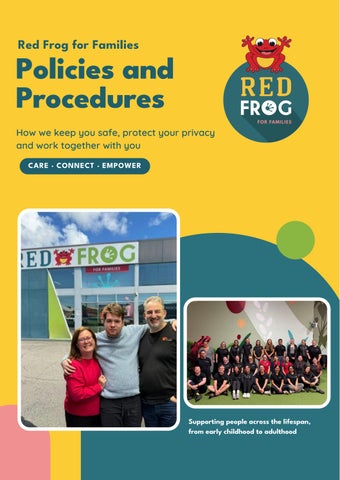
Supporting people across the lifespan, from early childhood to adulthood
WELCOME
About this booklet This booklet brings together the service policies and procedures that guide how Red Frog for Families works. It is for our team, and for the participants, families and carers we support, so everyone knows what to expect from us and how we keep people safe. If you have a question about any policy, please speak with your therapist or contact our Participant Support Team on (02) 4039 8555 or reception@rf4f.com.au.
Contents 01
Intake and Waitlist Policy and Procedure
3
23
Inclusion (ECEI Practice Standard)
84
02
Service Access and Equity Policy and Procedure
6
24
The Family (ECEI Practice Standard)
87
Privacy and Confidentiality Policy and Procedure
10
25
Capacity Building (ECEI Practice Standard)
91
03
26
Collaboration (ECEI Practice Standard)
95
04
Confidentiality In The Workplace
15
27
99
05
Cancellation Policy and Procedure
18
Evidence Informed Practice (ECEI Practice Standard)
Assessment, Planning, and Review Policy and 20 Procedure
28
Outcome Based Approach (ECEI Practice Standard)
103
06
Working with Carers and Family Members Policy and Procedure
24
29
Mealtime Management Policy and Procedure
106
07
Working in Participant Homes and School Settings Policy and Procedure
27
30
Feeding Therapy Policy and Procedure
107
08
31
108
09
Handling Participant Money Policy and Procedure
31
Providing Information, Advice, and Referral Policy
32
Duty of Care Policy and Procedure
110
10
Fee Policy and Procedure
34
33
Participant Rights and Responsibilities Policy 116
11
Medication Management Policy and Procedure
39
34
118
12
Conflict of Interest Policy and Procedure
42
Preventing and Responding to Abuse, Neglect, and Exploitation Policy and Procedure
Providing Information, Advice, and Referral Procedure
45
35
Decision Making and Choice Policy and Procedure
129
13
Service Agreement Terms and Conditions
47
36
High Intensity Care Policy and Procedure
135
14
Service Delivery Policy and Procedure
50
37
Clinical Waste Management Policy and Procedure
138
15 16
Providing Information, Advice and Referral
53
38
Child Safe Policy and Procedure
150
17
Behaviour Support Policy
54
39
154
18
Behaviour Support Implementation and Monitoring Procedure
60
Family Law and Access Policy and Procedures
40
Consumer Data Rights Policy and Procedure 156
19
Behaviour Support Procedure – Start to Finish
64
41
Transporting Participants Policy and Procedure
161
20
Restrictive Practices Policy and Procedure
65
42
165
21
Early Childhood Early Intervention Policy
77
Feedback, Compliments and Complaints Policy and Procedure
22
The Child (ECEI Practice Standard)
80
43
Service Exit and Transition Policy and Procedure
176
44
Therapy Dog Policy and Procedure
178
2
Red Frog for Families · Policies and Procedures
POLICY 1
Intake and Waitlist Policy and Procedure POLICY CODE
PROCEDURE CODE
PERSON ACCOUNTABLE
SPPOL012.06
SPPRO012.06
Chief Operations Officer
STATUS (DRAFT/RELEASED)
DATE LAST REVISED
Released
November 2024
Intake
Purpose and Scope
The following script supports the Red Frog
The purpose of this policy and procedure is
for Families Participant Support Team and
to guide Red Frog for Families team
other intake personnel to support families that contact Red Frog for Families seeking
members when dealing with families and individuals initial contact seeking services from Red Frog for Families. This applies to all Red Frog for Families team members, contractors, and volunteers.
service. Validate feelings around being on a waitlist. We understand the difficulty in having
Definition
to wait.
(none)
Our aim is to not have a waitlist.
Policy
Founders of Red Frog for Families Rochelle and David have found
Red Frog for Families aims to avoid or
themselves on waitlists in the past and
reduce waiting times for participants seeking
know how stressful it can feel.
service. We recognise at times that we will be unable to provide the right supports for an individual or family or will be unable to provide the supports at the time or frequency required by an individual or family and will seek to support those individuals or families to access the supports they need.
To assist us, the more availability you have the easier it will be for us to find a time. Keep communicating with us through the process, as we will with you. Current reports emailed to reception@rf4f.com.au.
Procedure
Our Managers of Support Services (MOSS)
Services Provided
meet a few times a week to discuss status of list, we will call you fortnightly to
The current list of services provided will be
update you and see if you need anything.
kept current on the Red Frog for Families website, and updated in the Participant
The next step is to complete a
Handbook as soon as practicable following any changes to service provision.
questionnaire. Expires in 10 days. (3-day extension). Once we receive it, the Managers of Support Services (MOSS) can look at availability in alignment with participant needs.
3
Red Frog for Families · Policies and Procedures
POLICY 1 · CONTINUED
Intake and Waitlist Policy and Procedure
Once appointment time(s) become
Speech Therapy, Occupational Therapy
available for assessment or therapy, we will call the participant to confirm
Sessions - $193.99/hr
dates/times and send out a confirmation
Therapy costs – Additional therapist travel
email.
Travel Speech Therapy or Occupational time for sessions conducted outside of
A detailed intake is to be completed on Practice Management system using
clinic in line with current NDIS published guidelines.
details from this initial conversation on the
Allied Health Assistant – Level 2 $86.79/hr
phone, including all details the Managers of Support Services (MOSS) will need to plan for scheduling purposes.
Travel Allied Health Assistant costs – Additional therapist travel time for sessions conducted outside of clinic in line
For Participants without NDIS funding
with current NDIS published guidelines.
Team Care Plan (From GP for Medicare
Community Access Sessions - $73.58/hr
rebate)
for weekday daytime sessions. Sessions in evenings, on weekends, or public holidays
NDIS (including Early intervention for under 7) Phone: 1800 800 110 Link to NDIS Access Request Form: https://www.ndis.gov.au/how-applyndis/what-access-request-form
incur higher charges in line with current NDIS Pricing Arrangements Travel Community Access costs - incurred for all travel with participants, and between the clinic and start of job location start of job is over 15km from
NOTES:
clinic location.
Ask for all reports over the last 12 months (this could mean an assessment is not
Behaviour Support $252.99/hr
needed)
Screener: combined for OT & SP = $80
Parents need to be told about prices around what they need (ongoing sessions, assessment).
Screener: OT & SP separately = $50
Timeline Participant Support Team members will complete the Phone Intake Form on initial
Pricing
contact from a participant
Red Frog for Families adjusted prices for all
After initial contact aim to complete each of the following steps within 7 days.
services on 1st July 2022. Prices are now in line with NDIS recommendations. Assessments - are billed by the hour at a rate of $193.99/hr. Assessments range between 6 hours and 15 hours (functional capacity/functional communication
Send Intake Questionnaire to the participant/participant representative (10 day expiry date)
assessment). All assessments include an
For new participants wanting therapy
initial support meeting, assessment,
services Intake Questionnaire
report writing time, copy of written report and a follow up support meeting).
4
Step one
For new adult participants wanting therapy services Intake Questionnaire - Adults
Red Frog for Families · Policies and Procedures
POLICY 1 · CONTINUED
Intake and Waitlist Policy and Procedure
For new participants wanting Holiday Programs Holiday Intake Questionnaire For new participants wanting feeding therapy an additional Feeding Therapy Intake If an existing or new participant wants Community Access services a New to Community Access Intake Include the Participant Handbook with the intake
send participants. Step Four Touch base fortnightly until assessment or therapy sessions offered and accepted. Step Five During the initial meeting the therapist is required to complete an updated Service Agreement for ongoing services to be
questionnaires
provided
Intake questionnaires will include such
During the initial meeting the therapist is required to complete a Participant Risk
questions as to allow identification of risks that may make accessing services in the Red
Assessment and/or CA Risk Assessment
Frog for Families clinic difficult and allow the Managers of Support Services to identify the
During the meeting for therapy services the
need to follow up with more formal risk assessments prior to the scheduled initial meeting. Step Two For new participants send Initial Service Agreement For new participants send Consent Form for Initial meeting
therapist must also complete the Meeting Checklist During the meeting for beginning Community Access services a therapist must complete the Community Access Initial Meeting Form After the meeting the therapist is to complete a Meeting Outcomes
Current Participants
Step Three
For participants seeking additional services the following Service Request can be
Manager of Support Services (MOSS) to
completed by PST or therapists.
advise reception of which Questionnaires to
5
Red Frog for Families · Policies and Procedures
POLICY 2
Service Access and Equity Policy and Procedure POLICY CODE
PROCEDURE CODE
PERSON ACCOUNTABLE
CAPOL002.05
CAPRO002.05
Chief Operations Officer
STATUS (DRAFT/RELEASED)
DATE LAST REVISED
Released
October 2024
Purpose and scope
Efficiency – Red Frog for Families will optimise the use of available public
This policy provides guidelines relating to
resources through a user-responsive
access and equity.
approach to service delivery that meets the needs of participants.
This policy applies to all potential and existing Red Frog for Families participants, their family members and carers, and other
Accountability – Red Frog for Families will
relevant stakeholders.
access and equity objectives for participants.
Definition
Policy
Access – Red Frog for Families will provide
Red Frog for Families’ service delivery
services to everyone who is entitled to them, without discriminating on the basis of a
environment is safe and engaging, physically
person’s country of birth, language, culture,
support and communication needs.
sexual identity or orientation, or religion.
Red Frog for Families’ screening and
Equity – Red Frog for Families’ services will be developed and delivered to ensure fair
eligibility, priority of access, and waitlist
treatment of all eligible participants.
equitable, and transparent manner, and in line with the Participant Rights and
Communication – Red Frog for Families will inform eligible participants of the services available, their entitlements, and how to
ensure it is accountable for implementing
accessible, and responsive to its participants’
management is undertaken in a fair,
Responsibilities Policy and Procedure. Access to services is based on eligibility,
seek participant feedback about the scope
relative need, organisational capacity, the best interests of people using the service,
and standard of service provision.
and potential impact on existing participants.
Responsiveness – Red Frog for Families will
Red Frog for Families endeavours to provide
be sensitive to participants from diverse
information to all participants in a manner that they will understand. Where information
obtain them. The organisation will regularly
linguistic and cultural backgrounds and, as far as practicable, respond to their particular circumstances and needs. Effectiveness –
is likely to be delivered not face-to-face
Red Frog for Families will focus on meeting the needs of participants from all
the person that the participant or carer is interacting with, an easy-read version of
backgrounds.
documents will be made available if possible,
6
where understanding can be ascertained by
Red Frog for Families · Policies and Procedures
POLICY 2 · CONTINUED
Service Access and Equity Policy and Procedure
and information about translation services
Red Frog for Families’ available resources
provided upon request. The Red Frog for Families website can easily be translated
to meet those needs.
through all modern web browsers so will not
compliment other services the person
be provided in alternate languages at this point in time.
Procedure
How Red Frog for Families’ services will receives. The preferences of the person for personality, experience, gender, cultural background, and language of their
Accessibility
worker; and
The Chief Operations Officer will consider
The best interests of the person.
how the premises or support delivery environment accommodates participant’s accessibility needs, health, privacy, dignity, quality of life, and independence and, where reasonable, make modifications. Suggestions or complaints about the service’s accessibility will be directed to Red Frog for Families’ Feedback, Compliments, and Complaints Policy and Procedure. Each participant will be supported to understand the circumstances under which supports may be withdrawn. Access to supports will not be withdrawn or denied solely on the basis of a dignity of risk choice that has been made by the participant.
During an intake interview, the Manager of Participant Experience (or delegate) will assess any barriers to the person accessing services: The Manager of Participant Experience (or delegates) will advise the person of their right to involve a support person in their dealings with Red Frog for Families. The Manager of Participant Experience (or delegates) will provide information and support for the person to access a person of their choice, such as an advocate, to assist them to interact with the service (see Decision Making and Choice Policy and Procedure).
Red Frog for Families will respond quickly
Where access issues are identified, the Manager of Participant Experience will
and appropriately to each request for service.
accessible for the person, and if not, how
Accepting Requests for Service
Red Frog for Families’ process for receiving and assessing requests for a service is designed to be inclusive of our agreed target group and consistently applied.
consider whether Red Frog for Families is it could be made accessible. Where a language or cultural barrier is identified, the Manager of Participant Experience (or delegates) will engage an
Consideration must be given to the person’s
interpreter or an appropriate external agency to support the person (see Service
priority of access by examining:
Delivery Policy and Procedure).
Where relevant, the needs of their family, carer, or other supporters.
The Manager of Participant Experience (or
Red Frog for Families’ potential
delegates) will contact the person or their supporter as soon as possible after the
contribution to meeting those needs.
Intake Interview to advise them of the outcome. Notification will be provided by phone and/or email.
7
Red Frog for Families · Policies and Procedures
POLICY 2 · CONTINUED
Service Access and Equity Policy and Procedure
Where the participant is offered services and
list at least every three months to:
accepts, see the Assessment, Planning, and Review Policy and Procedure.
advise them of their current status.
Comprehensive and clear records will be
list.
kept using the practice management system (Lumary - Enquiries), detailing: the name of the applicant. how they were referred. their eligibility, and any onward referrals made.
check whether they want to remain on the provide referrals to other service providers if required; and advise the estimated wait time remaining.
Appeal When a participant is excluded from or is
The Manager of Participant Experience (or
ineligible for a service with Red Frog for Families, the Manager of Participant
delegates) will conduct all Intake Interviews.
Experience (or delegate) will advise them of
They will provide the person with information
their right of appeal and offer referral to
about:
more appropriate agencies, as per the Providing Information, Advice, and Referral
entry and exit procedures; eligibility and priority of access requirements; conditions that may apply to service provision; and fees. The Manager of Participant Experience (or delegates) will provide the person with a Participant Handbook that outlines Red Frog for Families’ entry and exit procedures, fees, hours of operation, the Participant Rights and Responsibilities statement, Privacy and Confidentiality Policy and Procedure, and Feedback, Compliments, and Complaints brochure. Where appropriate, the Chief Operations Officer (or delegate) will provide this
Policy and Procedure. Appeals should be directed in writing to Red Frog for Families’ Chief Operations Officer and a final decision will be made by the Chief of Operations (or Management Team where appropriate). If required, staff will provide support for a person to make an appeal, by either transcribing their feedback for the Chief Operations Officer (or delegate’s) review or referring the person to interpreter or advocacy services. Those not successful in their appeal will be provided written advice to this effect. If a person is unhappy with the outcome of their appeal, they will be directed to Red Frog for Families’ complaints process. As per
information in an alternative format such as
Red Frog for Families’ Feedback,
a different language, Easy English, detailed
Compliments, and Complaints Policy and Procedure, information on the complaints
verbal explanation, or through the use of interpreters and advocates.
Waiting List processes The Manager of Participant Experience (or
process can be provided in a variety of formats if required including support to access interpreters or advocates if necessary.
delegates) will contact people on its waiting
8
Red Frog for Families · Policies and Procedures
POLICY 2 · CONTINUED
Service Access and Equity Policy and Procedure
Alternative Supports Red Frog for Families will work collaboratively with all people refused services and (with consent) their supporters to identify what alternative services and referrals could best meet their needs. With the participant's consent, relevant
to facilitate a smooth transition for the participant.
Continuous Improvement Red Frog for Families will maintain a record of people who have been refused a service, summarising reasons for their being found
information will be provided by Red Frog for
ineligible or, if found eligible, reasons for being placed on Red Frog for Families’
Families to new service providers to support
Waiting List.
the participant's seamless transition. Where appropriate, Red Frog for Families staff may
Access, service refusal, and referral
also meet with staff of alternative providers
9
information will be tracked to inform Red Frog for Families’ continuous improvement.
Red Frog for Families · Policies and Procedures
POLICY 3
Privacy and Confidentiality Policy and Procedure POLICY CODE
PROCEDURE CODE
PERSON ACCOUNTABLE
CAPOL001.05
CAPRO001
Chief of Operations
STATUS (DRAFT/RELEASED)
DATE LAST REVIEWED
Released
November 2024
1. Purpose and Scope
Information Privacy – refers to the control of the collection, use, disclosure, and disposal
This ensures that management of
of information and the individual’s right to
participants’ personal information meets all relevant legislative and regulatory
control how their personal information is handled.
requirements.
3. Policy
This policy applies to current and potential
Red Frog for Families is committed to
participants, their carers, and their family members. This policy also applies to the Red Frog for Families team, and any students or volunteers.
2. Definitions Personal information – Recorded
transparent management of personal and health information about its participants and our team members. This commitment includes protecting the privacy of personal information, in accordance:
information (including images) or opinion,
Australian Privacy Principles (APPs)
whether true or not, from which the identity (including those up to thirty years deceased)
Privacy Act 1988
could be reasonably ascertained. Sensitive information – Information or an opinion about an individual’s racial or ethnic origin, political opinions, membership of a political party, religious beliefs or affiliations, philosophical beliefs, membership of a professional or trade association, membership of a trade union, sexual preference or practices, or criminal record. This is also considered to be personal information. Health information – Any information or an
Privacy Amendment (Enhancing Privacy Protection) Act 2012
Procedure Personal Information Personal information may include: Name. Date of birth. Gender. Current and previous addresses. Residency status.
opinion about the physical, mental, or
Telephone numbers and e-mail addresses.
psychological health or ability (at any time)
Bank account details.
of an individual.
Tax file number. Driver's licence number.
10
Red Frog for Families · Policies and Procedures
POLICY 3 · CONTINUED
Privacy and Confidentiality Policy and Procedure
Centrelink information.
A person must be free to exercise genuine
Photographs.
choice about whether to give or withhold consent. This means they haven’t been
Race or ethnicity, and Medical history or information provided by a health service. In collecting personal information, Red Frog for Families will inform the participant: That information is being collected.
pressured or coerced into making a decision and that they have all the information they need in a format they understand. Voluntary consent requires that the person is not affected by medications, other drugs, or alcohol when making the decision.
The purposes for collection.
Informed Consent
Who will have access to the information.
A person’s capacity to make decisions will
The right to seek access to, and/or
vary depending on the type of decision or its
correct, the information; and
complexity, or how the person is feeling on
The right to make complaint or appeal
the day. The way information is provided to a person will also affect his or her capacity
decisions about the handling of their information. Participant information is used to:
to make decisions. Choices must be offered in a way that the person understands, for example by using images or signing.
Assess and provide services.
Support, where required, must be provided
Administer and manage those services.
for the person to communicate their consent.
Evaluate and improve those services. Contribute to research. Contact family, carers, or other third parties if required; and Meet our obligations under the NDIS. Participants are to be provided with the
Consent Form at the time of commencing service with Red Frog for Families. This form is to be: Signed and placed in the participant’s file on Practice Management System. Held securely with access limited to team members directly involved with the participant.
Consent Consent must be voluntary, informed, specific, and current.
Specific Consent Consent must be sought for a specific purpose and this purpose must be understood by the participant. Current Consent Consent cannot be assumed to remain the same indefinitely, or as the person’s circumstances change. People and guardians are entitled to change their minds and revoke consent at a later time. Participant consent forms are done yearly or if consent changes. Each school holiday period a participant's Holiday Consent Form is completed. If information about a team member is needed from another organisation, the team member is to complete Consent to Disclose Information to Third Parties
Voluntary Consent
11
Red Frog for Families · Policies and Procedures
POLICY 3 · CONTINUED
Privacy and Confidentiality Policy and Procedure
Collection and Storage of Personal Information Red Frog for Families collects information: Directly from participants orally or in writing. From third parties, such as medical practitioners, government agencies, participant representatives, carer/s, and other health service providers. From participant referrals; and From publicly available sources of information.
Not required to be retained by, or under, an Australian law or a court/tribunal order. Red Frog for Families has appropriate security measures in place to protect stored electronic and hard-copy materials. Red Frog for Families has an archiving process for participant files which ensures files are securely and confidentially stored and destroyed in due course. Should a breach in privacy occur, potentially exposing participant information (e.g. computer system hacked, laptop stolen etc.) the Chief
Red Frog for Families will collect sensitive
Operations Officer will immediately act to rectify the breach in accordance with
information:
Consumer Data Rights policy and procedure.
Only with participant consent, unless an
Updating Participant Information
exemption applies: e.g. the collection is required by law, court/tribunal order, or is
To ensure that participant information is accurate, complete, current, relevant, and
necessary to prevent or lessen a serious and imminent threat to life or health. Fairly, lawfully, and non-intrusively. Directly from the participant, if doing so is reasonable and practicable. Only where deemed necessary to support. Service delivery to participants. Staff activities and functions; and
not misleading, Red Frog for Families checks personal details and updates participant files accordingly: Whenever reviewing a participants' service; and/or Upon being informed of changes or inaccuracies by participants or other stakeholders.
Giving the participant the option of
There will be no charge for any correction of
interacting anonymously, if lawful and
personal information.
practicable. Red Frog for Families takes all reasonable
Where Red Frog for Families has previously disclosed participant personal information to
steps to protect personal information
other parties, should the participant request
against loss, interference, misuse,
us to notify these parties of any change to
unauthorised access, modification, or disclosure. Red Frog for Families will destroy,
their details, we must take reasonable steps to do so.
or permanently de-identify, personal information That is no longer needed. Unsolicited and could not have been obtained directly; or
12
Disclosing Information Red Frog for Families respects the right to privacy and confidentiality, and will not disclose personal information except:
Red Frog for Families · Policies and Procedures
POLICY 3 · CONTINUED
Privacy and Confidentiality Policy and Procedure
where disclosure would protect the participant and/or others. where necessary for best service practice; or where obligated by law. For these purposes, Red Frog for Families may disclose participants personal information to other people, organisations, or service providers, including: Medical and allied health service providers who assist with the services we provide to participants. A 'person responsible' if the participant is unable to give or communicate consent e.g., next of kin, carer, or guardian.
P.O. Box 851, Warners Bay NSW 2282 The Chief Operations Officer will assess the request to access information, taking into consideration current issues that may exist with the participant, and whether these issues relate to any lawful exceptions to granting access to personal information. Should the Chief Operations Officer decide that access to personal information will be denied, they must, within 30 days of receipt of the request, inform the participant in writing of: The reasons for denying access and The mechanisms available to complain or appeal.
The participant’s authorised
Should access be granted, the Chief
representative/s e.g., legal adviser.
Operations Officer will contact the
Our professional advisers, e.g., lawyers, accountants, auditors.
participant within 30 days of receipt of the request to arrange access to their personal
Government and regulatory authorities,
information.
e.g., Centrelink, government departments,
Should Red Frog for Families be unable to
and the Australian Taxation Office.
provide the information in the means requested, the Chief Operations Officer will
Organisations undertaking research where information is relevant to public health or public safety; and When required or authorised by law.
Accessing Personal Information Participants can request and be granted access to their personal information, subject to exceptions allowed by law. Requests to access personal information must state: The information to be accessed. The preferred means of accessing the information. and should be forwarded to the Chief Operations Officer's email coo@rf4f.com.au,
discuss with the participant alternative means of accessing their personal information. Reasonable charges and fees, incurred by Red Frog for Families in providing the data as requested, may be passed on to the participant.
Complaints Questions or concerns about Red Frog for Families’ privacy practices should be brought, in the first instance, to the Chief Operations Officer's attention. Participants may directly email the Chief Operations Officer at coo@rf4f.com.au
or in writing to: The Chief Operations Officer
In investigating the complaint Red Frog for Families may, where necessary, contact the
Red Frog for Families
participant making the complaint
13
Red Frog for Families · Policies and Procedures
POLICY 3 · CONTINUED
Privacy and Confidentiality Policy and Procedure
to obtain more information.
Phone: 1300 363 992
The participant will be advised either in writing, or in a face-to-face meeting, of the
Web: http://www.oaic.gov.au (online complaint form)
outcomes and actions arising from the investigation. If concerns cannot be resolved and participants wish to formally complain about how their personal information is managed,
Email: enquiries@oaic.gov.au Any complaint about services delivered under the NDIS may be brought to the NDIS Quality and Safeguards Commission.
or if they believe Red Frog for Families has
Complaints to the NDIS Commission can be
breached an Australian Privacy Principles and/or IPP.
lodged via: web: https://www.ndiscommission.gov.au/
they may send their concerns to:
email: feedback@ndis.gov.au
The Office of the Australian Information
phone: 1800 035 544 (free call from landlines)
Commissioner
14
or TTY 133 677. Interpreters can be arranged.
Red Frog for Families · Policies and Procedures
POLICY 4
Confidentiality In The Workplace What is workplace confidentiality? Workplace confidentiality involves any confidential information that an employee can come across in the ordinary course of business. Confidential information can be broadly categorised into three main categories: 1. Personal information of Participants, families and Carers 2. Employee information (professional and personal)
Therapist/patient confidentiality Unsurprisingly, patient confidentiality is highly important for therapists and counsellors. It forms part of the therapeutic frame of appropriate boundaries, which creates a safe space for a good working relationship to form. Here’re some examples of ways you could unintentionally break patient/therapist confidentiality: Sharing confidential information about a client with a family member or friend
3. Proprietary (business) information or
Talking about confidential information somewhere you can be overheard
“trade secrets”
Leaving your computer containing
Why confidentiality is important for the Participants, families and Carers? Failure to protect and secure confidential information may not only lead to the loss of business or participants, but it also unlocks the danger of legal action being taken against the business or employee for the breached confidentiality. A key element of confidentiality is that it helps build trust that makes participants, families and carers feel comfortable and in turn encourages return business. If you're in a position where you have access to or are given this type of data at work, your career relies on your ability to keep patient confidentiality. If you don't, you could lose trust and integrity in the eyes of your existing (and potential future) participants, who could terminate your
confidential information open to others Continuing to work with a participant when there's a conflict of interests (for example, they know one of your family members or friends) When permission to share information is given but isn't specific, this can create confusion and result in a potential breach (for example, a patient may give permission for their information to be shared with a teacher but not their GP)
What Is the Meaning of Confidentiality in the workplace? The word “confidentiality” has both casual and legal meanings in the workplace and will have different meanings throughout your professional career. In some instances, confidentiality refers to not discussing internal goings-on with co-workers. In other instances, it refers to not sharing trade
contract and take legal action against you. 15
Red Frog for Families · Policies and Procedures
POLICY 4 · CONTINUED
Confidentiality In The Workplace
secrets and other company information with
management, revealing the fact that a peer
competitors, the media or anyone outside of your company.
is interviewing with another company, forwarding a confidential email from one
Casual Definition You’ll be more likely to climb the corporate ladder during your career if you get along well with co-workers, build strong professional networks and have a reputation as a trustworthy employee. If you repeat confidential statements made by co-workers, even if the original source doesn’t hear about
employee to another, sharing information you overheard others discussing or passing around a document you found that wasn’t intended for others. A general rule of thumb for discussing others and/or their information is not to repeat something if you wouldn’t say it if the person was standing next to you.
your gossip, the people you tell might lose
Legal Examples
respect for you and no longer trust you. If
Information you can’t share outside of a
you gossip with participants and carers, they might tell your competitors, who will be less
business might include participant lists, production processes, recipes, patents,
likely to hire you in the future.
financial information, research, website
Legal Definition During your time in the workforce, you’ll have access to information your employer doesn’t want made public or revealed inside the company. This can include salaries, employee perks, participant lists, trade secrets, sales numbers, participant information, news about pending terminations, reasons for a firing, phone codes or computer passwords. You may not divulge this information while you are working for an employer or after you leave. In some instances, you will be asked to sign a confidentiality agreement requiring you to keep company secrets after you leave an employer. Some companies might offer to hire you specifically because they want you to bring inside information about your former employer they can use. Even if you don’t sign a confidentiality agreement, sensitive information you have might be protected under state or federal laws.
Casual Examples
traffic statistics and computer and building security information. Companies that collect data on customers cannot share this information with other companies unless it informs customers in advance, such as when businesses share email lists. Personnel information is confidential, and information in an employee’s file, such as tax file number, salary, health records, disciplinary actions and termination reason can’t be discussed with other employees. Most of this information can’t be discussed with potential employers who call for a reference. Divulging inside information can damage your former employer, allowing them to sue you to recover those damages. Review any noncompete or confidentiality agreements you’ve signed with your Lawer and discuss any proprietary information you have you might not be able to share with a new employer. An employee owes a duty of good faith to their employer. There is an obligation not to use or disclose confidential
Examples of breaking casual, confidential
information that is incorporated in that
communications include repeating a co-
duty. The disclosure of confidential information by an employee could also
worker’s opinion of a boss, supervisor/s or 16
Red Frog for Families · Policies and Procedures
POLICY 4 · CONTINUED
Confidentiality In The Workplace
amount to a breach of a fiduciary duty that the employee owes to the employer.
https://swamp.rf4f.com.au/polproc/76
(a) You must keep secret during and after
https://swamp.rf4f.com.au/polproc/96 https://openlegal.com.au/how-do-i-ensure-
your employment all information you obtain
confidentiality-in-the-workplace/
about the business and affairs of the
https://www.fairwork.gov.au/tools-and-
Company, Related Companies, Participants and carers of the Company. (b) Any
resources/best-practice-guides/workplaceprivacy
document or written material provided by
https://www.oaic.gov.au/privacy/guidance-
the Company for use in connection with the
and-advice/protecting-customers-personal-
Company’s business is the Company’s property must not be removed, passed on,
information
copied or disclosed to third parties except with the Company’s authority. Here are some links for further information on the important topic of confidentiality.
17
If you feel that there has been a breach of confidentially here is a link that will give you handy information on reporting the breach. https://www.oaic.gov.au/privacy/privacycomplaints
Red Frog for Families · Policies and Procedures
POLICY 5
Cancellation Policy and Procedure POLICY CODE
PROCEDURE CODE
PERSON ACCOUNTABLE
SPOLP010.04
SPROP010.04
Chief Operations Officer
STATUS (DRAFT/RELEASED)
DATE LAST REVISED
Released
November 2024
Purpose and Scope
be cancelled. This policy complies with NDIA
This policy provides a framework for Red
and NDIS Policy on the management of cancellation of services by a participant.
Frog for Families processes and obligations, should a participant’s parent/guardian
Procedure
request a cancellation of services. This policy
The cancellation of a Red Frog for Families
applies to all Red Frog for Families team
service by the participant, or failure to
members students, contractors, volunteers and all potential and existing participants,
attend a scheduled service without notice (no show), may result in the participant being
their family members, and other supporters.
charged the full applicable fee for the
Definition Cancellation – Refers to an individual notifying Red Frog for Families, in advance, that scheduled hours of service are not required or unable to be received. There are two categories of cancellation:
booked service and where appropriate, funding may be claimed. Confirmation documentation will be maintained on the Red Frog for Families website and may also be provided in individual NDIS Service Agreements, booking requests and/or other documentation
Short notice – where less than a minimum of three full business days’ notice is
provided to participants/parents/guardians
provided.
cancellation notification.
Reasonable Notice – where seven full
Where the participant attends for only part
business days or greater notice is provided.
of the scheduled service, without notice,
and will outline requirements for service
payment for the entirety of the booked
No Show – Refers to an individual not
service may be charged.
attending or being unavailable without notice
Where the participant fails without notice to
for a booked/scheduled service, or where the individual is not at the agreed location at
attend for the planned service, Red Frog for
the agreed time for the service.
participant and/or carer/guardian to confirm the planned attendance.
Policy Red Frog for Families is committed to transparent processes by which services can 18
Families will make every effort to contact the
More instances of cancellations or no shows totalling 20% or more of planned services in a continuous 12-month period may be Red Frog for Families · Policies and Procedures
POLICY 5 · CONTINUED
Cancellation Policy and Procedure
notified to the funding Agency, to enable consideration of review of the participant’s plan. For instances where Red Frog for Families initiates the cancellation of a service due to operational reasons, the service will be rescheduled at no penalty to either party. Should either party wish to end the Service
Agreement they must give the required notice detailed in the Service Agreement. If either party seriously breaches the Service Agreement the requirement of notice will be waived. All new Service Agreements between participants and Red Frog for Families will include details of advice periods for
Notice Period before Scheduled Service Action Fee Where reasonable notice is provided, there will be no penalty and Red Frog for Families will reschedule the service with the participant. Where the participant provides short notice the participant forfeits the service if it cannot be offered and booked to another participant and Red Frog for Families is paid as if the service occurred, as per scheduled service fee. Where the participant provides no notice (no show) the participant forfeits the service and Red Frog for Families is paid as if the service occurred, as per scheduled service fee.
cancellations and possible forfeit of the booked service.
19
Red Frog for Families · Policies and Procedures
POLICY 6
Assessment, Planning, and Review Policy and Procedure POLICY CODE
PROCEDURE CODE
PERSON ACCOUNTABLE
SPPOL001.05
SPPRO001.05
Chief Operations Officer
STATUS (DRAFT/RELEASED)
DATE LAST REVISED
Released
November 2024
Purpose and Scope
the NDIA to deliver planning or case management support as one of their core
This policy sets out the approach to
functions and with the expertise to develop
assessment, planning, and review in respect
informal, community, and disability-specific responses. These professionals are known as
to participant support plans, once a person has been offered and accepted Red Frog for Families’ services.
support coordinators.
For policy relating to assessment and planning of high intensity supports, see the
support planning that is beyond the scope of this policy the person should be directed to a
High Intensity Care Policy and Procedure.
relevant support coordinator. Referral and
This policy applies to all potential and existing Red Frog for Families participants, their family members and carers, and other relevant stakeholders.
Definition (none)
Policy This policy aligns with the planning
Should a person request assistance with
support to connect the person to the relevant agency or service provider will be provided within a service benchmark of five working days.
Procedure Red frog for Families team members are involved in assessment, planning, and review activities have the relevant skills (or the capacity to acquire skills) in order to provide:
requirements as set out in the Disability
Active engagement and early intervention
Inclusion Act 2014 (NSW) and NDIS Act 2013 of participation, choice and control,
strategies, including with families.
engaging as equal partners in decisions, and
planning, assessment, and review.
including families, carers, and other
Holistic and collaborative approaches to
significant people. Red Frog for Families will provide its participants with limited assistance with planning, including providing information regarding its own service delivery and through providing advice, information, and referrals. Extensive assistance with planning is provided by service providers funded by 20
Participatory and strength-based
service delivery; and Capacity building of families and carers. All documentation relating to assessment, planning, and review will be maintained on participant files. During all assessment, planning, and review activities, team members will discuss participants’ rights and Red Frog for Families · Policies and Procedures
POLICY 6 · CONTINUED
Assessment, Planning, and Review Policy and Procedure
responsibilities with them. They will confirm participants’ understanding verbally, using an interpreter or advocate where required.
for an Initial Meeting. Red Frog for Families will engage in joint assessment and planning activities with the
Team Members will advise the person of
NDIS, Local Area Coordinator, Support
their right to involve a support person in their
Coordinator, or Plan Management provider
dealings with Red Frog for Families. Where required, participants will be provided with
where appropriate in negotiating appropriate supports for the participant. All
information and support to access a person
activities undertaken with, or on behalf of,
of their choice, such as an advocate, to assist
the participant will be documented in the
them to access the service. See Decision Making and Choice Policy and Procedure.
participant file.
In accordance with the Privacy and Confidentiality Policy and Procedure, respect for and protection of participants’ privacy and confidentiality will be reinforced on an ongoing basis, verbally and in literature promoting the services offered by the organisation. If necessary and with the participant or their supporter/s consent, other parties such as service providers who deliver existing or complementary services to participants will be included in assessment, planning, and
The assessment will take into account: The participant’s needs (including health, well-being, and safety needs), goals, and longer-term aspirations. The supports that Red Frog for Families can provide to meet those needs, goals, and aspirations. The participant’s preferred links to family, friendships, and other support networks. The participant’s and their supporters’ age, ability, gender, sexual identity, culture, religion, or spirituality.
review activities.
Any barriers to community participation,
Team members will take into account the
place to help participants overcome them.
participant’s wishes, culture, diversity, values, and beliefs in regards to accepting or rejecting particular support options. The Red Frog for Families team will support each participant’s right to practice their culture, values, and beliefs while accessing supports.
Assessment and Planning Following their Intake Interview, where a participant is offered services and accepts, team members will work with the participant and their supporter/s to assess their needs and to develop and agree upon a Service Agreement. Team members will meet with the participant and their supporter/s as soon as practicable 21
along with strategies that could be put in Risks determined in a participant risk assessment. How, when, and where the participant requires the supports to be delivered; and The participant’s NDIS Plan. Where possible, services provided to participants should: Support them to develop, maintain, and strengthen independence, problem solving, social, and self-care skills appropriate to their age, developmental stage, and cultural circumstances; and Help participants to take control of and responsibility for their choices and enhance their autonomy, independence, and community participation. Red Frog for Families · Policies and Procedures
POLICY 6 · CONTINUED
Assessment, Planning, and Review Policy and Procedure
Where required, team members will identify
Team members must support participants to
and provide referrals and linkages in accordance with the Providing Information,
understand their service agreement and conditions using the language, mode of
Advice, and Referral Policy and Procedure to
communication, and terms that the
other services and activities that will enhance
participant is most likely to understand. The
the participant’s community participation and provide support and assistance to help
participant must sign the Service Agreement before payment for services can be claimed,
them access these, including training,
and before service delivery commences.
employment, health, wellness, cultural, and community services.
Staff must ensure the participant (and their supporter/s):
Service Agreements
Understands their Service Agreement, or
Team members will work with the participant
is supported to understand it;
and their supporter/s to formalise the
Has sufficient time to consider and review
supports to be provided in a Service Agreement.
their options and seek advice if required; and
https://redfrogforfamilies.snapforms.com.au
Receives a copy of the Service
/form/initial-service-agreement
Agreement.
https://redfrogforfamilies.snapforms.com.au /form/service-agreement
Where it is impracticable to provide a copy of the Service Agreement, team
Service agreements must represent a
members should record the reasons for
collaboration with participants in which:
not doing so.
Supports to be delivered are explained,
A copy of the Service Agreement will also be kept on the participant’s file.
and
Review
Conditions attached to the delivery of
Team members, with the relevant
Expectations are established,
supports, including why these conditions are attached, are specified. Supports provided should: Recognise the participant’s needs and desired outcomes. Be based on the least intrusive, personcentred, and strengths-based options. Link with other services and supports, with participant consent.
22
stakeholders, will review the provision of supports for each participant every school term with the participant and their supporter/s, or at any time where the participant’s needs have changed. The participant can also request a review at any time. Reviews will include:
Include the participant’s supporters, where
Assessing changes to the participant’s needs (including health, well-being, and
possible and with participant consent; and
safety needs), goals, and longer-term
Recognise, where possible, the
aspirations.
participant’s preferences including preferred gender of workers providing
The participant’s progress towards addressing their needs and achieving their
services.
goals. Red Frog for Families · Policies and Procedures
POLICY 6 · CONTINUED
Assessment, Planning, and Review Policy and Procedure
Recognition and celebration of the
Whether a change to the supports
participant’s progress.
provided is necessary.
Any barriers to community participation and strategies to help participants overcome them.
Reviews will take into account the participant’s NDIS Plan and incorporate any changes to the plan where practicable.
Risks identified in a participant risk assessment.
23
Red Frog for Families · Policies and Procedures
POLICY 7
Working with Carers and Family Members Policy and Procedure POLICY CODE
PROCEDURE CODE
PERSON ACCOUNTABLE
SPPOL005.05
SPPRO005.05
Chief Operations Officer
STATUS (DRAFT/RELEASED)
DATE LAST UPDATED
Released
June 2024
Purpose and Scope The purpose of this policy is to outline Red
Red Frog for Families will maintain current information on services that support family members/carers and provide them with
Frog for Families’ approach to the inclusion of carers and family members in the
education and training to support them to
planning, delivery, and review of services.
and planning, and where relevant, strengthen their participation in and
This policy applies to all potential and existing participants, their family members, carers, and other supporters.
participate in services, such as in goal setting
contribution to the child’s learning and development.
Definition
Where services to children are provided, information and supports are provided in a
(none)
clear, easy to understand, and flexible manner by integrating the support into the
Policy
child’s everyday routine.
Red Frog for Families aims to provide
Red Frog for Families is also committed to
services that will have a continuing positive effect on participants. As such, Red Frog for Families recognises the importance of the role of significant people in the well-being of people with a disability, and in the participant’s life overall. Red Frog for Families will implement processes that identify family members/carers as soon as possible in all service episodes, and that maintain an ongoing relationship with family
ensuring its team members are appropriately trained and knowledgeable in ways in which to provide family member/carer support, including ensuring team members are trained in cultural competency, are aware of crossorganisational and community linkages, and can access resources and information for family members/carers.
members/carers as partners in service
Procedure
delivery.
Ways in which Red Frog for Families will
Participants will be invited to identify their family members/carers during their initial
support family members/carers can include (but is not limited to):
contact with Red Frog for Families, and Red
Family members/carers will be provided
Frog for Families processes will include family members/carers to the extent that the participant wishes.
24
with and have access to information on respite services, counselling, crisis support, education, and training to maximise their Red Frog for Families · Policies and Procedures
POLICY 7 · CONTINUED
Working with Carers and Family Members Policy and Procedure
well-being and ability to care and
The family member/carer needs to know
advocate for the participant. Identifying family members/carers as
the participant has been made an involuntary patient; or
soon as possible and ensuring this is
It is to prevent harm to the participant or
recorded in the participant’s record.
to another person.
Reviewing family member/carer information regularly throughout service delivery.
If participants do not provide their consent for a carer to be involved/have knowledge of their service, Red Frog for Families should
Providing training and support, if required,
still engage with family members/carers.
to family members/carers to maximise their participation in the service.
Carers may still have very high needs for support. In this case, family members/carers
Promoting and developing the strengths
can still participate without breaching
of the family and assisting them to
participant confidentiality decision. Red Frog
develop their own network of formal and informal resources.
for Families can: Provide participant information in general
Ensuring that the needs of family
terms, and provide reassurance about the
members/carers who are children or
supports that monitor the participant’s
aged persons are met, by maintaining knowledge of specialist support
well-being.
services/organisations that can assist
opportunity to present their issues/needs,
them.
Provide the family member/carer the and to consider these in the assessment,
Engaging with family members/carers prior to the participant exiting Red Frog
planning, and support of the participant.
for Families services to provide them with
member/carer to be involved in Red Frog
information on crisis management and services that can provide ongoing support to them. If a participant refuses or does not wish to nominate a family member/carer during the initial access process, Red Frog for Families will review this at each service review. If a participant does not wish to nominate a
Provide opportunities for the family for Families at a service level. Provide support to assist them to access other services and advocacy.
Working with children and their families Where Red Frog for Families provides services to a child, Red Frog for Families recognises the importance of a family’s
family member/carer at any point during
involvement in the service provided ensuring
their service, this will also be respected and comply with the any other relevant
the best possible outcomes for the child. Red Frog for Families is committed to:
legislation or requirements. Information, in
Working with the family to inform and
this case, will only be provided to family
strengthen their participation in, and
members/carers:
contribution to, the child’s learning and
If the participant provides consent.
development.
If the information is needed so that the
Recognising and acknowledging the
family member/carer can provide care to the participant. 25
expertise and knowledge of the family about the child.
Red Frog for Families · Policies and Procedures
POLICY 7 · CONTINUED
Working with Carers and Family Members Policy and Procedure
Building the confidence of family
environment.
members to understand how family routines and everyday activities can
Collaborating with the family and other providers to support the coordination of
support the child’s development through capacity building, coaching, and collaborating with other service providers. Assessing the child’s development and focusing on the child’s function in their everyday routines and activities in their natural learning environments. Ensuring that support plans are flexible and customised to suit the child’s and family member’s preferences and learning styles. Promoting supports that include the child in daily routines in their natural learning
26
supports provided. Working with the family and other providers where the family wishes to engage a key worker, to identify an appropriately skilled and experienced worker. Sharing information, knowledge, and skills with the family, and other providers where consent has been provided to do so; and Respecting and valuing feedback from the child, family, and other professionals to improve service delivery.
Red Frog for Families · Policies and Procedures
POLICY 8
Working in Participant Homes and School Settings Policy and Procedure POLICY CODE
PROCEDURE CODE
PERSON ACCOUNTABLE
SPPOL007.06
SPPRO007.06
Chief Operations Officer
STATUS (DRAFT/RELEASED)
DATE LAST REVISED
Released
November 2024
Purpose and Scope This policy and procedure seek to minimise risk to Red Frog for Families team members health and well-being whilst using equipment in participant homes and school settings. This policy and procedure apply to all Red
assessment in consultation with participants and other stakeholders (as appropriate), and identify potential hazards and put appropriate controls in place prior to commencing service delivery. Risks will change over time: Red Frog for Families team members should assess risks
Frog for Families team members, contractors, volunteers, and student
as they deliver services; they should report
placements.
risk assessments to ensure appropriate risk averse measures are in place.
any risks to participant's carers and update
Risks Risks to Red Frog for Families team members working in participant homes and school settings are increased due to use of unfamiliar equipment in an unfamiliar (and sometimes unsuitable) work environment.
Procedure Responsibilities Safety and well-being are shared mutual responsibilities (see Participant Rights and Responsibilities Policy and Procedure and
As team members might not be appraised of changes to the environment and equipment,
Your Right Easy Read ). Red Frog for
team members need to exercise caution and conduct risk assessments prior to beginning
their families should work together to provide a safe environment for workers.
each task
Red Frog for Families should:
Families and participants, their carers, and
Policy
Clearly communicate and understand
In school settings Red Frog Families team
what services are to be provided.
members, contractors, volunteers, and
Assess additional services before delivery.
student placements will adhere to the WHS
Review an activity that may have
process as indicated by the school setting's team. Where Red Frog for Families delivers
changed to ensure the controls are still
services in participants’ homes it is
Document the daily monitoring of the
responsible to minimise risk to team members providing supports. Red Frog for Families will conduct an initial home risk
27
working or need to be altered. service using various methods (e.g. a communication folder/book or electronically) particularly where there Red Frog for Families · Policies and Procedures
POLICY 8 · CONTINUED
Working in Participant Homes and School Settings Policy and Procedure
are several service providers or several
Participants
community workers for a particular participant.
Their families and carers.
In school settings document the service using the School Visit Snapform. School Settings, Participants and/or Carers (and Landlords – Where Appropriate) should:
Landlords and other stakeholders. Other services providing supports, where possible. Red Frog for Families will see that adequate controls are put in place prior to commencing service delivery. The risk
Maintain a safe work environment (e.g.
assessment will follow the five-step Risk
repair broken steps, mow long grass, restrain animals, provide adequate
Management Process (see Risk Management Policy and Procedure)
lighting) Look after their own in-home/school setting safety (e.g. maintain electrical equipment and install smoke alarms and safety switches to switchboards) Cooperate with service providers and workers to ensure safe work procedures and a safe work environment (e.g. move furniture to allow adequate workspace, use lifting equipment based on assessed needs) Keep their equipment safe, well
Identify hazards. Analyse: assess and prioritise risks. Treat: Implement controls to eliminate or mitigate the risk. Monitor and review: Continually monitor and evaluate the risks and treatments to maintain their effectiveness and appropriateness. Report: Provide regular reports to the organisation and stakeholders.
maintained, and in good order
(Consultation should be carried out at each step of this process)
Inform service providers and others of
If the assessment shows that workers are
any known hazards.
Risk Assessment (Pre-Service) In school settings Red Frog Families team members, contractors, volunteers, and student placements will adhere to that setting's WHS process as indicated by the school setting's team members. Where Red Frog for Families delivers services in participants’ homes it will conduct an initial assessment of possible domestic hazards, prior to commencing service delivery. The therapist will complete the Home Risk Assessment The risk assessment will be conducted in consultation with (as appropriate):
exposed to significant risks, Red Frog for Families will determine whether they need to modify or suspend that particular service until the risk has been adequately controlled. Participant advocacy groups are available to work with all parties to address the issues.
Risk Assessment (Ongoing) Responding to Changes Changes will sometimes occur which can affect workplace health and safety. Changes which may affect Red Frog for Families team members health and safety include the following: Changes in Participant’s Health Illness, injury, and other changes to a
28
Red Frog for Families · Policies and Procedures
POLICY 8 · CONTINUED
Working in Participant Homes and School Settings Policy and Procedure
participant’s health status should be monitored as a potential source of risk to workplace health. Team should:
Changes in alternate service provider. Where time does not allow normal assessment and planning, Red Frog for Families will:
Regularly monitor the participant’s health
Complete a provisional assessment.
status.
Make interim arrangements.
Inform their supervisor and initiate the
Follow up with long-term arrangements.
need for a review of the care plan. Reassess their activities to ensure the risks are controlled. Discuss the need for changes with the participant and their families. Changes to the Home Environment A participant’s home environment can change between visits. Changes may include: Positioning of furniture.
Red Frog for Families will indicate its expectations for managing risk prior to commencing service delivery.
Reporting Incidents All incidents involving Red Frog for Families team members and participants will be reported as per the Incident Management Policy and Procedure. Reportable incidents include:
Inoperable electrical equipment.
Injuries to participants or workers.
People or animals are now present.
Emergency situations.
Altered storage patterns.
Near miss incidents where there is no
Spills or leaks.
injury but requires preventative action.
New equipment or furniture.
Red frog for Families team orientation will
Obstructed access.
include training in Red Frog for Families’ incident management procedures. Red Frog
Red Frog for Families team members need to:
for Families will include all incidents recorded in the Incident Register in its WH&S review as
Determine at each visit the safety of the participant’s home as a workplace before commencing duties. Undertake a visual scan of the participant’s home immediately on arrival, and of the equipment before use. Changes to Service Agreements Changes to service arrangements could include:
regulated in the Internal Review and External Audit Schedule. For ALL incidents, submit an incident report using the Incident Report
Electrical Equipment Red Frog for Families team members should follow the Electrical Safety Policy and Procedure wherever possible.
Changes in the service required.
Red Frog for Families is responsible for the testing and maintenance of equipment it
Requested team members are change by
provides for use in participant homes or
participant or by worker.
school settings. Red Frog for Families team members should:
29
Red Frog for Families · Policies and Procedures
POLICY 8 · CONTINUED
Working in Participant Homes and School Settings Policy and Procedure
Report faults and suspected faults
Some of these chemicals may be hazardous
immediately,
with the risks increased in areas with poor ventilation (e.g. shower alcoves, ovens, or
Treat Red Frog for Families electrical equipment left in participant residences as detailed below. Where Red Frog for Families team member must use the participant’s electrical installation and electrical equipment (i.e. power points, lights, extension leads etc.), they should: Visually inspect the electrical installation to satisfy themselves as to the electrical safety of the installation, paying particular attention to details such as damaged or missing parts and burning or discolouration of the electrical fittings in the installation (e.g. damaged light switch or cracked power point).
exposure to hazardous substances can range from minor skin irritation to chronic diseases such as occupational asthma and various forms of cancer. Disinfectants and cleaning solutions are a common cause of chemical injuries among workers in the home environment. Some substances like sodium hypochlorite (bleach) are an irritant and, in high concentrations, may cause burns to the skin, mucous membranes, and eyes. Where team members use chemicals supplied by participants, they should:
Avoid using the participant’s electrical
Avoid using chemicals that have been decanted into another container.
equipment (i.e. electric kettles, vacuum
Read the first aid information and
cleaners, extension leads etc.) if possible, as Red Frog for Families is not in control of the electrical condition of this equipment. Connect participant equipment via a compliant safety switch. If the participant’s residence is not fitted with a safety switch – or if uncertain – team members should use their own portable safety switch.
Hazardous Substances/Chemicals All chemicals are hazards that should be identified and managed. There are several chemicals used in community service work, particularly for cleaning, laundry, and gardening tasks.
30
small gardening sheds). The effects from
precautions on the label before use. Note any adverse reactions to chemical use. Consult with the participant about replacing the product or redesigning the task where possible; and Report adverse reactions as an incident to be documented using an Incident Report and then placed in the Incident Register.
Medications Medications, with the exception of a few such as cytotoxic (anti-neoplastic) drugs, are not classified hazardous substances. Where cytotoxic drugs are present, see the Clinical Waste Management Policy and Procedure for guidance on handling and disposal.
Red Frog for Families · Policies and Procedures
POLICY 9
Handling Participant Money Policy and Procedure POLICY CODE
PROCEDURE CODE
PERSON ACCOUNTABLE
SPPOL006.05
SPPRO006.05
Chief Operations Officer
STATUS (DRAFT/RELEASED)
DATE LAST REVISED
Released
November 2024
Purpose and Scope This policy and procedure provides guidelines for Red Frog for Families team
Policy Red Frog for Families is committed to: Ensuring that participants are supported
members in relation to the handling and
to manage, control, access, and spend
where appropriate, management, of participant’s funds.
Ensuring that where team members have
This policy applies to all Red Frog for Families team members, contractors, and volunteers. Plan Management services are not in the scope of this policy.
Risks Where participants require Red Frog for Families team members assistance in managing their funds, there exists: A risk of team members mismanaging participant funds accidentally or purposefully. A risk of participants wrongfully accusing Red Frog for Families team members of mismanagement. a risk of misjudging the balance between duty of care and dignity of risk. and thus
their own money as they determine. access to a participant’s money or other property, that it is managed, protected, and accounted for. Exercising a duty of care to ensure that participants funds are not exploited or disadvantaged. A participant’s funds cannot be legally managed by another person unless: The participant has competently assigned management to that person. An order has been made by the courts or the south Australian civil and administrative tribunal or guardianship board; or The person has been appointed as a Centrelink nominee under the commonwealth social security (administration) act 1999, which allows the person to receive social security payments on behalf of another.
A risk to the rights of the participant; and
Red Frog for Families team will not
A risk to the reputation, trust, and effectiveness of the service.
informally manage participant funds without the explicit consent of the participant and authorisation from the Chief Operations Officer. Participants’ money or other
31
Red Frog for Families · Policies and Procedures
POLICY 9 · CONTINUED
Handling Participant Money Policy and Procedure
property will only be used with the consent
Red Frog for Families. All team members are
of the participant and for the purposes intended for the participant.
required to maintain absolute confidentiality in respect of participant’s funds and
Red Frog for Families will not provide financial information, advice, or information other than that which would reasonably be required under the participant’s plan. Participants should manage their own funds wherever possible. Team members should not manage or make decisions regarding participants’ funds if participants are capable of doing so themselves, including providing financial information or advice
accounts.
Procedure Person-Centred Principles In general, person-centred principles govern the handling of participant monies. Red Frog for Families team members should ‘do with’ not ‘do for’, supporting participants to:
other than that which would be reasonably required under the participant’s plan.
Lead and direct transactions.
Red Frog for Families systems will include
their community.
appropriate checks and balances to ensure
Take control of and responsibility for their choices.
the safeguarding of participants from being exploited, and to protect team members
Actively participate in the transaction and
Develop and maintain independence,
from allegations of financial
problem solving, social, and self-care skills
mismanagement:
appropriate to their age, developmental stage, and cultural circumstances.
Participants who rely on team members for managing their money must have an
Community Participation
account with a savings institution that
Meals and Entertainment
records all transactions; Participants’ funds held onsite should be kept in a secure location; A team member who was not involved in the transactions must verify that participants have received the goods and services that have been purchased; Team members cannot accrue benefits for themselves from managing participants’ funds; and Family members or advocates must be involved in decisions concerning the expenditure or investment of significant
Red Frog for Families team members must pay for their own take away, fast food, and restaurant meals purchased when accompanying participants in the community. The use of a Companion Card is encouraged to cover the cost of entry into venues/entertainment for team members when the team member is accompanying a participant as part of their individual plan. Where a Companion Card is not available
amounts of participants’ funds.
or accepted, the cost will be paid by Red Frog for Families. To arrange
All team members are expected to
reimbursement, the team member must
demonstrate a high level of ethical conduct
forward a receipt and Request for
in both their duty to the participant and to
Reinbursement Form to their manager for approval.
32
Red Frog for Families · Policies and Procedures
POLICY 9 · CONTINUED
Handling Participant Money Policy and Procedure
A team member must not allow a
feedback as well as participant file audits,
participant or their family to pay for a team member’s entrance to any venues
to assess alignment between documented processes and actual practice.
or entertainment.
Red Frog for Families’ Continuous
Monitoring and Review This policy and procedure will be reviewed at least annually by the Management Team and incorporate team members, participant, and other stakeholder
33
Improvement Policy and Procedure and Continuous Improvement Plan will be used to record and monitor progress of any improvements identified and feed into the service planning and delivery processes.
Red Frog for Families · Policies and Procedures
POLICY 10
Fee Policy and Procedure POLICY CODE
PROCEDURE CODE
PERSON ACCOUNTABLE
SPPOL008.04
SPPRO008.05
Chief Operations Officer
STATUS (DRAFT/RELEASED)
DATE LAST UPDATED
Released
November 2024
Purpose and Scope Red Frog for Families is committed to the provision of a fair and consistent fee structure for all participants accessing Red Frog for Families services. Red Frog for Families understands that at times, families
applies to administration team members who are responsible for the administration of fees.
Definition (none)
may experience financial stress and we
Policy
encourage families to discuss this with one of our team so that we can work on a solution
Fees for service will apply to those families
together.
Families utilising any funding source, including through the National Disability
The purpose of this policy is to clarify roles and responsibilities within Red Frog for Families pertaining to the setting and collection of fees for service. The supporting systems and procedures will
who access services through Red Frog for
Insurance Scheme (NDIS), Medicare and Private Health Insurance Agencies, and to those families accessing services as privately funded participants.
ensure that there are guidelines and consistency around how we administer fees.
Procedure
This policy applies to parents/caregivers of
The link to the NDIS pricing information is
children in the service, team members, and community members who are participants of Red Frog for Families or wish to access Red Frog for Families services. This policy also
Purpose and Scope below. https://www.ndis.gov.au/providers/pricingarrangements Standard Fees for Service are as follows:
Service
Fee
All Therapy (NDIS, Medicare, Private Health Insurance, and Privately funded) Occupational Therapy, Speech Therapy
$193.99 per hour
Travel time for out-of-clinic sessions charged at 50% of the hourly rate, up to 30 minutes each way, with addition of per km rate
$1.10 per km
Therapy Assistant (NDIS, Medicare, Private Health Insurance, and Privately funded) Therapy Assistant (Level 2)
34
$86.79 per hour
Red Frog for Families · Policies and Procedures
POLICY 10 · CONTINUED
Fee Policy and Procedure
Service
Fee
All Reports including NDIS Summary, School Summary, Progress, Recommendations (NDIS, Medicare, Private Health Insurance, and Privately funded) Occupational Therapy, Speech Therapy
$193.99 per hour
Assessment Process (NDIS, Medicare, Private Health Insurance, and Privately funded) All assessments are conducted by the hour
Where the assessment is conducted for a child under 12 years of age: Our assessments involve an initial meeting
$193.99 per hour
therapist about the participant to discuss their strengths and challenges, and goals to work towards.
with parent/carer and one of our therapists (without the participant). This is an
They also include the assessment sessions
opportunity to have a more in-depth
assessment reports which can assist in application for NDIS funding.
conversation with our therapist about the participant to discuss their strengths and challenges, and goals to work towards. They also include the assessment sessions with the participant, and the subsequent assessment reports which can assist in application for NDIS funding. There is also an outcome meeting without the participant to discuss the findings of the
with the participant, and the subsequent
There is also an outcome meeting (with or without the participant as appropriate) to discuss the findings of the report and to make a plan for ongoing therapy. Our assessments are charged by the hour and need to include enough hours to complete a functional assessment. A functional assessment typically takes
report and to make a plan for ongoing therapy.
between 10 and 15 hours. Each hour is
To give an idea of the number of hours
Assessments are only charged for the time spent and not necessarily for the maximum
required, our assessments typically range between 6 and 8 hours. The therapist will determine the number of hours during your
charged at a rate of $193.99.
amount listed above.
initial meeting and advise you at that time.
Where a functional assessment is conducted (Age 18-25):
Assessments are only charged for the time
Our assessments involve an initial meeting
spent and not necessarily for the maximum amount listed above.
with one of our therapists, the participant, and any support people they would like to
Where a functional assessment is conducted (Age 12-18): Our assessments involve an initial meeting with parent/caregiver and one of our therapists (with or without the participant as appropriate). This is an opportunity to have a more in-depth conversation with our
35
include. This is an opportunity to have a more in-depth conversation with our therapist about the participant to discuss their strengths and challenges, and goals to work towards. They also include the assessment sessions with the participant, and the subsequent
Red Frog for Families · Policies and Procedures
POLICY 10 · CONTINUED
Fee Policy and Procedure
assessment reports which can assist in
more in-depth conversation with our
application for NDIS funding.
therapist about the participant to discuss their strengths and challenges, and goals to
There is also an outcome meeting to discuss the findings of the report and to make a plan for ongoing therapy. Our assessments are charged by the hour,and need to include enough hours to complete a functional assessment. A
work towards. They also include the assessment sessions with the participant, and the subsequent assessment reports which can assist in application for NDIS funding.
functional assessment typically takes
There is also an outcome meeting to discuss
between 10 and 15 hours. Each hour is charged at a rate of $193.99.
the findings of the report and to make a plan for ongoing therapy.
We are NOT able to complete driving
Our assessments are charged by the hour,
assessments or AT (assistive technology)
and need to include enough hours to
assessments at this time.
complete a functional assessment. A functional assessment typically takes
Assessments are only charged for the time spent and not necessarily for the maximum amount listed above.
between 10 and 15 hours. Each hour is charged at a rate of $193.99.
Where a functional assessment is conducted (Age 25+):
We are NOT able to complete driving assessments or AT (assistive technology)
We are generally unable to complete diagnostic assessments or SIL (supported
Assessments are only charged for the time
independent living) assessments for participants over 25 years of age, however
assessments at this time. spent and not necessarily for the maximum amount listed above. 20-minute session with
we are able to assist with functional assessments to determine how to support a
Occupational Therapist and Speech
participant to lead a better quality of life.
recommendations on requirement for further investigation Specialist Behavioural
Our assessments involve an initial meeting with one of our therapists, the participant, and any support people they would like to include. This is an opportunity to have a
Therapist Checklist report and
Intervention Support Behaviour Management Plan development (Typically 10-15 hours) Training in Behaviour Management Strategies
Service
Fee
Developmental Screener (Privately funded only) Occupational Therapy or Speech Therapy screener, 30-minute session per discipline Combined Occupational Therapy and Speech Therapy screener
$50 one discipline $80 combined
Behavioural Support (NDIS, Medicare, Private Health Insurance, and Privately funded) Specialist Behavioural Intervention Support
36
$252.99 per hour
Red Frog for Families · Policies and Procedures
POLICY 10 · CONTINUED
Fee Policy and Procedure
Service
Fee
Behaviour Management Plan development (Typically 10-15 hours)
$252.99 per hour
Training in Behaviour Management Strategies
$252.99 per hour
Access Community, Social and Recreation Activities (NDIS, Medicare, Private Health Insurance, and Privately funded) Community Access – Individual during weekday
$73.58 per hour
Community Access – Individual during weekday evening
$81.07 per hour
Community Access – Individual on Saturdays
$103.54 per hour
Community Access – Individual on Sundays
$133.50 per hour
Community Access – Individual on Public Holidays
$163.46 per hour
Community Access – Individual night-time sleepover (10pm–6am)
$311.79 per night
Travel with participant
$1.10 per km
For any services not listed that Red Frog
able to claim reimbursement on a paid
for Families is able to offer (e.g. Community
invoice. The invoice must be fully paid
Access services on weekends), the standard
prior to claiming reimbursement.
rate specified in the NDIS Price Guide will be applied.
An invoice for fees payable will be provided following each therapy session
Families are required to pay fees as detailed in the Service Agreement and Invoices. Fees will only be charged for actual services provided, or for cancellations in line with the Red Frog for Families Cancellation Policy.
Notification of Fees
37
including terms for payment. Default terms are two days after service has been delivered.
Outstanding Fees Families will be issued with an invoice for all services delivered. Any outstanding fees must be paid before service can resume.
Fees payable by NDIS clients will be
Families may receive up to three follow-
discussed with families prior to
up reminders to pay outstanding fees:
commencement with service and signed
Second reminder requests payment of
off in the Service Agreement. Red Frog for Families does not use
outstanding fees and advises that debt collection may follow, a late payment
Medicare bulk billing, or Private Health
fee of $25 per invoice will be applied 24
Insurance HICAPS facilities. Medicare or
hours after the second reminder has
Private Health Insurance funded families will be provided an invoice detailing
been sent should payment not be made;
information required for Medicare or their
Third reminder is a letter of demand
Private Health Insurance Agency to be
and reminds that debt collection may Red Frog for Families · Policies and Procedures
POLICY 10 · CONTINUED
Fee Policy and Procedure
follow. At all stages, families are invited to contact Red Frog for Families to discuss how they can be supported. The Manager of Business Supports (or delegate) will also attempt to contact the family to offer support options. Payment of fees is reviewed every four weeks by the Manager of Business Supports (or delegate). Any outstanding amounts that are deemed unrecoverable may be written off
Persons Responsible All employees are responsible for: Understanding the difference between the different services and the relevant fees, Referring families to the appropriate team members to assist with fee enquiries. The Chief Executive Officer (or delegate) is responsible for: Preparing and maintaining up to date fee information on the Red Frog for Families
by the Chief Operations Officer (or
website,
delegate). These amounts are reported to Red Frog for Families Leadership Team.
Processing payment of fees and issuing
Service delivery may be suspended until
Ensuring that the financial records are
all accounts are paid and will not resume
correct against service participant listings,
until agreement has been reached between the family/carer and the Chief
Processing NDIS payments for NDIS
Operations Officer.
Sending reminders as required regarding
Review of Fees Red Frog for Families fees will be reviewed by the Leadership Team annually in May for the following financial year or as deemed necessary by the Chief Executive Officer.
References NDIS Pricing guide Medicare Statement of Benefits
fee statements,
participants, and outstanding fees. The Chief of Operations is responsible for: Providing the Management Team with this policy for approval and/or amendment, Ensuring this policy is upheld, Preparing reports as requested by the Management Team in relation to fees and/or service participant lists, Ensuring an accurate Service Participant List is available on request.
38
Red Frog for Families · Policies and Procedures
POLICY 11
Medication Management Policy and Procedure POLICY CODE
PROCEDURE CODE
PERSON ACCOUNTABLE
SPPOL004.05
SPPRO004.05
Chief Operations Officer
STATUS (DRAFT/RELEASED)
DATE LAST REVIEWED
Released
October 2024
Purpose and Scope This policy outlines Red Frog for Families’ duty-of-care principles requiring team
on the participant’s file. See the High Intensity Care Policy and Procedure.
Administering Medications
members to maintain a high level of
Team Members
competency when reminding participants about, supervising the intake of, or
Team members responsible for
administering medication.
participants self-administer) must:
administering medicines (including where
This policy applies to all Red Frog for
be appropriately trained;
Families team members and any additional students, contractors, and volunteers.
understand the effects and side-effects of
This policy refers to, and should be read in
understand what to do in the event of an
conjunction with, the Clinical Waste
incident involving medication;
Management Policy and Procedure.
understand the reporting requirements
Definition (none)
Policy The health and safety of all Red Frog for
medications administered;
for incidents; understand the escalation procedure for incidents.
Participants Self-Administering and Managing Their Own Medications
Families team members, volunteers,
Participants will manage and administer their
contractors, participants, and visitors are of utmost importance, including the
own medication where appropriate.
management and administration of participant medications.
Procedure
Where required, the Manager of Quality Assurance (or delegate) will request written advice from a participant’s medical practitioner or guardian, notifying that a
High Intensity Care
participant has appropriate training and skill to assume responsibility for the
Note: Where supports include subcutaneous
management of their own medication.
injection, documented written or phone
Participants will be provided with every
orders by the health practitioner prescribing the medication must be obtained and placed
39
opportunity to safely manage and administer their own medication.
Red Frog for Families · Policies and Procedures
POLICY 11 · CONTINUED
Medication Management Policy and Procedure
The self-administration and management of
is clearly for organisational convenience and
medications by the participant is properly supervised, documented, and recorded by
not reflecting the preference or needs of the participant.
Red Frog for Families team member.
Participants Unable to Self-Administer Their Own Medications
Team members must not leave medications of any type in an area where they are
Team members are to provide the
unsupervised and accessible to participants or unauthorised persons.
participant with whatever physical or other
Medication Records
assistance is necessary and appropriate to enable the participant to take their own medication, unless the participant objects. Team members who provide medication administration services will be provided with appropriate training.
Practical Requirements for the Administration of Medications All medication must be administered in strict accordance with the directions of the prescribing medical practitioner or the manufacturer’s directions as appropriate and recorded on the Medication Log
A Medication Management form is to be completed with the caregiver of a participant if there is any medication to be given whilst attending Red Frog for Families. This form is to be completed and updated whenever a medication is changed. The document is kept on the participant’s file. Where a team member has uncertainty about a participant’s medication, this should be immediately clarified with the participant’s (and/or participant representative) or the dispensing pharmacist.
document.
Storing and Disposing of Medication
All participant medications are to be taken or
Storing Medication
administered from the original containers or
Medication for all participants must be
packages in which they were originally
stored in a locked container (e.g. filing
dispensed.
cabinet or cupboard), which can only be
Medication is not under any circumstances to
accessed by appropriately trained staff medication safe.
be given out or administered to a participant by another participant.
Prohibited Practices Team members must not administer any medication that is not prescribed in
All medication must be easily identified and differentiated. The Manager of Quality Assurance is responsible for the security of all medication
accordance with this policy, including ‘over
stored on Red Frog for Families’ premises.
the counter’ medication.
Team members must adhere to the
Team members must not administer medication to a participant who is clearly
manufacturer’s instructions for storing each medication.
objecting in an informed manner, unless
When medication needs to be transported, it
there is an approved protocol in place. Team members must not administer medications to participants in a manner that
40
should be placed in an appropriate storage container where required (located in the medication safe on the premises).
Red Frog for Families · Policies and Procedures
POLICY 11 · CONTINUED
Medication Management Policy and Procedure
Disposing of Medications All medications (including those selfadministered and managed by participants)
the Incident Management Policy and Procedure.
Medication Safe
are to be returned to the pharmacist when
The medication Safe is located in the Vault
ceased, or disposed of as per the Clinical
on the ground floor.
Waste Management Policy and Procedure. No ‘prescription only’ medication may be
The keys for the vault and the safe are located in the PST Hive office. Remember to
kept as Red Frog for Families’ stock. Any
return the keys once you are finished with
participant’s medication is to be returned to
them.
the participant at the end of the medication regime. No medications are to be used by or for another participant, or kept or allowed to accumulate with other participant’s medication for use sometime later as ‘stock’ medication.
The medication log for the participant is kept in the medication safe with the medication. When the key is turned left in the safe it can be opened and closed with the dial. When you lock the safe by turning the key to the right you must also turn the dial to the lock position. Check the safe is locked before
Reporting
walking away.
Incidents relating to medication misuse are Reportable Incidents and a Red frog for
Click the link below to see the location of the medication safe and how to lock and unlock
Families incident report should be completed
it. https://youtu.be/Svy-QX-8-Xg
as well as a report to to the NDIS Quality and Safeguards Commission in accordance with
41
The portable medication safe is also located in the vault.
Red Frog for Families · Policies and Procedures
POLICY 12
Conflict of Interest Policy and Procedure POLICY CODE
PROCEDURE CODE
PERSON ACCOUNTABLE
NDISPOL001.05
NDISPRO001.05
Manager of Quality Assurance
STATUS (DRAFT/RELEASED)
DATE LAST REVISED
Released
June 2024
Purpose and Scope This policy outlines the process Red Frog for Families must take in managing any perceived or actual conflicts of interest in
of Supports along with other funded supports included in a participant’s plan.
Policy Conflict can occur between the
relation to the contracting and delivery of
organisation’s interest and the participant’s
supports to participants of the National
interest. For example, a conflict of interest
Disability Insurance Scheme (NDIS).
exists when an organisation is in a position to benefit by both managing a participant’s
Red Frog for Families is committed to ensuring that any potential conflicts of interest are identified and managed in a manner that ensures participants retain choice and self-determination in relation to the use of their funding, and that the integrity of the organisation is protected. Under the NDIA Terms of Business, registered providers must not constrain, influence, or direct decision making by a person with a disability and/or their family so as to limit that person’s access to information, opportunities, choice and control. This policy applies to all Red Frog for Families NDIS services.
Definition Conflict of Interest: A conflict of interest may occur in the situation where Red Frog for Families as a registered provider enters into a Service Agreement with a participant to deliver Plan Management or Coordination
42
plan and providing Support Coordination and other types of supports to a participant, when it may not be in the participant’s best interests to receive both from the same provider. A conflict of interest can occur when Red Frog for Families, through their Plan Management or Support Coordination (where provided), refers the participant to another service offered by Red Frog for Families when there are alternative organisations that provide the same type of service, and which may better meet the needs of the participant. In some locations there may be limited-service options available, but the participant has a right to know what options are available to them. In these circumstances, it is incumbent on Red Frog for Families to ensure participants are provided with transparent information and advice about the full range of options available to them, so the participant can exercise informed choice. There may also be
Red Frog for Families · Policies and Procedures
POLICY 12 · CONTINUED
Conflict of Interest Policy and Procedure
occasions when a participant exercises their
It may be appropriate for the Manager of
choice to receive both types of supports from the same organisation because they
Quality Assurance (MoQA) to contact the NDIA for advice before proceeding.
prefer to deal with a single provider or have an on-going trusting relationship with that provider. Once the participant makes an informed choice and the NDIA has been consulted where necessary, the conflict of interest will have been appropriately dealt with.
Procedure Managing Conflicts of Interest When a potential conflict of interest has been identified, and before a service quote or Service Agreement is developed, Red Frog for Families must: Advise the participant of the potential for a conflict of interest and explain how this can occur Advise the participant of alternative options for receiving Plan Management, Coordination of Supports, or other supports from different providers Ensure all advice and information provided to a participant about support options (including those not directly delivered by Red Frog for Families) will be transparent and promote choice and control Ensure the participant understands the potential conflict of interest by asking them to explain in their own words their
Red Frog for Families will manage conflicts of interest as they arise in line with NDIS Operational Guidelines or pricing arrangements and guidelines. https://www.ndis.gov.au/aboutus/operational-guidelines Further: Team members providing Plan Management or Support Coordination will not have any role in the coordination of delivery of direct services for the participants they are supporting. Where Red Frog for Families operates as a financial intermediary, systems will be in place to ensure funds that are allocated to participants remain independent of funds used for other organisational purposes and will only be used for the purposes intended. Clear guidelines will be in place regarding the allocation of NDIS funds, the independence of funds, and the process of managing a participant’s funds as stipulated in the participant’s plan. Red Frog for Families team members or volunteers will not accept any offer of money, gifts, services, or benefits that would cause them to act in a manner contrary to the interests of the participant. Red Frog for Families team members or
understanding of what it means (this
volunteers will have no financial or other
ensures informed consent)
personal interest that could directly or indirectly influence or compromise the choice
Obtain the participant’s consent to proceed with the service quote or Service
of provider or provision of supports to a
Agreement by drawing to their attention
participant. This includes the obtaining or
the consent clause contained in the
offering of any form of commission.
Service Agreement with Red Frog for Families and the participant
Recording a Conflict of Interest All identified conflicts of interest are to be reported to the Manager of Quality
43
Red Frog for Families · Policies and Procedures
POLICY 12 · CONTINUED
Conflict of Interest Policy and Procedure
Assurance (MoQA) who will record them in
The participant’s name;
the Conflicts of Interest Register.
The participant’s NDIS number;
Complete the "Conflict of Interest" snapform:
The nature of the conflict of interest; and
Conflict of Interest
A summary of how the conflict was
The Conflicts of Interest Register will
managed, including any advice from the
document:
NDIA. The Register will be routinely reviewed.
44
Red Frog for Families · Policies and Procedures
POLICY 13
Providing Information, Advice, and Referral Procedure POLICY CODE
PROCEDURE CODE
PERSON ACCOUNTABLE
SPPOL003.05
SPPRO003.05
Chief Operations Officer
STATUS (DRAFT/RELEASED)
DATE LAST UPDATED
Released
July 2024
Purpose and Scope
collaborative service provision, and referrals.
This procedure describes how Red Frog for
The Manager of Participant Experience
Families provides information, advice, and
(MoPE) will collaborate with local A&TSI and CALD service providers to assist
referrals to participants. This procedure applies to all potential and existing Red Frog for Families participants,
culturally sensitive service delivery, ensure team members are adequately trained
relevant stakeholders.
and sensitive to the specific cultural needs of the service area (including in the
Procedure
generally facilitate participation of
Service Network Engagement
stakeholders from these backgrounds in the service and community.
their family members and carers, and other
Red Frog for Families will build strong relationships with local government and non-government providers and agencies and participate in relevant local networks, to increase service and referral options for its participants and other stakeholders. Red Frog for Families will build strong relationships with relevant Aboriginal and Torres Strait Islander (A&TSI) and culturally and linguistically diverse (CALD) services to support it to identify and meet participants’ needs and goals, as well as contribute to more coordinated service provision, better use of resources, and improved outcomes for participants and communities. This includes active involvement with A&TSI and CALD communities and services, such as participation in community events,
45
development of referral practices), and
Where applicable, Red Frog for Families will develop clear protocols with other service providers, such as memorandums of understanding or other forms of agreement, which outline relationships and delineate the roles and responsibilities of collaborating agencies. The Manager of Participant Experience (MoPE) will be responsible for establishing, reviewing, and modifying such agreements. Team members will be encouraged to attend interagency meetings as a means of linking with other service providers and to inform them of participant service and referral options. The Manager of Participant Experience (MoPE) will retain records of service network involvement, such as meeting minutes and communications, in
Red Frog for Families · Policies and Procedures
POLICY 13 · CONTINUED
Providing Information, Advice, and Referral Procedure
accordance with the Records and
services or leaving Red Frog for Families,
Information Management Policy and Procedure, to inform continuous
and their supporters, to identify alternative services and referrals that
improvement.
could best meet their needs.
Service Promotion The Manager of Participant Experience (MoPE) will ensure Red Frog for Families is listed on relevant directories and distribute information about its services in appropriate formats to local agencies.
Referral and Information Sharing
empathy and respect for the person, a non-judgemental attitude, and sensitivity to their needs. Where required, people will be provided with information and support to access a person of their choice, such as an advocate, to assist them to interact with
The Manager of Participant Experience
the Manager of Participant Experience
(MoPE) will maintain a comprehensive
(MoPE) and other services. See Decision Making and Choice Policy and Procedure.
Referrals Database, which will be continuously reviewed and built upon by all support delivery staff. This will be updated in our Client Management
46
Team members will provide referrals with
Team members must be aware of possible barriers that a participant may
System.
experience in using another service and, where feasible and appropriate, work with
Red Frog for Families will work
them to find ways to overcome these
collaboratively with all people refused
barriers.
Red Frog for Families · Policies and Procedures
POLICY 14
Service Agreement Terms and Conditions POLICY CODE
PROCEDURE CODE
STATUS (DRAFT/RELEASED)
DATE LAST REVISED
Purpose and Scope
PERSON ACCOUNTABLE
Have a representative involved in the planning of the participant’s supports.
The purpose of each Service Agreement is to
Access an advocate at any point to
describe the services that Red Frog for
support the participant.
Families will provide, the costs associated
Have consistency when it comes to the
with services, and where applicable what funding will be allocated from your NDIS plan.
Policy Unfortunately, Red Frog for Families is not an emergency-response or critical supports service. In the event of an emergency or disaster, Red Frog for Families will endeavour to continue to provide supports as usual, however cannot guarantee continuity of supports. If you would consider
participant’s supports. Be treated with the utmost respect and feel comfortable when working with the Red Frog for Families team. Access any support documents that Red Frog for Families have that relate to the participant’s supports. Practice your cultures, beliefs, and values during your supports with Red Frog for Families.
the services proposed in the service
Dignity of risk in decision making, with Red Frog for Families supporting the
agreement to be critical and require
participant and representative’s decisions.
continuity in the event of an emergency or disaster, please do not sign the service
What Red Frog for Families will do
agreement, but contact our team for referral
Work with the participant and
to another appropriate service.
representative to ensure we deliver the best supports to meet your needs and
It is extremely important that you are aware of your rights. You have the right to: Raise any concerns or complaints you
Respect and protect the privacy of the participant’s confidential and personal information.
have about the service the participant is receiving from Red Frog for Families, and
Treat the participant and representative
also to feel comfortable when doing this.
and honestly.
with respect and communicate openly
Be actively involved and have a say when
Observe the participant and
choosing the supports for the participant, and who they are provided by (person or
representative’s values, culture, and
service). 47
goals.
religious beliefs. Respect the participant’s and Red Frog for Families · Policies and Procedures
POLICY 14 · CONTINUED
Service Agreement Terms and Conditions
representative’s right to autonomy,
Talk to us if the participant or
including their sexual expression. Will respect the participant and
representative have any concerns about the supports being provided.
representative’s right to decision making
Give us notice per our published
and will ensure you are well informed of
cancellation policy if the participant
any risks.
cannot make a scheduled appointment; if the required notice is not provided, the
Support the participant and representative’s decisions and choices. Give the participant and representative information about managing any complaints or disagreements. Respect your possessions. Listen to the participant and representative’s feedback and resolve problems quickly. Notify the participant and representative at the earliest possible moment if Red Frog for Families has to change a scheduled appointment. Give the participant and the representative the required notice if Red Frog for Families need to end the Service Agreement. Provide supports in a manner consistent with all relevant laws, including the National Disability Insurance Scheme Act 2013 and Rules, and the Australian Consumer Law; Keep accurate records on the supports provided to you.
What we need you to do Treat Red Frog for Families team
will apply. Give us the required notice if the participant needs to end the Service Agreement (see ‘Ending a Service Agreement’) Let us know immediately if the participant’s funding plan is suspended or replaced by a new funding plan or the participant stops being a participant in the NDIS. If Red Frog for Families is at your home, provide a safe; alcohol, drug, and violence free environment. Not ask Red Frog for Families team members to act in a way that will break any laws. Understand that Red Frog for Families is unable to provide any financial advice.
Changes to Service Agreements If changes to the supports or their delivery are required, the parties agree to discuss and review applicable Service Agreement(s). The parties agree that any changes to Service Agreements will be in writing, signed,
members with courtesy and respect.
and dated by the parties.
Notify Red Frog for Families when the participants personal information
Ending a Service Agreement
changes. Respect Red frog for Families possessions. Not be under the influence of alcohol or drugs whilst accessing Red Frog for Families services. 48
Red Frog for Families cancellation policy
Should either party wish to end a Service Agreement the representative will give the provider 24 hour notice and the provider will give the representative one-month notice. If either party seriously breaches a Service Agreement the requirement of notice will be
Red Frog for Families · Policies and Procedures
POLICY 14 · CONTINUED
Service Agreement Terms and Conditions
waived. Should a new Service Agreement be
provider for case management and
agreed upon by both parties, the new Service Agreement will automatically replace any
professional development.
existing Service Agreement.
Payments The provider will seek payment for their
Your Privacy
provision of supports from individuals’
Red Frog for Families is very serious about your privacy and will only share relevant
representatives or funding agencies as advised by the participant or their
information about the supports that Red
representative. As the participant (or their
Frog for Families provide with the people
representative) is the one receiving service,
that are listed in your Participant Consent Form and the Red Frog for Families team
they remain liable if payment is unable to be claimed per their instruction.
members who need to know information about you to support you. Under certain circumstances, Red Frog for Families may be required by law to share information about
Feedback, Compliments and Complaints If the participant or representative wishes to
you.
give feedback, they can talk to their therapist either in person, through email,
Consents
on 02 8060 6499. We love to hear positive
At times it may be necessary for Red Frog for Families to contact other people in your
feedback, but if you can see a way we could improve what we do, we would appreciate it
life. A Participant Consent Form will be
even more if you told us about that too.
completed by you (or your representative), outlining the key people and services that make up your support network. Your information will be kept secure and confidential and will only be shared to make sure that you have the best services and support. Red Frog for Families will always let you know when they have had contact with anyone you have listed on your Participant Consent Form.
Permission Unless otherwise stated by the participant or representative, the provider reserves the right to record (video and audio) the participant during the provided service. The recordings will be kept exclusively by the
49
SMS, mail to feedback@rf4f.com.au or call
If the participant or representative is not happy with the provision of supports and wishes to make a complaint, the participant can talk to Red Frog for Families management via manager@rf4f.com.au or call on 0431 447 365. If the participant or representative is not satisfied or does not want to talk to this person, they can contact the NDIS Commission by phone on 1800 035 544, by visiting one of their offices in person, or visiting ndiscommission.gov.au for further information. If the participant or representative is not satisfied or does not want to talk to this person, the Participant or Representative can contact the New South Wales Ombudsman – https://www.ombo.nsw.gov.au 02 9286 1000
Red Frog for Families · Policies and Procedures
POLICY 15
Service Delivery Policy and Procedure POLICY CODE
PROCEDURE CODE
PERSON ACCOUNTABLE
SPPOL002.05
SPPRO002.05
Chief of Operations
STATUS (DRAFT/RELEASED)
DATE LAST UPDATED
Released
9th January 2023
Purpose and Scope The purpose of this policy and procedure is to describe person-centred principles that guide the service delivery to participants of Red Frog for Families. This policy and procedure applies to all potential and existing Red Frog for Families participants, their family members and carers, and other relevant stakeholders.
Definitions (none)
Policy
their autonomy, independence, and community participation. Red Frog for Families recognises the importance of carers and respects the carer as an individual with his or her own needs; and acknowledges that the carer has special knowledge of the person in his or her care. Red Frog for Families is committed to the involvement of carers in the services provided to the participant.
Procedure Service Delivery Principles Service delivery must, wherever possible:
Red Frog for Families promotes a person-
respect and support participant rights;
centred approach to its service delivery
put the participant at the centre of
whereby individuals lead and direct their services and are supported to maintain connections with their family, friends, and communities. All aspects of Red Frog for Families’ service delivery promote participants’ active participation in their community and support participants to develop and maintain independence, problem solving, social, and self-care skills appropriate to their age, developmental stage, and cultural circumstances. Participant assessment, planning, service delivery, and review will include activities or supports that help participants to take control of and responsibility for their choices and enhance 50
decision-making in all aspects of their life; recognise and accommodate participant preferences; respect the participant’s gender, sexuality, culture, religion, and spiritual identity; support participants to actively participate in their community and pursue their interests and goals; support participants to develop and maintain autonomy, independence, problem solving, social, and self-care skills appropriate to their age, developmental stage, and cultural circumstances; use a strengths-based approach to identifying individual participant needs Red Frog for Families · Policies and Procedures
POLICY 15 · CONTINUED
Service Delivery Policy and Procedure
and life goals, particularly in relation to
backgrounds to maintain and strengthen
recognising individuals’ capacity to develop their independence, problem
their connection to their community, their spiritual, and language connections.
solving, social, and self-care skills; support the participant’s dignity of risk;
The General Manager will develop a culturally competent workforce and employ
be based on the least intrusive options in accordance with contemporary evidence-
A&TSI and CALD staff where appropriate so that participant assessments, planning,
based practices.
service delivery, and reviews are undertaken
Staff will recognise that people can
in a culturally sensitive manner.
communicate their choices, likes and dislikes in many ways, including: verbal
Staff will identify and provide referrals and linkages to community services and activities
communication, withdrawal, acting out,
operated by or for A&TSI and CALD people.
engagement and disengagement, aggression, excitement, despondency, and joyfulness.
Red Frog for Families will work collaboratively with A&TSI and CALD services to provide holistic service delivery.
Identity, Culture and Language
Red Frog for Families will use a strengths-
Carers and Community
based approach to identifying individual
Where required, staff will identify and provide referrals and linkages to services
participant needs and life goals, particularly in relation to recognising the importance of
and activities that will enhance people’s community participation, and provide
family, extended family, kinship, and community ties and recognise the
support and assistance to help participants access these. See Red Frog for Families’
importance of people’s ties to their culture, spirituality, and language.
Providing Information, Advice, and Referral
Interpreters and Translation
Policy and Procedure.
Where appropriate or requested, Red Frog
Red Frog for Families will work collaboratively with disability-specific and
for Families will engage with interpreters and translation services to assist the participant’s
mainstream services to provide holistic
understanding of the service.
service delivery to its participants. Staff will work with participants and adapt to their individual needs as they change over time, regardless of the frequency or cause. Red Frog for Families will take all practicable measures to ensure that carers are involved in service delivery to the participant.
Cultural Connections Red Frog for Families is committed to supporting participants from Aboriginal and Torres Strait Islander (A&TSI) and Culturally and Linguistically Diverse (CALD)
51
Continuity of Service Participants should be able to identify staff providing supports. Where a participant’s regular support worker becomes unavailable, Red Frog for Families will endeavour to: contact the participant (or their supporters), and explain why the support worker is unavailable, offer another support worker in
Red Frog for Families · Policies and Procedures
POLICY 15 · CONTINUED
Service Delivery Policy and Procedure
replacement,
Red Frog for Families will develop processes
allow participant to postpone or cancel appointment, or
to provide continuity of services if unable to meet the above requirements, including (but
agree on another solution with participant. Red Frog for Families will fulfil its responsibilities under the participant’s NDIS Service Agreement by: providing the participant with the supports agreed to, at the agreed time, and consistent with all relevant laws and regulations; managing operations efficiently and effectively to minimise or avoid disruption to participants; keep scheduled appointments with the participant or, if unable to do so, provide a minimum of 48 hours’ notice.
52
not limited to): arranging for contractors to provide services; or signing Memorandums of Understanding with other local service providers to provide services. Note: The General Manager is responsible to check that replacement staff have undergone mandatory criminal history checks, have appropriate qualifications (where necessary to deliver the service), and have been inducted such that they can deliver services on Red Frog for Families’ behalf (see Human Resources Policy and Procedure).
Red Frog for Families · Policies and Procedures
POLICY 16
Providing Information, Advice and Referral POLICY CODE
PROCEDURE CODE
PERSON ACCOUNTABLE
SPPOL003.05
SPPOL003.05
Chief Operations Officer
STATUS (DRAFT/RELEASED)
DATE LAST REVISED
Released
July 2024
Purpose and Scope This policy describes how Red Frog for Families provides information, advice, and referrals to participants. This policy applies to all potential and existing Red Frog for Families participants, their family members and carers, and other relevant stakeholders.
Policy Red Frog for Families operates proactively with other service providers to increase each participant’s support options. Where possible, people (including participants leaving the service or people unable to access Red Frog for Families’ services) will be referred using facilitated, warm, or active referral processes.
Definitions (none)
53
Red Frog for Families · Policies and Procedures
POLICY 17
Behaviour Support Policy POLICY CODE
PROCEDURE CODE
PERSON ACCOUNTABLE
BSPPOL001.03
BSPPRO001.03
Chief of Operations
STATUS (DRAFT/RELEASED)
DATE LAST UPDATED
Released
March 2025
Purpose and Scope The purpose of this policy is to: support the delivery of high-quality services to participants by improving their quality of life and reducing or eliminating behaviours of concern; and minimise and prevent any physical harm of participants and staff within the service This policy applies to all staff, contractors,
and Protection) Regulation 2012 (NSW), NSW Guardianship Act (1987) and Guardianship Regulations 2010 (NSW), Child Protection (Working with Children) Act 2012 (NSW), NSW Anti-Discrimination Act 1977 (NSW), Mental Health Act 2007 (NSW), Mental Health (Forensic Provision) Act 1990 (NSW), Work Health and Safety Act 2011 (NSW), and Work Health and Safety Regulation 2017 (WHS Regulation) (NSW).
and volunteers.
This Policy and Procedure draws directly on the NSW Restrictive Practices Authorisation
This Policy and Procedure draws from,
Procedural Guide (June 2018), and the NSW
and/or aligns with, the NDIS Quality and Safeguarding Framework, the NDIS Quality
Restrictive Practices Authorisation Policy
and Safeguards Commission Positive Behaviour Support Capability Framework
(June 2018).
Definitions
2019, NDIS Quality and Safeguards Commission Regulated Restrictive Practices
Behaviours of Concern – behaviours that are
with Children and Young People with
the physical safety of the person or others is
Disability, the National Disability Insurance
placed in serious jeopardy, or that are likely to seriously limit the person’s use of, or
Scheme Act 2013 (Cwth), National Disability Insurance Scheme (Restrictive Practices and
of such intensity, frequency, or duration that
access to, services or community facilities.
Behaviour Support) Rules 2018 (Cwth),
Behaviours of concern are also known as
National Framework for Reducing and
challenging behaviours.
Eliminating the use of Restrictive Practices in the Disability Service Sector 2014 (Cwth),
Behaviours of concern are also known as
National Disability Insurance Scheme (NDIS Behaviour Support Practitioner Application) Guidelines 2020 (Cwth), Disability Discrimination Act 1992 (Cwth), the Disability Inclusion Act 2014 (NSW), Disability Inclusion Regulation 2014 (NSW), Children and Young Persons (Care and Protection) Act 1998 (NSW), the Children and Young Persons (Care 54
challenging behaviours. Behaviours of concern should be understood in the social context in which they occur. They should not automatically be interpreted as an expression of deviance or abnormality in an individual. Behaviour Support Plan (BSP) – A document or series of linked documents that outline Red Frog for Families · Policies and Procedures
POLICY 17 · CONTINUED
Behaviour Support Policy
strategies designed to deliver a level of
Children and Young Persons – Under the
behaviour support appropriate to the needs of an individual person. A behaviour support
NSW Children and Young Persons (Care and Protection) Act 1998
plan must include strategies that are
https://legislation.nsw.gov.au/view/html/inf
evidence-based, person-centred and
orce/current/act-1998-157, a Child is defined
proactive, and that address the person with disability’s needs and the functions of the
as a person under the age of 16 years.
behaviour in accordance with our conditions of registration. The plan should include multiple elements, reflecting the level of complexity, assessed needs, parameters, and context of the service agreement. A BSP may be either (a) a comprehensive behaviour support plan; or (b) an interim behaviour support plan. All behaviour support plans that contain restrictive practices must be lodged with the NDIS commission. If the
A Young Person is defined as a person who is aged between 16 and 18 years. Consent – Consent refers to the permission given by a person or legally appointed guardian (with authority to consent to restrictive practices). Consent must be obtained from the participant, or their guardian, prior to the authorisation of a Regulated Restrictive Practice (RRP). (Section 4.3 of the NSW Restrictive Practices
behaviour support plan does not include any regulated restrictive practices, the NDIS
Authorisation Policy (June 2018) sets out who can consent to different categories of RRP).
Commission does not need to be notified.
Containment – Containment of an adult with
Behaviour Support Practitioner – a person
an intellectual or cognitive disability means
with tertiary qualifications in psychology, occupational therapy, special education, speech pathology, social work, or other relevant discipline and/or training and experience in the provision of behaviour support and intervention – see entry for NDIS
Behaviour Support Practitioner Capacity – A person has capacity to consent if they are able to demonstrate an understanding of the general nature and effect of a particular decision or action and can communicate an intention to consent (or to refuse consent) to the decision or action. A person’s capacity to make a particular decision should be doubted only where there is a factual basis to doubt it. It should not be assumed that a person lacks capacity just because he or she has a particular disability. A person may have the capacity to exercise privacy rights even if they lack the capacity to make other important life decisions.
55
the physical prevention of the adult freely exiting the premises where the adult receives disability services, other than by secluding the adult. The adult is not contained, however, if they are an adult with a skills deficit only, and the adult's free exit from the premises is prevented by the locking of gates, doors, or windows. Duty of Care – This is a legal concept meaning the responsibility to take reasonable care to avoid causing harm to another person. A duty of care exists when it could reasonably be expected that a person's actions, or failure to act, might cause injury to another person. Functional Behavioural Assessment – the process for determining and understanding the function or purpose behind a person’s behaviour, and may involve the collection of data, observations, and information to develop an understanding of the relationship of events and circumstances that trigger and maintain the behaviour
Red Frog for Families · Policies and Procedures
POLICY 17 · CONTINUED
Behaviour Support Policy
Harm – Harm to a person means:
The system provides service providers and
physical harm to the person
Behaviour Support Practitioners online access to manage information about RPA in
a serious risk of physical harm to the person damage to property involving a serious risk of physical harm to the person
a single location. It also assists service providers to meet their obligations under the RPA Policy, such as by issuing notifications when an authorisation is approaching its
NDIS Behaviour Support Practitioner – a
expiration date.
person the NDIS Commissioner considers is
Person-Centred – A person-centred
suitable to undertake behaviour support assessments (including functional behavioural assessments) and to develop behaviour support plans that may contain the use of restrictive practices. NDIS Commission/Commissioner – The NDIS Commission regulates behaviour support for
approach is one which involves the person to gather information about that person’s lifestyle, skills, relationships, preferences, aspirations, and other significant characteristics, in order to provide a holistic framework in which appropriate respectful and meaningful behaviour supports may be
NDIS registered providers and monitors the
developed.
use of restrictive practices. Providers should
Person Responsible – a person with legal authority to make decisions about medical or
ensure that they comply with NDIS incident management and reporting requirements. NSW Government will monitor restrictive practice authorisations. Service providers are required to maintain current information in the NSW (FACS) RPA system, which will meet requirements for reporting to the NSW Government. There are no additional routine reporting requirements to the NSW Government. A central team within DCJ will oversee the Restrictive Practices Authorisation (RPA) function and support service providers to comply with their obligations. NSW (FACS) RPA System – an online portal to manage and monitor the authorisation of restrictive practices in NSW. NDIS registered service providers must submit requests for RPA via the NSW (FACS) RPA System. Service providers must maintain the currency of information in the NSW (FACS) RPA System, including the details of clinicians or service providers working with a person.
56
dental treatment for a person who lacks capacity to give informed consent. The “person responsible” is defined in the NSW Guardianship Act 1987. The person responsible is not the same as the next of kin. Positive Behaviour Support – a philosophy of practice and a term to denote a range of individual and multisystemic interventions designed to effect change in people’s behaviour and ultimately their quality of life. Positive behaviour support recognises that all people, regardless of their behaviour, are endowed with basic human rights and that any assessment, intervention, or support should be respectful of those human rights and foster the exercise and experience of those rights. Positive behaviour support recognises that all human behaviour serves a purpose, including those behaviours that are deemed to be behaviours of concern. In order to bring about adaptive change, it is first important to understand the purpose of their existing behaviours, their aspirations, and the range of knowledge and
Red Frog for Families · Policies and Procedures
POLICY 17 · CONTINUED
Behaviour Support Policy
skills they already have. Prohibited practice – any of the following: Aversion, which is any practice which might be experienced by a person as noxious or unpleasant and potentially
The following practices are also prohibited in relation to participants aged 18 and under: any form of corporal punishment any punishment that takes the form of immobilisation, force-feeding, or depriving
painful
of food, and
Overcorrection, which is any practice
any punishment that is intended to
where a person is required to respond disproportionately to an event, beyond that which may be necessary to restore a disrupted situation to its original condition before the event occurred Misuse of medication, which is administration of medication prescribed for the purpose of influencing behaviour, mood, or level of arousal contrary to the
humiliate or frighten the person (Regulated) Restrictive Practice (RRP) – any practice (including the excluded practice categories) can be a restrictive practice if: it is used primarily to control or restrict a person’s behaviour or free movement, or the person (or their authorised substitute decision maker) objects to its use
instructions of the prescribing general
Section 9 of the NDIS Act 2013 defines a
practitioner, psychiatrist, or paediatrician
restrictive practice as ‘any practice or
Seclusion of children or young people,
intervention that has the effect of restricting the rights or freedom of movement of a
which is isolation of a child or young person (under 18 years of age) in a setting from which they are unable to leave for the duration of a particular crisis or incident Denial of key needs, which is withholding supports such as owning possessions, preventing access to family, peers, friends and advocates, or any other basic needs or supports Unauthorised use of a restrictive practice, which is the use of any practice that is not properly authorised and/or does not have validity or does not adhere to requisite protocols and approvals Or
person with disability’. The use of restrictive practices for people with disability can present serious human rights breaches. The decision to use a restrictive practice needs careful clinical and ethical consideration, taking into account a person’s human rights and the right to self-determination. Restrictive practices should be used within a positive behaviour support framework that includes proactive, person-cantered, and evidence-informed interventions. There are some circumstances when restrictive practices are necessary as a last resort to protect a person with disability and or others from harm. Under the National Disability Insurance
are degrading or demeaning to the
Scheme (Restrictive Practices and Behaviour
person
Support) Rules 2018, there are five restrictive
may reasonably be perceived by the person as harassment or vilification, or
practices that are subject to regulation and oversight by the NDIS Commission:
are unethical.
seclusion – the sole confinement of a person with disability in a room or a
57
Red Frog for Families · Policies and Procedures
POLICY 17 · CONTINUED
Behaviour Support Policy
physical space at any hour of the day or
Families will support this objective by
night where voluntary exit is prevented, or not facilitated, or it is implied that
providing evidence-based, individualised plans to support positive changes to a
voluntary exit is not permitted;
person’s behaviour rather than their
chemical restraint – the use of
behaviour being controlled.
medication or chemical substance for the primary purpose of influencing a person’s
Red Frog for Families is committed to the recognition of behaviours of concern as a
behaviour. It does not include the use of medication prescribed by a medical practitioner for the treatment of, or to enable treatment of, a diagnosed mental disorder, a physical illness, or a physical condition; mechanical restraint – the use of a device to prevent, restrict, or subdue a person’s movement for the primary purpose of influencing a person’s behaviour but does not include the use of devices for therapeutic or non-behavioural purposes; physical restraint – the use or action of physical force to prevent, restrict, or subdue movement of a person’s body, or part of their body, for the primary purpose of influencing their behaviour. Physical restraint does not include the use of a hands-on technique in a reflexive way to guide or redirect a person away from potential harm/injury, consistent with what could reasonably be considered the exercise of care towards a person. environmental restraint – restricting a person’s free access to all parts of their environment, including items or activities.
form of communication that needs to be understood rather than a malicious act by the person. Red Frog for Families will recognise that multiple functional and structural and biopsychosocial factors influence behaviours of concern and require the development, implementation, and review of multidimensional strategies. This includes consideration of the person’s unique needs, skills and strengths, communication methods and abilities, daily routines and personal goals, involving family and other carers, and consider different contexts (school, work, home etc.) when planning, and reviewing interventions. These strategies will be documented on an NDIS approved behaviour support template. Red Frog for Families is committed to ensuring that participants with a disability who exhibit behaviours of concern are supported in appropriate ways, in a safe environment, and in a way that recognises their rights and needs. Red Frog for Families is committed to providing services in a way that: aims to reduce the intensity, frequency,
Policy Positive behaviour support focuses on evidence-based strategies and person-
and duration of the participant’s behaviour that causes harm to themselves or others
centred supports that address the needs of
aims to reduce or eliminate the need for
the person with disability and the underlying
restrictive practice through the use of positive behaviour strategies
causes of behaviours of concern, while safeguarding the dignity and quality of life of people with disability who require specialist behaviour support. Red Frog for
58
is committed to evidence-based practice through continuing professional development of all behaviour support Red Frog for Families · Policies and Procedures
POLICY 17 · CONTINUED
Behaviour Support Policy
practitioners in positive behaviour support methodologies.
59
Red Frog for Families · Policies and Procedures
POLICY 18
Behaviour Support Implementation and Monitoring Procedure POLICY CODE
PROCEDURE CODE
PERSON ACCOUNTABLE
BSPPOL001.03
BSPPRO004.01
Chief Operations Officer
STATUS (DRAFT/RELEASED)
DATE LAST REVISED
Released
March 2025
Purpose and Scope The purpose of this procedure is to: support the implementation and monitoring of behaviour supports following development of a Behaviour Support Plan in a manner that improves quality of life for participants; ensure Behaviour Support Plans have adequate measures in place to evaluate effectiveness and provide feed-forward mechanisms to remove or reduce behavioural strategies; and minimise and prevent any physical harm to participants and team members within
allows and should always be avoided. When implementing behaviour support plans, all workers must be aware of what constitutes a restrictive practice and the procedures for reporting use of a restrictive practice. Please refer to the BSPPRO002.03 Restrictive Practices Procedure for further information.
Positive Behaviour Support Positive Behaviour Support utilises evidencebased strategies and person-centred supports to address the needs of the person with disability and the underlying causes of behaviours of concern, while safeguarding the dignity and quality of life of people with
the service
disability who require specialist behaviour support, and that of the people around them.
identify and monitor the use of restrictive
This includes children, young people, adults,
practices
and older people. Positive Behaviour Support
Procedure
provides the right support for a person, their family, and friends to help people lead a
Restrictive practices are defined as “any
meaningful life and learn new skills without
practice or intervention that has the effect of restricting the rights or freedom of
unnecessary restrictions. Positive Behaviour
movement of a person with disability.
Support is about implementing evidencedbased, individualised plans to support
Restrictive practices may be required to
positive changes to a person’s behaviour
manage high risk behaviours of concern. The use of restrictive practices is ony permitted
rather than their behaviour being controlled.
as a last resort measure where all efforts to use a least restrictive practice have been proven to be ineffective. Restrictive practices must only be used where an authorisation 60
The Positive Behaviour Support framework aligns with Red Frog for Families’ goals of quality of life, and recognition of behaviours of concern as communication. Our practitioners will work to identify the reason Red Frog for Families · Policies and Procedures
POLICY 18 · CONTINUED
Behaviour Support Implementation and Monitoring Procedure
or motivation behind behavious of concern
the delivery of a behaviour support plan.
such as meeting an unmet need, escaping an unpleasant situation, or satisfying a sensory
Training and education may include roleplay examples of strategies to guide
demand. When developing and implementing
supports in appropriate implementation.
Positive Behaviour Support Plans, our practitioners will consider the participants unique needs, skills and strengths, communication methods and abilities, daily routines, and personal goals. All Red Frog for Families Behaviour Support Plans are developed in line with the Positive Behaviour
It is strongly recommended that all training sessions are video recorded and made accessible to the participant and their support networks for review and education of any new supports introduced to the participant's team.
Support framework.
The behaviour support practitioner will both
Behaviour Support Plan Delivery and Implementation
the plan as is necessary on an individual
Each behaviour support plan is a living document that is customised to the individual needs of the participant and their support network, and are based on the results of a comprehensive functional behaviour assessment. Implementation of any behaviour support plan requires a similar individualised approach and must be done in conjunction with the participant’s supports, both informal and formal, and take place across all environments relevant to the participant (e.g., home, workplace, school, clinic, and community). This may be done through support network education, consultation, and coaching, service collaboration meetings, and direct interventions. Behaviour support implementation requires clear understanding of not only strategies outlined in the plan, but also of the rationale underpinning strategies and how they will improve the quality of life of the participant. Wherever possible, multimedia options should be supported for behaviour support plan delivery, along with easy-to-understand reference sheets or documents that assist effective implementation of the plan. Training and education of the participant's support networks forms a key component of 61
deliver and support the implementation of basis. During delivery and explanation of the behaviour support plan, the behaviour support practitioner will include the participant, their support networks, and other providers involved in the participant's care. Behaviour support plan delivery includes ensuring that all relevant supports understand not only the instructions and strategies developed as part of the behaviour support plan, but also the rationale that supports the strategies to improve the quality of life of the participant. Collaboration will be ongoing throughout the plan period and any changes will be addressed as they arise and documented in the behaviour support plan. Where restrictive practices have been identified, a new behaviour of concern is being exhibited, and there is no positive behaviour support plan in place to help manage the behaviour, an interim behaviour support plan may be developed. The interim behaviour support plan is to be developed within one month of engagement and is intended to help manage the situation until a comprehensive behaviour support plan can be developed. The comprehensive behaviour support plan is to be completed within 6 months of engagement.
Red Frog for Families · Policies and Procedures
POLICY 18 · CONTINUED
Behaviour Support Implementation and Monitoring Procedure
Behaviour Support Plan Monitoring A key element of implementing a behaviour support plan is ensuring monitoring systems are in place to evaluate the effectiveness of strategies and support review of behaviour support strategies. Behaviour support practitioners are available for ongoing informal and formal support to assess, monitor, and evaluate the plan. Each
delivery and education. Both regular monitoring tools (e.g. daily state and strategy use) and reactive monitoring tools (e.g. incident reports, data collection, use of restrictive practices reports) should be included in a manner that allows for identification of changes of the participants presentation. A monitoring system should collate the
behaviour support plan is required to be reviewed at least every twelve months.
reports gathered from the tools used to assist the behaviour support practitioner to
An important element of monitoring is for
appropriateness of strategies and be used
the behaviour support practitioner to engage with the participant to observe their response to strategies in use and evaluate how strategies are contributing to enhanced
evaluate the ongoing effectiveness and as a marker to initiate a review of the behaviour support plan. All behaviour support plans that contain
quality of life for the participant.
restrictive practices must be lodged with the
As part of the behaviour support planning process, tools will be developed to monitor
Panel by the implementing provider.
the implementation of the behaviour support plan, with explanation regarding the purpose and use of these tools included in the plan
62
NDIS Comission by the behaviour support practitioner, and with the NSW DCJ RPA Behaviour support plans that do not contain restrictive practices do not need to be lodged or sit panel.
Red Frog for Families · Policies and Procedures
POLICY 18 · CONTINUED
Behaviour Support Implementation and Monitoring Procedure
63
Red Frog for Families · Policies and Procedures
POLICY 19
Behaviour Support Procedure – Start to Finish
64
POLICY CODE
PROCEDURE CODE
PERSON ACCOUNTABLE
BSPPOL001.03
BSPPRO001.04
Chief Operations Officer
STATUS (DRAFT/RELEASED)
DATE LAST REVISED
Released
March 2025
Red Frog for Families · Policies and Procedures
POLICY 20
Restrictive Practices Policy and Procedure POLICY CODE
PROCEDURE CODE
PERSON ACCOUNTABLE
BSPPOL002.03
BSPPRO002.03
Chief of Operations
STATUS (DRAFT/RELEASED)
DATE LAST UPDATED
Released
March 2025
Purpose and Scope The purpose of this policy is to: clarify Red Frog for Families’ position on the use of restrictive practices; and outline the legislative restrictions and requirements related to the use of restrictive practices within the service. This policy applies to all staff, contractors, and volunteers.
(NSW), Mental Health Act 2007 (NSW), Mental Health (Forensic Provision) Act 1990 (NSW), Work Health and Safety Act 2011 (NSW), and Work Health and Safety Regulation 2017 (WHS Regulation) (NSW). This Policy and Procedure draws directly on the NSW Restrictive Practices Authorisation Procedural Guide (June 2018) and the NSW Restrictive Practices Authorisation Policy (June 2018).
This Policy and Procedure draws from,
Definitions
and/or aligns with, the NDIS Quality and
Behaviours of Concern – behaviours that are
Safeguarding Framework, the NDIS Quality
of such intensity, frequency, or duration that the physical safety of the person or others is
and Safeguards Commission Positive Behaviour Support Capability Framework
placed in serious jeopardy, or that are likely
2019, the National Disability Insurance
to seriously limit the person’s use of, or
Scheme Act 2013 (Cwth), National Disability
access to, services or community facilities. Behaviours of concern are also known as
Insurance Scheme (Restrictive Practices and Behaviour Support) Rules 2018 (Cwth), National Framework for Reducing and Eliminating the use of Restrictive Practices in the Disability Service Sector 2014 (Cwth), Disability Discrimination Act 1992 (Cwth), the Disability Inclusion Act 2014 (NSW), Disability Inclusion Regulation 2014 (NSW), Children and Young Persons (Care and Protection) Act 1998 (NSW), the Children and Young Persons (Care and Protection) Regulation 2012 (NSW), NSW Guardianship Act (1987) and Guardianship Regulations 2010 (NSW), Child Protection (Working with Children) Act 2012 (NSW), NSW Anti-Discrimination Act 1977
65
challenging behaviours. Behaviours of concern should be understood in the social context in which they occur. They should not automatically be interpreted as an expression of deviance or abnormality in an individual. Behaviour Support Plan (BSP) – A document or series of linked documents that outline strategies designed to deliver a level of behaviour support appropriate to the needs of an individual person. A behaviour support plan is to have a preventative focus and is usually required to have a responsive focus. The plan should include multiple elements, Red Frog for Families · Policies and Procedures
POLICY 20 · CONTINUED
Restrictive Practices Policy and Procedure
reflecting the level of complexity, assessed needs, parameters, and context of the service agreement. A BSP may be either (a) a comprehensive behaviour support plan; or (b) an interim behaviour support plan.
Authorisation Policy (June 2018) sets out who can consent to different categories of RRP). Containment – Containment of an adult with an intellectual or cognitive disability means the physical prevention of the adult freely
Behaviour Support Practitioner – a person with tertiary qualifications in psychology,
exiting the premises where the adult receives disability services, other than by secluding
occupational therapy, special education,
the adult. The adult is not contained,
speech pathology, social work, or other
however, if they are an adult with a skills
relevant discipline and/or training and experience in the provision of behaviour
deficit only, and the adult's free exit from the premises is prevented by the locking of
support and intervention – see entry for NDIS
gates, doors, or windows. Duty of Care – This
Behaviour Support Practitioner
is a legal concept meaning the responsibility
Capacity – A person has capacity to consent if they are able to demonstrate an understanding of the general nature and effect of a particular decision or action and can communicate an intention to consent (or to refuse consent) to the decision or action. A person’s capacity to make a particular decision should be doubted only where there is a factual basis to doubt it. It should not be assumed that a person lacks capacity just because he or she has a particular disability. A person may have the capacity to exercise privacy rights even if they lack the capacity to make other important life decisions.
to take reasonable care to avoid causing harm to another person. A duty of care exists when it could reasonably be expected that a person's actions, or failure to act, might cause injury to another person. Functional Behavioural Assessment – the process for determining and understanding the function or purpose behind a person’s behaviour, and may involve the collection of data, observations, and information to develop an understanding of the relationship of events and circumstances that trigger and maintain the behaviour Harm – Harm to a person means:
Children and Young Persons – Under the
physical harm to the person
NSW Children and Young Persons (Care and
a serious risk of physical harm to the
Protection) Act 1998, a Child is defined as a person under the age of 16 years. A Young Person is defined as a person who is aged between 16 and 18 years.
person damage to property involving a serious risk of physical harm to the person NDIS Behaviour Support Practitioner – a
Consent – Consent refers to the permission given by a person or legally appointed
person the NDIS Commissioner considers is suitable to undertake behaviour support
guardian (with authority to consent to
assessments (including functional
restrictive practices). Consent must be
behavioural assessments) and to develop
obtained from the participant, or their guardian, prior to the authorisation of a
behaviour support plans that may contain the use of restrictive practices.
Regulated Restrictive Practice (RRP). (Section 4.3 of the NSW Restrictive Practices
66
NDIS Commission/Commissioner – The NDIS Commission regulates behaviour support for
Red Frog for Families · Policies and Procedures
POLICY 20 · CONTINUED
Restrictive Practices Policy and Procedure
NDIS registered providers and monitors the
Person Responsible – a person with legal
use of restrictive practices. Providers should ensure that they comply with NDIS incident
authority to make decisions about medical or dental treatment for a person who lacks
management and reporting requirements.
capacity to give informed consent. The
NSW Government will monitor restrictive practice authorisations. Service providers are required to maintain current information in the NSW (FACS) RPA system, which will meet requirements for reporting to the NSW Government. There are no additional routine reporting requirements to the NSW Government. A central team within FACS will oversee the Restrictive Practices Authorisation (RPA) function and support service providers to comply with their obligations. NSW (FACS) RPA System – an online portal to manage and monitor the authorisation of restrictive practices in NSW. NDIS registered service providers must submit requests for RPA via the NSW (FACS) RPA System. Service providers must maintain the currency of information in the NSW (FACS) RPA System, including the details of clinicians or service providers working with a person. The system provides service providers and Behaviour Support Practitioners online access to manage information about RPA in a single location. It also assists service providers to meet their obligations under the RPA Policy, such as by issuing notifications when an authorisation is approaching its expiration date. Person-Centred – A person-centred approach is one which involves the person to gather information about that person’s lifestyle, skills, relationships, preferences, aspirations, and other significant characteristics, in order to provide an holistic framework in which appropriate respectful and meaningful behaviour supports may be developed.
67
“person responsible” is defined in the NSW Guardianship Act 1987. The person responsible is not the same as the next of kin. Positive Behaviour Support – a philosophy of practice and a term to denote a range of individual and multisystemic interventions designed to effect change in people’s behaviour and ultimately their quality of life. Positive behaviour support recognises that all people, regardless of their behaviour, are endowed with basic human rights and that any assessment, intervention, or support should be respectful of those human rights and foster the exercise and experience of those rights. Positive behaviour support recognises that all human behaviour serves a purpose, including those behaviours that are deemed to be behaviours of concern. In order to bring about adaptive change, it is first important to understand the purpose of their existing behaviours, their aspirations, and the range of knowledge and skills they already have. Prohibited practice – any of the following: Aversion, which is any practice which might be experienced by a person as noxious or unpleasant and potentially painful Overcorrection, which is any practice where a person is required to respond disproportionately to an event, beyond that which may be necessary to restore a disrupted situation to its original condition before the event occurred Misuse of medication, which is administration of medication prescribed for the purpose of influencing behaviour, mood, or level of arousal contrary to the instructions of the prescribing general Red Frog for Families · Policies and Procedures
POLICY 20 · CONTINUED
Restrictive Practices Policy and Procedure
practitioner, psychiatrist, or paediatrician Seclusion of children or young people, which is isolation of a child or young person (under 18 years of age) in a setting from which they are unable to leave for the duration of a particular crisis or incident Denial of key needs, which is withholding supports such as owning possessions, preventing access to family, peers, friends and advocates, or any other basic needs or supports
following: seclusion – the sole confinement of a person with disability in a room or a physical space at any hour of the day or night where voluntary exit is prevented, or not facilitated, or it is implied that voluntary exit is not permitted; chemical restraint – the use of medication or chemical substance for the primary purpose of influencing a person’s behaviour. It does not include the use of medication prescribed by a medical
Unauthorised use of a restrictive practice,
practitioner for the treatment of, or to
which is the use of any practice that is not properly authorised and/or does not have
enable treatment of, a diagnosed mental disorder, a physical illness, or a physical
validity or does not adhere to requisite
condition;
protocols and approvals
mechanical restraint – the use of a device
Or are degrading or demeaning to the person may reasonably be perceived by the person as harassment or vilification, or are unethical. The following practices are also prohibited in relation to participants aged 18 and under: any form of corporal punishment any punishment that takes the form of immobilisation, force-feeding, or depriving of food, and any punishment that is intended to humiliate or frighten the person (Regulated) Restrictive Practice (RRP) – any practice (including the excluded practice categories) can be a restrictive practice if: it is used primarily to control or restrict a person’s behaviour or free movement, or the person (or their authorised substitute decision maker) objects to its use
to prevent, restrict, or subdue a person’s movement for the primary purpose of influencing a person’s behaviour but does not include the use of devices for therapeutic or non-behavioural purposes; physical restraint – the use or action of physical force to prevent, restrict, or subdue movement of a person’s body, or part of their body, for the primary purpose of influencing their behaviour. Physical restraint does not include the use of a hands-on technique in a reflexive way to guide or redirect a person away from potential harm/injury, consistent with what could reasonably be considered the exercise of care towards a person. environmental restraint – restricting a person’s free access to all parts of their environment, including items or activities.
Policy Red Frog for Families is committed to the minimisation of use of Restrictive Practices throughout the organisation and the
A restrictive practice is a regulated restrictive
community. It is the preference of Red Frog
practice if it is or involves any of the
for Families that Restrictive Practices should
68
Red Frog for Families · Policies and Procedures
POLICY 20 · CONTINUED
Restrictive Practices Policy and Procedure
not be utilised at all.
and the Q&S Portal (NDIS Commissioner).
Red Frog for Families is committed to providing services in a way that:
keeping records of the development and implementation of Restrictive Practices.
ensures transparency and accountability in the use of restrictive practices
A Restrictive Practices Authorisation (RPA) panel must be convened to:
recognises that restrictive practices should not be used to punish an adult or in
evaluate the BSP and protect participant’s rights
response to behaviour that does not
authorise the BSP
cause harm to the adult or others aims to reduce or eliminate the need for restrictive practice through the use of positive behaviour strategies is committed to evidence-based practice through continuing professional development of all behaviour support
submit the BSP for approval by the NSW (FACS) RPA system, and notify the NDIS Commissioner (via the Q&S portal). Record keeping, reporting, and reviewing must comply with regulations.
practitioners in positive behaviour support
Responsibilities
methodologies.
Red Frog for Families will:
Procedure Where a restrictive practice is deemed necessary to assist with short-term management of behaviours of concern, a comprehensive Behaviour Support Plan
ensure that proper consent is obtained for all use of Restrictive Practices (see Consent, below); ensure compliance with the RPA policy and guidelines issued by the NSW
including Restrictive Practices must be developed. Restrictive Practices must only be
Department of Family and Community Services;
used:
ensure that all staff developing and
in response to a risk of harm to the person with disability or others, as a last resort; in accordance with any state or territory and/or policy requirements; in proportion to the risk of harm, and only used for the shortest possible time.
delivering behaviour support are appropriately trained, qualified, and supported; ensure that behaviour support practitioners undertake professional development to maintain an understanding of practices considered restrictive and the risks associated with
Where a comprehensive BSP including
those practices;
Restrictive Practices is required, an NDIS
ensure that NDIS behaviour support practitioners have been assessed as
behaviour support practitioner must be responsible for: assessing the participant’s behaviours developing a behaviour support plan reporting via the NSW Family and Community Services (FACS) RPA system 69
suitable to deliver specialised positive behaviour support, including assessments and development of behaviour support plans; ensure that a specialist behaviour support Red Frog for Families · Policies and Procedures
POLICY 20 · CONTINUED
Restrictive Practices Policy and Procedure
clinical supervisor provides clinical
that include restrictive practices with the
supervision of each work practice of the NDIS behaviour support practitioner
NDIS Q&S Commission;
maintain the quality and compliance
and guidelines issued by the NSW
aspects of RPA, including an RPA
Department of Family and Community
mechanism that comprises a compliant RPA Panel;
Service;
report any unauthorised use of restrictive
development to remain current with
practices to the NDIS Quality &
evidence-informed practice and
Safeguards Commission as required;
approaches to behaviour support, including positive behaviour support.
support participants to make and resolve
ensure compliance with the RPA policy
undertake ongoing professional
complaints;
In collaborating with providers, Behaviour
support other providers implementing a
Support Practitioners will:
behaviour support plan: in delivering services; implementing strategies in the plan; and evaluating the effectiveness of current approaches aimed at reducing and eliminating restrictive practices monitor the use of restrictive practices, including regularly report the use of restrictive practice to the NDIS Q&S Commission; notify the behaviour support practitioner if changes in circumstances require the BSP to be reviewed;
support other providers implementing a behaviour support plan to: deliver services; implement strategies in the plan; and evaluate the effectiveness of current approaches aimed at reducing and eliminating restrictive practices. consider the interface between ‘reasonable and necessary supports’ under a participant’s plan and any other supports or services under a general system of service delivery that the participant receives, and develop strategies and protocols to integrate
record all use of restrictive practices (see
supports/services as practicable.
Record Keeping, below); and
develop BSPs in consultation with the
demonstrate commitment to reducing and eliminating restrictive practices
providers implementing behaviour support plans;
through policies, procedures, and
provide the BSP to those providers for
practices (see Record Keeping, below). Behaviour Support Practitioners will: have been assessed as suitable to deliver specialised positive behaviour support, including assessments and development of behaviour support plans; meet behaviour support requirements including lodging behaviour support plans
their consideration and acceptance; facilitate or deliver person-focused training, coaching, and mentoring to each of the providers implementing behaviour support plans, and, with each participant’s consent, their support network (where applicable); training covers the strategies required to implement a participant’s behaviour support plan, including positive behaviour support strategies.
70
Red Frog for Families · Policies and Procedures
POLICY 20 · CONTINUED
Restrictive Practices Policy and Procedure
develop behaviour support plans for each
there is no interim or comprehensive
participant, in collaboration with the providers implementing the behaviour
Behaviour Support Plan in place.
support plan. provide oversight where the specialist behaviour support provider recommends that workers implementing a behaviour support plan receive training on the safe
A crisis response should: involve the minimum amount of restriction or force necessary, involve the least intrusion and be applied only for as long as is necessary to
use of a restrictive practice included in a
manage the risk;
plan, to ensure the training addresses the strategies contained within each
never be used as a de facto routine
participant’s behaviour support plan. offer ongoing support and advice to providers implementing behaviour support plans, and, with the participant’s consent, their support network (where applicable), to address barriers to implementation. provide support to the provider/s implementing each participant’s behaviour support plan in responding to a
behaviour support strategy. Where a crisis response includes the use of an RRP, the use is unauthorised and constitutes a reportable incident (see RRPs as Reportable Incidents below, and the Incident Management Policy and Procedure). Until authorisation is obtained it remains an unauthorised restrictive practice. Each occasion where the practice is used constitutes a reportable incident.
reportable incident involving the use of restrictive practices.
Where it is anticipated that a crisis response
notify, and work with, the NDIS Commissioner to address such situations:
comprehensive or interim behaviour support plan and authorisation for its use must be
where effective engagement with providers implementing behaviour
A registered behaviour support practitioner
support plans is not possible for any reason; or
will be needed again, it must be included in a
sought. must be engaged to develop a BSP, and must develop:
if the supports and services are not being implemented in accordance with
an interim behaviour support plan that
the behaviour support plan.
regulated restrictive practice within one month after being engaged to develop
Crisis Response A crisis response may be required in situations where:
includes provision for the use of the
the plan; and a comprehensive behaviour support plan
there is a clear and immediate risk of
that includes provision for the use of the regulated restrictive practice within six
harm linked to behaviour(s), specifically
months after being engaged to develop
new or a previously unexperienced degree
the plan.
of severity in the escalation of behaviour, and
Interim BSPs Where appropriate, the behaviour support practitioner may develop an interim plan for
71
Red Frog for Families · Policies and Procedures
POLICY 20 · CONTINUED
Restrictive Practices Policy and Procedure
behaviour supports (including RRPs) that prescribes the following:
Within six months:
strategies to prevent the onset of the
Authorisation for a comprehensive BSP should be obtained, or
behaviour of concern;
Restrictive practices must be discontinued.
strategies to intervene during the escalation of the behaviour of concern; strategies to manage during the occurrence (i.e. incident) of the behaviour of concern in order to de-escalate and conclude the incident as quickly and safely as possible; information recording, including that prescribed for reporting the use of the restrictive practice. Within one month: Consent should be obtained. Interim authorisation should be sought from a designated senior manager, within Red Frog for Families or another service provider working with the participant, who would meet the criteria to convene an
Where approval for the short-term use of RRPs has been obtained, Red Frog for Families must submit reports to the NDIS Commission every two weeks while the approval is in force. The NDIS Commission publishes an Interim Behaviour Support Plan template that may be utilised in preference or addition to Red Frog for Families’ own templates. This template is available at: https://www.ndiscommission.gov.au/docume nt/1446
Behaviour Support Plan (BSP) To provide behaviour support, Red Frog for Families must be registered with the NDIS as a behaviour support provider.
RPA Panel.
A BSP must be developed prior to the
The General Manager (or suitable
authorisation of an RRP.
delegate) should consider the content of
A behaviour support practitioner must develop a BSP that meets the requirements
the interim plan for behaviour supports and be satisfied that the strategies outlined represent the least restrictive of alternative options which have an adequate evidence base for managing the risk. The General Manager (or suitable delegate) should specify the duration of the interim authorisation, which should be the shortest duration required to manage the risk, and must not be longer than five
of the NDIS Commission. For example, it should: be developed in consultation with the person with a disability, their support network, and implementing provider; be considered alongside alternatives that do not require restrictive practices; be based on a comprehensive biopsychosocial assessment including a
months.
functional behavioural assessment;
The General Manager (or suitable
contain contemporary evidence-based behavioural strategies including
delegate) must report fortnightly to the NDIS Quality and Safeguards Commission on any use of restrictive practices, for the duration of the interim authorisation.
environmental adjustments to constructively reduce behaviours of concern; be aimed at reducing and eliminating
72
Red Frog for Families · Policies and Procedures
POLICY 20 · CONTINUED
Restrictive Practices Policy and Procedure
restrictive practices;
Choices must be offered in a way that the
be developed in a form approved by the NDIS Commissioner and lodged with the
person understands, for example by using images or signing.
NDIS Commission;
Support, where required, must be provided
lodged with the RPA System (NSW FACS);
for the person to communicate their consent.
be reviewed as specified below. The Behaviour Support Competency
Specific consent: Consent must be sought for the specific restriction each time
Framework provides detailed guidance on
authorisation is sought. Current consent:
the issues that should be considered when
Consent cannot be assumed to remain the
developing a BSP.
same indefinitely, or as the person’s circumstances change. People and guardians
Extensive guidance is available in the NSW Restrictive Practices Authorisation Procedural Guide, Section 4.
are entitled to change their minds and revoke consent at a later time.
The NDIS Commission publishes a Comprehensive Behaviour Support Plan
Restrictive Practice Authorisation (RPA) Panel
template that may be utilised in preference
An RPA panel should operate at arm’s length from the contributors to the documented
or addition to Red Frog for Families’ own templates. This template is available at: https://www.ndiscommission.gov.au/docume
support plans or strategies, in order to best
nt/1441
context of the provider’s operations.
Consent Consent must be obtained from the participant, or their guardian, prior to the authorisation of an RRP. Consent must be voluntary, informed, specific, and current. Voluntary consent: A person must be free to exercise genuine choice about whether to give or withhold consent. This means they haven’t been pressured or coerced to make
evaluate the recommendations within the No member of the RPA Panel can bring an application for the Panel’s consideration. Service providers collaborate to convene joint panels, or access existing panels operated by providers with greater RPA volumes. The Central Restrictive Practices Team in FACS may be able to provide information about service providers that currently convene panels.
a decision, and they have all the information
An RPA Panel must include a minimum of two
they need in a format they understand. Voluntary consent requires that the person is
people:
not affected by medications, other drugs, or alcohol when making the decision. Informed consent: A person’s capacity to make decisions will vary depending on the
a senior manager familiar with the operational considerations around the use of a restrictive practice in the intended service setting, who chairs the RPA Panel
type of decision or its complexity, or how the
a specialist with expertise in Behaviour Support, can be provided by FACS or
person is feeling on the day. The way
sourced by other means, who is
information is provided to a person will also affect his or her capacity to make decisions.
independent of the service provider.
73
Red Frog for Families · Policies and Procedures
POLICY 20 · CONTINUED
Restrictive Practices Policy and Procedure
An RPA Panel may include additional
An RPA panel is to have a regular schedule
members, such as:
to enable:
a senior clinician familiar with the clinical
orderly consideration and progressing of
governance considerations around the
Restrictive Practice applications; and
use of a restrictive practice in the
regular monitoring, review, and reporting
intended service setting, a member of the community, or an
of restrictive practices in accordance with the requirements set out by the
advocate.
Commission.
The role of the RPA Panel is to: appraise the need, risk, applicability, and outcome of a restrictive practice for a person with disability with reference to the person’s needs, quality of life, and living context sanction the use of restricted practices as
Registered providers should ensure they have a way of tracking practices nearing the end of their authorisation validity to prompt timely re-submission for renewal of authorisation Extensive guidance for the RPA panel is available in the NSW Restrictive Practices
a component of a documented BSP
Authorisation Procedural Guide, Section 4.
ensure that people who receive a
Authorisation of RRPs
behaviour support service are protected from exploitation, abuse, neglect, and
Restrictive practices authorisation is endorsement for identified restrictive
unlawful and degrading treatment
practices to be implemented with a certain
ensure that consent is in place for any
individual, in a particular service setting, by
recommendation for the use of a restrictive practice
associated staff, and under clearly defined circumstances.
consider the appropriateness of a documented support plan or strategy ensure the appropriate documentation is available and contains information that is
The use of RRPs must be authorised. There are three requirements for authorisation: 1. a BSP is developed, and
sufficiently evidence-based to justify the
2. informed consent is obtained by the
strategies being requested, and
participant or their guardian, and
ensure the timely reduction and cessation of restrictive practices.
3. authorisation is approved by an RPA Panel.
The RPA panel comes to a decision by consensus based on the documented application and the information supplied by the presenting applicant. The decision must be unanimous. The discussion and determination centres on the justification for the proposed strategy, alternatives, and risks/benefits to the NDIS
Requests for RRP approval must be submitted via the NSW (FACS) RPA system by a Behaviour Support Practitioner. Decisions of the RPA Panel are recorded in a formal Outcomes Summary on the NSW (FACS) RPA system.
Minimum Requirements for use of RRPs The RRP must:
participant and those around the person.
74
Red Frog for Families · Policies and Procedures
POLICY 20 · CONTINUED
Restrictive Practices Policy and Procedure
be clearly identified in the BSP;
the NDIS Commissioner as soon as
be authorised in accordance with NSW processes;
practicable after it is developed.
be used only as a last resort in response
RPA system by the service provider or
to risk of harm to the person with disability or others, and after the provider has explored and applied evidence-based, person-centred, and proactive strategies;
the NSW Family and Community Services Behaviour Support Practitioner.
Record Keeping and Reporting Record keeping should document both:
be the least restrictive response possible
compliance in the use of RRPs; and
in the circumstances to ensure the safety of the person or others;
the reduction and minimisation of RRPs
reduce the risk of harm to the person with disability or others; be in proportion to the potential negative consequence or risk of harm; and be used for the shortest possible time to ensure the safety of the person with disability or others. In addition, the person with disability to whom the BSP applies must be given
and the use of alternatives, where possible. Records should include: behaviour support plans proposed and authorised; RPA Panel decisions to authorise BSPs; RPA Panel decisions to reject or modify BSPs. Records of the use of RRPs will include:
opportunities to participate in community
a description of the use of the regulated
activities and develop new skills that have the potential to reduce or eliminate the
restrictive practice, including: the impact on to the person with
need for regulated restrictive practices in
disability or another person;
the future.
any injury to the person with disability
Review of comprehensive BSPs containing an RRP A comprehensive behaviour support plan that contains a regulated restrictive practice must be reviewed by an NDIS behaviour support practitioner: if there is a change in circumstances which requires the plan to be amended as soon as practicable after the change occurs; or in any event—at least every 12 months while the plan is in force.
or another person; whether the use of the restrictive practice was a reportable incident; and why the regulated restrictive practice was used; a description of the behaviour of the person with disability that lead to the use of the regulated restrictive practice; the time, date, and place at which the use of the regulated restrictive practice started and ended; the names and contact details of the persons involved in the use of the
BSPs containing RRPs must be lodged by the
regulated restrictive practice;
behaviour support practitioner with:
the names and contact details of any witnesses to the use of the regulated
75
Red Frog for Families · Policies and Procedures
POLICY 20 · CONTINUED
Restrictive Practices Policy and Procedure
restrictive practice;
2. Submit a 5 Day Form via the “My
the actions taken in response to the use of the regulated restrictive practice;
Reportable Incidents” portal withing five business days,
what other less restrictive options were
3. Submit a final report if required.
considered or used before using the regulated restrictive practice;
RRPs as Reportable Incidents
the actions taken leading up to the use of
The unauthorised use of a restrictive practice
the regulated restrictive practice,
is a Reportable Incident and must be reported to the NDIS Commissioner.
including any strategies used to prevent the need for the use of the practice.
Unauthorised use of restrictive practices
These records will be kept for seven years
must be reported to the NDIS Commission
from the day the record is made.
within five business days. Forms are available at
Red Frog for Families must report to the NDIS Commission monthly reports regarding the use of
https://www.ndiscommission.gov.au/docu ment/656
regulated restrictive practices;
Use of Prohibited Practices (see Definitions) must be reported immediately
every two weeks where approval has
(within 24 hours of key personnel
been obtained for short term use of a regulated restrictive practice and while
becoming aware of the incident). Forms
the approval is in force. Methods and requirements for notification to the NDIS Commission are outlined on the web page:
are available at https://www.ndiscommission.gov.au/docu ment/661 If a person with disability discloses an
https://www.ndiscommission.gov.au/provide
incident that occurred in the past, it should generally be treated in the same way as any
rs/how-notify
other reportable incident, noting that the
Steps include:
immediate response may differ. See the
1. Submit an Immediate Notification Form via the NDIS Commission Portal within 24 hours,
76
Incident Management Policy and Procedure for further details relating to reporting incidents to the NDIS Commission.
Red Frog for Families · Policies and Procedures
POLICY 21
Early Childhood Early Intervention Policy POLICY CODE
PROCEDURE CODE
PERSON ACCOUNTABLE
ECEIPOL001.01
N/A
Chief Operations Officer
STATUS (DRAFT/RELEASED)
DATE LAST REVIEWED
Released
Dec 2024
Purpose and Scope
Other resources found to support this policy:
This policy applies to all team members
Supporting young children and their families
contractors, volunteers and their participants, families, and support networks. The purpose of this policy is to outline Red Frog for Families' commitment to best practice in early childhood early intervention
early to reach their full potential (PDF 305KB) Supporting young children early (PDF 7MB) ECEI Implementation Reset - Project Consultation Report (PDF 3.2MB)
and response to changes in industry
Early connections (PDF 509KB)
knowledge regarding early childhood early intervention.
Early childhood approach (PDF 202KB)
This Policy and Procedure draws from, and/or aligns with: The National Disability Insurance Scheme Act 2013 (Cwth),
Applying to the NDIS (PDF 513KB) Reimagining Early Childhood Action Plan to 2030 Early Childhood Intervention Australia.
Disability Discrimination Act 1992 (Cwth),
National Guidelines – Best Practice in Early Childhood Intervention.
The Disability InclusionAct 2014 (NSW),
National Disability Services. State of the
Disability Inclusion Regulation 2014 (NSW),
Disability Sector Report. 2022, National
Children and Young Persons(Care and Protection) Act 1998 (NSW), The Childrenand Young Persons (Care and Protection) Regulation 2012 (NSW), NSW Guardianship Act (1987) and Guardianship Regulations 2010 (NSW), Child Protection (Working with Children)Act 2012 (NSW), NSW Anti-Discrimination Act 1977(NSW), Early Childhood Approach June 2021
77
Disability Services. State of the Disability Sector Report (nds.org.au) National Disability Insurance Agency. (2021). Participant Outcomes Executive Summary. National Disability Insurance Agency (2021). Family and Carer Outcomes Executive Summary. Purcal, C., Hill, T., Meltzer, A., Boden, N. & Fisher, K.R. (2018). Implementation of the NDIS in the early Childhood intervention sector in NSW - Final Report (SPRC Report 2/18). Sydney: Social Policy Research
Red Frog for Families · Policies and Procedures
POLICY 21 · CONTINUED
Early Childhood Early Intervention Policy
This policy should be read in conjunction
with young children with developmental
with:
delay or disability and their families.
SPPOL002.05 Service Delivery Policy
Early Connections - When an early childhood
SPPRO002.05 Service Delivery Procedure SPPOL005.05 Working with Carers and Family Members Policy SPPRO005.05 Working with Carers and Family Members Procedure SPPOL012.06 Intake and Waitlist Policy SPPRO012.06 Intake and Waitlist Procedure
partner helps you find the right supports and services for participants, this is called early connections. Developmental Delay - When a participant has developmental delay, it means they might not develop at the same pace as other children of the same age. This means they may need lots of extra help to do everyday things. They might need this help for a long
CSPOL001.05 Duty of Care Policy
time.
CSPRO001.05 Duty of Care Procedure
Developmental Concerns - When a child has developmental concerns, they might not
CSPOL008.05 Child Safety Policy
develop at the same pace as other children
CSPRO008.05 Child Safety Procedure
of the same age.
CSPOL002.05 Participant Rights and Responsibilities Policy
Diagnosis - When a child or participant gets a diagnosis, a doctor or specialist will
CSPRO002.05 Participant Rights and
through assessments will identify that the
Responsibilities Procedure
individual has a disability.
Definition
Policy
Early Childhood Approach - Early childhood
Red Frog for Families is committed to supporting families to provide the best
intervention is all about giving children with developmental delay or disability, and their
possible start in life for their children.
families, supports to enable the child to have the best possible start in life. Through early
Red Frog for Families is committed to
childhood intervention, infants and young
providing services in a way that is consistent with all aspects of best practice in early
children as well as their families, can get
childhood early intervention, including:
specialised supports and services. These services aim to promote the:
The needs of the child (see ECEIPOL002.01 The Child Policy)
child’s development
The needs of the family (see
family and child’s wellbeing
ECEIPOL003.01 The Family Policy)
child taking part in their community.
The need for inclusion (see ECEIPOL004.01
Early Childhood Partners - Early childhood
Inclusion Policy)
partners are local organisations that are
The need for collaboration (see
government funded to deliver the early
ECEIPOL005.01 Collaboration Policy)
childhood approach. Early childhood partners have teams of professionals with
Focus on capacity building (see
experience and clinical expertise in working
The use of evidence informed practice
78
ECEIPOL006.01 Capacity Building Policy)
Red Frog for Families · Policies and Procedures
POLICY 21 · CONTINUED
Early Childhood Early Intervention Policy
(see ECEIPOL007.01 Evidence Informed
years are even more important for children
Practice Policy)
with disability and/or developmental delay. All future development is based on the
The use of an outcome based approach (see ECEIPOL008.01 Outcome Based Approach Policy) The early childhood years lay the foundation for future development. The early childhood
79
critical learning patterns laid down during this period. Further information is available in the appropriate policy addressing each of these areas listed above.
Red Frog for Families · Policies and Procedures
POLICY 22
The Child (ECEI Practice Standard) POLICY CODE
PROCEDURE CODE
PERSON ACCOUNTABLE
ECEIPOL001.01
ECEIPRO001.01
Chief Operations Officer
STATUS (DRAFT/RELEASED)
DATE LAST REVIEWED
Released
December 2024
Purpose and Scope This policy applies to all team members contractors, volunteers and their participants, families and support networks. The purpose of this policy is to: clarify how Red Frog for Families provides specialist supports and services to infants and young children with disability and/or developmental delays document the participant’s legal and human rights and how these are incorporated into practice identify how Red Frog for Families manage risk and ensure we focus on creating safe environments for our participants outline the legislation relating to the reporting of risk of harm to children and how our policies and procedures reflect these
The National Disability Insurance Scheme Act
2013 (Cwth), Disability Discrimination Act 1992 (Cwth), The Disability Inclusion Act 2014 (NSW),
Disability Inclusion Regulation 2014 (NSW), Children and Young Persons (Care and Protection) Act 1998 (NSW), The Children and Young Persons (Care and
Protection) Regulation 2012 (NSW), NSW Guardianship Act (1987) and Guardianship Regulations 2010 (NSW), Child Protection (Working with Children) Act 2012 (NSW), NSW Anti-Discrimination Act 1977 (NSW), Early Childhood Approach June 2021 Other resources found to support this policy:
document how policies and procedures
Supporting young children and their families early to reach their full potential (PDF 305KB)
encourage active involvement of the
Supporting young children early (PDF 7MB)
participant’s support network,
ECEI Implementation Reset - Project
Identify how Red Frog for Families ensures continuity of supports for each participant and their families This Policy and Procedure draws from, and/or aligns with:
Consultation Report (PDF 3.2MB) Early connections (PDF 509KB) Early childhood approach (PDF 202KB) Applying to the NDIS (PDF 513KB) Reimagining Early Childhood Action Plan to 2030
80
Red Frog for Families · Policies and Procedures
POLICY 22 · CONTINUED
The Child (ECEI Practice Standard)
Early Childhood Intervention Australia.
developmental delay or disability, and their
National Guidelines – Best Practice in Early Childhood Intervention.
families, supports to enable the child to have the best possible start in life. Through early
National Disability Services. State of the Disability Sector Report. 2022, National Disability Services. State of the Disability Sector Report (nds.org.au) National Disability
childhood intervention, infants and young children as well as their families, can get specialised supports and services. These services aim to promote the:
Insurance Agency. (2021). Participant
• child’s development
Outcomes Executive Summary. National
• family and child’s wellbeing
Disability Insurance Agency (2021). Family and Carer Outcomes Executive Summary. Purcal, C., Hill, T., Meltzer, A., Boden, N. & Fisher, K.R. (2018). Implementation of the NDIS in the early Childhood intervention sector in NSW - Final Report (SPRC Report 2/18). Sydney: Social Policy Research This policy should be read in conjunction with: SPPOL002.05 Service Delivery Policy SPPRO002.05 Service Delivery Procedure SPPOL005.05 Working with Carers and Family Members Policy SPPRO005.05 Working with Carers and Family Members Procedure SPPOL012.06 Intake and Waitlist Policy
• child taking part in their community. Early Childhood Partners - Early childhood partners are local organisations that are government funded to deliver the early childhood approach. Early childhood partners have teams of professionals with experience and clinical expertise in working with young children with developmental delay or disability and their families. Early Connections - When an early childhood partner helps you find the right supports and services for participants, this is called early connections. Developmental Delay - When a participant has developmental delay, it means they might not develop at the same pace as other
SPPRO012.06 Intake and Waitlist Procedure
children of the same age. This means they may need lots of extra help to do everyday
CSPOL001.05 Duty of Care Policy
time.
CSPRO001.05 Duty of Care Procedure CSPOL008.05 Child Safety Policy CSPRO008.05 Child Safety Procedure CSPOL002.05 Participant Rights and
things. They might need this help for a long Developmental Concerns - When a child has developmental concerns, they might not develop at the same pace as other children of the same age.
Responsibilities Policy
Diagnosis - When a child or participant gets a diagnosis, a doctor or specialist will
CSPRO002.05 Participant Rights and
through assessments will identify that the
Responsibilities Procedure
individual has a disability.
Definitions
Policy
Early Childhood Approach - Early childhood
Red Frog for Families is committed to supporting families to provide the best
intervention is all about giving children with
81
Red Frog for Families · Policies and Procedures
POLICY 22 · CONTINUED
The Child (ECEI Practice Standard)
possible start in life for their children. Red Frog for Families is committed to providing services in a way that: The child takes part in home and community life, with supports as needed, to create a real sense of belonging. The child learns and practises skills in the activities and daily routines of their everyday life. Early childhood professionals and family form a team around the child The early childhood years lay the foundation for future development. The early childhood years are even more important for children with disability and/or developmental delay.
along with the following brochures Privacy and Confidentiality Brochure, Feedback and Complaints Brochure, Incident Management Brochure, and Rights and Responsibilities Brochure 2. Initial Meeting During the initial meeting the Meeting Checklist will be completed by the therapist. This form has been designed to ensure that information is collected on the child’s and forms the bases of an IFSP (Individual Family Support Plan) Daily and weekly routines Other professionals or organisations the child engages with and who may support
All future development is based on the
them.
critical learning patterns laid down during
Strengths and challenges
this period.
Family goals
Procedure 1. Intake
health professionals such as dental, vaccinations, comprehensive health, allied
During the Intake process Red Frog for
health supports, or other
Families will determine if the individual
Completion of a Risk Form
requesting service is under 7 years of age.
Completion of a Consent Form which
Red Frog for Families will quickly attempt
identifies any other key people in the
to find suitable therapists and scheduled
child’s life
times to work with the family and provide
This form also prompts the therapist to
services Red Frog for Families will continue to touch base with families through connection calls while they are awaiting
discuss continuity of supports and emergency and disaster management. 3. Meeting Outcomes
services.
The Meetings Outcome snapform is
If Red Frog for Families is unable to
completed to assist in determining the
provide suitable therapy services as
course of action.
requested, our Manager of Participant
Depending on the situation and needs, the family maybe supported to apply for
Experience (Delegate) will provide alternate services for the family to contact. An Initial Service Agreement will be signed along with Terms and Conditions sighted and a Participant Handbook is given
82
If the family need support with other
NDIS and complete an NDIS Access Request Form. 4. Ongoing Therapy Whilst the participant is accessing services the therapists will follow best practice. See Red Frog for Families · Policies and Procedures
POLICY 22 · CONTINUED
The Child (ECEI Practice Standard)
related ECEI Policies
83
Collaboration
The Child
Capacity Building
The Family
Evidence Informed Practice
Inclusion
Outcome Based Approach
Red Frog for Families · Policies and Procedures
POLICY 23
Inclusion (ECEI Practice Standard) POLICY CODE
PROCEDURE CODE
PERSON ACCOUNTABLE
ECEIPOL003.01
ECEIPRO003.01
Chief Operations Officer
STATUS (DRAFT/RELEASED)
DATE LAST UPDATED
Released
December 2024
Purpose and Scope
Children and Young Persons (Care and Protection) Act 1998 (NSW),
This policy applies to all team members
The Children and Young Persons (Care and
contractors, volunteers and their participants, families and support networks. The purpose of this policy is to: Ensure that each participant accesses supports that engage their natural environment and enable inclusive and
Protection) Regulation 2012 (NSW), NSW Guardianship Act (1987) and Guardianship Regulations 2010 (NSW), Child Protection (Working with Children) Act 2012 (NSW),
meaningful participation in their family
NSW Anti-Discrimination Act 1977 (NSW),
and community life.
Early Childhood Approach June 2021
Red Frog for Families promotes inclusion by:
Other resources found to support this
Focusing on the child’s functions in
policy:
everyday routines and activities in natural
Supporting young children and their families
environments like home, preschool, parks etc. Promotes the active participation in family life, community life and natural environments. Linking with families community and support services. This Policy and Procedure draws from, and/or aligns with:
early to reach their full potential (PDF 305KB) Supporting young children early (PDF 7MB) ECEI Implementation Reset - Project Consultation Report (PDF 3.2MB) Early connections (PDF 509KB) Early childhood approach (PDF 202KB) Applying to the NDIS (PDF 513KB) Reimagining Early Childhood Action Plan to
The National Disability Insurance Scheme Act 2013 (Cwth),
2030
Disability Discrimination Act 1992 (Cwth),
National Guidelines – Best Practice in Early
The Disability Inclusion Act 2014 (NSW),
Disability Inclusion Regulation 2014 (NSW),
Early Childhood Intervention Australia. Childhood Intervention. National Disability Services. State of the Disability Sector Report. 2022, National Disability Services. State of the Disability
84
Red Frog for Families · Policies and Procedures
POLICY 23 · CONTINUED
Inclusion (ECEI Practice Standard)
Sector Report (nds.org.au) National Disability
partners have teams of professionals with
Insurance Agency. (2021). Participant Outcomes Executive Summary. National
experience and clinical expertise in working with young children with developmental
Disability Insurance Agency (2021). Family
delay or disability and their families.
and Carer Outcomes Executive Summary. Purcal, C., Hill, T., Meltzer, A., Boden, N. & Fisher, K.R. (2018). Implementation of the NDIS in the early Childhood intervention sector in NSW - Final Report (SPRC Report 2/18). Sydney: Social Policy Research This policy should be read in conjunction with:
Early Connections - When an early childhood partner helps you find the right supports and services for participants, this is called early connections. Developmental Delay - When a participant has developmental delay, it means they might not develop at the same pace as other children of the same age. This means they
SPPOL002.05 Service Delivery Policy
may need lots of extra help to do everyday
SPPRO002.05 Service Delivery Procedure
things. They might need this help for a long time.
SPPOL005.05 Working with Carers and Family Members Policy SPPRO005.05 Working with Carers and
Developmental Concerns - When a child has developmental concerns, they might not
Family Members Procedure
develop at the same pace as other children of the same age.
CSPOL002.05 Participant Rights and
Diagnosis - When a child or participant gets
Responsibilities Policy CSPRO002.05 Participant Rights and Responsibilities Procedure
Definitions Early Childhood Approach - Early childhood intervention is all about giving children with developmental delay or disability, and their families, supports to enable the child to have the best possible start in life. Through early childhood intervention, infants and young children as well as their families, can get specialised supports and services. These services aim to promote the: • child’s development • family and child’s wellbeing
a diagnosis, a doctor or specialist will through assessments will identify that the individual has a disability. Inclusion – is an active participation of children with and without additional needs, within their family, early childhood programs and community settings. Natural Settings – These are settings where children learn and develop everyday abilities and skills, including the home, community, and early childhood centres.
Procedure Intake During the Intake process Red Frog for
• child taking part in their community.
Families will determine if the individual requesting service is under 7 years of age.
Early Childhood Partners - Early childhood
Red Frog for Families will quickly attempt
partners are local organisations that are
to find suitable therapists and scheduled
government funded to deliver the early
times to work with the family and provide services
childhood approach. Early childhood 85
Red Frog for Families · Policies and Procedures
POLICY 23 · CONTINUED
Inclusion (ECEI Practice Standard)
Red Frog for Families will continue to
This form also prompts the therapist to
touch base with families through connection calls while they are awaiting
discuss continuity of supports and emergency and disaster management.
services. If Red Frog for Families is unable to provide suitable therapy services as requested, our Manager of Participant Experience (Delegate) will provide alternate services for the family to contact. An Initial Service Agreement will be signed along with Terms and Conditions sighted and a Participant Handbook is given along with the following brochures Privacy and Confidentiality Brochure,
Preschool Screeners Preschool screeners are conducted as a way of assessing children in their natural environment. School Visits School Visits are conducted regularly to see the child in their school community and environment. Community Access – this program has been developed to assist children with access to their local community.
Feedback and Complaints Brochure,
a. Community Access Intake
Incident Management Brochure, and
b. Community Access Initial Meeting
Rights and Responsibilities Brochure
School Holidays – During the holidays we
Initial Meeting
conduct many different programs in the
During the initial meeting the Meeting
home and in the local community to encourage inclusion.
Checklist will be completed by the therapist. This form has been designed to ensure that information is collected on the child’s and forms the bases of an IFSP (Individual Family Support Plan)
Meeting Outcomes The Meetings Outcome snapform is completed to assist in determining the course of action.
Daily and weekly routines
Depending on the situation and needs, the
Other professionals or organisations the
family maybe supported to apply for
child engages with and who may support
NDIS and complete an NDIS Access Request Form.
them. Strengths and challenges Family goals If the family need support with other health professionals such as dental, vaccinations, comprehensive health, allied health supports, or other Completion of a Risk Form Completion of a Consent Form which identifies any other key people in the child’s life
Ongoing Therapy Whilst the participant is accessing services the therapists will follow best practice. See related ECEI Policies The Child The Family Collaboration Capacity Building Evidence Informed Practice Outcome Based Approach
86
Red Frog for Families · Policies and Procedures
POLICY 24
The Family (ECEI Practice Standard) POLICY CODE
PROCEDURE CODE
PERSON ACCOUNTABLE
ECEIPOL002.01
ECEIPRO002.01
Chief Operations Officer
STATUS (DRAFT/RELEASED)
DATE LAST UPDATED
Released
December 2024
Purpose and Scope This policy applies to all team members contractors, volunteers and their participants, families and support networks. The purpose of this policy is to ensure that
This Policy and Procedure draws from, and/or aligns with, The National Disability Insurance Scheme Act
2013 (Cwth), Disability Discrimination Act 1992 (Cwth),
families accessing Red frog for Families
The Disability Inclusion Act 2014 (NSW),
receive family-centred supports that are culturally inclusive, responsive and focused
Disability Inclusion Regulation 2014 (NSW),
on their strengths. Taking in to account the following: The child and family have choice and control The familiy’s expertise and knowledge and their child is recognised and respected The familiy’s strengths, needs and prioritises are taken into account Support plans are flexible and individualised and reflect family members preferences and learning styles
Children and Young Persons (Care and Protection) Act 1998 (NSW), The Children and Young Persons (Care and Protection) Regulation 2012 (NSW),
NSW Guardianship Act (1987) and Guardianship Regulations 2010 (NSW), Child Protection (Working with Children) Act 2012 (NSW), NSW Anti-Discrimination Act 1977 (NSW), Early Childhood Approach June 2021
Support plans are respectful of families
Other resources found to support this policy:
cultural beliefs
Supporting young children and their families
Information is presented clearly and integrated into everyday routines
early to reach their full potential (PDF 305KB)
Development of formal and informal networks Supporting the family to participate and contribute to the child’s learning and development
Supporting young children early (PDF 7MB) ECEI Implementation Reset - Project Consultation Report (PDF 3.2MB) Early connections (PDF 509KB) Early childhood approach (PDF 202KB) Applying to the NDIS (PDF 513KB)
87
Red Frog for Families · Policies and Procedures
POLICY 24 · CONTINUED
The Family (ECEI Practice Standard)
Reimagining Early Childhood Action Plan to
families, supports to enable the child to have
2030
the best possible start in life. Through early childhood intervention, infants and young
Early Childhood Intervention Australia. National Guidelines – Best Practice in Early Childhood Intervention. National Disability Services. State of the Disability Sector Report. 2022, National
children as well as their families, can get specialised supports and services. These services aim to promote the: • child’s development
Disability Services. State of the Disability
• family and child’s wellbeing
Sector Report (nds.org.au) National Disability
• child taking part in their community.
Insurance Agency. (2021). Participant Outcomes Executive Summary. National Disability Insurance Agency (2021). Family and Carer Outcomes Executive Summary. Purcal, C., Hill, T., Meltzer, A., Boden, N. & Fisher, K.R. (2018). Implementation of the NDIS in the early Childhood intervention sector in NSW - Final Report (SPRC Report 2/18). Sydney: Social Policy Research Other Policies and Procedures to read in conjunction with this policy:
Early Childhood Partners - Early childhood partners are local organisations that are government funded to deliver the early childhood approach. Early childhood partners have teams of professionals with experience and clinical expertise in working with young children with developmental delay or disability and their families. Early Connections - When an early childhood partner helps you find the right supports and services for participants, this is called early
SPPOL002.05 Service Delivery Policy
connections.
SPPRO002.05 Service Delivery Procedure
Developmental Delay - When a participant has developmental delay, it means they
SPPOL005.05 Working with Carers and Family Members Policy SPPRO005.05 Working with Carers and
might not develop at the same pace as other children of the same age. This means they
Family Members Procedure
may need lots of extra help to do everyday things. They might need this help for a long
CSPOL001.05 Duty of Care Policy
time.
CSPRO001.05 Duty of Care Procedure
Developmental Concerns - When a child has
CSPOL008.05 Child Safety Policy
developmental concerns, they might not develop at the same pace as other children
CSPRO008.05 Child Safety Procedure
of the same age.
CSPOL002.05 Participant Rights and
Diagnosis - When a child or participant gets
Responsibilities Policy
a diagnosis, a doctor or specialist will through assessments will identify that the
CSPRO002.05 Participant Rights and Responsibilities Procedure
individual has a disability. Family-Centred Practice – is a way pf
Definitions Early Childhood Approach - Early childhood intervention is all about giving children with developmental delay or disability, and their 88
thinking and acting that recognises the central role of families in children’s lives. Family-centred practice is a way of thinking and acting that ensures that professionals Red Frog for Families · Policies and Procedures
POLICY 24 · CONTINUED
The Family (ECEI Practice Standard)
and families work in partnership and that family life, and family priorities and choices, drive what happens in planning and intervention. Strength-Based Practice – is a way to build on family members’ competencies: supporting families to make decisions themselves; and focus on empowering families to do things for themselves within their social communities.
Policy Red Frog for Families is committed to supporting families to provide the best possible start in life for their children. Red Frog for Families is committed to providing services in a way that recognises and promotes:
3. Culturally Responsive Practice Welcoming and create a culturally inclusive environment Encourage families to contribute to children’s learning and development Provide services and supports in a flexible fashion responsive to each family’s cultural, ethnic, racial, language and socioeconomic character. This may include child-rearing practices, health practices, meaning of disability, perception of education
Procedure Intake During the Intake process Red Frog for Families will determine if the individual requesting service is under 7 years of age.
1. Family-centred and Strength-Based
Red Frog for Families will quickly attempt
practices
to find suitable therapists and scheduled times to work with the family and provide
Each family is unique and different The family is the constant in the child’s life The family is the expert on the child’s abilities and needs Each family have the opportunity to decide the level of involvement they wish in the decision making of their child Parents have the ultimate responsibility of their child Each family member should be treated with respect
services Red Frog for Families will continue to touch base with families through connection calls while they are awaiting services. If Red Frog for Families is unable to provide suitable therapy services as requested, our Manager of Participant Experience (Delegate) will provide alternate services for the family to contact.
The strengths and needs of all family members should be supported and
An Initial Service Agreement will be signed
encouraged.
and a Participant Handbook is given
2. Strength-Based Practice Focus on what the family can do Facilitate empowerment
along with Terms and Conditions sighted along with the following brochures Privacy and Confidentiality Brochure, Feedback and Complaints Brochure, Incident Management Brochure, and
Capacity building
Rights and Responsibilities Brochure
Addressing risk factors in a holistic
Red Frog for Families welcome family or
manner 89
Red Frog for Families · Policies and Procedures
POLICY 24 · CONTINUED
The Family (ECEI Practice Standard)
friends who may be able to support the
This form also prompts the therapist to
family with translation services if English is not their first language. Alternatively
discuss continuity of supports and emergency and disaster management.
translators also can be provided. Initial Meeting
Meeting Outcomes The Meetings Outcome snapform is
During the initial meeting the Meeting Checklist will be completed by the therapist.
completed to assist in determining the course of action.
This form has been designed to ensure that
Depending on the situation and needs, the
information is collected on the child’s and forms the bases of an IFSP (Individual Family Support Plan) Daily and weekly routines Other professionals or organisations the child engages with and who may support them. Strengths and challenges Family goals If the family need support with other health professionals such as dental, vaccinations, comprehensive health, allied health supports, or other Completion of a Risk Form Completion of Home Risk form if home visit is organised Completion of a Consent Form which identifies any other key people in the child’s life
90
family maybe supported to apply for NDIS and complete an NDIS Access Request Form. Ongoing Therapy As needed the Meeting Checklist can be completed to update child and family goals. This form completes the Participant Support Plan documentation. Whilst the participant is accessing services the therapists will follow best practice. See related ECEI Policies The Child The Family Inclusion Collaboration Capacity Building Evidence Informed Practice Outcome Based Approach
Red Frog for Families · Policies and Procedures
POLICY 25
Capacity Building (ECEI Practice Standard) POLICY CODE
PROCEDURE CODE
PERSON ACCOUNTABLE
ECEIPOL001.05
ECEIPRO001.05
Chief Operations Officer
STATUS (DRAFT/RELEASED)
DATE LAST UPDATED
Released
December 2024
Purpose and Scope This policy applies to all team members contractors, volunteers and their
Other resources found to support this policy Supporting young children and their families
participants, families and support networks.
early to reach their full potential (PDF 305KB) Supporting young children early (PDF 7MB)
The purpose of this policy is to ensure:
ECEI Implementation Reset - Project
Each participant receives supports that build
Consultation Report (PDF 3.2MB)
knowledge, skills and abilities of the family and other collaborating providers in order to
Early connections (PDF 509KB)
support the child’s learning and development.
Early childhood approach (PDF 202KB)
This Policy and Procedure draws from,
Reimagining Early Childhood Action Plan to
and/or aligns with,
Applying to the NDIS (PDF 513KB) 2030
The National Disability Insurance Scheme Act 2013 (Cwth),
Other Policies and Procedures to read in
Disability Discrimination Act 1992 (Cwth),
SPPOL005.05 Working with Carers and
The Disability Inclusion Act 2014 (NSW),
Family Members Policy
Disability Inclusion Regulation 2014 (NSW),
SPPRO005.05 Working with Carers and
Children and Young Persons (Care and Protection) Act 1998 (NSW),
CAPOL002.05 Service Access and Equity
The Children and Young Persons (Care and
conjunction with this policy:
Family Members Procedure Policy
Protection) Regulation 2012 (NSW),
CAPRO002.05 Service Access and Equity
NSW Guardianship Act (1987) and Guardianship Regulations 2010 (NSW),
Definitions
Child Protection (Working with Children) Act 2012 (NSW), NSW Anti-Discrimination Act 1977 (NSW), Early Childhood Approach June 2021
91
Procedure
Early Childhood Approach - Early childhood intervention is all about giving children with developmental delay or disability, and their families, supports to enable the child to have the best possible start in life. Through early
Red Frog for Families · Policies and Procedures
POLICY 25 · CONTINUED
Capacity Building (ECEI Practice Standard)
childhood intervention, infants and young
professionals through collaboration and
children as well as their families, can get specialised supports and services. These
coaching. Building knowledge, skills and abilities to the family and individuals who
services aim to promote the:
spend the most time with the child in order to
• child’s development
have the greatest impact.
• family and child’s wellbeing
Policy
• child taking part in their community. Early Childhood Partners - Early childhood
Red Frog for Families is committed to supporting families to provide the best
partners are local organisations that are
possible start in life for their children.
government funded to deliver the early childhood approach. Early childhood
Red Frog for Families is committed to
partners have teams of professionals with
providing services in a way that:
experience and clinical expertise in working
Assists each child’s life to build their
with young children with developmental delay or disability and their families.
as specified in support plans
Early Connections - When an early childhood partner helps you find the right supports and services for participants, this is called early connections. Developmental Delay - When a participant has developmental delay, it means they might not develop at the same pace as other children of the same age. This means they may need lots of extra help to do everyday things. They might need this help for a long time. Developmental Concerns - When a child has developmental concerns, they might not develop at the same pace as other children of the same age. Diagnosis - When a child or participant gets a diagnosis, a doctor or specialist will through assessments will identify that the
capacity to achieve functional outcomes Empowers families to build confidence to understand how their family routines and activities can support their child’s development. Coaching and capacity building supports within a collaborative framework are used to build capacity of the child, family and collaborating providers. A collaborative approach is used to affirm, challenge and support the child and family to improve relationships and skills. Feedback is sort from the child, family and professional to improve supports delivered.
Procedure Intake
individual has a disability.
During the Intake process Red Frog for Families will determine if the individual
Collaboration – Where a family and
requesting service is under 7 years of age.
professionals work together as an integrated
An Initial Service Agreement will be signed
team around the child, communicating and
along with Terms and Conditions sighted and a Participant Handbook is given
sharing knowledge and skills. Capacity-Building Practice – encompasses building the capacity of the child, family and
92
along with the following brochures Privacy and Confidentiality Brochure, Feedback and Complaints Brochure, Red Frog for Families · Policies and Procedures
POLICY 25 · CONTINUED
Capacity Building (ECEI Practice Standard)
Incident Management Brochure, and
presentations etc.
Rights and Responsibilities Brochure Red Frog for Families welcome family or
Recognising if a family are at capacity and need these hours to support their own
friends who may be able to support the
well-being or other children.
family with translation services if English is not their first language. Alternatively translators also can be provided. Red Frog for Families encourages and actively seeks the assistance of other professionals, keyworkers and family members involved with the child to communicate, share knowledge and skills to collaborate in the best interest of the child.. Initial Meeting During the initial meeting the Meeting Checklist will be completed by the therapist. This form has been designed to ensure that information is collected on the child’s and forms the bases of an IFSP (Individual Family Support Plan) Other professionals or organisations the child engages with and who may support
The Meetings Outcome snapform is completed to assist in determining the course of action. Depending on the situation and needs, the family maybe supported to apply for NDIS and complete an NDIS Access Request Form. Ongoing Therapy As needed the Meeting Checklist can be completed to update child and family goals. This form completes the Participant Support Plan documentation. Therapist will attend case conference meetings with other professionals and family as needed. This maybe in person, via telehealth or other modes seen fit.
them.
Therapists will collaborate with other professionals and family through home
Identify the involvement the family wish of
visits, pre-school and school visits and
other professionals including education, health and family support During the initial meeting Red Frog for Family therapists will have open conversations about how actively they would like to be involved in sessions. Full involvement – direct coaching from
community activities. Therapists will communicate through agreed upon modes (phone, email, mail etc) with the team supporting the child and family. Continue to provide resources, educational opportunities and written
the therapists
supports as needed.
Partial involvement – Depending on families/carer/professional capacity
Opportunity for families to record their
Observational involvement – observing but not physically participating in a session. This also could be via video sharing of sessions. Indirect support – such as emails, parent resources, professional resources, articles,
93
Meeting Outcomes
therapy at home and share for review with therapy team. Recommendations and referrals to other professionals if needed. Whilst the participant is accessing services the therapists will follow best practice. See related ECEI Policies
Red Frog for Families · Policies and Procedures
POLICY 25 · CONTINUED
Capacity Building (ECEI Practice Standard)
The Child
Inclusion
The Family
Evidence Informed Practice Outcome Based Approach
94
Red Frog for Families · Policies and Procedures
POLICY 26
Collaboration (ECEI Practice Standard) POLICY CODE
PROCEDURE CODE
PERSON ACCOUNTABLE
ECEIPOL004.01
ECEIPRO004.01
Chief Operations Officer
STATUS (DRAFT/RELEASED)
DATE LAST UPDATED
Released
December 2024
Purpose and Scope This policy applies to all team members contractors, volunteers and their participants, families and support networks. The purpose of this policy is to ensure: Each participant receives coordinated supports from a collaborative team comprising Family Other informal or formal supports Other providers Red Frog for Families therapists and team To facilitate the child’s development and address the needs of both the child and
NSW Guardianship Act (1987) and Guardianship Regulations 2010 (NSW), Child Protection (Working with Children) Act 2012 (NSW), NSW Anti-Discrimination Act 1977 (NSW), Early Childhood Approach June 2021 Other resources found to support this policy Supporting young children and their families early to reach their full potential (PDF 305KB) Supporting young children early (PDF 7MB) ECEI Implementation Reset - Project Consultation Report (PDF 3.2MB) Early connections (PDF 509KB)
family.
Early childhood approach (PDF 202KB)
This Policy and Procedure draws from,
Applying to the NDIS (PDF 513KB)
and/or aligns with, The National Disability Insurance Scheme Act
2013 (Cwth),
Reimagining Early Childhood Action Plan to 2030 Other Policies and Procedures to read in
Disability Discrimination Act 1992 (Cwth),
conjunction with this policy:
The Disability Inclusion Act 2014 (NSW),
SPPOL005.05 Working with Carers and
Disability Inclusion Regulation 2014 (NSW), Children and Young Persons (Care and Protection) Act 1998 (NSW), The Children and Young Persons (Care and Protection) Regulation 2012 (NSW),
Family Members Policy SPPRO005.05 Working with Carers and Family Members Procedure CSPOL002.05 Participant Rights and Responsibilities Policy CSPRO002.05 Participant Rights and Responsibilities Procedure
95
Red Frog for Families · Policies and Procedures
POLICY 26 · CONTINUED
Collaboration (ECEI Practice Standard)
CAPOL002.05 Service Access and Equity
Diagnosis - When a child or participant gets
Policy
a diagnosis, a doctor or specialist will through assessments will identify that the
CAPRO002.05 Service Access and Equity Procedure
Definitions Early Childhood Approach - Early childhood intervention is all about giving children with developmental delay or disability, and their families, supports to enable the child to have the best possible start in life. Through early childhood intervention, infants and young children as well as their families, can get specialised supports and services. These
individual has a disability. Collaboration – Where a family and professionals work together as an integrated team around the child, communicating and sharing knowledge and skills. Keyworker – a key worker is an early childhood intervention specialist who acts as the key point of contact for young children living with developmental delay and disability and their families. Interdisciplinary Teams –
services aim to promote the:
comprises parents and professionals from several disciplines who have formal channels
• child’s development
of communication. Each specialist usually is
• family and child’s wellbeing
responsible for the part of the service plan
• child taking part in their community. Early Childhood Partners - Early childhood partners are local organisations that are government funded to deliver the early childhood approach. Early childhood partners have teams of professionals with experience and clinical expertise in working with young children with developmental delay or disability and their families. Early Connections - When an early childhood partner helps you find the right supports and services for participants, this is called early connections. Developmental Delay - When a participant has developmental delay, it means they might not develop at the same pace as other children of the same age. This means they may need lots of extra help to do everyday
relating to his/her professional discipline. Transdisciplinary Teams – family and professionals work together as a collaborative team sharing information, knowledge and skills across discipline boundaries, with a key worker usually coordinating the intervention. Role Release – This allows the family to interact primarily with the keyworkers, who works in consultation with other team members to create a coordinated service.
Policy Red Frog for Families is committed to supporting families to provide the best possible start in life for their children. Red Frog for Families is committed to providing services in a way that:
things. They might need this help for a long time.
Support a family engaging a key worker if they wish
Developmental Concerns - When a child has
Collaborate closely with the family and
developmental concerns, they might not
other providers to establish a team
develop at the same pace as other children of the same age.
Share information, knowledge and skills
96
around the child (TAC Model)
Red Frog for Families · Policies and Procedures
POLICY 26 · CONTINUED
Collaboration (ECEI Practice Standard)
with the family and other professionals or
communicate, share knowledge and skills
providers if consent is given. Coordinate with other services to ensure
to collaborate in the best interest of the child.
transitions are planned for children
During the intake process and at other
entering or exiting the service.
times through the child’s journey at Red
Procedure
frog for Families, therapists will read and respond to reports or documentation
Intake
from other professionals.
During the Intake process Red Frog for Families will determine if the individual requesting service is under 7 years of age.
During the initial meeting the Meeting Checklist will be completed by the therapist.
Red Frog for Families will quickly attempt to find suitable therapists and scheduled
This form has been designed to ensure that
times to work with the family and provide
forms the bases of an IFSP (Individual Family Support Plan)
services Red Frog for Families will continue to touch base with families through connection calls while they are awaiting services. If Red Frog for Families is unable to provide suitable therapy services as requested, our Manager of Participant Experience (Delegate) will provide
information is collected on the child’s and
Other professionals or organisations the child engages with and who may support them. Identify the involvement the family wish of other professionals including education, health and family support Meeting Outcomes
alternate services for the family to contact.
The Meetings Outcome snapform is
An Initial Service Agreement will be signed
course of action.
along with Terms and Conditions sighted
Depending on the situation and needs, the family maybe supported to apply for
and a Participant Handbook is given along with the following brochures Privacy and Confidentiality Brochure, Feedback and Complaints Brochure, Incident Management Brochure, and Rights and Responsibilities Brochure
completed to assist in determining the
NDIS and complete an NDIS Access Request Form. Ongoing Therapy As needed the Meeting Checklist can be
Red Frog for Families welcome family or
completed to update child and family goals.
friends who may be able to support the
This form completes the Participant Support
family with translation services if English is not their first language. Alternatively,
Plan documentation.
translators also can be provided.
97
Initial Meeting
Therapist will attend case conference meetings with other professionals and
Red Frog for Families encourages and
family as needed. This maybe in person,
actively seeks the assistance of other professionals, keyworkers and family
via telehealth or other modes seen fit.
members involved with the child to
professionals and family through home
Therapists will collaborate with other
Red Frog for Families · Policies and Procedures
POLICY 26 · CONTINUED
Collaboration (ECEI Practice Standard)
visits, pre-school and school visits and
Whilst the participant is accessing services
community activities.
the therapists will follow best practice. See related ECEI Policies
Therapists will communicate through agreed upon modes (phone, email, mail
The Child
etc) with the team supporting the child
The Family
and family.
Inclusion
The therapist will “role release” if needed and communicate primarily with the keyworker, to ensure a coordinated service approach.
98
Capacity Building Evidence Informed Practice Outcome Based Approach
Red Frog for Families · Policies and Procedures
POLICY 27
Evidence Informed Practice (ECEI Practice Standard) POLICY CODE
PROCEDURE CODE
PERSON ACCOUNTABLE
ECEIPOL001.06
ECEIPRO001.06
Chief Operations Officer
STATUS (DRAFT/RELEASED)
DATE LAST UPDATED
Released
December 2024
Purpose and Scope This policy applies to all team members contractors, volunteers and their
Other resources found to support this policy: Supporting young children and their families
participants, families and support networks.
early to reach their full potential (PDF 305KB) Supporting young children early (PDF 7MB)
The purpose of this policy is to:
ECEI Implementation Reset - Project
Ensure that each participant receives evidence-informed supports from Red Frog for Families that include: Quality standards Validated principles
Consultation Report (PDF 3.2MB) Early connections (PDF 509KB) Early childhood approach (PDF 202KB) Applying to the NDIS (PDF 513KB)
This Policy and Procedure draws from,
Reimagining Early Childhood Action Plan to
and/or aligns with:
2030
The National Disability Insurance Scheme Act 2013 (Cwth),
Early Childhood Intervention Australia.
Disability Discrimination Act 1992 (Cwth),
National Guidelines – Best Practice in Early Childhood Intervention.
The Disability Inclusion Act 2014 (NSW),
National Disability Services. State of the Disability Sector Report. 2022, National
Disability Inclusion Regulation 2014 (NSW),
Disability Services. State of the Disability
Children and Young Persons (Care and Protection) Act 1998 (NSW), The Children and Young Persons (Care and Protection) Regulation 2012 (NSW), NSW Guardianship Act (1987) and Guardianship Regulations 2010 (NSW), Child Protection (Working with Children) Act 2012 (NSW), NSW Anti-Discrimination Act 1977 (NSW), Early Childhood Approach June 2021
99
Sector Report (nds.org.au) National Disability Insurance Agency. (2021). Participant Outcomes Executive Summary. National Disability Insurance Agency (2021). Family and Carer Outcomes Executive Summary. Purcal, C., Hill, T., Meltzer, A., Boden, N. & Fisher, K.R. (2018). Implementation of the NDIS in the early Childhood intervention sector in NSW - Final Report (SPRC Report 2/18). Sydney: Social Policy Research This policy should be read in conjunction with:
Red Frog for Families · Policies and Procedures
POLICY 27 · CONTINUED
Evidence Informed Practice (ECEI Practice Standard)
SPPOL002.05 Service Delivery Policy SPPRO002.05 Service Delivery Procedure SPPOL001.05 Assessment, Planning, and Review Policy SPPRO001.05 Assessment, Planning, and Review Procedure HRPOL001.05 Human Resources Policy HRPRO001.05 Human Resources Procedure
Definitions
things. They might need this help for a long time. Developmental Concerns - When a child has developmental concerns, they might not develop at the same pace as other children of the same age. Diagnosis - When a child or participant gets a diagnosis, a doctor or specialist will through assessments will identify that the individual has a disability. Inclusion – is an active participation of
Early Childhood Approach - Early childhood
children with and without additional needs,
intervention is all about giving children with developmental delay or disability, and their
within their family, early childhood programs
families, supports to enable the child to have the best possible start in life. Through early childhood intervention, infants and young children as well as their families, can get specialised supports and services. These services aim to promote the: • child’s development • family and child’s wellbeing
and community settings. Natural Settings – These are settings where children learn and develop everyday abilities and skills, including the home, community, and early childhood centres. Evidence Based Practice – is a decision making process that integrates the best available research evidence. Empirical
• child taking part in their community.
supported intervention, clinical expertise and participants values and preferences. Best
Early Childhood Partners - Early childhood
Practice – a core set of principles that guide
partners are local organisations that are government funded to deliver the early
the way therapists work with families of
childhood approach. Early childhood
children with developmental delay and/or disability.
partners have teams of professionals with
Explicit Principles –
experience and clinical expertise in working with young children with developmental
Validated Practices –
delay or disability and their families. Early Connections - When an early childhood partner helps you find the right supports and services for participants, this is called early connections. Developmental Delay - When a participant has developmental delay, it means they might not develop at the same pace as other children of the same age. This means they may need lots of extra help to do everyday
100
Policy Red Frog for Families is committed to supporting families to provide the best possible start in life for their children. Red Frog for Families is committed to providing services in a way that ensures: Intervention strategies are based on explicit principles, validated practices, best available research and relevant laws and regulations.
Red Frog for Families · Policies and Procedures
POLICY 27 · CONTINUED
Evidence Informed Practice (ECEI Practice Standard)
Appropriate information, knowledge, skills
needs. A Request to Access Professional
and expertise are in place to deliver quality supports to families.
Development form is completed by the therapist.
Knowledge and skills are maintained
Supervision
through continuing relevant professional development, on-going self-reflection, self-assessment and monitoring of practices.
Procedure Qualifications of Team Members Red Frog for Families team members will meet the minimum qualification and experience requirements set down by the NDIA for the delivery of supports to NDIS participants. Red Frog for Families team members will also meet the minimum experience
Clinical supervision is recommended for allied health professionals for the purpose of supporting therapists in their professional role, continued professional development and ensuring participant safety, best practice and a high quality care is given. All members of the Red Frog for Families therapy team receive supervision in line with recommendations of their professional registration, typically consisting of weekly or fortnightly individual supervision (depending on experience), along with weekly group supervision (POD meetings), incidental peer-
requirements set down by the NDIA’s Guide
supervision opportunities, and whole team or discipline professional development
to Suitability.
opportunities each school term.
Orientation Training
POD Meetings
Red Frog for Families has developed a sound Orientation/Induction process based on best
Weekly POD (Professional Opportunities for Development) meetings (multidisciplinary
practice guidelines.
meetings) are held. These meetings provide
Specifically topics cover: Parental and family involvement Collaborating with other professionals Taking therapy into the home, pre-school, school and community Empowering families and carers
each other explore case studies and recent research in to evidence informed practice. Performance Reviews Regular team member Performance Reviews will:
Childhood challenges
identify training and development needs,
Universal Principals of evidence-based practice and outcome based approach.
encourage team engagement in their
Professional Development Each team member at Red Frog for Families has a professional development budget to use to access further training. Supervisors and Management team identify through Professional Learning Planning which courses the service as well as individual therapist 101
an opportunity for therapist to learning from
ongoing development. Support professional development in line with best practice and evidence informed care. Whilst the participant is accessing services the therapists will follow best practice. See related ECEI Policies The Child Red Frog for Families · Policies and Procedures
POLICY 27 · CONTINUED
Evidence Informed Practice (ECEI Practice Standard)
102
The Family
Capacity Building
Collaboration
Outcome Based Approach
Red Frog for Families · Policies and Procedures
POLICY 28
Outcome Based Approach (ECEI Practice Standard) POLICY CODE
PROCEDURE CODE
PERSON ACCOUNTABLE
ECEIPOL001.07
ECEIPRO001.07
Chief Operations Officer
STATUS (DRAFT/RELEASED)
DATE LAST UPDATED
Released
December 2024
Purpose and Scope This policy applies to all team members contractors, volunteers and their
Supporting young children and their families early to reach their full potential (PDF 305KB) Supporting young children early (PDF 7MB)
participants, families and support networks.
ECEI Implementation Reset - Project Consultation Report (PDF 3.2MB)
The purpose of this policy is to:
Early connections (PDF 509KB)
Ensure that each participant received supports that are outcome-based and goal-focused.
Early childhood approach (PDF 202KB) Applying to the NDIS (PDF 513KB)
This Policy and Procedure draws from, and/or aligns with:
Reimagining Early Childhood Action Plan to
The National Disability Insurance Scheme Act
Early Childhood Intervention Australia.
2013 (Cwth), Disability Discrimination Act 1992 (Cwth), The Disability Inclusion Act 2014 (NSW),
2030 National Guidelines – Best Practice in Early Childhood Intervention. National Disability Services. State of the Disability Sector Report. 2022, National
Disability Inclusion Regulation 2014 (NSW),
Disability Services.
Children and Young Persons (Care and Protection) Act 1998 (NSW),
State of the Disability Sector Report
The Children and Young Persons (Care and
Protection) Regulation 2012 (NSW),
(nds.org.au) National Disability Insurance Agency. (2021). Participant Outcomes Executive Summary. National Disability Insurance Agency (2021). Family and Carer
NSW Guardianship Act (1987) and Guardianship Regulations 2010 (NSW),
Outcomes Executive Summary. Purcal, C., Hill,
Child Protection (Working with Children) Act 2012 (NSW),
Implementation of the NDIS in the early Childhood intervention sector in NSW - Final
NSW Anti-Discrimination Act 1977 (NSW),
Policy Research
Early Childhood Approach June 2021 Other resources found to support this
T., Meltzer, A., Boden, N. & Fisher, K.R. (2018).
Report (SPRC Report 2/18). Sydney: Social This policy should be read in conjunction with:
policy: 103
Red Frog for Families · Policies and Procedures
POLICY 28 · CONTINUED
Outcome Based Approach (ECEI Practice Standard)
SPPOL005.05 Working with Carers and
Developmental Concerns - When a child has
Family Members Policy
developmental concerns, they might not develop at the same pace as other children
SPPRO005.05 Working with Carers and Family Members Procedure CAPOL002.05 Service Access and Equity Policy CAPRO002.05 Service Access and Equity Procedure
Definitions Early Childhood Approach - Early childhood intervention is all about giving children with developmental delay or disability, and their families, supports to enable the child to have the best possible start in life. Through early childhood intervention, infants and young children as well as their families, can get specialised supports and services. These
of the same age. Diagnosis - When a child or participant gets a diagnosis, a doctor or specialist will through assessments will identify that the individual has a disability. Inclusion – is an active participation of children with and without additional needs, within their family, early childhood programs and community settings. Natural Settings – These are settings where children learn and develop everyday abilities and skills, including the home, community, and early childhood centres. Out-come based Approach – focuses on
services aim to promote the:
outcomes that parents want for their child and family, and on identifying the skills
• child’s development
needed to achieve these outcomes. Outcome
• family and child’s wellbeing
focused participation is at the core of an
• child taking part in their community.
outcome based approach with outcomes measured and evaluated. Outcomes relate to
Early Childhood Partners - Early childhood
social-emotional wellbeing, acquisition of
partners are local organisations that are government funded to deliver the early
knowledge and skills and appropriate
childhood approach. Early childhood
behaviours.
partners have teams of professionals with
Policy
experience and clinical expertise in working with young children with developmental
Red Frog for Families is committed to
delay or disability and their families.
possible start in life for their children.
Early Connections - When an early childhood partner helps you find the right supports and services for participants, this is called early connections. Developmental Delay - When a participant has developmental delay, it means they might not develop at the same pace as other children of the same age. This means they may need lots of extra help to do everyday things. They might need this help for a long time. 104
supporting families to provide the best Red Frog for Families is committed to providing services in a way that ensures: Functional outcomes for the child and their family are based on needs, and that skills needed to achieve these are identified through collaboration with the child and family. Each participant has a documented support plan that describes the intervention and their functional
Red Frog for Families · Policies and Procedures
POLICY 28 · CONTINUED
Outcome Based Approach (ECEI Practice Standard)
outcomes.
Family goals are set and rated according
The family is actively involved in the assessment of the child and the
to importance and satisfaction.
development of the support plan. A copy of the support plan is provided to the family and in terms that are understood.
Ongoing Therapy Meetings are scheduled to update the Participant Support Plan and goals. Report Writing
The functional outcomes support the
Reports are written at the time of the
child’s meaningful participation in family
assessment and are given to families.
and community life.
Families attend an
The assessment, intervention planning and outcomes for the participant and family are measured, evaluated and reported in a way that is understood by the family.
Procedure Initial Meeting During the initial meeting the Meeting Checklist will be completed by the therapist. This form has been designed to ensure that information is collected on the child’s and forms the bases of an IFSP (Individual Family
Outcomes Meeting where the therapist talk through the findings of the report. Reports are also written to communicate to the NDIS participant outcomes and needs moving forward. ECEI Policies The Child The Family Collaboration Capacity Building Evidence Informed Practice
Support Plan)
105
Red Frog for Families · Policies and Procedures
POLICY 29
Mealtime Management Policy and Procedure POLICY CODE
PROCEDURE CODE
PERSON ACCOUNTABLE
SPPOL014.01
SPPRO014.01
Chief Operations Officer
STATUS (DRAFT/RELEASED)
DATE LAST UPDATED
Released
September 2024
Purpose and Scope This policy describes our commitment to ensuring that participants are safe. This policy should be read in conjunction with the Feeding Therapy Policy and Procedure. This policy applies to all Red Frog for Families team members, students, contractors, and volunteers.
Policy At Red Frog for Families, we are unfortunately unable to take on clients that require medical intervention (tube feeding, cleft palate) as part of their therapy as we do not have the equipment that may be required for these assessments and intervention. We have a database of contacts to refer to, if the needs of the participant are outside our scope.
Definition (none)
106
Red Frog for Families · Policies and Procedures
POLICY 30
Feeding Therapy Policy and Procedure POLICY CODE
PROCEDURE CODE
PERSON ACCOUNTABLE
SPPOL013.01
SPPRO013.02
Chief Operations Officer
STATUS (DRAFT/RELEASED)
DATE LAST UPDATED
Released
September 2024
Purpose and Scope
strong food preferences. The consequences
This policy describes our commitment to
may include poor dietary variety during early childhood.
ensuring that participants safely can attend therapy and work on obstacles that may
Policy
present around food.
Red Frog for Families is committed to
This policy should be read in conjunction with the Meal Time Management Policy and Procedure. This policy applies to all Red Frog for Families team members, students, contractors, and volunteers.
Definition Fussy Eater - is usually classified as part of a spectrum of feeding difficulties. It is characterised by an unwillingness to eat familiar foods or to try new foods, as well as
107
empowering families to help them with their child or participant that has challenges with trying new foods, resulting in poor dietary habits and resulting in health concerns. Red Frog for Families will: only service fussy eaters who have limited variety in food refer to other feeding specialists if there are other feeding, swallowing or complex feeding challenges.
Red Frog for Families · Policies and Procedures
POLICY 31
Providing Information, Advice, and Referral Policy POLICY CODE
PROCEDURE CODE
PERSON RESPONSIBLE
SPPOL003.05
SPPRO003.05
Chief Operations Officer
STATUS (DRAFT/RELEASED)
DATE LAST UPDATED
Released
October 2024
Purpose and Scope
Red Frog for Families will build strong relationships with relevant Aboriginal and
This policy describes how Red Frog for
Torres Strait Islander (A&TSI) and
Families provides information, advice, and
culturally and linguistically diverse (CALD) services to support it to identify and meet
referrals to participants. This policy applies to all potential and existing Red Frog for Families participants, their family members and carers, and other relevant stakeholders.
Definition
participants’ needs and goals, as well as contribute to more coordinated service provision, better use of resources, and improved outcomes for participants and communities. This includes active involvement with A&TSI and CALD
(none)
communities and services, such as participation in community events,
Policy
collaborative service provision, and
Red Frog for Families operates proactively
referrals.
with other service providers to increase each
The Manager of Participant Experience (MoPE) will collaborate with local A&TSI
participant’s support options. Where possible, people (including participants leaving the service or people unable to access Red Frog for Families’ services) will be referred using facilitated, warm, or active referral processes.
Procedure Service Network Engagement Red Frog for Families will build strong relationships with local government and non-government providers and agencies and participate in relevant local networks, to increase service and referral options for its participants and other stakeholders.
and CALD service providers to assist culturally sensitive service delivery, ensure team members are adequately trained and sensitive to the specific cultural needs of the service area (including in the development of referral practices), and generally facilitate participation of stakeholders from these backgrounds in the service and community. Where applicable, Red Frog for Families will develop clear protocols with other service providers, such as memorandums of understanding or other forms of agreement, which outline relationships and delineate the roles and responsibilities of collaborating agencies. The Manager of Participant Experience
108
Red Frog for Families · Policies and Procedures
POLICY 31 · CONTINUED
Providing Information, Advice, and Referral Policy
(MoPE) will be responsible for establishing,
continuously reviewed and built upon by
reviewing, and modifying such agreements.
all support delivery staff. This will be updated in our Client Management
Team members will be encouraged to
System.
attend interagency meetings as a means
Red Frog for Families will work
of linking with other service providers and to inform them of participant service and
collaboratively with all people refused services or leaving Red Frog for Families,
referral options.
and their supporters, to identify
The Manager of Participant Experience
alternative services and referrals that
(MoPE) will retain records of service network involvement, such as meeting
could best meet their needs. Team members will provide referrals with
minutes and communications, in
empathy and respect for the person, a
accordance with the Records and
non-judgemental attitude, and sensitivity
Information Management Policy and Procedure, to inform continuous
to their needs.
improvement.
with information and support to access a
Service Promotion The Manager of Participant Experience (MoPE) will ensure Red Frog for Families is listed on relevant directories, and distribute information about its services in appropriate formats to local agencies.
Referral and Information Sharing
person of their choice, such as an advocate, to assist them to interact with the Manager of Participant Experience (MoPE) and other services. See Decision Making and Choice Policy and Procedure. Team members must be aware of possible barriers that a participant may experience in using another service and,
The Manager of Participant Experience
where feasible and appropriate, work with
(MoPE) will maintain a comprehensive
them to find ways to overcome these barriers.
Referrals Database, which will be
109
Where required, people will be provided
Red Frog for Families · Policies and Procedures
POLICY 32
Duty of Care Policy and Procedure POLICY CODE
PROCEDURE CODE
PERSON ACCOUNTABLE
CSPOL001.04
CSPRO001.04
Chief Operations Officer
STATUS (DRAFT/RELEASED)
DATE LAST UPDATED
Released
August 2024
Purpose and Scope This policy outlines Red Frog for Families’ duty of care responsibilities to its participants and other stakeholders. This policy applies to all team members, contractors, and volunteers.
participants with an adequate level of care and protection against foreseeable harm and injury. Care concerns – are defined as acts or situations where a person’s health and/or well-being is jeopardised because of a failure to meet an agreed minimum standard of care. Care concerns can be minor, moderate, or serious.
Risks
Minor care concerns are deficits in
Failure to provide clear direction on the prevention and management of care
accepted care standards where the observed actions of a team member,
concerns could lead to under-reporting of
volunteer, contractor, or person on
care issues, inadequate responses, and
placement, or general organisational
below standard service provision. Direction around care concern prevention and
practices are likely to pose a minor risk to the safety, well-being, and quality of life
management aims to drive a culture of rights
of people with disability, if intervention
facilitation for people with disability and
does not occur. Minor care concerns may
continued service improvement and team development.
include, but are not limited to:
Definitions
Poor attention to a person’s grooming needs (e.g. nails dirty or untrimmed, teeth not brushed, clothing unclean, hair not
Dignity of risk – Respecting each individual's autonomy and self-determination (or “dignity”) to make informed choices and calculated risks for themselves.
combed etc.);
Duty of care – A common law concept that refers to the responsibilities of organisations to provide people with an adequate level of protection against harm and all reasonable, foreseeable risk of injury. In the context of this policy, duty of care refers to Red Frog for Families’ responsibility to provide its
watching television etc.);
110
Being distracted when interacting with people (e.g. talking on personal mobile, listening to portable music device, Failure to participate with interest and enthusiasm in activities designed to foster a person’s participation in the activities of daily living; Restricting opportunities for a person to act independently in the absence of any
Red Frog for Families · Policies and Procedures
POLICY 32 · CONTINUED
Duty of Care Policy and Procedure
real safety concerns;
an immediate report of the abuse to the
Requiring reminders to meet deadlines for a person’s appointments, day activities, or
manager/supervisor;
work; or
movement without authorisation;
Requiring reminders to maintain accurate
Intentionally withholding food or drinks
records. Moderate care concerns are deficits in
from a person for a considerable period of time; or
care standards where the alleged actions
Adding team names to person’s bank
of a team member, volunteer, contractor,
accounts or property without the
or person on placement, or general organisational practices have placed the
approval of the person, and/or family or guardian.
safety, well-being, and quality of life of people with disability at moderate risk.
Policy
Moderate care concerns may include, but are not limited to:
Red Frog for Families has a zero-
Frequently ignoring direction from the
and neglect.
supervisor/manager regarding the
Red Frog for Families has a duty of care
support needs of a person;
to ensure that people with disability are
Persistently ignoring a person’s dietary
not subject to any type of abuse, harm, or
and hydration needs after clear
neglect.
instruction and training;
Red Frog for Families has a moral and
Persistent teasing or making fun of a person;
legal obligation to take all reasonable
Taking unauthorised photos of a person;
appropriate standards of care. The appropriate standard of care is assessed
or Requiring reminders and guidance to attend to a person’s health needs. Serious care concerns are breaches in care standards where the alleged actions of a team member, volunteer, contractor, or person on placement, or general organisational practices have placed people with disability at significant risk or immediate danger of serious harm or have already caused the person with disability serious harm. Serious care concerns may include, but are not limited to: Exposing the person to extreme safety risks; Witnessing an act of abuse or neglect without intervening, and failing to make 111
Restricting a person’s freedom of
tolerance policy towards abuse, harm,
care in providing services and to meet
on the action that a reasonable person would take in a particular situation. Duty of care is breached by failing to do what is reasonable or by doing something unreasonable that results in harm, loss, or injury to another. This can be physical harm, economic loss, or psychological trauma. Team members must use their professional skills and experience to decide what actions they should take in each situation of potential harm. Where possible, concerns should be discussed with a manager. Duty of care must be balanced with an individual’s dignity of risk. The factors to be considered in situations
Red Frog for Families · Policies and Procedures
POLICY 32 · CONTINUED
Duty of Care Policy and Procedure
of potential harm are:
reasonable and consistent with all policies
the risk and likelihood of harm;
and procedures.
the sorts of injuries that could occur and
Team members will not carry out tasks
an assessment of the seriousness of those injuries;
they do not have.
precautions that could be taken to minimise the risk of harm or seriousness
Team will promptly report concerns about the safety of participants (including
of the injury; the usefulness of the activity involving risk; and current professional standards about the issue. Avoiding harm or injury involves:
environmental hazards) to a manager so that appropriate action can be taken. See Red Frog for Families’ Incident Management Policy and Procedure and Preventing and Responding to Abuse, Neglect, and Exploitation Policies and Procedures.
determining when harm or injury is foreseeable;
Participants will be encouraged to make
taking account of the seriousness of the
all times. This may require the support of
potential harm or injury;
other significant people as per the Decision Making and Choice Policy and
assessing risks from the other person's perspective;
their own decisions regarding their care at
Procedure.
recognising that some risks are
In managing behaviours of concern, team
reasonable;
members will first ensure their own safety and the safety of others. No punitive
not actively harming or injuring the other person; avoiding discrimination and overly restrictive options. avoiding compromises to the rights of others; noticing risks that the person alerts you to;
action will be taken and restraint will only be implemented in accordance with the Behaviour Support and Restrictive Interventions Policy and Procedure. Participants have a right to complain about Red Frog for Families services and they and their key support person/advocate should be alerted to the
recognising when people are at risk of injury from others.
Feedback, Compliments, and Complaints
supporting people to confront risks safely.
complaints bodies.
safeguarding others from harm or injury; and maintaining confidentiality.
Procedure All Red Frog for Families team members involved in participant care will at all times provide a standard of care that is
112
requiring qualifications or training that
Policy and Procedure and external
General Principles People with disability are informed of their inherent human rights and are supported to exercise these rights. People with disability have the right to participate in and contribute to the social, cultural, political, and economic life of the community on an equal basis with others.
Red Frog for Families · Policies and Procedures
POLICY 32 · CONTINUED
Duty of Care Policy and Procedure
People with disability have the right to live
wellbeing,
free from abuse, neglect, intimidation, and exploitation.
Establishing and maintaining a safe service environment,
People with disability have the right to be
Providing staff with training and guidance
respected for their worth, dignity, individuality, and privacy. People with disability have the right to
care concerns and duty of care. This may include training and guidance in:
realise their potential for intellectual,
Disability awareness;
physical, social, emotional, sexual, and spiritual development. People with disability have the right to have access to appropriate assistance and support that will enable them to maximise their capacity to exercise choice and control and realise their potential. People with disability have the right to pursue any grievances with disability service providers without fear of the discontinuation of services or of
Relevant legislation, policies, procedures, and guidelines that may assist them in the delivery of direct support; Any individual processes and/or standards of support that the disability service provider has in place; Positive support practices and care concerns; Identifying and reporting allegations of abuse and deficits of care;
recriminations or retribution from
Recording and reporting.
disability service providers.
Managing care concerns by:
People with disability are empowered to determine their own best interests,
Providing appropriate guidance and
including the right to exercise informed
Providing appropriate supervision;
choice and take calculated risks.
Conducting performance reviews; and
The cultural and linguistic diversity of people with disability is respected.
Taking disciplinary action where
People with disability receive quality
Reporting serious care concerns where
standards of care. Intervention in the lives of people with disability occurs in the least intrusive way,
training;
appropriate. they arise as per the incident management policy and procedure and
with the smallest infringements on the
preventing and responding to abuse, neglect, and exploitation policy and
fewest rights.
procedure,
Services and supports are based on contemporary evidence-based best
Debriefing participants and team
practice with a strong focus on person-
members after care concerns have occurred,
centred approaches.
Conducting service reviews focusing on
Responsibilities Red Frog for Families is responsible for: Fostering a person-centred service culture which supports participants’ safety and
113
on the prevention and management of
both the individual level and across the organisation, Analysing reported care concerns and developing corrective strategies, Implementing reviewed corrective Red Frog for Families · Policies and Procedures
POLICY 32 · CONTINUED
Duty of Care Policy and Procedure
strategies,
That individual plans are in place that
Protecting the confidentiality of participant information as per the privacy
clearly document individual choices, needs, and consent arrangements;
and confidentiality policy and procedure.
That service delivery supports the
Staff are responsible for: Ensuring the safety and well-being of participants in their care; Acting on duty-of-care guidance and training provided; Providing feedback on care management strategies; Identifying and recording potential improvements to care provided; Discussing care preferences and potentials with the participant, family, and carers; Recording care preferences in the participant’s file; Discussing improvement to care with their manager; Identifying possible care concerns and where possible, acting to prevent them; Responding to care concerns as they arise; Documenting care concerns and responses in the participant file and bringing them to the attention of their supervisor; Modelling exemplary behaviours when supporting people with disability and interacting with other team members and care providers, including families and carers.
participant’s achievement of their goals; That services are delivered in an ethical, respectful, and safe manner that focuses on human rights; That services promote the well-being, inclusion, safety, and quality of life of people with disability; That interventions or safeguards implemented: Have been consented to; Are the least restrictive on the fewest rights; and Consider the person’s particular goals, aspirations, interests, preferences, strengths, and capacities.
Recording and Reporting Moderate care concerns may be reportable Incidents if staff perceive that harm is done to the participant. Reportable Incidents should be reported to the NDIS Commission as per the Incident Management Policy and Procedure Serious care concerns are reportable Incidents and should be reported to the NDIS Commission as per the Incident Management Policy and Procedure Red Frog for Families staff will record all care concerns and potential care concerns in the participant’s file.
Service Culture
The Incident Register will be used to
Red Frog for Families will deliver person-
record:
centred services by ensuring:
all participant incidents (Incident Report),
That participants are involved in making
deficits in care, and
decisions and choices about all aspects of the support services they receive;
allegations of deficits in care. Participant, family, and carer care suggestions will be recorded using the
114
Red Frog for Families · Policies and Procedures
POLICY 32 · CONTINUED
Duty of Care Policy and Procedure
Feedback and Complaints Form and
Telephone: 02 9286 1000, or 1800 451 524
logged in the Complaints Register.
(outside Sydney metro)
Any incident involving a person with
Email: nswombo@ombo.nsw.gov.au
disability that may constitute an offence
Address: HSBC Centre 24/580 George St,
should be reported to the Police. If it is safe, practical, and appropriate to do so, staff should simultaneously, or
Sydney NSW 2000 Website: www.ombo.nsw.gov.au
immediately after, consult their
Monitoring and Review
manager/supervisor.
This procedure will be reviewed at least
Red Frog for Families will comply with all mandatory reporting requirements under
annually, incorporating participant and other
the Children and Young Persons (Care and
Red Frog for Families’ service delivery and
Protection) Act 1998 (NSW). https://reporter.childstory.nsw.gov.au/s/ All documentation produced during this
stakeholder feedback. satisfaction surveys will assess: participant and other stakeholder
participants file on the practice
awareness of their rights and the extent to which they feel able and supported to
management software and emailed to manager@rf4f.com.au
exercise them.; participant and other stakeholder
Mandatory reporting is a confidential
satisfaction with Red Frog for Families’ complaints processes; and
process will be uploaded to the
process not to be discussed with anyone except your manager/supervisor. It is not to be disclosed to those directly involved
the extent to which participants feel safe
in the incident.
Frog for Families.
and protected in their dealings with Red
Abuse and neglect in community settings
Red Frog for Families’ Continuous
should be also reported to the NSW Ombudsman.
Improvement Plan will be used to record and monitor progress of any improvements identified.
115
Red Frog for Families · Policies and Procedures
POLICY 33
Participant Rights and Responsibilities Policy POLICY CODE
PROCEDURE CODE
PERSON ACCOUNTABLE
CSPOL002.05
CSPRO002.05
Chief Operations Officer
STATUS (DRAFT/RELEASED)
DATE LAST UPDATED
Released
October 2024
Purpose and Scope
background, or age. Honesty, respect, dignity, and a regard for
The purpose of this policy is to confirm Red
privacy and individuality.
Frog for Families’ commitment to
Information and support to access services in the community.
participants’ rights. This policy applies to the all-team members, students, contractors, and volunteers and all
To be an active partner in the services
potential and existing participants, their
Make informed decisions and choices about the services they receive.
family members, and other supporters.
Definition (none)
provided.
A safe, secure, and comfortable environment whilst using the service.
Policy
Quality services, appropriate to their needs and age.
Red Frog for Families respects and fully
Support that takes into account lifestyle
commits to upholding the rights of all people,
and cultural differences.
including those with disabilities. Red Frog for
Pursue a grievance about the service and to have that grievance resolved in a
Families is committed to ensuring its participants are made aware of their rights
timely and appropriate manner.
and responsibilities and supported to
Have a support person/advocate/ally of
exercise them. Red Frog for Families
their choice to represent them in matters relating to their support.
acknowledges that people with disability have the same human rights as other members of the community and that the community has a responsibility to facilitate
Participants have the right to: Fair treatment – regardless of gender,
the exercise of those rights.
religion, disability, cultural and linguistic background, or age.
Procedure
Honesty, respect, dignity, and a regard for
Statement of Rights Participants have the right to:
116
privacy and individuality. Information and support to access services in the community.
Fair treatment – regardless of gender,
To be an active partner in the services
religion, disability, cultural and linguistic
provided.
Red Frog for Families · Policies and Procedures
POLICY 33 · CONTINUED
Participant Rights and Responsibilities Policy
Make informed decisions and choices
Respect other people’s rights to a safe,
about the services they receive.
secure, and comfortable environment.
A safe, secure, and comfortable
Treat other participants, team members,
environment whilst using the service.
and volunteers with fairness, honesty, and
Quality services, appropriate to their
respect.
needs and age. Support that takes into account lifestyle
Respect other people’s rights to privacy and confidentiality.
and cultural differences.
Follow red frog for families’ policies and
Pursue a grievance about the service and
procedures as they relate to participants and their access to support.
to have that grievance resolved in a timely and appropriate manner.
More information on rights and
Have a support person/advocate/ally of
responsibilities can be found on the NDIS
their choice to represent them in matters
website.
relating to their support.
https://www.ndis.gov.au/participants/yourrights-and-responsibilities
Statement of Responsibilities Participants have a responsibility to:
117
Red Frog for Families · Policies and Procedures
POLICY 34
Preventing and Responding to Abuse, Neglect, and Exploitation Policy and Procedure POLICY CODE
PROCEDURE CODE
PERSON ACCOUNTABLE
CSPOL003.05
CSPRO003.05
Chief of Operations
STATUS (DRAFT/RELEASED)
DATE LAST UPDATED
Released
August 2024
Purpose and Scope This policy outlines Red Frog for Families’ immediate response requirements following
2013 (Cwth) (the Act), National Disability Insurance Scheme (Incident Management and Reportable Incidents) Rules 2018 (Cwth), and the NDIS Quality and Safeguards
verbal assault, bullying, discrimination, or racism or an allegation of physical or sexual
Commission Reportable Incidents Detailed
assault that involves a participant.
(June 2019).
The aims of the policy are to:
Definitions
Ensure timely and effective responses are taken to address immediate participant safety and wellbeing. Support participants who have experienced physical or sexual assault, neglect, exploitation, or discrimination. Be accountable to participants for actions taken immediately and planned in
Guidance for Registered NDIS Providers
Abuse (in the context of this policy) – Verbal, physical, and/or emotional mistreatment and/or lack of care of a person. Examples include sexual abuse and any non-accidental injury. Child abuse: An act or omission by an adult that endangers or impairs a child’s
response to their experience of an assault.
physical and/or emotional health and development. Child abuse can be a single
Ensure due diligence and responsibilities
incident but often takes place over time.
to participants are met; and
Abuse, neglect, and maltreatment are
Hold perpetrators of physical and sexual
generic terms used to describe situations in which a child may need protection.
assault accountable for their actions. This policy applies to staff, students, contractors, volunteers, participants, and anyone who accesses Red Frog for Families. Where participant incidents qualify as Reportable Incidents, see also the Incident Management Policy and Procedure.
Physical abuse: When a child suffers or is likely to suffer significant harm from an injury inflicted by a parent/guardian, caregiver, or other adult. The injury may be inflicted intentionally or be the consequence of physical punishment or
This policy draws on, and aligns with, the
the physically aggressive treatment of a child. Physical injury and significant harm
Anti-Discrimination Act 1977 (NSW), the National Disability Insurance Scheme Act
a parent/guardian, caregiver, or other
118
to a child can also result from neglect by
Red Frog for Families · Policies and Procedures
POLICY 34 · CONTINUED
Preventing and Responding to Abuse, Neglect, and Exploitation Policy and Procedure
adult. The injury may take the form of bruises, cuts, burns or fractures, poisoning, internal injuries, shaking injuries, or strangulation. Sexual abuse: When a person uses power or authority over a child, or inducements such as money or special attention, to involve the child in sexual activity. It includes a wide range of sexual behaviour from inappropriate touching/fondling of a child or exposing a child to pornography, to having sex with a child. Emotional and psychological abuse: Involves continuing behaviour by adults towards children, which erodes social competence or self-esteem over time. It occurs when a person engages in inappropriate behaviours, such as rejecting, ignoring, threatening, or verbally abusing a child, or allowing others to do so. Racial, cultural, and religious abuse: Conduct that demonstrates contempt, ridicule, hatred, or negativity towards a child because of their race, culture, or religion.
Abuser – A person who mistreats and/or harms another person. Bullying – Repeated verbal, physical, social, or psychological behaviour that is harmful and involves the misuse of power by an individual or group towards one or more persons. Bullying occurs when one or more people deliberately and repeatedly upset or hurt another person, damage their property, reputation, or social acceptance. Child or Young Person – Under the NSW Children and Young Persons (Care and Protection) Act 1998, a Child is defined as a person under the age of 16 years. A Young Person is defined as a person who is aged between 16 and 18 years.
119
Exposure to domestic/family violence: When children and young people witness or experience the chronic, repeated domination, coercion, intimidation, and victimisation of one person by another through physical, sexual and/or emotional means within intimate relationships. Child sex offender – Someone who sexually abuses children, and who may or may not have prior convictions. Child protection – The term used to describe the whole-of-community approach to the prevention of harm to children. It includes strategic action for early intervention, for the protection of those considered most vulnerable, and for responses to all forms of abuse. Code of conduct – A set of rules or practices that establish a standard of behaviour to be followed by individuals and organisations. A code of conduct defines how individuals should behave towards each other and towards other organisations and individuals in the community. Disclosure (in the context of this policy) – A statement that a child or person makes to another person that describes or reveals abuse. Discrimination – treating a person less favourably than others in similar circumstances because of a personal attribute that has no relevance to the situation. Age discrimination – Discrimination on the basis of age (regardless of age) or on the basis of age-specific characteristics or characteristics generally associated with a person of a particular age. Disability discrimination – Discrimination on the basis of physical, intellectual, psychiatric, sensory, neurological or
Red Frog for Families · Policies and Procedures
POLICY 34 · CONTINUED
Preventing and Responding to Abuse, Neglect, and Exploitation Policy and Procedure
learning disability, physical disfigurement,
witnessing of family violence, and any non-
disorder, illness or disease that affects thought processes, perception of reality,
accidental injury.
emotions, or judgement, or results in disturbed behaviour, and presence in body of organisms causing or capable of causing disease or illness (e.g. HIV virus). Racial discrimination – Discrimination on the basis of race, colour, descent, or national or ethnic origin and in some circumstances, immigrant status. Sex discrimination – Discrimination on the basis of sex, marital or relationship status, pregnancy or potential pregnancy, breastfeeding, family responsibilities, sexual orientation, gender identity, or intersex status.
Sexual harassment – any form of unwanted, unwelcome, or uninvited sexual behaviour that is offensive, humiliating, or embarrassing. Domestic/family violence – The repeated use of violent, threatening, coercive, or controlling behaviour by an individual against a family member(s) or someone with who they have, or have had, an intimate relationship, including carers. Duty of care – A common law concept that refers to the responsibilities of organisations to provide people with an adequate level of protection against harm and all reasonable, foreseeable risk of injury. In the context of this policy, duty of care refers to the responsibility Red Frog for Families has to provide its participants with an adequate level of care and protection against foreseeable harm and injury. Maltreatment (in the context of this policy) – Physical and/or emotional mistreatment, and/or lack of care of a child or person. Examples include sexual abuse, the
Mandatory Reporter Guide (MRG) – assisting mandatory reporters to determine childrelated reporting requirements, the MRG is part of the NSW Childstory initiative. https://reporter.childstory.nsw.gov.au/s/mrg Mandatory reporting – The legal obligation of certain professionals and community members to report when they believe, on reasonable grounds, that a child is in need of protection from harm. In NSW, any staff working directly with children who have reasonable grounds to suspect that a child or children are at risk of significant harm from abuse or neglect are required to use the NSW Mandatory Reporter Guide to help determine whether the concern they have meets the statutory threshold for reporting. NDIS Quality and Safeguards Commission (the Commission) – The regulatory body established to oversee the registration of NDIS providers and monitor compliance, respond to complaints and reportable incidents, monitor behaviour support and restrictive practices, and undertake investigation and enforcement. https://www.ndis.gov.au/providers/becomin g-ndis-provider/how-register/role-ndisquality-and-safeguards-commission Neglect – The failure to provide a child with the basic necessities of life, such as food, clothing, shelter, medical attention, or supervision, to the extent that the child’s health and development is, or is likely to be, significantly harmed. Negligence – Doing, or failing to do, something that a reasonable person would, or would not do in a certain situation, and which causes another person damage, injury, or loss as a result. Offender or Perpetrator – A person who
120
Red Frog for Families · Policies and Procedures
POLICY 34 · CONTINUED
Preventing and Responding to Abuse, Neglect, and Exploitation Policy and Procedure
mistreats and/or harms a child or person.
Reasonable grounds – A person may form a belief on reasonable grounds that another person is in need of protection after becoming aware that their health, safety, or wellbeing is at risk and the participant’s parents/guardians are unwilling or unable to protect them. There may be reasonable grounds for forming such a belief if: A participant states that they have been physically or sexually abused; A participant states that they know someone who has been physically or sexually abused (sometimes they may be referring to themselves); Someone who knows the participant states they have been physically or sexually abused; A participant shows signs of being physically or sexually abused; The person is aware of persistent family violence or parental substance misuse, psychiatric illness, or intellectual disability that is impacting on the participant’s safety, stability, or development. The person observes signs or indicators of abuse, including non-accidental or unexplained injury, persistent neglect, poor care, or lack of appropriate supervision; or A participant’s actions or behaviour may place them at risk of significant harm and the parents/guardians are unwilling or unable to protect the child.
Reportable incidents – incidents, or alleged incidents, that: Arise from acts, omissions, events, or
could have resulted in, harm to the person with disability; OR which Arise from acts by a person with disability that cause, or risk causing, serious harm to another person. Section 73Z(4) of the National Disability Insurance Scheme Act 2013 defines a reportable incident as: The death of a person with disability. Serious injury of a person with disability including fractures, burns, deep cuts, extensive bruising, concussion, and any other injury requiring hospitalisation. Abuse of a person with disability behaviour management including verbal, psychological, and financial abuse. Neglect of a person with disability behaviour management that is seriously inappropriate or improper. Unlawful sexual or physical contact with, or assault of, a person with disability by a worker or another Ndis participant. Sexual misconduct committed against, or in the presence of, a person with disability, including grooming of the person for sexual activity; or Unauthorised use of a restrictive practice in relation to a person with disability. For further examples, consult the NDIS
Quality and Safeguards Commission Reportable Incidents Guidance. https://www.ndiscommission.gov.au/sites/de fault/files/2022-02/detailed-guidancereportable-incidents-detailed-guidanceregistered_0.pdf
Policy
circumstances occurring in connection with providing supports or services to a
Red Frog for Families is proactive in
person with disability AND resulted in, or
neglect in its services and to its participants. This includes supporting the safety and
preventing the occurrence of abuse and
security of people 121
Red Frog for Families · Policies and Procedures
POLICY 34 · CONTINUED
Preventing and Responding to Abuse, Neglect, and Exploitation Policy and Procedure
affected by family violence. Physical and sexual assault are crimes against the person. Staff should be aware
Principles of the NDIS Reportable Incidents Scheme 1. Centred on people with disability:
that many participants, including children,
Management of an incident is respectful of,
young people, and people with a disability,
and responsive to, a person with disability’s
are at greater risk of physical and sexual assault than the general population.
preferences, needs, and values while supporting the person’s safety and wellbeing.
Red Frog for Families has a moral, ethical,
2. Outcome focused: Management of an
and legal responsibility to ensure that all
incident should reveal the factors which
participants are safe in their care, and will provide training, resources, information, and
contributed to the incident occurring, and seek to prevent incidents from reoccurring,
guidance to support this. Red Frog for
where appropriate.
Families is committed to:
3. Clear, Simple, and Consistent: The process
Ensuring that the health, safety and wellbeing of participants at the service is
for dealing with reportable incidents is easy to understand, accessible, and consistently
protected at all times.
applied.
Fulfilling its duty of care obligations under
4. Accountable: Providers are responsible for
the law by protecting participants from any reasonable, foreseeable risk of injury or harm.
appropriately managing the response to reportable incidents. Everyone involved in the management of a reportable incident
Ensuring that all staff, students and
understands their role and responsibilities
volunteers caring for participants at the service act in the best interests of the
and will be accountable for decisions or actions taken in regard to an incident.
participant and take all reasonable steps to ensure the participant’s safety and wellbeing at all times. Supporting the rights of all participants to feel safe, and be safe, at all times.
5. Continual improvement: The incident management process facilitates the ongoing identification of issues and implementation of changes to improve the quality and safety of NDIS supports and services. 6.
Developing and maintaining a culture in
Proportionate: The nature of any
which participants feel valued, respected, and cared for;
investigation or actions following an incident will be proportionate to the harm caused and
Encouraging active participation from
any risk of future harm to people with
parents/guardians and families at the
disability.
service, and ensuring that best practice is based on a partnership approach with
When providing services to children, Red Frog for Families’ duty of care commits it to:
shared responsibility for participants’ health, safety, wellbeing, and development; and Educating participants of their individual rights by including personal safety education programs within red frog for
Respond to child wellbeing and protection concerns through referral, reporting, and service delivery. Inform children and young people of their rights to be protected from abuse or
families. 122
Red Frog for Families · Policies and Procedures
POLICY 34 · CONTINUED
Preventing and Responding to Abuse, Neglect, and Exploitation Policy and Procedure
neglect and of the avenues for support
Ensure that all team members are aware
available to them. Provide care and support services to
of, trained in, compliant with, and implement this policy.
children, young people, and their families.
Ensure team members are trained in early
Promote the safety, welfare, and
intervention approaches where potential
wellbeing of children and young people in their agency.
or actual abuse, neglect, and exploitation of participants is identified.
Provide non-discriminatory, culturally
Ensure the cultural needs of participants
appropriate services in accordance with the anti-discrimination Act 1977 (NSW) Click the below link to read CSPRO003.05 Preventing and Responding to Abuse, Neglect, and Exploitation Procedure https://red-frog-forfamilies.systemhub.com/company/share/sy stem/id/321471/shareCode/YTg0MjdjZmVm OWE1ZjU5ZjZ hYjU5YTRhNDUwZDQ5ZjM
Procedure
from aboriginal and Torres strait islander and culturally and linguistically diverse backgrounds are safeguarded through training in cultural competency. Ensure that team members are trained to recognise and prevent/minimise the occurrence or recurrence of abuse, neglect, and exploitation of participants within a service delivery context. Support team members to create an appropriate service culture in accordance with this policy and procedure and vision
Compliance Responsibilities
and values of the organisation.
Where Red Frog for Families delivers
Ensure that participants are aware of:
services to children, it is responsible to:
This policy and procedure,
Register online with the Office of the
Their right to safety,
Children’s Guardian.
Their right to speak out and complain
Nominate two senior staff (where
where they feel unsafe,
possible) as contacts in regard to serious
The available complaints procedures
matters;
and how they can access help and
Identify and document child-related positions in the organisation and ensure
advice,
workers in those positions hold relevant
The obligation on Red Frog for Families team members to share information
clearances.
where they suspect or are aware of
Keep records of all team members in child-related positions.
abuse, neglect, or exploitation.
Red Frog for Families will report incidents to the NDIS Quality and Safeguards Commission.
ensure there are systems in place to identify and remedy gaps which contributed to a participant experiencing abuse, neglect, or exploitation.
Prevention of Abuse, Neglect, and Exploitation
Identification of Abuse, Neglect and Exploitation
Red Frog for Families will:
Red Frog for Families will: Ensure there are systems in place to
123
Red Frog for Families · Policies and Procedures
POLICY 34 · CONTINUED
Preventing and Responding to Abuse, Neglect, and Exploitation Policy and Procedure
identify and remedy gaps which
the relevant authority in line with the
contribute to a participant experiencing abuse, neglect, or exploitation.
requirements of the incident management policy and procedure. – is implemented.
Conducting risk assessments of all roles in the organisation, Ensuring team members hold qualifications and clearances appropriate to their roles. Ensure team members are trained in early intervention approaches where potential or actual abuse, neglect, and exploitation of participants is identified. Ensure a Culture of Safety Red Frog for Families will: ensure that there is a culture of no retribution for any person who reports abuse, neglect, or exploitation of a person with a mental illness and/or disability. ensure that team members advise participants, their families, and advocates about: support services, which are equipped to identify abuse, neglect, and exploitation and able to refer individuals to
Red Frog for Families staff will: Support the creation of a culture of no retribution for reporting of suspected abuse, neglect, or exploitation. Support other team members to create an appropriate service culture in accordance with this policy. Provide services to participants in a manner consistent with this policy. Report all alleged or suspected instances of abuse, neglect, and exploitation in accordance with this policy, as well as the incident management policy and procedure.; Cooperate with the investigation of any complaint or grievance relating to the provision of red frog for families’ services; and Provide appropriate support to the person making the report.
appropriate specialist services; and
Responding to Abuse, Neglect, and Exploitation
support participants’ right to pursue grievances and complaints and access
Immediate Responses to Participant Allegations
to the criminal justice system. The Chief Operations Officer will ensure: That any concerned person, including but not limited to, the person receiving
Assure the participant that the incident will be taken seriously, discuss their options with them, and ask them how they would like to be supported throughout the process.
services, another participant, relative,
Consider the impact of the incident on the
friend, or person from the community is
other participants within the setting and
able to make a report or an allegation of abuse, neglect, and exploitation, without
provide them with appropriate support. It is important that they are not treated simply
fear of retaliation or retribution.
as potential witnesses.
That all red frog for family’s team
Provide the participant with information
members supporting participants are respectful of their rights and needs; and The requirement – to report the abuse,
about the use of an advocate (including an independent advocate) and facilitate access to an advocate where allegations of
neglect, or exploitation of participants to 124
Red Frog for Families · Policies and Procedures
POLICY 34 · CONTINUED
Preventing and Responding to Abuse, Neglect, and Exploitation Policy and Procedure
violence, abuse, neglect, exploitation, or
After reporting to the Police, the Chief
discrimination have been made.
Executive Officer must be immediately notified of the report. Depending on the
With the participant’s consent (or where unable to provide informed consent, their key support person’s consent), team members should contact: specialist support services, such as crisis care, counselling, advocacy, a legal information service, or a lawyer. other service providers known to be working with that participant, if appropriate. Record agreed actions for the participant’s immediate and ongoing needs in the Meeting Checklist (Participant Support Plan) and also
nature of the allegation, the Chief Operations Officer response regarding the alleged perpetrator should comply with the Human Resources Policy and Procedure. Responses include redirecting the team member to alternate duties that do not involve direct participant care, or standing the team member down. Actions, or alleged actions, by a team member causing harm to a person with disability during service delivery are reportable incidents and must be reported to the NDIS Quality and Safeguards
on our Client Records Management System
Commission. Where child-related, the
(Lumary) . This must include:
incident may also be reportable to the Office of the Children’s Guardian. See the Incident
Steps being taken to ensure the participant’s ongoing safety and wellbeing. Treatment or counselling the participant
Management Policy and Procedure.
Where a Participant is the Alleged Perpetrator
may access to address their safety and wellbeing.
Where a participant’s actions cause, or could
Modifications in the way services are
member or other person, treat the matter as
have caused, serious harm to a team
provided (for example, same gender care
a reportable Incident (see below).
or placement);
Where a participant is accused or suspected
How best to support the participant
of harming another participant, they should
through any action the participant takes
be removed from contact with other
to seek justice or redress, including making a report to police; and
participants, where possible, pending an investigation.
Any ongoing risk management strategy
Team members must consult with police
required where this is deemed appropriate.
Where a Team Member is the Alleged Perpetrator If a team member is accused or suspected of harming the participant, they should be removed from contact with all participants pending an investigation.
about whether to inform the participant of the report to police. The police may want to interview the participant and take a statement. Participants with a cognitive disability must have an independent third person present during the interview, and this will be arranged by police. Where the participant is under the age of eighteen years, an independent person must be present during the police interview.
125
Red Frog for Families · Policies and Procedures
POLICY 34 · CONTINUED
Preventing and Responding to Abuse, Neglect, and Exploitation Policy and Procedure
Under no circumstances should anyone but
See the Incident Management Policy and
the police interview the participant about the allegation. It is acknowledged however that
Procedure for guidance on reporting incidents.
some discussion with the participant may be required to establish safety and a basic understanding of what has occurred. Team members must contact the service most directly responsible for the participant’s care who will ensure that the participant has legal representation and is assisted during the investigation and hearing. Actions, or alleged actions, by a participant resulting in harm to another person (including team members) are reportable incidents and must be reported to the NDIS Quality and Safeguards Commission. The incident may also be a notifiable Incident
Notification of Next of Kin or Guardian – All Participants If the alleged perpetrator is the participant’s next of kin or legal guardian, the team member must ensure that the immediate needs of the participant are considered, and an appropriate planned response is undertaken. The Chief Operations Officer must notify the participant’s next of kin or guardian where: The participant is under 18 years old; The participant is over 18 years old and consents to their next of kin or guardian
reportable to SafeWork NSW. See the Incident Management Policy and Procedure..
being contacted. If the participant is
Reporting Incidents
does not have an appointed guardian, the
The Chief Operations Officer must ensure
chief operations officer should contact the
unable to make an informed decision regarding contact and the participant
that all incidents are reported to the relevant
next of kin as appropriate;
agency or agencies:
The participant has a legal guardian; or
the NSW Police Service and/or other relevant authorities;
The Chief Operations Officer must explain to
Notifiable incidents must be reported
the next of kin or guardian: the nature of the allegation; the standard procedure for
immediately to SafeWork NSW on 13 10 50. Incidents can be notified 24 hours a
reporting allegations to the police; that the
day, 7 days a week;
participant may choose whether or not to
All Reportable Incidents must be notified
participate in the police investigation; and any action taken by staff since reporting the
to the NDIS Commission (see the Incident Management Policy and Procedure.);
allegation.
Abuse and neglect in community settings
If the participant is a child or young person
should also be reported to the NSW
who does not wish their next of kin or guardian to be notified, a decision in relation
Ombudsman (see the Incident Management Policy and Procedure.); Child-related incidents may also be reported to the Office of the Children’s Guardian via the MRG at (see also the Mandatory Reporter Guide (MRG) section, below). 126
The participant is on a guardianship order.
to notification will need to consider factors including the participant’s age and capacity, where they are living, and their best interests. If necessary, legal advice should be sought, and if a decision is taken not to notify the next of kin or guardian, this must be clearly
Red Frog for Families · Policies and Procedures
POLICY 34 · CONTINUED
Preventing and Responding to Abuse, Neglect, and Exploitation Policy and Procedure
documented and placed on the participant’s
circumstances, and use that information
file.
to review the MRG.
Child-Related Incidents Mandatory Reporter Guide (MRG) Where a child is suspected to be at Risk of Significant Harm, a report to the Child Protection Helpline on 132 111 should be made. The MRG will assist in forming this assessment. The MRG is an online automated decisionmaking tool which generates decisions in response to input information, assisting
Where team members strongly disagree with the MRG decision, they should ensure their Decision Tree selections best fit their concerns, particularly in the case of neglect and/or where they strongly believe that there exists a Risk Of Significant Harm. Where new information becomes available, review the MRG’s decision accordingly. Where the MRG indicates the need to inform the child’s parents, see below.
mandatory reporters to determine how to
Investigating Incidents
respond to and report child-related abuse
See the Incident Management Policy and Procedure
and neglect. Responses include: Immediate Report to Community
Ongoing Support
Services – team members should report
Irrespective of gender, victims of sexual
concerns to the Helpline immediately, following the instructions on the screen.
assault frequently experience negative outcomes including dissociation, post
Consult with a Professional – the
traumatic stress disorder, depression, and
indicators border on the threshold for Risk
anxiety. Victims of physical assault also
Of Significant Harm. Team should
frequently experience shock, numbness, fear, depression, and anxiety. In recognition of
consider further action to address child well-being concerns, consulting their supervisors or other informed parties
support and/or a review of supports
about referral options or other strategies.
provided to the participant may be required.
Consult with your Referral Network – indicates that there is no risk of significant
A quality of support review must also be
harm but the family may benefit from a referral to additional services and has shown a willingness to accept services. For example there may be a need for specialist mental health services or respite care. Document and Continue Relationship – indicates that concerns don’t meet the threshold for reporting. Where Red Frog for Families has a continuing relationship
127
this, after an allegation of abuse, additional
undertaken by the Chief Operations Officer for participants who are victims or alleged perpetrators of an assault. Agreed actions for the participant’s immediate and ongoing needs must be recorded on the participant’s care plan. This must include: Steps being taken to assure the participant’s safety and well-being in the future; Treatment or counselling the participant
with the participant, team members should monitor the situation and note any
may access to address their safety and well-being;
deterioration in the family’s
Modifications in the way services are
Red Frog for Families · Policies and Procedures
POLICY 34 · CONTINUED
Preventing and Responding to Abuse, Neglect, and Exploitation Policy and Procedure
provided (for example, same gender care
to seek justice or redress including
or placement);
making a report to police; and
How best to support the participant
Any ongoing risk management strategy
through any action the participant takes
required where this is deemed appropriate.
128
Red Frog for Families · Policies and Procedures
POLICY 35
Decision Making and Choice Policy and Procedure POLICY CODE
PROCEDURE CODE
PERSON ACCOUNTABLE
CSPOL004.05
CSPRO004.05
Chief of Operations
STATUS (DRAFT/RELEASED)
DATE LAST UPDATED
Released
October 2024
Purpose and Scope
based approach and consider the person’s individual wishes as much as possible
This policy ensures participants are involved
regardless of his or her impaired decision-
and participate as fully as possible in the
making capacity.
decisions about the support they receive.
Impaired decision-making capacity refers to the inability of a person to make a particular decision at a particular time because he or she is incapable of:
This policy applies to all Red Frog for Families staff, students, contractors, and volunteers and all potential and existing participants, their family members, and other supporters.
understanding any information that may be relevant to the decision; or
This policy draws from the National Disability
retaining such information; or
Strategy 2010-2020.
using such information in the course of making the decision; or
Definitions Advance care directive is a legal form where a person, 18 years of age or over, is able to write down (or where unable to do so, have written down on his or her behalf) his or her instructions, wishes, and preferences for future health care, accommodation, and personal matters and/or to appoint one or more substitute decision makers who can make decisions on the person’s behalf in any period of impaired decision making capacity, or as determined by the person. Binding refusal is a refusal of particular medical treatment outlined in an advance care directive. Formal decision-making (on behalf of a person with disability): where informal decision-making arrangements are considered to be insufficient, formal arrangements will need to be activated. Formal arrangements should take a rights129
communicating his or her decision in any manner; or by reason of being comatose or otherwise unconscious, is unable to make a particular decision about his or her medical treatment.
Informed consent is the act of agreeing to or giving permission for certain actions affecting one or more aspects of one’s life (e.g. legal, financial, health, lifestyle, or social). To be informed a person must be given information about the proposed activity relative to the individual situation including potential for an adverse outcome, other options, and the possible results of alternative action or no action. For consent to be effective, the person should be able to communicate an understanding of the proposed activity. Consent can be refused or Red Frog for Families · Policies and Procedures
POLICY 35 · CONTINUED
Decision Making and Choice Policy and Procedure
withdrawn at any time.
Informal decision-making is where a person making a decision on behalf of another person has not been legally appointed. People who can make informal decisions include the person’s family, friends, carer, or nominated support. Most decisions can be made informally, including decisions about who a person wishes to see, their work, leisure, recreation, holidays, or accessing services. Lifestyle refers to a broad range of activities such as work, leisure, recreation, assistance with daily living, cleaning, mobility, social interactions, and friendship and relationships.
capacity, whether for a short time or permanently. Supported decision-making is the process of providing information, resources, and tools needed to enable a person to make their own decisions.
Policy Red Frog for Families is committed to ensuring all participants are involved in making decisions and choices about all aspects of the support services they receive from the organisation. Participants should be the person making informed decisions and choices with regard to themselves and the services they receive.
Person responsible: Where there is no substitute decision-maker or relevant instruction, a person responsible for a person with impaired decision-making capacity has legal authority to provide or refuse consent to health care and medical treatment for that person, in the following legal order:
All participants have the right to maintain
a guardian (including an enduring, private, or public guardian) who has been
People with disability have the right to participate in and contribute to the social,
appointed with a medical and dental
cultural, political, and economic life of the
consent function;
community on an equal basis with others.
a spouse, de facto spouse, or same sex partner who has a close and continuing
People with disability have the right to live free from abuse, neglect, intimidation, and
relationship with the person;
exploitation.
the carer or person who arranges care regularly and is unpaid (the carer’s
People with disability have the right to be
religious, and spiritual identities, and the right to dignity of risk. People with disability are informed of their inherent human rights and are supported to exercise these rights.
pension does not count as payment);
respected for their worth, dignity, individuality, and privacy.
the carer of the person before they went
People with disability have the right to
into residential care; or
realise their potential for intellectual,
a close friend or relative.
physical, social, emotional, sexual, and spiritual development.
Substitute decision-maker is an adult appointed under an advance care directive who can make decisions about health care, end of life, living arrangements, and other personal matters on behalf of a person during a period of impaired decision-making
130
their personal, gender, sexual, cultural,
People with disability have the right to take their own chances and make their own mistakes. People with disability have the right to have access to appropriate assistance
Red Frog for Families · Policies and Procedures
POLICY 35 · CONTINUED
Decision Making and Choice Policy and Procedure
and support that will enable them to
A person will not be taken to be incapable
maximise their capacity to exercise choice and control, and to realise their potential.
of understanding information merely because the person is not able to
People with disability are empowered to
understand matters of a technical or
determine their own best interests,
trivial nature;
including the right to exercise informed choice and take calculated risks.
A person will not be taken to be incapable of retaining information merely because
The cultural and linguistic diversity of
the person can only retain the information
people with disability must be respected.
for a limited time;
Intervention in the lives of people with disability occurs in the least intrusive way,
A person may fluctuate between having impaired decision-making capacity and
with the smallest infringements on the
full decision-making capacity;
fewest rights.
A person’s decision-making capacity will
Services and supports are based on contemporary evidence-based best
not be taken to be impaired merely because a decision made by the person
practice with a strong focus on personcentred approaches. Click the below link to read CSPRO004.05 Decision Making and Choice Procedure. https://red-frog-forfamilies.systemhub.com/company/share/sy stem/id/321491/shareCode/YzExZjRiY2YwN WU2MjY4ZjJm NTlmZmM0MWY5YWVhNmM
Procedure
results, or may result, in an adverse outcome for the person. If there are doubts about a person’s ability to make a particular decision, efforts must first be made to facilitate supported decision-making.
Decision Making and Choice Where a person has capacity: The Chief Operations Officer (or delegate) will advise
It is the task of disability service providers
participants/parents/guardians when making appointments for an Intake
and, if required, professionals such as psychologists and medical practitioners, to
they are entitled to have an independent
Determining Capacity
determine a person’s capacity. A person is presumed to have decisionmaking capacity unless proven otherwise. If it has not already been predetermined that a person has impaired decisionmaking capacity, individuals should have all decisions referred directly to them. Capacity is decision specific. That is, a person may have the capacity to make decisions in some circumstances or about some matters but not others. In addition: 131
Interview and subsequent reviews that support person at the meeting to assist them in the decision-making process. The Chief Operations Officer (or delegate) will support participants/parents/carers to access any information they reasonably require to enable them to participate in decisions affecting participants’ lives. Advice, notice, or information will be offered in the language, mode of communication, and terms that the participant is most likely to understand. Where possible, explanation should be given both verbally and in Red Frog for Families · Policies and Procedures
POLICY 35 · CONTINUED
Decision Making and Choice Policy and Procedure
writing. This includes supporting their
Aboriginal and Torres Strait Islander
access to technology, aids, equipment, and services that increase and enhance
people and people from culturally and linguistically diverse backgrounds will be
their decision-making and independence.
supported to make decisions in the
The Chief Operations Officer (or delegate)
context of their culture and heritage.
will be responsive to the changing needs, goals, aspirations, and choices of
Where a person requires some support in decision-making:
participants and will communicate in appropriate formats to facilitate their informed decision-making and choice. The Chief Operations Officer (or delegate) will recognise that a person’s views may be expressed through body language, behaviour, and/or through a variety of verbal or non-verbal signs. Where needed, augmentative communication aids should be used to assist communication. Where Red Frog for Families is unable to meet the needs and goals of a participant or is not resourced to effectively meet the person’s needs, the Chief Operations Officer (or delegate) will refer the person to other relevant service providers or community-based organisations to facilitate their support needs.
The Chief Operations Officer (or delegate) will facilitate access to appropriate support and information to enable the person to make the decision for themselves as far as is practicable. The Chief Operations Officer (or delegate) will bear in mind that a person’s views may be expressed through body language, behaviour, and/or through a variety of verbal or non-verbal signs. Where needed, augmentative communication aids will be used to assist communication. Where a person is determined to not have capacity: The Chief Operations Officer (or delegate) will engage with informal decision-makers
The Chief Operations officer (or delegate) will act upon the outcomes of a
– family, friends, carers or nominated
participant/parent/guardian’s input into
The Chief Operations Officer (or delegate)
decision-making. Information about participants’ rights, services, and processes that impact them
supports. will ensure that all informal decisionmaking arrangements are clearly
will be provided in a variety of formats
recorded and communicated to relevant staff. Decisions can then be pursued
where practicable to assist understanding,
through the agreed informal
in order to support decision-making and choice.
arrangements.
Advice, notice, or information will be offered in the language, mode of
Informal arrangements can be considered insufficient, for example when:
communication, and terms that the participant is most likely to understand.
There is conflict over decisions being
Where possible, explanation should be
The person’s safety or the safety of others may be at risk; or
given both verbally and in writing.
made about the person;
Where specific legislative requirements exist (e.g. consent to medical treatment). 132
Red Frog for Families · Policies and Procedures
POLICY 35 · CONTINUED
Decision Making and Choice Policy and Procedure
Where informal decision-making
or accessing services such as assistance with
arrangements are considered to be insufficient the Chief of Operations will
daily living, cleaning, and mobility.
pursue formal arrangements: Formal arrangements should take a rights-based approach and consider the person’s individual wishes as much as possible regardless of his or her impaired decision-making capacity. If no existing formal arrangements are in place, NSW Civil and Administrative Tribunal (NCAT) can provide advice. Formal arrangements will be recorded on the participant file and maintained in service reviews. Any amendments to the participant’s decision-making arrangements will be clearly recorded and communicated as soon as practicably possible.
Where a person has impaired decisionmaking capacity, alternative consent to lifestyle decisions must be sought: Where the person has an advance care directive and has not appointed a substitute decision-maker but relevant instruction exists, Red Frog for Families will take all reasonable steps to ensure decisions about lifestyle give effect to the person’s stated wishes. If a substitute decision-maker with relevant decision-making powers has been appointed within an advance care directive, decisions about lifestyle will be referred to the substitute decision-maker. Where no advance care directive exists, lifestyle decisions must be referred to the
Consent in Emergencies
person’s family, friends, or carer.
In emergency situations involving
In the absence of the above, service
participants with limited decision-making capacity Red Frog for Families will:
providers may consent to decisions about lifestyle consistent with the person’s
Prioritise the personal health and safety of the person with disability and the
In instances where no one is able to assume
safety of others;
responsibility, the person resists the decision(s), other interventions have been
Where practicable, determine if there is an advance care directive, personal plan, or consent arrangements in place that may guide immediate decision-making; Notify, and seek consent from, nominated
trialled, and/or there are concerns for the safety and well-being of the person, the matter is to be referred to NSW Civil and Administrative Tribunal (NCAT).
formal or informal decision-makers;
Red Frog for Families will ensure that the
Record details of the emergency and
person’s decision-making arrangements for
actions taken; Report as required to the ndis commission.
Lifestyle Matters Lifestyle decisions can include decisions about who a person wishes to see, their work, leisure, recreation, holidays, accommodation,
133
individual support plan.
lifestyle matters are clearly discussed and documented.
Dignity of Risk Where a participant has the capacity for decision making, all options, risks, and possible consequences must be discussed with them and all relevant stakeholders involved in the decision-making process. Red Frog for Families · Policies and Procedures
POLICY 35 · CONTINUED
Decision Making and Choice Policy and Procedure
If a decision doesn’t place anyone at risk
Staff Training and Information
of harm, team members are to comply with the decision.
Red Frog for Families will ensure the ongoing training and education of the team, where
Team members will support participants’
possible. This may include, but is not limited
access to information on which to base
to:
their decisions when they want to try new things or continue with options that may not have gone well in the past, including the benefits and risks, consequences, and responsibilities to them and others. All team members will be trained in responding to the needs of participants,
Disability awareness. Relevant legislation, policies, procedures, and guidelines that may assist them in the direct delivery of support. Information on determining capacity and consent.
participant decision making, dignity of
Supported decision-making principles.
risk, and assisting participants to make informed choices in the least restrictive
Duty of care responsibilities; and
way, through formal induction and training processes as well as regular team meetings (See NDIS Worker Orientation Module). All team members will support participants to articulate their decisionmaking arrangements and record these in their individual support plans. This should include consideration of strategies that seek to support individuals to identity and manage risks and live their lives in a way that best suits them. Where appropriate, team members should maintain ongoing liaison with the participant’s family, nominated support, and/or legally appointed guardian to ensure this.
Documentation and reporting requirements.
Reporting Requirements Red Frog for Families will comply with any legislative, contractual, or organisationspecific monitoring and reporting requirements. Red Frog for Families will maintain clear and accurate records relating to a person’s consent and decision-making arrangements. All consent and decision-making arrangements will be reviewed regularly to ensure changes in capacity or process are captured and recorded.
Policy Review Red Frog for Families will review this policy as required and in line with the Internal Review and External Audit Schedule.
134
Red Frog for Families · Policies and Procedures
POLICY 36
High Intensity Care Policy and Procedure POLICY CODE
PROCEDURE CODE
PERSON ACCOUNTABLE
CSPOL006.05
CSPRO006.05
Chief of Operations
STATUS (DRAFT/RELEASED)
DATE LAST UPDATED
Released
November 2024
Purpose and Scope
general public by ensuring that all standard precautions, safety guidelines, and
This policy guides the delivery of services to
regulations are practiced, and; continually
participants requiring high intensity care.
improving processes in line with observation, risk assessments, and feedback.
This policy applies to all Red Frog for Families staff, volunteers, and contractors involved in the assessment and planning processes and in delivering high intensity supports. This policy provides guidance specific to high intensity care, in addition to the Assessment, Planning, and Review Policy and Procedure
Click the link below to read CSPRO006.05 High Intensity Care Procedure. https://red-frog-forfamilies.systemhub.com/company/share/sy stem/id/321517/shareCode/MmNmYTNkY2U wN2JmMzJjND A5N2JhNjY4YmQyMzY0OGI
and Medication Management Policy and
Procedure
Procedure. It refers to, and should be read in conjunction with, the Clinical Waste
Responsibilities
Management Policy and Procedure and Incident Management Policy and Procedure.
Definitions (none)
Policy Red Frog for Families provides inclusive services by recognising the participant’s expertise and goals, and by responding to participant feedback. Red Frog for Families provides professional services by ensuring that staff are
Red Frog for Families is responsible for ensuring that: Each participant’s plan includes an assessment of potential risks to the participant, supporters, and team. Each participant’s plan identifies how risks, incidents, and emergencies will be managed, including required actions and escalation to ensure participant wellbeing. The participant’s health status is, with their consent, regularly reviewed by an appropriately qualified health practitioner.
appropriately qualified to deliver services, and by monitoring and training staff.
For medication to be administered by
Red Frog for Families provides safe services:
written or phone orders are obtained from the prescribing health practitioner.
minimising risk to the participant, staff, and
subcutaneous injection, documented
Team members are adequately trained 135
Red Frog for Families · Policies and Procedures
POLICY 36 · CONTINUED
High Intensity Care Policy and Procedure
and qualified to deliver high intensity care
Participant support planning will include an
and understand the associated risks and the procedures for identifying and
assessment of risk to participants and team members in relation to the provision of
managing incidents and emergencies.
supports.
Team members are monitored to ensure
Risk will be evaluated by a health care
best practice is implemented; and Team members are provided with the resources and materials they need to safely deliver services to a high standard.
Assessment and Planning As per the Assessment, Planning, and Review
Policy and Procedure, assessment and planning will recognise participants’ rights: To provide and withdraw consent; To their privacy and confidentiality of their personal information, and their right to access that information; To have a support person or advocate present at assessment and planning; To complain about the services provided; To receive information in the manner with which they are most comfortable; To respect them and all other human rights.
worker who: is appropriately trained and experienced in the particular supports being delivered; understands the participant’s needs; is familiar with the hazards and risks involved; and is capable of developing appropriate risk treatment strategies and incident/emergency responses. The participant support plan will include: documented written or phone orders by the prescribing health practitioner for any medication that trained workers may administer by subcutaneous injection; risks associated with the participant’s support needs; risks associated with the participant’s home environment; typical symptoms or adverse indications
Individualised plans will be developed for
associated with the participant’s support
each participant receiving high intensity supports.
needs;
The assessment and planning process will
those presented by the participant’s home
include participant input, recognising: their strengths and needs, goals and wishes; their support networks in their right to include family, carers, or an advocate in assessments and planning The plan identifies how risks, incidents and emergencies will be managed, including required actions and escalation to ensure participant well-being.
processes for managing risks including environment; processes for managing incidents, including required actions and escalation; contact details for emergency escalation. The plan will also include a schedule of health checks to be conducted: with the participant’s consent; by a suitably qualified health practitioner; regularly, at intervals determined by the participant and the supervising health professional. The participant support plan will be kept on
136
Red Frog for Families · Policies and Procedures
POLICY 36 · CONTINUED
High Intensity Care Policy and Procedure
the participant’s file and be available for
environmental crisis. See the Fire Safety and
reference to support team members
Emergency Policy and Procedure
In-home Patient Care Area
Incident Management
Red Frog for Families must ensure that the
Incidents must be managed as per the
participant’s home has, or can be modified to
Incident Management Policy and Procedure.
have, a suitable participant/patient care area appropriate to services required and
All hazardous substances, hazards, incidents
attendant risks. This typically includes:
Manager of Quality Assurance (supervisor or
hand-washing facilities; laundry facilities; access to a flushable toilet;
and near misses must be reported to the nominated NDIS incident reporter), as soon as possible and within 24 hours, through completion of:
a patient administration area, preferably
Hazardous Substance Risk Assessment,
in a non-carpeted area of the home.
Hazard Report or,
Risk Management
Incident Report
Participant risk: Participant risk will be minimised and managed by following the participant support plan.
Review
Staff risk: risks to support workers and other staff will be minimised by using appropriate personal protective equipment and waste disposal materials. Other risk: risk to carers and the general public will be minimised by: Building capacity of carers where possible and appropriate;
reviewed quarterly, on request, or as changes in circumstances require. Red Frog for Families will incorporate participant feedback in: The participant’s support plan, where appropriate; The continuous improvement process; and Team training.
Modifying service delivery areas to minimise risk;
Training
Managing hazardous
training in order to address:
materials/equipment appropriately; and Disposing of clinical waste appropriately (see clinical waste management policy and procedure)
Crises and Emergencies Where continuity of service is critical to survival, participants should be included in a Crisis and Emergency Plan and registered on a list of vulnerable persons in case of
137
The participant’s support plan will be
Red Frog for Families will provide team Feedback from the participant; Observations from supervision; Incident reports; The participant’s changing needs as advised by the health worker conducting participant health checks; and Changes in clinical practice and/or regulations.
Red Frog for Families · Policies and Procedures
POLICY 37
Clinical Waste Management Policy and Procedure POLICY CODE
PROCEDURE CODE
PERSON ACCOUNTABLE
CSPOL007.05
CSPOL007.07
Manager of Quality Assurance
STATUS (DRAFT/RELEASED)
DATE LAST UPDATED
Released
May 2024
Purpose and Scope
Human tissue (excluding hair, teeth, and nails);
This policy ensures the safety of participants,
Bulk body fluids and blood;
staff, and the general public by ensuring that waste produced in the delivery of services is
Visibly blood-stained body fluids and
appropriately managed.
and equipment;
visibly blood-stained disposable material
This policy applies to all staff, volunteers,
Laboratory specimens and cultures;
and contractors involved in delivering supports that generate clinical waste.
Animal tissues, carcasses, or other waste
This policy draws on the Protection of the
for medical or veterinary research.
Environment Operations Act 1997 (NSW),
Cytotoxic waste – Cytotoxic waste is
Infection Prevention and Control Practice Handbook (CEC, NSW. 2017), Clinical and Related Waste Management for Health Services (NSW PD 2017_026), Cytotoxic Drugs and Related Risk Management (SafeWork NSW), Caring for Participants Receiving Cytotoxic Drug Therapy Fact Sheet (NSW DADHC, Disability Safe), and National Guidelines for Waste Management in the Health Industry (National Health and Medical Research Council, Cwth).
Definitions Clinical waste – is waste which has the potential to cause sharps injury, infection, or offence. When packaged and disposed of appropriately, there is virtually no public health significance. Clinical waste contains the following: Sharps;
arising from laboratory investigation or
material that is, or may be, contaminated with a cytotoxic drug during the preparation, transport, or administration of chemotherapy. Cytotoxic drugs are toxic compounds known to have carcinogenic, mutagenic, and/or teratogenic (causing foetal and/or neonatal abnormalities) potential. Direct contact with cytotoxins may cause irritation to the skin, eyes, and mucous membranes, and ulceration and necrosis of tissue. The actual pathway through which exposure occurs is still unknown, however dermal exposure has been suggested to be the main route of exposure. A clear relationship has been found between dermal exposure levels and direct sources of exposure for all tasks. General Waste – waste that does not have the potential to cause sharps injury, infection, hazard, or offence. Such waste may be disposed of in the same way as domestic
138
Red Frog for Families · Policies and Procedures
POLICY 37 · CONTINUED
Clinical Waste Management Policy and Procedure
waste. This stream includes incontinence
The safety of its service delivery staff by
pads, sanitary waste, disposable nappies, saline, dextrin, oxygen masks, drained IV
providing them with the information, processes, and equipment needed for
bags and tubing, gloves (not blood stained),
personal protection and the safe handling
masks, napkins, and sterile wraps.
of hazardous materials.
Pharmaceutical Waste – pharmaceuticals or other chemical substances specified in the
The safety of participants, their families, and carers, by building capacity to
Poisons List under the Poisons and
effectively manage clinical waste
Therapeutic Goods Act 1966. Pharmaceutical
generated in their homes.
substances include expired or discarded pharmaceuticals, filters, or other materials
The safety of the general public by minimising the opportunity for the spread
contaminated by pharmaceutical products.
of disease and accidental injury arising
Sharps – Any object capable of inflicting a
from the handling and disposal of clinical
penetrating injury, which may or may not be contaminated with blood and/or body
waste.
substances. This includes hypodermic
is minimised by the correct disposal of
needles, intravenous sets (‘spikes’), Pasteur
hazardous chemicals.
pipettes, broken glass, and scalpel blades. Various hard plastic items, such as intact
The effectiveness of red frog for families’ clinical management by reviewing and
amniotic membrane perforators and broken plastic pipettes, also contribute to sharps.
The potential for environmental pollution
continually improving waste handling and safety processes.
Policy
Procedure
Clinical and related wastes can present problems in handling, storing, transporting,
Responsibilities
and/or disposing for the following reasons: the potential risk to personnel involved in the disposal of some of these wastes, and to the public, if it is not managed correctly; and the potential for pollution of the environment or visual offence if wastes are not disposed of properly.
Appropriate Snapforms must be completed at all times. Incident Report Hazardous Substance Risk Assessment Hazard Report Form
Compliance Requirements Where services generate clinical waste, Red
Red Frog for Families will minimise harm to
Frog for Families is responsible to:
the health and wellbeing of its staff, its
hold licenses, where applicable (see below);
participants, and the general public by complying with regulations concerning waste management in NSW. https://www.epa.nsw.gov.au/yourenvironment/waste/waste-overview/wasteSpecifically, Red Frog for Families seeks to ensure: 139
ensure that team members are appropriately trained and/or qualified to deliver services; work with service-delivery personnel to assess the risks associated with clinical wastes generated; ensure that appropriate clinical waste Red Frog for Families · Policies and Procedures
POLICY 37 · CONTINUED
Clinical Waste Management Policy and Procedure
disposal methods are available to service-
Licensing Requirements
delivery personnel; review waste management practices
A license is required under the Waste Minimisation and Management Regulation
regularly;
where any of the following are correct:
develop an emergency plan to respond to clinical waste or hazardous substances issues and incidents (and, if implemented, to review and revise the plan as needed); supply team with:
Red Frog for Families generates more than two tonnes of clinical (Hazardous) waste per year. Red Frog for Families stores more than 500kg of clinical (Hazardous) waste at
appropriate Personal Protective Equipment;
any one time.
appropriate waste disposal materials
than 40kg clinical (Hazardous) waste.
and spills kits;
Red Frog for Families is licensed as a
information (where available) about particular participant risks regarding
waste treatment facility.
transmissible infections and hazardous substances in clinical waste; information about identifying, handling, transporting, and disposing of all clinical waste streams generated in
Red Frog for Families transports more
Segregation and Handling Specific waste streams must be managed in line with NSW legislation, licensing, waste management contract, and waste minimisation practices.
service delivery;
Waste streams are divided into the following
information about emergency procedures, incident management, and
categories for appropriate handling:
use of spill kits appropriate to the risks and hazards presented by the clinical waste streams generated in service delivery.
Team Responsibility Where services generate clinical waste, team members are responsible to: Understand the hazards presented by clinical waste; Handle and dispose of clinical waste appropriately; Appropriately store and use the personal protective equipment supplied; Notify their supervisor where the clinical waste generated exceeds (or is likely to exceed) the equipment supplied; and Report all incidents appropriately.
General waste; Clinical and pathological waste; Cytotoxic waste; Sharps; Pharmaceutical waste. Waste should be segregated at the point of generation. Where waste streams overlap, the most hazardous component should determine labelling and disposal: e.g., sharps that are contaminated with cytotoxic materials must be labelled and disposed of as cytotoxic waste (by high temperature incineration). Red Frog for Families will ensure that all team generating waste understand how to segregate materials through: Monitoring and training; Providing suitable containers, labels, and
140
Red Frog for Families · Policies and Procedures
POLICY 37 · CONTINUED
Clinical Waste Management Policy and Procedure
bags;
Gloves, masks and other personal
Ensuring all waste can be easily, safely, and correctly segregated at the point of
protective equipment used as required;
generation.
incontinence pads, and disposable
General Waste General waste is any waste that does not present a risk of infection, hazard, or
Double bagging sanitary waste, nappies; Flushing fluids with the toilet seat down to contain aerosols.
offence.
Clinical and Pathological Waste
General waste products must not:
Clinical and pathological waste includes:
Have the potential to cause sharps injury. Be stained with blood. Come from an infectious patient Be disposed of in a manner likely to cause offence, such as in unusually large quantities. General waste includes: Aprons, gowns, masks and gloves; Sanitary waste, napkins, and sterile wraps; Oxygen masks; Drained dialysis wastes, drained saline or dextrin iv bags, nasogastric feeding tubing; Intravenous drip equipment that has not been contaminated with pharmaceuticals, hazardous chemical additives, such as cytotoxic or radioactive drugs – and from which sharps have been removed.
Incontinence pads and disposable nappies that come from an infectious patient. Team must observe standard precautions in handling clinical and pathological waste.
Disposal of Waste Any bulk fluids should be emptied into domestic sewerage systems. Other clinical waste, such as closed system surgical drains, wound exudate collection canisters from vacuum-sealed systems, and self-contained chest drainage collection systems that cannot be emptied into domestic sewerage systems, must be double-bagged and disposed of at point of use.
Laundry
Incontinence pads and disposable nappies
To minimise the risk of disease transmission
– unless the material is locally judged to
via exposure to contaminated linen, used
come from an infectious patient is visibly blood-stained, or is disposed of in a
linen or linen soiled with blood or other body substances should be handled, processed,
manner likely to cause offence, in which
and disposed of in a manner that prevents
case it must be treated as clinical waste.
exposure to skin and mucous membranes,
General waste should be handled in a manner consistent with domestic waste, and disposed of at point of waste generation using domestic waste disposal facilities. Standard precautions should be taken as appropriate:
141
Material and equipment visibly stained by blood or body fluids;
contamination of clothing, and transfer of microorganisms to other persons and the environment: Used, soiled, or wet linen should be bagged at the point of generation; Linen that is heavily soiled with blood, other body substances, or other fluids Red Frog for Families · Policies and Procedures
POLICY 37 · CONTINUED
Clinical Waste Management Policy and Procedure
(including wet with water) should be
Dressings, bandages, nappies,
bagged in clear leak-proof bags;
incontinence aids, and ostomy bags;
Linen bags should not be filled completely
Heavily soiled and contaminated bedding
as this will increase the risk of rupture in
that is determined to be disposed;
transit and injury to bag handlers;
Contaminated specimens from the
Used or soiled linen are not to be rinsed or sorted in patient care areas;
laboratory.
Domestic washing machines are only to be used to launder patients’ personal items and only one patient’s personal items can be washed per cycle.
Cytoxic Waste Cytotoxic waste is material that is, or may be, contaminated with a cytotoxic drug during the preparation, transport, or administration of chemotherapy. It includes: Cytotoxic pharmaceuticals past their recommended shelf life, unused or remaining drugs in all forms, contaminated stock, and cytotoxic drugs returned from a patient; Contaminated waste from preparation processes; Sharps and syringes, ampoules and vials; Intravenous infusion sets and containers including empty cytotoxic drug bottles; Cotton wool from bottles containing
bodily fluids. Cytotoxic waste includes: Gloves, gowns, dosing cups, and all equipment used in the preparation and administration of chemotherapy or antineoplastic drugs; Bodily fluids of chemotherapy patients and equipment used to manage bodily fluids; Soiled linen and clothing of chemotherapy patients; Napkins and other cleaning materials used to collect bodily fluid spills and wipe surfaces such as bed rails, toilet seats, or grab rails which chemotherapy patients touch. Red Frog for Families will: Advise team where a participant is undergoing cytotoxic drug treatment;
cytotoxic drug;
Provide appropriate spill kits;
Used hepa or chemical filters and other
Provide information on the contents of a
disposable contaminated equipment;
spill kit;
Contaminated personal protective equipment (for example – gloves,
Provide written instructions on how to manage a spill in a home situation;
disposable gowns, shoe covers,
Provide precautionary information to
respirators);
carers who are pregnant or
Swabs, cloths, mats, and other materials
breastfeeding;
used to clean cytotoxic contaminated
Provide the opportunity for team
equipment or to contain spills;
members to opt-out of working with
Contaminated body substance receptacles (for example – disposable
participants undergoing cytotoxic drug
vomit bags);
142
Cytotoxic residue is present in patients’
treatment on the basis of pregnancy, planned pregnancy, or breast feeding.
Red Frog for Families · Policies and Procedures
POLICY 37 · CONTINUED
Clinical Waste Management Policy and Procedure
Team caring for participants undergoing
household toilet by using a full flush and with
treatment with cytotoxic drugs will:
the lid down.
Avoid skin contact with the patient’s body
Laundry
substances;
All linen should be handled with care, placed
Prevent generating aerosols when
with minimal handling into leak-proof bags
handling the patient’s body waste;
for transport to laundry facilities.
Dispose of waste, such as urine, faeces,
Grossly contaminated linen should be
vomitus, the contents of colostomy and urostomy bags, incontinence aids, and disposable nappies;
discarded as cytotoxic waste. Recommended PPE:
Contain waste generated from drug
Gloves (double);
administration in a dedicated container;
Coveralls/gowns;
Keep waste containers secure and
Respiratory protective equipment.
appropriately labelled; Clean-up spills immediately using provided spill kits; Transport cytotoxic waste in sealed containers in the boot (not cabin) of a vehicle.
Disposal of Cytoxic Waste Hard waste: Cytotoxic waste generated in the home may include dressings, nappies, incontinence aids, ostomy bags, catheters, catheter bags and the like. Health care
Team should, and should inform participants and their carers, to: Bag laundry at the location of use; Wear two pairs of disposable gloves while sorting linen for laundering; Wash contaminated items separately, at the maximum cycle and in hot or cold water, then line dry; Put the gloves into a plastic bag, then into the household garbage.
workers should remove these items following
Once laundered, contaminated linen can be
their visit. The waste should be disposed in a cytotoxic waste bin and taken back to the
reused.
health care facility, in the boot of a vehicle, for disposal in a cytotoxic waste bin.
Sharps All sharps pose a potential hazard and can cause injury through cuts or puncture
If waste consists of a mixture of cytotoxic and other waste it must be incinerated at the
wounds. Discarded sharps may be
temperature recommended for cytotoxic
microbiological materials, and toxic, cytotoxic, or radioactive substances. There is
waste. In the absence of a health care worker, a patient or carer should dispose of the waste
contaminated with blood, body fluid,
disease potential if the sharp was used in the treatment of a patient with an infectious
into a sealed plastic bag, then into the
disease.
household rubbish.
Disposable needles should not be:
Soft waste: Cytotoxic contaminated body waste – i.e. urine, faeces, vomitus, the contents of colostomy and urostomy bags and the like – should be disposed of into a 143
Removed from syringes or other appliances, Recapped after use unless an approved
Red Frog for Families · Policies and Procedures
POLICY 37 · CONTINUED
Clinical Waste Management Policy and Procedure
safety device is employed,
Reusable sharps containers must be readily
Clipped, bent, or broken without the aid of an approved protective device, or
emptied and cleaned before reuse.
Inserted into their attached plastic tubing.
Pharmaceutical waste may arise from:
Sharps must be placed in the designated and appropriately labelled sharps container directly after use.
Pharmaceutical Waste Pharmaceuticals that have passed their recommended shelf life; Pharmaceuticals discarded due to off-
If carrying a sharp item, such as a syringe
specification batches or contaminated
with needle, is unavoidable, then it must be
packaging;
carried in a container such as a kidney dish, so as to minimise the likelihood of a sharps
Pharmaceuticals returned by patients or discarded by the public;
injury.
Pharmaceuticals that are no longer
Sharps Container
required by the establishment; and
Sharps containers must comply with AS4031/92 and must:
Waste generated during the manufacture and administration of pharmaceuticals.
Be designed and constructed to reduce
Non-hazardous materials such as normal
the possibility of injury to handlers during
saline or dextrin need not be considered as
collection and transport of sharps for disposal;
pharmaceutical wastes.
Be resistant to impact, penetration, and
current or expired, may be returned to a
leakage; Be stable, Have integrity of the handles/other carrying features and closure device, and Have a capacity indicator (fill line) marked on the outside wall of the container; Be strategically placed so as to minimise the distance sharps are carried to the disposal point;
relevant authority or collection centre for appropriate disposal or distribution. The disposal method depends on the chemical composition of the material. This must be checked with the manufacturer. The components must be interpreted/classified according to the known toxicity of the pharmaceutical involved, and the degree of contamination. If in doubt, consult the pharmacist.
In non-clinical community settings, such as
Storage
within a patient’s home, be placed out of
Where it is necessary to store clinical waste,
the reach of children (1.4m above the
Red Frog for Families will provide an
floor);
enclosed structure such as a shed, garage, cage, fenced area, or separate loading bay
Transported within a compartment in the car and separated from the driver’s
to store waste.
compartment; and
Red Frog for Families will ensure that
Transported to a hospital, community health centre, or multi-purpose service for
provided storage areas:
final disposal.
144
Excess stock of pharmaceuticals, either
Are cleaned regularly and kept free from odour and vermin, Red Frog for Families · Policies and Procedures
POLICY 37 · CONTINUED
Clinical Waste Management Policy and Procedure
Are located away from food and clean
Red Frog for Families will ensure team
storage areas,
members understand:
Are inaccessible to the public,
The NSW standard precautions (see the
Have rigid, impervious flooring,
Infection Control Policy and Procedure);
Have a lockable door or, if not
The hazards identified and the means of
practicable, locks on all bins in the area,
minimising risk;
Have, where practicable, loading and
The proper selection, fitting
unloading space within the storage area,
(donning/doffing, or putting
and
on/removing), storage, and maintenance
Have clean up facilities, spills kits, appropriate drainage, and bunding (i.e.
of PPE;
Retaining walls within the storage area to contain any material that has escaped).
Safe Work Procedure Risk Assessment Red Frog for Families will assess and
The proper use of spill kits provided. Red Frog for Families will ensure – where possible – that all contractors, such as waste collectors, comply with all WHS and other legislative requirements, e.g. wearing appropriate PPE.
document the risks to team members
Spill Kits
associated with participants in their care prior to commencing service delivery, by:
Clinical Waste Spill kit could contain:
Consulting data sheets for participant medications where available; Considering procedures required and likelihood of staff exposure;
Broom; Mop and mop bucket; A large (10 litre) reusable plastic container or bucket with fitted lid, containing: Two plastic general waste garbage
Considering the environment in which
bags for the disposal of any general
participant care will take place;
waste;
Using the hazardous substance risk assessment and
Two clinical waste bags for the disposal of clinical waste;
Consulting with the relevant team
A pan and scraper;
member.
Five granular disinfectant sachets
The Hazardous Substance Risk Assessment will be attached to the participant’s file.
containing 10,000 ppm available chlorine or equivalent;
Personal Protective Equipment (PPE)
Disposable rubber gloves suitable for
Red Frog for Families will supply the team with PPE: Suitable for the nature and degree of the identified hazard. Recommended in applicable safety data sheets (sds).
145
cleaning; Detergent; Disposable cloths and sponges; Disposable overalls; Heavy duty gloves suitable for handling clinical waste; Eye protection;
Red Frog for Families · Policies and Procedures
POLICY 37 · CONTINUED
Clinical Waste Management Policy and Procedure
A plastic apron;
Discard contaminated materials in Clinical
A mask (for protection against inhalation of powder from disinfectants, or aerosols
waste bag;
generated from the spills); Waste spill sign; Incident report form. Cytotoxic spill kits could contain:
Wash hands thoroughly. Other spills Collect appropriate spill kit from designated location; Wear disposable gloves, eyewear, mask,
Mop and mop bucket;
and apron;
Large (10 litre) reusable plastic container
Remove the bulk of the blood and body
or bucket with fitted lid, containing:
substances with absorbent material;
Two cytotoxic waste bags for the disposal
Use pan and scraper to scoop up
of cytotoxic waste; Two pairs of disposable hooded overalls; Shoe covers; Long heavy-duty gloves; Latex gloves; A mask (for protection against inhalation of powder from disinfectants, or aerosols generated from the spills); Splash goggles; Absorbent towelling/absorbent spill mat; Five granular disinfectant sachets containing 10,000 ppm available chlorine or equivalent; A pan and scraper; Waste spill sign; Incident report form.
absorbent materials and unabsorbed blood or body substances; Discard clinical materials in clinical waste bag for disposal; Wash hands thoroughly; Mop the area with a detergent solution; Wipe the site with disposable towels soaked in a solution of 1% (10,000 ppm) available chlorine; Clean and disinfect pan, scraper, mop, and bucket; Re-usable eyewear and apron should be cleaned and disinfected after use; Replace any used items and return the spill kit to the designated location. If a spill occurs on a carpeted area, mop up as much of the spill as possible using
Spills
disposable towels then clean with a
Blood or Body Substance Spills
detergent. Arrange for the carpet to be shampooed as soon as possible.
Spot Cleaning Put on disposable gloves; Wipe up spot immediately with a damp cloth, alcohol, or paper towel may be used;
146
Spill kits are located in the downstairs far left side of the chemical cupboard and in the upstairs team bathroom. The yellow wet surface signs are kept with them. Downstairs
Red Frog for Families · Policies and Procedures
POLICY 37 · CONTINUED
Clinical Waste Management Policy and Procedure
Cytoxic Spills Do not use alcohol-based agents to clean cytotoxic spills as some drugs can bind to alcohol and increase the area of contamination. Use sodium hypochlorite (liquid bleach) or Milton tablets or solution where possible.
For liquid spills, wait a few seconds for aerosols to settle, then cover the spill using available absorbent material, taking care not to generate any splashes (aerosols); Scrape up any broken glass and absorbent materials and place in cytotoxic waste bag;
Recommended PPE:
Mop the area with warm water. Detergent
Coveralls/gown;
may be applied as a final step, washing from area of least contamination;
Gloves; Protective eyewear; Shoe covers; Respiratory protective equipment; Head covering.
Dry the affected area with absorbent towels or other suitable materials; Remove shoe covers, outer gloves, disposable overalls, mask, and goggles and place in waste bag/container;
Spills of cytotoxic materials should be
Discard the contaminated cleaning waste
immediately contained and cleaned using
into the cytotoxic plastic waste bag;
the following procedure:
Seal waste bag and place in cytotoxic
Collect cytotoxic spill kit from designated location;
waste bin or have it collected in the usual
Put out a sign to notify of potential
Wash hands and any exposed skin;
hazard;
Complete an incident report;
Don a particulate (P2) respirator, then appropriate personal protective
Replace any used items and return the
equipment; Double glove with latex inner and heavyduty outer gloves;
manner;
spill kit to the designated location.
Incidents Immediate Response Penetrating injury/needlestick injury:
147
Red Frog for Families · Policies and Procedures
POLICY 37 · CONTINUED
Clinical Waste Management Policy and Procedure
Induce bleeding by gently squeezing;
connected to an intravenous normal
Wash promptly and thoroughly with soap and water.
saline;
Mucosal Splash: Rinse copiously with water; If eyes are affected rinse while open with tap water or saline;
Report to supervisor immediately; Seek immediate medical advice and further medical attention as necessary; Document incidents by completing an Incident Report
If blood gets in the mouth, spit out and
Initial Evaluation
rinse with water and spit out again.
Team members should attend an
Repeat several times.
Accident/Emergency facility to assess their exposure to risk and appropriate treatment.
Cytoxin Contamination Clothing and personal protective equipment Immediately remove outer gloves, gown, and any contaminated clothing; Place disposable personal protective equipment in the cytotoxic waste bin; Contaminated clothing should be bagged
For initial and/or subsequent blood screening, team members may choose to attend: Accident/Emergency Department; A Sexual Health Clinic; General Practitioner.
separately, machine washed separately, and line dried;
Internal Reporting
Remove and dispose of inner gloves.
internally to their supervisor.
Team members should report all incidents
Penetrating injuries, skin, and other body
Report incident to Supervisor;
contact
Complete Incident Report
Wash the affected skin with soap and clean thoroughly with copious amounts of tepid water. Do not scrub or create friction in the area of concern; Do not administer anaesthetic drops or ointments; Report to supervisor immediately; Seek immediate medical advice and further medical attention as necessary; Document incidents by completing an Incident Report Mucosal exposure Immediately flush the affected area (for example – eye) with an isotonic saline solution for at least 15 minutes – continuous irrigation may be facilitated with an intravenous infusion set 148
Notifying Incidents: Safe Work NSW If a serious injury or illness, a death, or a dangerous incident occurs notify SafeWork NSW immediately and the workers compensation insurer within 48 hours. Not all needle-stick injuries or exposures to blood and/or body fluids need to be notified to SafeWork NSW. SafeWork NSW must be notified by calling 13 10 50 when a worker has received any of the following types of medical treatment within 48 hours of an exposure incident involving contact with blood or body substances: A worker who has been exposed to blood or body substances and: has never been vaccinated against
Red Frog for Families · Policies and Procedures
POLICY 37 · CONTINUED
Clinical Waste Management Policy and Procedure
hepatitis B, or is a non-responder to previous hepatitis B vaccination courses. and, following the exposure incident, requires a:
Incident Recording, Investigation, and Reviews All incidents will be recorded, investigated, and reviewed as per the Incident Management Policy and Procedure.
hepatitis B vaccination; and
Review
hepatitis B immunoglobulin.
The Manager of Quality Assurance (or
A worker requires post-exposure prophylaxis against HIV infection. SafeWork NSW must be notified if an infection occurs as a result of an exposure incident, such as: hepatitis B
delegate) will review processes for handling and disposal of clinical waste as per the Internal Review and External Audit Schedule or as circumstances change. All reviews will be conducted in reference to: An assessment of current risks and hazards;
hepatitis C
An audit of current practices and
HIV
compliance;
SafeWork NSW must also be notified of any
Consultation with relevant team;
cytotoxic drugs spills that may impose
Current legislation and regulations; and
significant risk to workers’ health.
Relevant incident reports and complaints.
149
Red Frog for Families · Policies and Procedures
POLICY 38
Child Safe Policy and Procedure POLICY CODE
PROCEDURE CODE
PERSON ACCOUNTABLE
CSPOL008.05
CSPRO008.05
Chief of Operations
STATUS (DRAFT/RELEASED)
DATE LAST UPDATED
Released
November 2024
Purpose and Scope
about a child’s safety, which we follow
This policy describes our commitment to
rigorously. https://reporter.childstory.nsw.gov.au/s/
child safety.
mrg
This policy should be read in conjunction with
Our organisation is committed to
the Preventing and Responding to Abuse, Neglect, and Exploitation Policy. This policy applies to all Red Frog for Families staff, students, contractors, and
preventing child abuse, identifying risks early and removing and reducing these risks. Our organisation has robust human
volunteers.
resources and recruitment practices for all staff and volunteers.
Definitions
Our organisation is committed to
(none)
regularly training and educating our staff and volunteers on child abuse risks.
Policy
We support and respect all children, as
Our organisation is committed to child safety.
well as our staff and volunteers. We are
We want children to be safe, happy, and empowered. We support and respect all children, as well as our staff and volunteers. We are committed to the safety, participation, and empowerment of all children. We have zero tolerance of child abuse, and all allegations and safety concerns will be treated very seriously and consistently with our robust policies and procedures. We have legal and moral obligations to contact authorities when we are worried
150
committed to the cultural safety of Aboriginal children, the cultural safety of children from culturally and/or linguistically diverse backgrounds, and to providing a safe environment for children with a disability. We have specific policies, procedures, and training in place that support our leadership team, staff, and volunteers to achieve these commitments. If you believe a child is at immediate risk of abuse phone 000.
Our Children This policy is intended to empower children who are vital and active participants in our
Red Frog for Families · Policies and Procedures
POLICY 38 · CONTINUED
Child Safe Policy and Procedure
organisation. We involve them when making
understands that child safety is everyone’s
decisions, especially about matters that directly affect them. We listen to their views
responsibility.
and respect what they have to say.
Our organisational culture aims for all team members and volunteers (in addition to
We promote diversity and tolerance in our
parents/carers and children) to feel
organisation, and people from all walks of life and cultural backgrounds are welcome.
confident and comfortable in discussing any allegations of child abuse or child safety
In particular we:
concerns. We train our team members and
Promote the cultural safety, participation, and empowerment of Aboriginal children; Promote the cultural safety, participation, and empowerment of children from culturally and/or linguistically diverse backgrounds. Ensure that children with a disability are safe and can participate equally. Click the link below to read CSPRO008.05
volunteers to identify, assess, and minimise risks of child abuse and to detect potential signs of child abuse. We also support our team members and volunteers through ongoing supervision to: develop their skills to protect children from abuse; and promote the cultural safety of Aboriginal children, the cultural safety of children from linguistically and/or diverse
Child Safety Procedure.
backgrounds, and the safety of children with a disability. New team members and
https://red-frog-for-
volunteers will be supervised regularly to
families.systemhub.com/company/share/sy
ensure they understand our organisation’s
NmMTcxMmJlNz A0Mjg3ODA4N2YzNTY
commitment to child safety and that everyone has a role to play in protecting
Procedure
their behaviour towards children is safe and
Our Team Members and Volunteers
appropriate (please refer to the Staff Code of Conduct to understand appropriate
stem/id/321920/shareCode/MjhlYTkzNTAxZj
This procedure guides our team members and volunteers on how to behave with children in our organisation.
children from abuse, as well as checking that
behaviour further). Any inappropriate behaviour will be reported through
All of our team members and volunteers
appropriate channels, including the through the Mandatory Reporter Guide and the NSW
must agree to abide by our code of conduct
Police, depending on the severity and
which specifies the standards of conduct
urgency of the matter.
required when working with children. All Red Frog for Families team members, students,
Recruitment
contractors, and volunteers, as well as children and their families, are given the opportunity to contribute to the development of the code of conduct.
We take all reasonable steps to employ skilled people to work with children. We develop selection criteria and advertisements which clearly demonstrate our commitment to child safety and an
Training and Supervision
awareness of our social and legislative
Training and education is important to
responsibilities. Our organisation
ensure that everyone in our organisation
understands that when recruiting team members and volunteers we have ethical as
151
Red Frog for Families · Policies and Procedures
POLICY 38 · CONTINUED
Child Safe Policy and Procedure
well as legislative obligations.
Privacy
We actively encourage applications from Aboriginal people, people from culturally
All personal information considered or recorded will respect the privacy of the
and/or linguistically diverse backgrounds,
individuals involved, whether they be team
and people with a disability.
members, volunteers, parents, or children,
All people engaged in child-related work, including volunteers, are required to hold a
ensure any personal information is
Working with Children Check and to provide evidence of this Check. Please see the Office of the Children’s Guardian website for further information:
unless there is a risk to someone’s safety. We have safeguards and practices in place to protected. Everyone is entitled to know how this information is recorded, what will be done with it, and who will have access to it.
https://www.kidsguardian.nsw.gov.au/child-
Legislative Responsibilities
safe-organisations/working-with-children-
Our organisation takes our legal
check
responsibilities seriously. The Manager of Quality Assurance must ensure that all
We carry out reference checks and NDIS Worker Screener checks to ensure that we are recruiting the right people. We do retain
incidents are reported to the relevant agency or agencies:
our own records if an applicant’s criminal history affected our decision-making
the NSW Police Service and/or other relevant authorities;
process.
Notifiable incidents must be reported
If during the recruitment process a person’s
immediately to SafeWork NSW on 13 10
records indicate a criminal history then the person will be given the opportunity to
50. Incidents can be notified 24 hours a day, 7 days a week;
provide further information and context.
All Reportable Incidents must be notified
Fair Procedures for Personnel The safety and well-being of children is our primary concern. We are also fair and just to personnel. The decisions we make when recruiting, assessing incidents, and undertaking disciplinary action will always be thorough, transparent, and based on evidence. We record all allegations of abuse and safety concerns using our incident reporting form, including investigation updates. All records are securely stored. If an allegation of abuse or a safety concern is raised, we provide updates to children and families on progress and any actions we as an organisation take.
152
to the NDIS Commission https://www.ndiscommission.gov.au/ (see the Incident Management Policy and Procedure); Abuse and neglect in community settings should be reported to the NSW Ombudsman. Telephone: 02 9286 1000, or 1800 451 524 (outside Sydney metro) Email: nswombo@ombo.nsw.gov.au Address: HSBC Centre 24/580 George St, Sydney NSW 2000 Website: www.ombo.nsw.gov.au Child-related incidents may also be reported to the Office of the Children’s Guardian via the MRG All documentation produced during this process will be
Red Frog for Families · Policies and Procedures
POLICY 38 · CONTINUED
Child Safe Policy and Procedure
uploaded to the participants file on the
Regular Review
practice management software and emailed to manager@rf4f.com.au (see
This policy will be reviewed every two years and following significant incidents if they
also the Child-related: Mandatory
occur. We will ensure that families and
Reporter Guide (MRG) section, of the
children have the opportunity to contribute.
Incident Management Policy and Procedure);
Where possible we do our best to work with local Aboriginal communities, culturally
Mandatory reporting is a confidential
and/or linguistically diverse communities,
process not to be discussed with anyone
and people with a disability.
except your manager/supervisor. It is not to be disclosed to those directly involved
Allegations, Concerns and Complaints
in the incident. Mandatory Reporting guidelines are available via the NSW Family & Community Services website https://www.facs.nsw.gov.au/ See the Preventing and Responding to Abuse, Neglect, and Exploitation Policy and Procedure for guidance on reporting incidents.
Our organisation takes all allegations seriously and has practices in place to investigate thoroughly and quickly. Our team and volunteers are trained to deal appropriately with allegations. We work to ensure all children, families, Red Frog for Families team members, students, contractors, and volunteers know what to do and who to tell if they observe abuse or are a victim, and if they notice inappropriate
Risk Management
behaviour.
We have risk management strategies in place to identify, assess, and take steps to
We all have a responsibility to report an allegation of abuse if we have a reasonable
minimise child abuse risks, which include risks posed by physical environments (for example, any doors that can lock), and online environments (for example, no team member or volunteer is to have contact with a child in organisations on social media). To complete a risk assessment for a participant in clinic use Participant Risk Assessment To complete a risk assessment for a participant when visiting the home use Home Risk Assessment
belief that an incident took place (see information about failure to disclose above in Preventing and Responding to Abuse, Neglect, and Exploitation Policy and Procedure). If an adult has a reasonable belief that an incident has occurred, then they must report the incident. Factors contributing to reasonable belief may be: A child states they or someone they know has been abused (noting that sometimes the child may in fact be referring to
To complete a risk assessment for a
themselves);
participant accessing Community Access use
Behaviour consistent with that of an
CA Risk Assessment To complete a risk assessment for a participant during holiday
abuse victim is observed.
programs use Holiday Risk Assessment
abuse but is unwilling to report it;
Someone else has raised a suspicion of Observing suspicious behaviour.
153
Red Frog for Families · Policies and Procedures
POLICY 39
Family Law and Access Policy and Procedures POLICY CODE
PROCEDURE CODE
PERSON ACCOUNTABLE
CSPOL009.04
CSPRO009.04
Chief of operations
STATUS (DRAFT/RELEASED)
DATE LAST UPDATED
Released
October 2024
Purpose and Scope
Children/young people to leave a session; or
Red Frog for Families is committed to ensure
The child to be left alone with a
that participants are safe and that the
parent/person where a court order prohibits this person having contact with
organisation upholds any responsibilities or obligations in relation to family law and access. This policy applies to all Red Frog for
the child. If the custodial parent is not present, they will
Families staff, students, contractors, and
be contacted without undue delay and if necessary, the police and/or relevant
volunteers.
government departments will also be
Definitions
contacted.
(none)
Click the link below to read CSPRO009.04 Family Law and Access Procedure.
Policy
https://red-frog-for-
Legal Responsibilities for children/young people Red frog for Families acknowledges that parent/guardians, regardless of their marital status, have joint and equal legal
families.systemhub.com/company/share/sy stem/id/322320/shareCode/OWM1NTg2Nm ZlYzUwMWVl MDcwY2Q4YWRkZjY4ZTJhNGU
Procedure
responsibilities for their child/young person
Parenting Orders
unless there is a Court Order determining otherwise.
Red Frog for Families will uphold any
Red Frog for Families team members need to be knowledgeable of which parent/guardian has specific legal rights and responsibilities. Thus, the organisation will
Parenting Orders that have been made by a Court. This includes what information can be shared about the participant (child/young person) receiving support from Red Frog for Families.
need to access a copy of any relevant Court
Red Frog for Families understands that at
Orders issued.
times that the relationship between
Without permission of the custodial parent/guardian, Red Frog for Families is not legally able to allow:
154
separated parents/guardians without a parenting order may be challenging for them and that there may be preferences that information about a child is not shared with Red Frog for Families · Policies and Procedures
POLICY 39 · CONTINUED
Family Law and Access Policy and Procedures
the other parent/guardian. Red Frog for
acceptable to the family/person. Where
Families are unable to withhold information about the child from a parent/guardian
necessary, Red Frog for Families will offer assistance to a family by making a referral
unless there is a Parenting Order instructing
to an advocacy service with the consent of
this.
the family.
Families are required to provide up to date copies of any relevant Parenting Orders to
References
enable Red Frog for Families to implement
www.familycourt.gov.au
them.
Family Law Act 1975
Custody Orders
Disability Inclusion Act 2014
In the case where guardianship and custody
NSW Disability Service Standard
is legally defined, Red Frog for Families
Persons Responsible
policy must be followed as stated on the intake form. When situations change, a copy of the Custody Order must be provided to
Parents/guardians are responsible for: Providing Red Frog for Families with copies
Red Frog for Families.
of any parenting orders or court orders.
Where a child is attending a Red Frog for
All team members are responsible for:
Families service and a dispute arises over custody, the participant (child/young person) will be kept at the service. If the custodial parent is not present they will be contacted without undue delay and if necessary the police and/or relevant government departments will also be contacted.
Advocacy/Legal Advice/Independent Support Red Frog for Families welcome the inclusion of support for families which is external to the organisation, to assist families in their interactions. Assistance may be provided by a friend, family member, team member, translator, advocate, or anyone else who is
155
Checking the child’s file to see whether there are any parenting orders or court orders before providing information about a child/young person or allowing a child/young person to leave a session. Being aware of any parenting or court orders for the children/people they support, and ensuring these are followed as they relate to Red Frog for Families. Managers are responsible for: Ensuring that intake forms and service agreements specify Red Frog for Families’ policy where guardianship and custody is legally defined.
Red Frog for Families · Policies and Procedures
POLICY 40
Consumer Data Rights Policy and Procedure POLICY CODE
PROCEDURE CODE
PERSON ACCOUNTABLE
CSPOL011.01
CSPRO011.01
Chief Operations Officer
STATUS (DRAFT/RELEASED)
DATE LAST REVIEWED
Released
October 2024
Purpose and Scope
Information Privacy – refers to the control of the collection, use, disclosure, and disposal
The purpose of this policy is to confirm Red
of information and the individual’s right to
Frog for Families’ commitment to participants’ data rights and that
control how their personal information is handled.
management of participants’ personal information meets all relevant legislative and
Policy
regulatory requirements.
Red Frog for Families respects and fully
This policy applies to team members, students, contractors, and volunteers and all potential and existing participants, their family members, and other supporters.
Definition Personal information – Recorded information (including images) or opinion, whether true or not, from which the identity (including those up to thirty years deceased) could be reasonably ascertained. Sensitive information - Information or an opinion about an individual’s racial or ethnic origin, political opinions, membership of a political
commits to upholding the rights of all people, including those with disabilities. Red Frog for Families is committed to the transparent management of personal and health information about its participants and our team members. This commitment includes protecting the privacy of personal information, in accordance: Consumer Data Right Legislation: https://www.oaic.gov.au/consumer-dataright/consumer-data-right-legislation,regulation-and-definitions/consumer-data-
party, religious beliefs or affiliations,
right-legislation
philosophical beliefs, membership of a professional or trade association,
Procedure
membership of a trade union, sexual
Personal Information
preference or practices, or criminal record.
Personal information may include:
This is also considered to be personal information. Health information – Any information or an opinion about the physical, mental, or psychological health or ability (at any time) of an individual. 156
Name, Date of birth, Gender, Current and previous addresses, Residency status, Red Frog for Families · Policies and Procedures
POLICY 40 · CONTINUED
Consumer Data Rights Policy and Procedure
Telephone numbers and e-mail addresses,
Consent
Bank account details, Tax file number,
Consent must be voluntary, informed, specific, and current.
Driver's licence number,
Voluntary consent: A person must be free to
Centrelink information,
exercise genuine choice about whether to
Photographs, Race or ethnicity, and Medical history or information provided by a health service. In collecting personal information, Red Frog for Families will inform the participant: That information is being collected;
give or withhold consent. This means they haven’t been pressured or coerced into making a decision and that they have all the information they need in a format they understand. Voluntary consent requires that the person is not affected by medications, other drugs, or alcohol when making the decision. Informed consent: A person’s
The purposes for collection;
capacity to make decisions will vary depending on the type of decision or its
Who will have access to the information;
complexity, or how the person is feeling on
The right to seek access to, and/or
the day. The way information is provided to
correct, the information; and The right to make complaint or appeal
a person will also affect his or her capacity to make decisions. Choices must be offered
decisions about the handling of their information.
example by using images or signing.
Participant information is used to: Assess and provide services; Administer and manage those services; Evaluate and improve those services; Contribute to research; Contact family, carers, or other third parties if required; and Meet our obligations under the ndis. Participants are to be provided with the
in a way that the person understands, for Support, where required, must be provided for the person to communicate their consent. Specific consent: Consent must be sought for a specific purpose and this purpose must be understood by the participant. Current consent: Consent cannot be assumed to remain the same indefinitely, or as the person’s circumstances change. People and guardians are entitled to change their minds and revoke consent at a later
Consent Form at the time of commencing
time.
service with Red Frog for Families. This form is to be:
Participant consent forms are done yearly or
Signed and placed in the participant’s file on Practice Management System; Held securely with access limited to team members directly involved with the participant.
if consent changes. Each school holiday period a participant's Holiday Consent Form is completed. If information about a team member is needed from another organisation the team member will complete a Consent to Disclose Information to Third Parties
157
Red Frog for Families · Policies and Procedures
POLICY 40 · CONTINUED
Consumer Data Rights Policy and Procedure
Collection and Storage of Personal Information Red Frog for Families collects information: Directly from participants orally or in writing; From third parties, such as medical practitioners, government agencies, participant representatives, carer/s, and other health service providers; From participant referrals; and From publicly available sources of information. Red Frog for Families will collect sensitive information: Only with participant consent, unless an exemption applies: e.g. The collection is
Not required to be retained by, or under, an Australian law or a court/tribunal order. Red Frog for Families has appropriate security measures in place to protect stored electronic and hard-copy materials. Red Frog for Families has an archiving process for participant files which ensures files are securely and confidentially stored and destroyed in due course. Should a breach in privacy occur, potentially exposing participant information (e.g. computer system hacked, laptop stolen etc.) the Chief Operations Officer will immediately act to rectify the breach in accordance with the Office of the Australian Information Commissioner, or OAIC oaic.gov.au/cdr.
required by law, court/tribunal order, or is
Updating Participant Information
necessary to prevent or lessen a serious and imminent threat to life or health;
To ensure that participant information is
Fairly, lawfully, and non-intrusively;
not misleading, Red Frog for Families checks
Directly from the participant, if doing so is
personal details and updates participant files accordingly:
reasonable and practicable;
accurate, complete, current, relevant, and
Only where deemed necessary to support
Whenever reviewing a participants'
Service delivery to participants;
service; and/or
Staff activities and functions; and
Upon being informed of changes or inaccuracies by participants or other
Giving the participant the option of interacting anonymously, if lawful and practicable. Red Frog for Families takes all reasonable
stakeholders. There will be no charge for any correction of personal information.
steps to protect personal information against loss, interference, misuse,
Where Red Frog for Families has previously
unauthorised access, modification, or
other parties, should the participant request
disclosure. Red Frog for Families will destroy,
us to notify these parties of any change to their details, we must take reasonable steps
or permanently de-identify, personal information that is
disclosed participant personal information to
to do so.
No longer needed;
Disclosing Information
Unsolicited and could not have been
Red Frog for Families respects the right to privacy and confidentiality, and will not
obtained directly; or
disclose personal information except:
158
Red Frog for Families · Policies and Procedures
POLICY 40 · CONTINUED
Consumer Data Rights Policy and Procedure
Where disclosure would protect the participant and/or others; Where necessary for best service practice; or Where obligated by law. For these purposes, Red Frog for Families may disclose participants’ personal
P.O. Box 851, Warners Bay NSW 2282 The Chief Operations Officer will assess the request to access information, taking into consideration current issues that may exist with the participant, and whether these issues relate to any lawful exceptions to granting access to personal information.
information to other people, organisations,
Should the Chief Operations Officer decide
or service providers, including:
that access to personal information will be
Medical and allied health service providers who assist with the services we provide to participants;
denied, they must, within 30 days of receipt of the request, inform the participant in writing of:
A 'person responsible' if the participant is
The reasons for denying access and
unable to give or communicate consent e.g. Next of kin, carer, or guardian;
The mechanisms available to complain or appeal.
The participant’s authorised representative/s e.g. Legal adviser;
Should access be granted, the Chief Operations Officer will contact the
Our professional advisers, e.g. Lawyers, accountants, auditors;
participant within 30 days of receipt of the request to arrange access to their personal
Government and regulatory authorities,
information.
e.g. Centrelink, government departments,
Should Red Frog for Families be unable to
and the australian taxation office; Organisations undertaking research
provide the information in the means requested, the Chief Operations Officer will
where information is relevant to public
discuss with the participant alternative
health or public safety; and
means of accessing their personal
When required or authorised by law.
information.
Accessing Personal Information
Reasonable charges and fees, incurred by
Participants can request and be granted
Red Frog for Families in providing the data
access to their personal information, subject
as requested, may be passed on to the
to exceptions allowed by law.
participant.
Requests to access personal information
Complaints
must state:
Questions or concerns about Red Frog for
The information to be accessed The preferred means of accessing the information, and should be forwarded to the Chief Operations Officer's email coo@rf4f.com.au, or in writing to: The Chief Operations Officer Red Frog for Families
159
Families’ data privacy practices should be brought, in the first instance, to the Chief Operations Officer's attention. Participants may directly email the Chief Operations Officer at coo@rf4f.com.au. You should: Identify yourself Explain what happened and when, and Red Frog for Families · Policies and Procedures
POLICY 40 · CONTINUED
Consumer Data Rights Policy and Procedure
how you would like the issue resolved
For more information about making a
Include an address, phone number, and the date
Consumer Data Right complaint, visit oaic.gov.au/cdr.
Keep a written record of the complaint
The Office of the Australian Information Commissioner
and any response. In investigating the complaint Red Frog for Families may, where necessary, contact the
Phone: 1300 363 992
participant making the complaint to obtain
complaint form)
more information. The participant will be advised either in writing, or in a face to face meeting, of the outcomes and actions arising from the investigation. If the business doesn’t respond within 30 days, or if you aren’t happy with the
Web: http://www.oaic.gov.au (online Email: enquiries@oaic.gov.au Any complaint about services delivered under the NDIS may be brought to the NDIS Quality and Safeguards Commission. Complaints to the NDIS Commission can be lodged via:
response, you can complain to the Office of
web: https://www.ndiscommission.gov.au/
the Australian Information Commissioner, or
email: feedback@ndis.gov.au
OAIC. The OAIC acts as an impartial third party when investigating and resolving a
phone: 1800 035 544 (free call from landlines) or TTY 133 677. Interpreters can be arranged.
complaint.
160
Red Frog for Families · Policies and Procedures
POLICY 41
Transporting Participants Policy and Procedure POLICY CODE
PROCEDURE CODE
PERSON ACCOUNTABLE
SPPOL009.05
SPPRO009.05
Chief Operations Officer
STATUS (DRAFT/RELEASED)
DATE LAST UPDATED
Released
June 2024
Purpose and Scope Red Frog for Families is committed to the
Policy Persons Responsible
safety of each participant and team member
Parents/carers are responsible for:
and regard this as being paramount at all
Transporting their child in accordance with
times. This includes those participants who may occasionally travel in a team member’s
the current Australian Standards regarding seat belts and safety restraints.
vehicle or a Red Frog for Families vehicle being used in the course of their paid duties. In the event that Red Frog for Families are transporting participants and their parent/carers, Red Frog for Families will ensure that: Proper restraint systems are used in accordance with current Australian Standards. The vehicle itself is maintained according to Australian Standards (refer to Vehicle Safety Policy). All relevant insurances are up to date. The supporting systems and procedures will ensure that there are guidelines and consistency around how we implement this policy. This policy applies to participants, team members, volunteers and families accessing Red Frog for Families programs.
Holding the hand of children/young people or young people requiring additional support when they are in a car park adjoining Red frog for Families Services. Asking team members for strategies and support to address any support needs their child may have regarding safe travel or pedestrian access.
All employees are responsible for: Promoting safe transport and pedestrian safety behaviours. Referring parents/carers to current information about Australian Standards regarding seat belts and safety restraints. Responding to requests for strategies and support to address any support needs a parent/carer may have regarding the safe travel or pedestrian access of their child.
Procedure
Definition
Responsibility of Parents/Carers
(none)
Parents/carers are responsible for the transportation of their child/young person to and from their Red Frog for Families session.
161
Red Frog for Families · Policies and Procedures
POLICY 41 · CONTINUED
Transporting Participants Policy and Procedure
Red Frog for Families team members will assist parents/carers to understand their responsibilities in relation to requirements of
Guidelines for Seatbelts and Restraints (children/young people 0-7) Parents/carers will be provided with the
the current Australian Standards regarding
following information when they seek
seat belts and restraints. Where Red Frog for
clarification about seat belts and restraints:
Families team members become aware that participants are not being transported safely this will be followed up as a child protection issue (refer to Child Safe Policy).
General Transport Guidelines
Seat belts and restraints must meet Australian Standards (AS/NZS1754) and be marked as complying with the Australian Standard.
Under no circumstances will any participant
Red Frog for Families team members will ensure that each child under seven years
be transported by a Red Frog for Families
of age is secured in a child restraint or
team member if all of the following
booster seat when traveling in a vehicle.
guidelines are not met. Smoking of any substance, the intake of
Babies up to six months of age must be restrained in a rearward-facing restraint.
alcohol, or the use of any illegal substance
Participants from six months to under four
by any person while involved with the
years of age must be restrained in a
transportation of participants is prohibited. Staff will refer to the Human Resources
rearward-facing or forward-facing restraint.
Policy for further guidelines.
Participants under four years of age must
Participants will never be left unattended
not be in the front row of a vehicle with
in any vehicle. This provides supervision and prevents the opportunity for heat
two or more rows. From four years to under seven years of
stress.
age a forward-facing restraint or booster
Red Frog for Families team members will
seat must be used.
ensure that car seats/booster seats/seat belts/wheelchair anchor points are
Participants from four to under seven years of age can only sit in the front row
properly secured on participants and
of a vehicle with two or more rows when
themselves before departing.
all other seats are occupied by
Team members will assist each child and young person (where required) to fasten
children/young people of a lesser age in an approved child restraint.
and release the safety restraints on their
The ages specified above are a guide for
seat belts.
the safety of each child. If a child is too
Participants will only be transported in a vehicle in accordance with the
small for a restraint specified for their age, they should be kept in their current
manufacturer’s stated capacity to at all
restraint for as long as necessary.
times.
If a child is too large for a restraint
Participants will be discouraged from drinking, eating, and any other dangerous
specified for their age, they may move to the next level of restraint.
activities whilst in the vehicle.
Child restraints purchased overseas do
Participants will be accompanied at all
not comply with Australian Standards and
times, including to and from the vehicle. 162
Red Frog for Families · Policies and Procedures
POLICY 41 · CONTINUED
Transporting Participants Policy and Procedure
they are not compatible with Australian vehicles.
Drivers Drivers must be legally-licensed.
More information will be accessed as
Drivers will meet team qualifications
necessary using the following information
including (but not limited to) Working with
http://www.mobilityengineering.com.au/Bro
Children Check and NDIS Worker Screener
chure.pdf http://roadsafety.transport.nsw.gov.au/stayi
Check.
ngsafe/children/childcarseats/index.html
rules at all times.
Roads and Maritime Services (replacing
Drivers will not talk on a mobile phone at
Roads and Traffic Authority)’s Customer Service Enquiry on 13 22 13
any time, unless connected to the car’s hands free system, and loud music will not
Medical Exemptions Participants are exempt from wearing a child restraint if they hold a medical certificate signed by a medical practitioner which certifies that the child should not, for medical reasons, be restrained while traveling in a motor vehicle. Generally, if a child is unrestrained within a
Drivers will drive legally and follow road
be played to prevent distractions. Calls should be minimised and restricted to calls related to the current shift only. No social calls are acceptable whilst driving on Red Frog for Families business (to avoid distraction).
Road Safety Pedestrian Safety
vehicle on medical grounds, they must travel
Based on KidSafe Australia’s guidelines, Red
in a rear seat. However, if the medical
Frog for Families recognises that
certificate signed by a medical practitioner certifies that the child should not, or cannot,
participants are vulnerable road users and will follow the following guidelines:
for medical reasons, travel in a rear seat,
Although participants may think they can
then the child may sit in the front row.
Vehicles In accordance with the Red Frog for Families Vehicle Safety Policy and Procedure: Only vehicles that are insured, licensed,
handle crossing a road by themselves, Red Frog for Families are aware that children/young people: Are easily distracted and focus on only one aspect of what is happening.
and maintained to a high standard will be used for service operations.
Are smaller and harder for drivers to see.
The vehicle will have a First Aid Kit inside it
pedestrians.
Emergency contact details for all
Cannot accurately judge the speed and
participants and staff traveling in the vehicle can be found on the practice
distance of moving vehicles. Cannot accurately predict the direction
management software system accessable
sounds are coming from.
on team member's mobile phones.
Are unable to cope with sudden changes
Team members have a private mobile phone in case of emergencies.
in traffic conditions.
Are less predictable than other
Do not understand abstract ideas - such as road safety.
163
Red Frog for Families · Policies and Procedures
POLICY 41 · CONTINUED
Transporting Participants Policy and Procedure
Are unable to identify safe places to cross
Participants need to be accompanied and
the road.
closely supervised by a parent or adult carer to keep them safe.
Tend to act inconsistently in and around traffic.
164
Red Frog for Families · Policies and Procedures
POLICY 42
Feedback, Compliments and Complaints Policy and Procedure POLICY CODE
PROCEDURE CODE
BROCHURE POLICY CODE
CFPOL001.05
CFPRO001.05
CFPOL003.05
EASY READ POLICY CODE
PERSON ACCOUNTABLE
STATUS (DRAFT/RELEASED)
CFPOL002.05
Manager of Quality Assurance
Released
DATE LAST UPDATED
October 2024
Purpose and Scope
handling of a complaint, where a response or resolution is explicitly or implicitly expected.
This policy sets out how any person can provide feedback and make compliments or
For the purpose of this policy and procedure,
complaints about any aspect of Red Frog for Families’ operations and the process of addressing or responding to feedback and complaints. This policy applies to all Red frog for Families team, students, contractors, volunteers and all potential and existing participants, their family members, and other supporters. The policy also applies to other service providers, government agencies, and members of the community. This policy is based on Commonwealth of Australia (Department of Social Services) data and reflect the National Disability Insurance Scheme (Complaints management and resolution) Rules 2018.
Definition Compliment - an expression of praise,
a complaint is defined as an issue of a minor nature that can be resolved promptly or within 24 hours, and does not require a detailed investigation. Complaints include an expression of displeasure, such as poor service, and any verbal or written complaint directly related to the service (including general and notifiable complaints). General complaint - addresses any aspect of the service e.g. a lost clothing item or the service's fees. The complaint must be dealt with as soon as is practicable to avoid escalation of the issue. Grievance - a formal statement of complaint that cannot be addressed immediately and involves matters of a more serious nature e.g. the service is in breach of a policy or the service did not meet the expectations of a family.
encouragement, or gratitude about an
Policy
individual team member, a team, or a service.
Compliments, complaints, and other
Complaint - an expression of dissatisfaction made to or about an organisation, related to its products, services, team members, or the
165
feedback provide: Valuable information about participant satisfaction; and An opportunity to improve upon all
Red Frog for Families · Policies and Procedures
POLICY 42 · CONTINUED
Feedback, Compliments and Complaints Policy and Procedure
aspects of its service. Red Frog for Families records and handles feedback effectively in order to: Identify areas for improvement; Coordinate a consistent approach to complaint resolution; Reduce the potential for future complaints; and Allow for reporting and efficient allocation of resources.
and complaints. The recording of data to identify existing or emerging trends or systemic issues. Team members demonstrate an awareness of red frog for families’ feedback, compliments, and complaints management processes. Team members develop the range of skills and capabilities required to manage compliments, complaints, and feedback; and
Red Frog for Families’ feedback, compliment,
An organisational culture that is focused
and complaint handling system addresses
on effective, person-centred complaints
the principles of:
resolution and utilising feedback for continuous improvement.
Visibility and accessibility. Responsiveness.
Procedure
Assessment and investigation.
Red Frog for Families will promote best
Feedback.
practice, continuous improvement, and an
Continuous improvement; and
open, supportive, respectful culture that encourages and supports team members,
Service excellence. Red Frog for Families seeks to build a responsive, efficient, effective, and fair complaint management system. Resolving complaints at the earliest opportunity in a way that respects and values the person’s feedback can: Aid in recovering the person’s confidence about Red Frog for Families’ services.
complaints and report concerns without fear of retribution. Red Frog for Families' Participant Handbook, and Feedback, Compliments, and Complaints Brochure provide participants, their families and carers, and all other stakeholders with information about this policy and procedure, in an easy to understand format. This will
Help prevent further escalation of the
include information on how feedback and
complaint.
complaints will be addressed and who to contact to provide feedback and complaints
Red Frog for Families’ approach to feedback, compliments, and complaints management ensures: People understand their rights and responsibilities. Information on the feedback, compliment, and complaint management process is easily accessible. Increased satisfaction of participants in the management of their compliments 166
participants, and other stakeholders to make
to external agencies, including external advocacy and support agencies. Information will be clearly displayed and provided by team members when requested. Information about providing feedback and making complaints will be provided in a variety of formats where appropriate, including in Easy English and alternative languages. Interpreters and referrals to
Red Frog for Families · Policies and Procedures
POLICY 42 · CONTINUED
Feedback, Compliments and Complaints Policy and Procedure
advocates can be provided. Red Frog for Families will provide all participants, their families, and carers with
Complaints and feedback can be lodged by a third party on behalf of another person, if their consent has been provided.
this policy and procedure when they first
The Manager of Quality Assurance will track
access the service and, throughout service
and analyse feedback and complaint data to
delivery, remind them of the policy and their right to make a complaint without fear of
identify any ongoing issues and opportunities for service improvement.
affecting their service. All personal information Red Frog for Families collects to manage feedback or complaints will be handled in accordance with privacy legislation and the Privacy and
Feedback Feedback can be provided to Red Frog for Families at any time, in any way, by any stakeholder, including through:
Confidentiality Policy and Procedure.
Red Frog for Families’ public email
Feedback and complaints will be dealt with in a confidential manner and will only be
address; Mail.
discussed with the people directly involved.
Phone contact;
Click the link to read CAPOL003.05 Privacy
Feedback, Compliments and Complaints
and Confidentiality Easy Read Policy.
form
https://red-frog-for-
Participant Improvement Suggestions form and Connection Calls form
families.systemhub.com/company/share/po licy/id/15372/shareCode/MTZjMTZmNmE1O
Participant forums;
GQxYWZiMTI 1ZTg3MTE5MWUwNmIwYTY
Team collection of participant feedback
Click the link to read CAPRO003.05 Privacy
after each major interaction with the service (e.g. Initial assessment and
and Confidentiality Brochure
planning; reviews; exit); Client Exit
https://red-frog-for-
Feedback Form
families.systemhub.com/company/share/sy stem/id/332314/shareCode/NmJiOTRmNmM
Participant service delivery and satisfaction snapform surveys are sent
4Y2E1NmYyO GY3YWU2YzcyZjgyMGY4MTg
out at completion of therapy activities
Click the link to read Additional
and to gauge interest for future program
Confidentiality in the Workplace
directions. All participants will be asked to complete these surveys
https://red-frog-forfamilies.systemhub.com/company/share/sy stem/id/332806/shareCode/NzNkMmE0N2M xZmJmODI4O WM1MWFlYTYzYWE0NjdiNDQ All information regarding feedback and complaints will be kept securely in accordance with the Records and Information Management Policy and Procedure.
https://redfrogforfamilies.snapforms.com .au/form/school-holiday-programs-eoi Term program participant service delivery and satisfaction snapform surveys Participant Improvement Suggestions All participants will be asked to complete these surveys; Therapists also complete holiday program and intensive service delivery and satisfaction snap form surveys. All
167
Red Frog for Families · Policies and Procedures
POLICY 42 · CONTINUED
Feedback, Compliments and Complaints Policy and Procedure
therapists will be asked to complete these
takes, and set realistic expectations.
surveys https://redfrogforfamilies.snapforms.com
Be accountable – and empathic towards the affected person and action all
.au/form/school-holidays-teamfeedback-form Where feedback is provided verbally, the receiving staff member will transcribe the feedback onto a Feedback and Complaint Register. Provision of feedback through any of Red Frog for Families’ channels is voluntary. Feedback may identify an individual or may be submitted anonymously via mail or phone, or in clinic by posting in the feedback box.
commitments made. Assess – situations that pose an immediate threat or danger, or require a specialised response. All complaints and grievances will be referred to the relevant supervisor (or Manager of Quality Assurance) for resolution. The relevant supervisor will discuss minor complaints directly with the party involved as a first step towards resolution. If the complaint cannot be resolved promptly
Complaints Management Process
or within 24 hours, the Manager of Quality
Red Frog for Families’ complaints
Assurance (MoQA) will treat it as a grievance
management process can be simplified into five steps:
(advising the individual of their right to lodge a grievance if they have not already done so,
Receive. Record. Acknowledge. Resolve; and Communicate resolution.
Receive To lodge a complaint, individuals are encouraged to speak directly to a team
with the assistance of a support person or advocate if they wish). All participants making a complaint will be encouraged to use an advocate of their choice to act on their behalf if they wish. The advocate may be a family member or friend, or sourced (with the assistance of a team member if required) through the National Disability Advocacy Program.
member first, in an attempt to resolve the
If a complaint alleges actual or possible
matter without recourse to the complaints
criminal activity or abuse or neglect, it will be referred to the Manager of Quality
and grievances procedures. Team members will: Listen – openly to the concerns being raised by the complainant.
Quality Assurance will follow the Incident Management Policy and Procedure, reporting the complaint and working with the
Ask – the complainant what outcome they are seeking.
relevant authority to investigate the
Inform – the complainant clearly of the
Click the below link to read WHSPOL006.04 Incident Management Policy
complaint process, the time the process
168
Assurance immediately. The Manager of
allegation.
Red Frog for Families · Policies and Procedures
POLICY 42 · CONTINUED
Feedback, Compliments and Complaints Policy and Procedure
https://red-frog-for-
Store and protect – the Complaints
families.systemhub.com/company/share/po licy/id/14981/shareCode/MmNkYzczZmFmZ
Register in a secure file, accessible only to the Management Team.
DViMGExNDlk YzQzNWU5ZWY5MWVkNjQ Click the link Below to read WHSPRO006.04 Incident Management Procedure. https://red-frog-forfamilies.systemhub.com/company/share/sy stem/id/311120/shareCode/ZDMxMDI5MDAz
The Complaints Register will record: Complaints, Investigation progress and outcomes, How the outcomes have been communicated to stakeholders.
N2FkZDY4Yj dmZmE1OWNkOGExOTAwYjA
Acknowledge
Click the link below to read WHSPRO007.02
The Manager of Quality Assurance will:
Easy Read Incident Management https://red-frog-forfamilies.systemhub.com/company/share/sy stem/id/315628/shareCode/Y2Q0YzEyNDg2 NzZmZDkyNT kyNzUxNDYwZTQxMDdiMjA Click the link below to read WHSPRO011.03 A4 - Incident Management https://red-frog-forfamilies.systemhub.com/company/share/sy stem/id/322830/shareCode/ZTkwZjM0ZDcy NjRmMmNiOD Y5ZTEyYzUxM2FkZjVlODc
Acknowledge – receipt of the grievance within two working days to build a relationship of trust and confidence with the person who raised the complaint. Provide anonymity – a person may request to remain anonymous in their lodgement and therefore contact may not be possible or expected. Seek desired outcomes – provide realistic expectations and refer the matter to other organisations where identified as being more suitable to handle.
Click the below link to read WHSPRO008.02
Avoid conflict of interest – by appointing a
Incident Management Brochure
person unrelated to the matter as an
https://red-frog-forfamilies.systemhub.com/company/share/sy stem/id/322825/shareCode/Mjc4ZmNhYThk
investigator if necessary. Provide time frames and expectations – to the complainant where possible.
NThiMWZkM2I 2YTZiNTRkOWE2ZThkM2U
Resolve
Team members will take all reasonable steps
In resolving a complaint or grievance, the
to ensure a complainant is not adversely affected because a complaint has been
Manager of Quality Assurance will:
made by them or on their behalf.
Involve the complainant – keep them informed of the progress of the complaint
Record
and discuss any disparities identified in
The Manager of Quality Assurance will:
the information held;
Record – all information that is relevant to the compliment or complaint, in its original and simplest form, in the Complaints Register.
Request additional information – when required but apply a time frame that limits when it is to be provided by; Consider extensions– only where necessary and always communicate any additional time requirements to the
169
Red Frog for Families · Policies and Procedures
POLICY 42 · CONTINUED
Feedback, Compliments and Complaints Policy and Procedure
complainant with an explanation of the
Provide a further review – to enable the
need;
first investigation to be reviewed for soundness and allow additional
Record all decisions or actions of the complaint investigation in Red Frog for
information not available in the first
Families’ Complaints Register; and
complaint to be included.
Focus on the identified complaint matters only. A complaint is not an opportunity to
Identify opportunities – relay complaint outcomes to the appropriate area within
review a whole case. Investigation of complaints will not be conducted by a person about whom a complaint has been made. If required, the Management Team will determine the
the organisation for action to improve service delivery. Seek Feedback – from the complainant regarding their experience of the complaints process.
appropriate person to undertake the
Support will be provided to assist
investigation.
complainants to understand correspondence regarding complaints and grievances where
Communicate Resolution Red Frog for Families will respond to all complaints and grievances as soon as possible and within 28 days from acknowledgement. If a complaint or grievance cannot be
required (e.g. Interpreters, referral to advocates, etc.).
Actioning Resolutions Options for actions responding to a complaint include but are not limited to:
responded to in full within 28 days of
Explaining processes;
acknowledgement, an update will be issued to the complainant. The update will provide
Rectifying an issue;
the date by which a full response can be expected. The update should be provided verbally in the first instance then confirmed in writing. The Manager of Quality Assurance (or delegate) will: Discuss the outcome – where possible, verbally with the complainant before providing written advice and allowing them the opportunity to make further contact following receipt of the written advice. Include information on recourse – further action available to the complainant at the conclusion of the complaint investigation. An action of recourse may be to escalate the matter further with an external agency or for a further review within the organisation.
170
Providing an apology; Ongoing monitoring of issues; and Training or education of team members. The Manager of Quality Assurance (or delegate), in consultation with the complainant, will develop an action plan for all actionable resolutions, including: What will be done. Who will do it; When it will be done by; How the progress of the complaint and outcomes will be communicated to the person making the complaint and the participant; and How the progress of the complaint actions and implementation will be oversighted.
Red Frog for Families · Policies and Procedures
POLICY 42 · CONTINUED
Feedback, Compliments and Complaints Policy and Procedure
Procedural Fairness The precise requirements of procedural fairness can vary from one situation to another. The required steps can differ according to:
Complainants – treating them with respect and supporting them to make a complaint or to seek the help of an advocate; Team members against whom complaints or allegations are made – ensuring their
The nature of the matter being dealt with;
privacy and confidentiality while investigations are conducted;
The options for resolving it;
The ndis commission – assisting the
The time frame for resolution;
commission to operate most effectively in
Whether facts in issue are in dispute;
its dispute resolution role.
The gravity of possible findings that may be reached; and The sanctions that could be imposed based on those findings. Sometimes a quick, informal, and consultative procedure will be sufficient – but
Red Frog for Families’ complaint management process will include: Timely and proportionate responses; Open and two-way communication where possible; Fact-based and impartial investigation
on other occasions procedural fairness may
and decision making; and the
require a more formal, structured, or arms-
Recognition of the rights of all involved.
length procedure. Procedural fairness reflects a common expectation people have when their interests are directly and adversely affected by the actions of government agencies, employers, and other organisations. In essence, people expect that before adverse action is taken against them under legislation: They will be advised of any prejudicial matters that have been raised against
Procedural fairness does not imply that, in investigating allegations, the investigator must disclose the reason for investigating (see also below, Privacy and Confidentiality) For further guidance on procedural fairness see the Incident Management Policy and Procedure – Investigating Reportable Incidents.
Risk Assessment
them;
Red Frog for Families will manage
They will have an opportunity to express
complaints proportionately:
their view and to refute any prejudicial information on which the adverse action may be based;
Team members will resolve minor issues immediately where possible (without neglecting to fulfil reporting
Any adverse action will be based on
requirements);
relevant facts and circumstances; The decision-maker will be impartial and
The manager of quality assurance (or delegate) will investigate more serious
even-handed; and
complaints in an appropriate manner
An adverse decision will be explained.
(and report appropriately).
Red Frog for Families will accord or support procedural fairness in regards:
A proportionate response will be determined by an assessment of the risk posed to the participant, team members,
171
Red Frog for Families · Policies and Procedures
POLICY 42 · CONTINUED
Feedback, Compliments and Complaints Policy and Procedure
and/or the organisation, including: The seriousness of the accusation in terms of participant safety, health, and well-
agencies they can use to assist them to achieve a resolution. A Feedback and Complaints Form will be
being;
made available to the individual to lodge
The possibility that the complaint
their grievance, however it is not mandatory
represents a deeper or more wide-spread problem; The likely degree of difficulty in reaching
that they use the form. The Feedback and Complaints Form can be used to make anonymous complaints.
a satisfactory and timely resolution;
Click the link to read CFPOL003.04
The impediments to procedural fairness raised by each mode of management;
Feedback and Complaints Brochure
The risk to participant confidentiality
families.systemhub.com/company/share/po
posed by an investigation.
licy/id/16660/shareCode/ZGFiYWE3NDNiNDk
https://red-frog-for-
Privacy and Confidentiality
5N2QwZW ViZGMyNDVlNDVkZDg0YzI
Red Frog for Families will respect participant
Escalated complaints will be tracked in the
and team members privacy in managing complaints and grievances. Investigations will be sensitive to the personal trauma that allegations may cause to: Complainants; Accused parties; Associated parties – i.e. Other participants or team members. Complaints may be submitted anonymously. The Manager of Quality Assurance will consider de-identifying complaints prior to: Each stage of an investigation;
Complaints Register in the same manner as other complaints and the same communication processes as outlined above will be applied. Grievances can be lodged: Directly with a team member, either verbally or by providing a completed Feedback and Complaints Form; By email: moqa@rf4f.com.au By phone: 02 8060 6499; or In writing: The Manager of Quality Assurance Red Frog for Families
Discussion at management meetings;
P.O. Box 851, Warners Bay NSW 2282
Presenting data or analysis of reviewed complaints.
Complaints about the Management Team Participants may have complaints about the
Stored complaint records must be protected
Management Team, or any part of the
from unauthorised access.
service, and feel uncomfortable to lodge
Grievances and Complaints Escalation
these complaints through Red Frog for Families’ internal complaint process. In this
Grievances
case:
If a complainant remains dissatisfied with the outcome of their complaint or grievance they will be provided with the details of other 172
They may lodge the complaint with the NDIS Commission; They may approach a team member and Red Frog for Families · Policies and Procedures
POLICY 42 · CONTINUED
Feedback, Compliments and Complaints Policy and Procedure
express their concerns; the team member
under the Australian Consumer Law (ACL),
should support the participant to: Lodge the complaint anonymously, or
including provisions on customer guarantees and unfair contract terms. NSW Fair Trading
Lodge the complaint with the NDIS
provides information and advice and, in
Commission. They may approach a team member to engage an advocate to assist them lodge the complaint.
Complaint Escalation Where participants feel uncomfortable using Red Frog for Families’ internal complaints
some cases, dispute resolution services for customer disputes under the ACL. Complaints may also be lodged with NSW Fair Trading. See https://www.fairtrading.nsw.gov.au/helpcentre/online-tools/make-a-complaint
Referring Complaints
process, or want to complain about the
Complaints may raise reporting
Management team or the service in general,
requirements:
they may lodge complaints directly with the NDIS Quality and Safeguards Commission.
Where complaints allege abuse, neglect, or exploitation they will be managed as a
The NDIS Commission accepts complaints
reportable incident.
about:
Where complaints allege criminal conduct,
Services or supports that were not provided in a safe and respectful way,
they will be referred to the NSW Police and managed as a reportable incident.
Services and supports that were not
Where complaints allege child-related
delivered to an appropriate standard.
abuse, Red Frog for Families must report
Complaints to the NDIS Commission can be lodged via:
Https://reporter.childstory.nsw.gov.au/s/
Web:
mrg
https://www.ndiscommission.gov.au/
For all reporting processes, see the incident Management Policy and
Email: feedback@ndis.gov.au Phone: 1800 035 544 (free call from landlines) or tty 133 677. Interpreters can be arranged. Complaints may be lodged with the NSW Ombudsman: By email to nswombo@ombo.nsw.gov.au
Procedure
Record Keeping Red Frog for Families will keep and maintain appropriate records of all complaints received by the provider. This will include, where appropriate:
By phone on 02 9286 1000 or toll free
Information about the complaint;
(outside sydney metro) on 1800 451 524
Any action taken to remediate or resolve
Online at www.ombo.nsw.gov.au
complaints; and
NDIS participants purchasing products and services also have rights and protections
173
the allegation through the NSW MRG online reporting system.
The outcome of any action taken. Records must be kept for seven years from the date the record was made.
Red Frog for Families · Policies and Procedures
POLICY 42 · CONTINUED
Feedback, Compliments and Complaints Policy and Procedure
Reviews All complaints will be reviewed proportionately – either formally or informally depending upon the seriousness of complaint. Feedback will be sought from the complainant about the resolution of all complaints, and their response to any follow up or implementation of actions.
Do people using your services, their families, carers, and friends require more or improved information about their rights and the complaints process? Does the person who made the complaint feel more comfortable about speaking up in the future? Does anything need to change in your complaints handling system or approach to dealing with complaints?
Feedback and complaints will be discussed at management meetings as a standing
Do team members require further
agenda item. The Manager of Quality
Did the handling of the complaint reflect
Assurance will consider de-identifying complaints, where appropriate, in order to preserve the participant’s privacy. Things to consider in reviewing complaints: What was the complaint about? What service, policy, or procedure did it call into question? What was the experience for the person who made the complaint, or for any affected participant? Were the issues resolved for them?
training? the stated values and expectations for complaint handling? Or, was the complaint perceived as something negative that needed to be dealt with as quickly as possible? The Complaints Register will be reviewed annually, as per the Internal Review and External Audit Schedule, in order to: Identify and resolve systemic issues raised through the complaints management and resolution process;
What information did the complaint
Identify problems within the complaints
provide that will allow you to identify and
management process itself;
improve those services, policies, and procedures and your organisation as a
Inform the continuous improvement
whole? How effective was the communication with the complainant, any affected participants, affected team members and
process. Red Frog for Families will provide statistical and other information about complaints to the NDIS Commissioner, on request.
other stakeholders?
174
Red Frog for Families · Policies and Procedures
POLICY 42 · CONTINUED
Feedback, Compliments and Complaints Policy and Procedure
175
Red Frog for Families · Policies and Procedures
POLICY 43
Service Exit and Transition Policy and Procedure POLICY CODE
PROCEDURE CODE
PERSON ACCOUNTABLE
CEPOL001.05
CEPRO001.05
Chief Operations Officer
STATUS (DRAFT/RELEASED)
DATE LAST UPDATED
Released
November 2024
Purpose and Scope This policy describes the process for the exiting of participants from Red Frog for Families’ service. This policy and procedure applies to all potential and existing Red Frog for Families
Procedure Risk Assessment Red Frog for Families will assess risks to the participant associated with transitioning to or from the service, including: The level and nature of support the
participants, their family members and
participant needs;
carers, and other relevant stakeholders.
The level and nature of support the
Definition
participant will have available after transitioning.
(none)
Policy Participants have the right to terminate their
Team Members will: Document and communicate any identified risks;
service provision and any time, and this
Respond to any identified risk; and
decision will not prejudice future access to
Support the participant and supporters to
the service.
manage identified risk, where possible.
Red Frog for Families will collaborate with other services to enhance exit/transition planning to meet people’s needs where appropriate. Exit procedures will be fair, transparent,
All participants shall be provided with appropriate: Advice and support when exiting the service;
follow due process, uphold the rights of
Referral to other services and links to the community (including those that will assist
participants, and protect the safety and
the participant’s recovery and well-being);
integrity of Red Frog for Families team members, participants, programs, and
Information relating to entering our
services.
services at a later date (this will also be provided to family members and other service providers involved in follow-up). Therapists will access the Participant Exiting Services form to support the process.
176
Red Frog for Families · Policies and Procedures
POLICY 43 · CONTINUED
Service Exit and Transition Policy and Procedure
Prior to the participant’s exit from Red Frog
opportunity to have an informal interview
for Families, the Chief of Operations (or delegate) with the participant and family
with the Chief of Operations (or delegate).
members/carers (if nominated by the participant) will review the outcomes of the service and support, as well as inform the participant of ongoing follow-up
With the consent of the participant, carers and family members will be involved in exit planning and follow-up arrangements to ensure continuity of care.
arrangements (if any).
Review of Processes
The Manager of Participant Experience will
The transition process will be regularly
also contact participants and families via phone, to review transition plan and ensure appropriate supports are provided for a successful transition. All participants will be invited to complete a Participant Exit Feedback Form upon exiting the service and will be offered the
177
reviewed and developed, including: The risk assessment process, Advice and referrals provided, Re-entry of participants to service, Feedback provided, and Observations and available data.
Red Frog for Families · Policies and Procedures
POLICY 44
Therapy Dog Policy and Procedure POLICY CODE
PROCEDURE CODE
PERSON ACCOUNTABLE
TDPOL001.01
TDPRO001.02
Manager of Quality Assurance
STATUS (DRAFT/RELEASED)
DATE LAST REVISED
Released
February 2025
Purpose and Scope This policy demonstrates Red Frog for Families’ commitment to animal assisted therapy and seeks to ensure the safety of team members, students, contractors, volunteers, participants and their families/carers and other stakeholders with the presence of dogs.
Definition Therapy Dog: A therapy dog is a dog that is trained to provide affection, comfort and support to people, often in settings such as hospitals, retirement homes, schools and clinics. Therapy Dogs can particularly support people who experience: behavioural, emotional, developmental and mental health conditions. physical disabilities.
This policy follows legislative information and regulations on the use of companion
Assistance Dog: An assistance animal is a
animals and assisted animal/pet
participation of people with disability in
interventions that set out mandatory provisions for the responsible care and management of companion animals: The Companion Animals Act 1998 (the Act) Companion Animals Regulation 2008 Animal Visits and Interventions in Public and Private Health Services in NSW Department of Primary industries (animal
trained support designed to facilitate the accessing various aspects of personal and public life. Animal Assisted Therapy (AAT): A type of therapy that uses dogs or other pets to improve the physical and mental health of patients with certain acute or chronic diseases. It is being studied as a way to relieve distress in cancer patients undergoing
welfare)
treatment for pain.
NSW legislation governing animal welfare is the Prevention of Cruelty to Animals Act
Policy
1979 Prevention of Cruelty to Animals Regulation 2012
All types of animal visitation programs are to be conducted in accordance with relevant NSW Health policies and legislation relating
This policy applies to all Red Frog for
to best practice in healthcare, infection control, patient’s rights and animal welfare.
Families team members, students,
Health facilities and health organisations are
contractors, volunteers, participants and
responsible for informing all team members
their families/care givers.
about the roles and responsibilities
178
Red Frog for Families · Policies and Procedures
POLICY 44 · CONTINUED
Therapy Dog Policy and Procedure
associated with managing and coordinating
the participants' social, emotional, and
animal visits/intervention activities. Health services and animal agencies have
cognitive functioning during the therapeutic process.
responsibilities for hosting animal visitation
Red Frog for Families requires all of the
programs and maintaining an animal’s
following prerequisites health services and
health and well-being Red Frog for Families promotes the use of
animal agencies to be followed in regard to animal visitation, implementation and service
Animal Assisted Therapy (AAT) as a
provision.
therapeutic tool supporting the unconditional
Animal Welfare
relationship qualities of animals, to enrich therapeutic experiences. AAT is used where
Screening Requirements Infection and Injury Control
appropriate, and consent is given to enhance Location / Activity
Hazard Identification Type / Cause
Current Controls
Risk Score Eg. Likelihood (1-5) AND Severity (1-5)
Elimination or Control Measures
Who
When
Name of workplace: Red Frog for Families Risk Assessment focus: Therapy dog in clinic for therapeutic purposes and emotional support Work health and safety research completed
179
Insufficient Research Unidentified Risk Insufficient strategies in place
Thorough research Comprehensive risk assessment Clear and documented procedures Comprehensive plans in place
1/1
Refer to NSW DoE WHS website and review • Contract with animals, overview and key steps • NSW Public Health Information • Animals Visits and Interventions in Public and Private Health Services In NSW • Training requirements Identifying similar programs beingrun in clinic and discuss with organisers (regarding risk assessments, requirements)
Dog handler
Ongoing updating of risk assessment and updated policies + processes
Red Frog for Families · Policies and Procedures
POLICY 44 · CONTINUED
Therapy Dog Policy and Procedure
Location / Activity
Hazard Identification Type / Cause
Current Controls
Risk Score Eg. Likelihood (1-5) AND Severity (1-5)
Elimination or Control Measures
Who
When
Compliance, training and behaviour management requirements to be met
Appropriate approvals not in place Disobedience leading to incident (failure to leave area of escalation, eating something shouldn’t leading to illness)
Checklist of desired known commands. See list from trainer Recognised Behavioural training of dog and handler through accredited trainers Ongoing private training with K-9 institution
1/1
Animals Visits and Interventions in Public and Private Health Services In NSW The dogs will undergo significant familiarisation to the clinic environment and have undertaken therapy dog training
Dog handler
Prior to introduction to therapy clinic AND continual training regarding obedience
180
Red Frog for Families · Policies and Procedures
POLICY 44 · CONTINUED
Therapy Dog Policy and Procedure
Location / Activity
Hazard Identification Type / Cause
Current Controls
Risk Score Eg. Likelihood (1-5) AND Severity (1-5)
Elimination or Control Measures
Who
When
Students/Team approaching the dog
Dog pulls away Dog reacts aggressively Dog jumps up
Communication to team regarding dog expectations Temperament checked prior to introduction to therapy space
1/1
Visuals created to educate participants about approaching the dog and behavioural indicators they might see if the dog does not want to be approached or is unsettled. Dog to be approached from the front of the dog with the presence of a therapist. Participant interacting gently holding their hand out in front of them for the dog to smell. Dog to be on lead when moving about the clinic Dog to be easily identified as a therapy dog by wearing jacket at all times, except when resting in crate
Dog Handlers and team
Plan to communicate with team regarding introduction to participants. Whenever the dog is in clinic
181
Red Frog for Families · Policies and Procedures
POLICY 44 · CONTINUED
Therapy Dog Policy and Procedure
Location / Activity
Hazard Identification Type / Cause
Current Controls
Risk Score Eg. Likelihood (1-5) AND Severity (1-5)
Elimination or Control Measures
Who
When
Dog resting
Startled dog reacts in an unpredictable way
Safe areas for the dog to rest: • Managers office • PST Office Plan communicated to team
1/1
Dog to rest in appropriate bed in crates in management and PST office. Participants to be supervised when in the office with the dog and not to wake or startle. All interactions between dog and participants must be supervised.
Dog handler and team
At all times
Dog Toileting
Hygiene Stressed Dog
Dog taught to use specific area to toilet
1/1
All solid bowel movements picked up in plastic bag and hands washed. Bag to be disposed of appropriately. Dog be provided with the opportunity to go to the toilet in a quiet area out the back of the clinic. Take dog for regular toilet breaks
Dog handlers
Throughout the day
182
Red Frog for Families · Policies and Procedures
POLICY 44 · CONTINUED
Therapy Dog Policy and Procedure
Location / Activity
Hazard Identification Type / Cause
Current Controls
Risk Score Eg. Likelihood (1-5) AND Severity (1-5)
Elimination or Control Measures
Who
When
Dog moving around the clinic
Dog startled or spooked – leading to incident Dog Jumps Dog refused to go where intended
Therapy dog specific training for management of potential situations. Continual exposure and training to unexpected situations.
1/1
Dog is to remain on harness/lead at all times when moving about the clinic. Dog is to be led (not dragged). If reluctant to move, will need to investigate reason. Stop, settle the dog with reassurance and pats, then move on.
Dog handlers
At all times When dog is certified
Participants / Team handling dog
Hygiene issues Dirty hands Dog licking
Trained not to lick faces Wash hands after interacting with dog
1/1
Soap and water available in a variety of locations Hand sanitiser available Encouraged to wash hands after handling the dog
Any persons handling the dog
At all times
Participants /Team interacting with the dog (Play)
Dog gets overexcited during play – scratches or catches person with nails or teeth
Comprehensive behaviour training to avoid incident Play to be terminated if dog becomes overexcited Play to be supervised at all times Wash hands after interacting with dogs
1/1
Initially access to balls and ropes for games with students and dogs are restricted. Games of fetch and tug of war may be played in safe, designated space. Supervision at all times First aid immediately available in case of incident
Dog handlers First aid officer
At all times
183
Red Frog for Families · Policies and Procedures
POLICY 44 · CONTINUED
Therapy Dog Policy and Procedure
Location / Activity
Hazard Identification Type / Cause
Current Controls
Risk Score Eg. Likelihood (1-5) AND Severity (1-5)
Elimination or Control Measures
Who
When
Allergies
Significant allergic reaction to dogs
Parent/carer/clinic notified and any allergies noted. If team – plan in place to keep them away from dog. If participant – analysis of allergies as previously notified by parent/carer Health care plan followed First aid available
1/1
Specific locations dog allowed to visit & dog not allowed to visit, e.g. dog allowed in Kate office and dog not allowed in team room. Areas clearly communicated to all team/participants Participants/team with significant allergies to be in specific spaces that dog is not allowed to enter Appropriate medical treatments present and available Dog to remain on lead at all times outside of designated areas
Any persons with allergies to animals
At all times
Fear of Dogs
Cause unpredictable behaviour in team member or participants due to fear
All parties notified and any fears noted and managed accordingly with discussion Dog to be with a team member at all times Dog to be restricted in terms of areas allowed
1/1
Education around understanding dog behaviour. If a member of team and/or participant identifies with having a fear of dogs, they are to be supported and plans put in place to remove discomfort and/or contact with the dog.
All people interacting with dog
At all times
Monitor and Review: Monitor the effectiveness of controls and change if necessary. Review the risk assessment if an incident or a significant change occurs.
Procedure
Help individuals develop social skills
Research suggests animals can assist the
The relationship between therapy animals and the therapist can be a model for a
therapeutic setting in the following ways
healthy relationship
Animals can teach empathy and
The presence of animals is soothing and
appropriate interpersonal skills 184
Red Frog for Families · Policies and Procedures
POLICY 44 · CONTINUED
Therapy Dog Policy and Procedure
can more quickly build the therapeutic
All dogs must be approved by the
relationship for children, adolescents and adults
Manager of Quality Assurance (MoQA) to enter the clinic prior to entering the clinic
Patting an animal has been demonstrated
by completing the Therapy Dog Risk
to lower blood pressure, lower anxiety
Assessment
and lessen stress
All therapy dogs must be wearing their therapy dog jackets specifying their
It has been shown that animals have the potential to lower human anxiety by
qualification level to enter the building
simply being present
All dogs that are not qualified or in
Using animals in discussions and skill development is potentially less
training therapy dogs are not allowed in the building during working hours
threatening, than working only with
Team member dogs are only allowed in
human interactions, while also providing
the clinic outside of normal trading hours:
practice for how participants
7:30am-5:30pm, Monday-Friday and on weekends.
Personal Pet Visitations (No Pets Allowed)
Therapeutic Setting
Red Frog for Families restricts the visitation
Within the therapeutic setting, the dog must
of personal animals, unless they are specifically qualified or in-training therapy
be on a lead at all times and jacketed with appropriate credentials displayed clearly on
animals. The use of personal therapy
the jacket.
dogs/assistance dogs within the clinic is restricted to that participant only and require the approval from the Manager of Quality Assurance (MoQA). As part of the approval
Each day reception will put a poster up to inform families of which therapy dog is in the clinic that day.
process complete the Therapy Dog Risk
Dog Handling
Assessment
Clinic therapy dogs may be handled by Red
Participant Consent
Frog for Families' team members. Participants must be with a team member at
All participants must give consent via the consent form to have a therapy dog present in their session. Participants who bring their personal therapy dog/assistance dog into
all times when interacting with a therapy dog. Participants' therapy dogs must only be handled by their owners.
the clinic must ensure this dog is limited to
The handler is required to be holding the
only participate in clinic with that participant.
lead at all times. In an enclosed space away
General Guidelines: All dogs within the building are required to be certified or in training therapy dogs/assistance dogs which are associated with a registered therapy dog/assistance dog trainer. Evidence of training/certification will be required prior to entering the Red Frog for Families
from other participants, the therapy dog can be settled on its dog mat and tethered (lead attached to solid foundation). The handler is responsible for caring for and utilising the dog when it is in their care. The handler must comply with the Red Frog for families policies and procedures. Within the group settings, the dog must
clinic. 185
Red Frog for Families · Policies and Procedures
POLICY 44 · CONTINUED
Therapy Dog Policy and Procedure
remain on the lead at all times and held by
Illness or Injury
the handler. All participants within the group setting are required to have consent to use
It is the responsibility of the owner to care for their therapy dog and cover all costs for
the therapy dog within their session.
injury or illness. The dog will not be allowed
Scheduling a Therapy Dog
into the Red Frog for Families clinic space if it
Red Frog for Families' team members will need to request a therapy dog at least 24
Provision of food, water and shelter
is injured or ill.
hours prior to the session the therapy dog is
It is the responsibility of the owner to provide
required using the Schedule Therapy Dog
appropriate food, water and shelter to their
form.
therapy dog in their designated rest area. The therapy dog must have access to clean
If the form includes regular weekly sessions the form will only need to be submitted once,
water, their mat and food (if applicable).
at least 24 hours prior to the first session.
Toileting
This booking will expire at the end of the term, prior to the commencement of holiday programs/intensives. A new form for regular weekly sessions will need to be submitted at least 24 hours prior to the beginning of each term. To schedule the therapy dog during the holiday time a form will need to be submitted at least a week before the to the commencement of holiday programs/intensives.
Toileting for the dog must be done in a way that ensure hygiene is maintained for the handler and the clinic space. The dog is required to toilet on the grass located out the back of the clinic space. Two poo bags are to be located in the zipper of the therapy jacket at all times. Any toileting accidents must cleaned thoroughly and reported as an incident using the Incident Report
Dog Training All dog training and associated costs are the responsibility of the dog's owner.
186
Red Frog for Families · Policies and Procedures
POLICY 44 · CONTINUED
Therapy Dog Policy and Procedure
187
Red Frog for Families · Policies and Procedures
POLICY 44 · CONTINUED
Therapy Dog Policy and Procedure
188
Red Frog for Families · Policies and Procedures
CARE · CONNECT · EMPOWER Supporting people across the lifespan, and the families and support networks around them.
rf4f.com.au 1/10 Denney Street, Broadmeadow NSW 2292 (02) 4039 8555 · reception@rf4f.com.au Office hours: Mon–Thu 7:30am–5:30pm, Fri 7:30am–3pm
Red Frog for Families acknowledges the Traditional Custodians of the land on which we live, learn, and work, the Awabakal people. We pay our deepest respects to Elders past and present, and extend that respect to all Aboriginal and Torres Strait Islander peoples. We recognise their enduring connection to Country, community, and culture, and honour the wisdom and strength that continue to guide future generations.
This document is Copyright © and remains the property of Red Frog for Families. Copying or publishing this information without authority is a breach of copyright. The information in this document is correct as of January 2026 and may change. The latest copy is available on request.