■
■
■
Trees: the victims of extreme storms
Is AI doing your kid’s homework?
THE END OF PRINT: Grid is going all-digital in 2027
p. 10
p. 28
p. 3
OCTOBER 2026 / ISSUE 209 / GRIDPHILLY.COM
TO WA R D A S U S TA I N A B L E P H I L A D E L P H I A
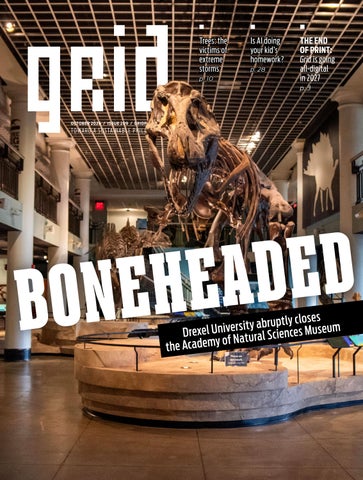
D E D A E H E N O B lo s e s c y l t p u r b a y rsit Drexel Unive atural Sciences Museum of N t h e Aca d e m y
REAL FOOD. LOCAL ROOTS. COLLEGEVILLE | DOUGLASSVILLE | DOWNINGTOWN KIMBERTON | MALVERN | OTTSVILLE | WYOMISSING kimbertonwholefoods.com
O CTO B E R 20 26
G R I DP HI LLY.COM
1
PUBLI SHE R’S NOTES
by alex mulcahy
It’s A Crime
publisher Alex Mulcahy senior editor Bernard Brown associate editor & distribution Timothy Mulcahy tim@gridphilly.com deputy editor Julia Lowe art director Michael Wohlberg writers
Marilyn Anthony Bernard Brown Tasso Hartzog Emily Kovach Kathryn Rice Sarah Ruiz photographers
Jess Benjamin Jeff Fusco Tasso Hartzog Linette Messina Jordan Teicher published by Red Flag Media 1032 Arch Street, 3rd Floor Philadelphia, PA 19107 215.625.9850 G R I D P H I L LY. C O M
2
GR ID P H IL LY.CO M
O C TO BE R 2026
W
ith the closing of the Academy of Natural Sciences, Drexel University has blundered into a spectacular public relations disaster. I could almost feel sorry for them, had their actions not been so cruel and heartless. When the news first broke, the reaction was a stunned grief. According to Drexel, this beloved museum, the public-facing side of an irreplaceable scientific institution, just didn’t make financial sense anymore. They listed some facts. Attendance was down, and had never recovered from COVID-19. The building at 19th Street and the Parkway required major work. It just couldn’t go on. Two of the three divisions of the Academy would be spared. Drexel would maintain the Academy’s collection of 19 million(!) specimens and scientific research would continue. To make it financially stable, they would sell the building. It was a tidy narrative, a problem and a solution presented simultaneously. After the initial shock and sadness of hearing the news, people started asking questions: How much work does the building need? Why does it need to close so quickly? Has every effort been made to save the museum? Supporters began to organize, politicians expressed dismay. And then the William Penn Foundation, usually a behind-thescenes player, made a public offer to fund the museum for a year. It was a bold intervention, effectively calling Drexel’s bluff. The closest Drexel has come to acknowledging that offer was when they told NBC 10 they hadn’t received a “formal proposal.” Their response speaks volumes. The museum has closed quickly because Drexel has no interest in keeping it open. Drexel did not just fail to make every effort to save the museum — they made no effort.
Returning to the bad PR. At a time when climate change is increasingly impacting our daily lives, and when science is under attack from the federal government, hastily shutting down a natural history museum is a very bad look for an academic institution. But for Drexel, that’s the tip of the iceberg. Denying kids the opportunity to interact with critters and creatures in the Outside In exhibit, to marvel at the dinosaurs and a world long gone (not to mention the diorama’s depiction of a world quickly vanishing), is a crime. Children are the victims of an expedient, short-sighted real estate scheme, and there is no way to spin it. In an interview with online journalism outlet Higher Ed Dive, Drexel president Antonio Merlo expressed his desire for Drexel to be known worldwide for their unique coop education program. But if they fail to perform the due diligence to save this invaluable museum, that will be secondary. They will be reviled in Philadelphia and beyond, known as an institution that chose to flip some real estate instead of honoring their commitment to steward a precious piece of our culture that made science fun and accessible, and was a breeding ground for future scientists. As of now, they sit somewhere between the Grinch and Ebenezer Scrooge. Of course, both of these characters had epiphanies and changed their ways, so there’s reason to hope. President Merlo, it’s not too late. Take the offer.
a l e x m u l ca h y , Publisher
COV E R P HOTO COURTESY O F RAM O N TO RRES/A NS
Give to Grid is transitioning to an all-digital newsroom. We need your help. Dear Readers, Grid’s December issue, #211, will be its last in print. Our business model is no longer working. As someone who has spent over three decades in print, I’m attached to it. I will forever prefer paper and ink to any other format. However, I’m excited about what Grid can do as an all-digital outlet. Our editorial mission will remain unchanged. We will continue to provide you with sustainability news and stories designed to inspire and educate, and to hold powerful people and institutions to account. What’s new is that our publishing cadence will change from monthly to weekly. It will allow us to respond to breaking stories more quickly. I’m optimistic that with this change in format, our journalism will reach more people. Last week, we posted a video that was viewed almost 40,000 times. That’s four times our print run. But to make this transition, we need your help. We want to continue providing the climate change and social justice journalism you trust. To do so, we need 500 new supporters. We are launching our “Give to Grid” campaign to reach that goal. If we hit that mark, we will continue. If not, we’ll plan a big party and celebrate our last couple hundred months together. It has been a pleasure. Sincerely,
TO SUPPORT US, PLEASE VISIT STORE.GRIDPHILLY.COM
O CTO B E R 20 26
G R I DP HI LLY.COM
3
cycling
Pedal Pushers Outdoor adventure organization uses bikes to get Philly’s kids into green spaces by emily kovach
T
en-year-old Josiah Marcelino lives within walking distance of Tacony Creek Park, but had never ventured onto its nature trails. This July, through the Bikes & Trails Camp, presented by YJR (Yo! Just Ride) Outdoors and the Tookany/Tacony Frankford (TTF) Watershed Partnership, Marcelino was able to experience the park in a brand-new way: via bicycle. “I learned to ride a bike at Bike Camp in just one day!” he said. “Going on the trail was really fun, and even though it was bumpy, I really enjoyed seeing and exploring the park.” All throughout Philadelphia, kids are learning how to ride bikes on park trails thanks to YJR Outdoors. The programs provide everything necessary: bicycles, helmets and instructors. Temple undergrad Emelin Tomax-Cinto assisted for some of the Bikes & Trails Camps in Tacony Creek Park this summer. Watching kids gain confidence on bikes while discovering parts of the park, like the bird murals along the creek, she saw their relationship to the park change. “They could see that this nature around 4 GR ID P H IL LY.CO M O C TO B ER 20 26
them is a resource they have — that they could even go there with their families and friends,” she said. “This space is for them.” YJR Outdoors was founded in 2023 by Philly native John Raisch, who grew up rid-
I saw an opportunity to introduce people to bikecentric and trail-centric activities … to lower the barriers and be their guide.” john rais ch founder, YJR Outdoors
ing bikes and exploring Pennypack, Lorimer Park and the Wissahickon. Inspired by his daughter, he started a youth cycling program 12 years ago. “There was a tremendous demand for people asking me to teach their kids to ride
a bike or who wanted help creating trails,” Raisch said. “I saw an opportunity to introduce people to bike-centric and trail-centric adventure activities, and to lower the barriers and be their guide.” Raisch loves bikes and wants more Philadelphians on two wheels, and also sees them as a means of accessing the outdoors. Once kids are moving through a park, they’re learning safety, trail etiquette, plant identification and wildlife observation. “Our motto is: ‘Adventure, advocacy, action,’” Raisch said. “By teaching kids how to ride bikes in parks, we introduce them to stewardship, and then they want to become advocates.” That philosophy is particularly important in Tacony Creek Park, where Raisch frequently encounters kids who live across the street but have never been inside. He believes Philadelphia’s parks should be equally accessible to children in every neighborhood. On the first day of camp with the Ferko Recreation Center, only one kid knew how to ride a bike. Many others were hesitant. By the second day, they’d gotten the hang of it. “They were riding their bikes like they’d been doing it for years! Seeing their peers riding bikes helped them be more confident,” Tomax-Cinto said. Tomax-Cinto didn’t have much experience riding a bike as a kid, but YJR Outdoors counselors helped reacquaint her with the basics. “I was able to ride on the trails with the kids, and I loved it,” she said. “That was my first time actually riding a bike through the whole trail, and it was really nice and peaceful.” Raisch sees the work as part of a larger effort to build a stronger outdoor and cycling culture in Philadelphia. Philadelphia has an expanding network of trails, such as the Circuit Trails. What’s needed, he says, is the cultural infrastructure that makes traditional youth sports accessible: coaches, programs and opportunities for kids to learn. For kids who live near Tacony Creek Park, YJR Outdoors is building that infrastructure one mountain bike at a time — and welcoming them into their neighborhood’s green space. ◆
W E N D I W U / TO O K A N Y/ TAC O N Y- F R A N K F O R D WAT E R S H E D
John Raisch teaches campers basic cycling skills at Police Officer Lauretha Vaird Boys & Girls Club before taking them onto the trails in Tacony Creek Park.
EARLY CHILDHOOD THROUGH HIGH SCHOOL At Kimberton Waldorf School, learning comes alive through art, nature, and a developmentally appropriate, low-tech approach. Students grow into curious, creative thinkers while thriving in strong academics, outdoor education, and a dynamic, successful athletics program rooted in teamwork, balance, and joy. Contact us today!
JOIN US FOR A PRIVATE TOUR OR OPEN HOUSE
Preschool - Grade 12 | kimberton.org | 610.933.3635
1 O CTO B E R 20 26 G R I DP HILLY.COM 5
urban naturalist
Frozen Flock Once billions strong, the passenger pigeon survives in a fading Academy diorama by bernard brown
A
6 GRID P H IL LY.CO M O C TO B ER 20 26
cause they were native to America,” Brower says. “We talked about the whole history of early colonist records of their abundance and how people caused their decline and extinction.” People took advantage of the abundant pigeons long before Philadelphia was founded. Peter Lindeström, who served as a military engineer with the New Sweden colony from 1654 to 1655, described the Lenape technique for catching the birds. During the day, the hunters would cut most of the way into the trunk of a large tree where the pigeons spent the night. In the evening, the weight of the returning birds would topple the tree, killing many of the pigeons, “for many cannot save themselves in such a fury of branches
Above: The passenger pigeon was illustrated on plate 62 of John James Audubon’s “The Birds of America.” Opposite: The Academy’s ornithology collections manager Nate Rice presents a passenger pigeon specimen, like those in the third floor diorama.
and leaves, nor fly away,” Lindeström writes. In American Ornithology, Alexander Wilson describes flocks in Kentucky that have no equal today. Luckily, we have his prose to immortalize them. One that he saw, “with its glittery undulations, marked a space on the face of the heavens resembling the windings of a vast and majestic river.” Another flock flew overhead for four hours. Based on the speed and the width of the column of birds, he estimated their numbers
C O U R T E S Y O F AU D U B O N C E N T E R AT M I L L G R OV E
flock of passenger pigeons rests frozen in time on the third floor of the Academy of Natural Sciences of Drexel University. The birds feed on the ground, rest on twigs and raise their wings to take to the air in a beech forest whose colonnade of gray trunks recedes into the diorama’s painted background. The mounted skeletons in Dinosaur Hall help visitors picture a T. rex treading the earth, a predator with no contemporary counterpart. The same is true of this display for the extinct passenger pigeons that once flew in the billions. “The Pidgeons in such numbers we see fly, that like a cloud they do make dark the sky; and in such multitudes are sometimes found, as that they cover both trees and ground,” says Keith Russell, program manager for urban conservation at Audubon Mid-Atlantic, quoting early Pennsylvania settler and poet John Holme. Russell says that thanks to centuries of written accounts, as well as Philadelphia’s role as a hub for natural history exploration, “there is a longer timeline of records for Philadelphia than there is for any other place.” Hannah Michelle Brower and Aspen Simone of Philly Pigeon Tours highlighted that connection in a special program they offered for the nation’s 250th. The tours usually focus on urban pigeons (aka rock doves), free-flying members of a domesticated Eurasian species. “We talked about the rock pigeon and the history with them, but focused more on passenger pigeons be-
at more than 2 billion. Another time, while inside a house, Wilson grew alarmed at a roaring wind outside and sudden darkness. He thought a tornado was coming. “The people, observing my surprise, cooly said, ‘It is only the pigeons.’” In the early 1800s, as Wilson wrote from his base in Philadelphia, passenger pigeon flocks were not as vast in the Mid-Atlantic as they were in Kentucky. However, he writes, “they are sometimes very numerous; and great havoc is then made amongst them with the gun, the clap net, and various other implements of destruction.” Even when passenger pigeons flew far from the Delaware Valley, Philadelphians still benefited from the havoc made amongst them. “These numerous birds are found in our markets, both alive and dead, very plenty, and generally cheap in the latter part of September and October,” writes Thomas F. De Voe in his 1867 book, The Market Assistant, which catalogues the foods sold in New York, Boston and Philadelphia. They weren’t numerous for much longer. “It would have been in the 1870s when everything was coming to an end,” Russell says. The slaughter — boosted by demand from growing cities on one hand, and innovations in communication and transportation on the other — was too much for the pigeons. As Joel Greenberg describes in his 2014 book “A Feathered River Across the Sky: The Passenger Pigeon’s Flight to Extinction,” professional market hunters would read the telegraphed reports and could hop on a train to arrive within days of a flock appearing. “Once the pros and local talent converged on the birds, the proximity of rail lines made transferral of the pigeons to larger regional and national markets easP HOTOS BY TASSO H A RTZO G
The Pidgeons in such numbers we see fly, that like a cloud they do make dark the sky; and in such multitudes are sometimes found, as that they cover both trees and ground.” excerpted from “The Wild Fowl” by john holme ier and cheaper,” Greenberg writes. “From the nesting grounds at Kane, PA., from three to twelve tons of pigeons were sent daily to Baltimore, Philadelphia and NewYork markets,” writes a taxidermist in Williamsport, recalling the 19th century pigeon trade in 1919’s “The Passenger Pigeon in Pennsylvania.” Passenger pigeons, which needed to breed in large groups, couldn’t recover. “Everything collapsed, because the birds were really dependent on these mass colonies to be able to reproduce,” Russell says. The Academy’s collection includes 38 passenger pigeons among about a quarter-million bird specimens. Ornithology collections manager Nate Rice took Grid back to the tall metal cabinets where the museum keeps specimens of endangered and extinct birds as feathered skins packed with cotton. To the left of the heath hens and to the right of the Carolina parakeets, a drawer holds passenger pigeons, gray with rose breasts. Some were collected by William Abbott from a flock that landed across the river in Haddonfield in 1877. Others came from the local markets. Rice reads from the label of one rather beat-up-looking pigeon skin, also collected by Abbott: “‘Pur-
chased from Philadelphia market December 13th, 1877.’” Rice says, “Abbott bought it, maybe he ate it, but he also skinned it.” The Academy’s vast collection of specimens doesn’t gather dust in drawers. Today, researchers study them using genetic analysis and other techniques that Abbott and other collectors couldn’t have imagined. “Every part of that bird’s body is built and assimilated from what it took from its local environment,” Rice says. The chemical traces in a feather can teach scientists about environmental conditions at the time the bird grew it. But it’s not just scientists who can learn from the Academy’s passenger pigeons. The birds offer everyone a window to the past. There is nowhere on Earth today that humans can hear the roar of an approaching flock of passenger pigeons and see the light fade as they block out the sun, but the birds in the diorama offer a portal: examples to multiply by the billions in the mind’s eye. The Lenape, Lindeström, Holme, Wilson: All experienced one of the most stupendous natural phenomena North America has ever offered. As the Academy’s museum closes its doors, we lose a link to a species they never imagined could disappear. ◆ O CTO B E R 20 26 G R I DP HILLY.COM 7
community
Perimeter Trek City circumambulation group celebrates ten years of walks story and photo by tasso hartzog
The Walk Around Philadelphia takes place each February and September, with the 100-mile perimeter separated into 12 segments.
8 GRID P H I L LY.CO M O C TO B ER 20 26
“1854,”
says jacques-jean “JJ” Tiziou, with authority, when asked about the origins of Philadelphia’s borders. “That’s when the Consolidation was signed: February 2, 1854.” Good luck finding another Philadelphian who could, on the spot, provide the exact date on which the Consolidation Act transformed the neat rectangle of William Penn’s colonial city — from Vine Street to South Street, Schuylkill to Delaware — into the considerably less tidy shape of the city today. But to be fair to the rest of us, Tiziou has good reason to know this obscure bit of trivia: He has walked the city’s odd, jutting perimeter no less than 17 times. Tiziou completed his first walk in 2016 as part of an artist residency, to which he’d applied as a photographer. (In 2011, he photographed and designed Philadelphia’s largest piece of public art: “How Philly Moves,” a mural on the side of a parking garage at the Philadelphia International Airport.) Over the next few years, he made the 100-mile trek an annual ritual. He’d set off clockwise from 61st and Baltimore and complete the walk in segments over five or six days. “I thought I knew Philly pretty well before I walked it,” says Tiziou. “It was a humbling, humbling experience. The city is vast and unknowable and magical.” In 2020, hoping to share that magic, Tiziou began accommodating larger groups through his organization, the Walk Around Philadelphia. He talks about “gifting people places”: showing them parts of their city they wouldn’t encounter otherwise. “We took a group of high school kids from the Kensington Health Sciences Academy out on a spring break walk,” he says, “and these youngsters had never been on the banks of the Delaware.”
On a sunny Saturday in September, Grid joined Tiziou and thirteen others for a section of the walk along that very river. The group set off from Cherry Street Pier wearing lanyards that bore the outline of Philadelphia and a message: “Please help me find my way safely around the city’s edge.” The walkers joked that they looked, and felt, like unaccompanied minors at an airport: excited, wide-eyed, a little intimidated by the hourslong journey ahead. Damien Eikerenkoetter, who had already completed several segments, was aiming for a full perimeter. “I want to be able to tell my grandchildren that I walked around this city,” he said. “I hope they’ll want to do it, too.” The group hadn’t gone more than a few hundred yards before being waylaid by a baby red-eared slider on a log. Meandering north in this manner, the walkers stopped often to admire the oddities and marvels that tend to accumulate in urban edgelands. Savannah Mudd, a birder in the group, would occasionally exclaim: “American kestrel!” “Elevent double-crested cormorants!” As obstacles presented themselves, the walk became a miniature exercise in dem-
I thought I knew Philly pretty well before I walked it. It was a humbling, humbling experience. The city is vast and unknowable and magical.” jj tiziou, founder, Walk Around Philadelphia
ocratic deliberation: Should we take this narrow path? Duck through this hole in a fence? Each group answers these questions differently, and thus traces a version of Philadelphia that is subtly its own. About 40 people have now completed the circuit, ranging in age from 11 to 94, and hundreds more have walked segments. Some walkers pay to participate, and others — those facing financial hardship — are given stipends. Last year, the Walk gave out $11,000. Ten years after Tiziou’s first circumambulation, the Walk Around Philadelphia is evolving. The organization is hiring a
full-time staff member in order to support a slate of ambitious goals, from a reentry program to more robust financial support for participants. “If 20% of our neighbors live below the poverty line, that’s a big barrier to access,” Tiziou says. “And so the goal is that 20% of each group be stipend-supported.” The broader aims are civic, spiritual and social. In a world riven by arbitrary boundaries and ruled by people bent on exploiting them, it’s instructive, Tiziou says, “to think about a thing from its borders and from its edges.” ◆
We Prepare Students for the Whole of Life.
OPEN HOUSE
Grades Pre-K-12 Saturday, October 10, at 9:30 a.m.
The only all-gender pre-K to 12 Quaker school in Center City
Learn More
friends-select.org 215-561-5900
O CTO B E R 20 26 G R I DP H ILLY.COM 9
extreme weather
After the Storm July microbursts topple critical trees across the city
N
by bernard brown
icole pepe’s house on the 5100 block of Catharine Street shook as the tree hit it. She had been watching through a window as the fierce winds of the July 11 microburst whipped leaves and bits of roofing shingles in a vortex behind her house. “My husband said, ‘Get in the middle of the house,’” just before the century-old London plane tree fell over. “You’d think it’d be like a thunderous crash, but it hit a car first, so it was like this weird kind of metallic sound.” When the storm finally passed and the winds died down, Pepe and her husband went outside to find the tree wedged against their porch. And it turned out it had actually crushed two cars when it fell across the street. “One of them happens to be mine,” says Liz Beard. Beard had been watching the torrential downpour from a second-floor window. “My house was like literally going through a car wash,” she says. After the storm, “I come outside to see what’s up, and there’s one of the huge London planes across two cars on our street.” Trees bring a lot to a neighborhood. Their shade makes hot days bearable, which is especially important as cities bake in a rapidly warming climate. They help soak up rain, which makes it easier to manage urban stormwater. But they also carry costs, especially when storms knock them over. As tree-toppling storms, amplified by a warmer, wetter climate, become more common, will property owners decide the canopy isn’t worth it? The tree that fell across the 5100 block of Catharine wasn’t the only one. According to an Aug. 3 City press release, “Philadelphia Parks and Recreation (PPR), working with the Department of Streets, responded to more than 500 tree emergencies.” Two of the downed trees had stood a few doors from Katie Brindley’s house near 50th and Chestnut streets in West Philadelphia. Massive London planes, they had come down while Brindley and her husband were driving 10 GR ID P H I L LY.CO M O C TO B E R 20 26
P HOTOS BY L I Z BEA RD
Liz Beard’s car was one of two crushed by a massive London plane tree when it fell across Catharine Street on July 11.
We’ve had storms where we’ve lost trees for sure, but not at this scale. In my time here, we’ve never had to close the gates for more than 24 hours.” je ssica baumert, executive director, Woodlands cemetery
back home after a trip. One of their teenagers FaceTimed them to show the trees down across the intersection. “He said, ‘You can’t park on 50th because of the storm and the trees.’” On their way back to their Walnut Hill neighborhood, the couple cruised through an unfamiliar landscape. “There’s trees down, there’s not a single light that’s working until we get to Walnut.” Brindley says.
As far as Brindley can tell, the trees that fell on her block had damaged a porch and some of the siding of a roof across the street, but otherwise had not caused major property damage. They had crushed parked cars, but miraculously had not hit any drivers. “No one was sitting at the traffic light in their car waiting to go. It was unlucky and incredibly lucky at the same time,” she says.
At least four microbursts hit the city along a path from West Philadelphia into South Philadelphia. Mayor Cherelle Parker signed a Declaration of Emergency Disaster the same day as the storm to speed up recovery efforts. The next morning, crews hired by the City cut the trees at 50th and Chestnut into sections and trucked them away, Brindley says. “It happened within like 24 hours, super impressive.” It took until July 16 for the City to remove the tree from the 5100 block of Catharine. In the meantime, on the Monday night following the storm, a motorist turned the corner from 51st and plowed into the downed tree, knocking it off the two crushed cars and jamming it more firmly into Pepe’s house. Along with street trees, trees in parks along the storm’s parth also took a hit on July 11. “There was massive tree loss in Wharton Square [in South Philadelphia],” Smith Fichman says. The same was true in Carroll Park at the western edge of the city and Malcolm X Park in West Philadelphia, where the winds snapped off the crown of a massive white oak tree next to the playground. In FDR Park, gusts knocked over trees and wrecked the Southeast Asian Market. At the Woodlands cemetery, the damage was so bad it took them until July 21 to make the grounds safe again for visitors. “There was a lacebark elm that was massive that fell and smashed a bunch of gravestones,” says Jessica Baumert, the cemetery’s executive director. Another large tree fell into the community garden, and several others split. Crews also had to remove hazardous “hangers,” broken branches suspended in a tree’s crown. “We’ve had storms where we’ve lost trees for sure, but not at this scale. In my time here, we’ve never had to close the gates for more than 24 hours,” she says. Baumert estimated the cost of cleaning up at about $50,000, which is not covered by insurance. The “micro” in microburst is a bit misleading. By definition, these storms cover a relatively short distance — under 4 kilomeO CTO B E R 20 26 G R I DP HILLY.COM 1 1
extreme weather
ters (2.5 miles) — but they can be intense. Microbursts start with an updraft of moist, warm air pulling rain droplets and hail high into a cloud. When that cloud cools, the suspended air suddenly drops and, when it hits the ground, gets shunted horizontally, producing wind speeds up to 100 miles per hour. Wind gusts on July 11 were as high as 70 mph, just shy of what you’d see in a Category 1 hurricane. The wind can also come at trees from multiple directions: down, sideways and in vortices as air reacts to the landscape, says Jason Lubar, a retired board-certified master arborist. Trees can withstand a lot of wind, says Lubar, but urban trees are often placed in positions they didn’t evolve to survive. A sycamore (the London plane tree is a hybrid of American and European sycamore species) in a forest grows surrounded by other trees that buffer it from the wind. Strong roots of that tree grow out in all directions, intertwined with the roots of its neighbors, giving it powerful support. A similar tree growing in a small pit between a sidewalk and the street is, by comparison, on its own. The curbstones block its roots from growing into the street to one side, and the foundations of nearby buildings also block it underground. The roots running under the sidewalk can brace it to a point, but not if the pavement buckles, as often happened on July 11. “If you look at tree failure in urban environments, full trees blowing over, you’ll see that the sidewalk is lifted up,” Lubar says, “They’re grabbing, so to speak, everything they can to hold on.” Trees with more room for their roots are better able to withstand strong wind gusts. “What we can do in our urban areas is provide adequate rooting volume through things like soil cells [underground frames that keep soil from compacting],” Lubar says. “We can design our hardscape to better accommodate root growth and expansion.” Before a storm, it might not be obvious to a homeowner that the tree in front of their house is a hazard. In addition to underground failures, trees rotting from the inside can break off. Trees with more than one trunk growing tightly together can split, as sometimes happens with Bradford pears and silver maples. Erica Smith Fichman, Philadelphia’s City forester, says property owners can hire an 12 GR ID P H IL LY.CO M O C TO B E R 20 26
Above: A tree in Malcolm X Park was one of many that split or was stripped of branches. Right: City crews began responding to downed tree reports the morning after the storm, but some blocks weren’t cleared for several days. Opposite (far right): After downed trees are removed, homeowners are often left responsible for removing the large stumps left behind, like this one at 43rd and Locust streets.
arborist certified in tree risk assessment by the International Society of Arboriculture to inspect their trees. A crew from Philadelphia Parks & Recreation can do the same for street trees. Though they are not all certified, “they have hundreds and hundreds of examples of seeing a tree, seeing what specific defects it has, and having a sense for what will happen,” Smith Fichman says. The Philly Tree Plan calls on the City to “Develop a proactive inspection cycle for maintenance of public trees,” but Parks & Rec currently lacks the personnel to do that. “It’s a work in progress,” Smith Fichman says. “Proactive inspections are something the Philly Tree Plan very loudly calls for, but you’ll also see that it calls for more staff.” Although the City removed fallen street trees, homeowners are left to remove stumps and repair their torn-up sidewalks. In New York City, the City repairs sidewalks damaged by trees, but Philadelphia does not. Soon after the storm, Mayor Parker promised to replace all the trees that were lost. Brind-
ley is skeptical: “Well, how are you going to replace these trees if the homeowners can’t even take care of getting rid of the stump where the diameter is as big as a car?” According to an Office of Emergency Management representative, property owners can apply for Small Business Administration physical damage disaster loans to repair sidewalks damaged in the July 11 storm. Smith Fichman pointed to progress Philadelphia has made by hiring a sidewalk coordinator who will work on a comprehensive sidewalk plan for the city. “You can’t talk to people about trees in the city without talking about sidewalks. And this all comes back to maintenance as trust building.” As Smith Fichman and the tree plan makes clear, growing the city’s canopy is a matter of public confidence as much as dollars. The whole neighborhood benefits from a towering street tree thanks to the cooler temperatures, but if homeowners worry the tree will drop a branch on their roof or leave them with thousands of dollars in sidewalk P HOTOS BY J O RDAN TEI C HER
Well, how are you going to replace these trees if the homeowners can’t even take care of getting rid of the stump where the diameter is as big as a car?” katie brindley, West Philadelphia resident repairs, they will be less inclined to have one in front of their house. Global warming could be making those trees more risky just as it makes the city’s canopy more valuable. By pumping more heat and moisture into the atmosphere, climate change has made storms more powerful. Although experts Grid interviewed in the wake of the storm couldn’t point to specific research on trends in storm-related tree damage in Philadelphia, anecdotally, they say the problem seems to be getting worse. According to Smith Fichman, a similar
storm hit Northeast Philadelphia last year. “The staff that have been here the longest when we had last year’s storm, they said they had never seen anything like that,” she says. “And then we had another one this year.” Meanwhile, extreme heat is the deadliest natural disaster, and trees are one solution, helping to shade hot neighborhoods while they suck up carbon dioxide. That’s particularly important in environmental justice communities, as the City’s climate action playbook notes: “Increasing tree coverage and green spaces in these communities can
support resilience to heat and flooding.” In 2009, the Nutter administration set a goal of reaching a 30% tree canopy in every neighborhood. Between 2008 and 2018, the canopy actually shrank by about 1,000 acres, a decline driven by “the widespread removal of individual trees and small patches in areas which had below-average tree canopy to begin with,” as found by a 2019 tree canopy assessment. The Philly Tree Plan, completed in 2023, emphasized the importance of supporting homeowners so that trees that benefit the entire community don’t become individual burdens. “The City’s response showing that there is support when this type of thing happens can make a huge difference,” Smith Fichman says. “The first 10 days [are] all about taking trees off of homes and cars, clearing roads, but then you’re left with these huge uprooted root balls that tore up the sidewalk. Then you have ADA problems, you have extreme expense for people. So, how the City comes through and really supports people … is going to help also determine people’s willingness to plant new trees.” Brindley hopes her neighbors won’t decide against planting new trees once the damage is all cleared. Together with the remaining London plane, “those trees were providing an abundance of shade on our homes,” she says. “Parking your car under them, you knew it would be shaded.” ◆ O CTO B E R 20 26 G R I DP HI LLY.COM 13
community
Remembering the Fallen West Philly community gardeners mourn trees lost to extreme storms by sarah ruiz
T
he Sunday following Philadelphia’s apocalyptic microburst storm, the Garden Court gardeners gathered late in the day to honor our fallen fruit trees. They sat around the apple stump and shared stories of the shade the tree had offered on hot July days and the roost the branches had made for birds and squirrels. Of the apples the wind sometimes threw down — always more sour than we’d like — or the cherries hung a ladder’s reach above our heads — always sweeter than the low-growing fruit. Then they shared silence and offered gifts: a scattering of cornmeal, a ripe tomato, a splash of water. This was climate grief, moving through a community. The Garden Court Community Garden is a natural respite on a busy street. In midsummer, when the squash and collards were in full flush and the central apple tree had leafed out into a wonderful umbrella of shade, the garden became a cool, green oasis. But when I returned from traveling just one week after the storm in early July, I was warned by a friend: “It looks really different.” Our oasis had been disrupted. The apple tree, along with our cherry and one peach, had been toppled. In place of green shade, only stumps and sweltering sunshine. News of the storms first reached me on vacation through a flurry of messages from a panicked neighbor. Downed trees everywhere, power out on the block, a transformer on fire — it was the craziest storm she’d ever seen in over a decade living in West Philly. For a while, she said, she’d just sat by her back door holding it shut. It had already blown open once in the violent winds and she was afraid of it flying off completely. The storm was only one of three back-to14 GRID P H I L LY.CO M O C TO B E R 2026
back climate disasters that hit Philly while I was away. First, there was the stagnant heat wave that parked 101-plus-degree temperatures over Philadelphia for three days. Then the sudden violence of the microburst
storms, with winds reaching up to 70 miles per hour in a single gust, followed by acrid wildfire smoke drifting down from burning Canadian forests that caused a Code Red air quality day in the city. I’ve documented a lot of scenes like these over a nearly decade-long career writing about climate change and the environment. I’ve also lived through a fair number of heat waves and freak storms. I understand them on an intellectual level as the result of climate change — the atmosphere, warmed by carbon emissions, is causing more extreme and erratic weather. But rarely does my work allow me to dwell on the emotional significance of each new devastation. To be human for a moment, and feel the event for
Vivian Chang has served as executive director of Asian Americans United since 2023.
On July 19, mourners held a ceremony bidding farewell to the decades-old apple tree that once flourished at the center of the Garden Court Community Garden.
P HOTOS BY B RO OK LAYNE
what it truly is: a loss. Ecological grief — the pain experienced when witnessing environmental destruction — has been a documented concept for at least the last century, its first articulation widely attributed to the environmentalist Aldo Leopold. But in recent years, the American Psychological Association (APA) has begun documenting a type of grief specific to the impacts of climate change. In 2017, it published a report that details the mental health outcomes of the ongoing climate crisis, including grief. As with the death of a loved one, climate grief stems from the same knowledge that what once existed is gone and cannot be brought back or replicated. It’s the feeling of sorrow felt hearing the last known member of some endangered bird calling out for companions. The fear and anxiety of watching the sea’s edge eat away at a shoreline. The pang of hauling off toppled tree branches that once grew proudly toward the sky. Humans can endure a great deal, both physically and emotionally. But our society is poorly equipped to handle the kind of grief that climate change is throwing at us. Human cultures have developed rituals over millennia to mourn our fellow humans: funerals and feasts and wakes and wailing processions that bring grief out in the open, share the burden of it with others and begin the long and winding process of dispelling it. But our trees? Whole species? The concept of winter or the memory of snow? How do we begin to mourn them? Grief is also amplified by the speed at which climate change is unfolding. There is barely enough time between each new disaster for power lines to be restored, emergency services staffed up and municipal resources replenished, let alone to begin processing painful emotions. Our focus is dragged along from one recovery effort to the next. Without mourning time, grief can overwhelm us. In the garden, this is a raw point. Climate isn’t the only agent of change in Garden Court. We have already lost our sunshine to the towers on our south flank. Now, development has begun to our west with the promise of more towers on the way. The mural that bordered our lot — an original from the Philadelphia Anti-Graffiti Network, created with support from DJ Jazzy
Attendees honored the fallen fruit trees by sharing photos of their branches and memories gardening and enjoying the shade underneath them.
Humans can endure a great deal, both physically and emotionally. But our society is poorly equipped to handle the kind of grief that climate change is throwing at us. Jeff — has been torn down in the demolition. Longtime neighbors are leaving. The boards that have framed our vegetable plots for three decades are at last rotting away. Losing our trees, on top of everything else, feels like the tempest of change around us finally striking home. There are two ways to meet grief. The
first is to isolate, to hunker down and wait for the storm to pass. But climate change is already here, and it will not be waited out. The second is to seek community, find others that share your grief and mourn together. The APA recommends community. Humans are stronger together. So, the Garden Court gardeners gathered to build a ritual for a new kind of loss. A wake for our trees. As at any good wake, there were snacks. Crackers with jelly distilled from the apple’s final crop. Later there would be conversations about what the future would look like: how to rebuild, whether to replace the trees and with what. But that moment was a time for mourning. And as the sun slipped below the half-demolished wall to the west, the gardeners departed. ◆ O CTO B E R 20 26 G R I DP HI LLY.COM 1 5
October is National Disability Employment Awareness Month and we are celebrating the talents of our employees with developmental disabilities. We will have a fundraising event all month to support the training and work of The Cosmic Foundation at the Café.
OPEN 7 DAYS A WEEK 8am to 7pm
1 Boathouse Row • 215-978-0900
cosmicfoods.com
16 GRID P H IL LY.CO M O C TO B E R 2026
NOTICE: Uber driver and passenger, you doored a bike rider & fled the scene . . . But
WE GOT YOU! On Feb 11, 2026 an Uber driver doored our client into a pole, broke his hand and then DROVE & WALKED AWAY while he bled on the sidewalk. !NO BUENO! He needed hand surgery.
SO, if you see someone get hit: Get the tag number Give it to the victim DO SOMETHING! zach@stuartleon.com
stuart@stuartleon.com
O CTO B E R 20 26 G R I DP HI LLY.COM 17
philly cooks
Pump Up The Jam
Natalia Cardona’s pineapple sweet potato jam is just one flavor in which she combines tropical fruit with temperate crops — and it makes a tangy addition to a fall cocktail.
Exotic and familiar fruits meet in local jam maker’s creations by marilyn anthony
O
ften the best business ideas arise from seeing a need. For Natalia Cardona, owner of Azúcar Jams, opportunity was hiding in an unlikely place: the jam aisle. Other sections of American supermarkets feature ingredients that generations of immigrants brought to the United States. But Cardona, the Guatemalan daughter of a woman who ran a juicery and made jams from surplus fruit, saw nothing on the jam shelves that offered the tropical tastes she grew up enjoying. Cardona, one of 12 children in a blended family, grew up in a Guatemala City shanty town near a vast seasonal food market. Her family cooked adventurously, and Cardona spent much of her childhood savoring the 18 GR ID P H I L LY.CO M O C TO B E R 20 26
market’s delicious array of foods. “I love cooking and eating and I will try pretty much anything,” she says. When she was 10 years old, with help from a Rhode Island-based Quaker group, she and her father immigrated to Canada. Cardona graduated from college in New Brunswick with a degree in international relations and landed an internship with the United Nations in Latin America. In 2000, the American Friends Service Committee in Philadelphia hired her as an administrative assistant. Several promotions later, Cardona’s expanded responsibilities took her around the world, tasting as she went, and doing work she loved. When her nonprofit job was eliminat-
ed in 2025, friends and family urged her to start retailing the small-batch Caribbean- and Latin American-influenced jams she had been giving away. Inspired by her dad’s example as an entrepreneur and by the stories of many founders from the podcast “How I Built This,” Cardona acquired the necessary licenses and launched Azúcar Jams in October 2025. “Food, for me, is like art to an artist,” Cardona explains. To develop her jams, she starts with her mother’s recipes and the tropical foods she ate as a child. Layered onto that foundation are flavors from her global travels as an immigrant and as a nonprofit executive — inspiring her unique flavor combinations such as berry guava P HOTOS BY J ESS BENJA MI N
PIÑA CAMOTE EMBER COCKTAIL A tropical-meets-autumn Old Fashioned. Pineapple brightness, sweet potato warmth and spice depth — a rich, cozy and golden sipping delight. Makes one cocktail.
I want to bridge the gap between what people know, like a strawberry, and what they haven’t been exposed to, like guava with ginger.” natalia cardona Azúcar Jams ginger, pineapple sweet potato and lulo blueberry. For Cardona’s palate, traditional blueberry preserves are “too one-note.” She adds lulo, a tart South American fruit similar to yuzu, to deepen the fruit flavor. Rosewater, an ingredient she first encountered in Turkey, finds its way into her mangopassion fruit blend. “I want to bridge the gap between what people know, like a strawberry, and what they haven’t been exposed to, like guava with ginger,” she says. Selling her jams at farmers markets enables Cardona to interact with her cus-
tomers. Often she finds that the people who have traveled extensively tend to have more adventurous palates. They are excited by the combinations she offers, products Cardona describes as traditional jams “upscaled with international flavors.” The business side of Azúcar Jams also reflects Cardona’s immigrant experience and decades of work on behalf of underserved people. Her company’s mission is “to bring the taste of sunshine, heritage and joy to your table — one jar at a time.” But Cardona’s personal mission goes further
2 ounces aged rum (or bourbon) 1 heaping teaspoon Azúcar Pineapple Sweet Potato Jam 2 dashes Angostura or orange bitters Splash of warm water Ice Orange peel or cinnamon stick, for garnish • In a mixing glass, stir jam, bitters and a splash of warm water until the jam thins and blends. • Add the rum and ice; stir for 20 to 30 seconds until silky and chilled. • Strain into a rocks glass over a single large ice cube. • Garnish with a curl of orange peel or a cinnamon stick.
with a pledge to “center diversity, inclusion and equity not just in the flavors we bring to our products. But also in our hiring and the people we collaborate with, ensuring our work reflects the vibrant communities that inspire us.” ◆ O CTO B E R 20 26 G R I DP HI LLY.COM 1 9
Visitors filled Dinosaur Hall in the museum’s final hours open to the public, taking photos with the T. rex and other skeletons one last time.
20 GRID P H I L LY.CO M O C TO BE R 2026
N U NATURAL HISTORY Museumgoers express heartache and outrage on the final day of the Academy of Natural Sciences Museum BY TASSO HARTZOG
J
ust before 10 a.m. on Sunday, Sept. 27, dozens of people stood in line outside the Academy of Natural Sciences of Drexel University, waiting in the spitting rain for the museum to open its doors to the public for the final time. Artie Cohen, 6, who’d been going to the Academy since he was 2 years old, looked forward to seeing the dinosaurs. And how did he feel about the museum’s closure? “Sad.” “There’s a lot of other great natural history museums that we can visit,” said Lauren Zalut, Artie’s mother. “But to not have this
P HOTO BY TASSO H A RTZO G
O CTO B E R 20 26 G R I DP HILLY.COM 21
UN-NATURAL HISTORY
one, the first one in the country, is pretty disappointing.” “We’d have to go to New York to see something like this,” she said. On Sept. 1, Drexel University and the Academy announced that the museum would close permanently at the end of the month, citing declining attendance that never rebounded after the pandemic. But, in 2025 at least, the Academy’s revenue outpaced its expenses. The greatest obstacle to the museum’s continued operation seems to have been a staggering $150 million in deferred maintenance costs for its 150-year-old building on the Ben Franklin Parkway, according to the Philadelphia Inquirer editorial board. Though there had been indications, earlier than September, that the Academy was not in good fiscal health — a significant reduction in hours last fall, an accompanying round of layoffs — there were no public statements about a potential closure until the Sept. 1 announcement. Casey Wulf, 8 and three-quarters, had strong convictions about Drexel’s conduct,
which he thought had been “selfish.” “I’m here because the museum has been open for 198 years,” he said. “It’s one of the most important places in the whole entire community, and they’re shutting it down.” Casey’s math is spot on: The museum opened to the public in 1828, making it the
I’m here because the museum has been open for 198 years. It’s one of the most important places in the whole entire community, and they’re shutting it down.” CASEY WULF, age 8
oldest natural history museum in the country. In 1868, the Academy became the first institution anywhere in the world to mount a fully articulated dinosaur skeleton. “It just means so much to me that people are trying to save the museum,” Casey said. He said he wanted to do what he could to help preserve “all of the things that the paleontologists have worked so hard to dig up — the dinosaur bones and all of the other creatures.” As people streamed in through the front doors, volunteers with Save the Academy, a coalition fighting to keep the museum open, handed out flyers and talked with visitors. A screen on the side of a truck out front displayed a message from the group: “The William Penn Foundation offered money to keep the Academy open. Take the deal.” Two days earlier, the Inquirer reported that the William Penn Foundation had made funding available to keep the museum open for a year. The funds would temporarily cover the operating subsidy that Drexel has been paying since its affiliation with the Academy began in 2011. A Drexel spokes-
Bo and Casey Wulf were among the first visitors to enter the museum as it opened its doors Sunday morning.
22 GRID P H I L LY.CO M O C TO B E R 20 26
P HOTO BY TASSO HA RTZOG
Visitors waiting in line and exiting the museum were met with an LED billboard truck encouraging the Academy to accept the William Penn Foundation’s offer to fund the museum for an additional year.
P HOTO BY L INET T E M ESSIN A
O CTO B E R 20 26 G R I DP HI LLY.COM 23
UN-NATURAL HISTORY
In Dinosaur Hall, children marveled at the skeletons and anatomical displays.
person said in response that the university had not yet seen any proposal “that would provide a permanent, sustainable path forward for the Academy’s museum.” According to reporting by the Inquirer, Drexel hopes to move the collections and sell the Academy’s aging building, though neither the university nor the Academy has commented publicly on those plans. Drexel maintains that its focus is on the “stewardship of the Academy’s collections.” Inside the museum, families gathered in front of the Academy’s 37 dioramas, most of which date to the early to mid-20th century and are likely impossible to move. A few kids, looking at a moose, made their hands into antlers; others stared slack-jawed at a polar bear. Brad Moritz and his son Adam, 27, were visiting from Limerick. Adam was not yet 5 when he first visited the museum, and he credits the Academy with inspiring his interest in biology and natural science. His greatest concerns had to do with the millions of specimens in the Academy’s collections. 24 GRID P H IL LY.CO M O C TO B E R 20 26
Losing educational institutions is something we absolutely cannot afford right now. And even if we were having a great time in American literacy and science, we couldn’t afford to lose the Academy of Natural Sciences.” SARAH MCANULTY, organizer, Save the Academy “I’m deeply bothered by the fact that they’re willing to take that big of a risk with these invaluable and irreplaceable specimens,” he said. “There’s so many of them here that are just crucial to many branches of science.” “The part that’s disconcerting for me is the sort of secrecy of it,” said Brad about the museum’s closure. “Even walking in here, other than the gentleman out front” — referring to a Save the Academy volunteer — “there’s no indication that this place is closing. If it’s a financial reason, why aren’t they seeking out assistance? Because I would gladly give to keep this around.”
On Saturday, Sept. 26, state Sen. Nikil Saval wrote a letter to Drexel President Antonio Merlo and Academy board Chair Suzanne Biemiller, urging that “museum facilities remain open through the end of the year until all potential avenues have been fully exhausted.” “Legislators, advocates, and Philadelphians of all stripes deserve the opportunity to leverage their passion, creativity, time, skills, and resources to work together on potential solutions,” Saval added. “The recent offer from the William Penn Foundation to fund the continued operation of the museum on the Parkway suggests that the philanthropic community has both more to P HOTO BY TASSO HA RTZOG
offer and has not been fully engaged.” City Councilmembers have authorized special hearings to investigate the closure of the Academy. On Sept. 24, Councilmember Jeffery Young Jr. introduced a zoning bill that would prevent residential and commercial uses for the museum building, which is currently zoned to allow multifamily development, potentially complicating Drexel’s plans to sell the property. Ryn McLane, a biology lab technician, had traveled almost 100 miles from Stroudsburg to see the museum at its home on the Benjamin Franklin Parkway for the first and potentially last time. “As someone coming up in the early stages of a career in science, this is really scary and sets an ominous tone for where we’re at in the world,” said McLane. “You think an institution like this that’s been here for 200 years is kind of just going to be here.” Sarah McAnulty, a science communicator who helped organize the Save the Academy coalition, agrees that the museum’s closure is a civic and scientific tragedy. “Losing educational institutions is something we absolutely cannot afford right now,” she says. “And even if we were having a great time in American literacy and science, we couldn’t afford to lose the Academy of Natural Sciences.” At Outside In, a hands-on zone of the museum designed for young children, the impending loss felt especially acute. At a table with markers and paper, visitors were encouraged to write memories of the museum and tape them to the walls. Alongside sketches of animals and dinosaurs, there were simple pleas — “Don’t shut this place down” — and somber memorials in kids’ handwriting: “I will miss the snake I got to pet.” “We brought our kids here when they were toddlers,” one note read. “This month, at ages 24 and 27, our kids came with us for one last visit.” Lovell Govan El hadn’t been to the Academy since he was a kid, living in West Philly. He and his two daughters, Amirah and Hidayah, had just arrived from Georgia to see the museum on its last day. “This is their first time seeing fossils live and in person, so they’re ecstatic,” he said. Their joy was tempered only slightly by the knowledge that they might not see those P HOTOS BY L INET T E M ESS I N A
fossils again. Like Artie Cohen, they had one word for the situation: “Sad.” “And it’s forever!” Amirah lamented. Donna Li, who grew up going to the museum, stood nearby with her sons Alex, 5, and Andy, 1. “We’ve been saying goodbye for the last four weeks,” she said. “We came literally every weekend just to document it.” Li estimated that, in the last six years, she’d visited 100 times; the museum had been a “second home” for her family. As a member at the Academy, she was sur-
prised by the closure announcement. She had renewed her membership in June and didn’t know the museum was struggling. “I don’t want my money back,” said Li. “I want them to stay open for the year.” Like many other visitors, Li hoped that Drexel would accept the funds offered by the William Penn Foundation and had trouble understanding why the university hadn’t done so already. David L. Cohen, a third-party facilitator appointed by the governor, had said, about the funds, “no one is helping
Nio Gasataya, a senior at Moore College of Art & Design, wore a dinosaur costume to show support for the museum.
O CTO B E R 20 26 G R I DP HI LLY.COM 25
UN-NATURAL HISTORY
The walls of the Outside In children’s zone were covered with messages from visitors of all ages recalling their favorite memories at the museum and begging it not to close. After the doors closed at 5 p.m., protestors marched down the Benjamin Franklin Parkway with a banner, chanting, “200 years, and we want more!”
things by offering Band-Aids,” though Li had little patience for that reasoning. “They’re saying stuff like, ‘It’s just a BandAid on the situation that needs a permanent solution.’ I was like, ‘But you didn’t try to search for a permanent solution. None of the members even know that you’re closing.’” Li understood that Drexel and the Academy had been facing real financial headwinds; she was frustrated, above all, that neither institution had been transparent about the extent of those challenges before it was too late. In 2024, the Academy was awarded a $480,000 grant from the Pew Center for Arts & Heritage to “undertake a two-year business model analysis” and chart a “detailed roadmap toward long-term sustainability.” If that analysis, scheduled to wrap up this year, led to any conclusions about the museum’s future, they were never made public. As Dinosaur Hall teemed with visitors, Amber “Dino Lady” Redfield, an educator and paleontologist at the Academy, reached above her head to secure a cervical bone that had become dislodged from a hulking Corythosaurus skeleton. She hopes that the Academy can find a way to “patch the Philadelphia pothole that we’re in.” Redfield, a Philly native who has worked at the Academy for 14 years, is one of more than two dozen staff members whose positions will be “impacted” by the closure of the museum, according to Drexel. “I found out we were closing just like everybody else found out we were closing,” she said. Redfield mentioned the University of the Arts, another beloved Philadelphia institution beset by murky financial woes, which shuttered abruptly in the spring of 2024, giving students and staff only a week’s notice before ceasing operations permanently. “I’m just hoping this isn’t a pattern,” she said. “To see everybody, especially this past month and today, coming out to support us,” said Redfield, “it absolutely moves me, and it shows why we have to be here.” ◆ 26 GRID P H I L LY.CO M O C TO BE R 2026
P HOTOS BY L IN ETTE MESSI NA
4828 Baltimore ave.
RESIDENTIAL AND COMMERCIAL COMPOST PICK-UP WOMAN OWNED MONTGOMERY COUNTY & NORTHERN CHESTER COUNTY FIRST MONTH FREE TRIAL! (610) 470-4680 // BACKTOEARTHCOMPOST.COM
1722 Sansom St. 2nd floor
Hair Vyce Studio is expanding to center city! Follow us on social media to stay updated.
Book here @Hairvyce
@Hairvycestudio
West Philly 4828 Baltimore ave. (215) 921-9770 Center City 1722 Sansom St. 2nd floor
O CTO B E R 20 26 G R I DP HI LLY.COM 27
education
Bot in the Backpack
AI tools are already in Philly classrooms. Are they hurting student learning?
I
t was a muggy morning in mid-August and parents were gathered inside The Academy at Palumbo High School’s cafeteria, chatting animatedly over coffee and biscuits. The occasion was the First-Year Student Breakfast, an annual event the school’s Home and School Association (HSA) hosts to connect new families with school staff and parent volunteers. The meeting had been running for nearly two hours when parents began asking about Palumbo’s tech policy. Edwin Mayorga, a Palumbo parent and HSA member, saw an opportunity to ask a question that had been on his mind — what, exactly, was the school’s stance on AI? “I knew I was kind of opening Pandora’s box right at the end of the meeting,” said Mayorga, acknowledging that AI is a thorny topic for schools looking to strike a balance between preparing students for the future and protecting them from technology’s potential harms. He said the school staff members present at the meeting provided a brief answer to his question, but added that the school’s AI policy is “still very vague to me, which I don’t think is usually a good recipe for good education.” Proponents say artificial intelligence has the potential to transform education by saving teachers time and personalizing curriculum, but research shows that AI tools can undermine student learning and stunt cognitive development. A recent report published by the Brookings Institution found that the risks of incorporating AI into classrooms currently outweigh the benefits. The School District of Philadelphia has taken steps to restrict student access to AI by limiting student use to ninth through 12th grade classrooms and publishing a set of AI guidelines, but some parents say they still lack information about how their children are engaging with AI at school. 28 GRID P H IL LY.CO M O C TO BE R 20 26
BY KAT HRYN RICE “The school district is not communicating about this,” says Keren Sofer, whose son attends the Science and Leadership Academy Middle School in University Village. Philadelphia high school students have access to Google Gemini, a generative AI assistant, but the district’s AI guidelines do not explain how schools are to prevent students from using the tool to replace their own writing and thinking. Without proper guardrails, generative AI tools can undermine student learning and social-emotional development, says Rebecca Winthrop, co-author of the Brookings Institution report. “It’s not a good idea for kids to have free reign on these incredibly powerful AI chatbots,” she says. “We
humanities teachers. Not all teachers are as careful about “AI-proofing” their assignments as Reber. Michelin Delgado, a junior at Central High School, said that many of her classmates turn to AI to complete their assignments. “The students that use AI — you can see it in their grades,” she said. “If you don’t understand something, it’s better to learn it yourself instead of continuing to use AI.” AI tools could end up exacerbating social divides, Winthrop says, because underresourced school districts are less likely to retain experienced teachers, like Reber, who put in the extra effort to make sure kids aren’t offloading their thinking to AI tools.
It’s not a good idea for kids to have free reign on these incredibly powerful AI chatbots. We really don’t want young people to have AI do their learning for them.” REBECCA WINTHROP senior fellow and director of the Center for Universal Education, Brookings Institution
really don’t want young people to have AI do their learning for them.” The School District of Philadelphia did not respond to multiple requests for comment. Kate Reber, an English and history teacher at Bodine High School, says that she takes extra steps to “AI-proof” her assignments, including reviewing the editing history of her students’ Google Docs to make sure they aren’t relying on Gemini to compose written assignments. She says that the work required to ensure students don’t misuse AI has “created an additional burden” for
“It’s not just using the tools, it’s knowing how to change your assignments so that kids don’t bypass what you’re asking them to do,” she says. Parents in other cities have started pushing back against AI tools creeping into classrooms. This fall, New York City Public Schools and the Los Angeles Unified School District announced one-year moratoriums on student AI use in response to mounting pressure from parents and activists. May orga says he’s “curious to see” if the changes in other school districts spur Philadelphia school leaders to communicate with parents
Palumbo parent and HSA member Edwin Mayorga often sees his son turning to AI tools for homework help in the absence of a textbook for guidance.
about their AI policies more proactively. “I really do hope there’s more conversation at the school level and the district level about what’s happening [with AI] and we don’t just bury our heads in the sand,” he says. Schools don’t typically provide families with AI literacy workshops or information about AI’s risks and benefits, even though many parents say they want this type of support, according to the Brookings Institution report. “Parents have very little engagement in [the AI] conversation that’s happening in education circles,” Winthrop says. The report also found that parents have limited awareness of the benefits and risks AI poses to their children’s education, even though they play a critical role in monitoring their children’s use of AI to complete homework assignments. P HOTO BY TASSO H A RTZO G
Mayorga says that when his son Teo gets stuck on his math homework, he snaps a photo of the problem and drops it into an AI-powered app that instantly generates a solution. This is partly because Teo doesn’t have a math textbook he can use as a reference guide. “When it comes to the homework side, I don’t blame my son for using AI because he doesn’t have these other paper-based resources to fall back on,” Mayorga says. Philadelphia schools started widely using Google Classroom to share curriculum with students when schools closed during the COVID-19 pandemic. The platform acts as a convenient one-stop shop for teachers to share curriculum, post assignments and communicate with students, effectively sidelining textbooks and other paper materials, Mayorga says.
Mayorga and Sofer acknowledge that Google Classroom is a good organizational tool, but they worry that the district’s embrace of Chromebook-based learning also comes at a cost for students. “Every minute they’re on their screens is a missed opportunity for a verbal, eye-toeye contact, emotional exchange between two humans,” Sofer says. “My fear is that there’s going to be down-the-line impacts that are going to be really problematic.” Mayorga also sees the push to integrate AI into classrooms as part of a larger digital learning trend that prioritizes exposure to technology and “career readiness” over more authentic learning. “We really just lost sight of what learning is. That’s the heart of my frustration,” he says. “AI really just adds lighter fluid to a fire that was already simmering for a long time.” ◆ O CTO B E R 20 26 G R I DP HI LLY.COM 29
education
Sort Change
Green Schools grantees bring compost bins, weather station to their campuses
W
BY B E R NA R D B R OW N
hen you were in high school, did you eat everything that got plopped onto your tray in the cafeteria? Some things never change, but W.B. Saul High School, an agriculture-focused high school in Northwest Philadelphia, has taken advantage of funding from the Green Schools program to help compost the leftovers (and the compostable trays). Saul is one of 32 schools (13 private, seven charter, and 12 from the School District of Philadelphia) that received more than $75,000 in total funding in the 2026 competition to improve sustainability, according to a City website. The high school had a cafeteria composting program, but it was disrupted by the COVID-19 pandemic and staff turnover. When Jennifer Mastalerz, an owner of Bennett Compost, saw the Green Schools grant announcement, she recognized an opportunity to revive the composting program, this 30 GR ID P H I L LY.CO M O C TO BE R 20 26
time with new receptacles to make it as easy as possible for the students to use. “We partner a lot with W.B. Saul High School to help the school in a broad sense
Nothing hits home like actually doing it for yourself and seeing how something works.” CARRIE PACINI, teacher, James Logan Elementary School with their composting program,” Mastalerz says. The high school composts livestock waste on campus. “What we proposed along with one of the environmental sci-
ence/horticulture teachers was to increase the infrastructure for that program. So, we got new cans that live inside the cafeteria.” They got the new bins from local company Dyvert, which uses visual guides to show people which items to throw into which receptacle: composting, recycling or landfill. At the James Logan Elementary School, a Green Schools grant will go toward a weather station that they expect to be built this fall, part of a broader effort to revitalize the grounds. The school has been working with the Trust for Public Land to install a green schoolyard and plant trees in what had been two acres of asphalt, says Eli Prosper, Logan’s community school coordinator. Fifth grade teacher Carrie Pacini has been working with the Philadelphia Water Department’s Fairmount Water Works for four years to develop an environmental curriculum. The weather station will help make abstract climate and weather concepts concrete for students. “They have to learn about weather and they have to learn about the instruments needed to analyze weather. What better way for them to learn than to have hands-on activities?” Pacini says. “Nothing hits home like actually doing it for yourself and seeing how something works.” Prosper says the weather station will also help engage students in studying climate change. “You look at all the record storms, floods, things like that that are happening in real time,” he says. “The students are probably the ones who come up with a solution or two.” Saul got its new bins at the end of the last school year, so it’s too soon to tell how much waste they are diverting. But Mastalerz says they made a big impression. “It was so beautiful to see the reaction from the teachers and the lunch staff, who were just like, ‘Are these ours? Do we get to keep these?’ Having something so nice was just really, really special and exciting.” ◆
C O U R T E S Y O F J E N N I F E R M A S TA L E R Z
Left to right: Saul student William Terrell, Bennett Compost owner Jennifer Mastalerz, Saul students Nicholas Kruck and Marlowe Whittenberg, and Dyvert founder Ben Ditzler stand with the school’s new compost sorting bins.
In addition to teaching them gardening skills, David Crutchfield also exposes children in the Junior Farmers program to species like ball pythons and box turtles.
Little Green Thumbs
Junior farmers learn about Philly’s natural world, from sprouts to scales
T
hree turtles are waiting in the garden at the Max Myers Playground. The kids have to find them. As David Crutchfield, garden educator with Farm Philly’s Junior Farmers program, leads the after-school program attendees outside, the children sprint ahead, eager to dive into the kale, squash, beets and other plants to search. The Northeast Philly recreation complex, which also includes a pool, tennis courts, playing fields and a classroom building, has had garden beds set in the grass along Hellerman Street since at least 2014, when Crutchfield, whom the kids call “Brother D,” started with Farm Philly. Skippers and bees buzz around flowering sedum growing out of hexagonal beds in one P HOTO BY JEF F F USCO
BY BERNARD BROW N section of the garden. More plants spring from old soccer balls tucked into the corners. Fat beets raise their shoulders above the soil next to corn stalks on a mound nearby, and a few yards away, raised beds of kale, sage, mint and other herbs hide the turtles. Junior Farmers supports gardening at
I get a chance to garden with the kids, teach them nature, horticulture.” DAVID CRUTCHFIELD, garden educator, Farm Philly
10 recreation centers and playgrounds, according to its website. Crutchfield rotates through gardens in Northeast Philadelphia, visiting them once a week. He also works at the Pennypack Environmental Center (Farm Philly and the environmental center are part of Philadelphia Parks & Recreation), which gives him access to animals, dead and alive, to work into his garden education sessions. Crutchfield describes his role as “naturalist,” his official title notwithstanding. “I get a chance to garden with the kids, teach them nature, horticulture,” Crutchfield says. Growing new foods leads children to try new foods. “These kids take this stuff home, and they say, ‘Mom, we need to Google this. I don’t know how to cook a beet,’” CrutchO CTO B E R 20 26 G R I DP HILLY.COM 31
education
The Green Pages Shop your values at these local businesses
BEAUTY
ELECTRICIAN
Hair Vyce Studio
Echo House Electric
Multicultural hair salon located in University City servicing West Philly & South Jersey since 2013. We specialize in premier hair cuts, color & natural hair for all ages. (215) 921-9770 hairvyce.com
Local electrician who works to provide high-quality results on private & public sector projects including old buildings, new construction, residential, commercial & institutional. Minority business. echohouseelectric.com
COMPOSTING GREEN CLEANING
“These kids take this stuff home, and they say, ‘Mom, we need to Google this. I don’t know how to cook a beet.’” DAVID CRUTCHFIELD, garden educator, Farm Philly
field says. He adds that that later, “they go into the supermarket and say, ‘Oh, yeah, Mom, get the beets.’” His afternoon with the group at Max Myers begins as the kids are cleaning up from their snack time. He takes out a half-grown ball python and some docile arthropods — a hissing cockroach and a millipede — and later a raccoon skull and pelt, before taking the group outside. “Brother D!” the kids yell as they ask for clues. Soon, though, they find a plastic toy turtle, and then the shell from a dead red-eared slider. After more coaxing, a very alive box turtle is discovered hiding beneath the kale. Before moving to Philadelphia 12 years ago and starting with the City, Crutchfield ran a garden at a women’s shelter as part of New York’s GreenThumb, where he saw the peace that growing and preparing food could bring to the residents. Here in Philadelphia, Crutchfield’s work with Farm Philly doesn’t just teach kids how to grow food. “I share my amazement, because I’m still amazed.” ◆ 32 GRID P H IL LY.CO M O C TO B E R 2026
Back to Earth Compost Crew
Holistic Home LLC
Residential curbside compost pick-up, commercial pick-up, five collection sites & compost education workshops. Montgomery County & parts of Chester County. First month free trial. backtoearthcompost.com
Philly’s original green cleaning service, est 2010. Handmade & hypoallergenic products w/ natural ingredients & essential oils. Safe for kids, pets & our cleaners. 215-421-4050 HolisticHomeLLC@gmail.com
Bennett Compost The area’s longest running organics collection service (est 2009) serving all of Philadelphia with residential and commercial pickups and locallymade soil products. 215.520.2406 bennettcompost.com EATS
Fifth of a Farm Our jams are a tribute to Philly, capturing its rich heritage in every jar. Whether you’re a longtime resident or passing through, take home a taste of the local tradition. Find yours @ fifthofafarm.com EDUCATION
Kimberton Waldorf School A holistic education for students in preschool-12th grade. Emphasizes creativity, critical thinking, nature, the arts & experiential learning. Register for an Open House! (610) 933-3635 kimberton.org
GROCERY
Kimberton Whole Foods A family-owned and operated natural grocery store with seven locations in Southeastern PA, selling local, organic and sustainablygrown food for over thirty years. kimbertonwholefoods.com MAKERS
Mount Airy Candle Co. Makers of uniquely scented candles, handcrafted perfumery and body care products. Follow us on Instagram @mountairycandleco and find us at retailers throughout the region. mountairycandle.com
ATTENTION:
Makers, small businesses and green entrepreneurs: Place your ad here! email alex@gridphilly.com
P HOTO BY J E FF FUSCO
p Mont o o C s h i r e b o t c GREAT DEALS O on Co-op Brands!
10%
OFF
or more
Co-op Month is celebrated nationwide throughout October! We’ll be celebrating all month long. Look out for features highlighting our fellow co-op vendors, growers, and members throughout the month.
Show your Co-op Pride! NEW Colors
Beanie Vintage Crew Sweatshirt Campfire Mug
12.99 ea $ 24.99 ea $ 8.99 ea
$
*Sales good while supplies last. | Ambler • Chestnut Hill • Germantown • Mt. Airy | Open daily 8am–8pm
Motivating climate action through climate communication Virtual Drop-in Hour Join the MES program
“I knew I wanted to apply my undergrad communications degree to the environmental field,” begins Maya Halma (MES ’26) on choosing Penn’s Master of Environmental Studies program. Her goal was to motivate climate action through communication. “By the time I reached the end of the MES program, I had narrowed in on the water sector.”
team from 12-1 p.m. on the first Tuesday of every month for an online chat about your interests and goals. Log in with us.
@Penn_MES
Maya built her MES curriculum with courses like Environmental Law and Environmental Policy—foundational for any line of work in the field, she found— and the Weitzman School of Design’s Water Policy course, which she describes as transformative. For her degree capstone, Maya partnered with the Penn Center for Science, Sustainability, and the Media researching interventions to motivate proenvironmental behavior. “The main takeaway is that behavior change is hard,” she says, noting there’s not a one-size-fits-all strategy for influencing climate behaviors. “It’s really important to be creative and to keep looking at different strategies for different behaviors.” During her time at Penn, Maya also completed a communications and outreach internship with Penn Sustainability and worked as a graduate fellow researching “forever chemicals” and communication strategies at The Water Center at Penn—a role that prepared her for a full-time staff position after she graduated. Today, she is the Center’s research and communications specialist. “I love where I am now, in this interdisciplinary space bringing communication, science, and policy together within the environmental field.” To learn more about Maya’s story, visit:
www.upenn.edu/grid