STEAM Gaining





THE LEARNING NEVER STOPS NOW
ENROLLING
Discover









Getting to Green: Routes to Roots is a multi-disciplinary public art project in Philadelphia that encourages residents to explore the city’s green spaces through public transit, promoting the discovery and rediscovery of these areas along with how to access them.
Upcoming Events:
May 1st, 6—8pm: Exhibit Opening Tacony Art Lab, 6918 Torresdale Ave
May 15th, 11am—1pm: Bus Wrap Reveal Frankford Transit Center, 5223 Frankford Ave
May 31, 2—4pm: Closing Reception and Printmaking Activity
Tacony Art Lab, 6918 Torresdale Ave.
June 6, 9am—5pm Pop-Up Program
Free Library of Philadelphia: Parkway Central, 1901 Vine St.
For more information and resources: gettingtogreen.phl






publisher Alex Mulcahy
senior editor Bernard Brown
associate editor Gabriel Donahue
associate editor & distribution
Timothy Mulcahy
tim@gridphilly.com
deputy editor Julia Lowe
art director
Michael Wohlberg
writers
Marilyn Anthony
Bernard Brown
Gabriel Donahue
Constance Garcia-Barrio
Patrick Kerr
Adam Litchkofski
Ed Rodgers
Sarah Ruiz
Jordan Teicher
photographers
Bernard Brown
Taylor Ecker
Adam Litchkofski
Ed Rodgers
Tracie van Auken
published by Red Flag Media
1032 Arch Street, 3rd Floor Philadelphia, PA 19107
215.625.9850
GRIDPHILLY.COM

Into The Unknown
Donald Rumsfeld famously, or maybe infamously, once said, “[T]here are known knowns; there are things we know we know. We also know there are known unknowns; that is to say we know there are some things we do not know. But there are also unknown unknowns — the ones we don’t know we don’t know.”
Rumsfeld was truly the Yogi Berra of statesmen, capable of saying something so convoluted it starts to make sense.
When a new technology is introduced, we should consider the “unknown unknowns.”
When Ben Sasse, the former Republican senator from Nebraska who was diagnosed with stage 4 cancer in November, was recently interviewed by Ross Douthat of the New York Times, he expressed an interesting take on the political chaos of our time, that it’s a byproduct of a technological shift.
“The historian in me says 75 or 100 years from now, when you look back on our moment, we’re not going to talk about politics at all.
“[W]hat’s really happening is these superdevices in our pockets — the largest tools any median individual’s ever had access to in all of human history — allow our consciousness to leave the time and place where we actually live, the places where we break bread, the people who are living next door to us, the people that you can physically touch and hug, the small platoons of real community, and we allow our consciousness to go really far away.”
Who could have guessed 22 years ago when Facebook launched or 19 years ago when the first iPhone was unveiled the profound effects on our culture that Sasse describes. The technology’s promise that, with regular updates, we could stay connected to our grade school classmates, a former neighbor, a cousin who lives thousands of miles away. Not only that, we could find communities based on our passions, regardless of where we lived.
To some degree that has been true, but the technology has also been blamed for political divisiveness and insurrection,
children’s suicides and a flood of misinformation that threatens to undermine our public health — just to name a few.
Now here comes artificial intelligence, another technology reshuffling how we approach life and work. I think it’s fair to say this revolution is being met with more apprehension than the last one. New York Times book reviewer Dwight Garner recently wrote that AI is “here to either a) help with our homework, or b) end the world.”
The techno-optimists appear to be currently outnumbered by the techno-skeptical and techno-exhausted, but each of them has a vision of how things will unfold. But, alas, what the future holds is unknown.
There is, however, an unknowable we do know about — and it’s climate change. The enormous amount of energy required to deploy AI as a product accessible to all is staggering. Politicians tend to focus on rising consumer prices that will result from increased demand for electricity. That’s undoubtedly true, but it’s not the Big Story of climate chaos. If climate change demands that we go on an energy diet, this is the equivalent of formalizing a daily fourth meal from Taco Bell.
The only chance we have to maintain our lifestyle — perhaps a dubious and dangerous goal — is to seek every opportunity we have to reduce how much energy we use. We should celebrate the district energy that Vicinity provides, and encourage them to follow through on their longstanding plans to fuel their efficient system with renewable energy instead of fossil fuels.
We shouldn’t be building new fossil fuel infrastructure in Port Richmond.
We absolutely should be passing the law, introduced by State Sen. Katie Muth, that would create a three-year window to slow down the building of data centers.
And we don’t need AI to tell us whether we should accelerate climate change.

In The Pines
Cyclist maps bike path from 30th Street to Atlantic City
story by gabriel donahue
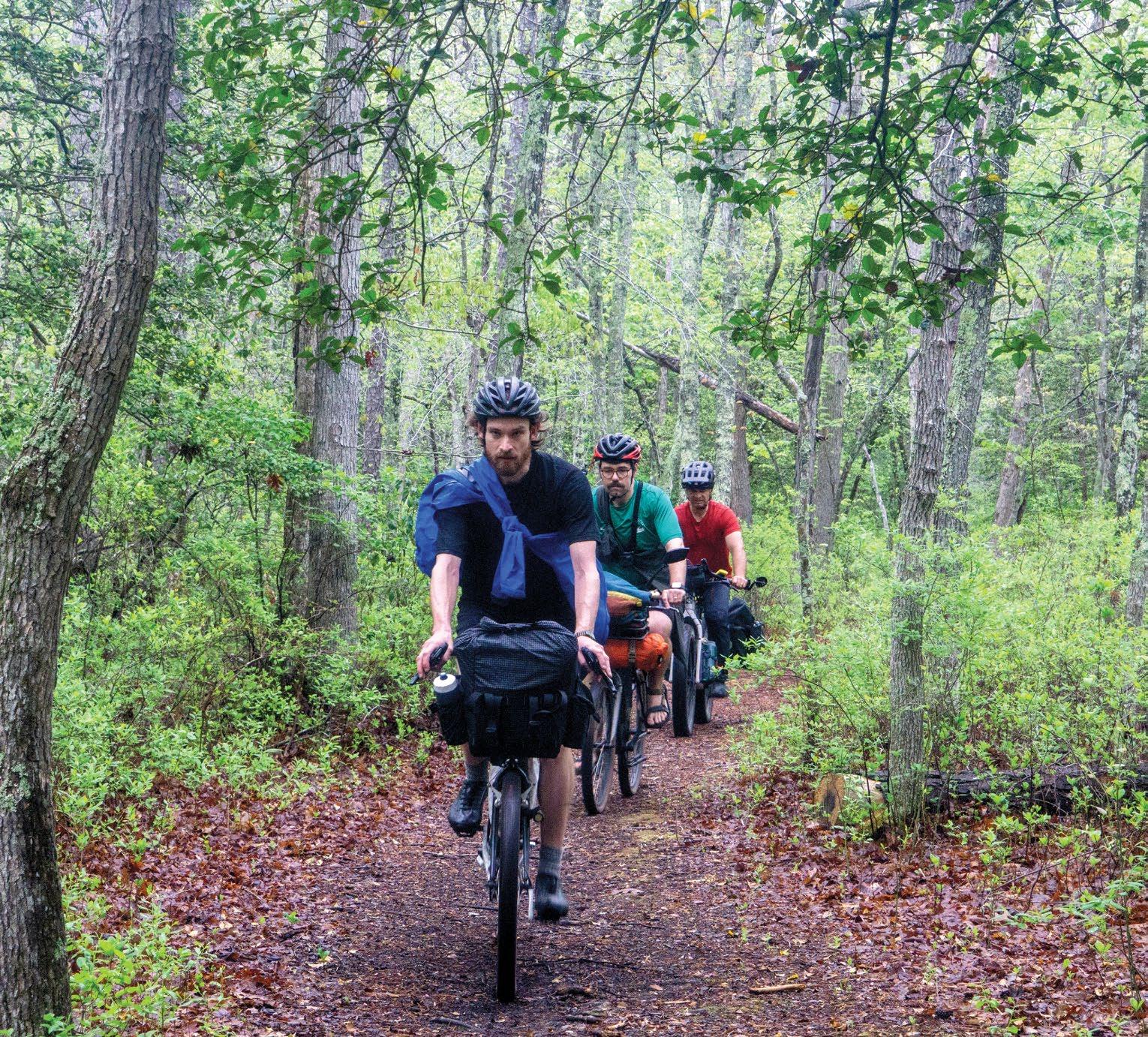
Julian Bender spent most of his weekends in the spring and summer of 2024 dedicated to one project: creating a bikepacking route through the Pine Barrens. He mapped out campgrounds and sites of natural and historical interest. He rode drafted routes, ruling out options that weren’t suitable for bikes due to flooding or overly soft terrain.
He named what he came up with the Jersey Devil Hunt, an homage to the Garden State’s famed cryptid. It stretches 170.5 miles through the expansive South Jersey wilderness, from Trenton to Atlantic City. Both endpoints and various stops along the way are accessible by transit serving Philadelphia’s 30th Street Station.
“I knew that I wanted it to be connected to transit, because that’s how I would always get out there,” he says. “How can
you cross the whole Pine Barrens? Well, you start at Trenton — there’s a train station there — and finish in Atlantic City — there’s a train station there. They both connect back to 30th Street. That just seemed
The
I can’t believe this is 25 miles from Philly. This is a whole different landscape.”
julian bender, creator, Jersey Devil Hunt
like the natural beginning and end points.”
Bikepacking, as Bender explains it, is self-supported travel for more than one consecutive day using a bicycle. It’s essentially backpacking, but using a bike rather than traveling on foot. Bender’s longest bikepacking trip was a three-month, cross-country journey to Oregon.
He first ventured through the Pine Barrens on an exploratory bike trek with a friend more than 15 years ago after seeing the green space on the map and wondering if they could ride there from South Philly.
“We had gotten to the edge of the woods, and we were way out there in the sticks,” he recalls. “It’s like, I can’t believe this is 25 miles from Philly. This is a whole different landscape.”
The Jersey Devil Hunt isn’t an event, nor does Bender host group rides along the route. It can be a solo trip, but those looking to share the ride can solicit partners in dedicated Facebook and WhatsApp groups that Bender monitors.
Bender says riders should have a basic understanding of their bike and its maintenance and know what supplies and food they’d need to pack for an overnight, energyintensive ride.
But he says it’s a good start for people looking to try the hobby, and he encourages breaking the route into smaller segments for day trips to get the hang of the landscape and distance riding. Bender has compiled a comprehensive guide on his website, jerseydevilhunt.com, with itineraries for trips of various lengths, noting that peak seasons are April to May and September to early November to avoid mosquitoes and sweltering heat.
There aren’t rules for which direction riders must go, but Bender recommends heading southbound from Trenton so that the final leg of the journey is along the beach, which he thinks is a perfect conclusion to the long ride.
“Getting a funnel cake on the boardwalk in Atlantic City at the end is always kind of an iconic thing to do,” he says. ◆
Jersey Devil Hunt bikepacking route brings cyclists through the New Jersey Pine Barrens.
A Ride on the Solar Coaster
There’s a lot to learn about solar energy production — and I can’t wait to teach you by
micah gold-markel
In 2008, I heard Van Jones speak at the Academy of Natural Sciences about his book “The Green Collar Economy.” He talked about the need to make careers in clean energy accessible to all of our communities, and that without intentional inclusion, the underserved neighborhoods in our region would be sidelined from these opportunities, too.
I grew up in West Philly — Powelton Village — and knew what Van meant. My neighbors were handy, but rarely employed with any stability or benefits that could sustain a family.
Inspired by his words, I founded Solar States that same year with a dual-mission: install solar, and educate the next generation. We would build free training programs in the city, and sell solar systems that program graduates could design, sell, install or maintain. They’d have benefits like 401(k)s and guaranteed hours.
While our dual-mission seemed simple, building a sustainable business to support both students and clients proved difficult, as anyone who has ridden on the “solar coaster” will tell you. At times, policy enthusiastically promoted solar adoption. Other times, not so much. But through it all, our commitment to renewable energy and developing a workforce hasn’t wavered.
That’s why I’m so proud of our FIND YOUR POWER training programs, which could only have been accomplished through the wisdom, hard work, and patience of partners and staff. We’ve watched folks go from no solar experience to master electricians, solar salespeople, designers, lead installers and small business owners. Last year, our FIND YOUR POWER partnerships expanded beyond the city — to Harrisburg and into Chester County — and served 100 new students, 10 of whom were hired full-time by Solar States. Today, over half of our workforce came through FIND YOUR POWER training programs.
In Grid, over the next several months, I’ll be sharing incredible stories from our journey. If you’re not working in solar all day,
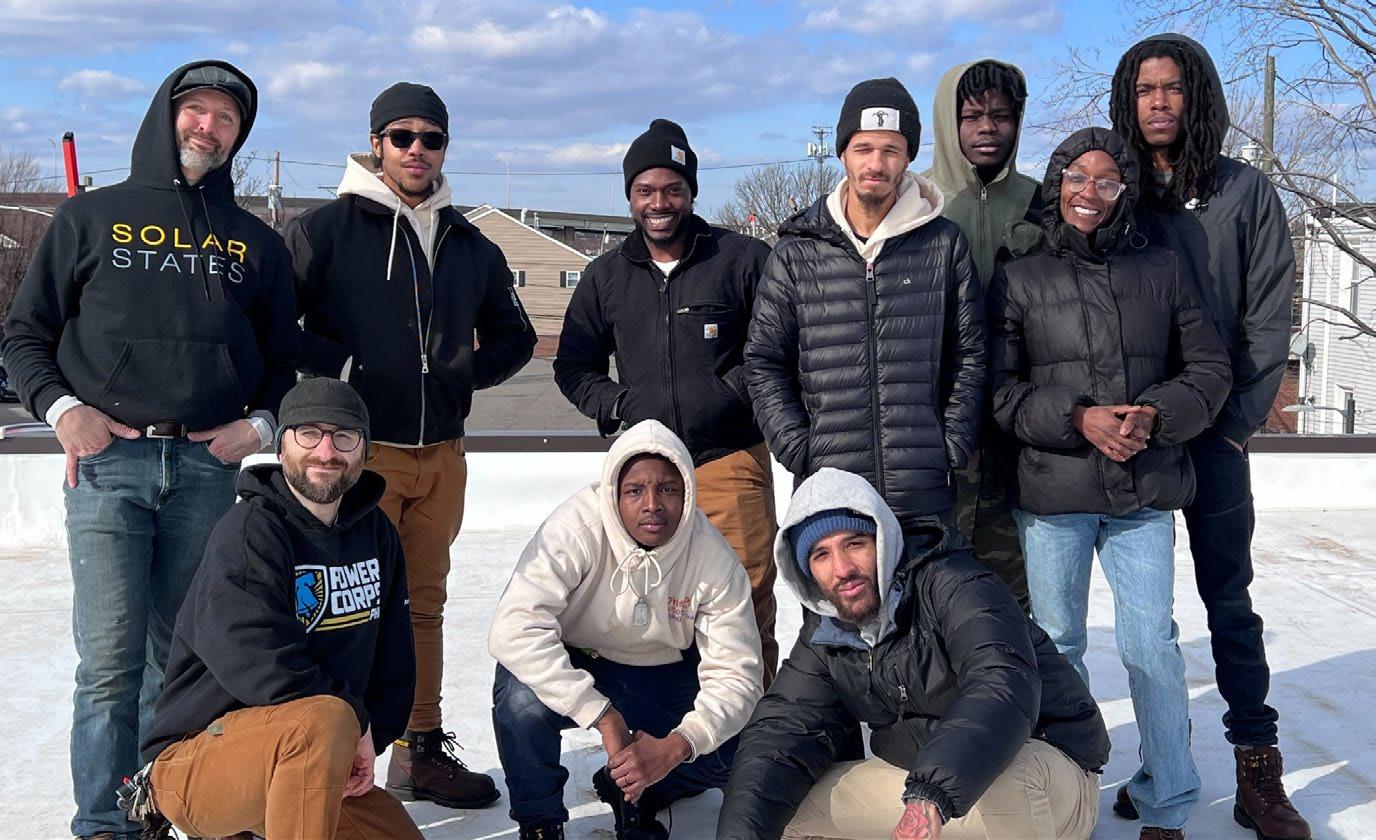
Recent graduates and teachers from Solar States’ FIND YOUR POWER program.
every day, it can be hard to keep up. The technologies change as quickly as the government’s incentives and the slew of misinformation. These columns are an opportunity to pause, acknowledge the success of students, clients and partners, and offer plain-language guidance to neighbors considering a solar system or career in solar energy.
Here are a few of the topics I plan to explore:
• Rooftop Solar 101: The basics. What does “basic” even mean in solar, anymore? Most projects we install are rooftop systems to help homeowners and businesses offset rising utility rates. Rising utility rates — maybe that’s another column …
• New technology: it seems that everything is “smart” now — even that clunky electrical panel can be replaced with a smart device that offers circuit-level control and visibility into how you’re spending energy. As an energy nerd, I geek out on what’s possible with this new tech, and would like to share more about it and how I designed and installed my own home’s smart system with my youngest daughter!
• Partner stories: A business model like ours only succeeds with healthy partnerships. OIC Philadelphia,
PowerCorpsPHL, Philadelphia Energy Authority, Energy Coordinating Agency, YouthBuild Philly, and special initiatives with some of our clients like Cristo Rey High and One Hope Community Church in North Philadelphia are of note, but only a few.
You can find information on our free training programs and request your free solar quote by scanning the QR Code or visiting solar-states.com. While the journey hasn’t been “simple,” our approach for students and clients surely is — reach out, and we’ll provide honest guidance on your best foot forward. ◆
Micah Gold-Markel is the founder of Solar States, a Philadelphia-based solar and storage installer.

Real Life Frogger
Volunteers guide amphibians as they move from hibernation to breeding grounds story and photo by ed rodgers
On a late winter-early spring evening, with a warm rain falling and temperatures above 45 degrees, volunteers with the Sourlands Conservancy in central New Jersey take up posts along nine roadways in Hopewell Township that frogs and salamanders need to cross while en route to the vernal ponds where they breed. The conditions have to be just right to coax the amphibians from the uplands where they have been hibernating, and the warm, dampness of the night makes for a perfect match.
Yvonne Selander, a librarian from Flemington, and six others, wearing reflective vests and headlamps, wait along one country road. They slow or stop vehicles on the roadway if the amphibians are crossing. If necessary, the volunteers carry them toward a nearby vernal pond. Selander has helped protect the amphibians from traffic for the last six years: “Having 10 to 12 salamanders cross the road and trying to figure out where they were, keeping track of them and hoping that a car didn’t come and thankfully, at that point, they didn’t.”
The mating calls from wood frogs and spring peepers fill the air. The wood frogs sound a little like ducks quacking. The peepers merge their songs into a deafening, highpitched chorus. The resulting tadpoles are safe from predatory fish because the vernal pools dry up during the summer. Robert Aluck, stewardship director for the Sourlands Conservancy, says wood frogs, spring peepers and spotted salamanders are the three species that are normally seen here.
“The past couple years, we’ve seen less than we’ve liked because of droughts at prime times of the year,” Aluck says. “So the vernal pools don’t fill up with the snow melt as much as we’d like.” The U.S. Drought Monitor shows much of the Delaware River watershed has been experiencing abnormally dry or drought conditions. This winter’s snowfall has provided some relief and increased the number of amphibians counted. “We’re expecting it to be a bigger year because of all the snow outside that’s currently melting and filling up the reservoirs,” Aluck says.
In one night, 55 spotted salamanders, 38 wood frogs and six spring peepers are re-
corded moving across the road to a pond. One week later, volunteers count nine wood frogs, 12 spring peepers and 11 spotted salamanders. New Jersey lists spotted salamanders as a species of special concern because of habitat loss.
Meanwhile in southern Delaware County, a group of volunteers are monitoring a series of three vernal ponds that were discovered five years ago in an industrialized and developed section of the Marcus Hook watershed. Meagan Hopkins-Doerr of the Delaware County Master Watershed Stewards says isolated wetlands such as this are sensitive to nearby development. “This is a pretty urban environment. I was so happy one of our volunteers found it,“ she says.
An apartment/condominium development, a large parking lot and a busy roadway surround the area. Wood frogs have already migrated to the ponds. Some of their egg masses are visible on logs in the pools. “There’s a whole bunch of naturally-occurring spring ephemerals here. Wood frogs are an indicator species,” Hopkins-Doerr says. Amphibian counts from the roadside efforts are sent to state environmental officials to assist with future land use decisions. A number of steps are underway to improve conditions. Volunteers have removed multiflora rose bushes and other invasive species from around the pools. “They can crowd out the native species that complement what’s living in the vernal pool,” according to John Ferri, who works with the Penn State Master Watershed Stewards program.

Volunteers have also planted native trees around the buffer of the ponds. Hopkins-Doerr says the monitoring has been ongoing for three years. Volunteers have also found a box turtle, green frogs and a DeKay’s brown snake. ◆
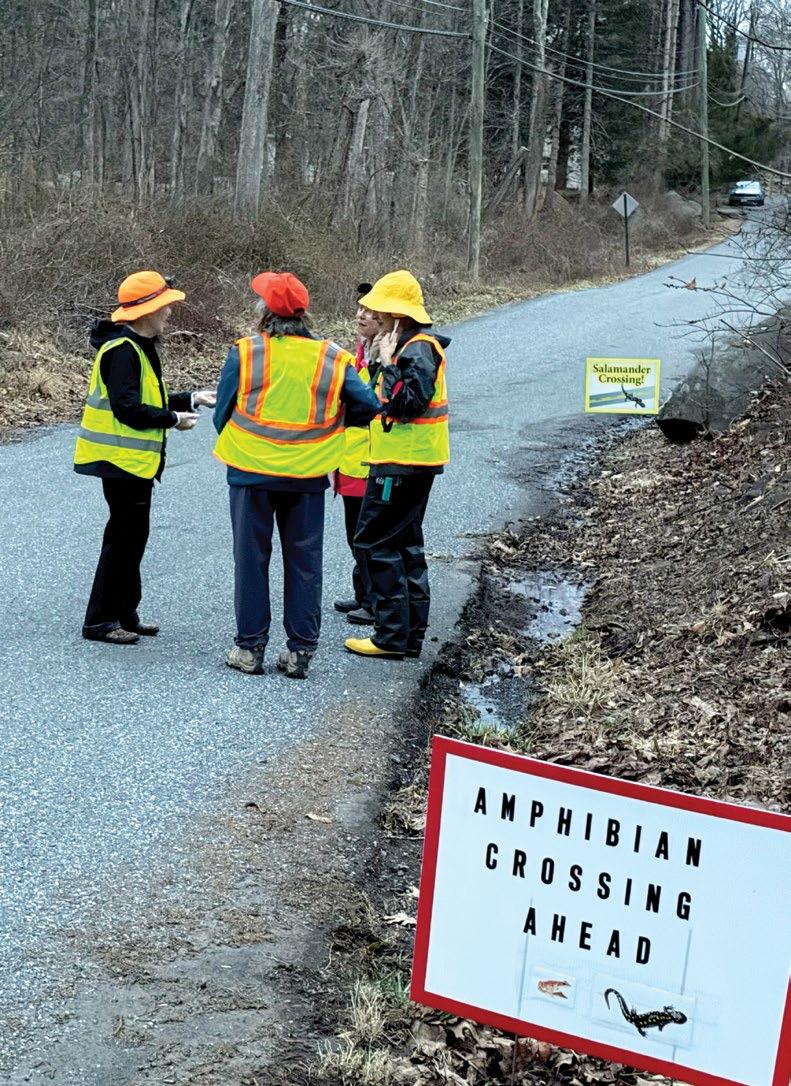
Left: Volunteers gather on a road in Hopewell Township, NJ, to control traffic when amphibians are crossing the street. Spotted salamanders are a common species seen along the roadway.
Revolutionary Feast
American Vegan Center celebrates the semiquincentennial with a plant-based cheesesteak, 76 inches long story by patrick kerr
On April 13, the day Mayor
Cherelle Parker declared Vegan
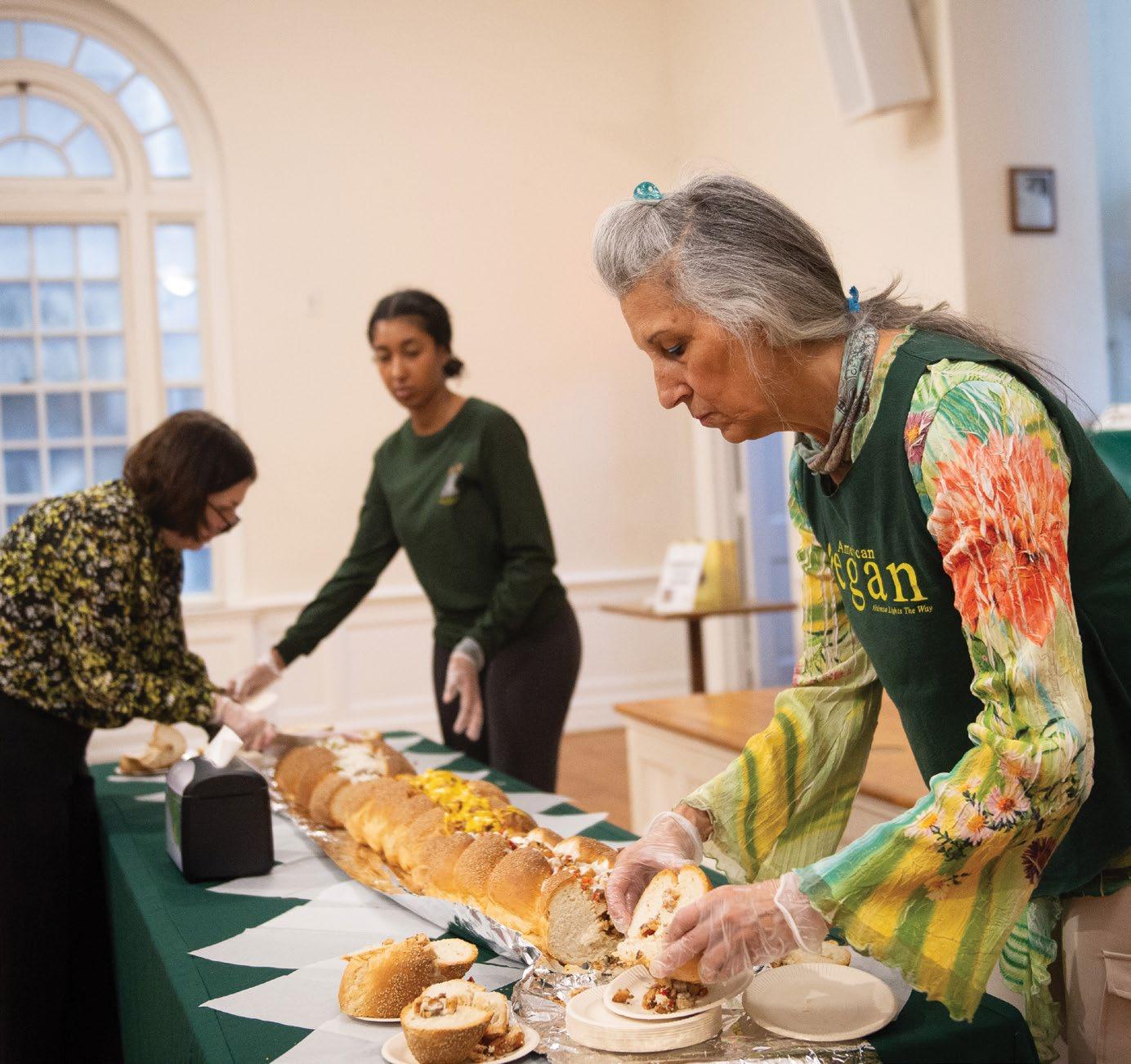
Cheesesteak Day, the American Vegan Center, headquartered in Old City, held its annual vegan cheesesteak contest, but with a record-breaking challenge: create the longest vegan cheesesteak, totaling 76 inches as a tribute to the revolutionary year of 1776.
Vegetarianism and Philadelphia may seem like odd bedfellows, but they are intertwined, says Vance Lehmkuhl, director of the American Vegan Center. According to his latest book, “Revolutionary Peace: How Philadelphia Launched the U.S. Vegetarian and Vegan Movement,” vegetarianism is as old as the nation.
Bernard Unti, a native Philadelphian and historian of animal protection, concurs.
“Vegetarianism in Philadelphia predates the cheesesteak by at least a century and a half,” Unti says.
Lehmkuhl explains, “The cheesesteak has two significant parts, and neither is vegan. It seems like [a vegan cheesesteak] contradicts itself.” But it fits into the framework of Philadelphia as a hotbed for revolutionary, abolitionist and vegetarian activity throughout its history.
Notable vegetarians in 18th-century Philadelphia include abolitionists Benjamin Lay and Anthony Benezet, as well as part-time vegetarian Benjamin Franklin.
The cheesesteak came into the food lexicon in the early 1940s and is largely credited to Pat’s Steaks. What some may see as a greasy meat sandwich for which there can be no plant-based equivalent, others embrace the culinary challenge of flipping the cheesesteak on its head.
Lehmkuhl describes the cheesesteak as “such an elemental food icon for Philadelphia … But also, here’s this variation that you can do, expressing your own creativity.”
The three finalists’ entries are
Past winners include Haverford’s Boardwalk Vegan and South Philly’s Triangle Tavern and use various kinds of nut- or veggie-based “cheeses” and meatless fillings from seitan to tofu to mushrooms.
This year, the top three restaurants brought their vegan cheesesteak creations to jointly construct the largest vegan cheesesteak. A panel of four judges were given blind samples of the three vegan cheesesteaks.
Judge Pamia Coleman is the cofounder of Black Girls With Green Thumbs, a nonprofit that teaches how to grow healthy food in urban areas. “We do a lot of plant-based cooking with fresh ingredients that we grow right in our own community gardens,” Coleman says. She appreciated the inclusion of whole foods like peppers and mushrooms.
Judge Lisa Tynes is an accomplished food innovator and is the daughter of Alfoncie B. Austin, who operated Basic 4 Vegetarian in the Reading Terminal Market. Her mother, Austin, is credited with developing the first fully vegan cheesesteak in 1999.
The newest restaurant to Philly’s vegan scene, Say She Ate — a playful take on the word satiate — opened in October 2025 and finished with the most votes in the public voting portion of the contest. Located on South Street, Say She Ate is a vegan restaurant creating “Indian-inspired Philadelphia cuisine.” Owners Shrinathji Raval and Keshava Mair grew up vegetarian and saw an opportunity to bring the plant-based food they are passionate about to the community.
Rounding out the top three were Sabrina’s Café and Boardwalk Vegan, which, with its signature house-made “wiz,” composed of carrots and potatoes, won for the third consecutive year.
“The path to today’s thriving veggie scene in Philly was set by the early Quaker exponents of ethical diet, the young Ben Franklin, who thrived on meatless cuisine, and the English nonconformist Protestants who organized the first vegetarian church, the first vegetarian newspaper and the first vegetarian organization in the United States,” Unti says. “In the trust of their contemporary successors, this legacy continues, and vegetarianism is arguably one of the most enduring of Philly firsts.” ◆
combined into one 76-inch cheesesteak and cut for guests to taste test.
Bound for Good
Entrepreneur creates critical connections between farmers and chefs
by marilyn anthony
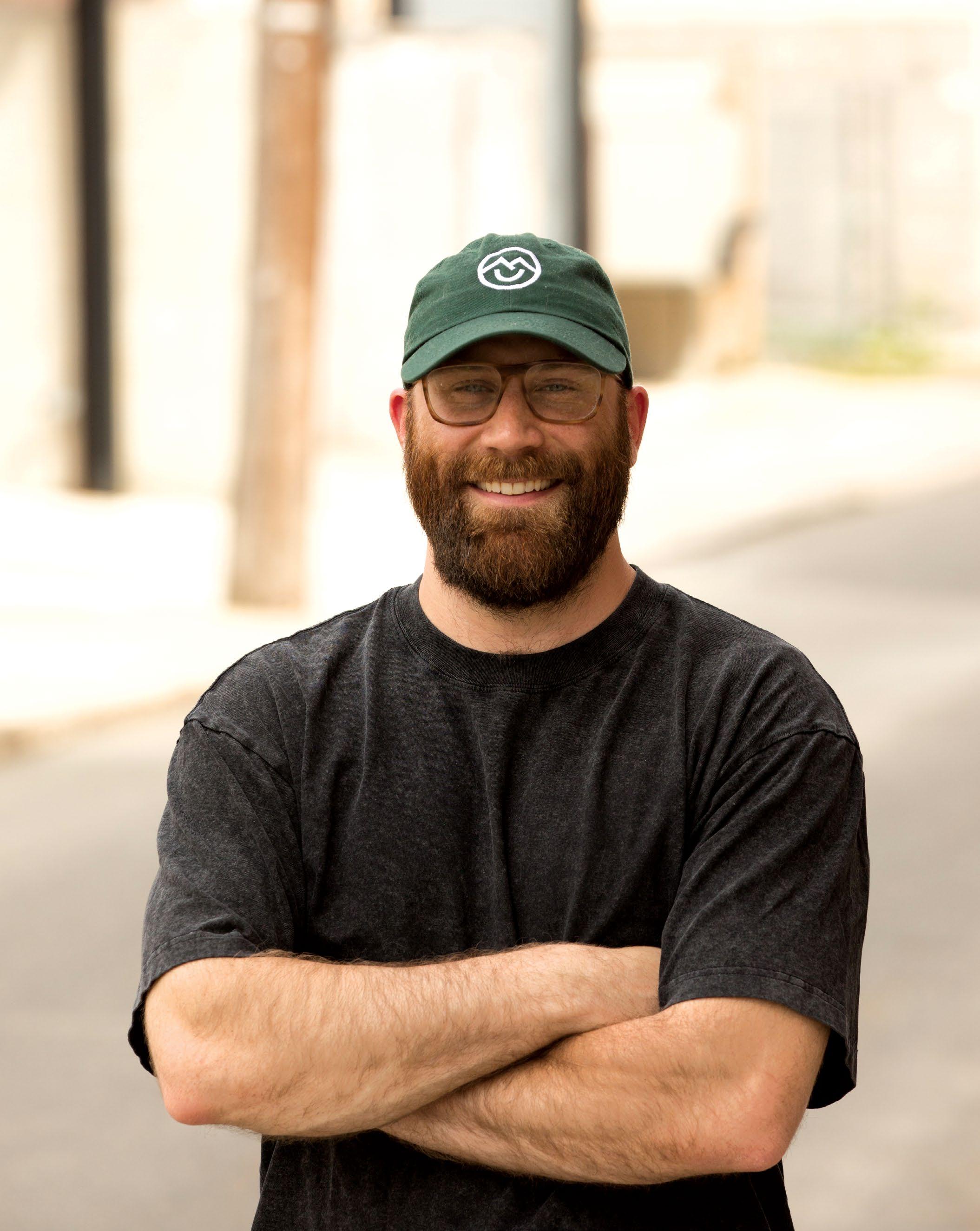
PHOTO BY TAYLOR ECKER
Matt Kirchner discovered that some local farmers lacked a consistent distributor and decided to fill the gap with his business, Local Bound.
The shortest distance between two points is incontestably a straight line. But the route Matt Kirchner followed prior to launching Local Bound, a local food districbution business, meandered through South Jersey, North Carolina, Los Angeles, New York City and Point Breeze, and from baseball diamonds to family farms.
Kirchner’s passion for playing baseball dominated his Elon College years. He was a business major, but “really all I thought about was baseball.” A job with a baseball events company lured him to L.A., but the start of the COVID-19 pandemic cut that career short. Suddenly, Kirchner was looking for something to do. He heard about people putting together produce boxes for home delivery and thought he’d give that a try. He began buying from the L.A. wholesale produce market, then from farmers markets and small California farms. Even amid stay-at-home orders, the California food culture was so strong, Kirchner says, he “got addicted to it.”
“What got me really involved was tasting new things, appreciating better quality foods,” he says. “I was hooked.”
Although Kirchner had no cooking experience, he knew more about ingredients than he realized, thanks to conversations with his brother, a Chicago-based chef. To turn his hobby into a business, he started saying “yes” to everything. He returned to the East Coast for a job at the Philadelphia Wholesale Produce Market. Next came a gig with Natoora, a New York City distributor. Kirchner joined a robust business connecting regional farmers with restaurants and specialty stores. Over time, Kirchner began identifying family farms in New Jersey and Pennsylvania and inviting them into the New York market. “I was amazed many of them did not have a relied-upon distribution network. It seemed like there was a gap,” he says.
But it was marrying a Philly woman that brought him to Point Breeze and led to Local Bound.
In June 2024, Local Bound launched as a bootstrap collective of roughly 10 small Pennsylvania farms. The initial member farms share a commitment to farming methods and product quality. “The stuff they’re growing is so amazing,” Kirchner
says. “They know how to grow [food], but there’s a disconnect. It’s so hard for them to both grow and distribute.” Kirchner’s expertise allowed them to devise an effective distribution system that enables local chefs to easily purchase from multiple farms.
Working with small growers and chefs means managing variables beyond the ebb and flow of uncontrollable weather. Kirchner attributes the enterprise’s early success to having “a lot of help.” Local Bound farmers do far more than grow food. The business relies on its members for storage space, packing products and delivery vehicles, making it a deeply collaborative effort. The next stage
of growth means building a stronger supply chain with more resources to meet what Kirchner believes is expanding demand. Kirchner sees “many young, exciting chefs with new restaurants who seem to be really wanting to plant roots in Philly.” The willingness to buy local is strong, but creating convenient access to local products isn’t easy. Kirchner is up for the challenge. The biggest things he learned working on baseball events were effective communication and calm crisis management. “These skills have been the most important crossover thing for me in the food distribution business — [and] staying organized.” ◆
SPRING CELEBRATION PASTA
Kirchner shares this light and flavorful recipe highlighting seasonal ingredients from many Local Bound farms. Makes 4-6 servings.
1 12-ounce package Pasta Lab’s campanelle pasta
4 or 5 chestnut mushrooms from Mycopolitan Mushrooms, quartered 3 stalks green garlic from Kneehigh Farm, chopped into one fourth-inch pieces
1 pint sugar snap peas from Kneehigh Farm, halved ½ cup hazelnuts from Bloom Farm, roughly chopped
• Bring a large pot of water to a boil and add 1 tablespoon of salt.
• Add campanelle pasta and cook for 4 to 5 minutes, or until tender.
• Drain, reserving ½ cup of pasta water.
• In a deep saute pan, cook chestnut mushrooms in olive oil over medium heat until golden brown. Remove from the pan and set aside.
¼ cup each fresh parsley, basil and thyme from Blue Sun Growers, chopped 2 ounces pea shoots from Taproot Farm 6 ounces Equinox cheese from Birchrun Hills Farm, sliced into ribbons with a vegetable peeler for garnish ½ cup olive oil ¼ cup white wine 1 tablespoon unsalted butter Salt and freshly ground black pepper, to taste
• Add green garlic and sugar snap peas to the pan and cook until soft and bright.
• Add white wine to the pan and reduce to 1 tablespoon.
• Swirl in 1 tablespoon butter and return the mushrooms to the pan.
• Season with salt.
• Add reserved pasta water, 1 tablespoon at a time, to make the sauce.
• Stir in pasta until evenly coated.
• Off the heat, toss pasta with hazelnuts, pea shoots and fresh herbs.
• Season to taste with salt and pepper.
• Garnish each serving with “ribbons” of Equinox cheese.
Making A New Home
West Philly nonprofit helps African immigrants settle in the city
by constance garcia-barrio
One night in July 2016, JeanPierre Lokombe woke up to a group of armed men banging on the door of his home in a small village in the Democratic Republic of Congo. The men were part of the Allied Democratic Force, one of the deadliest of the more than 100 rebel groups that rape, kill and maim to control the Congo’s rich resources. Threatened with death, Lokombe, a nurse, then 40, his wife and five children, and their fellow villagers scrambled to flee their land, leaving it to be mined for minerals. The Lokombes, whose names have been changed for their safety, began a grueling journey that ended in Philadelphia.
Nine years would pass before the Lokombes would meet Kennedy Chesoli, founder and executive director of the Center for Integration and Migrant Support (CIMS), a West Philly nonprofit that assists newly arrived immigrants from sub-Saharan Africa resettle in Greater Philadelphia.
Born and raised in Kenya, Chesoli learned early about Congo’s mineral-linked conflicts. “Congo — Central Africa’s largest country — has copper, lithium and rare earth minerals needed for smartphones and other electronic devices,” he says. “The fight to control those resources has meant decades of violence, poverty and instability. My father and I used to volunteer at a refugee camp in Kakuma in northwestern Kenya, near South Sudan,” says Chesoli, whose background includes philanthropy and healthcare, and who previously served as an economist in the Office of the United Nations Secretary-General.
In 2020, after leaving the U.N., Chesoli became program director for CHOICE Regional Health Network in Olympia, Washington. In his free time, he mobilized COVID-19-related assistance for vulnerable African families. As those efforts wound down, Chesoli, now living in Wayne, Delaware County, realized that Philly’s Congolese residents faced continued difficulties adjusting to life here. In response, in 2022, he established CIMS, a community-based organization, to serve this often overlooked population. CIMS gained 501(c)(3) nonprofit status in 2024.
However, in 2016, when the Lokombes escaped from Congo, the family was years away from receiving CIMS’s help. After leaving Congo — not to be confused with the neighboring Republic of Congo — Lokombe and his young family hitchhiked to Kampala, Uganda’s capital. “We lived on the street and survived on handouts and odd jobs,” he says. When the Lokombes learned that the U.N. had established a refugee camp in Kyaka, Uganda, about 120 miles away, they sought and received admission.
“We lived in a tent and had no running water,” Lokombe says. “There was an out-
PHOTO BY TRACIE VAN AUKEN
Congo — Central Africa’s largest country — has copper, lithium and rare earth minerals needed for smartphones and other electronic devices. The fight to control those resources has meant decades of violence, poverty and instability.”
kennedy chesoli, founder, Center for Integration and Migrant Support
door latrine.” The 31.5-square-mile camp housed 133,000 residents, including some 130,000 Congolese fleeing their country’s violence. “I worked on farmland surrounding the camp, planting, weeding, harvesting from dawn to dusk for $2 a day,” says Lokombe. Meanwhile, his children attended the camp’s makeshift school. After an intensive interview with the International Organization for Migration (IOM), which works in tandem with the U.N. High Commissioner for Refugees, the Lokombes’ names were placed on a list of people wishing to leave. “I couldn’t wait,” Lokombe says.
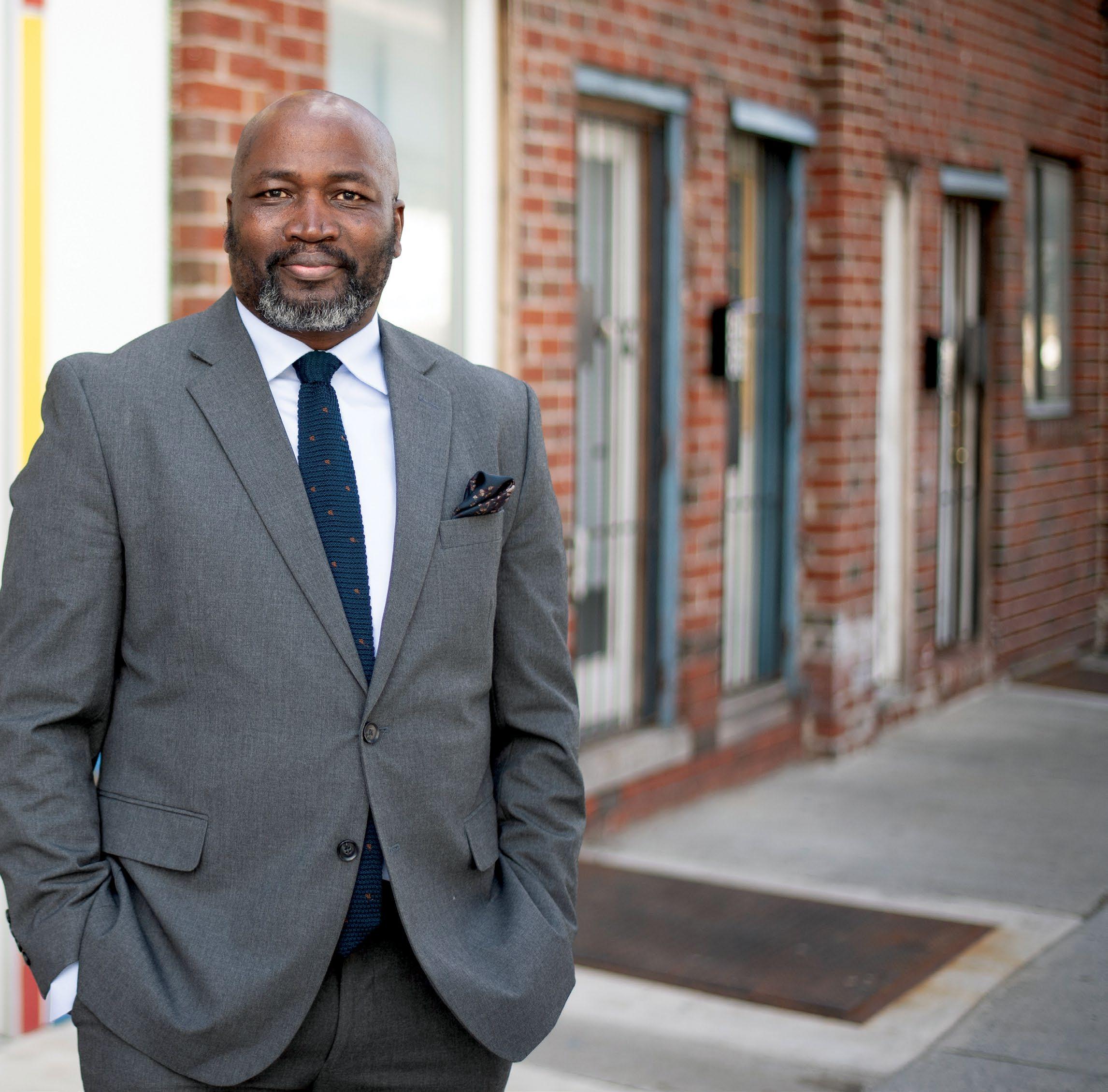
Kennedy Chesoli stands outside the Center of Integration and Migrant Services, located at 6104 Market St.
After five years, their turn came. IOM provided a loan for the family’s airline tickets to the U.S. “I would have preferred France,” says Lokombe, who speaks Swahili and French, the official language of Congo since colonial times.
Congo and France have a long history, Chesoli explains. France’s large Congolese community would have made it easier for the Lokombes to find supportive networks.
“We weren’t given a choice,” Lokombe says.
Adasa, 13, the Lokombes’ youngest child, had some misgivings upon landing at Philadelphia International Airport in December 2024. “It was very cold,” she says, “and I couldn’t eat the airport food. It was too spicy.”
The Lokombes joined an estimated 50,000 African immigrants in the city, most of them from Nigeria, Liberia and other West African countries, according to Global Philadelphia. These new Philadelphians have established restaurants and boutiques along Baltimore Avenue as well as in Africatown, which consists of some 700 businesses on or near Woodland Avenue from 47th Street to the city’s southwestern limits. Yet, only a small number of Africans in that enclave are from Congo.
“We’ve been unable to ascertain an approximate number of Congolese in Philly and Upper Darby,” Chesoli says. “They originate from different refugee camps in Kenya, Tanzania and other countries … and are dispersed across the city and resettled by different agencies. That said, in 2025, CIMS served 1,100 individuals,” he says, noting that the Nationalities Service Center, a nonprofit that helps immigrants resettle, referred the Lokombes to CIMS. CIMS offers services in French and Swahili attuned to the cultures of Congo.
CIMS guides immigrants in securing housing, often a struggle after the Trump administration’s cuts in funding for that purpose. The nonprofit also helps newcomers obtain familiar foods, such as rice, beans, plantains and corn flour. Additionally, CIMS helps clients find English classes and employment. “Our work is grounded in the lived realities of the families we serve,” Chesoli says.
That goal includes mitigating challenges big and small. For example, the Lokombes
My priority is education. When I can speak English well enough to communicate with patients, I can work as a nurse again.”
jean-pierre lokombe, immigrant from the Democratic Republic of Congo
had shared one temperamental cell phone between all seven of them. CIMS found a plan that allows them each to have their own phone.
Congolese families who have lived in rural settings and refugee camps may also face a steep learning curve. “When one family moved into an apartment in winter, the thermostat was set at 72 or 73 degrees [Fahrenheit],” Chesoli says. In summer, the apartment became an inferno because they didn’t realize they had to turn down the thermostat. “Instead, they slept in the corridor outside of the apartment,” says Chesoli. “Sometimes, they don’t know how to clean the apartment, use trash bags or put them out for pick up because no one has shown them.”
Healthcare is a top concern for the organization, and that extends to emotional well-being. CIMS has had mixed outcomes when referring clients to established service providers due to language barriers, scant knowledge of sub-Saharan African cultures, and the effect of years of trauma on families, Chesoli says. To mend this gap, CIMS is launching a mental and behavioral health initiative.
Finding work that pays a living wage also takes priority. Some CIMS clients deliver food, drive for Uber or Lyft, braid hair in salons or clean until they learn enough English to work in occupations for which they are trained. CIMS recently began offering GED and digital literacy programs to equip clients for economic mobility. Ryan Tucker, CIMS’s education pathway coordinator, partners with other grassroots groups and churches to recruit people who could benefit from these initiatives.
Lokombe, who lost his professional diplomas when he left Congo, has enrolled in the GED program. “My priority is education,” he says. “When I can speak English well enough
to communicate with patients, I can work as a nurse again.” Currently, he prepares food in a restaurant where his wife cooks.
Meanwhile, Adasa, who attends a West Philly elementary school, seems to have grown her life by leaps and bounds. “The education here is way better than in the refugee camp,” she says. “I had trouble with English at first, but that’s OK now,” she says, her speech fluent. Adasa’s four siblings, who are in their teens and early twenties, attend the School District of Philadelphia’s Franklin Learning Center. They also seek part-time jobs to help support the family.
The Lokombes’ progress heartens Chesoli in moments of frustration. Increased ICE enforcement has sown fear and reluctance — even among legal residents — to take advantage of educational programs and other opportunities, he says. At the same time, cuts in federal funds for housing, food and other basics barely allow some families to eke out a living.
Yet, Chesoli points to the accomplishments of Philly’s Congolese immigrants. “They are entrepreneurs operating transportation services, home health agencies, retail shops, beauty salons and import/export ventures,” he said in an email. “They create jobs and strengthen the region’s economy. Besides starting restaurants that serve Congolese cuisine, they’ve brought to Philly rumba music, now recognized on the Representative List of the Intangible Cultural Heritage of Humanity.
For her part, Adasa has found much to like in Philly. “If you need something, you ask your friends,” she says. “Everyone is kind, and I’m kind to everyone. I like movies, milkshakes, school and playing basketball. I love money. I want to be a lawyer.” ◆
To
volunteer or donate at CIMS, visit thecims org or call (215) 486-0888.
Coming this July . . .
Retrospective Pop-Up stay tuned for South Street location
@SocialImpactStudios + Community


‘Money Over Life’
The EPA’s new method of assessing the costs and benefits of air pollution regulations may have grave consequences for some Philadelphians story and photos by adam litchkofski
When faulty equipment at the Philadelphia Energy Solutions (PES) oil refinery caused an explosion on June 21, 2019, Carol White jolted awake and raced downstairs in her Grays Ferry home to investigate. She opened her front door and ash swept into her mouth and eyes, nearly blinding her and blocking her airways. As plumes of poisonous smoke barreled into the sky above her, White raced to her car to drive to the emergency room. But as she opened her car door, White once more inhaled ash and got even more in her eyes.
White was diagnosed with severe asthma shortly after moving to her home in 2006, but she had never felt as though she couldn’t breathe.
“I was thinking, ‘this is my last breath that I’m going to take,’” says White.
After arriving at Jefferson Methodist Hospital, she received three rounds of asth-

ma treatments and didn’t return home for a week. She says her eyes were affected worse than her lungs. In the days following the explosion, which occurred less than a mile from her home, white pus and residual ash leaked out of her eyes, causing abrasions that required surgery.
PES was the largest polluter in Philadelphia in 2016, accounting for 72% of the city’s toxic emissions. Benzene, a cancer-causing chemical, was produced at levels up to 444% higher than EPA standards. PES paid a $4.2 million settlement to the Environmental Protection Agency in 2024, but neither White nor her neighbors have received compensation.
Since the Reagan administration, The EPA has performed cost-benefit analyses for all environmental regulations, factoring in the suffering of people like Carol White. Historically, the EPA estimated the economic consequences of complying with regulations compared with the benefits to
public health and the environment.
But because of a Jan. 15 EPA decision, the people assessing air pollution regulations will no longer consider human health impact. Instead, regulations and limits will be determined based only on their impact on industry rather than their capacity to save human lives.
“The Trump administration is undermining the bedrock on which environmental policy in our country is built,” says Jane Clougherty, an air pollution exposure scientist and epidemiologist at Drexel University.
“None of us like the idea of putting a dollar value on a specific human life,” Clougherty says. “But because we live in a capitalist coun-
How can you put money over life? They’ve been doing it for far too long. Where’s the compassion? Where’s the love? Where’s the care?”
carol white, Grays Ferry resident
try, where cost-benefit analysis of policies is done, this is how we have to force human life and health benefits into the equation. We don’t know the exact value of any given statistical human life, but we know that it’s not zero. And that’s effectively what this administration has done — is to force the health costs and the life costs of any given environmental practice to be zero.”
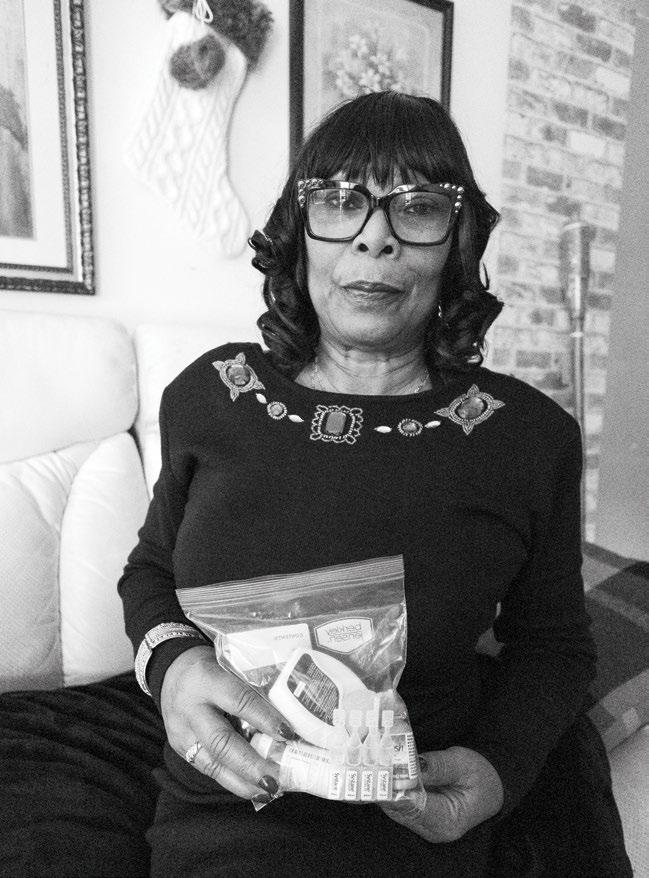
Almost seven years after the chemical explosion, the residual symptoms make it difficult for White to lead a normal life. At 67, her asthma often keeps her worried and indoors, while she simultaneously experiences eye pain and blurry vision. Her bag of prescription medications, which she keeps with her at all times, features a rotation of three high-strength daily inhalers and a variety of eyedrops.
On bad air quality days, White says, her neighbors remind her to stay inside and keep her doors closed. “Who lives like that? Who lives like that?!”
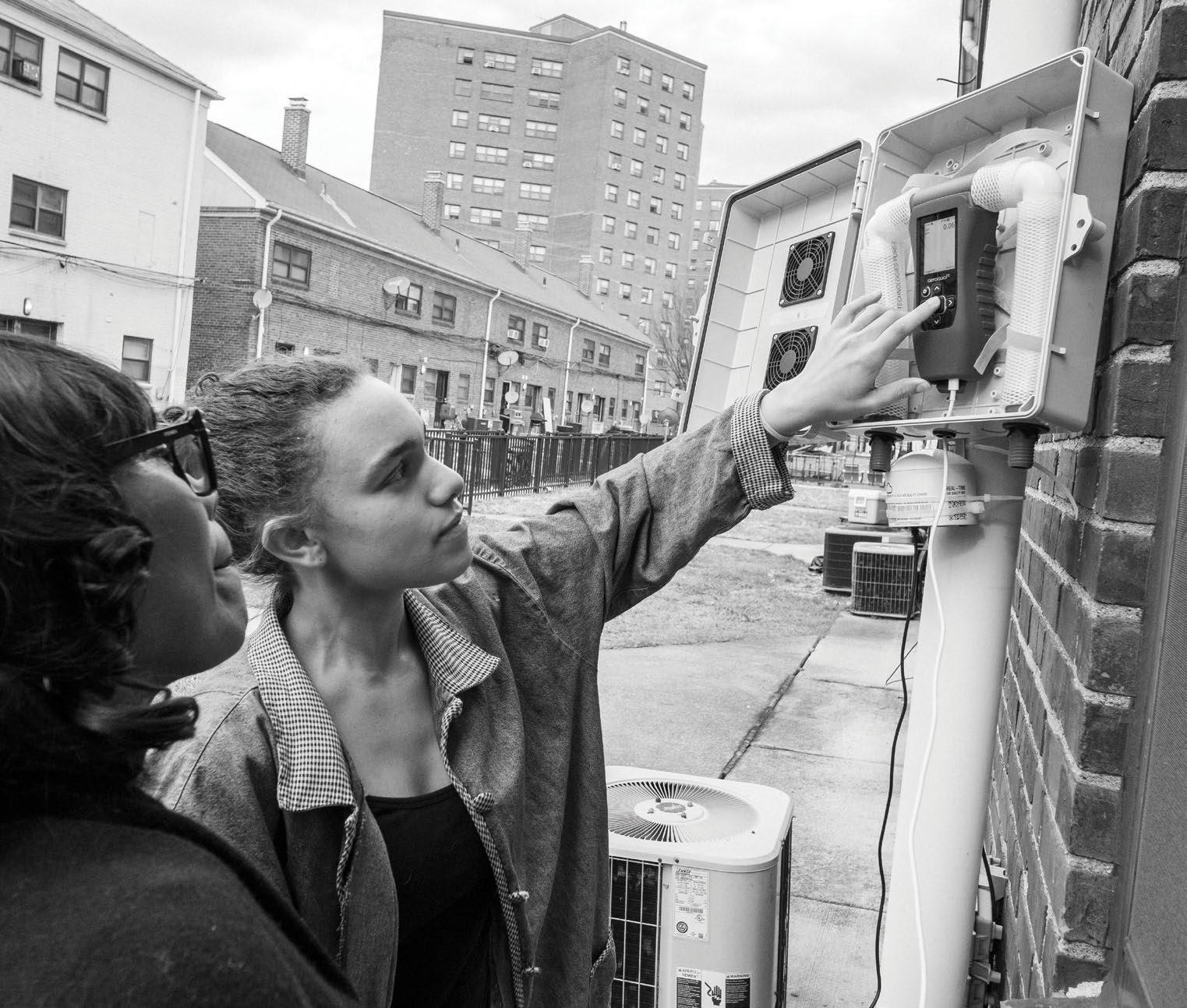
Grid spoke to White at her home on a
sunny March afternoon as children played in a nearby park. Though the air pollution monitor in her backyard read clean, White stayed indoors, fearful of the South Philly air she was breathing. Even on good air quality days, despite her cache of medications, she can experience flare-ups.
“When the EPA is pulling back on regulations, it’s easier for big polluters to pollute without any restraint,” says Alex Bomstein, executive director of Clean Air Council. “That means everybody is going to be breathing dirtier air. And when we’re breathing dirtier air, we are going to get sicker. We’re going to end up in the hospital more often. We are going to die more often.”
Even when a polluter shutters operations, its footprint doesn’t just vanish — nor do the cancer and asthma in nearby residents. Though closed since 2019, the PES site remains a major polluter. In 2022, the site had the second-highest benzene emissions among all U.S. refineries. As the site transitions into the Bellwether District, concerns remain not
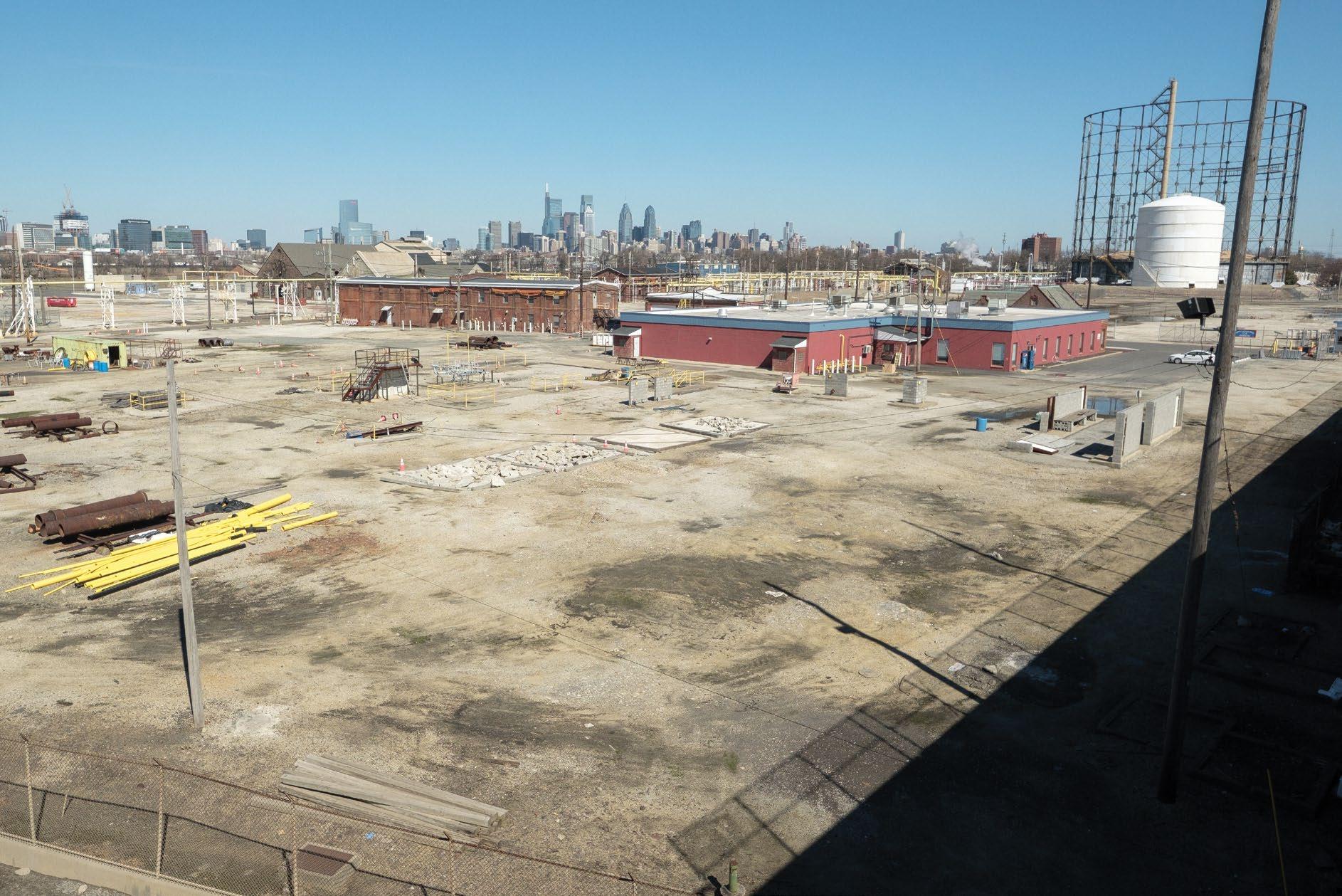
Clockwise from top left: industrial grounds on the other side of I-76 from Carol White’s home; Jendaiya Hill, a community organizer for Clean Air Council, checks White’s air pollution monitor; White holds her bag of prescription medications. In the bag are inhalers and eyedrops that she’s had to use daily since 2019.
only about air pollution, but also soil and groundwater contamination.
“To start valuing a statistical life at zero is one more way of saying: ‘We don’t care about the impacts, we don’t care about your health or your kids’ health — your lives don’t matter.’ That’s the underlying message that this decision really sends to communities that are already overburdened by our pollution,” Clougherty says.
The Trump EPA hasn’t stopped there. According to a 2025 Associated Press examination, at least “30 rules meant to protect air and water and reduce emissions that cause climate change,” collectively “estimated to save at least $275 billion a year and more than 30,000 lives annually,” were being targeted by the administration.
On Feb. 12, the EPA repealed the 2009 Endangerment Finding, which determined that climate pollution harms public health and welfare. The landmark decision had allowed for the regulation of greenhouse gas emissions from commercial vehicles.
Vehicle emissions directly impact White: standing between her home and the former PES refinery is Interstate 76. Road transportation is already among the largest pollution sources in Philadelphia and an MIT study from 2022 found that it causes approximately 53,000 PM2.5-related deaths per year. Without strict regulations, car companies can avoid controlling the emissions of the cars they manufacture, further polluting Philadelphia’s air and leaving the health of residents like White even more compromised.
“How can you put money over life? They’ve been doing it for far too long. Where’s the compassion? Where’s the love? Where’s the care?” White asks, exasperated, tears welling up in her eyes. “I need the people that sit in those chairs and sign those papers to give us a chance. I’m not just talking about me. I’m talking about newborn babies. Seniors that shouldn’t have to live the rest of their life saying, ‘Oh my God, help me, I can’t breathe.’ This is not what God promised for us. Why does one person that holds a pen and paper get to decide how we live and die?” ◆












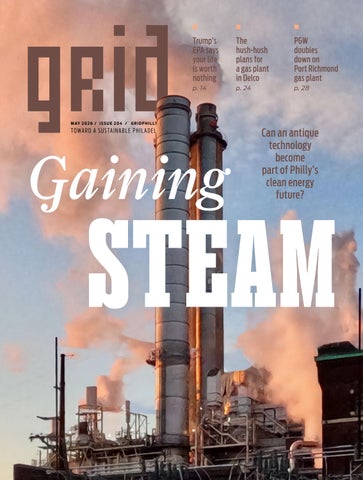
FULL STEAM AHEAD
Could a sustainable energy option have been lying beneath Philly’s sidewalks for a century?
BY SARAH RUIZ
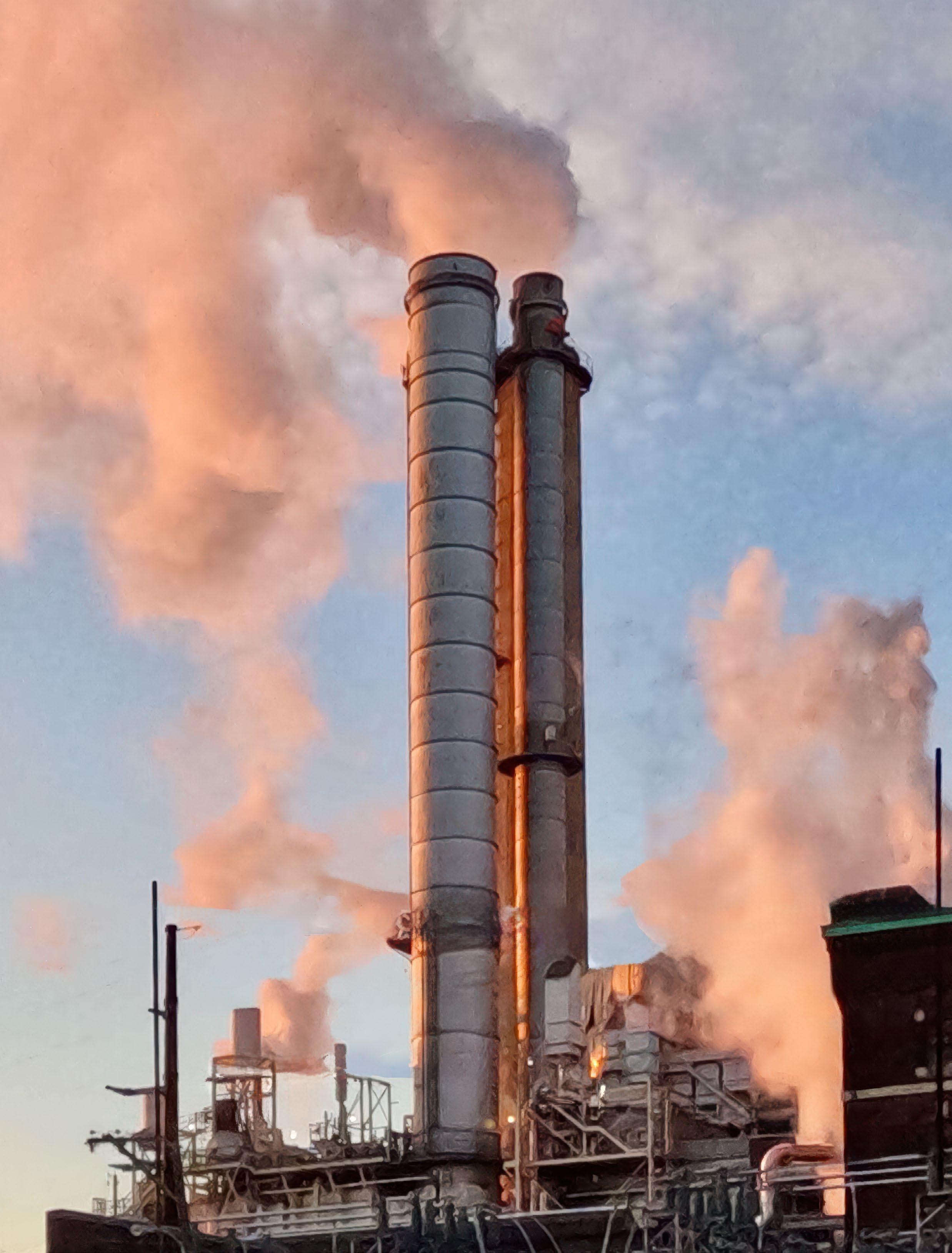
Tucked into a still corner of Grays Ferry, a block-spanning brick building with towering stacks overlooks the river and its walking trail. Thick steel pipes snake around the compound, carrying water and gas to tanks and boilers. The air thrums with the sound of machinery hard at work turning water into steam.
This is the Vicinity Energy Schuylkill plant, and it’s what’s known as a combined heat and power plant. Giant boilers within combust fuel to spin turbines that generate electricity. The excess heat from that process is then used to create high-pressure steam that gets funneled out to customers through the “steam loop,” a 41-mile circuit of piping
under the city. Steam is used by many of the city’s office buildings, Thomas Jefferson University Hospital, the University of Pennsylvania and the Philadelphia Museum of Art, among others, to both warm radiators and drive cooling compressors.
Steam systems, also known as district energy systems, undergird hundreds of U.S. cities, college campuses, hospital complexes, military bases and airports, providing heat, cooling and power to millions of people. The Department of Energy estimates there are 660 active district energy systems in the country. Vicinity is the largest operator of district energy systems in North America. In Philadelphia, they serve over 100 million square feet across 400 buildings.
These systems are more than just relics of the bygone “steam age.” They have been evolving alongside cities for over a century, taking advantage of new technologies and fuels as the energy landscape has changed.
An old sustainability technology
According to International District Energy Association President and CEO Rob Thornton, district energy was one of the first urban air quality solutions. It rose to popularity about 140 years ago, during a time when coal was used to heat cities.
“Every building had a coal furnace or a boiler, and as a result, the air quality was really bad,” says Thornton. “District energy was really an investment in a primary cen-
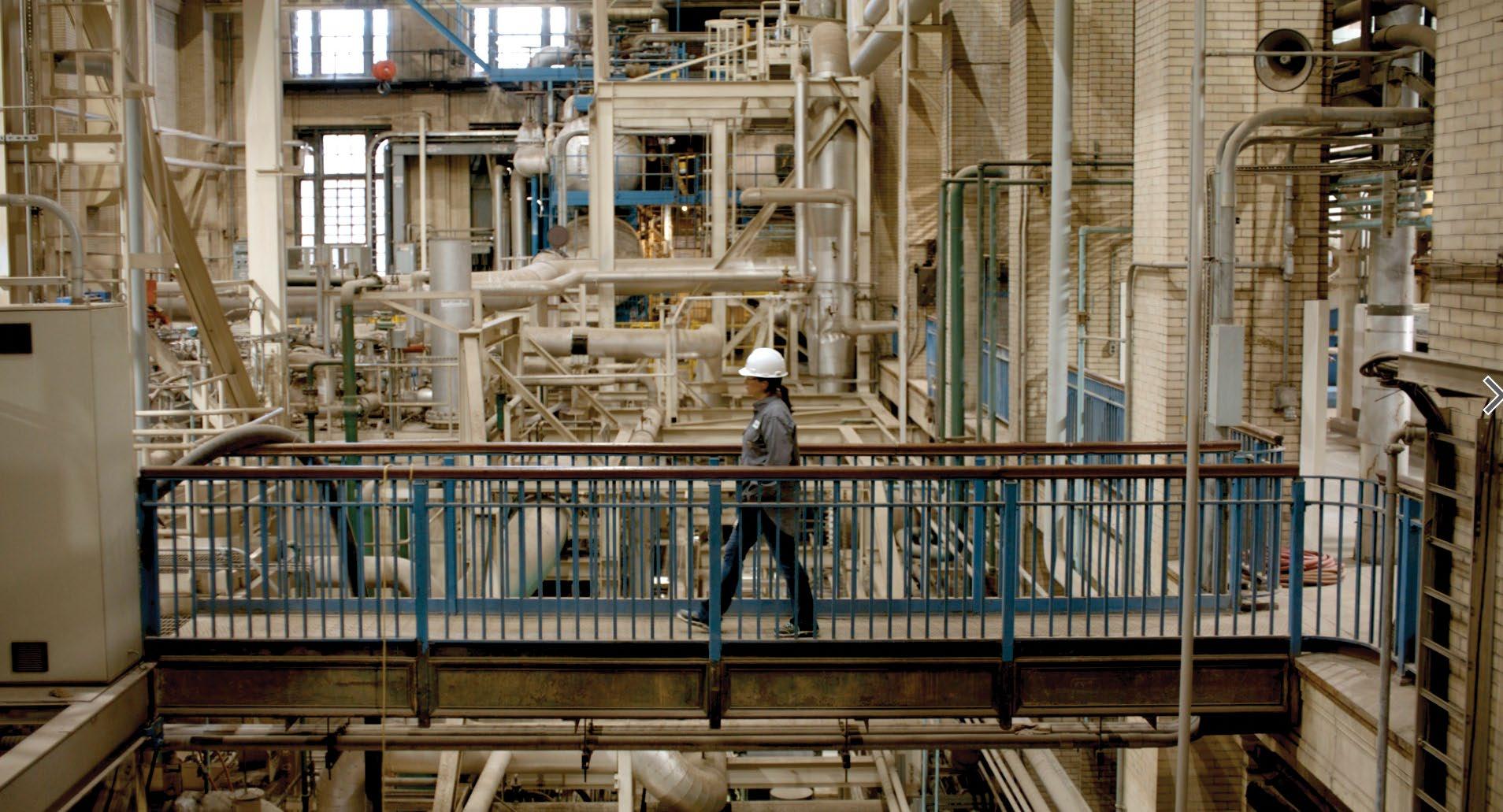

Vicinity employees conduct routine site walk-throughs at the company’s Philadelphia facility. Daily operations include monitoring system performance.
tral plant to eliminate hundreds, if not thousands of uncontrolled emission sources.”
Since then, the trajectory of district energy has arced towards enhanced sustainability. Built in 1903, the Schuylkill plant was made to burn coal, but as oil and later gas became more viable, equipment was upgraded or adapted to burn these new, less air-polluting fuels. Today, the plant primarily burns gas, as well as heating oil and a recycled cooking oil called LR100 — essentially the grease collected from a city’s worth of cheesesteaks and fries.
According to Nate Paist, Vicinity’s director of business development and account management, centralized generation has the added benefit of efficiency. Individual boilers have to be overdesigned to meet high-demand moments — cold midwinter nights, for example — but at all other times, the excess energy generated would go to waste. District energy systems allow customers to pull only what energy they need from the system.
With cities like Philadelphia now searching for ways to reduce fossil fuel use, this antique tech offers modern possibilities.
“The combined heat and power process is a less carbon-intensive process than the separate generation of heat and power,” says
The combined heat and power process is a less carbon-intensive process than the separate generation of heat and power. We’re avoiding over a half-million tons of carbon annually today.”
nate paist, Vicinity Energy
Paist. “We’re avoiding over a half-million tons of carbon annually today.”
New carbon-free possibility
That half-million-ton figure will climb as Vicinity plans to decarbonize its operations. At its plant in Cambridge, Massachusetts, the future is already underway.
A 42-megawatt electric boiler was installed there in 2024. These boilers use arcs of electricity to vaporize water into massive volumes of steam. The electricity can be sourced from anywhere, but Vicinity Chief Commercial Officer Pam Clark says the company intends to run these boilers on renewables.
The company has also broken ground
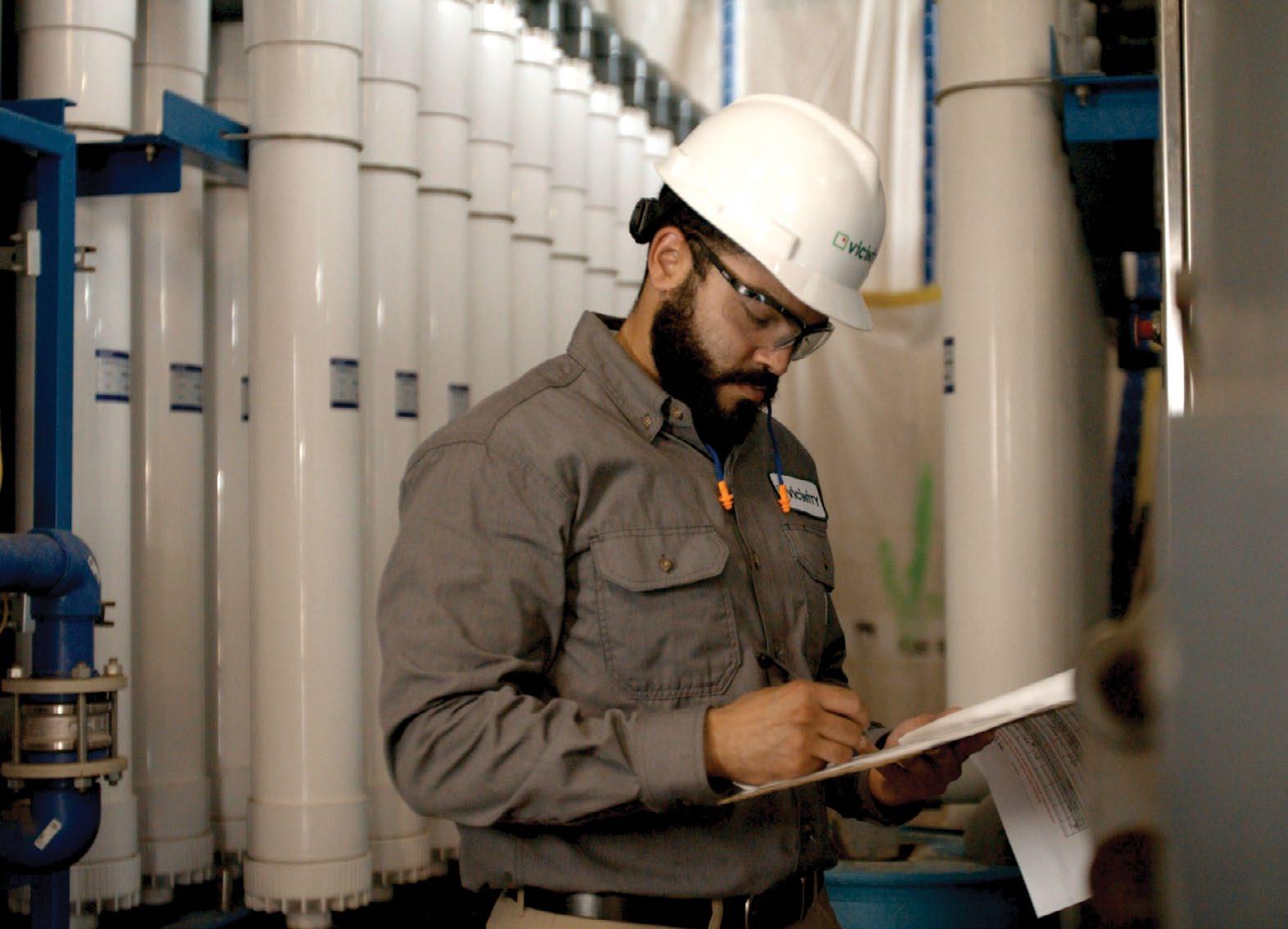
on the construction of a 35-megawatt heat pump system that uses refrigerants to extract heat from river water. That heat will be used to make steam, and the water will be returned to the Charles River a few degrees colder than it was, according to Paist.
“It’s actually kind of reversing some of the [warming] impact that industrial facilities have had on rivers for many years,” says Paist.
These changes are headed for Philadelphia, too. Clark says they are scoping the installation of an electric boiler at the Schuylkill plant as early as 2028 and a heat pump system by 2030. According to Paist, just one 85-megawatt heat pump system could support half the volume of steam generated at the Schuylkill plant in a year. These upgrades would take a major step toward Philadelphia’s goal to decarbonize its municipal infrastructure entirely by 2030, as laid out in the 2025 update to the City’s Municipal Energy Master Plan
“The cool part about this is we’re able to leverage all of the existing infrastructure that we have,” says Paist. “The pipes in the street don’t have to change. So we make one change here at the plant in Philadelphia, and it impacts the 100 million square feet that we serve.”
This is district energy’s secret strength. For over a century, plants have been retrofitting core equipment to adopt new technologies on behalf of a whole city.
“And now we’re at the stage where a number of steam systems are integrating electrification of steam,” says Thornton. “So, they’re keeping the veins and arteries of the steam networks in the streets to serve the buildings, and changing the heart and the lungs.”
Not without risk
In the early morning of Dec. 14, 2025, engineers at the Philadelphia Museum of Art started raising alarms. In the bowels of the monumental building’s steam vault, pressure readings were dropping rapidly out of their normal range.
The museum uses steam for climate control in its galleries and collections. Temperature and humidity must be precisely maintained to avoid damaging delicate artwork or cracking frames.
A call that night from Vicinity confirmed the plant was experiencing a “low-pressure incident,” meaning they weren’t able to push out usual levels of steam to their customers.
According to museum assistant chief engineer, Frank Torres, protocol immediately kicked in and engineers diverted what steam they had left from non-essential spaces like offices to maintain conditions in the galleries while they waited for pressure to be restored.
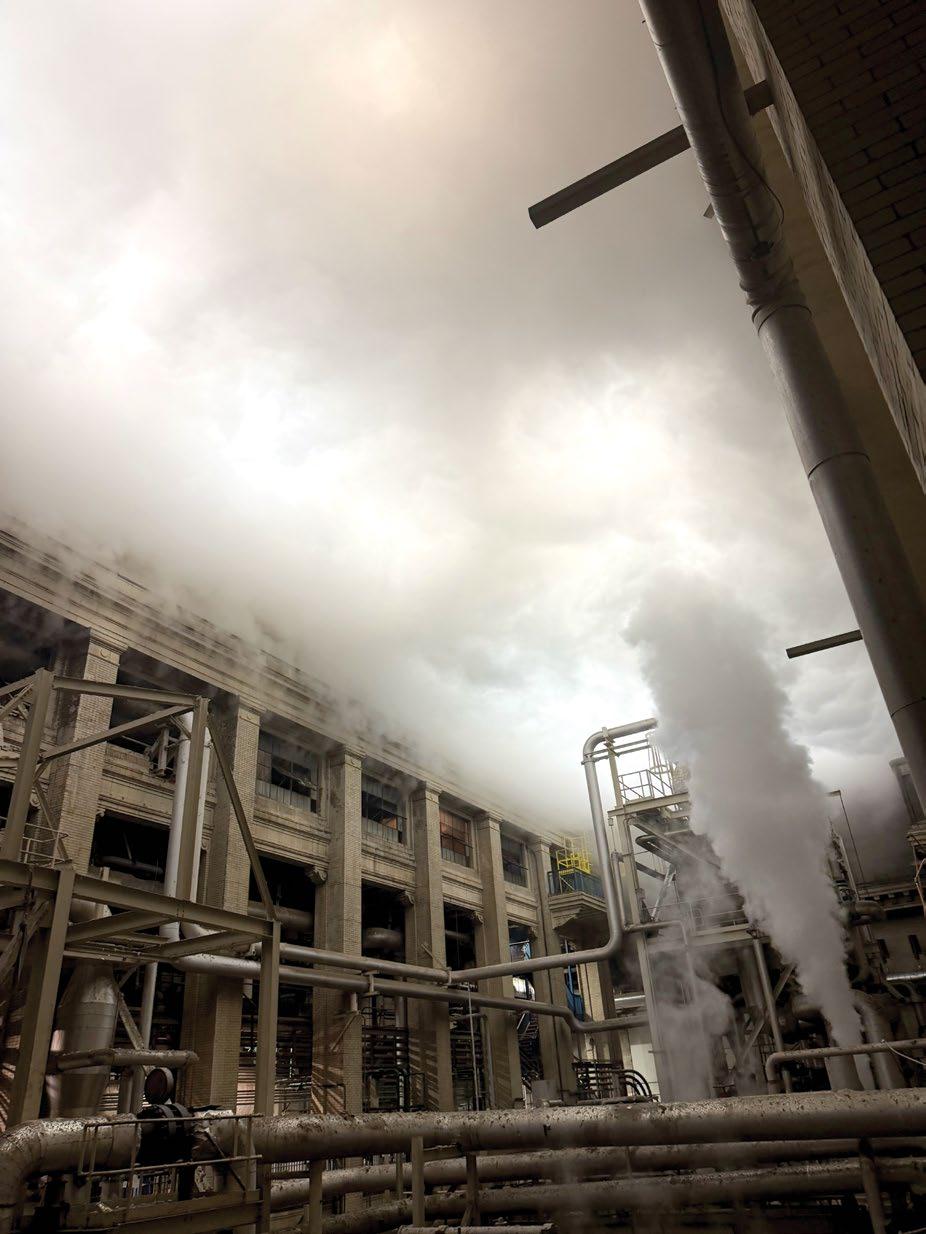
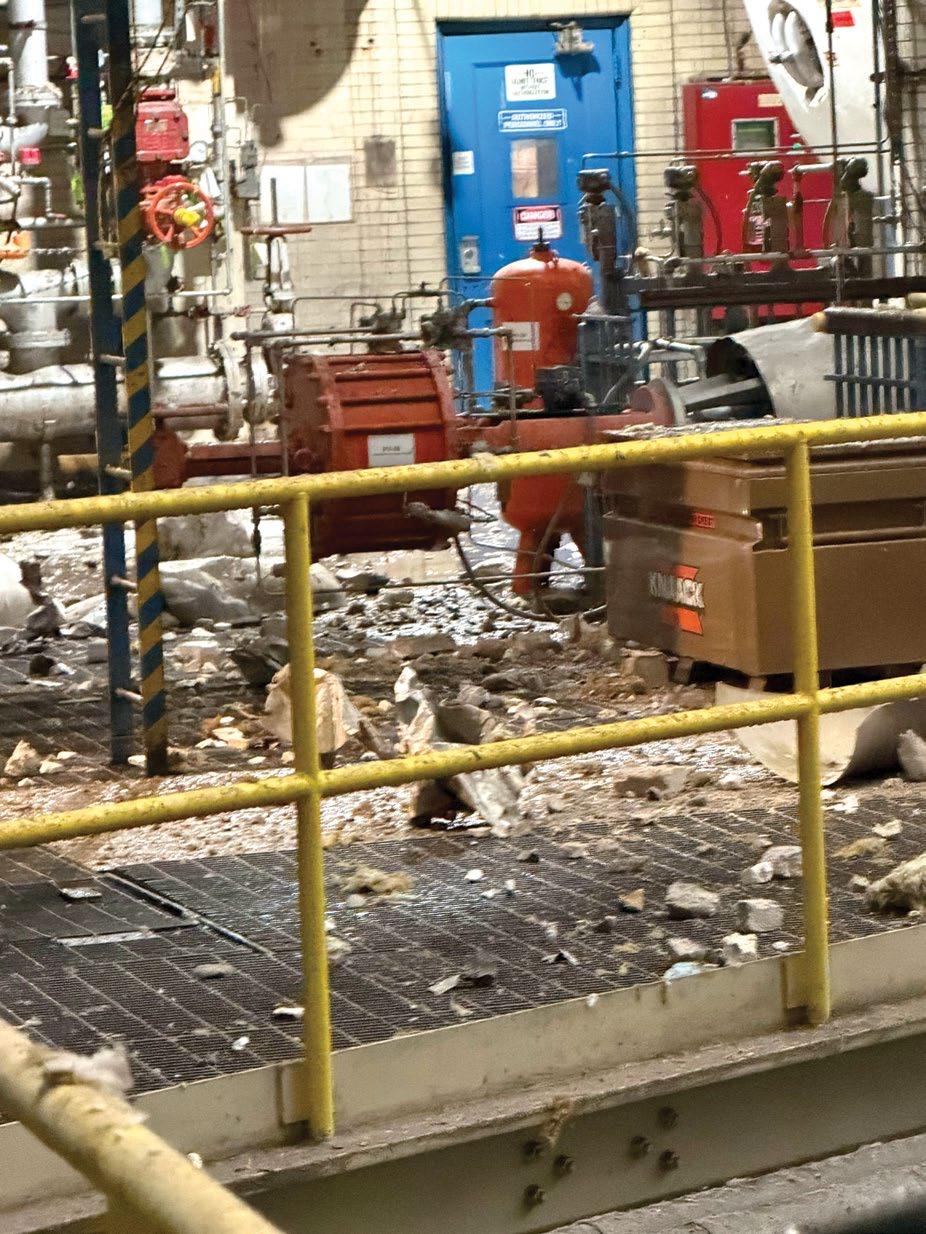
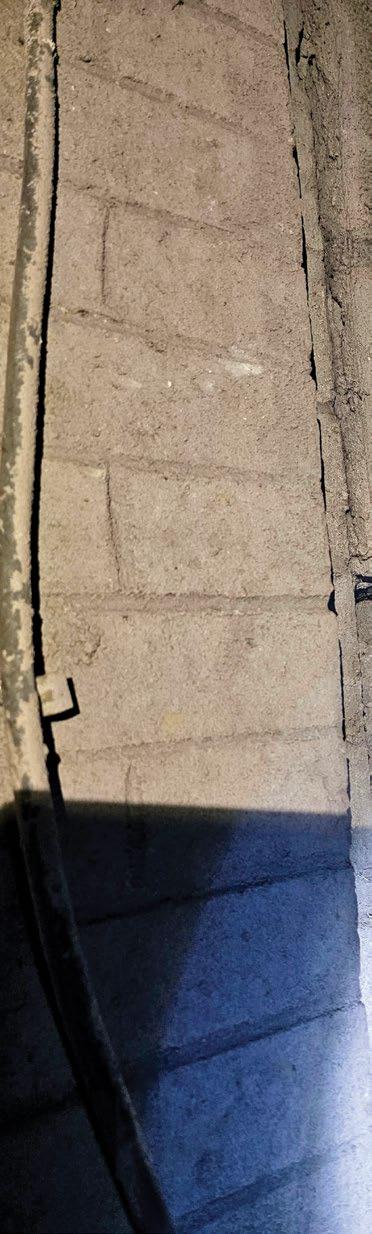
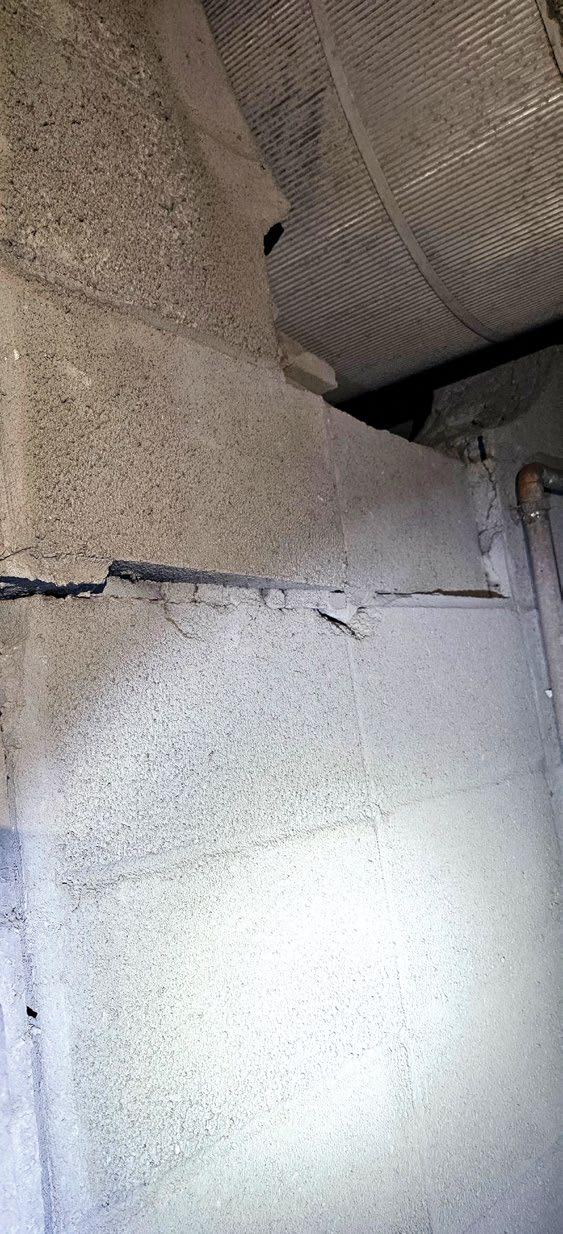
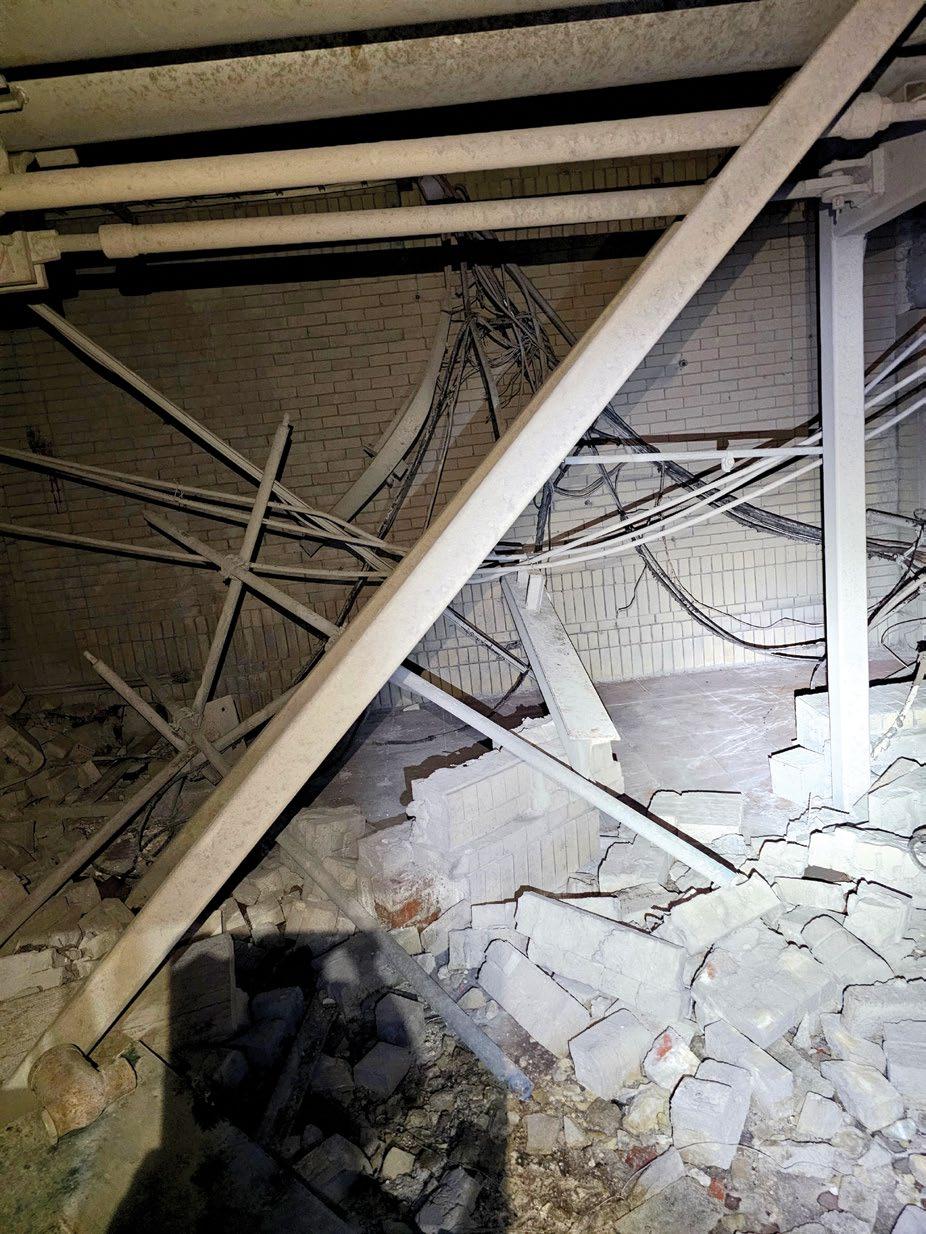
Across town at the steam plant, that “low-pressure incident” translated to something explosive. In the process of bringing a boiler online to meet increased heating demand, water vapor trapped in the pipe expanded suddenly, causing the pipe to rip open at a weld point. Steam flooded the facility. The force of the explosion propelled heavy debris, including brick, metal and asbestos insulation, throughout the inside of the plant.
No employees were near the pipe when it burst, and there were no injuries, though Sean Finnegan, an auxiliary operator at the plant and business manager for the International Brotherhood of Electrical Workers (IBEW) Local 614 says, “one guy said he was under the table because he thought the building was coming down. He was right under where it exploded.”
The incident occurred just three months after members of IBEW Local 614 filed an OSHA complaint, citing unsafe working conditions that Vicinity had failed to address. According to union president Larry Anastasi, plant employees had repeatedly raised concerns over the upkeep of equipment, as well as insufficient training for operators.
“Steam is a great form of energy [but] it requires maintenance, requires skilled labor,” says Anastasi. “When you have inundated
plants that aren’t maintained, it’s going to lend credence to those people that say things like, ‘That’s why we don’t use steam.’”
People powered
Over the century of its operation, the Philadelphia district energy system has become an interlocking matrix of machinery from different decades. Paist says the oldest operational boiler at the Schuylkill plant was established in the 1970s; with continuous repair, boilers can have a lifespan of more than 50 years.
People are perhaps the most important piece of that matrix. Paist acknowledges, “There’s always risk in bringing on a steam-generating piece of equipment”— high heat and high pressure are a volatile combination. But expert operators significantly reduce the risk of incidents like the
According to union president Larry Anastasi, plant employees had repeatedly raised concerns over the upkeep of equipment, as well as insufficient training for operators.
December explosion.
Finnegan says operating the Schuylkill plant’s unique combination of machinery requires the kind of judgment you have to learn on the job. He’s concerned that as the oldest, most experienced operators start to retire, institutional knowledge accrued over years of operating will be lost.
“A lot of guys that used to work there worked in the Navy … on boats, some of them on submarines, and it’s the same kind of equipment they used,” says Finnegan. “A lot of them guys are retired now, so that’s a lot of knowledge that’s walking out the door.”
Clark says Vicinity takes safety and operator training very seriously. Newly hired operators go through a rigorous training process that involves shadowing more experienced operators, and all staff receive annual, ongoing safety training. A statement from Vicinity added that last year’s OSHA complaint has also been reviewed and addressed. Vicinity staff have been at work on repairs to the boiler room that was damaged in the December incident, including asbestos abatement.
“We have since inspected every similar weld in our plant to ensure that there was not a similar issue that was identified in the December incident,” says Clark.
Finnegan says he would also like to see upgraded equipment installed so they don’t
have to work in fear of another incident like this happening.
When the repairs are finished, Clark says Vicinity will decide what to do with the faulty boiler. With a new electric boiler on the way, the old one may not be needed anymore.
“That boiler may just go into retirement,” says Clark.
The path to clean steam
Even further down the line, Clark says Vicinity is exploring options for thermal storage at the plant. This technology acts like a battery that stores heat rather than electricity. A material with high heat storage capacity, such as molten salt, is “charged” with excess heat generated during off-peak times that can be used to create steam during later periods of peak demand.
Thermal storage units would increase reliability by continuing to provide heat even when renewable supplies fluctuate — but Clark says Vicinity’s adoption of the technology is dependent on when more renewables start showing up in the grid. Customer demand is a big determinant for where and how Vicinity prioritizes decarbonization.
“In Philadelphia, there is a very strong interest in decarbonization,” says Clark. “There’s a lot of people who are leaning forward, still looking to move off of fossil fuels.”
An explosion in the Vicinity Energy Schuylkill plant caused damage, but no one was injured.
Thornton also cites regulation changes as important in transitioning district energy systems to zero-carbon systems. Currently, electric utilities can set their prices based on the amount of infrastructure they own, which incentivizes building new structures rather than taking advantage of existing infrastructure in a district energy system.
Additionally, Thornton says local sustainability standards, often derived from the American Society of Heating, Refrigerating and Air-Conditioning Engineers, champion building-by-building carbon solutions and don’t easily reward customers for connecting to a centralized low-carbon source.
And while district energy’s reliance on existing infrastructure is a cost-saving benefit, Thornton says new steam pipes are being laid in many places to bring pockets of new development into the network. Just this year, Vicinity completed a major extension, adding 2,000 feet of pipe to their existing loop.
Ultimately, Thornton says district energy won’t be the only solution to a zero-carbon future. Instead, it’ll offer cities a “quiver of technologies” they can use to achieve resilience.
“I think cities that have district energy are in a much better situation than the ones that don’t,” says Thornton. “A community has greater resilience, better economics, better reliability, particularly under extreme weather conditions, and ultimately has more control over its energy future.”
At the Schuylkill plant, the future of energy coexists alongside a century of past lives. The original coal dust well is still there, as well as the tracks that brought coal in from river barges. Beautiful arched windows and brick detailing sit next to utilitarian metal constructions. Inside, Cold War-era control panels have been retired in place, awaiting demolition for something newer and shinier.
“I think a lot of folks see, like, an older industrial site, and they just assume it’s bad, right?” says Paist. “We’re trying to change that story.”
Clark sees the beauty in all that juxtaposition.
“It reminds us how far we’ve come.” ◆
HOLD UP
State Sen. Katie Muth discusses her push to pause Pennsylvania’s data center frenzy
BY JORDAN
TEICHER
Data center development in Pennsylvania is booming. Last year, U.S. Sen. Dave McCormick and President Donald Trump announced $90 billion in private investments for artificial intelligence (AI) infrastructure, data centers and energy projects across the state. Today, according to the Data Center Proposal Tracker, Pennsylvania has 52 data centers, and there are at least 53 more currently proposed. Gov. Josh Shapiro wants developers to pick up the pace. In February, he announced a path to faster permitting for developers who follow stricter environmental and transparency standards.
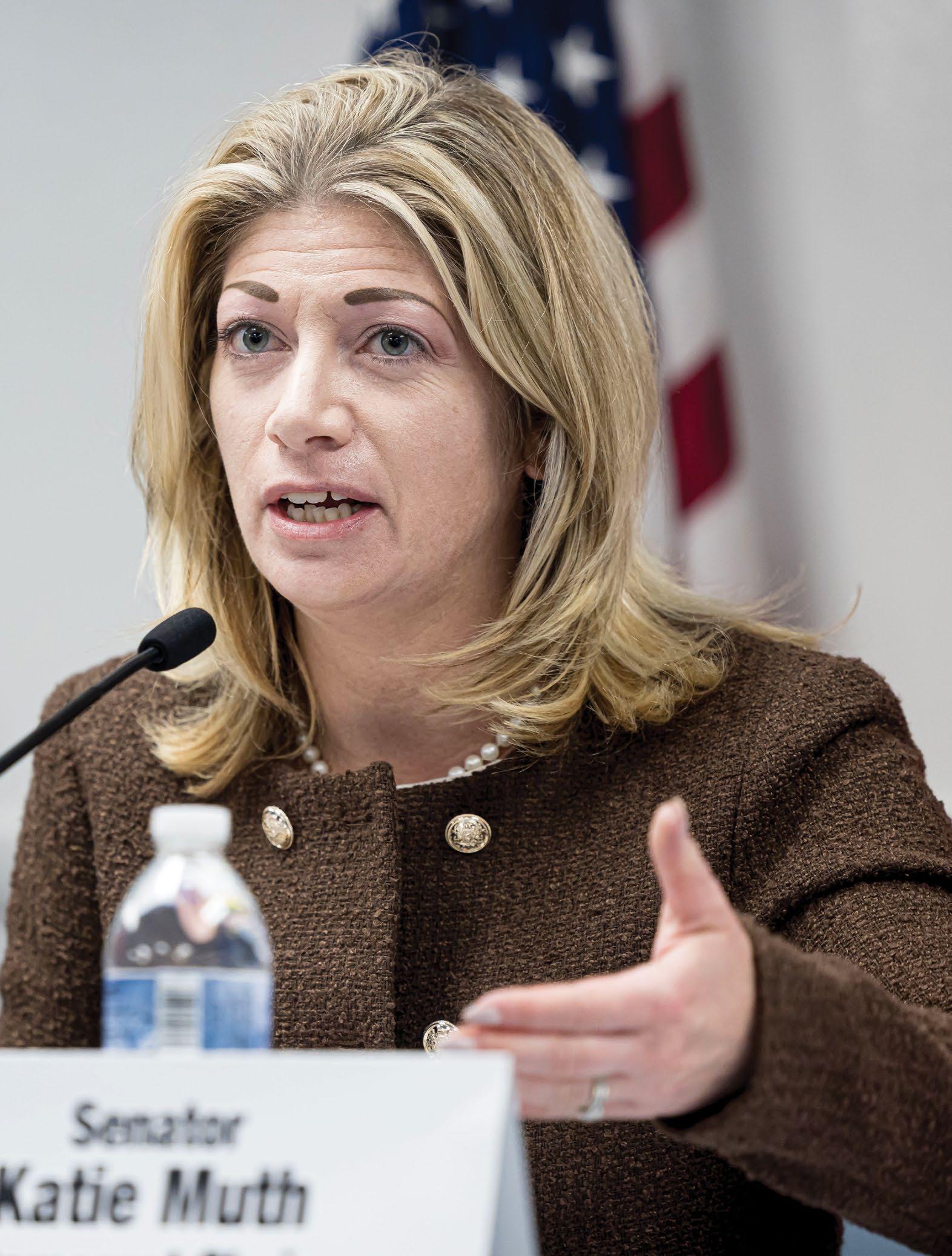
State Sen. Katie Muth, however, wants to slow things down. Muth, who represents parts of Chester, Montgomery and Berks counties, is seeing data center proposals in her district, and she’s concerned about how the structures impact human health, the environment and electricity costs. Soon, she plans to introduce legislation that would put a three-year moratorium on data center development.
Grid’s interview with Muth has been edited for length and clarity.
What inspired you to draft this legislation?
There is a race to get these projects approved. So we have places that are getting bombarded with applications, like Archbald Borough in Lackawanna County. It’s
really leaving local governments scattered and spending a lot of resources trying to find experts to analyze this stuff. So if the state really wanted to do this in a thoughtful, purposeful way, then would it be this mad-dash s***show of just unregulated development of one of the most impactful things the state will ever see?
Pennsylvania is a corporate-loyal state, and that’s why we have the most Superfund sites in the country. I just realized that if this isn’t stopped and done in a thoughtful way that there will be irreversible harm to our health and finances that all Pennsylvanians will suffer from.
Are there data center proposals in your district that concern you and your constituents? There’s one in East Whiteland Township in Chester County. Before East Whiteland Township was in my Senate district, there had been an application for a data center, and it was approved kind of incorrectly and that developer has yet to build it. He’s come back to the township with a new plan, and the people that live there are now just finding out that this was already approved. It’s relieving to see people come together and fight for the right things together, but it’s also just disappointing that people have to sit in anxiety and worry about this massive monstrosity being built on an unremediated brownfield. The other proposal is in East Vincent

I have concerns about prolonging the world’s dependence on these forms of energy that are literally melting the Earth.”
katie muth, Pennsylvania state senator
Township where I live. That site is right next to the Southeastern Veterans’ Center, and that’s a long-term care facility. This proposal would have a hyperscale data center with power generation, substation and battery storage within 420-some feet of the Center. And this is also another unremediated brownfield.
Part of the reason for a moratorium, you write, is that it will “allow state regulators to use this thoughtful pause as an opportunity to update policies and regulations to protect our Commonwealth.” In March,
the PA House passed H.B. 1834, legislation that would create the first-ever regulatory framework for data centers in Pennsylvania. To what extent would this legislation, if signed into law, address the concerns you have about data center development? I worry that it’s more performative than impactful. It still allows for like 90% of fossil fuel generation. And I have concerns about prolonging the world’s dependence on these forms of energy that are literally melting the Earth. So that does give me pause. I think that the ratepayer protection parts are okay. My understanding of 1834
is that it was created to assist independent data center developers against the big dogs of Amazon and Microsoft.
State data center moratorium bills have been introduced in 11 states this year, but none have passed their originating chamcber. What are the odds that your legislation passes? It’s a bill with my name on it, so the chances of it passing decrease dramatically. But I just don’t introduce weak s***. I purposely made it a three-year moratorium, knowing that maybe it could be entertained and amended down to someone else’s shorter timeframe. I have two unsolicited Republican co-sponsors — Rosemary Brown and Elder Vogel — and I have one other Democratic co-sponsor.
The rage about electricity prices is not partisan. People are pissed. I think the public putting the pressure on those in power will be key to making this happen. And if it doesn’t happen, at bare minimum, I think it will drive real protections and not just bare bones, performative measures.
You write that data centers are responsible for “constant noise, degrading air quality, draining our electricity supply, and depleting our local drinking water resources.” Won’t that still be the case in three years? Why not propose a ban on data center development entirely? I think that when you try to ban something outright, that becomes a non-starter in the legislature. But do I think we need hyperscale data centers? Do I think we need generative AI? Does everybody have to make every f***ing graphic on ChatGPT now? No.
I do think that there’s a corporate, exploitive angle to this in so many ways. I just know the reality of Pennsylvania. This isn’t Katie’s dream world. After the moratorium, I would hope, the thought is that you have these standards in place that if we’re going to have data centers, that they have the most minimal amount of human and economic impact, that we’re not, you know, putting 20 of these things together in a big pile in the middle of a community. ◆
State Sen. Katie Muth represents parts of Chester, Montgomery and Berks counties, where she wants to pause data center plans.
TOO CLOSE FOR COMFORT
The struggle over a potential liquefied natural gas export facility shifts to Eddystone in Delaware County
BY BERNARD BROWN
In 2022 , a pipe failed at the liquefied natural gas (LNG) export terminal in Freeport, Texas, causing an explosion and fire. The conflagration took place entirely within the facility, built on a barrier island along the Gulf of Mexico. The nearest residential area sits more than a mile away from the plant, adding a buffer from what is known as the blast zone. No one was injured inside or outside the plant.
There isn’t as much room for a natural gas explosion in Eddystone, where developers may be in negotiations with borough leaders to site a plant along the densely populated Delaware County waterfront, according to the Delaware Riverkeeper Network
The potential for an explosion is only one of the reasons Eddystone resident Eugene Wylie opposes an LNG plant in his backyard. The lack of open industrial space in the tiny municipality (about 1.5 square miles, a third of which is water) is another. Assuming the facility would be similar in size to the 1,000-acre Cove Point LNG export terminal in Maryland, “They would knock down 150 residents’ houses where the facility would go. If they need to knock down three blocks of houses, that’s one bad thing,” Wylie says.
He heard about the possible Eddystone plant from canvassers with Chester Residents Concerned for Quality Living (CRCQL), which has been fighting industrial pollution next door to Eddystone for more
than 30 years. Before the Eddystone development came to light last year, CRCQL had organized against an earlier proposal for an LNG export terminal based in Chester.
The road to Eddystone
The Chester proposal had been advanced by Penn America Energy, whose CEO, Franc James, began discussing the idea of an export terminal with elected state officials in 2016, according to reporting by State Impact
cording to the U.S. Energy Information Administration. LNG import terminals, such as those at Cove Point and Freeport, were retooled to reverse the flow.
Today, the United States exports more LNG than any other country, at more than 14 billion cubic feet per day, according to the U S Energy Information Administration Initially, Asian countries took in the largest portion of American gas, but after Russia invaded Ukraine in 2022, exports shifted
They would knock down 150 residents’ houses where the facility would go.”
eugene wylie, Eddystone resident
Pennsylvania in 2022 that brought the Chester proposal to light.
It was in 2016 that the United States started exporting LNG, after longstanding restrictions on shipping the fuel abroad from the contiguous U.S. New hydraulic fracturing technologies that allowed drillers to free up fossil gas trapped in shale resulted in a production boom, turning the U.S. from a net fossil fuel importer to an exporter, ac-
more towards Europe.
Cove Point is the nearest LNG export terminal to Pennsylvania, and the only one close to the wells tapping the Marcellus Shale. Another terminal operates at Elba Island in Georgia, while five more, including Freeport, are clustered along the Gulf Coast in Louisiana and Texas.
But with a glut of gas flowing from Pennsylvania wells (only Texas produces more
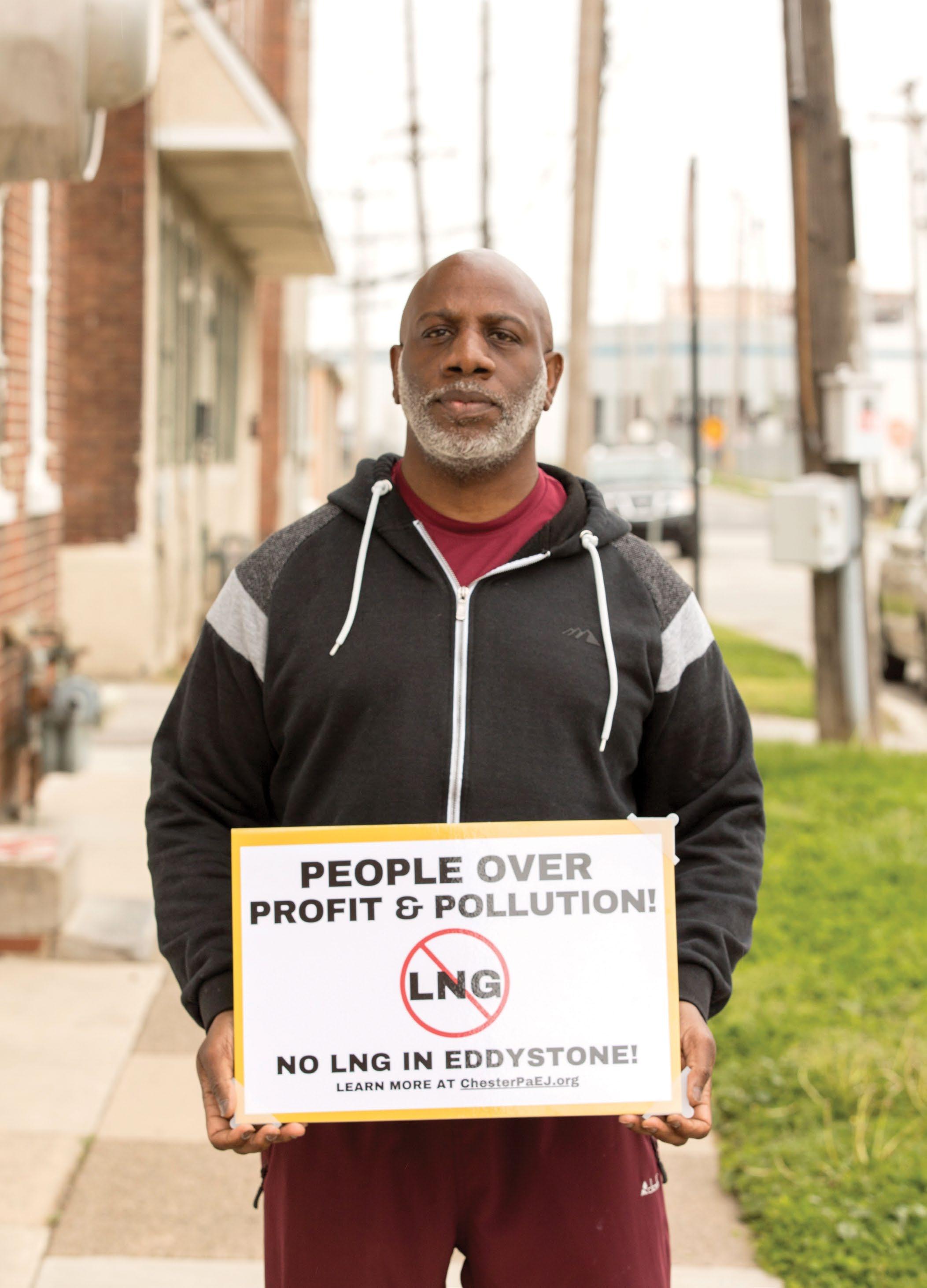
Eugene Wylie lives in Eddystone and opposes plans for an LNG plant in his neighborhood.
gas than Pennsylvania), local political leaders, labor unions and entrepreneurs want to see an export outlet closer to home.
In 2022, Northeast Philly state Sen. Martina White, R-Pa., introduced legislation to create a Philadelphia LNG Export Task Force, which passed the state House and was signed into law by then-Gov. Tom Wolf, a Democrat. The task force’s members and its hearings were dominated by industry and labor, as reported in Grid #170. In the task force’s final report, local environmental justice concerns were addressed only in a rebuttal written by task force member Rep. Joe Hohenstein.
The report promoted gas as a clean alternative to coal, stating that “Natural gas has the potential to mitigate the risks associated with climate change by significantly reducing global carbon emissions. By transitioning away from carbon-intensive fossil fuels, the United States can be a global leader in reducing greenhouse gas emissions.”
But carbon dioxide produced from burning methane, the principal fossil gas pumped from the ground, makes up only about 34% of the total emissions generated from getting it from the well to the final consumer overseas, according to a 2024 analysis by a Cornell University researcher Methane is itself a powerful greenhouse gas, and when leaks at every step of the process are considered, along with the energy it takes to transport and liquefy it, total lifecycle emissions exceed those from coal by 33%.
Nonetheless, Republican Sen. Dave McCormick is a vocal booster of Pennsylvania’s fossil fuel industry. In an April 2025 Washington Times op-ed titled “The Road to Energy Dominance Runs Through Pennsylvania,” McCormick wrote about planned LNG export projects: “Philadelphia Gas Works [PGW] is working to export LNG through the Port of Philadelphia. Penn America Energy and the Pennsylvania Building Trades are collaborating on a $7 billion project to build a new LNG export terminal along the Delaware River in Eddystone.”
That Eddystone proposal was news to the Delaware Riverkeeper Network, which files monthly right-to-know requests with the state government to keep an eye on any new developments, according to Tracy Carluccio, the network’s deputy director. “We immediately added that to our right-to-know request.” Those requests turned up mention of an entity called Eddystone Energy LLC, which was incorporated in Delaware in May
2025, apparently taking the place of Penn America. Over the next few months, more documents came to light, making clear that Eddystone Energy was communicating with state and local officials, but both the Pennsylvania Department of Community & Economic Development and Eddystone Borough claimed that a nondisclosure agreement prevents them from sharing ad-
ditional information through right-to-know requests, Carluccio says.
Carluccio says that the Riverkeeper Network is currently in mediation with the borough to sort out what documents are actually protected by the nondisclosure agreement. Grid has reached out to Eddystone’s mayor and borough manager, but has not received a response.
LNG is simply not welcome here … I’m not pushing [our projects] out to accommodate a blast zone.”
stefan roots, Mayor of Chester
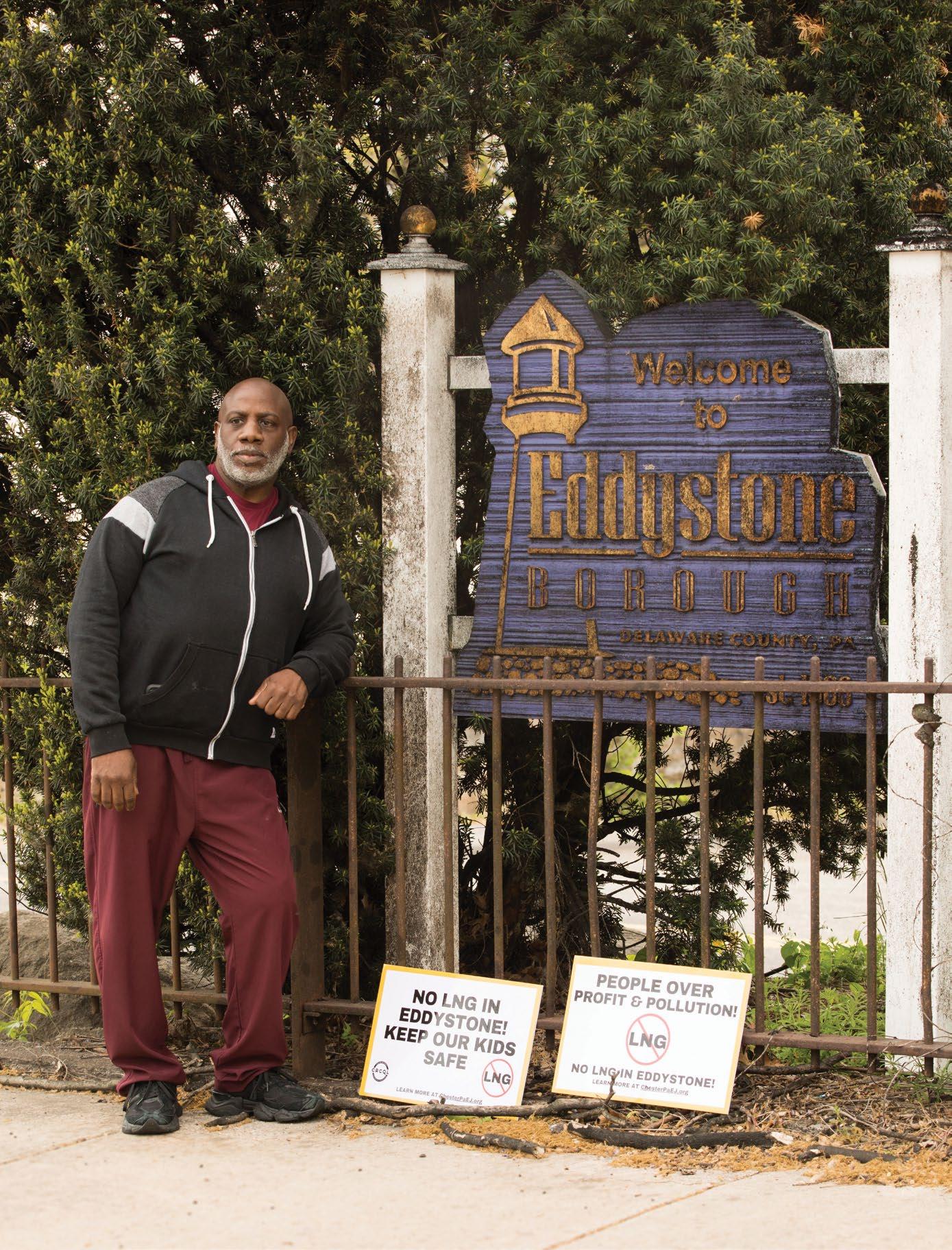
Plans situate the LNG plant on the Industrial Highway, which runs through Eddystone and Chester along the Delaware River waterfront.
PHOTO BY TAYLOR ECKER
Button-lipped
“Every person is staying button-lipped,” Wylie says. “I sent emails to council members, the mayor, the manager. No one replied.”
At a Nov. 5, 2025, meeting of the Pennsylvania House committee on Environmental & Natural Resource Protection , held in Chester, speakers objected to siting an LNG plant in Chester or in any of the other frontline communities along the Delaware River.
“LNG is simply not welcome here,” Chester Mayor Stefan Roots said. He went on to explain that there isn’t the space to safely site an LNG facility in Chester. “We have new multimillion dollar development projects in the blast zone underway in this area, including our Chester City Public Works garage and a new power home remodeling facility… I’m not pushing them out to accommodate a blast zone.” Roots said he sees Chester’s future in nonindustrial development, developing the city as an attractive place to visit and live. “As we seek to revitalize Chester, my vision is to build new housing and attract new residents to the city.”
Zulene Mayfield, a longtime advocate for environmental justice in Chester and a chairperson of CRCQL, said there are 11 major sources of air pollution in Chester already, including a trash-burning power plant and a sewage treatment plant that incinerates sludge. Mayfield drew a connection between these pollution sources and cancer deaths in her community. “If we value the health of our families, our friends and neighbors and throughout the Commonwealth, we need to build a different future, one in which we can all thrive,” she testified. “We should not be building a future in which growing numbers of parents are burying their children. Building a healthy future means there’s absolutely no room for Penn America’s LNG plant, not in Chester, not in Eddystone, not in Marcus Hook, and not, for that matter, in South Philly or anywhere.”
Wylie rejects claims that an LNG terminal would bring many jobs to Eddystone or that local residents would be qualified for higher-paying positions. “There’s no one in Eddystone with a chemical degree,” he says. “The only positives that can come out of it are for the company that will make money off of it. The LNG is shipped to other countries. The pros and cons don’t match.” ◆
GREEN PAGES
BEAUTY
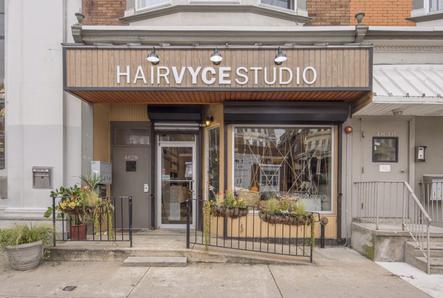
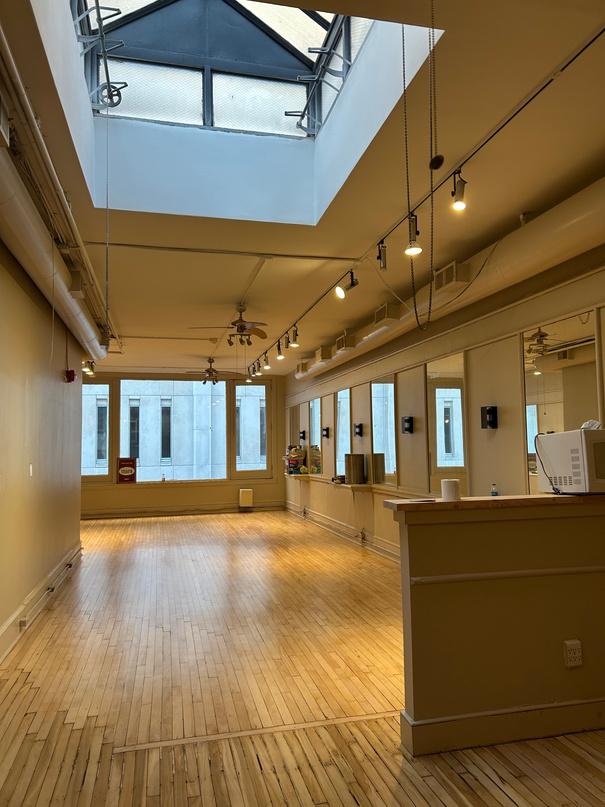
Hair Vyce Studio
Multicultural hair salon located in University City servicing West Philly & South Jersey since 2013. We specialize in premier hair cuts, color & natural hair for all ages. (215) 921-9770 hairvyce.com
BOOKS
Books & Stuff
The Giving Book Shop! Help me donate books next month by purchasing books I donated this month! books-stuff.com
COMPOSTING
Back to Earth
Compost Crew
Residential curbside compost pick-up, commercial pick-up, five collection sites & compost education workshops. Montgomery County & parts of Chester County. First month free trial. backtoearthcompost.com
Bennett Compost
The area’s longest running organics collection service (est 2009) serving all of Philadelphia with residential and commercial pickups and locally-made soil products. 215.520.2406 bennettcompost.com
EATS
Fifth of a Farm
Our jams are a tribute to Philly, capturing its rich heritage in every jar. Whether you’re a longtime resident or passing through, take home a taste of the local tradition. Find yours @ fifthofafarm.com
EDUCATION
Kimberton Waldorf School
A holistic education for students in preschool-12th grade. Emphasizes creativity, critical thinking, nature, the arts & experiential learning. Register for an Open House! (610) 933-3635 kimberton.org
ELECTRICIAN
Echo House Electric
Local electrician who works to provide high-quality results on private & public sector projects including old buildings, new construction, residential, commercial & institutional. Minority business. echohouseelectric.com
FARM Germantown
Garden
Urban farm with farm stand and plant nursery selling locally grown produce, bread, eggs, veggie and herb seedlings, perennials, trees and shrubs. 215 East Penn St., 19144 germantownkitchengarden.com
GREEN BURIAL
Laurel Hill
With our commitment to sustainability, Laurel Hill Cemeteries & Funeral Home specializes in green burials and funerals, has a variety of eco-friendly products to choose from, and offers pet aquamation. laurelhillphl.com
GREEN CLEANING
Holistic Home LLC
Philly’s original green cleaning service, est 2010. Handmade & hypoallergenic products w/ natural ingredients & essential oils. Safe for kids, pets & our cleaners. 215-421-405
HolisticHomeLLC@gmail.com
GROCERY
Kimberton
Whole Foods
A family-owned and operated natural grocery store with seven locations in Southeastern PA, selling local, organic and sustainably-grown food for over thirty years. kimbertonwholefoods.com
MAKERS
Mount
Airy Candle Co.
Makers of uniquely scented candles, handcrafted perfumery and body care products. Follow us on Instagram @mountairycandleco and find us at retailers throughout the region. mountairycandle.com
Makers, small businesses and green entrepreneurs: Place your ad here!
A DECISION DEFERRED
PGW looks to expand liquefied natural gas operations, despite decarbonization goals
BY BERNARD BROWN
On tuesday, april 14, the Philadelphia Gas Commission — the government body that oversees the City-owned Philadelphia Gas Works — did something highly unusual. It voted to table a vote on PGW’s 2027 capital budget, basically postponing a routine step until a later date. “I was very surprised that the Commission did not make a decision,” says Robert Ballenger, an attorney with Community Legal Services, which is contracted to represent the interests of PGW ratepayers as the utility’s public advocate.
Commissioner and City Council member Mike Driscoll asked that they table the decision to allow for more time to gather information about PGW’s request for $182 million to buy a new liquefier for its Port Richmond liquefied natural gas (LNG) plant. “This is a complex issue deserving more study,” Driscoll said in the April meeting.
The issue revolves around two 12-story tanks that loom over Columbus Boulevard near the Port Richmond waterfront. They fit in with the industrial landscape, sitting across the street from the Tioga Marine Terminal and next door to a water department sewage treatment plant.
Those tanks can hold four billion cubic feet of LNG, enough to get PGW’s customers through the coldest winter PGW can imagine.
Behind those tanks, a complex jumble of pipes feeds gas into equipment that cools the hydrocarbons to 270 degrees below
zero, at which point they condense into a liquid that takes up about 1/600th of the space, making it more efficient to store and transport.
What is harder to see is the gas, invisible to the naked eye, that leaks out or is intentionally vented to maintain the correct pressure in the tanks and the liquefying equipment. But filmed with an optical gas imaging camera like the one Physicians for Social Responsibility Pennsylvania has, the invisible gases pop into view on a video the group posted to YouTube. “You can point it at the facility and see,” says Linnea Bond, the group’s environment and health education director. “You can see this is a cloud of hydrocarbons.”
As Philadelphia winters warm due to climate change, and as the City attempts to meet its emissions reduction goals, Port Richmond residents Eric Stowe and Sara Baier are not convinced that the new liquefier would be a good purchase.
Baier and Stowe have not seen PGW reach out to the neighborhood around the facility, which led them and a group of other Port Richmond residents to organize. “For me, it has a lot to do with PGW not being transparent with residents that live in our neighborhood,” Baier says.
“What doesn’t make sense is building a brand new plant that’ll be ready by 2030 and has the ability to produce more LNG that we might not need,” Stowe says.
Along with Bond’s concerns about air pollution from plant operations, she says the

new, scaled-up liquefier would be a step back in the City’s path towards its stated goal of going carbon neutral by 2050. “We’ve got the question of investing in infrastructure for a system that we don’t want and that the city is sort of, at least in principle, supposed to be moving away from,” Bond says.
Devin McDougall, supervising senior attorney with Earthjustice, agrees.
“I think it’s concerning that PGW is proposing to make such a large investment in expanding fossil fuel infrastructure without analyzing its climate impacts or explaining how such an investment can be reconciled with the City of Philadelphia’s commitment to net zero greenhouse gas emissions by 2050,” McDougall says.
A 2021 study of options for PGW to decarbonize pointed to geothermal heating and cooling as a low-emissions service the utility is well-suited to provide. PGW has been slow to roll out a pilot, however, as Grid has reported. PGW’s representative wrote that the utility expects this spring to be able to
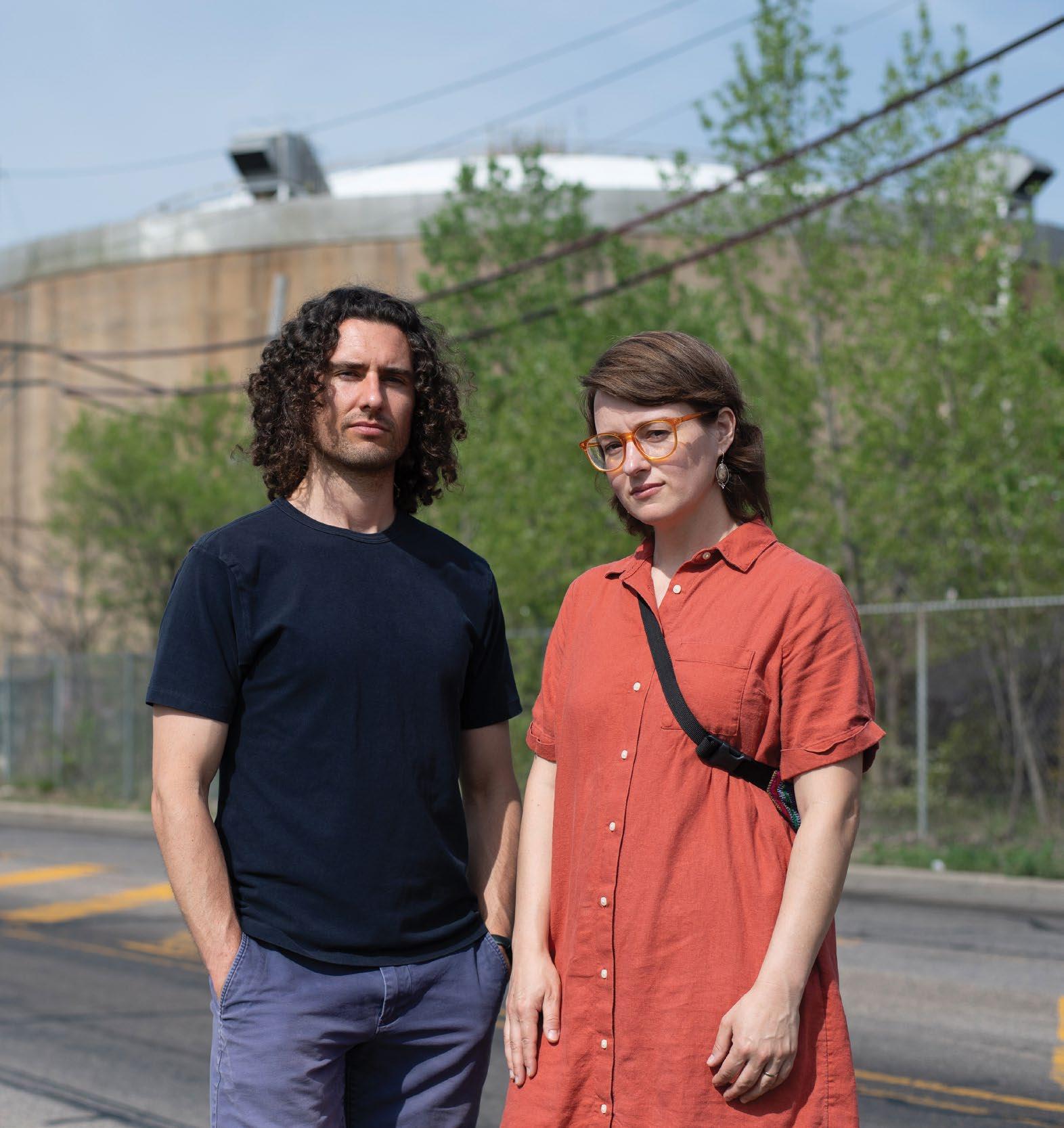
If PGW builds a plant that’s larger than it needs, then customers are maybe paying more than they should be paying.”
robert ballenger, attorney, Community Legal Services
announce the results of a feasibility study of a geothermal pilot at the John F. McCloskey Elementary School and the adjacent Dorothy Emanuel Recreation Center. PGW also plans to hold community meetings about long-term greenhouse gas reductions before October, though it has not set the dates.
PGW says the primary purpose of its LNG plant is to ensure reliability through what the utility calls “peak shaving,” a form of price arbitrage. Gas reaches Philadelphia
through a network of pipelines. The price of the gas depends on demand, so it is relatively expensive in the winter, when millions of buildings across North America use it for heating. PGW buys extra gas off the pipeline in the spring and fall when the price is low and stores it as a liquid. Then, in the winter, PGW can convert it back to a gas for its customers to use.
PGW doesn’t only use LNG to save money. The utility stores gas for the winter based
on its estimate of the most it could need — its “design winter.” The worst thing that can happen is to run out of supply during a freak cold snap, leaving customers without heat when they need it most. That means that virtually every year, PGW ends up with leftover LNG, which it sells to regional buyers who truck it away.
The current liquefier dates back to 2002, and PGW says it is nearing the end of its life. “PGW is proactively seeking to replace the system before the current system fails to avoid severe service disruptions to customers and increased costs,” a PGW representative wrote in reply to Grid’s request for comment.
The proposed liquefier would be able to operate year-round (not just spring and fall as is now the case), which would also increase PGW’s capacity to liquefy gas from 2.2 billion cubic feet per year to 3.3 billion cubic feet per year, as Ballenger points out.
Complicating its request for a new liquefier is PGW’s search for a public-private partnership with an outside entity that might provide financing for a new gas liquefier, as PGW explains in its capital budget proposal. “If an agreement is reached, PGW will no longer need the funding requested herein for this liquefier project.”
The potential public- private partnership adds more uncertainty for Stowe. “It’s not clear what their role is,” he says.
Along with expressing concerns that the new liquefier doesn’t align with the City’s sustainability goals, Ballenger thinks it is oversized and disagrees with PGW’s estimate of when they’ll need to replace the current one. PGW would likely need to borrow money to pay for a $182 million purchase, he says, and the payments on that debt would be passed along to customers. “If PGW builds a plant that’s larger than it needs, then customers are maybe paying more than they should be paying.”
As for the new liquefier, the Commission will have to make a decision on PGW’s fiscal year 2027 capital budget, which, according to Ballenger, will likely be presented at the May 12 meeting, or at a special session. Members of the public have the opportunity to weigh in at the upcoming meeting ◆
Eric Stowe and Sara Baier organized other Port Richmond residents to oppose possible plans to add a natural gas liquefier to the existing pair on Columbus Boulevard. PHOTO
AN UNCERTAIN FUTURE
A York County valley is at risk of flooding by energy storage center plans
STORY AND PHOTO BY BERNARD BROWN
When york energy storage LLC proposed in 2023 to turn the small valley of Cuff’s Run in York County, on the western bank of the Susquehanna River, into an energy storage reservoir, William McMahon, the engineer and energy entrepreneur behind the plan, billed it as a solution to the limitations of renewable energy. As is often said, the wind doesn’t always blow, and the sun doesn’t shine at night. The grid needs to store renewable energy to ensure an even supply.
In 2026, as artificial intelligence data centers spring up across America and energy prices rise, McMahon says the project is critical. “There is a great need for storage in the PJM grid,” he says.
Soon after Grid’s article ran in 2024, the Federal Energy Regulatory Commission (FERC) granted York Energy Storage a preliminary permit. In effect for four years, it gives the company priority for building a project on the site (essentially calling dibs) and opens up a public input period as the company begins to assemble the studies and other documents necessary for a full license application. If granted, the license would allow the company to build the project and use eminent domain to force property owners on the site to sell.
If granted, the license would allow the company to build the project and use eminent domain to force property owners on the site to sell.
The FERC’s decision drove a group of environmental organizations and local residents, led by the Lower Susquehanna Riverkeeper Association, to sue in December, demanding that the commission reverse the preliminary permit decision. The petitioners argue that the project would flood the residents out of their homes and would
ruin a scenic valley that the environmental groups have long worked to protect. The FERC argues that it followed the law and that the preliminary permit is not in itself a green light to build the project.
McMahon says he is currently looking for investors to fund the preliminary studies and, if it gets approved, the full project. Three owners with minority shares left the project in September, though McMahon says they were older friends of his who decided it was taking too much time from their retirement.
Jen and Jake Horton are petitioners in the lawsuit. Their home and farm would be flooded if the reservoir gets built. Although she thinks the loss of the minority owners and the resistance to the project indicate that it might not get built, Jen says the uncertainty is difficult for residents, particularly if they want to sell their property while the preliminary permit is in effect. “No one’s going to buy your home with something like this looming over it.” ◆
Jen and Jake Horton’s farm would be flooded by a proposed energy storage reservoir.

HUB PLANS HINDERED
Clean energy plans scaled back by the Trump administration are in danger of losing funding
BY BERNARD BROWN
President joe biden visited Philadelphia in 2023 to make a big energy announcement: the Philadelphia area would be home to MACH2, a new hydrogen hub, one of seven nationwide. But a year and a half into the second Trump administration, the project’s future is uncertain.
The Biden administration planned to pump $7 billion into regional centers for hydrogen production, taking advantage of a gas that, when combusted or run through a fuel cell, produces only water and energy. As Grid reported at the time, labor unions and industry representatives lined up behind the initiative, along with some envi-
ronmental organizations such as the National Wildlife Federation. But not everyone else was on board
Critics questioned whether it would be feasible to produce hydrogen using renewable energy, given how little wind and solar are currently generated in the Mid-Atlantic. Environmental justice advocates such as Chester Residents Concerned for Quality Living found themselves excluded from the planning process, prompting them to send a joint letter saying MACH2 had failed to engage the community.
The Trump administration hasn’t completely trashed the hydrogen hubs, but “rather than do a blanket elimination of all of the programs and projects, it has chosen instead to treat the individual projects as separate entities,” says Sean O’Leary, a senior researcher at the Ohio River Valley Institute. O’Leary says the administration also dismissed the staff of the Energy Department’s Office of Clean Energy Demonstrations, which had coordinated the hub rollout.
MACH2 did not respond to requests for comment. Based on information on its website, the scale of the hub has shrunk considerably. Biden initially said it would produce 100,000 tons of hydrogen per year. The MACH2 website currently lists one request for information seeking a producer that could provide 50 metric tons per day (18,250 per year).
But even if the federal government ends up funding the hubs, they might still flounder due to the fundamental economics of hydrogen. “They will not be able to find significant numbers of offtakers for this,” O’Leary says. “And it’s because virtually all of the uses for which they projected hydrogen to be used could frankly be performed more cost-effectively by other means.” ◆
Former President Joe Biden’s administration had high hopes for funding regional hydrogen plants.

Train for success in a field working toward climate solutions
From widespread wildfire smoke to rising flood waters, and Alaskan heat waves to freezing temperatures in Texas, few communities haven’t felt the effects of a changing climate. It’s time to help our communities prepare for the future.
Penn’s Master of Environmental Studies program prepares you to step up your future environmental career–whether pursuing climate solutions in law and policy, resilience and adaptation, sustainability, or another sector with environmental impact. Built with flexibility in mind, this innovative, interdisciplinary program allows you to gain real-world experience, make industry connections, and enroll full- or part-time to suit your schedule. Take the next step in your environmental career at www.upenn.edu/grid