HOW OUR FAMILY TURNED OUR PECO BILL INTO A $254 CREDIT
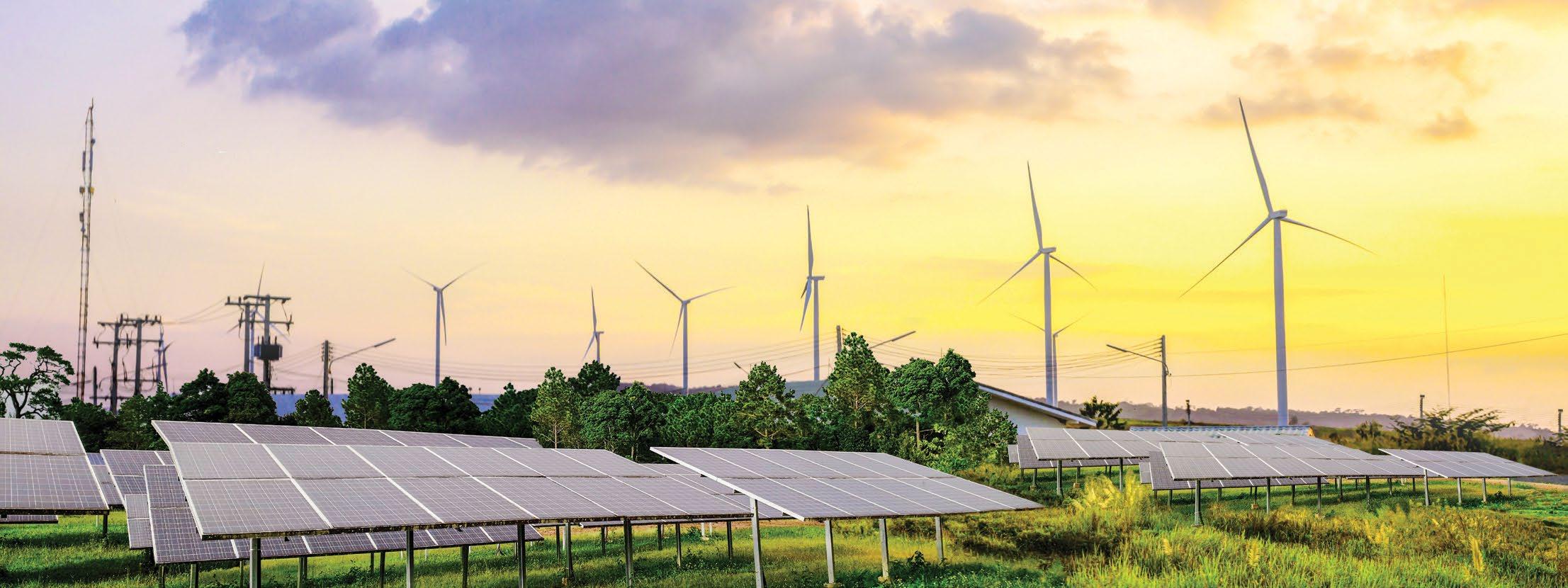
Plenty of our clients zero out their electric bill with solar. The real challenge is mastering PECO’s time-of-use plan, which requires shifting when you use power and when you sell power. If you do it right, you don’t avoid paying a bill — you earn money.
I pulled up our family’s energy bill and let my 11-year-old, Mira, see if she could understand it. Here’s our conversation, lightly edited. The short version is that PECO credited us $254!
Mira: Wait — our bill was zero? We’re making money? Micah: We are. PECO credited us $254 instead of charging us. We could’ve taken a check instead.
Mira: So how’d we do it? Micah: It comes down to a really smart system and good timing. The system is solar panels, a home battery, a smart electrical panel, and an EV charger. The timing is what PECO calls Time-of-Use (TOU), where electricity costs different amounts depending on the hour, and the swing is dramatic. “Peak power” (2-6 p.m., when everyone’s home) — costs about six times more than “super off-peak” overnight (12-6 a.m.). Our system allows us to take full advantage of these different rates. During “peak,” we run the whole house on solar energy stored in our battery, so we buy nothing at the high rate. At the same time, we sell our solar straight to the grid at that high peak rate. And we charge the EV overnight, when power’s cheapest. Same electricity everyone else uses; we just control when we use it and when we sell it.
Mira: But what is peak? Micah: It’s when the most people are using power at once. High demand, highest price. Supply and demand.
Mira: Because that’s when people are getting home from work? I get home from
by micah gold-markel
school at three. Micah: Exactly, right in the priciest window. On our plan, peak runs about 32 cents a unit, off-peak about 7.5 cents, and super off-peak overnight about a nickel.* That’s why the battery matters: it covers the house during peak so we’re not buying at the high rate, and can sell all the solar production during those hours at the highest price.
Mira: So the battery just saves the extra power? Micah: That’s the heart of it. It lets us use or sell our solar when it’s worth the most, not the second it’s made.
Mira: The bill says $388, then $202. Why is one half the other? Micah: The $388 is
* Rates shown are PECO time-of-use generation rates from our actual bill at the time of recording — Peak $0.3196, Off-Peak $0.07595, Super Off-Peak $0.05274 per kWh. Utility rates change over time and vary by plan.
everything we’d banked so far. The $202 is just this month — our system switched on last winter, so now that it’s sunny we bank almost as much in one month as we did all winter.
Mira: So how’d we get the $254? Micah: Every May, PECO settles up and cashes you out. Ours came to a $254 credit. The $0 bill, and then some.
Curious whether your home could do the same? Watch Mira and me review our bill by scanning the QR code, then get a quote at solar-states.com/start. ◆
Micah Gold-Markel is the founder of Solar States, a Philadelphia-based solar and storage installer.
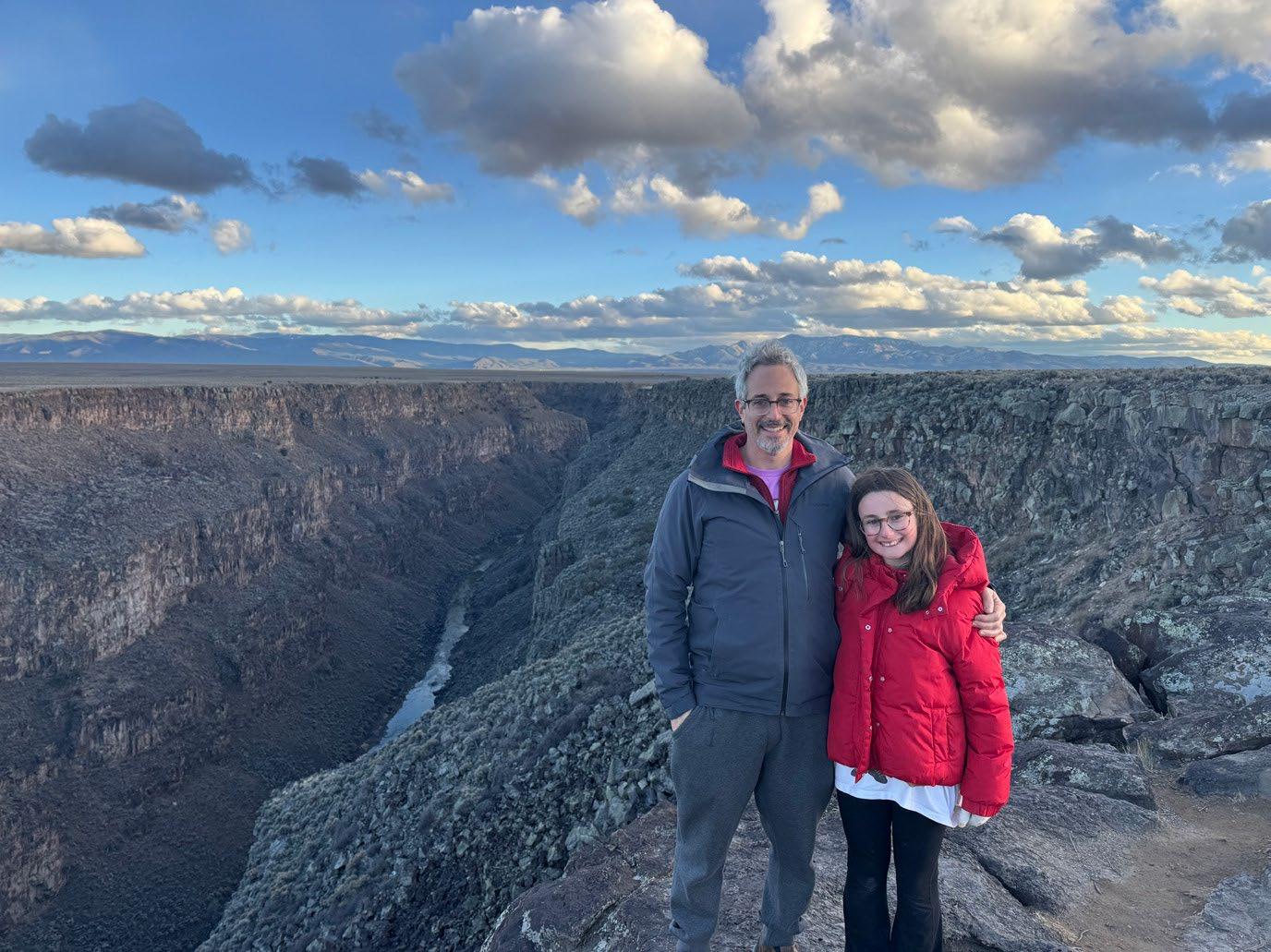
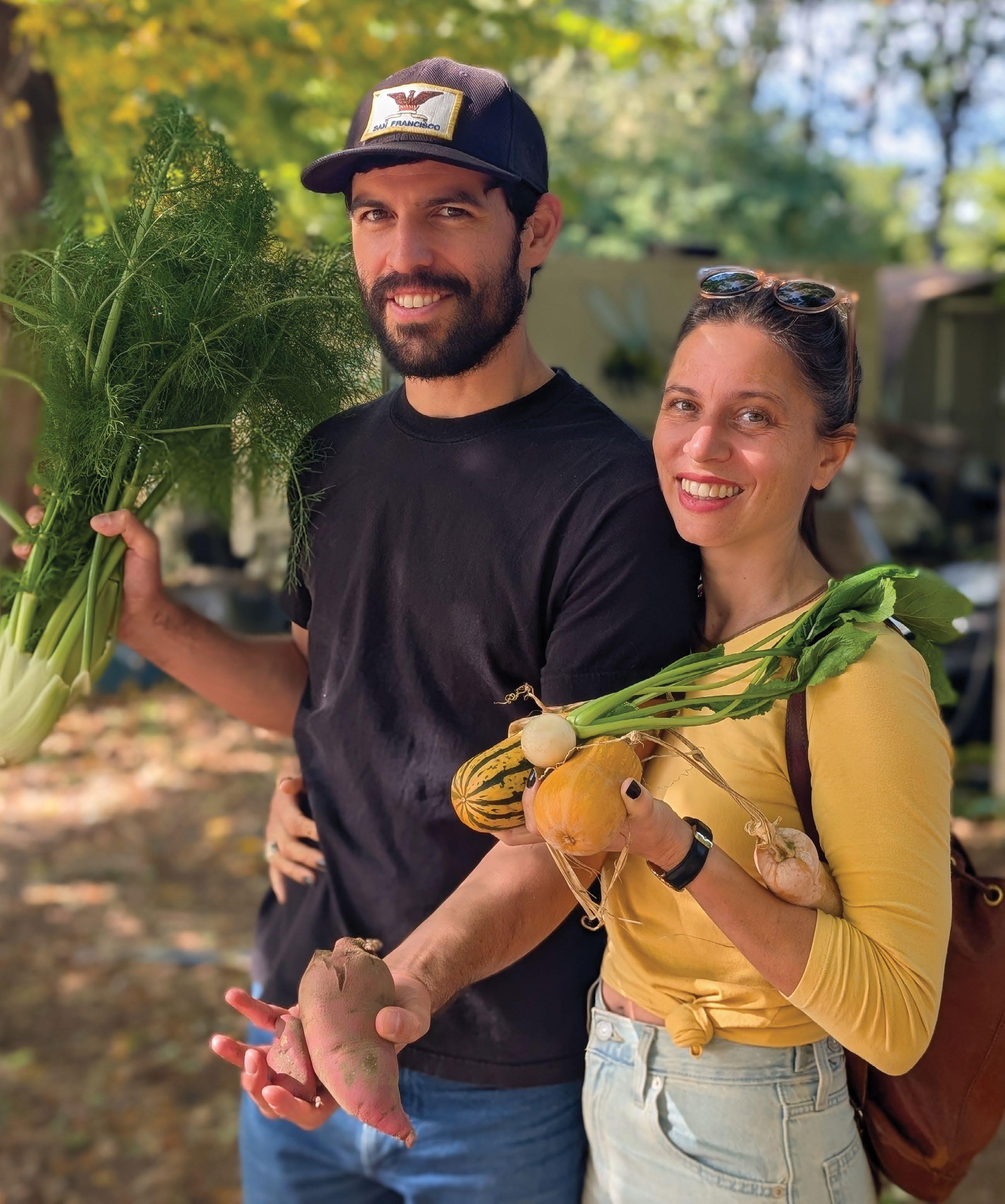
Solar States founder Micah Gold-Markel and his daughter, Mira, at the Rio Grande Gorge.
Amplified Ideas
Social Impact Studios sows idealism at 30th anniversary pop-up by sophie
aanerud
An empty shopfront on South Street is in the midst of transformation. Ennis Carter, the founder of Social Impact Studios, a Philadelphia-based “creative hub,” affixes bolts of colorful paper to a wall and unfurls a vibrant, refrigerator-sized hand-painted canvas beneath a banner proclaiming “Made with Artistry & Activism.”
For the month of July, the space at Seventh and South streets will serve as the site
of a pop-up exhibition celebrating the 30th anniversary of Social Impact Studios.
The space, full of vivid posters encouraging viewers to “Make it Happen” and “Eat. Play. Live … Better,” feels a bit like a shrine to positivity, which, according to Carter, is exactly the point. “This is a really important moment to celebrate the idea of putting positive messaging out into the world,” she says.
Social Impact Studios started as a passion project, run out of Carter’s bedroom. Since
its inception, the studio has morphed and grown into a widely recognized institution that has worked on thousands of projects alongside nonprofits from across the country.
“[We’re] like a creative agency, but for people who are making the world a better place,” Carter says.
The studio’s mission of “amplify[ing] inspired ideas that spark positive action” takes many forms. They have provided branding for arts and cultural collaboratives like the Intercultural Leadership Institute, designed logos for nonprofits including Hosts for Hospitals, and crafted the national farmers market “Buy Fresh Buy Local” initiative.
Often, Carter notes, the studio functions as a translator, distilling the complex jargon of nonprofits into narratives and slogans that spark public engagement. “When you’re really close to something, you know all the ins and outs, so you can make it overly complicated. I just felt really called to helping people simplify and amplify,” she says.
The pop-up exhibit will highlight the studio’s extensive portfolio and the three decades of creative work in community engagement and social change it represents.
“A retrospective of our work is actually showing 30 years of social impact by everybody we’ve ever worked with,” Carter says. “We’ve worked with hundreds and hundreds and hundreds of groups … and so we just want to celebrate.”
The theme of the exhibition, which will open July 3, is “Say it, see it, be it.” The message captures Social Impact Studios’s emphasis on positive action and summarizes Carter’s own creative and professional journey.
Encouraged by the response to the graphic design work she’d done as a fulltime organizer, Carter opened Social Impact Studios in 1996 to fill an underserved niche in the nonprofit sector.
“I had a more effective experience as an organizer by making posters and graphics and banners and things that would get attention,” recalls Carter. “It seemed that there was a need for people who understood the nonprofit sector or the political activist grassroots work and could also kind of make it a bit more directly geared toward the public.”
Social Impact Studios
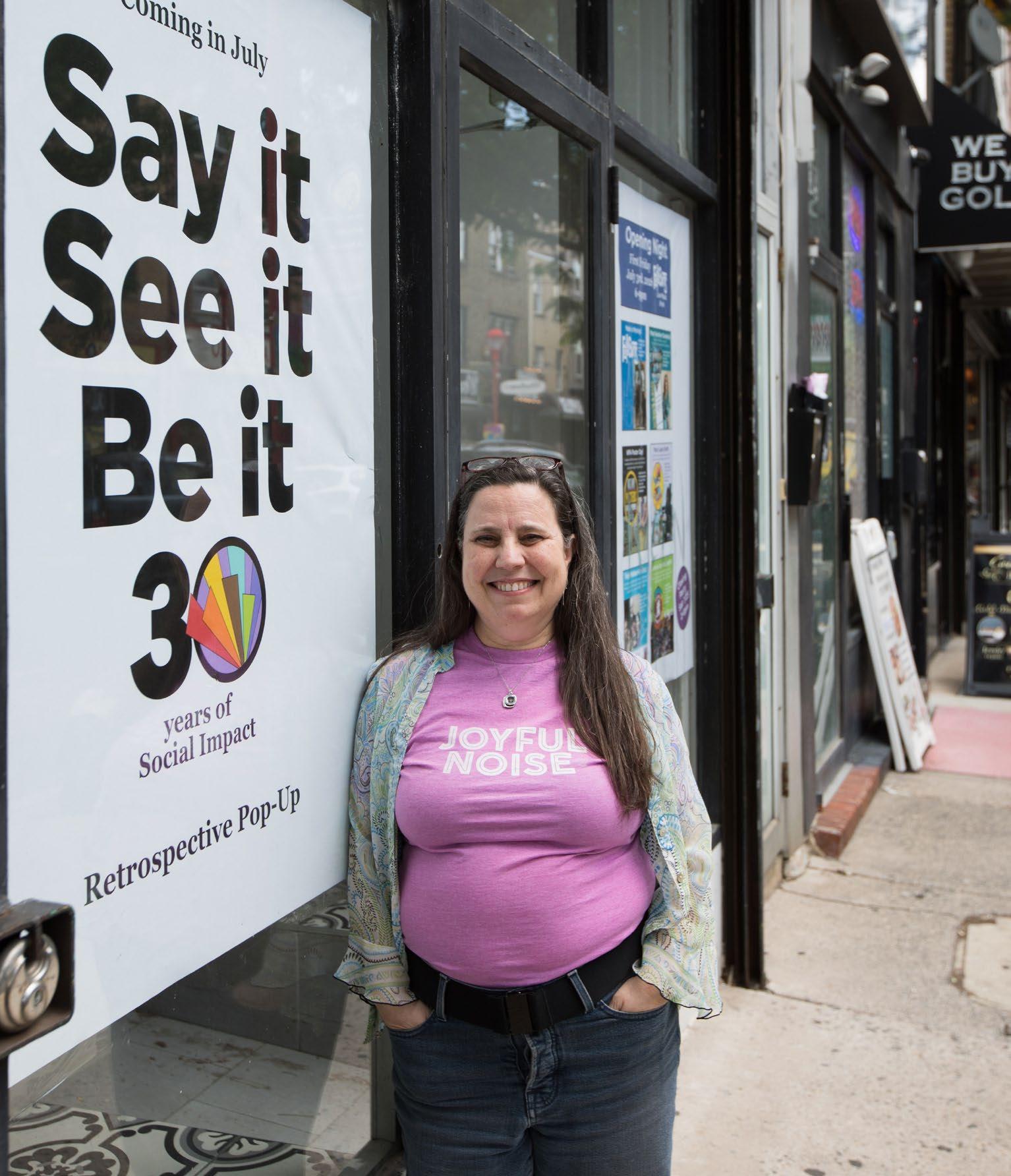
founder Ennis Carter is hosting a retrospective pop-up on South Street, which will be open through July, for its 30th anniversary.
Started as a graphic design and publication design business, Social Impact Studios shifted and expanded to meet the technological and political demands of the time. Carter recalls the pre-internet days when much of her time was spent faxing and mailing proofs to clients.
Today, Social Impact Studios serves as a collaborative institution where nonprofits can bounce ideas and learn narrative techniques honed through decades of trial and error. “We help create a strategy for how to get people to hear about your program, how are you going to promote it, how are you going to make it something that is as beautiful as what it is,” Carter says.
The exhibition aims to celebrate 30 years
I know you can make anything you want to make, [but] we don’t live in a culture that is supporting that or even supporting people being themselves.”
ennis carter, founder, Social Impact Studios
of activism while also inspiring idealism in an environment that Carter acknowledges is bent toward pessimism.
“As a designer, I’m a little bit spoiled in that I know you can do the impossible, I know you can make anything you want to make, [but] we don’t live in a culture that is supporting that or even supporting people being themselves,” Carter notes. “This is a really important moment to celebrate the idea of putting positive messaging out into the world, because that’s what’s going to help us actually become anything that we think we want to become.”
The pop-up will host a variety of events throughout July, including live performances (Carter and her husband are also musicians), book readings and screen-printing sessions. ◆
conditions,” Warner says. “There’s a good reason to be cautious.”
Feick says the college is committed to adhering to the highest sustainability standards. However, sustainable labels in turf can be misleading. Due to the language of regulatory laws, Warner says, companies can call turf PFAS-free when it is below a legal threshold, even if still easily detectable. For example, AstroTurf references a California threshold of 100 parts per million, despite water contamination having different thresholds. Initial plans include natural materials such as wood and sugarcane, designed specifically for field hockey.
Certainly the concerns of the nearest neighbors are definitely considered, but you have to look at what’s best overall for the borough … ”
james levine, Swarthmore Planning Commission Chair
Harris says this material removes the need to water the field, a common practice for other types of turf to alter the ball’s friction on the playing surface.
“We do things here sustainability-wise that most institutions are not doing,” Feick says. “We’re leaders, and people come to us looking for how to do things. With our energy plan, with our Zero Waste Plan, with our all-electric dining facility and composting operations, the way we procure energy.”
The college facilities team committed to environmentally conscious construction through the Living Building Challenge and is working towards on-campus carbon neu-
trality. Over a year ago, Swarthmore commissioned a toxicology consultant from Haley & Aldrich to produce the impact report, outlining how the college could reduce environmental impact and athletic injury risk, including sand drainage and frequent cooling irrigation. Feick says about 170 more trees would be planted on the development, without a significant increase in water usage for irrigation.
Borough government and zoning decisions are occurring amid rising costs for EMS services and county taxes, as in many surrounding municipalities. Swarthmore College is the borough’s largest landowner and last year paid the borough $638,000 to bridge a budget shortfall, averting the introduction of an earned income tax.
A question of neighborliness
At meetings of the Swarthmore Planning Commission, which handles technical zoning code changes, residents have raised concerns about artificial turf’s impact on water runoff into nearby Crum Creek, climate warming, heat-related athlete injuries, wildlife, microplastics and toxic waste if turf is removed or replaced.
Meetings now stretch late into the night. Andy Hirsch, the college’s vice president of communications and marketing, says some public comments have been factually supported, but “there’s a lot of emotion and things that are said that have no basis in any kind of scientific research or factual findings.”
Planning Commission Chair James Levine says that as the commission focuses on its comprehensive plan for the borough’s future, its challenge is to identify the best outcome for the borough while meeting long-term goals.
“You have to balance what’s best for the entire community,” Levine says. “Certainly the concerns of the nearest neighbors are definitely considered, but you have to look at what’s best overall for the borough as a whole.”
In March, Swarthmore College withdrew the zoning text code amendments it was pursuing and is now starting a process of longer conversations and engagement. The college also hired a community liaison. Hirsch emphasized the college’s hope to be good neighbors in the borough and sees opportunities for this in the lon-
ger approval process, including in-person conversations. He says the college wants to hear from residents and reach a mutually beneficial endpoint.
“This is a good faith effort by the college,” Hirsch says. “We are really invested in making this work to meet the programmatic needs of our students and our campus community, while also bringing value and a benefit to our neighbors in the ville.”
Alison Manaker moved from Philadelphia to Swarthmore 28 years ago, and says she chose her house largely because of Cunningham Field, which she saw as “a beautiful lawn we didn’t have to mow.” She started Fight for the Fields, the oppositional campaign to the plan, because she is concerned about neighborhood tranquility and daily nuisance. Other residents, she says, are more worried about the potential health and environmental impacts.
Across Swarthmore, lawn signs beg the borough to “Keep Cunningham Field Dark.” Specifically, stopping the lighting and sound systems in the proposed development. “The whole point of lighting is to turn night into day,” she said. “We actually don’t want to live next to something that
turns night into day.”
Swarthmore College administration promised no lighting spillover due to taller, focused lights and limited nighttime practices and games. Manaker has heard from residents near Clothier Field that they felt betrayed by constant lights when the college promised limited hours during construction. Maybe it was a matter of time before all residents felt that way, she says.
Manaker agrees with the college’s adjustments to the plan already — removing light from a field and shifting noisier fields to the side adjacent to the train tracks — but her overall perception of the college has shifted. She says the planned steps seem good, but worries they are performative.
“I think it was arrogant, and the process was very closed-minded by the people who were running it over at the college,” Manaker says. “They just put forward a proposal, which would have a massive effect on hundreds of families… It lacked a real empathy for what it means to live here in Swarthmore. Like they’re the big player, and only their concerns matter.” ◆
Gabriel Donahue contributed reporting.
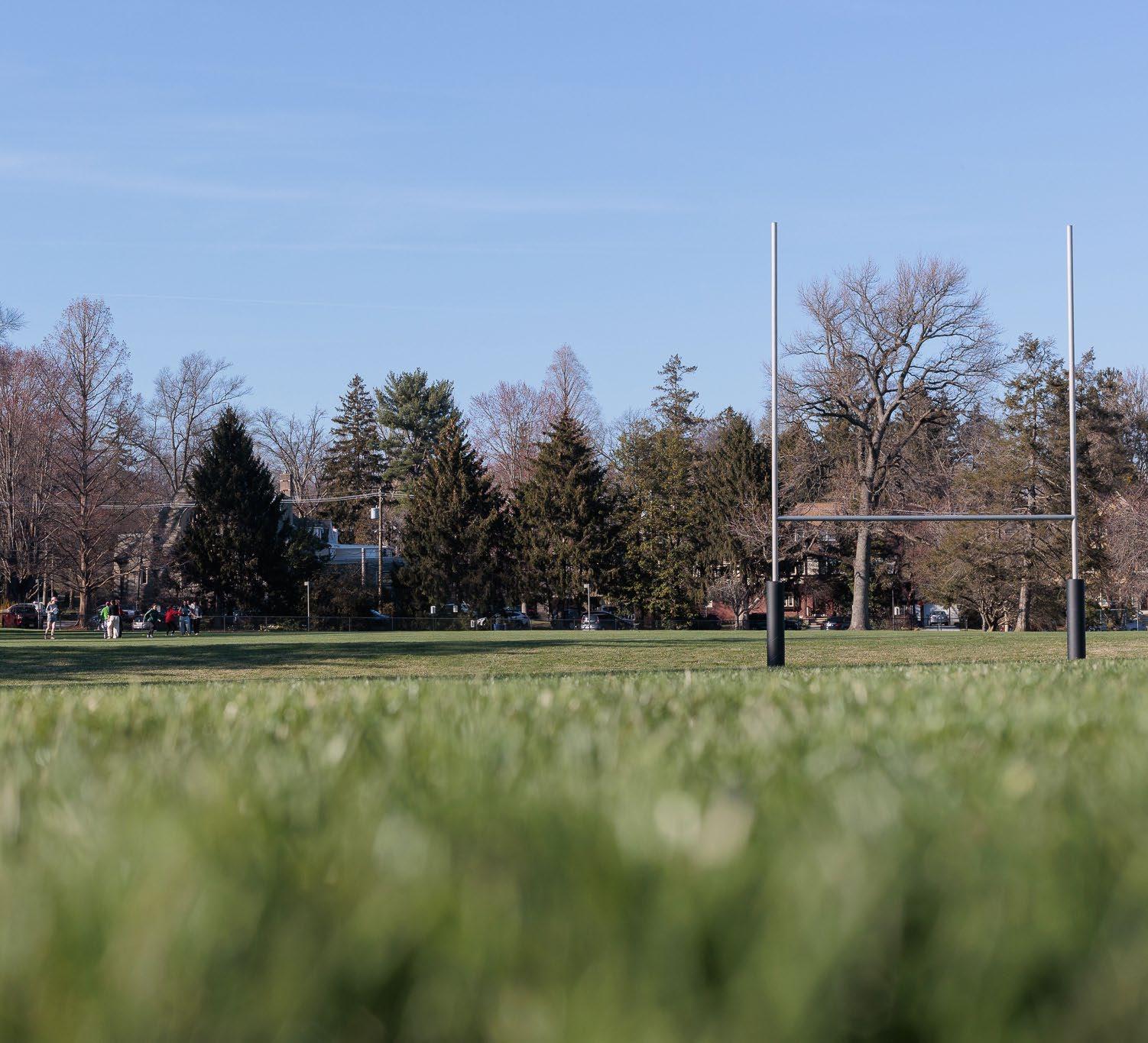
The proposed Cunningham complex would contain two synthetic turf fields — one dedicated to field hockey — as well as 12 tennis courts, a natural grass field and a pavilion.
A Place to Grow
Former West Philly community garden makes new home in
Kensington
Wby
bernard brown
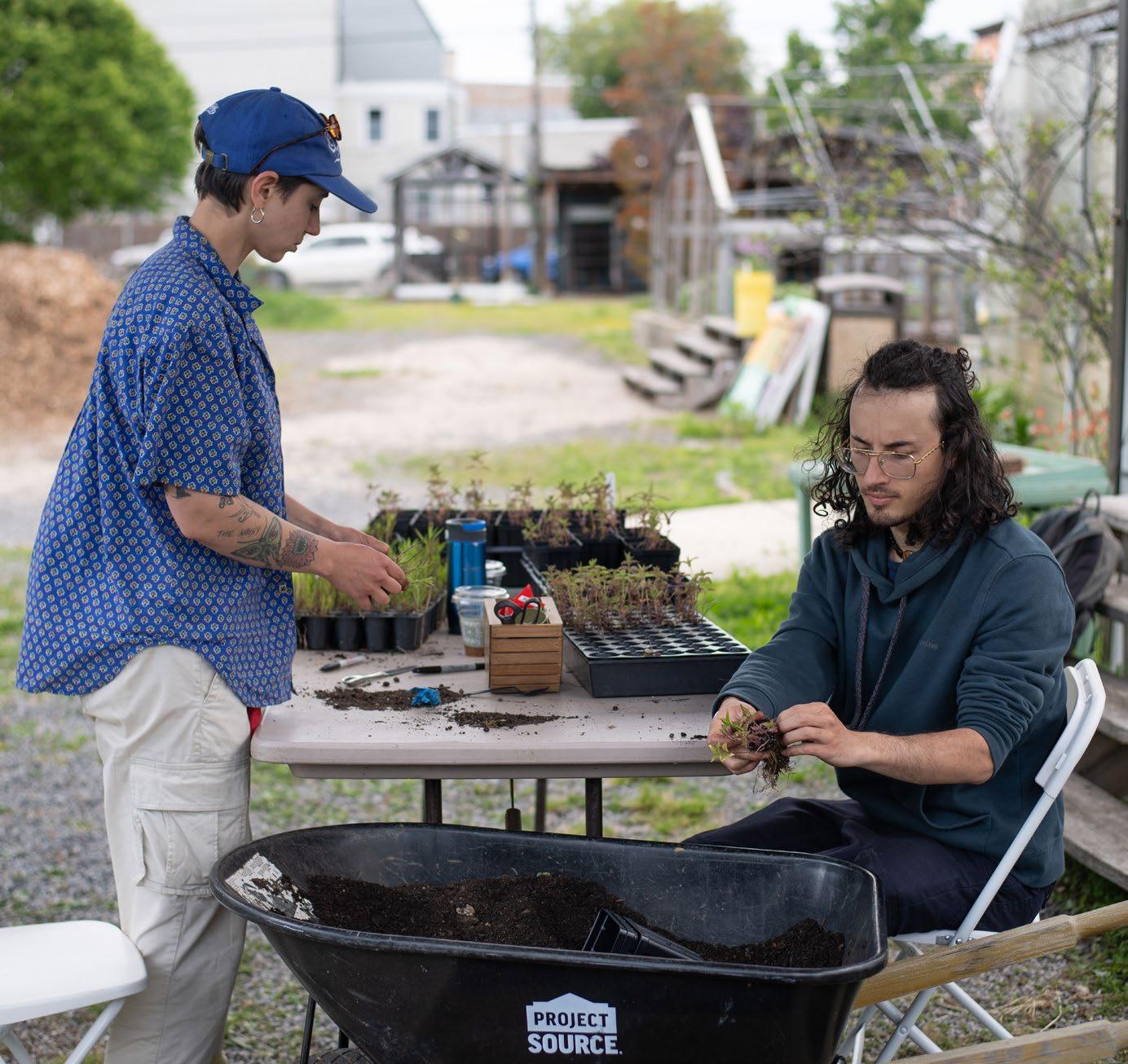
hen Grid visited the LandHealth Institute (LHI) nursery in May, community nursery operations lead Sara Mae Henke and native plant nursery associate Marcelino Smith were repotting hundreds of tiny bee balm plants from flats into pots to prepare them for sale. Behind them rose the arching end of a high tunnel greenhouse sheathed in plastic sheeting. In front of them, on the other side of a fence, stretched the endless rowhouse blocks of the River Wards.
LHI was still settling in after moving from its previous nursery site in West Philadelphia’s Parkside neighborhood, which it had occupied since 2018. The Philadelphia Industrial Development Corporation, which owned the property, sold it earlier this year.
The new LHI community nursery sits on part of the former Greensgrow Farm site, which closed in 2022, and is owned by New Kensington Community Development Corporation (NKCDC). The closure
of Greensgrow, which leased the site from NKCDC, left a big blank spot on the map and in the life of the community. Catherine Reuter, NKCDC’s urban agriculture and community garden program manager, says the organization is still planning the property’s long-term future. “We’ve been in this reimagining period,” Reuter says. “We’re
committed to making it stay urban agriculture- and community garden-focused, but still really dreaming and scheming around what the next 20, 40, 60 years should look like for the site and what investments we need to make.”
NKCDC has hosted pop-up plant sales, and the property serves as a community compost site in partnership with Bennett Compost. LHI also shares it with Star Apple Nursery, which produces seeds for Caribbean and Southeast Asian crops. NKCDC also grows vegetables there to support nutrition education programs, Reuter says.
LHI officially opened April 12, raising and selling native plants. Henke is happy to help activate the space for the surrounding community. “People just want it open,” they say. “People miss having this green spot. You could wander around a little bit, and then maybe buy one little thing.”
“Beyond just growing plants for retail, we’re having as many programs and workshops as possible so that people can learn here,” Henke says.
Scott Quitel, founder and executive director of LHI, sees growing native plants as a way to live in community with the natural world. “Community includes not just humans,” he says. “It includes the plants, it includes the bugs, and everyone should have an equal say at the table in a community. That’s what we’re going for.”
Everyone should have an equal say at the table in a community.
That’s what we’re going for.”
scott quitel, founder and executive director, LandHealth Institute
He also sees how plants can build urbanites’ connection to the natural world: “A milkweed can literally turn a kid into a scientist or an advocate.” A child can see the milkweed’s pink flowers and watch a monarch butterfly develop through its life cycle. “If they come back in the fall or late summer, they can take the seed pods, and they can open them up. The seeds blow all over. Meanwhile, they’re planting milkweed. So the plant itself is cool, but that could get a kid or an adult tied to nature,” Quitel says. “Education can make people become restoration people.”
Sara Mae Henke (left) and Marcelino Smith repot plants at the LandHealth Institute’s new Cumberland Street nursery.
Tainted Loam
Regional farmers uneasy about contamination risks in using processed sewage as fertilizer
by
ben seal
Farmers are worried, but they don’t want to talk about it. Evidence is mounting that the nutrient-rich sewage sludge many have applied to their farmland for decades as a low-cost fertilizer often contains perfluoroalkyl substances, or PFAS, a class of “forever chemicals” that resist degradation in nature and are hazardous to human health.
Typically vocal about the challenges they face, farmers are reluctant to discuss their own experience spreading the stuff — and it’s not hard to see why.
Ten years ago, Fred Stone learned that the
cows on his third-generation Maine dairy farm were producing tainted milk. For decades, he had been spreading treated sewage across Stoneridge Farm’s 100 acres as part of a state program — one of many across the country. He’d never had a problem until the local water district found PFAS in a well it maintained on his land. The chemicals have been linked to a range of health risks, including cancer, decreased fertility, low birth weight and hormone disruption.
In some of the farm’s milk, PFAS levels were 20 times higher than the federal limit for drinking water. It was present in soil,
hay and manure as well — particularly in areas where the sewage sludge had been applied. By the time a state investigation concluded, Stone had put down many of his poisoned cows and racked up nearly $500,000 in debt. His farm became a warning to others around the country about the risks of using sewage sludge.
In 2022, Maine became the first state to ban the land application of biosolids — the industry term for the processed sludge that remains after wastewater treatment. A small number of states have either prohibited the use of biosolids that contain PFAS or initiated testing to monitor contamination levels, but Pennsylvania is not yet among them. And so each week, dozens of trucks arrive at Southwest Philadelphia’s Biosolids Recycling Center to haul dehydrated sewage pellets to farms and fields across the state at a rate of more than 50,000 tons per year.
All that waste has to go somewhere, and the present alternatives — landfills and incineration — are more costly and come with their own environmental concerns. A spokesperson for the state Department of Environmental Protection said in a statement that the agency is developing biosolids permit revisions “that would incorporate testing for PFAS” and will be released for public comment “in the coming months.”
With the future of the state’s biosolids regulation hanging in the balance, environmental advocates are stressing the public health threats of continued use.
“They call it reusing and recycling. They call it replenishing. They call it nourishment. They call it fertilizer. It really is none of those things,” says Tracy Carluccio, deputy direc-
The only long-term answer is to stop putting PFAS in products — to regulate them all as a large family, instead of this chemicalby-chemical basis.”
kyla bennett, director of science policy, Public Employees for Environmental Responsibility
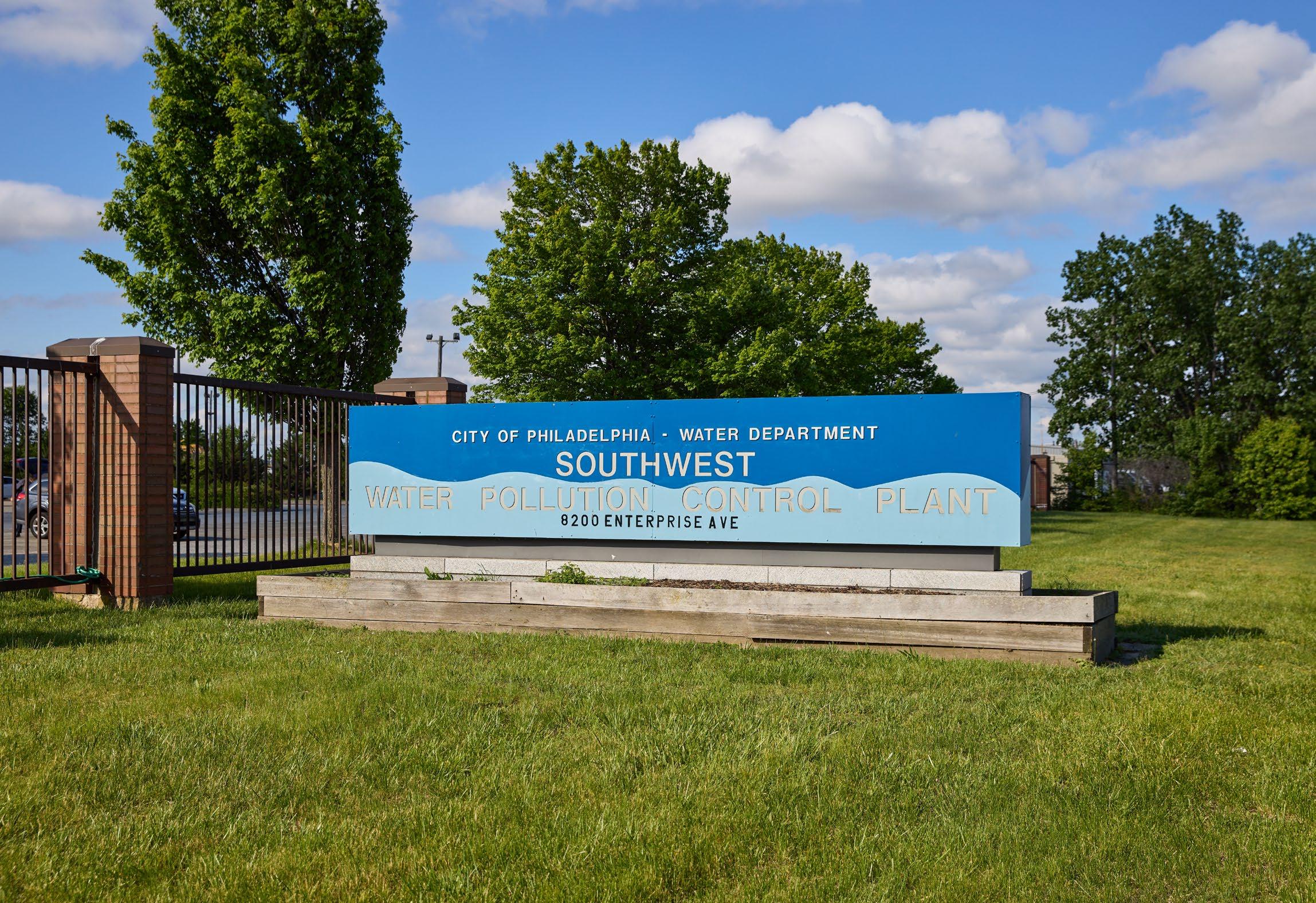
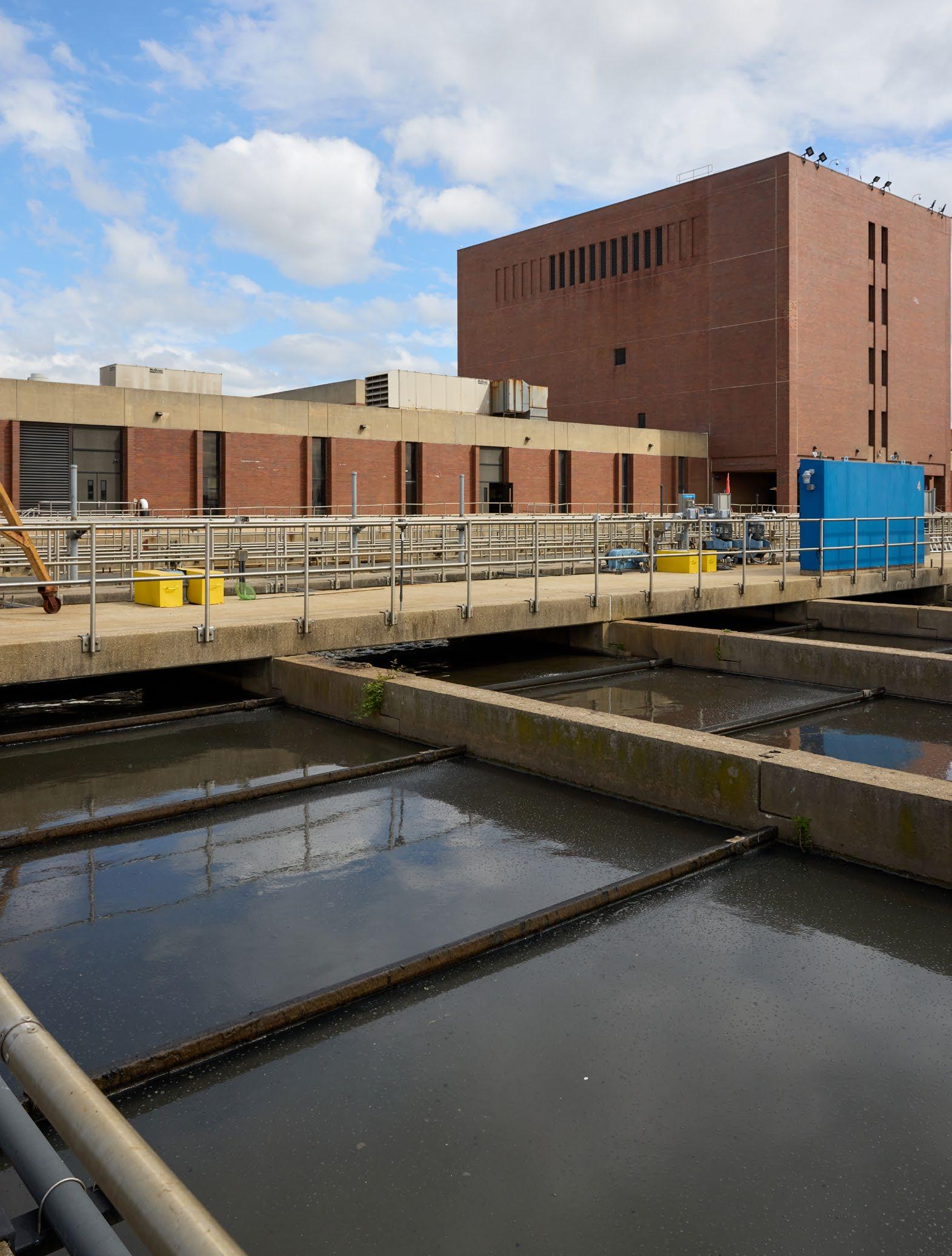
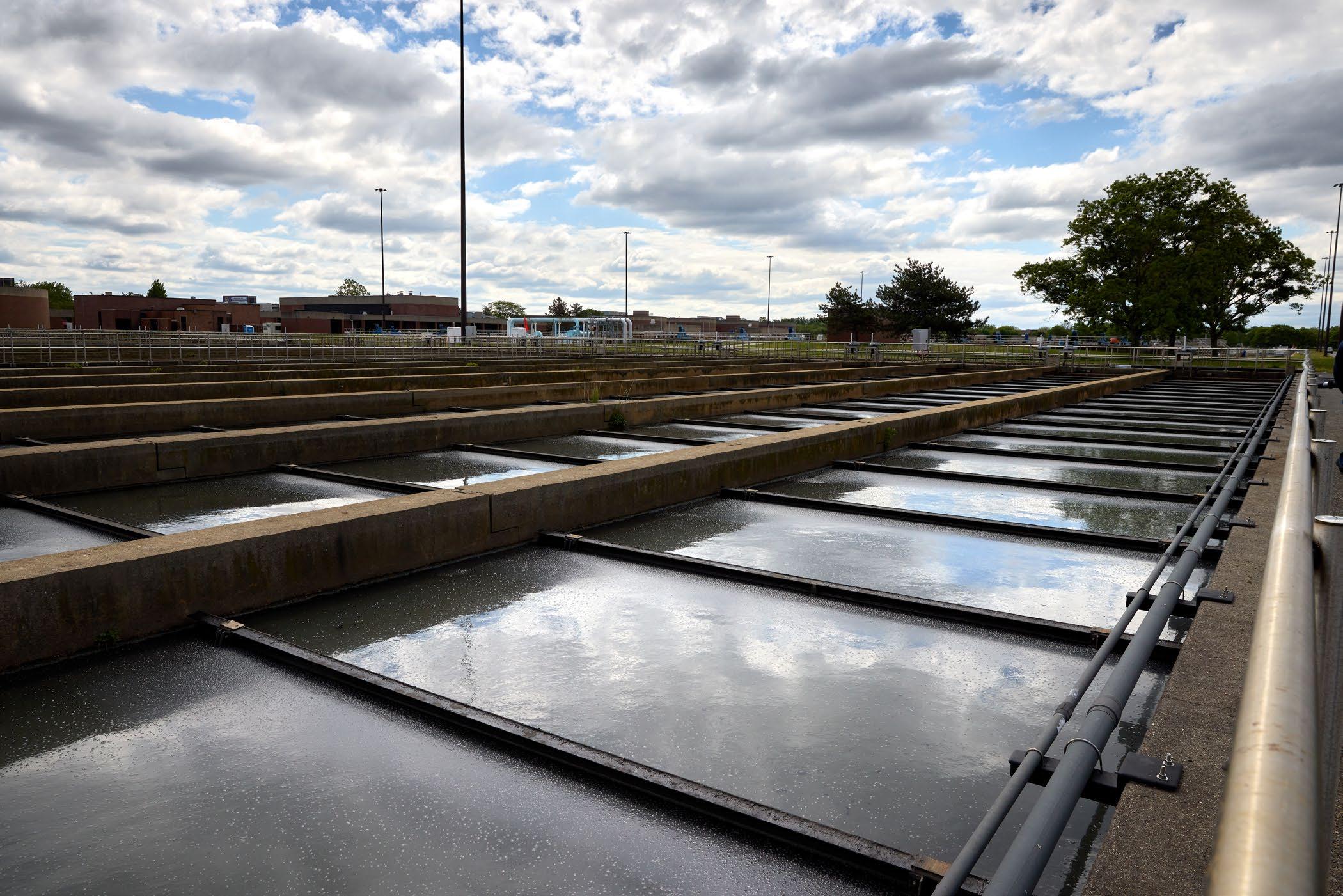
The Southwest Water Pollution Control Plant receives and treats sludge from the city’s Northeast and Southeast plants before pumping the resulting biosolids to the Synagro-operated Biosolids Recycling Center next door.
tor of the Delaware Riverkeeper Network. “It’s really just a waste stream. It’s an easy and inexpensive way to get rid of all the sewage sludge that we produce as human beings at our wastewater treatment facilities.”
Rather than a circular approach to growing healthy crops, she says, biosolids distribution “turns farmland into an industry wasteland.”
Philadelphia’s three wastewater treatment plants are among more than 17,000 nationwide that dispose of their sewage sludge via the offtake of biosolids, some 60% of which is spread on croplands. Each of the city’s three plants sends its sludge to the Biosolids Recycling Center, a facility operated by Synagro Technologies, a Baltimore-based leader in the billion-dollar biosolids industry. Synagro has handled the city’s sludge since 2012 as part of a 23-year, $590 million contract that came under the microscope when a city integrity review found that a consultant who steered the deal through City Council over union opposition was promised $400,000 a year for his efforts, according to The Philadelephia Inquirer. The payments were later eliminated.
After undergoing what Synagro describes as a “thermal drying process,” the city’s biosolids are trucked off to farms, parks and fertilizer blenders to be distributed. Across the country, as many as 70 million acres of farmlan d are permitted to receive biosolids, according to industry estimates. The largest portion of biosolids — more than 2 million dry tons each year, according to one estimate — ends up in agricultural fields.
Asked about the emerging concerns about biosolids, a Synagro spokesperson said in an email that it maintains an “open dialog” with its farmer customers and highlighted the benefits biosolids offer, including “improved moisture absorption ability, recycling of micro and macro nutrients, carbon sequestration, reduced nutrient leaching and lower use of industrially produced chemical fertilizers.”
The Philadelphia Water Department said in a statement that it “takes its responsibility to protect public health and the environment extremely seriously,” noting that utilities, regulators, researchers and policymakers are working to better understand emerging concerns around PFAS. The agency is undergoing a “wastewater master planning process” to prepare for future regulatory requirements, evaluate infrastructure and ensure that “Philadelphia is positioned to respond responsibly to evolving environmental standards and public health expectations.”
Pennsylvania’s records show 139 active sites are permitted to receive biosolids from the Philadelphia Water Department, nearly one-quarter of which are farms. Synagro, meanwhile, has 280 active client sites in the commonwealth, many of which receive biosolids from other municipalities or states. A recent study of soils at 10 Pennsylvania farms found significantly higher levels of PFAS in fields that had been treated with biosolids than those that had not.
Although the U.S. Environmental Protection Agency has identified more than
350 pollutants in sewage sludge, including a range of PFAS compounds, heavy metals and pathogenic microorganisms, it regulates only nine in biosolids: arsenic, cadmium, lead, copper, mercury, molybdenum, zinc, selenium and nickel. In its final days, the Biden administration published a draft risk assessment that found that land-applied sludge containing 1 part per billion of PFOA or PFOS, a pair of common PFAS chemicals, exceeded the threshold for human health risk. It also said that drinking groundwater contaminated by biosolids posed a risk. It didn’t comment, however, on the public health risks of eating contaminated produce, meat or dairy. The draft assessment has failed to advance under the Trump administration.
To understand how farmers in Pennsylvania are navigating the emerging information about PFAS contamination in biosolids, Grid reached out to several farms on the PWD’s permit list. None of them responded. According to Faith Kibuye, a water resources extension specialist with Penn State’s College of Agricultural Sciences, that shouldn’t be a surprise. Even when farm-
ers apply biosolids legally, the presence of PFAS introduced upstream is beyond their control. Regardless of the source, “farmers can face significant economic, social and reputational risks if PFAS is detected on their operations,” she says. As a result, farmers are “understandably cautious” about discussing their use of biosolids or even participating in research.
The Pennsylvania Farm Bureau referred questions about its biosolids policies and guidance for farmers to PennAg, an agribusiness industry association, which says it does not provide farmers with “direct or prescriptive guidance on the application or use of biosolids.” The New York Farm Bureau earlier this year updated its policy to oppose the land application of biosolids with “detectable amounts of PFAS and/or elevated levels of heavy metals.”
“Farmers are waking up. They’re angry. But a lot of them also don’t have any choice in the matter,” says Kyla Bennett, a former EPA staffer who is now director of science policy for the nonprofit Public Employees for Environmental Responsibility (PEER). She called the use of biosolids a “catch-22”
Before heading into an anaerobic digester, sewage at the Southwest Water Pollution Control Plant flows through an expansive grid of concrete tanks that allow sludge to settle to the bottom. PHOTO
for farmers, who have long utilized it as an inexpensive and purportedly safe alternative to fertilizer. Now that they know about the associated risks, some may still need to continue the practice to keep their farms running, especially as the war in Iran has spiked fertilizer costs and reduced availability.
As Grid recently reported, PWD in 2024 learned that “data anomalies” stemming from a plant manager’s number-fudging allowed a biosolids processing error to go unnoticed. Failing anaerobic digesters led the plant to produce biosolids that had not been properly processed to reduce pathogens. After an internal investigation, the agency alerted 25 farmers and land managers that they had been given noncompliant biosolids and paid $203,563 to the EPA to settle claims over its violations.
Even when the biosolids process works as expected, though, farmers lack information on any potential contaminants spread on their fields. Because current permits don’t include monitoring or reporting requirements for PFAS in biosolids, PWD said it does not conduct any testing.
The DEP is considering modifying its biosolids permits to utilize a tiered approach aimed at mitigating risks and better informing producers and distributors, according to a presentation the agency gave in January. Under the new model, which is based on a standard established in Michigan, biosolids would be applied normally only if the rate of PFAS were below 20 parts per billion. Between 20 and 100 parts per billion, they could be applied at a reduced rate, and land application would be prohibited beyond that limit.
PWD is closely following the DEP’s rulemaking, Water Commissioner Benjamin Jewell says, and will comply with any rules once finalized. Regulatory changes might make disposal of biosolids more expensive, forcing the department to expand its geographic range if limits are placed on how much and how often biosolids can be applied to certain fields, he adds.
State Rep. Brenda Pugh, R-Luzerne, introduced a bill last year that would require the DEP to test PFAS concentrations in the state’s biosolids and compare the chemicals’ presence in soil and water on farmland where biosolids have and have not been applied. It would also require analysis of
the presence of PFAS in crops, livestock and milk on lands that have used biosolids, as well as a study of treatment methods and other states’ regulations. Pugh says she introduced the legislation, which has 10 co-sponsors but has not yet received a committee vote, after speaking with farmers concerned about the long-term impacts of biosolids on neighboring farmland.
“If Maine has already come to this determination, then why are we behind the eight ball?” Pugh says. “Why are we allowing it to happen here?”
For its part, Synagro says it supports “science-based and peer-reviewed” legislation, including Pugh’s bill.
As it prepares updates to its biosolids regulations, the DEP is investigating PFAS contamination of groundwater in Columbia County that the agency believes is tied to legacy biosolids distribution from as far back as 1980 — an indication of the challenges in dealing with “forever chemicals.” The agency has issued a fish consumption advisory and has been delivering bottled water to impacted residents.
Legacy pollution from PFAS-contaminated biosolids has resulted in high levels of PFAS being discovered on farms in Texas, Maine, New York, Michigan and Tennessee, among others. In 2024, PEER sued the EPA on behalf of a group of Texas farmers, arguing that the agency is responsible under the Clean Water Act for regulating the presence of PFAS and other toxic chemicals in biosolids. That suit was dismissed last year; PEER later appealed
As a patchwork of state regulations develops, PEER’s Bennett and other advocates worry it will be insufficient to address the emerging crisis at its roots, in part because several states have already prevented policymakers from establishing standards stricter than those imposed by the federal government. Until the EPA effectively regulates PFAS, the chemicals will continue entering the wastewater stream from a range of industrial and household sources, leaving it to the treatment process to capture and remove them. Industrial pre-treatment offers one avenue for mitigation, but that won’t eliminate the chemicals’ presence, Bennett says.
“The only long-term answer,” she says, “is to stop putting PFAS in products — to regulate them all as a large family, instead of this chemical-by-chemical basis.”
When it comes to the presence of PFAS on farmland, Carluccio argues that more states should follow Maine’s lead.
“Biosolids should be banned from being put on land,” Carluccio says. “It can’t be controlled, and it should be prohibited.”
Heather Preisendanz, a professor of agricultural and biological engineering at Penn State, hears a chorus of questions from farmers worried about their use of biosolids. They wonder which crops can be safely grown in soils impacted by PFAS and ask her to sample their well water to alleviate concerns about their families’ health. Her research aims to understand how different crops take up PFAS differently and whether riparian buffers can mitigate runoff from fields treated with biosolids. Last year, Preisendanz served on a DEP working group that gathered information for the agency to utilize in its biosolids response. That group, she notes, didn’t include any farmers. The DEP did not respond to a question about the group’s composition.
The science around biosolids and PFAS complicates any efforts to mitigate risk, Preisendanz says. “There’s not great toxicologybased information to say for sure what the appropriate risk is for accepting biosolids and at what levels,” she says. There are few straightforward answers to share with those concerned about public health or the welfare of farmers who have land-applied biosolids.
“It’s really challenging, even if you have the numbers, to make sense of what to do with it,” Preisendanz says.
There are, however, steps that could minimize risk, she says: If biosolids are tested to reveal high quantities of PFAS, upstream testing should aim to identify the industrial source of the pollution and address it before it can reach the wastewater stream. And biosolids should be tested and data on PFAS contamination shared with farmers spreading it as fertilizer, Preisendanz says.
“Until we start testing it coming out of the facilities prior to spreading, we’re never going to know,” Pugh says.
Pugh is perplexed by the failure of her bill to advance in the General Assembly and fears that further delays in responding to biosolids contamination will leave Pennsylvania farmers and residents at risk.
“I don’t want our state to be a dumping ground,” Pugh says. ◆
chaosclimate
Could anything be worse than an early spring? ¶ In February, as we shivered under a shell of icy snow, we all looked forward to the melt. We imagined saying goodbye to our parkas and snow boots so that we could swap them for linen shirts and sandals. When that April heat came, we took to our porches and lingered outside to chat with our neighbors. It was lovely. ¶ But farmers were getting nervous. They knew that the early heat could be a setup. Perennial plants can be tricked into flowering and fruiting ahead of schedule, only to be blindsided when temperatures lurched back down below freezing. ¶ Climate chaos is local, regional and global all at once. In 2023, the snow blanketing the floor of boreal forests in Canada melted too soon, exposing deep layers of decaying twigs and conifer needles to the heat of a warmer summer. The dried-out fuel burned out of control when lit by bolts of lightning. It happened again in 2025. We’d better get used to it. ¶ In this issue, we take a look at some of the dominoes falling as we heat the planet, but we also take a look at how we might cope. How can the City make it easier to get flood insurance? Could we learn about climate resilience from Puerto Rico, an island battered by supercharged hurricanes? ¶ We’re stuck with this mess, but we’re not helpless.
Banner Drop
Meet the activists rebelling for life on Earth
➤ STORY BY SARAH RUIZ
In the gray light of early morning, four activists snuck onto a bridge overlooking U.S. Route 202 in Pennsylvania. There on the chain-link fence, they clipped their banner and unfurled it in view of the sleepy commuters just starting to pass below. Spelled out in 90 feet of white paint on fluttering black canvas was the message: “Vanguard has a climate problem.”
The activists, or “rebels,” were members
of the Philadelphia chapter of Extinction Rebellion (XR), a global protest group that uses civil disobedience to demand that governments, companies and other powers take the climate emergency seriously.
XR formed in the United Kingdom in 2018, following the release of a United Nations special report on climate change that starkly outlined the Earth’s trajectory toward nearly 3 degrees Celsius of warming by 2100. Spurred by the severity of the report and lackluster
government response, a group of British activists and organizers launched Extinction Rebellion on Oct. 31. With colorful banners, joyful noise and firm resistance in the face of arrest, over a thousand protesters shut down the road outside the Houses of Parliament and recited their “Declaration of Rebellion.”
The propulsive energy of the new movement spawned satellite XR groups across the world.
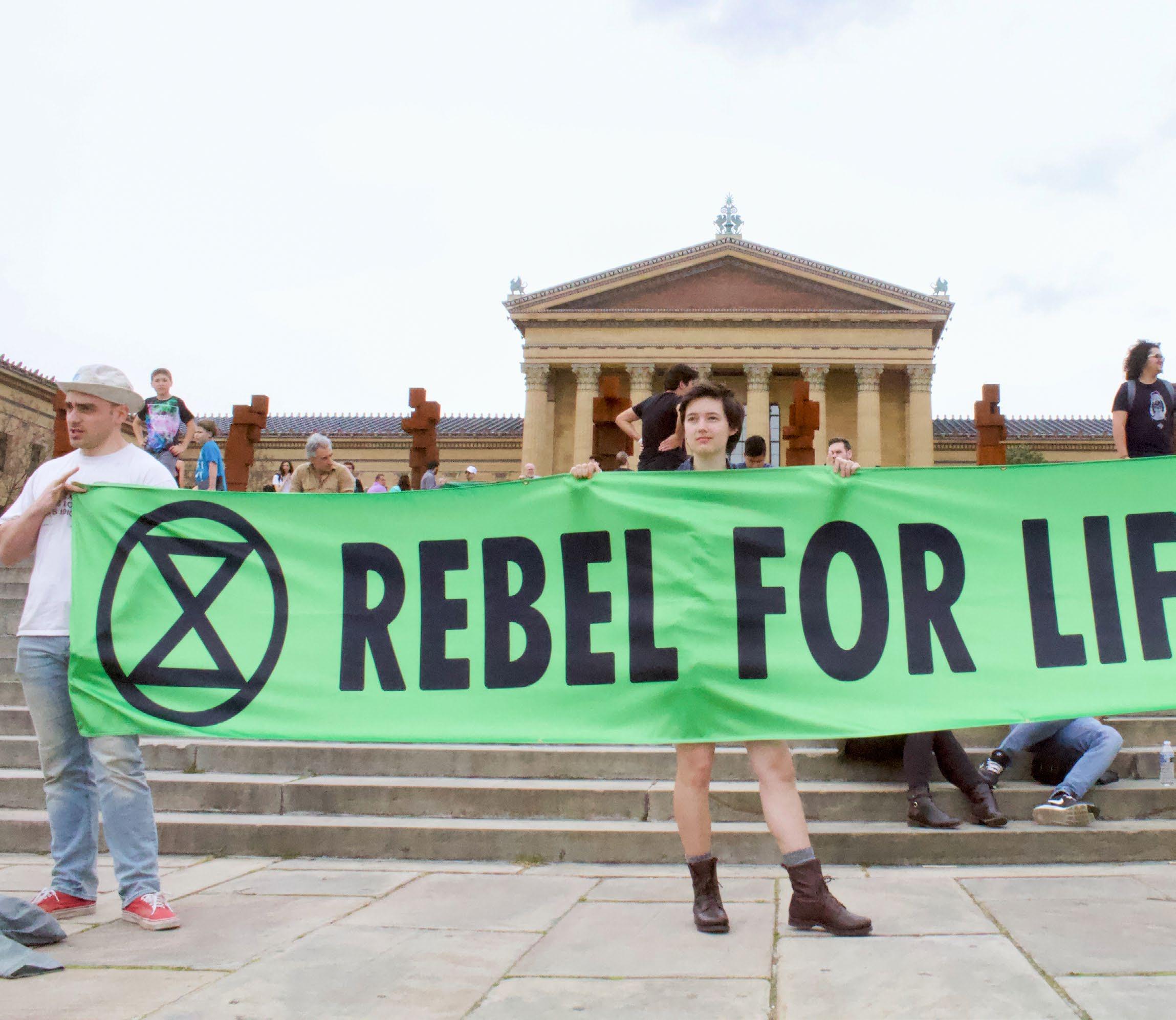
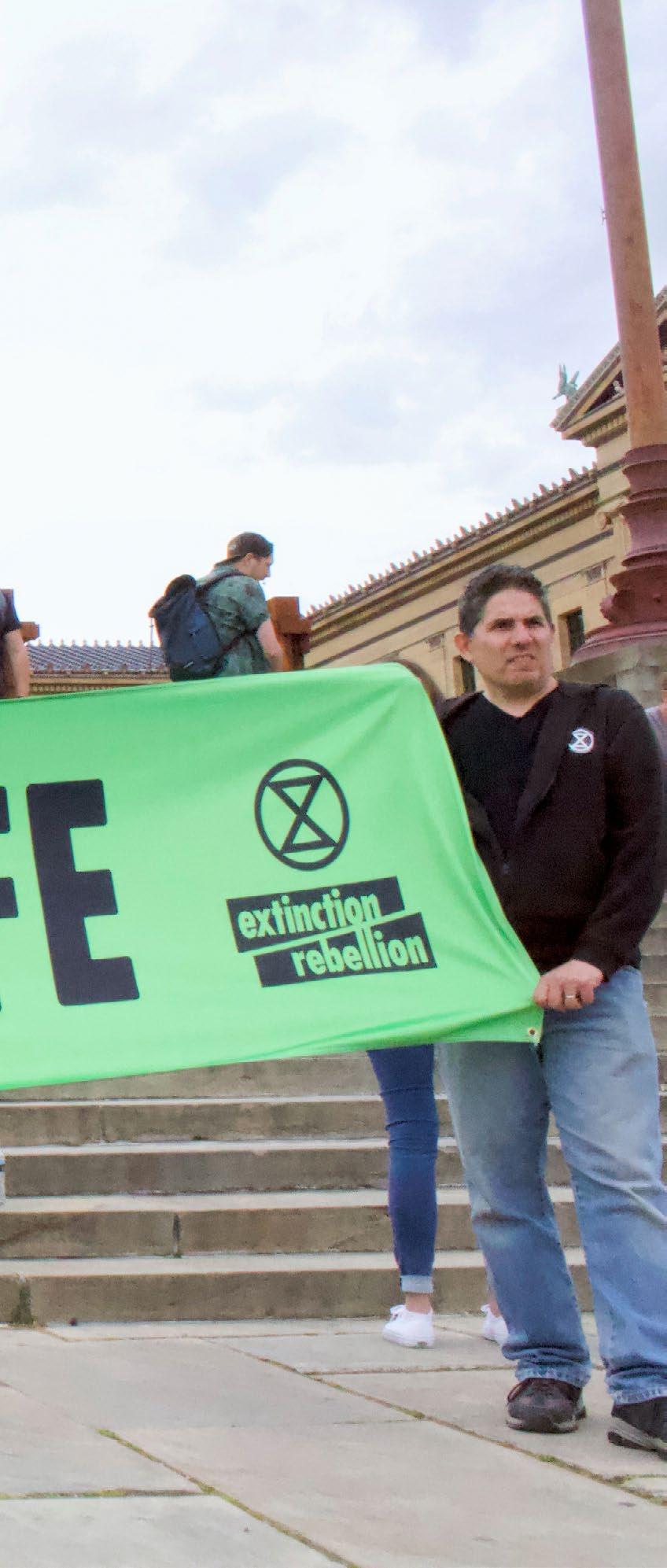
Philadelphia’s chapter was founded in early 2019. That May, holding a green banner with the words “Rebel for Life,” XR Philly lent its voice to the global movement with a protest on the steps of the Philadelphia Museum of Art.
“That energy that was happening in 2019 was what the movement of movements needs: that direct action, but also celebration of the life that we want,” says Frank
Fortino, who joined XR Philly in its first year. “XR would have fun interactions: the color, the dancing, the seriousness, the sacrifice of getting arrested.”
XR Philly’s messaging coalesced around four demands adapted from those of the global group: First, “tell the truth” about the climate crisis and who is causing it. Second, “act now,” because the climate crisis is an emergency and should be treated like one. Third, “decide together,” a call for people’s assemblies on major issues, because decisions that affect everyone should include everyone. And fourth, pursue a “just transition” that acknowledges the unequal distribution of climate impacts.
Taking nonviolent direct action is a historically justified and important part of social movements. And at the same time, it’s not a decision that anyone should step into lightly.”
LIAM SACINO member, Extinction Rebellion Philadelphia
The group expresses these demands through direct actions designed to disrupt the status quo: banner dropping, conference room storming, road blocks and “die-ins,” where protestors collapse and refuse to move. According to member Eric Moss, XR Philly is not particular about its methods, operating under the mantra “good enough for now, safe enough to try.” Actions target institutional powers that bear an outsized share of the blame for perpetuating the climate crisis: companies expanding oil and gas infrastructure in Pennsylvania, financial institutions like Vanguard that invest in fossil fuels, and politicians who won’t speak up.
Members often knowingly risk arrest during protests, but it’s not the primary goal, says member Liam Sacino.
“We believe strongly that taking nonviolent direct action is a historically justified and important part of social movements. And at the same time, it’s not a decision that anyone should step into lightly,” says Sacino. “It’s very empowering when you’re in the street blocking the garage. … It can become far less empowering when you now have your hands tied behind your back, and you’re put into a van that you’re not allowed to leave.”
When not tangling with law enforcement, XR Philly members engage with the public by passing out flyers and holding action-training workshops. They also connect with other activist groups to share resources and manpower. Sacino says XR Philly often steps in to fill a support role for local organizations. In the past, it has collaborated with the Delaware Riverkeeper Network, Philly Thrive, No ICE Philly and the Sunrise Movement.
“We’re kind of like the rent-an-activist organization of Philly,” says Sacino. “Like, you need a couple people who know how to just
really go in, maybe sit somewhere you’re not supposed to sit and say, ‘I’m not leaving’? You rent a couple activists.”
These “solidarity actions” and mutual aid efforts have become more of a priority for XR Philly in the past few years, according to Moss. A pandemic, a genocide, attacks on immigrants and rising fascism in the United States have “taken climate off the front page,” he says. But he doesn’t see supporting other causes as a distraction from the group’s mission.
“I might have had this reductionist view that we have to solve the climate crisis at its source,” Moss says. “But then, when you realize that the source is the whole system that underlies it, and you see these other symptoms that are of that same system, then it makes a whole lot of sense.”
For Sacino, mutual aid is part of how XR Philly models the future that the group is pushing for.
“If we are to solve the climate and ecological crises, it’s going to require a far more cooperative future,” says Sacino.
Cooperation and connection to community have also helped XR Philly members personally navigate an increasingly fraught world. Sacino, Moss and Fortino all came to XR in moments of despair about the state of the Earth, and taking direct action has worked as a balm for that despair.
“It is therapeutic for me, the work. Getting out in the streets, screaming, chanting, singing, … making a banner for hours, quiet,” Fortino says. He invites all who feel anxiety about the way the world is turning to join him.
“Don’t sit alone on that couch and suck in all the violence, suck in all the harm. You have comrades out here that are also in pain, that want to talk about it.” ◆
Extinction Rebellion members lead a protest on the Philadelphia Museum of Art’s steps in April 2019, one of dozens of demonstrations worldwide.
Island Inspiration
Watershed leaders visit Puerto Rico to help shape climate resilience plan ➤ STORY BY
When research was needed to create a climate resilience plan for the neighborhood surrounding North Philadelphia’s Tacony Creek, leaders of the Tookany/ Tacony-Frankford Watershed Partnership (TTF) had something more ambitious in mind than a traditional written study.
“We were going to bring together environmental organizations and leaders in this city, … then have experiences together where we’re seeing relevant climate
GABRIEL DONAHUE
resilience firsthand and hopefully getting inspired by that and using that as the foundation for action,” TTF executive director Justin DiBerardinis says.
Unsure what that could look like in practice, DiBerardinis and TTF’s director of community organizing and public programs, Cesali Morales, put their heads together. The result was an idea inspired by longtime Philly gardener Iris Brown and based on Morales’ commitment to incorporate the cultures of the people TTF serves
into the organization’s work.
“When I think about Philadelphia and I think about the neighborhoods that surround Tacony Creek Park, I think about how influenced it is by Puerto Rican culture,” she says. “We don’t often get the chance to learn from the places that we left, … from people on the front lines that are facing this climate crisis and get to share in that, and learn and prioritize the cultures that reflect us.”
So, on March 12, Morales and DiBerardinis, with a group of community leaders and state and city legislators in tow, boarded a plane to Puerto Rico in search of culturally relevant climate resilience techniques that could be implemented in North Philadelphia. Funded by a Green & Healthy Homes Initiative grant, the group spent two days visiting the Caño Martín Peña community
When you go down to the Caribbean, climate resilience is deep in the fabric of communities.”
land trust and Tabonuco, a farm and education center. Jackly Rivera, the unit director for the Lauretha Vaird Boys & Girls Club near Tacony Creek Park, called the trip “amazing” for the insight it gave into the community there: “how they get together, and when they want things done, how determined they are to get it done.”
DiBerardinis says the idea that climate resilience is only discussed by academics, intellectuals and progressives is simply untrue. “When you go down to the Caribbean, climate resilience is deep in the fabric of communities. That is across income lines, that is across racial lines,” he says.
However, it’s often the poorest communities, he points out, that are burdened with figuring out solutions to climate change. Consequently, “You see this interesting dynamic where climate resilience, climate action is be-
ing driven by the grassroots, not being driven by institutions,” DiBerardinis says.
That was reflected at the Martín Peña channel, where nearby residents created a land trust that has protected people from displacement due to ecological conditions and threats from developers.
“You can basically see the delineation of the land trust, because you see a working-class community, … and you see the high-rises of the San Juan financial district push right up to the border of that land trust,” DiBerardinis says. “You can see how these things that came out of a need for environmental restoration have created an opportunity for these communities to continue to live and to thrive and continue their traditions in the space that they built.”
He says it’s the closest parallel to the conditions in North Philadelphia, where illegal
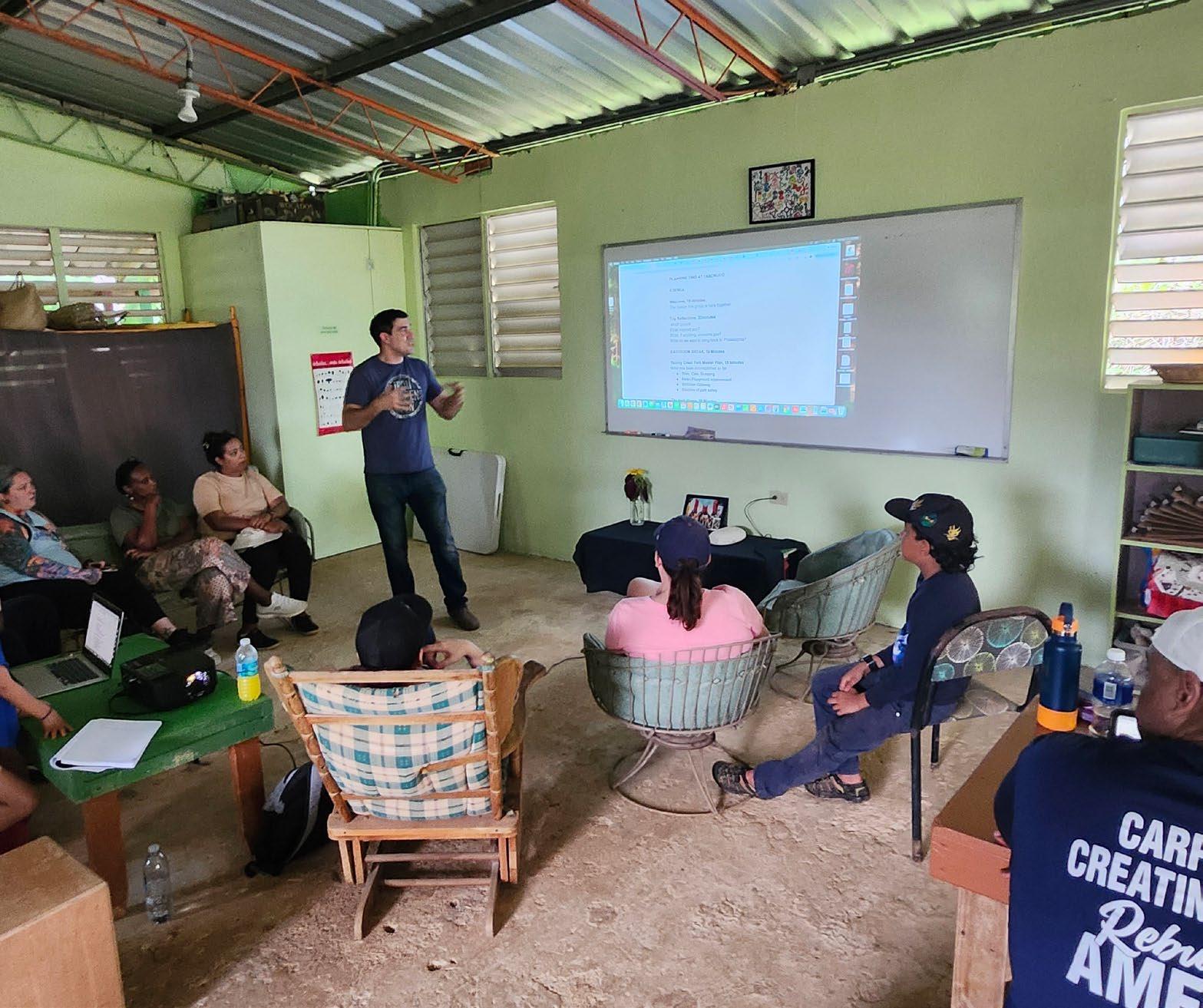
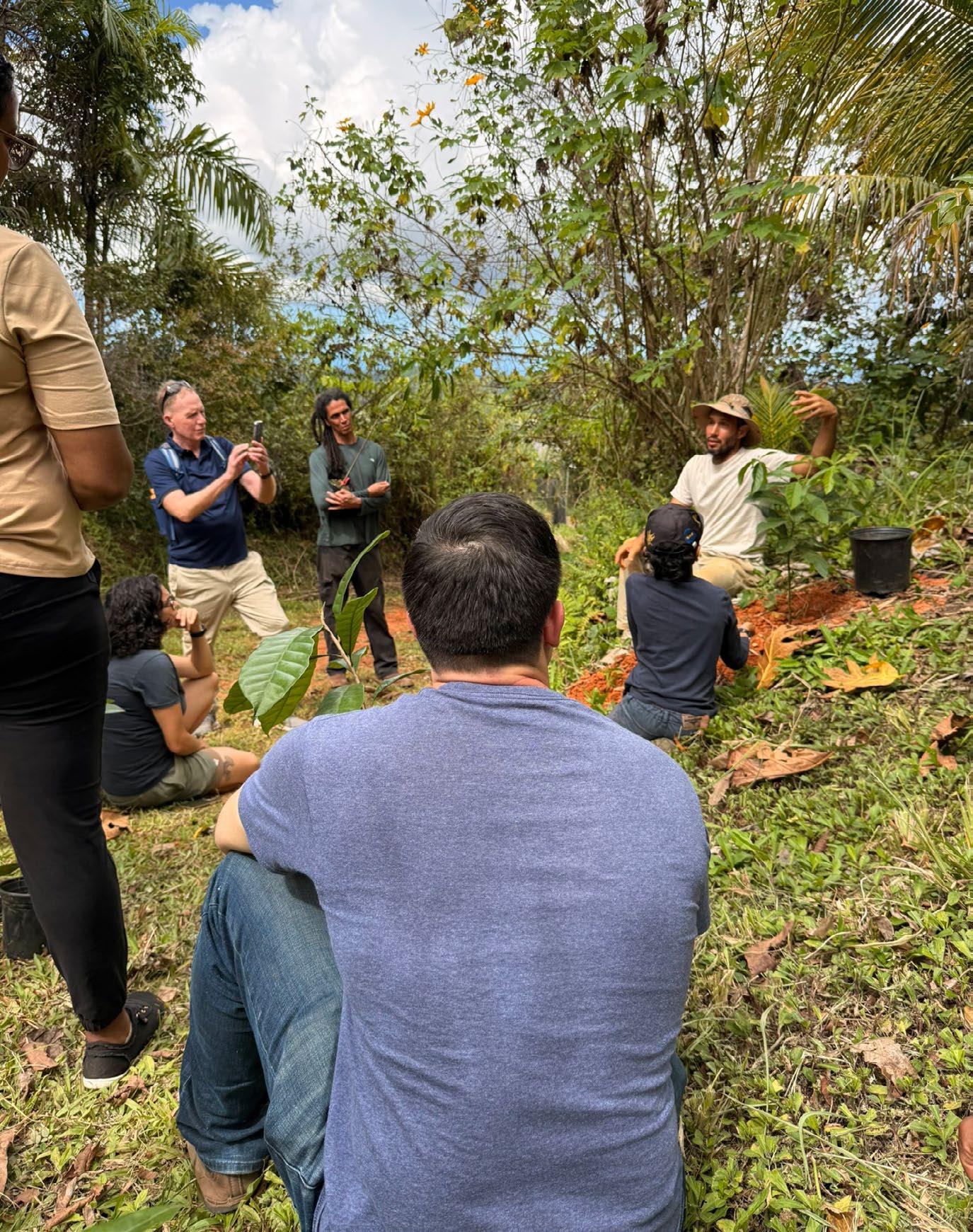
Opposite: The view from Tabonuco, a Puerto Rican farm and environmental education center. Left: A group conversation integrated lessons learned during TTF’s trip to Puerto Rico and focused on what their experiences could mean for Tacony Creek Park and Philadelphia.
dumping, erosion and gentrification — challenges also faced in Caño Martín Peña — are prevalent, but can be solved with collective action.
Particularly relevant were the forest restoration efforts underway there and at Tabonuco. In Caño Martín Peña, residents are replanting mangrove trees along the channel, work that is mirrored by what TTF has started along Tacony Creek. Since returning from the trip, a five-year tree plan has been initiated through Parks & Recreation, DiBerardinis says.
Tacony Creek’s banks are eroding, and better stormwater management is needed, especially as climate change intensifies storms. One challenge, TTF leaders say, is the fact that some of the land abutting the creek is privately owned. In a move similar to the development of Caño Martín Peña (though TTF doesn’t need to start from scratch as they did), the organization plans to deprivatize the land surrounding the creek so it can protect the entirety of the watershed.
Rosaura Rodríguez, an educator, artist and co-founder of Tabonuco, says she was nervous but excited to work with the Philadelphia group on their visit, because the avenues of decision-making are so different from what she knows.
“I have everyone’s numbers in the community. The engagement is very straightforward and direct. … It’s very foreign to me, catalyzing change from a more bureaucratic position,” she says.
Ecological restoration at Tabonuco is grounded in cultural preservation and environmental justice led by people of all ages. Hosting TTF, Rodríguez says, made her feel “even more sure and confident in what we do.”
“It gave me a lot of clarity,” she says, telling of an instance when neighborhood children impressed their visitors by their knowledge, curiosity and eloquence. “It just made me feel like, ‘Yeah, this is exactly what we do, and this is how it manifests. These
are our kids from our community.’”
Interacting with the local children left an impression on Morales, who saw how spending time outside and being involved in the community affected the interest they had in their surroundings, the confidence with which they carried themselves and their interactions with adults. “There’s just something about intellectualizing and in a theoretical way being like, ‘Yeah, we know we need green spaces, and we know that they’re important,’ and then actually having the opportunity to spend a lot of time and see young people who spend a lot of time outdoors and how transformational that is for them,” Morales says.
She and DiBerardinis have started envisioning ways that TTF can integrate lessons learned from the trip in its programming, particularly with a focus on young people. One goal is to create a youth-led, intergenerational food project to grow produce “celebrating Caribbean food culture that could live here on the banks of the Tacony Creek,” DiBerardinis says. In creating such a program, he and Morales say, TTF can connect culture to the land and embed a sense of stewardship into the participants.
Similarly, Rivera from the Boys & Girls Club, which already has an established relationship with TTF that includes monthly program-planning meetings, says she hopes to give the kids she works with opportunities to learn more about growing food and take home the produce they harvest.
Morales says that in the last couple of years, she’s seen an influx in teenagers spending time at Tacony Creek Park. Finding value in the space is just one step in building a larger movement.
Councilmember Quetcy Lozada, whose 7th District includes the park, says her biggest takeaway from the trip was the importance of having trusted community members lead the work. “For some people, government should be doing that, and only government. I think that that is just not the case,” she says. “When people are involved in the process, they take ownership of it. And when government walks away, the community continues to move the project forward.”
As the work advances here in Philadelphia, Rodríguez encourages the use of ar-
You just have to go outside and meet your neighbors if you're going to get down to the basics. Then you could figure out what are the challenges that people are interested in tackling first.”
ROSAURA RODRÍGUEZ co-founder, Tabonuco
tistic or recreational activities to build relationships and strengthen the movement.
“You just have to go outside and meet your neighbors if you’re going to get down to the basics,” she advises. “Then you could figure out what are the challenges that people are interested in tackling first, because
I’m sure there’s a million of them. But what does the community care about the most? And then the community can figure out what tools they want to use to figure them out. It could be arts or advocacy or activism, protests. It can be through children or through the elderly, can be through food.… But relationships are the foundation.”
While the relationship building continues and strengthens, TTF has a host of plans for strengthening the banks of Tacony Creek and turning the land surrounding it into a public corridor.
“This 50-acre parcel of nature preserve that we’re in right now is going to be transformed over the next five years into just a powerhouse of watershed protection and community climate resilience,” DiBerardinis says. “That’s the work that TTF is about and that we’re in, to get our decision makers and our community members to see the possibilities of that. We’re feeling the support as we’re now pursuing more funding for this project. We’re feeling that support with the private landowners to advance this vision.” ◆
Tabonuco’s Mario Gracia Otero led the group in a tree planting demonstration.
Life raft
Philly’s entry into FEMA program grants homeowners 15% discount on flood insurance ➤
STORY BY KYLE BAGENSTOSE
Philadelphia, a city wedged between two rivers, has a long history of getting swamped by dangerous floods. Its future, which is forecast to bring increasingly climate-fueled deluges, doesn’t appear any brighter. That leaves a pertinent question for the present day: What are city officials going to do about it?
As chronicled previously in Grid, the answer all too often has been: not much. But in a stroke of good news this spring, the City of Philadelphia helped its residents by joining the Federal Emergency Management Agency’s (FEMA) Community Rating System, a federal designation that essentially amounts to a rewards program for good flood-planning behavior by cities and townships across the country.
The primary benefit is that most property owners — residents and business owners — who hold a flood insurance policy will now automatically receive a 15% discount when their annual policy renews. With policies averaging about $800, that would mean typical savings of about $130 a year — a measurable difference for households squeezed by increasing costs of living, according to Chris Miller, principal agent of Miller Insurance, a FEMA-preferred flood insurance provider in Philadelphia.
“For a lot of families, that’s a big deal,” says Miller, who travels annually to Washington to hear from lawmakers about flood insurance. “Every single year, flood insurance affordability is at the top of the list.”
Now for the fine print. If you’re a Philadelphia homeowner wondering if you have flood insurance, you probably don’t. Very few standard policies cover flood damages, meaning a homeowner needs to go out of their way to obtain one. In Philadelphia, only a few thousand homeowners have taken that step, according to FEMA.
By joining the Community Rating System (CRS), Philadelphia is also only getting credit for policies it has already had in place. Joseph Sullivan, flood resilience program manager for the City’s Office of Sustainability, says among FEMA’s requirements
were an existing hazard mitigation plan and a zoning requirement to elevate the bottom floor of new developments constructed in floodplains. That was enough to enable Philadelphia to join the Community Rating System as a Class 7 community. But that’s third-lowest on a nine-class ladder in which Class 1 — the gold standard — yields a 45% discount on flood insurance.
“Our tactic was we didn’t want to initiate any new activity during the initial application, because we didn’t want to bite off more than we could chew,” Sullivan says.
Still, a win’s a win, says Carolyn Kousky, a nationally renowned flood expert and founder of the nonprofit Insurance for Good.
“I think it’s great Philly joined the CRS,”
Kousky says. “With intense rainfall increasing in the region as the planet warms, flooding is going to be a worsening problem, so any measures to help manage that growing risk would deliver real economic and social benefits.”
Plus, Kousky says, this could mark an important inflection point for Philadelphia, the fourth-largest U.S. city to join the CRS, to continue to advance through the program and secure bigger discounts. Sullivan was noncommittal, saying the City wants to ensure that any new initiatives they develop are fiscally and politically sustainable. But, he says the Office of Sustainability recently hired a new staffer to manage the program and could very well seek a higher classification during the next CRS cycle, which accepts applications every five years.
“We see our entry into the program … as a recognition of efforts that have been in place for a long time,” Sullivan says. “It’s kind of like the floor, and that’s where we’re going to be working off from here.”
Flooding caused by Hurricane Ida in 2021 raised the Schuylkill River to dangerous levels and shut down the Vine Street Expressway.
Northern Exposure
Summer smoke is just a whiff of the impact of fire in Canada ➤
STORY BY BERNARD BROWN
The past three summers in Philadelphia have seen smoke drifting overhead, making for beautiful sunsets and, when it settles close to the ground, hazardous air. That smoke came from forest fires that burned thoufsands of miles away in the boreal forests of Canada. These woods cover 270 million hectares (or about one million square miles) in Canada, equivalent to about 29% of the United States’ land area. To better understand what might be the new abnormal,
Grid called up Yan Boulanger, a biologist with the Canadian Forest Service who studies the impact of climate change on the boreal forest. The conversation has been edited for length and clarity.
What is a normal fire season like in the boreal forest? On average, about 2.5 million hectares burn in Canada annually. There are some years that are way more severe than others, and we are getting more and more of those.
Most of the trees — for example, black spruce, jack pines, balsam fir — are completely burned. But most of these species have strategies to regenerate after fire. For example, black spruce and jack pine, they have what we call serotinous cones. So, it means that when a fire occurs, the heat of the fire is enough to open the cones, and the seeds are freed to colonize after the fire.
What has made the last few years more severe? Snow has been melting earlier in
the spring, which offers a larger window of fire to occur. In some cases, it’s almost one month earlier than it was in the 1950s, for example.
The conditions that we are observing during the fire season are also changing. We have more warmer days when the fire danger is high.
The last three years are the most severe that we have experienced in Canada since records began. There were almost 30 million hectares that burned. That’s almost the equivalent of 8% of all the forested area in Canada.
I hate using ‘the new normal,’ because it’s not normal at all.”
YAN BOULANGER research scientist, Canadian Forest Service
How long does it take boreal forest to regrow after a forest fire? It depends on the latitude because the more you go north, the harsher the conditions are. But just to give you an idea, it may take 30, 40, 50 years before having mature trees.
But if you lose 30 million hectares every three years, and it takes 40 years to regenerate, that means you’re losing boreal forest faster than it can regenerate. Those recent years were very severe, but that’s what I’m studying, actually. We are developing models that are projecting what could be the impact of forest fires into the future on forest landscapes.
The trees that I mentioned before are adapted to fire, but they are not adapted to too much fire. So if there is too much fire on the landscape, the fires are occurring in stands that are getting younger and younger. What’s happening there, we call it a regeneration failure.
It can be a forest with a closed canopy, but after that, if there’s a regeneration failure, it’s much more open. The composition will change to species like birch and aspen. It can stay like that for hundreds of years. There will be much less biomass within the forest also. So it has a great impact on carbon storage.
What is the impact on the people who live in the areas hit by wildfire? The impact is very important, and even more important for First Nations [Indigenous peoples], because many of them live in communities that are very remote, that are located within the boreal forest. Because they are remote areas, sometimes it’s very difficult to evacuate. They have to evacuate by plane or by boat. Sometimes there are no roads to go there or very few roads, so the roads get jam-packed when there are evacuations.
What is the new normal? How can people adapt if these conditions shouldn’t be considered unusual anymore, but are instead what we can expect with climate change? I hate using “the new normal,” because it’s not normal at all. And it’s not stable. It’s getting even worse. So, we have to learn to live in a world where fire is getting much more important. The forest sector has to adapt. The economy has to adapt. The communities have to adapt. ◆
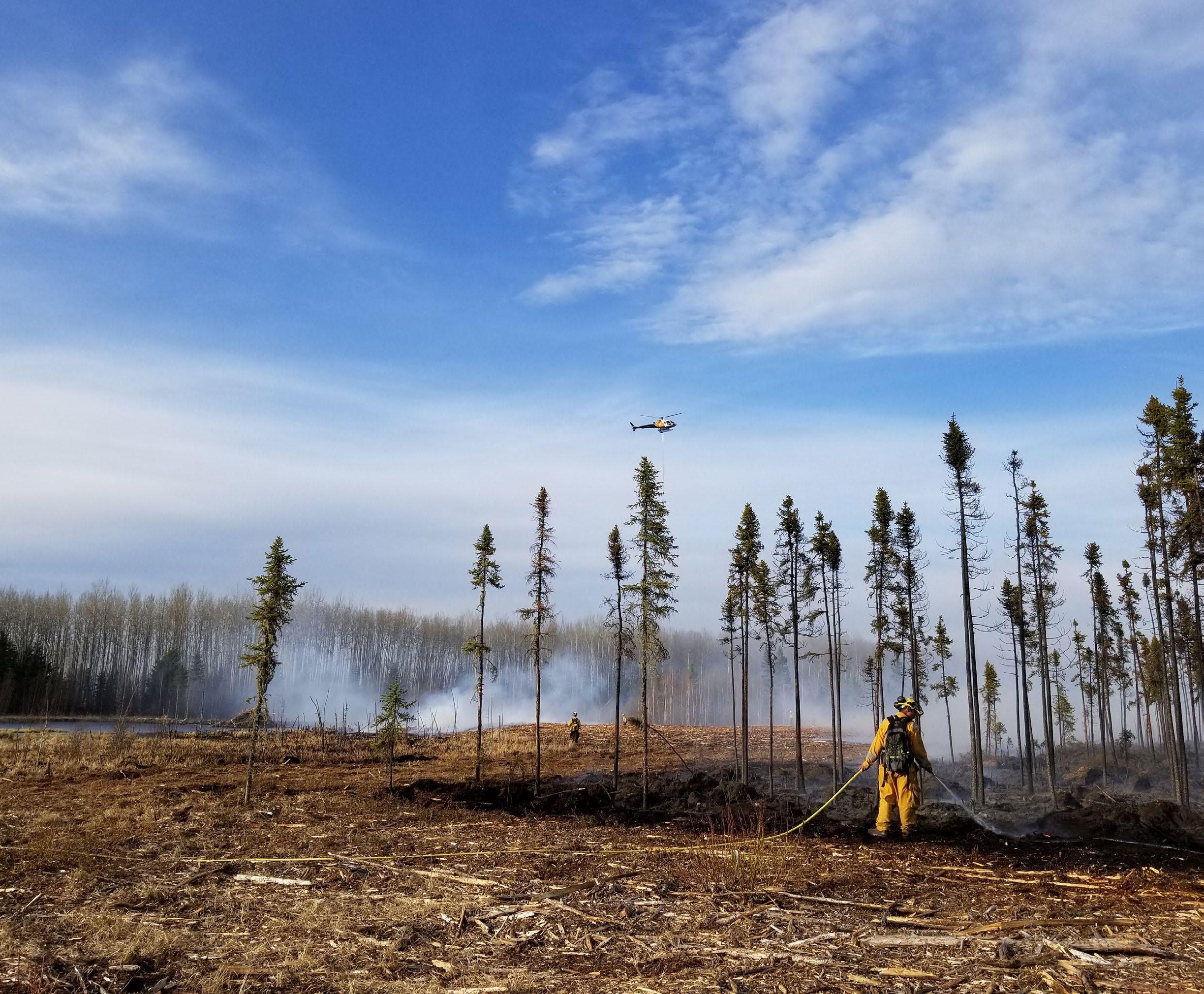
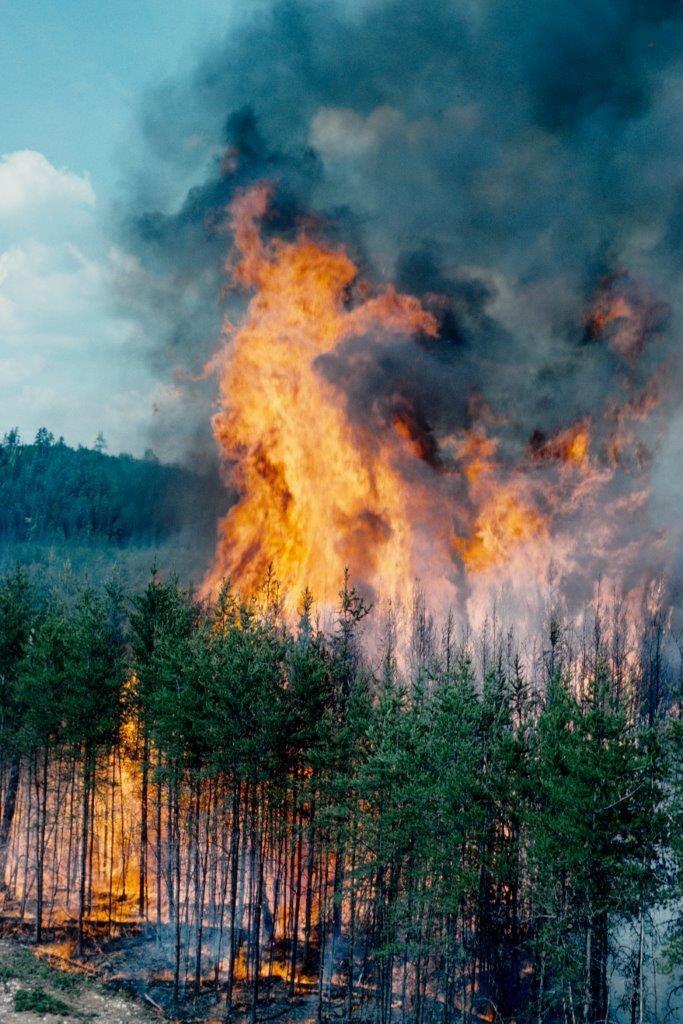
Opposite: Members of the Canadian Forest Service manage a fire in the Canadian boreal forest. The fires, made more severe and more frequent by climate change, have displaced tens of thousands of people.
Bearing Nothing
around in circles as Fahnestock kept an eye on a thermometer. “When he went over top, I could see it jump up 4 degrees, but till he circled back, it was cold again.”
In spite of the helicopter, only the peach trees near the signal fires emerged with some healthy flowers; they should produce just enough fruit for Fahnestock’s family to enjoy — “Literally just a handful.”
This year’s cold snap means that orchards across a wide swath from Ohio to southern New York will produce very little fruit this year. The tough question farmers are facing is how to prepare for a future of difficult spring weather.
It is cliché to talk about the temperature roller coaster of spring. As February thaws into March, everyone takes to their porches for the first warm, sunny day, only to retreat inside as the next day brings a chilly rain. But the highs and lows in March and April 2026 were downright violent. In Philadelphia, April 4 reached a high of 83 degrees, with lows dropping to 32 degrees on April 8. Temperatures bounced back to 91 degrees on April 16 before dropping again, with a low of 35 degrees on April 21. At Hands on the Earth, the mercury fell into the low 20s.
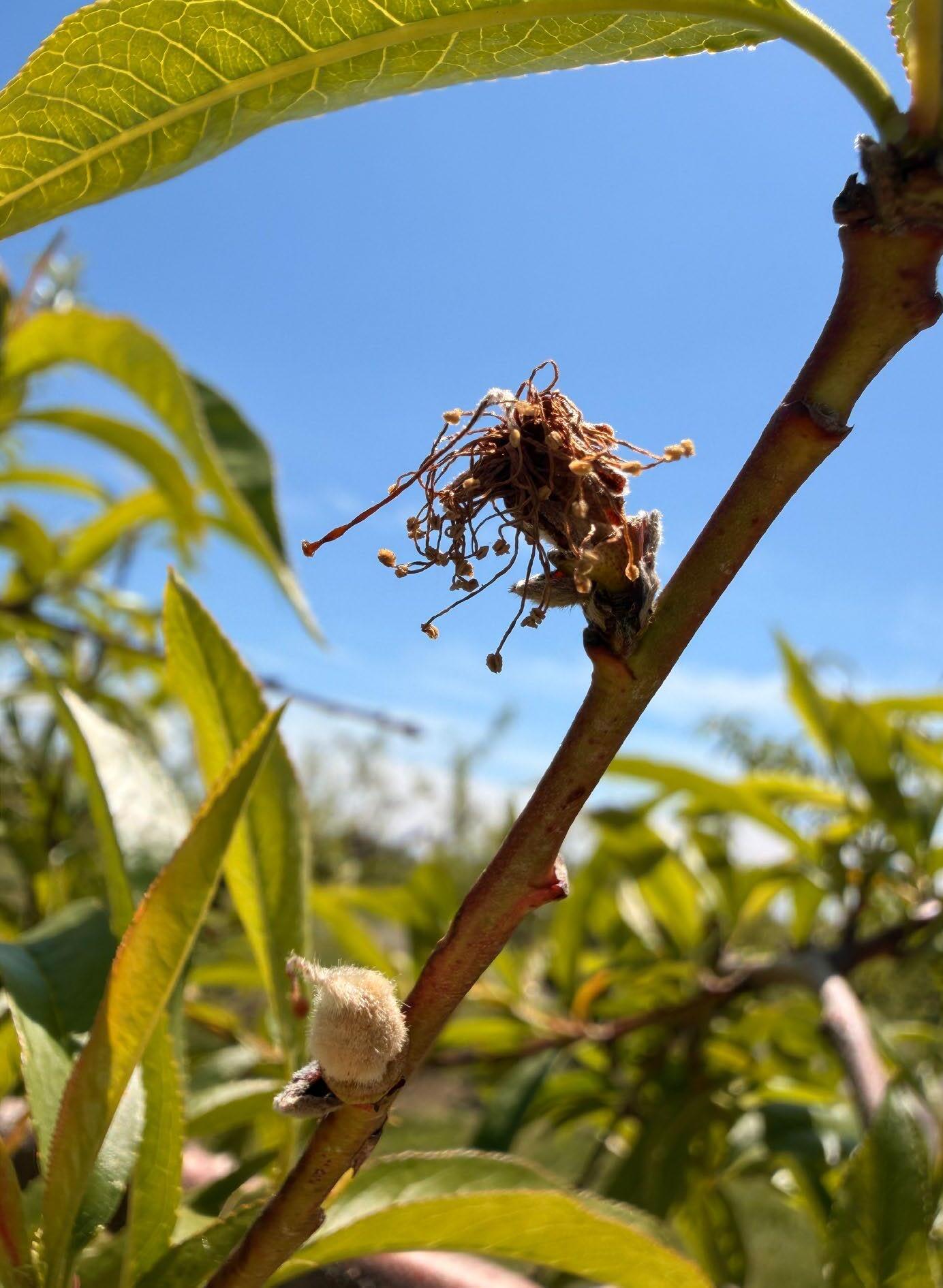
The early warm weather triggered apple, peach and other fruit trees to blossom, opening flowers to greet bees and other pollinators. Pollinated flowers began to develop into fruit, only to have the nighttime freezes kill the flowers and tiny fruitlets.
A spring freeze that kills some flowers is not rare. Indeed, a fruit tree has flowers to spare. “We only need 15% to 20% of buds to set to get a full crop,” says Shanthanu Krishna Kumar, a Penn State University assistant professor of tree fruit. It is also not rare for a spring freeze to be locally severe; it might hit one county and spare others. It might strike one orchard but not its neighbors, and it might kill flowers in low-lying areas within an orchard, but not higher up on a hill.
The helicopter was worth a shot, Dave Fahnestock thought. The owner of Hands on the Earth Orchard in Lititz, Lancaster County, which sells apples and peaches at farmers markets in Clark Park, Rittenhouse Square and Bala Cynwyd, hoped the downdraft from the propellers would mix warmer air with the
BY BERNARD BROWN
A freakish springtime freeze leaves regional farmers reeling after killing scores of crops ➤ STORY
freezing air hugging the ground across his 15 acres of fruit trees. In the days leading up to April 20, he had watched the forecast for the overnight low temperature go from worrisome to disastrous. “What could I do?” Fahnestock says. He and his crew lit fires around the orchard to show the pilot where to fly, and from 3–8 a.m., the helicopter went
“It’s a fact of life,” says Greg Stamm, manager of Mariner Farms near Downingtown. “Most of the time, if you do have problems, it’s not a complete wipeout, just a reduction in that variety or that field.” But the 2026 freeze was uncommonly thorough. It affected trees throughout orchards, and it hit orchards across a wide geographic area. Stamm has worked in agriculture almost his entire career — over 50 years. “This magnitude and scope,
PHOTO
April’s fluctuating temperatures caused apples, peaches and other fruits across the state, like those seen here at Linvilla Orchards in Media, to flower early and die off in nighttime freezes.
I’ve never seen anything like this,” he says.
In Pennsylvania, the state Department of Agriculture estimates that revenue losses for growers could reach $200 million. Statewide, “estimated losses range from 70% to 90% for apples; 90% to 100% for peaches, nectarines and apricots; 60% to 80% for European pears; and as high as 95% to 100% for cherries and plums,” according to an article published on Penn State’s website.
The USDA declared a natural disaster for 17 Pennsylvania counties and “is reviewing disaster designations for the remaining counties” in the state, according to a press release.
The April freeze damage was compounded by particularly dry air, Kumar says.
Steep terrain might have helped Frecon Farms in Boyertown, Berks County, avoid a complete wipeout, says owner Steve Frecon. “We’re looking at at least 50% or more of a crop loss,” for stone fruit, he said when Grid reached him in May, though he wouldn’t be able to fully assess the damage until the end of June. Even if fruit survives, much of it might be damaged so that it can’t retail as whole fruit, and instead will be sold for juice or other products. “It’s both the crop loss due to fruit just not being there, but then it’s
Because of the warm temperatures we had, there was a rapid progression from dormancy.”
SHANTHANU
KRISHNA KUMAR assistant professor of tree fruit, Penn State University
It takes temperatures 30 degrees or below to kill flowers and immature fruit, Kumar says. Fruit growers who see low temperatures in the forecast can take some steps to warm their trees. This might entail generating extra heat, say, by lighting propane burners. If they have access to water, they can spray the trees so that a thin shell of ice somewhat insulates the flowers from the cold air. They can also try to circulate higher, warmer air with the cold air settling around their trees. These tricks can work to boost temperatures by a few degrees, but when they dip into the low 20s for several hours, little can be done.
also going to be crop loss based on fruit that doesn’t make USDA grading standards,” Frecon says.
The damage from the freeze was particularly severe because it followed extraordinarily warm weather. “Because of the warm temperatures we had, there was a rapid progression from dormancy,” Kumar says. Flowers and fruit were 10 days further along than on the same date in 2025, and “last year, we were telling people that we are approximately five days earlier … as compared to the year before.”
The climate has changed in ways that
make growing apples more difficult, according to research published by Washington State University scientists in 2024 examining trends, including warmer temperatures, that make fruit more vulnerable to spring freezes. “What we found is that generally across most of the United States, there is an increase in … the risk of spring frost events over the last five decades,” says Lee Kalcsits, an environmental physiologist who co-authored the paper.
He says research increasingly focuses on how to adapt to the changing climate. There is a lot of genetic variation among apple varieties, as well as among the rootstock to which farmers graft cloned apple shoots. “There is a lot of variation there, and we want to understand the why and how that happens. Then we can develop a strategy for breeders to develop new varieties that do well.”
“I think we’re all going to have to prepare ourselves and our food system to brace for more extreme weather,” Frecon says. “I grew up in this orchard with no irrigation systems. Water was always plentiful and available. We have seen more springtime droughts when we should be getting lots of rain.” He says he installed an orchard irrigation system last year and is considering buying fans to help with future spring freezes.
Fahnestock says that his orchard doesn’t currently plan to invest in additional freeze protections, since protecting against an event of this severity would be prohibitively expensive. The helicopter was a cheaper alternative to buying propane heaters. “You need them every 10 feet, so we’re talking over $100,000 for something most years we won’t need, and you don’t know ahead of time what you need,” he says. “It’s not easy
to protect a crop, long and short of it.”
With so many local orchards losing some or all of their crops, consumers will see the impact when they pick or buy fruit. Frecon urges shoppers to be flexible when they go to the farmers market. “This is not the year to be fussy about cosmetic deficiency,” he says.
Fahnestock says Hands on the Earth is considering selling peaches grown elsewhere. “This is something we’ve never done before, hope to never do it again, but that’s the reality of where we’re at.”
“Supporting local farms and producers this season may be more important than ever,” says Bridget Palombo, director of healthy food access for The Food Trust (TFT). “TFT is working with farmers to help shoppers understand that the peaches on the table, for example, may have traveled hundreds or even thousands of miles because our local orchards were hit so hard.”
The Green Pages
Shop your values at these local businesses
ELECTRICIAN
Hair Vyce Studio
Multicultural hair salon located in University City servicing West Philly & South Jersey since 2013. We specialize in premier hair cuts, color & natural hair for all ages. (215) 921-9770 hairvyce.com
COMPOSTING
Back to Earth Compost Crew
Residential curbside compost pick-up, commercial pick-up, five collection sites & compost education workshops. Montgomery County & parts of Chester County. First month free trial. backtoearthcompost.com
Bennett Compost
This
magnitude
and scope, I’ve never seen anything like this.”
GREG STAMM manager, Mariner
Farms
Farmers diversify their products to weather shocks like the spring freeze. “Supporting local may not mean buying local peaches. It might mean buying the honey or the baked goods that they sell at that farm stand,” Frecon says. “I know a lot of fruit growers who have lost so much, they are scrambling to plant some vegetables so they can still have something to sell.” Frecon says that crop insurance doesn’t pay enough to make up for the lost retail sales from freeze-damaged crops. His orchard only carries catastrophic insurance on the peaches, not the apples or other crops.
“People ask us if we have insurance for this,” Fahnestock says, “You guys are our insurance for this, because we can buy [apples and peaches] and resell them. That gives us some income and helps us get through the year.” ◆
The area’s longest running organics collection service (est 2009) serving all of Philadelphia with residential and commercial pickups and locally-made soil products. 215.520.2406 bennettcompost.com
EATS
Fifth of a Farm
Our jams are a tribute to Philly, capturing its rich heritage in every jar. Whether you’re a longtime resident or passing through, take home a taste of the local tradition. Find yours @ fifthofafarm.com
EDUCATION
Kimberton Waldorf School
A holistic education for students in preschool-12th grade. Emphasizes creativity, critical thinking, nature, the arts & experiential learning. Register for an Open House! (610) 933-3635 kimberton.org
ATTENTION:
Makers, small businesses and green entrepreneurs: Place your ad here! email alex@gridphilly.com
Echo House Electric
Local electrician who works to provide high-quality results on private & public sector projects including old buildings, new construction, residential, commercial & institutional. Minority business. echohouseelectric.com
GREEN BURIAL
Laurel Hill
With our commitment to sustainability, Laurel Hill Cemeteries & Funeral Home specializes in green burials and funerals, has a variety of eco-friendly products to choose from, and offers pet aquamation. laurelhillphl.com
GREEN CLEANING
Holistic Home LLC
Philly’s original green cleaning service, est 2010. Handmade & hypoallergenic products w/ natural ingredients & essential oils. Safe for kids, pets & our cleaners. 215-421-4050
HolisticHomeLLC@gmail.com
GROCERY
Kimberton Whole Foods
A family-owned and operated natural grocery store with seven locations in Southeastern PA, selling local, organic and sustainably-grown food for over thirty years. kimbertonwholefoods.com
MAKERS
Mount Airy Candle Co.
Makers of uniquely scented candles, handcrafted perfumery and body care products. Follow us on Instagram @mountairycandleco and find us at retailers throughout the region. mountairycandle.com
Ambler • Chestnut Hill • Germantown • Mt. Airy Weavers Way Farm Market 7095 Henry Ave, Philadelphia, PA
Ready to take action for the environment?
Train for success in a field working toward climate solutions
Though she majored in physics and theatre in college, Arwen Kozak shares that environmental studies had been a longtime interest. It wasn’t until she started teaching high school physics and math in Germantown that a career focused on the environment began to take shape in her mind. “I really liked being in the classroom working with real people and thinking about community and how we want to show up in our society,” she explains, “and I realized that environmental policy was really how I thought I should do that. I wanted access to Penn’s network of people, not only the faculty and students, but also the kinds of guest speakers and visiting scholars that would be available to me on campus.”
Arwen Kozak, MES ’25 Senior Research Coordinator, Kleinman Center for Energy Policy