■
■
■
Extreme heat: an equity crisis
Resisting data center plans in South Philly
A smarter energy grid is possible
p. 5
p. 28
p. 14
AUGUST 2026 / ISSUE 207 / GRIDPHILLY.COM
TO WA R D A S U S TA I N A B L E P H I L A D E L P H I A
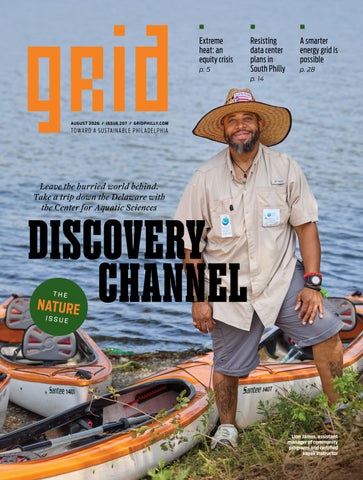
Leave the hurried world behind. Take a trip down the Delaware with the Center for Aquatic Sciences
DISCOVERY CHANNEL THE
NATURE ISSUE
Lion James, assistant manager of community programs and certified kayak instructor
REAL FOOD. LOCAL ROOTS. COLLEGEVILLE | DOUGLASSVILLE | DOWNINGTOWN KIMBERTON | MALVERN | OTTSVILLE | WYOMISSING kimbertonwholefoods.com
NOTICE: Uber driver and passenger, you doored a bike rider & fled the scene . . . But
WE GOT YOU! On Feb 11, 2026 an Uber driver doored our client into a pole, broke his hand and then DROVE & WALKED AWAY while he bled on the sidewalk. !NO BUENO! He needed hand surgery.
SO, if you see someone get hit: Get the tag number Give it to the victim DO SOMETHING! zach@stuartleon.com
stuart@stuartleon.com
AUGUST 20 26
G R I DP HI LLY.COM
1
PUBLI SHE R’S NOTES
by alex mulcahy
Beyond the Fear publisher Alex Mulcahy senior editor Bernard Brown associate editor & distribution Timothy Mulcahy tim@gridphilly.com deputy editor Julia Lowe art director Michael Wohlberg writers
Sophie Aanerud Marilyn Anthony Kyle Bagenstose Bernard Brown Erin Dohony Gabriel Donahue Elijah Fischer Ed Golden Julia Lowe Sarah Ruiz Steve Shreiner photographers Chris Baker Evens Matthew Bender Gabriel Donahue Taylor Ecker Julia Lowe Tracie van Auken published by Red Flag Media 1032 Arch Street, 3rd Floor Philadelphia, PA 19107 215.625.9850 G R I D P H I L LY. C O M
2
GR ID P H IL LY.CO M
AUGUST 20 26
W
hen we went to print last month with “APOCALYPSE NOW” splashed across the cover in 138-point type above a raging Canadian wildfire, I wondered if people would think we were being alarmist. Little did I know that the cover would prove timely. It wasn’t just the smoky air from those Canadian fires haunting us. It seemed like one climate-fueled crisis followed another: oppressive heat waves, unbreathable air, flash floods. Until a few weeks ago, I’d never even heard the term microburst — a violent downdraft capable of producing winds as strong as a weak tornado. Then one ripped through my neighborhood, snapping mature trees in half and uprooting giants that had stood for generations. I continue to look in disbelief when I see houses in plain view that were very recently hidden behind leaves and branches. But it really happened, and those trees are gone. For a while, it felt as though we no longer had weather. It was more like one assault from nature after another. Fear has a way of getting our attention. Maybe living through summers like this will finally convince us to examine human beings’ place in nature more deeply. But fear isn’t the only reason — or even the best reason — to care. The same systems that can overwhelm us are the ones that nourish us. A forest is not just a place where fires burn; it is also a place of beauty, refuge and renewal. A river or stream is not just a threat during a flood; it is a living system that has shaped our communities for generations.
This month’s issue is about rediscovering something we all need: the quiet joy of being outside. We often talk about nature in practical, almost utilitarian terms. Yes, trees cool our neighborhoods, filter our air and reduce flooding. Those benefits are essential, but they aren’t the whole story. Spending time outdoors also changes us. It lowers stress and quiets the mind. As we mingle in an ecosystem teeming with life, it reminds us that we’re part of something larger than ourselves. Researchers have found that people who feel connected to nature are more likely to protect it. That makes intuitive sense. We fight for the places we love, not just the ones we’re told are in danger. As the climate becomes less predictable, that connection may be more important than ever. If we want people to care for the natural world, we also have to help them experience it — to paddle its rivers, walk beneath its trees, watch its birds and discover the quiet satisfaction of simply being outside. The crises aren’t going away. But neither is the beauty, wonder and connection that make this planet worth protecting.
a l e x m u l ca h y , Publisher
COV E R P HOTO BY M ATTHE W BENDER
THE LEARNING
NEVER STOPS
NOW ENROLLING Discover the gold standard in public online education for grades K-12 at PA Cyber. To learn more Call 724.643.1180 or visit pacyber.org to start your PA Cyber journey today.
AUGUST 20 26
G R I DP HI LLY.COM
3
news Malcolm Bundy is an ambassador for Mifflin Square Park, where he interacts with residents and works to prevent illegal dumping.
PARKS
THE NEW GUARDIANS OF PHILLY’S PARKS A new Park Ambassador program from Philadelphia Parks & Recreation is focused on keeping
park spaces clean while building stronger connections with the people who use them. Funded by the William Penn Foundation, the two-year pilot places ambassadors at Mifflin Square, Tacony Creek, Cobbs Creek and Fairmount parks with the goal of reducing illegal dumping in and around the sites by 50%.
At Mifflin Square Park in South Philadelphia, ambassador Malcolm Bundy spends much of his time talking with residents. He informs them of how to properly dispose of commonly dumped items. “I have flyers for resources about how to properly dispose of appliances, household hazardous waste, tires and compost,” Bundy says. “If people have questions or need information, they can come up to me. It takes a village, and talking with your neighbors is the first step.” Bundy has found that many residents don’t know they can call 311 to report illegal dumping or schedule bulk trash pickup. To better understand where dumping is happening, Parks & Recreation is working with the Data Driven Discovery Initiative. Illegal dumping coordinators like Nathan McWilliams understand that progress is not always linear. “So success could be 1% success, it could be 2%, but every six months we just evaluate that off the goal. It’s not to decrease 50% within six months,” McWilliams says. For now, the work is steady and local, shaped by small conversations and the slow process of building trust. —Ed Golden
TRANSIT
T
he City of Philadelphia’s FY 2027 budget allocated $25 million for the Zero Fare program in Mayor Parker’s budget. The funding will allow the service to continue for 12 months, which means advocates will need to lobby again for the program in the next budget. “Transit riders should not have to balance paying for food, medical care, and transit fare,” said Stephen Bronskill, manager of the Transit Forward Philadelphia Coalition. “This budget moves us in the right direction.” The program is designed to offer relief to low-income riders and promote equitable growth across the city. When it was proposed in 2023, City Council approved $62 million for the FY 2024 budget to develop and implement the
4 GR ID P H IL LY.CO M AUGUST 2026
pilot program. At that time, 39% of Philadelphia residents in poverty cited transportation as their biggest obstacle to finding and sustaining employment. 34,000 eligible residents were auto-enrolled and received their passes directly in the mail. “Philadelphia is full of these invisible barriers,” says local organizer Jamir Griffin. “Parents trying to reach childcare. Students trying to get across the city after school closures. Workers turning down promotions because commuting would cost too much.” Griffin says that Zero Fare and programs like it improve quality of life and economic stability for riders. “This program recognizes something organizers have known for years. Mobility is opportunity.” — Erin Dohony
PA R KS : E D G O L D E N
A Budget To Flood the Engines
Cooling Is a Human Right Philadelphia must act now to protect its residents by the
philadelphia climate justice collective (Mantua Civic Association, SEAMAAC, Overbrook Environmental Education Center, Esperanza, and The Environmental Collaboratory at Drexel University)
CHRIS BAKER EVENS
P
hiladelphia is heating up — and too many of our neighbors can’t escape it. In parts of North, West and South Philadelphia, summer temperatures can soar 20 degrees higher than in greener, wealthier parts of the city. Heat is deadly — it’s a public health emergency that exposes the deep inequities shaping who stays safe and who suffers when the heat rises. Our conclusion is clear: Cooling must be recognized as a basic human right. Extreme heat is an equity crisis. Every summer, the same neighborhoods in Philadelphia suffer the most: Black, Brown, immigrant and low-income residents living in old, poorly insulated homes with little green space. In neighborhoods with limited tree canopy, minimal green space and extensive asphalt, homes can become “heat traps,” absorbing heat during the day and radiating it through the night. Philadelphia’s aging housing stock traps heat. Renters often lack the power or resources to install air conditioning or improve insulation. More trees and green infrastructure are also essential to cool neighborhoods — but without safeguards, they can also drive gentrification. Philadelphia’s network of cooling centers offers some relief — but there are too few, often too far away from struggling residents, and they close by early evening, even while overnight temperatures remain dangerously high. Some people feel unwelcome due to language barriers or restrictive rules. Others simply cannot get there. A right to cooling means more than temporary cooling shelters. It requires thinking proactively and creatively to ensure that there is equitable access to cooling on high heat days, including the deployment of mo-
Much of Philadelphia’s housing stock has a limited tree canopy and dark, flat roofs — a recipe for a hot home.
bile cooling buses, extended hours, multilingual outreach and inclusive spaces for everyone, including unhoused residents. City policies should allow community-based groups to open cooling centers proactively, rather than waiting for an official heat health emergency declaration that comes only after danger has already arrived. Even when air conditioners are available, too many Philadelphians can’t afford to turn them on. Philadelphia households spend nearly 7% of their income on energy — more than double the national average. Many report skipping meals or medications to pay utility bills. We must prevent energy shut-offs during extreme heat, expand utility assistance and require community-benefit agreements for
energy-intensive projects, such as data centers, that threaten to raise rates and strain local grids. Health systems must treat heat as a hazard. Heat worsens asthma, heart disease and mental health conditions, yet cooling is still not recognized as a preventive health measure. Hospitals and clinics must begin screening patients for heat vulnerability, integrating temperature exposure into medical records and training providers to ask the right questions. Other communities are showing the way: Maricopa County, Arizona, uses real-time emergency room data to track heat illness, and New York City dispatches community health workers to guide residents to cooling centers. Philadelphia can do the same. ◆
CALLS TO ACTION We urge the City and state to expand Whole Home Repairs and weatherization programs to include cooling measures such as reflective roofs and efficient AC installation. The commonwealth’s proposed Home Preservation Program should
prioritize the zip codes facing the highest heat and health burdens. Philadelphia already has a “right to heat” policy to ensure residents aren’t left freezing in winter. Now we need a right to cooling policy
that’s equally comprehensive, community-driven and backed by funding. Each of these is a lifesaving intervention. Together, they represent a moral imperative. Cooling is not a privilege. It is a human right.
AUGUST 20 26 G R I DP HILLY.COM 5
cycling
Joy Ride Cycling group brings Black women together for excursions through Philly’s parks story and photo by julia lowe Iresha Picot leads about 15 to 25 Black women on social bike rides biweekly.
I
resha picot wasn’t sure how many women would show up. It was the fifth day in a brutal stretch of summer heat, with Fourth of July fireworks having wrapped up just hours earlier. But by 10 a.m., 26 women had gathered at the Indego station at 33rd and Diamond streets for what has become their regular dose of joy: a group bike ride through Fairmount Park. Picot, founder of Black Girl Joy Bike Ride, says it was one of the group’s largest turnouts. The rides, which began in 2023, bring Black women together every other week for relaxed, noncompetitive bike rides designed to foster connection, with exercise as a welcome byproduct. “I really just wanted to bring Black women together, because I do think a lot of us are super isolated,” Picot says. “We carry so many things and so much responsibility, and we do it by ourselves, because a lot of us was taught not to ask for help.” Picot grew up riding bikes in rural Vir6 GRID P H IL LY.CO M AUGUST 2026
ginia and continued cycling after moving to Philadelphia 19 years ago, until her bike was stolen and she stopped riding for years. During the COVID-19 pandemic, she started riding Indego bikes, going for rides along Martin Luther King Jr. Drive. Before long,
I really just wanted to bring Black women together.” ire sha picot founder, Black Girl Joy Bike Ride
she began to wonder whether other Black women might want to join her. Using the city’s bikeshare program was central to the idea. Picot wanted women to be able to participate without worrying about the cost of owning a bike. An early
Penn Medicine grant covered Indego ride costs during the program’s first year, during which Picot was joined by an average of 10 to 15 women for weekly rides. As more women found the group, support from Philadelphia’s cycling and outdoor community grew alongside it. A fundraising partnership with Philly Bike Action! helped Black Girl Joy Bike Ride provide bicycles for seven of the group’s most consistent riders in 2025. Picot has since expanded that effort through a three-year Circuit Trails grant, which has allowed her to purchase more bikes, along with helmets and locks, and host maintenance workshops for participants. Over the past year, Picot has purchased 23 bikes for riders who didn’t have one. “One woman told me she had never been given something that expensive,” Picot says. “She was like, ‘I’ve never been gifted anything.’ So it’s been very touching.” The additional bikes have made it possible to explore parts of the city beyond those close to neighborhood Indego stations. Alongside the regular community rides, Picot now also hosts “adventure rides” that begin at trailheads. She intentionally plans routes through parks and trails to help newer riders feel safe and also to introduce participants to green spaces they may never have visited before. “One thing I realized, being a transplant, and so many Philly natives do show up to the bike ride: A lot of them had never been on some of these trails,” Picot says. “It was me who took them to Bartram’s, to John Heinz, to Delaware River Trail — but this is stuff in their backyards.” For Picot, increasing Black women’s visibility in those spaces is important, but cycling itself isn’t the point. “The bike is the tool,” she says. Before anyone starts pedaling, the women greet each other with hugs, laughter and offers to help adjust a seat or pump up a tire. Picot, who has worked in mental and behavioral health for 17 years, says that’s exactly what she hoped the rides would become: a place where women can show up for themselves and each other, combat loneliness and find joy. Sometimes, she says, it feels a little like group therapy. “I don’t think we ever have to do anything by ourselves — and that’s including healing, growing, getting better in life. I don’t think you should ever have to do that by yourself.” ◆
sponsored content
THE SOLAR TAX CREDIT YOU CAN STILL GET There’s a new, low-cost path to owning solar — with an even bigger discount in the region’s new “Energy Communities” by micah gold-markel
T
he 30% federal tax credit for going solar ended for homeowners in 2025, but it never ended for businesses. That’s the opening behind the Solar States Pre-Paid Lease. Here’s the idea. A qualified business owns the system long enough to claim the credit homeowners no longer can — and passes those savings into your price. You don’t front the credit or file for it — you simply benefit from it, as a lower price. What sets it apart from an ordinary lease is that it’s a path to ownership. A partner holds the system for its first five years — that’s what makes the tax savings possible — and then it becomes yours: the array, the power, the savings — all of it. You’re not renting your roof for decades; you’re on a discounted route to owning your solar. And the “lower” cost is real: it’s typically more than 24% off what a cash buyer pays, and as much as 34% in a qualifying “Energy Community.” To compensate areas with an industrial and fossil fuel past, the federal government designates certain counties as Energy Communities. Fortunately, much of Greater Philadelphia qualifies — Philadelphia, Delaware, Montgomery, Bucks and Chester counties among them, with more across Pennsylvania and New Jersey. That map is redrawn each year, so a home that qualifies today may not next year. Who is the path of the Pre-Paid Lease
ideal for? Anyone who wants to own their solar — and keep the long-term savings — for well under what it would normally cost. You’re a strong fit if you: • Own your home and your roof • Have a sound, sun-facing rooftop with room for panels • Want to lock in lower energy costs as utility rates keep climbing It’s a rooftop program, so ground-mounted arrays, carports, and shared or condo roofs you don’t fully control don’t qualify. If your panels go on your own roof, you’re likely in the running. And the process is easy. Solar States— a Certified B-Corporation that has designed and installed more than 2,000 systems across Pennsylvania, New Jersey
and Delaware since 2008, with our own NABCEP-certified crews — handles the design, permitting, installation and the paperwork behind the discount. Timing is important. Because the discount depends on your county and incentives that reset each year, the cost is likely the best you will see — and it can change. Get a free, no-pressure quote from Solar States and find out what the Pre-Paid Lease could save on your roof, in your county! ◆
Micah Gold-Markel is the founder of Solar States, a Philadelphia-based solar and storage installer.
AUGUST 20 26 G R I DP HILLY.COM 7
culture
Reel Change Philly’s Black indie film scene is robust. This club is getting the word out
W
hen cinephile and Germantown resident Stephanye R. Watts entered the world of independent cinema, she discovered a troubling pattern. “I started to notice there were no other Black people in the theater, unless they were like 60-plus,” Watts says. “Black millennials are on the internet, talking about wanting to see more Black films, and … I’m going to all 8 GRID P H I L LY.CO M AUGUST 2026
by elijah fischer
these different independent cinemas but … people aren’t here.” It was then, amid the #OscarsSoWhite movement, that she decided to form Be Reel Black Cinema Club, a group dedicated to amplifying independent, archival and previously inaccessible Black films, one meetup at a time. “We’re just trying to let the world know independent Black cinema exists,” Watts says. “It is vast, it is deep, and
it’s playing around you all the time.” BeReel began in February 2017, while Watts was living in New York City, through a partnership with Gina Duncan, then-head of the Brooklyn Academy of Music’s film department. In 2022, Watts returned to her hometown of Philadelphia, where she has expanded the club’s reach. The group promotes local screenings of Black-led and -directed films and encourages Black film lovers throughout Philadelphia to attend screening meetups, helping ensure Blackness is reflected in the audience as well as onscreen. “Our members are people who genuinely care about the future of Black arts and culture,” Watts explains. “They understand the importance of the Black film canon, and that in order for it to sustain, we have to show up for it. These are people who are committed to shoring up the future of Black filmmaking outside of the Hollywood system.” The Philadelphia Film Society (PFS) is the club’s official institutional partner, following its status as a primary screening location. BeReel also works with other Black-led community engagement groups through PFS, including Greedy In The City, a boutique culinary event club founded by Jae Rich. The two groups collaborated this year to hold a screening of “Soul Food” as part of Rich’s annual “Wine and Watch” series at PFS. “In my full-time job, I work in public history and museums, so my part in that was bringing some archival ephemera that connected to P HOTO BY TAY LOR EC KER
G R O U P P H OTO C O U R T E S Y O F S T E P H A N Y E R . WAT T S
Stephanye R. Watts partners with the Philadelphia Film Society to host screenings for its annual Black Cinema Week and throughout the year.
the film,” Watts says. Jasmine Hawkins, director of community engagement at PFS, says the partnership began in early 2023. “What Stephanye was looking for aligned with our mission to make films accessible, to showcase diverse voices and amplify representation,” she says. Through her camaraderie with other PFS affiliates, Watts’ work has been instrumental in helping PFS build demographics in its audiences that it hasn’t traditionally reached. “I think the partners coming together has definitely expanded PFS’s awareness with Black audiences throughout Philadelphia,” Hawkins says. BeReel’s summer lineup highlights multiple upcoming screenings that show that “Black cinema is alive in Philadelphia!” as announced on its Instagram. The group has also expressed excitement for the upcoming Blackstar Film Festival, which Watts says BeReel supports every year. The festival will take place from Aug. 6-9, showcasing films made by Black, Brown and Indigenous filmmakers from across the globe. BeReel also attends the New York African Film Festival annually, according to Watts, where she has started to see more younger folks in attendance. “I think [the Philly film scene] still has a ways to go in terms of growing Black audiences, but I have faith that we’ll get there. The ecosystem is set, there’s places in the area beyond just PFS even, like Scribe, cinéSpeak, Bryn Mawr, etc. The infrastructure is here, so I just hope we get to a place where Black audiences take hold of what’s being offered to us,” she says. When it comes to Philly’s engagement with Black cinema, Watts hopes to see more of these screenings sell out. “When I go see independent Black films by myself, I don’t like being the only Black person in the theater. I want to see us in the room, I want us to be more aware and support the arts. The reason why Philadelphia has been such a capital in terms of Black art and culture for over 250 years — because we’ve had a free Black community here for that long — is because people show up. What I want to see is millennials and Gen Z showing up and supporting, not just people over 60, so that we can continue to have this rich legacy of Black art in the city.” ◆
Open 7 days a week 8:00 am – 8:00 pm cosmicfoods.com
A $69 back-toschool benefit. Free for PFCU members.* The money app trusted by 6.5 million Debit card for up to 5 kids Chores and Allowance Open an account at PFCU to get Greenlight for FREE!* * PFCU members are eligible for the Greenlight SELECT plan at no cost when they connect their PFCU account as the Greenlight funding source for the entirety of the promotion. Subject to minimum balance requirements and identity verification. Upgrades will result in additional fees. Upon termination of promotion, members will be responsible for associated monthly fees. See terms for details. Offer ends 03/17/2027. Offer subject to change or renewal. Copyright © 2026 Greenlight Financial Technology, All rights reserved. The Greenlight Card is issued by Community Federal Savings Bank, member FDIC, pursuant to license by Mastercard International.
To learn more about the club, visit their Instagram @bereelblackcinemaclub.
Insured by NCUA
AUGUST 20 26 G R I DP H ILLY.COM 9
urban naturalist
Ice Age Orphan Plant species discovered in the well-trodden Pine Barrens by sarah ruiz
A
10 GR ID P H I L LY.CO M AUGUST 2026
Temple University professor Sasha Eisenman (left) discovered the New Jersey false asphodel, which is endemic to the Pine Barrens and is considered critically endangered.
“It is not in any contact with any populations from either other species, which are separated by hundreds of miles, and it’s been basically in isolation on its own evolutionary trajectory probably since near
the end of the last ice age,” says Eisenman. If New Jersey seems like an unlikely place to find a brand-new species, that’s because it is. According to Lena Struwe, director of the Chrysler Herbarium at Rutgers University, although more than 2,000 new species of plant are described every year, virtually none of them are in such a densely settled and well documented region as New Jersey. “We find species that show up in New Jersey that are known from Pennsylvania, Delaware, New York or from Europe or Africa, but that you find a brand-new species that was not known to botanists anywhere
SASHA EISENMAN (2)
long the sandy banks of the New Jersey Pine Barrens’ meandering streams, a small grasslike plant with clusters of white, starshaped flowers bloomed unnoticed for millennia until botanist and Temple University professor Sasha Eisenman made a surprising discovery. This rare and endangered plant, previously unknown to science, is found nowhere else in the world but New Jersey. The plant was long assumed to simply be the northernmost population of a species called the coastal false asphodel. Eisenman set out to test that assumption after other botanists noted morphological differences in the New Jersey population. Using historical herbarium records to guide him, Eisenman went hunting for the plant among the rare wetland savanna habitats of the Pine Barrens. He collected and examined specimens and conducted a genetic analysis to compare them to false asphodel species present to the north and south. He concluded that the New Jersey false asphodel was in fact a unique, endemic species. In March, Eisenman published a paper announcing the discovery, dubbing it Triantha × novacaesariensis, after Nova Caesarea, the Latin name for New Jersey. Eisenman’s research showed that two different species of false asphodel coexisting in New Jersey many thousands of years ago hybridized. As the two parent species eventually disappeared from the state, the hybrid plant was left to evolve on its own.
before is not something that is common in the United States,” says Struwe. Eisenman’s discovery immediately vaulted the plant to the attention of conservation bodies. The southern species of false asphodel is considered critically imperiled in New Jersey, but globally stable because larger populations exist in other states. Because T. novacaesariensis can only be found in rare
lantic white cedar swamp, and pitch pine lowlands ecological communities,” Caryn Shinske, a press officer for the New Jersey Department of Environmental Protection, wrote in a statement. According to Russel Juelg, a senior land steward with the New Jersey Conservation Foundation, the fact that T. novacaesariensis was able to survive long enough to be found
I wish people realized we have so much biodiversity right outside our doors.” lena struwe director of the Chrysler Herbarium at Rutgers University
numbers in New Jersey, it is now considered critically imperiled on the global level. “Conserving a rare endemic plant like Triantha × novacaesariensis in the Pinelands will require that the species’ habitat and ecological processes that support the plant also be conserved, including the globally rare Pine Barrens riverside savanna, At-
MUSEUM QUALITY
C O N S TA N C E M E N S H ( 2 )
Academy of Natural Sciences exhibit showcases indigenous plants in Parkway gardens
despite challenges from encroaching human development, motor vehicles and climate change, is a testament to the success of Pine Barrens conservation efforts. “The fact that we’re preserving these areas gives us the opportunity to make discoveries like this,” says Juelg. “If the Pine Barrens had been obliterated and developed,
H
erbarium specimens, collected and pressed for preservation by botanists, play a critical role in the discovery and study of plant species. Struwe says they act like a “snapshot in time,” recording the existence of plants that might have lived decades or centuries ago. The herbarium at the Academy of Natural Sciences is considered the oldest in North America, with specimens stretching back over 400 years, representing some of the first
those are things that obviously we would never even have known.” The New Jersey Pine Barrens is designated as a UNESCO Biosphere Reserve for its ecological uniqueness. There are at least 850 plant species present in the region, including 92 endangered or threatened species. Struwe says people often overlook the remarkable diversity so close to home, seeing only a “wall of green.” “I wish people realized we have so much biodiversity right outside our doors,” says Struwe. Could there be more undiscovered species hiding among New Jersey’s pitch pines and white cedars? Juelg says it’s likely, though the amount of focused effort required to describe even one new species means some of the Pine Barrens’ rich biodiversity might go unappreciated a while longer. For Eisenman, the mystery is part of the excitement. “The fact that extensive inventories of plants and studies of plants have been done for centuries, and yet there are still discoveries to be made is really exciting,” says Eisenman. “It just shows that even in front of us there are amazing natural systems at play that we have yet to fully understand.” ◆
descriptions of North American plants by Western scientists. However, long before the arrival of colonial scientists, the Indigenous peoples of North America were studying, using, cultivating and forming deep cultural ties to the continent’s plants. A new exhibit titled Botany of Nations, on display at the Academy of Natural Sciences until February 2027, elevates this Indigenous scientific knowledge, centering Native perspectives on the plant specimens “discovered” by Meriwether Lewis and William Clark during their 1804 expedition. Curated by indigenous plant expert Enrique Salmón, the exhibit offers displays, workshops on Indigenous cultural practices, and a native plant garden on the Benjamin Franklin Parkway. The exhibit invites visitors to consider the connection between plants and culture. As Struwe says: “The history of the plants and the history of the people are all interconnected.” “Native Plants on the Parkway” highlights species that support local wildlife and thrive in Philadelphia’s Northeastern climate.
AUGUST 20 26 G R I DP HILLY.COM 1 1
philly cooks
W Made to Share A contest-winning rice recipe celebrates tradition, community and care by marilyn anthony
Philipa Laster volunteers at the Crossroads Kitchen Project, an initiative housed at the Crossroads Women’s Center in Germantown.
12 GR ID P H IL LY.CO M AUGUST 2026
hen a fellow volunteer at the Crossroads Kitchen Project announced that she didn’t like rice, Philipa Laster sensed a challenge. Laster, a native of Nigeria, grew up eating rice every day. She began thinking about a dish that would change her colleague’s mind. Masa cakes, a traditional northern Nigerian food that Laster’s mother made weekly, offered an opportunity to showcase a tasty variation on the plain steamed or boiled rice her co-worker disdained as “poor people’s food.” But it was her aunt’s recipe, slightly modified, that helped Laster win first place in the 2026 Crossroads Kitchen Community “Vegetarian Rice and Beans” cookbook contest. “My reason for being in the competition was to show people there are different ways to make one certain food. I am strongly connected to the nutritional benefits of food rather than (just) the filling parts of food,” Laster says. She also cherishes her deep connection to food as a tribute to the women who shaped her life. Laster’s mother served her family masa as both a snack and a meal, but her aunt, with whom Laster lived while attending college in northern Nigeria, ran a small food business. An outdoor woodstove in the front yard enabled her to sell masa and bean cakes to passersby. Laster recalls that her aunt gave so many cakes to hungry schoolchildren that she laughingly questioned whether her aunt was running a business or a charity. Although Laster earned a degree in engineering in Nigeria, her ambition has always involved caregiving. She attributes her interest in health and wellness to an early childhood experience. Shortly after Laster was born, her father suffered a stroke. Her mother placed the 3-month-old in bed with him during his recovery. “I was a motivational baby,” Laster jokes, saying her presence gave her father the inspiration to get stronger. A glance at Laster’s résumé shows how much she has accomplished since moving to the United States 13 years ago. While raising two children, she became a certified nursing assistant, and after completing a Harvard Medical School Executive Education health and wellness program in 2024, she took on a freelance role as a motivational speaker and ambassador for healthy lifestyles and P HOTOS BY TAY LOR EC KER
sustainable nutrition. “Food is the main part of a healthy life. Everything starts with what we eat. … food can make you completely whole. Food is something people share when they are happy and also they go to when they are sad. Celebration is food.” Laster initially planned to move to Virginia, but while attending a funeral there,
Food is the main part of a healthy life. Everything starts with what we eat. Food can make you completely whole.” philipa laster
she met a woman who told her about Philadelphia. Laster liked the way the city sounded, “just like my name Philipa,” so she rerouted and settled here. In her small home garden in Olney, Laster grows a few African vegetables, and she is quick to rescue the dandelions from a neighbor’s yard. “We spend a lot of time on Earth either making food or eating food. I love cooking so much, and I am always searching for nutrients,” she says. “When people ask me how I get so much done, I tell them I have 48 hours in my day.” ◆
NIGERIAN MASA CAKES Makes approximately 20 cakes
These cakes are very versatile. You can adapt the ingredients to make them sweet or spicy, plain, fermented like sourdough or stuffed with vegetables such as minced broccoli or other greens. Don’t be daunted by the long prep time. Once the rice has soaked and the batter has risen, the recipe comes together quickly.
Ingredients 1 cup raw short-grain or tuwo* rice ½ cup cooked short-grain or tuwo* rice Water cup sugar, or to taste ¼ teaspoon yeast teaspoon baking powder teaspoon salt Vegetable oil, for frying
Equipment Nonstick frying pan Round molds, such as cookie or biscuit rings Blender
• Thoroughly rinse the raw rice, then soften it by soaking it in water to cover for 8 hours or overnight. • Drain the rice and combine it with the cooked rice in a blender. Blend into a smooth paste, adding a splash of water if needed. • Pour the batter into a bowl and stir in the salt, sugar, yeast and baking powder. Mix well. • Cover the bowl with a clean towel or plastic wrap and let it sit out at room temperature for 2 to 4 hours or until doubled in size. The fermented batter should be bubbly and airy at this stage. • Mix well then drop small amounts of batter into a well-oiled pan over medium-high heat. • Fry for 2 to 3 minutes on each side, or until golden brown.
Laster uses a special pan with rounded indents to fry masa cakes.
Serve the masa cakes warm with a traditional Nigerian soup like Miyan Taushe, with hot sauce, or with sweet toppings such as honey, maple syrup or powdered sugar.
*a Nigerian short grain rice used to make fufu
AUGUST 20 26 G R I DP HI LLY.COM 13
energy
Philly Thrive volunteer Johnny Kuprionis hangs flyers to invite Grays Ferry residents to an upcoming town hall.
On the Offense Philadelphians prepare for a fight against potential data centers in the city by bernard brown
O
rganizers with Philly Thrive and People’s Tech Project aren’t waiting for an artificial intelligence data center in the Bellwether District to be announced. In the deep freeze of February, the Point Breeze environmental justice advocacy group took to the sidewalks of Grays Ferry, knocking on 1,876 doors and speaking with nearly 500 people. The advocates expect a developer to start building as quickly as possible to avoid community resistance. “They can’t wait to build the data center,” says Shawmar Pitts, Thrive’s managing co-director. “You need a lot of room, and you need water. The Schuylkill is right there. It doesn’t take a brain surgeon to figure out what they are trying to do.” Thrive got its start organizing against pollution from the PES refinery, at the time the city’s largest single source of air 14 GRID P H I L LY.CO M AUGUST 20 26
pollution. After an explosion and fire in 2019 shut down the plant, Hilco Redevelopment Partners (HRP), an Illinois-based company, bought the 1,300-acre site. HRP is developing it into a new industrial hub, branded the Bellwether District, planned to include distribution centers and manufacturing facilities. So far, Hilco has announced a DrinkPAK beverage bottling plant. Thrive members aren’t the only people suspecting a data center at Bellwether. As reported in the Philadelphia Inquirer in December, HRP representatives would neither confirm nor deny that they were speaking with data center developers. Grid asked a City representative about plans to build a data center and did not receive a response. “I think we are purposely targeted,” says Thrive board president Sonya Sanders, speaking about the history of placing pol-
luting facilities in Black and Brown communities. “They put them in our areas because they feel as though we can do nothing.” Pitts says he expects the community to face higher electric bills and air pollution from diesel generators if a data center is built nearby. “From everything that we know about data centers, the community is going to have to foot the bill for the power,” he says. DeMorra Hawkins, interim co-director of Philly Thrive, sees data centers in particular as a threat that could motivate rural and suburban communities to unite with urban environmental justice. “The data center is one of these things that have united us across all geographical and economical and racial barriers,” she says. “Nobody wants a data center.” Pennsylvania Gov. Josh Shapiro has courted data center developers to build in the Keystone State to create jobs. “My husband is a union carpenter. I understand what those jobs mean for the strength of our economy,” Hawkins says. “But let’s be realistic. I looked up something, and on average, it takes anywhere between 50 to 100 people at most to run a data center. ... You can’t pay 100 people enough of a salary to offset a whole community that’s going to be affected.” AI boosters such as Elon Musk say that AI (run from data centers such as one that could be built in the Bellwether District) will unlock a future of abundance for humanity. Thrive and People’s Tech Project are not convinced that the transformation will benefit their communities. Instead they expect AI to facilitate policing and help the government violate civil liberties. “We’ll be a police state,” Hawkins says. “We won’t need a large police force when we can store everyone’s face for recognition in this data center.” Devren Washington, organizing director for People’s Tech Project, says “part of what’s driving these data center buildouts” is “the need for more computational capacity to service these products that ultimately get sold to local governments around the country.” The groups plan to continue educating the community and lobbying elected officials for legislation such as state Sen. Katie Muth’s proposal for a three-year pause on data center development, Hawkins says. “We can get ahead of this battle.” ◆ P HOTO BY TRACIE VAN AUKEN
Power Player Philadelphia Energy Authority’s vice president discusses its successes and next steps by bernard brown
T
h e p h i l a d e l p h i a e n e rgy Authority (PEA) manages green energy projects for the City and raises the money to make investments that will save electricity in the long run. The PEA is celebrating its first 10 years and looking forward to the next energy wins. Katie Bartolotta, the PEA’s vice president of policy and strategic partnerships, spoke with Grid about the PEA’s wins and its path forward. This interview has been edited for clarity and length.
C O U R T E S Y O F P H I L A D E L P H I A E N E R GY AU T H O R I T Y
What PEA accomplishments are you particularly proud of? My pet project here was the Philly street light improvement project. It was our biggest bond issuance to date and the first bond issuance for the PEA specifically on behalf of the City. So there were a lot of firsts baked in there. It was a citywide project, so it touched just every single neighborhood. We were actually able to partner with University of Pennsylvania’s Crime and Justice Policy Lab to do a contemporaneous study of the project. We found that where new lights had been installed, there was a 21% decrease in outdoor nighttime gun crimes. Cities issue bonds to borrow money all the time, and green bonds (the money to pay back the bonds comes from the savings generated by the project) are becoming more popular. What was special about the financing for this project? Because of all of the impact that we knew we could measure in neighborhoods throughout the city, we were able to get the sustainability bond designation for this project. A sustainability bond needs to meet all of the environmental benefits of a green bond, but it has social benefits as well that are measurable and trackable. Right now, we are in the midst of issuing another bond for a 14-building retrofit project that includes City Hall and three other large office buildings. It also includes health centers and three homeless services facili-
ties. That one is a green bond to the tune of about $30 million. The clean energy policy landscape has changed a lot in the past couple years, and it seems like that’s the pattern: It flips every four years with presidential administrations. How do you invest for the long term in this kind of political environment? Energy savings, long-term affordability and price stability are always good ideas. We’re still moving ahead with all of the projects that were on deck to lock in longterm pricing. The Adams County solar project is completed at 70 megawatts, but we have another one in Clearfield County for 20 MW that is under construction… Airport, a 1.5-MW project. These projects deal with City government infrastructure. What about the future of
programs focused on energy savings for residents such as Built to Last, which helps low-income home owners make energy-saving repairs and improvements? With Built to Last, our goal has always been to hit 10,000 households. And we’re getting close to about 500 completed homes right now, so we’re still on that trajectory. We’ve got funding from the mayor’s H.O.M.E. initiative, so we can serve additional households. Solarize, which vets solar installers so that homeowners know what they’re getting into, fills an information gap for people who make this kind of purchase extremely rarely. Are there any other ways that PEA could help with other kinds of big, energy-saving purchases? We’re looking to do this, too, with heat pumps and other basic efficiency measures. It’s important to build a program with consumer protections and a market for installers to operate in. If you come to Philly, there’s going to be this place of pooled interest with folks who are looking to do this work. ◆
Katie Bartolotta joined the Philadelphia Energy Authority as vice president of policy and strategic partnerships in 2021.
AUGUST 20 26 G R I DP HI LLY.COM 1 5
Your Support the only Philly-based publication focused entirely on sustainability, environmental justice and community resilience.
BECOME A MEMBER!
/ month
Get Grid delivered to your door + a powerful book to inspire you, per year
Our first pick: Calling In by Loretta J. Ross • In a world quick to cancel, Ross offers another way—calling in with compassion, courage and accountability. A vital read for anyone committed to meaningful change through building a movement.
SUBSCRIBE TO GRID Get Grid delivered to your door / month Be part of the solution. Join today at
➜ store.gridphilly.com 16 GRID P H IL LY.CO M AUGUST 20 26
207
the n at u r e issue
NATURE, NURTURED We often think of nature as something untouched: a world apart from our city blocks and neighborhoods, where we go to escape the pace of daily life, take a walk, appreciate wildlife or simply find a moment of quiet. But the landscapes we cherish are rarely separate from us. ¶ In reality, behind every thriving park, flourishing community garden and backyard forest are people committed to caring for them. ¶ This issue explores the many ways neighbors, advocates, volunteers and public officials are working to improve and preserve our shared green spaces — from protecting insects and establishing arboretums to reclaiming vacant land and connecting young people with local waterways. ¶ Their stewardship efforts remind us that the natural spaces we enjoy are shaped by the choices we make to care for them. How we tend to these spaces will determine not only what survives, but how future generations experience the natural world — and whether these places continue to thrive for years to come. P HOTO BY JU L IA LOWE
AUGUST 20 26 G R I DP HI LLY.COM 17
the n at u r e issue
TAKING FLIGHT
M
A legislative push to protect bugs gains momentum m BY BERNARD BROWN
aryland’s department of Natural Resources is keeping an eye on Baltimore checkerspots. The once-common butterflies are in decline. They’re not rare enough to be endangered, but the state will be in a good position to step in if needed. In the Keystone State, no agency is tasked with ensuring their survival. The Pennsylvania Fish and Boat Commission takes care of endangered fish, reptiles and amphibians, and aquatic invertebrates. The Pennsylvania Game Commission handles mammals and birds, and the Department of Conservation and Natural Resources (DCNR) protects plants. Terrestrial (land-dwelling) invertebrates fall into a regulatory gap, though a recently passed House resolution, introduced 18 GR ID P H I L LY.CO M AUGUST 2026
by Chester County state Rep. Chris Pielli, is starting to change that. Baltimore checkerspots are black with rows of white and orange spots, and, like the oriole, they got their name because the pattern resembles the heraldic shield of George Calvert, the Baron of Baltimore, who established the colony of Maryland back in the 1600s. Their caterpillars only eat a wetland plant called white turtlehead. As their wet, shrubby habitat has declined, so have the butterflies. Baltimore checkerspots are far from the only bug whose population is slipping. “The insects that we’ve observed are declining extensively,” says Stephanie Wein, clean water and conservation advocate for Penn Environment. And since scientists have
studied relatively few of the thousands of insect species in Pennsylvania, “It’s just the tip of the iceberg,” Wein says. Pielli’s House Resolution 66, which passed the Pennsylvania House of Representatives in May, kicked off a study of how state agencies assess the status of terrestrial invertebrate species and protect those in trouble. Conservation of insects and other invertebrates generally starts with protecting the plants they depend on, so Pielli expects that the study will point to DCNR as the lead agency. “The big thing 66 is going to do is help DCNR develop an effective insect conservation program,” Pielli says. The report should land this winter, but “some elements might be proactive habitat management and coordination with federal agencies like U.S. Fish and Wildlife. Having the ability to designate [species as endangered] is a needed tool in the toolbox and is a current gap — no agency has that authority.” “We should get a good snapshot of what the state is doing already, what are the gaps that need to be filled and what are other states doing that we can mimic,” Wein says. Pielli sees momentum building for wild insects with bills passed to promote native plants, which feed wild insects. In June, House Bill 426 passed with an overwhelming bipartisan majority. If a companion bill passes the Senate, the legislation will prioritize the planting of native species on the grounds of state properties. It builds on Act 37 from 2024 that did the same for native plantings along highways. Pielli has also introduced a bill (House Bill 441) that would assign the responsibility for terrestrial invertebrates to DCNR. “It did pass the state House, but it did along party lines,” which does not bode well for the Republican-controlled state Senate taking action, Wein says. “When I look at that party-line vote, it says ‘Let’s make a clearer case for why we need to act on terrestrial invertebrate protection.’ I think the report [from HR 66] will do that.” ✿
B U T T E R F Y LY: F L I C K R / W I L D R E T U R N
State Rep. Chris Pielli introduced two pieces of legislation to protect terrestrial invertebrates, such as the Baltimore checkerspot, pictured left.
ALMOST OFFICIAL A park in Cheltenham Township seeks accreditation as an arboretum m BY SOPHIE AANERUD
C
heltenham township’s 48acre Curtis Arboretum certainly looks like an arboretum. The park’s southern edge is dominated by a lush forest of sycamore, maple and ash that gradually opens onto a series of rolling hills featuring more than 50 tree species. Despite its name and expansive tree catalogue, Curtis is officially designated as a township park, not an arboretum. But this may change: The nonprofit Friends of Curtis Arboretum (FOCA) is preparing to apply for arboretum accreditation at the end of 2026. “It’s sort of like museum accreditation,” FOCA vice president Mindy Lemoine says. “Museums have to have a standard of cataloguing and planning and an exhibition strategy — what is our special place? What is our mission?” Though arboretums as institutions extend back centuries, the first comprehensive database of arboretums, ArbNet, was established in 2011. ArbNet accredits arboretums at four levels based on self-assessment and documentation showing they meet specific standards. Because of Curtis’s relatively small size and scale, the FOCA board plans to pursue Level 1 accreditation, which requires a governing body, an arboretum plan, volunteers and at least 25 labeled tree species. Once owned by publishing magnate Cyrus Curtis, the Cheltenham estate was redesigned in the 1930s by Curtis’s daughter, Mary Louise Curtis Bok, who enlisted the Olmsted Brothers landscape architecture firm to transform the space into a functioning arboretum. Bok went on to donate much of the property to the township. Over the years, the park’s forested portion suffered from neglect, prompting Cheltenham Township to craft a master plan in 2016 to revitalize the area. This included the establishment of Friends of Curtis Arboretum in 2018. Lemoine and FOCA president Donna Wray recall the state of the park when they P HOTO BY TAY LO R EC K ER
first joined the board — hillsides were choked by invasive plants as massive trees died beneath the weight of vines. The organization launched a “buffer brigade” of volunteers who worked year-round to revive the ecosystem, planting a new generation of native flora. “This was once all knotweed and vines,” Wray observes, walking through a restoration zone now vibrant with recently planted eastern redbud trees and rye grass. The habitat restoration process nourished FOCA’s aspirations of turning Curtis into an accredited arboretum. “We’ve been digging in the dirt, pulling out weeds, pulling up roots, cutting down vines, and now we’re going, ‘Where do we go now? What comes next for Curtis Arboretum?’” Lemoine says. Wray and Lemoine believe that Curtis, with its rich historic and communal significance, fills a niche within Pennsylvania’s ecosystem of arboretums. “Morris Arboretum is not far and we’re never going to be
that,” Wray says. “But we can be a free oasis for our community.” In 2025, FOCA enlisted Temple University’s landscape architecture program for assistance with planning, and ultimately hired graduate student Leisl Barkman as an intern. In May, Barkman held a community visioning meeting where she unveiled conceptual designs. “[We asked people,] ‘Is this the kind of thing that you would like to see in Curtis?’” Barkman says. “I think we got some strong ideas from that and I got to see generally a good path forward.” Crafting a plan that maintains the park’s historical elements (which include Curtis Music Hall, a WWII memorial and the original trees planted by the Olmsted Brothers) while supporting ecological health and the needs of the surrounding community is not without its challenges. But the team considers this balancing act part of what makes the work so rewarding. As the planning process commences, FOCA is also working to draw more visitors to Curtis by hosting educational events. “We had a mushroom walk this weekend, we have bird walks, we had a tree walk,” Lemoine says. “My personal real goal is to help Curtis be the nexus of tree activity in the township.” ✿
Left to right: Sarah ThorneLocke, Mindy Lemoine, Leisl Barkman, Donna Wray and Geoffrey Selling present a conceptual design plan for Curtis Arboretum.
AUGUST 20 26 G R I DP HI LLY.COM 1 9
the n at u r e issue
A SILENT THREAT A disease threatens Philly’s beech trees, but residents can act now
m BY STEVE SHREINER
D
Dark, stripey bands on leaves are an early sign of Beech Leaf Disease, which can be treated with trunk injections in early summer, as seen above.
ragged look. Left untreated, an infected tree can die within three to seven years. What makes BLD particularly serious is how rapidly it is spreading. Rain, wind, birds, insects and mammals all appear to move the nematode from tree to tree, meaning even well-maintained, healthy-looking trees are at risk. The good news is that there are treatments to protect your beech trees. While there is currently no immediate cure, trunk injections and, for smaller trees, foliar treatments have proven highly effective at slowing the disease and protecting the foliage. Treatments are performed between May and early August, before next year’s buds are fully formed. Additionally, trunk-applied phosphites will help strengthen cell walls and improve vitality. Soil fertilization is often part of a complete treatment plan to restore soil nutrients and the trees’ vigor.
My advice to any homeowner with a beech on their property is not to wait for obvious decline. Walk your property and look up into the canopies on a sunny day, when banding is often visible from below before it’s obvious from a distance. If you see signs or if you are unsure if your trees show signs, call a certified arborist promptly. Beeches take up to 40 years to bear their first nuts and can live well past 200 years, providing shade and beauty in our neighborhoods, while serving as a reliable food source to wildlife. They are worth fighting for and with early action, many can be saved. ✿ Steve Shreiner is an ISA Board Certified Master Arborist and founder of Shreiner Tree Care, a family-owned and -operated TCIAaccredited company. His staff of ISA-certified arborists has served the Main Line and greater Philadelphia region for over 40 years.
For more detailed information, visit Penn State Extension’s guide to Beech Leaf Disease: extension.psu.edu/guide-to-beech-leaf-disease-for-the-public
20 GRID P H I L LY.CO M AUGUST 20 26
COURTESY OF STEVE SHREINER
riving through the Main Line’s older neighborhoods, you’ll find American beech trees towering above you, with smooth gray trunks, thin bark, and some with carved initials from decades past. Their broad canopies shade properties that have stood for a century or more. These slow-growing, longlived trees are irreplaceable and central to the character of many neighborhoods. Sadly, these stately trees are facing a serious threat called Beech Leaf Disease. Beech Leaf Disease (BLD) was first identified in Ohio in 2012. It has since spread across the eastern United States and is now confirmed in every Pennsylvania county, with severity increasing in our area since 2022. Every species of beech is susceptible including American, European and Oriental. Although the dark-leafed copper beech can mask early symptoms for a longer period of time, they too are at risk and should not be overlooked. The cause is a microscopic worm called a nematode. It lives inside developing buds through the winter and feeds on them before leaves emerge. This results in dark, striped banding between the leaf veins, followed by leathery, curled foliage, thinning canopies and branch dieback that gives them a torn or
Sunflowers, eggplants, peppers and cucumbers are just a few of the plants growing on the vacant plot that Wanda Lebron has stewarded for decades.
WHOSE LAND? Philadelphia City Council recognizes stewardship of vacant land
W
m STORY AND PHOTO BY GABRIEL DONAHUE
anda lebron’s garden has an open-gate policy. From morning to night, the entrance, framed by sunflowers, is left unlocked so neighbors can stop in to chat, rest or harvest a vegetable from one of the raised garden beds. But each day, Lebron wakes up knowing that she could lose everything she and her neighbors have built. She does not own the lot where the garden sits. No one has heard from the owner for the roughly 30 years she’s worked on the plot. “I have been trying to acquire the lot from the City,” she says. “They say there’s nothing they can do. If I can find another lot that’s on the block that’s owned by the City of Philadelphia, I can try to go for that
one. … But we didn’t want to do it, because we was working on this so long. We don’t want to start on another lot.” Thousands of others are in the same boat. Nearly a third of Philadelphia’s 40,000 vacant lots are stewarded by volunteers who don’t have legally recognized rights to the land; those volunteers are at risk of losing all of their work, which can include community spaces they built with their own funds. These lots are concentrated in mainly lower-income neighborhoods and predominantly nonwhite communities. That’s why Lebron was so excited last month when representatives from the Philadelphia Land Stewards Union knocked on her door and invited her to join their fight. The union, which grew out of Iglesias Gar-
den, is an “organization of neighbors who use and care for vacant lots working together to solve our problems.” They’ve united behind a list of demands, beginning with official recognition by the City. That demand was met June 4, when City Council adopted a resolution introduced by Councilmembers Quetcy Lozada and Kendra Brooks recognizing the work of land stewards, stating the need for transparency and supporting the preservation of stewarded land. The union also wants greater transparency from the Philadelphia Land Bank, including more complete public information about publicly owned land, pending applications and property acquisitions and dispositions. It is also calling for the land bank to follow its existing notification and processing timelines, and for neighbors to receive priority when applying to acquire vacant properties before developers can bid on them. “I don’t think it’s fair or right that the City just ignores the ‘little people’ and give[s] these pieces of land to people who don’t even care about the neighborhood, who are not part of our neighborhood, to just build houses,” union member Dominique Johnson says. “These places can be used — have been used — for much more than houses. They are important to us. They’re not just pieces of land, they’re not just lots. These are places that we have been taking care of.” A City-owned vacant lot sits adjacent to Johnson’s home. He has been maintaining the space for about 20 years. He’s tried to acquire ownership and says he has been met with silence from the City. Recently, the City removed a gate from the property, and Johnson received a notice that there are plans to develop on the land. A spokesperson for Councilmember Jeffery Young confirmed in a statement that the Expression of Interest process Johnson applied for the lot through was discontinued in 2020, and that the lot is designated to become affordable housing through Turn the Key. Johnson says the union, which publicly launched in April, is building its membership and meeting with City Councilmembers as it works to advance its remaining demands. “I wanted to get involved because it sucks when you think you have something of your own, and you use it to host family gatherings, cookouts, hang out with your friends, a space for maybe the neighborhood kids to hang out at, and then come to find out, you don’t really have it. You don’t really own it.” ✿ AUGUST 20 26 G R I DP HILLY.COM 21
the n at u r e issue
A NEW OASIS
A long-awaited riverfront park in Bridesburg opens connections to nature and community m STORY AND PHOTO BY JULIA LOWE
I
n the year since Borski Park officially opened along the Delaware riverfront in Bridesburg, it has been home to an exciting slate of events, including a five-day beer pop-up hosted by Parks on Tap, a weekly “silver sneakers” exercise class designed for older adults, and a patriotic bicycle decorating contest celebrating July 4. But for longtime Bridesburg residents Tony and Fran Coppola, it’s their hidden gem of tranquility. “It has that calming, just restful feeling, being there,” Tony Coppola says. “And it’s nice — the kids are playing, there’s activity in that regard. So you get a little bit of everything.” The couple lives about a half-mile from the park. With the opening of Borski Park, 97% of Philadelphians now have access to a park within walking distance of where they live, according to the Trust for Public Land’s 2026 ParkScore index. “We’re getting closer to 100%, which is amazing, because that means that every resident in Philadelphia, hopefully in the next couple of years, will be able to access a public space within a 10-minute walk,” says Elizabeth Class-Maldonado, associate vice president and Pennsylvania state director of Trust for Public Land (TPL). The ParkScore results also show that Borski bumped Philadelphia up one spot in TPL’s national ranking of cities by park system quality, which rates categories like acreage, access and investment. The report found that “every $1 invested in parks and recreation returns, on average, at least $3 in local economic benefits each year,” as a result of things like lower healthcare costs from access to a public space for fitness and recreation, among other factors. Class-Maldonado says that seeing industrial spaces becoming spaces for communi22 GRID P H I L LY.CO M AUGUST 2026
ties to access for recreation is “transformational, especially with Borski Park. It was an area that people didn’t have access to anything related to nature at all.” Borski Park is the eighth and final park imagined in Riverfront North Partnership’s (RNP) original 2005 master plan for the Delaware waterfront, says executive director Stephanie Phillips. The park transformed a former concrete factory site into a public green space, reconnecting longtime Bridesburg residents with the riverfront they had been cut off from for decades while creating
a new park for future generations to enjoy. The 10-acre park is split almost in half between two distinct green spaces: a multipurpose lawn, known as the Great Lawn, and a wooded area to the northeast called the Upper Meadow. From the park entrance, a gravel trail leads visitors between a series of rain gardens toward a view of the Betsy Ross Bridge, then loops around the lawn and connects up into the meadow. That walking path winds between lush tall grasses and patches of wildflowers buzzing with bees and dragonflies — a native garden that Phillips says grew naturally from the rocky soil left behind by demolition debris deposited at the post-industrial site decades ago. “All we really have done there is to manage invasive species, and we installed some walking paths,” Phillips says. “It’s just this lovely little natural space.” On a July evening, when Grid visited the park, the serene meadow’s overlooks offered a moment of solitude, but the Great Lawn was sprinkled with activity. The main event was an all-ages beginner bike-riding class, a father and son kicked a soccer ball around, volunteers picked weeds and a lone
C O P P O L A S : C O U R T E S Y O F S TAC Y S C H WA B
angler fished from the concrete shoreline. Fishing at the shoreline is popular among young and old, Tony Coppola says, now that the water’s edge is accessible. The park’s shoreline is made up of roughly three acres of concrete, a holdover from the site’s history as a former concrete factory. “The concrete trucks would just dump their dregs directly into the river for decades, and that created what we call the ‘concrete lava mountain,’” Phillips says. “When we were in design, it was decided that there was just too much of the ‘lava’ to actually try to restore a natural shoreline.” But, she says, those mounds of concrete at the river’s edge tell the story of the site’s industrial background. During construction, some of the concrete shoreline was cut to create drainage ditches, which people now use to access the river for fishing. RNP is currently fundraising for a second phase of construction, which will add a wooden boardwalk to the shoreline, providing even more up-close access to the riverfront. “Fishing is one of those activities that naturally bridges cultures. There’s a really wonderful youth and elder connection
Visitors entering Borski Park are greeted by pollinator-friendly rain gardens filled with native plants. Right: Tony and Fran Coppola have lived in Bridesburg for 57 and 80 years, respectively.
when it comes to fishing and mentorship,” says Jazmine da Costa, senior program officer at the William Penn Foundation (WPF), which helped fund planning, construction and programming for the park over several years. Da Costa says that riverfronts naturally bring people together and bridge divides, and Borski Park is a space that exemplifies those programming opportunities. Funding from the foundation supported a six-year community engagement effort, including an advisory council, park visits, art campaigns and neighborhood events. “When we would go to community meetings at first in 2018 and 2019, what we heard was like, ‘This park is never going to happen. We’ve been promised this park for 20 years. It’s never going to happen,’” says Phillips. “And then it kind of morphed into, ‘Oh, this park is happening. How do we make this a safe and welcoming spot for our community?’” For years, the Coppolas thought they’d never see the long-promised park come to fruition. But when they set foot in the finished Borski for the first time last summer, Fran was in awe and full of gratitude. “To have lived in the neighborhood this long, and to have waited 79 years for this to happen, it’s unbelievable to me,” Fran Coppola says.
The Coppolas are original members of the Friends of Borski Park, which had roughly 30 people at the park’s ribbon cutting. Tony says the Friends group works to ensure the park offers programming for all ages and meets the needs of the community as it evolves into its future. For the second phase of Borski’s transformation, there are also plans for a band shell, terraced lawn seating and a picnic pavilion on the Great Lawn, making it a potential venue for live music and entertainment. But its identity will still be that of a nature park, Phillips says — the park will eventually become the near-midpoint of a fully connected 11-mile greenway. Two trail segments have yet to be completed: one connecting Borski to the Frankford Boat Launch, which PennDOT is set to break ground on in 2029, and the other connecting Borski to the Tacony Boat Launch, which is currently in active design, Phillips says. “You get to Borski Park, and it’s really more about nature. It’s about enjoying. That’s what the whole meadow is. And I don’t think people were able to really envision that until they were actually in the space. And it’s been really nice to see them embrace it,” says Phillips. ✿
“To have lived in the neighborhood this long, and to have waited 79 years for this to happen, it’s unbelievable to me.”
F R A N C O P P O L A , Bridesburg resident
AUGUST 20 26 G R I DP HI LLY.COM 23
the n at u r e issue
OUT WITH A PADDLE
A youth kayaking program gets Camden residents off their phones and on the Delaware m BY BERNARD BROWN
O
ctavia nash was back for more. She had joined a friend for a paddle on the Delaware River with Camden’s Center for Aquatic Sciences once before and returned for a free kayaking session at Pyne Poynt Park in mid-July, this time with her fiancée. “I like the peacefulness,” she says. “Oh my God, it’s like you leave all the hustle and bustle 24 GRID P H IL LY.CO M AUGUST 2026
behind, and you just get to be on the water.” Pyne Poynt sits near where the Cooper River meets the Delaware, facing Petty’s Island, whose lush green tree line mostly blocks the view of the Philadelphia waterfront. Lion James, assistant manager of community programs for the center, briefed the group of paddlers on safety and outlined the plan for their trip. Camden teens
taking part in the center’s Community and Urban Science Enrichment (CAUSE) program passed out life vests and checked that they fit properly (if you can lift the vest over your ears, it’s too loose). Three of the more experienced teens waited at the gravel boat ramp to guide the trip. Luis Colon helped attendees into their boats before joining them on the water. CoP HOTOS BY M ATTHE W BENDER
Instructors Luis Colon (opposite) and Jian Karlo Lopez-Jimenez (standing left, below) teach proper paddling technique, safety and on-thewater skills before participants set off on the Delaware River.
lon, who will start his second year of college in the fall, has been in the CAUSE program for seven years, starting in high school. He has spent the last three of those years as a paddling guide. Like Nash, he appreciates the peace that comes from leaving the landbased world behind. “We’re always so busy with work and school. It’s all about, oh, let’s get onto Canva. Let’s get onto Outlook. Let’s
“I’d say the best part is community engagement and being one with nature — the fact that I can do both at the same time.” JIAN KARLO LOPEZ-JIMENEZ
Community and Urban Science Enrichment participant AUGUST 20 26 G R I DP HI LLY.COM 25
get onto Gmail. Let’s get onto this and that. It’s really nice to disconnect and really see what’s here in Camden compared to what’s on your phone and computer.” “I’d say the best part is community engagement and being one with nature — the fact that I can do both at the same time,” says Jian Karlo Lopez-Jimenez, who graduated from high school in June and has been in CAUSE for five years. Lopez-Jimenez described seeing a bald eagle fly overhead from Petty’s Island, which sits in the Delaware across from the boat ramp. “It was 10 feet above us, max. Seeing the broad wingspan, everything, it was just breathtaking.” The Center for Aquatic Sciences started offering kayaking programs in 2017. “Originally, it was to get school groups on the water and work with children in the community,” says Amy Durkin, the center’s marketing and sales manager. People passing by would ask about the outings, prompting the center to expand the program to include free public kayaking events. After 45 minutes, the kayakers returned. This was Mo Atia and his sister Ranem’s first trip from Pyne Poynt. “I was going to go to the beach, and I called up my sister,” says Mo. “She said, ‘We’re going kayaking.’ I agreed.” Ranem says she paddles a lot, but this was her first time in the back channel behind Petty Island. “I learned a lot,” she says. As they paddle, the guides discuss watershed issues such as combined sewer overflows. “This is the next generation of those who are going to take care of the green spaces and waterways,” says Lion James, looking at the local teens staffing the program. “Kayaking has long been something that you could do on vacation, right? And only if you have the means and the access and the environment to do it.” He says youth from communities like Camden — largely Black and Brown — don’t see themselves as belonging in the outdoors. “We have everything we need, except for that spark that gets young people interested and involved. And if we don’t do it, they’ll continue to look at this resource as just a backdrop instead of a means for mental health improvement and recreation and exercise and so on.” ✿ 26 GRID P H I L LY.CO M AUGUST 20 26
Lion James (left, above) says kayaking is a vital way Camden teens can connect with nature. Amy Durkin helped expand the Center for Aquatic Sciences’s kayaking program to include free outings.
P HOTOS BY M ATTHE W BENDER
4828 Baltimore ave.
1722 Sansom St. 2nd floor
Hair Vyce Studio is expanding to center city! Follow us on social media to stay updated.
Book here @Hairvyce
@Hairvycestudio RESIDENTIAL AND COMMERCIAL COMPOST PICK-UP WOMAN OWNED MONTGOMERY COUNTY & NORTHERN CHESTER COUNTY FIRST MONTH FREE TRIAL!
West Philly 4828 Baltimore ave. (215) 921-9770 Center City 1722 Sansom St. 2nd floor
(610) 470-4680 // BACKTOEARTHCOMPOST.COM
AUGUST 20 26 G R I DP HI LLY.COM 27
GRID SMARTS Building a smarter energy grid in Pennsylvania could reduce consumer costs, but only if lawmakers act BY KYLE BAGENSTOSE
A
long the wide and scenic Susquehanna River near Harrisburg, Microsoft is reviving the nuclear power plant Three Mile Island. Infamous for the 1979 partial meltdown of one of its two reactors, it has been idle since 2019. But last year, Microsoft announced a deal with plant owner Constellation Energy to bring the nuclear facility’s remaining reactor back online and provide 835 megawatts of energy to help power its AI ambitions. In some ways, this atomic handshake looks like the most palatable option for adding new energy onto an electric grid that sorely needs it. As increased demand from data centers and electrification outpaces energy supply, utility bills are on the rise and blackouts are more likely. PJM Interconnection, a regional grid operator whose territory stretches from Chicago to Philadelphia to North Carolina, is warning of unprecedented electricity scarcity in the years ahead. In many places across PJM’s 13-state territory, industry and officials are rushing to cover the gap with natural gas. In rural West Virginia, Microsoft is planning to power a 1.4-gigawatt data center by using hundreds of small natural gas-powered generators. Some analysts estimate the opening of the campus will cause the company’s greenhouse gas emissions to rise as much as 44%. 28 GRID P H IL LY.CO M AUGUST 2026
From an environmental perspective, Three Mile Island’s carbon-free footprint looks preferable, but it’s not as clear cut economically. The public could still bear the costs of new infrastructure required to plug the plant back into the grid through increased electricity costs. Nearby residents will also have to grapple with the plant’s considerable impact on local water resources and its demonstrated potential for nuclear meltdown. Is there a smarter option? Indeed there is, says Michael Zimmerman, director and senior attorney of clean affordable power at the nonprofit Environmental Defense Fund. Lost in the sea of AI-related announcements by Silicon Valley titans over the past two years, Zimmerman says, was a commitment this June from Google to fund a 100MW “virtual power plant” within PJM. Unlike the traditional ways of thinking about energy supply and demand — building big new power plants to meet growing use — virtual power plants (VPPs) seek to maximize existing assets. That’s achieved by reducing load when demand is high — in large factories willing to curtail operations, for example, or in homes with smart thermostats that tick up their air conditioners a few degrees — and increasing supply by tapping into energy from thousands of small batteries, rooftop solar panels or electric vehicles. By coordinating all this simultaneously, a
VPP can provide the same energy benefit as a physical power plant. “I think this is a big deal,” Zimmerman says of Google’s announcement. “This is the first time I’m aware of that a large (energy) customer has directly procured a VPP.” Google’s planned 100-MW VPP will still be just a drop in the bucket for an electric grid that provides power to 67 million Americans, and saw demand reach a record 166,000 MW during this summer’s July 4 heatwave. But advocates say it’s just the beginning of a suite of “smart grid” solutions that can help power the grid while limiting the need to build expensive new infrastructure. In addition to virtual power plants, several other smart grid solutions can “utilize
C O U R T E S Y O F T H E O F F I C E O F R E P. F I E D L E R
State Rep. Liz Fiedler, chair of the House Energy Committee, advanced one of the few energy technology bills to become law in Pennsylvania this session.
our existing grid more efficiently,” says Kartik Amarnath, Mid-Atlantic regulatory director for the advocacy group Vote Solar. Those include advanced transmission technologies, which can move more energy over existing wires, as well as improved energy demand forecasting, which can reduce the number of unnecessary new power plants and costly speculation about energy scarcity. Faster connection of solar panels and new regulations for battery storage can also help, Kartik says. But there’s a catch, and it’s a familiar one: fossil fuel-powered politics. PJM is a large grid, and its operators interface with scores of state agencies, legislatures and utilities across its wide territory. In
The 20th-century model we’re dealing with now is insufficient to address a 21st-century electricity demand issue.” rob routh Pennsylvania policy director, Natural Resources Defense Council
key areas like Pennsylvania, the natural gas and coal industries hold outsized sway, advocates say, and solutions that focus on efficiency over new generation are bad for their business. Utilities, whose primary job is to maintain local electric grids, are similarly incentivized to support new generation, since they make their money from building new poles and wires to carry electricity to homes and businesses. This model, once useful to ensure a modern, well-run grid, is now “breaking down,” says Rob Routh, a Pennsylvania policy director for the Natural Resources Defense Council. “The 20th-century model we’re dealing with now is insufficient to address a AUGUST 20 26 G R I DP HI LLY.COM 29
21st-century electricity demand issue,” says Routh. State Rep. Liz Fiedler, a South Philadelphia Democrat who chairs the House Energy Committee, knows the challenge firsthand. Her committee has passed no fewer than five bills this session to promote smart grid technologies in Pennsylvania. But once the dust settled on state budget negotiations this summer, only one became law: Fiedler’s own HB 2223, which requires utilities to consider using advanced transmission technologies while planning new infrastructure. “It feels like a no-brainer to me, and feels like a good example of a way in which technology can help us right now,” Fiedler says. After clearing Fiedler’s committee, it passed through the closely divided House unanimously, a practically unprecedented development in the fraught energy politics of modern-day Pennsylvania. But then it met a more familiar fate: zero action in the Republican-controlled Senate, where leadership has been loath to move any energy-related legislation in recent years. In the end, it wound up as one of the few prized horses traded each year between
Republicans and Democrats during budget negotiations at the Capitol. The rest of the smart grid legislation remains on the auction block, unsold.
Building a smart grid In 2022, Duquesne Light, a Pittsburgh area utility that provides power to approximately 600,000 customers, piloted an advanced transmission technology called a dynamic line rating system. The project was low profile — a sensor here, a solar panel there — but it allowed the company to more accurately assess the real-time capacity of its lines to carry electricity. Duquesne Light officials told the Pittsburgh Post-Gazette they found the project ultimately allowed them to increase capacity on existing wires by 25%, and that they are now expanding the program to a quarter of their lines. “How that shows up as a value to a consumer is you get a more affordable product,” Josh Gould, the company’s director of advanced grid solutions, told the paper. Fiedler says experts have testified before her committee that a similar project implemented by PPL Electric resulted in over
$100 million in cost reductions and a 16% increase in grid capacity. Currently, utilities have to seek approval from the PUC before hiking electric rates to pay for new wires and poles, and Fiedler says that the HB 2223 policies now made law will require them to consider such advanced transmission technologies during planning, while also empowering the PUC to require utilities to implement the plans. It all adds up, Fiedler says, to an effort to ensure companies like PECO first do their due diligence on potential cost-saving technologies. “This is really hardware and software upgrades to our existing transmission infrastructure that will allow us to squeeze more energy out of our existing grid,” Fiedler adds. For its part, PECO, the electric provider for Philadelphia and surrounding areas, says it has long embraced technologies like smart meters and reclosers, which can automatically restore or isolate damaged sections of the grid. Such operational improvements aren’t technically advanced transmission technologies, but PECO says it supported House Bill 2223.
W HAT IS A VI RTUAL POWE R P LAN T ? This smart grid solution makes use of existing power assets to meet growing energy demand
A virtual power plant (VPP) isn’t a plant in a single physical location — it’s an interconnected system of various smaller distributed power sources. Think of a business’s battery storage system, an EV plugged in at your home, and a solar panel system at a factory all working together to balance electricity supply and demand. When stress on the grid is high, VPPs can harness electricity in those assets and redistribute it with greater efficiency, lessening the need to build new generation plants and transmission wires.
Batteries Solar panels
Solar
Transmission Batteries Solar panels Distribution
Wind
Fossil Fuels
30 GR ID P H I L LY.CO M AUGUST 2026
Electric vehicles Smart thermostats and devices
VIRTUAL POWER PLANT
Mechanical equipment Solar panels
Where virtual power plants are working Virtual power plants have also become a reality, but not in Pennsylvania. In a January 2025 report, the Lawrence Berkeley National Laboratory identified 62 VPPs in operation in California, the most of any state, followed by 16 in Colorado, 15 in Massachusetts, nine in Washington and eight in Texas in New York. In total, 26 states had at least one, including neighboring New Jersey, Maryland and Ohio. But Pennsylvania remains the proverbial hole in the doughnut, and results from elsewhere show what it’s missing. In summer 2025, solar company Sunrun successfully tested a massive 535-MW virtual power plant in California, which it claimed to be the largest such demonstration in the world. It leaned on about 100,000 households that agreed to chip in electricity from battery storage over a two-hour time period, causing a measurable dip in public demand for power from natural gas power plants, Inside Climate News reported. Zimmerman says Google’s deal with VPP operator Voltus to establish a 100-MW virtual power plant in PJM is important because it represents a potential paradigm shift in the data center space. Research from Johns Hopkins University shows that if data centers can better manage their energy demand by shifting peak use times, it could save the public as much as $1,000 per household. But data centers want the freedom to operate whenever they please, Zimmerman says. “Data centers are not going to want to curtail their own loads, but maybe what you can do is get them to pay other people to curtail theirs,” Zimmerman says. Could virtual power plants have a future in Pennsylvania’s traditional energy marketplace, where consumers could simply
DIGGING DEEPER IN THE TOOLKIT More policy options to build a smarter grid abound in the Pennsylvania legislature In July, HB 2223, which requires utilities to consider using advanced transmission technologies while planning new infrastructure, was voted into law. Here is some additional legislation that could build grid efficiency. House Bill 2380, sponsored by Lancaster County Democratic State Rep. Nikki Rivera, would require utilities to set targets for battery-storage procurement. Once implemented across the state, the batteries could help reduce reliance on fossil fuels to power through periods of peak demand. “Where having battery storage could really help us is when there is peak demand,” Fielder says. “So on those 100 degree days where everybody has their AC cranked up, or the very cold snaps when everyone has their heat blasting … batteries can help us smooth those peaks in demand.” Strategically located batteries could also eliminate the need to run new wires to isolated areas of the grid, advocates say. The bill to require utilities to begin using batteries narrowly passed a House Energy Committee vote in June,
14-12, and has yet to come before the full chamber. PECO says it does not support the bill, claiming it would “impose additional costs on Pennsylvania electricity customers without sufficient consideration of market conditions or cost-effectiveness.” The utility added it would like to see a pilot program first. House Bill 2595, sponsored by Allegheny County Democratic State Rep. John Inglis III, would set deadlines for utilities to approve interconnection of small-scale solar systems onto the grid. For example, a school or factory wishing to install a rooftop solar system would know how long it would take for PECO to approve. As previously reported by Grid, owners of such systems currently can face lag times of months to over a year, endangering their financing. Finally, HB 2429, a measure introduced by Montgomery County State Rep. Melissa Cerrato, would require utilities to publish capacity maps of their systems, allowing solar and battery companies to assess where their projects can be most quickly brought to market.
AUGUST 20 26 G R I DP HILLY.COM 31
sign up with their utility to participate in a program? Policy changes like those offered under House Bill 2264, which would require utilities to establish VPP programs and compensate homeowners and businesses who participate, would make it possible. Introduced by Harrisburg-area Democratic State Rep. Nathan Davidson, the bill cleared committee and passed through the House by a 107-95 vote in June. But it now sits untouched in the Senate. John Walliser, a senior vice president of the nonprofit Pennsylvania Environmental Council, hoped that at least some bipartisan support in the House for bills like HB 2264 would also help carry them across the finish line, but that did not come to fruition. In-
The Green Pages Shop your values at these local businesses
BEAUTY
ELECTRICIAN
Hair Vyce Studio
Echo House Electric
Multicultural hair salon located in University City servicing West Philly & South Jersey since 2013. We specialize in premier hair cuts, color & natural hair for all ages. (215) 921-9770 hairvyce.com
Local electrician who works to provide high-quality results on private & public sector projects including old buildings, new construction, residential, commercial & institutional. Minority business. echohouseelectric.com
COMPOSTING GREEN CLEANING
“[HB 2223] is really hardware and software upgrades to our existing transmission infrastructure that will allow us to squeeze more energy out of our existing grid.” state rep. liz fiedler
Back to Earth Compost Crew
Holistic Home LLC
Residential curbside compost pick-up, commercial pick-up, five collection sites & compost education workshops. Montgomery County & parts of Chester County. First month free trial. backtoearthcompost.com
Philly’s original green cleaning service, est 2010. Handmade & hypoallergenic products w/ natural ingredients & essential oils. Safe for kids, pets & our cleaners. 215-421-4050 HolisticHomeLLC@gmail.com
Bennett Compost The area’s longest running organics collection service (est 2009) serving all of Philadelphia with residential and commercial pickups and locallymade soil products. 215.520.2406 bennettcompost.com EATS
Fifth of a Farm dustry opposition could be one reason: in an email, PECO said it supported a “broader, more scalable” approach to piloting VPPs. Still, Fielder remains optimistic more could pass in years ahead as energy price pressure continues to bear down on the public, and their legislators. “I think people back home are having a really hard time right now in many ways, most especially at affording groceries, gas and utility bills,” Fiedler says. And Fiedler’s recently passed legislation, which made it through the House unanimously, gives reason for advocates to hope. “I can’t remember the last time that happened on an energy bill, not just in Pennsylvania but anywhere,” Walliser said. ◆ 32 GRID P H IL LY.CO M AUGUST 20 26
Our jams are a tribute to Philly, capturing its rich heritage in every jar. Whether you’re a longtime resident or passing through, take home a taste of the local tradition. Find yours @ fifthofafarm.com EDUCATION
Kimberton Waldorf School A holistic education for students in preschool-12th grade. Emphasizes creativity, critical thinking, nature, the arts & experiential learning. Register for an Open House! (610) 933-3635 kimberton.org
GROCERY
Kimberton Whole Foods A family-owned and operated natural grocery store with seven locations in Southeastern PA, selling local, organic and sustainablygrown food for over thirty years. kimbertonwholefoods.com MAKERS
Mount Airy Candle Co. Makers of uniquely scented candles, handcrafted perfumery and body care products. Follow us on Instagram @mountairycandleco and find us at retailers throughout the region. mountairycandle.com
ATTENTION:
Makers, small businesses and green entrepreneurs: Place your ad here! email alex@gridphilly.com
weAverS waY
pRovisiOnS Now available for pick up at all stores!
Stock up on essentials to make healthy breakfasts and packed lunches an A+!
Mem
perber k!
Shop wholesale prices for bulk orders of all your favorite products. New to Provisions? Use code WELCOME10 to get 10% OFF your first order. Learn More
PROVISIONS Co-op Wholesale
Ambler • Chestnut Hill • Germantown • Mt. Airy
®
Dreaming big and traveling far for the environment Before coming to Penn, Desra Arriyadi (Master of Environmental Studies ’25) worked in peatland conservation in his home country of Indonesia. When he received a full government scholarship to earn a master’s degree anywhere in the world, he chose Penn’s Master of Environmental Studies (MES) program for its reputation, resource management concentration, and extensive field classes. “Penn was the perfect match for my interests,” he says. During his graduate studies, Desra had the opportunity to present his environmental research at the International Peatland Congress in Taizhou, China. He also completed an internship with the United Nations Framework Convention on Climate Change, contributing research to the 2024 UN Climate Change Conference. And as part of his MES capstone project, Desra spent a week at the US Forest Service peatland research and development center in Minnesota. In recognition of his academic achievements, Desra was named the 2025 professional master’s programs Dean’s Scholar during his final semester. Coming full circle, Desra returned to Indonesia after graduation to advance the cause of environmental conservation and restoration at home. Today, he is the National Project Assistant at the Food and Agricultural Organization of the United Nations (FAO) where he focuses on strengthening sustainability in commodity and food systems, land restoration, and land use governance at the national level. To learn more about Desra’s journey, visit:
www.upenn.edu/grid
Virtual Drop-in Hour Join the MES program team from 12-1 p.m. on the first Tuesday of every month for an online chat about your interests and goals. Log in with us.
@Penn_MES