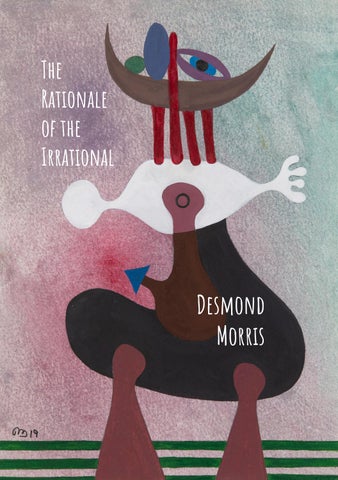
The Rationale of the Irrational
Desmond Morris
1
2
An exhibition to celebrate the life and work of
Desmond Morris 1928-2026
3
Foreword by Silvano Levy ‘Feeling a bit terminal but there is a painting that needs finishing. Must fight this’ was the message Desmond Morris sent from his hospital bed on 16th April 2026. Two days later he passed away. To the end, Morris remained engrossed in the extraordinary biomorphic world he had meticulously forged over eight decades. Even when, as he put it with characteristically wry humour, the nerve pain was ‘as bad as Joan of Arc’s when the flames reached her legs’, it was his globular, brightly-coloured, amoeba-like polymorphous creations that were foremost on his mind. The origin of the ‘biomorphs’, as they came to be dubbed by their creator, can be traced back to 1946, when the 18-yearold Morris occasionally experimented in the studio of Swindon artist Walter G. Poole (1916-1988), a friend of Henry Moore and pupil of Ceri Richards.There Morris painted the ground-breaking Over the Wall, with which he first entered a ‘private fantasy world’. The work foregrounds the thinly-veiled exploration of intimate interaction and sensuality that was to underlie his entire oeuvre. Morris had, after all, written that what most fascinated him about his avowed preceptor and model, Joan Miró, was the latter’s practice of ‘often imbuing his paintings with a wild, sexual violence’. Two stylised humanoid figures in Over theWall are engaged in an affectionate embrace, their heads and shoulders intertwined so as to appear mutually indistinguishable. Significantly, a third presence, in the form of a single eye, is observing the coupled pair from behind a wall. It was to be precisely this concept of the removed observer that would go on to become a repeated trope in Morris’s artworks, which is unsurprising for the future ‘manwatcher’ par excellence. Of Over the Wall he later commented,‘it is an expression of the sentiments of the outsider confronted with a situation from which he is excluded, that of the insider’. Certainly this is the case in another 1946 painting titled Landscape for Three, which again depicts an entwined couple 4
in the foreground being watched by a small, solitary figure in the distance. In October 1946 painting took a back seat; Morris was conscripted into the army for two years of National Service as Private 19090439 and found himself stationed at South Wood Camp, near Farnborough. He continued to paint in the barracks when he could, but later destroyed much of that production. Two years later Morris held his first solo exhibition at Swindon Public Library, which was covered by the BBC West Home Service after the six o’clock news, with a narration by Mervyn Levy. The local press was not impressed, however. Morris’s paintings were savagely condemned in one newspaper as ‘nightmares masquerading as art’. Another critic remarked that ‘It would be counted a magnificent gesture of benevolence on the part of any philanthropist if he were to buy up all these zygomorphic distortions in colour, and destroy them in a furnace’. Undeterred, Morris decided to seek out other likeminded artists and, soon after moving to Birmingham to study biology at the university in 1948, he found and frequented the surrealist coterie that had formed in Edgbaston around Conroy Maddox. Spurred on by the surrealist trajectory, the works of the 1940s were marked by a rejection of the representation of external reality. Yet, in striving towards this objective, Morris was uncomfortably straddling two distinct approaches. On the one hand there was the ‘transformation’ of external reality; on the other there was its ‘reduction’. He explained that his work had begun to oscillate between one method, based on outward appearances, and another, which looked to the inner world of his own psyche. In the first approach Morris modified aspects of the material world and made it less recognizable, whilst retaining the link with objective reality. In the second method, he abandoned representation and placed the focus on immaterial concepts. These would be given substance and tangibility, whilst remaining 5
6
Dancing Figure 1947 Watercolour and ink on lined paper 10.5 x 13 cm
non-referential: There are two trends which alternate in my work. On the one hand I take a specific scene from the external world, usually in the shape of a human figure and transform it. On the other hand I look to an internal world without any reference to the external world. I switch back and forth among the first stages of a developing internal world and another preoccupation with transforming the appearance of external reality. The essential difference between these two tendencies is that they arise from antithetical sources. Whilst superficially appearing to produce surprisingly similar results, Morris insists that they are opposed. He acknowledged that both strands tended towards a non-representational form of expression, and that the alteration of elements taken from the real world, as well as the shapes that could be seen as materialisations of psychological states, departed from reality.Yet Morris maintained that, whatever their ostensive similarities, the two approaches ‘remain distinct as far as their stimulus is concerned’. The first, he argued, rested firmly on an observation and reformulation of extant reality and, to an extent, did not surpass that reality. Like cubism, which had had a strong influence on Morris, it amounted to an analysis and manipulation of vision. A form would be altered or disguised, but the reference back to it would never be altogether absent. In the second approach, however, there was an attempt to express non-material phenomena in a tangible form. Borrowing from the objective world may have existed but its importance was minimised. ‘They are different processes,’ Morris insisted, ‘and the true internal biomorphic painting is one where I start from another world altogether.’ He made the pertinent distinction between the ‘internalisation of the external world’ and the ‘externalisation of the internal world’. At the same time Morris was also conscious that 7
observing the external world had the merit of preventing his work from becoming ‘too remote’. Some degree of reference to the external world, he felt, had had the effect of deterring him from moving towards what he regarded as the ‘alien’ world of abstraction, which he considered undesirable. Indeed, even as Morris went on to develop subjects and situations that were extremely removed from recognisable reality, it would often still be possible to perceive some allusion to objective reality. Morris also specified that his way of altering appearances could not rightly be termed a ‘distortion’, which, to him, implied a ‘negative change’. His ‘transformations’, as he preferred to call them, operated according to what he saw as ‘positive’ processes.These were either ‘supernormalisations’, whereby important elements would be increased in size, or ‘subnormalisations’, which were diminutions or eliminations of unimportant factors. In addition, both of these modifications were seen to involve some form of metamorphosis; ‘it is not just that an element would be made larger or smaller,’ Morris explained, ‘the shapes also changed, as in the case of, say, a mouth, which may cease to comprise a pair of lips and, instead, be expressed as a horizontal bar’. What remained crucial was the severance of the direct link with concrete reality. The 1950s were dramatically marked by Morris’s new role of presenter of Granada TV’s immensely popular Zoo Time, and his subsequent appointment as Curator of Mammals at London Zoo. Thinly disguised zoological scenarios began to appear in Morris’s paintings, particularly in a series of small canvases measuring seven by fourteen inches. These evoked the new urban environment in which Morris found himself, as well as his intense work with animals at London Zoo. Scenes of fighting, stalking, mating, ritual display and play abounded. Also, Morris did not shrink from referencing the less savoury aspects of London life; the work City Games of 1957 was prompted by an 8
Two Figures 1950 Mixed media on paper 20.2 x 25 cm
9
incident in a street near his apartment in Primrose Hill, London; a gang of young thugs were one day beating up a helpless victim when a local shopkeeper, personally known to Morris, ran to the rescue. The would-be hero was then himself attacked and ended up brutally castrated. Such a direct focus on reality, topical or otherwise, was transitory, however. What emerged in the late 1950s was a penchant for experimentation, especially with technique. In Bird Warning (1958) Morris adopted a pointillist technique, which he had never attempted before. Another new direction was the use of inks applied by roller, which created a rough, smudged, irregular background onto which figures were then painted. Particularly notable about the 1950s was that the decade had begun with a spectacular and definitive entrée into the surrealist movement. In February of 1950 Morris shared his first London exhibition with Joan Miró and Cyril Hammersma, at the London Gallery in Brook Street, which was not only the hub of surrealist activity in England but also the official headquarters of ‘The Surrealist Group in England’. In addition, the year 1950 saw a venture into film-making; the sinister and violent Time Flower, in which Paul Weir, Ramona Baulch and Morris himself were cast, was filmed in Avebury and the Marlborough Downs. It won two awards - The Silver Medallion of the Institute of Amateur Cinematographers and The Bassett Lowke Trophy. A second film, The Butterfly and the Pin, followed in 1951 and was selected for showing at an international film festival in Barcelona, where it was given the best placing of any of the British entries. The sixties, unsurprisingly, were a period of great experimentation, beginning with a series that Morris named ‘potato-heads’. These comprised figures with ‘lumpy’ heads within which facial features appear dispersed and disarranged. Noses, eyes, ears and mouths are ‘scattered’ within the contours of the ‘head’. When Morris subsequently acquired a spacious 10
new studio in Regent’s Park Road, near his apartment in Albert Terrace, he embarked on a large work entitled ‘The Assembly’, measuring eighty-four inches in length. In it he reiterated many of the small biomorphic figures which had featured in his previous series of small canvases. Morris then executed a second large biomorphic painting, The Processional, in 1961, which represented ‘the culmination’ of his first biomorphic phase. What followed was a drastically more experimental style. A series of ‘white landscapes’, which began with White Landscape I, marked ‘a radical change of direction’, to use Morris’s words. The content of these works was straightforward - simplified shapes mostly in black oil paint with a few small details in colour painted onto stark, absorbent surfaces created with unpainted plaster roughly applied to board or canvas with a palette knife. The austerity of these paintings was strangely at odds with the buoyantly exuberant atmosphere of London in the sixties.‘There is no humour, warmth or fun and games here, just severity.’ Nevertheless, when Joan Miró visited Morris at home in 1964 it was Ruling Power, one of the ‘white paintings’, that particularly struck the Spanish surrealist. The phase was superseded by a series of ‘black’ paintings, in which the backgrounds were black or very dark. The first of these was The Great Populator, an intermediary painting that marked the beginning of a subsequent phase termed ‘cell-heads’. The forms in the latter resemble biological cells in that they comprise forms that can be interpreted as cell walls and nuclei. As Morris acknowledged, cellular biology had exerted a great influence on these works. The intention was to create the impression of a head, without conveying ‘the appearance of anger, fear, friendliness or any other form of facial communication’. Indeed, if, in the process of painting, Morris happened to spot elements that could be interpreted as any form of expression, he would immediately destroy the work. 11
12
Portrait of Willie Ink on paper 22 x 20 cm
1951
Then the converse seemed to occur, with work that conveyed raw passion. Towards the end of 1961 compositions were ‘becoming pretty wild, with lines flashing across the canvas’, as Morris put it. Experimentation during this phase led him to add to his ‘semi-automatism’ with the use of dripping paint, blotting and spraying. It was at this time that Morris became interested in the paintings of Jackson Pollock, and particularly in the ‘force’ with which the American would throw paint at the canvas. But Morris had reservations about the fact that Pollock rarely modified the result of his automatic processes: ‘I did not like the fact that he made no attempt to transform the marks on the canvas.’ Morris’s own use of flung paint was accompanied by a painstaking reworking of the painting, often resulting in the addition of figures or other forms, as the ‘Fertilization’ series of 1961 demonstrates. Morris then embarked on another series of ‘heads’, which are a combination of the ‘cell-heads’ and the white plaster backgrounds of the ‘white paintings’. In another change of direction, Morris began to use palette knife application, spraying and throwing of paint,and,as titles such as Growing Point, Fertilization and Ovulation imply, there began a focus on biological forces ‘I am no longer painting biomorphs, but biological processes.’ The references were to wombs, ovulations, fertilizations and ejaculations. With simple blobs and liquids suspended in black backgrounds, he evoked the idea of protoplasm and primal matter. Not that Morris’s sixties period was wholly upbeat, however; it is indisputable that the increasing pressures of his professional life had cast a shadow over his artwork. The painting Parasite in the House depicts a large parasitic creature resting on the head of a pain-racked figure. Morris described the composition as depicting ‘brain-rape’. Furthermore, during a period of serious illness in 1966, Morris was to produce what he described as ‘dark and sinister’ works, in which figures appear 13
trapped in boxes or cages. The 1970s and the tail end of the 1960s were to usher in what Morris had always considered the apogee of his ‘biomorphic’ production. In a switch from a looser style that had emerged during his sojourn in Malta, he reverted to his meticulous, biomorphic technique, which he had first used in the forties. First to emerge were The Explorer has Arrived (1969) and The Ritual (1969), both of which entailed an intricate and painstaking way of working. The offer of an exhibition from the art dealer Pavlic Stooshnoff resulted in a biomorphic phase of 52 meticulously painted landscapes, which were begun in April 1972 and completed in September 1976.A similar phase can be said to have resumed in February 1985, when a further series of thirteen meticulously-executed biomorphic works were produced. ‘This style’ Morris commented, ‘completely dominated my output, as though the atmosphere of the biomorphic world had become so strong that it disregarded external, environmental influences.’ In order to complete the commission Morris was obliged to ‘work at a furious intensity, sometimes through the night’, as he recalled. Another commission in 1976 from the art dealer Hans Lasson spawned a further ten biomorphic landscapes, beginning with The Contestants (1976). The last painting in this particular suite, The Sleepwalker, was completed just in time for the opening of Lasson’s exhibition in October 1976. Over the next three decades biomorphic scenarii waxed and waned in Morris’s production, but the early millennium years brought a renewed focus on the theme, which was to culminate, in November 2004, with the production of a multi-panelled magnum opus that brought together figures that spanned an entire oeuvre and was fittingly titled ‘The Gathering’. It took three months of solid work, between 17 July and 17 October 2004, to produce The Gathering (2004), a complex work constructed from a central panel onto which are hinged 14
two further smaller panels that close together onto the face of the larger panel, a configuration that produces a total of five painted surfaces. Not only did Morris want to produce a climactic work that ‘gathered’ together key elements from his entire life’s work, but he also wanted to reflect the long-standing esteem in which he held the work of Hieronymus Bosch, whose altar-pieces Morris had visited at various times. The panels of The Gathering were consequently made to match the precise dimensions of Bosch’s Lisbon triptych, The Temptation of St Anthony, which Morris particularly admired and had revisited in 2003. ‘This is a painting I have visited a number of times,’ he commented, ‘and find utterly stunning – its size, composition and level of complexity.’ He even replicated Bosch’s technique of applying gesso to wood panels. It was within this ‘homage’ work that Morris reanimated what he considered his most notable biomorphic creations since the 1940s. With its lateral wings shut, the triptych shows a direct citation of Entry to a Landscape (1947), which, along with Over the Wall (1946), is accepted as Morris’s first work in what was to become his enduring biomorphic approach to painting. Appropriately, the real crack between the panels of the closed triptych matches the trompe l’oeil crevice between the Entry to a Landscape rocks, through which a bright, vivacious biomorphic landscape can be glimpsed. This poetic conceit, which maps an actual aperture onto the depiction of a geological opening, likened by Morris to the Siq, the narrow slit gorge in the rocks at Petra, invites the spectator to open the triptych doors, thereby revealing a teeming and immense biomorphic panorama. At the centre of the composition Morris places an ‘ancestral mother-goddess figure’, around which other biomorphs are gathered. Some of these are newly-created, whilst others can be traced back to specific earlier works. For instance, Morris depicts the ‘totem’ from Totemic Decline (1976), 15
a dark, segmented creature that had appeared in Bipedal Surprise (1986), the ‘tree’ and one of the bipedal serpentine figures from The Tree of Ignorance. Compositionally too, The Gathering is multifaceted. The central panel, with its life-giver figure, alludes to fertility and fecundity, whereas the right hand panel has been considered by Morris as far less animated and as verging on the ‘sinister’. The scene is dominated by a dark hole out of which disconcerting creatures emerge, as they had done in The Parade of Memories (1972). On opposing left panel, however, there is a somewhat ‘ethereal’ grouping, which floats on a blue space, with ‘celestial’ undertones. Not that Morris had set out simplistically to depict a tripartite universe comprising the Earth, Heaven and Hell. Rather, he paraded the spectrum of the human psyche, the obsessions, compulsions, fears, instincts and dreams that he had explored throughout the preceding sixty years. The Gathering is no less than a grandiose and cacophonous orchestration of the emotions. Silvano Levy 1. Desmond Morris, ‘Heroes & Villains’,The Independent Magazine (3 April 1993), p. 46.
16
Desmond Morris in his black bedroom, covered in mural images.1948.
17
The Comforter 1952 Oil on board 81 x 66 cm
18
19
20
Edible Ballcock 1960 Ink and watercolour on paper 28 x 41.3 cm
Cock of Gibraltor 1960 Ink and watercolour on paper 24.7 x 38 cm
21
22
Don’t Leave Me Here 1960 Coloured inks on paper 35.5 x 25.5 cm
Warrior in Love 1961 Mixed media on paper 20.5 x 10 cm
23
24
Untitled 1979 Ink on paper 29.5 x 41.8 cm
25
26
Untitled 1980 Collage on paper 21.1 x 29.7 cm
Untitled 1987 Mixed media on card 34 x 25 cm
27
Untitled 1987 Ink on paper 29.7 x 41.8 cm
28
Untitled 1987 Ink on paper 29.7 x 41.8 cm
29
30
Untitled 1987 Ink on paper 29.7 x 41.8 cm
31
32
Collage Head IX 1987 Ink and coloured paper s 28.5 x 20 cm
Title Year Medium Dimensions
Mercenar y II 1987 Ink and coloured paper s 28.2 x 20 cm
33
Mercenar y I 1987 Ink and coloured paper s 28.5 x 20 cm
Collage Head XIX 1987 Ink and coloured paper s 28.5 x 20 cm
34
Collage Head XXIII 1987 Ink and coloured paper s 28.7 x 20 cm
Collage Head X 1987 Ink and coloured paper s 28.5 x 20 cm
35
36
Untitled 1989 Ink on paper 29.5 x 41.5 cm
37
38
Untitled 1994 Ink on paper 23.4 x 38 cm
Untitled 1994 Ink on paper 25.5 x 38 cm
39
40
Untitled 1994 Ink on paper 28.4 x 24.8 cm
Untitled 1994/2025 Ink and watercolour on paper 38 x 25 cm
41
The War ning 1995/2025 Ink and watercolour on paper 25 x 35 cm
42
43
44
Counsel 2000/2024 Ink and watercolour on paper 38 x 25.2 cm
Untitled 1999 Mixed media on paper 27 x 21 cm
45
46
The Discoverer 2001 Coloured inks on tinted paper 27 x 21 cm
The Frozen Song 2001/2019 Ink and watercolour on paper 29.7 x 21 cm
47
Traveller 2001/2021 Ink and watercolour on paper 38 x 25.2 cm
Yeomen 2001/2025 Ink and watercolour on paper 38 x 25.3 cm
48
Questioner 2001/2025 Ink and watercolour on paper 38 x 25 cm
Upholder 2001/2025 Ink and watercolour on paper 38 x 25.2 cm
49
50
Grandee 2001/2025 Ink and watercolour on paper 38 x 25.2 cm
Negotiator 2001/2025 Ink and watercolour on paper 38 x 25.2 cm
51
52
Shapeshifter 2001/2025 Ink and watercolour on paper 38 x 25.2 cm
Zealot 2001/2025 Ink and watercolour on paper 38 x 25.2 cm
53
54
Corr ugated Hormones 2002 Mixed media and collage on paper 30 x 21 cm
55
56
Car nival Day 2 Ink on paper 20.2 x 29 cm
2002
57
58
Untitled 2002 Ink and watercolour on paper 29.7 x 21 cm
Soldier Dream 2003 Mixed media on paper 28.9 x 19.8 cm
59
The Official 2003/2017 Ink and watercolour on paper 29 x 20.2 cm
The Taskmaster 2003/2017 Ink and watercolour on paper 28.7 x 20.2 cm
60
The Fanatic 2003/2017 Ink and watercolour on paper 29 x 20.2 cm
The Mediator 2003/2017 Ink and watercolour on paper 29 x 20.2 cm
61
62
Fulfiller 2003/2023 Ink and watercolour on paper 28.5 x 20.2 cm
63
The Gathering 2004 (Closed view)
64
Title Year Medium Dimensions
65
66
The Gathering Oil on five pan and assembled triptych 146 x 268 cm
2004 nels framed as a hinged
67
The Officer 2005/2017 Ink and watercolour on paper 29 x 20.2 cm
The Idealist 2005/2017 Ink and watercolour on paper 29 x 20.2 cm
68
The Offender 2005/2017 Ink and watercolour on paper 29 x 20.2 cm
The Eyewitness 2005/2017 Ink and watercolour on paper 29 x 20.2 cm
69
Untitled 2005/2023 Ink and watercolour on paper 28.7 x 20 cm
Frontsman 2005/2023 Ink and watercolour on paper 28.5 x 20 cm
70
Untitled 2005/2023 Ink and watercolour on paper 29.5 x 19 cm
Untitled 2005/2025 Ink and watercolour on paper 29 x 21 cm
71
72
Fr ustrator 2005/2023 Ink and watercolour on paper 28.5 x 19.8 cm
Untitled 2005/2023 Ink and watercolour on paper 28.5 x 20 cm
73
74
The Reformer 2006/2017 Ink and watercolour on paper 29.2 x 20.5 cm
The Voyager 2006/2017 Ink and watercolour on paper 28.3 x 20 cm
75
The Lear ner 2006/2017 Ink and watercolour on paper 29 x 20.2 cm
The Scout 2006/2017 Ink and watercolour on paper 29 x 20 cm
76
The Overseer 2006/2017 Ink and watercolour on paper 29 x 20.2 cm
Dying to Meet You 2006/2017 Ink and watercolour on paper 28.5 x 20 cm
77
78
The Lost Traveller 2006/2017 Ink and watercolour on paper 29 x 20.5 cm
79
80
The Secret Companion 2006/2017 Ink and watercolour on paper 29 x 20 cm
The Strategist 2007/2017 Ink and watercolour on paper 29 x 20 cm
81
82
The Mercenar y 2007/2017 Ink and watercolour on paper 28.5 x 20 cm
83
84
Untitled 2007 Pen on paper 20 x 33 cm
85
86
The Player 2007/2017 Ink and watercolour on paper 29 x 20 cm
The Conscript 2008/2017 Ink and watercolour on paper 28.7 x 20.2 cm
87
The Mentor 2010 Ink and pastel on paper 30 x 21 cm
Sketch for Tomorrow Man Mixed media on paper 28.7 x 19.8 cm
88
2012
The Winner 2011 Ink on paper 30 x 21 cm
The Magistrate 2013/2017 Ink and watercolour on paper 29 x 20.5 cm
89
90
The Gur u 2007 Mixed media on paper 28.5 x 40 cm
Fish in Search of a Bicycle 2010 Ink and watercolour on paper 29.5 x 41.5 cm
91
92
Brainchild 2016 Oil on card 51 x 40 cm
93
94
Cats on Heat 2016 Mixed media on paper 28.5 x 19.6 cm
95
The Magician 2016 Oil on canvas 34.5 x 44.5 cm
96
97
The Lost Traveller 2016 Mixed media on paper 38.7 x 49.2 cm
98
99
100
The Forbidden Game 2017 Mixed media on paper 28.6 x 19.7 cm
The Author 2017 Mixed media on paper 28.1 x 19.9 cm
101
The Disbeliever 2017 Mixed media on paper 28 x 19.9 cm
The Voice in the Desert Mixed media on paper 28.2 x 19.7 cm
102
2017
The Passer-By 2017 Mixed media on paper 28 x 19.8 cm
The Veteran 2017 Mixed media on paper 28.1 x 19.7 cm
103
104
The Old Rival 2017 Mixed media on paper 28.6 x 19.9 cm
The Newcomer 2017 Mixed media on paper 28.7 x 19.7 cm
105
106
The Recr uit 2017 Mixed media on paper 28.1 x 19.7 cm
The Protector 2017 Mixed media on paper 28 x 19.9 cm
107
108
The Wattle Master 2017 Ceramic under-glaze on bisque plater, subsequently fired 27 x 27 cm
Woman with Bird 2017 Ceramic under-glaze on bisque plate , subsequently fired 27 x 27 cm
109
110
The Intr uder 2017 Ceramic under-glaze on bisque plate , subsequently fired 27 x 27 cm
111
112
Dreamer’s Awake 2017 Mixed media on paper 30 x 20.5 cm
113
114
Visitor II 2018 Ink on collaged card 28.7 x 20 cm
115
Persuader 2018 Ink on card 28.7 x 20 cm
The Author 2018/2020 Ink on card 28.7 x 20 cm
116
The Eclipse 2018 Ink on card 28.8 x 20.2 cm
Collaborator 2018 Ink on card 28.7 x 20 cm
117
118
Harbinger 2019 Oil on board 91.5 x 61 cm
119
Introvert 2019 Mixed media on paper 18.5 x 28.8 cm
120
121
122
Limbo 2019 Mixed media on paper 24.4 x 16.9 cm
123
Victim 2019 Mixed media on paper 19.5 x 28.2 cm
124
125
126
Mother 2019 Ceramic under-glaze on bisque plate , subsequently fired 27 x 27 cm
Angler 2019 Ceramic under-glaze on bisque plate , subsequently fired 27 x 27 cm
127
128
Couple 2019 Ceramic under-glaze on bisque plate , subsequently fired 27 x 27 cm
Feeding Time 2019 Ceramic under-glaze on bisque plate , subsequently fired 27 x 27 cm
129
Optimist 2021 Mixed media on paper 24.6 x 33.8 cm
130
The Judge 2022 Ink and watercolour on paper 21 x 29 cm
131
Littoral Wackadoodle 2021 Mixed media on paper 20.3 x 29 cm
132
Untitled 2022 Ink and watercolour on paper 27.7 x 41 cm
133
134
Headmistress 2023 Ink and watercolour on paper 40.5 x 28.5 cm
135
136
Progeniture 20 Oil on board 50.5 x 92 cm
024
137
Untitled 2025 Ink and watercolour on paper 29.7 x 21 cm
Untitled 2025 Ink and watercolour on paper 29 x 20 cm
138
Untitled 2025 Ink and watercolour on paper 29.7 x 21 cm
Untitled 2025 Ink and watercolour on paper 41.5 x 29.5 cm
139
140
The Entertainer 2026 Ink and watercolour on paper 33 x 22 cm
141
Desmond Morris 1928-2026
Biography Desmond John Morris was born at Purton, Wiltshire, on 24 January 1928 and died in Ireland on 19 April 2026, aged 98. Artist, zoologist, ethologist, author and broadcaster, he pursued his scientific and artistic careers in parallel for more than seventy-five years. He began making Surrealist paintings during the 1940s and held his first solo exhibition at Swindon Public Library in 1948. While studying zoology at Birmingham University he became associated with the Birmingham Surrealists around Conroy Maddox. In 1950 he exhibited at the London Gallery with Joan Miró and Cyril Hamersma, under the auspices of the Belgian Surrealist E.L.T. Mesens. In 1952 he exhibited at the Ashmolean Museum, Oxford, alongside Geoffrey Clarke and Scottie Wilson. Morris graduated with first-class honours in zoology from Birmingham University and continued his studies at Oxford under the Nobel Prize-winning ethologist Niko Tinbergen, receiving his DPhil in 1954. In 1956 he joined the Zoological Society of London, initially heading Granada Television’s film and television unit at London Zoo and subsequently becoming Curator of Mammals. His television series Zoo Time made him a familiar public figure. In 1967 he published The Naked Ape, an international bestseller which established him as one of the best-known popular writers on human behaviour. That year he also became Executive Director of the Institute of Contemporary Arts in London. He later returned to Oxford, continuing his research into human and animal behaviour while writing, broadcasting and painting. Throughout his life Morris maintained that painting was an 142
independent and essential part of his work. His imagery developed into a highly personal world of biomorphic organisms and imaginary landscapes, informed by Surrealism, biology and automatic processes but painstakingly transformed and controlled. Over his lifetime he produced thousands of paintings and drawings and held more than fifty solo exhibitions internationally. Following the death of his wife Ramona in 2018, Morris moved from Oxford to Ireland in 2019 to live near his son Jason and his family. He continued to write and paint almost daily into his late nineties. His final oil painting, Progeniture, was completed in May 2024. His final book, The Surrealist Menagerie: Strange Beasts & Fantastic Visions, is published by Thames & Hudson in September 2026.
Desmond Morris with an African Bambara Tr ibe figure from Mali. Oxford 1996
143
Solo Exhibitions 1948 1974 1976
1978 1987 1988 1989 1991 1992 1993 1994 1996
1997
144
Swindon Public Library, Swindon — First Solo Exhibition Stooshnoff Fine Art, London Wolfson College, Oxford — Paintings of the 1950s and 1960s Quadrangle Gallery, Oxford Lasson Gallery, London Swindon Museum and Art Gallery — Retrospective, 1946–76 Galerie D’Eendt, Amsterdam Mayor Gallery, London Shippee Gallery, New York Keats Gallery, Knokke-le-Zoute, Belgium Mayor Gallery, London — Works on Paper 1947–1988 Galerie Michèle Heyraud, Paris — Oeuvres Surréalistes Mayor Gallery, London Galerie Marie-Thérèse Wagner, Thionville, France — Écrivain – Zoologiste – Peintre Swindon Museum and Art Gallery — Retrospective, Paintings 1946–1993 Mayor Gallery, London — Paintings from the Sixties City Museum and Art Gallery, Stoke-on-Trent — Fifty Years of Surrealism Nottingham Natural History Museum — Fifty Years of Surrealism Atrium Bookshop, Cork Street, London — exhibition for launch of Fifty Years of Surrealism Mayor Gallery, London — Fifty Years of Surrealism Charleston Gallery, Firle, East Sussex — Fifty Years of Surrealism Buxton Museum and Art Gallery — A Surrealist World
1998
1999
2001 2002
2003 2004 2005
2006 2007 2008
Clayton Gallery, Newcastle — Fifty Years of Surrealism Keitelman Gallery, Brussels Jessy Van der Velde Gallery, Antwerp Art Consultancy Witteveen, Amsterdam — Paintings and Drawings 1947–1997 Mayor Gallery, London — Works on Paper 1949–1999 Galerie Pack-Huys, Mechelen, Belgium — Naked Surrealism Museum of Modern Art, Ostend, Belgium — Retrospective Mayor Gallery, London — Paintings and Works on Paper Art Consultancy Witteveen, Amsterdam — 55 Years of Surrealism Solomon Gallery, Dublin — Naked Surrealism Mayor Gallery, London — Recent Paintings & A Lost World: Sketches for a Bestiary 1960 Art Consultancy Witteveen, Amsterdam Guillermo de Osma Galería, Madrid — Desmond Morris, Pintor Surrealista Alexander Clayton Art, Stratford-upon-Avon — Surrealist Paintings 1949–2004 Galerie Pack-Huys, Mechelen, Belgium Saïd Business School, Oxford Taurus Gallery, Oxford Mayor Gallery, London — 80th Birthday Retrospective:Works from 1946–2007 Williamson Art Gallery and Museum, Birkenhead — Lines of Thought Galerie Witteveen, Amsterdam — Lines of Thought
145
2010
Verbeke Foundation, Belgium — first collage exhibition Taurus Gallery, Oxford — New Work 2011 Taurus Gallery, Oxford — New Work 2012 ISPA Gallery, Lisbon — Desmond Morris: Pintura Taurus Gallery, Oxford — The Tree of Time 2013 Taurus Gallery, Oxford — New Work 2014 Taurus Gallery, Oxford — Headworks Taurus Gallery, Oxford — 70 Years of Surrealism:The New Work of 2014 2015 O3 Gallery, Oxford Taurus Gallery, Oxford — The New Oil Paintings of 2015 2016 Taurus Gallery, Oxford — The New Paintings of 2016 2017 Taurus Gallery, Oxford — The New Paintings of 2017 2018 The Redfern Gallery, London — Works on Paper 1948–2018 2019 Mallams, Oxford — Bodyworks Farleys House & Gallery, Chiddingly — New Work 2020 Beaux Arts London — Desmond Morris in the 21st Century 2021–22 Rona Painting Gallery, Oxford 2022 The Redfern Gallery, London — The Last Surrealist Rona Painting Gallery, Oxford Dún Laoghaire Institute of Visual Arts (DIVA), Ireland — Creatures of the Mind 2024 DIVA, Dún Laoghaire — Solo Exhibition Newbridge College Theatre, Kildare — The Last Surrealist DIVA, Dún Laoghaire — Micro Surrealism: Miniatures 2025 Beaux Arts London — 97th Birthday Celebration 2026 DIVA, Dún Laoghaire — exhibition of 98 paintings made in his 98th year The Redfern Gallery, London — Memorial Exhibition 146
Selected Mixed and Group Exhibitions 1948 Contemporary Art Group, Swindon Public Library 1948 Artists Known and Unknown, Kingly Gallery, London 1949 Birmingham Artists Committee Invitation Exhibition, Royal Birmingham Society of Artists 1950 London Gallery, London, with Joan Miró and Cyril Hamersma 1951 Festival of Britain: Contemporary West Country Painting and Sculpture, Bristol 1951 Les Tendances d’Avant-Garde dans la Peinture Britannique Actuelle, Knokke-le-Zoute, Belgium 1952 Ashmolean Museum, Oxford, with Geoffrey Clarke and Scottie Wilson 1978 Surrealism Unlimited, Camden Arts Centre, London 1982 Les Enfants d’Alice: La Peinture Surréaliste en Angleterre 1930–1960, Galerie 1900–2000, Paris 1985 A Salute to British Surrealism 1930–1950, The Minories, Colchester; Blond Fine Art, London; Ferens Art Gallery, Hull 1986–87 Contrariwise: Surrealism and Britain 1930–1986, Glynn Vivian Art Gallery;Victoria Art Gallery; Newcastle Polytechnic Gallery; Mostyn Art Gallery 1988 The Avant-Garde in Britain 1910–1960, Fine Art Associates, London 1990 Surrealism: From Paris to New York, Arnold Herstand & Co., New York 1990 An Exhibition of Living British Surrealists, Murray Feely Fine Arts, London 1991 The Birmingham Seven, Murray Feely Fine Arts, London 1992 British Surrealism, Mayor Gallery, London 147
1993 Surrealism: Revolution by Night, National Gallery of Australia, Canberra; Queensland Art Gallery, Brisbane; Art Gallery of New South Wales, Sydney 1994 Surrealist Sculpture, Faggionato Fine Arts, London 1995 British Surrealism 1935–1995, England & Co., London 1995 Real Surreal: British and European Surrealism, Wolverhampton Art Gallery 1996–97 In the Mind’s Eye: Surrealist Works on Paper, Whitworth Art Gallery, Manchester;York City Art Gallery 1997 Marcel Duchamp ed altri iconoclasti, anche, Galleria Nazionale d’Arte Moderna, Rome 1997–98 El Objecto Surrealista, IVAM Centre Julio González, Valencia 1999 Surrealism in Britain, Mayor Gallery, London 2000 Surrealism in Birmingham 1935–54, Birmingham Museum & Art Gallery 2000 Dreaming with Open Eyes:The Vera and Arturo Schwarz Collection of Dada and Surrealist Art, Israel Museum, Jerusalem 2007 Dada, Surrealism and Beyond, Israel Museum, Jerusalem 2009 Dada and Surrealism Rediscovered,Vittoriano, Rome 2012 The Road is Wider than Long: Roland Penrose and British Surrealism, Southampton City Art Gallery 2012 British Surrealists, Falmouth Art Gallery 2014 British Surrealism Unlocked, Abbot Hall Art Gallery, Kendal 2023 Redfern Gallery Centenary Exhibition, London 2024–26 Forbidden Territories: 100 Years of Surreal Landscapes, The Hepworth Wakefield; The Box, Plymouth; Museum Arnhem 2026 The Unbound Mind, Galerie d’Orsay, Boston, with Grace Pailthorpe, Joan Miró, Salvador Dalí and Fermin Castro. 148
Selected Books by Desmond Morris 1958 1958 1961 1962 1965 1965 1966 1966 1967 1967 1969 1970 1971 1977 1979
1979 1981 1983 1983 1985 1985 1986 1986 1987
The Reproductive Behaviour of the Ten-Spined Stickleback — Brill, Leiden The Story of Congo — Hutchinson, London Curious Creatures — Jonathan Cape, London The Biology of Art — Methuen, London The Mammals: A Guide to the Living Species — Hodder & Stoughton, London Men and Snakes, with Ramona Morris — Hutchinson, London Men and Apes, with Ramona Morris — Hutchinson, London Zoo Time — Jonathan Cape, London Primate Ethology, editor — Weidenfeld & Nicolson, London The Naked Ape — Jonathan Cape, London The Human Zoo — Jonathan Cape, London Patterns of Reproductive Behaviour — Jonathan Cape, London Intimate Behaviour — Jonathan Cape, London Manwatching: A Field Guide to Human Behaviour — Jonathan Cape, London Gestures:Their Origins and Distribution, with Peter Collett, Peter Marsh and Marie O’Shaughnessy — Jonathan Cape, London Animal Days — Jonathan Cape, London The Soccer Tribe — Jonathan Cape, London Inrock — Jonathan Cape, London The Book of Ages — Jonathan Cape, London The Art of Ancient Cyprus — Phaidon, Oxford Bodywatching — Jonathan Cape, London Catwatching — Jonathan Cape, London Dogwatching — Jonathan Cape, London The Secret Surrealist — Phaidon, Oxford 149
1988 1990 1991 1994 1994 1997 1999 2001 2001 2002 2004 2004 2004 2006 2007 2008 2008 2009 2009 2010 2013 2013
150
Horsewatching — Jonathan Cape, London Animalwatching — Jonathan Cape, London Babywatching — Jonathan Cape, London The Human Animal — BBC Books, London Bodytalk: A World Guide to Gestures — Jonathan Cape, London The Human Sexes — BBC Books, London Body Guards: Protective Amulets and Charms — Element Books, Shaftesbury The Naked Eye:Travels in Search of the Human Species — Ebury Press, London Dogs:The Ultimate Dictionary of Over 1,000 Dog Breeds — Ebury Press, London Peoplewatching — Vintage, London The Naked Woman — Jonathan Cape, London The Nature of Happiness — Little Books, London A Lost World: Sketches for a Bestiary — Mayor Gallery, London Watching: Encounters with Humans and Other Animals — Jonathan Cape, London Dark Inside My Head — Belgrave Gallery, London The Naked Man — Jonathan Cape, London Baby — Hamlyn, London Planet Ape, with Steve Parker — Octopus Publishing, London Owl — Reaktion Books, London Child: How Children Think, Learn and Grow in the Early Years — Hamlyn, London Monkey — Reaktion Books, London The Artistic Ape:Three Million Years of Art — Red Lemon Press, London
2014 2014 2015 2016 Press 2017 2017 2018 2019 2019 2020 2020 2020 2020 2021 2022 2022 2023 2023 2023 2024 2024 2024 2025 2026
Headworks — Dark Windows Press, Rhos-on-Sea Leopard — Reaktion Books, London Bison — Reaktion Books, London The Boats of Malta:The Art of the Fishermen — Kettlestone Cats in Art — Reaktion Books, London Sixty-Nine Surrealists — Dark Windows Press The Lives of the Surrealists — Thames & Hudson, London Bodyworks — Dark Windows Press, Rhos-on-Sea Postures: Body Language in Art — Thames & Hudson, London The Surrealist Art of the Kuna — Kettlestone Press Wordworks: Painting with Words 1948–2020 — Dark Windows Press Creatures of the Mind: A 21st Century Bestiary — Dark Windows Press Surrealist Familiars — Dark Windows Press The Art of the Senufo Mudcloth — Kettlestone Press The British Surrealists — Thames & Hudson, London Watching — enlarged edition Oscar Mellor: Private Surrealist — Dark Windows Press Biomorphia:The Watercolours of 2020–2023 — Dark Windows Press Visual Magic:Tribal Surrealism Revisited — Dark Windows Press 101 Surrealists — Thames & Hudson, London Metallic Surrealism — Dark Windows Press The Surrealist Gallery at DIVA — DIVA, Dún Laoghaire Proto-Surrealism — Dark Windows Press The Surrealist Menagerie: Strange Beasts & Fantastic Visions — Thames & Hudson, London. 151
Major Monographs and Catalogues Raisonnés on Desmond Morris’s Art 1987 Philip Oakes and Desmond Morris, The Secret Surrealist: The Paintings of Desmond Morris — Phaidon, Oxford 1991 Michel Remy, The Surrealist World of Desmond Morris — Jonathan Cape, London French edition: L’Univers Surréaliste de Desmond Morris — Éditions Souffles, Paris 1997 Silvano Levy, Desmond Morris: 50 Years of Surrealism Barrie & Jenkins / Ebury Press, London 1999 Silvano Levy, Desmond Morris: Naked Surrealism — Petraco-Pandora, Antwerp An enlarged edition of Levy’s 1997 study. 2001 Silvano Levy, Desmond Morris: Analytical Catalogue Raisonné 1944–2000 — Petraco-Pandora, Antwerp. 2002 Silvano Levy, Desmond Morris — Petraco-Pandora, Antwerp / Museum voor Moderne Kunst, Ostend An expanded/translated version of Naked Surrealism, with a foreword by Willy Van den Bussche. 2008 Silvano Levy, Lines of Thought:The Drawings of Desmond Morris — Kettlestone Press, Norfolk. 2012 Silvano Levy, Desmond Morris: Analytical Catalogue Raisonné 2000–2012 Sansom & Company, Bristol. This second volume catalogues and analyses approximately 900 works produced between 2000 and 2012. 2020 Silvano Levy, Desmond Morris: Late Work — Analytical Catalogue Raisonné 2012–2020 — Sansom & Company, Bristol. This is the third catalogue raisonné volume and covers Morris’s prolific late production from 2012 to 2020. 152
Selected Important Writing and Reviews of Morris’s Art 1948 1962 1966 1973 1976 1987 1987 1987 1987 1988 1988 1990 1991 1991 1991 1991 1997 2004
Mervyn Levy, Desmond Morris, the Man and his Work, BBC Radio Mervyn Levy & Desmond Morris, Desmond Morris – Private Painter, The Studio Barrie Sturt-Penrose, Desmond Morris – Profile, Arts Review Philip Oakes, In Among the Biomorphs, The Sunday Times Painting Pundit, Sunday Telegraph Magazine Robin Dutt, Secrets of a Swindon Surrealist, The Independent Clare Henry, A Naked Ape Bares His Soul on Canvas, Glasgow Herald Clare Henry, Desmond Morris:The Secret Surrealist, Arts Review John Russell Taylor, Romanticism Haunting Still, The Times Desmond Morris, ARTnews, New York Jason Edward Kaufman, The Naked Artist: Secret Surrealist Desmond Morris, New York City Tribune James Burr, A Cultural Injection, Apollo George Melly, The Naked Mantis, Modern Painters Geraldine Norman, Zoologist Explores a Surreal World, The Independent Megan Tresidder, The Unconscious Art of a Manwatcher, Sunday Telegraph Rosalin Sadler, Love on a Slab, The Sunday Times Silvano Levy, Surrealism, the Scientist … and Sex, Art Review Louise Jury, The Naked Artist, The Independent.
153
Television Morris presented or contributed to several hundred television programmes. Principal series include: 1956–67 1960s 1982 1982 1986 1987–89 1988 1990 1990 1991–96 1994 1997 2017
154
Zoo Time, Granada Television — approximately 500 programmes Life in the Animal World, BBC2 — approximately 100 programmes The Human Race, Thames Television — six one-hour programmes The Manwatcher in Japan, Japanese television TV and Natural History, BBC1 The Animals Roadshow, BBC1, with Sarah Kennedy — 41 programmes Bodywatching, CBS Art World, with Joan Bakewell The Animal Contract — three-part series; Genesis Award winner Animal Country, ITV, with Sarah Kennedy — 67 programmes The Human Animal, BBC1 — six-part series; CableACE Award for Best Documentary Series and New York Festivals World Medal for script The Human Sexes — six-part series; nominated for a Primetime Emmy The Secret Surrealist, BBC Four — documentary devoted to Morris as an artist.
Film 1950
1951
Time Flower — written and directed by Desmond Morris; filmed at Avebury and on the Marlborough Downs. Awarded the Silver Medallion of the Institute of Amateur Cinematographers and the Bassett-Lowke Trophy. The film was publicly revived in 2025, seventy-five years after its making. The Butterfly and the Pin — Surrealist film; selected for an international film festival in Barcelona, where it received the highest placing of the British entries.
Permanent Public Collections • • • • • • • • • • • • • • •
Ashmolean Museum — Oxford, UK Atkinson Art Gallery — Southport, UK Birmingham Museum & Art Gallery — Birmingham, UK British Museum — London, UK Currier Museum of Art — Manchester, New Hampshire, USA Galleria Nazionale d’Arte Moderna e Contemporanea — Rome, Italy Israel Museum — Jerusalem, Israel National Galleries of Scotland / Scottish National Gallery of Modern Art — Edinburgh, UK Reiff Collection, London, UK Southampton City Art Gallery — Southampton, UK Swindon Museum and Art Gallery — Swindon, UK The Potteries Museum & Art Gallery / Stoke Museums — Stoke-on-Trent, UK Tate — London, UK Ulrich Museum of Art, Wichita State University — Wichita, Kansas, USA Yale Center for British Art — New Haven, Connecticut, USA. 155
Front cover, detail of: Desmond Morris (1928-2026) Limbo 2019 Mixed media on paper 24.4 x 16.9 cm
Inside back cover, detail of: Desmond Morris (1928-2026) The Gathering 2004 Oil on five panels framed and assembled as a hinged triptych (outer panels) 146 x 268 cm (overall size when open)
Catalogue © The Redfer n Galler y, 2026 Photography © Alex Fox All rights reser ved. No par t of this book may be reproduced or transmitted in any form or by any means, electronic or mechanical, including photocopying, recording or any other information storage or retr ieval system without prior permission in writing from the galler y.
11-12 Pall Mall, London, SW1Y 5LU tel +44 (0)207 734 1732 info@redfern-gallery.com redfern-gallery.com
158