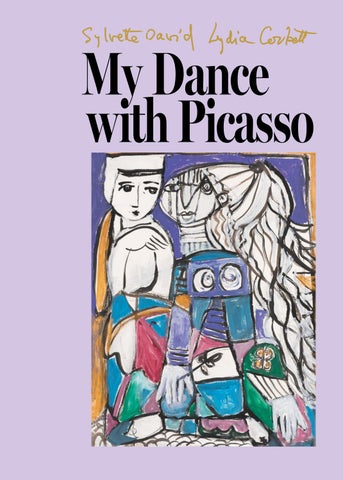
1
Lydia Corbett (Sylvette David)
A Retrospective
11-12 Pall Mall London SW1Y 5LU +44 (0)20 7734 1732 info@redfern-gallery.com @theredferngallery
Sylvette with Claude, Paloma and Picasso at La Galloise, Vallauris, 1954
2
You are There and I am Here The paintings of Lydia Corbett / Sylvette David By Jennifer Higgie
On a sunny day in 1954, in the village of Vallauris in the south of France, a 19-year-old woman named Sylvette David was drinking coffee on a terrace with a group of friends and her boyfriend, the young furniture designer Toby Jellinek. Suddenly, a sketch of a girl with a long blonde ponytail appeared above the wall opposite. The artist holding it was the 73-year-old Pablo Picasso, who had a studio across the street; the portrait was of Sylvette. She remembers: ‘We couldn’t see Picasso behind it because he wasn’t very big, but then he opened the door and beckoned for us to come over.’1 Picasso had recently met Sylvette after buying two chairs designed by Jellinek, which the couple had delivered to him. Sylvette, who is now known as Lydia Corbett, recounts: ‘We took them to his studio, we were so excited, and he said, “Come in, Come in!” Toby did all the talking, I was much too shy.’2 Picasso proceeded to ask Sylvette to model for him. She agreed. Over a few months, the Spanish artist was to create more than 60 portraits of her: 28 paintings, along with drawings, ceramics and sculptures. It is now known as the ‘Sylvette Cycle’. Sitting for Picasso was a transformative experience for Sylvette. She is part of a renowned group of models – including Elizabeth Siddal, the star of various Pre-Raphaelites paintings; Suzanne Valadon, who features in works by Pierre-Auguste Renoir and Henri de Toulouse-Lautrec; and Victorine Meurent, who was Édouard Manet’s favourite muse – who were to become artists themselves. From a distance of 70 or so years, Corbett recalls that meeting Picasso ‘was amazing, really. And I’ll never forget it because he opened doors for me’.3 I ask her what she means by that. She replies: ‘He gave me inspiration. Old people were my teachers. All my childhood, I loved old people. They taught me such a lot.’4 From Picasso she learned that when making a portrait ‘you should look at the face as a collection of flat areas’5, that ‘art is fun’6 and allows you to enter new worlds; and creating pictures is ‘the best thing to make you happy’. Over the many hours of sitting for him,
3
she closely observed how he painted: swiftly, without hesitation, following his intuition. He told Sylvette that if you absorb yourself in your creativity, ‘you’re healed of all of life’s pain’. It’s a lesson that has stayed with her. She says that when she sits in her studio ‘even now I am with him. I feel his presence and I feel happy there.’7 Corbett makes clear how peaceful it was sitting for Picasso and how the ‘rhythm’ they had together ‘was extraordinary’. They were both very comfortable with not talking. Silence, she believes, is a productive state; it allows you ‘to see the beauty of plants and people and sky, moon and sun’.8 She also recounts his sense of humour; at the easel he donned, variously, a cowboy hat given to him by Gary Cooper and a furry Russian winter hat, despite the summer heat. I ask her which of his portraits of her are her favourites. She replies: ‘I love them all but I particularly like the one in Chicago [at the Art Institute], which is me sitting in the grass with my ballet shoes.’9 Around the time he painted Sylvette, Picasso was grappling with the fallout of his breakup with Françoise Gilot, who had left with their two children, Claude and Paloma; he had recently met Jacqueline Rocque, who worked at the Madoura Pottery in the village – she would become his next, and final, wife. He clearly found respite from his emotional turmoil in his creative relationship with Sylvette. Corbett stresses that ‘he never flirted with me. He knew I wouldn’t like it and would have run away’. She laughs, telling the story of visiting the McNay Museum in San Antonio in Texas to see Picasso’s portrait that depicts her without a mouth. Corbett recounts: ‘The curators asked me, “Why do you not have a mouth?” I said, “well, maybe because I didn’t talk!”’ It’s clear that while discussions of so-called ‘muses’ are often couched in passive terms – the artist creates while the model sits – the truth of the matter is more complicated and reciprocal. That the presence of the subject helps shape decisions taken by the artist is undeniable. * Although in 1954 Sylvette was not yet an artist herself, the seeds of her creative life had already been planted. Born in Paris in 1934, she came from an unconventional and artistic family. Her English mother Honor David-Gell was a painter who had studied at the Académie Julian in Paris, and her French
4
father, Emmanuel David, was an art dealer who showed, among other artists, Bernard Buffet, whose work had a real impact on Sylvette: she admired his use of dark lines and simple forms. Sylvette inherited her mother’s enthusiasm for portraits and flowers, recalls her ‘lovely Impressionist colours’ and how she ‘worked in oils, mostly, using her hands, a brush and a knife’.’10 Sylvette’s childhood was, at first, idyllic; the family, with a new step-father, lived on a small island, the Île du Levant off the Côte d’Azur. Her grandfather, a hero from the First World War, had built three houses on the island, and children were allowed to roam freely. The artist says: ‘I was like a mermaid and a fish!’11 With the onset of the Second World War, however, life became fraught; with an English mother, the family was in danger, and it was impossible to get back to the UK. In 1942 they moved inland, to a remote village, Dieulefit in the Drôme. During their time there, they experienced great financial and emotional hardship and Sylvette was abused by her mother’s new partner. It was a trauma that took her decades to process. Once the war was over, life returned to a semblance of normality and in 1950, Sylvette and her brother were sent to Summerhill, a progressive boarding school in Suffolk. She enjoyed her time there, mainly because the children could decide whether to go to classes or not. Sylvette was taught by the eccentric Scottish poet, singer and artist, Ivor Cutler. She remembers him as ‘lovely, very amusing, and he could speak French. We would have a cup of tea. I think he was supposed to teach me geography, but instead he played the harmonica and sang funny songs.’12 It was at Summerhill that she met Toby Jellinek; they eventually married and were together until the late 1960s. After the war, Sylvette lived between France and England as marriage and motherhood – she was to have three children – took over. In the 1970s she moved to Devon with her second husband, Rawdon Corbett. As with so many female artists, she only found time to fully focus on her creativity once the children were older. Around the age of 45, at a time of great distress – her marriage was breaking down – Corbett began drawing and painting on paper, canvas and ceramic pots. Since then, her restless imagination has focussed variously on portraits of friends and family, studies of flowers – real
5
Pilgrimage to Assisi, 1995 Oil on canvas 73 × 54 cm
6
Sylvette Reading, 2019 Oil on board 74.5 × 63.6 cm
7
Sylvette in the Studio Vallauris 1954, 2023 Acrylic on board 89 × 59.5 cm
and imaginary – birds, cats and other animals; lovers, swimming, churches. She once wrote: ‘My inspiration comes from everywhere. Certain animals, like the horse, the dove, the robin, make me draw, as does the sea, fish, the moorland of my home in Devon and my home of Provence.’13 She has also painted numerous self-portraits, channelling what she learned from Picasso into a series of semi-abstracted, Cubist works that both pay homage to the artist and reflect her pre-occupations and place in the world. In works such as Sylvette Reading (2019) and Sylvette in the Studio Vallauris 1954 (2022) Corbett has absorbed Picasso’s high-key, gestural mark-making, which she makes her own via her ‘free line’14 – an approach that emerged, she believes, because she was never constrained by formal study. Corbett’s religious and spiritual faith has long been central to her creativity; she says, ‘the older I get, the nearer to God I feel’.15 She always signs her work twice: with her birth name, Sylvette David, and her spiritual and married name, Lydia Corbett. In 1962 she became a devotee of Subud, a multi-faith spiritual movement that originated in Indonesia in the 1920s; the artist describes its practice as ‘a meditation without the words’16 – which could equally be a description of the process of making art. Sylvette, like many members of Subud, chose to adopt a new name to reflect the shift in her spiritual development, which is heartfelt and wide-ranging. She is deeply engaged with the writings of the late Zen Buddhist monk Thich Nhat Hanh, who is widely credited with introducing mindfulness practices to the West. She is also a devout follower of Jesus Christ and has made eight pilgrimages to Assisi, an experience which has been reflected in her depictions of the crucifixion, St Francis, Mary and Eve. In a work from 1995, for example, Pilgrimage to Assisi, the body of a floating, soulful-faced woman, who could be a melding of Corbett with the Madonna, swells to absorb a baby, a bouquet of bright flowers, an angel, two pomegranates and a group of old stone buildings; they, in turn, float above a simple church, bathed in blue, the colour of the Virgin’s robe. It’s an image of solace and peace; the dream of a self-contained world in which aggression has been supplanted by something more nourishing: faith. Whether in watercolour, Indian ink or paint, on paper, canvas, board or ceramic pots, art, for Corbett, is a way of conjuring memories and moods, an
8
act of both solace and retrieval; of filtering and translating her observations about the world around her. Her subjects often balance intimacy, selfreflection and domesticity with a mood of delight and, at times, mystery. In one of her early works, Looking Over Dartmoor (1980), for example, a blonde woman, possibly the artist, is depicted in an intricately patterned, glowing ochre gown; a crouching figure beside her, their back to us, looks over the patchwork fields. Angels, surrounded by floating blooms, hover above the figures, like celestial guardians. The everyday – a view of the countryside – is envisioned here as a mystical place of abundant nature and cosmic energies. Similarly, in Home (1992), the artist depicts herself lost in reverie, an open book on her lap, an enormous heart beating in the centre of her chest. She dreams amid a crowd of children, birds, flowers and angels. It’s a study of both the jostling demands of motherhood, and the love and protection her family and her faith engender. At times, Corbett’s pictures have been directed by what she describes as ‘visions’: images that she sees when her eyes are closed. For example, in her memoir I Was Sylvette, she recounts an episode that happened in the late 1980s: ‘Leaving a train at Exeter, I was greeted by a sparkling white Gladioli lying on the steps of the station. It gave me a funny sensation, like goose pimples, and I took it as an instruction that I must continue painting flowers.’17 She explains she’s constantly fascinated by flowers because they’re ‘fresh and have different forms’. She particularly likes cheerful varieties, such as daffodils, tulips and Michaelmas daisies. In Flower Face (2014) the separation between human and plant has dissolved: against a sunny yellow background, two bright eyes and smiling mouth peer out from the tangle of a joyful bouquet. Although it’s true that Corbett never formally studied art, along with the influence of Picasso, she has drunk deeply from the well of the many artists who inspire her. She loves Samuel Palmer’s ‘rounded hills, sheep and trees’18; Piero della Francesca’s soft colours and otherworldly Madonnas; Marc Chagall’s lovers, flying through the air; Paul Klee’s delicate merging of figuration and abstraction, Gustav Klimt’s patterns and visions of men and women, entwined and loving. On a trip to Japan in the 1980s, she was also very moved by traditional Japanese art – in particular, its loose ink brushwork,
10
Home, 1992 Oil on board 53.5 × 38.5 cm
11
intricate patterning and spiritual dimension. She recalls: ‘I noticed a Shinto shrine at which they always left food to the spirit God or “Kami” to thank him for their own food. I understood that their sacred essence of God lives in all things: rocks, trees, rivers, animals, places and even people sharing the complexities of life.’19 Now in her 92nd year, despite suffering from poor eyesight, Corbett is still painting and drawing. Over zoom, she smilingly holds up pieces of paper for me to read which she’s inscribed with swift, bold circles – a symbol of eternity – and haiku-like statements. These include ‘the joy of understanding others is to understand love’; ‘I know you are there and I am here, happy’; and ‘solid as a mountain, clear as a lake.’ Some of the lines are by Lydia, others are quotes from the writings of Thich Nhat Hanh. They soothe her; she likes to leave them around her home, as a reminder of all that is good in the world. I finish our conversation by asking Lydia if she feels her art has a message. She replies: ‘I think my pictures are full of love and tenderness. I don’t like anger.’20 After our zoom has ended, she emails me one more thought: ‘What I enjoy so much about getting old is the joie de vivre!’ Jennifer Higgie, October 2026
Endnotes 1
Lydia Corbett quoted in Isabel Coulton, I Was Sylvette, Endeavour, London, 2017, p.91
2
‘I could never have been his lover’: Sylvette David on being Picasso’s muse, Christies, 21 June 2024, https://tinyurl.com/5n95887w
3
Lydia Corbett talking to Jennifer Higgie, 19 August 2026
4
Ibid
5
Lydia Corbett quoted in Isabel Coulton, I Was Sylvette, p.104
6
Lydia Corbett talking to Jennifer Higgie, 14 October 2026
7
Lydia Corbett talking to Jennifer Higgie, 14 October 2026
8
Ibid
9
Ibid
10
Lydia Corbett interviewed by Francis Kyle, I Was Sylvette, Endeavour, London, 2017, pp.199-200
11
Lydia Corbett talking to Jennifer Higgie, 14 October 2026
12
Op cit., Christie’s
13
Lydia Corbett, I Was Sylvette, n.p.
14
Lydia Corbett interviewed by Francis Kyle, I Was Sylvette, p.199
15
Lydia Corbett talking to Jennifer Higgie, 19 August 2026
16
Ibid
17
Isabel Coulton, I Was Sylvette, Endeavour, p.81
18
Lydia Corbett interviewed by Francis Kyle, I Was Sylvette, p.202
19
Lydia Corbett quoted in Isabel Coulton, I Was Sylvette, p.181
20 Lydia Corbett talking to Jennifer Higgie, 14 October 2026
12
right
Flower Face, 2015 Oil on board 33 × 25 cm
below
Looking over Dartmoor, 1980 Oil on board 60.2 × 81 cm (including hand-painted frame)
13
PAINTINGS AND DRAWINGS
Les Saltimbanques, 2018 Oil on board 66.8 × 58.8 cm
14
The Child with Sylvette in Chicago, 2016 Acrylic on board 89 × 69 cm
15
Evening Primrose, 2014 Oil on canvas 90 × 35 cm
16
Arum Lady, 1990 Oil on canvas 49.5 × 38.8 cm
In Memory of Toby’s Grey Coat, 2024 Acrylic and charcoal on board 75 × 60 cm
18
A Face within a Face, 2023 Acrylic on board 60.2 × 49 cm
19
Pumpkin in the Mirror, 1981 Oil on board 74 × 56 cm (including frame)
20
Toby’s Flowers, 1989 Oil on board 55.5 × 40 cm
21
Children, Cat and Bird, 2015 Oil on board 49.5 × 39.5 cm
22
St Francis, 2015 Oil on canvas 61 × 49.8 cm
23
above
Nativity, 2020 Acrylic and gold ink on board 42 × 47.7 cm
opposite
Friends Together, 2020 Acrylic on board 90.5 × 60 cm
24
Sylvette aged 15 in Dieulefit, 1949
26
Picasso and His Children, 2009 Oil on board 100 × 100 cm
above
Camellia Flowers, 1982 Oil on board 35 × 56 cm
opposite
The Apparition, 1983 Oil on board 84.5 × 58 cm
28
29
above
Dream of Peace, 2022 Acrylic on board 39.3 × 59.5 cm
opposite
Sylvette in Colour, 2018 Oil on board 90 × 59 cm
30
Blackbird with Michaelmas Daisies, 2010 Oil on board 58 × 43 cm
32
Girl with Blackbird, 2007 Oil on board 49.8 × 53.5 cm
33
34
opposite
Eternal Love, 2015 Emulsion and charcoal on board 90 × 44 cm
below
Nude on the Earth, Séguret de Provence, 2006 Oil on canvas 48.8 × 48.8 cm
35
above
Red Tablecloth and Blackbird, 2007 Oil on board 55.5 × 59.5 cm
opposite
Sylvette and Shadow with Sunflower, 2024 Oil on panel 75 × 49.7 cm
36
37
Sylvette in Blue Dress, 2015 Oil on board 38.8 × 48.6 cm
38
Family Embrace, 1985 Oil on board 60.9 × 45.2 cm
39
Under the Reflection of Picasso 1954, 2024 Acrylic on board 45 × 37 cm
40
The Boy of Peace, 2021 Acrylic on board 66.5 × 56 cm
41
above
Albert House, 1993 Oil on board 34.4 × 50 cm opposite
Flowers, c.1989 Oil on board 44.4 × 34 cm
42
Camaret Courtyard, 2017 Oil on canvas 60.8 × 45.8 cm
43
Garlic and Green Apples, 1997 Oil on board 39.5 × 49.5 cm
44
Red Kitchen Still Life, 2015 Oil on canvas 45.7 × 54.8 cm
45
In Memory of Picasso and Sylvette, 2023 Acrylic on board 61 × 51 cm
46
Loving Myself, 2022 Acrylic on board 74 × 57 cm
above
The Crib Cat, 2008 Oil on board 48.9 × 59.3 cm (including hand-painted frame) opposite
Sylvette and David, 2014 Oil on board 75.5 × 50.2 cm
48
49
Animal Love, 2023 Indian ink on board 60 × 44.5 cm
50
Japonica in Chinese Vase, 2007 Oil on canvas 60 × 45 cm
51
Abbaye de Sénanque with Angel, 1996 Oil on canvas 32 × 39.7 cm
Sleeping with Angels, 1984 Oil on board 30.7 × 41.2 cm
52
Dance with Picasso, 2026 Acrylic on board 82 × 59.5 cm
The Blue Donkey, 2014 Acrylic on board 38.3 × 56.4 cm
53
Blue Eyes, 2019 Charcoal, acrylic and gold on board 34.5 × 26.5 cm
54
The Fish and the Cat, 1990/2015 Oil on canvas 54.4 × 45.7 cm
55
from left to right (triptych)
Dove and Eye, 2025 Acrylic and charcoal on board 34.5 × 26.9 cm
Hand and Eye, 2025 Acrylic on board 34.5 × 26.9 cm
Looking Through the Hand, 2025 Acrylic on board 34.5 × 26.9 cm
56
57
Looking Back Down the Centuries, 2024 Charcoal on white board 22.8 × 33.2 cm
The Spirit of Love, 2018 Acrylic on canvas 29.6 × 39.6 cm
58
The Studio in Vallauris, 2025 Charcoal on board 80 × 61 cm
59
In the Present, 2014 Oil on board 44.5 × 34.5 cm
60
Sylvette and the Mask, 2016 Oil on canvas 74.5 × 59.5 cm
61
Sylvette, Looking Forward, 2024 Charcoal and acrylic on canvas 61 × 51 cm
62
Sylvette with Necklace, 2023 Charcoal and gold acrylic on board 53.4 × 44 cm
63
above
Dahlias amongst the Pebbles, 1995 Oil on board 35.4 × 45.7 cm opposite
Lydia in Patchwork, Warren House, Dartington Hall, 1982 Oil on board 85.5 × 60 cm
64
65
above
Lydia against the Light, 2024 Oil and charcoal on board 60 × 49.5 cm opposite
The Door Vallauris, 2017 Oil on board 114.5 × 68.5 cm
66
67
Harmony of Beast and Man, 2015 Oil on canvas 68.5 × 49 cm
68
Image of Picasso, 2018 Oil on board 36.4 × 32 cm
69
Verso
70
above and opposite
Mother of Peace, 2015 Folding screen – painted both sides Egg tempera and ochre pigments on canvas 180 × 120 cm
71
WATERCOLOURS
The River of Fish, 1996 Watercolour and Indian ink on paper 50 × 40 cm
72
Nude Still Life, 2008 Watercolour and ink on paper 49 × 39 cm
73
From Death to Life, 1993 Watercolour on paper 50 × 40.5 cm
And Eve was Created, 1997 Watercolour and ink on paper 40.5 × 51 cm
74
Face, Vase and Still Life, 2009 Watercolour and ink on paper 40.5 × 51 cm
Yellow Irises, 2005 Watercolour on paper 39 × 49 cm
75
Flowers from Toby, 1989 Watercolour on paper 50 × 40.5 cm
76
Dream, Totnes, 1982 Watercolour on paper 51 × 41 cm
77
left
Irises Dance, 1991 Watercolour and ink on paper 51 × 40.5 cm
South Brent Village, 2005 Watercolour and ink on paper 44.3 × 54 cm
78
The Horse on a Vase with Sylvette, 2012 Watercolour and ink on paper 40.5 × 51 cm
Young Ladies with Horse, c.1989 Watercolour and ink on paper 40.5 × 51 cm
79
OBJETS TROUVÉS
Lydia visiting Picasso and Jacqueline Roque at the Mas Notre-Dame de Vie in Mougins with her daughter Isabel, 1965
Picasso and Sylvette, 2023 Heavy storage jar painted white with egg tempera and Indian ink 43 × 23.5 × 23.5 cm
80
81
True Love, 2023
The Circus Performers, 2018
Amphora with handles painted white with egg tempera and Indian ink 41.5 × 26.2 × 24 cm
Large earthenware pot painted white with egg tempera and Indian ink 60 × 49 × 49 cm
82
Picasso and Sylvette, 2023
The Dance, 2023
Heavy storage jar painted white with egg tempera and Indian ink 43 × 23.5 × 23.5 cm
Round pitcher painted white with egg tempera and Indian ink 31 × 28 × 28 cm
83
Cat Face, 2024
The Blue Ladies, 2023
Pitcher painted white with Indian ink 30.5 × 18 × 18 cm
Small pitcher painted white with blue tempera 32 × 19 × 14 cm
84
Queen, 2019 Earthenware vase painted white with Indian ink 26 × 19 × 19 cm
Venus, Standing Woman with Bare Breasts, 2019 Earthenware vase painted white with Indian ink 45.6 × 10 × 10 cm
85
Sylvette in Trafalgar Square, 1957. Credit: Picture Post
Folded Sylvette Sculpture, c.2019 Emulsion and acrylic on aluminium 49.8 × 36.4 × 6.5 cm
86
87
opposite
Folded Horse Sculpture, c.2019 Emulsion and acrylic on aluminium 55.2 × 42.5 × 12.4 cm below
Tree of Life (Lydia Corbett and Isabel Coulton collaborative sculpture), 2024 Cedar wood, gesso, egg tempera and Indian ink 130.6 × 30 × 13 cm
88
89
BIOGRAPHY 1934
Born Sylvia Jocelyne David in Paris, 14 November Her father, Emmanuel David, was a Parisian art dealer and gallery owner born in Provence, and her mother, Honor Gell, was an English artist born in Wiltshire; both studied at the Académie Julian in Paris 1937-45 Lived in L’Île du Levant - one of the Îles d’Hyères in the Mediterranean 1946-50 Attended the École de Beauvallon, an open-minded art based primary school, in the Drôme 1951 Moved to the UK 1951-53 Attended A.S. Neil’s Summerhill School, Suffolk 1954 Returned to France with fiancé Toby Jellinek 1954 Met Picasso in Vallauris and modelled for the Sylvette series - consisting of over 60 works made over a three-month period 1956 Married Toby Jellinek and returned to the UK 1958 Moved back to Paris 1963 Birth of her first child, Isabel 1964 Adopted the first name Lydia 1965 Visited Picasso and Jacqueline Roque at the Mas Notre-Dame de Vie in Mougins with her daughter Isabel 1966 Moved to England 1970 Handmade objects and collages sold at Liberty, London 1971 Married Rawdon Corbett 1972 Birth of her second child, Alice 1975 Birth of her third child, Laurence 1981 Began full-time career as a painter whilst living on Dartington Hall Estate 1985 Moved to South Brent 1994 Picasso and the Model, a BBC film about Sylvette by Elizabeth Cowling was broadcast 2014 Alastair Sooke interviewed Lydia for a BBC article 2016 Question-and-answer session with Alastair Sooke at the British Museum during the Big Draw 2016 I Was Sylvette: The Story of Lydia Corbett, by Isabel Coulton, published by Endeavour, London 2016 Lydia in Conversation with Elizabeth Cowling at the National Portrait Gallery as part of the events programme accompanying the exhibition Picasso Portraits 2019 Café Sylvette opened at the Kunsthalle Bremen 2025 Speaker at British Museum event The Women Who Made Picasso
EXHIBITIONS 1985 1986 1986 1987 1987 1988 1989 1995 1997 2000
90
Birdwood House, Totnes Plymouth Theatre Royal, Plymouth Alex Gerrard Fine Art, Battle, East Sussex, Un-learned Artists Nicholas Bowlby Gallery, Kent InterArt Galerie, Cologne, Germany Flying Colours Gallery, Edinburgh Francis Kyle Gallery, London, Blue & White Still-Lifes Camaret-sur-Aigues, France Galerie Mensing, Hamm, Germany Musée de Mougins, France
Sylvette and her father Emmanuel David in 1960 in Camaret-sur-Aigues, Provence. Credit: Toby Jellinek
2006 2011 2012 2013 2014 2014 2017 2017 2018 2019 2020 2020 2022 2023 2023 2024 2024 2025 2025 2026
Galerie Weise, Chemnitz, Germany, Lydia Corbett Paintings curated by Beate Ritter The Bowie Gallery, Totnes, A Life Within a Life Fosse Gallery, Stow-on-the-Wold, The Girl with The Ponytail Galerie Pfaelzer Hof, Idar-Oberstein, Germany, Picasso-Erinnerungen Theater Bremen, Bremen, Sylvette, Sylvette, Sylvette Francis Kyle Gallery, London, World in a Flower Francis Kyle Gallery, London Kunsthalle Messmer, Riegel, Germany, Picasso and His Women – showing alongside work by Dora Maar and Françoise Gilot Mall Galleries, London, Sylvette, Picasso’s Muse: Paintings and Sculpture The Bowie Gallery, Totnes, A Woman with Stories to Tell Galerie Pfaelzer Hof, Idar-Oberstein, Germany, Sylvette, Sylvette - Paintings and Pottery Fosse Gallery, Stow-on-the-Wold, The Joy of Life David Simon Contemporary, Castle Cary, Lydia Corbett & Pablo Picasso: Out of Vallauris Fosse Gallery, Stow-on-the-Wold, The Dance of Life Soho Home, London, My Life’s Inspiration: Pablo Picasso, Lydia Corbett & Alice Corbett Penwith Gallery, St Ives, Lydia Corbett, Sylvette David | A Retrospective Messmer Foundation, Riegel am Kaiserstuhl, Germany, Drei Starke Frauen: Niki de Saint Phalle, Sylvette David und Elvira Bach Penwith Gallery, St Ives, The Muse and the Loving Minotaur Artipelag, Gustavsberg, Sweden, The Muses: Inspiring and Challenging Picasso The Redfern Gallery, London, Lydia Corbett (Sylvette David): My Dance with Picasso, A Retrospective
COLLECTIONS Milwaukee Art Museum, Wisconsin, USA Levett Collection, FAMM, Mougins, France
91
Published to coincide with the exhibition
My Dance with Picasso A retrospective of works by Lydia Corbett (Sylvette David) Picasso’s last surviving muse 4 to 28 November 2026 © The artist, the authors and The Redfern Gallery Essay © Jennifer Higgie Editor: Laura Selby Design: Graham Rees Design Photography: Thomas Selby Print: The Five Castles Press Published by The Redfern Gallery, 2026 ISBN: 978-0-948460-87-6 All rights reserved. No part of this book may be reproduced or transmitted in any form or by any means, electronic or mechanical, including photocopying recording or any other information storage or retrieval system without prior permission in writing from the gallery.
front cover (also illustrated on page 15)
The Child with Sylvette in Chicago, 2016 Acrylic on board 89 × 69 cm
opposite
Homage to Women, 2008 Chicken wire, papier-mâché and egg tempera with ochre pigments 181 × 59 cm (Maison Latour, Lydia’s Provençal mas in the south of France). With thanks to Charnaud, family friend. Photo: L.Berman
11-12 Pall Mall London SW1Y 5LU +44 (0)20 7734 1732 info@redfern-gallery.com @theredferngallery
92
Lydia would like to thank her children, Isabel, Alice and Laurence, and all her family for their help and support, as well as Lucien for his help in collecting and painting the objets trouvés. Her gratitude also goes to The Redfern Gallery, with special thanks to Laura Selby.