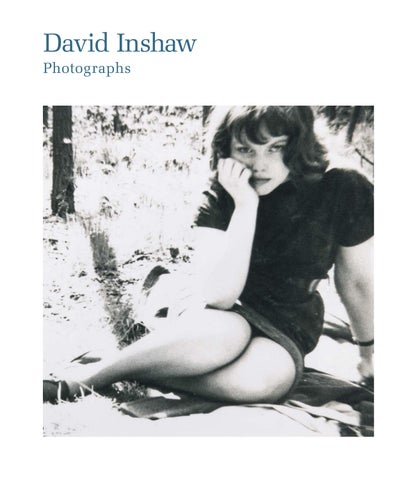
David Inshaw Photographs
David Inshaw Photographs
20 Cork Street, London W1S 3H L +44 (0)20 7734 1732 redfern-gallery.com
1.
Photo-portrait of DI with Minolta camera, Vale of Pewsey, 1978-9, colour
David Inshaw and Photography: The Temperament Behind the Camera Andrew Lambirth
1. There’s a photograph of David Inshaw taken in 1955 when he was 12, dressed in a Scout uniform, resting a Box Brownie camera on his knee and taking a snap of Lacock Abbey. The image is doubly revealing: firstly of his early interest in photography, which was to become a lifelong passion; and secondly for the context. Lacock Abbey was, after all, the home of Henry Fox Talbot (1800-77), inventor and pioneer of photography as we know it today. Camping with the Scouts at Lacock, Inshaw and his friends were invited into the Abbey by its last private owner, Matilda Talbot (1871-1958), the inventor’s great-niece. She was by then an elderly lady, and had arranged for the National Trust to take over the building and estate. In 1955, she wanted to show the Scouts what the moon and the planets looked like through a telescope. The magic of that night has remained with Inshaw, and he still speaks of it as one of his early and abiding memories of Wiltshire, the county that has been his home for the best part of 50 years. If Wiltshire has been one pole of his inspiration, the other has been the human form. Although a highly competent and sophisticated draughtsman, Inshaw has also made extensive use of photography as research material for his painting, and has consequently developed his skills with the camera. He enjoys taking photographs, and although most are intended to become part of an image bank and source for his paintings, occasionally he finds he
has taken a photograph which has exceptional resonance. A selection of these has been gathered here to demonstrate the range of his achievements in this medium, most of them dating from the 1960s and 70s, when he was perhaps at his most inventive and ambitious as a photographer. I spoke to him about his relationship with photography, in the summer of 2021, at his Devizes studio. ‘I first really took up photography when I came to teach in Bristol in 1966. The Fine Art department had a really good camera, a Pentax Spotmatic. No one used it, so I borrowed it and took it to America in 1967 and used it all the time. I was learning about photography then. Later I bought a Minolta in Devizes from Lou Rutter, in 1971. It was the top of the range that he had and I used it for quite a few years. I liked the idea of taking photographs and at that time everybody started using cameras. [Looking back] I don’t know whether it was part of my [artist’s] equipment or whether I just thought it could be useful. I did like the way photographs worked. I remember thinking that photographs had a certain quality and timelessness about them, and I thought I could probably introduce that into the painting. ‘However, I hadn’t really understood what photography meant to me until I met Alf [Stockham, friend and fellow painter], and we started sharing a house [at the Paragon, Bristol]
3
2. Susan Taylor, Bois de Boulogne 1960 5 × 5 in / 12.7 × 12.7 cm
in 1968. Then I began to discover photography as a way of creating images, of speeding up the process. I’d always done drawings, but eventually they didn’t really satisfy me, and the photographs did. Now my imagination is rooted in photographs. It’s a way of suspending time. Usually I don’t see photographs as things in themselves, but as part of a painting. I still use my old photographs, I still find them interesting. I’m not really experimental with cameras, I just use them to take photographs. And then I come back to the studio and use photographs to construct an image.’ Inshaw still has a set of prints of his American photos, which start very much as tourist snaps but begin to develop assurance even in the space of the three weeks he was in the USA. He stayed in New York with a childhood friend from Biggin Hill, Joan (later Helena) Matthews, who had trained to be a ballet dancer, but had grown too tall for the Royal Ballet and left for the States to join the Martha Graham Company. The subjects range from such classic tourist motifs as the Statue of Liberty, Manhattan from the water, and the Empire State Building, to street signage, advertising and a number of night shots. A vast and elaborate 007 billboard for the latest James Bond movie, You Only Live Twice, particularly caught his eye, along with aerial and panoramic views from the Empire State, and street layouts. There is a strongly abstract shot of the Empire State Building shot
from the ground up, dramatically constructed with light and shadow, and another of the main hall of Grand Central Station, dark and empty. Another highly effective structural image is of columns in a quiet subway station. Inshaw was beginning to recognise the possibilities of the medium. 2. ‘Photography is nature seen from the eyes outward, painting from the eyes inward. Photography records inalterably the single image while painting records a plurality of images wilfully directed by the artist.’ Charles Sheeler, 1937 The early American Modernist, Charles Sheeler (1883-1965), knew whereof he spoke, being himself both painter and photographer. In his painting he pioneered Precisionism, a kind of Cubist Realism at its height in the 1920s and 30s, and employed to great effect in the depiction of the new industrial cityscape of skyscrapers, bridges and factories. As a photographer he had two very different aspects to his work: the minimal, rather abstract interiors and external studies he made for himself, and the commercial work he did for Ford, for instance, photographing their production line in Michigan. Working in both media, he explored the relationship between abstraction and representation. In his lifetime, his photography was played down because it was seen as a threat to his reputation and integrity as an artist, as if
5
somehow using photographs as source material instead of pencil drawings was a form of cheating. These days, he is as highly regarded for his beautiful photographs as he is for his radical and equally beguiling paintings. ‘The camera — like alcohol, or a cork jacket — may be an excellent servant to a draughtsman, which only he may use who can do without it.’ Sickert’s warning sounded through the art schools of Inshaw’s youth, but attitudes were rapidly changing. Inshaw has always been aware of the subtle disparagement that can be directed at artists who employed photography as an adjunct to painted work, but he has always been open about his parallel involvement with the two media. He took photos from an early age, but in terms of his art, he only began to use photographic imagery in his 1960s Pop-inflected screenprints, and then to screenprint directly onto the canvas, as Rauschenberg did. (For example, in the 1969 painting My feelings for a fish a girl and an aeroplane.) But he quickly became disenchanted with the lack of involvement he found in silkscreen. For him the medium was just too mechanical and lacking in subtlety, and he returned to painting in oils. Photography remained important to him, but primarily as a means of collecting information about people and landscape. His use of the camera as a tool is confirmed by his response to the subject of probably his best-known
6
painting, The Badminton Game, 1972, now in the Tate Gallery. When Inshaw set up the game and asked the protagonists to start playing, he found it impossible to draw them in movement, so he took photos of them instead. [See No 24.] He also made drawings for the painting — there’s a particularly fine large pencil study of the trees and house and some of the topiary — but his on-the-spot notations were entirely photographic. The final painting was never simply a description of a game, it also involved an important degree of invention too. As he wrote about it later: ‘I think my main aim was to produce a picture that held a moment in time, but unlike a photograph, which only records an event. I thought a painting could give a more universal deeper meaning to that moment, by composing one instant from a lot of different unrelated moments.’ The alliance between camera and brush, so firmly established in the process of making this early painting, was to characterise his work from then on. Inshaw did not stop drawing: he has always made small pencil notes for paintings, and larger, more detailed studies to discover a composition. He has also, from time to time, drawn from the model, but he never takes a sketchbook out into the landscape, preferring to rely on his camera. He likes looking at drawings by other artists, and talks about being influenced by, for instance, the life-size drawings of Holbein and Stanley Spencer.
3. Cathy Thomas, Double Exposure 1964 20 × 16 in / 50.8 × 40.64 cm
7
4. Christina Asleep 1968 9½ × 11½ in / 24.13 × 29.21 cm
8
9
His early painting style relied on intricate drawing and the gradual accumulation of tiny brushstrokes to achieve a seamless overall image, but in the 1980s his brushmarks grew broader as he moved away from his dependence on line. In the 1970s he would still make large drawings for paintings, to discover the composition, which he then squared up and transferred to canvas. He loved making those big drawings, but after a decade of doing them, he realised he was trapped inside a process which was in danger of becoming a mannerism. As he said: ‘I had to find a way of reinventing a process that would give that kind of intensity to the image but wouldn’t be so mechanical.’ There was some inevitability to his choice of photography as the liberating factor. Photography had always been there as an inspiration and aide-mémoire, but now Inshaw developed a closer relationship with it. He continued to take new photographs, but he also looked back over his accumulated image-bank and sometimes drew upon it to generate a new painting. He exchanged his sable brushes for hog’s hair, stood up to paint (he had worked seated before), and brought his whole body to bear upon a painting rather than just his wrist and arm. This more physical approach to painting has continued into his current practice, just as painting and photography have remained intertwined in his work. And it also serves to emphasise the truth
10
that although Inshaw uses photographs, he doesn’t reproduce the look of them. That is a crucial difference between his art and much other photoderived work. 3. There were two occasions when Inshaw exhibited his photographs in public, as independent works of art. The first time was in 1976, right in the middle of a particularly fruitful period of photography for him. It was during his residency as Fellow in Creative Art at Trinity College, Cambridge (197577), and the exhibition was held in the Wren Library of Trinity. That was a relatively small-scale event, though it was important for the artist to see his photographs standing alone and self-sufficient in a professional context, for it confirmed his seriousness of approach to the medium. Inshaw exhibited his photographs again in a Plymouth Arts touring exhibition in 1981, along with the photos of Martin Axon and Graham Ovenden, but he pulled his work out before the end of the tour because he decided that he did not want to be known as a photographer. However, there was quite a substantial catalogue, with an introduction by Nicholas Usherwood, and reproductions of 10 of Inshaw’s photos from the 1970s, exclusively landscapes and figure subjects, in a ratio of 2 to 3. Usherwood asserted that although Ovenden’s photos were taken on
5. View from the Paragon, Bristol, 1 1969 11 × 8 in / 27.94 × 20.32 cm
11
6. View from the Paragon, Bristol, 2 1969 11 × 8 in / 27.94 × 20.32 cm
12
7. View from the Paragon, Bristol, 3 1969 11 × 8 in / 27.94 × 20.32 cm
13
8. Christina 1969-70 20 × 16 in / 50.8 × 40.64 cm
14
their own account, Inshaw’s were ‘for the most part, taken as tentative explorations of possible motifs for paintings, or parts of paintings’. In fact, Usherwood determined that Inshaw used photography to act as a trigger for compositional ideas to be carried out in paint. Perhaps Inshaw felt that he revealed too much of his thought processes by showing his photographs. And yet these dark and moody images do not easily give up their secrets: if anything, they enhance the mystery surrounding his subjects, and banish explanation in favour of suggestion. Of course, there have been a number of painters who were also talented photographers, Paul Nash, Eileen Agar and John Piper to name but three. Inshaw sees photography for these artists primarily as a means of extending their investigation of the subjects that preoccupied them. Yes indeed, but the independent aesthetic appeal of their exploratory photographs cannot be discounted altogether; nor can the beauty of his own photographs, as evidenced in this publication. Let us examine some individual examples. The portrait of Susan Taylor in France [No 2], is the most straightforward image here, as well as the earliest, a simple declarative shot, a moment caught. What a difference a decade makes, as will emerge if you compare this photograph to the sophistication of what Inshaw was doing in 1970.
The platinum print, Gillian (Back View) at the Paragon, Bristol, 1, 1970 [No 10], is a marvellous smoky image, all subtle sfumato edges, the soft human body disappearing into darkness, set against and contrasted with the tougher physicality of the chair and wooden panelling. Very sensuous and completely different in approach to the naturalistic Gillian (Back View) at the Paragon, Bristol, 2 [No 11], of the same year, which directly informed a painting Inshaw made called Gillian and a Light Summer Breeze (1973). The figure in the first photograph is concealed in shadow, in the second it is revealed through light; both are gently erotic. Look at the way he focuses on textures, and the different tactile qualities of ploughed earth, rough field margins and haystack in the platinum print Study for ‘She Did Not Turn’, 1973 [No 27]. This, of course, was the landscape in the painting of that name, a title which in turn derives from Hardy’s poem. As to the fall of light, that is particularly dramatic in Morwenstow Churchyard, Cornwall, 1975 [No 29]: raking banded light illuminating the original wooden ship’s figurehead, surreally marooned amongst graves, and now replaced by a plastic replica. As regards pictorial space, consider the complex relationships between the dark stand of trees on the hilltop, and the darker trees to the foreground in Little Bredy Hillside, Dorset, 1975/6 [No 34]. Meanwhile, symbolic narrative is
15
not entirely neglected: in the colour study Adam & Eve (David & Julia), 1976 [No 52], Julia offers David an apple and he is tempted, prior to them both being expelled from Eden… 4. ‘Photography is important to me’, Inshaw said in 2009. ‘I like the photographic process, taking pictures, the moments they capture. I take a lot of pictures then I choose the moment I want. When you’re looking at somebody or something (a landscape or whatever), the light is so tricky to capture. Photography can do that very well. Taking photos I try to get that moment of movement, that magic moment where it happens without you saying what you want. You’re trying to get that spark out of a sitter. You can’t do that if you sit and draw somebody because they sink into something else and you put them through a process…. In photography you can get that sparky moment.’ At heart, Inshaw’s artistic practice is about distilling the information offered by photographs into something else. The material initiates the imagery. He doesn’t generally get an idea and then go out and find photographs to illustrate it. His photographic archive is like having a series of sketchbooks — only better, as Inshaw has never liked keeping sketchbooks. ‘I couldn’t work out how to translate little sketches you did in your
16
sketchbook into a picture,’ he says. ‘I couldn’t make that connection, whereas with photography I can.’ Whatever his partiality for the medium, Inshaw is well aware of its limitations. ‘I’ve always thought that the surface of a painting is the most important part of it, and how the images are embedded in that surface. Whereas a photograph you just look at. If you come back to it, it’ll still be a photograph. With a painting you come back to it again and again and it’s different every time. It has an endlessly changing resonance. A photograph doesn’t.’ In his earlier work, narrative was important, but in later years he has become more of a formal painter, concerned with shape, colour, texture. Although he paints landscape, he says his paintings are ‘not landscape per se, they’re a sort of attitude towards landscape; a construct. And I constructed them in the studio.’ He doesn’t go out into the landscape to paint, for then he would have to deal with all sorts of considerations he simply isn’t interested in. He edits and constructs the topography he knows so intimately to create an image that will carry the requisite intensity. To achieve this he uses photographs, or, increasingly, aspects of photographs — for instance, a bird in the right attitude — which will then be added in, or in effect collaged into the image.
9. Raven 1970 8 × 11 in / 20.32 × 27.94 cm
17
10. Gillian (Back View) at the Paragon, Bristol 1 1970 14½ × 9 in / 36.83 × 22.86 cm, platinum print
18
Inshaw comments: ‘If I’m doing a painting of a tree or bush, I’ve got a photograph of a tree or bush which I use to start with, but then I alter in the process of painting. It’s just a guide, a useful beginning, a starting point.’ In the studio, he uses mount-board frames to crop the printed photographs or to present them in a square format (a long-time favourite). He is constantly trying out new permutations, not all of which reach the easel. They have to be intense enough to sustain his interest, as well as interesting compositions. His photographs are still mostly of people and places, not still-life (which he doesn’t tend to paint), and he never takes photographs for the sake of it. Talking about using photographs as raw material when painting portraits (the only ones he has done from life are self-portraits), Inshaw says: ‘I don’t copy the photograph, I just use it as a starting point. I reinvent, re-imagine. I hope that by using photography I can perceive something within the person that has never been touched on.’ He insists that he only uses photographs so that he can see where things are in relation to each other, after which imagination or invention takes over, and he concentrates on making a good painting, which is about ideas and thoughts and feelings, but which also works as a formal disposition of masses and lines and colours.
So how did some of his photographs move up from being raw material and research to photographs in their own right, as the images here? That seems almost serendipitous: some images glow and linger in the mind. Although Charles Sheeler maintained that photography was ‘outward seeing’, Inshaw brings to his best photographs his inner artistic world, which informs all his successful images, either photographic or painted. And when that inner world brims over into a photograph, irradiating it from within, a photograph worth exhibiting is created. Revealingly, most of Inshaw’s finest photographs are black and white, thus operating within restrictions he does not apply to his paintings. He finds and identifies the tonal strengths inherent in a subject, decides how to crop and position the image, and then sees how it will print up. If the process sounds simple, that’s because the other factors which go towards the creation of an image are unquantifiable: the artist’s vision, the temperament behind the camera. Those are the qualities which make these photographs unique.
Devizes: February, 2022
19
11. Gillian (Back View) at the Paragon, Bristol 2 1970 9 × 6 in / 22.86 × 15.24 cm
20
12. Gillian at the Window, The Paragon, Bristol 1970 6 × 6 in / 15.24 × 15.24 cm
21
13. Julie Reading 1971 6 × 9 in / 15.24 × 22.86 cm
22
23
14. Julie in the Garden at the Paragon, Bristol 1 1971 6 × 7¾ in / 15.24 × 19.68 cm
24
15. Julie in the Garden at the Paragon, Bristol 2 1971 6 × 9 in / 15.24 × 22.86 cm
25
16. Shipley Churchyard, West Sussex 1971 6 × 9 in / 15.24 × 22.86 cm
26
27
17. Gillian at Laycock, Wiltshire 1971 9 × 9 in / 22.86 × 22.86 cm
28
18. Gillian Seated 1971 9½ × 9½ in / 24.13 × 24.13 cm
29
19. Corsham Churchyard, Wiltshire 1971 9 × 13½ in / 22.86 × 34.29 cm
30
20. Levens Hall Topiary, Cumbria 1971 9 × 13½ in / 22.86 × 34.29 cm
31
21. Denise in the Mirror 1972 6 × 6 in / 15.24 × 15.24 cm
32
22. Christina 1972 8 × 11 in / 20.32 × 27.94 cm
33
23. Topiary at Compton Wynyates, Warwickshire 1972 8 × 8 in / 20.32 × 20.32 cm
34
35
24. Study for ‘The Badminton Game’ 1972 14¼ × 18¼ in / 36.2 × 46.35 cm
36
37
25. Avebury Landscape, Wiltshire, 1 1972-73 6 × 9 in / 15.2 × 22.86 cm
38
26. Avebury Landscape, Wiltshire, 2 1972-73 6 × 9 in / 15.2 × 22.86 cm
39
27. Study for ‘She Did Not Turn’ 1973 11 × 17 in / 27.94 × 43.18 cm
40
41
28. Jill with Wisden 1974 9½ × 15 in / 24.13 × 38.1 cm
42
29. Morwenstow Churchyard, Cornwall 1974 6 × 9 in / 15.2 × 22.86 cm
43
30. Avebury Ditch with Shadow, Wiltshire 1975 9 × 13½ in / 22.86 × 34.29 cm
44
31. Alf at Avebury, Wiltshire 1975 7½ × 8 in / 19.05 × 20.32 cm
45
32. Fiona at Rybury Camp, Wiltshire, 1 1975 10 × 15½ in / 25.4 × 39.37 cm, colour photograph
46
33. Fiona at Rybury Camp, Wiltshire, 2 1975 10 × 15½ in / 25.4 × 39.37 cm, colour photograph
47
34. Little Bredy Hillside, Dorset 1975/76 6½ × 9 in / 16.51 × 22.86 cm
48
35. Alison MacDonald, Trinity College, Cambridge 1976 11 × 17 in / 27.94 × 43.18 cm, platinum print
49
36. Veronica, Old Guest Room, Trinity College, Cambridge 1976 11 × 14½ in / 27.94 × 36.83 cm, platinum print
50
37. The First Photograph of Robin 1977 6 × 6 in / 15.24 × 15.24 cm
51
38. Bridehead House, Little Bredy, Dorset 1977 8 × 11 in / 20.32 × 27.94 cm
52
39. River Wylye and Elizabeth, Wiltshire 1977 6 × 9 in / 15.24 × 22.86 cm
53
40. Robin by Candlelight 1978 6 × 6 in / 15.24 × 15.24 cm
54
41. Robin by Candlelight 2 1978 6 × 6 in / 15.24 × 15.24 cm
55
42. Ro Hill 2 c.1978 11 × 8 in / 27.94 × 20.32 cm
56
43. Two on a Tower, Alton Priors, Wiltshire 1980 6 × 9 in / 15.24 × 22.86 cm
57
44. Juliet by Candlelight 1980 6 × 9 in / 15.24 × 22.86 cm
58
45. Gillian Thinking 1980 7½ × 10½ in / 19.05 × 26.67 cm
59
46. Running at the Academy 1 1980 6 × 6 in / 15.24 × 15.24 cm
60
47. Running at the Academy 2 1980 6 × 6 in / 15.24 × 15.24 cm
61
48. Blind Man’s Buff 1984 11½ × 16 in / 29.21 × 40.64 cm
62
63
49. Sharon Standing, Nude 1984 15 × 10 in / 38.1 × 25.4 cm
64
50. Sharon in Hat 1984-85 15½ × 13 in / 39.37 × 33.02 cm
65
51. Fiona at Landsdowne Terrace, Devizes 1984-85 15½ × 11 in / 39.37 × 27.94 cm
66
67
Catalogue © The Redfern Gallery, 2022 Works © David Inshaw Essay © Andrew Lambirth Photography: Peter J Stone Photography Design: Graham Rees Design Print: Gomer Press Published to coincide with the Exhibition
David Inshaw Photographs 15 June –15 July 2022 Published by The Redfern Gallery, London 2022 ISBN: 978-0-948460-91-3 All rights reserved. No part of this book may be reproduced or transmitted in any form or by any means, electronic or mechanical, including photocopying recording or any other information storage or retrieval system without prior permission in writing from the gallery.
All photographs are black and white Bromide prints except where stated. Front cover:
Susan Taylor, Bois de Boulogne, 1960 illustrated on page 4 Inside front cover:
Contact sheet of The Badminton Game, 1972 Inside back cover:
Contact sheet of Alf at Avebury, Wiltshire, 1975
20 Cork Street, London W1S 3H L +44 (0)20 7734 1732 redfern-gallery.com
68
52. Adam & Eve (David & Julia) 1985 10½ × 7½ in / 26.67 × 19.05 cm, colour photograph