NOVEMBER-DECEMBER 2026 $7.99
Meditation: Heaven Is Closer Than We Imagine Page 32
CATHOLIC. PASTORAL. TRUSTED.
Redemptive Love
On Christmas Day, we encounter God’s creative power
Peru’s Children of the Hillsides A volunteer contributes to “heaven’s plan”
SHAPED BY OUR CREATOR S TORIES R ICH IN W ONDER & A DVENTURE
♦ THE WHEEL AND THE CLAY
♦ THE STAG WITH THE CRYSTAL HORNS
The Inner Lives of Christian Artists
Artists can help us sense how marvelous it is to be created: the patience, the detail, the joy. In this essential collection, thirty-one Christian artists from various disciplines — music, poetry, film, sculpture — offer essays on the strange experience of following God’s lead by making beautiful things. Contributors include Arvo Pärt, Michael O’Brien, Dana Gioia, Duncan Stroik, Matt Maher, Gwyneth Thompson-Briggs, James Matthew Wilson, Siobhan Hogan, Tom Wilson, M a k o to Fu j i m u r a , D i o n D i Mu c c i , Frank L a Rocca, Elizabeth Zelasko, Mike Aquilina, and many more. WACP . . . Sewn Softcover, $19.95 “Timely, encouraging, and necessary, these well-wrought narratives belong on the shelf of any believer who aspires to make a meaningful creative contribution.” — Katy Carl, Editor in Chief, Luminor “Even if not artists by profession, we dream of being creative. But how does creativity work? This book provides answers in different keys, though a tonality of wonder permeates them all.” — Bishop Erik Varden, Author, The Shattering of Loneliness
♦ TALES FROM WAKKEN WOOD
E.P. Cowley’s dramatic saga immerses young readers in an enchanted world. In Wakken Wood, the battle between good and evil requires bravery, but also careful attention
In these delightful stories, Grace Fitzpatrick envisions a world of wonder, enchantment, discouragement, and danger. Witty, wise, and compelling, these stories are steeped in folktale tradition, but are startlingly fresh, and will appeal to grown-ups as much as to children. This book is a delightful romp to the time when wishes were granted and there was always some magic in the air. Some stories are playful, others are grave, but all of them rejoice in the abundance of grace that comes from good conquering evil and the deepest Love washing over all. STAGP . . . Sewn Softcover, $17.95
“These stories are deftly crafted and rich in whimsical humor, fresh imagination, and an underlying wisdom that readers may well marvel.” — Michael O’Brien, Author, Father Elijah “Fitzpatrick’s tales are like discovering a long-lost companion to the beloved tales of yesterday, yet are fresh and original for a new generation.” — Cheri Blomquist, Author, Before Austen Comes Aesop “Both timeless and ageless, these stories are suitable reading for adults and children. — Karen Ullo, Author, Cinder Allia
♦ BEFORE AUSTEN COMES AESOP
♦ ON THE EDGE OF INFINITY
BACAP . . . Sewn Softcover, $18.95
ONEFP . . . Sewn Softcover, $18.95
Cheri Blomquist presents an in-depth examination of the Children’s Great Books, literature that has made the most profound impact on children’s lives throughout Western history.
Clemens Cavallin tells the inspiring life story of Michael O'Brien, one of the most popular Catholic novelists and painters of our times.
TWAWP . . . Sewn Softcover, $18.95
www.ignatius.com P.O. Box 1339, Ft. Collins, CO 80522
(800) 651-1531
Liguorian • Vol. 114, No. 6 A REDEMPTORIST PASTOR AL PUBLICATION
November-December 2026 Redemptive Love: A Christmas Reflection On Christmas Day, we encounter God’s creative power
Emails in December: The Great Gift Exchange Sometimes, gifts just keep on giving
FR. THOMAS M. SANTA, CSsR
. . . . . . . . . . . . . . . . . . . . . . . . . . . . . . . . . . . 24
. . . . . . . . . . . . . . . . . . . . . . . . . . . . . . . . . . . 10
FR. MATTHEW POWELL, OP
CATHOLICS IN AMERICA
Book Excerpt: The Word Made Flesh A meditation for Christmas Day from Awakened by Grace: Advent and Christmas Devotional
Social Activism and Reform Part six of a six-part series: US Catholics helped dismantle systemic injustices in society
FR. JAMES R. McDONALD, CSsR
FR. MATTHEW O’TOOLE
. . . . . . . . . . . . . . . . . . . . . . . . . . . . . . . . . . . 13
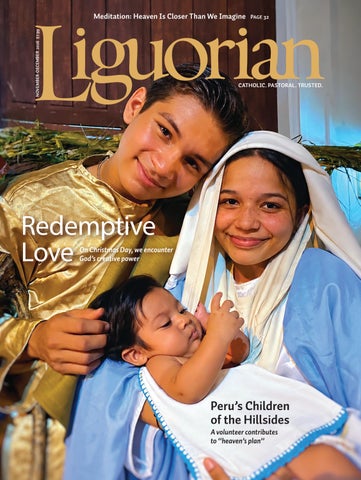
On the Cover: Children participate in a live nativity scene YVÁN GONZÁLEZ / CATHOPIC
. . . . . . . . . . . . . . . . . . . . . . . . . . . . . . . . . . . 28
Grappling with a Nation’s History: Confronting the Past and Healing the Present Only from a place of honesty can we move toward a point of healing
MEDITATION
Columns
Heaven Is Closer Than We Imagine Heaven unveils itself in life’s simplest moments
A WORD FROM THE PUBLISHER The Editorial Perspective
FR. HUY VU, CSsR
TOM FALETTI
. . . . . . . . . . . . . . . . . . . . . . . . . . . . . . . . . . . 32
............................................................ 5
. . . . . . . . . . . . . . . . . . . . . . . . . . . . . . . . . . . 16
THE CATHOLIC OBSERVER
Peru’s Children of the Hillsides: Their Unexpected Gift to Me A volunteer contributes to “heaven’s plan”
Your independent source of news and views on the Catholic Church
MARK GABRIELE
FICTION
. . . . . . . . . . . . . . . . . . . . . . . . . . . . . . . . . . 20 Page 20
GARY GATELY
. . . . . . . . . . . . . . . . . . . . . . . . . . . . . . . . . . . 36
Make Room A family’s carefully crafted Christmas unravels RENEE RIEDE
. . . . . . . . . . . . . . . . . . . . . . . . . . . . . . . . . . .38
FR. THOMAS M. SANTA, CSsR
PLAIN TALK Preparing for Christmas FR. PETER D. HILL, CSsR
............................................................ 9
FACE TO FACE Keeping It Real SCOTT CZARNOPYS
.......................................................... 15
PADRE MIGRANTE A Feast for Our Time FR. MIKE McANDREW, CSsR
EUCHARISTIC POETRY
......................................................... 23
The Invitation
REDEMPTIVE LIVING The Practice of Waiting
JEANETTE MARTINO LAND
. . . . . . . . . . . . . . . . . . . . . . . . . . . . . . . . . . . 42
PRAYING WITH THE MYSTICS
Meister Eckhart, OP Detachment: let go and let be LIGUORI PUBLICATIONS STAFF
. . . . . . . . . . . . . . . . . . . . . . . . . . . . . . . . . . . 43
VINITA HAMPTON WRIGHT
.......................................................... 31
KITCHEN TABLE GOSPEL A New Look at AI TIM AND JULIE SMITH
......................................................... 35
November-December Columnists
Readers Respond
Around the Table
Bible Quiz
Catholic Crossword
The Lighter Side
4
7
34
44
45
46
November-December Columnists Scott Czarnopys (“Face to Face”) brings sixteen years of Catholic education leadership to his role as education ministry director at Saint Patrick Parish in Parnell, Michigan. He is married to his beautiful wife, Arley, and has two children, Haven and Daxton. His columns are drawn from the everyday moments of faith, fatherhood, and community that shape his life. Fr. Peter D. Hill, CSsR (“Plain Talk”), is a Redemptorist missionary who has served as parish priest of Holy Cross Roman Catholic Church, Santa Cruz, Trinidad and Tobago; director of Holy Redeemer Retreat House, Dominica; and formation co-director at North American Redemptorist Formation House in San Antonio, Texas. Fr. Michael McAndrew, CSsR (“Padre Migrante”), has served for thirty-plus years in Redemptorist Hispanic ministry initiatives, youth ministry, bilingual parish missions, and farmworker ministry. He works with the Catholic Migrant Farmworker Network, has directed a Campesino ministry, and recently published a book with Liguori Publications: Walk With My People: A Life in Migration Ministry (828720).
Since 1913
Fr. Sandeep Menezes, CSsR (“Social Media Perspectives”), is a Redemptorist priest of the Bangalore Province, India. He currently serves as the assistant director of the Redemptorist Media Center under the Holy Redeemer Foundation and as chief editor of Redemptorist Publications in India. Widely recognized as a dynamic youth minister and missionary, he engages in ministry that extends beyond traditional preaching into the digital space, where he is an active social influencer, using media as a powerful tool for evangelization. Br. Raymond Pierce, CSsR (“The Lighter Side”), is a native of Saint John, New Brunswick, Canada. His ministry is storytelling via email. Every week, he sends “Morning Smiles” emails of humor and personal stories to nearly 1,000 senior citizens.
Christmas…is a time when we receive the promise of the Spirit’s continued faithfulness among us. We are grateful, blessed, and renewed.
Fr. Thomas M. Santa, CSsR (“A Word from the Publisher”), was named president and publisher of Liguori Publications in January 2024, his second assignment as the company’s leader. Professed as a Redemptorist in 1973, his ministries have included retreat work and writing reflections for the Scrupulous Anonymous newsletter. Tim and Julie Smith (“Kitchen Table Gospel”) have been professional music ministers in the Phoenix area for more than thirtyfive years. They have written and recorded dozens of music collections, including liturgical music, theater music, children’s music, and bilingual music, and their songs have been published in multiple hymnals. Vinita Hampton Wright (“Redemptive Living”) worked in religious book publishing for more than three decades. She is retired and continues to write, edit, and present retreats and workshops on creativity, writing, and prayer. She works as a spiritual director in Northwest Arkansas.
FR. THOMAS M. SANTA, CSsR
Catholic. Pastoral. Trusted.
Publisher Fr. Thomas M. Santa, CSsR Director of Digital and Creative Services Wendy Barnes Associate Editors Fr. Byron Miller, CSsR Andrew Tran-Chung, CSsR Manuscript Editor Amy Deputato Director of Media Fr. Charles Kumar, CSsR Journalist Gary Michael Gately Design, Production, and Post-Production Kate Brown John Gantz Kathy Lane Director of Sales and Marketing, Liguorian Ad Sales Chuck Healy Circulation Emily Drury Sales and Customer Service Coordinator Donna Hurley Contracts, Rights, and Permissions Jeffrey Morrison Editor-In-Chief, India Fr. Sandeep Menezes, CSsR
4 November-December 2026 // Liguorian.org
Editorial Offices United States 200 Liguori Drive, Liguori, MO 63057 India Thomas Town Post, Bengaluru, India, 560084 © 2026 Liguori Publications, a ministry of the Redemptorists. All rights reserved. 636-464-2500. Liguori.org. Unless noted, Scripture quotations are from The New American Bible, Revised Edition © 2010, 1991, 1986, 1970 Confraternity of Christian Doctrine, Washington, DC. Used with permission. Subscription Questions? Visit Liguorian.org. Call: 800-325-9521 Email: Liguorian@Liguori.org Write: Customer Service, 200 Liguori Drive, Liguori, MO 63057 Print + Digital Subscription One year: $38; Outside US: $53 (US funds only). If you prefer that your name and address not be available to select organizations, please mail your address label to: Mail Preference Service, Liguorian, 200 Liguori Drive, Liguori, MO 63057 Liguorian is available on CD from Xavier Society for the Blind, 154 E. 23rd Street, New York, NY 10010, or call 800-637-9193 for materials for the blind only.
Advertise in Liguorian Call Oremus Advertising at 781-822-0680 or email evelyn@oremusadvertising.com. Publication Mail Agreement #40112731. Canadian Return Mail Request: PO Box 122, Niagara Falls, Ontario L2E 6S8 Canada ISSN 0024-3450 Printed in the US at Kingery Printing. Support Our Ministry Please help us continue Liguorian and other Liguori Publications ministries by making a tax-deductible donation or remembering us in your will. Our legal title is Redemptorist Fathers dba Liguori Publications, Federal ID 43-0653409. Liguorian is named after our founder and patron saint, St. Alphonsus Liguori (1696–1787), Doctor of the Church, bishop, patron of confessors, moral theologian, prolific writer, pastoral theologian par excellence, and founder of the Redemptorist Congregation. It is in his spirit and inspired by the charism he shared with us, “With him there is plentiful redemption for all,” that this magazine and all pastoral educational products of Liguori Publications proudly claim we always strive to be Catholic, Pastoral, Trusted. To learn more about the Redemptorists, visit Redemptorists.com
A Word from the Publisher
The Editorial Perspective
FR. THOMAS M. SANTA, CSsR
A
lthough most readers will receive this issue of Liguorian in November, its theme is primarily Christmas. For now, it may be more accurate to think of this issue as preparation for Christmas. By the time you read this column, Thanksgiving may feel more immediate, while Christmas still lies ahead. That is the reality of publishing: we are always working ahead of the calendar—sometimes by weeks, often by months, and occasionally by a year or two. Excellence requires planning; it does not happen by accident. If we want Liguorian to be timely and attentive to the real pastoral and spiritual needs of our readers, we must remain rooted in the present while keeping our editorial eye on the future. That is not always easy. Sometimes we get it right, and sometimes we miss the mark. Over the past year, we have been celebrating the 250th anniversary—the semiquincentennial—of our nation’s founding. As part of that celebration, we featured a series of articles by Fr. Matthew O’Toole titled “Catholics in America.” I hope you experienced these articles in each issue of Liguorian as inspirational. I certainly appreciated Fr. O’Toole’s wisdom and insight; he made our history come alive and helped me fill in the blanks. His work helped me, as publisher, make an important commitment for our feature articles moving forward. Throughout 2027 and 2028, a feature article in each issue will focus on the Second Vatican Council. We draw inspiration for this extensive series from Pope Leo XIV, who writes that continued catechetical reflection on the Council “is a valuable opportunity to rediscover the beauty and the importance of this ecclesial event.” His words echo Pope Saint John Paul II, who wrote in an apostolic letter at the end of Jubilee 2000, “I feel more than ever in duty bound to point to the Council as the great grace bestowed on the Church in the twentieth century” (Novo Millennio Ineunte, 57). Pope Leo XIV’s encouragement inspired this series, but I found even greater motivation in the manufactured confusion surrounding the Second Vatican Council. Social media is unfortunately filled with self-proclaimed “experts” who portray the Council as unnecessary and disconnected from the Church’s history. With misplaced confidence, these talking heads claim it was the work of “modernists” who infiltrated the papacy and the assembled bishops with harmful intent. According to them, the true Church was lost and replaced by a “fake church.” Nothing could be further from the truth, and hopefully this series of articles will help set the record straight. Before we move too far ahead, a few words about the present issue of Liguorian seem appropriate. As mentioned, we will conclude Father O’Toole’s wonderful series as our nation’s celebrations come to an end. We will also conclude Jeanette Martino Land’s beautiful eucharistic poetry. If you appreciated her creativity, you may be interested in her book, Eucharistic Graces: Poems for Pondering God’s Presence, which will be available from Liguori Publications in January 2027 and from your local bookseller.
Reflecting on the Second Vatican Council allows us to “rediscover the beauty of this ecclesial event.”
WIKIMEDIA COMMONS
November-December 2026 // 866-848-2492 5
This issue of Liguorian also includes wonderful articles to help you prepare for Christmas. Our columnists continue to offer relevant commentary for your reflection and inspiration. Each will return in 2027, when we will also introduce a new column, “Family and Finances.” Its author, Novia Almeida, comes from Liguorian International. We look forward to her contribution and to even more features from the international edition of Liguorian. There is much to anticipate. If you are looking for a last-minute Christmas gift or stocking stuffer, consider a gift subscription to Liguorian. Six times a year, your thoughtful gift will remind someone of your care and concern. I suspect the recipient would put a subscription to good use, and it may be a wiser choice than another coffee mug or a box of shampoo and fragrances. Surprisingly, it is also a timely gift. More and more young people are discovering the joy of the printed word. Reading in print is not the same as reading on a phone or device, which always seems to be close at hand. Print invites a more deliberate choice, and in that deliberation, something special happens. It is simply not the same as reading electronically—but, of course, you already know that. Thank you for being part of our Liguorian family. We are honored that you have chosen us to be one of your pastoral, Catholic, and trusted voices. We take that responsibility very seriously, and we appreciate your support and encouragement. A
Custom Sacred Statues Since 1921 Exceptional craftsmanship. Remarkable value. Trusted worldwide to bring stories, heroes, and history to life.
Bronze • Marble • Fiberglass Let us create a one-of-a-kind sacred masterpiece for your parish, school, shrine, or organization. Our custom statues are expertly crafted, surprisingly affordable, and delivered in as little as 120 days.
Learn More www.customstatues.co Get Your Free Quote Today Caveco33@aol.com • 516 456 3663 6 November-December 2026 // 866-848-2492
Thank you for being part of our Liguorian family. We are honored that you have chosen us to be one of your pastoral, Catholic, and trusted voices.
Readers Respond *
Send Us Your Feedback! Write: Liguorian Editor, 200 Liguori Drive, Liguori, MO 63057 E-mail: Liguorianeditor@Liguori.org The opinions expressed don't necessarily reflect the opinions of the editors. Letters must be signed and include the writer’s full address and daytime phone number. Names will be withheld from publication upon request. The editors reserve the right to edit letters for length, clarity, and style.
From the Editor We sincerely apologize for the use of the Vietnamese national flag in “Vietnamese Catholics in the US: The Bubble Is Bursting” (September-October 2026). While it is the current flag of Vietnam, we understand its use may be insensitive to members of the Vietnamese American Catholic community. We regret the oversight and apologize for any hurt or offense it may have caused. Dear Liguorian Editor, I loved your article on Roberto Clemente, the baseball superstar killed on a mission of mercy in 1972 (“¿Santo Roberto? Meet the Greatest Latino Player of America’s Pastime,” July-August 2026). I learned so much ¿SANTO from it. It ROBERTO? was sad (his Meet the greatest Latino player of America’s pastime sock washing P ashore), happy (most of it), and infuriating (MLB boss Manfred’s ruling on retiring #21). Author William D. Townsend weaved his citations masterfully throughout the pages without making a big deal out of them. I want to learn how to do this. A website by Mike Aquilina is well placed, and the Clemente documentary (which I’ll view with my husband) is a springboard for readers who want more. Bill graciously warns that the Clemente biography by David Maraniss is 401 pages. Its length is good to know, and he sneaks it in using a minimum of words. “The only dirt you’re likely to find on Roberto Clemente is on his uniform,” and “Rossi swung and missed,” are among the many clever turns of phrase Bill invoked. He is excellent at this. Dawn Allred-Kraemer, PhD (via email)
Dear Editors, Comments on two articles in the July-August 2026 edition: 1. A small correction to Fr. Matthew O’Toole’s otherwise fine article “Patriots and Pioneers of the Faith.” It states that Charles Carroll (b. 1702) of Annapolis received a commission as attorney general of Maryland. The attorney general commissioned by Lord Baltimore (in 1688) was actually Charles Carroll (b. 1662) the settler (from Ireland), the father of Charles Carroll (b. 1702) of Annapolis. Thus, Charles Carroll [of Carrollton] (b. 1737) was the grandson (not son) of the attorney general. 2. I thought it was interesting that the image of a church in Vinita Hampton Wright’s article “Faith’s Role in Our History” is of St. Anne’s Episcopal Church in Annapolis. The cropped image is from a watercolor based on a circa 1794 drawing by Charles Cotton Milbourne, showing St. Anne’s Church and the Maryland State House in Annapolis. OK, I guess, since the article is about faith, not about Catholics per se. Robert L. Worden St. Mary’s Parish Historian Annapolis, Maryland
Editor’s Response: Over the years, Dr. Dawn Allred-Kraemer has contributed numerous articles to Liguorian.
Response from the author, Fr. Matthew O’Toole: I humbly and happily accept the correction cited. And I smile on the “otherwise fine article” comment.
Roberto Clemente’s number 21 was retired by the Pittsburgh Pirates in 1973.
Roberto Enrique Clemente Walker (1934–1972)
WILLIAM D. TOWNSEND
hiladelphia, where the Founding Fathers proclaimed America’s independence in 1776, is an appropriate location for the national pastime’s Major League All-Star Game in 2026. The United States’ semiquincentennial—or 250th anniversary—will surely spark extra sizzle at the July 14 matchup between baseball’s National and American Leagues and stir up memories of yesteryear.
For instance, gone too soon but remembered forever is a fifteen-time All-Star whose team played some 300 miles west of Philly. He’s the only Major League Baseball player to die while serving others. And while he earned awards aplenty during his life and after his tragic death, does he deserve more? A devout Roman Catholic, Roberto Enrique Clemente Walker (1934–1972) leveraged the fame he gained from eyepopping performances with the Pittsburgh Pirates to serve souls he might never know. “The Lord put me on this earth to help people,” he said. Begun in 2014, a fan and filmmaker’s efforts to push for Clemente’s canonization have struck out. But that does not shut the door on potential sainthood for the baseball great. The sport’s salutes to Clemente are legion, and many think the commissioner should retire Clemente’s number in perpetuity, as Bud Selig did in 1997 to honor the Majors’ first black player, 24 July-August 2026 // Liguorian.org
Jackie Robinson. Fans believe it’s important to memorialize Clemente’s legacy by universally retiring the number 21, which “Momen” (a childhood nickname based on the word momentito, said often by Clemente when he needed a moment to think) wore with grace and dignity in eighteen seasons with the Pirates. Clemente was among the pioneering Latin American big-leaguers and unquestionably the greatest. In his era, he was baseball’s most outstanding right fielder. Nobody ran on his cannon of an arm.
Life and Tragedies
Roberto was born on August 18, 1934, in Carolina, Puerto Rico—smack-dab in the middle of the Great Depression. His parents were Melchor Clemente, a nonpracticing Catholic who worked in sugarcane fields, and Luisa Walker Clemente, a Baptist who raised seven children and served friends and
strangers alike. Baptized a Catholic, Roberto learned about God mostly from his mother, writes Mike Aquilina in a September 18, 2018, article on Angelusnews.com. Luisa remembered her youngest as “a serious child—and unusually religious,” Aquilina writes. His favorite hymn’s lyrics state, “Life is nothing. Everything passes. Only God makes a man happy.” Seriousness shadowed Roberto. A sister he’d never know had a lifelong spiritual impact on him. Anairis Clemente begged for a baby brother, and then Roberto came along. Tragically, one day her dress caught fire; she was engulfed by the flames and died. Roberto treasured Anairis, pondering her in his heart. He said he often felt her at his side. The little girl inspired her brother to be like Christ and to help and give to others—for example, at the age of twelve, Roberto dashed to a burning car, rescued a man, and carried him away. Puerto Rico’s pastime occupied much of young Roberto’s time. “God wanted me to play baseball,” he said. Like fine wine, Momen improved with age. At the age of twenty, this black Latino signed with the Brooklyn Dodgers and was assigned to their
ROBERTO CLEMENTE PLAYING FOR THE PITTSBURGH PIRATES IN 1957 / WIKIMEDIA COMMONS
July-August 2026 // 866-848-2492 25
November-December 2026 // 866-848-2492 7
Extraordinary Works on Vital Conflicts & Church Renewal
◆ TO MAKE ALL THINGS NEW On the Church, Reform and Renewal
Jayd Henricks reflects on St. Augustine’s words that the Church is “ever ancient, ever new”, and how it remains true today. The Church is a dynamic reality, embodying both the human and the divine, the natural and the supernatural, and always in need of renewal. A veteran Church ministry leader, interacting with bishops and cardinals, Henricks has a unique perspective on Catholicism. He examines key issues that are affecting life in the family, the parish, the diocese, and beyond, with an eye to the rich wellspring of Catholic Tradition. It cuts through the online chatter and examines what authentic renewal might look like in the Church today. TMATNP . . . Sewn Softcover, $17.95 “An extraordinary book that presents an honest picture of life in the Church and opens the door to a hope-filled future. It is useful for both reflection and action.” — Most Rev. Charles Chaput, Archbishop Emeritus of Philadelphia “An important book that draws from Henricks’ substantial experience within the Church, his theological acumen, and his love for Christ and the Church.” — Carl Olson, Editor, Catholic World Report
ALSO AVAiLABLE ◆ TRUE CONFESSIONS
◆ VITAL CONFLICTS
Debating Abortion, Gender Treatments and Claims of Conscience
Chris Kaczor explores three of the most important and controversial issues in bioethics. The book grapples with the legal and ethical questions arising from the Dobbs decision that overturned the right to abortion defined by Roe v. Wade. It argues that all human beings—from the beginning of their lives to the end—have inherent dignity and deserve to be protected in law. This work explores the suffering caused by gender dysphoria and offers an ethics of compassionate care to those wounded by gender treatments. It also treats claims of conscience, both conscientious objection and conscientious provision. Kaczor defends conscientious objection in health care but also criticizes the claim that conscientious provision in health care is justified. VCDAP . . . Sewn Softcover, $18.95 “Kaczor explores the most contentious issues at the intersection of moral philosophy and politics, with rigorous yet accessible reasoning, clear prose, and persuasive arguments.” —Ryan Anderson, President, Ethics and Public Policy Center “A comprehensive, state-of-the-art critique of philosophical arguments about abortion, gender interventions, conscientious objection. The whole book is impressive. I cannot understate its importance.”—J. Budziszewski, Author, What We Can’t Not Know
Fran Maier provides a unique and frank in-depth series of interviews with 103 bishops, clergy, religious, and lay men and women from various backgrounds on a wide range of important issues concerning the Church.
◆ THE SEVEN BIG MYTHS ABOUT THE CATHOLIC CHURCH
Chris Kaczor separates fact from fiction to clarify official Catholic teaching, showing that much popular opinion on Catholicism is based on misinformation, and provides robust and lucid arguments for Catholic belief and practice.
TCH . . . Sewn Hardcover, $24.95
SBMCCH . . . Sewn Hardcover, $17.95
P.O. Box 1339, Ft. Collins, CO 80522
www.ignatius.com
◆
(800) 651-1531
Preparing for Christmas
Plain Talk FR. PETER D. HILL, CSsR
T
he Christmas season is my favorite time of the year. I love seeing the decorations and lights, going to different parties, enjoying the food and drinks, exchanging gifts, and appreciating the season’s festive atmosphere. However, it is easy to get caught up in the demands of the season and miss the real reason for Christmas. As a priest, I love the Christmas Novena by St. Alphonsus Liguori, as it offers a beautiful way to slow down, pray and meditate, and prepare the heart for the mystery we are about to celebrate: the Nativity of Christ. A novena is nine days of prayer, and the Christmas Novena traditionally begins on December 16 and concludes on December 24, leading us directly to the celebration of Christ’s birth. Rather than simply counting down the days until Christmas, the novena invites us to enter more deeply into the mystery of the Incarnation. This is especially important because Christmas is not simply about remembering the birth of a child in Bethlehem. It celebrates God’s extraordinary love. In Jesus, God does not remain distant from us; God comes among us, takes on our flesh, and shares in our humanity. The novena gives us time to contemplate God’s love and ask how we will respond to it. Saint Alphonsus Liguori’s Christmas Novena can help us prepare our hearts for Christ. Each day of his novena invites us to contemplate a different dimension of Christ’s coming: God’s love in becoming human, Jesus’ birth as an infant, his poverty, his humility and suffering, his mercy, and his birth. God has come because he is madly in love The novena is especially important for St. Alphonsus, with us. as the Incarnation was at the heart of his spirituality. As founder of the Redemptorists, Alphonsus was deeply concerned with spreading God’s love and mercy to everyone, especially the poor. His reflections on the Infant Jesus emphasize that God became small, vulnerable, and approachable so that we might discover how deeply we are loved. For Alphonsus, the manger, therefore, was more than a sentimental Christmas scene—it was a revelation of God’s heart. The God who could have come with power chose instead to come as a poor and lowly baby. In a world that often measures success by power, status, wealth, and influence, the Christmas Novena reminds us that God comes as a baby in humility, poverty, simplicity, and love. This novena challenges us to make room for Christ, not only in our churches and Christmas celebrations, but most of all in our hearts. The greatest gift we can give Christ at Christmas is a heart prepared to receive him. The Christmas Novena helps us remember the reason for the season. It prepares us to kneel before the manger and recognize the Emmanuel: God is with us, and he has come because he is madly in love with us. A Order St. Alphonsus Liguori’s Christmas Novena (810954) from Liguori Publications. Call 800-325-9521 or visit Liguori.org.
FINIX-B/ SHUTTERSTOCK
November-December 2026 // 866-848-2492 9
Redemptive Love A Chris tma s Ref lec tion
10 November-December 2026 // Liguorian.org
ON CHRISTMAS DAY, WE ENCOUNTER GOD’S CREATIVE POWER FR. THOMAS M. SANTA, CSsR
C
hristmas Day reveals God’s presence at work in our world. It is a time when we receive the promise of the Spirit’s continued faithfulness among us. We are grateful, blessed, and renewed by the promise we celebrate on Christmas Day and throughout the season. One of the great realities we celebrate on this day is the manifestation of God becoming incarnate—God taking on flesh in our world. In Jesus, the Word of God, divinity and humanity are joined. Through this unitive and creative act, we proclaim an astonishing and hopeful truth of faith: what seemed divided has been made one. God is not outside human experience, but within the human family. What once seemed separate from humanity is forever restored to relationship—a bond between God and humankind meant to be eternal. As people of faith, we call this new reality redemptive. We proclaim that the birth of Jesus is the birth of our Redeemer. But what do we mean by that bold statement? From what have we been redeemed? What has been restored? What has been brought back together that was once separated, torn, or divided? In truth, according to a strong and classical theological tradition, there was never any real separation between God and humanity. The perception of separation was an act of arrogance and foolishness, much like a child insisting, “I don’t need you, and you can’t make me!” Human beings—and all creation—cannot be separated from God, who is the life-force, animating energy, and creative power that brings forth, sustains, and enables all life. Denying this reality does not
change the truth; it only allows us to close our eyes to it. Like a child who believes, “If I close my eyes, I can’t see them, and they can’t see me,” we too are surprised when our illusion of separation or hiddenness is exposed, and God stands before us, calling us by name. Redemption, then, is less about repairing what was torn apart and more about restoring our vision, so we can see the truth that was always before us. Once our sight is healed, we begin to live as redeemed people. This is the “already and not yet” we celebrate as the liturgical year unfolds. We are already redeemed, yet not fully redeemed, because some still refuse to see. The kingdom of God is among us, but it has not yet been fully revealed. Recently, I have been inspired by the book The Emergent Christ by Ilia Delio (Orbis Books, 2011). In addressing science and the challenge of faith, the author invites readers to see the fullness of God as unfolding. As Christians, we are called to grow, develop, stretch, change, and evolve. We do not look back longingly to the past; rather, we live in the present and anticipate the future, when all things will be made whole. Every human experience that speaks of healing, wholeness, new life, risk, creativity, and challenge becomes a way in which the incarnate Christ is made more present in our world. God is found wherever there is life, growth, and human flourishing. We look to the past and recognize God’s hand at work, but we do not try to recreate what is gone. Instead, we seek to make God’s imprint alive in our own place and time. The grace of the moment is found in the present—the now—not in a distant past, already lost to time.
The Nativity (detail), Botticelli, 1444. National Gallery, London November-December 2026 // 866-848-2492 11
As we celebrate Christmas Day, we should celebrate every relationship with which we have been blessed. We celebrate relationships because all creation is connected to the rest of creation. We share in the same energy that flows from a loving and creative God, and all creation, in whatever form, bears witness to the power of the God of life. If we listen, pay attention, and invest ourselves in every relationship we encounter, we will experience the fullness of God’s blessing and life. Nothing, no one, and no experience is beyond being received as gift—unless we choose to
close our eyes and accept the illusion that it is otherwise. So, enjoy everything and everyone during these days of Christmas celebration. Be thankful and give praise to the Creator God, the center of all life, whose Son, Jesus the Christ, we joyfully acknowledge and celebrate today as God’s gift to us—the pledge of God’s life and love. A
Fr. Thomas M. Santa, CSsR, is the president and publisher of Liguori Publications, his second assignment as the company’s leader. Professed as a Redemptorist in 1973, his ministries have included retreat work and writing reflections for the Scrupulous Anonymous newsletter.
God is not outside the human experience, but within the human family.
12 November-December 2026 // Liguorian.org
CHRISTMAS DAY MEDITATION
The Word Made Flesh
C
“The Word became flesh and made his dwelling among us.” (John 1:14)
hristmas Day celebrates the astounding mystery of God’s Word made flesh. John’s prologue invites us to imagine the eternal Word, present at creation, the source of life and light, choosing to dwell among us in human form. This is not a distant deity but a God who knows our joys and sufferings intimately, who enters the messiness of our lives to bring redemption. Isaiah’s poetic vision of feet “beautiful upon the mountains” (Isaiah 52:7) reminds us that good news is meant to be carried and proclaimed. The birth of Jesus is the ultimate Good News; God’s salvation breaking into human history. The light shining in the darkness is the presence of love that darkness cannot overcome. This light calls us to open our eyes and hearts, to see God at work in unexpected places, to recognize the sacred in the ordinary, and to live as bearers of that light. The Word becoming flesh is an invitation to transformation: to embody grace, to live with compassion, and to be instruments of peace. As we celebrate this holy day, may we be filled with gratitude and wonder. Let the joy of Emmanuel inspire us to carry God’s presence into every corner of our lives and the world.
Questions for Reflection • How does the image of the Word becoming flesh challenge or deepen my understanding of God? • Where do I see God’s light shining in my world today? • How can I be a bearer of good news, peace, and hope in my daily life? • What practices or attitudes help me stay connected to the presence of Emmanuel throughout the year?
Prayer Word made flesh, we thank you for coming to dwell among us, for entering our joys and sufferings with love. Help me to live as a reflection of your light, to bring hope where there is despair, and peace where there is conflict. May I carry the good news of your presence into every day of my life. Amen.
Practice for Christmas Day
CATHOPIC
Before the celebrations begin, start the day with gratitude. Take a few quiet moments to name three gifts in your life that reflect God’s presence. Let this be your first prayer of Christmas, a heart awakened to grace. Do one small, intentional act that embodies the Good News, whether it is making peace with someone, giving extra attention to someone who might feel left out, or reaching out to someone who is grieving. Make room for the Word by spending 5–10 minutes with the opening of John’s Gospel (John 1:1–14). Read it slowly, perhaps aloud, and pause when a phrase stirs something in you. Let it be a dwelling place for Christ in your day. Look for the light. At some point during the day, while walking, sitting by the tree, or watching others, pause and ask, “Where do I see the light of Christ right now?” Train your heart to recognize Emmanuel in the ordinary. If possible, share the feast with someone outside your household. Extend your Christmas meal, gift, or joy either literally or symbolically. Christ came for the whole world. Let your table reflect that.
From Awakened by Grace: Advent and Christmas Devotional (829260) by Rev. James McDonald, CSsR. Available from Liguori Publications. To order, call 800-325-9521 or visit Liguori.org.
November-December 2026 // 866-848-2492 13
Face to Face
Keeping It Real
SCOTT CZARNOPYS
R
ecently, a young man sent me an email that was four sentences long. He was asking to speak to someone about joining the Catholic faith. As the contact person in our parish for these inquiries, I now get emails like this more often than I used to, but this one lingered with me. It had taken this young man two years to write it. He had tried to compose the email a dozen times but had always ended up discarding it. When I had the chance to sit down with him, he didn’t ease into our conversation. He was one of the shyest men I’ve ever met. He had no church background whatsoever. He told me that in his mid-twenties, while wandering the warehouse hallways where he worked, he started asking himself, Why am I doing this every day? What is the point? There must be more to life than a paycheck. He kept working, moving boxes and “pressing the repeat button” on a life that felt hollow at the center—until something shifted. “My life has meaning” he confided, “and I finally understood that it was God constantly tugging at me.” Then he said something I will never forget: “Everything around me is so polished and fake that I know God is the only one who is real to me now.” Our parish used to get about three or four inquiries a year from people wanting to talk to someone about joining the Catholic Church. Now it’s easily a dozen or more. I am not surprised that people are searching; what surprises me is the number of people who now do so. Young men in their twenties and thirties are showing up at my door to talk face to face about matters of faith. I honestly did not expect to see this demographic leading the wave. Every one of us scrolls through aspects of life that have been cropped, filtered, and captioned into an image of what we would like them to be. However, we know that not everything we present is real or authentic. One’s marriage, job, or everyday existence can differ from the picture a person portrays. The gap between the curated lives we present and the authentic, gritty, ordinary lives we live is exactly where God is doing some of his best work. Many young people are tired of the performance. They want to keep it real! Father Tom, our pastor, also sees this desire for a “reality check” in young people. He sits across from many of these same people before he sends them my way, and he tells me that he feels the same pull in the room, the same hunger underneath the small talk. Having another person who notices it, and who isn’t surprised by it, has helped me trust my instincts about what I’m seeing in many young people today. I used to hear that “young people don’t care about faith anymore,” and I mostly believed it. But there is too much real-life evidence that contradicts that statement. I think a lot of young people recognize fakeness more clearly than others, because they have grown up exposed to so much of it. And having experienced this artificiality, they now yearn for something real and true, with their two feet firmly on the ground. Somebody in your life has been sitting on an email for years. Pay attention to who is circling closer than you think. I’ll pray for you. Please pray for me! A
Young people want to keep it real!
CHATGPT
November-December 2026 // 866-848-2492 15
ONLY FROM A PLACE OF HONESTY CAN WE MOVE TOWARD A POINT OF HEALING
Grappling with a Nation’s History Confronting the Past and Healing the Present TOM FALETTI PHOTOS COURTESY OF AUTHOR TOM FALETTI
16 November-December 2026 // Liguorian.org
E
very nation has troubling parts of its history. The generations that follow must decide how to deal with the past. Will they minimize the mistakes and focus on what they are more comfortable with, or will they acknowledge the whole truth and grapple with its relevance in their day? When I visited Germany, I saw a variety of efforts to acknowledge the horrors of the Holocaust and the evils of Nazi and communist oppression. This led me to explore how we in the United States are grappling with our troubled legacy of slavery and racial discrimination. The US Catholic bishops urge us to do so.
Germany Confronts Its Past In the early years after World War II, Germany mostly avoided discussions of its past. Over time, attitudes changed. Today, the nation is working to face its history in numerous ways. In Berlin, a museum called the Topography of Terror details the atrocities committed under Nazi control. It explores how Hitler became a dictator and how the Holocaust happened in what had once been a democratic nation. The Mauer Museum at Checkpoint Charlie and the DDR Museum explore the oppression of the East German era with unflinching honesty. The Kaiser Wilhelm Memorial Church, also in Berlin, has a memorial marked by a crucifix and a plaque that reads, in part: “We remember with gratitude and reverence the men and women who lost their lives under the tyranny of National Socialism.… Jews, Protestants, and Catholic Christians, Social Democrats, and Communists, and many people of other faiths and beliefs fought and suffered together in prisons and concentration camps.… [We] include them and all other victims of tyranny in our prayers.” In many other cities, metal plaques are embedded in the streets at locations where Jews lived before they
were murdered or deported and executed in concentration camps. In Dresden, almost every building was destroyed in Allied bombings in the final months of World War II. The people of Dresden could have focused on the ways in which they were victims of the war. Instead, they acknowledged their shared responsibility for the evils of the Nazi regime. In 1988, the Evangelical Lutheran Church of the Cross posted a plaque near the church entrance that reads, “Christians remember the Jewish citizens of this city in shame and mourning. In 1933, there were 4,675 Jews living in Dresden. In 1945, there were only 70. We were silent as their houses of God were burnt, as Jews were disenfranchised, expelled, and murdered. We
A memorial plaque mourning the loss of Jews, Evangelical Lutheran Church of the Cross, Dresden
People gather for an open house a week before the official opening of the National Museum of African American History and Culture in 2016
did not recognize them as our brothers and sisters. We ask for forgiveness and shalom.”
US Museums Wrestle with the Past Many museums in the United States are confronting the painful truths about America’s history of slavery and racism: • The Smithsonian Institution’s National Museum of African American History and Culture in Washington, DC, explores, as per its mission statement, “the unvarnished truth of African American history and culture.” Its exhibits explode the myth that enslaved people were well treated and happy, documenting repeated attempts by enslaved people to gain their freedom. • The Legacy Museum in Montgomery, Alabama, provides a comprehensive survey of Black American history, from the first arrival of slave ships to the disproportionate incarceration of Black Americans today. It uses clear language to break through our complacency. It refers to the slave trade as legalized “human trafficking” and describes how lynchings were often publicized days in advance to attract spectators. • The National Memorial for Peace and Justice, also in Montgomery, commemorates the lives of the more than 4,400 Black men, women, and children who were murdered in targeted racial terror lynchings in the United States from 1877 to 1950. • At the Sixteenth Street Baptist Church in Birmingham, Alabama, where a 1963 bombing killed four young girls attending Sunday School and injured more than twenty others, church members offer tours to help ensure that this chapter in our history is not forgotten. November-December 2026 // 866-848-2492 17
• The nearby Kelly Ingram Park has a set of statues commemorating the four girls, along with other sculptures honoring the courage of the children who stood up for their rights in the face of water cannons and dogs.
“Memorial to Lynching Victims (1865-1876)” outside the Legacy Museum, Montgomery, Alabama
The National Memorial for Peace and Justice in Montgomery, Alabama, has 800 steel monuments, one for each county in the US where a racial terror lynching took place.
• The National Voting Rights Museum and Institute in Selma, Alabama, stands at the foot of the Edmund Pettus Bridge, where unarmed Black citizens were severely beaten before they could march to the state capital to petition for their voting rights. This museum commemorates the young “foot soldiers” who were willing to risk their lives for equal treatment. • The Freedom Rides Museum is located in the former Greyhound bus station in Montgomery, Alabama. There, in 1961, a group of nonviolent Black and white college students who volunteered to sit together on interstate bus rides in a bid to end segregation were savagely attacked by Klansmen and mobs of angry citizens.
Acknowledging Sins of the Past Is a Spiritual Act
A memorial to martyrs of World War II at the Kaiser Wilhelm Memorial Church, Berlin, with a Spanish crucifix from the 13th century
18 November-December 2026 // Liguorian.org
From a religious perspective, efforts to face up to the past have spiritual value. It’s always better to know the truth than to remain in ignorance, even if the truth is uncomfortable. Jesus’ statement that “the truth will set you free” (John 8:32) is not limited to the truth of the gospel. In all aspects of life, the truth frees us to move forward. Moreover, seeing the full arc of our nation’s history, the good and the bad, the noble and the sinful, gives us perspective and helps us choose God’s ways now. Just as
Germans’ truth-telling may help them resist attempts to turn back the clock, so too our acknowledgement of our nation’s past can help us keep moving forward. The Old Testament offers examples of acknowledging the sins of one’s forebears. In the Book of Nehemiah, Ezra the priest leads a communal prayer of confession and commitment to God that recalls how the kingdom of Judah ignored God’s mercy and repeatedly disobeyed God’s commandments. (See Nehemiah 9:1–37.) Although most of our museums and memorials are not religious in nature, their work is consistent with this biblical theme of confession. Furthermore, when we explore the troubling parts of our nation’s racial history, we also receive the blessing of learning about African Americans who, by the fortitude and character they demonstrated in the face of terror and discrimination, are role models for all of us. If we marginalize the history of slavery and racism, we miss out on these stories of courage and grace.
Bishops Call for Acknowledgment and Healing The US Catholic bishops issued a pastoral letter against racism, titled Open Wide Our Hearts, in 2018. It places racism in a moral context, saying that when people “exclude, ridicule, mistreat, or unjustly discriminate against persons on the basis of their race or ethnicity, it is sinful. Racist acts…reveal a failure to acknowledge the human dignity of the persons offended, to recognize them as the neighbors Christ calls us to love.” (See Matthew 22:39.) The bishops insist that “the sin of racism persists in our lives, in our country, and in our world.” It is seen in the “reappearance of symbols of hatred, such as nooses and swastikas, in public spaces,” in “discrimination in hiring, housing, educational opportunities, and incarceration,” and in “racial profiling.” They add that “often
racism comes in the form of the sin of omission, when individuals, communities, and even churches remain silent and fail to act against racial injustice when it is encountered.” (The bishops also raise concerns regarding the unjust treatment of Native Americans, Hispanic Americans, and immigrants.) The bishops call us to acknowledge our history: “The evil of racism festers in part because, as a nation, there has been very limited formal acknowledgement of the harm done to so many, no moment of atonement, no national process of reconciliation and…often a neglect of our history.” They reject the idea that we have done enough, instead urging us to “look honestly at past failures, ask for forgiveness, and move toward healing and reconciliation.”
We Must Keep Moving Forward Our museums and memorials face challenges. The National Voting Rights Museum in Selma manages to stay open only a few hours a day, a few days a week. In March 2025, the building that houses the Freedom Rides Museum in Montgomery was placed on a list of federal government buildings to be sold, until an outcry led to the withdrawal of the list. That same month, President Trump issued Executive Order 14253, directing the Secretary of the Interior to ensure that all properties under the Department of the Interior’s jurisdiction “do not contain descriptions, depictions, or other content that inappropriately disparage Americans past or living (including persons living in colonial times), and instead focus on the greatness of the achievements and progress of the American people.” Hundreds of historical sites now face government scrutiny over the language they use to describe the past and may be forced to remove truthful information if people in power believe the language is “disparaging” and does not adequately focus on the greatness of the United States.
It’s always better to know the truth than to remain in ignorance, even if the truth is uncomfortable.
“Memorial to Lynching Victims (1865-1876)” outside the Legacy Museum, Montgomery, Alabama
A sculpture dedicated to the foot soldiers of the Birmingham Civil Rights Movement in Kelly Ingram Park, Birmingham, Alabama
For example, the President’s House site in Philadelphia marks the location of the house where George Washington lived when he was president. In response to the aforementioned executive order, the facility removed panels and displays that told the stories of people whom Washington kept enslaved, including one who escaped to freedom. In February 2026, a federal judge ordered the reinstatement of the material, holding that removing the panels was arbitrary and capricious and ignored
one of the stated purposes of the facility, which was to tell “the whole, complicated truth” (City of Philadelphia v. Burgum et al). However, an appellate judge blocked the ruling, and the case is ongoing. Meanwhile, many states have passed laws restricting what can be taught in schools, leaving teachers concerned that they might be disciplined if they teach children “uncomfortable” truths about our nation’s past. The US bishops, in their pastoral letter, encouraged “all our educational institutions to break any silence around the issue of racism.” This requires us to acknowledge the sins in our nation’s history, not sanitize the past so that only our “greatness” shows. As Lonnie G. Bunch III, Secretary of the Smithsonian, said in an April 2023 interview with LEADERS Magazine, “We can only hope to move forward by reckoning with our entire past and examining the unvarnished truth.” Each new generation stands at a new crossroads. The movement to push past our discomfort about racism is relatively recent. Many of our museums addressing this issue are less than twenty years old. Will we continue to tell the whole, complicated truth? If our nation maintains its commitment to acknowledging the painful truths of our nation’s past; if we keep honoring those who have suffered and fought for justice; if we remain dedicated to repairing the damage caused by racism, America will continue to make strides forward in its pursuit of truth and justice. A
Tom Faletti is the founder and author of FaithExplored. com. He has been a Bible study leader in Catholic parishes for more than forty years, devoted twenty-four years of his life to working for justice on Capitol Hill, taught in an inner-city Catholic high school for thirteen years, and earned a graduate certificate in Catholic Theology from St. Joseph’s College of Maine. November-December 2026 // 866-848-2492 19
PHOTOS THIS PAGE BY RICH FRIEDMAN
Peru’s Children of the Hillsides
The kids of Puente Piedra don’t have presents waiting for them on Christmas morning, so we handed them out: Feliz Navidad!
Their Unexpected Gift to Me A VOLUNTEER CONTRIBUTES TO “HEAVEN’S PLAN” MARK GABRIELE Last December, I returned to Peru to help throw a Christmas party for 370 kids from a rural district outside Lima. The poverty I’d witnessed on my first trip overshadowed everything else I’d seen. When I got back home, I felt as if I’d left something unfinished. I went back to help in the little way I could—and I unexpectedly received something big in return. On the day of the party, we had an early morning rendezvous with eleven Limeños (residents of Lima) to load the bus. I was one of three people from the 20 November-December 2026 // Liguorian.org
United States recruited by Rich, a Floridian who has been involved in this annual event for more than a dozen years. Rich kept saying the same thing Mother Teresa used to say: “Come and see!” While considering it, I realized it wouldn’t be enough for me to simply lend a hand. I wanted to add to the event in some way. The party is known as a chocolatada—a Christmas gathering centered around hot chocolate— Arms full of goodies, including their own handmade decorations
PHOTO BY MARK GABRIELE
debris were everywhere; honestly, and its primary partner is the local But I noticed that the city planted the it looked like an evacuation zone. It roadsides with greenery, a welcome soup kitchen in Puente Piedra. Over was early on a Sunday morning, and relief from the drab monotony of conthe years, this particular chocolatathe streets were quiet, as everyone da has grown to be a big event, open crete and arid hillsides. Lima is “water stressed” so it’s significant that these was still inside, sleeping. When we to all the kids in the district. There’s roadside plantings are allocated mugot closer to “town center,” a makemusic, dancing, and entertainers in nicipal water resources. shift market was starting to coalesce; costume, and every child gets panettone (wildly popular there), one woman selling used a fruit juice popsicle, a clothes, another lining up her display of used shoes, children’s book, a ladleful of rich hot chocolate, a man emptying five sacks of potatoes, each a differand a wrapped gift to ent variety, into mounds. take home. But with all that covered, what more When we arrived at the could I offer? soccer field and started to Having done many unload the bus, we met Juanita, who ran the local c r a f t p r o j e c t s w it h soup kitchen. A crew came kids, I proposed making to set up the tents, tables, Christmas decorations and equipment, and then and coloring. The party the entertainers came in crew liked the idea, so that settled it—I was gocostume: Santa, elves, and ing back to Peru! They a reindeer. Juanita asked allocated four tables and for help carrying some forty chairs for the acthings from her house. tivity; the rest was up to A few of us accompanied me. I coordinated printher down the dusty road ing hundreds of Christalongside what seemed to mas coloring sheets and be construction materials Already beaming at twenty links, he kept working until there procuring armfuls of piled up against a wall. were over a hundred. colored markers and crayShe patted it with pride ons, packages of tinsel pipe cleaners to Toward the city limit, we crossed and said, “This is my house.” make chains, piles of balsa-wood orJuanita welcomed us inside. The a few trash-lined waterways. Trash nament forms, and countless press-on floor was raw concrete covered with had also accumulated on the roadgemstones. As I was packing up all the sides; there’s no more street cleaning throw rugs, and the walls were roughsupplies, a thought crossed my mind: out this far. We started driving up into laid mud bricks hung with fabric covWill they even like it? But I banished it the Andean hillsides. Soon there were erings. Later, from up the hill, I would and kept focused on the little tasks. no more roadside plantings, no more notice that her roof was a ramshackle When the day arrived, I loaded evlayer of corrugated tin tatters that placards advertising politicians who erything onto the bus, along with evpromised a better life. There were fewdidn’t look waterproof—but inside, she eryone else’s cartons of wrapped gifts, er utility poles and water tanks, too. had plush couches, and everything was panettone, kids’ books, and Christmas All around were dilapidated dwellings decorated for Christmas. “The people tablecloths. As we drove out of the city, with raw rebar spokes, corrugated tin up the mountain,” she pointed, “they I watched the landscape change outroofs, and missing windows. We had have nothing.” side the window. After we left the area Juanita then took us up the hill to scarcely driven for an hour, and we of glittering seaside hotels with light were already entering the land of the a hut that serves as the soup kitchen, forgotten—or, perhaps better put, the an outpost of Vaso de Leche (“Glass of sculptures and shopping malls, the city got much grittier, with stretches of Milk”), Peru’s food-assistance program disregarded. run-down buildings and graffiti. Lima The party takes place on a soccer that prioritizes children and those in is arid, receiving less than an inch of field in Puente Piedra (“Stone Bridge”), extreme poverty. When she opened the less than twenty miles away from door, it was empty. No refrigerator, no rain a year, so everything was dusty pantry, no food. Whatever comes in Lima. Dusty rubble and construction and dirty with no rain to wash it off. November-December 2026 // 866-848-2492 21
goes back out to those who need it in minutes. There was no running water; for a sink, there was just a plastic tub and a hose leading to a jerrican of water. Standing in the doorway, I looked up the hill. The dirt road with makeshift dwellings went as far as the eye could see. But the kids were starting to gather. It was showtime. A long embankment of tables piled high with the wrapped presents, books, panettone, and coolers with fruit ice pops flanked one side of the field. Nearby was an industrial-sized aluminum pot full of that mouthwatering hot chocolate. Up in the bleachers, the kids were waiting for the party to start. My new crafts area was set up perpendicular to the fence. Two curious girls wandered over to inquire, and since we were ready, I said, “If you like, you can start,” as I pulled up two chairs for them. Little did I know that almost 400 pairs of eyes were watching. No sooner had I turned my back to get the girls some coloring sheets than ALL the other kids came, all at once. “It was like ants on sugar,” Rich said.
Smiles like these are the reward for the party crew, who’ve kept this party going for more than a decade.
22 November-December 2026 // Liguorian.org
For a second, I was overwhelmed, but several mothers came over to help. The kids were excited by the color and sparkle, but they were patient and well mannered. Older kids helped their younger siblings. Within minutes, the crafts activities were spread out all over the artificial turf. Once I realized how enthralled the kids were, and how everything was magically taking care of itself, I felt as if I were walking an inch off the ground. I guess they liked it after all! Meanwhile, the rest of the party had started. The kids were getting a terrific high-energy show with music and contests, and they were loving it! Smiles, laughter, spontaneity; it was spectacular. At one point, a boy was so overcome with joy that he broke out of line and just started dancing. Seconds later, his little brother joined him, and the two started swinging around arm in arm as if no greater happiness on earth were possible. It was all so moving that it brought tears to my eyes. Those who know me know that I was born with the spirit of Christmas in my soul. My father nicknamed me “Mr. Christmas,” and my mother says that as a child, I always lit up in December. Looking back on that day of the party, I realize now how perfect it was for me to be there, making Christmas creations with kids and helping hand out their presents. And it’s good for those kids to know that there really are people who fly thousands of miles from the North with a sack of Christmas magic! Yes, they left with their hands and hearts full, but they gave me a gift, too. I may not be able to fix
It took some coaxing, but the artist finally unveiled his masterpiece.
everything that’s wrong and solve their poverty (thankfully, there are others working on that), but kids’ crafts? That I could handle. And that’s just what they needed that day. That afternoon, the world was perfectly ordered. As the saying goes, “There’s a lid for every pot; a pot for every lid.” But that’s no wisecrack; it’s a spiritual truth, a reflection of divine order. God’s work on this earth is done by millions of hands, maybe fumbling, maybe flawed, certainly human—but still perfectly suited to their task. The kids’ unexpected gift to me was the bliss it brought me to play my part in heaven’s plan. A LEFT: PHOTO BY RICH FRIEDMAN; ABOVE: PHOTO BY MARK GABRIELE
Mark Gabriele loves writing about whatever inspires him. He has published scholarly articles about an outsider artist named Johnathan Kendall, Alice in Wonderland, and monarch butterfly conservation; collaborated with a pastel artist on an illuminated poem called Love’s Ways: A Meditation on Love; and selfpublished a series of children’s books. Planning is underway for our 2027 Christmas party for the children of Puente Piedra. You can support our efforts here: https://gofund.me/c934b4c12
A Feast for Our Time
Padre Migrante FR. MIKE McANDREW, CSsR
O
n November 22, the last Sunday of the liturgical year, the Church celebrates the feast of Christ the King. The feast was established by Pope Pius XI in 1925 with the promulgation of his encyclical Quas Primas. He introduced the feast as a response to “the difficulties under which mankind was laboring” (QP 1). Pius XI declared that the kingdom of Christ is unlike the kingdoms of earth, and he identified nationalism and secularism as the difficulties challenging all people. Nationalism: We lament “those bitter enmities and rivalries between nations, which still hinder so much the cause of peace; that insatiable greed which is so often hidden under a pretense of public spirit and patriotism, and gives rise to so many private quarrels” (QP 24). Secularism: We lament “a blind and immoderate selfishness, making men seek nothing but their own comfort and advantage, and measure everything by these; no peace in the home, because men have forgotten or neglect their duty; the unity and stability of the family undermined; society in a word, shaken to its foundations and on the way to ruin” (QP 24). Pope Pius XI offered the feast of Christ the King to the Church to respond to nationalism and secularism based on the challenges faced in the revolutionary aftermath of World War I. In many countries of the world, there was a rising anti-clericalism that challenged religious leaders and threatened them with violence. Nationalist and secularist movements lacked humility, generosity, compassion, and unity. Both “-isms” were extremely egocentric. In contrast, the reign of Christ is centered on The reign of Christ is centered on love of God love of God and neighbor. and neighbor. Today, we also lament the enmities and rivalries between groups, races, political parties, nations, and even religious leaders. There is a tribalism that creates an “us vs. them” attitude in society. As time passes, divisions appear more and more entrenched, with little concern about living together in peace. Many see division as “right vs. left,” “Democrat vs. Republican,” “conservative vs. liberal,” but in each case, there is a selfishness that seeks one’s own comfort and advantage. The unity and stability of family are shaken, and society is endangered. The way of Christ is not the right or the left, conservative or liberal. It is not even a way in the middle or a way of compromise. It is a different way that is not based on individual needs. The great image of this different way is in the Gospel of Matthew, chapter 25. It is the way that accepts the responsibility to love our neighbor: “When I was hungry….” (See Matthew 25:31–46.) When Pope Pius XI established the feast of Christ the King, the celebration of the feast captured the imaginations of those whose lives were soon challenged by the political upheaval in many nations and the looming experience of World War II. The political and even religious upheaval of today is not new to the challenges that the Church has always faced. The real challenge is having the faith and courage to recognize Christ in all people—especially the hungry, the thirsty, the sick, the stranger, RDNE STOCK PROJECT/ PEXELS and the oppressed. A
November-December 2026 // 866-848-2492 23
Emails in December The Great Gift Exchange SOMETIMES, GIFTS JUST KEEP ON GIVING
FR. MATTHEW POWELL, OP
🔔
December 13 Norma Rocco Morris to her brother, Father Donald Rocco:
Donald, don’t forget the altar bells that fascinated my two boys when they visited your church. Against my strong objection, you gave them your old, rusted set last Christmas. All Christmas Day, it sounded like a herd of reindeer stampeding through the house. We had Joe’s great-grandmother over, and every time the bells rang, she started to say the Angelus. I think it’s a nice idea to give Christmas gifts to all the people who have helped the parish this year, but please be careful in your selection. Remember, Donald, I grew up with you. I know how spacey and absentminded you can be. People may say it’s the thought that counts, but they really do like to receive appropriate gifts. Think
God always provides… in his own way.
twice before you buy, Donald!
🥃
December 14 Louie Kowalski, auto mechanic, to his son, Tony, in California:
Father Rocco came in yesterday. You remember him, Tony. He’s our parish priest, the absentminded one some of the parishioners call “The Bishop of Outer Space.” I had my head under the hood of a car, and Charlie was lying underneath another. Father Rocco must have been talking to Charlie for five minutes before he realized it wasn’t me. I told him I was changing spark plugs, and he said something about Elijah in the fiery chariot and laughed. I guess it was supposed to be some kind of joke. Darned if I understood it. He wanted to give me a gift to thank me for always giving him a discount on repairs on that clunker of his. It was real nice of him. After he left, I opened the gift. Guess what it was? A bottle of Black Label Kentucky bourbon! And after I just celebrated my twelfth year of sobriety last month! You’d think he would remember since our AA group meets in the church hall. Charlie says it’s the thought that counts.
🎁 🎄 ♥ 😇 ⭐ 🎁 🎄 ♥ 😇 ⭐ 24 November-December 2026 // Liguorian.org
🌺
December 15 Steve Metzger, dry cleaner, to his brother, Bill, in Ohio:
What else is new? Oh, Father Rocco (I’ve told you about him) brought me a Christmas gift today to thank me for cleaning the Mass vestments for free. Somehow he managed to track snow through the shop, even though the front door has a bristle mat half the size of Siberia. The shape of the package looked dangerously like a plant. As soon as I unwrapped it, I began to sneeze, and my eyes started to water. It was a giant poinsettia. And I thought I was through with hay fever until spring! I had to put the plant as far away in the back room as possible. But, as the old cliché goes, Bill, it’s the thought that counts.
🌭
December 16 Anna Skerritt, baker, to Helen Reese, member of her church choir:
I forgot to tell you that Father Rocco came in yesterday with a Christmas gift for me in gratitude for all the bread and pastries I donate to his soup kitchen. On the way out, he bumped into a bread rack and sent three loaves of pumpernickel hurling across the shop. He walked serenely out, completely oblivious to the flying baked goods. When I opened the gift, what do you think it was? An assortment of dry Italian sausages! I’m pretty sure I told him I’m a vegetarian and don’t eat meat. Just the smell of the stuff would be enough to cause acid reflux. I know, Helen…it’s the thought that counts.
🍫
December 17 Florence Rossi, florist, to her daughter, Gina:
That well-meaning Father Rocco came in this afternoon to give me a Christmas gift. Said it was to thank me for all the flowers I donate to the church. I was in the shop alone, trying to get the bouquets and corsages ready for the Mancini wedding. When I told him I was alone and in a hurry, he insisted on trying to help me, which consisted of either handing me the wrong flowers or dropping them on the floor. If he wasn’t a priest and didn’t mean so well, I think I would have stabbed him with a corsage pin. After I finished the flowers and Bobby picked them up, I opened his gift. A two-pound box of chocolates. A box of chocolates, Gina! And I was so happy with my blood glucose reading this morning! Just the thing to give a diabetic—an immense box of candy. I know it’s supposed to be the thought that counts, but really!
🎁 🎄 ♥ 😇 ⭐ 🎁 🎄 ♥ 😇 ⭐ November-December 2026 // 866-848-2492 25
🥜
December 18 Patrick O’Connell, barber, to his wife, Alice:
Our absentminded pastor, Father Rocco, was just in. He kept calling me “Mr. Connor,” even though he’s been my pastor for ten years and there was a huge “O’Connell’s Barber Shop” sign in front of him. He gave me a Christmas gift to thank me for always trimming his beard at no extra charge. He’s such a nice man, but it couldn’t have been a worse gift. An assortment of nuts! Doesn’t he remember visiting me in the emergency room two years ago when I accidentally ate the cake with peanut butter in it? Obviously, he doesn’t remember that I’m allergic to nuts. Just one of those nuts, and I’d be back at Mercy Memorial! I know what you’re going to say, dear: it’s the thought that counts.
🦷
December 19 Louie Kowalski to his son, Tony:
Florence Rossi, the florist from across the street, came in yesterday and gave me a big box of chocolates. Seems someone gave them to her, and she’s diabetic. You know what a sweet tooth I have! The dentist says they’re bad for my teeth, but I say chocolate is worth a few cavities. I was going to save them for Christmas, but Charlie and I have been quickly eating our way through them. I don’t know who gave them to her, but they’re especially delicious. It makes up for the bottle of bourbon I gave away. Charlie says that God always
“I forget exactly to whom I gave what, but it all worked out very well.”
provides.
🥃
December 20 Steve Metzger to his brother, Bill:
No, I’m fine. It took me only an hour or so to recover from Father Rocco’s pollen assault. But I did get a really good Christmas gift. The day before yesterday, Louie Kowalski from the service station gave me a bottle of Black Label Kentucky bourbon. You know Louie doesn’t drink at all anymore. Some of the guys from the Knights of Columbus came over after closing time, and we had a Christmas toast. Boy, were they surprised at the quality of the bourbon. One of them said, “I guess the dry-cleaning business is doing very well.” God does provide. Actually, Bill, God has provided very well for me all year.
🎁 🎄 ♥ 😇 ⭐ 🎁 🎄 ♥ 😇 ⭐ 26 November-December 2026 // Liguorian.org
🎄
December 21 Patrick O’Connell to his wife, Alice:
By the way, I forgot to tell you that Steve Metzger gave me a poinsettia plant someone gave him for Christmas. It turns out he’s allergic to plants the way I am to nuts. It’s a huge poinsettia; it could provide shade for a small dog. I haven’t had time to decorate the shop at all, so I wrapped some white Christmas lights around the pot and put that little cardboard crèche they gave out at church at the bottom. It looks great, and several customers have commented on it. I guess since I didn’t put up decorations, God provided them for me.
🎁
December 22 Anna Skerritt to Helen Reese:
Helen, don’t worry about refreshments for the party after choir practice. The nicest thing just happened. Pat O’Connell, the barber next door, gave me a large box of mixed nuts—giant pecans, cashews, and macadamias. Must have cost a pretty penny, but I guess Pat is allergic to nuts. It will be perfect for the party. I’ll just add a few other things, and we’ll be all set. And no stinky meats! As I always say, the Lord will provide.
😊
December 23 Florence Rossi to her daughter, Gina:
I think we’ve got everything covered for Christmas dinner. Anna Skerritt came over yesterday and gave me the biggest box of dry Italian sausages—salami, soppressata, pepperoni, all imported stuff. I didn’t know she’s a vegetarian. Anyway, I’ll just add some olives and my marinated artichoke hearts, and we’ll have a perfect antipasto. And it’s all things a diabetic can eat, no thanks to Father Rocco. As Grandma used to say, God always provides.
🙏
December 28 Father Donald Rocco to his sister, Norma:
As I told you, Norma, you needn’t have worried at all. All my Christmas gifts were a great success and much appreciated. When I went to Louie Kowalski’s to fill up the car, he and Charlie were enjoying the chocolates I think I gave him. Pat Connor’s barber shop looked very festive with my gift of the poinsettia. I’m pretty sure I gave it to him. And then… well, I forget exactly to whom I gave Fr. Matthew Powell, OP, is a Dominican friar and retired professor of theater, speech, and English at Providence College in Providence, Rhode Island. He is the author of four books and more than a dozen short stories.
what, but it all worked out very well. As I said in my Christmas sermon, God always provides…in his own way. A
🎁 🎄 ♥ 😇 ⭐ November-December 2026 // 866-848-2492 27
Catholics in America In part six of this six-part series, we commemorate America’s 250th anniversary by celebrating Catholicism in the United States.
★ ★ ★ ★ ★ ★ ★ ★ ★ ★ ★ ★ ★ ★
SOCIAL ACTIVISM ★ ★ ★ AND REFORM ★ ★ ★ FR. MATTHEW O’TOOLE
I
n the memoir The Long Loneliness, Dorothy Day recalls asking this question in her youth: “Where were the saints to try to change the social order, not just to minister to the slaves, but to do away with slavery?” While she admired the saints’ holiness, Day wrestled with the fundamental tension between charity and systemic justice. She pushed past the traditional works of mercy to question why followers of Jesus Christ historically tended to comfort victims of oppressive structures rather than address the evil itself.
28 November-December 2026 // Liguorian.org
WIKIMEDIA COMMONS
Social activism involves a concentrated effort to change the systems in society and its institutions by transforming the oppressive economic and political structures to align with
the dignity of humans. Unlike simple spiritual concerns of [its] children as charity or almsgiving—which may to neglect their temporal and earthly provide immediate relief—activinterests.” The Church in America in ism seeks to dismantle the the late nineteenth and early root causes of systemic twentieth centuries bepoverty and injustice, gan to feel the presaiming to prevent sure of a new social suffering before it climate formed by happens. the emancipation As the Cathoof enslaved Black lic population in people, the large the United States inf lux of immigrew, the univergrants to the sal Church began country, and the giving a stronger rapid growth of invoice to the probdustry and its need lems of injustice in for labor. Monsignor John Ryan Monsignor John the world. In what is considered the first social Ryan of Minnesota was a encyclical, Rerum Novarum moral theologian who contrib(1891), Pope Leo XIII wrote that the uted greatly to American economic Church is not “so preoccupied with the thought and political action. As early
as 1906, Ryan argued that all men had a right to a living wage to support himself and his family. While he saw this right as implicitly taught in Rerum Novarum, Ryan believed it was now an explicit principle of Catholic social teaching. Later, he became so involved with the Depression-era recovery programs of President Roosevelt that he was known as “Monsignor New Deal.” Ryan gave the benediction at FDR’s fourth inauguration in 1945. The Christian belief that all human persons are children of God finds its derivative in the great American tenet that “all men are created equal.” The sin of racism, which offends these truths, emboldened numerous American Catholics to work at bridging the divisions caused by segregation. Saint Katharine Drexel used her inherited fortune to help Indigenous and Black people advance from disadvantaged situations. She founded Xavier University in New Orleans, the first Black Catholic college in the country.
Jesuit Fat her John LaFarge, Jr., known for his activism against racism and antiSemitism, argued against unfounded notions about the inferiority of African Americans. He created the Catholic Interracial Counc i l o f N e w Yo r k , which helped lay the groundwork for other civil rights alliances. Bishops in some parts of the country, like Joseph Ritter in St. Louis, took the initiative to integrate parish schools several years before the US Supreme Court declared segregation by race in public schools unconstitutional. During the civil rights movement, priests and religious, dressed in their clerical collars and habits, joined public marches to protest racism and advocate for the just treatment of all. The participation of nuns, like Franciscan Sister Mary Antona Ebo and others, added moral clout to the movement. Poverty, unemployment, and war animated other Catholic activists. Dorothy Day (previously mentioned) was a one-time suffragette and journalist for socialist periodicals. Converting to Catholicism, she devoted her life to building a society in which it was easier for people to be good. Along with Peter Maurin, she founded the Catholic Worker Movement, whose members lived “in accordance with the justice and charity of Jesus Christ.” Their
Houses of Hospitality were suited to the needs of the poor, with members living in solidarity with those they welcomed in. The Catholic Worker Movement campaigned for nonviolence and actively opposed both war and the unequal distribution of wealth. Even in old age, Dorothy Day could be found picketing for better wages of striking farmworkers or praying her rosary at antiwar demonstrations. The Second Vatican Council’s urgency to be engaged with “the joys a nd t he hop e s, the griefs and the anxieties” (Gaudium et Spes, 1) of the contemporary world i nclude d the turbulence of the war in Vietna m in t he late 1960s. Some activists for peace justified taking dramatic action in their efforts to end the war. In 1968, a group of lay and religious that included Jesuit Father Daniel Berrigan came to be known as “The Catonsville Nine.” Their opposition to the war in Vietnam led them to seize files from a draft office in Maryland and publicly burn Above left: Portrait of Dorothy Day by Vivian Cherry, 1955. Inset: Peter Maurin. WIKIMEDIA COMMONS
Protesters gather in front of the White House on Pennsylvania Avenue in 1966 to protest the Vietnam War WHITE HOUSE HISTORICAL ASSOCIATION
November-December 2026 // 866-848-2492 29
them. They were prosecuted by the government, but the response within the American Catholic household was divided. The sight of priests and nuns in handcuffs for their defiance outraged traditionalists, while progressive clergy and laity felt inspired. In the 1980s, the Cold War’s nuclear arms race was escalating. The American government’s policy of deterrence against the USSR was called into question by the US Catholic bishops. Their landmark 1983 pastoral letter, The Challenge of Peace, examined the moral legitimacy of nuclear arms. The bishops argued that while limited, temporary deterrence might be tolerated, the use of nuclear weapons to destroy cities was immoral. They questioned holding such bombs and called for disarmament. Catholic leadership was accused of being naïve on the issue of national security and war, and they faced much criticism for the statement, particularly from those serving in the armed forces or
letter, defended the position taken by the Church as part of its “consistent ethic of life,” linking opposition to nuclear war, abortion, and poverty in one moral framework.
★ Today, the efforts of American Catholics to help form “a more perfect union” and to advance the kingdom of God are as earnest as ever. In a good way, social activists are witnesses to gospel values that sometimes disturb the consciences of their fellow Americans so that our institutions and individual actions may bring about greater truth and justice for all God’s people. A The Challenge of Peace: God's Promise and Our Response examined the moral legitimacy of nuclear arms.
whose livelihood depended on the defense industry. Cardinal Joseph Bernardin, who led the writing of the
Rev. Matthew O’Toole is a priest of the Archdiocese of Saint Louis, a pastor, and a past instructor of modern European history.
Peace Prayer Lord, make me an instrument of your peace: where there is hatred, let me sow love; where there is injury, pardon; where there is doubt, faith; where there is despair, hope; where there is darkness, light; where there is sadness, joy. O divine Master, grant that I may not so much seek to be consoled as to console, to be understood as to understand, to be loved as to love. For it is in giving that we receive, it is in pardoning that we are pardoned, and it is in dying that we are born to eternal life. Amen. 19 STUDIO / SHUTTERSTOCK1
30 November-December 2026 // Liguorian.org
The Practice of Waiting
Redemptive Living VINITA HAMPTON WRIGHT
M
any of us have forgotten how to wait. We’ve grown accustomed to instant messages, quick internet searches, immediate text replies, and a world that is generally in a mad rush to get to the next news item or flash sale. When circumstances force us to wait, we become impatient, frustrated, angry, even desperate. The holy season of Advent invites us to wait roughly four weeks to celebrate the great Incarnation. How in the world do we do that? We are tempted to add all sorts of tasks to this time, making Advent a season of fevered activity: shopping, decorating, baking, taking on extra responsibilities in our faith communities, and adding more family events. We believers can be uber-productive during our waiting time! Just about the only people who know how to wait— really wait—are pregnant women, because their bodies go into a different mode that enables them to slow down, rest more, and use the time to anticipate and plan for a new little person. Sort of like how Mary learned to wait during her pregnancy with Jesus. The rest of us must resist the usual temptations to step up the pace and pile more onto our to-do lists. In this sense, waiting is a deeply spiritual practice. We go through Advent every year, and it can seem like just the same thing over and over again. But, wait. Let’s consider the possibilities. My life in the approaching year will be different from my life right now because nothing stays the same. I keep growing and changing, and the world around me is in “I’m preparing a place for you, Lord, constant transition. Thus, I can use Advent to sit quietly right in this busy life.” and imagine where my life is moving and what it might look like in the months to come. We refer to making room in our hearts for the Christ Child. Every Advent provides the opportunity to prepare my changing life for the ever-present Christ. What challenges do I see on the near horizon? What new dreams are revealing themselves in my heart? What needs in the world are calling me to bring God’s kingdom to life here and now? Can I imagine just the winter months ahead and make a place for Christ to settle in and be with me? Or am I already filling my schedule with plans and goals and worrying about how I’ll manage it all? Let’s try this during Advent. Let’s wait for a few moments of each day, when we stop doing things, cease problem-solving, make a cup of coffee or tea, and quietly sit in anticipation of how Christ will appear in our lives in the coming year. Let’s murmur a simple prayer: I’m preparing a place for you, Lord, right in this busy life (or difficult life or boring life or frustrating life…). We can wait to see what will unfold in our grace-filled lives. We can wait to see where our own growth will take us. Together this Advent, let’s wait and see. A CHATGPT
November-December 2026 // 866-848-2492 31
Heaven Is Closer Than We Imagine
32 November-December 2026 // Liguorian.org
HEAVEN UNVEILS ITSELF IN LIFE’S SIMPLEST MOMENTS
Meditation
I
FR. HUY VU, CSsR
AERIAL LANDSCAPE IN PHONG NAM VALLEY CINEMATIC SUNSET, CAO BANG PROVINCE, VIETNAM. DONG NHAT HUY / SHUTTERSTOCK.
was born in Vietnam and immigrated to the United States at age eleven, carrying with me schoolboy memories of village roads and family stories told around low wooden tables. Over the years, the United States became home. After my ordination as a Redemptorist priest, I was sent to pastor a parish in Tucson, Arizona. The sparse, dry expanse of cactus-filled desert could not be more different from the rice fields and dense, lush green of my home country. But it has become my home. The desert, the people, the unique blend of cultures here have shaped me in new ways. Still, I wondered what I might discover by returning to the land of my birth after so many years away. Returning to Vietnam last summer was more than a visit; it was a coming home to my roots and an affirmation of heaven in life’s simplest moments. As the plane descended, I felt something inside me soften. Towering limestone mountains, hidden caves and grottoes, winding rivers, and countless terraces of rice moving like waves in the wind—everything stirred memories buried deep within me. Every road, every hillside, every stretch of water whispered stories of the ones who had walked here before me. This sacred land, marked by their footprints and nourished by their sweat and sacrifice, forms the very bedrock of our people. Among all these stirring sights, what moved me most deeply was finding the grave of my ancestors: the resting place of my great-grandfather and his father. The site was simple, but, standing before it, I felt the weight and warmth of heritage. I knew again how proud I was to be a child of this land: rich in history, roots sunk deep in this soil, with family whose lives still steady mine. From that quiet, holy ground, I was drawn into the full, joyful embrace of my living family. Happiness rose like a high tide as we gathered after so many years apart. We prayed and sang at the church where my grandparents were baptized. I blessed my cousins’ homes. The sound of our voices weaving through rooms turned ordinary spaces into sanctuaries. There was joy in the smallest things: sipping strong Vietnamese coffee as its aroma mingled with the cool morning air; traveling with family to places I had known only through stories; sharing a steaming bowl of phở or a warm, crusty bánh mì. These meals, simple yet rich with family affection, were seasoned with laughter and the tenderness that comes with deep belonging. Each moment felt sacred. Not metaphorically, but actually sacred, the way ordinary things become when love is present.
It was here—in shared coffee and rising laughter, in the simple act of being fully present with the people I love—that heaven unveiled itself. Not as a distant promise or a future reward, but as this: this table, these faces, this grace-filled moment. I had traveled thousands of miles to discover what had been true all along: heaven isn’t somewhere else. It’s wherever love is given freely, wherever ordinary life opens to reveal the divine Presence that sustains it. Looking back on this life, with its countless ups and downs, with its joys and sorrows intertwined and woven together, if it could be named, it would be grace. Each breath, a gift. Each meal, a thanksgiving. Each smile, a small miracle. Now back in Arizona, I carry this realization with me. Every shared meal with a parishioner, every cup of coffee with friends, every conversation after Mass, every moment of laughter or tears, of joy or sorrow, of pain or wonder—everything, even the most common of things, is filled with the divine Presence. The landscape is different here, yes—sparse desert instead of lush green, cacti instead of rice fields. But heaven is no more present in Vietnam than it is in Tucson. It is present wherever we learn to see with the soul’s eye, wherever we treasure life’s simplest gifts, wherever we know how to love and be loved without condition. Heaven is closer than we imagine. It is in every gentle breath, every tender glance, every warm embrace, every act of care. Let us choose to love, to forgive, to hope, and to believe in the beauty God places before us—not only in the homelands we journey back to, but in the ordinary ground we stand on every day. And so we give thanks: Give thanks to the Lord, for he is good, his love endures forever. Give thanks to the God of gods, his love endures forever. Give thanks to the Lord of lords, his love endures forever (Psalm 136, NIV). A Reprinted by permission of NCR Publishing Company www.NCROnline.org.
Fr. Huy Vu, CSsR, is a Redemptorist priest serving as pastor of Santa Catalina Catholic Church in Tucson, Arizona, where he finds joy in preaching, storytelling, and walking with people in their everyday faith. Born in Vietnam and raised in the United States, he enjoys good food, good conversations, and daily walks with his dogs, Watson and Bentley, all of which help him notice the quiet ways God shows up in ordinary life. November-December 2026 // 866-848-2492 33
AROUND THE TABLE
Petite Scottish Scones Saint Margaret of Scotland The Queen of Kindness
Margaret was an English princess who grew up in exile in Hungary. She loved reading and prayer, and she learned all about being a princess. One day, while Margaret and her family were traveling by sea, a storm forced them to go ashore in Scotland. There, King Malcolm III welcomed and protected them. Margaret and Malcolm soon married. As queen, Margaret used her position to help others. Margaret made sure her children were raised with love and strong faith. She worked hard to improve the lives of the Scottish people and was known for her generosity. Margaret also brought positive changes to the Church in Scotland. She helped rebuild churches and monasteries and encouraged people to live good, Christian lives. Her love for God and others made a big difference in the country. Despite being a queen, she lived a simple life and made time daily for prayer and reading Scripture. Saint Margaret’s life teaches us about kindness, generosity, and faith. She showed that even in a position of power, one can live humbly and serve others. To celebrate St. Margaret’s inspiring life, enjoy these Petite Scottish Scones. Just as Margaret shared her kindness and love with everyone, this delicious treat will bring warmth and joy to your table.
Ingredients (Makes 12) 2 cups all-purpose flour 1/3 cup sugar 1 tablespoon baking powder 1/4 teaspoon salt 1/2 cup cold butter 1 large egg 1 cup plus 2 tablespoons heavy cream 1 cup fresh blueberries 1 teaspoon vanilla extract
1045–1093 Feast day: November 16 Patron of the poor, the orphaned, the widowed, and the sick Tools Checklist Large bowl Measuring cups and measuring spoons Mixing spoons Box grater or pastry cutter Knife Baking sheet Pastry brush Oven mitts Wire cooling rack
Saint Margaret of Scotland, pray for us!
Instructions 1. Preheat the oven to 400°F. 2. In a large mixing bowl, stir together flour, sugar, baking powder, and salt. 3. Grate the butter with the large holes of a box grater and stir it into the
flour mixture, or cut the butter into small pieces and use a pastry cutter to cut it into the flour mixture until it resembles coarse meal or sand. 4. Add the egg, 1 cup of cream, blueberries, and vanilla extract to the flour
mixture, stirring until the dough just comes together. 5. Turn the dough out onto a clean countertop and form it into a ball.
Press the dough into two 5-inch discs. Use a butter knife to cut each disc into 6 equal wedges. 6. Place the cut scones on an ungreased baking sheet and brush the tops
with 2 tablespoons of heavy cream. 7. Bake for about 18 to 20 minutes, until the tops are nicely browned. 8. Allow the scones to cool slightly on a wire rack, then serve them warm.
34 November-December 2026 // Liguorian.org
From Saintly Bites for Children: Mixing Faith, Fun & Family Time in the Kitchen ©2025, Shelby Siegfried; illustrated by Ted Schluenderfritz (828744). Available from Liguori Publications. To order, visit Liguori.org or call 800-325-9521.
Kitchen Table Gospel
A New Look at AI
TIM AND JULIE SMITH
I
n May of this year, Pope Leo XIV published his first encyclical: Magnifica Humanitas: On Safeguarding the Human Person in the Time of Artificial Intelligence. The Church (and the world) is still processing its implications and meanings. While this encyclical stresses the need to approach artificial intelligence (AI) with vigilance, “technology should not be considered, in itself, as a force antagonistic to humanity” (Magnifica Humanitas, 4), nor is it “inherently evil” (MH 9). By the same token, “technology is never neutral, because it takes on the characteristics of those who devise, finance, regulate and use it” (MH 9). “Artificial intelligence” has become an umbrella term for all types of human–machine interaction, causing both fear and fascination. It is natural for us to be anxious when we encounter something we don’t completely understand. Usually, the older we get, the steeper the learning curve— just ask our children and grandchildren, who endure our countless requests for help with things like challenging websites, online interactions, and how to work the remote. For a while, I thought “AI” was the nickname of a guy named Albert. Pope Leo XIV concludes his encyclical with the assurance that even in this era of AI, “we may bear witness to the grandeur of humanity, in which God has made his dwelling” (MH 245). As Christmas approaches, let us recall the words of the angels—“Do not be afraid”—in Scripture and reflect on some other forms of AI: • Authentic intelligence. The omnipotent God whom we worship is the author of all we are. Our truest nature reflects God’s intelligent design. Let us pursue authentic intelligence. • Artistic intelligence. Our artistic endeavors are the expression of Beauty itself, who is the source of all we create. Let us express, in everything we do, this creative artistic intelligence. • Angelic intelligence. In his first inaugural address, Abraham Lincoln used the phrase “the better angels of our nature.” Deep within us and all around us are benevolent beings who guide us. Let’s always be in touch with our angelic intelligence. Here are some types of AI we should avoid: • Annoying intelligence. Have you ever talked with someone who is very smart but lacks kindness or good social skills? Let us be humble enough to restrain our need to be right or to impose our intellect on others. • Apathetic intelligence. Intellect is a good thing, but if it lacks compassion or respect for human dignity, as St. Paul says, it is nothing but a “clashing cymbal” (1 Corinthians 13:1). Let us use what we know to connect with fragile hearts. • Abusive intelligence. Intelligence used as a weapon for gain, control, or profit— such as cyberattacks, identity theft, and phishing—is acknowledged in Pope Leo’s encyclical. Let us recognize the gift and the power of the cyberworld and use it only with the mind of Christ and the intention of God, the Author of Infinite Wisdom and All Intelligence. What no artificial intelligence is capable of is what God gave to us: the Word made flesh. Have a happy Advent and a blessed feast of the Incarnation. A
What no AI is capable of is what God gave to us.
BRIAN MATANGELO / UNSPLASH
November-December 2026 // 866-848-2492 35
The Catholic Observer
YOUR INDEPENDENT SOURCE OF NEWS AND VIEWS ON THE CATHOLIC CHURCH
In Secular France, Pope Leo Receives a Rockstar Welcome
Pope Leo XIV blesses a young girl with disabilities in his popemobile before celebrating an open-air Mass at the Place de la Concorde in Paris. The photo has been viewed millions of times on social media. PHOTO COURTESY OF LUDOVIC MARIN/AFP
Pope Leo XIV received a rockstar welcome from 800,000 people lining Paris’s Champs-Élysées on September 26 as the first US-born pontiff brought his message of peace, hope, and human dignity to the City of Light. Shouts of “Leo, Leo!” and “Long live the pope!” rang out as Leo rode in his popemobile, stopping to bless babies, children, and disabled people. Hundreds knelt before priests for sidewalk confessions before the leader of the 1.4 billion-member Catholic Church celebrated an open-air Mass at Place de la Concorde. “Seeing you gathered here, my brothers and sisters, heirs to France’s long and beautiful history of faith, I say to you: Drink from the source that is the pierced heart of Jesus,” Leo said. “Yes, you thirst for God, for life, for truth, for unity, for peace, for communion, and for happiness.” French President Emmanuel Macron met with Leo but did not attend the Mass, citing France’s strict separation of church and state. During their meeting, Leo expressed concern about societal trends involving genetic Gary Gately is the founder and editor of The Catholic Observer, a subscription-based newsletter. Gately, a lifelong Catholic, is an award-winning journalist who has written for The New York Times, The Washington Post, The Guardian, the National Catholic Reporter, America: The Jesuit Review, Newsweek, The Baltimore Sun, The Boston Globe, the Center for Public Integrity, CNBC.com and United Press International. Please email news tips or suggestions to Garymichaelgately@gmail.com.
36 November-December // Liguorian.org
manipulation, surrogacy, organ trafficking, and assisted suicide. Two months after the legalization of assisted suicide in France, Leo urged leaders to “welcome life unconditionally, to support frailty with loving care, to accompany every stage of life with respect and mutual trust.” In his homily, Leo told the crowd, “Only God can fill the emptiness within us,” and said Jesus “leads us, as a shepherd leads his sheep, to the source of happiness and peace.” Leo also addressed young people and France’s growing number of adult converts; adult baptisms have tripled over the past decade, reaching 13,234 this Easter. Still, only 2 percent of France’s roughly 20 million baptized Catholics regularly attend Sunday Mass. The Pope visited Maison Bakhita, a Paris center serving migrants and refugees. Named for St. Josephine Bakhita, a formerly enslaved Sudanese woman who became a nun, the center prompted Leo to emphasize care for society’s most vulnerable. “For Christians, the poor are not a sociological category, but the very flesh of Christ.… We need to understand clearly that the Lord took on a flesh that hungers and thirsts and experiences infirmity and imprisonment.” Six children with Down syndrome served at the Mass after Pope Leo invited them to be altar servers. At Lourdes in the evening after the Mass, Leo visited the grotto where the Virgin Mary appeared to St. Bernadette Soubirous in 1858. He lit a candle, drank from the spring, and prayed for France, asking that “the most disadvantaged and the poorest always be supported.” He also prayed that French leaders would promote fundamental human rights and world peace, “rejecting the mentality of war once and for all.”
Subscribe Free to The Catholic Observer To sign up for The Catholic Observer newsletter at no cost or for a paid individual or group subscription, please type this line into your web browser and follow the instructions.
thecatholicobserver.substack.com
The Catholic Observer
YOUR INDEPENDENT SOURCE OF NEWS AND VIEWS ON THE CATHOLIC CHURCH
At Last, Archbishop Fulton Sheen Is Beatified at a St. Louis Mass That Drew 50,000 Pilgrims Archbishop Fulton J. Sheen, the Emmy-winning broadcaster whose radio and television ministries made him one of the twentieth century’s most influential Catholic voices, was beatified on September 24 before more than 50,000 pilgrims at a St. Louis stadium. Cardinal Luis Antonio Tagle, representing Pope Leo XIV, celebrated the Mass that made Sheen the first American-born bishop declared Blessed. Leo, who grew up watching Sheen on television, said his message “really came home to people, and I think helped us as a family.” The beatification culminated a twenty-four-year cause delayed first by a legal battle over Sheen’s remains and later by concerns about his handling of clergy sexual misconduct cases during his time as bishop of Rochester. A subsequent investigation cleared Sheen of wrongdoing, and Pope Leo cleared the cause to proceed. Sheen’s beatification rests partly on the recovery of James Fulton Engstrom, born without a pulse in 2010 after an umbilical-cord knot deprived him of oxygen. His mother prayed for Sheen’s intercession as medical workers attempted resuscitation for sixty-one minutes. “At that moment, when all attempts had ended, James’ heart started to beat,” she later recalled. Despite predictions of severe brain damage, James developed normally. Vatican medical experts found no natural explanation for his recovery, and Pope Francis confirmed the miracle in 2019. During the ceremony, Tagle read Pope Leo’s apostolic letter describing Sheen as “a tireless preacher of the gospel through the modern means of communication and
a diligent shepherd animated by missionary zeal.” Sheen’s feast day will be December 9. Tagle’s homily emphasized that Sheen’s blessedness came not from celebrity, but from communion with Jesus and service to the poor. He recalled Sheen’s words to the Second Vatican Council: “Only a Church wounded by poverty can convert a doubting world.” Born in Illinois in 1895, Sheen was ordained in 1919 and taught theology and philosophy at The Catholic University of America. He became nationally known through The Catholic Hour radio program and later Life Is Worth Living, a television program that drew as many as 30 million viewers weekly. After winning a 1953 Emmy over Lucille Ball and Edward R. Murrow, Sheen famously quipped, “I feel it is time I pay tribute to my four writers— Matthew, Mark, Luke, and John.” Sheen also spoke against racism, segregation, and nuclear weapons and spent sixteen years heading the Pontifical Mission Societies in the United States. Throughout his ministry, he kept a promise made on the day of his ordination to spend an hour daily in eucharistic adoration. In his autobiography, Treasure in Clay, Sheen wrote, “It is impossible for me to explain how helpful the Holy Hour has been in preserving my vocation.… Looking at the eucharistic Lord for an hour transforms the heart in a mysterious way.” More than forty-five years after his death, Sheen’s preaching continues to reach new generations through recordings, videos, and his more than sixty books.
More Headlines from The Catholic Observer * Archbishop Fulton Sheen in His Own Words * Rewind—A Message We All Need to Hear and Heed Now: At a Jesuit Church in Baltimore, an Interfaith Service Celebrates Unity Among Christians, Jews, Muslims, Buddhists * A 330-Foot-Long Shroud Bearing the Names of Over 20,000 Children Killed in Gaza Is Making Its Way Across America
A new image of Blessed Fulton Sheen with a halo is displayed after he is declared Blessed at his beatification Mass at The Dome at America’s Center in St. Louis. Cardinal Luis Antonio Tagle delivered the homily at the Mass. PHOTO COURTESY EWTN
* Flashback: Visiting the First Large-Scale 9/11 Memorial at Ground Zero with My Then-Four-YearOld Son, Joseph
November-December // 866-848-2492 37
Fiction
Make Room A FAMILY’S CAREFULLY CRAFTED CHRISTMAS UNRAVELS RENEE RIEDE “I’m sorry, John.” Kate frowned. “I just don’t like the idea.” “So, that’s a no,” John said with a sigh. “OK. I’ll let my brother know they can’t come.” Kate’s frown seemed to swallow her entire face. “Why does Joe always have to do things like this to me?” “To you?” John looked confused. “Yes. To me. Your brother makes me feel like I’m responsible for his holiday happiness. Why can’t he celebrate Christmas at his own house this year?” “You know my little brother, Kate. He’s not very good at organizing things. And with Maggie out of the picture, and Luke and Teddy with him for Christmas, well…”
38 November-December 2026 // Liguorian.org
SHUTTERSTOCK AI / SHUTTERSTOCK
“And Joe only figured that out on December twenty-third?” John shrugged. “Joe invited himself, didn’t he?” Kate continued. “He invited himself and his boys to our family’s celebration on Christmas Day.” “Actually, Joe was wondering if he and the boys could come over on Christmas Eve and spend the night with us,” John reluctantly admitted. “Wha-a-a-t?” Kate squawked. “Christmas Eve and Christmas Day? What about our family? I’m not so sure our daughters will be thrilled with unexpected guests. You do know that Lauren and Leah and Elizabeth are pretty fond of our family’s Christmas traditions.” Our family’s Christmas traditions, Kate thought, envisioning the five of them singing Christmas carols as they delivered plates of homemade Christmas cookies to their neighbors. Right after that, they would head to St. John’s, where the girls, dressed in their Sunday best, would perform with the choir at the children’s Christmas Eve Mass. And, of course, all five of them would sit down for their special Christmas Eve dinner as soon as they got home from church. Kate loved everything about their family’s Christmas traditions, and now those interlopers were going to barge in and ruin everything. Was it her fault that Joe and Maggie had called it quits a couple years ago? Did Kate’s beautifully decorated home (thank you, Martha Stewart and Pinterest) and her three well-behaved daughters really have to be sabotaged by two-free range kids who exhibited no semblance of any acceptable manners? “Where would they sleep?” Kate finally managed to ask. “This is a very small house, and all the bedrooms are taken.” “Joe said he could bring a couple of air mattresses,” John informed his unhappy wife.
“Air mattresses! Where? In front of the Christmas tree?” Kate heard herself shriek as she pictured her exquisitely adorned Christmas tree toppling to the floor with all the ornaments that had belonged to her beloved grandparents clinging to its limbs.
“It’s Christmas. Couldn’t we make room for them?” “That’s what I was thinking,” John confessed. “The living room is the only place where those air mattresses will fit.” “Those air mattresses,” Kate huffed, trying to block out the possibility of unwieldy rectangles of inflated vinyl upending her carefully crafted Christmas. Honestly, it was almost too much to bear. “Please, Kate,” John implored. “It’s Christmas. Couldn’t we make room for them?” “I’ll think about it,” Kate grumbled.
❆❆❆ “They’re here!” nine-year-old Elizabeth announced when the doorbell rang. “Uncle Joe and the boys are here.” “Great,” Kate said with a grimace, bracing herself for the onslaught. John had worn her down. Not only had he made her feel like a combination of Ebenezer Scrooge and the Grinch before they’d seen the light, but he’d also pointed out that not opening the door for his younger brother and his rambunctious progeny would make him feel like one of those innkeepers who’d refused to open the door for the Holy Family when Mary was about to give birth. “I’m sorry, Kate,” John had said. “I know this won’t be the Christmas you’d imagined if they’re here. But the thought of the three of them in Joe’s little apartment, baking frozen pizzas
on Christmas Eve and heating up leftovers on Christmas Day is just…well, it’s just…just…” And that had been the moment when Kate realized her dear, sweet, guilt-ridden-for-no-good-reason husband was as determined to let that rowdy band of revelers in as she was to keep them out. “OK. But they had better be on their best behavior,” she’d ultimately relented, scowling, even though she wasn’t quite sure what “best behavior” would look like when it came to that little group. Now, she was about to find out. “Ho ho ho!” Joe grinned, wrapping Elizabeth up in his arms like beans in a burrito, as Luke and Teddy careened into the house. “Careful,” Kate cautioned, but not soon enough to save two of the shepherds in the Nativity set from losing their heads. “Oh, no. Oh, Kate. Oh, gosh. I am so sorry,” Joe sputtered, his face the color of the poinsettias that adorned the house. “Teddy,” he scolded. “You need to watch where you’re going.” No kidding, Kate thought, picking up the injured shepherds. That Nativity set had been in her family for years. “Does this mean Santa’s not going to bring me anything?” the culprit in the collision wanted to know. “No, Teddy. What it means is that you need to be a lot more careful while you’re here,” Kate informed the fiveyear-old, whose eyes were swimming with tears. “And it also means my bedroom is off-limits.” Lauren, the oldest sister, was emphatic. “And so is ours,” Leah said as Elizabeth nodded. “Did you hear that, boys? You need to stay out of your cousins’ bedrooms,” Joe said. “Got it, Dad,” Luke replied, while Teddy stared at his shoes. “Teddy,” Joe growled. “Got it, Dad,” Teddy echoed, even
November-December 2026 // 866-848-2492 39
though Kate wasn’t so sure about that. What she was sure about was that this year, Christmas Eve and Christmas Day weren’t going to be anything close to what she’d had in mind. Adios, Martha Stewart. So long, Pinterest.
The beautiful Christmas tree. She wondered if it would still be standing in the morning. Before they went out caroling, the boys gobbled up an entire plate of cookies Kate had earmarked for the neighbors. They fidgeted and fought in the pew at church, and when the children’s choir reached the high notes in “O Holy Night,” Luke stomped his feet, held his hands over his ears, and said, “Too loud,” in an astonishingly blaring voice. “Luke has some sensory issues,” Joe whispered as he and his older son exited the pew. Imagine that, Kate thought. A seven-year-old boy who can’t control himself in a sacred place. Why, she would have been beyond mortified if her girls had ever behaved like that in church. What next? Kate wondered, but not for long, because as soon as they sat down for dinner, Teddy spilled his entire bowl of Manhattan clam chowder all over her favorite holiday tablecloth. “Teddy,” Joe snapped. “What did Aunt Kate say about being careful?” “Sorry,” Teddy whispered. Kate was sorry, too. She was sorry that she wasn’t 100 percent certain that she would be able to get those tomato stains out of her formerly pristine tablecloth. And as if that wasn’t 40 November-December 2026 // Liguorian.org
enough, Kate noticed shortly after dinner that the lovingly constructed gingerbread house she and the girls had labored over for an entire Saturday afternoon now looked like it had been infested with termites. Can’t Luke and Teddy keep their grubby little mitts off anything? And, dear Lord, can they please stop squabbling? They bickered about how many cookies to leave for Santa and whether he would want chocolate or white milk. They argued about what to write on the note they left next to the cookies and milk for the jolly old man and if they should leave more than just a couple of carrots for his reindeer. Luke insisted he’d heard something about reindeer being very fond of celery, as well as carrots, but Teddy didn’t believe him. “They’re really something, aren’t they, Mom?” Lauren whispered as she and the rest of her family looked on in disbelief. “Really something.” “God give me strength,” Kate im-
plored after Joe and his offspring had finally bedded down on the air mattresses in front of the Christmas tree. The Christmas tree. The beautiful Christmas tree. She wondered if it would still be standing in the morning. Miracle of miracles, it was. The Christmas tree was upright. Baby Jesus was in the manger. The two shepherds, whose heads had been reattached with super glue, were keeping watch, and even though it wasn’t quite 6 a.m., every stocking had been emptied and every gift had been opened. “Well, it looks like that’s about a wrap,” John declared. “Or an unwrap,” Kate said, surveying the festive paper and colorful bows carpeting the living room floor. “No, it’s not,” Teddy trumpeted. “Teddy’s right.” Luke clapped as he agreed with his little brother for the first time since the two of them had barreled through the front door. “Come on, boys,” Joe scolded. “Your
The Best Christmas Ever. Was that what it was? Aunt Kate, your Uncle John, and your cousins have worked really hard to make this a very special Christmas for everyone. How about a little gratitude?” “How about a lot of gratitude?” Luke grinned. “Gratitude means ‘thanks.’ Right, Dad?” Teddy asked. “Yes. That’s right,” his dad replied. “Well...then how about a whole lot of gratitude!” Teddy cheered. “What are you two talking about?” Joe demanded, looking every bit as confused as Kate and John while Lauren, Leah, and Elizabeth looked on. Luke bent down and lifted a corner of the air mattress that was still in front of the Christmas tree. (What would Martha Stewart have to say about that?) Teddy grabbed the envelope that was on the floor underneath it. Then, both boys marched over to the couch where Kate and John were sitting.
“Here,” Teddy said, handing Kate the envelope. “This is from me and Luke. We made it right after you guys went to sleep. It’s for all of you.” Kate opened the envelope. She unfolded the paper that had been tucked inside—the paper with a drawing of all eight of them standing in front of a Christmas tree, arms draped around each other’s shoulders and smiles on every single one of their faces that were at least as wide as the Pacific Ocean. Underneath the picture of that extremely happy-looking family, it read, The Best Christmas Ever by Luke and Teddy. The Best Christmas Ever, Kate thought, as Teddy and Luke enveloped her in hugs and plastered her cheeks with kisses. The Best Christmas Ever. Was that what it was? Was that what you had when you opened your door to a family you hadn’t invited? Was that what you had when you made room in your home for people you weren’t
Bible Quiz answers from page 44
15-U (Rv 1:1-9)
2-M (Mt 16:17)
16-E (1 Sm 16:11-13)
3-S (Ex 2:11-15)
17-L (Acts 12:21-23)
4-G (Eph 6:17)
18-V (Gn 29:5-9)
5-P (Gn 25:34)
19-C (Ex 13:21)
6-I (Mk 6:53-56)
20-F (Mt 3:16)
7-X (Gn 14:18)
21-N (2 Kgs 22: 3-11)
8-H (Gn 4:1-2)
22-J (Mt 12:1)
9-R (Mt 27:56)
23-A (1 Cor 13:13)
10-K (Gn 6:10)
24-O (Rv 3:14-16)
11-Q (Gn 46:20)
25-W (Rom 6:23)
13-D (Col 4:14) 14-Y (Jn 20:24-25)
Renee Riede is a former teacher and a freelance writer whose stories, essays, and poems have appeared in publications for both children and adults. She lives in a national forest in the Appalachian Mountains with her husband of fifty years. She loves traveling, reading, writing, and hiking. She has three adult children and five spunky granddaughters.
Catholic Crossword answers from page 45
1-T (Jn 1:46)
12-B (Ex 12:8)
thrilled to see at your door—people who were definitely going to disrupt the Christmas you had envisioned? The Best Christmas Ever. Maybe that wasn’t exactly how Kate would have described it. But memorable. The most memorable Christmas ever. Yes. That was what it was. And that was more than enough for Kate, whose smile was every bit as big as the one on her face in Luke and Teddy’s drawing. A
GEMINI
N O B E L E S A U F A C T O L I V E P O E T U G L Y A L D E N H U R T N E A P H A S N T E L I E I N R E S I N S E R E C T E D L O I S S E E A D D G U A M D A M E L L A M A R A H A B N A N S L A I N S C U M O R D O A L L E N L A W K N E E P I N C M I V P A S S I O N A L I T L E O I L I G H T P I E R V E D A E N N U I A T N O E D I T E C A R D L O A M S Y N E N E W L Y www.wordgamesforcatholics.com
November-December 2026 // 866-848-2492 41
Eucharistic Poetry JEANETTE MARTINO LAND
The Invitation A gathering of angels heralded that first Christmas, their glorious singing proclaiming God’s Love-Gift to the world: JESUS. Divinity, hidden in a newborn baby’s humanity, lay cradled on a bed of straw, in a dirty, smelly stable. This baby, born to die for our sins, was crucified on the Way of Love. Resurrected and returned to the Father, Jesus dwells among us still… concealed in the sacrament of his love—Eucharist. A gathering of angels around the altar, profoundly adore the very essence of God: JESUS. Now cradled in the ciborium, He invites all to his heavenly banquet… The eucharistic feast that unites our souls to God. O divine Host, I joyfully accept your invitation! Cleanse me and purify me, for you alone can at once satisfy and intensify the gnawing spiritual hunger in the stable of my yearning heart.
Jeanette Martino Land is a freelance Christian writer and a member of St. Paul of the Cross Catholic Church in North Palm Beach, Florida. She received the Outstanding Alumna Award from Nazareth College (now University) in 2018. Jeanette and her husband, Jack, have made two missionary trips to Haiti. They have two sons and one granddaughter.
42 November-December 2026 // Liguorian.org
CHATGPT
w
Meister Eckhart, OP
Detachment: Let Go and Let Be Also called Eckhart von Hochheim; b. circa 1260, Hochheim (now Thuringia) Germany; d. 1328, Avignon, France; Dominican priest, theologian, philosopher, and mystic
Introduction Eckhart joined the Dominican Order at the age of fifteen. He studied in Cologne, possibly under Scholastic philosopher and Dominican friar Albert the Great. The intellectual environment in Cologne at that time was heavily influenced by another great Dominican mind, the theologian Thomas Aquinas, who had died several years prior. In his midthirties, Eckhart was nominated to the position of vicar (the main Dominican official) of Thuringia. Later, he taught theology at Saint-Jacques’s priory in Paris, and he also received his master’s degree, earning the title of “Meister” Eckhart. Among Eckhart’s writings are his four major works, known as “treatises.” In his sermons, he charted the course of union between the individual soul and God. Around the age of forty, he wrote the first of his treatises, titled Talks of Instruction, on the topics of self-denial, the nobility of the will and intellect, and obedience to God. He became provincial of the Dominicans in Saxony in 1303, then vicar of Bohemia in 1306. Some years later, starting around 1314, he focused on preaching to the contemplative nuns located throughout the Rhine River valley.
In His Own Words I declare truly that, as long as anything is reflected in your mind which is not the eternal Word, or which looks away from the eternal Word, then, good as it may be, it is not the right thing.… [Some people] want to love God as they love a cow. You love a cow for her milk and her cheese and your own profit. That is what all those men do who love God for outward wealth or inward consolation—and they do not truly love God, they love their own profit. I truly assert that anything you put in the forefront of your mind, if it is not God in himself, is—however good it may be—a hindrance to your gaining the highest truth (Sermon 14b). Where creature stops, God begins to be. Now all God wants of you is for you to go out of yourself in the way of creatureliness and let God be within you.… My dear friend,
ic s “Even if you think you can’t feel [God]…that is not the case.” MEISTER ECKHART
WIKIMEDIA
ing y a r P
ys t M e h t i th
what harm can it do you to do God the favor of letting him be God in you? Go right out of yourself for God’s sake, and God will go right out of himself for your sake! (Sermon 13b). God cannot leave anything void or unfilled, God and nature cannot endure that anything should be empty or void. And so, even if you think you can’t feel him and are wholly empty of him, that is not the case.… God, the Lord of nature, does not allow that anything be empty or void. Therefore, stand still and do not waver from your emptiness (Sermon 4).
Prayers Starters/Focus Eckhart is part of the creation-centered spiritual tradition. Unlike the fall–redemption spiritual tradition that begins with humanity’s sinfulness, the creation-centered tradition begins with humanity’s potential to act divinely, by way of compassion and of beauty-making and sharing. This tradition believes that life itself—living and dying, growing and sinning, groaning and celebrating—is the creative energy of God, God’s Word, in motion. Eckhart learned to trust life and his own life experiences, and he taught others to do this as well. As important as knowledge is to our living, the spiritual way still begins with the heart. To be spiritual is to be awake and alive. Creation itself was for him the primary sacrament. Eckhart’s treatises describe four stages of the union between the soul and God: dissimilarity, similarity, identity, and breakthrough. At the outset, God is all, and “all creatures are pure nothing” (Sermon 40). The process of union with God is driven by detachment from self and the world. Totally letting go is the way to gain all things in God.
Closing Prayer “A single Ave Maria, said in the spirit of self-denial, is worth more than a thousand psalms read without it.” “Lord, give me nothing but what thou wilt and dost—what and how thou wilt in every detail.” One of Eckhart’s favorite sayings of Jesus: “For whoever wishes to save his life will lose it, but whoever loses his life for my sake will find it” (Matthew 16:25). November-December 2026 // 866-848-2492 43
Bible Quiz
Rate yourself on your knowledge of Scripture. Match the first column with the second. Answers are on page 41.
1. Asked if anything good could come from Nazareth ________
A. 1 Corinthians
2. “Blessed are you Simon son of ________”
B. Bitter herbs
3. Fled to Midian after he killed someone ________
C. Cloud
4. “Helmet of salvation” epistle ________
D. Colossians
5. Jacob gave this to Esau ________
E. David
6. Jesus healed many here ________
F. Dove
7. Kingdom of Melchizedek ________
G. Ephesians
8. Mother of Cain and Abel ________
H. Eve
9. Mother of James and Joseph ________
I. Gennesaret
10. One of Noah’s sons ________
J. Grain
11. One of the sons of Joseph ________
K. Ham
12. Part of the Passover meal ________
L. Herod
13. Paul sends greetings from Luke in this epistle ________
M. Jonah
14. He required proof that Jesus was raised ________
N. Josiah
15. Site of a vision ________
O. Laodicea
16. Son of Jesse ________
P. Lentil stew
17. Struck down by an angel of the Lord ________
Q. Manasseh
18. Tended Laban’s sheep ________
R. Mary
19. An appearance of the Lord in Exodus ________
S. Moses
20. The appearance of the Spirit of God at Jesus’ baptism ________
T. Nathanael
21. The Book of the Law was found during his reign ________
U. Patmos
22. The disciples picked and ate this on the Sabbath ________
V. Rachel
23. “The greatest of these is love” epistle ________
W. Romans
24. This church was described as lukewarm in Revelation ________
X. Salem
25. “Wages of sin is death” epistle ________
Y. Thomas
Quiz Ratings 11–15 Correct = Novice «
16–20 Correct = Good «««
44 November-December 2026 // Liguorian.org
21–25 Correct = Outstanding «««««
“Catholic Crossword” and “Bible Quiz” are produced by Gabriel Publications. Liguori Publications is not responsible for their content. Please direct questions or comments to Gabriel Publications at info@wordgamesforcatholics.com.
ACROSS 1 Prize won by Mother Teresa 6 Son of Rebekah and Isaac 10 Truth 14 Biblical food 15 Odist 16 Unattractive 17 Pilgrim settler John 18 Injure 19 Tide 20 Contraction 21 Writer Wiesel 22 Memo phrase 23 “…and do not share in another’s ___” (1 Tm 5:22) 25 Built 27 “Can any of you by worrying ___ a single moment to your life?” (Mt 6:27) 30 Grandmother of Timothy 32 Bishopric 33 Largest of the Marianas 35 “Cheer, cheer for ole Notre ___…” 37 South American ruminant 41 She saved Joshua’s spies 43 A Bobbsey twin 44 Killed, biblically 45 Catholic comedian married to Burns 46 Pond film 48 Book containing calendar of Masses 49 The ___ of Moses 51 Genuflection joint 53 Slender metal fastener 54 Gibson’s The ___ of the Christ 58 904, to Cato 60 Landed 61 Pope during Attila’s time 63 “Let there be ___…” (Gn 1:3) 67 Pillar 68 The sacred scriptures of Hinduism 69 Boredom 70 ___ time
1
2
3
4
Catholic Crossword
5
6
7
8
9
10
14
15
16
17
18
19
20
21
22
23 27
28
29
33
24 30
34
41
31 35
42
36
55
50
56
13
38
39
40
65
66
32 37 44
46 49
12
26
43
45
54
25
11
47 51
48 52
58
57 62
53 59
60
61
63
67
68
69
70
71
72
73
74
75
64
www.wordgamesforcatholics.com
71 Prepare for publication 72 americangreetings.com product 73 Rich soil 74 “Auld Lang ___” 75 Recently
DOWN 1 He took the animals two by two 2 Spanish pot 3 Offers a price 4 Odds’ partner 5 Legume 6 An epistle 7 It is immortal 8 Lofty nest 9 Speaks 10 Catholic actress and Mouseketeer 11 Spy
12 Friend of St. Francis of Assisi 13 Did a pool job 24 Land is east of Eden (Gn 4:16) 26 Long fish 27 City in India 28 Double 29 Author of Charlie and the Chocolate Factory 31 Slap 34 Powerful whirlpool 36 Proclaim 38 Senior citizens’ org. 39 Longish skirt 40 Ever and ___ 42 ___ B’rith 47 13th letter of the Hebrew alphabet 50 “…I am sending you like lambs among ___.” (Lk 10:3)
52 Catholic star Brennan who appeared in Private Benjamin 54 Adjective for the Bishop of Rome 55 Catholic United States Supreme Court justice 56 St. Catherine’s town 57 Destitute 59 Catholic sports figure Lombardi 62 He held court in Valhalla 64 Chew on 65 Fling 66 Orderly
Answers are on page 41. Catholic Word Games by Mary Bartlett is available from Liguori Publications (814303). To order, call 800-325-9521 or visit liguori.org.
November-December 2026 // 866-848-2492 45
The Lighter Side
J
Christmas Comes but Once a Year • What other time of year can you sit around a dead tree and eat candy out of your socks? • Why spend so much on Christmas gifts this year? Glue pecans and jujubes onto bricks and mail them out as fruitcakes. • A woman went to the post office to buy stamps for her Christmas cards. “What denomination?” asked the clerk. “Oh, good heavens! Has it come to this?” replied the woman. “Well then, give me thirty Catholic, ten Baptist, and twenty Lutheran ones.” • A young child saying her nighttime prayers: “Dear God, thank you for my new baby brother, but I really wanted a puppy for Christmas!” • When my little granddaughter came home from religion class, I asked her what they had been studying. She answered, “After Mary heard she was the mother of Jesus, she sang the Magna Carta.” • My grandkids keep laughing about me losing my memory. They won’t be laughing at Christmas when there are no eggs under the tree!
Santa and His Reindeer Revisited • “I don’t want to sound sexist here, but I think men make better mall Santas. Men have bigger bellies, men are used to sitting for long periods of time, and men have lots of experience making promises they have no intention of keeping.” (Jay Leno) • When a little boy climbed onto Santa’s lap, Santa asked the usual: “And what would you like for Christmas?” The child stared at him, open-mouthed and horrified, and then gasped, “Didn’t you get my email?” • Both male and female reindeer grow antlers in the summer each year, but the males drop their antlers in late November to mid-December, while the females retain their antlers until the spring. Therefore, all of Santa’s reindeer—from Rudolph to Blitzen—had to be female, despite historical renditions to the contrary. We should have known! Only women can drive a man around the world and not get lost.
More Child Wisdom Well-known proverbs completed by third graders: • Children should be seen and not…spanked or grounded. • If at first, you don’t succeed…get new batteries. • You get out of something only what you…see in the picture on the box. • When the blind lead the blind…get out of the way. • A bird in the hand…is going to poop on you. Br. Raymond Pierce, CSsR, supplies the humor for “The Lighter Side.” To receive his complimentary weekly emails, “Morning Smiles,” email him at raymondcssr@gmail.com. ©SANKO
(Dickens’ A Christmas Carol)
“Honey, once I find the star for the top of the tree…it will be perfect!”
46 November-December 2026 // Liguorian.org
TODD TRAPANI / UNSPLASH
“God bless us, every one!”
If you have jokes or amusing stories you’d like to share, please email them for consideration to Liguorianeditor@Liguori.org, or mail them to Liguorian Editor, 200 Liguori Drive, Liguori, MO 63057.
Give the Gift of Liguorian Liguorian magazine shines with hope—inspiring stories, thoughtful reflections, and helpful insights into issues of the day. Give the gift of Liguorian magazine and help spread the joy of the gospel while bringing a message of hope to friends and family.
1 Year for $38 Each additional subscription is $33.00 Please add $15 if outside the US. Detach and mail the completed form below with payment in a sealed envelope. Please do not include cash.
MAIL TO: LIGUORIAN: 200 LIGUORI DRIVE, LIGUORI MO 63057 TYPE:
o NEW SUBSCRIPTION
o RENEWAL
o GIFT SUBSCRIPTION
TERM:
o 1 YEAR $38.00 (PLEASE ADD $15.00 IF OUTSIDE THE US)
Call to Subscribe 800-325-9521
Subscribe Online
Subscriber or Gift Donor Info (If giving a gift, please provide recipient info below)
Liguorian.org/ subscribe-today
NAME ADDRESS
Rate for subscriptions outside
CITY
STATE
ZIP
the US is $53. Subscriptions outside the US must be prepaid in US funds.
Gift Recipient Info (Discounts available for multiple gifts; please call 800-325-9521 for rates)
First-time access to the digital edition requires registration at Liguorian.org, or send an email
NAME
to Liguori@liguori.org.
ADDRESS
Six issues per year.
CITY
STATE
PHONE
ZIP
o PAYMENT ENCLOSED: $________________ (PLEASE MAIL IN AN ENVELOPE) o CHARGE MY CREDIT CARD: __VISA __DISCOVER __MASTERCARD __AMERICAN EXPRESS Card #
CVV #
Expiration Date__________________________Signature____________________________________________________________________________ LIGUORIAN IS A REDEMPTORIST PASTORAL PUBLICATION.
Thank You FOR SUPPORTING OUR MINISTRY.
Catholic. Pastoral. Trusted.
NONPROFIT ORG. U.S. POSTAGE PAID LIGUORI PUBLICATIONS
200 LIGUORI DRIVE LIGUORI, MO 63057 LIGUORIAN.ORG
GIVE THE GIFT OF CATHOLIC READING
Sacred
Pathways
Order today. Visit Liguori.org or call 800-325-9521. Save 10% on books and booklets, use code 27305.
Catholic. Pastoral. Trusted.