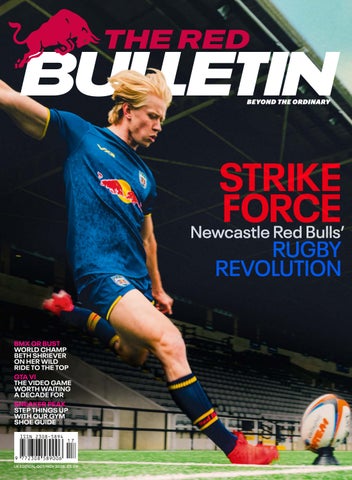
BEYOND THE ORDINARY
STRIKE FORCE Newcastle Red Bulls’ RUGBY REVOLUTION
BMX OR BUST WORLD CHAMP BETH SHRIEVER ON HER WILD RIDE TO THE TOP GTA VI THE VIDEO GAME WORTH WAITING A DECADE FOR SNEAKER PEAK STEP THINGS UP WITH OUR GYM SHOE GUIDE
UK EDITION, OCT/NOV 2026, £5.99
THE COOLER BRAND
HILARY TSUI - STYLIST
GRAVEL RUNNING FO R OF F T R AC K M I N DS
NOW OPEN 12 PETER’S ARCADE LIVERPOOL ONE
EDITOR’S LETTER & CONTRIBUTORS
Jessica Holland After chatting to champion beatboxer Grace Savage, the London-based writer is thinking of taking one of her classes. “I loved hearing her describe beatboxing as a way to unleash your power,” Holland says. “She’s turned a teenage obsession into a multifaceted career.”
Richard Johnson Shooting Olympic medalwinning BMX racer Beth Shriever for this issue was a dream commission for the bike-loving photographer. “It was a pleasure,” says Johnson. “The speed she sent it out the gates on her ‘warm-up’ lap blew us away!”
W
05
elcome to an issue packed with stories of people reinventing what’s come before. Our cover star Josh Hodge is a full-back for Newcastle Red Bulls, a rugby team who have had more than their fair share of change in the wrong direction. Now – thanks to vision, hard work and a few unusual bonding tasks – the freshly revamped side is entering an exciting new era. We also meet BMX champion Beth Shriever, who won a history-making fourth world title this summer. The tenacious Brit has become a master of adaptation to get to where she is. And, as the 27-year-old tells us, she’s not done yet. Then, ahead of the much-anticipated release of Grand Theft Auto IV, we look at the record-busting rise of the video game that’s become an indelible part of popular culture – and how this latest instalment is about to surpass the last. Enjoy the issue.
THEO MCINNES (COVER)
Ben Coles The writer of our feature on Newcastle Red Bulls witnessed back-to-back wins for the rising rugby side. “It was great to hear the renewed optimism of long-suffering fans,” Coles says, “and how the players have bonded in pre-season.” THE RED BULLETIN
CONTENTS
06
58
Rugby union
Newcastle Red Bulls
30
The story of a team reborn, set to put the north-east back on the rugby map Ultrarunning
Carlos 44 Garcia Prieto
He designs the toughest courses, then he runs them BMX racing
Beth Shriever 58 Success has been no easy ride for the Olympic champ Gaming
Grand Theft 68 Auto Vice City welcomes careless drivers: GTA VI is finally here
Throughout highs (world championship titles, Olympic gold) and lows (injuries, defeat at Paris 2024), Beth Shriever’s unflinching determination has kept her BMX racing career on course
Football/Gaming
Red Bull Wings Cup
Bullevard 08 15 17 18 21 22
Gallery Playlist Eccentric engineering Female-led removals Adapted football Travelling offline
Heroes
Grace Savage
24
Josh Homme
26
Beating the system King of Queens
Hari Budha Magar 28 Moving mountains THE RED BULLETIN
76
Think you’re the GOAT of EA SPORTS FC? This new tournament says prove it Venture 85 Travel 90 A shoe for every workout 99 Tried & Tested 103 Equipment 104 How To 107 Me & My Body 109 Mental Fuel 111 Comedy 112 What’s On 114 The Takeaway
RICHARD JOHNSON
Saddle soar
08
Hoachanas, Namibia
Chute out
What words pop into a skydiver’s head when they execute a perfect landing? “Boom”, perhaps, or “Nailed it”. Maybe even something like, “Congratulations on a safe touchdown, captain.” Marco Waltenspiel could tell you. In April this year, the 42-year-old Austrian was in attendance at the fifth Red Bull Global Aerial Performance Camp, a 10-day gathering where the world’s top aerial athletes hang out, chat, drink and eat together, and hurtle through the sky at frankly terrifying velocities. Anyway, we’re sure that Waltenspiel’s peers were pleased he could drop in. redbull.com
THE RED BULLETIN
JOERG MITTER/RED BULL CONTENT POOL
DAVYDD CHONG
GALLERY 09
THE RED BULLETIN
10
Eisenerz, Austria
Raising dust
Lazy Noon. Waterpipe. Bathtub. Not candle scents on a Hollywood star’s retail site but climbs in the Red Bull Erzbergrodeo. This June, at its 30th event, more than 1,100 riders competed in the hard enduro race. Mani Lettenbichler secured his fifth win in a row, but thankfully (or not, climate-wise) there was none of the heavy rain that made the 2013 starting line Decidedly Lakey (RRP $80). redbull.com
THE RED BULLETIN
11
SAM STRAUSS/RED BULL CONTENT POOL, VINCENT COTTE
DAVYDD CHONG
GALLERY
Mont Blanc, France
High spirits The Mont Blanc massif was once known as the Montagne Maudite (Cursed Mountain), beset by evil entities. But, this June, nothing spooked an eight-strong team led by Fred Fugen and Dani Román as they made a world-first wingsuit flight in formation above western Europe’s highest peak, covering 7.5km at an altitude of 3,800m. GOATs 1, ghosts 0. redbull.com THE RED BULLETIN
MIHAI STETCU/RED BULL CONTENT POOL
DAVYDD CHONG
12
THE RED BULLETIN
GALLERY
13
Odense, Denmark
Turning tale This July, in the birthplace of Hans Christian Andersen, HYROX athlete Ida Mathilde Steensgaard brought her own fantasy to life. The two-time obstacle course racing world champ turned a 30m Ferris wheel at Odense Harbour into a fitness challenge, completing six obstacles as it rotated. “I wonder how I get these crazy ideas,” she says. HCA would empathise. Instagram: @idamathildee
THE RED BULLETIN
innsbruck.info Foto: © Innsbruck Tourismus / Luca Jänichen
Innsbruck Region. My happy place.
BULLEVARD
15
Playlist
Man in motion Indie-rock phenom This Is Lorelei spends most of the year touring. Here, he picks four tracks that keep him going while on the road Ask Nick Amos how much music he’s put out in the past 15 years and he’ll say he’s not sure. The best estimate the Virginiaborn artist can give is 12 albums as Water From Your Eyes – his duo with ex-girlfriend Rachel Brown – and 70 solo releases as This Is Lorelei, most of them recorded at his parents’ home and then self-distributed via social media. For Amos, 35, music has always been less about a career than about having fun, but two years ago things got serious when the likes of Wilco’s Jeff Tweedy and Paramore’s Hayley Williams began covering his tunes. Amos signed a record deal, was declared an “indie-rock phenomenon” by The New York Times and now fills venues on both sides of the Atlantic. Recorded while touring, his new album, The Singer in My Band, captures the world as seen from buses, trains and planes. Here, Amos shares four songs on his dream soundtrack when travelling. Instagram: @hellothisisnate
GABE YOUNG
MARCEL ANDERS
ZZ Top
She Loves My Automobile (1979) “When I was growing up I lived in Vermont, and you had to drive to do literally anything. Now I’m in New York, I don’t have a car at all – I’m barely there. But if I still had one, or a rental, I’d play this song all the time. Deguello by [Texan rockers] ZZ Top is the best album ever.
Sleep
Dopesmoker (1999) “My ‘most-listened-to bus and train song’ is this single-track album by the American doom-metal band Sleep. Like, when I go into the city on the train, it’s almost always this, which is in the realm of 63 minutes. For me, long, cyclical, repetitive metal music is basically the same as ambient music.”
Aphex Twin
Windowlicker (1999) “In high school, this was my most listened-to car track. And if you have never tried it while driving, you should. It sounds great on a surround-sound stereo system. It’s definitely a song that you’ve got to keep an eye on the speedometer if you’re listening to it. But I’d also play it parked in a field, smoking weed.”
Gordon Lightfoot
Race Among the Ruins (1976) “Gordon Lightfoot’s production and the sound of his band was one of the main things I was thinking about when making this record. It used to be that I could do nothing but work on an album, but now I’m always on the road. It’s much harder. I looked to this for inspiration – it’s good driving music. Everyone in the van is up for it.” THE RED BULLETIN
ROUTINE OFF. RELAXATION ON.
ALPS AT THEIR VERY BEST GLACIER | MOUNTAIN | LAKE
www.zellamsee-kaprun.com
BULLEVARD
17
FIACRE MULLER, JAKE FURZE
MATT BLAKE
C
olin Furze’s latest invention appears to be much like a normal bike. But look closer and there are no suspension springs, no shock absorbers, just opposing magnets. This is the kind of mad-scientist overengineering that has made him one of the UK’s most popular YouTubers. The ex-plumber, who left school at 16, now has 13.3 million subscribers keen to see what he’s created next. “You don’t feel mechanical resistance like with a normal shock absorber,” Furze says of his ride. “Because the magnet bounces on a hidden cushion of nothing, it feels quieter, more like floating.” Sadly, like the hoverskateboard that came before, the bike won’t be going into mass production. The magnets involved – custom-made at around £2,000 a piece – carry half a ton of pulling force. “If you had one in your hand and got too close to a metal vice, it would crush your finger.” When the magnets arrived, one leapt from his hand and stuck fast to his workbench; freeing it required a crowbarand-plank seesaw contraption since every other tool in reach was also metal. “I couldn’t sell the bike,” says Furze, 46. “Someone would get injured, or stick it to a lamppost.” The project is his career in miniature: an ordinary idea, executed with a level of overengineering that creates something wackily different – and much cooler. His turn towards YouTube came a decade after leaving school, born more from grief than from ambition. Following the death of his father, Furze suddenly had access to his workshop shed in Stamford, Lincolnshire. “I was 26, single, had spare time and access to the shed, and YouTube was just beginning. Also, I’d finally quit BMXing and needed a big project to fill the creative void.” So, in July 2007, he and a friend built a wooden wall of death from packing pallets and rode around it on a moped. “The
Eccentric engineering
Making mad
Hoverboards, magnet bikes and millions of online followers: unconventional inventor Colin Furze is a creator in every sense video went viral within a week. My channel instantly jumped from 300 to 3,000 subscribers, which was a lot back then.” Soon, Sky TV came calling, and by 2010 he’d quit plumbing. Some of Furze’s projects since have brought him trouble with the police. A flamethrower mounted on a moped got him arrested for building “a prohibited military weapon”, he says. “The copper was laughing and said, ‘If you’re going to do this stuff, don’t put it all in the newspapers.’ I told them, ‘Going viral is my job!’” Later, a semi-automatic apple gun prompted an officer to ask if it had been “chronographed” (its muzzle velocity measured). It hadn’t. “He started laughing and said, ‘Yeah, that’s way over the legal limit. You’ve basically built another firearm.’” The upshot:
Mr Maker: Colin Furze; (top) his bikes with magnetic suspension and hydraulics, and the weaponised screwtank
Furze is now a licensed and registered firearms dealer, cleared to build things most Brits aren’t allowed to own. He’s currently finishing an underground garage – car lift included – beneath his house. It’s part of a tunnel network that will connect Furze’s workshop, home and a bunker he built 11 years ago. He has no plans to sell, whatever his work does to the property’s value. “I get emotionally attached to everything I build. The house will be my kids’ problem to deal with one day.” Looking back, Furze doubts his 16-year-old apprenticeplumber self would recognise him. “He’d think it was crazy. But it’s a gradual progression. Each project pushes your skills slightly further than the last.” YouTube: @colinfurze; Instagram: @realcolinfurze THE RED BULLETIN
Female-led removals
Moving with the times Meet the woman redressing her industry’s gender imbalance The flat was dark and damp, with a crack running down one wall. The young woman surveying the scene had just arrived in London with no family support, only a dream of becoming an actor – and she was beginning to wobble. “She said, ‘I don’t know if I’ve done the right thing,’” recalls Hannah Crawford, who had spent the day moving her in. Instead of unloading more boxes, Crawford gave her a hug and found the one box that mattered: the woman’s trinkets and keepsakes. “We put them out first, made the bed, then dealt with the rest. I couldn’t leave without helping her make it feel like home.” This might seem beyond the remit for a removals service, but that’s the point of Han With A Van. “What I get to do,” says Crawford, who also works as a THE RED BULLETIN
business coach, “is make people feel less alone in what can be a very lonely experience.” Crawford, 28, had noticed a dearth of female-led removals services in the UK. “Women in removals shouldn’t be a niche,” she says. “We’re 51 per cent of the population. People should have a reliable, female-led option in any industry.” The demand, she explains, comes down to peace of mind. “Some clients have had bad experiences with men, or with male movers. Others are visibly queer people who face snide comments or ‘othering’. Having someone you trust walk through the door is priceless.” Crawford understands the vulnerability. At the age of 20, she escaped “a really abusive home”, leaving Bathgate in Scotland with only what she could carry, and boarding a
Doing the heavy lifting: Hannah Crawford, founder of London-based, femaleled removals business Han With A Van
train to London. “I know what it feels like to have no one to help, leaving a difficult situation to do it all alone,” she says. However, the business happened almost by accident. It began with a post on the ‘Girls Who Rent’ Facebook group, recounting a favour Crawford had done for a mate. The post went viral, racking up half-a-million views in a month. Bookings started pouring in. Han With A Van isn’t only for women – Crawford will work with anyone as long as they follow her golden rule: “Don’t be a dick.” How do male and female clients differ? “Women who can’t afford my rates will say, ‘That’s outside my budget, but thank you.’ Whereas men are often like, ‘I can get a van for less,’ or ‘I don’t think you’ll actually be able to lift this.’” Her response? “Babe, you scrolled past 30 man-with-avan services and clicked on me because you assumed I’d be cheaper, and now you’re asking if I can lift the thing?” Crawford still gets told, “You’re a lot stronger than you look,” which she takes as a compliment. Training several times a week helps: “If you can deadlift 60 kilos, you have a much better chance of shifting a washing machine without hurting yourself.” Beneath the humour is a clear philosophy. “Businesses are run by people, so they’re an extension of people,” says Crawford. “The idea you have to be hard-nosed is bonkers.” Han With A Van is now building an infrastructure – vetted movers, admin support, eventually an app – to take that philosophy further. Can she see herself one day running a fleet of removals women from a desk? “No, my brain’s built for conversation, problem-solving, novelty, not routine admin.” Crawford adds, “Growing up, being kind, understanding and compassionate was sort of the ultimate rebellion. Then it sort of became my superpower.” Turns out it’s a pretty strong business model, too. hanwithavan.co.uk
MATT BLAKE
BULLEVARD
LAUREN JAMES
18
OfftrailUltra
BULLEVARD
21
GETTY IMAGES
MATT BLAKE
L
osing your sight as a teenager is hard enough; for Sam Gough, bullies made it harder. Her defining memory of school in Midlothian is groping about the gym hall floor for her broken glasses after being hit in the face by a dodgeball as others pointed and laughed. “I was patting around on my hands and knees, unable to find them,” she says. “Eventually, a kind girl found them and took me to the teacher.” It’s tempting to wonder what those kids would say to Gough today; at 23, she’s an elite rower, captain of the England women’s blind football team and an MBE. Remarkably, she bears no grudges: “I don’t condone the bullying, but I can acknowledge that people were young and lacked disability awareness.” Gough’s success stems from sheer grit. A traumatic birth left her with cerebral visual impairment – damaged pathways between her eyes and brain. “I was partially sighted growing up, but over the years I lost more vision. Now I only have light perception.” She also manages a hearing impairment and is a passionate ambassador for Deafblind UK. “I want to show that having multiple conditions doesn’t stop you thriving in sport.” Sport at school may have been an ordeal – not least her eventual removal from PE after teachers labelled her a “hazard” – but everything changed in 2021, when a British Blind Sport session led to her being scouted for England’s first women’s blind football squad. Blind football is a fast, physical five-a-side game in which outfielders wear blackout eyeshades and play with a ball containing ball bearings that rattle. To prevent collisions, players lunge into tackles shouting “Voy” (Spanish for “I go”). The Lionesses also echolocate by shouting “Red” to map teammates’ positions. Gough was eligible to play for England as no similar programme exists in Scotland. “But my ultimate goal is to
Adapted football
Playing it by ear As captain of the England women’s blind football team, 23-year-old Sam Gough is an expert in vocal echolocation. Now she’s helping sighted Premier League sides improve their game
Smart guide: Gough with Helga; (top) at the IBSA Women’s Blind Football World Grand Prix in May last year
establish the first-ever blind football sessions in Scotland,” she says. “It would be the highlight of my career.” Gough’s sporting passions don’t end with football: she swam for Scotland and was a Paralympic rower until her elite funding was removed because she refused to focus solely on the sport. She stood her ground and, without funding, won her third Henley Women’s Regatta. On the pitch, Gough has led England to victory in the TriNations Cup and silver medals at the European and World Championships. Off it, she navigates life with her guide dog, Helga, a black Labrador she calls her “pocket rocket”. As a blind football consultant, Gough runs sessions at Premier League academies – including those of Arsenal and Aston Villa –
blindfolding sighted players to teach spatial communication. “When you take away a player’s sight, communication becomes non-negotiable. Premier League coaches love it because the players take those heightened communication skills back into their sighted 11-a-side games.” In June this year, Gough was awarded an MBE in the King’s Birthday Honours for services to sport and the visually impaired community. “It was such a shock,” she says. “The response has been incredible.” Now, her sights are set on making history on the world stage. “We want to go to the Paralympics in LA 2028,” says Gough. “Blind men’s football is a Paralympic sport. We want to show that blind women belong on that stage, too.” deafblind.org.uk; Instagram: @samantha_gough6 THE RED BULLETIN
BULLEVARD
Travelling offline
New connections It’s been a decade since Luke Young locked away his smartphone. He wouldn’t change the analogue world it has opened up Imagine travelling the world without a smartphone: no maps app, no digital boarding passes, no translation tools. For Luke Young, this is not just some eccentric thought experiment: 10 years ago, the author locked away his phone – for good. Now he travels, navigating Europe and most recently Nepal’s remote Manaslu Circuit the oldfashioned way. The Adventures of a Digital Outsider, his second book, details the experience. “Not having a smartphone creates uncertainty, but that’s where the adventure really begins,” says the 28-year-old from Brighton. “You have to talk to people, trust strangers and experience a place, rather than just navigate it.” Even in the Himalayas, every village he passed had wifi. “People would finish a 20-kilometre trek at high altitude, exhausted, and immediately get on their THE RED BULLETIN
phone. Because I didn’t have that option, I had other ways to spend my time. It became deeply spiritual, grounding.” Young remembers the day he became a “digital outsider” – August 6, 2016 – better than any birthday: “I was 18, at a festival in Brighton, watching my friends rush ahead to a music tent. I suddenly realised, ‘How well do I really know these people?’ Even there, in person, I was just going through the motions the way I did online – not really connecting, not really enjoying myself. Something told me to stop running after them.” He went straight home and locked away his phone. “I kept it in a bag for years, hoping I’d use it again and feel better. That day never came.” The smartphone had become ubiquitous for Young and his peers. “For us Gen Z-ers, obsessed with identity and
No-data plan: Young’s account of his offline travel adventures; (top) the author treks Nepal’s Manaslu Circuit last November
belonging, it was the coolest thing. I became addicted to using it to find my crowd, to keep up appearances. What happened on social media the night before school could dramatically change how you felt walking in.” He was relying on it for validation, he says. “It was making me miserable.” The fallout from ditching his phone was brutal. He lost touch with everyone he knew. “When I vanished, people called, but I ignored them,” Young says. “That limbo period was extremely dark. I was a shadow of myself.” Ten years on, he still hasn’t picked up his old iPhone once. Life without a smartphone still throws up obstacles, though: recently, he fought a long battle to obtain a railcard in non-digital form. Eventually he had to persuade a psychiatrist to write him a note, and Young was given a Disabled Persons Railcard. “They realised it could become a discrimination case. It was bittersweet. It didn’t quite hit the mark, but it was a small victory.” Dating has proved harder still: “Nothing has lasted longer than a month or two. People find it interesting at first, but if you’re not constantly connected they lose interest.” Friendships take a hit, too: invitations vanish into group chats he isn’t part of. Travel tickets are now largely electronic-only, so he carries paper maps and handwritten schedules and will sometimes “borrow someone’s phone for 10 seconds” to show a QR code. But Young, who works in adult social care, insists the trade-off has been worthwhile. He’s more confident, runs marathons, reads “about 100 books a year”, and got his memoir onto the shelves of a bookshop that once told him it was impossible without an online profile. “Living this way has made me a better listener, more empathetic, less judgmental,” he says. “My fondest memories – friendships, love, overcoming hardship – couldn’t be captured in a photo or quantified in likes.” Young’s book The Adventures of a Digital Outsider is available now, published by Candy Jar Books
MATT BLAKE
22
WHEN ALL IS SAID AND DONE, WAS IT SAID OR WAS IT DONE?
VISIT BFGOODRICHTIRES.COM
24
HEROES
Grace Savage
The Devon-born beatboxer shredded stereotypes to become a four-time UK champion. Now she’s passing on her skills Words Jessica Holland Photography Anna Michell
Close your eyes when Grace Savage is on the mic and you’d think you were hearing an array of machines: heavy basslines playing beneath intricate drum patterns, R&B hooks fed through a sampler, and vinyl being scratched on a turntable. In fact, thanks to decades of mastery, the Bromley-based beatboxer is making all these layered sounds using her mouth, tongue and breath, and the way she weaves different song snippets together, building and releasing tension, is an artistic feat in itself. It’s a skill that’s seen Savage win the UK Beatbox Championships four times, twice in the women’s category and twice as part of a two-woman team competing against men. Between these victories, she developed and toured a solo show, Blind, which details her adolescence through a mixture of theatre and beatboxing. At one point, as replicated in a later TEDx talk, she mashes up misogynistic song fragments while dehumanising comments on her online videos are projected onto a screen. It established Savage as an important creative voice, resistant to pigeonholing. Over the years, she’s released an electropop EP, performed at Glastonbury and the National Theatre, and taught beatboxing to thousands, from schoolkids to the aged. Recently, she launched Savage Sounds School, a series of online classes aimed at “the shy, the weird and the curious”, as well as the Savage Sounds Beatbox app, a personalised, AI-driven daily practice tracker with tutorial content based on the user’s level and needs. Savage’s expert guidance has attracted the interest of a large number of women, she reports. “We tend to feel that we can’t take up as much space as men,” she says. “With beatboxing, you can let your weird out.”
the red bulletin: What were you like as a kid? grace savage: A little bit podgy, a little bit ginger and very freckly, with a proper West Country accent. I was obsessed with the Spice Girls, and I’d dress up as a different one each day of the week. Then I found beatboxing when I was about 14. What made you fall in love with it? I started going to drum’n’bass raves; there was a huge scene in the West Country. There were a few slightly older guys beatboxing, then my school friend Belle [Ehresmann, aka Bellatrix] got into it and I secretly started beatboxing, too. When I was about 18, I got up the courage to make my first YouTube video, then I began doing open-mic nights in Leeds, where I was studying theatre at uni. I was invited to do a five-minute set at the Southbank Centre [in London] and finally I found my niche, so I could get by without a normal job. In your TEDx talk, you say people always ask what it’s like being a female beatboxer. What’s your answer? I grew up with two older brothers, playing in the rugby team. When I started to beatbox, I never believed I didn’t belong. Maybe it’s something about being gay – I’m not performing for male approval. I don’t give a shit what the guys think. Is there pressure to seem tough? Typically, ‘harder, faster, stronger, better’ is how boys would rate beatboxing, but when me and Belle teamed up, we were like, “Let’s harmonise and put vulnerability in.” I’m here for the hardcore stuff, but my favourite kind of beatboxers are the more artistic, emotional ones who aren’t afraid to sing. As an artist, you must have range. How did it feel to win the UK Beatbox Championships together? It’s one of those life moments I’ll look back on as an old lady and think, “Yeah,
THE RED BULLETIN
we fucking did that.” To have won two UK championships against the boys… We made history together. Beatboxing can be quite a solitary art form. You can become an online streaming beatboxer – that’s fine – but nothing compares to being on stage with one of your best friends, who you’ve known since you were 12. When we join forces, it’s like we’ve got superpowers. Your TEDx talk presents negative comments you’ve received online. How did it feel to read those? The overwhelming majority of people were just really happy for us, but I think one of the comments was, “Two posh girls fucking up the game.” I’m from a state school, and I’m the first person in my family to go to uni. It’s a harsh thing to read. But I don’t take the rage bait personally any more. Have you ever frozen on stage? Performing Blind at Latitude was a rockstar moment. But there was another day when I forgot my lines, then fell over on stage. Once I came off, I burst into tears. I hadn’t given myself enough time to learn some new lines. The next day, I must have gone through the script 20 times. I was so nervous before I went on that I puked in the toilet. But it went amazingly after that. What do people get out of your courses, other than technical tricks? It’s about realising the power and potential of your voice. Beatboxing is weird: you have to get over the cringe factor of making a ridiculous noise, sounding terrible before you sound good. You have to let go of your inhibitions and just go for it. When you do, magical things happen. Download the Savage Sounds Beatbox app at studio.com/grace
Word of mouth
Savage’s advice for beatboxing newbies Slow down “Get the sounds crisp and clean first, then increase the tempo.” Get out of your head “Remember that it’s music – feel the groove. That’s more important than sounding perfect.” Find your own voice “Everyone’s learning from the same online tutorials. Spend some time finding your own unique sounds, rather than just copying others.”
“With beatboxing, you can let your weird out”
THE RED BULLETIN
26
HEROES
Josh Homme
The Queens of the Stone Age frontman and rock icon on being an ally, taking risks and channelling Shakespeare Words Marcel Anders Photography Andreas Neumann
At 6ft 4½in (1.94m) tall, Josh Homme has the stature of a bouncer but the charm, wisdom and personality of a seasoned artist. A founding member of stoner rock pioneers Kyuss in the late ’80s, the vocalist/ guitarist has gone on to establish himself as rock royalty with his band Queens of the Stone Age, as well as producing acts including Iggy Pop and Arctic Monkeys. QOTSA’s new, ninth album, Perfecth, sees Homme coming to terms with four years of personal challenges: his divorce from fellow musician Brody Dalle (The Distillers), the deaths of his friends Mark Lanegan and Anthony Bourdain, and his battle with cancer (which he won). Now 53, the Californian schooled on punk rock remains an anarchic risk-taker – but these days that means appearing on Gogglebox and collaborating with Shania Twain… the red bulletin: The new album is titled Perfecth. What does that mean? josh homme: Life is just not perfect and there’s nothing you can do about it; nor is it meant to be. Bill Shakespeare made up words – why can’t I? Making [QOTSA’s 2023 album] In Times New Roman, that was the first time I ever said, “I’m going to make up as many words as I can and that’ll be part of this obscenery.” What made you cover Iggy Pop’s song Sunday on the new album? When I was working with Iggy [on his 2016 album Post Pop Depression], I came up with those two licks one night, and I liked it so much I wanted to keep it for myself. The next morning, I said, “Listen, I wanted to keep this, but I just want you to know you have everything I have to give, and I love you. If I ever need to, I’ll just cover it.” The only difficult part was stopping myself from copying Iggy’s voice. It took me a second to figure that out.
THE RED BULLETIN
Was this album therapeutic to make? Certainly. Queens has been morphing for years into a snapshot of wherever I am. And who needs to listen to your ninth record, you know? The only answer I could ever come up with is because it’s an honest take on a life. It has to be real – that’s the only thing that matters. It’s a record exclusively about love. That’s not exactly groundbreaking for other bands, but it certainly is for me. I’ve experienced a lot of deaths, injury and heartache. Why not try to make something that describes this part of the human condition? You recently collaborated with Shania Twain. How did that come about? We talked on the phone when her producer sent me the track they wanted me to sing – Faded Blue Jeans – for her new album. I was flattered to get asked. I got to admit, I like that song – it’s pretty raw and rootsy by her standards. So why not? Maybe her audience digs it, too, and shows up at my shows. I’ve always loved working with other artists. Is that why you joined Jake Shears on Celebrity Gogglebox recently? I like Scissor Sisters a lot, and Jake’s a great guy to hang out with. I’ve known him for probably 20 years, and we get back together whenever we can, like in London a couple of weeks ago. Plus, I’m from Palm Springs, where the gay community has turned the city into one of the greatest things – there’s film festivals, parties… And there’s no one that I want to party with more. You’re a vocal supporter of the LGBTQ+ community… The thing is, I’m a tall guy. So many people are like, “You’re like the bully that beat me up in school.” And I’m always like, “No, I’m like the guy that beat up the bully that beat you up in school.” I know what ruins a good time or a good idea or
a beautiful moment: it’s the inability to shut off your own stupidity. Someone’s got to be like, “Hey, you, shut the fuck up.” I’ve been trying to gently pick my audience since I named myself Queens of the Stone Age and not Kings. [Chuckles.] You know, I don’t need all of you. I’ll create an environment where you can be yourselves, as long as you don’t hurt anyone. There’s no racists, no homophobes, no misogynists in my crew. We’ll turn the lights out and you can be yourself and dance until you’re sweaty. You’ve been in the public eye a long time. Does criticism ever get to you? Oh, fuck them! It’s my job to offend. If 15 or 20 per cent of the people don’t hate you, you suck. The adoration and hatred of strangers is the flipside of a coin. But when you don’t do it for the money, that currency is worthless, you know? Did that attitude come from your early love of punk rock? What I got from punk rock was that you’re supposed to do it yourself, find your own voice, infiltrate, search and destroy. You’re supposed to take risks. I don’t think you got to reinvent the wheel; you’re just kind of saying, “Look at my wheel. It rolls. It’s pretty badass.” It’s so much fun to try to be totally different. I’m always waiting for someone to come to my front door and say, “We’ve all agreed, we think your music sucks now,” and then, “Come on, boys, get in there,” and they just start taking everything. And I say, “Well, that was a pretty long time, you know? I did alright.” qotsa.com
Perfecth partners: Homme’s top collabs Iggy Pop – Post Pop Depression (2016) He co-wrote and produced, also contributing backing vocals, guitar and bass Lady Gaga – Joanne (2016) Co-writing, production, guitar and drums The Desert Sessions (1997-present) His Mojave-based collective series featuring artists such as PJ Harvey and Mark Lanegan Them Crooked Vultures (2009-2010) Homme’s supergroup with Dave Grohl and John Paul Jones
“There’s no racists, no homophobes and no misogynists in my crew”
THE RED BULLETIN
28
HEROES
Hari Budha Magar
The mountaineer and double amputee has achieved more than many people thought possible – including himself Words Richard Edwards Photography Adam Gerrard
Hari Budha Magar is one of the world’s most prolific mountaineers, having scaled the highest peaks of each of the world’s seven continents. The feat, which the 47-year-old Gurkha completed in January this year, is a remarkable achievement in itself. But Magar climbed the likes of Mount Everest, Aconcagua and Kilimanjaro as a double amputee, having lost both legs below the knee in an IED blast in 2010 while serving in the British Army in Afghanistan. The injury could well have been the end of his story. Instead, after successfully battling depression, alcoholism and self-doubt, he began a remarkable new chapter. On his journey to the top of the world, the Canterbury-based adventurer had to teach himself to climb in a way that few have ever contemplated, let alone achieved. He also had to fight Nepal’s legal system to even be allowed to attempt his dream of climbing Everest. Now, in his book Conquering Dreams, Magar tells his story to inspire not only the next generation of disabled climbers but all of us. the red bulletin: While serving in the army, did you ever let yourself think about the possible dangers? hari budha magar: You just fight. I always thought maybe I’d get killed or injured, but I never thought I’d lose both my legs. When I was blown up and still conscious, I could see that one leg had gone. Then, when I woke up in hospital the next day, the other leg had gone, too. How did you come to terms with what had happened? It was super, super difficult. I struggled for years to accept what had happened
THE RED BULLETIN
to me. I grew up in a place where disabled people are sometimes seen as being punished for something [they did] in a past life. I’ve since realised that mindset exists in a lot of places, not just in Nepal. I didn’t know if my wife would stick with me for the rest of my life. I had no idea what I was going to do. I turned to alcohol. Eventually I realised that if I kept going that way, I was going to die. I have a son, and I wanted to live for my family. After that, everything changed. I started doing sport, having adventures. My confidence came back. Did you do a lot of climbing or mountaineering growing up? No, I’d just look at the mountains and imagine it. We were brought up on stories of Edmund Hillary and Tenzing Norgay. There are songs about them, poems, films. The highest mountain in my district was right in front of my house. I’d see it every day, snow-covered for months, and I used to wonder, “How much of that could I climb?” How did you train for your climbs, given that you had to relearn everything with prosthetics? It was completely different. I had assistive devices and prosthetic legs, some of which weren’t originally designed for that kind of climbing. I basically DIY’d it! At first, I had no idea what my body was capable of. I remember crossing a hill of around 2,000 metres and feeling strange: headaches, the water tasting off. It was the altitude. I went to Kathmandu with a friend and we tested what I could handle. I kept pushing it and never stopped. Why wasn’t it legally possible for you to climb Mount Everest? There was outright ban on double amputees and visually impaired climbers climbing mountains above the height of 6,500 metres. We took that battle to
the Nepalese Supreme Court and managed to overturn that decision [in March 2018]. We argued that it infringed a basic human right. It was a long fight, a real battle, but to overturn that ban gave so many people fresh hope. What did it feel like to reach the top of Mount Everest? When I finally reached the summit after so many delays, so many problems, I just sat for a moment, then I gave my team a hug and cried like a baby. I was relieved. I was happy, but I also knew we were only halfway – anything could happen on the way back down. How physically demanding is your upper-body training? Massively. If something goes wrong, I need to be able to pull or push myself up using my hands. My legs help me stand and move, but they can’t really propel me. When I’m at home, I’m up at half five in the morning and in the gym, doing cardio and strength work. What is your legacy? It’s bigger than climbing. After that ban was overturned, I did interviews, and I realised how much of a difference better prosthetic legs and proper funding made. So many people supported me, and now I want to keep doing what I can for them. I’ve been to Afghanistan and risked my life for my country. Now, I risk my life for charity, hoping it inspires people – not just those with disabilities but everyone. Whatever your background, whatever’s happened to you, you can still build a meaningful life and achieve something. Instagram: @hari_budha_magar
Seven years, seven summits: when Magar hit his peaks Mont Blanc, Europe 15:00, August 13, 2019 Kilimanjaro, Africa 10:20, January 8, 2020 Mount Everest, Asia 15:10, May 19, 2023 Denali, North America 19:30, June 28, 2024 Aconcagua, South America 15:00, February 22, 2025 Puncak Jaya, Oceania 07:00, October 18, 2025 Mount Vinson, Antarctica 22:00, January 6, 2026
“When I finally got to the summit of Everest, I cried like a baby”
THE RED BULLETIN
30
FRESH KICKS International stars, homegrown heroes, and lessons in Geordie: inside NEWCASTLE RED BULLS’ bold new era Words Ben Coles Photography Theo McInnes THE RED BULLETIN
RUGBY UNION Explosive reboot: Newcastle Red Bulls’ Josh Hodge, photographed for The Red Bulletin at Kingston Park Stadium this August
THE RED BULLETIN
32
TEAM TRUTHS Full-back Josh Hodge (pictured) was a multisport athlete in his youth: he was on the books of EFL Championship football team Preston North End, trained with Team GB in shooting, and ranked in UK decathlon’s top five.
THE RED BULLETIN
RUGBY UNION
33
“Newcastle Red Bulls are now one of the most exciting projects in world rugby”
I
t’s a bright afternoon in early September, and the crowd at Newcastle’s Kingston Park Stadium are on their feet. They’ve just witnessed a moment as welcome as the Tyneside sunshine. Newcastle Red Bulls have completed a sweeping attack that started deep in their own half, a flowing move finished with a try in the corner by the team’s star full-back Josh Hodge. This is the kind of attacking rugby that fans have been longing for. It may only be a pre-season match against a weakened Glasgow Warriors side, but the ambition on display has every one of them excited. It’s been many years since the team formerly known as the Newcastle Falcons had anything much to celebrate. Hooker George McGuigan, now 33, joined Newcastle’s academy when he was just 14 years old, and a moment from his first season with the Falcons in 2011 – a home game at Kingston Park against Bath – has stayed with him: “I remember looking around the stands and thinking to myself, ‘Oh God, there’s no one here.’” Newcastle has been a bastion of rugby union in the north-east of England throughout the professional era, with no other top-tier teams nearby. The Falcons were league champions in their first-ever season in the sport’s top-flight, the Premiership, way back in 1997/98 when a team packed with stars including Jonny Wilkinson, Rob Andrew, Inga Tuigamala, Pat Lam, Doddie Weir
and Tony Underwood held off north London-based Saracens by a single point. But that success proved to be an elusive high point. Aside from two domestic cup triumphs, Newcastle slumped first to mid-table mediocrity and then into scraps to avoid relegation from the Premiership before eventually succumbing for the first time in 2012 and then again in 2019. Small budgets and a lack of success forced the young talent coming through to head elsewhere to further their careers. McGuigan is currently in his third stint with Newcastle after moves away to Leicester Tigers and Gloucester in a bid to enhance his England national team credentials. “It was very difficult,” McGuigan admits. “I never really wanted to leave, either time. Newcastle is where I’ve lived since the age of 15. It’s kind of home.” Hodge found himself in a similar position in 2020, moving to the opposite end of the country to join Exeter Chiefs in Devon. The 26-year-old future England prospect was also part of Newcastle’s junior academy before being promoted to the first team. Then, while he made progress playing for Exeter, a significant announcement in August last year changed things. Red Bull were taking over the ailing Newcastle Falcons. And they wanted to bring both McGuigan and Hodge back to the club where it had all started for them. “It’s the boyhood club that I played for,” says Hodge, “so it was like a dream come true.” THE RED BULLETIN
34
RUGBY UNION
“I want us to play fast, attacking rugby that gets our supporters out of their seats”
THE RED BULLETIN
35
C
hristian Wade, now 35, has been a rapid winger throughout his rugby career. One of the deadliest try-scorers in England, he started out with Wasps before going on to play internationally. The player from High Wycombe also spent four years out of rugby trying to make it in the NFL. Wade ended up on the practice squad of the Buffalo Bills, famously scoring a touchdown in a pre-season game with his first-ever carry as a running back – a remarkable feat considering he’d never played American football while growing up. Even with all of Wade’s experience, nothing matched Newcastle Red Bulls’ pre-season camp this summer in Austria, where the squad visited Red Bull headquarters and were put through their paces. “We were out there working hard, man. We were getting after it.” Off the training field, they linked up with athletes from very different disciplines. Danny MacAskill, the Scottish mountain bike and street trials rider, pulled off a series of “absurd” jumps, according to Hodge. Fitness athlete Harry Lightfoot and elite HYROX star Jake Dearden led a special training session for the players that involved them hitting certain distances on the ski erg, combined with press-ups, sit-ups and squats.
The squad’s new home and away kits for the upcoming 2026/27 season were also delivered – by helicopter. “I don’t think anybody in rugby would have experienced that before,” laughs Wade. The Newcastle Red Bulls squad has undergone a radical overhaul this summer: 24 players coming in – more than any other team in the rebranded PREM – and 25 going out. Among the catalogue of new signings were additions to the coaching team, with defence coach Calum MacRae joining head coach Dan McFarland. “Every team will have to integrate new players ahead of a new season, but this summer has really been a unique scenario for us,” McFarland says. “It’s a lot of change in a short period of time, so as well as the obvious nuts and bolts of getting fit and putting in place a game plan, a big body of work for us has been around cohesion.” This has put the onus on senior players in the squad – Wade and McGuigan included – to help the many new faces settle in. “We’ve been working hard to connect as a group, because obviously we don’t know each other well,” says Wade. He explains that, in addition to the Austria trip, the squad were broken up “into four mini teams” comprising a mix of senior players and academy prospects from across each position group for “a bit of healthy competition”. Each had an attachment to a certain aspect of the North East’s heritage: the ship-building industry, coal mining, farming and fishing. They competed in games and challenges that included creating a video tour of Newcastle, in which players chatted to locals and learned about the city. One of the most significant new signings finding their feet is Hoskins Sotutu. Landing the former New Zealand international, another player who has been tipped to play for England in the future, is widely regarded as a huge step forward by Newcastle and a sign of their intent. “It’s a massive coup, isn’t it?” says McGuigan. “Obviously, everyone was chasing him. Saracens and Gloucester were after him, so to get him here is obviously exciting.” Before his arrival this summer, Sotutu, a backrow forward signed from the Blues in Auckland, had been warned about the Newcastle climate, so he prepped accordingly, wearing plenty of warm THE RED BULLETIN
36
RUGBY UNION
Rising stars: Hodge cut his teeth in rugby as part of Newcastle’s junior academy; (opposite) Christian Wade joined last year from rugby league side Wigan Warriors
“We could be at the start of becoming one of the best clubs in the world”
THE RED BULLETIN
37
THE RED BULLETIN
38
layers. He arrived during a heatwave, sweating as he stepped off the plane. “Everyone has reassured me that it will definitely turn cold,” he laughs. Another part of the new players’ introduction to life in the north-east has included lessons in the local dialect. “They put together some paragraphs [for us to translate] into regular English, which was a pretty funny exercise,” says Sotutu. “A few boys from around the area helped out.” Being one of several new faces arriving this summer, among them a number of New Zealanders – prop Pouri Rakete-Stones from Wellington’s Hurricanes and back-row forward Max Hicks from French team Perpignon have also joined – has made settling in easier for Sotutu. “If I was coming into a group that was pretty well gelled, there would a bit more pressure to try to maybe fit into a mould,” he says. “Everyone is trying to get to know the area and get to know the boys as well, so we’re all in the same boat.” Newcastle wasn’t the obvious destination for Sotutu when he made the decision to move to the PREM. The England-based side of his family are living in Ipswich, a five-hour drive away. What enticed him was the journey that Newcastle are seeking to embark on. He went through a similar experience with the Blues, a team stuck in their own long drought without success. The experiences Sotutu and his teammates went through forged the Blues into a stronger group, before they eventually punched through the psychological barrier that had previously held them back and won the Super Rugby title in 2024. He can envision a similar trajectory at Newcastle. “That was one of the attractive things, coming into a team that has no sort of expectation, with everything to gain,” Sotutu says. “It’s something to look forward to. All the boys want to make Newcastle Red Bulls a team to be feared.” The challenge of transforming Newcastle also enticed Wade, who reached the very top of the game playing for England and the British and Irish Lions despite no real background in the sport while growing up. He has played a crucial part in preserving Newcastle’s spirits through tough times and brings that same positive energy to the revamped side. “I’ve always had this underdog mentality, this mindset of wanting to push to be the best I could be,” Wade says. “One of my main messages is just bringing that belief and people kind of feeding off that energy, regardless of whether we’ve been bottom of the league. “As long as we pull together as a team, there’s nothing that we can’t achieve. We need to change that narrative, and that’s something everybody here is on board with. Those days of being at the bottom of the table, even in the bottom half of the league, are behind us.” But this doesn’t come without hard work. The team have been working on the technical details – “Probably what we were missing last year,” notes McGuigan – while during pre-season there’s been a clear emphasis on “repeatability off the ground”, meaning players’ ability to get back on their feet THE RED BULLETIN
“As long as we pull together as a team, there’s nothing that we can’t achieve”
RUGBY UNION
39
TEAM TRUTHS Winger Christian Wade is seven tries short of eclipsing Chris Ashton’s PREM record of 101. “I think if we get [the record] by December, I’d be happy with that.” He could, of course, notch up six in one game to tie Ashton’s score – something he once did playing for Wasps against Worcester back in 2016. THE RED BULLETIN
40
RUGBY UNION
TEAM TRUTHS When asked which of Newcastle Red Bulls’ new signings has surprised him, hooker George McGuigan (pictured) points to Rusi Tuima, who has played for England A and at age-group level. Signed from Exeter Chiefs, the 6ft 5in (1.96m) forward adds some welcome size to the team. “He’s even more skilful than I was expecting,” McGuigan says. THE RED BULLETIN
41
THE RED BULLETIN
42
TEAM TRUTHS Back-row forward Hoskins Sotutu (pictured) made 14 appearances for the All Blacks between 2020 and 2022, which he feels “very grateful” for. He could now play for England, qualifying through his mother – having not played Test rugby in four years, he’d be able to switch teams. “It would be crazy if that did come through,” he says. THE RED BULLETIN
RUGBY UNION
43
“All the boys want to make Newcastle Red Bulls a team to be feared” after rucks and tackles as quickly as possible to support the next phase of play. The reasoning behind this, as Wade explains, is that Newcastle want to become one of the most entertaining sides in the PREM this season. “If you’re watching us this year, be prepared for more exciting tries, exciting gameplay,” he says. “We’re definitely bringing an ambitious style this year. That high energy and high effort are the main things we’ve been working on, which is definitely the reason why [training has] been so tough. We’ve been pushing the boat out there for sure, man. It’s exciting.” During the pre-season, players have been putting in eight-hour days – 7:30am to 3:30pm – including two gym sessions and a two-hour rugby session followed by analysis, in service of this new vision. “Different teams will have their own different ways of playing rugby, which is absolutely fine, but the Newcastle Red Bulls’ way is not going to be a slow, grinding game,” says McFarland. Having most recently worked with the Kobe Steelers in Japan, the head coach is enjoying something of a homecoming himself. “I was a student at Newcastle University, and I used to come and watch the great Newcastle Falcons side that won the Premiership title in the 1990s,” McFarland says, “so I have a massive respect and appreciation for what has gone before. In terms of how we will play and what our aspirations are, I’m not going to put a ceiling on our ambition by saying [where] I want us to finish in the league table. “I want us to go after every single game and to empower our guys to play fast, attacking rugby that gets our supporters out of their seats. We’ll be attacking from everywhere if it’s on, and that’s the message we’ve been giving to the players since day one of pre-season.” The new approach is part of the reason many of these players are here. Hodge is a particular fan of rugby’s increase in speed in recent years – “More reactive, more fast-paced, more instinctive plays, and being able to adapt very quickly,” as he puts it.
Having followed Newcastle from an early age, particularly the team’s star player Jonny Wilkinson, Hodge is also keen to represent what has come before. “Being the kicker, the guy who takes a lot of the pressure off his team at times, Jonny’s the person that I looked up to,” he says. “And that’s what I want to bring to the table here at Newcastle Red Bulls.”
I
t’s the halfway point in a double header of preseason matches for Newcastle at Kingston Park, playing against Rotherham Titans in their first game – an entertaining 43-36 win featuring plenty of academy and university players – before taking on Glasgow Warriors (a game Newcastle Red Bulls will go on to win 47-31). The crowd of around 3,000 is impressive for a pre-season fixture. Hodge has a small queue of young supporters lining up for selfies as he comes over to the touchline, a full-circle moment for him having watched Newcastle here as a boy. Irene, Steve and Dave, all in Red Bulls kit, have been watching Newcastle for close to 20 years. “Through the highs and the lows,” says Irene, drawing out both words. The squad’s hard work is already evident. “We were very impressed last week with the running, the tackling, everything,” says Irene. “Best we’ve seen in a long time.” “All the changes are great,” adds Steve. “We’re just looking forward to the season starting.” Dave is realistic about the season ahead: “It’s not going to be straightforward, straight to the top of the league. It’s going to be a few seasons.” But the optimism is palpable. After two tough decades following Newcastle, these supporters are owed some good times. As are McGuigan and Hodge, now back at the team that feels like home. All are aware that in this new era of Newcastle Red Bulls a page is being turned. “This is now one of the most exciting projects in world rugby,” says Hodge. “We could be at the start of becoming one of the best clubs in the world.” newcastleredbulls.com THE RED BULLETIN
44
Ultra Man Ultrarunners win the medals, but CARLOS GARCIA PRIETO is usually the first person to complete the course. Welcome to one of the most unusual jobs in sport Words Paddy Maddison Photography Thiago Diz THE RED BULLETIN
ULTRARUNNING Dune bug “I was designing a 250-kilometre race in Namibia that mostly takes place around the coast and into the dunes,” says Carlos Garcia Prieto. “You can see the city of Swakopmund on the horizon. There’s a lot of sand, so I had them running up and down the dunes a lot.”
THE RED BULLETIN
46
ULTRARUNNING
Power of three
“As far as I know, I’m the world’s only professional ultrarace designer”
C
arlos Garcia Prieto recalls finding himself encircled by five snarling dogs, deep in the mountains of Georgia. “They were barking, showing their teeth. Huge animals, maybe 60 or 70 kilos each. I didn’t move. About five metres before they reached me, they calmed down. A few minutes later I was stroking them.” For the 64-year-old Spaniard, it’s just another day at the office. “I’ve had guns pointed at me three times,” he continues. “Like, ‘Who the fuck are you? Get off my land!’ Twice in Australia and once in Sri Lanka. A few people have come at me with machetes, too. Oh, and one time I fell down, hit my head on a rock and was unconscious for several minutes.” You’re probably wondering what sort of job would put a person in the path of such danger. Special operations soldier? Bounty hunter? DEA officer charged with busting drug cartels? Not quite. Garcia Prieto is in the business of ultramarathons. THE RED BULLETIN
“These are the Three Peaks of Lavaredo in Italy’s Dolomites. For 11 years, I was a course director of the Lavaredo Ultra Trail, which is probably the country’s most important race. They have, like, 4,000 runners. It’s one of the nicest locations in Italy for me: lots of climbers, hikers and mountaineers. This is the south part of the mountains. There’s a super-nice valley on the other side, too.”
These epics are technically defined as any foot race exceeding the standard marathon distance of 42.2km, but more often than not they’re significantly longer – think 100, 250, even 500km. As for the locations, forget the smooth, spectator-lined streets of London or New York City; replace them with endless scorching desert, alpine peaks, or the frozen wilderness of Antarctica. The more remote, the better. But Garcia Prieto isn’t usually a participant. His work begins months, sometimes years, before the pistol sounds. “As far as I know, I’m the world’s only professional ultra-race designer,” he smiles. “There’s a huge number of races around the globe – maybe 30,000 or something – but they’re usually put together by clubs, town halls or sport associations. The people organising them are lawyers, mechanics, truck drivers, whatever. This is my only work. Twenty-four hours a day, this is my life.” Garcia Prieto’s CV reads like an encyclopaedia of the world’s most iconic ultra events. A trained architect,
47
“Seek out different paths”
Course creator “I think some runners are losing their respect for the distance. A marathon, for example, is a huge challenge, but organisers will often offer it as the ‘short’ option. What the fuck?! What do you mean, ‘the short one’? The 100km del Sahara takes place in Tunisia and is broken up into five stages. It’s a real test, but it’s still accessible. This year, I think, it will be the 24th edition.” THE RED BULLETIN
48
he took a punt working a race when construction jobs dried up during the 2008 financial crisis, and he hasn’t looked back since. Some might describe him as old-school in his methods. His formal training still shows up in his work. Garcia Prieto takes the same pragmatism, rigorous organisation and eye for detail that served him on construction sites and applies them to race design. For instance, where some course directors rely on computers and GPS mapping to illustrate their routes, he prefers to use a pencil and paper. He grins as he thinks back to his introduction to the sport. “A friend asked me, ‘Why don’t we go and run in the mountains? There’s this race we could do.’ I said, ‘What do you mean? Can you run in the mountains?’ “I had never run uphill or downhill before. I got tired, I got dirty, I had blood on my knees, blood on my hands. It was fun. I knew then that it was the sport for me. That was 1998, and I’ve been involved in trail running ever since.” These extreme races push the human body into unfamiliar territory. Sometimes runners are moving for days at a time with little to no rest, and it’s often the mind that cracks first. Hallucinations are common, due to sleep deprivation, and training is as much about preparing mentally as it is about conditioning the body. “I ran races where you spend two nights running,” Garcia Prieto says. “At the end, I suddenly realised I was falling asleep while running. The guy in front of me kept moving in and out of the beam of my head torch. His poles were making this rhythm: ‘click, click, click.’ I got hypnotised. My mind was somewhere else completely. “You have to break it up. If you start a 100-mile [161km] race thinking, ‘I have to run 100 miles,’ you probably won’t finish. [Instead] you decide that you’re going to run to that tree. Then to that rock one kilometre further on.” Garcia Prieto hasn’t raced in a long time: he “lost the eye of the tiger”, as he puts it. But he still trains
“I have to run every single section of the course for myself ” every day. And he has to. Because while he may not be competing, the Spaniard insists on running every inch of every course he designs. “Not even one metre of the race do I do in Google Earth,” he states emphatically. “I have to see everything for myself. I don’t trust anybody else. To balance the race, I need to know every single section. Someone can tell me it’s rocky or whatever, but that’s not enough. I need to know what it feels like.” This is non-negotiable for Garcia Prieto. He needs to understand the threats fully. Crevasses, wildfires, loose rocks, floods, high winds, wild cattle – these are things he has to be on the ground to see for himself. “I need to know if there are snakes. I need to know if there are wild dogs. I need to know everything.” His brush with the latter in Georgia, on the border of Eastern Europe and West Asia, is a prime example of why this approach is vital. “That experience changed the race,” he explains. “It turns out that these dogs are common in the area, to protect sheep from wolf attacks. We were able to organise dogpatrol vehicles during the event because I knew exactly where those dogs would be.” Safety, organisation and pragmatism only get you so far. For Garcia Prieto, what separates a good race from a life-altering experience is the soul of the route: what is its reason for existing? Every climb, descent and obstacle has to earn its place, creating a journey that reveals the spirit of a mountain range, a desert or a frozen continent as much as it tests those crossing it. The images on these pages represent some highlights from his ongoing quest to answer that question and, in doing so, create the best races on Earth.
Drawing from experience “I guess this is where my architectural background comes in. Some other course directors map out courses with the computer, and they show a GPS track or something. I don’t. I do it by hand with a pencil.” THE RED BULLETIN
ULTRARUNNING
49
Frozen footsteps “When you’re racing in Antarctica, there are a lot of rules, all governed by the Antarctic Treaty. One of these rules is that you can’t organise a point-topoint race: if something happened to a runner halfway, there’d be no way to rescue them. So every race has to be run as a loop. For this one, I ran a 400-metre loop for six hours. It sounds boring, but there was this glacier. It was spectacular, like Perito Moreno [in Patagonia] or something. I never got tired of looking at it. Every lap, I was like, ‘This is amazing!’”
“This glacier was spectacular. I never got tired of looking at it. Every lap, I was like, ‘This is amazing!’” THE RED BULLETIN
50
THE RED BULLETIN
ULTRARUNNING
51
Fissure king “If I see a strange place or an unusual feature of the landscape when I’m planning a course, I always make it so the runners have to go there. This is a 40-centimetre crack through the side of a mountain near the Swakop River [in Namibia]. You can barely get through with your shoulders, so the runners had to take off their backpacks to squeeze through. It’s only 150 metres or so, but these are the parts of a race that people remember.”
Wow factor (left, top) “This is the Roving Race. It’s an annual event, but each one is different, so every year I fly to a new location and design a completely new course. This one was in Jordan. To me, it’s the perfect race. Doing the same thing every year can get boring after a while, but with the Roving Race, every year is like, ‘Wow!’”
Keeping pace (left, bottom) “Thiago, my son-in-law, is usually the guy behind the camera, but here somebody has taken a shot of him taking a picture. They’re going down the Valle de la Luna [in Chile’s Atacama Desert]. The runners are really going for it, because if you don’t move fast, you don’t move!”
“The runners had to take off their backpacks to squeeze through this crack in the mountain” THE RED BULLETIN
52
ULTRARUNNING
“We have to ensure we don’t disturb penguins or any other wildlife”
THE RED BULLETIN
53
In the loop “There are marathons at both the South Pole and the North Pole that, exactly like us, use the loop principle. They’re run on roughly twokilometre circuits, with runners completing lap after lap for hours. We create the longest loop possible, but we also have to ensure we don’t disturb penguins, seals or any other wildlife.”
THE RED BULLETIN
54
Sand and vision “These are the sand dunes of Namibia. I wanted to have the campsite nestled right between them. When I design a race, I’m always trying to answer the same question: why should there be a race here? I need to find highlights: the culture, the landscapes, the landmarks. What makes a place special? I want runners to be awestruck. I want them going home like, ‘Babe, I need to take you to this place so you can see it with your own eyes!’”
THE RED BULLETIN
ULTRARUNNING
55
“The Four Deserts has been called one of the hardest races in the world”
Tough terrain “The Atacama is the world’s driest desert. I believe this shot shows the first campsite of a course I worked on for a race series called The Four Deserts. Time magazine has called it one of the hardest races in the world. The first campsite sits at 3,500metres elevation.” THE RED BULLETIN
56
ULTRARUNNING
“This 250km stage race finished at Petra, one of the Seven Wonders”
Working wonders “I first designed [ultra-race organisers] RacingThePlanet’s Jordan course in 2012. It was a 250-kilometre stage race that finished at Petra, one of the [new] Seven Wonders. In 2023, we redid the race for RacingThePlanet’s 20th anniversary. This image shows the desert in the south of Jordan.”
Marching in steppe “This was at the Gobi March, a 250-kilometre race in Mongolia that runs across seven days. I’ve got my Garmin GPS device and my book with my drawings to explain the course to a volunteer.” THE RED BULLETIN
RIGHT ON TRACK 58
Essex-born BMX racer BETHANY SHRIEVER made history this summer when she took her fourth world title. The 27-year-old makes winning look easy, but her journey to the top has been as bumpy as any circuit in her sport Words Farran Golding Photography Richard Johnson THE RED BULLETIN
BMX RACING Fast lane: Beth Shriever, photographed for The Red Bulletin at the National Cycling Centre in Manchester this August
THE RED BULLETIN
60
A
sk champion BMX racer Bethany Shriever why she loves her sport, and she’s clear: “It’s the unpredictability of it. There’s seven other girls on the [start] gate with you, and literally anything can happen. It’s just so exciting.” This unpredictability helps explain why, despite having an Olympic gold medal and several world titles to her name, the main emotion Shriever felt after winning the first round of the UCI BMX Racing World Championships this July was surprise. The Essex-born 27-year-old was competing in Brisbane, Australia, in a line-up that included reigning Olympic champion Saya Sakakibara, who had home advantage. But, after the racers launched themselves out of the gate and onto the testing 400m track, Shriever found enough speed to pull ahead of the pack by the THE RED BULLETIN
Learning curve: “You can’t help but want to push yourself when you’re training with Beth,” says her teammate Kye Whyte, “because you see greatness”
BMX RACING
61
“My Tokyo Olympics win was a big ‘I told you so’. It sent a message”
THE RED BULLETIN
62
time she reached the first corner, building a clear lead that proved impossible to beat. She crossed the finish line almost half a second clear of Sakakibara, who had to settle for second place. “It shocked me how quick I was,” Shriever admits. “Saya’s been flying this year. But when I won, I was like, ‘I can do it. It’s on for the final tomorrow.’” The next day, she was surprised again. Strong winds played havoc with the schedule as conditions were deemed too dangerous to ride in. “There were rumours flying all day,” Shriever says. “It got to early evening, then someone came up to me and said, ‘Right, you need to get changed. We’re going to the podium now.’” Organisers had made the unprecedented – and controversial – decision to cancel the final and invoke an as-yet-untested governing body rule that states existing fastest lap times should now be used to decide the championship. “I’ve experienced nothing like that before,” Shriever says. The British rider’s lap time from the previous day – 36.565 seconds – gave her the win and made her the first four-time world champion in elite women’s BMX racing, surpassing greats of the sport such as Mariana Pajón, Alise Willoughby and Shanaze Reade. Although the title officially makes her one of the best athletes ever to compete in BMX, a month later Shriever is laid back in every sense as she discusses her historic triumph with The Red Bulletin. She reclines in a seat bearing her name beside the BMX track at the National Cycling Centre – the official home of British Cycling – in Manchester, her base for almost eight years. The 5ft 3in (1.52m) racer is built for power, but the long graze that runs
“I’ve always understood that to be the best, you’ve got to give it 100 per cent” THE RED BULLETIN
down her forearm from her elbow indicates even she isn’t immune to the rigours of the sport. When asked about the latest in a long line of BMX-related injuries, she replies in an Essex accent unchanged by her many years up north: “It’s freaking tender, mate.” Shriever is philosophical about the unusual way she secured her latest title. “The whole event was crazy,” she says. “It’s a shame we didn’t get to race that second day, but I was still happy. At the end of the day, I had the quickest lap. Everyone had the same opportunity.” On the track, Shriever counters the volatility of BMX racing with a killer combination of explosive starts, raw speed and technical excellence. But it’s off the track, at times like these, that she’s really had to master navigating the unpredictable. Her down-to-earth attitude belies a steely determination to make it to the pinnacle of the sport she fell in love with as a child. And this intent has been tested in ways she couldn’t have predicted when she first placed feet on pedals.
Finding the passion Shriever’s first memory of riding a bike is successfully ditching the stabilisers from her ‘little pink bike’ and her dad, Paul, giving her a starting push in their garden: “It was the best thing in the world.” She soon started riding with her brothers at the Braintree BMX Club, where Paul would help by pushing them up jumps. Her first race came when she was eight, now riding her dad’s freestyle BMX: “It was this heavy thing, and I had a borrowed helmet, borrowed gloves… but I just fell in love with it.” One of the few girls at the club, Shriever had an ability that was evident from the start. “We all bounced off each other – it low-key helped me progress,” she says. “The boys would come up to me and go, ‘Are you gonna jump that jump?’” Which she invariably would, nailing the landing. “Then they’d go, ‘Oh, OK…’” she continues, smiling at the memory of their sheepish responses. “Even now, I love being one of the only girls to jump a certain jump, and people saying, ‘Oh, you can ride like a man.’ It’s like, ‘Yeah, fucking hell, girls can do it, too!’” South London-born BMXer Kye Whyte met Shriever when they were both competing in races as children, and he remembers her standing out. “You could see she was on a different level,” Whyte says. “Once Beth kicks into gear, she’s unstoppable.” By the age
of 12, Shriever’s skill had won her a place in British Cycling’s junior talent team. At weekends, she’d travel from her home in Essex to the National Cycling Centre, where she’d race on a world-class course with other young riders – many of whom would become lifelong friends – receive professional coaching and meet the country’s top athletes. Around this time, in the run-up to BMX racing’s Olympic debut at Beijing 2008, Shanaze Reade – ten years Shriever’s senior – was becoming a household name as Team GB’s sole woman rider. It made a huge impression on Shriever: “That’s when my Olympic dream started.”
BMX RACING
63
Giant steps: built in 1994 for Manchester’s 2000 Olympics bid, the National Cycling Centre houses a velodrome, a sports court and – since August 2011 – a 10,200sqm indoor BMX arena
Keeping the dream alive “When you start beating the people you think you’re not as good as,” Shriever says, “that’s when the real confidence comes in.” In 2017, after taking silver the previous year, she picked up her first world championship title as a junior. The win broadcast the arrival of a major new talent on the international scene, and Shriever started to believe it herself. Now 18, she was preparing to move up to elite level and was on track to begin training for the 2020 Tokyo Olympics, working with Marcus Bloomfield, British Cycling’s BMX development coach at the
time. “When an athlete goes up to elite, they suddenly get hit with a new reality,” Bloomfield says. “But Beth understood there [would be] girls who were bigger, stronger, faster than she was. She just cracked on and raced her bike.” Then the brakes were squeezed. UK Sport decided to cut funding to British Cycling programmes – those that support athletes with their training and travel to compete in Olympic qualifiers – and women’s BMX racing was defunded entirely. This despite Shriever’s world title and fellow junior Brit rider Blaine Ridge-Davis’ European gold that same summer. “They weren’t looking at us, the younger generation,”
Shriever says. “Blaine quit BMX and went to track cycling.” Shriever stood firm. But, having been forced to leave the British BMX set-up, she now needed a job to support herself. She trained as a teaching assistant, working at a local nursery. “I’d never done anything like that before,” she says. “I fell in love with it. But it was hard. Teaching kids is knackering, I’m not gonna lie, especially toddlers. I’d work a full day, then go straight to the track or the gym feeling pretty tired.” The money Shriver earned wasn’t nearly enough to cover the costs of attending the races necessary for Olympic qualification. So, with the THE RED BULLETIN
64
BMX RACING
encouragement of a parent at the nursery, she decided to set up a crowdfunding page. “We were trying to keep the dream alive, keep the passion going – we never stopped believing in it,” Shriever says. “It was uncomfortable because you’re putting your situation out there and asking for help. But the love I got was so reassuring.” She raised £20,000, which covered the costs of attending two key events in Australia. And now Shriever’s story was out there, it resonated. She made headlines around the world, from the BBC in the UK to CBS in the US. Shanaze Reade reached out to her, and conversations started with British Cycling. Around a year prior to the Olympics – still slated for summer 2020 at this point – Shriever travelled to the National Cycling Centre to discuss her case. “I spoke to the performance director, Sparky [Stephen Park] which was a daunting meeting,” she recalls. “I was 19 at the time. He literally looked me in the eyes and was like, ‘Can you get a medal?’ I said, ‘I’ll do my best!’” With Park’s intervention, and the ban on funding female athletes lifted, she got the chance she thought she might never have – to make it to the COVID-delayed Games in Tokyo in 2021. Shriever, the only woman competing in
BMX racing for Team GB, made good on her promise. At 22, she became the Olympic champion, beating the world’s best, including two-time defending Olympic gold medallist and Shriever’s personal hero Mariana Pajón. After an intense 45 seconds of racing, a physically spent Shriever was hoisted up by friend and teammate Kye Whyte, who’d won silver for Team GB in men’s BMX racing; the scene was splashed across UK national papers the next day. “It was literally like I was in a dream,” she says. “It was insane. There wasn’t belief in the women’s side. Thank God British Cycling helped me get there in the end, but that win was a big ‘I told you so’. It sent a message.”
Taking control Olympic glory set Shriever alight. Just three weeks after Tokyo, she won her first senior world championships, and by summer 2022 she was the first BMX racer to hold simultaneous Olympic, world and European titles. But, following a second world title win in 2023, the next summer’s Paris Olympics loomed large. As an underdog, Shriever had gone into the Tokyo Games feeling relaxed and positive. But, she explains, “because I was defending my
title [in Paris], I felt pressure like I’ve never felt pressure before. Even from the [beginning of the] year of the Olympics, I was waking up nervous, going to bed nervous”. Then, just 10 weeks before Paris, Shriever broke her collarbone in a crash at the world championships. “I didn’t know if I’d be able to come back from that,” she says. “I had to trust the people around me – the physios, the doctors – to get me back into shape.” Although she did manage to recover enough to compete – she excelled in the semi-finals – Shriever’s Tokyo fortunes were reversed in the Paris final, where she was blocked by the pack and finished last. “I don’t think [the result] really hit me until a few days later,” she says. “I wasn’t at my best in Paris, but I’d told myself that as long as I do my best, it’s all I can do – and I did that.” The real test now was how she reacted in the face of such a high-profile defeat. “I believe everything happens for a reason,” she says. “It lit a fire under me. I was like, ‘I never want to feel like that again.’ I had to have another surgery [on my collarbone], because it didn’t heal properly. Then I made it my goal to be in the shape of my life.” Shriever’s training regime had always been rigorous, but now it’s at a different
Built for power: Shriever’s riding is a killer combination of explosive starts, raw speed and technical excellence THE RED BULLETIN
65
“Paris 2024 lit a fire under me. I was like, ‘I never want to feel like that again’”
THE RED BULLETIN
66
“I came into 2025 absolutely swinging” Rocking the bells: Shriever’s rigorous training schedule sees her in the gym twice a day, three times a week, and riding at weekends ahead of important competitions
THE RED BULLETIN
BMX RACING
67
Aiming high: “I love being one of the only girls to jump a certain jump,” Shriever says. “It’s like, ‘Yeah, girls can do it, too’”
Pure power
How Shriever builds the strength of a champion During winter, Shriever prepares for the next season. She focuses on gaining strength, with sessions at the gym and track three days a week in three-week blocks, followed by a de-loading week.
Quick off the mark
The race start is crucial. Riders don’t know when the gate will drop, and they go from static to full force in a split second. “That’s why we do core and upper-body work,” says Shriever. “The stronger you are, the more consistent you’ll be.” This includes dumbbell bench presses and rows, seated cable rows, lat pull-downs and weighted pull-ups.
Pressing ahead
To hone reaction times and pedal power, Shriever does box jumps, single-leg work and trap bar jumps. “I’ll back-squat one day with a deadlift and leg press. Then, another day, I’ll do trap bar deadlifts with single-leg press, Bulgarian [split squats] and box squats. I ride well off a big training block – it raises my confidence.”
level. She’s at the gym twice a day, three times a week, and riding at weekends ahead of important competitions. “You can’t help but want to push yourself when you’re training with Beth, because you see greatness,” Whyte says of the many sessions they’ve shared. “She’s incredible. The drive that she has: she eats well, sleeps well, trains well, she’s on time. Watching her, you know you need put that same effort in.” For Shriever, anything less was never an option. “I’ve always understood that if you want to be the best in the world, you’ve got to give it 100 per cent,” she says. “Everything – your whole body, your whole self. And I gave it everything. I was motivated, I had new goals, and full faith in the process. I came into 2025 absolutely swinging.” In a perfect response to her disappointment at the Paris Olympics the previous summer, that year Shriever won her second European and third world championships. But now her goals were about more than titles. “I’d asked myself, ‘Why do I do this sport?’” she says. “It’s not just for results. I do it because I love travelling the world, meeting new people, achieving personal goals as well. I do this because I love riding my bike.”
Enjoying the journey These days, when she has the chance, she keeps her motivation fresh by doing laps of the track at Manchester’s Platt Fields Park. “Everyone’s having a laugh, playing around, setting lines. I just step back and think, ‘This is what it’s all about.’” As Shriever’s Brisbane performance proved, going back to the basics of her purpose is working; she’s more determined than ever. “If LA 2028 is my last Olympics, I want to look back and say I made the absolute most out of every race. I don’t want to miss any opportunity.” This summer, Shriever wasn’t the only homegrown talent on the podium at the world championships. Freia Challis won gold in the women’s junior division – the first Brit to do so since Shriever herself. That Challis also came up at Braintree BMX Club and idolises Shriever makes the senior racer’s impact on British BMX clear. “Success breeds success,” says Bloomfield. “You need that one person to break the mould and get those big wins, then everyone realises what’s possible.” The ascent of a new generation may now help Shriever in return. “It keeps me on my toes,” she says, smiling at the unpredictability she loves so much. “It’s going to help push me further.” THE RED BULLETIN
68
Thirteen years in the waiting, Grand Theft Auto VI is set to be the biggest entertainment launch in history. Here’s how fans of the gaming series have kept the flame alive, and why all the hype is justified Words Ade Adeniji and Tom Guise
THE RED BULLETIN
ROCKSTAR GAMES
PURE VICE
GAMING Double trouble: the game’s two playable characters, Lucia Caminos and Jason Duval; (opposite, top) community policing, GTA VI style; (bottom) tools of the trade
THE RED BULLETIN
70
Rhymes like Dimez: the fully realised characters of the GTA series are a huge part of its appeal. Roxy (shown right) is one half of female rap duo Real Dimez with her former high-school friend Bae-Luxe
THE RED BULLETIN
ROCKSTAR GAMES
Enjoy your stay: Port Gellhorn, a oncepopular vacation spot littered with shabby motels, shut-down attractions and empty strip malls, is a hive of criminal activity
GAMING
Shading it: customisation has always been key in GTA. With the addon Vintage Vice City Pack, you can give Jason a suave, retro look that’ll turn the heads of all the NPCs
B
71
ack in August 2021, during a live broadcast of German gameshow Schlag den Star (Beat the Star) host Elton was interviewing a contestant when a stranger ran on stage. “Taser is my name,” he declared. “I’d like to know where the hell is GTA 6?” “I have no idea,” replied Elton. “I haven’t even finished GTA 5 yet.” Full marks on the comeback, Elton. But Taser’s question was a pertinent one for millions worldwide. At that point, it had been eight years since GTA 5 – a game that had earned more than $800m on its first day of release, and more than $1bn in its first three days, making it the fastest-selling entertainment product ever. Such was the anticipation that by 2023 it had spawned a meme: “We got [X] before GTA 6”, wherein, according to knowyourmeme.com, any significant world event, technological advancement or unlikely occurrence would happen, and likely already has, before the next Grand Theft Auto game is released. That year, former US Air Force officer David Grusch claimed to have viewed government documents on a UFO retrieval programme. “We got aliens before GTA 6,” posted TikTokker Jaden Dunn to more than 250,000 views. Nat Geo announced a newly named large body of water in Antarctica: “We got a whole new ocean before GTA 6.” We got Mike Tyson returning to the ring, a sequel to Top Gun, Earth temporarily acquiring a new moon, and Taylor Swift re-recording her back catalogue, all before GTA 6. Then, on May 6, 2025, GTA developer Rockstar Games released the second trailer. In its first 24 hours, it had more than 475m views across all platforms, becoming the biggest video launch of all time. Plays of its accompanying tune, Hot Together by the Pointer Sisters, instantly soared 182,000 per cent on Spotify. The trailer ended with a date: May 26, 2026. Taser finally had his answer. That is, until November, when a further delay of six months was announced: November 19, 2026, was marked in millions of fans’ calendars. Pre-orders began in June –with video-game market analytics firm Newzoo assessing sales of $260m in the first week – and the already gargantuan hype train for Grand Theft Auto VI (we’ll correctly use Roman numerals from here) went supernova. But then, this game series has always been a cultural phenomenon. We also got that before GTA VI. THE RED BULLETIN
GAMING
Top pick: drive the Vapid Ganado
The perfect crime
Keith Hamilton wasn’t meant to change video games for ever. In 1993, the British programmer was writing software for credit card terminals. “I wanted to do something more interesting,” he says. A classified ad led him to a small video-game developer, DMA Design in Dundee, Scotland. Hamilton’s first gig was All New World of Lemmings, the third instalment in a popular series about guiding little creatures to safety through deadly obstacle courses. His next game was a scrappy, top-down, city-based joyriding sim codenamed Race’n’Chase. By the time of its release in autumn 1997, it had a new title: Grand Theft Auto. As lead programmer, Hamilton and a small crew had hauled an early build to the very first Electronic Entertainment Expo (E3) in LA in 1995, where 50,000 gamers were buzzing around the newly released Sony PlayStation. “The game was so buggy,” he recalls. “It just completely failed. It crashed, it didn’t work.” He developed a California tan, but the trip did little for the team’s fledgling project. Things changed when a cleaned-up demo landed on the cover disc of the Official PlayStation Magazine UK, giving its readers 10 minutes of gameplay. This was pre-email, pre-social media, but DMA’s offices filled with letters from fans worldwide. “[We wanted] the fun of the ’80s-type games we used to play, but with
The GTA IV trailer had over 475m views in 24 hours THE RED BULLETIN
adult themes and humour,” Hamilton says. “And that immersion – you could go into a city and do things [off-limits] in real life.” Those adult themes – carjacking, hit-and-runs, gang crime – were inspired by US movies, but months before the game’s release in 1997, concerned UK politicians debated its glorified violence. This helped GTA’s cult status. It was also an engineered moral panic. “The company hired a PR person to campaign against the game, leading to questions in Parliament and much better sales,” says Obbe Vermeij, then technical director at DMA, rebranded in 1999 as Rockstar North. The game’s German publisher, BMG Interactive, had brought in Max Clifford, a PR mastermind who had never met a scandal he didn’t like. Clifford planted headlines about GTA corrupting kids and made sure tabloids screamed about “murder simulators”. The resultant outrage was free advertising. By Grand Theft Auto III in 2001, there was no need for manufactured hype. “Usually, sales taper off after a few months,” Vermeij says. “That didn’t happen – word of mouth took over.” Rockstar knew exactly what its fans wanted. Ahead of GTA III’s release, it launched a website featuring blueprints for the game’s map, Liberty City – a facsimile of New York. These teased three mysterious islands with points of interest such as Bush Stadium on Staunton Island, where local soccer team the Liberty City Cocks played. The game’s physical manual included a classifieds section tied to the in-game commercials: “15 per cent off armourpiercing bullets” at gun store AmmuNation; “Bitch’n’Dog Food, with scrapings off the abattoir floor”; the Maibatsu Monstrosity SUV – “Why drive a small car? Are you a small person?”
It felt less like a company force-feeding its audience and more like mutual fandom. “We understood the market, because the market was us – young guys in their twenties who wanted to play video games,” says Hamilton, who left Rockstar in 2000. “We were writing a game for ourselves that we’d like to play.” Come GTA: San Andreas in 2004, it was no longer just a game but a shared cultural experience. Fans queued at stores at midnight to buy it. Vermeij tweeted a memory on October 26, 2024 – 20 years to the day of San Andreas’ launch: “Game releases were different back then... Digital distribution didn’t exist... The internet was crap, and apart from a couple of trailers, gamers didn’t know too much about the game… I went to the biggest store near the Rockstar North offices, which was HMV on Princess Street, Edinburgh. Even though it was a drizzly night, the line meandered all through the store and spilled out onto the street. It was mind-blowing to see all those people so excited, going home to play through the night.”
The torchbearers
The last time a new GTA was released, Daft Punk had just released the album Random Access Memories, Breaking Bad was in its final season, and the Xbox 360 was still a thing. You might enjoy most of those nostalgically today, but GTA V remains very much in the present. In June 2025, it was the second most downloaded PS5 game in the US, and third in Europe. In the same month, according to tracking site IconEra, more than 18 million users were active across the single-player game and its multiplayer mode, GTA Online. Part of the reason for that is Rockstar’s continued support with downloadable content (DLC): new vehicles, weapons, character skins, curated radio stations,
ROCKSTAR GAMES
72
Sun trap: Lucia in chill mode
73
(Top) Danger sign: GTA VI is set in the fictional state of Leonida, based on Florida, with most of the action centred on modern-day Vice City (a fictional version of Miami)
(Below) Eat my wake: the GTA VI Ultimate Edition features this pimped-up Shitzu Squalo with pinkand-blue livery and a fully stocked weapons crate
THE RED BULLETIN
74
appropriate place. Violent, funny, rude, satirical – that’s what Shakespeare was. It wasn’t an elevated art form; it was cheap mass entertainment, like the video games of their time. pinny grylls: People weren’t as reverent then. They’d throw apples if you were rubbish. We wanted that.
“Though this be madness, yet there is method in’t.” A scene from Grand Theft Hamlet, a film about a play performed inside a game
THE WORLD’S A STAGE
How an idea to perform Shakespeare in GTA Online became the video-game documentary of our times It was a film the audience at 2024’s South by Southwest festival knew little about beyond its premise: “Two outof-work actors attempt a full production of Hamlet inside the ruthless world of Grand Theft Auto.” When the end credits rolled, it was clear: Grand Theft Hamlet is special. “That was our world premiere,” says British actor Sam Crane. “To see this cinema roar with laughter throughout, then get up and applaud, it was like, ‘People are with us!’” “And we won the Jury Prize for best feature documentary,” adds filmmaker Pinny Grylls. The idea was born out of the pandemic. Unable to work, Crane and fellow actor Mark THE RED BULLETIN
Oosterveen turned to GTA Online as an outlet. “I saw the potential in what they were doing,” says Grylls, Crane’s wife of 19 years. They codirected and star in the film. Grand Theft Hamlet is machinima – filmmaking within a virtual world. It’s also a heartfelt commentary on communities, both those inside GTA and the ones locked in their homes. the red bulletin: How did the idea originate? sam crane: My route in was people role-playing in video games on YouTube. Messing around with Mark in GTA Online, I discovered a way to record footage. We found [the Sisyphus openair amphitheatre in Los Santos], did the first scene of Hamlet and uploaded it. It got the attention of the gaming press. I thought, “OK, there’s a story here.” Were you aware of machinima at the time? sc: We became aware. Someone said, “You should look at Total Refusal, this Austrian art collective making stuff in Red Dead
How long did it take to film? sc: Five months [to rehearse Hamlet] and over a year before, when we were messing around. pg: We had 500 hours of footage, some unwatchable. When I started editing I realised it was a bromance, like Withnail and I with Sam and his friend. Then there was me and how our relationship was affected. We had a lot of arguments.
[Redemption].” I got in touch and they gave us a crash course. I discovered Eva and Franco Mattes who made Freedom [2010] in Counter-Strike. In it, they’re going, “Don’t shoot us, we’re trying to do an art project,” and everyone blows them up. That made me realise you’ve got to embrace the chaos of these online worlds. It’s thrilling in a way most theatre isn’t.
Did you fake any of it? pg: Sam was trying to get recognition from the National Theatre, calling and emailing them, but how are you going to put that in the film? I was like, “Let’s find a telephone in the game.” Can you really make a call in the game? No. sc: The Royal Shakespeare Company did watch the livestream. But they didn’t make it into the game.
Why Shakespeare? sc: People think, “GTA and Shakespeare – they’re polar opposites.” But it’s the most
Tell us about the genuine moments… pg: Doing the auditions, it was moving that people
Bard game: Sam Crane and Pinny Grylls
GAMING
75
turned up at all. There was no “You can’t audition because you’re not an actor”. Then ParTeb [a player in a green alien suit] turns up and says, “I don’t have a relationship with Shakespeare.” He gave a piece of poetry from the Quran. That’s when I knew we had a film, that it’s about humans and it’s vulnerable. Did you perform Hamlet in one take? sc: Yeah. With time zones, it was tricky to get everyone together. That ramped up the adrenaline. It was now or never. pg: And it was the Fourth of July, which was annoying for the Americans. How big was your audience? sc: There was a limit to how many could be in the game at one time. We had 10 actors, so I think there was an audience of 10 as well. pg: Some strange characters turned up. It was a promenade performance, so they followed us around. And we had a livestream. All theatre should have live comments: “This is shit, I’m bored out of my tits.” sc: One of my favourite moments is when Hamlet’s about to die. It’s intense and serious, then you see ParTeb in the background [air-humping].
ROCKSTAR GAMES
Have you kept in touch with the cast? sc: We’ve maintained contact; some we’ve met in real life. People think that if you don’t have a relationship in the real world it doesn’t count, but there’s a validity to our relationship, like we have with ParTeb, which is purely in the game world. He has seen the film; he was so kind about it. We think he lives in Finland. Has it changed your lives? pg: Massively. It’s amazing when you get Anthony Lane in The New Yorker writing a piece about you, or a five-star review from Peter Bradshaw in The Guardian. It has opened doors. This is the best time of our lives. grandthefthamlet.com
Muscle car: the Schyster Deviant
businesses, heists and missions. A 2021 DLC introduced Dr Dre searching for his stolen unreleased tracks (when you found the music, it really was never-beforereleased). It also featured 77 fresh radio tunes and guest appearances by Snoop Dogg, Anderson .Paak and DJ Pooh. Not bad for the DLC of an eight-year-old game. But it’s the players who are doing the most to keep GTA Online alive – modders patching the game to bring an altogether different experience. Chief among them is the GTA RP (role-playing) community. Running on dedicated PC servers, these mods allow players to live in improvised realities – as cops and robbers, in flight simulators, courtroom dramas, or with regular jobs such as shop clerk or garbage collector. There are zombie survival servers, pseudo-fantasy ones, shared spaces for the queer, neurodivergent or people of colour. Many discover these not through playing them but by watching the most popular GTA RP Twitch streams. “Most people don’t care to [repeat] the same missions in the ‘vanilla’ game,” says English Ben. “But lots absolutely would if it had a new story, new missions.” Ben is a speedrunner who streams his play of increasingly difficult versions of 2000s-era GTAs. In one GTA: Vice City mod, he turns a nine-minute assassination mission into a maddening hour-long endurance test. “I was drawn to the games as a kid, even though I was absolutely too young. I’d accidentally speedrun them by just playing them over and over [to improve].” In the 2020s, two things happened to grow the GTA RP community further. The first was COVID, which forced people in lockdown to find digital spaces to hang out. The second was a 2022 leak of a GTA VI test build, which also included source
code and assets for GTA V. The modding community suddenly had the keys to the family jewels. When it seemed Rockstar might shut things down, it did something surprising: it bought two of the biggest roleplay platforms – FiveM and RedM. Then, in September 2026, Rockstar announced that GTA V’s largest roleplay server, nopixelV, would be accessible through the developer’s own games launcher. It was an official endorsement. “For years, we’ve seen the possibilities and passion that the creator community brings to the worlds of Grand Theft Auto V,” Rockstar announced. “We’re proud to support nopixel.” Although there was no mention of GTA VI, it’s a strong indicator that when its own online mode debuts, roleplay will be a part of it, letting players build, share and monetise their experiences right out of the gate. Three months before GTA VI’s launch date of November 19, anticipation had reached fever pitch ahead of a much-hyped gameplay reveal on Netflix. But on August 18, nine days before the show dropped, game footage suddenly started appearing online… daily. Locations, vehicles, NPCs in action, the game’s entire map, even story scenes were revealed. Within 48 hours, the share price of Take-Two Interactive, Rockstar’s parent company, had shed US$2.83bn in market value. Fans questioned whether the leaks were authentic; some even theorised it was a marketing ploy by Rockstar, who’d remained oddly silent. Then the leaker posted a clip of the word ‘leek’ being sprayed on a wall with bullets – it seemed a playable build of the game was in the wild. They also revealed a supposed motive: punishment for GTA VI’s digitalonly release. Each clip had a watermark touting the leaker’s own meme coin. A mysterious hacker holding the biggest game in history to ransom while peddling a crypto scam – it was a plotline straight out of GTA itself. But when Rockstar revealed its developers were “devastated”, and sent subpoenas to social media sites in an effort to identify the hacker, there was no more doubt about the authenticity of the leaks. After 13 years of waiting, were we going to have GTA VI spoiled before we got GTA VI? For fans who had already lived through the 2022 hack, the answer was easy: no. “Calm down, everybody. The leaks are a nothing burger,” Obbe Vermeij posted on X. “All that has happened is some footage has escaped. It looks like GTA VI will be phenomenal and sell for the next 15 years or so.” Take it from a man who’s seen it all before. rockstargames.com THE RED BULLETIN
76
Fever pitch: EA SPORTS FC 27, with the new in-game tournament the Red Bull Wings Cup, offers a massive upgrade to the bigmatch experience THE RED BULLETIN
FOOTBALL/GAMING
NET GAINS With the arrival of EA SPORTS FC 27 comes the Red Bull Wings Cup, a new in-game tournament that offers players the chance to translate skills from the digital pitch into realworld competition. Here, pros, experts and insiders share their tips to help even the most casual player raise their game
EAFC
Words Tom Ward
THE RED BULLETIN
U 78
nless you’ve spent this year meditating in a remote mountain hut, you’ll already know EA SPORTS FC 27 has arrived. The latest iteration of the game formerly known as FIFA is so wide-reaching it can count Max Verstappen, Snoop Dogg and Tom Holland as players – not to mention the 21,000-plus professional footballers included in the game, and the esports pros who excel on its digital pitch. But it’s the tens of millions of non-famous gamers worldwide who have made the title such a phenomenal hit. And, with the return of Ultimate Team, Rush and Career modes, the launch of The Grounds, and fresh cards for favourite footballers, EA SPORTS FC 27 offers a more expansive, individual and realistic playing experience than ever. The launch of the Red Bull Wings Cup, a new in-game tournament, gives players the chance to take their digital skills into real-world competition, with a national final this November to decide which UK gamer will compete at a starstudded world final at Inter Miami’s Nu Stadium in Florida next year. But what does it take to beat the best? Here, EA SPORTS FC players and insiders tell us what the game means to them, and provide tips for anyone looking to hold their own in the big leagues this autumn.
THE RED BULLETIN
FOOTBALL/GAMING
79
FC
27
Tekkz
THE ESPORTS PRO
EAFC
Hooked on the game since primary school, 25-year-old Tekkz is the man to beat at EA SPORTS FC. Even real-world England footballers have tried and failed
Devon-born Tekkz is one of the top EA SPORTS FC players in the game’s history and has now been winning matches for more than 20 years – huge considering he’s still only 25. “The first match I won, I was four years old,” explains Tekkz, real name Donovan Hunt. “My uncle invited me to play Xbox. I’d never played before, but I beat him. He wasn’t happy.” Tekkz’ first Xbox came that Christmas. He was hooked. During primary school in Dawlish, Devon, he balanced IRL football and FIFA. In secondary school, it was all
about playing online. “I wanted to be a professional footballer, but I knew that happens to 0.1 per cent of people. When I learned about competitive FIFA, at 15, I knew it was what I wanted to do.” In 2019, Tekkz broke out in a major way, becoming world champion in the FIFA eClub World Cup. He then won the 2020 eChampions League Invitational, and last year he finished in the top eight at the FC Pro 25 World Championship. Today, Tekkz is signed to RBLZ Gaming, Red Bull Leipzig’s esports team, competing in
“I won my first match aged four. I beat my uncle – he wasn’t happy”
tournaments with hundreds of thousands of spectators, as well as regularly streaming matches, tips and analysis as @DhTekKz on YouTube. But Tekkz is also still a huge fan of real-world football; he’s played EA SPORTS FC with many England footballers and is an insatiable student of the IRL game. “I’m a freak. I don’t want to watch football with my friends; I want to sit alone so I can analyse what’s going on, note all the tactics.” He also hones his mental game. Tekkz has worked with esports psychologists and says breathing exercises with his “hippy” mum have become a pre-game must. “We do this thing called ‘magic hands’ where I’ll do deep breathing until my hands feel relaxed. Otherwise, my mind is all over the place.” Then, at the start of a match, he holds onto the ball for a while, just to feel in control as he eases into it. In a big match, Tekkz tells himself, “Your opponent is just a person; they can be beaten.” This is especially important when playing real-world stars such as Bukayo Saka, Jack Grealish and Phil Foden. The best, he says, was the late Liverpool footballer Diogo Jota: “He didn’t play like the other pros. He would bring his own signature moves from the pitch into the game.” Ultimately, Tekkz says, victory comes down to your signature playing style. “I like doing skills, and I like pressing high – I was one of the first to do things like that, and I think it helped me get where I am.” You also need to work within the newest version of the game. “Through balls are really good this year, so on custom settings, if you can drop your depth to 60 or 50, it’ll help you deal with them.” For anyone looking to test their skills in the Red Bull Wings Cup, Tekkz says the key is to enjoy yourself: “When I don’t enjoy myself, I lose.” And above all, trust your instincts: “Remember, everyone has their own football brain.” THE RED BULLETIN
80
FOOTBALL/GAMING
THE PRO FOOTBALL PLAYER
FC
27
Leeds United’s German-born midfielder reveals the gaming secrets of the IRL dressing room
THE RED BULLETIN
Anton Stach
The Leeds United EA SPORTS FC group began last year. “We play Clubs,” says Stach, who battles it out with teammates Ethan Ampadu, Jayden Bogle and Lukas Nmecha. “It’s a lot of fun. When we’re playing Clubs and someone misses an easy goal, we’re still talking about it the next day in the gym. The banter can get provocative.” His advice for those hoping to compete with the pros is to find their sweet spot: “Play as many games you can. You get used to your tactics, and you
“I never thought I’d be in the game. The first thing I did was pick myself”
can try out different players.” And rather than memorising every trick in the game, Stach says, master just two or three for maximum impact. Above all, he advises, stay calm: “When you’re emotional, you want to get the ball quickly, and [that’s when] you make mistakes.” Although, perhaps remembering the broken PlayStation controllers of his youth, Stach knows this is often easier said than done. “In real life, I get angry when the referee makes a decision I’m not happy with, but it quickly passes,” he says. “In EA SPORTS FC, I do still struggle with things like my opponent scoring a lucky goal.” Football, after all, is a sport of highs and lows, and it wouldn’t be the beautiful game without them.
EAFC, RED BULL CONTENT POOL, GETTY IMAGES
Having come of age playing FIFA, Anton Stach’s mind was blown to find himself in the game. The Leeds United and Germany midfielder first appeared as a playable character in FIFA 21. “I never thought I’d be a character in the game,” he says. His friends back home instantly adopted him as their favourite player. They weren’t alone. “The first thing I did was pick myself,” Stach laughs. Now 27, he has less time to play the game than he’d like, but it holds fond memories. “FIFA 17 was my peak,” Stach says, recalling LAN parties in Germany where friends would play together on the same network. Of course, as every fan knows, football is an emotional game. “There were a lot of broken controllers,” he says, sheepishly. Stach was given his first Player Card in 2025 – another huge honour. For the most part, the stats are pretty accurate – “I can’t complain,” he says – though his dribbling agility and balance “aren’t that low in real life”. His favourite mode is Ultimate Team, in which players can build a dream squad and deploy custom tactics. Stach’s ultimate starting line-up includes legendary names including Pelé, Ronaldinho, Paolo Maldini, and, in goal, a deep cut – the Soviet keeper Lev Yashin. When not playing Ultimate Team, he likes to set up a “completely random duel”, bashing the square button three times until a random team is selected.
81
The What A joint venture with EA SPORTS, the Red Bull Wings Cup is a series of online and offline EA SPORTS FC 27 matches that will see players compete for a place in the national finals and, if victorious, the international final showdown in Miami.
The Red Bull Wings Cup EXPLAINED
Don’t let your dreams sit on the sidelines – chase EA SPORTS FC 27 glory on the international stage. Whether we’re talking grassroots, Champions League or your national squad, football is all about community.
The When It’s happening right now, with qualifiers running until November 7. Grab a limited-edition Red Bull Wings Cup can and start playing. If you’re victorious, you’ll be invited to the UK national final on November 14. Beat your fellow countrymen and women there and you’ll be flown out to the US for the international final in January.
The Red Bull Wings Cup takes this one step further, offering you the chance to test your skills against the best FC 27 players from across the globe.
The Where Once you’re in, you’ll battle it out in the online qualifiers and, if luck (or the ref) is on your side, earn your spot at the UK national final at the Red Bull Gaming Sphere in London. From there, Inter Miami’s Nu Stadium in Florida is just a few wins away. Football creator Angry Ginge and EA SPORTS FC esports star Tekkz will be keeping a close eye on proceedings throughout the competition, with the UK national final to be livestreamed on Angry Ginge’s Twitch channel.
But there’s more than bragging rights to be won: in-game prizes and real-world experiences are also up for grabs. Here’s how to get involved…
The How To sign up, head to the PlayStation Tournaments section in the EA SPORTS FC 27 main menu. Then grab a limitededition can of Red Bull and scan the code to start collecting in-game rewards.* As well as securing your place in the qualifiers, you stand to win prizes ranging from 250 EA SPORTS FC™ 27 Season Points to an exclusive Red Bull Wings Cup Ultimate Team Kit or a Red Bull Wings Cup Loan Player Item. Enter via the ASDA Red Bull Wings Cup Four-Pack promotion and there’s even more on offer, from 23 pairs of Premier League match tickets to a PlayStation console and controllers, Red Bull Wings Cup merchandise, plus a trip for two to the Red Bull Wings Cup World Final in Miami.
*A maximum of four codes can be redeemed per account. Rewards are automatically delivered within EA SPORTS FC™ 27 once the code has been redeemed Visit redbull.co.uk/wings-cup for more, and watch football creator Angry Ginge and EA SPORTS FC esports star Tekkz livestream the UK national final on Angry Ginge’s Twitch channel THE RED BULLETIN
82
FOOTBALL/GAMING
FC
27
James Salmon
THE EA INSIDER
Behind-the-scenes insight into the making of EA SPORTS FC and its ascent to global domination, courtesy of a man who knows As a marketing insider with EA SPORTS since the days of FIFA, and now senior director of partnerships marketing for EA SPORTS FC, James Salmon has a unique insight into how the game series became a phenomenon. He says it comes down to authenticity, innovation and purpose. Although fans play EA SPORTS FC on a screen, it must feel like an extension of the real world. So EA SPORTS swears fealty to football at all THE RED BULLETIN
levels, from grassroots to the Premier League. “Football is such a decentralised sport,” Salmon says, referring to the 21,000-plus players, more than 800 clubs, and 35-plus league and federation licenses that went into making EA SPORTS FC 27 feel like the most authentic version of the game yet. Details matter: “Fans want to play as Cristiano Ronaldo, not Chris Ronald.” And football is always evolving IRL. “We have a trusted collective of design council members,” Salmon says. “They’re constantly feeding into how we develop the game.” In addition to EA SPORTS’ in-house team, fans feed in real-time player data from local matches. The fact the first FIFA game was released in 1993, Salmon says, means current football
pros who grew up playing now offer their insights, too. And EA SPORTS FC is partnered with TRACAB, a tech company that tracks movements on the pitch and shares this data. “Through the power of technology, FC 27 is a huge opportunity for us to blur the line between digital and reality. We want to grow from a video game built from football to become a football platform built from video games.” Not that it’s always easy to predict how real players will perform: “I saw Erling Haaland score with a scissor kick in the Champions League. I’d never seen that before.” EA SPORTS works to bring even the most acrobatic displays of skill into the game, allowing players to replicate real-world brilliance. Then, given fresh tools, the best EA SPORTS FC players push it in ways Salmon and his team hadn’t thought possible: “The things players are able to accomplish at the top end of our professional esports ecosystem is mind-boggling.” The biggest hack for FC 27, according to Salmon, is getting involved in The Grounds, the new multiplayer open-world hub. “Rather than focusing on any meta, The Grounds is really all about immersion. It’s such a leap forward in terms of what you can experience as a fan within the game.” Salmon says EA SPORTS recognises its chance to help fans grow their love of the game, both on the pitch and on their consoles. This is where innovations like the Red Bull Wings Cup come in: “The interactive element of this tournament is what FC 27 is about. Seeing pro and amateur players around the world being involved is incredibly exciting.”
EAFC
“FC 27 is a huge opportunity to blur the line between digital and reality”
Tested for Real Travel
New
Hardshell Pro Range
You’ll feel the difference the moment you roll one across an airport floor. Every Hardshell endures the knocks, drops and miles of real travel, held to the same standard as every Stubble & Co bag, with durability testing that goes beyond the industry norm.
Rigorously Tested.
Built for the Long Haul.
Wonder wall
AARON ROLPH
AARON ROLPH
Adventurer Aaron Rolph takes a moment to absorb the immense scale of Monte Civetta’s colossal north wall, which lies below
VENTURE
Enhance, equip, and experience your best life
THE RED BULLETIN
86
VENTURE
THE RED BULLETIN
the valleys, glowing in the first light of day, sits Marmolada. The Dolomites’ highest peak, its glacier stands out starkly against the surrounding limestone, exactly where we left it two mornings earlier. Looking back at where this all began, it’s hard not to smile at how much the journey has differed from the one we’d imagined. The plan sounded straightforward enough on paper: climb three of the Dolomites’ classic summits – Marmolada, Civetta and Pelmo – over three days, stitching them together with glaciers,
via ferratas and long valley crossings to create an epic journey across the range. The reality is a different story. Having started our expedition from the shores of Fedaia Lake at 3:45am, we reach the Marmolada Glacier by 8:30am – long before most people have finished breakfast. The snowpack on the ‘Queen of the Dolomites’ crunches reassuringly beneath our crampons as we thread between the few visible crevasses, the rope between us offering quiet reassurance more than anything else.
AARON ROLPH
Mauri Marassi, one of my expedition partners, plants both trekking poles ahead of him before dragging his left leg forward. The movement is awkward but it’s the only way to keep moving. Around us, towering limestone walls funnel into a broad couloir that climbs towards a high saddle. By the third and final day of our journey, none of us has much left to give. Sleep has been scarce, knees are swollen, every incline feels steeper than it should. As we stop to catch our breath, I turn instinctively towards the horizon. Across
AARON ROLPH
Via ferrata in the Dolomites, Italy “Loose scree pours endlessly from the summit slopes, every step threatening to send rocks accelerating into the valley below. I manage to unearth a boulder, and watching it gather speed as it disappears down the mountain is a sharp reminder the climb isn’t over simply because we’ve reached the top”
87
High trek
(Clockwise from far left) Forsgren and Marassi approach Rifugio Coldai; alpine starts are a daily routine; a pause before the ascent of Piz Boè
This is proper alpine terrain, where every step becomes slower – not because the ground is especially difficult, but, at more than 3,000m in altitude, even the simplest movements demand a lot from our lungs. Above the glacier, the mountain changes character once again. We trade steady ice for loose limestone gullies that continue to test us, carefully weaving through crumbling rock chutes before scrambling the final metres onto Punta Penia, the highest point in the Dolomites at 3,343m. As the first sunlight spreads THE RED BULLETIN
88
across the landscape, jagged peaks emerge one after another from the morning haze. Somewhere among them sits the next two mountains on our list. There isn’t much time to celebrate – Punta Penia is far from the finish line – but it feels good to have the project underway. Back at the glacier’s edge, we pack away ropes and crampons, keeping only our harnesses and via ferrata equipment before descending towards Monte Civetta. Originally built during the First World War, via ferratas use fixed cables and ladders to open up spectacular mountain terrain to anyone with a harness and a strong head for heights. A gondola spares us a few hundred metres of climbing, but the approach to Rifugio Coldai still feels long on increasingly tired legs. Below us, Lago Coldai shimmers in the evening light, and within minutes we abandon our boots, plunging into the icy lake. The water is cold but in the best way, and by the time we’re out there are no complaints of sore legs. It’s the perfect reset before dinner and tomorrow’s challenge. The refuge buzzes with hikers following the Alta Via 1 hut-to-hut trekking route, swapping stories over pasta and beer while preparing for another day on the trail. Our table looks slightly different: harnesses, helmets and via ferrata lanyards lay spread across the floor as we organise kit for an entirely different kind of day. Breakfast appears well before dawn, and the first two hours unfold along one of the most beautiful traverses of the trip – a balcony path contouring beneath towering cliffs as daybreak slowly paints the Dolomites pink and gold. It takes longer than expected, but nobody minds. Eventually the traverse gives way to what we came for. Above us rises almost a thousand metres of continuous via ferrata. We’d expected relentlessly technical climbing on this route, rated ‘difficult’ and the
Hitting the peaks
The Dolomites, a mountain range in north-eastern Italy, are home to roughly 600 via ferrata routes of varying difficulty. The best time to visit is between mid-June and October, and there are direct flights from the UK to nearby airports in Verona, Venice and Bolzano; visitdolomites.com THE RED BULLETIN
VENTURE
89
“Mountains reward judgment over stubbornness and flexibility over ego”
Gripping stuff
AARON ROLPH
AARON ROLPH
From exposed ladders and airy traverses right to the summit cross, the route combines some of the Dolomites’ most unforgettable mountain journeys
second-hardest grade. Instead, we settle into a rhythm, passing through ledges, chimneys and broken limestone cliffs. There are still sections where clipping into the steel cable feels reassuring, particularly through polished and steep gullies where the exposure suddenly opens up beneath our feet, but much of the climbing rewards careful movement over outright strength. Looking across Civetta’s immense vertical north wall, its scale becomes almost impossible to comprehend. We stop briefly for snacks, taking in the silence before continuing upwards, spirits high, convinced the hardest part is behind us. The guidebooks, however, all warned about the descent, and they’re not wrong. Loose scree pours endlessly from the summit slopes, every step threatening to send rocks accelerating into the valley below. Despite moving cautiously, I manage to unearth a boulder. Watching it gather speed as it disappears down the mountain is a sharp reminder that the climb isn’t over simply because we’ve reached the top. What follows feels like the world’s longest descent. After nearly 2,000 vertical metres below, all three of us are limping. Years of skiing have prepared us for climbing mountains but not for descending thousands of vertical metres on foot, exposing weaknesses we probably knowingly ignored. My knees
hurt. Our partner Ebba Forsgren’s are visibly swollen. Mauri’s have deteriorated to the point where every other downhill step makes him wince. But there isn’t much to do other than keep walking. Our final challenge, Pelmo, dominates the skyline, but none of us can ignore the growing doubt that our bodies might have other ideas. Instead of forcing Pelmo, we opt to change the objective of our third peak to Piz Boè, one we clocked from Marmolada, which Ebba nicknamed “cake mountain”. At 3,152m, it still promises a worthy finale, but one that respects the condition we’ve found ourselves in while retaining the character of our goal: three epic Dolomiti peaks. By morning, Mauri can’t bend his knee properly, yet somehow, through bloodymindedness or stupidity, he continues upwards, poles clicking against the limestone. The approach begins gently through flower-filled alpine meadows before steepening into a broad couloir. The terrain becomes rough again but never quite reaches the intensity of Civetta, and soon our final summit cross comes into view. Standing on top doesn’t feel like triumph as much as relief from listening to our bodies. One final look back towards Marmolada ties everything together. Three days earlier, we stood on its glacier, thinking that the challenge was about linking three famous summits. Instead, it became something far more compelling. Mountains have little interest in carefully drawn itineraries; they reward judgment over stubbornness and flexibility over ego. We didn’t stand on every summit we planned to climb, but that no longer feels important. Looking back across the Dolomites towards the mountain where it all began, it’s clear the journey was shaped by the decisions and unexpected moments shared between three ambitious friends. Sometimes the best adventures don’t follow the line you first draw on the map; they bring you full circle. Aaron Rolph is an adventurer and photographer based in the Alps, and the founder of the British Adventure Collective; britishadventurecollective.com THE RED BULLETIN
STAY IN STEP THE RED BULLETIN
Sports shoes come in myriad forms, each anatomically tailored to a specific workout, so picking the correct one is crucial. Here’s our pick of the best for your next HIIT, weights or treadmill session, plus that all-important recovery phase
CHARLIE ALLENBY
90
VENTURE
91
HIIT
High-intensity interval training demands a Goldilocks shoe that provides stability for big lifts and functional movements and is also responsive enough to crush cardio stints on the bike, treadmill or rower. Finished with grippy soles for maximum traction across any surface, these versatile workhorses are built for the demands of modern fitness
ON Cloudpulse 2 on.com NIKE Hybrid nike.com UNDER ARMOUR UA Sculpt underarmour.co.uk Opposite: NIKE Hybrid nike.com THE RED BULLETIN
92
RECOVERY
If you can’t put your feet up post-exercise, these specially designed shoes can kickstart your recovery, even when on the go. Plush cushioning reinvigorates tired soles after a hard session, massaging muscles and aiding repair between long runs or intense HIIT workouts
VELOUS Oceanside Flip velousfootwear.co.uk R.A.D Mallow uk.rad-global.com SALOMON Reelax Slide 6.0 Storm salomon.com Opposite: UPPERVOID Knit Recovery Mule uppervoid.com THE RED BULLETIN
VENTURE
93
THE RED BULLETIN
94
WEIGHTLIFTING
The origins of the weightlifting shoe’s raised heel can be traced back to the Soviet Olympic lifters of the 1960s, who found that nailing a block onto a pair of leather-soled shoes enabled a deeper squat and heavier lifts for the snatch and the clean and jerk. Today’s options offer a lot more support by way of cushioning and breathability, but the primitive, PB-boosting design has stood the test of time
REEBOK Nano X5 Edge reebok.eu NIKE Romaleos 4 nike.com R.A.D One V2 uk.rad-global.com Opposite: TYR L-2 Lifter, tyr.eu THE RED BULLETIN
VENTURE
95
THE RED BULLETIN
96
THE RED BULLETIN
VENTURE
97
MIZUNO Neo Vista 3 emea.mizuno.com NEW BALANCE 1080v15 newbalance.co.uk R.A.D Synth uk.rad-global.com Opposite: SAUCONY Endorphin Pro 5 saucony.com
TREADMILL
Any running shoe will be at home indoors, but a lightweight, breathable upper is a must to prevent a jogging sesh from becoming a full-on sweatfest. Shoes with moderate cushioning and stability are most adept at absorbing the repetitive nature of pounding the treadmill
THE RED BULLETIN
VENTURE
99
TRIED & TESTED
SMART TRAINING
Fitness First’s Oliver Cox on how the gym is putting the AI in gains
Direct message
Safe space
“The interface is like a coach without a coach,” Cox explains. “The on-screen Pac-Man game where you keep the ball in the tunnel helps control tempo and time under tension, which develops your strength.”
“Able makes the personalised strength programming process seamless, accessible and safe. Rather than one rep max testing where you get under a squat rack and keep adding weight until you can’t no longer lift, the electromagnetic technology in the equipment enables you to push against it and receive your maximum output without the threat of a weight coming back on you.”
CHARLIE ALLENBY
A
rtificial intelligence is infiltrating every aspect of our lives, but the rudimentary, iron-heavy nature of a gym’s weights room hasn’t lent itself to a 21st-century glow-up. Until now. Able is Fitness First’s attempt at harnessing the power of AI and applying it to how we work out. “I liken it to when smartphones came along, compared with a Nokia 3310,” says Oliver Cox, Fitness First’s head of fitness strategy and analytics. “[The Nokia] is what the current strength equipment on many gym floors is like.” Centred on five pieces of electromagnetic-resistance machinery that “cover the big movement pattern pillars” of push, pull, hinge and rotation, with a digital ecosystem that acts as a virtual personal trainer, Able creates an ever-evolving training plan based on your goals, experience and ‘BioAge’. A health metric based on cardio, metabolic, flexibility and strength testing, BioAge provides a clear picture of what’s going on under the hood, and a tangible longevity benchmark to target if higher than your chronological age. Able isn’t intended to be a replacement for other gym equipment, rather a way to optimise your training – getting you fitter faster, whether you’re a bodyweight beginner or a pumped-up pro. Here, Cox shares how it can revolutionise your workouts…
fitnessfirst.co.uk/able
Optimisation station “The magic of electromagnetic resistance is that it’s dynamic. In eccentric mode, it splits the load you’re interacting with on both the concentric and eccentric phases, so you can overload the muscle fibres in that movement more than you ever could with traditional gym equipment, meaning accelerated gains. In adaptive mode, it optimises every rep, dropping the weight mid-rep if you’re struggling, and if you recover your form it’ll push the weight up again to challenge you.” THE RED BULLETIN
CONTINUOUS PROGRESSION
How one chairlift ride sparked four decades of skiwear innovation for Peak Performance
Swede harmony Innovative skiwear brand Peak Performance – the brainchild of two Swedish ski pros in the ’80s – has built a reputation for creating bold, progressive gear made by skiers, for skiers
Rooted in freeride skiing, the outdoor clothing specialist defined itself by creating bold, progressive gear by skiers, for skiers, with a purpose to bring the freeride spirit to the world. Using the best materials available has always been integral to the brand’s ethos, and this is best symbolised by its innovative R&D line-up. First launched in 1990, it’s the pinnacle of Peak Performance’s technical development and is reserved for those garments that have been rigorously tested in the field to survive and thrive in Sweden’s harsh winter conditions. To commemorate its heritage, Peak Performance has unveiled a new 40th anniversary collection. A nod to its origins, it also reflects how the technical freeride ski brand has been at the forefront of performance skiwear during its four decades of innovation. Find the Peak Performance 40th Anniversary Collection in-store at 49 Long Acre, London, WC2E 9LN, and at peakperformance.com from October 29
Peak Performance’s first-ever retail store, opened in Åre in 1990 and still serving as the brand’s cultural home today
CHARLIE ALLENBY
S
wedish skiing has a reputation for being dependable, family friendly and accessible, but its freezing temperatures and burly backcountry terrain can provide some of the most challenging conditions for those who prefer to push the sport’s limits. Two of those off-piste enthusiasts were Swedish professional skiers Stefan Engstöm and Peter Blom. It was the middle of the ‘80s, and brash, neon skiwear was having its first (and unfortunately not last) wave of popularity. But the duo were already tired of the garish colourways swamping the market and instead pined for skiwear that was functional and capable of withstanding the harsh and unpredictable Swedish winters, finished in a simple-yet-stylish Scandinavian design. During a conversation while sharing the chairlift to the top of the mountain in their hometown of Åre, they decided to do something about it. Peak Performance was born.
PROMOTION
Proud heritage Peak Performance’s new 40th anniversary collection nods to the brand’s origins, bringing back the iconic R&D Long GORE-TEX Jacket, first introduced in 1993, with evolved materials and features built for the modern skier
VENTURE
103
EQUIPMENT
BACK TO THE FUTURE
COURTESY OF BURTON
CHARLIE ALLENBY
Burton’s reinvention of the iconic 1980s Powder Shell jacket brings an early snowboarding staple into modern times Comfortable, waterproof and breathable. It sounds basic, but 40 years ago, finding a winter shell that combined all three was as rare as waking up to a bluebird day with blower powder conditions. That was until Burton unveiled the Powder Shell. Made from a unique two-layer Japanese fabric, the pioneering brand’s pullover jacket with a detachable hood redefined performance clothing, while an internal Walkman pocket allowed boarders to soundtrack their sessions on the mountain. To mark Burton’s 50th anniversary, the Vermont-based manufacturer has reinvented this iconic jacket, bringing it up to date with the latest in outerwear tech – minus the Walkman. It’s now made from Burton’s own recycled three-layer DRYRIDE fabric, which guards against snow, rain and wind while also drawing sweat away from your skin to keep things comfortable from the first hit to the last. Construction has also been brought into the 21st century with a stitchless design and fully taped seams for greater waterproofing, while underarm venting aids breathability. With its vintage striped colourway and contemporary fit, the new Burton Powder Shell combines a nostalgic aesthetic with a design and performance suited to modern snowboarding. burton.com
Retro chic
In an upgrade to the available tech in 1984 when the original Powder Shell was released, today’s iteration scores 20,000mm for waterproofing and 20,000g for breathability – both close to the maximum rating possible. THE RED BULLETIN
104
VENTURE
Why vibration works is still debated. “Some think they’re escaping moles, others think rain, so their burrows don’t flood. We lean toward the raindrops theory – we don’t have moles in Willaston’s fields.” For anyone tempted to have a go, Forster shares his worm-charming tips.
Twang or twickle?
“The actual technique involves the Four Ts,” he says. Twang: driving a garden fork into the soil at 15° and waggling it to send vibrations. Twickle: a gentler, circular motion with the fork. Tweak: using a longhandled fork from a metre away, for the more squeamish. Twack: born when a frustrated charmer slammed his fork into the ground and its vibrations drew worms (“We’ve now refined it into a legitimate technique”). Master more than two Ts at once and you’re a ‘Twiggler’. “And you’re allowed to wear a twig in your hat.”
HOW TO
CHARM A WORM
Digging deep into one of the world’s lesser-known and most (ahem) charming sports
THE RED BULLETIN
once the birds have roosted. Otherwise, you risk starting a feeding frenzy.” When the starting whistle blows, the field is a cacophony of clattering and stomping. Trombone blasts ripple the grass, children hammer with spoons on saucepans, competitors lie on the floor with kazoos. “There’s a magical moment where there’s a few minutes’ pause, then the ground oozes worms like a sponge.” The current world record was set in 2009, when 10-year-old Sophie Smith charmed out 567. This year’s winners, a grandfather and his grandchildren, lured just 164: “It’s possible that the worms are getting used to the vibrations.”
Some competitors rig up speakers and play music straight into the ground to tempt worms. “We’ve had all sorts over the years. Raindrops Keep Falling on My Head is popular, as is Tchaikovsky’s 1812 Overture – the cannons give a resounding bass note that the worms just love.”
Get stomping
“People often turn up in trainers, but heavy boots are best. I built a contraption I call ‘The Foot Stomper’ – three boots on a pulley that stomp like a yo-yo.” Once, a girl brought her pony to hoof the ground instead. “We have to be careful because four hooves aren’t very discriminate. She ended up squashing a couple of worms.”
Don’t grab
“We advise against what we call premature worm grasping.” Go in too soon and the worm may retreat, or you’ll end up in a tug-of-war. “It’s a myth that a worm torn in half can rejoin itself.”
“We quickly realised it could be a serious competition”
Rule 13 is non-negotiable. Counted worms go straight into a pre-dug, shaded trench rather than a hot bucket. The rule has been tested before. “We were once accused of organising a ‘worm hunt’,” Forster recalls. “A man rang me up, quite abusive about it.” So an RSPCA inspector who lived in the village – Inspector Curtis – arrived in uniform to check the worms were handled humanely. “He gave us his blessing, because we’ve always done right by the worms. They’re beautiful creatures and they deserve our respect.”
Mike Forster, co-founder of the WWCC
To book your plot, go to fwsa.co.uk
MATT BLAKE
Be kind
JONATHAN WHITE
It’s 1644, and the English Civil War is in full swing. As they wait in their trenches for the Battle of Nantwich to begin, the Royalist soldiers are starving. Bored and impatient, they drum their fingers on the earth. Suddenly, worms begin to emerge. The men, half-mad with hunger, eat them. “This, we believe, is where worm charming was born,” Mike Forster says of the origins of his sport: the art of coaxing earthworms from the ground using rhythmic vibration. “While they lost that battle, they at least fought with full bellies.” It’s mere folklore, of course, told by Forster – chief wormer and co-founder of the World Worm Charming Championships (WWCC) – with a twinkle in his eye. The championships have been staged in the grounds of Willaston Primary School in Cheshire every year since 1980; they began as a 10p sideshow at the school fete. “We quickly realised this could be a serious competition,” says Forster, 74. His late son William, who had cystic fibrosis, grew up with the event; it now supports the Cystic Fibrosis Trust in his name. Today, the WWCC are the sport’s only world championships, and the premise is simple: each competitor gets a 3m plot – there are 144 in total – and half an hour to charm out as many worms as possible. There are 18 official rules, including Forster’s favourites: “Rule 13 says handle worms gently; 18 says return them only
Sound them out
RES E T
SCO
VER
Y
WO
ND ER
DI
H
L L A
G EN
E
JO
Y
F
E RE
D
IMAGINE IF YOU COULD GIFT THAT FEELING TO SOMEONE ELSE.
THR
ILL
C
OM
AWE
AY L P PRESE
TO G ET H ER N ES
S
NOW YOU CAN, WITH THE PURPOSEFUL ADVENTURE FUND. S S M I LE MI NDF ULNESS
RELE
ASE
EXC
ITEME
NT
NCE
th SHOW!
CELEBRATING 50 YEARS OF SNOWSPORTS WITH 50% OFF TICKETS! SNOW SHOW LONDON OLYMPIA LONDON 17-18 OCTOBER 2026
Join thousands of mountain lovers at Snow Show London this October. Whether you're new to snowsports or a life-long adventurer, you'll discover the world's leading resorts, check out the latest gear, and enjoy inspiring talks, family activities and exclusive show offers all under one buzzing, winter-fuelled roof.
THE PAST. THE PRESENT. THE NEXT ADVENTURE. YOUR WINTER STARTS HERE.
50% OFF ALL TICKETS SCAN TO BOOK & KICK OFF YOUR WINTER!
200+ BRANDS & DESTINATIONS EXCLUSIVE SHOW OFFERS & DISCOUNTS RESORTS FROM ACROSS THE WORLD EXPERT TALKS FAMILY ACTIVITIES & ENTERTAINMENT APRÈS SKI BAR VR SNOWBALL FUN ALPINE FOOD FASHION SHOW AND MORE...
londonsnowshow.com
VENTURE
S
umo is no longer just a Japanese sport. Yes, the pro league exists only in Japan, where foreign involvement is tightly controlled, but this clash of giants is exploding worldwide. George Young, 33, is one of the UK’s leading amateurs. Standing 6ft 3in (1.9m) tall and weighing 150kg, Young has competed at the World Championships in Japan and Poland – “I’ve fought Japanese wrestlers and it’s like being hit by a freight train,” he admits – and he was the 2024 British heavyweight champion. He also runs Nottingham Sumo alongside his job as a nuclear power-plant engineer. The sport itself is simple. Two competitors face off in the dohyō, a 4.55m circular ring, then the fists hit the floor, the bell goes, and human battering rams collide. There are no rounds, no points, no time to find your rhythm. “The moment your hands touch the ground, it’s 100-per-cent commitment,” Young says. “You’ve got eight-to-10 seconds to finish the job.” If you don’t? “You get flattened.”
107
ME & MY BODY
TRICEPS
“Tsuppari – the pushing and shoving – lives or dies in your triceps. Sumos train this on a teppō pole, a heavy, fixed wooden post. Strike it open-palmed, slide the matching foot forward, push off – 20 minutes of that and your arms feel like noodles. You’re kind of dancing with your arms.”
SOLID START
British sumo champion George Young on how he preps to withstand freight-train force
QUADS & KNEES
“We fight from chūgoshi, a low, wide stance. Beginners always want to take a long stance and drag one foot back, which feels natural, but it’s how you get tipped over. Strong quads let you hold wide and low instead. It’s what stops 150 kilogrammes of momentum putting you on the floor.”
nottinghamsumo.co.uk
GREG COLEMAN
MATT BLAKE
GROIN
“Groin flexibility is crucial for the tachiai, the opening charge. The more flexible you are, the lower you can get your hips – low hips allow you to drive up at 45 degrees, head into your opponent’s chest, hands under their ribcage. Get it wrong and it’s hard to recover. We train this with matawari, a pancake stretch: torso flat on the floor, legs spread wide.”
FEET
“Sumos don’t step, we slide. We practice suriashi – dragging your feet across the floor rather than lifting them. This means you maintain constant contact with the ground. If you lift your foot to step, you’re temporarily on one leg, giving your opponent a chance to throw you.”
THE RED BULLETIN
PROMOTION
NO PAIN, ALL GAIN
arginal gains are no longer the sole preserve of professional athletes. From weekend warriors to competitive age groupers, amateurs are seeking any advantages to help boost performance – whether that’s following personalised training plans and maximising every workout session, or delving into the integral part that nutrition, rest and recovery play in realising their fitness goals. Compex understands this. For 40 years, the electrical muscle stimulation (EMS) specialist has pioneered tools that have become critical aids for a wide spectrum of athletes and abilities in areas as broad as strength and conditioning, pain relief, massage, TENS and toning. Its latest release takes the scientifically backed progress gained over four decades and integrates it into its most advanced, do-it-all Swiss army knife of an EMS device. Portable, personalised and packing five hours of battery life, the Ultimate helps to elevate the three key areas of training, recovery and pain relief like never before.
Featuring the next generation of Compex’s patented Muscle Intelligence (MI 2.0), this fitness tool takes any guesswork out of the equation. It automatically determines the most appropriate level of stimulation for any muscle and also allows you to automatically adjust parameters and optimise things further, depending on whether you’re using it for recovery, rehab, or ramping up a workout.
Available with two (Ultimate) or four (Ultimate Pro) modules, the Compex app provides guidance on the most effective placement as well as training plans to ensure you get the most out of every session. The Ultimate is quick to set up and completely wireless, meaning there are no limits on when and where you can use it. And even if the battery is dead, it’s possible to get a session’s worth from a 15-minute smart charging boost, so the device is always ready when needed. And this is not just another fitness tool that’ll just end up collecting dust alongside the foam roller or TRX machine. Scientifically proven to boost strength, explosiveness, VO2 Max and muscle volume, while also able to reduce post-workout blood lactate concentration and pain, the Ultimate helps accelerate gains and speed up recovery when you’re not training. The future of muscle care is here. And Compex will enable you to achieve your full potential. compex.com
CHARLIE ALLENBY
M
Why Compex’s latest EMS device is the Ultimate fitness tool
VENTURE
109
MENTAL FUEL
Musical motivation
LEAPING TO MIND
WARM-UP Girl Like Me – PinkPantheress
British parkour champion Rachel Gough on what keeps her moving
“I make sure there’s a positive vibe when I arrive at training. Growing up as a teenage woman in this sport was a bit lonely. Listening to my girly pop makes me feel so much better – it’s just fun.”
Rachel Gough didn’t set out to be a parkour champion – she just wanted more freedom than gymnastics offered. At 15, a friend took her to an open gym session next to a parkour hall; within a year, she’d ditched rigorous routines for something looser and more creative. Four years ago, aged 19, Gough moved to Belgium to join its thriving parkour scene. It paid off: this August, she won two golds and a silver at the British championships, qualifying her for October’s Parkour Earth World Championships in Brno, Czechia. It’s a remarkable trajectory given that two years ago she snapped a ligament in her foot and surgeons said she’d never compete again. “The bone was basically floating around inside my foot,” she laughs. “I fell back in love with training for the fun of it, and here I am.” Instagram: @rachel_gough
PEAK WORKOUT Ignorance – Paramore “I love [lead singer] Hayley Williams. In her early days, she was an icon – a woman taking up as much space as she did is so cool. I saw her live, supporting Taylor Swift. She’s tiny, but she totally commands the stage.”
COOLDOWN Forget-Me-Not – Laufey “Laufey writes beautiful songs. This is about moving from your home country and not wanting to lose that part of yourself. I really relate to that. I got to see her live with my sister – now she’s one of her favourite artists, too.”
Fitness inspiration RICHARD OSMAN The Thursday Murder Club “I read a lot as a kid, then I was diagnosed with dyslexia and got it into my head I couldn’t read. But in the last few years I’ve rediscovered the joy. I can’t read anything about sport; I need my mind somewhere else. Murder mysteries are my favourite.”
GEORGIA DONATI CLARKE and MEGAN POWELL Hosts of Breaking Barriers podcast Instagram: @breakingbarrierspodcast
IVAYLO EREV
MATT BLAKE
“They talk about different parkour events and give great info for newcomers – even things like how your menstrual cycle affects training. It’s a brilliant introduction, and it goes deep for those with experience, too.”
MELISSA PELL McQUEEN Parkour athlete Instagram: @mel2toes “She’s a 50-year-old who lost eight toes to frostbite in a hiking accident, and she’s genuinely the happiest person. She’s a huge inspiration for training for longevity.”
Workout wisdom “After winning the Winter Olympics, the skater Alyssa Liu said it was never really about the medal but about having fun on the journey. I love that. If you put all your value on glory, it’s never fun unless you win. I try to go in with no expectations. That’s what let me actually enjoy winning the British championships rather than just feeling relieved.”
THE RED BULLETIN
SUBSCRIBE NOW!
Be the first to get your issue of The Red Bulletin An annual subscription costs just £20 for six issues The next issue is out on Tuesday, December 8, and is available to buy from selected high-street and grocery stores It’s also available with City AM and The London Standard, and at airports, universities and selected outlets across the UK getredbulletin.com
VENTURE
111
On tour now
COMEDY
Until November 29 Josh Pugh: Ha Ha, Yeah Sound A stand-up since 2014, Pugh only found viral fame in lockdown – now 300K followers on TikTok and Instagram look forward to his weekly observational sketches. On tour, he proves he was funny long before the algorithms caught wind of him. joshpughcomic.com
Until November 14 Rachel Fairburn: Vexy Beasts Also known as one of the co-hosts of true-crime podcast All Killa No Filla, Fairburn mixes sharp new stand-up and character comedy. Nepo babies, scary mums, struggling rock stars and bitter theatre ushers all feature as she skewers everyday gripes. rachelfairburn.com
Until November 25 Nish Kumar: Angry Humour From a Really Nice Guy
BARDHA KRASNIQI, MATT STRONGE
MATT BLAKE
The political satirist is turning 40 amid rising autocracy and collapsing parties, delivering fast and furious new material on staying sane – and sharp – in a chaotic world. nishkumar.co.uk
SUPER NATURAL
Improv ace Kiell Smith-Bynoe on finding his lane Kiell Smith-Bynoe is best known as haunted homeowner Mike in the hit BBC sitcom Ghosts. As he nears the end of his Kool Story Bro tour and prepares for a Ghosts movie, the 37-year-old talks improv, acting, and why he’ll never return to Guildford. Tell us about the Ghosts movie… Well, Mike and [his wife] Alison have left the house, so the ghosts finally have the place to themselves – until some intruders turn up, and the ghosts don’t like intruders until they love them. The plan is to save the house, because it’s under threat. Mike and Alison are involved later, but you get to see the ghosts in a way you haven’t before, without anyone around who can see or hear them. A lot of the inspiration was ’80s classics like The Goonies and Back to the Future, too. Your comedy tour, Kool Story Bro, is a totally different kind of performance – pure improv. How does it work? We have a pool of about 12 improvisers, and each night a different line-up, plus a special celebrity guest, takes stories from the audience. It’s completely improvised,
“One of our cast of improvisers took his trousers off on stage”
which people never believe. In Southend, someone told us about splitting their trousers before a job interview – they’d had to wait in a cupboard while a teacher sewed them up. One of our improvisers, David Elms, genuinely took his own trousers off on stage, re-enacting it. Both Ghosts and Kool Story Bro depend on reacting well to others rather than controlling the outcome. Is that a connecting thread in your career? That’s interesting, because my therapist told me I like to sit in the passenger seat of my own life. But I have tried to build my own vehicles. With Kool Story Bro, there’s no improviser other than me who’s done every show. I’m across the ideas, the marketing, the bookings, and I’ve got the final say. So maybe I am in the passenger seat, but it’s my car. I sort of like it like that. So, do you believe in ghosts? If I had a penny for every time I’ve been asked that in the last six years, I could probably retire. But yes, I mean no – I’ve never seen one, though I’d reckon there’s some knocking about. We stayed at The Angel Hotel in Guildford once, and even though nothing showed itself, I’m about 98-per-cent sure that place is haunted. Ghosts: The Possession of Button House is in cinemas from October 23. Kool Story Bro tours until November 20; koolstorybro.co.uk THE RED BULLETIN
112
WHAT’S ON
19
to 22 November
Ocean Film Festival After the hottest-ever UK summer by mean temperature, you’d think everybody would be ready for a serious conversation about climate change. But as the saying goes, “You can lead a horse to water...“ Perhaps that’s the perfect thing to do. Rather than filling us with existential dread, the films showcased on this tour remind us of the boundless beauty of our seas and the stories they give us, such as The Raftsmen (pictured), about a 1973 mission to sail the Pacific on wooden rafts, and Granny Grommets, a heartwarming tale that proves it’s never too late to hit the surf. Touring nationwide; oceanfilmfestival.co.uk
13
October onwards
Arcade Arena The 1982 sci-fi film Tron imagined the possibility of humans (specifically Jeff Bridges) being sucked into an arcade machine and battling for survival on ‘the gaming grid’. Now, this immersive gaming arena allows you to experience it, too – but without the peril. As with the Manchester site, opened last year, the London venue features Chaos Karts (basically Mario Kart in real life, pictured here) and Pac-Man Live – where players in tracking devices run around a glowing maze, chased by the computer ghosts – as well as the all-new Alien Invasion. Think Laser Quest with intergalactic environments, drones and live-action monsters. Lambeth, London; arcadearena.co.uk THE RED BULLETIN
TOM GUISE
October to 26 November
Since its 1980 debut as a simple gathering of climbers, filmmakers and photographers, the Kendal Mountain Festival has grown into the world’s largest outdoor-culture convention, with more than 25,000 people visiting the Lake District for workshops, parties, screenings of over 150 films, and presentations by 300+ speakers. If you get itchy feet, try a Saturday trail run: 10K, 25K, or a 50K ultra that winds through Kendal before heading out into deer parks and river country. Kendal, Cumbria;kendalmountainfestival.com
THE RAFTSMEN, JUMPYJAMES, MARK SMITH, MARK SMITH/CIRQUE BERSERK, MANUEL HARLAN
14
Kendal Mountain Trail Runs
VENTURE
113
21 to 31 October
Cirque Berserk! Top marks for the rhyming wordplay – and bonus points for delivering. Although choreographed for the theatre, this show is pure big-top circus, with Timbuktu tumblers, Czech knife throwers, a Mongolian contortionist who performs ‘foot archery’, a robot with pyrotechnic arms (pictured), and a Brazilian stunt motorcycle crew who ride inside a ‘Globe of Death’. Garrick Theatre, London; cirqueberserk.co.uk
31
Oct to 23 Jan
Hamlet Hail to the Thief In 2003, responding to the War on Terror, Radiohead released their album Hail to the Thief and were unhappy with the results. But, after working with the band – on 2021’s downloadable Kid A Mnesia Exhibition – theatre director Christine Jones noted the album’s thematic
similarities to Shakespeare’s Hamlet. This inspired lead songwriter Thom Yorke to rework the music for this production of the play, directed by Jones and Steven Hoggett. Barbican Centre, London; barbican.org.uk
Publisher Andreas Kornhofer Editor-in-Chief Andreas Rottenschlager Global Content Tom Guise (Manager) Lou Boyd Creative Directors Erik Turek (Manager) Kasimir Reimann Art Directors Marion Bernert-Thomann Kevin Faustmann-Goll Patrick Schrack Photo Editors Eva Kerschbaum (Manager) Marion Batty (Deputy) Matti Wulfes Production Editor Marion Lukas-Wildmann Managing Editor Ulrich Corazza Publishing Management Sara Car-Varming (Manager) Hope Elizabeth Frater Editorial Design Peter Knehtl (Manager) Lisa Jeschko Tino Liebmann Sophie Weidinger Marketing Creation Julia Schinzel (Manager) Martina Maier Florian Solly Production Veronika Felder (Manager) Martin Brandhofer Walter O. Sádaba Sabine Wessig Repro Clemens Ragotzky (Manager) Claudia Heis Nenad Isailovic Josef Mühlbacher Magazine Retail Klaus Pleninger Subscriptions Peter Schiffer (Manager) Marija Althajm Viktoria Schwärzler Yoldaş Yarar Editorial Office Am Grünen Prater 3 A-1020 Vienna Tel: +43 1 90221-0 redbulletin.com Servus Media Dietmar Otti (Head of Servus Media) Matthias Brügelmann (Head of Content) Marlene Beran (Head of Operations) Stefan Ebner (Head of Commercial & Marketing) Published by Red Bull Media House GmbH, Oberst-Lepperdinger-Straße 11–15, A-5071 Wals bei Salzburg; FN 297115i Landesgericht Salzburg ATU63611700 Executive Directors Dietmar Otti Marcus Weber The Red Bulletin UK. ABC certified distribution 285,858 (Jan-Dec 2025)
THE RED BULLETIN United Kingdom ISSN 2308-5894 Publishing Manager Ollie Stretton Editor-in-Chief, United Kingdom Ruth McLeod Art Director Miles English Photo Editor Susie Forman Chief Sub-Editor Davydd Chong Advertising Sales Mark Bishop mark.bishop@redbull.com Printed by P/mint Sp. z o.o. ul. Pułtuska 120 07-200 Wyszków, Poland UK Office Seven Dials Warehouse 42-56 Earlham Street London WC2H 9LA Tel: +44 (0) 20 3117 2000 Subscriptions getredbulletin.com Enquiries and Orders subs@uk.redbulletin.com Back issues are available to purchase at getredbulletin.com Basic subscription rate is £20 per year. The Red Bulletin is published six times a year. Please allow a maximum of four weeks for delivery of the first issue Customer Service +44 (0)1227 277248 subs@uk.redbulletin.com Distributed by Marketforce UK Limited 121-141 Westbourne Terrace Paddington, London W2 6JR marketforce.co.uk Get in touch via mfcommunications@futurenet.com THE RED BULLETIN Austria ISSN 1995-8838 Editor-in-Chief, Austria Nina Kaltenböck Editors Stephan Hilpold (Senior Editor) Lisa Hechenberger Publishing Management Julian Vater THE RED BULLETIN France ISSN 2225-4722 Editor-in-Chief, France & Publishing Management Pierre-Henri Camy Editors Marie-Maxime Dricot Christine Vitel THE RED BULLETIN Germany ISSN 2079-4258 Editor-in-Chief, Germany David Mayer Senior Editor Stephan Hilpold Publishing Management Natascha Djodat THE RED BULLETIN Switzerland ISSN 2308-5886 Editor-in-Chief, Switzerland Anna Mayumi Kerber Editors Stephan Hilpold (Senior Editor) Christine Vitel Publishing Management Meike Koch
THE RED BULLETIN
for 23 days made me realise that I’d been living someone else’s life. I was a contestant on the TV show Alone back in 2022, with almost no preparation. I caught one fish and one duck in that time and lost more than 25 per cent of my body weight. The isolation and lack of stimulation were really hard and my adrenaline was constantly up – there’s always a sense of threat in that environment. I didn’t have any epiphanies out there, but when I came home I saw my old life through fresh eyes. Modern society doesn’t give you any space to sit without distractions, without other people’s opinions. Within three months, I’d left my seven-year relationship and quit my well-paid job as an NHS project manager. A lot of people told me it was a terrible idea, and it did feel scary suddenly throwing myself off a cliff into the unknown – I worried about being able to pay the bills. But I never want to say ‘no’ to myself – if I want to try something, I’ll give it a go. I had a strong sense that it was the right decision.
The wilderness expert on trusting your instincts
I’d go out to the Peak District alone on a Friday night and post about it on Instagram – that’s how the TV production company found me. I fell in love with the connection to the outdoors that bushcraft and wilderness skills provide. After quitting my NHS job, I worked at a holiday camp, which was brutal – I’d gone from a cushy desk job to cleaning Portaloos. Then I worked for the council as an outdoor instructor for disabled young adults, and
I started putting on bushcraft events. The one targeted at women was really popular, so I went down that path – and it snowballed. My company, Wilder Horizons, gets women who need an extra bit of support into the outdoors and teaches them skills. It also encourages more women to take that step into outdoor work, which is still very male-dominated. There’s always such support and camaraderie between strangers on my courses, and a sense of empowerment for women who arrive feeling really nervous.
with my current partner. When I first moved in, I was working three jobs, it was winter, and I was putting all the expectations of my previous life onto my new one: trying to match my salary, own the same amount of stuff and keep the same pace of life. There was a transition period where I thought, “Oh God, I’ve made life so much harder for myself.” But I’ve come to the realisation that an easier life isn’t necessarily a happier life. Now, I absolutely love living in the caravan. We don’t pay any rent, mortgage or utility bills, other than a gas bottle every couple of months. We’re parked on a farm, so we have loads of outside space and can grow our own vegetables. It’s a slower pace of life, living in tune with the seasons, being closer to nature. I’m working fewer hours and I really enjoy what I do. But everyone can find joy in nature and wildlife, even in a city centre. I think we could all be a bit more contented and not feel the need to buy as much stuff if we focused on the joy and awe we can get from the things offered to us for free.
The next issue of THE RED BULLETIN is out on December 8 THE RED BULLETIN
JESSICA HOLLAND
VENTURE
PETER STRAIN
114
WIIINGS FOR YOUR WINTER. NEW
RUN TO THE ENDS OF THE EARTH With the ultimate GPS performance smartwatch As worn by TOM EVANS © 2026 Garmin Ltd. or its subsidiaries. All rights reserved.