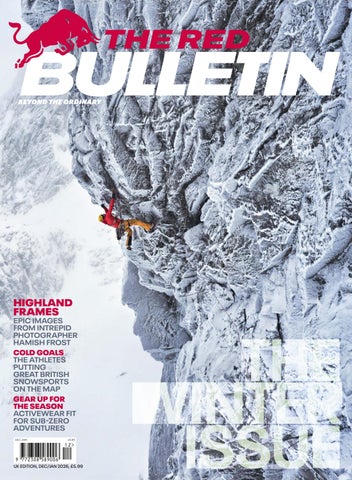
BEYOND THE ORDINARY
HIGHLAND FRAMES
EPIC IMAGES FROM INTREPID PHOTOGRAPHER HAMISH FROST COLD GOALS THE ATHLETES PUTTING GREAT BRITISH SNOWSPORTS ON THE MAP GEAR UP FOR THE SEASON ACTIVEWEAR FIT FOR SUB-ZERO ADVENTURES DEC-JAN
£5.99
UK EDITION, DEC/JAN 2026, £5.99
THE WINTER ISSUE
BEYOND THE ORDINARY
YUNGBLUD “I LOVE TO PUSH THE LIMITS” HIGHLAND FRAMES EPIC IMAGES OF COLD-WEATHER CLIMBING GEAR UP FOR ACTION ACTIVEWEAR FIT FOR SUB-ZERO ADVENTURES DEC-JAN
£5.99
UK EDITION, DEC/JAN 2026, £5.99
THE WINTER ISSUE
KIRSTY MUIR
THE FREESKI PHENOM PUTTING GREAT BRITISH SNOWSPORTS ON THE MAP
THE COOLER BRAND
UNLOCK THE CITY SIRIUS 11 • 1300 LUMENS • 90 GRAMS
OUT NOW
Find out more
EDITOR’S LETTER & CONTRIBUTORS
Amy Woodyatt The adventure sports writer and climbing enthusiast visited Glasgow to meet photographer Hamish Frost. “I’ve admired Hamish’s work for years,” she says, “so it felt surreal to meet him. To find he was so humble about all he’s achieved was even more surprising.”
Agathe Ledoux
HAMISH FROST (CLIMBING COVER), ISAMI KIYOOKA (KIRSTY MUIR COVER)
For our travel feature, the French photographer took a sail/ski expedition to a remote couloir in Norway. “Being in those magnificent surroundings, with no sign of civilisation, is a feeling I’ll never forget,” she says.
Tristan Kennedy “When you see top-level athletes on TV, they’re like fine-tuned machines,” says the British writer, who interviewed Kirsty Muir and four other top winter sports athletes for us. “It was fascinating to lift the metaphorical bonnet and see what makes them tick.”
A
07
s the nights draw in and the temperature drops, most of us head indoors. But this Winter Issue of The Red Bulletin is packed with passionate people who, instead, take things up a gear during the colder months. First, we meet five athletes flying the flag for Great British winter sports, including Scottish freeski talent Kirsty Muir, who won her first-ever World Cup gold medal earlier this year after coming back from serious injury. All have had their biggest wins in 2025, and they share with us the secrets of these sub-zero successes. Then we chat to outspoken rock rebel Yungblud – who’s avoiding the worst of the British winter with a world tour – about Bowie, boxing, body image, and how he fell in love with being himself again. And we journey into the Scottish Highlands through the epic images of Hamish Frost. The photographer thrives in the sort of icy mountain conditions that bring out the best in the climbing and skiing communities – both of which have welcomed him in a way he once didn’t think possible. Enjoy the issue.
THE RED BULLETIN
DESIGNED, DEVELOPED AND TESTED BY FORMER UK SPECIAL FORCES OPERATORS. EVERY GARMENT WE MAKE IS PERSONALLY TESTED BY CO-FOUNDERS LOUIS TINSLEY AND ANTHONY ‘STAZ’ STAZICKER USING DECADES OF ELITE MILITARY EXPERIENCE. WE DON’T JUST STAND BY OUR KIT, WE STAND IN IT.
CONTENTS
09
Bullevard 10 17 19 20 23 24
Gallery Playlist When Glaciers Sing Kandy G Lopez Zero tableware Alpine refuges
Heroes
Cat Burford Molar explorer
26
64
Fekky 28 Farmer chameleon
Tom Evans Ultra man
30
Winter sports
Gold rush
British winter sports are having a moment, and these five medal-winners are pushing the limits of success – and possibility Climbing
JIM KRANTZ
Hamish Frost
The action photographer and climber on the risks and rewards of shooting heroic feats amid Scotland’s most awe-inspiring peaks
Falling into place
Music
32 Yungblud
Born in Doncaster, schooled in rock and poised for world domination: the musical maverick and ‘voice of Gen Z’ is spreading his wings Action stunts
44 Michelle Khare
From clinging to a speeding fighter jet to wrestling her way out of chains deep underwater, no challenge is off the table for this YouTube phenom
56
64
She may not be a bigscreen Hollywood star but, with more than five million subscribers on YouTube, action-stunt performer Michelle Khare is flying high
Venture 75 Travel 82 The best winter sports gear 92 How To 93 Gear 95 Fitness 96 Events 98 Lessons from the Wilderness THE RED BULLETIN
MARCELO MARAGNI/RED BULL CONTENT POOL
DAVYDD CHONG
10
THE RED BULLETIN
TOPIC GALLERY
11
Porto Alegre, Brazil
High roller
Some people break world records by pushing a pea along the ground with their nose; others bomb down a custom-built, 70m-high skate ramp with a 60m drop at speeds of up to 103.8kph and a g-force of 3.9g. As a spectacle, Brazilian Sandro Dias’ feat at the Centro Administrativo Fernando Ferrari building in September shades it, we’d argue. The 50-year-old skate legend smashed two records that day: ‘tallest drop’ and ‘fastest speed’ on a temporary quarter pipe. ‘Fastest pea on a temporary quarter pipe’ remains up for grabs. Instagram : @diassandro
THE RED BULLETIN
12
West End, Bahamas
Blade stunner Got a balcony overlooking a football pitch? Hmm. Watch the local firework display from your kitchen window? Pah. Every year, the locals of West End on Grand Bahama enjoy the ultimate in free thrills when the world’s best aerobatics and aviation athletes and pilots – including US acrobatic pilot and movie-stunt veteran Aaron Fitzgerald (pictured in action last March) – assemble for a week to train and network at Red Bull’s Global Aerial Performance Camp. The only consolation? Chronic neck ache is no joke. redbull.com THE RED BULLETIN
13
JOERG MITTER/RED BULL CONTENT POOL, KOURY ANGELO/RED BULL CONTENT POOL
DAVYDD CHONG
GALLERY
Lakewood, CA, USA
Balancing act “One of my favourite things about skating,” says US figure-skating ace Isabeau Levito, “is being able to go on the ice and… play a character and a part without it being my identity.” Known for her lyrical style, the 18-year-old nicknamed ‘Tinkerbeau’ has channelled screen icons Sophia Loren and Audrey Hepburn and – less glamorous – a snake charmer en route to multiple medals at world and national levels. Here, we see her last July, executing a Biellmann spin, a tricky move requiring poise and balance. And ice skates. Instagram: @isabeau.levito THE RED BULLETIN
14
Southwark, London
Tunnel vision See you at the arches, he said. Oh, he must mean Arêches-Beaumont, that ski resort in the French Alps, we thought. Fools. Max Palm likes to think outside the slopes, so in November, when launching his first capsule collection for skiwear specialists Peak Performance, the Swedish freeskier invited top riders from the UK and worldwide to try out a custom-made set-up – and model his new gear – at White Grounds skatepark, near London Bridge Station. The location may have been more shabby than Chamonix, but the skills on show were as polished AF. Instagram: @maxx_palm
THE RED BULLETIN
NICHOLAS ILIANO
DAVYDD CHONG
GALLERY 15
THE RED BULLETIN
BULLEVARD
17
Tom Smith
Making the Edit The Editors frontman and solo artist gets nostalgic for the ’90s For 23 years, Tom Smith has been the singer, guitarist and main songwriter of shapeshifting band Editors, whose sound has transitioned from post-punk to industrial electro-rock across seven studio albums. The Birmingham-based five-piece have enjoyed hit singles, won nominations for the BRITs and Mercury Prize, sold out arenas in the UK and across Europe, and are currently working on their eighth album. Now, aged 44, Smith is embarking on a solo career, too. His debut release, There is Nothing in the Dark That Isn’t There in the Light, is in the classic, pared-back singer-songwriter tradition, with only piano, guitar and occasional strings to accompany his distinctive baritone. While still a dark, intense affair in true Editors style, it sees Smith “reconnect with the raw, acoustic beginnings” of his songwriting. Here, he selects four tracks that influenced him during those formative years… Tom Smith’s debut solo album, There is Nothing in the Dark That Isn’t There in the Light, is out now; tomsmith.os.fan
EDITH SMITH
MARCEL ANDERS
REM
Drive (1992) “When I was a kid, holidays were camping trips, driving to the north of England or to Scotland. And I guess we all liked REM because obviously there’s only so much Bryan Ferry a 13-year-old can take. This song instantly takes me back to being that age, sat in the back of the car, intrigued by the mystique around the band’s music and lyrics.”
Oasis
Slide Away (1994) “Oasis were the reason I first picked up a guitar – I pretty much learned how to play by noodling along to [their debut album] Definitely Maybe. I like sad songs best, and even though Oasis weren’t really about that so much, this track has a yearning [quality] that really registered with me. It had a profound effect on me as a teenager.”
Radiohead
Let Down (1997) “It was at Glastonbury in 1997 that Radiohead took music to a different place. It was kind of futuristic and classic at the same time, like they were beamed from outer space; they didn’t seem human. So I went, ‘I want to be in a band, I want to write songs, I want to be on that stage.’ And this track has always been my favourite – it’s unbelievable.”
Spiritualized
Broken Heart (1997) “Spiritualized live was one of the loudest shows I’ve ever seen. And even with all that volume, there was so much heart and sadness, too. The way they would combine the two felt like a religious experience, and this track still breaks me. I spent many hours in my bedroom looking out the window and feeling sad while listening to this.” THE RED BULLETIN
COMING SOON WESTFIELD,
SHEPHERD’S BUSH
BULLEVARD
19
MARCUS NEUDIGATE, RACHEL FLINT
RACHAEL SIGEE
W
hen Konstantine Vlasis listens to a glacier, he hears “a world that we couldn’t otherwise know”. “You can’t really see a glacier flowing in real time – it’s imperceptibly slow,” says Vlasis, an environmental composer from Tennessee. “But you can listen to the ice shifting – the cracking and rumbling – which is powerful.” He’s been recording glaciers in Iceland for several years, inspired in part by Sigur Rós’ 2001 EP Rímur, which includes an Icelandic folk song twinned with the sound of a stream. Vlasis’ latest project, When Glaciers Sing, is an “immersive audio story” due for release in early 2026. It melds the sounds of glaciers with traditional Icelandic songs and poetry, many of which reference these enduring masses of ice. “If you look through the documented history of glaciers in Iceland, there are always sonic descriptors,” Vlasis says. “Glaciers are not just a mass of ice; a glacier is a mass of ice that moves. And every movement creates a sound, every sound tells a story. It sounds like ice, like water, like air, like land. It sounds like life.” Loaded up with recording and safety gear, Vlasis heads out to the glaciers close to the south-eastern town of Höfn once or twice a month. “When I tell people about my work, maybe they think of an artist having these immersive, transcendent experiences,” he says. “There are moments of that, but really I’m just watching the weather. It’s very intense, and it can change extremely quickly. These landscapes are dangerous.” But the risk is justified. Using highly sensitive microphones developed from seismometer technology, his field recordings are surprisingly varied. They include the trickling of water systems inside glacier caves and caverns – “the acoustics of the ice itself” – and the popping and fizzing of air bubbles inside ice formations. “You’ll also hear
When Glaciers Sing
Frozen soundtrack This composer records the sounds of Iceland’s glaciers, telling the story of these enduring – but now endangered – ice formations these really weird melodies or glissandos, burps almost. What you’re actually hearing are those weird shapes of air escaping in different patterns, like air through a trumpet. It’s a history of how the ice has flowed down slope and deformed and compressed.” As well as sounds, Vlasis is collecting data in collaboration with scientists. “Glaciers are part of a fragile cryosphere, and these foundational parts of our planet are changing within
Check my floe: glacier advocate Konstantine Vlasis; (top) out in the (ice) field
human timescales, which is alarming. Early on, I felt a good amount of oscillation between aesthetic fascination and ecoanxiety, now it’s more a sense of wonder. Glaciers aren’t only global symbols for climate catastrophe and crisis; there’s cultural significance to these landscapes. Glaciers don’t necessarily have to harbour these associations of loss and disappearance and doom – they can also inspire hope.” konvlasis.com THE RED BULLETIN
Kandy G Lopez
Embroidering truth Meet the American artist whose life-size woven portraits force us to take another, closer look at the world For artist Kandy G Lopez, one place is ideal when scouting potential subjects. “Art fairs are usually where people wear their swaggiest outfit, right?” says the 38-year-old. “They look confident. I’m always amazed, because I don’t have swag! I’m interested in people who have a really striking presentation of self. It blows my mind.” This Fort Lauderdalebased creative doesn’t paint her models, though; she embroiders them. Her chosen medium was an accident, THE RED BULLETIN
Connective fibres: Lopez explores the relationship between art and marginalised communities; (top) City Girl – Jade
she admits: “I was creating collages in 2014, and a piece of string just fell onto one of my cityscapes. I didn’t know anything about crocheting or embroidering. I didn’t know about stitch patterns.” Lopez didn’t get “serious” about fibre art until 2021, when she began using rughooking mesh and yarn. Originally, she was making monochrome portraits of Black men in the aftermath of the George Floyd and Trayvon Martin shootings and the emergence of the Black Lives
Matter movement. “They were supposed to be rugs; you would step on them,” Lopez says. “I wanted to make a piece that symbolised what we do to people. But when I started adding colour, I was like, ‘No, these are too powerful to be on the floor.’” And so she began to create life-size embroidered portraits of people of colour, intended to be hung from the ceiling and viewed from below, subverting the traditional gaze that has diminished her subjects. “Our history is always in the back of my head,” says Lopez. “The representation – or erasure – of us in art history is something that’s always present. I like for the subject to be looking down at the viewer – especially when it comes to females – and not being passive. I don’t want it to feel voyeuristic; I want it to feel like they’re in command.” Each takes around a week to embroider freehand, and the layering of the medium allows Lopez to explore the relationship between art and marginalised communities. The grid of the mesh, she says, acknowledges the way that people of colour are trapped by societal expectations and prejudices: “Fibre was used to wrap yourself or to carry things, and I feel like I’m doing that with the figures. With each one I do, it’s like I’m elevating them to a certain place and also carrying them with me.” Her favourite thing is when viewers see their own family and friends in her works: “I love it when people are like, ‘Oh, that’s so-and-so!’ And I’m like, ‘That’s definitely not!’ But I like that they can make the connection. They’ll have their friend come over and take pictures in front of the piece. “That’s community. It’s bringing people into spaces where they wouldn’t normally be, then having a party in those spaces. I just want to be a fly on the wall and listen to the connections of visitors. That makes me happy.” kandyglopez.com
RACHAEL SIGEE
BULLEVARD
KANDY LOPEZ
20
PR EST TEAMRIDER: CAMILLE ARMAND
OT P R OT E ST. E U
BULLEVARD
23
KLINTA LOCMELE
RACHAEL SIGEE
I
n 2008, American astronaut Donald Pettit was frustrated at not being able to drink coffee the conventional way in zero gravity. So, during his time on the International Space Station, he designed a cup that more closely resembled Earthbound crockery than any developed for use in the cosmos, where liquids are traditionally drunk though a straw from a plastic pouch. Inspired by Pettit’s work, London-based graduate Klinta Ločmele has designed and created prototypes for a tableware collection that could be used in zero-gravity conditions without food or drink floating away from hungry space travellers. “[Pettit’s coffee cup] came from his own personal frustration,” says the 26-yearold Latvian, who studied furniture and product design at the University of the Arts London. Ločmele interviewed the NASA veteran during her research and concluded that, with astronauts under so much physical and mental strain in space, small changes could have a big impact. “They already go through extreme conditions that take a toll on their quality of living, which can [in turn] impact on mental health and affect their mission,” she explains. “A lot of the objects [they use] were designed during the space race. The needs of the astronauts were retrofitted to the environment, rather than the other way around.” Ločmele’s Zero project – a five-piece collection of tableware comprising a bowl, a plate, a spoon, a spork and a teapot – uses angles, grooves and spikes to harness the power of capillary action, the process whereby liquid travels through a narrow space without the assistance of gravity. Examples on Earth include water rising through the roots of plants, or when liquid starts to travel up a thin straw – as the water molecules stick both together and to the surface of their
Zero tableware
Cosmic crockery
Freeze-dried food and plastic drink pouches have long been astronaut staples, but this London-based designer is determined to introduce a little Earth etiquette to interstellar dining
Defying zero gravity: product designer Klinta Ločmele; (clockwise from top left) her spork, plate, bowl and teapot for astronauts
container, the surface tension causes them to move. “When you have a narrow angle, the liquid will stay there and it’s easier to control,” says Ločmele. “So the spork design kind of looks like a honey spoon. The whole idea is that water gets caught in the grooves, which help stop it making its way down the handle.” Her dish features spikes to hold solid food such as steak in place while it’s being cut, as well as grooves to prevent any sauce or juices from floating away. It also has miniature magnets on its base, allowing it to be fixed to a surface.
Ločmele’s prototypes are made from silicon and ceramics, but she envisages the pieces being 3D-printed in space. And while at the moment the collection is only speculative, she’s keen to test out her designs in a zerogravity setting “Even though this is all very conceptual, I feel that more designers should be thinking about it,” Ločmele says. “You have astronauts travelling to space every couple of months. We’re here to fix the problems of space travel for future generations.” Instagram: @cliff77.studios THE RED BULLETIN
Alpine refuges
Havens above Nestling in remote, high-altitude locations across the globe, these mountain shelters are accessible only to the brave Award-winning architecture. Jaw-dropping locations deep in the heart of nature. Many of them completely free. There are thousands of these lesser-visited havens across the planet – off-grid stopovers where visitors are welcomed with a bed for the night and the chance to experience the ultimate in escapism. The catch? These hidden gems usually nestle in inhospitable, high-altitude environments accessible only to the hardiest, travelling on foot (or with crampons and ice axe). The Romans were the first to construct these refuges THE RED BULLETIN
and shelters on high mountain passes, and the mid-1900s saw an increase in the building of more modern iterations. “Alpine refuges date back well over a century in some parts of the Alps, emerging alongside and facilitating the rise of mountaineering and alpine exploration,” explains British adventurer Aaron Rolph, whose new book, Alpine Refuges: The Architecture and Culture of Mountain Shelters, features 30 such examples. “Initially often simple wooden shelters, they provided climbers with crucial protection from the harsh weather in
Gimme shelter: Author and adventurer Aaron Rolph; (top) Bivacco Gervasutti in the Italian Alps
these extreme environments… The huts have [since] evolved to include sophisticated refuges blending functionality with varied local architectural styles, creating an incredible range of different building styles today.” The 36-year-old travelled the world to document some of the most unique examples, sharing refuges with friends and strangers everywhere from New Zealand to Norway. “I found a unique solitude in mountain ranges I’d never visited before,” he says. “The tougher the journey and harsher the conditions, the more rewarding it felt to reach the huts. There’s a unique beauty in how much you can appreciate even the most basic comforts in what would otherwise be a wild and savage place.” Rolph’s highlight was Bivacco Gervasutti (pictured) in the Italian Alps, a stone’s throw from the Swiss border. Those escaping the elements in the Mont Blanc massif would be forgiven for thinking the futuristic, tube-shaped construction is a mirage. “A spacey, modern, unmanned hut perched on a cliff edge surrounded by glaciers in all directions, it’s hard not to find [Bivacco Gervasutti] a pretty standout shelter,” says Rolph. “The unique whiteand-red capsule contrasts against the alpine setting. When you’re inside, the large window beautifully frames the surrounding mountains down the Aosta Valley.” These are more than sanctuaries in which to sit out a storm, though; during the process of making the book, Rolph experienced the unique culture they have cultivated. “Alpine refuges have become landmarks of human resilience,” he says, “but they also foster a sense of community. They allow you to share your mountain experience with friends and strangers alike.” Alpine Refuges is out now, published by Gestalten; uk.gestalten.com
CHARLIE ALLENBY
BULLEVARD
AARON ROLPH, MAURIZIO MARASSI-GERVASUTTI
24
BUILT FOR THE OCEAN BALANCE, GRIP, CONTROL
strike-footwear.com
26
HEROES
Cat Burford
‘The Molar Explorer’ talks swapping dental crowns for ice caps and making it to the South Pole solo Words Jessica Holland
In November 2024, just days before her 44th birthday, Cat Burford was dropped off on an Antarctic ice sheet by a tiny plane. When it left, the Cornwall-based dentist-turned-adventurer – nicknamed ‘the Molar Explorer’ – was all alone, with more than 1,100km of treacherous, freezing terrain to cross. Everything she needed to survive for almost two months in the polar wilderness was packed into a lightweight sledge she’d have to drag. One thing Burford couldn’t prepare for was a freak snowstorm that would make progress so much harder than expected. As she plans for her next, all-female adventure on the Arctic archipelago of Svalbard, the Shackleton athlete tells The Red Bulletin how she stayed alive for 53 days to become only the 13th women ever to reach the South Pole unaided, and why she put herself through it… the red bulletin: When your dream of going to the South Pole begin? cat burford: When I was 14, we had a geography lesson about Antarctica, and I thought, in a matter-of-fact way, “Well, of course I’ve got to go there. It looks incredible.” How did the thought become reality? I turned 40 during COVID. I was working as an NHS dentist at the time, and I felt a bit trapped; I wasn’t travelling as much as I’d done in the past when volunteering abroad. I realised that I might only be physically capable of going to Antarctica in the next 10 years, and I didn’t want the opportunity to slip by. I literally Googled, “How do I go to the South Pole?” I found a polar training camp with [expedition training and gear company] Shackleton. That led to more courses and training expeditions in Norway, Chamonix and Greenland.
THE RED BULLETIN
Was the idea of being all alone on the ice daunting? I was on my own for two weeks while training in Norway, and it felt empowering. I loved it. But I didn’t know what it would be like when I was the only person around for hundreds of miles. I was interested to find out, though. Everyone says that if you take any demons with you to Antarctica, they’ll show themselves on the ice. And did you experience any lows? On day 10, there was this freak weather event, a huge snow dump. My skis just sank; the snow was up to my knees. I was terrified of breaking the bindings, so I took them off. It was so slow, and tough mentally. By the time conditions improved, more than a week later, I was way off target timewise. I decided not to accept a resupply of food but to ration what I had. Making that decision was the only time I cried. But by the time I got to my last day, I still had three days’ worth of food left. I ate all the time that day! What were your highlights? Every kilometre was different, whether it was the sastrugi [ice waves] or the sugary snow that glittered in the sun, or sun dogs [spots of light in the sky]. It was breathtaking. I had a mantra: work hard, do your best, have faith and enjoy it. When negative thoughts crept in, I’d have a tennis racket in my mind and I’d be like, “Bam! Get it away!” Was it therapeutic distancing yourself from our hyper-connected world? It was bliss; there was no distraction. All I had to do was leave a voice message every night via a satellite phone and give my coordinates to the comms team. When Starlink comes into force [the global satellite internet service is currently expanding into the polar regions], I don’t think it will be the same experience.
Did you encounter any specific difficulties as a woman in a maledominated environment? There’s genuinely no expedition gear for women out there, so Shackleton designed my kit for me: wider thighs, shorter sleeves, pockets in the right place, a differently placed zip for going to the loo. It doesn’t take much to feel you don’t belong in this environment, and not being able to find female kit can make you think it’s not something a woman should be doing. What’s next for you? In April, I’m going to traverse the northwest of Svalbard – which is the fastest warming place on Earth – with four other women: a midwife, an Arctic nature guide, a polar guide and a data analyst. We’ll be participating in science projects, checking on microplastics and black carbon deposits. We also want to show that expeditions don’t have to be gnarly or competitive to be rewarding. It doesn’t need to be about “conquering nature”; it can be about fun, conversations and camaraderie, as well as focusing on the environment. How have your adventures changed you as a person? In the past, I felt underestimated all the time. It’s almost a relief when you’ve gone for a big dream and actually got there. People can’t question that. It’s given me the confidence to do all these other things.
Cold comfort: Burford’s South Pole essentials Cocktails “I took three pouches of margarita mix to drink with lime and snow on my birthday, Christmas Day and New Year’s Eve. That brought a big smile to my face” ‘Happy socks’ “Putting on the fluffiest, warmest, fleeciest socks in the evening was the best part of my day” ‘Steve the shovel’ “On every expedition, you need a shovel to build ice walls to protect yourself and your kit. Mine was borrowed from my old boss, Steve. I stuck on two googly eyes to give him a bit of personality, and I took videos of him along the way”
“I had a mantra: work hard, do your best, have faith and enjoy it”
THE RED BULLETIN
28
HEROES
Fekky
From spitting bars to shearing baa-baas: the rapper who ditched fame on the mic for life on the farm Words Alice Austin Photography Jessica Eliza Ross
Grime fans know Fekky as a formidable talent on the mic; the rapper has shared a stage with the likes of JME, Skepta, Giggs and Dizzee Rascal. But recently the South Londoner has been adding some wildly different – and unexpected – skills to his CV: cow milking, sheep shearing and corn growing. After discovering the healing power of gardening during lockdown, a few years ago Fekky bought a plot of land in rural Cambridgeshire and left his native Lewisham. Keen to establish a farm at the spot, which he’s already named ‘F Manor’, the rapper has been learning the ropes from experts in the field. The YouTube series Hood2Farm chronicles Fekky’s journey as he grapples with chickens, milks unwilling cows and braves swarms of honeybees. Here, the 38-year-old shares how connecting with nature helped him recover from trauma, form unlikely friendships, and unearth parts of himself he thought were lost… the red bulletin: What led you to transition from rapping to farming? fekky: I used to get in a lot of trouble on the streets. In 2011, I ended up stuck in the house with [an electronic tag], so I picked up music. Then it was non-stop music, shows, touring… and in 2018 I finally crashed. I had to take a break. I went to live in Thailand for three months and fell in love with nature. I came back to lockdown, so I started gardening, filming it and sharing it on social media. It became a thing: Fekky’s Garden. People were invested, messaging me about my trees, and I began to see the mental health benefits. I decided I wanted to do it fulltime and live in the country on a farm.
What benefits did you experience? It helped me with anxiety and trauma from the streets. I’ve been stabbed, my friends have died, and I just got on with it. Then I became famous and had to be on form ’cause I had eyes on me all the time. That brought lots of anxiety. But nature’s made me slow down. I’m still doing music, but I’m enjoying the process without the pressure. When you’re gardening, it’s just you and the plant; there’s no place for anger. What you gonna be mad about? It’s not gonna start cussing you out. What made you launch your YouTube series, Hood2Farm? I grew a potato, and then I thought about onions, then strawberries, cabbages… then I got some chickens and ducks. I knew I wanted to start my own farm, so I reached out to farmers, told them I want to learn, and went for a day or two to each farm and did exactly what they were doing. Milking the cows, herding the sheep, beekeeping – I was doing all of it. And it was surprising how we all got on. I thought they’d judge me, but I still talk to them now. If I have problems with my chickens, I call my chicken farmer. How did your community react to the transition? They loved it. People were ready for me to show them something else. Some rappers are scared to grow up, still trying to catch trends, and it’s a disservice ’cause they’ll always be compared with the next person coming up. But if you show people you’re growing up, express it and be real, you won’t get compared with others; you can just be yourself. Tell us about the charity you set up, The CC Foundation… I launched The CC Foundation [named after his sons Capree and Cuben] to put good back into my area and inspire people to do the same. We empower
THE RED BULLETIN
underprivileged youth and families, and we have a food bank every Thursday in Lewisham where I donate food I’ve grown, and eggs from my chickens. We also have a laptop library, and we hold employability classes to help the youth take control of their futures. But, most importantly, they know that someone who was so bad back in the day is the one doing this. That means a lot to people from my walk of life. What are your plans for the future? I want to film more seasons, travel to farms around the world – China, South America, Africa – and use the knowledge to open my own farm. I’ll have a produce shop on my farm, and young people can come help me for 24 hours and experience it themselves. We’ll have parties, and I’ll bring artists to come and perform. We’ll cook food from fresh produce and shift the culture. I don’t want people to think you can only be a footballer or a rapper – one of those cliché careers. I want to open up everybody’s eyes to the wider world. What have you learned about yourself on this journey? My charity does a turkey drive every year where we hand out 5,000 turkeys up and down the country. Last year, I said to my friend, “Can you believe that I’m giving out turkeys?” And my friend said yes – because I’ve always been a caring person. But when you go through trauma, you block out so much of yourself. Coming to nature has opened me back up to how I was. I found myself again. I still get mad here and there, but in general I’m at peace.
What Fekky’s learned in Hood2Farm Dairy farming at Wayside Farm, Herts Beekeeping at Olmstead Honey, Cambs Sheep farming at Ledgemore Farm, Herts Poultry farming at Organic Orchards, Essex Deer stalking in Hemel Hempstead, Herts Arable farming at Wayside Farm, Herts Fish farming at Lyon’s Drove Fishery, Cambs Pig farming at Brookfield Farm, Herts
“Coming to nature has helped me find myself again” THE RED BULLETIN
HEROES
Tom Evans
The British ultrarunner on what it took to win one of the world’s toughest endurance races Words Ruth McLeod
Thousands of passionate spectators brandishing cowbells, flares and even chainsaws line the route of the UltraTrail du Mont-Blanc (UTMB) each year, eager for a glimpse of those daring enough to take on one of the world’s toughest trail-running events. This legendary race – a beast of a challenge, covering 174km – loops around the Mont Blanc massif in Chamonix, France, and crosses through three countries en route, with 10,000m of elevation gain. Sussex-born athlete Tom Evans describes the event simply as “the Super Bowl of ultrarunning”. Having spent six years building a rep as one of the sport’s most accomplished competitors, in 2022 Evans took third place in the UTMB on his debut. But the title continued to elude the former British Army captain as he failed to finish the race on his next two attempts. In Chamonix in August this year, Evans, now 33, was determined to bury his demons. “I put myself in the position to fail again,” he says, “knowing that if you don’t give yourself the opportunity, then you can’t succeed.” And after 19 hours, 18 minutes and 56 seconds of continuous running, Evans finally nailed a decisive win. Here, he reveals the unlikely secrets of his ultimate success… the red bulletin: Congratulations! When did it hit you that you’d won the UTMB, and what did it mean to you? tom evans: In all honesty, it didn’t dawn on me until I got into Chamonix with a mile to go, as anything can happen on the final descent down to the start-finish line – it’s not over ’til it’s over. But it’s the world’s pinnacle ultra-distance trail race. Being able to stand on the top of the podium was incredibly special. It took years of dedication. Living in the UK, where it’s not mountainous, and being able to beat the best [runners on the
THE RED BULLETIN
planet] in a completely different environment means the absolute world. You weren’t the favourite going into the race… No. And a lot of people said, “Oh, you can’t win the UTMB if you don’t live in the mountains.” But it’s like, well, no, you can – you just have to find a way. That’s what separates good athletes from great athletes. And that’s what we did this year. How did you approach this year’s race following those two DNFs? One of the first things I did after UTMB last year was reach out to guy named Dr David Spindler, who’s a neuroscientist rather than a sports psychologist. I am, by far, the smallest fish he works with – he spent two weeks with [multiple Tour de France winner] Tadej Pogačar, Lewis Hamilton and me, which is mental. It helped me reframe things. What was his advice? Firstly, not to be too hard on myself, but then also to realise what went wrong in those [two previous UMTB] races was my fault – I went off too hard. There’s that quote by [Olympic gold-winning figure skater] Scott Hamilton: “If you want to finish first, first you’ve got to finish.” And from a mental standpoint I know I’m at my best when I’m at my happiest. Sitting in a small apartment at altitude [prior to racing] is not fun. So we wanted to create this positive environment [in a village near Chamonix] that was like home, where success feels inevitable, and to fill the cup throughout the summer with family and friends around me. So happiness was the key to your success in the race? Yeah, 100 per cent. For the last couple of years, I’ve definitely focused way
too much on the overall performance and neglected my mental wellbeing and just being really happy. So, at times in the race where it started to get tough, I had a lot of resilience to draw upon. The crowds are huge – and loud. How does that affect you? I remember last year going into the evening through Saint-Gervais [around 25km into the race] where the crowds are huge and there’s flares, there’s chainsaws – it’s crazy. And I hit my max heart rate, higher than I would hit in any session doing the hardest run I could. Like, that never happens. And after that your body goes into ‘fight or flight’ mode. So this year, for the start and in other loud sections, I put in sleep earplugs, just to try to dial down the noise a bit. When I was nearing Saint-Gervais, I also put on sunglasses to dial down the lights. It feels a bit boring to not fully immerse yourself in it, but if you hit max heart rate four hours into a 20-hour run, things are going to go really wrong, really quickly – I learned that from the last couple of years. Has your triumph sunk in yet? It’s really great to have done this, but it’s actually nice being back home, [back] to normality. My baby daughter Phoebe doesn’t care about the win; my dogs don’t care. Nothing’s really changed, and that’s exactly the way you’d want it.
Playing to win Evans had three different MP3 playlists to help him get through the Ultra-Trail du Mont-Blanc PLAYLIST 1: EVENING INTO NIGHT “This had very chilled country music – which is incredibly embarrassing to admit – to help me stay calm and relaxed” PLAYLIST 2: 2AM “For when I thought I’d feel pretty ropey. It was happy songs that make you smile – [Chappell Roan’s] Pink Pony Club was in there a couple of times” PLAYLIST 3: LAST SIX HOURS “Music to get me to the finish line – everything from Stormzy to Red Hot Chili Peppers, who have probably never been mentioned in the same sentence before!”
SANTARA STUDIOS AND COMMUTER FILMS
30
“People said, ‘You can’t win the UTMB if you don’t live in the mountains’”
THE RED BULLETIN
32
GOLD RUSH THE RED BULLETIN
CHAD CHOMLACK/RED BULL CONTENT POOL
HAVING TAKEN THEIR BIGGEST INTERNATIONAL TITLES IN 2025, THESE CHAMPION ATHLETES ARE FLYING THE FLAG FOR GREAT BRITISH WINTER SPORTS. HERE, THEY DIG INTO THE SECRETS OF THEIR SUCCESS…
WINTER SPORTS
Big air: Kirsty Muir trains at the Red Bull Snow Camp at Mammoth in California, USA THE RED BULLETIN
34
“I LEARNED A LOT ABOUT PATIENCE AND LISTENING TO MY BODY” THE RED BULLETIN
35
FREESKIING
KIRSTY MUIR
WINTER SPORTS
Creative Recovery Kirsty Muir has a thousand-watt smile that’s impossible to hide, even when wearing massive mirrored ski goggles, her race helmet and a neck gaiter to protect against the cold. And the grin that lit up the 21-yearold professional skier’s face in March, as the scores for the final World Cup slopestyle contest of the season were announced, could have powered her home city of Aberdeen. It hadn’t been a good day for skiing in the French resort of Tignes, Muir remembers over a video call from her summer training base in New Zealand. “The wind had really picked up,” she says, which made judging speeds on the slopestyle course difficult. Go too fast and you might overshoot the massive icy
jumps and metal rails by miles, landing on the flat; too slow and you risk not clearing them. Thankfully Muir, who skied in the Scottish Highlands as a kid, was used to dealing with bad weather, and she judged her tricks perfectly. The run, which included two 900° spins, one achieved after taking off backwards, earned Muir her first-ever gold on the World Cup circuit. And her happiness was born not only of victory but also vindication; the win crowned her comeback after one of the most difficult years of her career. Muir’s initial rise to the top of the freeskiing world had been as meteoric as it was improbable: unlike friends and rivals who learned to ski in the Alps or Rockies, she took her first turns on a dry ski slope next to an Asda car park. Her fierce determination and methodical approach to trick learning quickly marked her out as one to watch, however, and she won the British Championships in all three freeski disciplines – slopestyle, big air and halfpipe – at the age of just 13. At 17, as the youngest member of the GB Snowsport squad, Muir travelled to the 2022 Beijing Olympics, where she earned hugely impressive fifthand eighth-place finishes. Going into winter 2023-24, she was flying high – often literally. “I had the best start of a season I’ve ever had,” Muir says. “In the three competitions I did, I had a fourth,
MAMMOTH SNOW
Age: 21 Hometown: Aberdeen, Scotland Disciplines: Freeski slopestyle, freeski big air Highlight of 2025: World Cup gold, slopestyle, Tignes
a second and a third place.” But at the third of those contests, a World Cup Big Air event at Copper Mountain in the US on December 16, everything came crashing down. “It was the second run of three, and I just had a bit of a crash,” she says. “I kind of felt something at the back of my knee, but then it eased off. I thought I’d maybe pulled my hamstring or something.” After being examined by the GB Snowsport physio, Muir decided to go back up for her final run, which she landed, finishing third. A week later, however, the results of a precautionary scan came in: she’d snapped her anterior cruciate ligament (ACL). One half of the vital-but-fragile crossed formation of ligaments that connect the leg bones at the knee, the ACL is the skier’s equivalent of an Achilles’ heel. In a sport that puts a lot of torsional tension through the joint, injuries to the ligament are common, but the recovery time is long. “At least nine months,” Muir says she was told. It ended her season before it had really begun. She underwent reconstructive surgery towards the end of January 2024 and spent almost a month on crutches. Two weeks later, demonstrating the same methodical mindset that had characterised her approach to skiing, Muir opted for bone graft surgery on a recurring shoulder problem, allowing her to recover from the two in parallel. Normally after ACL replacement surgery, building muscle strength is key to help support the new ligament, she explains, “but we had to be quite creative with the exercises for the first four months until my shoulder was a lot better, because a lot of the things you’d usually do use your arms!” If the physical recovery was complicated, the mental adjustment after such a big setback was even trickier, Muir says. “For the first month or two, I was a lot sadder than I think I realised. It was just a grind. Every day, I’d get myself up, I’d take myself to the gym and I’d work hard. That was something I really wanted to do, but it wore on me because I was watching all the competitions I was missing.” Perhaps the cruellest blow came in January 2025. She had received a coveted invitation to the X Games at the end of that month. But as the date drew nearer, Muir was forced to accept that while she was back on THE RED BULLETIN
“MY GOAL WAS TO GET STRONGER THAN I WAS BEFORE” THE RED BULLETIN
CURLING
her skis, she wasn’t at the level she’d need to compete: “It was gutting.” Muir made a decision to lean into what she could do and get creative with her recovery. In summer 2024 she’d discovered mountain biking, a medically approved way to keep her fitness up without putting torsional stress through her knee. “It was so sick!” she says. “It actually felt similar to skiing in many ways – the speed and the flow.” Muir spent much of last summer riding around with her coaches close to home, enjoying the rapid improvement that comes with taking up a new sport. “It felt good to scare myself a bit again as well. I’m a very adrenaline-driven person, I think.” She also dipped a toe into the more meditative world of freediving – a discipline where keeping your heart rate low and remaining calm is crucial to boosting your performance. “That was really cool to push myself in a different way,” Muir says, explaining how the activity has benefited her approach to stress management in skiing contests. “I now make sure I’ve had a couple of deep breaths and centred myself before dropping in.” Her recovery taught her other useful lessons. “I learned a lot about patience, listening to my body and knowing when I need to stop,” she says. Muir had always been incredibly driven, to the point where “sometimes I’d feel guilty for taking a break from training. Now, I realise that taking a rest is so much more beneficial, because then you can be back fully ready for the next day”. That maiden World Cup victory in March was particularly sweet for the freeskier because she felt like she was putting all these new lessons into practice. “It was a huge confidence boost,” she says, grinning again at the memory. Now, heading into her first full season for two years, Muir and her coaches feel like she’s skiing better than ever. “My goal was to get stronger than I was before,” she says. With the winter season in full swing, Muir may soon have plenty more to smile about.
Master of the House The first time Bruce Mouat visited a curling rink, no one in his family would have predicted he’d end up completely hooked on the sport. Not his father, who’d taken him to Edinburgh’s Gogar Park Curling Club on a whim after reading about it in a newspaper; nor his older brother Colin, who also gave it a go; and least of all Bruce himself, who at the age of six was too small even to throw the 19kg stones. An esoteric discipline in which teams of four slide these granite stones towards a circular target known as the ‘house’, curling resembles lawn bowling on ice – not something you’d imagine appealing to most six-year-old boys. Nevertheless, something about the game stuck with the young Scot. “I had to wait a couple of years [while] watching my brother play,” Mouat says today, “but then I eventually got on the ice, and I’ve loved it ever since.” As he grew older, Mouat delved deeper into the history and complexities of curling. “It became this obsession that I just wanted to try and perfect,” he says. “I just kind of took it a wee bit too far and continued to do it as a profession.” When Mouat talks about going “a wee bit too far”, he means all the way to the top of his sport. As leader of the Scottish national team – or ‘rink’, as it’s known in curling – the 31-year-old has won four European Championships, two World Championships (including the most recent tournament in 2025) and an Olympic silver medal at the 2022 Winter Games in Beijing.
And yet, despite this success – and the two Olympic golds famously won by fellow Scottish skips Rhona Martin and Eve Muirhead in 2002 and 2022 respectively – curling isn’t massive in Scotland, let alone in the UK. “I still would describe it as niche,” says Mouat. “We have just under 10,000 registered members of the Scottish Curling Association, and 18 open rinks.” In Canada, by contrast, the sport is huge – “They have over a million registered curlers,” Mouat says – and the country is home to the world’s biggest professional tour. It’s here that ‘Team Mouat’ ply their trade when not competing as Team Scotland or Team GB, and the results have been similarly impressive. In 2017, he became the youngest-ever skip – and just the second-ever non-Canadian skip – to win a men’s Grand Slam event. In 2024, Mouat’s rink became the first team ever to win four of the five Grand Slam events in a single season. So why are they so successful? “Team dynamics are very important,” says their head man. Each member – named ‘lead’, ‘second’, ‘third’ for the order they throw in – has a vital role to play. Mouat has found the ideal partners in cousins Grant Hardie and Hammy McWilliam Jr and their childhood friend Bobby Lammie. But his mastery of tactics is perhaps the key. “The skip’s role is to throw the last two stones, and they also make a lot of the calls on strategy,” Mouat says. While it might look like lawn bowling, the Scot believes curling is better described as “chess on ice”. The rules are simple but take a lifetime to master. “What I said earlier about trying to perfect the sport? It’s never going to happen,” Mouat laughs. “Nine years after starting as a team, there are still new things we’re doing and trying to figure out.” When he’s not training or competing, Mouat volunteers his time as an ambassador for the Scottish Curling Trust, promoting the sport in schools. “I talk about the way that it’s not just physical; it’s using your brain at the same time,” he says. “And I tell them about the community we have.” Teamwork and tactics – a potent cocktail that, as Mouat well knows, you only have to try once to get hooked.
ALAMY
WINTER SPORTS
BRUCE MOUAT
36
37
Age: 31 Hometown: Edinburgh, Scotland Discipline: Curling Highlight of 2025: Second World Championship gold medal Curl power: Mouat (centre) in action with Team Scotland at the 2021 Men’s World Curling Championships in Calgary, Canada THE RED BULLETIN
38
Age: 28 Hometown: Tunbridge Wells, England Discipline: Skeleton Highlight of 2025: Second World Championship gold medal; second overall World Cup title
Slide effect: Weston competes at the 2024 World Championships in Winterberg, Germany THE RED BULLETIN
SKELETON
MATT WESTON
WINTER SPORTS
GETTY IMAGES, ALAMY
Engineering Victory When explaining his sport to people who haven’t seen it before, two-time skeleton world champion Matt Weston frequently compares it to Formula 1. “When we’re going around some of these corners, you’re hitting five or six g of pressure,” he says. Not that the skeleton sled offers any of the protections of a modern F1 car as it hurtles down an icy bobsleigh track – restricted to a maximum length of 120cm – at up to 150kph. “Obviously, we’re our own engines,” Weston says, referencing the way skeleton racers generate such speeds with their initial push on the flat, top portion of track. “But in terms of the equipment and the marginal gains, [like F1] we’re trying to find those hundredths of a second that make the difference between winning or losing.” And the main difference with between the two sports? “Skeleton’s just F1 without the budgets, or the glamour, or the money,” he laughs. It’s hard to imagine Max Verstappen or Yuki Tsunoda having to sweep autumn leaves off their own practice track before a training session, for example. “Or sometimes we’ll spend the first part of a session unblocking the drains,” Weston chuckles. Of course, not all skeleton athletes must contend with flooded training tracks; leaves on the line are, as ever, a particularly British problem. Without weather cold enough to maintain an ice-covered track, British Bobsleigh & Skeleton’s main training facility is a plastic-
39
and-metal mock-up of a skeleton start, located just outside Bath. A further disadvantage for Weston’s team is that, unlike their European and North American rivals, none of them grew up sliding. Weston went to school in Tunbridge Wells, Kent, where as a teenager he played rugby and did taekwondo. Like most of Team GB, he was selected as a racer with potential through a talent ID programme funded by UK Sport. But, at the time, his only knowledge of skeleton came from watching former Olympic champion Amy Williams on Top Gear. “One of my biggest rivals now is a German guy called Christopher Grotheer,” Weston explains. “I found out he’s been doing it 10 years longer than I have.” Despite this, Team GB has enjoyed a stunning run of success in the sport: Williams’ first-place finish at Vancouver 2010 was followed by back-to-back golds for Lizzy Yarnolds in 2014 and 2018. As twotime world champion and overall
“SKELETON IS ABOUT FINDING MARGINAL GAINS, LIKE IN F1”
World Cup winner, Weston is the standout of the current crop. But his teammate Marcus Wyatt, the 2024 European champion and current world number two, is often his closest rival. How did this gang of outsiders, none of whom grew up near snow, end up taking over skeleton? “One of the things I think really sets us apart is how much we work as a team,” Weston explains. Though skeleton is traditionally an individual sport, he says, “Marcus and I are always sharing information about lines, sharing equipment, ideas. We have this unwritten agreement that we’d much rather be sharing everything and fighting each other for one and two than not sharing and fighting for fifth and sixth”. Weston is also laser-focused on his equipment. “I’m a big petrolhead, and I have quite a mechanical mind,” he says. As with an F1 car, there are strict rules about the specs of skeleton sleds, he explains, but within those parameters there’s room for endless tweaking: “I really enjoy experimenting, saying to my coach, ‘Can we try this? Can we take this out?’” Since 2022, this tinkering has taken place under the watchful eye of Matthias Guggenberger, an Austrian coach hired by British Skeleton specifically for his sledmaking skills. But Weston is also incredible at turning what appear to be structural weaknesses into strengths. He asserts that not having a ‘home’ track has made him an expert at quickly reading new ones – a huge plus when navigating major events with the latest facilities – and that the Bath training centre’s lack of anything bar a start has allowed him to perfect his explosive sprint. Weston believes that when he and his teammates get on a proper track, they’re more focused than their rivals. “We have to maximise every single run we do,” he says. “We have to make sure everything is deliberate and do all the extra stuff that some people might consider boring. I’ve been in races where the top three, over four minutes of racing, have been separated by five hundredths of a second – that’s half the time it takes you to blink.” With margins this tight, Weston knows the importance of focusing on every little detail – even if that means sweeping leaves. THE RED BULLETIN
WINTER SPORTS
Mind Over Matter Imagine Tom Daley performing his most technical high dive, spinning and flipping at speed from the highest 10m board, but instead of a swimming pool beneath him, there’s solid ice. This is more or less what freeskier Zoe Atkin takes on when competing in halfpipe, except she does five or six of these acrobatic tricks in quick succession. Developed from skateboarding by way of snowboarding, the discipline is the definition of an extreme sport – certainly not one you’d imagine was compatible with having a heightened sense of fear. And yet Atkin, the current world number one and reigning world champion, is someone who’s always felt that emotion more intensely than most.
“Obviously this is only my perception, but I always felt like other people would just be trying these tricks, and I’d feel like, ‘I cannot do this! It’s crazy, I’m jumping off this 22-foot wall of ice!’” she says from her preseason training camp in Switzerland. In contrast to her inner turmoil, from the outside Atkin’s journey to the top of her sport almost seemed pre-ordained. Raised in the US state of Maine by a British father and a Malaysian mother, she started skiing almost as soon as she could walk, and when her older sister Isabel began competing in freestyle it seemed only natural that Zoe would follow. Izzy turned pro, joined Team GB, and went on to win a bronze Olympic medal in slopestyle. It looked like Zoe might do something similar in halfpipe. But, behind the scenes, the younger Atkin sister had always felt more apprehensive about their shared sporting passion. “Isabel was always more of an adrenaline junkie,” Atkin says. “I felt a little bit different.” While her sister threw herself off jumps willingly, Zoe had to psyche herself up. “I think it’s assumed that maybe we all have different brains or, like, we’re all just crazy adrenaline freaks,” she says of freeskiers, “but we have to train ourselves to be comfortable in those uncomfortable situations. That’s a part of our brains we train every single day.” If the physical acrobatics involved in halfpipe skiing came relatively easily to Atkin, she quickly realised she’d have to work harder on the mental gymnastics – a part of the
“WE HAVE TO TRAIN OUR BRAINS… I STILL GET TERRIFIED”
GETTY IMAGES, KAI RIVER KANZER/ZUMA PRESS WIRE/ZUMA WIRE
FREESKIING
ZOE ATKIN
40
41
X factor: Atkin gets air during a warm-up at the 2025 X Games Aspen in Colorado, USA
Age: 22 Hometown: Park City, Utah, USA Discipline: Freeski halfpipe Highlight of 2025: World Championship gold
THE RED BULLETIN
THE RED BULLETIN
SNOWBOARD CROSS
sport she feels “isn’t really talked about that much”. She began working with a sports psychologist at the relatively young age of 15. By the time the Team GB athlete was 19 and heading to the 2022 Olympics, she felt she’d learned how to manage her fear of physical injury. What she hadn’t dealt with was the perhaps far bigger fear of failure. Four years after her sister had won a medal, Atkin qualified in fourth place for the finals and felt like her time had come, only to fall short at the last hurdle as the stress and pressure got to her. “I didn’t really land the runs I wanted to in the finals,” she says. She finished in ninth, and the disappointment was unbearable enough for Atkin to question her involvement in the sport. “I had such high expectations of myself,” she says. For so long, this was the only thing that mattered. I now know that’s a common phenomenon.” Key to Atkin’s return was actually skiing less. She credits a summer holiday she took with her sister for laying the groundwork: “It was my first summer not skiing since I was young.” But the biggest factor, Atkin believes, was enrolling at Stanford University when she returned to the US that September. “I was meeting so many people, learning things and building my life as a person and as a student, not just as a skier,” she says. If hanging out with friends who knew nothing about skiing provided some perspective, the psychology classes included in her Symbolic Systems course – a degree also encompassing philosophy, maths, linguistics, statistics and computer science – equipped Atkin with a new way of looking at the mind. In terms of performance, the payoff was almost immediate: “That winter, I won the X Games for the first time, and that was such a huge confidence boost.” Further stellar results followed, in part because she was less worried about them. “I just kind of felt like I fell in love with the process more than the end result, which was so huge for me,” she says. Atkin now feels ready to take the leap into one of the biggest winters of her career. “I still get terrified,” she says. “I still have to deal with being uncomfortable. But now I remember fear is literally just a neurobiological process. It allows me to take a step back from my emotions.”
Tactical Champion Snowboard cross is known for being a tough sport. Four riders race head-to-head down a twisting course of banked turns and jumps – some of which measure 20m from lip to landing – at speeds of up to 110kph. Deliberate contact is not allowed, but crashes are common as riders draft (closely tail one another to reduce wind resistance), brake late, and cut inside each other to overtake. Careers in this gladiatorial discipline are all too often cut short by injury. But Charlotte Bankes is gearing up for her 12th season on the elite World Cup circuit. And, at 30, the British-born athlete appears to be improving with age. “The sport suits me,” Bankes says. “I was drawn to that direct competition and the diverse skill set you need. And it reminds me of growing up, chasing my brother through the trees on my board, adapting to the terrain.” Since Bankes first broke through in 2013-14, she’s started 79 World
“THE DIRECT COMPETITION OF THE SPORT DREW ME IN”
Cup races, winning almost a third of them and finishing on the podium no fewer than 35 times – a 44-per-cent success rate that’s all the more impressive when you consider that every World Cup consists of at least two head-to-head races, doubling the jeopardy. What’s really remarkable, however, is that the vast majority of her titles and trophies – including World Championship gold – have come in the past four winters, since she turned 26. Bankes credits this late career surge, at least in part, to switching teams. When she first started out, “competing for France just came naturally”, she says. Though she was born to British parents in Hemel Hempstead, Bankes grew up near the ski resort of Puy-St-Vincent and came up through the French ski club system. But, after a disappointing Olympics in 2018, she enquired about moving to Team GB. They welcomed her with open arms. GB Snowsport’s personalised approach to training meant Bankes could continue hers in Puy-StVincent instead of having to move to the French team base in Albertville. By “working on all the small stability muscles that nobody had kind of thought of in France”, her new coaches helped her resolve the chronic pain she’d been dealing with since breaking her pelvis back in 2011, which had been so bad she’d almost quit the sport. “It was a better environment,” Bankes says. “I really felt looked after.” Meanwhile, a new focus on strength and conditioning helped her make huge gains not just in the gym but on the track. Fast-twitch muscle movements can help in snowboard cross, but power is arguably more important, Bankes explains, “to be able to pump the jumps and get the most speed out of turns”. Of course, none of these marginal gains would matter were it not for Bankes’ innate competitive spirit; this is a woman who once earned a top ten finish at the French Championships in sailing (women’s Optimist class), even though it was “just a hobby”. Bankes is currently rehabbing from an injury – a broken collarbone that prematurely ended a winning season – but is raring to get back to the action. Snowboard cross may be tough but, as she’s proved time and again, it’s where Bankes thrives.
MIHA MATAVZ/FIS
WINTER SPORTS
CHARLOTTE BANKES
42
43
Cross purpose: Bankes lets rip at the World Cup in Gudauri, Georgia, last March as she seals a historic 25th individual win
Age: 30 Hometown: L’Argentière-la-Bessée, France Discipline: Snowboard cross Highlights of 2025: World Championship silver, a historic 25th World Cup gold medal
THE RED BULLETIN
44
AM BASTEIR, ISLE OF SKYE, 2022 “Here, Tim Miller (leading) and Jamie Skelton are climbing the route Hung, Drawn and Quartered. First climbed in 2008 by Martin Moran and Nick Carter, it was quite visionary at the time – winter routes don’t often ascend ground that steep in Scotland. Most of the rock in the Cuillin [range] is gabbro [coarse, crystalline rock], but there are these basalt dykes that form where water drains down. I was gutted not to climb that day, but I did it a year later – and it was as good as they said.” THE RED BULLETIN
CLIMBING TOPIC
SCALES OF POWER PHOTOGRAPHER AND CLIMBER HAMISH FROST KEEPS PACE WITH THE WORLD’S MOST AMBITIOUS WINTER ATHLETES IN THE MOST TESTING OF ENVIRONMENTS, CAPTURING MOMENTS OF MAGIC IN THE MOUNTAINS Words Amy Woodyatt
THE RED BULLETIN
A 46
ADAM RAJA
t the end of 2023, Hamish Frost found himself traversing a narrow, kilometre-long ridge in the far north-west corner of Nepal while attempting to climb a remote, unclimbed 6,000m peak. With marginal protection and a need to move quickly, for much of the time his only defence against a life-threatening fall was the rope attaching him to his good friend and fellow climber Matt Glenn. If one of them were to step through a cornice and stumble off the side of the ridge, the theory was that the other would throw themselves off the opposite side to balance the pair and prevent them both from falling. It wasn’t a strategy either wanted to put into practice. Having woken at 4am to find their belongings coated in a layer of ice, Frost and Glenn now watched as mini avalanches triggered by recent snowfall went off around them. The pair stripped down the kit they’d carry to the bare essentials, but Frost’s cold fingers were never far from his camera. He documented the adventure and released a half-hour film about it – Salimor Khola: A Climbing Expedition to an Unexplored Valley in the Himalayas – in May this year. It was a way
THE RED BULLETIN
CLIMBING
47
SUILVEN, 2017 “A winter storm blows over Suilven in the far north-west Highlands. You sometimes get these days in Scotland where there’s a storm and you’re completely consumed by cloud, but then the next minute it clears and this amazing light shines through. It was my first time in this part of Scotland, and I was struck by this beautiful peak – it looks like the prow of a big ship out on its own.”
“I HAVE A REAL DRAW TO TAKE PHOTOS AND DOCUMENT ANY TIME I SPEND IN THE MOUNTAINS” THE RED BULLETIN
48
AONACH BEAG, 2022 “This was when I was shooting some winter climbing photos near Fort William for [outdoor brand] Rab. We’d had a beautiful day out in the mountains – really clear, lovely weather – and were walking back down to Glen Nevis when suddenly the sun just burst out from below the clouds. It was this really dramatic, amazing light, and I got this shot of climbers Joe Brindley and Tim Exley. It felt as special as it looks in this photo.” THE RED BULLETIN
CLIMBING
49
for the rest of the world to understand the combination of gruelling physical exertion, breathtaking beauty and deep friendship that has led Frost to dedicate his life to exploring and photographing winter sports. “Climbing and taking photos have always gone hand in hand for me,” he says, now safely back at home in Glasgow. “I have a real draw to take photos and document any time I spend in the mountains.” With a name well-suited to his work in some of the world’s iciest environments, Frost is one of Europe’s leading adventure sports photographers. His dramatic, beautiful images transport you to high-altitude, subzero landscapes most of us will only ever experience remotely, accessing the almost inaccessible places where superlative winter climbers come alive. The moments of exhaustion and euphoria that Frost captures are now used by countless brands and pro climbers, mountaineers, skiers and runners around the world. But it’s in his adopted home of Scotland that he concentrates most of his time, travelling to
remote spots in the country’s wilderness with his fellow adventurers to document some of the country’s most brutal winter climbing, on routes less explored, in landscape that feels wild and untamed. “For me, it’s that unknown,” Frost says. “You’re not doing a route that’s in a guidebook, where you know what the difficulty level is going to be, or if it’s even possible; you’re going out and just looking at the cliff in front of you. And it’s just beautiful, visually stunning. There are so many opportunities to photograph new places, so much potential to climb new routes or ski new lines.” Frost is accustomed to 4am starts, long drives, frozen fingers and beard
“MY EXPERIENCES WHEN CLIMBING HAVE HELPED ME REEVALUATE SUCCESS” THE RED BULLETIN
50
icicles. And in order to stay a step ahead of the athletes he’s capturing, maintaining peak physical fitness is essential, so climbing, running and strength training are built into his weekly routine. To get the perfect vantage point for his shots, Frost drives crampons and ice axes through snow, ice or frozen turf to establish an anchor from which to dangle off the side of a mountain. There, suspended from a rope, he might spend hours watching climbers crawl up a rock face as he endures snowfall, spindrift and disconcerting gusts of wind, waiting for the perfect shot. “It’s pretty unpleasant a lot of the time,” Frost says. “You stand there belaying in the freezing cold, tons of snow coming down, and you’re saying to yourself, ‘Why the hell am I doing this?’ But then the climbing itself is a sort of meditative state you go into, and you kind of block everything else out. You can be in that state for two or three hours. Then you get to the top and there’s just this total release.”
T
his isn’t a career that Frost envisaged for himself while growing up; despite his Scottish first name, he was raised in Cambridgeshire’s flatlands and had a natural aversion to heights. He moved to Scotland in his late teens to study at the University of Glasgow, but it wasn’t until a neck injury stopped him playing rugby that he began to explore ski-touring and found a devoted community of Scottish skiers. With no formal training in photography, but a keen interest in the medium, he started taking his camera along. “I loved it,” Frost says. “In spring, there was still snow up high and it wouldn’t get dark till 9pm. So, after work in Perth, I’d often drive across to Glencoe, meet a friend, climb a hill in time for sunset, then ski down and drive the two or three hours [back home to] Glasgow.” It was when Frost’s pictures started to gain traction on Facebook ski groups, almost
“PUTTING YOURSELF IN CHALLENGING SITUATIONS IS WHEN YOU REALLY LEARN WHAT YOU’RE CAPABLE OF” THE RED BULLETIN
CLIMBING
51
BEN NEVIS, 2022 “Here, we’re in what’s called Number Two Gully. I was shooting for [mountain gear brand] Jöttnar with two of their team at the time: Anna Wells, in the foreground, and Mike Prescott, who’s belaying. It’s not that steep a line, and it tops out on the Ben Nevis plateau, so we all abseiled in on the rope. Despite appearances, Scotland rarely gets truly bitterly cold, even in winter, and I’ve learned tactics like packing multiple pairs of gloves.” THE RED BULLETIN
52
10 years ago, that he began toying with the idea of leaving his office-based job as an engineer. “The idea crept into my head,” he says. “I didn’t expect it to work out, but I felt I needed to try. It was a gamble.” He also started climbing. As his skill level increased and he became more ingrained in the outdoor community, Frost had to navigate not only the Scottish mountains but a new social world – as a gay man, he wasn’t certain he’d be accepted. Frost had come out while at university, but for a long time he only felt comfortable telling a few close and trusted friends on the outdoor scene. “Generally, climbers are pretty liberal and forward-thinking types, but it always has been a very straight, white, male-dominated environment,” he says. “If you’re young and gay or queer, or however you want to label yourself, quite often society teaches you to hide that part of yourself. I almost felt that I had to prove my worth to people before I could come out.” Eventually, he was asked by a friend to appear in one of a series of films spotlighting diversity in the outdoors. “I was keen to do it because I knew I wanted to come out for my own personal mental wellbeing,” he says. “It’s quite exhausting hiding that side of yourself. A barrier to me coming out had been the lack of queer role models in the outdoors community. I realised that I could potentially be a role model for other people and make it slightly easier for someone else to come out, so I knew it was a worthwhile, positive thing to do.” The film – the third episode in the Ascension Series commissioned by Berghaus – was released in summer 2023. To this day, Frost receives messages from others saying how his coming out has made them feel more seen and welcome in the outdoors, and also from those who say it opened their minds to what others might be experiencing in the outdoor community. “It’s also improved my friendships with other people I climb with, because I’m not
STAG ROCKS, 2016 “If it ever looks like there’s the chance of a good sunrise, I get up early to capture the light. I took this when I was doing a lot of ski-touring. Scottish skier Peter MacKenzie and I got to the top of Diagonal Gully at the perfect time and skied this line down to the Loch Avon basin. When the ski conditions in Scotland are good, I genuinely believe it’s a match for anywhere in the world.” THE RED BULLETIN
CLIMBING
53
“I KNEW THAT IF I COULD BE A ROLE MODEL FOR OTHERS WHO WANTED TO COME OUT, IT WOULD BE A POSITIVE THING”
THE RED BULLETIN
54
CLIMBING
SGÙRR ALASDAIR ISLE OF SKYE, 2021 “This was taken during the second lockdown. I’d moved up to Inverness, and we were allowed to go out for exercise within our local authority area, which for me included Skye. We did a route that hadn’t been done before, and as we got to the foot of the route on what’s the highest peak on Skye, there was this amazing sunrise. Scottish climber Callum Johnson, standing on that little outcrop of rock, adds a bit of scale to the image.”
THE RED BULLETIN
TOPIC
55
“THINGS CAN GET PRETTY UNPLEASANT… BUT WHEN YOU GET TO THE TOP, THERE’S THIS TOTAL RELEASE” hiding a part of myself,” Frost says. “I’m much happier as a result. In the end, it was the most positive thing I think I’ve ever been involved in. But it was pretty terrifying at the time.” Frost’s passion for the mountains, and the community he’s become a part of, have galvanised him to conquer his fears over and over again. It’s an ongoing process. The 37-year-old, who considers himself “pretty risk-averse”, admits he still feels scared at times, always aware that even the most careful planning can’t avert close calls. He’s had a few. During the trip to Nepal, after successfully traversing that seemingly endless, perilous ridge and standing just 300m from the summit, Frost and Glenn witnessed a sizeable avalanche metres away
from them on the slope they were about to climb. They were forced to turn back. Some close shaves have happened closer to home. In January 2024, a fall on a mixed climb on Cùl Mòr in north-west Scotland, the dislodgement of a piece of protection equipment from an icy crack, saw Frost plummet some 15m past the belay. He emerged relatively unscathed and is now recovering at home from minor ankle surgery ahead of the busy winter season. But Frost says he can see the benefit of having experienced his most testing times on the mountain; the lessons learned could positively impact his life off it, too. “Those situations have helped me re-evaluate what success and failure are,” he says. “Sometimes you get it right and it’s really satisfying, and sometimes you’ll get it wrong, or you’ll come away having not climbed anything that day, but you’ll have learned something. For me, it’s all about the experience. Putting yourself in those challenging situations – that’s when you really learn what you’re capable of.”
Instagram: @hamishfrost
THE RED BULLETIN
56
He’s already proved himself capable of commanding crowds of tens of thousands with his rousing,confessional pop-rock. But Yungblud is dreaming bigger… THE RED BULLETIN
TOM PALLANT
Words Marcel Anders
YUNGBLUD Shaking up the scene: Yungblud on stage in Berlin in October on the European leg of his Idols world tour
THE GREATEST SHOWMAN THE RED BULLETIN
58
“The dream has always been stadium rock,” Yungblud tells The Red Bulletin as he prepares to go on stage at a factory turned music hall in Munich. “Big venues are where I really come alive as a showman. Hopefully I’ll get to stadiums before I’m 35.” Just seven years ago, this statement from Doncaster-born Dominic Harrison – a former stage-school kid with, at the time, just a couple of brief TV roles to his name – might have seemed a naïve dream. But now it’s surely only a matter of time: at 28, this purveyor of emotive pop-rock is selling out arenas on both sides of the pond in minutes. Yungblud is currently promoting his third consecutive number-one album, Idols, on a tour that will have taken him to four continents by the end of January. It’s an apt album title for an artist who has, in the past year alone, performed with Aerosmith and the late Ozzy Osbourne, been hailed by Mick Jagger as the future of rock, and been likened to a young Elton John by The Smashing Pumpkins’ Billy Corgan. Already known as the voice of Gen Z, Yungblud has caught the ears of an older audience with his latest release, too. It’s all more than he might ever have considered possible when hanging out in his dad’s iconic guitar shop on Doncaster’s Hall Gate in his youth. Here, Yungblud talks body positivity, taking on his critics, and what boxing has in common with rock’n’roll…
It seems to be working – you’ve amassed devoted fans worldwide who you’ve encouraged to become a supportive community. Is that the secret to your success? The most beautiful thing about my early shows was that [the fans] led the way with the culture of Yungblud – it really came from them. I had a lot to say when I was younger, and I was a part of a generational wave – me, Billie Eilish, Lil Peep, Mac Miller, Lil Nas X – that crashed. A generation that really figured out the [power of] mobile phones, Twitter, Instagram, TikTok, which, for better or worse, gave everyone a voice. Other artists focused on radio singles and streaming numbers, but all I really cared about was community. I wanted a culture, an identity. It’s almost like, THE RED BULLETIN
GETTY IMAGES
the red bulletin: You’ve just begun your latest tour – are you now a pro at living out of a suitcase? yungblud: Yeah. It’s different every day. I don’t sleep in hotels – they freak me out, man – I literally just live on my tour bus. My mother’s father was a Gypsy, so I think it’s in the blood. I’ve got a back room on my tour bus with a bed, my PlayStation, my guitars, my candles, my incense, so I sleep there. I’ve built a home for myself on the road. Touring is not that glamorous; it’s gruelling, it’s crazy, and you’ve got to be made for it. The best thing is, my team is made up of my friends. So, no matter what people say, I’m the opposite of a fucking industry plan. Everything I do is me and my friends sat around the table, trying to fucking take on the world.
YUNGBLUD
59
when you’re young, the community is more important than the music. Now I’m 28, I’ve taken a step back and changed my way of thinking. It was, “OK, let me be as musically ambitious and imaginative with my music as I can be.”
“I’m the opposite of an industry plan. Everything I do is me and my friends sat around the table, trying to take on the world”
So Idols is meant to be an album that an older audience, not only Gen Z, can relate to? Yeah. What’s been amazing this year is seeing the beautiful range of ages at a Yungblud show. After I released my third album [2022’s Yungblud], it was a really hard year for me because I’d let too many opinions in – from the labels, the radio, the fans, the world. When you start this at 18 years old, you never expect it’s going to get this big. You dream about it, you want it to [happen], but you never expect it. I’d already moved on from the first iteration you knew me as – an 18-yearold from the North who was extremely politically driven and almost loud, brash – and I wanted to become something else. I’d really fallen out of love with my name. I was becoming insecure about stuff I was reading on the internet, like, “How is he going to be Yungblud for ever?”, and comments about my music, my authenticity, my body. When you’re young, it’s hard to take that on. Growing up in the public eye is really fucking weird. [Yungblud] was number one in seven countries, but I was disheartened because I believed it could have been better. But I don’t regret that, because it led me to make Idols, and it led me to be as comfortable, grounded and grateful as I am now. How did you fall back in love with Yungblud? The biggest turning point was Bludfest [the festival he founded in 2024, staged each year at the Milton Keynes National Bowl]. Honestly, I didn’t know if Yungblud was over. I didn’t know if I had to do a Ziggy/David Bowie thing and move on like it was the end of an era; I was hoping [the festival] would give me an answer. And the most beautiful thing was, I did fall in love again, because Yungblud became more than an 18-year-old kid from the North; it became a movement. Families were there; all ages were there. It made me realise Yungblud isn’t just me any more. When you cross that threshold and the name becomes bigger than you, and you have 25,000 people at your shows, you realise they’re there for a multitude of reasons. There’s a million different stories told when I sing one lyric. It’s a million different people finding solace for different reasons. And when you alleviate that control and you can be like, “I’m Dom and I can exist within the world of Yungblud,” I think music becomes limitless. I don’t have to be one thing for ever. You studied fine art at A-level, and you still paint. What made you opt for a career in music instead? I loved any kind of expression. I loved art, theatre, mime, dance, ballet – I loved it all. I think it’s something that’s THE RED BULLETIN
60
School of rock: Yungblud performing last September in Detroit, Michigan – a breeding ground for rock legends including Alice Cooper, Iggy Pop and the Stooges, and The White Stripes
“The stage is my favourite place in the world. Not one iota of fear” THE RED BULLETIN
YUNGBLUD
61
“Rock’n’roll is all about creating the space to exercise your imagination” BLUD RUSH Quickfire questions
GETTY IMAGES
What are your tour essentials? Beer, inhaler, pink socks. What are you listening to right now? Mostly ’70s classic rock, outlaw country – Hank Williams, Johnny Cash, Led Zeppelin The Allman Brothers Band – then bleeding into ’80s rock: Guns N’ Roses and shit. What attracts you in a person? Being themselves. There’s nothing more sexy than that. How many tattoos do you have? Fucking hell, I don’t know any more. Probably like 11, 12. I love getting a tattoo, because your body will never be the same after you get one. It’s a rebirth. You go through pain, and you end up a different person by the end of it. Which rock icon, dead or alive, would you love to meet? Bowie. I would love to talk to him about every era and what effect it had on him. Do you get stage fright? The stage is my favourite place in the world. I can’t fucking wait to get on there. Not one iota of fear. I wish I was on there now. What sort of role could tempt you to return to acting? A three-dimensional one. One I could really sink my teeth into. I’d love to play someone complex, something from Tim Burton or DC Comics.
used against me sometimes within the rock community: “How can a theatre kid be a rock star?” But I think Iggy [Pop], Lou Reed, Bowie, Freddie [Mercury]… everything was rooted in theatre and the arts. Any sort of limitation on artistic expression is the most un-rock’n’roll thing you can place upon somebody. Rock’n’roll is all about creating the space to exercise your imagination. Is that part of the reason why you were rejected for so long by the rock press? Rock music is such a sacred genre; it doesn’t give up its crown easily, and there’s been a reluctance from the rock community to accept anything young. What was beautiful this year was the ‘Back To The Beginning’ concert in Birmingham with Ozzy [the legendary Black Sabbath frontman’s final gig, just 17 days before his death last July] – the first moment that different generations of rock musicians came together and went, “We might not necessarily all get each other, but our genre is more powerful when we’re together.” Each generation of rock music tells a different version of the truth, adhering to what their generation has been subject to. My ambition is to bring generations of rock fans together. I love rock music – I grew up in a guitar shop – and I don’t give a fuck about being the first to put my head above the trench. I don’t care about being hated. I don’t care about people misunderstanding me – that’s the fun bit. What was it like to collaborate with Aerosmith, recording vocals with frontman Steve Tyler? He’s one of the greatest rock singers of all time; I’m young and full of energy. When we got into the studio, we both made each other feel extremely alive. There was a beautiful sense of healthy competition between us. And he’s got the pipes, man. Wow. Obviously, when you go through an injury like that [Tyler fractured his larynx while touring in 2023] it can take extreme psychological toll on you, but I think we made each other feel on edge and comfortable at the same time. He said to me that he’d never met anyone who was able to sing the notes like he does, so that was a crazy thing to hear. Do you see yourself as carrying the torch for classic rock, or paving the way for a new kind of rock star? I’m a by-product of my idols in the same way that my idols were a by-product of theirs. But I think classic rock has been seen as cheesy by people in the past. I want to inspire young bands to be able to reference Queen, Led Zeppelin, Oasis, Joy Division, The Cure, The Who, The Allman Brothers Band, in a way that can be new and fresh. What we’re doing – and what this culture is doing – is original. At the end of the day, people dictate what’s big, and people can be pissed off about it but my fanbase is THE RED BULLETIN
62
YUNGBLUD
Rock for a new era? Yeah. I still like to push the limits. And, especially with this new record, I’ve really been exploring myself sexually. You know, I got fit; I work out a lot. I had problems with my body [image] growing up. I’ve really been exploring this sexual side of myself, and I’ve been enjoying it – I find it extremely liberating. But it’s from a new position, not from an outdated ideology – that old-school [cliché of a rock star dating much younger women]. It’s from a place of liberation. I think we’re in a new place of love and body positivity and respect. You say you recently got fit. What was your approach? I found boxing. It calms down my mind. It’s allowed me to navigate whatever I’m going through: opinion on the internet, love, hate. I spar, so I actually get in the ring. If I let my emotions get the better of me, I get hit in the face; if I lose concentration, I get hit in the face [too]. And if I blow myself out within the first three rounds, I get the shit kicked out of me. So it’s the closest thing ever to being in a rock’n’roll band! But it provides my mind with a lot of peace. I can still have a couple of drinks, and I can still be a fucking rock star, but if I get up at 1pm and I can hit a punch bag for an hour, it almost brings me to the centre of my head. I’ve got ADHD, and if I have any leftover energy it turns into anxiety. So I get rid of it by boxing. And, of course, I’m on stage every day. I can do what I want with my diet because I’m burning so many calories. It’s all about keeping your head positive. I’m fucking obsessed.
“Yungblud isn’t just me; it’s a movement” You’ve spoken a lot about your mental health. Is that something you feel is important to talk about? I think it’s the new artistry. I think it’s what I’m here for. I’m here to write songs within mainstream music that make people think, so people who are going through [something similar] feel that they can talk. There’s no limitation with me; I’m very much an open book. Do you think that in this internet age young people need emotional support more than ever? I think the internet is such a strange place for a young person to belong, because when you wake up in the morning you’ll have compared yourself with 15 different people before you’ve even had breakfast. If your opinion is against that of the internet that day, it forces you to shut down. I really think we’ve got to find a way to fucking exist with each other, to enjoy disagreement and educate one another without hate. I miss the age of sitting down with someone who’s my political opposition. That should be OK; that’s democracy. Everything is simplified when it comes to the internet, and nothing in this life is simple. Me using the internet to tell people to get the fuck off the internet for a couple hours is a thing that I’ve been trying to do. As you say, you’ve been very open in your music about the issues you’ve experienced in life. But your songs can also be very uplifting… Yeah, I’m an extremely fizzy, bubbly person on the outside, but I have a very dark soul. So I try to find the light to combat it within my art. I think that’s where Idols came from. I was tired of writing about pain and depression. I wanted to look it in the face and say, “Fuck you, I’m going to beat you.” And I’m going to notice that taking a breath, stepping outside, being able to walk with two legs, are all gifts. Everything in this life is a gift. We can sometimes wallow in our darkness and forget that there’s so much light all around us. That’s what Idols was for me. Idolism is such a strange concept. [We idolise people] because some of us don’t have the fearlessness to give ourselves credit for our own story, for our own survival, for our own journey. It’s almost like this album is a strange turning point in my life, because, for the first time, I relinquished my idols. I turned my back on them and believed in myself [instead]. Because I did that, everyone I ever loved saw me – and now I get to work with my idols. It’s been a very strange 18 months. So more collaborations are lined up? I’m loving making music with my heroes and my idols. I want to get in the studio with everyone that’s hitting me up. And there’s so much music coming, I have Idols part two ready to go. I’m just so inspired at the minute. I feel like rock music is being welcomed by the mainstream again, and it’s my favourite music to make. I’m just exploding at all angles. yungbludofficial.com
THE RED BULLETIN
TOM PALLANT
growing by the day. And it’s not centred around this drugtaking, “How much can I drink?”, “How many groupies can I take on the road with me?” image that died in the ’80s. It’s all centred around love and unity and freedom, and freedom of speech, and positivity. And I love it, man.
64
THE RED BULLETIN
ACTION STUNTS Mission accomplished: with the help of the Red Bull Air Force, Khare successfully recreated Tom Cruise’s famous plane stunt from 2015’s Mission: Impossible – Rogue Nation
TAKING OFF
MICHELLE KHARE IS AN ACTION STAR FOR MODERN TIMES. THE AMERICAN IS CAPABLE OF THE KINDS OF JAW-DROPPING STUNTS FOUND IN THE MOST MEMORABLE ACTION MOVIES. BUT YOU WON’T SEE HER AT THE CINEMA – SHE’S WOWING MILLIONS AS A CONTENT CREATOR ON YOUTUBE INSTEAD Words Peter Flax Photography Jim Krantz
THE RED BULLETIN
66
ACTION STUNTS
F
rom the outside, Michelle Khare’s office looks like the average home in Burbank, California: white walls, sun-drenched. But open the front door and it quickly becomes clear that things aren’t quite as they first appear. Arrayed along the walls are a Secret Service hat, a nameplate that reads ‘Madame President’, a biography of Harry Houdini. There’s also a framed poster of Khare in a black bathing suit, upside down in a tank of water – a filmnoir-style rendering of something that, improbably, happened in real life and involved holding her breath for more than two minutes and 30 seconds as she fought to free herself from a clutch of chains. “Imagine me calling a fabricator and saying, ‘Hi, I’d like to make a Harry Houdini-style water-torture cell,’” Khare says with a laugh. “We hit a lot of dead ends, but we finally figured it out.” Downstairs, the garage has been converted into a prop closet. “Here’s the mask I used so I could sneak into the latest Mission: Impossible premiere,” Khare says, removing a sheet of plastic from an eerily real latex facade that
THE RED BULLETIN
“IT WASN’T JUST ABOUT SURVIVING THE STUNT. COULD I LOOK BADASS, TOO?” looks like her polar opposite: whitehaired, worn down, bedraggled. “I had the choice of, ‘Should I just wear a nice dress? Maybe I’ll get to meet Tom Cruise and take a beautiful photo? Or should I really swing for the fences, try to do something memorable and maybe look a little crazy in the process?’” That might as well be Khare’s MO. Over the past seven years, the 32-yearold founder and face of the YouTube documentary series Challenge Accepted has parlayed her ability to swing for the fences, regardless of the consequences – hits to her pride, bones or, often, both – into more than five million subscribers who faithfully tune in to see her attempt mental and physical feats that would deter even the most up-for-anything of individuals. To name a few: fielding 911 calls, training to progress from martial arts novice to black belt in just 90 days, and surprising the most famous actor
in the world at his own movie premiere. (Khare got her picture with Cruise when she whipped off the mask in front of a crowd of red-carpet onlookers who were convinced the actor himself was beneath the disguise.) A new kind of action star, Khare makes the process as much a part of the show as the execution, which is why she wants to show us where her latest – and arguably wildest, most death-defying, all the superlatives – stunt came to life. Upstairs, past a break room with a pillowladen nook and more memorabilia, sits a bare-bones conference room better known as mission-planning central. “This is where we plotted the plane stunt,” she says. “These walls have seen things.” By “plane stunt”, Khare means hanging off the side of a military aircraft at 240kph – no parachute, no goggles – in a grey suit tailored to match the one Cruise wore in Mission: Impossible – Rogue Nation. She
67
Star quality: with more than five million subscribers on YouTube, Khare has built an audience through her docuseries Challenge Accepted, where she takes on mental and physical feats that would deter most individuals
THE RED BULLETIN
68
ACTION STUNTS
“YOU’RE DOING WELL,” TOM CRUISE TOLD HER. “THAT HOUDINI STUNT IS INTENSE” trained for it the only way she knew: obsessively. Wind tunnels. Hurricane simulation fans. Neck-strengthening regimens. “It wasn’t just about surviving the stunt,” she says. “It was, ‘Can I do it and look badass, too?’” In June, Khare achieved just that, strapped to the side of a C-130 Hercules as it soared 600m into the air. Going through her mind at the time: “Just hold on and remain calm,” she says, as if describing a Saturday morning yoga class, not an act that would induce blackout-level adrenaline in most. Launched in 2018, Challenge Accepted has become a genre-defying juggernaut – half documentary, half daredevil performance, all Khare. In each episode, she trains for and attempts to pass the entry requirements for elite professions: firefighter, NASA astronaut, Secret Service agent, chess grandmaster. The stakes are often physical, always psychological. Can she complete Navy SEAL Hell Week? Represent a client in a mock murder trial? Pass for a Victoria’s Secret runway model after weeks of gruelling prep? The format may sound YouTubefriendly – slick editing, eye-catching thumbnails, stunts that invite clicks – but it’s not built for scrolling or swiping. One of her most-watched episodes, the 90-day black belt challenge, is 77 minutes long. “It’s a long episode,” she says, “but it moves. Every moment had to earn its place.” In an era obsessed with instant gratification, at a time when attention spans are purportedly shrinking, Khare is proof that depth and duration still have an audience as long as the story is strong enough. “This notion that younger generations don’t have an attention span… I don’t think that’s the whole truth,” she says. “I think everyone is brutal with their time. I know we’re not in a movie theatre – people can get up and go at any time –
THE RED BULLETIN
so it’s my role as a creator, host and producer to make sure every single moment provides value entertainment and inspiration for our audience.” Khare was born in Memphis, Tennessee, but grew up in Shreveport, Louisiana, the kind of place where, by her own admission, the movie theatre was all but a place of worship. “There wasn’t much else to do,” she says. “So every weekend we’d go see something.” Her father, an immigrant from India, learned English, in part, by watching action films. Tom Cruise was a household fixture. “Movies were our way of bonding,” she says. “We’d go as a family and then we’d come home and talk about what worked and what didn’t. We were that kind of nerdy.” At school, Khare didn’t fit neatly into any one mould. There was fencing – she qualified for the Junior Olympics – but also science fairs; taekwondo but also calculus. “I just liked being involved in everything,” she says. “One of my favourite phrases is, ‘A jack of all trades is a master of none, but oftentimes better than a master of one,’” she says. “Most people only know the first half of it.” At university she studied digital media technology, balancing coding courses with film theory and production internships. She interned at DreamWorks Animation and also at Steve Carell’s production company. Then Khare joined BuzzFeed, where she served as a producer during its meteoric rise in the mid-2010s. “It was like paid grad school in digital storytelling,” she says. “I learned to shoot, edit, direct, act, write. I made hundreds of videos in two years. I learned how to fail, and how to recover fast.” Around the same time Khare accepted the BuzzFeed job, she signed a contract to cycle competitively, which meant flying to races across the US, sprinting in crowded packs and training like an Olympian while holding down an office job. “By Friday afternoon I was at LAX, and then on Monday morning I was back at my desk, editing videos,” she says.
The schedule was unsustainable, but she didn’t want to give up either side. So she sought a third way: “I thought, ‘What if I could create something that combines these two worlds?’” Challenge Accepted was born of that collision – a series that would showcase her athletic drive, her compulsion to try new things and her storytelling skills in equal measure. She started with an approach of “three for the studio, one for me”. While some episodes were as short as four minutes, others, like the one where she trained to be a Victoria’s Secret model, ran north of 20 minutes. Attuned to her analytics, Khare realised she could dream bigger. “We hit this inflection point where those more in-depth projects started far outperforming anything else on the channel,” she says. “We thought, ‘What if we only focused on the big projects?’” Khare frequently speaks in the plural. She attributes much of the success of Challenge Accepted to her team of six core collaborators – including Garrett Kennell, her go-to director as well as her husband – and a large pool of talented freelancers. “Some of our episodes might have the shininess of a Hollywood production, but at the end of the day it’s a community effort. It’s very grassroots.” To be sure, there have been setbacks. Fatigue. Failed challenges. In an episode in which she takes a crash course at the world’s most prestigious butler academy, located in the Netherlands, Khare – spoiler alert – flunks out. During her 90-day black-belt journey, she fails to break a brick with her hands – the final requirement to pass the test. “But I kept going to class,” she says. “Every Saturday. I thought, ‘You know what? I’m going to do this whether or not it makes the video. I’m going to break this brick.’” On day 264, roughly six months after the challenge ended, she broke the brick, and in a video posted on Instagram she broke down in tears. “But, ironically, that wasn’t needed to make the story complete,” she says. “I was surprised by the audience’s reaction, to [see] how powerful it was to show the honest, raw failure from that moment. Failure is where the story happens.” Some challenges Khare can keep chipping away at, others are now-ornever gambits, as was the case with the Rogue Nation stunt. “It was, by far, the craziest idea we’ve ever had,” she says. “So of course we had to try.” In the conference room of Challenge Accepted HQ, Khare and her team began
69
Chain reaction: in a nod to her death-defying Houdini stunt, Khare was photographed underwater in an outdoor pool at the Goldwyn House, once the Hollywood home of famed studio mogul Samuel Goldwyn
THE RED BULLETIN
70
ACTION STUNTS
Breaking point: in an episode of Challenge Accepted, Khare attempted to get a black belt in taekwondo in just 90 days. She failed, but went on to achieve it in less than a year. As part of her final test, Khare broke a brick in two with her bare hand
“I WAS GONNA DO IT WHETHER THE RED BULLETIN
71
OR NOT IT MADE THE VIDEO” THE RED BULLETIN
72
Signed up: Michelle Khare, photographed for The Red Bulletin at the iconic Hollywood sign in Los Angeles in July this year
THE RED BULLETIN
ACTION STUNTS
brainstorming. She called Red Bull first. “I’m not just saying this because this was a Red Bull collab, but genuinely they’ve pulled off some of the most insane stunts in history,” she says. “It’s really rare to find a collaborative partner who’s even willing to go in that headspace of, ‘OK, we’re gonna be a little crazy and defy the laws of physics, but let’s go there.’” From idea to execution, the stunt took six months. “Extremely fast,” says Khare. “Faster than I thought would be possible.” Partners were assembled. Safari Technologies welded a custom camera arm onto the plane. A helicopter with a RED camera mounted on a Cineflex gimbal circled the aircraft during flight, piloted by Red Bull Air Force pilot Aaron Fitzgerald. “We had a full aviation crew,” says Khare. “I was wearing a grey suit like Tom’s in the film. No goggles, just contacts – custom scleral lenses. One little pebble in the eye at that speed and it’s over – that pebble could be going at the speed of a bullet.” The most terrifying part of the challenge? “A parachute is actually unsafe in this context,” Khare reveals. “If it deploys while you’re strapped in, you become the pinpoint. You could literally be ripped in half.” The only safety backup was a hand signal: one gesture and the crew inside would open the door and pull her in. “That’s it,” she says. “That’s the margin.” Some of the most important training was mental preparation. Under the tutelage of the Red Bull Air Force’s Sean MacCormac, Khare made multiple trips to an indoor skydiving wind tunnel. “We would do repetitions where I’d stand in front of a machine blasting winds well over 130 miles per hour [210kph], and he would, like, yell at me to visualise all of the steps of the stunt – how it could go well, how it could go wrong,” she says. “It was all about maintaining breath and composure. A large part of this stunt is the performance – face camera, keep your eyes open.” Breathing exercises helped, as did upper-body strength training to account for the pressure that 30 minutes in the air would exert on her neck and shoulders. “You’re basically holding an upward dog that whole time,” she says. On the red carpet of the latest Mission: Impossible premiere, Khare asked her idol for advice on how to pull off a “one-
73
“AN ACTION HERO IS SOMEONE LIVING LIFE TO THE FULLEST AND CONQUERING FEAR” of-one” Tom Cruise stunt. “You just have to train,” he told her. “You have to know what you’re doing. I build things up methodically and very thoroughly.” His words rang in her mind as MacCormac put her through her paces. (So, too, did his praise: “You’re doing well,” Cruise told her. “That Houdini stunt… that’s intense.”) She meditated on his parting words: “Be competent, don’t be careful.” The week leading up to that morning in early June, Khare had nightmares. The morning of, she was nervous. “There’s producer Michelle and there’s talent Michelle,” she says. “Producer Michelle thinks, ‘This will be incredible.’ Talent Michelle is like, ‘Oh no, now I have to do it.’” But when she arrived at the airfield, something clicked. “The crew was so ready, so prepared, so calm. It was all systems go.” Back in the editing suite at Challenge Accepted HQ, Khare cues up a clip of the stunt. Hanging off the side of the C-130 Hercules, she doesn’t scream, she doesn’t flinch. Even as the plane picks up speed and her feet fly back from the narrow ledge on which they were perched, she looks straight ahead, in defiance of the wind, and later looks down, in defiance of her fear of heights. It’s a sequence equal parts terrifying and triumphant. “About halfway through, it became very, very fun,” she says, smiling at the memory. “At a certain point, the adrenaline was just so high, which I had not experienced before. I’ve experienced adrenaline from physical activity, of course, but this was different – it was adrenaline from sensory overload.” The moment the plane landed, Khare let go, dropped to the ground and let the tears flow. “It was the greatest thrill of my life,” she says. “I’ll never forget embracing the crew. Really, it was a team accomplishment. I played a small part.” Humility aside, the push-pull between producer Michelle and talent Michelle propels her forward. “We don’t do easy things,” she says. “If it’s not challenging, it’s not a story we’re going to cover.” The
next big thing? Climbing the Burj Khalifa. “They’ve only let a handful of people do it,” she says of a select few that happens to include Tom Cruise. “We don’t have enough clout yet… but I use the word ‘yet’ for a reason.” Khare is also eyeing a Bollywood project. “Even if I’m only an extra in the background, I just want to dance,” she laughs. “It might actually be more nerve-racking than being strapped to the side of a plane.” On Khare’s bathroom mirror in the house she shares with Kennell, just around the corner from her office, is a Post-it Note that reads: “If I can just inspire one young girl today, I’ve done my job.” She explains, “When I started my channel, I was struggling with the push-and-pull of gotta get views, gotta make money, but those views are real people, and impact means something long-term. So I wrote that Post-it Note as a daily reminder to myself.” The note reminds Khare of her own idols: Cruise, Houdini, David Blaine, Evel Knievel, [US Survivor presenter] Jeff Probst – “Greatest host of all time,” she says – and the fact that “all of those people are men”. As ever, she’s undaunted. “All it means is that the runway of Challenge Accepted is defined by me.” It can go anywhere she desires, or, more accurately, anywhere she fears. “To me, that’s what an action hero is,” Khare says. “It’s someone who’s living their life to its fullest and conquering fear in the process.” Even – perhaps especially – someone building an empire out of what would appear to be a sunny, suburban house. Watch Michelle Khare’s docuseries Challenge Accepted on her YouTube channel
THE RED BULLETIN
All Mountain 500 Jacket
£119.99
Waterproof Warm Breathable
Shop 70+ sports in-store & online at www.decathlon.co.uk
SAIL TO SKI
AGATHE LEDOUX AND PAUL DE GROOT
HUGH FRANCIS ANDERSON
in Loppa, Norway
VENTURE
Enhance, equip, and experience your best life
THE RED BULLETIN
76
“Hours pass, sweat pours and legs scream; this is our offering to the mountain, our rite of passage to earn a descent like no other” My legs hum. Sweat pours down my neck. With each upward step, I sink to my waist in deep, delicious powder. A light breeze whips at the ridgeline above, and sunlight bends through the twirling spindrift. I turn to my friends, Dutch professional skier Paul de Groot and French photographer Agathe Ledoux. “Can you believe we’re actually here?” I say between heavy breaths. A wide smile stretches across their faces in disbelief. Despite the rough seas and storms, broken equipment and avalanche warnings that have plagued us for more than a week, we’ve made it to our destination: a couloir on a remote Norwegian peninsula, 400km above the Arctic Circle. Just 200m from the peak – both of the mountain and of our trip – we push on. The three of us find ourselves on the side of a mountain in the middle of nowhere because of a chance encounter. In July last year, my friend Camilla and I bought Delfin – a dirt-cheap, 45-year-old, 25ft [7.6m] sailing boat – in Oslo. While fixing a minor engine issue in Kristiansand harbour midway through our 2,800km voyage north back to our adopted THE RED BULLETIN
hometown of Tromsø, I met De Groot, an accomplished skier and sailor I’d long admired. He was sailing with his young family. Wine flowed. A friendship formed. Talk turned to winter, and he showed me a photo of an almost unreal couloir he’d seen on a sailing trip the previous winter. “My dream line,” he said. The steep, narrow gully was on Loppa, a wild Norwegian peninsula that kisses the Barents Sea, deep in the Arctic Circle. The island has a few isolated villages, but no road access; the only way to reach it is by boat. For this reason, it’s a seldom-visited location for skiers. De Groot’s dream line lay on the east face of a 1,000m ridgeline that horseshoes around Ullsfjorden. To reach it, you’d have to anchor in the fjord, traverse the gentle valley, and cut a swathe of switchbacks up the 30° runout zone before bootpacking the 500m, 50° couloir itself. “Well, if we make it to Tromsø, let’s sail there and ski it next winter,” I replied. We toasted to that. Eight months later, I’m standing on the deck of Delfin, shovelling snow, at a marina just outside Tromsø. Inside,
HUGH FRANCIS ANDERSON
NORWAY
AGATHE LEDOUX AND PAUL DE GROOT
TRAVEL/
VENTURE
77
Worth the wait: fresh, untracked powder is always the best reward after hours and hours of hard bootpacking
ARCTIC ROLE (Left) Delfin at anchor in Ullsfjorden; Anderson and De Groot bootpack the couloir in deep, safe powder; (opposite) sailing hard to reach Loppa ahead of a storm; (opener) starting the approach to the couloir in Ullsfjorden THE RED BULLETIN
SMOOTH GOING Anderson (left) and De Groot ski their way back towards the small fishing village of Bergsfjord
De Groot squirrels ski equipment into every nook and cranny he can find as Ledoux sorts through our food provisions. The surrounding mountains lie beneath heavy quilts of white. It’s April, and the polar night has released its grip; tawny light bathes the frozen landscape. It’s been an uncertain time, as weather fronts in winter in the north of Norway are often volatile. But a small window has opened up that would work for the 185km (approximately 20-hour) sail to the small fishing village of Bergsfjord, where we could wait out another incoming storm before sailing the short distance to Ullsfjorden. We leave at midnight, wrapped in every piece of down we own, but the Arctic chill remains palpable. The sails fill as we pass Tromsø and the Lyngen Alps. Despite engine troubles, we fly into Bergsfjord in good spirits and find one free berth within a melee of fishing boats. The ocean around Loppa is a mecca for fisherfolk, who, like us, are waiting out the storm. The days pass in a blur of coffee, hourly forecast checks and naked sauna trips. When cramped inside Delfin, we THE RED BULLETIN
talk non-stop, write nonsensical songs and laugh endlessly. There’s a charm to this time: we can’t do anything but wait, so we just laugh our way through it, and our bond deepens. The storm brings with it a mammoth dump of snow, but a winter of rapid warming and cooling has produced a persistent weak layer in the snowpack that leaves us on tenterhooks.
Into the wild
The Loppa peninsula is located at 70°N, deep in the Arctic Circle, and has no road access. The nearest airport is Alta, followed by a drive to Øksfjord and a ferry to Bergsfjord. The only place to stay is Bergsfjord Lodge, run by mountain guide Morten Christensen and his partner Mathilda Nyquist; bergsfjordlodge.com
Fortunately, we’re provided with some local knowledge from mountain guide Morten Christensen, who owns and runs a ski lodge in Bergsfjord. Ledoux is also a qualified avalanche instructor, so in the few clear weather windows we race into the mountains surrounding the harbour to feel our legs again and make avalanche assessments. On Loppa, we’re both remote and exposed. There’s little to no signal, and we’re hours from the nearest rescue service. It speaks to two opposing forces: the thrill of the edge, and the critical need to make safe decisions. This is a fine line that’s so often overlooked in the mountains, but this is no place for summit fever; we agree early on that if it gets sketchy we’ll turn back. After four days, the wind eventually dies and the clouds part to reveal an aquamarine sky. We untie Delfin’s frozen lines and cast off for Ullsfjorden, a short two-hour sail north. As we round the cape, I see the couloir for the first time. Its line looks as if it was carved by the blade of some skiing-enthused deity. My body quakes in anticipation. De Groot was right – it’s a dream line. Three hours of cross-country traverse later, we’re stood at the foot of the couloir, stripping to our base layers for the ascent. It’s one near-vertical step after the other in fresh, deep but thankfully stable snow. Hours pass, sweat pours and legs scream; this is our offering to the mountain, our rite of passage to earn a descent like no other. Finally, four hours on from the base, we summit. All that’s left is the culmination of a dream eight months in the making – one that’ll be over in a relative blink of the eye. As we layer up again and firmly step into our skis, I glance down into the fjord. A tiny speck of white floats on dark water. Delfin, the cheap old sailing boat used for weekend summer trips in Oslo, has completed her metamorphosis into a fully-fledged winter expedition vessel – an audacious idea turned reality. We cheer into the howling wind. Ledoux and I nod to De Groot. He counts himself down. “Three, two, one… dropping,” he bellows as he disappears in a plume of silky powder. The best line of his life. The best of ours, too. Hugh Francis Anderson is a British-Dutch writer who specialises in adventure and the environment, and a Fellow of the Royal Geographical Society. He lives in Tromsø, Norway. hughfrancisanderson.com; Instagram: @hughfrancisanderson
HUGH FRANCIS ANDERSON
VENTURE
AGATHE LEDOUX AND PAUL DE GROOT
78
PROMOTION
ALPINE ALTERNATIVE All three resorts offer a wide range of runs, and their intimate scale allows you to cover the whole mountain during your stay. Voss is great for complete beginners and children, with gentle green runs, cruisy blues, and three zones dedicated to little ones. At the other end of the scale, Geilo’s off-piste options make it the perfect place to push your comfort zones. Norway’s appeal extends beyond the runs on offer, too. Away from the slopes, you can take a scenic ride past rugged cliffs and frozen waterfalls on the Flåm
Railway, head out on a cruise along the Nærøyfjord, or delve into the depths of frozen forests on a snowshoe hike. And after the winter sun has set, the show doesn’t end – simply look to the skies for a chance to glimpse the Northern Lights overhead. You’d be forgiven for thinking that all this sounds expensive, particularly given Norway’s reputation for a high cost of living. But that couldn’t be further from the truth: some ski spots, such as Voss’ Grebbesbakken and Trollbakken slopes, are completely free, while lift passes can be half the price of those in the Alps. Combine this with a competitive seven-night package holiday deal from Inghams that includes flights, transfers and accommodation and switching your winter-sports excursion to something a bit more Scandi has just got even more appealing. Find out more at inghams.co.uk/ ski/norway
CHARLIE ALLENBY
hen thinking of a skiing holiday, your mind is likely to default to the Alps. Central Europe’s biggest mountain range stretches 1,200km across eight countries, each with its own signature style of resorts, runs and après-ski. But this is not the continent’s only winter sports destination. Look further north and in Norway you’ll discover a whole new experience, built on a long heritage, on the mountains that kickstarted it all. Overshadowed by its southern neighbours for popularity, Norway remains something of a hidden gem, with family-friendly resorts to rival any alpine setting. The country also boasts some of the world’s finest backcountry trails, every run flanked with dramatic scenery. Located close to the Arctic Circle, Norway’s resorts are renowned for being snow-sure, and the likes of Myrkdalen, Voss and Geilo get dumps of fresh powder for six months from late October to late April.
NORWAY HOME OF SKIING, SVERRE HJORNEVIK
W
Skiing originated in Norway, so why not experience the sport’s Scandinavian starting point with Inghams this winter?
Decades on the slopes. Service you can trust. Ski holidays done right. We’re the whole package.
SKI BETTER WITH INGHAMS
Call 01483 944 466 Visit inghams.co.uk
82
EQUIPMENT/
SNOW
THE RED BULLETIN
VENTURE
83
HELLY HANSEN Powdreamer 2.0 Jacket hellyhansen.com Opposite page: STUBBLE&CO Hybrid Backpack 30L stubbleandco.com
STUBBLE AND CO, HELLY HANSEN
SURE Don’t take to the slopes in kit that’s better suited to the beach. Blue run or backcountry, this winter sports gear is up to the challenge THE RED BULLETIN
ARKSEN, NIDECKER
84
THE RED BULLETIN
VENTURE
85
NIDECKER OG Supermatic Binding eu.nidecker.com Opposite page: ARKSEN Obex 3L Waterproof Jacket arksen.com
THE RED BULLETIN
86
VENTURE
Opposite page: O’NEILL FWC’Play Snow Pants uk.oneill.com THE RED BULLETIN
NIDECKER, ONEIL
NIDECKER Alpha APX Snowboard eu.nidecker.com
87
88
OSPREY, PEAK PERFORMANCE
OSPREY Mountain Bound Boot Pack osprey.com
THE RED BULLETIN
VENTURE
89
PEAK PERFORMANCE Helium Diamond Fuse Down Hood Jacket peakperformance.com THE RED BULLETIN
90
VENTURE
SALOMON
SALOMON S/Pro Supra Dual BOA 130 Boot salomon.com
THE RED BULLETIN
PROMOTION
GUSTAV WIKING
CHARLIE ALLENBY
T
he best things in life are free: a bluebird forecast for every day of your ski trip; the first hit on a freshly groomed run; queue-free gondolas and ski lifts that let you maximise your time on the mountain. And, each season, leading global ski brand Helly Hansen has its own gratis gift: the Ski Free initiative. Essentially a free ski session at more than 70 of the world’s best resorts in Europe and North America, it gives fans of winter sports an extra slice of gravity-fuelled action for nothing next time they hit the slopes. To qualify, all you have to do is buy a ski jacket, pants or suit from the latest ski collection and you’ll earn yourself a single day ticket, two-forone or even a ski lesson, depending on the specific resort. (Some previous seasons and discounted colourways are also included in the offer, but you’ll have to get your skates on to score a doubly delicious deal.) Backed by almost 150 years of innovation and heritage, Helly
FREE RIDE
Take to the world’s best resorts for less this winter with Helly Hansen’s Ski Free initiative
Hansen’s amazing kit is trusted by more than 55,000 professionals and 200 resorts around the world. Pick up a pair of Legendary Pant ski trousers, a Panorama Insulated jacket, or an Alpha or Alphelia Lifaloft Insulated Jacket and you’ll get an extra day of skiing or snowboarding for no additional outlay. And if you buy a jacket and pants set, you’ll qualify for two days, banking a whole weekend of fun by simply buying some mountain wardrobe essentials. So whether you want to sample Switzerland’s freeride paradise in Verbier, carve your way around 600km of slopes and the world’s largest ski area from France’s Les Menuires resort, or drink in the breathtaking panoramas of Mont Blanc in Chamonix for less, let Helly Hansen’s Ski Free initiative open up your world this winter. hellyhansen.com/skifree
92
VENTURE
Now an Emmy Award-winning cameraman, Aldred has scaled most of the world’s most famous trees, including Goliath, a redwood he returns to annually in the New Forest, and Apollo, a giant Duboscia macrocarpa in the DRC. But you don’t have to be a pro to appreciate the ‘floating kingdom’. Here are Aldred’s (tree)top climbing tips…
Learn to speak tree
Before roping up, study the tree to ensure it’s alive, stable, and willing to be climbed. “And make absolutely sure there are no dead branches hanging above where you want to climb. Trust your instincts. Once or twice, I’ve ignored a bad feeling about a tree and tried to force my way up. Every time, something’s gone wrong: branches snapping, insects attacking. You can tell when a tree doesn’t want you there.”
Stay in contact
Forest fanatic James Aldred on how we can all discover the ‘floating kingdom’ above us The bird’s attack was calculated and silent, a “blur of black feathers”. Swinging in the branches of a towering kapok tree in Venezuela’s Orinoco rainforest, wildlife cameraman James Aldred knew the risks. The harpy eagle is elusive, notoriously aggressive, and its talons are almost as long as a grizzly bear’s claw. Its favourite meal is sloth or monkey. For that reason, Aldred wore full police riot gear when he climbed to film its newborn chick. “As soon as the chick hatched – almost the size of a turkey – the mother wanted us gone,” he says. Then she struck, swooping in and hammering Aldred again and again. “She worked out the one chink in my armour and aimed her talon at my neck, missing my carotid artery by millimetres. Then she knocked me unconscious.” When Aldred came to, bleeding, his colleague Graham climbed up to help. “She only attacked when our backs were turned,” Aldred says. “So we took turns watching and filming. We got footage no one had ever seen before.” Dangerous birds are not the only risk to a professional tree climber like Aldred: he’s been attacked by swarms of bees, faced poisonous snakes, and worked above THE RED BULLETIN
crocodile-infested waters. But, for every terror faced, he’s seen wonders tenfold: “I’ve encountered seven-foot-long iguanas, 200 feet [60m] up… [and] hummingbirds that flitter right in front of your eyes.” Aldred climbed his first tree in the New Forest, Hampshire, where he grew up. From that moment, he knew he wanted to spend his life in what he calls “the floating kingdom of life” up in the canopy. “It’s the vaults, the roof, that hidden world above us that fascinates me. Ever since I was a boy, going up there has felt magical.”
“You don’t ‘conquer’ a tree. It’s alive, and it’s allowing you be there” James Aldred, wildlife cameraman
Beware of forest foes
Even in the UK, be alert for hidden dangers – especially bees. “Feral honeybees love building hives in the cavities of old trees. You must be so careful not to disturb them, particularly in swarming season.” Aldred learned this the hard way in Gabon when he discovered a hive halfway up the tree. “They went up my nose, in my mouth, eyes, ears… I was [almost 50m] above a lagoon full of crocs. I had to drop straight into it, still being stung underwater. Seventy stings later, I awoke on the bank, glad to be alive.”
Climb to commune
For Aldred, these giants are more than just timber: “When you climb, don’t think of a tree as something to conquer; it’s alive, and it’s allowing you to be there.” Describing sleeping in a hammock high in Goliath’s canopy, he adds, “There’s no better place to be. You’re in the arms of an incredibly old, massive, allencompassing, living entity. I’m not particularly New Age-y, but up there you can really feel a tree’s energy.” James Aldred’s memoir, The Man Who Climbs Trees, is published by Penguin Random House; jamesaldred.com
MATT BLAKE
CLIMB A TREE
JAMES ALDRED
HOW TO/
When climbing, never forget the most basic rule: always keep three points of contact – two hands and a foot, or two feet and a hand. This has been second nature to Aldred since childhood, when he and his friends would scramble up Scots pines after school, challenging each other to go ever higher. “We used to climb at the local golf course and hide up there, shouting abuse at the warden. That’s where I learned how important it is to feel balanced, to move carefully and trust your grip.”
VENTURE
93
EQUIPMENT/
NEW WAVE
Shooting action at sea is plain sailing with the world’s first 100-per-cent waterproof self-flying camera THIS WAY UP Among the Aqua’s features is the ability to flip itself over automatically before take-off if it’s upside down or knocked by a wave
CHARLIE ALLENBY
Though great on land, self-flying cameras can struggle near water: the reflective surface is a problem for sensors, causing instability, drops and dunks. The Aqua, the first 100-per-cent waterproof design from specialists HOVERAir, may be the solution. Neutrally buoyant, it can take off and touch down on water or land, with 15 flight modes to capture the action from any angle, including ‘snorkel mode’, where the device floats on the surface to shoot below, and a traditional POV ‘mount mode’. A wearable controller, the Lighthouse, operates take-off, landing and recall; everything else, including settings and live previews, is accessed via the 1.6in AMOLED display. Able to shoot at 4K 100fps, withstand winds of 33 knots and cover even the toughest terrain at 55kph, the Aqua might just be the ultimate action camera. hoverair.com
THE RED BULLETIN
PROMOTION
Triumph’s Ticket to Ride initiative makes owning your dream motorbike a reality
D
aytona. Bonneville. Street Triple. When it comes to dream motorcycle brands that boast an iconic line-up, it’s hard to look beyond Triumph. The British manufacturer’s roots stretch back to 1886, and it produced its first motorbike in 1902, making it the world’s second-longest continuous production motorcycle manufacturer. Triumph has remained at the forefront of two-wheeled designs ever since, releasing groundbreaking bikes for almost 125 years. So much so that today it’s one of the world’s
Street Triple 765 R, Trident 660, Daytona 660, Speed Twin 900, Bonneville T100 or Scrambler 900, or £250 towards a Speed 400 or Scrambler 400 X. There’s a 12-month window to get the contribution after passing your A or A2 licence, so what are you waiting for? Your dream motorbike is closer than you think.
TRIUMPH
LIVE THE DREAM
major motorcycle manufacturers and boasts a stacked range catering to all interests and styles – whether that’s the performance and adventureready Tiger Sport 800, the heritageinspired Speed Twin 900 or the all-terrain-taming Scrambler 400 X. Owning a Triumph has always been a rite of passage for any passionate petrolhead, and the brand has attracted a stellar cast of famous fans over the years, including Steve McQueen, Marlon Brando and Daniel Day-Lewis. But you don’t have to be a star of the big screen to get your hands on one – in fact, Triumph has now made it even easier with its Ticket to Ride initiative. The promotion gives riders who have recently passed their test up to £500 towards a new bike, meaning you can start your journey in the best possible way – aboard a Triumph. Just present your pass certificate at a Triumph dealership and you’ll receive a £500 contribution towards a Tiger Sport 800, Tiger Sport 660,
CHARLIE ALLENBY
Find out more
VENTURE
95
G
arrett McNamara is a legend in big-wave surfing. He’s also a pioneer of the sport: in 2011, the Massachusetts-born, Hawaii-raised athlete put Nazaré – a little-known Portuguese village at the time – on the map when he surfed a then world-record 78ft (23.8m) wave. Since then, McNamara has devoted his life to tackling ever-bigger beasts, as documented in the HBO series 100 Foot Wave – now in its third season – and he shows no signs of slowing down. The American goes into battle with these elemental titans armed with physical and mental techniques that help him defy the odds and return relatively unscathed. Here, McNamara shares some tips on how to prepare your body and mind for whatever physical challenge represents your own towering wave…
Settle down
Any situation that relies on peak physical performance – whether that’s catching monster waves, competing at a HYROX event, or taking on a challenging trail run – requires total focus, self-belief and mental preparation. “I close my eyes, breathe all my air out, breathe in, breathe it all out, then repeat for a third time,” explains McNamara. Long breaths out through the mouth and in through the nose fully oxygenate the blood and activate the parasympathetic nervous system, silencing the fight-or-flight instinct and reducing anxiety.
WENGLER PHOTO, ERIK PÜTSEP/ADVENTURE PRODUCTION
MATT RAY
Practice makes perfect
McNamara is a big believer in visualisation and relentless refinement as preparation for any eventuality. To successfully land the “best ride” of his life – a 40ft (12.2m) barrel wave at legendary surf spot Jaws – he spent two years practising at another Hawaiian location, Pipeline, so that when the stars aligned he could conquer Jaws with his eyes closed. This skill would come in handy: the violent spray of the barrelling wave affected McNamara’s eyes mid-attempt and he was forced to surf out the surge blind. “I just had to manifest and think, ‘You’ve got to make it!’” he says. “I was sucked up into the face, and almost falling, when the hurricane wind came from behind. It picked me up and flew me out in front of the wave as I opened my eyes.”
Strong body, strong mind
McNamara builds all-around strength with a physical conditioning regime that keeps him safer among the waves. “When you physically prepare out of the water,
FITNESS/
POWER SURGE
Big-wave surfer Garrett McNamara on prepping your body and mind for any physical challenge – on dry land or water you’re mentally ready in the water, too,” he explains. The surfer combines regular strength training with flexibility; he particularly rates resistance bands for providing tension at all stages of an exercise, building muscles and joints that are strong throughout their range of motion and also resistant to injury. He believes that, with any physical goal, consistency is key: “If you can’t do a daily workout, then do three days a week. But make sure you do it, because consistency is everything when it comes to building a more resilient body and mind.”
“Consistency is everything when building resilience” Garrett McNamara, big-wave surfing icon
Stop the clock
To withstand wipeouts, McNamara uses a reinforced, knee-brace-equipped wetsuit. But he also builds muscle mass and bone density to combat impacts similar to that of a car crash. His workouts include landmine presses (a shoulder-friendly hybrid of an overhead and chest press that uses the joint-strengthening functional arc of an anchored barbell), plyometric box jumps and medicine ball slams. Cardio is also crucial, so McNamara performs high-intensity intervals on an assault bike to train his lungs while simultaneously taxing the upper and lower body. This prepares him for the fight against the waves if he’s dragged under: “The body must be able to survive the impact, then endure the wipeout.” As he approaches his seventh decade, McNamara believes his longevity as an athlete is down to his physical routine – and its benefits aren’t restricted to those who surf giant waves. “It’s easy to stay in shape, hard to get back in shape,” he warns, “and as you get older, it gets harder because muscle mass drops, so you have to work just to stand still.” grantmcnamara.com THE RED BULLETIN
96
VENTURE
CALENDAR/
THINGS TO DO AND SEE
9
December onwards
Museum of Youth Culture
December onwards
Winter Heroes Sadly not an Avengers-style team-up of Santa Claus, Die Hard’s John McClane and the John Lewis Christmas ad. Instead, this 14-part series explores the exploits of some of the coolest customers in winter sports, including Ryōyū Kobayashi, the Japanese ski-jumper who leapt further than anyone in history; Marcel Hirscher, arguably the all-time greatest alpine skier, who – aged 36 – recently returned from retirement; Kjeld Nuis, who clocked 103kph on a pair of skates, breaking his own speed record; and Eileen Gu, the ChineseAmerican freeski champion and fashion icon. Watch them all on Red Bull TV. redbull.com
9
December to 4 January 2026
The Great Christmas Feast As the year draws to a close, so arrives another adaptation of A Christmas Carol. But what if you could have been present for its greatest telling? No, not by The Muppets, but by Charles Dickens himself. That’s the premise behind this spellbinding experience from immersive company The Lost Estate as you’re transported back to the esteemed author’s Victorian London home to bear witness to the birth of his festive classic. Turns out it occurred during a spectacular performance of theatre and live music, accompanied by free-flowing cocktails drawn from Dickens’ own recipes, and a sumptuous three-course feast of era-inspired gastronomy. Kermit should have worked for this guy. The Lost Estate, London W14; christmasfeast.thelostestate.com THE RED BULLETIN
NORMSKI/MUSEUM OF YOUTH CULTURE, HANSON LEATHERBY
9
Rebelliousness, self-expression and creativity – all essential qualities of youth that Jon Swinstead believes define the present and shape our future. In 1996, Swinstead co-founded Sleazenation, a lifestyle magazine at the epicentre of the era’s clubbing scene. The photography he collected during its eight-year run, and since, forms the foundation of this permanent exhibition space documenting a century of youth culture. But that’s only a part of the museum; it also houses galleries displaying today’s artists, growing the archive for future generations. St Pancras Campus, London NW1; museumofyouthculture.com
97
9 December to 28 March 2026
Paranormal Activity
Good theatre etiquette may be on the wane, but screaming at this stage show will be excused. Based on the supernatural film series that famously marketed itself with footage of audience reactions to its jump scares, this live experience was created by immersive theatre pioneer Felix Barrett of Punchdrunk, and its recent sell-out Chicago run earned shrieks of delight from critics. Ambassadors Theatre, London WC2H; paranormalonstage.com
9
December onwards
KYLE FLUBACKER, FEVER
Prison Island
Fancy a night in the clink? This one will have you in for a long stretch... of fun! Spanning 31 cells – each with its own fiendish escape-room task – the interactive adventure tests the puzzle-solving skills, dexterity and physical prowess of groups of up to five players as they attempt to break out. Just ensure you go to the right address – the
venue is only a stone’s throw from HM Prison Holloway, and it’ll take more than an instinct for Whack-a-Mole and code cracking to escape from there in less than 90 minutes. Highbury Studios, London N7; livenation.co.uk
Publisher Andreas Kornhofer Editor-in-Chief Andreas Rottenschlager Global Content Tom Guise (Manager), Lou Boyd Creative Directors Erik Turek (Manager), Kasimir Reimann Designers Marion Bernert-Thomann, Kevin Faustmann-Goll, Carita Najewitz, Patrick Schrack, Tara Thompson Photo Editors Eva Kerschbaum (Manager), Marion Batty (Deputy), Susie Forman, Rudi Übelhör Production Editor Marion Lukas-Wildmann Managing Editor Ulrich Corazza Publishing Management Sara Car-Varming (Manager), Hope Elizabeth Frater Art Direction, Commercial Peter Knehtl (Manager), Lisa Jeschko, Martina Maier, Julia Schinzel, Florian Solly Direct to Consumer Business Peter Schiffer (Manager), Marija Althajm, Matteo Luciani, Katharina Tirouflet, Yoldaş Yarar Retail and Special Projects Klaus Pleninger Production Veronika Felder (Manager), Martin Brandhofer, Walter O. Sádaba, Sabine Wessig Repro Clemens Ragotzky (Manager), Claudia Heis, Nenad Isailovic, Josef Mühlbacher Finance Žiga Balič, Simone Kratochwill, Tobias Steiner Digital Business Mathias Fritsch Project Management, Publishing Katrin Dollenz Assistant to General Manager Sandra Stolzer General Manager, Red Bull Media House Publishing Stefan Ebner Editorial Office Am Grünen Prater 3, A-1020 Vienna Tel: +43 1 90221-0; redbulletin.com Published by Red Bull Media House GmbH, Oberst-Lepperdinger-Straße 11–15, A-5071 Wals bei Salzburg, FN 297115i, Landesgericht Salzburg, ATU63611700 Executive Directors Dietmar Otti, Christopher Reindl, Marcus Weber The Red Bulletin UK. ABC certified distribution 279,129 (Jan-Dec 2024)
THE RED BULLETIN United Kingdom ISSN 2308-5894 Publishing Manager Ollie Stretton Editor-in-Chief, United Kingdom Ruth McLeod Art Director Miles English Photo Editor Susie Forman Chief Sub-Editor Davydd Chong Advertising Sales Mark Bishop, mark.bishop@redbull.com Printed by P/mint Sp. z o.o., ul. Pułtuska 120, 07-200 Wyszków, Poland UK Office Seven Dials Warehouse, 42-56 Earlham Street, London WC2H 9LA Tel: +44 (0) 20 3117 2000 Subscriptions getredbulletin.com Enquiries and Orders subs@uk.redbulletin.com Back issues are available to purchase at getredbulletin.com Basic subscription rate is £20 per year. The Red Bulletin is published six times a year. Please allow a maximum of four weeks for delivery of the first issue Customer Service +44 (0)1227 277248; subs@uk.redbulletin.com Distributed by Marketforce UK Limited, 121-141 Westbourne Terrace, Paddington, London W2 6JR; marketforce.co.uk Get in touch via mfcommunications@futurenet.com THE RED BULLETIN Austria ISSN 1995-8838 Editor-in-Chief, Austria Nina Kaltenböck Editors Stephan Hilpold (Senior Editor) Lisa Hechenberger Publishing Management Julian Vater THE RED BULLETIN France ISSN 2225-4722 Editor-in-Chief, France Pierre-Henri Camy Editors Marie-Maxime Dricot, Christine Vitel Publishing Management Fabio Lazzetta THE RED BULLETIN Germany ISSN 2079-4258 Editor-in-Chief, Germany David Mayer Senior Editor Stephan Hilpold Publishing Management Natascha Djodat THE RED BULLETIN Switzerland ISSN 2308-5886 Editor-in-Chief, Switzerland Anna Mayumi Kerber Editors Stephan Hilpold (Senior Editor), Christine Vitel Publishing Management Meike Koch THE RED BULLETIN USA ISSN 2308-586X Editor-in-Chief, USA Peter Flax Editors Melissa Gordon, Nora O’Donnell Publishing Management Gizelle McBride
THE RED BULLETIN
98
VENTURE
LESSONS FROM THE
WILDERNESS
From intrepid artist and adventurer Tessa Hulls
The next issue of THE RED BULLETIN is out on March 3 THE RED BULLETIN
TURBO LEVO 4
Where Super Meets Natural SuperNatural Power, Ride, and Range The Specialized Science Club Introduces the Levo 4, an electric mountain bike so advanced it transforms you into a cycling cyborg. Together you’re SuperNatural, fortified with super power, traction, control, and range to conquer any off-road terrain.
follow yours INSTINCT 3 ®
THE RUGGED GPS SMARTWATCH FEATURING A BRIGHT AMOLED DISPLAY, UP TO 24 DAYS OF BATTERY LIFE AND A BOLD LOOK ALL ITS OWN. © Garmin Ltd. or its subsidiaries. All rights reserved.