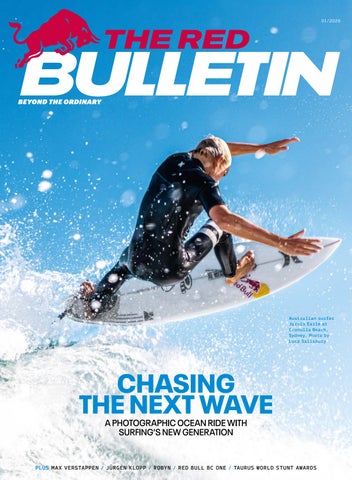
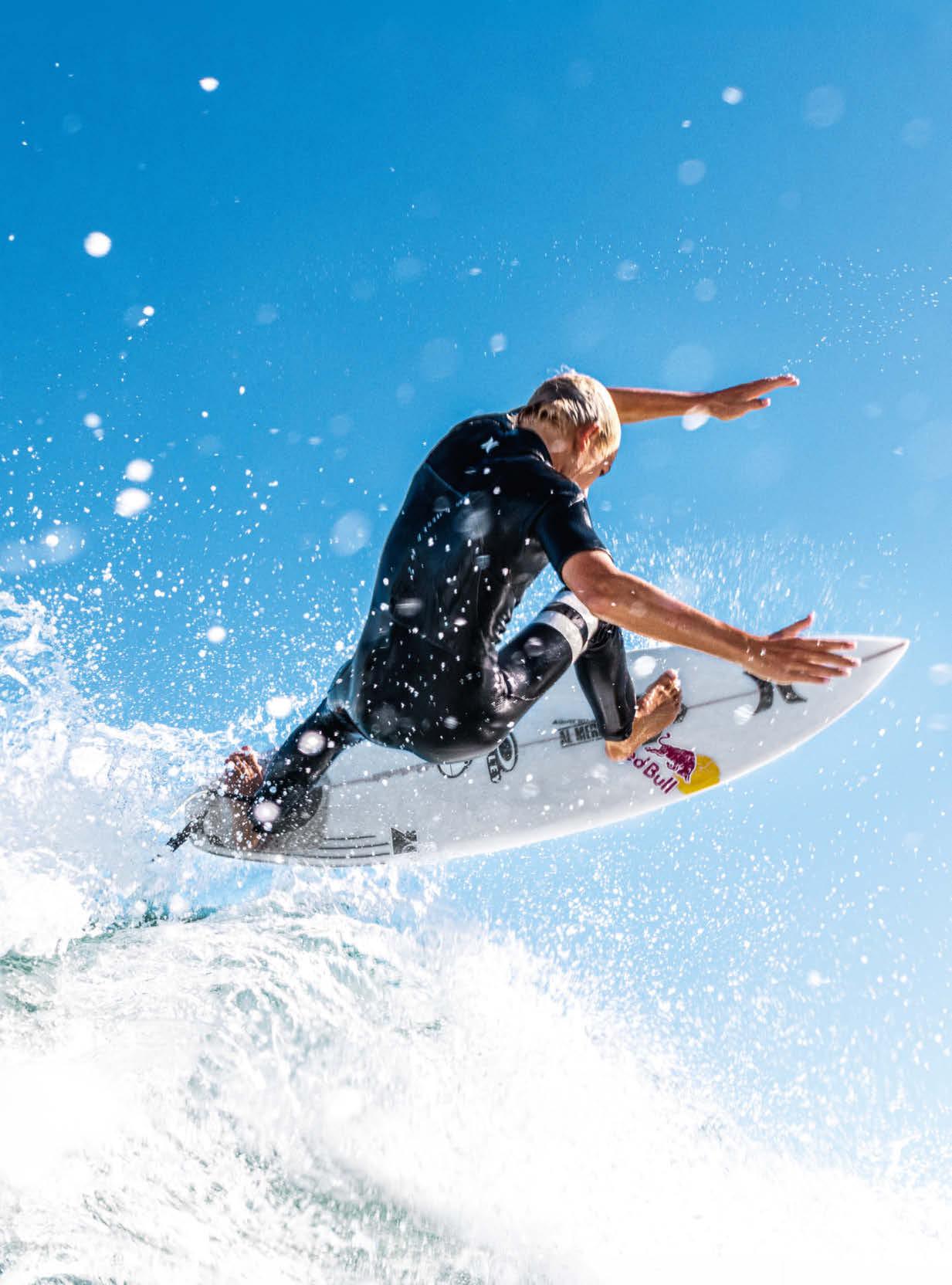
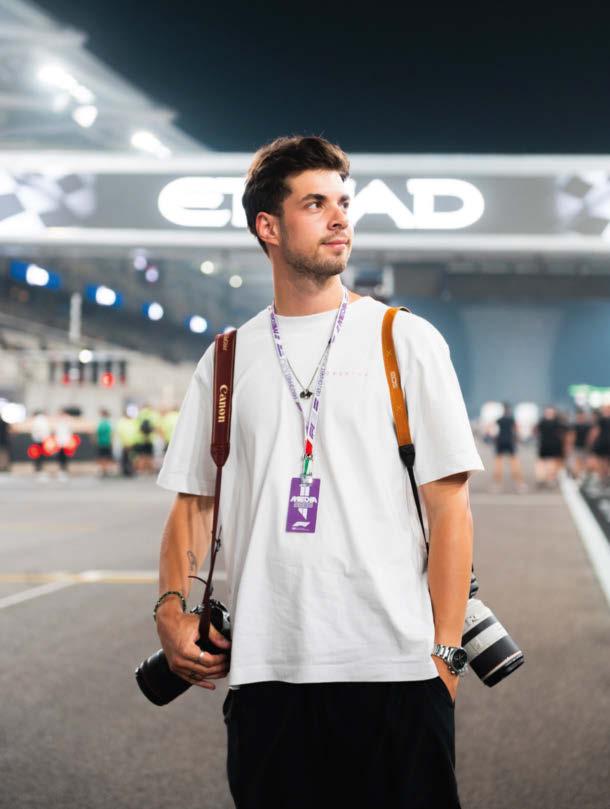
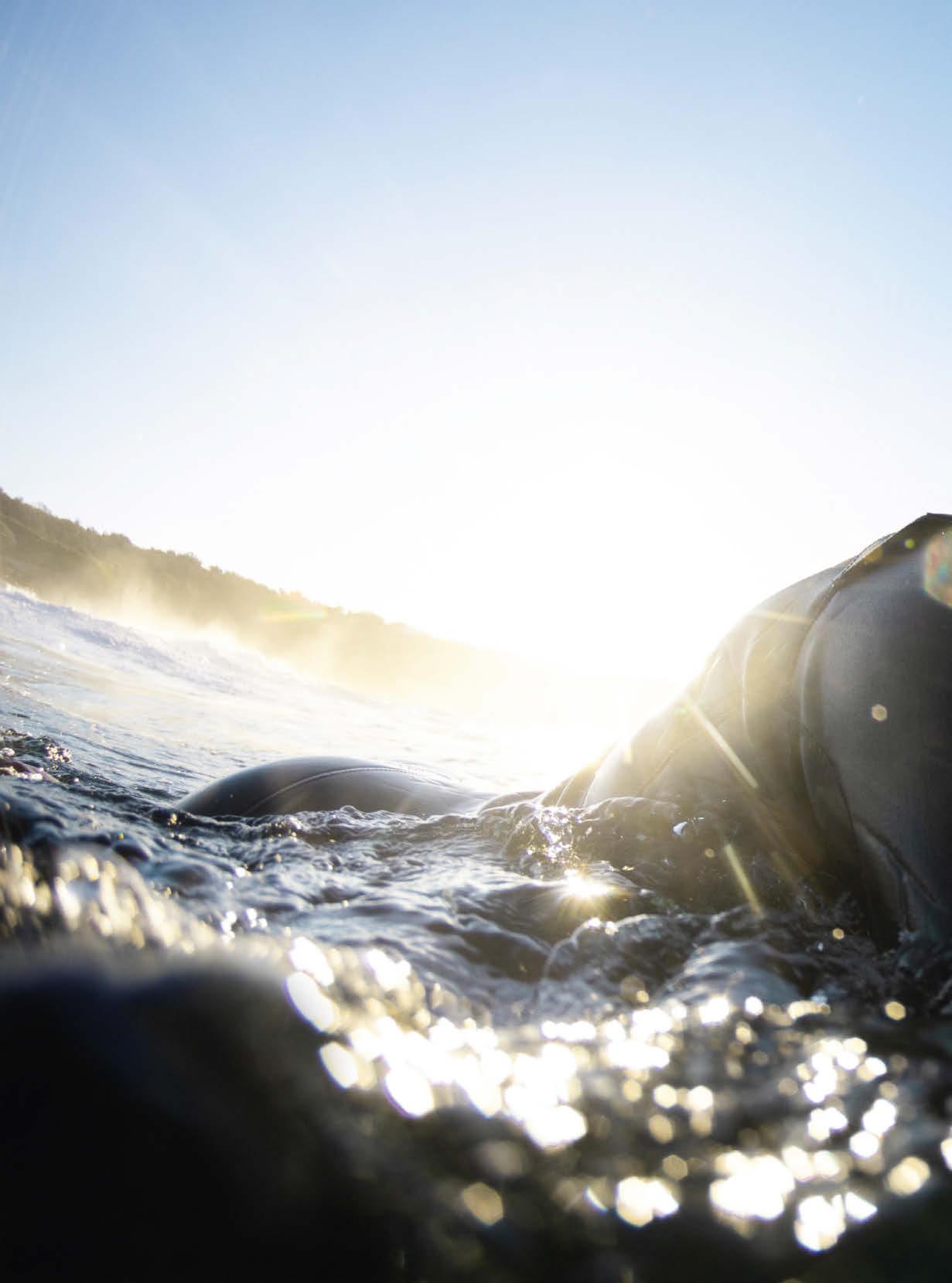
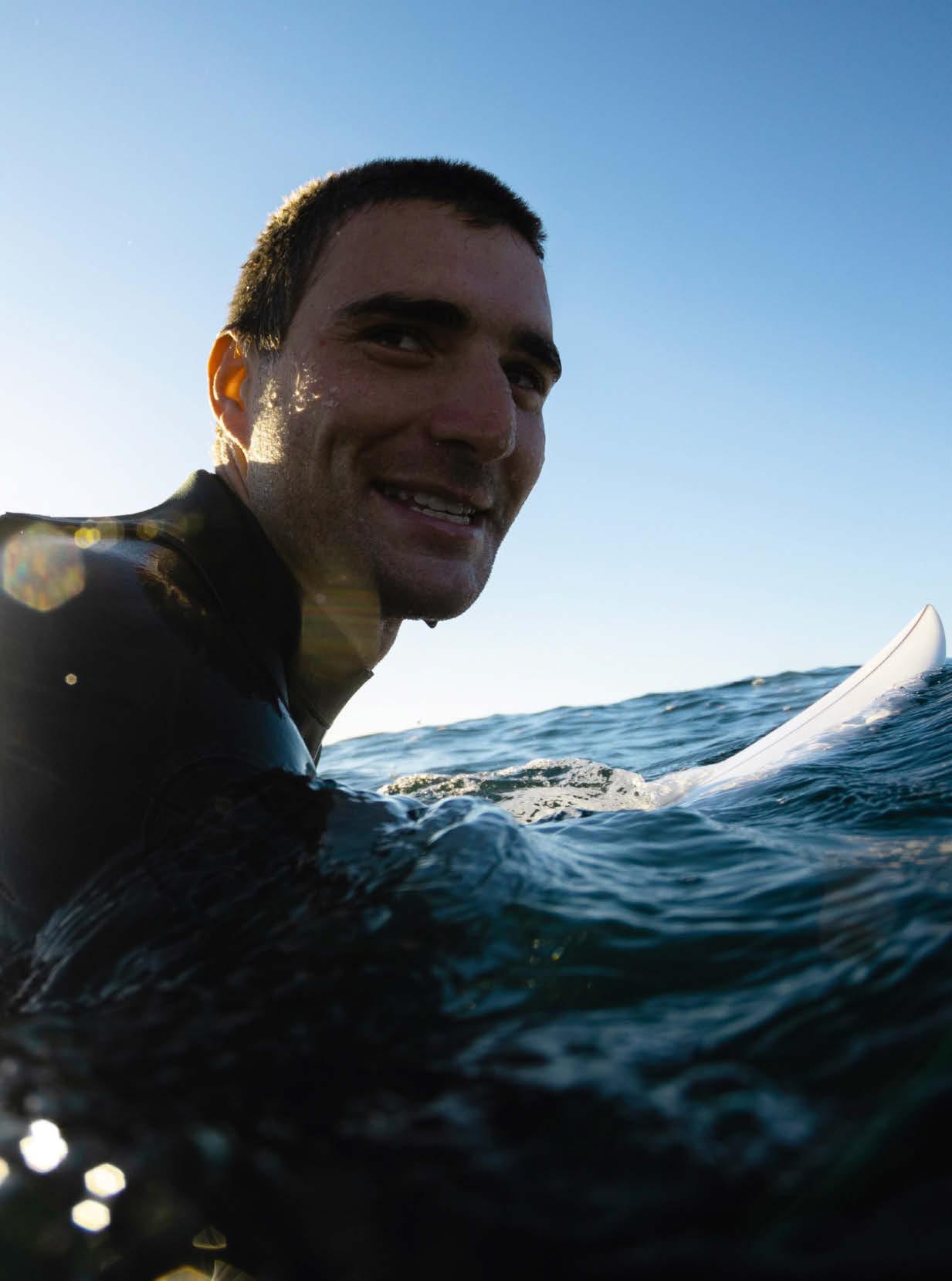
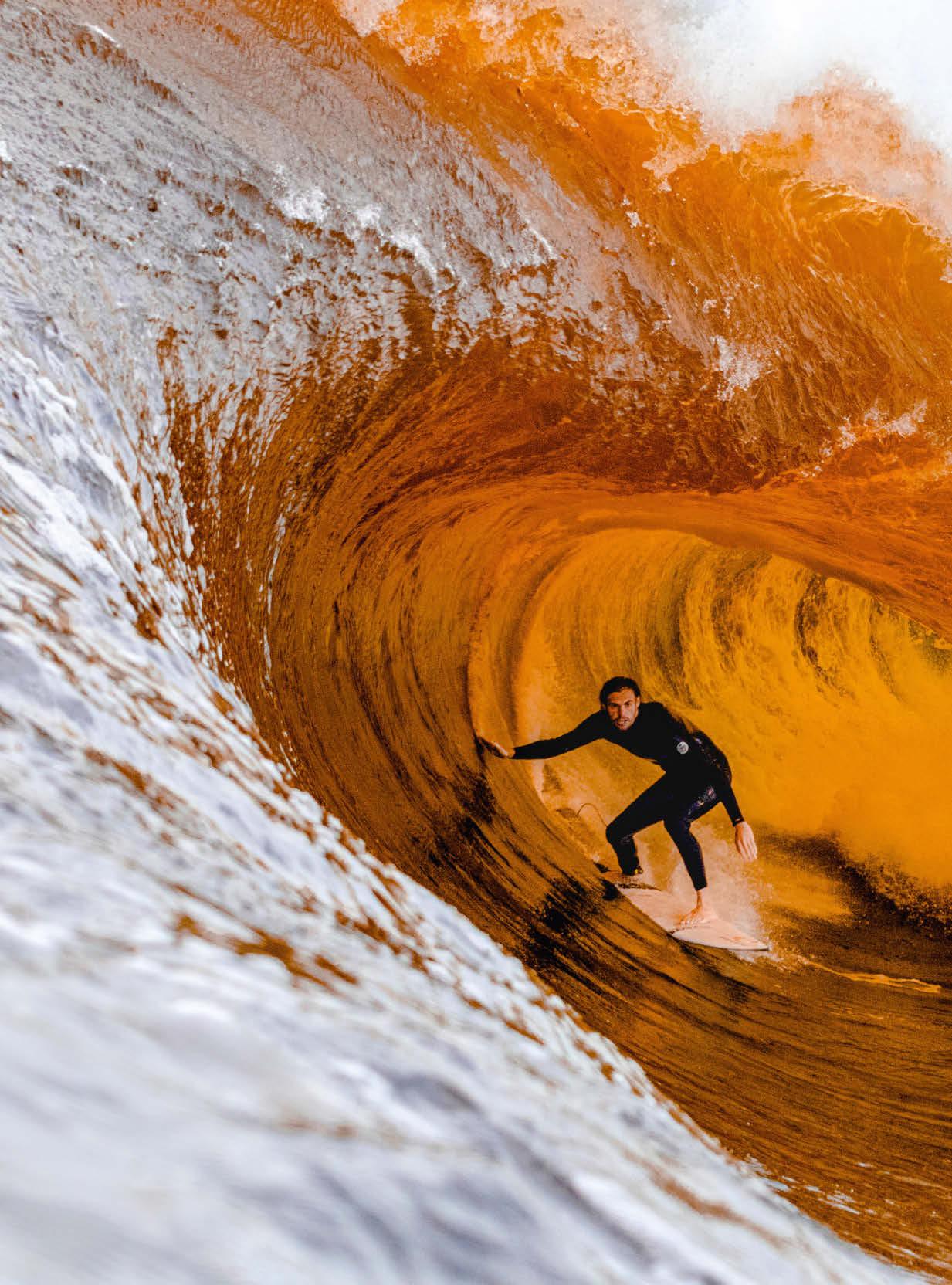
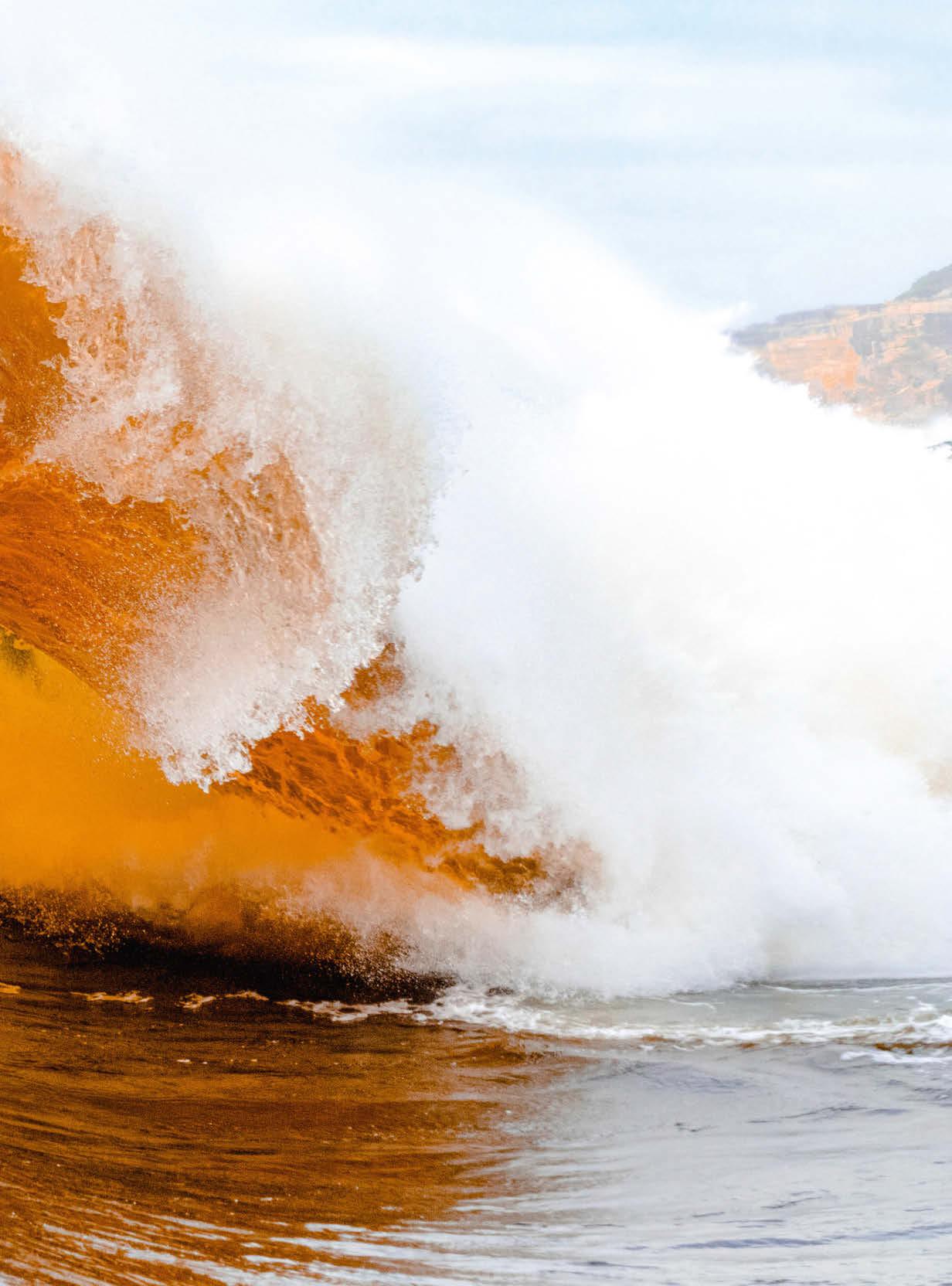
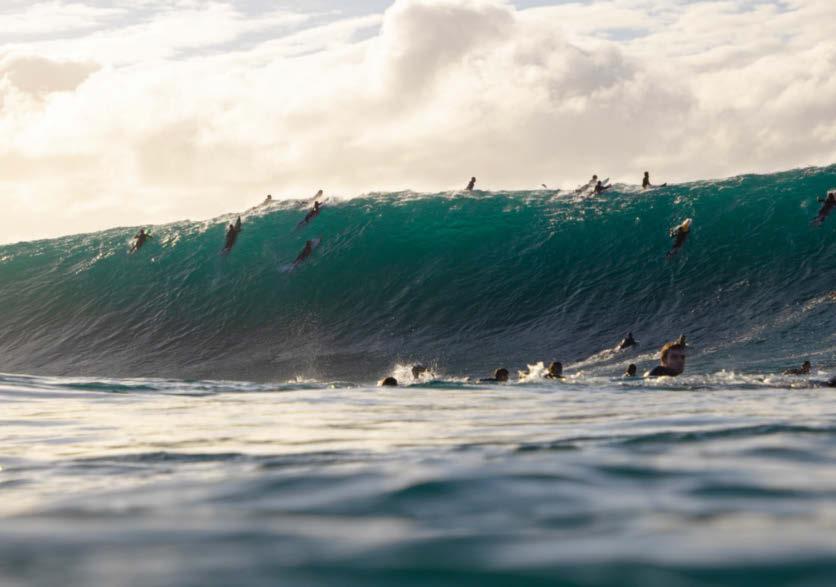
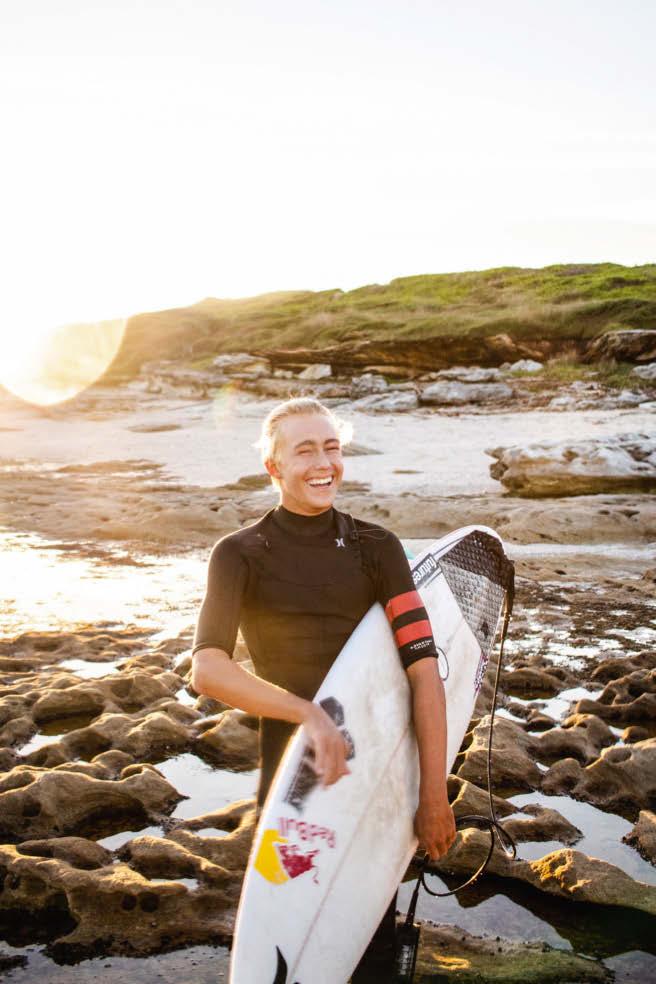
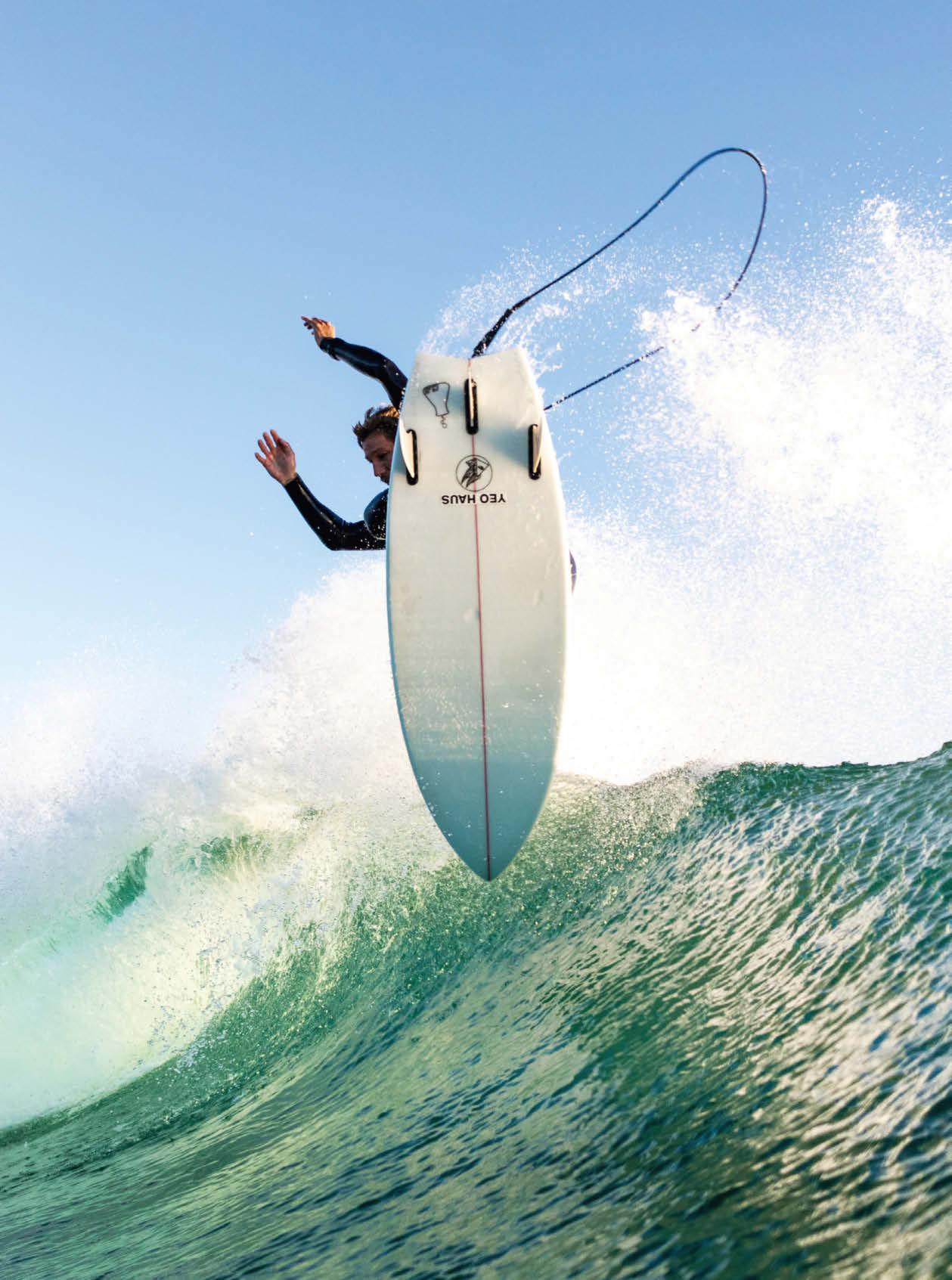
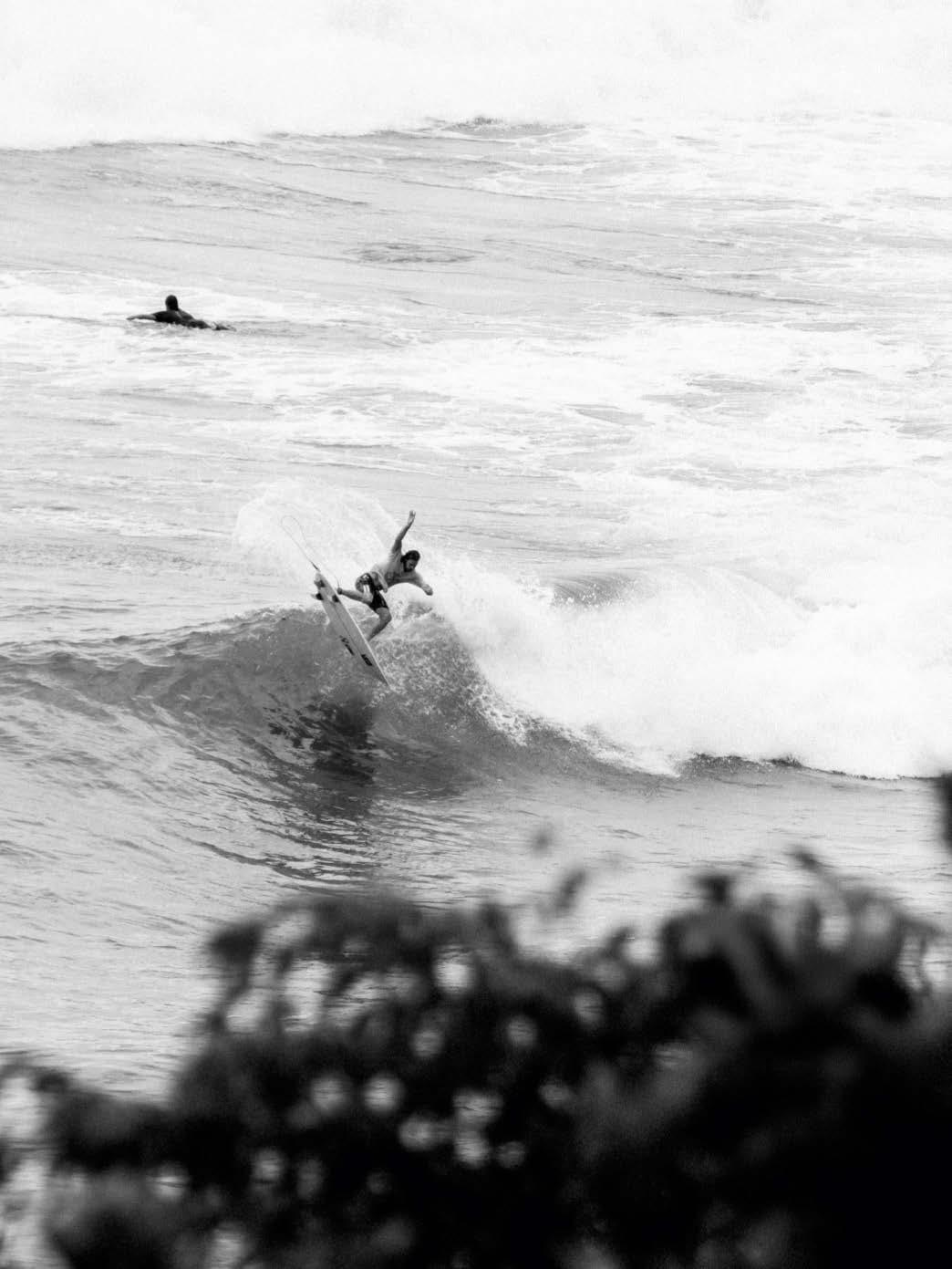
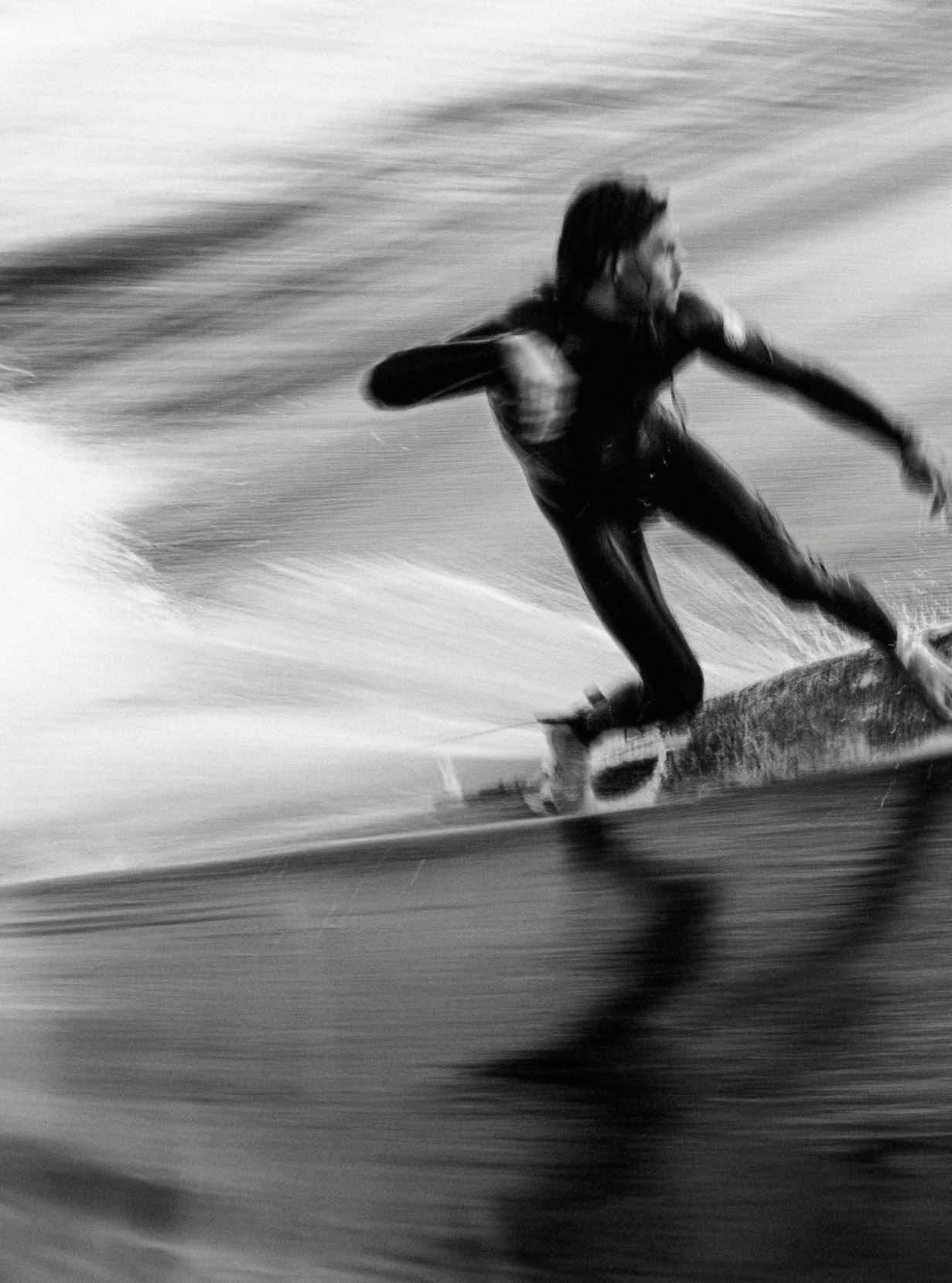
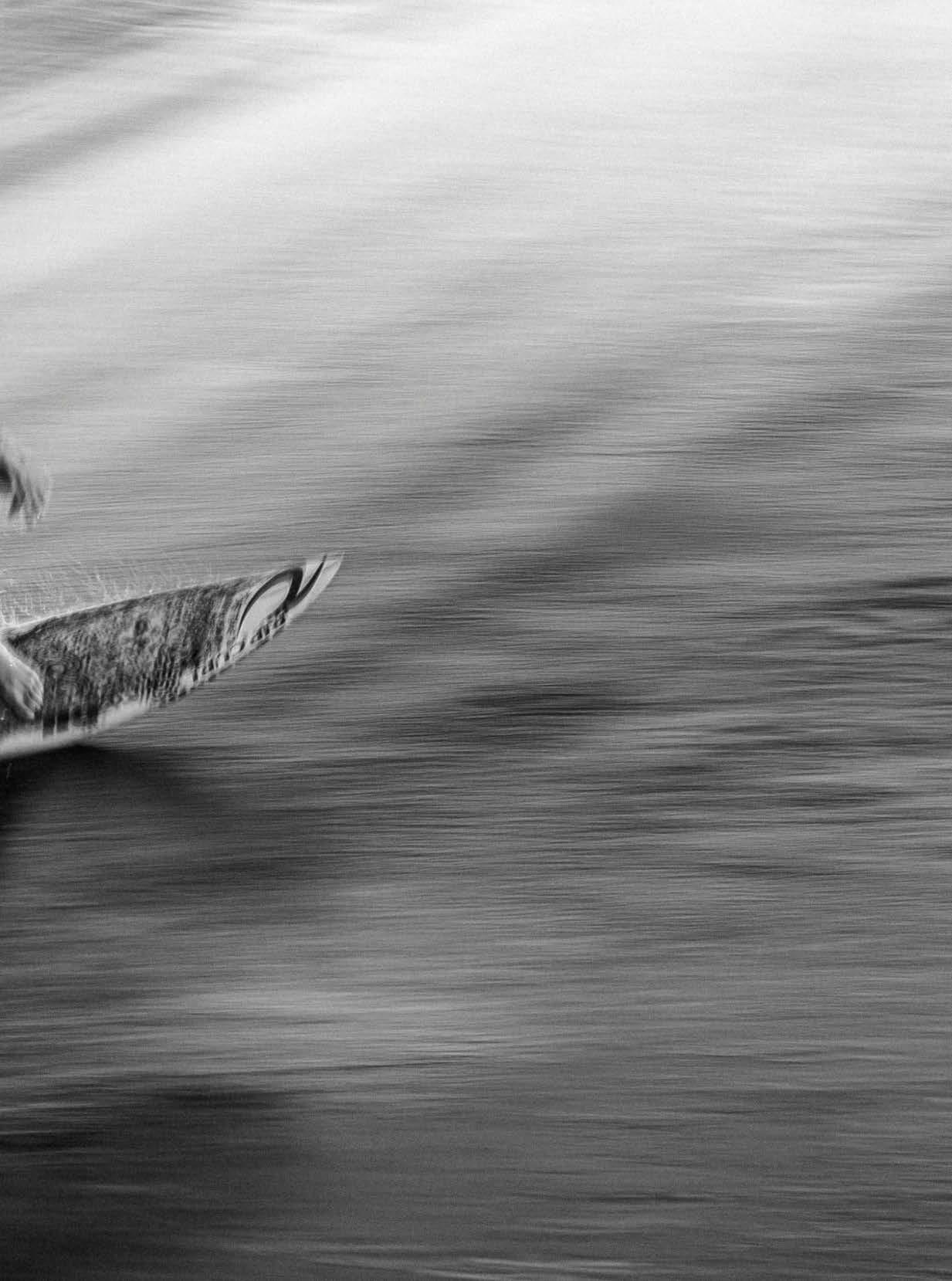
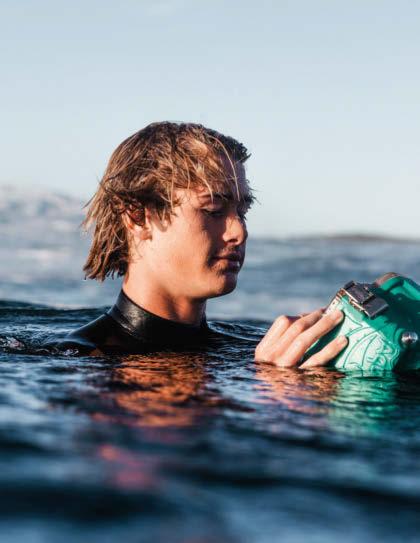
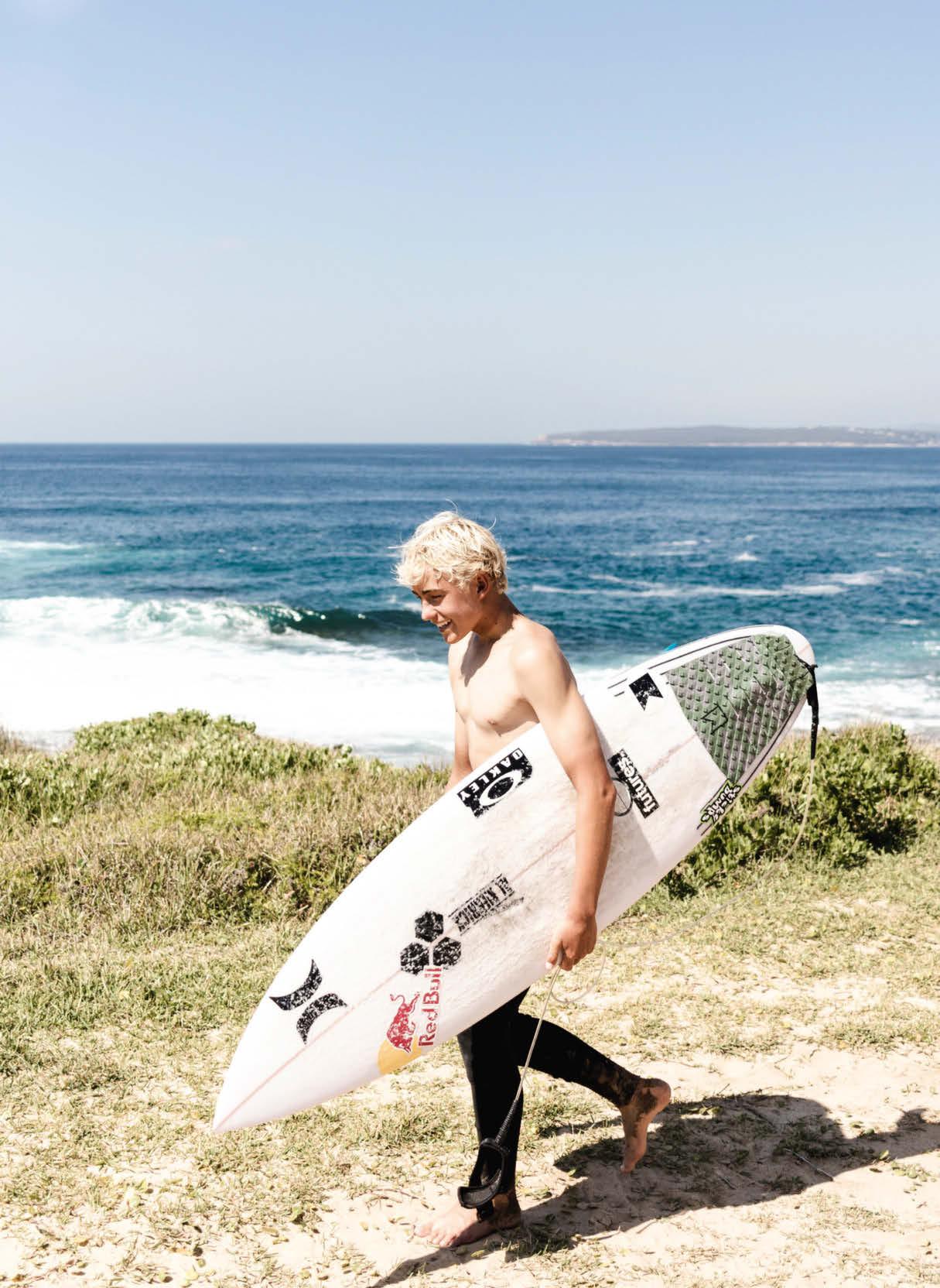
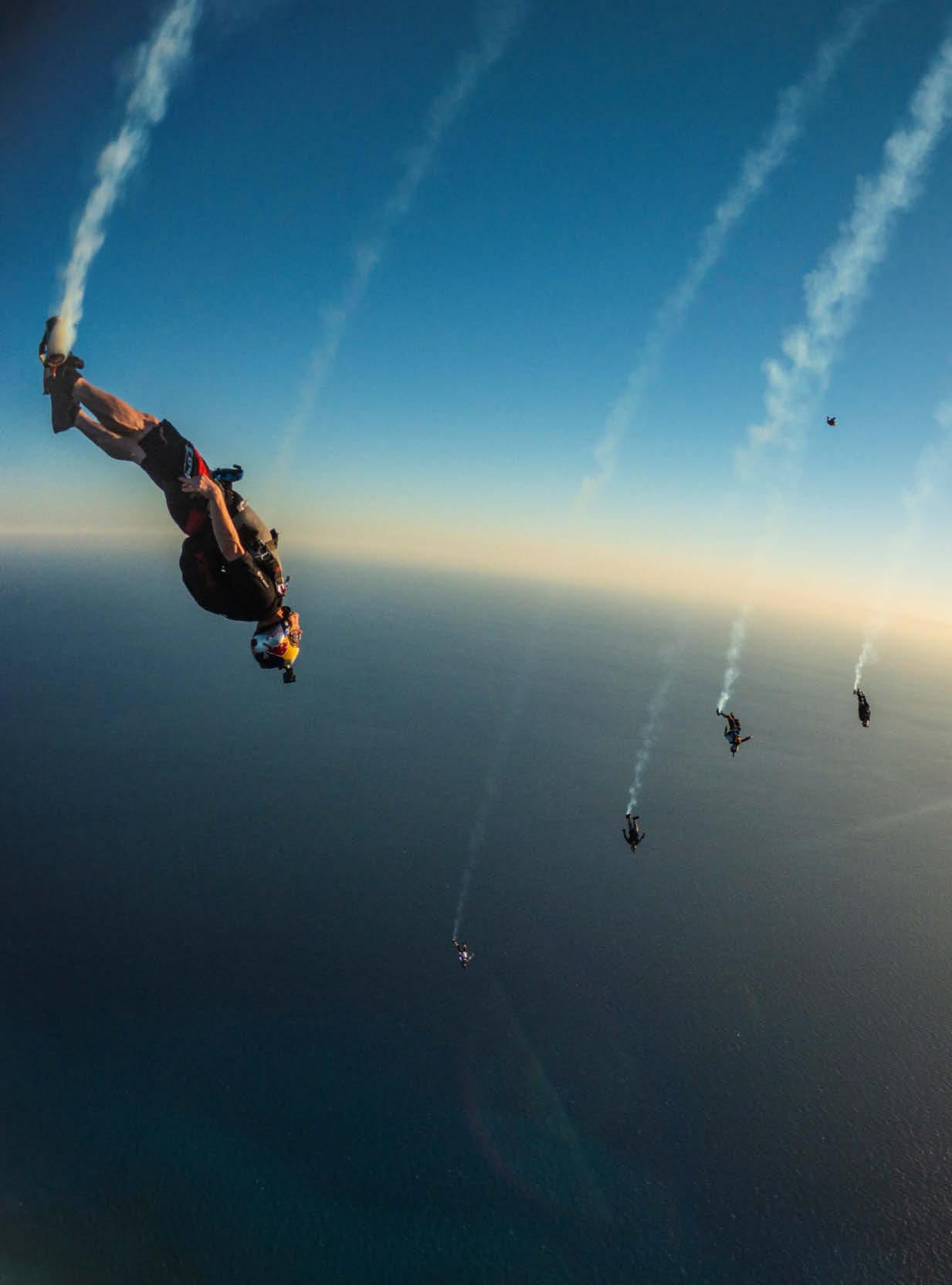
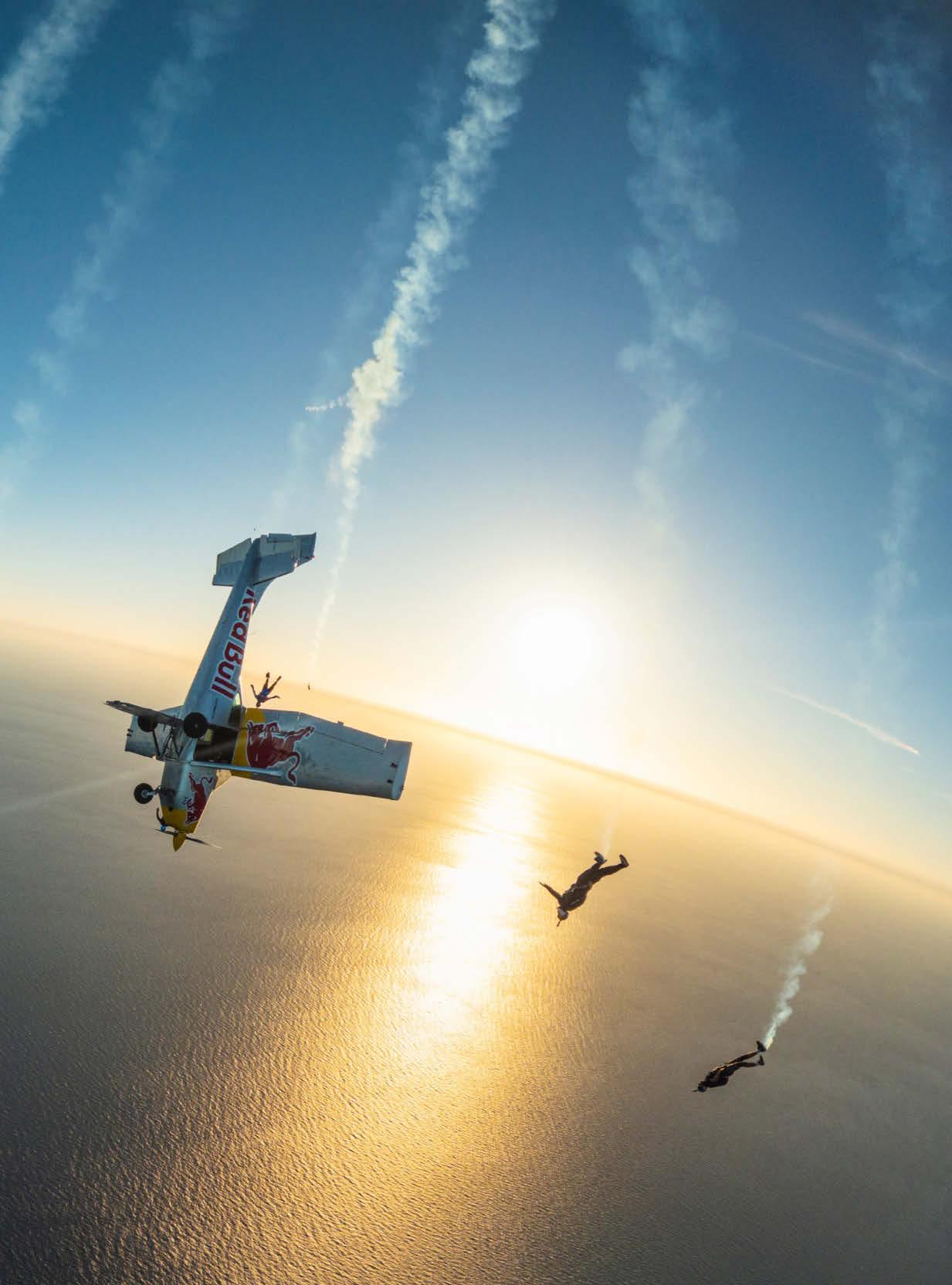
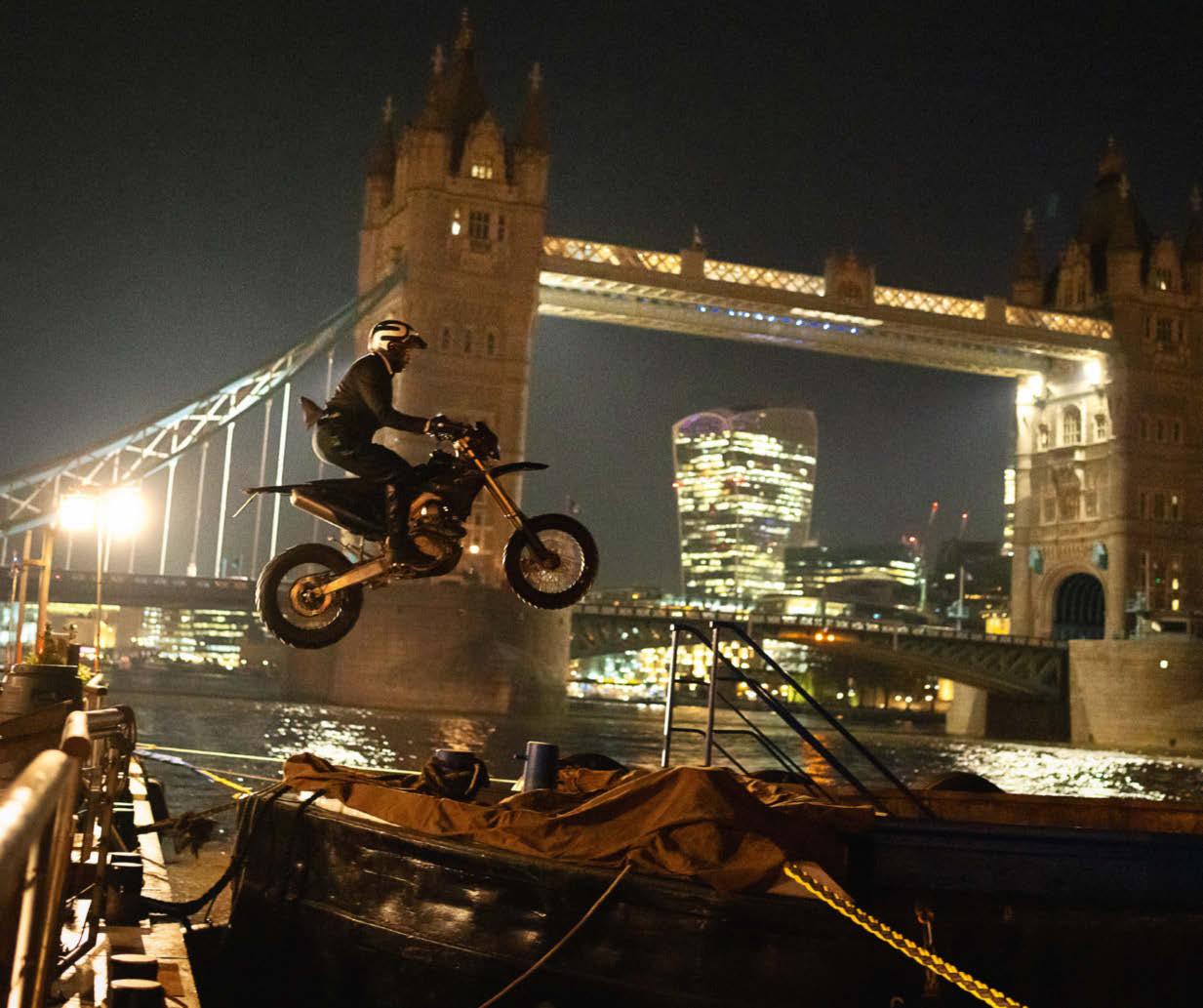
Australian surfer Jarvis Earle at Cronulla Beach, Sydney. Photo by Luca Salisbury
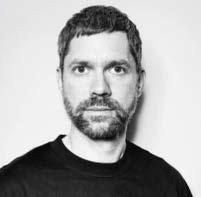
Peter Strain
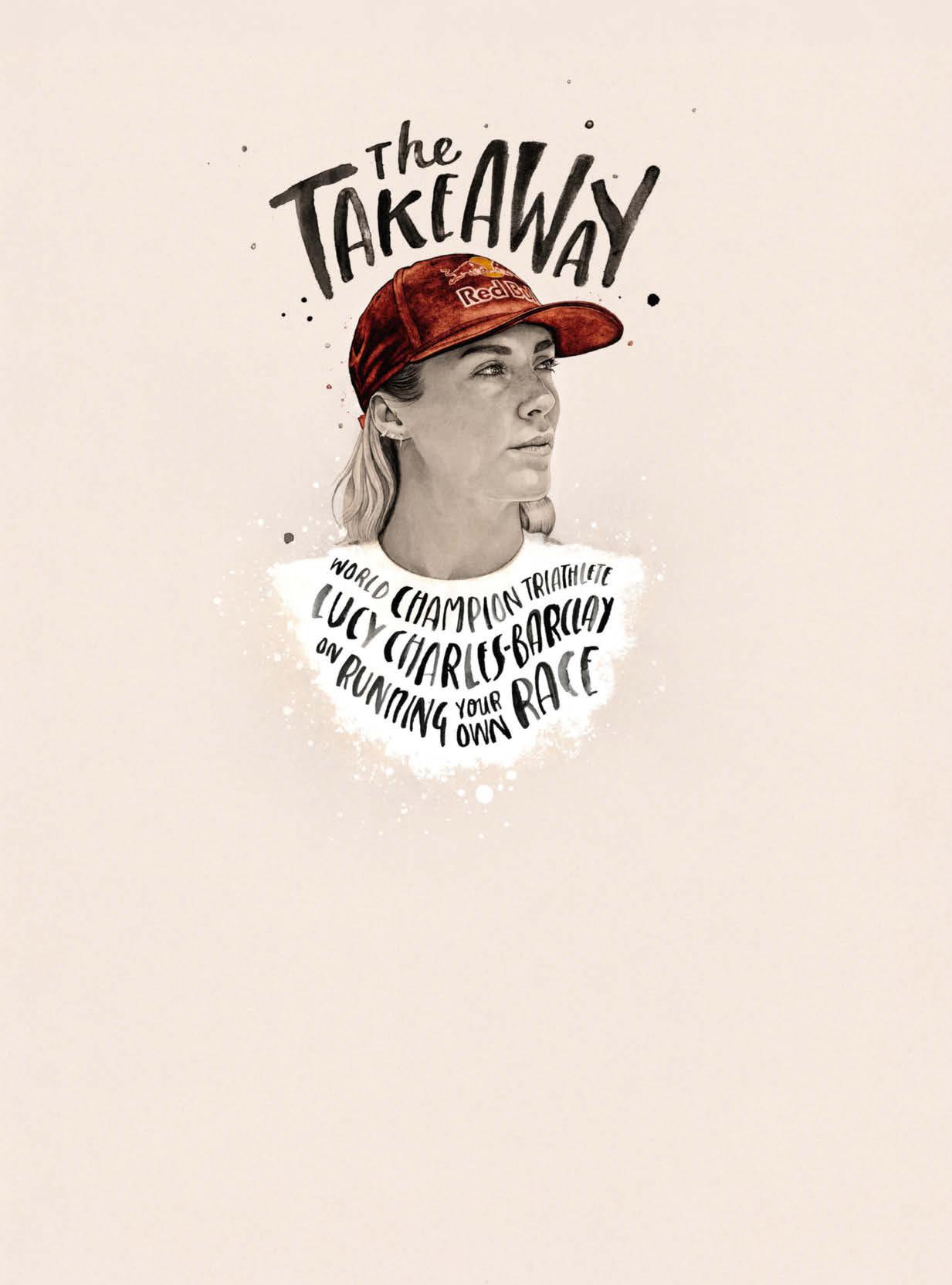
The award-winning Belfast illustrator hand-inked our last page, which features triathlete Lucy CharlesBarclay. “I love that with this series I can play with type and really focus on the likeness, the textures and shapes created by the subject’s pose,” Strain says.
Jessica Holland
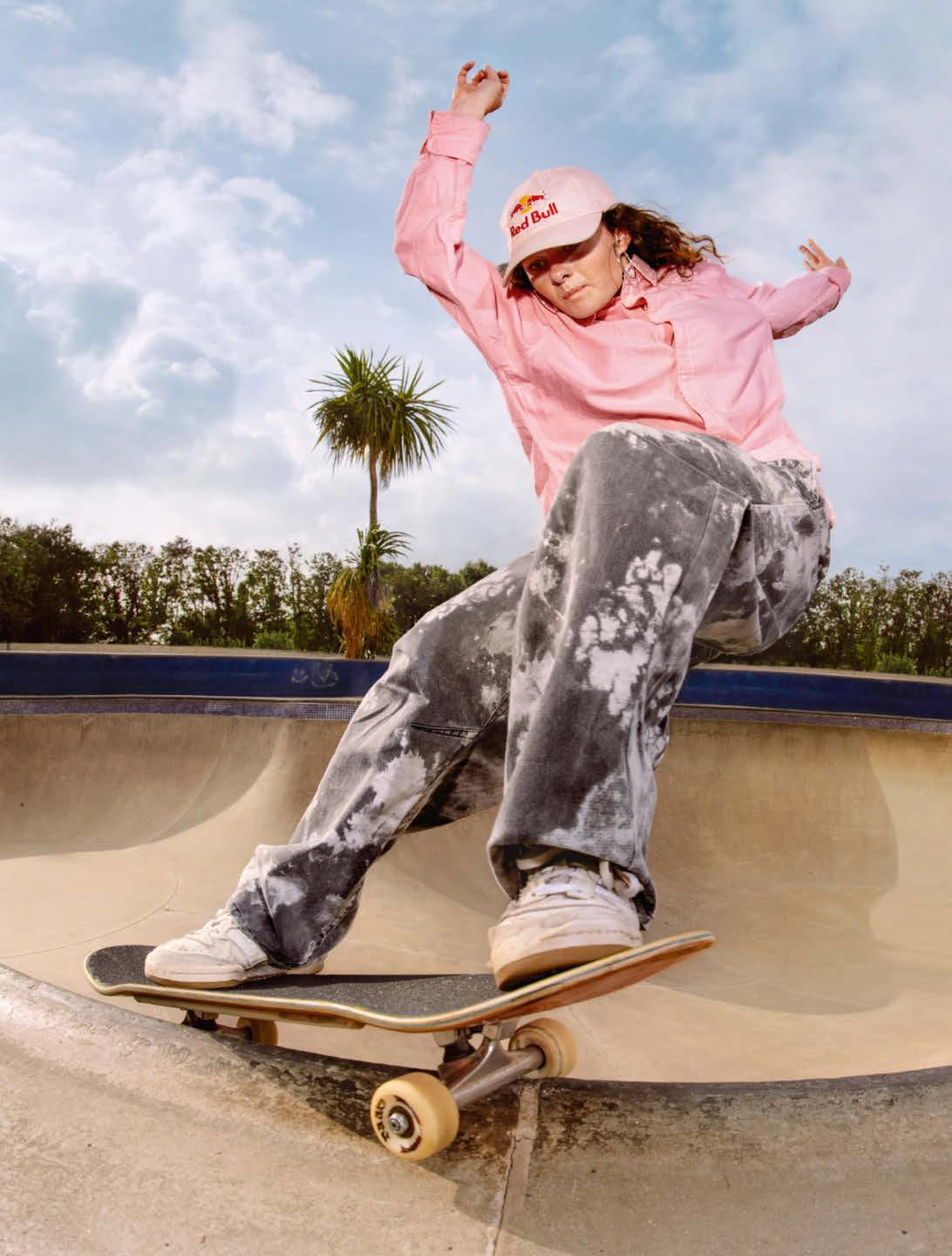
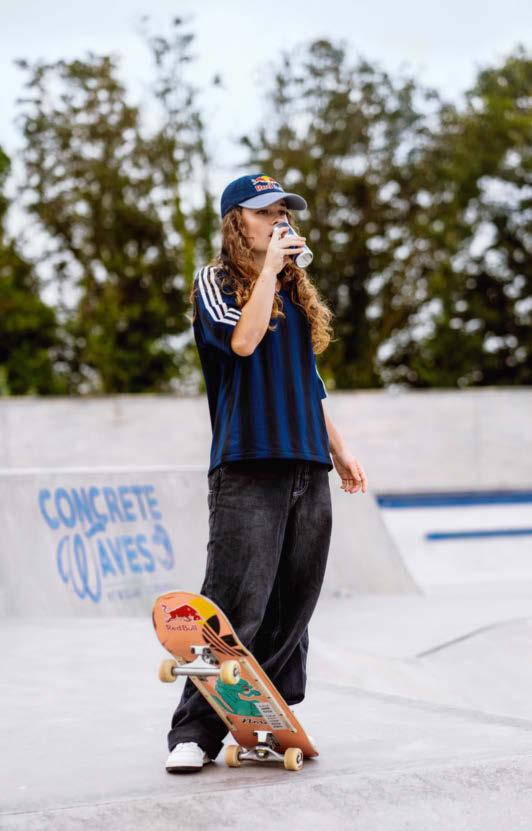
The skate-loving writer relished the chance to meet skateboarder Lola Tambling. “It was exciting to meet someone pushing women’s skateboarding forward in the UK,” she says. “It shed light on how Lola’s achieved so much – with passion, positivity and support.”
Norman Konrad
Enjoy the issue. EDITOR’S
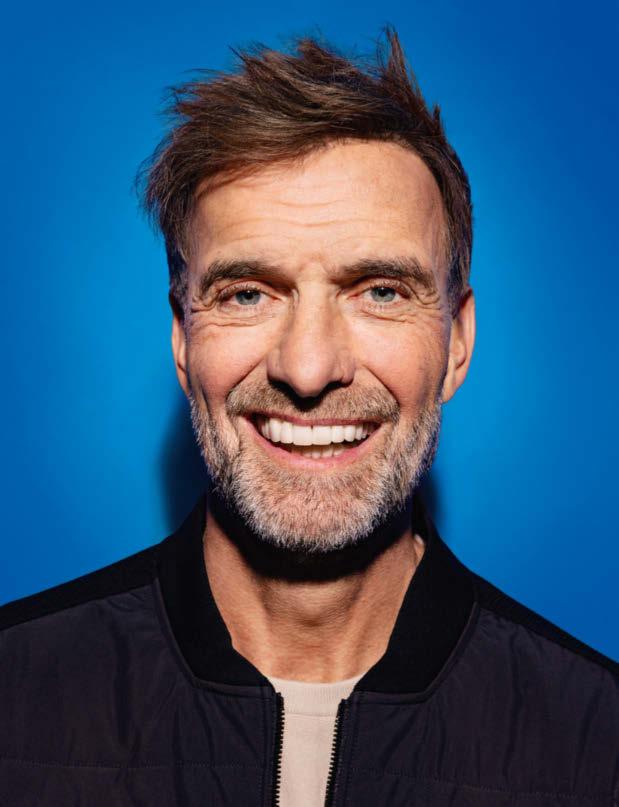
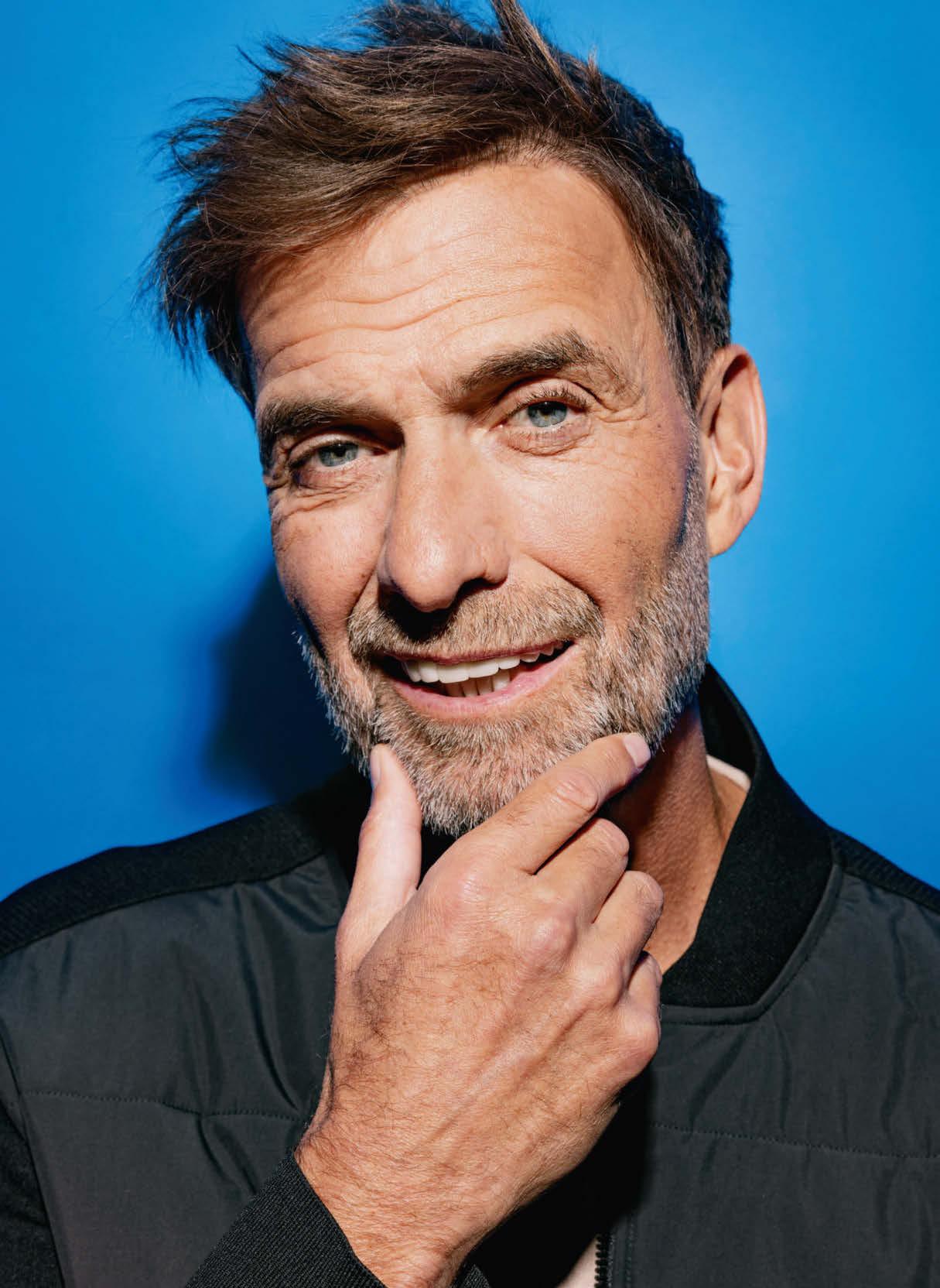
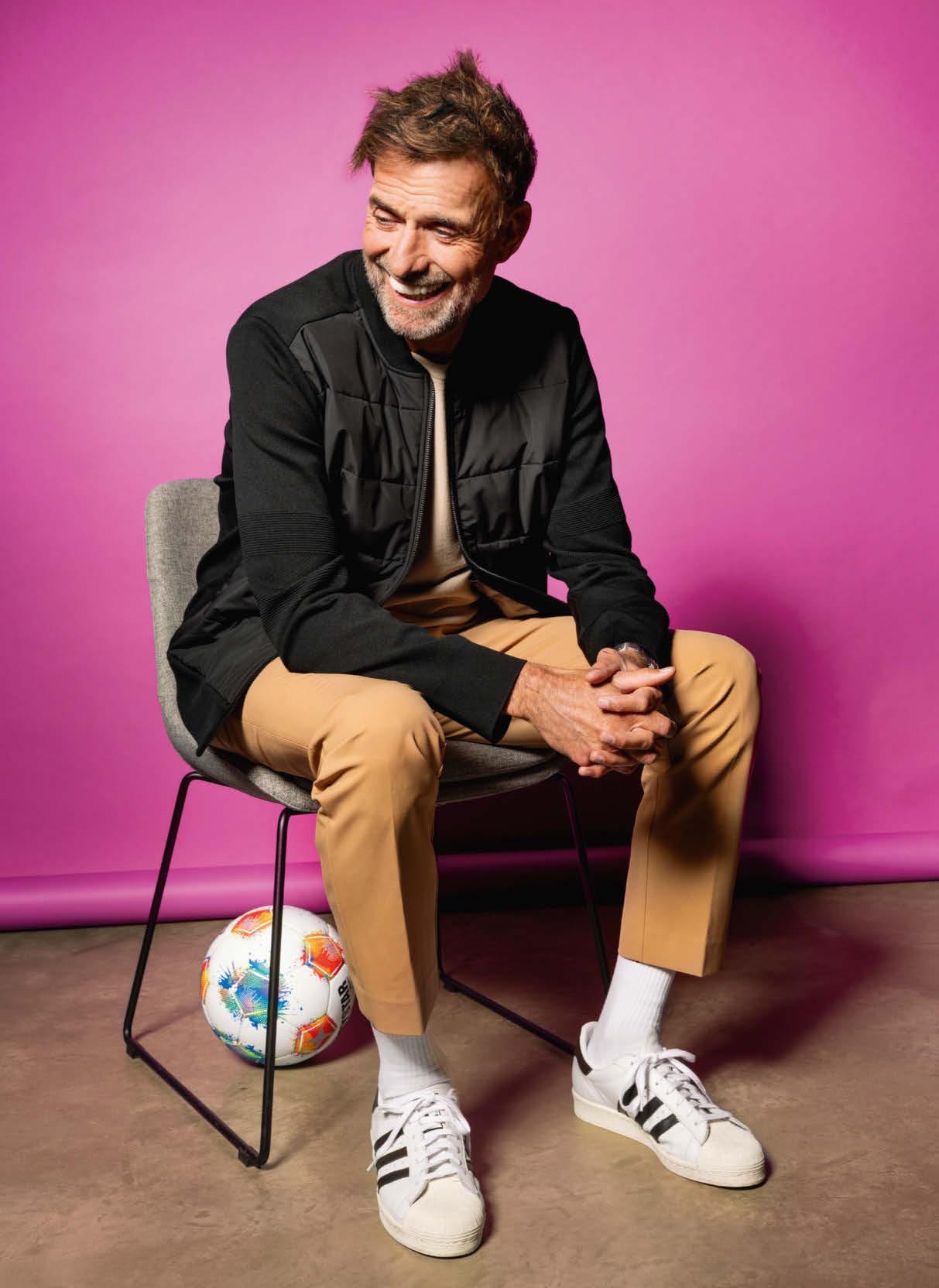
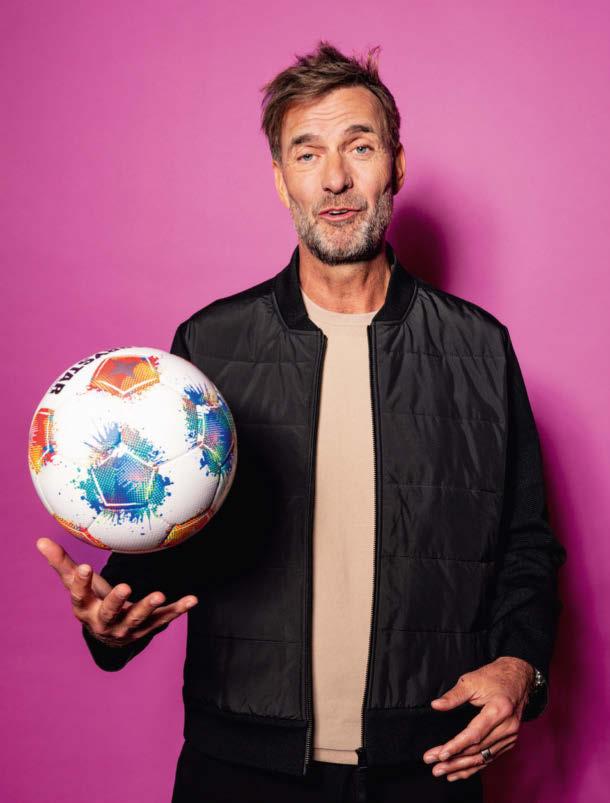
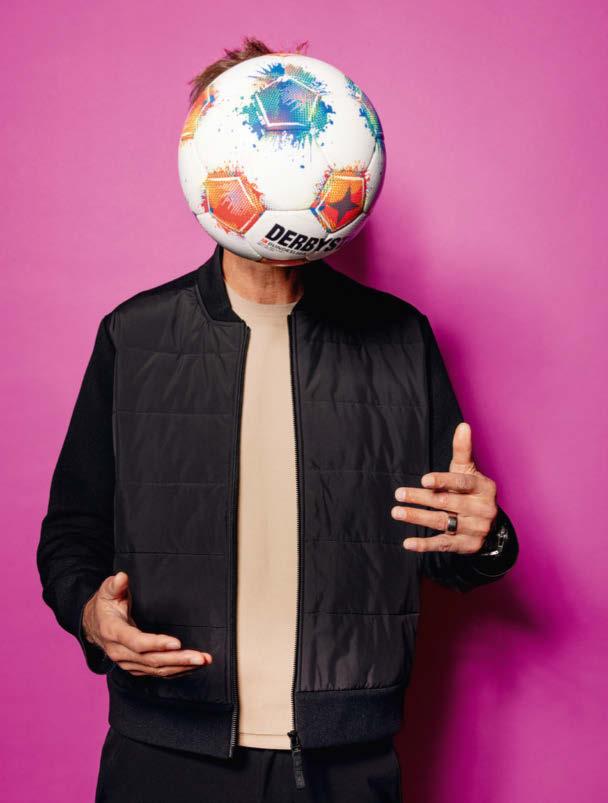
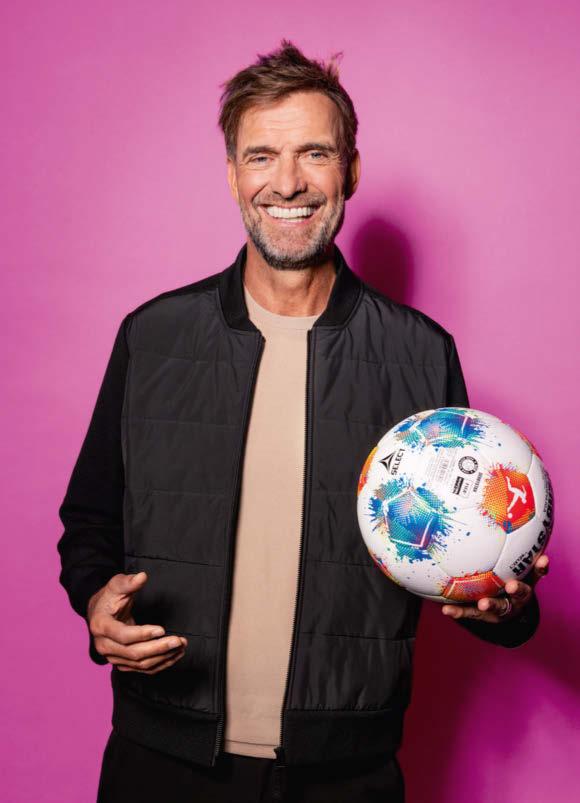
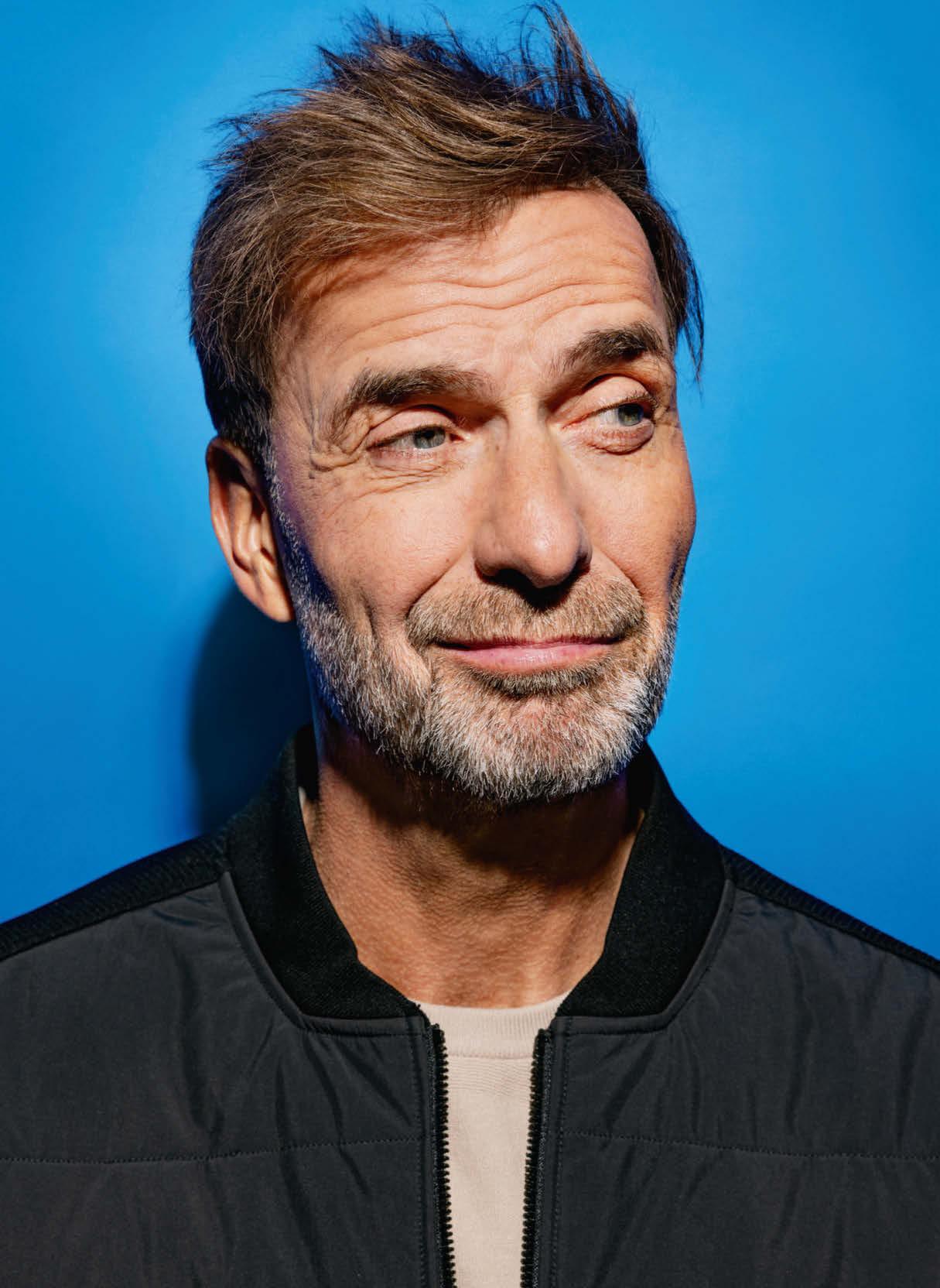
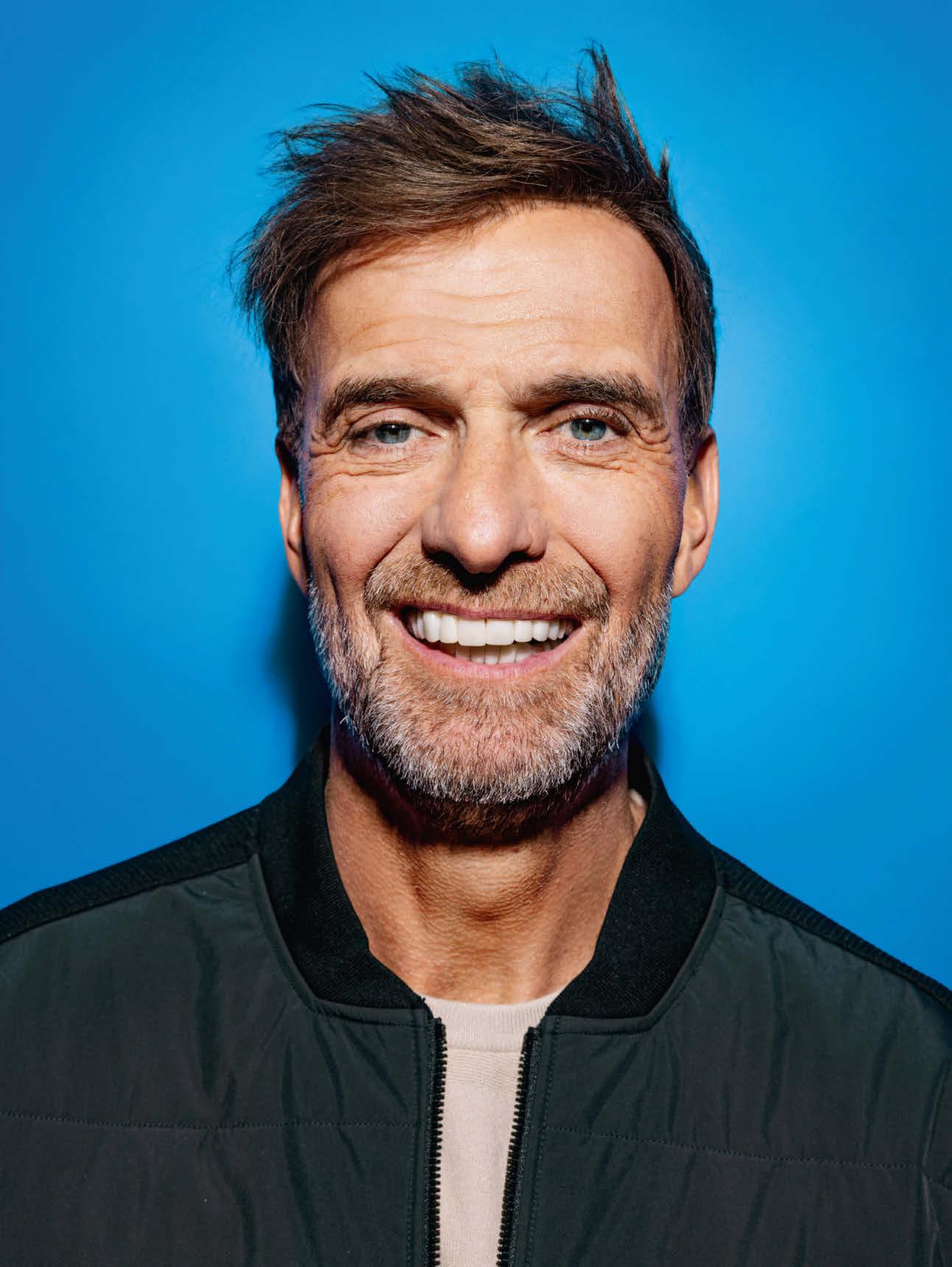
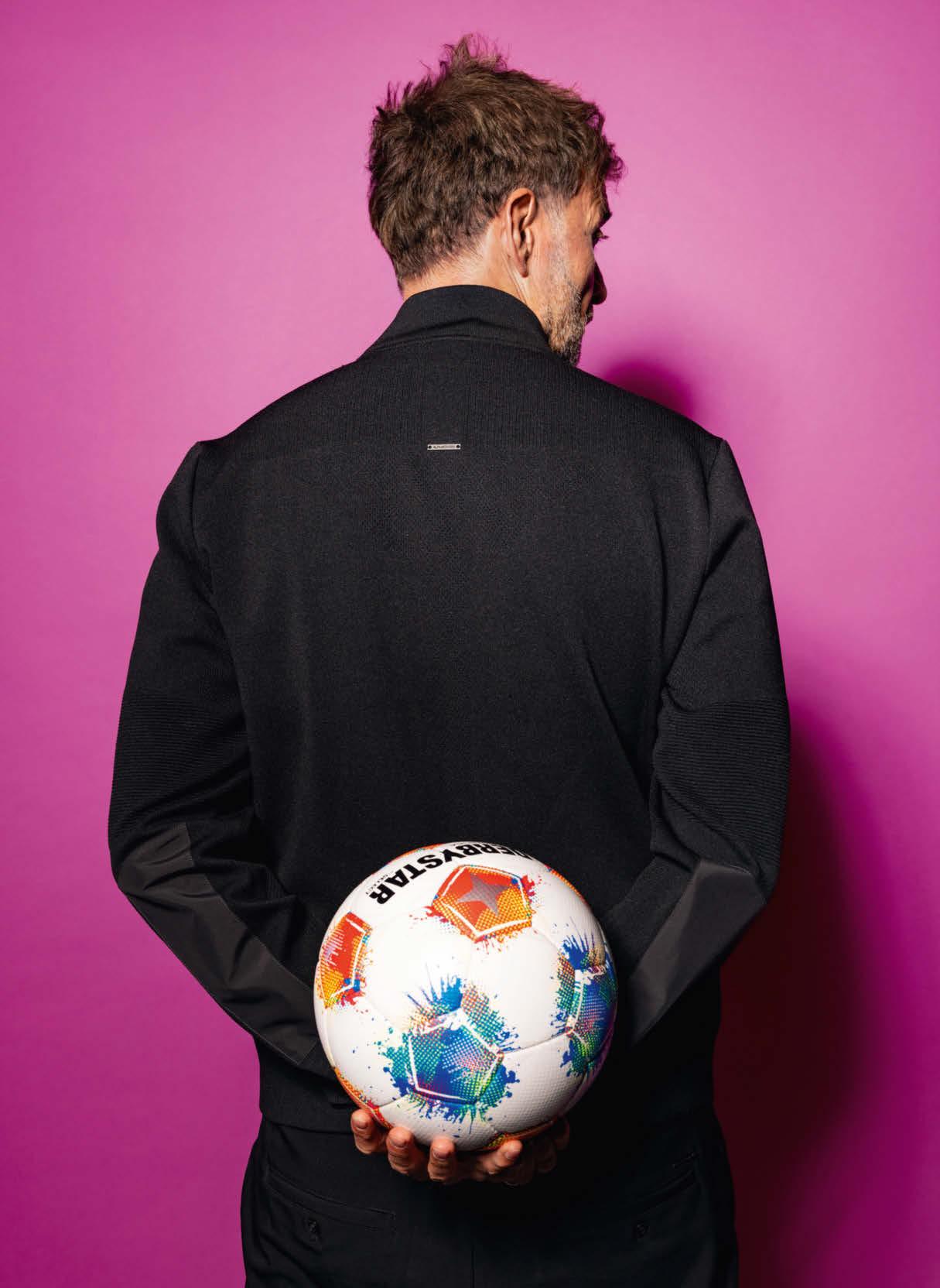
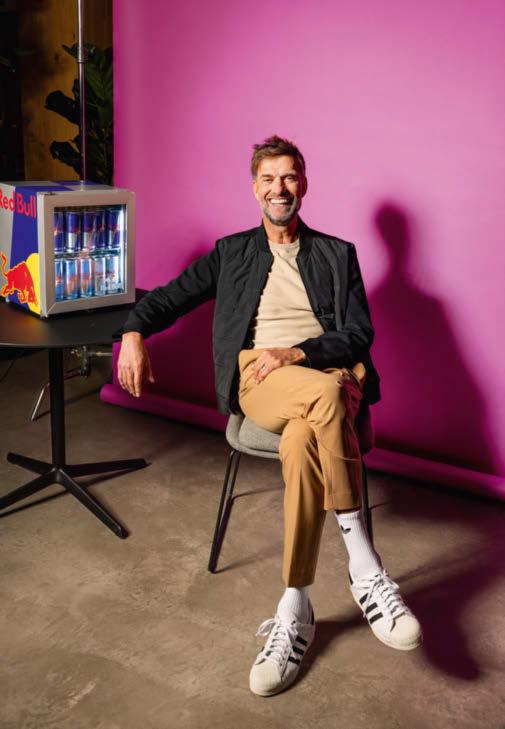
“He has incredible charisma,” says the Berlin-based photographer of shooting Jürgen Klopp. “And he’s authentic. You see him on TV so often, it’s like you already know him. In person, he was exactly the same.”
Adecade. What could you achieve in that time? For Max Verstappen, who made his driving debut for Red Bull Racing 10 years ago, the answer is “plenty”. In his first race for the team, aged 18, he became the youngestever F1 grand prix winner. Today, he’s a four-time world champion.
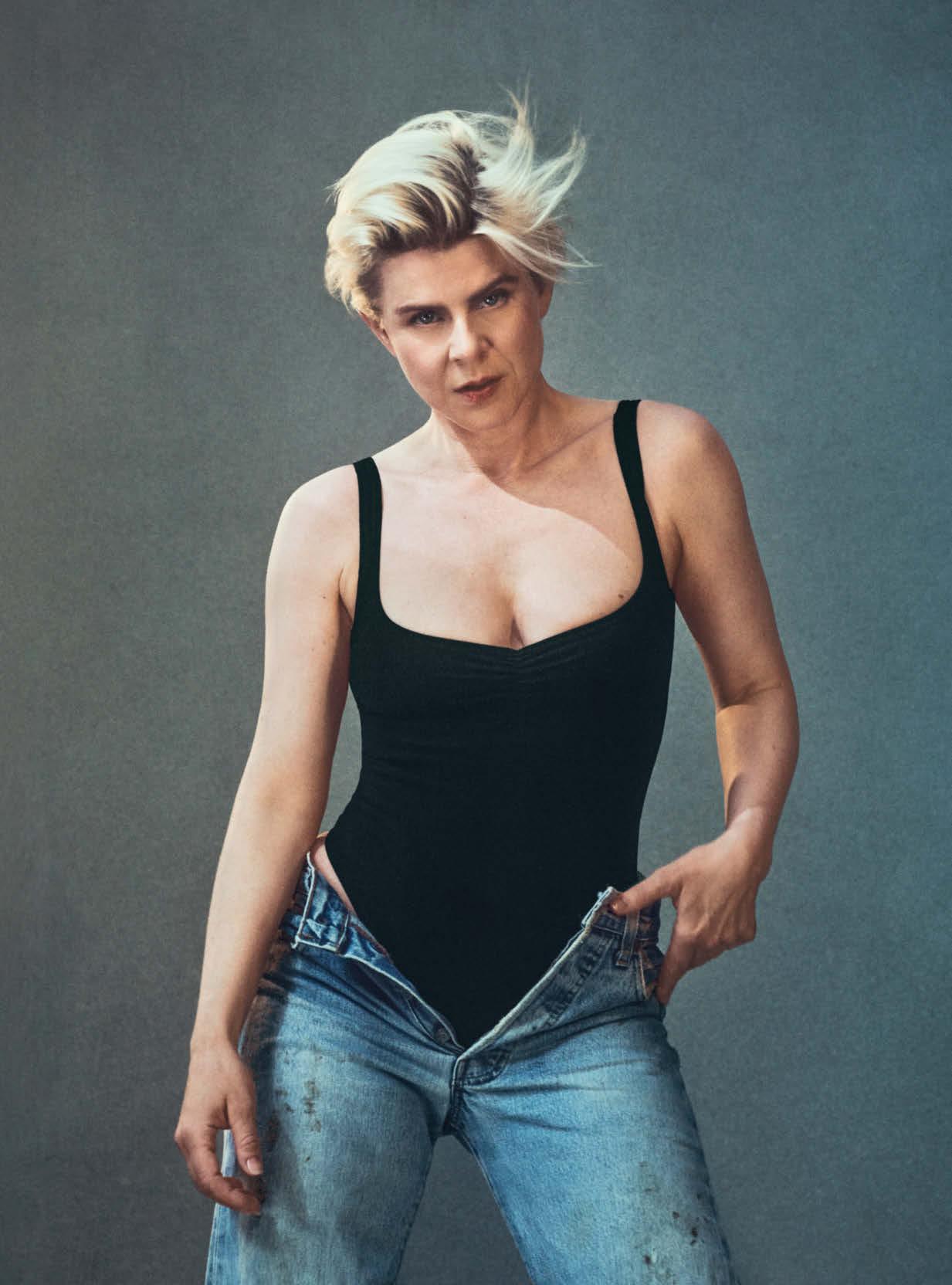
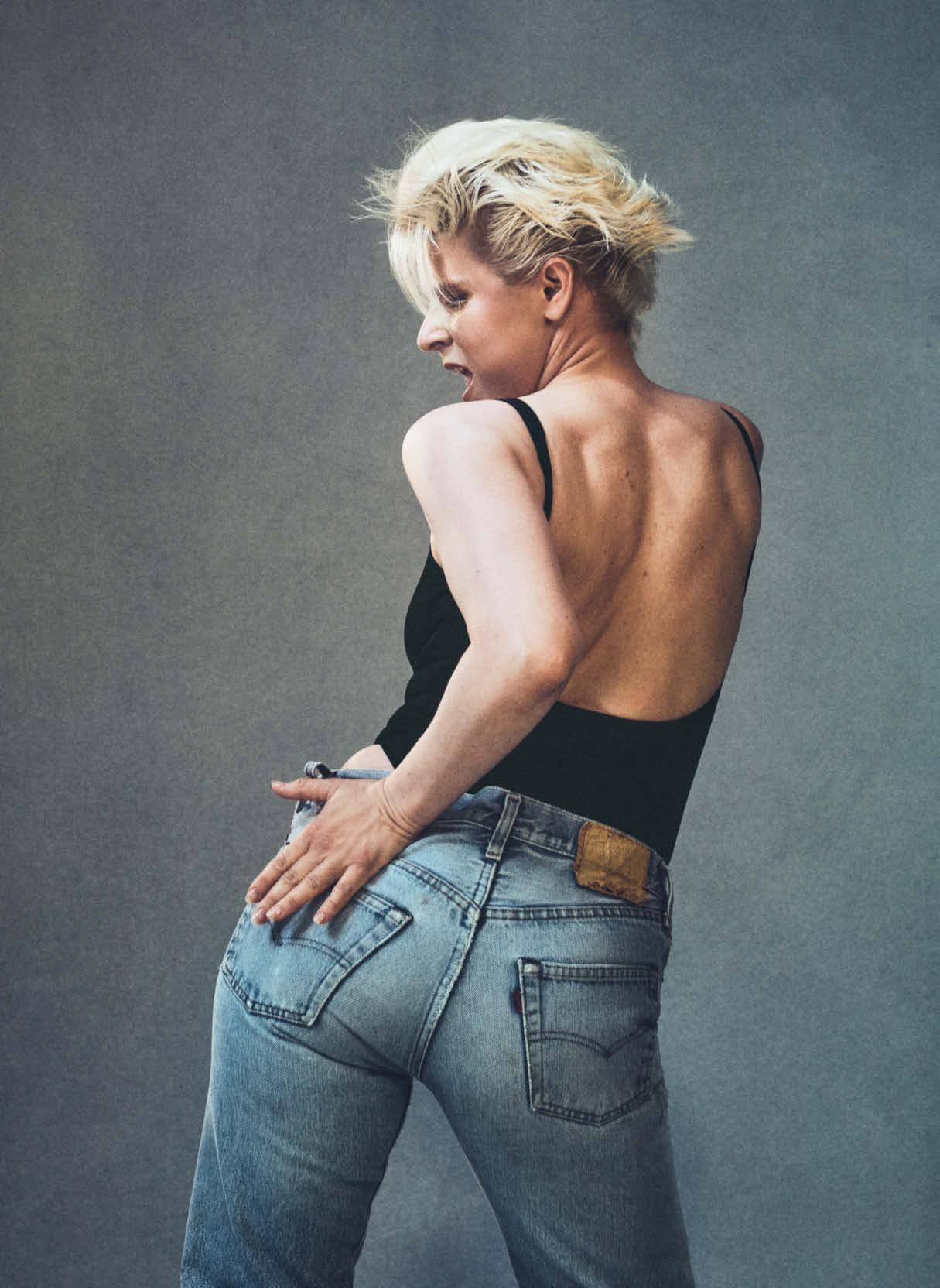
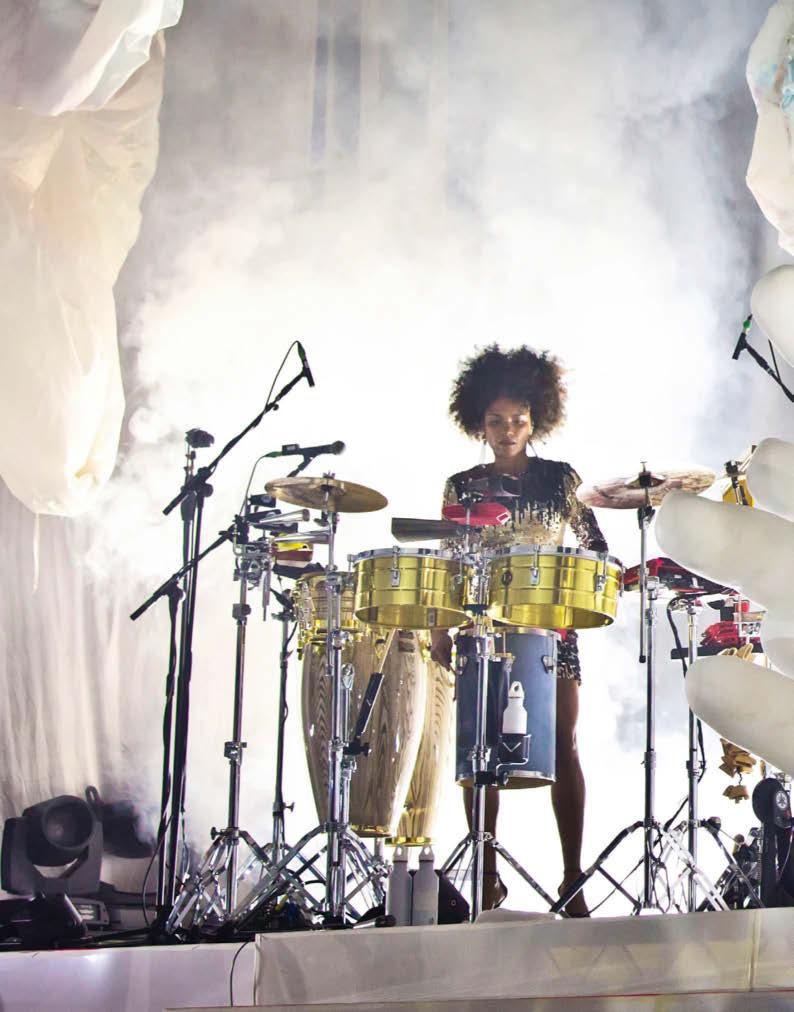
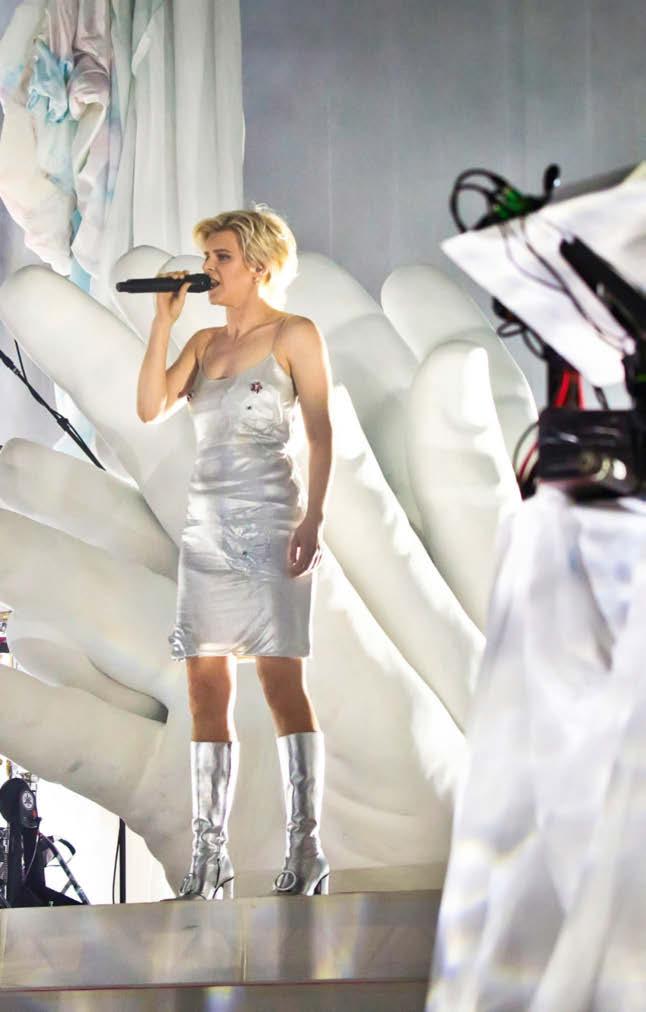
The passage of time is a theme that runs through many of the profiles in this issue, from pop queen Robyn embarking on a new world tour after almost four decades in the business, to Jürgen Klopp sharing lessons learned in a quarter-century managerial career that has won him some of football’s biggest trophies.
Then there’s British skateboarder Lola Tambling and Australian surf photographer Luca Salisbury. Aged 18 and 20 respectively, they’re just embarking on their careers. But as the stories in this issue show, all great journeys start somewhere.
legendary football manager on why optimism is the key to success, and pressure is best ignored
Riding on the edge with UK pro skater Lola Tambling
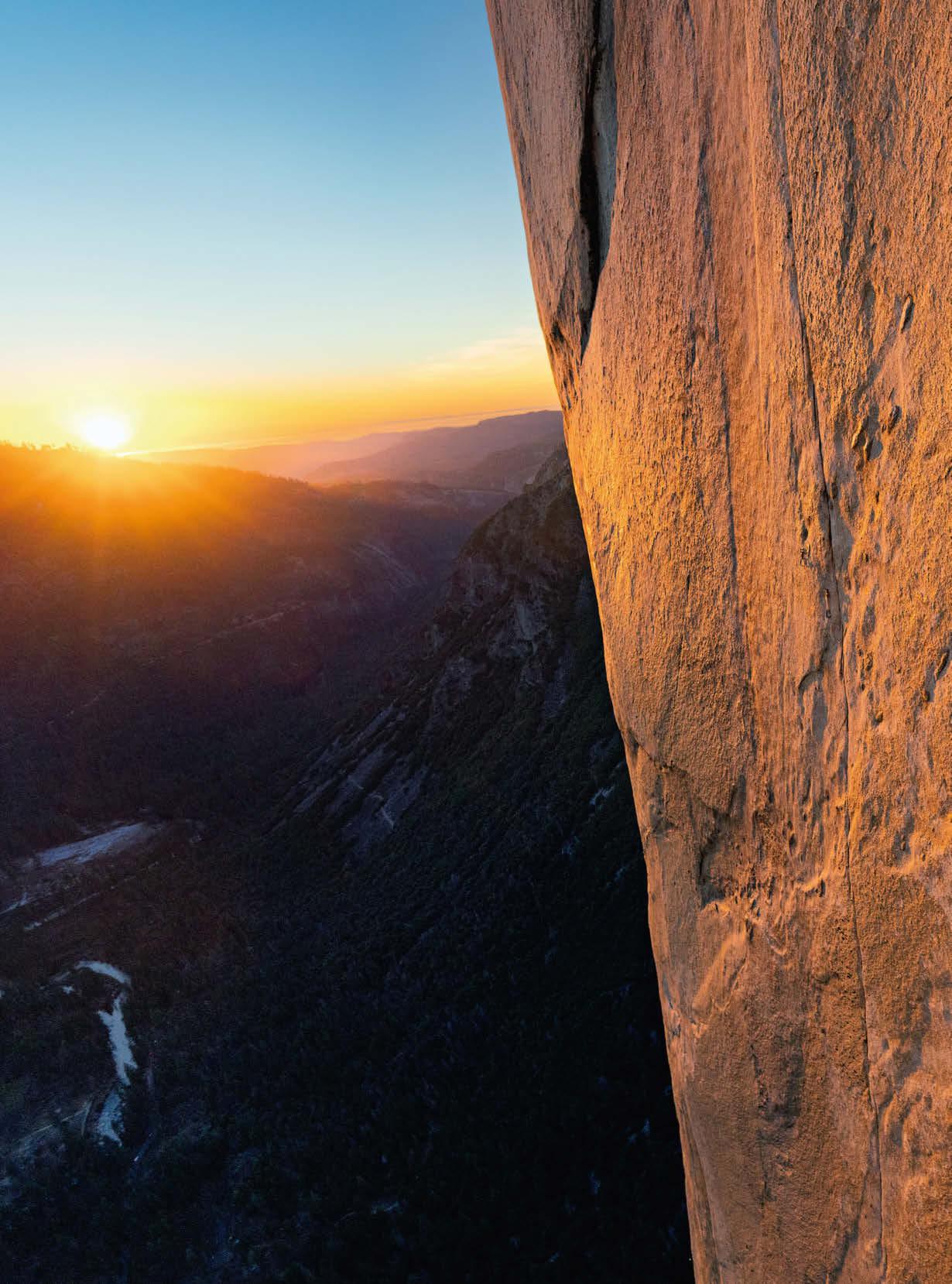
Yosemite, California, USA
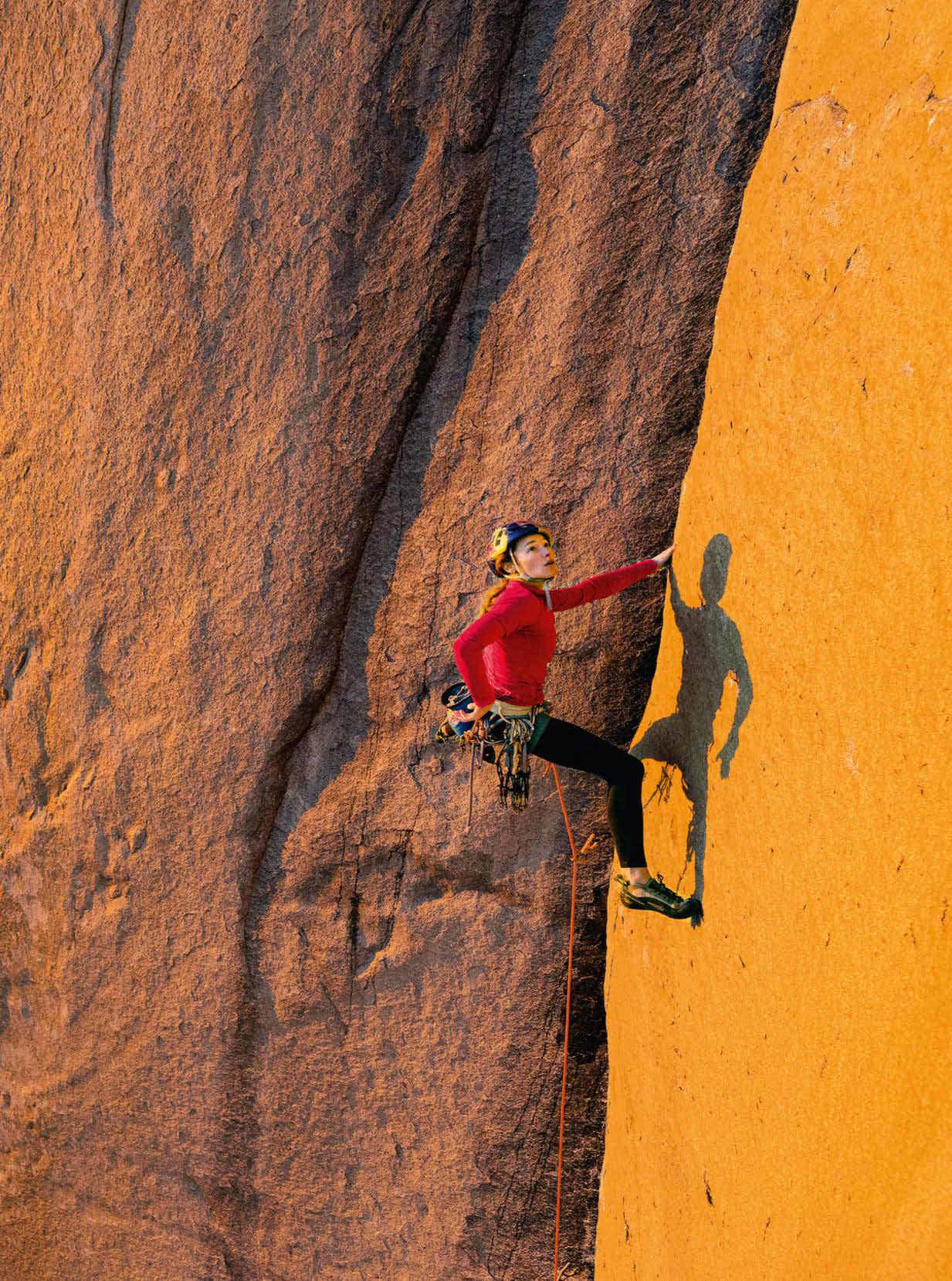
Gold rush
In the evening, this massive rock face begins to glow. Then, the sun bathes El Capitan in Yosemite National Park in copper and gold. But during this climb in November 2025, Sasha DiGiulian didn’t experience many evenings like this. It took the US professional climber 23 days to become the first woman to complete the 39-pitch route known as ‘Platinum Wall’. She spent a full nine of those days enduring snow, rain and 80kph gusts of wind, before the sun rose again on the 10th morning.
Instagram: @sashadigiulian
Warsaw, Poland
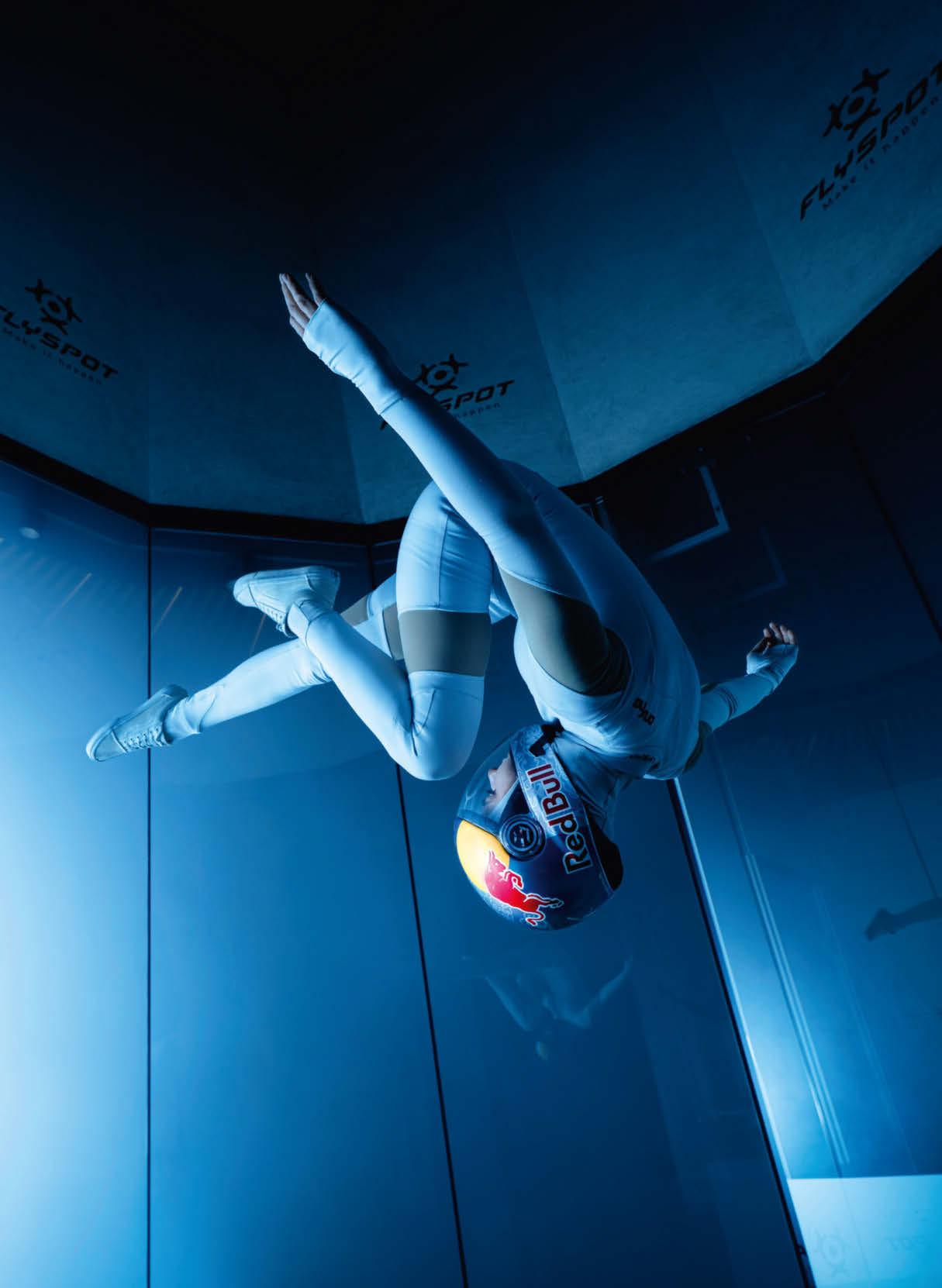
Air born
Maja Kuczyńska’s destiny always lay in acrobatics. Growing up in Warsaw, she experimented in gymnastics, ballet and skiing. But a tandem skydive with her father at the age of 10 sealed the deal. At 15, she won junior gold at the World Indoor Skydiving Championships. Now 26, Kuczyńska – seen here at Flyspot aerial sports centre in Warsaw – is reaching evergreater heights. In 2025, she became the freestyle indoor skydiving world champion.
Instagram: @kuczynska.maja
Afyonkarahisar, Turkey
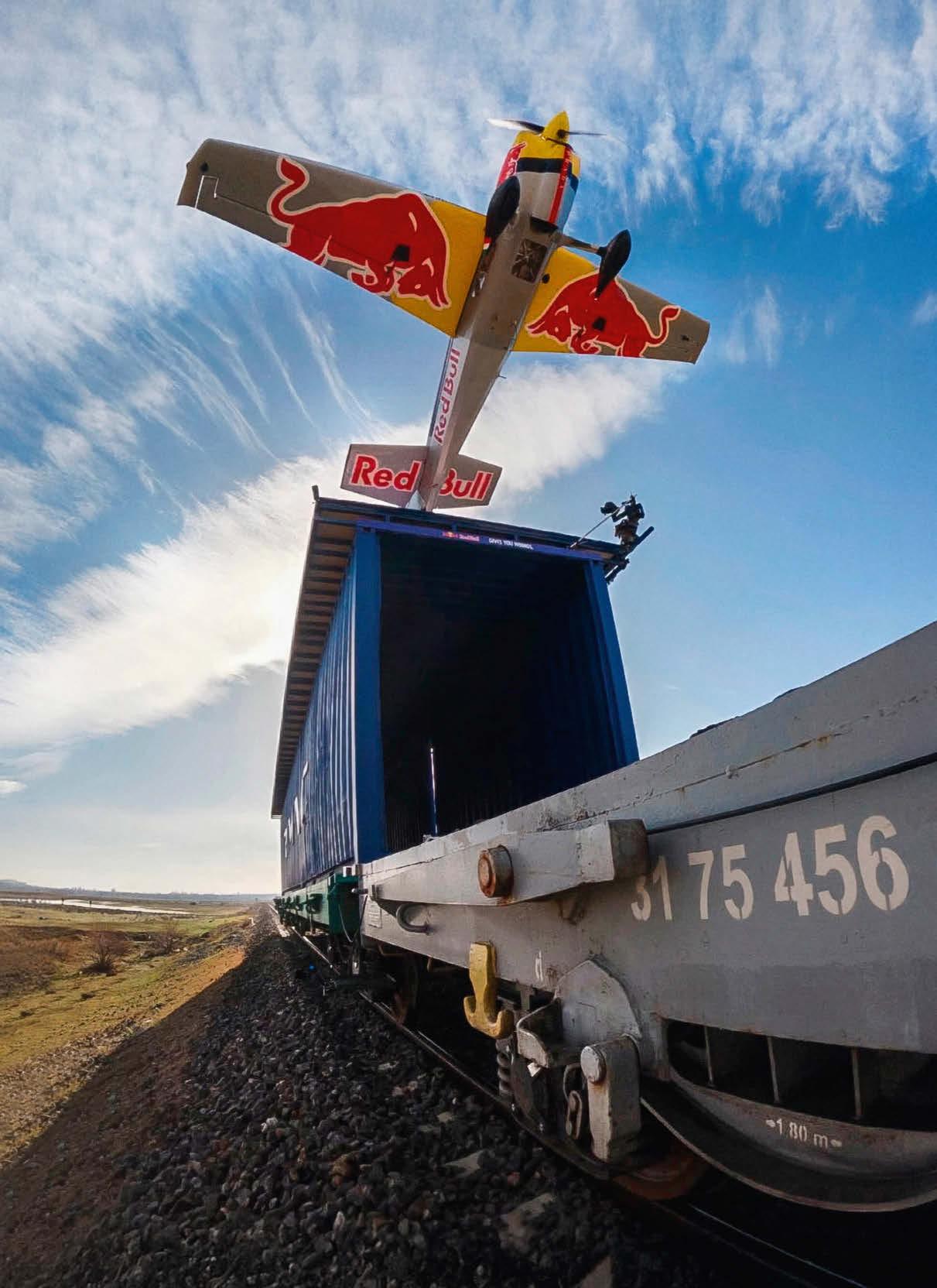
Trainsurfing
A freight train thundering along at 120kph. A Zivko Edge 540 aerobatic plane that the pilot must slow to exactly 87kph. A landing area on the last container of the train that cannot be seen by the pilot due to the rate of descent. Anyone who manages to land under such circumstances is among the best pilots in the world. Dario Costa did it. After the successful touchdown in February, the Italian stunt pilot took off again. That’s how aviation history is made. redbull.com
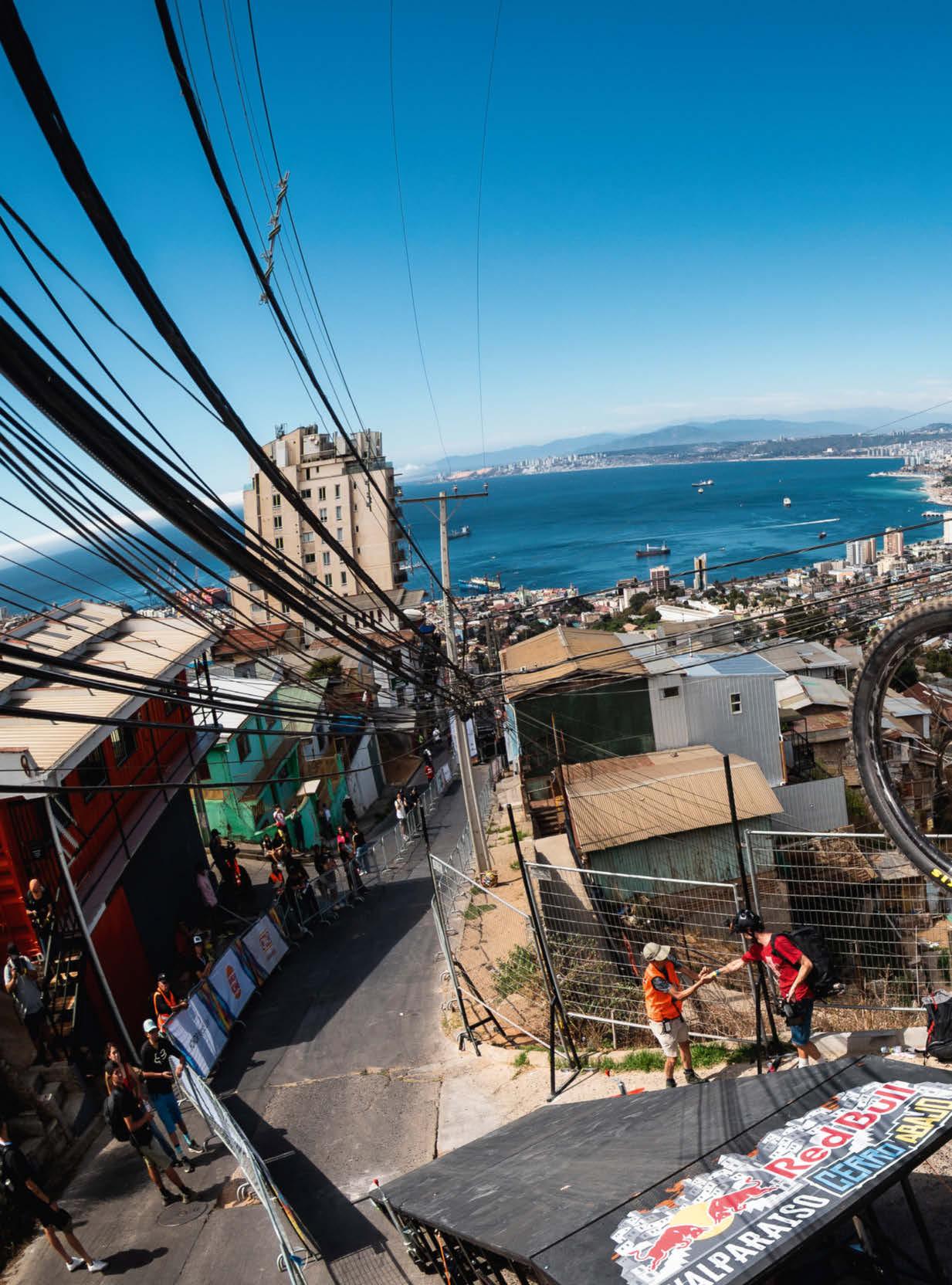
Valparaíso, Chile Urban jungle
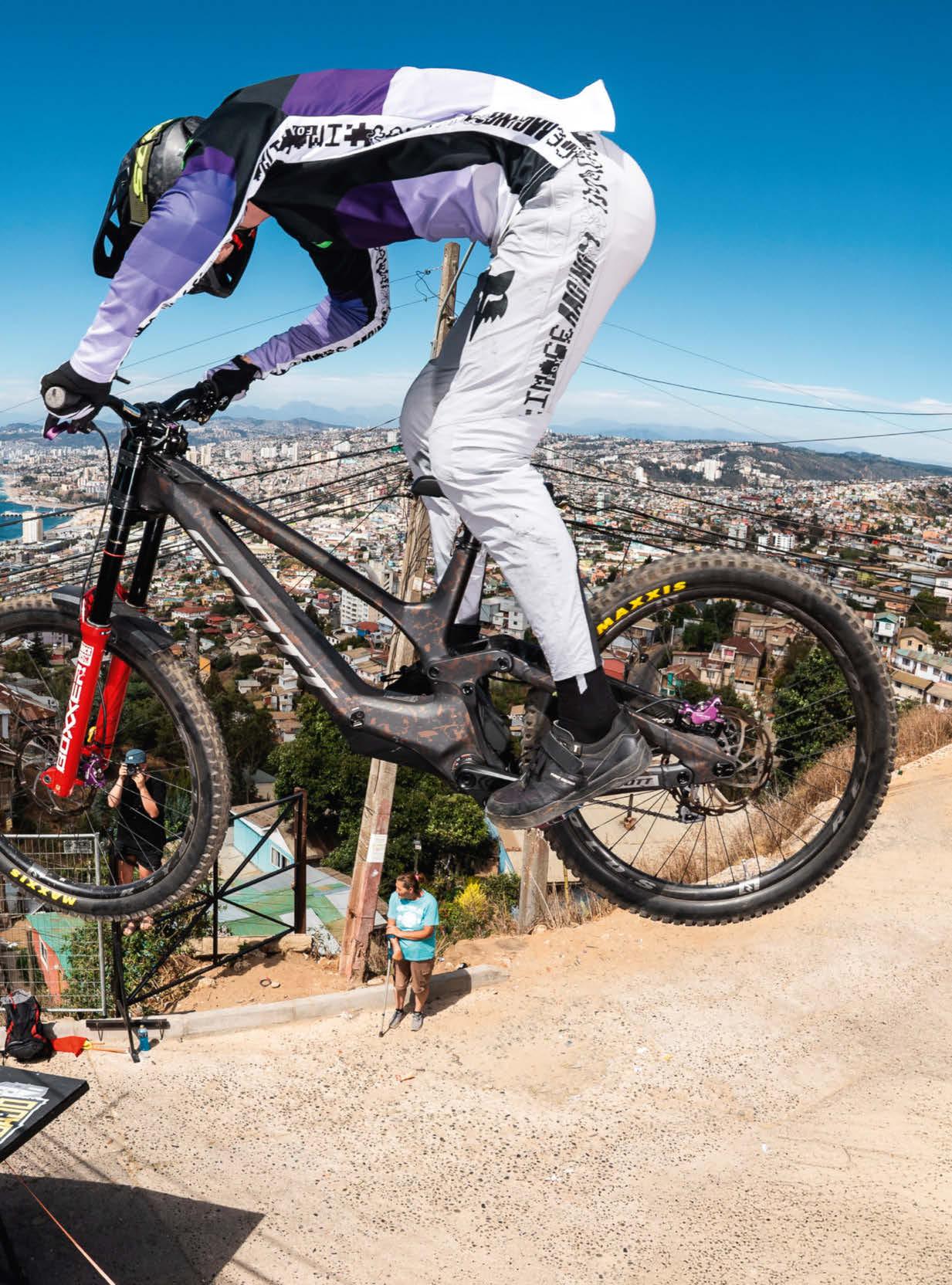
Red Bull Cerro Abajo in Valparaíso is one of the world’s toughest downhill mountain-bike races. Instead of forests and dirt trails, the route takes riders through the Chilean port city – down narrow alleys, over steep steps, even across rooftops, with no margin for error. Seen here is Swiss rider Marius Perraudin competing for the first time this February. “What an experience,” was his verdict at the bottom. Instagram: @marius.perraudin
Johno Verity
Dawning glory
At 5am every morning, this London cinematographer gets on his BMX. His reward? City sights few of us ever experience
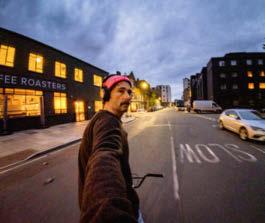
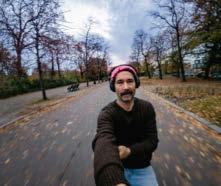
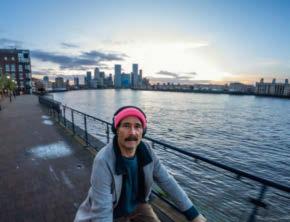
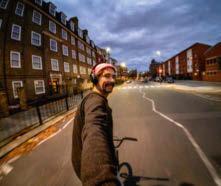
At 5am, London’s Oxford Street is at its quietest and most beautiful – no commuters or tourists, just the odd bus, the sound of birdsong, and the first signs of light glinting over the buildings. This is Johno Verity’s London, a version of the city he cycles through at dawn, filming and sharing the stillness with thousands online.
“I’ve ridden the whole length of Oxford Street in a minute and a half and not seen a single person,” says the cinematographer and former snowboarding pro. “Not many people get to experience that.”
makes [my videos] look consistent. But mostly I just like pink hats.” For the “backend insomniac” (his words), rising early has never been an issue. “I fall asleep easily enough,” he says, “but I can’t sleep past five. Then I’ve got a choice: scroll on my phone or get out into London.”
Verity’s films don’t follow a strict formula; he just cycles one-handed (camera in the other) and talks about whatever comes to mind, adding stories and facts he’s picked up along the way. The idea came to him one day when he was heading for an early flight to France. The Tube wasn’t yet running, so he hired a Lime bike and pedalled into town. “I got to Blackfriars and it was completely empty. The light was beautiful, and I just thought, ‘This is mad. No one is here.’ It felt like the city was briefly mine.” He shot a short video and posted it with little expectation. It travelled far further than anything he’d shared online before.
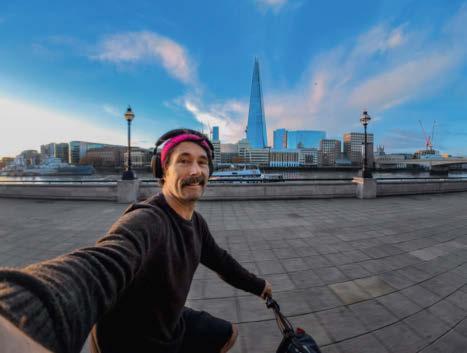
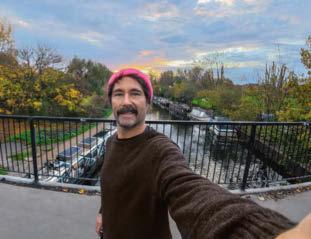
Which is precisely the point. At an hour when many are still under the covers, Verity leaves his home in Hackney, gets on his BMX and cycles. The direction doesn’t matter; what does is arriving before the dawn. His early-morning films – part history lesson, part meditation, part love letter to the capital – have made him a social media star, recognisable to many simply as ‘the guy in the neon-pink hat’.
It’s hardly surprising his footage has a cinematic aura: Verity has his own production company, Autumn Works, which shoots everything from snowboarding films to car ads. “There’s about 20 minutes when London is unspeakably gorgeous,” he says. “Stand on Waterloo Bridge at the right moment and St Paul’s is still lit as the dark-blue sky lifts behind it. Most people only see this city in a rush. I want to show people what it’s like before the performance starts.”
There’s something deeper driving him, too: “I try not to use Google Maps; I want the map in my head. Learning London’s history turns it into a huge puzzle. And cycling… there’s something about moving forward. If I’m worried about the future or replaying the past, it steadies me.”
By 7am, dawn’s spell lifts. The traffic returns, pavements fill, and London becomes itself again. Meanwhile, Verity’s vision – quiet, golden – begins to drift across the internet.
“That was an accident,” he says. “I wore it in the first video that did well, and it stuck. It pops against the sunrise and Instagram: @johnoverity
Playlist
Stolen moments
The guitarist and songwriter with US indie-folk hipsters Big Thief revisits four tracks that helped shape his craft
Buck Meek
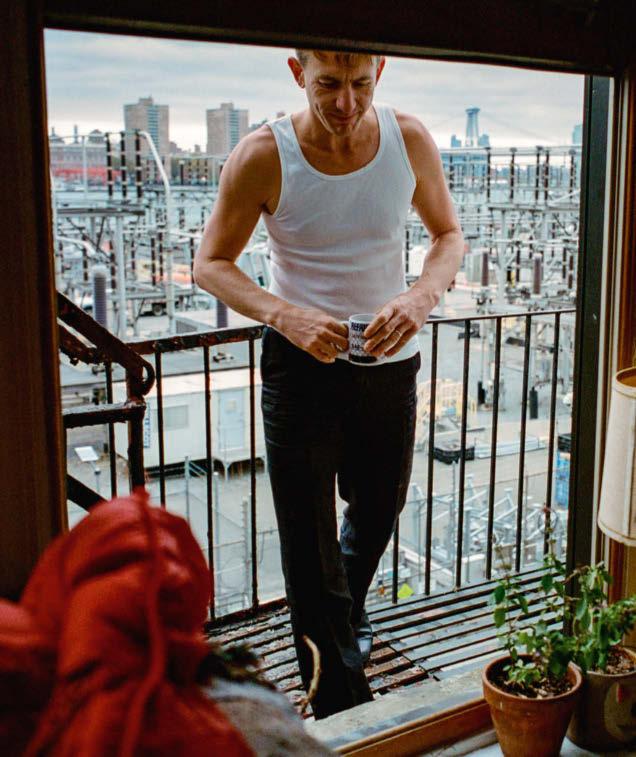
Hailing from Wimberley in Texas, Alexander Buckley ‘Buck’ Meek grew up jamming with local blues musicians. After meeting singer and guitarist Adrianne Lenker at Boston’s Berklee College of Music, in 2015 the two formed Big Thief with bassist Max Oleartchik (who departed the group in 2024) and, later, drummer James Krivchenia. They’re currently touring Europe to support their latest album, Double Infinity, while Meek recently released his fourth solo album, The Mirror
Otis Redding
(Sittin’ on) The Dock of the Bay (1968)
“When I was young, I’d go to my grandmother’s house every Friday. She would always put this song on and dance with me. It was one of my first real, focused experiences with music. Steve Cropper, who plays on this, has become one of my favourite guitar players. He’s a hero of mine.”
Taraf de Haïdouks
A La Turk (2001)
“This Romanian band are incredible. I’ve seen them once, and they started with so much speed, then got faster and faster to the point where it felt like their hands would fly off. That was an impactful moment for me, that they’d put themselves in this trance. And this is my favourite song. I always think about it when making music.”
Lucinda Williams
Metal Firecracker (1998)
“When I started out as a songwriter, I’d overthink everything and try to be all poetic. But then I heard this song, which is so brutally honest and to the point. It made me feel a lot, because it’s so relatable – just a kick-ass break-up song. It empowered me to write simply, confessionally and really from the gut.”
The Soul Stirrers
Nearer to Thee (1955)
“My first job was delivering pastries all over Manhattan in this little car. And when this song [with soul legend Sam Cooke on lead vocals] came on the radio, the spirituality of it brought me to tears. I had to pull over and just sit on the side of the highway and cry. It changed my life, making me rethink why I was writing songs, I guess.”
Emoji interview
Your move, Chrissi!
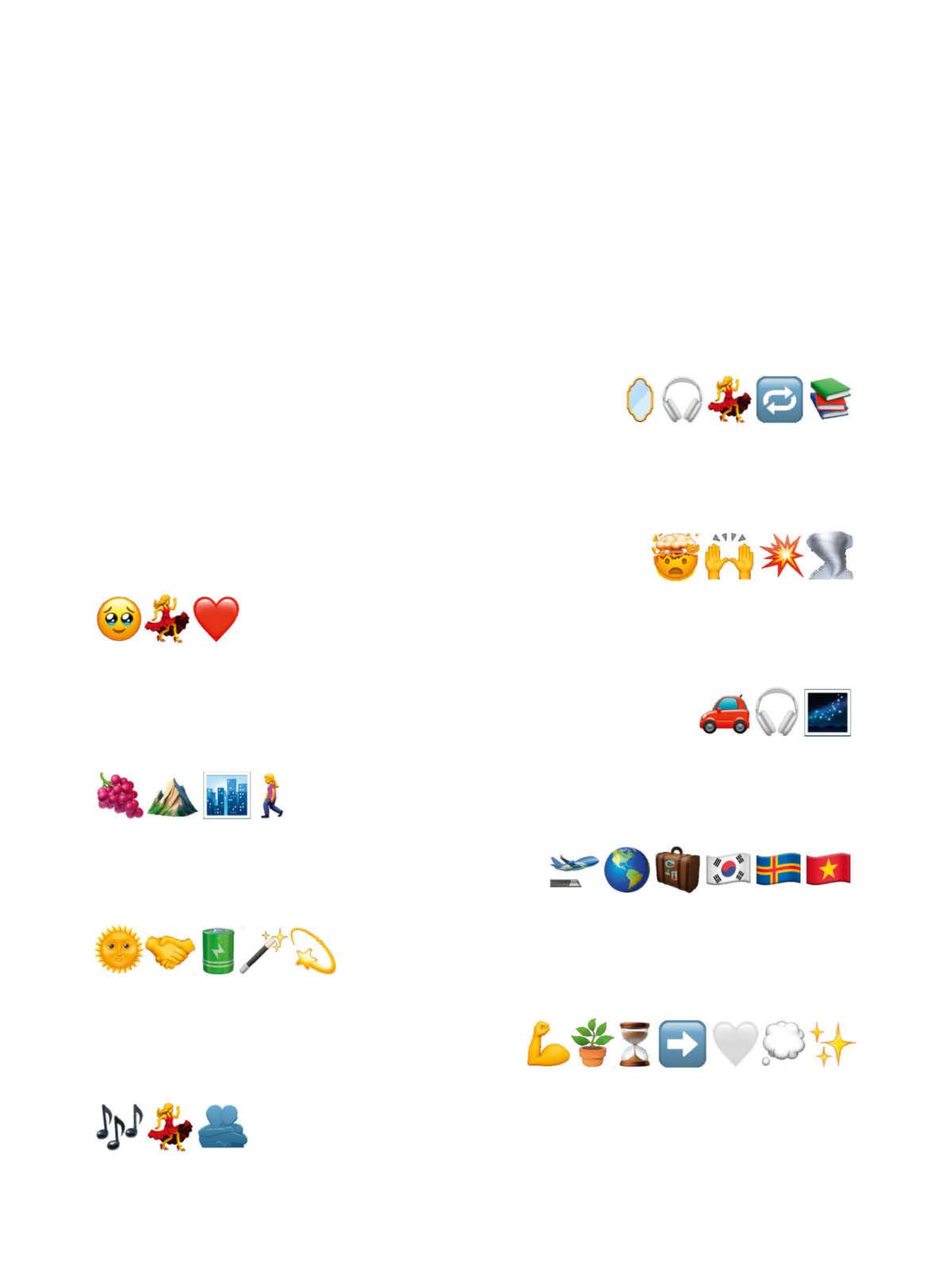
For this interview, the subject is only allowed to reply with emojis. This time: Christina Patakas, a creator who uses dance as a confdence booster
Your body control is exceptional. What helps you to train it?
How did it feel when your first video went viral?
Describe yourself in three emojis
Where do you get the best ideas for your choreography?
What is it that makes your hometown of Stuttgart so appealing?
What adventures are still on your bucket list?
How do you feel when you’re at one with the music?
How can I pluck up the courage to be first on the dancefloor at the club?
What would you recommend to young people who want to become creators?
Always in the flow
Born in 1997 and living in Stuttgart, Christina Patakas, known as Chrissi, is one of Germany’s leading dance creators. Through her performances she aims not only to inspire a love of hip-hop dance but also to promote dancing as a path to greater body positivity and self-confidence. The message is getting through – she has more than a million followers on TikTok and Instagram: @chrissipatakas
CHRISSI PATAKAS:
THE RED BULLETIN:
CHRISTINA PATAKAS
The scene that first got Archie O’Brien hooked on James Bond was the opening sequence of 1999’s The World Is Not Enough, where Pierce Brosnan leaps into a jet-powered boat and bursts through the side of MI6 HQ and into the Thames.
But it wasn’t 007 himself that caught O’Brien’s eye. “I was always into the Q Branch technology,” he says. “I just thought it was so cool that they could make anything they wanted as long as they had the ideas.”
Almost 20 years later, in 2017, while studying industrial and product design at Loughborough University, O’Brien began to work on his own Q-style gadget. “I knew it had to be sport-related,” says the British 28-year-old, who admits to being “pretty obsessed with making things”. “I knew it had to be high adrenaline, something fun. And it had to be something that didn’t already exist.”
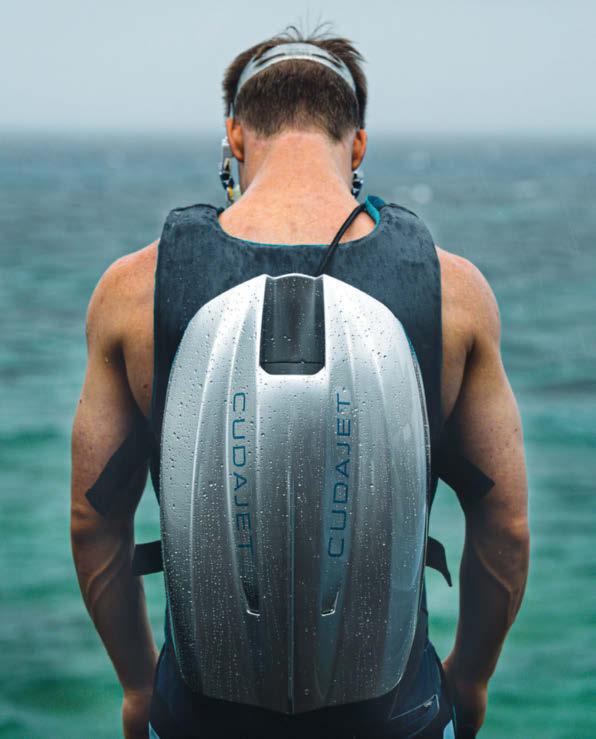
Keen to build on his love of freediving, O’Brien set about developing the CudaJet, the world’s first underwater jetpack. And while it might resemble the kind of tech that Bond would use, the device’s creator references superhero movies when describing the experience of speeding through the water: “You’ve got Superman, you’ve got Iron Man… It actually feels like flying. That’s the best way to describe it.”
Worn like a backpack on a neoprene harness, and relatively lightweight at just 14kg, CudaJet is initiated using a handheld trigger that engages its patented underwater propulsion system. While the swimmer controls the direction with their body movement, the jetpack thrusts them forward at speeds of up to 3m per second, exerting a drag force “comparable to flying through the air at more than 180 miles per hour [290kph]”.
The device is powered by lithium batteries that provide up to 90 minutes of
Live and jet fly
A longtime fan of James Bond-style gadgets, this product designer has created an underwater device any agent would be proud of
underwater exploring, and O’Brien says most people can pick up the basics in less than five minutes; the only additional equipment needed is a diving mask that covers the nose. Although the CudaJet is operational to a depth of 40m, it features a safety limit of 3m, at which point the power will switch off and the pack will act as a buoyancy device to bring the user back to the surface.
While he’s aware of interest from underwater camera operators and marine researchers, as well as its potential for lifesaving and
Creative surge: Archie O’Brien, founder and CEO of CudaJet Ltd; (top) his aquatic jetpack
rescue missions in the future, O’Brien says that, for now, the CudaJet – made to order at a price of £22,500 – is meant for leisure only: “It’s the ultimate superyacht toy.”
Using the jetpack is “addictive”, O’Brien says. “It’s unlike anything else. People don’t want to give it back to you once they’ve tried it. It’s a sensory overload when you first start, but then, once you get used to it, you can calm down and take in what’s around you. You get to explore places you’ve never explored before.”
CudaJet
Hype check
Playful twist
This gaming chair moves in sync with a player’s movements. Tech reviewer Kirafn gives it a test spin
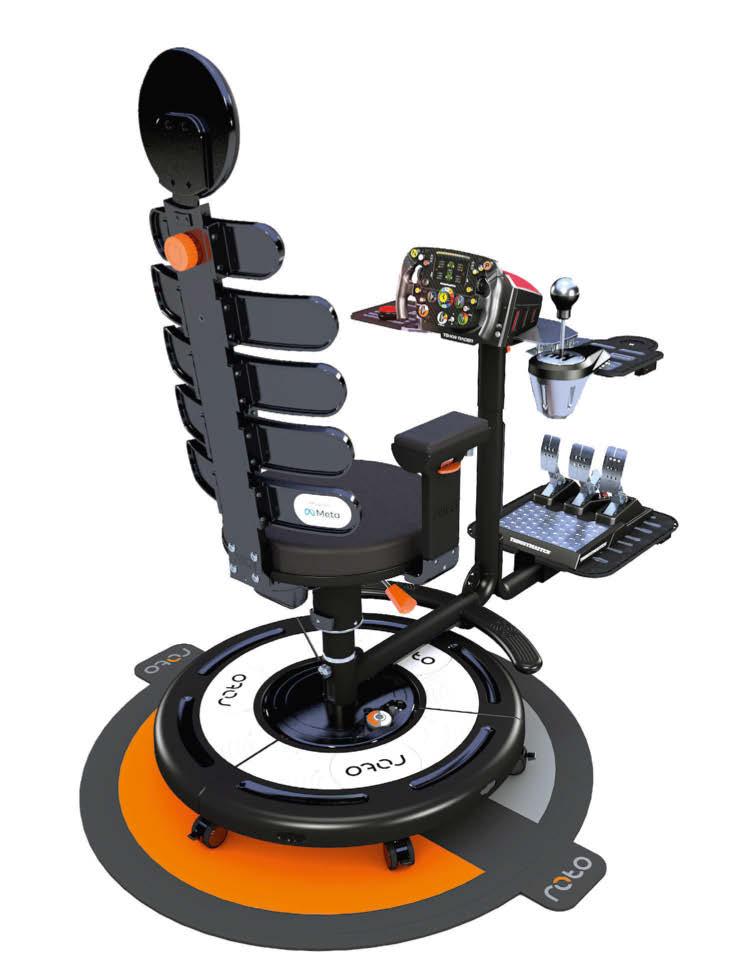
The
device
The Roto VR Explorer rotates in sync with a player’s head movements. This is made possible by a sensor on the VR headset and a motor in the base. The aim is to create a smooth sense of movement and help prevent motion sickness.
The hype
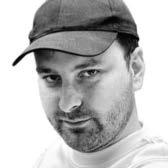
Kirafin
Real name Jonas Willbold, he’s 31 and entertains his 1.3 million followers on TikTok with comedy sketches. In his spare time, he indulges his fascination with tech products and trends. He takes a closer look at the latest trends for us.
The
verdict
Videos are scarce, as the device is too bulky for content creation. But the ones that do exist reliably go viral – like a TikTok from UFD Tech with 1.3 million views and 103,000 likes.
Especially interesting for hardcore VR fans who don’t have space for a VR treadmill or have limited mobility. Ideal for racing simulations. The price (from around €700) is reasonable, too. Still, it will likely remain a niche product.
MUST-HAVE FACTOR
Perfect for...
VR enthusiasts who want to keep moving even while sitting down.
Not suitable for...
VR enthusiasts who want to work up a sweat while moving around – hello, VR treadmill!
Wise words
Mindset of Manuel
Steep slopes, deep mud: the Extreme Enduro champion can master any terrain. Here, he explains what he has learned from life so far
Every evening, my girlfriend and I tell each other the highlight of our day, like, “Actually, today was really stressful, but I sat in the sun for 15 minutes at lunchtime – that was brilliant.”
Grass or mud stains come out easily if you rub them with shampoo or washing-up liquid before washing. When I was younger, I did odd jobs in an electrical shop, on building sites and in the neighbours’ gardens. Being independent from an early age feels good.
Pro tip from the training camp in Italy: add loads and loads of salt to the pasta water.
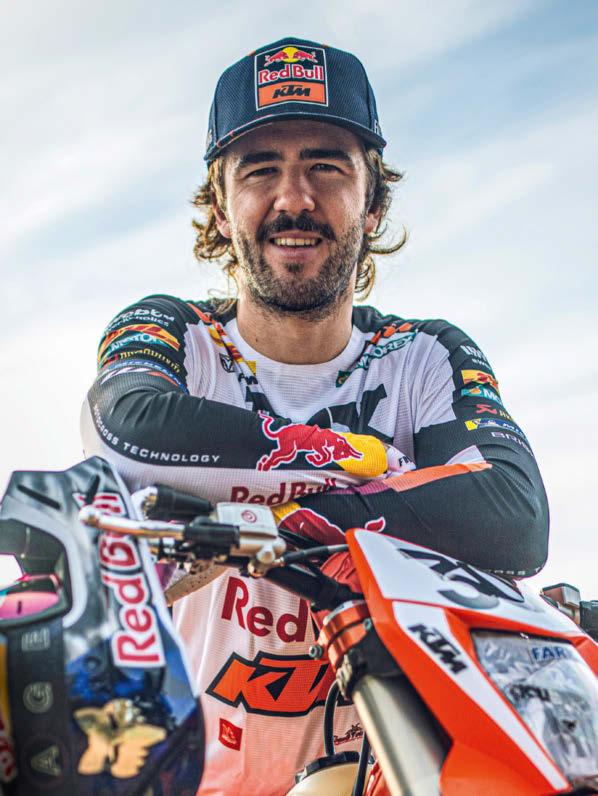
Manuel Lettenbichler
Born in Rosenheim, Bavaria, in 1998, Lettenbichler first sat on a motorbike at the age of five. In 2025, he won his fourth consecutive Hard Enduro world championship. Also a four-time winner of Red Bull Erzbergrodeo, Lettenbichler will again be competing in the gruelling one-day race in June. Instagram: @m_letti304
The single most important maintenance tip for all cyclists and motorcyclists: “Lubricate properly and you’ll ride smoothly!”
Discipline comes naturally when you make a conscious decision to commit to something.
If you begin to feel nervous, stay in the moment. At the start, I don’t think
about the
fierce battles about to unfold.
To know what you want, you need the freedom to try things out. Before I decided to take up motorcycling, I wanted to become a freeski pro – or a carpenter.
Sandro Dias
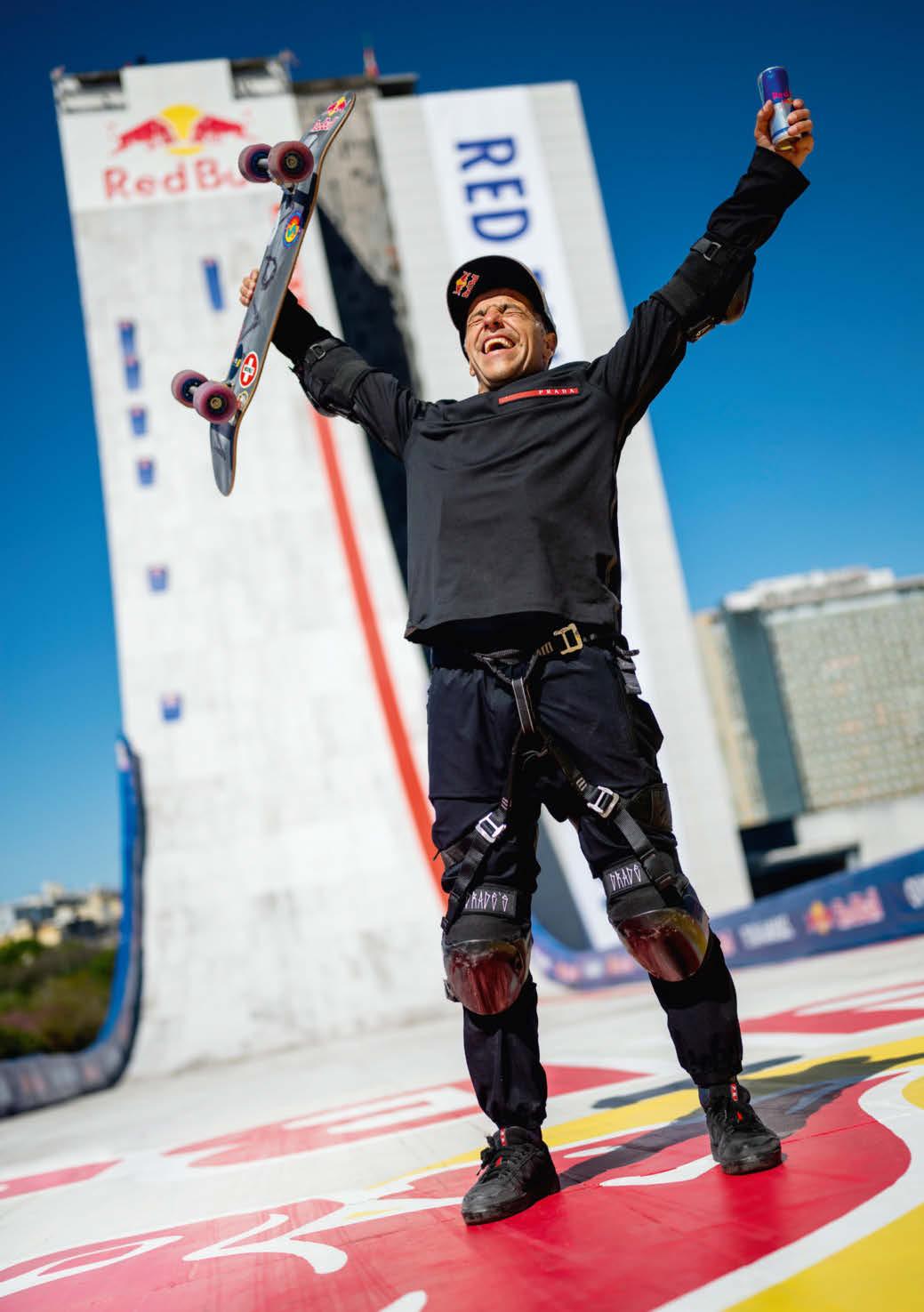
In 2025, this vert skateboarding legend made history by skating down the side of a 22-storey building in Porto Alegre, Brazil. Here, he reveals what it took
Words Stuart Kenny
In September last year, Brazilian six-time vert world-champion skateboarder Sandro Dias found himself standing on a makeshift ledge 70m above the ground, staring down the curve of the largest quarterpipe in existence.
For the crowds below, Dias was a distant dot on the side of the 22-storey Centro Administrativo Fernando Ferrari (CAFF) building in the city of Porto Alegre, in southern Brazil; alone, with only his skateboard for company.
This moment had been a long time coming. It had been a pipedream of the Brazilian skate community to ride down the CAFF ever since its construction in the 1980s. Until now, viral hoax videos and fngerboard recreations were as close as anyone had come to actually doing so.
When Dias dropped in, he did it on the biggest plywood ramp ever constructed, laid on top of the cracked concrete of the CAFF – with millions around the world watching.
Dias nailed the run, achieving the world records for the ‘tallest drop into a temporary quarterpipe’ (60.33m) and ‘fastest speed skateboarding on a quarterpipe’ (103.8kph). More importantly, the 50-year-old skater fulflled a dream he had frst conjured up four decades earlier.
the red bulletin: When did you frst get the idea to skate the CAFF?
sandro dias: I passed the building in the late ’80s when I was travelling to compete as an amateur near Porto Alegre. I was still a kid –13 or 14 years old – and I thought, “Oh my God, this building looks like a quarterpipe. Someone should skate this.” After many, many years, I fnally had the opportunity.
Red Bull Building Drop: the sky-high stats
Height of CAFF building: 88.91m
Highest drop-in point: 70m
Time from top to bottom: 8 seconds
Maximum g-force: 3.9g
Top speed reached: 103.8kph
Number of world records broken: 2
Landing spot: 1,800 foam cubes
When did you realise that skating from such a height might be possible?
I always knew it was possible, but that it was almost impossible to actually pull of. I was inspired by [Australian freestyle motocross rider] Robbie Maddison. He did an FMX stunt in 2008, jumping onto the Arc de Triomphe replica in Las Vegas. We frst looked at doing this 10 years ago. One guy actually went to Brazil to see the building. When he got back, he sent us the feedback: “If he does this drop, he’s going to die.” But he had only considered skating down the original structure. He hadn’t considered building anything on top. In 2022, Red Bull asked again about plans. I said, “Come on, let’s do the building,” and they said yes.
Did you know what an immense undertaking it would be?
When we started, I thought all we needed to do was build a ramp and drop in. I’ve been skating for almost 40 years, so I thought, “I know how to drop, even if it is the highest ramp ever.” I had no fear at all. Then they did all these studies into what would happen to my body during the drop – the velocity, the g-force and the impact – and it was lucky that they did. That was when I realised it wasn’t just another drop and that the preparation would be diferent. Without the training I might have killed myself.
What did the training involve?
I was towed behind a car at 136kph on an airfeld to get used to the speed. It was crazy the frst time, but I got used to it – then I wanted more. When we measured the g-force, it was the same story. They said my legs would have to support 350kg of downwards pressure, so we found the biggest quarterpipe in Brazil. I trained with weights on my body and I wore insole sensors to measure the force. At frst, they thought a 35kg vest would replicate the load on my knees. In the end, we had to increase it to 43kg to reach the g-force we were expecting.
Did the training help when you were on the platform?
It helped me to stay calm, knowing that my preparation had been tougher than what the run would be. The speeds I had trained at were higher, and the g-force would be lower, so the fnal impact would be at a lower speed as well. But the drop still felt totally diferent on the day. Everything I’d tested [had been done] individually, separately, whereas the drop was all of that in one. My mind was prepared, though. I kept repeating a mantra to myself on the ledge: “I created this. I’m ready. You can do it. It’s only eight seconds. You’re ready. Just go.”
What do you remember from the drop? I didn’t want to overthink it, so I just focused on my mantra. I remember telling myself: “Just pay attention to gravity.” In the video you can see the moment my arms go up – that’s when the force hit my body and I had to fght to stay balanced. When my arms go down, that’s when I regain control. After I passed the peak g-force I was so happy that I forgot I had to hit the airbags – and I hit them totally wrong. Luckily nothing happened. I couldn’t believe I’d done it on the frst attempt. My wife came to hug me, then my friends, people were crying. I was crying. It was folklore in Brazil that someone would drop into this one day, and it was the most amazing day of my life. No matter how far away your dreams may seem, never give up on them.
Instagram: @diassandro
“It was folklore in Brazil that someone would drop into this one day“
Laura Horváth
The Fittest Woman on Earth in 2023 and World Fitness Project champion in 2025 reveals how her siblings and an active upbringing inspired her athletic success
Words Lou Boyd
As a kid, movement wasn’t just a hobby for Laura Horváth, it was a way of life. Raised around a climbing wall owned by her sporting parents in Budapest, Hungary, she followed her older brother Kristóf on climbs and out on long, rugged hikes. But it was when he introduced her to weight training and functional ftness at the age of 16 that everything clicked.
From that moment on, Horváth’s rise in competitive ftness has been relentless. Five years into her career, in 2018, she placed second at the Crossft Games, a feat she repeated in 2021, before winning in 2023, earning her the title of ‘World’s Fittest Woman’. In 2025, Horváth became the inaugural champion of the World Fitness Project, cementing her status as one of the world’s most decorated ftness athletes. She’s also made her mark in weightlifting, becoming Hungarian champion in 2023 and 2024 and holding the 120kg clean-and-jerk national record.
“Why [should] only guys do all these things?” Horváth says. “I think for women to be strong and move their bodies, to lift heavy things, pull themselves up or do a push-up, these things are empowering.”
Now, she’s bringing that philosophy home. In Budapest, together with her older brother Kristóf, Horváth founded Kaduzs in 2024, a functional-ftness gym that welcomes anyone willing to give it a try. “We want to create a space where people feel supported to build their ftness and try new things without judgement,” she says. “I believe that strength belongs to everyone.”
the red bulletin: Why was sport such an important part of your family life? laura horváth: Both of my parents are PE teachers, my dad did the decathlon and
Behind the strength: Laura’s career milestones
[functional ftness] and signed up for the Crossft Games, I knew I’d eventually win – whether it took one year or fve.
Is it true you were the frst woman to ever join your local weightlifting gym?
Yes. My brother went frst, and when I asked to join, he told me I couldn’t as there me there were no girls and no female changing room. But I was persistent.
Now, women often outnumber men in functional ftness.
Yes, totally. In our gym, I’d say 70 to 80 per cent of members are women, and only 20 to 30 are men. In most of our classes, the majority are women.
How do you see female ftness evolving?
Breakthrough: Second place at the 2018 CrossFit Games First world title: 2023 CrossFit Games Documentary biopic: Power in Every Rep: Together We Rise Released April 17, 2026
my mum did track. Our upbringing was really rooted in sports. On weekends we went biking, canoeing – diferent active trips. It bonded me and my two brothers.
What’s your earliest memory of being in your parents’ climbing gym?
Running around, playing with the ropes and swinging. I hung out with my family and watched them climb.
At what point did ftness shift to becoming your career?
I’ve always been very competitive, so whatever I did, I wanted to be the best.
At frst, weightlifting was just another thing I was competing at with my brother, Kristóf. Over time, it evolved into something I wanted to pursue for myself.
Were you always competitive with Kristóf?
Ever since I was little, I wanted to do everything that he did. He was my big brother and I was his little shadow – which annoyed him at times. But as we got older, ftness really bonded us.
Your career went from CrossFit Games rookie silver medallist in 2021 to world champion in 2023. How did that sudden rise alter your training?
Honestly, it didn’t change my mindset. I’ve always been competitive. When I started
I think the message has shifted a lot. Before, it was all about being skinny and small. Now, more women want to be strong, to fuel their bodies, to embrace strength. Having muscle and being defned is no less feminine than being slim. Strong is beautiful.
Why did you and Kristóf decide to open your own gym, Kadusz?
We’d wanted our own gym for about 10 years. We dreamed of having a community space. But life kept getting in the way – we were abroad, had other priorities. In 2023 we started looking seriously. We almost gave up but then found an empty warehouse, and that was it – we decided to do it.
Do you see Kaduzs as having something unique that sets it apart?
I think our approach is diferent. Kristóf programmes more for longevity and wellbeing, rather than just performance. Not everyone needs to do muscle-ups. For most people, it’s better to focus on strict pull-ups, push-ups, squats, deadlifts –movements that make everyday life easier.
What would you say to someone intimidated by walking into a gym?
Even I feel that when I walk into a new gym! Just take the frst step. People often think they need to “get ft frst”, but that’s not true. All you need to do is show up. We’ll meet you where you are.
Instagram : @laurahorvaht
“Having muscle is no less feminine than being slim. Strong is beautiful”
Tania Sachdev
This chess champion is facing a new generation of players in a rapidly changing scene. Fortunately, thinking ahead is what she does best
Words Hugues Pascot
In recent years, chess has ventured out of the hushed halls, cafés and parlours it’s traditionally played in and made its way everywhere: from changing rooms and streaming platforms to athletes’ training routines. In short, the simple, yet mindbending board game that’s been played for thousands of years is at last a popculture phenomenon. On social media, a new generation of creators is turning openings, sacrifices and gambits into a spectacle. Chessmania is no longer only for purists, it has become the favourite sport of your favourite athletes and content creators.
Winning moves
This is a view shared by Tania Sachdev. An International Master and Woman Grandmaster, the 39-year-old player from New Delhi has been observing this transformation firsthand.
“The stereotypes surrounding chess are now being challenged,” she explains. “Thanks to social media and a younger generation that’s very comfortable with the media, things are changing much faster. There are so many different personalities now.”
Sachdev has been competing in international tournaments for more than 30 years – a life governed by the 64 squares of the chessboard. “I started playing when I was six. At first, it was just a hobby. But, as is often the case in life, things change,” she says. In her case, very quickly and in the right direction. Indian champion in the under-12s, then Asian champion in the under-14s, she still remembers the moment that the game truly hooked her.
Checkmate checklist: Sachdev’s milestones
6 The age she was introduced to the game by her mother 2005 Becomes a Woman Grandmaster at age 19 2008 Earns the title of International Master 2024 Wins gold at the 45th Chess Olympiad as part of the Indian team
“I was playing against a Chinese opponent who was half a point ahead. To get gold, I had to win. The game lasted for hours and by the end we were both exhausted, but I managed it. I thought to myself, ‘I want to experience that again, over and over.’”
She has. After that, the victories came thick and fast: Indian women’s chess champion in 2006 and 2007, the latter year also earning the title of Asian women’s champion, she joined the Indian women’s national chess team in 2008, became the Commonwealth women’s champion in 2016, 2018 and 2019, and earned bronze at the 2022 Chess Olympiad, followed by gold in 2024.
“That victory was special to me. It was my eighth Olympiad with the Indian team,” she recalls. “After coming so close to gold in 2022, this medal allowed me to fulfil a dream I’d had since my first Olympiad in 2008.”
Generation chess
In July 2025, the largest chess platform in the world, Chess.com, had more than 20 million Indian players, making it the second-most-active nation on the site after the US. But this surge is due to more than just the rise of online gaming; it coincides with the emergence of a generation of Indian prodigies such as Dommaraju Gukesh, who, in 2024,
became the youngest undisputed world champion in history.
For Sachdev, this is far from an unexpected phenomenon. “It’s the result of groundwork,” she says, crediting the visionary influence of 56-year-old Indian grandmaster and five-time world champion Viswanathan Anand. “He paved the way and showed that it was possible. The current generation has grown up with his legacy.”
Sachdev measures this shift against her own journey. “I received my first training from a grandmaster at the age of 18. Nowadays, children start training at the age of seven or eight. They play in tournaments very early on and are exposed to the very highest level right from the start.” The result is a new generation of players starting out at an increasingly early age, which is, says Sachdev, “giving rise to a different style of play and personality.”
Beyond the battle
For a top-level chess player like Sachdev, taking a break is unthinkable. For years, she competed in as many as 10 tournaments a season, a pace that she soon learned was unsustainable if she wanted to keep going. “I try to take a few days’ rest afterwards, to get away from any work or professional calls. But ever since I was very young, I don’t think a single day has gone by without me encountering a chessboard.”
While her career has long revolved around competition, Sachdev is now exploring another facet of her world: becoming a familiar voice in the game as a commentator. It’s a change she’s relishing, even if she does miss the sparring at times. “I’ve thrown myself wholeheartedly into commentating on and analysing tournaments, to the point where I’m playing less than before, and I do miss that. I’d love to get back into the rhythm of tournaments.”
As always, Sachdev will know when the right time will come to make that move. In March of this year, she was awarded the Contribution to Indian Sports Award of Excellence, proving there’s plenty we’re yet to still see from her career.
Instagram : @taniasachdev
“ I don’t think a day has gone by without me encountering a chessboard”
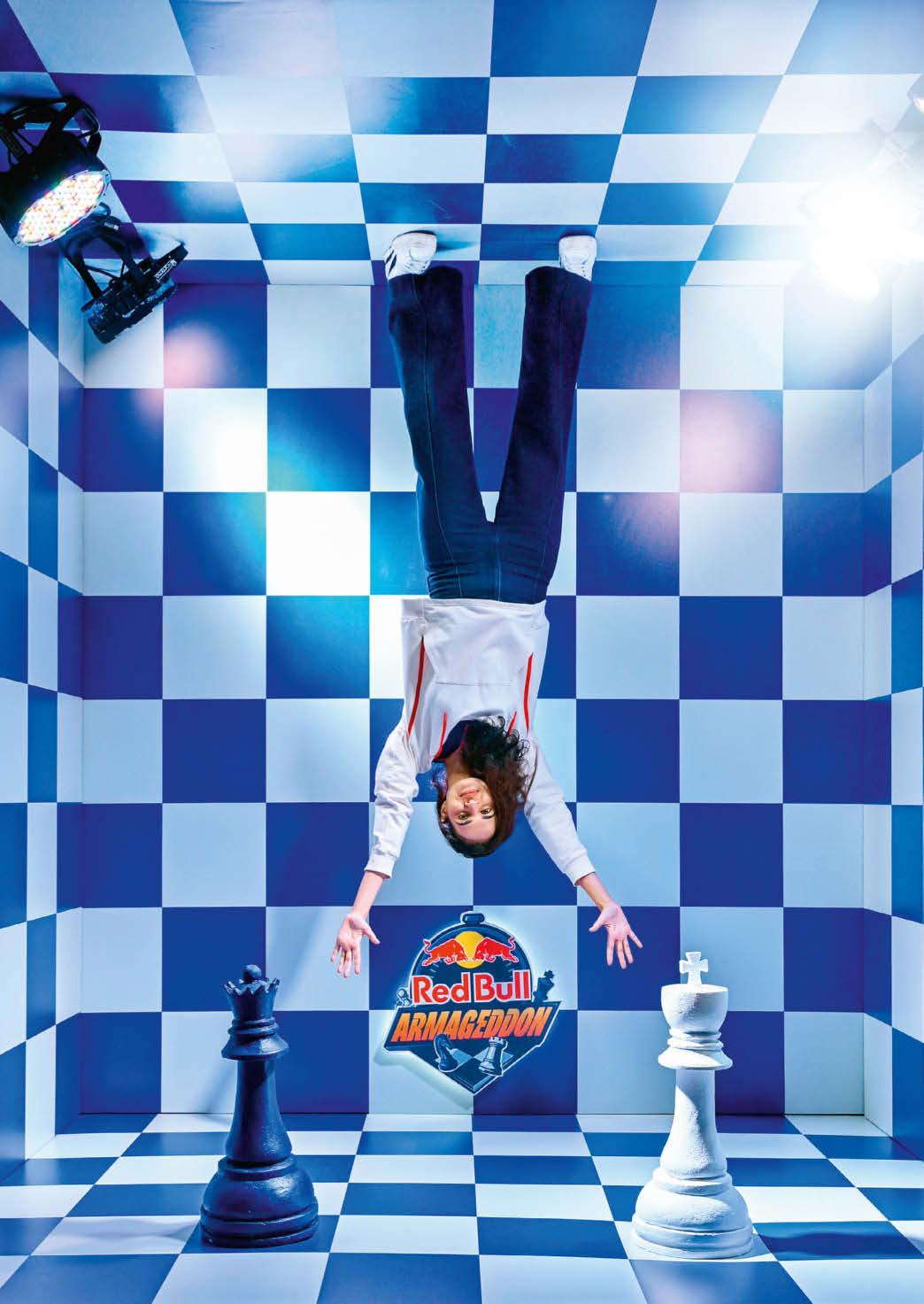
Tania Sachdev in 2025 at Red Bull Armageddon in Chennai, India
PAINTED BY SPEED
Alexis Perrin doesn’t just photograph F1, he paints with it – using action, emotion and kinetic motion as his brushstrokes. From the paddocks to the circuits to the podiums, he captures images as raw as they are meticulously composed
Words Hans Hammer Photography Alexis Perrin
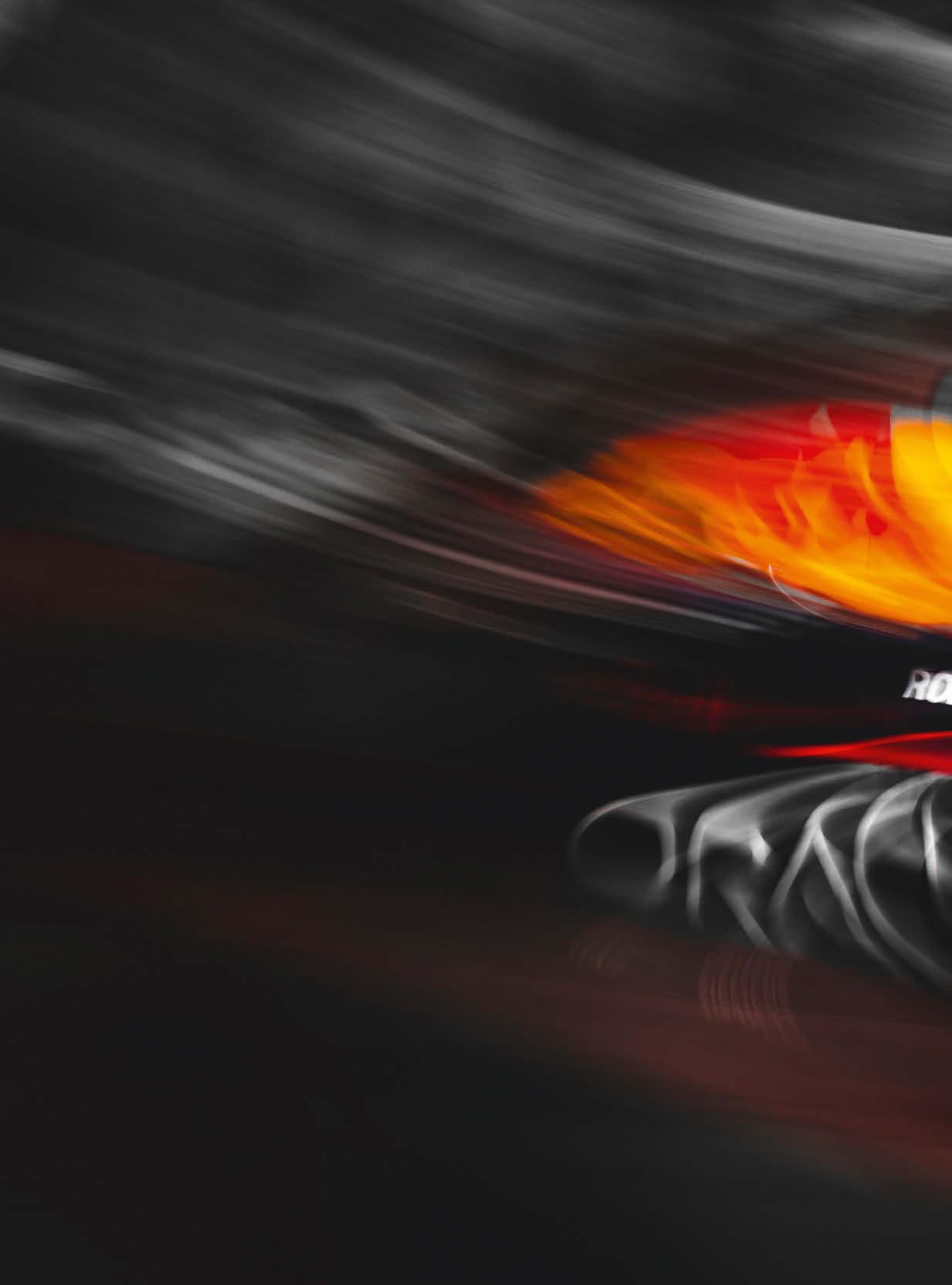
Monaco, 2024
“In Monaco, the cars race past at breakneck speed, skimming the walls. This demands extreme precision. Here, I wanted to keep the helmet in sharp focus and let the rest dissolve into pure motion as if the image had been painted by speed.”
“I like to experiment with movement and perspectives to create almost abstract images,” says Alexis Perrin. The 25-year French photographer began his career in 2017, working his way up through GT cars and motorbikes until, in 2023, he covered four F1 grand prix races for news site Motors Inside. In 2025, he covered 14 grands prix. “Motorsport is at least 75-per-cent preparation,” says Perrin, who analyses every circuit in advance using onboard footage.
The photographer “Making a name for yourself in F1 is all about forging contacts in the paddock, being cheerful, friendly and present.”
Alexis Perrin is pictured here after the
on December 7, 2025. Instagram : @alexis.perrin_
Abu Dhabi Grand Prix
Zandvoort, 2025
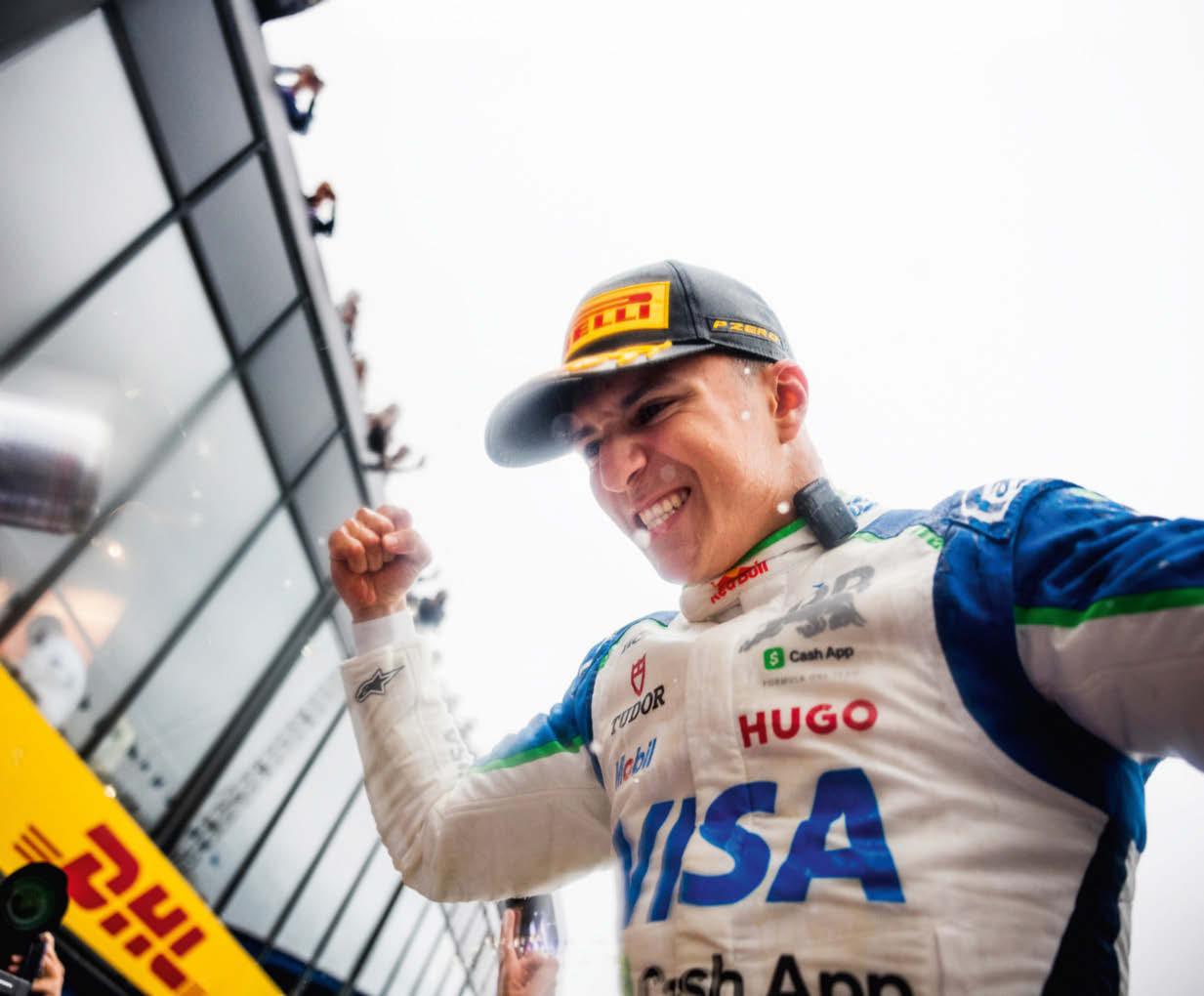
On race day, unlike other photographers, he’s not afraid of getting himself or his equipment covered in champagne, positioning himself as close as possible to the podium. “Emotions, paddocks, podiums, highly artistic scenes… motorsport is the most comprehensive subject to photograph,” he says.
“It’s where you can really put your creativity to use.”
“Isack Hadjar celebrates his first podium finish during his rookie season in F1 [driving for Racing Bulls]. Moments like this are why I love photographing this sport so much. Behind the speed and technology, there are always powerful emotions to capture.”
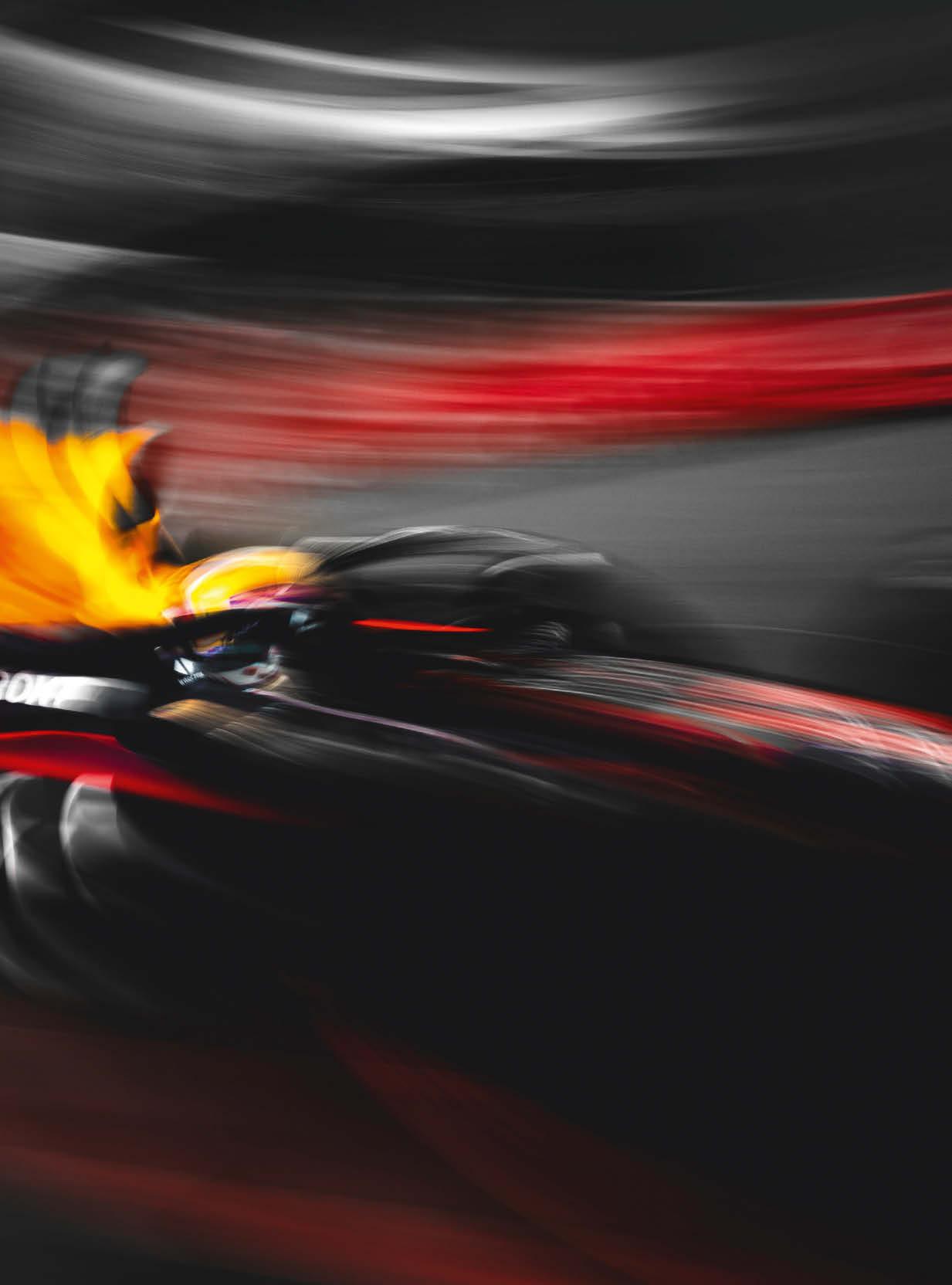
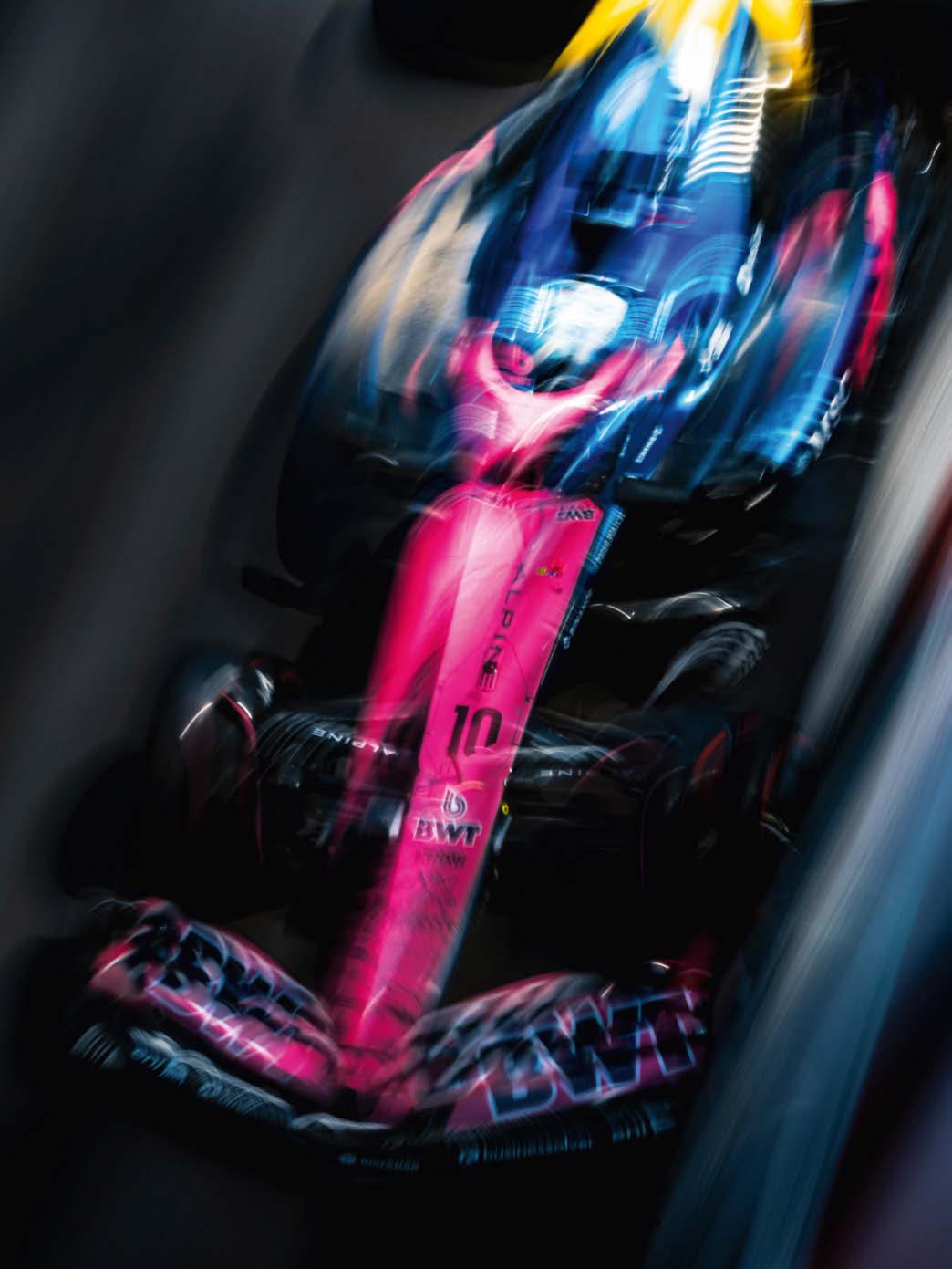
Mexico City, 2025
“From this high-angle viewpoint, using a slow shutter speed, the car becomes a trail of colour streaking across the image. In F1, everything happens at breakneck speed, and sometimes the best way to show that speed is precisely by not freezing it.”
Qatar, 2024
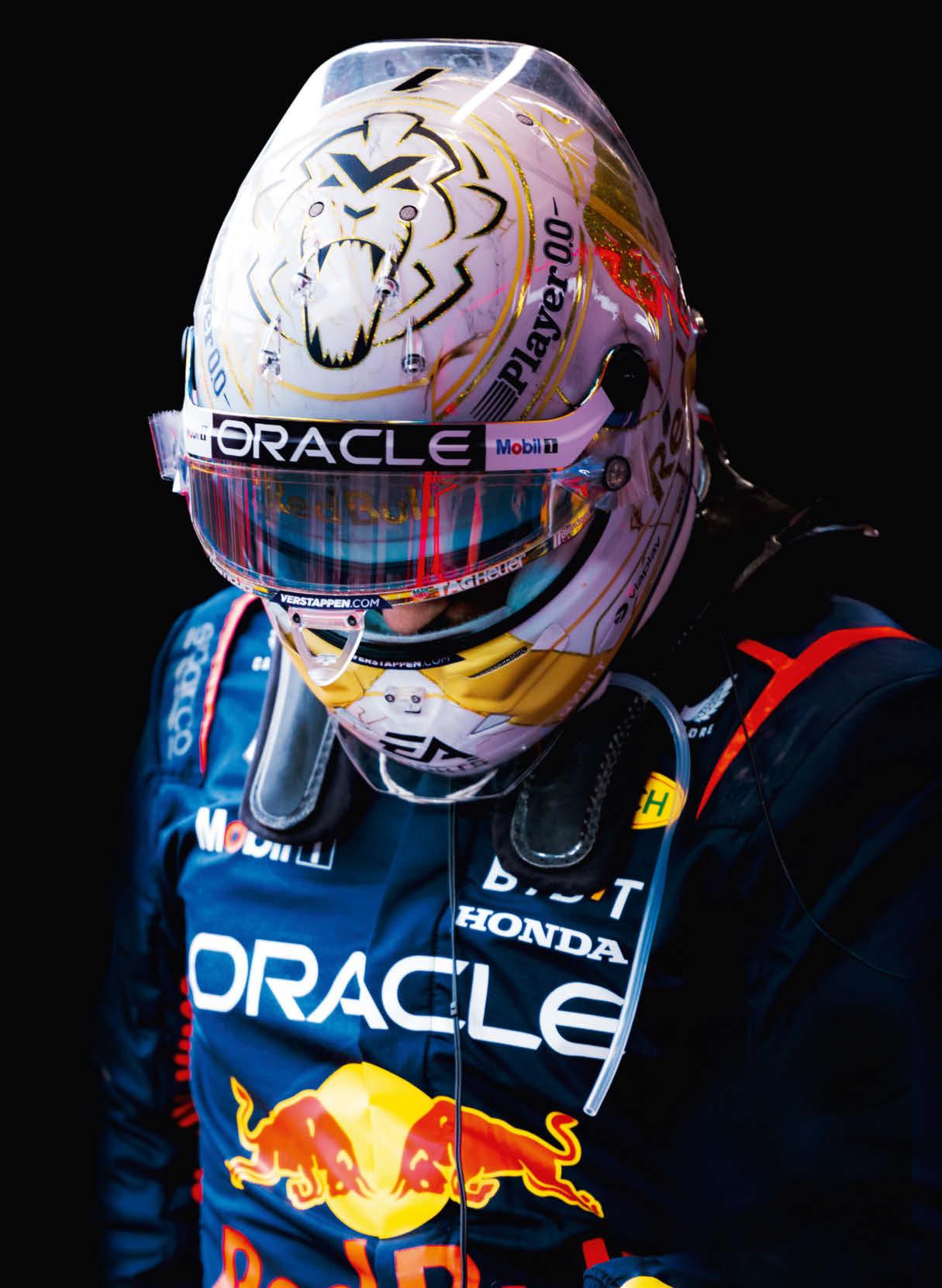
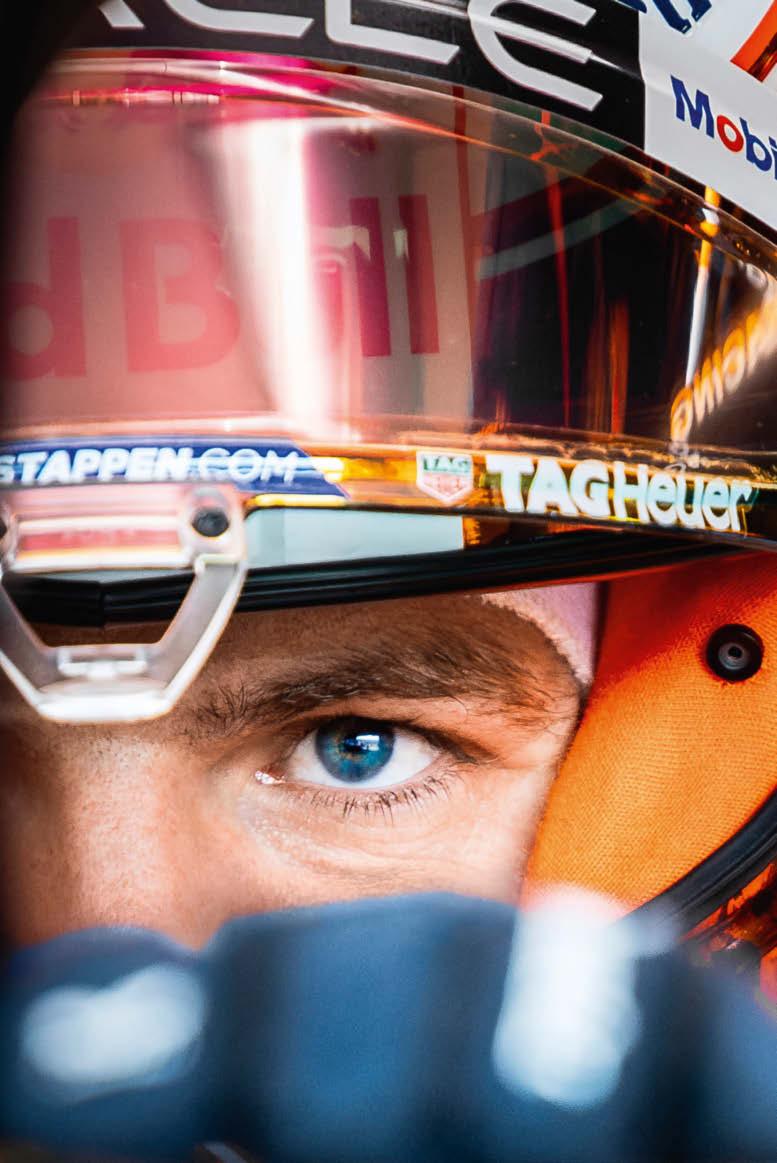
“Max Verstappen, moments before taking to the track. The background of the garage fades almost completely, giving the impression of a studio portrait. The light reflections on the helmet and visor create a highly graphic atmosphere.”
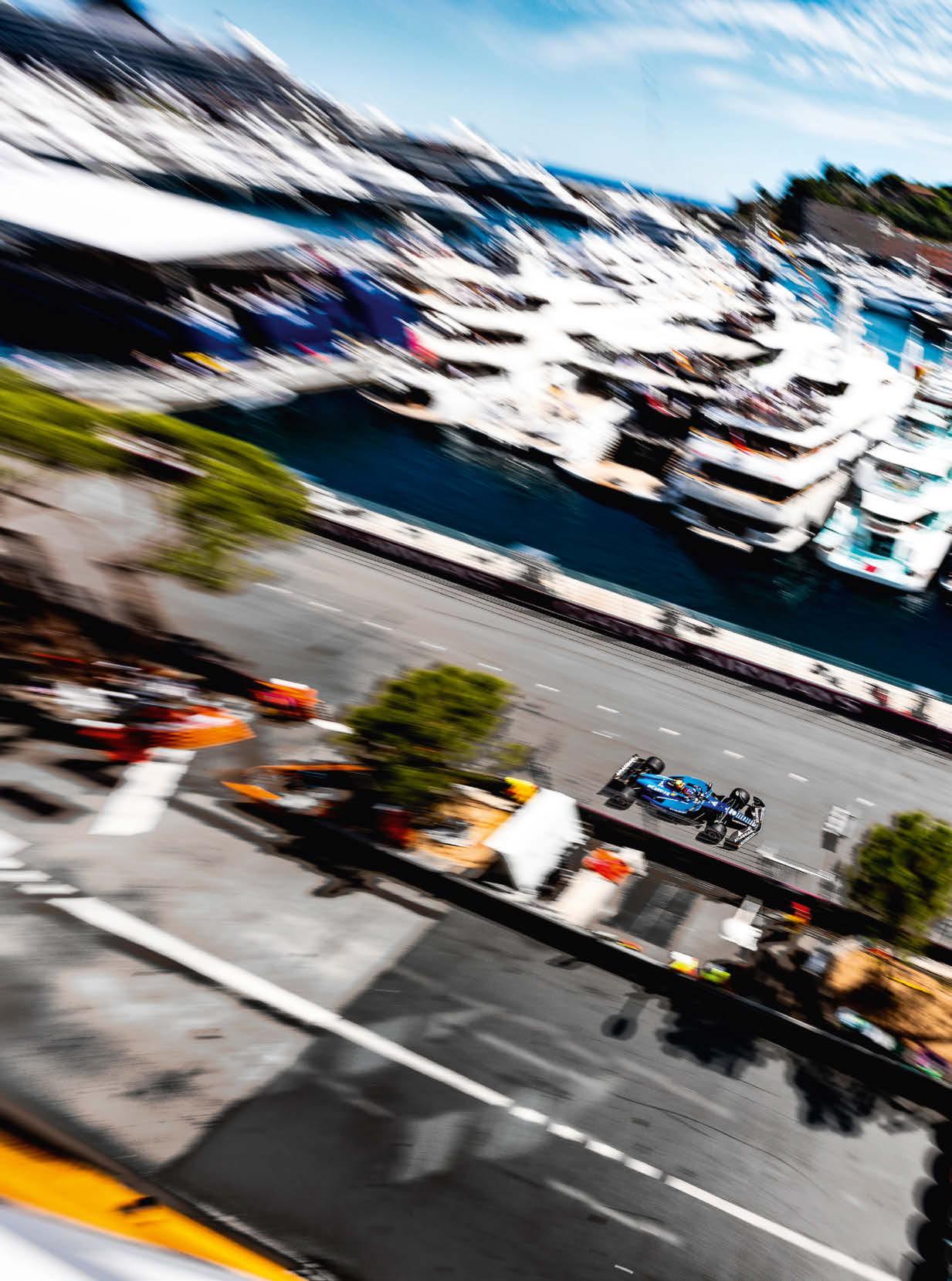
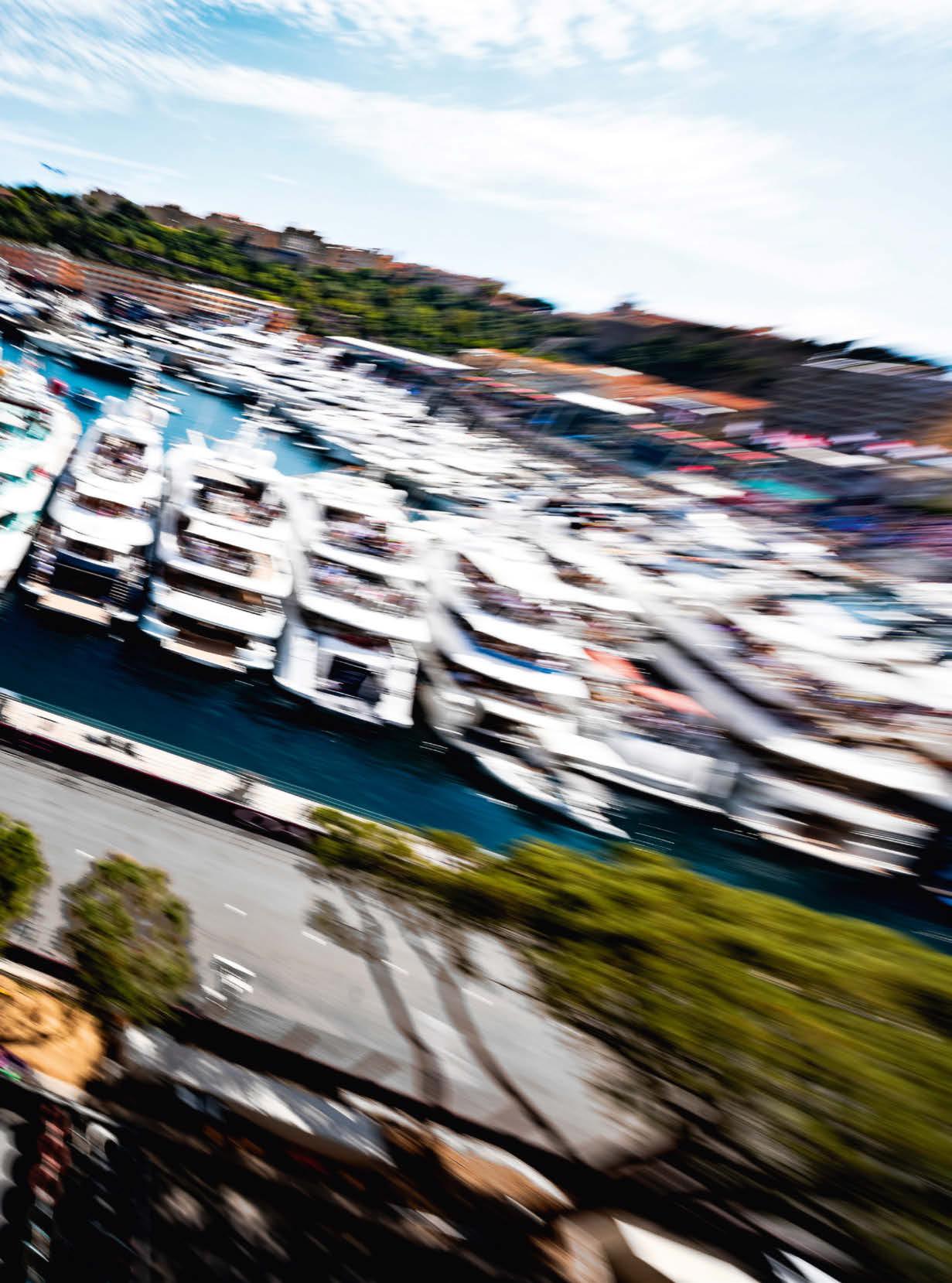
Monaco, 2025
“Shooting in Monaco offers unique perspectives on the race calendar. From this vantage point, the cars seem to race between the track and the yacht-filled harbour, creating a striking contrast between speed and the still surroundings. Playing with motion helps to enhance this feeling.”
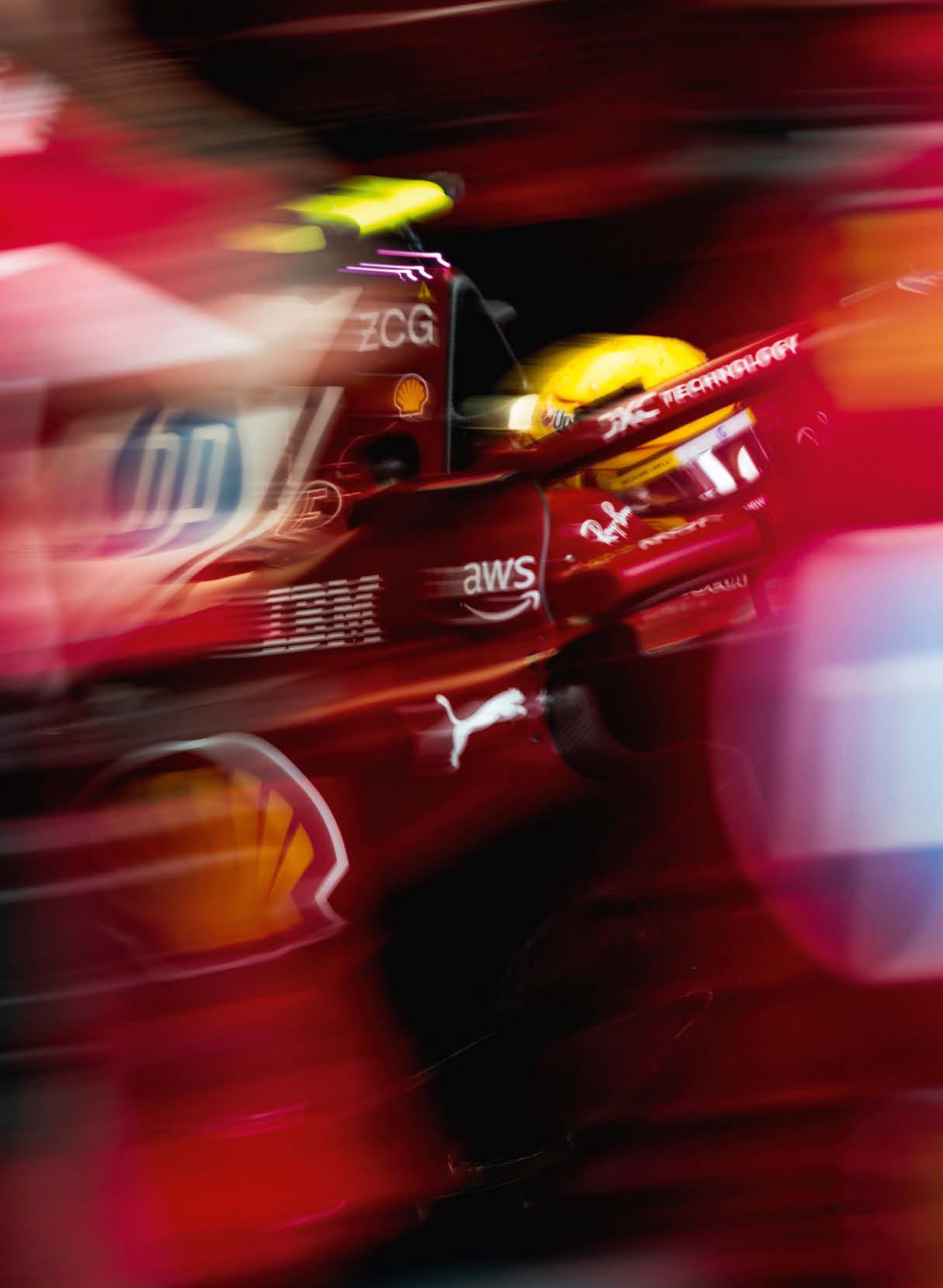
Silverstone, 2025
“Lewis Hamilton pulling out of the pits. Rather than positioning myself in front of the car, I stand behind the mechanics and take a panning shot: the silhouettes blend into the movement and frame it, giving the image more energy.”
“ Photographing motor racing is at least 75-per-cent preparation... and leaving room for instinct“
Spielberg, 2024
“This photo of Max Verstappen was taken just before he hit the track. What strikes me most here is the intensity of his gaze. You can sense the concentration, the seriousness and that fierce determination that characterises great champions.”
Bahrain, 2025
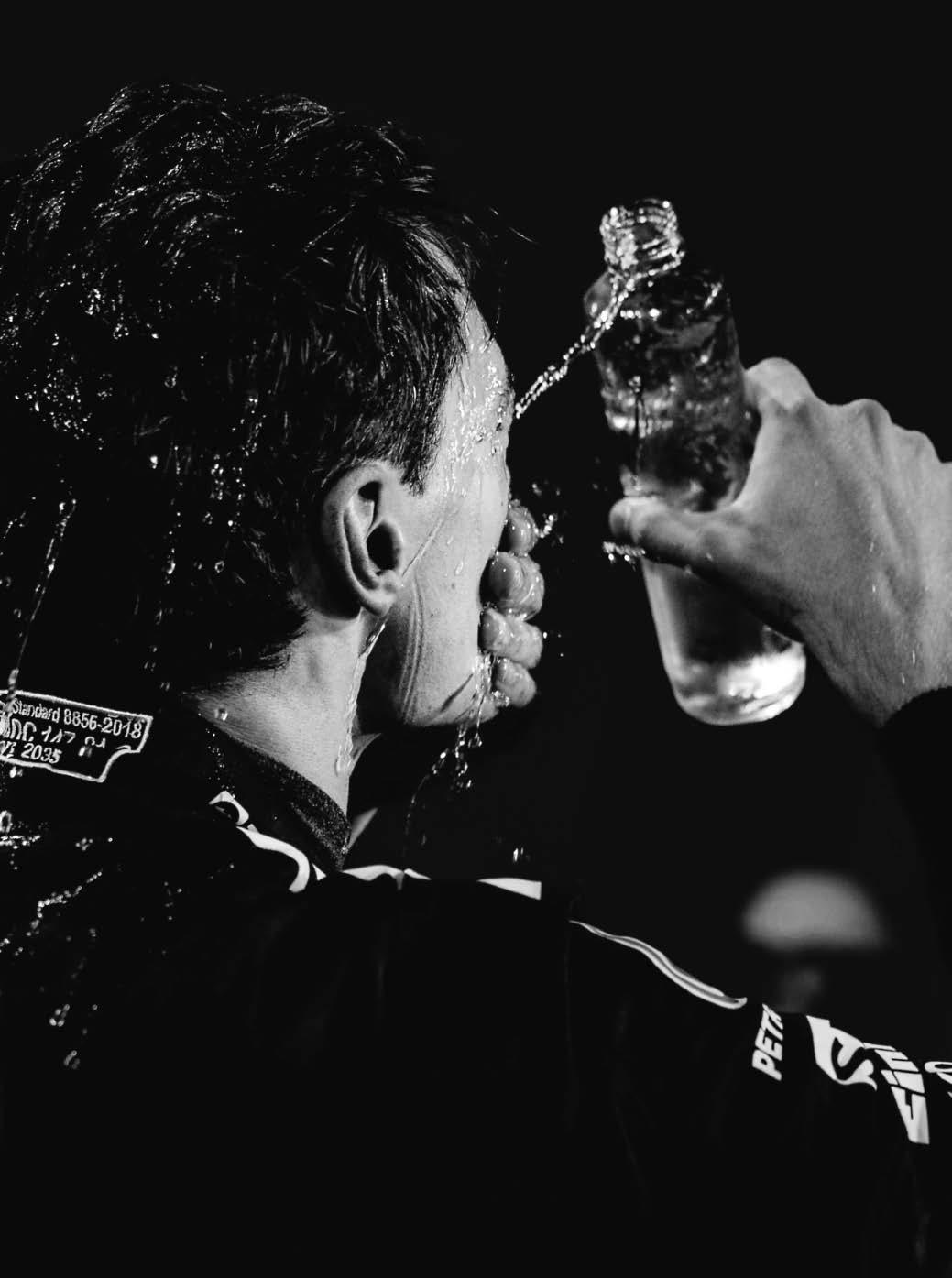
“George Russell, just after the race. Conditions can be extremely gruelling for the drivers, especially in the desert heat. A very human moment after the exertion, as he splashes water on his face to cool down.”
Monza, 2025
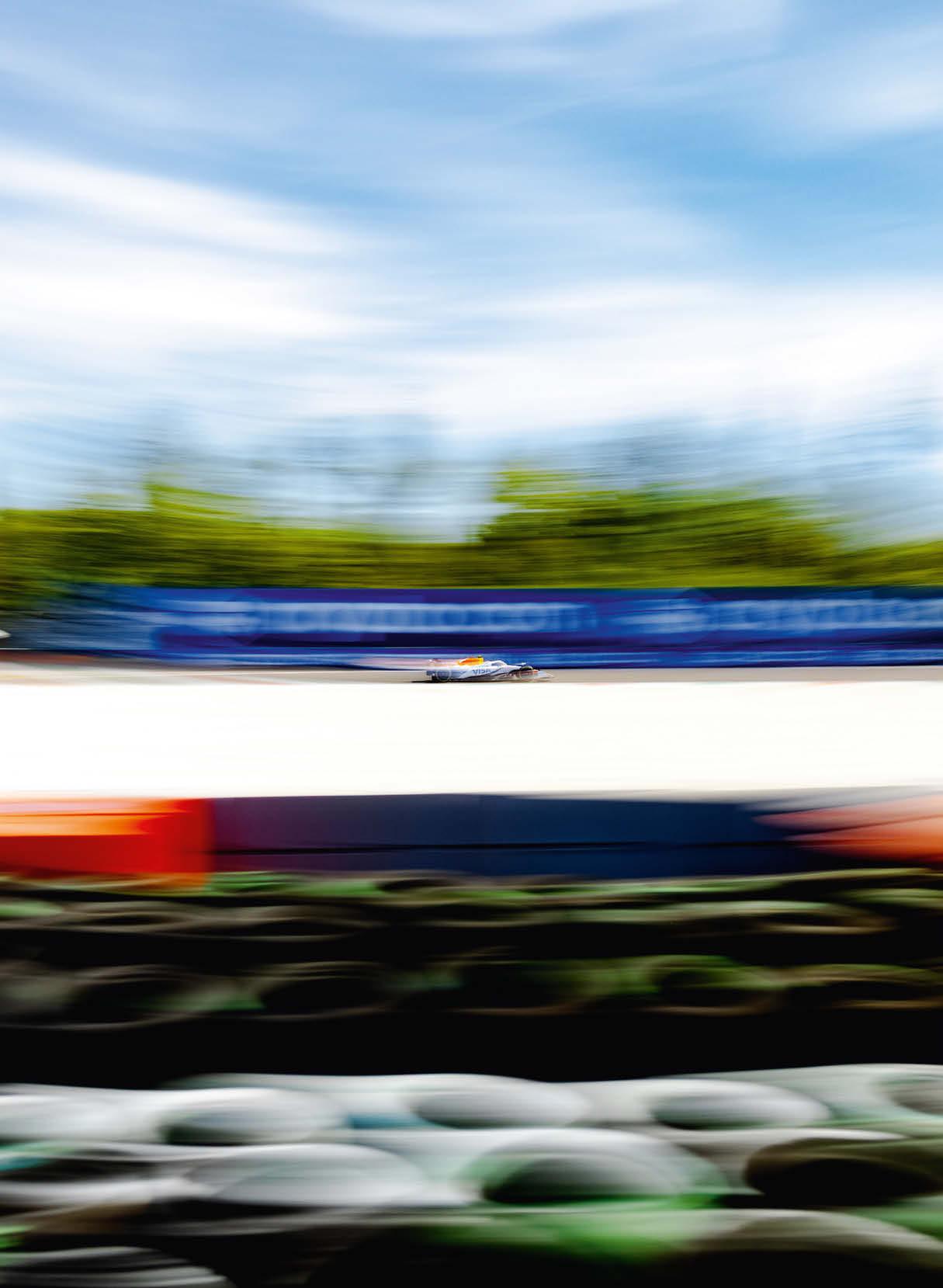
“On one of the fastest circuits, you can really feel the sense of speed when playing with the composition between the foreground, the background and the colours of the track. This balance allows the Visa Cash App Racing Bulls to stand out naturally in the image.”
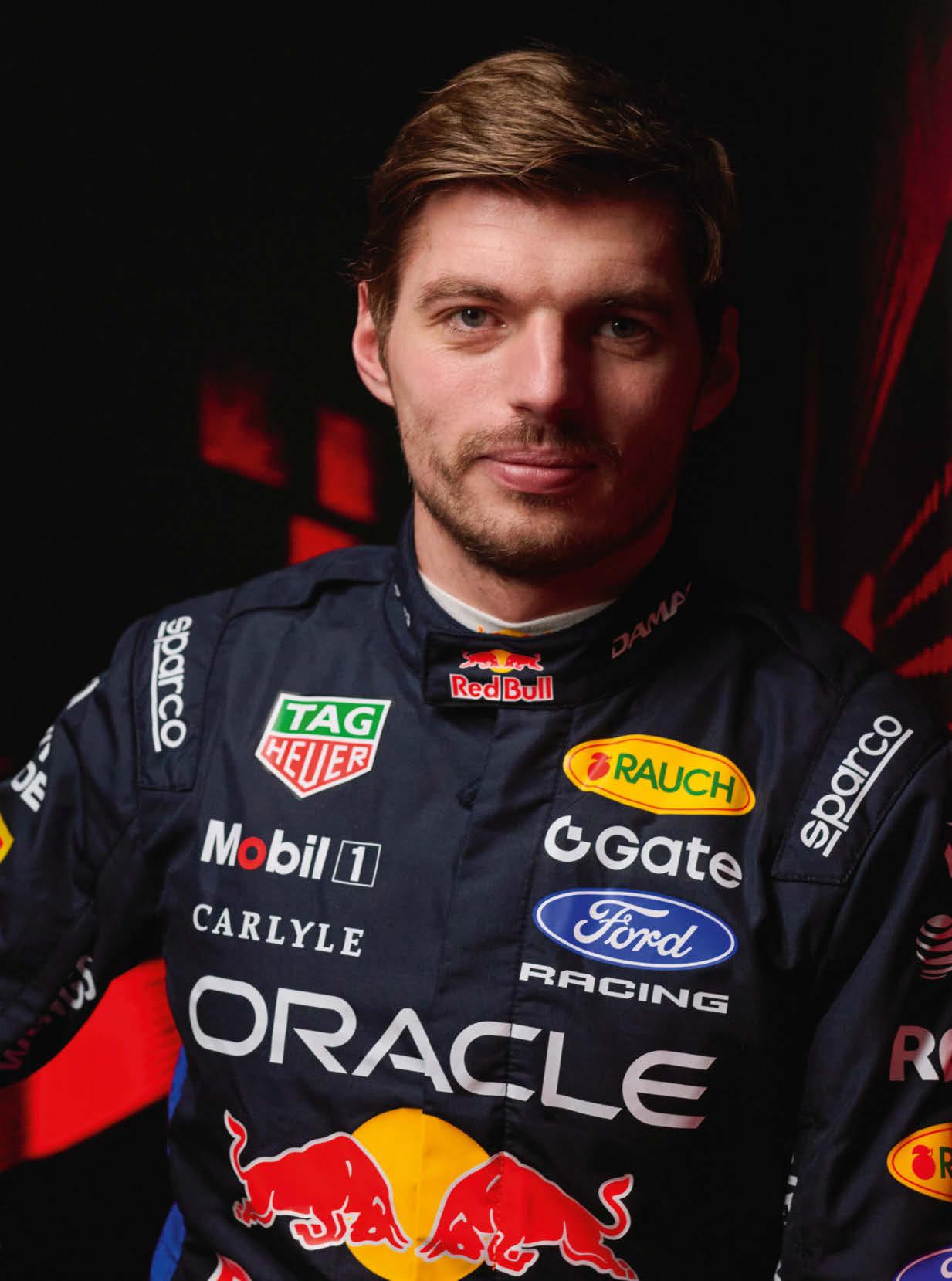
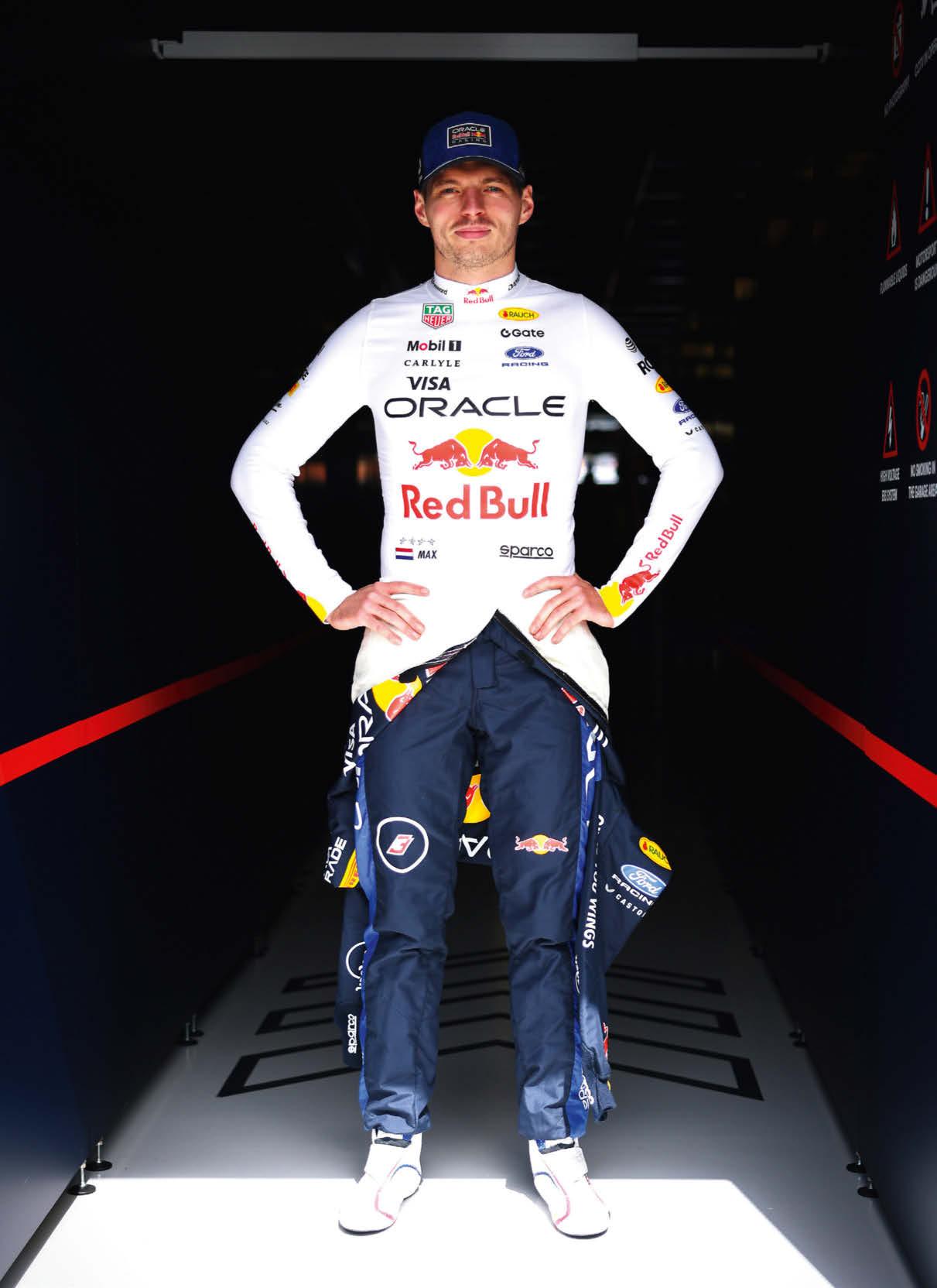
Max Verstappen, March 2026: at 18, he was the youngest-ever F1 race winner.
Today, at 28, he’s the youngest to have won 71 races, and counting…
POWER OF
Since his first grand prix with Red Bull Racing in 2016, Max Verstappen has rewritten the Formula 1 record books. Now, a decade later, he’s still changing the sport…
Words Justin Hynes
IN MAY
Max Verstappen arrived at the Circuit de Barcelona-Catalunya to compete in the Spanish Grand Prix with little to no clue about the car he was set to drive. In fact, he had only a superfcial understanding of how the team he was set to race for even operated.
Parachuted into Red Bull Racing from its junior sister-team Scuderia Toro Rosso just one week earlier and tipped as a generational talent, the 18-year-old was raw but precocious, as quick to show his emotions as to reach the fnish line. With only 26 grands prix for Toro Rosso under his belt, just how much the young Dutchman might achieve was still up for grabs. Three days after his arrival in Barcelona, Red Bull hit the jackpot.
“Within the frst fve minutes of practice, he’s purple, purple, purple [the fastest time on each sector of the track]. He was immediately up there,” recalls Phil Turner, the team’s chief mechanic in 2016, now Oracle Red Bull Racing’s head of race support team. “From that point onwards it was just, ‘My God, where had this kid come from?’”
An impressive Friday became an electric Saturday as Verstappen qualifed fourth. Then, on Sunday, he did the unthinkable. After Mercedes’ dominant but duelling drivers, Lewis Hamilton and Nico Rosberg, had taken each other out at the start, Verstappen swept through to take the lead. He should have been easy meat for the more experienced drivers, but the teenager tigerishly defended to keep Ferrari’s Kimi Räikkönen at bay, before taking the fag frst and becoming Formula 1’s youngest-ever race winner.
Talking Verstappen through the battle from the pit wall was his race engineer, Gianpiero Lambiase. “Before the race weekend, we spent three days with him on the simulator,” says Lambiase. “Straightaway, you could tell he had an insane capacity to process information. He picked it up like he’d been racing with us forever.”
Adrian Newey, the F1 design legend and Red Bull Racing’s chief technical ofcer until 2025, puts it even more
succinctly: “He’d just go out and drive the wheels of it.”
Verstappen has been doing that and more ever since. At just 28 years old (the age at which the great Ayrton Senna won his frst title), Verstappen has won four in a row, from 2021 to 2024. Prior to the start of this season, he had racked up a staggering 71 race wins, the sport’s thirdhighest total behind Hamilton (105) and Michael Schumacher (91). Hamilton was 33 when he hit 71 wins, Schumacher 35.
Verstappen’s path to greatness hasn’t always been smooth. In that frst season with Red Bull Racing, the Dutchman added six more podiums – including a stunning charge to third place during a rain-soaked race in Brazil – but the barnstorming fnishes were countered by a steady stream of collisions, clashes and conficts.
“In those frst two or three seasons he grew incredibly, and to see him add experience to his innate talent was formidable, but he was still prone to errors,” says Lambiase. “The frst seven or
“From that point onwards, it was just, ‘My God, where had this kid come from?’”
Phil Turner, Red Bull Racing’s chief mechanic in 2016
5, 2016:
May
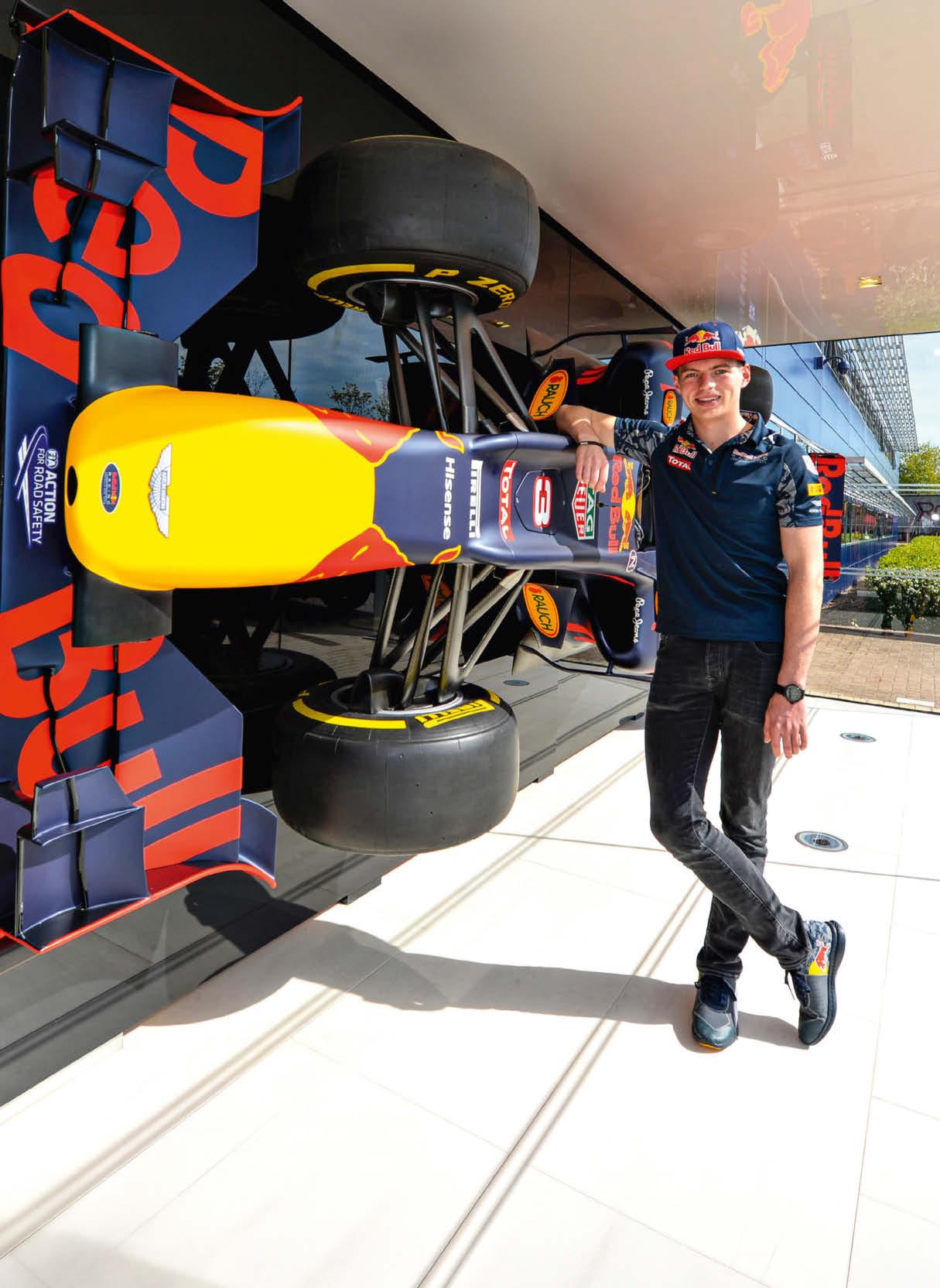
Max Verstappen at Red Bull Racing’s UK base 10 days before his first race – and win – for the team in Spain
Viva Verstappen: winning the S ão Paulo GP in 2024. At the next race in Las Vegas, he’d claim his fourth F1 World Championship in a row
Ten to the Max
A decade of defining Verstappen victories
SPAIN
Verstappen’s debut win on just his 27th grand prix, defying 2007 world champion Kimi Räikkönnen to become F1’s youngest-ever winner at 18 years old.
MEXICO
So dominant was the Dutch driver that only Sebastian Vettel, Kimi Räikkönnen and Lewis Hamilton (P2, P3 and P4) were on the same lap when he won.
AUSTRIA
Pushing past Ferrari’s Charles Leclerc to claim the team’s first win with Honda. This car/power unit/driver combo would soon become the sport’s strongest.
ANNIVERSARY GRAND PRIX
As F1 celebrated its 70th birthday, Max delivered perfection to beat faster Mercedes cars in a COVIDemptied Silverstone.
ABU DHABI
A nail-biting final lap to the final race of the season, but when the pressure was greatest Verstappen delivered, passing Hamilton to take his first title.
eight races [in 2017] there were a lot of accidents. The following year in Monaco, he crashed in practice and missed qualifying. It reduced him to tears.”
Verstappen quickly wiped them away. Mistakes were rarely repeated, and knowledge, once acquired, was applied with relentless precision. In 2019, there came a turning point. The team ditched its underperforming Renault engine and brought in Honda to power its cars. “Having Honda on board with something performant, reliable, was the basis for us to show what our chassis was capable of and for Max to show what he could do,” says Lambiase.
In 2019, Verstappen took Honda to its frst win in 13 years, at Red Bull’s home race at the Red Bull Ring in Austria. In the COVID-shortened 2020 season, he briefly threatened a title charge. The following year, he did it for real.
The 2021 season will be remembered for the ferocity of the title fght between Verstappen and seven-time champion Lewis Hamilton, culminating in a fnal-round showdown and controversy in Abu Dhabi. Tied on points, Verstappen was handed a closing-lap chance after a late-race safety car, and muscled his way past race leader Hamilton to claim the title. Lambiase says the title win was the result of Verstappen hitting new levels.
“What I remember is taking it race by race, following the process,” says Lambiase. “That sounds boring, but it’s part of the reason why [Max] came out on top. He didn’t get carried away dreaming about anything. He maximised everything he could.”
Verstappen cranked into an even higher gear in 2022 and, with the
BELGIUM
Starting 14th on the grid, Verstappen roared to the lead after just 11 laps and won 17.8 seconds ahead of teammate Sergio Pérez, who started second.
MIAMI
Despite qualifying ninth, Max climbed to P3 inside 15 laps, prolonging his starting tyres to take the lead. He then won 16 of the next 17 races.
SÃO PAULO
Starting 17th after a tough qualifying, Max scythed up the field.
“I felt unstoppable,” was his verdict on one of F1’s greatest wetweather drives.
JAPAN
Battling a difficult car, Verstappen converted a hard-won pole position into his first win of the season.
“Perfection,” Lambiase said after the finish.
ITALY
After a winless summer, Verstappen was 104 points off the top, but in Monza it all came together. In a flawless weekend, he won six of the final nine races.
Fast learner:
Verstappen, ahead of the first race of the 2026 season in Melbourne, Australia. The game has changed, but this man always catches up
“The biggest challenge was one we created ourselves: how many races could we win in a row? It had reached that level of perfection” Gianpiero Lambiase, Max Verstappen’s race engineer
experience of one title win and armed with a new generation of car, he romped to a second title, taking a remarkable 15 wins from 22 races. In 2023, fully delivering on the generational-talent tag attached to him in 2016, Verstappen roared through all opposition, torching the record books along the way.
“People don’t believe it, but it’s very difcult to win a Formula 1 race,” says Lambiase. “The competition is so tight that everything has to be perfect. So, to do what he did and win 19 races out of 22 is just astounding.”
Verstappen’s win percentage in 2023 – 86.3 per cent – broke the 71-year-old record of Alberto Ascari who won six of the eight races held in 1952. Of those 19 wins, 10 were scored consecutively, breaking a 10-year-old record set by fellow Red Bull driver Sebastian Vettel. Verstappen won four of the six Sprint races. He fnished of the podium just once and was always in the top fve on his way to a record points haul of 575, as well as helping his team to a record total of 860. In short, he put together F1’s greatest season ever.
“That car was made for him. It ftted him like a glove,” says Lambiase. “We could just roll out in FP1 [the opening practice session] and he was on it, the car was on it. The biggest challenge was one we created ourselves: how many races
could we win in a row? It had reached that level of perfection.”
In 2024, a fourth title followed in tougher circumstances, and in 2025, with the opposition at last closing the technical gap, the juggernaut stuttered to a halt. Even then, as Verstappen battled car woes and team instability, he won six of the fnal nine races and missed out on a ffth title by just two points.
Anew challenge now beckons. This year, the ferociously fast but heavy 2025 cars have been replaced by a new generation that are smaller, lighter and supposedly more malleable. Managing the recovery of energy to the batteries – which now provide half the car’s power – means that driving is less about fooring the accelerator and more a game of power management.
“I’m confdent that Max will become the best at mastering these regulations, and the technicalities and tricks, as much as he did with the previous set of regulations,” said team principal Laurent Mekies as pre-season testing ended in Bahrain this February. That process began almost as soon as Verstappen climbed into the new RB22.
In Bahrain, the Dutchman could be seen, and heard, aggressively downshifting to frst gear at Turn 10,
while most drivers used second gear. The approach allowed Verstappen to generate higher revs and maximise energy harvesting for the car’s battery system, giving him more power on the following straight. Rivals scrambled to adopt similar tactics, though many feared for the durability of their gearboxes.
It’s just the latest example of Verstappen’s uncanny talent for fnding a way to win. Just as he stepped into a deeply unfamiliar car in Barcelona in 2016 and quickly found his comfort zone, so the Dutchman has always had the ability, mindset and desire to drive around any problem.
Former chief mechanic Phil Turner sums it up best. “What’s the most impressive thing about Max? It’s that he’s remarkably uncomplicated in his approach. He just gets in and drives it, and he drives it fast. There’s no build-up, he doesn’t need a lap to familiarise himself with the track or with anything, even with a new car. He’s just able to drive it faster than most other drivers could even dream of.”
Ten years into his career with Oracle Red Bull Racing, there’s no sign that Verstappen’s pace or passion is fagging. There are new hurdles to overcome, new problems to solve, but there aren’t many who’d bet against this generational talent racing to the perfect solution.
FORMULA 1 TRANSFORMED
The 2026 cars differ dramatically from the last generation thanks to new FIA rules. “The whole way of racing is changing,” says Max Verstappen. Let’s take a look at what he means…
The cars are smaller
This year’s chassis are 200mm shorter, 100mm narrower and 30kg lighter. It’s the so-called ‘nimble car’ concept, intended to improve the drivers’ ability to battle one another.
The tyres, as well They’re still 18-inch Pirellis, but the wheels are 25mm narrower, to trim weight and cut drag.
Greener engines
Although still 1.6-litre V6 turbo hybrids, battery power has tripled, giving a near 50/50 split between electric and internal combustion. Significantly, the complex energy-recovery system that previously harvested exhaust heat is gone, leaving only a kinetic system which recharges the battery through actions like braking. The fuel is also 100-per-cent sustainable.
Aerodynamically
different
Last year’s cars generated huge amounts of downforce, enabling them stick to the track and speed around corners. But it also caused a bouncing effect known as ‘porpoising’. This was due to intricate ‘ground effect’ tunnels in the car floor sucking them downwards. Not any more. With flatter floors, we’re back to upper-body wings generating downforce.
Introducing active aero
On the straights, the front and rear wings open to reduce drag and increase speed. On the twisty bits, the wings close, boosting downforce and making the cars faster through the corners. These are imaginatively known as Straight Line Mode and Corner Mode. And there are other modes…
Overtake Mode
Replacing the old overtaking aid DRS (which used the wings in a similar fashion to active aero), now when a driver gets to within a second of the car in front, he can hit a button on the steering wheel, activating an electric power boost.
Boost Mode
There’s also another button a driver can punch at any time to access maximum power, provided they have enough charge. It adds a layer of energy management as drivers need to consider when to deploy it and when to recharge the battery.
The bottom line
In 2026, drivers are going to be hunting for energy. Those who manage that best will prosper. On the engineering side, teams that optimise their energymanagement tools will also have an advantage. In short, modern F1 is like speed chess… where the speed is 300kph.
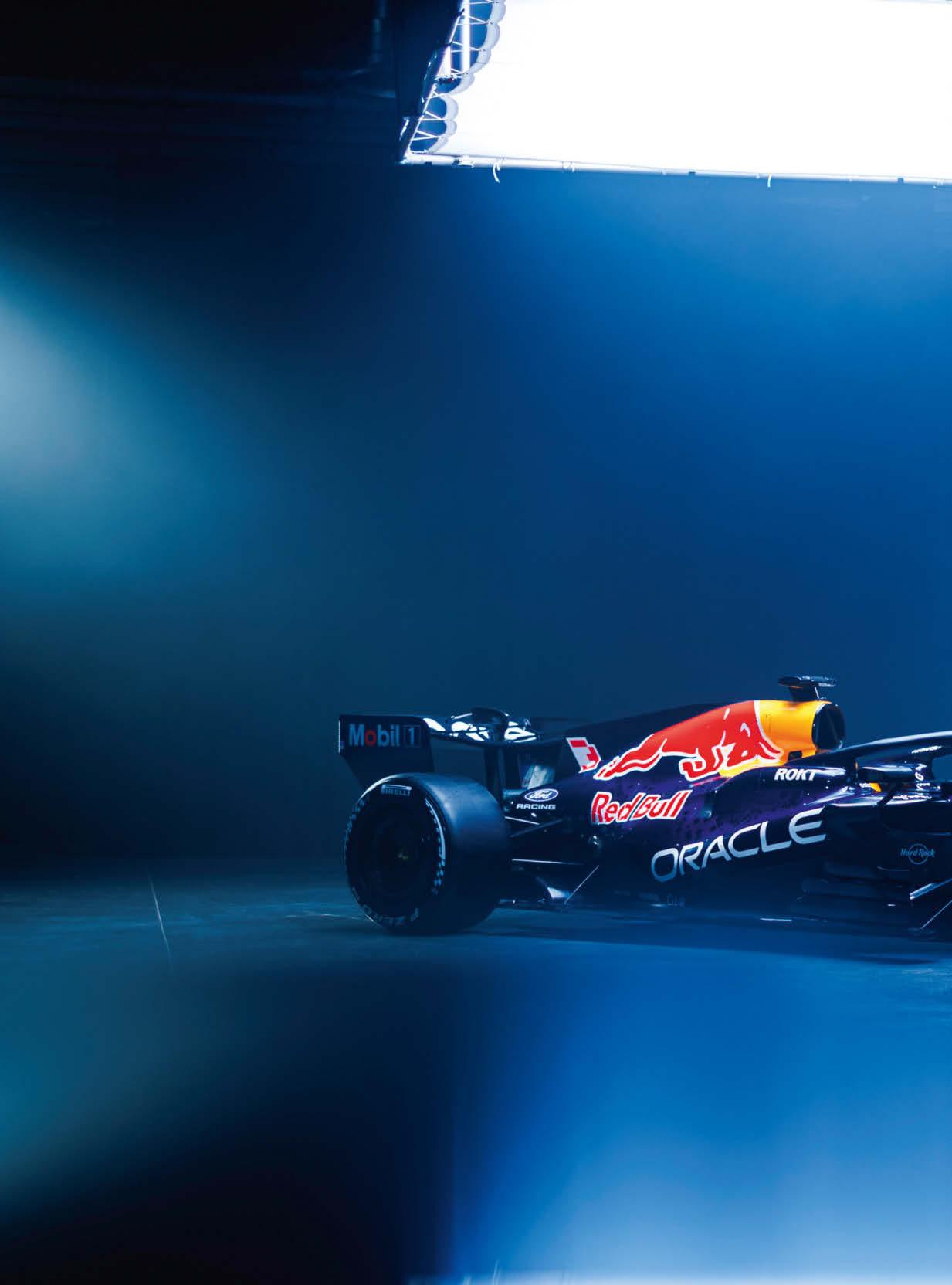
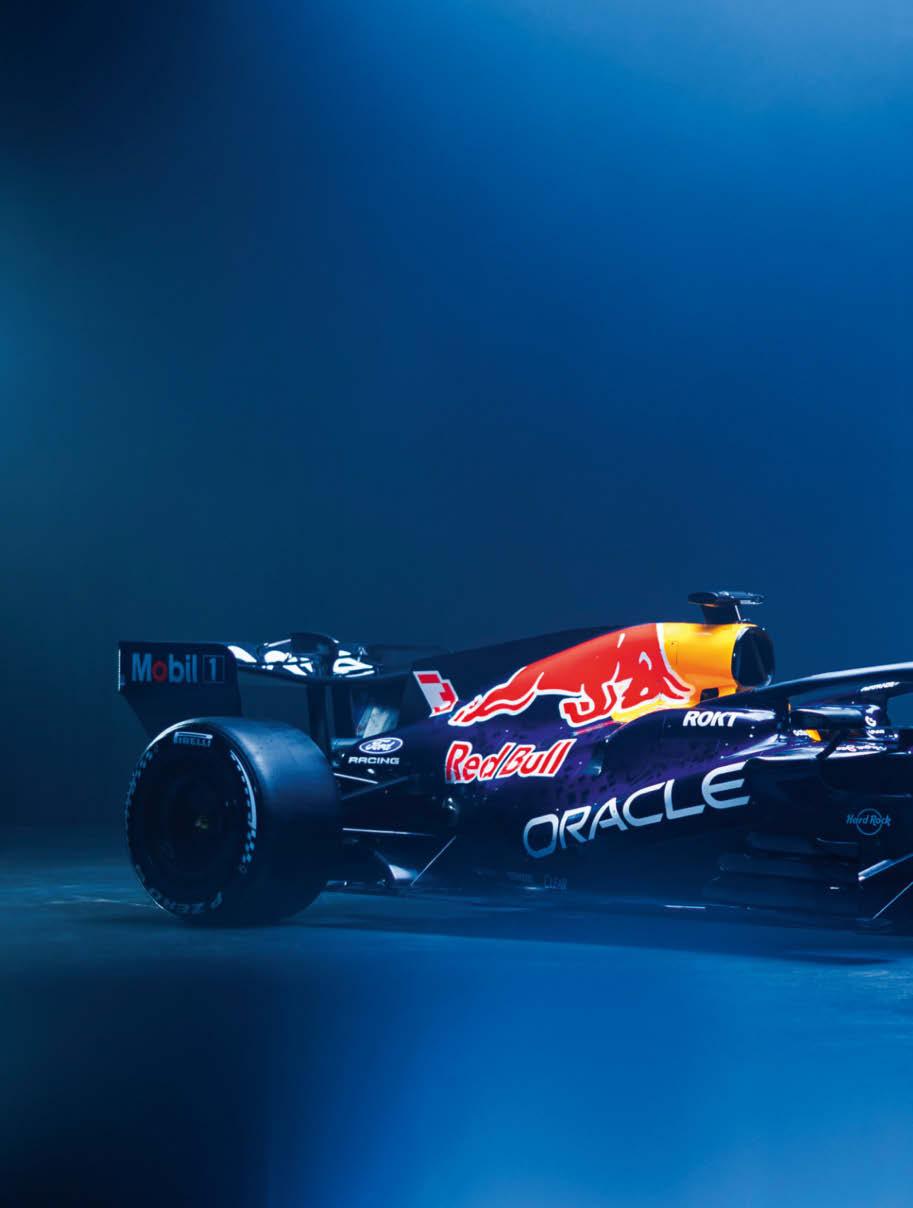
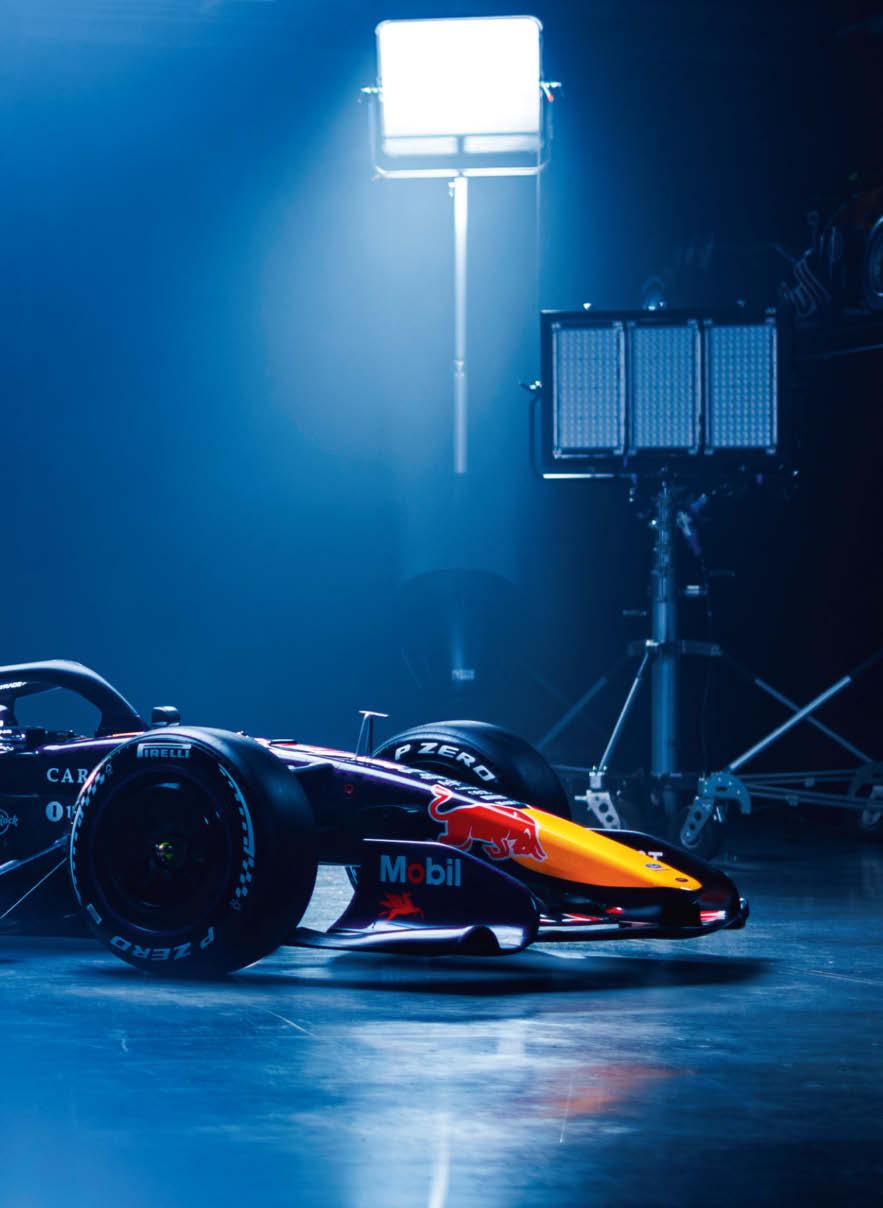
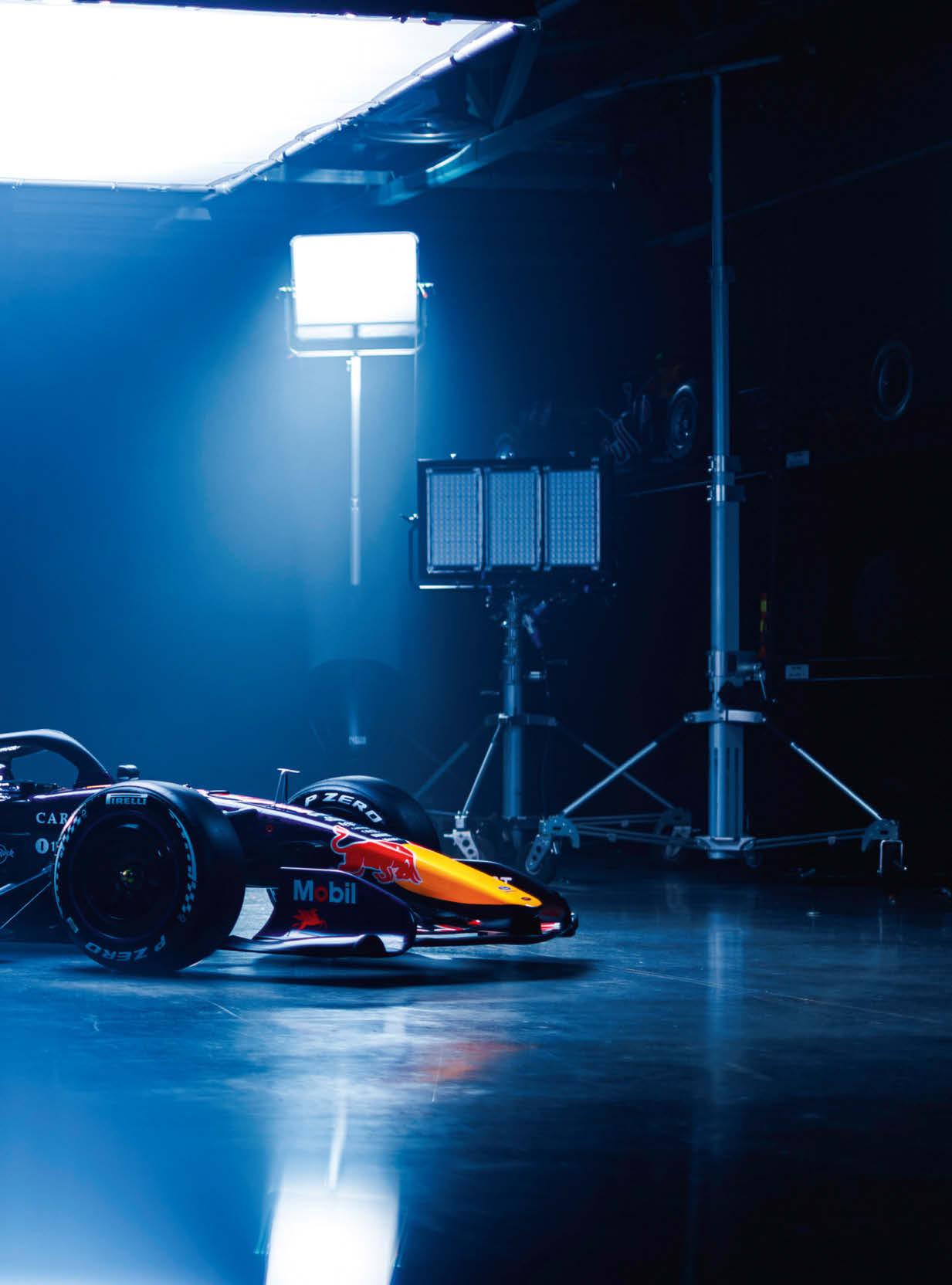
Pictured: Oracle Red Bull Racing’s 2026 F1 car – the RB22
CONCRETE & GOLD
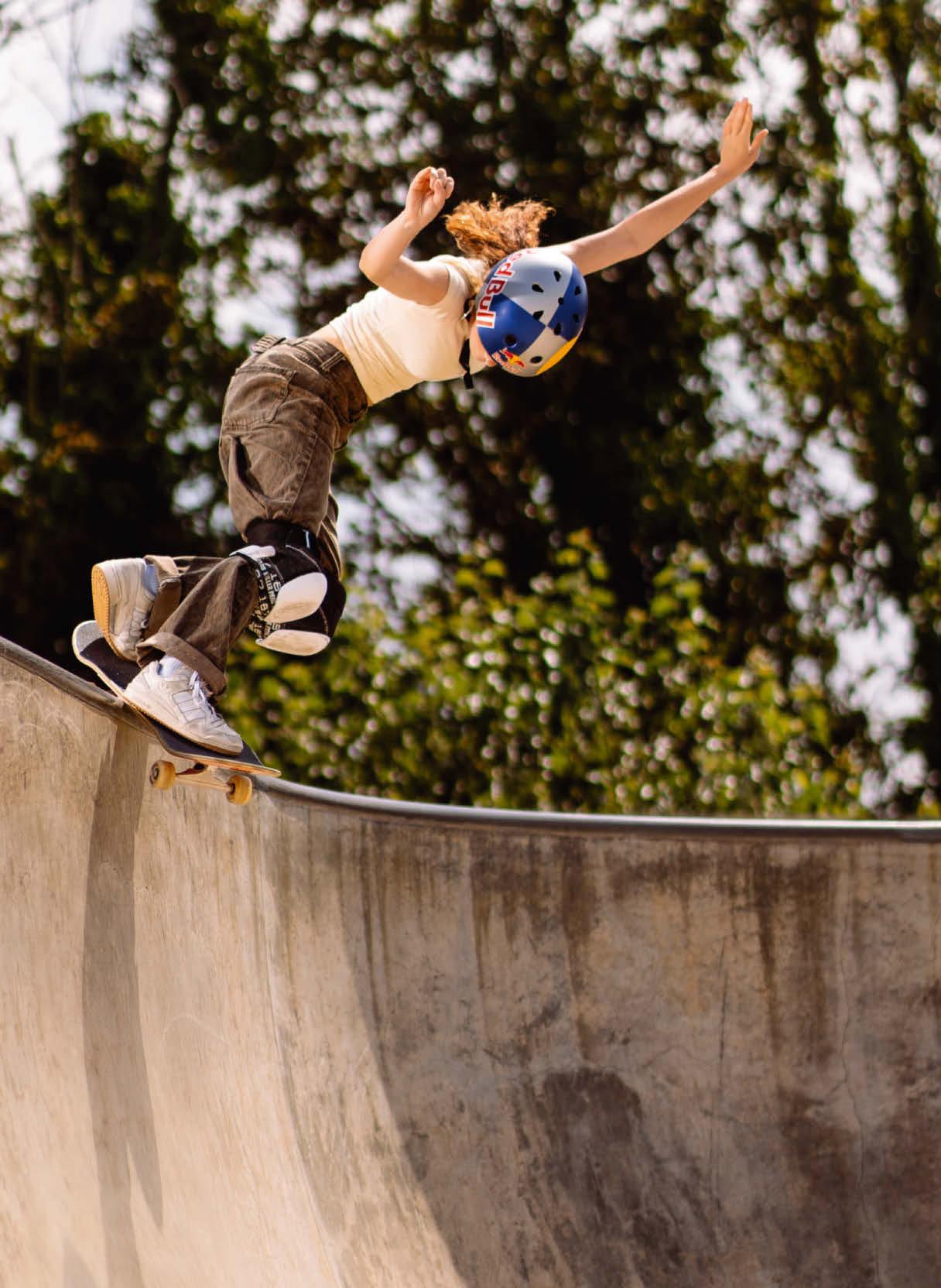
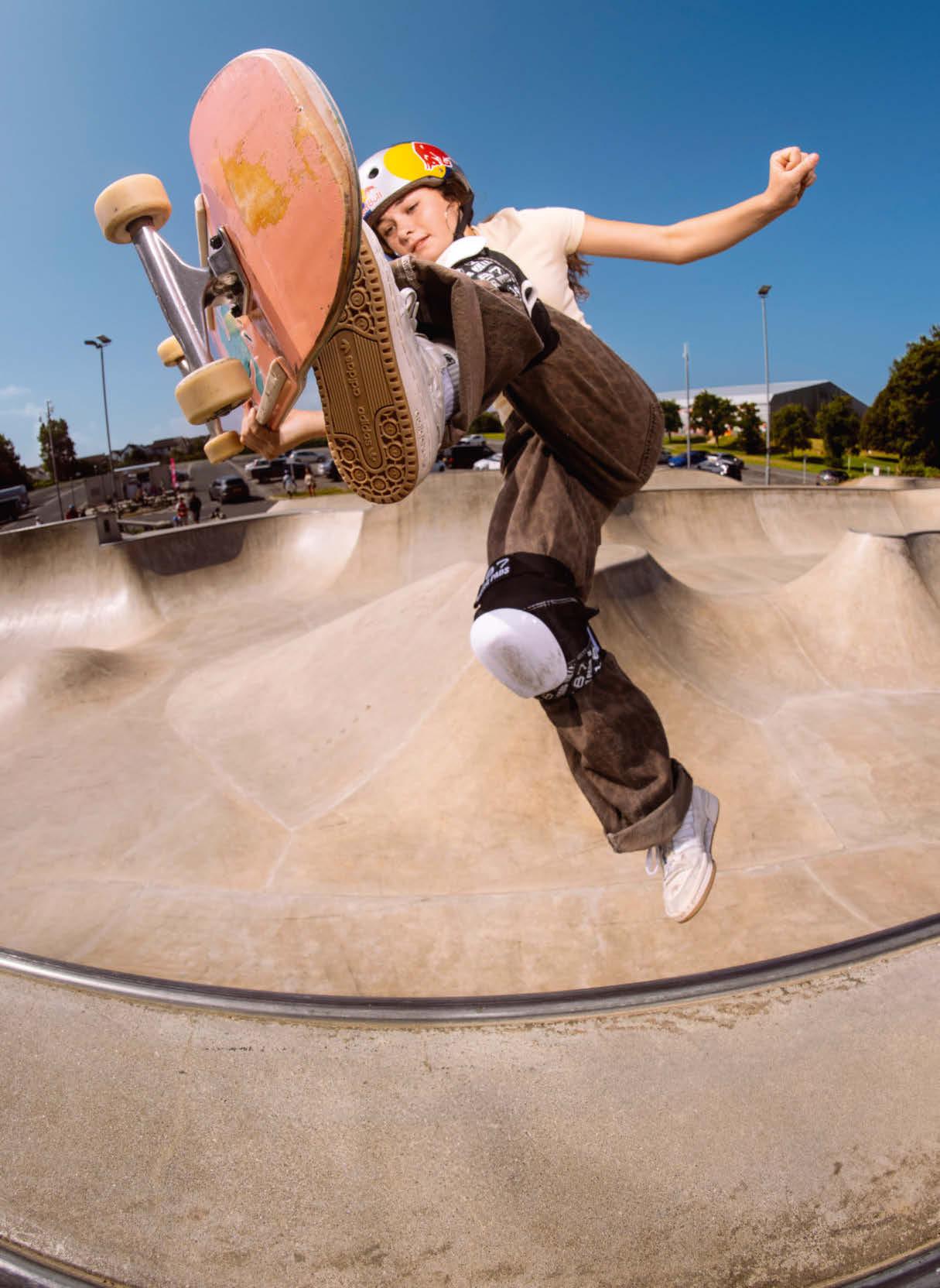
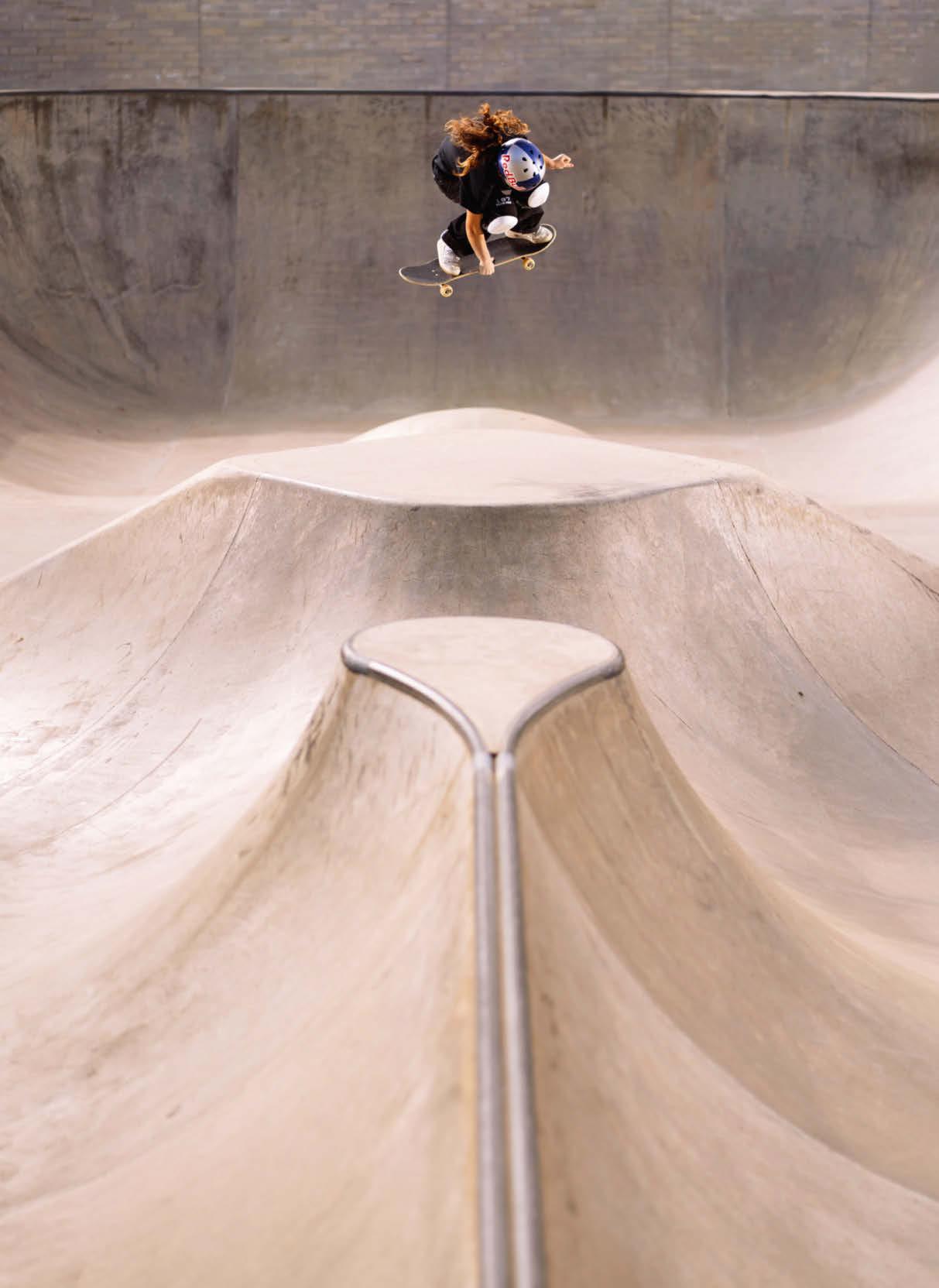
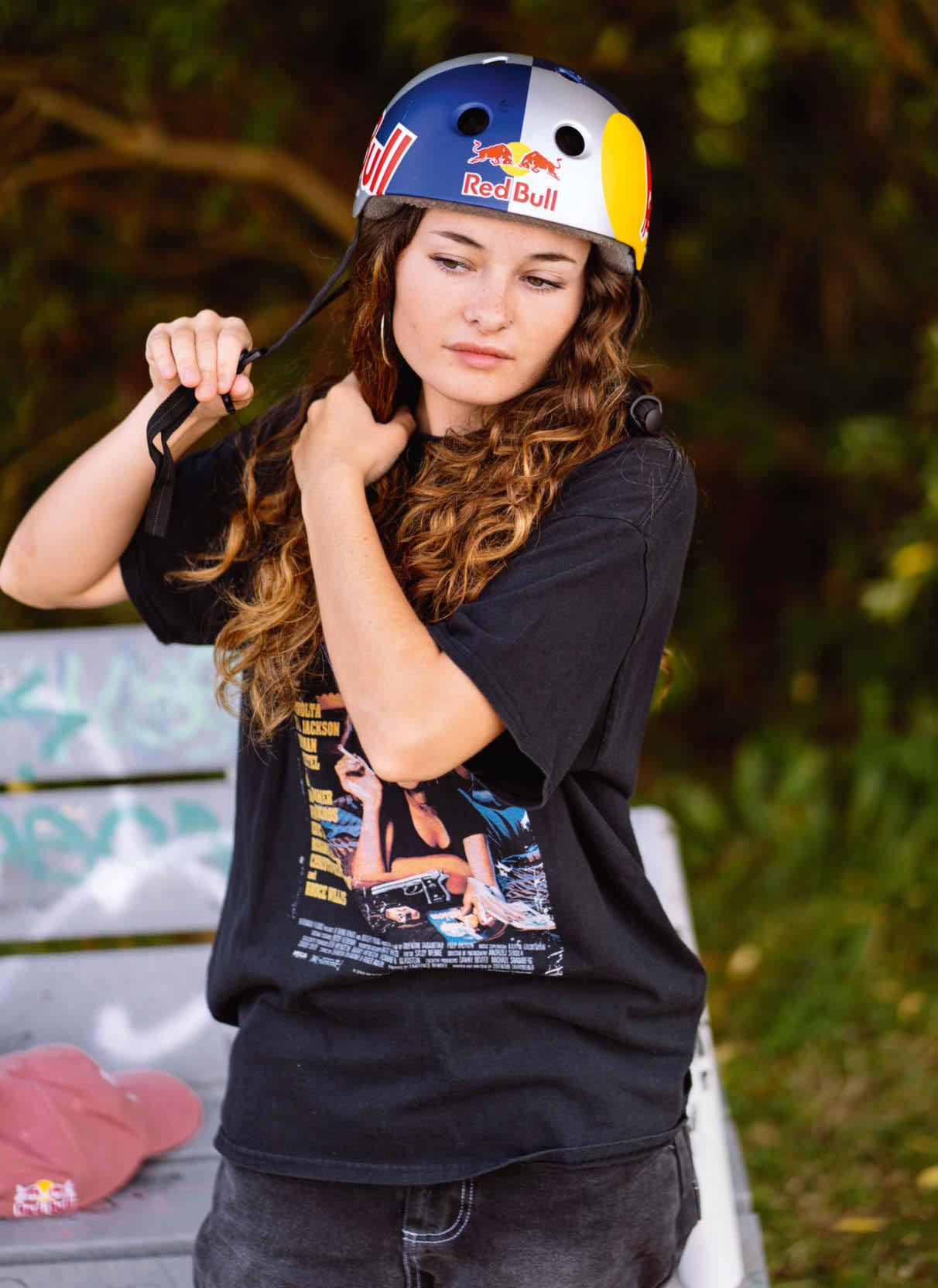
Lola Tambling is the UK’s most successful homegrown skater, honing world-class tricks on Cornwall’s concrete bowls. And as she turns 18, the shredder from Saltash is ready for more…
Words Jessica Holland Photography Leo Sharp
“I just thought, ‘I’m going to smash it. It’s all I ever wanted; it’s my dream’”
“Just being there is such a vibe.” Skateboarder Lola Tambling is remembering the euphoria of her first visit to California, to skate in an all-female contest, Exposure. “The deck is full – you can’t even move,” she says. “It feels like a rave: girls everywhere, hyping, and the music’s blasting. Everyone’s getting into it. Then you look over to your right and there’s Tony Hawk watching. All these sick dudes come to watch. The whole thing feels so warming and homely.”
For Tambling, skateboarding has been home for as long as she can remember, despite her actual home being thousands of miles from sunny San Diego in Saltash, a small Cornish town near Plymouth. She was just 11 years old on that trip to the US, and she’s travelled the world in the years since to skate and compete, including landing a spot at the 2024 Paris Olympic Games at the age of 16.
Sky Brown, the 17-year-old reigning champion in women’s park, has achieved household-name status after winning two Olympic bronzes for Team GB, but neither she nor Andy Macdonald, the other member of the 2024 skate team, grew up skating in the UK; this makes Tambling the nation’s most successful homegrown talent. Despite the less-than-ideal weather and a lack of world-class facilities, the laid-back teen is showing just how far it’s possible to get in the competitive skateboarding scene while remaining based in England.
“The fact that I’m doing so well skating English parks, I think that’s sick,” Tambling says. She’s sipping tea at the kitchen island of her family’s Cornwall home, sporting camo trousers and an Adidas American football jersey with her name on the back, slightly obscured by her mane of long, curly hair. “It’s underdog vibes. But I love being English. I think it just makes you stand out more. I love my home, and I like the skate parks I’ve grown up with.”
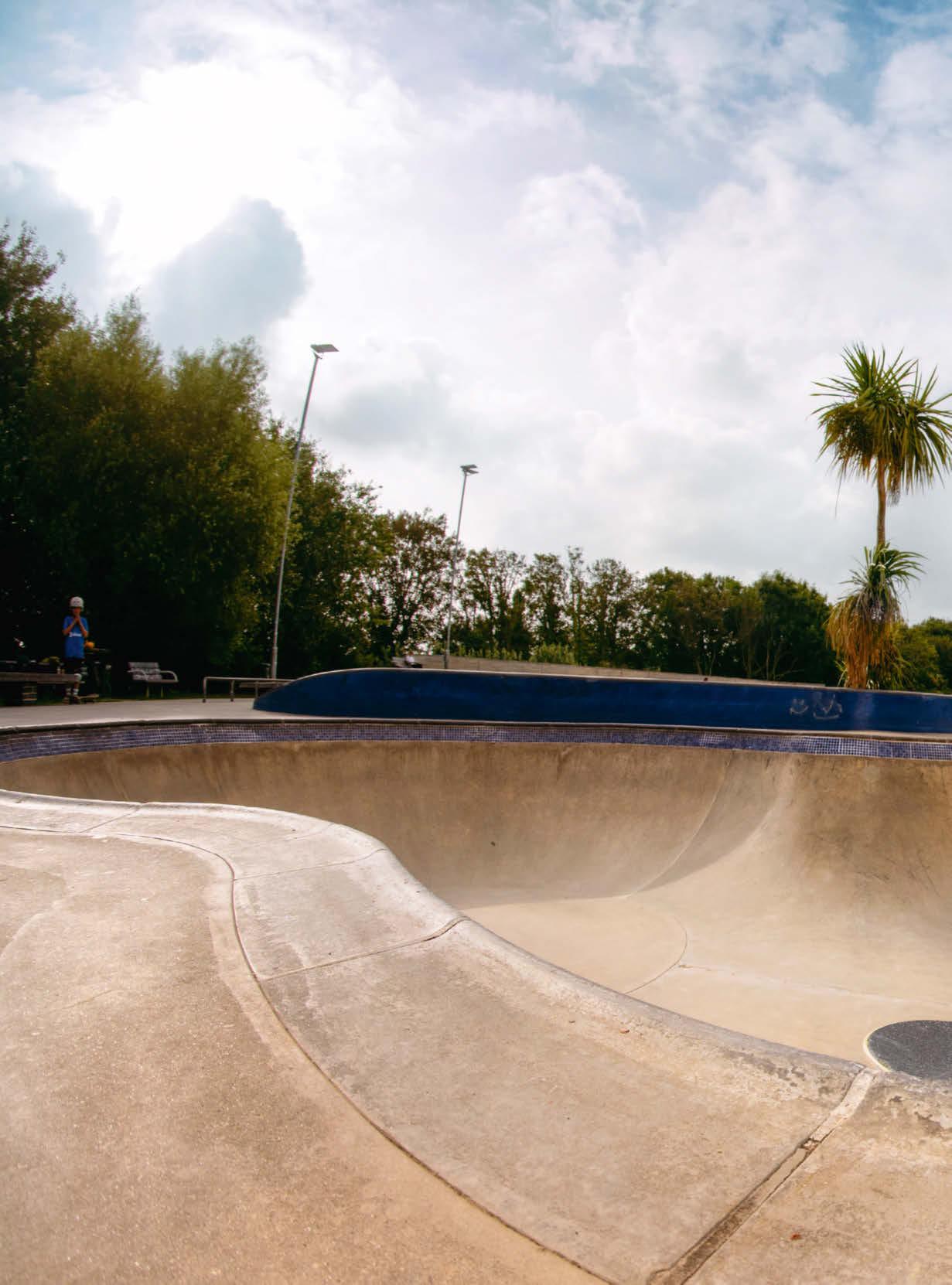
It’s an hour-plus drive from here to Concrete Waves, where last summer, on a perfect blue-sky day, Tambling was confirmed as the country’s best female park skater – for a third time in four years – at the Skateboard GB National Championships with a confident winning run that saw her spin 360° in the air over a jump box and fly over a big gap from one side of the bowl to the other.
It’s a similarly long drive to Mount Hawke, a big indoor park near Truro where she’s spent countless hours honing her tricks. But Tambling has had a few advantages that have helped her set a new bar for homegrown skating. Her dad, Martyn, a serious BMXer for decades, remains her main coach; she’s been homeschooled for most of her teens, which has allowed her to focus on travelling and competing as a skater; and Martyn and his wife Stephanie (Lola’s mum) built and ran a skatepark, Junkyard, here in Saltash between 2014 and 2022.
Tambling was just short of seven years old when her parents opened Junkyard, an indoor facility with a DIY vibe: a whippy wooden bowl, plaza section, cafe, and lots of community classes and events. She remembers falling in love with skating on the day of the opening jam – despite her BMXer lineage – and jumping on a plastic Penny board in Ugg boots and a bicycle helmet soon after. “I’d just go all the time,” she says. “I didn’t want to do anything else.”
She was often the only girl skating, which “could be a bit intimidating,” she says, “but the dudes always had my back.” By the time Tambling was 10, she was competing in jams, and she got to hang out with other dedicated female skaters when she travelled to Girl Skate UK events around the country. Then, on that trip to Exposure – staged at Poods Skatepark in Encinitas, just up the coast from San Diego – she first got to connect with women at the very top of the sport globally.
Anyone would have forgiven 11-year-old Tambling for freezing up amid all that talent and chaos, “but I just got
Born to skate: the Cornish skater was already riding a board by her seventh birthday
hyped,” she says. “I like it when they blast good music and other people are doing sick tricks. It’s so fun.”
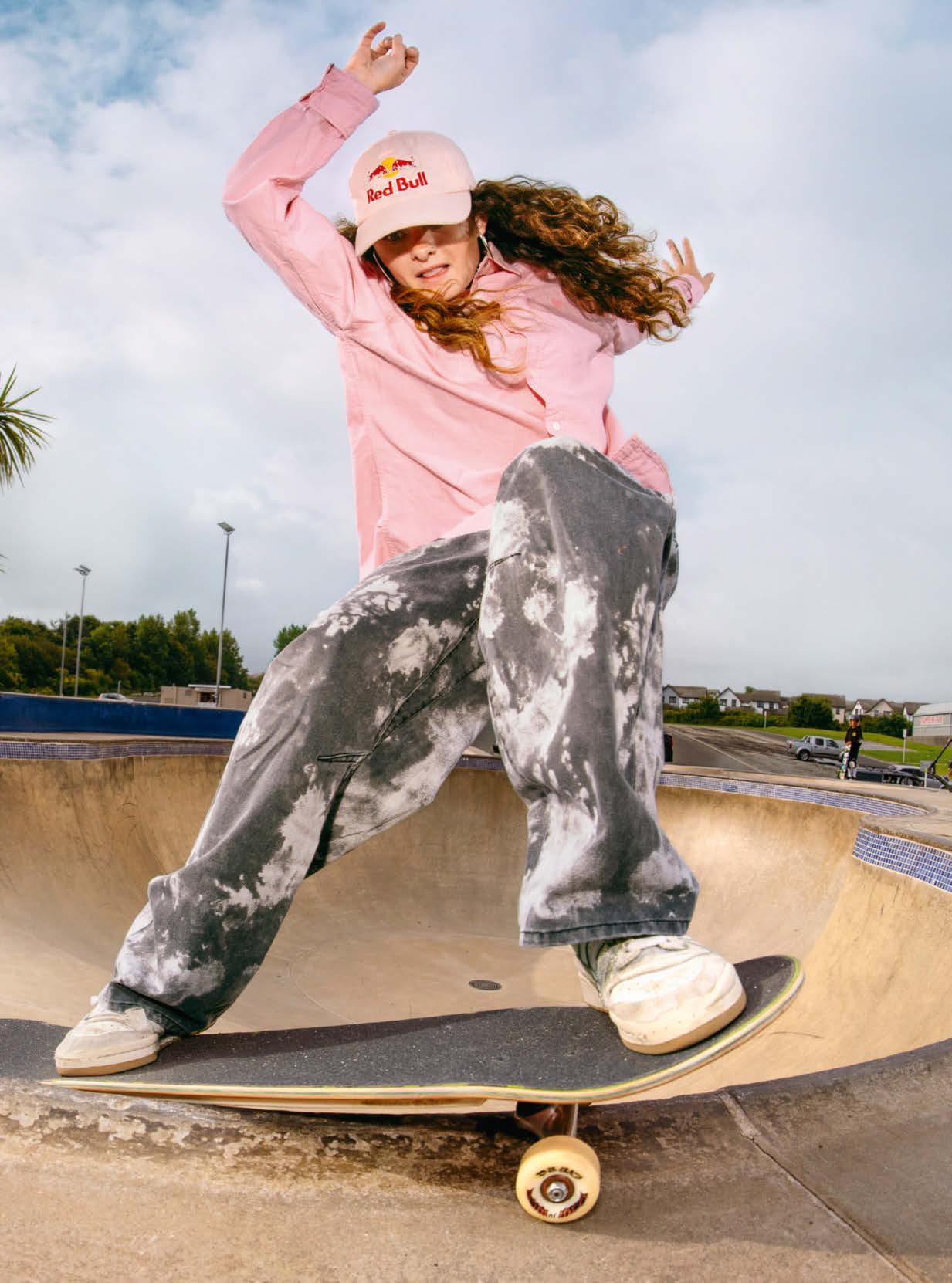
The following year, in 2020, the pandemic forced Exposure to adapt, taking the form of a video competition where skaters sent in entries from their hometown. Tambling’s opens with the purple-haired 12-year-old carving big arcs inside a huge, rocket-shaped metal pipe that she and her dad had found abandoned, cleaned out and then skated. The video is full of impressive tricks in sketchy, hard-to-skate spots, including a frontside rock’n’roll that’s still one of Tambling’s signature moves: tipping her front truck over the edge of a giant vert wall and then swinging it around 180° – away from her body, into her blind spot – to plunge back down the transition.
The video won the ‘Nora’s Pick’ category, judged by Encinitas-based skater Nora Vasconcellos, who won the Vans Park Series World Championships in 2017 before pivoting away from competitive skating, instead designing boards and shooting videos. “I’ve always looked up to her,” Tambling says. “She’s done all the big competitions, but she’s also been a core skater and made the best video parts. I wouldn’t want to say I want to be on the same path as her, because I want to be on my own, but she’s very inspiring. She’s done skateboarding.”
As well as being a playable character in the video game
Tony Hawk’s Pro Skater 3 + 4 and bringing out a pro skate shoe with Adidas (a first for a woman rider), Vasconcellos skates on the team of an indie, skater-run skate shop, Welcome Skateboards, and she told them to add this little English shredder to the team.
Tambling continued to grow as a skater, soaking up inspiration from an international community that had welcomed her from day one. But it was a different story at school back in the UK: she felt more at home skating in front of big-name pros than being in a classroom with her peers. Things might have been different were she growing up in a laid-back surf town such as Newquay, but here in Saltash, she says, “I was known as the skater, and people just didn’t like it. They bullied me because I was different. Now they’re all wearing baggy trousers!” She laughs in mock outrage. “It’s like, ‘You’re so late to the game!’ Teachers didn’t really support it, either. People just didn’t understand me, and because I was different to them, I got judged.” So, when schools shut during lockdown, this suited Tambling fine, and her parents continued her homeschooling, for the most part, after they had opened again.
Skating may still have a reputation as a form of teenage rebellion, but the sport has only brought Tambling closer to her family. “My dad understood,” she says, “because obviously he was a BMXer. And my mum was a singer in a band. I have cool parents.”
“When we found out I’d made it to the Olympics, it was just tears”
Most kids will only ever dream about sacking off exams to jump on a skateboard, but Tambling took training seriously, putting everything into her passion, making lists of tricks to crack, getting driven to Mount Hawke to drill them, and often skating alone rather than with a crew of friends. The work paid off: in 2022, aged 14, she won the British Championships for the first time. (Brown, Team GB’s highest-achieving skater, splits her time between Japan and the US and hasn’t competed in British nationals since 2019, when she won gold at the age of 10.) The following year, Tambling skated at the World Championships in Sharjah, UAE, and reached sixth in the global rankings. “That was the beginning of trying to get to the Olympics. That’s when I was like, ‘OK, I could do this.’”
After that, Tambling pushed herself even harder, adding more tricks to her repertoire, working on landing them consistently, and skating as many different parks as she could visit, so that she could adapt quickly to new terrain. The teen skater was feeling good as she travelled to Shanghai for a qualifying event just two months before the start of the 2024 Games, but she suffered a horrible fall during warm-ups while attempting a trick that’s usually well within her comfort zone.
“I did a front boneless in the deep end, and I completely missed my board when I went to put my foot back on,” Tambling remembers. “I fell 10 foot [3m] straight onto my head. I think my helmet must have moved, because I totally knocked myself out.” When she regained consciousness, she was seeing stars – “literally, scratchy silver stars” – and was rushed to hospital. “My head was all swollen. It was so scary.”
After that, there was only one more competition – set to take place in Budapest in June – that might give Tambling a chance of qualifying for the Olympics. Concussions require rest to repair, and if the brain gets knocked again while healing, the cumulative damage can be severe, but Tambling never considered giving up. “I still thought, ‘I’m going to smash it. This is all I ever wanted; it’s my dream.’ So I tried not to put any negatives in my head, but deep down I was stressing.”
When competition day came around again, Tambling had to master those fears, telling herself, “Take it easy. Just put a run down. Shanghai was a freak accident. You know how to skate.” She made herself do a front boneless again, mid-run, and landed it. “I was a bit on edge while I was skating. I didn’t
“The fact that I’m doing so well skating English parks is sick”
Home advantage: Tambling didn’t have to travel far to hone her skills – her parents built and ran a park in her
native Saltash
BOWL GOALS
Lola’s favourite skateparks JUNKYARD, CORNWALL, UK (RIP)
“It was my baby, and it got me to where I am today” POODS, ENCINITAS, USA
“I love the vibe, the way the bowl flows, and the sound when you grind the coping” SAINT-JEAN-DEMAURIENNE DIY, FRENCH ALPS
“It was built over eight years by a guy named Jérémy Durand. I was just gobsmacked when I got there; it’s incredible”
Flipping the future: Tambling’s long-term dream includes coaching others one day, and maybe even opening her own skatepark
do my best. But we found out that day that I’d made it to the Olympics. They called my name out and it was just tears. I couldn’t believe it.”
The Paris Games themselves were just a few weeks later –preliminary heats, then a final - and this time Tambling had already decided to just enjoy every second. “I actually didn’t feel any pressure,” she says. “I felt so happy and hyper, literally having the time of my life. It felt like being gladiators in the Colosseum: us in the bowl, and everyone thudding their feet on the stands around us. I’ve never experienced anything like it. I was like, ‘I’m just gonna go full send. Let’s go!’”
Park-skating contestants are ranked by their best-scoring 45-second line in a bowl (street skating, on obstacles like rails and stairs, is a separate contest; Team GB has not yet managed to get a street skater to the Olympics). Tambling went big every time. She fell during tricks on two out of three runs, but managed to hang onto her board for one full line, throwing a gap over a channel to a front rock slide, and just about landing a 540 – one-and-a-half spins in mid-air. “I nearly ate it the whole way through,” she says. “I’m dragging my hands down the ramp, looking like a turtle. It looks ridiculous, but… I made a run at the Olympics!” Tambling was ranked 15th out of 22 competitors, meaning she didn’t advance to the final, but she counts the whole experience as “such a huge achievement. I was an Olympian at 16 years old. I’ll remember that for the rest of my life”.
Unlike many other Olympic sports, skateboarding is known for its supportive atmosphere at contests, and you can see Tambling and the others hugging tightly in the contest footage
“Skating wouldn’t be skating without all the hype”
rather than willing each other to fail. “Skateboarding wouldn’t be skateboarding without the hype, without the family feeling, without the cheering and pushing each other,” Tambling says. “It would be so dead if we were all straight-faced.”
This is one of the reasons she loves skating – “It’s creative, you can be yourself, you can have fun with it” – and why competitions are just one part of its broader culture. They’ve provided a showcase for women and girls who might not have been featured by skate mags or included in skate-team videos back in the day, but they’re not always the most important barometer for who’s significant in the sport.
Right now, Tambling is determined to make it to the 2028 Games in Los Angeles – this time with valuable high-level contest experience under her belt, an updated bag of tricks, and more time to fly around the world skating as many big parks as possible – but she doesn’t plan to keep competing at that level afterwards. “I don’t want my whole life to be about that,” she says. “I want it to be pure core skating as well. I want to do more videos, still skate at Exposure and local comps, but also to be a coach, maybe open another skatepark like Junkyard.” She’s already working on new projects and has started filming a video part that she wants to be “very European, very English, very core”.
That word ‘core’ keeps coming up. It means different things to different people and is sometimes associated with a type of elitism that values remaining broke and marginal over embracing money and success. Chewing on a mint protein bar in the kitchen as her mum brews a second cup of tea, Tambling thinks for a moment about what the word means to her.
As she ponders, the young skater is just a few weeks away from her 18th birthday, which she plans to celebrate with a big party full of family and local mates, marking the end of a childhood shaped by the sport she loves. Tambling has already advanced what’s possible for British skateboarding on the international contest circuit while, at the same time, staying committed to the community, creativity and good vibes that make the sport what it is.
As an adult, although she’ll take on new challenges and move in new directions, the passion that first drew her to a board at the age of seven looks unlikely to diminish.
“I think being a core skater means you love skating deeply,” she says eventually. “You love everything about it: you’re into video parts, you’re into mags, you’re into learning new tricks, you’re into going skating with your mates, you’re into comps… You’re into all of it. It’s living and breathing skateboarding.”
New playing field: as global head of soccer, Jürgen Klopp has been developing football at Red Bull since 2025
THE KLOPP EFFECT
From Bundesliga promotion drama with FSV Mainz 05 to Champions League triumph with Liverpool, wherever Jürgen Klopp has travelled during his career in football management he’s awakened a self-belief in players, fans and entire cities alike. Here, he talks about lifechanging defeats, the power of a smile in the dressing room, and why it’s important to risk it all for success
Words Tobias Moorstedt
Photography Norman Konrad
They
say people often seem smaller in real life than on TV. That’s not the case with Jürgen Klopp, who is larger-than-life in person, too.
Six-foot-two [1.9m] tall, and slim, he starts things with a firm handshake.
“I’m Jürgen,” he says, warmly. Klopp, 58, is well used to the spotlight, though today’s photoshoot doesn’t come with the pressure of the dressing room before a final. The German is friendly, down-to-earth (he insists he’s happy switching outfits on set) and full of energy – all traits that have helped make him an almost universally loved manager, a rare thing in the tribal world of football. But it’s Klopp’s tactical acumen that has cemented his place in history.
Getting FSV Mainz 05 promoted to the Bundesliga; helping Borussia Dortmund secure back-to-back league titles; a nine-year reign at Liverpool that included winning the club’s frst top-fight title in three decades – Klopp has been the engineer of so many memorable successes. Fans don’t only respect the man with the trophy, they admire the guy in the viral clip singing along with German rock band Die Toten Hosen in the early hours after a Champions League fnal in 2018 that his team shouldn’t have lost. “[Real] Madrid had all the fucking luck,” he sang. “We swear we’ll keep on being cool. We’ll bring it back to Liverpool.” A year later, they did.
Having achieved everything possible as a football manager, Klopp decided to look for new adventures. His role as head of global soccer at Red Bull, which he began a little over a year ago, is exactly that, he says. But although his job has changed, the man himself hasn’t.
the red bulletin: You’re known for your big smile and your enthusiasm. Would you say you’re an optimistic person?
jürgen klopp: I’m very optimistic, which is how I see things going forward, too. Obviously, that doesn’t apply to all aspects of our lives, and world events –
“If you share your optimism with others, it has a really strong effect”
everything changes, and there are a lot of things we just can’t control. But I’m optimistic about the things I can infuence. Of course, I’m in a privileged position; I’m aware of that. At the age of 58, I now fnd myself having lived a life I wouldn’t have dared dream of as a youngster. A lot of stuf has worked out really well. But I was the same person with the same values 40 years ago. Call it unreasonably optimistic if you like. I always think things will turn out well.
Maybe, as a competitive athlete, it’s necessary to be an optimist. You grew up in the Black Forest, in the provinces, and – like millions of other boys in Germany – dreamt of a great career in football. But the chances are close to zero... I really, really loved the game and was one of the top players in the region. But, even then, the realist in me already knew I wasn’t good enough. Maybe I underestimated myself a little. I had a very, very average professional career, but it made everything
that came after possible. I wouldn’t have become the manager I am if I hadn’t dragged myself around German second-division stadiums 325 times. You have to be optimistic to make your dreams come true. But a realistic outlook is important, too. Where do my talents lie? Where can I make a diference? I wouldn’t have achieved anything if I’d been pessimistic.
Why not?
Pessimism looks backward and means not daring to believe in a better future. For me, things that didn’t work in the past are just a reminder of what won’t work now. I’ve never let failure get in the way.
How do you maintain that positivity, especially in testing times?
There’s a time for everything: grief, anger, refection. The worst defeats of my life were when Mainz missed out on promotion. This small club suddenly had a
Many highs: with Borussia Dortmund, Klopp won the Bundesliga twice and clinched the double. With Liverpool, he won the Premier and Champions League
chance of being promoted to the Bundesliga, but we missed out on the last day of the [2001/02] season by a single point. That was, at that moment, the worst day of my life; I couldn’t see anything positive about the future. But the world looked diferent again after a night of drinking. “Sleep on it” – that’s a tip I’d give anyone before they make a big decision.
Did it pay of?
The next morning I thought we were so good, so close, we just needed to make a few adjustments and we’d do it the next year. Then we missed promotion again, by a single goal [in the 2002/03 season]. It felt like I was being bullied by the football god. They were life-changing defeats. I knew that if I missed out on promotion a third time, that was the end of my great career as a manager. But then we did it, and I was saved. The Champions League fnals I lost later [with Dortmund in 2013, and Liverpool in 2018 and 2022] didn’t feel good either, but I knew they weren’t
“I demand a lot from my players. A smile is probably the only expression that makes it possible”
life-changing. It was a First World problem. At the end of the day, another trophy here or there doesn’t matter that much. But those early defeats really left their mark on me.
Many people would have just dug a hole and thrown themselves in...
You can’t do that in this job. Players only think as far ahead as the next training session or match. That’s not a criticism; I was no diferent. But someone has to show them the way and create the sense that we can achieve our goals. After missing promotion with Mainz that second time, I got up and said that the football god seemed to be carrying out an experiment on us: whether you can be knocked down and get back up again, not just once but maybe two or three times, and come out stronger for it. And then I said there’s no better club and no better city for the experiment than Mainz. At that moment, the 25 guys and the 20,000 people listening all believed. When
“My wife and I knew if this didn’t work out, we’d have to learn to drive taxis”
“There’s nothing
that enjoyable about a winning streak
–the longer it lasts, the greater the pressure”
training began again, there were 10,000 people there to watch, and they gave us momentum for the new season. Optimism for one is fne, of course, but if you share it with other people, it has a really strong efect.
Liverpool legend Steven Gerrard once said that you always came into the dressing room with a smile on your face. Is that true? And did you consciously put on the smile before opening the door?
I wasn’t aware of that. But, of course, when you come into the dressing room you have to prepare your team as best you can for the game. You need this bunch of guys sitting there to be better after you’ve talked to them than they were before. I demand a lot from my players: courage, creativity, unity. A smile is probably the only facial expression that makes it possible.
You once said that if you could bottle and sell what you feel before a game, it would be illegal. What would the label say?
“Desire to succeed”, “Desire to compete”, “Desire to play”, “Desire to change things”. Tell me one thing in life you can do better when you’re miserable.
Do you have any tips on how to avoid that?
It’s hard to give advice to people you don’t know. But I’ll try anyway. My career has gone brilliantly, even though I didn’t always win. There are people who will say I lost the Champions League fnal three times. Fair enough. But how stupid would it be for me to see it that way? I don’t think every day about Real Madrid scoring crazy goals against us. Nor do I think every day about the times I’ve lifted trophies. It’s up to me how I deal with the things that happen in life. If you lose a game, you can say, “My strategy was wrong. Back to the drawing board.” Or you can say, “The idea was good, but the execution, timing and accuracy were less than ideal.” That means you can be better next time. Giving everything doesn’t
mean you always get what you want, but it’s your only chance of getting anything at all.
In sport, there’s this phenomenon when a team is suddenly ‘on fre’, believes in itself and cleans up. How do you set a team ablaze?
There was this period at Liverpool where we only gave away fve or six points in home games over two-and-a-half seasons – it was madness! Sadly, though, we were only champions once in that period. [Laughs.] Looking in from outside, you might think, “They’re smashing it. It’s easy.” But when you’re in the middle of it, the pressure to keep it up keeps mounting. You win a game and are happy for a short moment – brilliant, three points. And then you look at your squad. How are the guys doing? Who needs a talking-to? Who needs support? Who needs an eye kept on them? Three days till the next game. You win again – crazy. What do we do now? There’s nothing that enjoyable about a winning streak: it’s all efort, relief, efort, relief, and the longer the streak lasts, the greater the pressure. The overwhelming feeling, though, was huge relief, to the point where I almost had trouble staying on my feet. OK, that’s that done, now for the next game... And it just never stops.
As Red Bull’s head of global soccer, you’re responsible for the sporting guidelines of clubs on four continents: Red Bull New York in the US, RB Leipzig in Germany, Red Bull Bragantino in Brazil and RB Ōmiya Ardija in Japan. Do you face such extreme pressure in your new job, too?
Firstly, I don’t miss the adrenaline [of hands-on management]. And, of course, I’m still connected to the game, though perhaps a little more loosely, as I’m not right there on the pitch. But I’m there in spirit with our teams and managers. I’m no longer in the driving seat; I’m more of a passenger. I keep an eye on things, and I’m happy when we get to where we
“I don’t miss the dressing room.
I spent enough time there, and it doesn’t smell that great“
want to be. I’m totally into my job, the conversations I have with people in diferent positions in diferent countries, the constant exchange of ideas. I learn something new every day. That’s a thrill for me, that I can satisfy my curiosity about the world at last.
What’s changed in this new position? And what, if anything, has stayed the same?
I don’t miss the dressing room – I spent enough time there, and it doesn’t smell that great. The frst year at Red Bull was super intense. We kickstarted a lot of things and broke the mould elsewhere. As [was the case] at my previous clubs, I didn’t arrive and start telling people on the frst day what they had to do diferently. First, I want to know who I’m dealing with, what’s being done and why. Then you can start talking about change and improvements.
We know what a manager does, but what’s the role of a head of global soccer?
I want to be a partner the likes of whom doesn’t exist elsewhere in football; an asset that only the RB managers have. In modern professional football, a head coach has no one in the club he can ask a question. Everyone thinks he must know best. But if one of our managers has a problem, he can call me, and I might have some answers, because I’ve been in that position myself.
What do managers ask on, or ahead of, the day of the match?
I’m in constant contact with all our managers. It’s about developing a basis for discussion and bringing in new ideas that weren’t there before. One recurring question is how we assess things. The greatest motivator in sport is public pressure. How does one deal with it? If ever I were to write a book, that’s what it would be about. It would also be short: “Just ignore it.” One sentence, repeated over 200 pages. Managers put enough pressure on themselves. How do you respond to public debate? You don’t. Take that from me. We want to play the best football possible and achieve our goals, not do what others want us to do. We’re
usually not the biggest fsh in the pond, and we have to fnd new, custom-made solutions. It’s thrilling helping people be, and remain, courageous.
You’ve been part of a reboot quite often in your career: at Mainz, Dortmund and Liverpool. There was also major upheaval at RB Leipzig ahead of this season. Where do you fnd the confdence that the reboot will work?
I see a crisis as an opportunity. You have to make decisions quickly after something negative happens. RB [Leipzig] was a successful club that had established itself as a new fxture in the Champions League, a real success story that’s rare in Europe. RB is young and vibrant. And that wasn’t quite working any more. Unplug. Then plug it back in again. Start from scratch. Get some fresh blood into the system. That’s exactly what we did together with the club, and now we have the youngest squad in the league again. You have to keep working when it comes to football, but that’s normal.
You spent 14 years managing in the Bundesliga, then nine years in the Premier League. Now you’re in several football leagues at the same time. What is that teaching you about football? When it comes to intensity, the Premier League is in a league of its own. It has the best players, amazingly well-managed, and they give 100 per cent. There are two cup competitions, and it’s a bigger league. It’s mad. France is the league for talent. Japan has a very exciting league with a completely diferent structure, because the talent is still at university and don’t make it into the league until they’re 23; they’ve matured as people. They’re just diferent, exciting systems. That’s why we don’t always want to put the Bundesliga or Premier League cap on but instead fnd a way to make this wonderful game adapt to the local culture.
You took on your frst managerial position a quarter of a century ago. Looking back at games during the Noughties, you could be forgiven for thinking you were watching them in slow
“Giving your everything is your only chance to get anything”
“How do you deal with public pressure? Just ignore it”
“I always hoped I’d made the right decision. And on the next occasion I was willing to risk it all again”
motion. What will drive change in football in years to come?
When I was a professional player in the ’90s, we were given salt tablets before training and weren’t allowed to drink. We would train completely dehydrated. A lot has happened since then, both tactically and in terms of training theory. My job has changed enormously. Whereas in my early days at Mainz I was still just tinkering around, by the end of my career at Liverpool I was in charge of a Space Shuttle. But there are limits to what you can do, physical limits. As soon as the players are given the time to perform, regenerate and train, football will take its next leap forward.
Is there a recipe for the success you’ve enjoyed throughout your career?
My outlook on life is based on thinking about the things that have happened to me in the past. No one ever told me this was the way to deal with challenges or defeat; I worked that out for myself. When I look at where I’ve
come from and what it’s led to in terms of my career, I think that shouldn’t be possible. I’d love to pretend that I knew the right thing to do at every crossroads or whenever there was a crisis. But that’s not how it was. I always hoped I’d made the right decision. And on the next occasion I was willing to risk everything again.
What does that mean in practice?
I don’t have a formula. I can only say this is what worked for me. My professional life has been about 90,000-per-cent better than I ever thought it would be. But there were other times when I sat at the kitchen table with my wife Ulla and did some sums. “Can we aford for me to go all out on football?” We knew that if it didn’t work out, we’d have to become cab drivers. And then we went for it together. And in the end it worked out. It was a cool journey, and a lot of people helped me along the way. Maybe that’s the message: be brave, surround yourselves with the right people, and things can turn out well.
World view: Jürgen Klopp is passionate about developing talent. RB Leipzig, for example, have the youngest squad in the Bundesliga
THE BEAUTIFUL GAME
How EA made a soccer sim so good it influenced the sport itself, turned fans into millionaires, and provoked pro footballers to fight about their stats
Words Ben Wilson
Leeds’ Lukas Nmecha takes on Liverpool’s Ibrahima Konaté in EA Sports FC 26. Every player’s performance stats are meticulously researched
Amsterdam, July 13, 2023, 7.02pm.
Fresh from thumping in 52 goals in his first season playing for Manchester City, the Viking-blond form of Erling Haaland struts down a floodlit aisle towards a makeshift stage upon which sits the trophies of the Champions League, Premier League, Women’s Champions League and La Liga. Applauding his entrance from the front row are a quartet of pros with 469 international caps between them: Didier Drogba, Ronaldinho, Luis Figo, Alex Scott.
But this isn’t the glitzy Ballon d’Or awards ceremony or a football-themed film premiere. It’s the launch – or rather relaunch – of a video game: the moment FIFA became EA Sports FC. And Haaland is dressed in green silk
pyjamas tailored by Dolce & Gabbana, the breast pocket monogrammed with his initials. “Every footballer dreams of this,” he tweeted in that moment. “Proud to be on the cover for the first season of a new era @EASPORTSFC #FC24.”
Sweaty goal, OP, pace abuse – the lingo of the FIFA game series is near universal. Almost every football fan has played it over the years, too. Across its three-decade rise to digitised-sport domination, FIFA has been translated into 18 languages and sold more than 345 million copies in 51 countries. Its soundtracks are iconic. It has turned ambitious teenagers into YouTube millionaires. It has been bickered about on professional team buses every weekend, across the world. All of which begs the question: how?
Twenty-nine years before Haaland graced the cover of the world’s bestselling sports video-game franchise, a fellow Norwegian beat him to it. Spurs’ Erik Thorstvedt is the only goalkeeper to ever grace a FIFA box. Sadly, it didn’t prove to be an omen of great things to come: the stopper made just two club appearances that season. Little wonder he’s never publicly acknowledged what has since become a huge honour, bestowed upon the likes of Lionel Messi and Cristiano Ronaldo as FIFA’s cultural impact spread. Perhaps Thorstvedt learned the lesson of fellow ’90s goalie David James, who was widely mocked when he revealed a love of video games. “I was getting carried away playing Tekken II and Tomb Raider for hours on end,” James confessed after a defeat for his Liverpool team against Newcastle United in 1997.
Despite James’s embarrassment, his era of gaming did coincide with FIFA flirting with forms of entertainment that eschewed tradition. Blur’s Song 2 was installed as the opening song to FIFA: Road to World Cup 98, where its adrenaline-rush chorus felt like the perfect pacesetter. The track remains a fixture across sports stadia to this day. “That repetitive piece of music got under your skin,” Steve Schnur, EA’s president of music, told media platform Vice. “It became integral to the kid playing the game, and to the gameplay, and then to actual sport.” Robbie Williams was digitised as a player in his music video for It’s Only U, which became the official theme song of FIFA 2000, and the seeds for cultural crossover were planted.
According to EA, three core consistencies have ensured the growth
Manchester City and Norway footballer Haaland plays in monogrammed silk pyjamas at the EA Sports FC 24 launch in Amsterdam
There are more than 130 real-life stadia in EA Sports FC 26, like the
seen
–
Bernabéu,
here
the home of Real Madrid 2026
It’s in the game: some moments in FIFAhistory
Each iteration of FIFA has brought greater realism to the gameplay. An example: players can no longer dodge being shown a card simply by running away from the referee
With FIFA 96, the series made the big leap to realtime 3D graphics thanks to its ‘Virtual Stadium’ technology. And, having acquired the licence, EA could use real player names for the first time
FIFA Football 2003 was another game-changer, with better player likenesses, a new freestyle control system, and TVstyle highlights at half-time and full-time
Across its three-decade rise to domination, FIFA has been translated into 18 languages and sold more than 345 million copies in 51 countries
Women’s football was included for the first time in FIFA 16, with 12 international teams available to play. Women’s club teams would remain absent until the release of FIFA 23
If there’s a single catalyst for FIFA’s cultural omnipresence, it’s Ultimate Team, the game’s naggingly addictive squad-building mode
FIFA 17 saw the introduction of a story mode, The Journey, where players could guide a rising star named Alex Hunter through the highs and lows of Premier League football
Harking back to spin-off series
FIFA Street, a feature called VOLTA Football was added to the mix in FIFA 20, focusing on smaller teams (3v3, 4v4, 5v5) and futsalstyle matches
of the game over the past 32 years. “Authenticity, innovation and purpose,” says James Salmon, senior director of franchise activation at EA Sports.
“From an authenticity perspective, we have 20,000 athletes, 750 clubs, and partnerships with over 300 different bodies within the sport. Innovation-wise, there are tools that have evolved through the years to enable the crossover into real-world football. As for purpose, there’s always been a role for EA Sports FC in the broader footballing community. The way the sport has evolved, we’ve evolved, too: [the rise of] women’s football, adding national [women’s] teams and, more recently, club teams. That centred approach across those three areas has guided us.”
A study by ESPN illustrates Salmon’s view. In 1980, fewer than one million US youth athletes participated in soccer; by 2014, it was more than three million. FIFA, the study concluded, was the gateway to the sport for 34 per cent of US soccer fans. Europe became similarly hooked, with players openly confessing their gaming affections. A decade after David James self-shamed his love of the console, Italian football icon Andrea Pirlo wrote in his autobiography, “After the wheel, the PlayStation is the greatest invention of all time.”
Sadly, James had long moved on from Liverpool when the team met Pirlo’s AC Milan in the 2005 Champions League Final, squandering any potential for post-match PlayStation banter. Had such a scenario played out a few years later, the focal topic would surely have been Ultimate Team – the game’s naggingly addictive squad-building mode. If there’s a single catalyst for FIFA’s cultural omnipresence, it’s this feature. Introduced as a paid-for addition to FIFA 09, Ultimate Team has since evolved into the perfect blend of Panini stickers, fantasy football league and competitive gaming. Gamers opendigital packs of trading cards featuring footballers who are then placed in line-ups to take into matches. Limited-edition cards are also released, featuring increases in player ratings, tempting gamers to buy more packs with real money. It made EA more than US$2 billion in its 2024-25 financial year.
Simon Minter was one of the first gamers to spot the game’s abundant potential. In 2012, aged 20, the Brit quit university and, under the alias Miniminter, launched a FIFA YouTube channel. A year later, Minter banded together with some friends to form a
EA’s decision to go it alone was seen as both a gamble and a flex
collective of football-obsessed YouTubers known as the Sidemen. Today, their channel has almost 23 million subscribers, and every one of the Sidemen is a multimillionaire.
Minter’s rise, alongside that of YouTube rivals such as Castro1021 and NepentheZ, cemented FIFA’s global influence on smartphone-hooked millennials. Alongside regular football fans, celebrities embraced the culture of sharing their fantasy line-ups, and it infiltrated real locker rooms. Whereas the footballers of yesteryear drank, smoked and partied in their free time, their modern counterparts endure regimes of curfews, alcohol restrictions and meticulous diets. FIFA became the outlet for players to relax while, at the same, avoiding any in-season
misbehaviour. It also tapped into their natural competitiveness.
Today’s footballers take Ultimate Team incredibly seriously. “We’re lucky to have a team of experts in our ratings department who are clued up with what’s happening across the real world of football,” says Salmon. “However, there’s also an energy that comes from athletes really caring about their ratings – and that energy is a privilege.” Salmon was two weeks into the job when he visited Queens Park Rangers to be met by a furious Rio Ferdinand “completely full of rage, losing the plot on camera about his pace rating and how we’d stitched him up. [He said] it was inaccurate and he was going to come down to [EA HQ in] Guildford and have a rant at the team”.
Leicester City’s Jamie Vardy was even more abrupt when an EA contingent descended on the team’s training ground during their titlewinning 2015-16 season. “As part of a winter upgrade campaign, we were awarding N’Golo Kanté, Riyad Mahrez and Jamie Vardy [placards of] their upgraded items,” says Salmon. “Vardy was so hacked off with his original in-game base rating that he put his head through the [placard]. He then grabbed it, slammed it on the ground, and stormed off the set. After some
Since EA Sports FC 24, women footballers (pictured left: Spain’s Aitana Bonmati) have played in the Ultimate Team alongside male counterparts
Cole Palmer of Chelsea in EA Sports FC 26 –32 years and 44 games on, the series is still pushing the limits of what’s possible in a football video game
For gamers and pro athletes, EA Sports FC has become as synonymous with the sport as the ball itself
coaxing from the staff, he came back, realised we had actually upgraded him following his amazing performances, and we got the shots we needed.”
FIFA had become so entrenched in the lifestyle of both player and fan that it was sometimes tough to decipher where the real-life sport ended and the digital one began. In 2014, when Barcelona drew Manchester City in the Champions League, the point of reference for the greatest footballer on the planet was EA’s video game. “It will be great to play against my friend Kun [Sergio Agüero],” said Lionel Messi. “On FIFA, I always beat him, so let’s see what happens on the pitch.” Such rivalries often became personal, as demonstrated when Man City defender Rúben Dias went viral with his reaction to being rated slower than teammates John Stones and Bernardo Silva in EA Sports FC 24. “I’m slower than who? Bernardo? It’s just…” He trailed off, frustration leaving him speechless. FIFA 23 brought a twist to the tale. Amid rumours that football’s governing body wanted US$300 million per year to renew its licence, EA made the call to go it alone. To outside eyes, it was both a gamble and a flex. “It was obviously a big decision, and big decisions carry jeopardy,” says Charlie Villiers, senior director of EA Sports FC franchise marketing. “But in terms of the 300 partners, the 20,000 athletes, the 750 [teams] – that’s the construct of all of our experiences. Including the mobile game, we had 150 million people using
“Rio Ferdinand lost the plot on camera about his pace rating in the game”
those experiences, which removed some of the jeopardy. This gave us an opportunity to move nimbly and quickly in defining what our fan-first football future looks like.”
“It was an opportunity to grow from being a video game built from football, to being a football platform built for video games,” echoes Salmon. “A great example of that is the work we’re doing with MLS [Major League Soccer, the US’s top league] around livestreaming games. We had an amazing relationship with [the governing body] FIFA. Some of the stuff that was written, the [perceived] acrimony, just wasn’t the case, but we felt this was an opportunity to strike out on our own. The proof points are the FC Pro esports competition, brand partnerships with the likes of Nike, and utilising FC Mobile as a platform that goes beyond gaming.”
Long after Song 2 and Robbie, the musical influence of EA Sports FC is more
formidable than ever. “The soundtrack [to the game] is enormous, and we have an amazing partner in Spotify that helps us bring it to life,” says Villiers. “There are those moments where you listen to a song and don’t know the artist but somehow know all the words. You’re like, ‘How the hell do I know this? Oh yeah, it’s been [playing] in my living room for months on end.’ We have an amazing music team in our LA studio who, every day, are thinking about how it will embody the next year in football. It’s a piece of IP with a massive cultural value that’s been successful at influencing the zeitgeist.”
Yes, you can listen to the EA Sports FC soundtrack on Spotify. Or watch live MLS games on your phone through FC Mobile. Or enter the FC Pro World Championship with a prize pool of US$1 million. In FIFA 23, you could even play as fictional team AFC Richmond, with Ted Lasso on the touchline – a feature that fans continue to clamour for.
Now, EA Sports FC 26 is all about the fanbase that brought the series this far, using community feedback to drive improvements such as tighter dribbling, more realistic keepers, and two game speeds depending on whether you’re playing online or offline. It’s a way of bolstering the sense of inclusivity. For gamers and pro athletes, EA Sports FC has become as synonymous with the sport as the ball itself – although, mercifully, no player has burst one in anger over their shot-power rating. Yet.
(Right) a Leeds United goal celebration in EA Sports FC 26; (opposite) US women’s team player Trinity Rodman nails a bicycle kick
IN HIS ELEMENT
In sport, there are a few exceptional talents. The same goes for sports photography.
Luca Salisbury is one such individual, as his incredible surfing photos demonstrate. His formula: skill plus courage plus friendship
Words Marc Baumann Photography Luca Salisbury
Lying in wait
“Maxime Rayer is probably my best friend,” says Salisbury of the surfer seen here. That day, it was just the two of them in the water, or rather, on top of it. This spot in Sydney is considered ‘sharky’ – great whites raise their young here and recently a bull shark attacked a swimmer near Salisbury’s home beach.
A dirty victory
Five tales about this photo: 1) The stunning colours were due to flooding at Cape Solander in New South Wales. 2) The photo made it into the top five of the Red Bull Illume photo contest. 3) During this session, Salisbury snapped a cover shot for Surfing World magazine. 4) With the money from the cover, Salisbury and pictured surfer Kipp Caddy had the issue number ‘SW 4175’ tattooed on their arms. 5) Climbing ashore afterwards, Salisbury injured his knee and had to undergo surgery. “It was worth it,” he says.
Luca Salisbury wants to show us “the raw power of the ocean”. In order to do that, the Australian photographer takes his camera where the sea roars most fiercely and the waves beat you hardest. Like surfers, photographers battle for the best position in the water. Salisbury can read the sea and its currents: he knows where the wave will break and what
The blue wall Of this monster wave at Depot Beach in southern New South Wales, a normal surfer might think: “Get out of there before it breaks and you’re dragged over the reef.” Not Salisbury –he plunged into the water, but the current pulled him into the impact zone. A jet ski rescued him at the very last second. “That teaches you humility,” he says.
the surfer is planning. That’s why, so often, he’s in the right place at the right time. “It fascinates me to push into ever bigger waves and test what I can achieve,” he says.
Smiley by nature
“You don’t want to photograph anyone who lacks style,” says Salisbury. With 21-year-old Jarvis Earle, pictured here at Cronulla Beach, NSW, there’s no danger of that.
He’s “one of the best surfers in the world in his age group”, says Salisbury of his old school friend.
“The smiliest kid on earth.”
Heads up, incoming!
Don’t worry, Salisbury didn’t catch a surfboard to the face while capturing this shot –
“I was farther away than the photo suggests,” he says.
The waves had been fairly uneventful when surfer Kurt Lovegrove launched into the air, and Salisbury captured the perfect 90° angle between board and water.
“Kurt loves the pic,” says Salisbury. No wonder.
Thanks, Dad
During a road trip with his parents, Salisbury spotted legendary Aussie surfer Wade Goodall running towards the water here at Angourie Point in northern New South Wales. “Wait a minute, Dad,” he said. That ‘minute’ turned into an hour, and this snapshot from his proud father.
Sunset rider
When the sun goes down, many photographers get out of the water because there isn’t enough light. Not Luca Salisbury. He dials down the shutter speed and opens the lens wider. “The photos get this lovely grainy look,” he says. He also likes the slight blur in this shot. “This surfer in Sydney absolutely flew past me.”
Wait? Is this the wrong number?
The young man on the video call insists he’s not a professional photographer. “I’m a carpenter, second year of my apprenticeship,” he says. But he looks exactly like Luca Salisbury: blond hair, the slightly bloodshot eyes of someone who surfs every day after work, and that easygoing, sun-soaked charm of a guy who’s been riding waves for as long as he could walk. No, the number is right, Salisbury is just remarkably modest. Growing up in Cronulla, near Sydney, he got a GoPro at age eight and started filming his school friends. Later came a secondhand Canon. Before long, he was shooting for local surf brands, because Salisbury has talent and is fearless. Whether in slabs – waves breaking over shallow, razor-sharp reefs – or in shark-infested waters, he ventures where others won’t. In 2022, at 17, he landed the cover of Australia’s longest-running surf magazine, Surfing World. It was, he says, “the shit I dreamt of as a kid”. Now he’s 20 and, yes, technically still a carpenter. But every one of his images says the same thing: professional photographer.
The photographer When capturing the action in the ocean
Luca Salisbury draws on his own experience as a surfer. After all, when he’s not shooting, he’s riding the waves himself.
@lucasalisburyphoto
Healing powers
No matter how crazy and unsettling the world out there may seem, no matter what troubles you’re facing, “saltwater just makes you happy”, says Salisbury.
Pictured here: surfer golden boy Jarvis Earle in Cronulla, and that “warm, relaxed, content, bubbly feeling after a surf, on the way back to the car park”.
ONE BATTLE
AFTER ANOTHER
At the world’s biggest breaking tournament, in the homeland of Street Fighter, a new hybrid competition format has emerged. Its name: Break Fighter
Words Patrick St Michel
BREAKING/GAMING
November 8, 2025, Harajuku, Tokyo: ahead of the more familiar breaking world final the following day, spectators at Red Bull BC One Camp saw alternative contests unfold
Battles. The Ryōgoku Kokugikan in Tokyo has seen its fair share. Built four decades ago, this sumo hall has become one of the most venerated in all of Japan. Its inaugural tournament, in January 1985, was attended by the Emperor of Japan himself; he witnessed one of sumo’s all-time greats, Yokozuna Chiyonofuji, achieve a zenshō – a perfect, undefeated score. But the arena has hosted more than sumo: it’s been the venue for WWE wrestling matches, boxing during the 2020 Olympics, and, on a Sunday in November 2025, the biggest breaking competition on the planet – the Red Bull BC One World Final.
Throughout the preceding week, the royalty of B-boys and B-girls have been descending on the city. Other big names are rumoured to be arriving, too: US East Coast rapper Redman, Beat Junkies co-founder J Rocc, and – fresh from a six-week, post-Grammys celebration tour with NxWorries collaborator Anderson .Paak – hip-hop producer Knxwledge, who, it’s whispered, may be performing at the afterparty.
The main stage of the Kokugikan is being transformed, the dohyō – or sumo ring – modified into a cypher mat, and the traditional masu-seki box seats arranged to accommodate almost 8,000 spectators. All around are banners and screens advertising the tournament, with the visuals featuring Japanese B-girl and 2024 Olympic gold medallist Ami Yuasa facing off against Ryu, the lead character in the video-game franchise Street
Courting tradition: the main event of the Red Bull BC One World Final Tokyo at the Ryōgoku Kokugikan
Midas touch: some Break Fighter contestants brought their own statementpiece controllers.
Below: a round of Street Fighter plays out on the big screen
Ringside view: Tokyo’s landmark sumo arena was converted for the breaking final. Clues to its usual purpose can be seen in
Fighter. B-girl Ami’s presence makes sense – she was the winner of the Red Bull BC One World Final in 2018 and 2023 – but the Street Fighter connection requires further explanation.
Japan is, of course, the iconic video-game franchise’s home; its publisher, Capcom, has an HQ in Osaka. But in 1992 – a year after Street Fighter II had been released into arcades, taking the world by storm and laying down the immutable template for one-on-one beat-’em-up battles – Capcom hosted the game’s first-ever official tournament right here at the Ryōgoku Kokugikan. Thirty-three years later, in March 2025, the company held the 11th Capcom Cup – a Street Fighter 6 competition with a grand prize of US$1 million – at this same venue.
So Street Fighter and the Kokugikan have a history, making them a natural partner for the Red Bull BC One World Final. But the connection goes
Each breaker is coached by their teammate, who’s a competitive gamer
even deeper – not here at the sumo arena but a 30-minute drive away, across town.
The day before the main event, inside the Yodobashi J6 Building in Harajuku, the Red Bull BC One Camp is taking place. Two breakers trade moves on a cypher mat, the crowd cheering them on. It’s a familiar scene from a traditional B-boy battle. Three judges calmly scrutinise the competitors before casting their verdict and pointing at Lil H, who has travelled here from Shanghai. But instead of celebrating, he instantly jogs towards a monitor set-up, away from the dancefloor, his opponent T-Jie in hot pursuit.
“They are out of breath,” the MC exclaims as both B-boys sit down and select their characters for a round of Street Fighter 6. Lil H chooses female Japanese ninja Mai, T-Jie picks electricity-charged Brazilian beast Blanka, and their selections light up the giant screen-wall as the spectators holler in approval. As the fight unfolds, each breaker is coached by their teammate – a competitive gamer who, minutes ago, was also locked in a Street Fighter battle with their respective counterpart.
This is Break Fighter, a new competition format that blurs the line between two sports. Each team comprises a breaker and gamer, the former facing off on the cypher mat, the other duking it out at Street Fighter 6. If the score is
Camp fire: across town at the Yodobashi J6 building, Claudio (left) and Sydney face off in a heated Break Fighter gaming round
KNXWLEDGE Playful beats
When picking a performer for the Street Fighter–flavoured BC One World Final afterparty, there was one obvious choice: breaking enthusiast, game-music aficionado and world-renowned producer Knxwledge
It’s the Red Bull BC One Final afterparty at Shibuya’s Club Harlem, and tonight’s DJ – music producer Knxwledge – bounces between ’90s hip hop, dreamy J-pop and throwback funk cuts. But it’s the hip-hop reworks of video-game music that really send the packed house into a frenzy.
“It’s funny that it’s broadly called videogame music,” says Knxwledge, aka Glen Boothe, “because it’s such a cheat code; it’s literally every single genre in one. There are [game-music] composers and musicians influenced by the same music we all love. That’s why it’s so good.”
For the New Jersey-born producer, soundtracks from all eras of console gaming have provided raw material for experimentation. His sprawling VGM [Video Game Music] beat-tape series features flips of game soundtracks, often remixed live on Twitch. This immersion in gaming culture caught the attention of video-game developer Capcom, which enlisted him to rework tracks for its Capcom Fighting Collection series.
A prolific presence in modern hip hop, Knxwledge has made beats for rappers including Kendrick Lamar, Action Bronson and Westside Gunn. Alongside Anderson .Paak, he’s one half of superduo NxWorries, 2025 ‘Best Progressive R&B Album’ Grammy winners for Why Lawd?. Yet his top accomplishment last year, he says, was leaving his LA base to spend time in Japan, a country he loves in part for its breaking and video-game history.
The move allowed Knxwledge to get involved with Japan’s B-boy culture, and he became a big presence on the 2025 Red Bull BC One schedule, performing at March’s BC One Kick-Off Jam and All-Star Tour, as well as DJing at the World Final afterparty in November. “I had always dreamed of DJing at a breaking event,” he says. “There were so many legendary B-girls and B-boys there.”
“I’ve been subconsciously flipping game music my whole career”
THE RED BULLETIN: Do you remember the first video game you played?
KNXWLEDGE: I’m pretty sure the original Nintendo was my introduction. No memory cards, just trying to finish the game before I had to go to church or something. Games like Karate, Excitebike, Mario, Contra… After that, it was Sega. That went from 8-bit to poly – really good rhythms – and had a much better sound card, so the music got way more advanced. I’d say Super Nintendo and Sega were definitely the start of me subconsciously thinking, “These loops are perfect. This music is so good.” I’m also kind of a fighting-game otaku – it was just Street Fighter, Mortal Kombat all day. I remember being enamoured with – and eventually knowing – the melody for each character, every stage theme. There are so many games that helped shape my ear into what it is.
Was there a turning point in your connection with gaming and music?
I credit the [Sega console] Dreamcast. When I got that in 1999, there were so many titles, some I’m still discovering. It’s the most timeless music I’ve come across. Even on my stream, every now and then I make beats and samples pretty much straight from the cartridge. Over the last two years, I’ve gotten every Japanese-issued Dreamcast game and I’ve been going through them.
When did you start remixing game music?
The VGM series began at the beginning of COVID. But sometimes I’ll come across something I made in the past and realise I’ve been subconsciously flipping video-game music my whole career.
What is it about Street Fighter that specifically connects with you?
I think it’s just the hundreds, thousands of hours I’ve played it. My mom’s sister had five boys, and their house was where I discovered Super Nintendo. I’d battle with them at Street Fighter II but not know the mechanics, just ‘jump, heavy kick, sweep’. That was my jam. I think it’s everything: the whole aesthetic, the music, the characters, even the outfits.
What specific way has game music influenced your own creations?
The idea of the perfect loop. Most games had limitations on time, the number of instruments, what they could do. That they could make something so beautiful out of something so limited stuck with me.
When these cultural scenes intersect, it’s clear how much they have in common
tied, the breakers themselves then have to settle it in the fighting game.
Lil H’s teammate is a local gamer, Merrymore. “I could only communicate with him in basic English, so it was tough,” she says, noting she recommended Lil H use Mai for the Street Fighter showdown. “Even though it was his first time playing, he landed some solid attacks and won!”
Watching these two cultural scenes intersect, it becomes clear how much they have in common. The breakers bring their own distinctive swagger to the dancefloor, even trading playful fightinggame-style jabs. The gamers express themselves through their personal playing style, channelling it through their chosen on-screen characters. Even when not playing, there’s a casual sense of showmanship. Many have turned up with their own pro game controllers. A 26-year-old local player, Shimiso, is carrying a gold Varmilo Kassai arcade fighting stick worth hundreds of dollars. He’s even replaced the joystick with a bespoke orb that looks as if it’s cut from crystal.
“Honestly, I didn’t know anything about breakdancing,” admits Shimiso, right after he and teammate Dragon Wrist qualify for the finals. “I came out today because of the gaming, but after watching it, it’s really cool. It’s a great opportunity for both sides to learn about one another.”
Breakdancing came to Japan in the early 1980s via the release of seminal hip-hop movie Wild Style, which also introduced the nation to rap and graffiti. It was accompanied by a tour of the archipelago by the Rock Steady Crew, who appear in the film. That proved all the inspiration needed for local breakers to form their own crews and communities, some in Tokyo’s sprawling Yoyogi Park, a stone’s throw from where the Break Fighter tournament is taking place today.
“You can see how passionate they are about it,” says German DJ Just-A-Kid while watching the qualifying rounds of Break Fighter. “If you understand the roots of hip hop like they do, you can get very good. They understand the culture. The foundation is strong.”
Competitive gaming in Japan, meanwhile, had started taking shape a decade earlier, when companies such as Sega held arcade-game tournaments in the 1970s. That carried on throughout the ’80s, but it was the arrival of Street Fighter II that truly introduced the possibility of what competition gaming could be. It also helped that the game’s characters were so indelible. “Each one is fascinating in its own way,” says Merrymore. “Everyone knows Ryu
Upending the match:
all
Jose Cardenas pulls out
the stops against Kona in the last round of the Break Fighter World Final
and Ken.” But with almost 30 playable characters in Street Fighter 6, knowing them has become trickier than it once was.
“Most of us B-boys don’t have time to game,” says Jose Cardenas. He and his gaming partner Sydney won this trip to Tokyo through the US round of Break Fighter in Denver. Cardenas credits his teammate’s gaming skills for getting them here, but in their first match they faced a tiebreaker, forcing Cardenas to grab the fighting stick. “Luckily, I have some old-school arcade experience and was able to low-kick my opponent to death,” he laughs.
Cardenas and Sydney have made it to the bestof-seven final. But they’re up against local breaker Kona and her gamer partner Tantanmen, who earned their spot here by winning at the Tokyo Game Show in September. It’s not going to be easy
A sudden comeback has the audience almost rushing the stage in excitement
for the US duo, but when Sydney manages to take the opening gaming match and Cardenas earns a unanimous decision in the first breaking showdown, a sweep appears possible.
In the next gaming round, Sydney – playing as Russian wrestler Zangief – looks set to shut down his opponent for a second time, but Tantanmen has other ideas. His character, Jamie, is a drunkenfist fighter whose moves are, interestingly, derived from breaking. After engineering a few breathtaking counters, Tantanmen floors Sydney in a comeback that has the audience almost rushing the stage in excitement. The DJ drops a beat, and the breakers instantly go at it again, Kona giving it her all to bring the final to a tie-breaker.
“We’ve got a match!” screams the MC, eliciting thunderous cheers from the hundreds of spectators packed into the venue. The rivals are indeed closely matched, but after Sydney’s Zangief KOs Tantanmen’s Jamie with a suplex, it’s down to an exhausted Kona to stave off championship point in the cypher. Cardenas edges it, and the Americans take the crown.
“It’s a good way to bring people together,” Cardenas says, clutching the first-ever Red Bull BC One Break Fighter World Final trophy. “There was a lot going on between the breaking and gaming, but you could hear the crowd – they loved it.”
Lucky break: B-boy Lil H hugs gamer teammate Merrymore after she coaches him to victory in a Street Fighter round
RETURN OF THE QUEEN
Pioneering Swedish pop star Robyn is back with an album and a world tour that cements her status as ‘the queen of sad electro bangers’
Words Marcel Anders
Photography Casper Sejersen
MUSIC
Dopamine hits: Sexistential is Robyn’s first new album in nearly eight years.
“I got that energy back,” she says
Robyn turns the other cheek at suggestions she’s an icon to other musicians: “I don’t want any credit for that”
“It’s really difficult to make good pop songs,” says Robyn from a hotel suite in Berlin. “It almost feels like reinventing the wheel sometimes.” And yet somehow the Swedish powerhouse always makes it look easy. Following a hiatus of eight years, Robyn is back with a new album, Sexistential, packed with emotive dancefloor fillers that prove she’s still the maestro of melancholy, that pop music can still deliver emotional depth, and that there’s a reason some of today’s biggest stars consider her an icon.
Over a music career spanning nearly four decades, 46-year-old Robyn – real name Robin Miriam Carlsson – has become synonymous with authenticity. Originally cast, at 15, in the teen pop-star mould later applied to Britney Spears, she pivoted away from R&B chart hits to forge her own brand of electropop, releasing it via her own label, Konichiwa Records, in 2005. Since then, her music has won her a global fanbase, Grammy nominations and influenced the sound of everyone from Rihanna to Taylor Swift. Now, after a few years of clubbing, exploring and making the decision to become an independent mother, Robyn says the time was right to make her return. “I got that energy back and it felt exciting.”
the red bulletin: This summer, you embark on your biggest tour yet, but first you’ll be opening for Harry Styles on his tour dates in Amsterdam… robyn: Yeah, lots of shows, it’s gonna be fun. I’ve never met Harry – he just called me out of the blue. I’m honoured – he’s a superstar, he plays stadiums and he writes great songs. I really like his stuff. So basically, I had no choice but to say yes to that.
And you’ve just released your first album in almost eight years. There was another eight-year gap between albums before that. Why is that?
I don’t know, there’s no strategy behind it. I probably should have made this album a long time ago. I just wanted to explore other things for a while. I was clubbing a lot. But I just can’t get away from trying to write a good song!
“I just can’t get away from trying to write a good song”
The rise of Robyn
1995
Releases her debut album, Robyn Is Here, at the age of 16 and lands on the Billboard Hot 100 twice 2001
Signs a worldwide deal with Jive Records
2005
Launches her own label, releases fourth album Robyn, and scores her first UK number-one single 2010
Releases the Grammy-nominated Dancing On My Own – the ultimate ‘sad banger’ 2012
Dancing On My Own appears in the HBO series Girls, further boosting its popularity 2020
Wins Songwriter of the Decade at the NME Awards 2024
Joins Charli XCX and Romy from the xx on stage at Glastonbury 2026
Prepares for The Sexistential Tour – her biggest world tour yet
Did making the album feel like documenting a new chapter in your life?
Yes, totally. I felt like I kind of re-entered my own life after a long period, a long relationship. I had experiences that were really amazing, like therapy, like clubbing; I explored a lot during the time before I had my son. Trying to become pregnant through IVF was a very specific experience. When I wrote this album, I felt like I was crashing back into myself, without another parent to have a baby with. I was really on my own. The album is like a series of snapshots about things like intimacy, but from a new perspective.
You started writing songs at the age of 11 and had your first record deal at 16. What was that time like for you?
It was a strange environment for me, because I had no clue what the commercial music industry was. I grew up in a very alternative environment with parents who ran an independent experimental
theatre, [with] absolutely no interest in having commercial success or making money, so I was naïve. I was still a teenager, I was working with amazing songwriters, and I learned so much during that time. It was just very different from what I wanted to do eventually, so it wasn’t made to last. The industry part of it was very soul-destroying for me.
What was it like to get such a great reaction when you left your label and launched your own, finally allowing you to release the music you wanted to make?
It was mind-blowing, and very satisfying that I could make something I really like myself, and that there were people that wanted to engage. Now, as an established artist, the music industry is great – I can pretty much do whatever I want. I just put out my music and it reaches my audience. That’s freedom.
“I can pretty much do whatever I want. I just put out my music and it reaches my audience. That’s freedom”
Doing it again: Robyn at the Velodrom in Berlin in 2019 during her last tour, for the album Honey
What do you think it takes for new music to get noticed these days?
That’s a good question. It used to be about technology – creating entirely new kinds of sounds –but that’s much harder to do now. New software and innovations are always emerging, but the major shift already happened in the 1970s and ’80s, when music became electronic. We don’t really have that same feeling anymore of hearing something and thinking, “This is completely unlike anything before.” That’s much harder to come by today.
How does it feel to be an icon to stars such as Taylor Swift, Lorde and Charli XCX?
That’s very flattering but I’m not sure if I deserve any form of admiration. I did what I had to do to get my music out and make my vision come alive. If someone gets a kick out of it or takes me as a blueprint, fine, but I don’t want any credit for that. I’ve always done what’s best for me, not for all women in music, even though that’s a nice thought.
Are you happy to give advice to the new generation of pop stars?
Sure. I’m not a mentor or anything, but I tell them my thoughts and give them moral support. I had dinner with Charli before she released Brat and I told her I really loved the title, I loved the music. In a way, I feel more connected to Charli’s age group in pop music than I do to people that are my peers, because there’s a more fluid way of thinking about pop, more flexibility. I find it cool and interesting – it keeps me updated.
Is that something you’re conscious of?
Sounding up-to-date?
I don’t know if I’ve ever set out to be cutting edge. For me, it’s about something else, something more playful. When there’s a groove I lose my sense of time, and I’m drawn to the relationship between rhythm and melody. You can find that in any kind of music. It’s not really about genre or pushing a particular sound, it’s about losing myself in the moment.
Getting lost in music?
Yeah [laughs], that’s my goal. robyn.com
Dive hard: Luke Aikins –a 2014 Taurus World Stunt Awards winner – and the Red Bull Air Force team skydive during the 2025 Red Bull Global Aerial Performance Camp in the Grand Bahamas in March last year
MICHAEL CLARK/RED BULL CONTENT POOL
LEGENDS OF THE FALL
For a quarter of a century, the Taurus World Stunt Awards have celebrated Hollywood’s unsung action heroes. Here, a few of the best reveal what it’s like risking their lives in pursuit of their art
Words Tom Guise
Arnold Schwarzenegger is standing on a stage in LA, clutching a trophy. “You know, there are two ways of getting someone to appear in Hollywood,” he booms. “One is you pay them. The other is to give them an award. So they gave me an award.” The audience, in black tie and evening gowns, laugh. “But they didn’t need to,” he adds with a tombstone grin. “I told them I love coming here anyway.”
The ‘here’ is the Taurus World Stunt Awards, an annual celebration of the stunt industry. Created in 2001 by Red Bull founder Dietrich Mateschitz, its stage has been graced by many big names, such as Harrison Ford, Halle Berry and Jackie Chan. But they’re not the stars of this show; they’re lauding the unsung heroes who take their place when the danger is too great.
This is the 25th anniversary, and Arnie isn’t kidding about his affection for the awards. He was here in 2001 for the first ceremony, and he hosted a year later. Now, in February 2026, he’s here to receive its inaugural ‘Icon’ award. “It took me five years to win the Mr Universe contest. It took me 50 to get the Taurus award,” he remarks. “This award, it’s not easy to get.”
This year there are just nine categories, including Hardest Hit, Best High Work and Best Fight. But that’s a big improvement on what came before. Prior to these awards, there were zero industry accolades for stunt workers. It wasn’t until 2007 that the Screen Actors Guild added a Stunt Ensemble award. We won’t see an Oscar for Achievement in Stunt Design until 2028.
But showing recognition was only one reason why the awards were created; another was for support. Alongside the ceremony exists the Taurus World Stunt Awards Foundation, providing financial assistance to members who experience debilitating stunt-related injuries. “We always talk about the firefighters and the police officers and the military, how they risk their lives to save others, but that’s what you do, too – all of you risk your lives,” Schwarzenegger tells the audience. “I am not the action hero. I play the action hero, but each and every one of you are the action heroes. Thank you very much.”
Jon Devore High flyer
“I can drive cars and take hits,” says Jon Devore. “But nine times out of 10, when Hollywood calls, it’s because of my expertise in air sport.” And that expertise is immense. As manager of the elite Red Bull Air Force aviation team, the 50-year-old Alaskan has completed more than 22,000 skydives and 1,500 BASE jumps. So when he and fellow Red Bull Air Force member Luke Aikins got the call for the 2026 Taurus Awards, they knew what it would entail: parachuting in the first trophy of the night.
Adding a twist to that opening segment, the trophy they were asked to bring was the one they’d won in 2014 for Iron Man 3 – while Devore is an aerial athlete, he’s also a stuntman and stunt coordinator with two Taurus awards under his belt. “The first film I was called to perform in was Austin Powers in Goldmember [2003],” he says. “But as I was flying to the job, my scene was cancelled. I still get residual cheques for a job I didn’t do.”
In 2012, Devore won the Best Speciality Stunt award for Transformers: Dark of the Moon: “We did the firstever formation wingsuit flight through an urban environment,” he says, “and for that to be recognised by the world of stunts really meant something.”
Last action hero: Arnie accepts his 2026 Icon award
“I did 31 jumps in one day with Tom Cruise – we broke my record”
Dropping in: Luke Aikins (centre) and Jon Devore (right) prepare to make a dramatic appearance at February’s Taurus Awards with their 2014 trophy
Then came Iron Man 3. “If you’ve seen the movie, Air Force One explodes and everybody’s sucked out,” says Devore. “Iron Man’s collecting people that are supposed to be tumbling through the sky. So we had to not look like skydivers, but still fly accurate. We were in suits and ties and skirts and dresses with hidden rigs. I don’t know how many jumps we did, but we shot for a solid month without goggles. Because when you get sucked out of an aeroplane, you’re not wearing goggles.”
Devore was also a runnerup in 2016, for a film that’s particularly special to him.
“When the original Point Break came out in 1991, I was a 16-year-old kid. That got me into skydiving. Flash forward to 2014 and I got hired to be aerial stunt coordinator for the remake, but also to double [main protagonist] Johnny Utah. That was a pinch-me moment, up there with coaching Tom Cruise for Mission: Impossible – Dead Reckoning Part One.”
You read that right: for two years, he trained Cruise for that iconic motorcycle BASE jump off a cliff. “Before we got there, I wanted to do a ton of skydiving, just to get his awareness in the air,” Devore recalls. “Tom asked
again about 300 yards [275m] down from the initial impact. I severed my spine, broke off my sacrum, severed my major artery – the list goes on.”
me, ‘What’s the most jumps you’ve done in a day?’. I said, ‘Twenty-seven, but after 15 you’re tired, you’re not learning.’ He goes, ‘OK, we’re doing 20 a day, every day.’ I’m like, ‘We’ll see how that goes…’
“In that first six weeks, we never did under 20 a day. The most we did was 31 – we broke my record. He’d jump with me from 8am to 3pm, then do two hours on the track with the motocross guy. He puts the same passion and energy into everything he does. He’s also an insanely nice person. When I had a really horrible injury, the support he gave me was astronomical. I don’t mean financially, but phone calls – true friendship support.
Coming from a guy that has 10,000 people pulling at him, it really showed me what kind of person he is.”
The injury that Devore is referencing happened in 2021, between the filming of Mission: Impossible – Dead Reckoning Part One and its sequel, Final Reckoning “I was supposed to only come home for two weeks, so I went to a bunny ski hill to do a bit of speed flying,” he recalls.
“Long story short, I slammed into a mountain at about 70 miles an hour [around 110kph], my feet got tangled in my lines, and I crashed
Devore was told he might never walk again, let alone fly. “But I always had hope,” he says, “because I could wiggle my feet, even though I couldn’t feel much.” He was sent to the Red Bull Athlete Performance Center (APC) in Santa Monica. “They had an amazing team, from top-level doctors to nutritionists and psychologists. I did four hours a day, four days a week, with them for a couple years straight, and eventually I got myself back in the sky. I still have incomplete spinalcord damage – I don’t feel much of my left leg, some of my muscles don’t fire at all, and I can’t get on my toes – but compared to what I was told I’d be, I’m beyond blessed.”
Devore compares the support he received at the APC to the vital work of the Taurus World Stunt Awards Foundation. “Some stunt performers have dedicated their life to the industry; it’s all they know. So when they get injured, they might not have anything else to fall back on. That somebody cares and is not just like, ‘Oh, that guy’s broken – next,’ it’s tremendous for the stunt community.”
After everything he’s been through, performing the opening jump at this year’s Taurus Awards had special meaning for Devore. “They wanted to bring back the live stunt,” he says. “The first Taurus I went to was the second one, where The Rock and his cousin [Tanoai Reed], who is also his stunt double, did a performance. Most the time when I see myself on camera, you can tell that I’m not an actor. Not to pat myself on the back too much, but I think I pulled this one off.”
When Crystal Hooks accepted her Taurus award at this year’s ceremony, she opened with a simple exclamation: “Oh, I definitely didn’t think this was going to happen…”
To a casual observer, this might seem like an act of humility. After all, the stunt that won her the award is unquestionably worthy: doubling as Australian actress Samara Weaving in a car chase in the comedy-heist thriller Eenie Meanie, she escapes by drifting 270° around a moving semi-trailer. But to those familiar with her story, Hooks’ words have a deeper resonance.
Crystal Hooks Machine queen
Mission statement: Devore and Cruise
“June 6, 2022, we were on Fast & Furious [2023’s Fast X ] in Italy, the last shot of the day,” she recalls, “and I was in an accident where a cannon plug hit me.” A cannon plug is a steel pipe that’s shot out of the bottom of a car to flip it over – an incredibly dangerous stunt. “That dramatically changed the next three years for me. I went through three surgeries – one in Italy, two here in America – to get back to where I could walk and run again.”
In April 2024, three months after her last surgery, Hooks got the call for Eenie Meanie. “I was still walking with a limp,” she says. “I prayed for that movie. Because I was like, ‘If I can do this justice, it’ll be my comeback.’ But this
business is very cut-throat.” Proving herself, says Hooks, was the hardest thing she’d ever had to do in her career.
If Hooks seems especially candid, that may have something to do with her upbringing in rural Southeast Georgia. “I was raised by a bunch of roughnecks in the woods,” she says. “My brother and I are fourthgeneration farmers. The way I communicate with people, it’s more like a dude than a girl. Sometimes that’s beneficial, sometimes not so much.”
Hooks went from “riding horses and working cows” to buying her first street bike at the age of 17, which led to drag-racing 1000cc motorcycles at her local speedway. By 2010, aged 23, she was living in
“My job is to be one of the best, period”
Orlando, Florida, working at Disney’s Hollywood Studios theme park in a vehicular stunt show titled Lights, Motors, Action!. “We rode supermotos and drifted tube-chassis cars with hybrid [Suzuki] Hayabusa engines three to four times a day,” she says. “It gave me seat time I would otherwise never have been able to support financially.” That was when Hooks got the call for her first movie job.
“It was for the movie Fast Five that was being filmed in Cuba,” she recalls. “I had no idea that a career in film was even a thing; I just drifted cars and stunt rigs with a bunch of hoodlums. That’s when I realised the freestyle shows we’d been doing – I’d been in that world.”
Today, there’s no question Crystal Hooks is in that world and – following her win at the Taurus Awards in February – conquering it, too. “I have so many deep emotional ties to this award, that movie, the people on it, the bosses that hired me,” she says. “I’m so grateful. To see a movie that’s aggressive in car work, and specifically for a woman to be in a demanding situation like that, it’s so rare.”
She also knows where she’s headed. “My job isn’t to be the best girl,” Hooks says. “It’s to be the one of the best, period. And I’m seeing that playing out, where I’m being hired not because I’m a girl but because of me. And that means a lot.”
Comeback kid: Crystal Hooks celebrates her 2026 Taurus Awards win in the Best Overall Stunt by a Stunt Woman category
Thinking outside the seat: “Jammed door? No problem,” says Hooks
Jump cut: (clockwise from top) one of JJ Perry’s awardwinning stunts in Back in Action; there goes the no-claims bonus; transporting a car-flip pipe ramp is no quick job
JJ Perry Stunt director
“If action is a diamond, this one had all the facets,” says JJ Perry of filming Back in Action – the Jamie Foxx/ Cameron Diaz Netflix movie that won him and his team this year’s Taurus award for Best Stunt Coordinator and/or Second Unit Director.
“There was an aerial unit for parachuting; a fight on a plane on a gimbal; cars, fire, boats; they let me lock up the Thames, the National Theatre; side streets for the motorcycle chase… everything is in that movie.” It wouldn’t be the first time he’s locked up London, either: “I did a Fast & Furious there, too.”
At 58, Perry is part of a growing generation of stunt performers now shaping the action filmmaking process. Starting out 36 years ago, he appeared in films including 1995’s Mortal Kombat (“I was doubling Johnny Cage”), Batman & Robin (1997) and Blade (1998). Before that, he’d built up quite an eclectic CV: “I was in the army for five years, taught taekwondo, sold cars. If you’d told me then, ‘Hey, JJ, you’re going to direct a bunch of movies,’ I would have laughed at you.”
In fact, it equipped Perry with the perfect set of skills
The second unit rehearses action scenes ahead of time, shooting what’s known as a ‘pre vis’. “We put props in there, film it with stunt men and women and cut it,” Perry says. “Basically, you’re shooting an action sequence. Do that a thousand times and guess what? You’re an action director.”
to lead stunt teams. “As stunt coordinators, we coach actors,” he explains. “That’s when I realised that being in the army and teaching taekwondo was a secret weapon – I could become their sensei.
“I did the action in this movie called Warrior [2011] with Tom Hardy and Joel Edgerton,” he continues. “We trained them for three months to become MMA fighters – body shaping, diet, everything. Same with Keanu Reeves and John Wick: three months of training, gun range, jiu-jitsu with masters, sliding cars. The best way to fake being a badass is to turn them into a badass.”
Then there’s the second unit. “You’re directing the action,” explains Perry. “Same as the director, you need to come in on schedule and on budget, but with the added responsibility of not killing someone at 120 miles an hour with bombs going off.”
“The best way to fake a badass is make them a badass”
Today, Perry has directed three movies of his own, including the 2025 sci-fi actioner Afterburn, starring Dave Bautista and Samuel L Jackson. This places him in an exclusive club of stuntmenturned-directors that also includes Chad Stahelski (the John Wick films) and David Leitch (Deadpool 2).
“I started out with these guys,” says Perry. “We all come from martial arts, which wasn’t the norm back then – most stuntmen were cowboys, bull riders or racecar drivers. But what inspired us was Jackie Chan and Sammo Hung. They were stuntmen, became actors, then directors, because they wanted to control what the action looked like.”
As for what’s coming next, Perry is under no illusions about the spectre of AI. “There’s no stopping it,” he says. “It’s going to grow fast and exponentially. It’s not what I signed up for, but show business is a business, and when they find a way to do stuff cheaper and safer they’re gonna do it. I hope we’ll still be doing car chases in six years.
“I mean, I might not still be doing it – I’ve had a hip replacement, and I need the other one replaced. But I hire these apex humans to go do these things. When you get to lock a city up, and you can smell the gas and the brake dust, you know, that’s the most awesome part.”
Perhaps Perry said it best when he signed off his acceptance speech at the Taurus Awards: “We have the best job in the world, y’all!” taurusworldstuntawards.com
Calling the shots: JJ Perry
Alpine ski racer Marcel Hirscher ’s favourite sporting event may surprise you
The movement connecting hearts
For me, the most inspiring major sporting event is the Wings for Life World Run – because here, everybody wins. This year, this global day of hope for spinal cord injury research fell on May 10 – Mother’s Day in many parts of the world – with the starting gun sounding at exactly the same moment across the planet. In unison, hundreds of thousands of people ran, walked and rolled together, united in solidarity and support for those who cannot. This charity run for spinal cord research is the driving force behind a movement that truly connects hearts.
We go through life taking steps, considering it the most natural thing in the world. Yet, for the 15 million people around the world with a spinal cord injury, being able to stand up and walk whenever and wherever they want would be a privilege. Spinal cord injuries can afect any of us, anytime, anywhere: in trafc, while hiking or even at home changing a lightbulb. Sometimes a single misstep is enough to result in a life-altering diagnosis –one that changes everything in a millisecond. Every year, another quarter of a million cases are added. And the higher up the spine the injury occurs, the more severe the long-term consequences. The spinal cord – the vital connection between brain and body – is vulnerable, and damage to it is still largely incurable. At least for now.
The movement for change was inspired by two Austrians. In 2004, Red Bull founder Dietrich Mateschitz and former professional motocross racer Heinz Kinigadner founded the Wings for Life Foundation to give wings to international spinal cord research. Exactly a decade later, the frst Wings for Life World Run took place. With the support of Red Bull, the foundation’s CEO Anita Gerhardter turned it into a global benchmark for fundraising through sport.
The numbers are impressive: from 2014 to 2025 more than 1.8 million people from 170 countries covered a total of 16.5 million kilometres for a good cause. Or to put it another way: they circled the globe on foot more than 410 times. Thanks to this commitment, more than €60.5 million has gone directly into research projects, all with the aim of fulflling the greatest hope of people with spinal cord injuries: that one day, they will be able to stand up and walk again.
The prospect of a cure is drawing closer. Currently, 72 research projects funded by Wings for Life are underway worldwide. They focus on approaches ranging from reducing infammation and activating cellular regeneration in damaged spinal cord issue, to stimulating remaining nerve pathways and developing drugs that trigger new nerve-cell growth. AI-supported data analysis is accelerating scientifc progress, and new combination therapies involving rehabilitation and medication are showing signifcant improvements in arm and hand function, even in cases of chronic spinal cord injuries.
“For one day, the Wings for Life World Run not only erases time zones, but also the illusion of separation – between continents, countries and people”
But silent sympathy doesn't help those afected. The Wings for Life World Run encourages all of us to take active part in supporting vital research and progress – and it does so through the joy of solidarity. I’m inspired by the combination of large-scale live events – the Flagship Runs – and the App Run, which allows anyone with a smartphone to take part from anywhere in the world.
For one day, the Wings for Life World Run doesn’t just erase time zones, but also the illusion of separation – between continents, countries and people; between the analogue and digital worlds. In Tokyo, the race starts at 8pm, in Sydney at 9pm, in New York at 7am, and yet everyone takes part together, at exactly the same moment– 190 nations united by one shared goal, one positive mindset. How often does that happen in our world?
I’m a good example of the inclusive power of the Wings for Life World Run: if it didn’t exist, I would never have taken part in a running event – alpine ski racers aren’t typically recreational runners. What drew me in? The mission, the creativity and the unique spirit of the community. We’re all constantly chasing goals. Isn’t it nice, then, when at least once a year the goal comes up from behind and gently catches up with you? A honking Audi full of friendly people cheering, the Catcher Car starts 30 minutes after the runners and follows them as a rolling fnish line. Whoever it catches knows they’ve done their part for a good cause.
Publisher Andreas Kornhofer
Head of The Red Bulletin
Andreas Rottenschlager
Publishing Management
Sara Car-Varming (Manager), Hope Elizabeth Frater
Editors
Tom Guise (Manager), Lou Boyd
Creative Directors
Erik Turek (Manager), Kasimir Reimann
Designers
Marion Bernert-Thomann, Miles English, Kevin Faustmann-Goll, Patrick Schrack
Photo Editors
Eva Kerschbaum (Manager), Marion Batty (Deputy), Susie Forman, Matti Wulfes
Sub Editors
Davydd Chong, Joel Meadows
Production Editor
Marion Lukas-Wildmann
Managing Editor
Ulrich Corazza
Production
Veronika Felder (Manager), Martin Brandhofer, Walter O. Sádaba, Sabine Wessig
Repro
Clemens Ragotzky (Manager), Claudia Heis, Nenad Isailovic, Josef Mühlbacher
Editorial Office
Am Grünen Prater 3, 1020 Vienna, Austria Phone +43 1 90221-0; Web redbulletin.com
Published by
Red Bull Media House GmbH, Oberst-Lepperdinger-Straße 11–15, 5071 Wals bei Salzburg, Austria, FN 297115i, Landesgericht Salzburg, ATU63611700
Printed by
Druckwerkstatt Handels GmbH, Hosnedlgasse 16, 1220 Vienna, Austria
Executive Directors
Dietmar Otti, Marcus Weber
Basic direction Entertainment
EXCEPTIONAL ATHLETE As a slalom and giant slalom specialist and six-time 'Sportsman of the Year', 37-year-old Austrian ski racer Marcel Hirscher has rewritten the history of alpine skiing with eight consecutive overall World Cup victories.
That’s why the Wings for Life World Run has long been more than a race – it’s a movement that connects hearts. At what is, for me, the most inspiring sporting event in the world, it’s not about being the best – it’s about being there. The winners? Everyone who takes part. And among them, there are special winners – runners who make it 60 or even 70 kilometres, and are satisfed with the applause alone.
Speaking of taking part – this year, I once again had the honour of being captain of our VAN DEER–Red Bull Sports Team in the App Run. We were thrilled to welcome everyone who wanted to run, walk or roll with us, to give wings to spinal cord research.
Red Bull Media House GmbH prints, publishes and distributes magazines such as The Red Bulletin. Red Bull Media House GmbH is an international media company, which produces, publishes and distributes print, audiovisual and multimedia material from the World of Red Bull in fields of sports, culture, lifestyle and premium entertainment. Red Bull GmbH and Red Bull Media House GmbH are members of the Austrian Chamber of Commerce. The responsible regulatory authority also for the license for Red Bull TV is the Kommunikationsbehörde Austria at Rundfunk und Telekom Regulierungs-GmbH. Laws applicable are among others the Österreichische Gewerbeordnung (Austrian Trade Act) and the AMD-G.
Route to success
Ready to face a challenge that trains your mental fitness? Take the ‘right’ turns until you reach the finish line
The puzzle
You can see the finish line, but getting there from the start requires taking the right turns. And only ‘right’ turns are the right turns – no going left, even if that’s your only option. Can you navigate the correct path?
Did you arrive safely? Scan the code and see if you took the right route
because, from the age of 16, I had people telling me I wouldn’t make it in sport. But my belief has been seriously tested along the way. In 2024, I experienced one of the worst days of my professional life when I had to withdraw from the IRONMAN World Championship in Nice on the eve of the race, after tearing my calf muscle. Being there, sidelined, was the devastating end to my worst-ever season. I had been diagnosed with coeliac disease that year, and my body was still recovering; I’d been plagued by injury. Social media made that time so much worse. I feel very fortunate to have a great audience, but there were also the trolls saying I was overhyped and asking when I was actually going to manage to string a season together. And, of course, it’s the negative one per cent of comments that stay in your brain. Mentally, it was a very tough time. I started to question whether, if I got another injury, I could continue doing sport at all.
so that I could take time to focus on training and getting healthy. It was the right call. When I started racing again last spring, I stayed injury-free and began to get some great results. A real turning point was winning my home T100
race in London, in front of all my friends and family. I was enjoying racing again. I went back to the World Championship – this time in Kona, Hawaii – knowing I was in great shape. Devastatingly, yet again, I didn’t make it to the finish line – I was forced to pull out midway through the race with what looked like heat exhaustion. But what could have felt like emotional déjà vu didn’t. Yes, I was gutted: I felt like I’d let everyone down; I felt mentally burnt out. And once again, there was a lot of chatter online, with
people saying that I had pushed too hard; again, I was completely written off. But this time, with my selfconfidence coming back, I was able to flip the effect it had – the lack of expectation actually felt quite liberating. I decided to delete social media completely and just focus on myself. I knew I had four weeks until the IRONMAN 70.3 World Championship to turn things around. Initially I didn’t want to train. It took about two weeks of forcing myself to do the work, then my brain came around to the idea of winning it. When I did cross that finish line first, taking my fourth World Championship title [in November last year], I had no control over my huge outburst of emotion. It felt like vindication.
as I would never, ever have believed the next season would turn out to be the best of my entire career. But, in the absence of a crystal ball, you need to have faith in yourself, even when others don’t. I’m so glad I stuck with it. There’s still so much external noise out there – people doing things differently, big opinions – but now I remember that I’m writing my own personal rule book as I go.