NEW ZEALAND
BEYOND THE ORDINARY
SPEED SPECIAL
QUICK LEAGUES Eminem raps 1,560 words a track Messi scores 75 goals in 92 games Bill Gates earns US$1M an hour
KEIRA
KNIGHTLEY
“I couldn’t take all the drugs I wanted to”
28
TOP TOOLS FOR OUTDOOR TYPES $4.95 MARCH 2015
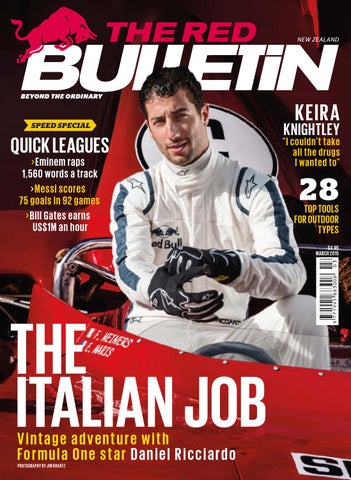
THE ITALIAN JOB V in t age a d ven tur e w i th Form ula One st a r Da n iel R iccia r do PHOTOGRAPHY BY JIM KRANTZ
DU N E K E N N IN G S
BILLABONG.CO.NZ
MOMENTS OF GLORY IMMORTALIZED IN PRINT
VS POSTERBOOK Vol. 2 T H E U LT I M AT E S H O W DOW
VOL. 2 POSTER BOOK OUT NOW
N
ONLY
8
$ .95
$8.95 INCL. GST
PB NZPC vs NZV8
9
416803 500 028
THE RED BULLETIN
24
SPEED MERCHANT
F1 star Daniel Ricciardo takes a classic Alfa Romeo for a spin on the route of one of the world’s greatest road races
JIM KRANTZ (COVER), WARNER MUSIC
WELCOME What do an F1 driver, a superstar DJ and a Lebanese rock band have in common? In the pages of The Red Bulletin this month, they are all out on the road. Infiniti Red Bull Racing’s Daniel Ricciardo puts his foot down and speeds back into history, recreating one of the great lost road races, the Targa Florio in Italy. Meanwhile, headlining gigs, parties and musical happenings around the world is Diplo, who recalls his greatest-ever nights behind the decks. And, in search of the authentic blues sound that could change their lives, Lebanese rockers The Wanton Bishops head from the Middle East to the Deep South. We’ve also got an exclusive and hilarious chat with Oscar nominee Keira Knightley, and loads more. We hope that you enjoy the issue. THE RED BULLETIN
“I was seven years old and I wanted to be Britney Spears” CHARLI XCX, PAGE 85
05
MARCH 2015
AT A GLANCE GALLERY 10 Stories behind incredible images
BULLEVARD
62
16 THE FASTEST EVERYTHING ON EARTH Plus: how you can be quicker
FEATURES
QUEST FOR THE BEST
24 Daniel Ricciardo
The Wanton Bishops journey from Lebanon to America, in search of the blues
38 Keira Knightley
42
Vying for Oscars glory
40 Mzwètwo
Taking Kiwi hip-hop to a new level
42 Tree fellas
Whittling down the best lumberjacks
50 Ian Walsh
Surfing the biggest of big waves
58 Adam King
Building mountain bike trails in NZ
60 Jerzy Skarzynski Going the distance for the Wings for Life World Run
‘TIMBER SPORT IS ABOUT CUTTING-EDGE PERFECTION’
The best lumberjacks in the world wear their scars with pride, their iron socks for safety and they devise yoga routines to keep themselves in fine felling shape
72 50 THE FUTURE OF SURFING
From new training gear to bionic limbs, meet the high-performance enthusiasts changing the way we ride big waves 06
SECRETS OF A FLY GUY
Training in the skies and on the ground keeps two-time former Red Bull Air Race champ Hannes Arch in top form
62 The Wanton Bishops
Rockers seek blues-tinged inspiration
ACTION! 72 73 74 76 78 84 85 86 89 94 98
TRAINING Get fit for acrobatic flying PRO TOOLS MTB dirt jumping gear TRAVEL Deep cave diving in Mexico WATCHES 2015’s top-end timepieces NIGHTLIFE On the road with Diplo PARTY New Zealand’s club scene MUSIC Charli XCX picks her top tunes GAMING Be a rebel in The Order: 1886 BUYER’S GUIDE Best new active gear SAVE THE DATE Unmissable events MAGIC MOMENT Scaling a rock face
THE RED BULLETIN
BALAZS GARDI/RED BULL CONTENT POOL, OLIVER JISZDA, BRIAN BIELMANN/RED BULL CONTENT POOL, JOERG MITTER/RED BULL CONTENT POOL
Driving the old Targa Florio race route through Sicilian villages
PLUS: Ray ‘SugaR’ Sefo
TenniS by The numbeRS
The nexT STaRS of SevenS
JANuAry – 2015 Issue 96 ’92 CrICket world Cup rAy ‘sugAr’ sefo
One Summer,
1992
MArCo roJAs
Remembering the
Mike Dawson kelly everNdeN
www.skysport.co.nz
Young Guns
JA N – 2 0 1 5
Issue 96
New ZeAlANd
$6.00 . incl gst
The
VaniShing
where did Marco Rojas go?
Mike Dawson Mkiii
EVERYTHING SPORT. NEWS, PICTURES AND GREAT STORIES. CALL 0800 759 759 TO SUBSCRIBE
CONTRIBUTORS WHO’S ON BOARD THIS ISSUE “I was with these Lebanese musicians and they were out of their comfort zone, but in their spiritual home” Balasz Gardi on tour with The Wanton Bishops in the Deep South, page 62
SHANE MCCAULEY
OLIVER JISZDA
BALASZ GARDI
The photographer and filmmaker, who lives in New York, first met Diplo at a block party in Philadelphia in 2003. Since then McCauley has travelled around the world documenting Diplo’s rise to DJ superstardom – the results from which feature in this month’s nightlife section. “My priority has always been to try and capture the energy of the night,” says McCauley, whose work often appears in Vanity Fair and Rolling Stone. “The pictures are of my 10 top nights touring with Diplo.” They appear on page 78.
Photographing the world’s best lumberjacks in woodcutting action requires a steady hand, a good deal of courage and a lot of lens cleaner. “I was very close to them as they were chopping, and I kept getting shavings in my camera,” says the Austrian snapper, who was shooting the sport’s star woodsmen until 1am the night before the world championships took place in Innsbruck. “After seeing them at competition speed, I’m impressed they still have all their arms and legs.” Read the feature on page 42.
“I’m always trying to capture the grit and the essence of what I’m shooting,” says the California-based photographer, who was tasked with documenting The Wanton Bishops’ formative road trip through the home of the blues music they love in America’s Deep South. “I was with these Lebanese musicians and they were out of their comfort zone, but in their spiritual home. It was exciting to get unlimited access to their lives and watch them soak up the atmosphere.” See the results on page 62.
Krantz (right) and Ricciardo in a 1972 Alfa Romeo
THE RED BULLETIN WORLDWIDE
The Red Bulletin is published in 11 countries. On the cover of this month’s South Africa edition is free solo climber Matt Bush
IN FOCUS
Behind the scenes Jim Krantz
Watch video footage at: redbulletin.com/ricciardo
The American photographer was in charge of this month’s covershoot featuring F1 star Daniel Ricciardo driving the old Targa Florio race route in Sicily. Krantz went to extraordinary lengths, closing roads, hiring staff and borrowing old goggles from 1965 Targa winner Nino Vaccarella. The feature’s on page 24.
08
THE RED BULLETIN
/redbulletin
Visual Storytelling Beyond the ordinary
JULY 2014 R30
BEYOND THE ORDINARY
7
ADRENALIN PLAYGROUNDS
M AKING CH ANGE PAY
THE CAPTAIN OF ADVENTURE
TO BLOW YOUR MIND
So u th Afri ca’s b ri g htest so c i a l e ntre p re n e u rs
ALL-ROUND ACTION HERO WILL GADD IS A LIVING LEGEND IN THE TRUEST SENSE.
LI NKIN PARK On th e i r n ew album and Tw itte r ma d n ess NEYMAR JUNIOR, Brazilian Football Star
NEYMAR!
UK EDITION
BEYOND THE ORDINARY
19 WORLD
AWESOME
SHOT!
Action photo special
CA N T H E B OY GE NIUS WIN TH E WOR L D CUP FO R B R A Z IL?
CLASS WATCHES
UNDEAD FUNNY
QUEEN OF THE BEACH
2014’s most hilarious movie
Dave Grohl
PEAK FREEFALL
Adventure’s toughest task
EXCLUSIVE: the legend reaches into your mind and music’s future
|
WEB
|
APP
|
SOCIAL
redbulletin.com
KILIMANJARO, TANZANIA
THE ICE MAN Canadian pro climber Will Gadd battles his way over a wall of glacial ice in a strange desert oasis 5,800m above sea level, 100m from the summit of Mount Kilimanjaro. “We had to camp out for three days to acclimatise ourselves for the final ascent,” says photographer Christian Pondella. “Then Will became the first man to scale the ice.” It was a climb Gadd had to prioritise: climate researchers predict that the glacier, thought to be around 70,000 years old, will have melted within five years. twitter.com/gilwad Photography: Christian Pondella/ Red Bull Content Pool
11
SAN FR AN C I S CO, U SA
WATER BABY Kai Lenny was surfing at four, and by nine had added windsurfing, kitesurfing and stand-up paddleboarding to his repertoire. At 22, the man from Maui is the reigning SUP world champion, and was runner-up in the kitesurfing world championships last year. Now he’s heading to New Zealand to prove himself the world’s best all-round watersportsman at The Ultimate Waterman contest. If anyone’s prepared, it’s him: “The ocean is my life,” he says. “I do everything in the water that there is to do in the water.” theultimatewaterman.com Photography: Keith Carlsen/Red Bull Content Pool
13
C APE TOWN , S O UTH AFRI C A
WISE GUY It’s taken almost 15 years, countless concussions and numerous broken bones to make South Africa’s Anthony Raynard a seasoned motocross pro. The 2012 MX2 champion has a motto to thank for keeping him in the saddle: ‘Quitters never win, winners never quit.’ Here, as part of project Red Bull My Track, the 24-year-old is passing on his hardearned wisdom to young riders in the form of a practical lesson: how to power through sandy turns. anthonyraynard.com Photography: Tyrone Bradley/ Red Bull Content Pool
15
EA RTH ’ S FASTEST EVERYTH I N G – A N D H O W YO U CA N B E Q U I C K ER
SPEED
F L O Y D M AY W E AT H E R J R
FASTEST FISTS IN BOXING Not merely the quickest in the ring – he’s sport’s quickest earner, too The US boxer turns 38 on February 24 and, as usual, he has much to celebrate. His record to date is 47-0-0, with 26 KOs and in 2014, he earned over US$100 million for just two bouts. No wonder, then, that his nickname is ‘Money’. But ‘Rocket’ would also be apt. His punches come in at a speed of 48kph, which is about three times as fast as a rattlesnake can strike.
REUTERS, RAFAELA PRÖLL FÜR WIENER, RED BULL CONTENT POOL, GETTY IMAGES(2), YUSUKE KASHIWAZAKI/RED BULL CONTENT POOL ANNA HAZOD
M OV E FAST E R . T H I N K FAST E R . B E FAST E R .
Oh Susie
4 SPEED SONGS The tracks that get Formula One heroes revved up
INTO THE MORNING The Weekend “It’s a song I’ve won races to, so it’s one I listen to a lot.” Lewis Hamilton Mercedes
BULLEVARD S P E E D
BE QUICK ABOUT IT!
0.1 SECONDS FOR A FIRST IMPRESSION So make the most of them No, it isn’t fair. Your opposite number scans you in the blink of an eye. And if you don’t pass the likeability test straight off, try as you might, it won’t do much good. That said, if, down the line, you turn out to be an idiot, however good that first impression you made was, it won’t count for much.
SMILE But get it right! The corners of your mouth must turn up, not extend out. That looks too forced.
FOUR KICKS Kings of Leon “It’s a cool song to warm up to. As is Molly’s Chambers.” Jenson Button McLaren
WEAR RED This signal colour makes you more attractive. It works on both men and women.
? ROMANCE IS DEAD Parkway Drive “A bit of a racket gets me going.” Daniel Ricciardo Infiniti Red Bull Racing
“HOW ARE YOU?” Your interlocutor will think you’re much nicer if you let them talk first.
?
SMELL RIGHT As long as you are clean and fresh, your own scent will impress more than any aftershave.
THE TEST DRIVER It was a case of girl against boys: Susie Wolff was racing karts against future Formula One world champs Kimi Raikkonen and Lewis Hamilton from the age of eight. Now the 32-year-old Scot has become, with the Williams team, the first woman to take part in an F1 race weekend in 22 years. She doesn’t want to be seen as a role model – she just wants to be really quick.
GET LUCKY Daft Punk “It doesn’t matter how talented you are and how hard you work, you always need a bit of luck.” Pastor Maldonado Lotus
“If everything seems under control, you’re just not going fast enough” MARIO ANDRETTI, F1 CHAMPION
17
BULLEVARD S P E E D
RAPID RAPPER
Here’s a Maxi-pad Kneel before General Zod this planet’s It’s actually disastrously bad Krypton, no Asgard, Asgard For the wack while I’m masterfully So you’ll be Thor and I’ll be Odin constructing this masterpiece yeah You rodent, I’m omnipotent ’Cause I’m beginning to feel like a Rap Let off then I’m reloading God, Rap God 3:00 Immediately with these bombs I’m totin’ All my people from the front to the back And I should not be woken nod, back nod I’m the walking dead Now who thinks their arms are long But I’m just a talking head, a zombie floating 1:30 enough to slap box, slap box? Let me show you maintaining this sh–t But I got your mom deep throating ain’t that hard, that hard I’m out my Ramen Noodle Everybody want the key and the secret We have nothing in common, poodle to rap I’m a Doberman, pinch yourself Immortality like I have got In the arm and pay homage, pupil Well, to be truthful the blueprint’s It’s me simply rage and youthful exuberance My honesty’s brutal Everybody loves to root for a nuisance But it’s honestly futile if I don’t utilize Look, I was gonna go easy on you not to Hit the earth like an asteroid and did What I do though for good hurt your feelings nothing but shoot for the moon since At least once in a while so I wanna But I’m only going to get this one chance (PPEEYOOM) make sure (Six minutes, six minutes) MC’s get taken to school with this music Somewhere in this chicken scratch Something’s wrong, I can feel it ’Cause I use it as a vehicle to ‘bus the I scribble and doodle (Six minutes, six minutes, Slim Shady, rhyme’ Enough rhymes to you’re on) Now I lead a New School full of students Maybe try to help get some people Just a feeling I’ve got Me? Me, I’m a product of Rakim through tough times Like something’s about to happen Lakim Shabazz, 2Pac, N-W-A., Cube, hey, But I gotta keep a few punchlines But I don’t know what Doc, Ren If that means, what I think it means, 3:30 Just in case ’cause even you unsigned Yella, Eazy, thank you, they got Slim Rappers are hungry looking at me we’re in trouble Inspired enough to one day grow up like it’s lunchtime Big trouble. And if he is as bananas Blow up and being in a position I know there was a time where once I as you say Was king of the underground I’m not taking any chances 2:00 To meet Run-D.M.C. and induct them Into the motherf––kin’ Rock n’ Roll But I still rap like I’m on my Pharoahe You were just what the doctor ordered Hall of Fame even though I walk in Monch grind I’m beginning to feel like a Rap God, the church So I crunch rhymes Rap God And burst in a ball of flames But sometimes when you combine 0:30 All my people from the front to the Only Hall of Fame I’ll be inducted in is Appeal with the skin color of mine back nod, back nod the alcohol of fame You get too big and here they come Now who thinks their arms are long On the wall of shame trying to enough to slap box, slap box? You fags think it’s all a game Censor you like that one line I said They said I rap like a robot, so call me ’Til I walk a flock of flames On “I’m Back” from the Mathers LP rap-bot Off a plank and One when I tried to say I’ll take seven But for me to rap like a computer must Tell me what in the f––k are you kids from Columbine be in my genes thinking? Put ’em all in a line I got a laptop in my back pocket Little gay looking boy Add an AK-47, a revolver and a nine My pen’ll go off when I half-cock it So gay I can barely say it with a ‘straight’ See if I get away with it now Got a fat knot from that rap profit face looking boy That I ain’t as big as I was, but I’m Made a living and a killing off it You’re witnessing a mass-occur like Morphin’ into an immortal coming Ever since Bill Clinton was still in office you’re watching a church gathering through the portal With Monica Lewinsky feeling on his And take place looking boy nutsack 4:00 You’re stuck in a time warp from two Oy vey, that boy’s gay thousand four though I’m an MC still as honest That’s all they say looking boy And I don’t know what the f––k that But as rude and as indecent as all hell You get a thumbs up, pat on the back you rhyme for Syllables, skill-a-holic (Kill ’em all with) And a “way to go” from your label every You’re pointless as Rapunzel This flippity, dippity-hippity hip-hop day looking boy With f––king cornrows You don’t really wanna get into a pissing You write normal, f––k being normal match 2:30 Hey, looking boy, what d’you say looking boy? And I just bought a new ray gun from With this rappity-rap I get a “hell yeah” from Dre looking boy the future Packing a Mac in the back of the Ac I’mma work for everything I have Just to come and shoot ya 1:00 backpack rap, crap, yap-yap, Never asked nobody for shit Like when Fabulous made Ray J mad yackety-yack Git out my face looking boy ’Cause Fab said he looked like a fag and at the exact same time Basically boy you’re never gonna be At Mayweather’s pad singin’ to a man I attempt these lyrical acrobat stunts capable While he play piano while I’m practicing that Of keeping up with the same pace Man, oh man, that was the 24/7 special I’ll still be able to break a motherf––kin’ looking boy, ’cause On the cable channel table I’m beginning to feel like a Rap God, So Ray J went straight to radio station Over the back of a couple of faggots Rap God the very next day and crack it in half All my people from the front to the back “Hey, Fab, I’mma kill you” Only realized it was ironic nod, back nod Lyrics coming at you at supersonic I was signed to Aftermath after the fact The way I’m racing around the track, speed, (JJ Fad) How could I not blow? All I do is drop call me Nascar, Nascar Uh, summa lumma dooma lumma you “F” bombs Dale Earnhardt of the trailer park, the assuming I’m a human Feel my wrath of attack White Trash God What I gotta do to get it through to you Rappers are having a rough time period I’m superhuman Innovative and I’m made of rubber, so 4:30 that anything you say is Ricochet in off a me and it’ll glue to you And I’m devastating more than ever demonstrating How to give a motherf––kin’ audience a feeling like it’s levitating Never fading, and I know that haters REBEL XD, THE WORLD’S FASTEST RAPPER are forever waiting He raps 18 syllables per second: faster than Eminem. For the day that they can say I fell off, they’ll be celebrating Try this at home
1,560 WORDS
“I’m coming to rock and I’m taking a rapper and I’m breaking ’em up”
’Cause I know the way to get ’em motivated I make elevating music You make elevator music “Oh, he’s too mainstream.” Well, that’s what they do When they get jealous, they confuse it “It’s not hip-hop, it’s pop.” ’Cause I found a hella way to fuse it With rock, shock rap with Doc Throw on “Lose Yourself” and make ’em lose it I don’t know how to make songs like that I don’t know what words to use Let me know when it occurs to you While I’m ripping any one of these verses that versus you It’s curtains, I’m inadvertently hurtin’ you 5:00 How many verses I gotta murder to Prove that if you were half as nice, your songs you could sacrifice virgins to Unghh, school flunky, pill junky But look at the accolades these skills brung me Full of myself, but still hungry I bully myself ’cause I make me do what I put my mind to When I’m a million leagues above you Ill when I speak in tongues But it’s still tongue-and-cheek, f––k you I’m drunk so Satan take the f––king wheel I’m asleep in the front seat Bumping Heavy D and the Boys “Still chunky, but funky” But in my head there’s something I can feel tugging and struggling 5:30 Angels fight with devils and Here’s what they want from me They’re asking me to eliminate some of the women hate But if you take into consideration the bitter hatred I had Then you may be a little patient and more sympathetic to the situation And understand the discrimination But f––k it Life’s handing you lemons Make lemonade then But if I can’t batter the women How the f––k am I supposed to bake them a cake then? Don’t mistake him for Satan It’s a fatal mistake if you think I need to be overseas And take a vacation to trip a broad And make her fall on her face and Don’t be a retard, be a king? Think not 6:00 Why be a king when you can be a God?
KEVIN MAZUR/GETTY IMAGES COPYRIGHT: SHROOM SHADY MUSIC, SONY/ATV RHYTHM, SONGS OF UNIVERSAL INC., COMEBACK KID PUBLISHING, HEBREW HUSTLE MUSIC, RUTHLESS ATTACK MUZICK, BIZA PUBLISHING INC., PINK PASSION MUZICK, BUGHOUSE, TWO BADD MUSIC
Eminem now has a Guinness world best to add to his many plaudits: most words in a hit song. During the 2013 track Rap God, he manages a top speed of 6.5 words a second
BULLEVARD S P E E D
LAND, SEA, AIR AND ELSEWHERE
WHAT WINS, WHEREVER Man versus machine, falcon fights tornado, rocket takes on planet, mountain against Bolt. Four races, four surprising victors 1
2
3
In space No resistance, because of the vacuum. In the 1970s, the two Helios probes flew faster than the quickest planet in our solar system.
Helios probes: the fastest man-made machines
Mercury: the fastest planet orbiting the sun
Apollo 10: the fastest manned machine
HELIOS-A & HELIOS-B
1 2
252,792kph
MERCURY 170,505kph
3
APOLLO 10 39,897kph 1
2
3
4
In the air Your granddad will know the winner here: the fastest manned aircraft is now over 50 years old.
North American X-15: broke Felix Baumgartner: the speed record in 1967 no one fell faster in 2012
MAX PLANK INSTITUT, NASA(2), WIKIPEDIA(2), JAY NEMETH/RED BULL CONTENT POOL, FOTOLIA(3), PICTUREDESK.COM(2), GETTY IMAGES(3)
3 4
FELIX BAUMGARTNER 1,357.64kph
PEREGRINE FALCON 389kph
Even mountains move, but the 5mm by which the Pakistani peak Nanga Parbat grows each year is countered by erosion.
1
ThrustSSC: Andy Green put his foot down in 1997
2
3
Cheetah: sprints faster than any other land animal
4
4
Usain Bolt: the fastest human being of all-time
THRUST SSC
1
3
1,227.986kph
CHEETAH 120kph
NANGA PARBAT 0.00000000057kph
We can still only guess when it comes to the fastest submarines. For security reasons, no government will admit to their subs’ top speed.
1
2
Black marlin. Fastest fish; no wonder with that nose
2
3
K-162: Soviet, quick and formerly top secret
Florent Manaudou: fastest 50m swim of 20.26s
BLACK MARLIN
1
Nanga Parbat: ninth-tallest mountain keeps growing
USAIN BOLT 44.72kph
In Water
3
7,274kph
OKLAHOMA TORNADO 509kph
On land
2
Peregrine falcon: king of the vertical nosedive
NORTH AMERICAN X-15
1 2
Oklahoma: hit by the fastest tornado in 1999
130kph
K-162 82.8kph FLORENT MANAUDOU 8.88kph
19
BULLEVARD S P E E D
S - A - A - A -Y C - H - E - E - E - S - E
632 DAYS LOOK LIKE THIS Michael Wesely exposes photos for over a year. A lot of stuff happens while he makes a pic
2003
MAY 2, 2003 Michael Wesely turns off the camera.
APRIL 4, 2003 Haiti officially recognises voodoo as a religion.
MARCH 20, 2003 The war in Iraq starts as US forces invade.
JULY 23, 2002 The Dow Jones falls 11 days in a row and sinks to below 8,000 points: a record low.
MARCH 30, 2002 Queen Elizabeth, The Queen Mother, dies in Windsor at the age of 101.
2002
JANUARY 1, 2002 The euro replaces the national currencies in 12 EU countries.
OCTOBER 23, 2001 Apple’s iPod goes on the market.
2001
SEPTEMBER 11, 2001 Terrorists strike the World Trade Center and the Pentagon in the US.
AUGUST 9, 2001 Michael Wesely presses the shutter release.
MICHAEL WESELY, THE MUSEUM OF MODERN ART, NEW YORK (8.9.2001-5.2.2003) © BILDRECHT, WIEN 2014
JANUARY 26, 2003 The Tampa Bay Buccaneers win Super Bowl XXXVII.
THE MUSEUM OF MODERN ART, NEW YORK (9.8.2001 - 2.5.2003) Wesely’s long exposures focus on photography as a process. Here he captures the renovation of MOMA in New York. In doing so, he is touching on themes of memory, time, image and imagination.
BULLEVARD S P E E D
These teens and 20-somethings have risen rapidly to the top of their fields, earning fame and fortune beyond their years
27 75 goals
LIONEL MESSI Scored a Barça hat-trick against Real Madrid at 19. And, after scoring for the 75th time in 92 matches, he’s the all-time top scorer in the Champions League.
18 2 Grammys
LORDE The youngest person on this list yet an old hand in the music industry. She signed her first record deal when she was 12.
IT’S ALL
GOOD Time heals all wounds, but just not at the same rate
TATTOO It takes 10 laser treatments to be rid of that tatt. With the necessary breaks between sessions, that’s 14 months in all.
24 US$1.5bn
EVAN SPIEGEL Snapchat’s co-founder owns 15 per cent of the US$10bn business, but only left his parents’ home last year, splashing US$3.3m on his new pad.
Kainrath’s 1×1
22
BROKEN BONES Your shinbone should be fine again eight weeks after that silly, showingoff snowboard crash.
ALCOHOL It’s longer than you think: three hours to break down the booze content of a pint of strong lager.
US$500m+
PALMER LUCKEY He invented the virtual reality headmounted display Oculus Rift before he was 20, then sold it to Facebook last year for US$2.3bn.
Speed = (the right) distance over time
NUCLEAR MELTDOWN Chernobyl and its surroundings will be inhabitable again in 25,000 years.
DIETMAR KAINRATH
FASTEST TRACKERS
GETTY IMAGES, JAMES KLOWE, AP PHOTO, PICTUREDESK.COM
YOUNG ONES (MANY ZEROES)
BULLEVARD S P E E D
LIFE HACKS
DO THINGS QUICKER NOW! Over the course of our lives, we spend 100 days brushing our teeth. Here are genius ways to help you make more time for the things that really matter PEELING GARLIC Put whole cloves of garlic in a sealed container and give it a hefty shake. They peel themselves.
FOLDING T-SHIRTS Place the T-shirt on a flat surface and mentally draw two lines (see fig.1 below).
KER-CHING What others have earned in the eight minutes you’ve been reading these pages
€148,356 BILL GATES Why does the guy still bother working?
€256 COOLING BEER Put the beer in a bowl of cold water with ice cubes and salt. It will be the perfect temperature in a couple of minutes.
CRISTIANO RONALDO You almost feel sorry for him compared to Floyd Mayweather Jr. Place your right hand at the top and your left in the middle.
Fold downwards, keeping your left hand where it is.
€15 ANGELA MERKEL We knew it! You won’t get rich in politics.
€2
BOILING EGGS Crack open an egg and empty into a cup, cover with microwavesafe clingfilm and microwave for 40 seconds. Now pull the T-shirt through with your left hand.
Fold it again at the sleeve, and you’re done.
Stop already, will you? Hello! You there! Quit it
REUTERS
DIETMAR KAINRATH
There are nice things that lose their sheen if you do them too much. If you’re not careful, they could even turn into world records that nobody wants or needs LONGEST KISS 58h 35m 58s Ekkachai and Laksana Tiranarat from Thailand kept their lips pressed together for more than two days in 2013. Our advice: the couple together that long with nothing to say to one another should split up. THE RED BULLETIN
LONGEST TENNIS MATCH 11h 5m
LONGEST KARAOKE MARATHON 101h 59m 15s
LONGEST TATTOOING SESSION 50h 10m
John Isner and Nicolas Mahut’s 2010 match at Wimbledon was suspended twice due to darkness. Isner won, and was promptly knocked out in the next round.
Italian Leonardo Polverelli warbled a total of 1,295 songs to backing tracks in 2011. That’s four days and nights! Thankfully, nobody was obliged to stick around for all of it.
Dave Fleet tattooed scenes from the life of Christ onto James Llewellyn in 2011. For two days. A crucifixion had never been so aptly rendered.
THE PERSON WHO WROTE THIS STUFF Has anyone got Bill Gates’s number?
CAN TALK OK, my answer’s wrong, but I didn’t know before you asked the question.
23
Rules of the road: in the 1970s, the regulations stipulated that sportscars had to be designed as two-seaters in order to distinguish them from the single-seater cars of Formula One. But although that’s what it said on paper, no one ever came along for the ride
SPEED MERCHANT F1’s future meets motorsport’s past: DANIEL RICCIARDO takes a classic Alfa Romeo for a spin on the route of one of the world’s greatest road races Words: Werner Jessner Photography: Jim Krantz
24
A
s the plane begins its descent into Palermo airport, on the northern coast of Sicily, Daniel Ricciardo explains what he’s ready to face in the day ahead. “I expect to learn how to manoeuvre a 300kph racing car in and out on public roads to avoid donkeys.” Motorsport nerds will get the reference. Everyone else should know that the Infiniti Red Bull Racing driver is nodding at Speed Merchants, a documentary about the 1972 sportscar season, which features footage of donkeys being avoided during the Targa Florio, the legendary endurance sportscar race that was held on the roads of Sicily from 1906 to 1977. The Ricciardo family has roots in Ficarra, a small village in the north of Sicily. They emigrated to Australia when his father was six, Ricciardo’s connection to this place is weak. As far as he can remember, he’s only been here once, as a child, on a family visit, he thinks. He has led an Australian life in which different things have mattered, such as his desire to become a racing driver. In two years driving for Scuderia Toro Rosso, he learned some 26
Italian – “some days I answered the mechanics in Italian when they spoke to me in English” – but basically the most Italian thing about him is his love of good food. “Top-quality food that’s been made well. I can always be won over with a good plate of pasta.” Were Targa heroes ever a topic of conversation at home? “No, Dad raved more about Formula One and Mario Andretti.” By that time, the heyday of the Targa Florio – ‘Targa’ is Italian for number plate; ‘Florio’ is for Vincenzo Florio, the founder of the race – had long since passed. It began as a harmless threeway race between a horse, a bicycle and the first car in Sicily, which belonged, naturally, to Signor Florio. By the start of the 1970s, it was an unwieldy monster. Even though the course changed several times over the years, the goal remained pretty much to do 11 laps of approximately 70km each. Competitors would drive through villages and towns along regular roads, with their walls, sheer drops and potholes. In the days leading up to the race, the authorities sent out messengers who asked residents, “to lock up children and animals”. Not everyone did. If anything, the opposite was the case. Hundreds of thousands of people lined the streets. The sea of people would part as the racing cars loomed into view and then come together again as THE RED BULLETIN
“ W H AT A M I E X P EC T IN G O F T H E DAY A H E A D ? TO LEAR N H OW TO MAN O EUVR E A 300 KPH RAC I N G CAR I N AN D O UT O N PU B LI C ROADS TO AVO I D DO N KEYS” D a n i e l R i c c i a r d o
Heady stuff: “Did my head really stick that far out of the cockpit back then too?” asked Helmut Marko when he saw Ricciardo in the Alfa. It did, but not quite as much. In contrast to the rest of the car, the seat isn’t original
House call: the course went through towns and villages. Presumably even those who didn’t witness it live heard the V8 as it sped down the narrow streets
they passed. Many Sicilians didn’t just want to see the cars, they wanted to touch them too, preferably when they were in full flight. The Targa was part of the World Sportscar Championship, and the performance of its cars improved rapidly over time. The large manufacturers of the day set up factory teams, led by Porsche, Ferrari and Alfa Romeo. In 1972, Ferrari, with one car driven by Arturo Merzario and Sandro Munari, was going for victory against no fewer than four Alfas. Back then, sportscar racing was held in the same regard as F1, and all good racing drivers, with the exception of Jackie Stewart, raced in both categories. On the start line of the 1972 Targa were then-current F1 drivers Nino Vaccarella, Rolf Stommelen, Vic Elford and Helmut Marko. These men were the speed merchants for which the documentary was named. Today, Marko says that he wasn’t 28
that much of a fan of the Targa. “The first few laps were a shock. During practice, Toine Hezemans collided with a donkey, rider and all. He was catapulted over the rear spoiler. Nino Vaccarella and his car disappeared under a truck. Locals nailed their doors and windows shut to be on the safe side. One car got lost up in the mountains. It took half a day just to find it again. There were no crash barriers, just outsized bales of hay here and there.” So how does a rational human being put his foot down in conditions like that? “As a racing driver, you forget all that when you have a sniff of victory,” says Marko. “That’s no different now. Today’s Formula One drivers are the most rational people on the planet in briefings, but when they put that visor down...” Back in the 1970s, teams sought lodgings in villages along the route, preferably with a tavern close by. If an opponent THE RED BULLETIN
recorded a fast time, the drivers got back in their cars. The better you knew the course, the better your lap times were. “We didn’t just have to learn by heart all the turns over the 72km course,” says Marko. “We also had to be aware of where the road surface changed and any crest of a hill where you lost traction.” Drivers practised in regular traffic, first using fast road cars, then racing cars. “Sometimes the Carabinieri would stop you, reach into the car and hand you a ticket they’d already filled out. We handed them in at the garage. There must have been hundreds of them. I’m guessing they were thrown away.” For the race itself, Marko shared his car with Italy’s Nanni Galli, who, it transpired, was said to be somewhat distracted by a death in the family. At the final driver changeover, he missed the braking point, ran into the wall and had to be pulled back out. THE RED BULLETIN
“ON E CA R GOT LOS T UP IN T H E MOUN TA INS. IT TOO K HALF A DAY J UST TO FI N D IT AGAI N ” H e l m u t M a r ko 29
“ TODAY ’S F OR M U L A ON E DR I V ER S A R E T H E M OS T R AT ION A L P EOP L E ON T H E PL A N E T IN B R IEF ING S, B UT WH EN TH EY PUT THAT VISO R DOWN …” H e l m u t M a r ko 30
Tough challenge: the men who could take cars like these to the limit were the ultimate heroes
Time warp: Cerda has hardly changed since Marko’s racing days, just replace the Fiat Puntos and Pandas parked on the side street with the 500s or 124s of that era
“SOM E T IM ES T H E CA R A B IN IER I WOUL D R E ACH IN TO T H E CA R A N D H A N D YOU A T ICK E T. WE HAN D ED TH EM I N AT TH E GARAG E” H e l m u t M a r ko
Marko, in an Alfa, and Arturo Merzario, in the Ferrari, were the only two who could still win, but Marko was more than two minutes behind. The Austrian then made the charge of his life, getting closer and closer to the Ferrari in what was an inferior car. But on the long straight in the final section of the course, Merzario displayed the superiority of his Ferrari’s 12-cylinder engine over the Alfa’s eight cylinders and won by a margin of 16 seconds. But Marko has the quickest lap of the Targa Florio to his name: 33m 41s, with an average speed of 128.253kph. Today, Daniel Ricciardo is driving Marko’s 1972 Alfa Romeo T33. The car took part in the biggest races of its day up until 1975, at which point it was sold to a collector in Greece and has since made its way to Scotland to its current owner, who bought it in 2012. The price has gone up with each sale. Driver safety in this sportscar is as poor as it ever was. Ricciardo is hemmed in on both his left and right sides by
Picture this: where once the tifosi would have raised their arms aloft and waved flags, now they’re poised with smartphones at the ready
33
two 60-litre petrol tanks. The front crash absorption structure is essentially a roughly hewn aluminium Alfa Romeo logo and the driver’s shins. The position of the seat is unusual, the right foot’s job hampered by part of the bodywork. Taller drivers need to make sure that they don’t accidentally flick a switch for one of the fuel pumps with their left knee. Operating the clutch is like doing a very tough leg-press. The steering wheel is so tiny and flat that it’s like being in a bumper car. Changing gear is completely normal: clutch and an H-gate. “I’ve only ever used that type of gear shift in Formula Ford,” Ricciardo says, “and I wasn’t all that good at it.” But when he’s not racing for hundredths of a second, Ricciardo can enjoy it. “It’s all handiwork,” he says. “It’s hard, but fun.” For Marko’s generation, it was the job of the drivers’ wives to patch up their husbands’ hands with gauze bandages as the vibrations were so bad on the poor roads in cars that could go up to 300kph. “Your whole body was battered and bruised after a sportscar race,” says Marko. “Driving these cars was extremely hard physically.”
Ricciardo expected the Alfa T33 to be a good mover. It weighs less than 700kg while generating more than 400bhp and has a chassis that was state-of-the-art in its day. “It does what you expect it to: it’s a proper racing car!” Ricciardo stops in every village, is recognised every time and surrounded by fans within minutes. You’re one of us, they tell him. Do you want something to eat? And when are you going to drive for Ferrari? He always answers in the affirmative, saying: let’s wait and see. Italians’ love of motorsport is immense and can sometimes be exhausting. But thankfully there’s the car to retreat to as well as more of the historical course to see. It is not wise to do a complete lap of the Targa Florio in this car. The roads are in a parlous state and would put a hire car at risk, never mind a 42-year-old racing car with tiny, 13in front wheels and which was designed to be as low and close to the road surface as possible. In theory, roads can be repaired, but in practice, Sicilian politics and a lack of willingness to take responsibility ensure the roads’ poor condition. When the side of the road has sagged by a couple of metres, somebody, you’d
The hills had eyes: hundreds of thousands of spectators lined the normally sleepy slopes, valleys and groves of Sicily during the race
34
THE RED BULLETIN
Get a grip: dust from the Sahara Desert plus a changeable road surface makes the route slippery
I T W EIG HS L E S S T H A N 700KG W H IL E GEN ER AT ING M OR E T H A N 400B H P AN D HAS A C HASSIS THAT WAS STATE-O F-TH E-ART I N ITS DAY
THE RED BULLETIN
35
think, might, at least, mark the spot with cones. Not here. But Ricciardo can still sample the best that the old course has to offer, with many good road surfaces and beautiful bends. The Alfa flies, though he is wary of a road that is always slippery with a touch of sand from the Sahara. The eight-cylinder engine roars. The rear of the car shakes. Ricciardo flashes a huge grin under his open helmet. He seems thoughtful on the plane home that evening. “I must finally ask my dad why my grandparents left Sicily for Australia.” He pauses to think. “Maybe now I have a better understanding of what Helmut means when he talks about the past, even if I’ll never completely understand it. Even if there wasn’t a donkey on the course this time.” Another pause. “But I know one thing. Now I want a historic racing car.” infiniti-redbullracing.com
T H E EIGH T-CY L IN DER ENGIN E ROA R S. T H E R E A R OF T H E CA R SH A K ES. R I CC IAR DO G R I NS
Mad about motorsport: people come out of their houses in droves and stare in wonder
TARGA FLORIO
GETTY IMAGES(3)
The story of one of the greatest endurance races ever – and perhaps the craziest Sicilian Vincenzo Florio discovered the De Dion-Bouton tricycle while he was travelling around Europe in 1900. He ordered one and soon took delivery from Paris. As driving alone wasn’t much fun, he organised a race between his tricycle, a jockey and a cyclist. The cyclist collapsed in the mountains, while the vehicle’s radiator overheated. As a result, the first Targa was won by a man on a horse. The official history of the race begins in 1906. Florio had given in to pressure from French bicycle racer Henri Desgrange, who wanted to launch a motor race in Sicily. Desgrange was also a journalist for French sports paper L’Auto and had just established the Tour de France to fill in the quiet period for the publication over the summer. A motor race in Sicily would be the perfect way to expand the portfolio.
THE RED BULLETIN
Ten cars lined up to start the first race. The winner, Alessandro Cagno, took nine and a half hours to complete the 148km course. Over the years, the course was reduced to 72km, but the number of laps was increased to 11 at its height. Porsche has had the most success at the Targa Florio with 11 wins. The name “targa” for cars with removable roofs comes from the race. Alfa won it 10 times, and has set the record for the fastest lap 10 times over. The last time the Targa counted towards the World Sportscar Championship was in 1973. A number of accidents, two of which were fatal, meant the authorities had to act, but the Italians held the race as a national race until 1977. Today, a vintage car race and a rally are run using the old name.
Messina
Palermo
SICILIA Siracusa
Donkeys, bales of straw, the walls of houses and spectators wandering this way and that: by the late 1970s, the Targa was finally deemed too dangerous
37
KEIRA KNIGHTLEY
“I didn’t take all the drugs I wanted to” In the run-up to the Oscars and after tackling Everest, the Londonborn star talks beauty, lobotomies and tattooing her nipples
At 18, Keira Knightley was swashbuckling with Johnny Depp in Pirates of the Caribbean, an adventure she repeated in two sequels. She then fought very different fights alongside Mickey Rourke in Domino and Clive Owen in King Arthur, and indulged in serious S&M with Michael Fassbender in A Dangerous Method. On screen Knightley is not to be messed with. Off screen she commands respect, too, after translating her early success into an enduring career that boasts complex character roles in films such as Atonement, Anna Karenina and most recently as the confidante to Benedict Cumberbatch’s haunted computer genius Alan Turing in Oscar-nominated The Imitation Game. The 29-year-old can also be seen in survival drama Everest this year, before she takes a break to have her first baby with husband, James Righton, of new rave band Klaxons. the red bulletin: You’ve been at the top of your game for well over a decade and are one of the best-paid actresses in Hollywood. How have you managed it? keira knightley: I tend to get back up quite quickly after I’ve been knocked down, and I try forge ahead as much as possible. I must admit, I can easily be one of those actors who almost seems like they’ve got a frontal lobotomy and doesn’t do anything. But then I get terrified by my own laziness, and that pushes me to be proactive. But why have I lasted in this business? I’m surprised myself. I’m incredibly lucky. There are a lot of people who have a couple of films and don’t get any more offers. Were there downsides to becoming famous so early? For me it meant a lack of experimentation. I couldn’t take all the drugs I wanted to take. That’s a good quote, isn’t it? When 38
I was 18, I had men following me around with cameras, while the media commented on everything I did. So I didn’t have that carefree time of getting drunk and falling over a lot. So without booze and drugs, did you take up healthier habits instead? I go through phases. There is six months where I get a personal trainer and go to the gym. Then I go, ‘God, that’s boring, I can’t be bothered to do that.’ So I enter six months of vegetation, and after that
“It’s an imagebased industry and I know my looks were partly responsible for my getting the part” I’ll do some exercise again. Other than that, I did go hiking in the Himalayas, but physically it wasn’t actually very impressive. Last year you posed topless on the cover of Interview magazine and banned any retouching on the pictures, as you don’t agree the practice should be commonplace. Do you have a penchant for bold statements? It’s not the first time I’ve appeared naked in a publication. Perhaps I won’t want to do it in five years, but my mum said, ‘When I’m a grandmother, I want my nipples tattooed blue, so I can show everyone I’ve led a life.’ And for me that’s my nipples being tattooed blue, as it were. I will show them to my grandchildren with pride.
The Oscars take place this month and you’ve been nominated. When you’re in a successful film like The Imitation Game, do you spend time thinking about whether you’ll win an award? Quite a few times I’ve played parts where people have gone ‘Oh my God, this has got to get nominations.’ And it hasn’t. You do go, ‘Oh f--k.’ But you can’t aim to make an award-winning film. You can aim to make the best film you can possibly make. If you get a nomination for something, it’s f--king excellent, and fun and brilliant. But really what matters is that people find the work interesting. You can’t ask for more than that. You got your first part in a blockbuster at the age of 18 in Pirates of the Caribbean. Did it bother you some people attributed that more to your looks than your acting chops? At least they weren’t saying I was the ugliest woman in the world. Look, it’s an image-based industry and I know that my looks were partly responsible for my getting the part. But there were a lot of pretty girls up for it, so there must have been something else as well. Looks fade. They fade! If that was all I had to offer, I’d have something to be very worried about. If all did fail, would you start a music career with your indie rocker husband? No, Jesus Christ. It would be the worst idea. He and his band work very well together, so I’ll let them get on with it. I hate singing in front of people. It’s scary, because you don’t want to look stupid. Do you care what other people think? If you don’t, you’d be a psychopath. On the other hand, I know some people find what I have to offer attractive and some people find it disgusting. That’s just the way it is. keiraknightley.com THE RED BULLETIN
AUSTIN HARGRAVE/AUGUST
Words: Rüdiger Sturm
Born March 26, 1985, in Teddington, London. Breaking out Football film Bend It Like Beckham launched her career in 2002. Fitting, as she’s a keen West Ham United fan. Blooming early Aged three Knightley demanded an agent. Aged six, she had one. ​
MZWÈTWO
“I’m not arrogant, just honest” The rising star of New Zealand hip-hop is channelling his self-belief into a series of EPs that take stylistic cues from unlikely sources Words: Tom Goldson Photography: David K Shields
Auckland rapper Mzwètwo is handsdown this country’s most unswervingly confident hip-hop artist, serving up chutzpah in his music and interviews to rival Kanye West. Mzwethu Manrich Ngubane was seven when his family came to the North Shore from Zimbabwe as refugees, yet there are few references to former or current homes in his music and how he presents it. Instead, he channels the dandyisms of the US rapper Theophilus London and the Ramones’ rock ’n’ roll fundamentals. What else you should know: before he released music under his current guise, he went by the alias Loui the Zu. He designs his own clothes, directs his own videos and declares himself New Zealand hip-hop’s best dressed. He consistently achieves high production values on a shoestring budget. Not bad for a 21-year-old. the red bulletin: Why did you drop Loui the Zu in favour of Mzwètwo? Mzwètwo: I used to be called ‘Zu’ in primary school because no one could pronounce my name. It’s only now that I feel like I’m really finding my voice as an artist, so the time was right to use something closer to my name. It comes down to what I’m now bringing together in my music. I like to call it modern rock ’n’ roll, taking influences like Morrissey, Hendrix and James Brown, and then mixing them up with hip-hop. It’s a shame that there’s not music out there that allows all those influences 40
to live together without conflict, and I bring them together because it’s what I want to hear. Everything I write and everything I do, I try to do it as selfishly as possible; to make stuff that people have never heard before. Loui the Zu was 100 per cent hip-hop. Why is Mzwètwo name-checking and channelling rock stars? I want to be a rap artist trying to make the best hip-hop songs that have ever been made. Rapping’s great, but I feel
“I believe that art is selfish, so I make sure that everything I say is 100 per cent true” like hip-hop musicianship, compared with other forms of music, is not up there. So my vision is to bring the spirit of Axel Rose when he was leading Guns N’ Roses in their prime, or Michael Jackson moonwalking across the Soul Train set, or Jay Z’s supercool, superminimal stage presence – to bring all these threads together, without conflict. As Mzwètwo, I’ve figured out what I’ve meant to do: bring choreography, a live band and the grand-scale simplicity of hip-hop together in one package. That’s the alchemy I’m trying to achieve.
Where does your self-confidence come from? From my mum, she’s a very confident woman. Most African woman I know are confident. You don’t need to tell them they look good, they’ll let you know; you don’t need to ask them how they feel, they’ll just tell you. I was raised by a female, grew up on the North Shore; I’m African, I like hiphop and fashion – because of all that I was always made fun of at school. Going through that made me say, ‘F––k it, this is what I am and this is what I like. It doesn’t matter if anyone else likes it or not.’ I believe that art is selfish, so I make sure everything I say is 100 per cent true. Some people might say I’m arrogant, but I’m just honest. You direct all your videos. How important is it for you to control how your music is presented? Honestly, I just want everything to look right. Visuals are very important to me. I think about music and clothes in the exact same way. The jeans I’m wearing dictate what shoes I’m going to wear, and it’s the same for my music: the kick or the bassline or the melody will dictate the type of snare I use or the rhyme I write. I think of my first two Gallantino EPs as couture collections: not for everyone, you need a certain amount of taste. The third one is more like a ready-to-wear collection that’s for everyone, for the masses – but you still need taste to get it. facebook.com/mzwetwomusic THE RED BULLETIN
Discography Gallantino 3 (EP, 2015) Gallantino 2 (EP, 2014) Gallantino 1 (EP, 2014) Extended play Serving as a statement of intent, Mzwètwo’s Gallantino EP series is so named because it is Gallant In the Name Of. “I want all my art to be brave,” he says, “and that name captures that spirit.” Under A$as-ment The A$AP Mob member Ferg listened to a selection of Mzwètwo’s songs at Red Bull Studio Auckland recently. “That totally blew me away,” admits the latter.
THEY CAME, THEY SAWED, THEY CONQUERED: BLOOD, SWEAT W O R D S: A N D R E A S R OT T E N S C H L AGE R P H OTOGR A P H Y: O L I V E R J I S Z DA
TIMBER
AND IRON SOCKS WITH WORLD CHAMPIONSHIP LUMBERJACKS
LAND 43
DISCIPLINE STANDING BLOCK CHOP HOW TO WIN IT “IT’S A NUMBERS GAME: FOUR 45-DEGREE STRIKES FROM ABOVE, THEN FOUR FROM BELOW. CHANGE SIDES. REPEAT”
“MY
SCAR MOTIVATES ME”
STIRLING HART 25, Canada “I was 21 when my axe slit my right cheek open during a competition. There was sticky blood everywhere. I had 88 stitches. I didn’t recognise my face after the operation, which was a horrible feeling. But the first time I went to a bar after that cheered me up; everyone wanted to hear the axe story. Especially the women. The scar has been my best friend ever since. And it gives me motivation. In 2014, I won my first national championship title.”
44
DIRK BRAUN 44, Germany
“I EVEN SAW
AT NIGHT” DISCIPLINE HOT SAW HOW TO WIN IT “THE WEIGHT-POWER RATIO IS IMPORTANT: THE SAW WEIGHS 28KG AND RUNS ON A 72HP KART ENGINE. IT’S LOUDER THAN A FIGHTER JET”
“When the national championships were held in Winterberg in 2003, the organisers were on the lookout for a local hero. So of course they asked me. I was working as a forest manager and was a competitive bodybuilder. I came sixth without any preparation. That spurred me on. My training regime since then has been: 5am, weights; 7am, my forestry job; 5pm, timber sport training. I’ve bought floodlights to light up my garden at night. My wife isn’t so keen on that part.”
DISCIPLINE STOCK SAW HOW TO WIN IT “EVERY CUT TAKES FULL BODY MOVEMENT. WHICH IS WHY I’VE DEVELOPED YOGA EXERCISES FOR LUMBERJACKS. THEY KEEP SHOULDERS AND HIPS FLEXIBLE”
46
“I STAY FIT WITH YOGA” ARDEN COGAR 44, USA “Most people think I’m a full-time lumberjack, but I have a day job as a lawyer. Law is what I studied and I specialise in accidents in the workplace. Litigation and timber sport competitions have a lot in common: you prepare for months in advance to hit the nail on the head on the day. As a lawyer your tools are specialists and paperwork, as a lumberjack an axe and a saw. But the same rule applies for both: preparation plus sweat equals success.”
DISCIPLINE SPRINGBOARD ASCENT 2.5M HOW TO WIN IT “KEEP YOUR BALANCE. THE FORCE OF YOUR STRIKE COMES FROM YOUR LEGS, ABS AND SHOULDERS”
MARTIN KOMÁREK 38, Czech Republic
“I SPENT
A YEAR’S WAGES ON AXES”
“I grew up in a small town. I first saw competitive timber sports on TV when I was a teenager and thought, ‘Wow! They are real men.’ At 21, I gave up my job as a paramedic and spent a whole year’s wages on sport axes from New Zealand. My parents asked if I’d gone mad. Now I’m the five-time European champion. I think of it like this: chopping tree stumps releases endorphins. Timber sports make you happy.”
JASON WYNYARD 41, New Zealand “I grew up in the Kaingaroa Forest, the largest plantation in the southern hemisphere. It’s 2,900km2 of Monterey pine; I sort of had to chop my way out of there. I’m a six-time world champion and the current champ. The bad news is that with every competition comes the potential for mistakes. Timber sport is a constant search for perfection.”
“TIMBER
SPORT IS ABOUT PERFECTION” DISCIPLINE SINGLE BUCK HOW TO WIN IT “YOUR SAW TAKES A LOT OF SHARPENING. THAT’S HARD WORK, BUT IT TAKES MORE WOOD OUT OF THE LOG WITH EACH CUT”
48
BRAD DELOSA 37, Australia “Australians are good at axe sports because we’ve had competitions for more than 100 years. I entered my first one when I was 16, and in 2013 I was crowned world champion. I’ve learnt an aggressive chopping technique. The crowd love it. The fact that timber sports are becoming increasingly popular is down to the increase in sedentary jobs. People like to watch big guys hacking through blocks of wood. ”
“I USE
AN APP
TO PRACTISE”
DISCIPLINE UNDERHAND CHOP HOW TO WIN IT “WELL-PLACED SWINGS OF YOUR AXE. YOU CAN PRACTISE THEM IN THE SAME WAY YOU WOULD YOUR GOLF SWING. THERE’S AN IPHONE VIDEO APP CALLED COACH’S EYE AND IT’S BRILLIANT” HOW TO KEEP YOUR FEET IN ONE PIECE “WE WEAR IRON SOCKS UNDER OUR SHOES, IN CASE A STRIKE OF THE AXE GOES ASTRAY” stihl-timbersports.com
Elite surfing is now populated by people like Ian Walsh: high-performance enthusiasts with tailored workouts. But the future holds even more. From new training gear to bionic limbs, Blade Runner on the waves is just a few years away
The future of... 50
ZAK NOYLE/A-FRAME
Chairman of the board: Maui-born Ian Walsh is one of the most fearless big-wave surfers
IAN WALSH
Shaken by close calls in the heavy surf off Maui, Ian Walsh wanted to understand what his body went through in those moments of high stress and low oxygen beneath a big wave. Suddenly, just surfing wasn’t enough to succeed – and maybe not even enough to survive. Here, one of the world’s best bigwave surfers offers a glimpse at the future of his sport, where high-performance training can mean the difference between life and death Words: Stuart Cornuelle
the red bulletin: Growing up a surfer on Maui, it seems like getting into big waves is just a natural evolution. Was it? ian walsh: We’d have big days all winter long, so I just eased into it when I was really young. But around my mid-teens is when it really set in that I didn’t want to be missing those days if my brothers and friends were going out there. What made you start thinking you needed to train for it? One day at a big outer reef I just got really pounded: held under forever, skipped across the bottom. My whole body got shredded on the reef. At that point in the day it was the third board I’d broken, so I was already tired and beat-up, and that was when I realised, “Wow, being tired and getting this pounded is 10 times worse than when you’re fresh.” That’s when I started to think, “OK, maybe I can’t just wake up and eat a bowl of cereal and go out here. I’ve got to be prepared.” After a couple of those incidents I met a guy who was opening a gym right by where I lived, and he really started to show me what it is I should be doing to train outside the water. What was that early training like? The first thing I really latched onto was learning about a foam roller, loosening
BRIAN BIELMANN/RED BULL CONTENT POOL, CHRISTIAN ANWANDER
After taking a pounding at an outer reef in Maui, Walsh knew he had to reinvigorate his training
52
THE RED BULLETIN
Walsh, who’s had trouble holding his breath for extended periods, began training in earnest to survive hold-downs on big waves.
“I started to think, OK, maybe I can’t just wake up and eat a bowl of cereal and go surfing”
Training plan: Walsh combines surfing with gym work, breath-holding exercises, and cycling
“ In every aspect of the sport, there’s a more professional approach. The top 10 surfers are training year round. They have coaches” up your ligaments and rolling everything out. And general circuit training stuff, not a lot of heavy weights, because the point wasn’t to get any bigger, it was just to kind of get everything in tune and firing more consistently. So a lot of basic lunges, pull-ups, push-ups – everything alternating to sync with which muscles you’re working. Were you focusing on breath-holding work at that point? No, just stuff in the gym. That was still a very quiet issue that I had, that I couldn’t hold my breath that long. What makes you say you couldn’t hold your breath? Compared to other surfers? If you look at some of my peers, they all were amazing divers. They were out speardiving, catching fish and just had really good lung capacities. I always felt like I couldn’t get that deep, and couldn’t stay under that long. Even just holding your breath as a kid, sitting on 54
THE RED BULLETIN
ADEMIR DA SILVA, MASTERS/A-FRAME, BRIAN BIELMANN/RED BULL CONTENT POOL
the couch, getting to 45 seconds or a minute was a struggle for me. So how did you address it? It was October 2010, I believe. I was flying, and the in-flight magazine had an article about this freediver and his wife [Kirk Krack and Mandy-Rae Cruickshank], who trained all these people: like Tiger Woods, and David Blaine for his magic stunts. I was reading about their technique and how they build up levels of lung capacity and teach breathing patterns, and I started thinking. At the time, Red Bull had just implemented their high-performance programme, so I took a load of screenshots of the article and emailed it to Andy Walshe, who was heading up the programme, and asked him, “Do you think we’d ever be able to get this guy to do a course with me, or figure out where he is?” And a few months later he ended up at my house on Maui. We had a full five days to figure it out. What did he have you doing? The first day Kirk flew in and went to dinner with my family, and at dinner he says, “OK, lie down and try this.” And I lay down and held my breath for 45 seconds or a minute. And then he says, “Now try this breathing technique,” which was basically slowing your heart rate down and letting out more carbon dioxide than you’re letting in oxygen, and unbalancing it so you have more room to fill up with oxygen. The first hold I did was three minutes, right there. After that, it was the winter we started paddling in at Jaws, and on a decent-sized day I got held under for a really long time. I remember coming up and having less than two seconds before another huge wave hit me, and I fully went into everything I had learned on the course. I went right into a diaphragmatic breath and sort of took a second to control my heart rate and then went straight back under, and I was way more comfortable than I had ever been up to that point. I came in that day and emailed Andy and Kirk right away just saying, “I can’t thank you guys enough.” What’s your training like today? I have a pretty good programme that I do for six weeks before winter. I’ll do a window of breath training for four or five days, where that’s all you do for those days is go through the pool motions and some static apnea [facedown underwater breath-holding] stuff, and then some freedives. Basically getting used to holding your breath almost to the point of torture. Then the THE RED BULLETIN
“ I used to just surf all winter long, but I was going so hard I‘d just run myself into the ground”
rest of my programme is that I’ll wake up early and go and surf every morning for a few hours, then come in, eat a second breakfast, and I’ll go to the gym for two to three hours and do a whole load of different stuff. Not a lot of weightlifting, a lot of it’s done with my own weight, like pull-ups, and just a ton of circuit training. And then I’ll eat again and usually go for a long bike ride, 55 to 65km or so. Some days I’ll go to Pilates or yoga as kind of an end-of-theday reset. Unless the waves are good, then I’m surfing again. And that’s just the first part of your training? Yeah. After week one, once I get everything firing, I’ll start to do breathholds within the circuit training at the gym. I’ll do a breathe-up similar to if I’m about to go underwater, and because my heart rate is higher, that feels a lot more like surfing than it does to just lie in a pool face down holding your breath. That’s where I feel like I start to push myself a lot. Sounds like off-season boot camp. Right, except there is no off-season in surfing. That’s what’s hard. You have to
make time. And I still want to be able to surf, so I might be in the middle of training, but if there’s a late-season swell in Indonesia that looks huge I’m going to dip out and go and surf it. Because in the end it’s still about surfing. Even just last year I felt like I overtrained, and it took away from some of my time in the water. I feel a lot of athletes do that. They might get so adamant about having a routine in the gym when they should be spending more time at their sport, and the gym should just be a tune-up. Where does the motivation come from to train this way? A lot of guys just surf, and that’s it. I’ve noticed the benefit for a few years now. I used to just surf all winter long and then move right into the Southern Hemisphere winter and surf all summer long down there. Usually by August or September, I’m going so hard that I just run myself into the ground. A few years ago I stopped doing that. I would finish my travels and go home and actually focus on a window to get myself ready for winter, and in doing that I noticed how much better I felt for the duration of the season. Are any other sports part of your training programme? I got really into mountain biking and road biking after my knee surgery last year. Now I love to do that. And then if the waves are flat I’ll do downwind paddleboard racing. And snowboarding, as much fun as it is, is definitely a workout, hiking around at altitude trying to find powder. I did a lot of boxing for a few years, full hand-eye and a lot of speed, hitting mitts or sparring. It was good cardio and it was fun as well. It’s a good life skill, too. It’s absolutely a good life skill. Have you noticed a change in surfers’ attitudes towards training in general? It seems there’s been a shift in the way people accept it. Oh, definitely. Tenfold, in every aspect of the sport. All the way down to the juniors, there’s a much more professional approach than there was 15 years ago. Now the top 10 surfers in the world, they’re all training year round and they have coaches. You look at the top juniors and it’s the same thing. And a big part of that is seeing the longevity of some of the guys’ careers who have taken care of themselves. You can get a lot more waves under your belt if you can stay in the water and stay healthy. 55
FUTURE TECH How today’s technology will fuel a high-performance tomorrow
THE HEART (effort) Although it may look like a simple Band-Aid, this thin, flexible, waterproof, self-adhesive pad actually conceals a tiny microchip that’s busy gathering data before, during and after a surfer’s ride: body temperature, heart rate and respiration. The device collects and stores this information onboard locally, but also zaps it via Bluetooth in real time back to coaches on shore.
THE FEET (pressure/control)
THE HANDS (stroke/power) How far, how fast, and how hard a surfer paddles used to be pure conjecture. But now, by employing slim rubberised wristbands equipped with tiny accelerometers inside, researchers are able to measure output. Attached tightly to the wrist, this band is aligned precisely with the arm axis to analyse the cyclical stroke pattern of surfing. This data is then recorded locally onto the attached microchip and will give physiologists the ability to create a training regime based on the unique arm length, upper body and shoulder strength necessary to paddle into waves.
In an effort to quantify the pressure distribution used by pro surfers as they pump a board down the line of a wave, researchers inserted custom-built insoles from Californiabased Pressure Profile Systems into surfers’ wetsuit booties. These insoles included sensors that measure the percentage of pressure from the front foot on the board versus the back foot. That info can be logged locally into an onboard microchip but also broadcast via Bluetooth or Wi-Fi to the team’s high-speed cameras. Researchers are thus able to visually analyse what a surfer’s feet are doing as the board moves along the wave.
HUMAN 2.0
STRALEY/A-FRAME, MICHAEL DARTE
TOM MACKINGER
Monitoring workouts and nutrition allows professional athletes to fine-tune their training. But the next quantum leap in performance will be cerebral Words: Ann Donahue Professional surfers prize their sense of Zen, the peace that comes with participating in a sport that is ultimately beholden to the waves and wonders of the ocean. Part of this, of course, is attributable to the beautiful surroundings, but the fundamental reason for a surfer’s sense of well-being never changes: it comes from the brain. There has been a significant amount of study about the importance of sports psychology. But there’s a burgeoning field of science that looks beyond the anecdotal accounts of self-esteem generated by a coach’s pep talk or visualising a successful competition. It treats the brain like a muscle, monitoring its responses and training it to do better. It’s not about what a person’s brain makes them feel: it’s about what the brain makes them do. “A professional surfer spends a lot of time training to be better, and what his trainer and his coaches focus on are his muscles, his concentration: a lot of things to do with your body and the skills you can control,” says neuroscientist Moran Cerf (right). “But that’s the body. What we want to do is focus on their brains.” Cerf, a professor at UCLA and Northwestern University, is exploring how to monitor the brain’s response in athletic situations with the goal of understanding how it controls the body’s physical reaction. Take an example of brain monitoring of the type Cerf is able to accomplish now: an elite athlete is told to get on a treadmill and run for as long as he can. Two hours later, muscles cramping and sweat dripping, he hits the stop button.
“ In your brain there are two components: one that says, ‘I can’t go on any more,’ and one that says, ‘I have to continue’” THE RED BULLETIN
Next to get on the treadmill is a Homer Simpson-esque gentleman, and he’s given the same instruction: run for as long as you can. After three minutes he gasps, hits the stop button, staggers off and grabs a recovery doughnut. On the surface, these two runners have nothing in common. But seconds before they quit, their brains both triggered a similar “No! We’re done here! No more!” burst of activity that instructed their muscles to stop running. It doesn’t matter that one’s a marathon runner and the other’s a couch potato. The question for Cerf then becomes how to stall this stop activity from occurring in the brain in order to improve stamina. “Somewhere in your brain there are two components: one that says, ‘I can’t go on any more,’ and one that says, ‘I have to continue,’ ” Cerf says. “They’re in competition. We can look at the brain, what the state is when they stopped, and we can say, ‘You can do better.’ ” Just knowing that the brain, and not the muscles, is imposing the limit can improve athletic performance. Simply acknowledging that you are striving to postpone the brain activity that tells you to stop increases endurance. For the marathon runner, it could mean running for another 10 minutes even though he
feels exhausted. For Homer Simpson, it could mean pushing it for another two to make it an even five on the treadmill. Call it the neuroscience version of Heisenberg’s Uncertainty Principle: knowing that your brain activity is being measured gives you the ability to change how it functions. Once this type of brain monitoring is perfected, it can expand into what Cerf refers to as “science-fiction” scenarios, but ones that could have a very real impact on professional sports. Across all sports, there is the homefield advantage or, in surf, you can call it a home-wave advantage. With advances in brain monitoring, scientists would be able to tell which athletes’ brains respond better to competing in front of a home crowd, an advantage that couldn’t ever be matched by their visiting competitors. “This person does better if the surfing competition happens in Hawaii than if it happens in South Africa,” says Cerf. “Whereas this other guy doesn’t, so it’s unfair that the first surfer gets first place. You don’t allow performance-enhancing drugs, but you do allow different brains. How can this be OK?” Another bit of future shock: brain monitoring can be used to facilitate the use of artificial limbs, even in able-bodied people. There is an experiment now only performed on animals that is twofold: electrodes are implanted in the brain of a monkey and connected to a prosthetic arm, while the working arm of the creature is bound. With a week of practice, the monkey’s brain has rewired itself to be able to move the prosthetic limb. Next comes the sci-fi element: once the working arm is untied, the monkey can move both its natural arms and its new prosthetic arm. Right now, the idea of manipulating the human body in such a way is like something out of Blade Runner. But will people feel the same way in the future, after five Olympics are held and no one sets a world record? Cerf believes that in some sports, we’re reaching the limit of human potential and brain monitoring and resulting body modification could be the answer to keeping them thrilling. “People thought, 60 years ago, that altering your body is outrageous, but now every 12-year-old girl gets breast implants,” Cerf says. “Eventually we’re going to get to the place where if people want to be athletes, instead of training for six months on the mountain, we’re going to buy mountain legs and just run with them and that’s it. We will allow people to improve their body, and we will call that Human 2.0.” 57
ADAM KING
“I wake up and think, ‘Sweet, let’s dig’” The 33-year-old trail builder from Rotorua has been clocking up long hours in the forest ahead of the first Crankworx mountain bike festival in New Zealand
Hurt, the Nine Inch Nails song famously covered by Johnny Cash, is a bleak, haunting dirge about drugs, depression and self-loathing: not the most obvious song to inspire a business venture. But one line in particular – “my empire of dirt” – jumped out at Adam King when he was looking for a catchy name for his mountain bike trail-building firm. King and his cousin Chris Martin formed Empire Of Dirt in 2012 and last year they scored the biggest contract of their careers, building the trails for Crankworx Rotorua. First held in Whistler, Canada in 2004, Crankworx is one of the world’s biggest MTB festivals. From March 25-29, top international riders including Brandon Semenuk of Canada, Cam Zink of the USA and New Zealand’s Kelly McGarry and Brook Macdonald will put King’s trails to the test. the red bulletin: What’s your earliest mountain biking memory? ADAM KING: I was 12 years old and me and my mates heard about a new track in the Redwoods Forest. It was the first track in Rotorua and it was pretty raw. There were three jumps, and they were horrible, but we’d hang out all day trying to get air time. When did you first pick up a shovel in a forest? I went on a few working bees back when I was a grom: that’s what you did then. If you wanted something new to ride, you brought your shovel and dug it yourself. People take the forest for granted, but over the years hundreds of people have helped make it what it is. I’ve watched it grow from nothing to 150km of trail. 58
Rotorua is a unique place. Our soil is the best in the world. I call it ‘gravy dirt’ because it’s so easy to work with. Did you know anything about soil types or track building back then? None of us did. It was the blind leading the blind. You’d kick a bit of dirt around, hit it, and see if you could make it around the corner without wiping out. If you didn’t, you went back, changed it and hit it again. It was all trial and error. How did you become a professional trail builder?
“Our soil is the best in the world. I call it ‘gravy dirt’ because it’s so easy to work with” I went to Whistler in 2007 on holiday. I loved it so much I went back the next year with my cousin Chris. We didn’t have jobs, but we got lucky. We got a five-week contract with a trail building crew and at the end of it they asked us to stay on. They called us ‘Kiwi savages’ because we worked so hard. When did you start to think about starting your own business? The experience in Whistler was second to none. If you were a muppet you could have pocketed the pay cheque and learned nothing, but I had a real passion for it. I learned about drainage and flow and how to build sustainable trails that
last. We spent two years in Whistler until our work visas expired. I came home to Rotorua and worked as an engineer, but Chris and I kept talking about starting our own business. In 2012 we got a loan of $50,000 to buy a digger and went for it. The first year was pretty intense, but we’ve got eight people working for us now so it’s all worked out. What is the process of building a mountain bike trail from scratch? First, you want a block of land that reeks of trail. I love the start of a project when I’m scoping a line and thinking about what I can build from nothing. After that you work out your angles, mark your track and get digging. It’s hard work and long hours, but it’s all worth it when you get to ride a new trail. Do you ride your trails every day? Not every day, but near the end of a build I need to test the track and see how it rides. My bike is part of my toolbox. If I don’t like riding it, who else is going to like it? What can the Crankworx riders expect from your trails? I’ve tried to build tracks that will test the riders and wow the crowds. We’ve built the downhill, speed ’n’ style and pump tracks, and with Extra Mile, a trail building company from Queenstown, we made the slopestyle track. The downhill track is 2.5km long, a steep, gnarly, offcamber course with some big jumps. How much do you enjoy what you do? On a scale of one to 10, I’ll say nine. I wake up on a Monday morning and instead of thinking ‘Damn I have to go to work’ like most people do, usually I think, ‘Sweet, let’s go dig some dirt.’ crankworx.com THE RED BULLETIN
GRAEME MURRAY
Words: Robert Tighe
Uphill with ease King and his cousin Chris Martin are the brains behind the tracks at the recently launched Skyline Gravity Park in Rotorua’s Whakarewarewa forest – the only year-round gondola-accessed mountain bike park in the world.
JERZY SKARZYNSKI
“You don’t bottle it. Ever”
Secrets of long-distance longevity from an athlete with over 30 years of marathons under his belt. With no signs of slowing, he plans to go ultramarathon in his seventh decade
It wasn’t easy being a world-class athlete in Eastern Europe during the Cold War, but Jerzy Skarzynski defied Poland’s politics and poverty to win marathons in two countries and come within four-anda-half minutes of the then world record. He hasn’t lost his love of sport’s longdistance challenge since retiring in 2004, and will be trying to reach his favourite mark of 26 miles 385 yards (42.195km) in the Wings for Life World Run in May. the red bulletin: Why did the marathon become your thing? Jerzy Skarzynski: Even when I was a child I wanted to win. I gradually worked my way up from football and 400m races to 10,000m and beyond. To start with, I couldn’t imagine completing a marathon. How did you prepare mentally for races? I thought to myself, ‘What’s the price I have to pay? How much do I want to win?’ I visualised my opponents, the way they ran, when I’d overtake them. I could see the spectators I’d run past. Those thoughts alone were enough to flood my brain with adrenalin. How can someone who just does sport for fun do that? By having a clear goal and using common sense. Common sense will tell you, ‘Every time I go for a run I get closer to my goal.’ You should run as long as you’re healthy. If your body doesn’t want to run even though you’re healthy, it’s just you being lazy. Train consistently, even if you think it’s not enough. Overzealousness is bad for you, so be careful and gradually work your way up to longer distances. Once you can run 10km, try 11km next time round and see how your body reacts. The mental side of things starts to come into it at 25km. 60
What do you mean by that? By 25km at the latest you’ll start having stupid thoughts. ‘There’s still too long to go,’ or ‘I’m not going to make it’. They bring you down. And you have to counteract them, push back the barriers in your head, take control of your psyche. How do you do take control? Try to see long-distance runs as an adventure. You’re going to have to run slowly and for a long time. So don’t try to escape that mentally. Your attitude before you start makes a big difference. Do world-class runners do that too?
“Conquer the fear of long runs by getting out there to compete” They keep an eye on GPS and their pulse, and don’t have time for stupid thoughts. You once said that you were afraid of the marathon distance. It’s good to be afraid. It’s OK to be afraid. You should be afraid. And you should conquer that fear each time. How do you do that? You get out there and compete. You don’t bottle it. Ever. Is it even possible to like marathons? It is. It’s wonderful when you know what you’re doing and do a good job of improving your form long term. I ran my personal best for the marathon of 2:11 30 years ago. Now I’m training for another marathon and, yes, I’m happy about it.
You’re taking part in the Wings for Life World Run in May. What are your goals? I want to get as close to marathon distance as I can. For 2016, the aim is any distance beyond that, ultramarathon distance. How far have you run in your lifetime? About 170,000km over the last 43 years. People told me I’d suffer from wear and tear, but I’m in great shape. Nothing hurts. You just have to listen to your body. What were training conditions like in Poland behind the Iron Curtain? A friend of mine had to sew my tracksuits, I’d get trainers sent to me from the West and there was no proper altitude training. I don’t look back fondly. The most painful thing was that we had a strong team, but weren’t allowed to go to the Los Angeles Olympics in 1984. Having said that, as a professional sportsman, I had a better life than a lot of other people in the country. What’s your best career memory? New Zealand: one time I trained for a race there for two weeks and then did the same again another time. There was beer and ice cream and whatever I wanted to eat… I had the time of my life. And a memory that motivates you? The 1984 Vienna City Marathon. The favourites from Ethiopia set off too quickly and my teammates and I reeled them in one by one. Our fans were singing Polish songs and cheering us on. My teammate Antoni Niemczak won and I came second. The starting pistol for the 2015 Wings for Life World Run will be fired simultaneously in 35 locations in 33 countries around the world on May 3, 2015. Who will hold the Catcher Car at bay the longest? All the info you need to take part: wingsforlifeworldrun.com THE RED BULLETIN
MICHAL JEDRZEJEWSKI/RED BULL CONTENT POOL
Words: Werner Jessner and Arek Piatek
Born January 13, 1956 Personal best 2:11:42, set in April 1986 in Debno, Poland Tape-taker Won the 1989 Warsaw Marathon and the 1991 Leipzig Marathon
THE
BLUES TRAVELLERS
This is what happens when a Lebanese band journeys to the American heartland of the music they love Words: Andreas Tzortzis Photography: Balazs Gardi
The Wanton Bishops: Nader Mansour (left) and Eddy Ghossein
63
A
long the pavement in front of the music bars of New Orleans’ Frenchmen Street they weave, the silly hatted, boozed-up detritus of a holiday weekend. They talk loudly and don’t want to call it a night. They push past a bearded, leanlimbed, tattooed man holding court with a group of guys. Nader Mansour, finance degree graduate and the visceral frontman of a Lebanese blues band, is cracking jokes in Arabic and English, and keeping an eye on the crowd making its way into the club. Nearby is his bandmate Eddy Ghossein, who, with his mod haircut and Nehru jacket, looks like he’s walked in off a ’60s album cover. Together they’re called the Wanton Bishops and they’ve been spending the last week getting their asses kicked. “We’ve needed an ass-whooping,” says Mansour. Being the number one blues band in cheesy pop and electroheavy Beirut is one thing. Being a blues band in the country where the blues was born is something else entirely. “They’re on a very high level here, musically,” he continues. “Our asses are blue.” But this was the point of the journey. Bandmates for four years, the pair had spent their 30-something years on this earth having never made it to the country that gave birth to the music they fell in love with. Now they were on a journey of discovery, from South by Southwest Music Festival (SXSW) in Austin, Texas, to New Orleans, Louisiana, then up the blues corridor through the cities of Jackson and Clarksdale in Mississippi, before ending up in a recording studio in Memphis, Tennessee. The point of the trip is to understand the music that carried in it the primal pulse of the human condition: the blues, 64
A musical pilgrimage (clockwise from this picture): driving the blues corridor; meeting Glen David Andrews; leaving New Orleans for Jackson; visiting the swamp lands; playing a first US gig at SXSW
a genre they studied through books and recordings and music lessons, learning enough to record an album of hardcharging blues-rock songs that would win fans throughout Europe. But one they hadn’t yet truly understood. The duo sit on an old church pew in a side room off the stage of d.b.a., a club on Frenchmen Street. Glen David Andrews, part of one of New Orleans’ many musical dynasties, is turning the hits of today into rolling funk lines on stage. His baritone voice and trombone solos are granting the Monday night crowd an audience with second line sassing and gospel call-and-response traditions. Mansour and Ghossein are nervous about performing with Andrews. They’re shuffling around and fiddling with their instruments. Earlier on they confessed that they’ll be playing funk for the first time tonight, but Andrews laughed them off, saying, “It’s the universal language!” Then it’s time and they hit the stage. The first song doesn’t get a harmonica solo because Mansour’s is in the wrong key, owing to a bit of miscommunication. But the Beirut boys loosen up at Ghossein’s guitar solo. Mansour’s growling vocals on
“JUST SHUT UP,
CLOSE YOUR EYES AND PLAY. IF YOUR BRAIN WORKS, YOU’RE DOING IT WRONG”
This picture: jamming in the backyard with Vasti Jackson, a fifth-generation bluesman, in Jackson, Mississippi. Above: watching and learning in a New Orleans church
a Junior Wells standard, Messing With The Kid, earn whoops from the crowd and Andrews leans back and takes it in, occasionally swooping forward to back him up. At one point, he looks at his saxophone player with a tight-lipped open-eyed smile, as if to say, ‘Hey, this is working.’ The second song gets the crowd fully onboard, and as the chaos of the funk/blues/gospel music winds down to loud cheers, Andrews shouts out “THE BISHOPS WON-TON!” It’s not technically right, but the two couldn’t care less. After years of dreaming about it, they have jammed with some bona-fide New Orleans musicians and held their own. It was a good reminder 66
for Mansour. “Just shut up, close your eyes, and play,” he says in the side room. “It’s not mathematics. If your brain works then you’re doing it wrong.”
H
ighway 55 skirts along Lake Ponchartrain and its swamps before entering an undulating pattern through forests on the way to Jackson. At first the road is lined with truck stops and the corporate-looking facades of churches: Pentecostal this, First Adventist that. Houses burnt out from Hurricane Katrina dot the outer ring of residential streets, as do empty shop fronts – chicken takeaway franchises along with small
“I LIKE TO TALK ABOUT
THE TRIUMPH OF THE BLUES, LOOKING AT STRUGGLE AND RISING ABOVE” VASTI JACKSON
THE RED BULLETIN
The band also found time to play at the old commissary of the Hopson Plantation near Clarksdale, Mississippi
general stores made redundant by recently built superstores. Once the Wanton Bishops arrive at Jackson, they head for the home of local journalist Charlie Braxton on a quiet, well-kept road in the Mississippi city’s suburbs. They’re here to meet Vasti Jackson, an accomplished musician who tours extensively in the US and abroad. The 52-year-old bluesman is from McComb, 120km south of here, and he is as eloquent on the history of the blues as he is skilled in its musical nuances. The three sit with Braxton and discuss the change in the music as it moved from the more rhythmic drum-led south in New Orleans, through the slower and THE RED BULLETIN
syncopated sound in the middle of the Delta region, on up to Chicago’s electric crowd-pleasing blues. “I like to talk about the triumph of the blues,” says Jackson. “Looking at struggle and rising above it. It’s an art form derived from the necessities of life, having to navigate oppression.” Though they didn’t always admit it, Mansour and Ghossein had reservations about how they would be received by people like Andrews and Jackson. They had only been playing together for a few years, after all, and had reached a level of commercial success that many had never achieved despite working
at it for years. There were sold-out shows at home and invitations to play across Europe and America. Now here they were, plucking at strings in the overgrown backyard of Braxton’s house with a fifth-generation bluesman, trying to find their groove, their story, in simple 12-bar chord progressions. At Jackson’s behest, Ghossein strummed out the melody of an old Middle Eastern song, with its haunting minor chords. Jackson immediately took it and made it his own, taking the half-tones of the song and turning them into full tones; taking the music of a faraway place and bluesifying it. 67
The road trip helped them understand the flavours and sounds behind the music they love, sampling everything from a Louisiana crawfish boil to the famous record stores and clubs of New Orleans
And in his playing was a suggestion, an idea of how the Wanton Bishops could put their own twist on the genre. “Tonight you’re gonna watch Vasti, yesterday you watched Glen David,” says Mansour at a soul food joint after the jam session. “You see these guys, and this is the calibre that, as musicians, we’re not at yet. We try and keep it honest and we try to play. If people like it, that’s beautiful. We try to get better every day, but it doesn’t have the pretension of representing someone, or some place.” Maybe that’s because where they’re from doesn’t embrace the music they love. Beirut’s war-torn past has created a heightened sense of danger, an aversion to risk. The sons and daughters of the middle and upper classes study law, medicine and finance. As soon as they can score a visa, they’re off to Europe and the US to study and work in places that offer more opportunities. Though just a piece of paper, Mansour says his French finance degree reassures his mother, who knows her musician son has something to fall back on. “His mother thinks exactly like my mother or every other mother because they lived through the war,” says Ghossein, who is 30. “They saw how easily people can end up living on the streets and be f--ked because of the war. If you have a good diploma, it will act like a passport for you.” “Our mothers are not big fans of uncertainty,” says Mansour, 31. “And the artist’s life is always uncertain.” But they chose uncertain career paths regardless. Ghossein did it early on, when, as a fledgling guitarist, he saw a blues musician play with his eyes closed and his head thrown back, and he wanted to do the same. Mansour came to it a bit later, in Paris, picking up the harmonica after hearing The Doors song Road House Blues. After returning to Beirut, Mansour began to host jam sessions at the now-defunct Bar Louie. It was there he met Ghossein and they bonded after getting into a fight with a group of angry car valets. Together they studied and practised in a country with no blues tradition, picking up skills and mentors along the way. Three years and 6,667 miles away, the two are musing on what it is about the blues that captivates them. “It’s not pretentious music,” says Ghossein. “It’s limited musically, but you are able to express a lot of feeling.” He stops and thinks for a minute after finishing his portion of black-eyed peas. “It feels nice to be able to discuss the THE RED BULLETIN
Home of the blues: Eddy Ghossein (left) and Nader Mansour riffing the Deep South way on the porch of a former sharecropper shack at the Hopson Plantation
“NOW WE’RE LEGIT SINGING ABOUT ALL THESE PLACES.
I’M NOT JUST A DOUCHE TRYING TO NAME DROP IN A SONG” blues,” he continues. “You can’t go into a bar at home and talk about the blues.”
L
ater that night, they’ve got a gig at the CrossRoads Bar & Lounge. The club is literally on the wrong side of the railroad tracks. For the hour or so before their set, Mansour is pacing nervously, annoyed that only a handful of people have shown up. Hip-hop’s chokehold on youth culture has put the blues in the backseat, even in its birthplace. Finally Ghossein and Mansour and their two session musicians take the stage and launch into a standard 12-bar blues progression. They get some nods and smiles immediately. They build the intensity measure for measure and Mansour kicks in with a couple of guitar solos and then gets on the mic: “We’re the Wanton Bishops from Beirut,” he says. “We hope you like it. If you don’t, we’ve got Vasti Jackson to come in and kill it.” Resplendent in an embroidered shirt and red fedora, Jackson eventually plays his way onto the stage from the back of
the venue. Preening and peacocking, he peels off minutes-long solos as he moves around the tables. Especially responsive is a small table of white people which, improbably, includes both the former drummer for the band Chicago and an inebriated Mississippi state senator. But the Wanton Bishops are keeping pace. Mansour’s harmonica, especially, is sounding inspired. And Ghossein, who doesn’t usually like solos, plays a few at Jackson’s request. The large crowd the band wanted never materialises, but they focus their energy on who’s there. “I didn’t see anything missing,” says local music promoter James Dixon. “The harmonica player is amazing. He played just as well as Vasti played the guitar. That astonished me. Eddy looked like one of The Beatles, but played like he was with Chuck Berry.” Later, the compliment will be relaid to Ghossein and his eyes will grow wide: “Really?” The next day will take them on Highway 61 through the old cotton plantations of Mississippi through to Clarksdale, where John Lee Hooker and Muddy Waters learned their craft. The van makes its way over the ruts of a gnarled dirt road, riven by the rains and hardened into that legendary Mississippi mud that Ray Charles loved to croon about. Mansour talks about how the trip’s changed them. “Now we’re legit, singing about all these places,” he says. “Now if I write a song that says I went down from New Orleans to Mississippi... I did. I’m not just a Lebanese douche trying to name drop in a song, you know? I’ve done that, as a matter of fact.” redbull.com/thewantonbishops
69
ADRENALIN
E
Y THAT PH IN TO AL PH EGNRA ADOR EATHLESS BR U Y LEAVES YOA PH THAT
PHOTOGR LESS YOU BREATH LEAVES S U INGENIO HO ARE OPLE W THE PE USE WORLD ENINIO ING TH G CHANG OPLE WHO ARE
THE PE ORLD E THE W MG EIN CH RG TN XA E THAT ADVENTUREE M E R T KS BOUNDARIES EXEA BR
THAT ADVENTURE NDARIES U BO S BREAK
YO U R . T N R E U M O O Y M
. T N E M O M
BEYOND THE
ORDINARY
BEYOND THE
ORDINARY
SUBSCRIBE NOW! 3 Months
6 Months
12 Months
$ 1400
$ 2500
$ 4500
FOR ONLY
FOR ONLY
Simply go to www.getredbulletin.co.nz or call 0800 225 255
FOR ONLY
Power play: a pushbike becomes an e-bike with this hub ACTIVE SPECIAL, page 89
Where to go and what to do
AC T I O N ! T R A V E L / T R A I N I N G / N I G H T L I F E / M U S I C / G A M I N G / G E A R / W A T C H E S / E V E N T S
Air time THE FITNESS REGIME THAT GETS RED BULL AIR RACE PILOT HANNES ARCH READY TO FEEL THE FORCE IN COMPETITION
JOERG MITTER/RED BULL CONTENT POOL
TRAINING, page 72
THE RED BULLETIN
71
ACTION!
WORKOUT
Air time: above Ascot Racecourse at 350kph and 10G
Hannes Arch: the 47-year-old has won nine Red Bull Air Races
Secrets of a fly guy
The 2015 Red Bull Air Race World Championship kicks off on February 13 in Abu Dhabi hannesarch.com, redbullairrace.com
I N FO C U S “Our planes can rotate as much as 600° per second,” says Arch. “The horizon goes blurry. This exercise simulates rotational acceleration and helps you improve your balance.”
ON TRACK ARCH’S PRE-FLIGHT ENTERTAINMENT “Music and images are an important part of my preparation. I use the headphones from my sponsors AKG before every race. Sagte der Bär, a track by electronic musician Paul Kalkbrenner, gets me in the perfect mood so I can focus on my lap, which lasts about a minute.”
72
“I look at an image in front of me, jump up and rotate 360° around my own axis as fast as I can. When I come to a sudden stop, I try to focus on the image again immediately”
THE RED BULLETIN
SAMO VIDIC/RED BULL CONTENT POOL, JÖRG MITTER/RED BULL CONTENT POOL
“The amount of time you have to prepare for a Red Bull Air Race is very limited,” says Austrian Hannes Arch. “Flying is the only way to achieve the precision you need for racing, so I do a lot of airshows, and go to a training camp three or four times a year which focuses on aerobatics.” When it comes to improving strength, being in the air wins again. So outside the cockpit, the runner-up in the 2014 World Championships tops it up with bouldering and climbing. “The only way to learn to cope with the G-force is to fly,” he says. “What we can train for on the ground is stamina, which is really important for pilots. Mountain biking, road-bike racing, paragliding and ski touring all improve my endurance and general fitness. They also help me clear my mind, which is good practice for when I need to focus on quick steering manoeuvres in the cockpit.”
HERI IRAWAN
R ED BULL AIR RACE TRAINING IN THE AIR AND ON THE GROUND KEEPS PILOT HANNES ARCH RACE READY
ACTION!
PRO TOOLS
1
3
2
5 4
S P E C I A L I Z E D P. 3 Wheel deal: Martin Söderström will compete at the Vienna Air King on April 11 and 12
Frame game MTB DIRT JUMPING THERE’S A SECRET TO MARTIN SÖDERSTRÖM’S WORLDCLASS AIRS: THE SIZEABLE SWEDE KEEPS HIS BIKE SMALL AND LIGHT
“People often ask me why I use such a small bike,” says 24-year-old podium regular Martin Söderström, whose skills on two wheels have made him a YouTube favourite. “But it’s only small in comparison to me: I’m 6ft 5in and my dirt-jumping bike has a standard frame anyone can buy in a shop. Though it might not look like it, the bike’s perfect for me, and it’s incredibly light, just 10.5kg. Some riders are convinced the bike’s light weight should be a disadvantage on big jumps, but I love how easy it is to manoeuvre in the air.”
MASON MASHON/RED BULL CONTENT POOL, FOTOLIA(2)
martin-soderstrom.com
PRO PICKS THE MUST-HAVES THAT HELP MARTIN SÖDERSTRÖM RECOVER, RIDE AND RELAX
THE RED BULLETIN
TENNIS BALLS “If you’ve got tennis balls with you, then you’ve got your own physio on hand. For example, lie on two balls and slowly slide your body back and forth over them. It’s good for your spine.”
POC CRANE
A FINE-TUNED BIKE FOR A SWEDISH GIANT 1 SPOKES & RIMS “The hollow section rims are made out of highly durable aluminium. The rustproof spokes weigh just 14g each.” 2 FRAME “Made from premium aluminium, it’s light and very stable. I’ve never broken one yet.” 3 SUSPENSION “I use a 120mm suspension fork, rather than the standard 100mm. It’s unorthodox, but
PURE HELMET
“My signature helmet saved my life many times back when I was doing freestyle mountain biking. I came up with the design for it, so you can see my 17-year-old dachshund on there.”
being tall I need a slightly taller bike.” 4 GEARS “The more gears you have the more you can break, so we stick to one.” 5 CHAINSTAYS “These are extremely short, just 385mm, and have a low centre of gravity. It makes the bike easier to control when you’re in the air.”
SKINNY STRETCH JEANS “These might be the best invention since the bike. They’re heavy-duty and you know you look good. Plus you can wear them whether you’re dirt jumping, freestyle mountain biking, travelling or out for the night.”
73
ACTION!
TRAVEL
OH M AYA ALSO AVAILABLE FOR AN ADRENALIN FIX IN AND AROUND YUCATAN
FLY Soar high above the waves with a water jetpowered flyboard over the Yucatan peninsula. flyboard mexico.com.mx
Take the plunge C AVE DIVING DARE TO ENTER THIS ALIEN UNDERWATER WORLD AND YOU’LL BE REWARDED WITH DEEP ADVENTURE LIKE NO OTHER
74
CRUISE
ADVICE FROM THE INSIDE MIND OVER MATTER “Cave diving is 90 per cent mental,” says instructor Natalie Gibb. “Divers who lose focus or let their emotions get the best of them can get into trouble. A good mental preparation technique is to work through pre-dive checks to calm down, review the dive plan and create confidence in your equipment. And remember that any diver can end a dive at any point, no questions asked.”
Pick a supercar like a Ferrari F430, Lamborghini Gallardo or Porsche 911 for a coastal highway drive to Playa del Carmen. exoticrides cancun.com
BOARD In deep: up to 40m
Learn the ropes
“This is an extreme sport, and at times divers can encounter frightening situations,” says Gibb. “There are always risks, but proper training and dive protocols mean they can be almost completely avoided.”
Strong and consistent winds combined with warm Caribbean waters make the coast line near Tulum a kiteboarder’s playground. oceanprokite.com
THE RED BULLETIN
GETTY IMAGES, JEFF LINDSAY, FOTOLIA(2)
There are not many places on the planet as unsuitable to humans as sunken caves. Hazards lurk at every turn, but there are few thrills as powerful as exploring these remarkable underwater locales. The vast subterranean waterways of the Riviera Maya, under the jungle of Mexico’s Yucatan Peninsula, are among the most testing and beautiful of all. There are three sunken cave systems, one of which, the Ox Bel Ha, is the world’s longest underwater cave, with 180km of explored passages. “Cave diving offers the chance to enter an environment where few people have gone before and which no other type of diving can provide,” says Natalie Gibb, one of the instructors at Diablo Divers, a cave exploration school on the Riviera Maya. “It appeals to those with the hearts of explorers.” Cave divers go well beyond the reach of daylight, often many miles into a deep cave system, pushing their minds and bodies to the limit. Those with a hunger to explore are rewarded by a new freedom to discover otherworldly surroundings. “In comparison to other diving, it feels like an entirely different sport,” says Jeremy Bruns, who took cave diving instruction from Diablo Divers. “It’s like playing field hockey for years and then putting on a pair of ice skates. It feels Prices for a guided completely new, thrilling cavern tour start from and exhilarating. The US$110. Divers must hold heightened awareness in a PADI Open Water Diver this unfamiliar environment certificate or equivalent. diablodivers.com really makes you feel alive.”
Dive time: explore huge seabed cave systems in Mexico
ACTION!
WATCHES
OH MY DAYS!
The IWC Portuguese Annual Calendar The date in the three windows at 12 o’clock is correct for a year as of March 1. Just set it once by hand at the end of February
PERFECTING A CALENDAR IS THE PINNACLE OF A WATCHMAKER’S COMPLEX CRAFT
THE PATEK PHILIPPE REFERENZ 5035 The mother of all annual calendars. Patek Philippe unveiled it in 1996.
Not just a pretty face
THE 100-YEAR SWITCH
T
he annual calendar annual calendar is a ‘small’ mechanism inside complication, while the perpetual a watch can distinguish calendar, a more complex, whether each February-ready version, is known as a ‘grand month has 30 or 31 days complication’. The and show the correct benefit of the former, date. But only most despite the need of the time, because for an annual date February is 28 days correction, is a long – or 29 during a leap year – so the watch that’s highly watch has to be set practical without the by hand on March 1. excessive price tag. In watch jargon, a Swiss innovators Patek THE ROTONDE DE calendar is known as Philippe invented the CARTIER ANNUAL a complication, as is annual calendar in CALENDAR any function beyond 1996. Numerous This Cartier watch shows the display of hours the day, date, and month in watchmakers have several places on the dial and minutes. The seized on the idea 76
since and brought their own versions onto the market. The initial boom that came with the launch of the function has slowed, but the release of a high-end model from the International Watch Company (IWC) could make 2015 a strong year for the small complication. Keeping IWC’s Portuguese Annual Calendar watch ticking over is a new automatic mechanism with a seven-day power reserve, designed and made in the Swiss city of Schaffhausen. It comes in a 44.2mm case that allows large displays for the month, date and day of the week, and thus first-rate readability.
THE MONTBLANC PERPETUAL CALENDAR This is the face of a perpetual calendar, including leap-year display at 12 o’clock.
THE RED BULLETIN
ALEXANDER LINZ
T HE ANNUAL CALENDAR FORGOTTEN WHAT DAY IT IS? A WATCH WITH A MECHANICAL MEMORY CAN HELP
The perpetual calendar displays the date without the need for adjustments. Well, probably not for you. Once every 100 years, in 2100, 2200 and so on, there is no leap year where one would usually appear, and the watch must be corrected manually.
WRISTY BUSINESS
The queen of complications CAROLE FORESTIER-KASAPI IS THE GENIUS BEHIND THE INTRICATE MOVEMENTS AT CARTIER WATCHES, WRITES THOMAS WANKA Thomas Wanka is the editor-in-chief of Germany’s Uhren magazine. He fixed his first watch with a fork when he was nine years old
Carole Forestier-Kasapi’s eyes twinkle expectantly when you ask her a question. Her obvious passion for watchmaking is infectious. The Frenchwoman is known as the Queen of Complications in her field, a mark of respect for her superior level of expertise. It’s a title she’s earned for her work at the Cartier design studio she heads up in La Chaux-de-Fonds in the Swiss mountains, the only production facility of its kind. Since she took over the fine watch department at Cartier in 2005, the company has gone from playing a minor role as a designer watchmaker to becoming highly regarded and winning numerous awards. ForestierKasapi puts her success down to “challenging everything and ignoring nothing”. She has dared to challenge aspects of the Mystery range of watches that have been an important part of Cartier’s history, the secret being how the hovering hands seem to float over the glass dials by themselves. She THE RED BULLETIN
has also confronted complications like the perpetual calendar in the Rotonde de Cartier Astrocalendaire. Instead of working with a lot of levers and springs, she created a threelevel display in the shape of an amphitheatre. It’s centred around a sort of mechanical brain which functions as a perpetual calendar, using nothing but cogs. The perpetual calendar doesn’t just know that February is shorter than the other months, it gets the date right in a leap year, too. Forestier-Kasapi is from a family of Parisian watchmakers, so it’s no surprise that she’s a natural at it. She started out making intricate desk clocks, but soon transitioned to wristwatches. Now she ensures nothing is overlooked in the detail of Cartier’s watch designs. She is in charge of more than 30 engineers and watchmakers responsible for about 30 new designs at Cartier’s fine watch department. But making the perfect timepiece certainly takes time. The design process for each new watch can take up to five years, so plans are already on the drawing board for as far ahead as 2020.
THE WISH LIST
Arm yourself SMARTWATCHES YOU CAN TRUST IN THE MOST EXTREME CONDITIONS Breitling Chronospace Military This one’s ready for almost anything. With a SuperQuartz thermocompensated mechanism, the Chronospace Military is more accurate than most, and it’s got a digital perpetual calendar. The strap is made of military grade fabric and there’s a stopwatch with split times (accurate to 1/100th of a second), with multiple alarm and time zone displays. breitling.com
Omega Skywalker X-33 Since 1965, most astronauts have worn an Omega during their missions into space, and this latest model has been tested and certified for spaceflight by The European Space Agency. It features mission elapsed time (MET) and phase elapsed time (PET), which can measure the length of future tasks and missions, along with a perpetual calendar and much more. omegawatches.com
Tissot T-Touch Expert Solar
Carole Forestier-Kasapi (above) is the designer of the Rotonde De Cartier Astrocalendaire (left), which shows the day of the week, the date and the month concentrically and in 3D
The T stands for tactile with this solar-powered watch, making it very suited to hiking. It’s got a touchscreen, so you can find readings from the altimeter, barometer and compass with one touch, as well as weather and relative pressure forecasts. tissot.ch
77
N I G H T L I F E
Diplo-matic community Words and photography: Shane McCauley
78
THE RED BULLETIN
From live sets in Rome to beach parties in Jamaica: the 10 most amazing moments from life on the road with DJ legend Diplo Wesley Pentz, alias DIPLO, became a worldwide star in 2008 thanks to Paper Planes. The song, which he produced for M.I.A., went quadruple platinum in the US and featured in Oscar-winning film Slumdog Millionaire. The former private tutor from Philadelphia has since reworked songs for Snoop Dogg, Beyoncé, Chris Brown and Madonna, among others. In 2014 the 36-year-old reportedly earned US$10 million. SHANE MCCAULEY, 38, first met Diplo at a block party in Philadelphia in 2003. The photographer and filmmaker, who lives in New York, has accompanied the DJ to shows on every continent ever since.
30.11.2011 Buenos Aires, Argentina
“Diplo doing a set off the cuff at 3am in the district of Monserrat. His gig has only just started, which is normal by Buenos Aires standards,” says McCauley. “People party all night there – even on weeknights.”
THE RED BULLETIN
79
N I G H T L I F E
21.01.2014 Melbourne, Australia
“Major Lazer is Diplo’s dancehall music project. At this gig in the Palace Theatre, 1,500 concertgoers held up their smartphones on demand. The sea of lights they created is a key part of the show and that’s the best moment for me to take my pictures.”
19.02.2012/ Kingston, Jamaica
“A couple dance during a Diplo set on Sugarman Beach. He loves the island nation’s dancehall music. The dance that goes with it is called daggering and looks like you’re having sex with your clothes on.”
05.08.2012/ Brooklyn, New York City, USA
“An unplanned riot. Major Lazer was supposed to be outdoors that night, but bad weather meant we had to move to the Music Hall of Williamsburg. MC Walshy Fire got the party started.”
80
THE RED BULLETIN
01.05.2012/ Manhattan, New York City, USA
“MikeQ’s Vogue Knight Tuesday is a legendary dance party at Escuelita Club in Hell’s Kitchen. Diplo is a regular. I took this shot during the 30-minute dance-off when a team of judges award prizes for the best moves.”
“BEACH PARTY IN JAMAICA: THE DANCE LOOKS LIKE YOU’RE HAVING SEX WITH YOUR CLOTHES ON”
24.02.2011/ Port of Spain, Trinidad “Diplo and Major Lazer MC Jillionaire on the way to the aftershow. Jillionaire is a local, so knows the best parties there. We call him the President of Trinidad.”
81
N I G H T L I F E
20.01.2013/ Philadelphia, USA
“For his Trap Hawk Down tour, Diplo played four sets a night in four different cities. After Baltimore and Philadelphia, he flew by helicopter to Atlantic City and New York.”
20.04.2011/ Madrid, Spain
“The Zombie Kids (left) are the kings of Spanish nightlife. Here they are at the Sala Heineken. But why is Diplo literally on the decks? Couldn’t be more straightforward. Because he’s a showman.”
82
THE RED BULLETIN
03.06.2009/ Rome, Italy
“Diplo on his tour of Italy with DJ duo Crookers. This picture was taken during his set at Atlantico Club in the south of the city. Rome was one of the few cities Diplo also had a look around in the daytime. Normally he’d be on his laptop, creating new tracks.”
“ Party like you could be dead tomorrow”
04.08.2012/ Philadelphia, USA
“Diplo’s wild Block Party sets are famous: 8,000 people partying outdoors and a carnival atmosphere. Here a steward coaxes two revellers down from a pole.”
the red bulletin: How did you become the house photographer of a world-famous DJ? shane mccauley: I first met Wesley 11 years ago. A New York music magazine had commissioned me to photograph his block party in Philadelphia. Wes still wore baggy pants at the time and had a ponytail. We hit it off straight away because, like me, he’s crazy about music. How does this craziness manifest itself? Wes is interested in all local music cultures. If he’s performing in India, he’ll spend hours at flea markets looking for Bollywood records because they might have an interesting beat. You’ve been travelling the world with Diplo for more than a decade? What’s the wildest nightlife scene you’ve seen? All hell really lets loose in Tel Aviv. The political situation there is tense. Young people there have the attitude that they could be dead tomorrow. Which is why they’re all the wilder when they party. Kenya was crazy, too. Diplo played in this venue with a roof made of palm grass and a wooden dancefloor. The kids danced so hard that the floor caved in. The security staff had to form a protective ring around the hole so that nobody fell in. Where is it dangerous to be a nightlife photographer? Kingston can be rough. You shouldn’t go out there at night without a local guide. In the Philippines, we wondered why there were sniffer dogs at the hotel. Later we found out that they’d thwarted a terrorist attack the week before. What’s the secret of taking great nightlife photographs? You can’t capture music in pictures. So I try to document the energy of the people at the concerts. See more pictures: shanemccauley.com
83
ACTION!
PARTY
HAD ONE TOO MANY? THREE ANCIENT HANGOVER CURES NOT TO TRY
HARE TEA Tea infused with hare dung was a popular remedy in the Wild West. Although potassium could indeed be of help, the amount in hare dung is less than in a banana.
Voyage of discovery: partygoers at The Find
Lost and found The copper lamp shades on the walls of The Find were one of the few things salvaged from the fire that destroyed Queenstown’s iconic World Bar. It was a Friday afternoon in May 2013, and Gary Livesey was in his office when he smelled smoke. “It was the most traumatic day of my life,” says Livesey, The Find’s general manager. “World Bar wasn’t just a bar. It was a big part of Queenstown.” The next day Livesey and his business partners started planning their next venture and less than a month later they opened The Find. Since then, The Find has established itself as one of the most popular venues in Queenstown. “We wanted to create something new and unique with the heart and soul of World Bar,” says Livesey, who with his partners plans to reopen World Bar later this year. “Queenstown is the perfect party town,” he says. “It’s a little bubble of happiness and positivity.” THE FIND 53 Shotover Street, Queenstown theworldbar.co.nz
84
INSIDER INFO DJ STUBACCA, A REGULAR AT THE FIND, GIVES US THE LOWDOWN ON HIS QUEENSTOWN HIGHLIGHTS
I LOVE TO START A NIGHT OUT AT… “Farelli’s Trattoria on the waterfront is my go-to restaurant before any big night out. They do great pasta and pizza. They seem to get everything right.” WHAT QUEENSTOWN ARTIST ARE YOU LISTENING TO? “DJ Ribera is very talented. He’s originally from Barcelona and he’s got some incredible remixes on Soundcloud.” THE MORNING AFTER YOU CAN FIND ME AT... “Rehab for my juice and smoothie fix, where I’ll have a Berryana smoothie or Green with Envy juice.”
ROAST BIRD Naturalist Pliny the Elder recommended any fellow Ancient Roman who’d overindulged should eat a roast canary and tie a fox’s genitals to his forehead.
SHEEP’S LUNGS After a night on the tiles, the Ancient Greeks served up sheep’s lung and owl eggs for breakfast. Scrambled, poached or fried?
THE RED BULLETIN
THE FIND(4), FOTOLIA(3)
T HE FIND TEAPOT COCKTAILS, LIVE DJS AND THE BEST BURGERS IN TOWN ARE THE SECRETS BEHIND THE FIND’S SUCCESS
ACTION!
MUSIC
MUSIC M OVI ES Charli XCX is the new princess of pop. Her career began two years ago, when, aged 20, she wrote the mega-hit I Love It for Swedish duo Icona Pop while also releasing her own debut album, True Romance. Then in the summer of 2014, she stormed the charts with catchy number Boom Clap, which sold a million copies in the US alone. Charli’s recipe for a hit is an electronic track with elements of punk and pop, and lyrics bursting with youthful exuberance. It’s a mix that captured the imagination of disco pioneer Giorgio Moroder and led the 74-year-old musician to use Charli’s vocals on his comeback album. Charli’s own new album, Sucker, is out now. She tells us which songs inspired her as she was writing it.
XCX Factor: Charlotte Aitchison, alias Charli XCX
“ Pop music from Mars” PLAYLIST ROCKING ROBOTS, PLAYBOY POP AND ANONYMOUS BEAT-MAKERS: CHARLI XCX PICKS HER FIVE FAVOURITE TRACKS
1 Britney Spears
2 Weezer
3 The Flying Lizards
“This was the first Britney song I heard, the first music video I really connected with and felt totally mindblown by. I was seven and it was her vocal, her outfit, the video, the track... all of it. I wanted to be her. It was then that I decided I wanted to be in the music industry. Then I discovered the Spice Girls soon after and it was settled.”
“This feels like a bad-ass rap song. The lyrics are so boozy, the tempo’s great, the video was shot at the Playboy Mansion, everything about it is cool. I wanted some of that on Sucker, so I invited Weezer vocalist Rivers Cuomo to join me in the studio. His knowledge is phenomenal and I love the track Hanging Around we wrote together.”
“I’m such a big fan of this track I actually play it live in my set. It’s been part of my repertoire for years. The original Money is an old blues track, but the electronic version this experimental rock outfit came up with in 1979 sounds like future robots performing. It sounds so futuristic, but so old at the same time. I really love it.”
4 Sophie
5 Dizzee Rascal
“Sophie is incredible. He’s a nextlevel producer. His tracks sound superfuturistic to me, especially this one – it’s like pop music straight from Mars. Not only is he very talented musically, but he’s an amazing visionary. He lives behind this Sophie pseudonym and no one knows who he is. That anonymity intrigues me. I’d love to work with him.”
“This classic came out 12 years ago, but still sounds so relevant. I was a big fan of Boy In Da Corner, the album this is taken from, but then I forgot about it until someone on the tour bus put it on recently and I got completely into it again. I love the way Dizzee raps. It’s raw, quick and witty. This record has serious longevity.”
...Baby One More Time
Hard
WARNER MUSIC, UNIVERSAL MUSIC, FABIEN, SONY MUSIC
charlixcxmusic.com
THE RED BULLETIN
Beverly Hills
I Luv U
FROM THE GOD OF GRUNGE TO THE GRANDE DAME OF JAZZ: THREE OF THE BEST MUSIC DOCUMENTARIES
MONTAGE OF HECK The first film about Nirvana frontman Kurt Cobain, who died in 1994, authorised by his family. It features private footage and unreleased-untilnow live material.
Money
FRESH DRESSED Rap star Nas takes a humorous look at hip-hop fashion trends of the last 30 years, from Adidas sneakers and gold chains to Kanye West’s leather jogging pants.
KEEP FI LM I N G ! GADGET OF THE MONTH
GOPRO HERO4 BLACK/MUSIC After conquering the world of sport, GoPro is coming for the music market. With new digital converters that capture great sound, as well as mounts, accessories and night vision mode, it’s the ideal piece of kit for musicians or fans to shoot footage at a gig. gopro.com
WHAT HAPPENED, MISS SIMONE? Oscar-nominated director Liz Garbus goes in search of Nina Simone’s true story. Simone’s daughter grants the first-ever access to the jazz singer’s private archive.
85
ACTION!
GAMES
B LOC K BUSTERS GAMING’S BIG HITTERS COMING AGAIN SOON
BATMAN ARKHAM KNIGHT The fourth in the Arkham series sees the Scarecrow going back to Gotham to assemble a team of supervillains to take on the Caped Crusader. Out in June
Aim and fire: defend the city with steampunk weaponry
London calling
A LTER N ATE H I STO R I ES THREE MORE GAMES THAT MESS WITH TIME
T HE ORDER: 1886 IN A CITY TORN APART BY REBELLION AND MURDEROUS SUPERNATURAL BEASTS, YOU’RE HUMANITY’S LAST HOPE Imagine a more action-packed Assassin’s Creed set in a world not dissimilar to that of the excellent TV show Penny Dreadful and you’re entering the world of The Order: 1886. Set in a parallel-universe London of 130 years ago, you play as Galahad, a member of an ancient order of knights, The Order, fighting enemies on two fronts: the rebellious Londoners unhappy with the police-like ways of The Order, and the Half Breeds, hideous, part-human creatures intent on wiping out humans of all kinds. England’s capital, in the game’s timeline, has elevated trains and airships, thanks to an Industrial Revolution far more advanced than the real-life event. The developers – many of whom also worked on the Greek mythology adventure God Of War and its sequels – have gone deep into the history books to devise the game’s steampunk weaponry and gadgets, to make items they’re calling “the Victorian version of the AK-47”. Using all this fantastical technology helps to boost the game’s compelling, murky atmosphere – which is also brought to life by a splendid recreation of the foggy London of the time. There’s a dirty-old-town feel to the action at all times, which is great, and it makes for a game that feels both familiar and different in the right ways. Available exclusively on PlayStation 4
86
theordergame.com
LEGEND OF ZELDA
Homefront: The Revolution Homefront: The Revolution A first-person shooter in which US resistance rises up to fight the occupying united Korean army. Out later this year on Mac, Windows, Linux and consoles.
Bladestorm Bladestorm: The Hundred Years War Out in March for PS4 and Xbox One, this real-time battle game is grounded in the Hundred Years War between the kingdoms of England and France. The Last Express A real-time point-and-click adventure set before the outbreak of WWI onboard the Orient Express for a journey from Paris to Istanbul. On iOs and Android.
The first original Zelda game with hi-def graphics is coming to Wii U later this year. It will be an openworld adventure and could not be more eagerly awaited.
RISE OF THE TOMB RAIDER Follow-up to 2013’s rebooted Tomb Raider, with a younger Lara Croft on a globetrotting action-packed adventure. Due at the end of 2015.
THE RED BULLETIN
BONGMASTER @PEACE FT. TEAM DYNAMITE L.A.B (LAUGHTON & BRAD KORA) BROCKAFLOWER DOWNTOWN BROWN RHOMBUS IN DUB (DJ SET) DONELL & BROWNHILL DIAZ GRIMM FT. PNC, SPYCC & INF RAIZA BIZA, YOUNG TAPZ & MZWETWO
RED BULL ZERO.
T H E R ED B U L L E T IN
ACTIVE STUFF HEXO+ ISPO BRANDNEW WINNER* ACCESSORIES WHAT’S GREAT ABOUT IT This autonomous drone lets you shoot spectacular videos above any terrain from the screen of your smartphone. WHERE IT BELONGS Above the roughest trails, toughest swells and steepest slopes. WHO NEEDS ONE Bikers, surfers and snowboarders like Xavier De Le Rue, who invented it.
A RAFT OF INNOVATIONS IN OUTDOOR, SPORTS AND TECH KIT MEAN IT’S NEVER BEEN EASIER FOR THE ADVENTUROUS TO GO FORTH AND CONQUER *ISPO BRANDNEW is the world’s biggest start-up contest in the field of sports. The award is given annually at the sports goods trade fair of the same name in Munich. An expert panel honours projects in eight categories and one overall winner. brandnew.ispo.com
THE RED BULLETIN ACTIVE STUFF
SAMSUNG GEAR VR WHAT’S GREAT ABOUT IT This virtual reality headset expands your field of view to 96°, so it’s like watching the biggest cinema screen in the world. WHERE IT BELONGS Perched on the head of any Samsung smartphone user. WHO NEEDS ONE Anyone who wants to feel fully immersed in their film or game.
ADIDAS T YCANE PRO OUTDOOR
ONOO ISPO BRANDNEW WINNER* OVERALL WINNER WHAT’S GREAT ABOUT IT The look is urban chic, but the tech is practical: it’s breathable, windproof and waterproof. WHERE IT BELONGS In any city where the weather is a little unpredictable (it was designed in Munich, Germany). WHO NEEDS ONE Anyone who doesn’t want to sacrifice style for comfort.
VANS SK8-HI WHAT’S GREAT ABOUT THEM Their classic high-top chunky style, inspired by the original Old Skool model from the 1970s. WHERE THEY BELONG In theory, on a skateboard. In practice, inside trendy nightclubs and around town. WHO NEEDS THEM Skaters, hipsters, DJs, artists.
The wrap-around design will protect you in even the roughest mountain conditions. A separate strap turns them into goggles.
JAWBONE ER A A smartphone appcontrolled Bluetooth headset that minimises pesky background noise, so all a caller hears is your voice.
CASIO PRO TREK MOUNT TASMAN This solar-powered and radio-synchronised watch can record everything from wind speed to temperature.
POL AR LOOP Activity tracker with all the functions you’d expect, plus the ability to record data as you swim.
90
THE RED BULLETIN ACTIVE STUFF
BEATS PILL WHAT’S GREAT ABOUT IT A speaker that’s compact, offers crystalclear sound and style too. It’s light, easy to transport and completely wireless. WHERE IT BELONGS Wherever people want to listen to music. WHO NEEDS ONE Those who believe good and simple design is as important as good music.
BRAGI THE DASH ISPO BRANDNEW WINNER* DIGITAL WHAT’S GREAT ABOUT THEM The world’s first wireless earphones that can also track and record your fitness. WHERE THEY BELONG In the ears of those who want to know their pulse rate, speed, number of steps and distance achieved during a workout. WHO NEEDS THEM Anyone who’s serious about fitness.
OAKLEY AIRWAVE 1.5 SNOW Innovative winter goggles featuring an integrated heads-up screen-like display, GPS and Bluetooth.
SP GADGETS POV LIGHT A waterproof, versatile LED light with 300 Lumens per watt and GoPro mounting system. It comes with multiple modes.
MODELL A SUUNTO EON STEEL WHAT’S GREAT ABOUT IT Diving is easier with this intuitive wrist-mounted computer. The bright user-friendly display tells you what you need to know instantly. WHERE IT BELONGS On your arm, about 30m underwater. WHO NEEDS ONE Divers who want to maximise their dive time with the latest air pressure and more info.
Du fährst mit deiner Reise-Enduro über wiegend auf der Straße und machst Abstecher auf unbefestigte Piste blindtext blind aus.
GO PRO HERO 4 The groundbreaking helmet-mounted camera is now available in surf and music editions.
THE RED BULLETIN ACTIVE STUFF ODLO SPIRIT A thin, lightweight, hardshell Gore-Tex jacket that provides protection from wind, rain and snow.
ZEHUS BIKE+
KRAFT & ULRICH HARPER ISPO BRANDNEW WINNER* STYLE WHAT’S GREAT ABOUT IT Your bike or skateboard will no longer be left lying around. The versatile modular storage can be used as a workstation or as a place to keep your sports gear. WHERE IT BELONGS In your home office or near your coat rack. WHO NEEDS ONE Sports and space-saving design lovers alike.
ISPO BRANDNEW WINNER* WHEELER This gadget turns Zehus-partnered fixedgear bicycles into e-bikes. It stores power as you ride, requires no extra cables and is operated via Bluetooth.
ORTOVOX ROCK‘N’ WOOL OVER ALL Freeriders who fear the cold can invest in this limited-edition base layer made from 100 per cent Tasmanian wool.
HEADIÇAO – BALLS 4 BRAZIL ISPO BRANDNEW WINNER* SOCIAL AWARENESS WHAT’S GREAT ABOUT IT This charity project aims to bring a new kind of ball game to children around the world. WHERE IT BELONGS Anywhere there’s a need for affordable sport. So far it has proved popular at orphanages in Brazil. HOW IT WORKS The game is called Headis and was invented by René Wagner, from Germany. It’s played like table-tennis, only with a bigger ball and without the bats – players head a special rubber ball across a ping-pong-sized table. The Headiçao project brought the new game to underprivileged children in the 2014 World Cup host nation by using wood and buckets to set up Headis tables all over the country.
SALOMON SK Y 30 Enjoy year-round adventures with this 30-litre pack. It’s good for everything from ski tours to summer hikes and long excursions.
TENTSILE TREE TENT ISPO BRANDNEW WINNER* HARDWARE SUMMER WHAT’S GREAT ABOUT IT A tree house that outdoor adventurers can carry anywhere they go. WHERE IT BELONGS On the ground or, even better, hung like a triangular hammock between three trees. WHO NEEDS ONE Adventurers who still want a good night’s sleep come floods, rocks, snowdrifts or bugs.
92
THE RED BULLETIN ACTIVE STUFF
SCHOFFEL CONOR GTX WHAT’S GREAT ABOUT IT This Gore-Tex snow jacket stretches for a snug fit and has different linings for each part of your upper body. WHERE IT BELONGS On the slopes and at the ski resort. WHO NEEDS ONE Winter sports lovers who own too many jackets. This one replaces all of them.
JACK WOLFSKIN ACTIVE HOODY A stretchy, extremely breathable fleece shirt to be worn as a base layer for winter sports. Thumb holes mean no snow will sneak up your sleeves.
SALEWA QUICK SCREW This ice screw sets new standards. Its light weight (180g) and the ergonomic design helps you get a grip with just one hand.
ANTELOPE ISPO BRANDNEW WINNER* SPORTSWEAR WHAT’S GREAT ABOUT IT This wireless suit from Wearable Life Science contains EMS (electrical muscle stimulation) technology to help your body strengthen and recuperate. WHERE IT BELONGS Anywhere, because this suit makes EMS possible outside, too. WHO NEEDS IT Anyone who wants improved physical results from exercise.
ONITSUK A TIGER HAR ANDIA MT A middle-cut sports shoe offering performance and style in equal measure.
ICE ROCK IDOL ISPO BRANDNEW WINNER* HARDWARE WINTER The carbon-fibre shaft of this ice axe prevents vibrations. The rest of the axe is made of steel, aluminium and titanium, yet it weighs an unbeatable 188g.
MAMMUT ONYX With a Gore-Tex fleece lining, waterproof shell and a grip perfect for snow, mud and ice, these boots put an end to cold, wet feet.
MARMOT SPEED LIGHT WHAT’S GREAT ABOUT IT It’s high-tech, lightweight, robust and comes with clever functional details such as a gale-force hood with a laminated wire brim. WHERE IT BELONGS In the mountains. WHO NEEDS ONE Active types who are watching the weight of their luggage.
ACTION!
SAVE THE DATE Other-worldly circus: don’t miss Limbo at Auckland Arts Festival this month
March 4-22
Aukilagi arts
February 23
Drawing in talent from around the country and across the globe, Auckland Arts Festival 2015 will feature 40 performances of music, theatre and dance, visual arts and international acts. Of special note in this year’s programme are Neneh Cherry making her first New Zealand visit, Fela! The Concert, celebrating the life and times of Nigerian afrobeat renegade Fela Kuti, and Limbo, a sizzling circus/cabaret show fresh from sell-out seasons at London’s Southbank and the Sydney Festival.
… and now he’s here. Drake is making his New Zealand debut and he’s bringing company. The Canadian hip-hop and R&B chart-topper plays Auckland’s Vector Arena with Atlanta rapper 2 Chainz in support. It’s a good time to be Drake right now: he’s officially bigger than the Beatles. In the last five years, 72 Drake tracks have entered the US Billboard Hot 100 chart; the Fab Four managed 71. ticketmaster.co.nz
aucklandfestival.co.nz
94
Started from the bottom…
THE RED BULLETIN
March 7
March 28
Sounds of home
Hot foot it
The Homegrown music festival consistently draws a crowd of more than 17,000 fans, solely on the strength of all-New Zealand line-ups. For the 2015 edition, 57 local acts including Shihad, David Dallas, Devilskin and Shapeshifter – plus up-andcoming acts that have appeared in The Red Bulletin such as Raiza Biza, Young Tapz and Mzwètwo – will be divvied up across seven genre-specific stages spanning the Wellington waterfront.
Kiwi harriers, it’s time to lace up and put your best foot forward. Now in its 24th year of competition, the Te Houtaewa 90 Mile Beach Run Challenge will once again bring long-distance runners to the far north in March, with ultramarathon, marathon and half-marathon events. The ultramarathon kicks off at Maunganui Bluff, the marathon at Hukatere and the half-marathon at Waipapakauri. The course then follows a long stretch of sand down to the finish line at the Pari Pari Domain on Foreshore Road in Ahipara.
homegrown.net.nz
Jennie Skulander and her Devilskin cohorts play Homegrown
tehoutaewa.co.nz
March 13-15
6
MARCH
RAVE ON Mogwai bring their wall of sound to Wellington’s James Cabaret on Friday March 6 and Auckland’s Powerstation on Saturday March 7. The Scottish quintet released their eighth album, Rave Tapes, last year. dashtickets.co.nz
24 HIT FOR SIX Jointly hosted by New Zealand and Australia, the ICC Cricket World Cup 2015 features the world’s top 14 teams battling at 14 venues over 44 days. The semifinals take place at Auckland’s Eden Park on March 24.
A three-day festival of music, culture, food and stories from around the world, WOMAD Taranaki has been an integral and colourful part of this country’s summer festival landscape for more than a decade. WOMAD’s continent-leaping lineup is looking particularly strong for its 11th NZ edition, with singersongwriters from America (Rufus Wainwright), Senegal (Youssou N’Dour) and Ireland (Sinead O’Connor), along with Israeli folk fusionists Balkan Beat Box.
icc-cricket.com/ cricket-world-cup
31
womad.co.nz
DAVID SOLM, MATT EVANS, SIMON O CONNER
MORE DATES FOR THE DIARY
MARCH
Global gathering
MARCH
March 3
March 28
March 28-31
Headbangers ball
Wheel action
Axe man
Those who want to rock can get a healthy serving of heavy metal this summer as Westfest returns to Auckland for a second year, moving across town from its previous home at Vector Arena to Alexandra Park. The headbanging bill includes international noisemakers like Soundgarden, Faith No More, Judas Priest, Fall Out Boy, Papa Roach, Lamb of God and All Time Low. Local acts include 8 Foot Sativa and Kitsch odrproductions.com
The Harry Fredrickson Gold Cup is Baypark Family Speedway’s most sought-after silverware. The trophy is once again up for grabs in Mt Maunganui this month, with visiting drivers taking on the Baypark locals in sprint cars, super saloons, stock cars and mini stocks. Arrive early for a chance to tour the pits, meet the drivers and see the cars up close before racing starts. bayparkspeedway.co.nz
The last time American blues guitarist Gary Clark Jr played a gig on these shores was in January 2013, when he opened for The Red Hot Chilli Peppers in Auckland. This time around he’s hitting the road and venturing out of the SuperCity for the first time, playing headline solo shows at smaller venues in Wellington (CPIT) and Christchurch (Shed 6) before returning to Auckland (The Powerstation) once again. ticketmaster.co.nz
THE RED BULLETIN
DON’T MISS
ON LOOP Cust is a 70km looped bike ride starting at Canterbury’s Cust Domain and heading towards Loburn, then back again. Funds raised from sponsored riders go to the Canterbury Cycling Development Trust. charityride.org.nz
95
Editorial Director Robert Sperl Editor-in-Chief Alexander Macheck Editor-at-Large Boro Petric Creative Director Erik Turek Art Directors Kasimir Reimann, Miles English Photo Director Fritz Schuster Production Editor Marion Wildmann Managing Editor Daniel Kudernatsch Editors Stefan Wagner (Chief Copy Editor), Lisa Blazek, Ulrich Corazza, Arek Piatek, Andreas Rottenschlager Contributors: Muhamed Beganovic, Georg Eckelsberger, Sophie Haslinger, Werner Jessner, Holger Potye, Clemens Stachel, Manon Steiner, Raffael Fritz, Marianne Minar, Martina Powell, Mara Simperler, Lukas Wagner, Florian Wörgötter Web Kurt Vierthaler (Senior Web Editor), Andrew Swann Design Martina de Carvalho-Hutter, Silvia Druml, Kevin Goll Photo Editors Susie Forman (Creative Photo Director), Rudi Übelhör (Deputy Photo Director), Marion Batty, Eva Kerschbaum Illustrator Dietmar Kainrath Publisher Franz Renkin International Advertisement Sales Patrick Stepanian Advertising Placement Sabrina Schneider Marketing and Country Management Stefan Ebner (manager), Manuel Otto, Elisabeth Salcher, Lukas Scharmbacher, Sara Varming Marketing Design Peter Knehtl (manager), Simone Fischer, Julia Schweikhardt, Karoline Anna Eisl Head of Production Michael Bergmeister Production Wolfgang Stecher (manager), Walter O Sádaba, Matthias Zimmermann (app) Repro Clemens Ragotzky (manager), Karsten Lehmann, Josef Mühlbacher Subscriptions and Distribution Klaus Pleninger (distribution), Peter Schiffer (subscriptions) General Manager and Publisher Wolfgang Winter Global Editorial Office Heinrich-Collin-Strasse 1, A-1140 Vienna Phone +43 1 90221-28800 Fax +43 1 90221-28809 Web redbulletin.com Red Bull Media House GmbH Oberst-Lepperdinger-Straße 11–15, A-5071 Wals bei Salzburg, FN 297115i, Landesgericht Salzburg, ATU63611700 Directors Christopher Reindl, Andreas Gall
96
THE RED BULLETIN New Zealand, ISSN 2079-4274 Editor Robert Tighe Chief Sub-Editor Nancy James Deputy Chief Sub-Editor Joe Curran Country Project and Sales Management Brad Morgan Advertisement Sales Brad Morgan, brad.morgan@nz.redbull.com Printed by PMP Print, 30 Birmingham Drive, Riccarton, 8024 Christchurch Subscriptions Subscription price $45, for 12 issues/year, getredbulletin.com, subs@nz.redbulletin.com New Zealand Office 27 Mackelvie Street, Grey Lynn, Auckland 1021 Tel: +64 (0) 9 551 6180 THE RED BULLETIN Austria, ISSN 1995-8838 Editor Ulrich Corazza Sub-Editor Hans Fleißner Advertisement Sales Alfred Vrej Minassian (manager), Thomas Hutterer anzeigen@at.redbulletin.com Subscriptions Subscription price €25.90 for 12 issues/year, getredbulletin.com, abo@redbulletin.at Printed by Prinovis Ltd & Co KG, D-90471 Nuremberg Disclosure according to paragraph 25 Media Act Information about the media owner is available at: redbulletin.at /imprint Austria Office Heinrich-Collin-Strasse 1, A-1140 Vienna Tel: +43 1 90221-28800 Contact redaktion@at.redbulletin.com THE RED BULLETIN Brazil, ISSN 2308-5940 Editor Fernando Gueiros Sub-Editors Judith Mutici, Manrico Patta Neto Advertisement Sales Marcio Sales (11) 3894-0207, contato@hands.com.br THE RED BULLETIN France, ISSN 2225-4722 Editor Pierre-Henri Camy Assistant Editor Christine Vitel Translation and Proof Reading Susanne & Frédéric Fortas, Ioris Queyroi, Christine Vitel, Gwendolyn de Vries Country Channel Management Charlotte Le Henanff Advertisement Sales Cathy Martin 07 61 87 31 15 cathy.martin@fr.redbulletin.com Printed by Prinovis Ltd & Co KG, 90471 Nuremberg France Office 12 rue du Mail, 75002 Paris Tel: 01 40 13 57 00 THE RED BULLETIN Germany, ISSN 2079-4258 Editor Arek Piatek Sub-Editor Hans Fleißner Country Channel Management Christian Baur, Nina Kraus Advertisement Sales Evelyn Kroiss, evelyn.kroiss@de.redbulletin.com Martin Olesch, martin.olesch@de.redbulletin.com Subscriptions Subscription price €25.90, for 12 issues/year, www.getredbulletin.com, abo@de.redbulletin.com THE RED BULLETIN Ireland, ISSN 2308-5851 Editor Ruth Morgan Music Editor Florian Obkircher Chief Sub-Editor Nancy James Deputy Chief Sub-Editor Joe Curran Advertisement Sales Deirdre Hughes 00 353 862488504, redbulletin@richmondmarketing.com Printed by Prinovis Ltd & Co KG, 90471 Nuremberg Ireland Office Richmond Marketing, 1st Floor Harmony Court, Harmony Row, Dublin 2, Ireland Tel: +353 (1) 631 6100
THE RED BULLETIN Mexico, ISSN 2308-5924 Editor Alejandro García Williams Deputy Editor Pablo Nicolás Caldarola Contributors Gerardo Álvarez del Castillo, José Armando Aguilar Proof Readers Alma Rosa Guerrero, Inma Sánchez Trejo Country Project and Sales Management Giovana Mollona Advertisement Sales +5255 5357 7024, redbulletin@mx.redbull.com Printed by RR Donnelley de Mexico, S de RL de CV (RR DONNELLEY) at its plant in Av Central no 235, Zona Industrial Valle de Oro en San Juan del Río, Querétaro, CP 76802 Subscription price $270, for 12 issues/year THE RED BULLETIN South Africa, ISSN 2079-4282 Editor Angus Powers Chief Sub-Editor Nancy James Deputy Chief Sub-Editor Joe Curran Advertisement Sales Andrew Gillett, +27 (0) 83 412 8008, andrew.gillett@za.redbull.com Printed by CTP Printers, Duminy Street, Parow-East, Cape Town 8000 Subscriptions Subscription price R228, for 12 issues/year, www.getredbulletin.com, subs@za.redbull.com Mailing Address PO Box 50303, Waterfront, 8002 South Africa Office South Wing, Granger Bay Court, Beach Road, V&A Waterfront, Cape Town 8001 Tel: +27 (0) 21 431 2100 THE RED BULLETIN Switzerland, ISSN 2308-5886 Editor Arek Piatek Sub-Editor Hans Fleißner Country Channel Management Antonio Gasser Product Management Melissa Burkart Advertisement Sales Marcel Bannwart, +41 (0)41 7663616 or +41 (0)78 6611727, marcel.bannwart@ch.redbull.com Subscriptions The Red Bulletin Reading Service, Lucern; Hotline: 041 329 22 00, Subscription price 19 CHF, for 12 issues/year, www.getredbulletin.com, abo@ch.redbulletin.com THE RED BULLETIN United Kingdom, ISSN 2308-5894 Editor Ruth Morgan Music Editor Florian Obkircher Chief Sub-Editor Nancy James Deputy Chief Sub-Editor Joe Curran Country Project and Sales Management Sam Warriner Advertisement Sales Georgia Howie +44 (0) 203 117 2000, georgia.howie@uk.redbulletin.com Printed by Prinovis Ltd & Co KG, 90471 Nuremberg UK Office 155-171 Tooley Street, London SE1 2JP Tel: +44 (0) 20 3117 2100 THE RED BULLETIN USA, Vol 4 issue 10, ISSN 2308-586X is published monthly by Red Bull Media House, North America, 1740 Stewart St, Santa Monica, CA 90404. Periodicals postage paid at Santa Monica, CA, and additional mailing offices. Editor Andreas Tzortzis Deputy Editor (acting) Steve Root Copy Chief David Caplan Director of Publishing and Advertising Sales Nicholas Pavach Country Project Management Melissa Thompson Advertisement Sales Dave Szych, dave.szych@us.redbull.com (LA) Jay Fitzgerald, jay.fitzgerald@us.redbull.com (New York) Rick Bald, rick.bald@us.redbull.com (Chicago) Printed by Brown Printing Company, 668 Gravel Pike, East Greenville, PA 18041, bpc.com Mailing Address PO Box 1962, Williamsport, PA 17703 US Office 1740 Stewart St, Santa Monica, CA 90404 Subscribe www.getredbulletin.com, subscriptions@redbulletin.com. Basic subscription rate is $29.95 per year. Offer available in the US and US possessions only. The Red Bulletin is published 12 times a year. Please allow four to six weeks for delivery of the first issue. For Customer Service 888-714-7317; customerservice@redbulletinservice.com
THE RED BULLETIN
MUST HAVES *THE BEST STYLES FROM ALL YOUR FAVOURITE BRANDS
1
2
3 6
7
4
5
1. Billabong Atom Backpack $49.99 2. Billabong Bayside Beanie $34.99 3. Gopro Hero4 Silver Adventure $599.99 4. Dragon DS1 Matte Torte/Bronze $199.95 5. Von Zipper Lomax Battlestation Black $219.99 6. Jansport Right Pack $129.99 7. Nixon Sentry Chrono Leather Black Gator $419.99
AVAILABLE AT SELECTED AMAZON STORES NATIONWIDE WWW.AMAZONSURF.CO.NZ
MAGIC MOMENT
Two years ago New Zealand driver ‘Mad Mike’ Whiddett dreamed up an event to bring drifting from the racetrack to the city streets. He finished fourth in the first Red Bull Drift Shifters, but at the end of last year he set the record straight. He won on the pinball-themed track with some smokin’ hot manoeuvres, including this sideways slide under the semi-trailer big rig. facebook.com/madmike.drift
“ I want to bring this event to all of the major cities around the world” ‘Mad Mike’ Whiddett has big plans for Red Bull Drift Shifters
GRAEME MURRAY/RED BULL CONTENT POOL
Auckland, New Zealand December 6, 2014
THE NEXT ISSUE OF THE RED BULLETIN IS OUT ON MARCH 10 98
THE RED BULLETIN
AN AIR FORCE IS ONLY AS GOOD AS ITS GROUND FORCE. Maintain the vehicles and equipment that keep our aircraft flying. Search ‘GSE Technician’. Recruiting Now.