AUGUST 2021 theactuary.com
The magazine of the Institute and Faculty of Actuaries
INTERVIEW Jennifer Dixon on transforming the state of the UK’s health
HEALTH The limitations of private health insurance for the elderly
LIFE How cultural differences can affect insurance product expectations
ENVIRONMENT Is biodiversity loss linked to the rise in zoonotic diseases?
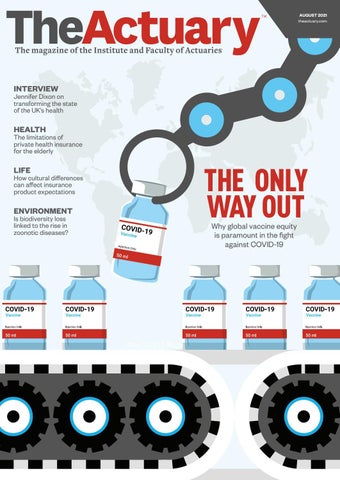
THE ONLY WAY OUT Why global vaccine equity is paramount in the fight against COVID-19
How COVID-19 galvanised vanised i d actuarial mindsets dse sets
1 COVER_The Actuary August 2021_The Actuary.indd 1
23/07/2021 14:57
p02_ACT.Aug21.indd 2
23/07/2021 10:28
Contents August 2021
20 12 Up Front 4 Editorial This summer may be disappointing for many, but this issue of the magazine can still provide some highlights, says Dan Georgescu 5 President and CEO’s comment Louise Pryor and Stephen Mann share some of the new approaches the IFoA is taking post-COVID-19
17 Health: A call to arms Vaccine inequity is hampering the global COVID-19 recovery – and the economy, says Prachi Patkee
36 Environment: Sustainability begins at home Rosalind Rossouw explains the work of the Sustainability Volunteer Group
20 Health: Encouraging openness Chris Knight and Lisa Balboa explain why actuaries need a greater understanding of mental health
38 Environment: The human error The biodiversity crisis is precipitating the rise of zoonotic diseases such as COVID-19, warn Georgina Bedenham, Amy Shields and Andrew Kirk
22 Health: Access all ages How well is private health insurance serving the elderly? Hamza Hanbali looks at the benefits and drawbacks of systems in Belgium and Australia 24 IFRS 17: Defining the discount rate Richard Olswang, John Jenkins, Tom Bulpitt and Darren Clay on the difficulties in interpreting IFRS 17 discount rate requirements
6 IFoA news The latest IFoA news and events
28 Life: Mapping out mortality Andrew Cairns, Torsten Kleinow and Jie Wen introduce the Longevity Index for England
Features
31 Life: One size fails all Insurers must bear cultural differences in mind when moving into new markets, say Georgia Knowles and Richard Zhou
12 Interview: Work to be done Jennifer Dixon discusses the state of the UK’s health and mortality, and how it can be improved
34 Environment: Waking up to the problem The insurance industry must step up to play its full role in combating the climate crisis, urges Rowan Douglas
COVER: SHUTTERSTOCK
Get the app Did you know you can now read The Actuary magazine on any tablet or A Android phone? Click through to read more online, download resources, or sshare on social media via our links in the app. It’s an exclusive free benefit for o our members. Download on the App Store at: www.theactuary.com/ipad V Visit: www.play.google.com
www.theactuary.com
3 contents_The Actuary August 2021_The Actuary.indd 3
40 Environment: Up to scratch Iancu Daramus examines how different sectors are acting when it comes to tackling climate change
At The Back 43 People/society news The latest news, updates and events 44 Student Vrishti Goel considers potential measures for discouraging smoking 45 Puzzles 46 Inside story Sandy Trust on volunteering for the Sustainability Board
Additional content including daily news can be found at www.theactuary.com Weekly newsletter: for all the latest actuarial news, features and opinion direct to your inbox, sign up at bit.ly/1MN3bXK AUGUST 2021 | THE ACTUARY | 3
23/07/2021 16:53
theactuary.com
PUBLISHER Redactive Publishing Ltd Level 5, 78 Chamber Street, London, E1 8BL +44 (0)20 7880 6200 PUBLISHING DIRECTOR Anthony Moran MANAGING EDITOR Sharon Maguire +44 (0)20 7880 6246 sharon.maguire@redactive.co.uk SUB-EDITOR Kate Bennett NEWS REPORTER Christopher Seekings +44 (0)20 7324 2743 christopher.seekings @redactive.co.uk D I S P L AY S A L E S theactuary-sales@redactive.co.uk +44 (0)20 7324 2753 RECRUITMENT SALES theactuaryjobs@redactive.co.uk +44 (0)20 7880 6234 ART EDITOR Sarah Auld PICTURE EDITOR Akin Falope SENIOR PRODUCTION EXECUTIVE Rachel Young +44 (0)20 7880 6209 rachel.young@redactive.co.uk PRINT Walstead Bicester
EDITOR Dan Georgescu editor@theactuary.com F E AT U R E S E D I T O R S Stephen Hyams: Pensions and investments Rajeshwarie VS: General insurance Thanuja Krishnaratna: Life Travis Elsum: Environment and sustainability Ruolin Wang: Sustainability, reinsurance and data science Blessing Mbukude: Life Yiannis Parizas: General insurance and data science Fiona Neylon: General insurance PEOPLE/SOCIETY NEWS EDITOR social@theactuary.com Sharon Maguire sharon.maguire@redactive.co.uk STUDENT MANAGING EDITOR Adeetya Tantia student@theactuary.com IFOA EDITOR Kate Pearce +44 (0)207 632 2118 kate.pearce@actuaries.org.uk EDITORIAL ADVISORY PANEL Peter Tompkins (chairman), Chika Aghadiuno, Nico Aspinall, Naomi Burger, Matthew Edwards, Jessica Elkin, Martin Lunnon, Richard Purcell, Sonal Shah, Nick Silver INTERNET The Actuary: www.theactuary.com Institute and Faculty of Actuaries: www.actuaries.org.uk
Recycle your magazine’s plastic wrap – check your local LDPE facilities to find out how.
SUBSCRIPTIONS Subscriptions from outside the actuarial profession: UK: £100 per annum. Europe: £130 per annum, rest of the world: £160 per annum. Contact: The Institute and Faculty of Actuaries, 7th floor, Holborn Gate, 326-330 High Holborn, London WC1V 7PP. T +44 (0)20 7632 2100 E kate.pearce@actuaries.org.uk. Changes of address: please notify the membership department. E membership@actuaries.org.uk Delivery queries: contact Rachel Young E rachel.young@redactive.co.uk Published by the Institute and Faculty of Actuaries (IFoA) The editor and the IFoA are not responsible for the opinions put forward in The Actuary. No part of this publication may be reproduced, stored or transmitted in any form, or by any means, without prior written permission of the copyright owners. While every effort is made to ensure the accuracy of the content, the publisher and its contributors accept no responsibility for any material contained herein. © Institute and Faculty of Actuaries, August 2021 All rights reserved ISSN 0960-457X
4 | THE ACTUARY | AUGUST 2021
4 editorial_The Actuary August 2021_The Actuary.indd 4
In for the summer Welcome to the August edition of The Actuary. During the summer months, previous editors probably imagined readers enjoying their print copy poolside, with a glass of something refreshing involving coconut and an umbrella. This is unlikely to be true in the majority of cases while part of the world is still in lockdown and travel restrictions are the norm. More likely, you are indoors when the issue arrives. Whether you are having a staycation or local break, I hope you find the magazine interesting and relevant, and it brightens up your day. Let me tempt you with some highlights from this issue. This month’s interview is with Jennifer Dixon, chief executive of the Health Foundation, a charity committed to improving health and care for people in the UK. She talks to us about her concerns for the future in the public health space, highlighting a growing health and life expectancy inequality (p12). On a related topic, Andrew Cairns, Torsten Kleinow and Jie Wen have been working on developing the next generation of mortality models for practitioners; they tell us about the new Longevity Index for England (p28). You can also visit the IFoA’s YouTube channel to view a webinar of Andrew and Torsten demonstrating the index and its associated app. In our cover article, Prachi Patkee writes about the existing global imbalance in COVID-19 vaccine purchases, and argues that to mitigate the global economic impact, high-income countries should do more to support vaccinations in emerging nations (p17). Finally, representatives from the IFoA Biodiversity Working Party present their findings from recent research on the link between biodiversity loss and zoonotic diseases, and how this should be taken into consideration in actuarial work (p38). I hope you enjoy the issue and wish you a safe summer. DAN GEORGESCU EDITOR editor@theactuary.com
www.theactuary.com
23/07/2021 17:17
LOUISE PRYOR
STEPHEN MANN
New world, new thinking
W
ith the turn of the IFoA’s sessional year – and a new president and Council installed – comes the opportunity to take a fresh look at our future. Much has changed since the onset of COVID-19, but one thing is certain: we won’t see the pre-2019 world again, and the only way is forward. This issue of The Actuary explores some of those forward-looking topics – including sustainability, which is very near to our hearts (and the future of the profession), and one that you will continue to hear much more about in the months ahead. Here, though, we wanted to focus our message to you on a different topic: our membership. You, our members, are at the centre of everything the IFoA plans, offers and achieves. LOUISE PRYOR We hope you’ve had an is the president of the Institute and opportunity to see the ‘New Faculty of Actuaries world, new thinking’ campaign that launched at the end of July. We know the world has changed, STEPHEN MANN and the single most important is the chief executive aim of the IFoA is to support of the Institute and you with the challenges you face Faculty of today and in the future. Actuaries www.theactuary.com
5 CEO PREZ_The Actuary August 2021_The Actuary.indd 5
There has been early evidence of this: moving examinations online so those of you studying with us could keep your qualifications on track amid the pandemic; more than doubling the number of events and webinars to keep you up to speed with the latest thinking; and rethinking the continuing professional development scheme to ensure it’s squarely focused on your learning needs. And, from 1 September 2021, as continued evidence of this commitment, all IFoA online events will be free to access for all our members. We hope you enjoy them. We aren’t stopping here. There is much more on our journey to rethink, reset and ensure that member needs are our priority as the IFoA moves ahead. Over the coming year, you’ll hear – and feel – much more about the key elements of our promise to members: career benefits, a vibrant community, a premium qualification, good value, a shared investment in the public interest, and being easy to do business with. We always welcome your views on what you have found – or would find – valuable in your IFoA membership; you can tell us more at newworld@actuaries.org.uk We are listening. Your needs are driving our evolution. And the improvements we are making to your overall membership experience demonstrate our commitment to helping us all rise to the challenges of this new world. AUGUST 2021 AUTUMN 2017 | THE ACTUARY | 5
23/07/2021 17:03
Upfront News FUNDRAISING
IN BRIEF...
The IFoA Foundation Mahidhara Appeal
Thematic review on funeral trust advice launched
Last month the IFoA Foundation began planning the launch of a new scholarship fund in memory of dear friend and colleague Mahidhara Davangere, who passed away suddenly in May. While we are deeply saddened by this great loss to our community, we are pleased to launch this initiative, continuing Mahidhara’s legacy as a passionate and philanthropic actuary. The fund will initially support the most promising student actuaries in India, and over time will broaden to other countries in South Asia and help working actuaries to have more sustainable careers. Alongside the new fund, the Foundation is raising funds towards its vision to open every door for the next generation of actuaries and to empower the profession to be transformative in addressing the greatest challenges of our time. At the time of writing, we are extremely grateful to have received gifts from generous supporters amounting to a sum of £23,000. With the IFoA Foundation’s matching commitment, we have reached 56% of our £55,000 target. With £24,000 remaining, we are calling on the actuarial community to help us reach this goal. We would like to thank everyone who has supported the appeal so far, which will allow the Foundation to have even greater impact with projects such as: The Mahidhara South Asia Scholarship over the next three years Educational hardship grants for young actuaries in South Asia who are financially disadvantaged Grants to local partner organisations in India that can deliver grassroots educational programmes that will engage the next generation of actuaries.
IMAGES: VECTEEZY
Iain Allan worked with Mahidhara on the IFoA banking initiative and has generously supported the appeal. “Anyone who worked with Mahidhara would recognise his endless energy, enthusiasm and positivity,” he says. “In addition to all his work for the IFoA, Institute of Actuaries of India, and International Actuarial Association, it is remarkable that Mahidhara found time to work with maths teachers and pupils in rural schools in India. It is therefore a fitting tribute to Mahidhara that the IFoA Foundation should set up a fund to support the most promising students in South Asia who need financial assistance to continue their education. I am pleased to support this initiative.” If you would like to find out more information, contribute to the online book of remembrance or make a donation, please visit bit.ly/36zHrLX. On behalf of all those who will benefit, and in celebration of Mahidhara, a much-loved member of our community, thank you for your support. 6 | THE ACTUARY | AUGUST 2021
6-8 news_The Actuary August 2021_The Actuary.indd 6
100% 90% 80% 70% 60% 50% 40% 30% 20% 10% 0%
The IFoA Review Team has launched the Funeral Trusts thematic review. This will consider the advice given by actuaries to pre-paid funeral plan trusts, looking at their role in valuation and other areas, including pricing. As well as providing insight on the quality of current advice and individual feedback to actuaries, it is hoped that the findings will help actuaries and policymakers as the industry moves to the new regime of Financial Conduct Authority regulation. The review is open to submissions until 10 September 2021. To take part in this exercise, or for more information on planned reviews, please visit bit.ly/IFoA_reviews or contact the review team for more information (reviews@actuaries.org.uk).
Annals of Actuarial Science releases insurance data science special issue From 2021, Annals of Actuarial Science (AAS), the research journal owned by the IFoA and published by Cambridge University Press, has expanded to three issues per year. This increase aims to facilitate the publication of annual special issues that will focus on a key theme. The July 2021 special issue of AAS (bit.ly/3r3LeKQ) looks at insurance data science. This theme grew out of the rapid and transformative developments we are seeing in actuarial and related fields, with increased use of computational statistics, machine learning and artificial intelligence (AI) models in insurance applications. The special issue draws partly from material discussed at the second Insurance Data Science Conference (bit.ly/3kepnis), held in Zurich in 2019, as well as including further papers from authors worldwide. The issue includes a wide-ranging review of AI in actuarial science, as well as papers exploring different facets of neural networks, the modelling of mortality, and computational statistics and machine learning in insurance operations. It also introduces an expansion of scope in AAS coverage by including three contributions to actuarial and statistical open-source software, recognising the crucial role such software plays in research and applying statistical models in practice. AAS is an online-only journal, with full access provided as an IFoA membership benefit via the Actuarial Knowledge Hub (bit.ly/3yRSXhB); please contact libraries@actuaries.org.uk if you would like help or information. www.theactuary.com
23/07/2021 14:59
Upfront News
2021/22 membership fees The past 18 months changed everything. At the IFoA, we recognise that we’re in a position to help you with the challenges wee all face in this new world, so as a part of ourr commitment to you, we’re pleased to let you know that we’re holding membership p fees at 2020 levels for another year. We’ll email you in early September 2021 with the details you need to keep your membership current, but you can actt now by logging in to your online record at www.actuaries.org.uk and checking thatt the preferred email address we hold for you in your online record is correct.
Subscription fees for 2021/2022: Fellow £715 Fellow (dual membership) £360 Associate £485 Associate (dual membership) £241 Certified Actuarial Analyst £250 Student Actuarial Analyst £170 Student £236 Affiliate £100 Reduced subscription (all categories) £73 Practising certificate fees £910 Subscriptions will become due on 1 October 2021 and should be paid by 31 October 2021to avoid any late payment surcharges. For information regarding subscription fees, please visit bit.ly/IFoA_subs
Book now!
The Road to Glasgow: IFoA’s Sustainability Thought Leadership Series In the run-up to COP26 in Glasgow later this autumn, the IFoA will be hosting a series of sustainability-themed events as part of its 2021 Thought Leadership Programme. Running in September and October, the series seeks to convene leading experts, thinkers and decision-makers with our global membership to debate the key sustainability issues of our time ahead of COP26.
Speakers include: Catherine Howarth - Chief Executive, ShareAction Professor Rebecca Willis - University of Lancaster Steve Waygood - Chief Responsible Investment Officer, Aviva Investors Professor Saleemul Huq - Director, International Centre for Climate Change and Development
Dr Dabo Guan - Professor in Climate Change Economics and the Low Carbon Transition, University College London Dr Emily Shuckburgh - Director of Cambridge Zero at the University of Cambridge Jane Davidson - Pro Vice-Chancellor Emeritus at the University of Wales Trinity Saint David and author of #futuregen
Find out more at actuaries.org.uk/sustainabilityseries
www.theactuary.com
6-8 news_The Actuary August 2021_The Actuary.indd 7
AUGUST 2021 | THE ACTUARY | 7
23/07/2021 14:59
Upfront News C O U N C I L U P D AT E
Council looks ahead to next year Council’s fourth meeting of the sessional year took place by videoconference on Thursday 17 June. This meeting was a chance for us to look back at the past year and forward to the next. We began the meeting with tributes to Council member Mahidhara Davangere, who passed away in May. Mahidhara was a selfless volunteer and an engaging colleague with an irrepressible passion for modernising the profession. He will be deeply missed. Following our discussion on the Member Propositions at our March meeting, we received an update on the further work that had been undertaken to begin delivering better value for our members. As part of this conversation, we agreed a series of recommendations on the future of the IFoA’s events offering, which aim to maximise both accessibility and value for money for our members (see more about this on facing page). On a related theme, Council agreed that there would be no increase in subscription fees for members for the coming subscription year (see page 7). We also received an update from the IFoA’s Regulatory Steering Group on its important work in producing the IFoA’s response to the recent government white paper on reform of audit and corporate governance. Council recognises that the outcome of the government’s proposals are of critical importance to the actuarial profession, and we have provided a steer on the final wording of the IFoA’s response. We will keep members updated on developments in this area. In line with Council’s oversight and governance responsibilities, we received updates from the IFoA’s chief executive and the chair of
the Management Board on recent activity. We agreed a small number of changes to the composition of the Management Board, which are intended to ensure the good flow of information between Council, the Board, and the Board’s two newly established committees, which will be key to the successful implementation of our updated strategy. We also discussed the in-progress work towards developing the IFoA’s new risk framework, which will help us deliver the key objectives in the strategy. Additionally, as part of our governance responsibilities, Council undertook its annual review of its performance for the year and received a report from the Management Board on the outcome of its annual review. We discussed the ways that Council could continue to improve its efficiency and effectiveness in the coming year, taking what we have learned from the past year as a fully ‘virtual’ body and considering how we (and the IFoA as a whole) can retain the best aspects of that model once COVID-19 restrictions begin to lift. Finally, we said thank you to those members of Council who were to step down at the Annual General Meeting: Laura Andrikopoulos, Kelvin Chamunorwa, Charles Cowling, Marian Elliott, Richard Galbraith, Keith Jennings, John Taylor and James Tufts. Their contributions to and hard work on Council are greatly appreciated. Council’s next meeting will take place on 15 September 2021. The minutes of our meetings are available at bit.ly/IFoA_ Council and you can contact us at presidents@actuaries.org.uk
I F O A F O U N D AT I O N
Seeking nominations for research paper prizes Each year, the IFoA seeks to recognise excellence in actuarial research by awarding prizes for exceptional research papers. We are currently seeking nominations for two prizes that are funded by the IFoA Foundation: The Peter Clark Prize (best paper written by members of the profession intended for an actuarial audience) The Geoffrey Heywood Prize (paper demonstrating excellent levels of communication and engagement with a general actuarial audience)
8 | THE ACTUARY | AUGUST 2021
6-8 news_The Actuary August 2021_The Actuary.indd 8
Last year’s winning papers (bit.ly/IFoA_PrizePapers) ers) looked at sensitivity testing ting off simulation models, and AI ‘dee ‘deep ep learning’ for mortality modellin modelling ng and forecasting. There is no requirement ent for the authors, or thosee nominating, to be IFoA members, and the prizess are open to the actuarial communimmunity around the world. Papers pers must have been first presented esented d no earlier than 31 May 2020, 020, orr first published in final form rm with a publication date in 2020. 20. The closing date for nomination tion is 22 August 2021.
For full details and eligibility criteria and to nominate online an outstanding nomi no mina nate te (via (vi via a th the e on onli l ne fform) orm) or m) a n ou outs tsta tand ndin ing g paper visit pape pa perr yo you u think thin th ink k deserves dese de serv rves es recognition, rec ecog ogni niti tion on,, vi visi sitt th the e Best Best Paper Pap aper er Prizes Pri rize zess page page at at bit.ly/3 bit.ly/3elrHQM / elrHQM
www.theactuary.com
23/07/2021 15:00
New world, new thinking Eighteen months ago the pandemic transformed all our lives overnight. To respond to this new world, we knew we had to change. We needed to rethink and reset. Your IFoA membership has evolved to meet the challenges of this new world by: đƫ Moving exams online so those of you studying with us could keep your qualification on track đƫ More than doubling the number of events and webinars to help you keep up to date with the latest thinking đƫ Rethinking our CPD scheme around your needs to make it less about a process and more about what you want to learn. Now we’re making a further change that shows our commitment to investing in you.
All online events free to access for IFoA members The next step is to better support your actuarial learning journey by making all online events free to access for IFoA members from 1 September 2021. This is designed to support you and respond to your needs. And it’s just the beginning of our transformation to help you meet the challenges of this new world. Find out more and tell us about your priorities at:
www.actuaries.org.uk/new-world-new-thinking
9 IFOA AD_01-Aug-2021_The Actuary.indd 9
23/07/2021 15:00
Upfront News
A starting point
for change Patrina Effer shares the development of a new IFoA course on sustainability and climate risk In October 2020, Louise Pryor (then IFoA president-elect) and a team of volunteers from the Sustainability Group came together for initial discussions about a course to support members’ lifelong learning in the area of sustainability and climate risk. From this initial group, a small team was formed. Our volunteers had varying levels of experience, but all wanted to learn more – not just from the research they would be doing, but also from each other. Since October, the team has been developing the first five modules of the course. These have been piloted by a further group of actuaries, and we are now evaluating their feedback. This is a course designed by members, for members. Our volunteers’ objective was that members who complete the course would understand: The main concepts of climate risk and sustainability that are relevant to actuaries How those concepts are relevant and what impact they might have on actuaries’ work How to apply these concepts in their work. The course is both an enabler to stimulate interest and a potential platform for further study. Successful completion of the course will not make an actuary a climate risk or sustainability expert; however, it will help them understand some of the issues that will impact actuarial work.
“The course is a great opportunity to expand your knowledge of the physical and transitional aspects of climate risk and their effects on both the economy and global social inequality”
Image: Shutterstock
Why contribute? The members contributing to this work come from diverse backgrounds, representative of the IFoA’s global membership; we asked them why they volunteered. Martin Hyland, one of our pilot volunteers, commented: “I think everyone needs to take action, at least in some small part, in order to tackle the environmental challenges we all face. I felt that this would be a good place to start. More generally, it is a chance to network, to gain new skills and enhance others, and to learn more on topics I am interested in.” When developing and piloting the materials, what did the volunteers hope their fellow members would get out of sitting the course? Matthew Cann, who leads the Development Team, said: “This is a broad subject that touches on all aspects of actuarial work. For those who won’t have sat exams recently or who haven’t had the opportunity to work in this field yet, this course will give them a 10 | THE ACTUARY | AUGUST 2021
10-11 IFOA NEWS_The Actuary August 2021_The Actuary.indd 10
solid grounding and hopefully encourage further development opportunities and the chance to put what they learn into practice.” He went on to add that he also hoped it would provide members with “a better understanding of the issues, the effects if we fail to take action now, and the benefits that could be achieved if we do act today. I hope members will find it an engaging and informative course that will help them take a particular mindset into their daily lives, both in and out of work.”
Pilot feedback Umeeta Luhano, one of our pilot reviewers, thought the course would be a great starting point for learning about basic concepts, as well as the impact of current regulation and financial disclosures regarding climate change. It also offered the opportunity to get involved in thought-provoking discussions about future solutions. www.theactuary.com
23/07/2021 15:01
INSIDE Work to be done Jennifer Dixon on the pandemic’s impact on UK health, and the lessons we must learn
A call to arms Vaccine inequity is hampering the global COVID-19 recovery – and the economy, says Prachi Patkee
Encouraging openess Chris Knight and Lisa Balboa on why actuaries need a greater understanding of mental health
Access all ages How well is private health insurance serving the elderly? Hamza Hanbali investigates
Defining the discount rate Perhaps an obvious question – why was the subject so important to them? Another pilot volunteer, Victoria Cornwall, said: “As the world changes, the actuarial profession and financial sector need to adapt – keeping pace with change or ideally using the sector’s significant influence to lead the charge.” “Now more than ever is the time to take real concrete action,” added Martin Hyland. “We need those actions to be in line with what the science is telling us, and those actions need to happen today. Finance needs to drive the change in how business models operate and what their focus is on, and must realise the opportunities available, not just the risks. Actuaries are uniquely placed, as risk management professionals, to provide real value and impact as we move our economies and societies to a more sustainable future.” The last word goes to pilot participant Eleanor Walker: “The course is a great opportunity to expand your knowledge of the physical and transitional aspects of climate risk and their effects on both the economy and global social inequality. If you are overwhelmed by the quantity of available information surrounding the topic, then the IFoA’s new course is a perfect place to start.” The course is still under development; it is hoped that the first course for members will be later in the year. To register your interest for the PATRINA EFFER sustainability course and view our is the senior lifelong currently available resources on this learning executive subject, please visit bit.ly/3xQjhbY at the IFoA www.theactuary.com
10-11 IFOA NEWS_The Actuary August 2021_The Actuary.indd 11
What are the challenges when determing the IFRS 17 discount rate? Richard Olswang, John Jenkins, Tom Bulpitt and Darren Clay report
Mapping out mortality Andrew Cairns, Torsten Kleinow and Jie Wen introduce the Longevity Index for England
One size fails all Cultural differences must be acknowledged in new markets, say Georgia Knowles and Richard Zhou
Waking up to the problem Insurers must step up to play a full role to combat the climate crisis, urges Rowan Douglas
Sustainability begins at home Rosalind Rossouw explains the work of the Sustainability Volunteer Group
The human error The biodiversity crisis gives rise to zoonotic diseases such as COVID-19, says Georgina Bedenham, Amy Shields and Andrew Kirk
Up to scratch Iancu Daramus examines how different sectors are acting in terms of tackling climate change AUGUST 2021 | THE ACTUARY | 11
23/07/2021 15:01
Features Interview
12 | THE ACTUARY | AUGUST 2021
12-15 interview_The Actuary August 2021_The Actuary.indd 12
www.theactuary.com
23/07/2021 15:01
Features Interview
Jennifer Dixon speaks to Stephen Hyams about the impact of the COVID-19 pandemic on the UK’s health, the lessons we must learn, and how data and technology could help relieve pressure on the NHS
ennifer Dixon CBE, chief executive of the Health Foundation, is committed to improving the health of people in the UK. Asked about our relatively high COVID-19 death rate, she points to a longer-term trend: “We had a weaker, less-resilient health stock. Michael Marmot’s 2020 review blamed austerity, which pulled the rug out from under social protection. Others, such as Angus Deaton and Anne Case, point to 40-year structural economic changes that have crushed some communities, such as the decline of big industry.” The gaps between rich and poor in terms of both life expectancy and healthy life expectancy have grown, and the pandemic has exacerbated these health inequalities by disproportionately impacting those in weaker health. While a slowdown in mortality improvement rates over the period 2011-20 was experienced by all countries in the Organisation for Economic Co-operation and Development (OECD), “recent analysis shows that those countries with a lower slowdown fared relatively well in terms of COVID-19 deaths,” says Dixon. In that context, it is no surprise that the UK had one of the most pronounced slowdowns in mortality improvements during that period. “You need an underlying theory of what causes health to deteriorate over time,” Dixon explains. “The wider determinants of health, such as the environment and education, are far more important than healthcare, for example.” We need to tackle these root causes if we are to make real improvements in the nation’s health. “This can help address specific risk factors, such as obesity, alcohol, smoking and drugs, which are socially patterned.”
Long COVID What is the impact of long COVID? “Our understanding is still emerging,” she says. “It is characterised by symptoms extending beyond four weeks after initial infection, and can last for more than eight months. It has affected over one million people, or 20% of those who tested positive for COVID-19, and two-thirds of them say it restricts their daily lives.
WORK TO BE
www.theactuary.com
12-15 interview_The Actuary August 2021_The Actuary.indd 13
DONE AUGUST 2021 | THE ACTUARY | 13
23/07/2021 15:01
Features Interview
“The condition has two broad sources. COVID-19 is a vascular disease, as well as respiratory, and can cause micro-blood clots, leading to lasting targeted organ damage, or fluctuating multisystem symptoms relating to different organ types. Secondly, the body’s immune system can fail to switch off, resulting in general malaise and fatigue, and post-viral symptoms, which can affect children.” Long COVID-19 tends to affect women more than men, the middle-aged more than older people, those who have been hospitalised or with pre-existing medical conditions, and groups with higher exposure to COVID-19. “It can affect people who initially have only mild symptoms. As with long Ebola, we don’t know whether the virus hides somewhere latent before re-emerging. It’s going to affect the working-age population for sure, and for those exposed through work there is a push for it to be recognised as an occupational disease.”
Young people Mental health issues in younger people are a longstanding concern, but have been made worse by the pandemic. “We know what is associated with poor mental health: stress from early life experiences, precarious and low-quality work, poor education, low expectations – all impacting the resilience to cope with life,” says Dixon. “It is hugely important, as young people are our future asset. We need there to be access to college places and apprenticeships, housing and transport subsidies, and greater protection for those on low pay. They also need access to mental health services.” Another big area is education and catch-up. “Before the pandemic, there were increasing levels of depression and anxiety, particularly in girls around 16-18 and partly attributable to social media,” Dixon explains. “Home learning during the pandemic has been helpful to some, but for many it has caused additional stress due to challenging family circumstances.”
Investing in the future What lessons can we learn from the pandemic? “The need to improve the health fabric of the nation and our underlying resilience to an emergency,” says Dixon. “The other factor is the resilience of the health and social care system. We know about chronic underfunding in hospital beds, doctors, nurses and equipment when compared with the rest of the OECD.” With fiscal activism in vogue, there is no shortage of money available to spend, but Dixon is concerned about cognitive bias in current UK government decision-making. “The money available as part of the levelling up agenda is largely focused on infrastructure projects such as bridges and trains, which are easier to visualise. We have a blind spot for talking about spending on human capital, such as health and education, and social capital, which includes the cohesion and vibrancy of communities.”
Planning and decision-making “We do a respectable amount of horizon scanning and planning in the UK for emergencies,” says Dixon. “However, it doesn’t translate into serious decision-making, which I think is because the government of the day is preoccupied with the short-term.” 14 | THE ACTUARY | AUGUST 2021
12-15 interview_The Actuary August 2021_The Actuary.indd 14
Our focus on planning for a flu pandemic was another problem. “The fear factor was not high enough. Some Asian countries were on high alert; they’d seen coronavirus before.” This reflects a lack of political leadership in identifying the key issues and channelling resources appropriately, she believes. Dixon suggests the decision-making process during the pandemic could have been better. “Governments have to make very difficult decisions, taking into account a number of factors. The science community did well and worked closely with the prime minister, but you also need something like a chief economic and chief social officer, akin to the chief medical officer, to provide key information.” Cognitive bias in positions of leadership is another concern. “Even with better information, one person’s perspective is just not enough. How do you ensure that the key decision-makers take account of all the key information in order to make rounded decisions with full transparency, and that the prime minister, for example, receives adequate challenge?”
Data and technology Technology has played a key role during the pandemic. “There’s been a large increase in the use of existing technology in healthcare, in www.theactuary.com
16/08/2021 13:41
Features Interview
“Recent analysis shows that those countries with a lower slowdown in mortality improvement rates fared relatively well in terms of COVID-19 deaths” do.” Ensuring the security and confidentiality of personal data is, of course, key. One concern is bias in the way data is collected, with underrepresentation of some ethnic groups undermining its reliability and usefulness. Recording ethnicity when collecting data can help identify such problems.
IMAGES: ISTOCK
ONS Health Index
particular for virtual consultations and using social media to reach consensus decisions about emergency treatment. There’s also been an enormous shift to online and digital forms of care, which weren’t there before.” Last October the Health Foundation conducted a survey of 4,000 patients and 1,000 NHS staff, which demonstrated widespread support for the use of technology. “Staff appreciate how it has relieved the pressure on them during the pandemic. Given the speed of take-up, there is still plenty of evaluation needed on safety and effectiveness, though.” Technology is not for everyone: for example, virtual consultations work well for simple, transactional matters, less so for those with multiple, complex conditions. They are also less popular with older people and those from more deprived communities. Dixon would like to see the NHS do more to embrace technology in the future. “It has great potential to enhance productivity, which is crucial with the fiscal pressures on resources.” It is important to evaluate the impact of technology, which is facilitated by the increasing amount of data available. “We should exploit far more the huge volume of NHS personal-level real-time data. There are huge benefits in pooling these large datasets, just like Amazon and Google www.theactuary.com
12-15 interview_The Actuary August 2021_The Actuary.indd 15
The Office for National Statistics has issued an experimental Health Index – “a composite index of health and wellbeing in each local authority area, which is not just a measure of current health but also of how that might develop in the future”, as Dixon explains. It comprises 58 indicators, which are organised into three groups. ‘Healthy people’ covers mortality rates, the prevalence of diseases and illnesses, and the degree of happiness and wellbeing. ‘Healthy lives’ concerns factors such as unemployment, child poverty and the prevalence of smoking, obesity and so on. ‘Healthy places’ addresses the wider determinants of health, such as green spaces, housing, access to healthcare and crime levels. “It could be used by central government to compare the performance of local authorities across the country, for example as part of the levelling-up agenda,” says Dixon. “It could also be used by local authorities to compare themselves with the rest of the country and identify issues that need tackling.”
The future Looking ahead, Dixon is optimistic about the wealth of talent in the health and public arena. “I think there’s a positive culture of transparency for debate, and a balance towards people wanting to close the health gap between rich and poor across the country.” She is also positive about the potential for data to improve healthcare, and the ongoing role of the NHS in providing equitable access at the point of need. She is concerned about the government’s apparent bias against acting on the wider determinants of health and its failure to tackle social care, which would help older people to remain independent and thrive for longer. “I also worry about a possible fiscal squeeze in the next couple of years, which could impact the NHS.” The main issue at present is recovery from the pandemic. Dixon sees two positive signs: “The public consciousness has been aroused to improve the health of the nation, especially closing the gap between the rich and poor. There is also optimism that the state can be used for the public good, in a way we haven’t seen for a long time.” AUGUST 2021 | THE ACTUARY | 15
23/07/2021 15:02
Upfront Books The magazine of the Institute and Faculty of Actuaries
The Reading Room
FEATURES LIST 2021
RECENTLY PUBLISHED
PLEASE NOTE THE THEMES FOR EACH ISSUE ARE NOT EXCLUSIVE.
The New Climate War: The Fight to Take Back Our Planet Michael E Mann Renowned climate scientist Michael E Mann shows how fossil fuel companies have waged a 30-year campaign to deflect blame and responsibility for climate change, and delay action.
The schedule is subject to occasional revisions. For further details, please email the features team prior to contributor deadlines at: features@theactuary.com
ISSUE DEADLINES
■ Regulation/ Sept Published: 02 Sept 2021 2021 Contributor deadline: 12 July 2021 Solvency II/
Unsettled: What Climate Science Tells Us, What It Doesn’t, and Why It Matters Steven Koonin
Ad booking deadline: 12 Aug 2021
IFRS 17
■ Investment ■ Modelling
One of America’s most distinguished scientists explains what the science really says (and doesn’t say) about our changing climate. Koonin draws upon his experience as an adviser to the Obama administration to provide up-to-date expert insight that is free from political agendas.
Oct Published: 07 Oct 2021 2021 Contributor deadline: 09 Aug
■ General
Nov Published: 04 Nov 2021 2021 Contributor deadline: 13 Sept 2021
■ Life insurance ■ Pensions ■ Finance/
insurance/ 2021 Reinsurance Ad booking deadline: 17 Sept 2021 ■ Risk management ■ Health and care
Ad booking deadline: 19 Oct 2021
COMING SOON
Investment
In Silico Dreams: How Artificial Intelligence and Biotechnology Will Create the Medicines of the Future Brian S Hilbush (Oct 2021)
Dec Published: 02 Dec 2021 2021 Contributor deadline: 11 Oct 2021
■ Modelling ■ Risk manage-
Ad booking deadline: 12 Nov 2021 ment ■ Insurance/ Reinsurance
Genomics expert Hilbush explores the work of the tech giants and biotechnology start-ups that are disrupting healthcare. The book provides an understanding of the innovations driving the pharmaceutical industry’s shift toward engineered medicines and curative therapies.
CONTACT DETAILS: For further information and advice contact: features@theactuary.com
Pandemic Surveillance
WRITING FOR THE ACTUARY See terms and conditions at theactuary.com/contribute
David Lyon (Nov 2021) Pandemic surveillance allows governments and corporations to monitor the spread of COVID-19, and make sure citizens follow the measures they put in place, via massive mobilisation of public health data and surveillance technologies. Lyon examines the different forms of pandemic surveillance from countries around the world, exploring their benefits, disadvantages and legality, and how they relate to privacy protection, data justice and the ethics of care.
SUBJECT
OCTOBER 2019 theactuary.com
The magazine of the Institute and Faculty of Actuaries
DECEMBER 2019 theactuary.com
NOVEMBER 2019 theactuary.com
The magazine of the Institute and Faculty of Actuaries
Interview Deborah Ashby On her leadership roles in public health and statistics
The magazine of the Institute and Faculty of Actuaries
Centenary
100 years of the Government Actuary’s Department
Interview Charles Counsell The man behind automatic enrolment
Risk
Technology Fighting insurance fraud in the digital age
Weathering the adverse affects of climate change
Risk
Pensions
New climate risk reporting guidelines
Are cash equivalent transfer values set at the right level?
Reinsurance How to improve customised solutions
eopllee peop elp p help an h can humb ca ningg annin off tthum plan ules o on pla siiion ow rrule How H their pens ement h thei nt with ge with engaage for retir to prepare
Antibiotic resistance: a ticking time bomb? Sh Should houlld we b bee using new mapping technology technollogy gy to assess environmental risks?
01 cover_The Actuary Oct 2019_The Actuary 1
30/09/2019 10:24
01 cover_The Actuary Nov 2019_The Actuary 1
25/10/2019 17:08
Interview
Pensions
Modelling
Risk
Ray Hammond on the future of money, work and healthcare
How do we divide pension pots fairly during divorce?
Assessing eligibility for the variable fee approach
Scenarios that help firms get to grips with climate change
1 cover_The Actuary Dec 2019_The Actuary 1
22/11/2019 15:51
www.theactuary.com
16 books and tings_The Actuary August 2021_The Actuary.indd 16
23/07/2021 15:03
Features Health
A CALL TO ARMS Supporting the vaccination of emerging nations is an opportunity not only to aid humanitarian efforts, but also to mitigate COVID-19’s global economic impact, says Prachi Patkee
C
OVID-19 continues to have a devastating effect on millions of people. The approval of vaccines brought renewed hope for a return to normality in 2021, but with demand far outstripping supply, the gap between rich and poor countries has widened even further. In addition to the humanitarian case for investing in vaccination of emerging nations, there is a strong economic incentive to support a collective pandemic recovery. A study produced by the US National Bureau of Economic Research concluded that full post-pandemic economic recovery would depend on securing equal access to vaccines in all countries. Without this, the uncontrolled infection rates in emerging markets have the potential to destabilise the vaccination efforts of developed regions.
IMAGES: SHUTTERSTOCK
India’s second wave In April 2021, battling a second wave, India consistently reported rising infection numbers and mortality on an unparalleled scale, with record highs of more than 400,000 cases and 4,000 daily deaths. As the official death count passed www.theactuary.com
17-19 COVID 19_The Actuary August 2021_The Actuary.indd 17
300,000, there were concerns – based on findings from crematoria – that the figures were being obfuscated and that the true death toll could be up to eight times higher than officially recorded. Worryingly, the second wave appears to be claiming more lives among healthier and younger cohorts (those aged 20-40) when compared to the first wave last year, which mainly claimed the lives of the elderly and the clinically vulnerable. It is so far unclear whether this is due to the variant affecting younger ages to a greater degree, or simply a function of the much higher toll that this wave is taking. The longer the SARS-CoV-2 virus remains in global communities, the more opportunity there is for it to evolve. While the emergence of a variant is expected in the lifecycle of a virus, the worrying features are the mutations they carry. The Delta (B.1.617.2) variant is likely responsible for the recent unprecedented
explosion of cases in India. Public Health England (PHE) identified this novel variant in samples taken in February 2021. It carries two mutations of immunological significance (E484Q and L452R). They alter spike proteins, the feature that allows the virus to bind with human ACE2 receptors and infect a host cell. Both mutations have been observed independently in other SARSCoV-2 variants, but were identified together for the first time in India. These mutations appear to heighten transmissibility and, from PHE data, reduce the effectiveness of several key vaccines in use around the world, creating additional challenges for the vaccinated population.
Vaccinating the masses The mammoth task of vaccinating the Indian population relies on supply of the Oxford/AstraZeneca and the Bharat Biotech vaccines. As demand exceeds production capacities, the world’s largest manufacturer of vaccines, the Serum Institute of India, is balancing overwhelming domestic demand with its contracted international orders. In March 2021, India was forced to suspend AUGUST 2021 | THE ACTUARY | 17
23/07/2021 16:54
Features Health
Vaccine inequities The rush to vaccinate the populations of more developed countries contrasts starkly with the numbers reported in poorer nations. Compared to Europe and North
18 | THE ACTUARY | AUGUST 2021
17-19 COVID 19_The Actuary August 2021_The Actuary.indd 18
FIGURE 1: Vaccine doses per capita procured by certain countries and territories
12 10
Doses per capita
exports of the Oxford/AstraZeneca vaccine as the government attempted to take stock of the national crisis. Recent government reports indicate that India has shipped 60m doses so far and is responsible for the supply of vaccines to 74 countries. There are many hurdles on the path to equitable vaccine distribution, including global supply chain fragility, raw materials shortages, complex vaccine storage requirements, convoluted distribution networks and trade restrictions. Currently, the world produces 5bn doses across all vaccines annually; the challenging circumstances of the past year and a half have meant that production had to be ramped up to deliver 9.5bn doses. As a key player in global vaccine production, much rests on India’s ability to contain COVID-19 spread, lest it impact international supply. Redirecting resources to this degree to increase manufacturing capacity, and the continued strain on Indian production chains due to the pandemic, threatens the production of other key medications. This has resulted in a parallel, ‘silent’ medical crisis: production of routinely prescribed vaccines for diseases such as measles and pneumonia, along with critical therapeutic cancer drugs such as monoclonal antibodies, have been delayed.
10.4
8
8.2 7.1
6 4.6
4
4 033 4.03 2.9 2
2.3 1.5
0
Canada
US
UK
EU
Japan
India
Brazil
Source: Duke University (bit.ly/3iqYTrv). Correct at the time of going to press.
America, which (at the time of writing) have so far administered at least one dose to 22% and 44% of their populations respectively, just 1% of people in Africa and 4.4% in Asia have received a dose of their vaccine. The world’s richest countries have been accused of ‘vaccine hoarding’ by securing and reserving vast volumes of vaccines that are several times larger than their populations. A vaccine supply shortage is perhaps the biggest stumbling block in the vaccination pipeline. Cost is another issue: due to global demand for the Oxford/AstraZeneca and Pfizer/ BioNTech vaccines, and the purchasing power of wealthier nations, poorer governments have been increasingly reliant on COVAX (a UN-backed global vaccine
procurement scheme for equitable distribution), sourcing vaccines from manufacturers that are not favoured by richer countries, relying on donated vaccines and financing, or indeed developing their own formulations. In April 2021, the World Bank announced it had approved US$2bn financing for the purchase and distribution of 19 vaccines for 17 countries, as part of the US$12bn ringfenced over 24 months to help developing regions. Collectively, COVAX and various countries have donated 73.4m doses to the developing world, with COVAX aiming to ship an additional 238m doses by mid-2021. These figures only account for a single jab for 1% of the world’s population, rising to 3% after the additional shipments.
www.theactuary.com
23/07/2021 15:04
Features Health
Why should the rest of the world be interested? Globalisation, interconnected economies and extensive trading networks mean that an economic or public health shock in one country can ripple across others. This could be through supply chain disruption, or the spread of a new variant leading to delays in the reopening of another country’s economy. A report commissioned by the International Chamber of Commerce’s Research Foundation projected a loss of US$9.2trn in the global economy if governments fail to secure COVID-19 vaccines for developing economies by the end of 2021. Gavi, the vaccine alliance responsible for helping to co-ordinate the COVAX scheme, warns that stagnant vaccine rollouts across the developing world could result in advanced economies bearing US$4.5trn in additional economic loses. If developing countries were able to vaccinate half of their populations by
“The global economy could lose US$9.2trn if governments fail to secure COVID-19 vaccines for developing economies by the end of 2021”
www.theactuary.com
17-19 COVID 19_The Actuary August 2021_The Actuary.indd 19
the end of 2021, total losses could be minimised to US$4.4trn, with GDP losses in advanced economies more than halved to US$2trn.
Impact on life and health insurance The second wave coursing through India has shown that the pandemic is indiscriminate, affecting the young and the ageing, the wealthier and less well-off, the insured and the uninsured. As some countries start to emerge from the pandemic, secondary COVID-19 impacts will start to reveal a clearer picture of the disease’s long-term health effects, which could lead to a rise in disability insurance claims. Delayed surgical treatments and cancer screening programmes may result in increased critical illness claims; cancer patients are a particular cause of concern among the insured population, who may now present with more aggressive cancers that could lead to excess mortality. There are lessons to be learnt from the experiences of countries that are beginning to ease their restrictions. Earlier this year, the Chilean vaccination drive garnered praise as it inoculated more than a third of its population in record time, racing ahead of the rest of South America and lagging behind only the impressive Israeli rollout. However, this positivity was short-lived as authorities, riding the high of their vaccine numbers, hastily relaxed national restrictions – resulting in a surge of new infectious cases and forcing the government to plunge Chile into another lockdown.
A high number of vaccines have been administered since December 2020 in the UK, and slow easing of social distancing measures commenced in March 2021. However, as parts of the country experienced hot spots of rising infection spurred by the Delta variant, the government paused the ending of lockdown restrictions for a month to enable more people to get vaccinated. As variants continue to emerge, the long-term closing of borders will be an unsustainable measure for protecting a country from future surges. Restricted global mobility, employment losses and a substantial decline in expenditure across multiple sectors of industry have caused a deterioration of economic conditions. A balance must be struck between financially detrimental lockdowns and the continued implementation of targeted public health measures. The primary exit strategy for many countries will continue to be high vaccination rates in conjunction PRACHI PATKEE is with phased a life and health R&D re-opening of analyst at Swiss Re societies. As such, and has a PhD in there is a growing clinical neuroscience from King’s College need to support the London vaccination efforts of the global community, in order to shield our collective selves from looming health and financial crises.
AUGUST 2021 | THE ACTUARY | 19
23/07/2021 15:04
Features Health
The UK actuarial profession needs to do more to understand mental health, say Chris Knight and Lisa Balboa from the IFoA’s Mental Health Working Party
ENCOURAGING URAGING Why was the Mental Health Working Party set up?
Is it important for actuaries to understand mental health? Yes! Actuaries design and price products that impact many people’s lives. To do this well, we need to understand them and their journeys. For example, for many individual products, our underwriting processes – down to the way we ask questions – can seem to penalise people who disclose even mild or long-distant instances of mental health conditions. This is counterproductive, as we should be encouraging, not penalising, openness. As active participants in the design of underwriting and claims processes, actuaries have a key role to play here. Through the work of the Mental Health Working Party, we hope to help actuaries: Better understand how a wide range of mental health conditions could impact customers’ experience and interactions with our products and services Start to build the ‘data infrastructure’ needed to bring mental health into mainstream actuarial work Embed a better understanding of mental health into our work through working party reports, conference presentations and an increased amount of mental health content in educational and continuing professional development material. 20 | THE ACTUARY | AUGUST 2021
20-21 mental health_The Actuary August 2021_The Actuary.indd 20
Isn’t this a specialist issue for life and income protection actuaries? No. Obvious associations with mental health and insurance might be self-harm, suicide or individual protection claims, but mental health has much wider actuarial implications. For example, in group income protection, work-related stress is a key driver of claims. Insurers have adopted strategies to proactively manage claims, including through the provision of cognitive behavioural therapy (CBT). Even for a product such as travel insurance, people with mental health conditions can find it hard to get coverage due to the potential costs of seeking support overseas.
What data does the industry use to understand the risks associated with mental health? We’ve been surprised to find that there’s very little industry data available. The latest public CMI data on income protection claims, including mental health claims, is more than a decade out of date. Actuaries often rely on published medical research and population studies to supplement internal company data, but these medical studies are not conducted specifically with insurance in mind. We’ve also found it challenging to find recent population studies that quantify how developments in treating and managing mental health conditions are likely to improve morbidity and mortality for insured customers. In addition, the Association of British Insurers (ABI) has recently issued the Mental Health and Insurance Standards (bit.ly/ABI_ MentalHealth), which include the requirement for companies to “Ensure that their underwriting approach around mental health conditions is reviewed regularly using up-to-date and/or relevant statistically credible evidence”. As a working party, we are seeking to find ways to improve data availability to support statistically credible, evidence-based decision making.
IMAGE: SHUTTERSTOCK
Society’s understanding of mental health is improving, but the insurance industry is lagging behind. Social media isn’t short of negative views concerning the way our industry treats people with mental health conditions, and a roundtable event held by the IFoA in 2020 highlighted that there are potentially big gaps in the actuarial profession’s understanding and practices around mental health. As a profession, we provide very little education to our members on this subject. The IFoA’s Mental Health Working Party was set up in order to tackle these shortcomings.
www.theactuary.com
23/07/2021 15:04
Features Health What data would help?
on risk would also help keep our pricing processes To allow actuaries to assess the prevalence up to date. and severity of mental health conditions Data could support the design of products and among the insured population, mental processes that encourage customers to disclose people in England experience a common mental health health information should ideally be and proactively manage their mental health. This condition such as depression incorporated into both exposure and claims should be viewed as a positive by the industry at or anxiety in any given week data collected at industry level. the application stage and throughout the lifetime Part of the current problem is that we of the insurance policy. tend to bucket mental health conditions We should, however, remember that data can’t into much broader categories than we capture everything. For example, an individual’s would for physical health. Looking at support network, resilience and personal industry-level claims outcomes by more circumstances can shape risk. The flexibility to working days were lost granular categories, and differentiating by capture biopsychosocial context in the in the UK from mental-health severity, would improve the best estimate underwriting decision remains important. In this related sickness absence in 2018 view of actuarial risk and help benchmark regard, underwriters continue to have a key role to the level of underwriting adjustments play as the interface between data and the customer. Approximately required. In this way, the industry can increase acceptance rates for applicants Can we learn from other countries? disclosing mental health conditions. We expect so, and we’d love to hear from readers Actuaries in senior management positions of The Actuary for ideas! The life and health should bear in mind their responsibilities insurance industry in Australia has been looking under the Equalities Act to anticipate the at mental health issues closely in recent years needs of customers, and the Financial (bit.ly/AI_MentalHealth), and in France there is Conduct Authority’s expectations an approach akin to a ‘statute of limitations’, of public health and social surrounding the fair treatment of whereby some prior mental health conditions care spending in England is vulnerable customers. A consensus on the do not need to be disclosed for underwriting on mental health (based on forward-looking view is highly relevant to purposes. This could be a reasonable approach 2018/19 planned spending) our industry. for well-managed conditions. There were approximately In the meantime, centralising simple data on the number of applicants Where next in your disclosing mental health conditions, and vision for the UK CHRIS KNIGHT the proportions of these accepted on profession and is group chief risk standard terms, can already start to break industry? officer at Legal & down common misconceptions that those Recognition: this is an General and chair of by suicide in the UK in 2018, with well-managed mild-to-moderate important issue, and we the IFoA Mental more than 3 times higher than Health Working mental health conditions are unable to would like to pave the way the number of road deaths Party obtain cover. It might also encourage for increased actuarial insurers that do impose lifetime loading for rigour in relation to mental such conditions to review their approach. health. When it comes to protection covers with mental health Data orientation: we’d like to see exclusions, or mental health conditions that commonly cause more data being collected and applicants to be declined cover, there will be no industry claims made available, to allow stronger data available. For this, looking to population data and seeking actuarial science to be applied and expert medical opinions will be key to understanding the to align with the ABI’s stance in its LISA BALBOA associated survival curves for morbidity and mortality events. code of conduct. is a business Collaboration: we would like to see development actuary at Hannover more creative ways of aligning the How could we use more granular data in pricing Re and deputy chair interests of the insurer and the and underwriting? of the IFoA Mental insured. How can we encourage Industry and population data should be used to review current Health Working people to disclose their mental underwriting philosophies, and help insurers become more Party health, rather than hide it from us? transparent with customers in the underwriting process (for Beyond CBT for group income example, to support communication around the increased protection customers, what can we actuarial risk that is driving the underwriting decisions). In do to incentivise customers to look particular, data to improve our understanding of the interaction after their own mental health? We between mental and physical health would be valuable. have high hopes for some win-win Partnering with researchers and medical experts to stay close to opportunities here. the impacts of latest treatment and management approaches
1 in 6
17.5 million
£1 in every £10
6,500 deaths
www.theactuary.com
20-21 mental health_The Actuary August 2021_The Actuary.indd 21
AUGUST 2021 | THE ACTUARY | 21
23/07/2021 15:04
Features Health
I
n many developed countries, private health insurance (PHI) plays an important role in the healthcare system, relieving basic state-backed universal coverage and providing access to more comprehensive and timely healthcare. However, economic and competitive forces can obstruct PHI accessibility, and at the heart of this is risk classification. Ignoring the heterogeneity between policyholders can lead to adverse selection spirals. Low-risk individuals who pay higher than their ‘fair’ premiums may choose not to insure themselves, which could threaten a system’s sustainability and affordability. On the other hand, the economic solution to this – risk classification – may hinder the fulfilment of PHI’s societal role, making health protection unaffordable for vulnerable individuals. This is particularly relevant when age is the classification criterion. As Ian Atkinson wrote in the
March 2017 issue of The Actuary, “we discriminate against a group we all hope we’ll one day join”. What are insurers to do?
Australia: community-based rating Australia adopts a community-based rating system with open enrolment to ensure universal PHI accessibility. Policyholders cannot be denied coverage, and pay the same premium regardless of health status, age and sex. However, this requires a complex set of interconnected rules. On the demand side, there are incentives to encourage young policyholders to take out PHI, such as loadings payable by those who enrol after age 31. The goal is to dampen the effect of adverse selection generated by community-based rating, which were reported in the 1980s and 1990s. On the supply side, a risk equalisation scheme is in place so insurers that attract riskier policyholders share the burden with
those that attract healthier policyholders. The scheme plays an important role in the Australian system, with estimated transfers of more than 40% of hospital and medical costs between insurers. It is, however, unclear whether this solution has real merits in terms of sustainability and affordability. Recent data shows early signs of another wave of falling participation from young policyholders, likely due to the upward trend in premiums. Population ageing contributes to this trend, especially given the increase in healthcare utilisation. Another potential factor is risk equalisation itself. Although designed to support the system, it can be a source of moral hazard from providers, and a barrier to innovation and disease prevention.
Belgium: lifelong contract designs Some countries attempt to address the issue by redefining certain features of health
S S E C AC AGES ALL
Can private health insurance fulfil its societal role when it comes to ensuring coverage for the elderly? Hamza Hanbali shares some lessons from Australia and Belgium 22 | THE ACTUARY | AUGUST 2021
22-23 health insurance_The Actuary August 2021_The Actuary.indd 22
23/07/2021 15:05
IMAGE: ISTOCK
Features Health
insurance products. In Belgium, PHI contracts (excluding disability covers) are lifelong, and the pricing basis must be fixed at policy issue. Policyholders know, in principle, the amount of all future premiums at policy issue. Contracts are priced based on entry age, which again incentivises individuals to take out cover earlier. Compared with the Australian system, this is less vulnerable to adverse selection and does not rely on a risk equalisation scheme. However, the lifelong nature of the contracts, combined with fixed pricing bases, has other technical consequences, especially for level premium policies. Insurers need to build reserves and forecast expected future medical costs with great precision. Medical inflation makes this challenging, although not impossible. Medical inflation refers to systematic and unpredictable increases in medical costs and is, by definition, hard to project. In its basic form, such a system addresses the accessibility, and to some extent affordability, of PHI for the elderly. However, it also generates long-term risk for insurers and may threaten their solvency, which ultimately would also impact policyholders. The Belgian regulator has consequently allowed insurers to update premiums over time using a medical index. In theory, insurers cover the traditional diversifiable insurance risk and policyholders bear the medical inflation risk. Both insurers and consumer representatives support this system, provided it is standardised at market level. To this end, the system requires two components: first, the construction of a medical index that captures inflation; second, an updating mechanism for future premiums that allows for fair risk-sharing between insurer and policyholder. The method currently in use for the medical index compares the aggregate claims (for five different age groups) net of payments from the universal cover over two consecutive years. Some refinement may be required to account for product differences in the construction and the application of the index. For the updating mechanism, although only future premiums are updated, these updates should reflect the effect of medical inflation on both premiums and reserves. In a system where policyholders bear all www.theactuary.com
22-23 health insurance_The Actuary August 2021_The Actuary.indd 23
medical inflation risk, premiums may need to be increased by more than what the medical index suggests. To illustrate this, consider a simple contract that pays an estimated benefit of 100 at time 10 in exchange for level premiums of 10 in arrears for 10 years. At time 1, the estimated benefit is revised up by 50% to 150, due to inflation. Increasing the remaining premiums by 50% would make total premiums payable 145, which falls short of the updated estimated benefit by 5. Therefore, if the policyholder were to truly bear all medical inflation risk, future premiums would need to be updated by more than 50% – effectively applying an ‘updating factor’. The size of this factor will depend on the policyholder’s entry age and duration-inforce, even if the medical index itself does not. The dependence on entry age arises because the updating factor depends on the level premium. To understand the dependence on duration, suppose the update occurs after the fifth premium payment, not the first. Increasing the remaining five payments by 50% would bring total premiums to 125, which would now lead to a shortfall of 25. Therefore, the updating factor would need to be higher when the adjustment is performed at time 5 compared to time 1. This example highlights three key points. First, premium increases might be higher than medical inflation. Second, the updating factor depends on the entry age. Third, policyholders with contracts of longer duration might face higher increases than those with contracts of shorter duration. Could this mechanism open the door to age-based discrimination? Consumer representatives in Belgium have pointed out that insurers could offer teaser rates to new young entrants and apply high adjustments later. One way to avoid this is to set up age-independent premium adjustments. These can be derived by pooling the reserves of a group of policyholders, for instance by policy inception year or even the entire portfolio. The adjustments would then depend on the pool’s age distribution, and not on the age of individual policyholders. Ignoring secondary effects such as selection and lapses, these methods are actuarially equivalent for insurers but not for policyholders. Under the age-dependent
method, policyholders who started their contracts at younger ages require higher adjustments than those who started later. Conversely, due to pooling, age-independent adjustments would lead to later-starting policyholders paying for the medical inflation of earlier-starting policyholders. Therefore, although pooling could help avoid high premium increases for the elderly who started contracts at younger ages, it may also be unfair to those who started later. In fact, these policyholders would face two penalties: one due to the higher initial level premium, and the other due to pooling.
Reconciling economics and ethics Australia and Belgium both provide partial answers to PHI accessibility and affordability for the elderly, but in both cases there remain technical limitations – even in addition to those discussed above. All the incentives and penalties involved in the Australian PHI market mean it has started to resemble a compulsory system, which can have consequences on product quality. The market has witnessed an increase of junk products targeting policyholders who do not want to pay penalties, and as a result, even insured individuals can face large out-of-pocket expenses. In Belgium, despite regulation, some insurers have reportedly applied sharp increases of up to 9% over the medical index. The transferability of reserves is another issue. Policyholders who want to switch providers lose their reserves, unlike in HAMZA HANBALI Germany, and are is a lecturer in therefore tied to actuarial science at their initial insurer. Monash University, These challenges Australia. He show that previously worked in reconciling the risk management at economic and AXA Belgium, and on the design of ethical constraints updating of risk classification mechanisms for requires a private health sophisticated and insurance contracts well-planned system. Sound scientific comparisons between different systems certainly are timely. AUGUST 2021 | THE ACTUARY | 23
23/07/2021 15:05
In-depth IFRS 17
Richard Olswang, John Jenkins, Tom Bulpitt and Darren Clay discuss the theoretical and practical challenges posed by IFRS 17 discount rates
I
FRS 17 is a principles-based standard that requires significant interpretation before it can be implemented in practice. A key consideration is the discount rate to be used in measuring liabilities, among other related financial assumptions. The IFoA’s IFRS 17: Future of Discount Rates Working Party was established to provide thought leadership in these areas. In 2021, as part of the Current Issues in Life Assurance (CILA) webinar series, the working party provided an overview of the requirements and implications of IFRS 17 relating to discount rates, in particular for annuity business. We share some of these thoughts and describe the results of several polling questions that were put to webinar participants (Figure 1).
IFRS 17 requirements IFRS 17 sets out the requirement to discount future cash flows in deriving the value of the liabilities. Paragraph 36 sets out the requirement to discount and (importantly) states that the discount rates shall reflect the characteristics of the cash flows and (very importantly) the liquidity
24 | THE ACTUARY | AUGUST 2021
24-27 in depth_The Actuary August 2021_The Actuary.indd 24
www.theactuary.com
23/07/2021 16:54
In-depth IFRS 17
FIGURE 1: CILA webinar – results of polling questions.
How advanced is your approach to setting discount rates?
Agreed but subject to testing
What is the influence of Solvency II on your IFRS 17 approach?
Varies None
What approach is used for annuities?
Varies
What approach is used Varies for non-annuities?
Complete
Some
Under development
Strong
Bottom-up Hybrid Top-down
Bottom-up
What asset mix is used for the reference Actual portfolio?
Hybrid Top-down
Other
Target
What approach is Use current (*) Not yet Lock in prospectively only used for locking in considered assumptions inflation assumptions? (*) Lock in both retrospectively and prospectively
characteristics of the insurance contracts. The discount rates should be consistent with observable market prices of financial instruments with cash flow characteristics consistent with the insurance contracts in question. Boiled down, we need a market-consistent discount rate, but we are allowed to have an illiquidity premium for illiquid liabilities. The key paragraphs in the application guidance are: B72 to B79 – these set out the various uses of discount rates throughout the IFRS 17 calculation and disclosure processes, and cover a number of practical aspects B80 and B81 – these respectively refer to the bottom-up and top-down approaches for arriving at the discount rates.
www.theactuary.com
24-27 in depth_The Actuary August 2021_The Actuary.indd 25
Under the bottom-up approach, we add on an illiquidity premium to the risk-free rate (RFR) to reflect the illiquidity characteristics of the insurance contracts. Under the top-down approach, we start with the full market value yield on the relevant assets and make a deduction for the credit risk component of the yield, but make no deduction in respect of illiquidity. In theory, both methods give rise to the same result – a discount rate that is risk-free but allows for the illiquidity of our cash flows. It is possible to use a hybrid approach involving some bottom-up and some top-down features, such as the Solvency II matching adjustment and fundamental spread approach. Interestingly, IFRS 17 says nothing about the definition of the RFR, and very little about the choice of assets to use in the top-down method. For this, one has to identify a ‘reference portfolio’, but this does not need to be the actual assets held. This introduces a further complexity – or, if you prefer, a further flexibility. In other words, IFRS 17 sets out some good principles and guidance, but does not really help us with the hard part, which is to divide up the spread on (say) corporate bond investments into the component that is due to their relative illiquidity and the component that is due to genuine credit risk. This issue has been the subject of much actuarial and financial analysis, which will no doubt continue. Top-down is probably the more common approach to date, and various studies are available to assess the necessary credit risk deductions. Bottom-up is currently less common, but approaches for this do exist – for example by considering the yield on a collateralised covered bond, which can in practice be
AUGUST 2021 | THE ACTUARY | 25
23/07/2021 15:06
In-depth IFRS 17
regarded as being risk-free but benefiting from an illiquidity premium. A particularly interesting point is that in recent years (and particularly since Solvency II came in on 1 January 2016), it has been regulators who have made the running in this area. For Solvency II, the European Insurance and Occupational Pensions Authority defines the parameters for the volatility adjustment and the matching adjustment. The Prudential Regulation Authority will do so in future now that we are post Brexit (and has announced its plans to review UK Solvency II), and a new version of the UK RFR came in from 31 July 2021. The International Association of Insurance Supervisors has now set out and is testing its Insurance Capital Standard regime, which defines the illiquidity and credit risk parameters under a three-bucket approach. Other than for internal purposes, and for transactions, insurers have not really had to devise their own approach for these critical issues – they have just followed the regulatory requirements. All this changes under IFRS 17. Each insurer has to determine its own approach, make the relevant judgments and get it all agreed with its auditors – in the knowledge that analysts will ask probing questions and compare companies’ approaches, and that the approach will drive key published and audited results. Not easy! In deciding how to proceed, the key questions facing insurers are: Whether to use bottom-up, top-down, or vary by product class Whether to work from a regulatory approach or use a completely separate approach. Simplicity versus complexity will figure highly in the equation, and it will inevitably be necessary to bridge from the regulatory to the IFRS 17 position. Even if the approach is based on the regulatory position, the insurer will still need to demonstrate that it complies with IFRS 17. Polling at the CILA webinar indicated that: For annuities, the most common planned approach is top-down, probably reflecting the fact that annuity business is particularly sensitive to the discount rate, and insurers need to use the optimal discount rate that can be justified. For other business, the most common approach is bottom-up, likely reflecting the fact that, generally, non-annuity business is less sensitive to discount rates and a simpler approach is desirable.
26 | THE ACTUARY | AUGUST 2021
24-27 in depth_The Actuary August 2021_The Actuary.indd 26
Key practical challenges Many approaches to deriving discount rates have been taken in the past, but one thing that they all seem to have in common is a link between the discount rate and the assets backing the liabilities. It is usually assumed that the insurer expects to earn all or part of the return on the actual assets backing the liabilities, or that the backing asset portfolio is sufficiently similar to some defined reference portfolio (as is the case with the volatility adjustment under Solvency II). Of course, this is the purpose of discounting liabilities in the first place. Since the insurer expects to earn asset returns, it does not need to hold the full amount of the liability cash flows – they can be discounted. The question then becomes: how much can one reasonably expect to earn? In a purist, risk-neutral framework, the assumption is that one can only expect, on a best estimate basis, to earn risk-free rates of return. If we look at some well-known approaches to discount rates: Solvency I in the UK allowed for a discount rate equal to 97.5% of the risk-adjusted return on the actual backing asset portfolio Solvency II adopts a risk-free plus approach where the ‘plus’ is either a matching adjustment (based on a subset of the actual portfolio, separately managed) or volatility adjustment (based on a defined reference portfolio) Market Consistent Embedded Values/QIS5 adopted a risk-free plus approach where the ‘plus’ was the spread on the actual assets held, minus a fixed proportion for credit risk.
What’s so hard about IFRS 17? Under IFRS 17, the requirement is that the discount rates reflect the characteristics of the liabilities. There is no reference to assets or the actual portfolio held, no reference to returns on assets or the amount of that return one may expect to earn. The key question is: how does one determine the characteristics of the liabilities and, in particular, the liquidity characteristics? The following five-step process could provide a possible approach. Note that this process is necessarily subjective, and expert judgment plays a key role. Nevertheless, setting out an overarching framework enables consistent and repeatable application of these judgments. 1 Derive a set of liability characteristics and assign a score to each one based on the expert view of how indicative it is of the liquidity of a contract. Some possible characteristics are: Ability of the policyholder to lapse their contract (in full or in part) and/or existence of any penalties Valuable features of the insurance contract (for example any attractive options or guarantees) Contract term Tax incentives Biometric risks (for example the ability to lapse and repurchase being economically prohibitive). 2 Define a set of liquidity buckets and, for each bucket, set a score range. 3 For each homogeneous risk group or group of similar contracts, calculate the score based on the characteristics of those contracts.
www.theactuary.com
23/07/2021 15:06
In-depth IFRS 17
FIGURE 2: Movements in assets and liabilities under general measurement model.
Changes in financial assumptions
Finance income and expense
Changes in asset values
Finance income and expense
Changes in non-financial assumptions
Best estimate liability at current rates (A)
Changes in non-financial assumptions
CSM at locked-in rates (B)
4 Allocate each group to a bucket using its score. 5 Either: Derive an illiquidity premium based on the portfolio of assets actually held and then apply a proportion of it to each bucket (for example 0%, 25%, 50%, 75%, 100% or 100%+ of liquidity premium), or For each bucket, define a reference portfolio of hypothetical assets and take 100% of that portfolio’s illiquidity premium. Clearly, one area of expert judgment here is how much of the illiquidity premium to take for each bucket. One aspect to consider is the relative liquidity of the assets and the liabilities. Specifically, it could be argued that certain insurance contracts (such as annuities) are more liquid than many assets, and so taking more than 100% of the asset-derived illiquidity premium could be a defendable position. Although this could be considered imprudent, and may lead to some undesirable dynamics, it may provide justification for not taking any less than 100%.
Implications for annuity business Taking a key product line such as annuities as an example, what does this mean in practice? Including an illiquidity premium in the discount rate leads to a lower best-estimate liability, but this is offset by a higher contractual service margin (CSM). Although the discount rate does not have to be related to own assets, a mismatch between the two will lead to ongoing profits or losses in finance income and expenses. This profit or loss may not be matched by the profile of the release of the additional CSM, thereby leading to volatility in the income statement. Of the three modelling approaches under IFRS 17, annuities are likely to be accounted for under the general measurement model, where the discount rates used to calculate the CSM are locked in at inception. Assuming assets are valued at fair value
www.theactuary.com
24-27 in depth_The Actuary August 2021_The Actuary.indd 27
through profi fit and d lloss (P&L) (P&L), th the mov movements in assets and liabilities are presented as in Figure 2. A mismatch between locked-in rates and actual asset returns results in an impact on the P&L of (A) – (B), which can introduce volatility for business that is sensitive to discount rates. A related issue is the treatment of the broader set of financial assumptions in addition to the discount rate. IFRS 17 is clear that the effect of financial risk and changes in financial risk on fulfilment cash flows should not adjust the CSM (paragraph B97). However, for changes in non-financial risk that do adjust the CSM, it only specifies that they should be measured using locked-in discount rates (paragraph B96c), and does not explicitly refer to other financial assumptions. This gives rise to differing views – for example on the treatment of inflation when adjusting the CSM of index-linked annuities for non-financial assumption changes (such as longevity). The three possible views are: 1 Use current inflation rates 2 Use locked-in inflation rates both retrospectively and prospectively 3 Lock in inflation prospectively but using the actual past inflation (in other words, base the adjustment to CSM on the actual annuity amount at the reporting date). Polling at the CILA webinar demonstrated that a variety of approaches are being considered. Option 2 is the most complex in practice as it would require maintaining a ‘shadow’ value of benefits as if the past had emerged in line with the original locked-in assumptions. The validity of each of these options is subject to wide discussion within the insurance industry and with the major audit firms.
RICHARD OLSWANG is IFRS 17 technical lead at Prudential, and chair of the IFoA’s IFRS 17: Future of Discount Rates Working Party
JOHN JENKINS is a principal with Milliman
TOM BULPITT is director of capital strategy at Athora
CONCLUSION The approach to determining discount rates for IFRS 17 is complex and subject to significant judgment. This demonstrates the importance of how these matters are communicated between actuaries and their stakeholders, both internal and external. The IFRS 17: Future of Discount Rates Working Party has produced a variety of papers discussing these and other topics in more detail to support actuaries in this process. These can be accessed at bit.ly/FutureDisRates. Further papers under development will consider determination of the reference portfolio and discount rates for reinsurance contracts.
DARREN CLAY works on the technical application of IFRS 17 for the Phoenix Group
AUGUST 2021 | THE ACTUARY | 27
23/07/2021 15:06
Features Life
T
he new Longevity Index for England (LIFE) grew out of the need for actuaries and external organisations to better understand and quantify mortality inequalities. Developing the index has formed a key part of a research programme based at Heriot-Watt University and supported by the Actuarial Research Centre of the IFoA, the Society of Actuaries and the Canadian Institute of Actuaries.
MAPPING OUT MORTALITY
Starting point: the Index of Multiple Deprivation Our initial challenge was to identify the strongest association between socioeconomic predictive variables and mortality outcomes using publicly available data. A good starting point is the widely used Index of Multiple Deprivation (IMD), as greater levels of deprivation are known to be associated with higher levels of mortality. However, the IMD is a general measure of relative deprivation and was not developed with a view towards explaining mortality differences. We propose an alternative index that focuses on mortality and uses a range of predictive variables to explain the differences in mortality and life expectancy between small neighbourhoods. Data was sourced from the Office for National Statistics for 32,844 Lower Layer Super Output Areas (LSOAs): socially homogeneous neighbourhoods with an average population of 1,600. Predictive variables at the LSOA level include all the domains and sub-domains of the IMD (most importantly unemployment, and income deprivation among the elderly), urban-rural classification and a variety of census-related data, including the proportion of people in an LSOA who live in a care home. Urbanrural differences turn out to be key in getting a good fit, as Figure 1 illustrates. This reveals a flaw in the IMD as a mortality predictor. For example, within Decile 4, death rates in rural areas are 20% lower than the decile average, while death rates in non-London conurbations are nearly 10% higher. The proposed LIFE index closes this gap.
Andrew Cairns, Torsten Kleinow and Jie Wen introduce the new Longevity Index for England and the accompanying open access app
The objectives of a new index In developing the new index, we aim to: Publish a robust, reliable and openaccess mortality index at neighbourhood (LSOA) level 28 | THE ACTUARY | AUGUST 2021
28-30 longevity_The Actuary August 2021_The Actuary.indd 28
www.theactuary.com
23/07/2021 15:07
FIGURE 1: Actual/expected deaths by IMD decile and urban-rural class, ages 70-79, with 95% confidence intervals.
1.1
Actual/expected by decile
Explain as much as possible of the variation we observe in LSOA-level mortality, using publicly available data, socioeconomic predictive variables, care home population, and urbanrural class Minimise unexplained urban-rural and regional differences Provide an open-access toolkit for actuaries Provide a tool and benchmark for actuaries for comparison with alternative ratings and valuation models Facilitate debate and action on how to tackle mortality inequality.
1.0
0.9
Conurbation London Conurbations excl London Cities/towns Rural towns Rural
0.8
0.7 Most deprived
Methodology
IMAGES: ISTOCK
Outputs LIFE index values are available for the 32,844 LSOAs in England for males and females aged 40-89. The index itself is a relative risk, with English national mortality by age and year as the base table: for example, an index value of 2 means the mortality rate at a particular age is double the national rate. The spread of values across all LSOAs is illustrated in Figure 2. This shows that there is considerable inequality at younger ages, with a narrowing gap at higher ages. To give context, we also calculate period remaining life expectancies (Figure 3). Examples of LSOAs with particularly high or low LIFE index values (for males and females) are listed in Table 1. More generally, many of the LSOAs with high LIFE values (high mortality) are in the North West of England (particularly Manchester, Liverpool and areas up the coast from Liverpool), but this is mainly the result of the underlying socioeconomic factors rather than any unexplained regional variation. www.theactuary.com
28-30 longevity_The Actuary August 2021_The Actuary.indd 29
2
4
6
8
10
IMD Decile FIGURE 2: Histograms of LIFE index values by LSOA for females at ages 45, 65 and 85.
Females aged 45
Females aged 65
Females aged 85
Frequency
2500 5000
2000 2000
4000 1500
1500
1000
1000
3000 2000 500
500
0
1000 0
0 0.5 1.0 1.5 2.0 2.5 3.0
0.5 1.0 1.5 2.0 2.5 3.0
LIFE index
0.5 1.0 1.5 2.0 2.5 3.0
LIFE index
LIFE index
FIGURE 3: Histograms of remaining period life expectancies by LSOA for females at ages 45, 65 and 85. X-axis range is median +/- 15%.
Females aged 45
Females aged 65
Females aged 85
1200 5000
800 1000
4000
Frequency
The LIFE index is estimated using the random forest algorithm. A random forest is a collection of uncorrelated regression trees. Each tree estimates relative risk as a piecewise constant function of the predictive variables fitted optimally to a randomly selected subset of LSOAs. As with simple linear regression, each function can be evaluated at any point – not just the LSOAs that it is fitted to. The random forest estimator is then the arithmetic average of the individual tree estimators. Random forests are known to be more robust than individual trees and, more generally, hyperparameters are tuned to achieve the right balance between over and underfitting. As a further check on robustness, results were compared with those for local linear regression and generalised linear models.
Least deprived
600
800 3000 600
400 2000 400 200 1000
200 0
0
0 36 38 40 42 44 46
Life expectancy
19 20 21 22 23 24 25
Life expectancy
6.5
7.0
7.5
8.0
Life expectancy
TABLE 1: Examples of LSOAs with the lowest or highest LIFE index values at ages 55 and 75 for both males and females.
LOWEST HIGHEST
AGE 55
AGE 75
St Albans 005B
Kensington and Chelsea 012E
Richmond upon Thames 012A
Westminster 019F
Blackpool 007C
Cannock Chase 010C
NE Lincolnshire 002A
Bolton 025C
Salford 024D
Welwyn Hatfield 010E
AUGUST 2021 | THE ACTUARY | 29
23/07/2021 15:07
Features Life
The LIFE app The research team has produced an open access app (bit.ly/LIFEindex) that allows non-expert users to explore mortality variation across the country. The app has two main tabs. Tab 1 provides data at the LSOA level. The user inputs a postcode or the name of an LSOA, alongside sex and age. Outputs include the LIFE index and life expectancy for that LSOA/sex/age combination, along with decile and percentile values that indicate how the LSOA ranks alongside other LSOAs. Figure 4 gives an example.
Tab 2 is a mapping tool that zooms out from the LSOA to either region, NHS clinical commissioning group (CCG) or parliamentary constituency. Users can zoom in to focus on areas of interest. Clicking on individual LSOAs produces a pop-up that gives summary information for the LSOA, similarly to Tab 1. The LIFE index and app can help policymakers compare CCGs on a like-forlike basis: after adjusting for socioeconomic and urban-rural variation, they can see which have higher or lower mortality than expected. CCG-specific variation in relative
risk is small but still significant, pushing life expectancies up or down by as much as six months from age 65. The app allows users to choose whether to include this additional CCG-level variation in the relative risk. While the app provides open access to the index values and allows users to compare index values in different areas, details of the underlying methodology are also available. We invite readers to contact us with any feedback via the webpage on the construction of the index or the app. You can watch a webinar of Andrew and Torsten demonstrating them at bit.ly/3eBL6x6
FIGURE 4: LIFE app example of Tab 1 input and output.
ANDREW CAIRNS is a professor in actuarial mathematics and statistics at Heriot-Watt University
FIGURE 5: LIFE app Tab 2 interactive mapping tool.
TORSTEN KLEINOW is an associate professor in actuarial mathematics and statistics at Heriot-Watt University
JIE WEN is a PhD candidate at Heriot-Watt University and works at Lloyds Banking Group
30 | THE ACTUARY | AUGUST 2021
28-30 longevity_The Actuary August 2021_The Actuary.indd 30
www.theactuary.com
23/07/2021 15:07
Features Life
ONE SIZE FAILS ALL L Georgia Knowles and Richard Zhou discuss cultural differences as a driver of life insurance demand, and consider how the industry can use cultural and behavioural psychology to create better products
www.theactuary.com
31-33 life insurance_The Actuary August 2021_The Actuary.indd 31
ife insurance exists to meet customers’ needs through financial protection or savings products. Customer needs differ by life stage, wealth, employment status and government regulation, as well as less tangible factors such as culture. While national wealth may explain an ability to afford insurance, cultural differences such as values, norms and beliefs can inform the perceived need for life insurance. Understanding what drives human behaviour is important for decision-making in all businesses, and particularly those that seek to leverage these drivers to create better products and improve the consumer experience.
Life insurance product development The product development process helps life insurers to identify and meet the needs of customers. Actuaries are involved in most stages of the process due to their expertise in valuing and understanding the risks associated with uncertain future benefits. AUGUST 2021 | THE ACTUARY | 31
23/07/2021 15:08
Features Life
Insurers are increasingly recognising the importance of involving behavioural experts, too; for example, innovative US insurer Lemonade employed a world-renowned behavioural economist as chief behavioural officer (CBO) in 2016. A CBO’s role is to integrate aspects of behavioural economics into the business model and lead a people-centric approach to decision-making. Engagement of behavioural and cultural experts is not limited to the financial sector, either: all businesses that work with people can benefit from an improved understanding of human behaviour and cultural difference. As businesses become more diverse, it is essential that they are also inclusive, and understand and accommodate differences.
avoidance, individualism vs. collectivism, and masculinity vs. femininity. Hofstede additionally used statistics and data from several global studies to position 76 countries relative to other countries through a score on each dimension.
The effect of individualism Andy Chui and Chuck Kwok’s 2008 paper for the International Journal of Business Studies, ‘National Culture and Life Insurance Consumption’, found through empirical testing that the dimension most closely related to life insurance TABLE 1: Geert Hofstede’s four original dimensions of national culture.
DIMENSION
DEFINITION
HOFSTEDE INDEX SCORES
Power distance
Related to the different solutions to the basic problem of human inequity.
Scores tended to be higher for East European, Latin, Asian and African countries; lower for Germanic and English-speaking Western countries.
Uncertainty avoidance
Related to the level of stress in a society in the face of an unknown future. Uncertainty avoidance is not the same as risk avoidance.
Scores tended to be higher in East and Central European countries, Latin countries, Germanspeaking countries and Japan; lower in Englishspeaking, Nordic and Chinese culture countries.
Individualism vs. collectivism
Related to the degree to which people in a society are integrated into groups.
Individualism tended to prevail in developed and Western countries; collectivism prevailed in less developed and Eastern countries; Japan took a middle position on this dimension.
Masculinity vs. femininity
Related to the distribution Masculinity tended to be high in Japan, in of values between the German-speaking countries, and in some Latin genders. countries such as Italy and Mexico; moderately high in English-speaking Western countries; low in Nordic countries and in the Netherlands; and moderately low in some Latin and Asian countries, such as France, Spain, Portugal, Chile, Korea and Thailand.
IMAGES: ISTOCK
National culture National culture is an important driver of consumer behaviour. In his 1871 book Primitive Culture, Edward Tylor defined culture as “that complex whole which includes knowledge, belief, art, morals, laws, customs and any other capabilities and habits acquired as a member of society” – a definition that still proves relevant today. While every individual is unique, if we place each person on a multidimensional cultural scale we can identify clusters of elements that make up a distinct national culture. Many researchers and anthropologists have set out to measure these elements, identify correlated variables and define cultural dimensions. The most well-known are the four original dimensions of national culture defined by social psychologist Geert Hofstede: power distance, uncertainty 32 | THE ACTUARY | AUGUST 2021
31-33 life insurance_The Actuary August 2021_The Actuary.indd 32
www.theactuary.com
23/07/2021 15:09
Features Life
demand is individualism vs. collectivism. In individualist societies, members tend to have an independent self view, valuing autonomy and perhaps viewing reliance upon others for help, particularly financial help, as a sign of weakness. Collectivist societies are defined by high interdependence, with members integrated into strong, cohesive in-groups. Family ties and obligations are strong determinants of behaviour; if one member of a collectivist society dies prematurely, the family group is expected to help their dependents. This collectivist social network security creates less of a need for market life insurance relative to highly individualist societies, in which market-based life insurance is necessary to safeguard the welfare of dependents.
The evolution of life insurance in China Hofstede’s dimension scores indicate that China is a highly collectivist culture that places value on extended family units spanning generations. Parents are traditionally responsible for raising their children to adulthood, and children are responsible for caring for their parents from retirement to death. A strong emphasis on respecting elders and ancestors gives living members responsibility for bearing the financial burden on an individual’s passing. China opened its economy to the outside world in the late 1970s under the leadership of Deng Xiaoping and his market economy reforms. The country and its people were eager to embrace Western concepts – shown in the popularity of McDonald’s, Western toys and disco dancing. Seeing these success stories, well-established life insurers such as AIA, Manulife and Allianz were eager to expand into China. Looking solely at economic indicators, the astonishing growth of China’s economy signalled a perfect environment for the development of the life insurance market. However, the products offered and marketed did not initially resonate. This initial failure can be credited to several key differences between Western and Eastern cultures that were unaccounted for: Death is a taboo topic in Chinese culture – particularly premature death and misfortunes. Chinese people define a ‘good life’ as living well towards the end of life. Chinese people traditionally leave their money to their children, thereby passing wealth down generations. This creates a strong savings mindset. There is a large emphasis on respecting elders and ancestors. When an individual dies, it is the responsibility of their family members to take care of such details as their funeral arrangement.
“It is important to recognise that cultural differences often result in contextdependent priorities and desires”
www.theactuary.com
31-33 life insurance_The Actuary August 2021_The Actuary.indd 33
Despite early setbacks, life insurers eventually adapted to China’s distinctive customer needs and attitudes. Instead of selling traditional life insurance protection policies, which conflict with cultural values around premature death, local insurers offered investment-style products that catered to the local consumers’ savings preferences. The local insurers offered three types of popular savings products, which continue to be sold today: Investment-style products catering to those preparing for retirement and a ‘good life’. Savings-style products as a means of passing wealth down to a family’s only child, due to the one-child policy that was implemented in China from 1979 to 2016. Unit-linked products for those with a higher risk tolerance in return for higher profits, spurred by the establishment of the stock market and ‘stock fever’ in the 1990s. China continues to exhibit strong growth, with a 30.7% per annum average annual real growth of life insurance premium income from 1995 to 2004, compared to GDP growth of approximately 11.5% per annum. There is also now higher demand for traditional risk protection products in China than there was several decades ago, as local companies that offered savings products benefit from a foundation of trust. By paying attention to the cultural differences that drive Chinese attitudes and behaviours, life insurers were able to reduce underinsurance and meet customer needs.
Things to consider Success in one market does not always translate to success in another market. On identifying the gap in a new market, it is important to recognise that cultural differences often result in context-dependent priorities and desires. This obstacle does not rule out any new market, but creates space for innovation – as demonstrated by the Chinese life insurance market success story. GEORGIA As the world becomes more KNOWLES multicultural, needs will change is a senior analyst at within established markets. PwC in New Zealand Insurers must maintain an innovative mindset when developing products, and should consider the value of engaging behavioural and cultural experts in the process. By better understanding the drivers of attitudes and behaviours, life RICHARD ZHOU insurers can continue to provide is a senior analyst at value and meet the customer PwC in New Zealand needs. While one size will not fit all, we can strive to build an industry that embraces cultural diversity and inclusion. The opinions expressed are the authors’ own and not necessarily those of their employer. AUGUST 2021 | THE ACTUARY | 33
23/07/2021 15:09
Features Environment
WAKING UP TOTHE PROBLEM
Rowan Douglas explains how the insurance industry can play a more critical role in combating climate change
I
nsurance sector communities have the invaluable expertise and resources required to address society’s climate challenges, but that experience is not fully understood or harnessed by the mainstream climate and resilience agenda. With COP26 drawing ever nearer, the insurance industry has a once-in-a-decade opportunity to recapture its historic role in social transition and gain a seat at the main table in Glasgow. When the Paris Agreement was adopted by 196 nations in 2015, the annual COP meetings became the focal point of global efforts to tackle climate change. While some of the signatory nations have since made progress, it is still urgent that we cut emissions and adopt resilience strategies. Like few other parts of the financial services sector, actuarial sciences have underpinned the social insurance systems that have enabled social transformations. Natural catastrophe modelling also has obvious applications within the climate
34 | THE ACTUARY | AUGUST 2021
34-35 insurance climate_The Actuary August 2021_The Actuary.indd 34
challenge and highlights our industry’s unique ability to accurately price risk over the longer term. It shouldn’t be surprising that an industry built upon the mathematical and philosophical foundations of the 18thcentury Enlightenment is now well placed to provide assistance in the quantification of climate-related risks and the evaluation of the related choices and trade-offs.
Building resilience Since the early 1990s, the insurance industry has revolutionised its mainstream assessment of climate-related risks and integrated this into its core pricing, risk controls, regulatory disclosure and capital management. A decade ago, led by Munich Re and in concert with public and academic partners, the industry created the Global Earthquake Model Foundation (GEMF), a global facility to assess the seismic risks to properties, infrastructure and wider assets. The GEMF’s aim was to support better planning, building codes, investment,
insurance and disaster responses to help save the millions of lives, livelihoods and assets that were at risk due to seismic activity. We now have the opportunity to emulate that ambition and provide a programme for building a global resilience model to support physical climate risk scenarios, stress testing and analysis for exposed communities, markets and assets. Because climate resilience is the product of many factors, insurance is not a ‘silverbullet’ solution. However, it is a necessary component because, when disaster strikes, the ability to rebuild homes, businesses, jobs and lives is central to economic recovery. The global pandemic has demonstrated that risks are systemic and will cascade through an economy if left unchecked. It has become more widely acknowledged that the world has reached the critical threshold at which it must act on the climate change lessons learned in the insurance industry, which are worth sharing more broadly. Through insurance, communal risks can be shared across public, private and mutual www.theactuary.com
23/07/2021 15:12
Features Environment
systems via premiums, taxation and hybrid systems. With sound scientific principles, economic sustainability and transparency to build upon, costs, payouts and incentives can be designed to support affordability, risk signalling, resilience and wider solidarity. In conjunction with wider financial reforms and processes, we also need to ensure that companies and local and national governments have enough support to evaluate and formally manage their contingent climate risks and liabilities.
It is also engaged in the development of the Global Resilience Index (GRI), an open-access platform providing reference data, risk metrics, mapping and resilience evaluation tools. The GRI will not only help insurance coverage but can also play a critical role in targeting resources, including from the development finance institutions and in building resilience where it’s needed most. A GRI prototype will be ready by COP26, with a view to launching a full index next year.
Insurance thinking
Risk management and strategies
The history of physical, industrial and social transition has shown that changes need to occur at speed and across all economies. They will require the provision of public, private and mutual insurance (including hybrid approaches) to enable a financially, socially and politically viable process. This is not just about commercial insurance products and/or public services; it is about the adoption of ‘insurance thinking’ with regard to risk assessment and the creation of economically sustainable risk pricing and risk sharing mechanisms. It is a mammoth task, but we don’t have to start from ground zero for insurance to play a role in achieving a net-zero and climate-resilient economy. There are organisational vehicles already in place to help speed us along this journey. For example, the Insurance Development Forum (IDF), launched at COP21 in Paris, was created in recognition of the critical role that risk management plays in the response to climate change. The IDF is a unique international institution that brings together the private and public sectors to help countries build the resilience they need to limit physical, social and financial climate change impacts. The global challenge of closing the ‘risk protection’ gap brought by climate change is at the heart of the IDF’s mandate, and it has already found success using its Tripartite Agreement project to support major sovereign and sub-sovereign programmes.
Disaster risk financing has risen up the agenda in recent months, with campaigners and insurers advocating for more attention from governments to manage risks before they become crises, with pre-arranged finance that can be deployed the moment disaster strikes. Most catastrophes, such as earthquakes, wildfires, floods, droughts and disease outbreaks, are predictable. But the international crisis financing system only covers around 2% through pre-arranged funding, relying instead on humanitarian aid that can takes months to deliver, by which point the secondary impacts have turned the original disaster into an enduring crisis. Willis Towers Watson (WTW) is working on innovative projects to develop climate and disaster risk strategies with the city of Medellin in Colombia to help its citizens recover more quickly from natural catastrophes, such as landslides and earthquakes. Alongside partners, MAR Fund and InsuResilience Solutions Fund, WTW is also participating in the world’s first multinational collaboration to design and implement parametric insurance to help restore the Mesoamerican Barrier Reef System, listed as endangered by the International Union for the Conservation of Nature, following hurricane damage. This model of shared success, augmented by inclusive insurance and mainstream market expansion across many territories, provides the ideas and facilities to
IIMAGES: GETTY
“When disaster strikes, the ability to rebuild homes, businesses, jobs and lives is central to economic recovery”
www.theactuary.com
34-35 insurance climate_The Actuary August 2021_The Actuary.indd 35
support the countries looking to protect their people and assets from the dangers of climate change. Only by accounting for risk can we properly value resilience and align economic incentives with secure climate outcomes. As major investors, underwriters and risk managers, insurers can play a leading role in enabling the wider finance, infrastructure and public sectors to implement the risk-informed rating systems, pricing and economic systems that will achieve the same outcomes for climate resilience.
A pivotal moment COP26’s host city of Glasgow is also the ideal location to renew ambitions for the role of insurance at the outset of the green financial revolution; traditional economic models will need to be updated to incorporate the modern context, including the climate and environmental risks to capital and human wellbeing. As we look to a period of unparalleled urgency and ubiquity, technical and environmental transitions, we should make sure to anticipate and create the insurance systems we will need, rather than delaying preparations until the risks, costs and losses reach crisis levels that will spur the necessary actions later on, when they will be less effective. If we seize the opportunity, society may look back on COP26 as the pivotal moment in climate-financial history – in the same way we now look on COP21 for its influence on climate politics. November may also be remembered as the month the sleeping insurance sector awoke to fulfill its potential in helping quell today’s climate emergency. As the providers of risk transfer solutions, insurance companies have always been ‘in the ROWAN DOUGLAS is head of the Climate room’ for climate Resilience Hub at change discussions Willis Towers – but we are yet to Watson, and the chair fully sit at the main of the operating table where the committee at the IDF historic solutions will be forged. COP26 is a strategic opportunity to finally and comprehensively take our seat. AUGUST 2021 | THE ACTUARY | 35
23/07/2021 15:12
Features Environment
SUSTAINABILITY Rosalind Rossouw reflects on the Sustainability Volunteer Group’s achievements to date – and looks to future opportunities
T
he Sustainability Volunteer Group (SVG) was launched in September 2020 and plays a critical role in supporting the IFoA and the Sustainability Board. Since its inception, many of its members have been drawn upon to assist with various sustainability-related activities, such as producing guidance and performing research via working parties. The SVG model aims to be nimbler, simpler and more open than the traditional IFoA volunteering approach. It achieves this through fostering a community of individuals who are interested in sustainability and want to help out. Members have no minimum expected level of commitment and are kept informed of any opportunities that they can then apply for. The SVG also provides a platform to engage members and communicate sustainability information. The SVG currently has 317 volunteer members and is open to applications. A fundamental attribute that contributes to its success is diversity – the SVG welcomes support from all actuarial and other disciplines. While experienced support is occasionally required, support is also needed from those who are enthusiastic and wish to get more involved and engaged in sustainability. The group has a mix of sustainability experience as well as broader work experience, and the current student-Fellow ratio is broadly 50-50. Although more than half of our members are from the UK, volunteers come from all over the world (see Figure 1).
36-37 SVG_The Actuary August 2021_The Actuary.indd 36
Achievements to date There has been a continual flow of opportunities and engagements to grow volunteer efforts – so far, 60 volunteer members have been recruited to support more than 10 key activities. Key SVG achievements of the past year include: Engagement and information flow – The SVG digital support team prepares and promotes content to increase actuarial engagement on sustainability. Volunteers enjoy opportunities to build sustainability contacts within the actuarial community, increase their knowledge on sustainability issues, and help raise awareness and knowledge. The team circulates a weekly newsletter (bit.ly/SFC_newsletter) containing the latest sustainable finance news and updates. In 2020 the team recruited a further four SVG volunteers, who helped launch a number of new initiatives, including a LinkedIn group, a book club and a sustainability interview series. FIGURE 1: Split of SVG members by location.
United Kingdom 62% India 21% Africa 7% Australasia and Asia (excluding India) 6% Europe 3% The Americas 1%
23/07/2021 15:13
Features Environment
achievable. The working party was The Biodiversity Working Party – This formed to progress the work that the received the highest expression of interest IFoA previously produced on by SVG volunteers to date, and has been intergenerational fairness relating to the group’s most significant achievement climate change, retirement and social in that the work of 20 authors, alongside care (bit.ly/IntergenFair). In wider fields multiple reviewers, culminated in the Although their achievements and activities such as economics, philosophy and ethics, production of five papers on this topic. The vary, the volunteers share a commonality – there is already a well-established debate ‘Planting the seeds’ blog (bit.ly/Planting they are IFoA members who have given up around discount rates, and the aim was to theSeeds) summarises the biodiversity their time to make a difference. Actuaries’ spark a wider debate within the profession, sessionals and includes links to the papers. ability to evaluate and manage long-term including revisiting the discount rate topic. risk is transferable to sustainability and we Film discussion panel – The SVG hosted Following on from past research, the have been encouraged by current and past a one-hour panel discussion of the new working party’s objective is to produce a presidents to get involved. WWF film Our Planet: Too Big To Fail consolidated IFoA position statement on The SVG is looking to expand the support (bit.ly/OurPlanetTBTF), inspired by the intergenerational fairness, extending the offered to international associations, and Our Planet Netflix series. The film explores work produced to date in the areas of to encourage further engagement within the risks of inaction, the impact of pensions, social care and climate change. the SVG, as well as between the SVG and investing-as-usual, and the role the finance actuarial societies around the world. sector can play in powering a sustainable The Opportunities and Careers If you would like to expand our reach by future. The panel included experts in the Sub-Group – This group was established leading or promoting sustainability in your field, including Raymond Dhirani, head of to identify how actuaries can find local actuarial society, helping organise a sustainable finance and green economy at sustainability-focused opportunities and regional book club or film discussion or, the WWF. This event brought many develop their sustainability knowledge regulations permitting, a local gathering, international volunteers together virtually and interest. The group will also examine get in touch at bit.ly/Volunteer_Sustain and is expected to be the first of many. how actuaries can establish themselves professionally by following a Climate Risk and Sustainability course sustainability-focused career path, pilot – As part of the overall action plan on and hopes to encourage and inspire others by profiling those who climate risk, the IFoA is working to develop a climate change have successfully done so, especially those who work for ‘nonand sustainability course for actuaries. SVG volunteers in the traditional’ actuarial employers and outside of financial services. Sustainability Credential Working Group were involved in helping to develop the syllabus and content for this (see page 10). Investment Sub-Group – SVG volunteers were recruited to A sustainability course pilot was launched in June and the provide sub-group support to the Sustainability and Finance & feedback is now being evaluated. Investment Boards with the preparation and execution of a plan to help actuaries working in investment appropriately include climate change considerations. Current projects There are also groups supported by SVG volunteers working Carbon Emissions Working Group – This is a joint Sustainability towards publishing their output. Activity to look out for includes: Board/Presidential Team working group established to address actuarial aspects of carbon emissions and offsets. By considering The Intergenerational Fairness Working Party – This was the the time value of carbon and how it should be allowed for from an very first call to SVG members, and received a response well above actuarial context, SVG volunteers will what the Sustainability Board thought was consider ways to work towards a coherent understanding of the issues around carbon ROSALIND emissions, offsets and achieving net zero. ROSSOUW is head Practical guide to Climate Change of IFRS 17 business for Risk Management Actuaries – implications and capital management The Sustainability Board published an at Sun Life Financial introductory guide to climate change and of Canada, an IFoA practical guides (bit.ly/Sustain_guides) Sustainability Board for actuaries working in pensions, life and member and an general insurance to help explain how these SVG lead issues are relevant to their work and associated actuarial advice. As part of the IFoA’s overall action plan on climate risk, SVG members volunteered to support the production of a new practical guide to provide cross-practice guidance to support risk management actuaries.
IMAGES: ISTOCK
FURTHER OPPORTUNITIES
AUGUST 2021 | THE ACTUARY | 37
36-37 SVG_The Actuary August 2021_The Actuary.indd 37
23/07/2021 15:15
Features Environment
oonotic diseases, or zoonoses, are diseases that have been transmitted from an animal source to humans in what is known as a ‘spillover’ event. Once an infectious pathogen crosses the species barrier, there is approximately a 50% chance that the spread of the disease is capable of evolving into human-to-human transmission. Zoonotic diseases have a long history – the first instance of the bubonic plague, for example, dates as far back as the 6th century. However, emergences of infectious diseases in humans are accelerating, with more than 70% of these estimated to be
zoonotic. Notable examples of recent zoonotic diseases include HIV, influenza, tuberculosis and Ebola. COVID-19, believed to be a spillover from bats, has provided a sobering reminder of how devastating the impact of zoonotic diseases can be on society – including surges in mortality, as well as disruption to the economy and health services. The severe acute respiratory syndrome (SARS-CoV-1) disease that emerged in China in 2002, a precursor to COVID-19, led to an estimated economic cost of US$30-50bn despite causing illness in less than 10,000 people – far short of the 170m recorded COVID-19 cases to date.
Causes of zoonotic diseases
Georgina Bedenham, Amy Shields and Andrew Kirk present the findings from their recent IFoA Biodiversity Working Party paper on the link between biodiversity and zoonotic diseases
THE HUMAN
ERROR 38 | THE ACTUARY | AUGUST 2021
38-39 zoonotic_The Actuary August 2021_The Actuary.indd 38
The alarming rise in spillover events can be attributed to a variety of causes – climate change, habitat loss, animal agriculture and industrial farming. Strikingly, almost half of the zoonotic diseases that have emerged since 1940 have resulted from change in land use, changes in agriculture and food production practices, or wildlife hunting. Human activity therefore emerges as the root cause for the rise in the incidences of zoonotic diseases. Despite this, human health considerations remain largely unaccounted for in activities such as land-use planning decisions. Moreover, these drivers are inextricably linked. For example, climate change and habitat loss can lead to the migration of animal populations, facilitating the spread of diseases. An increase in temperature, for instance, is expected to extend the geographical spread of mosquito-borne diseases such as Zika virus. The drivers of zoonotic diseases are largely the same drivers behind biodiversity loss (bit.ly/IPBES_BioPandem), as summarised in Figure 1. There is also some evidence that biodiversity loss itself facilitates the spread of zoonotic diseases, based on the theory that a greater diversity of species provides a more robust buffer against the transmission of diseases between animals and humans.
Future outlook Studies suggest that the risk of pandemics is increasing rapidly, with more than five new diseases emerging in people every year – any one of which has the potential to spread and www.theactuary.com
23/07/2021 16:55
Features Environment
FIGURE 1: How humans drive biodiversity loss and the emergence of zoonotic diseases.
Human activity
Climate change
Biodiversity loss
Habitat loss
Zoonotic disease
become a pandemic. It is therefore not a case of if there will be another pandemic, but when it will be. The increased pressure on ecosystems due to human activities, such as the rising global demand for meat, will drive further biodiversity loss and increase the risk of zoonotic diseases. To mitigate this risk, it is crucial that we reduce our environmental impact via a system of global co-operation. Initiatives such as Wildlife Conservation 20 and Preventing Pandemics at the Source have emerged post-COVID-19, seeking to prevent future pandemics and build sustainable relationships between human consumption and wildlife conservation.
IMAGES: ISTOCK
Industry progress Given the impact that COVID-19 has had on the global economy, the hope is that the financial industry will emerge with a greater understanding of pandemic risk and take action to mitigate it. It has been estimated that the associated costs of monitoring and preventing zoonotic disease spillover over a 10-year period represents just 2% of the estimated costs of COVID-19. More widely, protection of biodiversity has been recognised as a priority. The recent Dasgupta Review highlights that protecting 30% of the world’s protected land and ocean areas would require an annual investment of www.theactuary.com
38-39 zoonotic_The Actuary August 2021_The Actuary.indd 39
US$140bn – equivalent to 0.16% of global GDP, and less than one-third of the global government subsidies currently supporting activities that destroy nature. The review’s author, Partha Dasgupta, suggests that the solution to integrating biodiversity into global economics is to understand that biodiversity and economic growth are intertwined. He calls for new economic growth metrics that factor in natural resources. Doing so, he argues, would guide global economies towards an environmentally conscious measure of prosperity. Destructive practices such as land use change, intensive livestock farming and deforestation would be discouraged, helping reverse biodiversity loss as well as the prevalence of zoonotic diseases. While there has been progress through the work of conservation organisations and education across the financial system, a redesign of the economic paradigm is arguably the fundamental next step.
What can actuaries do? The financial industry is relatively immature in its thinking around biodiversity loss, which provides an opportunity for actuaries – who are accustomed to navigating uncertainty – to lead the way. Actuaries are well placed to improve the understanding of risks associated with biodiversity loss and zoonotic diseases. This has been exemplified by the work of the COVID-19 Actuaries Response Group and the IFoA’s COVID-19 Action Taskforce workstreams. Over a longer time horizon, various areas of actuarial work are likely to be impacted when considering the risks associated with biodiversity and zoonotic diseases, including: Underwriting and pricing of insurance products to account for changes in pandemic risk Risk management and disclosure of nature-related risks Product development to cater for the demand of pandemic-related cover Asset management frameworks Management of pension schemes Supporting the transition to a financial system that encompasses the value of the environment. Although it is challenging to formulate robust ways of incorporating nature-related
risks into actuarial practices, it could be seen as an extension to the approach taken by the financial sector in tackling climate risks, which has gained significant traction over recent years. Given the similarity of these risks, the findings from such initiatives should be leveraged to help provide analogous insight on the impacts of future disease emergence. More specifically, an important focus going forward will be supporting firms in their understanding of the impact of future pandemics and how prepared they are to handle these. The actuarial toolkit of risk modelling and GEORGINA scenario analysis BEDENHAM is means actuaries are an actuary in the insurance and well placed to help investment team firms embed these at the Government risks into their risk Actuary’s management Department and frameworks and a member of the understand the IFoA Biodiversity impacts on a wide Working Party range of stakeholders. Whatever we decide are our next steps, let’s use the lessons learnt from COVID-19 to AMY SHIELDS benefit future is a general insurance generations. actuary at NFU Mutual and a member of the This article is a IFoA Biodiversity summary of the authors’ investigation Working Party under the IFoA Biodiversity Working Party into the link between biodiversity loss and risk of zoonotic diseases. The full paper, ANDREW KIRK ‘The Importance is a life insurance actuary at KPMG and of Biodiversity a member of the Risks: Link to IFoA Biodiversity Zoonotic Diseases’, Working Party is available at bit.ly/ BWP_BioRisks The authors would like to extend their thanks to the paper’s co-author Umeeta Luhano. AUGUST 2021 | THE ACTUARY | 39
23/07/2021 15:18
Features Environment
UP TO SCRATCH Iancu Daramus looks at how effectively companies in different regions and sectors are responding to climate change
40 | THE ACTUARY | AUGUST 2021
40-42 emissions_The Actuary August 2021_The Actuary.indd 40
A
s public concern over climate change grows, so too does the expectation that investment professionals will address it. Regulators are also increasing their focus on climate risks: for example, climate stress tests are making their way into the supervision of banks and insurers, and UK pension funds are required to report on their management of climate risks and opportunities. A key challenge is that the data required to accurately quantify climate risk is not fully available – and, in some cases, it is not very meaningful without forward-looking analysis. For example, two oil companies might have the same emissions today, but if one is linking executives’ pay to reducing emissions and the other is incentivising oil and gas production, their risk profiles may diverge. Past emissions performance is not a guarantee of future emissions. www.theactuary.com
23/07/2021 15:19
Features Environment
emerging. European companies continue to top climate ratings, but Asian companies have overtaken North America, with the largest relative increase since 2020 coming from emerging markets. Figure 1 shows the scores by region, and how these have changed since last year. All sectors are exposed to climate risks and opportunities to some extent. Reaching net-zero greenhouse gas emissions will require far-reaching changes, beyond simply the phase-out of fossil fuels. There are indications of momentum on climate action across sectors. The number of companies setting net-zero targets, for
example, has almost doubled since October 2020. Apparel and cement companies top climate rankings on this measure, with a fifth of these sectors covered by net-zero targets – a remarkable increase from just 7% and 3%, respectively, last year. It may seem counterintuitive that a high-emission sector such as cement could top rankings on net-zero targets, but these sectors are subject to persistent scrutiny, meaning more attention is devoted to putting in place environmental policies and emissions-reduction programmes. For example, more than two-thirds of the shipping, utilities and oil and gas companies analysed have an emissions-reduction programme in place, compared to around a third of food, technology and telecommunications companies.
“The gap between leaders and laggards is often higher within a given sector than between sectors”
Significant variation remains The existence of an emissions-reduction programme may not necessarily indicate its importance for a company’s management and leadership. Indeed, analysis indicates that, in the shipping sector, there is a
FIGURE 1: Average climate ratings (out of 100) in key regions and select countries.
EUROPE (EXC. UK)
UK & IRELAND
NORTH AMERICA
EMERGING MARKETS
JAPAN
ASIA PACIFIC (EXC. JAPAN)
61
61
43
27
46
44
15%
5%
8%
21%
-3%
11%
APRIL 2021 RATING (AVG.) CHANGE SINCE 2020 (%)
To bridge this gap, additional research is required. As an example, Legal & General Investment Management (LGIM) has developed a framework for analysing companies’ climate strategies and has published data on key climate performance indicators for around 1,000 companies covered by its Climate Impact Pledge engagement programme. The latest progress report on these companies (bit.ly/LGIM_CIP2021) reveals some positive indications on climate action, albeit with substantial disparity between and within regions and sectors.
80
70
60
50
40
30
20
IMAGES: GETTY
Climate momentum is growing While climate change is a global threat, the emphasis that companies place on addressing it varies significantly by region. Spurred by public and investor concerns, companies in the West have historically led the way, but a different story is now www.theactuary.com
40-42 emissions_The Actuary August 2021_The Actuary.indd 41
10
0 2020
France
UK
Germany
Australia
Japan
Canada
Brazil
US
Korea
China
2021
Source: LGIM, as at April 2021.
AUGUST 2021 | THE ACTUARY | 41
23/07/2021 15:19
Features Environment
and highlights the extent of variation. For example, while the technology sector has the second highest average climate rating, the percentage of companies within this sector that meet set minimum standards is one of the lowest. Pressure from investors, particularly through proxy voting, can help improve
disconnect between disclosed emissions reductions targets and the accountability of the board members responsible for meeting them, which lacks details. The gap between leaders and laggards is often higher within a given sector than between sectors. Figure 2 shows climate change metrics across and within sectors,
FIGURE 2: Average climate ratings, minimum standards and net-zero ambitions across sectors. 25%
60
50 20%
40 15%
30
10% 20 53% 5%
51% 10 45%
37%
30%
26%
33%
41%
41% 9%
37%
19% 18%
8%
22% 0% t
St ee l M in in g Av iat io n
en Ce m
Fo o
d
Au to s Ba nk s Ap pa re l O il a nd g Ch as em ica ls Sh ip pi ng In su ra nc e
RE ITs
Te ch
Ut ilit an ies dt ele co m m s
0
The height of the bar represents the average climate rating within each sector (left axis) The numbers in circles denote the percentage of each sector meeting all of LGIM’s minimum standards % meeting all minimum standard % with net-zero targets (right axis) Source: LGIM, as at April 2021.
FIGURE 3: Sector distribution of companies voted against by LGIM for not meeting minimum climate standards. 35 30 25 20 15 10 5
nd ha Te c
42 | THE ACTUARY | AUGUST 2021
40-42 emissions_The Actuary August 2021_The Actuary.indd 42
ies
s m
ilit Ut
te lec om
il a
nd
RE IT
s ga
in g in O
M
ra nc e
d In
su
Fo o
ls ica
en t
Ch em
Ce m
nk s Ba
n io Av iat
Au to s
Ap
pa
re l
0
climate accountability across and within sectors. For example, in 2020, LGIM announced that it will be voting against all companies globally not meeting a sufficient proportion of its minimum standards. Figure 3 shows the split of companies with voting sanctions by sector. Financial and technology companies dominate the voting sanctions list, which may seem surprising at first glance, but reinforces the need for scrutiny outside the ‘usual suspects’ in the fossil fuel industry. For example, while oil and gas companies are beginning to take steps to reduce their emissions, financial institutions in general have been less forthcoming in setting targets for the emissions associated with their portfolios. Looking at a subset of the financial industry – real estate investment trusts (REITs) – less than 10% of the sector fully meets minimum standards requiring the full lifecycle emissions analysis and disclosure covering the carbon embodied in construction materials, as well as the emissions associated with the use of buildings. With new regulations in the UK calling for all new homes to be ‘zero-carbonready’ by 2025, unsatisfactory disclosure in this area may be a proxy for companies being exposed to future regulatory risk. Momentum on climate action is growing across regions and sections. However, significant variation remains and substantial progress is required. Investors have an important role to play in influencing companies to improve on their climate policies and commitments; they can assert their influence through proxy voting, engagement – and if that fails – divestment. As always, however, markets work best when supported and shaped by the right policies. The world’s eyes will soon be on IANCU DARAMUS COP26 in Glasgow, is a senior sustainability analyst where policymakers at Legal & General are expected to Investment strengthen Management ambitions to deliver on the Paris Agreement. As finance professionals, we must also rise to this challenge. www.theactuary.com
23/07/2021 15:19
At the back Society news
WCA
Rare honour awarded to Stuart McDonald BY LYNDON JONES
The Court of the Worshipful Company of Actuaries (WCA) made Stuart McDonald an honorary freeman at its meeting on 1 July. This award is rarely made – this is only the fifth time in the WCA’s 40-year history – and is given to a person of professional distinction who has contributed to the WCA or its aims. Stuart is an actuary and head of demographic assumptions and methodology at Lloyds Banking Group. He is also a leading member of the IFoA’s COVID-19 Actuaries Response Group and has made a name for himself as a trusted commentator on trends during the pandemic. The WCA has held virtual events every Thursday since lockdown started. Stuart has been a regular presenter on the work the profession is doing on COVID-19 research, and the award reflects his valuable contribution to the WCA’s members. Stuart commented: “I am honoured and grateful to have been made an honorary freeman of the WCA. I’d like to thank the Company for this award, and thank those from across the profession who have worked with me through the pandemic.”
OBITUARY
Mark Mitchell BY ANNA BISHOP
We remember with fondness the life of Mark Mitchell, who died on 19 June 2021, age 43, just a few weeks after being diagnosed with cancer. Mark was an ActEd tutor par excellence, able to impart the intricacies of annuities, stochastic calculus and Markov processes to students in an intelligible and enjoyable way. Hundreds, if not thousands, of actuarial students studying CM1, CM2 and CS2 (and equivalents in previous regimes) have gained enormous benefit from his caring and creative tuition. Mark graduated from Cambridge University in 1999 with a degree in maths. He spent the early part of his career at Mercer in Leeds, qualifying as an actuary in 2003. He subsequently worked at Scottish Widows in Edinburgh, where one of his roles was making sure the computer systems were correct from an actuarial point of view, so that letters to policyholders had the right numbers in them. That attention to detail continued in writing learning materials when he joined ActEd in 2007. His passion for excellence was evident in all the work he carried out, as well as the outstanding feedback he received from students. Mark loved a good puzzle, travelling, Eurovision, Wimbledon and a glass of Cockburn’s. There was delight in the smallest of things, and a wry humour. Memories of his teaching abound. Mark taught proportional hazard models, for example, via a pie-eating competition, with contestants either succumbing to the hazard of feeling full, or exiting the event for other imaginative reasons. When explaining ‘select’ mortality, he would jump into a notional set of square brackets on the floor, explaining that he was currently “a select life age X”. Mark’s was certainly a select life, carefully chosen as being one of the absolute best. Much sympathy goes out to his husband Lee, and all of his family and friends, for the loss of such a shining light.
www.theactuary.com
43 people and society_The Actuary August 2021_The Actuary.indd 43
D E AT H S It is with great regret that we announce the death of the following members. We offer our condolences to their families, friends and colleagues. Mr Ivor Kenna, an Associate based in the UK, passed away aged 89 Mr William Davidson, a Fellow based in Scotland, passed away aged 87
WHAT’S ON THE WEB A roundup of recent IFoA blogs: The IFoA has been working with the National Autistic Society to create practical guides to support our members and to raise the profile of neurodiversity within the profession. Here we share the experience of an actuary who prefers not to disclose their autism: bit.ly/3hRGNzS The UK is one of the most nature-depleted countries in the world. Read how the IFoA helped to influence a recent parliamentary report on this issue: bit.ly/3rkQtWF Stuart McDonald blogs about his experience of the pandemic and how the desire for actuarial analysis went mainstream: bit.ly/3BoBf7G We’re delighted that NFU Mutual has become the first UK insurer to gain QAS accreditation. Read about its experience of gaining accreditation: bit.ly/2VSEB2i
Call for your news… We would be delighted to hear from you. If you have any newsworthy items for these pages, please contact us at: social@theactuary.com AUGUST 2021 | THE ACTUARY | 43
23/07/2021 15:20
At the back School of thought
Student Up in smoke Vrishti Goel considers the difficulties of getting people to give up smoking – and how a smoke-free generation could affect life and health insurance premiums
ILLUSTRATION: SIMON SCARSBROOK
W
e all know that smoking is injurious to health. From graphic packaging displaying its effects to mass media warnings, no-smoking zones and awareness campaigns, this truth is everywhere. But is knowing enough? Because tobacco continues to be the leading cause of preventable death, even after we have been bombarded with all this information for more than half a century. Nearly 20% of the world’s population smokes. Tobacco consumption results in more than eight million deaths worldwide each year, with seven million of these due to direct usage and the rest because of inhalation of secondhand smoke. Tobacco has always been glamourised in cinema and television: from Audrey Hepburn’s Holly Golightly and her iconic cigarette holder in Breakfast at Tiffany’s to the cigars smoked by Hugh Jackman as Wolverine in the X-Men film series and James Gandolfini as Tony Soprano in The Sopranos, many people’s favourite characters have surely helped to make smoking look cool and suave. While most countries have banned or at least discouraged smoking in youth-rated films, there are exceptions for reasons of historical and factual accuracy. However, in a recent statement, Netflix pledged to cut down depictions of smoking in future original programming aimed at younger viewers, which is a step in the right direction. Apart from the obvious risks to the smoker, the tobacco industry also creates a 44 | THE ACTUARY | AUGUST 2021
44 STUDENT_The Actuary August 2021_The Actuary.indd 44
serious dent in economies. It is estimated that tobacco consumption costs approximately US$1.4trn in healthcare and lost productivity worldwide each year. The industry also diverts scarce resources, resulting in a high opportunity cost. The emission of greenhouse gases makes it unsustainable in a world of global warming. In many developing countries, children from poor households are employed in tobacco farming to boost family income and are then exposed to a number of health risks.
“New Zealand is proposing to ban the sale of cigarettes and tobacco products to anyone born after 2004” Current smoking measures mostly involve increasing excise taxes, which leads to higher prices; this has proven to be the most cost-effective mechanism for controlling tobacco consumption while also generating revenue for the government. However, as smoking is driven by addiction, it is hard to quit – even if most smokers want to do so. And if one does manage to quit, it takes more than a decade for that person’s mortality to get back up to the population average. Surely, then, we need stricter measures to ensure people don’t begin smoking in the first place?
Bhutan was the first country in the world to go entirely smoke-free, with a ban on sale and production of tobacco products and the outlawing of smoking in all public places. New Zealand is proposing to ban the sale of cigarettes and tobacco products to anyone born after 2004, making it effectively illegal for a generation and (hopefully) resulting in the country’s first smoke-free generation. The move is part of a plan to make New Zealand smoke-free by 2025. A ban does sound appealing, with all the benefits it will bring: a reduced burden on the healthcare system, increased productivity and higher longevity. This is especially true for life and health insurance customers, who pay up to 50% higher premium for the increased risks of smoking. A smoke-free generation would mean fewer claims and lower risks, and ultimately these benefits would translate to cheaper premiums for life and health insurance. However, governments are concerned that tobacco control measures would have negative economic consequences, such as lower tax revenues due to reduced demand and increased illicit activities; decreased employment in the manufacturing, farming and retail sectors; and the impoverishing of smokers through high prices. All statistics are taken from WHO website: www.who.int
VRISHTI GOEL is a student editor www.theactuary.com
23/07/2021 15:20
At the back Puzzles
Figure it out Member puzzle 15
at a mind for m If you have yptic clues and other cr e reasoning, to us and w s, send them conundrum h the most difficult will publis pages. in these very ntact terested, co If you are in actuary.com e social@th
Courtesy of Aktoro
Down 2 Slip in Shakespearian comedy (5) 3 Risky leaving a wrecked car crash for the capital (5) 4 Publicity given to topping actuarial function (7) 5 Argument to cause car crash (3, 4) 6 Complex perspective in study having odd omissions (7) 7 21s might start to sound like pop played by a brass band (6-3) 8 Choreographed dance to a graceful ending, so it’s said (9)
14 Old writing perhaps includes instruction to pay treasury (9) 15 Beat free and loud to turn back – it’s not nice inside! (9) 18 24 love a fashion shop – there’s more of them (7) 19 May perhaps assumes an 11 10 has a gardening skill (7) 20 Spooner’s traveller kissed like an angel (7) 23 Fewest survive by consuming an 11 10 (5) 24/10 Easily shocked by sign of flavouring like the previous clue (5, 6)
Across 13 Take your time to be a member of . . . (6, 2)
25/9 25/9 perhaps? (6, 8)
16 . . . 10 2 – tax brings in heads of energy providers (6)
26 Operatic 10 follows one’s heart being broken for prayer (3, 5)
9 See 25
17 Cutter and yachts just missing a disturbance with submarine’s aft (6)
27 Peninsula x, where train that finally crashed was parked (8)
10 See 24
19 Stuff about flesh-pot found here (3-5)
28 This isn’t ‘this’ in the Yorkshire Dales (6)
11 Such as pinot 5 (10)
21 10 which 12 nothing (4)
12 Puts on commercials on the radio (4)
22 Stationery cuttings? (10)
1 Improve damaged Dracula by cutting Aktoro (6) 5 Sensible comparison of 10s – answer’s within normal limits (8)
Boxed in Mensa puzzle 813 Move from square to touching square to collect the letters of a well known quote. What is it? www.theactuary.com
45 puzzles_The Actuary August 2021_The Actuary.indd 45
N A T E
M H A K
R M A N
S E N M
Member puzzle 15: Courtesy of Aktoro:Across:1 Revamp, 5 Rational,11 Irrational, 12 Adds, 13 Belong to, 16 Deputy, 17 Scythe, 19 Top-shelf, 21 Zero, 22 Paperclips, 25/9 Vulgar fraction, 26 Ave Maria, 27 Brittany, 28 T’other. Down: 2 Error, 3 Accra, 4 Pricing, 5 Run into, 6 Tangled, 7 Oompah-pah, 8 Anecdotal, 14 Exchequer, 15 Outfought, 18 Emporia, 19 Topiary, 20 Perfect, 23 Least, 24/10 Prime number. Mensa puzzle 813:Manners maketh man.
iQ
A MATHS ARE YOU ESTRO? A & LOGIC M hs, logical
AUGUST 2021 | THE ACTUARY | 45
23/07/2021 15:21
At the back Volunteer
Inside story
SANDY TRUST, leads the Sustainable Finance consulting team at EY.
e you based? Where are
“Joining the Sustainability Board ch changed my career, indeed my life” and indee
Edinburgh.
unteer role(s) do What volunteer you do forr the IFoA? Chair-elect of the Sustainability Board.
How long have you been ring? volunteering? I joined the Sustainability Board in 2016. It changed my career, and indeed my life!
What’s involved in your role(s)? Ensuring that we deliver on our mission: inspiring and equipping actuaries to play their role in delivering a sustainable future.
What motivates you to volunteer for the IFoA? A belief that actuaries have huge influence – we need to believe in ourselves and wield that power to deliver a fair and sustainable future, and good financial outcomes.
What have you/do you hope to achieve in your volunteer role? I’d like to build on the foundations laid by people who have come before, to play a part in transforming our mindset and practice so sustainability is central to our thinking.
IMAGES: SHUTTERSTOCK/ALAMY
What new skills or knowledge do you think you have developed? I am constantly learning how much there is to learn – not just technically on topics such as climate change and biodiversity, but also in terms of systems change, negotiation and influence.
Has this assisted your lifelong learning? I have learnt a huge amount by reading, writing, talking and thinking with the people I’ve met through the Board. 46 | THE ACTUARY | AUGUST 2021
46 INSIDE STORY_The Actuary August 2021_The Actuary.indd 46
Who is your role model – in life or in bu business? Do you think volunteering has helped you in your day job? i bl Volunteering l i ffor the h Unquestionably. Sustainability Board was pivotal – I learnt about the risks of climate change and decided it was the most important problem we face.
Have there been any memorable moments? I have particularly enjoyed the ad hoc Trust-Aspinall sustainability-themed Islington pub tours over the years – looking forward to their resurrection post-lockdown.
How do you balance your day job and your volunteer role? My day job is aligned with the IFoA role, so there is overlap. I’m also focused on building a team around the IFoA Sustainability Board to help us deliver.
How do you relax away from the office? Spending time with family and friends, and monkeying about outdoors. Connecting with nature and being active is hugely important. I enjoy running, kitesurfing, sailing and skiing.
What would you say to others considering a volunteer role? Do it! It is hugely worthwhile and you will meet an amazing range of people.
I’ve le learnt a lot from many colleagues over the t years, but if I had to pick one person, it would be Elon Musk for his perso vision i i and execution.
What was your earliest dream job? Anything outdoors, preferably on a boat or skis – or an environmental activist.
What word best describes you? Enthusiastic.
Do you prefer a staycation or holiday abroad? Anywhere outdoors – we’re blessed in the UK but have to confess I do enjoy ski trips.
If you were locked in a famous building for one night... which would it be and why? Can I be locked on a South Pacific island? I’d love to visit to see the nature, experience the stars and take in some kitesurfing.
What would you consider to be the most brilliant moment of your career to date? I enjoy starting things and trying to drive change. I feel lucky to have a job that lets me do that – with a brilliant team. To share your volunteer involvement or find out about volunteering for the IFoA, contact: engagement.team @actuaries.org.uk www.theactuary.com
23/07/2021 15:21
At the back Appointments
Jobs
To advertise your vacancies in the magazine and online please contact: theactuaryjobs@redactive.co.uk or +44 (0) 20 7880 6232
American International Group, Inc. (AIG) is a leading global insurance organization. Building on 100 years of experience, today AIG member companies provide a wide range of property casualty insurance, life insurance, retirement solutions, and other financial services to customers in more than 80 countries and jurisdictions. These diverse offerings include products and services that help businesses and individuals protect their assets, manage risks, and provide for retirement security.
Capital Modelling & Pricing
Reserving
Head of Capital Model Development
Actuarial Reserving Manager
UK Actuary
Qualified Job Code: JR2104022
Qualified Job Code: JR2101780
Qualified Job Code: JR2103864
Based: London
General Actuarial & Product Specialists Based: London
Based: London
An experienced Capital Modeller with both extensive Igloo modelling and management experience. Extensive background knowledge and experience of Igloo including its implementation of Solvency II and other related regulatory regimes.
This key role will manage the coordination of the reserving process for both UK & Europe. You will interact with and advise senior management and manage the overall reserving process including the delivery of the quarterly roll-forward and detailed valuations review for reserve results.
This role will provide actuarial support and advice to management and commercial business units in the UK. The commercial insurance products that fall within the responsibility of this role include: Casualty, Property, Financial Lines, Energy, Aerospace, Marine, SME, and Credit Lines.
Technical Pricing Modelling Actuary
Reserving Analyst
SME Actuary
Based: London Job Code: JR2003451 The Technical Pricing and Modelling Team develop best-inclass statistical modelling, data science, and technological solutions whilst supporting strategic initiatives within the actuarial team. Delivering advanced Bayesian models (utilising probabilistic programming techniques) that form the basis for rating tools and support business decisions.
Part Qualified Job Code: JR2102483
Based: London
Nearly / Qualified Job Code: JR2100063
Based: London
To support the quarterly assessment of in-house actuarial reserve indications on an ultimate basis, an earned basis and SII basis. To ensure that these are presented appropriately throughout the business. The candidate should have Reserving experience, preferably in the Lloyd’s or London Market.
The role will be responsible for supporting the UK & European Small and Medium Enterprise (SME) portfolios, providing pricing analysis, granular performance monitoring and reserving recommendations.
Senior Capital Modelling Risk Analyst
Actuarial Reserving Analyst
Marine Actuary
Part Qualified Job Code: JR2104033
Part Qualified Job Code: JR2101779
Nearly / Qualified Job Code: JR2103668
Based: London
Based: London
Based: London
A Senior Modelling Analyst to support the Solvency II Capital Model. You will support the development, testing, validation and documentation of the model. Experience of using Statistical/DFA modelling platforms/tools, in particular Igloo or other capital modelling platform.
This role involves supporting key reserving activities in the production of Legal Entity and US GAAP reserve estimates both gross and net of reinsurance and assist in capital modelling projects for both AIG UK and AIG Europe.
The role will be responsible for supporting the Global Marine business, providing pricing analysis and granular performance monitoring. Working closely with underwriters to produce transactional pricing analysis.
Senior Capital Modelling Risk Analyst
UK & Europe Specialty Analyst
Marine Actuarial Analyst
Part Qualified Job Code: JR2104029
Part Qualified Job Code: JR2003443
Part Qualified Job Code: JR2101779
Based: London
Based: London
Based: London
Lead role in development, calibration and uses of AIG’s group Internal Capital model at head office and various other geographies. Focus is on General Insurance risk modelling. Experience with Igloo, Matlab, R or VBA a plus.
This role involves supporting key reserving activities in the production of Legal Entity and US GAAP reserve estimates both gross and net of reinsurance and assist in capital modelling projects for both AIG UK and AIG Europe.
The Marine Actuarial Analyst will be responsible for supporting the Global Marine business, providing pricing analysis and granular performance monitoring.
Capital Modelling Risk Analyst
Personal Insurance Actuarial Analyst
UK Actuarial Analyst
Part Qualified Job Code: JR2104036
Part Qualified Job Code: JR2103945
Part Qualified Job Code: JR2103946
Based: London
Based: London
Based: London
A Modelling Analyst to support the Solvency II Capital Model. You will support the development, testing, validation and documentation of the model. Experience of using programming languages, such as VBA and MatLab, and an ability to learn new ones.
This role involves supporting key reserving activities in the production of Legal Entity and US GAAP reserve estimates both gross and net of reinsurance and assist in capital modelling projects for both AIG UK and AIG Europe.
This role will provide actuarial support to AIG UK Management and Commercial business units in UK. The commercial insurance products that fall within the responsibility of this role include Casualty, Property, Financial Lines, Energy, Aerospace, Marine, SME, and Credit Lines.
Capital Modelling Risk Analyst (x2 Roles) Part Qualified Based: London Job Code: JR2104027 / JR2104028
Senior Actuarial Analyst (x2 Roles) Part Qualified Based: Paris Job Code: JR2103956 / JR2103955
Actuarial Professional Associate
Supports development, calibration and uses of AIG’s group Internal Capital model at head office and the various other geographies. Focus is on General Insurance risk modelling. Experience with Igloo, Matlab, R or VBA a plus.
You will be responsible for supporting the UK & European business, providing actuarial reserving & pricing analyses and performance monitoring both in the production of Legal Entity and US GAAP reserve estimates on a gross and net of reinsurance basis.
You will be joining our Technical Pricing function. Looking for a Actuarial with good technical skills looking to gain experience with maintaining and developing technical raters.
Actuarial Trainee Job Code: JR2103954
Based: Paris
For further details please go to aig.com/careers and search the job codes under Search for Jobs. For any questions please ask RecruitmentUK@aig.com
AUGUST 2021 | THE ACTUARY | 47
ACT recr Aug21.indd 47
23/07/2021 10:43
At the back Appointments
Contract roles with specialist actuarial consultancy Leading supplier to the UK insurance industry for 15 years Projects available in Life and Non-life Roles at all levels of seniority
Are you looking for new contracting opportunities? We pride ourselves on our fresh approach to actuarial contracting, providing a high standard of service to contractors and clients alike. As a business run by actuaries, APR is uniquely placed to add value at all stages of the contracting process: • As actuaries ourselves, our expertise in the field means you can be sure that we will match you with suitable roles at realistic rates. Historically our focus has been on the Life side but we are now seeing, and filling, increasing numbers of Non-life roles. • We market our contractors effectively, including helping to tailor CVs to specific roles, ensuring submissions are wellpresented / error-free and providing support and guidance for interviews. • We will always deal with you professionally – we won’t bombard you with unsuitable roles, we guarantee never to share your CV with a client without your express permission and we will keep in regular contact with you. • As well as being on the supplier list to most of the UK’s largest insurance firms, some clients treat us as their sole supplier, so contracting through APR will give you access to roles unavailable through other sources. • We provide support with the practicalities of contracting, training in key industry topics and meaningful market insights. So whether you are currently in a permanent role and are considering actuarial contracting for the first time, or are a seasoned contractor who feels that our approach resonates with your view of how contracting should work, we would be delighted to speak to you.
Contact Conor Marshall (conor.marshall@aprllp.com, 0131 357 4358 ) for more information
www.aprllp.com
The best from The Actuary Jobs To view all of these vacancies and many more please go to www.theactuaryjobs.com
Pricing Actuary Whiteley or London Salary: GCB5
New graduate or Defined Benefit pensions experience St Albans, Hertfordshire Competitive salary
Pricing / Underwriting Analyst London £50,000 - £70,000 per annum + Bonus + Study Package
48 | THE ACTUARY | AUGUST 2021
ACT recr Aug21.indd 48
23/07/2021 10:43
[EXCLUSIVE] ERM MANAGER, London, up to £100,000 A leading London Market insurer is looking to hire a risk specialist to join their team. This role is exclusive to Eames only. In this role you will be part of a small team and you will be providing mentorship to the two junior risk analysts. You will be involved primarily in ERM, model validation, maintaining the SII program and leading the process of model governance. You will be developing the risk management capabilities, reporting to the relevant risk committee on ERM matters and the production of ORSA reports and dashboards. We are keen to speak to highly experienced risk individuals who have at least 10 years' of industry experience in validation, ERM activity and qualitative risk assessments. This role can be offered on a full time or part time basis. Contact: hannah.turner@eamesconsulting.com | 0207 092 3249
[EXCLUSIVE] SENIOR ACTUARIAL ANALYST London, up to £55,000 A leading syndicate is looking to hire in their capital modelling team. This role is exclusive to Eames only. This is an excellent opportunity to join a small actuarial function and report into the Capital Modelling Manager. You will be involved with the day to day operation of capital models for all syndicates and you will be involved with activities such as supporting SII initiatives, producing regulatory returns and developing the internal model. We are keen to speak to UK general insurance candidates who have a capital modelling background, however this role is open to all UK actuarial backgrounds. Candidates who have Igloo and R knowledge are encouraged to apply.
At the back Appointments
Contact: hannah.turner@eamesconsulting.com | 0207 092 3249
PRICING/RESERVING SME, London, £80,000
RENEWALS PRICING MANAGER, London, £75,000
A personal lines insurer is seeking an experienced reserving analyst/actuary to take on a mixed reserving/pricing role. You will gain a range of pricing experience, including risk pricing, market pricing and data science. You will input technical loss modelling into pricing models, requiring a strong understanding of reserving cycles. This is a unique opportunity for experienced reserving analysts/actuaries to gain pricing experience in a technically focused role. Ideally, you have strong reserving experience and are comfortable working with large quantities of data.
An exciting personal lines insurer is seeking an experienced Pricing Manager to support their road pricing team. You will oversee a team of four, focusing on the building and development of pricing models in Emblem. You will also support the Head of Pricing in managing key stakeholder relationships and taking on commercial responsibilities. The ideal candidate has management experience, preferably within a personal lines pricing role. Contact: sam.baker@eamesconsulting.com | 0207 092 3230
JAMES RYDON Director
Contact: sam.baker@eamesconsulting.com | 0207 092 3230
CAPITAL ACTUARY, London, £85,000
SPECIALTY PRICING ACTUARY, London, up to £95,000
A leading Lloyd's syndicate is looking to bring on board a Capital Modelling Actuary to undertake a unique role in their growing team. The role will focus on their syndicate book of business reports directly to the London Market Capital Manager. You will be responsible for maintaining their Tyche internal model, delivering the technical provisions of Solvency II and reporting for regulatory submission. The ideal candidate is a part to nearly qualified actuary with capital modelling experience, looking to take a step up.
One of the larger Lloyd’s syndicates is looking to bring on a nearly/newly qualified actuary into their pricing team. This reports into the Head of Specialty and will focus on multiple products. The role will include a mix of account pricing, model redevelopment, and general analytics. You will also have heavy exposure to the underwriters and third parties and will need to build strong relationships internally. Pricing experience is essential, with a strong preference towards London Market business..
Contact: rafaela.fakhre@eamesconsulting.com | 0203 846 5909
Contact: curtis.browning@eamesconsulting.com | 0207 092 3242
CURTIS BROWNING Managing Consultant
CYBER ACTUARY, London, up to £110,000
RESERVING/CAPITAL ACTYARY, London, up to £90,000
The cyber team in a Lloyd's insurer is looking for a Cyber Actuary to join their innovative team. The role will be focusing on pricing, data & claims analytics, accumulation loss models work and others. You will be sitting in a team composed of cyber professionals (underwriters, risk analysts, data scientists and others) and reporting directly to the Global Head of Cyber Risk. This role will offer a lot of front-facing responsibilities and engagement with underwriters. As such, great communication skills are a must. The suitable candidate will be a qualified actuary, ideally with experience in exposure management as well as an interest in this growing line of business.
A well-known Lloyd’s insurer is looking to hire a qualified actuary into their team. This will focus on a mix of reserving and capital modelling and will report into the Chief Actuary. This is an opportunity to broaden out your experience across multiple lines of business, giving you a lot of career options for the future. The team you’re joining is one of the best in the market, and you’ll be working with exceptional colleagues that you can learn from. The ideal candidate will have experience in reserving and or capital. Candidates who are particularly strong in one area are encouraged to apply. The role will also suit an excellent nearly qualified actuary who has experience in these areas.
Contact: rafaela.fakhre@eamesconsulting.com | 0203 846 5909
Contact: curtis.browning@eamesconsulting.com | 0207 092 3242
A&H PRICING ACTUARY, London, up to £90,000
SENIOR PRICING ANALYSTS x3, London, £60,000
A leading London Market insurer is seeking a newly qualified actuary to join their pricing function. Reporting into the Head of Pricing, this will focus on A&H business and will cover case pricing, model development and will work with underwriters. This role will work closely with multiple stakeholders, so good communication skills are vital. Ideally you will be a nearly or newly qualified actuary with demonstrable exam progress. Pricing experience is essential, but you don’t need to have A&H. Candidates who are particularly strong in one product are encouraged to apply.
An exciting insurtech is seeking three experienced pricing analysts to support an innovative pricing project.. The role will involve building pricing models from scratch, implementing machine learning capabilities, not just within GLM’s but also in live pricing. You will be involved in the project from start through to launch. You will also have the option to focus on market pricing, risk pricing or actuarial projects, whilst gaining wider exposure when support is required. The ideal candidate has at least 3 years of personal lines pricing experience and is interested in gaining wider pricing exposure.
Contact: curtis.browning@eamesconsulting.com | 0207 092 3242
Contact: sam.baker@eamesconsulting.com | 0207 092 3230
RESERVING MANAGER, London, up to £90,000
ACTUARIAL RESERVING ANALYST, London, £45,000
A well established Lloyd's/London Market insurer is looking to hire a FIA qualified actuary to join their reserving team. This is an excellent role for an individual who wants to gain some exposure to IFRS17. In this role you will lead certain operational aspects of the actuarial reserving which includes the design and maintenance of central reserving tools. You will also manage the validation of TPs and you will engage with Lloyd's as required on reserving queries. They are keen to speak to qualified actuaries who have a solid amount of experience in working in an actuarial team within a Lloyd's or commercial insurer. Candidates must also be able to demonstrate that they are ready to line manage.
A leading Lloyd’s insurer is looking to bring an Actuarial Reserving Analyst to join their team.. The candidate will be giving support to the Reserving Manager and the role involves developing strong relationships with senior professionals so excellent communication and interpersonal skills is essential. The role will involve assisting with the annual report on technical provisions, sorting regulatory requirements and communicating results on IFRS17 and Solvency II basis. For this role, our client is looking for a part-qualified actuary (2+ years experience), ideally with Lloyd’s reserving experience but would also consider personal or commercial lines experience.
RAFAELA FAKHRE Principal Consultant
HANNAH TURNER Principal Consultant
SAM BAKER Consultant
Contact: rafaela.fakhre@eamesconsulting.com | 0203 846 5909
Contact: hannah.turner@eamesconsulting.com | 0207 092 3249
AUGUST 2021 | THE ACTUARY | 49
ACT recr Aug21.indd 49
23/07/2021 10:43
Gravitas’ UK Actuarial & Insurance promoting... At the back Appointments
Current roles
To view our current jobs, please visit:
www.theactuaryjobs.com
Personal Lines Actuary, London, £75k - £100k DOE
Senior Reserving Actuary, London, £80k - £95k
Hybrid Actuarial Analyst, London, £45k - £60k
I am looking for a nearly / newly qualified Actuary with 4-8 years personal lines pricing experience to join a rapidly growing Insuretech based in London. The company are leading the charge in creating flexible products and technology in the insurance field and the client wants a commercially minded individual to join their team. If you have strong technical skills and the drive to collaborate with various stakeholders in a data driven environment, I want to hear from you.
This great opportunity has a reserving focus with a sprinkle of pricing and there will be the flexibility to develop the MI function and pricing performance alongside the underwriters. They are looking for a nearly qualified Actuary to do this non-traditional role in their team of 10 who’s dynamic, passionate, and up for the challenge. Once settled, they plan to bring in an analyst or junior actuary to directly report to and assist the successful candidate.
We are looking for a highly motivated individual to join one of our top clients in the London market. The opportunity is varied in nature, as you will have exposure to multiple lines of business with pricing, reserving and capital responsibilities. Another huge benefit is that the client is very flexible and will cater the role to your preference of function, which makes it a fantastic opportunity for an individual looking to diversify their experience.
c.wright@gravitasgroup.com | 07765134727
c.stewart@gravitasgroup.com | 0203 640 9840
c.stewart@gravitasgroup.com | 0203 640 9840
Actuarial Modeller, London, £45k - £125k DOE
Senior Pricing Actuary, Non-Life, London, £110,000 plus bonus and benefits
Director of Pricing, Broking, Non-Life, London, £150,000 plus bonus and benefits
One of the most exciting roles that we are currently working on is Actuarial Modelling and I want to speak to anybody with an Actuarial degree or experience with knowledge or interest in R and Python. The company in question is currently going through a lot of growth so is the perfect opportunity for anybody looking to make an impact and see the value they add to not only a team, but also a company that everyone will know the name of within the next 5 years.
What a fantastic opportunity to be part of an analytics driven insurer. This small but growing entity seeks a Casualty Pricing Actuary to be part of an agile business. A flat structure, with senior exposure, work will include Individual Risk Analysis, Rating model developments, Portfolio Analysis, Outwards Reinsurance and working with UWs on a daily basis. Would suit someone who wants to get away from the large corporates to make their mark with a leading player in the market Ref: KRQ 116
A leading broker with offices across the globe seeks an ambitious non-life actuary with ample LMKT pricing experience to lead, run projects and support the senior seller in defining engagements. You will take lead in designing and implementing cutting edge solutions to clients! To be considered you must be a FIA and have a good number of years’ worth of LMKT pricing experience. Ref: KRQ008
c.wright@gravitasgroup.com | 07765134727
K.quarman@gravitasgroup.com. | 0203 640 9842
K.quarman@gravitasgroup.com. | 0203 640 9842
Actuarial Analyst, London, £45-55,000
Actuarial Modellers, Non-life, London, £85,000 plus bonus and benefits
A leading international reinsurer is currently looking for an Actuarial Analyst to join their impressive team in London. Working across a range of exciting Treaty and Facultative business lines. Sat within the Pricing team with the flexibility to work within capital, or reserving, too. This exciting role provides an opportunity to develop your career within reinsurance, gain exposure to international markets, and enjoy working across a variety of business lines. The successful candidate should have 1-2 years in non-life insurance, be a great communicator, and be making good progress with their Actuarial exams.
This leading player in the market, with cutting edge technology is looking for actuarial modellers that are keen on actuarial systems development. Work will include working across all actuarial functions of Reserving, Pricing and Capital where you will manage, oversee development by liaising with clients to gather business requirements. As well as designing, implementing, and reviewing the solution, and developing automated testing frameworks. Those who have stopped exams are welcome to apply.
l.brown@gravitasgroup.com 0203 640 9846
K.quarman@gravitasgroup.com. | 0203 640 9842
See a role which is right for you?
REACH OUT TODAY!
MEET THE TEAM Kirsten Quarman Director, Insurance & Actuarial has 25 years’ recruitment leadership experience and has recruited across the London market, Canada & USA. A strategic and innovative builder of teams with vast experience in various recruitment methodologies permanent, executive search, and contract within the Insurance and Actuarial space. An individual who always connects the dots!
Arabella Cooke has over 30+ years’ experience in The International and London Insurance Markets. She was one of the very first female Lloyd’s Brokers. She moved into recruitment after a number of years and progressed quickly from general contingency to Executive Search, M&A and other strategic consultancy work. For 22 years she owned and ran Seer Group, a highly successful boutique Search firm focused exclusively on The Insurance Industry. Arabella currently runs Gravitas Insurance Search Division.
Rupa Pithiya is an Affiliate of the IFoA and has worked in the Insurance actuarial market since 2004, she has accumulated a vast network and holds a wealth of knowledge in the actuarial space. She now works at Gravitas and leads the perm and interim actuarial division. Utilises her experience, knowledge, and network to offer recruitment solutions to assist clients stay ahead of change.
Debbie Jackson the Catastrophe & Exposure Management recruiting Queen! Debbie is joining our rapidly expanding Insurance & Actuarial team and has specialised in placing Catastrophe, Exposure Management and Senior General Insurance positions in the UK and overseas for 20 years. Her experience includes both permanent and search assignments as well as introducing high quality individuals and teams to a wide variety of clients.
Charlie has been at Gravitas since March 2020 and has helped found the insurance team. Prior to this, she studied Business Management with French at Cardiff University, travelled extensively in France and Asia.
Charlotte joined Gravitas earlier this year after graduating from the Arts University Bournemouth with a degree in Events Management. She previously worked in an HR Position at Unilever in London.
Lili joined Gravitas in 2020 after receiving a First Class Honours Degree in International Business Management to help found the London Actuarial Team.
50 | THE ACTUARY | AUGUST 2021
One of the fastest growing actuarial teams in the UK - already #1 in Asia Pacific Actuarial JobAug21.indd page issue 2 ACT recr 50- gravitas Recruitment group.indd 1
21/07/2021 14:31 23/07/2021 10:43
21 14:31
Receive confidential advice, guidance, market intelligence, and access to the most sought-after Actuarial opportunities.
At the back
We bring together Actuaries in the Life Insurance, General Insurance, Reinsurance, Pensions, and Investments sectors, Appointments assisting those who wish to pursue permanent and interim appointments across the UK, Europe, Asia, and America.
Richard Howard | Director | Life Actuarial +44 203 861 9191 | Richard.Howard@oliverjames.com
Recruits Across: - Life - Investments
"Recruiting into Life offices, Reinsurers, Consultancies, and Asset Managers, I have an extensive network of contacts across the market. Despite the uncertainty of recent times, the actuarial job market is as robust as ever and offers a wealth of opportunities for candidates considering new roles. I am currently supporting clients on a high number of exclusive mandates and am keen to speak to actuaries who have experience in Pricing, Risk Management, ALM, and Capital Management".
UK & Ireland
Charlotte Rigby | Director | GI Actuarial Contract +44 203 861 9158 | Charlotte.Rigby@oliverjames.com "Focusing on GI appointments, I head up the Actuarial Contract practice at Oliver James, ensuring relationships and impeccable service are at the centre of everything we do. The GI interim market is thriving with a wealth of opportunities across reserving, pricing and capital. There has been a recent sharp rise in reserving and pricing focused assignments, particularly for NNQ and qualified level actuaries, alongside an increase in capital modelling assignments with high demand for Tyche and ReMetrica experience. Exposure Management and Catastrophe Modelling are areas which have seen notable growth, particularly within Climate Change Risk, as many consultancies build out teams of Climate Risk Modellers. Additionally, Data Science opportunities are increasing across both Life and GI, often for actuaries who are either qualified or part qualified with a Data Science focus, additionally, a non-actuarial background with a focus on Data Science is also desired".
Recruits Across: - GI UK & Ireland
Ross Anderson | Principal Consultant | GI Actuarial +44 203 861 9206 | Ross.Anderson@oliverjames.com
Recruits Across:
"With over 8 years’ experience of recruiting GI Actuaries within the Lloyd’s and London Market, I have extensive knowledge of both my candidate's wants, and my client's needs. 2021 has been a unique year so far and ranks as the busiest I’ve seen. There is a particular demand for Pricing and Reserving experience, and the most refreshing element at the moment is that our clients are happy to offer developmental opportunities to stretch the exposure of prospective new joiners".
- GI London Market UK & Ireland
Sarah Robins | Principal Consultant | GI Actuarial +44 203 861 9198 | Sarah.Robins@oliverjames.com
Recruits Across: - Personal Lines - Commercial Lines - Pricing - Data Science
"I have over 9 years’ experience recruiting Actuaries, Pricing, and Data Science candidates into the UK general insurance market, focusing solely on Personal and Commercial Lines. With the current change in regulations, and the investment into many personal lines insurers, the market has never been busier. Many insurers are offering flexible working patterns, including the option to work fully remote. All levels are in high demand”.
Featured Roles:
UK & Ireland
Global: 765 / UK Based: 374 / Life: 317 / GI: 247 / Contract: 78 / Pensions: 69 / Investment: 54
Capital Actuary Surrey | £80,000 - £100,000 Ross Anderson +44 203 861 9206 Ross.Anderson@oliverjames.com
Senior Actuarial Manager Surrey | Negotiable Jack Johnson +44 203 861 9176 Jack.Johnson@oliverjames.com
Vice President of Investments - Research Team London | £70,000 - £90,000 Hannah Burgess +44 203 861 9173 Hannah.Burgess@oliverjames.com
Head of Pricing London | Negotiable Damian Bialozynski +44 203 861 9208 Damian.Bialozynski@oliverjames.com
Data Scientist (Inside IR35) London | £900 - £1,200/day Ella Halliday +44 203 861 9156 Ella.Halliday@oliverjames.com
IFRS17 Actuarial Consultant London | Negotiable Charlotte Rigby +44 203 861 9158 Charlotte.Rigby@oliverjames.com
View our latest jobs at AUGUST 2021 | THE ACTUARY | 51
ACT recr Aug21.indd 51
23/07/2021 10:43
TI
ES 0+ ANCI 25VE VAC
AC
EXTREME DEMAND CHIEF ACTUARY
CONTACT US NOW TO MAKE THE BEST MOVE FOR YOUR CAREER HEAD OF ACTUARIAL
Qualified
Lloyd’s Syndicate
NON-LIFE LONDON
STAR6873
SENIOR ACTUARY
Qualified
HEAD OF NON-LIFE RESERVING (FTC) Insurtech Business
NON-LIFE LONDON
Qualified
STAR6878
SENIOR PRICING ACTUARY
Qualified
Reinsurance Broker
NON-LIFE LONDON
STAR6939
ACTUARIAL & ANALYTICS MANAGER Qualified
STAR6874
NON-LIFE ZURICH
PRICING MANAGER Qualified / Part-Qualified
Specialist Insurer
NON-LIFE HOME-BASED
STAR6930
Specialist Insurer
LIFE HEALTH DUBLIN / PARIS
STAR6914
LIFE BERMUDA
Big 4 Consultancy STAR5916
DB PENSIONS ACTUARY
Qualified
STAR6915
Retirement Specialist STAR6911
STAR6905
SYSTEMS TRANSFORMATION
Qualified / Part-Qualified
Major Insurer
LIFE SOUTH EAST / REMOTE / AGILE
Qualified
Mutual Insurer
LIFE SOUTH EAST
Qualified / Part-Qualified
STAR6934
STAR6921
CORPORATE ACTUARY Qualified
Leading Insurance Group
PENSIONS FLEXIBLE / REMOTE
Big 4 Consultancy
LIFE LONDON / REMOTE / FLEXIBLE
ANNUITIES PROPOSITION MANAGER
LIFE PENSIONS LONDON / AGILE
STAR6856
REPORTING ACTUARY
Leadin Reinsurer
LIFE LONDON / REMOTE
Leading Reinsurer
LIFE LONDON
RISK PRICING ACTUARY
Qualified
Qualified
Qualified
STAR6927
Qualified
LIFE MALTA
STAR6891
FINANCIAL REPORTING ACTUARY - IFRS
PROTECTION PRICING ACTUARY
ACTUARIAL MANAGER
Retirement Specialist
LIFE LONDON
Major Global Consultancy
Qualified
STAR6897
STAR6866
Qualified
Global Reinsurer
INVESTMENT AND ALM CONSULTANT LIFE LONDON OR SCOTLAND
Leading Consultancy
NON-LIFE LONDON
SENIOR ACTUARY (ASSURANCE)
Qualified
Independent Consultancy
Qualified
STAR6877
Qualified
MANAGER STAR6861
STAR6850
SENIOR VALUATION ACTUARY
Qualified
Global Insurer
London Market
NON-LIFE LONDON
LONDON MARKET PRICING
NON-LIFE LONDON
SENIOR ACTUARIAL MANAGER LIFE FLEXIBLE
Qualified
STAR6918
Qualified
STAR6916
SENIOR PRICING ACTUARY
Global Reinsurer
RESERVING ACTUARY
Global Insurer
NON-LIFE FLEXIBLE
Qualified
Personal Lines
NON-LIFE HOME-BASED
Major Consultancy
PENSIONS HOME-BASED
STAR6898
STAR6912
PENSIONS CONSULTANT
E
IV
Qualified / Part-Qualified
US
SENIOR CONSULTANT
Qualified
CL
EX
ACTUARIAL MANAGERS Independent Consultancy
PENSIONS NATIONWIDE
STAR6902
TECHNICAL ACTUARY Qualified / Part-Qualified
Buyout Specialist
PENSIONS NORTH / REMOTE
STAR6922
Niche Consultancy
Qualified / Part-Qualified
Independent Consultancy
PENSIONS YORKSHIRE / FLEXIBLE / REMOTE STAR6863
PENSIONS LONDON / SOUTH EAST
RECTIFICATIONS ACTUARY
LDI MANAGER
Qualified / Part-Qualified
Qualified / Part-Qualified
Major Consultancy
PENSIONS LONDON / SCOTLAND
STAR6893
STAR6860
Independent Consultancy
INVESTMENT LONDON
STAR6872
Antony Buxton FIA
Louis Manson
JJoanne O’Connor
Irene Paterson FFA Ir
Jan Sparks FIA Ja
MANAGING DIRECTOR
MANAGING DIRECTOR
OPERATIONS DIRECTOR O
PARTNER P
PARTNER PA
+44 7766 414 560 antony.buxton@staractuarial.com
+44 7595 023 983 louis.manson@staractuarial.com
+ 7739 345 946 +44 jjoanne.oconnor@staractuarial.com
+ 7545 424 206 +44 ir irene.paterson@staractuarial.com
+44 7477 757 151 jan.sparks@staractuarial.com ja jan
Peter Baker
Jo Frankham
Adam Goodwin
Paul Cook P
Clare Roberts
PARTNER
PARTNER
PARTNER
PARTNER P
ASSOCIATE DIRECTOR
+44 7860 602 586 peter.baker@staractuarial.com
+44 7950 419 115 jo.frankham@staractuarial.com
+44 7584 357 590 adam.goodwin@staractuarial.com
+4 7740 285 139 +44 paul.cook@staractuarial.com pa
+44 7714 490 922 clare.roberts@staractuarial.com
Satpal Johri
Diane Anderson D
Sarah O’Brien
Shaneene Reid
ASSOCIATE DIRECTOR
SSENIOR CONSULTANT
SENIOR CONSULTANT
CONSULTANT
+44 7808 507 600 satpal.johri@staractuarial.com
+ 7492 060 219 +44 ddiane.anderson@staractuarial.com
+44 7841 025 393 sarah.obrien@staractuarial.com
+44 7517 994 815 shaneene.reid@staractuarial.com
52 | THE ACTUARY | AUGUST 2021
ACTUARIAL POST RECRUITER OF THE YEAR 2012 . 2013 . 2014 . 2015 . 2016 . 2017 . 2018
ACT recr Aug21.indd 52
+44 20 7868 1900
Star Actuarial Futures Ltd is an employment agency and employment business
At the back ACTUARIES ARE IN Appointments
staractuarial.com
staractuarial.com 23/07/2021 10:43