16 minute read
Regulatory radar

WHAT’S ON THE RADAR?
Regulatory Radar looks at what the Conservative victory means for new rules
‘New year, new me’ – and a new government too, it seems. With a commanding victory for the Conservative Party in the December 2019 election, we enter the new year with a government vision set beyond the now and tomorrow.
With this reinvigorated focus, there is new legislation coming up on the horizon, both from the green benches and from private members. The new legislation of interest includes:
The Financial Services Duty of Care Bill – which seeks to require the Financial Conduct Authority (FCA) to make rules for authorised persons to owe a duty of care to consumers in their regulated activities.
The Pensions [Amendment] Bill – aims to amend the Pensions Act 2004 and the Companies Act 2006 to remove the cap on compensation payments under the Pension Protection Fund and to require the approval of pension scheme trustees and the Pensions Regulator for the distribution of dividends.
The Pensions Scheme Bill – aims to introduce: ● A framework for collective money purchase schemes. ● Provisions to enable pensions dashboards. ● New criminal offences for failure to comply with a contribution notice, avoidance of an employer debt, and conduct risking accrued scheme benefits. ● A new requirement for trustees of occupational
DB schemes to determine (with the agreement of the employer) a strategy for ensuring that pensions and other benefits under the scheme can be provided over the long term. ● Restrictions on the right to a statutory transfer, unless prescribed conditions are met.
While the first two bills are private members bills and hil h fi bill i b bill d thus are not guaranteed to succeed, the Pensions Schemes Bill is government-sponsored and therefore with their new majority, likely to pass through parliament relatively quickly.
FCA CHANGE Aside from parliament, it seems the FCA is also undergoing its own changes with the announcement late last year that Andrew Bailey will be heading to the Bank of England in March to take over as governor from Mark Carney.
Not letting this divert its attention, the FCA has launched a consultation on open finance, to see if it can expand open banking principles to give consumers and businesses more control over a wider range of their financial data, such as savings, insurance, mortgages, investments, pensions and consumer credit. It brings huge potential opportunities and challenges, and we will both contribute to this space and monitor progress as the policy develops.
Shayne Halfpenny-Ray is policy and public affairs adviser of the PFS
PFS ONLINE POLICY CONTENT Please be sure to visit our policy and research online content. Briefi ngs, updates, research papers and much more are available for download at: www.thepfs.org/insight
Emma Ann Hughes reflects on the key takeaways from the PFS’s Futureproof Conference, held in Birmingham
FUTUREPROOFING THE FINANCIAL ADVICE PROFESSION
How to make sure your business is fighting fit so you can assist your clients no matter what the future holds, was the focus of the PFS’s Futureproof Conference. Financial advisers gathered at the International Convention Centre (ICC) in Birmingham to hear from the Financial Conduct Authority (FCA), investment experts, government advisers and the PFS about what is on the horizon for the profession and clients. Here are the fi ve things we learned about what fi nancial advisers need to do to be ready for the years ahead.
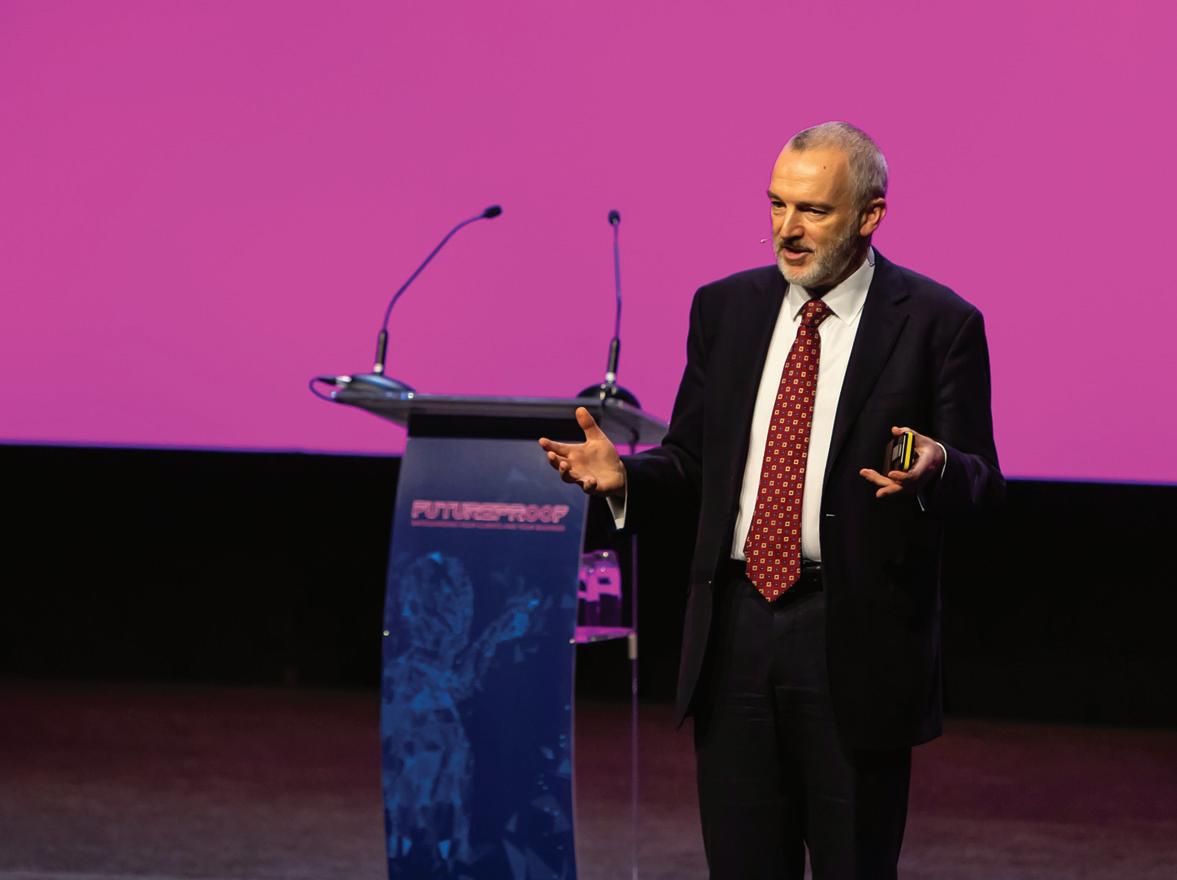
1GET YOUR STRUCTURE RIGHT In order to futureproof your advice business, Rory Percival, regulatory consultant, said you need to review the way you currently run your fi rm.
Speaking to a packed Hall One at the ICC in Birmingham, Mr Percival revealed he recently took part in a war of words on Twitter.
An adviser claimed the FCA should sit in client meetings more often to understand how the fi nancial advice process actually works.
But Mr Percival, a former technical specialist at the City watchdog, said he disagreed that the regulator needs to sit in on client meetings.
He said: “I thought to myself – no. The only thing that becomes important at that stage is being clear, fair and not misleading. It is
Rory Percival, regulatory consultant

how the firm operates, before they get into the client meeting – that is the most important thing.
“While for you, sitting with the client is the big, important thing, I would argue that it is what happens before that meeting in terms of fi rm governance that really matters.”
Mr Percival said it is vital that advice fi rms regularly review the way they work and question why they are operating in this way.
He said: “My view is most fi rms don’t do capacity for loss very well. Who in your fi rm is accountable for how you do capacity for loss? You need to have individual people who are accountable for pretty much everything you do in your fi rm. You are better as a fi rm if you have individuals who are accountable.
Debbie Gupta, FCA When I am accountable for things, I make sure things happen.
“We have all heard about the Senior Managers & Certifi cation Regime (SM&CR). A lot of what I have been talking about with accountability is coming in with the SM&CR, but I would suggest you expand that more broadly and ascribe responsibilities to all individuals across the fi rm.”
Mr Percival concluded that, to futureproof your advice business, you need to: “Th ink about your culture and your values. Build in challenge and manage biases within your fi rm.”
2REVIEW YOUR CHARGES Debbie Gupta, director of life insurance and fi nancial advice at the FCA, said the regulator is concerned that while a fee for ongoing advice is good for business, “it may be of very little value to the client”.
Ms Gupta urged advisers gathered at the PFS conference to look at how they charge for their services.
She said: “I know this is an emotive subject. We don’t expect advisers to be a charity, but we do expect you to consider the confl icts that arise. Take charges on ongoing advice. Most advisers that we see are charging a percentage of client assets. Th is works well for clients building their wealth, but is it right for clients that are withdrawing their assets?”
Ms Gupta said the FCA would be worried if it was to see →
Matthew Griffi n, 311 Institute
longstanding clients priced out of fi nancial advice at the point when they may need it the most.
She said: “Th ink carefully about where you add value. Professional advice is valuable and increasingly necessary as our environment is evolving. We still see too many fi rms focusing on the solution they want to provide to the client.
“We want to see a mindset where you ask: what does the client really need and how can I help them achieve that? Become a client-centric business and that will help you be truly futureproofed.”
3CHANGE THE CONVERSATION Advisers gathered at the PFS’s Futureproof Conference were also encouraged to think about the way their clients expect them to talk about their investments.
For example, in the early days of environmental, social and governance investment, all the talk was about screening, engagement with senior management and monitoring whether companies were hitting sustainability targets.
Belinda Gan, product manager of global sustainability of Schroders, said this was because this had been the focus of institutional investors who were fi rst to engage with environmental, social and governance investment.
Ms Gan said while institutions still want to know about exclusions, screenings and such like, for fi nancial advisers and retail investors it is less about being bombarded with acronyms and more about bringing it back to the real world.
Iain Richards, head of responsible investment for Columbia Th readneedle, agreed that disclosure from investment houses in this area needs to change so that advisers can connect their clients’ views with a suitable fund that is in keeping with their beliefs.
Mr Richards said: “People have not got their heads round how to connect the underlying client’s interest with the information that clients want. Platforms want case studies and stories, not just the technical story. Th e retail investor wants to see that it (the fund) is real and doing something meaningful.”
4ADVICE BEYOND THE GRAVE While it may have taken 75 years to get 50 million people to acquire a telephone, it took Pokemon Go just 19 days to achieve that same level of engagement.

Matthew Griffi n, CEO, 311 Institute
Advisers gathered at the PFS conference were told connectivity and digitalisation will accelerate the pace of disruption even more in the future – to days and then hours and minutes.
Every industry, directly or indirectly, is linked to every other industry, meaning seismic shifts in one eventually ripple across them all, creating an accelerating, virtuous cycle of limitless disruption, warned Matthew Griffi n, CEO of global futures and deep futures consultancy 311 Institute.
Refl ecting on what this could mean for the future shape of the fi nancial advice profession, Mr Griffi n, who has worked with all G20 governments, said robo-advice in its current state should not be feared by human fi nancial advisers.
He said: “Th e FCA is starting to clamp down on robo-advisers. A lot of them are just black boxes and we don’t know how they work.”
But Mr Griffi n said advisers need to be aware that human-centric interfaces are emerging and a future challenge or opportunity for the profession is the creation of an AI replica of a human fi nancial adviser.
Technology is working to replicate minds and thought patterns – so in
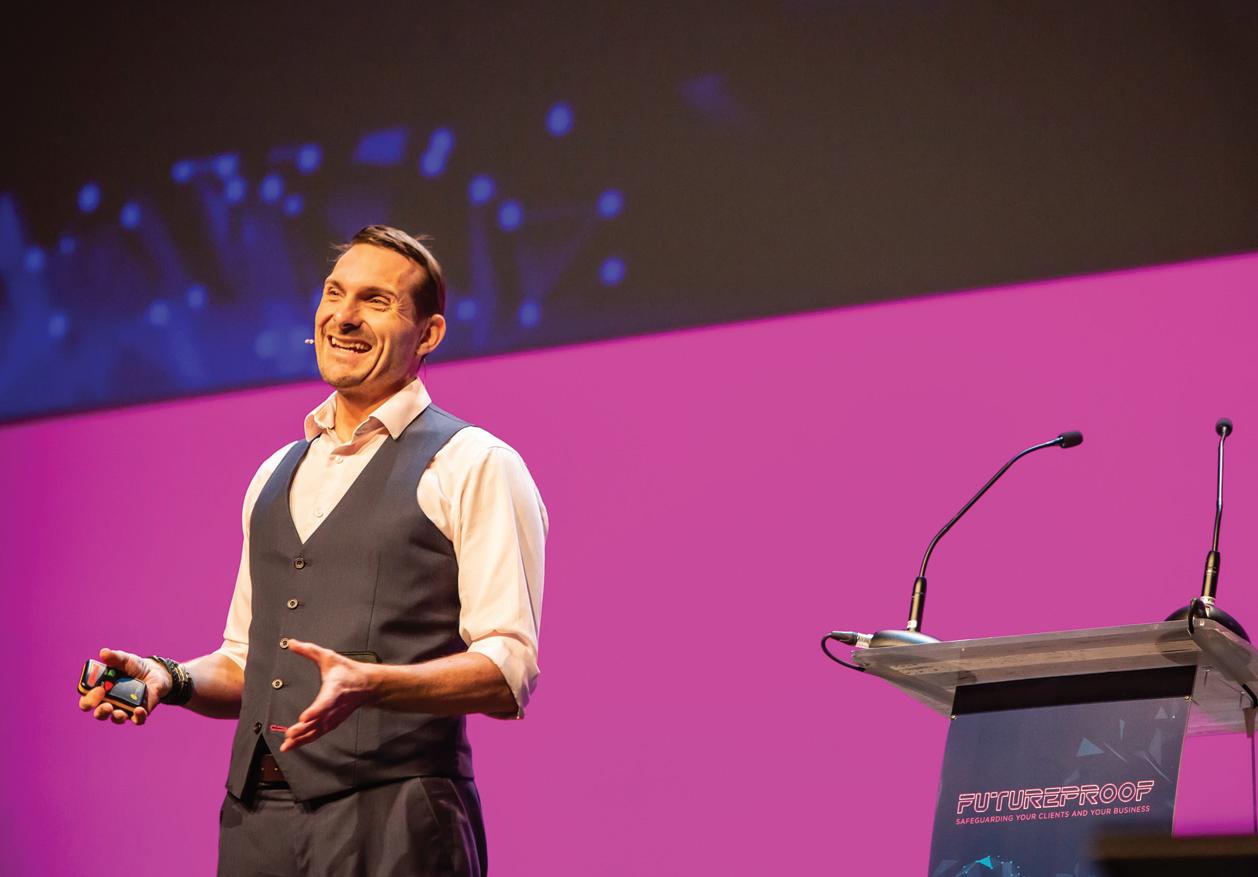
Keith Richards, chief executive of the PFS



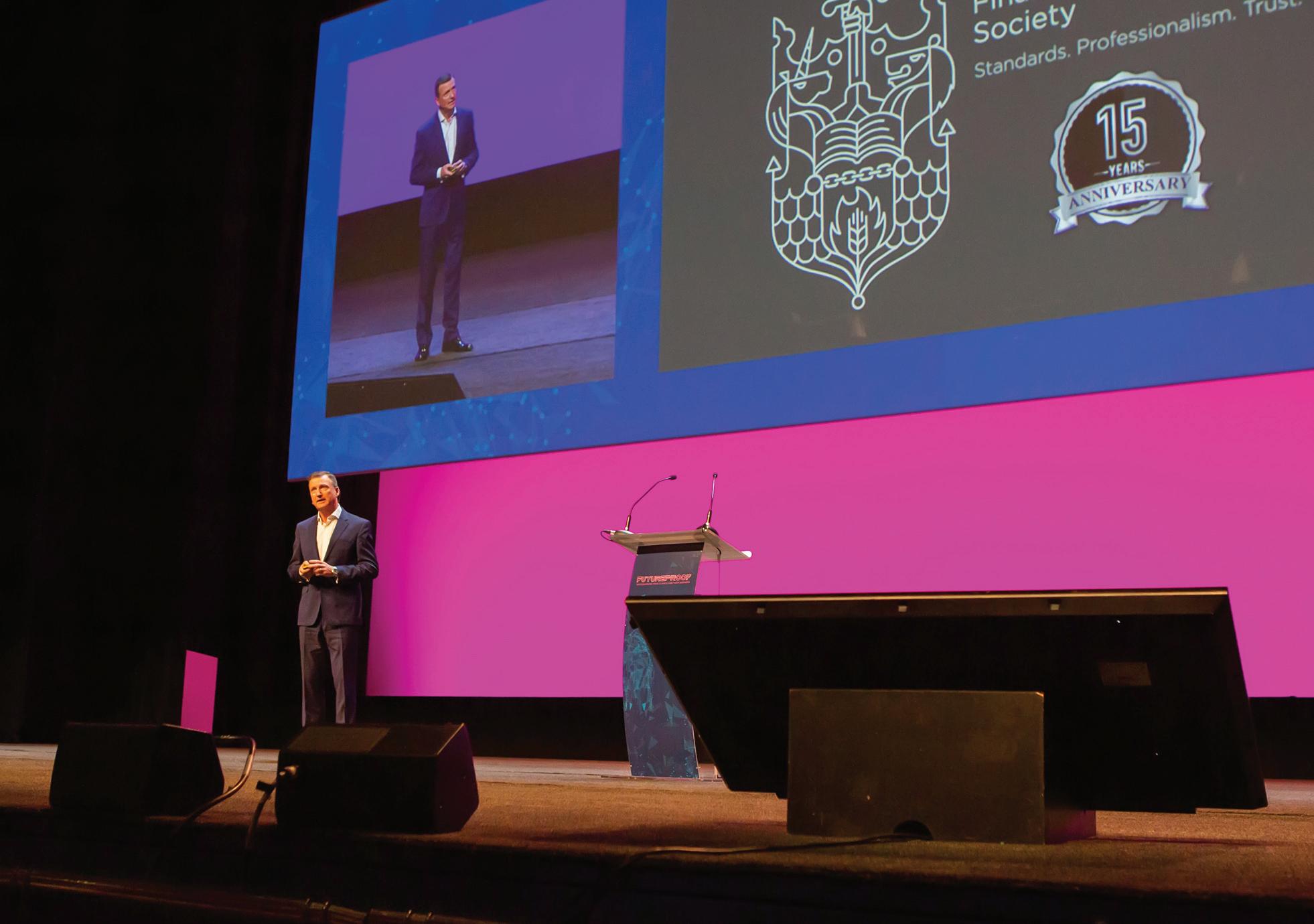
the not-too-distant future, an AI version of you could be advising clients even long after you have died, said Mr Griffi n.
He added: “Digital humans with neural network brains have arrived. Th is is Facebook on steroids. You can now have a robo-adviser like one you have never had before.”
Mr Griffi n said the emergence of new automation technologies, from avatars to robo-advisers, means that in the next couple of decades, being human would increasingly be a differentiator for clients.
He said: “People want to ask: ‘Why are you giving me that advice?’ At the moment, the AI can only say: ‘Th at is my advice.’ It doesn’t allow for the questioning of the advice.
“Your clients need you more – not less – because as the rate of change accelerates, people want human beings to make sense of it for them.”
5THE FUTURE IS BRIGHT – THE FUTURE IS ADVICE Ultimately, the key takeaway message that ran through this year’s PFS Futureproof Conference is that the future is bright for fi nancial

advice, as long as you are equipped and are preparing your clients for the ever faster-changing world.
Keith Richards, chief executive of the PFS, said for the long-term future prosperity of the profession, it is vital that advisers show their value to the wider public.
He urged advisers gathered in Birmingham to engage in pro bono initiatives such as Moneyplan, Forces Moneyplan and My Personal Finance Skills.
My Personal Finance Skills delivers fi nancial education and awareness workshops to schools across the UK. Th anks to fi nancial advisers who signed up to be ambassadors, more than 250 sessions will be delivered to 7,500 pupils this academic year.
But for the 2020 to 2021 academic year, the scheme will reach even more pupils, as 500 sessions have already been arranged.
Mr Richards said: “We need to engage the public in the importance of fi nancial planning in facing the challenges ahead. Many experts predicted the near-extinction of regulated advice due to the Retail Distribution Review. How wrong they all were. Adviser numbers have increased.
“Advisers have the power to change lives and collectively the profession has the power to shape the future. Th e PFS aims to be your compass.”
As chair of the conference, Claer Barrett, editor of FT Money, said the future is bright as the need for human fi nancial advice is greater than ever.
She said: “We know we need to invest in advice. We don’t want to do it by ourselves. AI is a solution to fi lling the advice gap for the mass market but how do I feel about talking to a chatbot? Whenever I buy something on the internet and something goes wrong, I don’t want to talk to a chatbot – I want to talk to someone who will listen to me and my needs.
“More than ever we need an advisory profession that can help us make the right choice.” ●
Emma Ann Hughes is communications director of the PFS
Spring Mortgage & Protection Roadshow Dates Announced
















We are delighted to announce that registration is now open for our spring programme of Mortgage & Protection roadshows.
Colchester 10 March London 11 March Leeds 18 March Sutton Coldfield 19 March Cardiff 24 March Dunblane 31 March Preston 1 April
A highly topical and business relevant programme has been created, with sessions delivered by subject specialists to provide insights and inspiration. Programme highlights will include: • Mortgage market overview – technology and economic drivers • Later life lending & vulnerability • A focus on income protection • Regulatory update from FCA • Futureproofing your business • Potential threats to client retention.
Register now to secure your free place!
Visit smp.org.uk/events to view the full programme and register for the location of your choice. Alternatively members can search and register via the PFSEvents app.
The events will run from 09.30 to 15.00. As well qualifying for up to 4.5 hours of CPD, attendance at these events will provide an opportunity to network with your peers and share good practice. Lunch and refreshments will be provided. Please note that some venues have strictly limited capacity so places will be confirmed on a first come first served basis.
Passing the business baton onto your children or siblings is certainly one way to solve the succession conundrum, as Liz Booth finds out
aking succession plans can be a headache for any fi nancial planner. Do you sell the business? Do you groom a successor from within or do you look to family members?
Talking to some of those who have passed the business onto family members – siblings, sons or daughters – the fi rst sense is one of relief (mostly for the sake of continuity and ongoing service to clients) but also of enormous pride.
Privately, people talk of the uncertainty attached with wondering whether their child would fi rstly be interested in fi nancial planning and then secondly whether they are prepared to work with another family member.
Ultimately, however, they all talk with pride that their children will step into their shoes at retirement and as they see their children achieve the necessary qualifi cations and become consummate professionals.
One such family is the Slipaczeks. Senior partner Filip Slipaczek grew up on a council estate in Winchester in the 1960s and in 1996, he established the precursor of the family fi rm as a sole practitioner.
He completed professional studies with the Chartered Institute of Bankers and the Chartered Insurance Institute before becoming one of the fi rst Chartered fi nancial planners. He is now uniquely Chartered by examination in three professions.
Filip is also the media offi cer of the Institute of Polish Jewish Studies; patron of Faith Matters, the country’s leading interfaith charity; and in 2014, he was awarded the Silver Cross of Merit (the Polish equivalent of an MBE) by the President of Poland.
Filip, Max and Alex Slipaczek with Rt Hon Theresa Villiers MP, Secretary of State for the Environment, Food and Rural Aff airs
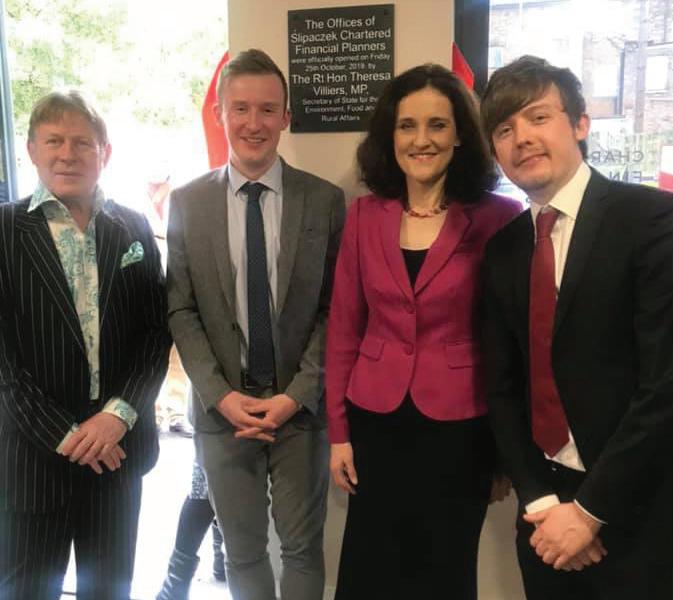

EVOLVING PRACTICE Slipaczek Chartered Financial Planners has also evolved into a Chartered fi rm. Alex (partner in the fi rm and oldest son of Filip), who received an MA in fi nance from the University of Aberdeen, joined the fi rm in 2012 and went on to achieve Chartered status and then became a Fellow of the PFS in 2018.
Max (partner and youngest son of Filip), is a past vice-president of the University of Essex Students’ Union.
Filip says: “He surprisingly joined the practice in 2014 and is now only one paper away from both Chartered status and Fellowship. Our practice is one of very few fi nancial planning fi rms in the UK where two siblings have followed their parent into retail fi nancial services.
“Th e fi nancial services sector has been tarnished historically by sales targets and mis-selling. By bringing one’s children into the business, they have already been instilled with a family-oriented moral compass. Th is is refl ected in the personalised service both locally in Barnet and further afi eld, being able to reach out to many of London’s diverse ethnic minorities. “Children should not be pressurised, but perhaps [only] cajoled into joining if they have an interest and show promise.” He believes that in a family fi rm “where there is an established and trusting client bank, children can be gently introduced to ongoing client relationships, without the need to force on them unnecessary and unwarranted sales targets.
“Having an established business with more than 90% recurring income, along with a desire for hard work from Alex and Max, has allowed both boys to progress with their studies during both the working week and outside of work. Th is has benefi ted their own career progression.”
Finally, he acknowledges: “In regards to pitfalls, perhaps it is the fact that the family understandably, see less of each other outside of work.” ●
Liz Booth is contributing editor of the PFS