FIRSTVOICE.FSB.ORG.UK O C T O B E R 2 0 2 0 -J A N U A R Y 2 0 2 1
O C T O B E R 2 0 2 0 -J A N U A R Y 2 0 2 1
Driving Business Ambition
ETHNIC MINORITY BUSINESSES | CASH FLOW | COVID RESPONSE
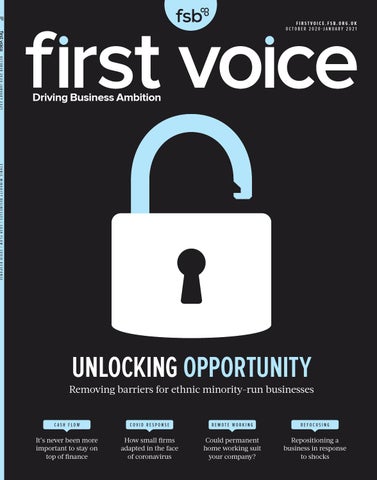
UNLOCKING OPPORTUNITY Removing barriers for ethnic minority-run businesses
CASH FLOW
COVID RESPONSE
REMOTE WORKING
REFOCUSING
It’s never been more important to stay on top of finance
How small firms adapted in the face of coronavirus
Could permanent home working suit your company?
Repositioning a business in response to shocks
01 cover_First Voice Oct-Dec 2020_First Voice 1
17/09/2020 15:02
ADVERTORIAL
Funding Platform
7 tips to manage your cash fl ow
D
uring the Covid-19 pandemic, many business owners were faced with several cash fl ow challenges. We offer practical tips to get a handle on your working capital, and give pointers on making your business plans more resilient.
Managing cash fl ow problems? Cash fl ow problems can cripple any small business. With the record balance having almost doubled to £23.4 billion* at the start of 2020, late payments was the key concern driving four in 10 (37%) small businesses to seek external funding. Then came Covid-19, and the situation worsened almost overnight. Businesses worried about preventing late payments had to adapt to a situation in which sales significantly diminished – or stopped. Business owners that stayed solvent during the crisis had, on average, a better handle on their cash fl ow by way of a forecast. This doesn’t need to be
complex, but it means having a clear sight of money coming in or going out, and regularly comparing what happened versus what you expected to happen.
Agree clear contract terms Separating your cash fl ow at a detailed level can be tricky, as different parts of your business might be working to different priorities. For example, you may wish to reduce costs through consolidated shipments – but you don’t want to lock up any more cash in stock than you need to. One way around this is to define clear contract and payment terms with customers and suppliers before you take on work. Having clear expectations of each party will help you take on business with the confidence that you can meet your obligations, while preventing complications around delivering to schedule and getting paid on time.
Plan, plan, and plan again 1. Prepare a cash fl ow forecast and update it ideally monthly, or at the very least quarterly 2. Check what levels of stock you need to operate, while trying to minimise the amount of cash locked up in expensive stock 3. Regularly check on your suppliers’ standing, to avoid running out of supplies that would stop you from being able to operate 4. Consider renegotiating payment terms, or changing suppliers if you can get better terms that help you retain more cash in your business 5. Choose your funding and credit options carefully, to put in place fixed and variable arrangements that allow your business to scale up or down 6. Have a tight grip on outgoings and maintain a cash buffer for di cult times; consider business insurance where a cash buffer would be inappropriate 7. Anticipate problems by tracking a worst-case and a best-case scenario in your plans
2 | firstvoice | october 2020-january 2021
02 FSB advertorial_First Voice Oct-Dec 2020_First Voice 2
You can better understand your position by planning your financial requirements – but make sure you have some cash in reserve for unforeseen expenses. Various software packages come with forecasting tools. Once the data is in your preferred package, you can make tweaks to your cash fl ow predictions easily. It is also a great basis for considering when its time to renegotiate payment terms, benchmark suppliers or explore funding.
Be proactive A proactive attitude will ensure you plan e ciently and have good controls around your working capital requirements. One size won’t fit all, so a scenario analysis is a practical way to test if your working capital strategies are fit for purpose.
If supplier costs rise by 5% or clients pay you 10 days late, what is the impact? Could you still pay staff and meet outgoings? Post-Covid-19 your approach can no longer be ‘set and forget’.
Be fl exible and keep an open mind A solid financial plan can ensure your business stays fl exible. This can give you a competitive advantage and a chance to preserve cash, which in turn can help improve access to funding and reduce the cost of borrowing. Small businesses with little working capital often struggle to attract investors or agree deals with lenders. While you will be familiar with business loans, there is now a plethora of new funding opportunities for bridging short-term funding gaps or investing in new products or services. Keep an open mind and explore all products available. Take invoice finance, which has improved a lot in recent years. Gone are the days when providers could attach lengthy contracts to such agreements, locking in your entire debtor book. There are now options where you can get advances starting with a single invoice.
If you are looking for cash fl ow finance, we can help. FSB Funding Platform is easy to use and gives members access to the UK’s largest panel of business lenders, with just one simple online application. Visit www.fsbfundingplatform.co.uk to apply for coronavirus loans or any type of funding today, or call us on 0330 097 2359, we are open 24/7.
* Balancing the books, FSB Small Business Index, www.fsb.org.uk/resources-page/balancing-thebooks-number-one-use-of-small-business-creditas-late-payments-top-20-billion.html firstvoice.fsb.org.uk
17/09/2020 15:03
O C T O B E R 2 0 2 0 -J A N U A R Y 2 0 2 1
CONTENTS 8
22
47
REGULARS 8
FIRST STEPS
ON THE RECORD Make It Click hub to boost online skills; extending Eat Out to Help Out; call for Tourism Hibernation Scheme; FSB Customer Care Twitter
10 NEED TO KNOW Preparing for the new immigration system; the CMA view on Covid-19 refunds; late payments on the rise; low confidence going into Q3
13 OPINIONATED Martin McTague on FSB members’ collective support, Torsten Bell on Covid-19 recovery and Parveen Begum on starting a business
34 DEEP DIVE Post-coronavirus, home delivery is poised to become even more significant
44 LEGAL It’s time for small businesses to familiarise themselves with post-Brexit immigration laws
45 HOW TO… ...Boost sales firstvoice.fsb.org.uk
03-04 Contents_First Voice Oct-Dec 2020_First Voice 3
47 R&D SUPPORT Closing the knowledge gap around the funding available for innovation
FEATURES 18 ETHNIC MINORITY BUSINESSES The challenges faced by business owners from ethnic minority backgrounds
22 CASH FLOW How small firms can improve their cash management – and avoid disaster
26 COVID-19 RESPONSE Five businesses share how they weathered the coronavirus storm
30 FSB SUPPORT A look at the ways in which FSB provided help to members hit hard by Covid-19
36 REMOTE WORKING As many firms consider making home working permanent, what do they need to know?
40 REFOCUSING BUSINESS The pandemic should prompt many companies to take a fresh look at their offering
50 HELPLINE Our expert advises on accidents in the workplace, business insurance and data protection officers
NETWORKING 51 MEMBER NEWS Model maker’s bestselling beasts; luxury pop-up firm pivots to support NHS workers; ‘Swap Shop’ comes to the East Midlands
54 DIALOGUE Former Olympian Greg Whyte on the link between staff wellbeing and financial wellbeing – plus your top tweets and the best of First Voice online
55 MY BUSINESS How Luke Mead went from scrubbing gravy bowls to fixing Keith Richards’ WiFi october 2020-january 2021 | firstvoice | 3
17/09/2020 15:04
CONTENTS 56 MEMBER SERVICES Advice on managing employees in a complex post-pandemic working world, and why FSB membership is a ‘no-brainer for business’
60
EXTRA TIME 60 FIT FOR BUSINESS Keeping on top of your mental health in an era of uncertainty
62 OUT OF OFFICE Boosting communication via improv, the best alternative shopping sites, and the art world’s digital transformation
64 THE GOODS Tech to enhance the postlockdown working experience
66 LAST WORD Running a small business has been tough in recent months – let’s remember why we do it, says Guy Browning
First Voice is published on behalf of the Federation of Small Businesses (FSB) by Redactive Publishing Ltd (Tel: 020 7880 6200) firstvoice.co.uk | redactive.co.uk
Publisher: Aaron Nicholls Editor: Nick Martindale Email: firstvoice@redactive.co.uk Lead designer: David Twardawa Picture researcher: Claire Echavarry Sub-editor: Kate Bennett Production: Aysha Miah-Edwards Email: aysha.miah@redactive.co.uk Tel: 020 7880 6241 Advertising: Email: fsb@redactive.co.uk Tel: 020 7324 2750 Creative commercial content manager: Alison Krog Email: alison.krog@redactive.co.uk Tel: 020 7324 2722 Printed by Warners
4 | firstvoice | october 2020-january 2021
03-04 Contents_First Voice Oct-Dec 2020_First Voice 4
MIKE CHERRY OBE, NATIONAL CHAIRMAN
First word I
HOPE THIS EDITION FINDS EVERYONE AS WELL AS CAN BE EXPECTED
in these testing times. Once again, I offer my condolences to anyone who has lost a loved one to the pandemic. I continue to find some degree of positivity about the way that we small businesses and the self-employed have come together. At FSB, our work continues in getting the best government support for small businesses as this crisis changes every aspect of our daily business. It is essential that we continue to stand together and support one another in every way we can, and we continue to highlight the need to support those who have missed out, such as owner directors and start-ups. I would like to thank all small businesses that have taken the time to participate in FSB’s Big Voice surveys during the past few months. This research helps inform FSB’s policy recommendations and government asks. At a time when things can change suddenly, we must be fully representative of the UK’s diverse small businesses and self-employed community, which is the cornerstone of the UK economy. At FSB, we will do all we can to ensure you are heard by decisionmakers at every level. Alongside this, we’ll do our utmost to make sure that our members have access to the most valuable tools and services. Do make the most of these resources, and reach out to FSB’s customer services team if you need any specific help or information. Many of you have joined in with the online support events that FSB has offered – I believe that, at the last count, 1,150 of these had already taken place. I can only thank members and staff who have come together to provide support to members and small businesses across the UK. What we have achieved together will be something to remember, and FSB is continuing to increase lobbying and support as 2020 draws to a close. This edition of First Voice went to press on 17 September. All information is correct as of that point.
FSB publications manager: James Connor Email: james.connor@fsb.org.uk Tel: 07595 284088
fsb.org.uk While every care has been taken in the compilation of this magazine, errors or omissions are not the responsibility of the publishers or of the editorial staff. Opinions expressed are not necessarily those of the publishers or editorial staff. All rights reserved. Unless specifically stated, goods or services mentioned are not formally endorsed by FSB, which does not guarantee or endorse or accept any liability for any goods and/or services featured in this publication. ISSN 2399-5467 Copyright: FSB Publications Ltd
Recycle your magazine’s plastic wrap – check your local LDPE facilities to find out how.
First Voice is available on subscription at £42 per annum. For details, contact james.connor@fsb.org.uk First Voice has an audited net average circulation of 122,603 (Jul 2019 to Jun 2020).
AccessAbility help. If you require this document in an alternative format, please ring 01253 336036 or email: AccessAbility@fsb.org.uk
firstvoice.fsb.org.uk firstvoice.fsb.org.uk
17/09/2020 15:07
FV.Oct20Jan21.005.indd 2
14/09/2020 12:02
OUTSPOKEN
Furlough finish Firms have been contributing to wage costs since the start of September; the scheme will end on 31 October.
DID YOU KNOW?
One in two feel positive about returning to the workplace
Black History Month This October campaign raising awareness of AfroCaribbean history is a great opportunity for food businesses and museums.
study by Aviva has found that 49 per cent of people are optimistic about going back into offices, and 61 per cent believe their employer will put the right safety measures in place. The top changes, according to the survey of 2,000 people, are easy access to handwashing and hand sanitiser (65 per cent), reducing the number of people in the workspace (50 per cent) and social distancing signposting (42 per cent). The research found that, during lockdown, 42 per cent of people worked from home, 26 per cent in their usual location, and 6 per cent in different locations; 21 per cent were furloughed, and 5 per cent were not working or on furlough.
A
National Curry Week Taking place on 9-15 October, this is a moment for curry houses to persuade us to indulge.
g A light-hearted look at the world of small business National Stress Awareness Day Held on 2 November, this aims to show how big a problem stress can be and what can be done. Use it as a chance to encourage sta to speak up, and o er them support.
STAR START-UP
Matthew Pinsent
6 | firstvoice | october 2020-january 2021
6-7 Outspoken_First Voice Oct-Dec 2020_First Voice 6
Black Friday/ Cyber Monday Held on 27 and 30 November respectively, these two events should provide a welcome pre-Christmas boost.
HEADS UP
Four-time Olympic gold medallist and rower Matthew Pinsent made waves of a di erent kind when he took part in Celebrity Masterchef, and came within a boat’s length of taking the title. The Olympian even said he enjoyed the experience so much that he asked to go back on a second time, but wasn’t allowed to! We think it’s only a matter of time before he has launches his own private dining business. Perhaps even on a boat?
Brexit transition end date 1 January will see the UK begin its new relationship with the European Union, as the transition period comes to an end. firstvoice.fsb.org.uk
17/09/2020 15:07
YOU DO WHAT?
And relax… hen you’re planning a wedding, a course of hypnotherapy lessons may not be top of the list. But that’s the market Hummingbird Hypnotherapy is targeting, helping stressed-out brides and grooms cope with the stress of getting married. “It’s a missing part of the wedding industry,” says company founder Silvia Mather. “Couples are bombarded with tasks, and this can have a really negative impact on a day when they should be feeling happy and relaxed. Hypnotherapy will help you
W
put it all into perspective and manage your time more productively and calmly.” The north-east-based hypnotherapy business has been running for three years but had only just launched the wedding service when lockdown hit. Fortunately, Silvia has been able to move the offer online. “At first my current clients were a bit unsure but it has been so successful that I will continue to offer this as an option,” she says. “This also means that I can work with people all over the world.”
To tell us about your unusual business venture, email us at firstvoice@redactive.co.uk
“Never give up. Today is hard, tomorrow is worse, but the day after tomorrow will be sunshine” JACK MA
5 TO WATCH
Health and fitness apps
Photography: iStock, Getty
1
2
3
MyFitnessPal
Strava
Nike Training Club
Waterlogged
C25K
This app helps you keep track of what you put into your body, calculating the calories consumed using a calculator that draws on more than 6 million recipes added by other users. E ectively a reliable, free food diary, it also lets you take o calories burned during exercise.
An online package designed to track runners’ and cyclists’ performance, Strava has come into its own in recent months. It tracks distance travelled, speed, elevation, calories burned and heart rate, and converts it into charts and graphs that can be shared across social media.
This app designs training plans, allowing you to work out in a gym or at home. Choose from cardio fitness programmes, bodyweight exercises, weight training and yoga to develop a plan that will work for you. Includes almost 200 workouts, ranging from 15 to 45 minutes.
We know we need to stay hydrated, and yet we don’t always drink enough water. Waterlogged allows you to keep track by taking and uploading pictures, and can show you whether you’re hitting your hydration target. Push notifications can give you a nudge when it’s time for a top-up.
For those in need of a bit of help shifting the lockdown belly, Couch to 5K gets you up o the sofa and out pounding the streets. Starting o slowly, the aim is to gradually build you up to a point where you can comfortably run 5K, over the course of nine weeks. Backed by the NHS.
firstvoice.fsb.org.uk
6-7 Outspoken_First Voice Oct-Dec 2020_First Voice 7
4
5
october 2020-january 2021 | firstvoice | 7
17/09/2020 15:08
ON THE RECORD TAX
Rule out tax rises, FSB urges Chancellor T
HE TREASURY SELECT COMMITTEE’S
second report into the economic effects of Covid-19 has called for the Chancellor to consider sector-specific extensions to the Government’s furlough programme, due to end in October. As well as urging flexibility on the furlough scheme, the Treasury Select Committee report called on the Chancellor not to raise taxes too early, as this could “stifle economic recovery”. FSB National Chairman Mike Cherry said: “The Treasury Select Committee’s assessment that tax rises would stifle a nascent recovery is the right one. We need a pro-business approach now more than ever. It should stick to its commitments on
tax, and NICs in particular, while investing in initiatives to support entrepreneurship, innovation and job creation. “The priority should be protecting small businesses that have been disproportionately impacted by coronavirus, including those caught by local lockdowns, subject to continued national restrictions, or with staff that have directly suffered because of Covid-19. “Then of course there are those who have been left out of support mechanisms entirely, including company directors and the newly self-employed. The Treasury Select Committee has rightly pointed out that these individuals are in urgent need of government support.”
LEARNING
Digital skills lifeline for small businesses A new free hub to boost online skills and drive businesses forward has been launched by Make It Click, a charitable skills initiative funded by Google. The new Make It Click small business hub, supported by FSB, offers small businesses an easy, convenient way to boost online and IT skills. It includes free online learning resources to help business owners and employees increase digital know-how and confidence. Skills range from beginner courses on word processing to
social media marketing and online accounting, which were the top skills small business owners said would help to boost their business during the pandemic. Mike Cherry, FSB National Chairman, said: “Delivering support to help small businesses increase their digital skills is crucial. The pandemic is making this even more of a priority; FSB research found that in early lockdown, 40 per cent of small businesses adopted or
8 | firstvoice | october 2020-january 2021
08-09 On the record_First Voice Oct-Dec 2020_First Voice 8
increased their use of digital technologies. “We are also asking Government to widen the definition of ‘R&D’ and introduce digital vouchers for small businesses to make it easier for them to adopt digital technologies. Many small firms already rely on Google and the UK’s growing tech sector, and now want to find new ways to boost small businesses’ digital growth. I’m pleased to see this happen through Make It Click.”
WORK PLACEMENTS
THE LATEST NEWS FOR FSB MEMBERS
Kickstart scheme disappoints small firms The Government has introduced a kickstart scheme in England, Scotland and Wales, aiming to create hundreds of thousands of high quality six-month work placements for those aged 16 to 24 who are on Universal Credit and deemed to be at risk of long-term unemployment. Funding available for each job will cover 100 per cent of the relevant National Minimum Wage for 25 hours a week, plus the associated employer National Insurance contributions and employer minimum automatic enrolment contributions. However, FSB National Chair Mike Cherry said: “Many small businesses will be disappointed to see this announcement, which feels more aligned to the needs of larger businesses. “Without further work, the scheme will leave many without any employment support after waiting for it for so long. Crucially, it is more difficult to access for those hiring fewer than 30 roles through the scheme, who as it stands will need to find intermediaries. There is currently no guidance for how to become an intermediary and how they will operate the scheme. “To hire 30 individuals is just beyond the means of most small businesses, many of which have far fewer employees or don’t have the HR support on hand to introduce that number of new employees. The Government should issue guidance to make it easy for small business organisations to become intermediaries, or a direct application route for small firms.” firstvoice.fsb.org.uk
17/09/2020 15:45
ONLINE
As part of FSB’s ongoing strategy to o er the best customer care to members and potential members, FSB has now launched a new Twitter account. @FSBCustomerCare will be used by the customer services team as a further channel to help members and potential members with enquiries and concerns. Our corporate communication account @fsb_policy remains unchanged, as do our other FSB nation and region Twitter accounts.
Extend Eat Out to Help Out F
SB HAS SPEARHEADED A
campaign to extend the Eat Out to Help Out scheme for Aberdeen, after the city faced a lockdown period that meant restaurants and cafés were unable to benefit. FSB wrote to the Secretary of State for Scotland, Alister Jack MP, about the issue,
TOURISM
FSB calls for Tourism Hibernation Scheme to help boost fl agging sector Tourism businesses in Wales need a lifeline by Government if they are to survive, it has been claimed, following the publication of a new survey. The latest Wales Tourism Business Barometer revealed two-thirds of businesses in the sector still have sta on furlough and an extended period of staycations is needed to boost business.
Ben Francis, FSB Wales Policy Chair, said: “FSB Wales has already called on Welsh Government to institute a Tourism Hibernation Scheme – a potential mix of loan and grant funding which includes o ering tourism firms loans at preferential rates, repayable once those firms are back in the profitable part of the 2021 season. Such a scheme
firstvoice.fsb.org.uk
08-09 On the record_First Voice Oct-Dec 2020_First Voice 9
would be aimed at supporting a tourism firm to hibernate through the winter of 2020-21 before reopening next spring. “It is clear that many firms need a lifeline to help see them through this incredibly difficult period, and if Welsh Government does not step in soon then time is going to very quickly begin to run out for Wales’ tourism firms.”
COVID-19
FOOD AND DRINK
while a petition supporting such a move gathered more than 3,600 signatures. Feedback from FSB members suggest that many operators believe they lost between £2,000 and £50,000 by not being able to benefit from the initiative. On a UK-wide basis, FSB is also asking the Chancellor to look to extend the scheme. Andrew McRae, FSB’s Scotland policy chair, said: “The Eat Out to Help Out scheme has been a roaring success, not only giving firms a welcome shot in the arm but also encouraging people to rediscover the brilliant local restaurants, pubs and cafés on their doorstop.”
FSB Customer Care Twitter account launches
Targeted help now needed in Northern Ireland FSB Northern Ireland Regional Chair Tina McKenzie has called for targeted support to be given to business sectors that are still closed due to coronavirus. The arts and creative industries in Northern Ireland have been massively affected. Pubs and private members’ clubs that do not serve food or have outdoor space available are still required to close – unlike in England, where they can open. Ms McKenzie said: “It would be a travesty if the legacy of this crisis is that honest businesses who have abided by the regulations are punished, rather than compensated. They have done the right thing for us, so Government must do the right thing for them.”
october 2020-january 2021 | firstvoice | 9
17/09/2020 15:10
ON THE RECORD
NEED TO KNOW
FOR THE LATEST BUSINESS UPDATES, VISIT FIRSTVOICE.FSB.ORG.UK/KNOWLEDGE-CENTRE/NEED-TO-KNOW.HTML
BUSINESS UPDATE
Vital information, resources and support LAW
Employer resources for new immigration routes The Home Office has published resources to help employers understand and prepare for the new points-based immigration system coming into effect from 1 January 2021. Anyone from the EU wanting to come to the UK for work will need to meet job and salary requirements. The Home Office previously revealed the core principles with a statement in February. The key features are: Immigration routes for prospective employees from outside the UK The application process for becoming a Home Office licensed visa sponsor Information on digital status and right to work checks The new global talent route; and intra-company transfers Read more at bit.ly/2YJjiPp
INTERNATIONAL TRADE
New trade advisory groups launched The Department for International Trade has established 11 trade advisory groups (TAGs) to provide
knowledge, insight and experience from industry experts that will inform the UK’s negotiating position and deliver trade deals that benefit the whole country. The 11 TAGs are: agri-food; automotive, aerospace and marine; British manufacturing and consumer goods; investment; life sciences; tech and telecoms; chemicals; financial services; professional advisory services; transport services; and creative industries. A list of members will be published on the gov.uk website. Read more at bit.ly/2Qvd419
LAW
Covid-19 refund updates The Competition and Markets Authority (CMA) has published its views on the law in relation to cancellations and refunds during the pandemic. The CMA believes that a consumer will generally be entitled to a refund when they have paid in advance for services or goods that cannot be provided because of the pandemic. It has provided detail on the difference between lockdown laws and Government guidance, and their impact on refunds.
10 | firstvoice | october 2020-january 2021
10-11 Neet to know - Data_First Voice Oct-Dec 2020_First Voice 10
Lockdown laws: If contracts cannot go ahead because of lockdown laws, the CMA would expect a consumer to be offered a full refund. If contracts are partially affected then, depending on circumstances and impact, consumers may be entitled to a refund or a price reduction. Government guidance: As this is guidance and not law, whether a consumer is entitled to a refund will vary. For example, if a package holiday is cancelled in light of Foreign and Commonwealth Office advice against travel to the country, there are protections that mean consumers should be entitled to a full refund. It will not always be the case that a full refund is due as Government guidance does not create legal restrictions. However, it is important to follow Government guidance, and the CMA believes businesses should treat customers fairly. Read more at bit.ly/34Kcnt0
FINANCE
New body to drive economic recovery Three core missions for the new Scottish National Investment Bank have been
laid before the Scottish Parliament for consultation. The core missions focus the bank’s activities on addressing key challenges and creating inclusive, long-term economic growth. This will enable the bank to play a significant role in supporting Scotland’s economic recovery from coronavirus. The proposed missions aim to support: The just transition to net-zero emissions by 2045 Creating opportunities and reducing inequalities Harnessing innovation. The bank is on schedule to launch by the end of the year and the Scottish Government has committed to capitalising it with £2 billion over 10 years. Read more at bit.ly/2QzYYeJ
TAX
Loan charge deadline passes The deadline to apply to HMRC for a refund or waiver for the loan charge review has now passed. Following HMRC’s Independent Loan Charge Review recommendations, certain voluntary payments made as part of a disguised remuneration settlement with HMRC can be refunded. The voluntary payments that can be refunded are those made on or after 16 March 2016, in relation to loans made in unprotected years. An unprotected year is one where HMRC did not take action to protect the year, for example, by opening an enquiry. Read more at bit.ly/3i1yvTK firstvoice.fsb.org.uk
17/09/2020 15:10
ON THE RECORD
Help shape our research. Join Big Voice, our free online research community, at fsb.org.uk/benefits/big-voice
NEED TO KNOW
FINANCE
QUICK STATS
3%
Late payment crisis worsens The majority of small businesses (62 per cent) have been subject to late or frozen payments in the wake of the Covid-19 outbreak, according to FSB’s latest study of more than 4,000 firms. The report, Late Again: how the coronavirus pandemic is impacting payment terms for small firms, shows that only one in 10 (10 per cent) have agreed changes to payment terms with clients, meaning most of this poor practice has not been signed off by creditors or debtors. The study shows that, despite concerted efforts by government at all levels to improve
procurement practices, there is no discernible difference in late payment activity between public and private sector supply chains. Around two-thirds (65 per cent) of small firms that supply to other businesses have suffered late or frozen payments, and an almost identical number (63 per cent) in public sector supply chains have experienced the same treatment. Small firms in the wholesale (71 per cent), legal and accounting (62 per cent) and advertising and marketing sectors (62 per cent) have been hardest hit.
The amount by which UK retail sales were higher in July than they had been in February, before lockdown, the Office for National Statistics says
69%
The proportion of UK workers who would rather cycle to work now than take public transport, according to research from Insolvency Support
How the coronavirus pandemic is impacting payment terms for small firms
62%
of all small businesses have experienced either an increase in late payments and/or had payments frozen completely as a result of Covid-19
10%
of all small businesses have experienced a lengthening of payment terms from customers as a result of Covid-19
71%
of small wholesale firms
62%
of small legal and accounting firms
65,000
62%
The number of cyber-attacks on UK SMEs each day, according to recruiter Robert Walters. Around 4,500 are successful
of small advertising and market research firms
have experienced either an increase in late payments and/or had payments frozen completely as a result of Covid-19
Pay restraint is order of the day
Small firms still reeling from pandemic
Businesses are implementing pay freezes and deferrals around awards as they attempt to weather the storm caused by Covid-19. XpertHR’s research revealed there were around 20 per cent fewer basic pay settlements effective between 1 January and 31 July than at the equivalent stage last year. Where pay settlements were implemented, 43 per cent were freezes, meaning employees did not receive any rise. Where businesses did implement pay increases, these were lower than the same period a year earlier in 56 per cent of cases, with just 16 per cent higher. Overall, the median basic pay award in the three months to the end of July fell to 0.5 per cent, two percentage points lower than the median of 2.5 per cent recorded in the same period a year ago. This makes it the lowest figure for more than a decade.
Almost one in four (23 per cent) small business owners expect Q3 of 2020 to be “much worse” than Q2, with just 13 per cent expecting “much improved” prospects. FSB’s Small Business Index found more than half (58 per cent) of firms expected their performance to remain stable or worsen over Q3. Four in 10 (42 per cent) expected a relative improvement as lockdown eased, while three quarters (75 per cent) said coronavirus was still having a negative impact. The figure stood closer to nine in 10 (88 per cent) in Q1. There were differences across sectors: construction, accommodation and
firstvoice.fsb.org.uk
10-11 Neet to know - Data_First Voice Oct-Dec 2020_First Voice 11
the food service sectors were most confident, and wholesale/retail and arts/ entertainment were least. Three quarters (75 per cent) of smaller businesses reported a fall in profits
in Q2 of this year, up 33 percentage points compared to Q2 in 2019. Most (82 per cent) said they were operating below capacity, and 65 per cent had seen a fall in international demand.
Small business confidence by sector +41
Construction Accommodation and food service activities
+35
Manufacturing
+5 -8
Retail Information and communication Arts, entertainment and recreation
-23 -66 -70
-60
-50
-40
-30
-20
-10
0
10
20
30
40
50
october 2020-january 2021 | firstvoice | 11
17/09/2020 15:11
FV.Oct20Jan21.012.indd 2
08/09/2020 16:14
OPINIONATED
MARTIN MCTAGUE
CONFRONTING COVID-19
Time to pull together The last few months have challenged the small business community as never before. But coming together with a collective voice will help many come out the other side
Illustration: Sam Kerr
I
T’S AT TIMES LIKE THESE WE NEED EACH OTHER.
I struggle to find the words to sum up how this year has been for small business owners and self-employed. Difficult? Challenging? Uncertain? Talk about understatements. For many, it has been frightening, devastating, and unbelievably stressful. But in among all of that, I have also had feelings of pride and optimism in our small business community. There are those who have shown incredible resilience in the face of adversity, those who have found ways of innovating and adapting their businesses, those who have supported their local community. And in many cases we have supported each other more than ever before, through online events, Facebook groups and experience-sharing. At FSB, thousands have stood together to make the voice of small business and the self-employed heard. That has never been more crucial than in the past few months. It proved effective. Our collective efforts – from volunteers, to those helping our research work, to members joining our local and national support activities – have achieved help and hope for each other in these extraordinary times. Many of the support schemes the Government rolled out were a result of our collective effort. These have helped many, but by no means everyone. The newly self-employed and directors of limited companies were left out of the main schemes, despite many of them being in financial peril. There were others who slipped through the cracks, too. For those who did benefit, it was a lifeline. But the reality is that this help is gradually drawing to a close. Grants, furloughing and self-employed support are winding-up; Government-backed loans will need to be repaid; VAT postponements are coming to an end. For some sectors, such as retail and hospitality, the firstvoice.fsb.org.uk
13 Martin McTague_First Voice Oct-Dec 2020_First Voice 13
run-up to Christmas will be crucial. A nervousness in consumer spending would be devastating. Whatever happens in the coming months, small business owners face a second wave of worry and potential hardship. The Government, devolved administrations and local authorities need to be mindful of this, and respond to circumstances as they unfold. Economic recovery is going to be a long, hard slog. It will only be achieved by making sure as many hard-working, innovative small business entrepreneurs get through this as strongly as possible. Policies must be focused not just on business survival, but on growth – even in these bleak days. There must be a focus not just on preserving jobs but on job creation; on supporting small firms to adapt and build their digital skills; on recognising in the tax system the contribution small businesses and the self-employed make and the risks they take to achieve that. But we also have a part to play. We must continue to support each other. We must continue to have a collective voice. Between us, we make up 99 per cent of businesses in the UK. We account for 60 per cent of private sector employment. By sticking together, we benefit not only each other, but the communities we serve and the economy as a whole. There are tough times ahead, but together we can get through this.
‘For many, 2020 has been frightening, devastating, and unbelievably stressful’
MARTIN MCTAGUE is National Vice Chair, Policy & Advocacy, FSB. All information is accurate as of 17 September.
october 2020-january 2021 | firstvoice | 13
17/09/2020 15:11
:KHQ LW FRPHV WR ¿ QGLQJ FRPSHWHQW ¿ UH VDIHW\ VHUYLFH SURYLGHUV IRU \RXU EXLOGLQJ
, y f i c e p s t s u j t ’ n Do
verify!
WKHLU 7KLUG
3DUW\ &HU
WL¿ FDWLRQ
0DMRU ¿ UHV DUH KLJKOLJKWLQJ WKH QHHG WR HQVXUH WKH ULVN IURP ¿ UH LV UHGXFHG DQG PDQDJHG LQ WKH EHVW ZD\ SRVVLEOH :KHQ VRXUFLQJ KHOS PDNH VXUH \RX VSHFLI\ FRPSHWHQW ¿ UH VDIHW\ SURYLGHUV and YHULI\ WKHLU 7KLUG 3DUW\ &HUWL¿ FDWLRQ LV DSSURSULDWH DQG YDOLG IRU WKH ZRUN UHTXLUHG $OO %$)( 5HJLVWHUHG &RPSDQLHV DUH 7KLUG 3DUW\ &HUWL¿ FDWHG YLD 8.$6 $FFUHGLWHG &HUWL¿ FDWLRQ %RGLHV LQ RQH RU PRUH VSHFL¿ F DUHDV RI ¿ UH VDIHW\
8VH WKH %$)( )LUH 6DIHW\ 5HJLVWHU WR HLWKHU VHDUFK RU YHULI\ D SURYLGHUV VSHFL¿ F 7KLUG 3DUW\ &HUWL¿ FDWLRQ
ZZZ EDIH RUJ XN British Approvals for Fire Excellence
FV.Oct20Jan21.014.indd 2
08/09/2020 16:15
OPINIONATED
TORSTEN BELL
COVID-19 RECOVERY
Targeted response The fallout from the Covid-19 pandemic has hit different firms and sectors in different ways. The economic recovery package should reflect this
Illustration: Sam Kerr
T
HE COVID CRISIS BEARS LITTLE RESEMBLANCE
to the financial crisis of 2007-08 in terms of its roots (a health emergency, rather than an economic one), scale (the biggest contraction for 300 years) and rapidity (already 750,000 fewer people are in paid employment). Understanding the unique nature of this crisis is key, especially for Government. One feature stands out – it affects different sectors in different ways. Swapping an office for Zoom meetings is one thing; being ordered to close completely is quite another. Gaps between sectors stand out when we look at where workers have been furloughed. Some 77 per cent of hospitality workers were furloughed at some point – 10 times the rate in finance. Take-up among micro firms has been 54 per cent, compared to 21 per cent among larger ones. The pace of return also varies. Construction saw almost half its furloughed workers return by the end of June, but there has been much less progress in getting furloughed workers in entertainment and leisure back to work. The danger is that we ignore these differences in economic policymaking. That’s clear in the Job Retention Scheme, which has the same rules for all firms, and support for the self-employed, where the one-size-fits-all approach means some big winners. Take, for example, the self-employed person who has had two big grants from Government despite having almost no hit to their work from the crisis. Lucky for them, but not the best use of Government money. We have seen some sector-specific help, such as the £1.7 billion bailout for the arts and the ‘Eat Out to Help Out’ scheme. But if we want to avoid a big rise in unemployment we need to recognise that while some sectors are already able to return to (almost) normal, others will be constrained for many months to come. firstvoice.fsb.org.uk
15 TorstenBell_First Voice Oct-Dec 2020_First Voice 15
The main support for firms is due to end later this year or early next, with the Retention Scheme phased out in October and loan repayments starting in early 2021, along with deferred tax bills. This is a big gamble for firms in the worst affected sectors, and a rise in unemployment could be the result. Weaker firms fail in any recession – but this crisis is unique, reflecting a temporary phase rather than a new normal. Many firms that are struggling now could prosper again in future. It’s time policy adjusted. The Chancellor should phase out the Retention Scheme more slowly for hard-hit sectors, and change it from a scheme that subsidises people not working to one that helps meet employment costs in sectors where the crisis is temporarily increasing costs. This would limit unemployment and help keep more firms afloat. To ensure firms can drive recovery without being overburdened with debt, we should convert the emergency loan schemes into studentloan-style, income-contingent loans, with repayments capped at five per cent of a firm’s annual revenue. The UK economy is on the road to recovery, but we are a long way off business as usual. It’s time policymakers recognise that this has been a unique crisis in terms of its depth, sectoral focus and temporary nature. After all, that is what firms and workers are living with every day it goes on.
‘Swapping an office for Zoom meetings is one thing; being ordered to close completely is quite another’
TORSTEN BELL is chief executive of the Resolution Foundation. Views expressed are those of the author and not necessarily those of FSB.
october 2020-january 2021 | firstvoice | 15
17/09/2020 15:12
OPINIONATED
PARVEEN BEGUM
NEW BUSINESS
Make the leap Starting up a new business requires people to step out of their comfort zones. But with hard work and a desire to network, anything is possible
Illustration: Sam Kerr
A
S THE CEO OF A TECH START-UP MAKING
solar-powered carports to charge electric vehicles (EVs), it is strange that my early professional skills were learned as a manager at Burberry. It was a comfortable job but I was eager for a new challenge, and about this time I was approached about working at EV company Tesla. They were looking to hire people outside the automotive or engineering industries who could find new solutions to problems. I started out working as an EV specialist, after which I moved into marketing and sales. The majority of my time was spent showcasing Tesla’s latest innovations, with the aim of making people realise that EV was a game-changer for the automotive and travel industries – and for the environment. My ‘eureka moment’ came when I realised that the world was obsessed with EVs but not their infrastructure. As the number of EVs continues to grow, parking facilities are failing to adapt, and there are not enough public charging carports. Around this time I met Mark Maurice, a mechanical engineer, environmentalist and my future busines partner. After discussing the state of EVs in the UK, we realised there was an opportunity to provide a solution to vehicle charging that would have less impact on the environment, because they could be powered by the sun. After two years at Tesla I left to co-found Solisco, with Mark covering engineering and myself new business and administration. My advice to anyone looking to start a business is: find a partner to share the workload. This enables you to do twice as much work. It isn’t easy getting a business off the ground. You need to do marketing research, networking, research and development and sales pitches, as well as meeting with potential 16 | firstvoice | october 2020-january 2021
16 ParveenBegum_First Voice Oct-Dec 2020_First Voice 16
lenders or investors. This can be overwhelming, especially if you are new to business. With Mark developing our products, I spent a lot of time researching the EV market, its pioneers and its key players. I also started attending conferences and connecting with people via LinkedIn to generate interest and meet potential clients and suppliers. We took every opportunity to visit our contacts in person, because we discovered that face-to-face meetings generate stronger, more meaningful relationships. Networking is essential; if you are nervous about doing so, events such as those arranged by FSB are a great way to break the ice. Some women perceive networking to be a maledominated affair but that has certainly not been my experience. So far, we have had a great start, but it has not been all plain sailing. The EV market and its regulation is still in its infancy. I see this as blessing in disguise. It has given us time to develop our early personal relationships with partners and stakeholders, which were forged at trade shows and conferences. My advice to anyone looking to start or grow a business is: do your market research, network as much as possible and take a chance on yourself. Finally, try and have fun. As philosopher Allan Watts said: “This is the real secret of life — to be completely engaged with what you are doing in the here and now. And instead of calling it work, realise it is play.”
‘My advice to anyone looking to start a business is: find a partner to share the workload’
PARVEEN BEGUM is CEO of Solisco. Views expressed are those of the author and not necessarily those of FSB.
firstvoice.fsb.org.uk
17/09/2020 15:12
The A4 Label Specialists
Laser & Inkjet Labels Free Samples
Huge Range
Fast Despatch
Call us on:
01270 668076 Buy online at:
www.labelplanet.co.uk FV.Oct20Jan21.017.indd 2
08/09/2020 16:15
F E AT U R E E T H N I C M I N O R I T Y- R U N B U S I N E S S E S
Ethnic minority-run businesses have an important part to play in the UK’s recovery from Covid-19, and the economy in general. Yet many such firms find there are additional obstacles in their way. Penelope Rance reports 18 | firstvoice | o
ct o b e r 2 02
0- j a nua
r y 2 02
18-20 Cover Story_First Voice Oct-Dec 2020_First Voice 18
1
fir s t v o i c e . f s b . o r g . u k
17/09/2020 15:13
E T H N I C M I N O R I T Y- R U N B U S I N E S S E S F E AT U R E
Unlocking opportunity MONG ITS MANY impacts, the coronavirus outbreak demonstrated the importance of small businesses to British society – supporting local communities, keeping supply chains moving, helping the most vulnerable in society and meeting unprecedented challenges with ingenuity. In the subsequent recession, they will also prove their worth, bolstering the depleted economy. According to a new FSB report, authored by the Centre for Research in Ethnic Minority Entrepreneurship (CREME) and Enterprise Research Centre (ERC), one segment of the SME community can make a significant mark in the post-Covid-19 landscape. Unlocking Opportunity: The Value of Ethnic Minority Firms to UK Economic Activity and Enterprise reveals that ethnic minority-run businesses (EMBs), of which there are around 250,000 in the UK, contribute £25 billion to the UK’s economy. They are more likely to export than non-EMBs, and also more likely to
A
innovate, with 30 per cent undertaking recent product or service innovation, compared to 19 per cent of non-EMBs. With the UK now in a recession, businesses that are agile, flexible and alive to the needs of their customers, and embedded in their communities, are likely to have the best survival rate. EMBs are well positioned. “The ethnic minority business population is more likely to engage in innovative activities, have a propensity to trade and a growth orientation,” says Professor Monder Ram of CREME. “If we’re talking about post-Covid recovery strategies, those are the things we need to accentuate, the qualities we’ll be looking for in entrepreneurs.” Those qualities will also be important to UK plc post-Brexit. “While we’re transitioning and leaving the EU, innovation is something the Government wants businesses doing,” says an FSB spokesperson. “Ethnic minority-led businesses are good at trade, which the Government should definitely be aware of in light of negotiating trade agreements.”
£25bn The overall impact of ethnic minorityrun businesses on the UK economy
firstvoice.fsb.org.uk
18-20 Cover Story_First Voice Oct-Dec 2020_First Voice 19
Initiatives to support EMBs
FSB is calling on the Government to target its business policies towards ethnic minority entrepreneurs:
1
Ensure the points-based immigration system works for the self-employed and small businesses
2
Recognise and promote the social impact of small businesses on their communities
3
Embed diversity and social value in the public procurement framework
4 5
Help the self-employed access new skills and training
6 7 8
Reach out to business owners in the UK’s diverse communities
Improve access to business support on a national and community level
Include EMBs in government campaigns to boost exporting
Introduce export vouchers to help SMEs utilise free trade agreements
9
Widen the definition of R&D to include small business development
october 2020-january 2021 | firstvoice | 19
17/09/2020 15:13
F E AT U R E E T H N I C M I N O R I T Y- R U N B U S I N E S S E S
Added to this, the EMB community is extremely diverse, ranging from established, more traditional businesses – often family-run, and well represented in hospitality, clothing and private transport – to start-ups established by younger British-born entrepreneurs or recent immigrants, in sectors such as advanced manufacturing, electronics and pharmaceuticals. Often centred in urban areas, their combined economic and societal impact is substantial. Unlocking Opportunity shows, during the last two decades, greater entrepreneurial activity among all main ethnic minority groups in the UK than for the population as a whole. In other words, a disproportionate number of people from ethnic minority backgrounds have set up or run a new business.
Recovery process This ambition needs to be fostered in the post-Covid economy, but it is also apparent that EMBs have been hit hardest by the effects of the pandemic, and could struggle to recover. EMBs are overrepresented in sectors that suffered during lockdown, including retail, taxi firms and restaurants. EMBs face other challenges too, and while every ethnic minority business owner’s experience is different, the report shows consistent issues emerging. Access to business support can be difficult for many SMEs, but seems more elusive for EMB owners. “When the Government is devising policies to help different groups of individuals, they look at the data and see how those individuals are performing within the labour market,” says the FSB
spokesperson. “But the data on ethnic minority business owners is sparse and poorly collated.” Consequently, targeted support is lacking. “The data shows ethnic minorities tend to lack good access to business support, which is incredibly important when you’re starting off on your own.” “When I started my business, I didn’t know what I didn’t know,” recalls Taruna Chauhan, a business coach who mentors for the health and social care sector. “I had to find my way around everything. It was a learning curve, and that’s why I’m now a business coach, to help businesses avoid the mistakes I made.” The report shows that, for some ethnic minority business owners, their network is limited in comparison to non-ethnic businesses. “Although they do use networks, EMBs tend to use more informal ones,” points out Professor Ram. “That raises questions about the extent to which institutions providing business support are reaching out to this significant part of the SME population.” That’s something Ms Chauhan can relate to. “When I first started in 2012 and went networking, more often than not I’d be the only Asian person there, and I thought, surely I can’t be the only Asian person running a business?” she recalls. “I know I’m not. Where are all these other Asian businesses?” Pauline Chambers, founder of recruitment consultancy Supply Care Solutions, couldn’t find a network that reflected her background. “Running a business can be very lonely, and although there are many sector groups in the recruitment industry, these are very under-represented by
30%
The proportion of ethnic minorityrun businesses undertaking recent product or service innovation
20 | firstvoice | october 2020-january 2021
18-20 Cover Story_First Voice Oct-Dec 2020_First Voice 20
17/09/2020 15:13
E T H N I C M I N O R I T Y- R U N B U S I N E S S E S F E AT U R E
EMB owners, specifically black business owners,” she says. “Other ethnic minority businesses such as Asian, Turkish or Greek firms often have networks of friends and family who have run businesses. In the black community, these opportunities are often less available.”
Funding frustration Access to finance can also be a hurdle. “If an individual doesn’t have much experience of banking applications, or knowledge about financial products, they may struggle to get external finance,” says the FSB spokesperson. Or it could be lack of understanding on the part of the lenders. Khaleelah Jones runs self-funded digital marketing agency Careful Feet, but when she sought finance to expand, she struggled. “My biggest challenge has been raising funds to grow the technology side of our business: we are a profitable company but it has been very difficult finding funding,” she says. “People recommend turning to friends and family, but I have no rich aunties wanting to leave me several hundred thousand pounds! This is an issue many founders face, but is definitely more prevalent in minority communities.” Three-quarters of EMBs have no employees, and are classed as selfemployed or micro businesses, which can also prove a barrier to accessing support. Ms Chauhan found herself excluded from an SME initiative because she has no staff. “People think in order to grow you have to have employees. I’m growing, but by outsourcing to people who have the right skills.” The Enterprise Research Centre has found that many ethnic minority businesses have less resilience than the business population as a whole, suggesting they require structured support to achieve longevity. “The first step is government and big stakeholders having an awareness of what’s firstvoice.fsb.org.uk
18-20 Cover Story_First Voice Oct-Dec 2020_First Voice 21
More to be done Jav Mohammed founded business improvement consultancy Arhine Solutions in 2013. His success is down to his passion for helping professionals develop their skills. “People should be given the opportunity to unlock their potential, and organisations across the globe have not tapped into the hidden talent within their workforce,” he says. Mr Mohammed is the sole employee of the business, which he financed with savings, and uses an associate model to handle bigger contracts. Despite his success, he feels he lacked appropriate assistance initially. “The biggest challenge was accessing business and financial support which met my needs,” he says. “I was offered support through the Growth Hub, but did not find it as valuable as joining networking groups, where the people were so helpful and supportive. My networking groups,
happening among EMBs,” says the FSB spokesperson. This should help inform the Government’s small business strategy. Ms Jones also believes that a government-backed fund for ethnic minorities would help more EMBs get off the ground. The onus isn’t all on the Government, however. “Banks and local authorities could do a lot more to help,” the FSB spokesperson says. “Many people, when they’re starting a business, aren’t looking to central government for direct support. They’re looking at what’s available within their local communities. It’s essential local base support is made available.” Ms Jones agrees that targeted support is essential. “We need more networking events, accelerators and workspaces specifically catered to address the issues our community faces, and to show success stories and share experiences.”
Showcase success Hadiza Adeyemi, who runs Blueberry Partners, which helps SMEs with strategy and innovation, wants to see opportunities for young entrepreneurs
partnership working and FSB have helped me to keep growing the business.” Looking forward, he plans to diversify his portfolio of services and expand into new territories. “I would like to tender for government and local authority contracts, but this has proved challenging, as I am only a small company,” he says. Mr Mohammed doesn’t feel his background raised barriers, but believes more can be done to assist EMBs. “The support needs to take into account the culture of the business owner and community they serve,” he says. “One size does not fit all. Sometimes business owners work the way they would in their homeland, which may not fit UK trading regulations. Don’t penalise them: support and educate them. Build trust and allow their voice to be heard.”
to experience EMB success stories. “Make available programmes designed for people of ethnic minority backgrounds where mentors take ambitious mentees under their wing, tutoring them, showing them the ropes and encouraging shadowing,” she suggests. “Companies should also create high-quality apprenticeship programmes in conjunction with SME courses in universities, ensuring good representation of students from ethnic minority backgrounds.” This kind of support from universities and corporations is growing. “A lot of the mainstream institutions are interested in the diversity element, banks are engaging with more minority businesses, and entrepreneurial universities are entering this space,” says Professor Ram. “But it’s also really important to ensure that EMBs are made aware that mainstream institutions are open for business for them.” PENELOPE RANCE is a freelance business journalist
october 2020-january 2021 | firstvoice | 21
17/09/2020 15:14
FEATURE CASH FLOW
HE ECONOMIC FALLOUT of lockdown meant many small businesses had little option but to take out loans simply to stay afloat. In July, the Government’s economic development bank – the British Business Bank – announced it had made £45 billion available in loans to support the cash flow of smaller businesses, including over a million ‘Bounce Back’ loans totalling £31 billion. There was also more than £11 billion in lending under the Coronavirus Business Interruption Loan Scheme (CBILS).
T
The coronavirus pandemic has exacerbated cash flow problems for a great many small businesses. According to Late Again, an FSB report published in June 2020, 62 per cent of SMEs have experienced either an increase in late payments and/or had payments frozen completely as a result of Covid-19, while one in 10 were hit by customers lengthening their payment terms. As the report notes ominously, “unless we can successfully tackle the scourge of late payments and, more generally, poor payment practice, many small businesses will be forced to close
Freeing up
Getting paid on time is a perennial issue for small firms, and the Covid-19 pandemic has made the problem even worse. But there are ways businesses can improve their cash situation, as Rob Gray reports
22 | firstvoice | october 2020-january 2021
22-24 CashFlow_First Voice Oct-Dec 2020_First Voice 22
firstvoice.fsb.org.uk
17/09/2020 15:14
CASH FLOW FEATURE
their doors for good and will be unable to play their part in spearheading the UK’s economic recovery”. In addition to a series of recommendations on rooting out poor payment practices, Late Again contains a ‘Leading the Way’ section that highlights some big businesses and organisations – Taylor Wimpey, Vodafone, Capita, Morrisons and HS2/Network Rail – which have taken steps to speed up payments to their suppliers. There is also praise for the work of both the Office of the Small Business Commissioner and the Public Procurement Review Service in pushing for prompt payment. Nevertheless, as FSB’s findings show, many SMEs struggle with late payment issues. FSB Senior Policy Advisor Daniel Bellis, the report’s author, says there are several approaches businesses can take to improve cash flow, although FSB is “cautiously against” early payment in return for discounts. “Our view is very much that payments should be made promptly and small businesses should not have to discount their goods or services to get paid – essentially paying to be paid,” he says. Legislation makes it clear that larger firms will be under scrutiny if they persist in paying late but, as Finpoint CEO Guy Bridge concedes, Covid-19 has put a spanner in the works. Finpoint runs FSB Funding Platform, a one-stop shop for business finance available to FSB members. “If things don’t pick up, a lot of businesses will need ongoing support,” he says. “But I remain positive as many Bounce Back loans will have been taken up by sound businesses as they make good economic sense.” By this, he means competitively priced debt.
Action needed If you run out of cash, your business will fail. Moreover, you may be accused of wrongful trading if you don’t have the resources to pay your bills as they fall due. So what can businesses do to stay solvent? firstvoice.fsb.org.uk
22-24 CashFlow_First Voice Oct-Dec 2020_First Voice 23
Head above water JustDucks, owned by husband and wife Richard and Debbie Wolstenholme, is a leading supplier of plastic, PVC and rubber ducks. The company has four employees and operates mainly in the B2B market, supplying branded ducks to corporate clients and offering a bespoke ‘bill’d-a-duck’ service. “People come to us with a mood board of what they’d like to create by way of a duck, such as ducks that are like Spitfire planes or the Golden Gate Bridge,” explains Mr Wolstenholme. “A lot of our work is hospitality-related, for businesses such as hotels, so when lockdown happened it was like somebody had turned off the tap.” When the crisis hit, Mr Wolstenholme furloughed his staff. Even so, to keep the business going he needed access to cash. Initially he sought funding from a high street bank with which he’d had a relationship for 20 years. “After a complete lack of contact I eventually got an email saying unfortunately the application didn’t meet the criteria as agreed with the Government. I asked for a copy of the criteria and was told I couldn’t have it.”
“Ensure your cash management techniques are optimal,” says Dr Keith Arundale, Senior Visiting Fellow at Henley Business School. “How good have your previous forecasts been? Have you been overly optimistic, or maybe too pessimistic, in their preparation? Are the assumptions made in arriving at the forecasts reasonable, realistic and capable of verification? Remember, it’s far easier to forecast your costs than your revenues.” In the current pandemic, unless you’re in a highly sought-after sector, trying to forecast sales more than a few weeks in advance, let alone one or two years, is pretty much impossible. Dr Arundale advises focusing on your core
He was able to secure vital funding through the FSB Funding Platform, operated by Finpoint. Within a couple of days, his application for CBILS funding was approved and he secured £117,000 from lender Funding Circle. The money has been used to keep the business going. There were orders in production at factories in China but he could not get hold of furloughed clients to find out if they still wanted them. The Chinese factories wouldn’t store the products so they were shipped to the UK in July. Mr Wolstenholme was able to contact some clients who were still happy to take the product despite the delay to their orders, as their events had been delayed too. Mr Wolstenholme hopes his decision to take out a loan will be vindicated, but the situation remains worrying. “In effect, we have to start again,” he says. “I will have to trawl through our database to get the business resurrected in a fairly short time. Like many small businesses, one of the biggest challenges for me is to come up with a plan that starts to bring some business in, so we can retain the staff who’ve been with us for 12 years.”
business while taking advantage of any opportunities to pivot or expand in the current crisis – and preparing worst-case scenarios and cash requirements plans on that basis. If you have a trusted independent advisor, ask them to review your cash forecasting and cash management procedures. Justin McGorman, owner of business performance firm Reveal Business, recommends ensuring your data is clean and accurate. “This will provide insights to help you make better decisions that will conserve cash,” he points out. He also urges SMEs to stop any “maverick spending” and ensure sales and purchasing are 100 per cent aligned and october 2020-january 2021 | firstvoice | 23
17/09/2020 15:14
FEATURE CASH FLOW
working together with regard to forecasting and ordering. Keith Marshall, a partner at accountancy firm Mazars, adds that improving your own housekeeping in areas such as stock reduction, faster billing, advance payments from customers and better credit control can have a big impact. “If you’re carrying two months’ worth of stock and your customers take two months to settle invoices, then the business must fund four months of working capital,” he says. “By analysing your processes from the moment you receive an order through to the moment you receive the cash, you will potentially be able to identify areas which can be streamlined. “If your customers are taking 60 days to pay then you need to spend time on this, ensuring they learn new habits and start paying in, say, 40 days,” he adds. “If you can save 20 days on your debtors and the same again on your stock, then you will be reducing your stock and debtors cumulatively by 33 per cent. For a company with stock of £600,000 and debtors of £750,000, the amount reduced will be £450,000 and that amount will land up in your bank account, which could be a big part of your solution.”
Banks also provide invoice discounting: lending on the back of your debtor book. Mr Marshall says that, while this is a good method of financing that provides flexibility and a lending line that expands as business grows, “it is generally more expensive than term loans or overdrafts and carries a heavier administrative burden”. You might ask friendly customers to pay in advance, although tread with care as few may be able to do so in the current climate. If needed, there are other ways to free up cash, potentially disposing of equipment, vehicles or premises that are no longer needed. “By all means sell capital assets that are surplus to requirements, bearing in mind that you are unlikely to recover full market, nor even book value, especially in a quick sale,” says Dr Arundale. “But beware of disposing of assets that are, or may be,
62%
The proportion of small firms reporting an increase in late payments as a result of Covid-19
needed for the future growth of the business. You could consider sale and leaseback of property, leasing or hiring equipment rather than outright purchase or, for longer-term capital, some form of equity finance.” If your business has good growth prospects, even in the pandemic or indeed as a result of it, equity crowdfunding, business angel finance or venture capital could be considered. Here, of course, you would have to give up a share of your equity ownership. Cash is king, so don’t leave its management to someone else, like your accountant or bookkeeper. Dr Arundale was once involved with an organisation that had to suspend a board meeting in order to stop the scheduled payments ledger run – or it would have become insolvent. A cautionary tale indeed. ROB GRAY is a freelance business journalist
External help If external funding is necessary, this can come in many forms – often involving asset-based lending, where business assets are put up as security for the term of the loan. Your bank may also consider offering an overdraft facility, although this may come with a personal guarantee which will expose you personally and could mean offering personal assets as collateral. 24 | firstvoice | october 2020-january 2021
22-24 CashFlow_First Voice Oct-Dec 2020_First Voice 24
firstvoice.fsb.org.uk
17/09/2020 15:15
WE ARE NOT A JACK OF ALL TRADES. WE ARE THE MASTERS OF SUM. Calculating whether your business can afford to carry unpaid sales invoices can give an unpalatable answer. But what if you could add increased certainty of payment to the equation? At Nimbla, we don’t know how to repair a van, fillet a fish, or build a house. But we can help to ensure that your invoices get paid. Visit nimbla.com to get started today from just £5.60* per invoice. No contract. No catches. Just a small sum for a good outcome.
*T&Cs apply. Visit our website (nimbla.com) for full details. Nimbla Limited is an appointed representative of Ambant Underwriting Services Limited, which is authorised by the Financial Conduct Authority to carry out insurance distribution activities under firm reference 597301. Nimbla Limited is registered in England and Wales under company number 12406548, registered office at 133 Whitechapel High Street, London, England, E1 7QA.
FV.Oct20Jan21.025.indd 2
14/09/2020 16:14
FEATURE COVID RESPONSE
Almost every small business was hit when lockdown was imposed back in March. Many responded by temporarily adjusting their operations to ensure they lived to fight another day. David Adams looks at how they did it
OVID-19 HAS CAST A shadow over the UK economy. According to FSB research, four in 10 small businesses suspended all operations in the first weeks of lockdown. Some have gone out of business; many have had to make staff redundant. Most have needed to use the support measures provided by central and local government. And most have had to change the way they work.
C
26-29 Covid Response_First Voice Oct-Dec 2020_First Voice 26
Many bricks-and-mortar shops, restaurants, pubs, food and drink producers and other manufacturers have effectively become online retailers. FSB research shows that, in the first few weeks of the lockdown, 16 per cent of small businesses launched or enhanced their online presence (including 21 per cent of those that kept operating throughout lockdown). One in 10 started offering new services (including 15 per cent of
those that stayed open); and six per cent (10 per cent of those that stayed open) started selling new products. Many small businesses have made contributions to local communities, or started to produce equipment to help combat the crisis, underlining their importance to society. Lockdown has created thousands of stories about small businesses finding a way to keep moving forward, despite the crisis. Here are just a few.
17/09/2020 15:16
COVID RESPONSE FEATURE
Muncaster Castle, Cumbria ‘We’re now starting to take on some seasonal staff who we would have taken on in March’
Far From the Madding Crowd, Linlithgow, West Lothian ‘We’ve moved into virtual events, which can only be good for the business’ Far From the Madding Crowd is the sort of independent bookshop every bibliophile would love to have nearby. Jill Pattle bought it in the early noughties and moved it to its current home, a Georgian building on Linlithgow’s High Street. In 2015, her daughter Sally became the manager. The shop organises or participates in a range of events each year, including readings by authors and school festivals. Some author events are continuing virtually, but all the usual events have been cancelled. Sally tried to keep working through lockdown while the shop’s two part-time staff were furloughed, but had to close in early April when the stock distributor suspended operations. Only when it restarted in late April could Sally get back to work and pay for a new website. For a while she was posting and delivering books, and enabling collections from the shop door. She and Jill also rearranged and redecorated
the interior in preparation for June 29’s socially distanced reopening. By late July, the shop was open Tuesday to Saturday, on reduced hours. “Some good things have come out of lockdown,” says Sally. “We’ve got the new website. More people are connecting with us through email or social media. We’ve built up a lot of goodwill. But if we had another lockdown I think we could last a month,” she says. “The weeks the shop was closed, I was taking in a week what I usually take in a day. “If we go into another lockdown my worry is that customers won’t come back,” she adds. “We would lose people who are out for the day. If they don’t feel safe, they won’t come. “But we’ve got a great shop, we sell a quality product, and we are now doing that online too. We’ve moved into virtual events. That can only be good for the business.”
firstvoice.fsb.org.uk
26-29 Covid Response_First Voice Oct-Dec 2020_First Voice 27
Muncaster Castle in the Lake District is a little off the beaten track, but has plenty to offer visitors: the reputedly haunted historic house, beautiful gardens and grounds, a birds-of-prey centre, and regular live events including outdoor theatre. The castle also hosts weddings and corporate events, while sister businesses offer self-catering, hotel and inn accommodation. The castle employs about 60 people all year round, but that figure usually doubles during the summer. “The tourist business is feast and famine – and this year the feast was taken away from us,” says Peter Frost-Pennington, whose family owns and runs the business. The family was deeply frustrated to have to keep the castle closed over Easter and both of the May Bank Holiday weekends. During May the grounds were reopened; during June and July different parts of the castle also reopened, and staff were brought back from furlough. “We’re now starting to take on some seasonal staff who we would have taken on in March,” says Peter. “So it’s been a gradual step back, day by day. “We’ve lost overseas visitors for this year, but we might have more domestic visitors. Let’s hope we can make money during the rest of this year, and we might get through the winter. We’ve lost three months of income and that’s going to be hard to make up. We won’t know where we are until 2022.”
october 2020-january 2021 | firstvoice | 27
17/09/2020 15:16
FEATURE COVID RESPONSE
Oakley Fayre, Downpatrick, County Down ‘It gave me time to reflect and clear my head and come back to the business with fresh eyes’
Mindblox, Inverurie, Aberdeenshire ‘I am now seeing 25 per cent more clients. I can see clients back-to-back online’ Tess Day has worked as a life coach since 2009. Since 2016 her business has been called Mindblox, and she is based in Inverurie, near Aberdeen. At the start of 2020 her aim was to focus on the small business market, developing services to help individuals, teams, managers and entrepreneurs. She had just started to rent some shared office space, but much of her time was spent travelling to meet clients and network. Lockdown forced her to cancel face-to-face workshops and work entirely online. “Pre-lockdown I was always dashing from one client to another and between my home and the office,” she says. “I was seeing maybe three clients per day, while having to meet the costs of parking, fuel, coffees and teas. “I would say I am now seeing 25 per cent more clients. I can see clients back-to-back online. I don’t want to work more hours, but I can be 28 | firstvoice | october 2020-january 2021
26-29 Covid Response_First Voice Oct-Dec 2020_First Voice 28
flexible. I can run some sessions now at 7am online, which helps some people with busy schedules. I can also offer evening sessions. “I’ve been able to speak to whole teams online on Zoom, delivering a motivational talk, or opening up the floor to discuss how people are getting on working from home,” she says. “We’ve had sessions where individuals have talked about problems they’re having and then I’ve had feedback where the manager has said ‘I had no clue that person was suffering’.” In future, she says, she will continue to deliver many sessions online and won’t return to her rented office, but she is keen to do more face-to-face work again. “I want to start doing more group work: going to a hotel and running a two-day seminar, or doing workshops where we bring people together,” she says. “I do want to go out there and work – but not like I was before.”
Café and delicatessen Oakley Fayre was founded by Brendan and Delores Kearney in the late 1970s. Their son Darren is now the on-site manager, although Brendan is still actively involved in administration, finance and HR. Before lockdown forced its temporary closure in March, the business employed 17 people, including seven weekend staff, many of whom were students. The latter were laid off when lockdown began, and the others furloughed. Darren says the first three weeks of lockdown were the most difficult, as the Kearneys tried to work out how the business would survive. But he loved being able to spend more time with his family. “That was a gift,” he
firstvoice.fsb.org.uk
17/09/2020 15:17
COVID RESPONSE FEATURE
Niavac, Castlereagh, Belfast ‘We will come out of it and may even be stronger for the experience’
says. “It also gave me time to reflect and clear my head and come back to the business with fresh eyes.” In May, the business started running a delivery/click and collect service, taking orders over telephone, email, Facebook and Instagram for products including picnic boxes, pizza kits and pre-prepared cheese and charcuterie boards. In June the business was able to reopen the café, and Darren has brought the furloughed employees back. “I’ve had to lose more than half of my tables because of social distancing, so my turnover is down by about 70 per cent in the coffee lounge, but we’re making enough to get by,” says Darren. He says the revelation during lockdown has been social media, largely Facebook and Instagram, as a source of customers. “All my footfall is coming from social media,” he says. “I think this is the new norm. But this year will be a write-off. There are going to be no big changes until next year, when people are really starting to get back to normal and we start building it back to what it was before. For now, we’re making it work as best we can for our customers and our staff.” firstvoice.fsb.org.uk
26-29 Covid Response_First Voice Oct-Dec 2020_First Voice 29
Niavac was founded in Belfast in 1956 as an overhead projector company, and has evolved during the past 30 years into a high-end audio-visual (AV) systems specialist. Its 20 employees are split between the integration/installation side of the business, which installs equipment for private and public sector clients, and the events side, which provides AV equipment and services to conferences, exhibitions, touring musical events and major sporting events. “We had some prestigious events lined up for this year, including the Irish Open Golf championship,” says Managing Director James Conlon. “Then all of it was cancelled overnight. That was quite traumatic. Everybody was worried. But I work with some fantastic people. They were immediately working out how we might reinvent ourselves. We came up with the idea of a virtual studio.” The studio, built in one of the company’s showrooms, lets clients stage virtual events by combining video and streaming technologies with videoconferencing platforms such as Zoom and Microsoft Teams. The studio space itself is a completely Covid-safe environment, with wall-sized LED displays that allow clients to choose their own backdrops. “We may be bringing in 40 or 50 people at a time, via Zoom or Teams, interacting with the people in the studio,” says Mr Conlon. “We now have a good order book and we’re working with some prestigious events.” In recent weeks these have included the New York – New Belfast conference and the BelTech 2020 technology conference. Niavac is also fielding a growing number of enquiries from businesses seeking to make more use of advanced videoconferencing and AV technologies in a corporate future where many people are likely to work from home more of the time. “This will not have been a great year, but we will come out of it and may even be stronger for the experience,” he adds. DAVID ADAMS is a freelance business journalist
Further information A huge amount of information for small businesses in need of support during the crisis is available on the FSB website at: fsb.org.uk/coronavirus
october 2020-january 2021 | firstvoice | 29
17/09/2020 15:17
FEATURE FSB SUPPORT
HEN CORONAVIRUS HIT IN March, thousands of small businesses saw their custom disappear, with many closing their doors until lockdown eased weeks later. “FSB’s UK public affairs team worked tirelessly and quickly to get the most support for the most small businesses,” says Martin McTague, National Vice Chair, Policy and Advocacy, at FSB. “We got new measures put in place in a matter of days which would normally take years to design.” The Coronavirus Job Retention Scheme, or furlough, was one of the first support mechanisms to be announced, but there was an agonising wait before small business grants and help for the selfemployed came through, which left many small businesses wondering how many days of cash flow they might have left. In April – when many were struggling to get access to their banks to get an emergency loan – one network of accountants predicted that a fifth of small businesses could go under in a matter of weeks. Many turned to local FSB representatives during this time, finding a vital source of advice and a voice for them where it mattered. “Often when I watched the news on coronavirus, FSB was being interviewed, which made me feel they were doing the right things by their members,” remembers Cecilia Grigor, founder of marketing, events and virtual PA service Planit, whose local FSB representative secured her a hardship grant when she thought she might miss out. FSB was the first business group to launch a dedicated Covid-19 hub to help all small businesses, back in February. And while members have accessed the host of resources available centrally – from furlough templates to printable signage to let people know they’re open again – it has been the local, targeted support that has mattered the most. Here’s how FSB helped three members survive.
W
Hour
need
of
When the Covid-19 crisis hit, FSB was on hand to help thousands of small firms at a local level all over the UK. The businesses featured here are just a few examples. Jo Faragher finds out more
JO FARAGHER is a freelance business journalist
30 | firstvoice | october 2020-january 2021
30-32 FSB support_First Voice Oct-Dec 2020_First Voice 30
17/09/2020 15:17
Totally Wonderfuel
Planit Scotland Without the support she received during lockdown, Cecilia Grigor believes she would have been lost and facing a very different future. Her Inverness and Highland-based company Planit Scotland, which offers marketing, events and a range of outsourced business services, was hit hard by the pandemic, and it looked as though the company might fall through the cracks in terms of Government support. “We don’t pay rates as we work remotely, so we were offered no financial support,” she says. “If I’d had a tiny office with no staff I could have got a £10,000 grant, but with six employees based at home I couldn’t get anything.” Ms Grigor took to Twitter to air her frustration and seek support from her MP, Drew Hendry. Her local FSB development manager David Richardson was on the case, as he knew Mr Hendry was championing this loophole and needed case studies. Thanks to the local lobbying efforts of FSB, Planit was able to access a hardship grant. But the support didn’t end there. “David advised me
to look at my contracts and apply for the furlough scheme,” say Ms Grigor. “I joined FSB webinars on furlough and it was good to see people fighting our corner. I was able to pass on advice to my clients, too.” Ms Grigor initially put all of her employees on furlough to give her time to look at what clients needed moving forward. Although there have been some redundancies within the business, it has been able to recruit for new positions to support clients with a Covid recovery plan. The events side of the business has been badly affected due to social distancing restrictions, but “not having all our eggs in one basket” means the company has been able to keep going. “We’re leaner, but we have definitely come out stronger,” she says. “There were also so many changes to the schemes, and we don’t have an internal HR person; FSB helped us to ensure we were doing things right,” she adds. “Considering the cost of membership versus the value we’re getting, it’s great. I often recommend FSB to my clients.”
‘It was good to see people fighting our corner’
At the start of 2020, Mel Varvel of food business Totally Wonderfuel was booked for a packed calendar of events. Her mobile trailer offers healthy recovery foods and coffee at sporting meets such as triathlons and running events, but the pandemic led to cancellations across the board from March until late summer. “Lots of the most lucrative ones, for example with the National Trust or corporate events, were cancelled from the word go,” she explains. While she was able to offer some online sales of deliverable items such as protein balls, and do home deliveries for some perishable products, her income was severely impacted by the virus. However, attending a local FSB online support event on how hospitality businesses in the south west could get back on their feet helped her to see light at the end of the tunnel. “It helped reassure me that other businesses were in a similar boat in terms of trying to get to grips with what they needed to do,” she says. “I was able to ask very specific questions such as could I take cash, as remote locations
‘It helped reassure me that other businesses were in a similar boat’ october 2020-january 2021 | firstvoice | 31
30-32 FSB support_First Voice Oct-Dec 2020_First Voice 31
17/09/2020 15:18
FEATURE FSB SUPPORT
sometimes mean contactless payment is difficult, and whether I had to have a screen, which might not work in the confined space of the trailer.” Environmental health officers were at the event to advise on sanitation issues and new regulations, too. Ms Varvel applied for the Government’s Self-Employment Income Support Scheme but her profits were offset against the purchase of her trailer when she set up the business five years ago, meaning she did not qualify for a grant. But her local FSB
development manager, Nicola Bailey, was able to alert her to the second stage of a local council grant in Dorset that was being extended to people operating from residential properties as well as those based in rateable premises. “Had I not been in touch with FSB I might have missed this,” she says. A slow return to ‘normal’ will begin with local events as she adapts to using PPE and new signage. “I don’t really know how things will go until I do it, but I’ll use it as an opportunity to refine what I do,” she concludes.
Kingdom Come When the Welsh Government first imposed lockdown restrictions on 23 March, Abergavenny-based soft play centre Kingdom Come had already been closed all weekend, following the closure of Welsh schools the Friday before. Owner Tracey James hoped she’d be eligible for a grant for the retail, leisure and hospitality industry, given the centre offered events and parties. “It turned out soft play centres were on an exemption list, so we were turned down,” she explains. Ms James asked for advice from Rob Basini, FSB development manager for
South Wales, and later found out that centres in other parts of Wales had been eligible for the support. Mr Basini helped Kingdom Come argue that similar businesses had been able to access the grant where other councils had used their discretion, and they took the case to MPs and Members of the Senedd in the Welsh Government. The initial decision was overturned and the business was taken off the exemption list. “FSB has been so helpful,” adds Ms James. “We felt like we could chat to Rob at any time to build a case and get momentum going. He helped us find the
‘We’re part of the community and the children have missed out’
32 | firstvoice | october 2020-january 2021
30-32 FSB support_First Voice Oct-Dec 2020_First Voice 32
right platform and message for our voice to be heard.” The grant helped the centre continue to pay its rates and invest in materials to help it open safely, which was scheduled for 17 September. The business bought a fogging machine to disinfect the play area and sanitising
stations, and is looking into layout alterations and chemical cleans to keep the surfaces safe. “We feel lucky for the support we received as we knew we’d be one of the last to open again,” Ms James says. “We’re part of the community and the children have missed out.”
firstvoice.fsb.org.uk
17/09/2020 15:18
FV.Oct20Jan21.033.indd 2
10/09/2020 12:23
DEEP DIVE
1
HOME DELIVERY
T
71%
HE COVID-19
pandemic accelerated many trends that were already happening, and the growth of online shopping and home delivery is one. With most of the population only leaving their homes for very specific reasons during lockdown, and often with more time and, in many cases, more disposable income on their hands as a result of not having to commute, demand for online purchases increased rapidly and, with it, for delivery to their door. And it looks like this is here to stay following the easing of lockdown. After a year of disappointing growth in 2019, and a slow start to 2020, online sales grew significantly, rising year-on-year by 23.8 per cent in April, 32.7 per cent in May and 41.3 per cent in the week during June when many non-essential stores reopened, according to analyst firm IMRG. Such growth was inevitably influenced by the fact that all non-essential stores were shut during lockdown, but the ongoing threat of coronavirus and the prospect of people working from home on a more regular basis means home delivery is likely to be a more prominent part of our lives in future, alongside the potential for more local shopping. For small firms, offering home delivery can add greater choice for customers, and could prove essential should physical premises be required to shut down again. Research by FSB from April, during lockdown, found 9 per cent of all small firms had started making deliveries to customers as a result of the crisis, with the number rising to 11 per
The amount of customers who want free home delivery, according to a report by TWC.
38% want the minimum spend limit removed
Covid-19 has ushered in a new era where it is rapidly becoming the norm for items to be delivered to our front doors. Small firms will hope to benefit
24%
The proportion of businesses that launched a new delivery service during lockdown, according to Quotezone.co.uk
Door to door
34 | firstvoice | october 2020-january 2021
34-35 deep dive_First Voice Oct-Dec 2020_First Voice 34
The amount of retail sales in June that were online, according to the Office for National Statistics
The number of Starship robots that have been pounding the streets of Milton Keynes, delivering groceries and dinners to customers
27% The growth in sales by Ocado in the first half of 2020, on the back of online shopping and home delivery firstvoice.fsb.org.uk
17/09/2020 15:19
T fro he a m in Na cco Fe cre a tio rd br ase ris n in ua i e al g t ry n of St o to on £9 ati the J lin 43 sti O un e s .5 cs ffi e 2 al m – e ce 0 es illi q fo 20 on ui r , a val w en ee t k to
10,500
6 13% 9.
9%
The number of roles created by home delivery firm Hermes in July, including 9,000 freelance couriers
750%
The increase in UK Google searches for ‘cream tea delivery’ during May. Other prominent delivery searches included cupcakes, pick and mix, and cocktails, reports the BBC
The number of people who say they will continue to use home delivery in future, TWC finds
82%
The amount of the UK grocery market that is now online, up from 7.4% pre-Covid-19, market research firm Kantar finds
fir s t v o i c e . f s b . o r g . u k
34-35 deep dive_First Voice Oct-Dec 2020_First Voice 35
cent among firms that expected to remain open. Many businesses have offered home delivery for some time, and those used to trading via online marketplaces such as Amazon and Etsy have built their whole business model around this, using the services of third-party delivery firms to ship products. Books, clothes, gifts and food are all frequent arrivals on doorsteps. However, the pandemic has also created demand for new items to be delivered, including those which may previously have not been considered by either customers or more traditional businesses. Deliveries of flour or baking products soared during lockdown, as did meals from restaurants and even luxuries such as afternoon teas, cocktails, chocolates or speciality cheeses. While this could pose problems for some businesses, particularly those with presences in areas that have seen reduced footfall, the rise of home working and home delivery offers the potential for small firms to carve out a niche with a lower cost base. It may be that home delivery proves something of a saviour for many, in an otherwise tough landscape.
The proportion of employees who say they would be happy to work from home permanently, according to Winckworth Sherwood o ct o b e r 2 02
0- j a n u a r y 2 02
1 | firstvoice | 35
17/09/2020 15:19
FEATURE REMOTE WORKING
No
going back
Lockdown saw a wave of firms rushing to embrace home working as the only way to keep their business going. Now, though, many are contemplating whether this could be more than a temporary fix, as Alex Wright reports 36 | firstvoice | october 2020-january 2021
36-38 RemoteWorking_First Voice Oct-Dec 2020_First Voice 36
EMOTE WORKING HAS become a way of life for many small businesses as a result of Covid-19. Companies have been forced to adapt and many have changed their whole business model and practices, with some even leaving their offices for good and going 100 per cent remote. It looks like remote working is here to stay, with 62 per cent of those who can work from home saying they would be happy to continue doing so if their office remained shut, according to a study by law firm Winckworth Sherwood. The UK had been behind the rest of Europe when it came to remote working, despite the technology being in place for some time. But what are the practical implications of long-term remote working? FSB research in 2019 found that small businesses which adopt remote working may see reduced staff absences, the creation of new business processes and additional business cost savings. It also found that providing staff with greater autonomy and the ability to make a
R
firstvoice.fsb.org.uk
17/09/2020 15:19
REMOTE WORKING FEATURE
difference may lead to the creation or development of a new product. The number one priority for small businesses operating remotely is their staff. They need to ensure the health and safety of all employees; even though they are working remotely, the same duty of care must be provided. The first step is to carry out a thorough risk assessment of work spaces, identifying hazards and making the necessary changes. Areas to consider include access, lighting and work stations, including display screen equipment and furniture. “There comes a point when working from home is no longer temporary,” says Duncan Spencer, head of advice and practice at the Institute of Occupational Safety and Health. “If the work station at home is no longer regarded as temporary then the employer will have to go further with the equipment they provide, including desks, chairs and screens.”
Supporting staff Another primary concern is staff wellbeing, with 24 per cent of businesses surveyed by Winckworth Sherwood believing that working from home long-term may have a negative effect on some employees’ mental health. Lack of human contact and interaction is the biggest contributor. FSB believes small business owners need to take the lead and talk about mental health with employees. It is also vital to keep in touch with staff and make sure work can be planned effectively in order to avoid stress and burnout. Talk to staff about their work and what you can do to make it more manageable – regular one-to-ones can be a great way to build trust. Managers also need to make themselves readily accessible to employees if they firstvoice.fsb.org.uk
36-38 RemoteWorking_First Voice Oct-Dec 2020_First Voice 37
A new way of working When lockdown was enforced, accountancy firm Empowered by Cloud switched to 100 per cent remote working and hasn’t looked back since. It’s quite a turnaround considering that the company, which specialises in Xero accounting software and was previously based in Glenrothes, was on the verge of signing a lease to move into a 2,000-square foot o ce before the Covid-19 pandemic struck. However, with staff being asked to work from home by the Government, owner Laura Taylor embraced the chance to go fully remote after realising that she could service her clients better and more e ciently. The switchover was seamless, with Ms Taylor only having to make small tweaks, such as 8am online team huddles to discuss the daily work schedule. She also made sure that display screen assessments were carried out for all employees, as well as ensuring they felt safe and comfortable in their new working environment. Then there is the ongoing job of ensuring that the right anti-virus protections and cybersecurity training are in place. As a result of all these changes, Ms Taylor says that the firm has been able to pass on significant cost savings to its clients in the form of free Receipt Bank and Futrli cash-fl ow forecasting software offerings. “The team has really embraced the whole change,” says Ms Taylor. “We have also onboarded a new member of staff during lockdown, where I spent a full day with them online, making sure that she was comfortable with all our procedures and practices, and that went very well.”
want to share a problem or just talk. Online social platforms are an effective way to stay in contact with individuals and monitor their wellbeing, as well as recognise individual and team successes. “Regular contact is vital for smaller businesses, particularly to ensure good wellbeing and notice when things seem out of character for an individual, such as being unusually slow to respond to emails, or uncharacteristically disengaged in conversations,” says Christine Husbands, Managing Director at FSB Care (fsb.org. uk/care), which provides a medical and health service for FSB members struggling with health issues. “Video calls, rather than telephone, can give a much greater sense of connection, and ease isolation.”
62%
The proportion of employees who say they would be happy to work remotely permanently
When recruiting online, employers must ensure the process is fair and relevant to the role, says the Chartered Institute of Personnel and Development’s senior resourcing and inclusion adviser Claire McCartney. That includes, for example, taking into account the fact that some people may be uncomfortable speaking in front of a camera, she says. “It’s really important that these processes are properly thought through from a diversity and inclusion perspective,” continues Ms McCartney. “Are you putting people off from applying by using online approaches? Are you limiting your pool of applicants? What about people who are more shy or introverted?” On the other october 2020-january 2021 | firstvoice | 37
17/09/2020 15:20
FEATURE REMOTE WORKING
hand, it opens up the talent pool to those from a wider catchment area. This is particularly important for London-based firms, as many experienced workers are priced out of the housing market.
Technical support Companies also need to consider their technology requirements, including cloud services, IT support, service providers, cybersecurity, regulations and cyber insurance. Cybersecurity should be top of the list. According to internet service provider Beaming, cyber-attacks on UK businesses increased 13 per cent during the second quarter, to their highest level in five years. Furthermore, 86 per cent of companies expect cyber threats to rise in the next year, a survey commissioned by WatchGuard Technologies found. The biggest challenge, says BullGuard CEO Paul Lipman, is the absence of a corporate network security system in which problems can be easily flagged. Then there are unsecure home routers and the use of work devices for other purposes, exposing companies to an array of threats, he says. To overcome these issues, Mr Lipman says firms need to ensure workers have the right cybersecurity training and tools. That starts with awareness of data protection policies and knowledge of how to detect key threats. “Firms need to run anti-malware protection on all devices that are connected to the corporate network,” says Mr Lipman. “They also need to have a back-up strategy where they regularly back up all of their data securely offsite, use an up-to-date VPN (virtual private network) when connecting devices remotely, and a commercial grade hardened DNS (domain name system)
service to protect their server, all of which are relatively inexpensive.” Access to data should be restricted to just those who need to use it in their role, with strong passwords and two-factor authentication a must. All information should also be encrypted, with an action plan and point of contact in the event of an incident. FSB members are entitled to free cyber protection; visit fsb.org.uk/ benefits for more information.
Tools for the job Remote working has also resulted in greater uptake of collaborative tools, says Kieran Kelly, digital transformation specialist at Gen-sys. The key ones are Trello, Miro and Slack, all of which have free small business versions, he says. “Trello is a great way to break down tasks into bite-sized chunks so you can track progress and share that with your colleagues,” says Mr Kelly. “Miro enables you to put your ideas down onto a virtual board, and both platforms integrate directly with Slack, which allows you to communicate and share information.” Jill Hughes, founder and CEO of Blueumbrella, a virtual assistant service, knows the value of remote working more than most. She started her business in 2001 with just “a landline and dial-up modem” and now has 50 clients. “People’s mindsets are changing because they have been forced to work from home and have proven they can do it productively,” says Ms Hughes. “The most important thing is being able to maintain that by setting clear boundaries so that you don’t get distracted, or your work doesn’t start to infringe on your personal life.”
‘Firms need to run antimalware protection on all devices that are connected to the corporate network’
38 | firstvoice | october 2020-january 2021
36-38 RemoteWorking_First Voice Oct-Dec 2020_First Voice 38
ALEX WRIGHT is a freelance business journalist
Counting the cost The dangers of working remotely were laid bare when small business owner Ann Davies had more than £10,000 stolen by cyber-criminals. Ms Davies, who runs Manchesterbased social media marketing agency BizWizUK, became a victim of cyber-fraud when her bookkeeper received an email, purportedly from Ms Davies’ email address, requesting two separate BACS payments of more than £8,000 and £2,000. Replying to the email, her bookkeeper questioned the request, and received another email back instructing her to go ahead and make the payments. Unbeknown to her bookkeeper, though, Ms Davies’ email account had been hacked, forcing her into a long, stressful and ultimately unsuccessful battle to reclaim the stolen funds. Cyber-fraud costs businesses and individuals £130 billion per year, according to the 2019 Financial Cost of Fraud Report, produced by Crowe UK. And working remotely means that companies are more likely to rely on email conversations rather than ask a colleague in person. “The key lesson I learned is not to think that something like this won’t happened to you, because it did,” says Ms Davies. “It’s vital that you educate your staff to make them aware of these kinds of issue, so that they can detect them before they escalate. “If you are unsure about the slightest thing, even if it’s just to confirm the instructions on an email, pick up the phone and speak to your colleague directly. By sticking to simple protocols like this you can avoid a lot of these problems happening in the first place.” firstvoice.fsb.org.uk
17/09/2020 15:20
ŖŔŖŔ ƚƚƚ "MMƕ " ; Vƞ y"" 7 _U;V1 7KLV KDV EHHQ D XQLTXHO\ FKDOOHQJLQJ WLPH IRU PHQWDO KHDOWK 5RVO\QV SD\UROO FDQ GR PRUH :H FDOO LW +HDOWK\ ([WUDV )RU XQGHU d SHU ZHHN WKH VPDOOHVW RI EXVLQHVVHV FDQ SURYLGH FDUH IRU HPSOR\HHV DQG WKHLU IDPLOLHV
_ _rƪM;V" SKRQH RQOLQH DFFHVV WR D SUDFWLVLQJ 8. *3
; " SKRQHOLQH RIIHULQJ H[SHUW OHJDO DQG KHDOWK DGYLFH LQIR
y oo_r 7KH %LJ :KLWH :DOO D VDIH RQOLQH VXSSRUW VSDFH
;y _ V y $FFHVV WR GLVFRXQWV IURP V RI UHWDLOHUV
XQGHU
e ZHHNO\ SHU SHUVRQ
/HDUQ PRUH DERXW RXU SD\UROO VHUYLFHV DQG JHW DQ LQVWDQW TXRWH
ZZZ URVO\QV FR XN IY )LUVW 9RLFH UHDGHUV DOVR JHW RII $// 6(59,&(6
FV.Oct20Jan21.039.indd 2
14/09/2020 10:56
FEATURE REFOCUSING BUSINESS
Agile
thinking
40 | firstvoice | o ct o b e r 2 02
0- j a nua
r y 2 02
1
40-42 Recovering from crisis_First Voice Oct-Dec 2020_First Voice 40
fir s t v o i c e . f s b . o r g . u k
17/09/2020 15:21
REFOCUSING BUSINESS FEATURE
The last few months have caused many small firms to re-evaluate their business models and in some cases fundamentally change their proposition. Peter Crush outlines why a little introspection may not be a bad thing
HEN LOCKDOWN FIRST hit, few firms were more suddenly decimated than those in the eating and drinking sector. And for start-up Dines, the app-based business whose entire premise is allowing restaurants to offer its customers demand-based pricing and discounts, it was literally business as usual one day, nothing the next. “We were doing well,” recalls founder Dil Hussain. “We had a few hundred clients but overnight our USP vanished. Even as eateries began to open, we could see that our business model would still struggle because the last thing reducedcapacity restaurants want is discounting – something that would erode their already perilous margins even further.” Left with no choice, Mr Hussain was forced to completely refocus his approach to market by rebuilding his entire business model – creating a new online offering within weeks. It included everything from menus with on-table ordering that customers could use from their mobiles, to other innovations such as food or drink suggestions if particular combinations of options were ordered. The latter could help restaurant owners boost average spent per head. “From helping clients boost footfall, we’ve had to pivot to being about helping clients create efficiencies,” he says. “Our new message is we can help clients boost sales, but our table service ordering facility also means restaurants can save on wages, by not needing so many waiting staff.”
W
Under scrutiny To say Dines needed a complete U-turn in its approach is an understatement, but according to recent research by software developer Capterra, Covid-19 has exposed many SMEs to the fragility of their existing models. It finds a third of SMEs didn’t have a business continuity plan before the pandemic, but already 76 per cent have had to change their offering to some degree, with 51 per cent saying they needed new investment to do so. This is despite many not knowing if they are likely to survive – data by Bizdaq suggests 363,000 SMEs will cease trading in the next five years, while the Office for National Statistics predicts 529,000 SME sector jobs could go in the next 12 months. ‘Adapt or die’ has been the motto of big business for years, but right now it’s a phrase that couldn’t be more apt for SMEs. “The strong pre-Covid economy has definitely caused complacency,” argues Ian Cooper, former Visiting Professor at Henley Business School and author of The Financial Times Guide To Business Development. He argues SMEs need to get back to basics and assiduously assess the new normal and where their market is, or needs to be. “It’s vital businesses reconnect with their customers – to ask what they now need from them, rather than wait to be contacted,” he says. “In business, 60-70 per cent is word of mouth, but this doesn’t come about by accident.” Mr Hussain believes now is a good time for businesses to think about the long-term, rather than just short-term
76%
The proportion of firms that have had to change their offering in some way
firstvoice.fsb.org.uk
40-42 Recovering from crisis_First Voice Oct-Dec 2020_First Voice 41
october 2020-january 2021 | firstvoice | 41
18/09/2020 14:01
FEATURE REFOCUSING BUSINESS
survival. “They can no longer think about what their products or services were; they have to put themselves in the shoes of their customers and understand how they might now feel about buying a product or service,” he says. This has certainly been the case for office relocation firm Business Moves Group (BMG), which suddenly found its work ceased when no one was working in offices any more. “From enjoying an annual turnover of £15 million, work was suddenly being cancelled in March,” recalls Managing Director Rachel Houghton. “We had to totally bolt-on new services to survive: moving furniture to people’s homes (to facilitate working from home), doing workingfrom-home assessments and redesigning offices to allow for social distancing. But this is all stuff that will stay now.” The key, she argues, is not being seen to suddenly flog a new service. “The rebuilding has to be done through relationships, not transaction-based
Photography: Getty images
‘The need to be determined and attack a new opportunity when the time is right can’t be underestimated’ interactions,” she says. “It’s listening to customers; understanding what their new issues are and how they can now be supported.” Fortune presents itself to the proactive. At the height of the pandemic Ms Houghton says she took a call from NHS Scotland, asking if BMG could distribute medical equipment; she simply said yes. “We definitely wouldn’t rule out adding such non-core elements to the business now,” she admits. “We’ve always had to evolve our offering 42 | firstvoice | october 2020-january 2021
40-42 Recovering from crisis_First Voice Oct-Dec 2020_First Voice 42
Making a killing Founded in 2016, high-end bespoke event-planning company La Fête normally plans and organises three or four big-buck events per month – everything from lavish weddings to milestone birthday parties, baby showers, themed afternoon teas and more. But like all firms that rely on people coming together in-person, Covid-19 meant it was suddenly thrust into a parlous situation. “This year was supposed to be our big year, but then the cancellations snowballed,” recalls founder Charlotte Ricard-Quesada. However, Ms Ricard-Quesada regularly networks, and a planned meeting with a fellow contact about ways to adapt soon turned into a separate business venture – The Digital Murder Mystery Co. “At first, I thought the idea of having a virtual murder mystery would be a much-needed source of income, but it’s now turning into its own permanent add-on,” she says. In just eight weeks, the whole concept – based on having different murder themes – was created, designed and made available to customers. Now the plan is to add more new themes every month, as well as to
diversify into interactive children’s adventures. “We sold more than 50 packages in the first five weeks,” she says. “But best of all it’s given us an exciting new business opportunity. We’re even planning on taking the product to existing clients to develop bespoke murder mysteries featuring their own venues, as a way of helping hotels connect with booked customers that currently can’t stay with them.” The new venture has also given the firm a chance to reach new markets. “Normally, our minimum big-event spend is £1,500, but this product gives us a pricing level to target those who want an experience costing less,” she says. “Crucially, this is a product that’s not only relevant to lockdown – it could have existed pre-coronavirus.” And there’s one more thing too: she says she’s become much more business-savvy. “For La Fête I might have gone the extra mile out of passion, but it would cost me margin,” she says. “This new venture has forced me to be much more realistic and cost-driven, and to invest appropriately to make a return. It’s definitely improved my business acumen.” firstvoice.fsb.org.uk
17/09/2020 15:22
REFOCUSING BUSINESS FEATURE
as the world of work has changed, but this compressed period of rebuild has certainly pushed us into making decisions that we were already thinking about. We were considering diversifying into change management solutions anyway, and this has cemented the need to do this.”
Shifting focus Simon Owen, Managing Director of Manchester-based TV commercials firm Standby Productions, agrees. He took the decision to develop services that make more use of stillsphotography and B-roll footage rather than sending crews out taking bespoke film footage. Again, this is likely to be a permanent service, thanks to clients backing the approach – including Cotton Traders, which ordered a new ‘ident’ done this way from the firm. “The need to be determined and attack a new opportunity when the time is right can’t be underestimated,” he says. “I put most of my staff on furlough, but when I came to refocus the business, I actually found it was holding me back. Without my usual new business development person I was prevented from rebuilding, so I’ve now got this resource back and we’ve had seven to 10 new enquiries in just the past few weeks because of it.” FSB’s own research, New Horizons: How small firms are navigating the Covid-19 crisis, finds that SMEs have been proactive during lockdown, with 16 per cent saying they’ve developed a new or enhanced online presence and 24 per cent saying they’ve adopted or increased their used of digital technology such as Zoom or Teams meetings. Meanwhile, 10 per cent have actually taken the opportunity to scan the horizon and diversified into producing new services. An offering that many SMEs seem to have easily moved into is home delivery services – 19 per cent have firstvoice.fsb.org.uk
40-42 Recovering from crisis_First Voice Oct-Dec 2020_First Voice 43
done this, according to the FSB research. Among those that have spotted a new business opportunity, many – including gin-maker The Bond Street Distillery – will be continuing it. “We only opened in December 2019, so not being able to run our distillery tours and bar was a major setback,” says distillery founder Sally Faulkner. “What we’ve done, though, is create pre-made gin cocktail pouches that people can order online, and during lockdown alone we sold more than 3,000 of them. It seemed to us to be an obvious alternative way to stay afloat, but we’ll definitely keep this now. It’s a case of just rolling with the punches, and reacting.” Ms Faulkner is no stranger to adapting. During lockdown she temporarily used her distillery equipment to diversify into making hand sanitiser (alcohol being the key ingredient) when there were huge shortages. After negotiating with the Treasury so that she would not have to pay duty on ethanol if it was used in this way, she bought 1,000 litres and had a new mini-business on her hands.
given confidence is so important right now. The short-term switch has helped solidify our business and kept us in clients’ minds.” He also says it has opened doors to potential new business opportunities – for instance, to produce other plastic-based medical supplies. Just getting out there and showcasing yourself is a rebuilding strategy in its own right, says Jack Izzard, founder of Rhizome PR. Faced with clients pulling back on work, he decided to create The Great British Bounce Back – a listings platform small firms can join for free (or pay £30 for a promoted listing). Journalists can search by sector or region to find and feature innovative SMEs to write about. Done more out of altruism than to build new clients, Mr Izzard says the site has generated interviews with small businesses on the BBC’s Today programme, as well as on ITV and in countless regional newspapers. “It’s vital that people in the regions served by small firms know they are doing new things,” he says. “Since launching during lockdown more than 500 have signed up, and about a dozen new SMEs are signing up every day.” Should all small firms take the chance they have now to refocus and rebuild? “Absolutely,” says Ms Houghton. “This whole experience has been tough, but it’s enabled me to focus my attention on where our business needs to be for the future. Sure, it would have been easier if we’d done this earlier, but often we do just concentrate on the day-to-day. Now, though, I’ve got excitement and pride about where we go from here.”
‘This whole experience has been tough, but it’s enabled me to focus my attention on where our business needs to be for the future’
Embracing change According to Gary Smith, boss of packaging firm Charpak – which temporarily switched from making plastic chocolate box inserts for the likes of Hotel Chocolate, M&S and Sainsbury’s to supplying PPE face masks – a temporary change of focus can create lasting business opportunities. “By supplying our masks back to our chocolate manufacturer suppliers, we’ve been able to demonstrate our ability to design and produce new products quickly,” he says. “This has been great,
PETER CRUSH is a freelance business journalist
october 2020-january 2021 | firstvoice | 43
17/09/2020 15:22
ADVICE
YOU CAN GET MORE ADVICE AND GUIDANCE ON THE FSB LEGAL HUB AT FSB.ORG.UK
LEGAL IMMIGRATION
In with the new Small firms that have traditionally hired staff from the EU need to familiarise themselves with the new post-Brexit immigration system and plan accordingly
I
N JULY, THE GOVERNMENT
published details on the UK’s new points-based immigration system, which favours skilled workers, students and other specialist work routes and takes effect from 1 January 2021. Most crucially, employers will need to sponsor EU citizens, as well as other overseas citizens who enter the UK after 31 December 2020, to be able to employ them in the UK. Employers without a sponsor licence who are intending to recruit new employees from overseas after 2020 should apply to the Home Office for a licence as soon as possible.
Points-based system To qualify under the new system, applicants must score 70 points. They will need to score all 50 points in the following compulsory criteria: The job must be at an appropriate skill level (RQF level 3 or above – equivalent to A Level) (20 points) The job must have been offered by an employer with a licence (20 points) The applicant must be able to speak English to a good level (10 points) The salary must be at least £20,480. Most applicants are expected to score the remaining 20 points by earning a salary of at least £25,600 (or the ‘going rate’ for the type of job, if higher). If the individual will be paid less than £25,600 (subject to the minimum salary threshold of £20,480), they can still qualify for a sponsor licence by scoring the remaining 20 points by using any of the following non-compulsory criteria: 44 | firstvoice | october 2020-january 2021
44 Legal_First Voice Oct-Dec 2020_First Voice 44
Salary of £23,040 to £25,599 (and above the ‘going rate’ for the type of job) (10 points) PhD in a relevant subject (10 points) PhD in a relevant science, technology, engineering or mathematics (STEM) subject (20 points) Job in a shortage occupation (the shortage occupation list will be confirmed by the Migration Advisory Committee from time to time) (20 points) A listed health/education job that meets the relevant national pay scale (20 points) The applicant is a new entrant to the UK labour market as defined by the criteria (20 points). Highly skilled workers will be able to enter the UK without a job offer if they are endorsed by a relevant and competent body.
Skilled work: Health and care visa The new health and care visa will apply to eligible roles within the health and care sector, including doctors, nurses, paramedics and pharmacists. A reduced visa application fee applies compared to that paid by other skilled workers, including an exemption for applicants from the immigration health surcharge (a charge paid by the UK employer for each skilled migrant worker they employ through the skilled worker route). Care home workers have been excluded from this fast-track visa system for health workers, in a move that critics say could prove “an unmitigated
disaster” for filling social care staff vacancies. Furthermore, care workers’ salaries generally fall below the pointsbased system threshold.
Employing international graduates A graduate immigration route will be available to international students who have completed a degree in the UK from summer 2021. This will be attractive to UK employers, as overseas workers will be allowed to stay on and work at any skill level for two years under a graduate route visa, or three years if they are a PhD graduate, without companies initially having to apply for sponsorship. The removal of the resident worker test (proof of advertising the vacancy to UK settled workers), together with the flexibility to employ graduates at any skill level without initial sponsorship and the move to a simpler immigration system, are welcome changes for UK employers. However, businesses that are planning to recruit EU workers from overseas from 2021 will generally need to apply for a sponsorship licence and will need to navigate the sponsorship rules. As reported by FSB, small businesses are currently likely to pay £3,101 for an application made for a three-year Tier 2 (General) visa fee. For businesses looking to recruit overseas workers, those costs will need to be factored in. HANNAH THOMAS is an employment solicitor at FSB Legal Hub. FSB members should ring the FSB Legal Helpline on 03450 727 727 to discuss legal issues
firstvoice.fsb.org.uk
17/09/2020 15:23
ADVICE
HOW TO... BOOST SALES
Selling points Generating sales is more important now than ever. Following a few simple steps can help to identify the right prospects and get the deal done
S
UDDENLY THE SALES OPERATIONS WITHIN OUR
businesses have changed. Although most of us have back-up plans for unforeseen circumstances, there is no contingency plan for our businesses post-Covid-19. Should you follow the same sales processes as before? Does your business need to start selling to a new market sector? The following tips will help you boost sales in the current market: 1
2
Identify new prospects
Identify the right channel
Take the time initially to develop a sales strategy to make your sales activities more efficient. Identify your ideal customer profile: the target company or person who is predicted to need your service or product. This could be your customers’ customers, the competitors of your customers, or a new industry sector within the supply chain. Identify the behaviours of your prospects, e.g. what social media channels they use. The more you find out about your prospects, the easier they will be to sell to.
Research and attention to detail are key skills that will help with the next steps for developing a relationship with a potential customer. There are various avenues for contacting a prospect, e.g. telephone, email, post, videoconference, website enquiries, networking events, referrals, podcasts, social media and so on. A consistent approach across the various ‘touch points’ is essential. The sales process needs to be designed, analysed and adapted to meet the expectations of your potential customers.
3
Build rapport A prospect is likely to engage with you through the buying process if you take the time to listen and care about their values and interests. Building rapport should occur early on within the conversation, and can make the negotiation and closing easier. To boost your sales in the current market, build a connection with your prospect by getting to know them. Actively listen to how they communicate with you (their tone of voice and body language etc). Share knowledge of mutual business relationships or a similar network.
4
45 How to_First Voice Oct-Dec 2020_First Voice 45
6
Sell your service or product
Be ready for objections
Make use of testimonials
There are two areas to consider. First, can you sell (i.e. have you been trained to have an e ective sales conversation and apply selling techniques)? Second, do you know the finer details of your service or product? It is crucial to learn and be passionate about it. Pre-Covid-19, selling techniques included describing features and benefits. However, your business should now focus on the needs of a prospect: how your service or product will have a significant impact on their business in current markets.
There could be several objections from the prospect. Before providing an answer to an objection, you need to find out if it is the only one or if there is anything else. Appreciate the objection, and respond with further needs-based selling techniques, e.g. ‘what if my service or product solved the problem?’ Deliver an anecdote of a similar situation with a previous customer. Explain it was the same objection, but after purchasing from you this customer experienced the benefit of your service or product.
During the negotiation part of the conversation, highlight the value of your service or product using testimonials or case studies from previous customers. Relay the outcomes your service or product has had. The new prospect will relate more to hearing real feedback from others and will be more likely to proceed from fear of missing out. After negotiating, follow-up with the prospect within 24-48 hours. The more time a prospect takes to decide whether to purchase, the higher the chances are they will not do so.
JAMIE MARTIN is Managing Director and Founder of Correct Careers Coaching and a sales trainer
firstvoice.fsb.org.uk
5
Illustration: Jamie Jones
october 2020-january 2021 | firstvoice | 45
17/09/2020 15:23
Card payments with no monthly costs
Here’s simple sumup.co.uk/fsb FV.Oct20Jan21.046.indd 2
10/09/2020 17:16
IN ASSOCIATION WITH
FIRST STEPS RESOURCES TO HELP YOUR START-UP SUCCEED
R&D SUPPORT
Innovative thinking There’s plenty of support for small firms that invest in new ways of doing things, which could come in handy in the current climate. The problem is not everyone knows about it, says Christian Doherty HE UK STILL REPRESENTS a phenomenally good place to start up a business and it’s got a really rich ecosystem around R&D and innovation.” That’s the view of Nick Bassett, Head of Investor Partnerships at Innovate UK. However, with Brexit and Covid-19, the UK has a challenge on its hands if it is to keep up with global competition. “There is a huge gap between companies that can raise £10 million and earlier-stage companies,” Mr Bassett admits. The UK spends 1.7 per cent of GDP on R&D; contrast that with Germany (2.8 per cent), the US (2.4 per cent) and Austria (3.7 per cent). Part of the issue is knowledge. Recent FSB research showed that 40 per cent of ‘incorporated new-to-market product innovators’ are not aware of R&D tax relief relevant to their business. Only 10 per cent of innovating smaller firms have accessed support from the Government. “Companies struggle at their early stages,” says Mr Bassett. “Innovation doesn’t follow a straight line, so money has to be deployed at an early stage where there is the
“T
fir s t v o i c e . f s b . o r g . u k
47-48 FS-RDsupport_First Voice Oct-Dec 2020_First Voice 47
highest level of risk and where the highest returns can be.” An innovation support system with nine main providers of advice and funding doesn’t help.
Innovation support The complexity hasn’t stopped many start-ups from engaging with the innovation funding system. Euan Campbell started his medi-tech business Cohesion Medical seven years ago, and its digital patient management tools have become part of the NHS’s remote patient care system. Cohesion benefited from a number of innovation schemes. “We managed to bootstrap with a combination of revenue and friend and family money at the beginning,” he says. The company was then able to access three Small Business Research Initiatives and won two awards from Innovate UK. “The awards are like an exam - you need to study, and you might not pass first time,” he explains.
o ct o b e r 2 02
0- j a n u a r y 2 02
1 | firstvoice | 47
17/09/2020 15:24
IN ASSOCIATION WITH
FIRST STEPS
R&D SUPPORT
10%
“As long as you ask why you didn’t get a certain question right, and go back with an improved answer, you start realising you’ve got not just the right answer but a really good answer.” Innovate UK runs competitions around a broad range of technical challenges and offers funding grants to businesses that can demonstrate suitability. Companies must meet the criteria and pass viability tests to win. Mr Campbell believes the benefit goes beyond the financial. “This process forces you to ask if you’re doing the right things, whether you can articulate what your business does and how you will move it forward.”
something Mr Campbell urges others to follow. “We’ve learned more about it since we started. Often that’s taking free advice from HMRC: they can tell you what is R&D, what’s allowable and what we can claim.” For 20 years, the tax credit system has been the foundation of governments’ efforts to encourage innovation. There are a number of different versions of the tax credit, and many smaller companies will qualify for SME R&D relief. This allows them to deduct an extra 130 per cent of qualifying costs from their yearly profit, as well as the normal 100 per cent deduction. They can also claim a tax credit if the company is loss-making, worth up to 14.5 per cent of the surrender-able loss. “Many small businesses don’t even know they’re doing R&D,” says Mr Campbell. “That period when you’re not earning any money? That’s when you should be doing R&D.” There are also issues around what counts. “A huge number of small businesses engage with ‘new to firm’ innovation but not ‘new to market’ innovation,” says Chinara Rustamova, Senior Policy Advisor for Innovation and Skills at FSB. “HMRC cites the latter as eligible, not the former.” There are hopes that as part of its ‘R&D Roadmap’, the Department for Business, Energy and Industrial Strategy will allow a broader application of the rules to ensure more activity falls under the R&D tax regime.
The proportion of innovating firms that have accessed financial support from the Government
Taking credit Cohesion supplemented its innovation funding with R&D tax credits,
small and start-up businesses understand the support. In his view, knowledge of what’s available is poor, although many companies have heard of R&D tax credits. “Many companies don’t feel they are eligible,” he says. “A company has to have less than 500 staff and a turnover of less than £100 million. However, companies that spend money developing new products, processes or services, or enhancing existing ones, are eligible for R&D tax relief.” If you’re spending on innovation, you can make an R&D tax credit claim to receive a corporation tax reduction and/ or cash payment. “If you’re claiming for the first time, you can typically claim R&D tax relief for your last two completed accounting periods,” says Mr Bridge. Jenny Tragner, a director at R&D consultancy ForrestBrown and member of HMRC’s R&D consultative committee, says that getting the right help is crucial. “Any reputable advisor will be regulated. They’ve spent time studying the tax system to adhere to ethical codes. If you engage with unregulated advisors, you don’t have much protection. Then it’s about working with an advisor that will partner with you on the process. There are lots of ways to prepare a claim.” With many advisors offering a ‘no-win, no-fee’ service, the perception of R&D tax credits applications as risk-free has grown. Not so, says Ms Tragner. “You can outsource the process, but not the risk. HMRC has identified abuse in the system, and that’s led to a hardening of their approach, so you need to be sure you’re working with a reputable firm.” For Euan Campbell, the benefits of innovation funding go beyond financial. “It does make you start thinking more innovatively,” he says. “You start looking for different ways to do things. Cultural change can be the biggest thing.”
Knowledge gap Guy Bridge, Managing Director of funding platform Finpoint, which runs FSB Funding Platform, helps 48 | firstvoice | o ct o be
r - de
ce
mbe
r 20
47-48 FS-RDsupport_First Voice Oct-Dec 2020_First Voice 48
CHRISTIAN DOHERTY i s a f r e e l a n c e b u s in e s s jo u r n a lis t
fir s t v o i c e . f s b . o r g . u k
17/09/2020 15:24
ADVERTORIAL
3 ways small businesses can get smarter about how they sell this autumn Y ou’re likely sick of reading it. We all know that the last few months have turned the world upside down and left millions of small business owners in the dark, wondering how to proceed. But it’s not all doom and gloom. Lockdowns and economic shifts have forced us all to get that little bit more creative. We’ve seen restaurants become takeaways, chippys become grocers and pubs become cocktail delivery services. In a time where nothing makes sense, small business owners have been rolling up their sleeves, burning the midnight oil and finding ways to stay open. With more than 2 million small businesses around the world using SumUp to get paid, we saw first-hand how resilient they can be when faced with di culty. Not only did they redefine the way they work, they also adopted new ways to get their products out there. One family-run pizza business even strapped one of our card readers onto a pizza peel so they could accept socially distanced payments. Pizza payments aside, here are a few tips on how you can start selling smarter.
Get inventive Business plans across the UK have to evolve. Food truck owners started firstvoice.fsb.org.uk
49 Sumup advertorial_First Voice Oct-Dec 2020_First Voice 49
E-commerce doesn’t have to be complicated or scary and, now more than ever, developing an online presence is imperative
to February’s pre-lockdown figures. Beauty merchants and barbers acquired 76% of their total revenue from the product in May alone. So, what does this all mean? E-commerce doesn’t have to be complicated or scary and, now more than ever, developing an online presence is imperative. Having a website is the first step, but don’t forget to spread the word across social media, too.
offering collection and delivery services. Outside of the culinary sphere, we saw hairdressers, barbers and beauticians move their work to the online realm by selling care and wellness products, and some gyms even started selling fitness apparel to compensate for the lack of joggers running through their doors.
Get remote
Get online At the start of lockdown, our team looked beyond our usual contactless card payments solutions and worked to release a series of products and services that would help our merchants continue to do business. One of those products was Online Store Starter, a customisable tool that you can set up in minutes so you can start selling your products online. Street food vendors who began using Online Store Starter even saw an increase in revenue of 260% compared
We can’t rely on in-person payments alone anymore. Sure, businesses have the go-ahead to open, but not everybody feels comfortable out and about just yet. Don’t want to miss out on that demographic? In comes remote payment solutions. We saw a need for a multitude of ‘get paid anywhere’ products. Our small business owners are now able to sell gift cards online, get paid by sending a link, take payments over the phone and choose from a variety of online store packages tailored to their needs. How things will be in a month or two may not be clear at the moment, but finding a way to get paid can be. If you’re a small business looking for more tips, tricks, or even an affordable, easy-to-use payment solution, visit sumup.co.uk/fsb october 2020-january 2021 | firstvoice | 49
18/09/2020 11:58
FIRST STEPS
FSB MEMBERS CAN CALL THE FSB LEGAL HELPLINE ON 03450 727 727
HELPLINE
Ask the experts Our experts are on hand to answer all your queries about setting up on your own. Rianda Markram, a solicitor at FSB Legal Hub, tackles the latest reader questions
Q
What do I need to know about accidents in the workplace?
Photography: Alamy
50 | firstvoice | october 2020-january 2021
50 AskTheExperts_First Voice Oct-Dec 2020_First Voice 50
Which type of business insurance must I have to be legally compliant?
A
The most common types of business insurance that may be relevant are: Employers’ liability insurance: if you employ staff, you must have this. It covers the risk of claims by employees, for example due to accidents or sickness they claim to suffer as a result of working for you. There are exclusions – e.g. if you are a sole trader or only employ family members, you may be exempt Commercial motor insurance: if you use or own vehicles within your business, you must ensure you have appropriate commercial motor insurance Professional indemnity insurance: if you are part of certain professions and your governing body sets a standard that you have to comply with, you’ll usually need indemnity insurance. Freelancers, contractors and consultants should check commercial contracts to see what is agreed around insurance. This can be beneficial if someone complains about your work. Public liability insurance can be useful and is not usually a legal requirement, but there are exceptions.
A
Ideally you should have: 1. A clear protocol on who’s in charge of dealing with accidents and what site occupants should do 2. An accident report form into which you can input information about an accident that’s just happened 3. An accident book to finally record all accidents, minor or major (people in charge of work premises are required to record details of specified work-related injuries, incidents and accidents, and report them to the public) 4. A reporting protocol. Certain types of accidents must be reported to the HSE. This protocol identifies where that’s the case, what you need to do, how long you’ll have to do it and whether it would be sensible to take legal advice from the FSB legal advice line 5. A section in your staff handbook explaining how you handle accidents and what they are obliged to do or can expect from you if an accident occurs 6. Contractual obligations and/or rights in your employees’ contracts. Employers and those in control of work premises have statutory duties to keep staff safe 7. First aid equipment and trained staff to administer it 8. Staff training on what to do when accidents happen 9. A clear understanding of health and safety duties.
Q
Q
What is a data protection o cer (DPO) and do I need to appoint one?
A
A DPO can help you operate within data protection laws, playing a key role in your data protection governance structure. You must appoint a DPO if you: Are a public authority (except for courts acting in their judicial capacity) Carry out large-scale systematic monitoring of individuals Carry out large-scale processing of special categories of data or data relating to criminal convictions and offences.
A DPO should have professional experience and knowledge of data protection law proportionate to the type of processing your organisation carries out, taking into consideration the level of protection required. FSB members can contact the legal advice line for more information on the topic. firstvoice.fsb.org.uk
17/09/2020 15:28
NETWORKING MEMBER NEWS
DIALOGUE
MY BUSINESS
SERVICES
LEISURE
Dinosaurs create a roaring trade I
F YOUR SUMMER BREAK TOOK
you near a replica dinosaur, there’s a good chance it came from Welsh firm Lifesize Models. The firm, based in Cwm, has been going for more than 25 years, having started as a sideline to a family business run by David Powell. “We had a store selling all sorts of unusual stuff,” recalls sales manager Lucy Powell, David’s daughter. “On a visit overseas, by chance we bumped into a Dutch chap producing fibreglass and resin products, and from firstvoice.fsb.org.uk
51-53 MemberNews_First Voice Oct-Dec 2020_First Voice 51
that meeting we developed all sorts of products, from 1ft busts to 40ft dinosaurs.” The business doesn’t just produce dinosaurs, but the popularity of the Jurassic Park films in the 1990s meant these soon became best-sellers. “We have supplied dinosaurs to Dan-Yr-Ogof (the National Showcaves Centre for Wales), York Maze, Tim Burton, Glasgow Fort, Liverpool One and many other corporate clients and theme parks,” says Lucy. “Dan-Yr-Ogof are our most prolific dinosaur clients. They are our only client
in the UK to have our 40ft brachiosaurs, mammoths, camarasaurus and several other life-size dinosaurs on display.” In all, the firm sells more than 3,000 models, including wild and farmyard animals, Halloween figures and Christmas items. “We also sell to many private buyers who are looking for something special,” says Lucy. “Some regulars buy over several years – they may start with a cow then add other animals to create their own farm. Many buy for their gardens or patio areas.” october 2020-january 2021 | firstvoice | 51
17/09/2020 15:33
NETWORKING
MEMBER NEWS
HEALTH
A bed for the night C
ABOOSE & CO IS
used to providing luxury pop-up accommodation for outdoor events such as festivals and glamping, but when the Covid-19 pandemic hit it shifted its focus towards helping the NHS. The business, which was set up by Tom Critchley in 2017 and converts shipping containers into luxury units, was on call to support Visions Group, which was tasked with creating a temporary village with 40 rooms for NHS staff at Reading’s Royal Berkshire Hospital. The village was operational for 80 nights during the height of the pandemic, giving nurses and other NHS staff somewhere comfortable to stay if they weren’t local or
Caboose & Co helped provide accommodation for NHS staff at Reading’s Royal Berkshire Hospital
couldn’t return home. “We were proud to play our part in these exceptional times and help provide a convenient, comfy place for staff to rest after a physically and emotionally demanding shift,” says Tom. The company has previously providing accommodation for glampers, event crew and VIPs at the Moto GP and F1 British GP at Silverstone, the Cheltenham and Hay Festivals, the Big Feastival, and the Ryder Cup in Paris. Since lockdown has eased, the focus has been on helping glamping sites extend their capacity to help meet demand for staycations, says Tom, but he’s hopeful the events sector will also return in future.
52 | firstvoice | october 2020-january 2021
51-53 MemberNews_First Voice Oct-Dec 2020_First Voice 52
NEED MORE BUSINESS? Specialist B2B Lead & Appointment Generation for Small Companies. Let us start growing your business today.
Call: 0118 934 4119 Visit: www.achieveuk.com
ACHIEVE UK firstvoice.fsb.org.uk
17/09/2020 15:33
5 mins with... CHARITY
Ken Punter
Up for a swap F
SB’S AREA LEAD FOR D2N2,
covering businesses in Derby, Derbyshire, Nottingham and Nottinghamshire, has joined other local businesspeople to recreate the swap shop concept made famous by Noel Edmonds. Rachel Hayward from bid-writing firm Ask the Chameleon teamed up with Dean Jackson, founder of sports apparel brand Huub, and Lee Marples, Director of think3, to create the Derby Swap Shop, after local charity CEO Tracy Harrison from Safe and Sound put out a request to swap services and expertise during the pandemic. “We estimate we have saved £20,000 in the local economy with the swaps
Tell us about your business
that have been completed to date,” says Rachel. “Swaps range from SEO support to PR to Dutch language interpreting, and the offers are just as varied.” Trades so far have been virtual, but Rachel doesn’t rule out physical swaps in the future. Derby Swap Shop now has 150 members and plans to replicate the concept across the Midlands. “We are committed to promoting swap shops to other counties and finding local champions to be our ambassadors,” adds Rachel. Swap Shop ran for 146 episodes between 1976 and 1982, and allowed children to meet up and trade toys and other items with each other.
51-53 MemberNews_First Voice Oct-Dec 2020_First Voice 53
From my time working in senior marketing roles in higher education and the third sector – I identified a need and gap for more strategic and joined-up planning.
How has it developed since then? A good start working with clients on large research projects. It’s been satisfying to give clients the marketing tools for them to use. However, Covid-19 has put a few things ‘on hold’. I’ve used the time to develop a podcast service that will help clients to develop their communications even while people are working remotely.
What’s the best thing about working for yourself?
What’s the worst?
Shield switch to help out NHS
firstvoice.fsb.org.uk
How did it get started?
More efficient use of time – considerably less bureaucracy and meetings!
HEALTH
When lockdown hit back in March, Llanellibased human science research consultancy K Sharp Ltd realised it was well placed to help meet the needs of frontline NHS staff. The firm, which usually conducts research and manufactures equipment for the UK’s defence sector, responded to a call from a community group co-ordinated through Amman Valley Makerspace to help produce visors for NHS staff. “We have been innovating with 3D printers for about 18 months as part of our normal business, so I moved all four of our printers out of the o ce to the family living room and got busy printing the face shields as part of this community effort,” says Managing Director Barry Kirby. The company manufactured around 14,000 visors over four months, which went to staff in hospitals, care homes and shops in the region. “It seemed the obvious thing
Oppidium is a strategic marketing consultancy working with universities, but the approach works for local authorities, charities – any organisation with complex communications needs.
Not having a peer group of colleagues to bounce ideas o , although networking goes some way to replacing this.
What advice do you have for people keen to start a new business?
Some of the recipients of the face shields
to do,” adds Mr Kirby. “It was also very close to home, as there were front-line workers everywhere doing their bit to keep the country moving through really di cult times. It made sense for us to support them too.” The firm’s own operations in the UK defence sector were largely unaffected by the pandemic, he adds, but moving to remote working and virtual client meetings meant the company could operate more e ciently. “It has actually meant we have had more work,” he says.
Plan long but keep the focus short. This means having clear long-term objectives but keeping a close eye on the specific tasks required to reach the end goal. This is the essence of the Objectives and Key Results approach. This is helpful even while thinking about starting a business.
How has FSB membership helped you? Helped with getting the business banking with the Co-operative Bank organised.
Tell us something fun… I host a community radio show in Northamptonshire for the Digital Northampton network. We run interesting interviews and features with people in the region who are involved with digital. october 2020-january 2021 | firstvoice | 53
17/09/2020 15:34
NETWORKING
GET IN TOUCH WITH THE FIRST VOICE TEAM AT FIRSTVOICE@REDACTIVE.CO.UK
SOCIAL
Dialogue Former Olympian Professor Greg Whyte spoke at an FSB webinar about staff wellbeing and business financial health. The panel also included Christine Husbands, Managing Director, RedArc; Kate Dale, Campaign Lead for Sport England; personal trainer Tracy Griffen; and Anna Davison, Head of Workplace Wellbeing, ukactive
Q
How do you encourage staff to be more active? KD: With Sport England’s This Girl Can campaign (which is just as relevant to men) we shared stories – getting women talking about what they were doing, sharing photos of themselves getting active in normal, everyday ways. It’s about opening up conversations and finding out what is stopping them, and talking about what you are doing yourself.
Q
What’s the best regular routine for improving mental wellbeing? TG: The best cardiovascular activity for mood boost is lowintensity, steady-state aerobic
From the webinar
exercise for half an hour or more, three times a week. Go for a walk, go for a ride, go for a swim. Get your heart rate up slightly so you feel slightly puffed, but not exhausted, every other day. That will give the highest endorphin release.
Q
When does strenuous exercise become too strenuous? CH: It’s important to remember that it should be about enjoyment. Understand what type of discomfort is normal – and what is a warning sign and when it’s time to stop and see your GP. Make sure that it is safe and gradual and you get a benefit.
Q
How can you prove the link between exercise and productivity? GW: When you are trying to promote physical activity it has to become a culture from top to bottom, and when measuring productivity, it is important you bring the workforce along with you. Negotiate with them on what aspect of productivity they want to have measured, and ensure there is parity and fairness. Not only will you see what is going on, but your workforce will, too. Not just the personal benefits around their physical, social and mental health, but all the benefits they are providing for the company as well.
bit.ly/2FGXqh7
Best of First Voice online 1 Self-employed to benefit from second stage of support scheme bit.ly/2EPRH8r
2 FSB calls for new government funding bit.ly/34Xa9GY
3 Manage holiday entitlement bit.ly/2YYq2sQ
4 Becoming Covid-secure bit.ly/2EOICwE
5 How commuting could change forever after Covid-19 bit.ly/3lJu81O More at firstvoice.fsb.org.uk
Top tweets Prof Monder Ram @monderram Ethnic minority firms have great growth potential. Yet another key finding from @CREMEatAston and @ERC_UK report for @fsb_policy
Paul Blomfield MP @PaulBlomfieldMP Pleased to be kicking off this year’s Big Conversation on Friday 18th September with an online event for small businesses in Sheffield Central with the @fsb_policy and @MakeUK_
Robert Jenrick @RobertJenrick Our planning reforms aim to create a more diverse, competitive housing market – helping small builders to #getbuilding. Pleased to see support from @fsb_policy
Sign up to @fsb_voice on Twitter to keep up to date with the latest news and features from First Voice
54 | firstvoice | october 2020-january 2021
54 Dialogue_First Voice Oct-Dec 2020_First Voice 54
firstvoice.fsb.org.uk
17/09/2020 15:34
NETWORKING
MY BUSINESS How did you come to start up? I was 15 and working in a café after school every Wednesday and all day on Sundays. On Wednesdays, the team would leave me to clean the gravy bowl from Sunday, which was covered in an inch-thick layer of dried gravy. I knew there had to be a better way to earn money, so I followed one of my passions and started repairing computers.
How has the business grown since then? We are now in our 10th year as a business and operate from a 6,000sq ft office in Chichester. Our customer base has grown to more than 200 clients, including household names and international companies.
Can you run me through a typical day? This can vary, from business development and enhancement of internal processes/systems to liaising with the team, managing the extension to the office, client account management, new business enquiries/ sales, and so on.
Photography: Getty images
What’s been the highlight for your business so far? It must be fixing the WiFi at Keith Richards’ house.
What’s the strangest request you’ve had from a customer? I was contacted to fix a computer that wasn’t turning firstvoice.fsb.org.uk
55 My Business_First Voice Oct-Dec 2020_First Voice 55
from anywhere in the world, although I love to be in the office.
And the hardest part?
MY BUSINESS
Luke Mead An unpleasant teen job led Luke to start up a computer repair business, LMS Group. It’s now an established firm in Chichester
on. The reason it wasn’t turning on was because of a regional power cut.
What one thing couldn’t your business function without? Our team – we have invested a lot of time and resources into finding the best people to improve our service offerings and bring something fun to the workplace. Oh, and coffee!
What’s the best thing about working for yourself? Having control over my life and being free to spend more time with my wife and son. I can also work
Knowing when to stop. I often get a burst of energy of an evening and before I know it, it can be 1am!
business, a freehold building and an amazing team, but this could have come sooner.
What do you wish you’d known when you first started out?
How does your FSB membership help?
Figures. Bearing in mind I started trading when I was 15 and set up the limited company at 19, it took me a few years to grasp it all.
FSB has helped us build relationships with local businesses and has provided great advice to continue growing. The business advice and articles have been of great value, keeping us up to date on new laws and so on.
If you could go back and change one thing, what would it be? I feel I wasted the first few years. If II’d d had a clear focus, we would be further ahead. We may have a strong
Where will th the business be in five years’ yea time? We plan to have hav a headcount of 24 and will still be based out of our ou office in Chichester. We’re We currently expanding and rearranging make room our office to m growth. for further gro
What do you do outside outs work? I enj enjoy spending time with my family, w walking, good food, socialising, go beer gardens and skiing. Could you feat feature in My Business? Email firstvoice@ redactive.co.uk with My Business in the subject lin line, explaining why your firm is a littl little bit different. Read more My B Business stories at bit.ly/2kCeJWs bit.ly/2
october 2020-january2020 2021 | | firstvoice firstvoice | | 55 55 october-december
17/09/2020 16:21
NETWORKING
MEMBER SERVICES TEAM MANAGEMENT
People strategy From finding advice to supporting wellbeing, FSB Employment Protection shares its top tips for managing your employees in the months ahead
R
UNNING A SMALL BUSINESS IS
never without its challenges. With constant updates and new guidelines being introduced as we move through the Covid-19 pandemic, staying ahead of the curve is crucial. Keeping up with the business world and getting advice when you need it is key. The following six simple tips will help you manage your employees in the months ahead.
Stay in the know From support scheme deadlines to the usual business tax dates and staff reviews, as a business owner there are countless important dates in your diary. Getting organised and keeping a track of what’s on the horizon will help you to plan for the months ahead.
Keep safe The health and safety of your employees, whether you have one or 100, is a priority, especially during these times. Staying compliant with new
‘Simply talking to your employees about what they need and what might help will go a long way’ 56 | firstvoice | october 2020-january 2021
56-57 MemberServices_First Voice Oct-Dec 2020_First Voice 56
and existing regulations will help to reassure your employees and keep you on the right side of the law. When you’re making any changes to your measures or processes, share these with employees so they understand how this will impact them, and offer training where necessary.
Ask for advice Advice you can trust is invaluable, whether you’re reaching out virtually to your network of peers or asking a professional. Before Covid-19, furloughing was a relatively unknown process, leaving many small business owners searching for advice and information on what to do. With the furlough scheme ending on 31 October, you may be wondering what steps to take next. It’s always important to get advice before you act to avoid any employment tribunals.
Support wellbeing The impact of lockdown and returning to work has a huge impact on mental health. If your team is back in the workplace, make sure they’re aware of resources that are available to them, and the places they can go to for confidential support.
Get answers Whether it’s employment contracts or template letters, it’s important to tick all the legal boxes. We’ve got you covered – our employment specialists are here every step of the way to answer your questions. If you’re unsure, you can call the legal advice line for employment support, or access hundreds of downloadable and customisable documents and templates from the FSB Legal Hub.
Communicate with employees Finally, simply talking to your employees about what they need and what might help will go a long way, even if you’re having to make difficult decisions about the future of your business. Talk to each member of your team with sensitivity and compassion. FSB Employment Protection is free for members. Access round-the-clock legal advice on all employment issues, a host of online documents and templates, as well as insurance protection in the event you are taken to an employment tribunal. For more information, call our customer service team on 0808 2020 888 quoting ‘FSB Employment Protection’ or visit fsb.org.uk/benefits firstvoice.fsb.org.uk
17/09/2020 16:21
NETWORKING
MEMBER SERVICES CASE STUDY
BENEFITS
Worth every penny Lynette Thomson is director of Commwire Limited, and has been an FSB member for more than three years. From legal advice on furloughing to support with debt recovery, she shares why she thinks FSB is a “no brainer for a business” MY EXPERIENCE OF FSB HAS been really positive. I needed help and advice with furloughing staff when Covid-19 happened. I knew it would be crazy busy, but the turnaround of the legal helpline was really fast, and I was able to speak to someone for advice. Sometimes it’s nice to just speak to a human rather than deal with the jargon. And there are so many different scenarios, so you don’t always know what applies to you. I also found the FSB Legal Hub really helpful too, as I was able to download all the documents I needed. I’ve used FSB for so many things and I wish I had been a member from the start of my business – there’s so much I purchased and paid for that is all there with FSB. We’ve used health and safety templates on the portal, and they’re our go-to for employment documents. Our sister company needed equality and diversity policies to go to tender, and the documents and templates were all there. They helped with employment issues, too, when we had an employee who needed time off due to his wife not being well. We didn’t know where we stood morally or legally, so being able to phone an employment solicitor who spoke our language was great. Phoning for advice can get expensive each minute you’re on the phone but with FSB it was all included, and they even helped
FSB Business Essentials benefits As experts in business, we offer our members a wide range of vital services including advice, financial expertise, support and a powerful voice in Government. Some of the main products are listed below:
FSB Business Banking:
Exclusive business banking package
FSB Business Continuity:
Free business continuity planning service
FSB Care:
Support for members diagnosed with a serious health condition
FSB Cash Advance:
Access to working capital that is not secured by your assets
FSB Cyber Protection:
Provides access to insurance and a helpline
FSB Debt Recovery:
Help to take action against late-payers
FSB Employment Protection:
Legal representation and basic compensatory awards
‘We don’t have in-house departments to look after all these parts of the business, so the benefits are 100 per cent worth the membership’
FSB Funding Platform:
Exclusive business finance service
FSB Health and Safety Service:
Advice from experts plus factsheets and documents
FSB Insurance Service:
Hassle-free insurance and a helpline for advice
FSB Legal Hub:
More than 350 factsheets and 650 legal documents
FSB Legal Protection Scheme: Access to legal and tax support
FSB Payments:
Discounted card payment services
FSB PR/Crisis Management Helpline: Guidance from a PR expert us with return to work forms and dealing with sicknesses. We’ve got fewer than 10 staff. We don’t have in-house departments to look after all these parts of the business, so the benefits are 100 per cent worth the membership, every minute of every day.
firstvoice.fsb.org.uk
56-57 MemberServices_First Voice Oct-Dec 2020_First Voice 57
FSB Tax Investigation Protection:
Representation on tax and employer compliance
FSB Workplace Pensions:
Exclusive to members and their sta Make sure you are making the most of your membership. For more information, visit fsb.org.uk/benefits or call customer services on 0808 20 20 888 october 2020-january 2021 | firstvoice | 57
17/09/2020 16:22
FV.Oct20Jan21.058.indd 2
10/09/2020 17:17
Extra time FIT FOR BUSINESS
OUT OF OFFICE
THE GOODS
GUY BROWNING
INVESTING IT
Get the picture Photography: ©Art Basel
How coronavirus is changing the way we buy art PAGE 63
firstvoice.fsb.org.uk
59 Extra time opener_First Voice Oct-Dec 2020_First Voice 59
october 2020-january 2021 | firstvoice | 59
17/09/2020 16:22
EXTRA TIME
Fit for business
COULD YOU OFFER MEMBERS ADVICE ON HOW TO STAY IN SHAPE FOR BUSINESS? EMAIL FIRSTVOICE@REDACTIVE.CO.UK
MENTAL HEALTH
Wellbeing boost Running a small firm in the current climate is a stressful business, so staying on top of your own mental health is essential. Karen Warren outlines a few tips to help you cope HE BUSINESS WORLD is not where many of us, as FSB members, want it to be. It can be low, cumbersome and frustrating in some instances, and hectic, all-consuming and relentless in others. Thank goodness we can wake up when we want to, take long lunches and finish early! But that’s not the reality of running your own business, is it? It’s harder work than the corporate world but it’s all yours, which can be fabulous and exhausting in equal measure at times. The independence to make decisions can feel lonely,
T
KAREN WARREN is a personal development specialist, owner of KW Inner Strength and author of Workforce Wellbeing – How to Build Organisational Strength and Resilience
60 | firstvoice | october 2020-january 2021
60-61 FitForBusiness_First Voice Oct-Dec 2020_First Voice 60
and the responsibility of leadership can weigh heavy. Can you honestly say you’re looking after yourself in your own business, now that you don’t have a health and safety officer and a human resources team to turn to for help, or a line manager who could sometimes be a bit useful and lend a sympathetic ear? The following tips will help you to look after yourself, and ensure you’re in the best possible shape – physically and mentally – for the challenges that inevitably lie ahead.
firstvoice.fsb.org.uk
17/09/2020 16:23
EXTRA TIME
Fit for business
3
Move!
We’re all more sedentary than we should be, so take more conscious action to get up regularly, move around, stretch and breathe, all of which supports good physical and mental health. If you can, spend some time outdoors during the working day, particularly in the colder months. A lunchtime walk can be very restorative.
1
Take regular breaks
Move away from your immediate workspace and disconnect yourself from all devices for at least half an hour, once a day. Your brain is a remarkable thing; with regular breaks it can work effectively and come up with new ideas and ways to adapt your business to significant challenges. If you work all day with no breaks, your body and mind will be running on empty and you’ll struggle. There is value in stopping for 10 minutes and stepping back.
2
4
Rest
Not with the TV on, while reading emails and trying to help with someone’s homework! Define a cut-off time for workrelated communication and stick to it. Let yourself settle and relax in the evening; you’ll sleep more soundly as a result.
Sleeping well supports your wellbeing significantly. Poor quality sleep can cause physical and mental health issues over time, and affects your concentration, tolerance and perspective. Alcohol doesn’t help – it really does negatively impact sleep quality, so try to have as many alcohol-free days as you can.
Eat and drink well
No, not the 1980s version of that! Stay hydrated and eat a balanced diet. Do not eat and drink on the move. Stop. Enjoy your food and allow your body to digest it for half an hour or so. If possible, move away from your usual workspace to eat your lunch. Are you giving your body the nourishment and hydration it needs to stay well, work effectively and fight infection if it needs to? Nourishment is about food, of course, but it’s also about letting yourself rest regularly and looking after yourself. firstvoice.fsb.org.uk
60-61 FitForBusiness_First Voice Oct-Dec 2020_First Voice 61
5
Connect with people
Stay in touch with your family, friends, peers, customers and suppliers. Networking can be a great way to connect with people who may be in a similar situation to you. To know ‘it’s not just me’ can be hugely helpful in diffusing any stress or anxiety you’re experiencing. Because it’s not just you; everyone struggles in their business at times. Reach out for support and talk to the people you trust to tell them how things are going. october 2020-january 2021 | firstvoice | 61
17/09/2020 16:23
EXTRA TIME
Out of office TEAM BUILDING
Just make it up
Mr Dickins. “We tell people not to try to be clever or funny. If you do, you’ll block yourself up. We like to think of improv as yoga for your soft skills, making your communication more supple.”
Comedians may make improvisation look effortless, but it’s rooted in simple skills and techniques. Learning them can help employees communicate more effectively – and there are several outfits delivering improv workshops via videoconferencing
Q
What can you do?
Hoopla, which pioneered London’s first club dedicated to improv comedy, runs online workshops through its corporate training arm, Hoopla Business (020 3916 5042, hooplabusiness.com). Founder Max Dickins says: “Our teambuilding sessions are about creating something that teams can sometimes be lacking – genuine human connection with one another.” Each session harnesses key concepts of improv to help team members collaborate and create ideas together. Workshops are structured into a series of exercises – whole-group activities plus breakout sessions where colleagues work in pairs. Three principles are paramount. “Firstly, it’s all about listening amazingly well, with the willingness to be changed by what the other person says,” says Mr Dickins. “Second is what we call the philosophy of ‘yes and...’. You say something to me, I accept it and add something from my own perspective. Lastly, you need to treat everything as an offer. Anything that gets thrown at you – including any unexpected mistakes, curveballs or problems – you find something useful in it.” Other outfits offering improv workshops include Hivemind (hivemindimprov.com), The Maydays (themaydays. co.uk) and overlapping troupe The Nursery (thenurserytheatre.com). 62 | firstvoice | o ct o b e r 2 02
0- j a nua
r y 2 02
62-63 OutOfOffice_First Voice Oct-Dec 2020_First Voice 62
1
Q
What will the business get out of it?
What does it cost?
Q
How can you do it?
Workshops can be delivered via Zoom or any other videoconferencing platform. You can also learn how to use improv techniques at your leisure from Dickins’ book, Improvise! Use the Secrets of Improv to Achieve Extraordinary Results at Work (improvisethebook.com).
As well as being a fun way of bringing colleagues together, improv is excellent at teaching self-awareness about communication. Mr Dickins says: “A lot of things we think we do well, we actually do badly – perhaps we find out we’re not such good listeners, or that we have an instinct to shut down other people’s ideas. And improv provides a space where making mistakes is OK: being able to mess up for it to be funny is a very liberating thing.”
Q
What are the risks?
Q
Shows such as Whose Line Is It Anyway? and Mock the Week may be most people’s reference point for improv, but introverts shouldn’t worry that they’ll need lightning-fast wit and a verbal riposte always cued up. “It’s not about performance at all,” says
The online format lends itself best to short sessions of 60 to 90 minutes. A workshop for up to 20 people, using two facilitators, starts at around £700.
‘We like to think of improv as yoga for your soft skills, making your communication more supple’
fir s t v o i c e . f s b . o r g . u k
17/09/2020 16:24
EXTRA TIME
Out of office front. It’s a worldwide craft fair for handmade, custom and vintage items; an online rummage tends to bring up both trash and treasure, but you’ll discover plenty of pieces that are unique.
SPENDING IT
Click and connect Many independent retailers took a big hit during lockdown, unable to compete with online leviathans. Here are some alternative shopping sites that support the high street and small businesses
1 Buy the book
Local bookstores are a vital community resource – and until the pandemic hit, they were staging a remarkable comeback, with membership of the Booksellers Association creeping up in recent years (see booksellers.org.uk, where you can search for a nearby store by postcode). You can
support them by buying at hive.co.uk, which also offers e-books, DVDs and Blu-ray, music and stationery. A cut of every sale goes to local bookshops, and you can nominate which ones to support.
2Indy boutiques
Two of the best sites for buying direct from independent boutiques are downyourhighstreet.co.uk and trouva.com. Both offer a wide
range of clothing, homeware, gifts and other goods from businesses all across the UK.
3
Artisan producers
5 Buy local
For many thousands of independent creators and microbusinesses, etsy.com provides an invaluable shop
Drink global, buy local: ukwinesonline.co.uk maintains a directory of independent wine merchants, many of which offer deliveries in their area. Although the website looks as though it was designed in the mid-1990s, the content is up to date and comprehensive. If you’re seeking grain rather than grape, try the self-explanatory beerishere.org for details of craft breweries and specialist beer stockists delivering in your neighbourhood.
Some galleries and auction houses are rolling out technology to help users visualise what they’re buying, with tools that can show works hung in a virtual room. Mr Read also believes that dealers will adopt less opaque pricing. “Historically, it was a given that you would haggle when buying art. Now, when we buy something online, we expect to see the best price immediately, and to know exactly what we’re buying and what condition it’s in.”
Change could be rapid. The Art Market 2020, published by Art Basel and UBS, estimated that in 2019 online sales accounted for 9 per cent of sales in the global art and antiques market by value ($5.9 billion of $64.1 billion). “I think online sales will account for at least 25 per cent of the market within five years,” says Mr Read. “A moment has arrived that can change everything – in the words of Jean-Luc Picard, things are only impossible until they are not.”
Founded in Bristol but now a nationwide operation, goodsixty.co.uk promises “the very best food delivered from independent retailers and artisan producers”. You can put together an order from multiple traders – around 140 are available in most areas – then confirm and pay with a single checkout. With everything from cheese and charcuterie to pies and preserves on offer, it’s a potential diet-killer.
4 Creators
INVESTING IT
Photography: ©Art Basel
THE CHANGING PICTURE OF ART Viewing and acquiring art online has seldom been straightforward. Galleries, auction houses and art fairs have been slow to adopt digital technology – until Covid-19 shut everything down overnight. Figures from the insurance provider Hiscox suggest this could be driving a digital transformation in the art world. Halfway through 2020, online-only auction sales at Christie’s, Sotheby’s and Phillips were 436 per cent up on the same period last year. And according to Hiscox’s Online Art Trade Report, the changes are not only profound, but more than likely irreversible: “No longer will we have the joy and pain of crowded art fairs and gallery openings. Dealers will have to find new ways to create the buzz.” firstvoice.fsb.org.uk
62-63 OutOfOffice_First Voice Oct-Dec 2020_First Voice 63
Art fairs are a canary in the coalmine, according to Robert Read, Hiscox’s Head of Art and Private Clients. He says: “Whether her you were selling contemporary art at the top end of the market,, or ephemera at the bottom, these se were a really big vehicle. They’ve ve all been taken away in one fell swoop, and the only thing that can fill the vacuum is online sales.” In 2020, the biggest global fairs have shown how this can be done. The Art Basel fair in June was an entirely virtual affair, and it’s reported that many multi-million dollar sales took place in its online viewing rooms during the VIP preview period. However, one of the main effects of the digital shift may well be to democratise the art market and lower barriers to entry.
october 2020-january 2021 | firstvoice | 63
17/09/2020 16:24
EXTRA TIME
The goods
Distance earning Whether you are working from home or heading back into the workplace, this quarter’s best new gadgets can help to keep productivity and wellbeing levels high as lockdown eases
1. Equivital eqWave
Part of the ‘new normal’ is maintenance of social distancing. To help ensure that guidelines can be met, Equivital has developed the eqWave to alert workers if they get too close to each other. Clipped onto clothing, each Bluetooth-enabled device covers a 360-degree field with a radius that is configurable to comply with current distancing requirements; it provides vibrating and visual alerts if it senses another device an insufficient distance away. The eqWave comes in packs of 10 with a starting price of £60. www.equivital.com
64 | firstvoice | october 2020-january 2021
64-65 The Goods_First Voice Oct-Dec 2020_First Voice 64
2. Tapo P100
A home working challenge is that most people’s residences aren’t as high-tech as the offices they’ve left. Tapo’s ‘smart’ plug enables you to manage anything from small devices to lights via smartphone, with no central hub. Set to sell for about £13, the P100 is able to operate electronic hardware on or o directly or according to pre-set schedules, and can be used with voice commands via Amazon Alexa or Google Assistant. The plug is controlled using a free iOS and Android app. www.tapo.com
3. Microsoft Surface Go 25.4cm
As home working becomes an indefinite reality for many, it’s crucial that the computers used are better than emergency stopgaps. Microsoft’s Surface Go tablet packs the processing power of something more substantial, while remaining light and portable. Spec highlights include an Intel Pentium Gold Processor, an 1800x 1200-pixel screen and up to 256GB storage, while the device switches easily between table and laptop configurations. Available to buy now for around £700. www.microsoft.com firstvoice.fsb.org.uk
17/09/2020 16:25
4. Wavewash
One headache for businesses looking to bring back sta is how to ensure hygiene and minimise the chance of a Covid-19 outbreak. Wavewash is a simple, contactless timer designed for use in businesses, schools, care homes, hospices and households to ensure that hands are being washed with soap for enough time to rid them of microorganisms. Each unit can be fitted above any sink to provide a 20-second, light-up timer that is activated with a wave of the hand. Available now for a fraction under £25. www.wavewash.co.uk firstvoice.fsb.org.uk
64-65 The Goods_First Voice Oct-Dec 2020_First Voice 65
5. STM ChargeTree
As home workers up and down the UK are discovering, houses aren’t all that well set up for working. Space is suddenly at a serious premium, particularly with multiple battery-powered devices on the go. STM ChargeTree frees up a bit of desk space by going vertical. Capable of powering up your phone, AirPods and Apple Watch simultaneously, the lip on the front of this wireless charging stand enables you to continue to use your iPhone as it is replenished. Expect to pay just under £70. www.stmgoods.com
6. Groov-e Zen
Anyone who has tried to conduct a conversation over the phone while a child creates havoc in the background will appreciate cutting-edge headphones. Capable of running for up to 10 hours without a break, the Groov-e Zen cans are designed for taking calls, or perhaps just listening to soothing music, while connected to a Bluetooth device. Noise-cancelling circuitry eliminates distractions, enabling you to concentrate on a task – or fl oat above the mayhem. Zen-like calm can be yours for about £55. www.groov-e.co.uk
7. Moodbeam One
With the pandemic taking its toll on our psychological health, it’s important to keep track of workers’ mental wellbeing. Moodbeam One is a wristband that enables users to log their mood and monitor their emotions. Priced at just under £50, wearers can press a yellow button when they are feeling well and a blue button one when they feel low. The data is then fed into an app, along with sleep and step data, to identify significant patterns or trends that might be contributing to stress or unhappiness. www.moodbeam.co.uk
october 2020-january 2021 | firstvoice | 65
17/09/2020 16:49
LAST WORD
GUY BROWNING I
Creation
F YOU HAVE THE
sort of business you lock up at the end of the day, lockdown was hard – so it’s a good time to remind ourselves why running your own business is still and will always be a good thing:
from a small business
Control ‘Line manager’ is one of the dullest phrases in the English language, right down there with ‘sofa cover’ and ‘hoover bag’. You don’t have one, which means you’ll never be appraised by someone who spends their time not doing their job and making yours more difficult. You’ll never have to ask your manager to raise your salary in line with your effort. You’ll never have to worry about someone else taking your credit or giving you the blame. We can manage by ourselves.
Reasons to be thankful There’s no denying that running a business is tough at the moment, unless you happen to be selling PPE. So we should remember just why we do it
Pride If you’re an investment banker, you can earn a lot of money – but to your children (who you never see) you will only ever be ‘something in the City’. Try inspiring your kids with stirring tales of short derivative swaps (is that a thing?). But offer the tastiest sausages in Derbyshire or the finest tattoos in Strathclyde and your kids will know, understand and respect what you’re doing.
Illustration: Sam Kerr
Bottom line Silent spreadsheet pleasure: that satisfying feeling you get when you’ve put all your business data in your spreadsheet, itemised every cost down to the last hairpin,
and then the final figure in the bottom right hand corner is positive. You’re in profit. You’ve made money. Who was responsible for that? You. Yours truly. Yourself. Give yourself a bonus.
‘You’ve created a business, a useful service, a beautiful product and a livelihood’
66 | firstvoice | october 2020-january 2021
66 Guy Browning_First Voice Oct-Dec 2020_First Voice 66
Decisions Running a small business is no different to running a big business: things change and decisions must be made. Who makes decisions in big companies? It probably isn’t you or anybody you know, and it might well be someone who lives in a different time zone and doesn’t speak your language. In small businesses we make our own decisions, big, small, day in, day out. In fact, I might make a little decision right now, just because I know I can.
At primary school you learned to read and write, but the things you took home were the things you made – the egg carton stegosaurus. In business, you learn how to buy and sell and make money, but what you’re most proud of is what you’ve built. You’ve created a business, a useful service, a beautiful product and a livelihood. It’s right up there with the stegosaurus.
Reputation In the large office, gossip is one of the main recreational activities. In a small business, word of mouth is your lifeblood. To win a new customer because one of their friends has personally recommended you is sweet. The knowledge that you’re trusted, respected and soughtafter is like getting a small lifetime achievement award every day of the week.
Challenge All SME people have one thing in common: they’ve had a go. They’ve given themselves the challenge of running their own business. They’ve also had the challenge of a global pandemic. We know what a challenge looks like and how to deal with it. It’s what we do. That’s why we’re special, why the whole economy depends on us and why you can be absolutely sure that, given time, we’ll get it up and running again. GUY BROWNING runs the design agency Smokehouse. smokehouse.co.uk
firstvoice.fsb.org.uk
17/09/2020 16:25
ADVERTORIAL
The road to recovery – how smarter payments can play a part
C
OVID-19 has had a huge impact on businesses across the UK. As we plot a route to recovery, many businesses are planning to re-open and rebuild. There will be challenges. Furloughed staff could leave business owners short-handed when trying to manage core systems and online or remote sales. Some consumers will behave differently, with preferred payment options including cards and mobile wallets over cash. For some firms, the road to building back sales may be slow, with the Bank of England recently predicting that the UK economy could shrink by 14% in 20201. Hard-hit sectors such as hospitality may experience a particularly lengthy path to significant sales increases. But recovery is possible. Whether you run your business via a physical store, online or both, it could be worth looking to payments as part of your recovery plan.
shopping in person when it reopens. Many others, however, will be reluctant to re-enter shops – and you’ll need measures to help keep them safe and reassured. Be mindful of hygiene-related issues around PIN entry devices (PEDs). And while you will wish to adopt – and communicate – a rigorous cleaning regime immediately, now could be a good time to consider longer-term solutions that could give you an advantage. Contactless could see wider use in the post-lockdown market, with the limit on contactless payments having risen to £45 in response to the unfolding situation.
Encouraging online sales
27% of shoppers
Making payments count
Reopening your store
Percentage of UK shoppers who say that, once they re-open, they will start visiting shops within the following time-period
If you operate from a physical store, some customers will be keen to start
these promotions, particularly when reviewing their personal finances. Also look at how you can increase your online presence as a whole. Promote yourself on social media or consider ways for customers to browse virtually. It could pay off now and make your online offering more effective in the future. Crucially, when purchases happen remotely you need to have appropriate payment options in place. Worldpay’s Pay by Link makes it easy to send a payment link via email so that customers can securely complete transactions. Alternatively, a Virtual Terminal offers a method for accepting secure payments from customers who prefer to purchase over the phone. These systems are easy to use and set up, with only an internet connection and browser needed.
will wait for products to be on promotion/ discount/sale etc., because of the coronavirus outbreak
If you don’t operate from physical premises, or if you’re in a position to offer online sales before your physical premises reopen, you could encourage purchases through online offers. Consumers may have an appetite for
Smarter payment solutions could give you additional support during this difficult time, providing opportunity where it might not be obvious. Simple, secure options are available to help businesses rebuild using alternative payment methods. Go to www.fisglobal.com/en-gb/ response-center/merchants/ uk-small-and-midsize-merchants to find out more about this topic and access resources to support your business with coronavirus impacts. SOURCES: 1 Monetary Policy Report, Bank of England, May 2020
fsb.org.uk/first-voice
FV.Oct20Jan21.067.indd 2
08/09/2020 17:17
FV.Oct20Jan21.068.indd 2
08/09/2020 16:17