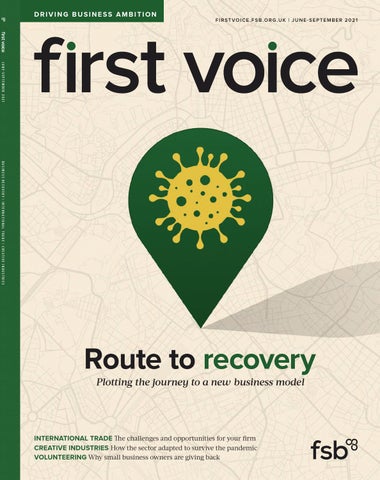
DRIVING BUSINESS AMBITION F I R S T V O I C E . F S B . O R G .U K | J U N E - S E P T E M B E R 2 0 2 1
JUNE-SEPTEMBER 2021 BUSINESS RECOVERY | INTERNATIONAL TRADE | CREATIVE INDUSTRIES
Route to recovery Plotting the journey to a new business model
INTERNATIONAL TRADE The challenges and opportunities for your firm CREATIVE INDUSTRIES How the sector adapted to survive the pandemic VOLUNTEERING Why small business owners are giving back
01 COVER_First Voice Jun-Sept 2021_First Voice.indd 1
24/05/2021 12:53
JAGUAR I-PACE
ELECTRIC HAS NEVER LOOKED SO GOOD.
BOOK YOUR EXTENDED TEST DRIVE NOW The Jaguar I-PACE excites the eyes from every angle. And as an all-electric vehicle it looks just as good on paper as it does on the road. With zero tailpipe emissions and an electric range up to 292 miles** on a single battery charge, it delivers significantly reduced running costs and notable financial incentives, including 1% Benefit In Kind tax^ and 100% Write Down Allowance.† And now it’s time to discover what I-PACE feels like, with an extended test drive. Experience instant torque, which launches you from 0-60mph in just 4.5 seconds. And enjoy sports car handling and agility, for which Jaguar is renowned. For more information, search I-PACE extended test drive. #JAGUARELECTRIFIES Fuel Consumption: N/A. CO 2 Emissions: 0 (g/km). EV Range: Up to 292 miles. **The figures provided are as a result of official manufacturer’s tests in accordance with EU legislation with a fully charged battery. For comparison purposes only. Real world figures may differ. Energy consumption and range figures may vary according to factors such as driving styles, environmental conditions, load, wheel fitment, accessories fitted, actual route and battery condition. Range figures are based upon production vehicle over a standardised route. *Important Information. Model shown is a 21MY I-PACE EV400 SE Auto AWD with optional features. 21MY I-PACE includes 3D surround camera as standard. ^Benefit In Kind tax rates for 2021-22 financial year. †100% Write Down Allowance assumption correct for 2021-22 financial year.
FV.JuneSept21.002.indd 2
17/05/2021 12:26
JUNE-SEPTEMBER 2021
inside 46 My journey Nicky Rudd discusses starting a business during a recession
48 Ask the experts ICO registration, rent struggles and cancelled trade shows
06 heads up 6
9
member spotlight 49 Member news Campsite’s eco credentials pay off; taking pets to the vet’s; the firm making art accessible
Need to know FSB Board appointments; pandemic boosts risk of cyber crime; electric vehicle investment rockets
52 FSB Awards
Data centre
54 Member services
Small business confidence rises as restrictions ease
All the winners from the FSB Celebrating Small Business Awards 2020
Supporting employees with long Covid; Rosse Systems on FSB membership benefits
10 Opinionated Jolyon Bennett on the business case for going green, Eva Hamilton on hiring ex-offenders, and Martin McTague on the road ahead, post-pandemic
advice 38 How to ...Manage your bank manager
40 Legal Understanding the statutory flexible working scheme
31 features 14 Route to recovery Penelope Rance reports on what it will take for businesses to bounce back after the Covid-19 crisis
18 Business recovery Small firms need to be mindful of how things have changed as they get back to business, says Jo Faragher
57 My business Sasha Fenton talks carving out her own niche in publishing
22 Big picture French fishermen blockade Jersey port
24 International trade
38
With the UK out of the EU, many small business are having to rethink their operations and seek new opportunities
31 Creative industries Rob Gray takes a look at how firms in the creative sector have successfully weathered the pandemic’s storm
34 Deep dive SMEs’ community impact
first steps 43 Social media Choosing the right platform is essential for success firstvoice.fsb.org.uk
03-04 Contents_First Voice Jun-Sept 2021_First Voice.indd 3
36 Volunteering David Adams speaks to small business owners about why they help out in their local communities june-september 2021 | firstvoice | 3
24/05/2021 12:54
inside june-september 2021
M I K E C H E R RY O B E , N AT I O N A L C H A I R M A N
first word VER A YEAR SINCE THE START OF F THE pandemic, many small businesses are only now looking to get back to normal trading, or even re-opening for the first timee in more than a year. With restrictions being eased last month, it certainly created more optimism than we have seen for a long time. e. We aren’t there yet, but we are on track with h the economy unlocking, so this edition of First irst Voice explores some of the issues and opportunities rtunities related to that. Many businesses have turned their online presence on its head during the past year and a half, but knowing where to start is often the most daunting process, which is why we look at how some small firms have used social media to transform their businesses. Small businesses will be at the heart of the recovery and while many that export and import goods and services are finding difficult short-term challenges when dealing with EU suppliers and customers, as well as trading between the UK mainland and Northern Ireland, FSB continues to put your views forward on the problems being faced. There is a long way to go, and many firms need additional support, but there are green shoots as we slowly exit from restrictions – so while caution is necessary, there can be room for greater optimism and opportunity for small businesses as we enter the summer months. Finally, with the environment one of the most pressing matters of our time, you may have noticed that First Voice is now plastic-free. The new paper wrapping is recyclable in all parts of the UK and is made from a 100 per cent sustainable, ethical source, minimising environmental impact. It’s a reminder that we must all play our part in preserving the environment for the next generation.
O
62 tech bits 58 New kit and apps The best new gadgets and apps for small businesses
60 Digital voice Our pick of First Voice’s online and social media content
out of office 62 I could try... ...Stand-up paddle boarding
64 Downtime How to hold a virtual film night for employees
last word 66 Guy Browning Endless growth isn’t always what a small business needs
Publisher: Aaron Nicholls Editor: Nick Martindale Email: firstvoice@redactive.co.uk Lead designer: David Twardawa Picture researcher: Claire Echavarry Sub-editor: Kate Bennett Production: Aysha Miah-Edwards Email: aysha.miah@redactive.co.uk Advertising: Lynne Murray Email: lynne.murray@redactive.co.uk Tel: 020 7324 2726 First Voice is published on behalf of the Federation of Small Businesses (FSB) by Redactive Publishing Ltd (Tel: 020 7880 6200) firstvoice.co.uk | redactive.co.uk
Printed by Warners
4 | firstvoice | june-september 2021
03-04 Contents_First Voice Jun-Sept 2021_First Voice.indd 4
This edition of First Voice went to press on 21 May. All information is correct as of that point.
FSB publications manager: James Connor Email: james.connor@fsb.org.uk Tel: 07595 284088
fsb.org.uk While every care has been taken in the compilation of this magazine, errors or omissions are not the responsibility of the publishers or of the editorial staff. Opinions expressed are not necessarily those of the publishers or editorial staff. All rights reserved. Unless specifically stated, goods or services mentioned are not formally endorsed by FSB, which does not guarantee or endorse or accept any liability for any goods and/or services featured in this publication. ISSN 2399-5467 Copyright: FSB Publications Ltd
This paper envelope, and the copy of First Voice magazine inside, are 100% recyclable.
First Voice is available on subscription at £42 per annum. For details, contact james.connor@fsb.org.uk First Voice has an audited net average circulation of 122,603 (Jul 2019 to Jun 2020).
AccessAbility help. If you require this document in an alternative format, please ring 01253 336036 or email: AccessAbility@fsb.org.uk HONOURS Best Digital Magazine – Memcom Membership Excellence Awards 2019 Best Association Magazine – Association Excellence Awards 2018
firstvoice.fsb.org.uk
24/05/2021 12:55
:KHQ LW FRPHV WR ¿ QGLQJ FRPSHWHQW ¿ UH VDIHW\ VHUYLFH SURYLGHUV IRU \RXU EXLOGLQJ
, y f i c e p s t s u j t ’ n Do
verify!
WKHLU 7KLUG
3DUW\ &HU
WL¿ FDWLRQ
0DMRU ¿ UHV DUH KLJKOLJKWLQJ WKH QHHG WR HQVXUH WKH ULVN IURP ¿ UH LV UHGXFHG DQG PDQDJHG LQ WKH EHVW ZD\ SRVVLEOH :KHQ VRXUFLQJ KHOS PDNH VXUH \RX VSHFLI\ FRPSHWHQW ¿ UH VDIHW\ SURYLGHUV and YHULI\ WKHLU 7KLUG 3DUW\ &HUWL¿ FDWLRQ LV DSSURSULDWH DQG YDOLG IRU WKH ZRUN UHTXLUHG $OO %$)( 5HJLVWHUHG &RPSDQLHV DUH 7KLUG 3DUW\ &HUWL¿ FDWHG YLD 8.$6 $FFUHGLWHG &HUWL¿ FDWLRQ %RGLHV LQ RQH RU PRUH VSHFL¿ F DUHDV RI ¿ UH VDIHW\
8VH WKH %$)( )LUH 6DIHW\ 5HJLVWHU WR HLWKHU VHDUFK RU YHULI\ D SURYLGHUV VSHFL¿ F 7KLUG 3DUW\ &HUWL¿ FDWLRQ
ZZZ EDIH RUJ XN British Approvals for Fire Excellence
FV.JuneSept21.005.indd 2
17/05/2021 12:27
8 THINGS YOU NEED TO KNOW
heads up BOARD
1
Three entrepreneurs join the FSB board
years have been a challenging SB HAS MADE THREE period for small businesses across new appointments to the UK, and in my volunteer role its board of directors. I have been privileged to be in a IT, cybersecurity and digital position to make the small transformation specialist Olu business voice heard loudly and Odeniyi and information clearly as Brexit happened and management entrepreneur then Covid-19 struck. I’m thrilled Alison North are joining as to take up a UK-wide role.” directors, while recruitment Mr Odeniyi, an FSB volunteer and employment services in Thames Valley, said: “I am entrepreneur Tina McKenzie passionate about helping other is taking up the new role of businesses to achieve deputy chair, policy and their ambitions. I have advocacy (UK). All three long been involved in are experienced member projects and volunteer volunteers at FSB. roles to achieve positive FSB National Chairman change and relish the Mike Cherry said: “Our opportunity to continue volunteers, alongside a this work at a UK level.” dedicated staff team, Ms North, who has work hard to support previously served as entrepreneurs right FSB’s area lead for across the country and in Swindon and Wiltshire, every sector, and to give said: “Having been in small businesses the big business for 35 years, I’m voice they deserve. Tina, dedicated to bringing Olu and Alison bring a my knowledge and wealth of experience and experience to listen enthusiasm.” to members and Ms McKenzie, who was understand their needs chair of FSB’s Northern on a practical basis today, Ireland Policy Unit for Top to bottom: Tina and as a future-thinking more than three years, McKenzie, Alison North and Olu Odeniyi basis for tomorrow.” said: “The last couple of
F
6 | firstvoice | june-september 2021
06-09 Heads up - News_First Voice Jun-Sept 2021_First Voice.indd 6
WEBINARS
2
Free live webinar training FSB is partnering with Google Digital Garage to provide free live webinar training for members. There are three webinars planned over the next few months. These are:
Digital marketing strategy (5 July) The role digital marketing plays in a business Different digital marketing channels to find and engage with customers A template for building a digital marketing strategy
Social media strategy (5 August) How social media can help you reach new customers online The building blocks of a simple social media strategy Tools that can help you save time when creating social posts
Get started with analytics (7 September) The ways that data analytics can help your business strategy Which tools can help you understand your audience How to get started with Google Analytics Visit fsb.org.uk/event-calendar.html for more information firstvoice.fsb.org.uk
24/05/2021 12:56
heads up need to know
PA R L I A M E N T
3
Normal service resumes in Scotland and Wales OW THAT THE DUST HAS SETTLED AFTER the parliamentary elections in Scotland and Wales, work is well underway to put small business recovery at the top of both new governments’ agendas. FSB in Scotland is pushing ministers to deliver a fairer deal for the self-employed, legislation to set binding targets for the share of public contracts won by local firms and action to keep overheads down. Meanwhile, in Wales, FSB is putting forward practical measures to secure the future of small business support, help businesses realise growth ambitions and revitalise high streets.
N
CYBER CRIME
Two in five firms hit by cyber crime
firstvoice.fsb.org.uk
06-09 Heads up - News_First Voice Jun-Sept 2021_First Voice.indd 7
HMRC pledges harsh fines for abuse of SEISS HMRC has confirmed the penalty regime with harsh fines for abuse of the Self Employment Income Support Scheme (SEISS). An overclaimed SEISS grant includes any amount paid which the self-employed person was not entitled to receive or payments of more than the amount HMRC said the applicant was entitled to when the claim was made. Overpayments must be notified to HMRC within 90 days of receipt of an SEISS grant. Penalties can be charged up to 100 per cent on the amount of SEISS grant overpaid, but there is a fairly long period for repayment, so as long as overpayments are settled by the end of January 2022, fines will not be enforced. When deciding the amount of any penalty, HMRC will take account whether the taxpayer knew they were entitled to the SEISS grant when they received it, and when it became repayable or chargeable to tax because the individual’s circumstances changed. HMRC is also warning taxpayers to be careful when making SEISS claims as there are a number of scams circulating, with fraudsters using emails and text messages to try to dupe the self-employed into making spurious claims. It is important not to click any links before checking the veracity of the message. Any phishing emails or texts should be notified to HMRC.
5
4
OUR IN 10 FIRMS (39 PER CENT) AND A QUARTER OF CHARITIES (26 per cent) report having suffered from cyber security breaches or attacks in the past 12 months, according to the Department for Digital, Culture, Media and Sport. The Cyber Security Breaches Survey 2021 report also shows the pandemic has heightened cyber risk, making securing digital environments harder as resources are diverted to facilitating home working. The Government is now encouraging businesses, charities and educational institutions to follow the free guidance from the UK cyber security experts at the National Cyber Security Centre. It includes advice on secure videoconferencing, secure home working and how to move your business from physical to digital.
F
WEBINARS
june-september 2021 | firstvoice | 7
24/05/2021 12:56
6
heads up need to know
ELECTRIC
POLITICS
Businesses turn to electric vehicles
K BUSINESSES ARE SET to invest £15.8 billion on vehicle fleet electrification over the next year – a 50 per cent increase on the previous 12 months. The research, commissioned by Centrica Business Solutions, revealed that UK firms spent £10.5 billion on electric vehicles (EVs) and on-site charging during the year to March 2021 with 40 per cent increasing the number of EVs they operate. But 43 per cent haven’t increased EV numbers, and 10 per cent have decreased. Range anxiety was the chief concern for 34 per cent, followed by the need to reprioritise investment during the coronavirus crisis (32 per cent). Two-thirds (67 per cent) of companies are prepared to operate an electric fleet by 2030, when the petrol and diesel vehicles sales ban comes into effect.
Scottish sh h leaders plan for life after politics
U
7
Sole traders happy with their lot satisfaction (29 per cent) and creative freedom (25 per cent). Half believe it’s more ethical to stay small, while 51 per cent say they feel more supported by customers because of their size. The research found the top motivations for going solo are being your own boss (54 per cent), having a career that suits your lifestyle (40 per cent) and being able to create something of your own (31 per cent).
MOST POPULAR BENEFITS OF BEING A SOLE TRADER
63%
49%
29%
25%
Flexible working
Independence
Job satisfaction
Creative freedom
8 | firstvoice | june-september 2021
06-09 Heads up - News_First Voice Jun-Sept 2021_First Voice.indd 8
COTLAND’S political leaders revealed their alternative career choices in interviews with FSB ahead of the May elections. Willie Rennie, Douglas Ross, Anas Sarwar, Lorna Slater and Nicola Sturgeon were asked to reveal which sort of business they would like to start in a life after politics. Douglas Ross said he’d like to supply baked goods such as scones to the hospitality industry, Anas Sarwar suggested he’d like to establish an international political campaign group, and Willie Rennie said he’d like to open a corner shop or environmental charity. Bibliophile Nicola Sturgeon said she’d like to establish a bookshop, while Lorna Slater said she already had a plan to set up an aerial training venue for circus arts. FSB’s Scotland policy chair Andrew McRae said: “If any of our political leaders do decide to go into, or back into, business after they’ve hung up their rosette for the last time, we’d be pleased to welcome them as members of FSB and support them.”
S
TRADERS
More than two-thirds (70 per cent) of sole traders in the UK enjoy being small and don’t aspire to grow in future. Research by Xero finds 62 per cent believe the benefits of being a sole trader far outweigh those of being a larger business. When asked about the benefits of being a sole trader, the most popular responses were flexible working (63 per cent), independence (49 per cent), job
8
firstvoice.fsb.org.uk
24/05/2021 12:56
heads up in-depth
data centre
SMALL BUSINESS CONFIDENCE BY REGION
+19
Most confident
CONFIDENCE
Least confident
Small businesses feeling confident again
+12
+39 +32
three months, the highest proportion since the summer of 2015. Only 24 per cent expect sales to fall; that figure was 84 per cent at this time last year. The majority (53 per cent) aspire to grow in the next year, the highest share since Q3 2019 and a 22-percentage point jump on the same period last year. But with the job retention scheme winding down soon, 14 per cent of small firms with staff say they are likely to make redundancies this quarter.
According to the latest FSB study of almost 1,700 business owners, 58 per cent of small businesses expect their performance to improve this quarter, and 31 per cent expect it to worsen. With restrictions easing in England and Wales, FSB’s Small Business Index rose to +27.3 in Q1, up from -49.3 last quarter. This is its highest since Q3 2014, and it is positive for the first time since Q2 2018. More than half (51 per cent) expect revenues to increase in the coming
SMALL BUSINESS CONFIDENCE BY SECTOR
+50 +39
+38
+34 +14
+39
+20
SMALL BUSINESS INDEX SNAPSHOT 50
Arts, entertainment & recreation
+7
Information & communication
+27.3 25
+10
Accommodation & food service activities
0
+15
-5 +24
Retail
-25
Construction
-32.6
+36
-50
-49.3
+37
Manufacturing
-75 0
5
10
15
20
25
30
35
40
Q2 2020
Q3 2020
Q4 2020
Q1 2021
Q U I C K F I R E S TAT S
54% The proportion of SMEs that will borrow money to survive in 2021, with over half (54 per cent) of these planning on applying for a loan through the Recovery Loan Scheme, research by Purbeck Personal Guarantee Insurance finds
firstvoice.fsb.org.uk
06-09 Heads up - News_First Voice Jun-Sept 2021_First Voice.indd 9
63%
68%
The amount of small business owners who expect the vaccination programme to boost profits. Almost half (44 per cent) believe they will rise by 10 per cent or more, AI forecasting tool giniPredict claims
The proportion of small business leaders who have seen an increase in mental health issues among staff since the start of the pandemic. A quarter (25 per cent) have not implemented any measures to help employees, the study by HR tech company Breathe finds
june-september 2021 | firstvoice | 9
24/05/2021 12:57
heads up sustainability
J O LY O N B E N N E T T
Every little helps As small business owners, we have a duty to rreduce the damage we do to our pla planet. But there’s also a strong business cas case for those who can make a difference
T 12 YEARS OLD I DID MY first deal, negotiating to sell my parents’ car for more than the asking price in the hope of keeping the extra. It didn’t work out, but I knew from then on that I loved doing a deal. After that, I managed a group of friends to put lids on wheelie bins and negotiated to pay them less than me. I learned that if you get more money than you are paying out, you make a profit. In the late 1990s I got my first break working in the mobile telecoms industry, which was booming at the time. I learned everything, good and bad, from the entrepreneurs driving that business – but I wanted to run and own my own business. What makes me happy is being in charge of my own destiny. That’s why I was compelled to start Juice (previously Gusto Telecoms) in 2012. My aim was to supply high-quality electronics accessories to the tech-savvy generation, and the team has developed a growing range of products to protect, charge and complement mobile devices. But we have also removed single-use plastic from our packaging.
A
10 | firstvoice | june-september 2021
10-11 Heads-up - Opinion_First Voice Jun-Sept 2021_First Voice.indd 10
We only have one planet, and businesses need to think about busin how they can look after it. I knew that if i we made our packaging or recyclable, people would rec recycled because people want to do the right buy b uy becaus b thing. army of consumers are making thing. An ar buying based on organisations’ buying decisions decis impacts impac and attitudes. They are increasingly looking ‘behind’ the brand increa to to see see what you stand for. SMEs carry out the vast majority of business in the UK economy, so we all need to limit the impact of our business practices on the planet. The misconception is that you need to make
The misconception is that you need to make massive changes and haemorrhage money massive changes and haemorrhage money – but just starting with tiny changes can make a difference. There are so many resources out there to enable people to make positive impacts through the way they manufacture or recycle. Even putting a paper recycling bin in the office is a start. Look at where your biggest impact is and how you can make a change: if it is your electricity usage,
for example, find a way to switch to a renewable energy source. At Juice, we addressed our packaging, as this is what we produce the most of. Sustainable manufacturing should be focused on removing single-use plastic and making packaging out of recycled or recyclable materials. I’d like to see all products being made from organic, biodegradable materials and for factories to use clean energy to support the manufacturing process. We have a long way to go, but we’ve made a start. Contrary to popular belief, I think we should be using plastic as an alternative material to almost anything – but it needs to be recycled, post-consumer waste and recyclable. There are more than 300 billion tonnes of plastic on Earth, and it’s going to be around for up to 3,000 years – so let’s use science to find ways to reuse this mountain of plastic, and let’s be inventive. There are already roads and cycle paths made from recycled glass and plastic; there is so much more we can do. I have no desire to be seen as a role model or ‘eco-warrior’ – just someone who does the right thing. I don’t believe my businesses has eco credentials or eco beliefs; it’s just about doing things the right way. My belief in minimising our impact on the planet doesn’t detract from my desire to be successful. JOLYON BENNETT is CEO and founder of Juice Mobile Phone Accessories. Views expressed are those of the author and not necessarily those of FSB. firstvoice.fsb.org.uk
24/05/2021 12:57
heads up ex-offenders
HE PANDEMIC HAS BEEN WITH us for more than a year, and the world has shifted its diversity and inclusion lens. We have become more empathetic and socially minded – two characteristics that have helped bring communities together in these uncertain times. Covid-19 has brought elevated community awareness, a drive to create social change, and a greater willingness to unlock prejudice. Rehabilitation of offenders is emerging as a prominent platform for discussion. Organisations such as Key4Life, which supports young men who are in prison or at risk of going to prison, can play a vital role in helping rebuild the lives of ex-offenders. By partnering with corporates and small businesses, they hey guide ex-offenders through employment yment programmes, help them earn incomes mes and integrate them back into society. ty. Reoffending costs the UK government ment £18.1 billion a year (Newton et al., 2019). 019). A Key4Life participant is four times more likely to be employed a year after release lease than their peers. Only 16 per cent off those who have completed our programmes mes reoffend, compared to the national reoffending rate of 64 per cent one-year year post-release. This is encouraging. Research shows that 50 per cent of corporate Britain would not hire an ex-offender (YouGov/DWP, 2016). However, employing ex-offenders iss an opportunity to do right for the locall community, and to drive change by dispelling stereotypes and prejudice. e. Businesses benefit by extending g opportunities to a broader candidate date pool, which allows them to address ess skills shortages and ensure talent isn’t left untapped. Employing ex-offenders can bring new perspectives to the workplace and provide an opportunity to do something meaningful by offering a second chance. Many organisations that take on ex-offenders experience failed hires, which results in a financial loss and means they must recruit at least twice for one appointment. Organisations such
Illustrations: Sam Kerr
T
firstvoice.fsb.org.uk
10-11 Heads-up - Opinion_First Voice Jun-Sept 2021_First Voice.indd 11
as Key4Life can advise companies on how to responsibly access talent. The Key4Life employability programme has placed more than 300 graduates in work placements and jobs across small and large businesses. These young men, who have come from backgrounds of poverty and crime, have transformed their lives by applying for and securing jobs, and by being given the opportunity to build trust in others. The social acceptance and ability to integrate that comes from having a regular income and renewed purpose is a lifeline for them. Due to Covid-19, there are currently fewer fewer vacancies available, which means
We would welcome and encourage any small business that could open its doors to ex-offenders fewer placement opportunities for ex-offenders. We would welcome and encourage any small business that could open its doors to ex-offenders and support th these programmes. Key4Life can provide gu guidance for new business partners, p providing a framework and toolkit to enable them to responsibly e attract, rec recruit and retain candidates with a criminal record. The charity crim screens the young men and works with them intensively before they join a inten company, and a provides ongoing support to them on once employed. Having a job is the critical success factor for men m with an offending background. Without that income and backgrou sense o of purpose, reoffending will remain a high cost for the UK. It is extraordinary to see graduates from extra rehabilitation programmes attain reha impressive corporate roles or run imp their the own businesses because someone cared enough, for long som enough, to change their lives. en EVA HAMILTON MBE is the founder and CEO of crime prevention charity Key4Life. Views expressed are those of the author and not necessarily those of FSB.
E V A H A M I LT O N
Positive impact Taking on ex-offenders isn’t just about giving someone a second chance at life; it can also provide small firms with a valuable source of committed skills june-september 2021 | firstvoice | 11
24/05/2021 12:58
heads up back to business
M A R T I N M cTAG U E
New reality As Covid-19 restrictions ease, small firms can be hopeful there are better times to come. But there should be no doubting that many challenges lie ahead
ITTING UNDER A PARASOL IN a beer garden, supping a pint of craft ale, the sun shining, Dua Lipa playing on the pub’s sound system, I reflected on how much we used to take simple things like this for granted. If the pandemic has taught us anything, it’s to expect the unexpected – not to assume that circumstances that exist today will be the same tomorrow. But seeing the beer garden busy, trays of drinks being delivered to tables, I felt a sense of optimism that better times are ahead. For all the devastation and heartbreak that the past 15 months have brought, and the enormous challenges for so many businesses, some good has come out of it for the future. Countless small businesses have demonstrated how innovative and nimble they can be, even in the face of the most extreme of situations. Many have adapted with new ways of working, new ways of reaching customers, and new products and services, many of which will endure. But, at the risk of seeing my pint glass half-empty rather than half-full, we shouldn’t be lulled into a false sense of
S
12 | firstvoice | june-september 2021
12 - Heads up - Opinion_First Voice Jun-Sept 2021_First Voice.indd 12
security. While the sun may shine today, there are clouds on the horizon tomorrow – or at least as the summer wears on. Government support schemes that have helped millions of small firms and self-employed people through the worst are coming to an end; business rates bills will be coming through the letterbox again; emergency loans will need to be repaid. And while the reopening of the economy is well under way, businesses in so many sectors have had their reserves wiped out in their fight for survival. There are also those who were
If the pandemic has taught us anything, it’s to expect the unexpected left out of business support schemes, such as company directors, who embark upon the rebuilding process with their finances at rock bottom. There is still a long road ahead, and it is vital that further obstacles aren’t put in the way of those trying to get their businesses back to a state of good health. The banks need to take a supportive approach to those seeking finance for growth, and the examples we’ve seen of some banks downgrading the
creditworthiness of those who took out emergency government-backed loans need to be called out. Many have recently seen their insurance premiums hiked, at a time when they can least afford it. Some have been struggling to get insurance renewals at all. The underlying cause is a hardening of the insurance market, but we can’t have a situation where small firms that have managed to battle through Covid-19 are scuppered at the last minute by a shortage of affordable insurance. The insurance industry needs to address this urgently. Small businesses themselves will need to continue being innovative, too. When it comes to ways of paying off debts, less conventional options might need to be considered, such as employee ownership. While employee ownership has many potential benefits that go way beyond a means of servicing debt, such as higher productivity and staff retention, I suspect it will be an option more business owners consider as a means of recovery. The Dua Lipa song that was accompanying my pint was ‘New Rules’. After all the lockdown restrictions, it struck me that its title had a new meaning. We can only hope that there isn’t a need for new Covid-19 rules in the coming months – but even if this is the case, the small business recovery will take time and need support. MARTIN MCTAGUE is National Vice Chair, Policy & Advocacy, FSB. All information is accurate as of 21 May 2021. firstvoice.fsb.org.uk
24/05/2021 12:59
YO U G O TH E DISTANCE F OR YOU R B USINESS. S O DO WE. Every business is on a journey. Whether you’re expanding your clientele or hiring new employees, Dell Technologies Advisors are here to help with the right tech solutions. So you can stop at nothing for your customers. Contact a Dell Technologies Advisor at 0800 085 4878 or Dell.co.uk/advisor
Intel® Evo™ platform
FV.JuneSept21.013.indd 2
17/05/2021 12:28
feature route to recovery
FACING THE
FUTURE For many small businesses, the world may never return to how things were before the pandemic hit. But taking steps now to adjust to the new reality will give your business the best chance of success. Penelope Rance explains
14 | firstvoice | june-september 2021
14-16 Features - Business Recovery_First Voice Jun-Sept 2021_First Voice.indd 14
firstvoice.fsb.org.uk
24/05/2021 13:00
IN ASSOCIATION WITH
M
ANY SMALL FIRMS are optimistic that this summer will see a return to businessas-almost-usual, but there is no denying the coronavirus pandemic will have a lasting impact. Small enterprises may have to reposition, streamline operations, change staffing models, upgrade technology or move into new sectors. “The companies that have surpassed expectations are those that have been open to change from day one,” says Mathew Gillies, director at Cowan & Partners chartered accountants. “Taking change by the horns and capitalising on opportunities is the best way for a business to thrive post-pandemic.” After a prolonged period of upheaval, one step on the road to recovery is a review of existing operations, ensuring your business is set up to face future challenges. Lessons learned could feed into increased efficiencies, a stronger workforce and more innovative thinking. “Develop a mindset of continuous improvement,” advises Anthony Impey, CEO of Be the Business. “Take a moment to reflect on changes you made or processes you implemented that enabled you to be adaptive, responsive and
How to build-back better
1 innovative in a time of crisis, and decide which actions can be mainstreamed into your business model.” Consulting an outside expert could help you identify efficiencies. “If you find the right advisor and lean on them, it frees up time to plan, strategise and grow your business – all steps that will ensure a successful recovery from the effects of Covid-19,” says Mr Gillies. The hospitality industry was hard hit by lockdown, but the downtime was an opportunity to make improvements, says Andy Banner-Price, co-owner of The 25 boutique B&B in Torquay. “We’ve used our time effectively, with updates to the website, the breakfast room has had a complete makeover, and several rooms have been painted.” They kept customers engaged with newsletters and social media posts, and are almost 80 per cent booked for the summer. While many small businesses have prioritised protecting jobs, a survey by financial platform Tide revealed that a fifth expected to make redundancies when the furlough scheme ends in September. With another 21 per cent unsure if they can support pre-Covid-19 numbers, owners need to be realistic about their staffing requirements.
Technical requirements One pandemic outcome has been small businesses’ embrace of flexible working, which broadens the skillset available to firms whose staff can work remotely. “Small businesses tend to employ locally. But should we be looking at the whole of the UK?” asks Charlie Bristol-McClean, director of PlanB Consulting. firstvoice.fsb.org.uk
14-16 Features - Business Recovery_First Voice Jun-Sept 2021_First Voice.indd 15
BE OPEN TO OPPORTUNITIES: Build an online presence, upskill or forge new business streams with existing skills. Don’t be afraid to try something new
2
GET A FRESH PERSPECTIVE Seek out people who have faced challenges similar to yours or can take a step back and ask pertinent questions
3
EMBRACE FINANCIAL SUPPORT Keep up to date with the assistance measures available from your national government
4
EMPLOY THE RIGHT TECHNOLOGY IT is an investment that pays for itself by helping control costs, manage resources and create new revenue streams
5
TAKE TIME TO WORK ON YOUR BUSINESS Focus on building the right processes and empower your employees to take ownership of their work so you have the time to think strategically
6
CONTROL CASH FLOW Cut back your overheads and ensure that every penny is spent in a manner that will benefit your business
june-september 2021 | firstvoice | 15
24/05/2021 13:00
feature
IN ASSOCIATION WITH
business recovery
It’s vital to have the right technology in place for remote working, but this isn’t the only driver for upgrading your setup. Research from Lloyds Banking Group and Be the Business found more than 1.5 million businesses ventured online for the first time during the pandemic. “When we think about tech adoption, we often see it in the context of innovation, delivering a new type of service or gaining a competitive advantage,” says Mr Impey. “But it is also crucial to building business resilience and dealing with continued uncertainty.” The right technology will put you in a stronger position in a world where more consumers are accustomed to online shopping and remote working. The Red Sock Launderette and Cleaning Service in Grantown-on-Spey, which services locals and visitors to the Cairngorms National Park, is an example of a firm using technology to bounce back. “We are looking at more efficient use of IT to streamline processes from scheduling to invoicing, staff timesheets and pay,” says director Rebecca Reid. “I’ve been communicating with Business Gateway and social enterprise Interface to move forward with these plans.” Overwhelmingly, says Mr Gillies, businesses are realising that the traditional way of doing things will change. “Technology means being able to reach clients all over the world at the click of a button,” he says. “We advise all our SMEs to look at ways to improve efficiencies, rely on technology and streamline operations.” Help to digitise is one element of the government support designed to help small business recovery, with the Budget including a £5,000 Help to Grow grant for digital training and management. The Recovery Loan Scheme replaced other government financial support, while the Self-Employment Income Support Scheme was widened, with an extra 600,000 able to claim direct cash grants. In England, the Restart Grant offers funding for non-essential retail, leisure and hospitality businesses.
Switching focus Former photographer Ceri Jennings founded Barry-based Sparkles Cleaning Services Wales & West in 2003 after taking on casual cleaning work during a career break. The company now employs 30 people. The first lockdown caused a significant shift. “Our commercial contracts were essential services, but domestic cleaning was suspended. We had working staff, furloughed staff, and staff who were shielding – every situation possible!” Sparkles kept trading by expanding into construction industry cleaning. “We purchased site-approved, five-point PPE for construction cleaners and hoovers to meet site requirements,” says Ms Jennings. “We asked staff to redeploy to support colleagues on the commercial side. For construction cleaning, they needed specific qualifications, and as soon as training centres opened they were ready and willing to upskill. We’ve worked together to safeguard jobs and I’m massively proud of what we’ve achieved.” The pandemic provided Sparkles and its employees with new opportunities. “One of our aims is to help people who’ve found it hard to get sustainable employment,” she adds. “Cleaning was overlooked in the past – maybe it will be valued more now. The future looks good: we’ve learned a lot and are ready to expand.”
Finding funding Business owners should consider taking advantage of the low-interest financial support currently available. “Some small businesses don’t borrow because they don’t want to be in debt,” says Mr McClean-Bristol. “But if you’re likely to have cash flow problems or you’ve got a viable business that might hit hard times, borrow some money. You can always pay it back, but don’t go bankrupt just for the sake of not borrowing.” Additional funding could be used to restructure your business model or pivot into a new sector. “We have a client that runs live events and relied on the wedding industry,” says Mr Gillies. “Now they are retraining, using their workspace to host virtual gigs, leasing out recording space, and even offering music tuition over video calls. Thinking outside the box – and not being afraid to go outside your comfort zone – is the way to pivot into success.” Diversification, adds Mr BristolMcClean, is the foundation of a robust business model. “If you’re running a very niche company, you’re vulnerable,” he says. “Not being too tied to one particular business stream means if you
16 | firstvoice | june-september 2021
14-16 Features - Business Recovery_First Voice Jun-Sept 2021_First Voice.indd 16
suddenly lose that business, you won’t be shut down. Operational resilience means being able to flex to deal with the outside conditions.” In this vein, the Red Sock Launderette is pursuing yearround contracts that are not tourist-dependent, while The 25 B&B is exploring business add-ons. “I spent lockdown writing an online training course for people thinking of running their own B&B, passing on my knowledge so they can create a successful business,” says Mr Banner-Price. “We’re also in negotiations with a third-party supplier to provide picnics and casual dining in the form of grazing boxes that can be enjoyed in your room.” The key is understanding your market, concludes Mr Impey: “One thing successful pivots have in common is that these companies knew what their customers wanted.” PENELOPE RANCE is a freelance business journalist firstvoice.fsb.org.uk
24/05/2021 13:01
advertorial
dell technologies
Tech solutions to support your business journey E very growing business is on a journey – and during the past year you will have encountered unprecedented challenges along the way. The necessity for remote working, higher levels of online sales, video conferencing and increased use of social media have meant the inevitable acceleration of digitisation. Changes to traditional ways of working that mean rethinking the perfect tech set-up to keep your business futureproof. The recent State of Small Business Britain report revealed that around half of SMEs introduced new digital technologies as a priority during the past 12 months, with many adopting systems they had never previously used. Disappointingly, the same research also reports that while there had been investment in digital technologies during the first stages of the pandemic, most SMEs suggested that they would not continue with this approach due to a lack of digital skills. That’s where Dell Technologies can help. By really listening and understanding, Dell Technologies Advisors are with you every step of the way, delivering one-to-one tailored solutions to keep your business on the road to recovery, so you can stop at nothing for your customers.
DELL REWARDS
Join Dell’s free loyalty programme for UK small business customers and benefit from:
Dell Rewards* coupons to redeem against future purchases Exclusive offers Early access to sales and product announcements FIND OUT MORE AND SIGN UP HERE www.dell.co.uk/businessrewards
Investing in your future
Implementing and developing new technology and digital solutions into your business journey inevitably comes at a cost. But don’t let cash flow concerns be a stumbling block. The increase in operational efficiencies, increased sales and impact on innovation activity to influence your business’s growth can far outweigh the investment. To help you fund the tech that will transform your business, Dell Financial Services offers a variety of finance solutions with flexible payment options to suit your budget. Call or chat to a Dell Technologies advisor to discuss your
“Dell Technologies Advisors are with you every step of the way, delivering one-to-one tailored solutions to keep your business on the road to recovery” firstvoice.fsb.org.uk
requirements. www.dell.com/en-uk/ work/shop/dell-small-business/cp/ dell-financial-services-emea
Or for a simple, predictable and worry-free solution, PC as a Service (PCaaS) combines hardware, software, lifecycle services and financing with no up-front costs. Just one fixed price per seat per month.* www.dell.com/en-uk/ work/shop/pc-as-a-service-for-business/ cp/pcaas
With you all the way
As soon as you have selected the ideal level of support for your business needs, you can trust our experts and partners to lead deployments from project management through planning, configuration and integration, setting up PCs with speed and less effort thanks to Dell’s ProDeploy Client suite. www.dell.com/en-uk/work/ shop/help-me-choose/cp/hmcprodeploy-client-suite Then, whether you are on the road or in the office, Dell ProSupport for PCs means in-region engineers are standing by to keep your team up and running 24/7 – giving you peace of mind and expert support designed specifically for growing businesses. www.dell.com/ en-uk/work/shop/help-me-choose/cp/ sbsupportforpcs To discuss your business’s tech requirements, call Dell Technologies Advisors today on 0800 085 4878 or visit www.dell.co.uk/advisor *Terms and conditions apply.
june-september 2021 | firstvoice | 17
feature business recovery
THE
PATH A AHEAD 18 | firstvoice | june-september 2021
18-20 Features - Way Forward_First Voice Jun-Sept 2021_First Voice.indd 18
firstvoice.fsb.org.uk
24/05/2021 13:02
feature business recovery
People need a period to get match-fit again; employers need to consider this in their back-to-work plans
The gradual easing of lockdown measures means many small firms are finally able to get back to business. But it’s a very different world, with many practical considerations to think about. Jo Faragher explains AST SPRING, LIFE TURNED UPSIDE DOWN FOR Scott Souster, who runs bespoke tailoring service Souster & Hicks. “We had a full book of appointments for wedding suits that were cancelled,” he says. “Since then, there have been no events and not a lot of people going into the office. The only people we can make things for are the ones we already have measurements for, as we can’t get close to customers.” Souster & Hicks has reopened since lockdown eased in April, but Mr Souster admits it’s a very different world. “The market has changed, so we’ve refitted the shop to showcase more casual clothes,” he adds. “But there’s the risk we go back into lockdown and we’ve spent this money for nothing.” Many small businesses remain uneasy. The pace of vaccination and reduction in cases has been cause for some confidence, but they know we are not likely to return to the way firstvoice.fsb.org.uk
18-20 Features - Way Forward_First Voice Jun-Sept 2021_First Voice.indd 19
things were before. According to Santander research, only two in five ( 42 per cent) of small businesses have fully continued operations since the outbreak of the pandemic; on average, SMEs have seen their profits slump by 16.5 per cent. Extensions to the Government’s furlough scheme and business loans have helped many to keep going, but the coming months will require practical adjustments in terms of health and safety, as well as preparing everyone mentally to cope with the changes ahead. “Small businesses are still fighting fires daily,” says Chris Biggs, partner at accounting company Theta Global Advisors. “Turnover may be increasing, but there’s still uncertainty. Some might be dealing with questions over whether to return to offices, while others are wondering whether to shift online. If they have no cash reserves, these are high-stakes decisions.” Get it right, however, and the next few months could prove successful for small businesses – Theta’s own research shows that two-thirds of Britons have more trust in small businesses since the pandemic, while 19 per cent of small businesses have managed to win new clients during the past year.
Learning to adapt Roz Chandler, who runs floristry business Field Gate Flowers, took a gamble when the wedding cancellations hit last year. She began offering online courses in wreath-making, and has launched an eight-month business course that trains people to become flower-farmers. “I wanted to show people how to make money from flowers – this helps them with everything from marketing strategy to social media and pricing,” she says. Her wedding work will return this summer and she has set up her courses as a separate business, flexing her workforce with freelance staff. Santander has worked with similar businesses that have pivoted online, according to Head of Business Banking Susan Davies. “These are businesses that adapted to the circumstances and found new ways to keep serving their customers, which they’ll continue even when they can reopen and attend face-to-face events again,” she says. One of the biggest shifts has been the move to home working, and location will be a major consideration for many. John Williams, director of workspace consultancy The Instant Group, predicts workers will “vote with their feet”. The company’s research found that 57 per cent of workers would prefer an office closer to home, with many favouring a hybrid approach june-september 2021 | firstvoice | 19
24/05/2021 13:04
feature business recovery
where they connect with colleagues at the office but do some work at home. There are clear cost savings to be gained from reduced office space, but consult employees first, says Mr Williams. “It is going to be a process of ‘test and learn’ to understand when staff come back, how they use workspace in the future, and what companies have to do to re-engage with them,” he explains. “This process will take anything up to two years to play out, so I would not imagine any hard answers before then.”
Emotional issues The transition back to a physical workplace may create some anxiety. This may be heightened for staff who have been on furlough for an extended period, says Duncan Spencer, Head of Advice and Practice at the Institution of Occupational Safety and Health. “For some, it will feel like taking a new job again,” he says. “Doubts about skill levels, understanding and ability will creep in. If not addressed positively, this will fuel anxiety.” Some may also require some reskilling and patience. “The body may not be as physically able or skilled to perform the tasks as well as before the pandemic,” he points out. “This may exasperate people and give rise to incidents. People need a period to get match-fit again; employers need to consider this in their back-to-work plans.” The best way to deal with anxieties is to keep up lines of communication, he concludes. “Bosses need to be honest that they are feeling this way, too,” he says. “If things are in the open, they can be seen as a collective challenge and everyone can find supportive solutions.” Many businesses have survived the past year by having an open mind and being flexible within the restrictions placed upon them. The next few months might not be a breeze, but there is light at the end of the tunnel. JO FARAGHER is a freelance business journalist 20 | firstvoice | june-september 2021
18-20 Features - Way Forward_First Voice Jun-Sept 2021_First Voice.indd 20
Mapping the way forward “In the space of 24 hours, we lost 95 per cent of our orders. Our customers couldn’t do anything with our stock so had no other option but to cancel,” says Emma Goss-Custard, founder of glutenfree bakery Honeybuns. Its clients were airlines and hospitality businesses, so when the Government grounded planes and announced full lockdown, everything felt like it was in freefall. As soon as she was able, Ms GossCustard placed all of her staff on furlough. The business had managed to free itself of debts, so had a buffer of previous profits on which it could survive. “Within months, two of our wholesalers had gone bust and people we’d worked with for a long time were in tears,” she says. She developed a SWOT (strengths/ weaknesses/opportunities/threats) analysis to work out how to move forward. This identified weaknesses
in Honeybuns’s online presence, which needed investment in digital advertising and search engine optimisation, as well as opportunities in terms of leveraging social media and positioning products for a new audience. Honeybuns now sells cakebuilding sets, collaborates with vegan candlemakers for gifts, and is looking into offering a subscription service. As lockdown eases, the company will begin to work with wholesalers again and has already been asked to send samples to stadia and hospital cafés. Ms Goss-Custard is reassuring employees that safety procedures will be in place and that the working week will be more flexible. The key to success, however, is innovation. “When food service opens up again they’ll want to see what new stuff we have, and if we don’t think about that it will be a problem,” she says.
Reducing the risk As government guidance that employees work from home comes to an end, there is likely to be a review into social distancing and other safety measures, says Hannah Thomas, a solicitor at FSB Legal. “The results of the review will help inform decisions on the timing and circumstances under which rules on 1m+ distancing, face coverings and other measures may be lifted,” she explains, adding that people should continue to work from home where possible until guidance changes. Clinically extremely vulnerable workers who cannot do so should be offered the safest available on-site roles or be offered furlough, which is extended until 30 September. From 6 April, employers with more than 10 staff in England have been able to access free lateral flow Covid-19 tests. Results from these tests are available within 30 minutes
and if an employee tests positive they should self-isolate and seek a confirmatory PCR test. Similar testing facilities are available in Scotland, Wales and Northern Ireland. Around one in 20 people are likely to suffer from ‘long Covid’ after having coronavirus, according to researchers at King’s College London. The condition is still not well understood, but it’s thought there are around 25 symptoms associated, including breathlessness, fatigue and nausea. “Part of the difficulty for employers is that the symptoms come and go; people will feel fine for a few weeks and then have a setback,” says Christine Husbands, Managing Director of FSB Care. “They need to be open-minded, offering flexibility and understanding if people aren’t able to commute or come back to work.” For more on long Covid, see page 54. firstvoice.fsb.org.uk
24/05/2021 13:04
020 3962 8009
FSB INSURANCE SERVICE'S CHECKLIST FOR WELCOMING YOUR CUSTOMERS BACK TO YOUR BUSINESS
Businesses are reopening as part of a gradual process to get ‘back to work’. Many SMEs are pleased, as the financial pressure of closing premises has been significant, but it’s important to ensure that businesses reopen safely and with the appropriate cover in place.
PRACTICAL CONSIDERATIONS ☐ Do your premises need a deep clean prior to reopening? ☐ Is there any debris or evidence of damage that needs fixing? ☐ Are your security systems still in operation? You may need to let your alarm receiving centre know you’re returning ☐ Is your fixed wiring system in good order? Have you had your electrics checked and are the inspection certificates up to date? ☐ Have you checked all your equipment is operating properly? ☐ Has potentially hazardous material been stored correctly? If not, does it need to be disposed of? ☐ You may want to get a pest control contractor in to check the premises for signs of infestation ☐ If you’re a food business, do you have any perishable stock that needs replacing?
HEALTH & SAFETY AND COMPLIANCE ☐ Revise your health and safety policies to include precautions to prevent the spread of coronavirus COVID-19. Note: HSE has released guidance for making your workplace COVID secure ☐ Review your fire risk assessment– is your fire alarm operating correctly? Are your fire extinguishers within date? Will all your fire wardens be on site when you reopen or do you need to reallocate these roles?
☐ If your business involves home visits, will you and your staff be adequately protected when entering customers’ homes? How can you minimise risk of infection? ☐ Any vehicles or high traffic areas should be regularly cleaned using gloves and standard cleaning products, with emphasis on handles and other high-touch surfaces.
INSURANCE CONSIDERATIONS ☐ Check your business insurance is back in place if you downgraded cover during lockdown ☐ Has your business model changed? Make sure your insurance covers any changes to how your business operates (deliveries, etc) ☐ Let your insurer know when you are back on the premises, so that they don’t mistakenly think you’re exceeding any unoccupancy clause in the policy wording In need of insurance advice? Call FSB Insurance Service on 020 3962 8009 Monday - Friday 9am - 5.30pm (excluding Bank Holidays)
REGISTER NOW AT WWW.FSB-INSURANCE-SERVICE.COM/REGISTER FSB Insurance Service Limited is authorised and regulated by the Financial Conduct Authority (FCA Registration No: 788654) Registered Office: 20 Fenchurch Street, London, United Kingdom, EC3M 3AZ. Company Number: 10831430.
FV.JuneSept21.021.indd 2
17/05/2021 15:56
big picture international trade
BIG PICTURE
Photography: AP
Fishing fallout French fishermen blockade the Port of St Helier, Jersey, in May 2021, after a row erupted over moves by the Jersey Government to implement the Trade and Cooperation Agreement following the UK’s departure from the European Union. The fishing industry has found itself at the forefront of friction around the new trading arrangements, with many in the sector hit by tension around border checks and falling prices.
22 | firstvoice | june-september 2021
22-23 Features - Big Pic_First Voice Jun-Sept 2021_First Voice.indd 22
firstvoice.fsb.org.uk
24/05/2021 13:05
firstvoice.fsb.org.uk
22-23 Features - Big Pic_First Voice Jun-Sept 2021_First Voice.indd 23
june-september 2021 | firstvoice | 23
24/05/2021 13:06
feature international trade
NEW
WORLD
ORDER The first six months of the UK’s new trading relationship with the European Union has not been without its challenges. But while many are having to rethink how they operate, there are plenty of opportunities around for small firms looking to engage in international trade
24-26 Features - Trade_First Voice Jun-Sept 2021_First Voice.indd 24
24/05/2021 13:07
feature
Photography: Alamy
international trade
MALL BUSINESSES HAVE been thrust into a new world since Britain left the EU single market and customs union on 1 January. Many have struggled to get to grips with the increased costs, rules, paperwork and delays, particularly concerning the movement of goods across the Northern Ireland border. This is reflected in the fact that UK exports to the EU fell 40.7 per cent in January, while imports were down 28.8 per cent, according to the Office for National Statistics – before rebounding by 46.6 per cent and 7.3 per cent respectively in February. More than half (58 per cent) of UK businesses have reported longer delays at the UK/EU border since 1 January, mainly because of the time it takes at customs to complete new paperwork, research by the Chartered Institute of Procurement and Supply has found. Manufacturing and fishing have been hardest hit. But Brexit will also potentially open up opportunities for SMEs to trade with other markets. What are the main challenges for small businesses in this new environment? How can they navigate these rules and regulations, and take advantage of opportunities?
Coping with change The biggest problem has been uncertainty, says Jack Semple, alliance secretary at the Engineering and Machinery Alliance of trade associations. “The challenges are confusion over the terms on which goods are being supplied, particularly with the Northern Ireland border,” he says. “In terms of the overseas market, there’s also more price volatility in materials and production inputs.” Britain’s departure from the single market and customs union has brought added red tape, says Arne Mielken, founder of Customs Manager. That could cause delays and other problems. “There are two parts to the equation: getting your goods out and then into another market,” he says. “You need to cut through the bureaucracy and paperwork, and make sure you are compliant with the latest regulations.” While the rules and regulations may seem overwhelming, help is at hand. A good starting point is to consult with an international trade adviser from the Government’s Department for International Trade (DIT). Another source of advice on funding, payment and performance bonds is UK Export Finance, the Government’s credit agency. The DIT also provides grants through its Internationalisation Fund to help support export strategy development.
‘Nothing short of a disaster’ Michael Bristow, of Michael’s Bridal Fabrics in Northfleet, has suffered a catalogue of disruptions. The firm, which does most of its business through trade fairs and client meetings in Europe, has encountered problems since 1 January. The first was having packages returned without having left the country. When Mr Bristow asked why they had been sent back, customs told him there was something wrong with
them, without specifying what. “Another time, we sent five substantial packages to a customer in Finland,” he adds. “They were all returned because there were no copies of the invoice with it, despite the fact we attached them on the outside, gave a second copy to the courier and sent an electronic version.” Another consignment to Germany, which would normally take a matter of days, arrived six weeks later. Then, a
delivery the company was expecting from a manufacturer in France was held up because customs said duty had to be paid on it, despite the carriers having been issued with a postponed VAT accounting number, so it was sent back. “The experience has been a disaster,” claims Mr Bristow. “It has caused massive disruption – I don’t know how businesses are supposed to deal with it as well as the problems of Covid-19.”
june-september 2021 | firstvoice | 25
24-26 Features - Trade_First Voice Jun-Sept 2021_First Voice.indd 25
24/05/2021 13:07
feature international trade
Navigating the maze
Businesses can apply to the Government’s £20 million SME Brexit Support Fund for grants of up to £2,000 to help with training and advice on adjusting to the new rules when trading with the EU. Businesses in Scotland can access trade help from Scottish Enterprise at www.prepareforbrexit.scot Trade associations and business support groups such as FSB are also invaluable. They can advise on and answer questions related to specific businesses or sectors, as well as campaigning and lobbying the Government on key issues.
Frequently asked questions Most questions raised about the new rules are around travel, border procedures, customs and VAT, which is why it’s key for companies to learn the Incoterms – the terms of delivery of goods between the buyer and seller. They also cover each party’s roles and responsibilities. It is also essential to understand the rules of origin, which determine where goods come from and how they are treated in terms of customs duty. The Lloyds Bank International Trade Portal is a useful resource on requirements for different markets and opportunities. “Exporters thinking of taking advantage of a new free trade agreement should work with suppliers to understand where inputs came from, assess whether goods meet the rule of origin and obtain proof of this where needed,” says Andrew Rose, associate in Baker McKenzie’s EU, competition and trade practice. “Rules of origin differ between products and trade agreements, so make sure you are looking at the right rules for your supply.” Small businesses starting out need to register and obtain an Economic Operators Registration and Identification (EORI) number from HMRC to move goods between Britain and the EU. It’s also worth considering whether to set up a deferment account for monthly payments for imports. 26 | firstvoice | june-september 2021
24-26 Features - Trade_First Voice Jun-Sept 2021_First Voice.indd 26
Looking further afield Despite all the problems for businesses trying to bring goods into Northern Ireland from Great Britain, Northern Irish firm Burren Balsamics owners Susie Hamilton Stubber and Bob McDonald say they have had no such issues with sending merchandise the other way. The producer of high-end black and white vinegar, based in Richill in County Armagh, has even received four orders in four months from Harrods. “We are quite lucky in that our products go across many sectors,” said Mr McDonald. “We supply airlines, cruise lines, luxury fine-dining restaurants and hotels, farm shops and retail stores.” But now the two owners have set their sights further afield as they seek to take advantage of international trade. “The Far East and the US are well suited to this product,” says Mr McDonald. “Irish food is renowned the world over, so it will always be sought-after.”
Firms need to use the right commodity code on customs declarations to ensure they are paying the right tariff, which can be done in advance by applying to HMRC. In addition, they need to know the domestic value added to their products and be aware of supply chain changes. “You have got to have good communication with suppliers and customers, and with HMRC to confirm you’re completing paperwork correctly,” says Paul Samrah, partner at Moore Kingston Smith. Jane Willis, Quality Director at R W Freight Services, says that firms might want to appoint the prime carrier they use to move the shipment to oversee the whole customs clearance process, including export entry. They will also submit Declaration Unique Consignment Reference numbers for consignments to the shipping line, make Entry Summary Declarations and issue a Certificate of Shipment to the exporter for VAT purposes on your behalf, she says. Companies could appoint a customs manager who understands the rules as they apply to the business and can help navigate. Applying for an Authorised Economic Operator status will also speed up cross-border trade, as can setting up an EU base to avoid customs duty, border clearance paperwork and delays. With trade agreements in place with more than 40 different countries and deals with countries such as the US, Canada, Australia and New Zealand on the way, it is time for firms to develop clear export/import strategies. It’s also an opportunity to take advantage of the weaker pound to sell products overseas. In February the Government applied to join the Comprehensive and Progressive Agreement for Trans-Pacific Partnership – a free trade partnership between 11 countries around the Pacific Rim, worth around 13 per cent of global GDP. Regardless of whether the UK is admitted, opportunities for small businesses trading overseas abound. firstvoice.fsb.org.uk
24/05/2021 13:07
advertorial yay.com
Bridging the gap A
s the shadow of Covid-19 began to obscure the grey late-winter skies of last March, it portended a difficult year ahead for small and medium-sized businesses. Lockdown restrictions saw co-workers cut off from one another in a manner that many businesses found difficult to bridge. For many, the problem of keeping the wheels turning with staff separated was one that had to be solved, at least initially, using personal devices. Office desk phones, dutifully carried from professional to personal premises, were the source of much frustration. Set-up firstvoice.fsb.org.uk
Yay Advertorial_First Voice Jun-Sept 2021_First Voice.indd 27
issues stymied less technical members of staff, who were isolated without technical support to hand and forced to turn to their mobile phones in the meantime. While this was acceptable as a temporary measure, it proved unfit as a permanent solution. There were concerns around privacy and professionalism as staff were forced to hand out personal phone numbers to colleagues, customers and clients in order to keep those wheels turning. ‘Cloud-hosted phone system’ and ‘unified communications platform’ may not have been familiar to small business
owners then, but the need for such a service was there. Businesses needed a communications platform that could be managed from anywhere: one that would allow staff to take and make business calls on any device, professional or personal, without having to worry about privacy or professionalism.
Early solutions Businesses therefore rightly began to explore more permanent solutions, at least for intra-business collaboration. These included Zoom, Google Hangouts and, a clear standout, Microsoft Teams. june-september 2021 | firstvoice | 27
24/05/2021 13:09
advertorial yay.com
Unlike Zoom and Google Hangouts, which are video calling platforms only, Teams offered what seemed to be the perfect solution for many businesses: a platform that would unify all business communications under one roof. Unified communications platforms, as they’re known, offer video conferencing, business instant messaging and voice calling capabilities to your staff. Microsoft Teams stands out by allowing users to use other Microsoft products and services from within the Teams app window, on top of all the above. Outlook emails, Word documents and files stored in OneDrive (Microsoft’s equivalent to Dropbox or iCloud) can be accessed, edited and shared within Teams. From the feedback we’ve received, though, Teams is not without its flaws, and not all early adopters have stayed with the platform. During the past 12 months we’ve talked to hundreds of businesses and found that their biggest grievances with the service have been: (i) price (ii) ease of use (iii) call quality This response is partly due to the fact that, without additional licences, Teams users won’t be able to make calls to other businesses. Depending on which licence you start with, costs can quickly balloon to £22 per user per month – not bad for a high-level phone system, but for small businesses that only need the basics and lack a large budget or the time to spend working out convoluted set-up procedures, this is disappointing.
A way forward The tension between the excellent ‘local’ experience of Microsoft Teams and its underwhelming performance as a phone system for handling calls with customers and other businesses manifested in a kind of communications coquetry. Teams teases users with what is truly possible in a world-class unified communications platform without really delivering; it solves one problem (that of 28 | firstvoice | june-september 2021
Yay Advertorial_First Voice Jun-Sept 2021_First Voice.indd 28
collaboration between departments and members of staff ) while inviting another (an underpowered phone system with costly, restrictive calling plans). Understandably, businesses both large and small longed for a best-of-both-worlds solution. Two ways forward presented themselves: (i) use what’s known as a Teams Direct Routing service to integrate a better, third-party phone system to handle phone calls between businesses, while retaining Teams tools for
“It’s possible to lower costs while presenting as a professional phone number with a local area code, no matter where you’re calling from”
collaborating with colleagues; or (ii), step forward with a different solution built around an intuitive, powerful phone system that wouldn’t let users down. Yay.com bridges the gap by offering both of these solutions. Teams Direct Routing will cost you more no matter what provider you choose, as you’re paying for multiple services where it’s possible to use one. That said, for larger businesses already using Microsoft Teams, this is often the right choice. Smaller businesses, however, might not need paid Microsoft Office apps like Word, or the other advantages of Teams. Free alternatives will do the job, nullifying many of Teams’ key advantages. Smaller businesses paying for Teams and Direct Routing would be paying for services and/ or features they’d never use. Instead, option (ii) is best for such businesses. This means a simple, cost-effective communications platform that can be set up quickly and managed intuitively, offers calling to inside and outside of the business, and has bonuses such as business instant messaging. Crucially, businesses must own their data and conversations, making a service like Yay.com preferable over a free public service such as WhatsApp. Yay.com users can be deleted if necessary, giving ultimate control to the owner of the business and providing a necessary level of professional separation between customers and staff.
Personal devices Despite the mass migration to services like Teams, some smaller businesses will have always used personal devices and listed personal contact details. For such businesses, the low maintenance and costs of using devices and phone numbers you already own are compelling arguments. Alternatively, if your business is mobile and the road your office, you might think it impossible to present as a professional office phone number when you make calls. Fortunately, this couldn’t be further from the truth. It’s possible to lower costs while firstvoice.fsb.org.uk
24/05/2021 13:09
presenting as a professional phone number with a local area code, no matter where you’re calling from. All you need is a data or WiFi connection. For example, an international landline call from the UK to the US would cost 55p per minute with BT. With Yay.com it would cost 1.5p per minute – just 2% of BT’s cost. Furthermore, of the small local businesses we’ve spoken to during the past 18 months, 72% said they would be more likely to use a business if that business had its own website, and the majority of those reported that they would be more likely to use such a business if it listed a local phone number. This indicates that customers appreciate a trustworthy, reliable brand. A small uplift in your professional image can go a long way in persuading your customers that your business is the one to choose. By investing in a professional phone number, branded caller experience and a professional website domain from a service such as Yay.com, small businesses will soon find the extra spend paying for itself.
Scalability Even if privacy isn’t your main concern, as business grows you’ll need to start delegating call handling to staff, which is impossible if all calls are directed to a single personal phone number. VoIP phone systems and unified communications platforms such as Yay.com allow a single phone number to ring through to multiple people, meaning the purchase of a single business phone number could be enough for you to begin scaling. Even if your business doesn’t have dedicated departments yet, you’ll be able to set up your phone as if you do. Customers can call through to your ‘finance’ or ‘sales’ teams, even if they only route to a voicemail for the moment. Sonia Shah of Wembley Central Mutual Aid, a group offering support to those hit hardest by Covid-19, was listing her personal mobile number as the group’s contact number out of necessity. “At the firstvoice.fsb.org.uk
Yay Advertorial_First Voice Jun-Sept 2021_First Voice.indd 29
“For small businesses looking to build or strengthen rapport with a local customer base, a .UK domain confers trustworthiness and reliability” very beginning of all of this we got our leaflets printed out quite quickly and I put my number on it,” she says. “When it got to the point where it was getting a bit crazy and I needed to start delegating to people, that’s where Yay.com came in.” Yay.com was honoured to provide the aid group with business phone services, and our service allowed Sonia and the group to scale and delegate call handling. “Other people ask, ‘what are you using?’ And you just tell them how easy Yay.com is compared to getting another SIM and another phone… If I’d known about this really early on it would have been just so helpful.”
Owning a domain As the survey results indicate, customers are more likely to do business with you if
you have your own website to go with your local phone number. To host a website you need a domain name – something memorable that belongs to your business, allowing would-be customers to search for you online. A domain will also give you an email message box which, like a business phone number, appears more professional wherever your business is listed. For example, if you’re called Pete Peterson, your website ppelectrics.uk can have an email address like sales@ ppelectrics.uk rather than ppelectrics@ gmail.com. This small jump in exclusivity will go a long way in boosting your reputation in the eyes of customers. Small businesses are helped even further if, like a local or ‘geographic’ phone number with an area code that june-september 2021 | firstvoice | 29
24/05/2021 13:09
advertorial
****
**
Calli
ng…
e mut
hold
ad keyp
add
ker spea
call
tran
sfer
yay.com
tran
sfer
call add
ker spea
hold
ad keyp mut e Calli ng… **** **
… ling
Cal
r ake spe key
pad
te
sfer tran
mu
add hol
call
d
local customers will recognise and trust, they choose a top level domain (TLD – the ‘.co.uk’ part of a URL) that will speak to the same homegrown roots that local customers love. Happily, a .UK domain will do just that.
.UK domains For small businesses looking to build or strengthen rapport with a local customer base, a domain ending in .UK confers trustworthiness and reliability. It tells people that yours is a local, homegrown and approachable business. Nominet, operating for 25 years as the official registry for UK
domain names, conducted a Trust and Awareness research survey which found that seven out of 10 people trusted businesses with a professional .UK ending domain over free alternatives. .UK domains are great for smaller businesses because they’re among the best value TLDs available, coming in cheaper than .com, .us and plenty of other popular TLDs without sacrificing reputation. More than 10 million .UK domains have been registered by businesses and individuals, and the level of trust afforded to .UK domains is no accident. This trust has been carefully curated by the 13 reporting agencies (including British law enforcement) that oversee .UK domains. What’s more, Nominet’s Domain Watch actively monitors suspect domains and removes them from the pool of active .UK domains at the point of registration. This is why you’ll rarely be invited to click a .UK link in spam or phishing emails. .UK’s pristine reputation will, by association, bolster trust in your business when you choose one. Furthermore, businesses using a domain ending in .UK get access to free resources and advice from The UK Domain by Nominet (theukdomain.uk) to help them get on their feet and grow in the online marketplace. Nominet itself says: “Through videos, eBooks, infographics, blogs and guides, we aim to inspire and grow digital confidence in businesses throughout their getting online and digital growth journey.” Small businesses can trust that they’ll get the support they need when stepping into online business for the first time.
YAY.COM As an ICANN accredited domain registrar and Accredited Channel Partner with Nominet, business owners and/or individuals can purchase domain names directly from us at Yay.com, as well as our Cloud Telephone System and Teams Direct Routing service. With us, your phone system, business phone numbers and domain names can be acquired, held and managed in one place. .UK domains can be yours starting at £4.65 (+VAT) per year from Yay.com with our promotion that’s running from 1 June–31 November 2021, and you can upgrade to a professional phone system for as little as £3.49 (+VAT) per user per month. If you’re a small business looking for a permanent solution for your business’s internal and external communications, or for more information on .uk domains, visit yay.com/fsb, or contact support@yay.com or call 0330 122 6000
“More than 10 million .UK domains have been registered by businesses and individuals and the level of trust afforded to .UK domains is no accident” 30 | firstvoice | june-september 2021
Yay Advertorial_First Voice Jun-Sept 2021_First Voice.indd 30
firstvoice.fsb.org.uk
24/05/2021 13:10
feature creative industries
REDISCOVERING THE
SPARK The creative sector has been one of the hardest hit by the pandemic. But a combination of adapting offerings to online environments and re-evaluating business models means there is hope for a brighter future, says Rob Gray
C
REATIVE INDUSTRIES WERE among the hardest to be hit by lockdown. With theatres, music venues, cinemas, art galleries and the like shuttered, work dried up and countless businesses struggled. Sadly, some were forced to throw in the towel. For many in creative fields, the Government’s notorious reskilling ad featuring a ballet dancer with the headline ‘Fatima’s next job could be in cyber’ rubbed salt into the wounds. Yet despite the enormous setbacks of the pandemic, many creative businesses have kept going through a mix of determination and innovation. The term ‘creative industries’ is among the most expansive and nebulous found in business. june-september 2021 | firstvoice | 31
31-33 Features - Creative Industries_First Voice Jun-Sept 2021_First Voice.indd 31
24/05/2021 13:11
feature creative industries
It covers the expected sectors such as music, fashion, design, and TV and film, as well as the less obvious, such as publishing, advertising and gaming. As this is a broad church, some have fared better than others during the past year. “We have seen a monumental shift in working practices, as well as expectations of consumer demand, which will have effects in years and maybe decades to come,” says Robert Lucas, FSB Creative Industries Policy Lead. “Adaptation is what the creative industries are built on, but the removal of the core of what they represent – socialisation and getting paid to tell stories – isn’t something that most sectors can hold up to for ever.”
Live issue ‘Pivoting’ is one of the buzzwords of our times, and that has frequently meant a switch from ‘live’ to ‘screen’. But this kind of transformation can have disadvantages. “There’s a danger we will lose the live experience, or that it will be less available to those who can’t afford it,” says Mr Lucas. “A democratic arts is the only way of keeping arts at the heart of our culture. There are a lot of factors to take into account when it comes to gradual recovery of the arts, from venues to performers to funding models, but it has survived before so I’m certain it will recover again – albeit slower than other industries.” The message Mr Lucas would like creatives to hear is that they are a business doing a valuable job, and should be supported as much as an accountant, solicitor or plumber. He would like some kind of financial encouragement for audiences and customers, like the Eat Out To Help Out initiative that benefited the hospitality sector, but is unsure whether there’s political appetite for such a move. David Parrish, a consultant and business coach who specialises in 32 | firstvoice | june-september 2021
31-33 Features - Creative Industries_First Voice Jun-Sept 2021_First Voice.indd 32
Digital theatre Lucy Askew, Chief Executive of the Creation Theatre Company in Oxford, says her firm has had “an embarrassingly good pandemic” on the back of switching to digital shows. “We made our first digital show within three weeks of the first lockdown and haven’t looked back,” she says. “Our digital shows are unique to a lot of the digital theatre that has been produced throughout the pandemic in that they are very much created for the medium. Having a live audience who can be seen and experience a show together is a really key part of that and has been absent from a lot of streamed theatre. It has introduced a new global audience to our work, and opened up new funding opportunities and partnerships.” In all, the firm has produced nine digital shows seen by more than 10,000 people in 22 countries, and has been featured in publications including The Guardian, The Financial Times and The New York
Times. “We’ve employed 63 freelance creatives at a time when the industry was largely closed,” she says. “Despite significant achievements in the last year, it still feels as though we are only at the tip of the iceberg of all the creative possibilities.” The business is in the process of creating its own ‘digital theatre’, supported by Innovate UK funding. “It will mean we can present work outside of Zoom with a platform that replicates the audience experience more closely,” says Ms Askew. “Once we’ve launched that we’d love to use it to help other theatre companies connect with digital audiences. “My advice to others in the sector would be to stay focused on why you do what you do. Throughout this historically challenging time, we’ve been really clear that our purpose was to keep entertaining people and employing freelancers, and an enormous amount of creativity has flowed from that clarity.” firstvoice.fsb.org.uk
24/05/2021 13:11
feature creative industries
creative businesses, created an online video-based course and toolkit during lockdown called ‘RE-Designing Your Creative Business’. He believes that it’s more important than ever for creative entrepreneurs to revisit and fine-tune their strategy. “This is an ideal time for creative businesses to refresh their strategies,” he says. “That means redesigning enterprises around a new business formula that is based on a clear understanding of several fundamental factors. “Firstly, their unique definition of ‘success’, which includes but is not limited to financial success. Secondly, an analysis of competition in the marketplace and identification of their competitive advantage. Then, a laser-like focus on the right customers – i.e. those who want, need and value the products or services in which they have a competitive advantage.”
‘Festival experience at home’ Grimmfest is a Manchester-based horror film festival now in its 13th year. Traditionally, it presents big-screen cinema events with partners such as Odeon Cinemas and Stockport Plaza, but lockdown meant it needed to find new ways to bring movie premieres and bigscreen classics to audiences. In April 2020, it established Grimmfest TV, a platform to host award-winning horror films online. Then, in October, the annual five-day Grimmfest ‘live’ event, normally held at the Odeon Great Northern, Manchester, became an online festival using a new virtual platform from Eventive, with funding from Creative England. The online festival included live
Q&As, allowing fans to interact with film-makers. Grimmfest also set up the Reaper’s Arms, an online ‘pub’ social space on Facebook, to encourage further fan interaction, and this year launched its first Easter festival, again online but with the hope that it will become a live event in 2022. “A lot of people have embraced having a festival experience at home,” says Simeon Halligan, who set up and runs Grimmfest with Rachel Richardson-Jones. “Our plan is to bring back live events, but they will be more hybrid, including online elements, because we’ve learnt there are lots of people who would like to come to a film festival but can’t necessarily attend.”
Photography: Getty
Learning to adapt Dr Jacqueline Jeynes, an author and owner of Pen Coed Publishing, a small-scale non-fiction publisher, says the problem for her during lockdown was the closure of public libraries and bookshops, where the majority of customers would see and buy books. While books are available to buy online, she says there’s a physical quality to books that’s lost when reading a description online. During lockdown, she took advantage of opportunities to adapt, participating in lots of online courses (some free, some paid for) and free webinars to learn more about websites, SEO, social media and selling online. She has introduced an online editing service that is available without the need for a physical meeting with clients. Dr Jeynes would like to see smallscale grants launched to help creative SMEs recover faster. In the case of her business, she could use this kind of funding to pay someone to spend a
There’s a danger we will lose the live experience, or that it will be less available to those who can’t afford it week or two promoting her books to libraries through email marketing. “Just that level of help would kickstart the business and get some money coming in,” she says. “I know that, as a self-employed individual, the size of the business at the moment does not qualify for any help, so I have to rely
firstvoice.fsb.org.uk
31-33 Features - Creative Industries_First Voice Jun-Sept 2021_First Voice.indd 33
on personal funds – as do many other writers, artists and craftspeople. I am sure that a grant of just £1,000-£2,000 for each business left out of the funding initiatives would have a huge impact in both the short and the long term.” Actor/illustrator/musician Sherwood Alexander was part of a touring production in Austria that was cut short when the pandemic hit. Since then, acting jobs have been few and far between, “more so than when things were normal”, he says. Yet lockdown has given him the chance to “knuckle down” on his screenwriting. It’s this kind of adaptability and singlemindedness that should give the creative sector the confidence it needs that it will, one day, thrive again. ROB GRAY is a freelance business journalist june-september 2021 | firstvoice | 33
24/05/2021 13:20
deep dive communities
HELPING HANDS
Small businesses play a vital role in helping to develop and improve their communities, whether that’s by actively contributing to local good causes or employing people who may otherwise struggle to find work
FSB members contribute time and money to a wide range of local organisations. Here’s how they help out their local communities
77%
33%
25%
20%
16%
Charities (local and national)
Schools/colleges
Business groups
Health and wellbeing organisations/Sport clubs
Youth organisations
11%
10%
10%
6%
10%
Place of religious worship
Universities
Offering shared community spaces to local community projects/groups
Local enterprise partnerships
Other
42% of small businesses engage with schools, colleges and youth organisations
34-35 Deep dive_First Voice Jun-Sept 2021_First Voice.indd 34
24/05/2021 13:21
deep dive communities
95%
30%
78%
of FSB members have taken on workers with a known disability or mental health condition
Proportion of FSB small business employers that have recruited from labour market disadvantaged groups in the last three years
All labour market disadvantaged groups
Older workers (aged 50 or above)
58% Young people (16-24)
43% Low levels of educational attainment
24% English as a second language
34% have taken on people with low levels of educational attainment
23% Individuals returning to work after a career break
Have a mental health condition
Source: FSB’s Small Business, Big Heart report
Black, Asian and Minority Ethnic (BAME)
Have a disability according to the definition in the Equality Act 2010
Long-term unemployed
An unpaid carer
Ex-offenders
34-35 Deep dive_First Voice Jun-Sept 2021_First Voice.indd 35
19% 19% 11% 11% 4% 3%
19% 11%
employ at least one person with a mental health condition
of FSB small business employers have at least one worker with a disability
24/05/2021 13:21
feature volunteering
GIVING
BACK
Across the UK, small business owners are busy helping out their local communities as well as running their own operations. Here, David Adams speaks to a few of them and find out what drives their voluntary efforts
Illustration: IKON images
S
MALL AND MEDIUM-SIZED businesses are not just the economic lifeblood of the UK: every day thousands of SME owners, managers and employees make valuable contributions to society in other ways. That includes the millions of pounds raised for charities, but many FSB members also do a huge amount of voluntary work to help other small businesses and entrepreneurs.
Those efforts should be acknowledged and celebrated – and in February 2021 FSB honoured many of these people as Volunteer Champions, including several of those featured here. But it is also important to recognise that for many other small business owners and entrepreneurs this is simply part of what they do, because they believe that helping each other is good for all of us.
Grace Graham Grace Graham is Director of the Keep It Simple Training Company, which provides bespoke equality, diversity and leadership training, but she is also a college lecturer, a mentor and FSB diversity and inclusion lead for Greater London.
‘It’s about fulfilling every potential of my life’ Grace has been helping other small business owners and managers via FSB since she first became a member in 2016. The FSB group she set up and runs in Hackney, east London, has been meeting since 2018. She felt it was important to offer attendees opportunities to talk about their work. “So that’s what we’ve been doing: helping other people find the confidence to get up and talk in front of people, to help them to get connections they never would have had,” she says. Leading these meetings has created opportunities for her, including as a lecturer at New City College in Hackney. She is also an enterprise mentor for current and former University of East London students who are starting businesses. Volunteering gives her huge satisfaction. “It’s about fulfilling every potential of my life and helping others to do the same.” firstvoice.fsb.org.uk
36-37 Features - Volunteering_First Voice Jun-Sept 2021_First Voice.indd 36
24/05/2021 13:23
feature volunteering
Gennaro Borrelli
Maggie O’Carroll
For more than 20 years, Gennaro Borelli’s business, Gennaro Organic Hair & Beauty, has been an institution in the Bedfordshire market town of Leighton Buzzard. He chairs FSB Leighton Buzzard Retail Special Interest Group and the town’s own business association, Leighton Buzzard First. LB First campaigning successes have included delaying the building of an outof-town supermarket for so long that the supermarket decided the large store format was no longer viable. “Had we not done that, lots of independent businesses in the town would have suffered,” says Gennaro. LB First and FSB have also collaborated on the development of the website shoplocallb.co.uk, through which more than 100 local businesses now have an online presence. FSB is sponsoring the site, and
Maggie O’Carroll is CEO of The Women’s Organisation (WO), created in 1996, which supports women growing businesses. She delivers the Enterprise Hub for the Liverpool City Region Business Growth Programme, and is also visiting professor at the University of
‘It’s a great way to have a strong voice’ businesses listed there can get a 30 per cent discount on their first year of FSB membership. He urges small business owners to deepen their involvement in their local communities. “It’s a great way to have a strong voice, but you also get to make new friends and meet lovely people,” he says.
‘It’s just the right thing to do’ Strathclyde’s Hunter Centre for Entrepreneurship; co-chair of the Women’s Enterprise Policy Group; and a board member of the National Committee for SME Enterprise Competitiveness and Sustainable Urban Development at Civil Society Involvement. Her job at the WO includes lobbying for small businessfriendly policy. She also mentors social entrepreneurs across the UK. During Covid-19, this included identifying gaps in government support. “Sometimes it’s lobbying, sometimes it’s networking, sometimes it’s mentoring, but it all focuses on using networks to try to get influence for small businesses,” she says. “My moral and business compass has always been about giving a hand-out and a handup. Why wouldn’t you try and create an environment where you can promote economic and social wellbeing? It’s just the right thing to do.”
firstvoice.fsb.org.uk
36-37 Features - Volunteering_First Voice Jun-Sept 2021_First Voice.indd 37
Bayo Igoh Bayo Igoh, founder and owner of Bigoh Coaching, developed an interest in social policy while volunteering at Hammersmith and Fulham Law Centre. He went on to work for Lambeth Borough Council and a variety of housing organisations. In 2017, he decided to focus on working as a business coach and mentor. In his job, he helps business owners develop the confidence to create opportunities. He also runs FSB initiatives in Lewisham, south-east London, is a trustee for the NGO Children of Rwanda; and works in voluntary roles for organisations including the Black Training and Enterprise Group, Black Owners and Enterprises, and Mental Health First Aid England. With some of these, he works with young people building careers – “helping them to navigate managing teams, taking on workloads and
‘I get a lot of pleasure out of seeing someone else benefit’ projects” – or those leaving the criminal justice system – “showing what can be done if you are given the opportunity to turn a corner”. He also offers pro bono or discounted coaching to entrepreneurs. “I get a lot of pleasure out of practising my art and seeing someone else benefit,” he says.
Chandra Sharma Chandra Sharma is Managing Director of Tangent Office Resources, which sells office supplies, stationery and work clothing. He is also a mainstay of the local business community in Orpington, south-east London.
‘Community is more important than ever now’ Born in India, Chandra came to the UK when he was six. The family lived in Dudley, West Midlands, where they opened a clothes shop that was a community hub. “Dudley symbolised what community is all about,” he says. “That idea of togetherness really resonated.” Since founding Tangent in 2005, Chandra has sought to improve the fortunes of all the businesses in the town. He helped to set up the Orpington Town Business Forum, as well as working with FSB. As well as being named a Volunteer Champion by FSB, Chandra received an award in December 2020 from the BOSS Federation – the trade association for the office supplies and services industry – for work that he and three other FSB members have been doing to help business owners facing severe problems during the pandemic. “Community is more important than ever now,” he says. june-september 2021 | firstvoice | 37
24/05/2021 13:24
GUIDANCE FOR SMALL BUSINESSES
advice HOW TO...
Manage your bank manager Staying on good terms with your bank manager is always a good idea, and all the more so in the current climate. Mark Blayney outlines how to make the relationship work OW IMPORTANT IS YOUR BANK manager’s support to the stability and success of your business? How far do you understand how your bank operates, and how it views your business? How well do you think you manage your bank manager to ensure their continued support? For many small business owners, your bankers (or other secured lenders) are usually a key financial stakeholder in your business and an important potential independent source of advice and support when the banking relationship is working properly. But as a result of the bank’s power, a breakdown in this relationship can be a real threat to your business’s survival. So for you as a business owner, now more than ever, knowing how to manage this critical relationship to maintain your lender’s support, and how to remedy any problems that may arise, can be critical to the survival of your business. Here are seven practical tips for keeping your business in your bank manager’s and your bank’s Good Book (literally the set of customer accounts that are seen as ‘good’ risks, which the bank will want to retain and grow), and what to do if things start to get difficult.
H
38 | firstvoice | june-september 2021
38-39 Advice - How to_First Voice Jun-Sept 2021_First Voice.indd 38
1
BE A LOW MAINTENANCE ACCOUNT Your bank manager will have a large number of existing accounts to manage, a constant stream of credit applications to deal with and present to credit committee, targets for new customers to acquire, and strict regular internal reporting requirements to meet. The last thing they need is to be chasing customers for information, so ensure you supply whatever reporting requirements you have agreed with your lender, such as monthly management accounts, reliably; in the banking world, no news is always regarded as bad news.
2
BE A HIGH-VALUE CUSTOMER
Your bank is a business. It wants to make a profit and your manager will be incentivised to generate income, so they will have an interest in selling value-added services. In general, the more valuable you are to your bank manager as part of their profit and loss, the greater their incentive is to support you and any funding applications you wish to make.
3
UNDERSTAND YOUR BANK’S SECURITY POSITION Fundamentally, banks are not entrepreneurial investors in your business. They are secured firstvoice.fsb.org.uk
24/05/2021 13:25
advice banking and finance
risky your business looks to your bank, ensure you understand the value of their security cover; essentially how much the market value of the assets, given in security such as property or plant and machinery, exceeds the sum of the outstanding loans.
4
ALWAYS ASK FIRST
Bankers do not like surprises. They equate these with a lack of control of the business and its finances, which makes them extremely nervous and could cause them to lose confidence in the business and its management. So never make payments that cannot be covered by your existing facilities. If you are reaching the limit of your facility, always talk to your manager in advance about what you need, why you need it and how you will return to within facilities.
5
Illustrations: Jamie Jones
In the banking world, no news is always regarded as bad news lenders taking charges over assets to back their lending, in the same way that your mortgage is secured on your house, so they are instinctively risk-averse. Ensuring adequate levels of security cover at all times for all facilities is a core part of how your bank operates, and requires your bank manager to manage your account. To keep an eye on how firstvoice.fsb.org.uk
38-39 Advice - How to_First Voice Jun-Sept 2021_First Voice.indd 39
KEEP YOUR CREDIT HISTORY CLEAN
Banks have highly developed early-warning systems to pick up signs of financial distress, and a County Court Judgement (CCJ) is a major red flag. With the current disruption and people working away from the office, there’s a risk that vital paperwork could slip through the net, and some companies are having CCJs registered against them by default – with serious consequences. Make sure any such claims are properly dealt with.
6
MANAGING IN AND OUT OF ‘INTENSIVE CARE’
While the name varies from bank to bank, every bank has
an ‘intensive care’ or ‘business support’ section tasked with taking on accounts flagged as having become too high risk for normal banking and requiring additional hands-on management. If your account is transferred into intensive care for any reason, it’s tempting to get angry and to see your new manager as the enemy. Natural as this reaction may be, it’s potentially very damaging. Instead, look to establish a strong working relationship with them to achieve your common goal, which is a return of your account to Good Book, as the alternative to an exit – at best through a refinancing or at worst through an insolvency – will be painful for both sides.
7
SURVIVING AN INDEPENDENT BUSINESS REVIEW (IBR)
A transfer into intensive care often triggers an IBR: a commercial investigation into and report on your business to the bank, usually by an insolvency practitioner. This will look at solvency, the bank’s security position (and so its risk) and the business’s prospects of survival and recovery. Don’t panic if an IBR is required, but do ensure you use the process to effectively present your business’s case and get appropriate professional advice and support to do so. MARK BLAYNEY is a partner at K2 business partners First Voice readers can access a free PDF copy of Managing Your Bank Manager, a Directors’ Guide. To request your copy visit K2-partners.com/FVoffer june-september 2021 | firstvoice | 39
24/05/2021 13:25
advice legal
FLEXIBLE WORKING
Changing habits As government guidance changes during the pandemic and employees return to office working, employers may see an increase in flexible working applications HE STATUTORY FLEXIBLE working scheme gives employees the right to request a contractual variation to their work hours, times or place – e.g. for shorter working hours, different working hours, flexitime or home work. It is anticipated that there will be an increase in requests from those who have worked from home during the pandemic, or wish to change their hours for personal reasons.
T
HANNAH THOMAS is an employment solicitor at FSB Legal Hub. FSB members should ring the FSB Legal Helpline on 03450 727 727 to discuss legal issues
Who can request it? Employees with at least 26 weeks’ continuous employment can make a request. They must be an employee, so it does not apply to agency workers in most cases, or to the self-employed. Employees can only make one request in a 12-month period. Requests can also be dealt with informally, outside the scheme.
The new work pattern will be a permanent variation to the employee’s contract, unless otherwise agreed – for example if the parties agree this on a trial basis. The employer must issue a written statement of changes to the contract within one month of the change taking effect. Flexible working requests should be considered on a caseby-case basis in line with employer
Under the statutory scheme: From receipt of the written request, the employer has three months (which can be extended) to consider the request, discuss it at a meeting at which the employee may be accompanied by a colleague, and notify the employee of the outcome, including any appeal outcome. If the request is approved, a meeting is not required. If it is rejected, it is good practice to offer the employee the right to appeal.
The employer must deal with the application in a reasonable manner. The employer can only refuse a request for these eight reasons: 1. The burden of additional costs 2. An inability to reorganise work among existing staff 3. An inability to recruit extra staff 4. A detrimental impact on quality 5. A detrimental impact on performance 6. A detrimental effect on ability to meet customer demand 7. Insufficient work for the periods the employee proposes to work 8. A planned structural change to the employer’s business
Employees with at least 26 weeks’ continuous employment can make a request for flexible working
40 | firstvoice | june-september 2021
40 Advice - Legal_First Voice Jun-Sept 2021_First Voice.indd 40
policy. Employers must ensure a rejection is based on a statutory reason and based on facts. If the application is to request home working, employers may find it hard to show that there will be a detrimental impact if there was no such impact when the employee was home working during the pandemic. Alternatively, employers may have evidence that this has not worked well, or that business requirements have changed as coronavirus restrictions eased.
Potential tribunal claims The employee can complain to an employment tribunal if the employer: Fails to deal with their application in a reasonable manner Fails to notify them of the decision on their application within the decision period Fails to rely on one of the statutory grounds when refusing their application Bases its decision on incorrect facts Treats the application as withdrawn when the grounds to do so do not apply. In determining any claim, the tribunal will have regard to the guidance in the ‘ACAS Code of Practice on handling in a reasonable manner requests to work flexibly’. If a claim is successful, the tribunal may order the employer to pay compensation up to the capped amount of £4,352. If the employee believes the employer has discriminated against them in the handling of the request based on a protected characteristic, they may bring a discrimination claim, which is uncapped. FSB members can access template letters, documents and guidance on dealing with flexible working applications on the FSB Legal Hub. firstvoice.fsb.org.uk
24/05/2021 13:26
FV.JuneSept21.021.indd 2
17/05/2021 12:29
Here’s simple
scan me
Card payments with no monthly costs sumup.co.uk/firstvoice
FV.JuneSept21.042.indd 2
19/05/2021 09:26
RESOURCES TO HELP YOUR START-UP SUCCEED
IN ASSOCIATION WITH
first steps
SOCIAL MEDIA
Spread the word Social media offers small firms the chance to develop their own voice and raise awareness of their brand among potential customers. But finding the right platform is vital, says Christian Doherty firstvoice.fsb.org.uk
43-44 First Steps - Social Media_First Voice Jun-Sept 2021_First Voice.indd 43
N THE PAST DECADE, the tools available to create awareness and drive sales have changed hugely. The days of newspaper ads and radio spots seem like ancient history, and social media is now a central part of business life. Whether it’s forging connections via LinkedIn, responding to feedback in real time on Twitter or creating that Instagrammable cupcake, it’s almost impossible for a growing business to attract, engage and retain new customers without some form of social presence. Cheryl Luzet, CEO of digital marketing agency Wagada, works with SMEs to design that strategy. “We find out their goals, then dig deeper into who their audience is,” she says. “That helps us work out which channels to use.”
I
They may post on LinkedIn to bolster the firm’s professional profile, take out a Facebook ad campaign or use Instagram to showcase products. However, while most of her clients are open to the possibilities that social media can bring, their enthusiasm has to be directed. “The most common mistake is businesses trying to have a presence on all channels,” she says. “Managing that kind of presence can become a full-time job. Choose one, direct your efforts there and do it well.”
Targeted approach Natalie Sharp, whose company Sharp Thinking Marketing helps growing businesses use social media, suggests starting with a competitor audit. “Note what platforms they’re using, how much engagement they get, june-september 2021 | firstvoice | 43
24/05/2021 13:27
first steps
IN ASSOCIATION WITH
social media
who their followers are and what they post,” she says. “Identify trends and key learnings, and develop a best practice list.” If customers start to engage, Ms Sharp says, you must have a clear escalation policy. “This is important if you’re a retailer or ecommerce business. Agree a policy for how to treat queries, who deals with them and response times.” Ms Sharp believes you can save time and improve outcomes with pre-agreed query-response templates, but there are times when a personal touch is needed. “Never ignore negative comments,” she says. “Respond to each one professionally, and try to take the conversation offline.”
Content strategy What platform to use? “It’s not so much about the platform but the content and business,” says Leeza Morley, senior social media adviser at Businessclan. “If you have lots of behind-the-scenes content and fun posts, Facebook might be best. If you attend lots of events or need a customer service platform, Twitter might be ideal.” Facebook is the biggest, with more than 50 million UK users in February 2021, according to napoleoncat.com. Tim Prizeman recently launched events and catering business Surf ‘n’ Fries – built by knowing where to find his audience.
Make the most of social media Leeza Morley, senior social media adviser at Businessclan, offers the following tips to help small firms get the most out of social media:
1
Use social media platforms primarily to be social
2
Don’t be too salesy – it’s about adding value, educating and entertaining
3
Post content that will appeal to your target audience, not to you
4
Think about the platform algorithms – don’t add too many links
5
Use the insights and analytics for each platform – learn from what you are posting in terms of content and timing
6
Be consistent in terms of tone of voice and branding
The new kid on the block Theadora Paraskevaides started Beaumont Music four years ago, offering funky instrument cases. Having built the brand on Instagram, she branched out onto Clubhouse. “Clubhouse is audio only, so you communicate just by voice,” she says. “Think of the platform as a hallway with temporary rooms off to the sides. You go into the room, hosted by a moderator, and become a member of the
audience by default. You can either passively listen or raise your hand and join the conversation. It’s like an interactive podcast.” The firm recently held a single launch for a musician. “We talked about the music, then played a game and got an interactive chat going,” says Ms Paraskevaides. “It was a lot of fun.” She describes her experiences so far as “rudimentary” but is
44 | firstvoice | june-september 2021
43-44 First Steps - Social Media_First Voice Jun-Sept 2021_First Voice.indd 44
impressed by the results. “We’ve created an amazing community of over 800 people,” she says. “It allows for networking and engaging with customers at no cost.” Like all social media, Clubhouse isn’t about selling but about building a profile. “On your Clubhouse bio you have to link to either your Twitter or Instagram so people take you seriously,” she says.
“I use Facebook and Instagram,” he says. “These are well used by adults, who are the bulk of my customers. Facebook is flexible and has functionality for local targeting. I post regularly in trading months, and run ads when we start in a new location. I have often had people come to the trailer saying, ‘I saw you on Facebook’.” But while some things can sell, such as clothes and jewellery, social media is ineffective as a sales tool for most. “It’s a tool to warm up your audience so that when they find themselves in a position of purchase, that desire and trust is already there and they buy from you,” says Ms Luzet. “It supports the other sales activity.”
Tracking results Henry Ford’s old adage holds true: “Half the money I spend on advertising is wasted; the trouble is, I don’t know which half.” But social media does offer a better chance of understanding where your money goes, whether through rudimentary tracking tools or more sophisticated (and expensive) dashboards. A social media campaign Wagada ran for meal delivery company Fitchef generated stats that show how social activity can be assessed. Underneath the headline figure of increasing the company’s Instagram followers to 1,500, the firm could track how interested people really were. This is shown, says Ms Luzet, by a low bounce rate from those who engaged. “We shared a series of stories teaching followers how to cook the perfect steak,” she says. “Two-thirds of those who watched the first story continued through all 15 steps.” For most businesses, social media is used most effectively as one part of the marketing mix, alongside face-to-face personal connections, a website and other promotional material. As Ms Morley says, “Choosing a platform is about determining which will give your business exposure with the right audience, and help you meet your marketing objectives.” If you can get that right, you won’t go far wrong. CHRISTIAN DOHERTY is a freelance business journalist firstvoice.fsb.org.uk
24/05/2021 13:27
advertorial SumUp
How affordable card readers are transforming small businesses “Sorry – it’s cash only” We’ve all heard those words at some point. Luckily, things are changing. Nowadays, more and more small businesses have a card machine on hand, and there are plenty of simple and affordable solutions out there. Here’s why taking card payments is a good idea – and why picking the right card reader is easier than you might think.
In the bag Imagine yourself out shopping; you’re all set to pay, but you notice that they just take cash – and you only have a card. Do you try and find a cash machine, go to another store, or scrap the whole thing altogether? If you could pay with a card as you planned, you’d be on your way home already.
Is cash still king? In 2017, debit cards overtook cash as the most popular payment method in the UK – so it’s safe to assert that the majority of today’s customers prefer a quick tap of their card to counting out change. And an increasing number of shoppers are ditching their wallets entirely, relying on phone apps for all their contactless payment needs. As you get ready to welcome real-life firstvoice.fsb.org.uk
Sumup Advertorial_First Voice Jun-Sept 2021_First Voice.indd 45
customers to your business again, now’s a great time to impress them by offering cashless payments.
The SumUp solution SumUp card readers are designed with small businesses in mind. There’s no fixed contract, no paperwork to sign and no monthly costs – only a 1.69% fee for each transaction. Here’s the low-down on your options: SumUp Air: The SumUp Air is perfect for small shops, taxi drivers, salons and barbers, works with the free SumUp app, and connects to your smartphone or tablet via Bluetooth, so that you can get paid anywhere. SumUp Solo: Our smartest card reader has a fast integrated processor
“As you get ready to welcome real-life customers to your business again, now’s a great time to impress them by offering cashless payments”
and an intuitive touch-screen interface. It has a built-in SIM card with Wi-Fi and unlimited free mobile data. It’s a great choice for retailers, cafes and restaurants. All our card readers support chip and PIN, contactless, and even Apple and Google Pay.
More than just a card machine Once you set up a SumUp profile, you’ll also get access to a free business current account, so you can send, receive and manage your money from a single place. You can also use the free SumUp app to: Generate payment links and QR codes to make it easier for customers to pay you Build your own simple online store View your transaction history and create invoices
Take your business to the next level If you want to level up your small business, offering cashless payment is a surefire way to do it. Choosing SumUp means no contract, no hidden fees and no hassle – just easy flexible payments for you and your customers. Head to sumup.co.uk/firstvoice to learn more. june-september 2021 | firstvoice | 45
24/05/2021 13:28
first steps my journey
Q
Can you tell me a bit about your business and how you came to set it up? We’re 12 years old this year, and we’re a content marketing and PR agency. I had worked for different agencies and got a bit frustrated – we were still at the point where companies would have a website done by a web agency, social media by a digital agency and PR by a PR agency, and I wanted to be able to offer a service that does all those things, because for me they’re just channels to get a story out. We were talking about content marketing before it became a buzzword.
Q
How has it grown along the way?
When we set up it was just me, and we now have 15 people working remotely. I set the business up 50:50 with my business partner Jason, who is also my husband, and we grew it so he could leave his journalist job and work with me, so we could share childcare. About five years in, that became a key driver for how we were set up.
You need to understand what skills you have and what you can delegate’
Q
How did you finance the business?
I had some money to start it off and Jason was still working, so I just worked really hard. Six months in I got my first retained client, and we’re still working for them. But we set ourselves up to be very agile and lean right from the start. We set up in 2009 when there was a recession on, and how contracts would work and how we would bill was always based around 46 | firstvoice | june-september 2021
46-47 First Steps - My Journey_First Voice Jun-Sept 2021_First Voice.indd 46
PA D UA C O M M U N I C AT I O N S
Ahead of time Starting a business in the last recession has helped content marketing agency Padua Communications cope with the challenges of the past year. Nick Martindale spoke to founder Nicky Rudd about her experiences and what she would do differently
firstvoice.fsb.org.uk
24/05/2021 13:29
first steps my journey
SCAN ME Watch the video of the interview by scanning the QR code having flexibility. We’ve realised that’s important for a lot of our customers.
Q
Whereabouts are you based geographically?
Jason and I are in the New Forest and we have given up our office since the pandemic, as we’ve been home schooling. But our team have always worked remotely so we didn’t have that steep learning curve during the pandemic.
Q
One of the big things I realised early on is to build in some fail-safe time
Is there anything you would have done differently?
You need to understand what skills you have and what you can delegate. I haven’t done invoicing for a long time because I’m not the right person to be doing that. So maybe having a greater understanding of that and more confidence to let things go earlier on.
Q
What do you know now that you wish you had when you started?
That everything would work out, and to have the courage of my convictions. There’s also an element of trying something and seeing if it will work, because it’s only by doing it that you can see if it will have an impact on your business. I don’t think they’re mistakes because you learn from them, but you need to be quick at understanding how you can work smarter and what you’re going to spend your time and money on, and put in place measurements. You need to hold yourself accountable.
Q
don’t try to be like everyone else. Find your own voice, story and customer set. One thing I realised early on is to build in some fail-safe time. Soon after setting the business up I had flu and couldn’t work for two weeks, and that was a good lesson for me. It’s influenced the way we do content planning with clients.
What advice would you have for anyone starting out now?
Do it, but spend time building your brand and thinking about what you want your business to be over the next three to five years, because once you’re up and running you don’t get as much thinking time. Don’t worry if there are lots of competitors because that means there is a demand for that service, but
Q
How do you manage the pressure of running a business? I do pilates a couple of times a week, and I try and get up and do a 15-minute workout every day. Sometimes that can be in my bedroom, or it might be a 30-minute walk out in the New Forest.
Q
What do you most enjoy about running your own business? I love working with clients and seeing the results, and I love joining the dots between how one market might impact another. I also love working with my husband and a good team of people. I would highly recommend running your own business, and wish I’d had the confidence to do it earlier.
Q
What’s the hardest part?
Switching off sometimes, and also knowing you have to make a decision and not knowing which way that’s going to go. I could probably be a bit stronger at the analytics and spreadsheets, but I tend to get others who like that to look after that.
firstvoice.fsb.org.uk
46-47 First Steps - My Journey_First Voice Jun-Sept 2021_First Voice.indd 47
Q
How has Covid-19 impacted you?
We have had some ups and downs with clients due to the way their industries have been affected, but we’ve always been cloud-based and virtual so that wasn’t a big learning curve for us. But a lot of the conversations we’d been having with clients about doing more on LinkedIn or online suddenly had an impact when they couldn’t go to events. But the biggest challenge for us was that we were home schooling while running the business. We eventually got to the stage where one of us was working and one was home schooling. It’s been exhausting!
Q
How do you split out the responsibilities between you? We’re both very hands-on. Jason tends to do a lot of the online usability elements such as SEO, and I’m good at listening and match-making, so thinking about what a client wants to achieve and developing a creative strategy. We’re quite lucky because we have skills that are disparate but which blend in nicely together.
Q
What are your hopes for the future of the business?
I’m actually having some sessions with a business coach at the moment because we’re deciding what kind of direction we want to go in next. You might have to ask me that in a few months! We’re thinking about how we can be smarter with our offering, and slicker with our reporting and feedback. But it will essentially be the same as the past 12 years because that’s what we like and what we think we’re good at. Listen to more of this interview at firstvoice.fsb.org.uk/knowledgecentre/first-voice-video.html
june-september 2021 | firstvoice | 47
24/05/2021 13:30
first steps your questions
Terms and conditions Our legal experts are on hand to provide you with advice on setting up and running your own business. Adam Grimwood, a solicitor at FSB Legal Hub, answers some of the latest queries
Q
Q
Q
You are right to be cautious, as there are so many scams. This is legitimate; it seems the Information Commissioner (the UK’s independent body that upholds information rights) is writing to everyone who is not on its records. All businesses that store data on some form of technology (often a computer) are likely to need to register. If you are not registered when you should be, you are technically committing an offence. There are exceptions, for example if the only data you hold relates to staff, or is necessary for your accounting. On the other hand, if, for example you have workplace CCTV, you need to register. Businesses should do the Registration Self-Assessment on ico.org.uk to find out one way or another. If you do need to register, there is a relatively small annual fee (£40£60 for most organisations). If you do not need to register, you still need to comply with obligations under data protection legislation.
This scenario is all too common at the moment. There is nothing in the law that says that a tenant no longer has to pay rent in a lockdown – unless your lease provides for rent suspension in these circumstances, which is unlikely. The Coronavirus Act means a landlord cannot evict you from your commercial premises for non-payment, and it is more difficult to send bailiffs in to seize goods to the value of arrears, as the outstanding amount needs to be substantial. These protections last until at least 30 June 2021. While that keeps the wolf from the door in the short term, it doesn’t solve the problem, as unpaid rent continues to accrue and your landlord can still sue you for it. It is hoped that landlords and tenants will be able to work through this as things hopefully return to normal. The Government’s position is to support commercial landlords and tenants to agree their own arrangements on debts by 30 June. The code of conduct it published last year sets out best practice for these negotiations. If discussions do not happen and there remains a risk to jobs, the Government is prepared to take further steps.
This is a business-to-business (B2B) contract, so there is not as much of a concept of ‘fairness’ as there might be if this was a personal holiday booking. Under the general law, you might look to argue that the contract was ‘frustrated’ – that is to say, it was no longer capable of being performed or could only be performed in a substantially different way (e.g. a different date or venue). However, in B2B contracts like this, there is likely to be a ‘force majeure’ (FM) clause. This effectively takes precedence, because the parties have envisaged what external events might scupper the performance of the contract, and have provided for what the contractual position is if such an event occurs. If the clause is worded so as to cover pandemics/lockdowns etc, and says that in such a case the organiser is allowed to change the date or location, then that is the position, and they are entitled to say that you cannot have a refund. One would hope there may be scope for some sort of negotiation or compromise. If not, while it is possible to try to challenge such clauses, it is far from easy.
I have received a letter from the Information Commissioner’s Office (ICO). It suggests I am breaking the law because I am not registered with them. Is this legitimate?
A
I am struggling to pay the rent on my commercial premises. What can I do? How vulnerable am I if I am not able to pay?
A
48 | firstvoice | june-september 2021
48 First Steps - Ask the experts_First Voice Jun-Sept 2021_First Voice.indd 48
My company booked to attend a trade show just before the pandemic struck. The original and subsequent dates were cancelled, but the organiser is insisting it can rearrange it again and we are not entitled to our money back. Is this correct?
A
firstvoice.fsb.org.uk
24/05/2021 13:30
YOUR NEWS AND INSIGHTS
member spotlight
LEISURE
Eco-push pays off for Sussex site AST WITTERING-BASED Stubcroft Farm Campsite has picked up three titles in the Beautiful South 2020/21 Regional Tourism Awards, organised by Tourism South East and Visit Britain. The campsite took the gold award for the best camping, caravanning and holiday park for the second year running, a second gold for responsible, ethical and sustainable tourism, and silver for access and inclusivity. “I think our success was down to a combination of innovative and unusual ideas and good customer service, combined with doing the right thing,” says Managing Director Simon Green. “Our unique feature, which sets us apart
E
firstvoice.fsb.org.uk
49-51 Spotlight - News_First Voice Jun-Sept 2021_First Voice.indd 49
from most campsites and hospitality businesses, is our focus on eco-friendly, inclusive and sustainable tourism.” The business started in 1992 as a farm campsite. “Camping was out of fashion then and our facilities were basic, but our sustainable eco-ethos gained popularity and we had many recommendations.” In 2016 it invested over £400,000 in a new amenity block, which includes sensoractivated LED lighting, solar-powered hot water and heating, and a biodigester. It’s now working on a new infrastructure programme to install a wind turbine, battery storage and a new three-phase grid link. “This will provide electricity for the amenity block and be combined with a programme over five
to seven years to roll out units on every pitch capable of providing both camping hook-ups and electric car charging points,” adds Simon. Covid-19 meant 2020 was a year of mixed fortunes but Simon is cautiously optimistic about the prospects for this summer. “Bookings have been strong,” he says. “But the current surge in demand does bring additional problems. Customers are disappointed when you are fully booked. “But if customers have a great time, a significant proportion will continue to holiday in the UK in future years and perhaps even those eventually returning to foreign holidays will book additional UK breaks.” june-september 2021 | firstvoice | 49
24/05/2021 13:32
member spotlight your news and insights
PETS
Paw-fect timing A
CHANCE CONVERSATION
with a friend who was a receptionist in a veterinary surgery was the impetus behind Claire Harris setting up Pets 2 Places in 2014. “She told me how people would always call and say they didn’t have any way to get to the vets, as the people-taxis wouldn’t take them and the buses were hit and miss,” she recalls. “She suggested I start a pet-taxi service, so I did. I never had any idea at the time it would become so big.” After initially setting up in Milton Keynes, Claire has now started franchising the business, and already has franchisees in Birmingham, Bournemouth, Leeds, London and Manchester.
With more people turning to pets during the past year as a result of the lockdowns, business has been buoyant for Claire and her team of franchisees. “As an essential service provider we continued throughout, gaining 70 per cent new customers in the first month of lockdown alone,” she says. “There’s been a huge increase in demand for picking up puppies.” A former franchisee herself, Claire’s advice to anyone thinking of taking out a franchise is to fully explore the package. “Look at what you are getting for your initial fee, and the ongoing fees,” she says. “Are you getting value for money? It’s also important to make sure your ethics match with their brand.”
ARTS
Ten-year landmark for Fife gallery A decade ago, Alison Strachan plucked up the courage to give up her career as a social worker and set up her own gallery to showcase the work of local artists and other craftspeople. The result was Maisie & Mac, which opened its doors in Cupar, Fife, in 2010. “I believed there was a market for the products I wanted to sell and that I could turn the place into a destination for those interested in individually made and quirky things with a back story,” she
says. “The building has seven deep window sills facing two main thoroughfares and was crying out to be used in a way that would maximise their potential.” In 2018, she opened a second gallery in Dundee. The past year has been tough due to the Covid-19 lockdowns, but a government grant and the furlough scheme has helped her survive. “I have provided a delivery and click-and-collect service, when allowed, throughout the lockdowns,” she says. “Sales
50 | firstvoice | june-september 2021
49-51 Spotlight - News_First Voice Jun-Sept 2021_First Voice.indd 50
have come through Facebook posts, from emails from regular customers asking me to make gift suggestions, and through the CuparClicks site. Social media has been key to keeping in touch with customers and during the most recent lockdown I put in place literal window shopping, making displays with a notice about how to purchase items.” Covid-19 has meant plans for a party with customers had to be put on hold, but Alison is
keen to mark the 10-year anniversary. “I will have a window display with pictures of the shop during renovation and when it was very sparsely stocked in the early days,” she says. “There will be competitions to win vouchers and product giveaways. Banners and balloons will feature at some point, too!”
firstvoice.fsb.org.uk
24/05/2021 13:32
member spotlight your news and insights
ARTS
5 MINS WITH...
Simon Fletcher, Arrowmaker Communications
Q
Tell us about your business Arrowmaker Communications is a copywriting business. I write marketing content: blogs, website copy, case studies, articles, white papers and so on.
Q
How did it get started? I spent 18 years in marketing and PR. Eight years ago, I decided I wanted to write copy for my own clients.
Q
How has it developed since then? It has surprised even me! I’ll be writing about accountancy one day, cybersecurity the next, business turnaround services the following week…
Creative boost H
USBAND-AND-WIFE TEAM
and professional artists Gordon and Toni Dickinson have built a business out of inspiring others to get creative. Formed in 2001, No Added Sugar works with schools, businesses, charities and other organisations to help students and staff discover the joys of creating art. “Each client has a different focus,” says Toni. “We may be working with a group to provide creative time for everyone to work together to produce a permanent art installation that everyone can be proud of. “However, much of our work is issue-based, providing creative activities to improve relationships and promote mental health.”
Research from the Cultural Learning Alliance suggests structured arts activities can boost cognitive abilities by 17 per cent, and encourage skills and behaviours that make children more likely to perform well at school. “Everyone is an artist; they just need encouragement to find their medium,” says Toni. “Participants tell us how relaxed they felt during the project and how proud they are of their work. Providing a time for creativity where conventional boundaries melt away improves mental health and wellbeing.”
Q
What’s the best thing about working for yourself? I’m disciplined, but not formal, so working for myself suits me, and my clients get an open, friendly, honest relationship.
Q
What’s the worst? It can be lonely. I’m full of ideas, and sometimes not having like-minded people to bounce them off is difficult.
Q
What advice do you have for people keen to start a new business? Promote constantly! Working on your business is as important as working in it.
Q
How has FSB membership helped you? I’ve found online networking very useful.
Q
Tell us something fun… I do some translation as well, so I’ve spent most of today turning a UK medical brochure into marketing French!
firstvoice.fsb.org.uk
49-51 Spotlight - News_First Voice Jun-Sept 2021_First Voice.indd 51
D I G I TA L
Smarten up your online skills An FSB member from Scarborough has published a book designed to help businesses improve online communication skills. Duncan Lewis, who runs personal development training firm Eaglei, published Speak Out! How to Make an Emotional Connection in Communication after seeing how businesses struggled to present themselves online during Covid-19. “With businesses recognising the requirement to embrace technology and use virtual platforms more effectively, they understand they need to up their game,” says Duncan.
The book’s tips include: Ensure the camera is parallel with your eyes and check the microphone is working fine Dress appropriately and have a professional looking background Make eye contact by looking at the camera lens Adapt your listening skills to give an extra few seconds for a response Keep your content and message(s) shorter than you would in person Smile; it relaxes you and your audience. Speak Out! is available exclusively at eaglei.uk.com/shop with £2 from every sale donated to The Prince’s Trust. june-september 2021 | firstvoice | 51
24/05/2021 13:33
member spotlight fsb awards
Glencoe Activities has diversified its golf course business by adding eight luxury lodges
D I G I TA L / E C O M M E R C E BUSINESS OF THE YEAR
Snag Group Ltd (Scotland winner) Snag Group research has shown that 90 per cent of British women can’t find a pair of tights that fit. For decades, tights measurement varied only by height – an approach that excluded millions. Now, Snag Group’s sizing matrix has brought tights that fit to thousands and converted into impressive sales: it sold 1.5 million pairs of tights in 20 months. MICRO BUSINESS OF THE YEAR
FSB AWARDS
Standing out The postponed final of the FSB Celebrating Small Business Awards 2020 took place in May. Here, we take a look at the winners, who saw off stiff competition to emerge victorious B U S I N E S S A N D P R O D U C T I N N OVAT I O N AWA R D
Glencoe Activities (Scotland winner) Originally an arable farm and transformed by the previous owner into a nine-hole golf course, the current owners have expanded the course, diversified with a café and activity centre, and installed eight luxury lodges with hot tubs. Eleven further design-led lodges are now under construction. The business was founded in 2009 and originally had 1.5 full-time equivalent employees and a turnover of £45,000. The gradual and consistent diversification and expansion has evolved into a business now employing 14 full-time staff, with a turnover for 2020 of £900,000.
e-badges (East Midlands area winner) Lincolnshire’s e-badges manufactures and supplies badge-making machinery and components. The UK-manufactured machines make pin badges, as well as keyrings, fridge magnets and other products, and the business also makes bespoke badges. Having bought the business in 2007, Andrew and Philippa Vear made e-badges the leading badge-making machinery supplier in the UK; they are now focused on becoming the leader in Europe. SELF-EMPLOYED/SOLE TRADER OF THE YEAR
Sheila Granger Ltd (Yorkshire & The Humber area winner) Sheila is an East Yorkshire hypnotherapist trading as Sheila Granger Limited. She became a clinical hypnotherapist in 2009 and has enjoyed huge success, particularly with virtual gastric band weight loss therapy.
52 | firstvoice | june-september 2021
52-53 Spotlight - Awards_First Voice Jun-Sept 2021_First Voice.indd 52
24/05/2021 13:35
Clockwise from top: Andrew and Phillipa Vear of e-badges; Outsource Solutions; Cobalt Aerospace; Sheila Granger
S TA R T- U P B U S I N E S S O F T H E Y E A R
Parker Rose Recruitment (South East area winner)
Her focus is now on helping others build their own practices. She has recently published her first books, aimed at bringing the benefits to thousands more. I N T E R N AT I O N A L B U S I N E S S OF THE YEAR
Cobalt Aerospace Ltd (East of England area winner) Cobalt Aerospace’s engineers, designers and production experts develop aircraft interior solutions that provide comfort, safety, convenience and ambience. It has launched innovations such as the original drop-in LED mood lighting system and the world’s first-to-fly wireless chargers. Products are designed and manufactured in-house, ensuring stringent quality control. The company supplies leading OEMs, flag carrier airlines, air framers and completion centres worldwide. E N V I R O N M E N TA L AWA R D
Laundry Efficiency Ltd (West Midlands area winner) Laundry Efficiency, owned by Colin and Graham Oakley, has been making the commercial laundry industry greener since 2016. Now with eight employees, it is revolutionising wash methods to reduce waste, pollution and natural resource misuse. By developing NASA’s Ozone technology, Laundry Efficiency has delivered a product that drives environmental improvements, and is making positive change in a highpolluting industry. firstvoice.fsb.org.uk
52-53 Spotlight - Awards_First Voice Jun-Sept 2021_First Voice.indd 53
office product. It also manages and delivers one of the world’s leading unified telecommunication offerings and a range of consultancy services.
Parker Rose was created in 2017 by Stephen Lock and Michael Dodsworth, who saw a need for a local, more independently run social work agency. The social work sector is under pressure and it is critical for agencies to provide innovative and time-sensitive services. Parker Rose set out to offer a local experience and to relieve such pressures. HIGH-GROWTH BUSINESS OF THE YEAR
Advance Grass Solutions Ltd (South East area winner) Advance Grass Solutions, owned by James Bennett, Sam Honeyborne and Sarah Baker, leads the way in sports turf management, offering consultancy, scientific analysis, R&D and turf management products. It is developing a range of organic and biological products for sustainable agronomy programmes that produce the best year-round playing surfaces. At just over two years old, the company’s clients have included Wembley Stadium. WELLBEING AWARD OF THE YEAR
Outsource Solutions (NI) Limited (Northern Ireland winner) Outsource is a Northern Ireland-based IT managed services and security company whose services include design, implementation, monitoring and maintenance, delivered by professional, caring staff. Other offerings include IT training, insurance, security and vulnerability testing, Wi-Fi as a Service and a bespoke full cloud
F A M I LY B U S I N E S S O F T H E Y E A R
Abbey Upholsterers (Northern Ireland winner) Since 1920 the Devlin family has held Abbey Upholsterers together as solidly as any of its furniture. Today it is a multi-million-pound company with more than 120 employees, providing bespoke high-end furnishings, upholstery and fitout to the leisure market and private clients. From its factory outside Belfast, using local craftsmanship, the firm has created and exported bespoke commissions globally. YOUNG ENTREPRENEUR OF THE YEAR (AGED 30 AND UNDER)
UK Trade Furnishings Ltd (Yorkshire & The Humber area winner) Cameron (26) and Declan Christie (27) are the young entrepreneurial cousins behind UK Trade Furnishings, which primarily trades under the name Luxury Flooring & Furnishings. Founded in 2011, it specialises in the online retail of flooring products, including solid and engineered wood, laminate and luxury vinyl tiles, and has become one of the leading players in the online flooring market. june-september 2021 | firstvoice | 53
24/05/2021 13:35
member spotlight your services
LONG COVID
Duty of care Post-Covid syndrome, or long Covid, is already having an impact on the health of thousands of people across the UK. Here, we outline the implications for small firms HE STATISTICS ON THE prevalence of post-Covid syndrome, commonly known as long Covid, are continuing to evolve, with the Office of National Statistics estimating that 300,000 people in the UK were affected at the end of January 2021. As this will inevitably increase, it’s likely to have a significant impact on small employers, small business owners and the self-employed.
T
What is long Covid? Long Covid can affect anyone infected with the Covid-19 virus, regardless of whether they were critically ill or only had mild symptoms, previously clinically vulnerable or fit and healthy, young or old. While the official definition of long Covid is symptoms continuing for 12 weeks or more following recovery from coronavirus, many people are experiencing symptoms for shorter periods. The symptoms, often occurring in clusters and fluctuating over time, include breathlessness, chronic fatigue, muscle pain and mobility problems.
I’m self-employed and suffering with long Covid. What can I do? If you’re unable to work or are struggling with symptoms in your daily life, it can be distressing, especially if you’re working for yourself. You’re not alone – FSB Care has experience of supporting members with long Covid. If you’re affected by long Covid, a business contingency plan should be put in place where possible.
I’m an employer. What can I do if my employee has long Covid? Given the large numbers of people likely to be affected, together with the complexities of multiple long-term fluctuating symptoms, employee absence due to ill-health is likely to increase. FSB Care stresses the importance of providing practical help and emotional support during this time. “This is clearly an emerging situation and one which is likely to be challenging for employers, in terms of providing support for those with this new relatively unknown condition and its long-term implications,” says Christine Husbands from FSB Care. Depending on the severity of symptoms, employees may need to take time off work as long-term sick leave. Alternatively, employees who are well enough to return to work in some capacity may require temporary adjustments to their work role, working
hours or place of work (such as incorporating periods of home working). “Adjustments to the employee’s work or work pattern may be required from a practical viewpoint and under health and safety legislation to help employees manage the impact of the varying physical and/or mental symptoms of long Covid on their work life,” says Hannah Thomas from FSB Employment Protection. Where long Covid symptoms are variable and fluctuating, any required adjustments will need to be tailored to the employee’s needs at that time and on a case-by-case basis, with the flexibility to adapt as necessary where the employee experiences relapses or improvements and by keeping the agreed adjustments under review.
Where can I find more support? FSB Care is free of charge to FSB members and can be extended to an employee for a fixed fee. FSB Care’s registered nurses have many years’ experience in supporting people with long-term chronic conditions. FSB members also have access to the FSB Legal Hub, which contains template documents and guidance on managing employees’ ill-health and sick pay entitlements, as well as the 24/7 legal and HR advice line, staffed by qualified lawyers.
54 | firstvoice | june-september 2021
54-55 Spotlight - Services_First Voice Jun-Sept 2021_First Voice.indd 54
24/05/2021 13:37
member spotlight your services
MEET THE MEMBER
Rosse Systems Shipley-based commercial fire and life safety firm Rosse Systems was established in 1982 and has clients including Coca-Cola, The National Trust and Leeds Cathedral. Kendall Proctor, Managing Director (below), and Carron Kennedy, Company Secretary, tell us more
BENEFITS
FSB member benefits As experts in business, we offer our members a wide range of vital services including advice, financial expertise, support and a powerful voice in Government. Some of the main products are listed below:
FSB Business Banking: Business banking package
FSB Business Continuity:
Q
How did you find out about FSB and why did you join? Another local company had mentioned the HR and legal benefits and said that if something did crop up and you needed help, it was worth having FSB in your back pocket. We’ve never used it to its full advantage but we know our membership is for a good cause. We had joined other organisations, but it seemed one-sided, whereas with FSB we know you’re fighting our corner.
Q
What challenges do you face in your business and how has FSB helped you? We have a team of 25 with 14 engineers, and have been steadily growing over the past 39 years, looking after sites in Yorkshire – from a corner shop in Shipley to Wentworth Woodhouse, a 300room, grade-1 listed stately home. We feel like a family and know all our customers. Often companies lose that when they grow too big. The red tape and day-to-day running of the business is difficult. Things are continually changing and evolving, especially when you’re managing staff and compliance, filling out tax forms and ticking the financial boxes. Covid-19 made us realise that the responsibilities stop with us as the employer. We called FSB this year in
relation to access to sites, enforcing Covid-19 tests, PPE and how to deal with any refusals. We wanted to make sure our facts were correct. Getting a second opinion gave us clarity on the situation and made sure we weren’t going down the wrong path.
Free business continuity planning service
FSB Care: Support for members diagnosed with a serious health condition
FSB Cyber Protection: Provides access to insurance and a helpline
FSB Debt Recovery: Help to take action against late-payers
FSB Employment Protection:
Q
Have you attended any FSB events? Attending FSB’s IR35 webinar was reassuring. IR35 doesn’t affect us because we’re not registered with the Construction Industry Scheme and we’re classed as a small business, but we do work with contractors and they ask us for evidence that we’re exempt. We’ve not been trained in accounting or HR, but we’re supposed to know all these things. It’s a minefield and you don’t want to get it wrong.
Legal representation and basic compensatory awards
Q
FSB Payments:
What’s the most rewarding part of running your own business? Driving past a building and knowing our systems are fitted in it is a great feeling. We have a lot of pride in what we achieve. Our engineers are very skilled and get a lot of praise. Another rewarding side is when one of our customers rings up for a chat or advice. We have known some of them for over 25 years and it is great that we are their first port of call.
firstvoice.fsb.org.uk
54-55 Spotlight - Services_First Voice Jun-Sept 2021_First Voice.indd 55
FSB Funding Platform: Exclusive business finance service
FSB Health and Safety Service: Advice from experts plus factsheets and documents
FSB Insurance Service: Hassle-free insurance and a helpline for advice
FSB Legal Hub: More than 350 factsheets and 650 legal documents
FSB Legal Protection Scheme: Access to legal and tax support
Discounted card payment services
FSB PR/Crisis Management Helpline: Guidance from a PR expert
FSB Tax Investigation Protection: Representation on tax and employer compliance
FSB Workplace Pensions and Payroll: Exclusive to members and their staff Make sure you are making the most of your membership. For more information, visit fsb.org.uk/benefits or call customer services on 0808 20 20 888 june-september 2021 | firstvoice | 55
24/05/2021 13:37
FV.JuneSept21.056.indd 2
17/05/2021 16:01
member spotlight my business
When and why did you first set up the business? I had been a successful author and my husband, Jan, had worked in banking in South Africa, which is where we met. In 1996, we settled in London and found work writing astrology columns for newspapers, when an Israeli publishing house wrote to me asking for the rights to a book I had written for a publisher that had since gone out of business. The letter implied that we needed a limited company so we formed Zambezi Publishing Ltd. It propelled us into a new career as publishers in the mind, body and spirit (MB&S) genre.
How has it developed since then? We produced annual horoscope books for WHSmith and MB&S books for shops in the UK and overseas, but then made an interesting discovery: large international publishers don’t employ specialist personnel for their non-fiction subjects, they farm out the work to small publishers. Zambezi has become the go-to place for publishers that want books on tarot, Reiki, astrology, palmistry, crystal healing, shamanism, feng shui and so on. We also branched out into offering self-publishing services for books in any genre.
Who do your main customers tend to be? We produce MB&S books for large publishers in the US and the UK, we publish our own books and sell them into UK shops, we sell printed and e-books firstvoice.fsb.org.uk
57 Spotlight - My Business_First Voice Jun-Sept 2021_First Voice.indd 57
MY BUSINESS
Sasha Fenton A chance encounter took Sasha and her husband from writing astrology columns to a publisher of mind, body and spirit books through Amazon, and we sometimes sell direct to the public at MB&S fairs.
Is there such a thing as a typical day? Not really. We might be hunting up illustrations, trying to decipher a manuscript on Chinese therapies, or checking back cover blurbs.
What is the most unusual situation or request you’ve had? Finding a knowledgeable witch, shamanic healer or oracle card expert are all part of a day’s work. Last year a publisher asked us to create and produce 14 books on subjects of their choice in the space of eight weeks. Finding authors for their cockamamie ideas took some doing, but our authors did an amazing job.
What are you most proud of from a business perspective? During the past couple of years we have produced a batch of books for a large
publisher in the US, which it sells all over the world. The volume of sales has taken both the Americans and us by surprise. We think it has been driven by two factors: one being the high standard of our work, but the second being that MB&S subjects are filling a desperate need for those who require spiritual and therapeutic help in uncertain times.
How does your FSB membership help? We have consulted the legal team a few times when we had to fight for payment for goods and services. We have nothing to hide from the tax man, but if he decided to investigate us, it is comforting to know that the FSB would help.
How would you like the business to evolve over the next few years? Our horoscope for five years hence shows we’ll still be here, and busier than ever. There will be an even greater overseas connection, and a new office in a distant country. We are developing a Zambezi online school for those who want to study subjects such as astrology, tarot and Reiki. We already have an organisation called MBS Professionals Ltd that helps professional workers in our field.
And the longer-term plan? There is a growing market for professionally researched, well produced information in our genre, whether as books or online. There is also a market for people who need help publishing their own book on any subject, and we help them achieve their dream.
What do you do to relax? Jan plays the guitar and goes fly-fishing. Gardening saves my sanity, and I grow much of the salad and veg that we eat. I also love falling asleep on the sofa! june-september 2021 | firstvoice | 57
24/05/2021 13:38
TECHNOLOGY TO HELP YOUR BUSINESS
tech bits GADGETS
All kitted out The latest technology for your business includes an almost unbreakable phone and a wristband designed to ensure social distancing
Prolojik Proxima
While Zoom or similar video platforms have been a lifeline for many home-workers in the pandemic, there has been very little opportunity for spontaneous contact. Meeow – a combination of ‘meet’ and ‘now’ – has been designed to provide entrepreneurs, business owners and professionals with the chance to meet like-minded people by connecting them at random in groups of four to seek advice, share ideas or just chat. Available on a subscription basis, the networking platform’s features include transcription, a prompting feature to keep conversation moving and an anonymous reporting function in the event of any offensive behaviour among participants. Subscription starts at £20 (plus VAT) for the year, then moves to £15 per month (plus VAT) for 750 sign-ups.
The word ‘distance’ has acquired a whole new resonance over the past year. Assuming there is eventually a widespread return to offices, the likelihood of staff mingling freely any time soon is minimal, and to that end Prolojik has developed Proxima wearable tech to help people monitor their proximity to others. The wearable tech comes in the form of a wristband or lanyard that connects wirelessly to a sensor network, and vibrates when people pass within 2m of each other, as well as taking their temperature to alert them of potential illness. The network, which is integrated into a lighting management control system, also collects data that can then be analysed on the spot or over time, as a means of identifying trends to enable targeted action to be taken without having to close entire buildings or facilities. Expect to pay £20 for a wristband/lanyard; installation costs of the overall system vary according to requirements.
meeow.co
prolojik.com
Meeow
58 | firstvoice | june-september 2021
58-59 Tech Bits - Digital Download_First Voice Jun-Sept 2021_First Voice.indd 58
1
firstvoice.fsb.org.uk
24/05/2021 13:39
tech bits new kit and apps
APP CORNER
Doogee S86
MyStreet
In these generally uncertain times, durability suddenly seems to be a particularly valuable quality. Doogee’s dust, drop and waterproof phone has been built to withstand just about anything the world can throw at it, which is good news for anyone whose work takes them outside, or places them in harsh environments. Inside its IP68-rated armour, this state-of-the-art smartphone packs a 12nm Helio P60 Octa-Core processor, 16MP AI quad camera and a battery capable of providing up to 39 hours of call-time (or 27 days in standby mode). When you have finally drained it of juice, 24W Type-C fast charging means you won’t have to wait long before it’s back up to capacity. Dual SIMs and wide network compatibility mean you won’t ever be out of touch, and its speaker is loud enough to enable the Android 10-handset to double as a portable audio device. Available in a choice of red, orange and black finishes, the S86 will cost approximately £225.
Lockdowns have left independent retailers reeling. MyStreet enables small shops to trade via a virtual shopfront to compensate for the lack of physical footfall. This app uses artificial intelligence and computer vision to match customers to retailers as part of a ‘personalised virtual high street’. It also enables staff to have contact with customers via messaging and live streams, enabling shoppers to receive relevant advice – the fit of an item of clothing, for example – before they buy. mystreet.io
HireHand
doogee.cc
Future Designs FUZONE500
4
Consideration of the potential spread of viruses and bacteria has rendered conventional office spaces unworkable for countless businesses during the past year. Help is at hand with the UZONE500, however, which uses ultraviolet light to make enclosed spaces significantly safer for staff. This air and surface purifier claims to be able to kill 99.99 per cent of airborne and surface bacteria and viruses. These sealed lamps use two different wavelengths of non-visible light to create ozone, resulting in cold incineration of any harmful molecules (including mould and fungi), and leaving surfaces sterile. They require no filters, and can be used when buildings are occupied. Pricing is bespoke and dependent on installation requirements, but as a rough guide, expect to pay about £600 to cover an area of 70 cubic metres. futuredesigns.co.uk firstvoice.fsb.org.uk
58-59 Tech Bits - Digital Download_First Voice Jun-Sept 2021_First Voice.indd 59
HireHand enables small businesses to allocate staff to shifts automatically. Currently being used by GP surgeries to help ensure the vaccine programme is staffed, the app uses algorithms to fill dropped shifts by matching each shift to a suitable candidate. Intelligent learning technology takes into account more than 40 factors, including skills, distance, when each worker last finished a shift, and preferred working hours, to enable managers to engage the best-matched people days, or minutes, in advance. Costs from £200 per month. hirehand.co.uk
Teleprompter for Video Employees have had to get to grips with addressing people via video during the past year. Not everyone is adept at using cameras, however. Teleprompter for Video displays scrolling text next to the user’s camera so scripts can be read with no discernible loss of eye contact. Backgrounds can be placed, and subtitles and company logos added. Teleprompter for Video is available for iOS and Android, and is free to download and use for scripts up to 750 characters; longer scripts are available for £11.99. www.telepromptervideo.com june-september 2021 | firstvoice | 59
24/05/2021 13:39
BEST OF FIRST VOICE FROM THE WEB AND SOCIALS
digital voice TOP TIPS
ONLINE
5 reasons your business should be using Instagram NSTAGRAM IS ONE OF THE most popular social media platforms today. With a billion monthly active users recorded in January 2020 (Hootsuite, 2021), the visual platform provides considerable opportunity for your business. So, why should you use Instagram? Or, if you already do, what should you look at making use of?
I
1
REACH: Instagram provides great reach. By using hashtags that represent your business, service or product, you can get your profile in front of millions of users with just a few taps.
2
INSIGHT: Instagram has some powerful free business tools that allow you to delve deeper into your audience. These tools provide insights into demographics and information about what day and time is best for you to post and be seen.
3
COMMUNITY: You can build relationships through stories and content geared toward your audience. This can lead to user-generated content from individuals sending in photos or tagging you in their posts.
4
TARGETING: You can promote your posts and gain more exposure with a targeted audience that matters to you. This also means that you can focus selected messaging to different demographics and locations.
5
LEGITIMACY: By partnering with influencers who are similar to your business, you can reach more potential customers by tapping into their audience and making use of the trust that the audience has for the influencer – it’s like word of mouth on steroids!
First for knowledge The First Voice website is packed full of practical advice and tips to help you grow your business. Here are just some of the articles that have been grabbing your attention recently How to handle anxiety in a remote team bit.ly/3hkr4ct
Stay productive while working from home bit.ly/3y7OAPS
Give your business a post-lockdown boost bit.ly/3fg1ItE
Five steps to preserve the value of your business bit.ly/3fgdDYD
Find the right web developer bit.ly/3tHEhP4 Find more at firstvoice.fsb.org.uk
Knowledge centre To see more webinars, podcasts and other interactive media, scan the QR code
firstvoice.fsb.org.uk
60-61 Tech bits - Digital download_First Voice Jun-Sept 2021_First Voice.indd 60
24/05/2021 13:40
tech bits digital voice
WEBINAR
How to launch an ecommerce business – during the pandemic or beyond This webinar, sponsored by Opayo, explored how small business owners pivoted their operations online during the pandemic and provides tips on how to use their experiences and knowledge to build a successful ecommerce business, whether that’s now or in the future. bit.ly/goingonlinewebinar
PODCAST
Keep connected: Productivity tips for home and hybrid working Struggling to stay productive while working from home? This episode provides some tips to help ensure you have the perfect working environment and tech required to operate effectively, whether you’re at home or in the office. bit.ly/FVPodcast5
SOCIALS
Social posts Your post-lockdown re-opening pics
@LeapHareGallery Leaping Hare Gallery in Easingwold, North Yorkshire, welcomes new artist Linda Mellin (@LindaMellinArt) as it re-opens
VIDEO
How to make your online ads work harder Want to learn about building a successful online advertising campaign using Facebook and Google? Watch this First Voice How To video to find out. bit.ly/onlineadsvideo
@Hillside_Design Product design staff get back to work at Hillside Design in Teignmouth, Devon
@Millies_Huts Happy customers return to Millie’s Beach Huts in Walton-on-theNaze, Essex – just in time for summer
@LibbyButler Tackling a backlog of customer repairs at Libby Butler Jewellers in Helmsley, North Yorkshire
Association Excellence Awards A ssociiatiion Excel Our FSB coronavirus webinars are finalists for the ‘best membership support during Covid-19’ category at The Association Excellence Awards. To watch these and more insightful webinars, visit bit.ly/firstvoicewebinars
firstvoice.fsb.org.uk
60-61 Tech bits - Digital download_First Voice Jun-Sept 2021_First Voice.indd 61
TAG US AT: @FSB_Voice june-september 2021 | firstvoice | 61
24/05/2021 13:48
STUFF TO DO IN YOUR SPARE TIME
out of office
I C O U L D T R Y. . .
Stand-up paddle boarding Paddleboarding was already growing in popularity even before social distancing and outdoor activities became our best option to stay in shape. William Ham Bevan finds out what’s involved TAND-UP PADDLEBOARDING – SUP for short – has been one of the fastest-growing water sports of the past decade. The Covid-19 pandemic delivered a further tidal surge in its popularity, as people sought socially distanced ways to get outdoors and shake off the after-effects of lockdown.
S
62 | firstvoice | june-september 2021
62-65 Out of Office_First Voice Jun-Sept 2021_First Voice.indd 62
A great part of the sport’s appeal is its accessibility, says Matthew Barker Smith of SUP Gower (supgower.com), which provides tuition and excursions on the Gower Peninsula, South Wales. “They’re like bicycles of the sea,” he says. “Anyone can jump on a bike and learn to ride it, and it’s the same thing with SUP.”
Where can you do it? In the UK, there are few restrictions as to where you are allowed to paddleboard on the sea, but plenty of places where you shouldn’t. Local knowledge is essential: Sup Hub UK maintains useful maps of where you can find it at suphubuk.com firstvoice.fsb.org.uk
24/05/2021 13:50
out of office i could try...
If you have an inflatable board, you can roll it up in a bag and take it anywhere “But it’s a myth that you can just take it up,” says Paul Hyman, founder and director of Active360 (active360.co.uk). “You see a lot of people out on the river doing it badly, having taught themselves bad habits. People can learn basic skills in a lesson or two.” It’s a matter of safety, too. Mr Barker Smith says: “What we would want people to do, if they’ve just bought a board or are thinking about it, is to have at least a one-hour introductory lesson. The RNLI has experienced a big uptick in SUP rescues over the past two years. You should be switched on to what you’re getting into.”
What are the benefits?
Paddleboarding on rivers, canals and lakes may require a permit. British Canoeing or Canoe Wales membership gives access to around 3,000 miles of waterways across England and Wales (£45; britishcanoeing.org uk, canoewales. com). In Scotland, ‘Right to Roam’ legislation means permission is not normally required, and Waterways Ireland (responsible for both NI and the Republic of Ireland) permits free paddling on the waterways it manages.
How do you get started? It’s tempting just to blow up your board, pick up your paddle and go: most people can transition from kneeling to standing up in hours. firstvoice.fsb.org.uk
62-65 Out of Office_First Voice Jun-Sept 2021_First Voice.indd 63
Even a recreational paddle can provide a decent physical workout: you can expect to burn up to 430 calories an hour, according to SUP World magazine. Enthusiasts claim it develops balance, stamina and strength more effectively than sit-down paddle sports, and involves a greater number of muscle groups. Mr Barker Smith says: “It targets your core, and depending on how aggressively you attack the water, it works your shoulders and arms. It’s also a good workout for your legs, because you’re stabilising at the same time.” The mental benefits are just as significant – not least the chance to de-stress in beautiful scenery. “Our clients get such a great opportunity to connect with nature in a city,” says Mr Hyman. “The Thames is teeming with wildlife. And because you’re in an elevated position, you get a great view of nature around the river or canal.”
What does it cost? Introductory sessions are inexpensive, and are the best way of finding out whether you’ll take to paddleboarding. A two-hour adult group lesson with Active360 is £59pp, launching from Kew, Brentford, Paddington or Richmond, while SUP Gower offers similar sessions for £44. If investing in your own equipment, you’ll need a board and paddle that suits your build, expertise and level of ambition. If you’ve taken an introductory lesson, you’ll be able to get advice from your provider. Otherwise, try to visit a board shop or speak with sales staff before purchasing. Picking the cheapest can be a false economy. “You can buy good boards for £500, but there’s a lot of stuff that’s not so good around the £300 mark,” says Mr Hyman. “We wouldn’t recommend buying cold, off the net. You could end up with something that’s a hazard. If the board’s too small and you keep falling off, you can easily tire out and get into trouble.” The right safety equipment is a must, starting with the leash that keeps you attached to the board. Depending on where you’re paddling, you may need a coiled or straight cord, attached at the waist, calf or ankle. A personal flotation device is recommended in many situations, and since this is the UK and not Hawaii, a wetsuit or weatherappropriate clothing is needed. Online safety checklists are available from British Canoeing at Go Paddling (gopaddling.info), and from the RNLI (rnli.org). june-september 2021 | firstvoice | 63
24/05/2021 13:50
out of office downtime
TEAM BUILDING
Let’s catch a (virtual) movie As anyone who has been to a showing of The Rocky Horror Picture Show will know, watching a film is better in company. A virtual movie night could be just the ticket The DIY approach The simplest form of viewing party is to nominate a film or programme, ask everyone to be ready at the appropriate time with a full glass and nibbles, and set up a WhatsApp group or a video call to take care of the interactive element. To watch something on demand, you could cue up a video and share your screen during the call (if using Zoom, you’ll need to tick ‘Share computer sound’ and ‘Optimise screen sharing for video clip’.) Shortcomings include video quality problems and lag, and beware of sharing material that breaches copyright or platform terms and conditions. If you
use content encoded with Digital Rights Management, the stream may be blacked out.
Streaming platforms Amazon Prime Video (amazon.co.uk) watch parties involve a few clicks to set the event up and invite up to 100 participants, who can swap comments in a text window. Everyone needs to watch on a desktop browser, and you’re limited to films and d shows available on Prime: each participant ipant needs to have bought ght or rented the video you’re watching.
GroupWatch on Disney+ (disneyplus. com) restricts you to six friends, who all need to be subscribers, and you’ll need to use a separate device for chatting along. However, you can stream shows and films from the Disney portfolio via smart TVs as well as browser windows. br
Third-party apps Third-part A platform that th helped jump-start the group-viewing trend was Netflix Party group-viewin
SPEND IT
1
Kit to work If it’s time to exchange the temporary workstation at the kitchen table for a more permanent arrangement, here’s some equipment worth considering
Double click
Using a trackpad for long periods can leave your hand like a claw; an ergonomically designed mouse can make a big difference. The wireless Logitech MX Master 3 (£99 from logitech.com) has won multiple awards for its comfort and innovation, including an accurate electromagnetic scroll wheel. A more affordable alternative is Logitech’s M280 (£29.99), a two-button model with a rubber grip moulded to fit the hand snugly.
1
64 | firstvoice | june-september 2021
62-65 Out of Office_First Voice Jun-Sept 2021_First Voice.indd 64
2
Lighten n up
2
If you’re looking o shiny, shadowy or washed-out at hed video meetings, poor lighting is probably to blame. Lume Cube and Zoom’s video conference lighting kit (£69 from amazon.co.uk) includes a compact LED lamp with adjustable brightness and colour temperature, which can be run off USB power or the internal battery.
3
Loud and clear
Not looking your best is one thing, but audio is critical. The Blue Yeti Nano (£99.99 from bluemic.com) is a USB microphone that delivers broadcast-standard sound for calls, podcasts or videos. Its stand takes up little space, and it comes with vocal-effects software to enhance clarity. Those on a budget might consider the Fifine 669B (£39.99 from amazon.co.uk), a simple USB condenser mic with volume control.
3
firstvoice.fsb.org.uk
24/05/2021 13:51
out of office downtime
(not affiliated with Netflix) – now known as Teleparty (netflixparty. com), and available as a free extension for Chrome and Edge browsers on laptop or desktop machines. You can use it to host watch-a-thons for up to 50 people on Disney+ and HBO as well as Netflix, with group text chat. Every member requires a valid subscription to the streaming service being used. For a more polished experience, try Scener (scener.com) – also available as a free Chrome extension. This enables video chat for up to 10 participants, plus text chat for unlimited further guests in ‘theatre’ mode. It’s compatible with YouTube and Vimeo, as well as services such as Netflix, Disney+ and Prime Video. Each party-goer needs a valid account on the service being used. Other apps and add-ons worth looking into include Metastream (getmetastream.com), which can chain multiple videos – perfect for a kitsch pop-video binge – and TwoSeven (twoseven.xyz), which allows you to share local files as well as online streams. A great opportunity to revisit that embarrassing film of the last teambuilding day.
4
On your feet
4
Plenty of home workers swear by sit-stand workstations. The motorised Flexispot EG1 desk (£199.99 from flexispot.co.uk) is stable and robust, easily assembled and quiet in operation, with a 73-123cm height range. Another way to break your sedentary work habit is to get a riser that sits on your table-top. Ergoneer makes a simple Z-frame model with two tiers to accommodate a monitor and keyboard (£105.95 from ergoneer.co.uk).
firstvoice.fsb.org.uk
62-65 Out of Office_First Voice Jun-Sept 2021_First Voice.indd 65
INVEST IT
THE HOME WORKER’S KER S ARMS With licensed premises shut for much of the past year, some people have recreated the pub experience at home. It has made for a booming market in breweriana: collectibles such as beer trays, beverage bottles, branded jugs and enamel signs. Alan Blakeman started up BBR (onlinebbr.com), an auction house specialising in breweriana and antique packaging, in 1979. “When I first started, whisky was dominant,” he says. “Now beer is number one. You can still pick up good items from big national beer brands for perhaps £15 or £20, but you have serious collectors who will pay four figures for items connected with regional breweries that have disappeared.” During the past 18 months, the greatest increase in demand has been for rare advertising signs. “Enamel ones that advertise drinks and cigarettes have skyrocketed,” says Blakeman. “We’ve also been seeing demand for laminated signs from the late 1950s and early 1960s. Five years ago, they’d fetch £10, but now they’re £50 or £60.” Fakes and reproductions are rife. The most infamous cautionary tale comes from the 1990s, when a forger obtained the original moulds for the ceramic toucans and zoo animals used to promote Guinness. Many of these bootlegs are still in circulation on online auction sites. It pays to purchase the best pieces you can afford. “Buy one good item rather than two lesser ones,” says Blakeman. “You’ll get the enjoyment of it for 10 or 20 years, and if you’ve invested wisely, it’ll still be worth something at the end.” Here are five lots from BBR’s “Whisky, Brewery, Smoking and Other Bits” auction in February 2021.
Lot 178 Dubonnet poodle and British bulldog: a 7” advertising bar figure in Beswick pottery. £140
Lot 181 Grants Whisky Scotsman decanter: a Royal Doulton jug with a barrel-motif handle. £85
Lot 246 Mansfield Ales pub jug: well-presented relic from a lost leviathan of regional breweries. £130
Lot 285 Ind Coope’s Ales and Stout enamel sign: a coveted 28” x 20” ad in near-perfect condition. £450
Lot 293 Bass coaster: a rare Minton pottery item featuring the famous red triangle motif. £130
june-september 2021 | firstvoice | 65
24/05/2021 13:51
last word guy browning
a small business To grow or not to grow Companies are often judged by their growth. But for many small business owners, it’s more important to have something sustainable that just works IG COMPANIES HAVE A phrase, often trotted out by the CEO: ‘if you’re not growing, you’re dying’. This often translates to, ‘if my bonus isn’t inflating, I’m going’. It’s not the same for small businesses. We don’t want to shrink because we’d disappear altogether, but we don’t necessarily want to grow too much, either. What we want is to keep going, to be sustainable. What does ‘sustainable’ mean for a small business? It means paying the bills. It means having orders in the order book. It means ending the week in a slightly better place than you started it. It means the spark that caused you to set up the business is still glowing. That’s what we all want, but proper growth is a different beast. Proper growth changes everything. There are normally two reasons you set up a business: you wanted to do more of what you love, or to take control of your life. Ideally, both. Sometimes when you grow a business successfully, you end up doing less of what you love and more of what you hate (meetings). On the other
B
hand, if you set up your business to take control, you can grow it as much as you like, because you’ll still be in the driving seat. Unless you get into debt – debt means someone else is the boss. The same goes for giving shares in your company. Do you want to share control? Growth can sneak up on you. You start with one or two people, add a few more to help when you’re busy, another couple to take advantage of new opportunities, and before you know it, you’ve grown. The tipping point is around 40 people. You’re no longer a small business when you don’t know the first name of everyone you meet in the office, you don’t know each and
The biggest step to growth is employing the first person who wasn’t one of the founders
66 | firstvoice | june-september 2021
66 Last word - Guy Browning_First Voice Jun-Sept 2021_First Voice.indd 66
every one of your customers and you don’t know the exact meaning of every single line in your accounts. For most small businesses, the biggest step to growth is employing the first person who wasn’t one of the founders. The big worry is that, for whatever reason, it doesn’t work out, and you’ll spend the next year trying to get rid of them while they try equally hard to bankrupt you. That’s our fear – mostly irrational, but it’s there nonetheless. Even if it does work, there’s always the fear that they won’t be as committed as you are. It’s like having a childminder: however good they are, it’s never going to be their baby. On the other hand, hire the right person and you’ll wonder why you did so much yourself for so long. If you already have a sustainable business, it’s worth asking yourself why you would want to grow it any further. Maybe it’s because you just want to make more money. But if that means working so hard you end up divorced, then you’ll lose half of everything, including your family. Alternatively, if you want to grow because there seems to be a huge pent-up need and desire for your product, then seize it with both hands and all the other hands you can find. Managed right, you can do that kind of growth in a way which keeps control and doesn’t make you personally smaller. GUY BROWNING runs the design agency Smokehouse. smokehouse.co.uk firstvoice.fsb.org.uk
24/05/2021 13:51
advertorial
Funding Platform
fsb funding platform
How to find the right finance to grow your business
R
unning your own business is, for many, the route to financial independence, allowing you to make positive decisions about your future. But knowing when to invest to take advantage of new business opportunities is not an easy decision to make. Reaching the point at which your venture is sustainable and profitable is a milestone that every entrepreneur and business owner dreams about. It can take months or even years to achieve – but you start to face a new set of challenges. You may need to invest more in raw materials and stock, larger premises, staff, and marketing and sales. Depending on the scale of the opportunity, you may have reached the point where you have started to consider the injection of growth finance. Working out how much you should and can afford to borrow can be hard. Borrow too little and in a few months you could be back at square one, unable to fulfil the business’s full potential. Take on too much debt finance and you may worry that if business takes a downturn in future, you may struggle to meet repayments. If you are planning to take your business to the next level, the FSB Funding Platform uses technology and friendly advice to do the hard work for members.
What is the size of the opportunity? Be realistic about the amount of funding you need. It usually takes longer than expected to reach your business goals, so make sure your sales projections are underpinned by a predictable and scalable sales pipeline. Investing in marketing and sales is a key component of any growth plan. The way you achieved sales as a small business may not be the same when you scale up,
selling new products or services, or perhaps selling in a new geography. Do your research, understand the competition and make sure your ‘go to market’ plan is focused on meeting the needs of your target customers.
Do I have a realistic growth plan and projections? Working out how you plan to invest over a period of time is critical. It’s too easy to absorb funds into the business and not execute your growth plan fully. Staying on track is key to your success, so put clear investment trigger points in your plan. Make sure you have a strong set of cash flow projections that clearly show when funds are being invested, and the impact on cash flow from month to month and quarter to quarter. There are a number of cash flow modelling tools that can help you project the impact of your investment and your business’s future cash needs.
What is the worst-case scenario? Model low, medium and high financial projections. Stress test your business model and understand the actions you can take if the anticipated growth doesn’t materialise. Business is all about risk and reward. Every entrepreneur will have a different risk profile. Understand the level of risk you are taking and the impact of things not going to plan, including macro-economic factors that are out with your control. Plan for the unexpected.
What are my options for a loan? In recent years the business finance market has witnessed a high degree of innovation, with the rise of alternative finance providers increasing choice. With this has come a degree of complexity as borrowers
firstvoice.fsb.org.uk
Advertorial FSB funding platform_First Voice Jun-Sept 2021_First Voice.indd 67
seek to compare traditional funding sources with new finance providers. It’s important to understand the overall cost of business finance, including fees and exit penalties, along with the security you can provide for a loan, which will also impact the rate at which you may borrow.
That’s where FSB Funding Platform can help. Our business finance service allows you to access the whole market with a single finance application. There are no fees for using the service and our expert advisors are on hand to help.
Ready to explore your business finance options? Whether you’re developing products, buying equipment, embarking on sales initiatives or considering a commercial mortgage to buy your premises, the FSB Funding Platform can help. As an FSB member, you can use the service for free and save time with one simple online application, and let our experts help. APPLY NOW app.finpoint.co.uk/partners/ FSB-Funding-Platform As part of the Government’s package to support UK businesses following the coronavirus pandemic, the Recovery Loan Scheme (RCL) launched on 6 April 2021. RLS covers Term Loans, Asset Finance, Invoice Finance and Revolving Credit (Overdrafts) from £1,000 to £10 million. Please note that lenders have agreed they will not take personal guarantees as security for lending below £250,000. READ MORE fsbfundingplatform.co.uk/ recovery-loan-scheme
june-september 2021 | firstvoice | 67
24/05/2021 13:52
FV.JuneSept21.068.indd 2
17/05/2021 12:26