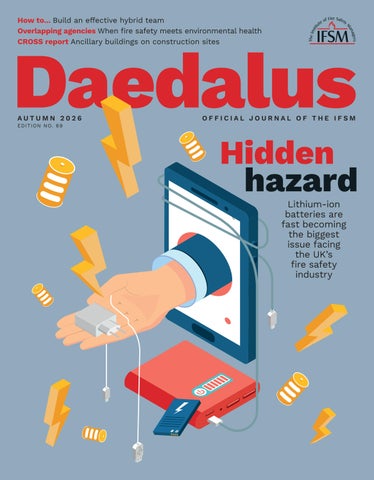
How to... Build an effective hybrid team Overlapping agencies When fire safety meets environmental health CROSS report Ancillary buildings on construction sites
AUTUMN 2026
OFFICIAL JOURNAL OF THE IFSM
E D I T I O N N O. 6 9
Hidden hazard Lithium-ion batteries are fast becoming the biggest issue facing the UK’s fire safety industry
01 COVER_Daedalus Autumn 2026_Daedalus.indd 1
04/09/2026 17:28
Synergy DAEDALUS.Aut26.033.indd FP.indd 1 33
Synergy FP.indd 1
28/05/2026 27/08/2026 08:47 10:23
Contents Autumn 2026
Regulars 04 President’s blog Bob Docherty’s final round-up as president
Features
24
14 Lithium-ion batteries Fire risk assessors can play their part in tackling the biggest problem facing the fire safety sector
05 News IFSM Awards 2026 shortlist revealed; NFRAR recognises existing qualifications
18 Fire safety enforcement
07 News analysis
The importance of fire safety and environmental health professionals working together and the implications for risk assessments
The prosecution of a fire risk assessor should be a wake-up call
10 Chair’s corner CPD Week and summer’s Technical Meeting
21 CROSS safety report
12 How to... Build an effective hybrid team
28 Membership benefits
12
Joining us ensures your voice is heard
24 Fire risk assessment
30 Member update
A great fire risk assessment doesn’t just come to the right conclusion: the evidence that you record shows how you got there
Congratulations to new and upgraded members
34 60 seconds with... Simon Marsh
The Institute of Fire Safety Managers Dunston Innovation Centre Dunston Road Chesterfield S41 8NG 0330 355 1286 info@ifsm.org.uk www.ifsm.org.uk
Ancillary buildings exempt from the Building Regulations are often installed without oversight or verified fire protection measures
07 Chair/Managing director David White President/Director Robert Docherty Business manager/Associate director Helen Hilton Vice chair/Director Matthew Spivey Council member/Director Victoria Swaine Council member/Director Sukhvinder Soor Publisher Redactive Media Group 9 Dallington Street, London EC1V 0LN redactive.co.uk
Editor Nick Martindale Lead designer David Twardawa Group content sub-editor James Hundleby Picture editor Akin Falope Production director Jane Easterman Account manager Aaron Nicholls Sales and advertising +44 (0) 20 7880 6237 ifsm@redactive.co.uk
Should you wish to send us your views, email: daedalus@redactive.co.uk Printer The Manson Group, St Albans Daedalus is the official magazine of The Institute of Fire Safety Managers (IFSM). Views expressed by contributors or advertisers are not necessarily those of the IFSM or the editorial team. The IFSM will accept no responsibility for any loss occasioned to any person acting or refraining from action as a result of the material included in this publication. ISSN 2978-1604 © 2026 The Institute of Fire Safety Managers
Autumn 2026 Daedalus 3
03 Contents_Daedalus Autumn 2026_Daedalus.indd 3
04/09/2026 16:37
President’s blog
The end of a chapter I was a reluctant candidate for IFSM president in 2021, and certainly never intended to serve three terms. But the time has come to hand over the reins
T
his is my final blog before I hand the president’s chain of office to Matt Spivey in October. For the last time I have dug into my archive to find the earliest photograph I have of the Institute ‘at work’. Taken at our AGM in October 2003, at the British Motor Museum in Gaydon, there are a few familiar faces – but one deserves special mention. May Husseyin was central to our day-to-day running during the early years and continued that work after our ‘reset’ in 2006. We owe a debt of gratitude to May for all her work during our formative years, so it’s right and proper for me to acknowledge that and say a big thanks to her on behalf of all the membership. I had no ambitions to become president of the Institute after being international president of the Institution of Fire Engineers from 1999 to 2000. However, the then president Dave White and chairman Graham Green asked me to consider standing, and proposed me at the 2021 AGM. Their reasoning was grounded and real! We had gone through some major growth
May Husseyin is second from left, front row
and a number of iterations, including a large turnover of council members, and Dave and Graham felt we needed some stability and experience at the head. They thought I would be able to head up the Institute as a well-known and recognised person in the world of fire and fire safety, especially following the Grenfell tragedy. All I can say is that their powers of persuasion were good, and I was duly elected in 2021 for a two-year term. We grew rapidly after Grenfell, in terms of both members and recognition as a leading professional body in fire and fire safety. We were part of most of the consultations and committee work that followed that tragedy, and I was deeply involved in standards for fire risk assessors (and had been since 2011). Council and leading members were getting heavily involved in national committee work and consultations, so we needed people who had the knowledge and experience to service all these commitments. It was with this background that council proposed me to stand for
two more terms – an unusual request but, given the circumstances, I was fortunate enough to be elected and serve three terms overall. I am grateful to the membership who had that confidence in me, and hope I have lived up to it. We have come a long way since our 2006 reset; it has been busy, challenging and positive. However, it would be remiss of me not to mention that there have been a few fairly vicious and nasty personal attacks on me, as well as on the chairman and the Institute itself. I am grateful for the overwhelming support I received from the vast majority of members, the Institute’s staff and, in particular, Dave White. I am hopeful that we have put all that behind us now and can continue to concentrate on what we do best. My course has run, and I have enjoyed every minute of it. I would like to thank all of you: readers, members and staff (past and present) for helping me. It has been an absolute pleasure and honour to be your president. The biggest thank you I reserve until last – to our chairman, Dave White. We have travelled many miles, worked many hours and devoted much of our lives to the Institute without a harsh word spoken between us. Dave is a kindred spirit and a true lifetime friend. I look forward to working with him and the Institute for many more years (as a backbencher from October!). My best wishes to you all for the future, and to the incoming president, Matt Spivey. Dr Bob Docherty QFSM, PhD, CEng, FIFSM (Life), FIFireE, MEI is president of IFSM
4 Daedalus Autumn 2026
04 President's blog_Daedalus Autumn 2026_Daedalus.indd 4
04/09/2026 14:25
News
News
WHAT YOU NEED TO KNOW THIS QUARTER... R I S K AS S E S S M E N T
REGISTER RECOGNISES EXISTING QUALIFICATIONS I F S M AWA R D S
Awards shortlist revealed IFSM IS PLEASED TO ANNOUNCE the shortlist of candidates for the 2026 IFSM Awards, which will take place at Old Trafford Cricket Ground on 1 October. The people who are in the running to receive one or more of the coveted awards are: Fire safety manager of the year Andy Pope Janis Gillespie Ben Duggan Shane Moore Stephen Lakin Young fire professional of the year Ben Smith Oliver Hamblett Ryan Hipperson Owen Gillard Millie White Fire safety company of the year Global HSE Group Fire Safe Global Delco Safety SGD Fire Protection Fire Safety & Compliance Fire safety project of the year The Fire Protection Association AstraZeneca UK Global HSE Group
Checkmate Fire Solutions Tesco Fire safety professional of the year Colin Todd Caden O’Leary Shaun Davidson Lee Thorne Andrew Morrison Fire safety team of the year Manchester Airport Torus62 Maidstone & Tunbridge Wells NHS Trust Checkmate Fire Solutions University of Cambridge Accredited course of the year Fike Safety Technology Tall Building Fire Safety The Fire Protection Association Compliance (Air and Water) Limited Global HSE Group Congratulations to all those who have been shortlisted and recognised for their outstanding achievements.
A limited number of tickets are still available; head to ifsm.org.uk/ awards to book your place.
IFSM’s National Fire Risk Assessors Register helps dutyholders to find and verify competent assessors. It has three levels: foundation, intermediate and advanced. This reflects the complexity of the buildings that a person is competent to assess. Applicants must submit fire risk assessments, show experience and continuing professional development, have insurance and have passed a competency evaluation or examination. They must also commit to ongoing monitoring to uphold standards. For those applying for intermediate level, existing Level 4 fire risk assessment qualifications are recognised within the process under the Recognition of Prior Experiential Learning (RPEL) system. This can reduce the amount of assessment required. Those in this position must provide evidence that they have passed an Ofqual-regulated level four fire risk assessment qualification and submit two fire risk assessments carried out on mediumrisk buildings in the last 12 months. Fire risk assessors with relevant experience but no level four qualification will be supported to gain one via FireQual. They must complete a knowledge-based exam and meet RPEL requirements, as well as submitting two fire risk assessments carried out on mediumrisk buildings in the last 12 months. All members carrying out fire risk assessments must be on a recognised fire risk assessors’ register. Autumn 2026 Daedalus 5
05-06 News_Daedalus Autumn 2026_Daedalus.indd 5
04/09/2026 14:28
News
ENGAGEM EN T
IFSM activity update IT HAS BEEN A BUSY year for the IFSM’s technical team and council as they work tirelessly behind the scenes, engaging with government departments, sector bodies and industry stakeholders on the issues that matter most to our members. Whether it’s responding to formal consultations, attending national research meetings or contributing to the development of new qualifications, our teams have been putting in the hours to ensure the Institute is at the table wherever important decisions about fire safety are made. At the heart of what we do is a simple commitment: representing all members and making sure their voices are heard. As the profession evolves and faces new challenges, IFSM is proud to play a major role in shaping the future of fire safety, and is increasingly recognised as a leading national player in the world of fire safety. In recent months, this commitment has translated into action across several fronts: Fire Safety in Residential Care: In July, we submitted our formal response to the government consultation on fire safety in residential care settings. Drawing on our members’ expertise and experience, the submission reflected the practical realities faced by those working across the care sector, ensuring that the views of our fire safety professionals were firmly represented in the policymaking process. Consolidating and Co-ordinating National Fire Research: In June, IFSM representatives travelled to Chester to attend the Consolidating and Coordinating National Fire Research meeting. We joined colleagues from across the sector to discuss the national direction of fire research and help ensure that future research priorities reflect the needs of those working on the ground. Skills For Justice (SFJ) Level 5 Fire Risk Assessor Qualification Syllabus: We have provided detailed feedback
and commentary on the proposed SFJ Level 5 qualifications syllabus for fire risk assessors, drawing on members’ expertise to ensure it is fit for purpose and reflects the profession’s evolving demands. Ministry of Housing, Communities and Local Government (MHCLG): Improving Proportionality and Building Safety Outcomes in Building Control: We are currently working on our response to the MHCLG consultation on emergency repairs under the higher-risk building regime. This proposes changes to the emergency repairs route for higher-risk buildings and is seeking views on the public’s perception of the current route, whether the definition of emergency repairs should be expanded or a new route created for critical works, what further guidance may be needed, and which types of emergency works might be suitable for self-certification through a Competent Person Scheme. Two other major government consultations, to which we made major contributions, have now closed. These were for improvements and additions to Building Regulations Approved Document B and, of great importance to us, a consultation on the profession of fire risk assessors. None of this work would be possible without our membership’s knowledge, experience and engagement. As always, we are here to help and represent our members at all levels, and welcome all members’ views to add to these processes. If you have expertise, insight or opinions you’d like to contribute to future consultations, research initiatives or qualification developments, we want to hear from you. Together, we will continue to ensure that the voice of fire safety professionals is heard loud and clear, wherever the future of our profession is being decided.
Vicki Swaine, IFSM council member, technical team member and director
SA F E T Y SYST E M S
WATER-MIST SYSTEM PROVES WORTH A first-floor domestic fire that broke out in a child’s bedroom was contained thanks to the property’s water mist system. The fire broke out at 9:13pm and fire services arrived at 9:34pm, by which time it had been extinguished by a BS8458 automatic water mist fire suppression system. The fire was confined to the room, with no injuries and little water damage. Scottish government legislation introduced in March 2021 requires all newbuild social homes, flats and shared multi-occupied residential buildings to have automatic water suppression systems. The incident reaffirmed the importance of such systems, particularly in high-density housing. Stuart Stevens, chief officer at the Scottish Fire and Rescue Service, called the increased provision of automatic fire suppression systems “a significant step forward in fire safety” that “will increase the safety of our communities, residents and firefighters”. The property’s iMist system can also be retrofitted to existing premises. Alex Pollard, operations director at iMist™ Fire Suppression, said it “fully extinguished the fire, saving lives and protecting property with minimal disruption”.
6 Daedalus Autumn 2026
05-06 News_Daedalus Autumn 2026_Daedalus.indd 6
04/09/2026 14:29
News analysis
Wake-up call The recent prosecution of a management company director and a fire risk assessor should remind us of our responsibilities. Dr Bob Docherty outlines the lessons for Responsible Persons and assessors
W Illustration: iStockphoto
e recently received a press release from Devon and Somerset Fire and Rescue Service about one of its prosecutions under the Regulatory Reform (Fire Safety) Order 2005 (FSO). A management company director and a fire risk assessor (FRA) were found guilty, fined and given community orders for fire safety failures in a high-rise apartment block in Plymouth. The legal process has taken its course and we will not name the people involved. However, as a professional body with many members who carry out fire risk assessments, we feel that the case is worthy of our attention – as are the lessons we can learn from it.
Background A director of a Plymouth-based building management company was given an 18-month community order for fire safety failures that placed apartment block residents at risk of death or serious injury. The company was convicted and fined £12,000, Autumn 2026 Daedalus 7
07-09 News Analysis_Daedalus Autumn 2026_Daedalus.indd 7
04/09/2026 16:03
News analysis
while its appointed FRA received a 12-month community order. The sentencing follows a fouryear investigation by Devon and Somerset Fire and Rescue Service into fire safety failings at the block. Sentencing took place at Plymouth Crown Court in June 2026. The failings were identified during a fire safety inspection carried out in 2021 – part of a programme of checks on high-rise residential buildings following the Grenfell Tower tragedy. Inspectors identified that the building also had a combustible external wall system. The fire safety inspectors found a number of serious defects, including the removal of smoke control fans and unauthorised building works that had created a risk of fire spread within the building. More specifically, they found that smoke control fans on the ground floor had been removed to create space for a two-bedroom flat. The smoke control system was a critical fire safety measure for clearing smoke from the central atrium in the event of a fire, thus enabling residents to evacuate safely. The smoke control fans’ removal placed residents at risk of death or serious injury. Although the smoke control fans had been removed, the vents, alarms and signage were left in place, and a flat had been constructed in areas where vital fire safety equipment
had previously been located. This made the alterations difficult to identify during routine fire safety inspections. It was also established that the smoke control fans had not been subject to a suitable maintenance programme before their removal, meaning that they could not be relied on to operate effectively. Further unauthorised alterations were made to flats and adjoining areas. The standard of fire-resisting construction was found to be inadequate, meaning that, in the event of a fire, flames and smoke could spread and compromise one of the building’s escape staircases. The works required Building Control approval, which had not been obtained. The company director admitted failing to have in place a suitable system of maintenance for a mechanical ventilation system, failing to maintain integrity of emergency routes and failing to take general fire precautions. He was ordered to carry out 240 hours of unpaid work and pay £34,758.06 towards costs.
Taking action Following the discovery of the failings, Devon and Somerset Fire and Rescue Service worked in partnership with Plymouth City Council, which led on fire safety concerns within individual flats. The service focused its investigation on the safety of the building’s communal areas.
Photography: Alamy
Fire safety inspectors found a number of serious defects, including the removal of smoke control fans
8 Daedalus Autumn 2026
07-09 News Analysis_Daedalus Autumn 2026_Daedalus.indd 8
04/09/2026 16:03
News analysis
The apartment block in Plymouth was found to have had its smoke control fans removed to create space for a two-bedroom flat
As an immediate risk-reduction measure, the service served three prohibition notices, including restrictions on the use of the lower-ground car parks and two flats. Given that hundreds of residents would otherwise have required emergency rehousing, the service agreed that the building could remain occupied subject to additional safeguards. These included the introduction of fire wardens and a waking watch (using people to detect fire and raise the alarm) while permanent safety measures were developed and installed. During the investigation, it emerged that the director had sought approval to remove the smoke control fans from the FRA, who had produced a fire risk assessment recommending that the smoke control system could be removed. The FRA pleaded guilty to an offence under Article 9 of the Regulatory Reform (Fire Safety) Order 2005 for failing to produce a suitable and sufficient assessment of the risks to which relevant persons were exposed. In mitigation, he said he had been told by the director that the smoke control fans never worked and that he had planning permission and approval from the fire service to remove them; he accepted that he could have done more to question this. He was ordered to carry out 120 hours of unpaid work and pay £34,000 towards costs. The cost of removing the smoke control fans was passed onto residents through service charges. The management company also pleaded guilty to two offences under the Fire Safety Order: failing to make appropriate fire safety arrangements, and failing to ensure a suitable system of maintenance was in place for the smoke control fans. The company accepted that it should not have allowed its director to exercise the level of control over fire safety arrangements that he had. It was fined £12,000 and ordered to pay £18,000 towards the costs. Judge Mathew Turner called the removal of the mechanical ventilation system a “reckless act”. Martin Sleigh, fire safety manager at Devon and Somerset Fire and Rescue Service, said: “This case should serve as a clear warning to anyone responsible for the management of fire safety in buildings that their duties must be taken seriously, particularly when changes or alterations are being made. Fire risk assessors and other professionals must operate within their competence and base their recommendations on thorough, independent assessment.” Since the deficiencies were discovered, Devon and Somerset Fire and Rescue Service has continued to work with Plymouth City Council to secure improvements and ensure residents’ safety. The building has now been re-clad, with further work to replace the smoke control system and installation of a sprinkler system due to take place this year. Dr Bob Docherty is president of IFSM
LESSONS TO BE LEARNED There are a few lessons to be learned from this case by both the Responsible Person (RP) and FRA, outlined below: In the case of higher-risk buildings such as highrise residential buildings (HRRBs), the RP should check that their FRA is third-party certified and recognised as competent as an individual on a FRA register to carry out fire risk assessments on HRRBs. There is plenty of guidance in the public domain for RPs on how to choose a FRA. RPs must understand what the fire safety arrangements are in their building(s), as well as the need to maintain all of those systems, both active and passive. The FRA should recognise their own levels of competence and know not to go beyond it. Colin Todd, a vice president of IFSM and expert witness acting for the prosecution, said that the FRA’s report “had failed to properly appreciate the complex nature of the premises and the special fire safety measures needed”. All FRAs should be on a formal recognised professional competency-based register that recognises the levels of competence set out in BS8674 and proves their level of competence. The FRA must be competent to recognise the complex nature of the premises they are assessing, including any special fire safety measures needed. The FRA must use their own judgement and not depend entirely on what they are told by the RP or other interested parties. Both RPs and FRAs should understand the reasoning, purpose and logic behind all fire safety measures in a building. Both RPs and FRAs should, without any doubt, know the seriousness of any breaches of the FSO and the dangers they may pose by placing one or more relevant persons at risk of death or serious injury in case of fire. Autumn 2026 Daedalus 9
07-09 News Analysis_Daedalus Autumn 2026_Daedalus.indd 9
04/09/2026 16:03
Chair’s corner
Making progress CPD Week, the summer Technical Meeting and preparations for the upcoming IFSM Awards mean it has been a busy few months at the Institute
A
s I sit down to write, I find myself reflecting on how much we achieved over the summer – and how much there still is to look forward to. One of the highlights has been our first IFSM CPD Week, which exceeded our expectations. The level of engagement from members, the quality of the presentations and, most importantly, the enthusiasm shown by those attending showed just how important continuing professional development remains within our profession. I want to thank everyone who supported the week, whether as a speaker, sponsor, attendee or team member behind the scenes. The positive feedback has been overwhelming, and planning is already under way to make it even bigger next year. We then returned to Coventry for our summer Technical Meeting, in partnership with Western Business Media and the Fire Safety Matters team. These events are an excellent opportunity for professionals from across the industry to come together, hear from leading speakers and share knowledge and experience. My thanks go to everyone who contributed. As with any successful event, though, we are always looking at ways to improve. We will be reviewing the format, speaker line-up and structure to ensure that future events continue to evolve and provide even greater value for our members and delegates. I recently spent time at the Houses of Parliament for the launch of BAFE’s updated SP205 Fire Risk Assessment Scheme. It was encouraging to see so many organisations represented,
Planning is already under way to make IFSM CPD Week even bigger next year working together to improve professional standards across the fire safety sector. Another area that makes me immensely proud is our work supporting the Children’s Burns Trust. Since announcing the partnership, the generosity of our members, partners and supporters has been remarkable. Together, we have raised more than £2,000 this year to support the Trust’s invaluable work with children affected by burn injuries and their families. Our latest fundraising activity was the IFSM Charity Golf Day. Not only did everyone enjoy an excellent day, but we raised more than £500. Congratulations to IFSM member David Lamb, whose team took first place. Looking ahead, one of the biggest dates in our calendar is approaching: on 1 October, we will be holding our final Technical Meeting of 2026, followed by our AGM and the IFSM Awards. The awards have become a highlight of the year, recognising the achievements of people, organisations and teams across the fire safety industry. If you have not already secured your place, I would encourage you to do so soon – tickets are on sale.
Away from events, an enormous amount of work continues behind the scenes. We have been investing significant time and effort into strengthening our accreditation schemes and the National Fire Risk Assessors Register (NFRAR). We have been reviewing and developing our accreditation processes to ensure they meet the needs of both individuals and employers, and I am pleased to say that applications under our updated accreditation arrangements are now open. At the same time, work continues on the development of the NFRAR. This extends far beyond maintaining a register; we have been working on competency frameworks, assessment methodologies, qualifications and the wider systems that will underpin the future of professional fire risk assessor registration. This is a substantial piece of work involving many dedicated people and, while much of it takes place behind the scenes, it is laying the foundations for something that we believe will benefit both the profession and those responsible for appointing competent fire risk assessors. I hope it will not be too long before we can share some exciting developments with you. The president and I continue to represent IFSM across the industry, working alongside government, standards bodies, industry groups and our partners. As we grow, so too does our responsibility to ensure that we maintain the professionalism, integrity and standards that have defined us for more than 25 years. David White FIFSM (Life), MIFireE, MIIRSM, LCGI is chair of IFSM
10 Daedalus Autumn 2026
10 Chairs Corner_Daedalus Autumn 2026_Daedalus.indd 10
04/09/2026 17:18
Become a Qualified Fire Risk Assessor FireQual Level 3 & Level 4 Qualifications The Äre risk assessment profession is changing. With increasing emphasis on assessor competency, professional standards and the requirements of BS 8674:2025, there has never been a better time to gain a recognised qualiÄcation and demonstrate your competence. Become a QualiÄed Fire Risk Assessor – FireQual Level 3 & Level 4 QualiÄcations ADL Health and Safety Ltd is proud to be a FireQual Approved Training Centre, delivering nationally recognised qualiÄcations for those entering the profession and experienced assessors seeking to progress their careers. FireQual Level 3 CertiÄcate in Foundation Fire Risk Assessment The Foundation qualiÄcation provides the ideal starting point for those wishing to undertake Äre risk assessments of low-risk premises and develop their competency in line with BS 8674:2025. It is suitable for health and safety professionals, facilities managers, Äre safety personnel, housing professionals and anyone looking to begin a career in Äre risk assessment. The course combines practical learning, real-world assessment techniques and portfolio development, providing a clear pathway towards professional recognition and registration. FireQual Level 4 CertiÄcate in Intermediate Fire Risk Assessment The Intermediate qualiÄcation is designed for assessors who already possess Äre risk assessment experience and wish to develop the higher level knowledge, skills and competence expected of Intermediate Fire Risk Assessors. The course explores more complex buildings, advanced Äre safety principles, compartmentation, passive Äre protection, Äre safety management and the application of current guidance and standards in real-world situations. Why Choose ADL Health and Safety Ltd? • • • • • • •
FireQual Approved Training Centre QualiÄcations aligned to BS 8674:2025 Delivered by highly experienced Äre safety professionals and former Fire Service oɉcers Practical, real-world approach based on current industry expectations Classroom and live online delivery options available Support and guidance throughout the qualiÄcation process Clear progression pathway from Foundation to Intermediate competency
Whether you are looking to start a new career, formalise your existing experience or progress towards higher levels of competency, our FireQual qualiÄcations provide a structured and recognised route to becoming a competent Fire Risk Assessor.
CONTACT US: 0151 440 3008 / 07447480736 www.adlhealthandsafety.com ADL DAEDALUS.Aut26.011.indd FP.indd 1 11
12/08/2026 27/08/2026 11:56 10:22
HOW TO…
Build an effective hybrid team The days of week-long work in the office appear to be behind modern workplaces. However, the move to remote working seems to be slowing, allowing businesses to explore hybrid models
H
ybrid working is where employees come into the office for a couple of days a week, rather than every day. It gives employees more flexibility, while many businesses report an uptick in both productivity and morale. But successful hybrid teams don’t happen by accident. They are built and nurtured intentionally, instead of falling into a comfortable routine. What’s more, teams needs to be fostered; there’s no single rule for all. The sooner a business can adapt to this new working style, the quicker it will feel the benefits. The following are five must-know tips to guide you through this transition.
1 Illustration: iStock
Set expectations from day one
Before beginning the hybrid working journey, everyone should be aware of what is expected and how they should contribute. For example, businesses must set expectations around which messaging app to use so that people don’t have to switch between apps, which will affect productivity and be time-consuming. Response times are another element
to consider. It is frustrating to send an employee a message asking for their help on a task if they don’t see it for half an hour. Employees need to understand that, to keep communication open, messages and emails should be regularly checked. There also needs to be cohesion between the expectations of hybrid workers and those of remote employees. Establishing core working hours for all those on the team is crucial to make sure everyone feels that the expectations are clear and fair.
2
Communication is the top priority
Office-only discussions can lead to alienation and isolation for those who work remotely. One way to combat the divide is to ensure that every communication and decision is in writing. Whether it’s via email or in a chat forum such as Teams, writing everything down for the whole team will enable everyone to feel that they are part of the discussion, rather than just being told later down the line. Virtual meetings will also help here. Ask team members to turn on their cameras – seeing each other’s facial expressions can foster
12 Daedalus Autumn 2026
12-13 How to_Daedalus Autumn 2026_Daedalus.indd 12
04/09/2026 14:30
How to...
relationships and help people to understand how others are feeling. Managers and team leaders should also hold regular one-to-one meetings with team members to check in on how each person is finding hybrid working requirements and whether they need additional support.
3
Measure outcomes, not just visibility
It can be tempting to base success on team members’ visibility. Who responded quickly? Who spoke up most? This is an old-fashioned way of thinking, because productivity is not just measured by time spent at a desk. Team leaders and managers should focus on results, not presenteeism. Set clear, measurable objectives and schedule regular performance
conversations so that everyone is on the same page and no one is caught off -guard by feedback. To measure outcomes, you also need to trust employees to be accountable. Doing so can be as simple as filling in a timesheet, or sending updates at the end of each remote working day as a handover for the next day.
4
Make collaboration intentional
Some tasks need face-to-face collaboration and some can be done
Successful hybrid teams don’t happen by accident
remotely. Days when employees are in the office together are the ideal times to hold planning and problem-solving meetings – in doing so, you can resolve an issue together in less time than it takes to wait for online communication. On non-office days, look into collaboration tools and platforms that allow everyone to see specific tasks and what is assigned to each person. Ensure everyone uses the same cloud-based software so that the whole team can see and access key documents, and avoid duplicate work. This also contributes to an overall feeling of ownership and accountability for a task, which boosts employee morale and motivation. To keep collaboration intentional, remote employees need the same opportunities to contribute as those who are in the office. For example, sending suggestions and queries within a specific email thread to which everyone replies will keep answers in one place and give everyone an equal opportunity to share what they think and how they would improve or change something.
5
Review and adapt regularly
As with any new business decision, the only way you can be confident that hybrid working is the right choice for your company is to keep reviewing how it is going. Gather employee feedback regularly, either in structured meetings or via email or other online communications, to stay up to date on how each person is feeling. And it’s important to keep adapting and evolving as people leave your team and new people join. What worked for one team may not work going forward, and you will only learn this if you take the time to assess things thoroughly. Stay ahead of trends and feelings to react positively and quickly. When you encourage continuous improvements rather than assuming that one system will work, you will find that you build a happy, successful and cohesive team.
James Owen is co-founder and director of Click Intelligence
Autumn 2026 Daedalus 13
12-13 How to_Daedalus Autumn 2026_Daedalus.indd 13
04/09/2026 14:30
Lithium-ion batteries
Over
and out
Lithium-ion batteries are fast becoming the biggest issue facing the UK’s fire industry, affecting homes and businesses alike. While there is a wider public education piece required, fire risk assessors can also play their part in helping to reduce the risk, as David Adams explains
Illustration: iStockphoto
T
hirty years ago, two sources of danger dominated public fire prevention messages: kitchen chip pan fires and carelessly discarded cigarettes. Household batteries were not usually seen as dangerous. Today, far fewer people use chip pans or smoke. But during the past 30 years most of us have become heavy users of lithium-ion (LI) batteries. Their lightweight, extremely high-energydensity design enables them to power a vast range of rechargeable electronic and mechanical devices, but it also creates risks. While most LI batteries are perfectly safe, in some circumstances the energy they contain can be released in an uncontrolled, explosive way. While such failures are rare, the huge number of these batteries (there are probably more than 100 million being used in the UK’s 29 million households and three million workplaces today) translates into thousands of potential fire risks. In 2025, UK fire brigades tackled fires linked to LI batteries every 4.8 hours on average, according to data compiled by the insurer QBE using Freedom of Information requests. Just under half of these fires (46 per cent) were in private homes, but many were in the
sorts of buildings where most fire risk assessments are completed, including shops, factories, warehouses and offices. Research from insurer Aviva suggests that more than one in two UK businesses (54 per cent) have been affected by an LI battery fire or fire-related incident. Some LI-powered devices cause more fires than others. You may have seen alarming video footage of e-bikes or e-scooters bursting into flames while on charge. Almost one-third (520) of the 1,760 fires that took place in 2025 involved batteries in e-bikes, and a disproportionate number of those bikes had been converted from conventional pushbikes. But LI battery fires could start in many other domestic and workplace rechargeable devices, including mobile phones, laptops, tablets, smart watches, electric toothbrushes, torches, toys, gaming devices, radios, speakers, lawnmowers, hedge trimmers, handheld scanners and warehouse vehicles, as well as cordless power tools or medical equipment. Fires caused by the large LI batteries in electric vehicles (EVs) could also be very dangerous, but QBE’s research suggests these occur at between onefifth and one-twentieth the rate of fires involving vehicles with petrol or diesel engines, and only about a quarter of EV fires start within the battery.
By contrast, the LI batteries in rechargeable vapes are very small, but can start fires and present a particularly significant risk when stored in large numbers: in March 2026 a fire that started in a Glasgow vape shop wrecked a historic building and closed the city’s Central station for two weeks.
Root causes LI battery fires start if batteries are damaged, over-charged or overdischarged, or if they get either very hot or very cold. These conditions can lead to failure of the separator between the electrodes in the battery’s cells, triggering the process of extreme and rapid overheating known as thermal runaway. This creates intense, explosive fires, burning at 700-1,000°C and producing large, torch-like flames. These are fed by venting of toxic, flammable gases from battery casings, including hydrogen, carbon monoxide and hydrogen fluoride. IFSM director and managing director at 3Safety Vicki Swaine came across a horrifying 2025 US academic study while working towards an MSc in fire engineering. Researchers funded by the US Fire Safety Research Institute studied 268 fires caused by LI batteries in e-bikes and e-scooters in New York City during 2023, which had caused 150 reported injuries and 18 deaths.
14 Daedalus Autumn 2026
14-17 Feature - Batteries_Daedalus Autumn 2026_Daedalus.indd 14
04/09/2026 16:10
Lithium-ion batteries
Autumn 2026 Daedalus 15
14-17 Feature - Batteries_Daedalus Autumn 2026_Daedalus.indd 15
04/09/2026 16:21
Lithium-ion batteries
The researchers suggested the large number of people living in high-density flats in the city and working as e-bike or e-scooter-riding delivery couriers – about 65,000 in 2023 – was a major reason why the city was affected by so many of these fires. Their research included testing full burn on e-scooters powered by 1.2kWh batteries in simulated living room and communal kitchen environments. They found that the initial explosion caused by thermal runaway in these batteries was powerful enough to shatter windows and produce fireballs 2m wide. As thermal runaway began, battery temperatures exceeded 800°C within 10 seconds of the first signs of smoke coming from the scooters – faster than most domestic smoke alarms could react. Carbon monoxide concentrations reached fatal levels within 35 seconds. Generally speaking, the batteries do not simply fail. As Matt Partridge, head of product development and a battery charging safety specialist at storage solutions provider Armorgard, puts it: “It is human interaction that causes them to fail.” Those interactions are usually linked to electrical overload or mechanical damage. “Electrical overload tends to be the predominant cause,” says Les Day, UK commercial director at hazardous materials storage specialist Asecos. “It tends to arise as a result of constant charging: leaving items on charge after they’ve received their maximum charge.” Mechanical damage might occur when a power tool is dropped or thrown into a van, or when an e-scooter or e-bike is dropped on the ground, for example. All these actions can lead to deterioration of the cell separator or other components inside the battery, increasing the chances of a short circuit and thermal runaway. When lots of batteries are close together, a fire in one can result in its neighbour going into thermal runaway.
Preventative measures What are the most important means of mitigating these risks? One solution is to ban some devices from specific locations. In 2021 Transport for London banned privately owned e-scooters and
Electrical overload tends to be the predominant cause, leaving items on charge after they’ve received their maximum charge
e-unicycles from London’s underground and overground trains and trams. A growing number of businesses and other organisations have also banned e-scooters and e-bikes from their premises. Civil Aviation Authority rules now stipulate that passengers must take mobile phones, vapes and battery packs into the cabin with them and cannot use battery packs to charge devices while in the air. Battery-powered devices are not allowed in luggage stowed in the hold, with the exception of laptops, which must be switched off completely. But you can’t ban all devices containing LI batteries from workplaces and homes. Instead, fire risk assessors should advise clients to identify LI battery risks and to store batteries and devices containing them safely. They must ensure effective isolation and segregation of these devices “in the same way you don’t have a jerrycan full of petrol in your living room,” as Partridge puts it. There are effective storage and/or safe charging solutions available that enable
isolation and segregation of batteries, including the storage solutions produced by businesses including Asecos and Armorgard. A growing number of insurers are now applying greater pressure on some organisations to invest in this sort of equipment. The most important quality of these containers is that they can contain devices going into thermal runaway, meaning they can offer resistance against internal temperatures of 1,000°C, as well as providing protection against external fires. Asecos states the applicable minimum safety standards to be BS EN 14470-1 (90 minutes external fire resistance) and the BS EN 1363-1 inside-to-outside fire resistance test. A further test, VDMA 24994, assesses the fire safety performance of LI battery storage and charging cabinets in the event of thermal runaway. Cabinets submitted for this test must be equipped with sensors to alert anyone in the surrounding area to a fire or any release of gases, and it must be possible to connect the cabinets to some form of air exhaust system. If an organisation needs to enable charging of devices inside a building, the facility should incorporate a residual current device, able to detect electrical faults and cut power to the affected equipment almost instantly. Charging areas also need to be kept dry and cool and should be at least 4m away from any combustible materials. It is also essential to avoid storing or charging batteries in escape routes such as stairwells or corridors, particularly in residential buildings. Swaine gives an example of a safer charging location: she recently assessed a sheltered housing facility where mobility scooters were being charged in a metal cabinet more than 3m away from the building. Similar arrangements would be needed if a building were to install LI-based battery energy storage systems, a growing number of which are likely to be fitted alongside solar panels in residential, commercial and other buildings during the next few years. Best practice would be for these systems to be installed outside the main building, within purpose-built enclosures.
16 Daedalus Autumn 2026
14-17 Feature - Batteries_Daedalus Autumn 2026_Daedalus.indd 16
04/09/2026 16:10
Lithium-ion batteries
There is plenty of guidance available from regulators and fire industry experts around best practice, and multiple regulations and standards also apply to different aspects of the use, storage and charging of LI batteries of different kinds. Responsible or Accountable Persons in charge of fire safety in commercial or large residential buildings under the terms of the Regulatory Reform (Fire Safety) Order 2005 or the Building Safety Act 2022 must consider fire risks linked to the storage or charging of e-bikes and e-scooters in those buildings, and other fire risks associated with LI batteries. Organisations storing LI batteries must also adhere to the requirements of the Dangerous Substances and Explosive Atmospheres Regulations 2002. These require employers to identify dangerous substances in the workplace and risks associated with them, implement measures to control or remove those risks, prepare plans to manage accidents and emergencies, and ensure employees are adequately informed and trained to control or deal with those risks. But they do not provide specific instructions on the storage or charging of LI batteries. Further standards, guidance and regulation will undoubtedly be published in future, but this is never a quick process.
Photography: Getty
Implications for assessors In the meantime, fire risk assessors must try to acquire relevant knowledge and incorporate it into the assessment of risks linked to LI batteries. Former Merseyside chief fire officer Tony McGuirk thinks they could do more by helping clients implement effective LI battery-specific plans, embedded within broader fire strategies. He calls his own approach ‘FireSafe2five20’, a methodology built around the critical timeline of a fire incident: detect the fire within two minutes, intervene and raise the alarm within the next five minutes, and ensure that within 20 minutes either the fire has been extinguished by those on site, or firefighters have arrived to take control. “The aim should be to enable isolation of the fire and create time,” McGuirk explains. “The more time we can create,
In 2025, UK fire brigades tackled fires linked to lithium-ion batteries every 4.8 hours on average
520 The number of fires that took place in 2025 as a result of batteries in e-bikes
the more options we’ve got to deal with the problem. We need simple solutions, because the first person on the scene is highly unlikely to be any kind of specialist with firefighting skills. They need practical actions they can take and tools they can use to keep an incident manageable.” These tools could include specific types of fire extinguishers, but also textile containment systems such as fire blankets. McGuirk has drafted a guidance note on the latter, highlighting the need for such textiles to comply with the DIN SPEC 91489 standard for assessing fire blankets used to contain vehicle fires. McGuirk believes meeting the challenge of managing these risks effectively should lead to major changes
in regulation and may change the way fire risk assessors serve their clients. “All the existing regulations we have are great for managing existing, conventional fire risks, and we’ve got to carry on with that, but this new risk is more dynamic, less predictable and ubiquitous,” he says. “This has become the number one issue occupying the fire industry.” He believes fire risk assessors should aim to help clients protect their organisations from the business continuity risks LI battery fires may create. “Fire risk assessors should be thinking about safety and about what operational resilience means, and making balanced judgements about risks in partnership with customers who know their own businesses,” he says. Whether or not they are doing this, what are the most important messages fire risk assessors should be conveying to clients about LI batteries today? As a minimum, says Partridge, they must try to ensure that clients can identify the type and quantity of batteries being stored or charged, and to ensure that storage and charging happen in suitable locations. Above all, says Swaine, “we need to keep spreading the word, so that more people recognise these potential issues.” David Adams is a freelance journalist with a strong background in the built environment Autumn 2026 Daedalus 17
14-17 Feature - Batteries_Daedalus Autumn 2026_Daedalus.indd 17
04/09/2026 16:10
Fire safety enforcement
Overlapping
s e i c n e ag
18 Daedalus Autumn 2026
18-20 Malcolm Thomas_Daedalus Autumn 2026_Daedalus.indd 18
04/09/2026 17:29
Fire safety enforcement
Environmental health officers work alongside fire and rescue authorities to enforce fire safety legislation, with implications for risk assessments and fire safety professionals. It’s important that the two professions work closely together, says Malcolm Thomas
Photography: iStockphoto
E
nforcement of fire safety law covering housing does not just lie with fire and rescue services; the responsibility is shared with local authorities’ environmental health services (private-sector housing teams). Recently, exploring these two parties’ overlapping duties and powers while providing training to environmental health officers (EHOs) in Norwich prompted me to examine how this affects fire risk assessment. EHOs work alongside fire and rescue authorities, which enforce the Regulatory Reform (Fire Safety) Order 2005, and Building Control. Environmental health is crucial to fire safety enforcement in UK housing, acting as the primary regulator for residential property standards. The article on the recent prosecutions in Plymouth in this edition of Daedalus is a case in point (see page 7). At the core of this enforcement is the Housing Act 2004, which established the Housing Health and Safety Rating System (HHSRS). This is a riskbased assessment tool that EHOs use to identify and evaluate 21 hazard categories in residential properties; fire hazard is just one of these categories. The EHO inspects a property and rates the fire risk from ‘Category 1’ (most serious) to ‘Category 2’ hazards, where they have discretionary powers. They have powers of entry and can issue enforcement notices, improvement notices requiring specific remedial work, or Prohibition Orders to restrict use until the hazard is removed. They also have powers to gather evidence, take material
samples, require the production of relevant documents and take legal action, including prosecution of non-compliant landlords. Under Section 239 of the Housing Act 2004, EHOs have the power to enter and inspect properties. Once there, they look at various risk factors, including: the position of heaters and cookers; the state of electrical installations and the number and position of sockets; the presence and condition of fire-resistant fabric, fire stops and internal doors; the adequacy of means of escape; the provision of smoke and heat detectors; and fire-fighting equipment. If a serious (Category 1) hazard is found, EHOs must take enforcement action, which can include issuing improvement notices, civil penalties (up to £40,000) or prosecution. Two specific areas of focus are houses in multiple occupation – where EHOs play a key role in ensuring that fire safety standards such as alarms and means of escape are met through licensing and inspection – and highrise residential buildings. Under the Building Safety Act 2022, EHOs have enhanced powers to enforce fire safety in high-rise buildings.
Further developments Two further areas of activity in recent years have been in enforcing standards where additional storeys have been added to residential blocks and where commercial buildings have been
Under the Building Safety Act 2022, EHOs have enhanced powers to enforce fire safety in highrise buildings Autumn 2026 Daedalus 19
18-20 Malcolm Thomas_Daedalus Autumn 2026_Daedalus.indd 19
04/09/2026 17:29
Fire safety enforcement
EHOs work alongside fire and rescue authorities, which enforce the Regulatory Reform (Fire Safety) Order 2005 re-purposed for residential use. Their remit does cover purpose-built blocks of flats and mixed-use property. In June 2026, the government issued new operating guidance on how to conduct inspections and assessments of hazards in housing under the HHSRS. The changes included an expanded definition of fire hazard, which now explicitly includes risks from explosions and building collapse due to fire, not just flames and smoke. To avoid the new £7,000 fine, landlords are advised to focus on key risks, to expect greater scrutiny on damp and mould, excess cold, fire risks and faulty electrics, and to act fast on serious issues. Incidentally, from November 2026, social landlords will be legally required to respond to fire hazards within specified timeframes under the next phase of Awaab’s Law, which extends mandatory investigation and repair requirements to additional health and safety hazards, including fire and explosion risks. Fire risk assessors need to be aware of the existence of the HHSRS and the overlap of Environmental Health enforcement responsibilities with those of fire and rescue services. It seems to me that EHOs, for all intents and purposes, carry out fire risk assessments: their guidance deals with the likelihood of fire, means of escape, general fire safety measures and management of fire safety. Their checklists are very similar to ours. In the guidance, HHSRS assessors are advised that they “should look at the fire risk assessment for the building and check whether a fire risk appraisal of external walls (FRAEW) has been commissioned and is available; record its presence
or absence in inspection notes and use its findings to inform scoring for the external walls hazard”. This means that they must understand the conclusions and recommendations of a fire risk assessment and an FRAEW – a tall order, in my opinion.
In-house operations Many councils now have dedicated fire safety teams, with EHOs focusing solely on high-risk residential properties. Since Grenfell, EHOs in some cities and towns are inspecting and leading the enforcement of high-rise blocks with combustible cladding or other defects, often as part of the Joint Inspection Team (JIT). The JIT is funded by the Ministry of Housing, Communities and Local Government. It acts as an expert adviser to local councils, but does not have its own legal powers, instead supporting councils to use their own. Subject blocks must be more than 11m tall, with priority given to residential buildings of over 18m in assessing the level of any fire safety hazards present using the HHSRS operating guidance. Camden, Westminster, Havering, Newham and Barnet Councils (private-sector housing team) inspect housing blocks, assess fire risks from external walls via HHSRS and have served Improvement Notices to remove “dangerous cladding”. EHOs frequently work alongside fire and rescue services. For complex cases, councils may establish joint teams where EHOs provide housing law expertise while fire inspectors offer technical fire safety knowledge. In essence, an EHO’s power over fire safety is a housingled public health function: they use the Housing Act 2004 to assess and
mitigate fire risks as a serious health hazard for residents. The Chartered Institute of Environmental Health (CIEH) represents this profession. During my recent training session for EHOs in Norwich, which was about investigating fire safety risks in external walls, I discovered that they were unaware of the IFSM and had little idea of the fire risk assessment process, the role of IFSM members, fire safety strategies, PAS 9980 and FRAEWs. We are working in the same space, so this lack of awareness is worrying. Based on my experience of training hundreds of fire risk assessors in recent years, I also know that our members also lack understanding of EHOs’ role, duties and powers. Our professional boundaries overlap with fire service protection teams, EHOs and others in addressing fire safety in existing residential properties. I would urge the IFSM and CIEH to jointly explore opportunities to collaborate for mutual benefit.
Malcolm Thomas is a building surveyor, trainer and IFSM council member
ADDITIONAL INFORMATION HHSRS operating guidance: Part 3 – A supplementary guide to the hazard of fire and explosions: gov.uk/government/publications/ housing-health-and-safetyrating-system-hhsrs-operatingguidance Joint Inspection Team: a national fire safety inspection resource: local.gov.uk/casestudies/joint-inspection-teamjit-national-fire-safetyinspection-resource
20 Daedalus Autumn 2026
18-20 Malcolm Thomas_Daedalus Autumn 2026_Daedalus.indd 20
04/09/2026 16:12
CROSS safety report
Fire safety governance and oversight for temporary and ancillary buildings on construction sites A recent CROSS safety report contends that ancillary buildings exempt from the Building Regulations may present fire safety risks because they are often installed without building control oversight, fire strategies or verified fire protection measures
REPORTER’S SUBMISSION The reporter states that they have identified a potential safety gap relating to ancillary buildings that are exempt from the Building Regulations 2010 under Regulation 9, Schedule 2, Class 5. These buildings are commonly used on construction or civil engineering sites and are exempt where they are intended for use only during the course of the works and contain no sleeping accommodation. The reporter is concerned that this exemption may have unintended implications for fire safety. The reporter notes that although such buildings remain subject to the Regulatory Reform (Fire Safety) Order 2005,
there is no associated building control process or oversight by a building control body. In their view, this creates the potential for ancillary buildings to be constructed or installed without reference to recognised fire safety standards, including the functional requirements of Part B of Schedule 1 to the Building Regulations 2010. They comment that these structures can remain in place for extended periods, may accommodate large numbers of people and can vary significantly in size, height and configuration. The reporter states that many ancillary buildings are constructed using modern methods of construction, such as modular or relocatable cabins. They highlight that previous CROSS reports have identified inherent fire safety concerns associated with such systems, particularly in relation to voids, gaps and routes for uncontrolled fire and smoke spread. The reporter considers that the absence of a formal building control process for ancillary buildings introduces a risk that key fire safety measures will not be inspected or verified. They observe that these buildings may be installed or reassembled multiple times, sometimes in poor condition, and that latent defects may be covered over during installation. They add that fire strategies are often absent, meaning that essential fire precautions, performance requirements and life safety considerations may not be clearly identified or addressed. The reporter believes that a fire in an ancillary building could pose a Autumn 2026 Daedalus 21
21-23 Cross Report_Daedalus Autumn 2026_Daedalus.indd 21
04/09/2026 16:13
CROSS safety report
significant risk to life, particularly as the size, height and occupancy of these buildings increase. They consider it foreseeable that the fire behaviour of such structures may not be consistent with traditional building forms due to their construction methods and the absence of fire protection measures typically required under the Building Regulations. They also note that because these buildings are exempt, they do not benefit from the handover information required under Regulation 38, which would ordinarily support safe operation and ongoing management. The reporter suggests that the blanket exemption from the Building Regulations, combined with the lack of a clear or mandatory building control pathway, may allow fire safety considerations to be deprioritised or overlooked during design, procurement, installation and use. The reporter believes that there is a need for clearer industry guidance on the technical and performance requirements applicable to ancillary buildings. They suggest that condition surveys should be undertaken by competent persons where buildings are secondhand or repeatedly relocated. They also advocate for holistic, performance-based fire strategies that take account of use, construction, size and functional requirements under wider fire safety legislation. The reporter states that ancillary buildings would benefit from Regulation 38 type information to support safe use and management throughout their life cycle. Finally, the reporter considers that there is limited published guidance on modular or relocatable structures, and that although HSG 168 includes information on temporary accommodation units, it may not sufficiently emphasise the potential for unpredictable fire behaviour within such buildings.
EXPERT PANEL COMMENTS The expert panel recognises the reporter’s concerns regarding the risks that complex and poorly managed site accommodation may present. Temporary and ancillary buildings used on construction sites, including modular or relocatable site accommodation, are exempt from the Building Regulations where the statutory criteria are met. Panel members note that this exemption reflects the practical realities of construction projects, where accommodation must often be installed, moved and reconfigured quickly as works progress. The panel, however, considers that requiring Building Regulations approval for such buildings in all cases could introduce disproportionate delay and disruption to construction activities with limited gain. The panel recognises that these buildings are commonly procured, installed and used by contractors for their own operational purposes and are not typically handed over to a third party. As a result, the panel does not consider the absence of Building Regulations handover information to be a systemic weakness in most typical use cases, because those responsible for the buildings are generally the same parties who selected and installed them. The panel considers that, in most cases, duty holders should already be aware of the construction and limitations of the accommodation they use on site. The panel emphasises that, although exempt from the Building Regulations, temporary and ancillary buildings remain subject to other statutory fire safety and health and safety duties that are probably better placed to manage the risks the reporter is raising. Exemption from the Building Regulations does not remove the duty to manage fire risk. The following legislation provides a comprehensive legal framework for managing fire risk on construction sites when applied competently and proportionately. A nonexhaustive list is outlined below: Health and Safety at Work Act 1974: This places a general duty on employers to ensure, so far as reasonably practicable, the health,
The panel does not consider the absence of Building Regulations handover information to be a systemic weakness safety and welfare of employees and others affected by their undertaking. This includes providing safe systems of work; maintaining safe premises and equipment; and managing fire risks arising from construction activities and temporary buildings. Management of Health and Safety at Work Regulations 1999: These regulations require suitable and sufficient risk assessments, including fire risks; preventive and protective measures based on the hierarchy of control; emergency procedures, including evacuation arrangements; and information, instruction and training for workers. Regulatory Reform (Fire Safety) Order 2005: This applies to all nondomestic premises, including temporary buildings on construction sites. Duties include conducting a fire risk assessment; providing appropriate fire detection and warning systems; ensuring adequate means of escape; maintaining firefighting equipment; and ensuring competent persons manage fire safety. Although the enforcing authority is the GB Health and Safety Executive (HSE) for construction sites, the panel notes that the legal duties under the Fire Safety Order remain equivalent in substance to those enforced by Fire and Rescue Services in other premises. Construction (Design and Management) Regulations 2015:
22 Daedalus Autumn 2026
21-23 Cross Report_Daedalus Autumn 2026_Daedalus.indd 22
04/09/2026 16:13
CROSS safety report
This requires planning, managing and monitoring construction work to ensure safety; co-operation and co-ordination between duty holders; design risk management, including temporary structures; and provision of welfare facilities, which must be safe and suitable. It also reinforces the need for competent contractors and designers, which extends to the specification and layout of temporary buildings. The panel notes that temporary site accommodation can be large and complex, including multi-storey arrangements with convoluted access and escape routes. If the above legislation is applied correctly, the following control measures should be implemented as a minimum. Fire risk assessment: A site-specific, dynamic fire risk assessment covering temporary buildings, their location, construction, occupancy and interface with site activities. Regular reviews as the site evolves and ongoing management of fire precautions. The panel also recognises that repeated relocation and reconfiguration of modular units can introduce defects or degradation over time, and that these risks should be identified and managed through routine inspection and review of fire risk assessments, as required by existing legislation. The panel acknowledges that there will be instances where duty holders do not discharge their legal duties adequately and that some organisations may seek to minimise regulatory requirements. However, the panel considers that such behaviour is not unique to temporary buildings and that those inclined to avoid compliance are likely to do so regardless of the regulatory pathway that applies. The panel therefore cautions against assuming that changes to regulatory status alone would result in significant improvements in practice. The panel supports the continued promotion of established sector guidance to reinforce expectations for fire safety management on construction sites, including HSE guidance on fire safety in construction (HSG168) and the Joint Code of Practice on the Protection from Fire on Construction Sites and Buildings Undergoing Renovation. The panel considers that leadership by clients and principal contractors, supported by targeted, intelligence-led enforcement, remains central to addressing persistent poor practice.
KEY LEARNING OUTCOMES For principal and sub-contractors Apply site-specific fire risk assessments to temporary and ancillary buildings, particularly where accommodation is large, multi-storey or frequently reconfigured Put in place routine inspection and maintenance arrangements for modular and relocatable units to identify deterioration or defects that could affect fire safety
For building owners and Responsible Persons Ensure that people managing temporary site accommodation understand the construction and limitations of the units in use, and their duties under the Fire Safety Order and wider health and safety legislation
For regulators and approval bodies Use targeted, intelligence-led inspection to address poor fire safety management on construction sites where temporary accommodation is extensive or complex
About CROSS UK: This article has been reprinted with the permission of Collaborative Reporting for Safer Structures UK (CROSS-UK), the trusted scheme for built environment professionals to report concerns about fire and structural safety. It aims to help create a safer built environment by improving competence through the sharing of technical knowledge, and by encouraging more open and collaborative attitudes. For more information, see cross-safety.org/uk
Autumn 2026 Daedalus 23
21-23 Cross Report_Daedalus Autumn 2026_Daedalus.indd 23
04/09/2026 16:13
Fire risk assessment
Beyond the tick-box
24 Daedalus Autumn 2026
24-26 Richard King_Daedalus Autumn 2026_Daedalus.indd 24
04/09/2026 16:22
Fire risk assessment
A fire risk assessment may comply with requirements, but how useful it is varies significantly – and that could expose assessors to some difficult questions. We need to reconsider our approach, says Richard King
W
Illustration: iStock
hen discussing competence, I often pose a professional knowledge. The problem is not that assessors straightforward question: could you explain make these judgements, but that many assessments fail to and justify your fire risk assessment one year show how those judgements were reached. after you completed it? I don’t just mean the significant findings or the action plan, but the reasoning Hidden dangers behind the decisions you made throughout the assessment. Checklists are useful. They create consistency and ensure For many assessors, the question can be slightly that important areas are not overlooked. Most of us use uncomfortable – not because the assessment them in one form or another. The danger arises when the was wrong, but because the evidence supporting checklist becomes the assessment. Consider the example in those decisions was never fully documented. Figure 1. At first glance, everything appears fine. But what Take a typical fire risk assessment template. Near the does it tell the client? beginning of the document, there will often be a box asking When was the last refresher training undertaken, and when how many floors the building has. Most assessors enter a is the next one due? number and move on. But is it really that simple? Does the How many staff did the fire warden training? How many number include the basement? What about the mezzanine need to? overlooking a reception? A loft space used for storage? A Is that number sufficient for the size and occupancy of the plant room accessed from the roof? Immediately, what building? appears to be a straightforward factual question becomes Have training records been reviewed as part of a judgement. The assessor has considered the building the assessment? and decided what should and should not be counted. The answer is obvious in many buildings, but not always. For all we know, the assessor may have reviewed excellent The interesting point is that most assessors would never think records and spoken to several staff members. Equally, they of this as a professional judgement, but that is exactly what may have been shown a single certificate from several years it is. The assessment records the answer but rarely records ago. The client, future assessor, auditor or enforcing authority the reasoning behind it. This might feel insignificant, but it has no way of understanding the basis for the judgement. highlights a much wider issue within fire risk assessments. A slightly more detailed response could record: When people think about professional judgement, they 25.1 Staff given instruction on induction? – Yes usually focus on the complex decisions, such as alternative Fire safety induction training is provided to all new employees approaches to guidance, compensatory measures, large sleeping risks or complex evacuation strategies. 25 TRAINING AND DRILLS However, professional judgement exists throughout the entire assessment. Every 25.1 Are all staff given instruction on induction? Yes No section requires decisions to be made. Why was the fire risk rated Comments: moderate rather than substantial? None Why was a particular travel distance considered acceptable? Are all staff given periodic ‘refresher training’ Why was a recommendation 25.2 N/A Yes No at suitable intervals? deemed unnecessary? Why was an existing management Comments: None arrangement considered adequate? Why was one action categorised as Are staff with special responsibilities (e.g. fire high priority while another was not? 25.3 N/A Yes No wardens) given additional training?
These decisions are often based on legislation, guidance, observations, experience, occupancy characteristics, management arrangements and
Comments: None Figure 1 Autumn 2026 Daedalus 25
24-26 Richard King_Daedalus Autumn 2026_Daedalus.indd 25
04/09/2026 16:22
Fire risk assessment
within three weeks of commencing employment. Training records for six recently appointed members of staff were sampled during the assessment and found to be satisfactory. 25.2 Refresher training provided? – Yes Refresher fire safety training is provided to all staff every two years. Records reviewed indicate that the most recent training session was completed in March 2025, with the next refresher programme due in March 2027. 25.3 Fire warden training provided? – Yes Three members of staff have received fire warden training. Training is delivered on-site every two years, with the most recent course completed in March 2025. Based on staffing levels and current occupancy arrangements, this number was considered suitable at the time of assessment.
certification and experience. These are all important indicators of competence. However, competence is also proven through decision-making. Two assessors may identify the same deficiency. The more competent assessor is the one who can clearly explain why it matters, what guidance was considered, what alternative measures were present and why a particular recommendation was made. Competence is not simply knowing the answer – it is being able to understand and justify the answer. When discussing documentation, it is easy to focus on enforcement action, liability or legal defence. These are important considerations. However, there are wider benefits: Better understanding for clients: A well-explained assessment helps clients to understand the issues affecting their building. Rather than simply being told what to do, they understand why they need to do it. This often improves compliance and implementation. Greater consistency: Documented reasoning helps future assessors, auditors and managers to understand previous decisions. This reduces contradictory advice and unnecessary expenditure. Business continuity: A well-reasoned assessment allows organisations to focus resources on real risks that threaten people, property and operations. This supports both life safety and business resilience. Reduced liability: Where decisions have been clearly documented and supported by evidence, organisations and assessors can easily demonstrate that decisions were proportionate, considered and reasonable.
The assessment records the answer but rarely records the reasoning behind it
The courtroom test Imagine being presented with one of your assessments 12 months after completion. A fire has occurred and questions are being asked. Perhaps an enforcing authority is involved. You are presented with your assessment and asked: “Why did you decide this was acceptable?” If the answer only exists in your memory, you may have a problem. Professional judgement is entirely appropriate within fire risk assessment; in fact, it is unavoidable. However, it should never be invisible. It should leave an evidence trail. A competent assessor should be able to demonstrate what they observed, what they concluded and what evidence supported that conclusion. More importantly, another competent person should be able to follow that reasoning from the fire risk assessment itself and understand how the conclusion was reached.
Going beyond qualifications The fire sector quite rightly places considerable focus on qualifications, training, memberships, third-party
How much detail is enough? This does not mean that every assessment should become a novel. In most cases, a sentence or two is enough; the goal is not to write more, but to explain more. Small additions, such as a brief observation, a short explanation, a reference to guidance or a note describing what evidence was reviewed, can dramatically improve the quality of an assessment. The next time you complete a fire risk assessment, choose one answer at random. It could be the number of floors, fire training, maintenance records or emergency lighting testing. Now ask yourself: “Would somebody reading this assessment in 12 months’ time understand how I reached this conclusion?” If the answer is no, consider whether a short explanation could strengthen the record. Ultimately, fire risk assessments are not simply about identifying risk – they are about communicating professional judgement. And sometimes the difference between a good assessment and a great assessment is not the conclusion itself, but the evidence that shows how you got there. Richard King is business development manager at IFSM
26 Daedalus Autumn 2026
24-26 Richard King_Daedalus Autumn 2026_Daedalus.indd 26
04/09/2026 16:22
Refuse chutes
Buildings often outlive the assumptions upon which they were designed
Time for a rethink Refuse chutes are convenient, but were designed for a different age and can introduce hazards, says Dr Tony Fogarty
F
or decades, refuse chutes have been regarded as a practical way to dispose of waste within residential buildings. Thousands remain in service across the UK. However, while the physical infrastructure is largely the same, the risks associated with domestic waste have changed considerably. Many chute systems were designed when domestic waste consisted mostly of paper, food waste, glass and metal containers. The original designers could not reasonably have anticipated today’s waste stream, which frequently includes lithium-ion batteries, disposable vapes, rechargeable devices and far more plastic packaging. Lithium-ion batteries did not exist when many chutes were installed. Batteries disposed of incorrectly may enter thermal runaway, igniting surrounding waste and generating intense heat and toxic smoke. This does not mean existing chute systems are inherently unsafe, but does
invite a fresh assessment of whether they still support a building’s fire strategy. Deliberate fire-setting remains one of the most significant risks associated with refuse rooms. Good housekeeping, secure refuse rooms, controlled access, self-closing fire doors, CCTV and prompt waste removal are often the most effective measures. In many buildings, better management arrangements may reduce risk more effectively than major engineering alterations. Some local authorities and housing providers have reviewed refuse chute use as part of estate improvement programmes. Their reasons are rarely based on fire safety alone and commonly include improving recycling rates, reducing maintenance costs, preventing blockages, improving hygiene, reducing odours and vermin, and encouraging waste segregation. For example, Hackney Council consulted residents on proposals to close
refuse chutes as part of wider changes to waste and recycling services, while Dundee City Council has progressively replaced the chutes in some multi-storey housing blocks. These examples show how operational, environmental and fire safety considerations increasingly overlap. The key question for fire risk assessors is not simply whether an installation complies with standards, but whether it continues to provide an acceptable level of protection in the context of the building’s current fire strategy. Existing installations should be considered holistically, taking account of compartmentation, smoke spread, maintenance, management arrangements and emerging hazards. Where concerns are identified, recommendations should be proportionate and evidence-based. These may include improved refuse room security, enhanced fire detection, localised suppression, specialist smoke leakage assessment, improved compartmentation, resident education regarding battery disposal and, where justified, a specialist engineering review rather than automatic replacement. Refuse chutes provide an excellent case study in how legacy fire safety features must be assessed against changing risks. Buildings often outlive the assumptions upon which they were designed. The challenge for today’s fire safety profession is not just to compare historic buildings against modern standards, but to determine whether existing measures continue to provide an acceptable level of protection. That debate extends beyond refuse chutes and lies at the heart of modern risk-based fire safety. Dr Tony Fogarty FIFSM is managing director of RM Risk Management Autumn 2026 Daedalus 27
27 Tony Fogarty_Daedalus Autumn 2026_Daedalus.indd 27
04/09/2026 16:23
Your IFSM
Membership benefits IFSM is a professional body for individuals and companies working in the fire industry. Whether you’re just starting out or have years of experience, joining the Institute offers numerous benefits
T
he Institute of Fire Safety Managers (IFSM) is a recognised body dedicated to promoting high standards in fire prevention, protection and risk management. Membership can enhance your career, offering access to resources, networking and ongoing professional development. The great thing about IFSM is that applications are open to anyone, at any level, working within the fire industry. Whether you’re a fire risk assessor, facilities manager, fire alarm installer or involved in fire safety in any other capacity, IFSM membership provides the structure and support to help you grow and develop your expertise. The following are just some of the main reasons people are joining IFSM:
A recognised mark of competence One of the key reasons to join IFSM is that membership is recognised as a mark of competence. By becoming a member, you demonstrate that you have the qualifications, knowledge and experience at the level of membership you hold and pledge to meet the Institute’s high professional standards. Members receive a digital downloadable certificate, can use the IFSM post-nominals and display the IFSM logo on their website, marketing materials or email signature, signalling their commitment to quality and professionalism. IFSM has a range of memberships, many of which come with postnominal letters. These include: Student (SIFSM) Technician (TIFSM) Associate (AIFSM) Member (MIFSM) Fellow (FIFSM) Life fellow (FIFSM (Life))*
*This is the highest grade of membership of the Institute and is by way of nomination only.
Continuing professional development (CPD) CPD is essential for staying up to date in your profession. Through highly discounted technical events, workshops, trade shows, quarterly journals and online CPD events, IFSM helps you stay at the cutting edge of fire safety knowledge and practices. Additionally, IFSM strives to share valuable updates on industry news. IFSM facilitates attendance at annual technical events that are CPD-accredited, online on-demand webinars, online access to presentations from IFSM technical meetings and regular news bulletins. IFSM also accredits training centres and courses. A full list of accredited providers can be found at ifsm.org.uk/training-courses
28 Daedalus Autumn 2026
28-29 Member benefits_Daedalus Autumn 2026_Daedalus.indd 28
04/09/2026 16:24
Your IFSM
IFSM works closely with government bodies, regulatory authorities and industry leaders to represent the views of its members
Members’ library Members can use their login details to gain access to the members’ library section of the website. This hosts numerous technical documents, presentations and 18 British Standard documents.
The National Fire Risk Assessors Register For those involved in fire risk assessments, IFSM membership offers the opportunity to be listed on the National Fire Risk Assessors Register (NFRAR). This recognises the different levels of knowledge and competency that each individual holds, ranging from entry-level assessors just starting out in their career (Foundation level; formerly Tier 1) through to Intermediate and Advanced levels (formerly Tiers 2 and 3). The NFRAR will help you choose a registered fire risk assessor or company in your area with the requisite skills, knowledge, experience and insurance to carry out any fire risk assessment(s).
Access to affiliate members Affiliate members are businesses and companies that are associated with the Institute, which offer a range of fire-related services to help your organisations. If your organisation operates in and around the fire safety space, you may decide to apply for affiliate membership. Find out more at ifsm.org.uk/affiliates
Ensure your voice is heard IFSM works closely with government bodies, regulatory authorities and industry leaders to represent the views of its members. In an everchanging regulatory environment, having a professional body that advocates for you is crucial. IFSM ensures that your voice is heard, influencing policies and standards that impact the fire safety industry. Joining the Institute is much more than a transaction; it’s an investment in your future. From enhancing your
professional reputation with a mark of competence to offering invaluable CPD opportunities, the benefits of membership go far beyond the tangible. No matter your level of experience or your role in the fire safety industry, IFSM is there to support you, advocate for you and help you achieve your career goals. If you want to take the next step in your fire safety career, becoming an IFSM member is a smart and rewarding choice.
NEXT STEPS If you’re interested in joining IFSM, please get in touch through any of the below channels:
info@ifsm.org.uk 0330 355 1286 ifsm.org.uk
Autumn 2026 Daedalus 29
28-29 Member benefits_Daedalus Autumn 2026_Daedalus.indd 29
04/09/2026 16:24
Member update
New and upgraded members and registrants Congratulations to the following members and registrants (up to 13 August) Nationally Accredited Fire Risk Assessors Register FOUNDATION
● Darren Hance ● Mark Pitkin ● Toby Coates ● Idris Hussain ● Ashlea Cruickshank ● Michael Burrett ● Theresa Cramp ● Chris Appleton ● Mathew Alade Amosa ● Philip Dodds ● Alfie Buddington ● Damon Yoxall ● Shams Ahmadi ● Alex Humphrey ● Alfie Ottley ● Liam Miller ● Daniel Watson ● Richard Watson ● Ray Ansel ● Michael Hembury ● Myles Easton ● Helen Bird ● Scott Hook ● Andrew King ● Claire Collins ● James Berry
INTERMEDIATE
● Wesley Johnson ● Ashley Dawes ● Steve Powell ● Simon Phillips ● Oliver Wibberley ● Lee Grint ● Justin Harris ● John Gleeson ● Aaron Hall ● Ian McCarroll ● Galilee Atalman ● Christopher Lowe ● Jeremy Malet ● Mark Speight ● Steven Holmes ● Steven Newton ● Colin Powney ● Simon Thomas ● Paul Sambrook ● Stuart Clamp ● Mohammed Shahinul Amin ● Joe Treece ● Callum Doolan-McCullough ● David Schauder ● Ayodeji Olulari ● Luke Karl Goodman ● Suzanne Glaus ● Kieran Fitzgerald ● Alan Nott ● Ian Davison ● Graham Brown
● Peter Wilson ● Bridget Litchfield ● Robert Halliwell ● Wayne Byles ● Kyle Scott ● Mohammad Bhuiyan ● Phil Whitehouse ● Dylan Bowen ● Dima Esmaile ● Israeli Remigio ● Justin Eveleigh ● Mark Sadler ● Stephen Jandu ● Michael Thomson ● Jonathan Smith ● Simon Hunt ● Corinne Fox ● Joseph Fortune ● Mark Bernardi ● Shaun O'Hanlon ● Alan Robinson ● Jack Wellard ● George Fiddler ● Alexandra Duffy ● Simon Bunning ● Paul Read ● Alan Bell ● Charlie Kemp ● Chris Athey ● Brian Daley ● Raimonds Pizics ● Tim Gunton ● Luke McGarrity
30 Daedalus Autumn 2026
30-32 Member update_Daedalus Autumn 2026_Daedalus.indd 30
04/09/2026 17:19
Member update
● Adrian Floyd ● William Footitt
MEMBER GRADE
● Marc Edmondson ● Aaron Gray ● Simon Motzkeit ● Amie Angell ● David Smith ● Kevin Joseph ● Louise Alvey ● Dominic Lijertwood ● Mark Chappell ● Marc Hancock ● Holli-Ann Willis ● Robert Adamson ● Michael Bartlett ● John Gladwin ● Symeon Grayson ● Alexander Roach ● Jonathan Sunderland ● Abraham Olajide ● Joseph Campbell ● Richard Humphrey ● Ryan Davies ● Neil Mark ● Roderic McBride ● David Hackett ● Jordan Robbens ● Luke Stacey ● Ian Patterson ● Robert Ryan ● Peter Ingram ● Steven Beckwith ● Nick Moore ● Craig Hawkes ● Jon Sweeney ● Shaad Khamker ● Mark Lewis ● Arnold Smith ● Suzanna Amberski
● Chris Caton ● Nikolay Dishliev ● Mia Bye ● Tobias Ball ● Ryan Carroll ● David Pollard ● Paul Allaway ● Keith Davidson ● Paul Medlow ● Deryck Stewart ● James Long ● Andrew Watterson ● Matthew Crowther ● Paul Johnson
● Charlotte Mawdsley ● Tom Newton ● Chung Yin Tang ● Mark Pashby ● Daniel Ward ● Daniel Burridge ● Andrew Payne ● Rhodri Morgan ● James Smith ● Zahid Adil ● Emily Young ● Brenden Laidlaw ● Jake Cahill ● Simon Belcher
ADVANCED
● Adekunle Daniel Komolafe ● Glenn Coxon ● Colin Bickerstaff ● Jeff Hall ● Dave Clements ● Steven Beckwith ● David Escudier ● Trishan Kaullysing ● Jordy Wright ● Aiden Lawler ● David Gover ● Ryan Walsh ● John Timperley ● William McAllister ● Andrew Murray ● Justin Kamphuis ● David Stilling ● Greg Workman
IFSM new members and registrants FELLOW
● Tony Bolder ● Lucy Cowell ● Mark Davies ● Jonathan Smith
(previously Chisholm)
● Levianne Crawford ● Lavinia MacKenzie ● David Whitton ● Ron Gregory ● Bob Ferguson ● Kris Murray ● Simon Roebuck ● Mark Hutchinson ● Graham Bell ● Mathew Alade Amosa ● Jon Davis ● Brian Farrell ● Andrew Robertson ● Robert Crawford ● Leigh Beck ● Anthony Horler ● Vincenzo Cimmino ● Pawel Wos ● Stephen Sawyer ● James Megeath ● Joe Treece ● Daren Austin ● Michal Krajcovic ● Robert Shand ● Robert Birtles ● James Donnelly ● Mike Hobbs ● Garry Jones ● Alex Strand ● Gary Moseley ● Geoffrey Brace ● Daniel Elstone ● James Rossano Bull ● Murray Kemp ● Matthew Green ● Michael Morgan ● Luther DeBank ● Cedric Laubscher ● Luke Hayward ● Yazdi Nash ● Janis Gillespie ● Alistair Jupp ● Andrew Rood
Autumn 2026 Daedalus 31
30-32 Member update_Daedalus Autumn 2026_Daedalus.indd 31
04/09/2026 16:24
Member update
● Idris Bapu ● Barry Deacon ● Oliver Wibberley ● Charlotte Harrison ● Nick Taylor ● John Brind ● Philip Tovey ● Yves Patrick Monsale ● Noel Ang ● Stephen Woolf ● Ashlea Cruickshank ● Wesley Johnson ● Steven Coles ● Joseph Pike ● Lewis Kain ● Cara Algar ● Aaron Hall ● Jen Barton ● Colin McKenzie ● Abul Khayer Enca ● Charlie Kilkenny ● Simon Childs ● James Bransom ● Richard King ● Samuel Ridley ● Jonathan Walker ● Mick Lucas ● Alex Brodie ● Craig Marchbanks ● Patrick Okolo ● Stuart Rookes ASSOCIATE GRADE
● Callum Staples ● Daniel Goode ● Jennifer Young ● Lindsey Carter ● Olusegun Ilori ● David Duncan ● Andrew Murray ● Gemma Charlton ● Casey Kennedy ● Christopher Joiner ● Timothy Lines ● Jerry-Lee Hall ● Benjamin Johnson ● Debbie Lewis ● Mykal Cook ● Callum Humphreys ● Chris Hughes ● Barry Rutley
● Sam Higgins ● John Lewis ● Richard Dell ● Harry Belton ● Kate Corner ● Ann-Marie Glading ● William Rees ● Peter Squires ● Thomas Jones ● Pedro Pereira ● Paul Belcher ● Sam Thomas ● Susan (Kelly) Walshe ● Idris Hussain ● Christopher Appleton ● Nicholas Claydon ● David Davies ● David Campbell ● Jessica Saxby ● George Boyle ● Shashi Pal ● Ian McCarroll ● Claire Wallace ● Paul Balfour ● Finley Evans ● Mark Seymour ● Duaine Taylor ● Paul Brown ● John Carrington ● Amy Macphie ● Mitchell Callow ● Karolina Chorazak ● Peter Torley ● Craig Dagg ● Jayne Cobban-Hughes ● Paul Seager ● Francis Gee ● Peter Long ● Adedayo Badejo ● Bruce Steele ● Philip Kelly ● Matthew Bacon ● Paul Newton ● Oluwafemi Adekanmbi ● Brett Harper ● Simon Woolley ● Lyndsay Halliday ● Julian Russell ● Silvio Petrasso ● Mark Omahony ● Samuel Neal ● Simon Glenister
● Tim Boxall ● Philip Davidson TECHNICIAN GRADE
● Gary Laskey ● Zakariyah Corboz ● Jonathan Cooper ● Dominic Whittaker ● Mohammed Kibria ● Leah James ● Olegs Sapovalovs ● Jamie McIver ● Jamie Graham ● James O'Brien ● Said Verdon ● Ruby-Mae Brookes ● Jennifer Austin ● Suzanne Glaus ● Steven Crow ● Andrey Polubryukhov ● Raymond Ansel ● Alex Humphrey ● John Ashton ● Leilani Rogers ● Haddisur Rahman ● Shams Ahmadi ● Umer Bin Dilshad ● Daniel Blackwell ● Lee Brown ● Scott Mathieson ● John Gleeson ● Robert Lathwood ● Gary Speakman ● Christopher May ● Jhonell Lana ● Warwick Theophane ● Elliot Moore ● Darren Smith ● Richard Hutchinson ● Summer Boyd ● Ricky Kamboj ● Harry Young ● Alan McHattie ● Shaun Linsley ● Kishore Dhanapal ● Andy Bartlett ● Trushal Asawala ● Krzysztof Kuras ● Reece Angus ● Antony Hurle ● Paul Ormesher
32 Daedalus Autumn 2026
30-32 Member update_Daedalus Autumn 2026_Daedalus.indd 32
04/09/2026 16:25
● Yasmin Clews ● Lianne Humphries ● Oliver Harvey ● Jack Morgan ● Dario Zorbas ● Tanja Fitzell ● Khushbo Khan ● Russell Thornhill ● Nathan Jones ● Leia Ramsden ● Mark Perry ● Dave Butcher ● Richard Mills ● Linda Duke ● Pasnage Mukarakate ● Lisa Perryman ● Mohammed Choudhury ● Quadir Uddin
Upgrades TECHNICIAN TO ASSOCIATE
● Tom Robinson ● Mohammed Amin ● Dylan Hassall ● Etienne Smith ● Callum Doolan-McCullough ● Lee Haslem ● Charlie Jones ● Katy Buckland ● Claire Collins ● Rachel Kelly ● Jonathan West-Gaul ● Andrew Tonkin TECHNICIAN TO MEMBER
STUDENT GRADE
● Becky Price ● Peter Komolafe ● Connor Burgess ● Akinniyi Akinlade ● Isaac Mutunga ● Charlene Ann Mitchell ● Samuel Wroe ● Marcus Dayal ● Disha Sukhesh
Affiliates ● Safemore Risk Solutions ● Axion Consultancy ● Emberline Risk Management ● RHJ Installations ● Quality Safety Consultants ● AOE Group ● FirePrevent ● Evolution Safety Solutions ● Arc Property Services Partnership
● Gary Keogh ● Richard Wootten ● Ross Farrell ASSOCIATE TO MEMBER
● Kevin Howard ● Andrew Van Cartier-Kerr ● Philip Whitehouse ● Gaige Oakley ● Tim Gunton ● Fabio Pinto ● Olubamise Ala ● Joshua Hall ● Peter Fritzsche ● Akinola Gbagba ● Laura Tull ● Justin Eveleigh ● Luke Morrisey ● Dominic Clarke ● Colin Sampson ● Stephen Haywood ● Paul Johnson ● Luther Debank ● Nick Brown ● Alan Dolby ● Victoria Dickinson ● Olukayode Dosunmu ● Paige Davis ● James Feeney ● Aaron Goult ● Joanna Blazewics
● Simon Brown ● Rebecca Foley ● Graeme Jackson ● Christopher Nicol ● Isaac Edwards ● Daniel Hewitt ● Daniel Dumbarton ● Nicholas Ward ● Adam Morris ● Russ Davis STUDENT TO TECHNICIAN
● Alvin Agard INTERMEDIATE TO ADVANCED
● Abigail Dowling ● John Bennett ● Neil Patrick Fritzsche ● Peter Fritzsche ● Justin Kamphuis ● Alan Davidson ● Dexter Edmonds ● Thomas Knight ● Farrokh Azad ● Francis Ejikeme ● Kevin Clarke ● James Feeney ● Philippa Bowyer ● Olukayode Dosunmu FOUNDATION TO INTERMEDIATE
● Zak Simche Royde ● Steven Thomas ● Jamie Morgan ● Matthew Lyons
Autumn 2026 Daedalus 33
30-32 Member update_Daedalus Autumn 2026_Daedalus.indd 33
04/09/2026 16:25
Would you like to feature in Sixty Seconds? Email daedalus@redactive.co.uk
60
SECONDS WITH...
Simon Marsh Now director of fire risk management at Axion Consultancy, Simon knew from an early age that he was destined for a career in fire safety
Q
How did you first get into the industry? My uncle was an operational firefighter; I knew from a young age that the fire industry was for me. I started out as a junior firefighter with Somerset Fire Brigade and applied to join the local authority fire service more times than I care to remember, but always got knocked back. Then one day in 1992, walking through Taunton town centre, I spotted an image in the window of an HM Forces careers office of a firefighter extinguishing a fire on a crashed fighter jet. I walked straight in and joined the Royal Air Force as a firefighter in 1993.
Q
How has your career developed to date? I served 26 years in the RAF, mostly as an operational aviation firefighter providing fire cover to fixed and rotary-wing aircraft around the world. I also worked in fire safety, which you either loved or didn’t. I loved it. I left in 2019 as a warrant officer, the top of my rank range, then became senior fire safety manager at Swindon Borough Council before moving to Hydrock in 2020 and working my way up to director of fire risk management (south). Hydrock became Stantec, and in June 2025 I joined Axion Consultancy. I do pinch myself sometimes. I left school with only two GCSEs.
Q
Why did you feel this was the career you wanted to pursue? The first draw, I’ll be honest, was working a five-day week for the first time, after nearly 20 years as a shift worker! Looking back, though, learning fire safety on the Ministry of Defence estate is the best
grounding you could ask for. The variety of buildings and risk profiles is huge, and the training builds you up gradually, from small, non-complex buildings to barrack blocks, aircraft hangars, ammunition depots and beyond.
Q
What’s the oddest situation you’ve encountered? Fire safety in austere environments. It probably sounds strange, doing fire safety inspections at patrol bases on the front line, but the risk is very real. You’ve got fuel depots and ammunition dumps on the base, and
Q
Can you run me through a typical day? A lot of my day is at a computer, working both from home and our Clerkenwell office. But I can’t stay off the tools, partly because I love getting out on projects, meeting clients and residents, and partly because being on site keeps my competence sharp. A typical week is a mix of reports and technical work at the desk, then surveys and visits out in the field.
Q
What gives you the most pleasure from your career? Facing challenges and helping to find the solutions to them. Every project throws up something different, and there’s real satisfaction in working it through. Ultimately, we’re all in this business for one reason: to make people safer in their homes.
The path you end up on might look nothing like the Q What piece of advice would you for your younger self? one you planned Keephave going. To the lad who got knocked there’s no guidance document out there for any of it. It comes down to lived experience and a lot of common sense to keep the risk tolerable, all while wearing body armour, carrying a rifle and with a pistol in the holster.
Q
What is your current role? I’m director of fire risk management at Axion Consultancy. We work alongside our SaaS specialists, Riskhub, providing fire engineering support and fire consultancy.
back by the fire service time after time, and who left school with only two GCSEs, don’t let any of that define you. The path you end up on might look nothing like the one you planned, and it’ll be all the better for it.
Q
What do you get up to outside of work? I love to spend time with my family. I run a lot. It keeps me physically and mentally fit, and it’s when I do my best thinking. I’ve recently joined a golf club, which is doing my mental health no favours whatsoever because I’m so bad at it! And I’m a season ticket holder at West Ham United, which I have just renewed, despite relegation. It’s not just the football, though; it’s proper fatherson time, which means a lot to me.
34 Daedalus Autumn 2026
34 60 seconds with_Daedalus Autumn 2026_Daedalus.indd 34
04/09/2026 16:36
Specialist Professional Indemnity Insurance for Fire Safety Professionals We understand your profession almost as much as you do Anchorman have been arranging Professional Indemnity Insurance for fire safety consultants for more than 15 years. So you know that with us, you’ll be in safe hands. Whether you’re a long-established firm or a start-up, we take the time to understand your business, matching your cover accordingly. Specialist advice and guidance
Exclusive in-house scheme with an “A” rated insurer*
'HYHORSHG IRU \RXU VSHFL¿F QHHGV
Access to a wide range of other insurers
Reaching out to our friendly UK-based team couldn’t be easier. “Always great service!” Tim Powell, Ergo Consulting, Birmingham, 2026
www.anchormanprofessions.co.uk
info@anchormanprofessions.co.uk
01837 650030
*Independent ratings from third party rating companies. Correct as at April 2026. Anchorman Professions is a trading name of Arthur J. Gallagher Insurance Brokers Limited, which is authorised and regulated by the Financial Conduct Authority. Registered Office: Spectrum Building, 55 Blythswood Street, Glasgow, G2 7AT. Registered in Scotland. Company Number: SC108909. FP808-2026. Exp 22/05/2027.
Anchorman-Daedalus-AdvertSummer-PRINT2026.indd 1 DAEDALUS.Aut26.035.indd 35
27/05/2026 10:23 15:49 27/08/2026
Tel +44 (0) 330 355 1286 Email info@ifsm.org.uk Web www.ifsm.org.uk
36 back cover_Daedalus Autumn 2026_Daedalus.indd 36
04/09/2026 16:36