


Apprenticeships have become a strategic workforce priority for insurers and financial planners, with James Miller noting their pivotal role in building sustainable skills pipelines across the profession
Insurers, brokers, financial planners and compliance teams continue to face acute skills shortages, an ageing workforce and increasing regulatory complexity. In this environment, apprenticeships have become one of the most credible and effective workforce solutions available. They are no longer simply an alternative route into the profession, they are a strategic one.
Financial services and insurance in England are navigating significant structural change. Experienced professionals are retiring faster than new entrants are joining. Competition for talent is intensifying, particularly in specialist areas such as compliance, paraplanning, mortgage advice and technical insurance roles. At the same time, firms are under growing pressure to evidence professional competence, high standards and continuous development.
Traditional recruitment alone can no longer provide the scale
or sustainability of talent the profession needs, nor does it consistently offer structured pathways for progression or succession planning. Modern apprenticeships are filling that gap.
Apprenticeships are structured, regulated training programmes that combine paid employment with formal learning, assessment and recognised qualifications. They are available from Level 2 through to Level 4 and above, aligned to occupational standards developed with employers.
An apprentice is a contracted employee who contributes from day one while building the knowledge, skills and behaviours required for their role. Training blends on the job experience with off the job development and an end-point
assessment, ensuring practical competence rather than purely theoretical learning.
In England, apprenticeships are funded through the Apprenticeship Levy for larger employers, while smaller firms contribute a modest co investment. This enables access to high quality training at a fraction of the cost of traditional routes.
The perception that apprenticeships are only for young people or entry-level positions remains common, but is increasingly outdated. Apprenticeships now support the upskilling of existing staff, career changers and the development of technical specialists.
Today, it is typical to see experienced administrators progressing into regulated roles, or client service professionals developing into paraplanners or advisers through structured pathways.
Age and prior experience are not barriers. What matters is job relevance, employer support and commitment to development.
Apprenticeships are also far from “soft options”. In financial services and insurance, apprentices must demonstrate competence in real roles. End-point assessment requires clear evidence of capability, professionalism and consistency.
While cost-effectiveness is valuable, the strategic benefits of apprenticeships are far greater. Employers embedding apprenticeship programmes report improved retention, clearer progression routes and stronger engagement across their workforce.
Apprenticeships create visible pathways from entry-level through to specialist and professional roles. They reduce reliance on external recruitment by developing internal talent aligned to organisational culture and long term business needs.
They also support regulatory expectations. Structured learning, documented competence and ongoing assessment help firms demonstrate investment in training, professionalism and compliance.
Importantly, apprenticeships widen the talent pool by attracting individuals who may not have followed traditional academic routes, but who bring fresh perspectives, resilience and loyalty.
Skills shortages across the sector remain significant, particularly in technical insurance roles, compliance and risk, mortgage advice and paraplanning.
Apprenticeships offer targeted solutions, including:
• Level 3 Insurance Practitioner and Level 4 Insurance Professional, building technical capability in underwriting, claims, broking and client management.
• Level 3 Compliance and Risk Officer, developing professionals who understand governance, regulation and practical risk management.
• Level 4 Paraplanner and Financial Planner, creating structured routes into roles critical to adviser productivity and client outcomes.
• Level 3 Mortgage Adviser, enabling firms to develop qualified advisers while managing regulatory risk.
• Level 3 Financial Services Administrator, providing strong foundations in professionalism, sector knowledge and commercial awareness.
Effective apprenticeships rely on strong collaboration between employer, apprentice and training provider.
High performing providers act as partners, aligning programmes to real job roles, regulatory environments and progression pathways, rather than delivering generic content.
Skills Edge Training operates on this partnership model, supporting employers with recruitment, tailored delivery, pastoral care and clear success frameworks for apprentices and managers alike.
For individuals, apprenticeships offer a clear route into a professional career without the burden of significant personal debt. Apprentices earn while they learn, gain recognised qualifications such as CertCII and DipPFS, and build credibility through real world experience.
For existing employees, apprenticeships provide structured development from support roles into technical or regulated positions, backed by employer investment and a clearly defined pathway.
The question for the profession is no longer whether apprenticeships have a place. It is whether organisations can afford not to use them.
As competition for talent intensifies and regulatory expectations rise, firms that invest in structured, inclusive development strategies will be best positioned to adapt and grow.
Apprenticeships open doors for individuals and secure futures for businesses. They are not an alternative route, they are a modern, credible and strategic response to the challenges facing financial services and insurance.
James Miller is managing director at Skills Edge Training

As levy reform approaches and workforce transformation accelerates, employers face a critical opportunity to rethink talent development and build future-ready capability, says Craig Potter.
The UK is entering a pivotal period of skills reform. With major changes to apprenticeships, funding systems and national skills governance, organisations are also managing rapid workforce evolution. Together, these shifts are increasing pressure on employers to rethink how they attract, develop and retain talent, and to build training pathways that are flexible, scalable and futureready.
As National Apprenticeship Week and levy reforms approach, employers must consider how to sustain long-term capability while navigating workforce transformation, regulatory tightening and a shifting policy landscape. So, what reforms are on the horizon and how can employers prepare?
Insights from a recent Davies roundtable highlighted a clear theme: workforce evolution has become business critical. Employers across the profession are grappling with talent shortages, global competition, new models of flexible working, generational shifts in working styles, rising customer expectations and rapid advances
in artificial intelligence (AI).
Two priorities emerged strongly from these discussions. First, firms need a holistic approach to workforce evolution, aligning people, technology and culture to build a productive, resilient workforce. Second, there is a growing appetite for a single, representative voice to articulate the sector’s needs to government, particularly around policy, funding and skills. Davies has taken a leading role in convening this unified voice, bringing employers together and influencing national discussions to ensure the sector’s priorities are heard.
The Apprenticeship Levy has supported employers to strengthen early career pathways and invest in upskilling. Once underutilised, it has matured significantly, with programme uptake rising to levels where the Department for Education is expected to exceed its apprenticeships budget for the first time.
From April 2026, the Apprenticeship Levy will be replaced by the Growth & Skills Levy.
Key changes include:
• Shorter expiry period for levy funds: Funds will expire after 12 months rather than 24, requiring faster, more proactive planning.
• Removal of the 10% levy top-up: This legacy incentive will end, reflecting a move towards a more streamlined funding system.
• Higher co investment rates: Employer contributions will rise from 5% to 25% once levy funds expire, prompting firms to ensure programmes deliver measurable return on investment.
The new levy aims to provide greater flexibility and a more responsive employer-led system. However, operational detail –including funding mechanisms and quality assurance - is still being finalised.
The reforms reflect broader government goals, including:
• Prioritising early career talent and addressing the not in education, employment or training (NEET) challenge.
• Focusing investment on skills that drive productivity and economic growth.
• Enabling shorter, targeted learning interventions.
• Streamlining more than 700 apprenticeship standards.
Several reforms will directly shape programme design and workforce planning under the Growth and Skills Levy:
• Increased support for SMEs Training for apprentices under 25 is now fully funded for SMEs, removing co investment barriers.
• Level 7 apprenticeship restrictions
Levy funded Level 7 apprenticeships are now limited to learners under 22, except those with an education, health and care plan.
• Shorter, more flexible training options
From April, apprenticeships of eight months or more and modular “apprenticeship units” will be available, enabling more focused skills development.
• Assessment reform Assessments will become more proportionate and flexible, with providers delivering certain elements and employers verifying behaviours.
Employers must take action now to benefit from the forthcoming system. At Davies, the people development team is supporting organisations to elevate performance by strengthening how they source, develop and retain talent ensuring firms can build future ready teams capable of meeting sector expectations.

• Strategic skills and levy planning
Helping employers translate policy change into practical workforce strategies, including levy modelling, skills forecasting and pathway design.
• Workforce reshaping Supporting operational redesign to strengthen capability, accelerate competence, develop leadership pipelines and align people with emerging technologies.
• Apprenticeship programme redesign Ensuring programmes remain robust, compliant and aligned to sector priorities, bridging skills gaps and building long term workforce capability.
• Future skills development With AI central to digital transformation, Davies helps firms unlock the value of technical expertise and equip teams to adopt new technologies confidently.
Insurance employers face increasing pressures fuelled by workforce change and government reform. Through strategic skills planning, workforce evolution and strong sector wide representation, supported by partners such as Davies, organisations can not only navigate change, but lead it.
By building future ready teams and strengthening early career pathways, the sector can create a more agile, diverse and productive workforce for the years ahead.
Potter is senior partner at Davies

As apprenticeships become a core entry route into insurance, Abbie Mansfield explores what line managers say works in practice
National Apprenticeship Week often highlights routes into the profession, yet far less attention is given to what happens once an apprentice enters the workplace. Across underwriting, broking, claims and loss adjusting, insights from apprentices and line managers shed light on what effective early career support looks like in practice, from confidencebuilding and protected learning time to the role of managers and workplace culture in shaping long-term careers.
Apprenticeships are now a central entry route into insurance, but success rarely depends on programme structure alone. An apprentice’s experience is shaped by the conversations, the clarity of expectations and whether learning is genuinely treated as part of the job, rather than something squeezed around it.
WHAT MANAGERS SAY MATTERS
Across all management perspectives, one theme was consistent: the importance of understanding people as individuals, not just job roles. A loss adjusting manager highlighted how varied learning preferences influence the support needed: “Some people learn by doing, some need context first, and others need time to talk things through.”
Area manager and Chartered loss adjuster
Underwriting managers also emphasised the value of regular, informal check ins, particularly when apprentices are balancing live workloads alongside study: “Regular catch ups help you spot when someone is struggling early, rather than when they’re already overwhelmed.”
Team manager, underwriting
From a scheme design perspective, many managers raised the challenge of balancing job expectations with qualification requirements:
“You have to recognise that they’re learning two jobs at once – the role and the qualification –and that needs to be reflected in how work is planned.”
Underwriting business manager and apprenticeship scheme lead
WHAT APPRENTICES NEED
Apprentices echoed these insights, noting that the workload associated with apprenticeship programmes is often underestimated:
“Managers should remember that apprenticeships come with a significant workload, and apprentices will need dedicated time during the workday to complete their tasks and training.”
Claims apprentice
Many highlighted the difference a supportive manager makes early on in their career. One apprentice reflected:
“Having a supportive manager who listens to my feedback and any concerns has been a massive support for me early in my career.”
Underwriting apprentice, 2024
Others stressed the importance of regular workload conversations to ensure study time is balanced effectively with operational responsibilities:
“Having regular catch ups with managers and the team regarding your workload and apprenticeship needs is beneficial to finding the right balance.”
Underwriting apprentice, 2023 cohort
Confidence building also emerged as a strong theme. Several apprentices shared reflections on what they wish they had known earlier:
“I wish I had the confidence from the start to raise my hand and ask questions whenever I was unsure, rather than worrying about slowing others down.”
Underwriting apprentice, 2024 cohort
For apprentices in broking and commercial roles, development was often shaped by opportunities extending beyond their core responsibilities. One account manager highlighted
the value of early professional exposure:
“I would strongly encourage managers to support apprentices and graduates in attending networking events.”
Account manager, broking
Another contributor, now working in commercial and specialist risks, reflected on the impact of taking ownership of development:
“I learned a lot by getting involved outside my immediate role and taking ownership of my own development early on.”
Insurance manager, commercial and specialist risks
These reflections suggest that effective early career support is rarely about large scale interventions. Instead, it is shaped by consistency, clear communication and a genuine commitment to development. When learning time is protected, expectations are transparent and conversations are open, apprenticeships are
I
far more likely to provide strong foundations for long term careers in insurance.
Abbie Mansfield is underwriter at Arch Insurance and president of Luton & Hertfordshire Insurance Institute
Abraham Holder reflects on how a single apprenticeship opportunity reshaped his career direction, revealing the mindset, persistence and selfawareness that helped him thrive in the profession
Three years ago I was scrolling through LinkedIn. I made a point of following every apprenticeship I applied for, and during one of those scrolls I came across a post sharing a CII Journal article about a new apprenticeship programme in Birmingham. At the time, it didn’t feel especially significant. I was still in school, exploring my options, and like many students my attention was scattered across countless possibilities.
When I say I was applying widely, I mean hundreds of applications. Every day, I submitted forms for roles in financial advice, banking and, most of all, accountancy particularly forensic accountancy, which always seemed exciting. These professions were presented as the most obvious, prestigious paths. Insurance, if I am honest, wasn’t even close to the top of my list.
But that article stayed with me. The comments beneath it spoke about a profession that valued long term development, early responsibility and genuine opportunity. At 16, you don’t often have

responsibility for anything and the idea that insurance could offer space to grow personally as well as professionally captured my imagination.
So, I applied as soon as I got home and then tried not to think too much about it. By that point, rejection was familiar. With large applicant pools and limited interview places, many applications never progressed beyond an automated email or a short phone call. I had only just completed my GCSEs, yet I had already felt that
disappointment many times.
That’s why the invitation to an aptitude day came as such a surprise. It was the first real interview I had been offered. Reading the message, my chest filled with butterflies. I was excited, anxious and suddenly very aware of what the opportunity represented.
I stayed up late researching everything I could about the business,
its values, its people, the team I hoped to join. On the day, I remember wandering through an unfamiliar part of the city, surrounded by large office buildings, circling the block more than once to check I had the right address. I felt young, out of place, and unsure whether I belonged in those spaces.
I didn’t secure that first role, but the experience left a lasting mark. It confirmed that this was the kind of environment I wanted to be part of, and that belief carried me through the rest of my apprenticeship journey. It gave me the confidence to apply again and I eventually secured the position I am still in today.
Applying for apprenticeships at sixteen meant competing with candidates who already had A-levels, broader

experience and, in some cases, a clearer sense of direction. Only months earlier, I had still been sitting my GCSEs.
On paper, it would have been easy to assume I was at a disadvantage.
But I never doubted myself because of my age. If anything, I began to see it as a strength. I had always felt mature and was often the youngest in my friendship groups. I knew I couldn’t compete on experience, so I focused on what I could control: preparation, curiosity and how I communicated my willingness to learn. That self awareness helped me approach applications and interviews with confidence rather than insecurity.
I lacked experience, but I quickly realised that experience is not what employers look for when recruiting apprentices. Ordinarily, businesses want someone who can contribute from day one. Apprenticeships are different. The central question is not whether you can already do the job, but whether you have the potential and attitude to grow into it.
Understanding this changed everything. Instead of trying to sound more knowledgeable than I was, I learned to be open about what I didn’t yet know and enthusiastic about learning it. Employers were assessing more than my qualifications; they were looking at my cultural fit, my curiosity, the questions I asked and whether I genuinely wanted to be there.
Starting a professional role at 16 brought its own challenges. I knew I would be the youngest person in most rooms and that inevitably shaped how others saw me. But I could control my approach to learning. I made a conscious effort to ask questions whenever I was unsure, seek feedback and treat every experience as a building block. That mindset, more than any qualification, has shaped the foundation of my career so far.
Abraham Holder is apprentice client adviser at Partners&
Now in its third year, the CII and PFS Apprenticeship Awards celebrate outstanding achievement across the profession while creating new opportunities for connection, collaboration and long-term development
Since 2023, the CII and the Personal Finance Society (PFS) have celebrated the Apprenticeship Awards – an opportunity to recognise outstanding talent, commitment and innovation within the profession. The awards shine a spotlight on exceptional achievement and skills development demonstrated by apprentices, while also highlighting the vital role employers play in supporting the sector’s rising stars.
From the outset, our aim has been to elevate apprenticeships as a credible and respected pathway into the profession, giving apprentices and apprenticeship providers the same recognition we give to our CII and PFS graduates.
While this remains central to our mission, this year the CII careers team is expanding its focus. We want the awards to become not only a platform for celebration, but also a space for collaboration. The 2026 programme will prioritise building long lasting relationships as apprentices and employers progress in their journeys – whether through mentorship opportunities between learners and judges, or by creating new connections between learning providers and firms. Our goal is to foster
a network that keeps winners, finalists, judges and providers connected long after the awards have concluded.
Last year’s event, held alongside the Qualification Awards, was our largest and most ambitious yet. Hosted at Westminster Hall in London, it welcomed a record number of guests and featured six apprentice awards and three apprentice provider awards. Winners received a cash prize, sponsored by the Worshipful Company of Insurers Charitable Trust, recognising their achievements and supporting continued professional development.
The Journal Podcast captured reflections from several winners on the night. Insurance Practitioner Apprentice of the Year, Mhari Lowson, said after winning: “It was really surprising. I am really grateful for the award and appreciative of winning it today.”
On her next steps, she added: “I recently got promoted to a senior role in claims, so it’s a new step for me to take on more leadership. I will also look into the diploma, but I’ll see where the senior role takes me.”

Rob Simpson, managing director of Simpson Financial Services and winner of Apprentice Provider (Small) of the Year, reflected on the achievement:
“I am delighted to have won this for the team and the firm. We always make space for staff to progress professionally, and to get recognition for this is fabulous.”
He also spoke about the firm’s long term commitment: “We have about 16 staff members and at least half of them are either on an apprenticeship or have been on one.”
“Around 2014, we realised the PFS was offering the support needed for us to adopt the programmes. We found it was a great way to introduce new staff into the industry and get them trained up.”
Elizabeth Dewick, winner of Senior Insurance Apprentice of the Year, shared her reflections: “It feels really good. It feels like all the effort was worth it. It has been a long journey, and I’ve learned so much but winning has made it all worth it.”
Reflecting on her apprenticeship experience, she added: “From starting the apprenticeship to endpoint assessment, it was about two and a half years. Just over a year for the ACI and then preparation for end point assessment and the interview.”
“I’ve learned so much, and it’s really helped me gain a wider insurance background. With the specialist work at Ecclesiastical, it has been invaluable to build broader knowledge. Ecclesiastical have been excellent in supporting me and allowing me the time to develop.”
If you are interested in nominating someone, please contact Ivie Edebiri, CII career programmes executive, at aspireapprenticeships@cii.co.uk
Ivie Edebiri is career programmes executive at the CII
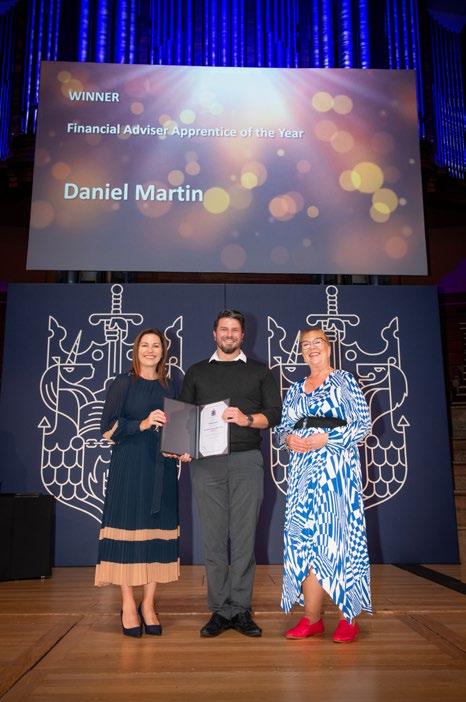



The 2026 Apprenticeship Awards will feature the following categories:
• Insurance Practitioner of the Year
• Insurance Professional Apprentice of the Year
• Senior Insurance Professional of the Year
• Financial Adviser Apprentice of the Year
• Paraplanner Apprentice of the Year
• Financial Services Administrator Apprentice of the Year
• Large Employer of the Year
• Small Employer of the Year
• Social Equality Employer of the Year
From college uncertainty to rapid progression at Zurich, Nina Pope’s story highlights the transformative power of apprenticeships
Nina Pope’s journey is a powerful example of how apprenticeships can unlock potential, build confidence and create lasting career success.
After leaving school, Pope was unsure of her next steps. She began studying A-levels but soon realised that the academic route wasn’t right for her. After leaving college, she took on several part-time roles but continued to feel driven to find a meaningful, sustainable career.
Her turning point came when she joined the ACT Jobs Growth Wales+ programme, where she received tailored support to strengthen her interview skills, refine her CV and explore suitable career paths. With guidance at each stage, she went on to secure what she describes as her dream role – underwriter at Zurich Insurance.
Starting at Zurich was both exciting and daunting. Working alongside colleagues with degrees and formal qualifications, Pope initially felt out of her depth. To support her development, she enrolled on the ALS programme and began an insurance apprenticeship alongside her role.
The apprenticeship proved transformational. It strengthened her technical knowledge, boosted
her confidence and provided a strong foundation in the insurance profession. Through structured learning, coaching and mentoring, Pope quickly began to thrive.
In just two and a half years, her achievements have been remarkable:
• Gained Level 2 Fleet Authority within her first year, followed by Level 3 Authority, earning promotion to senior underwriter and becoming the youngest Level 3 Underwriter in the business.
• Successfully completed her insurance apprenticeship, including the sector recognised Cert CII qualification.
• Selected to represent Zurich at CII events and awards evenings.
• Currently being considered for promotion to Grade 3 Underwriter, with increased responsibility and scope.
As her career has progressed, Pope has taken on a more strategic role, developing broker relationships, delivering training, granting underwriting authority and contributing to broader business decisions. She has also led additional projects for the small to medium enterprises (SME) team, such as managing duplicate policies to improve reporting accuracy and supporting the training and onboarding of new starters.
Her team manager, Daniel Richardson, said: “Within my team, Nina is a standout member. She is an ever present voice encouraging collaboration, supporting change, and helping the team to grow together.”
He added: “Nina has made herself indispensable by leading additional projects for our SME team and supporting the training of new starters. Her commitment to professional growth is evident both inside and outside her role.”
Beyond her technical expertise, Pope has become a valued member of the wider team. She encourages collaboration, organises team events to strengthen relationships and supports leadership by championing key messages and helping embed change.
Reflecting on her apprenticeship experience, she said: “I am proud of the professional, and person, I have become as a result of my apprenticeship.”
Pope’s experience is a powerful reminder of the life changing impact apprenticeships can have, both for individuals charting their future and for the organisations supporting them.
Isobel Birkett is marketing and communications coordinator at ACT

Discover how apprenticeships can strengthen your future.