British Horse Society Reg Charity No. 210504 (SC038516 in Scotland)
BHS is a membership organisation. Join today at bhs.org.uk 02476 840500
Views expressed by contributors are not necessarily those of BHS. Readers are advised to make appropriate enquiries and seek advice before spending any money or incurring any expense, or entering into a binding commitment in relation to an advertisement or featured product. BHS shall not be liable for any loss or damage incurred or suffered as a result of his or her accepting or offering to accept an invitation contained within any advertisement or featured product in British Horse magazine. British Horse is a registered trademark of British Horse Society. By submitting any picture to British Horse Society it is assumed that permission is granted for BHS to use this image in British Horse or any other BHS publicity material.
Lead rein
Dear BHS member,
Welcome to the Spring edition of British Horse Spring has always been a season of renewal, but this one feels particularly significant for all of us at BHS.
2026 marks a decade of our Dead Slow campaign: 10 years of lobbying, collaboration and lifesaving awareness that have helped make our roads safer for horses and riders.
On page 14, we look back on a decade of hard-won progress, driven by people who refused to accept that unsafe roads are inevitable. But this is not a moment to pause – it’s a moment to push harder. Following the Horse and Rider Road Safety Westminster Hall debate, which I attended in January alongside our Safety team, we set out what must happen next, a stronger change to the law and why action cannot wait.
This issue includes a Dead Slow car sticker. Display it proudly. Road safety saves lives, and your support gives this campaign its voice and its power.
Spring brings its own set of welfare priorities, from weight management and fat scoring to pasture management. You’ll find advice from our Welfare team throughout this issue, including features on how to prepare your pastures for spring and disease prevention.
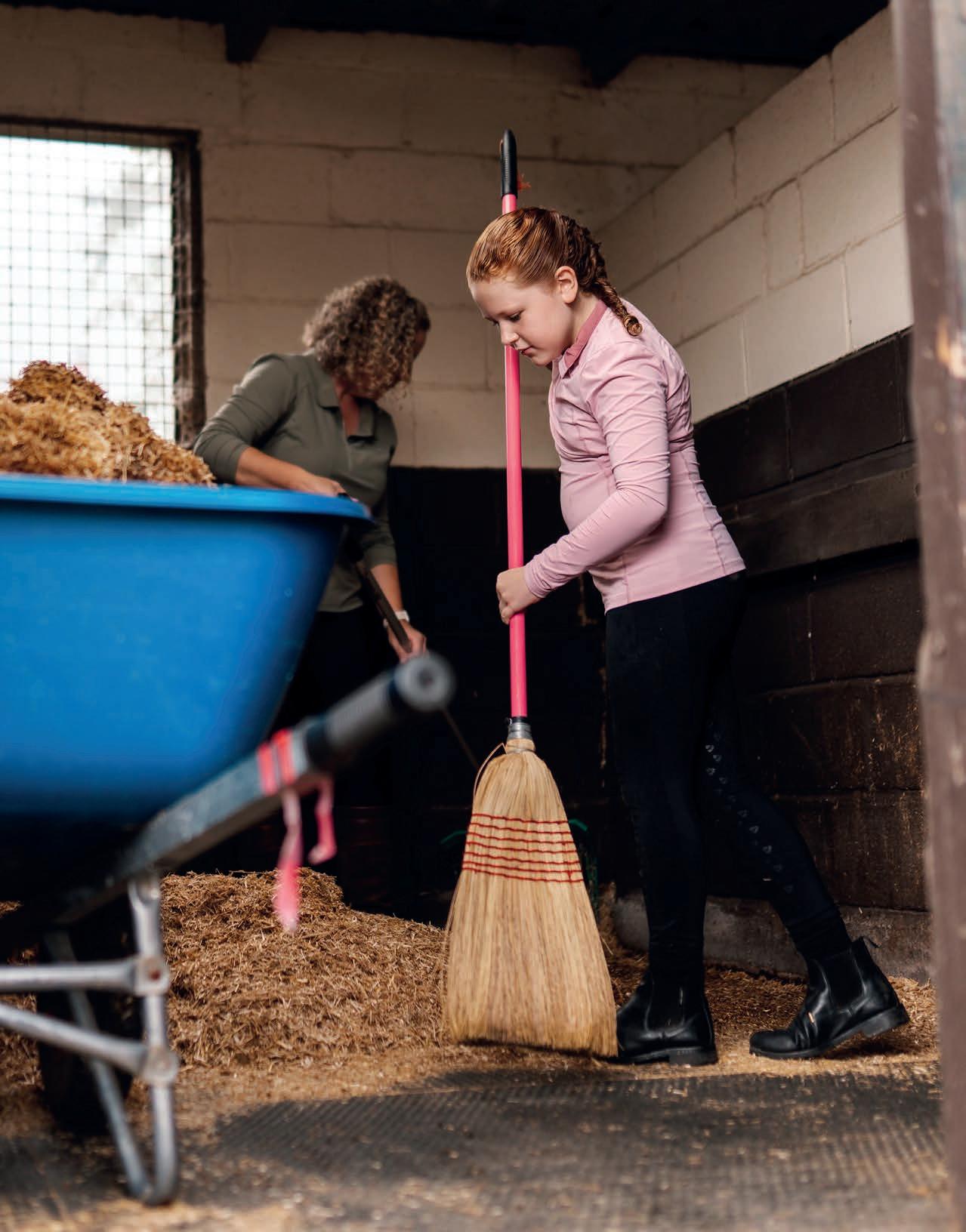
Our community stories remain at the heart of each issue; this time, we’re featuring a day in the life of a groom (pages 30-33), which shines a light on the skill, dedication and passion behind the scenes of our industry.
We know the cost of living continues to be a challenge for all horse owners, so we’ve included a feature on pages 34-36 that offers advice to help you manage budgets while maintaining the highest welfare standards for your horses.
The 2026 trustee elections are nearing, a crucial moment in shaping the future of
the Society. On page 40, we’ve shared an interview with Lucy Grieve, our Welfare Trustee, offering insight into the role, responsibilities and the impact our Board has across every aspect of our work. I’d encourage all members to take part in the election process; your voice truly helps direct the Society’s next chapter.
I hope you enjoy this Spring edition of British Horse. Follow us across our social media platforms and check out the website for the latest updates and campaigns. I love hearing from members via email at ceo@bhs.org.uk – so please feel free to get in touch directly.
Your support is critical to our work, thank you for your support.
With best wishes for an enjoyable year.
James Hick Chief Executive Officer
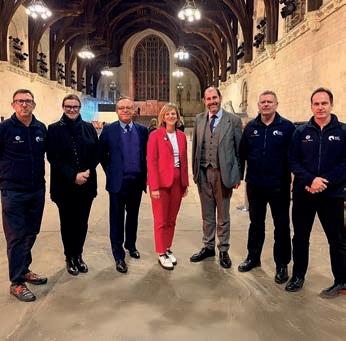
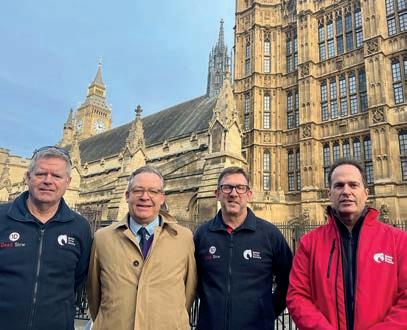
James with the Safety team; Lee Dillon MP; Lilian Greenwood, Minister for Local Transport; and Josie Jordan from Project EDWARD
BHS NEWS
Step into the starting gate
We’re looking for amateur jockeys to take part in our Charity Race Days
f you’re ready for a big challenge in autumn 2026, this could be your moment. We’re looking for 24 committed riders to take on a mile-long charity race at Newbury or Wetherby. You’ll be raising vital funds for BHS while experiencing something very few people ever get the chance to do. It’s unforgettable – but it’s tough, and it does ask a lot of you.
To take part, you’ll need to:
Raise £3,500 for BHS
Meet the likely weight limit of 11st 7lbs (including kit)
Pass a full fitness and riding assessment
Have a suitable horse aged four+, in training with a registered or point-to-point trainer
Ride out regularly with a trainer.
We know this might sound like a lot, but don’t worry, we’ll be supporting you throughout your journey. This could be your chance to step out of your comfort zone and into the starting gate. Our races offer a wonderful experience for horse lovers to come together and support each other. Courage, passion, impact – that’s what our community is all about.
Paula Dewsbury, who placed first in the Wetherby 2025 race, said her experience was “amazing. I felt so full of energy, I just wanted to go do it again.”
To register your interest or simply find out more, email fundraising@bhs.org.uk.
IN BRIEF
Ragwort rewind
We’re delighted to see Natural England’s reversal on its ragwort policy after having closed its complaints process in September 2025. Ragwort complaints will be accepted between 1 April and 30 October.
On
your marks, get set…
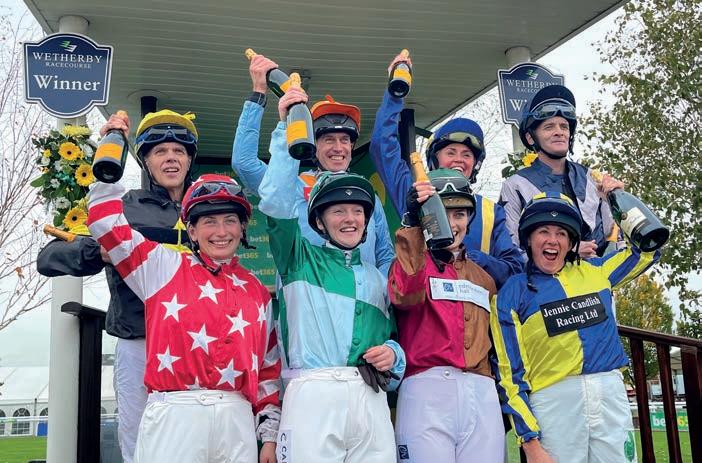
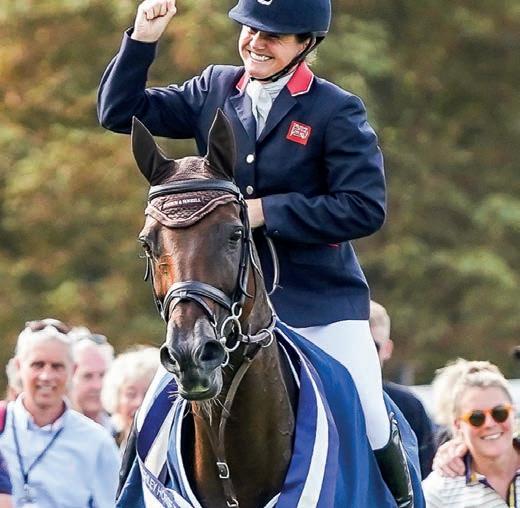
Congratulations to our two Charity Race winners: Paula Dewsbury, who won at Wetherby, and Martha Allhusen, who won at Newbury! Thank you again to all the jockeys who took part, and to everyone who worked hard with training and fundraising for this event.
Bring on the bridleway
With help from the Ride Out Fund, Bridleways 56 and 96 in Waltham Abbey, Essex, have had new drainage and a surface upgrade, so they can be enjoyed all year round.
Jockeys at Wetherby, 2025
FIGHTING FOR THE FUTURE
As we enter 2026, we’re reflecting on what could’ve been a significant moment for our off-road access network. For over 25 years, we’ve been fighting an impending deadline to formally record historic routes on the Definitive Map, which was originally set for 1 January 2026. While the former UK government postponed this deadline and our current government announced its intention to repeal it, we’re yet to see any action. We can’t rule out the possibility of losing
over 40,000 miles of unrecorded paths. Horse riders have access to only 22% of the public rights of way network, and carriage drivers have just 5%.
We’re urgently calling on the government to take action and repeal the cut-off date. We also want to see the introduction of a green paper on access, and for horse riders/equestrians to be included in Active Travel plans.
We’ll be sharing opportunities to write to your MP and raise awareness, so look out for ways to get involved!
Knowledge Exchange Awards
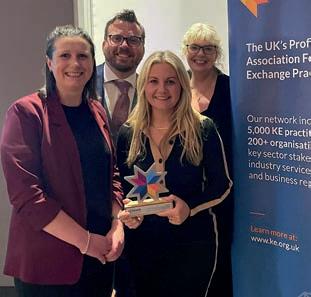
BHS, together with Nottingham Trent University and Diversity, won the Public Vote category at the 2025 Knowledge Exchange Awards, which celebrate partnerships that bridge the gap between academic research and real-world impact.
The project, ‘The Science Behind a Happy Horse: A strategic partnership for equine welfare and educational equality’, gave students the opportunity to create content that puts horses at the heart. They co-created educational resources on equine asthma and allergies, with a specific focus on sweet itch.
With over 100,000 views globally, the final resources made a meaningful difference to our community. The project broke barriers by offering a placement module that provided real work experience
for students who might not otherwise have access. Its success shows how we can come together to create a lasting impact and champion positive change. Thank you to everyone who took the time to vote for us!
Transforming Tetbury Trail
One of the Tetbury Rail Lands Regeneration Trust’s ongoing projects is developing the Tetbury Trail, a multi-user path in Gloucestershire, which runs mainly along the old railway line. Part of the trail was eroded,
extremely uneven due to exposed tree roots, and very muddy, especially during winter. Supported by our Ride Out Fund, a new all-weather surface has been laid, suitable for all types of users and can be used all year round!
Recognising road safety
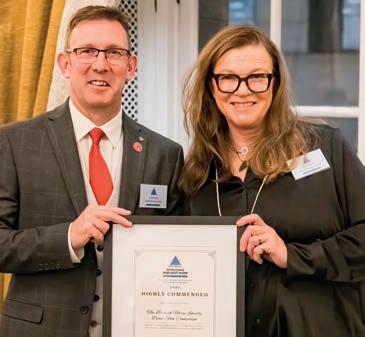
We’re thrilled that our Dead Slow campaign was Highly Commended at November’s Prince Michael International Road Safety Awards. This global recognition highlights the importance of working collaboratively to educate drivers on how to safely pass horses. It’s a joint effort that wouldn’t be possible without the brilliant support of our volunteers, key stakeholders and the whole equestrian community. As we mark 10 years of Dead Slow, we’re honoured to be recognised, and even more determined to keep pushing to make the roads safer for our horses and riders.
The team at the KE awards
Prince Michael International Road Safety Awards
An important week in Parliament
Our Safety team and CEO James Hick stood at Westminster Hall alongside MP Lee Dillon, who introduced the debate on horse and rider road safety, pushing for stronger protection for all of us and our horses.
Thank you to all of you who wrote to your MP to encourage them to attend. It’s a really positive step towards what we hope to be a promising change.
The work doesn’t stop here, though; we’ll continue to work with MPs across the country and, of course, Lee
Dillon to make a difference. Together, we’ll keep fighting.
Our Safety team were also there to support the fireworks debate at Westminster Hall as MPs gathered to discuss the impact of fireworks after more than 376,000 people signed two public petitions calling for change.
As proud members of the Firework Impact Coalition, BHS has continued to raise awareness of the serious risk that fireworks pose to people, horses
and other animals. The inappropriate use of fireworks can cause significant distress, injury and even fatalities, and public support for change is growing stronger every year.
Raise a hoof for Rideathon
Horse lovers across the UK joined us in summer 2025 to help raise money to protect and improve safe off-road routes.
Julia Packham, our top fundraiser in 2025, shared her experience from last year’s Rideathon: “I loved doing this challenge and can’t wait to do it again this year. I’ve always loved hacking, just me and my horse. It’s my happy place, exploring and being behind his ears. We need to keep bridleways open, especially so the younger riders have somewhere safe to ride outside the arena.”
We also spoke to Vittoria Necchi, who said it was “an incredibly positive experience for myself and my veteran mare, Bondi Girl (Sally). It gave our hacking direction and purpose while still being an age-appropriate challenge for Sally, which mattered most.” Vittoria is a proactive fundraiser who’s participated in Rideathon several times before.
“It was a wonderful way to achieve something together, enjoy our time and give back through fundraising.” Get ready to take the reins for one whole month of heart-pounding, adventurous trails and happy horses – for something that couldn’t be more important, raising vital funds to protect and improve our off-road routes. Are you in? Stay tuned for Rideathon 2026!
Building blocks
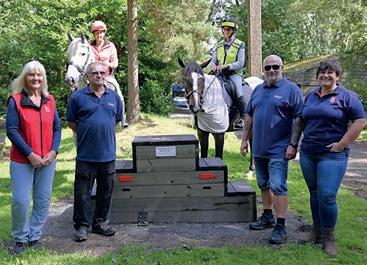
A new mounting block has been officially opened on the Whitegate Way in Cheshire, at the Whitegate Station car park. This project was a fantastic team effort between Mid Cheshire Bridleways Association (MCBA) and Cheshire West and Chester Council, with contributions from our Ride Out Fund.
A huge thank you to everyone involved for helping make this route even better for horse riders and the local community. It’s a great example of what we can achieve when we work together!
Unveiling the new mounting block
Our Safety team and CEO at Westminster Hall
Delicious
Ideal
Low
Pre
From awareness to action
ECEO James Hick talks about the impact of our Dead Slow campaign 10 years after it first launched
verytimeah
very time a horse and rider or horse and carriage step onto a road, they’re taking a risk that no one should have to take. This year, the Dead Slow campaign marks 10 years of standing up for those at the greatest risk on our roads – horses and their riders. 10 years of raising awareness, challenging complacency and demanding change. It is a moment to reflect – and to remember those who never made it home. In the past decade alone, 746 horses and 47 riders have been killed on UK roads. These are not just numbers. Each represents heartbreak, a family shattered, a trusted partnership lost, a life ended far too soon. Keeping riders and horses safe remains one of our five strategic aims – and it’s just as urgent today as it was when Dead Slow first began. While we acknowledge progress, the harsh truth remains: far too many riders are still putting their lives on
the line every time they step onto a road.
Dead Slow began as a simple but powerful awareness campaign: educating road users on how to pass horses safely. Behind that message lies a stark reality. Year after year, data from our Horse i app shows the risks riders face daily. When paired with the voices of people who have lived through these incidents – who have felt the fear, trauma and loss – the issue becomes impossible to ignore.
Over 10 years, Dead Slow has grown into far more than a campaign. It has become a movement powered by collective determination. Local Authorities are installing roadside signage. Mounted police are carrying out close-pass operations. HGV drivers and commercial organisations are taking up training. Road safety charities like Project EDWARD stand shoulder to shoulder with us. Different sectors, one shared purpose: safer roads for everyone.
A vital step forward came in January 2022, when the Highway Code was updated to better protect equestrians. This helps educate new drivers from the very start – and with more than 1.4 million people taking their practical driving test last year, that matters. Yet millions of drivers have never
revisited the Highway Code since passing their test. That is why we cannot stop.
Last month, many of you wrote to your MPs ahead of the Horse and Rider Road Safety Westminster Hall debate, led by MP Lee Dillon. Powerful personal testimonies from constituents were shared across the chamber, and there was cross-party agreement: the current situation is not good enough. As we await the second reading of the Road Traffic (Horse and Rider Safety) Bill, momentum must be maintained. Stronger laws are needed, and horses must be seen as sentient beings, not objects.
Our roads have changed dramatically since Dead Slow began. Electric vehicles, while positive in many ways, bring new risks because of how quiet they are around horses. Off-road routes are more important than ever, and we remain committed to protecting and preserving them through persistent lobbying and advocacy.
Finally, I want to thank our volunteers, members and dedicated Safety team. The progress we have made exists because of you. Safer roads are not too much to ask, and together, we will keep fighting until every rider and every horse can travel safely.
Healing without words
Ele Milwright, CEO of Warrior Equine, speaks with Melissa Evatt on equine-assisted therapy and how the power of horses is helping military veterans, serving personnel and first responders
We will always find a way that works!
For many people, being around horses almost feels like therapy. There’s something grounding about being in a horse’s presence: a quiet steadiness that invites you to slow the mind and relax. Horses are naturally sensitive animals, highly aware of their surroundings and those around them. They don’t respond to words, but to energy, intention and emotion, and can often reflect what a person is feeling.
Being with horses and other animals like dogs, cats and rabbits, often brings a sense of calm and safety that can be hard to find elsewhere. Stress goes down, breathing deepens and attention shifts to being in the moment.
Animal-Assisted Therapy (AAT) uses this innate reaction to help make therapy more engaging and less intimidating. The bond between humans and animals gives AAT distinct advantages compared to conventional talking therapies –something that Warrior Equine uses to help some of those most in need of that unspoken connection.
Introducing Warrior Equine
Warrior Equine works with and supports military veterans, serving personnel and first responders who’ve experienced severe psychological trauma. Founded by CEO Ele Milwright, Warrior Equine offers equineassisted mental resilience and positive wellbeing courses with the aim of facilitating long-term positive changes in mental health, resilience, confidence and self-worth.
They often work with people who have faced difficult experiences and dangerous situations to serve their country and communities. Alongside physical risk, they’re often exposed to intense psychological and moral trauma that can last long after the uniform comes off.
Warrior Equine has a network of partners
and supporters, working with organisations such as Army Recovery Capability, the Royal Navy, Welsh Guards, Op Courage, King’s Troop RHA, West Midlands Police and the Centre of Excellence for Equity in Uniformed Public Services to identify those most in need of their help.
For Ele, the idea for the organisation came after decades devoted to studying horses and observing their therapeutic potential, alongside her experiences as a military wife married to an RAF officer. She started out volunteering at her local RDA centre, working with the late Pat Burgess MBE, who encouraged her to become an RDA instructor. She then spent 15 years working with Kelly
stroke survivors and people recovering from spinal injuries. In Ele’s words: “We will always find a way that works!”
They work hard to create an environment that makes everyone involved feel safe, secure and free of judgement. All courses are run on a first-name basis, with no rank or hierarchy, to make sure everyone feels equal and able to speak freely. “The conversations we have are confidential and anonymised, so that participants are confident to share experiences and concerns without it being reported up the chain of command. Having a confidential, safe, supported space that is unconnected to work, to truly talk without judgement or fear, can be a very rare thing for a lot of our participants.”
They don’t care who we are, what rank we hold or how much money we earn!
Marks at Intelligent Horsemanship, learning more about horse psychology and equine behaviour. “It all started to come together, forming the seed of an idea that might combine all my passions”, explains Ele.
In 2019, Warrior Equine was launched with a small team combining equine experts, life coaches and counsellors.
Horse and human, together
Warrior Equine offer three-day courses that are based on groundwork, with no riding involved. With no ridden element, there are no restrictions on weight limits or physical injuries, making these courses widely accessible. Warrior Equine welcomes all and has worked with amputees, students with brain trauma injuries,
Many participants who come to Warrior Equine have had little to no previous contact with horses and may be unsure of working with them. Some are initially sceptical, wondering how ‘patting a pony’ is going to help their PTSD or severe mental wellbeing issues. But by the end of their course, the difference is clear with one attendee saying: “I was able to feel safe enough to drop my guard… something I haven’t done for many, many years!” The courses have been described as not just life changing but life saving.
Reflecting and connecting
The courses aim to work with a horse’s ability to read our body language, to build a connection and allow a ‘conversation’.
Ele explains: “As humans, we often wear masks, especially when our roles demand us to demonstrate a professional appearance of being calm, capable and assured at all times... For those who’ve experienced trauma and repeated distressing situations, we can begin to use these masks as a maladaptive coping strategy, such as denial, dissociation and emotional suppression.”
Horses can pick up on what we’re feeling, which makes them good partners to work with. Participants work with a horse loose in a round pen, with no line attached, so they’re free to move as they like. The masks
humans wear around each other don’t work on horses. The horse will pick up on the participant’s feelings and will mirror those emotions, as Ele says: Tthey’re our big, hairy mirrors.” One participant spoke about how surprised they were by the horses’ intuition: “They could sense the confusion, pain and pressure I’d been carrying inside, things even I didn’t fully understand.”
Ele explains: “This ability to accurately read and mirror the smallest changes with instant feedback is a key element. They don’t care who we are, what rank we hold or how much money we earn! They simply read us in the moment, and what body language we’re presenting. Do we present as a threat, or as a calm, confident friend they can trust?”
Through this process, participants begin learning to recognise their emotional state and the effect it has on those around them. Trained instructors guide students on how to regain selfcontrol of their emotional regulation and behaviours. Being around horses in this environment gives students the chance to practice how to slow down their breathing, lower their heart rate, soften body language and find that moment of calm.
Did you know?
Therapy animals such as dogs, cats, rabbits and horses have been used for hundreds of years, with roots dating back as far as Ancient Greece. Horses were believed to uplift the spirits of the ill, offering emotional comfort at a time when medical interventions were limited.
Where connection leads
“We teach many of the same techniques that our students may have learned in therapy, counselling and mindfulnesstype courses. However, learning in a clinical or classroom-type setting can have its limitations, especially when listening to theories and trying to remember them. The advantage here is that they get the opportunity to practice and experience it for real.
“The horses give us a unique chance to try these techniques in a safe setting, receiving instant feedback from a nonjudgemental, living and sentient being.”
As strong as a horse
At the heart of Warrior Equine’s operations are the silent but powerful workers: horses. While Warrior Equine doesn’t have its own horses or yard, they maximise their funding
by using existing facilities and their horses wherever there’s an area in need of a course.
All horses and ponies, big and small, are welcome to take part in Warrior Equine’s courses, provided they’re wellmannered. As Ele puts it: “As most of our participants are complete novices, we simply ask that the horses put forward for selection are even-tempered, happy to be handled and have no tendency to kick.”
The horses aren’t specifically trained for the courses; in fact, their natural reactions are what makes it work. Their behaviours and reactions need to be authentic and real, not shaped or learnt. What matters the most isn’t a horse’s size, breed or background, but its ability to remain present, responsive and calm. These qualities allow horses to become safe learning partners, offering participants consistency, honesty and trust with each interaction.
For many people, healing doesn’t begin with finding the right words. It begins with those moments of quiet awareness, learning to slow down and notice what’s happening internally. The connection between humans and horses offers this space naturally, without pressure or expectations. It’s a relationship built on quiet conversation, a two-way understanding, honesty and trust.
Did you know?
During the Crimean War and beyond, Florence Nightingale learnt that small pets (particularly dogs and birds) in hospital wards and sick rooms were great companions to ill patients as they offered comfort, reduced anxiety and improved patients’ moods.
Images: Sophie Callahan
Ele Milwright, CEO of Warrior Equine
Did you know?
Despite being used for centuries, AAT didn’t gain formal recognition until the 1960s, when psychologist Boris M Levinson coined the term after watching his dog, Jingles, and the positive impact he had on shy, withdrawn children.
Warrior Equine exists as a safe space for people who’ve spent much of their lives operating under pressure and repeated exposure to trauma. For military personnel, veterans and emergency responders, speaking openly about their trauma can feel unsafe. By removing hierarchy, judgement and the need for verbal expression, equine-assisted work offers an alternative.
The impact of this work is often subtle, but meaningful. “Teaching mental resilience techniques and enabling people to regain confidence and control of emotions are the key to Warrior Equine’s methodology, empowering students to better manage stressful environments and difficult memories.”
The heart of Warrior Equine’s work is horses: steady, soulful and spirited. They respond to emotion and give immediate and honest feedback without assumption or bias. In doing so, these powerful partners provide an opportunity for participants to reconnect with themselves and others. As one person shared: “This course has let me see a bit of light to heal myself.”
In a world that asks us to explain, justify or suppress emotions, Warrior Equine quietly demonstrates another way. When words fall short, connection leads.
You can learn more about Warrior Equine at warriorequine.co.uk.
Did you know?
In 1796, the York Retreat in England, one of the first in the world to offer “moral treatment” for mental health, introduced domesticated animals into care and recovery processes. They learnt that just having the animals in communal spaces reduced tension and distress among the patients.
Advantages of AAT
Today, AAT is used in hospitals, schools and therapy settings to treat anxiety, depression, PTSD and developmental disorders, with proven benefits such as lowered blood pressure, a reduction in stress hormones and an increase in those feel-good chemicals (endorphins). Compared to traditional talking therapies, AAT offers a completely different experience. Some of the advantages include: Unconditional acceptance: animals don’t judge and offer unconditional support, which can help people feel safer and more at ease Physiological benefits: interacting with animals (even for a short amount of time) can trigger positive physiological changes
Enhanced engagement and motivation: the presence of an animal can make therapy more engaging and less intimidating, which is beneficial for children or anyone who finds traditional therapy difficult Skill development: taking part in activities like caring for or training an animal can help people develop essential life skills such as responsibility, empathy, self-regulation and appropriate social interaction in a supportive, real-world context.
COMPLETE TO WIN
VOUCHER TO SPENDUSWITH *
Across
1. What Lincoln product stops itching? (5,3,4)
2. What Horseware fly rug can you ride in? (8)
3.Irritated skin caused by a reaction to fly bites? (5,4)
4. Common summer pest that bites horses? (5,3)
5. The name of Equilibrium Product’s fly range? (5,6)
6. Protective mesh worn over a horse’s face? (4)
Down
1. Aromatic plant believed to deter flies? (10)
2. What’s the name of the Shires zebra collection? (3,4)
3. You add this to washing off water to refresh your horse? (7,4)
4. A ‘Power’ful fly repellent? (5,6)
How To Enter
1.Correctly complete the crossword
Take a picture of the completed crossword and email it to marketing@coutryandstable.com 3.Enter by 31st May 2026
the feelingSharing
Since introducing our new look and feel, horse lovers across the country have been joining in to share the impact that horses have
on their lives
In our last issue, we shared our new look and feel – not just for British Horse, but for the wider BHS.
Prompted by the changing world of horses and feedback from our members, our new look and feel is more emotive and inclusive. It will help us reach more people and welcome them to be part of our horsey community by celebrating the special bond we have with our horses and the feeling that being with them brings us.
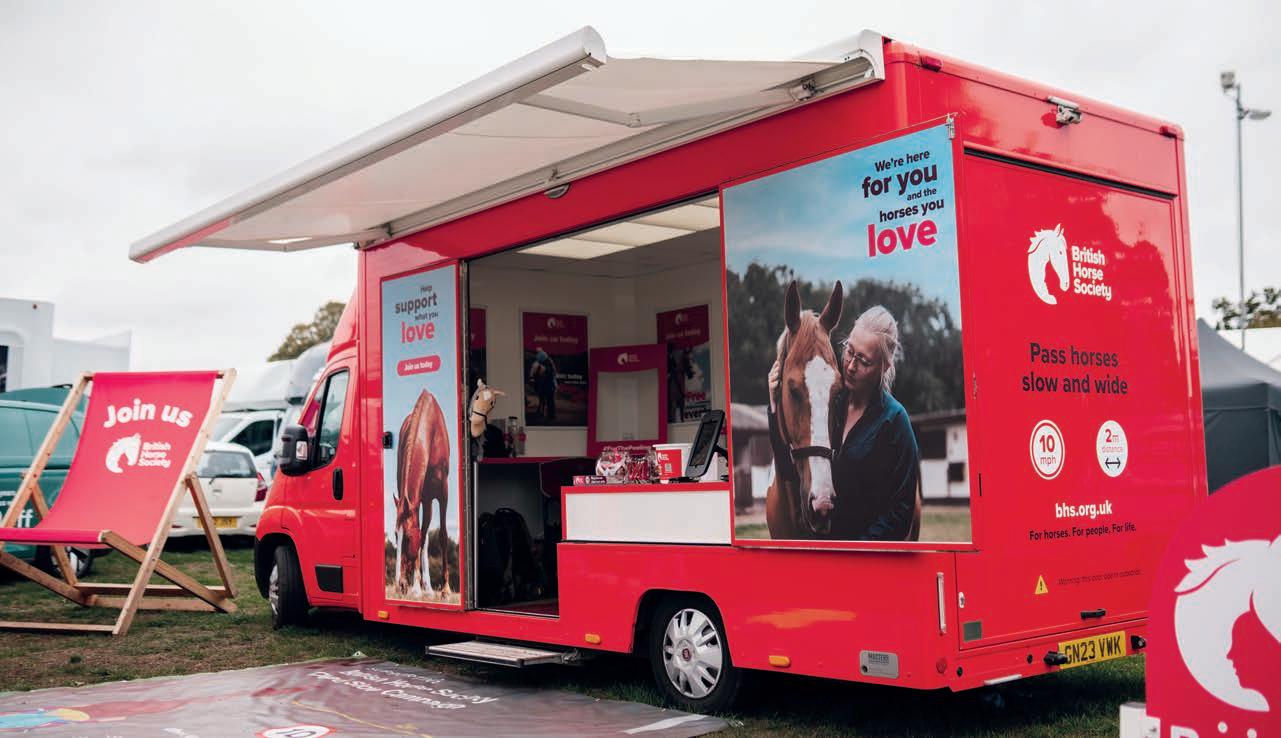
We know that feeling can be slightly different for all of us and it was great to see so many of you sharing your thoughts and feelings at Blenheim Palace International Horse Trials in September. Thousands of attendees joined us at both
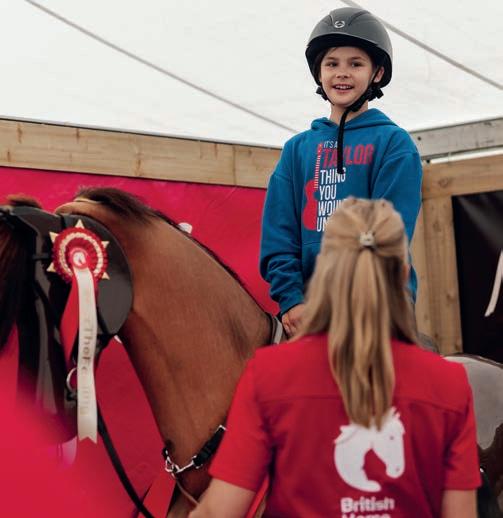
our event stand and event lorry – some of you included! Children enjoyed our hobby horse course throughout the weekend and on the main stand, Robocob (a mechanical horse) was as much in demand as ever. It’s always great to meet and talk to people who really get it, and who care about horses as much as we do.
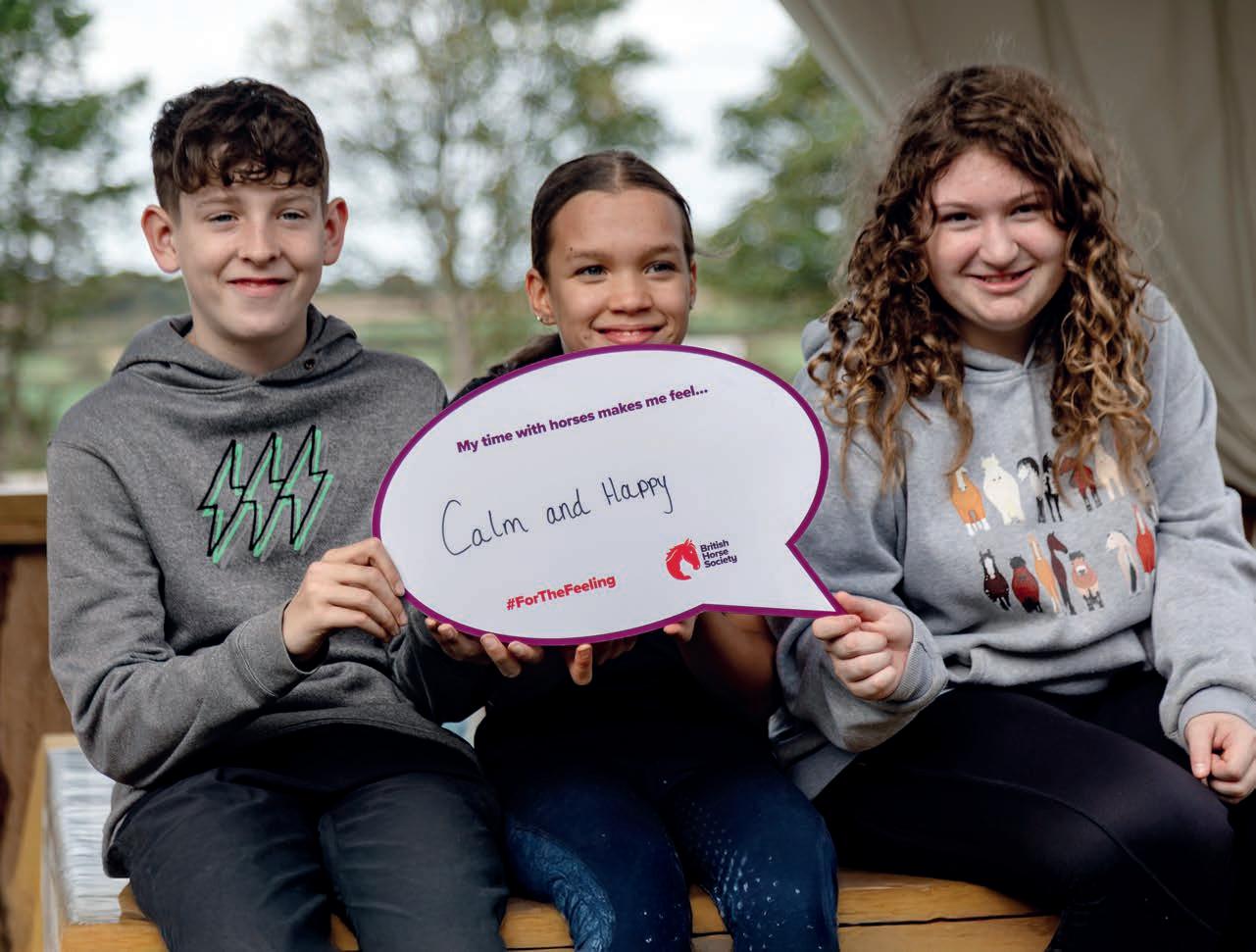
We also had a selfie booth during the event with all the accessories you could wish for. We asked people to share how they felt when they were with horses and what ‘For the feeling’ meant to them.
Horses can bring out so many feelings, but the general consensus was ‘loved’. ‘Calm’, ‘happy’ and ‘trusted’ also made multiple appearances during the weekend! But the sharing didn’t stop there.
Somehow they seem to know when we’re sad or anxious
Beyond Blenheim
In October, we asked followers across our social channels to share what ‘For the feeling’ meant to them, and thousands of you responded. You shared pictures, stories and anecdotes, from many lifetimes spent with and around horses. You made us smile, laugh and sometimes cry. Some of you spoke about how healing you find being around horses and how much they help you through the difficult times. Others spoke as their horses as their ‘best friends’ and their happy place, while acknowledging the hard work and determination involved..
From first rides to quiet reflections, show days to yard hugs… you shared your lives with us and brought that emotion to life in the most beautiful way.
One follower, Georgina Leigh (otherwise known as The Horse Artist) put it perfectly: “I can only describe #Forthefeeling as a unique kind of wizardry. Horses provide a companionship, a teacher, a confidant and team partner which is built on a silent understanding, mutual patience, as well as fantastically euphoric, and sometimes a bit scary moments, that take your breath away, all without speaking the same language! You never stop learning and I love it!”
Some well-known faces joined the conversation, sharing their thoughts and emotions. BHS President Martin Clunes said “The feeling I get the most with
Patrick, my horse, is joy and a lot of pride in all the things we achieve together on our journey” while Pippa Greenwood talked about how her horse was her rock through good times and bad. Megan Elphick talked about horses empathy saying: “Somehow they seem to know when we’re sad or anxious – and they make it better.”
Showcasing our centres
Our BHS Approved Centres also got in on the action. Over October half-term, we challenged centres to make and share short videos highlighting what horses meant to them and the people there.
Keep sharing
We had some incredible responses, with centre staff and pupils showcasing the difference that horses have made to their lives. Quarry Farm in Surrey spoke about the trust, care and connection that happens every single day, while Ryders Farm Equestrian Centre’s video was full of warmth, connection and the kind of moments that stay with you. Kidderminster’s Country Treks also made a video packed with joy, big-hearted horses and even bigger smiles. You can watch these three videos by scanning the QR code. Make sure you have tissues ready!
Calm. Joy. Connection. Confidence. Happy. Trust. Pride. Hope. Freedom. Loved. These are just some of the words you used to describe that feeling. That connection and feeling is why we do what we do. Why we trudge through muddy fields or ride our horses in the pouring rain. Thank you to everyone who shared their stories – your voices really make a difference. Not everyone gets the chance to experience a life with horses, but for those who do it’s lifechanging. Please keep sharing how amazing and powerful the bond we have with horses is. Tell your friends and family. Share your stories and photos on your social channels. Let’s show the world how beautiful, powerful and amazing life with horses can be. Because we all know – there’s no feeling like it.
Enjoying a session on Robocob
The BHS event lorry ready to welcome visitors
Adecade
Q What motivated you to start Dead Slow 10 years ago?
A: Having been in the Mounted Police in London for a long time, I always appreciated the challenges of riding horses on the roads. A tragic collision involving a horse happened in early 2016, just as I was moving to the BHS Safety team. I knew then that there was so much more we could do.
The Dead Slow campaign was created to involve, inform and guide drivers on how to pass horses safely. It was launched on BBC Breakfast, and it’s been one of my main priorities ever since. I’m passionate about making the country safer for horses and equestrians on the roads.
Q How do you think Dead Slow has evolved over the last decade?
Q What are some of your most significant achievements – both for yourself/ your team and the wider equestrian community?
A: The Prince Michael Award in November 2025 was a huge recognition of the hard work the team have put in over the last 10 years. A real honour!
The changes to the 2022 Highway Code gave specific advice to drivers on how to pass ridden horses and carriage horses and were significant in delivering our message to all drivers, specifically learners. This was a crucial moment and a huge step forward!
A: I think the main way the campaign has grown stronger is the way that the team have involved and partnered with road safety professionals, the police, driving instructors and local authorities. Before the campaign started, I don’t think it was a factor in many stakeholders’ activities. We’re now very much part of the overall strategy for vulnerable road users across the UK. At times it’s been a struggle, but we’ve had tremendous help from organisations like Project EDWARD, Co-pilot and driving instructors.
I also think the start of Close Pass operations with the police was a huge win. The fact that we attend and present at national road safety exhibitions and conferences is another way we’ve entered the road safety community. Personally, though, the awareness ride that took place in May 2025 from Lambourn to the Windsor Horse Show was a major undertaking for both me and the team as well as Project EDWARD. This was a huge success, and the media coverage and exposure we had were second to none. The support we had from Land Rover Defender, Lizzie Greenwood-Hughes and Lee Dillon MP were superb. What a fantastic five days!
Dead Slow of
George Bate speaks with our Director of Safety, Alan Hiscox, about how a single campaign has spent a decade reshaping driver behaviour, influencing national policy and improving road safety
Q What have been your biggest challenges over the last decade?
A: The biggest challenge is always getting more drivers to know about the Highway Code changes, but going to the major motoring shows is helping to do this. Another challenge is asking equestrians to let us know when they’ve had a close pass or incident with a vehicle. Recording incidents on our Horse i app is really important for us to lobby the government and inform local authorities where ‘hot spots’ are. Still, only one in five riders let us know what the situation is in their local area.
Q What impact do you think the campaign has had on the equestrian community?
A: I don’t think we’ll ever reach a point where every driver will pass horses safely. This doesn’t mean the team will stop trying to achieve a ‘Vision Zero’, but I
really think the campaign has had an effect in informing and involving all road users with our messages. I always monitor the statistics and hope that the number of horses killed or seriously injured will drop, and I sincerely think we’re making a difference. It’s great when we hear from riders that they’ve noticed a change in driver behaviour when riding out. The team is always striving for this change.
Q What impact do you think it’s had on the general population – motoring population, local authorities, government and so on?
A: Being involved with all road safety stakeholders has meant that they’re all aware of the challenges horse riders and carriage drivers face on the roads. Police forces are planning their own Close Pass operations, and we’re part of the planning process. Local authorities are putting more
and more Dead Slow posters up, liaising with both local riders and consulting our incident map. The relationship we have with all the driving instructor organisations means we’re asked to be a part of their messaging, and importantly, the relationship we have with Project Edward, RSGB, CoPilot and the police has been tremendous.
Q What would you like the next 10 years to look like for Dead Slow?
A: I’m a one-trick pony, and the message stays the same, but I hope more drivers become aware of the Highway Code changes, more drivers are considerate when passing or approaching horses, and more equestrians notice a change in driver behaviour. One thing I can say is, if I’m not here in 10 years, I hope the Dead Slow campaign is still going from strength to strength. We have a great team at BHS, including all our volunteers. We really couldn’t do it without everyone’s continued help!
By downloading our Horse i app, you can quickly and easily submit details of any incidents or near misses you encounter directly to us via your mobile device or tablet. Scan the QR code to find out more and download the Horse i app.
Highlights of our Dead Slow campaign
2010
We launch our incidentrecording website in response to growing concerns from the equestrian community.
2011-16
More and more incidents are being recorded through the BHS site, accumulating over 2,000 in just under five years. Our Safety team decides that more information needs to be given to road users on how to pass horses safely.
2016
We officially launch the Dead Slow awareness campaign on BBC Breakfast, publishing the incident report figures. The campaign quickly gains traction with awareness banners and presentations at road safety events. The campaign wins our first award from the Driving Instructors Association.
2017
One year on, we collaborate with the Department of Transport to produce a THINK! video, educating road users on the risks of passing horses.
Dead Slow is featured on BBC Breakfast again.
The Ride Safe Award is introduced, to raise awareness of riding safely on the roads.
2018
The team makes their first presentation at the National Road Safety GB conference. The first ‘Close Pass’ operation involving horses takes place in partnership with the police. We attend our first major motoring show at Goodwood to spread the message.
2019
2020
2023
We launch an awareness video featuring Laura, who tragically lost her horse, Angel, in a road traffic incident. We place our first ‘Dead Slow’ posters on roads in partnership with HRSA. We hold a Dead Slow VR film launch at Westminster, hosted by an MP.
With an increase in speeding rates during the lockdown, incidents continue to rise. But the pandemic doesn’t slow us down! We continue placing posters on roads and support riders who have had traumatic incidents on the roads.
2021
The launch of our Horse i app means that recording safety incidents has never been easier, leading to awareness posters being put up in 11 local authority areas. We film our ‘Look out for Laura’ awareness campaign. Supported by Nottingham Trent University, Cycling UK and the Road Safety Trust, the training videos help humanise vulnerable road users.
2022
The Highway Code was updated to include our Dead Slow behavioural messages. The hierarchy states pedestrians, equestrians, cyclists and motorcyclists are the road users most at risk in the event of a collision and are placed on top of the hierarchy.
Our Director of Safety, Alan Hiscox, is on the BBC Breakfast sofa again, spreading the Dead Slow behavioural messages across the nation. The team goes to more motoring shows, Car Fest, Silverstone and presents at national driving instructors’ conferences.
2024
Our Horse i app has been downloaded over 23,000 times, supporting our work to raise awareness of the importance of equestrian road safety. The campaign receives an award from the Institute of Driving Instructors.
2025
Partnering with Project EDWARD, our Safety team plays a key role in an awareness ride to Windsor Horse Show, appearing on BBC, in Horse and Hound and hundreds of radio stations. The campaign receives a Prince Michael Highly Commended award.
Road
B spre b
Alan Hiscox
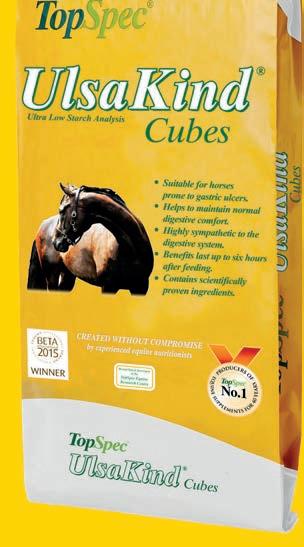
TopSpec UlsaKind Cubes
•Suitable for horses prone to gastric ulcers.
•Helps to maintain a healthy stomach lining in all circumstances.
•Very rich in B-glucans which form a gel, coat and soothe.
•High levels of calcium, including slow releasing calcium (Ca++) to six hours.
•Can be fed to horses undergoing veterinary care.
TopSpec UlsaKind Cubes are formulated to be highly sympathetic to the equine digestive system, especially when the normal increase in acidity occurs between meals.
The formula is very low in starch (UltraLowStarchAnalysis) and sugar and cubes both ‘Non-Heating’ and conditioning.
Staying sustainable while saving money
Serena Raftery explores the Equine Carbon Calculator and how it could help save money and the planet
We all know that, over the past few years, the cost of living has continued to rise, and with it, the cost of continuing to provide our horses with the care they deserve. We’re also becoming increasingly aware of the effects of climate change and looking at how we can reduce our carbon footprint.
During the summer of 2025, dry weather in the UK led to reduced grass growth and hay yields. Because of this, hay has become more expensive in most areas of the UK, affecting not only us as horse owners but also owners of other livestock. In some cases, people have struggled to find any hay at all.
On the flip side, we’ve also seen wetter winters in recent years, which means waterlogged fields and less grazing. This means we need the additional forage even more to keep our horses healthy, not just in the winter, but in the summer too. The drier summer meant less grass, so horses and livestock owners had to turn to feeding forage much earlier than usual. We need to act now to make sure our horses continue to be healthy year-round.
Smarter horse ownership
We’re still learning about the environmental impacts of horse ownership, which makes it difficult to lobby the government to invest in more sustainable practices. It also makes it harder to help horse owners like you find the resources that’ll allow you to reduce your carbon footprint, spend less money and still give your horses the standard of care they need and deserve. This is where the Equine Carbon Calculator
Designed to be flexible and to work for different owners’ needs
(ECC) comes in. Building on the already established Farm Carbon Calculator, White Griffin & Co adapted the toolkit to allow horse and yard owners to monitor what they’re using and identify where they could make changes to reduce waste, and in doing so, their spending and carbon footprint. Gathering the information that will help us lobby for change can seem daunting. The ECC’s creators know this first hand. Zoe Rudge at White Griffin says: “Figuring out your yard’s carbon footprint may feel like a complex, unfamiliar task, but the Equine Carbon Calculator keeps things straightforward. It’s designed to be used by anyone in the equine world, including yard owners, managers, grooms or individual horse owners, and works for yards of any size and setup. The tool gives you clear insights
The Farm Carbon Calculator
The Equine Carbon Calculator Toolkit is a variation of the Farm Carbon Calculator, which has been adapted for use on all types of premises used to care for horses, from your stables at home to the competition yards we see in magazines. White Griffin, Hartpury, Sparsholt and Derby College contributed to the adaptation of the Farm Toolkit, and other organisations have since gotten involved with the project.
that help you to run a more efficient yard, highlighting where you can save on costs and reduce energy use along the way.”
So how does it all work?
Designed to be flexible and to work for different owners’ needs, you can choose to focus on all aspects of horse ownership and record everything you use and spend. Or, alternatively, you can start with one area that you want to track with a view to adapt or tweak. It’s entirely down to you and what you need or want to look at.
One organisation that’s been using the ECC is The Horse Trust. They’ve been working to build a case study of the information they have recorded on the ECC and the changes they have made based on what they’ve found. They’ve chosen to record a lot of detail, making this no small task. While their research is ongoing, what they’ve discovered so far has been eye-opening, interesting and extremely useful to them at a time when reducing costs and adapting to the changing climate have been increasingly needed.
The toolkit was developed with horse owners in mind and was based on conversations with a wide range of equestrian people caring for horses. Many yard owners stated that they’d been forced to make a loss, perhaps more than once, to feed and care for their horses. It was the same story with private owners, some even being driven into
and
debt to continue to care for their horses.
In the end, the feedback was loud and clear – they needed some way of monitoring what they were using and wasting, both for horse owners generally, but especially for equestrian businesses.
The calculator aims to support all horse owners and to help us all move into a world where we don’t have to choose between making ends meet and our horses getting what they need. As well as helping you identify where you can make savings, the data collected will help the wider equestrian community identify where there are challenges. It’ll also provide the information needed to help build arguments for government support for horse owners to keep costs and carbon footprints low, and standards of care high.
As busy horse owners, this may be overwhelming at first glance, but as a community, we’re in this together. By making small changes to things we do every day, we can make a huge difference, helping our environment, our horses and our bank accounts!
The calculator aims to support all horse owners
Discover the Equine Carbon Calculator
Launched in March 2024, the ECC has already had over 2,000 accounts made by equestrians.
The passionate leaders of this project are hoping that this number will continue to grow, as more and more people become aware of the toolkit and its benefits. Aside from helping to reduce costs and waste, it helps make sure we’re doing our bit for the environment without compromising the care we give our horses.
It’s free to set up an account, and it’s very flexible in terms of how much or little information can be recorded, as well as what you want to record and when. For example, if there was one particular area you wished to keep track of, such as hay you’re buying that you may not need to, you can record how many bales of hay you buy and use over a period of time, and perhaps how much of that ends up on the muck heap. This
information may surprise you, and allow you to buy less hay, saving money and reducing your carbon footprint by helping to reduce the demand and therefore the impact on soil and biodiversity of harvesting hay.
If you’d like to discuss the benefits the ECC could bring to you, your horses and our environment, and how to get started, please reach out to zoe@whitegriffin. com
Scan the QR code to head to the calculator.
Helping horse owners
the planet
Giorgia’s passion for horses first started when she was around seven years old. She spent her early days in the saddle, learning to ride at Seechem Equestrian Centre in Worcestershire. Despite her parents not being horsey,
It’s a lifestyle, not a job!
riding took up most of her free time.
“I was determined to learn as much as I could, and I spent all my weekends and most evenings there – not much time for homework, though, I have to say!” said Giorgia. “When I was 18, I moved away and based myself with showjumpers to learn the trade.”
At age 27, Giorgia came back to Warwickshire and now runs a livery yard
working as a groom. “I start work at 7.30am. We hay, feed and muck out. I tend to ride four to six horses a day, a mix of my own and the clients. I’m a showjumper with a real love for flatwork, so it’s really important to me to get the horses working correctly to improve their suppleness and strength.
“I love the feeling of accomplishment when I’ve finished, and the horses feel soft and relaxed – that’s really important to me. The
A day
in the life…
Giorgia Distefano gives Lydia Bourne an insight into the rewards and challenges of running a livery yard
ridden horses get turned out while I’m usually teaching. We finish up on the yard, then do the hay and feed round. In the evenings, you’ll catch me either doing admin to keep on top of things, or at HYROX fitness sessions.”
Giorgia has her coaching qualifications, and they play a big part in her career. “Some of my days are filled up with teaching a range of clients, from flatwork to polework, to jumping around courses. I’ve recently set up a WhatsApp group called ‘hiring and dining’, where I organise show days and clinic days. We all go out together, and we also have socials. It’s an individual sport, and it can be lonely at times, so that’s why I wanted to create something different.”
Staying organised
Running a livery yard is no mean feat. From first feed to final turnout, days can be long, and high levels of organisation are required to make sure everything runs smoothly.
“I run the yard, coach and compete, and I don’t think people realise how many hours I spend planning. It takes an unbelievable amount of communication and organisation to pull it all off,” explains Giorgia.
“The amount of responsibility takes its toll, and the huge price increase because of the dry summer we’ve had has been unbelievably hard for yards. It’s given us all added pressure to a job already that has a lot of responsibility. I guess the ultimate challenge is knowing when you need to rest. Burnout is so common in the industry, no matter your job role, so I’d say we all need to listen to our bodies and know our limits.”
With over 20 horses at her yard, it’s an extremely demanding but rewarding role.
“No day is the same! I want to offer fivestar care, and the horses are always my top priority. I don’t take it lightly that we’re looking after people’s pride and joy.
“In order for it to be successful, it takes a lot of planning and execution. The horses are my first and last thought of the day. Running a livery yard is by no means easy – it’s a lifestyle, not a job!”
Developing skills
Working as a groom is a career where you’ll spend the most time directly with horses. It requires many different skills – from the ability to handle a range of horses to lungeing, plaiting and clipping. Knowledge on a broad range of topics, from feeding to equine health and grassland
It takes an unbelievable amount of communication and organisation to pull it all off
management, is also crucial to the role.
For Giorgia, completing BHS qualifications to gain the relevant skills was a fundamental part of her journey to her current role. She’s completed Stage 1 and 2 of BHS Groom qualifications.
“BHS qualifications are universally recognised, and I always wanted to have the exams on my CV. The way the exams are structured means you need to have the knowledge – you can’t give one-word answers, you have to be able to talk around the subject.
“With horses, you never know what you’re going to be dealt with; all you can do is prepare yourself as much as you can. It’s definitely given me a lot of confidence and provided my yard with structure and routine.”
Giorgia offers some words of advice for those considering a career as a groom: “I have so much to say, but the most important to me is pick your team wisely.
The team changes everything. It’s the most incredibly rewarding job, and your teammates (horses and human) become a community. Winter is hard, but in the summer it’s the best job in the world.
“If you’re going into it, throw yourself in with everything you have, apply for the jobs that are out of your comfort zone. Surround yourself with knowledgeable people that you can learn from! There’s so much scope in this industry; it’s constantly evolving and the opportunities are endless.”
For the love of horses
Despite the long and demanding days, passion is at the forefront of Giorgia’s role. Her love of horses is what keeps her going during the tough days. From the early starts on the yard to the physically demanding tasks, there is reward in the routine and connection that’s built with every horse. That special horse-human bond makes every challenging moment worthwhile. “What horses have done for me I’d never
be able to explain in a few sentences; they’ve given me stability throughout my whole life. My life has changed so much, but horses have always remained the same.
From a young child to a school kid, to an adult navigating the industry, horses have always been there for me. What I owe to them is more than I could possibly give.
“Our sport is under fire by the wider community, but there are thousands of individuals who devote their lives to the wellbeing of their horses, whether you have one or a yard full. I think it’s incredible what we’ve all achieved, with animals that can’t speak with words. Sometimes I just take a breath and realise what we’ve accomplished!”
Want to kick-start your career or simply develop your skills? We have a range of stages available for you to get stuck in. From our Coach pathway, Groom pathway and Ride Leader pathway – there’s something for everyone. Head to bhs.org.uk/equine-careers to learn more.
BHS Stages
Do you have career aspirations of caring for horses, riding professionally, coaching the next generation or working in a different role within the equestrian industry? Our qualifications will help you get there. Scan the QR code to explore the qualifications we offer all the way from Stage 1 to BHSI through to Fellowship.
Cutting costs
With many of us feeling the impact of rising costs, we’ve put together some advice to help support you and your horse
Words: LAUREN BILTON
Our passion for horses is what drives us, and here at BHS, we want to protect those special feelings.
The cost-ofliving crisis in the UK has hit everyone hard, and horse owners are no exception, with some having to make personal sacrifices to provide their horse with the best care.
This advice is designed to support horse owners and keepers who are concerned about their financial situation but are still managing to cope. It provides practical ideas to help decrease costs. If you’re an owner or keeper who’s facing financial difficulties, our Horse Care and Welfare team are here to help.
If you’re in the position where you’re potentially facing selling or rehoming your horse due to financial pressures, we understand that this may be an extremely distressing time for you. If you feel that you might benefit from talking to someone, please contact our helpline team.
Prioritising and prevention
It’s important to make decisions that don’t negatively impact your horses’ welfare while considering your own unique situation. Any changes should be introduced gradually, always prioritising your four-legged friend.
Prevention: we strongly recommend maintaining routine health care, including your regular farrier appointments, dental checks, saddle fitting checks and vaccinations. Stopping or delaying these appointments could potentially have a negative impact on your horse’s health and cause more expenses down the line. Many vet practices offer a health care plan to spread routine costs over 12 months, so it’s worth speaking to your vet to see if this is something they can offer you. It’s important not to cancel your insurance policy – speak to your insurer to make sure your policy is still meeting your needs.
Management: reducing your horse’s worm risk through management and regular testing will identify which horses need treating and what dewormer they need. It’s important to maintain a testing-led deworming programme to keep your horses healthy and reduce the risk of resistant worms. Consult with your vet or Animal Medicines Advisor (SQP) on
Feeding
We need to make decisions that prioritise our horses’ welfare and quality of life
the test results and if your horse requires a dewormer. Blanket deworming greatly increases the level of worm resistance, which can lead to expensive vet fees to treat wormrelated disease such as colic and colitis.
To shoe or not to shoe: talk to your farrier about shoeing options as your horse could go to just wearing front shoes or barefoot, depending on their needs. Always follow your farrier’s advice to make it a smooth transition and prevent any discomfort.
Our passion for horses
Monitor: check your horse’s bodyweight with regular fat scoring. This helps to keep them healthy while also letting you adjust their feed and forage rations. A feed balancer (which contains essential vitamins and minerals) is beneficial for those in good health, light work, good doers or those carrying excess weight. It can make mealtimes much easier and cheaper! If you need support, ask a nutritionist or some feed companies do offer advice free of charge.
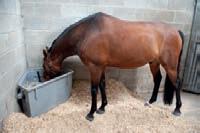
Enrichment: slowing your horse’s eating time through enrichment, slow feeder haynets or lower calorie options helps to encourage weight loss while preventing long periods without eating. It can also reduce the amount of wastage that might end up on the floor or in the bedding. If you’re feeding your horses bales out in the field, covering it with a net helps to reduce hay wastage. Managing your horse’s weight not only keeps them healthy, but it can also help reduce costs if they’re being overfed.
This advice is to help support horse owners who are concerned about their financial situation but still managing to cope.
Hay shortage: there are many options available on the market which can provide your horse with their essential forage requirements and be used to replace part of their hay ration. This can include chopped chaff, soaked sugar beet, grass nuts and fibre feeds.
If your livery yard offers hay as part of your package and you’re finding it difficult to meet price increases, speak to your yard manager/owner sooner rather than later. Potential payment plans or reduction in livery services may be available to you.
Around the yard
There are also changes we can make to our horsey routines that could help to reduce costs.
Bang for your buck: buying pre-owned equipment is sustainable, and you can get a good bargain! You can also sell anything you no longer use, and check out social media groups or equine car boot sales for any upcoming events. However, make sure to check that the equipment is safe and always wash before use. It’s a good idea to get your saddles double-checked and fitted by a qualified saddle-fitter. We don’t recommend buying second-hand riding hats.
Buddy up: consider whether you could share your lessons and split the cost. Depending on your livery yard, there may be a chance for you to buddy up with a friend from the yard to share daily jobs on a rota, which can
reduce your fuel costs if you drive. If possible, buy orders together and split delivery costs, share vet call out charges or organise on a free call visit zone day if offered.
Transport: make sure to discuss insurance quotes, as discounts are sometimes available when applying online. When travelling, make sure you aren’t carrying excess equipment that you don’t need as reducing weight will help reduce fuel consumption.
Working livery: can be a great way to reduce costs in exchange for your horse being ridden in lessons or for training. Your horse will get regular exercise while you get cheaper livery (and reduced fuel consumption). However, the yard should be licensed as a riding school with their local authority and
Advice corner
Gemma Stanford, Director of Horse Care and Welfare at BHS, shares advice on managing costs:
“Caring for a horse is a big financial commitment, and we should all think realistically about the costs involved before going on this journey. We need to make decisions that prioritise our horse’s welfare and quality of life.
ideally be a BHS Approved Centre. As always, prioritise what’s best for you and your horse.
Bedding: rubber matting is a big investment, but it can help save long-term, and we advise that a good layer of bedding material should be added on top. Muck out every day, only taking what you need to.
Supporting owners
Here at BHS, we know there’s nothing quite like that magical feeling you get with horses, you might call it peace, love, pride or something else entirely. We want to protect these feelings and help make the tough times better. Now more than ever, we need to support one another where possible. We want to help keep horses with their owners through education and support, working collaboratively with other charities across the UK to reach out to vulnerable people and communities.
Get in touch – we’re here to help
No one wants to part ways with their beloved horse, but it can be incredibly difficult to manage rising costs. If you’re struggling, we urge you to reach out.
Our Horse Care and Welfare team is here to help by offering you impartial advice and support with any questions or concerns you may have. Our help is free of charge and will remain confidential. Contact us on 02476 840517* or email welfare@bhs.org.uk. We’re also available via our social media channels.
Opening times are 8.35am–5pm from Monday–Thursday and 8.35am–3pm on Friday. *Calls may be recorded for monitoring purposes.
“Frustratingly, we know that it’s often impossible to know when a large vet bill is on its way. We’d encourage all horse owners to budget as effectively as they can.
“It’d also be good to think about horse insurance. Although it may seem like another expense, it can be a costeffective solution in the long run.”
Haynets can help reduce wastage
healthyhooves Weight management for
There is no getting away from the fact that an overweight horse or pony is at greater risk of a range of health issues, with laminitis being one of the most serious. Laminitis is a distressing, costly and timeconsuming problem to manage, which is why taking early action to help your horse or pony lose weight is essential in reducing the risk of this devastating disease.
How can we reduce the risk?
If your horse or pony is overweight, implementing a suitable weight loss programme should be a priority. The main source of energy (calories) in most horses’ diets is grass, and pasture is often the final trigger for laminitis, with some estimates suggesting it triggers up to 60% of cases. Managing grass intake is therefore essential, and effective strategies include limiting turnout time, using a grazing muzzle, or strip grazing. To ensure an adequate fibre intake and maintain digestive health, alternative sources of forage will be needed. Straw is a good option – it should be introduced gradually and can replace up to a maximum of 50% of the horse’s hay or haylage ration to provide chew time with fewer calories.
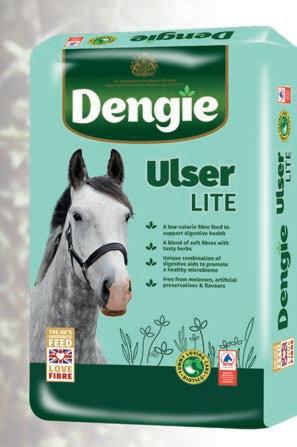
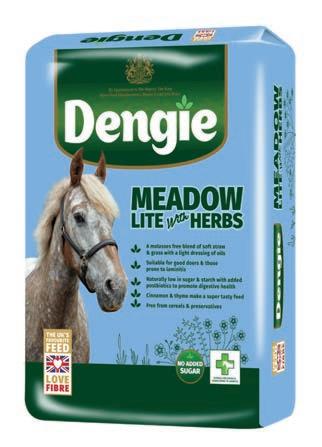
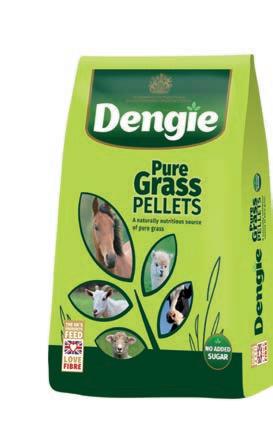
For horses on yards where it’s not possible to source or store straw, Dengie Meadow Lite with Herbs is a great alternative. Meadow Lite with Herbs combines chopped straw and precision dried grass with added pea hull fibre, postbiotics and tasty cinnamon and thyme, to provide maximum chew time for minimal calories. At just 3% sugar, Meadow Lite contains less sugar than average
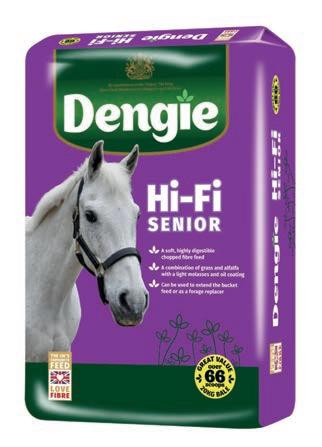
hay, and, at only 5MJ/kg digestible energy and 0.5% starch, it is one of Dengie’s lowest combined calorie, sugar and starch feeds, so it’s ideal for good doers prone to laminitis. When it comes to the bucket feed, a simple option to provide more chew time is to feed a low-calorie chopped fibre alongside a balancer or broad-spectrum vitamin and mineral supplement. In addition to Meadow Lite with Herbs, other suitable options from the Dengie range include:
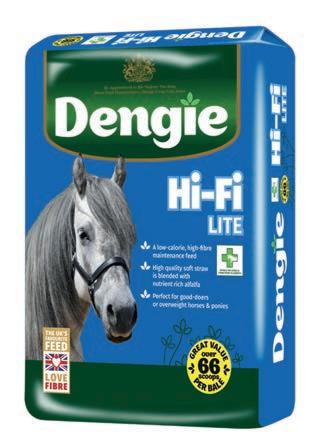
Hi-Fi Lite:
Low calorie and contains less sugar than most hays
Can be used as a total or partial forage replacer
High in fibre for digestive health.
Hi-Fi Molasses Free: Low calorie
Contains no added sugar and is naturally low in starch
Includes mint, fenugreek and alfalfa pellets for interest and taste.
Dengie Healthy Hooves Molasses Free: the all-in-one option
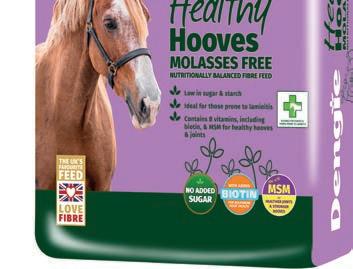
For a nutritionally-balanced, low sugar option Dengie Healthy Hooves Molasses Free offers a convenient all-in-one feed. It is low in calories, contains no added sugar, and includes added biotin and naturally high levels of calcium for strong, healthy hooves. Added methyl sulfonyl methane (MSM) provides a source of bioavailable sulphur to further support hoof health.
For more information or if you would like the Dengie nutrition team to review your horse’s diet, get in touch by calling 01621 841 188 or by completing an online feed advice form.
www.dengie.com
Help shape yourfuture
Want to make a positive, lasting difference to the lives of horses? We’re looking for new leaders to join our Board of Trustees to help shape our future and that of horses and riders for years to come
Do you have the passion, knowledge and insight to help steer BHS into the future?
Our vision is a world where every horse is respected, protected and enjoyed by knowledgeable, caring people. We’re looking for people who believe in this same vision to join our Board of Trustees.
Why be a Trustee?
Our Board of Trustees guides our strategic direction, and a skilled and passionate Board is essential in securing our future success. Although the roles can be demanding, the difference you make as a Trustee is extremely rewarding and not only benefits BHS members, but also the wider horse lover community.
Our Trustees volunteer their time, expertise and experience to the Society through
strategic planning, working with the Executive Team, preparing and attending Board meetings and making sure the best possible decisions are made.
To be eligible for election, you must be aged 18 years or older and have been a member of the Society for at least three years on 17 July 2026, the date of the Election Board Meeting. You don’t need to have Board experience as full training will be provided.
TRUSTEE VACANCIES
Specialist Trustee – Volunteering and Communities
Together with the Executive Team you’ll make sure that BHS continues to provide and develop varied opportunities for volunteering in all areas of the Society’s charitable work. You’ll support the ongoing development of the Society’s programme of activities which encourage participation in equestrianism, supporting and advising on new initiatives, audiences and funders that could be involved with our opportunities. You’ll champion volunteer contributions across all areas of our work and represent the views of volunteers at board level. You’ll provide strategic guidance to make sure the volunteer programme thrives and empowers volunteer teams to contribute effectively to our Strategic Plan and community engagement activities. You’ll provide strategic guidance to the Executive Team to build, and meet the needs of, the BHS community of volunteers, coaches and approved centre owners with the aim of increasing engagement with, and support for BHS.
The BHS has three positions available for election in 2026: Specialist Trustee – Volunteering and Communities
Specialist Trustee for Business – IT, Digital and Projects Specialist Trustee – Safety We’re committed to providing an inclusive and supportive environment for all our employees and volunteers. We believe having a diverse team across the organisation allows us to represent the communities we serve. An inclusive workplace that brings together individuals from different backgrounds with different strengths and experiences creates better outcomes for all
Specialist Trustee for Business – IT, Digital and Projects
You’ll have a commercial background with Executive or Board level experience and knowledge to support the Senior Management Team in delivering the Strategic Plan for 2025–2027 with particular focus on
employees, volunteers and our organisation. We therefore encourage applicants of all ages, from all communities and ethnicities as part of our commitment to being an inclusive employer. While recognising diverse experience, we particularly welcome applications from individuals with a disability and those from the LGBTQ+ community.
What to do next
Visit bhs.org.uk/trustee-elections to find out more about the skills and experience we’re seeking, as well as our Selection Policy and the full election procedure.
If you’d like to nominate, visit www. cesvotes.com/bhs. Nominations open on
the key enablers which underpin the strategy, including the oversight of key projects. The Society has robust project management systems in place to make sure the correct processes are followed from project inception through to successful completion, including implementation and optimisation of new technology and digital assets. You’ll support the Senior Management Team in project and programme governance and provide a conduit to the Board.
Specialist Trustee – Safety
You’ll assist the Executive Team in promoting the safety of horses, riders and carriage drivers to a variety of equestrian and non-equestrian audiences and stakeholders including UK Government, road safety charities and safety campaigners. You’ll assist the team in identifying opportunities for engagement with stakeholders and your knowledge of safety will provide an invaluable addition to the expertise already contained within the BHS Safety team. You’ll also act as a scrutineer of health and safety governance to the Board.
26 February 2026 and close at 12noon on 26 March 2026. Voting for the election will open at 9am on 5 June 2026 and will close at 12noon on 9 July 2026 Civica, an independent electoral services company, will be conducting the election process on the Society’s behalf. If you have any questions specifically concerning online nominations, then please contact Civica Election Services on 0208 889 9203 or support@cesvotes.com. If you can’t access the BHS website for more information, can’t nominate online or have any other questions, please contact the Governance Office at 02476 840531 or trustee.elections@bhs.org.uk.
Behind the scenes with Lucy Grieve
Lucy Grieve, Welfare Trustee, speaks to Melissa Evatt about her journey into trusteeship and why horses remain at the heart of everything she does
Trustees at BHS play an important, but often behind-the-scenes, role in guiding the charity’s future. For Lucy Grieve, taking on this position felt like a natural next step after many years working in the equine industry.
future of equestrianism and horse sport.
Lucy joined the BHS Board after being approached by our CEO, James Hick, who she met at several industry events, including Horses in Society, a forum that explores the
“When the opportunity arose, I didn’t need to think about it,” she says. “The chance to work with BHS is something I’d always jump at, having always admired and been in awe of what they do for the sector. I’ve been a BEVA [British Equine Veterinary Association] representative on the BHS Equine Health & Welfare Advisory Committee for a few years and have loved being a part of the wonderful work that we do.”
As a trustee, Lucy’s days are shaped around preparation and collaboration. “I check my
I’ve learnt so much and been given so many opportunities through my trustee roles
BHS emails every day and plan ahead for any meetings I have scheduled,” she says. In addition to board meetings, Lucy has joined the Finance Committee and attends company-wide team meetings whenever possible. These meetings, she says, are a reminder of how much happens behind the scenes. “Every meeting is a chance to learn and grow my knowledge and appreciation for the equestrian world. The benefits brought by BHS are sometimes overlooked and taken for granted, and seeing how the charity impacts our industry and the lives of horse lovers has been truly humbling.”
As part of Lucy’s trustee role, she brings a veterinary and welfare-focused perspective, which fits in well with the wide range of skills contributed by other trustees. These skills include financial acumen, strategic planning, fundraising expertise and experience in organisational governance. “The skills of all trustees are carefully chosen to help the charity’s needs and make sure we work in the interest of the horses, humans and industries we serve,” she explains.
A lifetime shaped by horses
Lucy’s professional background shows her lifelong commitment to the equine world. In 2007, Lucy qualified as a vet and has since spent her time working in the equine sector. Most of her career has been spent in clinical practice in Newmarket, where she worked in the racing, sports and leisure industries.
During that time, she was also on the BEVA Council as a Trustee, Chair of the Ethics and Welfare Committee and served as BEVA President from 2020 to 2021. After leaving clinical practice in 2022, Lucy decided to take up a permanent role at BEVA as Veterinary Projects Officer, which is where she is today.
Her experience has strongly influenced her approach to trusteeship. “I like to think that my time as a rider and horse owner has served me well in my role at BHS. I understand the challenges we all face, and how the equine industry is uniquely linked with all sectors of society through culture, sport and pleasure.”
At the heart of Lucy’s work is a deep respect and admiration for horses. “I never take for granted the privilege that horses give us. We have the opportunity to live our lives alongside this beautiful and powerful animal, which is such an amazing mirror to our soul and emotion; we should never underestimate that.
“You can’t pretend with horses; they know
Learn more about Lucy
Q: What’s your first memory of horses?
A: Pressing my face up against the car windows any time we passed a horse and my dad encouraging it (much to mum’s disdain) by shouting “HORSE!” I bet he regretted it once those riding lessons and equipment requests started coming in hard and fast.
Q: Sum up your experience of being a trustee in three words.
A: Eye-opening, humbling and rewarding.
Q: How do you enjoy spending your free time?
A: With my retired reining Quarter Horse, Tito. He was a rescue, and he’s the apple of my eye! I’m a much happier and more relaxed person if I’ve been for a hack or had a cuddle with my pony. He’s my emotional regulator, counsellor and pub-ride buddy, and he’s the cheekiest horse I’ve ever met.
Q: If you weren’t involved with horses, what would you be doing?
you better than yourself. That’s priceless to me. Without that time, freedom and reflection, I don’t feel myself. I had time without horses, and I look back at how much of a better (happier and healthier) person I am when they’re in my life. My husband and kids would say so too!”
Interested in becoming a trustee?
For anyone considering becoming a trustee themselves, Lucy’s message is simple: “Do it. Trustee positions are hugely valuable and rewarding. You can learn so much about the equine world and the work of a charity,
A: I love sailing and skiing, but I just wish I could take Tito with me. He’d love a trip to the Pyrenees or Greek islands, I’m sure! Work-wise, I was always (and still am) obsessed with astro and particle physics.
Q: What’s the best piece of advice you’ve been given?
A: Be kind and be yourself, and allow others to do the same.
which you might not experience otherwise.” She also hopes that members better understand the philanthropic nature of the role. “There are the obvious time and energy commitments and sacrifices, which could feel thankless or difficult, perhaps, but I’ve never found this to be the case. It’s always been hugely rewarding to me, as I’ve learnt so much and been given so many opportunities through my trustee roles. I’ve even started an MBA recently, which I would never have done were it not for my experiences as a trustee!”
To find out more about the election process, read our trustee nominations feature on page 38.
Saving lives
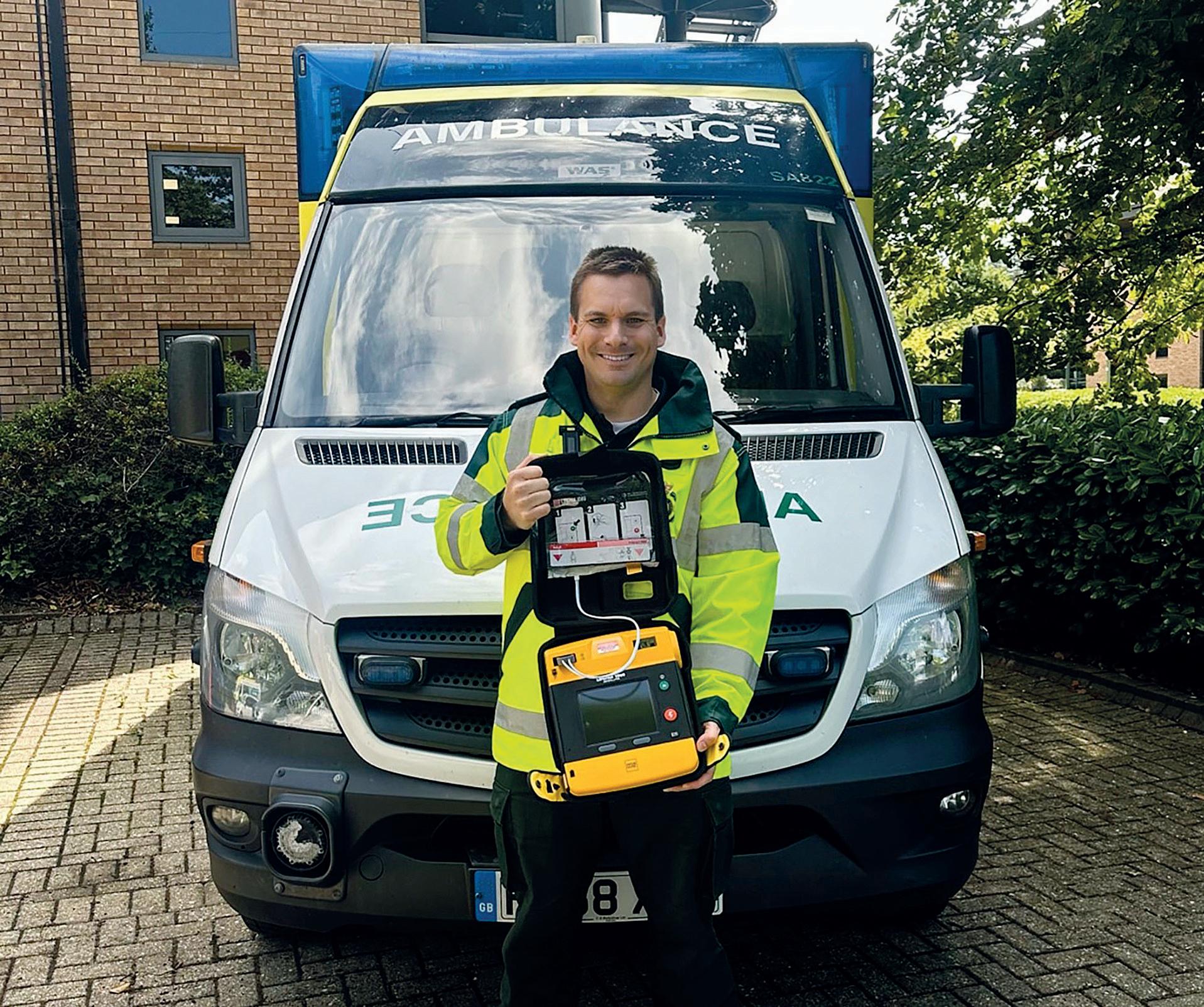
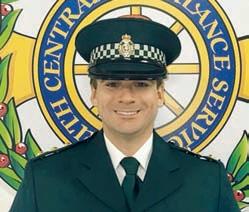
Michael Elkins, Lead Driving Education Manager with South Central Ambulance Service (SCAS), discusses the importance of AEDs and how to perform CPR
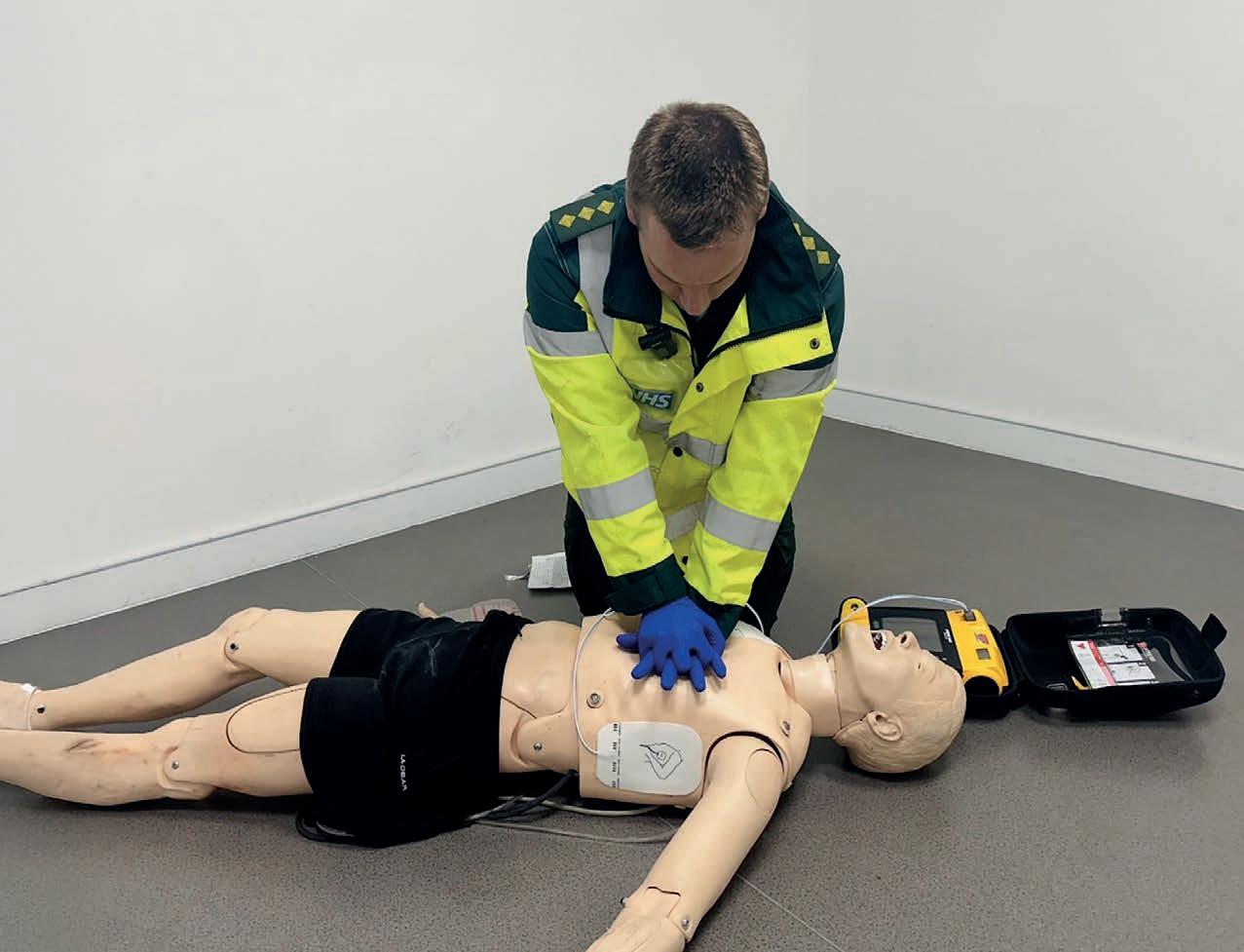
CPR is an emergency procedure used in the event of a cardiac or respiratory arrest, combining chest compressions and rescue breaths to give the patient the best chance of survival. If someone is unconscious and breathing abnormally,
call 999 and start CPR straight away. Once you’re connected to the Ambulance Service Control Room, you’ll be given basic life-saving instructions over the phone, including how to perform CPR. When you’re out and about on your horse, the unexpected can happen, which is why it’s best to be as prepared as possible for any situation to help keep yourself and the wider community safe.
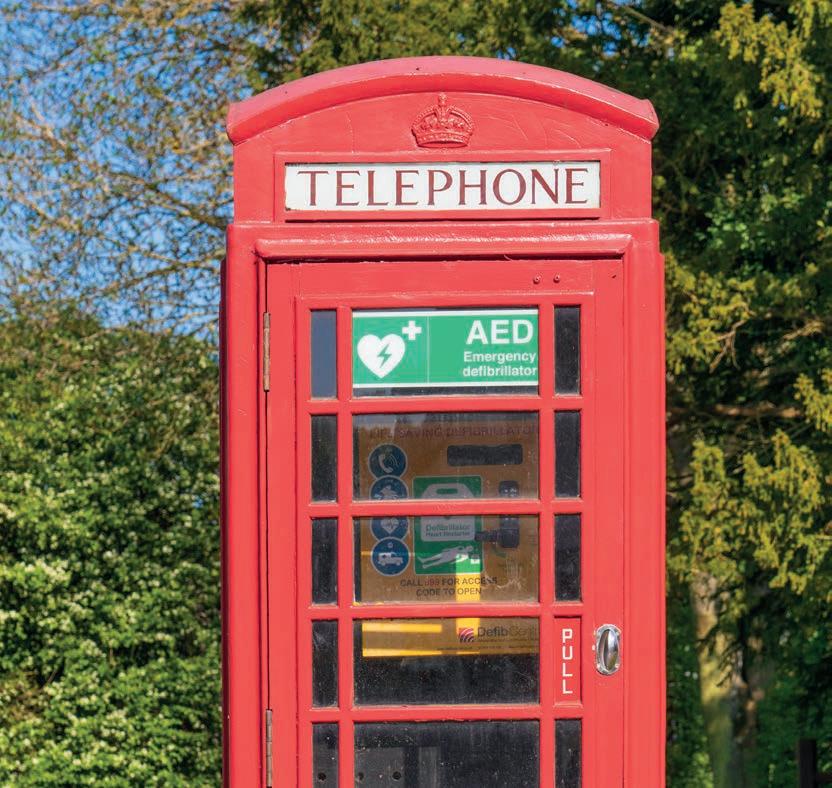
If you manage stables or a riding school, consider installing an AED
Hands-only CPR being performed on a training manikin
Remember: DRABC
Danger: make sure it’s safe for you to approach the casualty.
Response: check if the casualty is conscious and responsive. You can talk to them or gently tap their shoulder to see if they respond.
Airway: if unresponsive, check the mouth to see if anything is blocking the airway. Avoid sticking your fingers in someone’s mouth, as they may bite down.
Breathing: check for breathing for no longer than 10 seconds. You should see or feel two–three breaths in this time.
Circulation: check for any bleeding. Catastrophic bleeds will need to be addressed first, as CPR will only push more blood out of the body. If you’re trained in CPR, give chest compressions with rescue breaths. If you’re not completely confident, give hands-only CPR instead.
CPR with rescue breaths
1Place the heel of your hand on the centre of the person’s chest, then place the palm of your other hand on top and press down by 5–6cm at a steady rate of 100–120 compressions a minute.
2
After every 30 chest compressions, give two rescue breaths. Tilt the person’s head gently and lift the chin up with two fingers. Pinch their nose, seal your mouth over their mouth and blow steadily and firmly into their mouth for about one second. Check that their chest rises. If the chest doesn’t rise, don’t attempt to deliver more than two rescue breaths at a time. Continue with chest compressions instead.
3
Continue with cycles of 30 chest compressions and two rescue breaths until they begin to recover, or emergency help arrives.
Michael Elkins
Michael Elkins is a Lead Driving Education Manager with South Central Ambulance Service NHS Foundation Trust (SCAS). He leads a team of professional and highly skilled Driving Education Managers, and the team has a vital role in supporting frontline ambulance operations. He has an operational frontline background in both the police and ambulance service.
Hands-only CPR
1
Kneel next to the person and place the heel of your hand on the breastbone at the centre of their chest. Place the palm of your other hand on top of the hand that’s on their chest and interlock your fingers.
2Position yourself so your shoulders are directly above your hands.
3
Use your body weight and press straight down by 5–6cm on their chest.
4Keeping your hands on their chest, release the compression and allow their chest to return to its original position.
5
Repeat these compressions at a rate of 100–120 times a minute until an ambulance arrives or for as long as you can.
Be aware that effective chest compressions are likely to fracture ribs, and you may hear or even feel the fracture. Even if this happens, it’s important to continue CPR until help arrives.
Automated external defibrillator (AED)
An AED is a medical device designed to help someone who’s suffered a sudden cardiac arrest. They analyse the patient’s heart rhythm and, if needed, deliver a controlled electric shock through the heart in an attempt to restart it. No medical training is required to use them – you simply need to follow the verbal instructions given by the AED. AEDs should be sought immediately when someone is unresponsive and not breathing normally. In the event of a cardiac arrest, one person should already be performing CPR, while another attempts to locate an AED. When you call 999, the Ambulance Service Emergency Call Taker will be able to tell you where the nearest registered AED is, but ask someone else to get it – never leave the patient alone. CPR should only be paused when the AED instructs you not to touch the patient, at which point it will analyse the patient’s heart rhythm and decide whether to deliver an electric shock.
How to use an AED
1
Some AEDs will have an on/off button, while others turn on automatically. Once it’s on, follow the verbal instructions
given. These will often be repeated until the required action has been completed. As you continue CPR, your assistant will need to remove or cut through any clothing to get to the casualty’s bare chest.
2
Attach the pads to the casualty’s chest while maintaining CPR. The AED will show you where to place the pads on the chest.
3
Once the pads are on, the AED will tell you to stop CPR and analyse the heart’s rhythm. Make sure no one is touching the casualty. It will then give a series of visual and verbal prompts that you should follow. If a shock needs to be given, make sure everyone else is clear of the casualty before the shock is delivered.
4
If the casualty shows signs of becoming responsive and starts to breathe normally, put them in the recovery position. Leave the AED attached. Monitor their level of response and breathing, and be prepared to start CPR again if needed.
Early use of an AED, within three–five minutes of someone collapsing, can increase survival rates by as much as 70 percent.
I’d strongly encourage everyone to find out where their nearest AED is, either at their place of work or where they frequently visit. There are numerous apps, including DefibFinder, GoodSAM and Save-a-life, which show you where the nearest AEDs are. If you manage stables or a riding school, consider installing an AED. By being aware of these life-saving techniques, we can better protect and look out for each other in the event of a medical emergency.
Find your local defibrillator
You can find out where your local defibrillator is by scanning this QR code. Simply pop your postcode in to view a map of defibrillators in your area.
Quick-fire
What feeling do you associate with horses?
Respect.
What’s your proudest equestrian moment?
Winning Badminton and Burghley Horse Trials.
Who inspires you the most?
My horses.
Who got you into eventing?
My mum.
Signature dish?
Fish and prawns on rice – it’s easy and really yummy!
Where’s been your favourite place to compete, and why?
Burghley Horse Trials – it’s the biggest, and it’s all about cross country!
Favourite about
Favourite thing about horses?
Their individual personalities
Their individual personalities.
How do you relax on your days off ? Wine and cheese!
How do you relax on off W Wine
Why is having a strong partnership with your horse so important?
It’s needed in eventing more than any other sport – you really have to trust each other.
Q& A
What have you never tried but really want to?
Lauren Bilton catches up with international event rider
Piggy March for a quick-fire Q&A
I’d love to ride in a race.
What do you hope to achieve in the next five years?
To carry on enjoying eventing and watching our home-bred horses achieve something exciting in the sport. y ost Stud?
What do you enjoy most about running March Stud?
Watching horses’ progress.
What advice do you have for aspiring eventers?
Work very hard to enjoy it, first and foremost.
Whaat’s yo favoourite or tv seri Vera he
What’s your favourite film or tv series? (hee hee!)
Preparing your forpastures spring
Allison Lowther explains how field management decisions made now can shape horse welfare all season
Spring is a key time for pasture management. After months of wet weather, cold temperatures and heavy use, grazing can become tired, damaged and vulnerable.
Assessing pasture after winter
Before increasing turnout, make sure to assess how your grazing has come through during the winter. Taking time to walk round fields will give a clear picture of what needs attention. Look for signs of poaching, as well as bare or thin patches where grass has struggled to survive. Check whether water is pooling on the surface, which can indicate poor drainage or soil compaction. Compacted ground restricts grass roots and limits regrowth. Winter damage often allows weeds such as docks, thistles and nettles to grow. Spotting these early makes control easier later in the season.
Introducing spring grazing safely
Spring grass grows quickly and is rich in nutrients, but it can also be high in sugars. Turning horses out too quickly on to fresh grazing increases the risk of digestive upset, excessive weight gain and laminitis. Gradual introduction is essential.
If there’s been a lack of turnout over winter, or horses are moving into a new field, start with short periods of turnout and build up slowly over several weeks. This is especially important for native breeds, good doers and horses with metabolic issues. Keep an eye on grass growth as well as your horse’s condition. Grass can contain high sugar levels even when it looks short, particularly after sunny days followed by cold nights.
Using strip grazing, a track system or grazing muzzles can help control intake while still allowing your horse to move freely and socialise. From a welfare perspective, careful grazing management is about supporting long-term health, not simply restricting access to grass.
Managing laminitis risk in spring
Spring is a well-recognised high-risk period for laminitis, making pasture management especially important. Certain weather patterns increase sugar levels in grass, including
Resting and rotating fields
allows
grass to regrow and strengthens the sward over time
bright sunshine, low overnight temperatures and rapid growth following rain.
During higher-risk periods, managing grass intake may involve reduced turnout or using a grazing muzzle. Providing soaked hay can help maintain fibre intake without adding excess sugar. Regular fat scoring (also known as body condition scoring) and close observation for subtle changes in movement or posture can help owners act quickly if needed. If you have any concerns about your horse, talk to your vet.
Resting and rotating grazing
Grass needs time to recover. Continuous grazing weakens plants, reduces root depth and encourages weeds and bare patches to develop. Resting and rotating fields allows grass to regrow and strengthens the sward over time. Even on smaller paddocks, temporary fencing can be used to divide paddocks or protect areas that need time to recover. Creating a designated turnout area can allow turnout to continue without damaging growing grass. Planning how fields will be used throughout spring and summer helps prevent overgrazing and supports healthier pasture in the long term.
Fencing and water checks
Routine field checks are necessary all year round but make sure to carry out a thorough check and do any repairs to damaged fencing before turnout increases. Water troughs should be cleaned and checked for leaks. Clean, fresh water is a basic welfare requirement.
Support your horses through all four seasons
Soil care, rolling and harrowing
Good pasture starts with healthy soil. Compaction and poor drainage limit grass growth and encourage weeds.
Rolling and harrowing fields is common practice. Rolling is best carried out in early spring once the ground has dried slightly but still retains some moisture. It helps level uneven ground caused by winter poaching. Rolling can also press loosened grass roots back into the soil, supporting recovery after winter damage.
Harrowing helps to aerate the top layer of soil, encouraging grass growth and removing dead grass and weeds. However, it isn’t an alternative to poo picking, so it’s important that the field is cleared before harrowing, otherwise parasitic larvae will be spread across the field.
Soil testing can be useful before applying fertiliser, making sure nutrients are added only where needed. Bare patches can be reseeded in spring using a horse-appropriate grass mix, with areas fenced off until the grass regrows.
If you need help and advice, there are specialist companies who can help – a
quick internet search for equine pasture management companies in your area will bring up a selection for you to contact.
Overhead lines
Something that isn’t often considered is if your land has overhead lines on wooden poles, as these should be checked regularly too. If you’re the landowner, look over your wayleave agreement; it may contain the frequency of checks on the agreement from the network.
Scan the QR code to learn more about wayleave agreements and overhead line checks to keep your pasture and horses safe.
Each pole has the frequency and labels with the dates of these checks. Look for any signs of movement around the base and check for structural weakness or rotten wood. If you have any doubts, contact your network provider and tell them about your concerns.
Small steps that make a big difference
Simple, regular tasks help prevent larger problems later in the year. Removing
droppings daily, or at least twice a week, reduces parasite burden and discourages horses from avoiding certain areas of grazing. Repairing gateways, improving drainage in high-use spots and planning turnout routines all help protect pasture as it grows.
Thinking ahead is key. Identifying which fields can be rested, which areas may become designated turnout paddocks and how grazing will be managed through spring and into summer.
Supporting horses and pasture together
Spring pasture management is about balance – encouraging healthy grass growth while protecting your horse’s health. By carefully assessing fields, introducing grazing gradually, caring for soil and using techniques such as rolling and harrowing appropriately, you can create safer and more sustainable grazing. Good preparation now supports pasture condition and equine welfare throughout the year.
For more information on managing your pasture, head to bhs.org.uk/pasturemanagement.
Dengie Healthy Hooves
Molasses Free
A high-fibre, naturally low sugar and starch feed with added vitamins and minerals to provide a nutritionally-balanced diet.*
Packed with B vitamins, including biotin, and MSM to support healthy joints and stronger hooves, plus a light rapeseed oil coating promotes healthy skin and coat shine.
20kg SRP £17.79 dengie.com
Absorbine® Hooflex Original Liquid Conditioner
Hooflex® liquid conditioner helps restore and support strong, healthy hooves in a convenient liquid with a brush applicator for ease. Creating a breathable moisture barrier to maintain long-lasting moisture balance
Hooflex® liquid conditioner helps protect the entire hoof with all weather conditions including very wet and very dry. 444ml bottle with brush
£22.50 absorbine.co.uk
SPILLERSTM HAPPY HOOFTM
Molasses Free
TopSpec Lite Feed Balancer
High-fibre, molasses-free feed with no added sugar suitable for horses and ponies prone to laminitis. Contains 15mg of biotin per 3kg serving, proven to support hoof health. 20kg £18.15 spillers-feeds.com
Good doers are prone to poor feet because their feed intake is restricted. TopSpec Lite Feed Balancer includes the scientifically proven level of biotin, (15mg/500kg horse/day), together with methionine, cysteine, lysine, calcium, zinc, copper, iodine and vitamin A present, will greatly improve new hoof quality.
Happy feet
15kg £27.30 topspec.com
PROFEET Farrier Solution
PROFEET Farrier Solution is a nourishing gel hoof treatment with a natural brush for clean, drip-free application. Rich in emollients and fatty acids, it penetrates and protects the hoof, helping prevent cracking, drying and damage from wet/ dry conditions. £17.99 nafequine.com
applica em and hoof, hel cracking dama nafe
SPILLERSTM Hoof Health
A high-biotin formula including key ingredients to support hoof growth and quality. Ideal for horses and ponies with slow hoof growth, brittle, dry or cracked hooves. 3kg £35.99 spillers-feeds.com
Words:
Hooves carry your horse’s entire weight and are built to handle pressure, adapt to terrain and regenerate over time. Whether barefoot or shod, regular care, a balanced diet and support from a qualified farrier all play an important role.
Daily care
Pick out your horse’s feet at least once a day to check for stones, debris, cracks, splits, thrush and, where applicable, loose or worn shoes. Regular checks allow you to spot any issues early on. Prompt action can prevent discomfort and more serious problems.
Changing seasons
As spring sets in, it’s important to remember that hoof moisture changes with the seasons. Dry weather can make hooves
hoof care Spotlight on
A round up of the best ways to make sure your horse’s hooves stay as healthy as possible
brittle, increasing the risk of cracks and splits. Wet conditions can soften hooves, making them more prone to infections like thrush. Hooves are breathable and sensitive to environmental changes, so consistent care is key year-round. Use hoof dressings in dry weather to help maintain moisture – ask your farrier for advice
Always provide a clean, dry place for your horse to stand, such as hardstanding in fields or clean bedding in housing/stables.
Every horse is different
We recommend using a registered farrier for trimming and shoeing. Registered farriers are regulated by the Farriers Registration Council (FRC) to maintain high standards and accountability.
Every horse is different, so your farrier will consider factors including workload, surfaces worked on, clinical
history and hoof quality when making recommendations. They’ll guide you and, if needed, suggest involving your vet. Getting help early gives your horse the best care.
Supporting healthy hooves
A balanced, high-forage diet supports healthy hoof growth. Adding a balancer to your horse’s feed can make sure they get all the essential vitamins and minerals they need. Biotin (vitamin B7) helps strengthen hooves. Whole-horse health is key to strong hoof growth.
Maintaining fitness
The hooves help to circulate blood back up the leg, and movement boosts this circulation, supporting hoof growth. If your horse is housed/stabled, daily turnout and/or regular exercise is essential.
For more information, head to bhs.org.uk/hoof-care.
PHOEBE McHALE and LAUREN BILTON
The more you know about allergies, the more you can minimise reactions and improve your horse’s wellbeing
Stay allergy aware
Words: LAUREN BILTON
Just like us, our horses can be allergic to a range of things, and this can develop at any point in their lives, usually after repeated exposure to an allergen, which can cause their immune system to overreact.
Allergens can include:
Mould and fungi
Dust
Plants and pollen
Biting insects
Food or supplements
Some medications
Direct contact.
Horses are exposed to many of these daily, in the stables, during exercise or out at pasture.
Spot the signs
The two main types of allergies for horses are skin reactions and reactions affecting the lungs, nose and windpipe. Your horse can also develop conditions because of an allergy, such as Equine Asthma, sweet itch or hives.
Common reactions can include:
Hair loss and crusty skin
Hives
Swelling and redness
Coughing and laboured breathing
Headshaking (caused by some seasonal allergies).
Skin reactions
Equine dermatitis (inflammation of the skin) is a skin condition caused by factors such as allergies, insects or environmental irritants being inhaled or coming into contact with your horse’s skin. Some of the most common types include:
Atopic dermatitis
Bacterial dermatitis (mud fever/rain scald)
Insect bite hypersensitivity (sweet itch)
Reactions affecting the lungs, nose and windpipe.
Zooming in on sweet itch
Sweet itch is an allergic reaction to the protein in the saliva of biting midges (Culicoides) but may include other bloodsucking flies and insects. The allergy creates an irritable and sore skin condition (dermatitis), affecting the mane and tail areas of your horse, where midges typically bite.
Your horse is most likely to be affected between March and November, when biting insects are most active because of the warm temperatures and humidity.
Think ITCH: Inflamed sores, Thickened and coarse skin, Change in behaviour and Hair loss.
There’s currently no cure; it’s a condition that needs careful management as it recurs yearly. Reducing the possibility of contact between midges and your horse is the most
effective way to manage it. This can be achieved by using protective coverings such as fly rugs or masks, avoiding areas that attract midges or sheltering your horse from dusk until after dawn. A vet may be able to recommend medication to ease symptoms.
Talk to your vet to see what would work best for you and your fourlegged friend
Highlighting equine asthma (EA)
Airborne particles are small enough to enter your horse’s respiratory tract and cause irritation. These are known as aeroallergens and can be increased through poor management practices, such as inappropriate choice of bedding material or insufficient ventilation.
Aeroallergens may include various types of dust, mould, bacteria, mites, plant debris, pollen and toxic gases such as ammonia.
Signs:
Coughing
Difficulty breathing at rest
Nasal discharge
Fatigue
Loss of performance
Exercise intolerance.
If your horse is displaying signs of EA, it’s important to speak to your vet for further advice. There are diagnostic tools available which can give a high level of accuracy in determining the affected area. These tools are also useful for monitoring response to treatment.
Corticosteroids are often used in the treatment of EA. These are anti-inflammatory drugs and must be administered by your vet either orally, intravenously or via the respiratory tract. Additionally, your vet may advise using medication as a ‘rescue treatment’ prior to corticosteroids to open (dilate) the airway and give rapid relief. The effects of these medications are short-lived (up to 12 hours), so they should be used
alongside good management to reduce aeroallergens and prevent further irritation.
Diagnosing allergies
If you’re concerned, contact your vet. To confirm the allergy, your vet may recommend two tests.
Restriction tests are where potential allergens can be removed. For this, potential triggers such as bedding type or certain feeds are removed under vet guidance. If your horse improves after removing a potential trigger, it can help indicate the allergen.
Intradermal testing (IDT) is where potential allergens are injected into the skin. This usually involves clipping an area on your horse’s neck before injecting small amounts of an allergen (in liquid form) and then recording if there’s a reaction. Horses that are sensitive to an allergen will show stronger reactions such as swelling and hives in the area where they were injected. This lets identified allergies be used in immunotherapy or other treatment plans.
Management and treatment
This depends on the specific cause of the reaction, but generally limiting your horse’s contact with the allergen can reduce their reaction without treatment. Although difficult, avoiding the allergen is key to improving your horse’s welfare.
There are a variety of other treatment options available:
Changes to management by using quality bedding, washing rugs and saddle pads can reduce dust mites. Mucking out and sweeping when your horse is away from the area, carrying out feed checks and maintaining turnout during winter will also benefit your horse.
Allergen-specific immunotherapy involves feeding or injecting small amounts of an allergen to the affected horse, increasing the amount each time. Using the feeding method daily is easier and seems to be as efficient as the injections, which must be given by a vet. It helps to improve your horse’s tolerance to the allergen and reduce symptoms, however, it takes several months to see results.
Antihistamines provide a non-steroidal option that can be used long-term (under vet supervision). It blocks histamine, a chemical in the body that triggers an immune response, to reduce the severity of allergic reactions.
Remember ACT
Anti-inflammatory immunosuppressant drugs (often corticosteroids) are proven effective in controlling itching and hives. They’re given daily until symptoms reduce and then the dose is gradually decreased to help keep your horse reaction-free. Grooming and bathing with soothing shampoos can help you monitor the condition of your horse’s skin. Products containing aloe vera and oatmeal can also be beneficial alongside regular grooming to remove dust and dirt from the coat. Talk to your vet to see what would work best for you and your four-legged friend.
Get in touch – we’re here to help
Our Horse Care and Welfare team are here to help and can offer you further advice with any questions you may have. Contact us on 02476 840517* or email welfare@bhs.org.uk. You can also get in touch with us via our social media channels. Opening times are 8.35am–5pm from Monday–Thursday and 8.35am–3pm on Friday. *Calls may be recorded for monitoring purposes.
Written in partnership with Nottingham Trent University.
Assess: Contact with allergens such as pollen, dust and mould should be avoided. Control: Midges/insects are hard to avoid. Repellent sprays, fly rugs/masks and nose nets can help. Treat: Contact your vet if you have concerns. Allergies can’t be treated, but medications can help manage the symptoms.
Horses wearing protective coverings when turned out
Remember – hot before snot
Meet Andrew
Andrew Stennett is founder and proprietor of BHS Approved Grove House Stables LLP and I-Pegasus CIC. Grove House Stables is an award-winning riding school and training centre, while I-Pegasus CIC is dedicated to sustainably changing the lives of young people through horses.
Speaking out about strangles
Strangles… even the name is horrible and is so-called because the airway can become restricted by swollen lymph nodes, making swallowing and sometimes breathing difficult for your horse. It’s the most common equine infectious disease in the UK and is caused by a bacterium called Streptococcus equi
Andrew Stennett talks strangles with Emmeline Hannelly and the need to break down barriers to help deal with this devastating disease
We speak to Andrew Stennett to discuss his experience of coping with a strangles outbreak at his yard: “The centre team feel very passionate about raising awareness and speaking out about strangles. We need to break down barriers to be able to deal with this devastating disease for our horses. Anybody that’s part of this industry goes into it for the love of horses, putting their welfare at the heart of everything we do.”
How strangles spreads
Strangles can affect horses, ponies and donkeys of all breeds, health status and ages. It isn’t an airborne disease, but horses
Pus draining out from the nostrils
can cough or snort infected material several feet. The disease can spread easily by direct horse-to-horse contact, but also indirectly, for example through contaminated surfaces, equipment, handler clothing and hands. The bacteria can survive for a number of weeks in water which is why it’s important to take your own supply when away from the yard, for example when attending a show.
“A strangles outbreak is a worrying time because you’re concerned for your four-legged friends, but also how to practically keep a yard running and a business operational,” says Andrew. “It was devastating to be told it was strangles. Then I had to go and tell my team who were worried about the horses, their financial situation and whether our business, to be brutally honest, would be able to survive and jobs secured. I was also worried about the perception our clients would have of our organisation, so it was a huge hurdle to overcome.”
Signs of strangles
Typical symptoms include:
to do. This is important as infection can remain in around 10% of cases. This leads to a horse becoming known as a ‘carrier’; they’ve fully recovered from strangles and aren’t showing signs of disease but are still infected and able to spread the bacteria to others. Carriers can be treated by your vet.
Spread the word… not the disease
Last year, the Surveillance of Equine Strangles network reported that the average number of positive laboratory diagnoses per month had risen significantly compared with the previous four years, with over 360 cases by the end of September.
“We worked closely with our vets and industry partners during the outbreaks. I think it’s so important we remove any stigma associated with speaking out about it and putting biosecurity measures in place. It’s hard when negative online comments are made but, to me, this highlights misunderstanding about the disease. Yards should be supported,” says Andrew.
A high temperature, above 38.5°C, is often the first sign. This provides an opportunity to immediately isolate your horse to prevent the spread of the disease. Knowing your horse’s healthy temperature and routinely checking can make all the difference. Remember – ‘hot before snot’.
Lethargy/dull and depressed. Loss of appetite and/or not drinking, difficulty swallowing. A lowered head and neck.
A cough.
Thick and discoloured nasal discharge. Swelling of the glands under the jaw (lymph nodes), in the space between the head and neck or on the head or neck, which may lead to abscesses. These can burst with highly infectious, thick, creamy-yellow pus. The abscesses in the lymph nodes usually burst into your horse’s guttural pouches (air pockets at the back of your horse’s throat) which then drain out through the nostrils. It normally takes three to 21 days after the horse has been in contact with the bacteria for signs to develop. Be aware that not all horses will show the same symptoms, or even any at all. This
is called ‘atypical strangles’. Some horses may only show signs such as a mild fever, other forms of nasal discharge or a slight loss of appetite. Atypical strangles may go unnoticed but the disease can still spread. If you notice your horse showing mild signs, it’s always sensible to isolate them as a precaution and contact your vet.
What’s it like to care for a horse that has strangles?
Andrew explains: “The logistical factors are huge and it’s definitely a team effort. Looking after horses with strangles isn’t pleasant as the abscesses are revolting. I remember our yard manager treating a horse and one of the abscesses burst. She was covered in this foul-smelling discharge – I can’t describe the smell, and I hope you never have to experience it. It’s a big challenge and, in addition, you’re working hard to maintain the yard’s disease prevention plan and protect the other horses.”
Most horses recover from strangles in three to four weeks. It’s extremely important not to remove horses from isolation once they’re no longer showing signs, as strangles can continue to be spread for an additional six weeks, sometimes longer.
Carriers of strangles
Testing is the only way to make sure that your horse is no longer infected and that it’s safe to remove from isolation. Your vet will advise on when to test and what type of test
Helping to protect your horse
Speak with your vet to arrange strangles testing for all new arrivals.
There’s a strangles vaccine that can help limit the chance of your horse becoming infected or reduce the severity of symptoms they experience. The vaccine should be seen as an additional measure and not a replacement for good hygiene and disease prevention measures. The vaccine doesn’t result in a positive test for strangles, so your vet will still be able to determine if vaccinated horses have been exposed to the bacteria. For further advice, contact your vet. By taking simple steps to promote good hygiene and help prevent the spread of disease, both at the yard and when out and about, everyone involved with horses can play their part to help them stay healthy. Visit bhs.org.uk/diseaseprevention for further advice.
Strangles Awareness Week
“Myself and the whole team fully support Strangles Awareness Week [SAW],” says Andrew. This year, SAW will be held 4–10 May. Follow our communication channels for further details and how you can get involved.
Abscesses on the neck
Weigh to go!
Molly Baxter explores weight management techniques to keep your horse healthy and thriving
Keeping your horse at a healthy weight is one of the most meaningful ways to support long-term health and performance. Whether your four-legged friend is a companion, a competition horse or somewhere in between, effective weight management reduces the risk of metabolic disorders, improves soundness and enhances quality of life.
Worryingly, 50% of horses in the UK are overweight or obese. When we look specifically at our native breeds such as cobs or connies, this number jumps up to a staggering 70%.
Being overweight brings many health risks such as laminitis, insulin dysregulation, arthritis and lameness. Other less considered issues associated with obesity are heat intolerance and reduced stamina, and therefore poor performance.
Spot the signs
Recognising changes in your own horse can be tricky when you see them every day. We recommend getting hands-on and fat scoring (also known as body condition scoring) your horse every two weeks. This’ll help you to spot subtle changes. Head to bhs.org.uk/fatscoring for more information on how to fat score.
Weigh tapes aren’t the most accurate but can be a useful way to
There isn’t a one-size-fits-all approach to weight loss
regularly measure whether your horse is going up or down on the scale.
Weighing your horse on a weighbridge is the most accurate way of finding out their weight. We appreciate not every yard has regular access to a weighbridge, which is why we’ll bring it to you as part of our free weighing events.
Welfare-minded
If you find your horse needs to lose a few
pounds, it’s important to implement a weight management programme that’s welfare friendly. We don’t want to restrict horses, causing frustration, but instead carefully control their calorie intake and movement. There isn’t a one-size-fits-all approach to weight loss, it’s what suits you and your horse best with the facilities that are available.
Think ‘forage, friends and freedom’. We still need to provide these basic needs while managing weight. For example, putting an overweight horse into a sparsely covered paddock isn’t going to meet their basic needs. We need to encourage the horse to move around to burn calories. Provide hay balls and several small, soaked haynets dotted around the paddock. The reduced calorie intake means your horse can have a choice of where to eat. They’ll also move around more and decrease the risk of health conditions relating to not having forage for prolonged periods of time for example, gastric ulcers.
Horse being weighed on a weighbridge
1
Feed for function
Most leisure horses thrive on a forageonly diet, and a balancer can provide those essential vitamins and minerals. Making use of straw within the forage ration (up to 50%) will help to reduce calories. Introduce gradually and only feed to horses with good dental health.
2 Control grazing intake
Consider using a grazing muzzle to slow down the intake of grass, strip graze paddocks or create a track system. This means that horses can still have access to friends to express natural behaviours.
3
Consistent exercise
Overweight horses need careful exercise to make sure they don’t overload their already compromised joints and cardiovascular system. Excessive lungeing will put pressure on joints and potentially cause injury. 20–30 minutes of brisk walking either ridden or in-hand is enough to increase their heart rate and burn calories.
4 Set yourself a goal and buddy up
Research has shown we’re 40% more likely to stick to something if we do it with a friend. Aim to go on that fun ride, head to the groundwork clinic or enjoy visiting different hacking spots with your friend.
5 Rug your horses as individuals
Many horses, especially native breeds and cob types, can adapt well to winter weather and cope without a rug if they’re
healthy, have adequate forage and access to shelter. It’s easy to start layering your horse up when you feel cold, but they’re great at heating themselves up. Even a small clip can be beneficial in getting those prone to weight gain to burn calories, keeping themselves warm.
Weight loss takes time
Weight loss can be a surprisingly slow and challenging process. Once a horse becomes overweight, their metabolism adapts in ways that makes shedding those extra pounds more difficult. Fat cells don’t simply disappear, they shrink and previously enlarged fat cells can even become resistant to releasing stored energy over time. Even with reduced calories and increased exercise, progress will be gradual – sometimes it’ll take months to notice the subtle changes in your horse. Overweight horses often have hormonal imbalances, such as insulin dysregulation, which further impedes fat loss. Patience, consistency and long-term commitment are essential in supporting your horse. Small, steady improvements are far healthier and safer than rapid weight drops, allowing the metabolic system to adjust without risking additional stress or health implications. Want to book a Horse Health Day? Email welfare@bhs.org.uk To help us continue our important charitable work, please consider donating today.
Horse Health Days
Our team will weigh, weigh tape and teach you how to fat score your horse, offering tailored and non-judgemental advice. We’ll help you set realistic goals and provide ongoing support following the visit. Anonymous fat scores and weights are collated from each visit, and our findings for the percentage of overweight and obese horses are in line with published papers. We also log each of our revisits to yards –this percentage is reducing year on year, showing that owners are doing an incredible job to help their horses lose weight. Owners are encouraged to bring their equipment and stand on the weighbridge to give an indication of the total weight your horse is carrying. Many disciplines have implemented a 20% maximum carrying capacity for horses. Our team won’t need to look at the weighbridge monitor — we understand that weight is personal to you. We can help you work out 20% of your horse’s weight so you can see where you sit within that scale. The 20% recommendation is based on your horse being at a healthy weight – if they’re overweight then this percentage will likely need reducing.
Masterclass
Corinne Bracken is our newest BHS Fellow. She’s always been hands on, learning how to get the most out of any horse through feel and experimenting. For 20 years, she ran a busy competition yard in Surrey, breeding and producing top-level showjumpers.
with Corinne Bracken
A former international showjumper and world-class coach, Corinne has led medalwinning youth teams for Great Britain and supported high-performance programmes globally. Her passion for education and performance shines through everything she does and continues to inspire riders and coaches at every level. Today she runs a programme covering all four Olympic disciplines as Performance Manager for Hong Kong. Her masterclass is based around the way of going of the horse, something she believes is fundamental to all levels of riding. Starting with some basic exercises on the flat with a focus on rider position, the class then moves on to some simple pole exercises that can be adapted for all levels from novice through to international. Finally, the class will show how those simple exercises can be developed into jumping exercises that show suppleness and development for horse and rider.
Corinne
Bracken shows how to build on simple exercises to develop suppleness for both horse and rider
Meet the horse and riders
We have two riders for this masterclass.
Annie Ho rides the first two exercises on Ho La Belle D’helanie (a.k.a. Belle) who’s owned by Carrie Wang. The final exercise is ridden by David Sheerin on Calcourt Dynamic (a.k.a. Dennis) owned by Ruth Rietdyk.
Words: HANNAH
POULTON
Photography: JESSICA DAVIES
EXERCISE ONE
Progressing from a serpentine on the flat
Annie and Belle start by trotting serpentine loops to warm up. This gives them the opportunity to warm up equally on both reins and also allows Annie to feel if Belle is equal to ride in both ways. Corinne explains this is a great exercise to do with novices: “It gives you a really good opportunity to look at the rider position and see if there’s anything you need to work on there.”
Once both Annie and Belle are warmed up, Corinne starts adding poles to the exercise. She starts with a single pole, making sure the horse is used to trotting over the pole before asking them to do any more.
Corinne explains the importance of consistency over a single pole before moving on: “We’re learning about what Belle reacts to, the horse is reacting to the environment that we’ve put her in, and we have to listen to the horse.”
Belle was fine trotting over the striped poles, but when they came to a candy stripe pole, she jumped and cantered away. Corinne then directed Annie to return to the flat work, calming down the horse, going back to the poles – checking at each stage that Belle
is calm and happy with the progression.
Once Corinne’s able to add in all three poles, Belle is now using her core to trot through the poles. “This is a great exercise to work on suppleness and strength for the horse, and can be done in both walk and trot,” Corinne says.
Corinne then increases the difficulty of the exercise by asking the horse to turn from a shorter approach to the three trot poles. This will stretch Belle more on the outside of her body while contracting on the inside. It’s important that this isn’t met by Annie having a tight inside leg. “The horse needs to feel freedom to bend around the rider’s inside leg.”
At this point Corinne highlights her own position in the arena. She wants to be able to see all aspects of the horse’s movement and constantly examines what she sees: “Is the rider in balance? Is there any lateral imbalance?”
At the end of the exercise, they progress to trotting over the three poles while riding in a circle. This increases the stretch in Belle, asking her to activate her hind leg a little bit more by being on the turn.
The cooling-down of the horse after the exercises is just as important as the warmup. After the exercise, Corinne asks Annie to keep Belle trotting around the arena, stretching and taking the contact down
Aims of exercise
Make sure you’re in the right position and identify anything you need to work on
Check that your horse is calm, comfortable and confident in the arena
Build your horse’s confidence with poles prior to starting jumps
Top tip
Don’t get stuck
It’s really important that the coach doesn’t get stuck on the inside of the arena. Position yourself around the arena so you see the horse coming towards you and moving away from you.
and forwards but staying in the serpentine loop. This cools and stretches the muscles down, allowing the heart rate to drop.
Corinne also recommends using this time for rider reflection, discussing with Annie whether they’ve achieved the aims and goals for the session and what they wanted to do with Belle. She’ll also discuss what they want to do next to progress Belle, and how they’re going to do that. She sums up: “This for me can be the most important part of the lesson.”
EXERCISE TWO
Moving from poles to jump
Again, the exercise starts with the serpentine to make sure Belle is warmed up equally on both sides. Corinne likes to warm horses up following the scales of training, so they first work on the rhythm in the trot. Using the serpentine works on suppleness, stretching and harmony in the trot, then they come forward to canter.
The first thing Corinne looks for in the canter is that Annie works in the rhythm, starting to ride from the hind leg through to the contact in front. She emphasises that contact doesn’t mean Belle has to look like a dressage horse, it just means it has to have
a connection down through the rein. Once that connection and rhythm is in place, then Annie can start to ride the gears of the canter. As she moves on to testing rider balance, Corinne asks Annie to go into a jump position going over the poles. She stresses this isn’t to be confused with just a normal light seat. She’s looking for a jump position with the leg very secure, as well as a softness in the body and holding herself off the saddle, rather than the rider bouncing or losing that balance as we come through the poles. By going through the poles in jump position, she can see if Annie has balance and can absorb the movement through their leg. It’s very important when doing this exercise in the serpentine loop, that the rider is capable of changing diagonal and keeping the balance while doing it.
Aims of exercise
Check the horse is straight on both reins
Maintain and work on balance
Practice jump position ready for progression to jumping
Top tip
Repetition
Don’t be afraid to repeat, repeat, repeat. It’s how we all learn.
Having mastered doing the serpentine in trot in the jump position, Corinne then moves them on to doing canter over poles. To start the exercise, poles are placed so there’s a four stride and a three stride distance between them. Corinne prefers to ride the three stride first, followed by the four. This makes it easier for Annie and Belle as Belle gains momentum as she goes over poles. Once this is established, the exercise is reversed so
the combination rides four strides to three strides. If the rider isn’t naturally adjusting to the strides, then Corinne steps in to help.
She adds to the complexity by asking Annie and Belle to make an additional stride in each distance. They started by going five and four, which worked well as Belle appears to have a slightly shorter left canter. Then she turns it around to do four and five strides, hoping that Belle won’t be too exuberant.
The next level of this exercise is to go back to the original plan of riding four and five strides, followed by three and four. This shows Belle has the ability to go through the gears as well as demonstrating that Annie has the skills to be able to change that gear within the horse. All the time Corinne’s looking for lack of tension in the horse. She says: “We’re looking for the horse to be listening to the rider, but also the rider’s understanding of what the horse is doing underneath them.”
We’re looking
for
the
horse to be listening to the rider
Corinne further adapts the exercise by building the middle pole as a small jump. There’s now a pole on the floor, three strides to a little fence and then four strides to another pole. Again, this constantly works on the rhythm and the balance of the horse, giving the horse confidence, educating the rider and really
helping the pair of them develop.
When changing the exercise to have a jump in the middle, Corinne advises to always move the pole after the jump out around one foot. This allows the horse the freedom to canter over the pole, keeping the softness, suppleness and elasticity in the canter on the landing of the jump.
This really highlights whether the horse is straight on both reins.
Belle was very straight on the right rein. When they switched to the left rein, Corinne could see a little bit of a left drift there. This needs to be corrected before they start trying to jump courses that have got straight lines and bending lines in them, as this will then emphasise a problem in the arena. Corinne says: “It’s very important to be able to do these exercises, complete them correctly and be technically sound before you try and enter a show and go into the arena.”
EXERCISE THREE
Adding new challenges
Session three takes things to another level while still using almost exactly the same fences in the same position, but with an extra small jump and using a different horse/ rider combination. This shows how exercises one and two can progress to a more advanced session.
Corinne started again by having David and Dennis do the four strides and then three strides to the poles; however, David lost straightness. By losing the straightness, Dennis got long between the second and third poles. She corrected that by standing in front of him and taking his focus in a very straight line towards her. As she converts the poles to jumps, she makes sure to give Dennis plenty of space for three strides to allow him to have the freedom in his body and to use it in an elastic way.
Corinne has them repeat the exercise to make sure they can still ride it correctly. She constantly looks for balance and rhythm as they come around corners.
With the more careful horse, if it’s over a pole on the floor or over a jump, Corinne stresses that the rider needs to be active on the landing stride so there’s activity as soon as they land from the fence. So before starting to ride lines with Dennis, she lets him jump a single fence in the middle of the arena, just so she can check for rider position and horse balance.
Once both she and David are sure everyone is happy, they’ll continue to the next exercises. Corinne’s firm in the belief that this should be a discussion between the rider and the coach and that they listen to the horse as well.
Aims of exercise
Straightness when jumping
Become used to jumping patterns found in competition showjumping courses
Identify potential issues in the ring that are highlighted by the serpentine
Top tip
Reflection
Cooling down after an exercise is just as important as the warmup. Use a gentle trot around the arena. As well as stretching down the muscles and allowing the heart rate to drop, this is a good time for the rider to reflect on the session and what’s next.
Preparation for jumping the straight line was a single fence in the middle of the serpentine loop. This is used as a warm-up fence prior to jumping in a straight line on a four stride distance. The rider now progresses to the four stride distance with an
oxer coming out. The oxer then progresses in width which allows Dennis to start to strengthen his core, ask him to have stability in the air, and most importantly, also to ask the rider to have stability in the air.
Having completed our serpentine loop in canter with jumps, Corinne still wants to check for straightness, so she asks Dennis to jump the fence in the middle of the serpentine loop.
David and Dennis have already jumped all the straight lines individually with the pole, but now there’s a vertical going in and oxers
coming out, as well as fillers. This horse is quite an experienced jumper, so Corinne’s not too worried about going straight to the fillers or straight to an oxer. She explains: “If I was dealing with a less experienced horse or rider, I’d make them do verticals and I would jump them without fillers before going on to putting the fillers in.”
Jumping the fences on a serpentine loop will always exaggerate any issues a rider may have in the ring. Is the horse going to be the same off the left rein and the right rein when it comes to a fence? What’s it going to look like on the rollback turn? Is the stride going to shorten? Can the horse keep the rhythm through the turn? Can the rider keep the balance through the turn? Corinne believes riding the serpentine loop up and down the arena, both from the left and the right way, will really help highlight issues to work on in the future.
The pattern in this exercise is exactly what you will find in every showjumping course. It practises riding straight lines, roll backs, turn backs, soft turns, more tight turns, all while keeping the quality of the canter. All of these things help bring a horse forward towards the ultimate goal of becoming a competition horse.
Caring for
The BHS Fellows and Instructors Association supports professional development for senior BHS coaches and offers outstanding training to all. We focus on new veterinary and scientific advances, and thought leadership, including advanced rider and coach psychology. Visit fandiassociation.org.uk.
your elderly horse
Alex Robarts BHSI talks about considering your horse’s workload as they grow older
Just like humans, the ageing process differs for every horse, affected by different factors such as genetics, training pathways and workload. Those who know me are aware I have a soft spot for older horses and those that need rehabilitation. So I simply offer food for thought.
Planning for the future
‘You’re only as strong as your weakest point’ – the age-old saying that has such an effect on an owner when trying to encourage them to step back and re-evaluate the direction of training and the future of their horse.
It’s rare to have a horse’s full history – breeding, how they were handled as a youngster, variables of ground surfaces in early conditioning stages, training development… the list goes on. But we all have the ability to observe and assess what’s in front of us, and the more we do it, the better our eyes become and the greater the outcome for our equine partners. Not just when we first meet a horse, but day to day, month to month, year to year.
Less time in the saddle
As your horse ages, maintenance is key. For some owners, it can be challenging
when their partner in crime is no longer able to keep the same pace as before. It can be a hard adjustment, but there are still plenty of ways for you to keep learning and experimenting. Focus on in-hand work, reduce the intensity or quantity of ridden sessions per week and include polework. If available, use undulating ground, in-hand or ridden, but let them have their necks and
Alongside good nutrition, movement and variety are key
Supporting owners
Our BHS Friends at the End team are here to make sure that no one has to face the loss of their equine companion alone.
use their bodies. Quality over quantity – we don’t need to spend so long in the saddle. I’m a strong believer that, alongside good nutrition, movement and variety are key – ‘use it or lose it’. I’ve seen horses become ‘younger’ as their work becomes balanced for them rather than for the owner, giving added longevity. Remember, one of the most detrimental things for an older horse can be repetition. Being asked to do the same circles, the same outline, carrying the same rider in the same position, with the same faults and crookedness!
Approaching the rainbow
Horses are known for their strength and mobility, which will, of course, reduce as they age, but they should never lose their dignity. Nothing I’ve written here is rocket science or going to change the world, but when your horse is approaching the rainbow, remember there’s no such thing as a day too early, but it can always be a day too late. Let them carry their dignity to the end.
Call us on 02476 840517* or email friendsattheend@bhs.org.uk
Opening times are 8.35am–5pm from Monday – Thursday and 8.35am–3pm on Friday. *Calls may be recorded for monitoring purposes.
RECIPE
Go bananas!
Why not give this super-easy banana bread recipe a go? It’s a great option to use up any overripe bananas you have lying around.
INGREDIENTS
2/3 medium-sized (incredibly) ripe bananas
75g butter (melted)
½ teaspoon bicarbonate of soda
1 pinch of salt
150g sugar
1 large egg (beaten)
1 teaspoon vanilla extract
205g plain flour (optional) ½ or 1 cup of chocolate chips/fudge pieces
METHOD
1. Preheat the oven to 175°C and butter a loaf pan.
2. In a mixing bowl, mash the bananas with a fork until smooth, then stir in the melted butter.
3. Mix in the bicarbonate of soda and salt. Stir in the sugar, beaten egg and vanilla extract. Once mixed, add in the flour. (Optional – mix in chocolate chips/fudge pieces if desired.)
4. Pour the batter into your prepared loaf pan. Bake for 55–65 minutes or until a toothpick or wooden skewer inserted into the centre comes out clean.
Little pick me ups
A round up of seasonal highlights for people who love the outdoors lifestyle
WILDLIFE
Hungry hedgehogs
It’s that time of year where hedgehogs begin to emerge from hibernation. After cold periods, food is often scarce, so providing supplementary food can be extremely beneficial to them as they start to become active again. Meaty cat/dog food and biscuits are a good option as they’re high in protein and vitamins. Place the food in shallow bowls so it’s easily accessible.
5. Remove from oven and let cool in the pan for a few minutes. Then remove the banana bread from the pan and let it cool completely before serving. Enjoy!
RETAIL
Build your own butterfly house
We’ll start to see some early sightings of butterflies over the next couple of months, with some as early as February and March. The peacock, small tortoiseshell, red admiral, comma and brimstone are the first butterflies of the year. From April onwards, you’ll start to see even more flying about. Why not have a go at building your very own butterfly house ready for peak butterfly season? Purchase for £20 at shop.nationaltrust.org.uk
ACTIVITY
Flower power
Lots of our favourite flowers are starting to bloom. From daffodils to primroses, there’s lots to spot this time of year. Have a go at pressing your own flowers:
1. Pick some flowers of your choice
2. Open a book and line it with newspaper, placing the flowers down as flat as possible
3. Close the book carefully and weigh it down
4. Store in a warm, dry place and check on them daily
5. Once your flowers are dry, carefully remove them. You can now create whatever you like with your pressed flowers. Make bookmarks, cards or even frame them as an art piece!
Mailbox
Letters, tweets, polls from your BHS
Thefive domainsmodel
New look…
INSTAGRAM @britishhorse
X @britishhorse
EMAIL editor@bhs.org.uk
FACEBOOK
TheBritishHorseSociety
Just wanted to say how much I enjoyed the new look of the magazine. There was so much to read, and I particularly love the fact that you’re focusing so much on the emotional side of horsemanship. Looking forward to the next issue!
Paula Fraser
In safe hands
Having just had a friend breakdown and get stranded on the side of the motorway with her children and ponies on board, it’s really just reminded us all to look at our insurance cover. Your promo with Equine Rescue Services in the Autumn 2025 issue couldn’t have come at a better time. Now everyone has peace of mind knowing they’re covered and in good hands to be kept safe. Thank you.
Alice Mills
Teaching humans through horses
The last thing I wanted to hear on Monday’s early shift as a nurse on a busy ward was “You have a student working with you today” – particularly when that student was clearly hungover from a weekend of partying! I really struggled keeping her awake, let alone interested, until I remembered the five domains model for overall welfare. When I read it, I thought that it could be used for humans and promptly took a photo of the model. Copying the photo, I asked the student to write what she thought needed to be addressed before her patient could go home. It was a great success, not only because it kept her awake, but also made her think outside the box and dig deep into the importance of welfare and what it meant for her role as a nurse.
Emma Gardner
This issue’s star prize
WIN A PAIR OF EQUISAFETY CABALLUS SAFETY STIRRUPS
Equisafety Caballus Safety Stirrups combine precision engineering with elegant design. Handcrafted from lightweight aluminium, they feature a 5-degree ergonomic footplate that improves balance, posture, and heel position. A wide stainlesssteel ultra-grip tread enhances stability and comfort, while a spring-loaded safety arm releases instantly to prevent foot entrapment and reduce serious injury risk for riders of all levels and disciplines worldwide.
equisafety.com n
HIGH IN QUALITY PROTEIN AND INCLUDES VITAMINS C AND E TO SUPPORT MUSCLE MAINTENANCE AND THE IMMUNE SYSTEM
Emmma ma Gre
Hello from
We’re always looking to give you the best possible membership and experience with us, so we’re pleased to announce that we’ve partnered with our new insurance broker, Howden
What does peace of mind look like for you and your horse? At BHS, we believe it starts with feeling supported and understood – especially when it comes to protecting what matters most. That’s why we’re excited to welcome Howden as our new insurance providers.
Who is Howden?
Howden is a leading insurance broker with a genuine passion for the equestrian world. Led by David Howden – a lifelong horse lover and founder of The Howden Way and Cornbury House Horse Trials – the team lives and breathes all things equine. But what does that mean for you? Howden’s expertise isn’t just on paper. It’s a major sponsor of Ascot Racecourse and works closely with respected organisations like The Pony Club, British Eventing and Riding for the Disabled. The team are riders themselves, so they ‘get it’ – from the muddy
boots in the yard and the thrill of competition days, to the connection with our horses and how important they are to our lives.
What’s in it for you?
As a BHS member, you’ll benefit from the same level of insurance protection plus: Tailored insurance advice from people who speak your language Policies designed for you, covering horses, riders and a wide range of equestrian activities
Friendly, specialist support when you need it.
Is the cover with Howden different from before?
Change can raise questions – so what’s new? While Howden brings its own expertise and approach, our core aim remains unchanged: to provide members with comprehensive, reliable insurance. A document has been provided which explains the changes to the cover from renewal in 2026, which is available on the new BHS insurance centre. If you have questions about any changes in cover, the Howden team are on hand to explain everything clearly and help you find the right solution for you and your horse.
We’re here for you
At BHS, we want every member to feel confident and cared for. With Howden by your side, you’ll have access to specialist advice and insurance designed for the equestrian community, delivered in a way that’s clear and friendly.
Want to learn more?
Scan the QR code below or visit howdengroup.com/britishhorse-society to explore our new online insurance centre.
Easy-Net Haynets do it! Hold open to ll, carry with hands free for other jobs, hang in seconds, no knotting/tying!
The unique rope causes the net to hang at a level that enables horses and ponies to eat at a natural angle and then as the net empties draws back up so no trailing nets!
Extend the time your horse has access to hay - by reducing the speed of intake Pacefeeder - slow hay feeder, mimics natural grazing behaviour. Save feed costs - no trampling, soiling or contamination with bedding. Maintain gastric balance. Head, neck and jaw in correct grazing alignment.
Two sizes available Std. (holds approx 7 Kg hay) & Tall (holds approx 9 Kg hay)
Handle horses
Release
Clear pressure and release teaching
Promotes calmer, happier horses
Durable materials
Easy to use for all experience levels
Range of colours m d
Lovely cottage (sleeps four), top quality stables, turnout and miles of lovely Cotswold bridleways straight off the farm cottage.
£195.00 per night
Bring your own horse: £30 per night to include stable/ bedding and turnout. Minimum two nights. 01386 858359 / 07885 771102 www.shenberrow.co.uk / tinacarroll@shenberrow.co.uk Broadway, WR12 7JZ
YOUR TRUSTED PARTNER IN EQUESTRIAN HEALTH, SAFETY & COMPLIANCE HEALTH & SAFETY
Specialising
Our services are designed to help commercial equestrian businesses identify risks and implement clear policies and procedures to ensure the best health safety and compliance. centaurequestrianhealthandsafety.co.uk contact@centaurequestrianhealthandsafety.co.uk
UK HOLIDAYS
The Hit Air Jacket
Look no further than Hit Air for the ultimate in air protection. The latest vests in the Hit Air range provide the optimal air bag coverage, including their signature neck protection.
The lightweight, ergonomically designed vests are adjustable so can be worn over changing seasonal layers or over a body protector for cross country.
With UK Service Centre support and over 25 years specialist knowledge Hit Air are the number one choice for the discerning rider.
RRP from £380
Tack room test
Hooves up for testing their knowledge of equine passports?
Want to start your passport process or need a hand with any other BHS passport-related queries?
You can get in touch with us via email at passport@bhs.org.uk or call us on 02476 840517
1 When should a passport accompany your horse?
A When they’re at the field/ yard they live at
B When they’re travelling locally and internationally
C Only at competitions
D At all times
2 What key piece of information does a horse passport contain?
A Their favourite holiday destination
B Microchip number
C How far they’ve travelled in a trailer
D Their favourite snack
3
How do you identify the organisation that issued the original passport?
A Ask your horse – they’ll know!
B Go to the airport and speak to customer services
C Perseverance and relationship building
D You can’t check
Scan the QR code to submit your answers before midnight on Friday 27 March 2026
Competition
WIN A £25 BHS SHOP VOUCHER!
Visit bhs.org.uk/tackroomtest before midnight on Friday 27 March 2026 to be in with a chance of winning a £25 BHS Shop voucher!
The winner will be drawn at random on Monday 30 March 2026 from all correct answers received. The winner will be notified by 31 March 2026.
For full terms and conditions, visit bhs.org.uk/win. We’ll print the correct answer in the next issue.
Changing Lives Through Horses answers from last issue: 1c, 2a, 3d. Congratulations to winner Mary!
Illustration: Emma Faulkner
Cheval Liberté is trusted by equestrian professionals and horse owners alike, with a reputation built on quality, safety and horse-first design. As the sole UK and Ireland distributor of Molenkoning horse walkers and solariums, we bring world-leading Dutch engineering to yards that prioritise controlled movement, effective recovery and everyday wellbeing.
horse walkers
Molenkoning Horse Walkers
Controlled movement. Calm routines. Consistent care. Molenkoning horse walkers provide safe, structured exercise that supports daily fitness and recovery, whatever the weather. Designed for reliability and ease of use, they are trusted by professionals and horse owners who value consistency, control and horse welfare.
Smooth, even movement with programmable control. Quiet, low-stress operation. Robust European engineering built for daily use.
solariums
Molenkoning Solariums
Targeted warmth. Calm recovery. Everyday comfort. Molenkoning solariums are designed to support relaxation, muscle comfort and post-exercise recovery through gentle, evenly distributed warmth. Built with precision Dutch engineering, they are trusted by professionals and horse owners who value reliable performance and horse-first design.
- Buy now for £1,650 +VAT Call 01490 736323 & quote BMS26 to order today. Available for a limited time. Terms apply.